A doksi online olvasásához kérlek jelentkezz be!
A doksi online olvasásához kérlek jelentkezz be!
 2024 · 21 oldal (602 KB)
 angol
 0
 2026. november 04.
 Universitas Brawijaya
 Jelentkezz be

 Beágyazás
Nincs még értékelés. Legyél Te az első!
Mit olvastak a többiek, ha ezzel végeztek?


Tartalmi kivonat
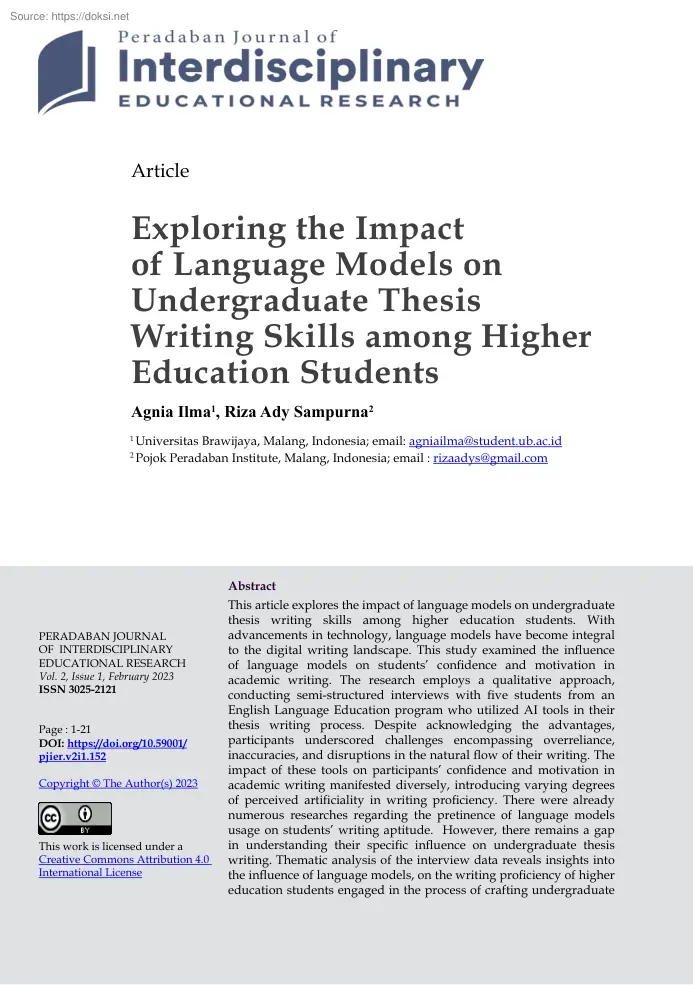
Article Exploring the Impact of Language Models on Undergraduate Thesis Writing Skills among Higher Education Students Agnia Ilma1, Riza Ady Sampurna2 1 2 Universitas Brawijaya, Malang, Indonesia; email: agniailma@student.ubacid Pojok Peradaban Institute, Malang, Indonesia; email : rizaadys@gmail.com Abstract PERADABAN JOURNAL OF INTERDISCIPLINARY EDUCATIONAL RESEARCH Vol. 2, Issue 1, February 2023 ISSN 3025-2121 Page : 1-21 DOI: https://doi.org/1059001/ pjier.v2i1152 Copyright The Author(s) 2023 This work is licensed under a Creative Commons Attribution 4.0 International License This article explores the impact of language models on undergraduate thesis writing skills among higher education students. With advancements in technology, language models have become integral to the digital writing landscape. This study examined the influence of language models on students’ confidence and motivation in academic writing. The research employs a qualitative approach, conducting
semi-structured interviews with five students from an English Language Education program who utilized AI tools in their thesis writing process. Despite acknowledging the advantages, participants underscored challenges encompassing overreliance, inaccuracies, and disruptions in the natural flow of their writing. The impact of these tools on participants’ confidence and motivation in academic writing manifested diversely, introducing varying degrees of perceived artificiality in writing proficiency. There were already numerous researches regarding the pretinence of language models usage on students’ writing aptitude. However, there remains a gap in understanding their specific influence on undergraduate thesis writing. Thematic analysis of the interview data reveals insights into the influence of language models, on the writing proficiency of higher education students engaged in the process of crafting undergraduate Peradaban Journal of Interdisciplinary Educational research 2(1)
2024 : 1-21 theses. Employing a methodology encompassing interviews, participants reported noteworthy enhancements in the coherence, clarity, grammar, syntax, and vocabulary of their theses facilitated by the utilization of these language tools. Overall, the incorporation of language models in the writing process emerged as a catalyst for heightened efficiency, skills development, and enhanced clarity in undergraduate theses, affirming the constructive role of AI technology in educational settings. Individualized experiences with language models exhibited variance contingent upon personal preferences and attitudes towards the writing process. Keyword : Language models, undergraduate thesis, writing skills, higher education INTRODUCTION In recent years, the field of education has witnessed significant advancements in technology that have revolutionized teaching and learning practices. One such technological advancement that has gained considerable attention is the use of language
models in education (Alqahtani et al., 2023; Essel et al, 2024; Kasneci et al, 2023) Language models have become integral components of the contemporary digital writing landscape, revolutionizing the way individuals engage with text and communicate ideas. The development of language models traces back to early computational linguistics research, with seminal contributions such as N-gram models and Hidden Markov Models (HMMs) laying the groundwork for subsequent advancements (Hadi et al., 2023) However, the advent of deep learning techniques, particularly recurrent neural networks (RNNs) and transformer models, has propelled language modeling to new heights (Khan et al., 2023) Models like OpenAI’s GPT (Generative Pre-trained Transformer) series and Google’s BERT (Bidirectional Encoder Representations from Transformers) have achieved remarkable performance in tasks such as text generation, language understanding, and Natural Language Processing (NLP). Language models find
applications across a wide range of domains, including NLP such as sentiment analysis, named entity recognition, and machine translation. They enable machines to understand and generate human-like text, facilitating communication between humans and computers in diverse applications (Essel et al., 2024) These models also serve as indispensable writing assistants, offering real-time feedback on grammar, syntax, and style (Alqahtani et al., 2023) Tools like Grammarly, Hemingway 2 Agnia Ilma, Riza Ady Sampurna 3 Exploring the Impact of Language Models Editor, and ProWritingAid leverage language models to help users improve the clarity, coherence, and readability of their writing. These have the capability to generate coherent and contextually relevant text across different genres and topics. They are employed in tasks such as automated content creation, text summarization, and dialogue generation, with applications in journalism, marketing, and creative writing (Hsiao et al., 2023;
Kasneci et al., 2023) Powered by artificial intelligence, language models have the potential to enhance various aspects of education, including writing skills development. The landscape of academic writing has undergone significant transformation with the advent of language models, AIpowered writing assistants, and other digital tools (Ciaccio, 2023; Hsiao et al., 2023) These technological advancements have revolutionized the way students approach thesis writing in higher education settings. As undergraduate thesis writing serves as a cornerstone of academic achievement and scholarly inquiry, understanding the influence of language models on students’ writing skills is crucial for educators, researchers, and practitioners alike (Koka et al., 2023; Olsson & Engelbrektsson, 2022). Thesis writing is a critical component of undergraduate education, serving as a culmination of students’ academic journey. However, many students face challenges when it comes to expressing their ideas
effectively (Cacciuttolo et al., 2023) and articulating them cohesively in written form (Starfield & Paltridge, 2019). Traditional approaches to thesis writing often rely on manual proofreading, editing, and revision processes, which can be time-consuming and labor-intensive. Language models, such as advanced natural language processing algorithms, can assist students in this process by providing assistance with grammar, structure, and generating coherent text, offer a promising alternative by providing automated assistance in identifying grammatical errors, enhancing clarity of expression, and improving overall coherence in writing (Alqahtani et al., 2023; Chauncey & McKenna, 2023; Essel et al., 2024; Malik et al, 2023; Song & Song, 2023) By leveraging the computational power of AI algorithms, these tools offer instant feedback and suggestions for improvement, empowering students to refine their writing skills more efficiently and effectively. Several investigations have
been carried out to explore the role of language models, driven by artificial intelligence, within the realm of education and research under various contexts such as the opportunities and challenges of language models in education (Hadi et al., 2023; Peradaban Journal of Interdisciplinary Educational research 2(1) 2024 : 1-21 Kasneci et al., 2023; Schwenke et al, 2023; Yan et al, 2024; Meyer et al., 2023), the influence of language models on tertiary education and research (Alqahtani et al., 2023; Cacciuttolo et al, 2023; Sallam, 2023; Zekaj, 2023), and the role of AI including language models in teaching and learning (Chauncey, et al., 2023; Tayan et al, 2023) Furthermore, several preceding scholars (Koka et al., 2023; Livberber & Ayvaz, 2023; Olsson & Engelbrektsson, 2022) added the body of knowledge of the academic’s responses towards artificial intelligence including language models in education. Some existing literature (Ciaccio, 2023; Gayed et al., 2022; Hsiao et
al., 2023; Malik et al, 2023; Marghany, 2023; Song & Song, 2023) also provided valuable insights into the evolving landscape of academic writing and the role of language models in shaping students’ writing practices. Studies have highlighted the benefits of integrating language models into writing instruction, including improvements in grammar proficiency, vocabulary expansion, and overall writing quality. Furthermore, some scholars have underscored the potential of language models to foster critical thinking skills, enhance student engagement, and promote self-directed learning in the writing process. However, despite the growing body of research on the topic, there remains a need for empirical studies that delve deeper into the impact of language models specifically on undergraduate thesis writing skills. To address that gap, this present study aims to investigate the effects of language models on students’ writing proficiency, exploring whether their usage leads to
improvements in the quality, clarity, and coherence of undergraduate theses and their linguistic proficiency. Furthermore, a significant gap exists in the current research literature concerning the examination of obstacles and constraints linked to the utilization of language models in the context of thesis composition. In that light, the researchers developed two research questions: 1. To what extent do language models enhance the writing proficiency and overall quality of undergraduate theses? 2. What is the influence of language models on students’ levels of confidence and motivation in the context of academic writing? By shedding light on the influence of language models on undergraduate thesis writing skills, this research aims to contribute to the existing literature on educational technology and its impact on student outcomes. Understanding the potential benefits and limitations of language models in the context of higher education can help educators and institutions make
informed decisions regarding their integration into the curriculum. The 4 Agnia Ilma, Riza Ady Sampurna 5 Exploring the Impact of Language Models findings of this study can inform educators, policymakers, and curriculum designers about the potential benefits and considerations associated with incorporating language models into writing instruction in higher education. RESEARCH METHOD This present qualitative research study aims to examine the impact of language models on the undergraduate thesis writing skills of students enrolled in English Language Education at Universitas Brawijaya during the academic year 2023. The population under investigation comprised last year’s students within this program, specifically those who engaged with AI technology to develop their undergraduate theses. Employing purposive sampling, 5 students who utilized AI tools during their undergraduate thesis writing process were selected as the sample for this study. This sampling technique allowed for a
targeted selection of participants who possessed relevant experiences with language models in thesis writing, ensuring that the data collected was rich and directly pertinent to the research focus. The primary method of data collection for this study was through semi-structured interviews with the selected sample of students. The interviews provided a platform for participants to articulate their experiences, perceptions, and insights regarding the influence of language models on their thesis writing skills. Through 10 open-ended questions, participants were encouraged to reflect on the specific ways in which language models had shaped their writing processes, strategies, and outcomes. Following data collection, thematic analysis was employed to analyze the interview transcripts. This approach involved identifying recurring patterns, themes, and concepts within the qualitative data, thereby enabling a systematic exploration of the influence of language models on undergraduate thesis
writing skills among higher education students. RESULTS AND DISCUSSION This section presents the result and provides a more extensive discussion to answer the research questions. This part details the findings and delves deeper into addressing the research query. It is organized into 5 specific areas covering enhancement of writing process efficiency, impact on writing skills development, improvement in linguistic proficiency, challenges and limitations, and perceived impact on writing confidence and motivation. Enhancement of Writing Process Efficiency The enhancement of writing process efficiency through the integration of language models was a prominent theme that emerged from the interviews conducted with undergraduate thesis students. These tools, including Peradaban Journal of Interdisciplinary Educational research 2(1) 2024 : 1-21 Grammarly, Hemingway Editor, and ProWritingAid, were reported to streamline various aspects of the writing process, thereby making it more
efficient and productive. Participants consistently highlighted the real-time feedback provided by these language models as a key factor in improving the efficiency of their writing process. By offering immediate insights into grammar, syntax, readability, and clarity, these tools enabled participants to make quick corrections and enhancements during the drafting phase of their undergraduate theses. This real-time feedback loop significantly reduced the need for extensive manual proofreading and editing, allowing participants to focus their energy and attention on crafting compelling arguments and developing their ideas. “.Language models such as grammarly helped me meticulously refine my grammar and syntax, ensuring my writing adhered to academic standards, while Hemingway Editor provided valuable insights into the readability and clarity of my prose. These tools were instrumental in streamlining my writing process, allowing me to focus more on crafting compelling arguments and less
on mundane proofreading tasks.” (P4) “.I predominantly used Grammarly and ProWritingAid to assist me throughout the writing process. Grammarly’s real-time grammar and spellchecking features helped me catch errors and improve the overall coherence of my writing. Meanwhile, ProWritingAid provided in-depth analysis of my writing style, offering suggestions to enhance clarity and conciseness.” (P2) Participants expressed appreciation for the efficiency gained through the use of language models. By automating tasks traditionally associated with proofreading and editing, such as identifying grammatical errors and suggesting improvements in writing style, these tools saved participants significant time and effort. This newfound efficiency allowed participants to allocate more time to the critical thinking and synthesis required for developing their thesis arguments, ultimately leading to a more focused and productive writing process. This finding is in line with the prior studies
(Kasneci et al., 2023; Zekaj, 2023) which found that language models automated tasks like spotting grammatical mistakes and suggesting improvements in writing style, tasks that would typically consume a lot of energy and time during manual proofreading and editing. With this efficiency, students found they could invest more of their time and effort into the critical aspects of their thesis, such as engaging in deep thinking and synthesizing ideas. 6 Agnia Ilma, Riza Ady Sampurna 7 Exploring the Impact of Language Models This shift in focus toward the substance of their writing ultimately led to higher-quality and more coherent undergraduate theses. Additionally, the other participants provided a nuanced understanding of how language models, particularly Grammarly, Scribbr, Ginger, and WhiteSmoke, contribute to enhancing undergraduate thesis writing skills among higher education students. The interview result demonstrated how language models contribute to refining writing quality
and precision. Participants noted the transformative impact of Grammarly, Scribbr, Ginger, and WhiteSmoke, in identifying and rectifying grammatical errors, maintaining consistency, coherence, and enhancing writing style. This suggests that language models serve as invaluable allies in the pursuit of writing excellence, offering indispensable support in identifying and rectifying errors and inconsistencies. This result aligns with that of the prior investigation (Myers et al., 2023) which found that Large language models can be used to identify (possible) grammatical problems at the semantic level and recommend appropriate and customized remediation techniques. The simplest assistance can be provided at the syntactic level, which involves finding and fixing errors. Additionally, large language models can help instructors in college and high school accomplish research and writing assignments (such as seminar works, paper writing, and student feedback) more quickly and successfully. “I
used tools like Grammarly, Scribbr, Ginger, and WhiteSmoke to provide invaluable assistance in identifying and correcting errors, ensuring that my writing is clear, concise, and grammatically correct. Unlike traditional proofreading methods, which can be time-consuming and prone to oversight, language models offer a fast and reliable way to improve the quality of my writing. Additionally, these tools have helped me maintain consistency in style and tone throughout my thesis, enhancing its overall coherence and readability.” (P5) The findings underscore the transformative impact of language models on undergraduate thesis writing skills. By offering comprehensive support, ensuring linguistic accuracy and academic integrity, refining writing quality and precision, and fostering confidence and precision, these tools empower students to produce scholarly and polished theses. Thus, the integration of language models into the writing process represents a valuable asset for undergraduate
students seeking to excel in academic writing and scholarly communication. Peradaban Journal of Interdisciplinary Educational research 2(1) 2024 : 1-21 Impact on Writing Skills Development Language models were found to have a positive impact on the development of thesis writing skills, particularly in terms of organization, coherence, and clarity of expression. Participants noted that the tools helped them identify and restructure awkward or unclear sentences, resulting in a more logically structured and coherent thesis. Additionally, language models improved the overall clarity and readability of their writing by suggesting alternative word choices and offering insights into sentence structure. By providing real-time feedback and suggestions, these tools enabled students to recognize areas where their writing lacked clarity or coherence. Through features such as grammar and style checks, participants were able to pinpoint problematic sentences and restructure them to enhance
logical flow and coherence. This process not only improved the overall structure of the thesis but also contributed to a more cohesive and logically connected narrative. “.One significant way they (language models) have influenced my writing is by improving the organization of my ideas. Grammarly and ProWritingAid helped me identify and restructure awkward or unclear sentences, ensuring a logical flow of information throughout my thesis. Additionally, these language models enhanced the coherence of my writing by suggesting transitional phrases and improving the connections between paragraphs. By providing instant feedback on sentence structure and overall readability, they also contributed to the clarity of expression in my thesis, helping me convey complex ideas more effectively.” (P1) “.Hemingway Editor and WhiteSmoke helped me identify areas of my thesis that lacked clarity or coherence, allowing me to restructure and refine my arguments for greater effectiveness. Furthermore,
these language models played a crucial role in enhancing the coherence of my writing by suggesting improvements to sentence structure and providing feedback on overall readability. Their ability to highlight areas for improvement and offer suggestions in real-time greatly contributed to the clarity of expression in my thesis.” (P3) Furthermore, language models played a crucial role in improving the clarity and readability of participants’ writing. By suggesting alternative word choices and offering insights into sentence structure, these tools helped participants refine their prose to ensure clarity and comprehension. Suggestions for alternative phrasing or word usage allowed participants to convey their ideas more effectively, making their writing more accessible to readers. Additionally, insights into sentence structure encouraged 8 Agnia Ilma, Riza Ady Sampurna 9 Exploring the Impact of Language Models participants to vary their sentence lengths and structures, enhancing
readability and maintaining reader engagement throughout the thesis. Participants also highlighted how Grammarly, ChatGPT, and Scribbr aided in identifying and reorganizing sections of their theses to create a more logical flow of information. These tools enhanced the coherence of their writing by suggesting transitions between paragraphs and offering suggestions to improve the overall structure of their arguments. This comprehensive feedback not only improved the flow of their arguments but also contributed to the overall clarity of expression in their theses. “.these language models enhanced the coherence of my writing by suggesting transitions between paragraphs and offering suggestions to improve the overall structure of my arguments. By providing detailed feedback on sentence structure and grammar, they also contributed to the clarity of expression in my thesis, helping me communicate my ideas more effectively to my readers.” (P5) “Tools like Grammarly, ChatGPT, and Scribbr
helped me identify areas of my thesis that needed restructuring or clarification, allowing me to create a more cohesive and well-structured argument. These language models also helped me in enhancing the coherence of my writing by suggesting transitions between paragraphs and offering feedback on the overall flow of my arguments. By providing instant feedback on grammar and sentence structure, they also contributed to the clarity of expression in my thesis, ensuring that my ideas were communicated effectively to my readers.” (P2) The results highlight how language models significantly transform undergraduate thesis writing skills. They improve coherence by suggesting changes in sentence structure and paragraph transitions, while enhancing clarity with feedback on grammar and readability. Consequently, these tools are essential for students aiming to refine their thesis writing skills and create high-quality academic work. In addition, Meyer et al (2023) emphasized language models are
editing tools that base their suggestions and adjustments on human-written texts. This procedure is comparable to asking a friend or coworker to provide feedback and proofread a sample of students’ writing. As such, utilizing language models with pre-written material is unlikely to give rise to ethical issues like plagiarism, which can happen when language models are used for prompt-based text generation. Peradaban Journal of Interdisciplinary Educational research 2(1) 2024 : 1-21 Improvement in Linguistic Proficiency The interview conducted unveiles a multifaceted enhancement in participants’ language skills facilitated by the integration of language models into their writing processes. Participants universally acknowledged the significant role of language models, encompassing Grammarly, Hemingway Editor, ProWritingAid, Scribbr, ChatGPT, Ginger, Quillbot, and WhiteSmoke, in bolstering their linguistic proficiency across various dimensions of writing. Firstly, participants
emphasized the pivotal impact of these tools on their grammar skills. By swiftly identifying and rectifying grammatical errors in real-time, language models ensured the linguistic accuracy and correctness of participants’ writing. This instant feedback mechanism not only served to eradicate errors but also acted as a valuable educational resource, offering insights into grammar rules and conventions. “.Grammarly and Hemingway Editor have greatly improved my grammar skills by highlighting and correcting grammatical errors in real-time.” (P4) “In my experience, language models such as Grammarly, ChatGPT, and Ginger have had a significant impact on my language proficiency in various areas. Firstly, these tools have greatly improved my grammar skills by identifying and correcting grammatical errors in my writing, ensuring linguistic accuracy.” (P3) In accordance with the previous research (Hapsari & Wu, 2022), Grammarly represented an AI-driven writing assistance tool
designed to augment users’ writing proficiency by delivering immediate feedback on grammar, spelling, and style. The AI algorithms inherent in Grammarly meticulously analyze learners’ texts, furnishing precise feedback to enhance the clarity and precision of their writing . Another noteworthy tool, ProWritingAid, similarly harnesses AI algorithms to assess users’ writing and furnish recommendations for refining grammar, style, and readability. ProWritingAid leverages AI-powered functionalities to aid learners in cultivating adept writing skills by identifying common errors and offering comprehensive enhancements to the writing content. Furthermore, participants noted a substantial expansion in their vocabulary attributable to the suggestions provided by language models. Through offering synonyms and alternative word choices, these tools encouraged participants to diversify their language use, enriching their writing with more varied and precise vocabulary. This augmentation in
vocabulary not only elevated the sophistication of their writing but also empowered them to articulate complex ideas with greater clarity and nuance. 10 Agnia Ilma, Riza Ady Sampurna 11 Exploring the Impact of Language Models QuillBot and ChatGPT serve as writing support tools employing artificial intelligence to assist learners in refining their writing skills. Consistent with the findings of Deng and Yu (2023), these tools provide recommendations for alternative sentence structures, the rephrasing of ideas, and enhancements to improve overall clarity. In addition, ChatGPT goes beyond by generating language texts that foster creativity in learners’ writing skills. The AI algorithms embedded in QuillBot present users with diverse options to elevate their writing capabilities, fostering creativity and advancing their overall proficiency in writing. “Additionally, they (ProWritingAid and Scribbr) have been instrumental in expanding my vocabulary by suggesting alternative word
choices and providing synonyms for commonly used terms.” (P1) “Quillbot and WhiteSmoke have helped me find new words by suggesting synonyms and different ways to say things, which has made my writing more varied.” (P3) Additionally, language models played a pivotal role in refining participants’ syntax. By offering suggestions on sentence structure and phrasing, these tools facilitated the construction of clearer, more concise, and logically coherent sentences. Participants highlighted the invaluable contribution of language models in enhancing the overall readability and coherence of their writing, thus making it more engaging and comprehensible to readers. “I think language models have had a significant impact on my syntax, helping me construct clearer and more concise sentences through suggestions on sentence structure and phrasing.” (P5) “.Also, language tools have been really helpful in improving how I structure my syntax or my sentences. They give me advice on how
to organize my sentences better, which makes them clearer and more elegant.” (P1) The unanimous consensus among participants regarding the transformative impact of language models on their linguistic proficiency underscores the significance of these tools in academic writing contexts. By addressing grammar errors, expanding vocabulary, and refining syntax, language models emerged as indispensable assets for students aiming to elevate the quality, clarity, and professionalism of their written work. Thus, the integration of language models represents a pivotal strategy for enhancing linguistic proficiency and fostering academic excellence among undergraduate students in higher education settings. Peradaban Journal of Interdisciplinary Educational research 2(1) 2024 : 1-21 Challenges and Limitations Despite the benefits, participants also encountered challenges and limitations when using language models for thesis writing. Participants faced several challenges and limitations when
utilizing language models for thesis writing, indicating complexities inherent in their integration into the writing process. One significant obstacle mentioned by participants was the risk of overreliance on these tools, which sometimes resulted in a loss of individual voice and style. While language models excel in error detection and suggestion provision, excessive dependence on them can homogenize writing styles, diluting the authenticity of the writer’s voice. “Yes, I did encounter some challenges and limitations when using language models for thesis writing. One significant challenge was the overreliance on these tools, which sometimes led to a loss of my own voice in the writing process.” (P1) “I found that language models could be overly prescriptive at times, leading to a loss of creativity and originality in my writing.” (P4) Moreover, participants encountered issues regarding the accuracy of suggestions provided by language models, particularly concerning
contextspecific terminology or niche subjects. This discrepancy necessitated caution and cross-referencing with additional sources to ensure the precision and relevance of the content. Additionally, participants noted instances where suggestions disrupted the natural flow of their writing, requiring manual adjustments to maintain coherence and readability. Participants also noted the need for careful evaluation and adjustment of suggestions provided by language models to ensure alignment with their intended message and the specific requirements of their thesis. Furthermore, challenges arose from the limitations of language models in understanding context-specific nuances or disciplinary conventions. Suggestions occasionally lacked appropriateness for the academic context of the thesis, reflecting a gap in the tool’s understanding of specialized fields. Participants also observed that language models could be overly prescriptive at times, stifling creativity and originality in their
writing. In accordance with prior investigations (Alkhawaldeh, M.A, Khasawneh, M.AS, 2023), conventional learning methods have been recognized for their advantages, yet they exhibit limitations in the context of enhancing oral communication skills. The emphasis placed on the development of written language skills in textbooks often neglects the essential aspect of oral communication. This oversight poses challenges for 12 Agnia Ilma, Riza Ady Sampurna 13 Exploring the Impact of Language Models learners in seamlessly incorporating information acquired through writing assignments into dynamic, real-time discussions. Despite the provision of controlled environments for speaking practice in language labs, these setups often lack stability and fall short of accurately replicating the intricate nature of human communication. These inherent constraints may impede students from attaining the foundational fluency and communication skills necessary for real-world applications. The findings
underscore the need for instructional strategies that holistically address both written and oral aspects of language acquisition to ensure comprehensive language proficiency. “Another limitation I faced was the occasional inaccuracy of suggestions provided by these tools, particularly in context-specific terminology or niche subjects. This required me to exercise caution and cross-reference suggestions with additional sources to ensure accuracy. Additionally, there were times when the suggestions provided by language models disrupted the flow of my writing, requiring me to manually adjust the phrasing to maintain coherence.” (P5) “Yes, I did face some challenges when using language models for my thesis. One problem was that sometimes these tools didn’t understand specific details or rules from my field of study. This meant that sometimes the suggestions they gave weren’t quite right for the academic style of my thesis.” (P2) “One challenge was the occasional inconsistency
in the suggestions provided by these tools, particularly across different platforms or software versions.” (P3) Technical constraints, such as the requirement for constant internet connectivity to access certain features, posed logistical challenges, particularly in environments with limited or unstable internet access. This dependency on internet connectivity added complexity to the writing process, potentially disrupting workflow and productivity. “Another problem was that I always needed the internet to use the language models. This made things difficult when I didn’t have a good internet connection or when it was unreliable.” (P1) Despite these challenges, participants recognized the value of language models as complementary aids in the thesis writing process. With careful consideration and moderation, participants navigated these hurdles, leveraging the benefits of language models while mitigating their limitations. By exercising critical thinking and manual intervention,
participants ensured the integrity and quality of their thesis writing, underscoring the importance Peradaban Journal of Interdisciplinary Educational research 2(1) 2024 : 1-21 of a balanced approach to the integration of language models in academic writing practices. “Even though there were difficulties, I managed to deal with them by using language models alongside complementary tools, instead of depending on them alone for everything in my thesis writing.” (P4) “Even with these problems, I discovered that if I used language models carefully and not too much, they were still helpful for my thesis writing.” (P2) Perceived Impact on Writing Confidence and Motivation The interview result shows that the participants expressed a nuanced view, acknowledging that while the tools provide support and guidance, their confidence in producing academic writing remains tempered by concerns about originality and depth of content. This suggests a critical awareness of the limitations of
relying solely on automated assistance and the importance of maintaining authenticity in their work. They perceived a modest boost in confidence attributed to the tools’ assistance, albeit with minimal impact on their perceived level of writing proficiency. Their heavy reliance on the tools for corrections may reflect a cautious approach to skill development, where the tools serve as a safety net rather than a catalyst for growth. “While the tools provided a sense of support and guidance, my confidence in producing academic writing remained tempered by concerns of originality and depth of content.” (P1) “My confidence in producing academic writing was marginally boosted by the tools’ assistance, but my perceived level of writing proficiency remained relatively unchanged as I relied heavily on the tools for corrections.” (P2) Participants’ mixed experience highlights the complex interplay between the benefits and drawbacks of language model usage. While the tools provide a
safety net and improve the overall quality of their writing, lingering doubts about authenticity and depth of work slightly diminish their confidence. This suggests a need for reassessment of tool usage to address underlying concerns and foster greater confidence in their writing abilities. Participants in this present study reported that their confidence in producing academic writing remains relatively unaffected by the tools, indicating a balanced perspective on the benefits and limitations of automated assistance. Their awareness of the tools’ inherent constraints underscores a mature understanding of the role of technology in the writing process. 14 Agnia Ilma, Riza Ady Sampurna 15 Exploring the Impact of Language Models “The use of language models had a mixed impact on my confidence in producing academic writing. While they provided a safety net and improved the overall quality of my writing, there was a lingering doubt about the authenticity and depth of my work, which
slightly affected my confidence.” (P4) “While the tools provided some reassurance, my confidence in producing academic writing remained relatively unaffected, as I was aware of the limitations of relying solely on automated assistance.” (P3) In contrast, one participant under this study perceived confidence is notably bolstered by the tools’ assistance, leading to an increased perceived level of writing proficiency. The tools’ contributions to refining grammar, syntax, and vocabulary choices, as well as enhancing structural and organizational skills, contribute to a significant boost in confidence. This suggests a transformative impact of language models in enhancing writers’ confidence and perceived proficiency in academic writing. “The use of language models bolstered my confidence in producing academic writing. Their assistance in refining grammar, syntax, and vocabulary choices not only improved the quality of my writing but also enhanced my structural and
organizational skills. This boost in confidence was reflected in an increased perceived level of writing proficiency.” (P5) Furthermore, regarding their motivation to write undergraduate theses, 3 out of 5 participants indicated that language models had minimal impact on their motivation to write undergraduate theses. Their primary drive was to complete the thesis under challenging circumstances, suggesting that external factors may have played a more dominant role in motivating their writing efforts. They admitted to preferring shortcuts over investing substantial effort in improving writing proficiency, indicating a reliance on quick fixes rather than intrinsic motivation. They also suggested that their reliance on quick fixes overshadowed any intrinsic motivation to improve writing skills, implying a preference for convenience over the effort required for skill development. “The use of language models did not significantly impact my intrinsic motivation in academic writing, as
the primary drive was to complete the thesis under challenging circumstances.” (P1) “The use of language models did not significantly affect my motivation in academic writing as I preferred shortcuts over investing substantial effort in improving my writing proficiency.” (P2) Peradaban Journal of Interdisciplinary Educational research 2(1) 2024 : 1-21 “The use of language models did not significantly boost my motivation in academic writing, as my reliance on quick fixes overshadowed the intrinsic motivation to improve my writing skills.” (P3) However, 2 out of 5 participants under this study provided a contrasting perspective, indicating that the utilization of language models positively impacted their motivation in academic writing. Despite initial hesitations, they found that the tools’ assistance and feedback boosted their motivation by offering valuable support and guidance. This enhancement in motivation was accompanied by an improvement in their perceived level
of writing proficiency, motivating them to strive for higher quality output. They highlighted that using language models did affect their motivation. Initially hesitant, they found that the tools’ assistance and feedback gradually boosted their motivation by providing a sense of support and guidance. However, they also expressed concern that their perceived level of writing proficiency felt somewhat artificial due to heavy reliance on the tools for corrections. “The utilization of language models positively impacted my motivation in academic writing. Despite initial hesitations, the tools’ assistance and feedback boosted my motivation by offering valuable support and guidance. This enhancement in motivation also contributed to an improvement in my perceived level of writing proficiency, motivating me to strive for higher quality output.” (P5) “Using language models did affect my motivation. Initially hesitant, the tools’ assistance and feedback gradually boosted my
motivation by providing a sense of support and guidance. However, my perceived level of writing proficiency felt somewhat artificial, as I relied heavily on the tools for corrections.” (P4) All in all, the findings of this study agree with the results of the preceding study (Song, C., & Song, Y, 2023) which highlighted the integration of AI technology into the instructional framework for writing yielded significant enhancements in participants’ motivation and engagement. The consistency between the current study’s findings and those of Song and Song supports the positive impact of incorporating AI in writing instruction, underscoring its potential to not only augment learning outcomes but also foster heightened levels of motivation and engagement among participants. These shared insights contribute to the growing body of evidence supporting the beneficial influence of AI in educational contexts, particularly in the domain of writing instruction. Furthermore, while some
participants did not experience a significant impact on their motivation or perceived level of writing proficiency, others found that the use of language models positively influenced their motivation 16 Agnia Ilma, Riza Ady Sampurna 17 Exploring the Impact of Language Models and confidence in academic writing. These findings suggest that the perceived impact of language models on writing confidence and motivation may vary among individuals, influenced by factors such as personal preferences, attitudes towards writing, and the extent of reliance on external tools for support. CONCLUSION The incorporation of language models into the undergraduate thesis writing process has proven highly advantageous, yielding increased efficiency, enhanced writing skills, and a heightened sense of confidence among students. Utilizing tools such as Grammarly, Hemingway Editor, and ProWritingAid has facilitated a smoother writing experience, resulting in more productive and cohesive theses. These
tools not only identified and restructured improper expressions but also elevated the overall clarity and readability of students’ writing, contributing to a logically structured narrative. The pivotal role of language models in refining the prose of the theses, through suggestions for alternative word choices and insights into sentence structure, has made the theses more accessible and engaging for readers. While participants acknowledged the positive impact of language models on their writing quality, concerns were expressed about potential over-reliance, affecting confidence and authenticity in academic writing. Despite these challenges, students recognized the value of language models as supplementary aids, emphasizing the need for a balanced approach that integrates critical thinking and manual intervention to uphold the integrity and quality of their work. This nuanced perspective underscores the importance for students to judiciously use language models alongside complementary
tools to maximize benefits while mitigating limitations. The presented findings contribute to the existing literature on educational technology and its influence on student outcomes, particularly within the domain of undergraduate thesis writing. By automating proofreading and editing tasks, language models have saved students considerable time and effort, allowing for a more focused approach to critical thinking and synthesizing ideas, ultimately resulting in higher-quality and more coherent theses. Participants attested to the significant enhancement of writing coherence through tools like Grammarly, ChatGPT, and Scribbr, which suggested transitions between paragraphs and offered feedback on argument structure, thereby enhancing overall expression clarity in their theses. This qualitative research underscores the transformative impact of language Peradaban Journal of Interdisciplinary Educational research 2(1) 2024 : 1-21 models on undergraduate thesis writing skills,
emphasizing the need for a well-balanced approach that combines automated assistance with manual intervention to safeguard the authenticity and quality of academic work. Valuable insights from these findings can inform educators, policymakers, and curriculum designers about the potential benefits and considerations associated with the integration of language models into higher education writing instruction. Future research endeavors should continue delving into the influence of language models on students’ confidence, motivation, and writing proficiency to optimize their effective integration. REFERENCES Alkhawaldeh, M.A, Khasawneh, MAS (2023) Language Learning Tools And Improvements In Speaking And Writing Skills. Journal of Southwest Jiaotong University, 58(5). https://doiorg/1035741/ issn.0258-272458533 Alqahtani, T., Badreldin, H A, Alrashed, M, Alshaya, A I, Alghamdi, S. S, Alowais, S A, & Albekairy, A M (2023) The emergent role of artificial intelligence, natural learning
processing, and large language models in higher education and research. Research in Social & Administrative Pharmacy: RSAP, S1551-7411. https://doi org/10.1016/jsapharm202305016 Cacciuttolo, C., Vásquez, Y, Cano, D, & Valenzuela, F (2023) Research Thesis for Undergraduate Engineering Programs in the Digitalization Era: Learning Strategies and Responsible Research Conduct Road to a University Education 4.0 Paradigm Sustainability, 15(14), 11206 https://doi.org/103390/su151411206 Ciaccio, E. J (2023) Use of artificial intelligence in scientific paper writing Informatics in Medicine Unlocked, 101253. https://doiorg/101016/j imu.2023101253 Chauncey, S. A, & McKenna, H P (2023) A framework and exemplars for ethical and responsible use of AI Chatbot technology to support teaching and learning. Computers and Education: Artificial Intelligence, 5, 100182. https://doiorg/101016/jcaeai2023100182 Deng, X., & Yu, Z (2023) A meta-analysis and systematic review of the effect of
chatbot technology use in sustainable education. Sustainability, 15(4), 2940. https://doiorg/103390/su15042940 El Shazly, R. (2021) Effects of artificial intelligence on English speaking anxiety and speaking performance: A case study. Expert Systems, 38(3), 12667. https://doiorg/101111/exsy12667 18 Agnia Ilma, Riza Ady Sampurna 19 Exploring the Impact of Language Models Essel, H. B, Vlachopoulos, D, Essuman, A B, & Amankwa, J O (2024) ChatGPT effects on cognitive skills of undergraduate students: Receiving instant responses from AI-based conversational large language models (LLMs). Computers and Education: Artificial Intelligence, 6, 100198. https://doiorg/101016/jcaeai2023100198 Gayed, J. M, Carlon, M K J, Oriola, A M, & Cross, J S (2022) Exploring an AI-based writing Assistant’s impact on English language learners. Computers and Education: Artificial Intelligence, 3, 100055. https:// doi.org/101016/jcaeai2022100055 Hadi, M. U, Qureshi, R, Shah, A, Irfan, M, Zafar, A,
Shaikh, M B, & Mirjalili, S. (2023) A survey on large language models: Applications, challenges, limitations, and practical usage. Authorea Preprints https://doi.org/1036227/techrxiv23589741v1 Hadi, M. U, Qureshi, R, Shah, A, Irfan, M, Zafar, A, Shaikh, M B, & Mirjalili, S. (2023) Large language models: a comprehensive survey of its applications, challenges, limitations, and future prospects. Authorea Preprints. https://doiorg/1036227/techrxiv23589741v4 Hapsari, I.P and Wu, TT (2022) AI Chatbots Learning Model in English Speaking Skill: Alleviating Speaking Anxiety, Boosting Enjoyment, and Fostering Critical Thinking. Innovative Technologies and Learning: 5th International Conference, Online, August 2022. Cham: Springer International Publishing, 444-453. https://doiorg/101007/978-3031-15273-3 49 Hsiao, Y. P, Klijn, N, & Chiu, M S (2023) Developing a framework to redesign writing assignment assessment for the era of Large Language Models. Learning: Research and Practice,
9(2), 148-158 https://doi org/10.1080/2373508220232257234 Kasneci, E., Seßler, K, Küchemann, S, Bannert, M, Dementieva, D, Fischer, F., & Kasneci, G (2023) ChatGPT for good? On opportunities and challenges of large language models for education. Learning and individual differences, 103, 102274. https://doiorg/101016/j lindif.2023102274 Khan, W., Daud, A, Khan, K, Muhammad, S, & Haq, R (2023) Exploring the frontiers of deep learning and natural language processing: A comprehensive overview of key challenges and emerging trends. Natural Language Processing Journal, 100026. https://doi org/10.1016/jnlp2023100026 Koka, N. A, Khan, A S, & Jan, N (2023) Exploring the attitudes and perceptions of foreign language lecturers on artificial intelligence-driven writing evaluation and feedback tools for improving undergraduate writing skills. Journal of Southwest Jiaotong University, 58(5) https:// Peradaban Journal of Interdisciplinary Educational research 2(1) 2024 : 1-21
doi.org/1035741/issn0258-27245856 Livberber, T., & Ayvaz, S (2023) The impact of Artificial Intelligence in academia: Views of Turkish academics on ChatGPT. Heliyon, 9(9), 19688. https://doiorg/101016/jheliyon2023e19688 Malik, A. R, Pratiwi, Y, Andajani, K, Numertayasa, I W, Suharti, S, & Darwis, A. (2023) Exploring Artificial Intelligence in Academic Essay: Higher Education Student’s Perspective. International Journal of Educational Research Open, 5, 100296. https://doiorg/101016/j ijedro.2023100296 Marghany, M. M (2023) Using artificial intelligence-based instruction to develop EFL higher education students’ essay writing skills. CDELT Occasional Papers in the Development of English Education, 82(1), 219-240. https://doiorg/1021608/OPDE2023313623 Meyer, J. G, Urbanowicz, R J, Martin, P C, O’Connor, K, Li, R, Peng, P C., & Moore, J H (2023) ChatGPT and large language models in academia: opportunities and challenges. BioData Mining, 16(1), 20
https://doi.org/101186/s13040-023-00339-9 Myers, D., Mohawesh, R, Chellaboina, V I, Sathvik, A L, Venkatesh, P, Ho, Y. H, & Jararweh, Y (2023) Foundation and large language models: fundamentals, challenges, opportunities, and social impacts. Cluster Computing, 1-26. https://doiorg/101007/s10586-023-042037 Olsson, A., & Engelbrektsson, O (2022) A thesis that writes itself: On the threat of AI-generated essays within academia. https://urnkbse/resol ve?urn=urn:nbn:se:hh:diva-47095 Sallam, M. (2023) The utility of ChatGPT as an example of large language models in healthcare education, research and practice: Systematic review on the future perspectives and potential limitations. medRxiv, 2023-02. https://doiorg/101101/2023021923286155 Song, C., & Song, Y (2023) Enhancing academic writing skills and motivation: assessing the efficacy of ChatGPT in AI-assisted language learning for EFL students. Frontiers in Psychology, 14, 1260843 https://doi.org/103389/fpsyg20231260843
Schwenke, N., Söbke, H, & Kraft, E (2023) Potentials and Challenges of Chatbot-Supported Thesis Writing: An Autoethnography. Trends in Higher Education, 2(4), 611-635. https://doiorg/103390/ higheredu2040037 Starfield, S., & Paltridge, B (2019) Thesis and dissertation writing in a second language: Context, identity, genre. Journal of Second Language Writing, 43, 1-3. https://doiorg/101016/jjslw201810002 Tayan, O., Hassan, A, Khankan, K, & Askool, S (2023) Considerations for 20 Agnia Ilma, Riza Ady Sampurna 21 Exploring the Impact of Language Models adapting higher education technology courses for AI large language models: A critical review of the impact of ChatGPT. Machine Learning with Applications, 100513. https://doiorg/101016/j mlwa.2023100513 Yan, L., Sha, L, Zhao, L, Li, Y, Martinez Maldonado, R, Chen, G, & Gašević, D. (2024) Practical and ethical challenges of large language models in education: A systematic scoping review. British Journal of
Educational Technology, 55(1), 90-112. https:// doi.org/101111/bjet13370 Zekaj, R. (2023) AI Language Models as educational allies: enhancing instructional support in higher education. International Journal of Learning, Teaching and Educational Research, 22(8), 120-134. https:// doi.org/1026803/ijlter2287
 Írásunkban a műelemzések készítésének módszertanát járjuk körül. Foglalkozunk az elemzés főbb fajtáival, szempontjaival és tanácsokat adunk az elemzés legfontosabb tartalmi elemeivel kapcsolatban is. Módszertani útmutatónk főként tanulók számára készült!

