Értékelések
 2021 · 29 oldal (2 MB)
 angol
angol
 2
2
 2026. február 25.

 Jelentkezz be

 Beágyazás
Nincs még értékelés. Legyél Te az első!
Mit olvastak a többiek, ha ezzel végeztek?

Tartalmi kivonat
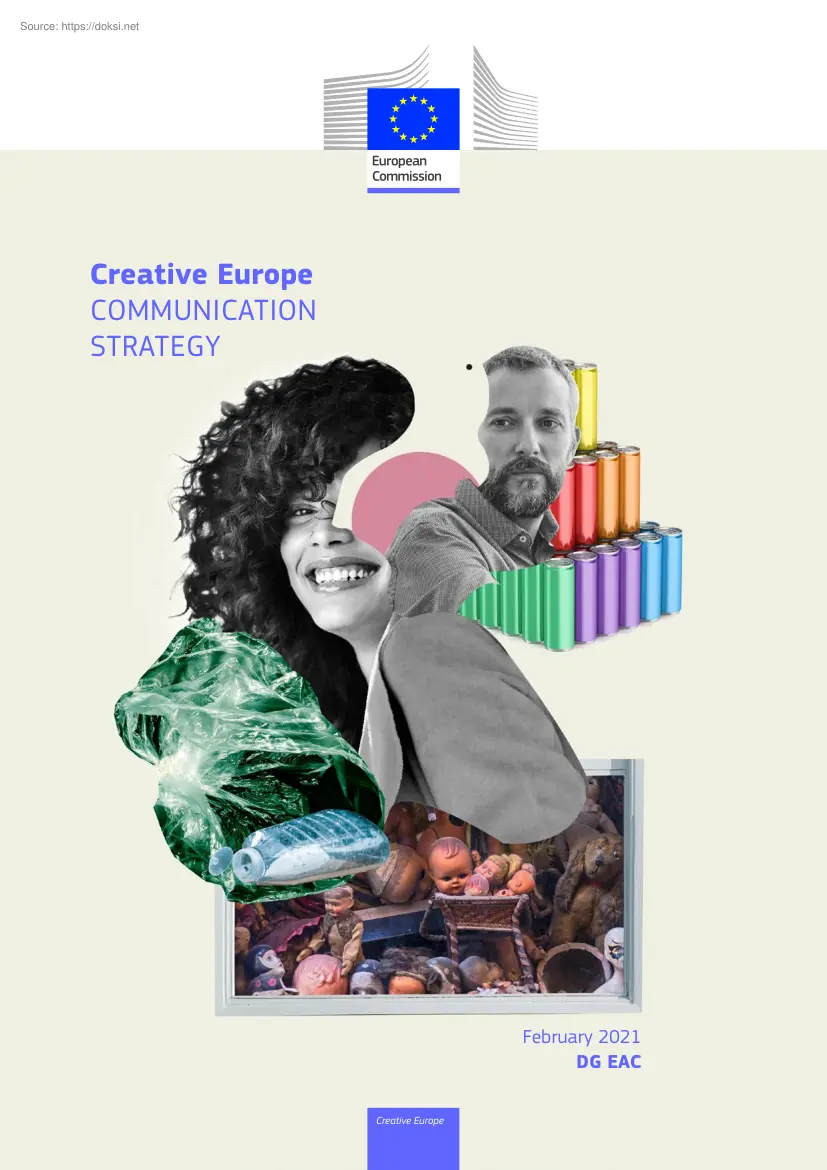
Creative Europe COMMUNICATION STRATEGY February 2021 DG EAC Creative Europe Source: CREATIV https://doksi.net E EUROPE | COMMUNICA TION STRATEGY Table of contents 1. Executive summary.2 2. Introduction.3 2.1 2.2 2.3 3. Research highlights .5 3.1 3.2 3.3 4. Desk research.5 Interviews.5 Key findings.6 Goals and objectives .9 4.1 4.2 5. Context .3 Strategy development.3 Methodological approach.3 General aim and overall ambition .9 Specific communication objectives .9 SWOT analysis . 10 5.1 Key challenges . 10 6. Target audience . 11 7. Key messages . 14 7.1 7.2 8. Communication approach . 17 8.1 8.2 8.3 9. Positioning . 14 Messaging matrix . 15 Tone of voice. 17 Vocabulary . 18 DOs and DON’Ts . 18 Creative approach. 19 9.1 9.2 Creative concept. 19 Key visuals. 20 10. Outreach approach 23 10.1 European and national communication 23 10.2 Tools and tactics 24 11. Monitoring and evaluation 28 CREATIV E EUROPE | COMMUNICA TION STRATEGY 1. Executive summary
Europe’s cultural and creative sectors are important, showcasing the diversity that different cultures bring to the European stage. As the only programme focused solely on supporting the cultural and creative sectors, Creative Europe is needed more than ever, given the significant impact of COVID-19 on these sectors. This document explores in detail how the Creative Europe strategy and creative concept were developed and formed through research; interviews with experts, stakeholders and beneficiaries; focus groups; and stakeholder mapping and analysis. The strategy also takes into account the principles of the European Agenda for Culture (2018), along with political principles, e.g the EU Green Deal Key findings I. The programme will focus on sectoral projects (music, architecture, etc) and the i-Portunus mobility scheme. II. The programme should be more aligned with the European Agenda for Culture and other major EU policies. III. Focus will be on the impact of COVID-19 on the
cultural and creative sectors, which needs to be taken into consideration within any future communication campaign. In the words of Sabine Verheyen, Chair of the European Parliament’s Committee for Culture and Education, ‘Europe risks losing its heart and soul.’ Therefore, within the approach, there needs to be an emphasis on support schemes, which are now more important than ever. On this basis, the diverse target audience to be covered in the communication strategy are: + Potential applicants (organisations and enterprises from the creative sector, as well as artists); + Direct beneficiaries (organisations and enterprises who have already participated in Creative Europe); + Stakeholders and multipliers (organisations and institutions influencing the way Creative Europe is deployed in Member States); + European citizens (audiences for different projects and special actions); + Decision makers (who enhance future financial and political support for the programme at EU, national
and local level). The creative concept for communication has been defined as: Push Boundaries. This concept has been rated as diverse and engaging. It appeals to the target audiences and sets the tone of voice for telling the story of Creative Europe. The creative concept will be explored in detail in Section 9 (p 17) Page | 2 CREATIV E EUROPE | COMMUNICA TION STRATEGY 2. Introduction 2.1 Context Creative Europe is the only European programme uniquely focusing on supporting the cultural and creative sectors. The 2021–2027 programme continues as a stand-alone programme The proposal for a regulation establishing the Creative Europe Programme (2021–2027) retains the programme’s three-strand structure. 1. Culture: cross-border movement; participation and social inclusion; growth and job creation; arts education enhancing European values and identity; and international outreach and diplomacy. 2. Media: new talents, skills, innovation and cooperation in the audio-visual sector;
new business models and technologies enhancing wider access to, and promotion of, European audio-visual works beyond borders; and theatrical and online distribution. 3. Cross sectoral: an approach combining culture and media (arts, technology, business) in creating, distributing, promoting and accessing content, quality journalism, media pluralism, literacy and culture through social inclusion. Creative Europe does not exist in isolation and must be fully aligned with the policy principles of the European Agenda for Culture (2018), which sets out the policy for the EU’s work on culture along with the other political priorities (the EU Green Deal, gender equality, etc.) Please note that the media strand is managed by DG Connect and is therefore not part of this communication strategy. 2.2 Strategy development The following steps are covered in this strategy document: 1. Research + Desk research + In-depth interviews with programme experts, key stakeholders and beneficiaries + Focus
groups with key stakeholders and beneficiaries 2. Stakeholder mapping and analysis 3. Development of communication strategy 4. Development of creative concept 2.3 Methodological approach The key steps are summarised below. STEP 1 Research and analysis Purpose Process Deliverable(s) Understand policy, context, innovations, audiences, challenges. Define inspiring insights and strategic direction. Desk research – social media listening, review of relevant documents. Creative brief. Research report. In-depth interview. Focus groups. Page | 3 CREATIV E EUROPE | COMMUNICA TION STRATEGY STEP 2 Creative concepts development Develop a long-term creative storytelling approach for the new Creative Europe programme. Creative team’s ideation process. Creation of Manifesto, and look and feel/ graphic approach to tell the story. 3 different creative routes. Selected route to be developed. STEP 3 Communication strategy development Highlight strategic recommendations for the
communication approach and actions in the years to come. Based on research findings, selected creative route and had ongoing feedback sessions with various DG EAC units. Communication strategy document. STEP 4 Creative assets and guidelines Provide ready-to-use materials and inspire content creators to develop their own materials. Range of specific assets based on immediate needs. Guidance for other appropriate communication tools and actions. Key creative assets and guidelines document. Page | 4 CREATIV E EUROPE | COMMUNICA TION STRATEGY 3. Research highlights 3.1 Desk research The desk research consisted of three elements: 1. Review and analysis of key documents + Creative Europe Monitoring Report 2019 + Creative Europe Monitoring Report 2018 + Interim evaluation of the Creative Europe Programme and ex-post evaluation of the Culture, MEDIA 2007 and MEDIA Mundus programmes + Evaluation of the European Heritage Label Action + Dissemination and exploitation of programme
results strategy 2. Social media listening and research + Social media listening was conducted for the period from 1 September 2020 to 13 November 2020 and aimed to identify insights such as: sentiments and feelings towards the programme; key topics, events and communication hooks; and top influencers. + The social media research also provided an overview of the key social media channels for Creative Europe at European and national level; top organic posts; and types of content targeting different audiences. + All insights served as a basis for discussion with DG EAC’s social media and web teams. 3. Secondary research was conducted in different areas: + + + + policy, history of the programme and tools content and messages communication and outreach stakeholders 3.2 Interviews In-depth interviews were conducted with DG EAC programme experts and heads of unit, as well as key stakeholders and relevant beneficiaries of various actions within Creative Europe. The interviews, conducted
via Teams, lasted for approximately one hour and were, upon consent, recorded for reporting purposes. The respondents for the Creative Europe interviews were: + + + + + DG EAC Director, Culture and Creativity DG EAC Head of Unit, Creative Europe Creative Europe Desk CULTURE, Germany Sharing a World of Inclusion, Creativity and Heritage, SWICH (programme beneficiary) BOZAR (programme beneficiary) Two of the respondents submitted their input in writing: + Creative Europe Desk, Estonia + Europe Comics (programme beneficiary) Page | 5 CREATIV E EUROPE | COMMUNICA TION STRATEGY 3.3 Key findings The key findings were clustered into three main areas: policy, people (including organisations) and communication. The key findings were shared with the larger project teams to inspire the development of creative concepts and storytelling lines, as well as a strategic direction for the communication approach. On policy 1. 2021–2027 – Creative Europe under the new Multiannual Financial
Framework continues to be the only programme focusing exclusively on cultural and creative sector activities and enterprises. The main innovations will consist of: + A greater focus on sectoral projects (e.g music, architecture, etc); and + iPortunus: a mobility scheme for artists and cultural workers, which is currently in its second pilot phase and has issued EUR 620,933 of direct financial support to 337 individual artists and/or culture professionals1. 2. Clear wish to bring the programme closer in line with policy The 2021–2027 programme should bring Creative Europe more closely in line with the European Agenda for Culture and other major EU policies (e.g EU Green Deal) The European Agenda for Culture aims to ‘harness the full potential of culture to help build a more inclusive and fairer Union, supporting innovation, creativity and sustainable jobs and growth.’ To do this, the agenda has three strategic objectives: + Social dimension Harnessing the power of culture and
cultural diversity for social cohesion and wellbeing. It is about the power of culture to bring people together, regenerate communities and even contribute to wellbeing. Removing the social and financial barriers that prevent people from benefitting from culture. + Economic dimension Supporting culture-based creativity in education and innovation, as well as for jobs and growth. It is about culture and arts as economic assets with potential that goes beyond the cultural and creative sectors, and which can be used to increase the competitiveness of other sectors, such as ICT, manufacturing and tourism. + External dimension Strengthening international cultural relations. Culture and arts are recognised as ‘soft power’ in international relations, and as an engine for sustainable social and economic development. The more prominent role of culture was also invoked by Ursula von der Leyen in her State of the Union speech. She said, ‘The New European Bauhaus movement is intended to be a
bridge between the world of science and technology and the world of art and culture’ (2 ), showing again that the impact of culture goes beyond its own sector. 3. Huge impact of COVID-19 on the cultural and creative sectors The sector has been hugely impacted by the crisis with many activities and structures under threat and dependent on public funding (often emergency measures). It has highlighted the role of culture and the creative industries in society, and how they are valued (or not) compared to more ‘traditional’ industries due to their perceived or actual monetary value. ( 1) Artists abroad, i-Portunus report 2020 ( 2) https://ec.europaeu/commission/presscorner/detail/en/AC 20 1916 Page | 6 CREATIV E EUROPE | COMMUNICA TION STRATEGY As stated by Sabine Verheyen, Chair of the EP Committee for Culture and Education, ‘Europe risks losing its heart and soul’ (3 ). In this challenging situation, some flexibility measures were introduced for the current beneficiaries
of Creative Europe, for actions delayed or cancelled due to COVID-19 (4 ). Certain support schemes (e.g for the cross-border distribution of performing artworks) have gained more importance in the current context, and the selection process for the 2020 European cooperation projects has been more demanding than initially anticipated. The importance of the Cultural and Creative Sectors Guarantee Facility (CCS GF) in helping the sector respond to the COVID-19 crisis was recognised politically. The European Commission and the European Investment Fund are preparing a set of revisions to the CCS GF agreement to allow more flexibility in the repayment of loans, to give the financial institutions more security and to continue to build-up a portfolio of loans. This specific situation is taken into account for the proposed communication plan. How does one communicate during COVID-19? How does one manage the cultural and creative sectors’ high expectations for European funding? The Creative
Europe communication concept is not focused solely on recovery, however. The creative concept for the whole 2021–2027 period allows for relevant messaging, not only in the context of COVID-19 but also in the future. On people and organisations 1. Unique opportunity for beneficiaries Creative Europe is about an inspiring and challenging exchange, and artistic and professional cooperation that allows organisations and enterprises to create beyond their own limits (whether geographical, linguistic or sectoral). Through collaboration, they open up new perspectives and unlock the full potential of the cultural and creative sectors. 2. Creative Europe is about more than funding Although it is clearly recognised as an opportunity to fund interesting projects, the beneficiaries also share a strong belief in Europe and in its values. They understand that the programme is (and will be) about more than money for creative projects. It is about projects that aim to go beyond the monetary impact:
it is about innovating, promoting European values, and ideas that move these sectors forward. 3. Reinventing culture in tough times In the face of the COVID-19 crisis, the cultural and creative sectors keep adapting and proving their added value. The crisis accelerated changes in the cultural and creative sectors, offering more diverse ways to access culture, and accelerating their digitisation. 4. More diversity for European audiences Thanks to projects carried out with the support of Creative Europe, Europeans have access to more varied cultural activities, such as books or music that would not normally be accessible to them due to a lack of translation or distribution, for example. It is important to keep promoting the diversity of European culture, as opposed to the American monoculture. The 2021–2027 programme will further guide audiences towards new, enriching cultural experiences that make Europeans feel proud and inspired. ( 3)
https://www.europarleuropaeu/news/en/press-room/20200511IPR78814/culture-committee-chair-verheyen-calls-fordoubling-money-for-creative-europe ( 4) https://eacea.eceuropaeu/about-eacea/coronavirus-impact en Page | 7 CREATIV E EUROPE | COMMUNICA TION STRATEGY On communication 1. Crucial role of Creative Europe Desks Creative Europe Desks are the key contact points for potential beneficiaries of the programme. With a vast network in 41 countries, the Creative Europe Desks can reach out to national audiences with more targeted messaging and approaches that are better adapted to the local context. Larger Creative Europe Desks have dedicated communication teams and are able to create their own material, while smaller ones might depend more on material distributed centrally by DG EAC. There is a need for a flexible and harmonised communication approach: inspiring and promoting a bottom-up approach, and continuing to set up common frameworks for Creative Europe to reinforce the brand and
create more consistency over time (e.g brand guidelines and sharing the same programme storytelling). The proposed communication should allow different creative voices to support and tell the common story of Creative Europe, enriched by diverse, local perspectives. 2. Clear communication flow is needed Creative Europe Desks are national representatives of Creative Europe: they speak up for the programme. But, in some cases, they are informed about the programme at the same time as all the other audiences and do not have enough time to prepare their own communication material (e.g locally adapted press releases). A more phased communication approach would help improve the coordination of communication dissemination efforts around the programme. 3. Managing expectations for potential beneficiaries Creative Europe is a programme that primarily targets organisations and enterprises from the cultural and creative sectors, rather than individuals (except for i-Portunus). For organisations
and enterprises, it needs to be made clear that there are strict requirements (e.g international cooperation) that need to be respected by applicants, and these should be communicated clearly, before they start the application process. 4. Potential to share the success of the programme Most of the communication around the programme happens before the call for proposals is launched. There is an opportunity to communicate more about ongoing projects to show the continuing positive impact on the cultural and creative sectors. Creative Europe supports several great initiatives across Europe, and it is time to increase the programme’s visibility to European audiences. For the 2021–2027 programme, we should not only provide information about the programme, but also speak up for culture and creativity to promote their role and importance in Europe. Page | 8 CREATIV E EUROPE | COMMUNICA TION STRATEGY 4. Goals and objectives 4.1 General aim and overall ambition The overall ambition of
the communication strategy is to develop a storytelling approach for the new Creative Europe programme that can empower communication campaigns and actions in the years to come (2021–2027). Simple graphic design elements and creative tools can inspire all contributors to create their own material for Creative Europe communications, ensuring a more consistent approach at European and national level. 4.2 Specific communication objectives Analysing the various communication objectives listed the recommendation is to build on communication actions or (mini) campaigns focusing on one or two specific communication objectives. The graphic below highlights the target audience(s) for which the specific objective is relevant, and the key moments that could be used for communication in the years to come (2021–2027). The specific objectives are also further developed in the ‘target audiences' part of the communication strategy. Applicants and beneficiaries from creative and cultural
sectors Stakeholders and multipliers Decision makers Communication timeline Communicate the novelties and lesser-known opportunities of the new Creative Europe. Starting in 2021 (first 18 months) Make the programme’s strands clearer and better known. Starting in 2021 (first 18 months) Clear communication around COVID-19, how it is affecting the programme, and the solutions. Important context for the start of new programme. Ongoing while pandemic lasts. Reach out to underrepresented beneficiaries/sectors. Before each application round. Attract relevant applicants. Before each application round. Influence decision makers to ensure continued support. Empower them to make the programme more visible within their networks. Yearly, when positive results are available. Enhanced actions before the new round of negotiations. Before bigger campaign launches and/or each application round. European audiences (citizens) Celebrate the achievements of the programme and spark a
feeling of pride among EU citizens. Ongoing. Key moments to be identified. Page | 9 CREATIV E EUROPE | COMMUNICA TION STRATEGY 5. SWOT analysis A “SWOT analysis” was conducted to identify the strengths, weaknesses, opportunities, and threats related to the Creative Europe Programme. A SWOT analysis was used instead of a PEST analysis, because PEST is limited to external factors and does not take the internal situation into account. Those internal factors (strengths and weaknesses) are very relevant for a programme like Creative Europe. When reflecting on opportunities and threats in a SWOT analysis, we also take into account the factors that would be included in a PEST analysis, e.g COVID-19 with its social and economic impacts, political factors like the importance of diverse EU policies, etc. Strengths Weaknesses + Unique European programme exclusively focused + Complex, bureaucratic application process. + Application process requires a lot of knowledge on the
cultural and creative sectors. + High level of awareness and recognition of the programme in the cultural and creative sectors. + Developed network of dedicated Creative Europe + + + Desks that work on more targeted communication materials, adapted to their national/local needs. The unique diversity of cultural and creative sectors and projects funded by Creative Europe. Creative Europe allows beneficiaries to reach out to audiences beyond the borders of their own country/language. Promotion of cross-border and cross-sector cooperation. Opportunities + Communicate the role/potential of the cultural + + + and creative sectors, and showcase their added value and that of Creative Europe. Clarify the overarching Creative Europe message, including eligibility and evaluation requirements to avoid disappointment of artists or organisations that are not eligible. Promote successful projects (important in increasing the visibility of Creative Europe). Improve the exchange of best
practices between different stakeholders and multipliers. + + + + + and resources that some smaller organisations or enterprises might be lacking. Low level of recognition of Creative Europe and its positive impact on European audiences (general public). Confusion for potential beneficiaries creates some disappointment (e.g international cooperation is a must for organisations). Digital ecosystem is not user-friendly. Lack of strong Creative Europe branding. Internal communication with Creative Europe Desks is not always well phased (they receive information at the same time as other target audiences). Threats + Budget cuts at national level due to COVID-19 + + might make it difficult for some organisations/enterprises to put forward projects under the new programme. Mobility, a core feature of i-Portunus, has been heavily affected by COVID-19. Risk of losing UK cultural and creative organisations that took part in the previous Creative Europe programme, due to Brexit. 5.1 Key
challenges Based on the SWOT analysis and research findings, the following key challenges were identified. 1. Bring the programme more closely in line with European policy, and show that culture and creativity have the potential to have a meaningful impact on our societies. 2. Show support in challenging times (COVID-19) without positioning Creative Europe as a recovery fund for badly hit sectors. 3. Promote inspiring and consistent brand guidelines while leaving space for local creativity in communication materials developed and disseminated by key multipliers (Creative Europe Desks). Page | 10 CREATIV E EUROPE | COMMUNICA TION STRATEGY A balanced communication approach that would better reflect the diversity of Europe’s cultural and creative sectors is also needed. 4. Increase the visibility of the programme among potential applicants, and provide clear information about eligibility requirements to avoid disappointment and false expectations. 5. Increase the visibility of
Creative Europe for European audiences, and go beyond merely informing people about the programme to demonstrate why the programme and the cultural and creative sectors matter for Europeans. 6. Target audience The Creative Europe target audience is very diverse, with various actors playing different roles. A snapshot including a segmentation of the target audience and specific objectives with regards to different segments can be found below. A. Potential applicants Organisations and enterprises from the cultural and creative sectors: + Small and large + Covering diverse fields of creativity and culture (arts, dance, theatre, music, books, etc.) + Non-profit (e.g museums and music festivals) and for profit (eg music record labels and publishing houses). Creative Europe requires international cooperation, and every project brings together various beneficiaries. Artists and creative professionals (i-Portunus). Key objectives for potential applicants Make the programme’s strands
clearer and better known . + Communication needs to raise awareness of the diverse opportunities offered by the different strands of Creative Europe. Clear communication around COVID-19, how is it affecting the programme and the solutions. + The whole sector is heavily affected by COVID-19. + Although Creative Europe is not a recovery fund, some messages (e.g potentially bigger allocation of budget in the first two years) will become more relevant in this context. Reach out to a diverse target audience. + Creative Europe offers opportunities for all types of creative/cultural projects . As such, it is important to attract applicants that reflect the diversity of European culture. Attract relevant applicants. + It is important to be clear about requirements to attract eligible applicants to the different strands of Creative Europe. B. Direct beneficiaries Organisations and enterprises from the cultural and creative sectors that have already participated in the Creative Europe
programme. Page | 11 CREATIV E EUROPE | COMMUNICA TION STRATEGY Key objectives for direct beneficiaries Communicate the novelties and lesser-known opportunities of the new Creative Europe. a. The audiences are already aware of some of the opportunities offered by the programme, but the communication should enable them to discover what else it can offer (types of new projects and funding opportunities, but also types of support). Celebrate the programme’s achievements and spark a feeling of pride among EU citizens. b. Your beneficiaries are the best ambassadors for the programme and their involvement is crucial to disseminating communication about the results achieved. C. Stakeholders and multipliers* Organisations and institutions that influence the way in which Creative Europe is deployed in Member States, as well as those that influence perceptions of Creative Europe through their own communication actions. Creative Europe Desks – a network established in countries
participating in the Creative Europe programme – play a pivotal role in promoting the programme and facilitating participation in it. Key objectives for stakeholders and multipliers Empower them to enhance programme visibility within their networks. D. European citizens European audiences for different projects and special actions (e.g European Capital of Culture) and awards organised under the Creative Europe programme. Key objectives for EU citizens Celebrate the programme’s achievements and spark a feeling of pride among EU citizens. E. Decision makers Those who can enhance future financial and political support for the programme at European (European Parliament, European Commission), national and local level. Key objectives for decision makers Influence decision makers to ensure continued support. c. Their role is essential in achieving all additional communication objectives for other segments of the target audience. d. In addition to clear information on the new
programme and its ambition (closer contribution to EU policies), communication should inspire the audience and give them the relevant tools to disseminate communication on Creative Europe. e. Currently, EU citizens are not aware of the broader impact of the European cultural and creative sectors. It is important to remind them why culture matters f. Special actions and awards create an opportunity to boost pride in the diversity of European culture. g. Communicate the programme’s ambition in its priorities and how they are aligned with European/national policies. Celebrate the programme’s achievements and spark a feeling of pride among EU citizens. h. It is important to remind people of the crucial role that culture and creativity plays in Europe on an economical, societal and innovative level. At this point, it is important to mention that certain entities selected for funding play a double role as both beneficiaries and multipliers. For example, a museum can benefit from
Creative Europe funding and increase its visibility by communicating around and through the implemented project. Page | 12 CREATIV E EUROPE | COMMUNICA TION STRATEGY Geographical scope Participation in Creative Europe is not restricted to EU member states. There are currently 13 non-EU countries that are either partial or full participants. These include EEA countries, such as Iceland and Norway, as well as neighbouring countries such as Serbia and Albania (5 ). Following the Brexit negotiation announcements, the UK will not be participating in the next Creative Europe programme. Between 2014 and 2018, Creative Europe awarded EUR 895 million to 376 UKbased cultural and creative organisations and audio-visual companies (6 ) During the strategic process, the following common traits among beneficiaries were indentified: i. j. They represent very diverse cultural and creative fields. They value diversity and recognise its wealth (as opposed to monocultural, global and uniform
cultural content). k. They are motivated by an opportunity to engage in international cooperation Ongoing exchanges with other European partners help to foster a ‘European feeling’. l. They are not just looking for funding: they strongly believe in Europe and its values m. They want to contribute via culture and creativity n. They are aware that their projects are a shop window for the sector, and they want to convey a positive image of those projects and the cultural and creative sectors as a whole. o. Creative Europe is perceived as an opportunity to be forced out of their comfort zone It challenges them, opens up new points of view and provides new cultural perspectives. p. They recognise the important role of the Creative Europe Desks in providing support and information, particularly during the onerous application process. Creative Europe offers European audiences the opportunity to discover initiatives that they otherwise would not have, opening the door to culture and
creativity beyond their own borders and languages. ( 5) https://eacea.eceuropaeu/creative-europe/library/eligibility-organisations-non-eu-countries en ( 6) https://www.creativeeuropeukeu/news/update-creative-europe-and-outcome-eu-referendum Page | 13 CREATIV E EUROPE | COMMUNICA TION STRATEGY 7. Key messages 7.1 Positioning In order to position the new Creative Europe, Simon Sinek’s ‘golden circle’ model (7) was used. to define the programme’s mission, values and the ultimate offer for their audiences concisely. The model is explained below. WHY? The very reason the programme exists. It is the cause; the core belief. HOW? How is the programme special, different or relevant? What are the key values or aspects of the programme? WHAT? Does the programme offer exactly, today and tomorrow? Creative Europe positioning: WHY? Creative Europe empowers the cultural and creative sectors to move Europe further. Cross-border and cross-sector cooperation opens up new opportunities
for these sectors, levels up the playing field, and enables a bigger European impact. HOW? q. Meaningful creativity: the power of creativity to change European societies. r. Collective power: all together, across sectors and borders, we can have a bigger, pan-European impact. s. Diverse: empowering diversity that moves Europeans t. Innovative: the power to innovate and reinvent, ready to face the challenges of today and tomorrow. WHAT? Creative Europe enhances the economic, social and international dimensions of the European cultural and creative sectors, promotes their diversity and boosts their competitiveness. Based on this positioning, a strategic direction to guide the creative development was developed. 7 ‘Start with why’: https://www.youtubecom/watch?v=qp0HIF3SfI4 Page | 14 CREATIV E EUROPE | COMMUNICA TION STRATEGY The power of creativity to move Europe further The strategic direction clearly positions Creative Europe as a programme focused on the cultural and
creative sectors. It is a belief in the power (and therefore the importance) of culture and creativity, and is relevant not only in challenging times (when Europe needs to support the cultural and creative sectors), but as an ongoing belief in culture’s crucial role: 2 for individuals: culture impacts Europeans, offering them a broader and more diverse perspective beyond the national or monocultural viewpoint; 3 economically: the cultural and creative sectors are not only economically important, they also have a positive impact on other sectors (e.g innovation, tourism and education); 4 socially: culture has the potential to change societies, break stereotypes (e.g around gender equality), speak on relevant topics (e.g sustainability) and promote European values internationally. The programme is directed at organisations and enterprises from the cultural and creative sectors that are looking to have a European impact, demonstrating the programme’s ambition and the potential of its
projects. 7.2 Messaging matrix Note: the messages included in this section represent strategic direction for content creators rather than final (citizen-facing) copywriting, which will be created based on the chosen creative concept. A. Horizontal messages about the 2021–2027 programme Creative Europe tagline Push boundaries Potential applicants Direct beneficiaries Stakeholders/multipliers Create beyond borders. Creative Europe is the programme that allows the cultural and creative sectors to reach beyond national and linguistic borders. Reasons to believe Potential applicants Direct beneficiaries Stakeholders/multipliers Reasons to believe a. Funding that allows organisations and enterprises to create more impactful projects and reach new audiences across Europe. b. The international aspect of Creative Europe goes beyond the respective Member States/participating countries Together we can move Europe further. Organisations and enterprises can achieve more through
co-creation and international collaboration. They can have a positive impact on societal challenges (e.g sustainability, gender equality and social inclusion) and on the economy (innovation, job creation and other sectors such as tourism and education). c. More funding for culture in difficult times (COVID-19) d. More funding for projects that support different EU policies European citizens + all target audiences indirectly Culture keeps pushing boundaries for all of us. Reasons to believe Main achievements of projects/actions taken under Creative Europe. e. Creativity and culture are not just a nice-to-have, they are the essence of European identity. f. Culture matters to Europeans, and European audiences matter to the cultural and creative sectors. g. Positioning Creative Europe as the exclusive programme for the cultural and creative sectors. Page | 15 CREATIV E EUROPE | COMMUNICA TION STRATEGY B. SPECIFIC MESSAGES Sectoral actions (targeting specific cultural and
creative sectors) Reasons to believe Expand your sector The 2021–2027 Creative Europe programme will put more emphasis on specific sectoral initiatives that aim to help those sectors move forward, innovate and expand their creative boundaries. h. Funding for specific sectors (eg to support architecture, audio-visual industries, cultural heritage, books and publishing, and the music sector). i. Development of the creative aspects of design, fashion and cultural tourism. Special actions/awards (cultural and creative sectors, and European audiences) Discover culture that moves Europeans. There are many special actions under the Creative Europe programme that reach out to a broad European audience, such as the European Capitals of Culture, European Heritage Days or European cultural prizes. Those actions are not yet attributed to Creative Europe and could be an opportunity to highlight the role of European culture: not only the importance of promoting its cultural diversity and rich
heritage, but also its added-value and relevance for Europeans. Reasons to believe Specific arguments shall be defined per action/award. i-Portunus (individual artists/ professionals) Move your ideas further. Reasons to believe i-Portunus expects to fund approximately 250 mobility grants for 2021-2027. Post-Brexit collaboration (UK cultural and creative sector) Let’s keep moving Europe further. The UK cultural and creative sector was actively participating in the Creative Europe programme. The European cultural sector is open to continuing to engage with the UK, with the Network of European Museum Organisations launching a petition for ‘Brexit and a cultural way forward, together’, for example. As can also be seen from the social monitoring analysis, the UK refusing to participate in Creative Europe from 2021 created a peak in news around the programme, with a lot of negative comments made about the decision. That shows the interest in a future cultural partnership
between the EU and the UK. Reasons to believe Years of successful participation in Creative Europe by the UK, with 231 British cultural organisations taking part in cooperation projects, making it the third most represented country after Italy and France (8). j. A mobility scheme for artists and cultural professionals to foster international collaboration, professional development and/or creation. Besides facilitating the mobility of individual artists/professionals, the scheme allows them to expand their ideas, develop, challenge and exchange in an international setting. ( 8) Creative Europe monitoring report 2019. Page | 16 CREATIV E EUROPE | COMMUNICA TION STRATEGY 8. Communication approach 8.1 Tone of voice The general communication approach and tone of voice are based on the following elements. Speak up for culture Creative Europe is the only European programme dedicated exclusively to the cultural and creative sectors. You have the credibility to speak up for these
sectors Challenging Creative Europe asks the cultural and creative sectors to keep pushing boundaries, innovating, inspiring, and moving Europeans forward. Our communication should also be thought-provoking, inciting potential beneficiaries to find out more about the programme, and encouraging European audiences to discover more of what European culture has to offer. Empowering The programme enables cultural and creative organisations and enterprises to reach beyond their country, sector and audiences. The communication around Creative Europe should reflect the impact that the funded projects are aiming for, and the effect they have on Europeans. Direct We have to provide clear information about the expectations and requirements of Creative Europe. Creativity @heart This is about celebrating the power of creativity. Communication around the programme should be surprising and inspirational, and allow enough flexibility to reflect the diversity of the sector. This tone of voice will be
further adapted to better reflect the needs of target audiences. 5 The cultural and creative sectors (artists/beneficiaries). They are the key target for the Creative Europe programme, and communication should first make them feel empowered to push boundaries. In addition, they need clear guidance on how to participate (where to find out more, contacts, requirements, etc.) 6 European audiences. Every piece of communication aimed at European audiences should be creative, inspiring and surprising, just like the projects supported by the programme. It should make Europeans proud of the richness of European culture and incite them to discover more of it. 7 Decision makers. Through official documents and communications, DG EAC should continue reminding decision makers of the importance of culture, and its role in supporting EU policies and values. It’s about speaking up for culture Page | 17 CREATIV E EUROPE | COMMUNICA TION STRATEGY 8.2 Vocabulary When beneficiaries and
stakeholders were asked to summarise Creative Europe, some inspiring terminology emerged. Summarised below, these can be used to draft rich, yet consistent messages Outside the borders Get out of your comfort zone Opportunities Cooperation Different perspectives Diversity Get inspired Reach beyond Discover more Work together Co-create Open for new ideas Keep culture alive Eye-opener 8.3 DOs and DON’Ts DOs – what to say/approach to take DON’Ts – best to avoid Storytelling: the creative approach expresses the impact of creativity, celebrating the whole sector and its collaborative power. Underestimating the role of the cultural and creative sectors and their impact on European societies. Approach: inspiring, empowering. Institutional and/or too technical. Reflect the diversity of the cultural and creative sectors. Adapt messages, tools and channels to the audience and the context. While key identity elements must always be present, avoid a ‘one size fits all’
approach for content. People: people and their experiences (individuals or organisations) are central The policies are the enablers of creative experiences, not the central point in communication Call to action: straightforward emotional (‘push boundaries’) or rational (‘apply now’) calls to action must always be easily visible. Multiple or complex messages without a clear indication of where people can find out more about a certain topic. Visuals/content: use diverse, vibrant visuals, reflecting the cultural and creative sectors. If possible, use the actual creative artwork examples. Avoid imagery that is déjà-vu, too static or ordinary. Showcase creative collaboration between various artists, creators, cultural professionals and/or organisation staff. Focus on individual creativity. Sharing: be proud in sharing communication actions or tools that have worked. Copy or imagery that may not be relevant locally. Make sure it fits with local culture and realities.
Page | 18 CREATIV E EUROPE | COMMUNICA TION STRATEGY 9. Creative approach 9.1 Creative concept The creative concept is based on the strategic direction as presented in the point 7.1 of this communication strategy: ‘The power of creativity to move Europe further’. This has been translated into creative proposals and the chosen one, validated during focus groups with programme stakeholders and potential beneficiaries is presented here. PUSH BOUNDARIES: CREATIVE RATIONALE Europe needs the cultural and creative sector – because culture is vital. Meaningful creativity allows us to rethink, reinvent and change the status quo. The cultural and creative sectors need Europe, because Europe is able to strengthen the power of creativity even more. Creative Europe allows creativity to cross borders and sectors We create connections for these sectors as a whole, enabling them to have a bigger audience, grow, innovate, and have an even greater positive impact. To convey this message, we
will use the basic idea of creativity as our vehicle: 8 ‘Creativity is thinking and expanding your ideas beyond the boundaries of what we know.’ 9 ‘Push boundaries’ is a call to artists and people active in the cultural and creative sectors to think outside the box and challenge the boundaries of the status quo. 10 Creative Europe brings together different actors from the cultural and creative sectors, and enables them to push these boundaries away. A manifesto expressing the creative concept was developed. A creative expression of the ‘push boundaries’ concept, it serves as an inspiration for further communication work on Creative Europe,. MANIFESTO You challenge boundaries. Not only physical boundaries, but state-of-mind and experience boundaries too. You go beyond the boundaries of the status quo. You think beyond gender, and beyond skin colour. You turn uniformity into diversity. In ‘sustainability’, you see ‘possibility’. Yes. You are an eye-opener for your
audience And together we can take it further. Much further Further than the borders of one country. Further than one culture We can turn the limits of the individual into the power of collaboration. Together, we can spark growth, accelerate technology, create jobs and create togetherness. Together, we can reach more eyes, and more ears. Together, we connect unexpected dots, by harnessing the richness of the entire sector. Together, we can break barriers and encourage positive change. Together, we have the power to push boundaries beyond the imaginable. Creative Europe,push boundaries. Page | 19 PUSH BOUNDARIES 31 CREATIV E EUROPE | COMMUNICA TION STRATEGY 9.2 Key visuals CREATIVE EUROPE 2021-2027 VISUAL GUIDELINES PUSH BOUNDARIES 37 When we create together, APPLICATIONS we encourage inclusion. Creative Europe 2021-2027 SOCIAL MEDIA POST PUSH BOUNDARIES THIRD PARTIES LAYOUT VERSION In social media posts such as Facebook or Instagram we place our headline or text
underneath the visual in the description. This way we can give our visual the maximum space. We sign off with the Creative Europe logo at the right bottom corner. Extra hashtags or emojis can be added when needed. PUSH BOUNDARIES Creative Europe 2021-2027 When we create together, we encourage inclusion. #CreativeEurope The EU programme supporting cultural and creative sectors. ec.europaeu/ creative-europe #CreativeEurope GENERIC APPROACH The cultural and creative sectors are characterised by endless facets and expressions, making it impossible to summarise their impact with just one aspect in the visual. That is why we have opted for a diverse and inspiring collage visual that can be adapted to the target group, message or segment being highlighted. The creative technique of collage allows us to bring together different Creative Europe actors, showing the power of collaboration needed to push boundaries. This format allows various aspects of the new programme to be highlighted in
surprising ways: sustainability, inclusion, innovation, etc. Page | 20 027 COPY A4 usion’. CREATIV E EUROPE | COMMUNICA TION STRATEGY ONS PUSH BOUNDARIES 31 EXECUTION HEADLINE When we create together, we encourage inclusion. RESULT INSPIRATION MAIN CHARACTERS Creative Europe 2021-2027 TAGLINE PUSH BOUNDARIES The EU programme supporting cultural and creative sectors. BODY COPY ec.europaeu/ creative-europe #CreativeEurope HASHTAG DESIGN ELEMENTS The key design elements for key visuals are: 11 PHOTOS of MAIN CHARACTERS The starting point when creating a key visual are the people meaning artists, creators, cultural professionals and organisations staff. Preferably two or three people are selected and placed in black and white. When selecting the images, diversity in gender, age and ethnicity will be considered. 12 SYMBOLS of INSPIRATION ELEMENTS To have a vibrant and colourful contrast with the black and white faces, creative and inspiring elements are used to
simulate what is going on in the creative mind. 13 SYMBOLS of RESULT OF THE ACTUAL ART/ INSTALLATION Additional artwork should be added to portray the actual creative work that is created. This can be a performance, a painting, a sculpture, land art, etc. FONTS When the layout does not follow the chart of European Commission, the use of Roboto font is mandatory, while using the chart EC Square Sans Pro is mandatory. Page | 21 CREATIV E EUROPE | COMMUNICA TION STRATEGY COPY ELEMENTS The key copy elements are: 14 HEADLINE We opt for a flexible headline that can be adapted to the target group, message or segment that is highlighted. The first part of the headline focuses on creative collaboration (‘When we create together), after which we emphasise the impact on a particular theme. (we create diversity / we encourage sustainability / we accelerate innovation / we embrace positive change / ) 15 TAGLINE This sign-off ‘push boundaries, combined with the headline, emphasises
Creative Europe’s focus on the power of collaborations and the impact this can have on us as a society. It’s about pushing physical boundaries (country borders, linguistic and cultural borders), mental boundaries (status quo, diversity, equality) and the boundaries of the creative and cultural sector itself (co-creation, innovation, acceleration). 16 BODY COPY In some cases an additional body copy is needed to explain the Creative Europe project that inspired the visual and/or its impact more in detail. 17 HASHTAG #CreativeEurope will be used as additional branding element next to the logo of the programme. Page | 22 10.1 European and national communication The various actors involved in the Creative Europe programme have different roles and responsibilities when it comes to communication of the programme. DG EAC: Develops guidelines highlighting the novelties of the programme and an ‘inspiration book’ to encourage consistent communication. Launches communication actions
and campaigns at European level, mainly communicating the ‘bigger picture’. Education, Audiovisual and Culture Executive Agency (EACEA): Supports DG EAC and boosts the launch at European level. EACEA is also responsible for informing potential applicants about funding opportunities, communicating with beneficiaries and providing information on successful projects. Creative Europe Desks: Adapt communication to national realities, run national communication actions, and feed back to other countries and DG EAC. Also responsible for the communication of more practical information about the application process, and for promoting different touchpoints where potential beneficiaries can find support at national level. Beneficiaries (e.g organisations running the projects): Communicate around their projects and share their experiences (e.g testimonials of artists who took part in mobility schemes) By sharing them with their sector and networks, they become genuine ambassadors for the
programme. For key communication campaigns or actions (such as the launch of the new 2021–2027 programme), a stronger focus on internal communication and stakeholder engagement shall be kept to balance the communication launch at European level. Regular, structured sessions with the internal teams, as well as with the key stakeholders and multipliers, will lead to complementary communication efforts and avoid potential overlaps in outreach. PURPOSE CREATIV E EUROPE | COMMUNICA TION STRATEGY 10. Outreach approach PHASE 1 PHASE 2 PHASE 3 PHASE 4 Internal launch Key stakeholder and multiplier engagement EU launch and national adaptation Structured sharing of information and assets Align DG EAC and EACEA teams on communication ambitions and approach. Align key stakeholders and multipliers on novelties and European communication approach. European launch and preparation for Member States launch at national level. Sharing intelligence aiming to inspire and enhance the sense
of community of those creating communications around Creative Europe. Page | 23 Webinar/video briefing sessions, and sharing of guidelines/‘inspiration book’ and other relevant documentation. DG EAC launches communication on its own channels. Key stakeholders and multipliers adapt and create national communication plans and materials, which are in line with the European guidelines/ ‘inspiration book’ and respond to their own diverse needs. Sharing of best practices and communication materials through stories via different channels outlined in detail in the communication plan. Min. 2 weeks before Phase 3. Min. 1 week before Phase 3. Launch moment. Regular exchanges. Ongoing via platforms/monthly live catch-ups. ACTION TIMING CREATIV E EUROPE | COMMUNICA TION STRATEGY Video briefing session and sharing of guidelines/‘inspiration book’. DG EAC has defined a strategy for the dissemination and exploitation of programme results, which covers the Erasmus+, Creative
Europe (CE) and European Solidarity Corps (ESC) programmes over the 2019–2020 period. This new strategy builds on the 2015 one, and has taken on board the recommendations from an external evaluation that was carried out in 2017, most importantly by aligning it with the needs expressed by stakeholders. The strategy is organised around 4 key objectives. 18 Objective 1: Produce project stories with policy relevance for communication purposes. 19 Objective 2: Provide support to beneficiaries on communication, dissemination and utilisation of projects. 20 Objective 3: Facilitate the exchange of experiences among key stakeholders and EACEA. 21 Objective 4: Foster sharing and re-use of project information and results via the Erasmus+, Creative Europe and ESC Project Results Platforms. DG EAC, EACEA, Creative Europe Desks, as well as project beneficiaries, are instrumental in the selection and dissemination of stories and support-related communication efforts on programme results. Leveraging
these will save time and resources, although further stories with strong communication potential can be curated during the whole programming period. Reinforced support for stakeholders in their communication shall be provided, for example by providing them with: additional guidance when needed (especially before big campaigns, communication actions or when new tools or priorities are announced); and more templates/models of further formats such as videos, factsheets and stories. This support will be particularly beneficial for stakeholders or multipliers with fewer communication resources. 10.2 Tools and tactics Inspiration book Inspiring and easy-to-use guidelines, created and disseminated by DG EAC, to help improve consistency, while staying flexible enough to integrate national needs. The inspiration book will include: Page | 24 CREATIV E EUROPE | COMMUNICA TION STRATEGY 22 the manifesto; 23 tone of voice and creative DOs and DON’Ts; 24 brand guidelines; 25 proposal(s) on
how to tell the success stories of Creative Europe under the new concept; 26 other ideas/inspiration on how to communicate around the new concept. Using this tool, Creative Europe Desks can create their own communication materials that are inspired by the new storytelling for Creative Europe and consistent with proposed branding elements. As a result, the story of Creative Europe can be told by many creative voices, adding to its richness and growing over time. Simple toolkit Stakeholders, as well as DG EAC, expressed the need for more comprehensive communication materials, such as: 27 a one-page PDF with infographic(s) illustrating Creative Europe in a very simple, visual way (need for clear and simple communication material to convey messages about the programme); 28 videos to explain the programme in the local language; 29 social media materials such as readymade posts, GIFs, etc.; 30 electronic brochures for online events; 31 recorded presentations, videos, tutorials, etc.
Maximising existing channels Existing channels will be analysed in the communication plan, including the Creative Europe Project Results Platform (VALOR) (9 ), existing newsletters, events, etc. These will need to be thoroughly mapped and studied, together with their governance and performance, so that they can be streamlined (if not centralised) and play a coherent role in the overall strategy in the years to come. Unlock the potential of earned media: speak up for culture For the period analysed (1 September to 13 November 2020), an equal spread of coverage can be observed, with a peak around mid-late September, focusing on: 32 the EU recovery fund for culture; 33 the UK refusing to participate in Creative Europe from 2021; 34 the launch of the 2019 Creative Europe monitoring report. Source: social monitoring (keyword: Creative Europe), ICF Next, 1 September to 13 November 2020. ( 9) https://ec.europaeu/programmes/erasmus-plus/projects/ Page | 25 CREATIV E EUROPE | COMMUNICA
TION STRATEGY Source: social monitoring (keyword: Creative Europe), ICF Next, 1 September to 13 November 2020. The most common coverage is in online news, followed by Twitter and blogs. The online coverage shows the potential of earned media around Creative Europe. There is an opportunity to not only create newsworthy communication (e.g the launch of a new programme), but also to respond to relevant news around European culture. For example, the latest debate on closing libraries in France and Belgium (10 ) due to another COVID-19 lockdown, was in fact a debate about the role of culture: are books essential for our societies or not? This approach would require clear guidance in order to plan in advance what type of moments are most relevant for communication purposes In these moments, DG EAC could speak up for culture by, for example, reminding people of the importance of the publishing sector and highlighting the facts about how Creative Europe supports the it, with over 2 700 books
translated and promoted since 2014 (11 ). Special actions organised by Creative Europe are also a good moment to spread more news about the programme and the role of the European cultural and creative sectors. For example, the announcement of the Mies van der Rohe Award is an opportunity to talk about the significance of architecture, and the announcement of European Capitals of Culture could create relevant momentum to focus on cultural and creative sectors in a specific EU country. Creative success stories Today, most of the communication about Creative Europe happens around the call for new projects and, even though past projects are promoted sometimes, it is not yet done in a structured way. Ongoing communication around co-funded projects would show that culture has an ongoing impact that really moves Europeans. One of the objectives of the updated (2019–2020) strategy for the dissemination and exploitation of programme results developed by DG EAC is to ‘produce project stories
with policy relevance for communication purposes’. The proposed creative approach should enable this objective. Today, those stories are mostly told in a format of success stories and/or factsheets. Under a new creative concept, it would be possible also to explore new, more engaging formats (GIFs and stories). Those formats should enable national Creative Europe Desks or beneficiaries themselves to create and share diverse stories about their achievements and still contribute to more consistent branding for Creative Europe. Those stories could highlight different aspects of the 2021–2027 programme: on the one hand showing the experience of beneficiaries, and, on the other, the projects’ impact on final ( 10) https://www.courrierinternationalcom/revue-de-presse/confinement-en-belgique-les-librairies-classees-commerces-essentiels ( 11) Creative Europe Monitoring 2019. Page | 26 CREATIV E EUROPE | COMMUNICA TION STRATEGY audiences who discover a more diverse culture thanks to
Creative Europe. The promotion of ongoing projects should also be encouraged alongside success stories from projects already completed, as it could increase the engagement of beneficiaries. Power of creative collective Creative Europe is all about collaboration and co-creation. Further collaboration between stakeholders should be encouraged, with the exchange of best practices (e.g by promoting use of the Project Results Platform), and collection of feedback and ideas on new storytelling for Creative Europe. The proposed creative approach should reflect the collaborative aspect of projects funded by Creative Europe. Ideas that facilitate collaboration between potential beneficiaries (eg matchmaking events) should also be explored. Engage with European audiences Special actions, as well as the projects funded by Creative Europe, are an opportunity to engage with European audiences who do not yet realise how much is achieved thanks to the programme. We can use those opportunities to
convey a bigger story behind Creative Europe, to showcase a bigger impact of culture and creativity, and to collect personal stories of European audiences that are exposed to the richness of European culture. For that purpose, we would recommend promoting the programme by engaging influencers (12 ) (Instagrammers and YouTubers), who could showcase the impact of Creative Europe in their countries by producing stories, videos and posts about the programme. ( 12) Influencers range from nano to macro. The categorisation is based on the number of followers, but also on their specialisation and budget. Page | 27 CREATIV E EUROPE | COMMUNICA TION STRATEGY 11. Monitoring and evaluation In line with the recommendation of a stronger focus on internal communication and stakeholder engagement, these actions shall be measured as follows. Surveys sent to stakeholders and multipliers to assess satisfaction levels with the materials and guidance received, as well as to gather insights on what
can be improved in future. To get an inclusive perspective, the survey can be addressed to representatives from all Member States, using EUSurvey or other online survey tools such as Voxco. Calls with key partners (i.e Creative Europe Desks) will enable a more in-depth assessment of what went well, the most useful materials received, best practices, and needs and expectations for the future. A balanced representation of Member States (geographically, by size and by availability of internal resources can be identified. Video calls can take place using software such Teams and follow a predefined discussion guide Working group with key partners and selected stakeholders/multipliers Based on observations and insight from the previous points, a working session on communication could be organised to discuss the results and way forward. This would be a live session, via video call or – even better – in person, when face-to-face meetings are possible again. Page | 28
Europe’s cultural and creative sectors are important, showcasing the diversity that different cultures bring to the European stage. As the only programme focused solely on supporting the cultural and creative sectors, Creative Europe is needed more than ever, given the significant impact of COVID-19 on these sectors. This document explores in detail how the Creative Europe strategy and creative concept were developed and formed through research; interviews with experts, stakeholders and beneficiaries; focus groups; and stakeholder mapping and analysis. The strategy also takes into account the principles of the European Agenda for Culture (2018), along with political principles, e.g the EU Green Deal Key findings I. The programme will focus on sectoral projects (music, architecture, etc) and the i-Portunus mobility scheme. II. The programme should be more aligned with the European Agenda for Culture and other major EU policies. III. Focus will be on the impact of COVID-19 on the
cultural and creative sectors, which needs to be taken into consideration within any future communication campaign. In the words of Sabine Verheyen, Chair of the European Parliament’s Committee for Culture and Education, ‘Europe risks losing its heart and soul.’ Therefore, within the approach, there needs to be an emphasis on support schemes, which are now more important than ever. On this basis, the diverse target audience to be covered in the communication strategy are: + Potential applicants (organisations and enterprises from the creative sector, as well as artists); + Direct beneficiaries (organisations and enterprises who have already participated in Creative Europe); + Stakeholders and multipliers (organisations and institutions influencing the way Creative Europe is deployed in Member States); + European citizens (audiences for different projects and special actions); + Decision makers (who enhance future financial and political support for the programme at EU, national
and local level). The creative concept for communication has been defined as: Push Boundaries. This concept has been rated as diverse and engaging. It appeals to the target audiences and sets the tone of voice for telling the story of Creative Europe. The creative concept will be explored in detail in Section 9 (p 17) Page | 2 CREATIV E EUROPE | COMMUNICA TION STRATEGY 2. Introduction 2.1 Context Creative Europe is the only European programme uniquely focusing on supporting the cultural and creative sectors. The 2021–2027 programme continues as a stand-alone programme The proposal for a regulation establishing the Creative Europe Programme (2021–2027) retains the programme’s three-strand structure. 1. Culture: cross-border movement; participation and social inclusion; growth and job creation; arts education enhancing European values and identity; and international outreach and diplomacy. 2. Media: new talents, skills, innovation and cooperation in the audio-visual sector;
new business models and technologies enhancing wider access to, and promotion of, European audio-visual works beyond borders; and theatrical and online distribution. 3. Cross sectoral: an approach combining culture and media (arts, technology, business) in creating, distributing, promoting and accessing content, quality journalism, media pluralism, literacy and culture through social inclusion. Creative Europe does not exist in isolation and must be fully aligned with the policy principles of the European Agenda for Culture (2018), which sets out the policy for the EU’s work on culture along with the other political priorities (the EU Green Deal, gender equality, etc.) Please note that the media strand is managed by DG Connect and is therefore not part of this communication strategy. 2.2 Strategy development The following steps are covered in this strategy document: 1. Research + Desk research + In-depth interviews with programme experts, key stakeholders and beneficiaries + Focus
groups with key stakeholders and beneficiaries 2. Stakeholder mapping and analysis 3. Development of communication strategy 4. Development of creative concept 2.3 Methodological approach The key steps are summarised below. STEP 1 Research and analysis Purpose Process Deliverable(s) Understand policy, context, innovations, audiences, challenges. Define inspiring insights and strategic direction. Desk research – social media listening, review of relevant documents. Creative brief. Research report. In-depth interview. Focus groups. Page | 3 CREATIV E EUROPE | COMMUNICA TION STRATEGY STEP 2 Creative concepts development Develop a long-term creative storytelling approach for the new Creative Europe programme. Creative team’s ideation process. Creation of Manifesto, and look and feel/ graphic approach to tell the story. 3 different creative routes. Selected route to be developed. STEP 3 Communication strategy development Highlight strategic recommendations for the
communication approach and actions in the years to come. Based on research findings, selected creative route and had ongoing feedback sessions with various DG EAC units. Communication strategy document. STEP 4 Creative assets and guidelines Provide ready-to-use materials and inspire content creators to develop their own materials. Range of specific assets based on immediate needs. Guidance for other appropriate communication tools and actions. Key creative assets and guidelines document. Page | 4 CREATIV E EUROPE | COMMUNICA TION STRATEGY 3. Research highlights 3.1 Desk research The desk research consisted of three elements: 1. Review and analysis of key documents + Creative Europe Monitoring Report 2019 + Creative Europe Monitoring Report 2018 + Interim evaluation of the Creative Europe Programme and ex-post evaluation of the Culture, MEDIA 2007 and MEDIA Mundus programmes + Evaluation of the European Heritage Label Action + Dissemination and exploitation of programme
results strategy 2. Social media listening and research + Social media listening was conducted for the period from 1 September 2020 to 13 November 2020 and aimed to identify insights such as: sentiments and feelings towards the programme; key topics, events and communication hooks; and top influencers. + The social media research also provided an overview of the key social media channels for Creative Europe at European and national level; top organic posts; and types of content targeting different audiences. + All insights served as a basis for discussion with DG EAC’s social media and web teams. 3. Secondary research was conducted in different areas: + + + + policy, history of the programme and tools content and messages communication and outreach stakeholders 3.2 Interviews In-depth interviews were conducted with DG EAC programme experts and heads of unit, as well as key stakeholders and relevant beneficiaries of various actions within Creative Europe. The interviews, conducted
via Teams, lasted for approximately one hour and were, upon consent, recorded for reporting purposes. The respondents for the Creative Europe interviews were: + + + + + DG EAC Director, Culture and Creativity DG EAC Head of Unit, Creative Europe Creative Europe Desk CULTURE, Germany Sharing a World of Inclusion, Creativity and Heritage, SWICH (programme beneficiary) BOZAR (programme beneficiary) Two of the respondents submitted their input in writing: + Creative Europe Desk, Estonia + Europe Comics (programme beneficiary) Page | 5 CREATIV E EUROPE | COMMUNICA TION STRATEGY 3.3 Key findings The key findings were clustered into three main areas: policy, people (including organisations) and communication. The key findings were shared with the larger project teams to inspire the development of creative concepts and storytelling lines, as well as a strategic direction for the communication approach. On policy 1. 2021–2027 – Creative Europe under the new Multiannual Financial
Framework continues to be the only programme focusing exclusively on cultural and creative sector activities and enterprises. The main innovations will consist of: + A greater focus on sectoral projects (e.g music, architecture, etc); and + iPortunus: a mobility scheme for artists and cultural workers, which is currently in its second pilot phase and has issued EUR 620,933 of direct financial support to 337 individual artists and/or culture professionals1. 2. Clear wish to bring the programme closer in line with policy The 2021–2027 programme should bring Creative Europe more closely in line with the European Agenda for Culture and other major EU policies (e.g EU Green Deal) The European Agenda for Culture aims to ‘harness the full potential of culture to help build a more inclusive and fairer Union, supporting innovation, creativity and sustainable jobs and growth.’ To do this, the agenda has three strategic objectives: + Social dimension Harnessing the power of culture and
cultural diversity for social cohesion and wellbeing. It is about the power of culture to bring people together, regenerate communities and even contribute to wellbeing. Removing the social and financial barriers that prevent people from benefitting from culture. + Economic dimension Supporting culture-based creativity in education and innovation, as well as for jobs and growth. It is about culture and arts as economic assets with potential that goes beyond the cultural and creative sectors, and which can be used to increase the competitiveness of other sectors, such as ICT, manufacturing and tourism. + External dimension Strengthening international cultural relations. Culture and arts are recognised as ‘soft power’ in international relations, and as an engine for sustainable social and economic development. The more prominent role of culture was also invoked by Ursula von der Leyen in her State of the Union speech. She said, ‘The New European Bauhaus movement is intended to be a
bridge between the world of science and technology and the world of art and culture’ (2 ), showing again that the impact of culture goes beyond its own sector. 3. Huge impact of COVID-19 on the cultural and creative sectors The sector has been hugely impacted by the crisis with many activities and structures under threat and dependent on public funding (often emergency measures). It has highlighted the role of culture and the creative industries in society, and how they are valued (or not) compared to more ‘traditional’ industries due to their perceived or actual monetary value. ( 1) Artists abroad, i-Portunus report 2020 ( 2) https://ec.europaeu/commission/presscorner/detail/en/AC 20 1916 Page | 6 CREATIV E EUROPE | COMMUNICA TION STRATEGY As stated by Sabine Verheyen, Chair of the EP Committee for Culture and Education, ‘Europe risks losing its heart and soul’ (3 ). In this challenging situation, some flexibility measures were introduced for the current beneficiaries
of Creative Europe, for actions delayed or cancelled due to COVID-19 (4 ). Certain support schemes (e.g for the cross-border distribution of performing artworks) have gained more importance in the current context, and the selection process for the 2020 European cooperation projects has been more demanding than initially anticipated. The importance of the Cultural and Creative Sectors Guarantee Facility (CCS GF) in helping the sector respond to the COVID-19 crisis was recognised politically. The European Commission and the European Investment Fund are preparing a set of revisions to the CCS GF agreement to allow more flexibility in the repayment of loans, to give the financial institutions more security and to continue to build-up a portfolio of loans. This specific situation is taken into account for the proposed communication plan. How does one communicate during COVID-19? How does one manage the cultural and creative sectors’ high expectations for European funding? The Creative
Europe communication concept is not focused solely on recovery, however. The creative concept for the whole 2021–2027 period allows for relevant messaging, not only in the context of COVID-19 but also in the future. On people and organisations 1. Unique opportunity for beneficiaries Creative Europe is about an inspiring and challenging exchange, and artistic and professional cooperation that allows organisations and enterprises to create beyond their own limits (whether geographical, linguistic or sectoral). Through collaboration, they open up new perspectives and unlock the full potential of the cultural and creative sectors. 2. Creative Europe is about more than funding Although it is clearly recognised as an opportunity to fund interesting projects, the beneficiaries also share a strong belief in Europe and in its values. They understand that the programme is (and will be) about more than money for creative projects. It is about projects that aim to go beyond the monetary impact:
it is about innovating, promoting European values, and ideas that move these sectors forward. 3. Reinventing culture in tough times In the face of the COVID-19 crisis, the cultural and creative sectors keep adapting and proving their added value. The crisis accelerated changes in the cultural and creative sectors, offering more diverse ways to access culture, and accelerating their digitisation. 4. More diversity for European audiences Thanks to projects carried out with the support of Creative Europe, Europeans have access to more varied cultural activities, such as books or music that would not normally be accessible to them due to a lack of translation or distribution, for example. It is important to keep promoting the diversity of European culture, as opposed to the American monoculture. The 2021–2027 programme will further guide audiences towards new, enriching cultural experiences that make Europeans feel proud and inspired. ( 3)
https://www.europarleuropaeu/news/en/press-room/20200511IPR78814/culture-committee-chair-verheyen-calls-fordoubling-money-for-creative-europe ( 4) https://eacea.eceuropaeu/about-eacea/coronavirus-impact en Page | 7 CREATIV E EUROPE | COMMUNICA TION STRATEGY On communication 1. Crucial role of Creative Europe Desks Creative Europe Desks are the key contact points for potential beneficiaries of the programme. With a vast network in 41 countries, the Creative Europe Desks can reach out to national audiences with more targeted messaging and approaches that are better adapted to the local context. Larger Creative Europe Desks have dedicated communication teams and are able to create their own material, while smaller ones might depend more on material distributed centrally by DG EAC. There is a need for a flexible and harmonised communication approach: inspiring and promoting a bottom-up approach, and continuing to set up common frameworks for Creative Europe to reinforce the brand and
create more consistency over time (e.g brand guidelines and sharing the same programme storytelling). The proposed communication should allow different creative voices to support and tell the common story of Creative Europe, enriched by diverse, local perspectives. 2. Clear communication flow is needed Creative Europe Desks are national representatives of Creative Europe: they speak up for the programme. But, in some cases, they are informed about the programme at the same time as all the other audiences and do not have enough time to prepare their own communication material (e.g locally adapted press releases). A more phased communication approach would help improve the coordination of communication dissemination efforts around the programme. 3. Managing expectations for potential beneficiaries Creative Europe is a programme that primarily targets organisations and enterprises from the cultural and creative sectors, rather than individuals (except for i-Portunus). For organisations
and enterprises, it needs to be made clear that there are strict requirements (e.g international cooperation) that need to be respected by applicants, and these should be communicated clearly, before they start the application process. 4. Potential to share the success of the programme Most of the communication around the programme happens before the call for proposals is launched. There is an opportunity to communicate more about ongoing projects to show the continuing positive impact on the cultural and creative sectors. Creative Europe supports several great initiatives across Europe, and it is time to increase the programme’s visibility to European audiences. For the 2021–2027 programme, we should not only provide information about the programme, but also speak up for culture and creativity to promote their role and importance in Europe. Page | 8 CREATIV E EUROPE | COMMUNICA TION STRATEGY 4. Goals and objectives 4.1 General aim and overall ambition The overall ambition of
the communication strategy is to develop a storytelling approach for the new Creative Europe programme that can empower communication campaigns and actions in the years to come (2021–2027). Simple graphic design elements and creative tools can inspire all contributors to create their own material for Creative Europe communications, ensuring a more consistent approach at European and national level. 4.2 Specific communication objectives Analysing the various communication objectives listed the recommendation is to build on communication actions or (mini) campaigns focusing on one or two specific communication objectives. The graphic below highlights the target audience(s) for which the specific objective is relevant, and the key moments that could be used for communication in the years to come (2021–2027). The specific objectives are also further developed in the ‘target audiences' part of the communication strategy. Applicants and beneficiaries from creative and cultural
sectors Stakeholders and multipliers Decision makers Communication timeline Communicate the novelties and lesser-known opportunities of the new Creative Europe. Starting in 2021 (first 18 months) Make the programme’s strands clearer and better known. Starting in 2021 (first 18 months) Clear communication around COVID-19, how it is affecting the programme, and the solutions. Important context for the start of new programme. Ongoing while pandemic lasts. Reach out to underrepresented beneficiaries/sectors. Before each application round. Attract relevant applicants. Before each application round. Influence decision makers to ensure continued support. Empower them to make the programme more visible within their networks. Yearly, when positive results are available. Enhanced actions before the new round of negotiations. Before bigger campaign launches and/or each application round. European audiences (citizens) Celebrate the achievements of the programme and spark a
feeling of pride among EU citizens. Ongoing. Key moments to be identified. Page | 9 CREATIV E EUROPE | COMMUNICA TION STRATEGY 5. SWOT analysis A “SWOT analysis” was conducted to identify the strengths, weaknesses, opportunities, and threats related to the Creative Europe Programme. A SWOT analysis was used instead of a PEST analysis, because PEST is limited to external factors and does not take the internal situation into account. Those internal factors (strengths and weaknesses) are very relevant for a programme like Creative Europe. When reflecting on opportunities and threats in a SWOT analysis, we also take into account the factors that would be included in a PEST analysis, e.g COVID-19 with its social and economic impacts, political factors like the importance of diverse EU policies, etc. Strengths Weaknesses + Unique European programme exclusively focused + Complex, bureaucratic application process. + Application process requires a lot of knowledge on the
cultural and creative sectors. + High level of awareness and recognition of the programme in the cultural and creative sectors. + Developed network of dedicated Creative Europe + + + Desks that work on more targeted communication materials, adapted to their national/local needs. The unique diversity of cultural and creative sectors and projects funded by Creative Europe. Creative Europe allows beneficiaries to reach out to audiences beyond the borders of their own country/language. Promotion of cross-border and cross-sector cooperation. Opportunities + Communicate the role/potential of the cultural + + + and creative sectors, and showcase their added value and that of Creative Europe. Clarify the overarching Creative Europe message, including eligibility and evaluation requirements to avoid disappointment of artists or organisations that are not eligible. Promote successful projects (important in increasing the visibility of Creative Europe). Improve the exchange of best
practices between different stakeholders and multipliers. + + + + + and resources that some smaller organisations or enterprises might be lacking. Low level of recognition of Creative Europe and its positive impact on European audiences (general public). Confusion for potential beneficiaries creates some disappointment (e.g international cooperation is a must for organisations). Digital ecosystem is not user-friendly. Lack of strong Creative Europe branding. Internal communication with Creative Europe Desks is not always well phased (they receive information at the same time as other target audiences). Threats + Budget cuts at national level due to COVID-19 + + might make it difficult for some organisations/enterprises to put forward projects under the new programme. Mobility, a core feature of i-Portunus, has been heavily affected by COVID-19. Risk of losing UK cultural and creative organisations that took part in the previous Creative Europe programme, due to Brexit. 5.1 Key
challenges Based on the SWOT analysis and research findings, the following key challenges were identified. 1. Bring the programme more closely in line with European policy, and show that culture and creativity have the potential to have a meaningful impact on our societies. 2. Show support in challenging times (COVID-19) without positioning Creative Europe as a recovery fund for badly hit sectors. 3. Promote inspiring and consistent brand guidelines while leaving space for local creativity in communication materials developed and disseminated by key multipliers (Creative Europe Desks). Page | 10 CREATIV E EUROPE | COMMUNICA TION STRATEGY A balanced communication approach that would better reflect the diversity of Europe’s cultural and creative sectors is also needed. 4. Increase the visibility of the programme among potential applicants, and provide clear information about eligibility requirements to avoid disappointment and false expectations. 5. Increase the visibility of
Creative Europe for European audiences, and go beyond merely informing people about the programme to demonstrate why the programme and the cultural and creative sectors matter for Europeans. 6. Target audience The Creative Europe target audience is very diverse, with various actors playing different roles. A snapshot including a segmentation of the target audience and specific objectives with regards to different segments can be found below. A. Potential applicants Organisations and enterprises from the cultural and creative sectors: + Small and large + Covering diverse fields of creativity and culture (arts, dance, theatre, music, books, etc.) + Non-profit (e.g museums and music festivals) and for profit (eg music record labels and publishing houses). Creative Europe requires international cooperation, and every project brings together various beneficiaries. Artists and creative professionals (i-Portunus). Key objectives for potential applicants Make the programme’s strands
clearer and better known . + Communication needs to raise awareness of the diverse opportunities offered by the different strands of Creative Europe. Clear communication around COVID-19, how is it affecting the programme and the solutions. + The whole sector is heavily affected by COVID-19. + Although Creative Europe is not a recovery fund, some messages (e.g potentially bigger allocation of budget in the first two years) will become more relevant in this context. Reach out to a diverse target audience. + Creative Europe offers opportunities for all types of creative/cultural projects . As such, it is important to attract applicants that reflect the diversity of European culture. Attract relevant applicants. + It is important to be clear about requirements to attract eligible applicants to the different strands of Creative Europe. B. Direct beneficiaries Organisations and enterprises from the cultural and creative sectors that have already participated in the Creative Europe
programme. Page | 11 CREATIV E EUROPE | COMMUNICA TION STRATEGY Key objectives for direct beneficiaries Communicate the novelties and lesser-known opportunities of the new Creative Europe. a. The audiences are already aware of some of the opportunities offered by the programme, but the communication should enable them to discover what else it can offer (types of new projects and funding opportunities, but also types of support). Celebrate the programme’s achievements and spark a feeling of pride among EU citizens. b. Your beneficiaries are the best ambassadors for the programme and their involvement is crucial to disseminating communication about the results achieved. C. Stakeholders and multipliers* Organisations and institutions that influence the way in which Creative Europe is deployed in Member States, as well as those that influence perceptions of Creative Europe through their own communication actions. Creative Europe Desks – a network established in countries
participating in the Creative Europe programme – play a pivotal role in promoting the programme and facilitating participation in it. Key objectives for stakeholders and multipliers Empower them to enhance programme visibility within their networks. D. European citizens European audiences for different projects and special actions (e.g European Capital of Culture) and awards organised under the Creative Europe programme. Key objectives for EU citizens Celebrate the programme’s achievements and spark a feeling of pride among EU citizens. E. Decision makers Those who can enhance future financial and political support for the programme at European (European Parliament, European Commission), national and local level. Key objectives for decision makers Influence decision makers to ensure continued support. c. Their role is essential in achieving all additional communication objectives for other segments of the target audience. d. In addition to clear information on the new
programme and its ambition (closer contribution to EU policies), communication should inspire the audience and give them the relevant tools to disseminate communication on Creative Europe. e. Currently, EU citizens are not aware of the broader impact of the European cultural and creative sectors. It is important to remind them why culture matters f. Special actions and awards create an opportunity to boost pride in the diversity of European culture. g. Communicate the programme’s ambition in its priorities and how they are aligned with European/national policies. Celebrate the programme’s achievements and spark a feeling of pride among EU citizens. h. It is important to remind people of the crucial role that culture and creativity plays in Europe on an economical, societal and innovative level. At this point, it is important to mention that certain entities selected for funding play a double role as both beneficiaries and multipliers. For example, a museum can benefit from
Creative Europe funding and increase its visibility by communicating around and through the implemented project. Page | 12 CREATIV E EUROPE | COMMUNICA TION STRATEGY Geographical scope Participation in Creative Europe is not restricted to EU member states. There are currently 13 non-EU countries that are either partial or full participants. These include EEA countries, such as Iceland and Norway, as well as neighbouring countries such as Serbia and Albania (5 ). Following the Brexit negotiation announcements, the UK will not be participating in the next Creative Europe programme. Between 2014 and 2018, Creative Europe awarded EUR 895 million to 376 UKbased cultural and creative organisations and audio-visual companies (6 ) During the strategic process, the following common traits among beneficiaries were indentified: i. j. They represent very diverse cultural and creative fields. They value diversity and recognise its wealth (as opposed to monocultural, global and uniform
cultural content). k. They are motivated by an opportunity to engage in international cooperation Ongoing exchanges with other European partners help to foster a ‘European feeling’. l. They are not just looking for funding: they strongly believe in Europe and its values m. They want to contribute via culture and creativity n. They are aware that their projects are a shop window for the sector, and they want to convey a positive image of those projects and the cultural and creative sectors as a whole. o. Creative Europe is perceived as an opportunity to be forced out of their comfort zone It challenges them, opens up new points of view and provides new cultural perspectives. p. They recognise the important role of the Creative Europe Desks in providing support and information, particularly during the onerous application process. Creative Europe offers European audiences the opportunity to discover initiatives that they otherwise would not have, opening the door to culture and
creativity beyond their own borders and languages. ( 5) https://eacea.eceuropaeu/creative-europe/library/eligibility-organisations-non-eu-countries en ( 6) https://www.creativeeuropeukeu/news/update-creative-europe-and-outcome-eu-referendum Page | 13 CREATIV E EUROPE | COMMUNICA TION STRATEGY 7. Key messages 7.1 Positioning In order to position the new Creative Europe, Simon Sinek’s ‘golden circle’ model (7) was used. to define the programme’s mission, values and the ultimate offer for their audiences concisely. The model is explained below. WHY? The very reason the programme exists. It is the cause; the core belief. HOW? How is the programme special, different or relevant? What are the key values or aspects of the programme? WHAT? Does the programme offer exactly, today and tomorrow? Creative Europe positioning: WHY? Creative Europe empowers the cultural and creative sectors to move Europe further. Cross-border and cross-sector cooperation opens up new opportunities
for these sectors, levels up the playing field, and enables a bigger European impact. HOW? q. Meaningful creativity: the power of creativity to change European societies. r. Collective power: all together, across sectors and borders, we can have a bigger, pan-European impact. s. Diverse: empowering diversity that moves Europeans t. Innovative: the power to innovate and reinvent, ready to face the challenges of today and tomorrow. WHAT? Creative Europe enhances the economic, social and international dimensions of the European cultural and creative sectors, promotes their diversity and boosts their competitiveness. Based on this positioning, a strategic direction to guide the creative development was developed. 7 ‘Start with why’: https://www.youtubecom/watch?v=qp0HIF3SfI4 Page | 14 CREATIV E EUROPE | COMMUNICA TION STRATEGY The power of creativity to move Europe further The strategic direction clearly positions Creative Europe as a programme focused on the cultural and
creative sectors. It is a belief in the power (and therefore the importance) of culture and creativity, and is relevant not only in challenging times (when Europe needs to support the cultural and creative sectors), but as an ongoing belief in culture’s crucial role: 2 for individuals: culture impacts Europeans, offering them a broader and more diverse perspective beyond the national or monocultural viewpoint; 3 economically: the cultural and creative sectors are not only economically important, they also have a positive impact on other sectors (e.g innovation, tourism and education); 4 socially: culture has the potential to change societies, break stereotypes (e.g around gender equality), speak on relevant topics (e.g sustainability) and promote European values internationally. The programme is directed at organisations and enterprises from the cultural and creative sectors that are looking to have a European impact, demonstrating the programme’s ambition and the potential of its
projects. 7.2 Messaging matrix Note: the messages included in this section represent strategic direction for content creators rather than final (citizen-facing) copywriting, which will be created based on the chosen creative concept. A. Horizontal messages about the 2021–2027 programme Creative Europe tagline Push boundaries Potential applicants Direct beneficiaries Stakeholders/multipliers Create beyond borders. Creative Europe is the programme that allows the cultural and creative sectors to reach beyond national and linguistic borders. Reasons to believe Potential applicants Direct beneficiaries Stakeholders/multipliers Reasons to believe a. Funding that allows organisations and enterprises to create more impactful projects and reach new audiences across Europe. b. The international aspect of Creative Europe goes beyond the respective Member States/participating countries Together we can move Europe further. Organisations and enterprises can achieve more through
co-creation and international collaboration. They can have a positive impact on societal challenges (e.g sustainability, gender equality and social inclusion) and on the economy (innovation, job creation and other sectors such as tourism and education). c. More funding for culture in difficult times (COVID-19) d. More funding for projects that support different EU policies European citizens + all target audiences indirectly Culture keeps pushing boundaries for all of us. Reasons to believe Main achievements of projects/actions taken under Creative Europe. e. Creativity and culture are not just a nice-to-have, they are the essence of European identity. f. Culture matters to Europeans, and European audiences matter to the cultural and creative sectors. g. Positioning Creative Europe as the exclusive programme for the cultural and creative sectors. Page | 15 CREATIV E EUROPE | COMMUNICA TION STRATEGY B. SPECIFIC MESSAGES Sectoral actions (targeting specific cultural and
creative sectors) Reasons to believe Expand your sector The 2021–2027 Creative Europe programme will put more emphasis on specific sectoral initiatives that aim to help those sectors move forward, innovate and expand their creative boundaries. h. Funding for specific sectors (eg to support architecture, audio-visual industries, cultural heritage, books and publishing, and the music sector). i. Development of the creative aspects of design, fashion and cultural tourism. Special actions/awards (cultural and creative sectors, and European audiences) Discover culture that moves Europeans. There are many special actions under the Creative Europe programme that reach out to a broad European audience, such as the European Capitals of Culture, European Heritage Days or European cultural prizes. Those actions are not yet attributed to Creative Europe and could be an opportunity to highlight the role of European culture: not only the importance of promoting its cultural diversity and rich
heritage, but also its added-value and relevance for Europeans. Reasons to believe Specific arguments shall be defined per action/award. i-Portunus (individual artists/ professionals) Move your ideas further. Reasons to believe i-Portunus expects to fund approximately 250 mobility grants for 2021-2027. Post-Brexit collaboration (UK cultural and creative sector) Let’s keep moving Europe further. The UK cultural and creative sector was actively participating in the Creative Europe programme. The European cultural sector is open to continuing to engage with the UK, with the Network of European Museum Organisations launching a petition for ‘Brexit and a cultural way forward, together’, for example. As can also be seen from the social monitoring analysis, the UK refusing to participate in Creative Europe from 2021 created a peak in news around the programme, with a lot of negative comments made about the decision. That shows the interest in a future cultural partnership
between the EU and the UK. Reasons to believe Years of successful participation in Creative Europe by the UK, with 231 British cultural organisations taking part in cooperation projects, making it the third most represented country after Italy and France (8). j. A mobility scheme for artists and cultural professionals to foster international collaboration, professional development and/or creation. Besides facilitating the mobility of individual artists/professionals, the scheme allows them to expand their ideas, develop, challenge and exchange in an international setting. ( 8) Creative Europe monitoring report 2019. Page | 16 CREATIV E EUROPE | COMMUNICA TION STRATEGY 8. Communication approach 8.1 Tone of voice The general communication approach and tone of voice are based on the following elements. Speak up for culture Creative Europe is the only European programme dedicated exclusively to the cultural and creative sectors. You have the credibility to speak up for these
sectors Challenging Creative Europe asks the cultural and creative sectors to keep pushing boundaries, innovating, inspiring, and moving Europeans forward. Our communication should also be thought-provoking, inciting potential beneficiaries to find out more about the programme, and encouraging European audiences to discover more of what European culture has to offer. Empowering The programme enables cultural and creative organisations and enterprises to reach beyond their country, sector and audiences. The communication around Creative Europe should reflect the impact that the funded projects are aiming for, and the effect they have on Europeans. Direct We have to provide clear information about the expectations and requirements of Creative Europe. Creativity @heart This is about celebrating the power of creativity. Communication around the programme should be surprising and inspirational, and allow enough flexibility to reflect the diversity of the sector. This tone of voice will be
further adapted to better reflect the needs of target audiences. 5 The cultural and creative sectors (artists/beneficiaries). They are the key target for the Creative Europe programme, and communication should first make them feel empowered to push boundaries. In addition, they need clear guidance on how to participate (where to find out more, contacts, requirements, etc.) 6 European audiences. Every piece of communication aimed at European audiences should be creative, inspiring and surprising, just like the projects supported by the programme. It should make Europeans proud of the richness of European culture and incite them to discover more of it. 7 Decision makers. Through official documents and communications, DG EAC should continue reminding decision makers of the importance of culture, and its role in supporting EU policies and values. It’s about speaking up for culture Page | 17 CREATIV E EUROPE | COMMUNICA TION STRATEGY 8.2 Vocabulary When beneficiaries and
stakeholders were asked to summarise Creative Europe, some inspiring terminology emerged. Summarised below, these can be used to draft rich, yet consistent messages Outside the borders Get out of your comfort zone Opportunities Cooperation Different perspectives Diversity Get inspired Reach beyond Discover more Work together Co-create Open for new ideas Keep culture alive Eye-opener 8.3 DOs and DON’Ts DOs – what to say/approach to take DON’Ts – best to avoid Storytelling: the creative approach expresses the impact of creativity, celebrating the whole sector and its collaborative power. Underestimating the role of the cultural and creative sectors and their impact on European societies. Approach: inspiring, empowering. Institutional and/or too technical. Reflect the diversity of the cultural and creative sectors. Adapt messages, tools and channels to the audience and the context. While key identity elements must always be present, avoid a ‘one size fits all’
approach for content. People: people and their experiences (individuals or organisations) are central The policies are the enablers of creative experiences, not the central point in communication Call to action: straightforward emotional (‘push boundaries’) or rational (‘apply now’) calls to action must always be easily visible. Multiple or complex messages without a clear indication of where people can find out more about a certain topic. Visuals/content: use diverse, vibrant visuals, reflecting the cultural and creative sectors. If possible, use the actual creative artwork examples. Avoid imagery that is déjà-vu, too static or ordinary. Showcase creative collaboration between various artists, creators, cultural professionals and/or organisation staff. Focus on individual creativity. Sharing: be proud in sharing communication actions or tools that have worked. Copy or imagery that may not be relevant locally. Make sure it fits with local culture and realities.
Page | 18 CREATIV E EUROPE | COMMUNICA TION STRATEGY 9. Creative approach 9.1 Creative concept The creative concept is based on the strategic direction as presented in the point 7.1 of this communication strategy: ‘The power of creativity to move Europe further’. This has been translated into creative proposals and the chosen one, validated during focus groups with programme stakeholders and potential beneficiaries is presented here. PUSH BOUNDARIES: CREATIVE RATIONALE Europe needs the cultural and creative sector – because culture is vital. Meaningful creativity allows us to rethink, reinvent and change the status quo. The cultural and creative sectors need Europe, because Europe is able to strengthen the power of creativity even more. Creative Europe allows creativity to cross borders and sectors We create connections for these sectors as a whole, enabling them to have a bigger audience, grow, innovate, and have an even greater positive impact. To convey this message, we
will use the basic idea of creativity as our vehicle: 8 ‘Creativity is thinking and expanding your ideas beyond the boundaries of what we know.’ 9 ‘Push boundaries’ is a call to artists and people active in the cultural and creative sectors to think outside the box and challenge the boundaries of the status quo. 10 Creative Europe brings together different actors from the cultural and creative sectors, and enables them to push these boundaries away. A manifesto expressing the creative concept was developed. A creative expression of the ‘push boundaries’ concept, it serves as an inspiration for further communication work on Creative Europe,. MANIFESTO You challenge boundaries. Not only physical boundaries, but state-of-mind and experience boundaries too. You go beyond the boundaries of the status quo. You think beyond gender, and beyond skin colour. You turn uniformity into diversity. In ‘sustainability’, you see ‘possibility’. Yes. You are an eye-opener for your
audience And together we can take it further. Much further Further than the borders of one country. Further than one culture We can turn the limits of the individual into the power of collaboration. Together, we can spark growth, accelerate technology, create jobs and create togetherness. Together, we can reach more eyes, and more ears. Together, we connect unexpected dots, by harnessing the richness of the entire sector. Together, we can break barriers and encourage positive change. Together, we have the power to push boundaries beyond the imaginable. Creative Europe,push boundaries. Page | 19 PUSH BOUNDARIES 31 CREATIV E EUROPE | COMMUNICA TION STRATEGY 9.2 Key visuals CREATIVE EUROPE 2021-2027 VISUAL GUIDELINES PUSH BOUNDARIES 37 When we create together, APPLICATIONS we encourage inclusion. Creative Europe 2021-2027 SOCIAL MEDIA POST PUSH BOUNDARIES THIRD PARTIES LAYOUT VERSION In social media posts such as Facebook or Instagram we place our headline or text
underneath the visual in the description. This way we can give our visual the maximum space. We sign off with the Creative Europe logo at the right bottom corner. Extra hashtags or emojis can be added when needed. PUSH BOUNDARIES Creative Europe 2021-2027 When we create together, we encourage inclusion. #CreativeEurope The EU programme supporting cultural and creative sectors. ec.europaeu/ creative-europe #CreativeEurope GENERIC APPROACH The cultural and creative sectors are characterised by endless facets and expressions, making it impossible to summarise their impact with just one aspect in the visual. That is why we have opted for a diverse and inspiring collage visual that can be adapted to the target group, message or segment being highlighted. The creative technique of collage allows us to bring together different Creative Europe actors, showing the power of collaboration needed to push boundaries. This format allows various aspects of the new programme to be highlighted in
surprising ways: sustainability, inclusion, innovation, etc. Page | 20 027 COPY A4 usion’. CREATIV E EUROPE | COMMUNICA TION STRATEGY ONS PUSH BOUNDARIES 31 EXECUTION HEADLINE When we create together, we encourage inclusion. RESULT INSPIRATION MAIN CHARACTERS Creative Europe 2021-2027 TAGLINE PUSH BOUNDARIES The EU programme supporting cultural and creative sectors. BODY COPY ec.europaeu/ creative-europe #CreativeEurope HASHTAG DESIGN ELEMENTS The key design elements for key visuals are: 11 PHOTOS of MAIN CHARACTERS The starting point when creating a key visual are the people meaning artists, creators, cultural professionals and organisations staff. Preferably two or three people are selected and placed in black and white. When selecting the images, diversity in gender, age and ethnicity will be considered. 12 SYMBOLS of INSPIRATION ELEMENTS To have a vibrant and colourful contrast with the black and white faces, creative and inspiring elements are used to
simulate what is going on in the creative mind. 13 SYMBOLS of RESULT OF THE ACTUAL ART/ INSTALLATION Additional artwork should be added to portray the actual creative work that is created. This can be a performance, a painting, a sculpture, land art, etc. FONTS When the layout does not follow the chart of European Commission, the use of Roboto font is mandatory, while using the chart EC Square Sans Pro is mandatory. Page | 21 CREATIV E EUROPE | COMMUNICA TION STRATEGY COPY ELEMENTS The key copy elements are: 14 HEADLINE We opt for a flexible headline that can be adapted to the target group, message or segment that is highlighted. The first part of the headline focuses on creative collaboration (‘When we create together), after which we emphasise the impact on a particular theme. (we create diversity / we encourage sustainability / we accelerate innovation / we embrace positive change / ) 15 TAGLINE This sign-off ‘push boundaries, combined with the headline, emphasises
Creative Europe’s focus on the power of collaborations and the impact this can have on us as a society. It’s about pushing physical boundaries (country borders, linguistic and cultural borders), mental boundaries (status quo, diversity, equality) and the boundaries of the creative and cultural sector itself (co-creation, innovation, acceleration). 16 BODY COPY In some cases an additional body copy is needed to explain the Creative Europe project that inspired the visual and/or its impact more in detail. 17 HASHTAG #CreativeEurope will be used as additional branding element next to the logo of the programme. Page | 22 10.1 European and national communication The various actors involved in the Creative Europe programme have different roles and responsibilities when it comes to communication of the programme. DG EAC: Develops guidelines highlighting the novelties of the programme and an ‘inspiration book’ to encourage consistent communication. Launches communication actions
and campaigns at European level, mainly communicating the ‘bigger picture’. Education, Audiovisual and Culture Executive Agency (EACEA): Supports DG EAC and boosts the launch at European level. EACEA is also responsible for informing potential applicants about funding opportunities, communicating with beneficiaries and providing information on successful projects. Creative Europe Desks: Adapt communication to national realities, run national communication actions, and feed back to other countries and DG EAC. Also responsible for the communication of more practical information about the application process, and for promoting different touchpoints where potential beneficiaries can find support at national level. Beneficiaries (e.g organisations running the projects): Communicate around their projects and share their experiences (e.g testimonials of artists who took part in mobility schemes) By sharing them with their sector and networks, they become genuine ambassadors for the
programme. For key communication campaigns or actions (such as the launch of the new 2021–2027 programme), a stronger focus on internal communication and stakeholder engagement shall be kept to balance the communication launch at European level. Regular, structured sessions with the internal teams, as well as with the key stakeholders and multipliers, will lead to complementary communication efforts and avoid potential overlaps in outreach. PURPOSE CREATIV E EUROPE | COMMUNICA TION STRATEGY 10. Outreach approach PHASE 1 PHASE 2 PHASE 3 PHASE 4 Internal launch Key stakeholder and multiplier engagement EU launch and national adaptation Structured sharing of information and assets Align DG EAC and EACEA teams on communication ambitions and approach. Align key stakeholders and multipliers on novelties and European communication approach. European launch and preparation for Member States launch at national level. Sharing intelligence aiming to inspire and enhance the sense
of community of those creating communications around Creative Europe. Page | 23 Webinar/video briefing sessions, and sharing of guidelines/‘inspiration book’ and other relevant documentation. DG EAC launches communication on its own channels. Key stakeholders and multipliers adapt and create national communication plans and materials, which are in line with the European guidelines/ ‘inspiration book’ and respond to their own diverse needs. Sharing of best practices and communication materials through stories via different channels outlined in detail in the communication plan. Min. 2 weeks before Phase 3. Min. 1 week before Phase 3. Launch moment. Regular exchanges. Ongoing via platforms/monthly live catch-ups. ACTION TIMING CREATIV E EUROPE | COMMUNICA TION STRATEGY Video briefing session and sharing of guidelines/‘inspiration book’. DG EAC has defined a strategy for the dissemination and exploitation of programme results, which covers the Erasmus+, Creative
Europe (CE) and European Solidarity Corps (ESC) programmes over the 2019–2020 period. This new strategy builds on the 2015 one, and has taken on board the recommendations from an external evaluation that was carried out in 2017, most importantly by aligning it with the needs expressed by stakeholders. The strategy is organised around 4 key objectives. 18 Objective 1: Produce project stories with policy relevance for communication purposes. 19 Objective 2: Provide support to beneficiaries on communication, dissemination and utilisation of projects. 20 Objective 3: Facilitate the exchange of experiences among key stakeholders and EACEA. 21 Objective 4: Foster sharing and re-use of project information and results via the Erasmus+, Creative Europe and ESC Project Results Platforms. DG EAC, EACEA, Creative Europe Desks, as well as project beneficiaries, are instrumental in the selection and dissemination of stories and support-related communication efforts on programme results. Leveraging
these will save time and resources, although further stories with strong communication potential can be curated during the whole programming period. Reinforced support for stakeholders in their communication shall be provided, for example by providing them with: additional guidance when needed (especially before big campaigns, communication actions or when new tools or priorities are announced); and more templates/models of further formats such as videos, factsheets and stories. This support will be particularly beneficial for stakeholders or multipliers with fewer communication resources. 10.2 Tools and tactics Inspiration book Inspiring and easy-to-use guidelines, created and disseminated by DG EAC, to help improve consistency, while staying flexible enough to integrate national needs. The inspiration book will include: Page | 24 CREATIV E EUROPE | COMMUNICA TION STRATEGY 22 the manifesto; 23 tone of voice and creative DOs and DON’Ts; 24 brand guidelines; 25 proposal(s) on
how to tell the success stories of Creative Europe under the new concept; 26 other ideas/inspiration on how to communicate around the new concept. Using this tool, Creative Europe Desks can create their own communication materials that are inspired by the new storytelling for Creative Europe and consistent with proposed branding elements. As a result, the story of Creative Europe can be told by many creative voices, adding to its richness and growing over time. Simple toolkit Stakeholders, as well as DG EAC, expressed the need for more comprehensive communication materials, such as: 27 a one-page PDF with infographic(s) illustrating Creative Europe in a very simple, visual way (need for clear and simple communication material to convey messages about the programme); 28 videos to explain the programme in the local language; 29 social media materials such as readymade posts, GIFs, etc.; 30 electronic brochures for online events; 31 recorded presentations, videos, tutorials, etc.
Maximising existing channels Existing channels will be analysed in the communication plan, including the Creative Europe Project Results Platform (VALOR) (9 ), existing newsletters, events, etc. These will need to be thoroughly mapped and studied, together with their governance and performance, so that they can be streamlined (if not centralised) and play a coherent role in the overall strategy in the years to come. Unlock the potential of earned media: speak up for culture For the period analysed (1 September to 13 November 2020), an equal spread of coverage can be observed, with a peak around mid-late September, focusing on: 32 the EU recovery fund for culture; 33 the UK refusing to participate in Creative Europe from 2021; 34 the launch of the 2019 Creative Europe monitoring report. Source: social monitoring (keyword: Creative Europe), ICF Next, 1 September to 13 November 2020. ( 9) https://ec.europaeu/programmes/erasmus-plus/projects/ Page | 25 CREATIV E EUROPE | COMMUNICA
TION STRATEGY Source: social monitoring (keyword: Creative Europe), ICF Next, 1 September to 13 November 2020. The most common coverage is in online news, followed by Twitter and blogs. The online coverage shows the potential of earned media around Creative Europe. There is an opportunity to not only create newsworthy communication (e.g the launch of a new programme), but also to respond to relevant news around European culture. For example, the latest debate on closing libraries in France and Belgium (10 ) due to another COVID-19 lockdown, was in fact a debate about the role of culture: are books essential for our societies or not? This approach would require clear guidance in order to plan in advance what type of moments are most relevant for communication purposes In these moments, DG EAC could speak up for culture by, for example, reminding people of the importance of the publishing sector and highlighting the facts about how Creative Europe supports the it, with over 2 700 books
translated and promoted since 2014 (11 ). Special actions organised by Creative Europe are also a good moment to spread more news about the programme and the role of the European cultural and creative sectors. For example, the announcement of the Mies van der Rohe Award is an opportunity to talk about the significance of architecture, and the announcement of European Capitals of Culture could create relevant momentum to focus on cultural and creative sectors in a specific EU country. Creative success stories Today, most of the communication about Creative Europe happens around the call for new projects and, even though past projects are promoted sometimes, it is not yet done in a structured way. Ongoing communication around co-funded projects would show that culture has an ongoing impact that really moves Europeans. One of the objectives of the updated (2019–2020) strategy for the dissemination and exploitation of programme results developed by DG EAC is to ‘produce project stories
with policy relevance for communication purposes’. The proposed creative approach should enable this objective. Today, those stories are mostly told in a format of success stories and/or factsheets. Under a new creative concept, it would be possible also to explore new, more engaging formats (GIFs and stories). Those formats should enable national Creative Europe Desks or beneficiaries themselves to create and share diverse stories about their achievements and still contribute to more consistent branding for Creative Europe. Those stories could highlight different aspects of the 2021–2027 programme: on the one hand showing the experience of beneficiaries, and, on the other, the projects’ impact on final ( 10) https://www.courrierinternationalcom/revue-de-presse/confinement-en-belgique-les-librairies-classees-commerces-essentiels ( 11) Creative Europe Monitoring 2019. Page | 26 CREATIV E EUROPE | COMMUNICA TION STRATEGY audiences who discover a more diverse culture thanks to
Creative Europe. The promotion of ongoing projects should also be encouraged alongside success stories from projects already completed, as it could increase the engagement of beneficiaries. Power of creative collective Creative Europe is all about collaboration and co-creation. Further collaboration between stakeholders should be encouraged, with the exchange of best practices (e.g by promoting use of the Project Results Platform), and collection of feedback and ideas on new storytelling for Creative Europe. The proposed creative approach should reflect the collaborative aspect of projects funded by Creative Europe. Ideas that facilitate collaboration between potential beneficiaries (eg matchmaking events) should also be explored. Engage with European audiences Special actions, as well as the projects funded by Creative Europe, are an opportunity to engage with European audiences who do not yet realise how much is achieved thanks to the programme. We can use those opportunities to
convey a bigger story behind Creative Europe, to showcase a bigger impact of culture and creativity, and to collect personal stories of European audiences that are exposed to the richness of European culture. For that purpose, we would recommend promoting the programme by engaging influencers (12 ) (Instagrammers and YouTubers), who could showcase the impact of Creative Europe in their countries by producing stories, videos and posts about the programme. ( 12) Influencers range from nano to macro. The categorisation is based on the number of followers, but also on their specialisation and budget. Page | 27 CREATIV E EUROPE | COMMUNICA TION STRATEGY 11. Monitoring and evaluation In line with the recommendation of a stronger focus on internal communication and stakeholder engagement, these actions shall be measured as follows. Surveys sent to stakeholders and multipliers to assess satisfaction levels with the materials and guidance received, as well as to gather insights on what
can be improved in future. To get an inclusive perspective, the survey can be addressed to representatives from all Member States, using EUSurvey or other online survey tools such as Voxco. Calls with key partners (i.e Creative Europe Desks) will enable a more in-depth assessment of what went well, the most useful materials received, best practices, and needs and expectations for the future. A balanced representation of Member States (geographically, by size and by availability of internal resources can be identified. Video calls can take place using software such Teams and follow a predefined discussion guide Working group with key partners and selected stakeholders/multipliers Based on observations and insight from the previous points, a working session on communication could be organised to discuss the results and way forward. This would be a live session, via video call or – even better – in person, when face-to-face meetings are possible again. Page | 28
 Útmutatónk teljes körűen bemutatja az angoltanulás minden fortélyát, elejétől a végéig, szinttől függetlenül. Ha elakadsz, ehhez az íráshoz bármikor fordulhatsz, biztosan segítségedre lesz. Egy a fontos: akarnod kell!
