Please log in to read this in our online viewer!
Please log in to read this in our online viewer!
 2009 · 24 page(s) (234 KB)
 English
 14
14
 May 15 · 2011
 Logging in required

 Embed
Embed
No comments yet. You can be the first!
What did others read after this?



Content extract
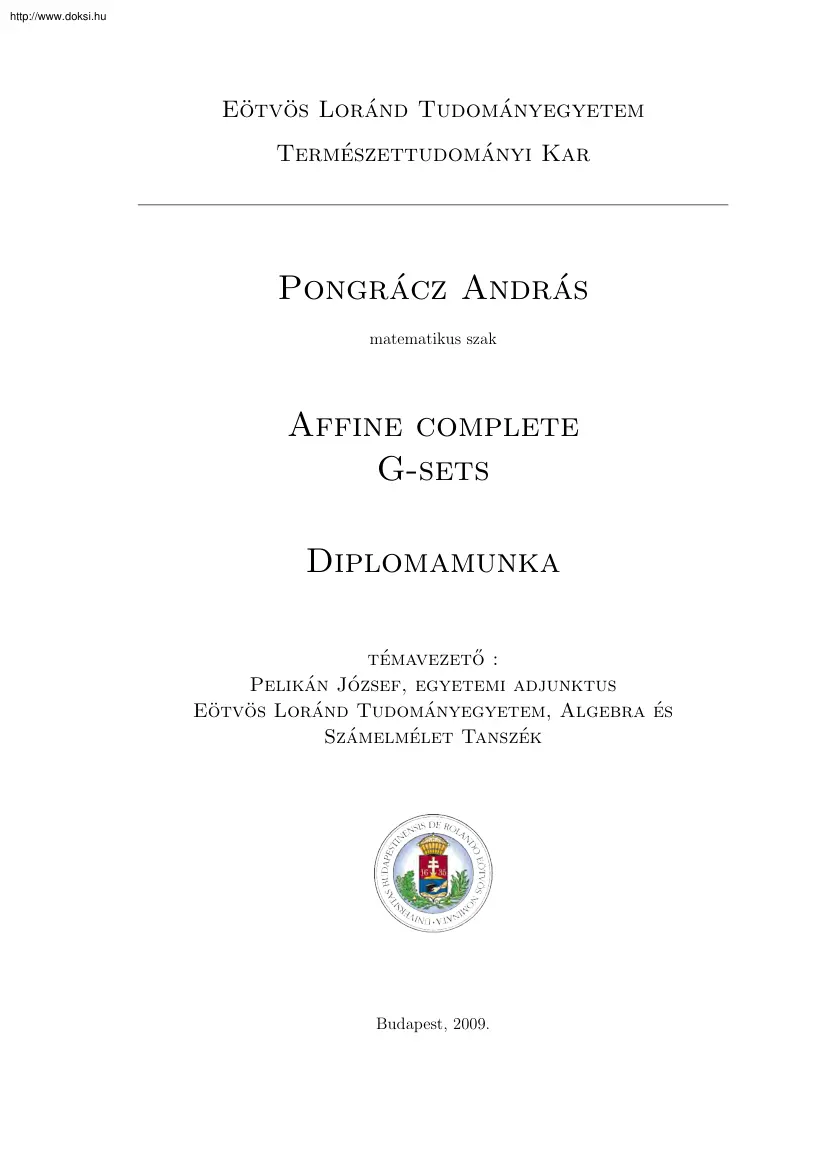
http://www.doksihu Eötvös Loránd Tudományegyetem Természettudományi Kar Pongrácz András matematikus szak Affine complete G-sets Diplomamunka témavezető : Pelikán József, egyetemi adjunktus Eötvös Loránd Tudományegyetem, Algebra és Számelmélet Tanszék Budapest, 2009. http://www.doksihu Tartalomjegyzék Bevezetés 3 1 Introduction 4 1.1 Definitions . 4 1.2 Known Results . 6 2 1-affine completeness 7 3 Regular group actions 12 3.1 Compatible functions . 12 3.2 Hereditary conditions . 14 4 The characteristic subgroup C(G) 23 5 Acknowledgements 24 2 http://www.doksihu Bevezetés Az affin teljes algebrák vizsgálata a 60-as évek elejéig nyúlik vissza. Grätzer György ismerte fel először a fogalom jelentőségét az univerzális algebrában, és az ő nevéhez köthetők az első
jelentős eredmények is a témában. A csoporthatások univerzális algebrai szempontból szintén fontos szerepet töltenek be. A két fogalom kapcsolatára világı́t rá John Snow egy tétele, miszerint ha egy véges rendpolinomteljes háló előáll mint egy véges algebra kongruenciahálója, akkor előáll úgy is, mint egy vektortér vagy egy affin teljes csoporthatás kongruenciahálója. Ez utóbbi eredmény motiválja az affin teljes csoporthatások vizsgálatát. Dolgozatomban többek között ismertetek néhány fontos csoportosztályt, amikből affin teljes csoporthatások származtathatók. Ilyenek például a véges egyszerű csoportok, a szimmetrikus csoportok vagy a Frobenius-csoportok. Szerepelni fognak olyan csoportok is, melyek sosem adnak meg affin teljes csoporthatásokat, például azon kommutatı́v csoportok, melyek nem izomorfak egy elemi Abel 2-csoporttal. Ilyen esetekben különböző kompatibilis
függvényeket, például hatványfüggvényeket kell konstruálnunk, melyek cáfolják az algebra affin teljességét. Megvizsgáljuk, milyen esetekben terjed ki az affin teljesség a részcsoportokról a csoportra. Végül bevezetünk egy új definı́ciót, ami minden csoportnak egy karakterisztikus részcsoportját adja meg Bizonyos értelemben ez a részcsoport méri azt, hogy a csoport mennyire áll közel ahhoz, hogy 1-affin teljes csoporthatást adjon meg. 3 http://www.doksihu Affine complete G-sets András Pongrácz Eötvös Loránd University, Budapest, Hungary Abstract György Grätzer was the first to investigate affine complete algebras. He realized the importance of this topic in universal algebra. Recently, John Snow observed that if the congruence lattice of a finite algebra is order polynomially complete, then this lattice is isomorphic to the congruence lattice of a vector space or of an affine complete G-set. We take this as
motivation to study affine complete G-sets in general. Recall that, for a group G acting on a set Ω, the algebra hΩ, Gi is called a G-set. We will investigate faithful actions only An algebra is affine complete if all its congruence preserving functions are polynomials. We present some families of affine complete G-sets, like regular actions of certain groups. We will prove that the regular G-set corresponding to a Frobenius group or a non-abelian group that is generated by involutions is affine complete. For some other classes of groups, including finite abelian groups (except elementary abelian 2-groups), we can construct several compatible functions, in particular, power endomorphisms, that are not polynomial functions. We will investigate the heredity of affine completeness in regular G-sets. Then we will define the characteristic subgroup C(G) of G. This subgroup is suitable to indicate how close the group is to produce a 1-affine complete G-set. 1 Introduction 1.1
Definitions As usual, the expression algebra refers to a pair A = (A, F ). Here, A is called the underlying set of A and F contains the fundamental operations. Many wellknown algebraic structures such as groups, rings, fields, Boolean algebras, lattices 4 http://www.doksihu or modules are all considered as algebras now. The algebra A is finite if both A and F are finite. Let C be a set of functions on A, i.e for any f ∈ C there is a k ∈ N = {1, 2, 3, } such that we have f : Ak A. Such C is called a clone if it contains all projections and it is closed under composition. The smallest clone containing the fundamental operations and the constant functions is the set of polynomials. In other words, a polynomial is a function on A that can be obtained from the fundamental operations, constant functions and projections by finitely many compositions. For a group G it is hard to describe the polynomials of G. Typically, a polynomial can be written as a product of some elements of
G, some variables and the inverse of some variables. Note that a polynomial can be written in many different forms here However, if G is an abelian group then there is a canonical form of the polynomials, namely these are the functions (x1 , x2 , . , xk ) 7 a1 x1 + a2 x2 + ak xk + g, where ai ∈ {0, 1, . exp(G) − 1} for any i ≤ k and g ∈ G If we have a finite field F then according to the Lagrange interpolation every function on F is a polynomial. Such algebras are called functionally complete or polynomially complete. Another important example for a polynomially complete algebra is the 2-element Boolean algebra. A congruence on A is an equivalence relation ρ satisfying the following condition: for any fundamental operation f with arity k, and elements a1 , b1 , . , ak , bk ∈ A such that (ai , bi ) ∈ ρ we have that (f (a1 , a2 , . , ak ), f (b1 , b2 , , bk )) ∈ ρ As ρ is a binary relation, it is a subset of A × A. It is easy to see that an equivalence
relation ρ is a congruence if and only if it is a subalgebra of A × A. The congruences of a group G are well studied. Every congruence corresponds to a normal subgroup of G in the following way. For a given N C G, the congruence ρN is the binary relation {(a, b) ∈ G × G | aN = bN }. Similarly, the congruences of a ring R are the equivalence relations corresponding to the ideals of R. Here, the equivalence classes of ρI for a given ideal I are the cosets of I. Usually, we abbreviate (a, b) ∈ ρ with a ≡ρ b or simply aρb. The congruences of an algebra A form a lattice denoted by Con(A). An n-ary function f on A is called compatible with the relation R ⊆ Ak if the following holds: ∀ai,j ∈ A (1 ≤ i ≤ n, 1 ≤ j ≤ k) : ((a1,1 , . , a1,k ) ∈ R, , (an,1 , , an,k ) ∈ R) ⇒ ⇒ ((f (a1,1 , . , an,1 ), , f (a1,k , , an,k )) ∈ R) An equivalence relation is a congruence if and only if every fundamental operation is compatible with it. Note that every
function is compatible with the smallest 5 http://www.doksihu congruence (equality) and the biggest congruence (any two element is congruent). We call a function f on A compatible if it is compatible with all the congruences of A. According to the fact that every function is compatible with the smallest and the biggest congruence in Con(A) we have that on a simple algebra every function is compatible. Thus for any prime p and any α ∈ N, the cyclic group Zp (and all other finite simple groups), the finite field Fpα and the 2-element Boolean algebra have the property that every function is compatible on them. In general, it is clear that constant functions, projections and the fundamental operations are compatible. It is also easy to see that the composition of compatible functions is also compatible. Thus the polynomials are compatible This observation yields the following definitions. Definition 1. An algebra A is affine complete if every compatible function on A is a
polynomial. A is k-affine complete if every at most k-ary compatible function is a (k-ary) polynomial. Clearly A is affine complete if and only if A is k-affine complete for all k ∈ N. Note that a polynomially complete algebra is always affine complete, as it only has polynomial functions, thus it is trivial that every compatible function is a polynomial on them. This holds for finite fields or the 2-element Boolean algebra For the cyclic n group Zp , we have pp n-ary functions, and these are all compatible. However, according to the canonical form of polynomials on abelian groups, we have that there are pn+1 n-ary polynomials. Thus for p ≥ 3 the cyclic group Zp is not k-affine complete for any k ∈ N. 1.2 Known Results It was György Grätzer in the early 60’s who posed the following question: What are the affine complete algebras? Of course, the aim is not to give a general description for such algebras, but to characterize them according to the different types. It was
Grätzer himself who achieved the first significant results in this area. He proved that every Boolean algebra is affine complete in [1] He also characterized the affine complete bounded distributive lattices. According to [2] a bounded distributive lattice is affine complete if and only if it does not contain proper Boolean intervals (intervals containing at least two elements). Hence there are no finite affine complete distributive lattices Note that in the point of view of affine completeness, the main difference between Boolean algebras and lattices is that the type of a Boolean algebra contains an extra unary function, the complement. Hence while a polynomial function 6 http://www.doksihu is order-preserving on a lattice, it need not to be order-preserving on a Boolean algebra. As all polynomial functions of a lattice are order-preserving, it is natural to investigate the following property. A lattice L is order affine complete, if every order-preserving compatible function is
a polynomial on L. In case of lattices it is also natural to study lattices satisfying the condition that every order-preserving function is a polynomial, rather than lattices with the property that every function is a polynomial. These lattices are called order polynomially complete Here is a description of order polynomially complete modular lattices. R. Wille: [9] A finite modular lattice L is order polynomially complete if and only if L is simple and relatively complemented. The following theorem is the classification of affine complete semilattices. K. Kaarli, L Márki, E T Schmidt: [5] A semilattice S is affine complete if and only if the following conditions hold for S: • S does not contain any atoms; • ∀a ∈ S @b ∈ S such that 0 6= b < a and (a] = (b] ∪ [b, a] hold simultaneously; • if a proper ideal I of S satisfies that ∀a ∈ S the ideal (a] ∩ I is a principal ideal, than I is a principal ideal. It was K. Kaarli who characterized affine complete abelian
groups in [3] According to his result, a finite abelian group G, written in the form Zn1 ⊕ Zn2 ⊕ ⊕ Znk with nk |nk−1 | . |n2 |n1 , is affine complete if and only if n1 = n2 Affine complete modules were investigated by A. Saks For a more detailed discussion of the topic, see [4] or [7]. In what follows we will present some new results for G-sets from the point of view of affine completeness. 2 1-affine completeness To decide whether a G-set hΩ, Gi is affine complete, we have to investigate all kary compatible functions and also all k-ary polynomials for all k ∈ N. However, there aren’t any interesting k-ary polynomials of a G-set hΩ, Gi for k ≥ 2. This observation leads to the following result. Theorem 1. Let G be a non-trivial permutation group on a set Ω, that is |Ω|, |G| ≥ 2. Assume that hΩ, Gi is 1-affine complete Then exactly one of the following holds: (1) hΩ, Gi is affine complete. 7 http://www.doksihu (2) |Ω| = 2 or there exists a
division ring K and a K-module V of rank greater than 1 over K such that hΩ, Gi is isomorphic to hV, {x 7 kx + v | k ∈ K, k 6= 0, v ∈ V }i. For finite Ω the result above is immediate from Pálfy’s classification of minimal algebras. We will give a self-contained, elementary proof for arbitrary cardinalities at the end of this section. First we state an auxiliary lemma Lemma 2. Let G be a semidirect product of a normal subgroup T 6= {1} and H ≤ G We assume that H acts faithfully on T by conjugation and that every H-invariant subgroup of T is normal in T . (1) Then hG/H, Gi is not 2-affine complete. (2) hG/H, Gi is 1-affine complete if and only if |G| = 2, H = 1 or T forms a module of rank greater than 1 over some division ring K, and hG/H, Gi is isomorphic to hT, {x 7 kx + t | k ∈ K, k 6= 0, t ∈ T }i. Proof: We claim that the function f (aH, bH) := abH for a, b ∈ T is compatible. (1) For H ≤ U ≤ G we have an N ≤ T such that U = N H and N is H-invariant, hence
normal in T . Let a1 , a2 , b1 , b2 ∈ T be such that a1 N H = a2 N H, b1 N H = b2 N H Using the normality of N in T we obtain f (a1 H, b1 H)N H = a1 b1 N H = a1 b2 N H = a1 N b2 H = a2 N b2 H = a2 b2 N H = f (a2 H, b2 H)N H and (1) is proved. Since f is essentially binary for T 6= 1, hG/H, Gi is not 2-affine complete. Next assume that hG/H, Gi is 1-affine complete. We will show that K := {ch : T T, x 7 xh | h ∈ H} ∪ {o : T T, x 7 1} is closed under pointwise multiplication · of functions. For g, h ∈ H the function p(aH) := ag ah H for a ∈ T is compatible by a similar argument as above. By the 1-affine completeness and p(H) = H, either p is constant or we have r ∈ H such that p(aH) = raH for all a ∈ T . In the former case ag ah ∈ H yields ag ah = 1 for all a ∈ T and cg · ch = o In the latter case we have (a−1 )r ag ah ∈ H yields (a−1 )r ag ah = 1 for all a ∈ T and cg · ch = cr . For h ∈ H we define i(ch ) : T T, x 7 (xh )−1 and i(o) := o As 8
http://www.doksihu above we find i(ch ) = cs for some s ∈ T . Hence hK, ·, i, oi is an abelian group Clearly hK {o}, ◦,−1 , idT i is a group isomorphic to H. For u, v, w ∈ K we have the distributive laws (u · v) ◦ w = (u ◦ w) · (v ◦ w) and u ◦ (v · w) = (u ◦ v) · (u ◦ w) by the definition of the pointwise multiplication · of functions. Thus hK, ·, ◦i is a division ring. T forms a K-module Denote the group operation in T by + Clearly G is isomorphic to A := {x 7 kx + t | k ∈ K, k 6= 0, t ∈ T }, (2) and hG/H, Gi is isomorphic to hT, Ai. If T has dimension 1 over K, then hT, Ai is simple and not 1-affine complete except if |T | = 2. Conversely it is straightforward that hG, Gi is 1-affine complete if |G| = 2. Now assume that T is a K-module of rank greater than 1 over some division ring K. Let A be as in (2). Let f : T T be congruence preserving on hT, Ai such that f (0) = 0. Then f preserves cosets of all K-submodules of T Let x ∈ T . Then we have
k ∈ K such that f (x) = kx Likewise for y ∈ T Kx we have f (y) = ly and f (x + y) = m(x + y) for some l, m ∈ K. Then f (x + y) ≡ f (x) mod Ky and f (x + y) ≡ f (y) mod Kx yield mx ≡ kx mod Ky and my ≡ ly mod Kx. Hence m = k = l and f (y) = ky for all y ∈ T Kx Similarly, f (z) = kz for all z ∈ T Ky and in particular for all z ∈ Kx {0}. Then f (x) = kx for all x ∈ T . Thus f is in A For H = 1 we obtain the following consequence. Lemma 3. Let G be an abelian group with |G| > 1 Then hG, Gi is not 2-affine complete, and hG, Gi is 1-affine complete if and only if G has exponent 2. Proof: As we have already proved the binary function h : (x, y) 7 xy is compatible, thus hG, Gi is not 2-affine complete. The function f : x 7 x2 is compatible on G. Indeed, let H ≤ G, and a, b ∈ G such that aH = bH. As H is a normal subgroup in G, we have a2 H = aHa = bHa = b2 H. Thus this power map is compatible We only have to check whether it is a polynomial function. It is
clearly not a left translation, and it is constant only if the exponent of G is 2. Thus an abelian group that is not an elementary abelian 2-group is not 1-affine complete. It is easy to see that an elementary abelian 2-group is 1-affine complete. Later, we will prove a more general theorem, namely that every group that is generated by involutions is 1-affine complete. In this proof, we only used that every subgroup of an abelian group is normal. Hence the same argument works for Hamiltonian groups, as well. We recall some well known facts about transitive permutation actions. 9 http://www.doksihu Lemma 4. Let G be a transitive permutation group on a set Ω, let α ∈ Ω, and let H := {g ∈ G | gα = α}. (1) hΩ, Gi is isomorphic to hG/H, Gi where g ∗ xH := gxH for all g, x ∈ G. (2) For H ≤ U ≤ G define ρU := {(xH, yH) ∈ (G/H)2 | xU = yU }. Then Con(hG/H, Gi) = {ρU | H ≤ U ≤ G}. Proof of Theorem 1: By a result of Salomaa in [8] it suffices to show that every
binary compatible function is constant or essentially unary or that the conditions of (2) in Theorem 1 are satisfied. Let e ∈ Comp2 (Ω, hΩ, Gi). Since |G| > 1 by assumption, we have α ∈ Ω such that |Gα| > 1. By the 1-affine completeness of hΩ, Gi the functions e1 (x) := e(x, α) and e2 (x) := e(α, x) are polynomial. Hence they are either constant or in G If, for example, e1 ∈ G, then f (x, y) := e(e−1 1 (x), y) satisfies f (x, α) = x for all x ∈ Ω. Hence it suffices to consider f ∈ Comp2 (Ω, hΩ, Gi) such that the unary functions x f (x, α) and x f (α, x) are constant or the identity function, respectively. Now, it is clear that we may assume f (α, α) = α, as well. For ω ∈ Ω we define fω (x) := f (ω, x) for x ∈ Ω. We have four cases, now. Case 1: f (x, α) = α, f (α, x) = α for all x ∈ Ω. Since |Gα| > 1, we have g ∈ G such that gα 6= α. Then h(x) := f (x, gx) satisfies h(α) = h(g −1 α) = f (α, α) As a
non-injective polynomial function, h is constant and f (x, gx) = f (α, α) for all x ∈ Ω. For β ∈ Ω, β 6= g −1 (α), we have fβ (α) = fβ (g(β)) = f (α, α). Consequently fβ is constant and f (x, y) = f (α, α) for all x, y ∈ Ω, x 6= g −1 α. If |Ω| > 2, then the functions of the form x 7 f (x, γ) for γ ∈ Ω are not injective and hence f is constant. Otherwise, if |Ω| = 2, then |G| = 2 and hΩ, Gi satisfies the conditions of (2). Case 2: f (x, α) = x, f (α, x) = α for all x ∈ Ω. Assume that we have β ∈ Ω such that fβ is not constant. Then fβ ∈ G and fβ (α) = β The function r(x) := f (x, fβ−1 (α)) satisfies r(α) = α and r(β) = fβ (fβ−1 (α)) = α. Hence r is constant and f (x, fβ−1 (α)) = α for all x ∈ Ω. 10 http://www.doksihu Let ω ∈ Ω {α}. Then fω is not constant but in G In particular, ω = fω (α) is in Gα and Gα = Ω. Let g ∈ G be such that g(α) 6= fβ−1 (α). Then h(x) := f (x, g(x))
satisfies h(α) = α and h(g −1 fβ−1 (α)) = f (g −1 fβ−1 (α), fβ−1 (α)) = α. Hence h is constant and h(g −1 (α)) = f (g −1 (α), α) = g −1 (α) yields g −1 (α) = α. Hence Gα = {α, fβ−1 (α)} and both Ω and G have size 2. Then hΩ, Gi satisfies the conditions of (2) Case 3: f (x, α) = α, f (α, x) = x. for all x ∈ Ω: This case is essentially the same as the previous one. Case 4: f (x, α) = f (α, x) = x for all x ∈ Ω. We will show that G satisfies the conditions of (2). First suppose that there exists β ∈ ΩGα Since fβ (α) = β 6∈ Gα, fβ is not in G but constant. Hence f (x, y) = x for all x ∈ Ω Gα, y ∈ Ω, and similarly f (x, y) = y for all x ∈ Ω, y ∈ Ω Gα. Now x = y for all x, y ∈ Ω Gα yields Ω = Gα ∪ {β}. Let γ ∈ Gα, γ 6= α The function c : Ω Ω defined by c(Gα) := α and c(β) = γ is compatible because the total congruence is the unique congruence ρ such there exists δ ∈ Gα
with (β, δ) ∈ ρ. Since c is obviously not polynomial, we have a contradiction. Hence Ω = Gα, that is, G is transitive on Ω. Let H be the stabilizer in G of α By Lemma 4 we may assume that Ω = {xH | x ∈ G}. If there exists an a ∈ G such that faα is constant, then f 0 (x, y) := a−1 f (ax, y) satisfies the assumptions of the previous case and consequently |Ω| = |G| = 2. Hence we assume fω ∈ G for all ω ∈ Ω in the following. Note that T := {fω ∈ G | ω ∈ Ω} is a transversal through G/H. It is clear that f (xH, yH) = xyH for any x, y ∈ T Let p ∈ Pol1 (G). We claim that q(aH) := p(a)H for a ∈ T preserves all congruences of hΩ, Gi. (3) Let ρ ∈ Con(hΩ, Gi). By Lemma 4 we have H ≤ U ≤ G such that ρ = ρU Let a, b ∈ T such that aU = bU . For x ∈ G, f (aH, xH) = axH and f (bH, xH) = bxH are congruent modulo ρU since f is congruence preserving. Hence (b−1 a)x ∈ U. (4) We have l ∈ N, g1 , . , gl ∈ G, and e1 , , el−1
∈ {−1, 1} such that p(x) = g1 xe1 g2 · · · gl−1 xel−1 gl for all x ∈ G. Then −1 p(b)−1 p(a) = gl−1 b−el−1 gl−1 · · · b−e1 g1−1 g1 ae1 g2 · · · gl−1 ael−1 gl el−1 g −1 = (b−el−1 ael−1 )gl (gl−1 · · · b−e1 ae1 g2 · · · gl−1 )a 11 l . http://www.doksihu By induction on l we obtain that p(b)−1 p(a) is a product of conjugates of b−1 a and of ba−1 , that is, conjugates of (b−1 a)−1 . Hence by (4) we have p(b)−1 p(a) ∈ U Thus q preserves ρU . We show that H ∩ H x = 1 for all x ∈ G H. (5) Let b ∈ T {1}, and let c ∈ bHb−1 ∩ H. The function g(aH) := a−1 caH for a ∈ T is compatible by (3). Since g(bH) = H and g(H) = H, we have that g is constant T T and ca ∈ H for all a ∈ T . Hence c ∈ a∈T aHa−1 = x∈G xHx−1 = 1 Therefore bHb−1 ∩ H = 1 which proves (5). Next we show [ah , b] = 1 for all a, b ∈ T, h ∈ H. (6) We fix b ∈ T, h ∈ H. The function m(aH) := [ah , b]H for a
∈ T is compatible −1 by (3). Since m(bh H) = m(H) = H, we have that m is constant and [ah , b] ∈ H for all a ∈ T . By a similar argument b(ah )−1 b−1 ah is in H for all a ∈ T Then [ah , b] = (b(ah )−1 b−1 ah )b is in H ∩ H b and [ah , b] = 1 by (5). Now hT i is abelian by (6) and H ∩ hT i = 1 by (5). Hence hT i = T For a ∈ T , h ∈ H we have u ∈ T, v ∈ H such that ah = uv. By (6) uv commutes with u−1 Hence v = uvu−1 which implies v = 1 by (5). Thus T is an abelian normal subgroup of G. Finally we see that every binary compatible function on hΩ, Gi is constant, essentially unary or that G is a semidirect product of a nontrivial abelian normal subgroup T and H ≤ G such that hΩ, Gi is isomorphic to hG/H, Gi. In the latter case hΩ, Gi satisfies the conditions of (2) and is not 2-affine complete by Lemma 2. According to Theorem 1 we only have to consider unary functions, from now on. In other words, we study 1-affine completeness of G-sets. 3
Regular group actions 3.1 Compatible functions For a group G let R(G) denote the regular G-set hG, Gi. According to Lemma 4 a function f : G G is compatible on the regular G-set R(G) if and only if for any H ≤ G and a, b ∈ G such that aH = bH, it holds that f (a)H = f (b)H. The G-set R(G) is 1-affine complete if every compatible function on R(G) is constant or is a multiplication with an element of G. Let f be a function on G such that f (1) = g for some g ∈ G. For an arbitrary h ∈ G let mh be the function mh : G G 12 http://www.doksihu x 7 hx These are compatible functions on R(G) and (mg−1 ◦ f )(1) = 1. It is also clear that mg ◦ (mg−1 ◦ f ) = f . As the composition of compatible functions is again a compatible function this implies that f is compatible if and only if mg−1 ◦ f is compatible. Thus R(G) is 1-affine complete if and only if the compatible functions on R(G) fixing 1 are 1G and idG , where 1G denotes the constant 1 map on G and idG denotes the
identity of G. This simplifies the matter of the 1-affine completeness of R(G). However, the most important property of a compatible function f satisfying f (1) = 1 is that it leaves invariant the subgroups of G. Indeed, let H ≤ G and h ∈ H, then 1H = hH, thus H = 1H = f (1)H = f (h)H, hence H = f (h)H and f (h) ∈ H. As these functions leave invariant the subgroups of G we can restrict them to any subgroup H ≤ G. It is clear that if f is compatible on R(G) such that f (1) = 1 then f |H is compatible on R(H) such that f |H (1) = 1. The following definition is a useful tool in our investigations. It is a way to construct new compatible functions if we are given a compatible function f . Definition 2. Let f be a compatible function on G Then fg is the following function: fg : x f (g)−1 f (gx) Lemma 5. Given a compatible function f on R(G) and an arbitrary g ∈ G, the function fg is also compatible on R(G) such that fg (1) = 1. Proof: Note that fg = mf (g)−1 ◦ f ◦ mg . As
the composition of compatible functions is also compatible, we proved that fg is compatible. It is also easy to see that fg (1) = f (g)−1 f (g) = 1. Semidirect products and direct products of groups often occur among the subgroups of a given group. The following lemma shows how a compatible function is determined by its restriction to the components. Lemma 6. Let G = A o B and f be a compatible function on R(G) such that f (1) = 1. Then f (ab) = f (a)f (b) holds for any a ∈ A and b ∈ B Proof: Every g ∈ G is uniquely determined by its A-coset and B-coset. Thus we only have to show that f (ab)A = f (a)f (b)A and f (ab)B = f (a)f (b)B. We have that ab = bab where ab ∈ A, thus abA = bA. As f is compatible, we have f (ab)A = f (b)A. Since f (1) = 1 we know that f preserves the subgroups of G, hence f (a) ∈ A. As A is a normal subgroup of G, we have that f (a)f (b) ∈ A, thus A = f (a)f (b) A. This implies that f (ab)A = f (b)A = f (b)f (a)f (b) A = f (a)f (b)A As f is
compatible and abB = aB, we have that f (ab)B = f (a)B. As f fixes 1, we know that f (b) ∈ B. Thus f (ab)B = f (a)B = f (a)f (b)B and we are ready 13 http://www.doksihu Corollary 7. Let n ≥ 1 and α ≥ 2 Then the compatible functions of R(Zαn ) fixing 1 are exactly the following: pk : Zαn Zαn , k∈N x xk Proof: The function pk is a homomorphism of Zαn that leaves invariant the subgroups. Thus given a H ≤ Zαn and a, b ∈ Zαn such that aH = bH, we have that b−1 a ∈ H. Thus pk (b−1 a) ∈ H, hence pk (b)−1 pk (a) ∈ H. This means pk (a)H = pk (b)H, thus pk is indeed a compatible function fixing 1. Now suppose that f is a compatible function on R(Zαn ) fixing 1. Let Zαn = Qα k i=1 hai i and let k ∈ N be such that f (a1 ) = a1 . We claim that f = pk Let b ∈ haj i l for some j ≥ 2 and let f (b) = b with l ∈ N. According to Lemma 6 we have that f (a1 b) = f (a1 )f (b), thus f (a1 b) = ak1 bl . This is also an element of ha1 bi, hence it is (a1
b)t = at1 bt for some t ∈ N. Thus at1 bt = ak1 bl , hence t ≡ k (mod n) Thus f (b) = bk . The same method works for a2 and an arbitrary element of ha1 i Thus for any 1 ≤ j ≤ α and x ∈ haj i, we have that f (x) = xk . According to Lemma 6 it is clear that f = pk , now. 3.2 Hereditary conditions Proposition 8. Let G be a group with subgroups Ui (i ∈ I), N and H := T i∈I Ui such that H ≤ N and Ui N = G for all i ∈ I. Then hG/H, Gi is 1-affine complete if hN/H, N i is 1-affine complete. Proof: Let f be compatible on hG/H, Gi with f (H) = H. Let x ∈ G, and let i ∈ I. Then we have u ∈ Ui such that x−1 N = uN , that is, xu ∈ N Since xUi = xuUi , we have f (xH)Ui = f (xuH)Ui . (7) First we assume that f is constant H on N/H. Then f (xuH) = H yields f (xH) ⊆ Ui T by (7). Hence f (xH) ⊆ i∈I Ui = H Thus f is constant H on G/H Next we assume that f is the identity on N/H. Then f (xuH) = xuH yields T f (xH) ⊆ xUi by (7). Hence f (xH) ⊆ x i∈I Ui = xH
Thus f is the identity on G/H. Let G := AGL(n, K) be the group of affine transformations on K n , and let H := Z(GL(n, K)). If n > 1, then hG/H, Gi is affine complete by Proposition 8 [For v ∈ K n define tv : K n K n , x 7 x + v. Let N := {tv | v ∈ K n }H Then hN/H, N i is 1-affine complete by Lemma 2. Let U := GL(n, K) Then 14 http://www.doksihu G = U N . For v ∈ K n we have U tv H ∩ U = {a ∈ U | av = kv for some k ∈ K} T Hence v∈K n U tv H = H. Proposition 8 applies and yields that hG/H, Gi is 1affine complete Since H has no abelian complement in G, Theorem 1 implies that hG/H, Gi is ac.] Corollary 9. Let G be a group with a normal subgroup N and U ≤ G such that T G = U N and g∈G U g = 1. Assume that R(N ) is 1-affine complete Then R(G) is 1-affine complete. Before our observations on how the affine completeness of proper subgroups imply the affine completeness of the group, we show a construction. The G-sets obtained by this construction are never 1-affine
complete. Proposition 10. Let A and B be nontrivial groups such that gcd(|A|, |B|) = 1 Then R(A × B) is not 1-affine complete. Proof: The elements of the group A × B can be uniquely written in the form ab such that a ∈ A and b ∈ B. Let f be the function that maps ab to a Here f (1) = 1 holds. As gcd(|A|, |B|) = 1, the subgroups of A × B are of the form C × D with C ≤ A and D ≤ B. Thus a function h is compatible on R(A × B) if and only if h|A is compatible on R(A) and h|B is compatible on R(B). The function f clearly satisfies this condition but it is neither constant 1 nor the identity. Hence A × B is not 1-affine complete. Lemma 11. Let G be a group with subgroups A, B Suppose that there exists a compatible function f on R(G) such that f (A) = 1 and f |B = idB . Then [A, B] = 1 and gcd(|A|, |B|) = 1. Proof: Let a ∈ A, b ∈ B. Notice that f (1) = 1 Since bhb−1 ai = ahb−1 ai, we have f (b) ∈ f (a)hb−1 ai, that is, b ∈ hb−1 ai. Then b commutes with b−1 a
and consequently with a. Hence A and B centralize each other Clearly A∩B = 1. Suppose that a prime p divides gcd(|A|, |B|) Let a ∈ A, b ∈ B both have order p. Then ha, bi is an elementary abelian group of order p2 Since f (ab) = f (a) · f (b) = b is not contained in habi, the function f does not preserve the congruence modulo habi. This contradicts the assumption that f is compatible Thus gcd(|A|, |B|) = 1. Lemma 12. Let G be a group and A ≤ G such that R(A) is 1-affine complete Let f be a compatible function on G such that f (1) = 1 and let g ∈ G be an arbitrary element. Then f |gA is either constant or it is of the form x h ∗ x with some h ∈ hgi. 15 http://www.doksihu Proof: According to Lemma 5 we know that fg is a compatible function on R(G). The restriction of fg to A is a compatible function on R(A) with fg (1) = 1. As R(A) is 1-affine complete we got that fg |A is either constant 1 or the identity. Case 1: fg |A is constant 1. Then for any x ∈ A we have
that f (g)−1 f (gx) = 1, hence f (gx) = f (g) for all x ∈ A. Thus f |gA is constant Case 2: fg |A is the identity. Then for any x ∈ A we have that f (g)−1 f (gx) = x, hence f (gx) = f (g)x = (f (g)g −1 )(gx) for all x ∈ A. Thus f |gA is the multiplication with f (g)g −1 . The following theorem is the most important hereditary condition for 1-affine complete G-sets. It covers the case of direct and semidirect products of groups producing 1-affine complete regular G-sets. Theorem 13. Let G be a group with subgroups A, B such that R(A), R(B) are 1-affine complete. Then R(hA, Bi) is 1-affine complete except if [A, B] = 1 and gcd(|A|, |B|) = 1. Proof: Let f be a compatible function on hA, Bi such that f (1) = 1. We have four cases now. Case 1: f |A = 1A and f |B = idB . Then by Lemma 11 we have that [A, B] = 1 and gcd(|A|, |B|) = 1. Case 2: f |A = idA and f |B = 1B . Again by Lemma 11 we have that [A, B] = 1 and gcd(|A|, |B|) = 1. In these two cases hA, Bi = A × B with
gcd(|A|, |B|) = 1, thus R(hA, Bi) is not 1-affine complete according to Proposition 10. Case 3: f |A = idA and f |B = idB . An element of hA, Bi can be written as the product of elements of A and B. There is a shortest form of every element in hA, Bi. We prove by induction on this length that f (x) = x for every x ∈ hA, Bi For elements with length at most 1 it is clear that f (x) = x, because such an x is in A or in B. Now assume that the length of x is l ≥ 2 and that the statement holds for any x ∈ hA, Bi with length smaller than l. Without loss of generality we may assume that x = x1 ab is the shortest form of x, x1 ∈ hA, Bi, a ∈ A and b ∈ B. Note that x1 abB = x1 aB and x1 abAb = x1 bAb Here R(Ab ) is also 1-affine complete, because Ab is isomorphic to A. According to Lemma 12 the function f on these cosets is either constant or it is a multiplication with some element of hA, Bi. Assume it is constant on both cosets. Then f (x1 ab) = f (x1 a) and f (x1 ab) = f (x1 b) As
x1 a and x1 b has length smaller then l, we know that f fixes these elements. Thus f (x1 ab) = x1 a = x1 b and consequently a = b. This is a contradiction, because this implies that x1 a2 is a shorter form of x than x1 ab. Thus f is a multiplication with some element of hA, Bi on at least one of the cosets. The element we multiply with 16 http://www.doksihu can only be 1, because both cosets has an element that is fixed by f . Hence f fixes x, too. Case 4: f |A = 1A and f |B = 1B . We will prove by induction on the length of an element of x ∈ hA, Bi that f (x) = 1. For elements with length at most 1 it is clear that f (x) = 1 as these are the elements of A ∪ B. Assume that l ≥ 2 and the statement holds for elements with length smaller than l. Again, without loss of generality we may assume that x = x1 ab is the shortest form of x, x1 ∈ hA, Bi, a ∈ A and b ∈ B. Note that x1 abB = x1 aB and x1 abAb = x1 bAb , and that according to Lemma 12 the function f on these cosets
is either constant or it is a multiplication with some element of hA, Bi. Assume that it is a multiplication with some element on both cosets. Then on the B-coset it has to be the multiplication with (x1 a)−1 and on the Ab -coset it has to be the multiplication with (x1 b)−1 . As these cosets has a common element x, we got that (x1 a)−1 = (x1 b)−1 , hence x1 a = x1 b and a = b. This is a contradiction, because if a = b then x1 a2 is a shorter form of x than x1 ab. Thus f is constant on at least one of these cosets. As both cosets has an element that is mapped to 1, the function f can only be constant 1, so we are ready. The following corollaries are immediate consequences of Theorem 13. Corollary 14. Let G be a group with subgroups A, B such that G = AB Assume that R(A), R(B) are 1-affine complete. Then R(G) is 1-affine complete except if gcd(|A|, |B|) = 1 and G = A × B. Corollary 15. Let G be a group that is generated by involutions Then R(G) is 1-affine complete. By
Corollary 15 and Theorem 1 every nonabelian group G that is generated by involutions with the regular action on itself is affine complete. This covers the dihedral groups, nonabelian simple groups, Sn , SL(n, q) for n ≥ 3, and all nonabelian Coxeter groups. Since Sn is 1-affine complete it is clear that every group occurs as a subgroup of a 1-affine complete group. Later, we will show another way to construct such an embedding yielding a much smaller 1-affine complete group in general. For a group G let N := hx ∈ G | x2 = 1i. If N has a complement U in G and T g∈G U g = 1, then R(G) is affine complete by Corollary 9. This applies to SL(n, q) ≤ G ≤ GL(n, q) for n > 2 and to SL(2, q) hdiag(−1, 1)i ≤ G ≤ GL(2, q). [We note that SL(n, q) hdiag(−1, 1, . , 1)i is generated by all conjugates of a transposition matrix and by diag(−1, 1, . , 1)] Corollary 16. Let G be a finite group all of whose minimal normal subgroups are nonabelian. Then R(G) is affine complete
17 http://www.doksihu Proof: Let N be the product of all minimal normal subgroups of G. Let a ∈ GN , and let U := hai. We claim that K := U N satisfies the assumptions of Corollary 9 T For k ∈ K we have U k N = K. Clearly H := k∈K U k is a cyclic normal subgroup of K. By assumption we have simple non-abelian subgroups S1 , , Sl of G such that N = S1 · · · Sl . Hence N has no abelian normal subgroup and in particular H ∩N = 1 Thus [H, N ] = 1. But the centralizer of N in G is trivial by assumption Hence H = 1. Since N is generated by involutions by the Odd-Order Theorem, R(N ) is affine complete by Corollary 15. Hence R(K) is 1-affine complete by Corollary 9 Now let f be compatible on R(G) with f (1) = 1. By Corollary 15 we have either f (N ) = 1 or f |N = idN . In the first case we find f (a) = 1 and in the second f (a) = a by the 1-affine completeness of R(K). Thus f (N ) = 1 implies that f is constant on all of G and f |N = idN implies that f is the identity map on
all of G. Now R(G) is 1-affine complete and consequently affine complete by Theorem 1. Lemma 17. Assume that G is a group with subgroups H1 , H2 , , Hk , k ≥ 2, such k S that the set G {1} is the disjoint union (Hi {1}). Assume that f is a compatible i=1 function on G such that there exists an x 6= 1 in G satisfying f (x) = 1 or f (x) = x. Then f is the constant 1 map or the identity. Proof: Without loss of generality suppose that x ∈ H1 . Let y ∈ Hj {1} for some 2 ≤ j ≤ k. Let z = x−1 y and z ∈ Hl Note that l 6= 1 and l 6= j Then xHl = xzHl = yHl , thus f (x)Hl = f (y)Hl . Note that the intersection of any two cosets g1 Hi1 and g2 Hi2 has at most one element, hence f (y) is determined by its Hl -coset and Hj -coset. Case 1: Now if f (x) = 1, then f (y) is in the same Hl -coset and Hj -coset as 1. Thus f (y) = 1 for any y ∈ / H1 . Now we can choose x from H2 and do the same for any y ∈ H1 , which implies that f is the constant 1 map. Case 2: If f (x) = x, then
f (y) is in the same Hl -coset and Hj -coset as y. Thus f (y) = y for any y ∈ / H1 . Again we can choose x from H2 and do the same for any y ∈ H1 , hence f is the identity. Definition 3. We call G a partitioned group if there exist subgroups H1 , H2 , , Hk of G such that G{1} is the disjoint union of the sets H1 {1}, H2 {1}, . , Hk {1} Corollary 18. Assume that G is a partitioned group and f is a compatible function on G such that f (1) = 1. Then f is either the constant 1 map or f |G{1} is a permutation of the set G {1} with all cycles of equal size. Proof: Assume that f is not the constant 1 map. Denote by f k the function f ◦ f ◦ . ◦ f with k copies of f in the composition Note that as f is compatible, 18 http://www.doksihu f k is also compatible for any k ∈ N. The function f maps G {1} to G {1}, thus f k also maps G {1} to G {1}. Take an arbitrary element g 6= 1 in G and consider the series g = f 0 (g), f 1 (g), f 2 (g) . Take the minimal l such that f
l (g) = f k (g) for some k > l. Then f l (f k−l (g)) = f l (g), hence f l has a fixpoint This means that f l is the identity, so f is bijective. The size of a cycle of f is the divisor of l Neither of these numbers can be less then l, because otherwise there would be a d < l such that f d (g) = g. Thus all the cycles of f has size l This lemma says that if a group G is partitioned with some subgroups then it is 1-affine complete if and only if for any f compatible function on G such that f (1) = 1 there exists an element x 6= 1 satisfying f (x) = 1 or f (x) = x. It is well known that Frobenius groups, p-groups with exponent p for some prime p and certain nonabelian simple groups such as P SL2 (q) and Suzuki groups are partitioned groups. Now we investigate some special Frobenius groups Lemma 19. Let G be a non-abelian group of size pq for distinct primes p, q Then R(G) is 1-affine complete. Proof: We will use + to denote the group operation on G. Let f be compatible with f (0)
= 0. Let G = hai o hbi with pa = qb = 1 Then there is an r (mod p) such that for any x ∈ hai we have −b + x + b = rx. The order of r is q (mod p) For any x ∈ hai the equation −kb + x + kb = rk x holds. As G is a partitioned group it is enough to prove that there exists a h 6= 1 such that f (h) = h. By Corollary 18 we have that f is a bijection. Every element of the semidirect product can be written uniquely in the form u + v such that u ∈ Zp and v ∈ Zq . We know that f (u + v) = f (u) + f (v) for such u and v. The function f restricted to hbi is also a permutation fixing 1. Thus there is a bijection α : {1, 2, , q −1} {1, 2, , q −1} such that for any i ∈ {1, 2, ., q − 1} we have f (ib) = α(i)b Let x ∈ hai and let k ∈ {1, . , q − 1} Then f (x + kb) = f (x) + f (kb) by Lemma 6 On the other hand, f (x + kb) ∈ hx + kbi. Thus for some n ∈ N we have that n(x + kb) = f (x) + α(k)b (8) After expanding the expression on the left hand side we get x + (kb + x
− kb) + . + (k(n − 1)b + x − k(n − 1)b) + knb = f (x) + α(k)b (9) Every element has a unique form u + v such that u ∈ Zp and v ∈ Zq , hence f (x) = x + (kb + x − kb) + . + (k(n − 1)b + x − k(n − 1)b) and (10) α(k)b = knb (11) 19 http://www.doksihu According to 11 we have kn ≡ α(k) (mod q). Substituting this to 10 yields f (x) = x + (kb + x − kb) + . + (k(n − 1)b + x − k(n − 1)b) = = x + r−k x + . + r−k(n−1) x = r−α(k) − 1 r−kn − 1 x = x r−k − 1 r−k − 1 −α(k) Hence f (x) = r r−k −1−1 x. This holds for any 1 ≤ k ≤ q − 1 but the left hand side of the equation does not depend on k. Thus there is an element t (mod p) such that for any x ∈ hai we have f (x) = tx and for any k ∈ {1, 2, ., q − 1} we have r−α(k) −1 ≡ t (mod p), that is r−k −1 r−α(k) − 1 ≡ t(r−k − 1) (mod p) (12) Note that α is a permutation of {1, 2, ., q − 1}, thus adding these equations for 1 ≤ k ≤
q − 1 we get q−1 X (r −α(k) − 1) ≡ t k=1 q−1 X (r−k − 1) (mod p), hence (13) (mod p) (14) k=1 (t − 1) q−1 X (r−k − 1) ≡ 0 k=1 As q−1 P r−k ≡ 0 (mod p), it is easy to calculate that q−1 P (r−k − 1) ≡ (−q) (mod p). k=1 k=0 Here q is not divisible by p. Thus p|(t − 1) and consequently t ≡ 1 (mod p) This implies that for any x ∈ hai we have f (x) = tx = x, thus f has a fixpoint. The importance of these lemmata will be clear from the following theorem. Theorem 20. Let G be a Frobenius group Then R(G) is 1-affine complete Proof: Let a ∈ N and b ∈ H. Assume that a, b 6= 1 and ap = bq = 1 for distinct primes p and q. The equation f (ab) = f (a)f (b) holds again, thus f (ab) = al f (b) = f (b)(al )f (b) with some 1 ≤ l ≤ p − 1. As ab = bab we also know that abhab i = bhab i. Thus f (ab)hab i = f (b)hab i Hence f (ab) = f (b)(ab )k = f (b)(ak )b for some 1 ≤ k ≤ p − 1. We got that f (b)(al )f (b) = f (b)(ak
)b and consequently (al )f (b) = (ak )b . Thus (al )f (b)b −1 = ak . Here al 6= 1, otherwise f (a) = 1 and f (G) = 1. If f (b) = b then we found a fixpoint and we are ready If f (b) 6= b then f (b)b−1 6= 1 and then the conjugation with the element f (b)b−1 ∈ hbi permutes the elements of hai. Thus hai o hbi = F is a non-abelian subgroup of size pq According to Lemma 19 we have that f |F = idF . Hence the elements of F are fixpoints of the function f and f (G) = idG . According to Theorem 20 R(A4 ) is 1-affine complete. 20 http://www.doksihu Definition 4. A permutation group G acting on the finite set Ω is called a Zassenhaus group if G is the transitive extension of a Frobenius group, that is G is transitive, and the stabilizer of an element α ∈ Ω is a Frobenius group acting on Ω {α} The following corollary is a natural consequence of Theorem 20, as there are many Frobenius subgroups in a Zassenhaus group. Corollary 21. Let G be a Zassenhaus group Then R(G) is
1-affine complete Proof: Let f be a compatible function on G such that f (1) = 1. Consider G as a permutation group on the set Ω. This is a Zassenhaus group, hence for any α ∈ Ω the stabilizer Gα is a Frobenius group. Two such stabilizers intersect nontrivially and generate G. These stabilizers are 1-affine complete According to Theorem 13 G is 1-affine complete. Theorem 22. Let p > 2 be a prime and G be a nonabelian group with exponent p Then R(G) is 1-affine complete. Proof: Note that G is a p-group that is equally partitioned with its subgroups. Thus we only have to check whether the conditions of Lemma 17 hold. Let 1 < Z1 (G) < Z2 (G) < . < Zn (G) = G be the upper central series of the group G As G is nonabelian, we have n ≥ 2. Z2 (G) is a p-group with nilpotence class 2 In such groups the following equation holds: (xy)k = xk y k [x, y] k(k−1) 2 for any k ∈ N (15) Let f be a compatible function on G such that f (1) = 1. Then f preserves Z2 (G) We
will show that f |Z2 (G) is either constant 1 or the identity. The centre of this group is nontrivial, hence it contains a subgroup hgi that is isomorphic to Zp . Let k ∈ N be such that f (g) = g k . Then given an element h ∈ / hgi in Z2 (G) we have hg, hi is isomorphic to (Zp )2 on which every compatible function is of the form x 7 xl with some l ∈ N. Thus every element of hgi is mapped to its k th power just as the elements of G hgi. So we have f (x) = xk for any x ∈ Z2 (G) Let x and y be in Z2 (G) such that [x, y] 6= 1. As xyhyi = xhyi, we have that f (xy) = f (x)y l = xk y l with some l ∈ N. Also f (xy) = (xy)k = xk y k [x, y] centre of Z2 (G). Thus xk y l = xk y k [x, y] k(k−1) 2 k(k−1) 2 , where [x, y] , hence y l−k = [x, y] k(k−1) 2 k(k−1) 2 is in the . Thus this element is in the intersection of hyi and the centre, which is the trivial subgroup {1}. Thus [x, y] k(k−1) 2 = 1 such that [x, y] 6= 1. This implies that p divides k(k−1) , 2 thus
either k or k − 1 is divisible by p. Hence f is either the constant 1 map or the identity on Z2 (G). Now the conditions of Lemma 17 hold, hence f is the constant 1 map or the identity on G. Thus G is 1-affine complete 21 http://www.doksihu Proposition 23. Assume that A and B are groups such that R(A) is 1-affine complete and exp(B)|exp(A) Then R(A × B) is 1-affine complete Proof: Given a compatible function f on G such that f (1) = 1. As R(A) is 1-affine complete, we have that f |A is 1A or idA . In other words f |A is the function pk |A with k = 0 or k = 1, where pk : A × B A × B (16) x xk (17) We will prove that if the compatible function f fixes 1 and f |A = pk |A for some k ∈ N, then f = pk . First we will show that f |B = pk |B . Let b ∈ B an arbitrary element Here hbi is cyclic, hence it is the direct product of cyclic groups of prime power order. Thus according to Lemma 6 it is enough to prove that f |H = pk |H for any H ≤ B cyclic with |H| prime power. For
this let H be such a subgroup and c 6= 1 an arbitrary element of H of order pα with p prime. As exp(B)|exp(A), there is an a ∈ A with the same order as c. It is clear that ha, ci is isomorphic to (Zpα )2 According to Corollary 7 we have that any compatible function on ha, ci is of the form pl for some l ∈ N. As f (a) = ak we have that f (c) = ck Thus f |B is indeed pk |B According to Lemma 6 it is clear that f = pk , now. As k = 0 or k = 1, we have that f is either the constant 1 map or the identity. According to Proposition 23 for any group G we have that R(D2|G| × G) is 1affine complete. This is another construction for a group of which G is a subgroup (moreover a normal subgroup) and the G-set corresponding to it is 1-affine complete. As we proved earlier, abelian groups are not 1-affine complete (except the elementary abelian 2-groups), because the map x 7 x2 is a compatible function on them. The next step should be to observe when a map of the form x 7 xk is compatible.
The following theorem gives a condition which implies that there exists such a compatible function on the group. Proposition 24. Assume that G is a nonabelian group such that exp(G) does not divide |G : Z(G)|. Then R(G) is not 1-affine complete Proof: Let |G : Z(G)| = k. According to the theory of transfers it is well-known that the map f (x) = xk is a homomorphism. Given a subgroup U ≤ G and x, y ∈ G such that xU = yU we have y −1 x ∈ U . Now f clearly preserves subgroups, thus (y −1 x)k ∈ U . As f is a homomorphism it also holds that (y −1 x)k = y −k xk , hence xk U = y k U . Thus f is compatible, and since exp(G) does not divide |G : Z(G)|, f is not the constant 1 map. G is not abelian, hence f is not the identity Thus f is a nontrivial compatible function on G and G is not 1-affine complete. 22 http://www.doksihu 4 The characteristic subgroup C(G) In this section we present the characteristic subgroup C(G). A more detailed discussion on the topic can be found
in [6] Definition 5. Denote by C(G) the subgroup of G that is generated by all the 1-affine complete subgroups of G. Theorem 13 shows that C(G) is the direct product of subgroups of pairwise coprime order, namely the maximal 1-affine complete subgroups of G. It also shows that the maximal 1-affine complete subgroups of G are characteristic subgroups. Indeed, for an α automorphism of G and A ≤ G maximal 1-affine complete subgroup, R(hA, α(A)i) is 1-affine complete, since for a nontrivial A the condition gcd(|A|, |α(A)|) = 1 never holds. According to this remark (and also by definition) it is clear that C(G) is a characteristic subgroup of G. Not considering those groups which are the direct product of nontrivial groups of coprime order (we know these are not 1-affine complete), it is clear that a group G is 1-affine complete if and only if G = C(G). Corollary 25. Let G be a group such that G is not the direct product of two nontrivial groups of coprime order Then R(G) is 1-affine
complete if and only if every Sylow subgroup of G is contained in a 1-affine complete subgroup of G. Proof: If R(G) is 1-affine complete then it is clear that every Sylow subgroup of G is contained in a 1-affine complete subgroup of G. For the other direction let |G| = pα1 1 pα2 2 . pαr r Then for any 1 ≤ i ≤ r we have that |C(G)| is divisible by pαi i , since there is a pi -Sylow contained in C(G). Thus |C(G)| is divisible by |G|, hence G = C(G) and R(G) is 1-affine complete. It is a natural idea to look for groups with the property that C(G) = 1. According to our results about groups producing 1-affine complete G-sets, we know the following. Corollary 26. Assume that C(G) = 1 Then • |G| is odd • every subgroup of G of order pq with different primes p and q is cyclic. • every subgroup H ≤ G with exponent p for a prime p H is abelian. 23 http://www.doksihu 5 Acknowledgements Special thanks to my thesis advisor, József Pelikán, and many thanks to Csaba
Szabó, Peter Mayr and Gábor Horváth. References [1] Grätzer, G.: On Boolean functions (Notes on lattice theory II), Revue de Math Pure et Appliquées, 7 (1962), 693-697. [2] Grätzer, G.: Boolean functions on distributive lattices, Acta Math Acad Sci Hungar., 15 (1964), 195-201 [3] Kaarli, K.: Affine complete abelian groups, Math Nachr, 107 (1982), 235-239 [4] Kaarli, K.: Affine completeness in algebra, in: Proc Annual Math Conf of the Republic of China, 83-92. (Tainan, 1993) [5] Kaarli, K., Márki, L, Schmidt, E T: Affine complete semilattices, Monatsh Math., 99 (1985), 297-309 [6] Mayr, P., Pongrácz, A, Horváth, G: Characterizing translations on groups by cosets of their subgroups, manuscript (2009.) [7] Ploščica, M.: Compatible functions on distributive lattices and related algebras, PhD thesis (2004.) [8] Salomaa, A.: On essential variables of functions, espesially in the algera of logic, Ann. Acad Sci Fenn Ser A I No 339, (1963) [9] Wille, R.: Eine
Charakterisierung endlicher, ordnungspolynomvollständiger Verbände, Archiv der Math, 28 (1977), 557-560 24
jelentős eredmények is a témában. A csoporthatások univerzális algebrai szempontból szintén fontos szerepet töltenek be. A két fogalom kapcsolatára világı́t rá John Snow egy tétele, miszerint ha egy véges rendpolinomteljes háló előáll mint egy véges algebra kongruenciahálója, akkor előáll úgy is, mint egy vektortér vagy egy affin teljes csoporthatás kongruenciahálója. Ez utóbbi eredmény motiválja az affin teljes csoporthatások vizsgálatát. Dolgozatomban többek között ismertetek néhány fontos csoportosztályt, amikből affin teljes csoporthatások származtathatók. Ilyenek például a véges egyszerű csoportok, a szimmetrikus csoportok vagy a Frobenius-csoportok. Szerepelni fognak olyan csoportok is, melyek sosem adnak meg affin teljes csoporthatásokat, például azon kommutatı́v csoportok, melyek nem izomorfak egy elemi Abel 2-csoporttal. Ilyen esetekben különböző kompatibilis
függvényeket, például hatványfüggvényeket kell konstruálnunk, melyek cáfolják az algebra affin teljességét. Megvizsgáljuk, milyen esetekben terjed ki az affin teljesség a részcsoportokról a csoportra. Végül bevezetünk egy új definı́ciót, ami minden csoportnak egy karakterisztikus részcsoportját adja meg Bizonyos értelemben ez a részcsoport méri azt, hogy a csoport mennyire áll közel ahhoz, hogy 1-affin teljes csoporthatást adjon meg. 3 http://www.doksihu Affine complete G-sets András Pongrácz Eötvös Loránd University, Budapest, Hungary Abstract György Grätzer was the first to investigate affine complete algebras. He realized the importance of this topic in universal algebra. Recently, John Snow observed that if the congruence lattice of a finite algebra is order polynomially complete, then this lattice is isomorphic to the congruence lattice of a vector space or of an affine complete G-set. We take this as
motivation to study affine complete G-sets in general. Recall that, for a group G acting on a set Ω, the algebra hΩ, Gi is called a G-set. We will investigate faithful actions only An algebra is affine complete if all its congruence preserving functions are polynomials. We present some families of affine complete G-sets, like regular actions of certain groups. We will prove that the regular G-set corresponding to a Frobenius group or a non-abelian group that is generated by involutions is affine complete. For some other classes of groups, including finite abelian groups (except elementary abelian 2-groups), we can construct several compatible functions, in particular, power endomorphisms, that are not polynomial functions. We will investigate the heredity of affine completeness in regular G-sets. Then we will define the characteristic subgroup C(G) of G. This subgroup is suitable to indicate how close the group is to produce a 1-affine complete G-set. 1 Introduction 1.1
Definitions As usual, the expression algebra refers to a pair A = (A, F ). Here, A is called the underlying set of A and F contains the fundamental operations. Many wellknown algebraic structures such as groups, rings, fields, Boolean algebras, lattices 4 http://www.doksihu or modules are all considered as algebras now. The algebra A is finite if both A and F are finite. Let C be a set of functions on A, i.e for any f ∈ C there is a k ∈ N = {1, 2, 3, } such that we have f : Ak A. Such C is called a clone if it contains all projections and it is closed under composition. The smallest clone containing the fundamental operations and the constant functions is the set of polynomials. In other words, a polynomial is a function on A that can be obtained from the fundamental operations, constant functions and projections by finitely many compositions. For a group G it is hard to describe the polynomials of G. Typically, a polynomial can be written as a product of some elements of
G, some variables and the inverse of some variables. Note that a polynomial can be written in many different forms here However, if G is an abelian group then there is a canonical form of the polynomials, namely these are the functions (x1 , x2 , . , xk ) 7 a1 x1 + a2 x2 + ak xk + g, where ai ∈ {0, 1, . exp(G) − 1} for any i ≤ k and g ∈ G If we have a finite field F then according to the Lagrange interpolation every function on F is a polynomial. Such algebras are called functionally complete or polynomially complete. Another important example for a polynomially complete algebra is the 2-element Boolean algebra. A congruence on A is an equivalence relation ρ satisfying the following condition: for any fundamental operation f with arity k, and elements a1 , b1 , . , ak , bk ∈ A such that (ai , bi ) ∈ ρ we have that (f (a1 , a2 , . , ak ), f (b1 , b2 , , bk )) ∈ ρ As ρ is a binary relation, it is a subset of A × A. It is easy to see that an equivalence
relation ρ is a congruence if and only if it is a subalgebra of A × A. The congruences of a group G are well studied. Every congruence corresponds to a normal subgroup of G in the following way. For a given N C G, the congruence ρN is the binary relation {(a, b) ∈ G × G | aN = bN }. Similarly, the congruences of a ring R are the equivalence relations corresponding to the ideals of R. Here, the equivalence classes of ρI for a given ideal I are the cosets of I. Usually, we abbreviate (a, b) ∈ ρ with a ≡ρ b or simply aρb. The congruences of an algebra A form a lattice denoted by Con(A). An n-ary function f on A is called compatible with the relation R ⊆ Ak if the following holds: ∀ai,j ∈ A (1 ≤ i ≤ n, 1 ≤ j ≤ k) : ((a1,1 , . , a1,k ) ∈ R, , (an,1 , , an,k ) ∈ R) ⇒ ⇒ ((f (a1,1 , . , an,1 ), , f (a1,k , , an,k )) ∈ R) An equivalence relation is a congruence if and only if every fundamental operation is compatible with it. Note that every
function is compatible with the smallest 5 http://www.doksihu congruence (equality) and the biggest congruence (any two element is congruent). We call a function f on A compatible if it is compatible with all the congruences of A. According to the fact that every function is compatible with the smallest and the biggest congruence in Con(A) we have that on a simple algebra every function is compatible. Thus for any prime p and any α ∈ N, the cyclic group Zp (and all other finite simple groups), the finite field Fpα and the 2-element Boolean algebra have the property that every function is compatible on them. In general, it is clear that constant functions, projections and the fundamental operations are compatible. It is also easy to see that the composition of compatible functions is also compatible. Thus the polynomials are compatible This observation yields the following definitions. Definition 1. An algebra A is affine complete if every compatible function on A is a
polynomial. A is k-affine complete if every at most k-ary compatible function is a (k-ary) polynomial. Clearly A is affine complete if and only if A is k-affine complete for all k ∈ N. Note that a polynomially complete algebra is always affine complete, as it only has polynomial functions, thus it is trivial that every compatible function is a polynomial on them. This holds for finite fields or the 2-element Boolean algebra For the cyclic n group Zp , we have pp n-ary functions, and these are all compatible. However, according to the canonical form of polynomials on abelian groups, we have that there are pn+1 n-ary polynomials. Thus for p ≥ 3 the cyclic group Zp is not k-affine complete for any k ∈ N. 1.2 Known Results It was György Grätzer in the early 60’s who posed the following question: What are the affine complete algebras? Of course, the aim is not to give a general description for such algebras, but to characterize them according to the different types. It was
Grätzer himself who achieved the first significant results in this area. He proved that every Boolean algebra is affine complete in [1] He also characterized the affine complete bounded distributive lattices. According to [2] a bounded distributive lattice is affine complete if and only if it does not contain proper Boolean intervals (intervals containing at least two elements). Hence there are no finite affine complete distributive lattices Note that in the point of view of affine completeness, the main difference between Boolean algebras and lattices is that the type of a Boolean algebra contains an extra unary function, the complement. Hence while a polynomial function 6 http://www.doksihu is order-preserving on a lattice, it need not to be order-preserving on a Boolean algebra. As all polynomial functions of a lattice are order-preserving, it is natural to investigate the following property. A lattice L is order affine complete, if every order-preserving compatible function is
a polynomial on L. In case of lattices it is also natural to study lattices satisfying the condition that every order-preserving function is a polynomial, rather than lattices with the property that every function is a polynomial. These lattices are called order polynomially complete Here is a description of order polynomially complete modular lattices. R. Wille: [9] A finite modular lattice L is order polynomially complete if and only if L is simple and relatively complemented. The following theorem is the classification of affine complete semilattices. K. Kaarli, L Márki, E T Schmidt: [5] A semilattice S is affine complete if and only if the following conditions hold for S: • S does not contain any atoms; • ∀a ∈ S @b ∈ S such that 0 6= b < a and (a] = (b] ∪ [b, a] hold simultaneously; • if a proper ideal I of S satisfies that ∀a ∈ S the ideal (a] ∩ I is a principal ideal, than I is a principal ideal. It was K. Kaarli who characterized affine complete abelian
groups in [3] According to his result, a finite abelian group G, written in the form Zn1 ⊕ Zn2 ⊕ ⊕ Znk with nk |nk−1 | . |n2 |n1 , is affine complete if and only if n1 = n2 Affine complete modules were investigated by A. Saks For a more detailed discussion of the topic, see [4] or [7]. In what follows we will present some new results for G-sets from the point of view of affine completeness. 2 1-affine completeness To decide whether a G-set hΩ, Gi is affine complete, we have to investigate all kary compatible functions and also all k-ary polynomials for all k ∈ N. However, there aren’t any interesting k-ary polynomials of a G-set hΩ, Gi for k ≥ 2. This observation leads to the following result. Theorem 1. Let G be a non-trivial permutation group on a set Ω, that is |Ω|, |G| ≥ 2. Assume that hΩ, Gi is 1-affine complete Then exactly one of the following holds: (1) hΩ, Gi is affine complete. 7 http://www.doksihu (2) |Ω| = 2 or there exists a
division ring K and a K-module V of rank greater than 1 over K such that hΩ, Gi is isomorphic to hV, {x 7 kx + v | k ∈ K, k 6= 0, v ∈ V }i. For finite Ω the result above is immediate from Pálfy’s classification of minimal algebras. We will give a self-contained, elementary proof for arbitrary cardinalities at the end of this section. First we state an auxiliary lemma Lemma 2. Let G be a semidirect product of a normal subgroup T 6= {1} and H ≤ G We assume that H acts faithfully on T by conjugation and that every H-invariant subgroup of T is normal in T . (1) Then hG/H, Gi is not 2-affine complete. (2) hG/H, Gi is 1-affine complete if and only if |G| = 2, H = 1 or T forms a module of rank greater than 1 over some division ring K, and hG/H, Gi is isomorphic to hT, {x 7 kx + t | k ∈ K, k 6= 0, t ∈ T }i. Proof: We claim that the function f (aH, bH) := abH for a, b ∈ T is compatible. (1) For H ≤ U ≤ G we have an N ≤ T such that U = N H and N is H-invariant, hence
normal in T . Let a1 , a2 , b1 , b2 ∈ T be such that a1 N H = a2 N H, b1 N H = b2 N H Using the normality of N in T we obtain f (a1 H, b1 H)N H = a1 b1 N H = a1 b2 N H = a1 N b2 H = a2 N b2 H = a2 b2 N H = f (a2 H, b2 H)N H and (1) is proved. Since f is essentially binary for T 6= 1, hG/H, Gi is not 2-affine complete. Next assume that hG/H, Gi is 1-affine complete. We will show that K := {ch : T T, x 7 xh | h ∈ H} ∪ {o : T T, x 7 1} is closed under pointwise multiplication · of functions. For g, h ∈ H the function p(aH) := ag ah H for a ∈ T is compatible by a similar argument as above. By the 1-affine completeness and p(H) = H, either p is constant or we have r ∈ H such that p(aH) = raH for all a ∈ T . In the former case ag ah ∈ H yields ag ah = 1 for all a ∈ T and cg · ch = o In the latter case we have (a−1 )r ag ah ∈ H yields (a−1 )r ag ah = 1 for all a ∈ T and cg · ch = cr . For h ∈ H we define i(ch ) : T T, x 7 (xh )−1 and i(o) := o As 8
http://www.doksihu above we find i(ch ) = cs for some s ∈ T . Hence hK, ·, i, oi is an abelian group Clearly hK {o}, ◦,−1 , idT i is a group isomorphic to H. For u, v, w ∈ K we have the distributive laws (u · v) ◦ w = (u ◦ w) · (v ◦ w) and u ◦ (v · w) = (u ◦ v) · (u ◦ w) by the definition of the pointwise multiplication · of functions. Thus hK, ·, ◦i is a division ring. T forms a K-module Denote the group operation in T by + Clearly G is isomorphic to A := {x 7 kx + t | k ∈ K, k 6= 0, t ∈ T }, (2) and hG/H, Gi is isomorphic to hT, Ai. If T has dimension 1 over K, then hT, Ai is simple and not 1-affine complete except if |T | = 2. Conversely it is straightforward that hG, Gi is 1-affine complete if |G| = 2. Now assume that T is a K-module of rank greater than 1 over some division ring K. Let A be as in (2). Let f : T T be congruence preserving on hT, Ai such that f (0) = 0. Then f preserves cosets of all K-submodules of T Let x ∈ T . Then we have
k ∈ K such that f (x) = kx Likewise for y ∈ T Kx we have f (y) = ly and f (x + y) = m(x + y) for some l, m ∈ K. Then f (x + y) ≡ f (x) mod Ky and f (x + y) ≡ f (y) mod Kx yield mx ≡ kx mod Ky and my ≡ ly mod Kx. Hence m = k = l and f (y) = ky for all y ∈ T Kx Similarly, f (z) = kz for all z ∈ T Ky and in particular for all z ∈ Kx {0}. Then f (x) = kx for all x ∈ T . Thus f is in A For H = 1 we obtain the following consequence. Lemma 3. Let G be an abelian group with |G| > 1 Then hG, Gi is not 2-affine complete, and hG, Gi is 1-affine complete if and only if G has exponent 2. Proof: As we have already proved the binary function h : (x, y) 7 xy is compatible, thus hG, Gi is not 2-affine complete. The function f : x 7 x2 is compatible on G. Indeed, let H ≤ G, and a, b ∈ G such that aH = bH. As H is a normal subgroup in G, we have a2 H = aHa = bHa = b2 H. Thus this power map is compatible We only have to check whether it is a polynomial function. It is
clearly not a left translation, and it is constant only if the exponent of G is 2. Thus an abelian group that is not an elementary abelian 2-group is not 1-affine complete. It is easy to see that an elementary abelian 2-group is 1-affine complete. Later, we will prove a more general theorem, namely that every group that is generated by involutions is 1-affine complete. In this proof, we only used that every subgroup of an abelian group is normal. Hence the same argument works for Hamiltonian groups, as well. We recall some well known facts about transitive permutation actions. 9 http://www.doksihu Lemma 4. Let G be a transitive permutation group on a set Ω, let α ∈ Ω, and let H := {g ∈ G | gα = α}. (1) hΩ, Gi is isomorphic to hG/H, Gi where g ∗ xH := gxH for all g, x ∈ G. (2) For H ≤ U ≤ G define ρU := {(xH, yH) ∈ (G/H)2 | xU = yU }. Then Con(hG/H, Gi) = {ρU | H ≤ U ≤ G}. Proof of Theorem 1: By a result of Salomaa in [8] it suffices to show that every
binary compatible function is constant or essentially unary or that the conditions of (2) in Theorem 1 are satisfied. Let e ∈ Comp2 (Ω, hΩ, Gi). Since |G| > 1 by assumption, we have α ∈ Ω such that |Gα| > 1. By the 1-affine completeness of hΩ, Gi the functions e1 (x) := e(x, α) and e2 (x) := e(α, x) are polynomial. Hence they are either constant or in G If, for example, e1 ∈ G, then f (x, y) := e(e−1 1 (x), y) satisfies f (x, α) = x for all x ∈ Ω. Hence it suffices to consider f ∈ Comp2 (Ω, hΩ, Gi) such that the unary functions x f (x, α) and x f (α, x) are constant or the identity function, respectively. Now, it is clear that we may assume f (α, α) = α, as well. For ω ∈ Ω we define fω (x) := f (ω, x) for x ∈ Ω. We have four cases, now. Case 1: f (x, α) = α, f (α, x) = α for all x ∈ Ω. Since |Gα| > 1, we have g ∈ G such that gα 6= α. Then h(x) := f (x, gx) satisfies h(α) = h(g −1 α) = f (α, α) As a
non-injective polynomial function, h is constant and f (x, gx) = f (α, α) for all x ∈ Ω. For β ∈ Ω, β 6= g −1 (α), we have fβ (α) = fβ (g(β)) = f (α, α). Consequently fβ is constant and f (x, y) = f (α, α) for all x, y ∈ Ω, x 6= g −1 α. If |Ω| > 2, then the functions of the form x 7 f (x, γ) for γ ∈ Ω are not injective and hence f is constant. Otherwise, if |Ω| = 2, then |G| = 2 and hΩ, Gi satisfies the conditions of (2). Case 2: f (x, α) = x, f (α, x) = α for all x ∈ Ω. Assume that we have β ∈ Ω such that fβ is not constant. Then fβ ∈ G and fβ (α) = β The function r(x) := f (x, fβ−1 (α)) satisfies r(α) = α and r(β) = fβ (fβ−1 (α)) = α. Hence r is constant and f (x, fβ−1 (α)) = α for all x ∈ Ω. 10 http://www.doksihu Let ω ∈ Ω {α}. Then fω is not constant but in G In particular, ω = fω (α) is in Gα and Gα = Ω. Let g ∈ G be such that g(α) 6= fβ−1 (α). Then h(x) := f (x, g(x))
satisfies h(α) = α and h(g −1 fβ−1 (α)) = f (g −1 fβ−1 (α), fβ−1 (α)) = α. Hence h is constant and h(g −1 (α)) = f (g −1 (α), α) = g −1 (α) yields g −1 (α) = α. Hence Gα = {α, fβ−1 (α)} and both Ω and G have size 2. Then hΩ, Gi satisfies the conditions of (2) Case 3: f (x, α) = α, f (α, x) = x. for all x ∈ Ω: This case is essentially the same as the previous one. Case 4: f (x, α) = f (α, x) = x for all x ∈ Ω. We will show that G satisfies the conditions of (2). First suppose that there exists β ∈ ΩGα Since fβ (α) = β 6∈ Gα, fβ is not in G but constant. Hence f (x, y) = x for all x ∈ Ω Gα, y ∈ Ω, and similarly f (x, y) = y for all x ∈ Ω, y ∈ Ω Gα. Now x = y for all x, y ∈ Ω Gα yields Ω = Gα ∪ {β}. Let γ ∈ Gα, γ 6= α The function c : Ω Ω defined by c(Gα) := α and c(β) = γ is compatible because the total congruence is the unique congruence ρ such there exists δ ∈ Gα
with (β, δ) ∈ ρ. Since c is obviously not polynomial, we have a contradiction. Hence Ω = Gα, that is, G is transitive on Ω. Let H be the stabilizer in G of α By Lemma 4 we may assume that Ω = {xH | x ∈ G}. If there exists an a ∈ G such that faα is constant, then f 0 (x, y) := a−1 f (ax, y) satisfies the assumptions of the previous case and consequently |Ω| = |G| = 2. Hence we assume fω ∈ G for all ω ∈ Ω in the following. Note that T := {fω ∈ G | ω ∈ Ω} is a transversal through G/H. It is clear that f (xH, yH) = xyH for any x, y ∈ T Let p ∈ Pol1 (G). We claim that q(aH) := p(a)H for a ∈ T preserves all congruences of hΩ, Gi. (3) Let ρ ∈ Con(hΩ, Gi). By Lemma 4 we have H ≤ U ≤ G such that ρ = ρU Let a, b ∈ T such that aU = bU . For x ∈ G, f (aH, xH) = axH and f (bH, xH) = bxH are congruent modulo ρU since f is congruence preserving. Hence (b−1 a)x ∈ U. (4) We have l ∈ N, g1 , . , gl ∈ G, and e1 , , el−1
∈ {−1, 1} such that p(x) = g1 xe1 g2 · · · gl−1 xel−1 gl for all x ∈ G. Then −1 p(b)−1 p(a) = gl−1 b−el−1 gl−1 · · · b−e1 g1−1 g1 ae1 g2 · · · gl−1 ael−1 gl el−1 g −1 = (b−el−1 ael−1 )gl (gl−1 · · · b−e1 ae1 g2 · · · gl−1 )a 11 l . http://www.doksihu By induction on l we obtain that p(b)−1 p(a) is a product of conjugates of b−1 a and of ba−1 , that is, conjugates of (b−1 a)−1 . Hence by (4) we have p(b)−1 p(a) ∈ U Thus q preserves ρU . We show that H ∩ H x = 1 for all x ∈ G H. (5) Let b ∈ T {1}, and let c ∈ bHb−1 ∩ H. The function g(aH) := a−1 caH for a ∈ T is compatible by (3). Since g(bH) = H and g(H) = H, we have that g is constant T T and ca ∈ H for all a ∈ T . Hence c ∈ a∈T aHa−1 = x∈G xHx−1 = 1 Therefore bHb−1 ∩ H = 1 which proves (5). Next we show [ah , b] = 1 for all a, b ∈ T, h ∈ H. (6) We fix b ∈ T, h ∈ H. The function m(aH) := [ah , b]H for a
∈ T is compatible −1 by (3). Since m(bh H) = m(H) = H, we have that m is constant and [ah , b] ∈ H for all a ∈ T . By a similar argument b(ah )−1 b−1 ah is in H for all a ∈ T Then [ah , b] = (b(ah )−1 b−1 ah )b is in H ∩ H b and [ah , b] = 1 by (5). Now hT i is abelian by (6) and H ∩ hT i = 1 by (5). Hence hT i = T For a ∈ T , h ∈ H we have u ∈ T, v ∈ H such that ah = uv. By (6) uv commutes with u−1 Hence v = uvu−1 which implies v = 1 by (5). Thus T is an abelian normal subgroup of G. Finally we see that every binary compatible function on hΩ, Gi is constant, essentially unary or that G is a semidirect product of a nontrivial abelian normal subgroup T and H ≤ G such that hΩ, Gi is isomorphic to hG/H, Gi. In the latter case hΩ, Gi satisfies the conditions of (2) and is not 2-affine complete by Lemma 2. According to Theorem 1 we only have to consider unary functions, from now on. In other words, we study 1-affine completeness of G-sets. 3
Regular group actions 3.1 Compatible functions For a group G let R(G) denote the regular G-set hG, Gi. According to Lemma 4 a function f : G G is compatible on the regular G-set R(G) if and only if for any H ≤ G and a, b ∈ G such that aH = bH, it holds that f (a)H = f (b)H. The G-set R(G) is 1-affine complete if every compatible function on R(G) is constant or is a multiplication with an element of G. Let f be a function on G such that f (1) = g for some g ∈ G. For an arbitrary h ∈ G let mh be the function mh : G G 12 http://www.doksihu x 7 hx These are compatible functions on R(G) and (mg−1 ◦ f )(1) = 1. It is also clear that mg ◦ (mg−1 ◦ f ) = f . As the composition of compatible functions is again a compatible function this implies that f is compatible if and only if mg−1 ◦ f is compatible. Thus R(G) is 1-affine complete if and only if the compatible functions on R(G) fixing 1 are 1G and idG , where 1G denotes the constant 1 map on G and idG denotes the
identity of G. This simplifies the matter of the 1-affine completeness of R(G). However, the most important property of a compatible function f satisfying f (1) = 1 is that it leaves invariant the subgroups of G. Indeed, let H ≤ G and h ∈ H, then 1H = hH, thus H = 1H = f (1)H = f (h)H, hence H = f (h)H and f (h) ∈ H. As these functions leave invariant the subgroups of G we can restrict them to any subgroup H ≤ G. It is clear that if f is compatible on R(G) such that f (1) = 1 then f |H is compatible on R(H) such that f |H (1) = 1. The following definition is a useful tool in our investigations. It is a way to construct new compatible functions if we are given a compatible function f . Definition 2. Let f be a compatible function on G Then fg is the following function: fg : x f (g)−1 f (gx) Lemma 5. Given a compatible function f on R(G) and an arbitrary g ∈ G, the function fg is also compatible on R(G) such that fg (1) = 1. Proof: Note that fg = mf (g)−1 ◦ f ◦ mg . As
the composition of compatible functions is also compatible, we proved that fg is compatible. It is also easy to see that fg (1) = f (g)−1 f (g) = 1. Semidirect products and direct products of groups often occur among the subgroups of a given group. The following lemma shows how a compatible function is determined by its restriction to the components. Lemma 6. Let G = A o B and f be a compatible function on R(G) such that f (1) = 1. Then f (ab) = f (a)f (b) holds for any a ∈ A and b ∈ B Proof: Every g ∈ G is uniquely determined by its A-coset and B-coset. Thus we only have to show that f (ab)A = f (a)f (b)A and f (ab)B = f (a)f (b)B. We have that ab = bab where ab ∈ A, thus abA = bA. As f is compatible, we have f (ab)A = f (b)A. Since f (1) = 1 we know that f preserves the subgroups of G, hence f (a) ∈ A. As A is a normal subgroup of G, we have that f (a)f (b) ∈ A, thus A = f (a)f (b) A. This implies that f (ab)A = f (b)A = f (b)f (a)f (b) A = f (a)f (b)A As f is
compatible and abB = aB, we have that f (ab)B = f (a)B. As f fixes 1, we know that f (b) ∈ B. Thus f (ab)B = f (a)B = f (a)f (b)B and we are ready 13 http://www.doksihu Corollary 7. Let n ≥ 1 and α ≥ 2 Then the compatible functions of R(Zαn ) fixing 1 are exactly the following: pk : Zαn Zαn , k∈N x xk Proof: The function pk is a homomorphism of Zαn that leaves invariant the subgroups. Thus given a H ≤ Zαn and a, b ∈ Zαn such that aH = bH, we have that b−1 a ∈ H. Thus pk (b−1 a) ∈ H, hence pk (b)−1 pk (a) ∈ H. This means pk (a)H = pk (b)H, thus pk is indeed a compatible function fixing 1. Now suppose that f is a compatible function on R(Zαn ) fixing 1. Let Zαn = Qα k i=1 hai i and let k ∈ N be such that f (a1 ) = a1 . We claim that f = pk Let b ∈ haj i l for some j ≥ 2 and let f (b) = b with l ∈ N. According to Lemma 6 we have that f (a1 b) = f (a1 )f (b), thus f (a1 b) = ak1 bl . This is also an element of ha1 bi, hence it is (a1
b)t = at1 bt for some t ∈ N. Thus at1 bt = ak1 bl , hence t ≡ k (mod n) Thus f (b) = bk . The same method works for a2 and an arbitrary element of ha1 i Thus for any 1 ≤ j ≤ α and x ∈ haj i, we have that f (x) = xk . According to Lemma 6 it is clear that f = pk , now. 3.2 Hereditary conditions Proposition 8. Let G be a group with subgroups Ui (i ∈ I), N and H := T i∈I Ui such that H ≤ N and Ui N = G for all i ∈ I. Then hG/H, Gi is 1-affine complete if hN/H, N i is 1-affine complete. Proof: Let f be compatible on hG/H, Gi with f (H) = H. Let x ∈ G, and let i ∈ I. Then we have u ∈ Ui such that x−1 N = uN , that is, xu ∈ N Since xUi = xuUi , we have f (xH)Ui = f (xuH)Ui . (7) First we assume that f is constant H on N/H. Then f (xuH) = H yields f (xH) ⊆ Ui T by (7). Hence f (xH) ⊆ i∈I Ui = H Thus f is constant H on G/H Next we assume that f is the identity on N/H. Then f (xuH) = xuH yields T f (xH) ⊆ xUi by (7). Hence f (xH) ⊆ x i∈I Ui = xH
Thus f is the identity on G/H. Let G := AGL(n, K) be the group of affine transformations on K n , and let H := Z(GL(n, K)). If n > 1, then hG/H, Gi is affine complete by Proposition 8 [For v ∈ K n define tv : K n K n , x 7 x + v. Let N := {tv | v ∈ K n }H Then hN/H, N i is 1-affine complete by Lemma 2. Let U := GL(n, K) Then 14 http://www.doksihu G = U N . For v ∈ K n we have U tv H ∩ U = {a ∈ U | av = kv for some k ∈ K} T Hence v∈K n U tv H = H. Proposition 8 applies and yields that hG/H, Gi is 1affine complete Since H has no abelian complement in G, Theorem 1 implies that hG/H, Gi is ac.] Corollary 9. Let G be a group with a normal subgroup N and U ≤ G such that T G = U N and g∈G U g = 1. Assume that R(N ) is 1-affine complete Then R(G) is 1-affine complete. Before our observations on how the affine completeness of proper subgroups imply the affine completeness of the group, we show a construction. The G-sets obtained by this construction are never 1-affine
complete. Proposition 10. Let A and B be nontrivial groups such that gcd(|A|, |B|) = 1 Then R(A × B) is not 1-affine complete. Proof: The elements of the group A × B can be uniquely written in the form ab such that a ∈ A and b ∈ B. Let f be the function that maps ab to a Here f (1) = 1 holds. As gcd(|A|, |B|) = 1, the subgroups of A × B are of the form C × D with C ≤ A and D ≤ B. Thus a function h is compatible on R(A × B) if and only if h|A is compatible on R(A) and h|B is compatible on R(B). The function f clearly satisfies this condition but it is neither constant 1 nor the identity. Hence A × B is not 1-affine complete. Lemma 11. Let G be a group with subgroups A, B Suppose that there exists a compatible function f on R(G) such that f (A) = 1 and f |B = idB . Then [A, B] = 1 and gcd(|A|, |B|) = 1. Proof: Let a ∈ A, b ∈ B. Notice that f (1) = 1 Since bhb−1 ai = ahb−1 ai, we have f (b) ∈ f (a)hb−1 ai, that is, b ∈ hb−1 ai. Then b commutes with b−1 a
and consequently with a. Hence A and B centralize each other Clearly A∩B = 1. Suppose that a prime p divides gcd(|A|, |B|) Let a ∈ A, b ∈ B both have order p. Then ha, bi is an elementary abelian group of order p2 Since f (ab) = f (a) · f (b) = b is not contained in habi, the function f does not preserve the congruence modulo habi. This contradicts the assumption that f is compatible Thus gcd(|A|, |B|) = 1. Lemma 12. Let G be a group and A ≤ G such that R(A) is 1-affine complete Let f be a compatible function on G such that f (1) = 1 and let g ∈ G be an arbitrary element. Then f |gA is either constant or it is of the form x h ∗ x with some h ∈ hgi. 15 http://www.doksihu Proof: According to Lemma 5 we know that fg is a compatible function on R(G). The restriction of fg to A is a compatible function on R(A) with fg (1) = 1. As R(A) is 1-affine complete we got that fg |A is either constant 1 or the identity. Case 1: fg |A is constant 1. Then for any x ∈ A we have
that f (g)−1 f (gx) = 1, hence f (gx) = f (g) for all x ∈ A. Thus f |gA is constant Case 2: fg |A is the identity. Then for any x ∈ A we have that f (g)−1 f (gx) = x, hence f (gx) = f (g)x = (f (g)g −1 )(gx) for all x ∈ A. Thus f |gA is the multiplication with f (g)g −1 . The following theorem is the most important hereditary condition for 1-affine complete G-sets. It covers the case of direct and semidirect products of groups producing 1-affine complete regular G-sets. Theorem 13. Let G be a group with subgroups A, B such that R(A), R(B) are 1-affine complete. Then R(hA, Bi) is 1-affine complete except if [A, B] = 1 and gcd(|A|, |B|) = 1. Proof: Let f be a compatible function on hA, Bi such that f (1) = 1. We have four cases now. Case 1: f |A = 1A and f |B = idB . Then by Lemma 11 we have that [A, B] = 1 and gcd(|A|, |B|) = 1. Case 2: f |A = idA and f |B = 1B . Again by Lemma 11 we have that [A, B] = 1 and gcd(|A|, |B|) = 1. In these two cases hA, Bi = A × B with
gcd(|A|, |B|) = 1, thus R(hA, Bi) is not 1-affine complete according to Proposition 10. Case 3: f |A = idA and f |B = idB . An element of hA, Bi can be written as the product of elements of A and B. There is a shortest form of every element in hA, Bi. We prove by induction on this length that f (x) = x for every x ∈ hA, Bi For elements with length at most 1 it is clear that f (x) = x, because such an x is in A or in B. Now assume that the length of x is l ≥ 2 and that the statement holds for any x ∈ hA, Bi with length smaller than l. Without loss of generality we may assume that x = x1 ab is the shortest form of x, x1 ∈ hA, Bi, a ∈ A and b ∈ B. Note that x1 abB = x1 aB and x1 abAb = x1 bAb Here R(Ab ) is also 1-affine complete, because Ab is isomorphic to A. According to Lemma 12 the function f on these cosets is either constant or it is a multiplication with some element of hA, Bi. Assume it is constant on both cosets. Then f (x1 ab) = f (x1 a) and f (x1 ab) = f (x1 b) As
x1 a and x1 b has length smaller then l, we know that f fixes these elements. Thus f (x1 ab) = x1 a = x1 b and consequently a = b. This is a contradiction, because this implies that x1 a2 is a shorter form of x than x1 ab. Thus f is a multiplication with some element of hA, Bi on at least one of the cosets. The element we multiply with 16 http://www.doksihu can only be 1, because both cosets has an element that is fixed by f . Hence f fixes x, too. Case 4: f |A = 1A and f |B = 1B . We will prove by induction on the length of an element of x ∈ hA, Bi that f (x) = 1. For elements with length at most 1 it is clear that f (x) = 1 as these are the elements of A ∪ B. Assume that l ≥ 2 and the statement holds for elements with length smaller than l. Again, without loss of generality we may assume that x = x1 ab is the shortest form of x, x1 ∈ hA, Bi, a ∈ A and b ∈ B. Note that x1 abB = x1 aB and x1 abAb = x1 bAb , and that according to Lemma 12 the function f on these cosets
is either constant or it is a multiplication with some element of hA, Bi. Assume that it is a multiplication with some element on both cosets. Then on the B-coset it has to be the multiplication with (x1 a)−1 and on the Ab -coset it has to be the multiplication with (x1 b)−1 . As these cosets has a common element x, we got that (x1 a)−1 = (x1 b)−1 , hence x1 a = x1 b and a = b. This is a contradiction, because if a = b then x1 a2 is a shorter form of x than x1 ab. Thus f is constant on at least one of these cosets. As both cosets has an element that is mapped to 1, the function f can only be constant 1, so we are ready. The following corollaries are immediate consequences of Theorem 13. Corollary 14. Let G be a group with subgroups A, B such that G = AB Assume that R(A), R(B) are 1-affine complete. Then R(G) is 1-affine complete except if gcd(|A|, |B|) = 1 and G = A × B. Corollary 15. Let G be a group that is generated by involutions Then R(G) is 1-affine complete. By
Corollary 15 and Theorem 1 every nonabelian group G that is generated by involutions with the regular action on itself is affine complete. This covers the dihedral groups, nonabelian simple groups, Sn , SL(n, q) for n ≥ 3, and all nonabelian Coxeter groups. Since Sn is 1-affine complete it is clear that every group occurs as a subgroup of a 1-affine complete group. Later, we will show another way to construct such an embedding yielding a much smaller 1-affine complete group in general. For a group G let N := hx ∈ G | x2 = 1i. If N has a complement U in G and T g∈G U g = 1, then R(G) is affine complete by Corollary 9. This applies to SL(n, q) ≤ G ≤ GL(n, q) for n > 2 and to SL(2, q) hdiag(−1, 1)i ≤ G ≤ GL(2, q). [We note that SL(n, q) hdiag(−1, 1, . , 1)i is generated by all conjugates of a transposition matrix and by diag(−1, 1, . , 1)] Corollary 16. Let G be a finite group all of whose minimal normal subgroups are nonabelian. Then R(G) is affine complete
17 http://www.doksihu Proof: Let N be the product of all minimal normal subgroups of G. Let a ∈ GN , and let U := hai. We claim that K := U N satisfies the assumptions of Corollary 9 T For k ∈ K we have U k N = K. Clearly H := k∈K U k is a cyclic normal subgroup of K. By assumption we have simple non-abelian subgroups S1 , , Sl of G such that N = S1 · · · Sl . Hence N has no abelian normal subgroup and in particular H ∩N = 1 Thus [H, N ] = 1. But the centralizer of N in G is trivial by assumption Hence H = 1. Since N is generated by involutions by the Odd-Order Theorem, R(N ) is affine complete by Corollary 15. Hence R(K) is 1-affine complete by Corollary 9 Now let f be compatible on R(G) with f (1) = 1. By Corollary 15 we have either f (N ) = 1 or f |N = idN . In the first case we find f (a) = 1 and in the second f (a) = a by the 1-affine completeness of R(K). Thus f (N ) = 1 implies that f is constant on all of G and f |N = idN implies that f is the identity map on
all of G. Now R(G) is 1-affine complete and consequently affine complete by Theorem 1. Lemma 17. Assume that G is a group with subgroups H1 , H2 , , Hk , k ≥ 2, such k S that the set G {1} is the disjoint union (Hi {1}). Assume that f is a compatible i=1 function on G such that there exists an x 6= 1 in G satisfying f (x) = 1 or f (x) = x. Then f is the constant 1 map or the identity. Proof: Without loss of generality suppose that x ∈ H1 . Let y ∈ Hj {1} for some 2 ≤ j ≤ k. Let z = x−1 y and z ∈ Hl Note that l 6= 1 and l 6= j Then xHl = xzHl = yHl , thus f (x)Hl = f (y)Hl . Note that the intersection of any two cosets g1 Hi1 and g2 Hi2 has at most one element, hence f (y) is determined by its Hl -coset and Hj -coset. Case 1: Now if f (x) = 1, then f (y) is in the same Hl -coset and Hj -coset as 1. Thus f (y) = 1 for any y ∈ / H1 . Now we can choose x from H2 and do the same for any y ∈ H1 , which implies that f is the constant 1 map. Case 2: If f (x) = x, then
f (y) is in the same Hl -coset and Hj -coset as y. Thus f (y) = y for any y ∈ / H1 . Again we can choose x from H2 and do the same for any y ∈ H1 , hence f is the identity. Definition 3. We call G a partitioned group if there exist subgroups H1 , H2 , , Hk of G such that G{1} is the disjoint union of the sets H1 {1}, H2 {1}, . , Hk {1} Corollary 18. Assume that G is a partitioned group and f is a compatible function on G such that f (1) = 1. Then f is either the constant 1 map or f |G{1} is a permutation of the set G {1} with all cycles of equal size. Proof: Assume that f is not the constant 1 map. Denote by f k the function f ◦ f ◦ . ◦ f with k copies of f in the composition Note that as f is compatible, 18 http://www.doksihu f k is also compatible for any k ∈ N. The function f maps G {1} to G {1}, thus f k also maps G {1} to G {1}. Take an arbitrary element g 6= 1 in G and consider the series g = f 0 (g), f 1 (g), f 2 (g) . Take the minimal l such that f
l (g) = f k (g) for some k > l. Then f l (f k−l (g)) = f l (g), hence f l has a fixpoint This means that f l is the identity, so f is bijective. The size of a cycle of f is the divisor of l Neither of these numbers can be less then l, because otherwise there would be a d < l such that f d (g) = g. Thus all the cycles of f has size l This lemma says that if a group G is partitioned with some subgroups then it is 1-affine complete if and only if for any f compatible function on G such that f (1) = 1 there exists an element x 6= 1 satisfying f (x) = 1 or f (x) = x. It is well known that Frobenius groups, p-groups with exponent p for some prime p and certain nonabelian simple groups such as P SL2 (q) and Suzuki groups are partitioned groups. Now we investigate some special Frobenius groups Lemma 19. Let G be a non-abelian group of size pq for distinct primes p, q Then R(G) is 1-affine complete. Proof: We will use + to denote the group operation on G. Let f be compatible with f (0)
= 0. Let G = hai o hbi with pa = qb = 1 Then there is an r (mod p) such that for any x ∈ hai we have −b + x + b = rx. The order of r is q (mod p) For any x ∈ hai the equation −kb + x + kb = rk x holds. As G is a partitioned group it is enough to prove that there exists a h 6= 1 such that f (h) = h. By Corollary 18 we have that f is a bijection. Every element of the semidirect product can be written uniquely in the form u + v such that u ∈ Zp and v ∈ Zq . We know that f (u + v) = f (u) + f (v) for such u and v. The function f restricted to hbi is also a permutation fixing 1. Thus there is a bijection α : {1, 2, , q −1} {1, 2, , q −1} such that for any i ∈ {1, 2, ., q − 1} we have f (ib) = α(i)b Let x ∈ hai and let k ∈ {1, . , q − 1} Then f (x + kb) = f (x) + f (kb) by Lemma 6 On the other hand, f (x + kb) ∈ hx + kbi. Thus for some n ∈ N we have that n(x + kb) = f (x) + α(k)b (8) After expanding the expression on the left hand side we get x + (kb + x
− kb) + . + (k(n − 1)b + x − k(n − 1)b) + knb = f (x) + α(k)b (9) Every element has a unique form u + v such that u ∈ Zp and v ∈ Zq , hence f (x) = x + (kb + x − kb) + . + (k(n − 1)b + x − k(n − 1)b) and (10) α(k)b = knb (11) 19 http://www.doksihu According to 11 we have kn ≡ α(k) (mod q). Substituting this to 10 yields f (x) = x + (kb + x − kb) + . + (k(n − 1)b + x − k(n − 1)b) = = x + r−k x + . + r−k(n−1) x = r−α(k) − 1 r−kn − 1 x = x r−k − 1 r−k − 1 −α(k) Hence f (x) = r r−k −1−1 x. This holds for any 1 ≤ k ≤ q − 1 but the left hand side of the equation does not depend on k. Thus there is an element t (mod p) such that for any x ∈ hai we have f (x) = tx and for any k ∈ {1, 2, ., q − 1} we have r−α(k) −1 ≡ t (mod p), that is r−k −1 r−α(k) − 1 ≡ t(r−k − 1) (mod p) (12) Note that α is a permutation of {1, 2, ., q − 1}, thus adding these equations for 1 ≤ k ≤
q − 1 we get q−1 X (r −α(k) − 1) ≡ t k=1 q−1 X (r−k − 1) (mod p), hence (13) (mod p) (14) k=1 (t − 1) q−1 X (r−k − 1) ≡ 0 k=1 As q−1 P r−k ≡ 0 (mod p), it is easy to calculate that q−1 P (r−k − 1) ≡ (−q) (mod p). k=1 k=0 Here q is not divisible by p. Thus p|(t − 1) and consequently t ≡ 1 (mod p) This implies that for any x ∈ hai we have f (x) = tx = x, thus f has a fixpoint. The importance of these lemmata will be clear from the following theorem. Theorem 20. Let G be a Frobenius group Then R(G) is 1-affine complete Proof: Let a ∈ N and b ∈ H. Assume that a, b 6= 1 and ap = bq = 1 for distinct primes p and q. The equation f (ab) = f (a)f (b) holds again, thus f (ab) = al f (b) = f (b)(al )f (b) with some 1 ≤ l ≤ p − 1. As ab = bab we also know that abhab i = bhab i. Thus f (ab)hab i = f (b)hab i Hence f (ab) = f (b)(ab )k = f (b)(ak )b for some 1 ≤ k ≤ p − 1. We got that f (b)(al )f (b) = f (b)(ak
)b and consequently (al )f (b) = (ak )b . Thus (al )f (b)b −1 = ak . Here al 6= 1, otherwise f (a) = 1 and f (G) = 1. If f (b) = b then we found a fixpoint and we are ready If f (b) 6= b then f (b)b−1 6= 1 and then the conjugation with the element f (b)b−1 ∈ hbi permutes the elements of hai. Thus hai o hbi = F is a non-abelian subgroup of size pq According to Lemma 19 we have that f |F = idF . Hence the elements of F are fixpoints of the function f and f (G) = idG . According to Theorem 20 R(A4 ) is 1-affine complete. 20 http://www.doksihu Definition 4. A permutation group G acting on the finite set Ω is called a Zassenhaus group if G is the transitive extension of a Frobenius group, that is G is transitive, and the stabilizer of an element α ∈ Ω is a Frobenius group acting on Ω {α} The following corollary is a natural consequence of Theorem 20, as there are many Frobenius subgroups in a Zassenhaus group. Corollary 21. Let G be a Zassenhaus group Then R(G) is
1-affine complete Proof: Let f be a compatible function on G such that f (1) = 1. Consider G as a permutation group on the set Ω. This is a Zassenhaus group, hence for any α ∈ Ω the stabilizer Gα is a Frobenius group. Two such stabilizers intersect nontrivially and generate G. These stabilizers are 1-affine complete According to Theorem 13 G is 1-affine complete. Theorem 22. Let p > 2 be a prime and G be a nonabelian group with exponent p Then R(G) is 1-affine complete. Proof: Note that G is a p-group that is equally partitioned with its subgroups. Thus we only have to check whether the conditions of Lemma 17 hold. Let 1 < Z1 (G) < Z2 (G) < . < Zn (G) = G be the upper central series of the group G As G is nonabelian, we have n ≥ 2. Z2 (G) is a p-group with nilpotence class 2 In such groups the following equation holds: (xy)k = xk y k [x, y] k(k−1) 2 for any k ∈ N (15) Let f be a compatible function on G such that f (1) = 1. Then f preserves Z2 (G) We
will show that f |Z2 (G) is either constant 1 or the identity. The centre of this group is nontrivial, hence it contains a subgroup hgi that is isomorphic to Zp . Let k ∈ N be such that f (g) = g k . Then given an element h ∈ / hgi in Z2 (G) we have hg, hi is isomorphic to (Zp )2 on which every compatible function is of the form x 7 xl with some l ∈ N. Thus every element of hgi is mapped to its k th power just as the elements of G hgi. So we have f (x) = xk for any x ∈ Z2 (G) Let x and y be in Z2 (G) such that [x, y] 6= 1. As xyhyi = xhyi, we have that f (xy) = f (x)y l = xk y l with some l ∈ N. Also f (xy) = (xy)k = xk y k [x, y] centre of Z2 (G). Thus xk y l = xk y k [x, y] k(k−1) 2 k(k−1) 2 , where [x, y] , hence y l−k = [x, y] k(k−1) 2 k(k−1) 2 is in the . Thus this element is in the intersection of hyi and the centre, which is the trivial subgroup {1}. Thus [x, y] k(k−1) 2 = 1 such that [x, y] 6= 1. This implies that p divides k(k−1) , 2 thus
either k or k − 1 is divisible by p. Hence f is either the constant 1 map or the identity on Z2 (G). Now the conditions of Lemma 17 hold, hence f is the constant 1 map or the identity on G. Thus G is 1-affine complete 21 http://www.doksihu Proposition 23. Assume that A and B are groups such that R(A) is 1-affine complete and exp(B)|exp(A) Then R(A × B) is 1-affine complete Proof: Given a compatible function f on G such that f (1) = 1. As R(A) is 1-affine complete, we have that f |A is 1A or idA . In other words f |A is the function pk |A with k = 0 or k = 1, where pk : A × B A × B (16) x xk (17) We will prove that if the compatible function f fixes 1 and f |A = pk |A for some k ∈ N, then f = pk . First we will show that f |B = pk |B . Let b ∈ B an arbitrary element Here hbi is cyclic, hence it is the direct product of cyclic groups of prime power order. Thus according to Lemma 6 it is enough to prove that f |H = pk |H for any H ≤ B cyclic with |H| prime power. For
this let H be such a subgroup and c 6= 1 an arbitrary element of H of order pα with p prime. As exp(B)|exp(A), there is an a ∈ A with the same order as c. It is clear that ha, ci is isomorphic to (Zpα )2 According to Corollary 7 we have that any compatible function on ha, ci is of the form pl for some l ∈ N. As f (a) = ak we have that f (c) = ck Thus f |B is indeed pk |B According to Lemma 6 it is clear that f = pk , now. As k = 0 or k = 1, we have that f is either the constant 1 map or the identity. According to Proposition 23 for any group G we have that R(D2|G| × G) is 1affine complete. This is another construction for a group of which G is a subgroup (moreover a normal subgroup) and the G-set corresponding to it is 1-affine complete. As we proved earlier, abelian groups are not 1-affine complete (except the elementary abelian 2-groups), because the map x 7 x2 is a compatible function on them. The next step should be to observe when a map of the form x 7 xk is compatible.
The following theorem gives a condition which implies that there exists such a compatible function on the group. Proposition 24. Assume that G is a nonabelian group such that exp(G) does not divide |G : Z(G)|. Then R(G) is not 1-affine complete Proof: Let |G : Z(G)| = k. According to the theory of transfers it is well-known that the map f (x) = xk is a homomorphism. Given a subgroup U ≤ G and x, y ∈ G such that xU = yU we have y −1 x ∈ U . Now f clearly preserves subgroups, thus (y −1 x)k ∈ U . As f is a homomorphism it also holds that (y −1 x)k = y −k xk , hence xk U = y k U . Thus f is compatible, and since exp(G) does not divide |G : Z(G)|, f is not the constant 1 map. G is not abelian, hence f is not the identity Thus f is a nontrivial compatible function on G and G is not 1-affine complete. 22 http://www.doksihu 4 The characteristic subgroup C(G) In this section we present the characteristic subgroup C(G). A more detailed discussion on the topic can be found
in [6] Definition 5. Denote by C(G) the subgroup of G that is generated by all the 1-affine complete subgroups of G. Theorem 13 shows that C(G) is the direct product of subgroups of pairwise coprime order, namely the maximal 1-affine complete subgroups of G. It also shows that the maximal 1-affine complete subgroups of G are characteristic subgroups. Indeed, for an α automorphism of G and A ≤ G maximal 1-affine complete subgroup, R(hA, α(A)i) is 1-affine complete, since for a nontrivial A the condition gcd(|A|, |α(A)|) = 1 never holds. According to this remark (and also by definition) it is clear that C(G) is a characteristic subgroup of G. Not considering those groups which are the direct product of nontrivial groups of coprime order (we know these are not 1-affine complete), it is clear that a group G is 1-affine complete if and only if G = C(G). Corollary 25. Let G be a group such that G is not the direct product of two nontrivial groups of coprime order Then R(G) is 1-affine
complete if and only if every Sylow subgroup of G is contained in a 1-affine complete subgroup of G. Proof: If R(G) is 1-affine complete then it is clear that every Sylow subgroup of G is contained in a 1-affine complete subgroup of G. For the other direction let |G| = pα1 1 pα2 2 . pαr r Then for any 1 ≤ i ≤ r we have that |C(G)| is divisible by pαi i , since there is a pi -Sylow contained in C(G). Thus |C(G)| is divisible by |G|, hence G = C(G) and R(G) is 1-affine complete. It is a natural idea to look for groups with the property that C(G) = 1. According to our results about groups producing 1-affine complete G-sets, we know the following. Corollary 26. Assume that C(G) = 1 Then • |G| is odd • every subgroup of G of order pq with different primes p and q is cyclic. • every subgroup H ≤ G with exponent p for a prime p H is abelian. 23 http://www.doksihu 5 Acknowledgements Special thanks to my thesis advisor, József Pelikán, and many thanks to Csaba
Szabó, Peter Mayr and Gábor Horváth. References [1] Grätzer, G.: On Boolean functions (Notes on lattice theory II), Revue de Math Pure et Appliquées, 7 (1962), 693-697. [2] Grätzer, G.: Boolean functions on distributive lattices, Acta Math Acad Sci Hungar., 15 (1964), 195-201 [3] Kaarli, K.: Affine complete abelian groups, Math Nachr, 107 (1982), 235-239 [4] Kaarli, K.: Affine completeness in algebra, in: Proc Annual Math Conf of the Republic of China, 83-92. (Tainan, 1993) [5] Kaarli, K., Márki, L, Schmidt, E T: Affine complete semilattices, Monatsh Math., 99 (1985), 297-309 [6] Mayr, P., Pongrácz, A, Horváth, G: Characterizing translations on groups by cosets of their subgroups, manuscript (2009.) [7] Ploščica, M.: Compatible functions on distributive lattices and related algebras, PhD thesis (2004.) [8] Salomaa, A.: On essential variables of functions, espesially in the algera of logic, Ann. Acad Sci Fenn Ser A I No 339, (1963) [9] Wille, R.: Eine
Charakterisierung endlicher, ordnungspolynomvollständiger Verbände, Archiv der Math, 28 (1977), 557-560 24
 When reading, most of us just let a story wash over us, getting lost in the world of the book rather than paying attention to the individual elements of the plot or writing. However, in English class, our teachers ask us to look at the mechanics of the writing.

