Please log in to read this in our online viewer!
Please log in to read this in our online viewer!
 2005 · 19 page(s) (345 KB)
 English
 20
20
 December 22 · 2012
 National University of Singapore
 Logging in required

 Embed
Embed
No comments yet. You can be the first!
What did others read after this?




Content extract
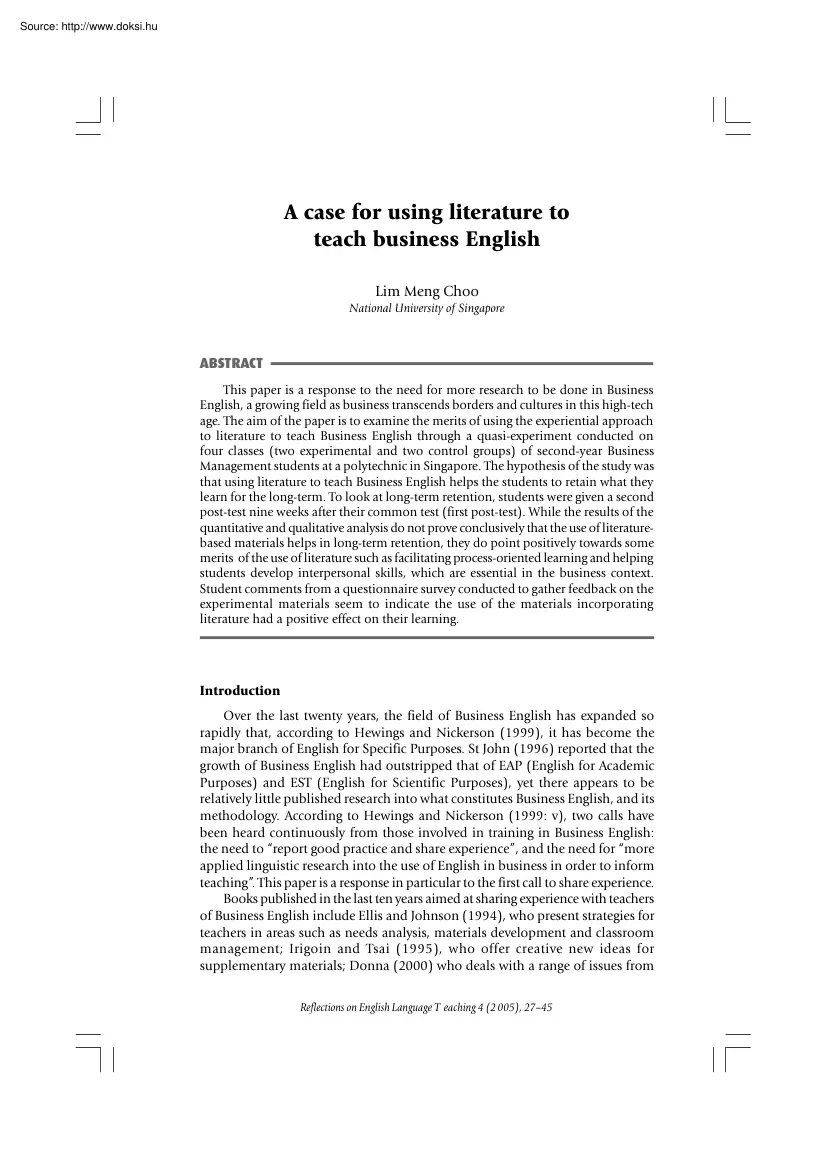
A case for using liter atur e to teach business English 27 A case for using literature to teach business English Lim Meng Choo National University of Singapore ABSTRACT This paper is a response to the need for more research to be done in Business English, a growing field as business transcends borders and cultures in this high-tech age. The aim of the paper is to examine the merits of using the experiential approach to literature to teach Business English through a quasi-experiment conducted on four classes (two experimental and two control groups) of second-year Business Management students at a polytechnic in Singapore. The hypothesis of the study was that using literature to teach Business English helps the students to retain what they learn for the long-term. To look at long-term retention, students were given a second post-test nine weeks after their common test (first post-test). While the results of the quantitative and qualitative analysis do not prove conclusively that the
use of literaturebased materials helps in long-term retention, they do point positively towards some merits of the use of literature such as facilitating process-oriented learning and helping students develop interpersonal skills, which are essential in the business context. Student comments from a questionnaire survey conducted to gather feedback on the experimental materials seem to indicate the use of the materials incorporating literature had a positive effect on their learning. Introduction Over the last twenty years, the field of Business English has expanded so rapidly that, according to Hewings and Nickerson (1999), it has become the major branch of English for Specific Purposes. St John (1996) reported that the growth of Business English had outstripped that of EAP (English for Academic Purposes) and EST (English for Scientific Purposes), yet there appears to be relatively little published research into what constitutes Business English, and its methodology. According to
Hewings and Nickerson (1999: v), two calls have been heard continuously from those involved in training in Business English: the need to “report good practice and share experience”, and the need for “more applied linguistic research into the use of English in business in order to inform teaching”. This paper is a response in particular to the first call to share experience Books published in the last ten years aimed at sharing experience with teachers of Business English include Ellis and Johnson (1994), who present strategies for teachers in areas such as needs analysis, materials development and classroom management; Irigoin and Tsai (1995), who offer creative new ideas for supplementary materials; Donna (2000) who deals with a range of issues from Reflections on English Language T eaching 4 (2 005), 27–45 28 Lim Meng Choo needs analysis and course planning to assessment and evaluation; and Hall and Crabbe (1994) whose handbook seeks to help teachers of English for
business and technology with the process of course design. A look at catalogues from major publishers reveals a growing number of Business English textbooks that teachers can choose from that focus on language skills, such as Barnard and Cody (2000), Grant and McLarty (2001), Johnson (2000), Lites and Thorpe (2001), and Naunton (2000). In the area of business communication which is the focus of this study, many textbooks, such as Bovee and Thill (2000), Guffey (1998), Lesikar, Pettit and Flatley (1999) deal with specific skills, such as writing (letters, memos, etc) and speaking (e.g, making presentations, interviewing for jobs). The textbooks teach strategies and moves to acquire these skills, followed by application exercises. For example, Guffey (1997, p 288) outlines a four-part plan to teach students how to write a message communicating bad news that begins with a ‘buffer’ (“a neutralopening that does not reveal the bad news”), followed by ‘reasons’ (“an explanation
of the causes for bad news”), ‘bad news’ (“a clear but understated announcement of the bad news that may include an alternative or compromise) and finally, ‘close’ (a personalised, forward-looking, pleasant statement). The role of literature in teaching Business English has been little explored both in published textbooks and research, with only a handful of published works on this topic. These include Duangsamosorn (1996, p 19) who argues for the teaching of literature “to improve the students’ ability in effective business communication” and Vogt (1998) who suggests using literature in the Business English classroom to help students understand other cultures better. Peter (1999) has conducted a quasi-experiment using the experiential approach to literature in the classroom and claims that it helps business students to improve their English proficiency and communicative effectiveness in business writing. So far, none of the textbooks for students and handbooks for
teachers available in the market or published research demonstrates how literature can actually be incorporated and used to teach specific business skills such as writing letters, reports, resumes, and giving presentations. Purpose This paper seeks to demonstrate how various forms of literature can be used to teach the writing of business letters. This paper also examines the merits of using the experiential approach to literature to teach Business English, and discusses an exploratory study conducted on business students at a polytechnic in Singapore on the effects (including both student response and effectiveness of materials) of using literature in the Business English classroom. The hypothesis of the study was that using literature to teach Business English helps the students to retain what they learn for the long-term. Before proceeding further, it is important to define terms in the hypothesis such as ‘using literature’, ‘Business English’, ‘what students learn’, and
‘long-term retention’. A case for using liter atur e to teach business English 29 Definition of terms Using literature What is referred to as ‘literature’ in this study does not follow the traditional idea of literature of that being the ‘finest’, ‘most beautiful’ and ‘best’ literary achievements of a society. Literature at its finest and most beautiful has traditionally not played any major role in English language teaching (Howatt, 1984; Stern, 1983). In the context of this study, literature does not refer to the traditional canon, the English classics or Shakespeare. What is meant by ‘literature’ in this research is, as defined by McRae in his book ‘Literature with a small l’ (1991: vii), “any text, whose imaginative content will stimulate reaction and response in the receiver”. To add personally to that, a good piece of literature text to use in the classroom would be one that is subjective (open to many interpretations), implicit (where the
meaning is not so obvious), and which evokes an aesthetic response in the reader (where the reader experiences the text and is affected by it). Most importantly, it must have the potential to engage the reader. Therefore, to engage the polytechnic students, the literature used in this study includes both text and audio/audiovisual materials such as a song (listening to the CD and studying the lyrics), an excerpt from a local play made into a movie (watching an excerpt from the motion picture and studying the text from the book “Army Daze”), and an excerpt from a novel (studying the text). Rather than focusing on the literary and cultural aspects of literature, the study of literature in this research is fundamentally a study of “language in operation” how language can be used for different purposes, such as giving information, expressing feelings, and persuading someone; and the different methods by which language operates, such as statement, comparison, understatement, and
irony. (Moody, 1971). Some examples of the use of literature to assist in language instruction can be found in Bassnett and Grundy (1993), Carter and Long (1991), Collie and Slater (1987), Duff and Maley (1990), McRae (1991), and Tomlinson (1994a). The approach taken in using literature in the study is, first of all, experiential. This means that the learners first experience and become engaged in the literature before they go on to analyse it. For example, students may be asked to refer to their own past experiences first before listening to a text, or visualise in their minds what is going on in the text that is being read to them. This approach is based on theories of language acquisition which stress the value of experiencing the language in order to acquire the ability to use it (Ellis, 1984, 1994; Krashen, 1981, 1982). Secondly, the approach taken is inductive, where learners discover rules for themselves. Instead of being presented with a model letter and the moves for achieving
such a letter, the students are given various letters, asked to analyse them and devise their own strategy for writing an effective letter. Many researchers (Bolitho & Tomlinson, 1995; Tomlinson, 1994b; Willis, 1996) say it is more profitable for the learners to discover things about the language for themselves, rather than being told what the rules are. An excerpt of a lesson using the experiential approach to literature to teach writing bad news letters is shown in Appendix 1. 30 Lim Meng Choo Business English According to Ellis and Johnson (1994, p. 3), Business English implies the “definition of a specific language corpus and emphasis on particular kinds of communication in a specific context”. In the context of this study, the materials developed were intended for a core module in business communication, called Practical Business and Information Communication, where the students at the polytechnic received instruction on skills such as letter writing, resume writing
and interviewing for jobs, minutes writing and conducting meetings. What was expected by the students and the polytechnic was that at the end of this business communication course, the students would be equipped with skills to communicate effectively in English at their workplace. Due to time constraints, the focus of this study was limited to letter writing, namely, the writing of good news, bad news and persuasive letters. What the students learn Although we have no means of knowing exactly what the students will learn, what is meant in the hypothesis is the target set for their learning. By using literature, what I hoped to achieve was not just knowledge for the short-term, but ability to use this knowledge in the long-term. That is because through literature, the students learn to pick up different meanings from the way language is used and learn how to use the language to express themselves in a variety of different contexts. In using literature, what we are looking at is not
simply an “egocentric” approach, where the “personal voice” is of utmost importance, but also an “empathetic” approach, where the students, through literature, are able to listen to different voices and respond to these voices, as in writing a bad news letter, to perceive where the customer is coming from and respond accordingly. Long-term retention Psychologists look at short-term memory as information that vanishes in as quickly as 20 seconds if a person is prevented from repeating the information (Kassin, 1995). Long-term learning, on the other hand, is the capacity to retain amounts of information for long periods of time (Kassin, 1995). This could mean months or even years. Students typically tend to memorise information for a test, and then right after the test, forget the information. Therefore, I would define long-term retention as retention (of information in memory and ability to use this information) even after a test, and this could last for weeks or even months
and years. However, due to time constraints in this study, operationally, nine weeks after a test is used as a benchmark for long-term retention. Rationale for incorporating literature in teaching Business English Three reasons are proposed for incorporating literature in the teaching of business students: a) to help students enhance their communication skills through developing sensitivity and empathy, b) to serve as a powerful motivator, A case for using liter atur e to teach business English 31 and c) to help students to acquire the “capacity” to exploit the knowledge they have gained long after the class is over. The first reason for the use of literature is that it can help students develop interpersonal skills such as sensitivity and empathy, which are vital in today’s global business context. Nieragden (2002, p 3) recommends moving on from “teaching linguistic competence” to teaching “interpersonal and (inter) cultural competence” as in the world of business
today, shareholder value is directly linked to attention to corporate culture, client orientation and customer service. Hollet (1998: 19) underscores the importance of being able to read between the lines in effective business communication and knowing what people mean by what they say. She explains that because relationships are important in business and “such relationships demand politeness and consideration for face”, we will find that people will not say what they mean. One way to teach interpersonal competence is to use literature. Through literature, students learn how to analyse characters, and ‘read between the lines’ to infer what is not stated (which is implicit) from what is stated (which is explicit). Maley (1989) comments that in literature, readers often have to go beyond what is said to what is implied. According to Tomlinson (1994a), reading literature can help learners to acquire the ability to respond to utterances in which the full meaning is not overt.
Through literature texts that look at a range of human emotions and experiences, students can gain a better insight into human nature and the complexities behind human communication. Through literature, readers are drawn into different worlds of the characters, and learn to put themselves in someone else’s shoes and see the world through another person’s eyes. This human touch can help students to become more effective business people. A second reason for using literature texts is that they can be a powerful motivator. One of the reasons given by Duff and Maley (1990) for using literature in the language classroom is that literary texts deal with matters important enough to the writer to make him or her write about them. They observe that “this genuine feel of literary texts is a powerful motivator, especially when allied to the fact that literary texts so often touch on themes to which learners can bring a personal response from their own experience” (Duff & Maley, 1990,
p. 6) According to Krashen (1982), one of the criteria for optimal input for acquiring language is that which is interesting or relevant. Using literature that is relevant to the students can arrest the students’ attention and increase their motivation to learn. Waters (1994, p. 11) suggests that materials should have “plenty of lively, challenging, stimulating activities capable of motivating learners who lack confidence in their ability to use English and who may tend to view ESP as only a requirement rather than in more positive terms”. Especially for the low-proficiency students who may find writing boring, literature can be a good way of stimulating their interest. A third reason to incorporate literature is that it can help students acquire the “capacity” to apply their knowledge over time. In setting out learning purposes for ESP, Widdowson (1983) distinguishes between competence, which is the knowledge of language systems and social rules, and capacity, which is
“the ability to create meanings by exploiting the potential inherent in the language for 32 Lim Meng Choo continual modification and change” (Widdowson, 1983, 8). Carter and McRae (2001, p. 10) recommend using literature to help students go beyond “acquiring basic knowledge of the language” to “learning about the language and how it works” because using literature can help develop the “fifth” skill in language learningthe skill of “thinking and processing”. The problem with teaching competence or knowledge, as most Business English courses do, is that the students may achieve short-term knowledge and remember a fixed set of phrases to use and solutions to apply. But in the long-term, they may not have the capacity to exploit that knowledge to solve problems and face transactions which vary day-to-day in the business context. Through literature, students do not just learn a set of moves to write a certain genre of letters, but they learn to discern different
meanings from the way language is used and to use the language to respond appropriately to the context. Research Design To find out whether using literature to teach Business English helps students to retain what they learn over the long-term, I developed a set of materials using literature to teach business letter writing, and conducted an exploratory study on four groups of second-year business students at a polytechnic in Singapore. A total of 65 students were involved in the study, forming two control groups and two experimental groups. The students were grouped according to classes assigned by the university. I taught a set of one control and one experimental group while my colleague taught the other set of one control and one experimental group. The two control groups used a business communication textbook by Guffey (1998), while the two experimental groups used materials which incorporated the experiential approach to literature (see Appendix 1 for a sample of one of the
lessons). Instruments To test the hypothesis of whether using literature to teach Business English helps in the long-term retention of linguistic and discourse structures, the students were put through three rounds of testsa pre-test (to ascertain their levels at the start), a first post-test administered five weeks after the pre-test (which was a common test for all second-year students in the polytechnic taking the module on business writing) and a second post-test administered nine weeks after the first post-test (to look at long-term retention). For all three tests, the students were given a choice of two questions, of which they had to answer one. The questions described various scenarios and the students were required to write either a bad news or a persuasive letter or a letter which is a combination of both. For all the tests, the students were graded according to the polytechnic marking criteria which consisted of format (5 marks), content (10 marks), language (5 marks) and
grammar (5 marks). To examine communicative effectiveness, a qualitative analysis of the results was also undertaken. Practitioners in the fields of marketing, public relations 33 A case for using liter atur e to teach business English and advertising were given the questions in post-test 2 and asked to list their criteria for what makes an effective answer. All the student scripts for the second post-test were then analysed to see which ones met at least 75% of the criteria listed by the practitioners. To get student feedback on the literature-based materials, a questionnaire was also administered after the first post-test (see Appendix 2). Internal Reliability Ideally, all the test scripts (pre-test and two post-tests) for my colleague’s and my classes should have been marked by both my colleague and I. However, my colleague was unable to mark the scripts for my classes because she was too busy. Despite this, I am confident there was inter-rater consistency. The polytechnic
conducts standardisation meetings after each test so that the teachers can agree on what kind of script deserves an A, B, C, and so on. So the marks for the first post-test were determined after the standardisation meeting for the module, and the criteria applied to marking the first post-test were the same criteria used for the pre-test and second post-test. In addition, to ensure inter-rater consistency, I marked scripts of the first and second post-tests for my colleague’s classes. A ttest was done comparing her scores and mine, which showed no significant differences for both post-tests. Findings and Discussion Quantitative Analysis The results of the pre-test and two post-tests were analysed using the t-test and effect-size analysis. The control group and experimental group that I taught will be referred to as Set A and the ones my colleague taught will be referred to as Set B. Table 1 shows the results of the pre-test, two post-tests and t-test for Set A When the mean pre-test
scores of 13.13 (out of a total of 25) for control group A and 15.14 for experimental group A were compared using the t-test, the result of 3.72 was found to be significant at 005 level (35 df) This shows that the two groups were not on a par to begin with. However, the two groups achieved the same level at post-test 1. The two scores were quite close: the mean score for the control group was 17.21 and the experimental group 1709 As shown in Table 1 Test results for Set A Pre-test Post-test 1 Post-test 2 Control A Mean Score Experimental A Mean Score T-stat T-test T-critical (p<0.05, two-tailed, 30 df) 13.13 17.21 15.61 15.14 17.09 17.89 3.72 0.256 2.61 2.042 2.042 2.042 34 Lim Meng Choo Table 1, the t-test result of 0.256 for the first post-test is not significant at 005 level (35 degrees of freedom). To look at long-term retention, the performance of the students from the first post-test to the second post-test was compared. The first post-test was the official test
conducted by the polytechnic. The second post-test, which I conducted, was administered after a period of nine weeks from the first post-test. During this period, the students did not study letter-writing any more, but moved on to study other aspects of Business English such as job interviews and writing minutes of meetings, and had no opportunity to revise letter-writing materials before the second post-test. For Set A, the students in the experimental group obtained a mean score of 17.89 in the second post-test, an improvement from the mean score of 1709 in the first post-test. However, the mean scores for students in the control group slid from 17.21 in the first post-test to 1561 in the second post-test As the students in both groups had reached the same level at post-test 1, a slide in results for post-test 2 could be an indication that the students had begun to forget what they had learnt. A t-test was done to compare the mean scores of the two groups for post-test 2 and it
showed that there was a significant difference with t-stat of 2.61 at 005 level, 35 degrees of freedom To see if the gains for the experimental group were significantly strong, an effect size analysis was calculated based on the difference between the first and second post-test. According to Lynch (1996, p. 98), “an effect size of 05 is considered a moderate effect for the programme, and an effect size of 1.0 is considered strong” The results showed an effect size of 0.74 which is reasonably strong Table 2 shows the results of the tests for Set B, the experimental group and control group taught by my colleague. For Set B, the results of the pre-test show both groups were on a par to begin with. Both the experimental and control group showed improvement from the pre-test to first post-test, and a t-test done to compare the results of the two groups in the first post-test yielded no significant difference. However, the mean score of the students in the control group slid slightly,
from 18.13 in post-test 1 to 17.89 in post-test 2 As for the experimental group, the mean gain for the students from post-test 1 to post-test 2 was zero, i.e, the mean scores remained the same. A t-test conducted to compare the mean scores of the experimental and control groups for post-test 2 yielded no significant difference. An effect size analysis calculated based on the difference between the first and second post-test Table 2 Test results for Set B Pre-test Post-test 1 Post-test 2 Control B Mean Score Experimental B Mean Score T-stat T-test T-critical (p<0.05, two-tailed, 30 df) 14.07 18.13 17.89 14.56 17.83 17.83 0.48 0.29 0.07 2.056 2.056 2.056 A case for using liter atur e to teach business English 35 for the experimental group showed an effect size of 0.11, which translates to a very weak effect of the materials on the scores of the students. In summary, for the set of students I taught, the quantitative analysis of the test results yielded a positive
correlation between the experimental materials and long-term retention while for the set of students my colleague taught, the results were not so conclusive and showed a weak effect of the materials on long-term retention. What is interesting to note here is that for both the control groups taught by us, the results of the second post-test were worse than the first posttest. A negative mean gain score from the first post-test to the second post-test is expected as students generally begin to forget what they have learnt in class soon after a test. However, the students in the experimental group I taught actually did slightly better on the second post-test compared to the first post-test and for the experimental group my colleague taught, the results were the same for the first post-test and second post-test. This was after a nine-week interval with no reference to the letter-writing materials. The improvement in the students’ grades could perhaps be an indication that the use of the
experimental materials does help them to achieve “capacity” rather than “competence”. Another interesting point to note is that in the short-term, the standard textbook materials appear to have had a more positive effect than the experimental materials as the control groups made a greater improvement from the pre-test to the first post-test relative to that of the experimental groups. The materials for the control group are highly structured and are accompanied by the use of the PP-P approach (PresentPracticeProduce). This may have helped the students in preparing and producing for the test. The post-test was graded based on content, format and language. Under content, one of the criteria was whether the students used the strategies and moves taught in the textbook. This shows that the students were expected to produce “goal-oriented” results, i.e, demonstrate the ability to reproduce strategies that they had learnt in class. Therefore, students in the control group who
studied the textbook would probably have had a slight advantage as the approach of the textbook is also “goal-oriented”. As a result of their better performance in the short-term, the control groups also performed better in terms of overall improvement from the pre-test to the second post-test. Qualitative analysis In post-test 2, the students had a choice of two questions. Both questions required students to write a letter in response to a customer complaint, one regarding bad service at a restaurant and the other regarding bad reception for a hand phone. Ten practitioners in the fields of marketing, public relations and advertising were asked to list their criteria of an effective letter according to the above two scenarios. The respondents said that in addition to the style of the letter being concise and to the point, they expected the presence of these four items in an effective letter: 1. An apology or an acknowledgement of the issue at the beginning of the letter; 2. A brief
and short explanation that does not go into too much detail to explain the cause of the problem or expose the company’s weaknesses; 36 Lim Meng Choo 3. A pledge that steps are being taken to solve problems or a promise that the problem will not occur again; 4. Attractive and adequate “carrots” such as freebies and discounts to compensate the customer. All the students’ scripts were analysed to see which ones contained the four main criteria listed by the respondents. As very few of the letters in both the experimental and control groups managed to fulfill all four of the criteria, the study looked at letters that fulfilled at least 3 of the criteria. Only 5% of the control group of Set A managed to fulfil 3 or more of the criteria mentioned by the respondents, compared to 44% of the experimental group. For Set B, 21% of the control group fulfilled 3 or more of the criteria compared to 56% of the experimental group. For both sets A and B, there were at least twice as many
letters in the experimental group that contained three or more criteria compared to the control group. None of the letters were graded based on these four criteria in the first and second post-tests; they were graded according to the polytechnic’s criteria. Yet more letters in the experimental group were found to fulfil more of the practitioners’ criteria. One of the reasons could be that the experimental materials involved exercises to help the students develop empathy and see the problem from the customer’s point of view. And it is plausible that the students in the experimental group managed to retain this “capacity” for writing to satisfy the reader, as nine weeks after the first test, at least 100% more letters written by students in the experimental groups contained three or more of the criteria that constituted an effective letter (judged by practitioners) compared to the control groups. Results of questionnaire From the two experimental groups, 35 students (out of a
total number of 39 students involved in the experiment) responded to a questionnaire survey aimed at finding out the students’ reactions to the literature-based materials. What the students liked most The first question in the survey (see Appendix 2) asked the students to choose the activities which they liked most from the three units taught. The activities included discussion, role-plays, viewing or listening to literature, and analyzing and writing letters. From Table 3, it is clear that the three most popular activities voted by the students were all directly linked to the literature used in the lessons, such as a videotape excerpt from a local movie “Army Daze”, a role-play of a scenario from the novel “Looks and Smiles”, and listening to a song entitled “The Sunscreen Song”. (For an example of how literature is used to help students learn, see Appendix 1). This shows the students highly enjoyed the use of literature What the students want included in the materials
When asked an open-ended question of what they would like to see included in the materials, the students asked for more role-plays, videos/movies and songs (see Table 4). This is perhaps an indication that they want more literature-based materials to be included in their lessons. 37 A case for using liter atur e to teach business English Table 3 The five activities that students liked the most Rank 1 2 3 4 5 Activity Frequency Excerpts from the movieExcerpts from the movie ‘Army Daze’ Scenario role-play (Karen and Mick at football match) Sunscreen Song Activities related to the ‘Army daze’ videotape e.g discussion Sorting mail into two bins and telling why the letters are effective or ineffective 25 22 20 17 17 Table 4 What students want in the materials Rank 1 2 3 Activity Role-play Watching videos/movies Songs Frequency 5 4 4 Table 5 The three activities that students liked the least Rank 1 2 3 Activity Writing letters Role-playing Sorting letters Frequency 15
4 2 What the students liked least As shown in Table 5, of the activities least liked by the students, the one that leads by a wide margin, is writing letters, followed by role-playing, with only four votes. From my experience and also those of my colleagues in teaching these polytechnic students, we found that generally the students disliked activities in written communication and found them boring, compared to oral communication. The next section will discuss the impact of the literature-based materials on the students’ motivation, especially in relation to the unpopular activity of writing letters. How the materials helped in learning When the students were asked how the materials helped in their learning, some of them said that they enjoyed the materials and this enhanced their motivation to learn. Below are some quotes from the students: “brighten up atmosphere, so won’t feel bored. Therefore more receptive to learn”; “some materials really guided me, making letter
writing easy, fun and enjoyable”; “some of the ways are very effective and interesting, hence urging you to be in the mood of letter writing”; 38 Lim Meng Choo These comments seem to support the idea that literature can serve as a powerful motivator, especially for students who are neither confident in the language nor motivated to learn, like these polytechnic students. One student even commented, “I’m more enthusiastic to writing letters now especially refusal letters”. Given that letter-writing is one of the activities least liked by the students, the materials appear to have worked in helping this student overcome his dread of writing letters. The students also said that using literature helped them to develop sensitivity to the audience. One student said, “It showed me how to present my thought and to convey my messages gently to the other party”, while another commented, “(I) Know how to write appropriately to the theme of the letter”. All the comments
from the students seem to indicate that the use of literature-based materials had a positive effect on their learning. Limitations The following are some limitations of the study. 1. Given the limited time, only three lessons of the experimental materials to teach letter writing were developed (spanning a total of 12 contact hours). Although what is being tested in this study is how well the students remember what they have learnt from the materials after a period of time, and not the effectiveness of the materials as demonstrated by the difference in grades between the pre-test and first post-test, the fact that the approach was only used for a short term of three lessons limits the overall impact it can have on the students. Had more lessons been developed and used, the study might perhaps have yielded more conclusive results. 2. The total number of students in the experimental groups is 29% smaller than the total number in the control groups. This is because one of the classes that
my colleagues was assigned to by the polytechnic was much smaller than the other classes, with an enrolment of only 15 students compared to an average enrolment of 22 in the other three classes. Furthermore, 40% of the students in this smallest class failed to turn up for either the pre-test or the second post-test, and could not be included in the experiment. The pretest and post-tests were conducted during class time The students were absent for various reasons such as being on medical leave, on industrial attachment or missing class to complete projects for other courses (during the time of the second post-test). Because of the need to keep pace with the syllabus, there was no opportunity for the students who missed the tests to take them again. 3. The subjects were not randomly selected but were allocated their classes by the polytechnic based on their majors and foreign language choice. 4. Due to time and logistical constraints, the second post-test was administered only nine
weeks later to obtain the results of long-term retention. While nine weeks is a long time considering that the students often forget what they learn immediately after a test, other studies can be done to test the students over a longer period to further validate long-term retention. A case for using liter atur e to teach business English 39 Despite the limitations, the study nevertheless raises some pertinent issues for consideration in materials development and for future research. Implications for Materials Development While the findings do not prove conclusively that the use of literature-based materials helps in long-term retention, they do point to some merits of integrating this approach into the teaching of business letter writing. For example, in the long-term, more students in the experimental group were able to write letters that fulfill the criteria for effective letters as indicated by practitioners in the field. The Guffey (1998) textbook that the control students
used taught different genres of lettersgood news, bad news and persuasiveand the moves for each genre. The strategy used in Guffey (1998) for bad news letters is to begin on a positive note, give an explanation first before breaking the bad news and finally, end on a note of goodwill. One of the limitations of using the genre-based approach in teaching letter writing is that in the business world, letters often do not fall neatly into genres. For example, in the second post-test, the students were asked to write a letter in response to a complaint. This is a combination of a “bad news” letter (not wanting to refund customer’s money) and a “persuasive” letter (getting the customer to continue using the company’s services). The students, however, simply used the strategy they had learnt in writing bad news letters and applied it indiscriminately to write responses to complaint letters. The moves that the students learnt for effective bad news and persuasive letters were also
very different from what Singaporean practitioners expected to see in a response to a complaint letter. In business, the focus is on keeping the customers and maintaining the bottom-line. Rather than focus solely on product (what a bad news letter looks like) and the strategies used to achieve the product, a focus on the process is just as, if not more, important and necessary. One respondent, a sales manager, said that before he replied to a complaint letter, he would analyse the situation: will the writer continue to patronise the company or will he or she terminate the company’s services, and on top of that, try to generate bad publicity for the company? If the customer appears willing to continue patronising the company, then he would focus on the relationship, and tell the customer how valuable he or she is. In situations where damage control is necessary, he would simply give in to the customers’ demands to satisfy them. Likewise, materials for teaching business letter
writing should train the students to go through the process of sizing up the customer and the situation, and to think through how to compose a letter as if they were the ones on the receiving end. Most importantly, the students need to develop sensitivity and the ability to respond appropriately to each unique customer in every different situation, and using the materials incorporating literature can help them towards that end. 40 Lim Meng Choo Implications for research From the criteria of effective letters listed by practitioners in the field of marketing, sales, public relations and advertising, it appears that what is being taught in the textbook and classroom may be very different from what is really expected in the business world. More research in discourse analysis needs to be done to look at how effective letters (such as good news, bad news and persuasive letters) are written in ways that would satisfy the Asian audience. For example, in the required textbook, Guffey
(1998, pp. 173-175) recommends establishing a good relationship at the beginning of the letter and demonstrates how to do this by affirming the strength of the company and the quality of its products. But boasting about the company was regarded as taboo by some practitioner respondents, who said that if someone were really angry with a company, the person would not want to hear talk about how good the company was. Perhaps this difference in perception is also culturalAsians consider it impolite to “blow your own horn”. What the Singaporean practitioners were looking out for at the beginning of the response letter was an apology or acknowledgement of the issue being complained about. In writing a bad news letter, Guffey (1998) also recommends a good, detailed explanation before rejecting the customer. However, the students did not realise that this cannot be applied to all situations. When the students tried to give detailed explanations of the problem in the second post-test, their
letters were deemed ineffective by the business practitioners who did not want to go into the details of the problem again; what they wanted was a pledge that positive steps were being taken to rectify the problem. The students were not aware that what they learnt from the textbook might not be culturally appropriate in the context in which they live and work. Therefore, more research needs to be done in the Asian context to bridge the gap between what is taught in the classroom and what really happens in the business world. As this study only involved interviews with ten practitioners and focused only on letters of response to complaints, there needs to be more comprehensive research on the criteria for effectiveness of different types of letters, e.g, complaint letters and sales letters, to determine what students really need to know and learn in the Business English classroom. Conclusions In the short-term, the standard textbook materials appear to have had a more positive effect
than the experimental materials as the control groups made a greater improvement from the pre-test to the first post-test relative to that of the experimental groups. In the long-term, however, the experimental groups fared better than the control groups. The mean score of both control groups slid from the first post-test to the second post-test, while the mean score actually increased for one experimental group, and stayed the same for the other experimental group. While the results do not negate the merits of the textbook for short-term achievement of good grades, the findings do point positively towards the use of literature for process-oriented learning to achieve ‘capacity’ to exploit knowledge over the long-term. However, the study at this stage is only exploratory More A case for using liter atur e to teach business English 41 tests would need to be done over a longer period for more conclusive results, and a study on the integration of both process- and
product-oriented approaches in teaching business writing may be worth exploring in the future. The response of the students to the materials as seen from the questionnaire survey is perhaps an indication of the direction students want the materials to take. The literature used was the most popular activity with the students and it was also what the students wanted to see more of. From the comments given, it appears that materials with literary content helps them to enjoy the lesson, and in doing so, enhances their motivation to learn. Another important factor is that the materials were able to get some students enthusiastic about writing letters, an activity which the students disliked the most. Therefore, if the students’ reactions are anything to go by, then it seems that there is merit in incorporating the experiential approach to literature in the teaching of business letter writing. References Barnard, R., & Cody, J (2000) Business ventur e Oxford: Oxford University Press
Bassnett, S., and Grundy, P (1993) Language thr ough liter ature: Creative language teaching thr ough liter ature. Harlow, Essex: Longman Bolitho, R., & Tomlinson, B (1995) Discover English (New ed) Oxford: Heinemann Bovee, L., & Thill, J (2000) Business communication today (6th ed) Upper Saddle River, NJ: Prentice Hall. Carter, R., & Long, M (1991) Teaching Liter ature Harlow, Essex: Longman Carter, R., & McRae, J (2001) Reading language: A fifth skill IATEFL Issues , 165, 10 Collie, J., & Slater, S (1987) Liter ature in the language classr oom: A resource book of ideas and activities Cambridge: Cambridge University Press. Donna, S. (2000) Teach business English Cambridge: Cambridge University Press Duff, A., & Maley, A (1990) Liter ature Oxford: Oxford University Press Duangsamosorn, S. (1996) The importance of literature in the teaching of business English The English Teacher, 2 (1), 18-25. Ellis, R. (1984) Classr oom second language development: A study
of classr oom inter action and language acquisition . Oxford: Pergamon Ellis, R. (1994) The study of second language acquisition Oxford: Oxford University Press Ellis, M., & Johnson, C (1994) Teaching business English Oxford: Oxford University Press Grant, D., & McLarty, R (2001) Business basics Oxford: Oxford University Press Guffey, M.E (1997) Business communication: Pr ocess and pr oduct (2nd ed) Mason, Ohio: International Thomson Publishing. Guffey, M.E (1998) Essentials of business communication (4th ed) Cincinnati, Ohio: South-Western College Publishing. Hall, S., & Crabbe, D (1994) English for business and technology cour se design: A guide f or teacher s using the EBT project r esources. Singapore: SEMEO Regional Language Centre Hewings, M., & Nickerson, C (Eds) (1999) Business English: R esear ch into pr actice Harlow, Essex: Longman Hollet, V. (1998) Effective communication English Teaching Pr ofessional, 8 , 18-19 Howatt, A. (1984) A History of English
language teaching Oxford: Oxford University Press Irigoin, J., & Tsai, B (1995) Business English r ecipes Harlow, Essex: Longman Johnson, C. (2000) Market leader: Banking and finance Harlow, Essex: Longman-Pearson Education Kassin, S. (1995) Psychology Boston: Houghton Mifflin Co Krashen, S. (1981) Second language acquisition and second language learning Oxford: Pergamon Krashen, S. (1982) Principles and pr actice in second language acquisition Oxford: Pergamon Lesikar, R., Pettit, J, & Flatley, M (1999) Lesikar’ s basic business communication (8th ed) Boston: McGraw-Hill. 42 Lim Meng Choo Lites, E., & Thorpe, K (2001) English for global business Ann Arbor, Michigan: University of Michigan Press. Lynch, B.K (1996) Language pr ogram evaluation: Theory and pr actice Cambridge: Cambridge University Press. Maley, A. (1989) Down from the pedestal: literature as resource In R Carter, R Walker & C Brumfit (Eds.), Liter ature and the learner: Methodological appr
oaches ELT Documents 130 (pp 1024) Basingstake, Hampshire: Modern English Publications in association with The British Council. McRae, J. (1991) Liter ature with a small l London: Macmillan Moody, H. (1971) The teaching of liter atur e in developing countries London: Longman Naunton, J. (2000) Head f or business: Intermediate Oxford: Oxford University Press Nieragden, G. (2002) Changing perspective(s): On the ‘soft teach’ in business English IATEFL Issues, 167, 3-4. Peter, W. (1999) A study on the effect of using an experiential appr oach to liter ature on the language proficiency of the business English students at a polytechnic . Unpublished MA thesis, National University of Singapore. Stern, H. H (1983) Fundamental concepts of language teaching Oxford: Oxford University Press St John, M. (1996) Business is booming: Business English in the 1990s English for Specific Purposes , 15(1), 3-18. Tomlinson, B. (1994a) Openings London: Penguin Tomlinson, B. (1994b) Pragmatic
awareness activities Language A wareness, 3(3 & 4), 119-129 Vogt, E. (1998) A fast track to cultural understanding: Literature in translation The Journal of Language f or International Business , 9(1), 10-28. Waters, A. (1994) ESP – Things fall apart In R Khoo (Ed), LSP: Problems and pr ospects Anthology series 33 (pp. 1-14) Singapore: SEAMEO Language Centre Widdowson, H.G (1983) Learning purpose and language use Oxford: Oxford University Press Willis, J. (1996) A framework f or task-based learning Harlow, Essex: Longman Appendix 1. UNIT 2: Delivering Bad News Before you listen 1. Have you ever received bad news before? (eg someone refused your request, something bad happened to someone close to you?) How did you feel? In groups of 2 or 3, share with each other your experience. As you watch (1st clip) 2. Your teacher will show you two short clips from the movie ‘Army Daze’ As you watch the first clip, try to put yourself in the shoes of the characters. After you watch 3.
In groups of 3 or 4, discuss how Malcolm and Cpl Ong are going to break the bad news to Krishna about Lathi (Krishna’s girlfriend) flirting with 2Lt Heng. Act out the scene As you watch (2nd clip) 4. Watch the second clip of the video and ask yourself: How do you think Krishna felt? What would you have done if you were Krishna? After you watch 5. In groups of 3 or 4, discuss the following questions: a) What would you have done if you were one of the boys? Would you have told Krishna about the situation the way Kenny did? A case for using liter atur e to teach business English 43 b) Do you think the way the boys broke the news to Krishna made him feel better or worse? c) How do you think the news could have been given to soften the impact? As you read In the exercises above, you looked at how bad news was delivered by 2Lt Heng to Lathi and by the boys to Krisha. How do you break bad news to someone with diplomacy and tact, while taking into consideration the other person’s
feelings? Writing a bad news letter is basically knowing how to say ‘no’ to someone in a diplomatic way. 6. In the last lesson, some of you have written letters demanding for compensation after using SunTan sunscreen lotion damaged your skin. Your teacher will give you a letter that your classmate has written. As you read the letter, ask yourself: how would I feel if I were the Consumer Affairs Manager? After you read 7. In groups of 3 or 4, discuss how you would feel if you were the Consumer Affairs Manager and what you would do. 8. Suppose you decided (as the Consumer Affairs Manager) that you will not compensate the customer. That’s because you found that the sunscreen lotion that the consumer used had expired a long time ago, which is why the customer’s face broke out in pimples after using the lotion. In groups of 3 or 4, discuss the scene in which the Manager explains to the customer face-toface the reason for refusing to compensate. Think about what the manager would
say. Act out the scene 9. Suppose you did not have a chance to see the customer face-to-face Write a letter to the customer, explaining your refusal to compensate. Compare and contrast 10. Read the letters that your teacher gives you that your classmates have written, refusing to compensate the customer. Compare the letters and in your groups, discuss which one you think will achieve the best effect. Each group will then report their findings to the class. Looking at other letters 11. Below are four letters (Letters 1 to 4) Which ones do you find effective and which ones ineffective? Give your reasons. 12. Look at the two letters that you find most effective and also at the effective letters that your classmates wrote refusing compensation. In your groups, discuss the following questions: a) Do you find any similarities between the letters? b) Is the bad news given in a direct or implied manner? c) Do you see any common forms of language used? d) Do you find any similarities or
differences in the sequence of the content? See if you can come up with a strategy for writing a bad news letter (e.g what a bad news letter should contain, which parts should come first etc). 13. Choose any one of the letters (Letters 1 to 4) and re-write the letter to make it more effective. 44 Lim Meng Choo Appendix 2. Questionnaire survey Class: Please fill out this questionnaire which will help us to design better materials to help you learn. Questionnaire on materials used for letter writing 1. Which of the activities did you like most? (You may circle more than one) Unit 1: The Art of Letter Writing a. Sunscreen Song b. activities related to the Sunscreen Song: discussion of songagreeing, disagreeing with advice, adding your own advice/others c. analysing language used in direct letters d. writing activity related to sunscreen products : designing promotional materials (e.g, flyers), writing a sales letter, writing a complaint letter/ others Unit 2: Delivering Bad News a.
excerpts from the video “Army Daze” b. activities related to the video: discussion of video/role-play/ others c. analyzing four bad news letters (comparing and contrasting) d. writing bad news letters Unit 3: Writing Persuasively a. Scenario role-play (Mick and Karen at football match) b. Other activities related to role-play: analyzing language used/discussion of strategies used for persuasion c. Sorting mail into 2 bins (effective and ineffective mail) and telling why it’s effective or ineffective d. Analysing persuasive letters written in Asian context e. Writing persuasive letters 2. What activities did you like least? 3. Which activities did you find most useful in your learning to write letters? 1. listening to music (eg, Sunscreen Song)/watching videos (eg, Army Daze)/scenario role-play (e.g, Mick and Karen from ‘Looks and Smiles’) 2. discussion 3. role-play 4. analyzing original letters written in the Asian context for effectiveness 5. practice in writing letters
A case for using liter atur e to teach business English 4. What kind of activities do you find least useful? 5. Did the materials help you in your learning? Yes/ No 6. If yes, in what way? 7. Suggestions for improving any of the materials 8. What would you like to be included in the materials? Thank you for filling out this questionnaire. 45
use of literaturebased materials helps in long-term retention, they do point positively towards some merits of the use of literature such as facilitating process-oriented learning and helping students develop interpersonal skills, which are essential in the business context. Student comments from a questionnaire survey conducted to gather feedback on the experimental materials seem to indicate the use of the materials incorporating literature had a positive effect on their learning. Introduction Over the last twenty years, the field of Business English has expanded so rapidly that, according to Hewings and Nickerson (1999), it has become the major branch of English for Specific Purposes. St John (1996) reported that the growth of Business English had outstripped that of EAP (English for Academic Purposes) and EST (English for Scientific Purposes), yet there appears to be relatively little published research into what constitutes Business English, and its methodology. According to
Hewings and Nickerson (1999: v), two calls have been heard continuously from those involved in training in Business English: the need to “report good practice and share experience”, and the need for “more applied linguistic research into the use of English in business in order to inform teaching”. This paper is a response in particular to the first call to share experience Books published in the last ten years aimed at sharing experience with teachers of Business English include Ellis and Johnson (1994), who present strategies for teachers in areas such as needs analysis, materials development and classroom management; Irigoin and Tsai (1995), who offer creative new ideas for supplementary materials; Donna (2000) who deals with a range of issues from Reflections on English Language T eaching 4 (2 005), 27–45 28 Lim Meng Choo needs analysis and course planning to assessment and evaluation; and Hall and Crabbe (1994) whose handbook seeks to help teachers of English for
business and technology with the process of course design. A look at catalogues from major publishers reveals a growing number of Business English textbooks that teachers can choose from that focus on language skills, such as Barnard and Cody (2000), Grant and McLarty (2001), Johnson (2000), Lites and Thorpe (2001), and Naunton (2000). In the area of business communication which is the focus of this study, many textbooks, such as Bovee and Thill (2000), Guffey (1998), Lesikar, Pettit and Flatley (1999) deal with specific skills, such as writing (letters, memos, etc) and speaking (e.g, making presentations, interviewing for jobs). The textbooks teach strategies and moves to acquire these skills, followed by application exercises. For example, Guffey (1997, p 288) outlines a four-part plan to teach students how to write a message communicating bad news that begins with a ‘buffer’ (“a neutralopening that does not reveal the bad news”), followed by ‘reasons’ (“an explanation
of the causes for bad news”), ‘bad news’ (“a clear but understated announcement of the bad news that may include an alternative or compromise) and finally, ‘close’ (a personalised, forward-looking, pleasant statement). The role of literature in teaching Business English has been little explored both in published textbooks and research, with only a handful of published works on this topic. These include Duangsamosorn (1996, p 19) who argues for the teaching of literature “to improve the students’ ability in effective business communication” and Vogt (1998) who suggests using literature in the Business English classroom to help students understand other cultures better. Peter (1999) has conducted a quasi-experiment using the experiential approach to literature in the classroom and claims that it helps business students to improve their English proficiency and communicative effectiveness in business writing. So far, none of the textbooks for students and handbooks for
teachers available in the market or published research demonstrates how literature can actually be incorporated and used to teach specific business skills such as writing letters, reports, resumes, and giving presentations. Purpose This paper seeks to demonstrate how various forms of literature can be used to teach the writing of business letters. This paper also examines the merits of using the experiential approach to literature to teach Business English, and discusses an exploratory study conducted on business students at a polytechnic in Singapore on the effects (including both student response and effectiveness of materials) of using literature in the Business English classroom. The hypothesis of the study was that using literature to teach Business English helps the students to retain what they learn for the long-term. Before proceeding further, it is important to define terms in the hypothesis such as ‘using literature’, ‘Business English’, ‘what students learn’, and
‘long-term retention’. A case for using liter atur e to teach business English 29 Definition of terms Using literature What is referred to as ‘literature’ in this study does not follow the traditional idea of literature of that being the ‘finest’, ‘most beautiful’ and ‘best’ literary achievements of a society. Literature at its finest and most beautiful has traditionally not played any major role in English language teaching (Howatt, 1984; Stern, 1983). In the context of this study, literature does not refer to the traditional canon, the English classics or Shakespeare. What is meant by ‘literature’ in this research is, as defined by McRae in his book ‘Literature with a small l’ (1991: vii), “any text, whose imaginative content will stimulate reaction and response in the receiver”. To add personally to that, a good piece of literature text to use in the classroom would be one that is subjective (open to many interpretations), implicit (where the
meaning is not so obvious), and which evokes an aesthetic response in the reader (where the reader experiences the text and is affected by it). Most importantly, it must have the potential to engage the reader. Therefore, to engage the polytechnic students, the literature used in this study includes both text and audio/audiovisual materials such as a song (listening to the CD and studying the lyrics), an excerpt from a local play made into a movie (watching an excerpt from the motion picture and studying the text from the book “Army Daze”), and an excerpt from a novel (studying the text). Rather than focusing on the literary and cultural aspects of literature, the study of literature in this research is fundamentally a study of “language in operation” how language can be used for different purposes, such as giving information, expressing feelings, and persuading someone; and the different methods by which language operates, such as statement, comparison, understatement, and
irony. (Moody, 1971). Some examples of the use of literature to assist in language instruction can be found in Bassnett and Grundy (1993), Carter and Long (1991), Collie and Slater (1987), Duff and Maley (1990), McRae (1991), and Tomlinson (1994a). The approach taken in using literature in the study is, first of all, experiential. This means that the learners first experience and become engaged in the literature before they go on to analyse it. For example, students may be asked to refer to their own past experiences first before listening to a text, or visualise in their minds what is going on in the text that is being read to them. This approach is based on theories of language acquisition which stress the value of experiencing the language in order to acquire the ability to use it (Ellis, 1984, 1994; Krashen, 1981, 1982). Secondly, the approach taken is inductive, where learners discover rules for themselves. Instead of being presented with a model letter and the moves for achieving
such a letter, the students are given various letters, asked to analyse them and devise their own strategy for writing an effective letter. Many researchers (Bolitho & Tomlinson, 1995; Tomlinson, 1994b; Willis, 1996) say it is more profitable for the learners to discover things about the language for themselves, rather than being told what the rules are. An excerpt of a lesson using the experiential approach to literature to teach writing bad news letters is shown in Appendix 1. 30 Lim Meng Choo Business English According to Ellis and Johnson (1994, p. 3), Business English implies the “definition of a specific language corpus and emphasis on particular kinds of communication in a specific context”. In the context of this study, the materials developed were intended for a core module in business communication, called Practical Business and Information Communication, where the students at the polytechnic received instruction on skills such as letter writing, resume writing
and interviewing for jobs, minutes writing and conducting meetings. What was expected by the students and the polytechnic was that at the end of this business communication course, the students would be equipped with skills to communicate effectively in English at their workplace. Due to time constraints, the focus of this study was limited to letter writing, namely, the writing of good news, bad news and persuasive letters. What the students learn Although we have no means of knowing exactly what the students will learn, what is meant in the hypothesis is the target set for their learning. By using literature, what I hoped to achieve was not just knowledge for the short-term, but ability to use this knowledge in the long-term. That is because through literature, the students learn to pick up different meanings from the way language is used and learn how to use the language to express themselves in a variety of different contexts. In using literature, what we are looking at is not
simply an “egocentric” approach, where the “personal voice” is of utmost importance, but also an “empathetic” approach, where the students, through literature, are able to listen to different voices and respond to these voices, as in writing a bad news letter, to perceive where the customer is coming from and respond accordingly. Long-term retention Psychologists look at short-term memory as information that vanishes in as quickly as 20 seconds if a person is prevented from repeating the information (Kassin, 1995). Long-term learning, on the other hand, is the capacity to retain amounts of information for long periods of time (Kassin, 1995). This could mean months or even years. Students typically tend to memorise information for a test, and then right after the test, forget the information. Therefore, I would define long-term retention as retention (of information in memory and ability to use this information) even after a test, and this could last for weeks or even months
and years. However, due to time constraints in this study, operationally, nine weeks after a test is used as a benchmark for long-term retention. Rationale for incorporating literature in teaching Business English Three reasons are proposed for incorporating literature in the teaching of business students: a) to help students enhance their communication skills through developing sensitivity and empathy, b) to serve as a powerful motivator, A case for using liter atur e to teach business English 31 and c) to help students to acquire the “capacity” to exploit the knowledge they have gained long after the class is over. The first reason for the use of literature is that it can help students develop interpersonal skills such as sensitivity and empathy, which are vital in today’s global business context. Nieragden (2002, p 3) recommends moving on from “teaching linguistic competence” to teaching “interpersonal and (inter) cultural competence” as in the world of business
today, shareholder value is directly linked to attention to corporate culture, client orientation and customer service. Hollet (1998: 19) underscores the importance of being able to read between the lines in effective business communication and knowing what people mean by what they say. She explains that because relationships are important in business and “such relationships demand politeness and consideration for face”, we will find that people will not say what they mean. One way to teach interpersonal competence is to use literature. Through literature, students learn how to analyse characters, and ‘read between the lines’ to infer what is not stated (which is implicit) from what is stated (which is explicit). Maley (1989) comments that in literature, readers often have to go beyond what is said to what is implied. According to Tomlinson (1994a), reading literature can help learners to acquire the ability to respond to utterances in which the full meaning is not overt.
Through literature texts that look at a range of human emotions and experiences, students can gain a better insight into human nature and the complexities behind human communication. Through literature, readers are drawn into different worlds of the characters, and learn to put themselves in someone else’s shoes and see the world through another person’s eyes. This human touch can help students to become more effective business people. A second reason for using literature texts is that they can be a powerful motivator. One of the reasons given by Duff and Maley (1990) for using literature in the language classroom is that literary texts deal with matters important enough to the writer to make him or her write about them. They observe that “this genuine feel of literary texts is a powerful motivator, especially when allied to the fact that literary texts so often touch on themes to which learners can bring a personal response from their own experience” (Duff & Maley, 1990,
p. 6) According to Krashen (1982), one of the criteria for optimal input for acquiring language is that which is interesting or relevant. Using literature that is relevant to the students can arrest the students’ attention and increase their motivation to learn. Waters (1994, p. 11) suggests that materials should have “plenty of lively, challenging, stimulating activities capable of motivating learners who lack confidence in their ability to use English and who may tend to view ESP as only a requirement rather than in more positive terms”. Especially for the low-proficiency students who may find writing boring, literature can be a good way of stimulating their interest. A third reason to incorporate literature is that it can help students acquire the “capacity” to apply their knowledge over time. In setting out learning purposes for ESP, Widdowson (1983) distinguishes between competence, which is the knowledge of language systems and social rules, and capacity, which is
“the ability to create meanings by exploiting the potential inherent in the language for 32 Lim Meng Choo continual modification and change” (Widdowson, 1983, 8). Carter and McRae (2001, p. 10) recommend using literature to help students go beyond “acquiring basic knowledge of the language” to “learning about the language and how it works” because using literature can help develop the “fifth” skill in language learningthe skill of “thinking and processing”. The problem with teaching competence or knowledge, as most Business English courses do, is that the students may achieve short-term knowledge and remember a fixed set of phrases to use and solutions to apply. But in the long-term, they may not have the capacity to exploit that knowledge to solve problems and face transactions which vary day-to-day in the business context. Through literature, students do not just learn a set of moves to write a certain genre of letters, but they learn to discern different
meanings from the way language is used and to use the language to respond appropriately to the context. Research Design To find out whether using literature to teach Business English helps students to retain what they learn over the long-term, I developed a set of materials using literature to teach business letter writing, and conducted an exploratory study on four groups of second-year business students at a polytechnic in Singapore. A total of 65 students were involved in the study, forming two control groups and two experimental groups. The students were grouped according to classes assigned by the university. I taught a set of one control and one experimental group while my colleague taught the other set of one control and one experimental group. The two control groups used a business communication textbook by Guffey (1998), while the two experimental groups used materials which incorporated the experiential approach to literature (see Appendix 1 for a sample of one of the
lessons). Instruments To test the hypothesis of whether using literature to teach Business English helps in the long-term retention of linguistic and discourse structures, the students were put through three rounds of testsa pre-test (to ascertain their levels at the start), a first post-test administered five weeks after the pre-test (which was a common test for all second-year students in the polytechnic taking the module on business writing) and a second post-test administered nine weeks after the first post-test (to look at long-term retention). For all three tests, the students were given a choice of two questions, of which they had to answer one. The questions described various scenarios and the students were required to write either a bad news or a persuasive letter or a letter which is a combination of both. For all the tests, the students were graded according to the polytechnic marking criteria which consisted of format (5 marks), content (10 marks), language (5 marks) and
grammar (5 marks). To examine communicative effectiveness, a qualitative analysis of the results was also undertaken. Practitioners in the fields of marketing, public relations 33 A case for using liter atur e to teach business English and advertising were given the questions in post-test 2 and asked to list their criteria for what makes an effective answer. All the student scripts for the second post-test were then analysed to see which ones met at least 75% of the criteria listed by the practitioners. To get student feedback on the literature-based materials, a questionnaire was also administered after the first post-test (see Appendix 2). Internal Reliability Ideally, all the test scripts (pre-test and two post-tests) for my colleague’s and my classes should have been marked by both my colleague and I. However, my colleague was unable to mark the scripts for my classes because she was too busy. Despite this, I am confident there was inter-rater consistency. The polytechnic
conducts standardisation meetings after each test so that the teachers can agree on what kind of script deserves an A, B, C, and so on. So the marks for the first post-test were determined after the standardisation meeting for the module, and the criteria applied to marking the first post-test were the same criteria used for the pre-test and second post-test. In addition, to ensure inter-rater consistency, I marked scripts of the first and second post-tests for my colleague’s classes. A ttest was done comparing her scores and mine, which showed no significant differences for both post-tests. Findings and Discussion Quantitative Analysis The results of the pre-test and two post-tests were analysed using the t-test and effect-size analysis. The control group and experimental group that I taught will be referred to as Set A and the ones my colleague taught will be referred to as Set B. Table 1 shows the results of the pre-test, two post-tests and t-test for Set A When the mean pre-test
scores of 13.13 (out of a total of 25) for control group A and 15.14 for experimental group A were compared using the t-test, the result of 3.72 was found to be significant at 005 level (35 df) This shows that the two groups were not on a par to begin with. However, the two groups achieved the same level at post-test 1. The two scores were quite close: the mean score for the control group was 17.21 and the experimental group 1709 As shown in Table 1 Test results for Set A Pre-test Post-test 1 Post-test 2 Control A Mean Score Experimental A Mean Score T-stat T-test T-critical (p<0.05, two-tailed, 30 df) 13.13 17.21 15.61 15.14 17.09 17.89 3.72 0.256 2.61 2.042 2.042 2.042 34 Lim Meng Choo Table 1, the t-test result of 0.256 for the first post-test is not significant at 005 level (35 degrees of freedom). To look at long-term retention, the performance of the students from the first post-test to the second post-test was compared. The first post-test was the official test
conducted by the polytechnic. The second post-test, which I conducted, was administered after a period of nine weeks from the first post-test. During this period, the students did not study letter-writing any more, but moved on to study other aspects of Business English such as job interviews and writing minutes of meetings, and had no opportunity to revise letter-writing materials before the second post-test. For Set A, the students in the experimental group obtained a mean score of 17.89 in the second post-test, an improvement from the mean score of 1709 in the first post-test. However, the mean scores for students in the control group slid from 17.21 in the first post-test to 1561 in the second post-test As the students in both groups had reached the same level at post-test 1, a slide in results for post-test 2 could be an indication that the students had begun to forget what they had learnt. A t-test was done to compare the mean scores of the two groups for post-test 2 and it
showed that there was a significant difference with t-stat of 2.61 at 005 level, 35 degrees of freedom To see if the gains for the experimental group were significantly strong, an effect size analysis was calculated based on the difference between the first and second post-test. According to Lynch (1996, p. 98), “an effect size of 05 is considered a moderate effect for the programme, and an effect size of 1.0 is considered strong” The results showed an effect size of 0.74 which is reasonably strong Table 2 shows the results of the tests for Set B, the experimental group and control group taught by my colleague. For Set B, the results of the pre-test show both groups were on a par to begin with. Both the experimental and control group showed improvement from the pre-test to first post-test, and a t-test done to compare the results of the two groups in the first post-test yielded no significant difference. However, the mean score of the students in the control group slid slightly,
from 18.13 in post-test 1 to 17.89 in post-test 2 As for the experimental group, the mean gain for the students from post-test 1 to post-test 2 was zero, i.e, the mean scores remained the same. A t-test conducted to compare the mean scores of the experimental and control groups for post-test 2 yielded no significant difference. An effect size analysis calculated based on the difference between the first and second post-test Table 2 Test results for Set B Pre-test Post-test 1 Post-test 2 Control B Mean Score Experimental B Mean Score T-stat T-test T-critical (p<0.05, two-tailed, 30 df) 14.07 18.13 17.89 14.56 17.83 17.83 0.48 0.29 0.07 2.056 2.056 2.056 A case for using liter atur e to teach business English 35 for the experimental group showed an effect size of 0.11, which translates to a very weak effect of the materials on the scores of the students. In summary, for the set of students I taught, the quantitative analysis of the test results yielded a positive
correlation between the experimental materials and long-term retention while for the set of students my colleague taught, the results were not so conclusive and showed a weak effect of the materials on long-term retention. What is interesting to note here is that for both the control groups taught by us, the results of the second post-test were worse than the first posttest. A negative mean gain score from the first post-test to the second post-test is expected as students generally begin to forget what they have learnt in class soon after a test. However, the students in the experimental group I taught actually did slightly better on the second post-test compared to the first post-test and for the experimental group my colleague taught, the results were the same for the first post-test and second post-test. This was after a nine-week interval with no reference to the letter-writing materials. The improvement in the students’ grades could perhaps be an indication that the use of the
experimental materials does help them to achieve “capacity” rather than “competence”. Another interesting point to note is that in the short-term, the standard textbook materials appear to have had a more positive effect than the experimental materials as the control groups made a greater improvement from the pre-test to the first post-test relative to that of the experimental groups. The materials for the control group are highly structured and are accompanied by the use of the PP-P approach (PresentPracticeProduce). This may have helped the students in preparing and producing for the test. The post-test was graded based on content, format and language. Under content, one of the criteria was whether the students used the strategies and moves taught in the textbook. This shows that the students were expected to produce “goal-oriented” results, i.e, demonstrate the ability to reproduce strategies that they had learnt in class. Therefore, students in the control group who
studied the textbook would probably have had a slight advantage as the approach of the textbook is also “goal-oriented”. As a result of their better performance in the short-term, the control groups also performed better in terms of overall improvement from the pre-test to the second post-test. Qualitative analysis In post-test 2, the students had a choice of two questions. Both questions required students to write a letter in response to a customer complaint, one regarding bad service at a restaurant and the other regarding bad reception for a hand phone. Ten practitioners in the fields of marketing, public relations and advertising were asked to list their criteria of an effective letter according to the above two scenarios. The respondents said that in addition to the style of the letter being concise and to the point, they expected the presence of these four items in an effective letter: 1. An apology or an acknowledgement of the issue at the beginning of the letter; 2. A brief
and short explanation that does not go into too much detail to explain the cause of the problem or expose the company’s weaknesses; 36 Lim Meng Choo 3. A pledge that steps are being taken to solve problems or a promise that the problem will not occur again; 4. Attractive and adequate “carrots” such as freebies and discounts to compensate the customer. All the students’ scripts were analysed to see which ones contained the four main criteria listed by the respondents. As very few of the letters in both the experimental and control groups managed to fulfill all four of the criteria, the study looked at letters that fulfilled at least 3 of the criteria. Only 5% of the control group of Set A managed to fulfil 3 or more of the criteria mentioned by the respondents, compared to 44% of the experimental group. For Set B, 21% of the control group fulfilled 3 or more of the criteria compared to 56% of the experimental group. For both sets A and B, there were at least twice as many
letters in the experimental group that contained three or more criteria compared to the control group. None of the letters were graded based on these four criteria in the first and second post-tests; they were graded according to the polytechnic’s criteria. Yet more letters in the experimental group were found to fulfil more of the practitioners’ criteria. One of the reasons could be that the experimental materials involved exercises to help the students develop empathy and see the problem from the customer’s point of view. And it is plausible that the students in the experimental group managed to retain this “capacity” for writing to satisfy the reader, as nine weeks after the first test, at least 100% more letters written by students in the experimental groups contained three or more of the criteria that constituted an effective letter (judged by practitioners) compared to the control groups. Results of questionnaire From the two experimental groups, 35 students (out of a
total number of 39 students involved in the experiment) responded to a questionnaire survey aimed at finding out the students’ reactions to the literature-based materials. What the students liked most The first question in the survey (see Appendix 2) asked the students to choose the activities which they liked most from the three units taught. The activities included discussion, role-plays, viewing or listening to literature, and analyzing and writing letters. From Table 3, it is clear that the three most popular activities voted by the students were all directly linked to the literature used in the lessons, such as a videotape excerpt from a local movie “Army Daze”, a role-play of a scenario from the novel “Looks and Smiles”, and listening to a song entitled “The Sunscreen Song”. (For an example of how literature is used to help students learn, see Appendix 1). This shows the students highly enjoyed the use of literature What the students want included in the materials
When asked an open-ended question of what they would like to see included in the materials, the students asked for more role-plays, videos/movies and songs (see Table 4). This is perhaps an indication that they want more literature-based materials to be included in their lessons. 37 A case for using liter atur e to teach business English Table 3 The five activities that students liked the most Rank 1 2 3 4 5 Activity Frequency Excerpts from the movieExcerpts from the movie ‘Army Daze’ Scenario role-play (Karen and Mick at football match) Sunscreen Song Activities related to the ‘Army daze’ videotape e.g discussion Sorting mail into two bins and telling why the letters are effective or ineffective 25 22 20 17 17 Table 4 What students want in the materials Rank 1 2 3 Activity Role-play Watching videos/movies Songs Frequency 5 4 4 Table 5 The three activities that students liked the least Rank 1 2 3 Activity Writing letters Role-playing Sorting letters Frequency 15
4 2 What the students liked least As shown in Table 5, of the activities least liked by the students, the one that leads by a wide margin, is writing letters, followed by role-playing, with only four votes. From my experience and also those of my colleagues in teaching these polytechnic students, we found that generally the students disliked activities in written communication and found them boring, compared to oral communication. The next section will discuss the impact of the literature-based materials on the students’ motivation, especially in relation to the unpopular activity of writing letters. How the materials helped in learning When the students were asked how the materials helped in their learning, some of them said that they enjoyed the materials and this enhanced their motivation to learn. Below are some quotes from the students: “brighten up atmosphere, so won’t feel bored. Therefore more receptive to learn”; “some materials really guided me, making letter
writing easy, fun and enjoyable”; “some of the ways are very effective and interesting, hence urging you to be in the mood of letter writing”; 38 Lim Meng Choo These comments seem to support the idea that literature can serve as a powerful motivator, especially for students who are neither confident in the language nor motivated to learn, like these polytechnic students. One student even commented, “I’m more enthusiastic to writing letters now especially refusal letters”. Given that letter-writing is one of the activities least liked by the students, the materials appear to have worked in helping this student overcome his dread of writing letters. The students also said that using literature helped them to develop sensitivity to the audience. One student said, “It showed me how to present my thought and to convey my messages gently to the other party”, while another commented, “(I) Know how to write appropriately to the theme of the letter”. All the comments
from the students seem to indicate that the use of literature-based materials had a positive effect on their learning. Limitations The following are some limitations of the study. 1. Given the limited time, only three lessons of the experimental materials to teach letter writing were developed (spanning a total of 12 contact hours). Although what is being tested in this study is how well the students remember what they have learnt from the materials after a period of time, and not the effectiveness of the materials as demonstrated by the difference in grades between the pre-test and first post-test, the fact that the approach was only used for a short term of three lessons limits the overall impact it can have on the students. Had more lessons been developed and used, the study might perhaps have yielded more conclusive results. 2. The total number of students in the experimental groups is 29% smaller than the total number in the control groups. This is because one of the classes that
my colleagues was assigned to by the polytechnic was much smaller than the other classes, with an enrolment of only 15 students compared to an average enrolment of 22 in the other three classes. Furthermore, 40% of the students in this smallest class failed to turn up for either the pre-test or the second post-test, and could not be included in the experiment. The pretest and post-tests were conducted during class time The students were absent for various reasons such as being on medical leave, on industrial attachment or missing class to complete projects for other courses (during the time of the second post-test). Because of the need to keep pace with the syllabus, there was no opportunity for the students who missed the tests to take them again. 3. The subjects were not randomly selected but were allocated their classes by the polytechnic based on their majors and foreign language choice. 4. Due to time and logistical constraints, the second post-test was administered only nine
weeks later to obtain the results of long-term retention. While nine weeks is a long time considering that the students often forget what they learn immediately after a test, other studies can be done to test the students over a longer period to further validate long-term retention. A case for using liter atur e to teach business English 39 Despite the limitations, the study nevertheless raises some pertinent issues for consideration in materials development and for future research. Implications for Materials Development While the findings do not prove conclusively that the use of literature-based materials helps in long-term retention, they do point to some merits of integrating this approach into the teaching of business letter writing. For example, in the long-term, more students in the experimental group were able to write letters that fulfill the criteria for effective letters as indicated by practitioners in the field. The Guffey (1998) textbook that the control students
used taught different genres of lettersgood news, bad news and persuasiveand the moves for each genre. The strategy used in Guffey (1998) for bad news letters is to begin on a positive note, give an explanation first before breaking the bad news and finally, end on a note of goodwill. One of the limitations of using the genre-based approach in teaching letter writing is that in the business world, letters often do not fall neatly into genres. For example, in the second post-test, the students were asked to write a letter in response to a complaint. This is a combination of a “bad news” letter (not wanting to refund customer’s money) and a “persuasive” letter (getting the customer to continue using the company’s services). The students, however, simply used the strategy they had learnt in writing bad news letters and applied it indiscriminately to write responses to complaint letters. The moves that the students learnt for effective bad news and persuasive letters were also
very different from what Singaporean practitioners expected to see in a response to a complaint letter. In business, the focus is on keeping the customers and maintaining the bottom-line. Rather than focus solely on product (what a bad news letter looks like) and the strategies used to achieve the product, a focus on the process is just as, if not more, important and necessary. One respondent, a sales manager, said that before he replied to a complaint letter, he would analyse the situation: will the writer continue to patronise the company or will he or she terminate the company’s services, and on top of that, try to generate bad publicity for the company? If the customer appears willing to continue patronising the company, then he would focus on the relationship, and tell the customer how valuable he or she is. In situations where damage control is necessary, he would simply give in to the customers’ demands to satisfy them. Likewise, materials for teaching business letter
writing should train the students to go through the process of sizing up the customer and the situation, and to think through how to compose a letter as if they were the ones on the receiving end. Most importantly, the students need to develop sensitivity and the ability to respond appropriately to each unique customer in every different situation, and using the materials incorporating literature can help them towards that end. 40 Lim Meng Choo Implications for research From the criteria of effective letters listed by practitioners in the field of marketing, sales, public relations and advertising, it appears that what is being taught in the textbook and classroom may be very different from what is really expected in the business world. More research in discourse analysis needs to be done to look at how effective letters (such as good news, bad news and persuasive letters) are written in ways that would satisfy the Asian audience. For example, in the required textbook, Guffey
(1998, pp. 173-175) recommends establishing a good relationship at the beginning of the letter and demonstrates how to do this by affirming the strength of the company and the quality of its products. But boasting about the company was regarded as taboo by some practitioner respondents, who said that if someone were really angry with a company, the person would not want to hear talk about how good the company was. Perhaps this difference in perception is also culturalAsians consider it impolite to “blow your own horn”. What the Singaporean practitioners were looking out for at the beginning of the response letter was an apology or acknowledgement of the issue being complained about. In writing a bad news letter, Guffey (1998) also recommends a good, detailed explanation before rejecting the customer. However, the students did not realise that this cannot be applied to all situations. When the students tried to give detailed explanations of the problem in the second post-test, their
letters were deemed ineffective by the business practitioners who did not want to go into the details of the problem again; what they wanted was a pledge that positive steps were being taken to rectify the problem. The students were not aware that what they learnt from the textbook might not be culturally appropriate in the context in which they live and work. Therefore, more research needs to be done in the Asian context to bridge the gap between what is taught in the classroom and what really happens in the business world. As this study only involved interviews with ten practitioners and focused only on letters of response to complaints, there needs to be more comprehensive research on the criteria for effectiveness of different types of letters, e.g, complaint letters and sales letters, to determine what students really need to know and learn in the Business English classroom. Conclusions In the short-term, the standard textbook materials appear to have had a more positive effect
than the experimental materials as the control groups made a greater improvement from the pre-test to the first post-test relative to that of the experimental groups. In the long-term, however, the experimental groups fared better than the control groups. The mean score of both control groups slid from the first post-test to the second post-test, while the mean score actually increased for one experimental group, and stayed the same for the other experimental group. While the results do not negate the merits of the textbook for short-term achievement of good grades, the findings do point positively towards the use of literature for process-oriented learning to achieve ‘capacity’ to exploit knowledge over the long-term. However, the study at this stage is only exploratory More A case for using liter atur e to teach business English 41 tests would need to be done over a longer period for more conclusive results, and a study on the integration of both process- and
product-oriented approaches in teaching business writing may be worth exploring in the future. The response of the students to the materials as seen from the questionnaire survey is perhaps an indication of the direction students want the materials to take. The literature used was the most popular activity with the students and it was also what the students wanted to see more of. From the comments given, it appears that materials with literary content helps them to enjoy the lesson, and in doing so, enhances their motivation to learn. Another important factor is that the materials were able to get some students enthusiastic about writing letters, an activity which the students disliked the most. Therefore, if the students’ reactions are anything to go by, then it seems that there is merit in incorporating the experiential approach to literature in the teaching of business letter writing. References Barnard, R., & Cody, J (2000) Business ventur e Oxford: Oxford University Press
Bassnett, S., and Grundy, P (1993) Language thr ough liter ature: Creative language teaching thr ough liter ature. Harlow, Essex: Longman Bolitho, R., & Tomlinson, B (1995) Discover English (New ed) Oxford: Heinemann Bovee, L., & Thill, J (2000) Business communication today (6th ed) Upper Saddle River, NJ: Prentice Hall. Carter, R., & Long, M (1991) Teaching Liter ature Harlow, Essex: Longman Carter, R., & McRae, J (2001) Reading language: A fifth skill IATEFL Issues , 165, 10 Collie, J., & Slater, S (1987) Liter ature in the language classr oom: A resource book of ideas and activities Cambridge: Cambridge University Press. Donna, S. (2000) Teach business English Cambridge: Cambridge University Press Duff, A., & Maley, A (1990) Liter ature Oxford: Oxford University Press Duangsamosorn, S. (1996) The importance of literature in the teaching of business English The English Teacher, 2 (1), 18-25. Ellis, R. (1984) Classr oom second language development: A study
of classr oom inter action and language acquisition . Oxford: Pergamon Ellis, R. (1994) The study of second language acquisition Oxford: Oxford University Press Ellis, M., & Johnson, C (1994) Teaching business English Oxford: Oxford University Press Grant, D., & McLarty, R (2001) Business basics Oxford: Oxford University Press Guffey, M.E (1997) Business communication: Pr ocess and pr oduct (2nd ed) Mason, Ohio: International Thomson Publishing. Guffey, M.E (1998) Essentials of business communication (4th ed) Cincinnati, Ohio: South-Western College Publishing. Hall, S., & Crabbe, D (1994) English for business and technology cour se design: A guide f or teacher s using the EBT project r esources. Singapore: SEMEO Regional Language Centre Hewings, M., & Nickerson, C (Eds) (1999) Business English: R esear ch into pr actice Harlow, Essex: Longman Hollet, V. (1998) Effective communication English Teaching Pr ofessional, 8 , 18-19 Howatt, A. (1984) A History of English
language teaching Oxford: Oxford University Press Irigoin, J., & Tsai, B (1995) Business English r ecipes Harlow, Essex: Longman Johnson, C. (2000) Market leader: Banking and finance Harlow, Essex: Longman-Pearson Education Kassin, S. (1995) Psychology Boston: Houghton Mifflin Co Krashen, S. (1981) Second language acquisition and second language learning Oxford: Pergamon Krashen, S. (1982) Principles and pr actice in second language acquisition Oxford: Pergamon Lesikar, R., Pettit, J, & Flatley, M (1999) Lesikar’ s basic business communication (8th ed) Boston: McGraw-Hill. 42 Lim Meng Choo Lites, E., & Thorpe, K (2001) English for global business Ann Arbor, Michigan: University of Michigan Press. Lynch, B.K (1996) Language pr ogram evaluation: Theory and pr actice Cambridge: Cambridge University Press. Maley, A. (1989) Down from the pedestal: literature as resource In R Carter, R Walker & C Brumfit (Eds.), Liter ature and the learner: Methodological appr
oaches ELT Documents 130 (pp 1024) Basingstake, Hampshire: Modern English Publications in association with The British Council. McRae, J. (1991) Liter ature with a small l London: Macmillan Moody, H. (1971) The teaching of liter atur e in developing countries London: Longman Naunton, J. (2000) Head f or business: Intermediate Oxford: Oxford University Press Nieragden, G. (2002) Changing perspective(s): On the ‘soft teach’ in business English IATEFL Issues, 167, 3-4. Peter, W. (1999) A study on the effect of using an experiential appr oach to liter ature on the language proficiency of the business English students at a polytechnic . Unpublished MA thesis, National University of Singapore. Stern, H. H (1983) Fundamental concepts of language teaching Oxford: Oxford University Press St John, M. (1996) Business is booming: Business English in the 1990s English for Specific Purposes , 15(1), 3-18. Tomlinson, B. (1994a) Openings London: Penguin Tomlinson, B. (1994b) Pragmatic
awareness activities Language A wareness, 3(3 & 4), 119-129 Vogt, E. (1998) A fast track to cultural understanding: Literature in translation The Journal of Language f or International Business , 9(1), 10-28. Waters, A. (1994) ESP – Things fall apart In R Khoo (Ed), LSP: Problems and pr ospects Anthology series 33 (pp. 1-14) Singapore: SEAMEO Language Centre Widdowson, H.G (1983) Learning purpose and language use Oxford: Oxford University Press Willis, J. (1996) A framework f or task-based learning Harlow, Essex: Longman Appendix 1. UNIT 2: Delivering Bad News Before you listen 1. Have you ever received bad news before? (eg someone refused your request, something bad happened to someone close to you?) How did you feel? In groups of 2 or 3, share with each other your experience. As you watch (1st clip) 2. Your teacher will show you two short clips from the movie ‘Army Daze’ As you watch the first clip, try to put yourself in the shoes of the characters. After you watch 3.
In groups of 3 or 4, discuss how Malcolm and Cpl Ong are going to break the bad news to Krishna about Lathi (Krishna’s girlfriend) flirting with 2Lt Heng. Act out the scene As you watch (2nd clip) 4. Watch the second clip of the video and ask yourself: How do you think Krishna felt? What would you have done if you were Krishna? After you watch 5. In groups of 3 or 4, discuss the following questions: a) What would you have done if you were one of the boys? Would you have told Krishna about the situation the way Kenny did? A case for using liter atur e to teach business English 43 b) Do you think the way the boys broke the news to Krishna made him feel better or worse? c) How do you think the news could have been given to soften the impact? As you read In the exercises above, you looked at how bad news was delivered by 2Lt Heng to Lathi and by the boys to Krisha. How do you break bad news to someone with diplomacy and tact, while taking into consideration the other person’s
feelings? Writing a bad news letter is basically knowing how to say ‘no’ to someone in a diplomatic way. 6. In the last lesson, some of you have written letters demanding for compensation after using SunTan sunscreen lotion damaged your skin. Your teacher will give you a letter that your classmate has written. As you read the letter, ask yourself: how would I feel if I were the Consumer Affairs Manager? After you read 7. In groups of 3 or 4, discuss how you would feel if you were the Consumer Affairs Manager and what you would do. 8. Suppose you decided (as the Consumer Affairs Manager) that you will not compensate the customer. That’s because you found that the sunscreen lotion that the consumer used had expired a long time ago, which is why the customer’s face broke out in pimples after using the lotion. In groups of 3 or 4, discuss the scene in which the Manager explains to the customer face-toface the reason for refusing to compensate. Think about what the manager would
say. Act out the scene 9. Suppose you did not have a chance to see the customer face-to-face Write a letter to the customer, explaining your refusal to compensate. Compare and contrast 10. Read the letters that your teacher gives you that your classmates have written, refusing to compensate the customer. Compare the letters and in your groups, discuss which one you think will achieve the best effect. Each group will then report their findings to the class. Looking at other letters 11. Below are four letters (Letters 1 to 4) Which ones do you find effective and which ones ineffective? Give your reasons. 12. Look at the two letters that you find most effective and also at the effective letters that your classmates wrote refusing compensation. In your groups, discuss the following questions: a) Do you find any similarities between the letters? b) Is the bad news given in a direct or implied manner? c) Do you see any common forms of language used? d) Do you find any similarities or
differences in the sequence of the content? See if you can come up with a strategy for writing a bad news letter (e.g what a bad news letter should contain, which parts should come first etc). 13. Choose any one of the letters (Letters 1 to 4) and re-write the letter to make it more effective. 44 Lim Meng Choo Appendix 2. Questionnaire survey Class: Please fill out this questionnaire which will help us to design better materials to help you learn. Questionnaire on materials used for letter writing 1. Which of the activities did you like most? (You may circle more than one) Unit 1: The Art of Letter Writing a. Sunscreen Song b. activities related to the Sunscreen Song: discussion of songagreeing, disagreeing with advice, adding your own advice/others c. analysing language used in direct letters d. writing activity related to sunscreen products : designing promotional materials (e.g, flyers), writing a sales letter, writing a complaint letter/ others Unit 2: Delivering Bad News a.
excerpts from the video “Army Daze” b. activities related to the video: discussion of video/role-play/ others c. analyzing four bad news letters (comparing and contrasting) d. writing bad news letters Unit 3: Writing Persuasively a. Scenario role-play (Mick and Karen at football match) b. Other activities related to role-play: analyzing language used/discussion of strategies used for persuasion c. Sorting mail into 2 bins (effective and ineffective mail) and telling why it’s effective or ineffective d. Analysing persuasive letters written in Asian context e. Writing persuasive letters 2. What activities did you like least? 3. Which activities did you find most useful in your learning to write letters? 1. listening to music (eg, Sunscreen Song)/watching videos (eg, Army Daze)/scenario role-play (e.g, Mick and Karen from ‘Looks and Smiles’) 2. discussion 3. role-play 4. analyzing original letters written in the Asian context for effectiveness 5. practice in writing letters
A case for using liter atur e to teach business English 4. What kind of activities do you find least useful? 5. Did the materials help you in your learning? Yes/ No 6. If yes, in what way? 7. Suggestions for improving any of the materials 8. What would you like to be included in the materials? Thank you for filling out this questionnaire. 45