Please log in to read this in our online viewer!
Please log in to read this in our online viewer!
 2012 · 8 page(s) (115 KB)
 English
 42
42
 January 12 · 2013
 University of Oradea
 Logging in required

 Embed
Embed
No comments yet. You can be the first!
What did others read after this?



Content extract
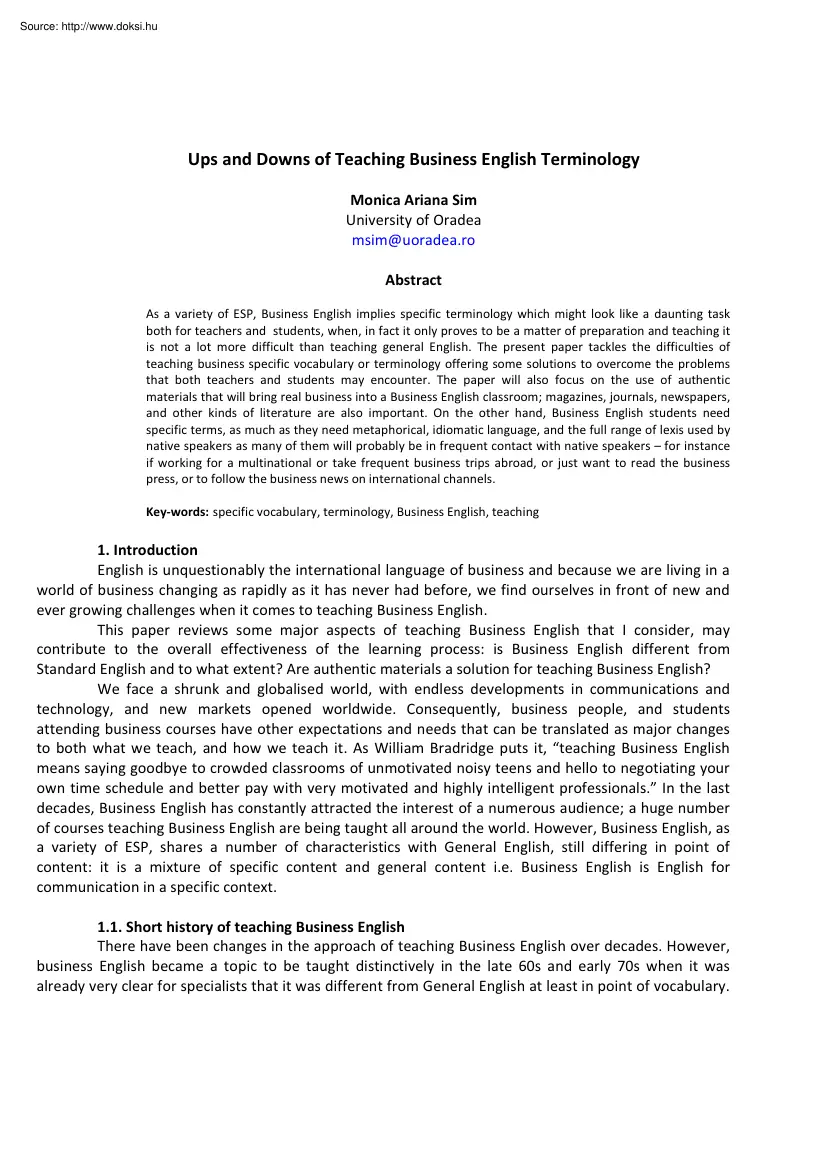
Ups and Downs of Teaching Business English Terminology Monica Ariana Sim University of Oradea msim@uoradea.ro Abstract As a variety of ESP, Business English implies specific terminology which might look like a daunting task both for teachers and students, when, in fact it only proves to be a matter of preparation and teaching it is not a lot more difficult than teaching general English. The present paper tackles the difficulties of teaching business specific vocabulary or terminology offering some solutions to overcome the problems that both teachers and students may encounter. The paper will also focus on the use of authentic materials that will bring real business into a Business English classroom; magazines, journals, newspapers, and other kinds of literature are also important. On the other hand, Business English students need specific terms, as much as they need metaphorical, idiomatic language, and the full range of lexis used by native speakers as many of them will probably be
in frequent contact with native speakers – for instance if working for a multinational or take frequent business trips abroad, or just want to read the business press, or to follow the business news on international channels. Key-words: specific vocabulary, terminology, Business English, teaching 1. Introduction English is unquestionably the international language of business and because we are living in a world of business changing as rapidly as it has never had before, we find ourselves in front of new and ever growing challenges when it comes to teaching Business English. This paper reviews some major aspects of teaching Business English that I consider, may contribute to the overall effectiveness of the learning process: is Business English different from Standard English and to what extent? Are authentic materials a solution for teaching Business English? We face a shrunk and globalised world, with endless developments in communications and technology, and new markets opened
worldwide. Consequently, business people, and students attending business courses have other expectations and needs that can be translated as major changes to both what we teach, and how we teach it. As William Bradridge puts it, “teaching Business English means saying goodbye to crowded classrooms of unmotivated noisy teens and hello to negotiating your own time schedule and better pay with very motivated and highly intelligent professionals.” In the last decades, Business English has constantly attracted the interest of a numerous audience; a huge number of courses teaching Business English are being taught all around the world. However, Business English, as a variety of ESP, shares a number of characteristics with General English, still differing in point of content: it is a mixture of specific content and general content i.e Business English is English for communication in a specific context. 1.1 Short history of teaching Business English There have been changes in the approach
of teaching Business English over decades. However, business English became a topic to be taught distinctively in the late 60s and early 70s when it was already very clear for specialists that it was different from General English at least in point of vocabulary. Thus, there appeared constant methodological preoccupations. At the beginning it was all about reading economic texts followed by comprehension questions, vocabulary exercises, and repetition drills, lacking the interest for true-to-life business situations. In the late 70s and early 80s the focus was on teaching formulaic expressions introduced in business contexts and practiced in role-plays of common business situations such as making appointments, making introductions, business lunches etc. It was only in the late 80s that the emphasis was on the development of business communication skills and it was a direct consequence of the development of in-house training programmes where employees were provided with
opportunities to attend courses in presentation techniques, negotiating and effective meeting skills, among other things. The focus on real effective business communication is or should be a feature of the contemporary Business English teaching, and it has been the approach to English language teaching in the world for the past twenty years. The main purpose of teaching it is to develop the communication skills, the learners’ capacity to make use of the language in its most effective way. 1.2 Changes in the business world influence the teaching of Business English According to some authors, there have been four major influences over the last ten years with a great impact on the process of teaching and learning Business English and these are: the development of technology which allowed people to be in a closer and permanent connection and led to a globalised world of business, people being forced to be extremely effective at a push of a button and English has become the tool for this
global communication; new powerhouse economies, the second important influence, when countries like China, Russia and India became major players in the world of business, as they are countries that can produce goods more cost effectively due to cheaper raw materials and labour force; the third influence is the emergence of new markets in Eastern Europe with consumers hungry for new products previously denied them before the collapse of the Soviet block; last but not least, the huge growth of the financial sector which became more dynamic creating a closely joined world, where economies influence each other be it in a positive or a negative way. All these important movements and changes naturally influence the teaching of Business English. Students are no longer that much interested in grammar or basic business language To improve effectiveness, they need to know specialized vocabulary; they need to be fluent and quick; they have to become aware of cultural differences and their
implications in the business world. 2. What is Business English and Business Terminology? 2.1 Defining Business English To put it simply, Business English is the English required when you do business. It is about teaching English to adults or university students, working or preparing to work in a business environment, be it a large multinational, a small private company or a state company. The radical difference between teaching General English and business, technical English resides in the very aim of the teaching: it may mean teaching technical, academic words, or just taking notes, making presentation, depending on the students’ expectations as they may need it when making presentations, when making telephone calls, for socialising, or negotiating for example. Even if it may be hard, teaching Business English is special and really rewarding as it offers you the possibility to quickly answer to your students’ immediate needs for English; it is in strong connection to the
day-to-day activities of real life, and you may build special relationships with your students in order to find out more about their working lives and about their particular needs in terms of English language. As the dictionaries put it (Collins English Dictionary on-line), terminology refers to the body of specialized words relating to a particular subject, the study of terms, that is, the system of terms belonging or peculiar to a science, art, or specialized subject; nomenclature: the terminology of economics. Thus, terminology refers to the specialized vocabulary characterizing a profession, or some other activities to which a group of people dedicate significant parts of their lives, or sometimes even a slice of an industry. Specialists of a certain area need a specialized vocabulary to properly communicate about notions and concepts specific to their field and that is the technical terminology characterizing a profession, or some other activities to which a group of people
dedicate significant parts of their lives, or sometimes even a slice of an industry. Sometimes terminology is improperly labelled as jargon. In its early history, linguists considered terminology as a mere marginal discipline, simply neglecting it. In time, together with the society evolution, with the progress of sciences and techniques, terminology changes from a discipline holding a marginal status into a theory ever more interesting and appealing to linguists. With the advent of fast development of commerce, international relations, accounting, management, the more refined organizational systems contribute daily to the apparition of new specialized economic terms and within this general label of economic language there are a lot of specialized financial, banking, commercial, accounting, marketing, planning, administrative terms, just to mention some of them. In other words, terminology was the result of the need of experts to communicate precisely and concisely; this sometimes had
the undesired effect of excluding those unfamiliar with the specific language of a certain group as these revolutionary changes touch all the people coming from different cultural, educational background. This may produce difficulties and misunderstandings, for instance in the case of patients that can hardly understand at all the medical vocabulary. Difficulties may also come up when experts belonging to different area of activity that are still connected, use different terms to denote the same phenomena and processes. On the other hand, the term jargon may, and most of the times it really happens to, bear pejorative connotations, especially referring to “business culture.” To conclude, it is vocabulary, the living body of a language that registers the most dramatic changes of modern world, making it difficult for people – teachers included - to keep up. For instance, the very recent financial crises provide people with specific vocabulary that becomes almost basic words for
most speakers: who knew what toxic assets were until a year ago; stagflation (the economic term for stagnant growth and rising inflation), funt (the financially untouchable) and ninja loans (coming from the abbreviation of No Income, No Job, No Assets) are just some other samples. The Business English teacher needs to constantly update his or her business vocabulary knowledge. 2.2 Who Needs Business English? Deriving from its very definition, the answer to this question is: either adults working or preparing to work in a business environment, be it a large multinational, a small private company or a state company or Business English students studying the language either because they need to do their jobs more efficiently or due to the fact they study it in school. Teaching Business English implies highly specific goals and objectives which demand a tight control of the course plan and careful selection of materials and activities. Thus teachers have to be aware of what their real goals
are, who they have to communicate with in English, what about and why. If teachers manage to find out precisely what they need to do and in what contexts, then they can adapt lessons accordingly. As stated above, there is a clear distinction among the learners of Business English: students, or the so-called pre-experience learners and the job experienced learners (Ellis and Johnson 35). The former category will have two types of needs: the need to read bibliography in English and the need to attend English lectures in order to get some qualifications and they have to improve some of their skills: reading, speaking etc. the latter category of learners has a clear set of different needs, that is to improve some of their skills, or they may change their job and need some other skills. Anyway, the striking difference refers to the fact that job experienced learners do not have time for homework, they do not want or need knowledge about the language, they need a practical use of the
language. 2.3 Teaching Business English to Our Students In spite of the growing need for learning English and of the expanding practices of Business English teaching, the process of teaching and learning Business English communication skills is not satisfactory and confronted with many challenges. To get the deeper understanding of the issue, it is necessary to investigate into the perceptions and practices of Business English teaching. Teaching Business English in a college or university in Romania could be challenging as Romania itself is a country where business was hardly a topic twenty years ago then we are language teachers not business experts, and the whole process is performed with students who do not have a general idea about other cultures and civilizations. Thus we become “the designers of a new trend in this Romanian fashionable culture”, that is doing business. It does not only refer to teach words, phrases, concepts that can be found in dictionaries or specialized
books; it is more like a complex educational process of discussing up-to-date topics, and for the moment, it seems that Business English is only a concept (as, by the way, we teach Business English to Romanian students, but we use mostly materials printed abroad). Some teachers – we belong to this category - may find themselves teaching with locally designed materials and course books. These materials are sometimes “in-house productions”, adapted to the level of students and providing the daily lessons needed to teach. Nevertheless, there are times when the teacher feels the need to diversify and enliven the teaching atmosphere. To get beyond the limitations imposed by the curricula, teachers often use authentic materials incorporating them into lesson plans. 3. Resources of teaching Business English 3.1 The teacher/trainer First of all, the Business English teacher is a university graduate; moreover, a detail of utmost importance, the Business English teacher is primarily a
language teacher. The Business English teacher does not need to be an expert in any particular field of business, does not need a business background to succeed in teaching Business English. As Pete Sharma poetically puts it, “for one business English teacher, life is a cold trudge through the snow to a remote factory on the outskirts of a mining town. Over the year, she learns as much about mining as the students learn about language. For another, the students answer all the questions on the needs analysis in the same way: 'I don’t (phone) – I haven’t started working yet'”. It is also rightfully noticed that “it is a misconception that in the field of ESP the teacher has to be an expert in the subject matter.” (Ellis 17) The teacher does not have to teach negotiation strategies, management theory etc. He underlines the fact that the teacher should be seen as an expert in presenting and explaining the language and in taking care of the learners’ language
problems. The Business English teacher has to prepare students to communicate in a foreign language, i.e English about business issues students specialize in Nevertheless teaching Business English is more than just teaching English, it is more challenging as it involves highly specific goals which ask for carefully selected materials and activities. It is about business as well, so professional skills and language skills are equally needed. Secondly, today, the paradigm of the traditional teacher directed learning is shifting towards self-directed learning or student-oriented learning that is, most probably easy and practicable with the help of the new technologies. The emerging and innovative technology will undoubtedly change the whole teaching process as from school education to university education; thus teachers need to get familiar with technological innovation, the new methodological approaches that help in their instruction and need to know how they can get relevant information
from available technology. The teachers need to learn new skills of Business English for effective teaching in order to use them and enhance the communication skills of the learners (Chen 16-33). There are huge methodological differences in what we tell students about language, and how we teach it. There are things like online language courses, evaluating computer assisted language learning and website along with incorporating and dealing with multimedia language laboratories; it is up to each and every teacher to use and implement technologies in his/her classroom for Business English teaching because a teacher’s attitude towards technology will massively influence their approach to teaching Business English and will also influence the students’ feedback. 3.2 Authentic materials The structures that Business English students have to learn are basically the same as general English students. The difference is in context and vocabulary Vocabulary can be best learnt in context that is
why authentic materials can be a choice. The definitions of authentic materials are slightly different in literature. What is common in these definitions is that these materials involve language naturally occurring as communication in native-speaker contexts of use (Morrow 13) or rather those selected contexts where Standard English is the norm: real newspaper reports, for example, real magazine articles, real advertisements, cooking recipes, horoscopes, etc. Rogers and Medley (1988: 467) consider them as “appropriate” and “quality” in terms of goals, objectives, learner needs and interest and “natural” referring to real life and meaningful communication. Jordan (1986:113) refers to authentic texts as texts that are not written for language teaching purposes. Nevertheless, most of the teachers throughout the world agree that authentic texts or materials are beneficial to the language learning process since they increase students' motivation for learning and make the
learner be exposed to the real language, but what is controversial is when authentic materials should be introduced and how they should be used in a language classroom. 3.21 Advantages and disadvantages Most Business English books have been on the market for several years and though they may still contain a lot of useful language input and practice, some aspects of their content now appear outdated. The teacher may decide to omit some exercises if they deal with outmoded practice or present old-fashioned ideas or, especially, old-fashioned language. Advantages of using authentic materials: 1. Authentic materials provide exposure to real language, to a reality level of Business English 2. Authentic materials drawn from periodicals are always up-to-date and constantly being updated. 3. Authentic materials relate more closely to learners ' needs and provide them with a source of up-to-date relevant materials for learning Business English. 4. Authentic materials have a positive
effect on learner motivation 5. Authentic materials provide authentic cultural information 6. Authentic materials offer a more creative approach to teaching Disadvantages of using authentic materials: Alongside with the unquestionable advantages of using authentic materials which bring the real world into the classroom, these texts often contain difficult language, unneeded vocabulary items and complex language structures, which causes a burden for the teacher in lower-level classes (Martinez 253). Other voices argue that authentic materials may be too culturally biased and too many structures are mixed, causing lower levels have a hard time decoding the texts. The solution might be for teachers to be thoughtful enough to decide when and how to introduce authentic materials taking into account especially the students' level of English. 3.22 Newspapers, magazines, the internet One of the most challenging tasks language teachers face is how to stimulate the interest of their
students. Thus, there is a permanent search for materials to supplement the course book Where such materials could be found? Almost everywhere. It is just a matter of will and creativity: from cable TV, English language newspapers and magazines, music on the radio. In spite of the praised value added by the use of authentic materials, some consider that the classroom compromises the authenticity of virtually any material. The same could be speculated for a newspaper article selected by the teacher, photocopied and brought to the class as raw material for reading and discussion, or vocabulary work. As Simon Sweeney interestingly states, “the task of reading something from a newspaper or magazine would carry greater authenticity if the student brought the newspaper of his/her choice . as opposed to reading something chosen by the teacher” (Sweeney 359) English for business is a real and living language so as baron pertinently states “My text books are newspapers, magazines, trade
journals, technical texts, sources from the internet, leaflets, brochures, company information, radio, TV and company videos. A text book is useful for background material whereas authentic material is a source of up to date information” (Idem 363). The practice of teaching English, particularly Business English with the help of technology affects the teaching learning process in terms of performance and quality. The teacher is able to make use of the latest tools of information communication technology and electronic communication to support language teaching and learning process. The Internet can be used to provide authentic material as well. The teacher can search for sites that focus on a specific topic, make questions, and use online dictionaries for meaning and pronunciation. The company websites are also an interesting source of authentic materials, providing the vocabulary practice students need. Then questions about the content of the website can be prepared so as to
make students scan the website for information. The huge advantage is that students can complete the study on their own. The Internet is a great source of authentic materials which are ideal for use in Business English classes, whatever the level of students. Even though some of these materials are clearly intended for native speakers, teachers can adapt all types of activities to suit all levels of students when exploiting these materials. Conclusions 1. English is unquestionably the international language of business and Business English, which is a variety of ESP, shares a number of characteristics with General English, still differing in point of content; Business English is the English required when you do business; 2. Business English became a topic to be taught distinctively in the late 60s and early 70s when it was already very clear for specialists that it was different from General English at least in point of vocabulary; 3. There have been four major influences over the last
ten years with a great impact on the process of teaching and learning of Business English: the development of technology, new powerhouse economies, new markets, financial sector; 4. It seems that Business English is only a concept in Romania, thus teaching it is quite a challenging process. 5. The Business English teacher is primarily a language teacher and does not need to be an expert in any particular field of business, does not need a business background to succeed in teaching Business English 6. When used effectively, authentic materials help bring the real world into the classroom and significantly enliven the language class. 7. Works Cited Bradrige, William. Teaching Business English, http://wwwglobal englishcom/news/Teaching-Business-English, last visited th 30 Sept. 2011 Web Michael Thundercliffe, Current Trends in Teaching and Learning Business English: Adapting to Internationalisation, http://www.scribdcom/doc/37409071/Current-Trends-in-Teaching-and-Learning-Business-English
Web World English Dictionary Collins http://www.collinslanguagecom/ Web Ellis, Mark and Johnson, Christine. Teaching Business English, Oxford: Oxford University Press, 1995 Print Maftei, Mara Magda , The Art of Teaching, The Art of Performing. The Academy of Economic Studies, Bucharest http://www.contabilizatro/file/cursuri de perfectionare/management si marketing/managing change in engli sh for business for special purposes challenges and opportunities/partea2.pdf Web Sharma, Pete. Controversies in Business English April, 2009 http://wwwteachingenglishorguk/articles/controversiesbusiness-english Web Ellis, M., C Johnson Teaching Business English Oxford: Oxford University Press, 1994 Print Chen, H.J Internet-assisted language learning and professional development Seminar on multimedia English teaching, 2003. Chungtai institute of health sciences and technology Web Morrow, K. Authentic texts and ESP In S Holden (Ed), English for Specific Purposes London: Modern English Publications,
1977. Print Rogers, C. V and Medley, F W Language With A Purpose: Using Authentic Materials in the Foreign Language Classroom Foreign Language Annals, (1988). Web Jordan, R.R English for Academic Purposes A Guide and Resource Book for Teachers Cambridge University Cambridge University Press, 1997. Print Martinez, A.G Authentic Materials: An Overview on Karen's Linguistic Issues, 2002 Print M. Athar Hussain, NB Jumani, Munazza Sultana, M Zafar Iqbal, Exploring Perceptions and Practices about Information and Communication Technologies in Business English Teaching in Pakistan, 2010, World Academy of Science, Engineering and Technology. http://wwwwasetorg/journals/waset/v61/v61-19pdf Web Sweeney, Simon., In Print: Reading Business English TESOL Quarterly 1996, http://wwwjstororg/pss/3588152 Web Business Issues, 2006. wwwbesigorg qtd http://peocambridgeorg 1 October 2011 Web
in frequent contact with native speakers – for instance if working for a multinational or take frequent business trips abroad, or just want to read the business press, or to follow the business news on international channels. Key-words: specific vocabulary, terminology, Business English, teaching 1. Introduction English is unquestionably the international language of business and because we are living in a world of business changing as rapidly as it has never had before, we find ourselves in front of new and ever growing challenges when it comes to teaching Business English. This paper reviews some major aspects of teaching Business English that I consider, may contribute to the overall effectiveness of the learning process: is Business English different from Standard English and to what extent? Are authentic materials a solution for teaching Business English? We face a shrunk and globalised world, with endless developments in communications and technology, and new markets opened
worldwide. Consequently, business people, and students attending business courses have other expectations and needs that can be translated as major changes to both what we teach, and how we teach it. As William Bradridge puts it, “teaching Business English means saying goodbye to crowded classrooms of unmotivated noisy teens and hello to negotiating your own time schedule and better pay with very motivated and highly intelligent professionals.” In the last decades, Business English has constantly attracted the interest of a numerous audience; a huge number of courses teaching Business English are being taught all around the world. However, Business English, as a variety of ESP, shares a number of characteristics with General English, still differing in point of content: it is a mixture of specific content and general content i.e Business English is English for communication in a specific context. 1.1 Short history of teaching Business English There have been changes in the approach
of teaching Business English over decades. However, business English became a topic to be taught distinctively in the late 60s and early 70s when it was already very clear for specialists that it was different from General English at least in point of vocabulary. Thus, there appeared constant methodological preoccupations. At the beginning it was all about reading economic texts followed by comprehension questions, vocabulary exercises, and repetition drills, lacking the interest for true-to-life business situations. In the late 70s and early 80s the focus was on teaching formulaic expressions introduced in business contexts and practiced in role-plays of common business situations such as making appointments, making introductions, business lunches etc. It was only in the late 80s that the emphasis was on the development of business communication skills and it was a direct consequence of the development of in-house training programmes where employees were provided with
opportunities to attend courses in presentation techniques, negotiating and effective meeting skills, among other things. The focus on real effective business communication is or should be a feature of the contemporary Business English teaching, and it has been the approach to English language teaching in the world for the past twenty years. The main purpose of teaching it is to develop the communication skills, the learners’ capacity to make use of the language in its most effective way. 1.2 Changes in the business world influence the teaching of Business English According to some authors, there have been four major influences over the last ten years with a great impact on the process of teaching and learning Business English and these are: the development of technology which allowed people to be in a closer and permanent connection and led to a globalised world of business, people being forced to be extremely effective at a push of a button and English has become the tool for this
global communication; new powerhouse economies, the second important influence, when countries like China, Russia and India became major players in the world of business, as they are countries that can produce goods more cost effectively due to cheaper raw materials and labour force; the third influence is the emergence of new markets in Eastern Europe with consumers hungry for new products previously denied them before the collapse of the Soviet block; last but not least, the huge growth of the financial sector which became more dynamic creating a closely joined world, where economies influence each other be it in a positive or a negative way. All these important movements and changes naturally influence the teaching of Business English. Students are no longer that much interested in grammar or basic business language To improve effectiveness, they need to know specialized vocabulary; they need to be fluent and quick; they have to become aware of cultural differences and their
implications in the business world. 2. What is Business English and Business Terminology? 2.1 Defining Business English To put it simply, Business English is the English required when you do business. It is about teaching English to adults or university students, working or preparing to work in a business environment, be it a large multinational, a small private company or a state company. The radical difference between teaching General English and business, technical English resides in the very aim of the teaching: it may mean teaching technical, academic words, or just taking notes, making presentation, depending on the students’ expectations as they may need it when making presentations, when making telephone calls, for socialising, or negotiating for example. Even if it may be hard, teaching Business English is special and really rewarding as it offers you the possibility to quickly answer to your students’ immediate needs for English; it is in strong connection to the
day-to-day activities of real life, and you may build special relationships with your students in order to find out more about their working lives and about their particular needs in terms of English language. As the dictionaries put it (Collins English Dictionary on-line), terminology refers to the body of specialized words relating to a particular subject, the study of terms, that is, the system of terms belonging or peculiar to a science, art, or specialized subject; nomenclature: the terminology of economics. Thus, terminology refers to the specialized vocabulary characterizing a profession, or some other activities to which a group of people dedicate significant parts of their lives, or sometimes even a slice of an industry. Specialists of a certain area need a specialized vocabulary to properly communicate about notions and concepts specific to their field and that is the technical terminology characterizing a profession, or some other activities to which a group of people
dedicate significant parts of their lives, or sometimes even a slice of an industry. Sometimes terminology is improperly labelled as jargon. In its early history, linguists considered terminology as a mere marginal discipline, simply neglecting it. In time, together with the society evolution, with the progress of sciences and techniques, terminology changes from a discipline holding a marginal status into a theory ever more interesting and appealing to linguists. With the advent of fast development of commerce, international relations, accounting, management, the more refined organizational systems contribute daily to the apparition of new specialized economic terms and within this general label of economic language there are a lot of specialized financial, banking, commercial, accounting, marketing, planning, administrative terms, just to mention some of them. In other words, terminology was the result of the need of experts to communicate precisely and concisely; this sometimes had
the undesired effect of excluding those unfamiliar with the specific language of a certain group as these revolutionary changes touch all the people coming from different cultural, educational background. This may produce difficulties and misunderstandings, for instance in the case of patients that can hardly understand at all the medical vocabulary. Difficulties may also come up when experts belonging to different area of activity that are still connected, use different terms to denote the same phenomena and processes. On the other hand, the term jargon may, and most of the times it really happens to, bear pejorative connotations, especially referring to “business culture.” To conclude, it is vocabulary, the living body of a language that registers the most dramatic changes of modern world, making it difficult for people – teachers included - to keep up. For instance, the very recent financial crises provide people with specific vocabulary that becomes almost basic words for
most speakers: who knew what toxic assets were until a year ago; stagflation (the economic term for stagnant growth and rising inflation), funt (the financially untouchable) and ninja loans (coming from the abbreviation of No Income, No Job, No Assets) are just some other samples. The Business English teacher needs to constantly update his or her business vocabulary knowledge. 2.2 Who Needs Business English? Deriving from its very definition, the answer to this question is: either adults working or preparing to work in a business environment, be it a large multinational, a small private company or a state company or Business English students studying the language either because they need to do their jobs more efficiently or due to the fact they study it in school. Teaching Business English implies highly specific goals and objectives which demand a tight control of the course plan and careful selection of materials and activities. Thus teachers have to be aware of what their real goals
are, who they have to communicate with in English, what about and why. If teachers manage to find out precisely what they need to do and in what contexts, then they can adapt lessons accordingly. As stated above, there is a clear distinction among the learners of Business English: students, or the so-called pre-experience learners and the job experienced learners (Ellis and Johnson 35). The former category will have two types of needs: the need to read bibliography in English and the need to attend English lectures in order to get some qualifications and they have to improve some of their skills: reading, speaking etc. the latter category of learners has a clear set of different needs, that is to improve some of their skills, or they may change their job and need some other skills. Anyway, the striking difference refers to the fact that job experienced learners do not have time for homework, they do not want or need knowledge about the language, they need a practical use of the
language. 2.3 Teaching Business English to Our Students In spite of the growing need for learning English and of the expanding practices of Business English teaching, the process of teaching and learning Business English communication skills is not satisfactory and confronted with many challenges. To get the deeper understanding of the issue, it is necessary to investigate into the perceptions and practices of Business English teaching. Teaching Business English in a college or university in Romania could be challenging as Romania itself is a country where business was hardly a topic twenty years ago then we are language teachers not business experts, and the whole process is performed with students who do not have a general idea about other cultures and civilizations. Thus we become “the designers of a new trend in this Romanian fashionable culture”, that is doing business. It does not only refer to teach words, phrases, concepts that can be found in dictionaries or specialized
books; it is more like a complex educational process of discussing up-to-date topics, and for the moment, it seems that Business English is only a concept (as, by the way, we teach Business English to Romanian students, but we use mostly materials printed abroad). Some teachers – we belong to this category - may find themselves teaching with locally designed materials and course books. These materials are sometimes “in-house productions”, adapted to the level of students and providing the daily lessons needed to teach. Nevertheless, there are times when the teacher feels the need to diversify and enliven the teaching atmosphere. To get beyond the limitations imposed by the curricula, teachers often use authentic materials incorporating them into lesson plans. 3. Resources of teaching Business English 3.1 The teacher/trainer First of all, the Business English teacher is a university graduate; moreover, a detail of utmost importance, the Business English teacher is primarily a
language teacher. The Business English teacher does not need to be an expert in any particular field of business, does not need a business background to succeed in teaching Business English. As Pete Sharma poetically puts it, “for one business English teacher, life is a cold trudge through the snow to a remote factory on the outskirts of a mining town. Over the year, she learns as much about mining as the students learn about language. For another, the students answer all the questions on the needs analysis in the same way: 'I don’t (phone) – I haven’t started working yet'”. It is also rightfully noticed that “it is a misconception that in the field of ESP the teacher has to be an expert in the subject matter.” (Ellis 17) The teacher does not have to teach negotiation strategies, management theory etc. He underlines the fact that the teacher should be seen as an expert in presenting and explaining the language and in taking care of the learners’ language
problems. The Business English teacher has to prepare students to communicate in a foreign language, i.e English about business issues students specialize in Nevertheless teaching Business English is more than just teaching English, it is more challenging as it involves highly specific goals which ask for carefully selected materials and activities. It is about business as well, so professional skills and language skills are equally needed. Secondly, today, the paradigm of the traditional teacher directed learning is shifting towards self-directed learning or student-oriented learning that is, most probably easy and practicable with the help of the new technologies. The emerging and innovative technology will undoubtedly change the whole teaching process as from school education to university education; thus teachers need to get familiar with technological innovation, the new methodological approaches that help in their instruction and need to know how they can get relevant information
from available technology. The teachers need to learn new skills of Business English for effective teaching in order to use them and enhance the communication skills of the learners (Chen 16-33). There are huge methodological differences in what we tell students about language, and how we teach it. There are things like online language courses, evaluating computer assisted language learning and website along with incorporating and dealing with multimedia language laboratories; it is up to each and every teacher to use and implement technologies in his/her classroom for Business English teaching because a teacher’s attitude towards technology will massively influence their approach to teaching Business English and will also influence the students’ feedback. 3.2 Authentic materials The structures that Business English students have to learn are basically the same as general English students. The difference is in context and vocabulary Vocabulary can be best learnt in context that is
why authentic materials can be a choice. The definitions of authentic materials are slightly different in literature. What is common in these definitions is that these materials involve language naturally occurring as communication in native-speaker contexts of use (Morrow 13) or rather those selected contexts where Standard English is the norm: real newspaper reports, for example, real magazine articles, real advertisements, cooking recipes, horoscopes, etc. Rogers and Medley (1988: 467) consider them as “appropriate” and “quality” in terms of goals, objectives, learner needs and interest and “natural” referring to real life and meaningful communication. Jordan (1986:113) refers to authentic texts as texts that are not written for language teaching purposes. Nevertheless, most of the teachers throughout the world agree that authentic texts or materials are beneficial to the language learning process since they increase students' motivation for learning and make the
learner be exposed to the real language, but what is controversial is when authentic materials should be introduced and how they should be used in a language classroom. 3.21 Advantages and disadvantages Most Business English books have been on the market for several years and though they may still contain a lot of useful language input and practice, some aspects of their content now appear outdated. The teacher may decide to omit some exercises if they deal with outmoded practice or present old-fashioned ideas or, especially, old-fashioned language. Advantages of using authentic materials: 1. Authentic materials provide exposure to real language, to a reality level of Business English 2. Authentic materials drawn from periodicals are always up-to-date and constantly being updated. 3. Authentic materials relate more closely to learners ' needs and provide them with a source of up-to-date relevant materials for learning Business English. 4. Authentic materials have a positive
effect on learner motivation 5. Authentic materials provide authentic cultural information 6. Authentic materials offer a more creative approach to teaching Disadvantages of using authentic materials: Alongside with the unquestionable advantages of using authentic materials which bring the real world into the classroom, these texts often contain difficult language, unneeded vocabulary items and complex language structures, which causes a burden for the teacher in lower-level classes (Martinez 253). Other voices argue that authentic materials may be too culturally biased and too many structures are mixed, causing lower levels have a hard time decoding the texts. The solution might be for teachers to be thoughtful enough to decide when and how to introduce authentic materials taking into account especially the students' level of English. 3.22 Newspapers, magazines, the internet One of the most challenging tasks language teachers face is how to stimulate the interest of their
students. Thus, there is a permanent search for materials to supplement the course book Where such materials could be found? Almost everywhere. It is just a matter of will and creativity: from cable TV, English language newspapers and magazines, music on the radio. In spite of the praised value added by the use of authentic materials, some consider that the classroom compromises the authenticity of virtually any material. The same could be speculated for a newspaper article selected by the teacher, photocopied and brought to the class as raw material for reading and discussion, or vocabulary work. As Simon Sweeney interestingly states, “the task of reading something from a newspaper or magazine would carry greater authenticity if the student brought the newspaper of his/her choice . as opposed to reading something chosen by the teacher” (Sweeney 359) English for business is a real and living language so as baron pertinently states “My text books are newspapers, magazines, trade
journals, technical texts, sources from the internet, leaflets, brochures, company information, radio, TV and company videos. A text book is useful for background material whereas authentic material is a source of up to date information” (Idem 363). The practice of teaching English, particularly Business English with the help of technology affects the teaching learning process in terms of performance and quality. The teacher is able to make use of the latest tools of information communication technology and electronic communication to support language teaching and learning process. The Internet can be used to provide authentic material as well. The teacher can search for sites that focus on a specific topic, make questions, and use online dictionaries for meaning and pronunciation. The company websites are also an interesting source of authentic materials, providing the vocabulary practice students need. Then questions about the content of the website can be prepared so as to
make students scan the website for information. The huge advantage is that students can complete the study on their own. The Internet is a great source of authentic materials which are ideal for use in Business English classes, whatever the level of students. Even though some of these materials are clearly intended for native speakers, teachers can adapt all types of activities to suit all levels of students when exploiting these materials. Conclusions 1. English is unquestionably the international language of business and Business English, which is a variety of ESP, shares a number of characteristics with General English, still differing in point of content; Business English is the English required when you do business; 2. Business English became a topic to be taught distinctively in the late 60s and early 70s when it was already very clear for specialists that it was different from General English at least in point of vocabulary; 3. There have been four major influences over the last
ten years with a great impact on the process of teaching and learning of Business English: the development of technology, new powerhouse economies, new markets, financial sector; 4. It seems that Business English is only a concept in Romania, thus teaching it is quite a challenging process. 5. The Business English teacher is primarily a language teacher and does not need to be an expert in any particular field of business, does not need a business background to succeed in teaching Business English 6. When used effectively, authentic materials help bring the real world into the classroom and significantly enliven the language class. 7. Works Cited Bradrige, William. Teaching Business English, http://wwwglobal englishcom/news/Teaching-Business-English, last visited th 30 Sept. 2011 Web Michael Thundercliffe, Current Trends in Teaching and Learning Business English: Adapting to Internationalisation, http://www.scribdcom/doc/37409071/Current-Trends-in-Teaching-and-Learning-Business-English
Web World English Dictionary Collins http://www.collinslanguagecom/ Web Ellis, Mark and Johnson, Christine. Teaching Business English, Oxford: Oxford University Press, 1995 Print Maftei, Mara Magda , The Art of Teaching, The Art of Performing. The Academy of Economic Studies, Bucharest http://www.contabilizatro/file/cursuri de perfectionare/management si marketing/managing change in engli sh for business for special purposes challenges and opportunities/partea2.pdf Web Sharma, Pete. Controversies in Business English April, 2009 http://wwwteachingenglishorguk/articles/controversiesbusiness-english Web Ellis, M., C Johnson Teaching Business English Oxford: Oxford University Press, 1994 Print Chen, H.J Internet-assisted language learning and professional development Seminar on multimedia English teaching, 2003. Chungtai institute of health sciences and technology Web Morrow, K. Authentic texts and ESP In S Holden (Ed), English for Specific Purposes London: Modern English Publications,
1977. Print Rogers, C. V and Medley, F W Language With A Purpose: Using Authentic Materials in the Foreign Language Classroom Foreign Language Annals, (1988). Web Jordan, R.R English for Academic Purposes A Guide and Resource Book for Teachers Cambridge University Cambridge University Press, 1997. Print Martinez, A.G Authentic Materials: An Overview on Karen's Linguistic Issues, 2002 Print M. Athar Hussain, NB Jumani, Munazza Sultana, M Zafar Iqbal, Exploring Perceptions and Practices about Information and Communication Technologies in Business English Teaching in Pakistan, 2010, World Academy of Science, Engineering and Technology. http://wwwwasetorg/journals/waset/v61/v61-19pdf Web Sweeney, Simon., In Print: Reading Business English TESOL Quarterly 1996, http://wwwjstororg/pss/3588152 Web Business Issues, 2006. wwwbesigorg qtd http://peocambridgeorg 1 October 2011 Web
 When reading, most of us just let a story wash over us, getting lost in the world of the book rather than paying attention to the individual elements of the plot or writing. However, in English class, our teachers ask us to look at the mechanics of the writing.

