Please log in to read this in our online viewer!
Please log in to read this in our online viewer!
 2001 · 7 page(s) (1 MB)
 English
 3
3
 February 12 · 2018
 Logging in required

 Embed
Embed
No comments yet. You can be the first!
What did others read after this?



Content extract
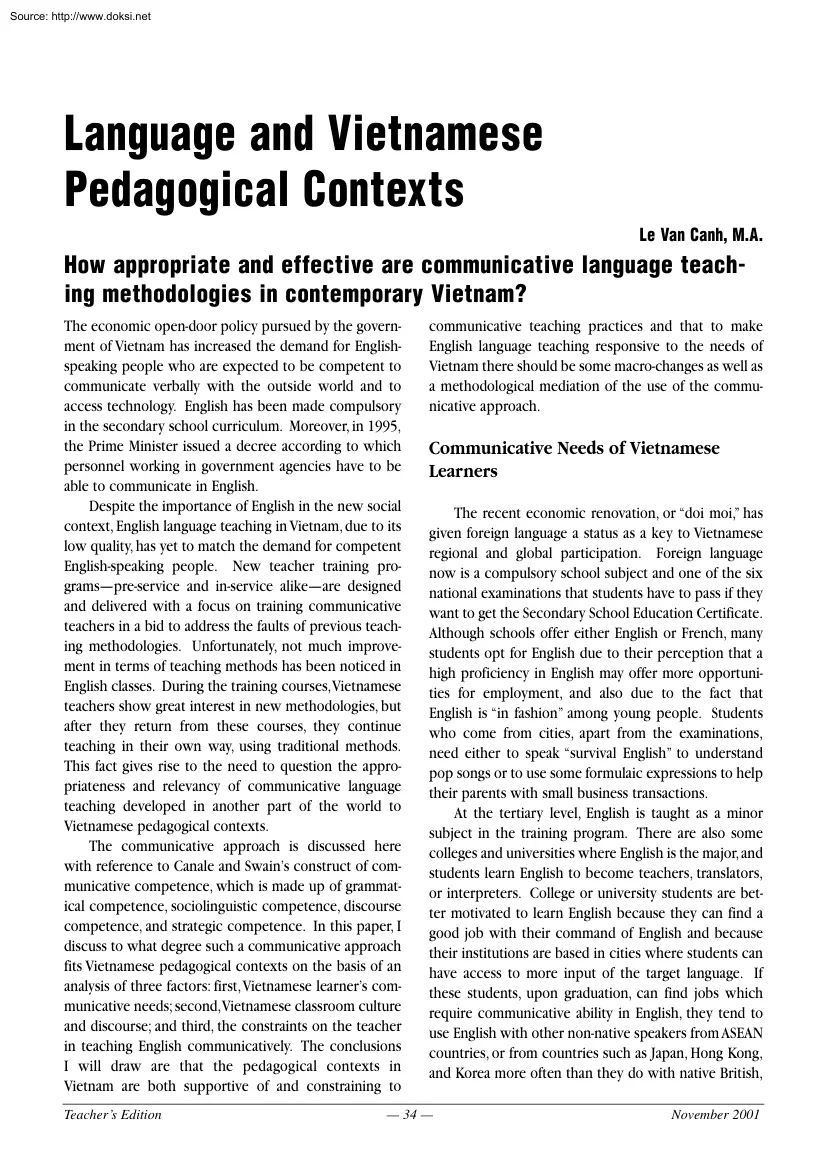
Source: http://www.doksinet Language and Vietnamese Pedagogical Contexts Le Van Canh, M.A How appropriate and effective are communicative language teaching methodologies in contemporary Vietnam? The economic open-door policy pursued by the government of Vietnam has increased the demand for Englishspeaking people who are expected to be competent to communicate verbally with the outside world and to access technology. English has been made compulsory in the secondary school curriculum. Moreover, in 1995, the Prime Minister issued a decree according to which personnel working in government agencies have to be able to communicate in English. Despite the importance of English in the new social context, English language teaching in Vietnam, due to its low quality, has yet to match the demand for competent English-speaking people. New teacher training programspre-service and in-service alikeare designed and delivered with a focus on training communicative teachers in a bid to address the
faults of previous teaching methodologies. Unfortunately, not much improvement in terms of teaching methods has been noticed in English classes. During the training courses,Vietnamese teachers show great interest in new methodologies, but after they return from these courses, they continue teaching in their own way, using traditional methods. This fact gives rise to the need to question the appropriateness and relevancy of communicative language teaching developed in another part of the world to Vietnamese pedagogical contexts. The communicative approach is discussed here with reference to Canale and Swain’s construct of communicative competence, which is made up of grammatical competence, sociolinguistic competence, discourse competence, and strategic competence. In this paper, I discuss to what degree such a communicative approach fits Vietnamese pedagogical contexts on the basis of an analysis of three factors: first,Vietnamese learner’s communicative needs; second,Vietnamese
classroom culture and discourse; and third, the constraints on the teacher in teaching English communicatively. The conclusions I will draw are that the pedagogical contexts in Vietnam are both supportive of and constraining to Teacher’s Edition communicative teaching practices and that to make English language teaching responsive to the needs of Vietnam there should be some macro-changes as well as a methodological mediation of the use of the communicative approach. Communicative Needs of Vietnamese Learners The recent economic renovation, or “doi moi,” has given foreign language a status as a key to Vietnamese regional and global participation. Foreign language now is a compulsory school subject and one of the six national examinations that students have to pass if they want to get the Secondary School Education Certificate. Although schools offer either English or French, many students opt for English due to their perception that a high proficiency in English may offer more
opportunities for employment, and also due to the fact that English is “in fashion” among young people. Students who come from cities, apart from the examinations, need either to speak “survival English” to understand pop songs or to use some formulaic expressions to help their parents with small business transactions. At the tertiary level, English is taught as a minor subject in the training program. There are also some colleges and universities where English is the major,and students learn English to become teachers, translators, or interpreters. College or university students are better motivated to learn English because they can find a good job with their command of English and because their institutions are based in cities where students can have access to more input of the target language. If these students, upon graduation, can find jobs which require communicative ability in English, they tend to use English with other non-native speakers from ASEAN countries, or from
countries such as Japan, Hong Kong, and Korea more often than they do with native British, 34 November 2001 Source: http://www.doksinet Americans, or Australians in their working environments. It is difficult for Vietnamese speakers to achieve the sociolinguistic competence defined by Canale and Swain because the target sociolinguistic conventions are unknown to them. On the other hand, they do not necessarily have to achieve this competence in a contemporary Vietnamese context Vietnamese learners differ in their purposes for learning English. In general, students of English in Vietnam fall into three major categories in terms of needs. Some view English as a tool for more attractive and lucrative employment opportunities; others need a good knowledge of English to study further at a university. The majority of students, however, learn English just to pass the national examinations. These students do not have an obvious communicative need. All they need is a sufficiently good
knowledge of grammar and vocabulary of the target language to pass the national grammarbased and norm-referenced examinations. Currently, the two most important English examinations in Vietnam are the school final examination and the university entrance examination. Both are administered at the end of Grade 12 and neither has a Listening and Speaking component. While the former is norm-referenced, the latter is designed to discriminate between candidates who will be admitted into college or university and those who will not. Holliday argues that “in order to be appropriate, English language teaching methodologies need therefore to be finely tuned to the various needs of individual classroom cultures: they need to be appropriate to local cultures in very specific terms” (p. 53) Canale and Swain also argue that “a communicative approach must be based on and respond to the learner’s communicative needs” (p. 27) Unquestionably, learners’ needs vary, depending on external
exposure to the target language and personal motivation. It is therefore necessary to investigate how much communicative ability Vietnamese learners need before decisions on teaching methodology are made. The English learning environment in Vietnam is described as a cultural island where the teacher is expected to be the sole provider of experience in the target language. Due to the lack of exposure to the target language and the pressure to pass the examinations, the affective filter is high for most Vietnamese students. This is clearly demonstrated by their lack of motivation and high level of anxiety, manifest in a fear of failure in exams. Their learning motivation depends largely on the “teacher’s initiative” and the “learner’s will to succeed” Teacher’s Edition (Ellis). This explains partly why Vietnamese teachers focus more on language knowledge than language use, and more on receptive skills than productive skills. In this environment,“it is valid to ask how
much communicative competence one needs to teach” (Paulston, p. 291). The requirement to provide learners with “the opportunity to take part in meaningful communication interaction with highly competent speakers of the language, i.e, to respond to genuine communicative needs in realistic second language situations” (Canale and Swain, p. 27) is unrealistic and impracticable in most Vietnamese settings. Vietnamese Classroom Culture and Discourse Vietnamese society is typically characterized as a collectivist society.The class is a “family” where students study and play together. The friendships they make during their years at school are significant and last many years after they have left school. This is different from Western individualist societies. The educational system of Vietnam is also characterized as a closed system and knowledge-centered. The textbook, the syllabus, and the teacher determine the knowledge to be acquired. Underpinned by the behaviorist
stimulus-response pattern, this educational system expects students to “return” the desired behavior, which is assessed by examinations. Central to pedagogical practices in Vietnam is the traditional view of the teacher-student relationship. This view supports teacher-centered methods and a structured curriculum. The teacher is supposed to be the only provider of knowledge and therefore is highly respected by the students, students’ parents, and the society as a whole. What the teacher or the textbook says is unquestionably the standard. This respect for teachers is reflected in a motto that can be read on the front of every school building:“Tien hoc li huu hoc van,” or “First learn how to behave, then learn the subject.” Teachers maintain such a high profile in their function as the norm of knowledge, wisdom, and behavior that they do not accept their role as “instruments to see that learning takes place” (Medgyes). In Vietnam, English language teachers are subject
teachers whose responsibility is to provide students with knowledge about the English language and to develop knowledge of it in the most effective possible way. Education is considered “a ticket to ride” and 35 November 2001 Source: http://www.doksinet certificates are more important than competence. Failure in exams is viewed as academic incompetence, and, therefore, a face-losing misfortune. Not only do students find it critical to pass the examinations, teachers are also very much concerned about the pass rate of their students, since they are assessed based on their students’ performances in public examinations rather than on the quality of their teaching. As a result, no matter what the learning purpose of the students might be, teachers have to make sure that their students achieve a high pass rate in the examinations. This examination-oriented instruction produces students who may “achieve the highest scores in the examinations but fail to show their excellence
in real-life performance” (Tuy). The main emphasis of the communicative approach is to develop a learner’s communicative competence through the “negotiation of meaning.” The communicative classroom seeks to encourage learners to initiate and participate actively in meaningful interaction. Breen and Candlin say that participation in the negotiation of meaning enables learners to interpret and construct meanings for themselves and that this is the expression of genuine and meaningful use of the target language. Vietnamese students, except for those coming from larger cities, are slow in adapting to the participatory approach to education on account of their traditional passiveness (Linh). An examination of classroom discourse reveals that classes are teacher-centered and teacher-led. Learning follows the hierarchy of first listening to the teacher,then repetition,then copying models (Kennett and Knight) Classroom interaction is largely one-way, either between a teacher and
individual student or between a teacher and the whole class When one particular student is responding to the teacher, others do not listen. They have their own business to attend to. The traditional analytical learning style informs both the teacher and learners that it is safe to learn and memorize rules. “The preponderance of this activity limits other types of practice activities” in the language classroom (Kennett and Knight). Interruption, argument, seeking clarification, and challenging others rarely happens during class time. By contrast, choral repetition is a commonly used teaching technique. Influenced by Confucianism, students feel rude if they interrupt, question, or argue with their teacher. Language activities such as role-plays, problem-solving tasks, or information gap activities are strange to their culture of learning. When they fail to understand something, they are not daring enough to ask for clarification in public for fear of losing face. They are not
proactive Teacher’s Edition enough to initiate interaction. In the classroom, they are expected to sit in silence unless the teacher calls them individually to speak. When a particular student is called upon to speak in class, her response tends to be very brief, in the form of either a phrase or a short sentence. The teacher directs interaction by asking questions to elicit the reading text; she already knows the answers to her questions. If a student makes a mistake, the teacher intervenes immediately because she has to make sure that students do not make mistakes. Corrective feedback is part of the teacher’s role in the classroom If the teacher does not give corrective feedback, students will think that she is of poor competence. Constraints on Teachers in Using the Communicative Approach Vietnamese teachers of English, by and large, have positive attitudes towards the communicative approach, but they feel constrained in implementing communicative teaching in their classroom
for many reasons. Medgyes asserts that “the communicative classroom requires a teacher of extraordinary abilities: a multidimensional, high-tech,Wizard-of-Oz-like superperson yet of flesh and blood” (p. 107) Communicative teaching is too challenging in Vietnam, where the teacher’s English proficiency is low, classes are large, the buildings, furnishings, and other facilities are basic, and only low levels of support can be provided in terms of materials, libraries, and advisory services. New teaching methods require new understandings and skills. They often require teachers to spend more time doing additional preparatory work, but there are already too many demands on teachers’ time. In secondary schools, teachers rarely have access to the input and resources of the target language. Not a single secondary school in Vietnam has ELT resources and materials available to teachers. The only teaching materials that are at their disposal are a textbook, a couple of practical grammar
books, some test samples, and a dictionary. The opportunity for both teachers and students to “take part in meaningful interaction with highly competent speakers of the language” (Canale and Swain, p. 27) is extremely rare. In such a poor language input environment, teachers soon find their English fossilized. They themselves have problems in getting meaning across in the target language. The predetermined syllabus and prescribed textbook are also frustrating to teachers if they are 36 November 2001 Source: http://www.doksinet committed to communicative methods. In Vietnam, the Ministry of Education and Training designs the national curriculum and sets the syllabus in the schools. The Ministry also monitors the implementation of the syllabus and sets the school final examinations. The syllabus and the textbook, once approved by the Ministry, become laws that must be strictly observed. With the misinterpretation of the principle of “testing only what students have
learnt,” test writers confine the test content to what is covered in the textbook. This again encourages rote, memory-based learning. The third major obstacle to the implementation of the communicative approach is class size and the teaching schedule. Secondary schools have an average class size of between 45 and 52 students and they meet only 3-5 hours a week for English. Inside the classroom, students sit in long rows with five students in each row, leading to immobility for any planned communicative activities. At the same time, the teacher is under pressure to cover the allocated syllabus in the time allowed. Implications for Educational Administrators and Teacher Trainers Over many centuries, Western cultures have influenced Vietnamese culture to a great extent. The attitudes of Vietnamese people to these Western cultures vary from time to timenow they resist, now they adopt thembut in either case, in the end they know how to adapt those exotic cultures to suit their needs and
social contexts. Historically, when Vietnamese scholars became aware of the deficiencies of Confucianism-based education in the early 18th century, they decided to replace it with a Western-style education. The new educational system enabled the Vietnamese to access new social ideologies and to develop their analytical thinking. Teacher’s Edition Although Vietnamese teachers take a positive view of the communicative approach to language teaching, they find it difficult to use this approach in their pedagogical practice. There are various reasons for this constraint in using communicative methods, but the most important ones are the difficulty in creating “realistic second language situations” for their students who have no real-life communicative needs in the target language, and the pressure to prepare their students for the examinations. The claim that Vietnamese students are passive is misleading,because their passiveness in learning is the product of traditional teaching. If
teaching methods are changed more radically, students’ learning styles will change accordingly. To facilitate innova2001 Hayden Sewall tions in teaching methodologies, there must be some macrochanges, the most significant of which is to reform the testing system. Definitely, there is still a long way to go before Listening and Speaking tests can be administered nationwide in Vietnam, for both economic and technical reasons. However, the traditional test can be changed to be more criterion-referenced to test grammar, vocabulary, and reading skills more communicatively. Communicative teaching should be supported by communicative testing. Unless students are tested in terms of skills to use the language communicatively, rather than a good memory of language rules, testing cannot provide any positive backwash on teaching. McGroarty asserts that “communicative competence, as a concept, can mean different things for different groups of students; program planners, administrators, and
teachers will be able to provide better instruction only after considering the specific purposes for which the language is to be used” (p. 257) This fact should also be highlighted during teacher training courses. Training should help to develop a teacher’s ability “to adopt a research orientation to their own classrooms and their own teaching” (Richards and Nunan, p. xii) in order to decide the appropriateness, feasibility, applica- 37 November 2001 Source: http://www.doksinet bility, and practicality of methods against their specific sociocultural and pedagogical situations. It is crucial that teachers should be made aware that Canale and Swain’s model of communicative competence is not applicable to every context. The goal of competence should necessarily be modified to meet students’ expectations and the sociocultural context of teaching and learning. Flexibility in using the syllabus and flexibility in deciding how to approach the classroom culture on the part
of the teachers are essential to the successful use of a communicative approach. Modernization of teaching methods does not mean Westernization of pedagogical practices. The assumption that a language can be acquired not only for the purpose of communication but also through the process of communication is not challenge-free in all teaching situations. Pica argues that “communication is very critical to language learning but it is insufficient to meet the needs and goals of many learners” (p. 7) It is also unfair to think that foreign teaching techniques and materials are all irrelevant. Practice has proved that a culturallyadapted communicative approach can work well in Vietnamese classrooms. Learning English in Vietnam, students rarely have opportunities for English communication outside the classroom. What they have learned inside the classroom is for future use, rather than for immediate use. In this context, it is critical to maintain a good balance between instruction,
correction, and communication. Researchers such as Lightbown and Spada support the view that exclusively form-based or meaning-based classes are less effective than meaning-based classes with some focus on form and corrective feedback. It is incumbent upon teacher trainers and teachers to have insights into Vietnamese pedagogical contexts to decide which aspects can be changed and which can be accepted. In teacher-training projects, there should be a partnership between teacher trainers and teachers to address the challenges emerging from the constraints of the local culture and educational system with good understanding and adequate creativity. If we agree that learners are not “empty vessels,” we have to accept that teachers in training courses are not empty vessels, either. They have their own experiences, beliefs, and values. It is certain that teachers’ practical knowledge is different from theoretical and pedagogical knowledge. Their resistance to change often results from
their own learning experience and perceptions of teaching. For them, innovations should be judged on the basis of their usability and practicality. If innovations are relevant and applicable to teachers’ specific situations, they are likely to bring about changes in the classroom. Shaw argues that “human beings are generally half in one subculture and half out of another” (p. 12) Innovations in teaching methodology do not mean “throwing the baby out with the bath water.” A traditional approach could be either improved in the direction of the principles of communicative language teaching, or used as a kick-off step in the communicative classroom. The teaching hierarchy could be first accuracy, then fluency, or acquisition following learning, not the other way round. From the above analysis of Vietnamese classroom discourse, it is necessary to accept a hierarchy of negotiated interaction from choice elicitation, such as showing agreement or disagreement, to product elicitation,
such as giving factual information, then to process elicitationfor example,giving or asking for opinions. To do this, trainers in teacher training courses should provide trainees with hands-on experience in how to teach English communicatively in the local context through a balance of training, practicum, and evaluation. Conclusion On its progress to regional and global participation, Vietnamese traditional culture is facing challenges from incoming exotic cultures. The current global trend is for national and international elements to both coexist and be interdependent. This trend gives rise to the need to reconsider some traditional values that have become out-of-date and unsuitable to the new social contexts. Needless to say,Vietnam has decided to maintain its cultural integrity while integrating into the international community. To be successful in this goal, Vietnamese people know that they should be wise enough to adapt By reform, we do not mean throwing away all traditional
values and practices. Practicability and applicability to specific teaching situations are factors of success in educational reform. Teacher’s Edition 38 November 2001 Source: http://www.doksinet what comes from outside but is thought to be suitable to their needs and their settings, and then create something of their own. There is ample historical evidence to support this. Vietnam has decided to “take a short cut” to the industrialization and modernization of the country because of its comparative advantages. In this strenuous endeavor, reform in the educational system in general, and in the area of language education in particular, is a crucial factor. By reform, we do not mean throwing away all traditional values and practices. Practicality and applicability to specific teaching situations are factors of success in educational reform. A piece of furniture that looks good in the showroom may turn out to be ugly when it is not compatible with the space and other existing
material of a particular living room. An appropriate technology should be one that fits local conditions, local needs, and local purses Two essential factors support the use of communicative language teaching in Vietnam. First, the government sees proficiency in communicative English as essential for business and commercial contacts, as well as for access to information on technological development. Second, teachers have a favorable view of this approach. However, the sociocultural context of the country creates some challenges. The communicative approach should, therefore, be “culturally attuned” to be effective in Vietnamese contexts (Ellis) in order to help English teaching in Vietnam to respond better to the vision of national development. Efforts to decide what is the right balance between traditional methods and modern methods according to learners’ needs and learning environments and to facilitate learning and teaching should be encouraged among all stakeholders:
administrators, syllabus designers, teacher trainers, and teachers themselves. n References Breen, M.P, and CN Candlin “The Essentials of a Communicative Curriculum in Language Teaching.” Applied Linguistics 1, pp. 89-112, 1980 Canale, M., and M Swain “Theoretical Bases of Communicative Approaches to Second Language Teaching and Testing.” Applied Linguistics 1, pp 1-47, 1980. Ellis, G. “How Culturally Appropriate is the Communicative Approach?” ELT Journal 50, pp. 213218, 1996 Teacher’s Edition Holliday, A. Appropriate Methodology and Social Context. Cambridge University Press, 1994 Linh, D.K “Nhung ghi nhan to hoi thao khoa hoc ve phuong phap giang day dai hoc” [Notes on the seminar on teaching methodologies in higher education]. Giao Duc Va Thoi Dai [Education and Times newspaper], p. 56, 1999 Lightbown, P. and N Spada How Languages Are Learned. Oxford University Press, 1993 Kennett, P. and J Knight “Baseline Study Report on Lower Secondary English Language
Teaching in Vietnam.” ELTTP Project of the Ministry of Education and Training and the Department for International Development, 1999. McGroarty, M. “Some Meanings of Communicative Competence for Second Language Students.” TESOL Quarterly 18, pp. 257-271, 1984 Medgyes, P. “Queries from a Communicative Teacher” ELT Journal 40, pp. 107-112, 1986 Paulston, C.B “Linguistics and Communicative Competence.” In Developing Communicative Competence in a Second Language. Ed R C Scarcella, W.Anderson, and S Krashen Heinle and Heinle, 1990 Pica, T. “Tradition and Transition in Second Language Teaching.” In Second Language Teacher Education Ed J. Richards and D Nunan Cambridge University Press, 1990. (Accessed on the ERIC database, 1997) Richards, J., and D Nunan “Self-Observation in Teacher Development.” In Second Language Teacher Education. Ed J Richards and D Nunan Cambridge University Press, 1990. Shaw, P. “Variation and Universality in Communicative Competence:
Coseriu’s Model.” TESOL Quarterly 26, pp. 9-25, 1992 Tuy, H. “Co gi can ban them ve tinh hieu hoc” [Learner’s fondness for knowledge revisited?]. Giao Duc Va Thoi Dai [Education and Times newspaper], p. 79, 1999 This paper was originally presented at the Fourth International Conference on Language and Development, “Partnership and Interaction,” held October 13-15, 1999, in Hanoi, Vietnam. It has been published in the conference proceedings, also entitled Partnership and Interaction, edited by Jonathan Shaw, Diana Lubelska, and Michelle Noullet, published in 39 November 2001 Source: http://www.doksinet 2000 in Bangkok, Thailand, by the Asian Institute of Technology. Used by permission ❖❖❖❖❖ Le Van Canh (M.A, TESOL, St Michael’s College) is the Director of the International Relations Office of the College of Foreign Languages, Hanoi National University, where he also teaches. He has been involved in English education since 1979, and has written for many
newspapers and professional journals. This month, he is presenting a paper entitled “Breaking With Traditional Practices? Issues in EFL Teacher Education in Vietnam”at a conference in Edinburgh. ❖❖❖❖❖ Resource Bulletin Board Internet Listening Practice The following three Websites have been designed to help ESL/EFL students practice their listening online. They use free audio software, such as Real Player, that nowadays comes preinstalled on most computers. www.esl-labcom This excellent site features a large and varied array of listening selections and exercises, graded by skill level. Put together by Randall Davis, who currently teaches at the University of Utah, it also includes pre- and post-listening exercises, as well as scripts of the selections. AD.Walkerorg/listeninghtm This is a fine guide to practicing listening on the Internet, and features a good listing of sites on which authentic and educational audio resources may be found. There is also an explanation of
how to listen to radio stations with Real Player, and how to play common formats such as MP3. www.mrctwsuedu/ielc-lab/wnr or webs.wichitaedu/ielc-lab/wnr While the listening resources of the previous two sites are for online use, this Website has a free World News Review program that can be downloaded and used offline. Maintained by the Intensive English Language Center at Wichita State University, the software (Windows 95 and higher) includes 12 news stories in normal English read at normal speed, plus comprehension exercises. Teacher’s Edition 40 Ideas on the Go Since We All Have to Eat. Hayden Sewall Goal: Students learn to write opinions on a topic of practical interest. Have your students write a restaurant review! The street our school is located on has at least twenty, low-priced “com binh dan” eating venues. Each has a different personality, clientèle, and history, but all are well-known to my students. Many of these places do not have a name, so the street address
(for example, Number 8, Lach Tray Street) is sufficient. I start by assigning students to eat at restaurants of their choice. In addition, they must find out two interesting facts from the owner. Other topics of interest include environment, types of customers, food quality and variety, staff appearance, cleanliness, location, price of the food, and size of the portions. They could give an overall rating using stars or another symbol. Before students are sent out, we study specific restaurant words, review the basics of paragraph writing, and look at some examples of reviews written by me about other restaurants in the city. When everyone feels good about their review, which will no doubt require several drafts and revisions, I put together a book to distribute to any and all studentstheir own dining guide! (Note: You probably need to ask your school for permission to do this. It may also be useful to have a school official read your reviews and write a short introduction. This will
guarantee that it is okay to distribute your restaurant guide on campus.) Hayden Sewall, the ELI Curriculum Director for Vietnam, is in his fourth year of teaching at Vietnam Maritime University. He is currently finishing an M.A in TESOL, and has eaten at all 20 “com binh dans” on Lach Tray Street in Haiphong. November 2001
faults of previous teaching methodologies. Unfortunately, not much improvement in terms of teaching methods has been noticed in English classes. During the training courses,Vietnamese teachers show great interest in new methodologies, but after they return from these courses, they continue teaching in their own way, using traditional methods. This fact gives rise to the need to question the appropriateness and relevancy of communicative language teaching developed in another part of the world to Vietnamese pedagogical contexts. The communicative approach is discussed here with reference to Canale and Swain’s construct of communicative competence, which is made up of grammatical competence, sociolinguistic competence, discourse competence, and strategic competence. In this paper, I discuss to what degree such a communicative approach fits Vietnamese pedagogical contexts on the basis of an analysis of three factors: first,Vietnamese learner’s communicative needs; second,Vietnamese
classroom culture and discourse; and third, the constraints on the teacher in teaching English communicatively. The conclusions I will draw are that the pedagogical contexts in Vietnam are both supportive of and constraining to Teacher’s Edition communicative teaching practices and that to make English language teaching responsive to the needs of Vietnam there should be some macro-changes as well as a methodological mediation of the use of the communicative approach. Communicative Needs of Vietnamese Learners The recent economic renovation, or “doi moi,” has given foreign language a status as a key to Vietnamese regional and global participation. Foreign language now is a compulsory school subject and one of the six national examinations that students have to pass if they want to get the Secondary School Education Certificate. Although schools offer either English or French, many students opt for English due to their perception that a high proficiency in English may offer more
opportunities for employment, and also due to the fact that English is “in fashion” among young people. Students who come from cities, apart from the examinations, need either to speak “survival English” to understand pop songs or to use some formulaic expressions to help their parents with small business transactions. At the tertiary level, English is taught as a minor subject in the training program. There are also some colleges and universities where English is the major,and students learn English to become teachers, translators, or interpreters. College or university students are better motivated to learn English because they can find a good job with their command of English and because their institutions are based in cities where students can have access to more input of the target language. If these students, upon graduation, can find jobs which require communicative ability in English, they tend to use English with other non-native speakers from ASEAN countries, or from
countries such as Japan, Hong Kong, and Korea more often than they do with native British, 34 November 2001 Source: http://www.doksinet Americans, or Australians in their working environments. It is difficult for Vietnamese speakers to achieve the sociolinguistic competence defined by Canale and Swain because the target sociolinguistic conventions are unknown to them. On the other hand, they do not necessarily have to achieve this competence in a contemporary Vietnamese context Vietnamese learners differ in their purposes for learning English. In general, students of English in Vietnam fall into three major categories in terms of needs. Some view English as a tool for more attractive and lucrative employment opportunities; others need a good knowledge of English to study further at a university. The majority of students, however, learn English just to pass the national examinations. These students do not have an obvious communicative need. All they need is a sufficiently good
knowledge of grammar and vocabulary of the target language to pass the national grammarbased and norm-referenced examinations. Currently, the two most important English examinations in Vietnam are the school final examination and the university entrance examination. Both are administered at the end of Grade 12 and neither has a Listening and Speaking component. While the former is norm-referenced, the latter is designed to discriminate between candidates who will be admitted into college or university and those who will not. Holliday argues that “in order to be appropriate, English language teaching methodologies need therefore to be finely tuned to the various needs of individual classroom cultures: they need to be appropriate to local cultures in very specific terms” (p. 53) Canale and Swain also argue that “a communicative approach must be based on and respond to the learner’s communicative needs” (p. 27) Unquestionably, learners’ needs vary, depending on external
exposure to the target language and personal motivation. It is therefore necessary to investigate how much communicative ability Vietnamese learners need before decisions on teaching methodology are made. The English learning environment in Vietnam is described as a cultural island where the teacher is expected to be the sole provider of experience in the target language. Due to the lack of exposure to the target language and the pressure to pass the examinations, the affective filter is high for most Vietnamese students. This is clearly demonstrated by their lack of motivation and high level of anxiety, manifest in a fear of failure in exams. Their learning motivation depends largely on the “teacher’s initiative” and the “learner’s will to succeed” Teacher’s Edition (Ellis). This explains partly why Vietnamese teachers focus more on language knowledge than language use, and more on receptive skills than productive skills. In this environment,“it is valid to ask how
much communicative competence one needs to teach” (Paulston, p. 291). The requirement to provide learners with “the opportunity to take part in meaningful communication interaction with highly competent speakers of the language, i.e, to respond to genuine communicative needs in realistic second language situations” (Canale and Swain, p. 27) is unrealistic and impracticable in most Vietnamese settings. Vietnamese Classroom Culture and Discourse Vietnamese society is typically characterized as a collectivist society.The class is a “family” where students study and play together. The friendships they make during their years at school are significant and last many years after they have left school. This is different from Western individualist societies. The educational system of Vietnam is also characterized as a closed system and knowledge-centered. The textbook, the syllabus, and the teacher determine the knowledge to be acquired. Underpinned by the behaviorist
stimulus-response pattern, this educational system expects students to “return” the desired behavior, which is assessed by examinations. Central to pedagogical practices in Vietnam is the traditional view of the teacher-student relationship. This view supports teacher-centered methods and a structured curriculum. The teacher is supposed to be the only provider of knowledge and therefore is highly respected by the students, students’ parents, and the society as a whole. What the teacher or the textbook says is unquestionably the standard. This respect for teachers is reflected in a motto that can be read on the front of every school building:“Tien hoc li huu hoc van,” or “First learn how to behave, then learn the subject.” Teachers maintain such a high profile in their function as the norm of knowledge, wisdom, and behavior that they do not accept their role as “instruments to see that learning takes place” (Medgyes). In Vietnam, English language teachers are subject
teachers whose responsibility is to provide students with knowledge about the English language and to develop knowledge of it in the most effective possible way. Education is considered “a ticket to ride” and 35 November 2001 Source: http://www.doksinet certificates are more important than competence. Failure in exams is viewed as academic incompetence, and, therefore, a face-losing misfortune. Not only do students find it critical to pass the examinations, teachers are also very much concerned about the pass rate of their students, since they are assessed based on their students’ performances in public examinations rather than on the quality of their teaching. As a result, no matter what the learning purpose of the students might be, teachers have to make sure that their students achieve a high pass rate in the examinations. This examination-oriented instruction produces students who may “achieve the highest scores in the examinations but fail to show their excellence
in real-life performance” (Tuy). The main emphasis of the communicative approach is to develop a learner’s communicative competence through the “negotiation of meaning.” The communicative classroom seeks to encourage learners to initiate and participate actively in meaningful interaction. Breen and Candlin say that participation in the negotiation of meaning enables learners to interpret and construct meanings for themselves and that this is the expression of genuine and meaningful use of the target language. Vietnamese students, except for those coming from larger cities, are slow in adapting to the participatory approach to education on account of their traditional passiveness (Linh). An examination of classroom discourse reveals that classes are teacher-centered and teacher-led. Learning follows the hierarchy of first listening to the teacher,then repetition,then copying models (Kennett and Knight) Classroom interaction is largely one-way, either between a teacher and
individual student or between a teacher and the whole class When one particular student is responding to the teacher, others do not listen. They have their own business to attend to. The traditional analytical learning style informs both the teacher and learners that it is safe to learn and memorize rules. “The preponderance of this activity limits other types of practice activities” in the language classroom (Kennett and Knight). Interruption, argument, seeking clarification, and challenging others rarely happens during class time. By contrast, choral repetition is a commonly used teaching technique. Influenced by Confucianism, students feel rude if they interrupt, question, or argue with their teacher. Language activities such as role-plays, problem-solving tasks, or information gap activities are strange to their culture of learning. When they fail to understand something, they are not daring enough to ask for clarification in public for fear of losing face. They are not
proactive Teacher’s Edition enough to initiate interaction. In the classroom, they are expected to sit in silence unless the teacher calls them individually to speak. When a particular student is called upon to speak in class, her response tends to be very brief, in the form of either a phrase or a short sentence. The teacher directs interaction by asking questions to elicit the reading text; she already knows the answers to her questions. If a student makes a mistake, the teacher intervenes immediately because she has to make sure that students do not make mistakes. Corrective feedback is part of the teacher’s role in the classroom If the teacher does not give corrective feedback, students will think that she is of poor competence. Constraints on Teachers in Using the Communicative Approach Vietnamese teachers of English, by and large, have positive attitudes towards the communicative approach, but they feel constrained in implementing communicative teaching in their classroom
for many reasons. Medgyes asserts that “the communicative classroom requires a teacher of extraordinary abilities: a multidimensional, high-tech,Wizard-of-Oz-like superperson yet of flesh and blood” (p. 107) Communicative teaching is too challenging in Vietnam, where the teacher’s English proficiency is low, classes are large, the buildings, furnishings, and other facilities are basic, and only low levels of support can be provided in terms of materials, libraries, and advisory services. New teaching methods require new understandings and skills. They often require teachers to spend more time doing additional preparatory work, but there are already too many demands on teachers’ time. In secondary schools, teachers rarely have access to the input and resources of the target language. Not a single secondary school in Vietnam has ELT resources and materials available to teachers. The only teaching materials that are at their disposal are a textbook, a couple of practical grammar
books, some test samples, and a dictionary. The opportunity for both teachers and students to “take part in meaningful interaction with highly competent speakers of the language” (Canale and Swain, p. 27) is extremely rare. In such a poor language input environment, teachers soon find their English fossilized. They themselves have problems in getting meaning across in the target language. The predetermined syllabus and prescribed textbook are also frustrating to teachers if they are 36 November 2001 Source: http://www.doksinet committed to communicative methods. In Vietnam, the Ministry of Education and Training designs the national curriculum and sets the syllabus in the schools. The Ministry also monitors the implementation of the syllabus and sets the school final examinations. The syllabus and the textbook, once approved by the Ministry, become laws that must be strictly observed. With the misinterpretation of the principle of “testing only what students have
learnt,” test writers confine the test content to what is covered in the textbook. This again encourages rote, memory-based learning. The third major obstacle to the implementation of the communicative approach is class size and the teaching schedule. Secondary schools have an average class size of between 45 and 52 students and they meet only 3-5 hours a week for English. Inside the classroom, students sit in long rows with five students in each row, leading to immobility for any planned communicative activities. At the same time, the teacher is under pressure to cover the allocated syllabus in the time allowed. Implications for Educational Administrators and Teacher Trainers Over many centuries, Western cultures have influenced Vietnamese culture to a great extent. The attitudes of Vietnamese people to these Western cultures vary from time to timenow they resist, now they adopt thembut in either case, in the end they know how to adapt those exotic cultures to suit their needs and
social contexts. Historically, when Vietnamese scholars became aware of the deficiencies of Confucianism-based education in the early 18th century, they decided to replace it with a Western-style education. The new educational system enabled the Vietnamese to access new social ideologies and to develop their analytical thinking. Teacher’s Edition Although Vietnamese teachers take a positive view of the communicative approach to language teaching, they find it difficult to use this approach in their pedagogical practice. There are various reasons for this constraint in using communicative methods, but the most important ones are the difficulty in creating “realistic second language situations” for their students who have no real-life communicative needs in the target language, and the pressure to prepare their students for the examinations. The claim that Vietnamese students are passive is misleading,because their passiveness in learning is the product of traditional teaching. If
teaching methods are changed more radically, students’ learning styles will change accordingly. To facilitate innova2001 Hayden Sewall tions in teaching methodologies, there must be some macrochanges, the most significant of which is to reform the testing system. Definitely, there is still a long way to go before Listening and Speaking tests can be administered nationwide in Vietnam, for both economic and technical reasons. However, the traditional test can be changed to be more criterion-referenced to test grammar, vocabulary, and reading skills more communicatively. Communicative teaching should be supported by communicative testing. Unless students are tested in terms of skills to use the language communicatively, rather than a good memory of language rules, testing cannot provide any positive backwash on teaching. McGroarty asserts that “communicative competence, as a concept, can mean different things for different groups of students; program planners, administrators, and
teachers will be able to provide better instruction only after considering the specific purposes for which the language is to be used” (p. 257) This fact should also be highlighted during teacher training courses. Training should help to develop a teacher’s ability “to adopt a research orientation to their own classrooms and their own teaching” (Richards and Nunan, p. xii) in order to decide the appropriateness, feasibility, applica- 37 November 2001 Source: http://www.doksinet bility, and practicality of methods against their specific sociocultural and pedagogical situations. It is crucial that teachers should be made aware that Canale and Swain’s model of communicative competence is not applicable to every context. The goal of competence should necessarily be modified to meet students’ expectations and the sociocultural context of teaching and learning. Flexibility in using the syllabus and flexibility in deciding how to approach the classroom culture on the part
of the teachers are essential to the successful use of a communicative approach. Modernization of teaching methods does not mean Westernization of pedagogical practices. The assumption that a language can be acquired not only for the purpose of communication but also through the process of communication is not challenge-free in all teaching situations. Pica argues that “communication is very critical to language learning but it is insufficient to meet the needs and goals of many learners” (p. 7) It is also unfair to think that foreign teaching techniques and materials are all irrelevant. Practice has proved that a culturallyadapted communicative approach can work well in Vietnamese classrooms. Learning English in Vietnam, students rarely have opportunities for English communication outside the classroom. What they have learned inside the classroom is for future use, rather than for immediate use. In this context, it is critical to maintain a good balance between instruction,
correction, and communication. Researchers such as Lightbown and Spada support the view that exclusively form-based or meaning-based classes are less effective than meaning-based classes with some focus on form and corrective feedback. It is incumbent upon teacher trainers and teachers to have insights into Vietnamese pedagogical contexts to decide which aspects can be changed and which can be accepted. In teacher-training projects, there should be a partnership between teacher trainers and teachers to address the challenges emerging from the constraints of the local culture and educational system with good understanding and adequate creativity. If we agree that learners are not “empty vessels,” we have to accept that teachers in training courses are not empty vessels, either. They have their own experiences, beliefs, and values. It is certain that teachers’ practical knowledge is different from theoretical and pedagogical knowledge. Their resistance to change often results from
their own learning experience and perceptions of teaching. For them, innovations should be judged on the basis of their usability and practicality. If innovations are relevant and applicable to teachers’ specific situations, they are likely to bring about changes in the classroom. Shaw argues that “human beings are generally half in one subculture and half out of another” (p. 12) Innovations in teaching methodology do not mean “throwing the baby out with the bath water.” A traditional approach could be either improved in the direction of the principles of communicative language teaching, or used as a kick-off step in the communicative classroom. The teaching hierarchy could be first accuracy, then fluency, or acquisition following learning, not the other way round. From the above analysis of Vietnamese classroom discourse, it is necessary to accept a hierarchy of negotiated interaction from choice elicitation, such as showing agreement or disagreement, to product elicitation,
such as giving factual information, then to process elicitationfor example,giving or asking for opinions. To do this, trainers in teacher training courses should provide trainees with hands-on experience in how to teach English communicatively in the local context through a balance of training, practicum, and evaluation. Conclusion On its progress to regional and global participation, Vietnamese traditional culture is facing challenges from incoming exotic cultures. The current global trend is for national and international elements to both coexist and be interdependent. This trend gives rise to the need to reconsider some traditional values that have become out-of-date and unsuitable to the new social contexts. Needless to say,Vietnam has decided to maintain its cultural integrity while integrating into the international community. To be successful in this goal, Vietnamese people know that they should be wise enough to adapt By reform, we do not mean throwing away all traditional
values and practices. Practicability and applicability to specific teaching situations are factors of success in educational reform. Teacher’s Edition 38 November 2001 Source: http://www.doksinet what comes from outside but is thought to be suitable to their needs and their settings, and then create something of their own. There is ample historical evidence to support this. Vietnam has decided to “take a short cut” to the industrialization and modernization of the country because of its comparative advantages. In this strenuous endeavor, reform in the educational system in general, and in the area of language education in particular, is a crucial factor. By reform, we do not mean throwing away all traditional values and practices. Practicality and applicability to specific teaching situations are factors of success in educational reform. A piece of furniture that looks good in the showroom may turn out to be ugly when it is not compatible with the space and other existing
material of a particular living room. An appropriate technology should be one that fits local conditions, local needs, and local purses Two essential factors support the use of communicative language teaching in Vietnam. First, the government sees proficiency in communicative English as essential for business and commercial contacts, as well as for access to information on technological development. Second, teachers have a favorable view of this approach. However, the sociocultural context of the country creates some challenges. The communicative approach should, therefore, be “culturally attuned” to be effective in Vietnamese contexts (Ellis) in order to help English teaching in Vietnam to respond better to the vision of national development. Efforts to decide what is the right balance between traditional methods and modern methods according to learners’ needs and learning environments and to facilitate learning and teaching should be encouraged among all stakeholders:
administrators, syllabus designers, teacher trainers, and teachers themselves. n References Breen, M.P, and CN Candlin “The Essentials of a Communicative Curriculum in Language Teaching.” Applied Linguistics 1, pp. 89-112, 1980 Canale, M., and M Swain “Theoretical Bases of Communicative Approaches to Second Language Teaching and Testing.” Applied Linguistics 1, pp 1-47, 1980. Ellis, G. “How Culturally Appropriate is the Communicative Approach?” ELT Journal 50, pp. 213218, 1996 Teacher’s Edition Holliday, A. Appropriate Methodology and Social Context. Cambridge University Press, 1994 Linh, D.K “Nhung ghi nhan to hoi thao khoa hoc ve phuong phap giang day dai hoc” [Notes on the seminar on teaching methodologies in higher education]. Giao Duc Va Thoi Dai [Education and Times newspaper], p. 56, 1999 Lightbown, P. and N Spada How Languages Are Learned. Oxford University Press, 1993 Kennett, P. and J Knight “Baseline Study Report on Lower Secondary English Language
Teaching in Vietnam.” ELTTP Project of the Ministry of Education and Training and the Department for International Development, 1999. McGroarty, M. “Some Meanings of Communicative Competence for Second Language Students.” TESOL Quarterly 18, pp. 257-271, 1984 Medgyes, P. “Queries from a Communicative Teacher” ELT Journal 40, pp. 107-112, 1986 Paulston, C.B “Linguistics and Communicative Competence.” In Developing Communicative Competence in a Second Language. Ed R C Scarcella, W.Anderson, and S Krashen Heinle and Heinle, 1990 Pica, T. “Tradition and Transition in Second Language Teaching.” In Second Language Teacher Education Ed J. Richards and D Nunan Cambridge University Press, 1990. (Accessed on the ERIC database, 1997) Richards, J., and D Nunan “Self-Observation in Teacher Development.” In Second Language Teacher Education. Ed J Richards and D Nunan Cambridge University Press, 1990. Shaw, P. “Variation and Universality in Communicative Competence:
Coseriu’s Model.” TESOL Quarterly 26, pp. 9-25, 1992 Tuy, H. “Co gi can ban them ve tinh hieu hoc” [Learner’s fondness for knowledge revisited?]. Giao Duc Va Thoi Dai [Education and Times newspaper], p. 79, 1999 This paper was originally presented at the Fourth International Conference on Language and Development, “Partnership and Interaction,” held October 13-15, 1999, in Hanoi, Vietnam. It has been published in the conference proceedings, also entitled Partnership and Interaction, edited by Jonathan Shaw, Diana Lubelska, and Michelle Noullet, published in 39 November 2001 Source: http://www.doksinet 2000 in Bangkok, Thailand, by the Asian Institute of Technology. Used by permission ❖❖❖❖❖ Le Van Canh (M.A, TESOL, St Michael’s College) is the Director of the International Relations Office of the College of Foreign Languages, Hanoi National University, where he also teaches. He has been involved in English education since 1979, and has written for many
newspapers and professional journals. This month, he is presenting a paper entitled “Breaking With Traditional Practices? Issues in EFL Teacher Education in Vietnam”at a conference in Edinburgh. ❖❖❖❖❖ Resource Bulletin Board Internet Listening Practice The following three Websites have been designed to help ESL/EFL students practice their listening online. They use free audio software, such as Real Player, that nowadays comes preinstalled on most computers. www.esl-labcom This excellent site features a large and varied array of listening selections and exercises, graded by skill level. Put together by Randall Davis, who currently teaches at the University of Utah, it also includes pre- and post-listening exercises, as well as scripts of the selections. AD.Walkerorg/listeninghtm This is a fine guide to practicing listening on the Internet, and features a good listing of sites on which authentic and educational audio resources may be found. There is also an explanation of
how to listen to radio stations with Real Player, and how to play common formats such as MP3. www.mrctwsuedu/ielc-lab/wnr or webs.wichitaedu/ielc-lab/wnr While the listening resources of the previous two sites are for online use, this Website has a free World News Review program that can be downloaded and used offline. Maintained by the Intensive English Language Center at Wichita State University, the software (Windows 95 and higher) includes 12 news stories in normal English read at normal speed, plus comprehension exercises. Teacher’s Edition 40 Ideas on the Go Since We All Have to Eat. Hayden Sewall Goal: Students learn to write opinions on a topic of practical interest. Have your students write a restaurant review! The street our school is located on has at least twenty, low-priced “com binh dan” eating venues. Each has a different personality, clientèle, and history, but all are well-known to my students. Many of these places do not have a name, so the street address
(for example, Number 8, Lach Tray Street) is sufficient. I start by assigning students to eat at restaurants of their choice. In addition, they must find out two interesting facts from the owner. Other topics of interest include environment, types of customers, food quality and variety, staff appearance, cleanliness, location, price of the food, and size of the portions. They could give an overall rating using stars or another symbol. Before students are sent out, we study specific restaurant words, review the basics of paragraph writing, and look at some examples of reviews written by me about other restaurants in the city. When everyone feels good about their review, which will no doubt require several drafts and revisions, I put together a book to distribute to any and all studentstheir own dining guide! (Note: You probably need to ask your school for permission to do this. It may also be useful to have a school official read your reviews and write a short introduction. This will
guarantee that it is okay to distribute your restaurant guide on campus.) Hayden Sewall, the ELI Curriculum Director for Vietnam, is in his fourth year of teaching at Vietnam Maritime University. He is currently finishing an M.A in TESOL, and has eaten at all 20 “com binh dans” on Lach Tray Street in Haiphong. November 2001
 Just like you draw up a plan when you’re going to war, building a house, or even going on vacation, you need to draw up a plan for your business. This tutorial will help you to clearly see where you are and make it possible to understand where you’re going.

