Please log in to read this in our online viewer!
Please log in to read this in our online viewer!
 2016 · 50 page(s) (1 MB)
 English
 3
3
 August 30 · 2018
 Logging in required

 Embed
Embed
No comments yet. You can be the first!
What did others read after this?


Content extract
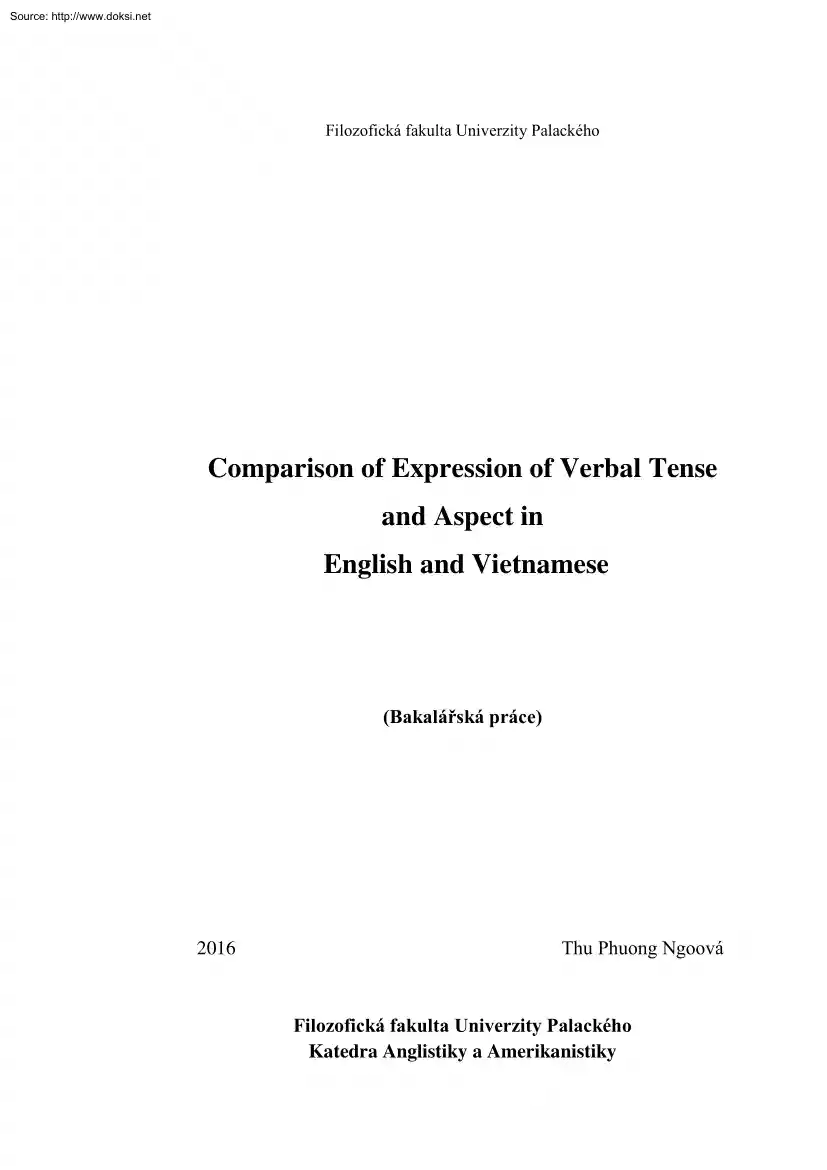
Source: http://www.doksinet Filozofická fakulta Univerzity Palackého Comparison of Expression of Verbal Tense and Aspect in English and Vietnamese (Bakalářská práce) 2016 Thu Phuong Ngoová Filozofická fakulta Univerzity Palackého Katedra Anglistiky a Amerikanistiky Source: http://www.doksinet Comparison of Expression of Verbal Tense and Aspect in English and Vietnamese (Bakalářská práce) Autor: Thu Phuong Ngoová Studijní obor: Anglická filologie Vedoucí práce: Jeffrey Keith Parrott, Ph. D Počet stran: 50 Počet znaků: 70 439 Olomouc 2016 Prohlašuji, že jsem tuto diplomovou práci vypracovala samostatně a uvedla úplný seznam citované a použité literatury. Pokud není řečeno jinak, překlady všech cizojazyčných citací v této práci jsou mé vlastní. V Olomouci dne 23.62016 2 Source: http://www.doksinet I would like to thank my supervisor Jeffrey Keith Parrott, Ph. D for his guidance and patience. I would also like to thank my parents for
their support and inspiration. V Olomouci dne 23.62016 3 Source: http://www.doksinet Abstract This thesis is a comparison of expression of time in English and Vietnamese with focus on verbal tense and aspect. Both languages are considered analytic, nevertheless, they express verbal features with different means. English uses inflectional suffixes on the verb and also some analytic expressions (auxiliaries) but Vietnamese has no affixation on the verb whatsoever, thus uses time particles and time adverbials to express verbal temporal features. The aim of this thesis is to give a general comparison of the typology of these languages and to discuss and compare the expression of time and aspect in greater detail. Key words English, Vietnamese, Morphology, Typology, Analytic, Inflection, Tense, Time, Aspect, Adverbial, Particle 4 Source: http://www.doksinet Anotace Tato práce srovnává vyjádření času v angličtině a ve vietnamštině se zaměřením na slovesný čas a
aspekt. Oba jazyky jsou považovány za analytické, nicméně vyjadřují tyto gramatické kategorie rozdílnými způsoby. Angličtina využívá flektivní sufixy na slovese a také pár analytických výrazů (pomocná slovesa), ale sloveso ve vietnamštině je neohebné, a tak využívá časové partikule a příslovečná určení času k vyjádření těchto vlastností děje. Cílem této práce je obecně srovnat anglický a vietnamský jazyk z typologického hlediska a také důkladně zanalyzovat jakými způsoby tyto jazyky vyjadřují vlastnosti děje. Klíčová slova Angličtina, vietnamština, morfologie, typologie, analytický, flexe, čas, aspekt, příslovečné určení, partikule 5 Source: http://www.doksinet Content 1 Introduction . 8 2 Comparison of English and Vietnamese from different aspects of Grammar . 11 3 4 5 6 2.1 Lexicon. 11 2.2 Syntactical Structures . 12 2.3 Morphology. 13 2.31 Monosyllabicity in an Analytic Language . 13 2.32
Meaning Boundaries . 14 2.33 Inflectional Morphology . 15 Verbal Morphology . 17 3.1 Analytic and Synthetic Features . 17 3.2 Tense and Time . 18 3.3 Aspect. 19 Function of English and Vietnamese Adverbs . 20 4.1 Time adverbials in English . 20 4.2 Adverbials in Vietnamese . 21 4.3 When in the Function of an Interrogative Element and a Conjunction22 PRESENT TIME . 24 5.1 State Use . 24 5.2 Event Use . 25 5.3 Polite Requests – Polite Particle ạ . 26 5.5 Imaginary present . 26 PAST TIME . 28 6.1 PAST SIMPLE . 28 6.11 6.2 Đã . 28 Past Perfect . 30 6.21 Đã (Continued). 30 6.211 7 Past Negation . 30 Future Time . 32 7.1 Auxiliary will - sẽ. 32 7.2 BE GOING TO . 33 7.21 Intention - đinh ̣ . 33 6 Source: http://www.doksinet 7.22 7.3 8 Cause . 34 Present tense . 34 COMPLETION . 35 8.1 Past Simple and Past Perfect Simple. 35 8.2 Future Perfect . 35 8.3 Đã, xong, rôi . 35 8.4 Perfective 36 Duration, Continuation, Repetition .
39 9 9.1 Duration . 39 9.11 9.2 Progressive Aspect . 39 Continuation . 39 9.21 Adverbs vẫn, cứ, còn, maĩ , nữa 40 9.22 Present Perfect 41 9.221 Experiential Perfect - từng 41 9.23 Present Tense – Habitual Use, Regular Repetition . 42 9.231 Adverbs hay, thừơng xuyên, “nào” constructions 43 10 Recent Past and Immediate Future . 44 10.1 Present Perfect. 44 10.11 10.2 Mới, vừa . 44 Immediate Future . 45 10.21 Sắ p, sắ p sửa . 46 11 Conclusion . 47 12 Resumé . 48 13 Works Cited . 49 7 Source: http://www.doksinet 1 Introduction The aim of this thesis is to compare constructions in English and Vietnamese with focus on tense and aspect markers. These two languages are both genetically and areally distant, English is a member of the Indo-European language family and Vietnamese is a member of the Austroasiatic language family (Černý 1998, 51-52). Therefore, I consider these two languages suitable subjects of such an
analysis. Although, in my work I will especially focus on the classification by linguistic typology. “It has nothing to do with neither genetic nor geographic classification and classifies languages according to their type of grammar” 1 (Černý 1998, 59), however, the fact that they have developed in different geographical areas lower the chance of influencing one another. As regards linguistic typology, for this research it is most relevant to compare and classify these languages from the morphological aspect. They both can be classified as analytic due to their low index of synthesis2. Vietnamese has a value of 1.06 and English has 168, contrasted with the extreme of the other end of the scale which is Inuit with 3.72 morphemes per word in average (Greenberg 1960, 193). Although both English and Vietnamese appear to be on the same side of the scale, it is important to point out several differences in their characteristics. While English shows some synthetic characteristics,
that is grammatical categories are expressed by affixes attached to some other word (Bickel and Nichols 2013), e.g 3rd person singular suffix -s or past tense suffix -ed on a verb, Vietnamese seems to have no affixation whatsoever, therefore, it can be considered as an isolating language. Vietnamese is also a “monosyllabic language (each syllable is one isolated word)” (Le et al. 2004, 602) but also has compounds. They are likely to be a result of Chinese influence, as these languages have been in close contact throughout their development. Chữ nôm, which was a system based on Chinese characters and was used until the early 1 “Nemá nic společného s klasifikací genetickou ani geografickou a třídí jazyky pouze na základě typů jejich gramatiky.” 2 Total of morphemes divided by total of words (M/W) (Schwegler 1990, 20) 8 Source: http://www.doksinet 20th century (Ager 2008). A variety of compounds have their origin in these characters, e.g Trung Quốc
‘China’ which literary means ‘central nation’ As regards inflectional morphology and expressing tense and aspect in particular, English uses suffixation, namely -ed or -en attached to the verb or analytic use of the auxiliary have, while in Vietnamese, these features are marked analytically by ‘time elements’3 (Hlavatá and Slavická 2003, 71), in my work I will refer to them as ‘time particles.’ These time particles are namely đã, đăng and sẽ. The combination of tense and aspect create a large variety of verb forms in English and how such features are expressed in Vietnamese is the main of this work. In addition to time particles, expressing tense and aspect in Vietnamese also relies on the usage of time adverbials such as rồ i, vẫn, xong, vừa, mới, sắ p, chưa etc. They can even be combined with one another or also used together with a time particle. They express other specific features of the verb such as continuity, duration or repetition and
more. What their English counterpart is and to what degree they correspond with it will also be discussed in my thesis. In Vietnamese, time particles denoting time are closed-class words, they do not carry any meaning if they stand alone and they need to be used with a verb which they modify – they give us information whether the action expressed by the verb is a past, present or future event. With combination with time adverbials they can also tell us whether the event happened just recently or long before the speech act or is going to happen in the near future. This information can be grammatically expressed in English by inflection with the exception of future will and going to and other constructions. However, the particles in Vietnamese are not always obligatory as English tense markers are. In some cases they occur when a time adverbial is not present, in other cases they are used together with a time adverbial and there are also cases in which neither is present. It is still
sufficient for a native speaker to understand the message. The interpretation replies mostly on context Nevertheless, I am 3 “Časové elementy” 9 Source: http://www.doksinet going to describe the usage and function of the tense and aspect markers with regard to syntax, morphology and semantics. As my work is a contrastive analysis, my methodology is mostly comparative – stating the situation in English and then finding the closest equivalent and point out the differences. If there is a feature which is not present in English, I try to find the closest equivalent in English. Example are provided in each section to demonstrate the usage. Despite Vietnamese having no grammatical means of expressing verbal features, my aim is to demonstrate that it has more distinct expressions of verbal features which can be also graded and used with little or no restriction, while English relies mainly on grammatical constructions of which meaning and usage depends on grammatical relations.
My work is based on the theory of English and Vietnamese grammar. The main sources for English grammar are Bernard Comrie’s publications Language Universals and Linguistic Typology (1981), Tense (1993) and Aspect (1995), and Geoffrey Leech’s Meaning and the English Verb (2004). The basis for the theory of Vietnamese language are Đình-Hoà Nguyễn’s Vietnamese (1997), and Praktická vietnamština = Tiế ng Viê ̣t thực hành (2003) by Lucie Hlavatá and Thi Binh Nguyen Slavická. To carry out a contrastive analysis, it is necessary to give a typological background of English and Vietnamese and give an overview of their characteristics from the view of various linguistic disciplines. Secondly, I will briefly review the morphology with the emphasis on the verb, especially inflectional morphology. In chapter 4, I will compare the function of adverbs in English and Vietnamese. In chapters 5, 6 and 7, I will compare how English and Vietnamese express events that refer
to present, past and future time respectively. In chapters 8-10 I will be dealing with the realization of the aspectual features such as completion and repetition in both analyzed languages. 10 Source: http://www.doksinet 2 Comparison of English and Vietnamese from different aspects of Grammar English belongs to the Germanic branch of the Indo-European language family, while Vietnamese is a part of the Mon-Khmer branch of the Austroasiatic language family. Vietnamese language is spoken mainly in Vietnam, where it is the official language of the country, and also in Laos and Cambodia, and in Vietnamese immigrant communities in many parts of the world, especially in the United States and Europe. Nevertheless, only in the Czech Republic it is a recognized minority language (Šimůnková 2013). However, geographical occurrence is not a reliable clue for determining genetic relatedness. For example the Hungarian language is surrounded by languages from the Indo-European family but is
a member of the Uralic language family. Its relative Finnish is also geographically distant – Hungarian is spoken in Central Europe, while Finnish in Northern Europe (Černý 1998, 51). Nevertheless, I will briefly compare these two languages considering various linguistic layers, looking for both similar and different structures 2.1 Lexicon If English and Vietnamese have completely different lexicon, related languages usually have similar words in basic vocabulary, for instance kinship terms, body parts, pronouns, numerals etc. Comparing pairs such as father-bố , hearttim, I-tôi or one-mồ t, any kind of similarity can hardly be concluded It is also less likely that some words come from a common antecedent. Although, one may find similar words of the same meaning and similar pronunciation as khaki-kha ki or fascism-phát xít, it is more likely that these words entered the Vietnamese vocabulary from English after English had borrowed them from another language. Therefore
English and Vietnamese words do not seem to have common antecedents in the sense that these languages have words that have their origin in a word from another language which then developed separately, but rather in the sense of borrowing words successively from one another. 11 Source: http://www.doksinet Vietnamese vocabulary was mainly influenced by Chinese due to the close interaction. The writing system was also similar, Vietnamese used Chinese characters together with characters developed in Vietnam for Vietnamese vocabulary and this system was widely used until the “Roman catholic missionaries introduced a Latin-based orthography for Vietnamese” called chữ quố c ngữ ‘national script’ in 17th century (Ager 2008) with diacritics to mark 6 tones. The original writing system called ‘chữ nôm’ and ‘chữ quố c ngữ’ were used simultaneously until 1910 when under the French occupation the ‘chữ quố c ngữ’ became the only official
alphabet. During this period a lot of French words entered the vocabulary as loan-words e.g cà-phê ‘coffee’, so-co-la ‘chocolate’, bia ‘beer’. 2.2 Syntactical Structures As for syntax, we can find both similar and different structures. Regarding the basic word order, both languages follow the word order pattern S-V-O in a declarative sentence. (1) Tôi 1SG 4 thích hoa. like flower ‘I like flowers.’ English allows movement of syntactic constituents in interrogative sentences. The auxiliary verb inverts with the subject resulting in V-S-O. Lexical verbs require ‘do-support.’ Vietnamese sentence remains strictly S-V-O, although, a process which is similar to English “do-support” occurs. (2) Ba ̣n có thích hoa không? 5 Friend AUX like flower NEG6 ‘Does (your) friend like flowers?’ Ba ̣n thích Friend like hoa nào? flower which Ba ̣n có. Friend AUX ‘Yes, she does.’ Ba ̣n thích Friend like ‘Which flower does she like?’
hoa hòng rose nhấ t. SUP ‘She likes roses the most.’ As can be seen in the example (2) above, the verb có has to be inserted between the subject and the verb, but carries no lexical meaning. It can also be 4 1st person singular 5 Auxiliary 6 Negation 12 Source: http://www.doksinet used as a lexical verb with the meaning of possession. In this case, another có is not used in questions. The usage of có is not obligatory Additionally, không, which means “no” or “not”, has to be put in the sentence at the end. This cókhông construction is typical for a yes-no question Có or không can be used in answers to these questions, similarly to elliptical answers in English. In Whquestions, the Wh-element replaces the constituent for which it asks as in echo questions. Only tại sao, vì sao or sao ‘why’ are sentence-initial Nào ‘which’ appears in post-position and behaves like an adjective. Post-modification is typical for Vietnamese. Regardless
of elements that are inserted in the sentence, the S-V-O word order does not change. English also has a typical intonation patters for questions, but in Vietnamese it does not play a big role because it would be in clash with the phonemic tone. Syntactic movements are also visible in English but for example in Czech, the word order stays the same in questions so it relies on rising intonation. Both languages have prepositions. Vietnamese sentence structure is more similar to the English one than to Japanese or Korean one, for instance. Geographical occurrence thus does not hint any similarity or difference. 2.3 Morphology As regards morphology, here we come across great differences. Also, for the sake of my research, comparing these two languages from this aspect is most relevant. According to the parameter of index of synthesis, both English and Vietnamese are considered analytic, due to its low value. Although, English, has relatively larger amount of affixation than Vietnamese
does. Vietnamese shows no marks of affixation whatsoever. 2.31 Monosyllabicity in an Analytic Language Analytic or isolating languages use mark grammatical categories with “special auxiliary words (in fact with free morphemes)” (Černý 1998, 61)7. This fact corresponds with the monosyllabic nature of Vietnamese, although an isolating “ postupně k typu analytickému, v němž je běžné označovat gramatické kategorie zvláštními pomocnými slovy (vlastně volnými morfémy)” 7 13 Source: http://www.doksinet language does not necessarily have to be monosyllabic (Comrie 1981, 43). Also, simple denomination prevails in analytic/isolating languages, “isolating type which does not cumulate morphemes in one word cannot be favorable to descriptive denomination” (Popela 2006, 15) 8 . It is more natural for such a language to tend to monosyllabicity and simple denomination which is not further decomposable which is apparent in Vietnamese. It is often one general idea that
is expressed in one form both for a noun and a verb in case of English, e.g love, the word category is further specified by other morphemes such as the or -ing or personal pronouns. In Vietnamese, there is no distinction between the form of an adjective and an adverb. Descriptive denomination is more characteristic for synthetic languages, e.g German Studenten-wohn-heim, ‘student dormitory’) (Popela 2006, 26). 2.32 Meaning Boundaries A morpheme is defined as the minimal unit of meaning (Wardhaugh 1972, 68). However, the boundaries in Vietnamese are not always clear. “Moreover, it is general true that each word consists of just a single morpheme, with the possible exception of bắ t đầ u ‘begin’, which is arguably a word on some criteria, e.g unity of meaning, although it can be segmented, at least etymologically into two morphemes: bắ t ‘seize’ and đầ u ‘head’” (Comrie 1981, 43). Vietnamese is rich on such compounds 9 Sometimes their meaning is
predictable from their parts but it is not always the case. The meaning of bắ t đầ u is not easily predictable, however, there are also compounds which are transparent to a certain degree. Quầ n áo ‘clothes’ consists of quầ n ‘trousers’ and áo ‘shirt’, so in fact, two co-hyponyms are compounded to give a label to their hyperonym. So if we consider these structures as compounds, it would mean we would have to consider the meaning of each part resulting in 2/1 index of synthesis. Although every syllable (word) is spelled separately, these complex structures behave like one, therefore, they count as one word. It is very likely that these structures cause the index to deviate from the ideal value 1. Generally, it is hard to define the term ‘word’ so that it would hold true “Izolační typ, jenž nekumuluje morfémy v jednom slově, nemůže být popisnému pojmenování příznivý.” 9 “Compound is a word (more precisely a lexeme) that consists of two
or more simpler 8 lexemes” (Matthews 1991, 82) 14 Source: http://www.doksinet universally. “In some languages – ‘isolating’ languages, such as Vietnamese – there are plainly low-level units, with little or no internal structure” (Crystal 1987, 91). 2.33 Inflectional Morphology Present day English has only eight inflections: two suffixes for nouns, four for verbs, and two for adjectives and adverbs. “This is astonishingly small number of inflections compared with the number of inflections on nouns and verbs in other inflected Western European languages, such as Spanish, French, and Italian” (Klammer, Schulz and Volpe 2010, 43). In fact, Old English, from which present day Modern English has developed, used to be very rich on inflection – the nouns were marked not only for number but also gender and case and today we barely see any overt case marking on nouns (only possessive -‘s) and some is visible on pronouns (he-his-him). Vietnamese possessives are made
always made analytically as a post-modification of an NP, similar to the English construction of + NP. Also, Vietnamese nouns are inflected neither for gender nor case. Vietnamese nouns also make no distinction between a singular noun and a plural noun. For expressing the quantity, a quantifier has to be used có mồ t tuổ i Child 1SG have one age ‘My child is one year old.’ (3) Con tôi có hai tuổ i Child 1sg have two age ‘My child is two years old.’ Con tôi Grading adjectives in English can be made by adding -er and -est or analytically by adding more and the most in order to make the comparative form and superlative form respectively. In Vietnamese, this process is always made analytically by adding hơn or nhấ t, expressing comparative and superlative respectively. There is no distinction between adjectives and adverbs, thus there is no derivational morpheme which would derive an adverb from an adjective. (4) cao – cao hơn – cao nhấ t ‘high’
– ‘higher’ – ‘the highest’ Another English inflectional morpheme is suffix -s which indicates agreement with third person singular in present tense. There are 3 grammatical features expressed by one morpheme which shows some fusional characteristics of English, although, this is rather an exception. Vietnamese shows no signs of 15 Source: http://www.doksinet agreement, the verb remains in the same form, it does not take affixation or undergo any stem changes whatsoever. (5) Cô giáo Female teacher mới new cảm thấ y feel tót. good ‘The new teacher seems to be nice.’ Tôi 1SG cảm thấ y feel buồ n. sad ‘I feel sad.’ The last set of inflectional morphemes in English are suffixes indicating grammatical tense and aspect, namely -ed, -en and -ing. Vietnamese expresses these features by time particles and time adverbials. In other words, these features are always expressed analytically, not by affixation on the verb. This will be discussed
in the following chapter. 16 Source: http://www.doksinet 3 Verbal Morphology Although English is not an inflectional language, it does have a few inflectional suffixes. The ones that are attached to a verb, namely -s, -ed, -en and -ing express features such as tense, aspect voice and even person and number. “With most full verbs ‘basic’ paradigms of fourteen (or possibly sixteen) forms are to be established. These take into account only finite phrases and exclude phrases containing imperatives” (Palmer 1966, 55). This paradigm is a result of combinations of tense, aspect and voice. It has both analytic (the use of auxiliaries) and synthetic (the use of suffixes) features in terms of morphological typology. This holds for regular verbs 3.1 Analytic and Synthetic Features Inflectional suffixes -s, -ed, -en, -ing on the verb show synthetic features of a language and result in four other verb forms apart from the simple form, namely past tense form, past participle,
gerund and 3rd person singular in present tense. A language with 5 possible different verb forms (not considering the analytical forms) would be rather considered as isolating – closer to Chinese and Vietnamese and further from Latin which has over one hundred verb forms. This is true only if we consider words If we think of forms, we get a comparable number with Latin. “The essential difference between Latin and English is therefore not perhaps so much the matter of the number of verbal forms but rather the way in which the verbal forms are divided up into words” (Palmer 1966, 2). To form the basic verbal paradigm mentioned above, primary auxiliaries are used (have, be). This is an analytic feature, since free morphemes are used. In Vietnamese, it is always the case Verb stems do not change – they do not inflect for person and number like the English verbs do. The tense and aspect is not expressed with a suffix and auxiliaries are not used either. Vietnamese relies on the use
of a large variety of adverbials and time particles to express what we call tense and aspect in English. It is therefore pointless to speak of verbal forms in Vietnamese. 17 Source: http://www.doksinet 3.2 Tense and Time Tense is a grammatical category, “grammaticalised expression of location in time” (Comrie 1993, 9). It has three functions, “first to mark purely temporal relations of past and present time, secondly (and closely related to the first) in the sequence of tenses of reported speech, and thirdly to mark ‘unreality’ in conditional clauses and in wishes” (Palmer 1966, 69). Another possible division of tenses is ‘past’ and ‘non-past’ by Leech (2004). Present and future are classified as non-past tenses. One of the reasons why present and future are put together could be that present tense can also express the future not only the present time. The grammatical labels are often misleading because the tense does not always correspond with time.
Therefore, I will use the term ‘time’ rather than the grammatical labels of ‘tense’. A Vietnamese verb is “timeless in itself, [] only linguistic and situational context provides a clue to relative time” (Nguyễn 1997, 108). Time reference is lexicalized, adverbials are used to locate situations in time (Comrie 1995, 6). Therefore we cannot speak of tense as a grammatical category in Vietnamese. These adverbials give information about the action the verb expresses, but they are not a part of it as the English past tense suffix -ed is. On the other hand, English auxiliaries are not a part of the verb either, but for making a certain verb form for example past participle, it is used along with an inflectional suffix and even the auxiliary itself can take an inflectional suffix, for example in had looked the auxiliary is inflected for tense but the lexical verb is in the participle form with -ed suffix. Nothing like this is possible in Vietnamese “Tense relates the time of
the situation to which it is referred to some other time, usually to the moment of speaking” (Comrie 1995, 1). Adverbs which have such function are đã, sẽ, sắ p, vừa, mới, rồ i etc. (sẽ might be considered as an auxiliary, as its possible English equivalent is will). Some of them also indicates how far in time the situation is from the referred point in time – near future or recent past. 18 Source: http://www.doksinet 3.3 Aspect Another grammatical category is aspect which is concerned with “how the speaker perceives the duration of events, and how different events relate to one another in time” (Carter and McCarthy 2011, 411). In English it is realized through auxiliaries and a corresponding inflectional suffix on the lexical verb. There are three grammatical aspects – simple, perfect and continuous or progressive. “Perfect aspect is concerned with the speaker’s perspective on the relationship between one time frame and an event that takes place
in another time frame” (Carter and McCarthy 2011, 415). Continuous aspect is concerned with the duration of the event. It may be ongoing, unfinished and it can also imply temporality of the duration of the event. Vietnamese uses adverbs to denote aspect such as đang, xong, vãn, mãi, cữ etc. They express features such as continuity, completedness or continual repetition. English verb forms are combinations of grammatical tense and aspect, however in Vietnamese, it is not necessary to have both tense and aspect marking in one sentence. Aspect is not a grammatical category of a verb neither is tense Expressing and understanding the time in Vietnamese language thus relies mainly on the context and time adverbials. In English the grammatical categories tense and aspect realized on the verb are sufficient, adverbials are used for specification but are not at all necessary. 19 Source: http://www.doksinet 4 Function of English and Vietnamese Adverbs Most English adverbs are
classified as full words, whereas Vietnamese adverbs belong to the class of function words. However they are not completely empty in meaning, “with the exception of final particles, which English does not have, all the “function words” (adverbs, connectives, interjections) are indeed comparable to English adverbs, auxiliaries, negators, intensifiers, prepositions, conjunctions, and interjections” (Nguyễn 1997, 139). In English they are sometimes classified as a part of the open or lexical word classes but in both languages they modify the meaning of a verb, an adjective, another adverb or some other constituent. Nevertheless there are differences in their behavior, occurrence and usage. For my work, time adverbs and time adverbials are most relevant. 4.1 Time adverbials in English They are used to express when the action expressed by the verb takes place. As for their position in the sentence, “their normal position is immediately following the verb or at the end of the
sentence, it is often possible, for emphasis and stylistic effect, to move adverbs about within a sentence. In fact, the mobility of adverbs is one of their most distinctive characteristics” (Klammer 2010, 82). (6) I saw a bear yesterday. Yesterday I saw a bear. They are not always obligatory, they are not necessarily essential to understanding the sentence. Also, their omitting might not result in an ungrammatical sentence such as in the case of omitting an obligatory verbal complement. Often the time adverbials have the syntactic function of adjuncts, they are always optional in the sentence. The only difference might be inaccuracy of the information the sentence for instance I will clean the house tomorrow vs. I will clean the house 20 Source: http://www.doksinet As for expressing the time of the event to which it is referred, time adverbial expressions are not obligatory, as the tense marking on the verb or the auxiliary already expresses this information. However, there
are some verbs that take adverbs as their complements, e.g be, happen, live, take place, arrange, schedule etc. In these cases they are obligatory. 4.2 Adverbials in Vietnamese Vietnamese adverbs are described as “lexemes which accompany a content word and serve to modify the meaning of that head word either in a nominal or verbal expression” (Nguyễn 1997, 140). While English time adverbial expressions are not mandatory, in Vietnamese their use is crucial to determining the time to which it is referred, as Vietnamese grammar lacks any kind of grammatical marking on the verb, which is the case of English. Not only do they express the time as in the location in time, but also the way the action is distributed throughout the time. In other words, they roughly mark the grammatical categories, which in English are marked by suffixes and auxiliaries, tense and aspect. Their position in the sentence varies, they will be discussed individually. It is possible to front some of them for
greater emphasis, but another way to reach the same effect, which is also very characteristic for an analytic language, is through repetition. Some adverbs are not obligatory, especially if there is another element, which expresses the tense or aspect information. It is also possible to have more such markers of tense and aspect in one sentence. Sometimes they are redundant, they do not contribute to the meaning, and sometimes they function as an emphasis. Omitting a time adverb when a tense or present marker is already present, does not result in an ungrammatical structure. It is comparable to the case of example I will clean the house tomorrow vs. I will clean the house in Chapter 4.1 of which Vietnamese version can be seen below 21 Source: http://www.doksinet tôi (7) Mai Tomorrow 1SG sẽ dọn nhà. 10 FUT organize house ‘I will clean the house tomorrow.’ Tôi 1SG sẽ dọn nhà. FUT organize house ‘I will clean the house.’ 4.3 When in the Function of an
Interrogative Element and a Conjunction An adverb when can introduce time adverbial clauses and nominal clauses (Quirk et. al 1985, 441-442), which are usually in the function of adverbials/adjuncts. When can also substitute at what time, it is a pro-form It can also be the fronted interrogative element in questions asking for the time. (8) When are you coming home? At what time does the train arrive there? When I was still a student, I never did my homework. Call me when you get home. In Vietnamese, there is a large variety of expressions with the meaning of English when as demonstrated on the following examples which are the translations of the English examples above. (9) Bao giờ When con child về ? come back ‘When are you coming home?’ (Mother to child) Mấ y giờ What time tầ u train đế n arrive đấ y? there ‘At what time does the train arrive there?’ Ngày xưa khi con vãn còn bé, con không bao giờ Day ancient when child still small
child never ‘When you were small you never cried.’ (Parent to child) Khi nào con When child về nhà come back home thì then ‘Call me when you get home.’ (Mother to child) 10 Future 22 gọi cho me.̣ call for mother khóc. cry Source: http://www.doksinet The closest equivalent to when seems to be bao giờ or khi or khi nào. However, khi or khi nào is somewhat more specific, as it can be translated as ‘the moment when’. Khi itself can be used as a lexical noun meaning ‘time’, ‘while’, moment’ as in Có khi tôi rấ t buồ n ‘Sometimes I am really sad’ or more specifically ‘There are times when I am really sad.’ Bao giờ never refers to the past but khi may. The interrogative bao giờ, mấ y giờ and khi nào stand before the verb phrase if they ask about the future. If they ask about the past, they occur after the verb phrase (Nguyễn 1997, 132). In English the information about the time is carried by the
tense morpheme but in Vietnamese it is in fact the word order that makes distinction between the past or future reference. Compare examples (9) and (10). (10) Em về Younger brother come back ‘When did you come home?’ nhà home bao giờ? when When can be translated into Vietnamese in many ways – in interrogative sentences examples are bao giờ, mấ y giờ and khi nào, in declarative or conditional sentences it is mostly compounds that contain a lexical word which is usually a time noun, e.g ngày ‘day’ in ngày xưa ‘long ago’ These always stand at the beginning of the sentence thus the subordinate clause precedes the main clause. 23 Source: http://www.doksinet 5 PRESENT TIME Actions that take place in the present that is not before the speech act, if we follow the ‘past’ and ‘non-past’ distinction, are usually expressed by present tense in English. However, present tense has a large variety of uses, Leech (2004) states 5 uses of simple
present tense – state use, event use, habitual use, simple present referring to past and future and imaginary use. As we can see, despite labeling the tense present, it does not necessarily refer to the present. It can refer to the past as well as to the future, e.g The match on Sunday starts at 2 o’clock or And then she slaps him and tells him to get the hell out, didn’t she? It is not always used to describe events holding at present moment, however, there is certain association with it (moment of speech). Additionally, if we think of ‘present time’ as a point in time, it is, in fact, a period that extends indefinitely into the past and into the future. “In this sense, ‘present time’ is potentially all-inclusive” (Leech 2004, 4). On the contrary, past and future times are limited, as they cannot extend further as far as the present moment. Aspect helps to define how the situation is restricted. In this chapter I will discuss the uses of the present tense in English
in reference to present time and compare them to adverbs that denote a present action in Vietnamese. 5.1 State Use “The state use of the Simple Present is found with verbs expressing a temporally stable state of affairs” (Leech 2004, 6). It is ‘unrestrictive’ in the sense that it extends the state into the past as well as into the future without any limitation. “The use of the present tense is in referring to situations which occupy a much longer period of time than the present moment, but which nonetheless include the present moment within them” (Comrie 1993, 37). They hold for the present moment but they began before the moment of utterance and also may continue and expand into the future. It is not restricted to the present moment only. It is not excluded that the situation is not part of the past 24 Source: http://www.doksinet or present. Whether it is or is not perhaps depends on the context or one’s practical knowledge. Adverbials may be used to limit the
duration or contrasting one period with another. For example At present they live in New York implies that they lived somewhere else some time ago. So-called ‘eternal truths’ are also a state use of simple present tense. These statements are always true, usually found in scientific or mathematical context, such as Two and three make five, or even proverbs, e.g time flies Geographical statements also have no time limit, e.g Vatican is located in Italy Similarly to English, Vietnamese verbs used for expressing states do not require any other marker if they refer to the present. Vietnamese verbs thus appear in their ‘simple’ form, that is, no adverbial is required. sóng ở Cộng Hòa 1SG live in republic ‘I live in the Czech Republic.’ Séc. Czech Hiê ̣n tại tôi Currently st Cộng Hòa Séc. republic Czech (11) Tôi số ng 1 sg live ở in ‘Currently, I live in the Czech Republic.’ 5.2 Event Use Present simple tense is also used with
event verbs and it signifies “an event referred to as a whole and viewed simultaneous with the present act of speaking” (Leech 2004, 7). This is the case of sport commentaries and commentary of demonstrators. It is also used in exclamations as opposed to the use of the progressive aspect, which is rather unmarked, e.g Here comes my bus! In so-called performative utterances when the event and the act of speech are identical and occur at the same moment, for instance I agree or We accept your offer. In Vietnamese, verbs expressing events also need no other tense marking as can be seen in the following example (). 25 Source: http://www.doksinet (12) Tôi 1SG đồ ng ý. agree ‘I agree.’ 5.3 Polite Requests – Polite Particle ạ Also, a verb in past tense can refer to the present in polite requests, when the speaker does not want to sound too direct as in the example (13) below. (13) It’s getting cold in here. Could you please close the window? Despite the verb can
being in past tense, it refers to the present – the window is open and it is cold at the moment of speech and the speaker requests closing the window in order to make the room warmer. Also, the verbs to wonder and to think are often used in a similar way. In the example I just wondered if we got any homework today the speaker is wondering now, past tense does not refer to the past in this use. “Past tense distances an event from the present, and distancing an event can make it more indirect” (Carter and McCarthy 2006, 406). However, it would be completely grammatical to use present tense in requests, it is just a matter of the speaker’s attitude, as it changes the tone of the message. In Vietnamese, politeness is not expressed by tense but by polite particle a ̣ which is placed at the end of the sentence both in declarative and interrogative sentences. The verb has the same form, there is no tense marking specific for polite requests. (14) Con Child mằ c áo wear shirt
này this có dườc AUX good không NEG ạ? POLITE ‘Is it OK to wear this shirt?’ (Child to mother) Xin bố cho con tiề n ạ. Beg father give child money POLITE ‘Please give me some money, daddy.’ (Child to father) 5.5 Imaginary present This special kind of present simple used is typical for fiction. Imaginary happenings are described in past tense and present tense is used for “dramatic heightening” (Leech 2004, 16). It has some effect on the reader as if they were 26 Source: http://www.doksinet experiencing the events described. Here is an example from a novel used by Leech (2004) and a sample from an old comic by Võ Hùng Kiê ̣t.11 (15) Mr. Tulkinghorn takes out his papers, asks permission to place them on a golden talisman of a table at my Lady’s elbow, puts on his spectacles, and begins to read by the light of a shaded lamp. Tuổ i vừa Age just Cầ m dao Hold knife mười bố n, bế trai, thấ y giă ̣c cha ̣y
dài, em fourteen small boy see enemy run long he câ ̣y nắ p remove lid tăng tank kia, bi ̣đich ̣ that enemy quay turn nắ p lid nhảy lên jump up ga ̣t về phía push toward xe vehicle sau. back ‘The little boy, who has just turned 14, sees the enemy and jumps onto the tank. He tries to use a knife to open the lid of the tank but the enemy turns the lid and knocks him down.’ As can be seen, the verbs do not have any special marking for past time. 11 “Comics in Vietnam: A Newly Emerging Form of Storytelling,” accessed June 22 2016. http://kyotoreview.org/issue-16/comics-in-vietnam-a-newly-emerging-form-of-storytelling/ 27 Source: http://www.doksinet 6 PAST TIME “It is well known that English has two chief ways of indicating past time by means of verbs: the past tense and the perfect aspect; also that these two can be combined to form the past perfect” (Leech 2004, 35). This concerns actions that took place before the moment of speech. The
function of the past tense, however, is purely to locate a situation anywhere before the present moment. It does not specify whether it is just a single point in time or whether it continues to the present or into the future or to another reference point in time (Comrie 1993, 41). This is further specified by the verbal aspect In this chapter I will discuss the expression of past events with the use of past simple, past perfect and adverbs with emphasis on locating an event on the timeline. Present perfect, which also describes events in the past, will be discussed in next chapters. 6.1 PAST SIMPLE Apart from the event or state taking place before the present moment, another feature of the past tense is that the speaker must have a definite time in mind (Quirk et al. 1985, 183) which is expressed by time adverbials such as last week, in 1990, when I was in Prague, for instance in I started school in 1999 or I started school last year. This is one of the main distinction between the
uses of past simple and present perfect, as the time adverbial would make the sentence ungrammatical. The time adverbial is not needed when there is some shared general knowledge between the speakers, for instance This novel was written by a famous romantic writer presupposes that the novel must have been written at some time or another (Quirk et al. 1985, 184) We can distinguish three meanings of past – event (I broke a glass), state (I lived in America) and habitual (In my school years, I woke up at 6). Event past occupies a single point in time, habitual occupies multiple points in time and state occupies a continuous period of time. 6.11 Đã In English the past tense is expressed by the suffix -ed on the verb, in Vietnamese it is expressed by the auxiliary đã along with time adverbials. It is 28 Source: http://www.doksinet even possible that no tense marking is present, in that case the interpretation depends on the context. The adverb đã can be used for events, states
and habits. It is always placed before the head verb. Its use seems to be optional, but as the meaning of the sentence might be vague and one has to take the context into account, it narrows down the interpretation. It emphasizes only that the action took place in the past but also that it is completed. To be more precise, it has the feature of anteriority either for past or future time, it “signals that the head verb denotes a circumstance viewed as completed prior to some other circumstance” (Nguyễn 1997, 153) in the past or future. If the ‘other circumstance’ is present moment, then đã is in fact a past tense marker. (16) Tôi 1SG đã biế t thằ ng này 12 ANT know guy this không NEG thầ t thà. honest “I (already) knew this guy was dishonest.” In the example (16) there is no other circumstance given, it is to be deducted from the context. We can suppose that some bad experience preceded this statement, therefore, the state of ‘knowing’ held
true before the supposed bad experience. Additionally, the copula là ‘to be’ is never used for linking a subject and its adjectival complement, thus it can never appear with đã or any other tense marking. Là only links a subject and its nominal complement When there is no tense marker present, it seems that speakers would automatically consider it past, especially with event verbs as in the following example. cái cóc. (17) Tôi làm vỡ 13 1sg make break CLS glass ‘I broke a glass.’ (literally ‘I made a glass broken’) Time adverbials are probably the most reliable indicator of time. Compounds like hôm qua ‘yesterday’ (literally ‘the day that has passed), tuầ n trước ‘last 12 Anterior 13 Classificator 29 Source: http://www.doksinet week’ (literally ‘the week before’) or năm ngoái ‘last year’ (literally ‘the outer year’) usually introduce the sentence but can also appear at the end. (18) Hôm qua tôi Yesterday 1SG đi
go bác si.̃ doctor ‘Yesterday I went to the doctor.’ 6.2 Past Perfect Past perfect has the meaning of “past-in-the-past, or more accurately, a time further in the past, seen from the viewpoint of a definite point of time already in the past” (Leech 2004, 46). Similarly to the past simple, it needs an already established point of reference. It is used both with definite and indefinite time, as opposed to present perfect which cannot be used with definite time reference. Past perfect is thus used for describing an event occurring at a definite or indefinite time but before some other definite point in time. In an example When I came home, my dad had cooked the dinner, it is clear that the given point of reference in the past is when I came home and the cooking activity occurred earlier and it is finished. 6.21 Đã (Continued) This feature is in Vietnamese also expressed by đã. Đã is used for the action that occurred earlier and is finished. For clear contrast and
interpretation of the sequence of the events, there is no đã in the other clause, as it is not obligatory. (19) Khi tôi When 1sg đế n nhà, bố tôi đã nấ u cơm arrive home father 1sg ANT cook rice (xong) (rồ i). (finished) ‘When I came home, my dad had (already) cooked the dinner.’ The interpretation of the clause without any tense marking is narrowed down to past by the presence of đã in the other clause. Đã indicates which action was anterior. Additionally, particles xong and rồ i may be used to emphasize that the action is finished. This will be discussed in Chapter 8 in greater detail 6.211 Past Negation It is interesting that Vietnamese even has a negative adverb chưa translated roughly as ‘not yet’ which is used in declarative sentences, yes-no questions and also in answers to them. Vietnamese yes-no questions are in fact ‘yes-nonot yet questions,’ as the expected answer is có ‘yes’ or không ‘no’ or chưa 30 Source:
http://www.doksinet ‘not yet.’ In declarative sentences it immediately precedes the main verb In interrogative sentences it stands at the end, similarly to không. In questions about the past, it may be used with đã as in example (20). In answers, the verb may be omitted, in that case it follows the subject as in the example (21). đã cho chó (20) Chi ̣ Elder sister ANT give dog ăn eat chưa? not yet ‘Have you fed the dog yet?’ (21) Chi ̣ Elder sister ‘Not yet.’ chưa. Chi ̣ không. not yet Elder sister ‘No.’ NEG There is slight difference in interpretation of example answers in (21). The first one implies that the speaker is aware of his duty to feed the dog but has not done it yet, but certainly will. The other one may imply speaker’s unwillingness or ignorance of his duty. English negative answer does not imply speaker’s negative attitude. There are morphemes expressing the feature of past in both languages but in Vietnamese, it is possible
to have a verb without any tense morpheme with the meaning of past. The interpretation depends on the context – if the meaning of past is known from the context, it is not necessary to express it. 31 Source: http://www.doksinet 7 Future Time The future is understood as anything which has not taken place yet, that is on the right side from the present moment on the time axis, but at the same time it can express something which will hold true in the future and possibly already did in the past or present. In the case of predictions, there are so many factors determining whether they will be true or not and that is why future reference might be subsumed under mood (Comrie 1993, 44). “There is no future-tense morpheme in English, no affix that can be attached to a verb to indicate that the action will take place in the future” (Klammer 2010, 185). “There is no grammatical category that can be properly analyzed as a future tense” (Huddleston and Pullum 2002, 209). Future is
realized through free morphemes or through present tense. In fact, future and present might overlap, as it might but also might not exclude the present moment or even the past. In this chapter I will compare English constructions with will, be going to and present tense to Vietnamese particles denoting future time. 7.1 Auxiliary will - sẽ Huddleston and Pullum in their The Cambridge Grammar of the English Language argue that will is an auxiliary of mood rather than tense (2002). It belongs to the same group of central modals such as can and may both from grammatically and semantically. The sentence That will be the postman means the speaker is sure that it is the postman because of his knowledge that the postman always comes on this particular day and hour, thus it refers to the present and it expresses necessity. If will refers to the future, it can express general or habitual prediction (That will be enough) or volition (Please lend me some money, I will give it back). It
precedes the main verb, which carries no inflection. This is similar to Vietnamese expression of future. Particle sẽ is placed after the subject, thus it stands before the head verb but also precedes negation. 32 Source: http://www.doksinet (22) Tôi sẽ không 1SG FUT NEG đổ i thay. change ‘I won’t change.’ It expresses that the action will likely take place in the future. Similarly to đã, it is not obligatory especially when a time adverbial such as mai ‘tomorrow’ or tuầ n sau ‘next week’ is present, because it is redundant but it is possible to use it to make the future reference more explicit. It is important that it expresses certain probability of an action taking place in the future. Although the difference is slight, it can be seen when comparing negative sentences. Negative sentence without particle sẽ implies almost absolute certainty that the action will not take place. When the particle is present, it implies the action will not take place
but it is also possible that it will. Thus this particle also partly has a modal meaning, similarly to English will. Sẽ is also be used in predictions. (23) Tôi sẽ không đế n. 1sg FUT NEG come Tôi 1sg ‘I won‘t come.’ (I might change my mind) không NEG đế n. come ‘I won’t come.’ (it is my final decision) Pháp mà thi hành đạo luật ấ y thì dân chúng sẽ phản đố i liề n. France if carry out CLS law that then people FUT oppose immediately 'If France implements that law, the people will immediately protest.' 7.2 BE GOING TO Be going to + infinitive construction is used to express future outcome of present circumstances, both intention and cause (Leech 2004, 58). 7.21 Intention - đi ̣nh Đinh ̣ is one of the verbs of volition and it translates as ‘to intend.’ Thus for expressing intention a full-meaning verb is used, not a particle carrying only grammatical information as in earlier cases. It stands before the
main verb and acts like an auxiliary or modal verb. This verb is used for emphasizing the intention, its meaning is close to ‘to plan,’ otherwise sẽ can be used as well. (24) Hôm nay làm cái Today elder brother intend do CLS ‘What are you going to do today?’ sister to brother anh đi ̣nh 33 gì? what Source: http://www.doksinet 7.22 Cause “The future with present cause is found with animals and inanimate objects, as well as with human subjects” Leech (2004). Additionally, it may imply immediate future, as the “train of events” leading to the future happening might be already under way. Sẽ is used but depending how soon the future will be, particle sắ p or sắ p sửa is used instead. The topic of immediate future will be discussed in next chapters. (25) Bà sắ p chế t. Grandma IMMFUT14 die ‘[Our] grandma is going to die.’ (she’s very ill now) 7.3 Present tense Present tense is usually used for arrangements and plans for the
future and it implies that they have already been made. There is very slight difference between the arrangement and intention expressed by be going to + infinitive. The latter puts more emphasis on one’s presents state of mind, while the former expresses something socially predetermined regardless of one’s feelings now (Leech 2004, 61-62). Vietnamese has no other means for indicating future based on present plan or programme than the verb đi ̣nh. If the speaker does not need to emphasize his intention with the use of đi ̣nh, only a time adverbial is used. (26) Hôm nay me ̣ làm phỏ. Today mother make phỏ ‘I’m making phỏ today.’ (for dinner) Vietnamese uses particle sẽ and verb đi ̣nh to express plans or predictions about the future. However, time adverbials are very frequent and also reliable means of expressing this feature as well. English uses, along with time adverbials, bound morphemes (present tense) and also free morphemes (auxiliary will, be going
to). 14 Immediate future 34 Source: http://www.doksinet 8 COMPLETION The notion of completion has been slightly discussed with regard to past time reference. English has no means to indicate completion or termination of a situation separately. This meaning is implemented in various verb forms across tenses and aspects, usually expressed by past time reference tenses. In Vietnamese, completion is quite an important feature and is expressed by đã, xong and rồ i. 8.1 Past Simple and Past Perfect Simple Completed actions are mostly indicated by past simple. These are usually single-time events and may have a direct time reference, as opposed to present perfect which does not allow direct time reference as can be seen in Chapter 5.1 It focuses on when the action occurred, not on its duration nor its result (Alexander 1988, 168). It can be contrasted with the present perfect In examples Mary has lived a good life and Mary lived a good life the past simple implies that Mary is
no longer alive, thus it indicates termination. Past Perfect Simple has the function to indicate which of two events happened first. Both of them are single-time events, therefore it excludes the meaning of progressive as in When I came home, my dad had already cooked the dinner. 8.2 Future Perfect Future perfect is used for describing actions that will “already be completed by a certain time in the future” (Alexander 1998, 181). It is a combination of auxiliaries will have and past participle or -ing form. This form already consists of three words, four morphemes to be precise, which shows the analytic characteristics of the English language. Usually a direct time reference is given 8.3 Đã, xong, rôi As stated earlier in Chapter 6, the particle đã expresses past time. Its main features, however, are completion and anteriority. It is used “when the speaker wants to indicate explicitly that an action has been completed” (Nguyễn 1997, 154). Thus, it can be in fact
used in any time reference 35 Source: http://www.doksinet The particle đã is often accompanied by the adverb rồ i ‘already’, ‘over and done with’ but it is not the rule. Rồ i may be used without đã While đã is placed before the predicate, rồ i follows the predicate. This construction stresses that the action or condition has been terminated. But sometimes there is a subtle nuance of modality: Ông ấ y đã về rồ i. (he ANTERIOR return already) may mean 'He has gone back.' or 'He has come back' whereas Ông ấ y đã về means 'He's back [from errand].' Moreover only the context can tell whether the action or condition is in the past or in the future. (Nguyễn 1997, 158) If a future time adverbial is used such as tomorrow or next week, it is understood that the action will have been completed in the future by the time specified by the time adverbial, as shows the example () below. đã hai năm rồ i
từ khi mình sang bên Tomorrow ANT two year already since self to side ‘Tomorrow it will have been 3 years since we moved here.’ (27) Mai đây here Additionally, adverb or possibly adjective xong ‘finished’ can be used with đã and rồ i resulting in the same meaning. Xong follows the verb or its object and precedes rồ i (Hlavatá and Slavická 2003, 190). It is also a part of a compound làm xong ‘to finish’ (literally ‘to make something finished’). All three elements expressing completion may be used simultaneously to achieve greatest emphasis on the fact of completion, as in example (28). (28) Tôi đã sửa 1SG ANT repair xong finished xe rồ i. vehicle already ‘I (have) (already) finished repairing the car.’ It can be concluded that in Vietnamese, it is more important to express the feature of anteriority and completion than past time, due to numerous ways of expressing it contrast with no means of expressing past time separately.
Anteriority implies past time because an event is always ‘past’ when compared to another event to which it is anterior. 8.4 Perfective This small subchapter is dedicated to perfective and imperfective verbs which is related to the topic of completion. “It is sometimes claimed that perfective forms indicate situations of short duration, while imperfective forms indicate 36 Source: http://www.doksinet situations of long duration” (Comrie 1995, 16). Both English and Vietnamese have this feature encoded in some lexical verbs which appear in perfectiveimperfective pairs. Perfective expresses a single-time action, thus also completed and usually has a result. Imperfective expresses an action that may last for a longer period of time and does not necessarily imply a result or completion. This system is very well established in Slavic languages, for instance in Czech it is a separate grammatical category. Example (29) in perfective focuses on the completion of the action, thus its
equivalent is past simple. Example (30) in imperfective focuses on the duration of the action, thus it corresponds with the continuous aspect in English. (29) U-děla-l to za PERF-do-PAST.MASC3rdSG itACC in dv-ě two-FEM hodin-y. hour-FEM.PLACC ‘It did it in 2 hours.’ (30) Děla-l Do-PAST.MASC3rdSG to it.FEM dv-ě two-FEM hodin-y. hour-FEM.PLACC ‘He was doing it for two hours.’ As I have already said, English has pairs of lexical verbs that distinct in the features of perfectivity such as to find – to look for. The verb to find is, in fact, a result of the verb to look for. It cannot be used for expressing duration of an action that lasts a long period of time. Another pair is to know (somebody) – to recognize (somebody). This distinction is not possible on all verbs, for instance to look – to see. In this case, look may be a short limited action as in I looked at him, or a continuous action as in I was looking at him. In Vietnamese, this distinction is evident
on verbs of sense or verbs which are in English classified as state verbs such as to know, to understand etc. (Hlavatá and Slavická 2003, 216). To mark that a verb is perfective, đườc, thấ y or ra is used (only đườc may be used with all kinds of verbs). They stand immediately after the verb, thus forming a compound and giving it a new meaning. Examples of the perfetive and imperfective pairs are: nghe ‘to listen’ – nghe thấ y ‘to hear,’ nhìn ‘ to see’ – nhìn thấ y ‘to notice,’ tìm ‘to look for’ – tìm thấ y ‘to find.’ 37 Source: http://www.doksinet (31) Tôi 1SG tìm chìa khóa look for keys mãi không tìm đườc. CONT NEG find ‘I have been looking for the keys for ages but I still can’t find them.’ Đườc is more universal, it literally means ‘good’ so in combination with a verb which expresses a state or a continuous activity, đườc can be roughly translated as ‘the process came to an
end and brought results.’ 38 Source: http://www.doksinet 9 Duration, Continuation, Repetition This chapter deals with the features of duration, continuation and repetition. Events that last for a period of time are grammatically expressed by the progressive (continuous) aspect in English. 9.1 Duration In Vietnamese, the feature of duration is denoted by particle đang ‘in the process of’ which stands before the main verb. It can refer to an action in progress at present moment but also in the past or future but it is not used with the particles đã and sẽ. (32) Tôi đang do ̣c báo 1SG PROG read newspapers ‘I’m reading newspapers.’ (now) 9.11 Progressive Aspect “The Progressive aspect is said to give an ‘inside’ view of a happening, rather than an ‘outside view,’ seeing the happening as a single whole” (Leech 2004, 18). It expresses duration, going-on actions and also temporality It can be contrasted with the simple aspect, in examples Which
team do you support? and Which team are you supporting?, the former one means in general and the latter one means at this particular match so the time in which this holds true is restricted to a certain period of time, therefore it is temporary. It is realized through a form of be and -ing suffix on the verb and is mostly used with event verbs, some state verbs might change their meaning when in progressive form, for instance sense verbs such as see, hear, smell etc. 9.2 Continuation Although the notion of continuation is to certain extend included in duration, it is more specific. It emphasizes that a situation, which began in the past and lasts for a certain period of time, is still not completed at the present moment or other time specified and continues in the future and is most likely to last for a long time. As opposed to the progressive aspect which implies temporary duration. In Vietnamese, these two notions are not interchangeable It applies 39 Source: http://www.doksinet
to series of repetitive events and also continuous states. This is in English expressed by the present perfect, adverbs such as still or verbal constructions such as keep + verb -ing or adverbs such as still. 9.21 Adverbs vẫn, cứ, còn, mãi, nữa English has various means of expressing this feature varying from different tenses to lexical verbs and adverbials. Vietnamese uses adverbs vẫn, cứ, còn, and their combinations. “They indicate that an action or state of affairs goes on without ending or changing or that it occurs repeatedly” (Nguyễn 1997, 145). How long it lasts is defined by the context or time adverbials. They are placed before the main verb. Vẫn can be translated as ‘still,’ cứ indicates that states or events go on without any change and còn is translated as ‘remain.’ Their combinations express their feature more forcefully, they emphasize it. (33) Nó That guy vẫn cứ CONT hút thuố c lá smoke cigarette ‘He keeps
smoking (cigarettes).’ (even though he was told to stop) khỏe Younger sibling strong ‘How are you?’ Em không? Em vẫn NEG Younger sibling CONT ‘I’m (still) good. khỏe. strong In addition, cứ may occur with mãi which indicates that an action is going on continuously for a long period of time (Hlavatá and Slavická , 208). Since cứ occurs in front the verb, mãi occurs behind it. For greater emphasis, mãi may be reduplicated resulting in mãi mãi. (34) Nó cứ khóc mãi. That guy CONT cry on and on ‘He wouldn’t stop crying.’ Nữa expresses addition to already existing state or action. It follows the predicate. (35) Chi ̣ hát hay lắ m, elder sister sing good so much ‘You sing so well, sing some more!’ 15 hát sing Addition 40 nữa đi! ADD15 IMPERATIVE Source: http://www.doksinet Cô ấ y không Woman that NEG de ̣p pretty nữa. ADD ‘That woman is not pretty anymore.’ 9.22 Present Perfect The
grammatical label for present tense is partially misleading, as it does not refer to the present directly. Leech (2004) refers to it as ‘past with present relevance’ or ‘past involving the present.’ That means the event occurs in the past but is related to the present in some way. Either it lasts up to the present moment or has results persisting at the present moment so it includes an idea of continuation even though the action itself might have been terminated. The use of the perfect aspect sometimes depends on the speaker and on his attitude towards the event and how he perceives the earlier mentioned relevance to the present. In examples John arrived and John has arrived, the only possible meaning is that the latter indicates “persistence of the result of John’s arrival, i.e that he is still here” (Comrie 1995, 56) 9.221 Experiential Perfect - từng “Experiential perfect indicates that a given situation has held at least once during some time in the past leading
up to the present” (Comrie 1995, 58). The difference between John has gone to America and John has been to America is that the former is the ‘perfect of result’, implying that John is in America now or on his way there. In the latter one there is no such implication, it simply expresses John’s experience of going to America at least once. The difference is thus made only by the choice of verb, in this case it is go or be. Vietnamese has a similar expression of experience, although more restricted to sensual experience. This is expressed by adverb từng which Nguyễn (1997) translates as ‘has (once) .-ed in the past’ In affirmative it follows đã and chưa in negative sentences. Simple expressions with negative adverbs such as không bao giờ ‘never’ or adverbials of frequency such as một lầ n ‘once’ or nhiề u lầ n ‘many times’ can be used instead of experiential từng. (36) Tôi 1SG chưa từng not yet EXPERIENCE thấ y see con
ngoan child good ‘I have never seen such a good child.’ 41 như like này. this Source: http://www.doksinet 9.23 Present Tense – Habitual Use, Regular Repetition “The habitual use typically occurs with event verbs and represents a series of individual events which as a whole make up a state stretching back into the past and forward into the future” (Leech 2004, 10). It expresses regularity or repetition in some event taking place. However, Comrie in his Aspect argues that it describes a “situation which is characteristic of an extended period of time, so extended in fact that the situation referred to is viewed not as an incidental property of the moment but, precisely, as a characteristic feature of a whole period” (1995). Its use is thus not restricted to repeated single events only, but also states as in The Temple of Diana used to stand at Ephesus. Habits in the past are expressed by the used to + verb construction, for present habits there is no morpheme
that marks the feature of habituality nor there is a morpheme that marks present tense)16. Present tense and thus present habits can be expressed by a bare verb or time adverbials. Quantifiers, such as every, are used for greater emphasis on the repetition. (37) In the evenings I go home from work by bus. Every evening I go home from work by bus. Present tense in the habitual use, in fact, refers to past, present and also future. It is not completely ‘unrestrictive.’ If we take the example sentences in (), we can assume that the speaker went home from work by bus last Wednesday or Friday and most likely will do so next Tuesday as well. It is also not said that the action is occurring at the moment. The time is not specified for the past present or future, however, a certain pattern of occurrence is given by the adverbial in the evenings and certain reference point is represented by work (after he has finished work) and we can assume that the action will follow the pattern if the
conditions or circumstances are the same as they are at the moment of speech, for example the same working hours, the same bus connections, the same financial situation, the same job etc. In this respect it includes the idea of continuation. 16 except 3rd person singular -s 42 Source: http://www.doksinet 9.231 Adverbs hay, thừơng xuyên, “nào” constructions In Vietnamese, event verb used without any other element that would specify the location in time seems to evoke a past time meaning. Therefore, habitual present is always expressed by adverbs such as hay ‘often’ (it tends to be so often) or by time adverbial constructions such as ngày nào cũng ‘every day’, thường xuyên ‘regularly’ etc. The adverb hay precedes the main verb. Thường xuyên is a compound construction, it usually begins the sentence but it is not the rule. Adverbials such as every day, every week are constructed in this pattern: Time Noun + nào ‘whichever’+ Subject +
cũng ‘likewise’+ Predicate. (38) Cóc này hay võ. Glass this often break ‘These glasses often/usually break.’ (because they are poorly made) Thường xuyên Regularly tôi 1SG của sổ . clean window lau ‘I clean the windows regularly.’ Tuầ n Week nào tôi whichever 1SG cũng dòn likewise clean nhà. house ‘I clean the house every week.’ Due to the absence of any tense grammatical markers, these time adverbials are essential in differentiating the time period to which it is referred. 43 Source: http://www.doksinet 10 Recent Past and Immediate Future This chapter deals with expressions of situations which occupy a point near to the present moment, in the past or in the present. This feature of ‘nearness’ does not have separate means of expression in English. The idea of recent past may be included in the present perfect. The idea of immediate future is expressed by be about to + verb construction. 10.1 Present Perfect As has been
already said, the idea of recent past may be associated with the perfect aspect. It is used when “the present relevance of the past situation referred to is simply one of temporal closeness, i.e past situation is very recent” (Comrie 1995, 60). All cases of the present perfect do not necessarily have to express recent past even with certain present relevance, so that recentness may be deducted, but recentness may imply present relevance. “It is most frequently used in news announcements” (Huddleston and Pullum 2002, 145). Present perfect does not allow direct time reference as the past simple does, however, it allows time specification with the adverb recently or one of its close synonyms such as just, and other time adverbials denoting recentness such as a minute ago, yet, already or just now as in I have just closed the window. Past simple may also indicate recent past, but without the emphasis on the persistent relevance as in Who said I couldn’t walk in? I just did it.
10.11 Mới, vừa Vietnamese has the idea of recent past indicated by adverbs mới ‘new, recent’ and vừa ‘just (now).’ They precede the main verb and may and may not occur together, if they do, vừa precedes mới. Their meaning is not exactly the same, that is the reason why they cannot appear together to achieve the same effect as the combination of đã, xong and rồ i as in Chapter 8.3 Additionally, xong may be used to indicate completion of the action. 44 Source: http://www.doksinet (39) Tôi 1SG vừa just (mới) recent ăn cơm eat rice xong. finished ‘I have just finished eating.’ Tôi mới nhận cái thư. 1SG recent receive CLS letter ‘I have recently received a letter.’ 10.2 Immediate Future Immediate Future is a situation “when an action is imminent, i.e when it approaches the utterance or a moment in either past or future” (Nguyễn 1997, 155). English expresses such situation with the form of be and about to + verb or
be on the point of + verb in –ing form (Alexander 1988, 183). The tense of be depends on the time of the point of reference – past tense for actions approaching a moment in the past and present tense for actions approaching a moment in the future. Near or immediate future is generally understood as the time period within seconds or minutes. In He came when I was about to leave, the point of reference is he came and the act of leaving is immediate future with respect to that point of reference. The use of be on the point of implies greater immediacy (Alexander 1988, 183) as in I was on the point of calling you. Just may be used to imply even greater immediacy. An example of ‘the most immediate future’ may be I was just on the point of calling you. Immediate future which in fact becomes present at the moment of speech may be expressed by the present continuous as in They’re just starting! Immediate future may be one’s intention as well as cause, this classification was used
in Chapter 7.2 regarding be going to, which in fact may also imply near future. The sentences It’s about the rain and It’s going to rain, have more or less the same meaning. Time adverbials may be used for specifying when this action occurs such as in a minute, in a bit, in a second etc. In this case, be about to is not used, as the 45 Source: http://www.doksinet meaning of a short period of time is already implemented in be about to, thus it does not appear with time specification. 10.21 Sắ p, sắ p sửa Immediate future in Vietnamese is expressed by adverbs sắ p or sắ p sửa ‘about to, on the point of.’ They precede the main verb and may be accompanied by rồ i ‘already.’ If the speaker wants to indicate that an action will be completed in the immediate or near future, sắ p sửa may be combined with xong as in the example (40) below. (40) Tôi 1SG sắ p sửa about to xong finished bài ho ̣c. homework ‘I’m almost done with my
homework.’ 46 Source: http://www.doksinet 11 Conclusion The thesis deals with expressions of time in English and Vietnamese, thus analyzing the realization of verbal tense and aspect. Both languages are considered analytic, nevertheless, they differ in the expression of grammatical features such as tense and aspect. Vietnamese being close to an ideal isolating language which isolates morphemes in separate words, relies on the usage of time particles and time adverbials. Context is another important factor in interpreting the meaning of the sentence. Vietnamese has no grammatical affixes, these are characteristic for English, despite some analytic expressions. English verb can be inflected in minimum four ways, while Vietnamese verb does not change its form. Despite these facts, my aim was to demonstrate that Vietnamese has more temporal features which are expressed by separate words not by bound morphemes. These words (particles, adverbials) have a clear function and their
usage is not grammatically restricted, their meaning is mainly defined by the context. English has numerous grammatical means of expressing these features but they are constrained by the grammatical and semantical relations in the sentence, for instance incompatibility of present perfect with direct time reference. Every verb form (combination of tense and aspect) may have multiple meanings and may be used for expressing different features, thus a lot of features do not have separate means of expressing. For instance the feature ‘past’ can be expressed by past tenses and present tenses in combination with aspects, while in Vietnamese, đã or any other expression with the feature of anteriority is sufficient and they do not need to combine. In larger context, it is possible to omit any time expression. 47 Source: http://www.doksinet 12 Resumé Tato práce se zabývá vyjádřením času v Angličtině a ve Vietnamštině a tedy analýzou tím, jak tyto jazyky vyjadřují
gramatické kategorie času a aspektu. Oba jazyky jsou považovány za analytické, nicméně se liší v tom, jak realizují dané gramatické kategorie. Vietnamština, jakožto téměř izolační jazyk, který odděluje morfémy jako samostatná slova, se spoléhá na užití časových partikulí a příslovečných určení času. Také kontext je významným faktorem, na kterém závisí interpretace dané věty. Vietnamština nemá žádné gramatické afixy, ty jsou vlastností Angličtiny, i když se vyskytují také analyticky sestavené výrazy. Anglické sloveso může být vyčasováno nejméně čtyřmi způsoby, zatímco Vietnamské sloveso vůbec nemění svůj tvar. Navzdory těmto faktům bylo cílem mé práce demonstrovat to, že Vietnamština má více vlastností, které určují děj, a které také mají své vlastní vyjádření vlastními morfémy. Tyto morfémy (partikule, příslovečná určení) mají jasnou funkci a jejich užití není omezené
gramatikou, neboť význam udává hlavně kontext. Angličtina sice má hodně gramatických prostředků ale jejich užití je příliš omezeno gramatickým a sémantickými vztahy ve větě, například inkompatibilita předpřítomného času s přímým určením času. Také všechny tvary sloves mohou mít více významů a být použity k vyjádření různých vlastností, tudíž spousta vlastností nemá výhradně jednu svojí vlastní formu vyjádření. Například vlastnost „minulost“ lze vyjádřit minulým časem i přítomným časem v kombinaci s aspektem, zatímco ve Vietnamštině je naprosto dostačující použít pouze partikuli đã nebo kterýkoli jiný výraz, který vyjadřuje časové předcházení. Ani se nemusí kombinovat a v případě dostupného kontextu mohou být úplně vynechány. 48 Source: http://www.doksinet 13 Works Cited Ager, Simon. 2008 “Vietnamese language, alphabet and pronunciation” Accessed March 11, 2016.
http://wwwomniglotcom/writing/vietnamesehtm Alexander, L. G 1988 Longman English Grammar London: Longman Bickel, Balthasar and Johanna Nichols. 2013 “Inflectional Synthesis of the Verb.” In Dryer, Matthew S and Haspelmath, Martin (eds) The World Atlas of Language Structures Online. Accessed on April 5, 2016 http://wals.info/chapter/22 Carter, Ronald, and Michael McCarthy. 2006 Cambridge Grammar of English. Cambridge: Cambridge University Press Comrie, Bernard. 1981 Language Universals and Linguistic Typology Oxford: Blackwell. Comrie, Bernard. 1993 Tense Cambridge: Cambridge University Press Comrie, Bernard. 1995 Aspect Cambridge: Cambridge University Press Crystal, David. 1987 The Cambridge Encyclopedia of Language Cambridge: Cambridge University Press. Černý, Jiří. 1998 Úvod do studia jazyka Olomouc: Rubico Greenberg, Joseph Harold. 1960 “A Quantitative Approach to the Morphological Typology of Language.” International Journal of American Linguistics 26:178-194.
Hlavatá, Lucie, and Thi Binh Nguyen Slavická. 2003 Praktická vietnamština = Tiế ng Viê ̣t thực hành. Praha: Fortuna Huddleston, Rodney, and Geoffrey K. Pullum 2002 The Cambridge Grammar of the English Language. Cambridge: Cambridge University Press Klammer, Thomas P., Muriel R Schulz, and Angela Della Volpe 2010 Analyzing English Grammar. 6th ed New York: Pearson Le V.B, DD Tran, E Castelli, L Besacier, J-F Serignat 2004 “Spoken and written language resources for Vietnamese.” Paper presented at International Conference LREC, Lisbon, Portugal, May 599-602. Leech. Geoffrey 2004 The Meaning and the English Verb 3rd ed Harlow: Pearson. 49 Source: http://www.doksinet Matthews, Peter Hugoe. 1991 Morphology 2nd ed Cambridge: Cambridge University Press. Ngo, Binh N. 2001 “The Vietnamese Language Learning Framework Part One: Linguistics.” Journal of Southeast Asian Language Teaching Vol 10. Accessed April 5, 2016
http://www.seasiteniuedu/jsealt/past%20issues/volume%2010/VN%20LLF% 20Part%20I.pdf Nguyễn, Ðình-Hoà. 1997 Vietnamese Amsterdam: John Benjamins Publishing. Palmer, Frank Robert. 1966 A Linguistic Study of the English Verb London: Longman. Popela, Jaroslav. 2006 Skaličkova jazyková typologie Brno: Masarykova univerzita. Quirk, Randolph, Sidney Greenbaum, Geoffrey N. Leech, Jan Svartvik, and David Crystal. 1985 A Comprehensive Grammar of the English Language. London: Longman Schwegler, Armin. 1990 Analyticity and Syntheticity Berlin-New York: Mouton de Gruyter. Šimůnková, Martina. 2013 “Česko má nové národnostní menšiny Vietnamce a Bělorusy.” Accessed April 23, 2016 http://zpravy.idnescz/vietnamci-oficialni-narodnostni-mensinou-fiq/domaciaspx?c=A130703 133019 domaci jj Wardhaugh, Ronald. 1972 Introduction to Linguistics New York: McGraw-Hill. 50
their support and inspiration. V Olomouci dne 23.62016 3 Source: http://www.doksinet Abstract This thesis is a comparison of expression of time in English and Vietnamese with focus on verbal tense and aspect. Both languages are considered analytic, nevertheless, they express verbal features with different means. English uses inflectional suffixes on the verb and also some analytic expressions (auxiliaries) but Vietnamese has no affixation on the verb whatsoever, thus uses time particles and time adverbials to express verbal temporal features. The aim of this thesis is to give a general comparison of the typology of these languages and to discuss and compare the expression of time and aspect in greater detail. Key words English, Vietnamese, Morphology, Typology, Analytic, Inflection, Tense, Time, Aspect, Adverbial, Particle 4 Source: http://www.doksinet Anotace Tato práce srovnává vyjádření času v angličtině a ve vietnamštině se zaměřením na slovesný čas a
aspekt. Oba jazyky jsou považovány za analytické, nicméně vyjadřují tyto gramatické kategorie rozdílnými způsoby. Angličtina využívá flektivní sufixy na slovese a také pár analytických výrazů (pomocná slovesa), ale sloveso ve vietnamštině je neohebné, a tak využívá časové partikule a příslovečná určení času k vyjádření těchto vlastností děje. Cílem této práce je obecně srovnat anglický a vietnamský jazyk z typologického hlediska a také důkladně zanalyzovat jakými způsoby tyto jazyky vyjadřují vlastnosti děje. Klíčová slova Angličtina, vietnamština, morfologie, typologie, analytický, flexe, čas, aspekt, příslovečné určení, partikule 5 Source: http://www.doksinet Content 1 Introduction . 8 2 Comparison of English and Vietnamese from different aspects of Grammar . 11 3 4 5 6 2.1 Lexicon. 11 2.2 Syntactical Structures . 12 2.3 Morphology. 13 2.31 Monosyllabicity in an Analytic Language . 13 2.32
Meaning Boundaries . 14 2.33 Inflectional Morphology . 15 Verbal Morphology . 17 3.1 Analytic and Synthetic Features . 17 3.2 Tense and Time . 18 3.3 Aspect. 19 Function of English and Vietnamese Adverbs . 20 4.1 Time adverbials in English . 20 4.2 Adverbials in Vietnamese . 21 4.3 When in the Function of an Interrogative Element and a Conjunction22 PRESENT TIME . 24 5.1 State Use . 24 5.2 Event Use . 25 5.3 Polite Requests – Polite Particle ạ . 26 5.5 Imaginary present . 26 PAST TIME . 28 6.1 PAST SIMPLE . 28 6.11 6.2 Đã . 28 Past Perfect . 30 6.21 Đã (Continued). 30 6.211 7 Past Negation . 30 Future Time . 32 7.1 Auxiliary will - sẽ. 32 7.2 BE GOING TO . 33 7.21 Intention - đinh ̣ . 33 6 Source: http://www.doksinet 7.22 7.3 8 Cause . 34 Present tense . 34 COMPLETION . 35 8.1 Past Simple and Past Perfect Simple. 35 8.2 Future Perfect . 35 8.3 Đã, xong, rôi . 35 8.4 Perfective 36 Duration, Continuation, Repetition .
39 9 9.1 Duration . 39 9.11 9.2 Progressive Aspect . 39 Continuation . 39 9.21 Adverbs vẫn, cứ, còn, maĩ , nữa 40 9.22 Present Perfect 41 9.221 Experiential Perfect - từng 41 9.23 Present Tense – Habitual Use, Regular Repetition . 42 9.231 Adverbs hay, thừơng xuyên, “nào” constructions 43 10 Recent Past and Immediate Future . 44 10.1 Present Perfect. 44 10.11 10.2 Mới, vừa . 44 Immediate Future . 45 10.21 Sắ p, sắ p sửa . 46 11 Conclusion . 47 12 Resumé . 48 13 Works Cited . 49 7 Source: http://www.doksinet 1 Introduction The aim of this thesis is to compare constructions in English and Vietnamese with focus on tense and aspect markers. These two languages are both genetically and areally distant, English is a member of the Indo-European language family and Vietnamese is a member of the Austroasiatic language family (Černý 1998, 51-52). Therefore, I consider these two languages suitable subjects of such an
analysis. Although, in my work I will especially focus on the classification by linguistic typology. “It has nothing to do with neither genetic nor geographic classification and classifies languages according to their type of grammar” 1 (Černý 1998, 59), however, the fact that they have developed in different geographical areas lower the chance of influencing one another. As regards linguistic typology, for this research it is most relevant to compare and classify these languages from the morphological aspect. They both can be classified as analytic due to their low index of synthesis2. Vietnamese has a value of 1.06 and English has 168, contrasted with the extreme of the other end of the scale which is Inuit with 3.72 morphemes per word in average (Greenberg 1960, 193). Although both English and Vietnamese appear to be on the same side of the scale, it is important to point out several differences in their characteristics. While English shows some synthetic characteristics,
that is grammatical categories are expressed by affixes attached to some other word (Bickel and Nichols 2013), e.g 3rd person singular suffix -s or past tense suffix -ed on a verb, Vietnamese seems to have no affixation whatsoever, therefore, it can be considered as an isolating language. Vietnamese is also a “monosyllabic language (each syllable is one isolated word)” (Le et al. 2004, 602) but also has compounds. They are likely to be a result of Chinese influence, as these languages have been in close contact throughout their development. Chữ nôm, which was a system based on Chinese characters and was used until the early 1 “Nemá nic společného s klasifikací genetickou ani geografickou a třídí jazyky pouze na základě typů jejich gramatiky.” 2 Total of morphemes divided by total of words (M/W) (Schwegler 1990, 20) 8 Source: http://www.doksinet 20th century (Ager 2008). A variety of compounds have their origin in these characters, e.g Trung Quốc
‘China’ which literary means ‘central nation’ As regards inflectional morphology and expressing tense and aspect in particular, English uses suffixation, namely -ed or -en attached to the verb or analytic use of the auxiliary have, while in Vietnamese, these features are marked analytically by ‘time elements’3 (Hlavatá and Slavická 2003, 71), in my work I will refer to them as ‘time particles.’ These time particles are namely đã, đăng and sẽ. The combination of tense and aspect create a large variety of verb forms in English and how such features are expressed in Vietnamese is the main of this work. In addition to time particles, expressing tense and aspect in Vietnamese also relies on the usage of time adverbials such as rồ i, vẫn, xong, vừa, mới, sắ p, chưa etc. They can even be combined with one another or also used together with a time particle. They express other specific features of the verb such as continuity, duration or repetition and
more. What their English counterpart is and to what degree they correspond with it will also be discussed in my thesis. In Vietnamese, time particles denoting time are closed-class words, they do not carry any meaning if they stand alone and they need to be used with a verb which they modify – they give us information whether the action expressed by the verb is a past, present or future event. With combination with time adverbials they can also tell us whether the event happened just recently or long before the speech act or is going to happen in the near future. This information can be grammatically expressed in English by inflection with the exception of future will and going to and other constructions. However, the particles in Vietnamese are not always obligatory as English tense markers are. In some cases they occur when a time adverbial is not present, in other cases they are used together with a time adverbial and there are also cases in which neither is present. It is still
sufficient for a native speaker to understand the message. The interpretation replies mostly on context Nevertheless, I am 3 “Časové elementy” 9 Source: http://www.doksinet going to describe the usage and function of the tense and aspect markers with regard to syntax, morphology and semantics. As my work is a contrastive analysis, my methodology is mostly comparative – stating the situation in English and then finding the closest equivalent and point out the differences. If there is a feature which is not present in English, I try to find the closest equivalent in English. Example are provided in each section to demonstrate the usage. Despite Vietnamese having no grammatical means of expressing verbal features, my aim is to demonstrate that it has more distinct expressions of verbal features which can be also graded and used with little or no restriction, while English relies mainly on grammatical constructions of which meaning and usage depends on grammatical relations.
My work is based on the theory of English and Vietnamese grammar. The main sources for English grammar are Bernard Comrie’s publications Language Universals and Linguistic Typology (1981), Tense (1993) and Aspect (1995), and Geoffrey Leech’s Meaning and the English Verb (2004). The basis for the theory of Vietnamese language are Đình-Hoà Nguyễn’s Vietnamese (1997), and Praktická vietnamština = Tiế ng Viê ̣t thực hành (2003) by Lucie Hlavatá and Thi Binh Nguyen Slavická. To carry out a contrastive analysis, it is necessary to give a typological background of English and Vietnamese and give an overview of their characteristics from the view of various linguistic disciplines. Secondly, I will briefly review the morphology with the emphasis on the verb, especially inflectional morphology. In chapter 4, I will compare the function of adverbs in English and Vietnamese. In chapters 5, 6 and 7, I will compare how English and Vietnamese express events that refer
to present, past and future time respectively. In chapters 8-10 I will be dealing with the realization of the aspectual features such as completion and repetition in both analyzed languages. 10 Source: http://www.doksinet 2 Comparison of English and Vietnamese from different aspects of Grammar English belongs to the Germanic branch of the Indo-European language family, while Vietnamese is a part of the Mon-Khmer branch of the Austroasiatic language family. Vietnamese language is spoken mainly in Vietnam, where it is the official language of the country, and also in Laos and Cambodia, and in Vietnamese immigrant communities in many parts of the world, especially in the United States and Europe. Nevertheless, only in the Czech Republic it is a recognized minority language (Šimůnková 2013). However, geographical occurrence is not a reliable clue for determining genetic relatedness. For example the Hungarian language is surrounded by languages from the Indo-European family but is
a member of the Uralic language family. Its relative Finnish is also geographically distant – Hungarian is spoken in Central Europe, while Finnish in Northern Europe (Černý 1998, 51). Nevertheless, I will briefly compare these two languages considering various linguistic layers, looking for both similar and different structures 2.1 Lexicon If English and Vietnamese have completely different lexicon, related languages usually have similar words in basic vocabulary, for instance kinship terms, body parts, pronouns, numerals etc. Comparing pairs such as father-bố , hearttim, I-tôi or one-mồ t, any kind of similarity can hardly be concluded It is also less likely that some words come from a common antecedent. Although, one may find similar words of the same meaning and similar pronunciation as khaki-kha ki or fascism-phát xít, it is more likely that these words entered the Vietnamese vocabulary from English after English had borrowed them from another language. Therefore
English and Vietnamese words do not seem to have common antecedents in the sense that these languages have words that have their origin in a word from another language which then developed separately, but rather in the sense of borrowing words successively from one another. 11 Source: http://www.doksinet Vietnamese vocabulary was mainly influenced by Chinese due to the close interaction. The writing system was also similar, Vietnamese used Chinese characters together with characters developed in Vietnam for Vietnamese vocabulary and this system was widely used until the “Roman catholic missionaries introduced a Latin-based orthography for Vietnamese” called chữ quố c ngữ ‘national script’ in 17th century (Ager 2008) with diacritics to mark 6 tones. The original writing system called ‘chữ nôm’ and ‘chữ quố c ngữ’ were used simultaneously until 1910 when under the French occupation the ‘chữ quố c ngữ’ became the only official
alphabet. During this period a lot of French words entered the vocabulary as loan-words e.g cà-phê ‘coffee’, so-co-la ‘chocolate’, bia ‘beer’. 2.2 Syntactical Structures As for syntax, we can find both similar and different structures. Regarding the basic word order, both languages follow the word order pattern S-V-O in a declarative sentence. (1) Tôi 1SG 4 thích hoa. like flower ‘I like flowers.’ English allows movement of syntactic constituents in interrogative sentences. The auxiliary verb inverts with the subject resulting in V-S-O. Lexical verbs require ‘do-support.’ Vietnamese sentence remains strictly S-V-O, although, a process which is similar to English “do-support” occurs. (2) Ba ̣n có thích hoa không? 5 Friend AUX like flower NEG6 ‘Does (your) friend like flowers?’ Ba ̣n thích Friend like hoa nào? flower which Ba ̣n có. Friend AUX ‘Yes, she does.’ Ba ̣n thích Friend like ‘Which flower does she like?’
hoa hòng rose nhấ t. SUP ‘She likes roses the most.’ As can be seen in the example (2) above, the verb có has to be inserted between the subject and the verb, but carries no lexical meaning. It can also be 4 1st person singular 5 Auxiliary 6 Negation 12 Source: http://www.doksinet used as a lexical verb with the meaning of possession. In this case, another có is not used in questions. The usage of có is not obligatory Additionally, không, which means “no” or “not”, has to be put in the sentence at the end. This cókhông construction is typical for a yes-no question Có or không can be used in answers to these questions, similarly to elliptical answers in English. In Whquestions, the Wh-element replaces the constituent for which it asks as in echo questions. Only tại sao, vì sao or sao ‘why’ are sentence-initial Nào ‘which’ appears in post-position and behaves like an adjective. Post-modification is typical for Vietnamese. Regardless
of elements that are inserted in the sentence, the S-V-O word order does not change. English also has a typical intonation patters for questions, but in Vietnamese it does not play a big role because it would be in clash with the phonemic tone. Syntactic movements are also visible in English but for example in Czech, the word order stays the same in questions so it relies on rising intonation. Both languages have prepositions. Vietnamese sentence structure is more similar to the English one than to Japanese or Korean one, for instance. Geographical occurrence thus does not hint any similarity or difference. 2.3 Morphology As regards morphology, here we come across great differences. Also, for the sake of my research, comparing these two languages from this aspect is most relevant. According to the parameter of index of synthesis, both English and Vietnamese are considered analytic, due to its low value. Although, English, has relatively larger amount of affixation than Vietnamese
does. Vietnamese shows no marks of affixation whatsoever. 2.31 Monosyllabicity in an Analytic Language Analytic or isolating languages use mark grammatical categories with “special auxiliary words (in fact with free morphemes)” (Černý 1998, 61)7. This fact corresponds with the monosyllabic nature of Vietnamese, although an isolating “ postupně k typu analytickému, v němž je běžné označovat gramatické kategorie zvláštními pomocnými slovy (vlastně volnými morfémy)” 7 13 Source: http://www.doksinet language does not necessarily have to be monosyllabic (Comrie 1981, 43). Also, simple denomination prevails in analytic/isolating languages, “isolating type which does not cumulate morphemes in one word cannot be favorable to descriptive denomination” (Popela 2006, 15) 8 . It is more natural for such a language to tend to monosyllabicity and simple denomination which is not further decomposable which is apparent in Vietnamese. It is often one general idea that
is expressed in one form both for a noun and a verb in case of English, e.g love, the word category is further specified by other morphemes such as the or -ing or personal pronouns. In Vietnamese, there is no distinction between the form of an adjective and an adverb. Descriptive denomination is more characteristic for synthetic languages, e.g German Studenten-wohn-heim, ‘student dormitory’) (Popela 2006, 26). 2.32 Meaning Boundaries A morpheme is defined as the minimal unit of meaning (Wardhaugh 1972, 68). However, the boundaries in Vietnamese are not always clear. “Moreover, it is general true that each word consists of just a single morpheme, with the possible exception of bắ t đầ u ‘begin’, which is arguably a word on some criteria, e.g unity of meaning, although it can be segmented, at least etymologically into two morphemes: bắ t ‘seize’ and đầ u ‘head’” (Comrie 1981, 43). Vietnamese is rich on such compounds 9 Sometimes their meaning is
predictable from their parts but it is not always the case. The meaning of bắ t đầ u is not easily predictable, however, there are also compounds which are transparent to a certain degree. Quầ n áo ‘clothes’ consists of quầ n ‘trousers’ and áo ‘shirt’, so in fact, two co-hyponyms are compounded to give a label to their hyperonym. So if we consider these structures as compounds, it would mean we would have to consider the meaning of each part resulting in 2/1 index of synthesis. Although every syllable (word) is spelled separately, these complex structures behave like one, therefore, they count as one word. It is very likely that these structures cause the index to deviate from the ideal value 1. Generally, it is hard to define the term ‘word’ so that it would hold true “Izolační typ, jenž nekumuluje morfémy v jednom slově, nemůže být popisnému pojmenování příznivý.” 9 “Compound is a word (more precisely a lexeme) that consists of two
or more simpler 8 lexemes” (Matthews 1991, 82) 14 Source: http://www.doksinet universally. “In some languages – ‘isolating’ languages, such as Vietnamese – there are plainly low-level units, with little or no internal structure” (Crystal 1987, 91). 2.33 Inflectional Morphology Present day English has only eight inflections: two suffixes for nouns, four for verbs, and two for adjectives and adverbs. “This is astonishingly small number of inflections compared with the number of inflections on nouns and verbs in other inflected Western European languages, such as Spanish, French, and Italian” (Klammer, Schulz and Volpe 2010, 43). In fact, Old English, from which present day Modern English has developed, used to be very rich on inflection – the nouns were marked not only for number but also gender and case and today we barely see any overt case marking on nouns (only possessive -‘s) and some is visible on pronouns (he-his-him). Vietnamese possessives are made
always made analytically as a post-modification of an NP, similar to the English construction of + NP. Also, Vietnamese nouns are inflected neither for gender nor case. Vietnamese nouns also make no distinction between a singular noun and a plural noun. For expressing the quantity, a quantifier has to be used có mồ t tuổ i Child 1SG have one age ‘My child is one year old.’ (3) Con tôi có hai tuổ i Child 1sg have two age ‘My child is two years old.’ Con tôi Grading adjectives in English can be made by adding -er and -est or analytically by adding more and the most in order to make the comparative form and superlative form respectively. In Vietnamese, this process is always made analytically by adding hơn or nhấ t, expressing comparative and superlative respectively. There is no distinction between adjectives and adverbs, thus there is no derivational morpheme which would derive an adverb from an adjective. (4) cao – cao hơn – cao nhấ t ‘high’
– ‘higher’ – ‘the highest’ Another English inflectional morpheme is suffix -s which indicates agreement with third person singular in present tense. There are 3 grammatical features expressed by one morpheme which shows some fusional characteristics of English, although, this is rather an exception. Vietnamese shows no signs of 15 Source: http://www.doksinet agreement, the verb remains in the same form, it does not take affixation or undergo any stem changes whatsoever. (5) Cô giáo Female teacher mới new cảm thấ y feel tót. good ‘The new teacher seems to be nice.’ Tôi 1SG cảm thấ y feel buồ n. sad ‘I feel sad.’ The last set of inflectional morphemes in English are suffixes indicating grammatical tense and aspect, namely -ed, -en and -ing. Vietnamese expresses these features by time particles and time adverbials. In other words, these features are always expressed analytically, not by affixation on the verb. This will be discussed
in the following chapter. 16 Source: http://www.doksinet 3 Verbal Morphology Although English is not an inflectional language, it does have a few inflectional suffixes. The ones that are attached to a verb, namely -s, -ed, -en and -ing express features such as tense, aspect voice and even person and number. “With most full verbs ‘basic’ paradigms of fourteen (or possibly sixteen) forms are to be established. These take into account only finite phrases and exclude phrases containing imperatives” (Palmer 1966, 55). This paradigm is a result of combinations of tense, aspect and voice. It has both analytic (the use of auxiliaries) and synthetic (the use of suffixes) features in terms of morphological typology. This holds for regular verbs 3.1 Analytic and Synthetic Features Inflectional suffixes -s, -ed, -en, -ing on the verb show synthetic features of a language and result in four other verb forms apart from the simple form, namely past tense form, past participle,
gerund and 3rd person singular in present tense. A language with 5 possible different verb forms (not considering the analytical forms) would be rather considered as isolating – closer to Chinese and Vietnamese and further from Latin which has over one hundred verb forms. This is true only if we consider words If we think of forms, we get a comparable number with Latin. “The essential difference between Latin and English is therefore not perhaps so much the matter of the number of verbal forms but rather the way in which the verbal forms are divided up into words” (Palmer 1966, 2). To form the basic verbal paradigm mentioned above, primary auxiliaries are used (have, be). This is an analytic feature, since free morphemes are used. In Vietnamese, it is always the case Verb stems do not change – they do not inflect for person and number like the English verbs do. The tense and aspect is not expressed with a suffix and auxiliaries are not used either. Vietnamese relies on the use
of a large variety of adverbials and time particles to express what we call tense and aspect in English. It is therefore pointless to speak of verbal forms in Vietnamese. 17 Source: http://www.doksinet 3.2 Tense and Time Tense is a grammatical category, “grammaticalised expression of location in time” (Comrie 1993, 9). It has three functions, “first to mark purely temporal relations of past and present time, secondly (and closely related to the first) in the sequence of tenses of reported speech, and thirdly to mark ‘unreality’ in conditional clauses and in wishes” (Palmer 1966, 69). Another possible division of tenses is ‘past’ and ‘non-past’ by Leech (2004). Present and future are classified as non-past tenses. One of the reasons why present and future are put together could be that present tense can also express the future not only the present time. The grammatical labels are often misleading because the tense does not always correspond with time.
Therefore, I will use the term ‘time’ rather than the grammatical labels of ‘tense’. A Vietnamese verb is “timeless in itself, [] only linguistic and situational context provides a clue to relative time” (Nguyễn 1997, 108). Time reference is lexicalized, adverbials are used to locate situations in time (Comrie 1995, 6). Therefore we cannot speak of tense as a grammatical category in Vietnamese. These adverbials give information about the action the verb expresses, but they are not a part of it as the English past tense suffix -ed is. On the other hand, English auxiliaries are not a part of the verb either, but for making a certain verb form for example past participle, it is used along with an inflectional suffix and even the auxiliary itself can take an inflectional suffix, for example in had looked the auxiliary is inflected for tense but the lexical verb is in the participle form with -ed suffix. Nothing like this is possible in Vietnamese “Tense relates the time of
the situation to which it is referred to some other time, usually to the moment of speaking” (Comrie 1995, 1). Adverbs which have such function are đã, sẽ, sắ p, vừa, mới, rồ i etc. (sẽ might be considered as an auxiliary, as its possible English equivalent is will). Some of them also indicates how far in time the situation is from the referred point in time – near future or recent past. 18 Source: http://www.doksinet 3.3 Aspect Another grammatical category is aspect which is concerned with “how the speaker perceives the duration of events, and how different events relate to one another in time” (Carter and McCarthy 2011, 411). In English it is realized through auxiliaries and a corresponding inflectional suffix on the lexical verb. There are three grammatical aspects – simple, perfect and continuous or progressive. “Perfect aspect is concerned with the speaker’s perspective on the relationship between one time frame and an event that takes place
in another time frame” (Carter and McCarthy 2011, 415). Continuous aspect is concerned with the duration of the event. It may be ongoing, unfinished and it can also imply temporality of the duration of the event. Vietnamese uses adverbs to denote aspect such as đang, xong, vãn, mãi, cữ etc. They express features such as continuity, completedness or continual repetition. English verb forms are combinations of grammatical tense and aspect, however in Vietnamese, it is not necessary to have both tense and aspect marking in one sentence. Aspect is not a grammatical category of a verb neither is tense Expressing and understanding the time in Vietnamese language thus relies mainly on the context and time adverbials. In English the grammatical categories tense and aspect realized on the verb are sufficient, adverbials are used for specification but are not at all necessary. 19 Source: http://www.doksinet 4 Function of English and Vietnamese Adverbs Most English adverbs are
classified as full words, whereas Vietnamese adverbs belong to the class of function words. However they are not completely empty in meaning, “with the exception of final particles, which English does not have, all the “function words” (adverbs, connectives, interjections) are indeed comparable to English adverbs, auxiliaries, negators, intensifiers, prepositions, conjunctions, and interjections” (Nguyễn 1997, 139). In English they are sometimes classified as a part of the open or lexical word classes but in both languages they modify the meaning of a verb, an adjective, another adverb or some other constituent. Nevertheless there are differences in their behavior, occurrence and usage. For my work, time adverbs and time adverbials are most relevant. 4.1 Time adverbials in English They are used to express when the action expressed by the verb takes place. As for their position in the sentence, “their normal position is immediately following the verb or at the end of the
sentence, it is often possible, for emphasis and stylistic effect, to move adverbs about within a sentence. In fact, the mobility of adverbs is one of their most distinctive characteristics” (Klammer 2010, 82). (6) I saw a bear yesterday. Yesterday I saw a bear. They are not always obligatory, they are not necessarily essential to understanding the sentence. Also, their omitting might not result in an ungrammatical sentence such as in the case of omitting an obligatory verbal complement. Often the time adverbials have the syntactic function of adjuncts, they are always optional in the sentence. The only difference might be inaccuracy of the information the sentence for instance I will clean the house tomorrow vs. I will clean the house 20 Source: http://www.doksinet As for expressing the time of the event to which it is referred, time adverbial expressions are not obligatory, as the tense marking on the verb or the auxiliary already expresses this information. However, there
are some verbs that take adverbs as their complements, e.g be, happen, live, take place, arrange, schedule etc. In these cases they are obligatory. 4.2 Adverbials in Vietnamese Vietnamese adverbs are described as “lexemes which accompany a content word and serve to modify the meaning of that head word either in a nominal or verbal expression” (Nguyễn 1997, 140). While English time adverbial expressions are not mandatory, in Vietnamese their use is crucial to determining the time to which it is referred, as Vietnamese grammar lacks any kind of grammatical marking on the verb, which is the case of English. Not only do they express the time as in the location in time, but also the way the action is distributed throughout the time. In other words, they roughly mark the grammatical categories, which in English are marked by suffixes and auxiliaries, tense and aspect. Their position in the sentence varies, they will be discussed individually. It is possible to front some of them for
greater emphasis, but another way to reach the same effect, which is also very characteristic for an analytic language, is through repetition. Some adverbs are not obligatory, especially if there is another element, which expresses the tense or aspect information. It is also possible to have more such markers of tense and aspect in one sentence. Sometimes they are redundant, they do not contribute to the meaning, and sometimes they function as an emphasis. Omitting a time adverb when a tense or present marker is already present, does not result in an ungrammatical structure. It is comparable to the case of example I will clean the house tomorrow vs. I will clean the house in Chapter 4.1 of which Vietnamese version can be seen below 21 Source: http://www.doksinet tôi (7) Mai Tomorrow 1SG sẽ dọn nhà. 10 FUT organize house ‘I will clean the house tomorrow.’ Tôi 1SG sẽ dọn nhà. FUT organize house ‘I will clean the house.’ 4.3 When in the Function of an
Interrogative Element and a Conjunction An adverb when can introduce time adverbial clauses and nominal clauses (Quirk et. al 1985, 441-442), which are usually in the function of adverbials/adjuncts. When can also substitute at what time, it is a pro-form It can also be the fronted interrogative element in questions asking for the time. (8) When are you coming home? At what time does the train arrive there? When I was still a student, I never did my homework. Call me when you get home. In Vietnamese, there is a large variety of expressions with the meaning of English when as demonstrated on the following examples which are the translations of the English examples above. (9) Bao giờ When con child về ? come back ‘When are you coming home?’ (Mother to child) Mấ y giờ What time tầ u train đế n arrive đấ y? there ‘At what time does the train arrive there?’ Ngày xưa khi con vãn còn bé, con không bao giờ Day ancient when child still small
child never ‘When you were small you never cried.’ (Parent to child) Khi nào con When child về nhà come back home thì then ‘Call me when you get home.’ (Mother to child) 10 Future 22 gọi cho me.̣ call for mother khóc. cry Source: http://www.doksinet The closest equivalent to when seems to be bao giờ or khi or khi nào. However, khi or khi nào is somewhat more specific, as it can be translated as ‘the moment when’. Khi itself can be used as a lexical noun meaning ‘time’, ‘while’, moment’ as in Có khi tôi rấ t buồ n ‘Sometimes I am really sad’ or more specifically ‘There are times when I am really sad.’ Bao giờ never refers to the past but khi may. The interrogative bao giờ, mấ y giờ and khi nào stand before the verb phrase if they ask about the future. If they ask about the past, they occur after the verb phrase (Nguyễn 1997, 132). In English the information about the time is carried by the
tense morpheme but in Vietnamese it is in fact the word order that makes distinction between the past or future reference. Compare examples (9) and (10). (10) Em về Younger brother come back ‘When did you come home?’ nhà home bao giờ? when When can be translated into Vietnamese in many ways – in interrogative sentences examples are bao giờ, mấ y giờ and khi nào, in declarative or conditional sentences it is mostly compounds that contain a lexical word which is usually a time noun, e.g ngày ‘day’ in ngày xưa ‘long ago’ These always stand at the beginning of the sentence thus the subordinate clause precedes the main clause. 23 Source: http://www.doksinet 5 PRESENT TIME Actions that take place in the present that is not before the speech act, if we follow the ‘past’ and ‘non-past’ distinction, are usually expressed by present tense in English. However, present tense has a large variety of uses, Leech (2004) states 5 uses of simple
present tense – state use, event use, habitual use, simple present referring to past and future and imaginary use. As we can see, despite labeling the tense present, it does not necessarily refer to the present. It can refer to the past as well as to the future, e.g The match on Sunday starts at 2 o’clock or And then she slaps him and tells him to get the hell out, didn’t she? It is not always used to describe events holding at present moment, however, there is certain association with it (moment of speech). Additionally, if we think of ‘present time’ as a point in time, it is, in fact, a period that extends indefinitely into the past and into the future. “In this sense, ‘present time’ is potentially all-inclusive” (Leech 2004, 4). On the contrary, past and future times are limited, as they cannot extend further as far as the present moment. Aspect helps to define how the situation is restricted. In this chapter I will discuss the uses of the present tense in English
in reference to present time and compare them to adverbs that denote a present action in Vietnamese. 5.1 State Use “The state use of the Simple Present is found with verbs expressing a temporally stable state of affairs” (Leech 2004, 6). It is ‘unrestrictive’ in the sense that it extends the state into the past as well as into the future without any limitation. “The use of the present tense is in referring to situations which occupy a much longer period of time than the present moment, but which nonetheless include the present moment within them” (Comrie 1993, 37). They hold for the present moment but they began before the moment of utterance and also may continue and expand into the future. It is not restricted to the present moment only. It is not excluded that the situation is not part of the past 24 Source: http://www.doksinet or present. Whether it is or is not perhaps depends on the context or one’s practical knowledge. Adverbials may be used to limit the
duration or contrasting one period with another. For example At present they live in New York implies that they lived somewhere else some time ago. So-called ‘eternal truths’ are also a state use of simple present tense. These statements are always true, usually found in scientific or mathematical context, such as Two and three make five, or even proverbs, e.g time flies Geographical statements also have no time limit, e.g Vatican is located in Italy Similarly to English, Vietnamese verbs used for expressing states do not require any other marker if they refer to the present. Vietnamese verbs thus appear in their ‘simple’ form, that is, no adverbial is required. sóng ở Cộng Hòa 1SG live in republic ‘I live in the Czech Republic.’ Séc. Czech Hiê ̣n tại tôi Currently st Cộng Hòa Séc. republic Czech (11) Tôi số ng 1 sg live ở in ‘Currently, I live in the Czech Republic.’ 5.2 Event Use Present simple tense is also used with
event verbs and it signifies “an event referred to as a whole and viewed simultaneous with the present act of speaking” (Leech 2004, 7). This is the case of sport commentaries and commentary of demonstrators. It is also used in exclamations as opposed to the use of the progressive aspect, which is rather unmarked, e.g Here comes my bus! In so-called performative utterances when the event and the act of speech are identical and occur at the same moment, for instance I agree or We accept your offer. In Vietnamese, verbs expressing events also need no other tense marking as can be seen in the following example (). 25 Source: http://www.doksinet (12) Tôi 1SG đồ ng ý. agree ‘I agree.’ 5.3 Polite Requests – Polite Particle ạ Also, a verb in past tense can refer to the present in polite requests, when the speaker does not want to sound too direct as in the example (13) below. (13) It’s getting cold in here. Could you please close the window? Despite the verb can
being in past tense, it refers to the present – the window is open and it is cold at the moment of speech and the speaker requests closing the window in order to make the room warmer. Also, the verbs to wonder and to think are often used in a similar way. In the example I just wondered if we got any homework today the speaker is wondering now, past tense does not refer to the past in this use. “Past tense distances an event from the present, and distancing an event can make it more indirect” (Carter and McCarthy 2006, 406). However, it would be completely grammatical to use present tense in requests, it is just a matter of the speaker’s attitude, as it changes the tone of the message. In Vietnamese, politeness is not expressed by tense but by polite particle a ̣ which is placed at the end of the sentence both in declarative and interrogative sentences. The verb has the same form, there is no tense marking specific for polite requests. (14) Con Child mằ c áo wear shirt
này this có dườc AUX good không NEG ạ? POLITE ‘Is it OK to wear this shirt?’ (Child to mother) Xin bố cho con tiề n ạ. Beg father give child money POLITE ‘Please give me some money, daddy.’ (Child to father) 5.5 Imaginary present This special kind of present simple used is typical for fiction. Imaginary happenings are described in past tense and present tense is used for “dramatic heightening” (Leech 2004, 16). It has some effect on the reader as if they were 26 Source: http://www.doksinet experiencing the events described. Here is an example from a novel used by Leech (2004) and a sample from an old comic by Võ Hùng Kiê ̣t.11 (15) Mr. Tulkinghorn takes out his papers, asks permission to place them on a golden talisman of a table at my Lady’s elbow, puts on his spectacles, and begins to read by the light of a shaded lamp. Tuổ i vừa Age just Cầ m dao Hold knife mười bố n, bế trai, thấ y giă ̣c cha ̣y
dài, em fourteen small boy see enemy run long he câ ̣y nắ p remove lid tăng tank kia, bi ̣đich ̣ that enemy quay turn nắ p lid nhảy lên jump up ga ̣t về phía push toward xe vehicle sau. back ‘The little boy, who has just turned 14, sees the enemy and jumps onto the tank. He tries to use a knife to open the lid of the tank but the enemy turns the lid and knocks him down.’ As can be seen, the verbs do not have any special marking for past time. 11 “Comics in Vietnam: A Newly Emerging Form of Storytelling,” accessed June 22 2016. http://kyotoreview.org/issue-16/comics-in-vietnam-a-newly-emerging-form-of-storytelling/ 27 Source: http://www.doksinet 6 PAST TIME “It is well known that English has two chief ways of indicating past time by means of verbs: the past tense and the perfect aspect; also that these two can be combined to form the past perfect” (Leech 2004, 35). This concerns actions that took place before the moment of speech. The
function of the past tense, however, is purely to locate a situation anywhere before the present moment. It does not specify whether it is just a single point in time or whether it continues to the present or into the future or to another reference point in time (Comrie 1993, 41). This is further specified by the verbal aspect In this chapter I will discuss the expression of past events with the use of past simple, past perfect and adverbs with emphasis on locating an event on the timeline. Present perfect, which also describes events in the past, will be discussed in next chapters. 6.1 PAST SIMPLE Apart from the event or state taking place before the present moment, another feature of the past tense is that the speaker must have a definite time in mind (Quirk et al. 1985, 183) which is expressed by time adverbials such as last week, in 1990, when I was in Prague, for instance in I started school in 1999 or I started school last year. This is one of the main distinction between the
uses of past simple and present perfect, as the time adverbial would make the sentence ungrammatical. The time adverbial is not needed when there is some shared general knowledge between the speakers, for instance This novel was written by a famous romantic writer presupposes that the novel must have been written at some time or another (Quirk et al. 1985, 184) We can distinguish three meanings of past – event (I broke a glass), state (I lived in America) and habitual (In my school years, I woke up at 6). Event past occupies a single point in time, habitual occupies multiple points in time and state occupies a continuous period of time. 6.11 Đã In English the past tense is expressed by the suffix -ed on the verb, in Vietnamese it is expressed by the auxiliary đã along with time adverbials. It is 28 Source: http://www.doksinet even possible that no tense marking is present, in that case the interpretation depends on the context. The adverb đã can be used for events, states
and habits. It is always placed before the head verb. Its use seems to be optional, but as the meaning of the sentence might be vague and one has to take the context into account, it narrows down the interpretation. It emphasizes only that the action took place in the past but also that it is completed. To be more precise, it has the feature of anteriority either for past or future time, it “signals that the head verb denotes a circumstance viewed as completed prior to some other circumstance” (Nguyễn 1997, 153) in the past or future. If the ‘other circumstance’ is present moment, then đã is in fact a past tense marker. (16) Tôi 1SG đã biế t thằ ng này 12 ANT know guy this không NEG thầ t thà. honest “I (already) knew this guy was dishonest.” In the example (16) there is no other circumstance given, it is to be deducted from the context. We can suppose that some bad experience preceded this statement, therefore, the state of ‘knowing’ held
true before the supposed bad experience. Additionally, the copula là ‘to be’ is never used for linking a subject and its adjectival complement, thus it can never appear with đã or any other tense marking. Là only links a subject and its nominal complement When there is no tense marker present, it seems that speakers would automatically consider it past, especially with event verbs as in the following example. cái cóc. (17) Tôi làm vỡ 13 1sg make break CLS glass ‘I broke a glass.’ (literally ‘I made a glass broken’) Time adverbials are probably the most reliable indicator of time. Compounds like hôm qua ‘yesterday’ (literally ‘the day that has passed), tuầ n trước ‘last 12 Anterior 13 Classificator 29 Source: http://www.doksinet week’ (literally ‘the week before’) or năm ngoái ‘last year’ (literally ‘the outer year’) usually introduce the sentence but can also appear at the end. (18) Hôm qua tôi Yesterday 1SG đi
go bác si.̃ doctor ‘Yesterday I went to the doctor.’ 6.2 Past Perfect Past perfect has the meaning of “past-in-the-past, or more accurately, a time further in the past, seen from the viewpoint of a definite point of time already in the past” (Leech 2004, 46). Similarly to the past simple, it needs an already established point of reference. It is used both with definite and indefinite time, as opposed to present perfect which cannot be used with definite time reference. Past perfect is thus used for describing an event occurring at a definite or indefinite time but before some other definite point in time. In an example When I came home, my dad had cooked the dinner, it is clear that the given point of reference in the past is when I came home and the cooking activity occurred earlier and it is finished. 6.21 Đã (Continued) This feature is in Vietnamese also expressed by đã. Đã is used for the action that occurred earlier and is finished. For clear contrast and
interpretation of the sequence of the events, there is no đã in the other clause, as it is not obligatory. (19) Khi tôi When 1sg đế n nhà, bố tôi đã nấ u cơm arrive home father 1sg ANT cook rice (xong) (rồ i). (finished) ‘When I came home, my dad had (already) cooked the dinner.’ The interpretation of the clause without any tense marking is narrowed down to past by the presence of đã in the other clause. Đã indicates which action was anterior. Additionally, particles xong and rồ i may be used to emphasize that the action is finished. This will be discussed in Chapter 8 in greater detail 6.211 Past Negation It is interesting that Vietnamese even has a negative adverb chưa translated roughly as ‘not yet’ which is used in declarative sentences, yes-no questions and also in answers to them. Vietnamese yes-no questions are in fact ‘yes-nonot yet questions,’ as the expected answer is có ‘yes’ or không ‘no’ or chưa 30 Source:
http://www.doksinet ‘not yet.’ In declarative sentences it immediately precedes the main verb In interrogative sentences it stands at the end, similarly to không. In questions about the past, it may be used with đã as in example (20). In answers, the verb may be omitted, in that case it follows the subject as in the example (21). đã cho chó (20) Chi ̣ Elder sister ANT give dog ăn eat chưa? not yet ‘Have you fed the dog yet?’ (21) Chi ̣ Elder sister ‘Not yet.’ chưa. Chi ̣ không. not yet Elder sister ‘No.’ NEG There is slight difference in interpretation of example answers in (21). The first one implies that the speaker is aware of his duty to feed the dog but has not done it yet, but certainly will. The other one may imply speaker’s unwillingness or ignorance of his duty. English negative answer does not imply speaker’s negative attitude. There are morphemes expressing the feature of past in both languages but in Vietnamese, it is possible
to have a verb without any tense morpheme with the meaning of past. The interpretation depends on the context – if the meaning of past is known from the context, it is not necessary to express it. 31 Source: http://www.doksinet 7 Future Time The future is understood as anything which has not taken place yet, that is on the right side from the present moment on the time axis, but at the same time it can express something which will hold true in the future and possibly already did in the past or present. In the case of predictions, there are so many factors determining whether they will be true or not and that is why future reference might be subsumed under mood (Comrie 1993, 44). “There is no future-tense morpheme in English, no affix that can be attached to a verb to indicate that the action will take place in the future” (Klammer 2010, 185). “There is no grammatical category that can be properly analyzed as a future tense” (Huddleston and Pullum 2002, 209). Future is
realized through free morphemes or through present tense. In fact, future and present might overlap, as it might but also might not exclude the present moment or even the past. In this chapter I will compare English constructions with will, be going to and present tense to Vietnamese particles denoting future time. 7.1 Auxiliary will - sẽ Huddleston and Pullum in their The Cambridge Grammar of the English Language argue that will is an auxiliary of mood rather than tense (2002). It belongs to the same group of central modals such as can and may both from grammatically and semantically. The sentence That will be the postman means the speaker is sure that it is the postman because of his knowledge that the postman always comes on this particular day and hour, thus it refers to the present and it expresses necessity. If will refers to the future, it can express general or habitual prediction (That will be enough) or volition (Please lend me some money, I will give it back). It
precedes the main verb, which carries no inflection. This is similar to Vietnamese expression of future. Particle sẽ is placed after the subject, thus it stands before the head verb but also precedes negation. 32 Source: http://www.doksinet (22) Tôi sẽ không 1SG FUT NEG đổ i thay. change ‘I won’t change.’ It expresses that the action will likely take place in the future. Similarly to đã, it is not obligatory especially when a time adverbial such as mai ‘tomorrow’ or tuầ n sau ‘next week’ is present, because it is redundant but it is possible to use it to make the future reference more explicit. It is important that it expresses certain probability of an action taking place in the future. Although the difference is slight, it can be seen when comparing negative sentences. Negative sentence without particle sẽ implies almost absolute certainty that the action will not take place. When the particle is present, it implies the action will not take place
but it is also possible that it will. Thus this particle also partly has a modal meaning, similarly to English will. Sẽ is also be used in predictions. (23) Tôi sẽ không đế n. 1sg FUT NEG come Tôi 1sg ‘I won‘t come.’ (I might change my mind) không NEG đế n. come ‘I won’t come.’ (it is my final decision) Pháp mà thi hành đạo luật ấ y thì dân chúng sẽ phản đố i liề n. France if carry out CLS law that then people FUT oppose immediately 'If France implements that law, the people will immediately protest.' 7.2 BE GOING TO Be going to + infinitive construction is used to express future outcome of present circumstances, both intention and cause (Leech 2004, 58). 7.21 Intention - đi ̣nh Đinh ̣ is one of the verbs of volition and it translates as ‘to intend.’ Thus for expressing intention a full-meaning verb is used, not a particle carrying only grammatical information as in earlier cases. It stands before the
main verb and acts like an auxiliary or modal verb. This verb is used for emphasizing the intention, its meaning is close to ‘to plan,’ otherwise sẽ can be used as well. (24) Hôm nay làm cái Today elder brother intend do CLS ‘What are you going to do today?’ sister to brother anh đi ̣nh 33 gì? what Source: http://www.doksinet 7.22 Cause “The future with present cause is found with animals and inanimate objects, as well as with human subjects” Leech (2004). Additionally, it may imply immediate future, as the “train of events” leading to the future happening might be already under way. Sẽ is used but depending how soon the future will be, particle sắ p or sắ p sửa is used instead. The topic of immediate future will be discussed in next chapters. (25) Bà sắ p chế t. Grandma IMMFUT14 die ‘[Our] grandma is going to die.’ (she’s very ill now) 7.3 Present tense Present tense is usually used for arrangements and plans for the
future and it implies that they have already been made. There is very slight difference between the arrangement and intention expressed by be going to + infinitive. The latter puts more emphasis on one’s presents state of mind, while the former expresses something socially predetermined regardless of one’s feelings now (Leech 2004, 61-62). Vietnamese has no other means for indicating future based on present plan or programme than the verb đi ̣nh. If the speaker does not need to emphasize his intention with the use of đi ̣nh, only a time adverbial is used. (26) Hôm nay me ̣ làm phỏ. Today mother make phỏ ‘I’m making phỏ today.’ (for dinner) Vietnamese uses particle sẽ and verb đi ̣nh to express plans or predictions about the future. However, time adverbials are very frequent and also reliable means of expressing this feature as well. English uses, along with time adverbials, bound morphemes (present tense) and also free morphemes (auxiliary will, be going
to). 14 Immediate future 34 Source: http://www.doksinet 8 COMPLETION The notion of completion has been slightly discussed with regard to past time reference. English has no means to indicate completion or termination of a situation separately. This meaning is implemented in various verb forms across tenses and aspects, usually expressed by past time reference tenses. In Vietnamese, completion is quite an important feature and is expressed by đã, xong and rồ i. 8.1 Past Simple and Past Perfect Simple Completed actions are mostly indicated by past simple. These are usually single-time events and may have a direct time reference, as opposed to present perfect which does not allow direct time reference as can be seen in Chapter 5.1 It focuses on when the action occurred, not on its duration nor its result (Alexander 1988, 168). It can be contrasted with the present perfect In examples Mary has lived a good life and Mary lived a good life the past simple implies that Mary is
no longer alive, thus it indicates termination. Past Perfect Simple has the function to indicate which of two events happened first. Both of them are single-time events, therefore it excludes the meaning of progressive as in When I came home, my dad had already cooked the dinner. 8.2 Future Perfect Future perfect is used for describing actions that will “already be completed by a certain time in the future” (Alexander 1998, 181). It is a combination of auxiliaries will have and past participle or -ing form. This form already consists of three words, four morphemes to be precise, which shows the analytic characteristics of the English language. Usually a direct time reference is given 8.3 Đã, xong, rôi As stated earlier in Chapter 6, the particle đã expresses past time. Its main features, however, are completion and anteriority. It is used “when the speaker wants to indicate explicitly that an action has been completed” (Nguyễn 1997, 154). Thus, it can be in fact
used in any time reference 35 Source: http://www.doksinet The particle đã is often accompanied by the adverb rồ i ‘already’, ‘over and done with’ but it is not the rule. Rồ i may be used without đã While đã is placed before the predicate, rồ i follows the predicate. This construction stresses that the action or condition has been terminated. But sometimes there is a subtle nuance of modality: Ông ấ y đã về rồ i. (he ANTERIOR return already) may mean 'He has gone back.' or 'He has come back' whereas Ông ấ y đã về means 'He's back [from errand].' Moreover only the context can tell whether the action or condition is in the past or in the future. (Nguyễn 1997, 158) If a future time adverbial is used such as tomorrow or next week, it is understood that the action will have been completed in the future by the time specified by the time adverbial, as shows the example () below. đã hai năm rồ i
từ khi mình sang bên Tomorrow ANT two year already since self to side ‘Tomorrow it will have been 3 years since we moved here.’ (27) Mai đây here Additionally, adverb or possibly adjective xong ‘finished’ can be used with đã and rồ i resulting in the same meaning. Xong follows the verb or its object and precedes rồ i (Hlavatá and Slavická 2003, 190). It is also a part of a compound làm xong ‘to finish’ (literally ‘to make something finished’). All three elements expressing completion may be used simultaneously to achieve greatest emphasis on the fact of completion, as in example (28). (28) Tôi đã sửa 1SG ANT repair xong finished xe rồ i. vehicle already ‘I (have) (already) finished repairing the car.’ It can be concluded that in Vietnamese, it is more important to express the feature of anteriority and completion than past time, due to numerous ways of expressing it contrast with no means of expressing past time separately.
Anteriority implies past time because an event is always ‘past’ when compared to another event to which it is anterior. 8.4 Perfective This small subchapter is dedicated to perfective and imperfective verbs which is related to the topic of completion. “It is sometimes claimed that perfective forms indicate situations of short duration, while imperfective forms indicate 36 Source: http://www.doksinet situations of long duration” (Comrie 1995, 16). Both English and Vietnamese have this feature encoded in some lexical verbs which appear in perfectiveimperfective pairs. Perfective expresses a single-time action, thus also completed and usually has a result. Imperfective expresses an action that may last for a longer period of time and does not necessarily imply a result or completion. This system is very well established in Slavic languages, for instance in Czech it is a separate grammatical category. Example (29) in perfective focuses on the completion of the action, thus its
equivalent is past simple. Example (30) in imperfective focuses on the duration of the action, thus it corresponds with the continuous aspect in English. (29) U-děla-l to za PERF-do-PAST.MASC3rdSG itACC in dv-ě two-FEM hodin-y. hour-FEM.PLACC ‘It did it in 2 hours.’ (30) Děla-l Do-PAST.MASC3rdSG to it.FEM dv-ě two-FEM hodin-y. hour-FEM.PLACC ‘He was doing it for two hours.’ As I have already said, English has pairs of lexical verbs that distinct in the features of perfectivity such as to find – to look for. The verb to find is, in fact, a result of the verb to look for. It cannot be used for expressing duration of an action that lasts a long period of time. Another pair is to know (somebody) – to recognize (somebody). This distinction is not possible on all verbs, for instance to look – to see. In this case, look may be a short limited action as in I looked at him, or a continuous action as in I was looking at him. In Vietnamese, this distinction is evident
on verbs of sense or verbs which are in English classified as state verbs such as to know, to understand etc. (Hlavatá and Slavická 2003, 216). To mark that a verb is perfective, đườc, thấ y or ra is used (only đườc may be used with all kinds of verbs). They stand immediately after the verb, thus forming a compound and giving it a new meaning. Examples of the perfetive and imperfective pairs are: nghe ‘to listen’ – nghe thấ y ‘to hear,’ nhìn ‘ to see’ – nhìn thấ y ‘to notice,’ tìm ‘to look for’ – tìm thấ y ‘to find.’ 37 Source: http://www.doksinet (31) Tôi 1SG tìm chìa khóa look for keys mãi không tìm đườc. CONT NEG find ‘I have been looking for the keys for ages but I still can’t find them.’ Đườc is more universal, it literally means ‘good’ so in combination with a verb which expresses a state or a continuous activity, đườc can be roughly translated as ‘the process came to an
end and brought results.’ 38 Source: http://www.doksinet 9 Duration, Continuation, Repetition This chapter deals with the features of duration, continuation and repetition. Events that last for a period of time are grammatically expressed by the progressive (continuous) aspect in English. 9.1 Duration In Vietnamese, the feature of duration is denoted by particle đang ‘in the process of’ which stands before the main verb. It can refer to an action in progress at present moment but also in the past or future but it is not used with the particles đã and sẽ. (32) Tôi đang do ̣c báo 1SG PROG read newspapers ‘I’m reading newspapers.’ (now) 9.11 Progressive Aspect “The Progressive aspect is said to give an ‘inside’ view of a happening, rather than an ‘outside view,’ seeing the happening as a single whole” (Leech 2004, 18). It expresses duration, going-on actions and also temporality It can be contrasted with the simple aspect, in examples Which
team do you support? and Which team are you supporting?, the former one means in general and the latter one means at this particular match so the time in which this holds true is restricted to a certain period of time, therefore it is temporary. It is realized through a form of be and -ing suffix on the verb and is mostly used with event verbs, some state verbs might change their meaning when in progressive form, for instance sense verbs such as see, hear, smell etc. 9.2 Continuation Although the notion of continuation is to certain extend included in duration, it is more specific. It emphasizes that a situation, which began in the past and lasts for a certain period of time, is still not completed at the present moment or other time specified and continues in the future and is most likely to last for a long time. As opposed to the progressive aspect which implies temporary duration. In Vietnamese, these two notions are not interchangeable It applies 39 Source: http://www.doksinet
to series of repetitive events and also continuous states. This is in English expressed by the present perfect, adverbs such as still or verbal constructions such as keep + verb -ing or adverbs such as still. 9.21 Adverbs vẫn, cứ, còn, mãi, nữa English has various means of expressing this feature varying from different tenses to lexical verbs and adverbials. Vietnamese uses adverbs vẫn, cứ, còn, and their combinations. “They indicate that an action or state of affairs goes on without ending or changing or that it occurs repeatedly” (Nguyễn 1997, 145). How long it lasts is defined by the context or time adverbials. They are placed before the main verb. Vẫn can be translated as ‘still,’ cứ indicates that states or events go on without any change and còn is translated as ‘remain.’ Their combinations express their feature more forcefully, they emphasize it. (33) Nó That guy vẫn cứ CONT hút thuố c lá smoke cigarette ‘He keeps
smoking (cigarettes).’ (even though he was told to stop) khỏe Younger sibling strong ‘How are you?’ Em không? Em vẫn NEG Younger sibling CONT ‘I’m (still) good. khỏe. strong In addition, cứ may occur with mãi which indicates that an action is going on continuously for a long period of time (Hlavatá and Slavická , 208). Since cứ occurs in front the verb, mãi occurs behind it. For greater emphasis, mãi may be reduplicated resulting in mãi mãi. (34) Nó cứ khóc mãi. That guy CONT cry on and on ‘He wouldn’t stop crying.’ Nữa expresses addition to already existing state or action. It follows the predicate. (35) Chi ̣ hát hay lắ m, elder sister sing good so much ‘You sing so well, sing some more!’ 15 hát sing Addition 40 nữa đi! ADD15 IMPERATIVE Source: http://www.doksinet Cô ấ y không Woman that NEG de ̣p pretty nữa. ADD ‘That woman is not pretty anymore.’ 9.22 Present Perfect The
grammatical label for present tense is partially misleading, as it does not refer to the present directly. Leech (2004) refers to it as ‘past with present relevance’ or ‘past involving the present.’ That means the event occurs in the past but is related to the present in some way. Either it lasts up to the present moment or has results persisting at the present moment so it includes an idea of continuation even though the action itself might have been terminated. The use of the perfect aspect sometimes depends on the speaker and on his attitude towards the event and how he perceives the earlier mentioned relevance to the present. In examples John arrived and John has arrived, the only possible meaning is that the latter indicates “persistence of the result of John’s arrival, i.e that he is still here” (Comrie 1995, 56) 9.221 Experiential Perfect - từng “Experiential perfect indicates that a given situation has held at least once during some time in the past leading
up to the present” (Comrie 1995, 58). The difference between John has gone to America and John has been to America is that the former is the ‘perfect of result’, implying that John is in America now or on his way there. In the latter one there is no such implication, it simply expresses John’s experience of going to America at least once. The difference is thus made only by the choice of verb, in this case it is go or be. Vietnamese has a similar expression of experience, although more restricted to sensual experience. This is expressed by adverb từng which Nguyễn (1997) translates as ‘has (once) .-ed in the past’ In affirmative it follows đã and chưa in negative sentences. Simple expressions with negative adverbs such as không bao giờ ‘never’ or adverbials of frequency such as một lầ n ‘once’ or nhiề u lầ n ‘many times’ can be used instead of experiential từng. (36) Tôi 1SG chưa từng not yet EXPERIENCE thấ y see con
ngoan child good ‘I have never seen such a good child.’ 41 như like này. this Source: http://www.doksinet 9.23 Present Tense – Habitual Use, Regular Repetition “The habitual use typically occurs with event verbs and represents a series of individual events which as a whole make up a state stretching back into the past and forward into the future” (Leech 2004, 10). It expresses regularity or repetition in some event taking place. However, Comrie in his Aspect argues that it describes a “situation which is characteristic of an extended period of time, so extended in fact that the situation referred to is viewed not as an incidental property of the moment but, precisely, as a characteristic feature of a whole period” (1995). Its use is thus not restricted to repeated single events only, but also states as in The Temple of Diana used to stand at Ephesus. Habits in the past are expressed by the used to + verb construction, for present habits there is no morpheme
that marks the feature of habituality nor there is a morpheme that marks present tense)16. Present tense and thus present habits can be expressed by a bare verb or time adverbials. Quantifiers, such as every, are used for greater emphasis on the repetition. (37) In the evenings I go home from work by bus. Every evening I go home from work by bus. Present tense in the habitual use, in fact, refers to past, present and also future. It is not completely ‘unrestrictive.’ If we take the example sentences in (), we can assume that the speaker went home from work by bus last Wednesday or Friday and most likely will do so next Tuesday as well. It is also not said that the action is occurring at the moment. The time is not specified for the past present or future, however, a certain pattern of occurrence is given by the adverbial in the evenings and certain reference point is represented by work (after he has finished work) and we can assume that the action will follow the pattern if the
conditions or circumstances are the same as they are at the moment of speech, for example the same working hours, the same bus connections, the same financial situation, the same job etc. In this respect it includes the idea of continuation. 16 except 3rd person singular -s 42 Source: http://www.doksinet 9.231 Adverbs hay, thừơng xuyên, “nào” constructions In Vietnamese, event verb used without any other element that would specify the location in time seems to evoke a past time meaning. Therefore, habitual present is always expressed by adverbs such as hay ‘often’ (it tends to be so often) or by time adverbial constructions such as ngày nào cũng ‘every day’, thường xuyên ‘regularly’ etc. The adverb hay precedes the main verb. Thường xuyên is a compound construction, it usually begins the sentence but it is not the rule. Adverbials such as every day, every week are constructed in this pattern: Time Noun + nào ‘whichever’+ Subject +
cũng ‘likewise’+ Predicate. (38) Cóc này hay võ. Glass this often break ‘These glasses often/usually break.’ (because they are poorly made) Thường xuyên Regularly tôi 1SG của sổ . clean window lau ‘I clean the windows regularly.’ Tuầ n Week nào tôi whichever 1SG cũng dòn likewise clean nhà. house ‘I clean the house every week.’ Due to the absence of any tense grammatical markers, these time adverbials are essential in differentiating the time period to which it is referred. 43 Source: http://www.doksinet 10 Recent Past and Immediate Future This chapter deals with expressions of situations which occupy a point near to the present moment, in the past or in the present. This feature of ‘nearness’ does not have separate means of expression in English. The idea of recent past may be included in the present perfect. The idea of immediate future is expressed by be about to + verb construction. 10.1 Present Perfect As has been
already said, the idea of recent past may be associated with the perfect aspect. It is used when “the present relevance of the past situation referred to is simply one of temporal closeness, i.e past situation is very recent” (Comrie 1995, 60). All cases of the present perfect do not necessarily have to express recent past even with certain present relevance, so that recentness may be deducted, but recentness may imply present relevance. “It is most frequently used in news announcements” (Huddleston and Pullum 2002, 145). Present perfect does not allow direct time reference as the past simple does, however, it allows time specification with the adverb recently or one of its close synonyms such as just, and other time adverbials denoting recentness such as a minute ago, yet, already or just now as in I have just closed the window. Past simple may also indicate recent past, but without the emphasis on the persistent relevance as in Who said I couldn’t walk in? I just did it.
10.11 Mới, vừa Vietnamese has the idea of recent past indicated by adverbs mới ‘new, recent’ and vừa ‘just (now).’ They precede the main verb and may and may not occur together, if they do, vừa precedes mới. Their meaning is not exactly the same, that is the reason why they cannot appear together to achieve the same effect as the combination of đã, xong and rồ i as in Chapter 8.3 Additionally, xong may be used to indicate completion of the action. 44 Source: http://www.doksinet (39) Tôi 1SG vừa just (mới) recent ăn cơm eat rice xong. finished ‘I have just finished eating.’ Tôi mới nhận cái thư. 1SG recent receive CLS letter ‘I have recently received a letter.’ 10.2 Immediate Future Immediate Future is a situation “when an action is imminent, i.e when it approaches the utterance or a moment in either past or future” (Nguyễn 1997, 155). English expresses such situation with the form of be and about to + verb or
be on the point of + verb in –ing form (Alexander 1988, 183). The tense of be depends on the time of the point of reference – past tense for actions approaching a moment in the past and present tense for actions approaching a moment in the future. Near or immediate future is generally understood as the time period within seconds or minutes. In He came when I was about to leave, the point of reference is he came and the act of leaving is immediate future with respect to that point of reference. The use of be on the point of implies greater immediacy (Alexander 1988, 183) as in I was on the point of calling you. Just may be used to imply even greater immediacy. An example of ‘the most immediate future’ may be I was just on the point of calling you. Immediate future which in fact becomes present at the moment of speech may be expressed by the present continuous as in They’re just starting! Immediate future may be one’s intention as well as cause, this classification was used
in Chapter 7.2 regarding be going to, which in fact may also imply near future. The sentences It’s about the rain and It’s going to rain, have more or less the same meaning. Time adverbials may be used for specifying when this action occurs such as in a minute, in a bit, in a second etc. In this case, be about to is not used, as the 45 Source: http://www.doksinet meaning of a short period of time is already implemented in be about to, thus it does not appear with time specification. 10.21 Sắ p, sắ p sửa Immediate future in Vietnamese is expressed by adverbs sắ p or sắ p sửa ‘about to, on the point of.’ They precede the main verb and may be accompanied by rồ i ‘already.’ If the speaker wants to indicate that an action will be completed in the immediate or near future, sắ p sửa may be combined with xong as in the example (40) below. (40) Tôi 1SG sắ p sửa about to xong finished bài ho ̣c. homework ‘I’m almost done with my
homework.’ 46 Source: http://www.doksinet 11 Conclusion The thesis deals with expressions of time in English and Vietnamese, thus analyzing the realization of verbal tense and aspect. Both languages are considered analytic, nevertheless, they differ in the expression of grammatical features such as tense and aspect. Vietnamese being close to an ideal isolating language which isolates morphemes in separate words, relies on the usage of time particles and time adverbials. Context is another important factor in interpreting the meaning of the sentence. Vietnamese has no grammatical affixes, these are characteristic for English, despite some analytic expressions. English verb can be inflected in minimum four ways, while Vietnamese verb does not change its form. Despite these facts, my aim was to demonstrate that Vietnamese has more temporal features which are expressed by separate words not by bound morphemes. These words (particles, adverbials) have a clear function and their
usage is not grammatically restricted, their meaning is mainly defined by the context. English has numerous grammatical means of expressing these features but they are constrained by the grammatical and semantical relations in the sentence, for instance incompatibility of present perfect with direct time reference. Every verb form (combination of tense and aspect) may have multiple meanings and may be used for expressing different features, thus a lot of features do not have separate means of expressing. For instance the feature ‘past’ can be expressed by past tenses and present tenses in combination with aspects, while in Vietnamese, đã or any other expression with the feature of anteriority is sufficient and they do not need to combine. In larger context, it is possible to omit any time expression. 47 Source: http://www.doksinet 12 Resumé Tato práce se zabývá vyjádřením času v Angličtině a ve Vietnamštině a tedy analýzou tím, jak tyto jazyky vyjadřují
gramatické kategorie času a aspektu. Oba jazyky jsou považovány za analytické, nicméně se liší v tom, jak realizují dané gramatické kategorie. Vietnamština, jakožto téměř izolační jazyk, který odděluje morfémy jako samostatná slova, se spoléhá na užití časových partikulí a příslovečných určení času. Také kontext je významným faktorem, na kterém závisí interpretace dané věty. Vietnamština nemá žádné gramatické afixy, ty jsou vlastností Angličtiny, i když se vyskytují také analyticky sestavené výrazy. Anglické sloveso může být vyčasováno nejméně čtyřmi způsoby, zatímco Vietnamské sloveso vůbec nemění svůj tvar. Navzdory těmto faktům bylo cílem mé práce demonstrovat to, že Vietnamština má více vlastností, které určují děj, a které také mají své vlastní vyjádření vlastními morfémy. Tyto morfémy (partikule, příslovečná určení) mají jasnou funkci a jejich užití není omezené
gramatikou, neboť význam udává hlavně kontext. Angličtina sice má hodně gramatických prostředků ale jejich užití je příliš omezeno gramatickým a sémantickými vztahy ve větě, například inkompatibilita předpřítomného času s přímým určením času. Také všechny tvary sloves mohou mít více významů a být použity k vyjádření různých vlastností, tudíž spousta vlastností nemá výhradně jednu svojí vlastní formu vyjádření. Například vlastnost „minulost“ lze vyjádřit minulým časem i přítomným časem v kombinaci s aspektem, zatímco ve Vietnamštině je naprosto dostačující použít pouze partikuli đã nebo kterýkoli jiný výraz, který vyjadřuje časové předcházení. Ani se nemusí kombinovat a v případě dostupného kontextu mohou být úplně vynechány. 48 Source: http://www.doksinet 13 Works Cited Ager, Simon. 2008 “Vietnamese language, alphabet and pronunciation” Accessed March 11, 2016.
http://wwwomniglotcom/writing/vietnamesehtm Alexander, L. G 1988 Longman English Grammar London: Longman Bickel, Balthasar and Johanna Nichols. 2013 “Inflectional Synthesis of the Verb.” In Dryer, Matthew S and Haspelmath, Martin (eds) The World Atlas of Language Structures Online. Accessed on April 5, 2016 http://wals.info/chapter/22 Carter, Ronald, and Michael McCarthy. 2006 Cambridge Grammar of English. Cambridge: Cambridge University Press Comrie, Bernard. 1981 Language Universals and Linguistic Typology Oxford: Blackwell. Comrie, Bernard. 1993 Tense Cambridge: Cambridge University Press Comrie, Bernard. 1995 Aspect Cambridge: Cambridge University Press Crystal, David. 1987 The Cambridge Encyclopedia of Language Cambridge: Cambridge University Press. Černý, Jiří. 1998 Úvod do studia jazyka Olomouc: Rubico Greenberg, Joseph Harold. 1960 “A Quantitative Approach to the Morphological Typology of Language.” International Journal of American Linguistics 26:178-194.
Hlavatá, Lucie, and Thi Binh Nguyen Slavická. 2003 Praktická vietnamština = Tiế ng Viê ̣t thực hành. Praha: Fortuna Huddleston, Rodney, and Geoffrey K. Pullum 2002 The Cambridge Grammar of the English Language. Cambridge: Cambridge University Press Klammer, Thomas P., Muriel R Schulz, and Angela Della Volpe 2010 Analyzing English Grammar. 6th ed New York: Pearson Le V.B, DD Tran, E Castelli, L Besacier, J-F Serignat 2004 “Spoken and written language resources for Vietnamese.” Paper presented at International Conference LREC, Lisbon, Portugal, May 599-602. Leech. Geoffrey 2004 The Meaning and the English Verb 3rd ed Harlow: Pearson. 49 Source: http://www.doksinet Matthews, Peter Hugoe. 1991 Morphology 2nd ed Cambridge: Cambridge University Press. Ngo, Binh N. 2001 “The Vietnamese Language Learning Framework Part One: Linguistics.” Journal of Southeast Asian Language Teaching Vol 10. Accessed April 5, 2016
http://www.seasiteniuedu/jsealt/past%20issues/volume%2010/VN%20LLF% 20Part%20I.pdf Nguyễn, Ðình-Hoà. 1997 Vietnamese Amsterdam: John Benjamins Publishing. Palmer, Frank Robert. 1966 A Linguistic Study of the English Verb London: Longman. Popela, Jaroslav. 2006 Skaličkova jazyková typologie Brno: Masarykova univerzita. Quirk, Randolph, Sidney Greenbaum, Geoffrey N. Leech, Jan Svartvik, and David Crystal. 1985 A Comprehensive Grammar of the English Language. London: Longman Schwegler, Armin. 1990 Analyticity and Syntheticity Berlin-New York: Mouton de Gruyter. Šimůnková, Martina. 2013 “Česko má nové národnostní menšiny Vietnamce a Bělorusy.” Accessed April 23, 2016 http://zpravy.idnescz/vietnamci-oficialni-narodnostni-mensinou-fiq/domaciaspx?c=A130703 133019 domaci jj Wardhaugh, Ronald. 1972 Introduction to Linguistics New York: McGraw-Hill. 50
 When reading, most of us just let a story wash over us, getting lost in the world of the book rather than paying attention to the individual elements of the plot or writing. However, in English class, our teachers ask us to look at the mechanics of the writing.

