Please log in to read this in our online viewer!
Please log in to read this in our online viewer!
 2018 · 12 page(s) (685 KB)
 English
 3
3
 December 31 · 2020
 Petra Christian University
 Logging in required

 Embed
Embed
No comments yet. You can be the first!
What did others read after this?




Content extract
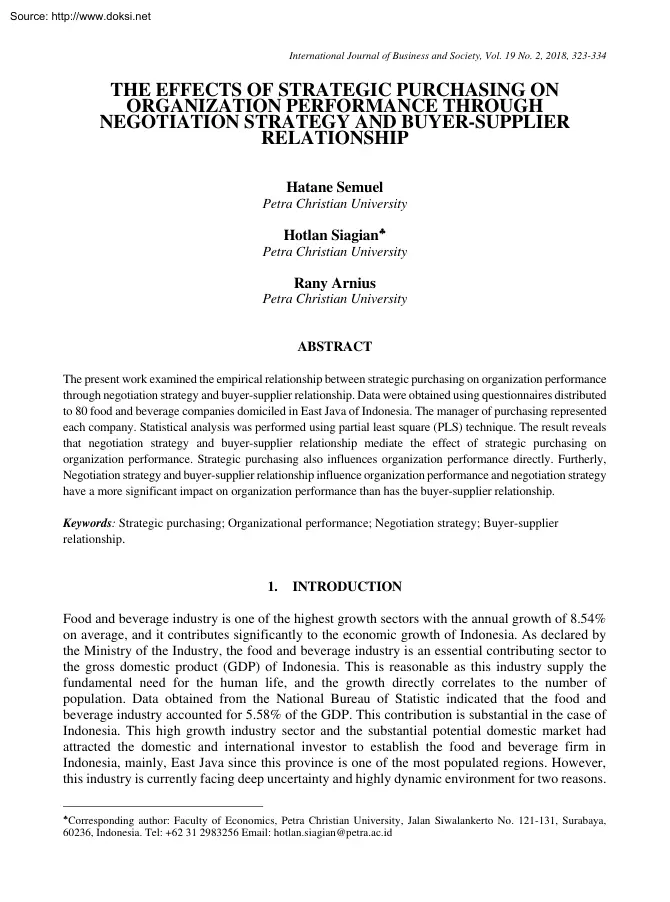
Source: http://www.doksinet International Journal of Business and Society, Vol. 19 No 2, 2018, 323-334 THE EFFECTS OF STRATEGIC PURCHASING ON ORGANIZATION PERFORMANCE THROUGH NEGOTIATION STRATEGY AND BUYER-SUPPLIER RELATIONSHIP Hatane Semuel Petra Christian University Hotlan Siagian Petra Christian University Rany Arnius Petra Christian University ABSTRACT The present work examined the empirical relationship between strategic purchasing on organization performance through negotiation strategy and buyer-supplier relationship. Data were obtained using questionnaires distributed to 80 food and beverage companies domiciled in East Java of Indonesia. The manager of purchasing represented each company. Statistical analysis was performed using partial least square (PLS) technique The result reveals that negotiation strategy and buyer-supplier relationship mediate the effect of strategic purchasing on organization performance. Strategic purchasing also influences organization
performance directly Furtherly, Negotiation strategy and buyer-supplier relationship influence organization performance and negotiation strategy have a more significant impact on organization performance than has the buyer-supplier relationship. Keywords: Strategic purchasing; Organizational performance; Negotiation strategy; Buyer-supplier relationship. 1. INTRODUCTION Food and beverage industry is one of the highest growth sectors with the annual growth of 8.54% on average, and it contributes significantly to the economic growth of Indonesia. As declared by the Ministry of the Industry, the food and beverage industry is an essential contributing sector to the gross domestic product (GDP) of Indonesia. This is reasonable as this industry supply the fundamental need for the human life, and the growth directly correlates to the number of population. Data obtained from the National Bureau of Statistic indicated that the food and beverage industry accounted for 5.58% of the GDP This
contribution is substantial in the case of Indonesia. This high growth industry sector and the substantial potential domestic market had attracted the domestic and international investor to establish the food and beverage firm in Indonesia, mainly, East Java since this province is one of the most populated regions. However, this industry is currently facing deep uncertainty and highly dynamic environment for two reasons. Corresponding author: Faculty of Economics, Petra Christian University, Jalan Siwalankerto No. 121-131, Surabaya, 60236, Indonesia. Tel: +62 31 2983256 Email: hotlansiagian@petraacid Source: http://www.doksinet 324 The Effects of Strategic Purchasing on Organization Performance through Negotiation Strategy and Buyer-supplier Relationship First, the increased number of companies engaged in this industry has saturated and made the fiercer competition unavoidable following the law of supply and demand. Second, the raw material supply, which previously mostly
supplied from the domestic agricultural product, is gradually becoming insufficient due to limited domestic supply capacity while the demand is gradually increasing. Within this atmosphere, the firms have to find out alternative source for the raw material such as importing from Vietnam, Malaysia, Cambodia, or Thailand. A report from the Ministry of Industry indicated that today, 70% of the raw material requirement is imported. When a firm has to import the raw material, the new challenge on the supply chain management emerges due to the exposure to the new challenge in term of complexity and uncertainty. Field data obtained through interviews with several managers engaged in the food and beverage companies domiciled in the region of East Java showed that the firms had achieved unfavorable organization performance due to expensive raw materials, long lead-time, and increased logistic cost. In the similar sense, the Ministry of Industry of the Republic of Indonesia also stated that the
performance of companies engaged in the food and beverage industry is currently facing a shortage of the raw materials supply. With referring to the above issues, the question raised is how to enhance the performance of the organization from the perspective of supply chain management. Many studies have investigated how to improve the organization performance in the context of the supply chain management. The presence of strategic purchasing within the organization has enabled the company to acquire the resources required in fulfilling customer needs (Keitany & Riwo-Abudho, 2014). Strategic purchasing within an organization means that the purchasing has a vital role in the decision-making process. Strategic purchasing is thought as a tool for optimizing organization performance and increase profitability through minimizing the costs. Other research also argued that corporations now realize the importance of purchasing process any material such as raw materials or part as inputs for
the production process (Carr & Pearson, 2002). Strategic purchasing is an activity that involves a significant amount of cost (over 70%) of their revenue in the form of material or part cost (Makabira & Waiganjo, 2014). While Oberoi & Khamba (2005) said that as the number of companies engaged in any industry is continually increasing, it consequently increases the complexity, uncertainty, creates a new competitive environment and requires a strategic purchasing. Another research by Alafi (2014) suggested that negotiation strategy is an important way how to reach an agreement with the supplier. With an appropriate negotiation strategy, the company may have the best contract with its supplier which at the end will influence the organization performance. The company's performance is affected by their negotiating strategy that helps companies get the best price and quality as expected. The result of negotiation strategy, which accommodates the expectations of both parties
involved in the agreement, will subsequently build a better relationship between the supplier and the buyer in the extended period. According to Mohanty & Gahan (2012) better relationship between two parties, called buyersupplier relationship, will benefit both sides in term of profitability which is not only in the shortterm but long-term as well. This buyer-supplier relationship shall be based on trust, power and dependency, capacity and capability of suppliers as well as their two-way communications. A better relationship between buyer and supplier will increase the sharing of information which at the end will improve operational aspect and subsequently performance. With refer to Coban (2012), the organization performance is also influenced by the excellent relationship between buyer and supplier. The better relationship between buyer and supplier, the better performance of the Source: http://www.doksinet Hatane Semuel, Hotlan Siagian, Rany Arnius 325 supplier will be. The
company can invite the vendor to be directly involved to support the production process in providing the material as required. This collaboration is possible when the proper relationship between the company and the supplier exists. It can be noted that many researchers have investigated the relationship of strategic purchasing and organization performance (Keitany & Riwo-Abudho, 2014), strategic purchasing and negotiation strategy (Thrulogachantar & Zailani, 2011), strategic purchasing and buyer-supplier relationship (Perks & Oosthuizen, 2013), negotiation strategy and organizational performance (Alafi, 2014), buyer-supplier relationship and organization performance (Damlin et al., 2012), negotiation strategy and buyer-supplier relationship (Perks & Oosthuizen, 2013). However, to the best of our knowledge, there is no study has examined the interaction between the four constructs (strategic purchasing, negotiation strategy, buyer-supplier relationship, and organization
performance) with the mediating role of negotiation strategy and buyer-supplier relationship simultaneously. In order to fill this gap, the present study concentrates on the examination of the effect of strategic purchasing on the organization performance through the mediating role of negotiation strategy and buyer-supplier relationship in the context of food and beverage industry in the region of East Java, Indonesia. This study contributes significantly to the current research on the supply chain management and paves the way for the manager to establish a strategic purchasing, buyer-supplier relationship, and negotiation strategy in the pursuit of superior organization performance. 2. 2.1 LITERATURE REVIEW Organization Performance The performance of a company may be measured by looking at the financial and operational performance (Chen, Paulraj, & Lado, 2004). Financial performance can be measured by looking at the operating performance of a company. Business performance
would be more efficient to measure by using the operational performance indicators. Operational performance reflects more directly on the efficiency and effectiveness of the business's operations (Ya’kob and Jusoh, 2016). The operational performance reflects specific competencies of the supply chain, including cost, reliability, quality, and flexibility (Slack, Chamber, & Johnston, 2010), as well as the time it takes for a product to enter the market (Li, Ragu-Nathan, Ragu-Nathan, & Subba Rao, 2006). Research by Vij & Bedi, (2016) said that business performance measurement could use either or both of subjective and objective measure. The objective measure means the assessment based on secondary data such as financial ratio obtained directly from a regular financial report issued by management. While subjective assessment involves the evaluation using the primary data obtained from respondent through a questionnaire. On this study, organization performance was
assessed using a subjective measure which is represented by five indicators, i.e cost efficiency, timely delivery, timely to market, products quality and flexibility to the customer. 2.2 Strategic Purchasing Any organization requires sustainable materials or part supply to serve its customers demand. It is, therefore, a compulsory for the organization to make sure how the raw material supply is sustainable. Carr & Pearson (2002) introduced a concept of strategic purchasing which is defined as a process of planning, evaluating, implementing and controlling the sourcing decision. Strategic Source: http://www.doksinet 326 The Effects of Strategic Purchasing on Organization Performance through Negotiation Strategy and Buyer-supplier Relationship purchasing is the matter of how to obtain materials or part in fulfilling their customer demand. Another finding by Carr & Pearson (2002) showed that strategic purchasing has a positive impact on organization performance. Paulraj,
Chen, & Flynn (2006) classified the strategic purchasing into three component, i.e strategic focus, strategic involvement as well as the presence of purchasing professional within an organization. Strategic purchasing does not look at only longterm plan referring to the company's strategy, but also involve important management Strategic Purchasing has a significant role in the supply chain management. It contributes to the success of a company as well as the improvement of the company's profitability and shareholders value (Oberoi & Khamba, 2005). In ideal form, strategic purchasing integrated separate internal and external functions in enhancing efficiency, effectiveness, and responsiveness of an organization (Figuera, Robinson, & Jakubowski, 2005). On this study, strategic purchasing is assessed using four indicators, i.e, long-term plans directionally, engagement in strategic planning, competency development training, and support of top management to purchasing
function. 2.3 Buyer-Supplier Relationship Ramakrishnan et al., (2015) said that the relationship between supplier and buyer would provide benefits within the company and environmental friendly products. Damlin et al, (2012) said the strategic level would help in achieving long-term goals and profit for an extended period in the future. While tactical level supports allocation resources that improve the efficiency, flexibility Meanwhile operational level should have a target on daily operational activities to reduce uncertainty and the ability to control. In his research, Mohanty & Gahan (2012) said that the buyersupplier relationship should be based on trust, power and dependency, capacity and capability of suppliers as well as their two-way communications. A better relationship between two parties will benefit both sides regarding profitability not only in the short-term but also long-term. In this study, the buyer-supplier relationship is assessed using four indicators, i.e,
confidence to supplier, strong relationship with the provider, fulfilling the request and explicit raw material specification. 2.4 Negotiation Strategy Effective negotiation is key to improving the competitiveness of enterprises. With appropriate negotiation strategy, both parties will gain a mutual benefit (often called win-win solution) in agreement with their needs. Negotiation is an activity to influence others through two-way communication in order other party agree on what the organization wants (Chebet, Rotich, & Kurgat, 2015). Negotiation requires an appropriate negotiation strategy, supportive team, and also, both parties should have the similar shared information necessary in the process of negotiations. Without sharing unbiased information in term of the bargaining matter, will make the parties involved in the difficult position to decide (Chebet et al., 2015) In addition to the information shared among the parties in the supply chain, collaboration and integration
will also be important during negotiation process (Jouali & Chakor, 2013). Negotiation is a method that can be used to reach an agreement with the supplier. Approval by the provider is the first step to establishing a relationship between providers with buyers or companies (Perks, P Oosthuizen, 2013). Good negotiation will result in long-term relationships between two or more parties that are interconnected to make or provide benefits to the parties involved (Chebet et al., 2015) On this study, negotiation strategy is assessed using three indicators, i.e sharing of business planning information, product development process, and control of raw material. Source: http://www.doksinet Hatane Semuel, Hotlan Siagian, Rany Arnius 327 2.5 The Influence of Strategic Purchasing on Buyer-Supplier Relationship Strategic purchasing affect the buyer-supplier relationship in the form of coordination and cooperation to achieve the company's goal (Carr & Smeltzer, 1999). Strategic
purchasing also contributes to building and managing the buyer-supplier relationship for enhancing company's competitive advantage (Chen et al., 2004) A study conducted by Onyango, Onyango, Kiruri, & Karanja (2015) also supported the results of previous studies which suggest that proper relationship between the supplier and the buyer arising from strategic purchasing resulted in two-way communication and will improve the operational performance of the company. The relationship between the provider and the company has a significant positive effect on the performance of the company due to the excellent relationship leads to the two parties will work together in the long term (Abul & Rashed, 2010). Based on the description above, the authors propose hypotheses as follows: H1: Strategic purchasing influence the buyer-supplier relationship. 2.6 The Impact of Strategic Purchasing on Negotiation Strategic Strategic purchasing has an impact on the negotiation strategy to reach
an agreement between the parties involved (Hageen, 1966). Thrulogachantar & Zailani (2011) draw conclusions from a study of 158 manufacturing companies in Malaysia that strategic purchasing affect the purchasing negotiation strategy. Negotiation is used to reduce the gap between suppliers and buyers to meet the needs of both parties involved. In his study, (Carr & Smeltzer, 1999) said that organizations that have strategic purchasing also has a level of cooperation with suppliers that are high concerning creating a mutually beneficial negotiation party involved. Based on the description above, the authors formulate hypotheses as follows: H2: strategic purchasing influence the negotiation strategy 2.7 The Effect of Strategic Purchasing on Organization Performance Research conducted on a sample of 175 respondents involved in parts purchasing in the United States concluded that the organization performance is affected by strategic purchasing in the organization (Carr &
Pearson, 2002). Good organization performance will be obtained when a company has a unique competence reflected in the form of goal-oriented activities that enable the company to survive in the long term (Ramsay, 2011). Meanwhile, Rossetti & Choi (2005) said that favorable organization performance would be achieved with the presence of strategic purchasing function in the organization. The research was conducted on companies engaged in the Aerospace industry in the United States. Chen et al, (2004) argued that strategic purchasing will create a sustainable competitive advantage through close working relationships with a limited number of suppliers, open communication among partners, and development of the long-term relationship to achieve mutual goals and at the end will enhance the organization performance. Paulraj et al, (2006) said that the importance of strategic purchasing role has evolved and expanded from traditional buying to supply management role. This study suggested the
importance of strategic purchasing to achieve better organizational performance. Based on the above description, corresponding hypotheses proposed is as follows: H3: strategic purchasing affect the organization performance. Source: http://www.doksinet 328 The Effects of Strategic Purchasing on Organization Performance through Negotiation Strategy and Buyer-supplier Relationship 2.8 The Effect of Negotiation Strategy on Buyer-Supplier Relationship Negotiation strategy needs to be done to build good relationships with suppliers so that enterprises more competitive compared with competitors (Perks & Oosthuizen, 2013). The Company is actively developing a closer relationship or durable with suppliers to achieve lower product costs, reduce time to market, improve quality and technology, as well as improved service and delivery. Another research by Thomas, Thomas, Manrodt, & Rudner (2013) said that the negotiation strategy supports the efforts of the excellent relationship
between the supplier and the company. Based on the description above, the authors formulate hypotheses as follows: H4: negotiation strategic effect supplier-buyer relationship 2.9 The Influence of Buyer-Supplier Relationship on Organization Performance A study by Damlin et al., (2012) said that the company's goal could be achieved with the support of the supplier arising from the creation of a close relationship between the company and suppliers. Research conducted by Onyango et al., (2015) on manufacturing company located in Kenya East Africa indicate that the organization's performance is influenced by the existence of a good relationship with suppliers. A study by Alafi (2014) stated that the company's performance significantly influenced by the relationship between the vendor and the buyer through. The relationship between the provider and the company has a significant positive effect on the performance of the company because the two parties can work together in
the long term (Abul & Rashed, 2010). Based on the description above, the authors formulate hypotheses as follows: H5: Buyer-supplier relationship affects the organization performance 2.10 The Relationship between Negotiation Strategy and Organization Performance Alafi (2014) pointed out in his research that the company's performance is significantly affected by the policy of negotiation between the buyer and the supplier. The company can ask for a solution from suppliers to achieve continuous improvements in cost, using high-quality raw materials that provide a flexible approach, accompanied by shorter delivery time and allow it to lower minimum order quantity. Proper negotiation would result in long-term relationships between two or more parties that are interconnected as a consequence of these negotiations to make or provide benefits to the parties involved (Chebet et al., 2015) The study suggested that negotiation strategy is an essential role in achieving agreement
between parties with the primary goal to achieve mutual benefit. Based on the description above, a hypothesis is proposed as follows: H6: Negotiation strategy affect the organization performance 3. METHODOLOGY The unit of analysis is a firm level with the population consisting of those food and beverage companies domiciled in East Java with the total number of 341 companies (small size up to big size in term of the number of employees (Central Bureau of Statistics, 2015). However, this number of firms are not all engaged as the producer of food and beverage but include related companies as Source: http://www.doksinet Hatane Semuel, Hotlan Siagian, Rany Arnius 329 well such as bottle manufacturer, pack manufacturer, raw material supplier, equipment supplier, distributor, and retailer. Of the 341 firms, we consider only 100 companies are engaged as producer of food and beverage and constitute the médium and large companies. This work used these 100 food and beverage producers as
the object of the study for two reasons, i.e, 1) they are who actually dealt with the problem of the supply chain issue particularly the raw material supply, and 2) who have the supply chain management in practices such as strategic purchasing, buyersupplier relationship, negotiation practices, and organization performance. Each company was represented by one manager or director in charge of purchasing department as they are considered the most informed regarding top management decision making. All indicators asked on the questionnaires were assessed using subjective measure with a five-point Likert scale ranging from 1: strongly disagree up to 5: strongly agree. The questionnaires were distributed by direct handover, and through e-mail as well to the respondent. We make a call or send e-mail regularly each week to ask if the questionnaire has been received and if the questionnaire has been completed as well. Eight weeks have been spent to collect the data through the e-mail and
visiting the office. Of the 100 questionnaires distributed, 80 questionnaires were correctly completed and valid. This number of returned questionnaire indicated the response rate of 80% Collected data were then analyzed using Partial Least Square (PLS) technique with smart PLS software. 4. THE EMPIRICAL RESULTS The first analysis is to assess the measurement model (outer model) by evaluating the convergent and discriminant validity of each indicator and the reliability of the block indicators of each variable. The next step is to examine the structural model (inner model) through the assessment of the patch coefficient together with its p-value or t-value. Table 1 lists the factor loading and cross loading of all indicators. Each indicator has a factor loading higher than the recommended minimum of 0.50 (Chin, 1998) in all cases (range 0657 to 0890) Hence, all indicators are considered valid. Table 1: Indicators Factor Loading and Cross Loading Variable & Indicator Strategic
Purchasing (SP) 1. Long-term plans directionally 2. Engage in strategic planning 3. Competence development training 4. Support for purchasing functions Buyer-supplier relationship (BSr) 1. Confidence to suppliers 2. A strong relationship 3. Fulfilling the request 4. Raw material specifications Negotiation strategy (NS) 1. Sharing information of business plan 2. Product development cooperation Factor loading SP Cross loading BSr NS OP 0.796 0.890 0.763 0.676 0.796 0.890 0.763 0.676 0.459 0.524 0.608 0.577 0.241 0.348 0.456 0.355 0.457 0.484 0.674 0.525 Valid Valid Valid Valid 0.831 0.810 0.657 0.793 0.649 0.514 0.501 0.468 0.831 0.810 0.657 0.793 0.555 0.388 0.396 0.562 0.670 0.500 0.485 0.578 Valid Valid Valid Valid 0.850 0.832 0.364 0.396 0.510 0.544 0.850 0.832 0.591 0.589 Valid Valid Validity Source: http://www.doksinet 330 The Effects of Strategic Purchasing on Organization Performance through Negotiation Strategy and Buyer-supplier Relationship Variable
& Indicator 3. Control of raw materials Organization performance (OP) 1. Cost efficiency 2. Timely Delivery 3. Time to market 4. Product quality 5. Flexibility to the customer Factor loading 0.814 SP 0.373 Cross loading BSr NS 0.497 0.814 OP 0.556 0.789 0.769 0.841 0.697 0.816 0.559 0.504 0.496 0.584 0.557 0.542 0.475 0.595 0.638 0.603 0.789 0.769 0.841 0.697 0.816 0.521 0.607 0.595 0.443 0.559 Validity Valid Valid Valid Valid Valid Valid Table 1 also lists the indicators cross loading which indicates that each indicator has cross loading value higher than its construct than with others. It shows that all indicators are valid in term discriminant validity. Table 2 lists the value of Average Variance Extracted (AVE) and Composite reliability (CR). The composite reliability exceeded the recommended minimum value of 70 in all cases (range .882 to 919) (Fornell & Larcker, 1981) Table 2: Composite Reliability and AVE Variable Strategic Purchasing Buyer – Supplier
relationship Negotiation Strategy Organization Performance Composite Reliability AVE 0,864 0,857 0,871 0,888 0.671 0.601 0.692 0.614 The value of AVE also exceeded the accepted minimum value of .50 in all cases (range 601 to .676) Those results demonstrated that measurement model has good validity and reliability in all cases. Inner model assessment using PLS does not directly calculate the goodness of fitness The primary method used to assess the inner model is by considering the variance explained called R2. Table 3 lists the variance explained (R2) for each dependent variable, i.e, buyer-supplier relationship, negotiation strategy, and firm performance. The Greater value of R2 indicates higher variance of the construct explained by the independent variable. The R2 value for the buyersupplier relationship is 0207 This value is relatively small compared with the other two variables While the R2 value for negotiation strategy and organizational performance are relatively high
(0.687 and 0600), means that portion of the variance in negotiation strategy and organization performance are well explained. Table 3: Variance Explained (R2) Variable Buyer-supplier relationship Negotiation Strategy Organizational Performance R2 0,207 0,687 0,600 Those hypotheses were examined by referring to the magnitude of path coefficient and t-value or P-value obtained from PLS result. Table 4 lists the path coefficient (β) and t-value for each relationship. Based on a significance level of 5% or t-value of 196, the results demonstrated that Source: http://www.doksinet Hatane Semuel, Hotlan Siagian, Rany Arnius 331 all path coefficients are positive and significant in all cases. As expected strategic purchasing influences buyer-supplier relationship (β = 0.518 and t-value>1,96) and negotiation strategy (β =0.455 and t-value = 3323 > 196), and organization performance (β=0337 and t-value =4328) Also negotiation strategy affects buyer-supplier relationship (β
=0.387 and t-value = 4944) and organization performance (β =0.383 and t-value = 5327) Also, the result reveals that buyersupplier relationship has an impact on organization performance (β = 0258 and t-value = 3018) Table 4: Path Coefficient and T-Statistic Hypothesis H1 H2 H3 H4 H5 H6 Relation SP BSr SP NS SP OP NS BSr BSr OP NS OP Path Coeff.( β) 0,518 0,455 0,337 0,387 0,258 0,383 T-Statistic 6,368 4,323 4,328 4,944 3,018 5,237 Remark supported supported supported supported supported supported Figure 1 shows the complete results of analysis using PLS. An additional finding from this study is that strategic purchasing affect organization performance directly and indirectly through mediating effect of negotiation strategy and buyer-supplier relationship. The buyer-supplier relationship also contributes a mediating effect on firm performance. The indirect effect of strategic purchasing on organization performance through buyer-supplier relationship is 0.134 which obtained
by the multiplication of 0.518 and 0,258 Strategic purchasing directly affects performance through negotiation strategy by the coefficient of 0.174, obtained by the multiplication of 0.455 and 0383 Another indirect effect of strategic purchasing on organization performance is achieved through mediating role of negotiation strategy and buyer-supplier with the magnitude of 0.045 Subsequently, the total impact of strategic purchasing on organization performance is 0.645 This value means that the mediating role of negotiation strategy and the buyer-supplier relationship is highly significant and provide the same contribution compared to its direct effect. Figure 1: Inner and Outer Model Result Source: http://www.doksinet 332 The Effects of Strategic Purchasing on Organization Performance through Negotiation Strategy and Buyer-supplier Relationship The results of this work reinforce all the proposed hypothesis. One of the notable findings from the result is that the strategic
purchasing affects, directly and indirectly, the organization performance. Indirect influence is mediated by both constructs, negotiation strategy and buyer-supplier strategy. It means that buyer-supplier relationship contributes the mediation effect for the strategic purchasing to improve the performance. When a company applied strategic purchasing within the organization and established an appropriate buyer-supplier relationship, will give an impact on the performance in addition to its direct impact. It is reasonable that an appropriate relationship between buyer and supplier will enable both sides to gain a mutual benefit. In the same manner, negotiation strategy also contributes a mediating effect for the strategic purchasing to influence the performance. Having a proper negotiation will help the firm to obtain an agreement with the company goal and at the end will benefit the company. Based on the findings, this study paves the way for manager how to improve the performance of
the organization from the supply chain management perspective. An organization engaged in the food and beverage industry should concern in establishing a strategic purchasing, buyer-supplier relationship and negotiation strategy. Those functions are essential since it enables the organization to establish a sustainable raw material supply with lower cost, shorter lead time, and better quality and, in the end, will enhance the performance of the food and beverage companies in the region of East Java and Indonesia. The implication of this finding is that the role of the strategic purchasing is highly essential. In addition to the strategic purchasing, the establishment of an appropriate buyer-supplier relationship and the use of negotiation strategy will improve the impact on firm performance. 5. CONCLUSION The aim of the present research was to examine the mediating role of strategic purchasing on performance through negotiation strategy and buyer-supplier relationship. This study
has shown that buyer-supplier relationship and negotiation strategy mediate the influence of strategic purchasing on the performance. The research has also demonstrated that strategic purchasing affects directly organizational performance. The findings of this research provide insights the importance role of buyer-supplier relationship and negotiation strategy in improving performance both due to its direct and indirect impact. The results of this research could be used to help the company in enhancing its performance. The implementation of strategic purchasing within the organization offers a benefit for the enterprise. In addition to the role of strategic purchasing, the establishment of an appropriate buyer-supplier relationship and application of a proper negotiation strategy also give a benefit for the company performance. ACKNOWLEDGEMENT We would like to thank an anonymous referee for useful comments and suggestions. The usual disclaimer applies. This project is funded by the
authors together Source: http://www.doksinet Hatane Semuel, Hotlan Siagian, Rany Arnius 333 REFERENCES Abul, C., & Rashed, A (2010) Effect of information and knowledge sharing on supply chain performance : a survey based approach. Journal of Operations and Supply Chain Management, 3(2), 61-77. Alafi, K. (2014) The effect of purchasing strategies on manufacturing performance: the case of Qualifying Industrial Zones in Jordan. Journal of contemporary research in business, 6(2), 337-361. Carr, A. S, & Pearson, J N (2002) The impact of purchasing and supplier involvement in strategic purchasing and its impact on firm’s performance. International Journal of Operations & Production Management, 22(9), 1032-1053. Carr, A. S, & Smeltzer, L R (1999) The relationship of strategic purchasing to supply chain management. European Journal of Purchasing & Supply Management, 5(1), 43-51 Chebet, M., Rotich, J, & Kurgat, A (2015) Negotiation skills: keys to business
excellence in the 21. Journal of Research and Reflection in Management Sciences, 3(3), 23-31 Chen, I. J, Paulraj, A, & Lado, A A (2004) Strategic purchasing, supply management, and firm performance. Journal of Operations Management, 22(5), 505-523 Chin, W. W (1998) The partial least squares approach to structural equation modeling Modern methods for business research, 295(2), 295-336. Coban, O. (2012) The impact of strategic purchasing on supply chain performance of the bottled water industry in Turkey. European Journal of Business and Management, 4(8), 57-65 Damlin, A., Dietersdóttir, K, Fornander, D, Brykt, J M, Polyantseva, E, & Sundquist, D (2012) Measuring buyer-supplier relationship performance, Retrieved from http://publications.libchalmersse/records/fulltext/170612/local 170612pdf Figuera, J., Robinson, R, & Jakubowski, E (2005) Purchasing to improve health system performance. (K Walshe & J Smith, Eds) (2nd ed) Open university press Fornell, C., & Larcker,
D F (1981) Evaluating structural equation models with unobservable variables and measurement error. Journal of Marketing Research, 18(1), 39-50 Hageen, A. (1966) Negotiating styles among American purchasing managers in the 21 Journal of Business, 1(8), 57-69. Jouali, J., & Chakor, A (2013) Collaboration in buyer-seller relationships as a new approach to competitive advantage. Journal of Business and Management, 10(2), 55-64 Keitany, P., & Riwo-Abudho (2014) Effects of lean production on organizational performance: a case study of flour producing company in Kenya. European Journal of Logistics Purchasing and Supply Chain Management, 2(2), 1-14. Li, S., Ragu-Nathan, B, Ragu-Nathan, T S, & Subba R S (2006) The impact of supply chain management practices on competitive advantage and organizational performance. Omega, 34(2), 107-124. Makabira, D. K, & Waiganjo, E (2014) Role of procurement practices on the performance of corporate organizations in Kenya : A case study of
kenya national police service, International Journal of Academic Research in Business and Social Sciences, 4(10), 369385. Mohanty, M. K, & Gahan, P (2012) Buyer supplier relationship in manufacturing industryfindings from indian manufacturing sector Business Intelligence Journal, 5(2), 319-333 Oberoi, J. S, & Khamba, J S (2005) Strategically managed buyer-supplier relationships across supply chain: an exploratory study. Human Systems Management, 24(4), 275-283 Onyango, O. J, Onyango, M B, Kiruri, S N, & Karanja, S N (2015) Effect of strategic supplier Source: http://www.doksinet 334 The Effects of Strategic Purchasing on Organization Performance through Negotiation Strategy and Buyer-supplier Relationship relationship management on internal operational performance of manufacturing firms : A case of East African Breweries Limited , Kenya. International Journal of Economics, Finance and Management Sciences, 3(2), 115-124. Paulraj, A., Chen, I J, & Flynn, J (2006)
Levels of strategic purchasing: impact on supply integration and performance. Journal of Purchasing and Supply Management, 12(3), 107122 Perks, P. S, & Oosthuizen, N (2013) Exploring supplier negotiation best practices and supplier relationships strategies in South Africa. Society of Interdisciplinary Business Research, 2(1), 330-350. Ramakrishnan, P., Haron, H, & Goh, Y N (2015) Factors influencing green purchasing adoption for small and medium enterprise (SMEs) in Malaysia. International Journal of Business and Society, 16 (1), 39-56. Ramsay, J. (2011) The resource based persoective, rents, and purchasing’s contribution to sustinable competitive advantage. Journal of Supply Chain Management, 37(3), 38–47 Rossetti, C., & Choi, T Y (2005) On the Dark Side of Strategic Sourcing : Experiences from the Aerospace Industry, 19(1), 1-15. Slack, N., Chamber, S, & Johnston, R (2010) Operations management (10th Ed), Pearson Education. Thomas, S. P, Thomas, R W, Manrodt, K B,
& Rudner, S M (2013) An experimental test of negotiation strategy effect on knowledge sharing intention in buyer-supplier relationship. Negotiation Strategy Effect on Knowledge Sharing, 49(2), 96-113. Thrulogachantar, P., & Zailani, S (2011) The influence of purchasing strategies on manufacturing performance An empirical study in Malaysia, 22(5), 641-663. Vij, S., & Bedi, H S (2016) Are subjective business performance measures justified? International Journal of Productivity and Performance Management, 65(5), 603-621. Ya'kob, S. A & Jusoh, W J W (2016) The effect of supply chain linkage on micro and small enterprise performance. International Journal of Business and Society, 17 (1), 99-112
performance directly Furtherly, Negotiation strategy and buyer-supplier relationship influence organization performance and negotiation strategy have a more significant impact on organization performance than has the buyer-supplier relationship. Keywords: Strategic purchasing; Organizational performance; Negotiation strategy; Buyer-supplier relationship. 1. INTRODUCTION Food and beverage industry is one of the highest growth sectors with the annual growth of 8.54% on average, and it contributes significantly to the economic growth of Indonesia. As declared by the Ministry of the Industry, the food and beverage industry is an essential contributing sector to the gross domestic product (GDP) of Indonesia. This is reasonable as this industry supply the fundamental need for the human life, and the growth directly correlates to the number of population. Data obtained from the National Bureau of Statistic indicated that the food and beverage industry accounted for 5.58% of the GDP This
contribution is substantial in the case of Indonesia. This high growth industry sector and the substantial potential domestic market had attracted the domestic and international investor to establish the food and beverage firm in Indonesia, mainly, East Java since this province is one of the most populated regions. However, this industry is currently facing deep uncertainty and highly dynamic environment for two reasons. Corresponding author: Faculty of Economics, Petra Christian University, Jalan Siwalankerto No. 121-131, Surabaya, 60236, Indonesia. Tel: +62 31 2983256 Email: hotlansiagian@petraacid Source: http://www.doksinet 324 The Effects of Strategic Purchasing on Organization Performance through Negotiation Strategy and Buyer-supplier Relationship First, the increased number of companies engaged in this industry has saturated and made the fiercer competition unavoidable following the law of supply and demand. Second, the raw material supply, which previously mostly
supplied from the domestic agricultural product, is gradually becoming insufficient due to limited domestic supply capacity while the demand is gradually increasing. Within this atmosphere, the firms have to find out alternative source for the raw material such as importing from Vietnam, Malaysia, Cambodia, or Thailand. A report from the Ministry of Industry indicated that today, 70% of the raw material requirement is imported. When a firm has to import the raw material, the new challenge on the supply chain management emerges due to the exposure to the new challenge in term of complexity and uncertainty. Field data obtained through interviews with several managers engaged in the food and beverage companies domiciled in the region of East Java showed that the firms had achieved unfavorable organization performance due to expensive raw materials, long lead-time, and increased logistic cost. In the similar sense, the Ministry of Industry of the Republic of Indonesia also stated that the
performance of companies engaged in the food and beverage industry is currently facing a shortage of the raw materials supply. With referring to the above issues, the question raised is how to enhance the performance of the organization from the perspective of supply chain management. Many studies have investigated how to improve the organization performance in the context of the supply chain management. The presence of strategic purchasing within the organization has enabled the company to acquire the resources required in fulfilling customer needs (Keitany & Riwo-Abudho, 2014). Strategic purchasing within an organization means that the purchasing has a vital role in the decision-making process. Strategic purchasing is thought as a tool for optimizing organization performance and increase profitability through minimizing the costs. Other research also argued that corporations now realize the importance of purchasing process any material such as raw materials or part as inputs for
the production process (Carr & Pearson, 2002). Strategic purchasing is an activity that involves a significant amount of cost (over 70%) of their revenue in the form of material or part cost (Makabira & Waiganjo, 2014). While Oberoi & Khamba (2005) said that as the number of companies engaged in any industry is continually increasing, it consequently increases the complexity, uncertainty, creates a new competitive environment and requires a strategic purchasing. Another research by Alafi (2014) suggested that negotiation strategy is an important way how to reach an agreement with the supplier. With an appropriate negotiation strategy, the company may have the best contract with its supplier which at the end will influence the organization performance. The company's performance is affected by their negotiating strategy that helps companies get the best price and quality as expected. The result of negotiation strategy, which accommodates the expectations of both parties
involved in the agreement, will subsequently build a better relationship between the supplier and the buyer in the extended period. According to Mohanty & Gahan (2012) better relationship between two parties, called buyersupplier relationship, will benefit both sides in term of profitability which is not only in the shortterm but long-term as well. This buyer-supplier relationship shall be based on trust, power and dependency, capacity and capability of suppliers as well as their two-way communications. A better relationship between buyer and supplier will increase the sharing of information which at the end will improve operational aspect and subsequently performance. With refer to Coban (2012), the organization performance is also influenced by the excellent relationship between buyer and supplier. The better relationship between buyer and supplier, the better performance of the Source: http://www.doksinet Hatane Semuel, Hotlan Siagian, Rany Arnius 325 supplier will be. The
company can invite the vendor to be directly involved to support the production process in providing the material as required. This collaboration is possible when the proper relationship between the company and the supplier exists. It can be noted that many researchers have investigated the relationship of strategic purchasing and organization performance (Keitany & Riwo-Abudho, 2014), strategic purchasing and negotiation strategy (Thrulogachantar & Zailani, 2011), strategic purchasing and buyer-supplier relationship (Perks & Oosthuizen, 2013), negotiation strategy and organizational performance (Alafi, 2014), buyer-supplier relationship and organization performance (Damlin et al., 2012), negotiation strategy and buyer-supplier relationship (Perks & Oosthuizen, 2013). However, to the best of our knowledge, there is no study has examined the interaction between the four constructs (strategic purchasing, negotiation strategy, buyer-supplier relationship, and organization
performance) with the mediating role of negotiation strategy and buyer-supplier relationship simultaneously. In order to fill this gap, the present study concentrates on the examination of the effect of strategic purchasing on the organization performance through the mediating role of negotiation strategy and buyer-supplier relationship in the context of food and beverage industry in the region of East Java, Indonesia. This study contributes significantly to the current research on the supply chain management and paves the way for the manager to establish a strategic purchasing, buyer-supplier relationship, and negotiation strategy in the pursuit of superior organization performance. 2. 2.1 LITERATURE REVIEW Organization Performance The performance of a company may be measured by looking at the financial and operational performance (Chen, Paulraj, & Lado, 2004). Financial performance can be measured by looking at the operating performance of a company. Business performance
would be more efficient to measure by using the operational performance indicators. Operational performance reflects more directly on the efficiency and effectiveness of the business's operations (Ya’kob and Jusoh, 2016). The operational performance reflects specific competencies of the supply chain, including cost, reliability, quality, and flexibility (Slack, Chamber, & Johnston, 2010), as well as the time it takes for a product to enter the market (Li, Ragu-Nathan, Ragu-Nathan, & Subba Rao, 2006). Research by Vij & Bedi, (2016) said that business performance measurement could use either or both of subjective and objective measure. The objective measure means the assessment based on secondary data such as financial ratio obtained directly from a regular financial report issued by management. While subjective assessment involves the evaluation using the primary data obtained from respondent through a questionnaire. On this study, organization performance was
assessed using a subjective measure which is represented by five indicators, i.e cost efficiency, timely delivery, timely to market, products quality and flexibility to the customer. 2.2 Strategic Purchasing Any organization requires sustainable materials or part supply to serve its customers demand. It is, therefore, a compulsory for the organization to make sure how the raw material supply is sustainable. Carr & Pearson (2002) introduced a concept of strategic purchasing which is defined as a process of planning, evaluating, implementing and controlling the sourcing decision. Strategic Source: http://www.doksinet 326 The Effects of Strategic Purchasing on Organization Performance through Negotiation Strategy and Buyer-supplier Relationship purchasing is the matter of how to obtain materials or part in fulfilling their customer demand. Another finding by Carr & Pearson (2002) showed that strategic purchasing has a positive impact on organization performance. Paulraj,
Chen, & Flynn (2006) classified the strategic purchasing into three component, i.e strategic focus, strategic involvement as well as the presence of purchasing professional within an organization. Strategic purchasing does not look at only longterm plan referring to the company's strategy, but also involve important management Strategic Purchasing has a significant role in the supply chain management. It contributes to the success of a company as well as the improvement of the company's profitability and shareholders value (Oberoi & Khamba, 2005). In ideal form, strategic purchasing integrated separate internal and external functions in enhancing efficiency, effectiveness, and responsiveness of an organization (Figuera, Robinson, & Jakubowski, 2005). On this study, strategic purchasing is assessed using four indicators, i.e, long-term plans directionally, engagement in strategic planning, competency development training, and support of top management to purchasing
function. 2.3 Buyer-Supplier Relationship Ramakrishnan et al., (2015) said that the relationship between supplier and buyer would provide benefits within the company and environmental friendly products. Damlin et al, (2012) said the strategic level would help in achieving long-term goals and profit for an extended period in the future. While tactical level supports allocation resources that improve the efficiency, flexibility Meanwhile operational level should have a target on daily operational activities to reduce uncertainty and the ability to control. In his research, Mohanty & Gahan (2012) said that the buyersupplier relationship should be based on trust, power and dependency, capacity and capability of suppliers as well as their two-way communications. A better relationship between two parties will benefit both sides regarding profitability not only in the short-term but also long-term. In this study, the buyer-supplier relationship is assessed using four indicators, i.e,
confidence to supplier, strong relationship with the provider, fulfilling the request and explicit raw material specification. 2.4 Negotiation Strategy Effective negotiation is key to improving the competitiveness of enterprises. With appropriate negotiation strategy, both parties will gain a mutual benefit (often called win-win solution) in agreement with their needs. Negotiation is an activity to influence others through two-way communication in order other party agree on what the organization wants (Chebet, Rotich, & Kurgat, 2015). Negotiation requires an appropriate negotiation strategy, supportive team, and also, both parties should have the similar shared information necessary in the process of negotiations. Without sharing unbiased information in term of the bargaining matter, will make the parties involved in the difficult position to decide (Chebet et al., 2015) In addition to the information shared among the parties in the supply chain, collaboration and integration
will also be important during negotiation process (Jouali & Chakor, 2013). Negotiation is a method that can be used to reach an agreement with the supplier. Approval by the provider is the first step to establishing a relationship between providers with buyers or companies (Perks, P Oosthuizen, 2013). Good negotiation will result in long-term relationships between two or more parties that are interconnected to make or provide benefits to the parties involved (Chebet et al., 2015) On this study, negotiation strategy is assessed using three indicators, i.e sharing of business planning information, product development process, and control of raw material. Source: http://www.doksinet Hatane Semuel, Hotlan Siagian, Rany Arnius 327 2.5 The Influence of Strategic Purchasing on Buyer-Supplier Relationship Strategic purchasing affect the buyer-supplier relationship in the form of coordination and cooperation to achieve the company's goal (Carr & Smeltzer, 1999). Strategic
purchasing also contributes to building and managing the buyer-supplier relationship for enhancing company's competitive advantage (Chen et al., 2004) A study conducted by Onyango, Onyango, Kiruri, & Karanja (2015) also supported the results of previous studies which suggest that proper relationship between the supplier and the buyer arising from strategic purchasing resulted in two-way communication and will improve the operational performance of the company. The relationship between the provider and the company has a significant positive effect on the performance of the company due to the excellent relationship leads to the two parties will work together in the long term (Abul & Rashed, 2010). Based on the description above, the authors propose hypotheses as follows: H1: Strategic purchasing influence the buyer-supplier relationship. 2.6 The Impact of Strategic Purchasing on Negotiation Strategic Strategic purchasing has an impact on the negotiation strategy to reach
an agreement between the parties involved (Hageen, 1966). Thrulogachantar & Zailani (2011) draw conclusions from a study of 158 manufacturing companies in Malaysia that strategic purchasing affect the purchasing negotiation strategy. Negotiation is used to reduce the gap between suppliers and buyers to meet the needs of both parties involved. In his study, (Carr & Smeltzer, 1999) said that organizations that have strategic purchasing also has a level of cooperation with suppliers that are high concerning creating a mutually beneficial negotiation party involved. Based on the description above, the authors formulate hypotheses as follows: H2: strategic purchasing influence the negotiation strategy 2.7 The Effect of Strategic Purchasing on Organization Performance Research conducted on a sample of 175 respondents involved in parts purchasing in the United States concluded that the organization performance is affected by strategic purchasing in the organization (Carr &
Pearson, 2002). Good organization performance will be obtained when a company has a unique competence reflected in the form of goal-oriented activities that enable the company to survive in the long term (Ramsay, 2011). Meanwhile, Rossetti & Choi (2005) said that favorable organization performance would be achieved with the presence of strategic purchasing function in the organization. The research was conducted on companies engaged in the Aerospace industry in the United States. Chen et al, (2004) argued that strategic purchasing will create a sustainable competitive advantage through close working relationships with a limited number of suppliers, open communication among partners, and development of the long-term relationship to achieve mutual goals and at the end will enhance the organization performance. Paulraj et al, (2006) said that the importance of strategic purchasing role has evolved and expanded from traditional buying to supply management role. This study suggested the
importance of strategic purchasing to achieve better organizational performance. Based on the above description, corresponding hypotheses proposed is as follows: H3: strategic purchasing affect the organization performance. Source: http://www.doksinet 328 The Effects of Strategic Purchasing on Organization Performance through Negotiation Strategy and Buyer-supplier Relationship 2.8 The Effect of Negotiation Strategy on Buyer-Supplier Relationship Negotiation strategy needs to be done to build good relationships with suppliers so that enterprises more competitive compared with competitors (Perks & Oosthuizen, 2013). The Company is actively developing a closer relationship or durable with suppliers to achieve lower product costs, reduce time to market, improve quality and technology, as well as improved service and delivery. Another research by Thomas, Thomas, Manrodt, & Rudner (2013) said that the negotiation strategy supports the efforts of the excellent relationship
between the supplier and the company. Based on the description above, the authors formulate hypotheses as follows: H4: negotiation strategic effect supplier-buyer relationship 2.9 The Influence of Buyer-Supplier Relationship on Organization Performance A study by Damlin et al., (2012) said that the company's goal could be achieved with the support of the supplier arising from the creation of a close relationship between the company and suppliers. Research conducted by Onyango et al., (2015) on manufacturing company located in Kenya East Africa indicate that the organization's performance is influenced by the existence of a good relationship with suppliers. A study by Alafi (2014) stated that the company's performance significantly influenced by the relationship between the vendor and the buyer through. The relationship between the provider and the company has a significant positive effect on the performance of the company because the two parties can work together in
the long term (Abul & Rashed, 2010). Based on the description above, the authors formulate hypotheses as follows: H5: Buyer-supplier relationship affects the organization performance 2.10 The Relationship between Negotiation Strategy and Organization Performance Alafi (2014) pointed out in his research that the company's performance is significantly affected by the policy of negotiation between the buyer and the supplier. The company can ask for a solution from suppliers to achieve continuous improvements in cost, using high-quality raw materials that provide a flexible approach, accompanied by shorter delivery time and allow it to lower minimum order quantity. Proper negotiation would result in long-term relationships between two or more parties that are interconnected as a consequence of these negotiations to make or provide benefits to the parties involved (Chebet et al., 2015) The study suggested that negotiation strategy is an essential role in achieving agreement
between parties with the primary goal to achieve mutual benefit. Based on the description above, a hypothesis is proposed as follows: H6: Negotiation strategy affect the organization performance 3. METHODOLOGY The unit of analysis is a firm level with the population consisting of those food and beverage companies domiciled in East Java with the total number of 341 companies (small size up to big size in term of the number of employees (Central Bureau of Statistics, 2015). However, this number of firms are not all engaged as the producer of food and beverage but include related companies as Source: http://www.doksinet Hatane Semuel, Hotlan Siagian, Rany Arnius 329 well such as bottle manufacturer, pack manufacturer, raw material supplier, equipment supplier, distributor, and retailer. Of the 341 firms, we consider only 100 companies are engaged as producer of food and beverage and constitute the médium and large companies. This work used these 100 food and beverage producers as
the object of the study for two reasons, i.e, 1) they are who actually dealt with the problem of the supply chain issue particularly the raw material supply, and 2) who have the supply chain management in practices such as strategic purchasing, buyersupplier relationship, negotiation practices, and organization performance. Each company was represented by one manager or director in charge of purchasing department as they are considered the most informed regarding top management decision making. All indicators asked on the questionnaires were assessed using subjective measure with a five-point Likert scale ranging from 1: strongly disagree up to 5: strongly agree. The questionnaires were distributed by direct handover, and through e-mail as well to the respondent. We make a call or send e-mail regularly each week to ask if the questionnaire has been received and if the questionnaire has been completed as well. Eight weeks have been spent to collect the data through the e-mail and
visiting the office. Of the 100 questionnaires distributed, 80 questionnaires were correctly completed and valid. This number of returned questionnaire indicated the response rate of 80% Collected data were then analyzed using Partial Least Square (PLS) technique with smart PLS software. 4. THE EMPIRICAL RESULTS The first analysis is to assess the measurement model (outer model) by evaluating the convergent and discriminant validity of each indicator and the reliability of the block indicators of each variable. The next step is to examine the structural model (inner model) through the assessment of the patch coefficient together with its p-value or t-value. Table 1 lists the factor loading and cross loading of all indicators. Each indicator has a factor loading higher than the recommended minimum of 0.50 (Chin, 1998) in all cases (range 0657 to 0890) Hence, all indicators are considered valid. Table 1: Indicators Factor Loading and Cross Loading Variable & Indicator Strategic
Purchasing (SP) 1. Long-term plans directionally 2. Engage in strategic planning 3. Competence development training 4. Support for purchasing functions Buyer-supplier relationship (BSr) 1. Confidence to suppliers 2. A strong relationship 3. Fulfilling the request 4. Raw material specifications Negotiation strategy (NS) 1. Sharing information of business plan 2. Product development cooperation Factor loading SP Cross loading BSr NS OP 0.796 0.890 0.763 0.676 0.796 0.890 0.763 0.676 0.459 0.524 0.608 0.577 0.241 0.348 0.456 0.355 0.457 0.484 0.674 0.525 Valid Valid Valid Valid 0.831 0.810 0.657 0.793 0.649 0.514 0.501 0.468 0.831 0.810 0.657 0.793 0.555 0.388 0.396 0.562 0.670 0.500 0.485 0.578 Valid Valid Valid Valid 0.850 0.832 0.364 0.396 0.510 0.544 0.850 0.832 0.591 0.589 Valid Valid Validity Source: http://www.doksinet 330 The Effects of Strategic Purchasing on Organization Performance through Negotiation Strategy and Buyer-supplier Relationship Variable
& Indicator 3. Control of raw materials Organization performance (OP) 1. Cost efficiency 2. Timely Delivery 3. Time to market 4. Product quality 5. Flexibility to the customer Factor loading 0.814 SP 0.373 Cross loading BSr NS 0.497 0.814 OP 0.556 0.789 0.769 0.841 0.697 0.816 0.559 0.504 0.496 0.584 0.557 0.542 0.475 0.595 0.638 0.603 0.789 0.769 0.841 0.697 0.816 0.521 0.607 0.595 0.443 0.559 Validity Valid Valid Valid Valid Valid Valid Table 1 also lists the indicators cross loading which indicates that each indicator has cross loading value higher than its construct than with others. It shows that all indicators are valid in term discriminant validity. Table 2 lists the value of Average Variance Extracted (AVE) and Composite reliability (CR). The composite reliability exceeded the recommended minimum value of 70 in all cases (range .882 to 919) (Fornell & Larcker, 1981) Table 2: Composite Reliability and AVE Variable Strategic Purchasing Buyer – Supplier
relationship Negotiation Strategy Organization Performance Composite Reliability AVE 0,864 0,857 0,871 0,888 0.671 0.601 0.692 0.614 The value of AVE also exceeded the accepted minimum value of .50 in all cases (range 601 to .676) Those results demonstrated that measurement model has good validity and reliability in all cases. Inner model assessment using PLS does not directly calculate the goodness of fitness The primary method used to assess the inner model is by considering the variance explained called R2. Table 3 lists the variance explained (R2) for each dependent variable, i.e, buyer-supplier relationship, negotiation strategy, and firm performance. The Greater value of R2 indicates higher variance of the construct explained by the independent variable. The R2 value for the buyersupplier relationship is 0207 This value is relatively small compared with the other two variables While the R2 value for negotiation strategy and organizational performance are relatively high
(0.687 and 0600), means that portion of the variance in negotiation strategy and organization performance are well explained. Table 3: Variance Explained (R2) Variable Buyer-supplier relationship Negotiation Strategy Organizational Performance R2 0,207 0,687 0,600 Those hypotheses were examined by referring to the magnitude of path coefficient and t-value or P-value obtained from PLS result. Table 4 lists the path coefficient (β) and t-value for each relationship. Based on a significance level of 5% or t-value of 196, the results demonstrated that Source: http://www.doksinet Hatane Semuel, Hotlan Siagian, Rany Arnius 331 all path coefficients are positive and significant in all cases. As expected strategic purchasing influences buyer-supplier relationship (β = 0.518 and t-value>1,96) and negotiation strategy (β =0.455 and t-value = 3323 > 196), and organization performance (β=0337 and t-value =4328) Also negotiation strategy affects buyer-supplier relationship (β
=0.387 and t-value = 4944) and organization performance (β =0.383 and t-value = 5327) Also, the result reveals that buyersupplier relationship has an impact on organization performance (β = 0258 and t-value = 3018) Table 4: Path Coefficient and T-Statistic Hypothesis H1 H2 H3 H4 H5 H6 Relation SP BSr SP NS SP OP NS BSr BSr OP NS OP Path Coeff.( β) 0,518 0,455 0,337 0,387 0,258 0,383 T-Statistic 6,368 4,323 4,328 4,944 3,018 5,237 Remark supported supported supported supported supported supported Figure 1 shows the complete results of analysis using PLS. An additional finding from this study is that strategic purchasing affect organization performance directly and indirectly through mediating effect of negotiation strategy and buyer-supplier relationship. The buyer-supplier relationship also contributes a mediating effect on firm performance. The indirect effect of strategic purchasing on organization performance through buyer-supplier relationship is 0.134 which obtained
by the multiplication of 0.518 and 0,258 Strategic purchasing directly affects performance through negotiation strategy by the coefficient of 0.174, obtained by the multiplication of 0.455 and 0383 Another indirect effect of strategic purchasing on organization performance is achieved through mediating role of negotiation strategy and buyer-supplier with the magnitude of 0.045 Subsequently, the total impact of strategic purchasing on organization performance is 0.645 This value means that the mediating role of negotiation strategy and the buyer-supplier relationship is highly significant and provide the same contribution compared to its direct effect. Figure 1: Inner and Outer Model Result Source: http://www.doksinet 332 The Effects of Strategic Purchasing on Organization Performance through Negotiation Strategy and Buyer-supplier Relationship The results of this work reinforce all the proposed hypothesis. One of the notable findings from the result is that the strategic
purchasing affects, directly and indirectly, the organization performance. Indirect influence is mediated by both constructs, negotiation strategy and buyer-supplier strategy. It means that buyer-supplier relationship contributes the mediation effect for the strategic purchasing to improve the performance. When a company applied strategic purchasing within the organization and established an appropriate buyer-supplier relationship, will give an impact on the performance in addition to its direct impact. It is reasonable that an appropriate relationship between buyer and supplier will enable both sides to gain a mutual benefit. In the same manner, negotiation strategy also contributes a mediating effect for the strategic purchasing to influence the performance. Having a proper negotiation will help the firm to obtain an agreement with the company goal and at the end will benefit the company. Based on the findings, this study paves the way for manager how to improve the performance of
the organization from the supply chain management perspective. An organization engaged in the food and beverage industry should concern in establishing a strategic purchasing, buyer-supplier relationship and negotiation strategy. Those functions are essential since it enables the organization to establish a sustainable raw material supply with lower cost, shorter lead time, and better quality and, in the end, will enhance the performance of the food and beverage companies in the region of East Java and Indonesia. The implication of this finding is that the role of the strategic purchasing is highly essential. In addition to the strategic purchasing, the establishment of an appropriate buyer-supplier relationship and the use of negotiation strategy will improve the impact on firm performance. 5. CONCLUSION The aim of the present research was to examine the mediating role of strategic purchasing on performance through negotiation strategy and buyer-supplier relationship. This study
has shown that buyer-supplier relationship and negotiation strategy mediate the influence of strategic purchasing on the performance. The research has also demonstrated that strategic purchasing affects directly organizational performance. The findings of this research provide insights the importance role of buyer-supplier relationship and negotiation strategy in improving performance both due to its direct and indirect impact. The results of this research could be used to help the company in enhancing its performance. The implementation of strategic purchasing within the organization offers a benefit for the enterprise. In addition to the role of strategic purchasing, the establishment of an appropriate buyer-supplier relationship and application of a proper negotiation strategy also give a benefit for the company performance. ACKNOWLEDGEMENT We would like to thank an anonymous referee for useful comments and suggestions. The usual disclaimer applies. This project is funded by the
authors together Source: http://www.doksinet Hatane Semuel, Hotlan Siagian, Rany Arnius 333 REFERENCES Abul, C., & Rashed, A (2010) Effect of information and knowledge sharing on supply chain performance : a survey based approach. Journal of Operations and Supply Chain Management, 3(2), 61-77. Alafi, K. (2014) The effect of purchasing strategies on manufacturing performance: the case of Qualifying Industrial Zones in Jordan. Journal of contemporary research in business, 6(2), 337-361. Carr, A. S, & Pearson, J N (2002) The impact of purchasing and supplier involvement in strategic purchasing and its impact on firm’s performance. International Journal of Operations & Production Management, 22(9), 1032-1053. Carr, A. S, & Smeltzer, L R (1999) The relationship of strategic purchasing to supply chain management. European Journal of Purchasing & Supply Management, 5(1), 43-51 Chebet, M., Rotich, J, & Kurgat, A (2015) Negotiation skills: keys to business
excellence in the 21. Journal of Research and Reflection in Management Sciences, 3(3), 23-31 Chen, I. J, Paulraj, A, & Lado, A A (2004) Strategic purchasing, supply management, and firm performance. Journal of Operations Management, 22(5), 505-523 Chin, W. W (1998) The partial least squares approach to structural equation modeling Modern methods for business research, 295(2), 295-336. Coban, O. (2012) The impact of strategic purchasing on supply chain performance of the bottled water industry in Turkey. European Journal of Business and Management, 4(8), 57-65 Damlin, A., Dietersdóttir, K, Fornander, D, Brykt, J M, Polyantseva, E, & Sundquist, D (2012) Measuring buyer-supplier relationship performance, Retrieved from http://publications.libchalmersse/records/fulltext/170612/local 170612pdf Figuera, J., Robinson, R, & Jakubowski, E (2005) Purchasing to improve health system performance. (K Walshe & J Smith, Eds) (2nd ed) Open university press Fornell, C., & Larcker,
D F (1981) Evaluating structural equation models with unobservable variables and measurement error. Journal of Marketing Research, 18(1), 39-50 Hageen, A. (1966) Negotiating styles among American purchasing managers in the 21 Journal of Business, 1(8), 57-69. Jouali, J., & Chakor, A (2013) Collaboration in buyer-seller relationships as a new approach to competitive advantage. Journal of Business and Management, 10(2), 55-64 Keitany, P., & Riwo-Abudho (2014) Effects of lean production on organizational performance: a case study of flour producing company in Kenya. European Journal of Logistics Purchasing and Supply Chain Management, 2(2), 1-14. Li, S., Ragu-Nathan, B, Ragu-Nathan, T S, & Subba R S (2006) The impact of supply chain management practices on competitive advantage and organizational performance. Omega, 34(2), 107-124. Makabira, D. K, & Waiganjo, E (2014) Role of procurement practices on the performance of corporate organizations in Kenya : A case study of
kenya national police service, International Journal of Academic Research in Business and Social Sciences, 4(10), 369385. Mohanty, M. K, & Gahan, P (2012) Buyer supplier relationship in manufacturing industryfindings from indian manufacturing sector Business Intelligence Journal, 5(2), 319-333 Oberoi, J. S, & Khamba, J S (2005) Strategically managed buyer-supplier relationships across supply chain: an exploratory study. Human Systems Management, 24(4), 275-283 Onyango, O. J, Onyango, M B, Kiruri, S N, & Karanja, S N (2015) Effect of strategic supplier Source: http://www.doksinet 334 The Effects of Strategic Purchasing on Organization Performance through Negotiation Strategy and Buyer-supplier Relationship relationship management on internal operational performance of manufacturing firms : A case of East African Breweries Limited , Kenya. International Journal of Economics, Finance and Management Sciences, 3(2), 115-124. Paulraj, A., Chen, I J, & Flynn, J (2006)
Levels of strategic purchasing: impact on supply integration and performance. Journal of Purchasing and Supply Management, 12(3), 107122 Perks, P. S, & Oosthuizen, N (2013) Exploring supplier negotiation best practices and supplier relationships strategies in South Africa. Society of Interdisciplinary Business Research, 2(1), 330-350. Ramakrishnan, P., Haron, H, & Goh, Y N (2015) Factors influencing green purchasing adoption for small and medium enterprise (SMEs) in Malaysia. International Journal of Business and Society, 16 (1), 39-56. Ramsay, J. (2011) The resource based persoective, rents, and purchasing’s contribution to sustinable competitive advantage. Journal of Supply Chain Management, 37(3), 38–47 Rossetti, C., & Choi, T Y (2005) On the Dark Side of Strategic Sourcing : Experiences from the Aerospace Industry, 19(1), 1-15. Slack, N., Chamber, S, & Johnston, R (2010) Operations management (10th Ed), Pearson Education. Thomas, S. P, Thomas, R W, Manrodt, K B,
& Rudner, S M (2013) An experimental test of negotiation strategy effect on knowledge sharing intention in buyer-supplier relationship. Negotiation Strategy Effect on Knowledge Sharing, 49(2), 96-113. Thrulogachantar, P., & Zailani, S (2011) The influence of purchasing strategies on manufacturing performance An empirical study in Malaysia, 22(5), 641-663. Vij, S., & Bedi, H S (2016) Are subjective business performance measures justified? International Journal of Productivity and Performance Management, 65(5), 603-621. Ya'kob, S. A & Jusoh, W J W (2016) The effect of supply chain linkage on micro and small enterprise performance. International Journal of Business and Society, 17 (1), 99-112
 When reading, most of us just let a story wash over us, getting lost in the world of the book rather than paying attention to the individual elements of the plot or writing. However, in English class, our teachers ask us to look at the mechanics of the writing.

