Comments
 2016 · 2 page(s) (694 KB)
 English
 4
4
 July 01 · 2021
 Log in

 Embed
Embed
No comments yet. You can be the first!
What did others read after this?

Content extract
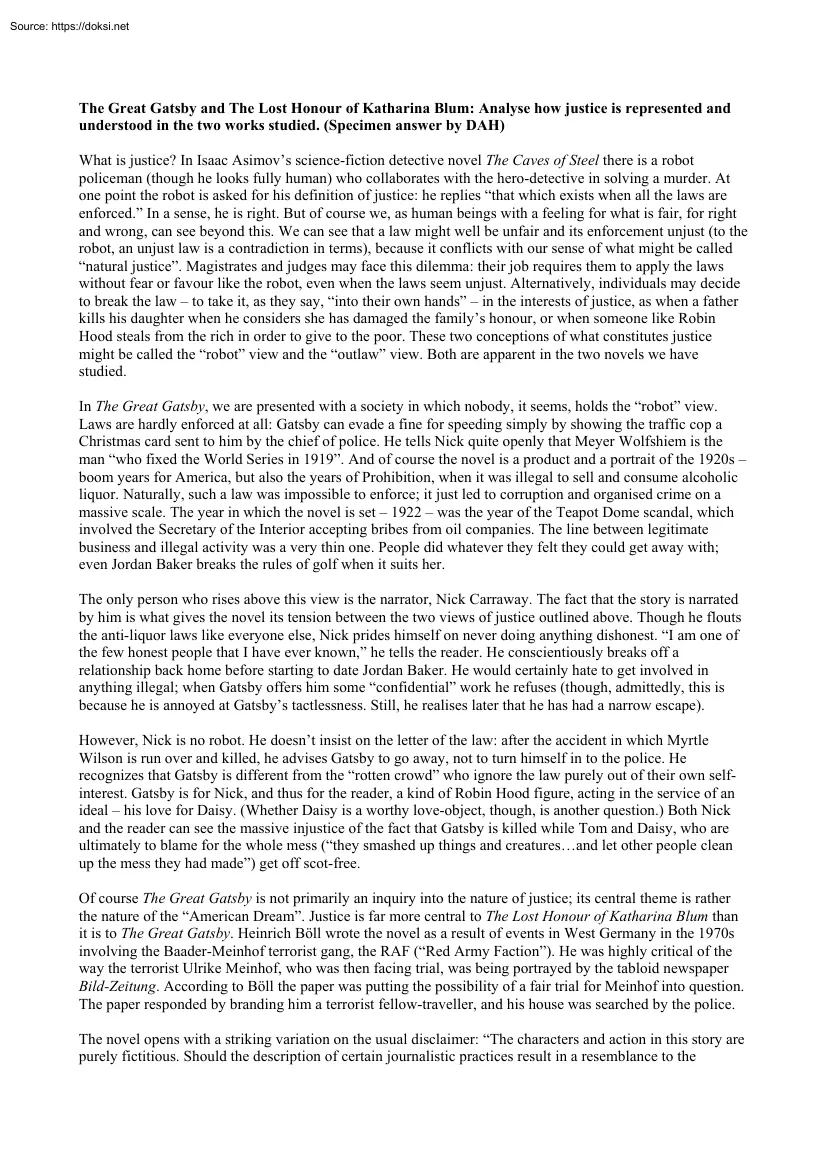
The Great Gatsby and The Lost Honour of Katharina Blum: Analyse how justice is represented and understood in the two works studied. (Specimen answer by DAH) What is justice? In Isaac Asimov’s science-fiction detective novel The Caves of Steel there is a robot policeman (though he looks fully human) who collaborates with the hero-detective in solving a murder. At one point the robot is asked for his definition of justice: he replies “that which exists when all the laws are enforced.” In a sense, he is right But of course we, as human beings with a feeling for what is fair, for right and wrong, can see beyond this. We can see that a law might well be unfair and its enforcement unjust (to the robot, an unjust law is a contradiction in terms), because it conflicts with our sense of what might be called “natural justice”. Magistrates and judges may face this dilemma: their job requires them to apply the laws without fear or favour like the robot, even when the laws seem unjust.
Alternatively, individuals may decide to break the law – to take it, as they say, “into their own hands” – in the interests of justice, as when a father kills his daughter when he considers she has damaged the family’s honour, or when someone like Robin Hood steals from the rich in order to give to the poor. These two conceptions of what constitutes justice might be called the “robot” view and the “outlaw” view. Both are apparent in the two novels we have studied. In The Great Gatsby, we are presented with a society in which nobody, it seems, holds the “robot” view. Laws are hardly enforced at all: Gatsby can evade a fine for speeding simply by showing the traffic cop a Christmas card sent to him by the chief of police. He tells Nick quite openly that Meyer Wolfshiem is the man “who fixed the World Series in 1919”. And of course the novel is a product and a portrait of the 1920s – boom years for America, but also the years of Prohibition, when it was illegal
to sell and consume alcoholic liquor. Naturally, such a law was impossible to enforce; it just led to corruption and organised crime on a massive scale. The year in which the novel is set – 1922 – was the year of the Teapot Dome scandal, which involved the Secretary of the Interior accepting bribes from oil companies. The line between legitimate business and illegal activity was a very thin one. People did whatever they felt they could get away with; even Jordan Baker breaks the rules of golf when it suits her. The only person who rises above this view is the narrator, Nick Carraway. The fact that the story is narrated by him is what gives the novel its tension between the two views of justice outlined above. Though he flouts the anti-liquor laws like everyone else, Nick prides himself on never doing anything dishonest. “I am one of the few honest people that I have ever known,” he tells the reader. He conscientiously breaks off a relationship back home before starting to date
Jordan Baker. He would certainly hate to get involved in anything illegal; when Gatsby offers him some “confidential” work he refuses (though, admittedly, this is because he is annoyed at Gatsby’s tactlessness. Still, he realises later that he has had a narrow escape) However, Nick is no robot. He doesn’t insist on the letter of the law: after the accident in which Myrtle Wilson is run over and killed, he advises Gatsby to go away, not to turn himself in to the police. He recognizes that Gatsby is different from the “rotten crowd” who ignore the law purely out of their own selfinterest. Gatsby is for Nick, and thus for the reader, a kind of Robin Hood figure, acting in the service of an ideal – his love for Daisy. (Whether Daisy is a worthy love-object, though, is another question) Both Nick and the reader can see the massive injustice of the fact that Gatsby is killed while Tom and Daisy, who are ultimately to blame for the whole mess (“they smashed up things and
creaturesand let other people clean up the mess they had made”) get off scot-free. Of course The Great Gatsby is not primarily an inquiry into the nature of justice; its central theme is rather the nature of the “American Dream”. Justice is far more central to The Lost Honour of Katharina Blum than it is to The Great Gatsby. Heinrich Böll wrote the novel as a result of events in West Germany in the 1970s involving the Baader-Meinhof terrorist gang, the RAF (“Red Army Faction”). He was highly critical of the way the terrorist Ulrike Meinhof, who was then facing trial, was being portrayed by the tabloid newspaper Bild-Zeitung. According to Böll the paper was putting the possibility of a fair trial for Meinhof into question The paper responded by branding him a terrorist fellow-traveller, and his house was searched by the police. The novel opens with a striking variation on the usual disclaimer: “The characters and action in this story are purely fictitious. Should the
description of certain journalistic practices result in a resemblance to the practices of the Bild-Zeitung, such resemblance is neither intentional nor fortuitous, but unavoidable.” When it appeared, his political opponents again accused him of being an apologist for terrorism, although of course the novel is no such apology – it is an attack on the questionable, corrupt and cruel practices of the right-wing tabloid press, and the way it works hand in glove with the police to destroy people’s reputations. The representatives of the law in the novel are shown as doing their job conscientiously, even Commissioner Beizmenne, who at first rubs Katharina up the wrong way with his coarse manners and speech (“did he fuck you?”) – though his casual way of getting permission to tap people’s telephones (“I need my little plugs again”) may be regarded as questionable. (At one point in the novel – chapter 41 – the anonymous narrator steps forward to protest, in
tongue-in-cheek fashion, against this practice of phone-tapping, pretending to be concerned about its psychological effects on the poor public servants who have to carry it out.) What is really criticised in the novel – but not by the narrator, who remains in the background and lets the facts speak for themselves – is the way the police fail to protect Katharina from character assassination (“Outlaw’s Sweetheart”, “Murderer’s Moll”) at the hands of the News, which insinuates that she is a terrorist sympathiser and even profits from bank robberies: “How did [she] come by an apartment worth an estimated 110,000 marks? Did she share in the loot from the bank hold-ups?” The News reporter Tötges twists what people tell him about Katharina (“intelligent, cool, level-headed”) to make it sound sinister (“ice-cold and calculating”). He disguises himself as a workman in order to get into the hospital room where Katharina’s mother is recovering from a cancer
operation, and, when she unexpectedly dies, describes her as “a victim of her own daughter”, claiming that she died of shock after being informed about Katharina’s alleged terrorist activities. (Such character assassination by the tabloid press is still continuing today: witness the “monstering” of Christopher Jefferies by the Sun and other newspapers in Britain in 2011. As the landlord of a murder victim he was questioned by the police in connection with her death, and later released; but the papers all but accused him outright of the murder, and branded him a sexual pervert as well. However, unlike with Katharina, the authorities did their job of protecting him: the papers were fined for contempt of court and were forced to pay him substantial sums as damages for libel. His story has recently been dramatized for television – under the title The Lost Honour of Christopher Jefferies. And it isn’t just the right-wing tabloid press that does this, as we can see from the
vilification, in the New York Times and other “liberal” media, of the three young men at the centre of the notorious Duke University “rape” case.) After all this, the reader is inclined to sympathise with Katharina when (like George Wilson in Gatsby and – potentially – Blorna with his Molotov cocktail) she takes the law into her own hands, arranging a private interview with Tötges in her flat and shooting him; especially given that he starts by crudely propositioning her: “how about a bang?”. Tötges’ death, we feel, is richly deserved – it satisfies our sense of “natural justice”. However, as Kurt Andersen points out in his introduction to the Penguin edition of the novel, when RAF members assassinated the highest-ranking judge in West Berlin a few months after the book came out, Böll condemned the killing. In response, the imprisoned RAF leaders, including Baader and Meinhof, issued a statement calling his liberal bluff: “What else did Böll mean in his
Katharina Blum, if not that the shooting of a representative of the ruling power apparatus is morally justifiable?” At last, the right and the far left were in agreement: in his fiction, they both insisted, he had effectively legitimized and even glorified politically correct murder. This may be doubted: but certainly Böll is playing a dangerous game here. Katharina kills Tötges because she thinks it is the right thing to do, and we may agree with her, for whatever reason. She has stolen the gun, however, from Konrad Beiters, her friend Else’s lover, so the murder is obviously premeditated. The law against premeditated murder exists to prevent people from killing other people just because they think it is “right”. Tötges may or may not get what he deserves for ruining Katharina’s life: but what is certain is that Katharina must get what she deserves for killing him. “Natural justice” (ask a magistrate or judge) ultimately has to take second place to strict enforcement
of the law: it is the robot who is right about justice, rather than the outlaw
Alternatively, individuals may decide to break the law – to take it, as they say, “into their own hands” – in the interests of justice, as when a father kills his daughter when he considers she has damaged the family’s honour, or when someone like Robin Hood steals from the rich in order to give to the poor. These two conceptions of what constitutes justice might be called the “robot” view and the “outlaw” view. Both are apparent in the two novels we have studied. In The Great Gatsby, we are presented with a society in which nobody, it seems, holds the “robot” view. Laws are hardly enforced at all: Gatsby can evade a fine for speeding simply by showing the traffic cop a Christmas card sent to him by the chief of police. He tells Nick quite openly that Meyer Wolfshiem is the man “who fixed the World Series in 1919”. And of course the novel is a product and a portrait of the 1920s – boom years for America, but also the years of Prohibition, when it was illegal
to sell and consume alcoholic liquor. Naturally, such a law was impossible to enforce; it just led to corruption and organised crime on a massive scale. The year in which the novel is set – 1922 – was the year of the Teapot Dome scandal, which involved the Secretary of the Interior accepting bribes from oil companies. The line between legitimate business and illegal activity was a very thin one. People did whatever they felt they could get away with; even Jordan Baker breaks the rules of golf when it suits her. The only person who rises above this view is the narrator, Nick Carraway. The fact that the story is narrated by him is what gives the novel its tension between the two views of justice outlined above. Though he flouts the anti-liquor laws like everyone else, Nick prides himself on never doing anything dishonest. “I am one of the few honest people that I have ever known,” he tells the reader. He conscientiously breaks off a relationship back home before starting to date
Jordan Baker. He would certainly hate to get involved in anything illegal; when Gatsby offers him some “confidential” work he refuses (though, admittedly, this is because he is annoyed at Gatsby’s tactlessness. Still, he realises later that he has had a narrow escape) However, Nick is no robot. He doesn’t insist on the letter of the law: after the accident in which Myrtle Wilson is run over and killed, he advises Gatsby to go away, not to turn himself in to the police. He recognizes that Gatsby is different from the “rotten crowd” who ignore the law purely out of their own selfinterest. Gatsby is for Nick, and thus for the reader, a kind of Robin Hood figure, acting in the service of an ideal – his love for Daisy. (Whether Daisy is a worthy love-object, though, is another question) Both Nick and the reader can see the massive injustice of the fact that Gatsby is killed while Tom and Daisy, who are ultimately to blame for the whole mess (“they smashed up things and
creaturesand let other people clean up the mess they had made”) get off scot-free. Of course The Great Gatsby is not primarily an inquiry into the nature of justice; its central theme is rather the nature of the “American Dream”. Justice is far more central to The Lost Honour of Katharina Blum than it is to The Great Gatsby. Heinrich Böll wrote the novel as a result of events in West Germany in the 1970s involving the Baader-Meinhof terrorist gang, the RAF (“Red Army Faction”). He was highly critical of the way the terrorist Ulrike Meinhof, who was then facing trial, was being portrayed by the tabloid newspaper Bild-Zeitung. According to Böll the paper was putting the possibility of a fair trial for Meinhof into question The paper responded by branding him a terrorist fellow-traveller, and his house was searched by the police. The novel opens with a striking variation on the usual disclaimer: “The characters and action in this story are purely fictitious. Should the
description of certain journalistic practices result in a resemblance to the practices of the Bild-Zeitung, such resemblance is neither intentional nor fortuitous, but unavoidable.” When it appeared, his political opponents again accused him of being an apologist for terrorism, although of course the novel is no such apology – it is an attack on the questionable, corrupt and cruel practices of the right-wing tabloid press, and the way it works hand in glove with the police to destroy people’s reputations. The representatives of the law in the novel are shown as doing their job conscientiously, even Commissioner Beizmenne, who at first rubs Katharina up the wrong way with his coarse manners and speech (“did he fuck you?”) – though his casual way of getting permission to tap people’s telephones (“I need my little plugs again”) may be regarded as questionable. (At one point in the novel – chapter 41 – the anonymous narrator steps forward to protest, in
tongue-in-cheek fashion, against this practice of phone-tapping, pretending to be concerned about its psychological effects on the poor public servants who have to carry it out.) What is really criticised in the novel – but not by the narrator, who remains in the background and lets the facts speak for themselves – is the way the police fail to protect Katharina from character assassination (“Outlaw’s Sweetheart”, “Murderer’s Moll”) at the hands of the News, which insinuates that she is a terrorist sympathiser and even profits from bank robberies: “How did [she] come by an apartment worth an estimated 110,000 marks? Did she share in the loot from the bank hold-ups?” The News reporter Tötges twists what people tell him about Katharina (“intelligent, cool, level-headed”) to make it sound sinister (“ice-cold and calculating”). He disguises himself as a workman in order to get into the hospital room where Katharina’s mother is recovering from a cancer
operation, and, when she unexpectedly dies, describes her as “a victim of her own daughter”, claiming that she died of shock after being informed about Katharina’s alleged terrorist activities. (Such character assassination by the tabloid press is still continuing today: witness the “monstering” of Christopher Jefferies by the Sun and other newspapers in Britain in 2011. As the landlord of a murder victim he was questioned by the police in connection with her death, and later released; but the papers all but accused him outright of the murder, and branded him a sexual pervert as well. However, unlike with Katharina, the authorities did their job of protecting him: the papers were fined for contempt of court and were forced to pay him substantial sums as damages for libel. His story has recently been dramatized for television – under the title The Lost Honour of Christopher Jefferies. And it isn’t just the right-wing tabloid press that does this, as we can see from the
vilification, in the New York Times and other “liberal” media, of the three young men at the centre of the notorious Duke University “rape” case.) After all this, the reader is inclined to sympathise with Katharina when (like George Wilson in Gatsby and – potentially – Blorna with his Molotov cocktail) she takes the law into her own hands, arranging a private interview with Tötges in her flat and shooting him; especially given that he starts by crudely propositioning her: “how about a bang?”. Tötges’ death, we feel, is richly deserved – it satisfies our sense of “natural justice”. However, as Kurt Andersen points out in his introduction to the Penguin edition of the novel, when RAF members assassinated the highest-ranking judge in West Berlin a few months after the book came out, Böll condemned the killing. In response, the imprisoned RAF leaders, including Baader and Meinhof, issued a statement calling his liberal bluff: “What else did Böll mean in his
Katharina Blum, if not that the shooting of a representative of the ruling power apparatus is morally justifiable?” At last, the right and the far left were in agreement: in his fiction, they both insisted, he had effectively legitimized and even glorified politically correct murder. This may be doubted: but certainly Böll is playing a dangerous game here. Katharina kills Tötges because she thinks it is the right thing to do, and we may agree with her, for whatever reason. She has stolen the gun, however, from Konrad Beiters, her friend Else’s lover, so the murder is obviously premeditated. The law against premeditated murder exists to prevent people from killing other people just because they think it is “right”. Tötges may or may not get what he deserves for ruining Katharina’s life: but what is certain is that Katharina must get what she deserves for killing him. “Natural justice” (ask a magistrate or judge) ultimately has to take second place to strict enforcement
of the law: it is the robot who is right about justice, rather than the outlaw