Comments
 2024 · 19 page(s) (1 MB)
 English
 2
2
 January 28 · 2026
 Log in

 Embed
Embed
No comments yet. You can be the first!
What did others read after this?


Content extract
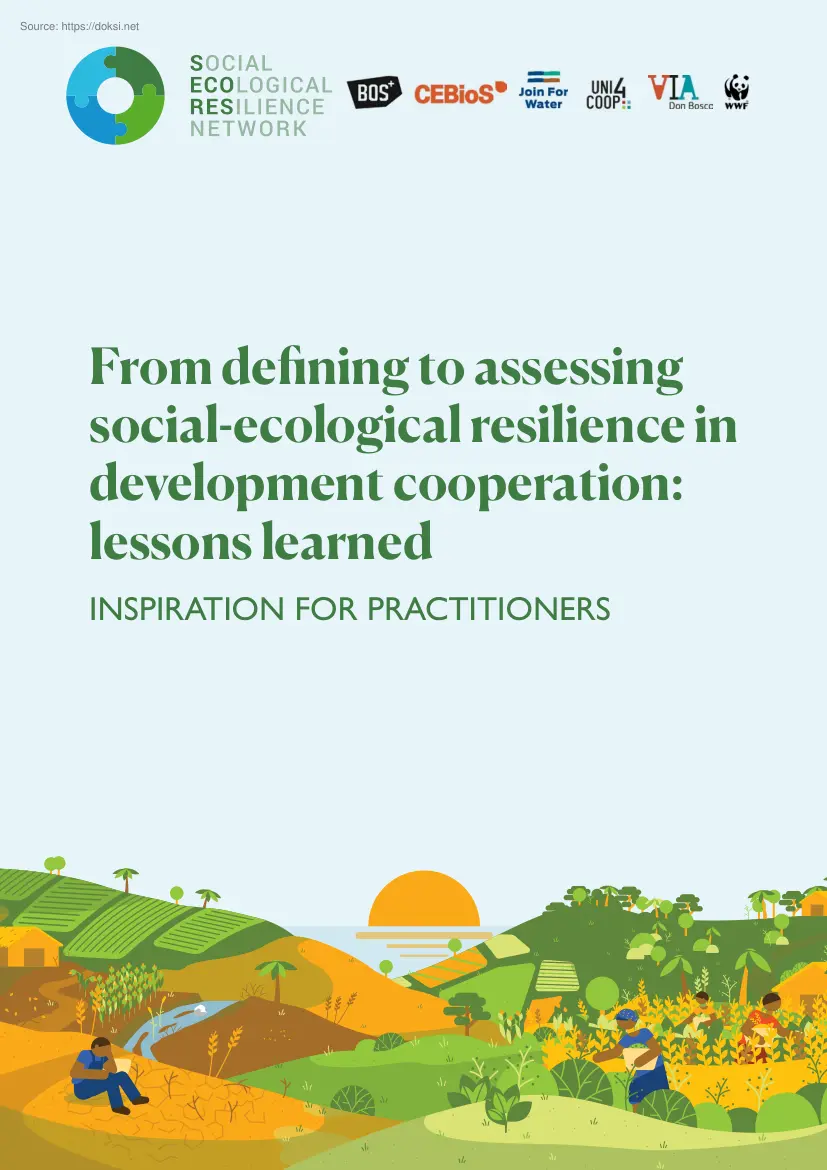
From defining to assessing social-ecological resilience in development cooperation: lessons learned INSPIRATION FOR PRACTITIONERS Content Introduction.5 Lesson 1 Defining the added value of socialecological resilience. 6 Introducing social-ecological resilience. 6 Towards a dynamic definition. 6 Added value of social-ecological resilience . 7 Lesson 2 From measuring to assessing socialecological resilience.8 Theory. 9 Application. 9 Summary.13 Citation: SECORES. 2024 From defining to assessing social-ecological resilience in development cooperation: Lessons learned - Inspiration for practitioners (36 pages). Lesson 3 Social-ecological resilience in programme monitoring. 14 Authors: Working Group on “the Assessment of Social-ecological resilience”, as part of SECORES, the Belgian Network on Social-Ecological Resilience. Driving stakeholder conversation on resilience.14 Community-based monitoring of social-ecological resilience.16 Document contributors: Vincent Hénin
(Louvain Coopération), Amélie Janssens (Via Don Bosco), Luc Janssens de Bisthoven (CEBioS), Anne-Julie Rochette (CEBioS), Bram Sercu (Bos+), Constant Setonde Gnansounou (UNamur), Johan Slimbrouck (Join For Water), Lieve Van Elsen (Bos+),Wannes Verbeeck (WWF), Kim Vercruysse (Join For Water). Other contributors to the work summarized in the document: Thierry De Coster (ULB coopération), Tania d’Haijère (CEBioS), Jean Hugé (Open Universiteit), Ilya Lander Pijpen (Vrije Universiteit Brussel), Longin Ndayikeza (Office Burundais pour la Protection de l’Environnement), Jacques Nkengurutse (Université du Burundi), Olivier Nkurikiye (Université du Burundi),Yannick Meyers (UGent). Cover picture: Farming landscapes in Burundi Ilya Lander Pijpen Lesson 4 Finding a common language on social-ecological resilience. 19 Appropriation of the concept.19 Common understanding of social-ecological resilience in different sectors.21 5. Conclusion 22 6. References 23 Annex Resilience assessment
tools. 24 References.24 1. Wayfinder 25 2. Assessing Resilience in Social-Ecological Systems: Workbook for Practitioners.27 3. Toolkit for the Indicators of Resilience in Social-Ecological Production Landscapes and Seascapes (SEPLS indicators).29 4. Resilience, Adaptation Pathways and Transformation Approach (RAPTA).31 5. Strategic Resilience Assessment (STRESS).33 Introduction Sustainable development has been the main paradigm driving international cooperation and development projects for the past decades. It has helped greatly in recognizing that long-term and inclusive positive change can only occur by adopting an integrated and multi-sectoral approach.Yet, the general development paradigm often falls short in addressing global risks associated with the carrying capacity of our planet and their social and ecological impacts. In addition, we need a framework that takes disruptive events into account and actively enhances the resilience of the planet and its inhabitants.
Social-ecological resilience (SER) offers this highly needed holistic paradigm, taking into account system responses to disruptive events together with the planetary boundaries and social foundations, to enrich the existing development paradigm. SER is the capacity to adapt or transform in the face of change in social-ecological systems (linked systems of people and nature), particularly unexpected change (which may be fast or slow), in ways that continue to support human wellbeing [1]. Therefore, putting SER at the centre of international cooperation projects will allow for a more holistic understanding of the context, which in turn will enable more effective results contributing to human well-being in harmony with nature. However, while SER offers a theoretical framework to guide international cooperation projects in a context of climatic and social changes and increased occurrence of extreme events, it remains challenging to disseminate and popularise the concept and to translate
it in practical tools and approaches. It is this knowledge gap that SECORES, a Belgian network on Social-Ecological Resilience, aims to address. The network is driven by 6 core member organisations including BOS+, CEBioS, Join For Water, Uni4Coop, VIA Don Bosco and WWF Belgium. From 2022 onwards, these organisations have engaged in reviewing, testing and disseminating tools and insights around understanding and assessing socialecological resilience in international cooperation. This publication aims to share these insights and inspire practitioners and other actors in international cooperation to learn with us about the added value of using a SER framework to develop, implement and evaluate development projects. We present four lessons: 1. Defining the added value of SER 2. From measuring to assessing SER 3. Incorporating SER in programme monitoring 4. Finding a common language on SER Lesson 1 Defining the added value of socialecological resilience INTRODUCING SOCIAL-ECOLOGICAL
RESILIENCE Since 2022 SECORES member organisations engage in incorporating social-ecological resilience (SER) in their respective programmes and projects and to promote the integration of both human wellbeing and environmental sustainability into Belgian cooperatio n. As part of this ambition, different types of events were organised between 2022 and 2024 that aimed at introducing the concept of SER to other development organisations and project stakeholders. In total, seven workshops in Africa, Asia and South-America, and 2 workshops in Belgium were organised. Through organising these workshops and communicating about SER and our work, we learned that it is important to formulate an unambiguous definition of SER and its added value in the context of international cooperation. TOWARDS A DYNAMIC DEFINITION Resilience is a word that can be applied in almost any context. The most basic definition of resilience is “The ability to cope with change and continue to develop” [2].
Applied to social-ecological systems, resilience is the capacity to adapt or transform in the face of change in the linked systems of people and nature, particularly unexpected change, in ways that continue to support human well-being [1]. The doughnut of social and planetary boundaries illustrates this socially just and environmentally safe space lying between the planetary boundaries and the social boundaries [3; 4]. 6 The difference between using SER as an approach to design and implement a development project as compared to using a traditional social-ecological analysis is the focus on system changes over time. With SER, a systemic view is considered with interacting social and environmental dimensions that evolve over time and space, instead of considering static elements of the system. We learned that SER offers an excellent theoretical framework to systematically consider adaptations or transformations of a system which are needed to continue to support environmental stability
and human well-being in the future. ADDED VALUE OF SOCIALECOLOGICAL RESILIENCE Figure 1. The doughnut of social and planetary boundaries (Raworth, 2017) For us, the added value of SER is asking questions for every project that intervenes in a social-ecological system, reflecting about what the components of a system are and how possible solutions interact with these components. In that perspective, SER can enrich or complement classical project cycle management methods, by explicitly taking into account the social-ecological system. In practice, we learned that it is essential to start from the following five questions to integrate the resilience of social and ecological components in project management: · What is the system you are intervening in? (i.e classical context analysis) · What are the components of the system that will be strengthened? (i.e problem assessment) · Who will benefit from the actions? (i.e stakeholder analysis) · What are disturbances in your system
that you need to build resilience against? (i.e consider changes in the system rather than static problems) · How will resilience be strengthened? (i.e solution tree for disturbances) It is through the latter question that approaches such as e.g, agroecology can be developed as part of a wider project logic or strategy that aims at systemic adaptations or transformations. For further reading on our definition of SER and how we believe it can offer an added value in international cooperation, click here. 7 Lesson 2 From measuring to assessing socialecological resilience THEORY Through a preliminary literature review, five existing tools or approaches to assess SER were selected as relevant and useful to apply in the field of development cooperation. Below we provide an overview of the five tools, and their main strengths and weaknesses, according to us. Their full references and more detailed information about the general objective, approach, and requirements for each tool can
be found in Annex. As observed in lesson 1, ‘classical’ environmental analyses do not systematically consider adaptations or transformations of a system which are needed to continue to support environmental stability and human well-being in the future.We also learned that many approaches already exist that help strengthen SER such as agroecology and certain climate change adaptation measures.And we can place these solutions into a stepwise project logic that has strengthening SER at its core. But how are we measuring actual improvement in SER? How do we equally consider the ecological and social parts of a system? Can we even measure SER? And on what temporal and spatial scales is it useful? These were the questions we had when starting our projects and programmes across the different organisations. For example, we learned that resilience is a priority for many organizations, particularly those focusing on agriculture. However, they often do not measure or assess it directly.To
find out more about how others did this and what elements we could take with us in our projects, we set out to do two things. First, we engaged in a literature review to identify and assess existing tools that focus on evaluating social-ecological resilience. Second, we went to the field and tested different approaches. In what follows, our main findings are briefly discussed. Figure 2. Five tools or approaches to assess SER, with their main strengths (green) and weaknesses (red) APPLICATION The literature review highlighted that frameworks and approaches to assess social-ecological resilience indeed exist and can be applied in different contexts. However, all five selected approaches require extensive data collection and analysis, and/or stakeholder dialogue. We felt the need to test in practice how feasible it is to apply such a tool, and what type of useful information it can provide. Therefore, we joined forces with the Vrije Universiteit Brussel (VUB) in Belgium, the University
of Burundi and the ‘Office Burundais pour la Protection de l’Environnement (OBPE) to set-up a short-term research project in which the SEPLS tool was applied in communities in Burundi in a running development project. In addition, SECORES member UNI4COOP, in collaboration with University of Namur, also supported a PhD study on assessing social-ecological resilience in mangrove ecosystems in Benin. Below we highlight some findings of both studies. 8 9 Case study in Burundi – assessing SER in farming communities A tandem of Belgian and Burundian master students were supported by SECORES to test the Toolkit for the Indicators of Resilience in Social-Ecological Production Landscapes and Seascapes (SEPLS) in the field. The objective was to understand social-ecological resilience in three farming communities in Burundi, a country facing growing demographic and climate pressures. SEPLS is an indicator-based assessment tool designed for development projects in production
landscapes. The study adapted these indicators for community-based scoring resilience assessment workshops and a questionnaire in three regions. The indicators are grouped into five categories: 1. Landscape diversity and ecosystem protection 2. Biodiversity (incl agricultural biodiversity) 3. Knowledge and innovation 4. Governance and social equity 5. Livelihoods and well-being The results of the workshop highlighted the lack of income diversity, limited adaptation strategies, and high prevalence of climatic and agricultural disturbances among rural households. Most indicators received low scores in the workshops, except for the ‘Diversity of local food system’ indicator. The study found significant variations between the different regions. From a systems perspective, the study suggests that there are especially gaps in the current policy and governance frameworks to enable farmers and communities to strengthen their resilience through income diversification. We found that the
SEPLS tool’s indicators provided a suitable framework for a preliminary assessment of a social-ecological system and what components need the most attention towards strengthening the resilience of the system, based on the perceptions of the target group involved. Therefore, a key strength of this participatory assessment is the involvement of community members and relevant stakeholders, which provides crucial local ecological and social knowledge, a vital aspect of social-ecological resilience. It is also a rapid assessment method (1.5 days) in regions with limited data and financial constraints. The indicators are flexible and have been refined over more than a decade of developmental work. Figure 3. Conducting a SEPLS assessment workshop with the community in Burundi ( Ilya Lander Pijpen) A key feature of the SEPLS tool is an assessment workshop, where perceptions are captured for 20 indicators using a Likert scale (1-5). These indicators cover ecological, agricultural, cultural,
and socioeconomic aspects and indirectly integrate the 5 questions presented in lesson 1 in this document.The indicators are adapted to be perceptionbased, engaging citizens and using simple language to facilitate discussion 10 However, we have experienced some difficulties as well. First, adapting some indicators to Burundi’s specific context was challenging. For example, Indicator 12 (Rights related to land/water and other resource management) was complicated by the mix of statutory and customary laws and war-related land disputes. Similarly, Indicator 15 (Social equity) was difficult to address due to sensitivities stemming from the country’s history of ethnic conflicts. These complexities highlight the need for careful adaptation of the tool in complex sociological contexts. Second, organising such large stakeholder workshops also come with financial and logistical constraints, as it requires additional permissions, a conference venue in a nearby city, and costs for
transporting and accommodating rural participants. These challenges are be taken into account for NGOs to use the tool as designed. For example, we opted for several focus groups to address some of these challenges. Finally, we realised that the scores on the indicators given 11 during the workshops should not be considered as quantitative data but as a summary of the discussions, with key themes addressed. The essence of these assessments lies in the discussion rounds, whereby the dimensions and understanding of the social-ecological system are discussed and explored with different stakeholders. Case study in Benin – assessing SER in mangrove communities institutions, particularly legal instruments which protect coastal ecosystems, exist, their contribution to enhancing the social-ecological resilience of mangroves has been limitedly explored.We operationalized the concept of SER in Benin by investigating the extent to which the synergies between legal instruments and local
deities existing in coastal countries can contribute to enhancing the resilience of mangroves, based on the seven principles.This in-depth study shows that although decrees, orders and law enforcement agencies exist to ensure the application of these provisions, challenges related to inadequate sensitization, insufficient resources, weak collaboration among institutions and land-related issues compromise their enforcement locally. Also, the introduction of local deities in coastal areas, particularly for mangroves conservation facilitates the respect of some key provisions, notably the ban on mangrove wood cutting. More information on this study can be found in Gnansounou et al., 2024 [7] SUMMARY Figure 4. Human interference and law violation erode mangrove resilience in Benin Source: Drone images taken in Houakpè-Daho, Benin in August 2023 ( Constant Setonde Gnansounou) The PhD study in Benin focuses on assessing SER in mangrove communities. In a first phase, a literature review
was conducted and helped to identify a few approaches that help assess dimensions of resilience. However, most existing tools focusing on mangroves specifically focus on biophysical and ecological characteristics of mangroves and failed to address the social components of these social-ecological systems. Therefore, the study focused on building a SER framework for mangroves that starts from the policy dimension of the system. The framework proposed by Biggs et al. [5] and revised by Sterk et al [6] was used. The authors identify seven generic policy-relevant principles which are crucial to enhance the social-ecological resilience of socialecological systems. They include: (1) maintain diversity and redundancy, (2) manage connectivity, (3) manage slow variables and feedback, (4) foster the understanding of social-ecological systems as complex and adaptive systems, (5) encourage learning and experimentation, (6) broaden participation and (7) promote polycentric governance. The first
three criteria represent the key properties of a social-ecological system and the last four are its governance attributes. In Benin, legal instruments and traditional rules rooted in local deities coexist in the governance of natural resources. Although formal 12 Different relevant guiding tools and approaches are available to explore, assess and gain a deeper understanding of one or more dimensions of social-ecological resilience (SER) within a given system. None of them is intended to provide a precise quantitative measure of SER, which we believe is neither desirable nor feasible. For instance, the SEPLs tool does not aim to strictly quantitatively measure SER, but rather to summarize and discuss key features contributing to the resilience of a social-ecological system. This approach encourages communities to reflect on the crucial elements of SER, adding a strong communication and awareness-raising component. Some of these tools offer a directive approach with well-defined steps,
questions and methodologies to be followed (e.g SEPLS or Wayfinder), while others are more descriptive frameworks (e.g 7 principles used in the study in Benin or the Workbook for Practitioners). The first group of tools have the advantage of fostering a common language among stakeholders on resilience by guiding the users through a stepby-step process towards a tangible output, such as scores. We have also experienced application of such tools requires time and resources. Alternatively, the more descriptive frameworks require less strict investments in approaches and methodologies, but do require more reflection and research to adapt the framework to specific contexts. In conclusion, we have learned that there does not exist a one-sizefits-all solution to assess SER in a given context. Instead, it is important to select an approach that aligns with the possibilities and needs of a project. We hope that by sharing our experiences and literature review (Annex), we can help other actors
to select and apply these tools further to provide more case studies and insights. 13 Lesson 3 Social-ecological resilience in programme monitoring As mentioned in the beginning, as SECORES we engage in learning about and advocating for the integration of SER into development projects and programmes.This also implies that we needed to look for ways to monitor how social-ecological resilience improves over time. From lesson 2 we know that it may be challenging and time-consuming to assess SER in quantitative terms, but that there is great value in assessing different components of SER as part of a project cycle. Table 1. Example of a SER monitoring framework co-created with stakeholders System pressures System impacts Expect to see Want to see Dreaming to see Encroachment of riparian areas and wetlands Soils drying out, loss of biodiversity, risk of ecosystem collapse (less buffer against climatic changes) Sensitization and demarcation of valuable zones Restoration of
degraded wetlands and rivers Explore and test sustainable compensation mechanisms for ecosystem conservation Formation of community byelaws and advocate for sustainable policies Ecosystems are sustainably protected, and people have access to their ecosystem services Continuous resource monitoring of state of ecosystems Enforcement of policies This is also what two members of SECORES set out to do by including an indicator in their programmes focussing on ‘Progress on strengthening socio-ecological resilience. Yet, while the indicator is the same, different approaches are possible to monitor it. Join For Water adopted a stakeholder-driven approach based on a general framework, while BOS+ in South America is piloting a community-based monitoring approach. DRIVING STAKEHOLDER CONVERSATION ON RESILIENCE Join For Water adopted a stakeholder-driven approach to monitoring progress in SER as part of their programmes. A general framework was developed based on outcome mapping and
identifying progress markers for resilience in each programme. A 3-step methodology was followed: (1) identify the system and geographical scope for which SER is monitored, (2) identify water-related pressures, impacts and potential responses within that system, and (3) outcome mapping with progress markers based on the potential responses given by stakeholders.The result is a table with disturbances within the system together with potential outcomes on how it would look like if SER improved over time (classified as ‘expect to see’, ‘want to see’, and ‘dreaming to see’). 14 Figure 5. Mpan’Game used in Uganda at the stakeholder workshop on resilience to illustrate up- and downstream linkages within the system. It also illustrates the importance of bringing together stakeholders to reflect and discuss on system components. Figure 6. Stakeholder-driven identification of elements of the system that require the most urgent action to improve social-ecological resilience in
the Mayo-Chinchipe basin in Ecuador-Peru. 15 This approach was applied in 5 country programmes of Join For Water. The exercise led to a useful synthesis of the system components that require the most attention towards strengthening social-ecological resilience. Yet, the main lesson from this exercise is that trying to monitor progress in SER requires many different ‘sub-indicators’ or system components (for example, the information in the table above expands the further you move to the right), which require intensive data-collection and which are not always within the scope of a single project.This also requires a dedicated budget and time However, even without intensive monitoring of all progress markers, the indicator helps to introduce resilience-thinking with stakeholders and sparked interesting discussions and reflections on the concept. Throughout a programme, stories and insights can be collected on the identified system components which helps to better understand the
system interactions. In short, the resilience-specific indicator as part of a monitoring system help to feed the conversation between project stakeholders, which is also an important lesson (see lesson 4). COMMUNITY-BASED MONITORING OF SOCIALECOLOGICAL RESILIENCE BOS+ is currently implementing a community-based monitoring approach to assess the social-ecological resilience (SER) of communities in close relationship with conservation areas, alongside the local partners in Ecuador, Peru and Bolivia. The methodological approach of the process starts with the selection of a focus group in each country to design the participatory methodology and develop a strategy to monitor SER. It starts with the community’s own definition of the word “Resilience” and, based on the concept defined by them, develop indicators that reflect an improvement on the aspects that they consider relevant to build social and ecological resilience. To facilitate the formulation of indicators, we divided the
SER concept into three parts: the impact on social, economic and ecological capacities. The methodology comprises five key steps that are community-led and facilitated by BOS+: 1) community definition of resilience, 2) identification of the social, ecological and economic capacities that are expected to improve over time, 3) development of indicators to measure the defined capacities, 4) design of a monitoring plan and tools for data collection, 5) data collection and reflection on the findings. 16 Creation of a focus group inside the community Community-based defintion of social and ecological resilience How to measure resilience: Defining capacities and indicators Design of a monitoring strategy for SER Communication and Use of the Results Reflecting on the results: Data analysis from the focus group Data collection led by focus group Selection and development tools for data collection Figure 7. Overview of the community-led monitoring approach for SER This methodology is
designed to empower the members of the community to actively reflect on the projects they are part of and to recognize their key role in their success. It also decolonizes M&E and promotes community appropriation of project stages that are often exclusively carried out by the external organizations. The focus group reflects on the capacities that should improve and from them, they derive several indicators to measure the changes in these capacities. The indicators are presented and discussed by the focus group who selects those that contribute best to building resilience during the projects. The selected indicators go through a process of refinement and then the groups design a monitoring plan for each one of them. The first step of implementation of the measurement is defining the baseline for each indicator. Each indicator will be followed up in a certain timeframe by one or more responsible persons who are in charge of that indicator. Each year a meeting will be held to bring
together all the information and to seek lessons learned from the results and methodology. During the implementation of this approach the participation of the community focus groups is key. Given the fact that this process is set to be entirely led by them, it reflects their understanding of resilience and measures the elements that they consider relevant. It has derived in a positive response from the community and a remarkable enthusiasm to discover if the environmental actions they have been implementing have effectively improved their quality of life and the environment. 17 Table 2. Example of the definition of a socio-ecological resilience indicator and the monitoring plan Indicator: Number of diversified plots that include fruits, coffee, medicinal plants, tara,. What will we measure? Number of productive systems Fruit trees and medicinal trees How will we measure it? Registration of plants in the productive plots and georeferencing plots When will we measure it? Every
6 months Where will we measure it? In 20% of the productive plots installed by the project Who will measure it? The property owner. Led by members of the focus group Figure 8. Community defines the concept of resilience Figure 9. Self-steering defining indicators of SER and discussing a monitoring plan for them 18 Lesson 4 Finding a common language on socialecological resilience As mentioned in the introduction, different concepts such as sustainable development are widely used, often adapted to a specific sector. Each sector has made proposals to align itself with the objectives of sustainable development. So, what is the link between these much-used concepts and resilience? We believe that far from being antagonistic, they are complementary. It is important to identify the similarities and to improve understanding of the concept of resilience.To this end, we have come across two lessons: (1) organising open discussions about SER helps participants to appropriate the concept
themselves for a specific context, and (2) it is difficult to develop a common understanding SER that spans different sectors in international cooperation, but the importance is that we find ways to integrate these different views. APPROPRIATION OF THE CONCEPT In workshops in different countries organised by SECORES members, we discussed the SER concept based on concrete examples, through the collective mapping of a given social-ecological system. The five questions of lesson 1 were used to map and describe the socioecological system, its key elements (communities, key players, natural areas, infrastructures), the stresses and shocks affecting the socio-ecological system, and elements contributing to increasing or decreasing resilience (natural, human and institutional factors). These structured conversations enabled the appropriation of the concept, making it more concrete to participants. Participants highlighted that discussing a given system with the SER lens helped considering
more the social aspects, identifying possible synergies and opportunities to action across different organisations. The strong link with empowerment was also appreciated. 19 COMMON UNDERSTANDING OF SOCIAL-ECOLOGICAL RESILIENCE IN DIFFERENT SECTORS During the seminars and workshops, we also learned that many people and organisations already work on strengthening SER without necessarily using the same vocabulary. It is important to recognize the importance of these views and actions to come to a common understanding of SER. Figure 10. Working group to define SER elements in a rural village in the Atacora department (Benin) A.-J Rochette Figure 11. Working group to define SER elements in a rural village in the Atacora department (Benin) A.-J Rochette 20 For example, in the context of agricultural social-ecological systems discussions highlighted the dependence on agricultural inputs and seeds (“semences et intrants agricoles”) that limits the capacity of farmers to adapt to
changing environments. The workshops also raised concerns about the disappearing wetlands under agricultural pressure making the system more vulnerable to floods and droughts. To address these challenges, many organisations promote agroecological practices that enhance soil health, biodiversity, crop diversification as mechanisms to create a win-win for people and nature. These actions fit directly into the resilience paradigm without using the concept directly. Similarly, integrated water management practices were frequently mentioned as critical for maintaining ecosystem services and ensuring sustainable agriculture and human wellbeing, which directly impacts resilience. In addition, depending on the sector and development organisation works in, the relative importance of specific system components logically varies. We observed that for policy and governanceoriented organisations, SER is all about land rights and access, which were often mentioned as vital for resilience building as
it directly influences resource management and community involvement. For health organisations, improving health services and linking them with environmental empowerment can increase community resilience by ensuring a healthy population capable of adapting to changes. And finally for educational organisations, education is considered as an important lever for strengthening resilience via raising awareness and providing training to build knowledge and capacity. However, despite the recognized importance of education in building resilience, discussions in the field with the education sector have shown that the very concept of resilience has not been popularised within this sector and is still little understood. 21 In short, the experiences from our workshops show that SER is a broad concept relevant to various fields, including policy, health and education. What it also emphasizes is that if we want to integrate a SER narrative in international cooperation, it will require combining
social and environmental components of development projects as much as possible. 5. Conclusion Defining social-ecological resilience in theory is easy, but defining its added value in international cooperation requires asking questions about what the components of a system are and how possible solutions interact with these components. In particular, we learned that if we want to strengthen SER as part of any project, it is essential to understand your system, its components, the target audience, the disturbances of your system, and possible responses. 22 6. References [1] Folke, C., Biggs, R, Norström, AV, Reyers, B & Rockström, J 2016 Social-ecological resilience and biosphere-based sustainability science. Ecology and Society 21(3). http://wwwjstororg/stable/26269981 [2] Stockholm Resilience Center. 2024 Resilience dictionary https://www.stockholmresilienceorg/research/resilience-dictionary html [3] Rockström, J., Steffen, W, Noone, K, Persson, Å et al 2009 Planetary
boundaries: exploring the safe operating space for humanity. Ecology and Society 14(2), 32. [4] Raworth, K. (2017) Doughnut Economics: Seven ways to think like a 21st century economist. London: Penguin Random House Measuring social-ecological resilience can be useful in specific studies and projects, but in the context of international cooperation programmes it may be more useful to focus on assessing the different components of resilience based on existing tools or approaches. [5] Biggs, R., Schlüter, M, Biggs, D, Bohensky, E L, BurnSilver, S, Cundill, G., Dakos, V, Daw, M T, Evans, S L, Kotschy, K, Leitch, M A, Chanda, M., Quinlan, A, Raudsepp-Hearne, C, Robards, M D, Schoon, M L, Schultz, L. & West, C P 2012 Toward principles for enhancing the resilience of ecosystem services. Annual Review of Environment and Resources 37, 421-448. h t t p s : / / w w w. a n n u a l r e v i e w s o r g / d o i / a b s / 1 0 1 1 4 6 / annurev-environ-051211-123836 Monitoring progress on
social-ecological resilience can be a goal in itself or a way to ignite a systemic conversation with stakeholders and collaborative development of a shared vision of a system and how different interventions link to resilience. [6] Sterk, M., van de Leemput, I A & Peeters, E T (2017) How to conceptualize and operationalize resilience in socio-ecological systems? Current Opinion in Environmental Sustainability 28, 108-113. https://doi.org/101016/jcosust201709003 Finding a common language on social-ecological resilience is challenging across different sectors of international cooperation. However, more than actually using the same language on SER, it is important to recognise we all work in the same socialecological systems and that our actions can have positive or negative impacts on other sectors within these systems. [7] Gnansounou, S. C, Salako, KV,Visée, C, Dahdouh-Guebas, F, Kakaï, R. G, Kestemont, P & Henry, S (2024) The role of local deities and traditional beliefs in
promoting the sustainable use of mangrove ecosystems. Forest Policy and Economics, 160, 103145 23 Annex Resilience assessment tools Review and analysis by Yannick Meyers, Master student, UGent REFERENCES 1. Wayfinder: Enfors-Kautsky, E, L Järnberg, A Quinlan and P Ryan 2021. Wayfinder: a new generation of resilience practice Ecology and Society 26(2):39. 2. Resilience Alliance 2010 Assessing resilience in social-ecological systems:Workbook for practitioners.Version 20 3. UNU-IAS, Biodiversity International, IGES and UNDP (2014) Toolkit for the Indicators of Resilience in Socioecological Production Landscapes and Seascapes (SEPLS). https://hdl.handlenet/10568/104521 4. O’Connell, D, Maru, Y, Grigg, N, Walker, B, Abel, N, Wise, R, Cowie, A, Butler, J, Stone-Jovicich, S, Stafford-Smith, M, Ruhweza, A, Belay, M, Duron, G, Pearson, L. and Meharg, S 2019 Resilience, Adaptation Pathways and Transformation Approach. A guide for designing, implementing and assessing interventions for
sustainable futures (version 2). CSIRO https://researchcsiroau/eap/rapta/ 5. Levine, E, Vaughan, E & Nicholson, D 2017 Strategic Resilience Assessment Guidelines. Portland, OR: Mercy Corps h t t p s : / / w w w. m e r c y c o r p s o r g / r e s e a r c h - r e s o u r c e s / strategic-resilience-assessment 24 1. WAYFINDER Short description Wayfinder is a novel conceptual framework and a process design for resilience practice. Framed by the Anthropocene argument, and with an explicit social-ecological system focus, the purpose of Wayfinder is to help users navigate toward trajectories of sustainable development. It represents the frontier in resilience and sustainability science, synthesized into a clear, coherent, and hands-on approach. Encouraging a new generation of resilience practice, Wayfinder will help development practitioners, project teams, policymakers and other changemakers navigate towards sustainable, safe and just futures. General purpose Wayfinder is a process
guide for resilience assessment, planning and action in social-ecological systems. Through the Wayfinder process, participants work together to strengthen and refine their understanding about the system in focus, the sustainability challenges they face, and to develop strategies for creating adaptive and transformative change. How does it work? The Wayfinder process consists of five phases. Each phase is divided into three modules, and all modules consist of a set of work cards that describe specific concepts, tasks, and activities. Conducting a Wayfinder process requires skilled facilitation and involves a range of stakeholders that are engaged at different points in the process. Each phase ends with a set of evaluation, reflection and sense-making questions that help you decide if you are ready to move on to the next stage. Outputs given and inputs needed. Outputs Inputs It provides practical guidance on how to turn the deep systematic understanding (gained through the
assessment) into action. A Wayfinder process is deeply collaborative and requires dialogue across different groups of stakeholders and actors with diverse interests and goals. Other key elements Element Explanation Spatial scale The process is designed to focus on a social-ecological system at a given focal scale such as a catchment, community, or food system. Temporal scale It aims for long term systematic change. Implementation time One iteration of the process may take over a year to complete, depending on the context. Individual components of the process (eg, an individual module or a subset of the work cards) can be used to inform more traditional forms of planning and sustainable development practice. Participatory or expert-driven Both, with strong emphasis on collaborative learning. 25 2. ASSESSING RESILIENCE IN SOCIALECOLOGICAL SYSTEMS: WORKBOOK FOR PRACTITIONERS Generalizability Wayfinder is generic enough to be used worldwide. Capacities It requires a set
of advanced process- and content-related skills. Ease of use The process is challenging, and highly skilled expert facilitation is required. It is a long-term participatory approach that requires commitment. Cost It is a free online step-by-step plan. Though the process itself requires sufficient resources. The Wayfinder process guide is published under a creative commons license. Short description Balance between social and ecological parts They are equally important. They project trajectories of sustainable development by combining nine planetary boundaries and 10 social boundaries, which creates a doughnut-shaped safe space within which humanity can thrive. As from Raworth (2012). Attention to education and sensibilisation Education is one of the social boundaries in the safe space. The process is designed to encourage in-depth learning and reflexive practice as the modus operandi. This workbook for practitioners uses strategic questions and activities to assess resilience
in socialecological systems. The approach involves constructing a conceptual model of a system that includes resources, stakeholders, and institutions, and identifies potential thresholds between alternative systems states to provide insight into factors that build or erode a system’s resilience. A resilience assessment can help with developing strategies for coping with uncertainty and change. Urban or rural context Not specified. Relation to ‘Theory of Change’ The change narrative is one of the main outputs of a Wayfinder process. It can be seen as a continually developing hypothesis about how to navigate toward more sustainable, safe, and just futures. The change narrative offers a complexity perspective on the idea of “theory of change”. Link or overlap with other tools It draws on the strengths of existing approaches and integrated these into a science-based, practical approach to sustainable development. Strengths and Challenges Strengths Challenges Wayfinder
synthesizes and operationalizes the frontier in resilience into one clear, coherent, and practical framework and process. Holistic approach. Aims for long term systematic change. Free online step-by-step plan. Participatory driven. One iteration of the process may take over one year. Only pilot testing (E.g: Senegal) Examples of previous applications Pilot testing in Ranérou region (Senegal) Arthur Perrotton et al., unpublished manuscript General purpose The general purpose is assessing resilience in social-ecological systems. This workbook is designed to assist in resolving specific resource issues and in developing and implementing management goals without compromising the resilience and integrity of the system as a whole. How does it work? Each section of the workbook describes a key concept and asks a series of questions or proposes activities that apply the resilience concept to the focal system. Each phase of the assessment builds upon and integrates understanding from
previous sections. Brief summaries at the end of each section capture critical insights and are used to construct a conceptual model of the system. There are five main stages of the assessment framework, beginning with describing the system, then understanding system dynamics, probing system interactions, and evaluating governance, and finally acting on the assessment. Outputs given and inputs needed. Outputs Inputs Building on the conceptual model, the assessment guides the identification of potential thresholds that represent a breakpoint between two alternative system states and helps reveal what is contributing to or eroding system resilience. A resilience assessment can thus provide insight into developing strategies for buffering or coping with both known and unexpected change. It requires research insights from complex adaptive systems and needs mainly qualitative data. Practical recommendation Given the emphasis on long-term systemic change, it is highly recommended that a
Wayfinder process is led by a group of people with long-term presence in the area. Sites https://wayfinder.earth/ https://doi.org/105751/ES-12176-260239 26 Other key elements Element Explanation Spatial scale It can be applied on different spatial scales. Temporal scale It aims to achieve long-term sustainability. 27 Annex Implementation time The framework presented in this workbook is designed for repeated updates and fine-tuning. As a system evolves or new issues emerge, it may be helpful to revisit the assessment at regular intervals. Specific time needed to implement the assessment are not given. Participatory or expert-driven Both. Generalizability It is applicable for many situations, including in development projects. Capacities Participatory driven but need for expertise to understand the difficult concepts. Ease of use Some concepts, like 'Adaptive Cycle' are not easy to comprehend, which makes it difficult to apply. Though, each section is
further explained by at least one practical example. The assessment process can be adapted to a particular context, including the degree to which it is participatory versus expert driven, the use of primary and secondary data and in relation to the overall purpose of the assessment. Cost The workbook is in the form of free guidelines in PDF format. Balance between social and ecological parts They are equally important. Attention to education and sensibilisation Not specified. Urban or rural context Not specified, though some examples emphasise on urban contexts. Relation to ‘Theory of Change’ Not specified. Link or overlap with other tools The approach described in the practitioner’s guide was informed by several decades of theoretical and applied research in ecology, natural resource management, complex adaptive systems and integrated social-ecological systems. Strengths and Challenges Strengths Challenges Aims for transformative change. Flexible in terms of its
use. Some examples available Difficult to comprehend. The ‘System understanding’ takes a long period of time to complete. Very little guidance on strategies to enhance social-ecological resilience. Examples of previous applications Goulburn-Broken Catchment in Australia · Walker, B. H, Abel N , Anderies J M and Ryan P 2009 Resilience, adaptability, and transformability in the Goulburn-Broken Catchment, Australia. Ecology and Society 14(1): 12 Practical recommendation This resilience assessment is most effective when it becomes integrated into (existing) strategic plans and management processes. 28 Sites https://www.resallianceorg/resilience-assessment https://www.resallianceorg/assessment-projects 3. TOOLKIT FOR THE INDICATORS OF RESILIENCE IN SOCIAL-ECOLOGICAL PRODUCTION LANDSCAPES AND SEASCAPES (SEPLS INDICATORS) Short description This toolkit provides practical guidance for making use of the “Indicators of Resilience in Socio-ecological Production Landscapes and
Seascapes (SEPLS)” in the field. The indicators are a tool for engaging local communities in adaptive management of the landscapes and seascapes in which they live. General purpose By encouraging community members, themselves to reflect on landscape and seascape resilience, and how it can be improved, the indicators potentially give them a greater sense of ownership over management processes, hopefully leading to more lasting sustainability. How does it work? It gives practical guidance on how to use the indicators in an assessment workshop held by the local community. This involves steps to be taken before, during and after the workshop itself, including followup discussions and repeated workshops, encouraging a continuing, long-term, adaptive approach to management. Outputs given and inputs needed Outputs Inputs This toolkit provides practical guidance for making use of the “Indicators of Resilience in Socio-ecological Production Landscapes and Seascapes (SEPLS)” in the
field. It requires discussion and a scoring process for the set of twenty indicators designed to capture communities’ perceptions of factors affecting the resilience of their landscapes and seascapes. 29 Annex Other key elements Practical recommendation Useful to get a broad overview of current resilience in a social-ecological system. Can be used for a preliminary assessment and for successive analysis. Element Explanation Spatial scale The spatial scale of SEPLS, in the context of using the indicators, depends on how local community members themselves identify the area they depend on for their survival and livelihood. Temporal scale It intents to achieve long-term sustainability. Implementation time The process can be done in a very short period of time in which it gives a broad overview of the system’s social-ecological resilience. (The assessment workshop can be done in ± 1.5 days, preparation time not included) https://hdl.handlenet/10568/104521
Participatory or expert-driven Centred on holding participatory "assessment workshops". Generalizability It is applicable for many situations, including in development projects. Capacities The role of facilitator may be more important in situations where it is difficult for communities to use the indicators on their own. 4. RESILIENCE, ADAPTATION PATHWAYS AND TRANSFORMATION APPROACH (RAPTA) Ease of use Easy to do the scoring of the 20 indicators and can be comprehensively visualised in spider diagrams. No field work needed, but input from local community is important. Sites Short description RAPTA is about how to make robust interventions in systems, informed by science of resilience, adaptation and transformation, applied in an intentional way to work out what parts of the system keep the same, modify or transform and how to change them, in order to move towards sustainability goals (e.g SDGs) while the world is changing rapidly in novel ways with high uncertainty.
Cost Free guidelines in PDF format. Balance between social and ecological parts Equally important. Attention to education and sensibilisation It works on the stimulation of knowledge sharing. General purpose Urban or rural context Not specified Relation to ‘Theory of Change’ Not specified The general purpose is to design, implement and evaluate interventions for achieving sustainability goals within highly uncertain and rapidly changing decision contexts. Link or overlap with other tools Can be used for a preliminary assessment before using other tools. Strengths and Challenges Strengths Challenges Short-term Participatory driven Comprehensive Free Many examples Does not apply resilience concepts in the field. Only concise outcome. Examples of previous applications · · · · 30 Namibia (2014), an overview of the process. Fiji, Identification of concrete community actions. Turkey, Development of a landscape/seascape strategy Kenya, Results analysis for
researchers How does it work? RAPTA consists of three modules (People: dialogue, values, visions; Systems analysis; and Options and pathways to action) each with three components.The modules are supported by two continuous processes (Active Learning: establishing learning practices that build capacity for responding to rapid, unprecedented change; and Adaptive Governance: coordinating iterative, flexible and responsive interactions between the modules when designing the intervention and for its implementation and evaluation). Outputs given and inputs needed. Outputs Inputs The Guidelines provide detailed instructions on application of each module of the framework, and guidance on how to use it at different stages of the project cycle. There are also many intermediate outputs from each of the modules and processes. It requires data, models and evidence from a range of sources and existing indicators that are earlier reported. There may be a need to develop new indicators or models
or collect new data to fill identified knowledge gaps. 31 Annex Other key elements Examples of previous applications Element Explanation Spatial scale Can be applied on different scales, though the process aims at cross-scale integration. Temporal scale It aims for long term systematic change. Implementation time The implementation time depends on the context and whether you apply the full process. Participatory or expert-driven Both. Experienced facilitators or practitioners may find the steps outlined in the brief guide are sufficient to undertake the components described. Additional materials are signposted to point to more detail to guide tailored delivery of the activities. Generalizability · This version of the guidelines was developed especially for meeting challenges around the future security of agriculture but applies equally well to planning for climate change adaptation, urban development, disaster management, biodiversity conservation Capacities It
builds in learning at every stage and uses the increasing understanding to refine the project plans and develop the capacity of stakeholders to manage them to successful implementation Ease of use Its inherent flexibility makes it usable in many different project contexts, and under different interpretations of resilience, adaptation and transformation.You may opt to either use the entire guide or just reference specific modules. Cost Free guidelines in PDF format. However, the project implementation phase will require adequate budget for all aspects of the learning component, project governance and ongoing multi-stakeholder engagement. published under a creative commons license. Balance between social and ecological parts They are equally important. Attention to education and sensibilisation Not specified. Urban or rural context Not specified. Relation to ‘Theory of Change’ A ‘Theory of Change’ is an output from Module 1. Link or overlap with other tools It
extends and complements the Resilience Alliance Workbook for Practitioners (2010), the Stockholm Resilience Centre’s Wayfinder program, and the work of the CSIRO climate adaptation and international development teams. Strengths and Challenges Strengths Challenges Free tool. Hollistic approach. Participatory driven. Implements actions for building sustainable futures. Flexible in terms of its use. Overall quite extensive. Does not state how long the imlementation process takes. Only pilot testing (E,g.: Ethiopia) Need to develop new indicators. 32 Maru Y, O’Connell D, Grigg N, Abel N, Cowie A, Stone-Jovicich S, Butler J, Wise R, Walker B, Million AB, Fleming A, Meharg S, Meyers J. 2017 Making ‘resilience’, ‘adaptation’ and ‘transformation’ real for the design of sustainable development projects: piloting the Resilience, Adaptation Pathways and Transformation Assessment (RAPTA) framework in Ethiopia. May 2017 CSIRO, Australia Practical recommendation As it is an
overall extensive process, it takes a lot of time, resources, and commitment to complete a RAPTA process. Can be used to produce a theory of change Sites https://research.csiroau/eap/rapta/ https://research.csiroau/eap/where-to-next-with-rapta/ 5. STRATEGIC RESILIENCE ASSESSMENT (STRESS) Short description STRESS is a methodology that helps teams apply resilience thinking in distinct humanitarian or development contexts. Deepening understanding of risk and the systems communities rely on allows practitioners to adjust what they do and how they do it, helping maintain progress toward well-being outcomes even in the face of increasing instability and fragility. General purpose The general purpose of the STRESS methodology is providing humanitarian and development teams practical guidance through new ways of analysing the places they work to understand how the complex, interconnected drivers of instability threaten progress; and designing strategies and interventions that reflect these
insights and support communities in achieving long-term well-being outcomes and transformational change. How does it work? The process plays out in four phases: 1. Scope: The team builds a contextual understanding of the system based on the guiding resilience questions, establishes the research focus and prepares research plans and activities. 2 Inform: The team employs a mixed-methods approach to collecting the quantitative and 33 Annex qualitative information needed for an informed analysis. 3 Analyse: The team evaluates and synthesizes collected information. 4 Strategize:The team develops a theory of change, which includes the key elements required to build resilience. Outputs given and inputs needed. Outputs Inputs The outputs are an analysis of development trends and constraints, a characterization of shocks and stresses, vulnerability profiles, a description of current and potential resilience capacities, and a resilience theory of change. After completing a STRESS,
practitioners should have a set of outputsand will have practiced critical skills in systems thinking and complexitythat can be used continuously to improve and adapt their programs during development and implementation. The inputs needed are a process design around the guiding resilience questions, a participatory scoping workshop, a systemic analysis of development trends and constraints, use mixed-methods approach to data collection, a strategize workshop. Other key elements Relation to ‘Theory of Change’ The outputs from the third phase (Analyze) help teams revise an existing theory of change or develop foundational inputs for a new one. In the fourth phase (Strategize), the team develops a resilience-building strategy in the form of a measurable theory of change. Link or overlap with other tools STRESS should not replace sector-specific assessment and analysis tools (e.g, gender analysis, Emergency Market Mapping AnalysisEMMA, Climate Vulnerability and Capacity
AssessmentsCVCAs) that practitioners value and use regularly. Strengths and Challenges Strengths Challenges Free tool. Can be applied in 8 - 10 weeks. Clear examples make it more easy to use. It describes the timing and number of participants needed for each step. It does not apply resilience concepts in the field Examples of previous applications Element Explanation · Karamoja (2016), Regional-level Assessment Spatial scale The geography targeted during the process are defined by ecological boundaries (E.g: Watershed), administrative boundaries (E.g: States) or economic boundaries (Eg: Market system). These boundaries may vary significantly in scale · Niger, Country-level Assessment Temporal scale Long term systematic change · Nepal, PAHAL Program-level Assessment Implementation time Different times, depending on the effort put into the process. · Myanmar, Dry-Zone Regional-level Assessment Participatory or expert-driven Both. A Core Team (5-10 locally based
program staff), Assessment Lead (Individual that leads the assessment (100% of a full-time position)), and Assessment Coordinator (Individual that organizes and coordinates activities). With strong emphasis on · Bangladesh: Planting Seeds of Resilience in Humanitarian Settings Generalizability Applicable for many situations, including development projects. Capacities Teams can use the Inform Phase to further investigate the initial list of resilience capacities created during the scoping workshop Ease of use Examples make it more easy to use. It describes the time and number of participants needed for each step. Can be done in 8 - 10 weeks but its has its consequences (see picture). Cost Free guidelines in PDF format. However, STRESS should not be used to design short-term (i.e, < 3 years) or smaller scale (ie, under $5 million) projects Balance between social and ecological parts There is more emphasis on social aspect (long-term well-being of communities) Attention
to education and sensibilisation It has attention to equity in access, reformed school curricula, etc. Urban or rural context Not specified. 34 Practical recommendation It should be used for developing a new country, subnational or regional strategy, in large multi-year programs that value resilience building, mainstreaming resilience outcomes into existing development programs, and for informing an inception phase for multi-year programs. Sites https://www.mercycorpsorg/research-resources/strategic-resilience-assessment 35 Annex
(Louvain Coopération), Amélie Janssens (Via Don Bosco), Luc Janssens de Bisthoven (CEBioS), Anne-Julie Rochette (CEBioS), Bram Sercu (Bos+), Constant Setonde Gnansounou (UNamur), Johan Slimbrouck (Join For Water), Lieve Van Elsen (Bos+),Wannes Verbeeck (WWF), Kim Vercruysse (Join For Water). Other contributors to the work summarized in the document: Thierry De Coster (ULB coopération), Tania d’Haijère (CEBioS), Jean Hugé (Open Universiteit), Ilya Lander Pijpen (Vrije Universiteit Brussel), Longin Ndayikeza (Office Burundais pour la Protection de l’Environnement), Jacques Nkengurutse (Université du Burundi), Olivier Nkurikiye (Université du Burundi),Yannick Meyers (UGent). Cover picture: Farming landscapes in Burundi Ilya Lander Pijpen Lesson 4 Finding a common language on social-ecological resilience. 19 Appropriation of the concept.19 Common understanding of social-ecological resilience in different sectors.21 5. Conclusion 22 6. References 23 Annex Resilience assessment
tools. 24 References.24 1. Wayfinder 25 2. Assessing Resilience in Social-Ecological Systems: Workbook for Practitioners.27 3. Toolkit for the Indicators of Resilience in Social-Ecological Production Landscapes and Seascapes (SEPLS indicators).29 4. Resilience, Adaptation Pathways and Transformation Approach (RAPTA).31 5. Strategic Resilience Assessment (STRESS).33 Introduction Sustainable development has been the main paradigm driving international cooperation and development projects for the past decades. It has helped greatly in recognizing that long-term and inclusive positive change can only occur by adopting an integrated and multi-sectoral approach.Yet, the general development paradigm often falls short in addressing global risks associated with the carrying capacity of our planet and their social and ecological impacts. In addition, we need a framework that takes disruptive events into account and actively enhances the resilience of the planet and its inhabitants.
Social-ecological resilience (SER) offers this highly needed holistic paradigm, taking into account system responses to disruptive events together with the planetary boundaries and social foundations, to enrich the existing development paradigm. SER is the capacity to adapt or transform in the face of change in social-ecological systems (linked systems of people and nature), particularly unexpected change (which may be fast or slow), in ways that continue to support human wellbeing [1]. Therefore, putting SER at the centre of international cooperation projects will allow for a more holistic understanding of the context, which in turn will enable more effective results contributing to human well-being in harmony with nature. However, while SER offers a theoretical framework to guide international cooperation projects in a context of climatic and social changes and increased occurrence of extreme events, it remains challenging to disseminate and popularise the concept and to translate
it in practical tools and approaches. It is this knowledge gap that SECORES, a Belgian network on Social-Ecological Resilience, aims to address. The network is driven by 6 core member organisations including BOS+, CEBioS, Join For Water, Uni4Coop, VIA Don Bosco and WWF Belgium. From 2022 onwards, these organisations have engaged in reviewing, testing and disseminating tools and insights around understanding and assessing socialecological resilience in international cooperation. This publication aims to share these insights and inspire practitioners and other actors in international cooperation to learn with us about the added value of using a SER framework to develop, implement and evaluate development projects. We present four lessons: 1. Defining the added value of SER 2. From measuring to assessing SER 3. Incorporating SER in programme monitoring 4. Finding a common language on SER Lesson 1 Defining the added value of socialecological resilience INTRODUCING SOCIAL-ECOLOGICAL
RESILIENCE Since 2022 SECORES member organisations engage in incorporating social-ecological resilience (SER) in their respective programmes and projects and to promote the integration of both human wellbeing and environmental sustainability into Belgian cooperatio n. As part of this ambition, different types of events were organised between 2022 and 2024 that aimed at introducing the concept of SER to other development organisations and project stakeholders. In total, seven workshops in Africa, Asia and South-America, and 2 workshops in Belgium were organised. Through organising these workshops and communicating about SER and our work, we learned that it is important to formulate an unambiguous definition of SER and its added value in the context of international cooperation. TOWARDS A DYNAMIC DEFINITION Resilience is a word that can be applied in almost any context. The most basic definition of resilience is “The ability to cope with change and continue to develop” [2].
Applied to social-ecological systems, resilience is the capacity to adapt or transform in the face of change in the linked systems of people and nature, particularly unexpected change, in ways that continue to support human well-being [1]. The doughnut of social and planetary boundaries illustrates this socially just and environmentally safe space lying between the planetary boundaries and the social boundaries [3; 4]. 6 The difference between using SER as an approach to design and implement a development project as compared to using a traditional social-ecological analysis is the focus on system changes over time. With SER, a systemic view is considered with interacting social and environmental dimensions that evolve over time and space, instead of considering static elements of the system. We learned that SER offers an excellent theoretical framework to systematically consider adaptations or transformations of a system which are needed to continue to support environmental stability
and human well-being in the future. ADDED VALUE OF SOCIALECOLOGICAL RESILIENCE Figure 1. The doughnut of social and planetary boundaries (Raworth, 2017) For us, the added value of SER is asking questions for every project that intervenes in a social-ecological system, reflecting about what the components of a system are and how possible solutions interact with these components. In that perspective, SER can enrich or complement classical project cycle management methods, by explicitly taking into account the social-ecological system. In practice, we learned that it is essential to start from the following five questions to integrate the resilience of social and ecological components in project management: · What is the system you are intervening in? (i.e classical context analysis) · What are the components of the system that will be strengthened? (i.e problem assessment) · Who will benefit from the actions? (i.e stakeholder analysis) · What are disturbances in your system
that you need to build resilience against? (i.e consider changes in the system rather than static problems) · How will resilience be strengthened? (i.e solution tree for disturbances) It is through the latter question that approaches such as e.g, agroecology can be developed as part of a wider project logic or strategy that aims at systemic adaptations or transformations. For further reading on our definition of SER and how we believe it can offer an added value in international cooperation, click here. 7 Lesson 2 From measuring to assessing socialecological resilience THEORY Through a preliminary literature review, five existing tools or approaches to assess SER were selected as relevant and useful to apply in the field of development cooperation. Below we provide an overview of the five tools, and their main strengths and weaknesses, according to us. Their full references and more detailed information about the general objective, approach, and requirements for each tool can
be found in Annex. As observed in lesson 1, ‘classical’ environmental analyses do not systematically consider adaptations or transformations of a system which are needed to continue to support environmental stability and human well-being in the future.We also learned that many approaches already exist that help strengthen SER such as agroecology and certain climate change adaptation measures.And we can place these solutions into a stepwise project logic that has strengthening SER at its core. But how are we measuring actual improvement in SER? How do we equally consider the ecological and social parts of a system? Can we even measure SER? And on what temporal and spatial scales is it useful? These were the questions we had when starting our projects and programmes across the different organisations. For example, we learned that resilience is a priority for many organizations, particularly those focusing on agriculture. However, they often do not measure or assess it directly.To
find out more about how others did this and what elements we could take with us in our projects, we set out to do two things. First, we engaged in a literature review to identify and assess existing tools that focus on evaluating social-ecological resilience. Second, we went to the field and tested different approaches. In what follows, our main findings are briefly discussed. Figure 2. Five tools or approaches to assess SER, with their main strengths (green) and weaknesses (red) APPLICATION The literature review highlighted that frameworks and approaches to assess social-ecological resilience indeed exist and can be applied in different contexts. However, all five selected approaches require extensive data collection and analysis, and/or stakeholder dialogue. We felt the need to test in practice how feasible it is to apply such a tool, and what type of useful information it can provide. Therefore, we joined forces with the Vrije Universiteit Brussel (VUB) in Belgium, the University
of Burundi and the ‘Office Burundais pour la Protection de l’Environnement (OBPE) to set-up a short-term research project in which the SEPLS tool was applied in communities in Burundi in a running development project. In addition, SECORES member UNI4COOP, in collaboration with University of Namur, also supported a PhD study on assessing social-ecological resilience in mangrove ecosystems in Benin. Below we highlight some findings of both studies. 8 9 Case study in Burundi – assessing SER in farming communities A tandem of Belgian and Burundian master students were supported by SECORES to test the Toolkit for the Indicators of Resilience in Social-Ecological Production Landscapes and Seascapes (SEPLS) in the field. The objective was to understand social-ecological resilience in three farming communities in Burundi, a country facing growing demographic and climate pressures. SEPLS is an indicator-based assessment tool designed for development projects in production
landscapes. The study adapted these indicators for community-based scoring resilience assessment workshops and a questionnaire in three regions. The indicators are grouped into five categories: 1. Landscape diversity and ecosystem protection 2. Biodiversity (incl agricultural biodiversity) 3. Knowledge and innovation 4. Governance and social equity 5. Livelihoods and well-being The results of the workshop highlighted the lack of income diversity, limited adaptation strategies, and high prevalence of climatic and agricultural disturbances among rural households. Most indicators received low scores in the workshops, except for the ‘Diversity of local food system’ indicator. The study found significant variations between the different regions. From a systems perspective, the study suggests that there are especially gaps in the current policy and governance frameworks to enable farmers and communities to strengthen their resilience through income diversification. We found that the
SEPLS tool’s indicators provided a suitable framework for a preliminary assessment of a social-ecological system and what components need the most attention towards strengthening the resilience of the system, based on the perceptions of the target group involved. Therefore, a key strength of this participatory assessment is the involvement of community members and relevant stakeholders, which provides crucial local ecological and social knowledge, a vital aspect of social-ecological resilience. It is also a rapid assessment method (1.5 days) in regions with limited data and financial constraints. The indicators are flexible and have been refined over more than a decade of developmental work. Figure 3. Conducting a SEPLS assessment workshop with the community in Burundi ( Ilya Lander Pijpen) A key feature of the SEPLS tool is an assessment workshop, where perceptions are captured for 20 indicators using a Likert scale (1-5). These indicators cover ecological, agricultural, cultural,
and socioeconomic aspects and indirectly integrate the 5 questions presented in lesson 1 in this document.The indicators are adapted to be perceptionbased, engaging citizens and using simple language to facilitate discussion 10 However, we have experienced some difficulties as well. First, adapting some indicators to Burundi’s specific context was challenging. For example, Indicator 12 (Rights related to land/water and other resource management) was complicated by the mix of statutory and customary laws and war-related land disputes. Similarly, Indicator 15 (Social equity) was difficult to address due to sensitivities stemming from the country’s history of ethnic conflicts. These complexities highlight the need for careful adaptation of the tool in complex sociological contexts. Second, organising such large stakeholder workshops also come with financial and logistical constraints, as it requires additional permissions, a conference venue in a nearby city, and costs for
transporting and accommodating rural participants. These challenges are be taken into account for NGOs to use the tool as designed. For example, we opted for several focus groups to address some of these challenges. Finally, we realised that the scores on the indicators given 11 during the workshops should not be considered as quantitative data but as a summary of the discussions, with key themes addressed. The essence of these assessments lies in the discussion rounds, whereby the dimensions and understanding of the social-ecological system are discussed and explored with different stakeholders. Case study in Benin – assessing SER in mangrove communities institutions, particularly legal instruments which protect coastal ecosystems, exist, their contribution to enhancing the social-ecological resilience of mangroves has been limitedly explored.We operationalized the concept of SER in Benin by investigating the extent to which the synergies between legal instruments and local
deities existing in coastal countries can contribute to enhancing the resilience of mangroves, based on the seven principles.This in-depth study shows that although decrees, orders and law enforcement agencies exist to ensure the application of these provisions, challenges related to inadequate sensitization, insufficient resources, weak collaboration among institutions and land-related issues compromise their enforcement locally. Also, the introduction of local deities in coastal areas, particularly for mangroves conservation facilitates the respect of some key provisions, notably the ban on mangrove wood cutting. More information on this study can be found in Gnansounou et al., 2024 [7] SUMMARY Figure 4. Human interference and law violation erode mangrove resilience in Benin Source: Drone images taken in Houakpè-Daho, Benin in August 2023 ( Constant Setonde Gnansounou) The PhD study in Benin focuses on assessing SER in mangrove communities. In a first phase, a literature review
was conducted and helped to identify a few approaches that help assess dimensions of resilience. However, most existing tools focusing on mangroves specifically focus on biophysical and ecological characteristics of mangroves and failed to address the social components of these social-ecological systems. Therefore, the study focused on building a SER framework for mangroves that starts from the policy dimension of the system. The framework proposed by Biggs et al. [5] and revised by Sterk et al [6] was used. The authors identify seven generic policy-relevant principles which are crucial to enhance the social-ecological resilience of socialecological systems. They include: (1) maintain diversity and redundancy, (2) manage connectivity, (3) manage slow variables and feedback, (4) foster the understanding of social-ecological systems as complex and adaptive systems, (5) encourage learning and experimentation, (6) broaden participation and (7) promote polycentric governance. The first
three criteria represent the key properties of a social-ecological system and the last four are its governance attributes. In Benin, legal instruments and traditional rules rooted in local deities coexist in the governance of natural resources. Although formal 12 Different relevant guiding tools and approaches are available to explore, assess and gain a deeper understanding of one or more dimensions of social-ecological resilience (SER) within a given system. None of them is intended to provide a precise quantitative measure of SER, which we believe is neither desirable nor feasible. For instance, the SEPLs tool does not aim to strictly quantitatively measure SER, but rather to summarize and discuss key features contributing to the resilience of a social-ecological system. This approach encourages communities to reflect on the crucial elements of SER, adding a strong communication and awareness-raising component. Some of these tools offer a directive approach with well-defined steps,
questions and methodologies to be followed (e.g SEPLS or Wayfinder), while others are more descriptive frameworks (e.g 7 principles used in the study in Benin or the Workbook for Practitioners). The first group of tools have the advantage of fostering a common language among stakeholders on resilience by guiding the users through a stepby-step process towards a tangible output, such as scores. We have also experienced application of such tools requires time and resources. Alternatively, the more descriptive frameworks require less strict investments in approaches and methodologies, but do require more reflection and research to adapt the framework to specific contexts. In conclusion, we have learned that there does not exist a one-sizefits-all solution to assess SER in a given context. Instead, it is important to select an approach that aligns with the possibilities and needs of a project. We hope that by sharing our experiences and literature review (Annex), we can help other actors
to select and apply these tools further to provide more case studies and insights. 13 Lesson 3 Social-ecological resilience in programme monitoring As mentioned in the beginning, as SECORES we engage in learning about and advocating for the integration of SER into development projects and programmes.This also implies that we needed to look for ways to monitor how social-ecological resilience improves over time. From lesson 2 we know that it may be challenging and time-consuming to assess SER in quantitative terms, but that there is great value in assessing different components of SER as part of a project cycle. Table 1. Example of a SER monitoring framework co-created with stakeholders System pressures System impacts Expect to see Want to see Dreaming to see Encroachment of riparian areas and wetlands Soils drying out, loss of biodiversity, risk of ecosystem collapse (less buffer against climatic changes) Sensitization and demarcation of valuable zones Restoration of
degraded wetlands and rivers Explore and test sustainable compensation mechanisms for ecosystem conservation Formation of community byelaws and advocate for sustainable policies Ecosystems are sustainably protected, and people have access to their ecosystem services Continuous resource monitoring of state of ecosystems Enforcement of policies This is also what two members of SECORES set out to do by including an indicator in their programmes focussing on ‘Progress on strengthening socio-ecological resilience. Yet, while the indicator is the same, different approaches are possible to monitor it. Join For Water adopted a stakeholder-driven approach based on a general framework, while BOS+ in South America is piloting a community-based monitoring approach. DRIVING STAKEHOLDER CONVERSATION ON RESILIENCE Join For Water adopted a stakeholder-driven approach to monitoring progress in SER as part of their programmes. A general framework was developed based on outcome mapping and
identifying progress markers for resilience in each programme. A 3-step methodology was followed: (1) identify the system and geographical scope for which SER is monitored, (2) identify water-related pressures, impacts and potential responses within that system, and (3) outcome mapping with progress markers based on the potential responses given by stakeholders.The result is a table with disturbances within the system together with potential outcomes on how it would look like if SER improved over time (classified as ‘expect to see’, ‘want to see’, and ‘dreaming to see’). 14 Figure 5. Mpan’Game used in Uganda at the stakeholder workshop on resilience to illustrate up- and downstream linkages within the system. It also illustrates the importance of bringing together stakeholders to reflect and discuss on system components. Figure 6. Stakeholder-driven identification of elements of the system that require the most urgent action to improve social-ecological resilience in
the Mayo-Chinchipe basin in Ecuador-Peru. 15 This approach was applied in 5 country programmes of Join For Water. The exercise led to a useful synthesis of the system components that require the most attention towards strengthening social-ecological resilience. Yet, the main lesson from this exercise is that trying to monitor progress in SER requires many different ‘sub-indicators’ or system components (for example, the information in the table above expands the further you move to the right), which require intensive data-collection and which are not always within the scope of a single project.This also requires a dedicated budget and time However, even without intensive monitoring of all progress markers, the indicator helps to introduce resilience-thinking with stakeholders and sparked interesting discussions and reflections on the concept. Throughout a programme, stories and insights can be collected on the identified system components which helps to better understand the
system interactions. In short, the resilience-specific indicator as part of a monitoring system help to feed the conversation between project stakeholders, which is also an important lesson (see lesson 4). COMMUNITY-BASED MONITORING OF SOCIALECOLOGICAL RESILIENCE BOS+ is currently implementing a community-based monitoring approach to assess the social-ecological resilience (SER) of communities in close relationship with conservation areas, alongside the local partners in Ecuador, Peru and Bolivia. The methodological approach of the process starts with the selection of a focus group in each country to design the participatory methodology and develop a strategy to monitor SER. It starts with the community’s own definition of the word “Resilience” and, based on the concept defined by them, develop indicators that reflect an improvement on the aspects that they consider relevant to build social and ecological resilience. To facilitate the formulation of indicators, we divided the
SER concept into three parts: the impact on social, economic and ecological capacities. The methodology comprises five key steps that are community-led and facilitated by BOS+: 1) community definition of resilience, 2) identification of the social, ecological and economic capacities that are expected to improve over time, 3) development of indicators to measure the defined capacities, 4) design of a monitoring plan and tools for data collection, 5) data collection and reflection on the findings. 16 Creation of a focus group inside the community Community-based defintion of social and ecological resilience How to measure resilience: Defining capacities and indicators Design of a monitoring strategy for SER Communication and Use of the Results Reflecting on the results: Data analysis from the focus group Data collection led by focus group Selection and development tools for data collection Figure 7. Overview of the community-led monitoring approach for SER This methodology is
designed to empower the members of the community to actively reflect on the projects they are part of and to recognize their key role in their success. It also decolonizes M&E and promotes community appropriation of project stages that are often exclusively carried out by the external organizations. The focus group reflects on the capacities that should improve and from them, they derive several indicators to measure the changes in these capacities. The indicators are presented and discussed by the focus group who selects those that contribute best to building resilience during the projects. The selected indicators go through a process of refinement and then the groups design a monitoring plan for each one of them. The first step of implementation of the measurement is defining the baseline for each indicator. Each indicator will be followed up in a certain timeframe by one or more responsible persons who are in charge of that indicator. Each year a meeting will be held to bring
together all the information and to seek lessons learned from the results and methodology. During the implementation of this approach the participation of the community focus groups is key. Given the fact that this process is set to be entirely led by them, it reflects their understanding of resilience and measures the elements that they consider relevant. It has derived in a positive response from the community and a remarkable enthusiasm to discover if the environmental actions they have been implementing have effectively improved their quality of life and the environment. 17 Table 2. Example of the definition of a socio-ecological resilience indicator and the monitoring plan Indicator: Number of diversified plots that include fruits, coffee, medicinal plants, tara,. What will we measure? Number of productive systems Fruit trees and medicinal trees How will we measure it? Registration of plants in the productive plots and georeferencing plots When will we measure it? Every
6 months Where will we measure it? In 20% of the productive plots installed by the project Who will measure it? The property owner. Led by members of the focus group Figure 8. Community defines the concept of resilience Figure 9. Self-steering defining indicators of SER and discussing a monitoring plan for them 18 Lesson 4 Finding a common language on socialecological resilience As mentioned in the introduction, different concepts such as sustainable development are widely used, often adapted to a specific sector. Each sector has made proposals to align itself with the objectives of sustainable development. So, what is the link between these much-used concepts and resilience? We believe that far from being antagonistic, they are complementary. It is important to identify the similarities and to improve understanding of the concept of resilience.To this end, we have come across two lessons: (1) organising open discussions about SER helps participants to appropriate the concept
themselves for a specific context, and (2) it is difficult to develop a common understanding SER that spans different sectors in international cooperation, but the importance is that we find ways to integrate these different views. APPROPRIATION OF THE CONCEPT In workshops in different countries organised by SECORES members, we discussed the SER concept based on concrete examples, through the collective mapping of a given social-ecological system. The five questions of lesson 1 were used to map and describe the socioecological system, its key elements (communities, key players, natural areas, infrastructures), the stresses and shocks affecting the socio-ecological system, and elements contributing to increasing or decreasing resilience (natural, human and institutional factors). These structured conversations enabled the appropriation of the concept, making it more concrete to participants. Participants highlighted that discussing a given system with the SER lens helped considering
more the social aspects, identifying possible synergies and opportunities to action across different organisations. The strong link with empowerment was also appreciated. 19 COMMON UNDERSTANDING OF SOCIAL-ECOLOGICAL RESILIENCE IN DIFFERENT SECTORS During the seminars and workshops, we also learned that many people and organisations already work on strengthening SER without necessarily using the same vocabulary. It is important to recognize the importance of these views and actions to come to a common understanding of SER. Figure 10. Working group to define SER elements in a rural village in the Atacora department (Benin) A.-J Rochette Figure 11. Working group to define SER elements in a rural village in the Atacora department (Benin) A.-J Rochette 20 For example, in the context of agricultural social-ecological systems discussions highlighted the dependence on agricultural inputs and seeds (“semences et intrants agricoles”) that limits the capacity of farmers to adapt to
changing environments. The workshops also raised concerns about the disappearing wetlands under agricultural pressure making the system more vulnerable to floods and droughts. To address these challenges, many organisations promote agroecological practices that enhance soil health, biodiversity, crop diversification as mechanisms to create a win-win for people and nature. These actions fit directly into the resilience paradigm without using the concept directly. Similarly, integrated water management practices were frequently mentioned as critical for maintaining ecosystem services and ensuring sustainable agriculture and human wellbeing, which directly impacts resilience. In addition, depending on the sector and development organisation works in, the relative importance of specific system components logically varies. We observed that for policy and governanceoriented organisations, SER is all about land rights and access, which were often mentioned as vital for resilience building as
it directly influences resource management and community involvement. For health organisations, improving health services and linking them with environmental empowerment can increase community resilience by ensuring a healthy population capable of adapting to changes. And finally for educational organisations, education is considered as an important lever for strengthening resilience via raising awareness and providing training to build knowledge and capacity. However, despite the recognized importance of education in building resilience, discussions in the field with the education sector have shown that the very concept of resilience has not been popularised within this sector and is still little understood. 21 In short, the experiences from our workshops show that SER is a broad concept relevant to various fields, including policy, health and education. What it also emphasizes is that if we want to integrate a SER narrative in international cooperation, it will require combining
social and environmental components of development projects as much as possible. 5. Conclusion Defining social-ecological resilience in theory is easy, but defining its added value in international cooperation requires asking questions about what the components of a system are and how possible solutions interact with these components. In particular, we learned that if we want to strengthen SER as part of any project, it is essential to understand your system, its components, the target audience, the disturbances of your system, and possible responses. 22 6. References [1] Folke, C., Biggs, R, Norström, AV, Reyers, B & Rockström, J 2016 Social-ecological resilience and biosphere-based sustainability science. Ecology and Society 21(3). http://wwwjstororg/stable/26269981 [2] Stockholm Resilience Center. 2024 Resilience dictionary https://www.stockholmresilienceorg/research/resilience-dictionary html [3] Rockström, J., Steffen, W, Noone, K, Persson, Å et al 2009 Planetary
boundaries: exploring the safe operating space for humanity. Ecology and Society 14(2), 32. [4] Raworth, K. (2017) Doughnut Economics: Seven ways to think like a 21st century economist. London: Penguin Random House Measuring social-ecological resilience can be useful in specific studies and projects, but in the context of international cooperation programmes it may be more useful to focus on assessing the different components of resilience based on existing tools or approaches. [5] Biggs, R., Schlüter, M, Biggs, D, Bohensky, E L, BurnSilver, S, Cundill, G., Dakos, V, Daw, M T, Evans, S L, Kotschy, K, Leitch, M A, Chanda, M., Quinlan, A, Raudsepp-Hearne, C, Robards, M D, Schoon, M L, Schultz, L. & West, C P 2012 Toward principles for enhancing the resilience of ecosystem services. Annual Review of Environment and Resources 37, 421-448. h t t p s : / / w w w. a n n u a l r e v i e w s o r g / d o i / a b s / 1 0 1 1 4 6 / annurev-environ-051211-123836 Monitoring progress on
social-ecological resilience can be a goal in itself or a way to ignite a systemic conversation with stakeholders and collaborative development of a shared vision of a system and how different interventions link to resilience. [6] Sterk, M., van de Leemput, I A & Peeters, E T (2017) How to conceptualize and operationalize resilience in socio-ecological systems? Current Opinion in Environmental Sustainability 28, 108-113. https://doi.org/101016/jcosust201709003 Finding a common language on social-ecological resilience is challenging across different sectors of international cooperation. However, more than actually using the same language on SER, it is important to recognise we all work in the same socialecological systems and that our actions can have positive or negative impacts on other sectors within these systems. [7] Gnansounou, S. C, Salako, KV,Visée, C, Dahdouh-Guebas, F, Kakaï, R. G, Kestemont, P & Henry, S (2024) The role of local deities and traditional beliefs in
promoting the sustainable use of mangrove ecosystems. Forest Policy and Economics, 160, 103145 23 Annex Resilience assessment tools Review and analysis by Yannick Meyers, Master student, UGent REFERENCES 1. Wayfinder: Enfors-Kautsky, E, L Järnberg, A Quinlan and P Ryan 2021. Wayfinder: a new generation of resilience practice Ecology and Society 26(2):39. 2. Resilience Alliance 2010 Assessing resilience in social-ecological systems:Workbook for practitioners.Version 20 3. UNU-IAS, Biodiversity International, IGES and UNDP (2014) Toolkit for the Indicators of Resilience in Socioecological Production Landscapes and Seascapes (SEPLS). https://hdl.handlenet/10568/104521 4. O’Connell, D, Maru, Y, Grigg, N, Walker, B, Abel, N, Wise, R, Cowie, A, Butler, J, Stone-Jovicich, S, Stafford-Smith, M, Ruhweza, A, Belay, M, Duron, G, Pearson, L. and Meharg, S 2019 Resilience, Adaptation Pathways and Transformation Approach. A guide for designing, implementing and assessing interventions for
sustainable futures (version 2). CSIRO https://researchcsiroau/eap/rapta/ 5. Levine, E, Vaughan, E & Nicholson, D 2017 Strategic Resilience Assessment Guidelines. Portland, OR: Mercy Corps h t t p s : / / w w w. m e r c y c o r p s o r g / r e s e a r c h - r e s o u r c e s / strategic-resilience-assessment 24 1. WAYFINDER Short description Wayfinder is a novel conceptual framework and a process design for resilience practice. Framed by the Anthropocene argument, and with an explicit social-ecological system focus, the purpose of Wayfinder is to help users navigate toward trajectories of sustainable development. It represents the frontier in resilience and sustainability science, synthesized into a clear, coherent, and hands-on approach. Encouraging a new generation of resilience practice, Wayfinder will help development practitioners, project teams, policymakers and other changemakers navigate towards sustainable, safe and just futures. General purpose Wayfinder is a process
guide for resilience assessment, planning and action in social-ecological systems. Through the Wayfinder process, participants work together to strengthen and refine their understanding about the system in focus, the sustainability challenges they face, and to develop strategies for creating adaptive and transformative change. How does it work? The Wayfinder process consists of five phases. Each phase is divided into three modules, and all modules consist of a set of work cards that describe specific concepts, tasks, and activities. Conducting a Wayfinder process requires skilled facilitation and involves a range of stakeholders that are engaged at different points in the process. Each phase ends with a set of evaluation, reflection and sense-making questions that help you decide if you are ready to move on to the next stage. Outputs given and inputs needed. Outputs Inputs It provides practical guidance on how to turn the deep systematic understanding (gained through the
assessment) into action. A Wayfinder process is deeply collaborative and requires dialogue across different groups of stakeholders and actors with diverse interests and goals. Other key elements Element Explanation Spatial scale The process is designed to focus on a social-ecological system at a given focal scale such as a catchment, community, or food system. Temporal scale It aims for long term systematic change. Implementation time One iteration of the process may take over a year to complete, depending on the context. Individual components of the process (eg, an individual module or a subset of the work cards) can be used to inform more traditional forms of planning and sustainable development practice. Participatory or expert-driven Both, with strong emphasis on collaborative learning. 25 2. ASSESSING RESILIENCE IN SOCIALECOLOGICAL SYSTEMS: WORKBOOK FOR PRACTITIONERS Generalizability Wayfinder is generic enough to be used worldwide. Capacities It requires a set
of advanced process- and content-related skills. Ease of use The process is challenging, and highly skilled expert facilitation is required. It is a long-term participatory approach that requires commitment. Cost It is a free online step-by-step plan. Though the process itself requires sufficient resources. The Wayfinder process guide is published under a creative commons license. Short description Balance between social and ecological parts They are equally important. They project trajectories of sustainable development by combining nine planetary boundaries and 10 social boundaries, which creates a doughnut-shaped safe space within which humanity can thrive. As from Raworth (2012). Attention to education and sensibilisation Education is one of the social boundaries in the safe space. The process is designed to encourage in-depth learning and reflexive practice as the modus operandi. This workbook for practitioners uses strategic questions and activities to assess resilience
in socialecological systems. The approach involves constructing a conceptual model of a system that includes resources, stakeholders, and institutions, and identifies potential thresholds between alternative systems states to provide insight into factors that build or erode a system’s resilience. A resilience assessment can help with developing strategies for coping with uncertainty and change. Urban or rural context Not specified. Relation to ‘Theory of Change’ The change narrative is one of the main outputs of a Wayfinder process. It can be seen as a continually developing hypothesis about how to navigate toward more sustainable, safe, and just futures. The change narrative offers a complexity perspective on the idea of “theory of change”. Link or overlap with other tools It draws on the strengths of existing approaches and integrated these into a science-based, practical approach to sustainable development. Strengths and Challenges Strengths Challenges Wayfinder
synthesizes and operationalizes the frontier in resilience into one clear, coherent, and practical framework and process. Holistic approach. Aims for long term systematic change. Free online step-by-step plan. Participatory driven. One iteration of the process may take over one year. Only pilot testing (E.g: Senegal) Examples of previous applications Pilot testing in Ranérou region (Senegal) Arthur Perrotton et al., unpublished manuscript General purpose The general purpose is assessing resilience in social-ecological systems. This workbook is designed to assist in resolving specific resource issues and in developing and implementing management goals without compromising the resilience and integrity of the system as a whole. How does it work? Each section of the workbook describes a key concept and asks a series of questions or proposes activities that apply the resilience concept to the focal system. Each phase of the assessment builds upon and integrates understanding from
previous sections. Brief summaries at the end of each section capture critical insights and are used to construct a conceptual model of the system. There are five main stages of the assessment framework, beginning with describing the system, then understanding system dynamics, probing system interactions, and evaluating governance, and finally acting on the assessment. Outputs given and inputs needed. Outputs Inputs Building on the conceptual model, the assessment guides the identification of potential thresholds that represent a breakpoint between two alternative system states and helps reveal what is contributing to or eroding system resilience. A resilience assessment can thus provide insight into developing strategies for buffering or coping with both known and unexpected change. It requires research insights from complex adaptive systems and needs mainly qualitative data. Practical recommendation Given the emphasis on long-term systemic change, it is highly recommended that a
Wayfinder process is led by a group of people with long-term presence in the area. Sites https://wayfinder.earth/ https://doi.org/105751/ES-12176-260239 26 Other key elements Element Explanation Spatial scale It can be applied on different spatial scales. Temporal scale It aims to achieve long-term sustainability. 27 Annex Implementation time The framework presented in this workbook is designed for repeated updates and fine-tuning. As a system evolves or new issues emerge, it may be helpful to revisit the assessment at regular intervals. Specific time needed to implement the assessment are not given. Participatory or expert-driven Both. Generalizability It is applicable for many situations, including in development projects. Capacities Participatory driven but need for expertise to understand the difficult concepts. Ease of use Some concepts, like 'Adaptive Cycle' are not easy to comprehend, which makes it difficult to apply. Though, each section is
further explained by at least one practical example. The assessment process can be adapted to a particular context, including the degree to which it is participatory versus expert driven, the use of primary and secondary data and in relation to the overall purpose of the assessment. Cost The workbook is in the form of free guidelines in PDF format. Balance between social and ecological parts They are equally important. Attention to education and sensibilisation Not specified. Urban or rural context Not specified, though some examples emphasise on urban contexts. Relation to ‘Theory of Change’ Not specified. Link or overlap with other tools The approach described in the practitioner’s guide was informed by several decades of theoretical and applied research in ecology, natural resource management, complex adaptive systems and integrated social-ecological systems. Strengths and Challenges Strengths Challenges Aims for transformative change. Flexible in terms of its
use. Some examples available Difficult to comprehend. The ‘System understanding’ takes a long period of time to complete. Very little guidance on strategies to enhance social-ecological resilience. Examples of previous applications Goulburn-Broken Catchment in Australia · Walker, B. H, Abel N , Anderies J M and Ryan P 2009 Resilience, adaptability, and transformability in the Goulburn-Broken Catchment, Australia. Ecology and Society 14(1): 12 Practical recommendation This resilience assessment is most effective when it becomes integrated into (existing) strategic plans and management processes. 28 Sites https://www.resallianceorg/resilience-assessment https://www.resallianceorg/assessment-projects 3. TOOLKIT FOR THE INDICATORS OF RESILIENCE IN SOCIAL-ECOLOGICAL PRODUCTION LANDSCAPES AND SEASCAPES (SEPLS INDICATORS) Short description This toolkit provides practical guidance for making use of the “Indicators of Resilience in Socio-ecological Production Landscapes and
Seascapes (SEPLS)” in the field. The indicators are a tool for engaging local communities in adaptive management of the landscapes and seascapes in which they live. General purpose By encouraging community members, themselves to reflect on landscape and seascape resilience, and how it can be improved, the indicators potentially give them a greater sense of ownership over management processes, hopefully leading to more lasting sustainability. How does it work? It gives practical guidance on how to use the indicators in an assessment workshop held by the local community. This involves steps to be taken before, during and after the workshop itself, including followup discussions and repeated workshops, encouraging a continuing, long-term, adaptive approach to management. Outputs given and inputs needed Outputs Inputs This toolkit provides practical guidance for making use of the “Indicators of Resilience in Socio-ecological Production Landscapes and Seascapes (SEPLS)” in the
field. It requires discussion and a scoring process for the set of twenty indicators designed to capture communities’ perceptions of factors affecting the resilience of their landscapes and seascapes. 29 Annex Other key elements Practical recommendation Useful to get a broad overview of current resilience in a social-ecological system. Can be used for a preliminary assessment and for successive analysis. Element Explanation Spatial scale The spatial scale of SEPLS, in the context of using the indicators, depends on how local community members themselves identify the area they depend on for their survival and livelihood. Temporal scale It intents to achieve long-term sustainability. Implementation time The process can be done in a very short period of time in which it gives a broad overview of the system’s social-ecological resilience. (The assessment workshop can be done in ± 1.5 days, preparation time not included) https://hdl.handlenet/10568/104521
Participatory or expert-driven Centred on holding participatory "assessment workshops". Generalizability It is applicable for many situations, including in development projects. Capacities The role of facilitator may be more important in situations where it is difficult for communities to use the indicators on their own. 4. RESILIENCE, ADAPTATION PATHWAYS AND TRANSFORMATION APPROACH (RAPTA) Ease of use Easy to do the scoring of the 20 indicators and can be comprehensively visualised in spider diagrams. No field work needed, but input from local community is important. Sites Short description RAPTA is about how to make robust interventions in systems, informed by science of resilience, adaptation and transformation, applied in an intentional way to work out what parts of the system keep the same, modify or transform and how to change them, in order to move towards sustainability goals (e.g SDGs) while the world is changing rapidly in novel ways with high uncertainty.
Cost Free guidelines in PDF format. Balance between social and ecological parts Equally important. Attention to education and sensibilisation It works on the stimulation of knowledge sharing. General purpose Urban or rural context Not specified Relation to ‘Theory of Change’ Not specified The general purpose is to design, implement and evaluate interventions for achieving sustainability goals within highly uncertain and rapidly changing decision contexts. Link or overlap with other tools Can be used for a preliminary assessment before using other tools. Strengths and Challenges Strengths Challenges Short-term Participatory driven Comprehensive Free Many examples Does not apply resilience concepts in the field. Only concise outcome. Examples of previous applications · · · · 30 Namibia (2014), an overview of the process. Fiji, Identification of concrete community actions. Turkey, Development of a landscape/seascape strategy Kenya, Results analysis for
researchers How does it work? RAPTA consists of three modules (People: dialogue, values, visions; Systems analysis; and Options and pathways to action) each with three components.The modules are supported by two continuous processes (Active Learning: establishing learning practices that build capacity for responding to rapid, unprecedented change; and Adaptive Governance: coordinating iterative, flexible and responsive interactions between the modules when designing the intervention and for its implementation and evaluation). Outputs given and inputs needed. Outputs Inputs The Guidelines provide detailed instructions on application of each module of the framework, and guidance on how to use it at different stages of the project cycle. There are also many intermediate outputs from each of the modules and processes. It requires data, models and evidence from a range of sources and existing indicators that are earlier reported. There may be a need to develop new indicators or models
or collect new data to fill identified knowledge gaps. 31 Annex Other key elements Examples of previous applications Element Explanation Spatial scale Can be applied on different scales, though the process aims at cross-scale integration. Temporal scale It aims for long term systematic change. Implementation time The implementation time depends on the context and whether you apply the full process. Participatory or expert-driven Both. Experienced facilitators or practitioners may find the steps outlined in the brief guide are sufficient to undertake the components described. Additional materials are signposted to point to more detail to guide tailored delivery of the activities. Generalizability · This version of the guidelines was developed especially for meeting challenges around the future security of agriculture but applies equally well to planning for climate change adaptation, urban development, disaster management, biodiversity conservation Capacities It
builds in learning at every stage and uses the increasing understanding to refine the project plans and develop the capacity of stakeholders to manage them to successful implementation Ease of use Its inherent flexibility makes it usable in many different project contexts, and under different interpretations of resilience, adaptation and transformation.You may opt to either use the entire guide or just reference specific modules. Cost Free guidelines in PDF format. However, the project implementation phase will require adequate budget for all aspects of the learning component, project governance and ongoing multi-stakeholder engagement. published under a creative commons license. Balance between social and ecological parts They are equally important. Attention to education and sensibilisation Not specified. Urban or rural context Not specified. Relation to ‘Theory of Change’ A ‘Theory of Change’ is an output from Module 1. Link or overlap with other tools It
extends and complements the Resilience Alliance Workbook for Practitioners (2010), the Stockholm Resilience Centre’s Wayfinder program, and the work of the CSIRO climate adaptation and international development teams. Strengths and Challenges Strengths Challenges Free tool. Hollistic approach. Participatory driven. Implements actions for building sustainable futures. Flexible in terms of its use. Overall quite extensive. Does not state how long the imlementation process takes. Only pilot testing (E,g.: Ethiopia) Need to develop new indicators. 32 Maru Y, O’Connell D, Grigg N, Abel N, Cowie A, Stone-Jovicich S, Butler J, Wise R, Walker B, Million AB, Fleming A, Meharg S, Meyers J. 2017 Making ‘resilience’, ‘adaptation’ and ‘transformation’ real for the design of sustainable development projects: piloting the Resilience, Adaptation Pathways and Transformation Assessment (RAPTA) framework in Ethiopia. May 2017 CSIRO, Australia Practical recommendation As it is an
overall extensive process, it takes a lot of time, resources, and commitment to complete a RAPTA process. Can be used to produce a theory of change Sites https://research.csiroau/eap/rapta/ https://research.csiroau/eap/where-to-next-with-rapta/ 5. STRATEGIC RESILIENCE ASSESSMENT (STRESS) Short description STRESS is a methodology that helps teams apply resilience thinking in distinct humanitarian or development contexts. Deepening understanding of risk and the systems communities rely on allows practitioners to adjust what they do and how they do it, helping maintain progress toward well-being outcomes even in the face of increasing instability and fragility. General purpose The general purpose of the STRESS methodology is providing humanitarian and development teams practical guidance through new ways of analysing the places they work to understand how the complex, interconnected drivers of instability threaten progress; and designing strategies and interventions that reflect these
insights and support communities in achieving long-term well-being outcomes and transformational change. How does it work? The process plays out in four phases: 1. Scope: The team builds a contextual understanding of the system based on the guiding resilience questions, establishes the research focus and prepares research plans and activities. 2 Inform: The team employs a mixed-methods approach to collecting the quantitative and 33 Annex qualitative information needed for an informed analysis. 3 Analyse: The team evaluates and synthesizes collected information. 4 Strategize:The team develops a theory of change, which includes the key elements required to build resilience. Outputs given and inputs needed. Outputs Inputs The outputs are an analysis of development trends and constraints, a characterization of shocks and stresses, vulnerability profiles, a description of current and potential resilience capacities, and a resilience theory of change. After completing a STRESS,
practitioners should have a set of outputsand will have practiced critical skills in systems thinking and complexitythat can be used continuously to improve and adapt their programs during development and implementation. The inputs needed are a process design around the guiding resilience questions, a participatory scoping workshop, a systemic analysis of development trends and constraints, use mixed-methods approach to data collection, a strategize workshop. Other key elements Relation to ‘Theory of Change’ The outputs from the third phase (Analyze) help teams revise an existing theory of change or develop foundational inputs for a new one. In the fourth phase (Strategize), the team develops a resilience-building strategy in the form of a measurable theory of change. Link or overlap with other tools STRESS should not replace sector-specific assessment and analysis tools (e.g, gender analysis, Emergency Market Mapping AnalysisEMMA, Climate Vulnerability and Capacity
AssessmentsCVCAs) that practitioners value and use regularly. Strengths and Challenges Strengths Challenges Free tool. Can be applied in 8 - 10 weeks. Clear examples make it more easy to use. It describes the timing and number of participants needed for each step. It does not apply resilience concepts in the field Examples of previous applications Element Explanation · Karamoja (2016), Regional-level Assessment Spatial scale The geography targeted during the process are defined by ecological boundaries (E.g: Watershed), administrative boundaries (E.g: States) or economic boundaries (Eg: Market system). These boundaries may vary significantly in scale · Niger, Country-level Assessment Temporal scale Long term systematic change · Nepal, PAHAL Program-level Assessment Implementation time Different times, depending on the effort put into the process. · Myanmar, Dry-Zone Regional-level Assessment Participatory or expert-driven Both. A Core Team (5-10 locally based
program staff), Assessment Lead (Individual that leads the assessment (100% of a full-time position)), and Assessment Coordinator (Individual that organizes and coordinates activities). With strong emphasis on · Bangladesh: Planting Seeds of Resilience in Humanitarian Settings Generalizability Applicable for many situations, including development projects. Capacities Teams can use the Inform Phase to further investigate the initial list of resilience capacities created during the scoping workshop Ease of use Examples make it more easy to use. It describes the time and number of participants needed for each step. Can be done in 8 - 10 weeks but its has its consequences (see picture). Cost Free guidelines in PDF format. However, STRESS should not be used to design short-term (i.e, < 3 years) or smaller scale (ie, under $5 million) projects Balance between social and ecological parts There is more emphasis on social aspect (long-term well-being of communities) Attention
to education and sensibilisation It has attention to equity in access, reformed school curricula, etc. Urban or rural context Not specified. 34 Practical recommendation It should be used for developing a new country, subnational or regional strategy, in large multi-year programs that value resilience building, mainstreaming resilience outcomes into existing development programs, and for informing an inception phase for multi-year programs. Sites https://www.mercycorpsorg/research-resources/strategic-resilience-assessment 35 Annex
 When reading, most of us just let a story wash over us, getting lost in the world of the book rather than paying attention to the individual elements of the plot or writing. However, in English class, our teachers ask us to look at the mechanics of the writing.

