Please log in to read this in our online viewer!
Please log in to read this in our online viewer!
 2006 · 2 page(s) (68 KB)
 English
 41
41
 October 23 · 2008
 Logging in required

 Embed
Embed
No comments yet. You can be the first!
What did others read after this?




Content extract
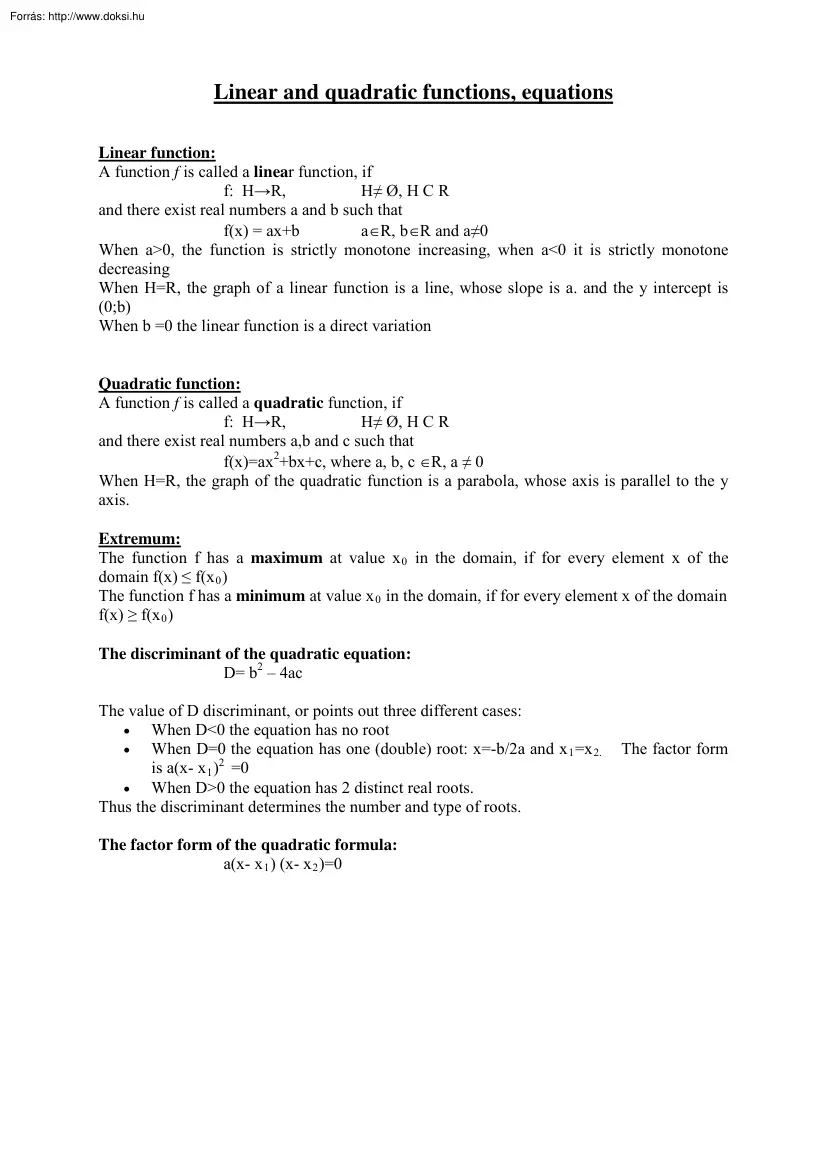
Linear and quadratic functions, equations Linear function: A function f is called a linear function, if f: HR, H≠ Ø, H C R and there exist real numbers a and b such that f(x) = ax+b a∈R, b∈R and a≠0 When a>0, the function is strictly monotone increasing, when a<0 it is strictly monotone decreasing When H=R, the graph of a linear function is a line, whose slope is a. and the y intercept is (0;b) When b =0 the linear function is a direct variation Quadratic function: A function f is called a quadratic function, if f: HR, H≠ Ø, H C R and there exist real numbers a,b and c such that f(x)=ax2+bx+c, where a, b, c ∈R, a ≠ 0 When H=R, the graph of the quadratic function is a parabola, whose axis is parallel to the y axis. Extremum: The function f has a maximum at value x 0 in the domain, if for every element x of the domain f(x) ≤ f(x 0 ) The function f has a minimum at value x 0 in the domain, if for every element x of the domain f(x) ≥ f(x 0 ) The discriminant of
the quadratic equation: D= b2 – 4ac The value of D discriminant, or points out three different cases: • When D<0 the equation has no root • When D=0 the equation has one (double) root: x=-b/2a and x 1 =x 2. is a(x- x 1 )2 =0 • When D>0 the equation has 2 distinct real roots. Thus the discriminant determines the number and type of roots. The factor form of the quadratic formula: a(x- x 1 ) (x- x 2 )=0 The factor form Proof: Theorem: the solutions of the quadratic function are x1, 2 = − b ± b 2 − 4ac where ax2+bx+c, and a, b, c ∈R, a ≠ 0 2a Proof: The standard form of a quadratic equation is given by ax2+bx+c, and a, b, c ∈R, a ≠ 0 Solving this equation by completing the square gives a formula for finding all real number solutions of any quadratic equation. ax2+bx+c Factor the equation: b c x+ )=0 a a Rewrite the expression in parentheses in order to get a perfect square: b2 c b a (( x + ) 2 − 2 + ) = 0 a 2a 4a Add the two last fractions: b b 2 −
4ac a(( x + ) 2 − )=0 a 4a 2 When b2 – 4ac≥0 you can continue as follows: a(x 2 + b 2 b 2 − 4ac 2 ) −( ) )=0 2a 2a Factor the left side by using the identity a2-b2=(a+b)(a-b) a (( x + b b 2 − 4ac b b 2 − 4ac a( x + + )( x + − )=0 2a 2a 2a 2a The product equals zero if either factor is zero. We know that a≠0 thus b b 2 − 4ac x+ + = 0 or 2a 2a b b 2 − 4ac − =0 2a 2a The two roots of the equation: x+ − b − b 2 − 4ac − b + b 2 − 4ac or x 2 = x1 = 2a 2a Summarizing the solutions: − b ± b 2 − 4ac 2a This is the equation of Quadratic formula. It gives us the roots of the quadratic eqution, is a ≠ 0 and b2 – 4ac≥0. Q. e d x1, 2 = Applications: In Math: Trigonometric, logarithm, exponential, and square root equations that can be originated with quadratic equation, solving extremum problems, simplifying fractions In Physics: uniformly accelerating motion, projection, free fall, circular motion, s-t functions
the quadratic equation: D= b2 – 4ac The value of D discriminant, or points out three different cases: • When D<0 the equation has no root • When D=0 the equation has one (double) root: x=-b/2a and x 1 =x 2. is a(x- x 1 )2 =0 • When D>0 the equation has 2 distinct real roots. Thus the discriminant determines the number and type of roots. The factor form of the quadratic formula: a(x- x 1 ) (x- x 2 )=0 The factor form Proof: Theorem: the solutions of the quadratic function are x1, 2 = − b ± b 2 − 4ac where ax2+bx+c, and a, b, c ∈R, a ≠ 0 2a Proof: The standard form of a quadratic equation is given by ax2+bx+c, and a, b, c ∈R, a ≠ 0 Solving this equation by completing the square gives a formula for finding all real number solutions of any quadratic equation. ax2+bx+c Factor the equation: b c x+ )=0 a a Rewrite the expression in parentheses in order to get a perfect square: b2 c b a (( x + ) 2 − 2 + ) = 0 a 2a 4a Add the two last fractions: b b 2 −
4ac a(( x + ) 2 − )=0 a 4a 2 When b2 – 4ac≥0 you can continue as follows: a(x 2 + b 2 b 2 − 4ac 2 ) −( ) )=0 2a 2a Factor the left side by using the identity a2-b2=(a+b)(a-b) a (( x + b b 2 − 4ac b b 2 − 4ac a( x + + )( x + − )=0 2a 2a 2a 2a The product equals zero if either factor is zero. We know that a≠0 thus b b 2 − 4ac x+ + = 0 or 2a 2a b b 2 − 4ac − =0 2a 2a The two roots of the equation: x+ − b − b 2 − 4ac − b + b 2 − 4ac or x 2 = x1 = 2a 2a Summarizing the solutions: − b ± b 2 − 4ac 2a This is the equation of Quadratic formula. It gives us the roots of the quadratic eqution, is a ≠ 0 and b2 – 4ac≥0. Q. e d x1, 2 = Applications: In Math: Trigonometric, logarithm, exponential, and square root equations that can be originated with quadratic equation, solving extremum problems, simplifying fractions In Physics: uniformly accelerating motion, projection, free fall, circular motion, s-t functions
 Just like you draw up a plan when you’re going to war, building a house, or even going on vacation, you need to draw up a plan for your business. This tutorial will help you to clearly see where you are and make it possible to understand where you’re going.

