A doksi online olvasásához kérlek jelentkezz be!
A doksi online olvasásához kérlek jelentkezz be!
 2002 · 3 oldal (34 KB)
 magyar
 586
586
 2006. szeptember 17.
 Bejelentkezés szükséges

 Beágyazás
Nincs még értékelés. Legyél Te az első!





Tartalmi kivonat
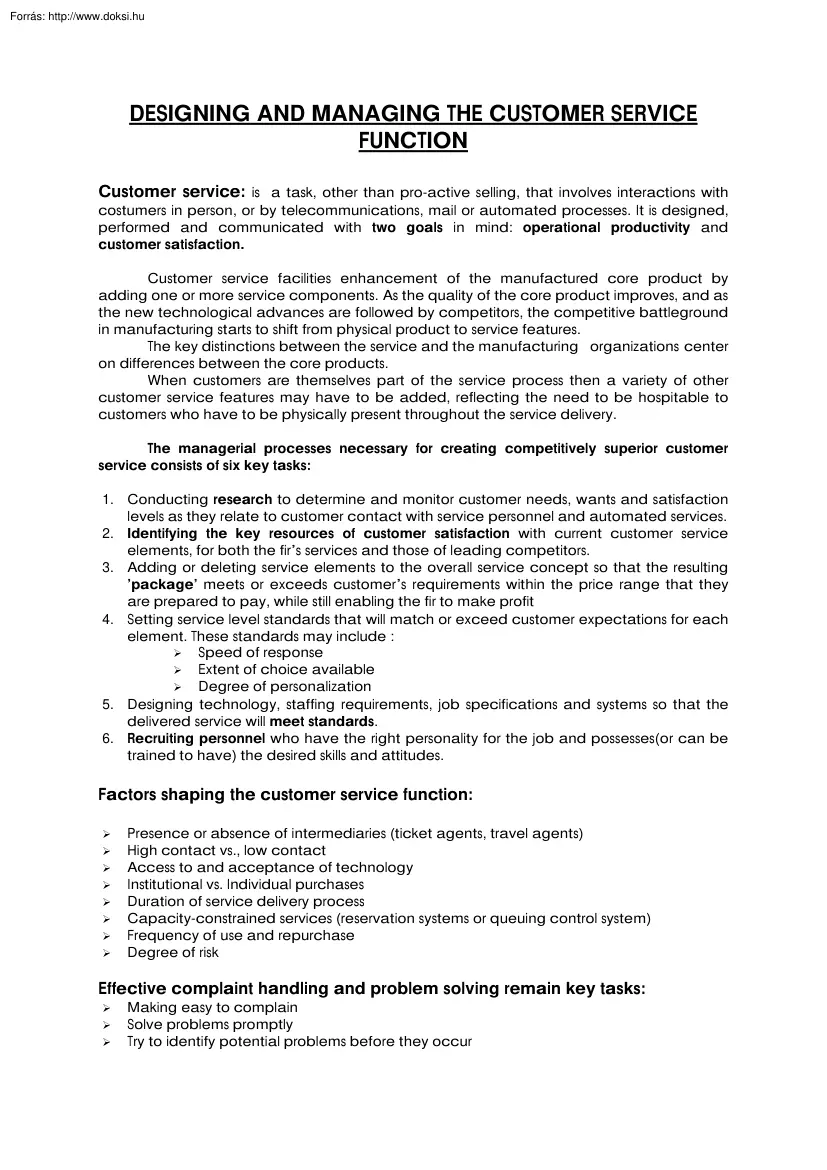
DESIGNING AND MANAGING THE CUSTOMER SERVICE FUNCTION Customer service: is a task, other than pro-active selling, that involves interactions with costumers in person, or by telecommunications, mail or automated processes. It is designed, performed and communicated with two goals in mind: operational productivity and customer satisfaction. Customer service facilities enhancement of the manufactured core product by adding one or more service components. As the quality of the core product improves, and as the new technological advances are followed by competitors, the competitive battleground in manufacturing starts to shift from physical product to service features. The key distinctions between the service and the manufacturing organizations center on differences between the core products. When customers are themselves part of the service process then a variety of other customer service features may have to be added, reflecting the need to be hospitable to customers who have to be
physically present throughout the service delivery. The managerial processes necessary for creating competitively superior customer service consists of six key tasks: 1. Conducting research to determine and monitor customer needs, wants and satisfaction levels as they relate to customer contact with service personnel and automated services. 2. Identifying the key resources of customer satisfaction with current customer service elements, for both the fir’s services and those of leading competitors. 3. Adding or deleting service elements to the overall service concept so that the resulting ’package’ meets or exceeds customer’s requirements within the price range that they are prepared to pay, while still enabling the fir to make profit 4. Setting service level standards that will match or exceed customer expectations for each element. These standards may include : Speed of response Extent of choice available Degree of personalization 5. Designing technology, staffing
requirements, job specifications and systems so that the delivered service will meet standards. 6. Recruiting personnel who have the right personality for the job and possesses(or can be trained to have) the desired skills and attitudes. Factors shaping the customer service function: Presence or absence of intermediaries (ticket agents, travel agents) High contact vs., low contact Access to and acceptance of technology Institutional vs. Individual purchases Duration of service delivery process Capacity-constrained services (reservation systems or queuing control system) Frequency of use and repurchase Degree of risk Effective complaint handling and problem solving remain key tasks: Making easy to complain Solve problems promptly Try to identify potential problems before they occur Customer conduct matrix Selling actions Nonselling actions Inbound communication Order taking Reservations Request for information and advice
Complaint handling and problem solving Receipt of payments Outbound communication Personal or phone solicitation Advertising support Market research Confirmations and reminders Port-use follow-up Billing and collections Outline format for a service audit: 1. Identify customer-contact tasks (other than sales) eg: Information, reservation Service delivery tasks Billing and customer-record transmittal Problem solving, complaint handling 2. Review standard procedures for each task Written standards Oral/written instructions (ad hoc) Availability (hours, days, locations) Interactions with other personnel 3. Identifying performance goals by task Specific quantitative goals Qualitative goals Contribution to related services Contribution to long-term success of system 4. Specify measures of performance by task Money based Time based Management/supervisor evaluations Customer evaluations
5. Review and evaluate personnel elements Recruiting/selection criteria and practices Nature, content of training Job definitions, career path (if any) Interactions with other employees Nature of supervision, quality control Evaluation procedures Corrective actions available Employee attitudes, motivation Hours, extent of paid/unpaid overtime 6. Identifying and evaluate support systems Instructions, manuals, brochures, form letters Office facilities, furnishing, layout etc. Office equipment (phone, fax, computers etc.) Vehicles and equipment for repair and maintenance Mobiles Record keeping devices (e.g Log books) Guidelines for effective program implementation: Recruit the right employees Train employees properly Create a user-friendly environment Educate the customer Be efficient first, nice second Standardize response system Develop a pricing policy Consider using
subcontractors Be proactive Evaluate performance regularly Acknowledge and affirm good work Take corrective actions on defective task The customer service checklist: The customer is why we are here. We have to get right The welcome, because it is the customer’s first impression Acknowledge the customer immediately with eye-contact and a smile. Use the customer’s name it is guaranteed to make them feel important. Every guest is different, we need to listen to find out what they need. The customer comes first, second and third. Customer service is as team effort, and the tea does make the difference. Happy guests make good customers. The formula for perfect customer service is YOU! Customer care issues Differentiate through exceptional customer care! You are not just the messenger, you are also the message First impression – the point of no return 6 human needs: 1. Recognition – treating people as individuals 2. Security –
it is all about sufficient information 3. Belonging – accept that people are different 4. Contact – we are a ‘people’ business 5. Curiosity – we all like to learn, educate the customer 6. Reward – the little ‘something’ that make the stay
physically present throughout the service delivery. The managerial processes necessary for creating competitively superior customer service consists of six key tasks: 1. Conducting research to determine and monitor customer needs, wants and satisfaction levels as they relate to customer contact with service personnel and automated services. 2. Identifying the key resources of customer satisfaction with current customer service elements, for both the fir’s services and those of leading competitors. 3. Adding or deleting service elements to the overall service concept so that the resulting ’package’ meets or exceeds customer’s requirements within the price range that they are prepared to pay, while still enabling the fir to make profit 4. Setting service level standards that will match or exceed customer expectations for each element. These standards may include : Speed of response Extent of choice available Degree of personalization 5. Designing technology, staffing
requirements, job specifications and systems so that the delivered service will meet standards. 6. Recruiting personnel who have the right personality for the job and possesses(or can be trained to have) the desired skills and attitudes. Factors shaping the customer service function: Presence or absence of intermediaries (ticket agents, travel agents) High contact vs., low contact Access to and acceptance of technology Institutional vs. Individual purchases Duration of service delivery process Capacity-constrained services (reservation systems or queuing control system) Frequency of use and repurchase Degree of risk Effective complaint handling and problem solving remain key tasks: Making easy to complain Solve problems promptly Try to identify potential problems before they occur Customer conduct matrix Selling actions Nonselling actions Inbound communication Order taking Reservations Request for information and advice
Complaint handling and problem solving Receipt of payments Outbound communication Personal or phone solicitation Advertising support Market research Confirmations and reminders Port-use follow-up Billing and collections Outline format for a service audit: 1. Identify customer-contact tasks (other than sales) eg: Information, reservation Service delivery tasks Billing and customer-record transmittal Problem solving, complaint handling 2. Review standard procedures for each task Written standards Oral/written instructions (ad hoc) Availability (hours, days, locations) Interactions with other personnel 3. Identifying performance goals by task Specific quantitative goals Qualitative goals Contribution to related services Contribution to long-term success of system 4. Specify measures of performance by task Money based Time based Management/supervisor evaluations Customer evaluations
5. Review and evaluate personnel elements Recruiting/selection criteria and practices Nature, content of training Job definitions, career path (if any) Interactions with other employees Nature of supervision, quality control Evaluation procedures Corrective actions available Employee attitudes, motivation Hours, extent of paid/unpaid overtime 6. Identifying and evaluate support systems Instructions, manuals, brochures, form letters Office facilities, furnishing, layout etc. Office equipment (phone, fax, computers etc.) Vehicles and equipment for repair and maintenance Mobiles Record keeping devices (e.g Log books) Guidelines for effective program implementation: Recruit the right employees Train employees properly Create a user-friendly environment Educate the customer Be efficient first, nice second Standardize response system Develop a pricing policy Consider using
subcontractors Be proactive Evaluate performance regularly Acknowledge and affirm good work Take corrective actions on defective task The customer service checklist: The customer is why we are here. We have to get right The welcome, because it is the customer’s first impression Acknowledge the customer immediately with eye-contact and a smile. Use the customer’s name it is guaranteed to make them feel important. Every guest is different, we need to listen to find out what they need. The customer comes first, second and third. Customer service is as team effort, and the tea does make the difference. Happy guests make good customers. The formula for perfect customer service is YOU! Customer care issues Differentiate through exceptional customer care! You are not just the messenger, you are also the message First impression – the point of no return 6 human needs: 1. Recognition – treating people as individuals 2. Security –
it is all about sufficient information 3. Belonging – accept that people are different 4. Contact – we are a ‘people’ business 5. Curiosity – we all like to learn, educate the customer 6. Reward – the little ‘something’ that make the stay