A doksi online olvasásához kérlek jelentkezz be!
A doksi online olvasásához kérlek jelentkezz be!
 2007 · 4 oldal (48 KB)
 angol
angol
 0
0
 2026. július 15.
 Jelentkezz be

 Beágyazás
Nincs még értékelés. Legyél Te az első!
Mit olvastak a többiek, ha ezzel végeztek?




Tartalmi kivonat
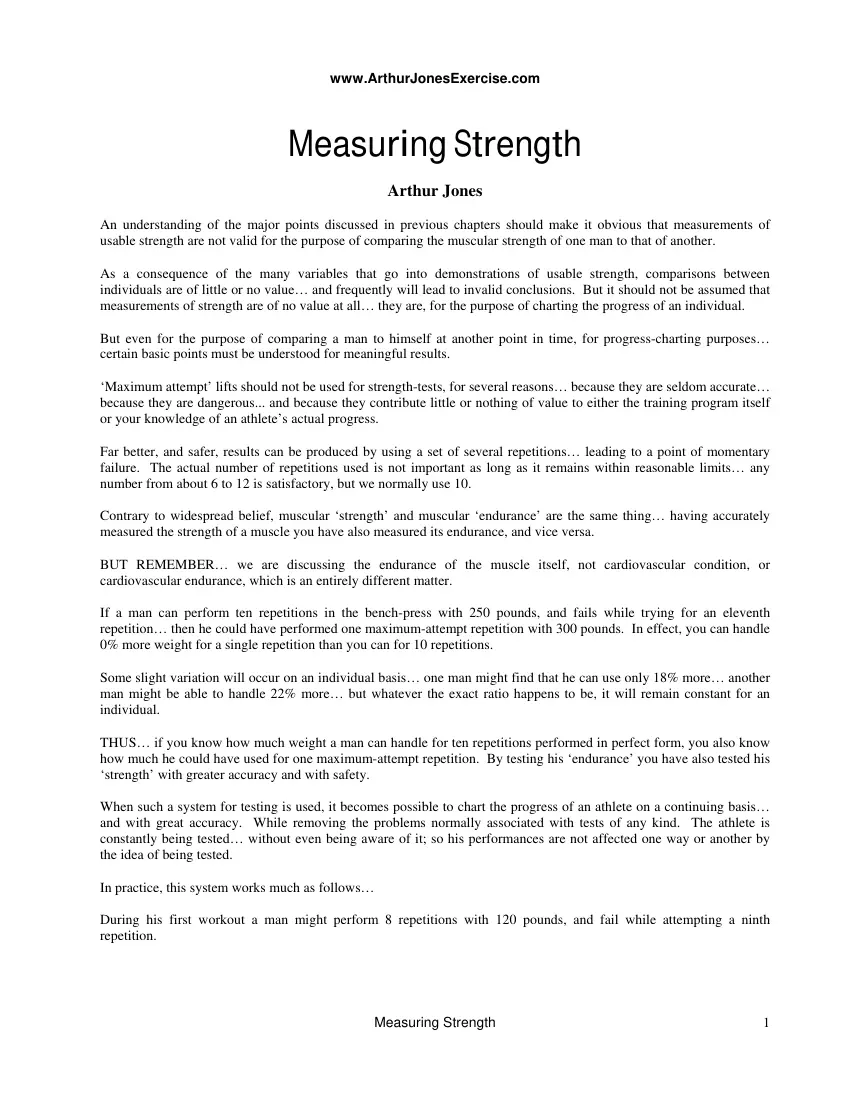
www.ArthurJonesExercisecom Measuring Strength Arthur Jones An understanding of the major points discussed in previous chapters should make it obvious that measurements of usable strength are not valid for the purpose of comparing the muscular strength of one man to that of another. As a consequence of the many variables that go into demonstrations of usable strength, comparisons between individuals are of little or no value and frequently will lead to invalid conclusions. But it should not be assumed that measurements of strength are of no value at all they are, for the purpose of charting the progress of an individual. But even for the purpose of comparing a man to himself at another point in time, for progress-charting purposes certain basic points must be understood for meaningful results. ‘Maximum attempt’ lifts should not be used for strength-tests, for several reasons because they are seldom accurate because they are dangerous. and because they contribute little or nothing
of value to either the training program itself or your knowledge of an athlete’s actual progress. Far better, and safer, results can be produced by using a set of several repetitions leading to a point of momentary failure. The actual number of repetitions used is not important as long as it remains within reasonable limits any number from about 6 to 12 is satisfactory, but we normally use 10. Contrary to widespread belief, muscular ‘strength’ and muscular ‘endurance’ are the same thing having accurately measured the strength of a muscle you have also measured its endurance, and vice versa. BUT REMEMBER we are discussing the endurance of the muscle itself, not cardiovascular condition, or cardiovascular endurance, which is an entirely different matter. If a man can perform ten repetitions in the bench-press with 250 pounds, and fails while trying for an eleventh repetition then he could have performed one maximum-attempt repetition with 300 pounds. In effect, you can handle
0% more weight for a single repetition than you can for 10 repetitions. Some slight variation will occur on an individual basis one man might find that he can use only 18% more another man might be able to handle 22% more but whatever the exact ratio happens to be, it will remain constant for an individual. THUS if you know how much weight a man can handle for ten repetitions performed in perfect form, you also know how much he could have used for one maximum-attempt repetition. By testing his ‘endurance’ you have also tested his ‘strength’ with greater accuracy and with safety. When such a system for testing is used, it becomes possible to chart the progress of an athlete on a continuing basis and with great accuracy. While removing the problems normally associated with tests of any kind The athlete is constantly being tested without even being aware of it; so his performances are not affected one way or another by the idea of being tested. In practice, this system works much
as follows During his first workout a man might perform 8 repetitions with 120 pounds, and fail while attempting a ninth repetition. Measuring Strength 1 www.ArthurJonesExercisecom Then, a week later, during his fourth workout, he might perform 9 repetitions with 120 pounds which is clear proof that he is then ‘stronger.’ You don’t know exactly how much stronger, but that isn’t important an exact measure will come a bit later. If, during his sixth workout, he performs 10 repetitions with 120 pounds, that is your signal to increase the resistance. And during the seventh workout, with the weight increased to 125 pounds, he may perform 8 repetitions which tells you that the first six workouts have increased his strength in that exercise by exactly 5 pounds. But remember that is a five-pound increase for 8 repetitions so his actual increase, for a single repetition, would be somewhat higher. A bit later, when he is able to perform 8 repetitions with 150 pounds, you are clearly
aware that his strength has increased by 25% and when he can perform 8 repetitions with 180 pounds, then his strength has increased by 50%, and so on. When progress occurs, you are immediately aware of it when there is no progress, you are aware of that as well and if a loss in strength occurs, you are also aware of it. And in all cases, you are constantly and immediately aware of what is actually happening to the strength of all your trainees. Each man is being constantly compared to himself and if for any reason it is desirable to do so, you can also compare one man to another man by using the same data. Far too much guesswork is involved when maximum-attempt lifts are used for strength tests if a man overestimates his momentary strength he may fail with a weight only slightly heavier than he could have handled. Or he may guess too low yet be unable to perform a second repetition with less than he could have used for only one; and again the result would be misleading. Or he may
‘miss the groove’ while handling a maximum weight, and thus fail even though he was really strong enough to use the weight selected. Or he may be bothered by the very fact that he knows he is being tested, and this can greatly affect his performance. AND the forces involved in maximum-attempt lifts are considerably higher, approximately 20% higher, but the risk for injury is far out of proportion to the percentage of increase in resistance; so it is probable that the risk of injury is at least ten times as high and it might well be a hundred times as high. Risk that is avoidable risk that serves no slightest purpose unnecessary risk. When a continuing record of a man’s performances are being used for the purpose of charting his progress, it is not possible to be constantly aware of his exact, momentary level of strength because it is not practical to compare, for example, 8 repetitions with 120 pounds to 9 repetitions with 130 pounds. Accurate comparisons can be made only when
the same number of repetitions are involved on two different dates and since there will be considerable variation in the number of repetitions performed, you cannot compare each workout to every other workout with exact accuracy. But it is not necessary to do so and, in practice, the ‘guide figure’ of repetitions that you are using for comparison purposes will occur often enough to give you frequent checks on exact strength increases. For example, a man might reach his guide-figure of repetitions during his first workout then again during the sixth workout then again during the ninth workout then again during the fourteenth workout, and so on. Each time, of course, with more weight You would know, then that he has made a certain, exact amount of progress on each of those dates and the fact that this was not a weekly basis is of no importance. 2 Measuring Strength www.ArthurJonesExercisecom All exercises should be continued to a point of momentary failure, until it is
impossible to perform another repetition in good form and close attention should be paid to form, or style of performance, at all times. A simple test of good form is provided by the fact that you can ‘hold’ more weight than you can lift thus, if you reach a position that you cannot hold, the form was bad; instead of lifting the weight, you threw it to that position. BECAUSE if the resistance had been moved by contraction of the muscles that you are trying to exercise, then you could easily hold any position that you reach. At the start of an exercise, during the first repetition, it would be easily possible for you to move the weight very rapidly even without throwing it because at that point in the exercise, your muscles are fresh and strong. But instead, move the weight smoothly and fairly slowly at a speed well below what you are momentarily capable of. During the following four or five repetitions, use the same speed-of-movement and if the weight is correct, by the time you
reach the seventh or eighth repetition you should not be able to move it any faster in good form. Then, during the last two or three repetitions, you should be forced to reduce the speed-of-movement since, by that point, your momentary strength should be greatly reduced. The final full repetition should be performed VERY SLOWLY at a speed-of-movement very close to zero. After which, it should be momentarily impossible to perform another repetition. Thus, the first several repetitions are performed slowly by choice and the last few repetitions are performed even more slowly by necessity. Such proper form may well be the most important factor in exercise, and should be observed in all exercises performed for the purpose of increasing strength but it should also be understood that using proper form may give the impression that it is actually reducing your usable strength; that is to say performed properly, you may be able to get only 8 repetitions with 200 pounds but performed more
rapidly and with less attention to strict form, you could probably do at least 11 repetitions. Even without ‘throwing’ the weight AND even if the form was perfect, but the movement was somewhat faster, you would probably have been able to do at least 10 repetitions. So it must be understood that the number of repetitions is meaningful only if the style of performance and speed-ofmovement remain unchanged the form and speed must not change from workout to workout, and if they do, then your charting figures are meaningless. SECONDLY it must also be understood that changing the order of your exercises will also appear to affect your strength. How many repetitions you can perform with a given amount of resistance depends to some degree upon what other exercises you have done previously during that same workout. If you have been doing a set of ‘chinning’ movements followed by a set of curls, and if you reverse the order of these exercises then it will appear that you have become
stronger in the curls and weaker in the chinning movements. When, in fact, no actual change in strength has occurred. Highly motivated trainees, in a natural desire to show progress, will have to be watched closely to prevent them from slipping into the bad habits of poor form or too rapid movement and that situation will be helped somewhat if the importance of form and speed is understood by the trainee, and if no emphasis is given to ‘testing.’ An apparent (but misleading) reduction in strength occurs when a slow-speed-of-movement is used because the actual ‘time of contraction’ or ‘time of force production’ is a factor in strength. A formula might be designed to show that a muscle can produce X force for Y time. Measuring Strength 3 www.ArthurJonesExercisecom And when that relationship of force to time is understood, it becomes obvious that slower movement will appear to reduce strength because, if one part of the equation is increased, then the other part must be
reduced to compensate for it. If, for example, you are capable of performing 10 repetitions in a bench-press with 250 pounds and if your normal speed-of-movement is such that you spend a half of a second raising the weight, and another half-second lowering the weight then it would take you ten seconds to perform 10 repetitions. During which exercise your muscles would be required to produce approximately 250 pounds of force for ten seconds. But if you use the same weight, and if you perform only one repetition but do so very slowly then it might take you five seconds to lift the weight and another five seconds to lower the weight; which means that the ‘time of contraction’ of your muscles was as great for one repetition performed slowly as it was for 10 repetitions performed rapidly and you can be very sure that you will not be able to do 10 repetitions at that greatly reduced speed. At first glance, if the formula is understood, you might expect to be able to do only one
repetition at such a slow speed but in practice, you could probably do two or three repetitions. The apparent paradox in the results produced by practical application of this formula results from the fact that other factors are involved factors that have not been given consideration in the formula. But all that is necessary to understand is that a slow speed of movement will reduce the possible number of repetitions. 4 Measuring Strength
of value to either the training program itself or your knowledge of an athlete’s actual progress. Far better, and safer, results can be produced by using a set of several repetitions leading to a point of momentary failure. The actual number of repetitions used is not important as long as it remains within reasonable limits any number from about 6 to 12 is satisfactory, but we normally use 10. Contrary to widespread belief, muscular ‘strength’ and muscular ‘endurance’ are the same thing having accurately measured the strength of a muscle you have also measured its endurance, and vice versa. BUT REMEMBER we are discussing the endurance of the muscle itself, not cardiovascular condition, or cardiovascular endurance, which is an entirely different matter. If a man can perform ten repetitions in the bench-press with 250 pounds, and fails while trying for an eleventh repetition then he could have performed one maximum-attempt repetition with 300 pounds. In effect, you can handle
0% more weight for a single repetition than you can for 10 repetitions. Some slight variation will occur on an individual basis one man might find that he can use only 18% more another man might be able to handle 22% more but whatever the exact ratio happens to be, it will remain constant for an individual. THUS if you know how much weight a man can handle for ten repetitions performed in perfect form, you also know how much he could have used for one maximum-attempt repetition. By testing his ‘endurance’ you have also tested his ‘strength’ with greater accuracy and with safety. When such a system for testing is used, it becomes possible to chart the progress of an athlete on a continuing basis and with great accuracy. While removing the problems normally associated with tests of any kind The athlete is constantly being tested without even being aware of it; so his performances are not affected one way or another by the idea of being tested. In practice, this system works much
as follows During his first workout a man might perform 8 repetitions with 120 pounds, and fail while attempting a ninth repetition. Measuring Strength 1 www.ArthurJonesExercisecom Then, a week later, during his fourth workout, he might perform 9 repetitions with 120 pounds which is clear proof that he is then ‘stronger.’ You don’t know exactly how much stronger, but that isn’t important an exact measure will come a bit later. If, during his sixth workout, he performs 10 repetitions with 120 pounds, that is your signal to increase the resistance. And during the seventh workout, with the weight increased to 125 pounds, he may perform 8 repetitions which tells you that the first six workouts have increased his strength in that exercise by exactly 5 pounds. But remember that is a five-pound increase for 8 repetitions so his actual increase, for a single repetition, would be somewhat higher. A bit later, when he is able to perform 8 repetitions with 150 pounds, you are clearly
aware that his strength has increased by 25% and when he can perform 8 repetitions with 180 pounds, then his strength has increased by 50%, and so on. When progress occurs, you are immediately aware of it when there is no progress, you are aware of that as well and if a loss in strength occurs, you are also aware of it. And in all cases, you are constantly and immediately aware of what is actually happening to the strength of all your trainees. Each man is being constantly compared to himself and if for any reason it is desirable to do so, you can also compare one man to another man by using the same data. Far too much guesswork is involved when maximum-attempt lifts are used for strength tests if a man overestimates his momentary strength he may fail with a weight only slightly heavier than he could have handled. Or he may guess too low yet be unable to perform a second repetition with less than he could have used for only one; and again the result would be misleading. Or he may
‘miss the groove’ while handling a maximum weight, and thus fail even though he was really strong enough to use the weight selected. Or he may be bothered by the very fact that he knows he is being tested, and this can greatly affect his performance. AND the forces involved in maximum-attempt lifts are considerably higher, approximately 20% higher, but the risk for injury is far out of proportion to the percentage of increase in resistance; so it is probable that the risk of injury is at least ten times as high and it might well be a hundred times as high. Risk that is avoidable risk that serves no slightest purpose unnecessary risk. When a continuing record of a man’s performances are being used for the purpose of charting his progress, it is not possible to be constantly aware of his exact, momentary level of strength because it is not practical to compare, for example, 8 repetitions with 120 pounds to 9 repetitions with 130 pounds. Accurate comparisons can be made only when
the same number of repetitions are involved on two different dates and since there will be considerable variation in the number of repetitions performed, you cannot compare each workout to every other workout with exact accuracy. But it is not necessary to do so and, in practice, the ‘guide figure’ of repetitions that you are using for comparison purposes will occur often enough to give you frequent checks on exact strength increases. For example, a man might reach his guide-figure of repetitions during his first workout then again during the sixth workout then again during the ninth workout then again during the fourteenth workout, and so on. Each time, of course, with more weight You would know, then that he has made a certain, exact amount of progress on each of those dates and the fact that this was not a weekly basis is of no importance. 2 Measuring Strength www.ArthurJonesExercisecom All exercises should be continued to a point of momentary failure, until it is
impossible to perform another repetition in good form and close attention should be paid to form, or style of performance, at all times. A simple test of good form is provided by the fact that you can ‘hold’ more weight than you can lift thus, if you reach a position that you cannot hold, the form was bad; instead of lifting the weight, you threw it to that position. BECAUSE if the resistance had been moved by contraction of the muscles that you are trying to exercise, then you could easily hold any position that you reach. At the start of an exercise, during the first repetition, it would be easily possible for you to move the weight very rapidly even without throwing it because at that point in the exercise, your muscles are fresh and strong. But instead, move the weight smoothly and fairly slowly at a speed well below what you are momentarily capable of. During the following four or five repetitions, use the same speed-of-movement and if the weight is correct, by the time you
reach the seventh or eighth repetition you should not be able to move it any faster in good form. Then, during the last two or three repetitions, you should be forced to reduce the speed-of-movement since, by that point, your momentary strength should be greatly reduced. The final full repetition should be performed VERY SLOWLY at a speed-of-movement very close to zero. After which, it should be momentarily impossible to perform another repetition. Thus, the first several repetitions are performed slowly by choice and the last few repetitions are performed even more slowly by necessity. Such proper form may well be the most important factor in exercise, and should be observed in all exercises performed for the purpose of increasing strength but it should also be understood that using proper form may give the impression that it is actually reducing your usable strength; that is to say performed properly, you may be able to get only 8 repetitions with 200 pounds but performed more
rapidly and with less attention to strict form, you could probably do at least 11 repetitions. Even without ‘throwing’ the weight AND even if the form was perfect, but the movement was somewhat faster, you would probably have been able to do at least 10 repetitions. So it must be understood that the number of repetitions is meaningful only if the style of performance and speed-ofmovement remain unchanged the form and speed must not change from workout to workout, and if they do, then your charting figures are meaningless. SECONDLY it must also be understood that changing the order of your exercises will also appear to affect your strength. How many repetitions you can perform with a given amount of resistance depends to some degree upon what other exercises you have done previously during that same workout. If you have been doing a set of ‘chinning’ movements followed by a set of curls, and if you reverse the order of these exercises then it will appear that you have become
stronger in the curls and weaker in the chinning movements. When, in fact, no actual change in strength has occurred. Highly motivated trainees, in a natural desire to show progress, will have to be watched closely to prevent them from slipping into the bad habits of poor form or too rapid movement and that situation will be helped somewhat if the importance of form and speed is understood by the trainee, and if no emphasis is given to ‘testing.’ An apparent (but misleading) reduction in strength occurs when a slow-speed-of-movement is used because the actual ‘time of contraction’ or ‘time of force production’ is a factor in strength. A formula might be designed to show that a muscle can produce X force for Y time. Measuring Strength 3 www.ArthurJonesExercisecom And when that relationship of force to time is understood, it becomes obvious that slower movement will appear to reduce strength because, if one part of the equation is increased, then the other part must be
reduced to compensate for it. If, for example, you are capable of performing 10 repetitions in a bench-press with 250 pounds and if your normal speed-of-movement is such that you spend a half of a second raising the weight, and another half-second lowering the weight then it would take you ten seconds to perform 10 repetitions. During which exercise your muscles would be required to produce approximately 250 pounds of force for ten seconds. But if you use the same weight, and if you perform only one repetition but do so very slowly then it might take you five seconds to lift the weight and another five seconds to lower the weight; which means that the ‘time of contraction’ of your muscles was as great for one repetition performed slowly as it was for 10 repetitions performed rapidly and you can be very sure that you will not be able to do 10 repetitions at that greatly reduced speed. At first glance, if the formula is understood, you might expect to be able to do only one
repetition at such a slow speed but in practice, you could probably do two or three repetitions. The apparent paradox in the results produced by practical application of this formula results from the fact that other factors are involved factors that have not been given consideration in the formula. But all that is necessary to understand is that a slow speed of movement will reduce the possible number of repetitions. 4 Measuring Strength
 Írásunkban a műelemzések készítésének módszertanát járjuk körül. Foglalkozunk az elemzés főbb fajtáival, szempontjaival és tanácsokat adunk az elemzés legfontosabb tartalmi elemeivel kapcsolatban is. Módszertani útmutatónk főként tanulók számára készült!
