A doksi online olvasásához kérlek jelentkezz be!
A doksi online olvasásához kérlek jelentkezz be!
 2024 · 205 oldal (3 MB)
 angol
angol
 2
2
 2026. július 29.

 Jelentkezz be

 Beágyazás
Nincs még értékelés. Legyél Te az első!
Mit olvastak a többiek, ha ezzel végeztek?

Tartalmi kivonat
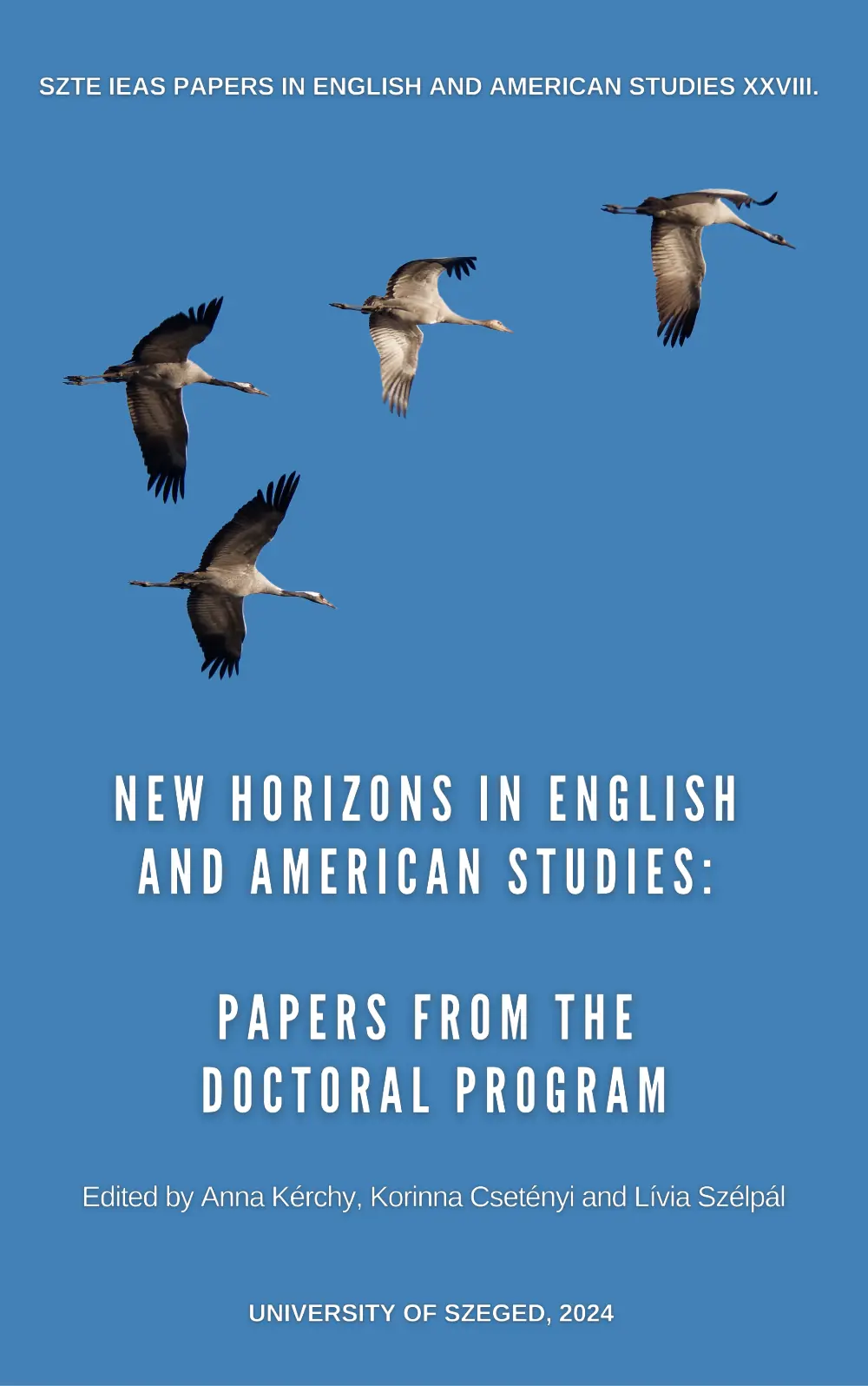
New Horizons in English and American Studies: Papers from the Doctoral Program Edited by Anna Kérchy, Korinna Csetényi, and Lívia Szélpál SZTE IEAS E-Books Papers in English and American Studies XXVIII. 2024 Published by the Institute of English & American Studies of the University of Szeged Cover: design by Laura Ádám, photograph by György E. Szőnyi ISBN (pdf) 978-963-688-029-3 Irén Annus, Hana Lina Berraf, Aya Chelloul, Zoltán Cora, Korinna Csetényi, Olga KajtárPinjung, Anna Kérchy, Viktória Osoliova, Armin Stefanovic, Réka Szarvas, Bálint Szántó, Lívia Szélpál, Dóra Szokolyai, György E. Szőnyi, Zsuzsanna Tóth, Zoltán Vajda, 2024 This book is subject to the Creative Commons Attribution 4.0 international licence For further information visit https://creativecommons.org/licenses/by-nc-nd/40/ 2 Table of Contents Introduction by Anna Kérchy.4 György Endre Szőnyi The Progress of Esoteric Fiction in Relation to Fantasy Literature.9 Armin
Stefanović The ’Potter Formula’ Revised: How the New Age Facilitated the Sucess of the Harry Potter Franchise.23 Zsuzsanna Tóth (Neo-)Platonism Revived: Literary Imagery of Daemons in Philip Pullman’s His Dark Materials Trilogy.36 Bálint Szántó Transmedia Storytelling and Media Play in Spider-Man: Across the Spider-Verse.48 Korinna Csetényi Fear of Living Dolls in Ira Levin’s The Stepford Wives.58 Viktória Osoliova “'I’ve never been wanted anywhere’” Haunting/Haunted House and Female Identity in Shirley Jackson's The Haunting of Hill House.68 Réka Szarvas The Criminal Poetics of the Detecting Body in Gillian Flynn’s Sharp Objects .81 Dóra Szokolyai Theories of Postmodern Love: A Quest for “That Which Cannot be Found”.93 Aya Chelloul Unreading Passivity: The Oppositional Consciousness of the Arab-Muslim Woman in Leila Aboulela’s Novel The Translator .104 Hana Lina Berraf #Rulesofthegame: Tár on Power.119 Irén Annus At the Mercy of History:
The Cultural Misappropriations of Christopher Columbus in the US .141 Olga Kajtár-Pinjung From Bush to Biden: Presidential Attitudes towards Guantánamo.153 Zoltán Vajda Thomas Jefferson on Poverty in England.172 Zoltán Cora Will The Poor Always Be with You? The Beveridge Plan, the Creation of the Modern British Welfare State, and Its Reception in Europe and Hungary.185 3 Anna Kérchy Introduction ORCID iD: 0000-0001-9042-9545 New Horizons in English and American Studies: Papers from the Doctoral Program edited by Anna Kérchy, Korinna Csetényi, and Lívia Szélpál is the twenty-eighth volume in the Papers in English and American Studies series published by the Institute of English and American Studies of the Faculty of Arts at the University of Szeged. In line with the technological progress and the increasing digitalization of our times, and also motivated by the ethical imperative and pedagogical agenda to democratically share academic knowledge, the PEAS series has moved
from the initial printed editions to online open access publication to grant our readers a free, immediate availability of research findings. The present collection of essays is unique in so far as it presents papers authored both by doctoral students and their supervisors, junior and senior professors working together under the aegis of SZU’s Doctoral Program of Literatures and Cultures in English. A glimpse at these current research projects reveals not only an impressive variety of topics, theoretical frameworks, and cutting-edge interdisciplinary approaches but also provides a fine example of the vibrant intergenerational dialogue that constitutes the veritable engine of our program. The research of the fantastic as a literary genre has a long-standing tradition in our program: we have explored the histories and theories of speculative fiction from the Gothic era to postmodernism throughout international collaborations like The Iconography of the Fantastic conference (2002) or
the Fantastic Literature Salzburg-Szeged PhD Research Network (20052009), with proceedings published in PEAS Volumes 11 and 17 respectively. The first six essays in this volume elaborate on these endeavors by proposing to examine various narrative strategies of non-mimetic fiction where supernatural events or magical agents play a pivotal role in the de/construction of storyworlds, which strategically generate readerly hesitation. György E Szőnyi’s historical contextualization of the genre tracks antecedents of the esoteric tradition in fantasy fiction to detect generic transmutations as well as the oscillation between innovation and tradition in his comparative analysis of two contemporary fantasy sagas, Philip Pullman’s His Dark Materials (1995-2000) and Deborah Harkness’s All Souls Trilogy (2011-14). Armin Stefanović studies another bestselling fantasy saga, J.K Rowling’s Harry Potter series: he scrutinizes the complex cultural dynamics of disand re-enchantment while
arguing that the primary reason of the Potterverse’s transcultural appeal – besides its nostalgic commodification of British cultural specificities, generic hybridization, cross-over audience address, and the singular adaptogenic quality of the novels – is the franchise’s resonating with New Age spiritual beliefs and practices. Zsuzsanna Tóth’s close-reading focuses on the representations of daemons in Pullman’s His Dark Materials with the dual aim of demonstrating how these fictional figures, the zoomorphic external embodiments of one’s inner-self are inspired by the Neo-Platonic philosophical concept of the desire for unity, and how they relate to the mythical quest trope of losing, seeking and hopefully regaining Paradise. In Bálint Szántó’s paper the attention shifts to transmedia storytelling techniques as instruments of immersive fantastification for a ludic audience engagement: a case study of the 2023 animated movie Spider-Man: Across the Spider-Verse
reveals how the carefully crafted intertextual web of references, a characteristic of multiverse narratives, introduces a new form of storytelling that enables the transgression of the 4 boundaries between fan/author, official/unofficial, diegetic/paratextual to celebrate the playful co-creativity of prosumers. The final two essays of this section discuss the pleasurable thrills of the horror genre. Korinna Csetényi reads Ira Levin’s The Stepford Wives as a satirical feminist sci-fi horror that combines the thematic clichés of the horror genre (mad scientists, doppelgängers, the misuse of technology) with the social criticism of women’s patriarchal oppression, while atavistic anxieties are sublimated into the figure of the living doll who evokes the uncanny dread of cognitive/affective dissonance. Viktória Osoliova explores the psychogeographical implications of the haunted house and the haunted mind in Shirley Jackson’s The Haunting of Hill House by relying on Rosemary
Jackson’s notion of “the gothic poetics of space” and Anthony Vidler’s “architectural uncanny.” Her corporeal narratological analysis reveals that the house does not only incarnate repressed psychic contents but the domicile’s animation also mirrors the traumatised heroine’s alienation. The studies in the second part embark on a feminist analysis of gendered power dynamics in contemporary verbal and visual artworks created by, about and/or for women. They enter into critical conversation with the gender-studies-related research carried out on multiple academic platforms in our institute ranging from the TNT ef E-journal of Gender Studies to the annual NYIM Language, Ideology, Media conference (with the twentieth edition forthcoming in Fall 2025) managed by our Gender Studies Research Group, and distinguished publications such as the Iconology of Gender conference-volume (2008) edited by our Research Group for Cultural Iconology and Semiography or Spaces in Transition.
Festschrift in Honour of Sarolta Marinovich-Resch (2005) published as the twelfth and fifteenth volume in the PEAS series. In this present volume, Réka Szarvas scrutinizes a contemporary subgenre of crime fiction, domestic noir as a descendant of the female gothic, and argues that in Gillian Flynn’s Sharp Objects the amateur detective anti-heroine’s self-cutting functions as an embodied means of communicating repressed psychic contents via an écriture féminine carved in the flesh to resist patriarchal domestic entrapment and to provide carnal clues for the detective and the reader to decode both the subject’s traumatic residue and the crime case corrupting the community. Dóra Szokolyai explores the new field of “love studies,” focusing on literary and theoretical reflections on the “postmodern romantic condition.” By relying on an innovative interdisciplinary methodology conjoining feminist scholarship, affective narratology and theories of postmodernism, she reveals
how late-twentieth-century critical thinking both ironically challenges yet nostalgically reiterates romantic love as a grand narrative via an ambiguous gesture that also reflects on the postmodern crisis of language attested by suspicions raised by the simple speech act “I love you.” Aya Chelloul’s analysis of Leila Aboulela’s novel The Translator adopts Chela Sandoval’s concept of “oppositional consciousness” to examine the political tactics that colonized, marginalized Arab-Muslim women invent to respond, speak with, transform and ultimately resist the multitudes of oppressions they face. The active engagement with signs of power undermines the stereotype of submissiveness with which Muslim women have been associated, and it also contributes to the growing discussion on how to understand agency beyond modern, liberal conceptualizations. Hana Lina Berraf’s critical analysis of contemporary American cinematic responses to the #MeToo movement focuses on Tár directed by
Todd Field, a psychological drama about abusive workplace relationships in the classical music industry. She aims to explore the limits and potentials of how the representations of unequal power distributions and the strategies of silencing or seeking a voice within the movie resonate with the agenda of the extradiegetic feminist collective social movement, and asks whether the social evaluation or the psychological experience of the abuse is altered or not by the gendered perspective, if the perpetrator happens to be a woman in power. 5 The final part of the volume includes four articles on British and American history; with some contributions elaborating on historical research findings previously shared in multiple publications of Americana E-Books’ Szeged Series in American Studies. Irén Annus’s article, framed by postmodern theoretizations of identity, cultural production and American historical memory, focuses on the cultural misappropriations of the figure of Christopher
Columbus, discoverer, explorer, and governor. It revisits the pivotal moments when this symbolical figure has been alternately glorified or vilified, consistently suspended within a web of historical signifiers shaped by ideological political interests. Olga-Kajtár Pinjung’s essay investigates changing presidential attitudes towards Guantánamo. Comparing Bush’s reactionary politics, Obama’s troubleshooting approach, Trump’s ignorant attitude, and Biden’s reticent stance, she reveals how the different administrations constructed the enemy image of Guantánamo Bay detainees and how the exclusionary logic of enmification affected the legislative processes of each administration following the 9/11 terrorist attacks. The last two papers scrutinize the poor relief system from English and American historical perspectives. Zoltán Vajda provides a critical reading of Thomas Jefferson’s ideas about the nature of poverty and poor relief in England, arguing that Jefferson addressed
these issues through the perspective of the country’s economic and social structure as well as its alleged aspiration to become a major world power, but he also unjustly neglected some major features of the Old Poor Law – which functioned in many ways similarly to American localized poor relief –, and ignored several types of English poor along with their survival strategies. Zoltán Cora evaluates British social policy during the Second World War, exploring the Beveridge Plan, and the creation of the modern British Welfare State, with a special attention paid to its reception in Europe and Hungary. The study demonstrates how, due to an adaptive and selective reception, the Plan’s arguments were employed in the wartime discourse of the Hungarian Social Democratic Party as well as other leftish and Christian-socialist political actors’ defense of universalism in social insurance, especially unemployment insurance. As a co-editor of this volume and the current head of the
Doctoral Program of Literatures and Cultures in English, I firmly believe that the collection of essays in the present volume will provide an exciting insight into the colorful variety of senior and junior research projects pursued in our program, and hope that many of the academic endeavours briefly presented here will soon be brought to a full, more intricate, in-depth realization in a longer dissertation or monograph format. 6 List of References Barát, Erzsébet, ed. 2005 Spaces in Transition Festschrift in Honour of Sarolta MarinovichResch PEAS 12 Szeged: JATEPress Kérchy Anna, Sabine Coelsch-Foisner, György Endre Szőnyi, Sarolta Marinovich-Resch, eds. 2009. What Constitutes the Fantastic? PEAS 17 Szeged: JATEPress Kiss, Attila, György Endre Szőnyi, Márta Baróti-Gaál, eds. 2002 The Iconography of the Fantastic. Iconography East & West 2 PEAS 11 Szeged: JATEPress Kiss, Attila and György Endre Szőnyi, eds. 2008 The Iconology of Gender I-II PEAS 15 Szeged: JATEPress.
Tóth, Zsófia Anna and Zoltán Vajda. 2023 Further Critical, Theoretical and Analytical Explorations of U.S Culture, Literature and History Szeged Series in American Studies, Americana E-Books. Full List of Publications in Papers in English and American Studies Series 1. Halász M, ed 1980 Papers in English and American Studies Vol 1 Szeged: JATE 2. Rozsnyai, Bálint, ed 1983 Papers in English and American Studies Vol 2 Szeged: JATE. 3. Fabiny, Tibor, ed 1984 Shakespeare and the Emblem: Studies in Renaissance Iconography and Iconology. Szeged: JATE 4. Fabiny, Tibor, ed 1991 Literary Theory and Biblical Hermeneutics: Proceedings of the International Conference Reading Scripture: Literary Criticism and Biblical Hermeneutics. Szeged: JATE 5. Kiss, Attila and Antónia Szabari 1995 The Semiotics of Revenge: Subjectivity and Abjection in English Renaissance Tragedy; Demand, Desire and Drive in Sidney's Texts and their Contexts. Szeged: JATE 6. Novák, György, ed 1995 HUSSE Papers
1995: Proceedings of the Second Conference of the Hungarian Society for the Study of English. Szeged: JATE 7. Kiss, Attila, ed 1996 Iconography in Cultural Studies: Papers from the International Conference "Iconography East and West." Szeged 1993 Szeged: JATEPress 8. Szőnyi, György Endre and Rowland Wymer, eds 2000 The Iconography of Power: Ideas and Images of Rulership on the English Renaissance Stage. Szeged: JATEPress 9. Németh, Anikó 2004 Art, the embodied expression of man" Making and Creating Art and Beauty in the Victorian Age. Szeged: JATEPress 10. Annus, Irén 2005 Social Realities in the Making: the Structuration of Society and the Constitution of American Identity. Szeged: JATEPress 11. Kiss, Attila, György Endre Szőnyi, Márta Baróti-Gaál, eds 2002 The Iconography of the Fantastic. Iconography East & West 2 Szeged: JATEPress 12. Barát, Erzsébet, ed 2005 Spaces in Transition Festschrift in Honour of Sarolta Marinovich-Resch. Szeged: JATEPress 13.
Vajda, Zoltán 2007 Innovative Persuasions Aspects of John C Calhoun’s Political Thought. Szeged: JATEPress 14. Cristián, Réka Mónika and Zoltán Dragon 2008 Encounters of the Filmic Kind: Guidebook to Film Theories. Szeged: JATEPress 15. Kiss, Attila and György Endre Szőnyi, eds 2008 The Iconology of Gender I-II Iconography East & West 3. Szeged: JATEPress 16. Peckham, Donald W 2009 Noticing and instruction in second language acquisition : a study of Hungarian learners of English. Szeged: JATEPress 7 17. Kérchy, Anna, Sabine Coelsch-Foisner, György Endre Szőnyi, Sarolta MarinovichResch, eds 2009 What Constitutes the Fantastic? Szeged: JATEPress 18. Kovács, Ágnes Zsófia 2010 Literature in Context: Strategies of Reading American Novels. Szeged: JATEPress 19. Matuska, Ágnes 2011 The Vice-Device: Iago and Lear's Fool as Agents of Representational Crisis. JATEPress 20. Kiss, Attila 2010 Double Anatomy in Early Modern and Postmodern Drama Szeged: JATEPress. 21.
Kérchy, Anna, Attila Kiss and György E Szönyi, eds 2012 The Iconology of Law and Order (Legal and Cosmic). Szeged: JATEPress 22. Kiss, Attila, ed 2012 Distinguished Szeged Student Papers Acta Iuvenum Szeged: JATEPress. 23. Bocsor, Péter 2013 Paradigms of Authority in the Carver Canon Szeged: JATEPress. 24. Cristian, Réka Mónika, Andrea Kökény, György E Szőnyi eds 2017 Confluences: Essays Mapping the Manitoba–Szeged Partnership. Szeged: JATEPress 25. Kiss, Attila, ed 2020 Distinguished Szeged Student Papers II Acta Iuvenum Szeged: JATEPress. 26. Csetényi, Korinna 2021 Monstrous Femininity in Stephen King’s Fiction Szeged: JATEPress. 27. Kiss, Attila, ed 2024 Distinguished Szeged Student Papers Acta Iuvenum III Szeged: SZTE IEAS. 28. Kérchy, Anna, Korinna Csetényi, Lívia Szélpál, eds 2024 New Horizons in English and American Studies. Papers from the Doctoral Program Szeged: SZTE IEAS 8 György E. Szőnyi The Progress of Esoteric Fiction in Relation to Fantasy
Literature ORCID iD: 0000-0002-6805-6890 Abstract: Approximately around the end of World War 2, a new subgenre of narrative fiction emerged in world literature, championed by English speaking writers: fantasy literature. It is J.RR Tolkien's works, especially The Lord of the Rings (written between 1937 and 49, first published in 1954), and its Middle Earth universe that has been considered as the archetype of this kind of “epic high fantasy” model. Ever since the genre gained increasing popularity, an impressive amount of scholarly literature, theoretical works, case studies and adaptations have been devoted to its types, transformations and mutations. A common feature of fantasy novels is the abundance of esoteric motifs ranging from supernatural creatures, demons, spirits, to supernatural actions, magic, witchcraft, transmutation, and the like. In this essay I examine two relatively recent fantasy sagas, Philip Pullman’s His Dark Materials trilogy (1995-2000) and Deborah
Harkness’s All Souls Trilogy (2011-14) with the twofold aim to track antecedents of the esoteric fiction tradition and to detect the signs of generic hybridization in both sagas. Keywords: Fantasy, esoteric fiction, magic, Frankenstein, Lindsay Clarke, Patrick Harpur, Philip Pullman, Deborah Harkness * I Approximately around the end of World War 2, a new subgenre of narrative fiction emerged in world literature, championed by English speaking writers: fantasy literature. It is JRR Tolkien's works, especially The Lord of the Rings (written between 1937 and 49, first published in 1954), and its Middle Earth universe that has been considered as the archetype of this kind of "epic high fantasy" model.1 Ever since the genre has gained increasing popularity, an enormous amount of scholarly literature, theoretical work, and case studies have been devoted to its types, transformations and transmutations.2 A common feature of fantasy novels is the abundance of esoteric motifs
in them: supernatural creatures, demons, spirits, supernatural actions, magic, witchcraft, transmutation, and the like. In this essay I will examine two relatively recent fantasy sagas, Philip Pullman's His Dark Materials trilogy (1995-2000) and Deborah Harkness's All Souls Trilogy (2011-14) and detect the signs of generic hybridization in them, but first of all, we shall need a look back in the past to see prototypes and antecedents. It should not be surprising that, as in the case of any cultural or literary phenomenon, things usually do not pop up out of nothing; it is useful and instructive to trace their forerunners. In the case of fantasy fiction, the obvious ancestor is the Gothic novel. It is especially so because of the esoteric and supernatural elements, seasoned with horror and monstrosity. However, 1 See the scholarly literature published in the periodical Fantasy and Science Fiction (Cornwall, Conn: Mercury Press); also, Manlove 1992; Hunt and Lenz 2001; Chester
2016; etc. 2 See for example Slusser and Rabkin 1987; Manlove 1992; Szőnyi 2002; Jackson 2003; O'Keefe 2003; Kiss 2006; Mendelsohn 2008; James and Mendelsohn 2012; Kérchy 2010, 2020; etc. 9 with some scrutiny, under the loose umbrella of the Gothic the proliferation of subgenres can be noticed; Mary Shelley's Frankenstein (1818) is quite distinct from Bulwer-Lytton's Strange Story (1862), or Bram Stoker's Dracula (1897).3 The more scrutiny, the more windows open backward to the ever more remote past: the Freemason and Rosicrucian novels of the Enlightenment (Anon., L’Adepte moderne, 1755), the alchemical allegories and esoteric utopias of the Baroque era (Johann V. Andreae's Chymische Hochzeit, 1616; Francis Bacon's New Atlantis, 1626), the magus figures of the Renaissance (Faustus, Prospero), the witchcraft magicians of the medieval romances (Merlin and the Lady of the Lake); and we can continue our survey back to the Roman Apuleius's Golden
Ass, the magic-laden adventures of Odysseus, or the Second Temple mystical Jewish legends and the supernatural episodes in the Gilgamesh epic. From all this we can conclude that the magical, the supernatural, and the horrifying have always been attractive motifs in literature and it is quite enlightening to observe the mingling and separations of these motives in various periods and cultural contexts. In the followings I concentrate on the emergence of "esoteric fiction" of the nineteenth century and aim to explore how it achieved a new flowering in the twentieth century, until around the Second Millenium when the (sub)genre merged with the latest generation of fantasy novels. 4 When mapping this progress, we also need to notice the hybridization with certain types of science fiction and utopias/dystopias. II How can we define "esoteric fiction" when the notion of esotericism itself is so complex and heterogeneous due to its connections with religion, science,
psychology, literature, and the visual arts?5 One thing is certain: esoterism is rooted in the human mind and is triggered by human ambition for power and/or for knowledge with such determination, which is willing to step beyond the sphere of the rational and the ordinary. A few years ago in another essay I raised several questions relating to esoteric fiction, which I find helpful to reiterate here: The archetypal magician-story gained cosmic significance in the Renaissance, and has been popular ever since. Is this a pattern taken from life, or merely from the pressure of literary conventions, the demand of the reading public? Does it follow the logic of scientific investigation, mixing experimentation with the supernatural? Is this all allegory and parable, or does it have a more direct relevance? One might feel surprised that this literary framework has even passed into twentieth century fiction, virtually unshaken by the development of natural sciences and the disqualification of
magic as a scientific discipline. Or should we rather see this literary phenomenon as a reaction against the self-assuredness of the natural sciences? Is there any way of reconciling the rational-scientific way of thinking and the magical-occult world view? (Szőnyi 2017, 234) Esotericism is connected to religion by the ambition of humans to experience epiphany, to partake in the divine or even to deify themselves. The connection to science comprises the technology (usually called magic), which can be used to achieve the transcendental 3 In this paper I refer almost exclusively to Anglo-American fictional works, although other examples could be mentioned from other languages, including Hungarian. 4 The subject of this paper is treated extensively in my 7-part YouTube video lecture series, The Lure of the Occult: Esoteric Fiction. The link to the first is https://youtube/lDEeZW8JyY4 5 See Warner 2006; Szőnyi 2007 and 2017; also, Roukema 2018. 10 experience. There is one more
feature of esoterism that is particularly vital in literary representations: ambiguity, without which there is no good fiction or poesis. The religious aspect of ambiguity is manifested in the paradoxical situation of the magus, who, with full devotion and piety, yearns to be united with the divine, while at the same time has enough hybris to believe that this is a realistic goal to achieve. Another paradox is when the magus, who wants to transmute him/herself into some higher existence, makes a pact with lowly dark forces to secure the success. Two archetypal myths of Western culture are the story of Icarus and of Doctor Faustus.6 Icarus is ambiguous because he has hybris to overestimate his capabilities, at the same time his striving ambition and scientific curiosity to fly as high as possible is admirable, captivating. Faustus also wants to master nature, in addition to gaining youth, omniscience and power, and this desire turns him blind to realize the danger involved in bargaining
with the devil. Both of these stories can be seen as didactic, moralistic tales to deter people from overweening pride, at the same time it is difficult not to admire the bold researchers and wish them success. This paradoxical ambiguity makes them tragic heroes, as many literary renderings of their stories testify over the centuries.7 I suggest that modern esoteric fiction was born in the romantic spirit of the nineteenth century: we can easily see the combination of exaggerated hybris-cum-ambition as well as the scientific interest in the three novels I mentioned above (Frankenstein, Strange Story, Dracula). Despite their differences, they are also connected by the fact that two kinds of sciences are presented in their stories. Frankenstein, upon arriving in Ingolstadt to study medicine, brings from home an interest in the occult sciences, based on his readings of the works of Paracelsus and Cornelius Agrippa. The first professor he meets, Mr. Krempe, ridicules him for these
"superstitious beliefs" and Frankenstein feels that “[t]he ambition of the inquirer seemed to limit itself to the annihilation of those visions on which my interest in science was chiefly founded. I was required to exchange chimeras of boundless grandeur for realities of little worth” (Shelley 1993, 37). However, his next professor, Mr. Waldman appreciates his interests and in his chemistry lecture talks about the ancient esoteric alchemists as those, who “acquired new and almost unlimited powers; they can command the thunders of heaven, mimic the earthquake, and even mock the invisible world with its own shadows” (Shelley 1993, 38). But Mr Waldman not only appreciates the old masters, but he also manages to synthetise their learning with the newest discoveries and technologies of modern science, meaning electricity in the early nineteenth century. This mixed inspiration will trigger Frankenstein's ambition to create artificial life: "After days and nights
of incredible labour and fatigue, I succeeded in discovering the cause of generation and life; nay, more, I became myself capable of bestowing animation upon lifeless matter" (Shelley 1993, 41). Frankenstein's synthetising method is rather unique in esoteric fiction, and even he does not succeed in the end. More commonly, the two kinds of sciences – the rational and the occult knowledge – appear separately and in opposition to each other, as we see in the Strange Story and Dracula. In both novels there is a medical doctor (Dr Allen Fenwick and Dr van Helsing respectively) who relies on rationalistic scientific methods and sceptically disregards esoteric and supernatural phenomena. However, in the end of the day they have to admit the failure of their narrow-minded rationalism, still, they can never fully penetrate the world of the occult. 6 7 See Baron 1992; Maguire 1993 (a biography of Christopher Marlowe, fusing both topics of Icarus and Faust). Fitzsimmons 2008. 11
Another characteristic feature of these early esoteric novels is that despite the supernatural and magical elements, the general setting is quite mimetic, following one of Aristotle's basic types of imitation: "Since the poet is an imitator, he must carry out his imitations on all occasions in one of three possible ways. Thus, he must imitate the things that were in the past or are now." (Aristotle 1974, 135) In this naturalistic world enters the magus who tries to step beyond the screen of nature into the realms of the supernatural by means of revelatory techniques. This occult sphere coincides with Aristotle's second type of mimesis – "[the Poet must imitate] that people say or think to be" (ibid.) –, a sphere that ranges from the manifestations of the divine to fantasy-inspired imaginations.8 In esoteric fiction the supernatural appears in various ways, each instance rooted in ancient traditions, which can be identified as follows: 1/ The
protomodern world picture, which deeply believed in the continuum of the material and the supernatural realms as picturesquely allegorized by the notion of the Great Chain of Being. On the contrary, in the modern, Cartesian world, humans have lost their ability to recognize the occult correspondences between the sublunary and the translunary existence. 2/ Those endeavours that search the occult spheres are exemplified by the so-called secret sciences, such as astrology, alchemy, natural and ceremonial magic. 3/ A recurring motif is the human desire to create life artificially (via the homunculus, or the golem). 4/ The presence of supernatural creatures, although their number is quite limited to the Judeo-Christian world picture (angels, devils, demons, spirits, witchcraft, possessions). 5/ Last but not least, as a heritage from the scientific revolution of the early modern era, the idea of secret societies, occult associations (Rosicrucians, Freemasons) also appear. III As for
twentieth-century modern esoteric fiction, the pattern is like the one worked out in the time of Romanticism and the Victorian periods. In a normal (most of the time European) environment an odd character appears, who is filled with hybris and tries to rip up the carpets of the ordinary and enter the esoteric spheres in order to acquire superhuman power and knowledge as well as exercise control over average people. A good early example is Somerset Maugham's The Magician (1908) in which a surgeon, Arthur Burdon and his fiancée, Margaret, amid the fashionable society in Paris, fall under the influence of a black magician, Oliver Haddo. He is based on the real-life character of Aleister Crowley, one of the most (in)famous modern magicians, founder of a neo-Egyptian magical ritual and the Abbey of Thelema, a libertine religious community in Sicily; and whose laconic message was: "Do what thou wilt!" The magician kidnaps Margaret whom he uses for illicit homunculus
experiments in his faraway English castle. This novel also shows that the mixture of scepticism, its ambiguous subversion, and the horrific sublime are vital elements in esoteric fiction (Szőnyi 2007, 408-409). A literary device, already used by Bulwer-Lytton in A Strange Story is the parallel development of two-story lines, one in the present, and one in the past. In this novel, Simon 8 See Hume 1984. 12 Forman and other Elizabethan characters return to an uninteresting Victorian small town. To jump ahead to the late twentieth century, a good example to mention is Peter Ackroyd's novelistic oeuvre. In Hawksmoore (1985) Restoration characters haunt the modern detective, in The House of Doctor Dee (1993) the famous Renaissance magus revives in his one-time house as a modern homunculus (Szőnyi 2006, 55-58). In 1989 Lindsey Clarke published a very complex esoteric novel, The Chymical Wedding. Against expectations, here the two time-planes do not include Johann Valentin
Andreae's Baroque period, the two stories rather unfold in 1849 and in the 1980s. The hero of the modern story, Alex Darken, a younger poet in crisis, takes refuge in a small Norfolk village to recharge himself. There he meets an older, famous poet, Edward Nesbit, who is on a soulsearching journey with his young American lover, Laura It turns out that the village parish church was tended in the nineteenth century by Edwin Frere, a liberal pastor whose marriage was also in crisis. He fell in love with Luisa Agnew, a local noble damsel, who, with his father, Sir Agnew, was deeply imbued in alchemical experiments. Luisa's character is based on the historical figure of Mary Ann Atwood, who also collaborated with her father in alchemy and wrote a monumental work on the occult sciences. The father arranged the publication of the book together with his own philosophical poem on alchemy. But soon he got frightened by the secret and heretical character of their own work and purchased
the printed copies to burn them. Accidentally, a few examples survived, and a new edition was published in 1918.9 In Clarke's novel the mysterious love of Luisa and Edwin Frere is replicated between Alex and Laura, while the old Nesbit engages in magical and deeply psychoanalytical actions to manage their triangle. No need to say, there is a lot of reference to alchemy as well as to Jung's archetypal consciousness theories. The narration is often exalted, the dynamics of the characters is heated, and most critics considered it a beautifully written, ambitious and captivating novel.10 Patrick Harpur's Mercurius: The Marriage of Heaven and Earth (1990) is quite similar to the above and published almost at the same time. It again fuses several temporal planes Since this book is less known than the ones mentioned so far, and since – alongside with many critics and readers – I find it a masterpiece, I have decided to introduce it in more details.11 In the most
contemporary line, the narrator, P., receives a package from his former girlfriend, Eileen, which contains her diary and a packet of curious alchemical materials. The book is basically the publication of these writings. The novel uses the "trick of documentarism," something that has been well known as a literary device since the eighteenth century. There is a matter of fact first person introduction written by P. (page numbering here is in roman numerals) in which he gives an account of his receiving the materials, and his motivations for publishing the manuscripts. He also presents interpretive remarks which prepare the reader for the upcoming unusual and powerful story. The introduction begins with a quotation in which Hermes speaks in first person: "Know this: I, Mercurius, have set down a full, true and infallible account of the Great Work. But I give you fair warning that unless you seek the true philosophical gold and not the gold of the vulgar [.] read no farther
lest I prove fatal to you" The perplexed reader immediately 9 Atwood 1918. See several reviews on Amazon.com: https://wwwamazoncom/Chymical-Wedding-PicadorBooks/dp/0330309684 Access: 2024-07-16 11 The following summary is partly taken over from an earlier essay of mine, Szőnyi 2007, 416-17. 10 13 receives a reasonable explanation, although this does not mean that all disquiet will be dispelled: These disconcerting words were written on the first sheet of paper I took from one of two plastic bags which had been left on the doorstep of my London flat, 7 April 1983. [The person who left those bags was the narrator's ex-girlfriend, Eileen, 33, a year older than Narrator P., they were contemporaries at Cambridge University.] The papers were written in two hands: one belonged to Eileen, the other a country vicar who calls himself 'Smith'. Smith was a modern practitioner of alchemy and his writing included an account of the alchemical Magnum Opus. Eileen's
writings begin as (unposted) letters to me, but following her discovery of Smith's manuscript, they change into something like a commentary on this alchemical operation (x-xi). P. then explains that since he had read Jung's alchemical studies, he could make some sense out of the manuscripts, however, after I have edited these texts; I am less satisfied with Jung's explanation. Quite apart from the fact that he is not concerned with the practical side of alchemy, but only with its subjective effects, he often begs more questions than he answers. It begins to look as if alchemy is a larger and more profound phenomenon than psychology can embrace – a whole science of the soul, in fact, which has yet to be adequately realised (xii). It is impossible here to summarize this five-hundred-page novel in which a multiple plot unfolds whose threads are finally untangled in the highly dramatic denouement. One time plane features Eileen, who, after having broken with P., quite
accidentally ends up in a small village in the country, decides to rent the Old Vicarage and – as a self-healing therapy – to write some scholarly books there. This is how she discovers the manuscripts of Smith, who was the local vicar in this village in the 1950s, and it is the old house where he carried out his alchemical experiments to create the Work. As the publisher's blurb sums up: "As she penetrates farther into the alchemical labyrinth, she is haunted both by her own history and by that of her neighbours, the menacing Mrs. Zetterberg and the disfigured Pluto – and, finally, by the enigma of Smith himself."12 As P. correctly writes in the Introduction, "The book is far from being all hard work – more than half the entries entertain us with the ordinary lives of the authors" – except these lives can hardly be called ordinary even if they were spent in an uneventful godforsaken village. It is the extremely well-represented human drama that makes
this novel outstanding, but one must not forget about its engaging and mystical philosophical message, either. Although alchemy is explained and interpreted in a very scholarly manner throughout the book (through Eileen we receive notes on scientific history and explanations from structural anthropology), the Introduction anticipates the "insider's" message of the book: Something quite unexpected emerges from these writings taken as a whole: the sense that alchemy is the supreme expression of a world-view which, superior in many ways to our own, the book goes a long way towards reconstructing. More than that, the book can be seen as a plea, and a warning, not to neglect our deep-rooted spiritual heritage (xiv). 12 From the cover of the first edition: Harpur 1990. 14 As one would expect, the book has two main time frames, the 1980s and the 1950s, furthermore many digressions take us back to the period of the great magi and infamous alchemists of the Renaissance.
Among others, John Dee is mentioned quite extensively and an interpretation of his enigmatic Monas hieroglyphica is also included. Like in the other novels referred to above, in this narrative too, everything is realistic: from the digs of P. to the village vicarage and the home of the local excentric lady, Mrs Zetterberg The story is by no means allegorical, the characters are all rounded and the diction is often humorous. Except for those instances when through a slit of common life, we can have a glimpse into the magnum mysterium, the Work, which is not only an exalted chemical experiment, but also the transmutation of the soul, of the adept and the reader alike. And this process is deeply ambiguous. I was glad to discover that an enthusiastic bookworm also came to this conclusion: "Ambiguity is the real story here, however. Alchemy's history is provided, but what I most responded to was the entrance into a world where nothing is as it seems, where all is uncertain and
unclear."13 Earlier I have identified five themes that esoteric fiction often exploits. However, these esoteric phenomena are always nested in ordinary and even geographically recognizable environments. Good examples are Frankenstein's Ingolstadt, Oliver Haddo's Paris, the English rural villages of The Chymical Wedding and Mercurius. Out of the many I could also mention one more monumental piece of fiction, Susanna Clarke's Hugo Award winning novel, Jonathan Strange and Mr. Norrell (2004) The story is about the fierce competition of two magicians placed in a perfectly drawn setting of early nineteenth-century England, London, and the countryside, from South to the North. Critics have labelled this work alternative history and fantasy. In my opinion the latter label is less fitting than calling the work esoteric fiction. It is abundant in supernatural scenes, but the mimetic setting also relates to the early utopias (beginning with Thomas More's archetypal
fiction), which, even if placed in imagined "nowhere lands," represent their supposed geographical location as believable. As opposed to this pretended realism, the early and later fantasies are hallmarked by entirely fictitious "possible worlds" in which every element and their connections are part of the crafted possible universe.14 This is the case in Tolkien's Middle Earth, in Pullman's "Oxford behind the veil," Christopher Paolini's Alagaësia (in his Eragon cycle), and the like. In this respect they point back to allegorical proto-fantasies, such as the Chymische Hochzeit from the seventeenth century, or some of the medieval romances. These worlds are populated by a variety of creatures: humans, elves, orks, hobbits, dragons, dwarfs, speaking eagles, vampires, daemons, witches, cohabitating in various ways.15 13 Cheryl A. Chatfield on https://www.amazoncom/Mercurius-Marriage-Heaven-PatrickHarpur/dp/0980286581 (access: 2024-07-10) 14
See Conkan 2020. 15 Recent Hungarian scholarship on the topic of modern literary monsters: Benczik 2020. 15 IV It is time to look at the kind of hybrid fantasies that dominate the literary scene of the past few decades. I intentionally do not want to discuss Harry Potter, I leave it to Armin Stefanović, my doctoral student, whose paper features in this collection. But I would like to connect with some remarks to the paper of Zsuzsanna Tóth – also my former doctoral student – on Pullman's His Dark Materials.16 The latter is a very ambitious and engaging trilogy, which Joscelyn Godwin once called "Harry Potter for grown-ups!"17 The "official" generic label of this work is "fantasy for young adults," although in my opinion there are many layers of signification, which soar way beyond the comprehension and level of cultural information of today's young adult readers. The first thing this readership may be perplexed by is the title of the
trilogy. What are the dark materials and whose stuff are they? You need to know Milton's Paradise Lost (not a daily reading of contemporary teenagers) and ponder on the following quotation which refers to Satan's journey through the chaos of the Universe towards Paradise where he wants to corrupt the First Humans: Into this wilde Abyss, The Womb of nature and perhaps her Grave, Of neither Sea, nor Shore, nor Air, nor Fire, But all these in their pregnant causes mixt Confus'dly, and which thus must ever fight, Unless th' Almighty Maker them ordain His dark materials to create more Worlds, Into this wilde Abyss the wary fiend Stood on the brink of Hell and look'd a while, Pondering his Voyage. (2910-919) The Dark Materials are in Chaos, ready for the Almighty "to create more worlds". And this is what Philip Pullman accomplished in the trilogy, in more than one sense. He crafted a complicated cosmos in which parallel universes exist, everything is
doubled unnoticeably, unless you find a slit through which you can traffic from one world to the other. This is how the two main teenage characters, Lyra Belacqua and Will Parry meet. Lyra lives in an alternative Oxford, Will in the city we know today. In Lyra's Oxford a lot of things are similar to what we commonly know about the famous university town. Nevertheless, already after the first few pages we feel stranger and stranger. There are the colleges and among them the great Bodleian Library, but the largest and most powerful college, Jordan, is unknown to us. We are also surprised to find out that the scientists are working on "philosophical instruments" and they call this activity "theology". No wonder then that a holographic picture takes pride of place in the chapel's altarpiece. There is oil, but it is called coal spirit, there is electricity, but it is called anbaric current. There are rifles and telephones, but there are no airplanes only
balloons and "zeppelins". If we turn from appearances to the essentials of life, it seems that every aspect of private and social existence is strongly under the influence of the Church, established by Jean Calvin in Here I would like to acknowledge Tóth's dissertation, which was very helpful in extending my bibliography concerning the critical reception of Pullman, and also some of her papers on religious symbols (Tóth 2013 and 2014). 17 Godwin 2004, a conference paper shared with me by the author. 16 16 the sixteenth century, who became pope and moved the holy seat to Geneva. In this respect this epic has curious reminiscences of the now so fashionable pieces of "counterfactual history" fiction. Most curious in that world is that people have daemons in the form of animals from which they cannot be separated until they die. A daemon is like a soul, which lives outside the body but in perfect harmony and cooperation with it. Children's daemons can
change their shape, while a sure sign of growing up is that the daemon becomes fixed in form. Where are we, after all, and what is going on? A lot! Lyra Belacqua is the offspring of a strange union. Her mother is Mrs Coulter, who deceived her husband when she fell in love with the most powerful and ingenious man of England, Lord Asriel. Mr Coulter soon found out about their relationship – what is more, about the existence of an illegitimate child –, and in his rage tried to kill Lord Asriel. However, the outcome was the opposite: Lyra's father killed the jealous attacker. All this led to the breaking up of the couple-in-love, the exile of Asriel to the North, while Lyra was placed in the custody of Jordan College to be brought up. While in exile, Lord Asriel discovers a strange phenomenon in the North: the Dust. It consists of elementary particles which fall from space and stick to grownups but not to children. The phenomenon deeply worries the Church, the theologians think
that Dust is the punishment of God which will destroy humankind burdened by the original sin; only children are exempt until they reach puberty, and their daemons get fixed. The Magisterium – which is the supranational body of authority, and their representatives maintain the dogma that dominates the politics and society of Lyra's world –, establishes the General Oblation Board entrusted to study dust. The Board is lead by Mrs Coulter who organizes children to be kidnapped, transported to the North and being experimented with in a special camp. The theory is that if children are severed from their daemon, they will be safe from the effects of Dust. This proves to be a horrible and mistaken practice, since it is unbearably painful for humans to be cut off from their souls, so the children die one after the other. Earlier I claimed that two features are vital in esoteric fiction: theological questions and technological procedures. The alchemist's motto is "ora et
labora," that is pray and work These refer to the spiritual and material/chemical transmutations. As opposed to these, The Lord of the Rings is rich in crafted mythology, but there is no (re)constructed religion or theology there. On the technical side we naturally see the usual magical capabilities, but there is no innovative or traditional technological description, even not in the case of the huge metallurgical workshops of Orthanc, the iron tower of Saruman. Contrary to this, Pullman's trilogy is abundant in both features. This is why I consider it as the prototype of the new hybrid fantasy fiction. Each of the three volumes are named after a magical gadget: the first is under the aegis of the Golden Compass, an alethiometer, which tells the truth if asked and read properly – this will help Lyra during her quest for the lost children. Eventually she finds her mother, and later her father; the latter being engaged in a far-reaching project of clarifying the true nature
of Dust. The second volume is named after the Subtle Knife, a magical instrument, which is capable of ripping up the separating membrane between alternative universes. Finally, in the last volume the Amber Spyglass is a special telescope, created by the physicist Mary Malone to enable the observation of Dust. All of these instruments can have certain allegorical meaning, but at the same time they are gadgets showing some relationship with inventions in science fiction narratives. The theological part is much more complicated. Step by step, we learn that the Magisterium considers Dust as the result of the original sin while Lord Asriel and Mary Malone discover 17 that it is actually the origin of life. What is more, the origin of the universe, since even the Almighty (God) was formed by it. Another fascinating theological aspect is the role of Metatron in the novels. Metatron points back to the apocryphal Books of Enoch, who was from the seventh generation after Adam and was so
righteous that God elevated him, still in his life, to heaven.18 In Jewish versions of the legend Enoch there transformed into Metatron and became one of the archangels, the regent of the Lord. This sounds like a glorious story, but in Pullman's version everything is much more sinister. Metatron is a cheater who captures the Almighty and tyrannically rules in his name. In the end, Asriel and the reformed Mrs Coulter defeat Metatron, but they also must sacrifice their lives in the battle. Later Lyra and Will find the Almighty in a glass coffin and when they open it, the Lord turns into dust and the wind blows it away. While His Dark Materials start as "a simple" double-world fantasy, by the second, and especially the third volumes an apocalyptic cosmic battle unfolds. The goal of Asriel is to replace the Kingdom of Heaven with the Republic of Heaven, and ultimately the survival of all humanity and the other creatures are at stake.19 This apocalyptic tone is also present
in The Lord of the Rings where Saruman's victory would bring about the destruction of the whole anthropocene. The stakes are also very high in my second hybrid testcase, Deborah Harkness's All Souls Trilogy. The title of the latter is intriguingly ambiguous, since the plot partly takes place in Oxford where All Souls College is one of the most famous institutions. On the other hand, "all souls" refer to the existence and fate of all humanoid creatures on the Earth, which are four: humans, witches, vampires, and demons. In this bestseller saga (A Discovery of Witches, 2011; Shadow of Night, 2012; The Book of Life, 201820) a brew of several pop literature elements is concocted, "starting with an illicit love affair between an American scholar and athlete, who happens to be a witch, descendant of the famous Salem witches, and a 1,500-year-old, wine-loving, yoga-practicing vampire. Maybe it sounds comical, but it’s not presented in such a way" (Ziemba 2011).
The heroine, Diana Bishop is a historian who arrives in Oxford with a scholarship and tries to forget about her witch identity. But when she finds an occult book in the Bodleian Library and it wakes to life, she has to face her own nature. In the meantime, she gets acquainted with Matthew Clairmont, a professor of genetics, who turns out to be a vampire engaged in a research to figure out why vampires are hit by genetical mutations up to the point that they face extinction. The mentioned non-human humanoid creatures have a world consortium which is guardian of the laws that regulate the coexistence of the various (sub)species. One of their decrees forbid co-mingling among the races but Diana and Matthew break the law and go against the evil manipulators of the council. To make a long story short, by the end of their quest, in a common effort of the historian and the genetician, helped by the lost, then found, and deciphered ancient book, plus the employment of most modern genetical
examinations, they clarify that the truth is just the opposite: in-breeding is the dangerous path, all races are equal and their healthy genetical amalgamating should be the solution of their survival. 18 Enoch literature is enormous. I have summarized the contents and development of the various Enoch books in several papers: Szőnyi 2011 and 2015. 19 After the international success of His Dark Materials, Pullman continued the story with another trilogy, The Book of Dust, of which two volumes came out (La Belle Sauvage, 2017; The Secret Commonwealth, 2019), and he also published a separate volume in 2003, Lyra's Oxford. 20 Like Pullman, Harkness also capitalized on the international success of her trilogy and since then published The World of All Souls: The Complete Guide (2018) and Time's Convert (2018), a prequel/sequel to the Trilogy. 18 This work is certainly not pure fantasy. It has no created world, the plot takes place in our own present and the second volume in
Elizabethan England (where Shakespeare's famous contemporary, Christopher Marlowe is a demon!), but the atmosphere is uncanny because this mimetic universe is populated by various imaginary humanoids. There is not much theology in it either; the message of the saga is more like a quotation from the Charter of Human Rights.21 But this is all right, there are other problems Before mentioning those, I would underline that the technological aspect of the narrative is intriguing and original, especially the usage of genetics and race theories in relation to the imaginary creatures. For example, the whole physiology of the vampires means an interesting step in the development or progress of the vampire as Attila Mócza's doctoral dissertation has shown (2024, 4, 205-7). All this makes the All Souls Trilogy not only a page turner and an intellectually engaging piece, but also a good test case for the recent fashion of hybrid esoteric fantasy/thrillers. Being myself a cultural
historian, I have found quite irritating that while Deborah Harkness is a good historian who published intriguing books about John Dee, the Elizabethan magus and the scientific life of Elizabethan London, her presentation of the Renaissance world is somewhat primitive and schematic in volume 2, which relates Diana and Matthew's time travel back to the past. It seems that she was concentrating on the romantic and thrilling story lines while failed to show her own expertise of the historical contexts. This approach to me is rather condescending to the intellectual level of the readership. The lack of social sensitivity is even more painful. The whole setting reminds one of a glittering romcom tv soap opera. While Pullman, when representing the Gyptians (gypsies) or the difficult background of the kidnapped children, paid attention to the various social layers and called for sympathy for the subdued, Harkness's environment is Oxford's expensive university world of exclusive
colleges, top rated labs, libraries, restaurants, and gyms – and this is just the beginning. The ancient handsome vampire comes from a French aristocratic family, they have a huge fortress there, where the also thousand-year old mother is faithfully waiting, surrounded by servants and a private army. The vampire hunts animals in his own forest to supply the necessary blood when he restrains from using humans, they fly private planes, drive LandRovers, and drink the most expensive wines. It is instructive to ponder about the relationship of the author to her profession and writing career. Being a scholar and a writer at the same time is admirable, and there are shining examples among creators of esoteric fiction and fantasy, too. Tolkien was a professor of Anglo-Saxon language and Nordic philology. Umberto Eco is well known as a semiotician as well as a researcher of medieval Europe. I could mention the Hungarian Antal Szerb, who wrote one of the most entertaining esoteric novels I am
aware of – The Pendragon Legend (1934/2006) –, at the same time he was a literary historian famous for his huge handbooks of Hungarian and world literature. In the case of Deborah Harkness something is problematic Something, which was bothering me while reading the Trilogy, but was not able to verbalize it. Finally, I found a good critical opinion which expressed my concerns: With her academic hat on, Harkness is the author of two non-fiction books, on Elizabethan London and John Dee. Fair play to her, I guess, that she's found such a thrifty way of reusing all that material; and interesting that she should hit on doing academics as superhuman beings 21 This was even more emphasized by the three-season television series (2018-22, streaming on Max), in which a lot of Afro-American and Asian characters show up, although not consistently belonging to the same humanoid species. Pullman's His Dark Materials also attracted the interest of TV serial creators and, indeed, it was
turned into a very good quality BBC series (2019-23, streaming on Max, too). In it quite a few characters are played by colored actors and actresses. 19 at just the moment the prospect of a university education slips further and further from people's reach. Not, I'd imagine, that Harkness intended such a message But think about it: a history professor dropping scholarly research for toshy fantasy. Some actions really do speak louder than words. (Turner 2011) V Esoteric fiction has been present in world literature since the beginnings of literature in the distant Antiquity, and since then it has always been captivating readers. But why? What is the explanation about this attraction? I would like to reiterate22 that since the rise of the scientific revolution and the triumph of the "linear" way of Western thinking, the occult philosophy has been attractive as a counterculture and also functioned as a kind of "conscience of humanity," warning against the
excesses of reason, the partial failure of the "Enlightenment project," which – apart from being progressive and helpful –, sometimes seem to endanger the very existence of humankind.23 On the other hand, one should not forget about people’s age-old and seemingly ever increasing desire to be entertained, particularly in a dark way that titillates with the thrill of dangerous, supernatural forces, fantasies of the suppressed Other, providing the audience with a secure position of the onlooker without being exposed to those destructive powers that are displayed. We can call it the uncanny, or the terroristical sublime, but Victoria Nelson hit the nail on the head when she laconically wrote, “we are dealing here with the hunger for story” (2001, 240).24 References Aristotle 1974. Poetics In Classical and Medieval Literary Criticism Translations and Interpretations, edited by Alex Preminger et al. New York: Fraderick Ungar Atwood, Mary Ann. 1918 A Suggestive Inquiry
into the Hermetic Mystery (1850) London: J.M Watkins Baron, Frank. 1992 Faustus on Trial The Origins of Johann Spies's 'Historia' in an Age of Witch Hunting. Tübingen: Niemeyer Benczik, Vera. 2020 "Monsters Old and New: The Changing Faces of Otherness in Richard Matheson's I Am Legend and Its Film Adaptations." In Tradition and Innovation in Literature: From Antiquity to the Present, edited by Pál Hegyi, 187-203. Budapest: Eötvös Kiadó. Chester, Deborah. 2016 The Fantasy Fiction Formula Manchester: Manchester University Press. Clarke, Lyndsay. 1989 The Chymical Wedding New York: Fawcett Columbine Conkan, Marius. 2020 Building Secondary Worlds in Portal-quest Fantasy Fiction London: Interdisciplinary Discourses. Fitzsimmons, Lorna ed. 2008 International Faust Studies: Adaptation, Reception, Translation. London: Continuum Godwin, Joscelyn. 2004 "Esotericism without Religion: Philip Pullman’s His Dark Materials." Conference paper, shared with
me by the author See the conclusion of Szőnyi 2007. See for example Hanegraaff 1997. 24 See also Limpár 2017, 1-8. 22 23 20 Hanegraaff, Wouter J. 1997 New Age Religion and Western Culture Esoterism in the Mirror of Secular Thought. Albany, NY: SUNY Press Harkness, Deborah. 2014 All Souls Trilogy New York: Viking Harpur, Patrick. 1990 Mercurius: The Marriage of Heaven and Earth London: Macmillan Hume, Kathryn. 1984 Fantasy and Mimesis Responses to Reality in Western Literature New York and London: Methuen. Hunt, Peter and Millicent Lenz. 2001 Alternative Worlds in Fantasy Fiction Contemporary Classics of Children's Literature. New York: Continuum Jackson, Rosemary. 2003 Fantasy: The Literature of Subversion (1981) London and New York: Routledge. James, Edward, and Farah Mendlesohn eds. 2012 The Cambridge Companion to Fantasy Literature. Cambridge: Cambridge University Press Kérchy, Anna. 2020 "Chimeric Visions: Posthuman Somaesthetics and Interspecies Communication in
Contemporary Humanimal Body Art Performances." Hungarian Journal of English and American Studies 26 (2): 193-223. ––. 2010 "Faraway, So Close Towards a Definition of Magic(al) (Ir)Realism " In What Constitutes the Fantastic?, edited by Sabine Coelsch-Foisner et al. 15-35 Szeged: JATEPress. Kiss, Attila. 2006 "The Semiography of the Fantastic Body" In Fantastic Body Transformations in English Literature, edited by Sabine Coelsch-Foisner, 31-44. Heidelberg: Universitätsverlag Winter. Limpár, Ildikó. 2017 "Introduction" In Displacing the Anxieties of Our World: Spaces of the Imagination, edited by Ildikó Limpár, 1-8. Newcastle upon Tyne: Cambridge Scholars Publishing. Maguire, Liam. 1993 Icarus Flying London: Ormond Manlove, Colin. 1992 Christian Fantasy From 1200 to the Present London: Macmillan Mendlesohn, Farah. 2008 Rhetorics of Fantasy Middletown, CONN: Wesleyan University Press. Milton, John. 1957 Paradise Lost In Complete Poems and Major
Prose, edited by Merritt Y Hughes. Indianapolis: Bobbs-Merrill Mócza, Attila. 2024 The Progress of the Vampire, or a Historical Typology of the Character’s Fictional Representations. Szeged: University of Szeged, unpublished doctoral dissertation. Nelson, Victoria. 2001 The Secret Life of Puppets Cambridge, Mass: Harvard University Press. O'Keefe, Deborah. 2003 Readers in Wonderland: The Liberating Worlds of Fantasy Fiction; From Dorothy to Harry Potter. New York: Continuum Pullman, Philip. 2003 His Dark Materials New York: Random House / A Yearling Book Roukema, Aren. 2018 Esotericism and Narrative: The Occult Fiction of Charles Williams Leiden: Brill. Shelley, Mary. 1993 Frankenstein (1818) Chatham, Kent: Wordsworth Classics Slusser, George Edgar and Eric S. Rabkin eds 1987 Intersections: Fantasy and Science Fiction. Carbondale: Southern Illinois University Press Szőnyi, György E. 2002 "The Iconography of the Fantastic: An Introduction" In The Iconography of the
Fantastic: Eastern and Western Traditions of European Iconography 2, edited by Attila Kiss, Márta Baróti-Gaál and György E. Szőnyi, 7-30 Szeged: JATEPress. ––. 2006 "The Reincarnations of the Magus: Alchemy, John Dee, and Magic in Some Postmodern Historical Metafiction." In Fantastic Body Transformations in English 21 Literature, edited by Sabine Coelsch-Foisner, 45-61. Heidelberg: Universitätsverlag Winter. ––. 2007 "Representations of Renaissance Hermetism in Twentieth-Century Postmodern Fiction." In Mystical Metal of Gold Essays on Alchemy and Renaissance Culture, edited by Stanton J. Linden, 405-25 New York: AMS Press ––. 2011 "The Reincarnations of Enoch from the Middle Ages to the Renaissance" In Angels, Devils. The Supernatural and Its Visual Representation, edited by Gerhard Jaritz, 162-78. Budapest-New York: CEU Press (Medievalia 15) ––. 2015 "Enoch - the Modern Apocalyptic Hero Contemporary Cultural Representations
of the Biblical/Apocryphal Patriarch." IKON: Journal of Iconographic Studies 8: 131-41 ––. 2017 "Enter the Magus: Discovering Esoteric Ideas in Modern Fiction" In Confluences: Essays Mapping the Manitoba-Szeged Partnership, edited by Réka M. Cristian; Andrea Kökény; György E. Szőnyi, 233-52 Szeged: JATEPress Tóth, Zsuzsanna. 2013 "Gnostic Spiritual Heritage in Philip Pullman’s His Dark Materials Fantasy Trilogy." University of Bucharest Review (Literary and Cultural Studies Series), 3 (1): 172-181. ––. 2014 "Eve Discovering Adam or the Bloom of Romance: Northrop Frye’s Anatomy of Criticism and Philip Pullman’s His Dark Materials Trilogy." In HUSSE 11: Proceedings of the 11th Conference of the Hungarian Society for the Study of English, edited by Veronika Ruttkay and Bálint Gárdos, 394-407. Budapest: L’Harmattan Publishing House, 2014. Warner, Marina. 2006 Phantasmagoria Spirit Visions, Metaphors, and Media into the Twenty-First
Century. Oxford: Oxford University Press Ziemba, Christine N. 2011 (February 21) Review of A Discovery of Witches http://www.pastemagazinecom/articles/2011/02/deborah-harkness-a-discovery-ofwitches-reviewhtml Access: 2024-07-14 22 Armin Stefanović The ‘Potter Formula’ Revised: How the New Age Facilitated the Success of the Harry Potter Franchise ORCID iD: 0009-0007-5241-7683 Abstract: In this paper, I investigate the possible reasons for the popularity of the Harry Potter franchise comprised of a series of books, movies, video games, theatre plays, TV series, merchandise and real-world attractions based on Joanne K Rowling’s fantasy novel series. While Andrew Blake explained the Potterverse’s appeal with the efficient representation of the English past, the commodification of British culture, and the global familiarity with English literature, I wish to suggest that the success of Harry Potter stories is related to the increased interest in New Age religiosity and
lifestyle. As institutional religions increasingly lost control over the public sphere after the general disenchantment succeeding to the Second World War, the religious marketplace became more open to the Western esoteric traditions that the church and scientific institutions formerly suppressed. I explore how the early New Age movement philosophies developed from these changes, using the example of the first pilgrimage places, communities, and networks formed in Glastonbury, Findhorn, and Nottinghamshire in the 1960s. Characterized by individual spirituality, a free combination of religious beliefs and practices, and a loose relationship to religious authorities, New Age ideas quickly became a part of the mainstream culture throughout the 1980s. Although the New Age is difficult to document on the level of movements and institutions, its influence on cultural production is overwhelming. I argue that the New Age could flourish because favourable historical conditions prevailed for
literary works and other media products that featured magical phenomena and became readily embraced by readers in the UK and the US, and then worldwide. Reinforced by American cinema’s marketing campaigns turning into a bestseller the Harry Potter franchise, Rowling’s Wizarding World company strategically stimulated the global Harry Potter hype by relying on commodified, simplified versions of new age beliefs. Keywords: Harry Potter, New Age, fantasy fiction, magic, religion. * Today there is no place in the world where people do not recognize Harry Potter, the hero of Joanne K. Rowling’s seven fantasy novels (1997-2007) Named after its protagonist, a young orphan, these novels follow the boy’s adventures as he discovers that he is a wizard accepted to one of the most prestigious schools for witches and wizards, Hogwarts. Each novel in the series describes the events of one of Harry’s school years. He enrolls at Hogwarts at the age of eleven and is due to graduate at the age
of seventeen, which is considered the legal age for wizards. Harry and two of his Hogwarts classmates, Ron and Hermione, go on adventures and explore the hidden magical world. Even though they are protected at Hogwarts, they find out that the dark wizard who killed Harry’s parents when he was a baby plans to return, and with the guidance and help of their teachers, they learn how to defeat the ultimate evil Lord Voldemort. The Harry Potter novels (hereafter HP novels) start as children’s fantasy books, magical school stories and become progressively darker, introducing psychologically more challenging topics like death, torture, betrayal, and sacrifice, venturing into the realm of young adult literature. This Bildungsroman series follows Hogwarts students’ maturation, while it also tracks the cognitive development of many of its readers who read the first book as kids and finished the seventh as teenagers. In the end, to defeat the dark wizard, Harry 23 overcomes the darkness
within him by learning to trust his friends and family and his own powers. The HP universe is not just a series of books. The story about the lives and adventures of witches and wizards is also narrated via movie and video game adaptations (2001-2011). Additionally, Rowling wrote other books elaborating on the HP storyworld, including Fantastic Beasts and Where to Find Them (2001), Quidditch Through the Ages (2001), The Tales of Beedle the Bard (2008), Hogwarts: An Incomplete and Unreliable Guide (2026), Short Stories from Hogwarts of Power, Politics and Pesky Poltergeists (2016), and Short Stories from Hogwarts of Heroism, Hardship and Dangerous Hobbies (2016). In 2006 the first HP prequel movie in the Fantastic Beasts series was released, followed by two more in 2018 and 2022. In 2012, the interactive website Pottermore was presented to the public and was rebranded as Wizarding World in 2019 to offer additional information about the HP universe. In 2016, the Harry Potter and the
Cursed Child stage play premiered in London theatres. In 2023 a new video game, Hogwarts Legacy was released In addition, the HP franchise has numerous attractions, parks, and resorts in Japan, the US, the UK, China, Australia, Poland, and Switzerland. In 2021 Harry Potter: Hogwarts Tournament of Houses quiz competition was released on TV. Commenting on the story of the success of the Harry Potter (HP) books and movies, Brown and Patterson (2010) call its author Joanne Rowling “() one of the richest and most influential women on the planet, with a personal fortune greater than the Queen of England” (543). Rowling managed to achieve something that was regarded by many as impossible, to become one of the wealthiest and most influential people on the planet simply by writing novels. Considering that she achieved this in a very short period of time, as a woman author of fantasy books for children, her success story is even more impressive. Brown and Patterson (2010) estimate that by
2006, the seven books in the HP series had sold 450 million copies worldwide and six HP movies were released, making $5.4 billion at the global box office At the same time, the HP franchise made cca. $1 billion in merchandise, considering not only toys and DVDs but also theme parks like the one in Florida. Rowling's Wizarding World brand was in 2006 worth $4 billion (543). Harry Potter and the Deathly Hallows novel was published in 2007 and sold 15 million copies on the first day (BBC News). In 2011, Harry Potter and the Deathly Hallows movie premiered. This movie alone made over $13 billion at the global box office (Box Office Mojo). In total, The Wizarding World, the company behind the HP brand, made over $9.5 billion at the box office (The Numbers), over $8 billion in book sales (Stewart 2016), and over $7 billion in toys and merchandise (Grimmer et. Al 2020) By 2011, Vogel (2015) estimated that the Wizarding World brand made $3.9 billion in home entertainment and over $1.5
billion in video games (184) In 2018, Pesce estimated the HP franchise’s worth to be $25 billion. The same figure was reached by Grimmer and his colleagues (Grimmer et. al 2020) HP novels were translated into over 80 languages (Scott 2022, Pesce 2018). How is it possible that in an age where teachers complain that students do not read but spend too much time on online social media platforms instead, children around the world are lining up to buy the new HP volume despite the considerable length of the literary work? In 2002, Andrew Blake published his book The Irresistible Rise of Harry Potter, the first scholarly attempt to tackle the question of how a book became the most translated and sold book in history in such a short time. According to Blake (2002), HP novels reflected the rebranding of English identity, what he calls ‘English past-in-present.’ This, together with the popularity of the English language and culture in the world due to British colonization and the
commodification of British cultural products, according to Blake, explains the success of the 24 HP novels in the UK and the US, and its export to the world through the popularization of the ‘Potter formula.’ Blake’s argument, therefore, is threefold Firstly, Harry Potter is an English suburban orphan, representing the English past rebranded considering its multicultural present. Secondly, the 1990s saw a change in the book market industry, where British cultural products were commodified and aligned with the capitalist market. And thirdly, due to the status of the English language and culture in the world, books like HP were easily exported worldwide (Blake 2002). In this paper, I revisit Blake’s ‘Potter formula’ to argue that, although Blake’s thesis does justice in explaining the initial popularity of HP books in the UK, it downplays an important aspect of the book – magic. Blake does note that due to the postmodernists' relativization of the authority of
science and the church, magical practices flourished in the public sphere (2002, 100). However, he fails to recognize the extent to which magical culture attracted people to England from the 1960s until the turn of the millennium. This leads him to overestimate the role of rebranding the English national identity in the success of the HP novels. I will argue that the reason for the worldwide lure of the HP universe is not to be found in Harry’s rebranded Englishness but in presenting magic in a New Age style – a religiosity and a lifestyle characterized by individual spirituality, a free combination of religious beliefs and practices, and a loose relationship to religious authorities. I argue that New Age, together with the continuous transmediation, and production of new content – movies, video games, real-life attractions, new books, a theatre play, a quiz show, interactive websites, and relentless marketing campaigns -- gives a more complete explanation of the global success
of HP universe. I define the New Age both in terms of religiosity and lifestyle. On the one hand, the New Age is a Zeitgeist that reflects the change in religiosity, a move from institutionalized to individualistic form of spirituality that we can trace from the 1960s when the first New Age communities emerged. In this sense, the New Age is a product of re-enchantment, a historical process of reemergence of magical culture in the public sphere after the Second World War (Asprem 2014, Hanegraaff 1996, Partridge 2004, Taylor 2007). More importantly, the New Age is also a style of living that favors individualism in creating a unique spiritual path by combining beliefs and practices from various religious traditions (Heelas and Woodhead 2005; Prince and Riches 2000). Therefore, I see the spreading of the New Age as a cultural phenomenon, a marketable franchise, a style of living instead of just a religiosity. The HP books and later movies, I argue, fell into the fertile soil of cultures
permeated with the New Age spirit. The ‘Potter Formula’ To understand what made HP books irresistible, Blake (2002) sheds light on historical processes that led to its emergence. Blake argues that the initial popularity of HP books can be explained by three interrelated factors: (1) Arousing nostalgia by re-presenting iconic cultural products from the English past, (2) the commodification of British culture, and (3) exploiting the popularity of English literature and culture in the world, which is the result of British colonization. He points out significant historical changes in the 1998 United Kingdom There was a move towards political autonomy in the case of Wales and Scotland and in the case of Ireland. However, for England, Blake notes, no such changes have occurred Hence, he concludes, “Politically, England does not exist. The imagined center of the UK has begun to lose its periphery, without gaining a legal identity of its own ()” (2002, 6). Blake reads the HP novels as
a part of an attempt to return to the past and rebrand the new English present. Victorian London, new houses that are trying to look like country cottages, and 25 Highlands boarding school are just some of the examples of this antiquation from the HP universe (2002, 7). This rebranding, however, does not simply mean a return to the past but reshaping the past considering the new multicultural English present. Due to the immigration of the Commonwealth into British cities in the 1950s, the English present is changed by the contact with other cultures. New artistic waves were emerging already in the 1970s Among others, Blake notes Bhangra, the Anglo-Asian pop genre, the Bally Sangoo sung in Hindi, and North Indian forms of jazz (2002, 15). For Blake, Harry is a product and an agent of the project of rebranding Englishness. Harry is living in a typical English suburb, immersed in the English past. “Harry Potter isn’t just part of Hewison's museum culture; he is a revolutionary,
a symbolic figure of the past-in-future England which is in desperate need of such symbols” (15-16). He goes to Hogwarts, English past-in-present – a magical multicultural place without technology. Blake interprets Hogwarts as a mixture of post-nineteenth-century writings and present concerns and attitudes – representing past mixed with present is a trademark of what he calls the ‘Potter formula.’ This style is not only related to HP novels. The viral American TV series Buffy the Vampire Slayer was Harry’s contemporary. Blake notes that in Buffy too, historical references (the past) are mixed with new feminist attitudes (the present). Therefore, he suggests that due to the propagation of the English language and culture in the world, which is the product of British imperialism, the ‘Potter formula’ – English past rebranded considering contemporary issues was easy to sell to the world as a commodity. For him, the fact that Harry is an English suburban child is the main
factor in spreading the HP hype from the UK to the US and worldwide. The goal of British imperialism was to establish the English language in British and American colonies. In the 19 th century, English Literature became an academic category. Blake sees the relationship between Hollywood and British fiction as a 20th-century continuation of this project. Harry is not the first, but the third British character in line to win the hearts of the world after Sherlock Holmes and James Bond (2002, 91). Both Harry’s predecessors followed a very similar model They began their journey addressing the contemporary crisis. Holmes stories were published in 1887, just after the public found out about Jack the Ripper. Bond from the 1950s is an agent who risks his life to spy for Britain, a contrast to members of the British establishment like Burgess, Maclean, Philby, and Blunt who were seen as traitors. Stories about Holmes and Bond were then rebranded for the global market. In the 1960s Bond
became a father-figure who saved the world from capitalism, global threats, and organized crime. Selling Bond merchandise started during these decades, including expensive cars, and repackaging DVDs for Christmas (Blake 2002, 92-93). To show why it was so essential to commodify Englishness, Blake draws attention to the political changes in 1997 England. This year marks the beginning of Harry’s and Buffy’s story, as well as the election of the New Labour Party to power (2002, 22-23). Blake does not read this political change as a new party's constitution but as an attempt to modernize Britain by presenting the party as a reinvention of the Labour party that existed for a century. For him, the HP hype is a reflection of political, historical, and cultural changes in Britain at the end of the twentieth century: “New Labour needed a magical transformation, and they found it in Harry Potter” (2002, 24-26). At the time, the New Labour party faced issues with education and
reading. In many schools, teachers and children reported increased interest in reading because of the HP novels. Citing a speech by Tony Blare about the importance of creativity and artistic imagination, Blake reads the political program of insistence on culture and creativity to motivate people to do (creative) work in the ‘cultural industry’ and stabilize the economy (2002, 51). The introduction of HP books to schools, therefore, can be seen as a 26 tactic to motivate children to read. But also, it was a part of a more elaborate strategy to rebrand British cultural products for exports in the contemporary capitalist marketplace, reorient the country’s economy toward culture, and solve financial issues the Labor party was facing. These historical and political changes affected the book market. Bookselling chains like Barnes & Noble and Borders relied on the mass production of books, setting up cafeterias in bookshops, and linking reading with purchasing other leisure time
products. Waterstones and Blackwell organized events, book signings, and readings. Interaction with readers was also encouraged through internet platforms such as Amazon. Bloomsbury Publishing, the publisher of the HP books, followed all these trends. They had an e-magazine, Blumsburrymagazine.com, with a section devoted to Harry Another significant change in the book market is the focus on teenage and preteen consumers. Statistics that Blake mentions to support his argument say that “At the beginning 1990s it was estimated that Americans under 12 spent around $9 billion per year and influenced family decisions on the spending of another $135 billion” (2002, 77). In 2000, he adds, the numbers were higher, with direct costs of $30 billion and indirect ones of $300 billion. Consumerism, Blake argues, is encouraged on the internet or television, but now, with these political changes, it is also learned in school. The relationship between schools and the market changed in such a way
that it was easier to target children by various marketing companies (2002, 73-78). With the intrusion of consumerist capitalism into all pores of society, reading and purchasing became interrelated. Bloomsbury Publishing and Scholastics, the HP book publishers in the UK and the US, are excellent case studies of the employment of marketing strategies. Selling DVDs, toys, sweets, and other items with HP designs was the primary strategy for attracting children’s attention. Adults and young adults were also targets of their campaigns, with book covers different from those for children. The new bookstores offered coffee and pastries for adults Harry’s face suddenly started appearing on all kinds of products, even on Coca-Cola cans (79). Blake argues that rebranding Englishness and the magic of consumerist capitalism propelled the HP hype in the UK and the US. To argue for the book’s global success, he points out the worldwide appeal of British cultural products (89). Enter the New
Age Blake’s ‘Potter formula’ is an interesting take on analyzing the popularity of the HP franchise, especially in the early stages of its development, when the hype was mostly about the books and merchandise that accompanied them. Blake excels in situating the lure of HP novels within the political, economic, and cultural context of Great Britain. In a new historicist fashion, he convincingly interprets HP novels as both a product and an agent of rebranding English identity. He shows how the novels captured the attention of the New Labor party and were used, together with other British cultural products, to rejuvenate the declining economy. However, Blake's argument fails to explain why the HP franchise spread quickly worldwide. Moreover, he acknowledges that HP books were published in the context of the changing religious field in Europe and American colonies where the crisis of faith and rationality resulted in the weakening of the influence of Christianity and science in
the public sphere and consequently the emergence of a magical culture that these institutions suppressed since the 17th century (2002, 101). However, compared to the rebranded English identity, the alignment between HP novels and reemerging magical culture for Blake is incidental. In revising Blake’s ‘Potter formula’ I argue that it is not Harry’s Englishness or heroism that sells the HP novels, but the plurality and diversity of Rowling’s characters. And, finally, it is not just transmediation, but an elaborate marketing strategy that followed all the media trends and 27 relentless publishing of new content for almost thirty years that together account for the global success of the HP universe. The most significant impact of the New Age was on the UK and the US, which eventually happened to be simultaneously the two most significant consumers of HP products. On the one hand, I argue that the HP novels received immediate attention because they emerged within cultures where
the New Age was widespread, the UK and the US. On the other hand, I expand the definition of the New Age as discourse, proposed by Wood (2007), arguing that the New Age is a lifestyle that resonates with HP novels. The New Age is a type of spirituality that encourages a free combination of beliefs, practices, and values from multiple religious traditions and a rejection of a single authority (Hanegraaff 1996, Heelas 1996). With the advent of the internet and the possibility to easily search for religious content and freely combine beliefs and practices to create one’s spiritual path, this often results in appropriating the most exciting ideas from various religious traditions and replacing them with new ones without a serious commitment. York (2001) criticizes the New Age, calling it “() an outgrowth of liberal Western capitalism” (364). New Age seekers explore the religious field almost without boundaries, at times switching from Paganism to Druidism in a day. Without a
formalized religious structure, authority, and code, the New Age often becomes a ride through a theme park. The New Age is an umbrella term used by scholarship as a denominator for a variety of religious beliefs and practices, among others meditation, healing, positive thinking, mindbody-spirit techniques, interest in a horoscope, and crystals that emerged in the public sphere after the Second World War as a counterculture (Hanegraaff 1996, Heelas 1996, Sutcliffe 2003). Hanegraaff argues that the beginnings of this religious counterculture movement can be found in the UK in 1950s UFO cults that were drawing on former Theosophists like Alice Bailey. On the other hand, during the 1970s and 1980s, the New Age grew into a diverse body of beliefs and practices like Neopaganism, New Age science, New Age healing, growth movement, and Channeling (Hanegraaff 1996, 103). Hellas adds esoteric Buddhism, Islam, Christianity, Taoism, Druidism, Mayan, Native Indian traditions, meditations, Wicca,
Shamanism, and various forms of positive thinking (1996, 1). The ‘New Age’ concept was criticized because of its vagueness since it does not refer to a particular group, institution, or set of beliefs. Sutcliffe (2003) argues that the New Age is not a movement nor a religion Moreover, groups and individuals subsumed under this term do not identify themselves as ‘New Agers’ (2003, 24, 3). Findhorn community in Scotland is one of the first New Age communities in the world, founded by Eileen Caddy in 1962. She arrived in Glastonbury in 1953 with Peter Caddy and Sheena Govan (Draper 2004, 188). The story of the founding of this community begins in Glastonbury (Somerset, England) (Gallagher 2014, 188). Glastonbury is a pilgrimage place where a variety of spiritualities coexist: “() paganism, ceremonial magic, Buddhism, Druidism, Sai Baba, yoga, neo-shamanism and myriads of established and not so established complementary and alternative healing and medicine traditions” (Draper
2004, 145). This place is known for its ‘spiritual properties’ which are described in many stories about Glastonbury; one of them mentions Jesus visiting this place. These stories are the reason why so many Muslims, Christians, Buddhists, Hinduists, Janes, members of other religions, as well as those who identify as spiritual or non-religious come and visit this place. With so many religious communities in a small place, a sense of universalism has formed to find a common ground between them. Members of all religions participate in events organized by members of other faiths. One of the memorable events described by Draper was Rumi's whirling Dervishes event (2004, 154-155). The popularity of Glastonbury, the adjacency of religious 28 practices, and the movement of visitors from one event to the next, allow us to regard Glastonbury as the cradle of the New Age. At the turn of the century the term ‘New Age’ became pejorative and meaningless. This is a consequence of
criticism the New Age withstood as a form of easy, fast, market-oriented religiosity. Its counterculture elements, the optimism towards coming of a better age, and the desire to form a community are absent in the late 1990s and early 2000s. There are no individuals or groups that identify as ‘New Agers.’ The New Age seemed to have disappeared on the level of a label or a group and dispersed into a culture of individualistic religiosity – a lifestyle. As Hammer (2001) puts it “() the New Age appears to have metamorphosed from a vaguely coherent network into a form of collective behavior (74). This is what makes the New Age difficult to document historically. However, the aspects of the New Age were very much alive and widespread in the UK and the US public, even though they were not labeled ‘New Age.’ This becomes evident when we examine cultural production at the turn of the century (Hammer 2001, 74-75). The case of HP hype is one of the most vocal examples Harry Potter:
The New Age Style The New Age is a paradigm shift in the approach to religion – its beliefs, traditions, practices, norms, and authorities. This change is important for our understanding of the immediate attention HP books have received. With the church losing its grip over the public space, New Age ideas gained popularity, especially among generations who were looking for sources of spirituality but were reluctant to conform to a single authority, rules, and discipline of religious traditions. Even in the first New Age communities and networks, authorities are multiple and lose, there is no institution, and members freely choose from the range of beliefs and practices. During and after the 1980s, when the New Age came out of these communities and became a global phenomenon, it further escaped scholarly attempts at capturing it with a coherent definition. The multiplicity of forms that it takes only have in common an individualistic approach to a spiritual path and a free combination
of beliefs, practices, and authorities that one deems conducive to one’s spiritual path. This led Prince and Riches to define the New Age as a lifestyle (2000, 5). In other words, even though at the turn of the millennium we do not find individuals and groups that identify with the ‘New Age’ label, what we do find is a change in a lifestyle where one uses and combines beliefs and practices of a variety of religious traditions to produce his unique spiritual path. One can, for example, believe in reincarnation and karma, pray to Jesus Christ, and meditate with the sound of shamanistic drumming and the smell of incense to achieve a positive change. The New Age emerged in the UK, but it almost simultaneously spread in the US and then across Europe and the world. So, it is no wonder that a book published in 1997 in which a boy goes to a special school to learn magic was readily embraced in countries where the New Age was born and grew. Therefore, it is not Englishness that together
with present attitudes produces the ‘Potter formula’ – it is magic, packaged in a New Age style. In the example of the Halliwell sisters from Charmed, Lyra from His Dark Materials, and Buffy from Buffy the Vampire Slayer, magic, demons, vampires, and witches are mixed with feminist attitudes of empowerment of women. In these TV series, women are agents who not only protect themselves but save the world. Harry, much like his peers, is also a child of the New Age – a boy unbounded by a religious tradition, who does not conform to any form of religious authority, never prays, and does not go to church. But he is interested in the world of the supernatural and endeavors to learn magic and create his unique path. At Hogwarts, students have common core subjects: Astronomy, Charms, Defense Against the Dark Arts, Herbology, History of Magic, Potions, and Transfiguration. But by mastering these skills, some students 29 become more interested in one aspect of magic, while others find
other spells to better fit their talents. What is more, when they arrive at Hogwarts students are sorted into the four great houses: Gryffindor, Ravenclaw, Hufflepuff, and Slytherin which match their character and intentions. But even then, they are not determined by their house, and they can freely explore the wizarding world and strive to improve those aspects of magic that they feel inclined to. In contrast to the passive Christian attitude of waiting for Jesus to come and bring about the Kingdom of Heaven, the early New Age takes an active role in manifesting this brave new world (Hanegraaff 1996, 102). When it became obvious that the age of peace and harmony was not coming, the New Age discourse changed. Instead of talking about bringing about equality and harmony through transforming the world, the focus shifted to transforming the Self. The New Age does not imply the rejection of religious practices but assumes acceptance of those beliefs and practices that one finds empowering.
Whether they are Wicca spells, yoga, meditation, Christian prayer, shamanistic journey, Nordic drumming, chanting, incense, or tarot, one feels entitled to the freedom to choose and combine elements from various religious traditions and transform them to fit his unique style. This is exactly what students at Hogwarts do. They venture to the magical school and discover a variety of magical practices, spells, and creatures. In the HP universe, magic is hidden. This invites the reader to explore the wizarding world together with its heroes. As Asprem (2017) notes, the world of HP reveals () that the disappearance of magic may have been more apparent than real. In Harry Potter’s universe, magic was not eradicated once and for all; instead, it evacuated into a separate “wizarding world,” hidden from the disenchanted “Muggle world.” We may be stuck in the Muggle world, but somewhere in the shadows there is a portal to a place where magic is still very much alive. (27) This captures
the spirit of the New Age. As Hanegraaff (1996) and Wood (2007) pointed out, the New Age emerges from the magical milieu rooted in a secularized culture, not Christianity. New Age is marked by incredulity towards accessing the divine through religious authority. Therefore, one lives his life in a modern secular culture, but occasionally engages in meditation, yoga, prayer, Wicca spells, Nordic and Native American drumming, and shamanistic rituals, to experience a world that waits hidden, not in the afterlife, but just around the corner – the fantastic and magical. This is also true from the narratological perspective – In Harry Potter and the Philosopher’s Stone, together with Harry, the reader is guided by the narrator in his discovery of a world of magic and a school where one can learn it. We follow our hero as he finds Platform 9¾ at King's Cross Station and boards the Hogwarts Express. The reader, just like Harry, discovers that magic exists and ventures to explore
this shiny new world. What is more, we find out that magic has always been there, just around the corner. At Hogwarts, students learn magical spells and abilities, not even once considering that they should not engage with magic because of their religious background. But the HP universe is not without religion Hogwarts students celebrate Christmas and in Harry Potter and the Deathly Hallows, we find two quotes from Bible on tombstones in Godrick Hallow. These elements notwithstanding, religion does not play an important role in the plot. They are just a cultural background of the UK There is nothing particularly religious about the Christmas celebration. Harry and Hermione do not pray in the graveyard scene. The passive attitude of waiting for a savior is replaced by an active attitude of using magic to protect oneself. Before the Battle of Hogwarts, the professors did not protect themselves with the Our Father prayer. Instead, in the book version, Flitwick 30 casts the Protego
Horribilis charm (Rowling 2007, 501). In the movie version, Flitwick, Molly, and Slughorn cast “Protego Maxima, Fianto Duri, Repello Inimicum” (Yates, 2011). Moreover, in the HP universe, wizards develop those aspects of magic they are inclined to. They can always learn new spells and improve their abilities. Just like the New Age, magic in the HP universe is practical and individual. Not only students can combine spells to create a unique dueling style, but those more talented can also create new spells. For example, as a student, Severus Snape invented many spells, including Levicorpus and Sectum Sempra. Just like the approach to religious beliefs and practices in the New Age, the description of the system of magic in the HP universe is vague. Except for the names of subjects at Hogwarts, we do not get an understanding of where magic comes from and how it works. The reader simply accepts the fact that some people have magic and that wands amplify their magical abilities. In Harry
Potter and the Philosopher’s Stone, when Harry buys a wand, Olivander tells him “The wand chooses the wizard” (Rowling 1998, 85). But why is it that the wand chooses the wizard and not the other way around and how does a wand choose a wizard, we never find out. The reader is also introduced to the differentiation between dark and light magic but there is no explanation of what makes a spell dark magic. In Harry Potter and the Goblet of Fire, Barty Crouch Junior masked as Alastor Moody, demonstrated to students of Hogwarts the three unforgivable curses Imperius, Cruciatus, and Avada Kedavra (Rowling 2000, 211-215). But neither he nor the narrator explain why these curses are dark magic He just tells students that they are illegal and that whoever uses these three curses ends up in Azkaban prison. Why is, for example, the Gubraithian Fire that Dumbledore casts to repel the inferi in Harry Potter and Half-Blood Prince a charm and the Fiendfire from Harry Potter and the Deathly
Hallows a curse, or a dark charm? Both are fire spells that cause devastating effects. Why is Protego Diabolica, introduced in Fantastic Beasts: Crimes of Grindelwald, a dark charm even though its use is in protecting the caster? In the movie version of the Battle of Hogwarts, we see that the protection charm over Hogwarts also has devastating effects on those who try to physically penetrate it. My point here is that the HP universe does not offer the reader a comprehensive understanding of magic, its types, and its classifications. As we follow Harry, Ron, and Hermione in their adventures, we learn new spells, find new magical objects, and meet new fantastic creatures. HP novels and movies bombard its readers with the novel shiny magical things. To name a few, the Cloak of Invisibility was introduced in Philosopher’s Stone together with wands, brooms, and chocolate frogs, the Chamber and Basilisk are in the center of the Chamber of Secrets storyline, and the Marauder’s Map and
time turners were introduced in Prisoner of Azkaban. But this is true not only on a micro-level of the novels but also on the macro-level of the transmediation and commodification (see Kérchy 2018) of the HP universe. From 1997 when the first book was published, the HP franchise followed all the media trends – in addition to seven novels Rowling published additional books, movie and video game adaptations were created, followed by the Pottermore (later Wizarding World) interactive website, and then new Fantastic Beast movies. At the same time, Harry Potter and the Cursed Child theatre play premiered in London. In recent years, the Harry Potter quiz show and Harry Potter Reunion were published. The Harry Potter TV series is planned for 2025. The HP marketing campaign ensured worldwide sales of HP toys and merchandise, relentlessly producing new wands and character figures. The HP attractions like the Hogwarts train, theme parks, escape rooms, and movie sets are now a global
phenomenon. And so, it is not just transmediation, but following all the digital and media trends, from books to movies and video games. With the increasing popularity of the internet and the possibility of owning a computer emerged the Pottermore. The Fantastic Beasts movies and The Cursed Child play attracted viewers, the former by promising them to return to the past when Dumbledore and Grindelwald were young and the latter by taking 31 them into the future when Harry's children go to Hogwarts and Voldemort returns. The microperspective of presenting magic, magical creatures, and items in a New Age style and macroperspective of transmediating the HP universe to follow all the digital and media trends, made the HP story so attractive to children and adults around the world for almost thirty years. The parallel between Harry Potter and the New Age becomes obvious as the reader gets more and more novel content, but none of it requires venturing into an in-depth analysis. Just
like in Glastonbury, where you can meditate in the morning, go and see whirling dervishes in the afternoon, and take part in shamanistic rituals in the evening, without burdening yourself with the history of these practices or committing to its authorities, the HP universe also offers magic primarily as diverse and fun. Rooted in the secularized culture, magic is devoid of any religious authority. It is an inner capacity to be developed individually Moreover, Muslim, Christian, and Buddhist children can enjoy it alike. Even though students must spend years learning magic, especially the difficult spells, the reader is not troubled by details about how a wizard progresses in learning a difficult spell. Even in Harry Potter and the Prisoner of Azkaban, when Harry attempts to learn the Patronus charm, we do not learn what it is that makes this charm difficult. “For a thirteen-year-old wizard, even an indistinct Patronus is a huge achievement,” Remus explains (246). From him, we learn
that the wizard must think of a happy memory, wave his wand, and say Expecto patronum (Rowling 1999b, 238). But what is it exactly that makes the spell difficult and how Harry manages to master it, we never find out. Just like in the New Age, one does not have to commit to learning the whole system of Hinduism or Buddhism to believe in reincarnation and karma, in the HP universe the reader does not commit to learning the system of magic. With a “willing suspension of disbelief” just accepts that the spell does what it does and moves on to the next one. Another parallel between New Age and HP is that the magic in HP novels and movies is transformative, individualistic, and practical. By learning magic, students create their unique path. This is what makes the world of HP so interesting – not the Englishness of its main character but the diversity of its characters. Students learn magic to be able to defend themselves and defeat Voldemort. In the New Age, one freely combines
religious practices to empower oneself, to experience the transcendental, and to use this empowerment in everyday life. This is why New Age was aligned with the self-help culture of the 1980s In the HP novels, Harry is the protagonist and often the focalized of the narrative, and it is with him and mostly through his perspective that we discover the wizarding world. He is a boy whose parents were killed when he was a baby. In the attempt to kill him, a part of Voldemort’s soul became a part of Harry. From that moment Harry carries evil within him and wrestles with the trauma of losing his parents. As we follow Harry on his journey, we learn that to defeat Voldemort, Harry must come to terms with his traumatic past and defeat the evil within him. In Harry Potter and the Order of the Phoenix, Snape teaches Harry Occlumency, a magical skill that protects the caster’s mind from access or influence. But it is in Harry Potter and the Deathly Hallows, that Harry accepts death and loss and
therefore is able to get rid of the part of Voldemort that lived inside him. And so, through magic, love, and friendship, our hero, from a small orphan living in a cupboard, transforms himself into a powerful wizard and saves the world. This transformative aspect of magic is further emphasized by the juxtaposition of love and power. Just like in the Star Wars universe (whose popularity also aligns with the New Age) where we have Jedi and Sith, or another Harry’s contemporary, the TV series Charmed where we have good witches and white lighters and bad warlocks and demons, in HP novels good witches and wizards transform themselves through the selfless use of magic while the bad ones use dark magic to dominate others. But following Harry’s example, full transformation is only possible through 32 the magic of love, selfless sacrifice, and friendship. As I discussed earlier, the New Age emerged from the Theosophical belief in the coming of the Age of Aquarius in the 1950s and the
1960s, an age that will bring about equality, peace, and prosperity. Although in the 1970s and the 1980s, the coming of the New Age was absent in the New Age discourse, it was replaced by the transformation on the individual level – a transformation of the Self. This is why the New Age was dispersed in the self-help discourse in the 1980s, 1990s, and early 2000s. In the New Age, just like at Hogwarts, one can pick and choose from a variety of magical/spiritual practices to create his individualistic magical/spiritual path. Conclusion In this paper, I revised Blake’s ‘Potter formula’ that focused on rebranding the English past concerning new cultural changes. Blake saw HP books as products and agents of cultural, economic, and political changes in the UK at the end of the millennium – the emerging national sentiments, politics of the New Labor party, reorienting economy towards cultural production, and the change in the book market industry. Rebranding the English past,
together with changes in book sales that sold books with different covers for children and adults and offered toys and sweets in bookstores, the commodification of British cultural products, and marketing campaigns, according to Blake explains the lure of the HP books in the UK and the US. To argue for the worldwide appeal of these books, Blake points out the popularity of the English language and culture in the world and the universality of issues that HP novels tackle. Although I think that Blake’s account of the popularity of HP novels holds until today, I have argued that he puts too strong an emphasis on the rebranding of the English past. It is quite plausible that elements of the English past aligned with cultural, historical, and political changes in the UK. However, it is unlikely that these elements attracted many readers worldwide. Other British hero examples Blake mentions are Sherlock Holmes and James Bond. In these cases, also, it is not Englishness that sells these
heroes but the other way around – the popularity of these heroes sells the Englishness. I have argued that magic presented in a New Age style sells HP books. I presented the changes in the religious field in the UK and the US from the 1960s until the turn of the millennium to show that the book about magic published in 1997 would be readily embraced by readers in these cultural settings. It is not just HP books but several other contemporary stories about magic and the supernatural like TV series Buffy and Charmed and Pullman’s His Dark Materials novels. As Partridge showed, after the Second World War, the occult emerged in the public sphere and slowly made its way to the mainstream media. This is, in his account, a part of the secularization and the re-enchantment processes. What I endeavored to show is how these processes crystallized in places like Glastonbury, which acted as a melting pot of religious ideas that resulted in the emergence of the New Age. The fact that the New
Age originated in the UK but almost immediately spread to the US speaks about the demand for supernatural content that is not filtered through and bound by religious institutions. The HP novels and movies, I argue, have fulfilled that demand. The New Age implies a free combination of religious beliefs and practices to create a unique spiritual path. This often results in a shallow understanding and a lack of serious commitment to beliefs and practices one picks up in the religious marketplace. In the spirit of capitalism, one moves from one to the next religious practice to find the one that works the best for him and his spiritual transformation. But what ‘works the best’ is often that which is most exotic, catchy, and attention-grabbing. I have argued that a parallel can be drawn between the New Age attitude toward spirituality and the attitude toward magic in HP novels and movies. The reader is introduced to a diversity of characters from which he can choose his favorite one. 33
The system of magic is described vaguely so that the reader does not have to bother with learning how it works but is all the time bombarded with new spells, magical items, and fantastic beasts. Finally, following Harry’s story, we find magic is a practical tool to be used for self-empowerment and transformation – the hallmarks of the New Age. If we add this to Blake’s ‘Potter formula’ we get a more complete account of the popularity of the HP universe. But why did Rowling’s novels capture global attention among other contemporary stories about magic like Pullman’s His Dark Materials? The answer is not simply transmediation. As I showed, Pullman’s novels were also adapted into movies, theatre plays, and TV series. The key is in transmediation which followed all the digital and marketing trends and published new HP content for almost thirty years, creating an avalanche effect. The turning point was the Warner Bros movies starting in 2001 But the HP franchise did not
stop there. After that, there were videogames, websites like Pottermore and Wizarding World, amusement parks, Fantastic Beasts movies, Harry Potter and the Cursed Child play, Hogwarts Tournament of Houses, Hogwarts Legacy videogame, and soon a new HP TV series will stream. These are all media products signed by Rowling and the Wizarding World franchise. They also sell various other commodities and tours with the HP brand So, it is magic wrapped in the spirit of the New Age, the transmediation of the HP universe, relentless marketing campaigns, and commodification of HP products (wands, toys, robes, chocolate frogs) that set the HP universe apart from other cultural products. List of References Asprem, Egil. 2014 The Problem of Disenchantment: Scientific Naturalism and Esoteric Discourse, 1900-1939. Leiden: Brill Asprem, Egil. 2017 “The Problem of Disenchantment and Modern Transformations of the Supernatural.” In: Religion: Super Religion, 27-42 Macmillan Reference USA BBC News.
2000 Potter Sales Smash Record Accessed September 2024 http://news.bbccouk/2/hi/entertainment/829238stm Blake, Andrew. 2002 The Irresistible Rise of Harry Potter Verso: London Box Office Mojo. Top Lifetime Grosses. Accessed September 2024. https://www.boxofficemojocom/chart/top lifetime gross/?area=XWW Brown and Patterson. 2010 “Selling Stories: Harry Potter and the Marketing Plot” Psychology & Marketing 27 (6): 541–556. Chryssides, D. George 2007 “Defining the New Age” In: Handbook of New Age, edited by Daren Kemp and James R. Lewis Leiden: Brill Draper, K. B Ian 2004 “From Celts to Kaaba: Sufism in Glastonbury” In: Sufism in Europe and North America, edited by David Westerlund. London: Routledge Curzon Gallagher, V. Eugene 2014 Reading and Writing Scripture in New Religious Movements: New Bibles and New Revelations. New York: Palgrave Macmillan Grimmer, Louise, Gary Mortimer, and Martin Grimmer. 2020 “Galloping Gargoyles! Is Harry Potter losing his (earning)
power?” The Conversation. Access September 2024 Hammer, Olav. 2001 Claiming Knowledge: Strategies of Epistemology from Theosophy to the New Age. Boston: Brill Hanegraaff, J. Wouter 1996 New Age Religion and Western Culture: Esotericism in the Mirror of Secular Thought. Leiden: E J Brill ––. 2005 “Spectral Evidence of New Age Religion: On the Substance of Ghosts and the Use of Concepts.” Journal of Alternative Spiritualities and the New Age Studies, London: Kempress Ltd. 1 (1): 35-58 Heelas, Paul and Linda Woodhead. 2005 The Spiritual Revolution: Why Religion is Giving Way to Spirituality. Oxford: Blackwell Publishing 34 Heelas, Paul. 1996 The New Age Movement: The Celebration of the Self and the Sacralization of Modernity. Oxford: Blackwell Publishers ––. 2008 Spiritualities of Life New Age Romanticism and Consumptive Capitalism Blackwell Publishing. Kérchy, Anna. 2018 “Transmedia Commodification Disneyfication, Magical Objects, and Beauty and the Beast.” In
Routledge Companion to Transmedia Studies, edited by Gambarato Rampazzo Renira, Matthew Freeman. New York: Routledge, 223-233 Partridge, Christopher. 2004 The Re-Enchantment of the West, Alternative Spiritualities, Sacralization, Popular Culture, and Occulture. Volume I London: T&T Clark International. Pesce, Nicole Lyn. 2018 The $25 Billion Wizarding World of ‘Harry Potter’ by the Numbers Market Watch. Accessed September 2024 https://wwwmarketwatchcom/story/the25-billion-wizarding-world-of-harry-potter-by-the-numbers-2018-08-30 Prince, Ruth and David Riches. 2000 The New Age in Glastonbury: The Construction of Religious Movements. New York: Berghahn Books Rowling, K. Joanne 1998 Harry Potter and the Sorcerer's Stone New York: Scholastic ––. 1999a Harry Potter and the Chamber of Secrets New York: Scholastic ––. 1999b Harry Potter and the Prisoner of Azkaban New York: Scholastic ––. 2000 Harry Potter and the Goblet of Fire New York: Scholastic ––. 2003 Harry
Potter and the Order of the Phoenix New York: Scholastic ––. 2005 Harry Potter and the Half-Blood Prince New York: Scholastic ––. 2007 Harry Potter and the Deathly Hallows New York: Scholastic Scott, Ian. 2022 Harry Potter and the 80 Translations National Library of Scotland Accessed September 2024. https://blognlsuk/harry-potter-and-the-80-translations/ Spangler, David. 1981 Revelation: The Birth of the New Age Elgin: The Lorian Press Stewart, B. James 2016 In the Chamber of Secrets: JK Rowling’s Net Worth The New York Times. Accessed September 2024 https://wwwnytimescom/2016/11/24/business/inthe-chamber-of-secrets-jk-rowlings-net-worthhtml Sutcliffe, J. Steven 2003 Children of the New Age: A History of Spiritual Practices London: Routledge. Taylor, Charles. 2007 The Secular Age London: The Belknap Press of Harvard University Press. The Numbers. Box Office History for Harry Potter Movies Accessed September 2024
https://www.the-numberscom/movies/franchise/Harry-Potter#tab=summary Turner, R., and L Killian 1972 Collective Behavior Englewood Cliffs, NJ: Prentice-Hall Vogel, L. Harold 2015 Entertainment Industry Economics: A Guide for Financial Analysis Ninth Edition. New York: Cambridge University Press Wood, Matthew. 2007 Possession, Power and the New Age: Ambiguities of Authority in Neoliberal Societies. Hampshire: Ashgate Wordsrated. 2021 Harry Potter Books Stats and Facts Last accessed June 2024 https://wordsrated.com/harry-potter-stats/ Yates, David, dir. 2011 Harry Potter and the and the Deathly Hallows – Part 2 Warner Bros Yates, David, dir. 2018 Fantastic Beasts: Crimes of Grindelwald Warner Bros York, Michael. 2001 “New Age Commodification and Appropriation of Spirituality” Journal of Contemporary Religion 16 (3): 361-372. 35 Zsuzsanna Tóth (Neo-)Platonism Revived: Literary Imagery of Daemons in Philip Pullman’s His Dark Materials Trilogy ORCID iD: 0000-0002-3264-5845
Abstract: Philip Pullman’s (1946- ) fantasy trilogy, His Dark Materials (1995-2000), retells the Judeo-Christian myth of the Fall of Man with God(-figures), Adam, Eve, and the Serpent. The two twelve-year-old protagonists named Lyra Belacqua and William Parry wander through several parallel universes to restore the formerly distorted cosmic balance because of the harmful effects of the gradually dehumanizing churches and sciences. While this act is generally identified with the second Fall, it is in practice the Ascension of Man known from both orthodoxy and heterodoxy, for which each of them, as well as all human beings have helpers, intermediaries, or kind of spiritual guides called daemons who, as distinctive pieces of a human being’s spiritual part, are manifested in animal-shaped material body – visible, audible and tangible –, but only in Lyra’s world. Philip Pullman’s enthralling idea of daemons is not entirely his own, but it is rather his adaptation of traditional
fantastic elements to the essence of his story. My first aim is to argue that Pullman’s daemons are the late twentiethcentury literary embodiments of (Neo) Platonic love concept, or Eros himself The ancient, archetypal desire, even ambition of man to regain Paradise, the Golden Age, or simply the perfect homogeneity with the Creator that was once lost at the beginning of human history has been an integral part of Western religious traditions. I also wish to prove that on Platonist and Neo-Platonist philosophical basis, Pullman’s daemons play a central role in the author’s peculiar literary adaptation of the myths of losing, seeking and hopefully regaining Paradise in the future. Keywords: Philip Pullman, the Fall of Man, literary imagery, daemons, (Neo-)Platonism * Introduction Philip Pullman’s (1946- ) fantasy trilogy, His Dark Materials (1995-2000), retells the JudeoChristian myth of the Fall of Man with God(-figures), Adam, Eve, and the Serpent. The mythopoeia, or fictional
mythology, of the three novels, entitled Northern Lights (in the UK) / The Golden Compass (in the USA and Canada) (1995), The Subtle Knife (1997) and The Amber Spyglass (2000),25 is the result of the English author’s arbitrary, yet genuine eclecticism of Judeo-Christian and Greco-Roman traditions. The two twelve-year-old protagonists named Lyra Belacqua and William Parry wander through several parallel universes to restore the formerly distorted cosmic balance because of the harmful effects of the gradually dehumanizing churches and sciences. Given Pullman’s anticlericalism, while this act is called the second Fall, it is in practice the Ascension of Man known from both orthodoxy and heterodoxy, for which each of them, as well as all human beings have helpers, intermediaries, or kind of spiritual guides called daemons who, as distinctive pieces of a 25 Hereafter they are abbreviated as GC, SK and AS, respectively. 36 human being’s spiritual part, are manifested in
animal-shaped material body – visible, audible and tangible –, but only in Lyra’s world. Beside of their high popularity with most readers, the significance of daemons in His Dark Materials has already been pointed out by scholars. Among others, Santiago Colás is convinced that the relationship between human and daemon forms one point “around which, as in an elliptical orbit, the worlds and dramas of His Dark Materials turn” (Colás 2005, 50). According to Donna Freitas, Pullman’s idea of these creatures is “one of the main raisons why this work is considered fantasy” (Freitas 2007, 38). The author claims to get this idea “from paintings by Leonardo da Vinci (‘The Lady with the Ermine’), Holbein (‘The Lady and the Squirrel’) and Tiepolo (‘Young Woman with a Macaw’), where there seems to be a psychological link between the person and the creature” (Butler 2007, n.p) Despite all appearances and statements, Philip Pullman’s enthralling idea of daemons is
not entirely his own, but it is rather his adaptation of traditional fantastic elements to the essence of his story. However, this artistic method is neither surprising, nor unique, nor shameful György E. Szőnyi claims that One can develop a typology of the fantastic according to various criteria: mode of expression, genre, or thematics (). Such a typology should reflect the variety and versatility of the phenomena brought under the label ‘fantastic,’ which can be arranged along a continuum ranging from highly conventionalized symbolic sign systems to the extreme products of individual imagination. When looked at chronologically, these phenomena suggest a tendency to move from the traditional to the individual. (Kiss-Szőnyi 2002, 10) In addition, there has been a polarization of the fantastic between “the conventional and the subjective” (Kiss-Szőnyi 2002, 12). On this basis, my first aim is to argue that Pullman’s daemons are the late twentieth-century literary
embodiments of (Neo) Platonic love concept, or Eros himself. The ancient, archetypal desire, even ambition of man to regain Paradise, the Golden Age, or simply the perfect homogeneity with the Creator that was once lost at the beginning of human history has been an integral part of Western religious traditions. According to Jonathan Dollimore, the Fall of Adam and Eve from unity, fullness and freedom to disunity, crisis and fragmentation is “one of the founding myths of western-European culture” (Dollimore 1998, 91). Due to our vulnerability and imperfection, this negative experience of mankind “has always been counterbalanced by the age-old ambition of man to regain the lost harmony, eventually to deify himself and regain his position at the side of God” (Szőnyi 2004, 19-20). The terminus technicus to this union of the individual human soul with God is unio mystica. In David Luscombe’s definition, mystical theology constitutes “the secret knowledge and incommunicable
experience of God, non-intellectual and distinct from both natural theology and revealed theology” (Luscombe 2006, 312). The alienation of institutionalized religion from personal contact is further emphasized by Louis Dupré: “Christianity, especially in its reformed churches, attaches less significance to the element of experience than other faiths do” (Dupré 1995, 247). In the light of these, I also wish to prove that on Platonist and NeoPlatonist philosophical basis, Pullman’s daemons play a central role in the author’s peculiar literary adaptation of the myths of losing, seeking and hopefully regaining Paradise in the future. 37 The Concept of Love in Platonism and Neo-Platonism The metaphysics of the Classical Greek philosopher, Plato (428/427 BC-348/347 BC) is one of the main roots of the Western doctrine of dualism according to which there are two fundamental causal principles underlying the existence of the world. The soul belonging to the world of ideas and the
body belonging to the world of shadows connote the superiority of spirit and the inferiority of matter. Namely, while Plato “identified psyche (usually translated into English as ‘soul’) with the principle of life,” he “initially considered the body (and its functions: sensation, appetite, etc.) as little more than a kind of prison” (Colás 2005, 53) For this reason, Plato highly recommended that “because of the imperfections of earth we ought to try to escape as speedily as possible to the place of the gods. To escape means so far as possible to become like God; and that means to combine righteousness and holiness with wisdom” (Ferguson 1976, 146). The world of the gods and that of humans, which were sharply demarcated from each other, necessitated the agency of in-betweens or mediators. According to Stuart W Smithers, “the paradigmatic feature of the spiritual guide is always his intermediate status” (Smithers 1995, 29-30). In more details, “in a hierarchically
ordered cosmos, the guide is situated in an intermediary world of subtle possibilities, between the realms of pure matter and pure spirit, between earth and heaven, or, one might say, between the exoteric and esoteric” (Smithers 1995, 29-30). It can convincingly explain why “[t]he belief in angels, demons and other intermediary beings has become an important aspect of Western religious thought and imagination, in mainstream Christianity as well as in esoteric currents” (Van Den Broek 2006, 616). With the aim of making contact with the divine, Plato distinguished between four “sacred enthusiasms, or furies,” namely religious enthusiasm, prophetic fury, love and poetry (Szőnyi 2004, 22). “As none of these forms of communication with the transcendental is a logically conceivable experience,” Szőnyi argues, they can be called “mystical apprehensions” (ibid). Let me present an excerpt upon the purpose, the nature, and the embodiment of love from Symposium (c. 385-380
BCE), one of Plato’s philosophical texts: What I told you before – halfway between mortal and immortal. And what do you mean by that, Diotima? A very powerful spirit, Socrates, and spirits, you know, are half-way between god and man. What powers have they, then? I asked. They are the envoys and interpreters that ply between heaven and earth, flying upward with our worship and our prayers, and descending with the heavenly answers and commandments, and since they are between the two estates they weld both sides together and merge them into one great whole. They form the medium of the prophetic arts, of the priestly rites of sacrifice, initiation, and incantation, of divination and of sorcery, for the divine will not mingle directly with the human, and it is only through the mediation of the spirit world that man can have any intercourse, whether waking or sleeping, with the gods. And the man who is versed in such matters is said to have spiritual powers, as opposed to the mechanical
powers of the man who is expert in the more mundane arts. There are many spirits, and many kinds of spirits, too, and Love is one of them. (Symposium 202d-e, 203a) Even this small part of the dialogue between Plato’s teacher, the Classical Greek philosopher Socrates (470/469 BC-399 BC), and a fictional woman of Wisdom, named Diotima, highlights how much the Platonic tradition took Eros as “the aspiration towards God, a kind 38 of sublimation of sexual desire, a direction of the libido towards the spiritual” (Ferguson 1976, 108). With this regard, John Ferguson claims that Socrates was not just a supreme rationalist, but also “a mystic, who experienced a divine sigh or daimonion, which was a voice within warning him against particular courses of action” (Ferguson 1976, 172). Besides, as Roelof Van Den Broek points out, “[t]he Greek word daimōn originally designated a god or, more vaguely, a divine power. From the latter it evolved into an indication of the undetermined
superhuman power that causes the good or bad events of human life, i.e of fate” (Van Den Broek 2006, 617). Neo-Platonism was a philosophical school based on Platonic doctrines.26 Mary T Clark reveals us that it was only in the nineteenth century when Neo-Platonism was clearly distinguished from Platonism and so named (Clark 1995, 366). This philosophical school was applied to the philosophy of Plotinus (c. 204/205-270), whose teaching is based on three principles, the One, the Intellect, and the Soul. Among them, the One or Good is the First Principle and the source of reality, it transcends being and thought, and it is naturally unknowable. While Plotinus claimed himself “only to be an exegete of the teachings of Plato”, he also endeavoured to defend the teachings of Plato and the ancients in the Hellenic world against “the materialism of the Stoics and the biologically limited view of the human soul seen in Aristotle” (Shaw 2006, 834). Yet, this defence led to the
appropriation and reshaping of Stoic cosmology and Aristotelian metaphysics into the service of a spiritual Platonism. Gregory Shaw argues that as a result, “[t]he Plato that Plotinus championed was the author of mystical doctrines that deified the soul by lifting it into the ineffable erotics of the One” (ibid). Even, as Ferguson claims, “Plotinus actually dared to coin the phrase ‘God is [E]ros’” (Ferguson 1976, 108). In parallel with the further reinterpretations of Plato’s original doctrines and teachings in the Italian Renaissance era, the thinkers’ focus shifted more to love. The fact that Neo-Platonist philosophers separated their pagan philosophical doctrine from pagan worship enabled intellectual Christians to learn from them (Clark 1995, 365). The Renaissance revival of Platonism was primarily due to the humanist philosopher Marsilio Ficino (1433-1499). Even though Plato’s complete text was available, Ficino read and translated Plato “through profoundly
Neoplatonic lenses” (Leijenhorst 2006, 841). In his audacious attempt to reconcile Platonism with Christianity, he was able to “argue with conviction that the time was ripe for a Platonic revival that would unite wisdom and faith, philosophy and revelation, as they had once been united in the golden age, the pre-Noachian time of Enoch himself who had walked with God” (Allen 2006, 363). Ficino interiorized Platonic love so much that, on the basis of the attraction of one thing by another due to a certain similarity in their nature, he identified magic with love (Szőnyi 2004, 80-81). As a matter of fact, Szőnyi reports that Ficino called love “a magus” (Szőnyi 2004, 80). Of course, the Renaissance philosophers did not forget about intermediaries, just as “the platonic concepts of Supreme Good, creative Nous, and the transmitting d[a]emons could be easily associated with Christian doctrines: God, angels, and the human soul” (Szőnyi 2004, 86-87). The reason for the
relative popularity of Neo-Platonism with artists, such as the contemporary Philip Pullman, who were and are against mainstream religious movements, might be the attractiveness of this philosophical school’s man- and life-centeredness. According to Mary T Clark, “Neo[-][P]latonism was the first theology constructed on the basis of religious In spite of Cees Leijenhorst’s conviction that it is “difficult – indeed, artificial to some degree – to discuss Renaissance Neoplatonism separately from Renaissance Hermetism” (Leijenhorst 2006, 842), the limited scope of my paper does not make it possible to involve Hermetism in my discussion. 26 39 experience;” and “its promotion of human interiority was a benefit to religion” (Clark 1995, 366). Simultaneously, the Neo-Platonists definitely distanced themselves from the antimaterialist and life-hating views of Gnosticism In particular, Plotinus “clearly portrayed the Gnostics as anti-cosmic dualists” (Shaw 2006, 834).
For him, as Gregory Shaw insists, “the soul’s deifying contact with the Nous and the One is attained only by first aligning itself with the sensible cosmos, and he maintains that all creation is good and rooted in a mysterious ‘contemplation’ (theoria) that pervades the spiritual and material realms” (ibid). Besides, Cees Leijenhorst observes that Neo-Platonism remained “largely an extra-academic affair,” because “[t]he metaphysical speculations of the Platonists proved to be more attractive to a non-academic public than the strict logic of academic Aristotelianism, inspiring musicians, poets and painters as well as statesmen such as Cosimo and Lorenzo de’ Medici [1389-1464 and 1449-1492, respectively]” (Leijenhorst 2006, 842). The Divine Eros Inside: Daemons in His Dark Materials The mythopoeia of His Dark Materials is permeated with the agnostic Philip Pullman’s acceptance of the unknowable and insistence on the tangible world of here and now. On the one hand,
“[t]here may have been a creator, or there may not: we don’t know” (AS 188). On the other hand, “[w]e shouldn’t live as if [any uncertain Heaven] mattered more than this life in this world, because where we are is always the most important place” (AS 464). It implies Pullman’s refusal of Plato’s preference and longing to the perfect world of gods. On the basis of the general rule according to which “there is no dualism where there is no question of cosmogony [creation myth] or anthropogony [the study of human origins], where there is no account of the principles responsible for bringing the world and man into existence” (Bianchi 1995, 506), Pullman’s mythopoeia simply lacks the distinct dualism of Platonic metaphysics. Instead, the contemporary author pursues to either homogenize or unite spirit and matter. Anne-Marie Bird states that “[i]n order to disturb the value-laden Christian hierarchy of spirit and matter, Pullman is concerned to demonstrate the
interdependency of soul and body” (Bird 2001, 116). What best exemplifies the fusion of the spiritual and the material is called Dust, a mysterious, self-conscious substance: “[m]atter and spirit are one” (SK 221). In Donna Freitas’ understanding, “[i]n the universe of His Dark Materials, the spirit and the body that make up two-thirds of the person are not easily divisible; both are made of Dust. Spirit is Dust acting in one way (‘from what we are’), and matter is Dust acting in another (‘from what we do’)” (Freitas 2007, 50). What is more, this conscious substance also functions as the building block of Pullman’s universe which, in this way, appears to be “a self-creating, self-organizing, and self-sufficient one” (Colás 2005, 49). By comparison, the nature of Pullman’s daemons reflects the homogeneous cosmic structure of His Dark Materials. Each daemon made of Dust (AS 436) is such an integral part of a human being that they together form a whole complex
of three units, “body and ghost and daemon together” (AS 356). To the question whether one of these units has more importance than the other two, the answer is a definite no. Pullman’s whole retelling of the basic narrative of Judeo-Christian mythology focuses on the condition of meaningful human existence, the integrity of the both spiritual and material connection among human body, soul and daemon. The reason is, as Santiago Colás emphasizes, What we call a self is nothing more or less than the relation between our daemon and us. [] This relationship simply is the self in Pullman’s world, but this relation is also dynamic. So that we might say that the self in Pullman’s universe is relational and becoming (rather than being). (Colás 2005, 57) 40 Moreover, “[c]uriosity and imagination, interest and intellect, affect and expression then all appear to depend upon the integrity of the invisible, but material, bond between human and daemon” (Colás 2005, 52). It follows
that “any position that would threat the soul as separable from or transcendent to the body, or as in any way immaterial, leads to cruelty and suffering” (Colás 2005, 55). Considering love and sexuality as giving meaning to life, Pullman’s story celebrates awakening sexuality. According to Barbara C Sproul, although Christianity thinks of time “linearly, as a sequence of moments, and seek to characterize the relation of moments to one another in light of the whole” (Sproul 1995, 538), this religion keeps one of its central doctrines as timelessly eternal: Original Sin. For the Biblical religions, Adam is “not only the first man but the essential one: the sin committed in that time of beginning is perceived as formal and archetypal, timelessly part of the human condition” (Sproul 1995, 538). In total contrast to all of these, Pullman sees the beginning of corporeality mythologized as the Fall of Man as a necessary step in the development of individual human development.
He rightly recognizes that “[w]ithout sin we would not be human and we would have nothing to strive for – ours would be an empty existence” (Leet 2005, 180). Pullman himself claims that [T]he notions of sin that are bound up with our physicality supposedly () is one thing I was trying to get away from in my story. I try to present the idea that the Fall, like any myth, is not something that has happened once in a historical sense but happens again and again in all our lives. The Fall is something that happens to all of us when we move from childhood through adolescence to adulthood and I wanted to find a way of presenting it as something natural and good, and to be welcomed, and, you know - celebrated, rather than deplored. (“The Dark Materials” 2004, n.p) His interpretation of the Fall hopefully happening to each and everyone in adolescence regards time in its circularity, similarly to Eastern religions and philosophies that have generally conceived time as “revolving in
cycles, within each of which are periods of creation and destruction, with each ‘final’ cataclysm to be followed again by the entire process of generation” (Smith 1995, 112). As a visual sign, the animal-shape of Pullman’s daemons primarily serves to orient people in their every-day social life. Without doubt, it relies on animal symbolism that characterizes not only Western cultures, but also the entire mentality of humankind: In all cultures, the symbolization of animals is an essential feature in reflections about the nature of humanity, of the characteristics of individuals and their societies, of the surrounding world and its forces, and of the cosmos as a whole. Human beings define themselves and their place in the world by integrating themselves with, or opposing themselves to, the other inhabitants of the universe. (Walens 1995, 291) In particular, “[a]nimal symbols are often used as expressions of abstract qualities of thought, feeling, and action or as
manifestations of the processes of being and becoming” (Walens 1995, 292). For instance, a seaman says to Lyra that “[t]ake old Belisaria She’s a seagull, and that means I’m a kind of seagull too. I’m not grand and splendid not beautiful, but I’m a tough old thing and I can survive anywhere and always find a bit of food and company” (GC 147). The obvious advantage of a daemon in one particular shape is “[k]nowing what kind of person you are” (GC 147). And, “it helps to know what you’re like and to find what you’d be good 41 at” (AS 409). Millicent Lenz points out that Pullman can communicate to the reader “an immediate impression of a character’s essence” (Lenz 2001, 139).27 Yet, the conventional symbol of the given animal shape itself, let it be a repulsive toad or a peaceful-looking dove, does not influence whether a given character can be only positive or negative. The obvious reason is, in Lenz’s words, “[d]aemons may belong to either category,
allies or enemies, for they are extensions of their human counterparts and in keeping with the human’s spiritual intention” (Lenz 2001, 139). If we look back to Neo-Platonist doctrines, we can see that there was a great innovation on the originally medieval idea of the so-called Great Chain of Being: “man’s place changed – from mixed to movable. As a result the [N]eo[][P]latonist thought man could climb up the Chain, even up to God” (Szőnyi 2004, 87) This particular teaching is best connected to the name of Giovanni Pico della Mirandola (14631494) who was convinced that “[t]o you is granted the power of degrading yourself into the lower forms of life, the beasts, and to you is granted the power, contained in your intellect and judgment, to be reborn into the higher forms, the divine” (Mirandola 1998, n.p) Furthermore, Pullman’s variable imagery of daemons expresses the Biblical transition from innocence to experience. In His Dark Materials, the least traditionalist
English author modified Chapter Three of Genesis in a way that more prominent focus is given to the outcome of Eve and Adam’s disobedience: sensuality. “And the woman said unto the serpent, We may eat of the fruit of the trees of the garden: “But of the fruit of the tree which is in the midts of the garden, God hath said, Ye shall not eat of it, neither shall ye touch it, lest ye die. “And the serpent said unto the woman, Ye shall not surely die: “For God doth know that in the day ye eat thereof, then your eyes shall be opened, and your daemons shall assume their true forms, and ye shall be as gods, knowing good and evil. “And when the woman saw that the tree was good for food, and that it was pleasant to the eyes, and a tree to be desired to reveal the true form of one’s daemon, she took of the fruit thereof, and did eat, and gave also unto her husband with her; and he did eat. “And the eyes of them both were opened, and they saw the true form of their daemons, and
spoke with them. “But when the man and the woman knew their own daemons, they knew that a great change had come upon them, for until that moment it had seemed that they were at one with all the creatures of the earth and the air, and there was no difference between them: “And they saw the difference, and they knew good and evil; and they were ashamed, and they sewed fig leaves together to cover their nakedness. ” (GC 326-327) (Originally italicized by Pullman) 27 However, Maude Hines sheds light to the discriminative viewpoint of freely reading the visible reflection of anyone’s soul. In her opinion, “daemons make people legible to others as well as themselves” (Hines 2005, 38) The form of the daemon is so much an important key to both character and class position that “the figure of the daemon naturalizes the rigidity of the class system in Lyra’s world” (Hines 2005, 39). It means that if someone has a dog daemon, s/he must be a servant. Moreover, “[f]antasies
of reading the body as a key to the self persist today in a multiplicity of discriminatory practices against people with visible disabilities and racist, sexist, and ageist practices” (ibid). In His Dark Materials, the shape of daemons is exposed to these reading practices 42 Since then, in the ignorant childhood of their human counterpart, daemons can have any shape, but in adolescence with the coming of “sinful” feelings and thought, they “assumed one shape, keeping it permanently” (GC 44). It is quite obvious that, what Pullman confirms, what fixes the form of the daemon is “[t]he nature of the child” (qtd. in Parsons and Nicholson 1999, 128). Were it not for daemons, Pullman could not convey so artfully “the fluidity of the child’s nature versus the rigidity of the adult’s” (Lenz 2001, 139). In addition, there is a parallel significant change during the years of puberty: Dust begins to settle on adolescents as much as it settles on adults (GC 325).
According to Anne-Marie Bird, Dust is “believed to accumulate in ever-increasing quantities during adolescence, its function being to act as some kind of catalyst that initiates the child’s journey toward adulthood” (Bird 2001, 116). Believing Dust to be the embodiment of a kind of divine eroticism, Donna Freitas argues that Dust as god is “not a being separate from the world but part and parcel of the world, part and parcel of human beings – so intimate that it is as if the universe and God are lovers, and the erotic love enjoyed between creatures is a tangible expression of this divine intimacy” (Freitas 2007, 135). For this reason, it is not surprising that to the Church “Dust symbolises the awakening of sexual awareness, humanity’s rejection of the heavenly for the earthly, and thus, a descent from spirit to matter” (Bird 2001, 116). Last but not least, the material bodies of daemons need to get the same – hopefully respectful – attitude that the most intimate
parts of the human body deserve. “[I]t was a gross violation of manners to touch something so private as someone else’s daemon. It was forbidden not only by politeness, but by something deeper than that – something like shame” (AS 409). People, even little children, just know it, as instinctively as feeling “nausea bad and comfort good” (GC 126). Interestingly, in contrast to this deeply-rooted human instinct as well as daemons’ animal instinct, “[t]he word ‘taboo’ suggests something created by human beings, something constructed rather than natural” (Hines 2005, 42). Nevertheless, attempting to get rid of Original Sin alias Dust or sexuality, the desperate clergy in some of Pullman’s parallel universes manages to draw a parallel between the separation of a daemon from its human body (named ‘intercision,’ a monstrous abuse) and castration. Without a daemon as vim, even will to life, one has “no fear and no imagination and no free will” (SK 176), so s/he
is a perfect subject to blind obedience. Every detail so far suggests as if both in the evolution of humankind since the Fall of Eve and Adam, and in the personal development of everyman and everywoman since adolescence, Pullman’s daemons ran as the ancient Eros’ not-so-secret agents. Besides of this, daemons have a more crucial duty in the mythopoeia of His Dark Materials. Daemons for Paradise Regained In the mythopoeia of His Dark Materials, Philip Pullman consciously elaborated his own version of those archetypal myths of losing, seeking and hopefully regaining Paradise that have been central parts of Western religious traditions. The anticlerical author makes it absolutely clear how valuable he considers Paradise to be regained in the future: We live in a dark valley, (). But the only way out of this impasse, (), is not back towards childhood: as with the Garden of Eden, an angel with a fiery sword guards the way; there is no going back. We have to go forward, through the
travails and difficulties of life and embarrassment and doubt, and hope that as we grow older and wiser we may approach paradise again from the back, as it were, (). (qtd in Fried nd, np) 43 In accordance with this, the final outcome of Pullman’s story implies that instead of longing for an immortal, omnipresent, omnipotent God in the middle of a remote heaven, all of which is based on the uncertain promise of hypocrite priesthood, people should appreciate the beauties of the material world of here and now around them, or rather they should work for making this world as loveable and as homey for each other as humanly possible – it means that human beings should “apply their natural faculties and make use of the accumulation of human wisdom” (Rayment-Pickard 2004, 80). In practice, it means to build the Republic of Heaven. What Pullman’s story implies, as Freitas argues, is that an individual’s daily choices to help others, “repeated over the course of years, create for
a person a meaningful life and, ultimately, contribute to the building of the Republic” (Freitas 2007, 165). The exemplars of self-sacrifice for the benefit of others are Lyra and William, the second Eve and the second Adam in Pullman’s retelling of the myth of the Fall. Daemons simultaneously catalyze and limit humankind in their necessity of building the Republic of Heaven. On the one hand, just like Socrates and Plato’s intermediary spirits, Pullman’s daemons also must help their humans and “guide them and encourage them toward wisdom. That’s what daemons are for” (AS 424) In this light, Lenz calls attention to the fact that “[t]he daemon is reminiscent of the animal guide in folklore, and like the animal guide, the daemon ‘knows the way,’ instinctively, the right path for the character to travel” (Lenz 2001, 140). On the other hand, the material needs of daemons determine their humans’ spatial scales. The reason is “your daemon can only live its full life
in the world it was born in Elsewhere it will eventually sicken and die. We can travel, if there are openings into other worlds, but we can only live in our own” (AS 325). As a direct result, “we have to build the Republic of Heaven where we are, because for us there is no elsewhere” (AS 325). In this way, as Lenz explains, “fantasies of escape to an alternative world are foreclosed” (Lenz 2005, 9). However, it is expressly Pullman’s secularizing intentions that subvert the credibility of his so desired republic. Neither the second Fall, nor the great sacrifice of Lyra and Will bring us the second Paradise. Only the chance is given to each and every man and woman to work for the Republic of Heaven that can be realized in a distant future.28 My doubts are confirmed by Frederick J. Hoffman’s observations according to which “[a]s the belief in immortality [] becomes less and less certain, more attention is paid to time, and time achieves a spatial quality” (Hoffman 1964,
4). In parallel with this, personal immortality is dissolved into a social immortality. A state is progressively strengthened; evil is gradually purified out of it; and I as citizen, in working toward that future condition of bliss (not for myself but for my children’s children), share posthumously in it. This concept of grace depends upon an almost absolute faith in futures. Only future time is important in this case; the past is valuable only in showing what we ought to avoid in the present to make the future pure. (Hoffman 1964, 6) With regards to these all, individual interests in Pullman’s mythopoeia gradually become insignificant, even undesirable because “[n]o one could [be able to build the Republic of Heaven] if they put themselves first” (AS 464). Although Pullman says that it is “a story 28 In this way, Pullman understands time linearly, and his belief in the Republic of Heaven resembles to the belief in the future arrival of heaven of historical, usually
prophetic religions such as Christianity whose myths and doctrines he aims to question. For these belief-systems, “history is a given, a once-and-for-all process that begins with the divine initiation and is often understood as depending at each moment on the sustaining, recreating act of the maker” (Smith 1995, 112). 44 about growing up” (qtd. in Spanner 2002, np), the all-encompassing price seems to be too high, especially for adolescent readers. As Hoffman claims, “[a] human being who is the agent of human futures [] exists in history for the sake of purifying it, and can therefore not yield to the temptation to idealize his present state. He is a martyr only if he transcends his person, if he acts impersonally” (Hoffman 1964, 100). Besides, Hugh Rayment-Pickard also has a remarkable objection to Pullman’s Republic of Heaven. Namely, [T]he idea that human beings can make their own perfect future is not a new idea, but one of the (now discredited) dogmas of the
enlightenment. Over the past two centuries, there have been a thousand variations on the idea of republic of heaven – from Coleridge and [Robert] Southey’s pantisocracy to William Morris’s Earthly Paradise, from socialist utopias to capitalist dreams of the ‘end of history.’ Without exception, human attempts to design perfect societies have failed spectacularly, and some have generated brutal tyrannies. Pullman does not give us sufficient reason to think that his republic will not fail as miserably as all the rest. (Rayment-Pickard 2004, 83) Besides of these objections, on the one hand, the future fulfilment of the Republic of Heaven with its linear time-conception contradicts Pullman’s celebration of the Fall happening to everyone in adolescence in a cyclical time conception. On the other hand, the demand of total investment into this spatial-earthly heaven is irreconcilable with the author’s life-loving ideology. For these reasons, I daresay that Pullman’s Republic of
Heaven is not what Western religious traditions have depicted as Paradise regained. Instead, to revive the spiritual heritage of Platonism and Neo-Platonism, man needs to discover the divine potential deep inside himself. It is not an anthropomorphic god-figure, but what Raimundo Panikkar defines as deity that symbolizes “the transcendence of all the limitations of human consciousness and the movement of the human spirit toward selfidentity through its encounter with the ultimate” (Panikkar 1995, 264). Deity also symbolizes “man’s knowledge that he is not alone[,] nor the ultimate master of his fate” (Panikkar 1995, 264). Daemons are indispensable for recognizing and interiorizing this kind of deity On the one hand, instead of being the external mediators of Platonic metaphysics, Pullman’s fictional creatures are integral parts of their human counterparts who, therefore, share the divine nature of Eros, the all-pervading life-force. On the other hand, people are also
connected to animals by the animal-ness of daemons. This silent reminder, that we are only one among many, helps mankind accept and express mutual responsibility for and respectful humility towards the Cosmos and all of its inhabitants. In the light of this trustworthy wisdom, twenty-first-century man and woman should learn the acceptance of our temporal and spatial limits, as well as the abandonment of unattainable desires and ambitions endangering others. In conclusion, Philip Pullman’s reliance on (Neo-)Platonist philosophy in the mythopoeia of His Dark Materials cannot be characterized as a slavish loyalty, but rather as a witty literary recycling. Largely based on the theological term of Imago Dei (Image of God), that human beings are created in God’s image, while Neo-Platonism considers man as an imperfect being who can become complete only by God, Pullman’s fictional mythology represents mankind blessed with the opportunity of perfecting themselves by recognizing either
their potential divinity or their divine potency inside – yet, without the (false) notion of human superiority. In my opinion, this implication of my paper better captures the connectedness that the agnostic Pullman longs for, and reveals what kind of Regained Paradise the trilogy’s mythopoeia involuntarily expresses: not the Republic of Heaven with its unbearable 45 requirements and uncertain outcome, but rather the possibility of a paradise of where and when we are. Reference List Primary Literature Mirandola, Pico Della. 1998 Oration On the Dignity Of Man (15th C CE) 28 January 2014 http://public.wsuedu/~brians/world civ/worldcivreader/world civ reader 1/picohtml Plato. 1982 The Collected Dialogues of Plato Including the Letters Eds Edith Hamilton & Huntington Cairns. Princeton, New Jersey: Princeton University Press Pullman, Philip. 2007 Book I: The Golden Compass New York: Lauren-Leaf ––. 2007 Book II: The Subtle Knife New York: Lauren-Leaf ––. 2007 Book III: The
Amber Spyglass New York: Lauren-Leaf Secondary Literature Allen, Michael J.B 2006 “Ficino, Marsilio” In Dictionary of Gnosis & Western Esotericism, edited by Wouter Hanegraaff, 360-367. Bianchi, Ugo. 1995 “Dualism” In The Encyclopedia of Religion, edited by Mirce Eliade Vol. 4, 507-512 Bird, Anne-Marie. 2001 “’Without Contraries is no Progression’: Dust as an All-Inclusive, Multifunctional Metaphor in Philip Pullman’s ‘His Dark Materials’.” Children’s Literature in Education 32 (2): 111-123. Butler, Robert. 2007 “The Art of Darkness: An Interview with Philip Pullman” More Intelligent Life. 29 January 2014 http://moreintelligentlifecom/node/697 Clark, Mary T. 1995 “Neoplatonism” In The Encyclopedia of Religion, edited by Mirce Eliade. Vol 10, 365-367 Colás, Santiago. 2005 “Telling True Stories, or The Immanent Ethics of Material Spirit (and Spiritual Matter) in Philip Pullman’s His Dark Materials.” Discourse 27 (1): 34-66 Dollimore, Jonathan.
1998 Death, Desire and Loss in Western Culture New York: Routledge. Dupré, Louis. 1995 “Mysticism” In The Encyclopedia of Religion, edited by Mirce Eliade Vol. 10, 245-261 Eliade, Mircea ed. in chief 1995 The Encyclopedia of Religion Vol 1-15 New York, London: Simon & Schuster Macmillan. Ferguson, John. 1976 An Illustrated Encyclopaedia of Mysticism and the Mystery Religions London: Thames & Hudson. Freitas, Donna and Jason King. 2007 Killing the Imposter God: Philip Pullman’s Spiritual Imagination in His Dark Materials. San Francisco: Jossey-Bass Fried, Kerry. No publication date “Darkness Visible: An Interview with Philip Pullman” Amazon.com Message 29 January 2014 Hanegraaff, Wouter J. ed 2006 Dictionary of Gnosis & Western Esotericism Leiden, Boston: Brill. Hines, Maude. 2005 “Second Nature: Daemons and Ideology in The Golden Compass” In His Dark Materials Illuminated, edited by Lenz and Scott. 37-42 Hoffman, Frederick John. 1964 The Mortal No: Death and
the Modern Imagination Princeton, New Jersey: Princeton University Press. Kiss, Attila and György E. Szőnyi 2002 “The Iconography of the Fantastic: An Introduction.” In Attila Kiss, Márta Baróti-Gaál and György E Szőnyi, eds The 46 Iconography of the Fantastic: Eastern and Western Traditions of European iconography 2. Szeged: JATEPress, 7-30 Leet, Andrew. 2005 “Rediscovering Faith through Science Fiction: Pullman’s His Dark Materials.” In His Dark Materials Illuminated, edited by Lenz and Scott 174-187 Leijenhorst, Cees. 2006 “Neoplatonism III: Since the Renaissance” In Hanegraaff, ed Dictionary of Gnosis & Western Esotericism, edited by Wouter Hanegraaff, 841-846. Lenz, Millicent. 2001 “Philip Pullman” In Alternative Worlds in Fantasy Fiction Contemporary Classics of Children’s Literature, edited by Peter Hunt and Millicent Lenz. London, New York: Continuum, 122-169 ––. 2005 “Introduction Awakening to the Twenty-first Century: The Evolution of
Human Consciousness in Pullman’s His Dark Materials.” In His Dark Materials Illuminated, edited by Lenz and Scott. 1-15 Lenz, Millicent and Carole Scott eds. 2005 His Dark Materials Illuminated: Critical Essays on Philip Pullman’s Trilogy. Detroit: Wayne State University Press Luscombe, David. 2006 “Dionysius Areopagita (Pseudo-)” In Hanegraaff, ed Dictionary of Gnosis & Western Esotericism, edited by Wouter Hanegraaff, 312-313. Panikkar, Raimundo. 1995 “Deity” In The Encyclopedia of Religion, edited by Mirce Eliade Vol. 4, 264-276 Parsons, Wendy & Catriona Nicholson. 1999 “Talking to Philip Pullman: An Interview” The Lion and the Unicorn 23 (1): 116-134. Rayment-Pickard, Hugh. 2004 The Devil’s Account Philip Pullman and Christianity London: Darton, Longmand and Todd Ltd. Shaw, Gregory. 2006 “Neoplatonism I: Antiquity” In Dictionary of Gnosis & Western Esotericism, edited by Wouter Hanegraaff, 834-837. Smith, Jane I. 1995 “Afterlife: An Overview”
In The Encyclopedia of Religion, edited by Mirce Eliade. Vol 1, 107-116 Smithers, Stuart W. 1995 “Spiritual Guide” In The Encyclopedia of Religion, edited by Mirce Eliade. Vol 14, 29-37 Spanner, Huw. 2002 “Heat and Dust” Third Way 29 January 2014 http://www.spannermediacom/interviews/Pullmanhtm Sproul, Barbara C. 1995 “Sacred Time” In The Encyclopedia of Religion, edited by Mirce Eliade. Vol 12, 535-544 Szőnyi, György E. 2004 John Dee’s Occultism Magical Exaltation through Powerful Signs Albany: State University of New York Press. “The Dark Materials debate: life, God, the universe.” 2004 The Telegraph 31 January 2014 http://www.telegraphcouk/culture/3613962/The-Dark-Materials-debate-life-God-theuniversehtml Van Den Broek, Roelof. 2006 “Intermediary Beings I: Antiquity” In Dictionary of Gnosis & Western Esotericism, edited by Wouter Hanegraaff, 616-619. Walens, Stanley. 1995 “Animals” In The Encyclopedia of Religion edited by Mirce Eliade Vol. 1, 291-296
47 Bálint Szántó Transmedia Storytelling and Media Play in Spider-Man: Across the SpiderVerse ORCID iD: 0000-0003-3885-0820 Abstract: In this paper, I discuss transmedia storytelling and the playful nature of Multiverse narratives in the context of the 2023 animated movie Spider-Man: Across the Spider-Verse. The movie, just like its 2018 predecessor, Spider-Man: Into the Spider-Verse, tells a story in which different, unrelated adaptations of the titular character from across many forms of media are brought together in one self-contained narrative. Multiverse narratives offer a strong degree of variability and play, even more so than traditional transmedia storytelling. Using portals, originally classical fantasy storytelling elements, as narrative devices, they create an intertextual web of references between different adaptations of one character. The example that I use for analysis in this paper is the LEGO scene from Across the Spider-Verse. I argue that this mixture of
different forms of media and representation, including a highly stylized one in the form of LEGO, presents a novel form of storytelling, which is intertwined with the development of digital culture and online fandom. This kind of storytelling creates a space for transgression between such boundaries as fan/author, official/unofficial, and diegetic/paratextual. It also displays the affinity of contemporary popular culture towards play and playfulness in storytelling. Keywords: transmedia, multiverse, play, intertextuality, iconic representation * Introduction In 2023, Sony Pictures released Spider-Man: Across the Spider-Verse, the second animated movie in the Spider-Verse series. Similarly to Into the Spider-Verse (2018), the previous installment in the series, this movie features numerous incarnations of the titular character from different adaptations across all media. This crossover revolves around the narrative framework of the Multiverse, the idea that multiple parallel realities
exist, with each one having its own unique aspects. Ever since its inception in the 1960s, the character of Spider-Man has had a huge number of alternate incarnations. In 1967, four years after the release of the first issue of The Amazing Spider-Man comic book, the first Spider-Man animated television series was released. The series loosely adapted the early storylines of the original comics, thus creating one of the first alternate versions of the titular character. In the following decades, many additions were released through a wide variety of media, including comics, cartoons, newspaper comic strips, video games, and live-action movies. However, instead of following the traditional method of transmedia storytelling, where all media products contribute to one singular storyworld (Jenkins 2006, 96-97), these products usually contained “rebooted” versions of the character, in narratively isolated retellings of the story. For instance, while the 1960s version of Peter Parker was
bitten by a radioactive spider, newer versions often feature more recent scientific elements, such as genetically modified spiders. For a long time, it would have made no sense for these characters to interact with each other, in the same way as the idea of Robert Downey 48 Jr.’s and Benedict Cumberbatch’s Sherlocks in one movie would baffle viewers However, five decades after the initial version of Spider-Man, the Spider-Verse series brings together dozens of different variants from across many forms of media. Although this kind of crossover is not without precedent (the 2014 comics storyline Spider-Verse essentially laid the groundwork for the animated movies), Into the Spider-Verse was the first superhero movie to feature the Multiverse as a central driving factor of the narrative in a high-budget international production. The idea also made its way into live-action with the release of Spider-Man: No Way Home in 2021, which saw the different live-action incarnations of
Spider-Man, portrayed by Tobey Maguire, Andrew Garfield, and Tom Holland, coming together in one movie. The Spider-Verse movies rely heavily on comic-like aesthetics, incorporating elements such as thought bubbles, panels, Ben Day dots, and visual “sound” effects into the cinematic representation. This is different from the style of most earlier superhero adaptations that derived from comic aesthetics and attempted to align with the stylistic criteria of mainstream Hollywood cinematography. This series embraces the style and aesthetics of the source material. All of this is accompanied by a soundtrack influenced by hip-hop, a music genre often associated with remixability, sampling, and intertextuality. These elements together create a synesthesia of variability, multiplicity, and play. Both Spider-Verse movies feature many interesting elements that could be examined using the perspectives of both narratology and media studies. The scene that I aim to analyze in this paper is a
one-minute sequence that occurs during a fight between Spider-Man and Spot, the main villain of the movie. During the fight, a portal is opened into an alternate universe, where everything is made of LEGO. While this short sequence is relatively insignificant to the main storyline of the movie, it still carries major implications about new storytelling methods in popular culture. Unlike the rest of the movie, which was created by a professional studio, this scene was animated by Preston Mutanga, a 14-year-old Cameroonian Canadian artist, who had earlier gained fame on the internet by uploading short LEGO movies animated by himself. I argue that this scene serves as a prime example of how Multiverse narratives provide a space for transgression between the diegetic and paratextual elements of a movie. I also argue that this type of storytelling blurs the lines between fan and author. Media Play and LEGO Play is everywhere in our culture. Video games have become officially recognized
sports Social media platforms are developing virtual reality extensions. Toys, comics, and playing cards are being traded for millions of dollars, and LEGO creations are displayed at exhibitions. As Joost Raessens argues, this “ludification of culture” is taking over even those domains that are not traditionally associated with games, such as education and politics (Raessens 2014, 94). He cites Johan Huizinga’s definition from Homo Ludens, where Huizinga explains “play” as an activity which stands consciously outside of ordinary life and offers no profit or material interest (Huizinga 1955, 13 in Raessens 2014, 13). In Raessens’ view, the concept of play comes with a paradox. On the one hand, it represents the freedom of humanity. However, on the other hand, it comes with rules and boundaries (Raessens 2014, 101-102). Play has a strong relationship with new media, as digital technologies offer a high degree of variability for audiences. When discussing fan-created content
in the context of media franchises, it is important to mention the notions of affirmative and transformational fandom (obsession inc 2009). This binary distinction, first delineated by Dreamwidth user obsession inc, refers to the two main approaches of fans towards media franchises. In affirmative fandom, the content created by 49 the fans does not derive from the author’s intentions. Instead, it celebrates the creators’ authority, and recreates the source material in some form, such as cosplay. As opposed to this, transformative fandom alters the source material, and repurposes it to its own liking. This can be viewed as a process of democratization as it enables wider audiences to produce their own content and gives space to minority representation. However, obsession inc also acknowledges the fact that these two categories form a spectrum instead of a clear dichotomy, with major overlaps between them. In the end, both types can be considered as celebratory fandom, which takes
pleasure in the creative process of engaging with a text. Media scholar Paul Booth defines the term “media play” as “a characteristic of contemporary media culture to focus on those instances in which individuals create meaning from activities that articulate a connection between their own creativity and mainstream media, all the while working within the boundaries of the media text” (Booth 2015, 15). While he acknowledges that the term “play” is inherently ambiguous, he cites the definition of games scholars Katie Salen and Eric Zimmerman as the one on which he based his own: “play is free movement within a more rigid structure” (Salen and Zimmerman 2003, 11 in Booth 2015, 15). Play exists within boundaries, but also has the potential to transgress them. Booth cites obsession inc’s definitions of affirmative and transformative fandom and argues that there is a hybrid interaction between the capitalist practices of the media industry and the fandom’s resistance
(Booth 2015, 12). He draws a conclusion that is quite similar to that of obsession inc and claims that while fandom exists as separate from the industry, the relationship between the two is dialogical and negotiable. Media play emerges during these interactions. Booth also explains the term “fan pastiche”, which refers to fan/industry interactions where fans reproduce what is seen on screen (Booth 2015, 18). He borrows Matthew Hills’ term “mimetic fandom” (Hills 2010) to refer to the meticulous craft going into fans replicating industry practices. Hills attempts to deconstruct the view that there is a binary opposition between the attitudes of fan creators in terms of whether they imitate or transform the media product. Even in the case of fan works that reproduce or imitate the original text, there is a degree of individualization. Katriina Heljakka discusses the canonization of toys and comics in the era of the ludic turn (Heljakka 2022, 1157). She argues that adult
audiences are more willing to engage with playful and toyish products of popular culture, which are no longer associated with the infantile. In a similar vein, comics are also acknowledged as “transgenerational genre of sequential art” (Heljakka 2022, 1157). Both comics and toys have been stigmatized for a long time, which, in Heljakka’s view, is slowly disappearing. She concludes that they have an intertwining relationship (Heljakka 2022, 1162-1163), as both rely on the imagination of the audience as an active participant in the construction of narratives. Going back to Booth’s definition of media play (Booth 2015, 15), we can argue that when fans play with toys, they engage in media play, as they create new meanings with industry-produced merchandise products. This phenomenon is further amplified by the presence of stop-motion animation, where these licensed toys are used by fans to produce actual content, which is often published on the internet. Toys also contribute to the
intersection of multiple different film universes that I discuss in my research. There is no copyright law that can stop a fan from playing or creating stop-motion videos with toys from different franchises at the same time. Jonathan Gray views licensed toys as paratextual elements of movies. He argues that while there is much criticism over the consumerist aspect of these products, toys also contribute to the accessibility of transmedia storyworlds (Gray 2010, 21). They bring an element of play 50 into the narrative, one which does not always align with the corporate-endorsed “proper” way (Gray 2010, 187-188). Toys turn the narrative into a malleable entity, opening opportunities for personalization. Throughout his analyses, Gray argues that paratexts play an important role in the creative process of a text. This leads him to disagree with critics who dismiss film merchandise as mere commercialized cash-grabs. He argues that a proper study challenges the logic of “primary”
and “secondary” text and should recognize that paratextual elements “often play a constitutive role in the production, development, and expansion of the text” (Gray 2010, 175). These paratextual elements do not simply include toys, but also posters, trailers, cereal boxes, and trading cards. In the case of most major film franchises, one of the most popular and most recognizable kind of merchandise is LEGO. It serves many functions, as it can be customized, displayed, and played with. Furthermore, it produced an entire aesthetic style over the years, leading to many LEGO-themed cartoon series and feature-length movies. Franchises, such as LEGO Star Wars and LEGO Super Heroes, gained a “life on their own”, making us question whether they can be considered merely as paratextual additions to the main franchise. In a critical approach, Matthew P. McAllister and Jared LaGroue regard LEGO movies as a “gateway” for children to a “branded and commodified society”
(McAllister and LaGroue 2019, 47-48). Using the example of the LEGO Batman Movie (2017), they argue that this cross-promotion between the LEGO brand and the Batman brand serve as a way of driving children towards consumerism. While they applaud the ability of the brand to render itself accessible to a wide variety of audiences, they still primarily view it as a form of commodification (McAllister and LaGroue 2019, 56). However, they also acknowledge the fact that the LEGO Batman Movie indeed includes self-reflexivity on its own status in consumer culture. Overall, their analysis contrasts with Gray’s ideas, who argues that toys can transfer power over the narrative to audiences (Gray 2010, 187). J. R Lee refers to LEGO as “a rare blend of brand and medium” (Lee 2020, 148) He argues that “LEGO has constructed an entire paradigm of transmedia storytelling in which narrative and play are intertwined according to the pixelated playful bricolage that defines the LEGO medium” (Lee
2020, 150). The LEGO universe itself is a transmedia storyworld that is different from the official franchise whose stories it adapts. It has its own unique rules and aesthetics. In this case, LEGO itself can be regarded both as the main text and the paratext The toys, sold in stores, are also the ones that are used to tell stories in other media products, such as video games and movies. Moreover, they are also a popular tool among fans in the creation of fan art or YouTube videos. Starting with LEGO Island in 1997, the company has released many games, some of which are based on LEGO’s original product lines, while others are based on the licenses acquired by the company (e.g LEGO Star Wars, Indiana Jones, Batman) These games offer a relatively consistent storytelling style, in which the variable nature of these toys play an important role in both the gameplay and the narrative. In the case of licensed franchises, they often present a loose adaptation of these movies, re-told in the
same style. LEGO has also released a plethora of cartoons, including four full-length theatrical movies: The LEGO Movie (2014), The LEGO Batman Movie (2017), The LEGO Ninjago Movie (2017), and The LEGO Movie 2: The Second Part (2019). In his analysis of transmedia LEGO narratives, Lee cites Scott McCloud’s ideas about iconic representation (Lee 2020, 161). Exploring the reasons behind our culture’s fascination with the simplified reality of cartoons, McCloud discusses how cartoonists and comic artists use 51 abstraction to focus on specific details (McCloud 1994, 30-31). He exemplifies this with the ability of the human brain to perceive two dots and a line in a circle as a human face. This way, the facial features of a person or a fictional character can be stripped down to eliminate unimportant elements. Lee takes this idea and argues that the same can be applied to LEGObased storytelling In both cases, the authors theorize an interactive form of storytelling, in which the
audience is invited to use their imagination to fill in the gaps left by the authors of the comic. Although LEGO had been regarded previously as a line of products aimed specifically at children, we can no longer consider it as such. The adult as a toy collector is becoming more and more prominent in critical discourse (Heljakka 2022, 1148). The term AFOL (Adult Fan of Legos) has gained immense popularity recently, especially in the wake of the COVID-19 pandemic. Quarantined within their homes, many people rediscovered their childhood obsession with building with bricks. Nowadays, many LEGO products are aimed specifically at adults. These sets are generally bigger, more complex, come with smaller elements, and are more expensive than their child-friendly counterparts. Some of the most well-known examples are the LEGO ICONS series (containing products such as the massive Eiffel Tower or Rivendell from Lord of the Rings). However, these sets are usually intended for display and not for
play. This shows that, while toy collecting is no longer considered to be exclusively a children’s activity, there is still a stigma attached to the act of play itself. Even if we move into other domains, such as action figures or Funko Pops, enthusiasts of these items often store or exchange them without ever removing them from their original packaging. Furthermore, in the case of LEGO, each set comes with a manual that shows the “proper” way of assembling it. Therefore, even if we think of LEGO as a customizable toy that gives freedom to the owner, there are boundaries within which they are encouraged to play. This connects back to how Raessens views play as an activity that represents freedom but is performed within rules and boundaries at the same time (Raessens 2014, 101-102). All the approaches outlined here imply a high degree of interactivity between the narrative and the audience. They also reflect on how comics and toys, two separate forms of media, often intersect in
the way they present a narrative. While Heljakka and Gray regard playability as the main common denominator between comics and toys in terms of their storytelling capabilities (Gray 2010, 175) (Heljakka 2022, 1162-1163), Lee views iconic representation as the point at which the two media collide (Lee 2020, 161). The concept of the Multiverse has been theorized by scholars as a new paradigm in transmedia storytelling in popular fiction. Sissel Undheim argues that it is the “perfect setting to explore the metamodern as a contemporary cultural term” (Undheim 2023, 198). It is characterized by a strong degree of intertextuality and self-reflexivity. As we can see in the case of the Spider-Verse movies, it also requires audiences to be at least somewhat familiar with other, seemingly unrelated adaptations. It also exhibits fluidity, allowing transgression between such categories as fan and author, official and unofficial, and different forms of media. As Jen Cardenas describes it, the
various animation styles representing the alternate Spider-heroes create a “postmodern chaos” (Cardenas 2021). This notion of “chaos” is also echoed by Anne Besson, who argues that the Multiverse is presented as “a figure of chaos, a vector of an imbalance, a disturbance, which cannot last” (Besson 2023, 10, my translation) in Into the Spider-Verse. In the following, I will attempt to make sense of this chaos through the analysis of the LEGO scene in Across the Spider-Verse. 52 LEGO in Across the Spider-Verse The scene that I wish to discuss occurs during the first confrontation between Miles Morales/Spider-Man and the antagonist of the movie, the Spot. Using his ability to open portals into alternate dimensions through the Multiverse, the Spot arrives in a world where everything is made of LEGO. The Peter Parker of this universe notices the disruptions caused by the arrival of the villain, and calls Miguel O’Hara, another universe’s Spider-Man. As I mentioned
earlier, while this scene has no significant impact on the plot of the movie itself, it indeed leads us to important conclusions about the current state of storytelling and transmedia worldbuilding in popular culture. On the one hand, it shows us in a major franchise like Spider-Man the strong influence the internet has on movies. Digital media made it possible for Preston Mutanga’s homemade LEGO videos to reach the directors of the movie, leading to the inclusion of his work in the final version. On the other hand, this scene also shows the increasing orientation of transmedia franchises towards media play by breaking the fourth wall through the incorporation of LEGO. At the beginning of the scene, we see a text panel showing the designation of this universe as “Earth-13122”. Marvel has been using numbers to differentiate between its fictional worlds for a long time, with Earth-616 being the original mainstream comics universe. This shows us that the authors acknowledge the fact
that the LEGO world is not merely an adaptation of the original Spider-Man comics in a different style, but another plane of existence, which is just as canonical to the narrative as any other. This way, there is a transgression occurring between the paratextual realm of toys and the diegetic world of the movie. In other movies, such as The LEGO Movie (2014), there is still a clear line between the realm of toys and that of human beings. However, in Across the Spider-Verse, LEGO is treated just like any other aesthetic style in the movie, whether it is noir, anime or live-action. The main concept of the entire series is that the different realms are depicted using different animation styles, all of which are connected through the Multiverse. When the Spot breaks into the LEGO world, he retains his style as a “traditional” animated character, while the rest of the characters and the setting around them are fully made of LEGO. His arrival causes disruption in this world, causing a
taxi to crash into the wall of the Daily Bugle building. As the collision occurs, the taxi runs over several people and objects, which fall into pieces. Interestingly, what would be an exceptionally bloody and disturbing scene under any other circumstance, is presented merely as a fun gig in LEGO style. Instead of blood and gore, we simply see plastic LEGO characters losing their parts and we assume that they could be reassembled at any moment. The “playful bricolage” that Lee mentions (Lee 2020, 150) is in full effect here, in a universe where anything and everything can be disassembled into the tiniest pieces. A scene like this would have been very difficult to create in any of the other universes presented in the movie. In the other universes, which are drawn in “regular” art style (I put the word “regular” in quotation marks here as I find it important to emphasize that the movie presents the audience a wide variety of unique art styles – they are “regular” in the
sense that they are not created in LEGO style), it would obviously be problematic to present a car running over people and heads falling off in a movie aimed at all age groups. The abstract nature of LEGO bricks makes this scene look like as if these were just simple toys falling apart. The scene also exemplifies the intertextual spider-web of the story. While the Daily Bugle and J. Jonah Jameson are not featured anywhere else in the first two installments of the series, they are still present in the scene without any exposition. The creators assume that the audience is familiar with them from the comic books or earlier adaptations, so their presence 53 is reduced to a simple Easter Egg. The background also features some Easter Eggs for split seconds. The wall behind Jameson contains a photo, featuring a LEGO character, who bears a striking resemblance to the late Stan Lee, the creator of Spider-Man. The people sitting in the room next to Jameson are reading a newspaper with the
words “DOC OCK STILL AT LARGE!” on its cover page. These small references, which characterize the entire movie in general, are nods to the well-versed audience members. The creator of the sequence in question, Preston Mutanga, has an extensive oeuvre of animated short videos on YouTube. Although the most popular form of LEGO videos on YouTube is stop-motion animation, Mutanga creates computer-generated 3D animation with Blender. The video that led to his eventual breakthrough was a LEGO remake of the official trailer of Across the Spider-Verse. He uploaded it to YouTube in January 2023, about half a year before the release of the movie. The video gained millions of views, and eventually caught the attention of Sony’s production crew, which led to writer-producers Christopher Miller and Phil Lord contacting Mutanga’s family for a potential collaboration. In the following months, Mutanga worked on the scene while still attending school (Rindtner 2023). Despite the tight schedule,
Mutanga succeeded in finishing on time, and the scene made its way into the movie. Grassroots LEGO animation has a strong element of play. Fans who create stop-motion videos use toys to form narratives. Due to the limited number of tools available to them, they often must tell complex stories in a simplified way. This is particularly true in the case of nonCGI videos, as they do not have access to animation that would allow them to play with the facial features of the characters. Even artists like Mutanga, who do use CGI in their work, have to face the limitations of LEGO characters. However, as I discussed earlier in the context of iconic representations (McCloud 1994, Lee 2020), this is not necessarily a limiting factor. In McCloud’s view, abstraction techniques, such as caricatures, can amplify a person’s facial features (McCloud 1994, 30). In LEGO, where faces are simply represented by two dots as eyes and a line as a mouth, this is exactly the case. After the LEGO Peter Parker
changes into his Spider-Man outfit in the scene, it is only the lenses on the mask whose movement is used as a form of facial expression. Regarding the distinction between affirmative and transformative fandom (obsession inc 2009), it is hard to judge on which side this case falls. Fan authors who upload their short videos to YouTube and other social media platforms usually do not do so with the intention of getting hired by Sony or Disney. In most cases, they do not even receive any form of financial compensation. Although the partnership system of YouTube makes it possible for creators to acquire money through views, usually only the most popular ones make a significant amount. In the traditional sense of the definition, one would argue that Mutanga belongs to the affirmative side of this dichotomy. Even more so, as the video that originally made him famous is a LEGO recreation of a trailer – a video that is supposed to advertise a media text. Moreover, in doing so, he used the
aesthetic system of LEGO, which is tied inseparably to a multinational company. However, there is undoubtedly a unique style to Mutanga’s videos on his YouTube channel, which is also visible in the scene that became a part of the movie. Furthermore, his case might open the way for other young artists and animators to express themselves within franchises that reach millions of people around the world. Overall, Mutanga’s case is a prime example of a fan becoming the author of an official media product. I argue that this is an inverse of the process that McAllister and LaGroue criticize They generally view LEGO movies as a gateway for children into the world of consumerism (McAllister and LaGroue 2019). However, for Mutanga, it was a gateway into the world of 54 filmmaking. Although the tools, such as the look and the design of LEGO minifigures and the franchises of which he made his animated videos were already existing, he brought his own element of play into them, creating
something completely new. The shift towards playfulness in popular culture indeed made fictional universes more accessible (Gray 2010, 21). The question is where this accessibility stands on the scale between grassroots and institutionalized modes of engagement. Can we still regard it as “fan pastiche” (Booth 2015, 16), or is it in the realm of corporate media production? The experimentative attitude of the creators of the Spider-Verse series is highlighted in many scenes in the two movies. Since Sony Pictures owns the movie rights of the characters of the Spider-Man franchise, they have created several standalone live-action movies. As of the writing of this essay, these are Venom (2018), Venom: Let There Be Carnage (2021), Morbius (2022), and Madame Web (2024). All these movies have been criticized for their formulaic storylines. They are typically regarded as prime examples of corporations trying to use the franchise as a cash-cow. They have also greatly contributed to the
increasing “superhero fatigue” of the 2020s, with audiences slowly moving away from the genre that dominated cinemas in the 2010s. However, while the Spider-Verse movies were also produced by Sony Pictures, they are highly experimental, especially in relation to other superhero movies. The concept of the Multiverse gives artists the chance to incorporate different cartoon styles (noir, anime, sketchbook), opening the way to scenes like Mutanga’s LEGO animation. However, this still raises the question of whether we can talk about honest artistic experimentation, or the appropriation of fan labor to increase profit. In Booth’s view of media play, fandom and the media industry are not regarded as dual opposites (Booth 2015, 150). He claims that the two are in a complementary relationship. I argue that Mutanga’s case is a further step in blurring the boundary between the two. In the age of the internet, we cannot view media corporations as the sole proprietors of profit from a
given media franchise. YouTube contains hundreds of fan-operated channels that have no connection to Disney, Sony or any other media conglomerate and yet generate significant revenue from reviewing and discussing their movies. On the other hand, given the multi-generational nature of a franchise like Marvel, many established writers and directors grew up as fans of the original comics before taking charge of a series or a movie. With its many layers of references and intertextual additions, Across the Spider-Verse is a perfect example of how these established lines can be transgressed. In the same way as there is no clear distinction between fan and producer, the binary opposition of diegetic and paratextual is no longer appropriate either. Historically, LEGO products used to be simply paratextual elements of a movie. Marketing schemes for Hollywood franchises, such as Star Wars or Harry Potter, have involved LEGO releases since the late 90s. In the early 2000s, these were expanded
into other forms of media, predominantly video games and short animated movies. Through these media products, the transmedia storyworlds of these franchises (e.g LEGO Star Wars) were developed However, the LEGO worlds all kept their distance from the actual storytelling of the mainline narrative. For example, in the case of Star Wars, although they were officially licensed, just like the novels or comic books of the franchise, they were still treated as simple fun additions without impacting the story in any way. Meanwhile, other transmedia products released under the aegis of Lucasfilm, such as animated series, novels, or comic books, could contain characters or settings that were referenced even by the theatrical Star Wars movies. For LEGO products, this would have been quite difficult to imagine. As Lee describes it, LEGO Star Wars is an “odd amalgam of relatively linear, scripted gameplay and whimsical, parodic cutscenes that reenact Star Wars scenes in comic pantomime” (Lee
2020, 172). In the case of Across the 55 Spider-Verse, this boundary between the diegetic world of the movie and the paratext is blurred, making it difficult to distinguish between the two. Fans of vast narratives also tend to create their own “plates” with media texts they like, while dismissing some others that they dislike. Terms like head-canon and fanon, referring to fans’ own preferred versions of the narrative, are in everyday use within fan circles. Within the context of Multiverse narratives, these alternate interpretations of a media text can become canonical. There is also much more communication between authors and fandom than before, and fans can have a direct influence on the media text. Overall, it can be argued that this approach is slowly becoming the norm in commercial filmmaking. In the past decade, we have seen many examples of fan communities influencing the production of movies. In 2019, after the release of the first trailer of the live-action Sonic the
Hedgehog (2020) movie, the appearance of the titular character had to be changed due to widespread online backlash. In the case of Star Wars, after Star Wars: The Last Jedi (2017) and Solo: A Star Wars Story (2018) were considered critical and commercial failures, Lucasfilm executives decided to bring back the character of Emperor Palpatine for Star Wars: The Rise of Skywalker (2019), the final installment of the sequel trilogy. This decision was greatly influenced by the fascination of online meme communities with Ian McDiarmid’s performance as Palpatine in the prequel trilogy. With its plethora of Easter Eggs and intertextual references, the Spider-Verse series incorporates several elements that were not originally developed by Marvel, with Mutanga’s animated short movies being one of them. Intertextuality and Media Play – What is next? In this paper, I attempted to carry out an analysis of the LEGO scene in the 2023 animated movie, Spider-Man: Across the Spider-Verse and
discussed its long-term implications for new media. Using the approaches of various scholars regarding the idea of play as my main theoretical framework, I exemplified through this scene how play and variability constitute an integral element of Multiverse narratives. We can notice the increasing integration of fan elements and playful aesthetics in commercial filmmaking, and this scene is an exemplar of this phenomenon. Although it is often difficult to tell whether it is a simple profit-oriented spectacle or an actual new paradigm in transmedia storytelling, this scene does carry important implications regarding the future of popular culture. Through its example, we can see that fringe genres, such as LEGO animation, are now being acknowledged as part of our cultural canon and are viewed as a legitimate form of storytelling. At any rate, Mutanga’s success in getting into a production of this scale as a completely self-taught teenager is a remarkable achievement, which has seemed to
be impossible so far. The inclusion of alternate universes in the narrative made it possible for such a breakthrough to happen. The “postmodern chaos” (Cardenas 2021) that is brought by this movie and its use of different artistic styles creates an ideal environment for experimentation with new forms of storytelling. Overall, as this analysis has shown, Multiverse narratives provide an opportunity for the transgression of historically rigid lines, separating the official and unofficial; amateur and professional; diegetic and paratextual; fan and author. With its unique blend of styles and intricate web of intertextual references, the Spider-Verse series remains one of the most prominent and more interesting examples of this form of storytelling. While both Marvel Studios and DC have been criticized for using the Multiverse as an excuse to bring characters from obscure franchises back to life, the creators of the Spider-Verse series have so far 56 avoided such criticism. The idea
of alternate universes represented through different art styles creates a space for artistic experimentation, both aesthetically and in terms of narrative modes. Reference list: Besson, Anne. 2023 “Into the Spider-Verse: la méta-sérialité comme moteur narratif” Cahiers de Narratologie 43 (June 16). http://journals.openeditionorg/narratologie/14341 Booth, Paul. 2015 Playing Fans: Negotiating Fandom and Media in the Digital Age Iowa: University of Iowa Press. Cardenas, Jen. 2021 “’You’re Like Me’ – A Metamodern Reading of Spider-Man: Into the Spider-Verse.” What Is Metamodern? https://whatismetamoderncom/film/spider-manspider-verse-metamodernism/ Gray, Jonathan. 2010 Shows Sold Separately: Promos, Spoilers, and Other Media Paratexts New York: NYU Press. Heljakka, Katriina. 2022 “Toys, Comics and Transmedia Play: Tracing the Connections Between Multidimensional Storytelling and Playability.” Journal of Popular Culture 55 (5): 1144-1168. Hills, Matt. 2010 “As Seen
on Screen? Mimetic SF Fandom & the Crafting of Replica(nt)s” In Media Res. https://mediacommonsorg/imr/2010/09/06/seen-screen-mimetic-sffandom-crafting-replicants Huizinga, Johan. 1955 Homo Ludens: A Study of the Play-Element in Culture Boston, MA: Beacon Press. Jenkins, Henry. 2006 Convergence Culture: Where Old and New Media Collide New York: NYU Press. Lee, Jonathan Ray. 2020 Deconstructing LEGO: The Medium and Messages of LEGO Play London: Palgrave Macmillan. McAllister, Matthew P. and Jared LaGroue 2019 “Hey, Kids Who Wants a Shot from the Merch Gun?!”: LEGO Batman as a Gateway Commodity Intertext.” In Cultural Studies of LEGO: More Than Just Bricks, edited by Rebecca C. Hains and Sharon R Mazzarella, 47-71. London: Palgrave Macmillan obsession inc. 2009 “Affirmational Fandom vs Transformational Fandom” Dreamwidth https://obsession-inc.dreamwidthorg/82589html Persichetti, Bob, Peter Ramsey, Rodney Rothman, and Phil Lord, dir. 2018 Spider-Man: Into the Spider-Verse.
Columbia Pictures Raessens, Joost. 2014 “The Ludification of Culture” In Rethinking Gamification, edited by Mathias Fuchs, Sonia Fizek, Paolo Ruffino, and Niklas Schrape, 91-114. London: Meson Press. Rindner, Grant. 2023 06 09 “One of Across the Spider-Verse’s Most Memorable Scenes Was Animated By a 14-Year-Old.” GQ https://wwwgqcom/story/spider-man-acrossthe-spider-verse-lego-scene-14-year-old-animator Salen, Katie, and Eric Zimmermann. 2003 Rules of Play: Game Design Fundamentals Massachusetts: MIT Press. Santos, Joachim Dos, Kemp Powers, and Justin K. Thompson, dir 2023 Spider-Man: Across the Spider-Verse. Columbia Pictures Undheim, Sissel. 2023 “The Magic of the Multiverse: Easter Eggs, Superhuman Beings, and Metamodernism in Marvel’s Story Worlds.” In Comics, Culture, and Religion: Faith Imagined, edited by Kees de Groot, 187-204. New York: Bloomsbury 57 Korinna Csetényi Fear of Living Dolls in Ira Levin’s The Stepford Wives ORCID iD: 0000-0003-2191-1009
Abstract: Ira Levin’s The Stepford Wives has not garnered a lot of critical attention as a horror text, with scholars tending to focus more on its indebtedness to second wave feminism. The work has been approached as an ironic backlash against the movement when inserted within that framework. In my article, I wish to concentrate upon the book’s place within the horror genre: the familiar tropes of the mad scientist, the misuse of technology, fear of living dolls/automata and doppelgängers all appear in one form or another in the novel. As usual with horror texts, under the guise of a fantastic scenario, Levin was aiming at revealing some of the most pressing problems and concerns of contemporary society (the situation of women in patriarchal society). In addition to these topical issues, there are various elements in the book which address timeless fears and anxieties independent of the given social era (such as fear of alienation or fear of animated machines). Keywords: Gothic,
horror, Ira Levin, The Stepford Wives, second wave feminism * Introduction Ira Levin’s The Stepford Wives (1972) is relatively unknown in Hungary; however, in the United States the expression “Stepford Wife” has entered the cultural lexicon (Matrix 2007, 109). While most people are not familiar with the novel, there is a clear image evoked in their minds upon hearing this term: beautiful women dressed in an impeccable way, with perfect hairdos, boundless enthusiasm for housework and no interest in anything outside the domestic sphere. Written during the tumultuous years of Second Wave Feminism, directly invoking the name of one of the spearheads of the Women’s Rights Movement, Betty Friedan herself, the book is tightly tied to the cultural era it is a product of, expressing many anxieties and concerns which were also on the agenda of feminist critics (especially regarding the role, the isolation, and the unhappiness of many suburban housewives). Film critic Kathi Maio, in her
review of the work, makes a useful distinction between stories that are timeless and ones that are more directly tied to the respective eras in which they were written. She claims that Levin’s text is an example par excellence of the second category: a topical work, which might appear “dated” if read decades later (after all, feminism has already entered its fourth wave), yet it offers a “vivid and insightful portrait of one’s own moment in time”, which she compares to “a snapshot of the social landscape of an earlier time” (Maio 2004, 115). While the novel’s status as an important sociocultural document examining gender issues, conflicts and problems is beyond doubt, I would like to approach it first and foremost as a text belonging firmly within a genre which constitutes my scholarly background: horror. Thus, I propose to examine some constituent elements of The Stepford Wives and see how well they fit into the typical schemata employed by horror narratives. 58
The Stepford Wives presents the story of Joanna Eberhart, a young mother of two, whose family decides to leave the city and move to the seemingly perfect suburb of Stepford (although most people assume the city to be New York, it is never explicitly specified in the text). She initially is reluctant to move, but is eventually persuaded by her husband, Walter, that this is the best for their children: cleaner air, lower crime rates, and friendly neighbours await them. While settling in, she discovers that almost all the women in town are obsessively homeoriented, and their status as a housewife seems to fulfill all their expectations from life. They talk about household chores and duties and are always subservient to their husbands, except for two women, Charmaine and Bobbie, with whom Joanna strikes up a friendship immediately. Charmaine is openly critical of her husband, making scathing remarks about him (Ed is “a sex fiend and a real weirdo”, “Anything that gets him out of the
house nights is fine with me” [Levin 2004, 53, 52]), while Bobbie is all but the tidy housewife: she is loud and energetic, with “small hands and dirty toes” (Levin 2004, 29); her house is a mess and her children are unruly. However, after a romantic weekend spent alone with her husband, Charmaine returns just as brainwashed as the rest of the Stepford women. She will no longer pursue interests of her own (she used to be an avid tennis player) and she is completely changed from who she was. This is the first change the reader witnesses (along with Joanna), and it is introduced in such an abrupt way that we cannot help but identify ourselves with Joanna’s point of view and experience her utter disbelief and shock. She has arranged to play tennis with Charmaine but when she shows up at her door, Charmaine tells her she forgot about their program. She further adds she does not have the time for such silly pastime activities since she needs to clean the house. Joanna is so
flabbergasted she can only react by quipping “[o]kay, funny joke” (Levin 2004, 80). But then Charmaine reveals the full extent of her radical change of heart: “I’m not joking,” Charmaine said. “Ed’s a pretty wonderful guy and I’ve been lazy and selfish. I’m through playing tennis [] From now on I’m going to do right by Ed, and by Merrill too. I’m lucky to have such a wonderful husband and son” (Levin 2004, 80) She is actually having her beautiful clay court destroyed and a putting green installed instead, since Ed is a golf player who could not care less about tennis. Joanna can only stammer “[w]hat did he do to you? [] Hypnotize you?” (Levin 2004, 81), as she is backing away from Charmaine, leaving the place quickly, as if she was afraid this might be some contagious disease that could infect her, too. She calls Bobbie in panic to tell her about Charmaine and they are desperately trying to find the cause of the transformation. This being “the eco-aware
70s” (Murphy 2009, 96), with such domestic tragedies looming on the horizon as that of Love Canal (a toxic waste disposal site used by a chemical company, which harmed the health of many individuals living in the area), they suspect environmental pollution or some kind of a poisoning. Fearing their own eventual transformation, they discuss moving from Stepford The final piece of evidence for Joanna falls into place when a new Bobbie returns after spending a weekend alone with her husband. Joanna’s suspicions about the Stepford men’s involvement in this process of transformation grow to a point where she becomes so paranoid she no longer trusts her own husband. She attempts to flee but is literally hunted down by the Stepford men, who are all more than willing to give Walter a helping hand in finding his wife. The last time we see Joanna she is standing in Bobbie’s kitchen, confronting her friend for some proof of her humanity since she refuses to believe that the big-bosomed
creature standing in her impeccably clean house is the same woman who used to wear “a blue Snoopy sweatshirt and jeans and sandals” (Levin 2004, 29) and whose kitchen was covered with “little peanut-buttered handprints on the cabinets” (Levin 2004, 28). Bobbie offers to cut her 59 finger to show that she bleeds and the episode ends on a chilling note as Bobbie is approaching Joanna with a huge knife in her hand. In a short coda we learn that a newcomer to the town, Ruthanne, a children’s book author, whom Joanna briefly met previously, bumps into Joanna in a supermarket. She receives insipid answers to her honest enquiries and she is baffled by how Joanna has abandoned her old ways and chosen to follow the traditional, highly circumscribed way of life prescribed for the female residents of Stepford. Horror plot with a feminist twist Author Ira Levin is probably better known for his novel Rosemary’s Baby (1967) about the advent of the Antichrist, which book was
successfully adapted to the silver screen in 1968 by Roman Polanski. Along with William Peter Blatty’s The Exorcist (1971), it is credited with introducing horror into the mainstream, initiating a horror boom that paved the way for a future generation of horror writers, Stephen King among them. While Rosemary’s Baby falls squarely within the genre category of horror, The Stepford Wives accommodates more approaches: part horror, part sci-fi, part satire, with strong feminist undertones. I would like to start my analysis by applying an idea propounded by Noël Carroll in his seminal The Philosophy of Horror (1990), where he claimed that there are two basic plot structures underlying the narratives of most horror fiction. Interestingly enough, Levin’s novel can be linked to both. First, the novel can be examined as “a complex discovery plot” (Carroll 1990, 99), comprising four elements: onset, discovery, confirmation and confrontation. Curiosity plays a huge role here, alongside
an investigative spirit, which is clearly reflected in the book when Joanna refers to herself as “Nancy Drew Eberhart of Fairview Lane” (Levin 2004, 71), thus acknowledging the detective work necessary to unravel the mystery surrounding Stepford. While Carroll connects the onset phase to the appearance and depredations of a monster, the monsters residing in Stepford are more insidious, less manifest. First Joanna is just baffled by the cult of domesticity prevalent seemingly in all households and by the polite refusals of women when she tries to engage them in any activities outside their homes (she attempts to start an awareness-raising group, a Women’s Club, to discuss matters of politics, the women’s liberation movement etc.) She spectacularly fails to drum up any interest, and while in the 1975 movie version the women do show up for one meeting, they are happy to limit their conversations to the respective merits of various brands of detergents and floor polish. While this
meeting is not part of the source text, it ended up as one of the most iconic scenes of this adaptation. One of the participants complains of her inability to finish all housework (she does not manage to bake bread and wash the floors efficiently enough). Her desperate plea to the others, who are trying their best to help her in finding better cleaning products to save time, has been used by various feminist critics to point out the impossible nature of housework. Simone de Beauvoir has famously remarked that “[f]ew tasks are more like the torture of Sisyphus than housework, with its endless repetition: the clean becomes soiled, the soiled is made clean, over and over, day after day. [] The battle against dust and dirt is never won” (1961, 425). If a perfect Stepford wife cannot rise to the challenge of finishing all the housework in time, this only shows the absurdity of this demand when placed upon average women. During the discovery phase, Joanna collects evidence regarding the
radical change the whole town underwent (she discovers, for example, that at one point Stepford had a Women’s Club 60 and even hosted Betty Friedan for a talk). The confirmation phase in a typical horror narrative is concerned with the protagonist’s efforts to convince other people (usually authority figures, such as the police or the military) of the existence of the threat. The beauty of Levin’s work lies in the vague nature of the threat. What is Joanna afraid of? She confides her fears to a psychiatrist whom she sees upon Walter’s suggestion. The doctor tries her best to allay Joanna’s fears but in the end she resorts to the remedy her profession sees fit for such cases: she suggests therapy and prescribes mild tranquilizers. She does voice however the precarious position of the women living in that era, who were apt to feel “a deep resentment and suspicion of men” and were “pulled two ways by conflicting demands [] the old conventions on the one hand, and the new
conventions of the liberated woman on the other” (Levin 2004, 142). What constitutes Joanna’s fear is the transformation process, which she has witnessed first-hand in the case of Charmaine and Bobbie, and which must have happened to all Stepford wives: it entails a loss of identity, reducing women to the status of docile servants. Commenting upon the merits of the 1975 film version, Alissa Quart also claims that the movie can be seen as “a metaphor for how we die a little bit when we choose lives of deference and diminishment” (2004, 29). As already mentioned, the confrontation phase, which usually pits the hero against the monster, takes place in a kitchen, the quintessential symbol of domesticity. The fact that Joanna presumably perishes at the hands of Bobbie, or what she thinks is Bobbie, makes her death all the more poignant. It might seem strange to write about Joanna’s death when I previously stated that at the end of the book she is seen shopping, but that is a
different Joanna. Before explaining what I mean by a different Joanna, I need to introduce the second possible plot structure proposed by Carroll: the overreacher plot (1990, 118). Admittedly, Carroll’s proposition has to be slightly modified to apply to Levin’s text, but The Stepford Wives seems to incorporate both plot versions. The ur-text of horror overreacher plots is Mary Shelley’s Frankenstein (1818) and from there we can trace a long line of overreacher stories, often stigmatized with belonging to the so-called mad scientist tradition. In the case of Levin’s novel, the primary focus is not on the figure of the mad scientist but on the victim, yet the main elements of such plots can still be detected. Stepford is home to various companies using cutting-edge technologies geared towards the production of vaguely defined products and most Stepford husbands work in places such as “Ulitz Optics”, “CompuTech”, “Stevenson Biochemical” or “Vesey Electronics”
(Levin 2004, 89). One of the men, Dale Coba, used to work in Disneyland and was responsible for the development of those eerily lifelike animated robots which impersonate various US Presidents. He is the leader of the Men’s Association in Stepford, which has only male members. Joanna could hardly believe such an archaic society could exist in the present day When Walter was invited to join, he allayed Joanna’s misgivings by saying that such societies could be changed only from the inside. Maybe he honestly believed this to be the case at first, but he was too weak to resist the grandiose dreams of the other members who quickly won him over (we never see them interact; we can only infer he did not put up much of a resistance). The master plan of Stepford men is to replace their human wives with robotic counterparts, replicas of the real women. Actually, these androids are upgraded versions of their spouses: they are slimmer, have larger breasts and are highly sexualized. There is an
elaborate process through which the women’s characteristics, such as facial features and voice patterns, are carefully copied before they are eliminated. The men of Stepford play God by creating new 61 wives, giving life to their childish fantasies of subservient partners whose only desire is to please them and boost their egos (there is a highly comic scene in the 1975 movie, when Joanna and Bobbie accidentally overhear a Stepford couple making love, where the emphasis is upon the wife’s rapturous shouts of joy, underlining her subordinate position to the man: “You’re the king Frank! Oh, you’re the champion Frank! Oh, you’re the master!”(00:48:5049:00) Clinging to a traditional, highly outdated formula, these men literally create Coventry Patmore’s “The Angel in the House”, one of whose responsibilities was to please her man (“Man must be pleased; but him to please is woman’s pleasure” Canto IX, book I, lines 1-2), albeit they are less prudish than their
Victorian forefathers. In a very disturbing scene, for example, after Walter returns home from his first night at the Men’s Association, Joanna wakes up to find her husband masturbating in their bed. She is honestly taken aback, telling him “you could have [] Woke me. I wouldn’t have minded” (Levin 2004, 24) What gives weight retrospectively to this scene is that later on we realize that Walter’s arousal was probably due to the feverish fantasies the other men must have presented him with. The fact that he chooses not to wake his wife and make love to a flesh and blood woman already indicates he has been partly converted, subscribing to the common dream of Stepford men to have compliant, docile fembots, domestic slaves ready at all times to respond to their sexual needs. Returning to Carroll’s theory regarding the overreacher plots, it is easy to consider the techsavvy Stepford men as 20th century descendants of the likes of Victor Frankenstein. What makes them even worse
than their predecessors is that they are not stopped in their nefarious activities; they receive no punishment (the majority of overreachers bring doom upon their heads, from Nathaniel Hawthorne’s Rappaccini or Aylmer to modern incarnations such as Stephen King’s doctor protagonist from Pet Sematary [1983], who interferes with the natural order by bringing back the dead – with horrible consequences). The Stepford husbands do not see the wrong of their ways either, which is another modification of the typical narrative, since after tragedy strikes, most mad scientists repent and try to redress the wrongs they committed. According to Maio, Levin’s work could be considered an “ahead-of-the-curve study of the male «backlash» mentality, even before the media had put a name to the phenomenon” (2004, 115). While the premise of the novel is absurd, it resonated with people to such an extent that Levin was accused of “being anti-male and conversely charged with being
anti-feminist” at the same time (Maio 2004, 116), a clear indication of his success at pushing the right phobic pressure points of his contemporaries, which is one of the primary functions of horror literature (King 1981, 4). Readers have to infer for themselves what could have triggered the backlash, but Levin inserts some subtle hints in the text. For example, Joanna discovers in an old newspaper article that Dale Coba’s wife was “among the founders of the Stepford Women’s Club” (Levin 2004, 147), which had a membership of over fifty. The men in town might have resented their wives’ growing awareness of equality in terms of all aspects of life since for them gender equality implied “the loss of power and control” (Alshiban 2019, 36). They decided upon a counterattack, which started with the establishment of an all-male society, ostensibly with a “strictly social” purpose: “poker, man-talk, and the pooling of information on crafts and hobbies” (Levin 2004,
147). The setting of their meetings is apparently the only old building in town, a “square old nineteenth-century house, solid and symmetrical” (Levin 2004, 68), whose perimeters are never crossed by a woman. It is probably a nod in the direction of the 62 Gothic genre that Levin chose this isolated site for his forbidden place, “up on the hill” (2004, 68), which draws Joanna’s interest in a similar way as Bluebeard’s wife’s curiosity was piqued by the locked room, as observed by Natalie Neill (2018, 260). The problematics of the gaze At this point I feel it is necessary to examine the family dynamics and gender relations of the marriage of Joanna and Walter. When we meet Walter the first time, he is doing the dishes, while engaged in a conversation with his wife. He seems to be a modern husband who does not mind sharing housework with his spouse, including taking care of the children. In spite of this, “he is still a fairly typical suburban husband” (Murphy 2009,
94), since he commutes to the city every day while the college-educated Joanna stays behind to mind the kids and run the household. However, Joanna does have a personal ambition: she is a semi-professional photographer, who has already sold some photos and now she is “trying to get up a portfolio of at least a dozen first-rate photos–to dazzle the agency into a contract” (Levin 2004, 96). She has a dark room installed in her new Stepford home and we can see her working there at several points during the story. The importance of Joanna’s role as a photographer should not be overlooked. She is a curious, open and motivated woman, who wishes to explore the world and who effectively appropriates the gaze for herself (a loaded term ever since the publication of Laura Mulvey’s influential essay in 1975 analyzing the entrenched patriarchal cultural practices involved in Hollywood film making, which posited men as spectators, and women as the objects of the male gaze, occupying an
engendered hierarchical position). While her pictures also bring her some money, which could be seen as a way to financial independence, potentially undermining Walter’s role as the sole breadwinner, I consider the economic aspect less important than her having a mind which is alive, inquisitive and eager to engage with the outside world. One night, when she is out looking for worthwhile subjects for her pictures, she stops by the building of the Men’s Association to take some photos of the impressive mansion by the light of the moon. Soon a policeman shows up and diverts her attention with questions while the men in the house, who were in all probability warned by the policeman, pull down the shades. By the time Joanna raises her camera to her eyes again, her vision is obstructed and she cannot hope to unravel what the men are up to in their exclusive club. While her photography firmly positions her as a subject with the right to choose her objects, there are some disturbing
scenes in the novel where she is relegated to the status of an object to be looked at, which position is more comfortable (and clearly less threatening) for the male subject. One evening Walter invites some members of the Men’s Association to their home, and while Joanna does join their discussions on various projects (presumably to the surprise of these men who are not accustomed to intelligent women), she also has to play the housewife, serving refreshments to the guests. While sitting among them, at one point she notices that Ike Mazzard, a famous magazine illustrator, is drawing sketches of her: “Full faces, three-quarter views, profiles; smiling, not smiling, talking, frowning” (Levin 2004, 45). She becomes self-conscious because of the artist’s actions and she “felt suddenly as if she were naked, as if Mazzard were drawing her in obscene poses” (Levin 2004, 44). Mazzard never bothered to ask for her permission, he probably assumed she would feel flattered by becoming
the subject of his art. She later remarks that the drawings do not do justice to her because they are upgraded versions of her, not faithful renditions. The reader realizes only 63 with hindsight that these specific drawings must have served as some kind of a blueprint during the production of the female robot which eventually replaces Joanna. The other episode I wish to highlight in connection with Joanna’s unwittingly becoming the object of male gaze occurs in that most domestic place, the kitchen. While she is there preparing coffee for the guests, she becomes aware of the presence of Dale Coba, who is silently watching her from the doorway. Smiling at her, he says: “I like to watch women doing little domestic chores” (Levin 2004, 47). Coba is clearly the kind of man who is not happy with women having any interests outside the home; he identifies females with the private sphere. By leaning in the doorway and watching Joanna closely with his ice cold gaze (his look and
attitude are repeatedly characterized as “disparaging” [Levin 2004, 40, 41 42, 48]), he exudes an aura of superiority and he effectively stands in Joanna’s way, shutting her in, blocking her escape route. In fact, “she wished Walter would come” (47), as if she needed to be rescued from the predatory attention of this alpha male. These scenes serve as illustrations that men are reluctant to let women out of the cage of domesticity and they feel so threatened by the prospect (or rather, the reality) of assertive, free-thinking, opinionated wives that they resort to violence to protect their cherished notions of traditional gendered relations. Levin quotes from Simone de Beauvoir’s The Second Sex in the epigraph to his book: “Today the combat takes a different shape; instead of wishing to put man in a prison, woman endeavors to escape from one []. Now the attitude of the males creates a new conflict: it is with a bad grace that the man lets her go” (1961, 675). In his
dystopian vision women never had a chance to leave this prison. Uncanny doubles and suburban horror Next I would like to address an element of the novel which also cements its relation to the Gothic/horror tradition, and this is the figure of the double. Although the Stepford women do not meet their own doubles, meeting someone else’s double is only slightly less uncanny. Freud, in his 1919 essay entitled “Das Unheimliche”, relies on Otto Rank’s exhaustive study on doubles and cites them as frequent sources of the uncanny. Originally conceived as a protection against death, “an insurance against the destruction of the ego” (Freud 1955, 235), doppelgängers came to be associated with sinister qualities later on, in fact, they became “the harbinger[s] of death” (Freud 1955, 235). Freud also lists such figures as automata or mechanical dolls, entities where the dividing line between animate and inanimate is blurred, as capable of evoking the feeling of the uncanny. During
his analysis of ETA Hoffmann’s “The Sandman” (1817), he highlights the character of Olimpia, who becomes the protagonist Nathanael’s obsession before he realizes that the beautiful creature is just a lifelike doll, an inanimate object. Nathanael mistakes a doll for a real woman, while in Stepford robots are mistaken for real women. The fear provoked by living dolls, connected to their ambiguous ontological status, lingers even when one knows for certain how to categorize such an entity. A cognitive dissonance is created in the mind since these creatures do not belong to the natural order of things. Right after Bobbie is changed, she and her husband, Dave, come to Joanna’s house to fetch their son, who spent the weekend there (at this point the reader, similarly to Joanna, has no knowledge of what befell Bobbie). When Joanna opens the door, she immediately perceives the change, but she has no misgivings: “Bobbie had had her hair done and was absolutely beautifuleither due to
make-up or love-making, probably both. And Dave looked jaunty and keyed up and happy” (Levin 2004, 114). She does sense something strange in Bobbie’s 64 behaviour, but nothing alarming. Following a flippant remark of Dave, Joanna expects her friend to react in her usual, sarcastic way, but Bobbie just smiles at her and keeps silent. What is more interesting is Walter’s reaction. When the couple is leaving, Walter hesitates to kiss Bobbie’s cheeks. Joanna confronts her husband about this as soon as they are alone: “Why didn’t you want to kiss her?” (Levin 2004, 117) Walter’s hesitation is the result of his knowledge that Bobbie has been eliminated and swapped with a fembot. His instinctual reaction is to hold back and he is wary of physical contact. Sadly, he will change his mind regarding such reservations soon enough, since the same fate will await his wife, too. Extrapolating from this premise, I would like to point out how fertile this idea of people getting
replaced by replicas without their environment noticing turned out to be for the horror genre. In probably the most famous example, The Body Snatchers, Jack Finney’s novel of 1955 (filmed several times under the title Invasion of the Body Snatchers [1956; 1978]), the residents of a small California town are gradually taken over by extraterrestrial entities. The heyday of such alien invasion narratives coincided with the Cold War, so these texts were often seen as expressing paranoid fears related to communist infiltration. However, the numbing conformity, the loss of individuality, the feelings of isolation and alienation, which are the results of these invasions, could equally apply to the situation of housewives in their highly circumscribed suburban existence during the same era. These were the women Friedan described in her Feminine Mystique (1963) and to whose situation she famously referred as “the problem that has no name” (1971, 11). Since this phenomenon was typical of
suburban life, of supposedly idyllic places like Stepford, I would like to conclude with a brief look at a relatively recent development within the horror genre, the so-called Suburban Horror, which is concerned with the “dark and terrifying underside” of the suburban experience (Murphy 2009, 11). A characteristically American phenomenon, the suburb came into being following the Second World War, when major housing developments were built to meet the demand for more houses by returning GIs, who were given financial incentives to buy a home. As a result of new and fast building technologies, suburbs sprang up in astonishing numbers: “between 1948 and 1958, 11 million new suburban homes were established” (Murphy 2009, 6). However, moving to the suburbs just entrenched the role divisions between men and women: husbands commuted to the city for work, leaving the woman in sole charge of the home. The boredom and the non-intellectual quality of such a restricted life, where the
separate spheres ideology of Victorian times resurfaced, left many women in desperate need of something more and drove them to seek relief in alcohol or tranquillizers, although many cultural practices (such as magazines, advertising agencies, TV sitcoms) were employed in convincing them to find total emotional fulfillment in the role of housewife. According to architectural critic Annmarie Adams, “[t]here is no doubt that the mass movement of young American families to the suburbs in the 1950s and early 1960s had devastating implications for women’s status The suburbs isolated them from political, social, and financial power and segregated them from opportunities for employment, education, and cooperative parenting” (1996, 164). In fact, Joanna harbors exactly such thoughts when she contemplates their decision to move: She wishedthat they would be happy in Stepford. That Pete and Kim would do well in school, and that she and Walter would find good friends and fulfillment. []
That the lives of all four of them would be enriched, rather than diminished, as she had feared, by leaving the citythe filthy, crowded, crime-ridden, but so-alive city. (Levin 2004, 12) 65 Against this suburban background of dehumanizing conformity, which on the surface appeared to be attractive for its seeming stability and safety, a new generation of writers decided to set their stories: Shirley Jackson and Richard Matheson are among the initial contributors to this subgenre. Suburban horror has also achieved enormous success and popularity in the genre of films, as shown by Halloween (1978), Poltergeist (1982), Nightmare on Elm Street (1984) or the recent Oscar winner Get Out (2017), whose director repeatedly referred to The Stepford Wives as one of the major inspirations behind his film, claiming that “what The Stepford Wives did for gender, Get Out does for race” (Schweitzer 2021, 125). As pointed out by Murphy, “in the Suburban Gothic, one is almost always in more danger
from the people in the house next door, or one’s own family, than from external threats” (2009, 2), and Ira Levin’s novel bears a sad testimony to this truth. Reference List Adams, Annmarie. 1995 “The Eichler Home: Intention and Experience in Postwar Suburbia” In Gender, Class, and Shelter: Perspectives in Vernacular Architecture V, edited by Elizabeth Collins Cromley and Carter L. Hudgins, 164-178 Knoxville: University of Tennessee Press. Alshiban, Afra. 2019 “Group Psychology and Crowd Behaviour in Ira Levin’s The Stepford Wives.” Mosaic: An Interdisciplinary Critical Journal 52 (1): 33-49 Beauvoir, Simone de. 1961 The Second Sex Translated by Howard Madison Parshley New York: Bantam Books. Carroll, Noël. 1990 The Philosophy of Horror or Paradoxes of the Heart New York: Routledge. Finney, Jack. 2010 The Body Snatchers Great Britain: Gollancz Freud, Sigmund. ‘The Uncanny’ In The Standard Edition of the Complete Psychological Works of Sigmund Freud, Vol. 17, edited
by James Strachey, 217-252 London: The Hogarth Press, 1955. Friedan, Betty. 1971 The Feminine Mystique New York: Dell Publishing Hoffmann, E. T A “The Sandman” In Tales of Hoffmann, 85-127 London: Penguin Books, 1982. King, Stephen. 1983 Danse Macabre New York: Berkley Books ––. 1984 Pet Sematary London: Book Club Associates Levin, Ira. 2004 The Stepford Wives New York: HarperTorch Maio, Kathi. 2004 “The Town Hollywood Couldn’t Forget” Fantasy & Science Fiction 107 (4/5): 115-200. Matrix, Sidney Eve. 2007 “‘Behind the idyllic façade, a terrible secret’: Technologies of Gender and Discourses of Domesticity in The Stepford Wives.” StoryTelling 6 (2):109119 Mulvey, Laura. 1975 “Visual Pleasure and Narrative Cinema” Screen 16 (3): 6-18 Murphy, Bernice M. 2009 The Suburban Gothic in American Popular Culture London: Palgrave Macmillan. Neill, Natalie. 2018 “The Stepford Frankensteins: Feminism, Frankenstein, and The Stepford Wives.” The Journal of American
Culture 41 (3): 257-266 Patmore, Coventry. 1854 The Angel in the House https://www.gutenbergorg/files/4099/4099-h/4099-hhtm#page74 Quart, Alissa. 2004 “Our Bodies, Our Selves” Film Comment 40 (4): 28-29 Schweitzer, Dahlia. 2021 Haunted Homes New Brunswick: Rutgers University Press 66 Filmography Exorcist, The. Directed by William Friedkin 1973 Hoya Productions Get Out. Directed by Jordan Peele 2017 Blumhouse Productions Halloween. Directed by John Carpenter 1978 Compass International Pictures Invasion of the Body Snatchers. Directed by Don Siegel 1956 Walter Wanger Productions Invasion of the Body Snatchers. Directed by Philip Kaufman 1978 Solofilm Nightmare on Elm Street, A. Directed by Wes Craven 1984 New Line Cinema Poltergeist. Directed by Tobe Hooper 1982 Metro-Goldwyn-Mayer Rosemary’s Baby. Directed by Roman Polanski 1968 William Castle Enterprises Stepford Wives, The. Directed by Bryan Forbes 1975 Palomar Pictures 67 Osoliová Viktória “I’ve never been wanted
anywhere”: Haunting/Haunted House and Female Identity in Shirley Jackson’s The Haunting of Hill House ORCID iD: 0009-0002-2863-6011 Abstract: The critically acclaimed author, Shirley Jackson in her 1959 novel, The Haunting of Hill House, uses the gothic formula to explore the haunting nature of domestic space. This paper attempts to explore the (dis)location of female identity and corporeality within the setting of the Gothic haunted house by relying on theories concerning the psychological and psychogeographical implications of the haunted house motif, with special regard to the concept of the uncanny by Sigmund Freud and the concept of the architectural uncanny by Anthony Vidler. I rely on Jackson’s gothic poetics of space to understand how female embodiment is subjected to estrangement through its (dis)locations in the haunted house. To illustrate the spatial and corporeal poetics of the haunted house through analysing the peculiar and symbiotic relationship that the female
protagonist shares with the haunted house, the concept of extimacy by Jacques Lacan will be of use. I argue that the novel creates horrific effects by allowing readers a glimpse at the internal struggles of the traumatised main character but also by animating the house itself as an uncanny topographical agent figuratively expressing these anxieties. Because of its supernatural abilities, the house reflects (and incarnates) its female heroine inhabitant’s unconscious fears and desires. Keywords: Gothic fiction, haunted house, female identity, uncanny, extimacy. * Shirley Jackson’s Domestic Gothic Shirley Jackson (1916 – 1965) is one of the most well-known supernatural speculative fiction writers, whose Gothic writings influenced famous authors, such as Stephen King and Richard Matheson. Jackson defines the essential engine of her fiction as: “ fear itself, fear of self, fear and guilt and their destruction of identity, and any means at hand will do to express them” (Jackson
in Antoszek 2020, 850). Her works are imbued with a horrific atmosphere and take place in a claustrophobic space while exploring the thin line between sanity and madness, the demons of the mind, fear, and self-destruction. Jackson’s works mostly explore the fragile female psyche and for this reason, her oeuvre is often analysed in the context of the sub-genre of Female Gothic. Narratives belonging to the Female Gothic are always voiced from a female point of view and often represent anxieties related to sexuality, domesticity, and patriarchal oppression. In The Haunting of Hill House, Shirley Jackson places a haunted house exhibiting supernatural powers at the center. When she published the novel in 1959, she drew upon a long tradition of haunted house narratives. Jackson’s style can be regarded as the continuation of the haunted house tradition of Edgar Allan Poe and Nathaniel Hawthorne and the psychological ghost story written by Henry James and Edith Wharton. Her unique
contribution to this genre comes from her focus on domestic horror (Franklin 2016, 2), since her horror stories “always take place primarily on a psychological level, and are grounded in the domestic” (Franklin 4) homely realm, defamiliarising familiar locations to reveal the safe 68 as threatening. Readers and critics have been equally puzzled by the haunting nature of Hill House ever since its publication since Jackson was among the first authors who attempted to tackle the following questions: If a haunted house is inhabited by disembodied spirits of the deceased former residents whose paranormal presence and malevolent actions disturb present living inhabitants, but can also the architectural structure or the topographical location of the house itself become a haunted, haunting entity? If it can, what haunts it and how will its spatial arrangement change by its hauntings? Can the house itself haunt its inhabitants through the uncanny animation of the inanimate spatial object?
Or are we haunted by ourselves when we become dislocated mentally and physically? The novel is set in the 1950s. Doctor John Montague, a university professor who studies supernatural phenomena, rents the supposedly haunted Hill House and invites two women, Eleanor and Theodora, because of their previous experience with the paranormal. During their stay, they witness strange events in the house, including noises and strange writings on the walls. The happenings are told from an “unreliable narrative point of view by focalizing through a delusional character” (Hattenhauer 2003, 155), Eleanor, who is disunified, deeply disturbed subject. The reader experiences the story from within her consciousness Eleanor is a spinster who struggles to establish her own identity, which has been oppressed by the emotional tyranny of her mother. After her mother’s death, Eleanor goes to Hill House to find her place in the world and belong somewhere. Eleanor has the most troubled relationship with
the house because she is more susceptible to supernatural happenings than the others. “A Badly Turned Angle”: The Uncanny in Hill House According to Freud, the uncanny is “undoubtedly related to what is frighteningto what arouses dread and horror; equally certainly, too, the word is not always used in a definable sense, so that it tends to coincide with what excites fear in general” (Freud 1955, 219). In his essay, Freud examines the uncanny from the perspective of psychology, linguistics, literature and culture. Thus, the concept is not an easily defined one For instance, he claimed that the uncanny as a term is not only psychoanalytical but also an aesthetic category (1955, 219). In attempting to define the concept, Freud offers two approaches: firstly, to find out “what meaning has come to be attached to the word uncanny” (1955, 220) and secondly to collect “all those properties of persons, things, sense-impressions, experiences and situations which arouse in us the
feeling of uncanniness” (1955, 220). He begins with an etymological study of the German word unheimlich which is translated to English as uncanny. The word unheimlich is the opposite of heimlich (homely) (1955, 220). Freud defines the German word heimlich as “belonging to the house, not strange, familiar, intimate, friendly” (1955, 219) and the word unheimlich as “uncomfortable, uneasy, (of a house) haunted” (1955, 221). However, the interesting and complex idea about the word heimlich is that it expresses two sets of ideas which are completely different: “on the one hand it means what is familiar and agreeable, and on the other, what is concealed and kept out of sight” (1955, 224-225). Freud further claims that “heimlich is a word the meaning of which develops in the direction of ambivalence, until it finally coincides with its opposite, unheimlich. Unheimlich is in some way or other a sub-species of heimlich” (1955, 226). Thus, the uncanny points to a shift between
the heimlich and the unheimlich. Based on this, the haunted house is perhaps the most striking example of uncanniness, something that has been regarded as a safe haven emerges in a new light as alien, defamiliarized and threatening . Similarly in The Architectural Uncanny, Anthony Vidler argues that the uncanny “found its metaphorical home in architecture: first in the house, haunted or not” (Vidler 1992, 11). The house as a place of 69 the familiar (heimlich, or the homely), intimacy, comfort, and refuge turns into the unfamiliar (unheimlich, or the unhomely). Based on these definitions, Hill House can be described as deeply rooted in the uncanny. Its guests characterise it as “a place of contained ill will” (Jackson 82), “vile” (Jackson 33), and “diseased” (Jackson 33). It destabilises the notion of the house as a safe space and shakes the boundaries between the homely and the unhomely. The following passage illustrates how Hill House’s frightening exterior causes
spatial estrangement: No human eye can isolate the unhappy coincidence of line and place which suggests evil in the face of a house and yet somehow a maniac juxtaposition, a badly turned angle, some chance meeting of roof and sky, turned Hill House into a place of despair, more frightening because the face of Hill House seemed awake, with a watchfulness from the blank windows and a touch of glee in the eyebrow of a cornice. (Jackson 1984, 34) According to Vidler, space and certain buildings can provoke an uncanny feeling which he calls an “architectural uncanny” (Vidler 1992, 11). He suggests the idea of whether the architectural structure of a building can evoke unease. He claims that the uncanny is not “a property of the space itself” (11), and it is “difficult to speak of an “architectural” uncanny, in the same terms as a literary or psychological uncanny; certainly no one building, no special effects of design can be guaranteed to provoke an uncanny feeling” (1992,
11). Jackson’s Hill House exemplifies the opposite of Vidler’s claim. Because of its displeasing architectural structure, this house is not perceived as a place of safety and its uncanny appearance is described by negative spatial features, such as a “badly turned angle” and a “maniac juxtaposition” (Jackson 1984, 34). However, the most uncanny sensation arises from the house’s personification or anthropomorphisation. Personification is a figure of speech that vests non-human entities and inanimate objects with human characteristics such as emotions, intentions, and will. Jackson’s anthropomorphisation of the house conveys dread The house’s exterior is given physical human characteristics, it has a face, eyes, and eyebrows. People often think that there is nothing more frightful and uncanny when something inanimate turns into animate.29 Freud explains this uncanny feeling with E T A Hoffman’s short story “The Sandman” where an inanimate automaton that resembles
a doll is turned alive. Rosemary Jackson states that in the fantastic genre topography or space is often preoccupied with the problem of vision. Many fantastic narratives introduce “mirrors, glasses, reflections, portraits, eyeswhich see things myopically, or distortedly, or out of focusto effect a transformation of the familiar into the unfamiliar” (Jackson 2009, 25). Hill House, having eyes, has the power of surveillance. Being watched can also induce a paranoid anxiety, a creeping sensation. The inhabitants of Hill House soon realize that they are being watched: “The house. It watches every move you make” (Jackson 1984, 85) Undoubtedly the most famous haunted house description ever written belongs to Jackson. The novel’s opening paragraph holds an enduring power to unsettle the mind: No live organism can continue for long to exist sanely under conditions of absolute reality; even larks and katydids are supposed, by some, to dream. Hill House, not sane, stood by itself
against its hills, holding darkness within; it had stood so for eighty years and might stand for eighty more. Within, walls continued 29 On how monstrous-marvellous objects may modify spatial experience see Kérchy 2019 and 2021. 70 upright, bricks met neatly, floors were firm, and doors were sensibly shut; silence lay steadily against the wood and stone of Hill House, and whatever walked there, walked alone. (Jackson 1959, 1) Based on Jackson’s enigmatic quote, we could argue that the house is not like a traditional haunted house which is haunted by a ghost. The description of Hill House as “not sane” indicates personification and implies that the house does not serve merely as a passive background or a static setting. Instead, Jackson proposes the idea that the house is analogous to the human mind. It is a living entity with agency, and a capacity to act and exert power Thus, Hill House is capable of acting on its own. The spatial uncanny induced by Hill House’s exterior
evokes fear and unease in the characters. The first line suggests that the house is an uninhabitable place for live organisms. The line also can be understood as referring to the mental state of the people who stay in the house for a couple of days. All humans dream in order to cope with reality Jackson implies that anyone who does not dream will lose his or her sanity. The phrase “conditions of absolute reality” (Jackson 1) suggests that the stable nature of reality and existence will be challenged and also implies that the boundaries between the ordinary and the supernatural can be easily disrupted. When staying in the house, people might question their reality and doubt whether their experiences are real or just products of their imagination. Our reality might differ from the house’s absolute reality and this might be the reason why most live organisms cannot exist sanely if they do not dream, while the house continues to exist in its absolute reality. This passage is also an
excellent example of spatiotemporal uncanny. Hill House has a special, heterotopic, heterochronic kind of spatiotemporal quality. Hill House “stood so for eighty years and might stand for eighty more” (Jackson 1959, 1) refers to the house’s existence in its own unique space and time. It has its own temporality that grants it an eternal existence that cannot be measured by human time. However, it is not only the exterior that makes the house disturbing but also its interior. The group describes the house’s interior as a space where everything is “off center” (Jackson 1959, 107) and “every angle is slightly wrong” (Jackson 1959, 105). The professor states that the house’s layout is a “masterpiece of architectural misdirection” (Jackson 1959, 106). The house’s disorderly structure is due to its “concentric circles of rooms” (Jackson 1959, 100). This peculiar design means that the outer rooms open into the inner rooms, leaving the inner rooms windowless. This
strange structure also creates a claustrophobic space Moreover, the house’s rooms around rooms structure and its dark and narrow corridors resemble a labyrinthine structure that disorients and even traps the characters. Due to these “tiny aberrations of measurement” (Jackson 1959, 106), the house becomes a space of distortion. “I’ve never been wanted anywhere”: Ext/int/imacy of the Disunified Female Subject with the Haunted/Haunting House Scott Brewster argues that “[t]he intense, uncanny relationship between intimacy and exclusion, homeliness and strangeness finds evocative expression in the Gothic tales” (Brewster 2022, 57), and Jackson’s haunted house novel is a perfect illustration of such a relationship. In Gothic literature, especially in the haunted-house sub-genre, the house often becomes a metaphor for the haunted mind. As Ng Hock Soon points out that the house functions as a “repository for the subject’s unconscious; the home becomes the locus of the
subject’s projected anxieties” (Ng Hock Soon 2004, 16). Indeed, in the haunted house, the subject experiences the uncanny relationship between homeliness and unhomeliness, intimacy and exclusion. In connection with Jackson’s novel, Ruth Franklin writes that “[t]he novel 71 makes it clear that something in the house brings out the disturbance in Eleanor” (Franklin 2016, 402). I agree only partially with Franklin because Eleanor’s disturbance does not exactly stem from the house but from her. I argue that the house reflects Eleanor’s unconscious fears and the hauntings provoked by it are the externalisations of Eleanor’s troubled mind. This uncanny relationship could be best described by the term “intimate estrangement” by Stephen Arata (Arata in Brewster 2022, 57). To borrow the term from Arata, an “intimate estrangement” (Arata 2010, 60 in Brewster 2022, 57) characterizes Eleanor’s relationship with the house and her troubled mind. Jackson’s narrative
examines this intimate estrangement that Jacques Lacan terms extimacy or intimate exteriority. This intimate estrangement or extimacy is evidenced by Eleanor’s strange symbiotic relationship that she develops with the house. The novel both questions and opens up to the possibility of haunting: Is the house haunted? Do the hauntings only exist in Eleanor’s disturbed mind? The house indeed causes a disturbance in Eleanor but the question is why? or what kind of haunting is targeted at Elenor? Is Eleanor the victim or the source of the house’s haunting? She is more susceptible to the hauntings than the others and the hauntings are primarily directed at her. The concept of intimate estrangement by Arata is based on the psychoanalyst Jacques Lacan’s notion of extimacy or intimate exteriority (Brewster 2022, 57). Lacan coined the term by “applying the prefix ex (from exterieur, ‘exterior’) to the French word intimité (‘intimacy’)” (Evans 2006, 83), which “expresses the
way in which psychoanalysis problematises the opposition between inside and outside, between container and contained” (Evans 2006, 83). The concept also problematizes and questions the traditional psychological distinction between “exteriority and psychic interiority or intimacy” (Pavón-Cuéllar 2014, 661). The term signals “the nondistinction and essential identity between the dual terms of the outside and the deepest inside, the exterior and the most interior of the psyche, the outer world and the inner world of the subject” (Pavón-Cuéllar 2014, 661). According to Lacan, extimacy indicates “this central place, this intimate exteriority, this extimacy, which is the Thing” (Lacan 1960, 167 in Pavón-Cuéllar 662). Lacan identifies extimacy with the Thing and depicts it as the “excluded interior” (Lacan 1960, 122 in Pavón-Cuéllar 662), the “subject’s inside” that becomes “the first outside” (Lacan 1960, 65 in Pavón-Cuéllar 662). Lacan also indicates
the intermingling of two opposing things: exteriority and intimacy as he claims that extimacy is not the opposite of intimacy but “the intimate is Otherlike a foreign body, a parasite” (Miller 1994, 76). Thus, Lacan introduces another psychic phenomenon to psychology that contradicts the pairs of opposites such as the inside/outside or the self/other. According to him, these opposites cease to function in the binary dualistic manner, and instead blur into one as intimate and exterior at the same time. In The Haunting of Hill House, Eleanor’s extimacy and intimate estrangement towards the house are exemplified by three most menacing instances of haunting: the appearance of a message written by chalk and by blood and the loud knockings on the walls. During the first haunting, Eleanor hears a loud pounding on the wall at night. She says to herself: “It is a noise down the hall, far down at the end, near the nursery door, and terribly cold, not my mother knocking on the wall”
(Jackson 127). This supernatural incident illustrates a very interesting aspect of extimacy which “plays out not only in the psychic realm but also across wild landscapes and domesticated spaces” (Brewster 59), expressing “the distinctions between exterior and interior in psychic, social and environmental terms: not only are our ‘private’ thoughts and feelings rendered strange, but this estrangement can be projected onto external objects and spaces” (Brewster 59). Ng Hock Soon also argues that in the Gothic “[s]pace becomes, at once, a stage in and through which the subject moves as she responds and gives 72 definition to it, and a screen upon which the subject’s (un)conscious desires and fears become inscribed” (2015, 12). In Jackson’s novel, the house acts as a surface upon which Eleanor’s anxieties are inscribed. In Freudian psychology, this is called externalization, which means “putting some unwanted content outside oneself” (Sandler 1987, 5) or
“one’s psychic structure to the outside” (Sandler 1987, 7). Brewster thinks Lacan’s theorisation further as he suggests: [e]xtimacy can be seen as equivalent to the unconscious, an intimate that is also, nevertheless, ‘radically other. Just as the human being is both separated from, and dependent upon, all that lies beyond the interior world, similarly they must negotiate with an exteriority that lodges within. (Brewster 2022, 57) Similarly, in Jackson’s novel Eleanor’s unconscious is not just represented as an internal space but it is externalized and dispersed over the house. This haunting incident illustrates the intimate estrangement that is present in the relationship between Eleanor and the house. This type of haunting is not just terrifying and strange but very intimate at the same time because it is only experienced by Eleanor. The rest of the group say that “[t]he sound which hammered on your door was not audible to us” (Jackson 134). After this shocking
episode, Eleanor confesses to Theodora that on the night of her mother’s death, she did not hear when her mother was knocking on the wall asking for her medicine and after that, she died. Eleanor is terrified and connects this haunting with herself. She feels responsible for her mother’s death and she fears the house because it somehow senses her most intimate self, her secret and her guilt. Mladen Dolar argues that extimacy “points neither to the interior nor to the exterior, but is located there where the most intimate interiority coincides with the exterior and becomes threatening, provoking horror and anxiety” (1991, 6). Considering this claim, the most terrifying in this haunting is that Eleanor’s extimacy emerges as a very intimate memory which is a part of her most intimate interiority and is perceived as exterior, or, it is something exterior that overlaps with her intimate experience. Even though this haunting seems to be paranormal, the loud knocking on the wall is
a reminder of something intimate and familiar that becomes strange and horrifying for her. There are two other supernatural incidents that deserve special attention: the appearance of a message on the wall written by chalk and a bloody message on the wall. Eleanor witnesses this when the following sentence appears on the wall: “HELP ELEANOR COME HOME” (Jackson 1959, 146). Eleanor feels that she is singled out by the house and says: “Those letters spelled out my name, and none of you know what that feels likeit’s so familiar. It’s my own dear name, and it belongs to me, and something is using it and writing it and calling me with it and my own name” (Jackson 1959, 146). The message is disturbing because it means that the house begins to claim Eleanor’s identity. By uttering her name, the house also makes her question her identity and her sense of self. For Eleanor, her “own dear name” has great value because she owns nothing besides it. The other haunting incident
occurs in Theodora’s room where a messagae appears written by blood. Probably this haunting is the most terrifying and malevolent. It is scary because the message is written in blood The color red is the symbol of life and menstruation. This might symbolise Eleanor’s hatred toward her corporeality and femininity. Before discussing the hauntedness of Hill House, it is necessary to provide a brief overview of the classification of haunted houses. Steven J Mariconda defines the traditional haunted house in the following way: “At its simplest, a haunted house may be defined as a dwelling that is inhabited by or visited regularly by a ghost or other supposedly supernatural being” (2007, 268). When ghosts want to communicate with the living or harm them, they use the 73 house and the various objects that can be found there. For this reason, haunted houses are often simple containers for the supernatural entities who inhabit them. These houses do not possess a will of their own,
they only act as a passive space and the restless spirits use them as mere instruments. There is another interesting type of house, whose “ominousness is not the result of a curse or possession by an unseen, alien presence, but stems instead from its very own self; that is, the house is itself the very source of strangeness or anomaly” (Hock Soon 2015, 2). Similarly, Dale Bailey, in his discussion of haunted houses, refers to this type of house as a “sentient haunted house” (Bailey 1999, 22), defined as an “obscure conjunction of architecture and geometry” with a “malign will and intelligence” (Bailey 1999, 22). The word sentience has various meanings, “it may range from full consciousness and self-awareness to mere reaction to stimuli” (2020, 302. Cristiana Pugliese writes that critics have different ideas of what sentience is or which house qualifies as a true sentient house (2020, 300). She further argues that a truly sentient house has a will of its own but no
human sentience, however, it is able to react (2020, 302). In Danse Macabre (1981), his non-fiction book surveying the horror genre, Stephen King writes that some haunted houses act as a “psychic battery” (2011, 284). This type of haunted house has no will on its own and cannot voice its agenda verbally but serves as a container for the energies the inhabitants leave behind. In these cases, the former inhabitants were evil people or suffered a terrible death and later the house became malicious because it absorbed their bad energies. The haunted house as a “psychic battery” is explored in short stories such as Algernon Blackwood’s “The Empty House” (1906), and Edward Bulwer-Lytton’s “The Haunted and the Haunters; or, The House and the Brain” (1859) (Pugliese 2020, 320). I believe Stephen King’s The Shining (1977) also belongs to this category, even though it does not represent a haunted house but a haunted hotel where the previous dead hotel residents left behind
their energies (see Csetényi 2021). Ever since the novel’s publication, there has been a debate around the issue of the hauntedness of the house. In her introduction to Jackson’s novel, Laura Miller describes it as a “great ghost story” (2006, 1). I argue against the interpretation since in a traditional haunted house narrative defined by Mariconda, the house is called haunted because it is inhabited or visited by a ghost. One of the most disturbing characteristics of Hill House is that the supernatural phenomena are not produced by ghosts but by the house itself. Therefore, the house is not a haunted house because strangeness and menace already dwell within the house since it is described as a house that “formed itself” (Jackson 35), as “not sane” (Jackson 1), and “vile” (Jackson 33). Daryl Hattenhauer claims that “[t]here is no haunted house; Eleanor haunts herself” (2003, 172). I cannot entirely agree with Hattenhauer because a supernatural power is inherent
in the house. Pugliese states that although “Hill House may be frequently personified, and although Eleanor may feel the house interacts with her at an emotional level, the house never behaves as an independent sentient organism” (2020, 302). I only partially side with Pugliese’s dubious claim because it is true that the house has no voice, and it does not voice verbally what its agenda is. However, I think there might be several degrees of sentience regarding haunted houses. Tricia Lootens argues that in Hill House, “the haunting is personally designed for the haunted” (Lootens 1991, 151). My argument aligns with Lootens’ because Eleanor brings her own hauntings with her to Hill House. She is haunted by her most intimate fears. The house acts as a vessel that absorbs and contains Eleanor’s anxieties, repressed memories, and traumas. The house returns these to Eleanor in the form of hauntings (supernatural occurrences). Her anxieties seem to affect her experiences at Hill
House If one 74 really had to decide whether Hill House is a haunted house, a haunting house or a sentient house, I would argue that it is a combination of a haunting house and a sentient house. Besides, the above mentioned haunted house types, I wish to call attention to the possibilty of another type of haunted house that I term an embodied house. Starting off my argument from the theory formulated by Maurice Merleau-Ponty according to which there is a symbiotic relationship between the subject and space: “[t]o be a body, is to be tied to a certain world, as we have seen; our body is not primarily in space: it is of it” (Merleau-Ponty 1962, 171). Thus, space can exist independently of the subject but it also extends from the subject. Thus, there is an inherent symbiotic relationship between humans and space. Ng Hock Soon states that “space can and does accommodate an unconscious property that insinuates itself in ways that are often more felt than known.” (2015, 12) In
connection with this Soon uses one of Ponty’s key arguments according to which space “. by its magic, confer its own spatial particularizations upon the landscape [and subject, I would add] without ever appearing itself” (Merleau-Ponty 1962, 296 in Ng Hock Soon 12). Soon further elaborates on this claim: The nonappearance of spatiality that is nevertheless particularly “present,” as I understand it, is the spatial unconscious, which the subject registers predominantly in indirect ways. Encountering such a space exposes the extent to which subjectivity inadvertently shapes space, and to which such a performative in turn resignifies the subject’s position (Merleau-Ponty 1962, 296 in Ng Hock Soon 12). Similarly, In Jackson’s novel there is a symbiotic relationship between the house and Eleanor. In the novel, the house needs human presence to be able to haunt. Jackson’s haunted house narrative also invites a discussion about the distinction between the home and the house.
The home is one of the most universal and powerful archetypes of humanity. It symbolizes safety, refuge, comfort, intimacy and identity Gaston Bachelard in The Poetics of Space (1957) defines the house as a symbol of the self and argues that the house is the most intimate of spaces, a “felicitous space,” and “the space we love” (Bachelard 1994: xxxv). The domestic space is essential in establishing an identity and familial relations, therefore, the relationship between humans and the place where they live is important. Chiara Briganti and Kathy Mezei explain that the home and the house are not easily definable concepts: “The house is generally perceived to be a physically (sic) built dwelling for people in a fixed location, the home, although it may possess the material characteristics of a built dwelling, implies a space, a feeling, an idea, not necessarily located in a fixed place” (2012, 5). Similarly, Mary Douglas claims that the home does not need to be a fixed space,
it can take any kind of form (2007, 268). The concept of home is used for “the meanings we attach to the physical structure which are characterized as the experience and meaning of home or home as an idea and an imaginary imbued with feelings” (Blunt and Dowling 2006 in Coolen and Meesters 2011, 3). Thus, the concept of the house refers to the physical structure, whereas the concept of the home indicates our relationship with the house’s material structure and the feelings we attach to it. The home is an emotional space while the house is the material manifestation of the home space. However, not all houses are welcoming, safe, and comforting. Bachelard’s study also mentions the existence of “hostile space” (1994: xxxvi), although he does not go into it. However, Dylan Trigg calls our attention to the fact that the home can be “a site of intimacy, but also the centre of fragmentation” (Trigg 2017, 6). This claim is also supported by Ng Hock Soon who writes that,
“Gothic writing foregrounds the house most ambiguously in 75 terms of its dialectical relationship with the subject as it fluctuates between a protective haven and a hostile space threatening her existence” (Ng Hock Soon 2015, 2). This especially true for the haunted house narratives, the home/house distinction is violated. Most haunted houses are based on the same basic principle of intrusion of some outside, usually supernatural force which disrupts the house/home distinction. Usually, the occupant or the visitor of a haunted house first experiences the house as homely and later the house is transforms from a place of protection into a place of horror. (see Csetényi 2024) This is especially relevant in Gothic novels which revolve around a female character. In these cases, for many women “the house can bear oppositional connotations (subjugation/entrapment versus empowerment/ emancipation)” (Hock Soon Ng 2015, 4). If we want to examine Soon’s statement in the context of
Jackson’s novel, we could connect Eleanor’s intimate estrangement to the house which both functions as homely/intimate and unhomely/estranged. For Eleanor, the house is a multivarious space: liberating yet oppressing. In the following paragraphs, I wish to elaborate more on this opposing relationship. Eleanor is a lonely, single, neurotic woman in her early thirties, whose mother died before she was invited to Hill House. After her mother’s death, she moves in with her married sister In that era (the story takes place in the 1950s), Eleanor occupies a marginalised position because she is homeless, not married, and not independent. Her traumas and hauntings began long before she enters Hill House. She led a lonely and unloved life, caring for her invalid mother Eleanor probably suffers from a case of arrested development, which refers to the condition when someone is stuck in a certain emotional or mental level of development and can be the reason why some adults act like children
emotionally or mentally. She is portrayed as a childish person with a tendency to lie and daydream. Eleanor has no home to return to and she yearns for one and desires to belong somewhere and to someone. These concerns seem to occupy the center of her mind Looking into the nature of the haunting in Hill House and Eleanor’s relationship with it, I argue that the narrative is also about the desires for family and a desire for belonging. Eleanor is a deeply disturbed and lonely person who lacks a fixed identity. At the beginning of the novel, the house/home distinction is well exemplified by Eleanor’s construction of fantasy scenarios and ideal homes. For the first time in her life, she stands up for herself and takes the family car and goes to Hill House. Although her sister has forbidden it, Taking the car is her first victory: “the car belonged entirely to her, a little contained world all her own” (Jackson 1959, 16). She travels alone and regards the road as “her intimate
friend” (Jackson 1959, 18) and fully embraces the freedom that the journey offers. This is the first occasion that Eleanor goes somewhere alone but most importantly it is the first choice she makes independently. The car acts as a liberatory space and not a confining one. During the journey, she comes up with different alternative versions of different ideal home places where she owns things and is taken care of. When she sees a house with two stone lions, she imagines living there: On the main street of one village she passed a vast house, pillared and walled, with shutters over the windows and a pair of stone lions guarding the steps, and she thought that perhaps she might live there, dusting the lions each morning and patting their heads good night. [] People bowed to me on the streets of the town because everyone was very proud of my lions. (Jackson 1959, 16) This passage reflects Eleanor’s status as being an extimate subject. Her inner world is formulated in the form of a
fantasy or daydream about her most intimate feelings and desires which reflect Eleanor’s wish for a house/home of her own. This alternative reality is realised in figurations of ideal homes that reside in Eleanor’s troubled mind. She has never felt at 76 home in the world. Throughout the whole novel, Eleanor desires a home, and to belong She is homeless and does not belong anywhere and is not wanted anywhere. The Freudian externalization can also function as a coping mechanism. The subject not only projects his/her anxieties but his/her desires onto space. Eleanor’s fantasy about an ideal home serves only as a coping mechanism against her actual miserable life. She disliked the house she shared with her mother: “In my mother’s house the kitchen was dark and narrow, and nothing you cooked there ever had any taste or color” (Jackson 1959, 111). These examples reflect the dual nature of the homely. The first home is an idealised, desired one while the other one, where she
actually lived, she would never call a home. She regards the domestic space as ambiguous and the more time she will spend in Hill House the more confused she will be about what constitutes a homely space. Eleanor arrives at Hill House with high hopes. She is looking for a home and she desperately wants to make the place her home. She experiences her being invited to the house as part of her newfound independence. She hopes that the time spent in the house with the other guests will change her life. As she says: “I would never have suspected it of myself, she thought, laughing still; everything is different, I am a new person, very far from home” (Jackson 1959, 27). She hopes that spending time in the house with the others will provide her autonomy, sense of belonging, self-confidence and identity. This can be observed in the following quote: “I am here” (Jackson 1959, 101), “I have a place in this room” (Jackson 102), “I am the fourth person in this room, I am one of
them, I belong” (Jackson 1959, 16). Interestingly, her desire for belonging is formulated spatial terms. She also thinks that making friends with the others will make her a more confident and more important person. Eleanor’s conception of a home comes from her fantasies. She incorporates these into her fragile psyche. The house becomes a fortress that protects Eleanor from the outside world A world where Eleanor does not want to return to. Thus, she constructs Hill House as a homely dream house where she can realize her dreams. For instance, she thinks the following about her stay in Hill House: “Looking at herself in the mirror, with the bright morning sunlight freshening even the blue room of Hill House, Eleanor thought, It is my second morning in Hill House, and I am unbelievably happy. Journeys end in lovers meeting” (Jackson 1959, 136). This quote demonstrates how desperately she wishes the house to become an ideal home. She also Tricia Lootens points out that Jackson
creates “a house that entraps its inhabitants with fantasies of domestic bliss even as it forces them to recognize such fantasies as delusions” (1991, 155). However, Eleanor does not recognise her fantasies in connection with the house as delusions. The more she spends in Hill House the more she falls under the house’s power. For instance, in an eerie passage, Eleanor describes the way her senses have become specially attuned to the house: “She could even hear, with her new awareness of the house, the dust drifting gently in the attics, the wood aging” (Jackson 1959, 223). Also, the labyrinthine structure of the house becomes strangely familiar to her, and she dances in the hallways without thinking about getting lost. However, in some ways she is already lost The group wants to send her away because the house took complete control over her. Eleanor says the following: “I am home, I am home.” (Jackson 1959, 232) and “I haven’t any home to return to” (Jackson 1959,
239). This illustrates the pair of oppositions of the home/house and the self/other The allure of the house lies in its potential of belonging. Its most deceitful characteristic is that it seemingly functions as a home and almost until the very end Eleanor desperately cling to this fantasy. However, this homely home only reflects a distorted image of Eleanor’s imagined dream house. Towards the ending of the novel, the most painful moment in the novel is when Eleanor realizes that they will never be her family nor her friends: 77 I can get a job; I won't be in your way. I don’t understand Theodora threw down her pencil in exasperation. Do you always go where you’re not wanted? Eleanor smiled placidly. I’ve never been wanted anywhere, she said (Jackson 209) At the end of the novel, the group sends Eleanor away because the house took complete control over her. However, Eleanor cannot escape Hill house and on the driveway crashes into a tree with her car and dies. Jackson,
with Eleanor’s death leaves the narrative open ended Her death can be viewed as a suicide or a murder (a murder where the house is the killer). As I have demonstrated, Jackson’s story is primarily concerned with identity, or the lack of it, and the distinction between house and home. Eleanor lacked a fixed identity and desperately tried to see Hill House as a home. Her death symbolises an eternal union with the house Her death ensures that she will be a part of the house forever. She chooses to remain in an “estranged attachment” with the house. This attachment is a perverse kind of attachment because she does not realise that the house is a wrong home. Jackson with the house and home distinction perhaps wanted to suggest that an ideal home does not exist and if someone aims to establish one will always fail. This is implied by Jackson at the end: “whatever walked there, walked alone”. Thus, Jackson reminds us that despite the house is haunted, it is still empty Eleanor is
walking there, alone. Conclusion In this paper I have focused on the motif of the haunted house by relying on Sigmund Freud’s concept of the uncanny and Anthony Vidler’s concept of the architectural uncanny. It offered a classification of haunted houses, namely the haunted house, the haunting house and the sentient house. Through this classification, I concluded that in Shirley Jackson’s narrative, the house is not a haunted house but a combination of a haunting house and a sentient one. I also argued that the house can be viewed as an embodied house due to the human presence in it. The article also examined Jackson’s gothic poetics of space to show female embodied identity’s estrangement from itself and its (dis)location in the haunted house. This novel is not only about the representation of the inner struggles of the female character but also incorporates narratologically their figurative expression in a house. Lacan’s theory on extimacy and Brewster’s concept of
intimate strangement helped me in clarifying the that the that the house acts as a surface upon which Eleanor’s fears and anxieties are inscribed. I also demonstrated that the hauntings provoked by the house are the externalisations of Eleanor’s troubled mind. Reference List Anderson, Melanie. 2016 “Perception, Supernatural Detection and Gender in The Haunting of Hill House” In Shirley Jackson, Influences and Confluences, edited by Melanie Anderson and Lisa Kröger, 35-54. New York: Routledge Antoszek, Patrycja. 2020 “Haunting Feelings: Shirley Jackson and the Politics of Affect” Women’s Studies 49 (8): 850–867. Bailey, Dale. 1999 American Nightmares: The Haunted House Formula in American Popular Fiction. Wisconsin: University of Wisconsin Press Bachelard, Gaston. (1964) 1994 The Poetics of Space Boston: Beacon Brewster, Scott. 2022 “Extimacies: Strange Attachments in James Hogg, Robert Louis Stevenson, and Margaret Oliphant.” Gothic Studies 24 (1): 57–69
Briganti, Chiara and Kathy Mezei. 2012 “Introduction” In The Domestic Space Reader, edited by Chiara Briganti and Kathy Mezei, 3-17. Toronto: University of Toronto Press. 78 Coolen, Henny and Janine Meesters. 2011 “Editorial Special Issue: House, Home and Dwelling.” Journal of Housing and the Built Environment, 27 (1): 1–10 Csetényi, Korinna. 2021 Monstrous Femininity in Stephen King’s Fiction Szeged: JATEPress. Csetényi Korinna. 2024 “What’s Behind the Door? Aesthetic Considerations in the Horror Genre through Shirley Jackson’s The Haunting of Hill House.” In Myth, Image, Narrative: Critical Studies, edited by Edit Gálla, Zsuzsanna Péri-Nagy and Mária Adorján, 155-167. Budapest: L'Harmattan Dolar, Mladen. 1991 ““I Shall Be with You on Your Wedding-Night”: Lacan and the Uncanny.” The MIT Press 58: 5-23 Douglas, Mary. 1991 “The Idea of a Home: A Kind of Space” Social Research 58 (1): 287307 Evans, Dylan. 2006 An Introductory Dictionary of
Lacanian Psychoanalysis London: Taylor & Francis e-Library. Franklin, Ruth. 2016 Shirley Jackson: A Rather Haunted Life New York: Liveright Freud, Sigmund. (1919) 1955 “The Uncanny” Translated by James Strachey In The Standard Edition of the Complete Psychological Works of Sigmund Freud, vol. 17, 217–52. London: The Hogarth Press Hattenhauer, Darryl. 2003 Shirley Jackson’s American Gothic Albany: State University of New York Press. Jackson, Shirley. (1959) 2009 The Haunting of Hill House New York: Penguin Random House. Miller, Laura. 2006 “Introduction” In The Haunting of Hill House London: Penguin Books Kérchy, Anna. 2019 “Psychogeography in the Curiosity Cabinet: Angela Carter’s Poetics of Space.” In The Arts of Angela Carter A Cabinet of Curiosities Manchester: Manchester University Press, 39-57. ––. 2021 “The Secret Life of Things: Queering the Museal Gaze in Angela Carter’s Postmodern Curiosity Cabinets.” Marvels & Tales 34 2 (2021): 159-179
King, Stephen. (1981) 2011 Danse Macabre New York: Simon & Schuster Lootens, Tricia. (1991) 2005 ““Whose Hand Was I Holding?”: Familial and Sexual Politics in Shirley Jackson’s The Haunting of Hill House.” In Shirley Jackson: Essays on the Literary Legacy, edited by Bernice M. Murphy, 150- 169 Jefferson: McFarland Mariconda, Steven J. 2007 “The Haunted House” In Icons of Horror and the Supernatural: An Encyclopedia of Our Worst Nightmares, vol. 1, edited by ST Joshi, 267-307 Westport, Connecticut: Greenwood Press. Merleau-Ponty, Maurice. (1962) 2005 Phenomenology of Perception Translated by Colin Smith. London: Routledge Miller, Jacques-Alain. 1994 “Extimité” In Lacanian Theory of Discourse: Subject, Structure and Society, edited by Mark Bracher, Marshall W. Alcorn Jr, Ronald J Corthell, and Francoise Massardier-Kenney, 74–87. New York: NYU Press Ng Hock Soon, Andrew. 2015 Women and Domestic Space in Contemporary Gothic Narratives: The House as Subject. London,
New York: Palgrave Macmillan ––. 2004 Dimensions of Monstrosity in Contemporary Narratives: Theory, Psychoanalysis, Postmodernism. London, New York: Palgrave Macmillan Pavón-Cuéllar, David. 2014 “Extimacy” In Encyclopedia of Critical Psychology, edited by Thomas Teo, 661-664. New York: Springer Pugliese, Cristiana. 2020 “What Does a House Want? Exploring Sentient Houses in Supernatural Literature.” Preternature: Critical and Historical Studies on the Preternatural 9 (2): 299-326. 79 Sandler, Joseph and Meir Perlow. 1987 “Internalization and Externalization” In Projection, Identification, Projective Identification, edited by Joseph Sandler, 1-13. London: Karnac Books. Trigg, Dylan. 2017 Topophobia: A Phenomenology of Anxiety London: Bloomsbury Vidler, Anthony. 1992 The Architectural Uncanny: Essays in the Modern Unhomely Cambridge: MIT Press. 80 Réka Szarvas The Criminal Poetics of the Detecting Body in Gillian Flynn’s Sharp Objects ORCID iD:
0000-0002-9788-2227 Abstract: Domestic noir, a 21st-century subgenre of crime fiction is famous for its subversive take on seemingly safe and comforting concepts: it discloses the home and the family as socio-cultural and spatial arrangements hiding dangerous prospects for its inhabitants, especially unsuspecting heroines. The primarily female-authored genre – a descendant of the female gothic – often highlights the toxic nature of societal expectations prescribed by conservative patriarchal models of femininity. Focusing on Gillian Flynn’s debut novel, Sharp Objects, I wish to argue that the amateur detective anti-heroine Camille’s self-cutting can be interpreted as an embodied means of feminine writing against domestic entrapment. The diary she carves into her flesh resonates with French feminist theorists’ écriture féminine, while it also functions as a compensatory means of communicating repressed psychic contents. It is a way to cope with trauma through the
performative storytelling of self-mutilation that traces signs for the detective and the reader to decode. Keywords: domestic noir, Sharp Objects, life writing, écriture féminine, performativity * Introduction In Gillian Flynn’s debut novel, Sharp Objects (2006), the main character, Camille Preaker cuts words into her skin to deal with her childhood trauma. Camille is a journalist from Chicago, who travels home to her Midwestern hometown to cover and investigate the recent murder of two young girls. Camille lost her sister, Marianne, when she was a teenager, and as a result of this trauma, she has been mutilating herself ever since by cutting words into parts of her skin which can be covered with clothes. For the course of the investigation, Camille moves back to her old family home inhabited by her estranged mother Adora, her stepfather, and youngest sister Amma, thirteen, and tries to find out who killed the little girls. While doing the investigation she realises that her
mother has Munchausen syndrome by proxy, and she is responsible for the death of her older sister, Marianne. Moreover, the police suspect that Camille’s mother killed the little girls too. After her mother is arrested, Camille moves back to Chicago with Amma, where a similar murder happens. The epilogue reveals that the real killer of the little girls was Camille’s sister, Amma, who decorated her dollhouse with the remains of her victims. As this brief summary attests, there is an evolution of connecting trauma, the body, and writing in Flynn’s novel. Sharp Objects is the grittiest work in her oeuvre: this first novel deals with trauma through explicit verbalisations of corporeal experiences connected to seeping wounds, torn flesh, split psyches, and ruptured, distorted memories. It makes readers realise that trauma is both a mental and a physical blockage, an affective crisis triggered by an unspeakable episode that can only be conceptualised and occasionally healed through
narrativisation. As we proceed chronologically in Flynn’s oeuvre, trauma(writing) increasingly emerges as a source of motivation, something that women can embrace and will use to manipulate others, to usurp power positionalities. Flynn memorably keeps the interconnectedness of “writing (and) the body” a major leitmotif of her novels. The characters’ exploitation of their own trauma for purposes of revenge culminates in the 81 character of Amy Dunne in Gone Girl (2012), who cleverly deceives everybody around herself by her faked kidnapping, by rewriting, reinventing, multiplying herself both corporeally via physical self-fashioning and discursively on the narrative level of her diary that simulates confessional sincerity. Amy creates several identities for herself (she hides behind the masks of Amazing Amy, Diary Amy, Cool Amy, Dead Amy), and changes her body and looks accordingly, adapting the first person style narration of the novel to the corresponding character while
miming stereotypically feminine ways of writing, switching between naive, sentimental, abused, and hysterical personas in her diary to mislead her readers and punish her unfaithful husband. A predecessor to Amy’s character is Libby Day, the protagonist of Flynn’s Dark Places (2009), who is trying to earn a livelihood from being the survivor of the massacre of her family by publishing a memoir and selling the souvenirs of her childhood to a club interested in her tragedy. Thus, while Sharp Objects (sometimes critically) presents trauma, Dark Places uses it, and Gone Girl masters and abuses it. Trauma and its exploitation by the characters seem to be a recurring theme of domestic noir novels, but so does the play with and subversion of life writing. In this paper, I map this repurposing of the auto/biographical genre in Sharp Objects, with the aim to explore the poetics of the metafictional body-rewritings in the novel by analysing the protagonist, Camille Preaker’s body from two
perspectives. The first is the subversion or radicalisation of the practice of life writing in the novel through turning the body into a diary by words carved into the skin. This self-harm is connected to an attempt to express the unspeakability of trauma through fleshly corporeal performance, taking the concept of “writing from the body” in a literal manner. The second is the exploration of trauma and performative storytelling, connected to Munchausen syndrome by proxy, which is the reason and instigator of Camille’s self-harm. All three of Flynn’s novels employ life writing as a narrative tool to tell the story of crime and detection. Sharp Objects presents a peculiar approach to this aim which I shall call the bodydiary, and place it in the focus of my paper The body-diary offers itself the most to be analysed in terms of the abjectified subject position (Kristeva 1982) given its corporeal, gruesome, compulsive, scattered nature. Dark Places presents a memoir/self-help book
written by the survivor of a family massacre. Gone Girl’s diary is another exciting case of pseudo-autobiography, written as a traditional diary format, however, it turns out to be a fake one: Amy forges it both as a clue and as a diversion for the detectives, and her husband, thus designing another self-splitting in a long line of fragmented subjectivities created by herself, called “Diary Amy” (see Szarvas 2018). Flynn’s novels belong to the genre of domestic noir, a contemporary, primarily femaleauthored crime fiction subgenre. Crime author Julia Crouch first used the label to describe a trend among British and Irish detective fiction writers, such as herself. Domestic noir brings crime into the home, and questions and dislocates the ideologies and associations connected to the family, the idea of home as a safe haven, and motherhood as a sacred social institution. Domestic noir features a new type of detective woman, relying on the tradition of the toughened-up professional
investigator of the female hard-boiled novels, who nevertheless impersonates a feminist (sub)version of the traditional hard-boiled detective. These antiheroines are often dysfunctional in their life, they are deeply flawed, battle with some sort of addiction, have a troubled life, and fail to escape their demons. They often have to investigate crime cases in their own microcosm, their family, or their neighbourhood which they suddenly see in a darker, defamiliarised light, as they are faced with some horrible truth from the past. At the same time, their detection sheds light on the systematic misuse of power, 82 whether it is domestic abuse or oppressive societal expectations that have to be satisfied by any means. They are, however, rarely ever professional detectives, they only participate in the investigation by circumstance. The character is more and more popular in films and TV series: examples include, besides the adaptations of Flynn’s novels, Paula Hawkins’ The Girl on
the Train (2015), the character of Lisbeth Salander in Stieg Larsson’s The Girl with the Dragon Tattoo (2005), or Marvel Comics’ Jessica Jones, but original cinematic productions as well. Crouch defines the genre as follows: Domestic noir puts the female experience at the centre. The main themes are family, motherhood, children, marriage, love, sex and betrayal. Setting is important: the home a character inhabits, and the way they inhabit it, can tell us as much about them as what they say or do. At the centre of these stories is a subversion of the idea of home as sanctuary. Home can also be a cage, a place of torment, of psychological tyranny, of violence. (Crouch 2018, vii) Moreover, domestic noir reiterates and subversively plays with the cultural narratives that imprison the feminine subject in a socially prescribed, disciplined, and supervised, submissive mode of embodiment. As Joyce argues, the genre “re-enacts existing tropes and mythologies, whilst offering a particular,
specific index of the current cultural anxieties which produce these narratives” (Joyce, 2018, 2). As the genre aims to question concepts and phenomena that are thought to be solid and safe, it is no wonder that it likes to play with the concept of lifewriting as well. Domestic noir novels, but especially Flynn’s novels all employ first-person storytelling, creating a confessional style; and use the diary as a narrative tool to create an uncanny simulation of intimacy, to introduce unreliable narrators, and increase the tension foundational of the crime fiction experience through the cunning play with readerly expectations. Corporeal Life Writing: Camille’s Body-diary Besides the central crime plot of the novel, the main narrative engine of Sharp Objects is the (anti)heroine’s peculiar way of self-harm: carving words into her skin. Camille feels certain scars in different scenes in the novel, which creates a subtext to the story of detection, influencing the way the story
unfolds. Camille is pushed into this compulsive self-harming practice by her mother’s accidental killing of her sister, Marianne, when Camille was thirteen. As Camille was not letting herself to be nursed like her sister was, her mother neglected her. This trauma was followed by disturbing bodily changes, the same year her sister died she started menstruating and her whole body became different. Her changing adolescent body and her sister’s death proved to be too much of a trauma to her, and to suppress the psychic pain with a physical one she carved words into her skin for years before going into a psychiatric hospital to gain treatment. As Camille confesses to the reader: I am a cutter, you see. Also a snipper, a slicer, a carver, a jabber I am a very special case. I have a purpose My skin, you see, screams It’s covered with wordscook, cupcake, kitty, curlsas if a knife-wielding first-grader learned to write on my flesh. I sometimes, but only sometimes, laugh Getting out of the
bath and seeing, out of the corner of my eye, down the side of a leg: baby-doll. Pulling on a sweater and, in a flash of my wrist: harmful. Why these words? Thousands of hours of therapy have yielded a few ideas from the good doctors. They are often feminine, in a Dick and Jane, pink vs. puppy dog tails sort of way. Or they’re flat-out negative Number of synonyms for anxious carved in 83 my skin: eleven. The one thing I know for sure is that at the time, it was crucial to see these letters on me, and not just see them, but feel them. (Flynn 2006, 76) Although cutting is a coping mechanism for her, she feels shame and guilt about it: she wears clothes that cover her body and pays attention to hiding the marks. Jeffreys writes that this is the usual behaviour with self-injurers instead of the pride of those who use body modification for example piercings or tattoos (Jeffreys 2000, 420). It signals agency to her: while doing this she gains back the control over her body from her
mother. This way she becomes the author of the text, her body and ultimately her life. She is the sole writer and the only appropriate interpretor of her body-text who masters the secret meaning of the words carved into her skin. The way Camille carves words into her skin has a similar function to diary writing. Diaries are a particular form of life writing, that deal with the mundane everyday life of a person, and as Rebecca Hogan puts it, diaries are often connected with fragmented femininity: fragmentary, constructed by associative rather than logical connections, concentrating on the everyday (for which to some extent read “trivial” and “ephemeral”), lacking a sense of the architectonics of shape or plot, nonteleological – is somehow feminine; while the autobiography – finished, polished, carefully constructed, providing a shaped image of existence seen from the teleological perspective of the end of a life – is somehow masculine (Hogan 1991, 96). Hogan’s
description suggests that diary is a gendered genre that is connected to women, to a feminine mode of writing, which is fragmented, unfinished, expressing vulnerability, intimate and homely, domestic. Diaries are often confidential, hidden from other people as they contain a person’s innermost thoughts, written in a confessional style that reports events of the person’s everyday life, as well as feelings. The writing style of diaries can be described by parataxis, which on a grammatical level refers to words and phrases put together without connecting words, and on the level of narrative, parataxis can refer to the non-hierarchical, fragmentary way of writing, that appears to be without selection or structure (Hogan 1991, 98-103). Camille’s habit of carving words into her skin started when she was a child. She had a compulsion to write everything down, almost like a writing fit, which led to the cutting of words into her skin. She writes: “[e]very phrase had to be captured on
paper, or it wasn’t real, it slipped away. [] Writing them down, though, I had them No worries that they’d become extinct” (Flynn 2006, 77). Later she turns from the paper to the skin: her body’s surface becomes the container of her thoughts and feelings. It is similar to the diary, since it is not written for an audience, it is a secret always hidden under layers of clothing. She is reluctant to show it to anybody, she fears the judgement and shame that can come with the disclosure of the wounded flesh. The often poetic, alliterating words on her body are connected either to an event in her life, or a feeling elicited by this event: scars preserve a state of life, they contain memories, just like a diary does. Her body-writing is a secret that she can turn to when she needs to confirm the veracity of reality and the validity of her experiences: All I know is that the cutting made me feel safe. It was proof Thoughts and words captured where I can see them and track them. The
truth, singing, on my skin, in a freakish shorthand. Tell me you’re going to the doctor, and I’ll want to cut worrisome on my arm. Say you’ve fallen in love and I buzz the outlines of tragic over my breasts (79). 84 The skin, just like the diary, is a place for her to turn when she needs to safely express herself, it holds her thoughts, her feelings, it knows the truth about herself – and tracks time and the events of her life. Camille’s body-diary also works as a narrative engine in the novel, which fuels her cognitive agency, facilitates both her remembrance and predictive processes, and hence influences the process of detection. In difficult situations she feels certain words she carved into her skin buzzing, tickling, thumping, flaring up, burning, depending on the situation: I could feel myself getting pulled into Wind Gap politics and I panicked. Catfight began thumping on my calf (171). I patted my cheek and unclenched my shoulders. I called myself sweetheart I
wanted to cut: Sugar flared on my thigh, nasty burned near my knee. I wanted to slice barren into my skin (172). I left them whispering to each other, favorite buzzing on my knee (182). Sometimes I can hear the words squabbling at each other across my body. Up on my shoulder, panty calling down to cherry on the inside of my right ankle. On the underside of a big toe, sew uttering muffled threats to baby, just under my left breast. I can quiet them down by thinking of vanish, always hushed and regal, lording over the other words from the safety of the nape of my neck (78). Camille’s body, which contains all her past feelings, memories, trauma through the words she carved into her skin is the bearer of a knowledge she was not grown-up enough to understand as a teen so she suppressed the troubling feelings she could neither interpret nor verbalise via her self-harming practices as an act of survival. The body’s communication with Camille through the itching, burning word-scars thus
can evoke the experience of going home to the parents’ house and reading our old diary, reminiscing already forgotten episodes of our childhood, especially since the novel only reveals her self-harm to the reader almost halfway through its run, and we cannot know whether her skin flares up the same in her everyday life as well. However, it does in her hometown, and triggers memories that lead her closer and closer to solving the mystery that had set the novel’s plot into motion, and the key to which lies in her own home and childhood. However, it is not only the diary-function that can help us explore Camille’s cutting as a corporeagraphic biographical expression of her trauma. Her cutting also resonates with écriture féminine that translates into women’s writing, and refers to the work of French feminists, such as Julia Kristeva, Monique Wittig, Luce Irigaray and Hélène Cixous in the 1970s, who tried to create an alternative to the phallogocentric writerly tradition and
criticised patriarchal narratives permeated by hegemonic ideologies of the Western world which facilitated the systematic opression of female experiences. It is a way of writing that celebrates the différance of the female body and employs it to create texts that defy the canon. Writing in this case is informed by the feminine lived experience, the vulnerability of women’s bodies. The female body is employed as a narrative engine: menstruation, motherhood, or menopause fuel the writing process. It offers an emotional, corporeal counterpart to the cerebral masculine storytelling by offering fragmented narratives describing intense bodily experiences. Although the fear of essentialism is always present when something is advocating a universal female experience, it is still a great tool to explore a connection between writing and the female body (Jones 1981, 247–253). As Kérchy highlights, this feminine writing is rather based on the ever-changing subject position that considers the
multiplicity of the female experience (Kérchy 2018, 81–82). Sharp Objects is an 85 excellent example for écriture féminine, since the relationship between writing, femininity and the ideologies connected to the female body are an integral part of the novel. As Ann Rosalind Jones points out, although écriture féminine is Cixous’ term, French second wave feminism seem to agree on the importance of the body as a source of jouissance and the différance that helps women find their voice against phallogocentrism (Jones 1981, 249). Elaine Showalter calls this trend in feminist literary criticism the gynocriticism (which in itself already refers to the central role of the female body) and argues that there are four main areas where the difference can be detected: biology, linguistics, psychoanalysis, and culture (Showalter 1981, 185–6). Showalter poses the following question: if writing is associated with men and the pen is the equivalent of a penis that penetrates and
inseminates the blank page with meaning, then what can woman write with? Reclaiming the significance of the maternal womb, the French feminists embraced the figure of the hysteric historically associated with the ‘wandering womb,’ the cause of the ultimate female malady. Sexuality without reproductive compulsion, free flowing desire becomes thus the source of writing that is “intimate, confessional, often innovative in style and form” creating vulnerable and fluid texts (Showalter 1981, 187–189). The narratological assumption that the corporeal energies of the represented bodies and the reading bodies may fuel the text with a special vitality which mobilize the semiotic deep layers of signification does not only appear in érciture féminine. There are several theoretical approaches that examine this connection. Peter Brooks (1993) and Daniel Punday (2003) wrote about how the narrative and the body can be connected, Brooks from the psychoanalytical perspective of desire
governing textual meanings, while Punday laying out the fundaments of corporeal narratology, that examines how the bodies „semioticized” in the text shape the „somatized” narrative (see Kérchy 2006, 2008). Kérchy elaborates on the topic to provide a synthesis of corporeal narratology and feminist metafiction and introduces the term corporeagraphic metafiction, which considers the paradoxical space of the body as a sight of semiotic struggle between the text of the ideologically prescribed feminine subjectivity written on the body by the disciplining, inspecting technologies of power [] and its subversive (re)writing from the body via the repressed, freakish and fascinating, radically different and heterogeneous, metaphorically ‘female’ corporeality’s return to the text and to the textualized self – that can be exploited for feminist ends via technologies of the self. (Kérchy 2008, 62) Corporeagraphic metafiction unfolds and subverts the ideologies shaping the
gendered, docile body, since it acknowledges the body’s position as a cultural construct. The body is designed and performed, it is represented and interpreted along the lines of cultural prescriptions regarding gendered, raced, classed embodiments, thus creating a text that can be read. Kérchy argues, that the self-reflexive, confessional life-writings by women are often informed by a bodily perception, which correlates with the French-theories of écriture féminine. Corporeagraphic metafiction thus examines how the body is written by the language of ideologies and the same time the corpus of the literature that recreates these ideologies written of the body, and through the techniques of metafiction it can highlight the arbitrary, communally mythologised, nearly fictional or simulated nature of these ideologies, while at the same time trying to subvert and rewrite them by enacting and authoring bodies in different, non-normative ways (Kérchy 2018, 51–54). 86 Flynn’s novel
thematises a corporeally informed writing by taking écriture féminine literally: writing from the bodily experiences, on the body, or rather, into the body, by slicing, carving into it. Showalter argues that writing from the body signifies the exhibition of bloody wounds (Showalter 1981, 189). In Camille’s case the “feminine writing” is in the most literal form, both the motive, the medium and the message is connected to a feminine self-expression. Her self-harm is instigated by rebelling against the gendered patriarchal ideologies prescribed to Camille by her mother, who upholds these ideals by all means. As a response, Camille transforms her body into a monstrous other, that is often associated with the abjectified female corporeality. The monstrous female who writes with/from her body is a central image of Cixous’ seminal text on écriture féminine. She recalls Medusa from the Greek/Roman mythology, the monstrous creature whose femme fatalish gaze petrified men, who
refuses the lethal images surrounding her and laughs, this way reappropriating and empowering the monstrous subject position she represents. Cixous also mentions drives (vocal, anal, oral) that may grant women the energy necessary for survival, and among these she mentions the drive and the desire to write (Cixous 1976, 891). In Camille’s case, writing is not just a drive, it is a fit: a compulsion she starts with pen and paper, writing everything obsessively down, and the final medium for her writing becomes her body. Her self-harm and turning her body into a diary can be interpreted as a fight for language, a fight against silencing. Camille uses the body-diary to achieve control over her life by documenting her thoughts for eternity on her skin, yet silencing herself by always hiding the scars, paradoxicallyshouting without a voice. The Permutations of Transgenerational Pathological Storytelling In the following part, I compare Camille’s self-cutting to her mother’s Munchausen
syndrome by proxy, and propose that they are both performative ways of storytelling that have similar sources, but different objects – in Adora’s case her traumatic childhood leeds to a pathologically abusive motherly care, while Camille redirects her pain onto her own body by carving words into it to sublimate her anger and anxiety into a carnal form of authorship. The source of Camille’s self-harm is on the one hand the trauma caused by the death of her sister and on the other hand her mother’s neglect – both of them originating from her mother’s Munchausen syndrome by proxy. Munchausen syndrome has two types The classic case is when a patient produces elaborate stories and symptoms of illnesses they do not have (Alvarez 2011, 209). Munchausen syndrome by proxy is a type where the patients themselves do not have symptoms, but they make other people sick. The illness is an integral part of the plot of Sharp Objects, although the reader only learns that it is the reason
behind Adora’s actions at the end of the novel after Camille herself finds out. Natalie Alvarez explains that Munchausen syndrome patients produce symptoms by creating a narrative performance of illnesses. The illness got its name from the 18 th century baron who is known for his fantastic, often unbelievable tales. Munchausen is a pathologically extreme case of storytelling, where the story unfolds through the patient’s body, the symptoms of fabricated illnesses, which is accompanied by a compulsion to perform (Alvarez 2011, 212–214). Alvarez recalls Judith Butler’s theories of performativity, and states, that for Munchausen patients “the symptoms become a ‘stylized repetition of acts’ that reproduce and reinforce a set of norms by which diagnoses are determined and made” (Alvarez 2011, 216). People who have Munchausen syndrome by proxy (MBP) pathologise the caretaker role by creating fictitious illnesses for their children or relatives depending on them (Sheridan
2003). Adora was physically abused in her childhood by her mother who wanted to prepare her for the cruel adult life. Adora internalised the pain of her upbringing and turned her suffering into MBP: she deliberately makes her children sick so that they would depend on her care all the 87 time. Her children’s fictitious illnesses justify her role as a caretaker, and reinforce her identity as a perfect housewife and a sacrificial mother in a small town milieu still defined by domestic ideals of femininity which characterise the 1950s’ US suburban life famously criticised in Betty Friedan’s Feminine Mystique (1963). As Camille rebels against her mother’s ideologies, Adora stops caring for her and neglects her, constantly reminding her daughter that she is not worthy of love. When Camille is an adult, she calls her a sick person for ruining her perfect body. Adora, because of the MBP accidentally kills her other daughter, Marianne, and the loss of her sister pushes Camille to
channel her pain into cutting her skin. Thus, the trauma in the novel is passed on from generation to generation in a literal, physical way: the women of the novel are causing trauma because of their own trauma. Camille, however, breaks the circuit of pain by turning it against herself; by cutting words into her skin, she eventually manages to formulate a story out of her pain. The aftermath of a traumatic experience can be represented in narratives through the selfharm of the character. Showalter writes that “anatomy is textuality” (Showalter 1981, 187), and so does Susan Bordo when arguing – based on Foucault – that the body is a “medium of culture” and a site of social control and discursive discipline. We train our bodies from an early age through hygienic practices, diet, exercise, and self-stylization routines to become a disciplined cultural product that complies with our community’s ever-changing rules and normative ideals. According to Bordo, female bodies are
even more susceptible to the internalisation of external control over bodies because of dictates of fashion and beauty industries. By following the rules set out for women, their bodies become “docile bodies – bodies whose forces and energies are habituated to external regulation, subjection, transformation, ‘improvement’” (Bordo 1997, 91). Since these rules change across time, race, ethnicity, class, age, religion and sexuality, the female body is inscribed with a “text of femininity”, that can reveal the politics and ideologies behind gender construction (Bordo 1997, 93), however, it also creates an opportunity to rewrite the body and rebel against these ideals through body-modification (Jeffreys 2000, 422). These body-modifying processes can culminate in self-harm. Sarah Naomi Shaw argues that self-harm can be a form of self-expression for women to communicate their anxieties connected to cultural practices, and can be a way to manage distress, and gain control over
one’s body (Shaw 2002). According to Yochai Ataria, it is possible that self-harm functions as a coping mechanism for extended trauma and the experience of powerlessness (Ataria 2018, 104). Shaw also points out, that according to clinical data, most people who self-harm are women. This fact can reflect on “girls’ and women’s experiences of relational and cultural violations, silencing and objectification” (Shaw 2002, 192–193). Ruth McPhee agrees that self-injury is just as culturally determined such as femininity or masculinity, and it should be interpreted according to “pre-existing structures of signification”. The self-harmed body is thus a “readable inscription,” a narrative of the traumatised body (McPhee 2014, 71). It is a sociocultural construct, a language for pain loaded with cultural or political connotations, and it is especially related to discourses of mental illness and the gendered body. The understanding of self-harm is shaped by normative ideologies
of suffering, sanity, addiction, corporeality and gender. As the skin is the border between inside and outside, the microcosm of the self and the macrocosm of society, those who engage in self-harm by disrupting homogeneous surfaces (through the deliberate damaging of the skin, flesh and tissues) are placing themselves in a transitional in-between liminal state of being neither self nor an other, evoking through the abjectification of the self the feeling of uncanny, horror, disgust or nausea. Their body becomes monstrous and grotesque in the eye of the normative society, as McPhee puts it (73–77). 88 Although clinical data shows that the majority of self-harmers are female, McPhee argues, that there is a stereotype of the “delicate cutter” that dominates cultural concepts on self-harm both in popular culture and in medical discourse. The delicate cutter figure is a white teenager female who cuts her arms and legs, and evokes masochistic passivity, an infantile feminine
subjectivity that is the successor of the figure of the hysteric (81). Through the course of the novel Camille is in her mid-thirties, and does not cut anymore, but obsessively ponders about her scars and suppresses her feelings with lots of alcohol. Before the events described in the novel, according to her fictional prehistory however, she fit into the stereotype of the delicate cutter. However, self-injury as the “deliberate destruction of body tissue” by carving, cutting or burning the corporeal surface can also serve as an instrument to reclaim the ownership over one’s body and subjectivity, a rebellion against silencing, a subversive counter-writing that can help manage distress as a self-sustaining practice (Shaw 2002, 200–208). Sheila Jeffreys argues that it can even mean a twisted return to the “state of normality” as a much more empowering alternative to suicide that could also mean a rejection of prescriptive scenarios (Jeffreys 2000, 411). It can be regarded as
an extreme version of the body-modifications involved in Western beautification practices prescribed for feminized subjects, yet self-harm requires an “extra push” – elicited by negative affects and memory fragments rooted in childhood neglect, abuse, or trauma. Self-injury is therefore a coping strategy to deal with powerlessness, intrusive memories, and dissociations; it can be a reproduction of the traumatic experiences and a way to punish the body (Shaw 2002, 196–199) but also a means to tell a different story. Yochai Ataria states that clinical research shows for self-cutters a history of childhood abuse let it be sexual, physical or emotional abuse, or neglect (Ataria 2018, 105). Ataria posits that when it comes to traumatic memories the patient remembers too well and also suffers from a memory deficit at the same time. Paradoxically, the story of the trauma fails to be recalled on the semantic level: there is a lack on the linguistic/contextual level which could help to
embed the memory into a narrative, hence the verbal representation is blocked. However, the trauma is remembered on a bodily level very vividly through what Ataria calls bodily memories. As he says: “As a constructed story, the traumatic memory is indeed poorly remembered, yet at the same time the traumatic experience leaves a scar on the bodily level” (106). These bodily memories can be evoked through sensory experiences, such as lights or sounds, which can trigger the memory on a bodily level and help its resurfacing to fill the gap between the linguistic and the corporeal (106–7). In Flynn’s novel, the detective narrative that frames the crime fiction turns out to be about Camille’s exploration of her past which she suppressed, and which seems to be forgotten. She comes back to her hometown and realizes that she cannot remember her past, especially events that happened to her sister. However, as she spends more and more time in her childhood home, she starts dreaming about
her past and suddenly remembers small details that help her recover past happenings: the physical space of the events triggers her memory. At the end, she is drugged and captivated in the suffocating care of her mother, just like when she was a child, and the physical, intense bodily experience triggers her memories and helps her understand what happened in her childhood and realize her mother’s illness. Ataria argues that the traumatic memories are localised on the body, not just metaphorically but literary as well: most self-harmers use those specific locations for their practice where the traumatic experience happened. This can create a distancing, a disownership of the specific body parts, and as a result, the self-disembodying patient treats their body as an object, this 89 way they hurt not their own embodied self, but the body-as-an-object, which on one hand allows for self-harm but also gives the sense of gaining back control over their body (109). The body thus becomes a
mediator of the trauma, but at the same time the bodily coding prevents the traumatic event from becoming a narrative: because it is physical and non-verbal, the description, and the linguistic representation of the trauma becomes impossible. Ataria calls this linguistic foreignness, and he concludes: [.] traumatized survivors have lost (a) the ability to represent the traumatic experience to themselves, (b) the ability to create new metaphors that would endow their experience with meaning, (c) the belief that words mean anything at all, and (d) the ability to use words to express their feelings. (Ataria 2018, 113) As self-expressive communication is a basic human need, traumatized people need to find a new way to express their pain and their feelings, and that is why some of them turn to selfharm. The cuts and bruises become their voice on the skin, and at the same time the voice of their skin (115). Self-harm becomes a tool in regaining ownership of the body, and the attack on the
body is an attack on the traumatic memories burned deeply in the body (126), as Ataria argues. In Camille’s case, the whole body is the location for her self-harm, as her abuse is connected to her mother’s MBP, who was making her sick, and it is also connected to a compulsive femininity and orderliness, and a critique thereof. The compulsion to write everything down, almost like in a writing fit leads from writing on paper pages of a diary to cutting words into her skin. Camille’s body-surface becomes the container of her thoughts and feelings, creating a simultaneously pathological and therapeutical body-diary. Carving is thus an attempt to translate her suffering into a meaningful narrative, however, given the nature of self-harm, the decoding of the text of the body becomes impossible for readers other than herself. The narrative of her body is too fragmented, the story does not come together, these independent signifiers get out of control. However, they also assist her in
solving the crime case Private and public are interconnected: Camille must relive her personal traumatic past to be able to decode the language of her body she created through the cutting for forgotten reasons; and learning the appropriate interpretation of these bodily signs also leads her tot he decoding of the murder mistery, the dark secret constituting the uncanny kernel of the domestic noir. Her body becomes evidence of her suffering, a testimony to her trauma, representing forever in her skin’s ruptures the unspeakable turned into a “freakish shorthand”, as she refers to it. Shouting her pain through her skin makes the signs decipherable for the knowing readercriminal-investigator yet these clues remain hidden from prying eyes. Camille’s cutting rebels against the normative ideal of femininity that is expected of her by her mother who is enacting a perfect performance of the tragic mother because of MBP. Camille as a child does not meet her mother’s expectations and
does not allow her mother to nurse her, like her sisters, which leads to maternal neglect. Thus through the cutting Camille rebels against the engendering social expectations, intergenerational abuse, and at the same time transforms her mental trauma into a physical imprint of her discontent. If we regard MBP as pathological performative storytelling, we may assume that it needs an audience at all times. Hence Camille’s word-cutting is a more intimate, self-contained, and rebellious version of her mother’s auto-narrativisation since the audience is missing from the equation and is reduced to her own readerly self. The meticulous ritual of her carving includes preventing her wounds from healing for weeks: this is in line with what Butler calls a “stylized repetition of acts” (Butler 1988, 519), making her case a pathological performative storytelling, similar to her mother’s. Camille’s self-harm and Adora’s abuse by neglect both have their language, 90 written on, from
and through Camille’s body. Since abuse marks the body, and the victim hurts herself where the trauma happened on the body, a closed circuit of harm is generated. This is a cruel twist to écriture féminine, that originally was meant to reject the oppressive male-dominated discourse by gaining creative agency through autonomous female-authored body-writing vibrated by corporeal energies. In line with the gloomy atmosphere of the domestic noir, Camille is a strange detective who investigates her own body to solve a crime case involving maternal monstrosity, intergenerational trauma and a multiplication of (self)abuse in the attempt of forging new ways to express and decode the unspeakable. Conclusion My analysis aimed to demonstrate how anti-heroine Camille’s self-cutting in Gillian Flynn’s domestic noir novel Sharp Objects can be interpreted as corporeally motivated self-writing, a pathological instance of performative storytelling, and a strange instrument of solving the murder
mistery while gaining female authorial/interpretive agency. The novel uses self-harm as a plot organising device and a narrative engine: it is an intergenerationally transmitted sadistic drive, but also a therapeutical compensation, a coping method and a form of selfexpression ab/used both as a form of feminine subjectivation and feminist resistance in a household that upholds oppressive patriarchal institutions. On the one hand, through the selfcutting, the body functions as a diary recording Camille’s traumas and emotions that offers a sense of control over her life and her body. On the other hand, it works as a counterpoint to her mother’s pathological narrativisation of generational trauma, ultimately ending the chain of abuse by turning it towards herself, to regain her bodily agency. Thirdly, the wounded body provides clues throughout the amateur detective investigation, thus self-harming eventually functions paradoxically both as a means of reiterating and subverting
ideologically prescribed patterns, and a site of resistance against submissive, silenced, suffering patriarchal norms of femininity. Reference List Alvarez, Natalie. 2011 “Performance as Pathology: The Case of Munchausen's Syndrome and Performative Illness.” Theatre Journal 63 (2): 209–224 Ataria, Yochai. 2018 Body Disownership in Complex Posttraumatic Stress Disorder New York: Palgrave Macmillan. Bordo, Susan.1997 “The Body and the Reproduction of Femininity” In Writing on the Body: Female embodiment and feminist theory, edited by Katie Conboy, Nadia Medina, and Sarah Stanbury. 129–154 New York: Columbia University Press Brooks, Peter. 1993 Body Work: Objects of Desire in Modern Narrative Cambridge: Harvard University Press. Butler, Judith. 1988 “Performative Acts and Gender Constitution: An Essay in Phenomenology and Feminist Theory.” Theatre Journal 40 (4): 519–531 Ciocia, Stefania. 2018 “Hollywood and the Trailblazers of Domestic Noir: The Case of Vera
Caspary’s Laura (1943).” In Domestic Noir: The New Face of 21st Century Crime Fiction, edited by Laura Joyce and Henry Sutton. 27–50 London: Palgrave Macmillan. Cixous, Helene. 1976 “The Laugh of the Medusa” Signs 1 (4): 875–893 Crouch, Julia. 2018 “Foreword: Notes from a Genre Bender” In Domestic Noir: The New Face of 21st Century Crime Fiction, edited by Laura Joyce and Henry Sutton. v–viii London: Palgrave Macmillan. Flynn, Gillian. 2006 Sharp Objects New York: Crown 91 ––. 2009 Dark Places New York: Crown ––. 2012 Gone Girl New York: Crown Friedan, Betty. 1963 The Feminine Mystique New York: Norton Hogan, Rebecca. 1991 “Engendered autobiographies: The Diary as a Feminine Form” Prose Studies: History, Theory, Criticism 14 (2): 95–107. Jeffreys, Sheila. 2000 “‘Body Art’ and Social Status: Cutting, Tattooing and Piercing from a Feminist Perspective” Feminism & Psychology 10 (4): 409–429. Jones, Ann Rosalind. 1981 “Writing the Body:
Toward an Understanding of ‘L'Ecriture Feminine.’” Feminist Studies 7 (2): 247–263 Joyce, Laura. “Introduction to Domestic Noir” In Domestic Noir: The New Face of 21st Century Crime Fiction, edited by Laura Joyce and Henry Sutton. 1–8 London: Palgrave Macmillan. Kérchy, Anna. 2006 “Narrating the Beat of the Heart, Jazzing the Text of Desire A Comparative Interface of James Baldwin’s Another Country and Toni Morrison’s Jazz.” In: James Baldwin and Toni Morrison: Comparative Critical and Theoretical Essays, edited by Lovalerie Scott King and Lynn Orilla Scott. New York: Palgrave Macmillan, 37-62. ––. 2008 Body-Texts in the Novels of Angela Carter: Writing from a Corporeagraphic Point of View. New York: The Edwin Mellen Press ––. 2018 A nő nyelvet ölt Feminista narratológiai, esztétikai, testelméleti tanulmányok Szeged: JATE Press. Kristeva, Julia. 1982 Powers of Horror New York: Columbia University Press McPhee, Ruth. 2014 Female Masochism in
Film Sexuality, Ethics and Aesthetics Farnham: Ashgate. Plain, Gill. 2001 Twentieth-Century Crime Fiction: Gender, Sexuality and the Body Edinburgh: Edinburgh University Press. Punday, Daniel. 2003 Narrative Bodies: Toward a Corporeal Narratology New York: Palgrave Macmillan. Shaw, Sarah Naomi. 2002 “Shifting Conversations on Girls’ and Women’s Self-Injury: An Analysis of the Clinical Literature in Historical Context.” Feminism & Psychology 12 (2): 191–219. Sheridan, Mary S. 2003 “The deceit continues: and updated literature review of Munchausen Syndrome by Proxy.” Child Abuse &Neglect 27: 431–451 Showalter, Elaine. 1981 “Feminist Criticism in the Wilderness” Critical Inquiry 8 (2): 179– 205. Szarvas, Réka. 2018 “Mad Housewife and Cool Girl: Gillian Flynn’s Gone Girl as Feminist Metafiction.” Americana e-Journal of American Studies in Hungary 14 (2) 92 Szokolyai Dóra Theories of Postmodern Love: A Quest for “That Which Cannot be Found” ORCID
iD: 0009-0002-4705-3620 Abstract: During the postmodern era, between the 1970s and 1990s there has been a large increase in publications on (romantic) love, desire, sexuality, and romance across disciplines, driven by the aim to examine how late-twentieth-century societal shifts (such as the rise of individualism, technological advancements, changing gender roles, and consumerism) have shaped affective economies of romantic experiences. At the same time, the ideal of “true love” has been widely commodified in advertising, popular romance fiction, television shows, songs, magazines, and self-help books. Reflecting on these changes and the pervasiveness of romantic love in culture, theorists in the 1990s identified a “new” form of romantic love: a “postmodern romantic condition” (Illouz 1997). My aim is to connect interdisciplinary approaches (by Eva Illouz, Catherine Belsey, and Anthony Giddens), focusing on the paradoxical relationship between romantic love and
postmodernism, which is characterised by an attitude of simultaneous idealisation and ironic self-questioning. I investigate the notion of romantic love as a grand totalizing narrative (Lyotard 1979), reflecting on a postmodern crisis of language where a simple speech act such as “I love you” becomes challenged by the intertextual traces of the past. Keywords: intertextuality, love studies, postmodern fiction, quest narrative, romantic love * Postmodern perspectives introduce an attitude of scepticism towards the idealised grand narrative of true love. In the 1990s, there was a growing interest in a “new” form of romantic love across disciplines: a “postmodern romantic condition” (Illouz 1998, 175) or a “postmodern love” (Belsey 1994a, 683). It is possible to identify a distinctly postmodern turn in terms of the theories and experiences of romantic love, signifying a shift towards individualism, alienation, self-questioning, and commodification. During this time,
romantic love was increasingly seen as socially constructed (shaped by social, economic, political and media influences) rather than as an everlasting and irreplaceable connection. Wishing to elaborate on a methodological framework of feminist love studies, I scrutinize theories focusing on postmodern forms of romantic love in Western culture, with the aim to find the common denominators of this patchwork through a comparative analysis. I study the sociocultural transformations of romantic love in an “age of lost innocence” (Eco 1985, 68): a postmodern era where romantic love becomes paradoxically both elevated as the ultimate quest and questioned as the ultimate cliché. I am interested in how this affective change is symptomatic of our contemporary interpersonal relations and human condition. Romantic love is a highly-debated concept: for many years, it has even been seen as “too taken-for-granted to be captured” in research (Jónasdóttir 2014, 15), considering how elusive
or difficult to grasp it is: how romanticised the notion itself has become, due to its oververbalisation. Stories of love are widely marketable, as emotional intensity and excitement (in the form of teary-eyed confessions and heart-breaking love triangles) attract a lot of readers and viewers of many media forms, especially love stories that include sexually explicit themes. While romantic love was often viewed as too individual and private, other elements of personal lifeincluding sexualityhave been studied quite extensively (Jackson 93 1995). Romantic love has frequently been confined to the realm of private life (as it was seen as a “subjective” emotion), rather than being investigated in the context of public rituals, social conflicts, or class dynamics (Illouz 1997, 3). Before the 1990s, romantic love was primarily explored within philosophy, psychology, and literary studies, but in recent decades, there has been an increased interest in the study of romantic love across
disciplines (Jónasdóttir 11), especially in sociology (in terms of how to interpret emotions in a social context), cultural studies, political theory (to highlight private subtexts of public realms), and now also in biology and neuroscience (seeking rational scientific explanations for irrational passions). This shift has also been marked by the increasing number of academic books and journal articles now incorporating the word “love” in their titles (Jónasdóttir 11) as many of these recent books identify the field of love studies as part of their framework. Love studies is an emerging interdisciplinary field which examines love in its various forms, such as familial love, friendship, self-love, compassionate love, and romantic love. In the field of love studies, romantic love has been defined and re-defined in endless ways, including as an attachment, an emotion, a social practice or a social construct, while questions also arise whether people are having, feeling, or
“doing” love (Jackson 2014, 38). Love can be conceptualised as relational in the sense that it is “something one ‘does’ and ‘feels’ with others rather than a pre-existing emotion that one ‘has’” (Smart 2007, 59). In any social context, it could be argued that not all feelings are “feelable” (Hochschild 2003, 121). This perspective shows the ways in which these intimate attachments are influenced by “cultural dictionaries” which determine what emotions are “pre-acknowledged, pre-named, pre-articulated, culturally available to be felt” (Hochschild 121), providing a fully social view of love (Jackson 2014). It is also possible to understand romantic love as a discourse that is associated with repetition (Pearce 2007), suggesting how love stories are not only structural patterns but they take part in (re)establishing ideological scripts. Romantic love “proclaims itself universal and inescapable, yet is anything but” (2007, x), and it is important to
consider the ways in which it is presumed to be natural or beyond analysis, as romantic love has multiple meanings and is associated with a variety of practices in different cultures and historical eras. According to this view, it remains important to avoid essentializing and universalizing romantic love, as it is “bound up with metaphysical and spiritual belief-systems” (Pearce 2011, 13), while also acknowledging how these attachments are frequently tied to (sexual and emotional) bodily experiences through physical touch, which is associated with gendered roles and rules of courtship. These norms and proprieties concerning touch and physical movements form limits in terms of how it is appropriate to experience romantic love. There are also approaches towards problematizing the (binary) contrast between mind and body, or true love and lust (Belsey 1994b, 34), hence de-establishing a moral hierarchy. Despite difficulties around definition, the romantic imagination has been widely
studied in terms of clichés and mythologies surrounding romantic love (taking the familiar form of love letters, gifts, and bedtime stories); for instance, connecting lovein terms of language use with unity or complementarity (Kövecses 1986, 62), religious devotion or sacrifice (72), and intimacy or physical closeness (75). Another common approach to studying romantic love is to refer back to Greek and Christian philosophy and employ the terms of eros (erotic love), agape (charity or neighbourly love), philia (friendship), and storge (parental love or affection) as a way to categorise different types of love (Godden and Peter 2023, 3) for the purposes of analysis. In terms of associations, to provide a few examples, romantic love in Western culture often becomes connected to various elements of nature, particularly disasters; for example, flames, hurricanes, and floods (Belsey 1992, 186)entwined with intense (bodily) sensations of “burning, falling through space, submerging, or
drowning” (186). It also carries “an aura of transgression” (Illouz 1997, 8), which suggests a departure from societal norms 94 and boundaries“offering a collective utopia () transcending social divisions” (Illouz 2) as part of an experience that is perceived to be inevitable. Around the 1990s, there was a large increase in publications on (romantic) love, desire, sexuality, and romance, which reflected on the ways in which twentieth-century societal changes (mainly the rise of individualism, technological advancements, shifting gender roles, and consumerist ideals) have influenced romantic experiences in Western countries (Beck and Beck-Gernsheim 1995; Elam 1992; Giddens 1992; Illouz 1997). Love has emerged as the primary source of people's “ontological security” (Giddens 1992), being seen as a source of meaning and freedom, a “promise of eternity” (May 2011, 239) without any sense of “coldhearted calculation” (Illouz 1997, 9). Following World War II,
intimate connections have been thoroughly transformed, in terms of lifestyles, dreams, and anxieties. In times of change, people often seek and turn towards something to believe in, and as many theorists have argued (Illouz 1997), romantic love has become the religion of many nations over the twentieth century: offering hope and security during difficult times. The desired relationship might have helped achieve a sense of completeness and provide a way to escape financial, social, and other difficultiesechoing the cliché, “love conquers all”. Some theorists have even proposed a “new” form of romantic love, describing it as a “postmodern romantic condition” (Illouz 1998, 175), a “postmodern love” (Belsey 1994a, 683), or a “[p]ost/modern romance” (Pearce and Stacey 1995, 34), reflecting on the intriguing relationship between romantic love and postmodernism. There appears to be a distinctly postmodern shift in the understanding of romantic love that is marked by the
rise of individualism, consumerism, andabove alla satirical, ironic, or playful questioning yet also relentlessly idealising perspective towards the grand narrative of true love. Postmodernism has been defined in an endless variety of ways, including as a theoretical position, an aesthetic style (influencing, for instance, architecture, art, philosophy, and literary criticism), or as a periodizing concept (emerging in the late-twentieth century), often characterised by its tendency towards questioning and going against grand totalizing narratives of culture (Lyotard 1979, 37), for instance, the Enlightenment (xxiii) or progress (7). It remains difficult to define postmodernism as a concept (as its objective is to escape such categorizations), and it can even be understood as “not so much a concept as a problematic” (Hutcheon 1989, 16). As I mentioned, postmodern culture can be closely connected to a capitalist economy, mass media, and consumer society, as social dynamics are
greatly determined by economic processes of accelerated production and consumption of commoditiesaiming for the production of profit. Among many emerging perspectives, feminist and poststructuralist views open up destabilising and decentring questions about meaning-making, subjectivity, and identity in Western cultureproblematizing the grand narratives (Lyotard 1979) that play their part in controlling the ways in which individuals engage with ideological patterns circulated in society. It is not only the institution of marriage and heteronormative reproductive economy that is questioned in this way but courtships and love-affairs in all their forms: even queer relations, consensually non-monogamous relations, extra-marital affairs, or other forms of gender non-binary, gender-fluid or even transhuman (romantic) intimacy. In an era where these legitimising master narratives are in crisis, romantic love poses a similar question: it is possible to argue that romantic love is another such
grand narrative, as postmodernism questions commonly accepted ideals, universals, and possibilities of unique connections: turning towards the “innocence” of romantic love. As sociological studies have shown (Illouz 1998), there are differences between mass media representation and “everyday” versions of romantic love, which is connected to the relationship between fiction and reality: 95 to a postmodern crisis of representation. Across centuries, cultures, and genres, love stories have been rewritten, recycled, and reimagined in a multiplicity of ways. Love stories are present in the vast majority of postmodern media, even in commercials and songs. Despite “all its banality [desire] continually attracts an eager audience”: in education, advertising, magazines, and even in cinema and television (Belsey 1994a, 686), as it is widely explored and present in consumer culture. While “love stories sell like hot cakes; they also win literary prizes” (687), and there is an
intriguing success associated with these stories, despite involving similar themes, structures, or plot devices in various mediums and formats (whether they are labelled as literary fiction or mass-market romance). As previously noted, there was a rising theoretical interest at this time to re-evaluate one of the most intimate (even seemingly sacred) relations. As Anthony Giddens argues in his influential book titled A Transformation of Intimacy (1992), a new form of love (confluent love) has emerged which is based on free negotiation between partners (94), and although this argument has been widely criticised, especially by feminist scholars (as the theory presupposes a sense of equality in terms of choice between the partners), it has also sparked a lot of interest around the complex power dynamics of romantic love since its publication. In postmodern culture, there has been a “collapse of overarching life-long romantic narratives” (Illouz 1998, 175), which is connected to a
sense of disenchantment (1997, 293). This is also the result of how romantic practices were becoming interconnected with consumerist values and activities, for instance, in the form of expensive romantic gifts, dating culture, and the dream wedding. This framing would imply that romantic love can be bought on the market but that is not quite the case. As Catherine Belsey points out, everything (including sex) has become a commodity, and it is possible to engage with and satisfy various impulses and pleasures, yet there seems to be one thing that you cannot purchase on the market: “true love” (1994a, 683). In other words, love becomes an object of fascination (1994b, 3), a topic to endlessly read or write about. Love is seen as the “one remaining object of desire” (1994a, 683). While its value goes up in the cultural imagination (683) (as it is seen as rare and aspirational), at the same time, the essentialized qualities associated with romantic love are questionedin other
words, whether love is truly everlasting, unique, or unrepeatable. As Lyotard points out postmodernism’s “incredulity toward metanarratives” (xxiv), Belsey also suggests “an incredulity toward true love” (683), a sceptical or suspicious attitude of questioning. Romantic love takes an intriguing position in postmodern culture: it is desired yet interrogated. The following quote from Umberto Eco provides an important insight into postmodernism’s return to the pastthrough the example of love. I think of the postmodern attitude as that of a man who loves a very cultivated woman and knows that he cannot say to her “I love you madly”, because he knows that she knows (and that she knows he knows) that these words have already been written by Barbara Cartland. Still there is a solution He can say “As Barbara Cartland would put it, I love you madly”. At this point, having avoided false innocence, having said clearly it is no longer possible to talk innocently, he will
nevertheless say what he wanted to say to the woman: that he loves her in an age of lost innocence (Eco 1985, 67-68). The ironic self-reflexivity in postmodern culture creates conflicting attitudes towards romantic love. When confessing love, the use of irony is necessary because of this awareness of existing expressions and texts, such as the romance novels written by Barbara Cartland, which makes it difficult (if not impossible) to make straightforward, innocent, and unambiguous statements (Allen 2000, 190). Eco’s quote is also a critique of postmodernism’s elitist attitude, as it mentions a “very cultivated” woman. This attitude does not necessarily 96 (only) refer to a sense of celebration, pathos, and subversive reimaginings, but it can also encompass a mocking attitude of self-irony, melancholy, humour, and bitterness. On the one hand, this repetition shows up as a playful ironyan acknowledgement that while others have experienced love and talked about it, it still
remains desirable to express these sentiments and on the other hand, it is an exhaustion with the cycle of repetition, where the lover and the beloved long to forget the past and finally say something new. In what way is the language of love shaped by gender? Do “women in love need to quote women, men men” (Belsey 1994a, 692)? What does this mean for queer love? It seems, as Roland Barthes argues, that this repetition of “I love you” lacks nuances and “suppresses explanations, adjustments, degrees” (Barthes 1979, 148), but paradoxically, “I love you” still becomes charged with the intertextual traces of the past, which creates a crisis of expression where it is no longer possible to talk about one's experiences of romantic love, passion, and intimacy without encountering these constraints of languageleading to a sense of unsayability or unspeakability. Taking this anonymity or “im-personality” of expression (Belsey 692) a step further, it is also possible to
see online or virtual love (cyberlove) (BenZe'ev 2004) as another example of this postmodern ideal: in a sense, it is similar to how courtly love celebrates (extra-marital) flirtation and emotions without physical intimacy. This can be tied back to the ways that postmodernism elevates romantic love in a religious way, using a language of devotion (see Kövecses 1986)while also taking into consideration how there is a sense of freedom and reinvention of identity that is bound up with virtual relations. In online interactions, language itself attempts to carry the emotions. This virtual space allows for a sense of separation and idealised connection (similar to courtly love), yet it also highlights the challenge of confessing love. Despite (or precisely because of) this crisis of language, it also seems impossible to stop talking about romantic love: “[e]very other night, on TV, someone says: I love you” (Barthes 1979, 151). The lover, as a result, becomes a figure trapped in
this loop of endless repetition As the inexpressible aspects of love are brought into play, the lover’s language also becomes marked by an awareness of potential misunderstanding or miscommunication. Even though “'I love you’ is always a quotation,” as the narrator of Jeanette Winterson’s Written on the Body (1992) points out, it is “still the thing we long to hear” (9)which opens up possibilities where repetition can be a source of pleasure, (subversive) play, and bring a sense of joy rather than frustration. Reflecting this postmodern shift in debates and conceptualizations of romantic love, this sense of citationality is (deliberately) foregrounded (Belsey 1994a, 691) in postmodern fiction; for instance, in the form of parody. Postmodern parody can be defined as “repetition with critical distance that allows ironic signalling of difference at the very heart of similarity” (Hutcheon 1988, 26). This is an approach where postmodernism “uses and abuses, installs
and then subverts, the very concepts it challenges” (Hutcheon 3). Postmodern fiction (which is characterised by textual fragmentation, metafiction, stories-within-stories, and ironic play) incorporates various intertexts as part of a “critical or ironic re-reading” of the past (Hutcheon 23), which refers to a playful, self-aware, often intentionally falsifying perspective, frequently returning to the conventions of genres and narratives (11) (for instance, science fiction, ghost stories, westerns, detective stories, or romance fiction). By dissecting its words, gestures, and rituals in search of a definition, postmodern fiction also attempts to capture romantic love, creating a “proliferation of textuality” (Belsey 1994a, 687). In order to approach these (postmodern) languages of love, it is possible to consider the concept of palimpsests. Any text can be described as “a tissue, a woven fabric” (Barthes 1977, 97 159) that is put together and assembled from the
“already written” and the “already read”. Studying this “text-between” goes far beyond identifying sources or influences (Barthes 160). In this way, “the citations which go to make up a text are anonymous, untraceable, and yet already read: they are quotations without inverted commas” (159). According to this view of the “text-between” (160), these relations cannot be located and listed in a way that is comprehensive. Although this line of thinking provides a way to visualise and explain these links or relationsas all texts are intertextual according to these theoriesit does not provide a practical framework for analysis (Mason 2019, 5). The theory of palimpsests is based on an analogy, “on the same parchment, one text can become superimposed upon another, which it does not conceal but allows to show through” (Genette 1997, 399), so in other words, the paper is reused but it is still possible to see the earlier texts underneath, often making them all hard to
read. In the case of palimpsests, the texts are not related or derived from each other in any sense, which helps to completely move beyond a study of sources or influences. Intertextual references are unstable, flexible, and fragmented, always in a process of changenot something that can be found or not found in a text. Palimpsestous reading as theorised by Philippe Lejeune is characterised by loving “(at least) two [texts] together” (Genette 399), already invoking links between eroticism, love, and intertextuality (Dillon 2007, 91). Just as palimpsests consist of multiple layers of texts, postmodern love is characterised by quotes, clichés, and personal experiences. In this way, the “lonely voice of the lover in that text could thus be heard as a polyphony, a chorus” (Still and Worton 1990, 21). Following Barthes's theories, it is possible to see intertextual codes as a “mirage of citations”: dissolving into thin air once one attempts to grasp them (Culler 1981,
113), always changing with the lightssimilar to a “vision in broken pieces” (Winterson 1997, 24). In this sense, in fictional works (for instance, Sarah Dillon mentions the work of H.D), it is possible to see intertextual elements as queer palimpsests, according to which the “involution of autobiographical and fictional, heterosexual and homosexual, feminine and masculine texts presents a challenge to reading” (Dillon 103). Queer can refer to an “open mesh of possibilities, gaps, overlaps, dissonances and resonances, lapses and excesses of meaning” (Sedgwick 1994, 7), conceptualising queering as a “movement” (viii) in the context of sex, gender, and sexuality. This intertextual approach invites readers to navigate a web of references, recognizing and interpreting the echoes of other stories. Individual readers all have different interpretations based on a variety of factors such as location, preferences, educational background, and even attention span. From a feminist
perspective, it remains important to consider who has the power to quote from whom (especially without quotation marks), and also what texts are being recirculated and why (in the sense of a hierarchy), and what kind of texts do not have a place in the aesthetic of the already read (Allen 2000, 154). Love, especially romantic love, has acquired a problematic status in feminist theory. In feminist (and queer) discourse, even to this day, there has been a certain hesitation, scepticism, debate, and even “hostility” (Smart 2007, 62) around the topic of romantic love, due to its intertwinement with patriarchal structures and conservative views, especially in the context of marriage and gender roles in relationships and even with regard to how to approach the study of popular romance fiction from a feminist perspective. This controversial status can be due to how love is often associated with “the realm of women, the home, the private, the apolitical, the ‘not serious’” (Toye
2010, 41). To put it differently, romantic love has been widely conceptualised and portrayed in terms of heterosexual complementarity, which has served to reinforce and stabilise cultural norms surrounding gender, identity, and power structures (Medina-Doménech, et al. 2014, 165) Despite this hesitation to engage with this 98 topic, to this day, it remains a relevant political question to critically consider our range of “romantic possibilities”, or to put it differently, with whom we may or can fall in love (Jackson 2014, 36). Turning towards these limitations and boundaries of romantic love, it is now acceptable for someone to fall in love multiple times throughout their lives yet not with more than one person at the same time (Jackson 41). Recently, there have been feminist efforts to engage with the complexity of romantic love, but due to its problematic status, love is still often seen as an unstable and elusive starting point for (subversive) social politics. Romantic love
is associated with a sense of freedom disconnected from notions such as family and class, or social and religious commitments (Grossi 2018, 60), destabilising the institution of marriage, which leads to a view of romantic fantasies as a “source of social chaos and irresponsibility” (Solomon 1994, 54). Romantic love is also a site of exploitation, as it has intricate links with not only sexuality, care, desire, and friendship (see Kérchy 2017), but also (patriarchal) violence and control precisely through institutions such as marriage. In romantic relationships (especially in marriages), there are imbalances of power, authority, and status (Friedman 1998, 169). In terms of its political reach, the fairytale-like fantasies and enchantment associated with “true love” are often used to explain and establish oppressive policies, for instance, in relation to family values or domestic violence. It is important to acknowledge “the role that love has played in women’s compliance
with patriarchal values” (Elam 1992, 7). At the same time, romantic love is constantly in the process of being “re-shaped and renegotiated through interactions” (Jackson 2014, 38), not just through everyday interactions but also through engaging with an extensive variety of media. Individuals continue to consume love stories in all forms, recognizing (even embracing) established conventions yet also possibly yearning for “new”, alternative directions. In this sense, romantic love can be seen as a site of subversion, especially when considering its close ties to “narrativity” (Pearce and Stacey 1995, 12): the narrative of romance (with its familiar structures, themes, and clichés) also enables women to navigate and rewrite their identities, relationships, and personal boundaries, using the narrative frameworks of love stories. Love stories are (re)told again and again. Individuals are drawn to stories that are familiar to them“to those events, emotions, and endings
which are recognizable” (DuPlessis 1985, 20), but the postmodern aims to work both with and against this sense of comfort and familiarity. Conventionally, repetition in literature has been conceptualised as a technique for creating rhythm, emphasis, and continuitythese patterns can result in a sense of unity, but at the same time, (intertextual) repetition also creates disruption, play, and ambiguity in narratives. Due to the familiarity with the structural elements, it is possible “to break the sequence” (DuPlessis 70), as the typical plot of “boy meets girl, boy loses girl, boy gets girl” can turn into “girl meets boy, girl loses boy, girl gets boy”or “girl meets girl, girl loses girl, girl gets girl” (Juhasz 1998, 65), suggesting more variations. In this way, it is possible to subvert heteronormative and male-centred romance scripts. Although feminist love studies overlaps with love studies, this emerging field distinguishes itself by employing a feminist
perspective towards various forms of love (García-Andrade et al. 2018; Jónasdóttir and Ferguson 2014), highlighting the diversity of love (not just romantic but other forms and types such as familial relations) and commenting on the ways in which people have perceived and expressed love in different times and cultures. Feminist love studies looks at practices and embodied experiences with regard to power relations, analysing love as an “ethical, social, and/or political force” (Ferguson and Toye 2017, 5). 99 In Western culture, desire is always “inextricably intertwined with narrative” (Belsey 1994a, 9). The postmodern romantic condition turns these clichés, doubts, and anxieties into quest narratives. In this sense, romantic love is a quest driven by a desire for ideals such as connection, fulfilment, and belonging. It is not possible to analyse romantic love without taking into consideration the ways in which desire has been theorised by psychoanalytic perspectives.
Postmodern love is deeply influenced by the prominence of psychoanalytic perspectives at the time, according to which, the beloved is always seen as an absence (Barthes 1979, 15), which leads to an inevitable (compulsive) quest or search for one's other half, seeking to get rid of an emptiness. This desire can be seen as an excess (Belsey 1994b, 5), always escaping and overflowing (even in the heterosexual sense), as it cannot be contained and goes everywhere (6) in a way that is characterised by restlessness, as it is always reaching towards (unattainable) completion, towards a “half-remembered pleasure” (5), evoking a sense of nostalgia, yearning, and an eerie sense of déjà vu. The lover confronts traces of past experiences which influence their desires and anxieties. Following a Lacanian framework, Belsey argues that desire is motivated by “an absence at the heart of identity” (1994b, 75). Taking into consideration the highly influential psychoanalytic perspectives,
the twentieth-century Western aesthetics of romantic love is primarily concerned with the idea of loss, as it is based on notions of complementarity. From a feminist perspective, it is important to think critically about a concept of desire that is based on binariessince, for centuries, desire has been understood, discussed, and left unquestioned within the confines of a model of completion that “enables the two sexes to be understood as (biological, sexual, social and psychical) complements” (Grosz 1994, 72), leading to a concept of desire that “lacks, yearns, seeks” (72). This is a quest or search for a unique connection that transcends the ordinariness of the everydaylove is associated with “immortality” (Belsey 1994a, 683). This quest can be seen as a “romantic dream in which we can keep losing ourselves” (Frye 1976, 370). Even though true love is seen as an ultimate object of pursuit, it is also simultaneously associated with doubt, disappointment, and
disillusionment. This distrust is also bound up with the fear of “losing” oneself when falling in love (losing one's way or straying from the known path)a vulnerable leap towards uncertainty. This can be imagined as how in Jeanette Winterson's novel The Powerbook (2000), a palace becomes a “personal labyrinth” (239) for those endlessly wandering in search of something “that which cannot be found” (Winterson 1997, 124). This quest is further destabilised by the idea that it is impossible to know beforehand whether it is going to be successful: whether it is all worth it. Romantic love can also be seen as following the logic of gambling: “the tension between repetition, forgetting, and chance” (Bényei 1997, 202): embracing the thrill of losing or/and winning. Tragic endings have a particular place in postmodern romantic ideals, as they elevate the romance even further, making it “perfect” or singularly uniqueevading any possibility of ordinariness,
stability, or a gradual loss of intensity. Many of the great love stories that are widely remembered and retold in Western culture do not have happy endings (Belsey 1994b, 38). Tragic resolutions have a wide influence on cultural imagination; for example, the love stories of Tristan and Isolde, Romeo and Juliet, or Paolo and Francesca. Paradoxically, romantic love can be seen as “incompatible with (narrative) order” (Bényei 1998, 203), escaping structural frames and confines such as quest narratives. Instead of approaching love as a singular and cohesive narrative, Barthes presents these experiences through a series of “fragments” (1979); for instance, absence or jealousy. Exploring the emotions and thoughts of an individual in love, Barthes dissects it into isolated moments and feelings, using each fragment to capture different aspects of the lover's experience (such as embarrassment, waiting, and drama). 100 Each figure explodes, vibrates, in and of itself like a
sound severed from any tuneor it is repeated to satiety, like the motif of a hovering music. No logic links the figures, determines their contiguity: the figures are non-syntagmatic, non-narrative; () they stir, collide, subside, return, vanish with no more order than the flight of mosquitoes (Barthes 6-7). Desire may present itself through what is not explicitly expressed in the text and instead, allude to a variety of intertextual sources, especially to sources with origins that are difficult to trace. In what ways does the incorporation of clichés, intertexts, and other textual repetitions shape (or disrupt) the grand narrative of “true love”? Queering the narrative pattern of quests, a postmodern form of romantic love is seen as layered similarly to palimpsests, as traces of earlier clichés, stories, and quotes (randomly) resurface, resisting closure. Romantic love is now conceptualised and expressed through a variety of texts. As lovers search for connection, they draw upon
a variety of historical, cultural, and personal influences, which resurface throughout their journey. Intertextuality can become excessive, exaggerated possibly (self-)ironic, bringing in a variety of sources: for instance, conventions of genres (such as themes, ways of narrating, attitudes, writing style, even specific phrases or sentences, and so on). It needs to be noted that there is a “fundamental tension” here: although love stories follow a narrative logic (here Tamás Bényei is reflecting on Jeanette Winterson's novel, The Passion), they end up “performing the non-narrative, non-narratable, risky texture of the world of eroticism” (Bényei 1997, 204). In this way, the quest for romantic love becomes open-ended and non-linear, always going off-script. This can also be tied to the notion of écriture féminine (Cixous 1991), an engendered mode of writing that challenges rational and “masculine” structural and linguistic forms. Seeking to express the
non-narratable and unspeakable aspects of passion, desire, and romantic love, écriture feminine incorporates a perspective of openness towards the ambiguity, eroticism, and excess involved in acts of storytelling (Kérchy 2011), which allows the uncontainable flow of (intertextual) fragments and traces of intense bodily experiences to resurface in a similar way to the reappearing, unstable layers of palimpsests. A postmodern or late-twentieth-century aesthetic of romantic love has been investigated by philosophical, poststructuralist, and psychoanalytic perspectives. In postmodern culture, romantic love becomes revalued (Elam 1992, 2) and even elevated (Belsey 1994a, 683). This quest is a “romantic dream” in which individuals can lose themselves (Frye 1976, 370) in pursuit of something irreplaceable yet ultimately elusive. This turns romantic love into “the example par excellence of the 'postmodern condition'” (Illouz 1997, 13). Considering theoretical debates around
romantic love, the difficulties of definition, and its pervasiveness in consumer culture, I have analysed how contradictory aspects of postmodern love intertwine, centering around the implications of the possibility that there is nothing “new” to say about love. Reference List Allen, Graham. 2000 Intertextuality New York: Routledge Barthes, Roland. 1977 Image-Music-Text Translated by Stephen Heath London: Fontana ––. 1979 A Lover’s Discourse: Fragments Translated by Richard Howard London: Hill and Wang. Beck, Ulrich and Elisabeth Beck-Gersheim. 1995 The Normal Chaos of Love Translated by Mark Ritter and Jane Wiebel. Cambridge: Polity Press Belsey, Catherine. 1992 “True Love: The Metaphysics of Romance” Women: A Cultural Review 3 (2): 181-192. 101 ––. 1994a “Postmodern Love: Questioning the Metaphysics of Desire” New Literary History 25 (3): 683-705. ––. 1994b Desire: Love Stories in Western Culture Oxford: Blackwell Ben-Ze’ev, Aaron. 2004 Love Online:
Emotions on the Internet Cambridge: Cambridge University Press. Bényei, Tamás. 1997 “Risking the Text: Stories of Love in Jeanette Winterson’s The Passion.” Hungarian Journal of English and American Studies 3 (2): 199-209 Cixous, Hélène. 1991 “The Laugh of the Medusa” In Feminisms: An Anthology of Literary Theory and Criticism, edited by Robyn R. Warhol annd Diane Price Herndl, 334-350 New Brunswick: Rutgers University Press. Culler, Jonathan. 1981 “Presupposition and Intertextuality” In The Pursuit of Signs: Semiotics, Literature, Deconstruction, 110-132. London: Routledge Dillon, Sarah. 2007 The Palimpsest: Literature, Criticism, Theory London: Continuum DuPlessis, Rachel Blau. 1985 Writing Beyond the Ending: Narrative Strategies of TwentiethCentury Women Writers Bloomington: Indiana University Press Eco, Umberto. 1985 Reflections on ‘The Name of the Rose’ London: Secker and Warburg Elam, Diane. 1992 Romancing the Postmodern London: Routledge Ferguson, Ann and
Margaret E. Toye 2017 “Feminist Love Studies – Editor’s Introduction” Hypatia 32 (1): 5-18. Friedman, Marilyn. 1998 “Romantic Love and Personal Autonomy” Midwest Studies in Philosophy 22 (1): 162-181. Frye, Northrop. 1976 The Secular Scripture: A Study of the Structure of Romance Cambridge: Harvard University Press. García-Andrade, Adriana, et al., eds 2018 Feminism and the Power of Love: Interdisciplinary Interventions. New York: Routledge Genette, Gérard. 1984 Palimpsests: Literature in the Second Degree Translated by Channa Newman, & Claude Doubinsky) Lincoln: University of Nebraska Press. Giddens, Anthony. 1992 The Transformations of Intimacy: Sexuality, Love and Eroticism in Modern Societies. Cambridge: Polity Press Godden, Naomi Joy and Shajimon Peter. 2023 “The Love Ethic: Love and Activism for Ecosocial Justice.” In Contemporary Love Studies in the Arts and Humanities What's Love Got To Do With It?, edited by Madalena Grobbelaar et al., 1-15 London:
Palgrave Macmillan. Grossi, Renata. 2018 “What Has Happened to the Feminist Critique of Romantic Love in the Same-Sex Marriage Debate?” In Feminism and the Power of Love: Interdisciplinary Interventions, edited by Adriana García-Andrade et al, 55-73. New York: Routledge Grosz, Elisabeth. 1994 "Refiguring Lesbian Desire" In The Lesbian Postmodern, edited by Laura Doan, 67-84. New York: Columbia University Press Hochschild, Arlie. 2003 The Commercialization of Intimate Life Berkeley: University of California Press. Hutcheon, Linda. 1988 A Poetics of Postmodernism History, Theory, Fiction New York: Routledge. ––. 1989 The Politics of Postmodernism London: Routledge Illouz, Eva. 1997 Consuming the Romantic Utopia: Love and the Cultural Contradictions of Capitalism. Berkeley: University of California Press ––. 1998 “The Lost Innocence of Love: Love as a Postmodern Condition” Theory, Culture & Society 15 (3-4): 161-186. Jackson, Stevi. 1995 “Even Sociologists
Fall in Love: An Exploration in the Sociology of Emotions.” Sociology 27 (2): 201220 102 ––. 2014 “Love, Social Change, and Everyday Heterosexuality” In Love: A Question for Feminism in the Twenty-First Century, edited by Anna G. Jónasdóttir and Ann Ferguson, 33-48. New York: Routledge Jónasdóttir, Anna G. 2014 “Love Studies: A (Re)New(ed) Field of Feminist Knowledge Interests.” In Love: A Question for Feminism in the Twenty-First Century, edited by Anna G. Jónasdóttir and Ann Ferguson, 11-33 New York: Routledge Jónasdóttir, Anna G. and Ann Ferguson, eds 2014 Love: A Question for Feminism in the Twenty-First Century. New York: Routledge Juhasz, Suzanne. 1998 “Lesbian Romance Fiction and the Plotting of Desire: Narrative Theory, Lesbian Identity, and Reading Practice.” Tulsa Studies in Women's Literature 17 (1): 65-82. Kérchy, Anna. 2017 “Amicable Alices Lewis Carroll and his Child Friends” The Politics and Poetics of Friendship, edited by Ewa
Kowal and Robert Kusek, 223-239. Krakow: Jagiellonian University Press-Columbia University Press. ––. 2011 “Feminist Psychogeography and Jeanette Winterson’s Passions” In She’s Leaving Home. Women’s Writing in English in a European Context, edited by Nóra Séllei and June Waudby, 131-149. Oxford: Peter Lang Kövecses, Zoltán. 1986 Metaphors of Anger, Pride and Love Amsterdam: John Benjamins Lyotard, Jean-François. 1984 The Postmodern Condition: A Report on Knowledge Minnesota: University of Minnesota Press. Mason, Jessica. 2019 Intertextuality in Practice Amsterdam: John Benjamins Publishing Company. May, Simon. 2011 Love: A History Yale University Press Medina-Doménech et al. 2014 “Moved by Love: How the Research of Love Can Change Our Deep-Rooted Emotional Understandings and Affective Consciousness.” In Love: A Question for Feminism in the Twenty-First Century, edited by Anna G. Jónasdóttir and Ann Ferguson, 158-173. New York: Routledge Pearce, Lynne and
Jackie Stacey, eds. 1995 Romance Revisited New York: NYU Press Pearce, Lynne. 2007 Romance Writing Cambridge: Polity ––. 2011 “Romance and Repetition: Testing the Limits of Love” Journal of Popular Romance Studies 2 (1): 1-14. Sedgwick, Eve Kosofsky. 1994 Tendencies London: Routledge Smart, Carol. 2007 Personal Life: New Directions in Sociological Thinking Cambridge: Polity. Solomon, Robert C. 1994 About Love: Reinventing Romance for Our Times Indianapolis: Hackett. Toye, Margaret E. 2010 “Towards a Poethics of Love: Poststructuralist Feminist Ethics and Literary Creation.” Feminist Theory 11 (1): 39-55 Winterson, Jeanette. 1992 Written on the Body London: Jonathan Cape ––. 2000 The Powerbook London: Jonathan Cape Worton, Michael and Judith Still, eds. 1990 Intertextuality: Theories and Practices Manchester: Manchester University Press. 103 Aya Chelloul Unreading Passivity: The Oppositional Consciousness of the Arab-Muslim Woman in Leila Aboulela’s Novel The
Translator (1999) ORCID iD: 0009-0005-1311-4618 Abstract: Leila Aboulela’s main character in her debut novel The Translator (1990) represents an example of a migrant, Muslim British Sudanese woman grappling with the vagaries of relocation and grief. As a translator working at university, Sammar engages with the power structures that produced the oriental other through her intimate conversations with Rae Isle, a scholar in Middle Eastern affairs. Far from offering mere answers to issues of colonialism, islamophobia and racism, the paper claims that their interaction evinces that Sammar possesses a differential consciousness. The latter is a concept that Chela Sandoval (2000) uses to capture the strategic shifting and moving of the tactics employed by the marginalized and the colonized to respond, speak with, transform and ultimately resist the multitudes of oppressions they face. The paper argues that Sammar’s enactment of religious norms to affirm her faith and produce herself as
an ethical subject is the location from which her differential consciousness stems. Such enactments redefine her relationship with the outer world and with Rae as a prospective partner from binary opposition to interconnection. The analysis of her active engagement with signs of power not only undermines the stereotype of passivity and submissiveness with which Muslim women have been associated, it also contributes to the growing discussion on how to understand agency beyond modern, liberal conceptions. Keywords: Muslim women, third world feminism, faith, oppositional/differential consciousness, postcolonial/decolonial theory * Introduction The figure of the oriental woman has a long history in the Western imagination. Within it, not only the Arab and Muslim aspects of her identity are represented as a monolith, the latent orientalism suffused in this imagination also constructs her as a sensual and passive object. The entanglement of such representation within a global structure of
power that racially classifies humans and legitimizes one form of being at the expense of others poses theoretical problems as to how to account for these third world women’s experiences and literary expression. It has been established that postcolonial feminism pursues a double critique, that of the power relations binding colonizer and colonized, and the gender norms circulating in the postcolonial territories (Al-Wazedi 2021, 155). When it comes to the Arab-Muslim world, the discussion attempts to account for the effects of Western imperialism, the antagonism between secular nationalism and the rise of Islamism, and how they shape women’s subjectivities and their responses to these structures (163). The emerging anglophone novels written by Arab-Muslim women inevitably contain echoes of such critiques in their depictions of migrant protagonists. As Homi K Bhabha argues, the aesthetic practice of these writers possesses a sense of historical recognition that looks at the present
as “a moment of ‘transit’” to be identified and interpreted, drawing a line between social reality and its representation 104 (1992, 143-144). The question that arises from Bhabha’s assertions is: how can we account for such a recognition given the complexity of their positionality? In other words, how can we identify the interpretive speech of the oppressed or the subaltern within a dominant culture so adamant on speaking on their behalf, on stuffing words into their mouths? In her debut novel The Translator (1999), Leila Aboulela engages in a symbolic journey that reflects on the process of interpretation. The protagonist, Sammar, is a British-Sudanese translator working at a university in Aberdeen, Scotland. A widower still grieving her late husband, her job seems to be the only thing that brings her out of her melancholic somnolence. In those moments of interpretation, a connection arises between her and Rae Isle, an academic specializing in Middle Eastern affairs.
Through their dynamic exchange of experiences, stereotypes and power relations are momentarily glimpsed and understood. Their romance reaches its apex when Sammar suggests that Rae should revert to Islam in order to get married. The ultimatum catapults Rae into a deep reflection on his position as an academic and a modern subject and affirms Sammar’s positionality as an ethical Muslim subject. Rae eventually reverts, a performance which transforms not only his subjectivity but also reinscribes the gender and racial dynamic between him and Sammar. The novel has attracted a wide range of critical responses. Waïl Hassan’s essay (2008) stands out in its critique of Sammar and her role as a mediator by virtue of her profession as a translator. He argues that her acts of translation maintain a binary opposition between “the public and the private, secularism and religiosity, translation and conversion” (309). Additionally, he claims that Aboulela’s fiction as a whole rejects
feminism and individual agency in favor of an all-encompassing sense of predetermination, narrowing the operative realm of agency down to “the sphere of personal conduct” (314). In light of this critical engagement, the present paper claims that what is revealed in The Translator is not a simplistic act of translation. In its depiction of characters grappling with faith as a conceptual and performative notion and the way it shapes their perception and relations, the novel opens up an interstitial space, a frontera, in which Sammar and Rae are located. Their perception can be seen as a differential mode of consciousness that opposes signs of power in subtle and sometimes unrecognizable ways. Chela Sandoval’s (2000) notion of differential consciousness enables the explication of Sammar’s position as an ethical Muslim subject rather than a passive Muslim woman. The differential or oppositional is a mode of consciousness Chela Sandoval theorizes in her seminal book The Methodology
of the Oppressed (2000). She demonstrates that this mode has been not only employed by US third world feminists whose positionalities were unrecognized and marginalized by mainstream white feminism but utilized by various postcolonial theorists to make sense of the subjectivities existing under various forms of domination. Most importantly, Sandoval asserts that it is experienced by the marginalized everywhere. Using her concept, I will argue that Sammar and Rae illustrate an example of differential consciousness. Through her performance of certain religious norms, her physical movement in the streets of Aberdeen, Khartoum, and the communal and private spaces therein and her imaginative movement, Sammar showcases a skillful reading of the various colonial, racist, and patriarchal ideological signs. Alongside Sammar, Rae by virtue of his intellectual curiosity, family history, and travels in Morrocco also demonstrates this differential mode. By giving particular interest to Sammar as
the figure of the Arab-Muslim woman in the narrative, I showcase how her active and deconstructive engagement with dominant signs of power is rooted in a form of agency whose meaning, and contours are arrived at when actions “inhabit norms” of a specific kind (Mahmood 2005, 15). Not only has religious practice been rendered inferior and backward in relation to modern secularist modes 105 of being, but it has also been associated with the private, and the feminine in the postcolonial context, rather than understanding it as a mode of cultivating an ethical subjectivity. Focalizing on Sammar’s engagement with faith and her performance of religious practice is thus aimed at destabilizing such categorizations to reveal traces of other modes of being that provincialize modernity’s Eurocentric humanism (Morey 2018, 250). The focus will then unread the passivity and submissiveness with which this category of women has long been associated. The Positionality of Colonized Women of
Color: Sandoval and the methodology of the oppressed/emancipated The positionality of third world women/women of color has long been misrecognized by mainstream feminism. In its most prevalent analyses, this category of women is situated in connection with underdevelopment, oppressive traditions, poverty and religious fanaticism. According to Chandra Talpade Mohanty, this type of analysis uses the binary of Western (modern)/non-Western(traditional) to make sense of these phenomena, producing critical insight that mistakenly situates women as a monolith, unaffected by historical change (1991, 6). Concomitant with such investigations is the attention given to third world women’s contribution to the multinational economy, focusing on income, fertility, life expectancy and other biopolitical aspects, failing to highlight the dynamism and fluidity of third world women (ibid). Mohanty encourages us instead to view their subjectivity as being shaped by complex relationality that foregrounds
power-relations as dictating common differences. The latter cannot be reduced to basic binary oppositions; rather, it is constituted through fluid, multiple structures of domination that intersect to locate women differently at different historical moments and such an understanding implies a dynamic oppositional agency that points out the connections between systemic relationships and the directionality of power (13). It is thus important to complicate our understanding of third world women’s positionalities to become able to view them beyond the oversimplified constructions of mainstream, white feminism. One way of excavating this dynamism is through a critical engagement with women’s writing. Be it fictional or biographical, Mohanty asserts, it can give access to women’s development of political consciousness. Access to these texts is mediated through the political and the commercial exigencies of the marketplace as well as the knowledge, skills, motivations, and location of
individual writers (33). There has been a notable call within Western societies for the diversification of their literary canon which created a demand for different and “exotic” stories with the expectation of offering an authentic take on women's oppression (34). Although these suppositions frame the stories the public consumes, some literary works manage to enter the literary space on their own terms. Leila Aboulela’s fiction has emerged in a particular historical junction where interest in Muslims and Islamic societies resurfaced globally and in Great Britain. Her work manages to portray complex characters in ways that undermine racist, orientalist, and Islamophobic presumptions. Aboulela’s literary works have contributed to a new trend called Muslim Immigrant Literature (Hassan 2008, 299). Waïl Hassan defines it as “a literature that seeks to articulate an alternative episteme derived from Islam but shaped specifically by immigrant perspectives” and stands in
contradistinction from works produced by immigrant writers of a Muslim background adopting a secularized stance towards their culture. This trend attempts to reinvent the novel’s narrative logic to encompass structures inspired by Islamic literature, Qur'anic stories, and Arab myths and folklore. It ultimately attempts to articulate a form of Islamic humanism and use it as a position from which liberal humanism is criticized and deconstructed. Aboulela’s focus on women within a migratory context locates her writing 106 “within the feminized space which may be said to operate between the continuing pressures of Western cultural imperialism, and conservative, anti-modernist cultural Islamism” (Nash 2002, 28). She manages to locate female subjects within complex power relations by offering a dynamic view of their subjectivity which does not succumb to circulating stereotypes of the passive, oppressed, exotic, and sensuous Muslim woman. Aboulela is a writer who incorporates
faith in her fiction, using it as the nucleus that shapes her characters’ actions. Far from being a straightforward depiction, her representations explore the complexities of faith through descriptions of rituals and the way they engender emotional effects, centering tension around the challenge of coordinating actions with inner conviction and positing these complexities in Islamophobic settings (Hassan 2008, 310). What comes to the fore in The Translator is then the struggle to live according to Islamic ethics in a host British society that has been historically shaped by colonialism and a home society, Sudan that has been reinvented along the lines of a Eurocentric dualism which was reified later under the nation-state (Hallaq 2018). I argue that the female protagonist, Sammar, struggles to shape and produce her subjectivity as an ethical being. The tension culminates into finding the expression of a Muslim ethical subjectivity premised on notions of temporal continuity, and the
view that there is an inherent interconnection between the human and the material world. Such a view brings about a form of anti-materialism, which entails a total rejection of sovereignty-as-mastery. It cultivates the qualities of humility and modesty as two interrelated concepts which are performed through “positive, non-defensive, and selfconfident” attitudes (Hallaq 2019, 267-8). Generating this stance towards oneself and the world is made possible through the observation of religious norms and rituals, ranging from prayer and fasting to requiring a non-Muslim love interest to convert to get married as it is the case in The Translator. However, this ethical subjectivity is not straightforwardly expressed because these norms are performed within dominant disciplinary structures that delegitimize and inferiorize them. To discern the relation between the Muslim subject and the outer world, one that was gradually obfuscated by colonial domination, the analysis of the novel at hand
will take heed of the tensions that arise as a result of the main character’s positioning within a patriarchal, racist and Islamophobic power structure and her attempts to produce herself as an ethical Muslim subject. Chela Sandoval’s theoretical postulations in The Methodology of the Oppressed (2000) will allow us to gain a perspective on the protagonist’s positionality. In her book, Sandoval (2000) invites us to consider the subject positions of the shattered, colonized individual through her discussion of Fredric Jameson’s lamentation over the loss of the modern, historical subject. He argues that the cultural conditions brought about through late capitalism have incapacitated the modernist/historicist subject of the West from exercising that critical distance that allows artistic and political deliberation (33). In this desolate postmodern space, he opposes “radical poststructuralist/postmodern subjectivity that is diffused and nowhere” to “a horrifyingly
claustrophobic modernist/historicist subjectivity” (32). The latter exists in an isolated bubble whose inside is momentarily exposed and externalized through selfexpression, which promptly and repetitively reestablishes the stable, isolated status quo, while the former is nowhere to be found. Sandoval argues that there is a third way of understanding this predicament. She suggests that Jameson’s topology of subjectivity obscures other conceptualizations of the subject, which is demonstrated by the colonized, a subjectivity that is partly ensconced in and oscillates between either position. The degree of absence and presence of this third form of subjectivity is estimated in order to give rise to “forms of being that will be capable of intervening in power” (34). The oscillation between the presence and absence of the self takes place in a domain of “mobile codes and significations.a place of possibility and creativity where language and meaning itself are constituted”
(ibid). In a note, 107 Sandoval adds that the “third form of consciousness, identity, and practice was developed and enacted by subjugated peoples who employed a differential survival skill that allowed them to center, decenter, and recenter in discourse according to demand, necessity or moral aim” (191). For this third position to emerge, Sandoval (2000) takes Althusser’s concept of interpellation further. According to his view, citizen-subjects are interpellated by ideological state apparatuses in order to maintain the social status quo; nonetheless, the hailed individual can have the tools and conditions to “effectively challenge and transform oppressive aspects of identity and social order” (43). Sandoval develops Althusser’s suggestion of this possibility in his own theory of ideology to encompass a more nuanced understanding of consciousness that complicates the binary of subordination and coopted resistance. She argues that subordinated forms of resistance are
created by ideological state apparatuses, whose functionality is solely oriented towards sustaining the existing social order. Such a consciousness is resistant but not self-consciously oppositional, as its method relies on a gradient of four subject positions: the human, the pet, the game, and the wild. The human figure is the organizing principle through which the rest of the positions gain their value (193). It is a human defined through modernity’s mode of rationality, and is inherently masculine, white, and secular. The oppositional consciousness she advocates for, however, is not interested in fully occupying the positionalities offered up by power, arguing that this consciousness presents itself in “effective, persistent, self-conscious, and oppositional” ways (43). It does so by picking up on the various aspects that constitute ideology to construct a solid enough knowledge that allows “‘break[ing] with ideology’ while at the same time also speaking in, and from
within” (44). The consciousness at hand is oppositional as it works through a dialectical engagement from within multiple ideological positions (ibid). The cultivated knowledge necessary for the oppositional consciousness is accumulated through cognitive mapping. It is a form of resistance Frederic Jameson suggests that all firstworld citizens should adopt in order to cope with the fragmentation induced by the neocolonizing postmodern condition. The concept describes a “skilled dissidence” formulated as a “‘cartographic’ proficiency” whereby the citizen subject delineates “social and cultural territories with consciousness or imagination as one is moving across them” (Sandoval 28). Sandoval finds that such a skill has already been mastered by the colonized and the marginal, whose fragmentation was the basis that reified the wholeness of modernist subjectivity (33). They possess a psychic and physical third space produced by the break that separates signifiers from
signifieds (34). As Roland Barthes argues, such a break is engendered when a cultural sign becomes a signifier to a new ideological sign, erasing, albeit incompletely, the trace of the initial signified. This cut creates a psychic, non-schizophrenic positioning that copes with “referents ‘never what they were supposed to be’” (Sandoval 34). The splitting has fostered within the colonized approaches of seeing, interpreting, and bringing about real effects constituting the foundational premise of oppositional consciousness. The main technique of this mapping is the reading of signs to understand power relations, which provide the content of the differential mode of oppositional consciousness. Eventually, it guides its movement across various ideological positions to which consciousness adheres or abandons based on survival, moral and/or political needs (30-1). The matrix of power in which this consciousness is situated is determined not only vertically, through the modernist
hierarchical, pyramid-like positions but also horizontally as per the postmodern understanding of power as a flattened, grid-like terrain. Sandoval favors this multidimensional understanding of power to make this consciousness recognizable. She argues that the semiotic reading operated by this consciousness entails exchanges and 108 contrasts between the horizontal and vertical modes of power that frame perception and behavior (77). She aligns her view on subject formation with the Foucauldian framework which insists on the productivity of power. Its performative aspect allows accounting for the ceaseless rearrangements this consciousness demonstrates as it creates and enacts, differentially, new constellations of meaning, in response to the “influences of powers that surround and traverse us, as well as by the memory of those identities that might have taken, and may still take, “our” current places” (ibid). In other words, the differential consciousness is made possible
through the various aspects of power, such as a “mobile interchange between [its] sovereign, Marxist, and postmodern” versions as well as their “inter-transferences” (ibid). The reading of signs of power operated by the differential consciousness is a semiotic one that is inherently sensitive to the fluctuations of power. The semiotic reading operated by the oppositional consciousness takes the form of semiology, mythology or deconstruction, meta-ideologizing, the differential, and the ethical. Through Barthes’s theory, Sandoval argues that semiology involves recognizing a sign as an ideological formation and speaking beyond the manufactured signified of the dominant class, on the level of the “zero degree” of language which highlights the link between language and its material referent (107). Mythology is a step further where the ideological sign is actively deconstructed (110). Meta-ideologizing involves creating “‘higher’ levels of signification built onto the
older dominant form of ideology” (ibid). The differential, however, involves the combination of all three strategies through a movement between and among ideological or self-constructed signs, allowing the contestation of boundaries (111, 112). Finally, the ethical mode guides such movements as it is devoted to an egalitarian distribution of power, which is seen as a democratic imperative (112). These operations shape the interpretive capabilities of the oppressed while simultaneously roots them in an ethical commitment that vies for justice and equity. Living within fragmenting structures of domination endows the marginalized and colonized with a discerning capacity. When it comes to a Muslim individual caught into this web, a sensitivity towards colonialism, orientalist knowledge production, and Islamophobia emerges through readings of dominant signs that are not mere reactions but as perceptive responses (Lugonès 2003, 45). This capacity allows them to question the understanding
of Islam as a backward, irrational religion, and the positing of Muslim women as passive, submissive and oppressed under its dogma. It is easy to brush aside Muslims’ resorting to religious ritual and practice as a self-defensive reaction to the rise of xenophobic sentiment in Britain, implicitly maintaining the existing binary opposition between the two. However, the aim is to showcase how the ethical subject produced through the realization of faith has the capacity to deconstruct dominant structures to gain a glimpse of a vision of the world in which the relationship among humans, and between humans and their environment, is interconnected. Positionality of Muslim Female Subjects: Mahmood and Pious Women I argue that Aboulela’s novel The Translator (1999) represents a female character who deploys these techniques to deal with her condition as a postcolonial Arab-Muslim subject in the diaspora. Moreover, by virtue of Aboulela’s evident deployment of faith as an affective and
practical experience, it is equally important to supplement Sandoval’s theorization with Saba Mahmood’s anthropological investigation of piety as a sociopolitical phenomenon. In The Politics of Piety (2005), Mahmoud argues, much like Sandoval, that feminine Muslim subjects have long been misrecognized by liberal feminist scholarship, especially the ones engaged with religious practices. Some feminists see that women supporters of such practices 109 doubtlessly have a false consciousness that, when remedied and enlightened, would naturally lead these women to abandon Islamic traditions. These feminist arguments reify the mainstream portrayal of Muslim women as passive and submissive to patriarchal authority by premising themselves on the binary opposition between domination and resistance. It is a form of civilizational feminism that is adamant on allocating other cultures, and in this case Muslim cultures, an inferior position for their supposed irrationality, underdevelopment
and religiosity, while simultaneously emphasizing the superiority of liberal and secularist ideology for its possession of superior methods that ensure the protection of rights and lead to cultural enlightenment (Vergès 2021, 14). Gisela Carrasco-Miró (2020) proposes the term “coloniality of secularism” to denote the universalization of the superiority of secularism at the expense of the marginalization and inferiorization of faith, religion, and spirituality which were reduced to matters of the private sphere (96). The spread of this attitude was facilitated by Europe’s colonial ventures and its underlying ideology of progress that posits human development to evolve from “primitive irrational religion to modern rational secular consciousness” (Casanova 2011, 59 in Carrasco-Miró 2020, 96). She further argues that it creates the monolith of “fundamental Islam” as secularism's absolute opposite, as well as neglects the presence of Christianity as part of Western
European modernity (ibid). While these factors have shaped the way feminist arguments are formulated, Mahmood highlights that these analyses assert a humanist agency, used as a norm by which to understand Muslim women, even though feminists have waged various critiques against the humanist project for its denigration and negation of femininity (2005, 10). Mahmood (2005) highlights the liberal feminists’ tendency of locating only acts of feminine resistance that oppose, disrupt, challenge and eventually realize women's own interests against customs and traditions which are always by seen as oppressive. Mahmood suggests that analyses of resistance always encode an underlying “desire for autonomy and selfexpression” (2005, 8), the cornerstones of the humanist subject, components that “are not part of [their] experience” as Abu-Lughod suggests (1990, 47 in Mahmood 2005,8). Mahmood further argues that such an obsessive inclination to ascribe a ‘feminist consciousness’
(AbuLughod 1990, 47 in Mahmood 2005) to the analyzed subjects obstructs the possibility of exploring the operations of power in that context. She points out that such analyses obscure other forms of human action that do not resonate with a subject position that is postulated by rational autonomy and its codes of morality. She claims that feminist analyses from different strands locate women’s agency from within the political project of liberalism which uses freedom as an ideal against which women’s positions are diagnosed cross-culturally. Additionally, the analysis also offers a prescriptive solution to remedy their oppression using the same concept of freedom that promotes the ideal of setting self-determined goals in response to structures of domination. According to her view, she concludes that such analyses are only preoccupied with spotting those moments of self-determinacy as a form of resistance, which is the main concern for feminist politics and theorization (10). What
distinguishes liberalism’s emphasis on self-realization from other historical versions of the concept is liberalism’s espousal of self-realization with individual autonomy as a procedural principle. The act of self-realization is distinguished by its absolute capacity to go beyond any conditions that may obstruct it; an individual is autonomous as an effect of such a transcendental attitude. In other words, free actions entail the expression of one’s will that is not affected by tradition or custom, an ethics of freedom (11). Freedom is, then, to autonomously choose regardless of the illiberal quality of that choice (Christman 1991, 359 in Mahmood 2005, 12). This positing of freedom alongside procedural autonomy is, for Mahmood, what shapes the premise of feminist debates (12) .Feminist historians and anthropologists of the Arab Muslim world have been consequently working on spotting 110 women's autonomous discursive articulations, celebrating at times the liberatory
aspect of feminine spaces, which were usually understood as inferior to the public sphere, without lending an eye to other instances that render freedom and individual autonomy incoherent. In general, Mahmood questions poststructuralism’s conceptualization of agency as a subversion or resignification of social norms. The reason for this is that, in her view, subversion-as-resistance still articulates a subject entangled in liberal ideology. She argues that while Butler’s concept of performativity has changed the way norms are understood as external factors and highlighted the importance of norms in shaping the subject, her location of agency in the possibility of undoing norms through their failed repetition leaves little room to understand the way norms work in constituting subjects (Mahmood 2005, 22). She sees that it renders unintelligible human actions that do not fit within the scope of repression and resistance, belonging to other histories and modes of being. She suggests
that there are other operations of power that construct different subjects and whose path is not determined by liberatory politics. In other words, agency arises from historically and culturally specific concepts and “cosmologies and worldings,” which imbue it with specific meanings. Passivity and docility acquire their meaning from a progressivist point of view; in other parameters that create the conditions for their enactment, they can signify a form of agency whose contours are arrived at when actions “inhabit norms” of a specific kind (15). She argues that “the terms people use to organize their lives are not simply a gloss for universally shared assumptions about the world and one’s place in it, but are actually constitutive of different forms of personhood, knowledge, and experience” (16). Consequently, piety is determined by the connections arising among words, concepts, and practices (17); exploring those connections will help insert women’s actions into the
realm of intelligibility. Mahmood, however, lends too much emphasis on the productivity of norms, albeit rightfully insisting that they inform the formation of the subject's inner workings, as they are “lived and inhabited, aspired to, reached for, and consummated” (23) without providing an adequate account for the role of colonial institutions and orientalist knowledge in shaping and altering their content. She notes that the piety movement is ensconced within a larger social debate preoccupied with finding the proper ways to enact religious rituals (ibid). The two major strands of the debate oscillate between the pietists’ emphasis on the bodily expression of norms and the secularists’ underscoring of the contingency of their expression (24). Mahmood here fails to point out how modernity and modern state apparatuses, inaugurated by the joint forces of colonialism and orientalism, have produced these two seemingly opposing strands contesting colonial civilizational
ideology. As Wael Hallaq succinctly points out, the Muslim subject has undergone a transformation along the lines of a humanist subject through the propagation of modern norms that have traversed all aspects of Muslim society (2018). It follows then that the performance of norms on which Mahmood insists needs also to be historicized. So, while she emphasizes the importance of performing religious rituals and norms in creating an ethical Muslim subject in line with Qur’anic teachings, she does not note its colonized status, its shattered subjectivity in the postcolonial landscape. As Sandoval points out, the fractures are instigated by eradicating the situated link between the signifier and the signified. In other words, the pietists’ emphasis on the performativity of norms is an insistence on their behalf to retrieve the residual link between the believer and her religion’s codes. The Muslim woman’s performance of religious norms is enacted differently, by Sandoval’s
formulation. By occupying the available norms, produced historically, they demonstrate a consciousness that can decode the colonially produced content from the form, and perpetually seeking that link which was/is informed by interconnection, humility, and anti-materialism (Hallaq 2019). It can be argued that she is demonstrating a differential 111 consciousness that does not conform to the idea of false consciousness nor the transcendental humanist subject. Instead, it is a mode of perception situated in the crevice between new signs and the previously historically situated signifieds, as Barthes delineated. In other words, the pious perform religious norms as an affirmation of their faith in response to dominant racist, secularist and Islamophobic signs in order to excavate and explore the residual that exists underneath that structure, which is characterized by Sandoval as a grid that places people in isolated clusters of difference in the postmodern landscape. We cannot ignore the
fact that modernity has totalized subjects along its underlying principles, subjects who nonetheless tried to retrieve something, a promise of something else. Yet, when it comes to Muslim subjects, their efforts are caught up in an attitude that essentializes the past in search of authenticity. Their temporality is pathologically stuck in the past (Agbaria 2022). Hallaq, in his discussion of Abdurrahman Taha’s postulations, suggests that before the nineteenth century, the understanding of tradition was that of an organic back and forth, characterized by neither “total rupture nor total continuity” (2019, 101). Modernity’s skewed temporality has congealed this dynamic engagement with the past, completely recoding the relationship and values with which the past is understood. It has become something to make away with, or to be improved in response to civilizational imperatives, an attitude that characterizes Arab secularists; or it is something to be rigidly replicated to
maintain the group’s essence, an attitude belonging to Muslim conservatives. So, the focus on the performativity of norms as an affirmation of faith is an attempt at finding that relationship that once upon a time overtly structured the Muslim cosmology, specifically because of Islam’s focus on the ethical cultivation of the self. Positionality of Third World Women in Muslim Immigrant Literature: Leila Aboulela When it comes to the scholarly analysis of the immigratory and diasporic conditions of migrant Muslim women, an idealized expectation has been constructed. Critics tend to resolutely argue that immigration leads to overcoming structures of subordination and reach a liberated location which is always assumed to be the West (Smyth 2010, 98). Such an analysis hinges on a binary opposition between the West/non-West, as either liberated or oppressive. James Clifford argues that the diasporic context can have the effect of reinforcing or loosening gender subordination (1994,
313-314). Such analyses take lightly the inscription of other structures of domination and obscure the different responses immigrants have towards them. Moreover, the shattered subjectivity of the other is maintained through various locations, and its components are rearranged depending on the economic and social downward or upward mobility each situation presents. As Avtar Brah observes, “the manner in which a group comes to be ‘situated’ in and through a wide variety of discourses, economic processes, state policies and institutional practices is critical to its future” (1996, 179). The situation in which immigrant Muslims find themselves is qualified by Peter Morey (2018) as shaped by the Euro-American military and economic involvement in the Middle East. Islamophobia in the West emerges out of the naturalization of the construct of the violent Muslim other. This hyper-fixation obscures “the tortuous results of decades of geopolitical meddling by the West” (Morey 2018,
249). Muslim authors in the West grapple with such parameters. Still, as Morey sees it, their literary depictions are less interested in authenticity and more concerned with pulling apart hegemonic categories of knowledge (249). By underscoring the epistemic exclusions, they insert “entire ways of seeing and representing the world” (Morey 2018, 250). Leila Aboulela is one author who is interested in and committed to portraying characters embedded within an Islamic worldview. Shirin Edwin argues that “Aboulela’s fiction is deeply informed by the personal difficulties encountered by Muslims in 112 the practice of their religion in non-Muslim societies” (2013, 61). By translating the experiential and practical aspects of Muslim existence, particularly in relation to practicing women, Aboulela makes a dent in the ideological set-up that categorizes them as submissive and passive. In The Translator (1999), Sammar, the protagonist, engages with power structures involved in
knowledge production through her relationship with Rae, an expert in Middle Eastern politics. Through a critical focus on British university and the placement of a once colonized feminine subject within it, Alexandra Schultheis argues that the novel addresses the tensions that arise from academia’s inability to recognize faith as a factor that shapes an individual’s life and, much like the postcolonial state, its failure “to reconcile identifications based on faith with those of modernity” (2009, 211). Deeply informed by its orientalist tradition, British, and Western academia in general, as institutions of knowledge production construct and maintain modernity’s basic tenets: rationality, instrumentalism, and domination over nature and other human beings (Hallaq 2018, 104). So, the presence of the object of Orientalism in the figure of Sammar, and her loyalty to Islamic faith and practice within the institution of knowledge production creates discontinuities and
contradictions that are worth exploring. Moreover, Sammar’s positionality within the postcolonial Sudanese society whose institutions and norms have been restated through British colonialism imbues her thoughts and actions with more contradictions. I scrutinize the methods Sammar uses to grapple with her position as a widowed, immigrant Sudanese Muslim woman, and the ways she positions herself in her relationship with Rae. Particular attention will be given to faith as a mode of “being in and with the world rather than above and against it” (Hallaq 2018, 237, emphasis in original) which will facilitate the deconstruction of the subject position offered to Sammar as a colonized Muslim woman inhabiting a patriarchal-modern social structure. It is evident from the start that Sammar’s diasporic life is shaped by an interrelated web of discourses. Her becoming a British citizen was the outcome of state policy which gave a British passport to the children of foreign citizens born on
British soil (70). Her employment at the university in Aberdeen was issued out of the lack of translators proficient in Arabic, and because of the continuing interest in Middle Eastern affairs during the late twentieth century, the period in which the novel is set. Sammar, the protagonist, reframes her awareness of her life, an outcome uncontrollable, external political factors, as a divine plan, otherwise she would “feel the world narrowing, dreary and tight” (71). In this instance, she copes with her pronounced sense of hopelessness, expressed time and again in the novel, by summoning faith as a worldview, not to opiate her senses in the face of an antagonizing social structure, but to ground her actions and their outcome within a meaningful logic that add a sense of direction to her life. During a moment of prayer, held in the small university mosque, empty on winter breakthe existence of which holds echoes of historical reverberations that adds another layer to her presence
therethe narrator relates that with each word she recites and each gesture she performs, she feels “the splinters inside her coming together” (72-73). Not only does the act of worship at university signals the flimsiness of the boundary that is presumed to separate West from East, but it also assuages, albeit momentarily, the unease of her fragmented feminine self. The novel constructs Sammar’s shattered self to be borne out of the death of her husband, Tarig. The car accident that took his life is posited as the event that brought about a discontinuity to Sammar’s life. It is projected as the event that interrupted her quest for a blissful domesticity and threw her out into the coldness of Aberdeen, despite the fact that she and her husband were leading what can be qualified as a non-traditional marriage where they worked, shared household duties, and took turns in caring for their only child. It is only after 113 her husband’s death that she communicates that she has
wanted to be “another Mahasen” all along. Mahasen is her mother-in-law and her aunt and is regarded by Sammar as representing the ideal of womanhood. To be another Mahasen is to “have babies, get fat, sit with one leg crossed over the other and complain to life-long friends about the horrific rise in prices, the hours Tarig has to spend at the clinic” (26). It seems that the trauma of losing a loved one has created the incentive in Sammar to lean towards desiring a form of domesticity that she did not perform in the first place. While the earlier dynamics of her marital life seem to be dictated by the socioeconomic conditions of the couple as migrants where sharing domestic labor is crucial to the family’s well-being, Sammar’s latter projection seems to be an attempt at vesting herself with an already available identity, epitomized by her mother-in-law as an extension of the nationalist discourses on womanhood that overswept not only Sudan, but the entirety of the
Arab-Muslim world. As an outcome of colonial discourse and policies, women’s social position had witnessed a gradual redefinition along the lines of motherhood and childrearing, definitions that nationalists of both religious and secularist leanings kept intact and promoted (Shakry 1998, 127). The story constructs Sammar’s colonized feminine self as a forceful attempt to create a pseudo-sense of unity between herself and the life she thought she would lead. This forcefulness, however, brought about more fragmentation. The narrator posits this splintering as a loss of sight, “as if there were a fog blocking her vision, a dreamy heaviness everywhere” (Aboulela 2008, 65). At first glance, the construction of Sammar’s desire as determined by the power of the duality of her late husband/mother-in-law suggests a claustrophobic colonial/modern-patriarchal arena of action. However, Sammar’s performance of the norms that are intended to realize such a desire not only undoes the hold
her mother-in-law has on her but also posits a different projection of an ideal man-woman relationship that exceeds the ideals she set up for herself. Mahasen did not want Sammar to take another husband after her son’s death under the pretext that the candidate Sammar picked was too old for her. Mahasen makes an interesting case, saying that since Sammar is an educated woman with a job in Britain, she is able to support herself, because “life is different now” (13). While critics see this passage as signaling Sammar’s conservativism and fixation over tradition (Hassan 2008,316), they neglect the fact that Mahasen is trying to honor the memory of her late son and protect her grandson from being claimed by a strange man. The progressivism of “life is different now” belies the mother-in-law’s patriarchal loyalties. Mahasen’s hold, however, dwindles when Sammar’s work relationship with Rae transforms into a romance, leading her to insist that he converts so that they can
get married. An Islamic projection of historically imbricated norms is glimpsed through Sammar’s relationship with her new love interest Rae. In her budding connection to Rae, Sammar transfers the patriarchal/modern desire to achieve a sense of unity with his masculine figure. When their relationship began to take a romantic turn, the narrator quickly picks up on the newness of her vision after she had woken up one morning to see, “with clear eyes”, the state of her room, “the hospital room” (Aboulela 2008, 65), suggesting that her perspective began to shift. The days that preceded such a cleansed sight were filled with conversations, where both Sammar and Rae shared intimate details about their lives: her childhood in Sudan, and his dwelling in Morrocco as a new university graduate eager to experience the world. The exchange between the Muslim woman and the secular man is signaled through the narrative as a “connection” (64). Subtle a word it may be, it holds strong
implications between the two as individuals, and as representatives of two seemingly incompatible cultural formations. 114 In Sammar’s insistence that Rae should convert so they can be married, her desire for unity is undermined. The enactment of the religious precept that requires Muslim women to take as a spouse only a Muslim man deconstructs the idealized hierarchical relationship that would structure Sammar and Rae’s relationship. It punctures her desire for unity, and restructures man-woman relations along conceptions of interconnection. In other words, her insistence recodes the structure of her relationship with Rae in a way that decolonizes her positionality as a modern subject. Asma Barlas, in her brilliant hermeneutical endeavor to unread patriarchal interpretations of the Qur’an and subsequently offer a fresh look on its epistemology, argues that the notion of Tawhid, the basis of Islamic monotheism, disrupts gender binaries (2019, 113). It does so by undermining
male sovereignty which establishes men’s privileged position vis-à-vis women, and it redefines the man-woman pair as “two coexisting forms of a single reality” where each element of the pair “incorporates within itself all oppositional attributes” that constitute this single reality (Barlas 2019, 159). In other words, Sammar’s insistence on Rae’s conversion brings about the trace that organizes manwoman relations through their recognition of their status as created beings connected to one another and to the world they inhabit. The need for conversion unearths the Muslim worldview from underneath patriarchal and modern-colonial ideologies. Rae’s conversion punctures the boundary that dichotomizes gender relations, and it renders Sammar’s quest for unity inconceivable. What Barlas suggests is that incorporating the attributes of the masculine/feminine does not entail that one opposes the other, nor that one of them is positioned as lacking. The feminine being within
this setup of interconnection, devoid of hierarchies, is understood as a being in and of itself much like the masculine one, as Barlas argues that they can be seen as “contraries (‘A’ and ‘B’), not as contradictories (‘A’ and ‘not A’)” (161). Contrariness then makes the construction of the feminine as lack, as the other of the masculine, implausible. Consequently, Sammar’s shift in perspective, in addition to her performance of a religious requirement transforms her relationship with Rae as a man on an ontological level. This transformation is perceived through his shift in position before and after his conversion to Islam. According to Hassan, the dynamic existing between a Muslim woman in love with a non-Muslim man offers a critique of multiculturalism, nativism, liberalism and leftist politics, which tend to be unconsciously racist (2008, 306-7). Although Hassan is right in pinpointing how Sammar and Rae’s relationship undermines mainstream British discourse
(and Western discourse in general), he does not take an interest in the location from which such a critique is formulated. Clues can be found in a conversation Sammar has with Rae who begins by saying, I studied Islam for the politics of the Middle East. I did not study it for myself I was not searching for something spiritual. I believed the best I could do, what I owed a place and people who had deep meaning for me, was to be objective, detached. In the middle of all the prejudice and hypocrisy, I wanted to be one of the few who was saying what was reasonable and right” . She said, “Don't you realize how much you hurt me saying objective and detached, like you are above all this, above me, looking down.(Aboulela 2008,123, emphasis mine) This passage signals not only a problematization of the detached attitude of the academic towards the subject studied but also points towards the inherent Western masculine superiority that underlies such a rational engagement. Moreover,
Sammar’s hurt scrutinizes how such a detachment, which also extends to include one of the ways how the other is 115 apprehended, can preempt the possibility of love which requires the two to be standing on equal grounds. Although the novel expresses that Rae has benign intentions in his scholarly interest in the Middle East, it would be a mistake to assume that he possesses an authorial position that transcends the ideological parameters of the knowledge-producing institution in which he is located. Rae cannot help but assume the position of an orientalist despite Sammar thinking earlier in the novel that orientalists can only be the ones with the intention to sully the image of Arabs and Muslims (21). However, Rae, after his conversion to Islam, expresses his regret in thinking that Islam dignified people without dignity, forgetting that he needed it himself, “what I regret most,’ he said, ‘is that I used to write things like “Islam gives dignity to those who otherwise
would not have dignity in their lives”, as if I didn’t need dignity myself’” (192). Hassan finds issue with this statement, arguing that the non-western and non-white are indirectly presumed to be undignified (2008, 307). While Hassan is interested in indicating Rae’s unconscious sense of superiority, he fails to appreciate the transformed standpoint from which Rae now speaks as a revert. While before, his embeddedness in a rationalist, calculating and secularist stance dictated his racist view of others who do not share his view as necessarily inferior and undignified, his assertion that he needed it himself does not position him on the other end of the binary of superior/inferior. His assertion manifests a transition from viewing spirituality and religion as insignificant to seeing it as an ethical corpus whose forms of habitus add value to the lives of the people who practice it, including himself. He is no longer detached from the world as a master (masculine) subject by
virtue of his position in academia, but is now exhibiting his interconnection with the world, and allowing his relationship with Sammar to grow as his conversion subsequently allows them to get married. Brendan Smyth notes the gradual dissolution of Rae’s orientalist masculinity and its transformation into an engaged subject, “as a man who understands not just as a disembodied intellect, but as an embodied believer” (2010, 99). Consequently, his performance of an Islamic religious norm has brought forward a neglected and denigrated worldview which has subsequently transformed him and Sammar into ethical beings embedded within the world. Together with Sammar, the two performatively engage in redetermining their relation among themselves and with the world by rooting themselves in an ethical framework that deconstructs the tenets of modernity. Conclusion Focusing on Leila Aboulela’s debut novel The Translator (1999) the discussion attempted to demonstrate the imbrications (Gill
and Pires 2019) that shape the life of a Muslim feminine subject living in the diaspora as a professional translator working in an academic setting. A critical reading of the romantic relationship between Rae Isles, a Scottish scholar of Middle Eastern studies and Sammar, a translator in his department, was provided to shed light on how faith and its connection to religious practice can have a transformative effect on subjectivity and gender relations. In seeking a partnership with Rae while performing the norm of requiring his conversion, Sammar recodifies the relationship that lies between man and woman from hierarchy to interconnection. It has been argued that the man/woman dichotomy undergoes a transformation, from a hierarchical relationship into an interconnected pair. Chela Sandoval’s (2000), Asma Barlas’ (2019) and Saba Mahmood’s (2005) theoretical conclusions were used in conjunction to account for Sammar’s journey throughout the novel. The task was first to try to
recognize how the subaltern speak, i.e, how they operate from within the codes and ideologies that situate them as Muslim women within the dualistic relationship polarizing East and West that has historically produced those positionalities. To do so, it stepped away 116 from the expectation that female characters need to demonstrate expressions of liberal humanist subjectivities, which are inherently masculinist and exclusionary in their articulation of womanhood. Moreover, such a supposition reflects the underlying ideology of civilization which prescribes for third world people, especially women, the ideals of freedom and autonomy to comply with in order to achieve the status of humanity. The second task was to shed light on the performance of rituals of worship and the adherence to certain religious norms. It focused on the way they unhook them from the grips of modernity and orient them towards an anti-instrumentalist vision of the world that undoes the hierarchical relationship
between humanity and nature, and eventually between man and woman. Therefore, it was argued that The Translator (1999) is a novel that goes beyond established orientalist stereotypes to excavate attitudes and emphasize performances that respond to and go beyond modernity’s constructions of the Muslim other. Reference List Aboulela, Leila. (1999) 2008 The Translator Edinburgh: Polygon Abu-Lughod, Leila. 1990 “The Romance of Resistance: Tracing Transformations of Power ThroughBedouin Women.”American Ethnologist, 17 (1): 41-55Al-wazedi, Umme 2021. “Postcolonial Feminism” In Companion to Feminist Studies, edited by Nancy A. Naples, 155–73. New Jersey: John Wiley & Sons Ltd. https://doi.org/101002/9781119314967ch9 Barlas, Asma. (2002) 2019 Believing Women in Islam: Unreading Patriarchal Interpretations of the Qur’an. London: Saqi Books Barthes, Roland. (1957) 1972 Mythologies Translated by Richard Miller New York: Hill and Wang. Bhabha, Homi K. 1992 “The World and the
Home” Social Text 31 (32): 141–53 https://doi.org/102307/466222 Brah, Avtar. 1996 Cartographies of Diaspora: Contesting Identities London: Routledge Carrasco Miró, Gisela. 2019 “Encountering the Colonial: Religion in Feminism and the Coloniality of Secularism.” Feminist Theory 21 (1): 91–109. https://doi.org/101177/1464700119859763 Casanova, José. 2011“The Secular, Secularizations, Secularisms” In Rethinking Secularism, edited by Craig Calhoun, Mark Juergensmeyer and Jonathan Vanantwerpen, 54– 74.New York:Oxford University Press Christman, John. 1991 “Liberalism and individual positive freedom”Ethics 101 (2): 343–59 Clifford, James. 1994 “Diasporas” Cultural Anthropology 9 (3): 302–38 Edwin, Shirin. 2013 “(Un)Holy Alliances: Marriage, Faith, and Politics in Leila Aboulela’s The Translator.” Journal of Middle East Women’s Studies 9 (2): 58–79 https://doi.org/102979/jmiddeastwomstud9258 Gill, Andréa, and Thula Pires. 2019 “From Binary to
Intersectional to Imbricated Approaches: Gender in a Decolonial and Diasporic Perspective.” Contexto Internacional 41 (2): 275–302. https://doiorg/101590/s0102-85292019410200003 Gray, Billy. 2021 “From the Secular to the Sacred: The Influence of Sufism on the Work of Leila Aboulela.” In Narratives Crossing Borders: The Dynamics of Cultural Interaction, edited by H. Jonsson, L Berg, C Edfeldt, and B G Jansson, 145–68 Stockholm: Stockholm University Press. https://doiorg/1016993/bbjg Hallaq, Wael. 2018 Restating Orientalism: A Critique of Modern Knowledge New York: Columbia University Press. 117 ––. 2019 Reforming Modernity: Ethics and the New Human in the Philosophy of Abdurrahman Taha. New York: Columbia University Press Hassan, Waïl S. 2008 “Leila Aboulela and the Ideology of Muslim Immigrant Fiction.” NOVEL: A Forum on Fiction 41 (2/3): 298–319. https://www.jstororg/stable/40267740 Lugones, Maria. 2003 Pilgrimages/Peregrinajes: Theorizing Coalition against
Multiple Oppressions. Maryland: Rowman & Littlefield Publishers, Inc Mahmood, Saba. 2005 The Politics of Piety: The Islamic Revival and the Feminist Subject New Jersey: Princeton University Press. Mohanty, Chandra Talpade. 1991 “Cartographies of Struggle: Third World Women and the Politics of Feminism.” In Third World Women and the Politics of Feminism, edited by Chandra Talpade Mohanty, Ann Russo, and Lourdes Torres, 1–50. Bloomington: Indiana University Press. Morey, Peter. 2018 Islamophobia and the Novel New York: Columbia University Press Nash, Geoffrey. 2002 “Re‐Siting Religion and Creating Feminised Space in the Fiction of Ahdaf Soueif and Leila Aboulela.” Wasafiri 17 (35): 28–31. https://doi.org/101080/02690050208589768 Sandoval, Chela. 2000 Methodology of the Oppressed Minneapolis: University of Minnesota Press. Schultheis, Alexandra W. 2009 “From Heterotopia to Home: The University and the Politics of Postcoloniality in Tayeb Salih’s Season of Migration
to the North and Leila Aboulela’s The Translator.” In Africa Writing Europe: Opposition, Juxtaposition, Entanglement, edited by Maria Olaussen and Christina Angelfors, 187–216. New York: Rodopi B.V https://doiorg/101163/9789042029279 008 Shakry, Omnia. 1998 “Schooled Mothers and Structured Play: Child Rearing in Turn-of-TheCentury Egypt” In Remaking Women: Feminism and Modernity in the Middle East, edited by Lila Abu-Lughod, 126–70. New Jersey: Princeton University Press Smyth, Brendan. 2010 “To Love the Orientalist: Masculinity in Leila Aboulela’s The Translator.” In The Best of Journal of Men, Masculinities and Spirituality, edited by Joseph Gelfer, 87–104. New Jersey: Gorgias Press. https://doi.org/1031826/9781463226114-007 Tarar, Amina Hanif and Syeda Salma Hasan. 2020 “Islamic Concept of Faith and Human Development.” Islamic Studies 59 (3): 377-396. https://www.jstororg/stable/27088402 Vergès, Françoise. 2021 A Decolonial Feminism Translated by Ashley J
Bohrer London: Pluto Press. 118 Hana Lina Dalel Berraf #Rules of the Game: Tár on Power ORCID iD: 0000-0002-5680-2294. Abstract: The #MeToo movement is a global social movement, led by African American activist Tarana Burke, that aims to denounce sexual, psychological, and physical violence. Following an upsurge in its popularity at the end of 2017 due to the Harvey Weinstein case and many other high-profile affairs bringing traction to the topic, many filmmakers have attempted to transcribe to the big screen the waves of testimonies which emerged from this historical turning point. While most of the films which came out as a direct response to the hashtag’s popularity, such as The Assistant (2019) and Bombshell (2019), retell real-life events, Tár (2022), a film directed by Todd Field, presents itself as an entirely fictional psychological drama, which, rather than reenacting a Me Too narrative, comments more generally on the issue of power and workplace relationships within
the classical music industry. Despite its reluctance to associate with the movement, the 2022 movie successfully highlights some of the same power dynamics and abusive behaviors that #MeToo has called out and condemned. This article intends, on the one hand, to explore the representation of power and silencing within the movie while, on the other hand, attempting to determine whether Tár should reconsider its director’s unwillingness to associate with the feminist social movement since its main perpetrator of abuse, Lydia Tár, is a woman in power. Keywords: Tár, power, silencing, feminism, Me Too * Introduction Tár is a 2022 psychological drama written and directed by Todd Field that deals with power, guilt, reputation, and fame. It follows the life of Lydia Tár, the fictional chief conductor of an orchestra in Berlin set to perform and live-record their version of Mahler’s fifth symphony sometime in the near future. However, Tár’s image, along with her career as a
conductor, appears to fall apart as rumors of her sexual misconduct and predatory behavior towards younger people, including Krista Taylor, a violinist she used to work with, spread on social media following the tragic passing of the latter. Lydia’s fall from grace comes as a result of the alleged extra-marital sexual relations entertained by her with younger musicians, thus, the movie closely relates to cancel culture and the Me Too movement. Indeed, the movie’s falling action deals with how such allegations spread, are amplified, and eventually lead to lifealtering consequences. As the question of Lydia’s guilt is never resolved, Field leaves his audience to personally assess the main character based on fragments of information, emails, dialogues, and behaviors scattered around in the film. In this article, I perform a close reading of the movie to highlight the various representations of and discussions around power, which Field invites his audience to participate in. To do
so, I focus on the concept of power as explored in theoretical writings by Marion Young, Sally Haslanger, Michel Foucault, and Stephen Greenblatt. As the power dynamics between the film’s protagonist and the people surrounding her is one of the focal points of Tár, it is essential to define the meaning of power. Much of the discussion surrounding the topic revolves around the side-effects of owning and exercising 119 power. Indeed, many early sociological and political writings on the topic focus on the concept of power as a one-way street mechanism in which only the actants positioned at the top of the hierarchy of human social interactions hold power over the bottom ladder. American political theorist Robert Alan Dahl describes his understanding of the concept as intuitive and explains its inner functionings as follows: “A has power over B to the extent that he can get B to do something that B would not otherwise do” (Dahl 1957, 202–203). Here, Dahl genders the person who
holds power with the use of the pronoun “he,” however, as later research and the movie at hand demonstrate, power may often be gendered but its holder does not necessarily have to be biologically male to have the same traits usually associated with patriarchal and toxic masculine dominance. Inspired by Allison K Hammer’s work on toxic masculinity, I will refer to said concept as “normative masculinity”, an alternative term coined by the assistant professor to emphasize the relationality between “sexual control and domination, full democratic participation in the life of the nation-state, along with the qualities of impenetrability” and white supremacy (Hammer 2023, 1). They 30 describe the term as follows: Normative Masculinity adheres to a set of scripts that dictate what masculinity should and should not be, which requires the simultaneous denigration and exclusion of numerous Others. The total rejection of anything considered weak or penetrable becomes part of
masculinity’s definition. Such a rigid orientation to the world is highly unstable, however, and requires the projection of fears and anxieties onto women and “lesser” masculinities. (Hammer 2023, 1-2) This conceptualization of masculinity is useful for the analysis of the film’s main character since, as it will be explored later on in this analysis, Tár builds an alternative identity for herself which seems to cater to normative masculinity: the masculine, world-famous and powerful u-section lesbian. Dahl’s theorization of power remains popular and relevant throughout the decades following his work, as exemplified by Max Weber’s definition of the same concept as “the probability that one actor within a social relationship will be in a position to carry out his own will despite resistance” (Weber 1978, 53), which follows the same power dynamic, where A imposed their will on B. Thus, both definitions, along with many others, can be referred to as “exercis[ing] power
over others” (Foucault 1983, 217) a conceptualization that is still relevant to many feminist understandings of society as patriarchal. There is, however, an important distinction to make between Dahl and Foucault’s views on power (over). While Dahl “offers a non-evaluative definition of power (over), on the basis of which power (over) is not to be considered ‘good’ or ‘bad’ per se, but its moral status is to be established case by case” (Pansardi, 2012), Foucault’s ‘power’ takes an aggressive form where one person or a group exercises power over others regardless of their will and desires. Put differently, as Mark Haugaard explains, the French philosopher equates power to domination and therefore positions it in opposition to freedom (Haugaard 2022, 347). Following this line of argumentation leads Foucault, as pointed out by Haugaard, to make the questionable conclusion that, based on the principle that “power is only exercised over free subjects, and only in
so far they are free” (Foucault 1982, 221) slavery is therefore “not a power relationship” (221). Haugaard highlights in his article “Foucault and Power: A Critique and Retheorization” the flawed nature of this argument since, as Steven Lukes asks, “Is it not the 30 Allison K. Hammer is a non-binary assistant professor and coordinator of the Women, Gender, and Sexuality Studies program at Southern Illinois University. As such, I will refer to them in this text by their preferred pronouns: they/them. 120 supreme exercise of power to get another or others to have the desires you want them to have that is to secure their compliance by controlling their thoughts and desires?” (Lukes 2005, 27). It is at times when domination reaches its highest point that the less powerful do not resist (Haugaard 2022, 348), accepting their position and realities as part of the world order. Additionally, power does not always take the form of power-over or domination and can sometimes
play a necessary role in keeping peace and order, as such, despite its negative impact on individuals and society when it is abused, power can also have beneficial effects. Indeed, an alternative conceptualization of power presents itself in political theorist Hanna Pitkin’s works in which she defines power as “something –anything– which makes or renders somebody able to do, capable of doing something. Power is capacity, potential, ability, or wherewithal” (Pitkin 1972, 276). Therefore, according to this definition, rather than being a limiting agent, power is, in this particular form, understood as the power-to rather than the power-over. While this optimistic definition of the concept is emphasized and represented in many contemporary feminist theoretical and artistic works, it is important to note that having the power-to is not necessarily equivalent to being-able-to. Lukes’ works illustrate this idea by highlighting how “having power is being able to make or to
receive any change, or to resist it []. It identifies a capacity: power is a potentiality, not an actuality – indeed a potentiality that may never be actualized” (Lukes 2005, 69). This idea is especially important for the analysis of the filmic representations of women due to mainstream, self-proclaimed feminist works, such as Mulan (2020), oftentimes being criticized for their portrayal of women as possessing power in the form of ‘being-able-to’. According to many film critics, in the case of Mulan in the 2020 live action remake of the beloved Disney animated movie, this actualization of power, which comes through her mastery of qi, minimizes of the difficulty of breaking out of the rigid structures the main character would have had to face as a regular woman to turn her potentiality and ‘power-to’ into actuality. While this criticism is valid to some extent as there is power in representing the empowerment of the disempowered and the ordinary, these changes to Mulan’s
origin story shift the focus from how to empower women through the acquisition of physical strength to “how a talented woman can thrive or just survive in a world that does not allow feminine power” (Wang 2021, 6), i.e, the embracing of femininity as a strength While similarly to Mulan, Tár is also a talented woman who climbed the ladder of a male dominated industry, I would argue that Field defeminizes his character to make her fit into the position of power she holds. As such, while her potentiality takes the form of her musical abilities and technical knowledge, the more she turns that potentiality into actuality with the help of Sharon, her partner and concertmaster, the more she appears to reproduce the kind of normative masculine traits and behaviors described by women in Me Too testimonies. Whether one chooses to embrace power in one form or the other (power-to or power-over), in both instances, power is presented as something to be possessed or exercised over others for
the benefit of oneself. Power is thus a resource that, according to feminist critics, is distributed unequally. This is corroborated by Iris Marion Young, an American political and feminist theorist, as she describes power as “a kind of stuff that can be possessed by individuals in greater or lesser amounts” (Young 1990, 31). According to her analysis, in contemporary societies, social relations are more often than not based on domination and oppression (32-33). Many feminist theorists and activists embrace this approach to power as necessarily being both exercised by and over people, focusing on how to revise the unequal distribution of it. Building on the ideas of Young, American feminist philosopher Sally Haslanger distinguishes between two types of oppression: agent oppression, when “a person or persons (the oppressor) inflicts harm upon another (the oppressed) wrongfully or unjustly” (Haslanger 2012, 314) and structural oppression, where “the oppression is not an
individual 121 wrong but a social/political wrong; that is, it is a problem lying in our collective arrangements, an injustice in our practices or institutions” (314). Haslanger advocates for the analysis of power to include structural and agent oppressions, something I would like to embrace for my analysis of Tár. Understanding power on both an individual and structural level proves to be vital to the reading of the film since Tár provides an audio-visual insight into abuses of power –or put differently, oppression– which occur on the personal and professional level simultaneously. My understanding of power as a bilateral force is also influenced by Stephen Greenblatt’s reading of the concept, which, like many of the above-mentioned scholarly works on the topic, draws from Michel Foucault’s power-knowledge-discourse theory. In Discipline and Punish, the French philosopher describes this relationship as follows: “Power and knowledge directly imply one another”
(Foucault 1995, 27) and highlights how “there is no power relation without the correlative constitution of a field of knowledge, nor any knowledge that does not presuppose and constitute at the same time power relations” (27). What can be inferred from this quote is not only the ability of the person/group in power to create or recreate knowledge to fit their ideas and ideologies but also the fact that said power holder’s ability to spread knowledge and even construct truth inevitably implies the creation of power imbalances between themselves and the people they hold power over. Greenblatt expands on these ideas in his 1988 essay “Invisible Bullets” by identifying containment and subversion as instruments used by the dominant group to create and maintain their power, or put differently, “the very condition of power” (Greenblatt as cited in Montrose 2007, 402). Here, subversion is to be understood as “the act of trying to destroy or damage an established system or
government” (Cambridge Dictionary, Subversion). However, while containment can take a form which mirrors its dictionary definition: “the act of controlling or limiting something or someone harmful” (Cambridge Dictionary, Containment), the use of the word “harmful” in said definition should be problematized. Indeed, in cases where the system or governing body works for the benefit of the people, containment may indeed be understood as the preservation of society/individuals from harm. Yet, if said governing body is in itself violent and harmful such as authoritarian governments or colonial powers, containment can become an aggressive tool used to silence and put an end to opposition. In such cases, the act of controlling and limiting is imposed on something or someone harmful specifically to the destructive group in power. As such, although containment can be necessary to the wellfunctioning of a group or society, it can also be an aggressive form of suppression Louis Montrose
explains Greenblatt’s use of containment and subversion in “Invisible Bullets” as “the ability of the dominant order to generate subversion so as to use it to its own ends” (Montrose 2007, 402), maintaining the same exact phrasing, and therefore the same understanding, in his book The Purpose of Playing : Shakespeare and the Cultural Politics of the Elizabethan Theatre (Montrose 1996, 8) previously used to describe the two terms. Nonetheless, he is critical of how “the binary logic of subversion-containment produces a closed conceptual structure of reciprocally defining and dependent terms” (Montrose 2007, 402) arguing that, pushed to its extreme, such position could suggest a “reading of Foucault that emphasizes the discontinuity of history and the inescapable subjection of subjects” (403). In that sense, as the dominant order pushes its own discourse as rightful by force, it automatically creates an oppositional, subversive response, which it will, in turn, try to
contain. In the context of the movie, Lydia Tár is a source of authority (power), which makes the people around her part of both the subversive and the contained group. As such, for this analysis, containment will be primarily understood to be taking place through various forms of silencing forces ranging from verbal and psychological to physical, though it also takes the form of incitement to discourse at times. 122 1. The Art of Power and the Power in Art The movie’s protagonist, Lydia Tár, played by Cate Blanchett, is a world-renowned chief conductor preparing for a significant performance with an orchestra she leads in Berlin. While Tár contains an array of conducting scenes, the very first scene of the movie, the audience’s formal introduction to the woman that lends her “last name” to the film, comes in the form of a more than twelve minutes long interview for the New Yorker. In it, Lydia presents herself as an eloquent, intelligent, and charismatic figure (Field
2022, 4:46-17:06), who is not only made powerful by her technical knowledge of music, musical history, and aura but also by her ability to capture the audience with her words. Our impression of this gift is strengthened by the scene that follows, in which the conductor talks to a woman named Whitney Reese, a fan, who expresses to the protagonist how she has been “so taken by what [Tár] said () about interpretation and specifically about feelings” (Field 2022,17:07-17:17). Not only does this scene attest to Tár’s masterful use of words, it also uncovers her subtly flirtatious, charming, and relaxed character as well as the fact that she holds the same power-over (Foucault 1983; Dahl 1957; Weber 1978) described by Dahl, Weber, and Foucault. Moreover, as this powerover is much dependent on/guaranteed by her knowledge, professional expertise and position in the field of classical music and conducting, she embodies the exact position of power Foucault refers to when discussing the
“power relations” (Foucault 1995, 27) which occur as a result of the possession of knowledge rather than a physical ability to dominate the weaker other. Tár is therefore presented to the film’s watchers as someone who possesses what Pierre Bourdieu refers to as the forms of capital. Capital for Bourdieu represents the “the set of constraints, inscribed in the very reality of that world, which govern its functioning in a durable way, determining the chances of success for practices” (Bourdieu 1986, 242). While the conductor is revealed at the end of the movie to come from a humble background, thus not having been born with the sort of social capital31 that would help her advance in her career, her acquisition of symbolic capital32 in the form of her degree and reputation leads her to meet Sharon. This meeting will lead to both women progressively acquiring more social 33, cultural and thus economic capital as their personal relationship and professional careers
simultaneously advance. Through that first scene, Field lays the foundation of the audience’s perception of Tár as representing more than a woman whose power is limited to the field in which she holds a highly respected position. He highlights how she holds power over her orchestra but also over her audience as an international star; what is shown in this scene is the influence and therefore the power of Lydia Tár as a public persona rather than the individual. To understand the conductor’s influence on people, it is important to point out the distinction between a celebrity and a star. As explained by Dwyer and Sengupta, celebrity implies that “the focus is on the person’s private and personal life” while “stardom has more to do with their professional life since the star has to be a successful performer. Yet the star is more than a performer – a manufactured image, trained, shaped, and styled as a commodity who sells cinema” (Dwyer and Sengupta 2021, 185). Although
the two scholars are specifically looking at movie stars in their article, this definition of the star as a manufactured commodity proves itself to be a Pierre Bourdieu describes social capital as “Social capital is the aggregate of the actual or potential resources which are linked to possession of a durable network of more or less institutionalized relationships of mutual acquaintance and recognition – or in other words, to membership in a group” (Bourdieu 1986, 248) 32 Symbolic capital is “to be recognized as legitimate competence, as authority exerting an effect of (mis)recognition” (Bourdieu 1986, 245). 33 In the movie, Lydia and Sharon, her concertmaster and wife, met through their respective positions in the world of classical music and built a name for themselves through skill but also personal connections and networking. 31 123 useful paradigm for the understanding of Tár as someone whose audience and entourage may want to become voluntarily involved in power
play with but also as someone who was made by the industry and by herself to be idolized and fetishized. When discussing the process of writing and directing the film with Cate Blanchett, Field describes his reasoning behind the choice of the character’s profession as being based on the fact that, for him “the closest thing [to] a person that’s wielding power that can be dramatized quite simply is in front of an orchestra. And it’s a picture of a pyramid; she is literally at the tip, that fulcrum” (Field 2023a, 2:06-2:19). From this quote, it is evident that Tár as a work of art aims to go beyond denouncing the corruption of an individual working within the music industry since, as Field puts it, the inspiration behind Lydia Tár stems from the fact that he “work[s] in the film business So [he is] sure that the character sort of was birthed out of many parents34” (Field 2023b, 4:42-5:5). Nevertheless, it is also apparent that the rigidity and structure-focused nature of
classical music naturally makes the music industry the appropriate setting to discuss the prevalence of abusive power structures within the entertainment business. Making Lydia a conductor thus allows Field to show his audience a visual representation of the authority she has over others through the way orchestras are laid out (in the form of a triangle, or, as referred to by the director, a pyramid). As Tár stands at the top of her pyramid, holding a baton in the palm of her hands, she has the power to dictate the orchestra’s every move and has complete control over the musicians. While in the context of a concert this “power-over” is necessary for the success of the performance, what Tár draws attention to is the problematic nature of using power for personal gain and/or to harm others. In his criticism of Foucault’s focus on power (over) as subjection, Haugaard rightfully points out that, When the social subject sees the other as, say, a police officer or teacher, that act
of interpretation places the other in as specific subject position. If this interpretation correlates with the other’s perception of self, and both interact relative to the constitution rules of their respective subject positions, this results in successful interaction, which is both enabling and constraining for these social actors. Power is not a metaphysical force that produces individual social subjects. (Haugaard 2022, 349) Indeed, while Foucault’s interpretation of power-over as domination is present in the movie at times, Tár also explores the instances where power-over is necessary. As a conductor, Lydia is needed by the orchestra to play together in harmony and, as a teacher, she is also needed to control the course of the lecture. In these situations, Tár needs to hold power over the group she faces, which is what makes their containment possible and maintainable. Much like it is the case with the police officer or teacher, the problem does not lie in the conductor’s
ownership of power, it is her potential use of said power-over to harm others that should be problematized. It is reasonable to assume that the “parents” Field is referring to are the same people occupying positions of power who the Me Too Movement tried to denounce and dismantle. Some Hollywood specific examples include but are not limited to: Harvey Weinstein, Andrew Kreisberg, Bryan Singer, Brett Ratner, Brad Kern and Asia Argento. 34 124 Figure 1: Tár towering over Max In the movie’s second scene, Lydia Tár is at the very height of her career and is given the opportunity to teach as a guest lecturer at Julliard, one of the most prestigious universities for the performing arts worldwide. Despite her relaxed demeanor, Tár can be seen physically towering over one of the students, Max, she confronts on not being “really into Bach” (Field 2022, 00:29:04-00:29:18) (see figure 1) before sitting next to them35, the camera following her throughout this entire interaction.
This scolding confirms Bourdieu’s reading of art and cultural consumption as “predisposed, consciously and deliberately or not, to fulfill a social function of legitimating social difference” (Bourdieu 1984, 7). In the sphere of classical music, Johann Sebastian Bach is considered to be one of the greatest composers of all time 36. Not being “into Bach,” from Tár’s perspective, therefore implies a lack of cultural capital and appreciation for the canon, which, despite changing over the years, remains consistent within the world of classical music. Though Tár’s confident argumentation for the evaluation of the artist’s talent to be solely based on their work are compelling, especially when contrasted to Max’s nervous and shaky responses, this scene illustrates the main character’s behavioral pattern when her authority is questioned. Enquiring about her young student’s reasoning and attempting to present them with an alternative perspective on the issue is not
what makes Tár’s behavior abusive in nature, it is her shifting of the conversation from the philosophical to the personal that does. Here, Max is put on the spot and attacked on his personal appearance and identification, humiliating him in front of his peers and potential future colleagues. However, it is the gradual escalation of the situation that exhibits Tár’s need to be validated and in control of other people’s thoughts around her, and that, no matter the means that need to be used. Indeed, at first, Tár approaches Max with curiosity, concern but most importantly, a sincere desire to understand and change his perspective on the topic. This is reinforced by the camera work which includes both the professor and student appearing in the foreground, at equal distance from the camera and thus having equal importance in the beginning of this impressive, long one-take shot filmed using a hand-held camera. As Tár becomes more frustrated and confrontational with them [Max],
she walks up the stage, the camera following her, dominating, and conducting the conversation. Here, the conductor visually reclaims her Max describe themselves as a “bipoc, pangender person” (Field 2022, 00:29:50-00:29:54). While pangender people can have different preferences when it comes to what pronouns others should refer to them as, Max’s pronouns are left unknown in the movie. As such, I will refer to Max using gender-neutral pronouns (they/them) to avoid repetition. 36 BBC Music Magazine asked 174 leading contemporary composers for their top 50 composers of all time to establish an updated ranking. This resulted in Bach being selected as the best composer of all time (BBC Music Magazine, 2024) 35 125 power over the students as a lecturer and positions herself as the central element to the shot. Interestingly, after a brief monologue, she invites Max back onto the stage -and therefore into the scene-, asking them once again to sit next to her while she attempts to
illustrate her arguments, this time by playing the piano as a final attempt to change their mind. Even though “[she] plays really well” Max maintains, still nervously twitching, that “nowadays, white, male, cis composers, just not [their] thing” (Field 2022, 00:32:59-00:33:10). This complete refusal to reevaluate their preconceived ideas and personal beliefs pushed Tár to her limit, escalating the situation further and reorienting the conversation from being about separating the art from the artist to addressing what she interprets to be her student’s prejudice against European, cis gendered and male composers. This switch in the lecturer’s attitude towards Max is once again highlighted by Florian Hoffmeister’s camera work since the shot goes from including both characters to Tár appearing progressively bigger and higher than the student as she walks away from them. The more demeaning and personal Tár’s discourse gets, the more Max looks small, crushed, and silenced,
effectively moving them to the background and out of the conversation. This uninterrupted shot ends with the apprentice conductor exiting the lecture room distraught while the camera once again focuses on Tár responding to them with the following: “And you’re a robot. I mean, unfortunately, the architect of your soul appears to be social media You wanna dance the mask, you must service the composer” (Field 2022, 00:35:15-00:35:25). Though the rest of her words are also superficially addressed to Max, as she continues to speak, Tár goes down the stairs backwards while the camera stays put. This gives the illusion that the words that follow may be an inner monologue addressed to herself but spoken aloud: “You gotta sublimate yourself, your ego and, yes, your identity. You must, in fact, stand in front of the public and god and obliterate yourself” (Field 2022, 00:35:26-00:35:35). In this end of scene and for a few moments, Tár seems to be regressing back to her powerless
state and identity. Indeed, by uttering these truths hidden in plain sight about the fabricated nature of her identity, Tár feels vulnerable and, thus, gets visually smaller and smaller. Like the audience discovers much later in the movie, Lydia Tár also had to sublimate and change herself to service the composers she interprets but also keep up with the grand identity she presents to the public, including in this lecture. Such passages give a glimpse of a mask ready to shatter, yet, Tár’s presence is still felt by many, including Max, as intimidating, authoritative, and dominating as demonstrated by the student’s nervous leg twitch throughout their entire interaction. Although power is used at the end of this shot as a tool for domination, it is also a pedagogical tool managed and distributed or taken away by Tár according to which approach she wants to take with her students. Through the thorough, intellectual dialogues presented in these first few scenes, it is easy to infer
some of the personal beliefs and standpoints that make the conductor into who she presents herself to be such as the need to separate the art from the artist, to preserve the canon and status quo. Yet, she is also visibly aware of the power she holds over others and is able to play with how much power she gives to and takes from those around her as illustrated by her confrontation with Max. The classroom scene, along with many other scenes scattered around the film are not simply there to reinforce the conductor’s rhetorical skills; the film uses each and every one of them as a means and opportunity to explicitly state the mindset behind Tár’s ability to distance and disassociate herself from the harm she causes to others. In an interview with the journalist and radio host Rico Gagliano, Field gives further insight regarding his views on the representation of concepts of power and democracy: There’s a reason people rise to power and, as this character would say, it’s not
always so polite. You know, there’s always going to be some roadkill for someone to reach that destination. That’s fascinating to me It’s fascinating to 126 me how people are enabled to exist like that and have been from the beginning of time []. She doesn’t necessarily have the right to do that [preventing the democratic functioning of the German orchestra]. She’s been granted that privilege essentially by the orchestra that orchestra is, in fact, led by the concertmaster and in this case the concertmaster is her wife. (Field 2023b, 6:15-7:24) This is particularly interesting to consider as Field himself emphasizes the way that individuals who hold as much power as Tár do not get to the top of the pyramid without using and abusing others as well as the systems which are supposed to prevent such behaviors from happening. By developing a relationship with and later on marrying the concertmaster, Sharon, Tár fights her way into the top of the classical music food chain
while securing the fact that her decisions and demands will always be accepted and met by the other members of the orchestra no matter their position on the topic at hand. In that sense, the conductor is not only using her wife’s trust, knowledge, and personal affection to get ahead, she is also abusing the system by guaranteeing to have the most critical voice in the orchestra on her side. The concertmaster’s position gives them the authority to “assist in the audition and hiring process for principal players, resolve problems -artistic, technical, or personal- between members of the orchestra, or even work closely with the orchestra's music director as their right-hand person, weighing in on all artistic decisions” (Berklee). Based on her position within the orchestra, Sharon therefore has a considerable professional and affective influence on the rest of its members, allowing her to have the power to convince them of the rightfulness of Tár’s decisions in spite of
their potential apprehensions or reluctance. This arrangement allows Tár to pass any decision she takes while maintaining the illusion of choice and equality within the orchestra since the pressure to abide by the conductor’s whims does not come directly from her. Sharon is thus complicit in Tár’s abuse of her power and in the containment of her orchestra as a result of her female/spousal solidarity being tainted by both women’s personal interests. Nevertheless, while there is no doubt that Tár holds, uses and abuses the power she has over her partner and therefore over the orchestra, Sharon is made equally as problematic as Lydia by the fact that she enables the abuses of power to take place within the orchestra by supporting the maestro’s every decision, sometimes exclusively based on her personal feelings for her. In line with Young, here, power is possessed by multiple individuals, it is only possessed “in greater or lesser amounts” (Young 1990, 31) as demonstrated
by the fact that the concertmaster herself abuses her position within the industry and the orchestra for personal motives. Another relationship that illustrates how the conductor uses her personal relations to proceed in her professional career is her ambiguous, hot-and-cold relationship with her assistant, Francesca Lentini, played by French actress Noémie Merlant. While in many scenes Tár seems to be overworking the French artist and is quite dismissive of the latter’s feelings about Krista Taylor for instance, it is clear that there is, or at least there has been, something more to the two women’s relationship prior to where the film begins. This hypothesis is strengthened by the intimacy of their interactions in multiple scenes, including the car ride, during which Francesca questions the maestro about the way she presented the abusive relationship between the composers Mahler and Alma in her New Yorker interview as normal, almost natural. This scene is set inside a car,
making the space separating both women especially limited thus reinforcing the closeness that comes with Francesca’s role as an assistant. Additionally, while darker lighting and small spaces are usually associated with claustrophobia and anxiety, Hoffmeister skillful use of the dim natural light coming into the car enables the atmosphere to feel, rather than suffocating, intimate, real, and personal. As Jim Hemphill, film historian and film maker explains, 127 In early scenes like Lydia Tár’s interview with Adam Gopnik or her meal with her benefactor Elliot Kaplan (Mark Strong), Hoffmeister uses a strong key light to convey her power and reinforce the sense that she’s always on stage. In private, less secure moments like the ones where Lydia is alone in her studio, however, the light becomes more neutral and intimate. (Hemphill, 2023) Scenes with Francesca, along with ones involving Sharon and Petra, therefore come to contrast the bright lights and spacious stages on which
Tár performs as a conductor as well as her more marketable alter-ego. In fact, this interaction with Francesca is one of the few instances in which the conductor, rather than arguing with her interlocutor or hiding behind the façade she has built for herself, simply exchanges thoughts with someone as individuals on an equal footing. Since lighting plays a key role in allowing movie watchers to acquire a better understanding of when Lydia’s guard is down and her mask is, at least to some extent, off, her actions and words ought to be examined more closely since they are telling of the character’s real views. Figure 2: #rulesofthegame In the car scene with Francesca, Tár responds to the younger woman’s concerns on the abusive nature of Mahler’s actions with the following: “She agreed to those rules. No one made that decision for her. #rulesofthegame” (Field 2022, 39:28-40:12) before playfully sticking her tongue out (see figure 2). It is clear that Tár assumes that Alma
Mahler-Werfel’s decision to give up her musical career to marry Gustav Mahler, who was older than her by almost two decades and already the director of the Vienna Court Opera at the time (Hilmes 2015, 40), was completely free from internal and external pressuring factor. Based on this assumption, she blames the young woman for ending her own career by her own accord without considering the power imbalance between Alma and Gustav; something that is reflected by the conduct’s use of Alma’s first name while referring to Gustav by his last name as a form of respect due to his status and magnitude within the industry. As pointed out by Francesca, Alma’s career was suppressed and ultimately ruined by her husband’s desire to be the only famous composer in the house and Tár’s response highlights her nonchalant attitude towards abusing one’s power over others. Another similar sentiment can be observed later on in the movie as she is having lunch with her former mentor Andris. In
that scene, Tár asks Andris: “Didn’t he [Schopenhauer] once also throw a woman down a flight of stairs who later sued him?” (Field 2022, 55:13-55:18) to which Andris replies, laughing: “Yes, although it’s unclear that this private and personal failing is at all relevant to his work” (Field 2022, 55:19 -55:25). This interaction is followed by both characters laughing in unison, confirming the nonchalance the main character seems to have towards abusive behaviors against women. When put into perspective and coupled with both the implicit and 128 explicit abuses of power, favors and dismissive behaviors performed by Lydia throughout the film, her dedicated support for separating the art from the artist in the previously mentioned debate she had with Max at Julliard reads as more than a mere philosophical approach to art. It foreshadows the fact that she uses this rhetoric as a coping mechanism for her own self and reflects her own need to separate her art and talent from
her past and present problematic behaviors. 2. The Baton of Silence: Silence as Power Tár’s abuses of power appear recurrently throughout the movie in various forms ranging from threats, favoritism and exploitation to dismissal and coldness. It is imperative to the understanding of Field’s complex depiction of the conductor to examine the many ways in which Lydia uses power for personal gains but also how these abuses of power, in the end, come at the price of her mental stability. The first explicit, direct use of deception and abuse of power displayed by Tár comes after she returns home from her guest lecture at Julliard and discovers that her daughter, Petra, is being bullied by a young girl named Johanna. It is worth mentioning that, following this discovery, many of Tár’s interactions with Petra show the main character’s care for and bond with her child, thus humanizing her but also highlighting the contrast between her personal and private self versus her professional,
public persona. After reassuring Petra that everything will be okay, she heads towards Johanna and verbally threatens her. What is interesting to note here is how Tár formulates her threats towards the little girl. Tár purposefully emphasizes the girl’s inferior position in relation to herself, an adult, as well as the slim chance of anyone believing her if she decides to report the verbal threats made by a “grown-up” (Field 2022, 48:54-49:49) against her. While these threats come from a place of care for her daughter, this type of manipulative and emotionally abusive discourse is one commonly used by abusers to contain their victims by belittling them and convincing them of their lack of credibility (Childhelp), thus asserting their dominance over them. for Young, injustice refers to “two forms of disabling constraints, oppression and domination” (Young 1990, 39) and oppression is defined as groups or individuals experiencing “some inhibition of their ability to develop
and exercise their capacities and express their needs, thoughts, and feelings” (Young 1990, 40). Based on these definitions, Tár can be said to have used domination to oppress Johanna, a child, by stripping her of her ability to speak of the threats made towards her. This scene is a highly telling example of the type of person Tár is as it uncovers a recurrent pattern of dealing with problems through domination and oppression no matter the situation or the person on the receiving end, even if that person is a child. Indeed, although Tár could have calmly resolved the situation between Petra and Johanna with the help of other adults, the conductor opted to handle the situation herself by doing what she does best: use the verbal, physical and psychological power she holds over others to silence them the way she would silence her orchestra with her baton. This scene also confirms Field’s tendency to masculinize his main character since, before intimidating the little girl, she
refers to herself as “Petra’s father” (Field 2022, 00:48:5400:49:01) while wearing a loose, more masculine looking suit. This masculinization is not limited to the way that the conductor presents herself and dresses given the way she uses the women around her and recurrently acts as an apologist for powerful, abusive male artists based on their talent and accomplishments in the field of classical music. This resembles the language and abusive tactics used by male abusers to minimize of their own faults and actions. This behavior can be classified as “scapegoating,” a form of gaslighting since Lydia “deflects blame onto someone else to avoid having to take responsibility” for her actions but also to avoid tarnishing the works of other renowned artists and therefore their “reputation [and] power” (Newport Institute 2024). As pointed out by Professor Finn Mackay, Butch or 129 masculine lesbians are often associated with and accused of perpetrating the same normative
masculinity37 that endangers women (Mackay 2019, 5). Field’s stereotypical portrayal of Tár as a toxic, manipulative and abusive lesbian thus perpetrates stereotypes against Butch lesbians by having her be a masculine abuser of women. Such portrayals are extremely harmful as they do not take into consideration the divers forms butch lesbian identities can take nor the subversive potentiality of butches “adopting and often transforming traits traditionally associated with men, threaten[ing] masculinity more than they imitate it” (Solomon 1993). In that sense, Tár does not provide lesbians with “a space in which to discover what it means to be self-defined, self-loving, women-identified, neither an imitation man nor his objectified opposite” confining them to the same “imitation role-stereotypes of “butch” and “femme”” offered by the male gay culture (Adrienne Rich as cited in Semlyen, Joanna and Sonja Ellis 2023, 218). What could also be inferred from the
confidence and lack of hesitation exhibited by Lydia when threatening Johanna is that not only does she use domination or power over others to get what she wants, but she also feels comfortable doing so. This security in using her power to oppress others indicates that she has internalized domination as a part of her identity. Internalized domination occurs when ‘‘members of the [dominant] group accept their group’s socially superior status as normal and deserved’’ (Griffin 1997, 76). This only strengthens the assessment of the movie as being “a film about the kinds of abuse and exploitation that are enabled when one particularly powerful person comes to believe she has earned all of this through sheer individual merit” (Morgenstern as cited in Jacobs 2023). It is the same internalization, along with her technical prowess, status and connections that enable Lydia Tár to continuously abuse her position and power while facing little to no consequences to her actions until
the end of the film. Another type of abusive behavior repeatedly shown in the movie is Lydia’s favoritism towards young, talented female musicians working under her supervision, to whom she often feels attraction. This tendency is made clear by the difference in treatment received by Francesca, an aspiring conductor working as the maestro’s assistant, in contrast to Olga Metkina, a young cellist freshly landed in Berlin from Russia. Building on Greenblatt’s description of power dynamics, it can be observed that the conductor uses a form of containment I would like to refer to as suppressive agency on Francesca. The term agency is understood as defined by Maria F. Malmström: “Agency is a universal capacity to act, but it is socio-culturally mediated, i.e, agency is locally defined” (Malmström 2012, 24) This description of the concept acknowledges both the individual capacity to act as well as the role of the social sphere and context in regulating this capacity. Here, Tár
is consciously keeping her assistant’s hopes of climbing the hierarchical ladder despite being unwilling to offer her greater opportunities. Francesca is thus given just enough of the potentiality and illusion of having the power-to described by Lukes (Lukes 2005, 69) to keep quiet, all the while never fully being able to actualize said power and turn it into the ability Pitkin talks about (Pitkin1972, 276). Although suppressive agency gives the subordinated subject enough of the illusion of agency necessary to keep them under the perpetrator’s control, as with any other form of power, its use on others only provides a temporary form of complete control. This is illustrated by the fact that Francesca grows more and more irritated by Lydia’s behavior as time goes by, to the point of finally breaking out of the state of containment, exploitation and complicity by quitting her job, a form of subversion, as a result of the maestro’s selection of “someone moremore experienced”
(Field 2022, 1:41:45-1:41:50) for the role of assistant maestro. The By that is meant the ‘harmful behaviors and attitudes traditionally associated with men, like aggression, emotional repression, and domination” (NeuroLaunch Editorial Team 2024). 37 130 director implies that this subversiveness runs deeper than a mere break of professional ties as it is assumed that Francesca is the person who collects and/or fabricates evidence condemning her former employer’s sexual misconduct, leading to her cancellation. Nonetheless, despite the preferential treatment given to Olga based on the maestro’s implied romantic interest in her as well as her professional containment of Francesca as an assistant also being personally motivated, the relationships of both women with Tár also seem driven by their professional ambitions, making them complicit in their containment. This transactionality is not only present in the conductor’s relationships with Olga and Francesca; it is recurrent
in all her relationships, a fact that is even pointed out by Sharon in the movie: “There’s only one relationship you’ve ever had that wasn’t. And she [Petra] is sleeping in the room next door” (Field 2022, 2:14:40-2:14:59). In fact, her relationship with Sharon is, in itself, no different from the one she entertains with the younger women since Sharon both enables Lydia through her silence while benefiting from keeping her at the top. As pointed out by Nina Hoss who plays Sharon “There is a certain trait of a personality that is not innocent, they want something from the partnership as well” (Hoss 2022, 15:56-16:05) and, in this particular case, “she gets the glam out of it and they’re THE couple of Berlin someone who would lead the one big orchestra in Berlin, you’re invited all the time, you travel the world!” (Hoss 2023, 8:31-8:44). Similarly, while Tár uses her power over the two younger girls for personal gains and motives, both Francesca and Olga are
partially contained not only by the maestro but also by the opportunities that being around such an influential musician entail. Silencing as a form of oppression, therefore, appears on various levels, which can be visually illustrated through Esther Miedema, Christoforos-Dimitrios Zafeiris, and Nicky Pouw’s visual metaphor for silencing as a black box (see figure 3) (Miedema et al. 2022, 7) Despite being initially made to describe the silencing of activists and scholars, this silencing box can also be used to visualize the types of silencings faced by any victim of an abuse of power and oppression. Indeed, this box allows us to see the different forms that silencing can take but also how they can be layered over each other. For instance, a victim can simultaneously be silenced on an individual and collective level, moreover, said silencing can range from being self-imposed to imposed. This highlights how silencing is not a one dimensional process and how various forms of silencing
can interact with each other to create layers rendering the process of breaking out of one’s silence more difficult. Figure 3: The ‘black box’ of silencing Through this illustration of the possible types of silences and silencings, it is easier to understand that silencing in Tár is imposed on the two artists on all three levels (individual, group and collective) simultaneously. Containment is upheld by the power of the individual as embodied by Lydia, the group in the form of the orchestra/Sharon (who is aware of Lydia’s 131 ways and favoritism), as well as the collective, which in this case is the classical music industry. Although the first two are very explicitly present as part of the plot, it is also made just as evident that the classical music industry is prone to corruption due to the competitiveness and connection-based favoritism present in the field. Furthermore, silence in Tár constantly moves from one end of the spectrum to the other as it is both
self-imposed out of ambition or personal affection for the maestro in Francesca’s case and imposed by the fear of being shunned by the industry like Krista Taylor was. 3. Haunting Guilt and Power With its ending, Tár explores current issues related to cancel culture, a contemporary term rooted in our ever-changing conceptualizations of power, knowledge, truth, politics, and the history of censorship. As mentioned in this work’s introduction, Foucault’s conceptualization of power is closely related to knowledge and how it is spread through discourse. As cancel culture mainly takes place on social media through the spreading of one’s knowledge of an influential person’s wrongdoings, with the aim to eradicate them from the realm of visibility, it is essential to discuss how truth functions in this context 38. In The Political Function of the Intellectual, Foucault describes the intricacies of what has often been referred to by the French philosopher himself and scholars alike
as the “regime of truth” as follows: The important point here, I believe, is that truth isn’t outside power, or deprived of power. [] Truth is of the world: it is produced by virtue of multiple constraints. And it induces the regular effects of power Each society has its regime of truth, its ‘general politics’ of truth: that is, the types of discourse it harbours and causes to function as true; the mechanisms and instances which enable one to distinguish true from false statements, the way in which each is sanctioned; the techniques and procedures which are valorised for obtaining truth; the status of those who are charged with saying what counts as true. (Foucault 1977, 13) This quote suggests that any knowledge can be circulated as truth regardless of whether it is factual or not. This is imperative to remember throughout this discussion, as there is no denying that the video recording of Tár’s interactions with Max at Julliard was edited to frame the altercation as
sexual rather than confrontational. While the allegations made on social media in relation to the conductor’s behavior towards Max were fabricated, she is hiding skeletons in her closet that would point to real, repressed, and silenced misconduct from the past. Field refrains from presenting his viewers with any scenes in which Tár crosses the line between mentor and mentee with any of the characters seen alive in the movie (Olga and Francesca), however, it is important to note that the transactionality of all her relationships is implied to have been, at times, also sexual. For instance, her possession of the same red purse (see figure 4) (Field 2022, 43:05) held by Whitney, the fan she was flirting with in the movie’s second scene when coming back home from her work trip, may be interpreted in ambiguous ways. It is evident that Tár has the financial means to buy the same red Birkin she complimented Whitney on, yet the bag does not reappear until the maestro comes back from
another trip to New York, where Whitney is based, to face a lawsuit filed by Krista’s parents. This subtle callback implies that the two women saw each other again after their first encounter captured on screen and a potential sexual relationship could have occurred between the two. This fairly well-hidden detail points 38 It should also be noted that Cancel Culture does not necessarily prevent celebrities from inflicting harm upon others, rather, the fear of getting cancelled may only result in said celebrities being more thorough about covering the tracks of their wrongdoings in order to avoid being exposed, and, thus, retaining their influence. 132 to a pattern in which Tár uses women, including her partner, to get what she wants, whether that is a bag she likes, sexual pleasure, or outstanding musical performances, therefore, emulating the type of abuse typically found within heteronormative relationships such as cheating, gaslighting, lying, ghostingetc. Figure 4: Red purse
comparison This pattern is confirmed by the fight which follows Lydia’s entrance into her family home that same evening. Sharon confronts Tár by saying the following: “I tried calling you last night. Did you have fun with her [Olga]? There are many things I accept about you And in the end, I’m sure I could get over something like this” (Field 2022, 2:12:44-2:13:10). Here, Sharon recognizes Lydia’s tendency to “have fun” with younger women and, although Olga rejected Lydia’s invitation to dinner that night, she hints at the fact that this has not been the first time the maestro disappeared on her partner to spend the night with other women. What is even more interesting about this conversation is how Sharon frames her partner’s extramarital affairs as something she could get past. Indeed, this very small part of the fight proves that the concertmaster chooses to gloss over many things about Tár, confirming both Sharon’s self-imposed silencing and her position as a
silent enabler. As the conversation escalates at the mention of Krista Taylor’s death and the accusations surrounding it, it is not Tár’s potential involvement in the tragic passing of the violinist that is questioned but her lack of adherence to “the rules” since, as Sharon puts it, “it’s got nothing to do with what they’re accusing you of. It’s a simple matter of not warning me that our family is in danger” (Field 2022, 2:13:352:13:54) This telling statement once again reinforces the idea that Tár’s power extends beyond herself to the group since, had she played by the rules of her relationship as she did “when [she] first arrived here [Berlin] as a guest conductor looking for a permanent position” (Field 2022, 2:14:23) by asking for Sharon’s counsel, the latter would have helped the maestro silence the case, regardless of whether or not the accusations are legitimate. Based on these interactions, it may be inferred that Sharon’s position in Tár’s
pyramid of power is much more complex than that of someone self-imposing their own silence. The concertmaster has the power to influence the group and the collective as a result of her importance in the orchestra as well as her knowledge of the intricacies of the industry, and yet, she chooses to ignore Tár’s wrongdoings and abuses of power as long as she is consulted on the issues at hand. As such, Sharon is both a silent and active enabler of Tár’s abuse by holding power over the orchestra and giving the maestro the same power-to described by Pitkin as “capacity, potential, ability, or wherewithal” (Pitkin 1972, 276) to enter the industry. 133 For Sharon, the question of Tár’s guilt regarding the case of the violinist is unimportant for her support for the maestro, however, Lydia’s guilt and deep involvement in the young woman’s death can only be described as haunting. Despite the fact that there are no physical interactions between Tár and Krista in the movie,
the maestro is haunted by her prior connection to the redhead since her ghost appears to follow her. Not only is the ghost present in the background of multiple scenes (see figure 5), it can even be physically seen by Petra, who, after calling Lydia for comfort, stares at her door frame and gets scared by the ghostly presence following her father (Field 2022, 1:57:45-1:58:12). Figure 5: Krista’s ghost Moreover, after Francesca announces Krista’s death to Tár and before any accusation is even made, the conductor’s priority is to get her assistant to erase any trace of correspondence or link between them, highlighting a prominent level of anxiety that points to having something to hide. Despite her best effort to repress any thoughts about Krista, Tár repeatedly faces audio-visual reminders of Krista in the form of symbols (see Figure 6) drawn on the book sent to her by Krista prior to her passing, on Petra’s table, on the metronome that goes off on its own, waking her up at
night as well as in the form of the same two notes repeating over and over again, interrupting her work and sleep. This recurrent acoustic and visual uncanny is especially important to highlight since it is representative of the deceased abused haunting the abuser. While Krista’s passing puts a halt to her ability to physically speak for herself about the abuse she suffered at the hands of Tár, her spirit continues to be heard in the form of repetitive, haunting sounds and drawings. As pointed out by Sigmund Freud “Many people experience the feeling [the uncanny or Unheimliche] in the highest degree in relation to death and dead bodies, to the return of the dead, and to spirits and ghosts,” (Freud 1955, 241) therefore, Krista’s haunting of Tár’s family house and former apartment is exceptionally disturbing to her psyche. This clever use of ghosts and the haunted house allows for the victimized to break the silence imposed on her beyond the grave, having real consequences on
her abuser’s life since Tár’s restlessness eventually leads to a psychic breakdown in which she pushes her replacement conductor, Eliot Kaplan, off the podium and beats him in front of the orchestra and audience. Seeing someone who she considers mediocre conducting her score instead of her triggered a deep unsettling feeling which, she decides, can only be resolved by disposing of her double and “substitute[ing] the extraneous self for [her] own” (Freud 1955, 234). 134 Figure 6: The symbols appear on the back of the metronome While these uncanny experiences may give the impression of being coincidental and unrelated at first, the fragments of e-mails Lydia is desperately trying to conceal contextualize the reason for these strong repressed emotions and guilt. Indeed, these e-mails provide concrete evidence that Tár does in fact have a pattern of luring in talented young women, exploiting them –if not sexually, professionally– and disposing of them when she does not
need them anymore. For the first time in the movie, Lydia is explicitly shown to have used her power and influence to spread what Foucault would refer to as her own regime of truth (Foucault 1976, 13) to blacklist Krista from the music industry. Figure 7: Krista’s emails to Francesca This blacklisting seems to have been caused by the maestro’s personal issues with the violinist as some of the emails sent to Francesca by Krista (see figure 7) contain the following fragments: “Okay, she hates me”; “Can it be so casual for someone to so suddenly ghost someone they were so ENRAPTURED BEYOND COMPREHENSION about?”; “I understand what you’re saying about her, about life, about” or “Why do I have to beg for her to be a human?” (Field 2022, 1:21:44). These e-mails may only show Krista’s side of the story and do not elaborate on the reasons behind her removal from Tár’s orchestra, however, the maestro does recognize Krista’s talent on multiple occasions, putting the
hypothesis of a lack of musical gift to rest. What confirms the hypothesis of a personal conflict being at the root of the maestro’s abuse of power is the fact that she describes Krista as having “something not quite right about her” and “making demands” (Field 2022, 1:08:52- 1:09:02), in an attempt to gaslight Francesca into thinking that Krista was the root of the problem. By destroying any chances for the young conductor to find work as part of another orchestra on a global scale, Tár does not only silence Krista’s own voice, but she also silences her talent and music. The silencing of her purpose in life is likely to have led to Krista’s suicide, yet it is also noticeable 135 that the young woman’s voice is never heard in the movie, even when she was still alive. We only get to see her silently watching the maestro from the audience, see her ghost lingering around Tár or hear of her through other characters. As the audience discovers more evidence of misconduct
and abuse of power, Tár’s calm, likable, and methodical façade crumbles. The final agent in the movement of subversion rising against Lydia Tár comes at the hands of social media, or cancel culture, as the fabricated video of her interaction with Max goes viral at the same time as Krista Taylor’s parents sue the famous conductor for having abused the red head to her death. The accusations surrounding Krista’s case effectively heighten the credibility of the fake video, causing a butterfly effect where every piece of evidence put forward, be it true or false, is assumed to be true by default. In a sense, cancel culture is represented here as a form of structural oppression as understood by Haslanger: the fabrication of the video is not only wrong on an individual level, it is “a social/political wrong” (Haslanger 2012, 314) due to the political undertones of cleansing the social sphere by canceling problematic and potentially harmful individuals. Ironically, it is the same
power Lydia once used on Krista in the form of the circulation of knowledge, or in this case fabricated truths (Foucault 1977, 12-14), that people on social media used to cancel Tár. As a result of the allegations, she is pushed away from her home, her workplace and is forced to retreat into her lower-middle class, wooden childhood house. As Lydia enters, the camera fixes the door, no longer following the main character around but rather observing her from afar. The lighting in this scene relies on the house’s old yellow lightbulbs which reflect an orange hue onto the deep brown wood. While warms tones are often associated with warmth and homeliness, when contrasted with the sun lit and bright, white lighting used in the rest of the movie, the dimness of these yellowish lightbulbs, rather than creating a sense of heimliche, mix with the narrowness of the entrance to create a gloomy atmosphere, matching Lydia’s attitude towards her past. It is in that same house that the audience
is faced with one final revelation that entirely shatters the main character’s persona: her birth name is Linda Tarr and the alias “Tár” is nothing but a mask (Field 2022, 2:24:19). What this subtle stylization and change of name highlights is Lydia’s need to dissociate from her former, more modest life and silence her former self for reasons that remain unknown to the film’s watchers. While the movie never reveals the real motives behind this change of names, it is safe to assume that said switch was made in order to better fit into the highly coded and privileged world of classical music. By changing her name, Tár is certain to suppress and silence her former self, since, if anyone, be it an employer, colleagues, acquaintances or even fans, looks into her under this new name, her past life and reality would never appear within the search results. This purposeful distancing from any association with her family is highlighted by her brother’s assessment of his sister’s
situation and cancellation as her “not seem[ing] to know where the hell [she] come[s] from or where [she is] going” (Field 2022, 2:27:15-2:27:23). Yet, despite being at the lowest point of her career and having lost all her supports, fans and loved ones, it is clear that Tár still sees herself as superior to the rest of her biological family. This sense of superiority is signified by Field and Hoffmeister’s use of the stairs to, much like it was done in the Julliard scene, elevate the conductor above her interlocutor. She remains on top of the stairs, appearing bigger and more important than her brother, as she continues to deny the accusations made against her, pretending that she is fine. As such, similarly to the way she was trying to contain other people and events to maintain her power, control, status and reputation, when confronted with the consequences of her own actions and behaviors, Tár still attempts to contain parts of herself by wearing the mask of Lydia Tár and
fainting ignorance on the downfall of her professional and personal life. Here, containment is self136 imposed as well as imposed on others in an attempt to cope with the loss of the control and hold that keeping the persona of Lydia Tár up allowed Linda to have. 4. Conclusion: #MeToo’s Cancelled Power Tár provides an interesting insight into the ambiguous and complex ways in which power can be used and presented as well as the ease and confidence with which many abuse it within the entertainment industry. While the movie is not explicitly about a Me Too story since the main character’s past alleged sexual and romantic involvement with both Krista and Francesca is only implied, it illustrates and displays the same patterns of abuse, domination, containment, and subversion that can be found in most Me Too cases. What is even more crucial to understand in this context is that while it sounds fair for Cate Blanchett, as the face of the movie, to say the following: “Of course
[there’s] cancel culture you could lump #MeToo in with that, but I think that’s a big generalization. [] But they’re plot devices and textures from the real world, they’re not the only thing we’re talking about. It is, dare I say it, more existential than that” (Blanchett 2023), this statement is rooted in a reductive view of #MeToo. Although Blanchett and Field are not wrong in saying that their movie is about the complexity of power in a broader sense, their consideration of #MeToo as a mere plot device used for the exploration of bigger, “more existential” (Blanchett 2023) issues is highly problematic. It implies the same now widespread notion that #MeToo is nothing more than a gender issue when the movement is much more complex than being about the exposure of men-on-women sexual assaults and the cancellation of said male perpetrators. Had Tár been a man displaying the same patterns of predatory behavior towards young women, the movie would have been, without a
doubt, accepted as a #MeToo movie, yet, because the perpetrator is a lesbian woman, it is framed as being about more than the simplistic patriarchal portrayals of the inner workings of power. This attitude is highly dismissive of the important work and advancements brough forward by feminist film and film theory on the treatment of women both on and off screen as well as their role in rightfully denouncing the role played by the patriarchy in said mistreatment. By minimizing the issues brought to light by the Me Too movement and confining it to male on female violence, this reductive discourse effectively silences #MeToo by adding to its stigmatization. I would therefore like to propose to reframe Tár, despite its director’s reluctance to do so, as a Me Too film since, as the testimonies which came out of said movement successfully demonstrated, abuse does not know gender. As the film fulfills the remaining criteria that makes stories fit into the category of Me Too narratives,
namely the repeated use of power for sexual and professional favors by a powerful figure, the exposure of said misconducts through social media and the public downfall of the perpetrator, Tár could be used by the Me Too movement to emphasize the fact that sexual and psychological violence as well as silencing is not limited to heteronormative relationships. This unwillingness to be associated with the two social media-based movements does not take away from Field’s brilliant handling of the sensitive and current topics of power imbalances and cancel culture. Indeed, his characterization of Tár as both charming and problematic allows the audience to reconsider their own attitudes toward the immediate cancellation of celebrities based on limited evidence. Viewers are given many reasons to root against Tár, but they are also given access to the unedited footage of her interaction with Max, confirming from the start that the video was fabricated while still having the power to destroy
someone’s life and career. While Lydia Tár’s use of her power for sexual profit is heavily implied but never seen on screen, it is certain that she tried to dispose of Krista through her international blacklisting. Thus, with this movie, Field forces his audience to quarrel with their instinct to defend a character who is being framed while also having seen her abuse her power in many other real instances. As this aspect of the movie is left unresolved, we are pushed to reconcile with these contradicting thoughts somewhere in the middle: it is crucial to identify the 137 problematic behaviors not only in Lydia Tár and the real-life people in power she mirrors but also in social media’s tendency to automatically believe accusations against famous artists regardless of their veracity. Although #MeToo and cancel culture are important forces of the subversion of and resistance against structural cells of power, cases and situations related to these movements should continue to be
critically, fairly assessed, and thought about. Reference List: BBC Music Magazine. 2024 “These are the 50 greatest composers of all time - and the 50 top albums you need in your collection.” June 28 https://wwwclassicalmusiccom/features/composers/50-greatest-composers-all-time#bestcomposer Berklee. nd “Career Communities: Concertmaster” Berklee Career Comminities website https://www.berkleeedu/careers/roles/concertmasterconcertmistress Blanchett, Cate. 2023 “Cate Blanchett on how Tár tackles cancel culture and #MeToo” RadioTimes website. February 16 https://wwwradiotimescom/movies/cate-blanchetttar-interview/ Accessed 13 May 2024 Bourdieu, Pierre. 1984 “Introduction” In Distinction: A Social Critique Of The Judgement Of Taste, 1-8. Massachussets: Harvard University Press ––. 1986 “The Forms of Capital” In Handbook of Theory and Research for the Sociology of Education, edited by J. G Richardson, 241-258 New York: Greenwood Press Cambridge Dictionary. n.d
Subversion. https://dictionary.cambridgeorg/dictionary/english/subversion Childhelphotline. nd “Identify Abuse” Childhelp Organization website https://www.childhelphotlineorg/identify-abuse/ Accessed 3 March 2024 Dahl, Robert, 1957. “The Concept of Power” Behavioral Science 2, no3: 201–15 Dwyer, Rachel, and Rakesh Sengupta. 2021 “Stardom” BioScope: South Asian Screen Studies 12, no. 1-2: 185-188 Field, Todd, dir. 2022 Tár Universal Pictures ––. 2023a “Cate Blanchett Discusses the Mind-Bending Secrets of Tár” YouTube https://www.youtubecom/watch?v=cQOnM-A2f-o&t=24s Accessed 6 May 2024 ––. 2023b “With TÁR, Todd Field makes a power play | MUBI Podcast” YouTube https://www.youtubecom/watch?v=KcoThqQhZtY Accessed 3 May 2024 Foucault, Michel. 1977 “The political function of the intellectual” Radical Philosophy 1, no 17: 12-14. Translated by Colin Gordon https://www.radicalphilosophycom/issues/017 Accessed 5 May 2024 ––. 1982 “The Subject and
Power” In Beyond Structuralismand Hermeneutics, edited by Hubert L. Dreyfus and Paul Rabinow London: Harvester Wheatsheaf ––. 1983 “Afterword: The Subject and Power” In Hubert Dreyfus and Paul Rabinow, Michel Foucault: Beyond Structuralism and Hermeneutics, 2nd edition. Chicago: University of Chicago Press. ––. 1995 Discipline and Punish: The Birth of the Prison Translated by Alan Sheridan New York: Random House. Freud, Sigmund. 1955 “The Uncanny” In The Standard Edition of the Complete Psychological Works of Sigmund Freud. Edited by James Strachey, et al Vol 17 London: Hogarth Press. 219-252 Griffin, Pat. 1997 “Introductory Module for the Single Issue Courses” In Teaching for Diversity and Social Justice: A Sourcebook. Edited by Maurianne Adams, Lee Anne Bell, and Pat Griffin. New York: Routledge 61–81 138 Hammer, Allison K. 2023 Masculinity in Transition Minneapolis: University of Minnesota Press. Haslanger, Sally, 2012. Resisting Reality: Social
Construction and Social Critique New York: Oxford University Press. Haugaard, Mark. 2022 “Foucault and Power: A Critique and Retheorization” Critical Review: A Journal of Politics and Society 34, no. 3-4: 341-371 Hemphill, Jim. 2023 “Why ‘TÁR’ Looks Different from Every Other Movie of 2022” IndieWire. https://www.indiewirecom/features/general/tar-cinematography-florianhoffmeister-1234807120/ Hilmes, Oliver. 2015 Malevolent Muse: The Life of Alma Mahler Boston: Northeastern University Press. Hoss, Nina. 2022 “Todd Field, Cate Blanchett, Nina Hoss & More on TÁR | NYFF60” YouTube. https://wwwyoutubecom/watch?v=99jXV9zrrS0 Accessed 10 May 2024 ––. 2023 “TÁR Conversations - Cate Blanchett, Nina Hoss, and Todd Field (UK Premiere)” YouTube. https://wwwyoutubecom/watch?v=3-SXIAdJ2Wk Accessed 10 May 2024 Jacobs, Tom. 2023 “The Rich Ambiguity of Tár, and Why Director Todd Field Wouldn’t Have It Any Other Way.” UC Santa Barbara website.
https://news.ucsbedu/2023/021066/rich-ambiguity-tar-and-why-director-todd-fieldwouldnt-have-it-any-other-way Accessed 29 September 2024 Lukes, Steven. 2005 Power: A Radical View London: Palgrave Macmillan Mackay, Finn. 2019 “Always Endangered, Never Extinct: Exploring Contemporary Butch Lesbian.” In Women's Studies International Forum 75. https://www.sciencedirectcom/science/article/pii/S0277539519300822 Accessed 20 September 2024. Malmström, Maria F. 2012 “Gender, Agency, and Embodiment Theories in Relation to Space.” Égypte/Monde Arabe 9: 21-35 http://journalsopeneditionorg/ema/2985 Accessed 14 May 2024. Miedema, Esther, et al. 2022 “Silences and Silencings: An exploratory study on Feminist and Queer Scholars and Activists’ Experiences of, and Responses to, Silencing.” Research Gate. https://www.researchgatenet/publication/361417248 SILENCES SILENCINGS An exploratory study on feminist and queer scholars and activists' experiences of and responses to
silencing. Accessed 3 March 2024 Montrose, A. Louis 1996 The Purpose of Playing: Shakespeare and the Cultural Politics of the Elizabethan Theatre. Chicago: University of Chicago Press ––. 2007 “New Historicisms” In Redrawing the boundaries: The transformation of English and American Literary Studies. Edited by Greenblatt, Stephen, and Giles Gunn, 392418 Beijing: Foreign Language Teaching and Research Press https://archive.org/details/redrawingboundar0000unse n3a2 NeuroLaunch Editorial Team. 2024 “Masculine Behavior: Exploring Traditional and Modern Perspectives.” NeuroLaunch, 22 September https://neurolaunchcom/masculinebehavior/ Accessed 29 September 2024 Newport Institute. 2024 “Identifying Gaslighting: Signs, Examples, and Seeking Help” On the Newport Institute. https://wwwnewportinstitutecom/resources/mentalhealth/what is gaslighting abuse/ Accessed 29 September 2024 Pansardi, Pamela. 2012 “Power to and Power over: Two Distinct Concepts of Power?” Journal of
Political Power 5, no. 1: 73–89 Pitkin, Hanna Fenichel, 1972. Wittgenstein and Justice: On the Significance of Ludwig Wittgenstein for Social and Political Thought. Berkeley: University of California Press. 139 Semlyen, Joanna and Sonja Ellis. 2023 “Lesbian, Gay, and Bisexual (LGB) Identities” In The Palgrave Handbook of Power, Gender, and Psychology. Edited by Zurbriggen, Eileen L. and Rose Capdevila Cham: Palgrave Macmillan Solomon, Alisa. 1993 “Not Just a Passing Fancy: Notes on Butch” Theatre 24, no 2: 35-46 Wang, Zhuoyi. 2021 “From Mulan (1998) to Mulan (2020): Disney Conventions, CrossCultural Feminist Intervention, and a Compromised Progress” Arts 11, no 1: 5 Weber, Max, 1978. Economy and Society: An Outline of Interpretive Sociology Translated by Ephraim Fischoff et al. Berkeley: University of California Press Young, Iris Marion. 1990 Justice and the Politics of Difference Princeton: Princeton University Press. 140 Irén Annus At the Mercy of History: The
Cultural Misappropriations of Christopher Columbus in the US ORCID iD: 0000-0001-9371-3963 Abstract: The figure of Christopher Columbus, discoverer, explorer, and governor has been interpreted in numerous ways by various interest groups throughout American history, typically in order to confirm power positions or to gain recognition. Framed by postmodern theorizations on identity and cultural production, this paper considers the history of the cultural presence of Columbus in the US, revisiting pivotal moments in which his symbolic figure has been either glorified or vilified – or both. It maps the ways in which Columbus’ controversial character has been suspended within the web of historical signifiers through examples of the representational strategies employed in his depictions within the arts, always in the service of political endeavors. The paper argues that his name has been appropriated based on various values and characteristics tied to specific identity segments.
However, Columbus’ character can be located at the intersection of these segments, embedded in a unique historical period. American historical memory, thus, has yet to come to terms with both the human complexities and the historical contexts that have shaped its past and impacts its presence. Keywords: Christopher Columbus, national identity, visual representation, culture war, identity politics * 1. Introduction Christopher Columbus has been recognized for discovering the American continent for which in the US he is honored by over six thousand towns being named after him, some 150 public memorials and hundreds of portraits and history paintings depicting him. He is a historical figure who was sometimes remembered, sometimes forgotten, sometimes loved and sometimes hated. This study surveys Columbus’ uneven cultural presence in the US and demonstrates how his figure has been appropriated in various ways in different historical periods in support of political struggles for
recognition. This paper draws on postmodern understandings of history, culture and identity and considers practices of identity politics as far as the dynamics and method of appropriating Columbus’ name are concerned. After all, as Hall comments, “identities are about questions of using the resources of history, language and culture in the process of becoming” (1996, 4) which is, I propose, what allowed historically for the unlimited political and cultural appropriation of Columbus’ name. 2. History and the Construction of Identities Nationalism studies scholars, from Gellner (1983) and Anderson (1983) to Hobsbawm (1992) and Smith (1995) have emphasized the role of culture in general, and history in particular, in the construction of modern nation-states. Coakley argues that history has been employed to “legitimate regimes, ideologies, policies,” etc. (2010, 531) by highlighting past events with their peculiar aspects associated with the given nation. Historical narratives
include carefully 141 selected historical moments and characters as the cornerstones of the storyline around which the grandeurs and ideals of the nation are structured, with the aim of constituting a cohesive narrative that lands meaning to the past, at once also evoking a shared historical memory upon which a sense of unity, identity, pride and loyalty can be constructed among the members of the nation. Coakley does not hesitate to admit that these constructions often benefit from “over-simplification, misinterpretation, fabrication” (2010, 533), while embedding and veiling the dominant ideology in the national culture. A great power has thus been invested in historians who, even if unconsciously, have been able to provide grand service to the construction of the nation, singling out the most appropriate events and heroic figures through which the nation and national identity may evolve. Similarly, artists, driven either by valuable commissions or personal convictions,
dedicated their talents to the service of large-scale nationalist projects. They, as much as historians, “select which aspects of the real world to portray” (Burke 2001, 23) and follow a genre and the artistic conventions it entails, including theme, structure, figures, gestures and postures, clothing, objects, colors, brushstrokes, etc. in painting, while other art forms keep to their own conventions in a similar vein. Burke insists that art can nevertheless be regarded as historical evidence as artworks do reflect aspects of social reality, even if in a distorted manner. While art pieces can indeed be seen as “distorted mirrors” (2001, 31), these distortions can be interpreted as evidence of the ideologies, mentalities and identities of an era. It is, nevertheless, essential to recognize that periods are not homogeneous, nor are their representations. It seems that art in the course of the 18 th and 19th centuries was rather cohesive and standardized, possibly in part because
of the practice of canonization that must have been regarded as essential in the process of the construction of nation-states and national identities in modernity. The strive for standardization and singular narratives, however, was deeply challenged by the explosion of a series of sociopolitical movements throughout the 20th century in the US, particularly as of the 1950s and 1960s. The outcome of these includes alternative understandings of the past and subsequently, of the present, which created what Stuckey describes as “the plural histories of our singular national identity” (2023, 11). Therefore, I propose to approach the constitution of historical narratives and appropriation of historical figures in them through postmodern theorizations on identity. These ideas tend to presume that identities are not fixed and stable, but they are a process, always in a state of permanent flux (Hall 1996, 4). The self is conceptualized as fragmented, with different segments, such as gender,
race, class, nationality, sexuality, ability, religion, etc. at play Selfidentity is constructed at the intersection of these various segments, argues Crenshaw (1989), which are expressed through various forms of practices in relation to the “points of temporary attachment to the subject positions which discursive practices construct for us” (Hall 1996, 6). Identity politics have been able to recognize the potential in mobilizing groups of people along various identity segments, particularly as of the mid-twentieth century in the US – as long as the people involved shared experiences of perceived injustice by mainstream society. The politicization of identity on the communal level enabled people to fight for social and political recognition and justice, and thus to engage in “political projects, each undertaken by representatives of a collective with a distinctively different social location that has hitherto been neglected, erased, or suppressed” (Heyes 2020). Kruks
characterized it as being “a significant departure from earlier, pre-identarian forms of the politics of recognition in its demand for recognition on the basis of the very grounds on which recognition has previously been denied . [meaning that] what is demanded is respect for oneself as different” (2001, 85, 142 in Heyes 2020). While it is a rather new form of political struggle, I propose that traces of the logic of identity politics have surfaced throughout US history and that, therefore, it provides a potential framework within which the appropriation of Columbus in American historiography and cultural politics may be conceptualized. 3. Christopher Columbus A symbolic dissection of Columbus’ figure may provide us with the identity segments that were recognized as meaningful and instrumental in specific historical contexts in the US. Who was Columbus? He was an Italian born in Genoa in 1451 by the name of Cristoforo Colombo. A self-taught and intellectually curious young man,
he developed an interest in aviation and wanted to find a promising new trade route: the western sea passage to the gold and spices of the East Indies. His efforts to secure royal support for his undertaking were successful once Queen Isabella and King Ferdinand II. of Spain, a stronghold of Catholicism, agreed to sponsor his trip. Columbus promised them the riches of the Indies, enough to grow their wealth, and to capture Jerusalem, which was Columbus’ “grand passion,” according to Delaney (2011, xvi). He landed on San Salvador on October 12, 1492, and served as the first governor of the Indies until 1499. He was accused of the mismanagement of the colony, allowing cruel treatment of the natives and overtly zealous fervor to convert them. In addition, the Spanish court also accused him of misappropriation and administrative misconduct. As the result, he was arrested and imprisoned with his brother for six weeks in 1500. He made his last, fourth voyage to the New World in 1502,
returned in very poor health two years later, and died in Spain in 1506. Although strictly speaking he did not discover America as such, but his arrival and early accounts of the New World gave a major impetus for European explorations and the eventual colonization of the continent. He himself was also driven by a desire for fame, wealth and position, thus he was an explorer, having completed four voyages in his lifetime, as well as a colonizer, who was promised governorship over the virgin territories he encountered along with one tenth of the riches he obtained. He founded the settlement of Hispaniola, restlessly searched for gold, with the forced assistance of the native Taino population, many of whom were enslaved to work on the new plantations as well. As the result of their forced labor and cruel treatment, their number quickly decimated under Columbus’ governorship, which in part also contributed to his eventual arrest and imprisonment. 4. Pivotal Periods in the Appropriation
of Columbus Columbus had a rather complex and at once controversial personality, which allows for a series of interpretations and historical assessments, depending on the identity segments one wishes to capitalize on – either through identifying with it or despising it. We must bear in mind that potentially particularist or reductionist considerations of one’s life and actions retrospectively, under utterly different historical circumstances, reflect in versatile ways on the condition, interests and positions of the appropriators as well. In what follows, four periods will be discussed during which Columbus’ name came to the fore in American history: the War of Independence and its aftermath, the Jacksonian period, the Gilded Age, and recent culture wars. 4.1 Columbus and American Independence 143 Once the colonies gained independence from Britain, the cultural construction of a distinct nationhood with a unique history and identity started to take shape. Heike considers the
discovery of the American continent as one of the founding myths that made America. In this myth, Columbus’ figure was employed in order “to colonize the past” through which a unique and meaningful beginning for American history could be “invented” (Heike 2014, 53). For this purpose, it seems to me, a twisted approach to Columbus was employed, which emphasized first and foremost what he was not: 1) he was not British, thus provided an apt starting point for a unique narrative of a specifically American past, and 2) he was not Spanish by birth, so even if he was at the service of the Spanish crown, he could be separated from the terror associated with the Spanish colonial conquest marked by the names of dreadful conquistadors, such as Pedro de Alvarado, Hernán Cortes, or Francisco Pizarro, whose horrifying acts were reported by Bartolomé de las Casas in his A Short Account of the Devastation of the Indies (1542). Wertheimer (1994) proposes that the heroization of Columbus
started with a 1771 poem entitled “The Rising Glory of America” by Philip Freneau and Hugh Brackenridge, which is regarded by Adams as “arguably the most important American poem of its age” (2013, 390). Composed for the commencement ceremony of the authors at Princeton in 1771, this rather lengthy piece composed in a trialogue format surveys pivotal moments of American history, at once also articulates many of the formative myths in the cultural imagination that brought the American nation into being: the translatio studii and translatio imperii ideas that resurfaced in the nineteenth century as “manifest destiny”; the conflicting Anglophilia and Anglophobia of England’s rebellious offspring; the conflicting Whiggish trust in progress versus a romantic noble savagism; the so-called leyenda negra of depraved Spanish colonization; and the complementary (and later conflicting) visions of a Hamiltonian future built on commerce, or a Jeffersonian future built on agriculture.
The poem culminates in a vision of America as site of the biblical New Jerusalem, descending from the heavens and settling somewhere, roughly, in the vicinity of New Jerseya vision presented with all its implications of Americans as an exceptional “chosen people,” a light to all nations, under the approving eye of God’s Providence. (Adams 2013, 390) The poem also takes the first step to claim Columbus for the Americans: it connects his landing to American history, thus timing “the founding of [the New World] prior to the British and Spanish empires” (Wertheimer 1994, 35). Characterized as a self-driven and selfconfident individual, he is portrayed as a hero who “forced his way” across the ocean and could overcome all the obstacles coming his way to achieve his goals. This poem commemorates Columbus the visionary, the self-reliant and committed explorer, who prepared the way for the transplantation of the European civilization in the New World. The tercentenary
celebrations allowed for the commemoration of Columbus for the first time on Columbus Day, on October 12, 1792, celebrating 300 years of his landing. It was observed locally in various places until 1937, when it was declared an official public holiday. In addition, the tercentenary also saw the very first monument being dedicated to Columbus in the US: it was a 44-feet tall obelisk, a present by Catholic France, erected in Baltimore, MD, the center of Catholicism in the US. Made of brick and covered by white stucco, the column was placed on a pedestal with an inscription: “Sacred to the Memory of Chris. Columbus / Octob. XII MDCCVIIIC” It was probably meant to be both a memorial and an ornamental 144 piece in the fashion of contemporary garden design (Pugh 2021) as it decorated the estate of the French consul at the time – until 1964, when it was moved to a public park and rededicated. The last quarter of the 18th century witnessed the gradual resurrection of Columbus from the
grey mist of the distant past as a prominent historical figure whose integration into the narrative of the American past as the agent facilitating the implantation of European civilization in the continent. His fame had reached its peak by the tercentenary: by then, he was constructed as the embodiment of a pious, learned man: “a good colonist (if a colonist at all), a scientist, scholar, and humanist, as a profoundly religious man, as an Enlightenment figure ahead of Enlightenment, and thus as a tragic figure” (Heike 2014, 60). 4.2 Columbus and the Jacksonian Period The second period in which Columbus’ name surfaced with frequency was the Jacksonian period, which was an era of America’s romantic quest for an authentic past to confirm its current place, values and policies. This was the “founding era” (Stuckey 2023, 24) of the new republic in the course of which the rhetoric of true American democracy for the common man conveyed the image of an ideal society, as witnessed
by the popularity of genre paintings by William S. Mount, George C Bingham, David G Blythe, Lily M Spencer, etc at the time However, it was only the surface as it camouflaged social tensions and inequalities that would explode around the middle of the century, with regard to both gender and racial equalities, among others. The Jacksonian era, however, through its forced homogeneity and idealism, constructed a lasting image of the American nation, perceived as strong, mature and united, prepared to take its destiny in its own hands, and victoriously pursue its goals, whatever the means, to achieve success. And Columbus, yet again, came to the fore in the national narrative. Vital to his renaissance was a two-volume work by Washington Irving entitled The History of the Life and Voyages of Christopher Columbus, first published in 1828. It was a biography based on Irving’s research in Spain – with fictional elements to “fill out” (McElroy 1976, 6) sketchy or missing segments of
Columbus’ life – which gained unprecedented popularity: it saw 175 editions by the end of the century in the US and Europe combined (McElroy 1976, 1). Bartosik-Velez finds that the “Columbus described in Irving’s account represents the values of the new republic: he is a self-made man who became successful, despite many obstacles in his path, by virtue of his goodness, genius, hard work, and faith in science and the benefits of commerce” (2014, 97). His figure as an explorer and a land taker also “played into the frontier spirit of U.S westward expansion,” notes Contreras (2019). This book was Irving’s contribution to an emerging cultural landscape of the United States, an effort which brought unprecedented success to him. However, Hazlett (1983) argues that, while Irving’s avowed claim with this volume was to create a non-fictional narrative that glorified Columbus in order to instill nationalist and patriotic feelings in his American readers, in the midst of writing
an authentic biography, he could not escape an anti-colonial and “anti-imperialist subtext” (1983, 567) to emerge beneath his nationalist narrative – for example, when describing the status and conditions of the natives. Despite the implied counter-narrative, however, this work arose as the most popular and definitive biography of Columbus for the century. Abrams explains this by the power of the myth that Irving outlined in his work on Columbus, detailing how he sailed West and found a virgin island populated by native savages to whom he delivered Christianity and civilization, planting “the seeds of future North American economic prosperity and constitutional republicanism” (1993, 75) on the land. 145 The first thorough early history of the US by the pen of a professional historian was History of the Colonization of the United States by George Bancroft published in 1834. It also deified Columbus: Bancroft declared that the “enterprise of Columbus [was] the most
memorable maritime enterprise in the history of the world” (1874, 5) and that he was blessed with “the undivided glory of having fulfilled the prophecy” (1874, 6). Words resonating with the conviction of the American national project as entrepreneurial and expansionist, enjoying God’s blessing, driven by manifest destiny, also constructed Columbus as an active agent in the process. In recognition of Columbus’ contribution to the grandeur of the American nation, Congress found it appropriate to allow him to join the national pantheon of American heroes. In 1836, merely eight years after the publication of Irving’s biography, Congress commissioned John Vanderlyn to render the landing of Columbus for the Rotunda in the Capitol. It was part of a larger project of exhibiting historical paintings depicting formative moments in the nation’s history, thus creating a visual narrative of commemoration and historical canonization. It began in 1817, when Congress commissioned John
Trumbull, a painter of the American Revolution, to complete the first historical paintings (four of them) for the Rotunda, which was followed by further orders. Vanderlyn’s commission signified that the government was prepared to initiate Columbus officially in the national narrative, canonizing him and identifying with the myth that surrounded his name. Abrams (1993, 75) argues that Irving’s work was inspirational for most historical paintings depicting Columbus’ landing throughout the century, Vanderlyn’s being no exception: he followed Irving’s description when sketching his image. In his Landing of Columbus (1847), the central figure, Columbus commands the composition, distinguished by his noble pasture, broad shoulders, greyish hair, fair skin and elegant red and white clothing. He is holding the banner of Aragon and Castille, thus claiming the land for them, while raising his eyes towards the sky, as if expressing gratitude to God for their safe landfall, at once
signaling that their mission opens a new phase in history. To mark the grand moment, he stands bare headed, victorious and noble, as if understanding the weight of this historical moment. Surrounded by his companions, such as the captains of the ships Niña and the Pinta, holding the banner of King Ferdinand and Queen Isabella on the left and a friar raising a cross on the right, Columbus is portrayed as a leader and visionary, guided by divine providence. In contrast, some of the low-ranking members of the crew along the shore on the left are already looking for treasures. The natives on the right are surveying the scene as they are hiding in the forest, one of them submitting by kneeling and bowing to the Europeans. They are depicted with the least precision, thus almost melting into the forest through the color of their skin, thus being rendered insignificant. This landmark painting, concludes Abrams, “epitomized the discovery legend with all its religious and commercial
overtones” (1993, 83). In addition, other American Romantic painters of the age also commemorated him, including Emanuel Leutze who completed six large paintings depicting key moments in the life of Columbus. In his Columbus’ First Landing in America (1863), the explorer is the central figure of the composition. He is portrayed as a warrior in armor this time, his young face framed by blond curly hair as he is raising his eyes towards the sky, with his sword in his hand, as if giving thanks for their safe landing and requesting blessing for their upcoming tasks on the new land. All his high-ranking officers are kneeling behind him, being thankful for their safe landing. The soldiers on the left are getting out of a boat, while the forest on the right offers refuge to the natives, who are barely noticeable. In terms of composition, the two paintings are quite similar; however, Leutze’s image thematizes the religious dimension of the 146 colonization, while Vanderlyn’s picture
is more balanced in terms of integrating both secular and sacred powers whose contribution was fundamental to his accomplishments. In 1836, Congress also debated the commissioning of two monuments to decorate the two sides of the staircase to the main entrance of the Capitol building. After an extensive discussion of the sculptors to be hired, they authorized the president to decide on the matter. Van Buren chose Luigi Persico, an Italian immigrant artist, as one of them, and he completed his marble composition, The Discovery of America, in 1844. It signifies the paramount place which the narrative of origin continued to occupy in the political discourse that regularly exploited this narrative “as the prelude in a New World destiny to absorb lands and march westward, carrying the torch of civilization and completing the providential circle of progress from the west back to its origins, the east” (Fryd 1987, 20). In addition, this statuary also confirmed contemporary gender and
racial hierarchies, reflective of former European representational practices from the Age of Discovery, such as the Allegory of America (1587– 89) by Jan van der Straet (Johannes Stradanus). The composition depicts the white male conqueror, dressed in stylized armor, standing proudly, legs apart, victoriously holding up an orb in his right hand, with his sword resting on the ground beside him on his left. On his right, a half-naked indigenous woman, the Native princess of the subjugated New World is crouching down, looking at his face with a mixed expression of fear and uncertainty, wondering about the future of her continent and people. The consorted cultural construction of Columbus as an impeccable historical figure was only topped by Ralph Waldo Emerson who claimed in his apologetic 1856 English Traits: “Strange, that the New World should have no better luck, that broad America must wear the name of a thief. Amerigo Vespucci, the pickle-dealer at Seville whose highest naval
rank was boatswain’s mate in an expedition that never sailed, managed in this lying world to supplant Columbus, and baptize half the earth with his own dishonest name” (lxvii). 4.3 Columbus and the Gilded Age Domestic and foreign affairs, however, rendered Columbus yet again insignificant, and it was not until the end of the century that Columbus re-gained recognition – this time, because of his ethnicity and religion. The unprecedented industrial development that followed the Civil War in the US necessitated the importation of cheap labor force, primarily from Central and Southern Europe. Millions of newcomers flooded the Eastern shores, particularly New York City, and the heavy industrial hubs, arriving from countries such as Russia, Greece, Poland, Hungary and Italy. The Irish immigrants who found their way to the New World in the 1840s, by then had engaged in ethnocultural and ethnoreligious politics, offering a potential pattern through which newcomers could organize
themselves and move towards some kind of group recognition. The Irish relied on two identity segments in their efforts in this regard: ethnic and religious identification, upon which their coalition with Tammany Hall, the Democratic Party in New York City, rested. Close to one million Italian immigrants reached the American shores in the last two decades of the 19th century. They were Catholics, similarly to the Irish, but their ethnicity and thus relation to the Anglo-American mainstream culture was quite different. In order to advance their acceptance by mainstream society, the Italians chose to search for American historical figures they could also claim, and Columbus was one natural choice. They identified with him based on their ethnicity and faith, and “used his story to insert themselves into the U.S narrative” (Contreras 2019) with more fervor than any of the other Catholic immigrant groups. The Italians celebrated Columbus’ Day, while the Irish paraded on Saint
Patrick’s 147 Day. The Irish, however, also recognized the potentials in Columbus’ name and borrowed it when establishing the reputable Catholic fraternal order, The Knights of Columbus, in 1882. The quadricentennial events offered an apt opportunity to remember the discoverer and to showcase the achievements of the American nation since Columbus’ landing, evidencing to the world that they do not lack behind the advanced Western nations. Celebrating the discovery as the birth of America, President Harrison referred to Columbus as “the pioneer of progress and enlightenment” and declared Columbus Day a special holiday in his Proclamation 335. It was one way to celebrate 400 years of American success, but he also seized the occasion “to impress upon our youth the patriotic duties of American citizenship . [and to express] gratitude to Divine Providence for the devout faith of the discoverer and for the divine care and guidance which has directed our history and so abundantly
blessed our people” (Harrison 1892). Perhaps the grandest project to display the nation’s achievements was the 1893 World’s Columbian Exposition in Chicago. Columbus’ name was employed to signify the event, which commemorated him by over seventy portraits exhibited in the “White City” built exclusively to house the expo, and a statue centrally located by the Administration Building. It portrays Columbus, standing forcefully on a pedestal, with a sword in his hand, ready to capture the new land before him. But his figure is overshadowed by the sacred and secular powers rendered by the oversized banner and the cross atop the flagpole. In addition, the inaugural ceremony opened with John K. Paine’s piece entitled Columbus March and Hymn, which was performed by an orchestra of 190 musicians and a choir of over 5000 singers. Columbus’ image also appeared frequently on various printed matters, such as posters, postcards and books as a hallmark of the spectacular event. Here
is a memorable rendering based on his famous portrait by Sebastiano del Piombo, nested amongst iconographic references to the US (flag, eagle, motto, olive branch) and San Salvador (palm tree). The central pool around which the White City of the world fair was constructed was also attached to Columbus: it symbolized the water he had to cross, one that separated but also connected America and the rest of the developed world – an interpretation they preferred to focus on at the time. At the end of the 19th century, Columbus continued to be appropriated in the national historical discourse, employed to emphasize the connection between Europe and the United States in terms of their shared past, human and cultural roots, intellectual and religious traditions. Columbus remained a model of devotion, endurance, knowledge and hard work, values so dear to Protestant America. In addition, the Italian immigrants very skillfully also grasped the opportunity to identify with Columbus in terms of
ethnicity and religion, thus vindicating the right to be part of the American humanscape through his figure. 4.4 Recent Culture Wars As a conscientious governor, however, and a devout Catholic, Columbus insisted on civilizing and evangelizing the natives and taking a fair price for these efforts. News of his administrative shortcomings and mistreatments of the natives, including forced labor and mass killings, reached the Spanish court, as a result of which Columbus was arrested to stand trial in Spain. He was depicted as a ruthless colonizer, whose voyages and accounts of the New World also encouraged further colonizing powers to try to make roots across the Atlantic, a process during which they subjugated the indigenous population, occupied their land, took their riches and destroyed their cultures. It is the destructive deeds deriving from 148 the power invested in him and role in the colonisation of the Americas that Native Americans emphasize when undermining previous narratives
and assessments of Columbus. Howard Zinn’s provocative A People’s History of the United States from 1980 along with alternative histories by native historians, such as Roxanne Dunbar-Otiz (partly Cherokee), Philip Deloria (Dakota) or Susan Miller (Seminole) provided the immunition of historical facts to demands of eraising Columbus from the list of American heroes. This new interpretation of his figure turned the grand commemoration of the quincentenary of his landing on Columbus Day into the celebration of what became called the Indigenous People’s Day in Berkeley, CA, setting an example that many cities have followed since. The unprecedented expansion of minority rights in the US in the past 150 years and the escalation of demands to force to observe and modify the law if needed through strategies of identity politics may account for the bravery with which this subversion was executed. Identity politics continues to provide ammunition for further struggles and demands even
today. We continue to encounter a variety of histories and interpretations, and Columbus ended up being caught in the midst of the recent culture wars. In the spirit of the new anti-racist wave triggered by the Black Lives Matter movement, public narratives and historical figures were carefully re-assessed nationwide. Many believe that Columbus is among the racist historical figures who need to disappear from American public spaces and narratives. Epitomized in the subversive celebration in 1992, Columbus Day embodied the clash of dissenting views regarding his figure. Today, the situation is somewhat mixed: Columbus Day continues to be a holiday, but in some of the states, Native American Day or Indigenous People’s Day is celebrated instead. Moreover, Catholics and Italian Americans insist on celebrating Columbus Day even in places where officially it is no longer a holiday as locals view Columbus Day as an occasion to celebrate their own heritage and not Columbus’ landing. Thus,
they claim to rejoice over diversity and heritage in general, not just over one segment of the American population, on Columbus Day. The difference in opinion over Columbus’ evaluation has divided the nation. Italians and Catholics in general continue to respect Columbus’ legacy in their interpretation and insist on maintaining his name in various organizations. Native Americans as well as their political allies, on the other hand, demand his erasure from American history (Contreras 2019) from a rather different perspective, thus opening a new chapter in the history of culture wars in the US. Taken by powerful emotions in the matter, some joint forces to demolish Columbus’ statue in Baltimore Harbor and threw it into the harbor. The Knights of Columbus, however, fished the twelve pieces of the statue out of the river, and covered the expense for the statue to be restored to its original form. In Philadelphia, the Italian American community vehemently protected the best-known
marble statue of Columbus, located on Marconi Plaza, with armed residents guarding it day and night. When the city ordered a wooden box to be constructed to block it from public view in June 2020, George Bochetto and the Friends of Marconi Plaza challenged the decision in court and won the case (Neil 2023). In his surveillance of the statues dedicated to Columbus in major American cities, Sandler (2022) reported that 149 statues in honor of Columbus remained nationwide in 2021, while 36 had been removed. While the memorial landscape represents perhaps the most enigmatic visual field in the struggle for the revision of the national historical memory, other areas have also addressed the social tension. Some minority painters, for example, have engaged in re-conceptualizing classic works of art in innovative ways. Afro-American artist Titus Kaphar, for one, copies historical paintings only to alter them as subversive re-presentations that reveal deeper historical relations and
complexities, thus constructing spaces for revision and the inclusion of 149 those excluded from US historical narratives and canonized art. In his oil and mixed media reenvisioning of Vanderlyn’s painting, the Europeans are invisible, “literally bound up with cloth that’s been shoved into their body forms on the canvas. They’re like mummies – preserved for eternity, rendered inert and silent . Meanwhile, the West Indies natives are still there, asking the viewer to consider their presence” (Ault 2018). A unique multimedia perspective is embraced by Joiri Minaza, an artist of Dominican descent. Her The Cloaking of the statue of Christopher Columbus behind the Bayfront Park Amphitheatre, Miami, Florida (2019) is an installation which includes images taken of the statue, concealed with colorful fabric of classical patterns of the natural flora and fauna of the region, which the colonizers must have encountered. The subversive act of wrapping up the statue nullifies Columbus
and colonization while re-establishing the original beauty of the landscape and the people who inhabited it. On the other hand, pictures by Italian American painter John Duillo in the possession of the Smithsonian American Art Museum idolize Columbus: Christopher Columbus and the Discovery of America (ca. 1993) includes two portraits of him: Columbus the explorer occupies the center of the composition, having just landed, kneeling in the middle, fully armored, with a sword in his hand, supported by religious and military figures standing behind him. His brave, noble, youthful face, however, also appears in the sky, signifying his spirit, which continues to guard over the land he discovered. 5. Conclusion Stuckey notes that the American “national history offers plentiful examples of both inclusion and exclusion, often justified in exactly the same terms” (2023, 3). The examples of cultural production in this study demonstrate the various ways in which empowered and disenfranchised
groups alike appropriated Columbus’ figure for political gains throughout the centuries and capture the sense of social unrest and inequality that have characterized the American society. They also demonstrate how Columbus’ reputational trajectory is the result of what Jansen describes as “path-dependent memory work” (2007): his various presents built on previous mnemonic understandings allowed for “symbolic shifts” at “critical junctions,” also preparing “the terrain for later moments of contestation” (Jansen 2007, 961). It means that his figure may continue to be exploited at critical turning points based on his specific identity segments and resultant actions. As we could see, art with its constitutive power, was employed in multiple ways to assist these endeavours. However, by doing so we fail to consider the totality of historical and human complexities that shape human action, without which Columbus’ legacy, whatever it may be worth, will not be able to take
shape and to find final rest. Reference List Abrams, Ann Uhry. 1993 “Visions of Columbus: The ‘Discovery’ Legend in Antebellum American Paintings and Prints.” American Art Journal 25 (1-2): 75–101 Adams, Stephen. 2013 “Philip Freneau’s Summa of American Exceptionalism: ‘The Rising Glory of America’ without Brackenridge.” Texas Studies in Literature and Language 55, no. 4 (Winter): 390-405 Anderson, Benedict.1983 Imagined Communities: Reflections on the Origin and Spread of Nationalism. New York: Verso Ault, Alicia. 2018 “Two Artists in Search of Missing History” Smithsonian Magazine, April 4, 2018. https://wwwsmithsonianmagcom/smithsonian-institution/two-artists-searchmissing-history-180968651/ 150 Bancroft, George. 1874 History of the Colonization of the United States Vol I Boston: Little, Brown and Co. https://quod.libumichedu/m/moa/aan29210001001/9?page=root;rgn=full+text;size= 100;view=image Bartosik-Velez, Elise. 2014 The Legacy of Christopher Columbus in
the Americas: New Nations and a Transatlantic Discourse of Empire. Nashville: Vanderbilt University Press. Burke, Robert. 2001 Eyewitnessing: The Uses of Images as Historical Evidence London: Reaktion. Casas, Bartolomé de las. 1992 (1542) A Short Account of the Devastation of the Indies London: Penguin. Coakley, John. “Mobilizing the Past: National Images of History” Nationalism and Ethnic Politics 10 (4): 531-560. Contreras, Russell. 2019 “Columbus, once immigrant hero, now heel to some” ABC News, October 11, 2019. https://abcnewsgocom/US/wireStory/ap-explains-columbusimmigrant-hero-now-heel-66220952 Crenshaw, Kimberle. 1989 “Demarginalizing the Intersection of Race and Sex: A Black Feminist Critique of Antidiscrimination Doctrine, Feminist Theory and Antiracist Politics.” University of Chicago Legal Forum 1989, 1 (8): 139-167 Delaney, Carol. 2011 Columbus and the Quest for Jerusalem: How Religion Drove the Voyages that Led to America. New York: Free Press Emerson, Ralph
Waldo. 1856 English Traits https://wwwgutenbergorg/files/39862/39862h/39862-hhtml Fryd, Vivien G. 1987 “Two Sculptures for the Capitol: Horatio Greenough's ‘Rescue’ and Luigi Persico's ‘Discovery of America’.” The American Art Journal 19 (2): 16-39 https://www.jstororg/stable/1594479 Garr, Arnold. 1992 Christopher Columbus: A Latter-Day Saint Perspective Provo, UT: Brigham Young University. https://rscbyuedu/book/christopher-columbus-latter-daysaint-perspective Gellner, Ernest. 1983 Nations and Nationalism Ithaca, NY: Cornell University Press Hall, Stuart. 1996 “Who Needs Identity?” In Questions of Cultural Identity, edited by Hall, Stuart and du Guy, Paul, 1-17. London: Sage Harrison, Benjamin. 1892 “Proclamation 335 – 400th Anniversary of the Discovery of America by Columbus.” https://wwwpresidencyucsbedu/documents/proclamation335-400th-anniversary-the-discovery-america-columbus Heike, Paul. 2014 The Myths that Made America: An Introduction to American
Studies Bielefeld: Transcript Verlag. Hazlett, John D. 1983 “Literary Nationalism and Ambivalence in Washington Irving’s The Life and Voyages of Christopher Columbus.” American Literature 5: 560-75 Heyes, Cressida. 2020 “Identity Politics” In Zalta, Edward N (ed) The Stanford Encyclopedia of Philosophy. https://plato.stanfordedu/archives/fall2020/entries/identity-politics Hobsbawm, Eric. 1992 Nations and Nationalism since 1780: Programme, Myth, Reality Cambridge: Cambridge University Press. Jansen, Robert. 2007 “Resurrection and Appropriation: Reputational Trajectories, Memory Work, and the Political Use of Historical Figures.” American Journal of Sociology 112, no. 4 (January): 953-1007 Kauffman, Christopher J. 2007 “Columbus and Columbianism and the Knights of Columbus, 1882-1900.” American Catholic Studies 118, no 4 (Winter): 93-100 151 Kruks, Sonia. 2001 Retrieving Experience: Subjectivity and Recognition in Feminist Politics Ithaca, NY: Cornell University
Press. Neil, Emily. 2023 “These Prominent Philadelphia Landmarks Are Still Named After Christopher Columbus.” Billy Penn, October 6, 2023. https://billypenn.com/2023/10/06/philadelphia-columbus-monuments-indigenouspeoples-day Pugh, Emily. 2021 “Obelisk” In: History of Early American Landscape Design Washington, DC: National Gallery of Art. https://healdngagov/mediawiki/indexphp/Obelisk Sandler, Ross. 2022 “Toppling Christopher Columbus: Public Statues and Monuments” New York Law School Faculty Scholarship 848: 1-10. https://digitalcommons.nylsedu/fac other pubs/849?utm source=digitalcommonsnyl s.edu%2Ffac other pubs%2F849&utm medium=PDF&utm campaign=PDFCoverPa ges Schlereth, Thomas J. 1992 “Columbia, Columbus, and Columbianism” The Journal of American History 79 (3): 937–68. Schuman, Howard, Barry Schwartz and Hannah D’Arcy. 2005 “Elite Revisionists and Popular Beliefs: Christopher Columbus, Hero or Villain?” The Public Opinion Quarterly 69, no. 1
(Spring): 2-29 Smith, Anthony D. 1995 Nations and Nationalism in a Global Era Cambridge: Polity Stuckey, Mary E. 2023 Defining Americans: The Presidency and National Identity Lawrence, KS: The University Press of Kansas. Wertheimer, Eric. 1994 “Commencement Ceremonies: History and Identity in ’The Rising Glory of America,’ 1771 and 1786.” Early American Literature 29 (1): 35–58 152 Olga Kajtár-Pinjung From Bush to Biden: Presidential Attitudes towards Guantánamo ORCID iD: 0009-0009-6172-8912 Abstract: This paper investigates how the different administrations contributed to the construction of the enemy image of Guantánamo Bay detainees and how it appeared in their legislative processes following the 9/11 terrorist attacks. The unprecedented and transnational nature of global terrorism provided lawmakers with new, unforeseen challenges they needed to address and overcome. Shocked by the attacks, the Bush administration assumed a socalled reactionary approach that was
motivated by fear of future attacks which resulted in problematic and questionable decisions. In an attempt to remedy the damage caused by his predecessor, President Obama used a troubleshooting approach to distance himself from the previous administration but to no avail because President Trump reversed the decisions of the Obama administration based on the ignorant approach he assumed upon election. The Biden presidency has chosen a reticent approach to Guantánamo. By analyzing and comparing presidential speeches, executive orders, and legislative decisions of the Bush, Obama, Trump, and Biden administrations pertaining to the Guantánamo Bay Naval Base, and analyzing the role of international laws in their respective decision-making processes, this essay provides a comprehensive look into the effects and significance of legislative enmification. Keywords: legislative enmification, detention, enemy image construction, 9/11, Guantánamo Bay * 1. Introduction The fate of Guantánamo
Bay detainees has been significantly dependent upon the governing power and its approach to the detained individuals. Presidents Bush, Obama, Trump, and Biden brought their own agendas and unique attitudes to Guantánamo which appeared in their legislative measures as well. The purpose of the present paper is to analyze legislative measures, speeches, and laws codified by each president in order to reveal and provide an overall view of their magnitude in the enemy image construction, i.e enmification of Guantánamo Bay detainees. By examining the reactionary politics of President Bush, the troubleshooting politics of President Obama, the ignorant approach of President Trump, the reticent approach of President Biden, and their respective legislation one might gain a deeper understanding of their in/efficiencies as well as their role in the enmification process. The proportion of the analysis of each presidency is uneven; George W. Bush was the President of the United States at the time
of the 9/11 terrorist attacks, consequently, most laws and regulations regarding Guantánamo Bay are connected to his name, therefore it occupies the biggest part of the research. Barack Obama served two terms as President; the Guantánamo Bay-related laws he signed are considerably fewer than those of his predecessor. President Trump’s administration was in power for four years; thus, the analysis of his government is even shorter. Last but not least, Joe Biden has been in power since January 2021. The gradual decrease in the length of analysis of each president does not, by any means, diminish the significance and weight of their speeches, legislation, and role concerning the research; it is merely a result of the length of their presidency and the extent to which they were concerned with Guantánamo Bay detainees. 153 Following a brief historical background on the relationship between Cuba and the United States, the paper studies the legal situation of the Guantánamo Bay Naval
Base, the notion of American exceptionalism, and the enemy in relation to the context. In the subsequent chapters, each administration is analyzed individually with regard to Guantánamo Bay and the War on Terror, with a special focus on enemy image construction. 2.1 Guantánamo and the United States of America, 1898-2024 The Guantánamo Bay Naval Base is situated on the Southeastern tip of the island of Cuba and it is under the control and jurisdiction of the United States of America. It has been used as a detention facility for the suspected terrorists associated with the 9/11 terrorist attacks since January 2002. The Naval Station has served various functions and purposes since the United States signed the lease agreement with Cuba; among others, it was a naval operations center, a detention facility for asylum seekers, a prison for HIV-positive Haitian refugees, and finally, it currently functions as a maximum-security detention center (Walicek and Adams 2017, 11). Cuba and the
United States share a complex and complicated history and in order to get a better understanding of Guantánamo’s situation, one must travel back in time to the SpanishAmerican War when, with the interference of the United States, Cuba regained its independence from Spain. After the war, Cuba was faced with a choice: the United States agreed to withdraw its troops from the island on the condition that Cuba accept and sign the Platt Amendment which came to fruition in 1903. According to the Amendment, the United States officially began to lease the territory from Cuba. The contract can only be terminated in two cases, with the agreement of both parties or if the United States willingly abandons it (Kaplan 2005, 835-36). What it means in reality is that the fate of the base is exclusively in the hands of the United States until they decide otherwise regardless of the will of Cubans. Cuba is a passive party in this contract since it does not have the means or power to remove the
Americans from the island. The latest attempt to terminate the contract occurred in 1959 when, following the revolution, Fidel Castro tried to render the contract null and void without success. Every year the United States draws a check of 4,085 US dollars – the agreed-upon amount – which has never been cashed by the Cuban government as a way to protest against the American occupation of the area (Kaplan 2005, 835-36). The suspected terrorists, captured in the War on Terror, were taken to the Guantánamo Bay Naval Base which was designed to be highly visible to the rest of the world yet never completely transparent (Coleman 2017, 39). This dichotomy between transparency and the lack of it significantly influenced the government's communication with the public. Lack of transparency, the censorship surrounding the detention facility, the bending of the truth, and manipulation of legal terms all contributed to the fact that the government of the U.S could hide the atrocities and
abuse that had been occurring on the base (Smith 2008, 128). 2.2 “Legal Black Hole” The Bush government viewed the Guantánamo Bay detention facility as a so-called “legal black hole”, where neither federal nor international laws apply, even though the third article of the lease agreement clearly states that as long as the United States occupies the area, it has complete control and jurisdiction over the territory (Agreement 1903). According to their main argument, since Cuba has sovereignty over the Guantánamo Bay territory, the United States does not have the right to enforce its legislation. Hence, anything they do is acceptable, and they cannot be held accountable for their actions (Kaplan 2005, 834). This attitude, however, raises several problematic issues. 154 It is undeniable that the unprecedented transnational nature of modern terrorism made the applicability of laws bound by geographic and national borders much more difficult (Prieto 2009, 17). This new kind of
“asymmetric warfare” is defined as “acting, organizing, and thinking differently than opponents in order to maximize one’s advantages, exploit an opponent’s weaknesses, attain the initiative, or gain greater freedom of action” brought about issues regarding the question of warfare and combatancy (Metz and Johnson 2001, 5-6). Nevertheless, at the time of the 9/11 terrorist attacks several federal and international laws were in effect with which The United States could and should have complied, such as the laws of war sections of the Geneva Conventions from 1949, or the habeas corpus right of a person to question the legality of his or her detention (Amann 2005, 2085-87). Instead of acknowledging the existence and significance of the applicable laws and establishing the necessary modifications created by the new, unknown war circumstances, the highest-ranking decision-makers of the Bush administration ignored them (Amann 2005, 2087). The intention of the United States to
capture and punish those who were either directly or indirectly involved in the 9/11 terrorist attacks, provided they have sufficient evidence against them, is understandable. However, it does not mean that the United States had the right to deprive these suspected terrorists of their basic human rights and the right to due process of law (Butler 2004, 63). Not to mention the practically indefinite detention which enabled the government to exercise its power indefinitely (Butler 2004, 64). This kind of indecisiveness regarding jurisdiction and the application of international laws allowed for abuse, inhumane treatment of detainees, and the use of legal loopholes. Following the 9/11 terrorist attacks, the Bush government applied a so-called “reactionary politics” (Hajjar 2019, 164), the point of which is that their decisions were based on and motivated by the fear of a possible further terrorist attack and loss of innocent lives. This can be correlated with Richard Hofstadter’s
claim that manifested in the 1960s, according to which the “syndrome of paranoid rhetoric” is created by disasters and the potential fear of disasters (Hofstadter 1996, 39). The reactionary attitude of the Bush government might be attributed to the fact that since the American War of Independence, America was attacked on its soil only three times: the first in 1812 when the British attacked the capital, the second on December 7, 1941, in Pearl Harbor, and the third was the 9/11 terrorist attacks (Smith 2008, 39). The United States declared a global War on Terror to capture and detain the individuals responsible for the terrorist attacks. Only 5% of the detainees were captured by the American military. The remaining 95% were handed to the United States by allied forces (Pfiffner 2014, 129). The United States offered 5000 US dollars bounty for every captured Taliban fighter (Smith 2008, 47). As a result, many were taken to prison based on hearsay, forcefully obtained information, and
testimony (Prieto 2009, 21). The situation was aggravated and complicated by the fact that the American government did not ask for or require any form of identification of the suspected terrorists by the countries who handed them over (Smith 2008, 146). Consequently, many non-combatants, people who had never set foot on a battlefield, were taken to Guantánamo because they were misidentified as enemies in communication with the government, including minors and elderly people, for instance, the oldest detainee on record was born in 1913 (Smith 2008, 151). 92% of the detainees had never been charged with being a member of al Qaeda which is a considerable percentage (Smith 2008, 163). Taking everything into account, by examining the decisions of the Bush government we can get a 155 deeper understanding of the disadvantages and potential dangers of reactionary politics and it opens a discussion to the role of legislation in enemy image construction. 2.3 American Exceptionalism and the
Notion of the Enemy American exceptionalism was one of the main cornerstones of the Bush administration, which became even more emphasized after 9/11. American exceptionalism is the notion according to which, the United States is different from and better than the rest of the world; it has to set an example to other countries, and it has to do so in the name of promoting and extending freedom (Peterecz 2016, 33). According to Hilde Eliassen Restad, American exceptionalism has three components: the first is that the United States is different from the old world, the second claims that it has a special and unique role in the history of the world; and finally, the United States will gain great power, and it will not lose its leading position in the world (2015, 3). As American exceptionalism has a long tradition and a broad existing literature, it must be noted that I use the notion restrictedly concerning my research on enemy image construction after 9/11 in the US. The special position
of the United States and the American people is not a newfangled phenomenon, its origins can be traced back to colonialization. Designations such as the “new world, the chosen nation, the city upon the hill, the promised land, new garden of Eden, American Jerusalem” all contributed to the feeling of predestination and the fact, that American exceptionalism has become one of the most significant notions used by the presidents of the United States (Peterecz, 253). Correspondingly, the notion of civilization-consciousness must be mentioned, which further accentuates the fact that American civilization is different from Western civilization. It dates back to 1776, when the English philosopher and revolutionary, Thomas Paine stated that England and America “belong to different systems: England to Europe and America to itself”. (Paine 1776, 83). This idea is supported by Robert Kagan, who suggests we acknowledge the fact that America and Europe see the world differently (Kagan 2004,
3). These opinions support the thesis with which many Americans and outsiders agree that America is a special kind of nation with an extraordinary commitment and destiny (Crockatt 2007, 14). This special role assigned to the United States became even more significant following the terrorist attacks because the whole world was on the edge, waiting for the U.S to resolve the situation, which put extra pressure and limelight on the Bush government (Crockatt 2007, 22). Rhetoric expressing the extraordinary situation and sense of assumed responsibility of the United States appeared in several of the post-9/11 speeches of President Bush. On the eve of the attacks, addressing the nation, he highlighted that their task was “to protect our citizens at home and around the world from further attacks”. (Bush 2001a) Furthermore, the word civilization itself was a reoccurring one in the rhetoric of President Bush: “and what is at stake is not just America’s freedom. This is the world’s
fight This is civilization’s fight”, (Bush 2001b) he stated at the beginning of the War on Terror. On the fifth anniversary of the tragic events of 9/11, he emphasized that “this struggle [the War on Terror] has been called a clash of civilizations. In truth, it is a struggle for civilization” (Bush 2006b) Moreover, one may quote from the State of the Union address in 2002, when he said “we have a great opportunity during this time of war to lead the world toward the values that will bring lasting peace” (Bush 2002). The above-mentioned quotations shed light on how the Bush administration assumed the responsibility and role of leading the world in its fight against terrorism. The Bush government is characterized by this type of responsibility since the War 156 on Terror provided the president with the perfect opportunity to solidify the leading role of America, which he recognized, however, later was not able to realize (Metz 2017, 234). Nevertheless, the concept of the
enemy as it is used in the present paper, needs to be clarified. According to Carl Schmitt, the founding stone of politics is the distinction between friend and enemy. He claims that in a completely peaceful world, without the possibility of war and the dichotomy of friend and enemy, there would be a world without politics (Schmitt 2007a, 35). He categorizes the enemy into two separate groups, real and absolute enemies; the latter is to be used for the Guantánamo Bay detainees, because, as opposed to the real enemy – who is fighting for a tangible purpose such as land or territory – the absolute enemy is more ideological and it can only be defeated in an absolute war that is not exclusively aimed at the enemy itself, but the realization of a higher purpose as well, by all means necessary (Schmitt 2007b, 94-95). This approach can be observed in the narrative and legislation of the Bush administration and later the Trump presidency. 3. Legislation of the Bush Administration after
9/11 The first order signed by President Bush following the terrorist attacks was the so-called Authorization for Use of Military Force which authorized the president to use any force necessary against nations, organizations, or people, who he deemed were either directly or indirectly involved in the planning or execution of the attacks (AUMF 2001). The language of the order is problematic and controversial. On the one hand, the president has the right to make a unilateral decision on who is considered to be a terrorist by the government and use any means and military force he deems necessary against such persons. The document, however, does not provide any criteria based on which the president could make such a significant determination as to declare a person a terrorist. Without clearly defined criteria, presidential power seems to be unlimited. On the other hand, the first steps of enemy image construction can be detected in the order as it suggests that these people are so
dangerous to American society that the United States can do anything in its power to stop them. Five days after 9/11, Richard “Dick” Cheney, Vice President, stated in a television interview that it is possible that the army of the United States might have to step onto the “dark side” and many of the things they are required to do should be done away from the eyes of the public, quietly “use any means at our disposal, to achieve our objective” (Paust 2007, 12, also see: Cheney interview). The statement of the Vice President accurately projected the direction that was taken by the Bush cabinet in the upcoming period. On November 13, 2001, President Bush signed a military order titled Detention, Treatment, and Trial of Certain Non-Citizens, which made it possible for essentially anybody who is not an American citizen to be arrested, tried, and convicted by military commissions (Military Order 2001). The procedures used by military commissions significantly differ from the
procedures of regular trials in the justice system. In a criminal trial, the defendant has the right to have access to all the evidence presented against him/her; information obtained by force or coercion is inadmissible as evidence; the defendant has the right and freedom to choose an attorney (Department of Justice, Steps in the Federal Criminal Process). On the contrary, the military commissions are not obliged to provide the defendant with access to all the evidence used against him/her, and evidence that was obtained by force or coercion might be admissible. The commission decides with the consent of the Secretary of Defense; the defendant cannot choose an attorney, it is appointed by the commission. Furthermore, the defendant does not have the right to seek remedy or compensation either in any court of the United States or in international courts (Military 157 Order 2001). In other words, the military commission system deprived detainees of their basic human rights, which
generated significant backlash among civil rights organizations worldwide. The following step occurred in January 2002 when Donald Rumsfeld, then Secretary of Defense stated, as it has previously been mentioned, that detainees should be called “unlawful combatants” instead of “prisoners of war”. As a justification, he said that per the Geneva Conventions, prisoners of war are entitled to certain rights such as the right to humane treatment, whereas “unlawful combatants” do not have such rights (Seeye 2002). The term was first used in the court case Quirin v Cox 1 in 1942 and states that “by the law of war, lawful combatants are subject to capture and detention as prisoners of war; unlawful combatants, in addition, are subject to trial and punishment by military tribunals for acts which render their belligerency unlawful” (Quirin v Cox 1942). According to the wording, the difference between lawful and unlawful combatants lies in the trial procedure; nevertheless, both
should be detained as prisoners of war. The Bush administration codified Rumsfeld’s perspective on February 7, 2002, when he formally denied prisoner-of-war status to the captured suspected terrorists (Decision 2002). Per article three of the Third Geneva Conventions, prisoners of war are entitled to certain protections; for instance, the use of “outrages upon personal dignity, in particular humiliating and degrading treatment” is forbidden. Furthermore, prisoners of war “shall in all circumstances be treated humanely, without any adverse distinction founded on race, colour, religion or faith, sex, birth or wealth, or any other similar criteria” (Article 3 1949). The arguments behind the decision of the President are not completely obvious and changed over time. They claimed that the Geneva Conventions do not apply in the case of non-state organizations such as members of al Qaeda because the United States is at war with a terrorist organization and not a particular
nation-state which justifies the suspension of laws (Butler 2002). At the same time, at the beginning of the conflict, Afghanistan – where the majority of the detainees were captured – did not have a functioning government following the deposed Taliban leadership (Jalali 2002, 184) therefore the Geneva Conventions are not applicable (Decision 2002, 477). However, the Bush administration repeatedly asserted that they treated detainees “in a fashion consistent with the conventions” (Decision, 480). It is imperative to emphasize the contradiction; why would the government decide to deny prisoner-of-war status to people they had captured in the War on Terror if, at the same time, they claimed they were treated under the Conventions? The denial of the status enabled the United States to interrogate detainees freely, using any means without regard to the consequences. Besides the Geneva Conventions, the United States disregarded the United Nations’ so-called International Covenant
on Economic, Social and Cultural Rights which states the “recognition of the inherent dignity and of the equal and inalienable rights of all members of the human family is the foundation of freedom, justice and peace in the world” (United Nations, 1966). One might rightfully pose the question of “if the detainees were not entitled to the protections of the prisoner-of-war status, to what legal protections were unlawful combatants entitled? 3.1 Enhanced Interrogation Techniques The Bush administration accepted the use of enhanced interrogation techniques for national security reasons because it deemed them the fastest and most effective way of collecting intelligence (Pfiffner 2014, 128). The use of the name “enhanced interrogation technique” instead of the word “torture” which is closer to the true meaning of the practice served the same purpose as the already mentioned, carefully crafted terms. These legal, semantic, 158 seemingly insignificant differences proved to be
essential regarding Guantánamo detainees, their treatment, and their rights – or the lack thereof – since they further contributed to their dehumanization. The use of enhanced interrogation techniques is concerning from a legal perspective as well. On the one hand, confessions made under duress are often unreliable: suspects may make false statements to end the unpleasant or painful procedure (Smith 2008, 46). If the suspect makes a false confession and admits to having committed a crime, it affects his whole life which he might have to spend behind bars (Smith 2008, 79). This argument is supported by the 1963 publication of the CIA titled Counterintelligence Interrogation, which states that “intense pain is quite likely to produce false confession, concocted as a means of escaping from distress. A time-consuming delay results while the investigation is conducted, and the admissions are proven untrue” (CIA 1963, 94). The inefficiency of the use of enhanced interrogation
techniques is further supported by Matthew Alexander (pseudonym), who worked as a military interrogator for seventeen years, led over three hundred interrogations, and participated in nearly one thousand during the War on Terror (Pfiffner 2014, 139). Alexander claims – and his experience supports it – that during a successful interrogation, the task of the interrogator is to gain the trust of the interrogatee, learn everything about him/her while using a respectful and open communication method by manipulating the conversation through directed questions using the information at his/her disposal (Alexander 2011, 283-291). All in all, it can be determined that the Bush government applied the use of enhanced interrogation techniques without doing thorough research on their efficacy and involving experts in the field even though they brought about several ethical and intelligence dilemmas. The second half of 2002 was characterized by the so-called torture memoranda addressed to
government officials, which were later leaked in the spring of 2004. These documents were written by the Attorney General and the Assistant Attorney General of the United States and addressed to the president, the Central Intelligence Agency, and the Department of Defense. They were necessary because there is a fine line between torture and enhanced interrogation techniques. Torture is strictly forbidden in both American and international law, while there are no such restrictions on enhanced interrogation techniques. The most well-known torture memo was addressed to Alberto R. Gonzales, who was a White House Counsel at the time and became Attorney General in 2005. This nearly fifty-page long document contains a comprehensive analysis of the definition of torture as it is included in the United States criminal resource manual and its applicability in the case of suspects captured in the War on Terror (Department of Justice 2002). Torture means “an act committed by a person acting
under the color of law specifically intended to inflict severe physical or mental pain or suffering (other than pain or suffering incidental to lawful sanctions) upon another person within his custody or physical control” (US Code). The Gonzales memo examines the definition exhaustively and makes two significant determinations: one is that in the war with al Qaeda and its allies, it is justified to use the controversial method of interrogation due to national security reasons. Moreover, it provides impunity to interrogators thus preventing them from being held accountable for their actions in a court of law because, at the time of the use of enhanced interrogation, their primary purpose was the extraction of intelligence and not the abuse itself (Department of Justice 2002), which is called good faith reliance. Concerning the Guantánamo Bay Naval Base, good faith reliance means that interrogators, who used enhanced interrogation techniques, will not be held responsible for their
actions, because their main priority was the extraction of 159 information from the detainees that could potentially lead to the prevention of a possible terrorist attack. Besides the Gonzales memorandum, the one connected to Major General Michal B. Dunlavey should be mentioned, in which he asked for the approval of the application of several special interrogation techniques which was accepted and signed by Secretary of Defense, Donald Rumsfeld in December 2002 (Paust 2007, 13). The different interrogation methods detailed in the memorandum were approved for the sake of easing the extraction of intelligence even though they might be considered torture, which is nearly impossible to define as the threshold for human beings to tolerate pain and where they place the line between torture and acceptable methods of interrogation is highly subjective. The first breakthrough in the legal situation of the detainees occurred with the Rasul v Bush (2004) case which determined that non-American
citizens are entitled to submit a habeas corpus petition and thus question the legality of their detention. The court was looking for the answer to the question: do American courts have jurisdiction and authority to accept the petition of individuals detained at the Guantánamo Bay naval base, to which the answer was a definite yes. The Supreme Court stated that “because the United States exercised "complete jurisdiction and control" (per the content of the lease agreement) over the base, the fact that ultimate sovereignty remained with Cuba was irrelevant” (Rasul v Bush 2004). The administration placed the detainees outside of the country’s geographical borders, beyond the reach of the law where they had no access to courts. However, with the Rasul v Bush decision, the Supreme Court extended the applicability of the law (Kaplan 2005, 846). Photographs of the Abu Ghraib scandal were released on April 28, 2004, depicting American soldiers abusing Iraqi prisoners. The
photographs were first broadcast on CBS and shortly after they were circulated all over the world. The most famous photo shows an Iraqi prisoner with a hood over his head, standing on a box, connected to a piece of electrical equipment. According to intelligence, he was threatened to be electrocuted if he fell off the box (Amann 2005, 2091). Following the scandal, the United States immediately launched an investigation to impeach the responsible parties. Major General Antonio Taguba prepared a report detailing the deliberately executed, systemic, illegal abuse of Iraqi prisoners in the hands of American guards (2004, 16). Taguba connected the Abu Ghraib abuse with the Iraqi visit of the commander of the military unit called Joint Task Force Guantánamo (2004, 8). There were reports of abuse coming from Guantánamo even months after the Abu Ghraib scandal, for instance, by representatives of the International Committee of the Red Cross from November 2004, which claimed that detainees
were subjected to mental and physical violence that was “tantamount to torture” (Lewis 2004). The abuse and interrogation techniques applied in Abu Ghraib were used in Guantánamo Bay as well. Notwithstanding, the photos taken in the Iraqi prison opened the eyes of the world to the abuse taking place in prisons operated by the United States. The Bush administration used the “bad apple” argument to react to the scandal, claiming that there are bad people everywhere and the atrocities committed in Iraq do not represent the values of the American people. He reassured the public that their “soldiers in uniform are honorable, decent, loving people” (CNN 2004). In the meantime, they insisted on claiming that America had never used torture during interrogations, a statement that lost all its credibility following the scandal. One of the formal responses of the American government to the Iraqi scandal was the creation of the Combatant Status Review Board (CSRT) by the Department of
Defense. The primary 160 task of the CSRT was to examine the situation of the detainees and the legality of their detention within a legal framework (Lattmann 2009, 15). Based on the available evidence, the CSRT divided the detainees into four categories: “level 1: demonstrated threat as an enemy combatant” (Felter and Brachman 2007, 4), “level 2: potential threat as an enemy combatant” (5), “level 3: associated threat as an enemy combatant”, and finally, “level 4: no evidence of threat” (6). The first “demonstrated threat” category includes detainees who directly took part in, planned to, or intended to take part in attacks against the United States; “potential threat” means individuals who supported anti-American organizations and received support from such organizations; detainees who were in contact with terrorists belong to the third category; detainees against whom the CSRT had not found any evidence are included in the fourth category (6). The CSRT
conducted its investigation and categorization between July 2004 and March 2005 (Felter-Brachman 2007, 4-6). Nonetheless, the categorization did not result in any positive outcome or consequence for the detainees. 3.2 Turning Point President Bush signed the Detainee Treatment Act of 2005 (DTA), which could be considered a formal reaction to the Abu Ghraib scandal, which prohibits “cruel, inhuman, or degrading treatment or punishment of persons under the custody or control of the United States government” (DTA 2005). Furthermore, based on the content of the act, those employees of the government who had participated in “authorized interrogations” and face civil or criminal charges, have the right to use the argument that at the time of the interrogations, they were not aware of the fact that what they were doing was against the law, they were following procedures they were ordered to do i.e, they acted in good faith (DTA 2005) In 2006, in the decision of the Hamdan v Rumsfeld
case, the Supreme Court of the United States terminated the military commissions system, thus revoking the military order (2001), because it violated the rules of the Geneva Conventions and the Constitution of the United States (Hamdan v Rumsfeld 2006). The plaintiff in the case was Salim Ahmed Hamdan, a Yemeni citizen, who was held at Guantánamo until 2008. As a reaction to the Supreme Court decision, President Bush addressed the nation on September 6, 2006, to emphasize the necessity and importance of reinstating military commissions by claiming that “terrorists who declared war on America represent no nation” they are the “the most important source of information” in this new war on terrorism which can only be victorious if they can “detain, question, and, when appropriate, prosecute terrorists captured here in America, and on the battlefields around the world” (Bush 2006a). Additionally, he highlighted how significant it was that Americans and others across the world
to understand the kind of people held at Guantanamo. These aren’t common criminals, or bystanders accidentally swept up on the battlefield -- we have in place a rigorous process to ensure those held at Guantanamo Bay belong at Guantanamo. Those held at Guantanamo include suspected bomb makers, terrorist trainers, recruiters and facilitators, and potential suicide bombers. They are in our custody so they cannot murder our people. (Bush 2006a) He added that these individuals should be taken to a safe place where they can be subjected to interrogations carried out by experts and reassured the nation that “these procedures were designed to be safe, to comply with our laws, our Constitution, and our treaty obligations” (2006a), ending his speech with “the United States does not torture. It's against our laws, and it's against our values. I have not authorized it -- and I will not authorize it” (2006a) By emphasizing on the one hand that the detainees pose a threat to the
country, and on the other, 161 that they should be held at Guantánamo Bay, the president’s intention to create an enemy image of the detainees is evident. Three months after the speech, the government accepted the Military Commissions Act of 2006 (MCA) which overturned the Hamdan decision by authorizing the president to create military commissions to try and prosecute “unlawful enemy combatants” (Metz 2017, 232). The act differentiates between “lawful” and “unlawful enemy combatants”, Guantánamo detainees belong to the latter (MCA 2006). “Unlawful enemy combatants are persons not entitled to combatant immunity, who engage in acts against the United States or its coalition partners in violation of the laws and customs of war during an armed conflict” (MCA 2006). For the War on Terrorism, the term “unlawful enemy combatant” is defined to include, but is not limited to, an individual who is or was part of or supporting Taliban or al Qaeda forces, or associated
forces that are engaged in hostilities against the United States or its coalition partners” (Department of the Army). It has become clear at this point what might have appeared blurry before, the government began to use the term “enemy” in its legislation to designate the detainees. As an update, one change should be mentioned compared to the military order. Namely, it states that evidence obtained by force shall not be admissible, unless the military judge decides otherwise or if the Secretary of Defense prescribes it. That is to say, forcefully obtained testimonies may still be admissible depending on the situation. Probably the most significant Supreme Court decision in the legal situation of the detainees was made in the Boumediene v Bush case, where the court determined that similarly to U.S citizens, non-citizens do have the constitutional right to submit a habeas corpus petition which had previously been impossible according to the Military Commissions Act of 2006.
Moreover, they declared that placing detainees beyond the reach of U.S law does not mean that their basic human rights disappear (Boumediene v Bush 2008). Since the arrival of the first detainees to Guantánamo Bay in 2002, there have been approximately 780 individuals held there, of which 540 were released and transported to their home countries by the Bush administration, this is how President Obama inherited the incredibly complex issue of the Guantánamo Bay detention facility from President Bush in January 2009. 4. The Obama Administration President Obama openly criticized the reactionary politics and its consequences carried out by the previous administration, highlighting that “all too often our government made decisions based on fear rather than foresight; that all too often our government trimmed facts and evidence to fit ideological predispositions” (2009a). His presidency was characterized by a troubleshooting approach, attempting to remedy the issues created by the Bush
government. As his first act as President, Barack Obama signed two executive orders concerning Guantánamo in January 2009; Executive Order 13491 titled Ensuring Lawful Interrogations states that, an individual in the custody or under the effective control of an officer, employee, or other agent of the United States Government, or detained within a facility owned, operated, or controlled by a department or agency of the United States, in any armed conflict, shall not be subjected to any interrogation technique or approach, or any treatment related to interrogation, that is not authorized by and listed in Army Field Manual 2-22.3 (Executive Order 13491) 162 The relevant section of the Army Field Manual prohibits the inhumane and degrading treatment of unlawful enemy combatants, hence banning the use of coercive interrogation techniques (Department of the Army 2006). With the signing of Executive Order 13492 Review and Disposition of Individuals Detained at the Guantánamo Bay Naval
Base and Closure of Detention Facilities, President Obama attempted to achieve the impossible and ordered the closure of the detention facilities at Guantánamo Bay (Executive Order 13492 2009), which, as we know, did not come to fruition. 4.1 Why Close Guantánamo? The President was very vocal about his intention to close the facility and his reasons seemed sound and reasonable. The three pillars of his arguments were security-related, financial, and moral. According to Obama – as he reiterated several times – the detention facility at Guantánamo has become a symbol for coercive interrogation. It is being used as “a recruitment tool for terrorists and increase the will of our enemies to fight us while decreasing the will of others to work with America” (2009a) adding that it is evident by the messages delivered by terrorist organizations as well as on websites they operate (Obama 2010). What is more, the safety of American troops might be jeopardized who could be mistreated
if captured as retaliation for Guantánamo Bay. (Obama 2009a) The financial burden the operation of the offsite prison places on taxpayers is considerable as in 2015, for example, it cost nearly 450 million U.S dollars for less than a hundred detainees (Obama 2016) The reason for the high cost is quite straightforward: as it is completely separated from the rest of the island, everything the United States has and needs at Guantánamo Bay has to be transported, including personnel, equipment, and vehicles. The most emphasized reason of the president was the moral aspect, saying “when terrorists offer only the injustice of disorder and destruction, America must demonstrate that our values and our institutions are more resilient than hateful ideology” adding that their values have been the saving grace for the nation for ages (Obama 2009a). As we can see, American exceptionalism was not exclusively used by President Bush. 4.2 How to Close Guantánamo? In his speech on May 21, 2009,
President Obama introduced the administration’s plan regarding the situation and disposition of detainees by establishing five distinct categories. The first category includes detainees who can be prosecuted in federal courts (instead of military commission) for violating U.S criminal laws He had previously reiterated his opposition to the military commissions system used by the Bush administration for lack of efficiency. As a justification and example of the competence of US courts, he mentioned the case of Zacarias Moussaoui, the twentieth 9/11 hijacker who was tried and convicted in U.S court. In case of suspects accused of violating the laws of war – the second category – President Obama proposed the use of military commissions, which would enable sensitive information to remain confidential – with significant changes and updates to the flawed version of the previous administration, by “bringing our commissions in line with the rule of law” (2009a). Detainees, who had
been cleared for release by courts, belong to the third category. The fourth one contains those who had been cleared for transfers to other countries either for “detention or rehabilitation”. Finally, the fifth category includes the most problematic cases, those “who cannot be prosecuted yet who pose a clear danger to the American people” (2009a). The reason why they cannot be prosecuted varies but, in many cases, it is due to “tainted” evidence, for instance, evidence obtained forcefully (Obama 2009a). As we can see, the Obama administration began its first term with a thorough, elaborate, and explicit plan to close Guantánamo. 163 At the same time, in a memorandum, the Obama administration supplemented the AUMF with a seemingly small yet significant addition: “The President also has the authority to detain persons who were part of, or substantially supported, Taliban or al-Qaida forces or associated forces (highlighted by the author) (Respondents’ Memorandum 2009).
In the interpretation of the International Crisis Group, the vague term “associated forces” provided a loophole for the government to detain those whom they could not directly link to the Taliban or al Qaeda (International Crisis Group 2021). As far as the topic of the current research is concerned, “associated forces” is relevant because it is one of the many terms used by all administrations to cover a group for which they lack a clear legal framework. The Military Commissions Act of 2009 was a reformed version of its 2006 counterpart. One of the biggest changes was the designation, which was changed from “unlawful enemy combatant” to “unprivileged enemy belligerent” (MCA 2009), a term which is defined by Richard Baxter in an article originally published in 1951, as “a category of persons who are not entitled to treatment either as peaceful civilians or as prisoners of war because they have engaged in hostile conduct without meeting” the requirements established
by the Geneva Conventions (Baxter 1951, 42). Conversely, the definition included in the MCA of 2009 is more specific, supplementing hostility with intent, acting “purposefully” and adding being part of al Qaeda “at the time of the alleged offense” (MCA 2009). However interesting the change in designation may seem, there is no significant alteration in the definition itself, compared to the “unlawful enemy combatant” title applied by the previous administration. An essential difference, however, is that the MCA of 2009 forbids the use of evidence obtained by force “whether or not (the abuse was committed) under the color of law” (MCA 2009). The sole reasonable justification for using a distinct name for detainees is that the Obama administration wanted to distinctly isolate itself from the previous government, even regarding their legislative measures. This assumption is supported by Tung Yin’s arguments examined in his article titled “Anything But Bush? The Obama
Administration and Guantánamo Bay” (2001). The Obama administration proposed the purchase and refurbishment of the Thomson Correctional Center in Thomson, Illinois as a possible feasible location for detainees upon the close of Guantánamo Bay. It was initially supported by the local governments since it would have meant the creation of hundreds of new job opportunities in the region (Dinan 2010). The Senate Armed Services Committee, however, decided to strip funding for the execution of the plan. Yin did comprehensive research on the topic and analyzed many possible reasons for the closure of Guantánamo Bay and the failure to retrofit the Thomson prison and arrived at the conclusion that it “would have been a change merely for its own sake, without any meaningful motivation other than to do something different from what the previous administration had done” (Yin 2011, 480). Obama’s efforts to close the prison were unsuccessful. Before his inauguration, the issue was
supported by both the Democratic and Republican parties. Later, as steps were taken towards the closure of the facility, what initially had been a bipartisan issue became a partisan one, Republican politicians backed out for political reasons and made it virtually impossible for the president to achieve his goal (Obama 2017). As far as enmification is concerned, the Obama presidency did everything it could to remedy the situation created by the previous administration. It is evident from the communication of the President and the introduced laws that they made efforts to achieve the closure of the Guantánamo Bay facility, even though it was fruitless. The administration of President Obama replaced the reactionary politics of the Bush government with a troubleshooting 164 approach and in doing so achieved minor changes in improving the enemy image of the Guantánamo Bay detainees. 5. The Trump Administration If the Bush presidency was characterized by a reactionary attitude and that
of President Obama by troubleshooting, Donald Trump assumed an ignorant approach to politics. In the information overload of the 21st century, attention has become crucial, and it is believed to be “the last currency we own” and have control over (Merkovity 2017, 48). As Norbert Merkovity claims, the purpose of attention-based politics is to be constantly discussed in public life and become a phenomenon that cannot be ignored (2017, 50). In the words of McAllister, “Trump created a communicative environment where it was impossible not to talk about him” (2016, 1190). With his populist use of social media, specifically Twitter, he managed to be unmissable for a huge part of American society. His use of harsh criticism, intentional lack of regard for being politically correct, and his divisive tweets succeeded in drawing the attention of not only his supporters but the whole world to himself and his political agenda (Merkovity 2017, 55). Balázs Böcskei argues that Trump created
so-called “post-truth” politics which resulted in the growing division and gap between different groups instead of bringing opposing sides together to have a conversation on issues regarding their differences. Böcskei adds that besides common sense, passion entered the stage of political discourse ((Böcskei 2017, 258260). Passion, attention-based, and post-truth politics are terms that best describe the communication of the Trump administration concerning Guantánamo. On January 30, 2018, President Trump signed Executive Order 13823 titled Protecting America through Lawful Detention, which not only revoked Executive Order 13492 regarding the close of the prison but made it possible for the government to send additional detainees to the base in the name of national security (Executive Order 13823). President Trump expressed his view on Guantánamo and the detainees in various interviews and Twitter posts, all of which bear the same message and opinion, namely that Guantánamo Bay
detainees are “extremely dangerous people and should not be allowed back on the battlefield” (Trump 2017). When he announced the executive order about keeping the prison open, the United States did not have a choice but to “annihilate them” which strongly resembled Carl Schmitt’s proposal regarding the defeat of the absolute enemy which is only possible in an absolute war. (2007b, 94-95) Furthermore, during his candidacy, he repeatedly expressed his support for the use of torture during interrogations, for instance waterboarding, claiming that “torture works” and methods such as “waterboarding is fine but not nearly tough enough” (Trump 2016a). All of the above-mentioned examples point towards a clear attempt of the president to reinstate the enemy status the Obama administration tried to soften. The efficiency of the ignorant approach used by President Trump is undeniable. His bold and harsh statements are impossible to disregard. Nevertheless, his ignorance of facts
is easily noticeable in his speeches, here are two examples from a one-minute-long excerpt from one of his rallies from 2016: “but here’s the thing I didn’t understand. I heard it, but I didn’t understand it. We spend 40 million dollars a month on maintaining this place”, claiming he could operate it for a fraction of the amount (Trump 2016b). This statement suggests the extent of his ignorance on the financial cost of having to transport everything to the base. Moreover, in the same speech he proposes that the United States should “get Cuba to reimburse us ‘cause we’re probably paying rent” (Trump 2016b) another evident example of 165 the dangers of misinformation. These statements prove a powerful regression to strengthening the enemy image of Guantánamo Bay detainees. 6. The Biden Administration President Biden and his administration have been quiet about expressing opinions and plans about Guantánamo Bay. As opposed to the Obama administration – which was
very vocal about its intentions from day one – Biden chose a more reserved approach – a reticent one – in his communication about the base, most likely due to the failure of the Obama approach. Nonetheless, he has been working towards closing the prison by freeing one and repatriating six detainees to their home countries, reducing the detainee population of Guantánamo Bay to 30 today (Lee and Kube 2023). With President Biden’s withdrawal from the 2024 presidential election, we shall see what the future holds for the remaining Guantánamo detainees. 7. Conclusion Every president applied his singular approach in the decision-making process regarding Guantánamo Bay detainees which affected the construction of the enemy image to varying extents. George W Bush, who was the President of the United States of America at the time of the 9/11 attacks, assumed a reactionary politics; the legislative decisions and presidential communication were driven and inspired by the fear of
further attacks. Understandably, a tragedy of this volume forced the Bush administration to capture and punish those responsible as soon as possible. Due to the shock caused by the unforeseen situation, however, they made several mistakes that would have been possible to prevent with some consideration and respect to the relevant laws. As the victim of the attacks, the United States was willing to assume the role of the nation that would remedy the situation and the rest of the world entrusted it to be the sole decisionmaker. One of the most severe legal and moral mistakes the Bush administration made was taking the suspected captured or otherwise acquired suspects to the Guantánamo Bay detention center based on hearsay and assumed associations to terrorist organizations. Consequently, there were many individuals held at Guantánamo who had nothing to do with al Qaeda or the 9/11 attacks. At the same time, the government disregarded federal and international laws, thus depriving
detainees of their basic human rights. The respective legislative measure signed by President Bush contributed to the enmification and dehumanization of the detainees by emphasizing how dangerous individuals held at Guantánamo Bay were; how any measure should have been taken to extract information from them, including the application of enhanced interrogation techniques; they were considered to be the “worst of the worst”; they were denied prisoner-of-war status; they were designated “unlawful enemy combatants”. As a result, the status and image of Guantánamo Bay detainees as the enemy was solidified. In contrast, President Barack Obama opted for a radically separate approach and attempted to mitigate the situation and mistakes made by the Bush administration. This troubleshooting politics provided more legal protection for individuals held at Guantánamo Bay – by banning the use of enhanced interrogation techniques – and intended to close the facility permanently.
Despite the sound financial, moral, and security-related reasons, due to the lack of bipartisan support, the plan failed. The administration was keen on separating itself and its legislation from the previous one, so much so that they changed the name of detainees from “unlawful enemy combatants” to “unprivileged enemy belligerents” which did not imply any considerable changes in the situation of the detainees besides further proving its isolation from the Bush government. 166 With the election of President Trump, attention-based politics, ignorance, and passion became the main motivational factors in Guantánamo-related legislation. President Trump’s harsh and raw perspective of detainees put a stop to President Obama’s efforts to close the detention facility. Additionally, he openly expressed his support for the use of torture during interrogations. President Trump’s legislation and speeches resulted in a significant setback compared to his predecessor by accentuating
and reinstating the dangerous terrorist or enemy status of the detainees. In conclusion, the status of Guantánamo Bay detainees is remarkably dependent on the political agenda of the sitting President. His approach and legislative measures are decisive in the extent to which non-combatant individuals detained at the facility are considered enemies. The enmification of the detainees does not exclusively affect the individuals themselves, but an enemy status may lead to questioning the credibility of the person as well as his entire future once he is released from Guantánamo; he may leave the base but cannot escape the status and perception of him created by the government. Reference List Primary Sources Agreement between the United States and Cuba for the Lease of Lands for Coaling and Naval stations. 1903 https://avalonlawyaleedu/20th century/dip cuba002asp Article 3, The Geneva Conventions. 1949 https://ihl-databasesicrcorg/en/ihl-treaties/gciii1949/article-3?activeTab=undefined
AUMF. 2001 Joint Resolution to authorize the use of United States Armed Forces against those responsible for the recent attacks launched against the United States. https://www.congressgov/107/plaws/publ40/PLAW-107publ40pdf Bush, George W. 2001a Statement by the President in His Address to the Nation September 11, 2001. https://georgewbushwhitehouse.archivesgovnews/releases/2001/09/20010911-16html ––. 2001b Address to a Joint Session of Congress and the American People September 20, 2001. https://georgewbush-whitehousearchivesgov/news/releases/2001/09/200109208html ––. 2002 President Delivers State of the Union Address January 29, 2002 https://georgewbush-whitehouse.archivesgov/news/releases/2002/01/2002012911html ––. 2006a President Discusses Creation of Military Commissions to Try Suspected Terrorists. September 6, 2006. https://georgewbushwhitehouse.archivesgov/news/releases/2006/09/20060906-3html ––. 2006b President's Address to the Nation September 11, 2006
https://georgewbushwhitehousearchivesgov/news/releases/2006/09/20060911-3html CNN. 2004 “Bush 'sorry' for abuse of Iraqi prisoners: President expresses apology to Jordan's king.” CNN, May 7, 2004. https://edition.cnncom/2004/ALLPOLITICS/05/07/bushapology/indexhtml CIA. 1963. KUBARK: Counterintelligence Interrogation. July 1963. https://nsarchive2.gwuedu/NSAEBB/NSAEBB122/CIA%20Kubark%201-60pdf Cheney, Richard. 2001 The Vice President appears on Meet the Press with Tim Russert September 16, 2001. https://georgewbushwhitehouse.archivesgov/vicepresident/news-speeches/speeches/vp20010916html “Decision Not to Regard Persons Detained in Afghanistan as POWs.” The American Journal of International Law, vol. 96, (2002) No 2 475–480 https://doiorg/102307/2693945 167 Department of the Army. 2006 Human Intelligence Collector Operations https://irp.fasorg/doddir/army/fm2-22-3pdf Detainee Treatment Act of 2005 - Sec. 1001 – 1006 December 30, 2005
https://www.govinfogov/content/pkg/COMPS-489/pdf/COMPS-489pdf Quirin v Cox 317 U.S 1 1942 https://supremejustiacom/cases/federal/us/317/1/#30 Executive Order 13492. 2009 Review and Disposition of Individuals Detained at the Guantánamo Bay Naval Base and Closure of Detention Facilities https://www.govinfogov/content/pkg/DCPD-200900005/pdf/DCPD-200900005pdf Executive Order 13491. 2009. Ensuring Lawful Interrogations. https://obamawhitehouse.archivesgov/the-press-office/ensuring-lawful-interrogations Executive Order 13823. 2018 Protecting America Through Lawful Detention of Terrorists https://www.presidencyucsbedu/documents/executive-order-13823-protectingamerica-through-lawful-detention-terrorists Military Commissions Act of 2006. October 17, 2006 https://wwwcongressgov/bill/109thcongress/senate-bill/3930 Military Commissions Act of 2009. https://wwwintelligencesenategov/laws/militarycommissions-act-2009-title-xviii-national-defense-authorization-act-fiscal-year-2010 Military Order.
2001 Detention, Treatment, and Trial of Certain Non-Citizens in the War Against Terrorism. November 13, 2001. https://georgewbushwhitehouse.archivesgov/news/releases/2001/11/20011113-27html Obama, Barack. 2009a The White House, Remarks by the President On National Security 521-09, Washington D.C https://obamawhitehouse.archivesgov/the-pressoffice/remarks-President-national-security-5-21-09 ––. 2010. News Conference by The President December 22, 2010. https://obamawhitehouse.archivesgov/the-press-office/2010/12/22/news-conferencepresident ––. 2016 Remarks by the President on Plan to Close the Prison at Guantanamo Bay February 23, 2016. https://obamawhitehouse.archivesgov/the-pressoffice/2016/02/23/remarks-president-plan-close-prison-guantanamo-bay ––. 2017 Letter from the President -- Report with Respect to Guantanamo January 19 2017 https://obamawhitehouse.archivesgov/the-press-office/2017/01/19/letter-presidentreport-respect-guantanamo Rasul v Bush. 2004 OYEZ LII Supreme
Court Resources June 28, 2004 https://www.oyezorg/cases/2003/03-334 Respondents’ Memorandum Regarding the Government’s detention Authority Relative to Detainees Held at Guantánamo. https://www.justicegov/archive/opa/documents/memo-re-det-authpdf Taguba, Antonio M. 2004 Article 15-6 Investigation of the 800th Military Police Brigade https://irp.fasorg/agency/dod/tagubapdf Trump Donald. 2016a. “Donald Trump: Torture Works.” https://www.youtubecom/watch?v=Kpj3pp10wD8 ––. 2016b “Trump: Load Guantanamo Bay Up with 'Bad Dudes'” https://www.youtubecom/watch?v=j7dmMI3CtKI ––. (@realDonaldTrump). 2017. Tweet, January 3, 2017. https://twitter.com/realDonaldTrump/status/816333480409833472 United Nations. 1966 International Covenant on Economic, Social and Cultural Rights https://www.refworldorg/legal/agreements/unga/1966/en/33423 US Code: Title 18 – Crimes and Criminal Procedure: Chapter 113C – Torture.
https://www.govinfogov/content/pkg/USCODE-2011-title18/pdf/USCODE-2011title18-partI-chap113Cpdf 168 U.S Department of Justice, Office of Legal Counsel 2002 Memorandum for Alberto R Gonzales Counsel to the President. https://nsarchive2.gwuedu/NSAEBB/NSAEBB127/020801pdf U.S Department of Justice: Steps in Federal Criminal Process. https://www.justicegov/usao/justice-101/discovery Boumediene v. Bush. 2008. 553 U.S 723. June 12, 2008. https://supreme.justiacom/cases/federal/us/553/723/ Hamdan v. Rumsfeld. 2006. 548 U.S 557. June 29, 2006. https://supreme.justiacom/cases/federal/us/548/557/ Secondary Sources Alexander, Matthew. 2011 Kill or Capture: How a Special Operations Task Force Took Down a Notorious al Qaeda Terrorist. New York: St Martin’s Press Amann, Diane Marie. 2005 “Abu Ghraib” University of Pennsylvania Law Review, 153 (6): 2085–141. https://doiorg/102307/4150658 Baxter, Richard. 2013 “So-Called ‘Unprivileged Belligerency’: Spies, Guerrillas, and Saboteurs.”
In Humanizing the Laws of War edited by Detlev F Vagts, Theodor Meron and Stephen M. Schwebel, Oxford University Press (This piece was originally published in The British Year Book of International Law, 1951, 28:. 323-345) Böcskei, Balázs. 2017 “Post-truth politics” as the normal state of politics” In Tamara – Journal of Critical Organization Inquiry 15 (3-4): 257-60. Butler, Judith. 2002 “Guantánamo Limbo” In The Nation, March 14, 2002 https://www.thenationcom/article/archive/guantanamo-limbo/ ––. 2004 “Indefinite Detention” In Precarious Life: The Powers f Mourning and Violence New York, New York: Verso. Coleman, Diana Murtaugh. 2017 “The Amen Temple of Empire” In Guantánamo and American Empire: The Humanities Respond edited by Don E. Walicek and Jessica Adams, 39–67. Cham, Switzerland: Palgrave Macmillan. DOI: https://doi.org/101007/978-3-319-62268-2 2 Crockatt, Richard. 2007 After 9/11: Cultural Dimensions of American Global Power London ‒New York:
Routledge. Dinan, Stephen. 2010 “Obama’s Gitmo plan takes another hit” In The Washington Times May 28, 2010. https://wwwwashingtontimescom/news/2010/may/28/senate-panelstrips-funding-illinois-prison/ Felter, Joseph and Jarret Brachman. 2007 CTC Report: An Assessment of 516 Combatant Status Review Tribunal (CSRT) Unclassified Summaries. West Point, NY: The Combating Terrorism Center. Hajjar, Lisa 2009. “The Afterlives of Torture: The Global Implications of Reactionary US Politics.” State Crime Journal 8 (2):164-74 DOI: 1013169/statecrime820164 Hofstadter, Richard 1996. The Paranoid Style in American Politics and Other Essays Cambridge, Massachusetts: Harvard University Press, (Republished version of the original which was published in 1964) International Crisis Group. 2021 “Overkill: Reforming the Legal Basis for the US War on Terror.” https://wwwcrisisgrouporg/united-states/005-overkill-reforming-legal-basisus-war-terror Jalali, Ali A. 2003 “Afghanistan in 2002: The
Struggle to Win the Peace” In Asian Survey 43 (1): 174-85. DOI: https://doiorg/101525/as2003431174 Kagan, Robert 2004. Of Paradise and Power: America and Europe in the New World Order New York: Vintage Books. 169 Kaplan, Amy. 2005 “Where is Guantánamo?” In American Quarterly, 57 no 3 (September): 831–58. DOI: https://doiorg/101353/aq20050048 Lattmann, Tamás. 2009 “Fogolytábor a guantánamói támaszponton – áttekintés a megnyitástól a bezárásig.” In Nemzet és Biztonság: Biztonságpolitikai Szemle, 2 (1): 10-19. Lee, Carol E. and Courtney Kube 2023 “Newest transfer brings Guantanamo detainee population down to 30; Biden administration wants to cut it still more” https://www.nbcnewscom/politics/national-security/transfer-drops-guantanamopopulation-30-biden-wants-to-close-rcna80478 Lewis, Neil A. 2004 “Red Cross Finds Detainee Abuse in Guantánamo” The New York Times, November 30.
https://wwwnytimescom/2004/11/30/politics/red-cross-findsdetainee-abuse-in-guantanamohtml McAllister, M.P 2016 “Optimism and Pessimism about the Democratic Potential of Media” In New Media & Society. 18 (7): 1190-95 https://doiorg/101177/1461444816644920 Merkovity, Norbert. 2017. “Introduction to Attention-Based Politics.” https://www.researchgatenet/publication/324107360 Introduction to attentionbased politics Metz, Rudolf Tamás. 2017 “A kis-nagy ember George W Bush és a 9/11-es terrortámadás” In Viharban kormányozni: Politikai vezetők válsághelyzetekben, edited by Körösényi András, 218‒239. Budapest: MTA TK PTI Metz, Steven, and Douglas V. Johnson 2001 “Asymmetry and US Military Strategy: Definition, Background, and Strategic Concepts.” Strategic Studies Institute, US Army War College. http://wwwjstororg/stable/resrep11225 Paine, Thomas. 1776 Common Sense: Address to the Inhabitants of America, on the Following Interesting Subjects. Philadelphia: W
& T Bradford E-book available: https://www.gutenbergorg/files/147/147-h/147-hhtm Peterecz, Zoltán. 2016 A kivételes Amerika: Az amerikai kivételesség történelmi bemutatása Budapest: Gondolat Kiadó. Pfiffner, James P. 2014 “The Efficacy of Coercive Interrogation” In Examining Torture: Empirical Studies of State Repression, edited by Tracy Lightcap and James P. Pfiffner, 127-159. New York: Palgrave Macmillan. https://doi.org/101057/97811374391610009 Paust, Jordan. 2007 Beyond the Law: The Bush Administration’s Unlawful Responses in the “War” on Terror. New York: Cambridge University Press Prieto, Daniel B., and Swetha Sridharan 2009 “Detention and Interrogation” War About Terror: Civil Liberties and National Security After 9/11. Council on Foreign Relations. http://wwwjstororg/stable/resrep057829 Restad, Hilde Eliassen. 2015 American Exceptionalism: An Idea that Made a Nation and Remade the World. London ‒ New York: Routledge Schmitt, Carl. 2007a The Concept
of the Political Chicago: The University of Chicago Press ––. 2007b Theory of the Partisan New York: Telos Press Publishing Seeye, Katherine Q. 2002 “A Nation Challenged: The Prisoners; First 'Unlawful Combatants' Seized in Afghanistan Arrive at U.S Base in Cuba” The New York Times, January 22, 2002. https://wwwnytimescom/2002/01/12/world/nation-challenged-prisoners-firstunlawful-combatants-seized-afghanistan-arrivehtml Smith, Clive Stafford. 2008 Bad Men: Guantanamo Bay and the Secret Prisons London: W&N. Walicek, Don E. and Adams, Jessica 2017 “Finding Guantánamo: Freedom, Paradox, and Poetry.” In Guantánamo and American Empire: The Humanities Respond edited by 170 Don E. Walicek and Jessica Adams, 1-39 Cham, Switzerland: Palgrave Macmillan https://doi.org/101007/978-3-319-62268-2 1 Yin, Tung. 2011 “’Anything But Bush?’: The Obama Administration and Guantanamo Bay” In Harvard Journal of Law and Public Policy, 34, (2): 453-95.
https://papers.ssrncom/sol3/paperscfm?abstract id=1855047#paper-citations-widget 171 Zoltán Vajda Thomas Jefferson on Poverty in England ORCID iD: 0000-0002-2411-2985 Abstract Scholarly interest has been mild in Jefferson’s understanding of poverty in his own country and elsewhere, and the ones addressing the issue have paid less attention to its national variations. This essay, therefore, aims at exploring the nature of poverty and poor relief in England as Jefferson considered it and argues that he basically addressed it through the perspective of the country’s economic and social structure as well as its alleged aspiration to become a major world power. He held that such ambitions indirectly though, but surely resulted in the poverty of laborers in Britain as well as paupers serving such ambitions. Thus, these social groups also played a significant role in regenerating poverty there. Yet, in doing so, Jefferson seems to have missed major features of the poor and the poor
relief system under the Old Poor Law, which, in many ways, functioned similarly to the one that formed the basis of American localized poor relief. In the final analysis, Jefferson’s vision of the social and economic system of the country was a major reason for his ignoring several types of the poor in England as well as survival strategies of the indigent of England outside the system of poor-relief. Keywords: Thomas Jefferson, England, civilization, poverty, poor-relief * Even a cursory glance at the life and work of Thomas Jefferson offers a chance to reveal their peculiar features: the articulation of natural (later to be called human) rights in the revolutionary context of 1776, the interpretation of slavery as a “necessary evil,” and hence his reluctance in accepting it, the Louisiana Purchase of 1803, or founding the University of Virginia have filled a great number of volumes of scholarly research (Onuf 1993, 671-99). Research has, at the same time, also shown that
Jefferson considered the United States to be exceptional in several ways in comparison to the rest of the world, more particularly, Europe. Whether politically, economically, and even regarding gender roles or the culturally predominant concept of time, he believed his home country to be different from the rest of the world in an outstanding way. This difference, at the same time, implied the notion of moral superiority for him to the benefit of his nation (Mennell 2007, 23-39; McCoy 1980, 19-20, 185-87; Peterson 1987, 342; Banning 1978, 214-15). One particular marker of this difference for Jefferson was economic inequality and poverty. He was convinced that social inequalities in America were insignificant as compared to European countries such as France or England. Special circumstances characteristic of the land created favorable conditions for social harmony and republican social order – so much so that indigence was easier to handle there (Vajda 2024b, 89-90). Yet, few scholars
have pursued the theme of poverty in Jefferson’s thought, let alone its connection with American exceptionality. And even though there have been sporadic attempts to explore its major features in his thought, they have either been designed to discuss it in general, abstract terms, ignoring its specific varieties within an American context or have tended to ignore distinctions between various nationalities that Jefferson, nonetheless, showed intense concern with. Scholarship addressing aspects of Jefferson’s understanding of poverty 172 also failed to utilize findings of poverty studies of the Early Republic, thus failing to connect such efforts with the republican conception of political economy and manly independence (See Steele 2012, 72-77, 104; Steele 2008, 31; Steele 2013, 891; Guzzetta 1985, 343-56; Scheer 1998, 329-46; West 1997, Chapter 6). It is this issue of economic exceptionality connected with indigence that I am going to discuss here with regard to Jefferson’s
ideas concerning England. The question that I wish to address is what, in particular, he held to be the distinguishing features of poverty in England – a country that he also considered to be the most developed in the world. As will also be seen, Jefferson promoted a homogenizing vision of poverty in England, ignoring several types of the poor emphasizing one type of the indigents only, disregarding those without jobs. He also claimed poverty there to be part of a complex political, economic, and social regime. Therefore, stressing England’s peculiarity, he not only regarded its economic power but also its treatment of poverty, yet showed no awareness of the actual system of poor relief there, let alone non-relief survival strategies of the indigent there. Jefferson ultimately blamed indigence in contemporary England on its status as a great power, its political and social order, namely the lack of power for the majority of the people to govern themselves (in contrast to the
American Republic), connecting this feature with the peculiar form of the country’s poor relief system, as he understood it, and the English political elite’s decisive role in sustaining an unjust economic system. I will also argue that he drew a sharp dividing line between England and the United States in such and other aspects of poverty. Finally, Jefferson’s views are to be assessed in view of his republican understanding of poverty and thus his conception of the English social and economic order that he had distinct opinions about. Regarding the country as the most developed of all, Jefferson measured poverty and poor relief there accordingly, by denying the country’s republican approach to it. Before turning to Jefferson’s views on the English poor and their relief, in order to place the topic in context I will briefly explore his theory of civilization, his views on poverty and poor relief in regard to the United States and France as well as English poor relief as it
existed in his times. Jefferson’s Theory of Civilization Jefferson’s conception of poverty in Britain was embedded in a broader discourse of the historical development of human society. Derived from Scottish and French Enlightenment philosophy, the theory, with slight variations, held that human societies pass through various stages of development, each tied to a specific form of subsistence. The first stage comprised hunting and gathering, the second was the pastoral, to be followed by farming, and the commercial (industrial) stage. Clearly, such a series implied a hierarchy of the forms of subsistence, with hunting-gathering being at the bottom and the commercial one at the top, representing the highest stage of human social development (Meek 1976, 2-6, 99-126, 16274). Jefferson adapted this theory by implementing two basic changes to it. One was related to the US environment, which he found vital in explaining the workings of the theory on American soil. He largely connected the
succession of the stages to westward expansion by arguing how his country was passing through a sequence of various zones in progress as historical stages of 173 subsistence moving from the east “like a cloud of light” westward (“Thomas Jefferson to Ludlow” in Jefferson 1984, 1496-97; quoted phrase on 1497). As for the second change, Jefferson also invested his own version of the stadial theory with a moral dimension. He did so by associating the farming stage of development with independent producers whom he thought to be capable of high moral conduct since they were independent of others for subsistence, that is, they were capable of catering to their own (and their families) needs. Furthermore, he found such independence earned through selfsufficiency vital to the moral and political foundations of a republic He thus considered selfsufficient farmers to possess the virtue necessary for supporting a republican order Little wonder that he called such a segment of the
American population “the chosen people of God.” (Notes on the State of Virginia, Query XIX, in Jefferson 1984, 290-91; quoted phrase on 290). Believing in farming as the ideal form of subsistence, essential to the moral foundation of a republican society, he thus connected it with the idea of economic selfsufficiency. By contrast, he regarded wage laborers, the typical producers of the commercial stage of social development as ones occupying the other extreme position in his moral scale. Relying upon no independent resources for sustenance, these laborers functioned as dependents on others for subsistence, therefore being no appropriate moral subjects of the republican order. They failed to exhibit the republican virtue necessary for pursuing the good of the whole; they lacked in independence connected with economic self-sufficiency. This is what Jefferson meant by “mobs of great cities” in Europe, dangerous to political order being “like a canker” (Jefferson 1984, 291).
Such tenets became the basis of his republican political economy with moral repercussions (McCoy 1980, 118, 131; Pocock1975, chapter 15; Sheldon 1991, 73). Jefferson’s theory of social development as well as its moral consequences had bearings upon his views about the relationship between people and government. He had the image of European governments as ones exerting too much power over the governed. This is why he described them as societies of “wolves” and “sheep” (“Jefferson to Edward Carrington”, January 16, 1787, in Jefferson 1977, 415). Yet, as he immediately added, the same could easily happen to the governed in the United States once they turned “inattentive to public affairs” (ibid.), that is, leave their magistrates without control This was the political attitude of those poor living in cities derived from their dependence for subsistence on wage labor, and their showing no interest in public affairs was an indicator of their lacking republican virtue.
Finally, Jefferson believed farming as the primary form of subsistence in the United States was vital to own “virtuous” “governments”. “When they get piled upon one another in large cities, as in Europe,” he once noted, “they will become corrupt as in Europe” (Jefferson to James Madison, December 20, 1787, in Jefferson 1977, 432). In other words, the form of subsistence determined the moral standing of a nation in Jefferson’s eyes, with implications for its population as well as from a republican point of view. At the current stage of historical progress, however, the American Republic proved superior to European countries in this respect, too, he believed. This connection between the course of civilization and its consequences for social and political conditions of a nation was complicated by the issue of poverty in Jefferson’s mind. Jefferson on Poverty in the United States As seen above, Jefferson’s conception of poverty was intimately linked with the ideal of
republican political economy and centered on manly economic independence. He considered 174 male heads of families to have the obligation to use the land to support themselves and their dependents. This view of the ideal social order informed his conception of indigence, which was thus basically linked to male dependence, as an indicator of poverty. He was convinced that men who could not sustain themselves and their families were to be regarded as poor. According to him, independent producers were expected to provide the surplus of their labor for those in need. This also supposed, however, that those who refused to work hard to achieve that counted as idlers and were thus to be deprecated morally (“Observations on the Article États-Unis Prepared for the Encyclopédie,” June 22, 1786, in Jefferson 1904-1905, vol. V, 58-59) Consequently, for Jefferson, the poor in the American Republic and in general were to be categorized into the deserving poor and the idle or undeserving
ones. The first group involved dependents incapable of sustaining themselves and thus thrown upon poor relief, while the second encompassed those capable of sustaining themselves but unwilling to do so. Consequently, women, slaves, children, the aged or adult males with disabilities sought poor relief in a justified manner, while capable free adult males could rely on the help of communities only if they provided labor in return for relief (Wolf 2004, 173; Katz 2001, 4-5; Mohl 1970, 97-98; Katz 1986, 14; Nash 2004, 4). Jefferson was so much convinced of the judicious nature of this distinction between the deserving and undeserving poor that he drafted a bill for the poor relief system of the State of Virginia in 1779. It provided for poorhouses for the former, for instance, and workhouses for the latter to be established in the state (“A Bill for Support of the Poor,” in Jefferson 1950, vol. 2, 419-422) Importantly, freeholding farmers were the main guarantee for avoiding catering
to the needs of those belonging to either category of the poor. At the same time, Jefferson took great pains to distinguish varieties of indigence by nation regarding the American scene of poverty and poor relief as only one of many. Hence, in order for us to understand the place of England in this vision, we have to see the whole scale by including another European country that Jefferson also articulated in connection with the issue of poverty as well as civilization. Jefferson on Poverty in France One of Jefferson’s rare generalizations about Europe in connection with property was that even those with jobs there found it difficult to get by. He called European “laborers” “supperless,” that is, people who could hardly sustain themselves (and thus their families), facing hunger, and all that because of the demands of the military (Jefferson 1984, 301). Yet, just as European nations differed from one another on the question of civilization and development to him, related to
that, poverty also assumed similar varieties in such regard. Jefferson’s understanding of poverty in England can be associated with the scale of civilization, and thus he also considered other countries, such as France from the same perspective, setting it also as a contrast. If England represented the most developed country in the world in Jefferson’s eyes, with all the negative implications for poverty, France stood for the other extreme of the spectrum of European countries. He visited and stayed in the country as minister commissioned by the Congress in 1785, leaving for home in 1789, right on the eve of the French Revolution. Providing a staunch critique of the ancient régime, Jefferson regarded France as being far from modernization. He thought the country to be behind the United States, too, in providing 175 for the indigent. Identifying the major group of the poor in France as the ones with no jobs he suggested providing them with land owned and used by aristocrats as
hunting grounds. He thought that farming could become a viable activity for such people before his visit to France in the 1780s. Nonetheless, during his travels in the country, he became convinced of the deplorable status of French peasants whom he found poor owing to their inability to cultivate land without the help of their families (Vajda 2024a, 226). Jefferson also believed that poverty in the French countryside was indicated by the lack of manly independence, male heads of families unable to perform tasks of subsistence without relying on the help of their families. This idea was also something that Jefferson associated with a low level of civilization (“Notes of a Tour into the Southern Parts of France, &c. “ March 3, 1787). In this respect, too, then, France represented a level of civilization below that of America, where independent male producers predominated the republican sphere of production, according to Jefferson. In other words, in the case of France, Jefferson
was reluctant to admit the power of the republican model of subsistence economy based on agricultural production. Consequently, French peasants failed to approximate the ideal of the independent producers in the style of American freeholders. For him, farming as poor-relief did not work in their case The French, therefore, failed to follow the American way of civilization in this respect. Later in his life, in the aftermath of the Revolution in France as well as the Napoleonic wars, Jefferson even associated the country with the general view that he had held concerning cities and their laboring population. In his letter to John Adams on October 28, 1813, he complained how “in the hands of the canaille of the cities of Europe” the “demolition and destruction of everything public and private” have taken place, giving France as an example of the process. Contrasting them to the virtuous farming population of the United States, he argued that those people living in cities with no
“property” have greatly contributed to such deterioration of “public affairs” in France in the “past twenty-five years” (Jefferson 1977, 538). One consequence of Jefferson’s vision of French poverty was that unlike in the case of America, he did not capitalize on the distinction between the idle and the deserving poor: he saw the situation of poor relief so dire in France that he remained silent on the possibility of people refusing to take jobs in France. Poor Relief in England Jefferson’s views on the indigent and poor relief in England significantly differed from the picture that, in fact, characterized the country in this regard. He ignored several aspects of the system, especially the diversity of strategies that the indigent of the country resorted to in their effort to survive. The poor in England had been provided for since medieval times, but largely due to dismantling an earlier system for the poor by Henry the VIII, starting with the late Elizabethan period,
their relief came to be organized on a parish basis. Local governments became responsible for catering to the needs of the indigent living under their authority as stipulated by the Poor Law of 1601 and later legislation, until the 1830s. The system was first predominated by outdoor relief, that is, the needy could receive help in their homes financed out of poor-rates, tax specifically levied on members of the community qualifying for such purposes. The system consisted of indoor poor relief with the establishment of poorhouses for those incapable of work and workhouses for those capable of performing labor but being out of job (Quigley 1997, 16-25). The Old Poor Law was also to provide temporary outdoor relief 176 for the indigent across the country and a permanent one for the elderly in the seventeenth through the eighteenth centuries (Kelly and Ó Gráda 2011, 343-44). This localized system of poor relief in England showed a great degree of diversity and resilience, also
reflective of the varied status of the poor as well as their diverse strategies of surviving under it. This diversity characterized both the system itself and the survival strategies of the poor other than those offered by the system. As for the Old Poor Law, there was a strong belief on the part of the indigent that they were entitled to the benefits of the relief it could offer when they were in need of it. Such a view was caused by the strong ties of interdependence among members of communities belonging to the same local parish. Those paying poor rates to support the indigent there, for instance, could expect that one day, when in need of help, they could rely on the support of the local poor-relief system. Whether sickness, old age, unemployment or other causes, they could hope for support in return for their previous contributions to maintaining the system – quite like in the fashion of today’s typical insurance systems (Hitchcock, King, and Sharpe 1997, 10). In addition to
the Old Poor Law, the English indigent also relied on a diverse system, “the economy of makeshifts” meaning a set of sources of income making their survival possible through means other than institutional poor-relief (Tomkins and King 2003, 1). One reason for that was the law proportion of poor-relief payments in their welfare mix. A sizeable number of such people had to resort to a disproportionate ratio of alternative resources for welfare (King 2003, 232, 235). Another alternative source of income for the poor alongside parish-relief was “charity endowment,” usually made available for those in need of it temporarily, in times of crisis (King 2003, 237-39; quoted phrase on 237). Wages for temporary jobs also formed part of the welfare mix for the poor provided by relief authorities. Finally, “self-help,” in the form of “friendly societies” was also available for the English poor providing them with aid in times of outstanding expenditures caused by such crises as
sickness or death (ibid., 240-44; quoted phrases on 244). The economy of makeshifts also denoted an intricate system of economic relations among the poor themselves geared toward reciprocal relations, including loans and services provided for one another, physical or psychological, either for money or in the hope of being reciprocated for them in times of need. These meant alternative income for families besides the male wage Once, however, these opportunities began to diminish by the early nineteenth century, the poor found less chance to weather hard times by solely relying on male wages, and hence poor-relief became still more important for them (Hitchcock, King, and Sharpe, “Introduction,” in Hitchcock, King, and Sharpe 1997, 12-13). Contemporary English reformers even considered rural forms of poor-relief, glamorizing the cottage and the culture related to it as an ideal way of subsistence for the rural poor. They thought it, often provided with an allotment, to be a viable
alternative to indoor poor relief based on the workhouse with its rising costs. Cottage families headed and provided for by wage earning males would sustain a wholesome and morally appropriate way of life, it was hoped. Moreover, in doing so, they would not burden the local poor-relief system (Lloyd 2004, 88-89, 91, 94, 95). As seen above, a similar system of poor-relief had developed in the North American colonies of Britain and remained in place following Independence. It was also based on decentralized, 177 localized poor-relief. Nonetheless, as I am going to argue below, Jefferson ignored the chief characteristic features of the English culture of poor relief, let alone its parallels with the American system. Jefferson on Poverty in England Jefferson’s conception of poverty in England was, in part, generated by his ambiguous views of the country. On the one hand, he considered it the most developed nation in the world, since it had reached the highest possible level of
development, that is, the commercial one. Yet, in several ways, it represented a culture that was something that his own nation was to avoid. One such element was the existence of a privileged class that Jefferson referred to as the Aristocracy, for him, a retrograde social group, characterized by its devotion to present pleasures, ignoring the future-oriented calculations furthering progress: the European nobility (including the English one) seemed “overcivilized” to him (Spahn, 56, 64). Furthermore, he continued to feel threatened by a country that pursued mercantilist economic policies of an empire instead of being a republican nation-state (Onuf and Onuf 2006, 220). As a result of this mindset, Jefferson’s understanding of the indigent in England was informed by his general conception of poverty. However, it significantly differed from what he believed to characterize France and his home country. Furthermore, for him, the problem of the English poor was intimately connected
with the status of the country with its peculiar economic and political system. In addition to landed property, the major legitimate basis of sustenance for him, Jefferson could still think of alternative ways of sustenance for the poor in a European context. Thus, if no free land was available, he identified other forms of “employment” also appropriate to be provided for those without jobs. As he pointed out to James Madison in 1785, “If for the encouragement of industry we allow it [i.e land] to be appropriated, we must take care that other employment be provided to those excluded from the appropriation” (October 28, 1785, in Jefferson 1984, 842). Peculiarly enough, he detected no such alternatives in the case of the poor in England, and he estimated that the laboring people of the country did not fare well. As far as the types of the poor are concerned, as has been seen above, Jefferson made a point of referring to the idle or undeserving and the deserving poor within the
American context. However, as for England, similarly to the case in France, he made no effort to identify the idle poor, the main reason being that he concentrated on the harsh living conditions of paupers and laborers. Another major difference was that Jefferson made no distinction between the unemployed poor and the laboring poor when it came to the indigent in England, the former missing in his discussion. Nonetheless, the category of the laboring poor proved rather complex in Jefferson’s understanding of the indigent in England consisting of two subcategories for him: the “paupers” and “the laboring class.” The “paupers” of England represented a very special category of the poor in Jefferson’s universe of indigence. The reason was that although they had the opportunity to work, it guaranteed no subsistence for them. Thus, they were compelled to find other means of living which were rather far from activities that Jefferson would accept as labor. Their poverty was
directly caused by the laws of market relations but also indirectly by the laws made by their masters, or the Aristocracy of Britain. 178 For Jefferson, England provided the worst example of the poor, who, in his words, as “the eleemosinary class or paupers,” according to him, were forced to live “below the means of supporting life, even by labor” (“Jefferson to Thomas Cooper,” September 10, 1814). Hence these people did not take proper jobs, finding subsistence through service in “armies and navies” and were thus employed by their masters, that is, the “Aristocracy,” to maintain the economic and social order that was designed against their happiness. It is thus “the eleemosinary ranks,” he claimed, that “furnish materials for armies &navies to defend their country, exercise piracy on the ocean, and carry conflagration, plunder and devastation on the shores of all those who endeavor to withstand their aggressions.” They defend “the pauperism of the
lowest class, the abject oppression of the laboring, and the luxury, the riot, the domination, the vicious happiness of the Aristocracy. In their hands, the paupers are used as tools to maintain their own wretchedness, an to keep down the laboring portion by shooting them whenever the desperation produced by the cravings of their stomachs drives them into riots.” (ibid) The other group of the laboring poor, the”laborers” can easily fall into the category of paupers: “[T]he laboring class,” he argued, are employed “to the maximum of labor which the construction of the human body can endure, to the minimum of food, of the meanest kind, which will preserve it in life, and in strength sufficient to perform it’s (sic) function, to obtain food enough, and clothing, not only their whole strength must be unremittingly exerted, but the utmost dexterity also which they can acquire; and those of great dexterity only can keep their ground; while those of less must sink into the class
of paupers.” (ibid) Jefferson also argued that a large portion of the laboring class in England was hardly distinguishable from the paupers, because the former found it hard to make ends meet. As a result, those that could not compete with the appropriate efficiency demanded by the market with rival laborers of other nations could very easily become paupers. (ibid) Only those could avoid falling from among the class of the laborers that were capable of working with the utmost degree of efficiency surviving at the minimum level of subsistence (ibid.) Yet, this showed to Jefferson that the situation of these laborers mainly depended on the conditions of the international market. Therefore, they stood a good chance of losing their means of subsistence finding themselves among the unemployed poor once they could not compete with foreign competition. He also held the English Aristocracy responsible for the situation of the English laboring class (ibid.) They could keep the laboring poor
subjugated to achieve prosperity for themselves. Thus, for Jefferson, the employment of the poor of England in the navy and the army appeared to be as a sort of poor-relief, at the same time promoting the oppression of the laboring poor. It was the means by which the paupers of the country could be provided with a level of subsistence sufficient for their survival. For him, this was in sharp contrast with the description of poor relief in America. Jefferson even asserted an unequivocal connection between military service and poverty in England suggesting that employing “paupers” as paid soldiers was a sign of “oppression” (“Jefferson to James Monroe,” June 19, 1813). Disapproving such a practice, he thought nations were better off transferring their resources from making war to such activities as 179 “finding employment for their idle poor” (Notes on the State of Virginia, Query XXII, in Jefferson 1984, 300.) The social elite of England, however, refused to consider
such alternatives, and the reason for that lay in its attitude to government, its power status and the people themselves. Jefferson attributed the ultimate reason for the high number of paupers in England to the high public debt of the country, which was financed by overtaxing laborers, depriving them of a sizeable portion of their subsistence. As he claimed, consequentially, these people were soon to find themselves among the paupers of the land, and to make matters worse, the basis of their subsistence was the surplus produced by those who were still struggling, but because of the general situation of the country, their number was constantly diminishing, making even poor-relief precarious (“Jefferson to Edward Everett,” March 2, 1822). In other words, according to him, the financial policy of Britain was not only to create a constant supply of the indigent, but it was also undermining its own system of poor-relief. Excluding the move to turn the surplus into poor relief,
Jefferson implied that England maintained an economic system that was not even suitable for providing for the indigent. As Jefferson believed, the root of the problem, in part, lay in that the English were living beyond their means, the enormous public debt creating such a burden of Britain’s budget that it strained the capacities of tax-paying people. The diminishing pool of revenue, on the other hand, prevented the proper functioning of poor relief in that it also diminished the pool of resources for poor relief. He also believed such mechanisms to have resulted in “the present crisis of England” (ibid.) Yet, overtaxing “the industrious” was the decision of a national elite, Jefferson supposed. Such an elite tended to rule over them by such means in order to suppress them. Taking their money away in the form of high taxes was so outrageous for Jefferson that he thought it was a means of pushing them into the ranks of the poor as part of their suppression. To Jefferson’s
mind, at the same time, all these considerations were intimately linked with the political differences between the American Republic and European countries, including England. As Jefferson explained to William Johnson in 1823, the governments of these countries exerted oppression of the people since they were not based on their consent, with the people excluded from policy making. So as to sustain such a condition, on the other hand, they were kept under the rule of their masters (“Jefferson to Judge William Johnson,” June 12, 1823, in Jefferson 1904-1905, vol. XII, 314) Keeping the people in poverty was thus a means of their political and social subjugation. As Jefferson explained to Johnson in a passionate manner, “Still farther to constrain the brute force of the people,” their masters “deem it necessary to keep them down by hard labor, poverty, and ignorance, and to take from them, as from bees, so much of their earnings as that unremitting labor shall be necessary to
obtain sufficient surplus barely to sustain a scanty and miserable life” (ibid., 315) Here Jefferson, again, alluded to high taxes on laborers, by which they are deprived of the fruits of their labor. Suffering this, at the same time, equaled creating conditions for laborers in England under which, because of extra, strenuous labor that they were enforced to perform, they are compelled to lead a life similar to the unemployed poor. To make matters worse, in his eyes, the surplus that the workers were deprived of in such a way, is turned into financing their masters: “And these earnings they apply to maintain their privileged orders in splendor and idleness, to fascinate the eyes of the people, and excite in them an humble adoration and submission, as to an order of superior beings” (ibid.) The English elite, thus, in the ultimate analysis by Jefferson, became equal to his much criticized 180 undeserving poor in America, with no labor performed to live on. Yet, he claimed, all
this was made possible by a political system that, unlike the one in his own country, is not based on the consent of the governed but by the power of those who rule them “independent of their will” (ibid.) They can do so through deceiving the people Ultimately, then, the poverty of people in England, put in a broader context of analysis by Jefferson became a corollary of the political system that they had no control over because of their ignorance of their own leaders as the ultimate cause of their misery. The poverty of English laborers in the hands of their masters, thus, becomes a means of perpetuating their own degraded social and political conditions. Putting the question of the English poor in a broader, international context, Jefferson even considered the poor in England when discussing its relationship with America. In speculating the future demise of England as a world power and the parallel rise of the United States owing to its population growth, he believed the latter
to win their economic competition. In a letter to Samuel Pierre Du Pont de Nemours in 1815, he pointed at the “overwhelming power of England,” yet, he prophesized, his own country would become a viable match of the English. America’s job will be made easier because of “the starved and rickety paupers and dwarfs of English workshops” (December 31, 1815). In other words, Jefferson also saw the laboring poor of England as a decisive factor in the economic rivalry with the United States, deciding it to the detriment of the former. The English system of economic production thus showed consequences of overcivilization, which resulted in increasing expenditures, and taxes for the country with a concomitant effect of growing poverty and the oppression of the poor. Ironically, despite his emphatic demarcation between the American social and economic order and the English one, at one moment Jefferson, in fact, voiced his opinion about some degree of commonality between the two nations
as regards the question of poverty. It was, at least with regard to American farmers from the 1810s on, that Jefferson posited convergence between the poor in America and those in England. He complained how conditions in his own country had become unfavorable to commercial agriculture and resulted in the deterioration of the farmers’ economic situation. In doing so he, in fact, identified a propertied social class in America with the laboring poor, who were in constant danger of becoming dependents and thus in need of poor relief (Vajda 2024b, 93-94). Jefferson depicted this situation as one approximating that of England, which he, as has been seen, disapproved of and severely criticized. For him, England’s handling the poor was something that the United States should have avoided. Still, by the end of his life he voiced his worries about the same fate awaiting his cherished farmers. Nonetheless, in other respects, he found the situation of the indigent in England structurally
different from that of the poor in the United States. Finally, despite his devastating opinion on the English economic and political system and its consequences for the poor, Jefferson also saw the possibility of improving the situation. As he wrote in the aftermath of the War of 1812, the people of England were “dying of hunger in the streets and fields” because of the high taxes levied on them. Yet, he believed, a “revolution” could take place in the country soon with their leaders removed and expatriated. In addition, the people would establish their own government which would be able to “permit them to enjoy the fruit of their own labor in peace” (“Jefferson to William Sampson,” January 26, 1817). Therefore, as far as Jefferson saw it, the best way of dealing with poverty in England was to let the people govern themselves instead of their betters in order to alleviate the problems of mistaken economic policies that are aimed at financing wars through high taxes on
the people (ibid.) Revolution and change were thus not impossible for the English in his mind, once they 181 adopted the American way of government by the people. Thus, in his estimation, a change in government would be essential to change the economic system of England and the problem of poverty, too. The English people, then, would be able to lead a way of life similar to their American counterparts who governed themselves and knew very little of poverty. Conclusion Jefferson’s assessment of poverty in England was thus in part informed by his limited view of the situation because of the more complex world of the indigent in the most developed economy of the contemporary world as well as his more general views about civilization and government. In terms of subsistence for the poor, Jefferson contrasted America with Europe in general and England in particular, in view of the availability and significance of land: while his home country as well as France, he believed, could still
have free land to provide for a surplus population, England could no longer do so in the lack of available free land. This also explains why the distinction that Jefferson made with regard to the undeserving and deserving poor in America proved irrelevant with respect to England, where economic and political conditions made it hard for even the laboring poor to survive. In England, he thought, in the lack of free arable land, only unrewarding occupations were offered to paupers, whose class suffered from miseries similar to those suffered by the laboring poor, who, in turn, were unable to stand competition with fellow laborers of other nations under the heavy burden of taxes imposed upon them by their oppressors. Thus, most laboring poor were exposed to the high possibility of downward mobility into the ranks of paupers. Jefferson’s vision of poverty in England had a homogenizing effect. By ignoring the unemployed the poor, he highlighted limited types of the indigents only.
Moreover, he showed no awareness of the diverse nature of poor-relief proper in England or the welfare mix of the indigent. Ironically enough, however, Jefferson’s ignorance of the Old Poor Law-governed English system of poor relief in a sense matched with the subsidiary nature of the system in assisting the poor to survive: the economy of makeshifts for the poor, as we have seen, also expressed the insufficient degree of institutionalized relief in the sustenance of the indigent of England. The main reason for Jefferson’s vision of the poor in England was that he saw England exceptional – not only regarding its economic power, but also in view of its treatment of poverty affecting its status as an overcivilized culture. For him, poverty in England seemed part of a complex political, economic, and social regime. As far as he could judge, England’s desire to establish the position of a great power for itself required greater than average resources. Hence, taxing the population
heavily was the ultimate cause of the high rate of poverty in the country. The “eleemosinary” class of paupers proved necessary for maintaining the status of the country as a great power providing manpower for the navy and the army as well as to ensure suppression of the laborers, which went together with England’s overcivilized status. Reference List Primary Sources “Thomas Jefferson to Edward Everett, 2 March 1822,” Founders Online, National Archives, https://founders.archivesgov/documents/Jefferson/03-18-02-0221 [Original source: The Papers of Thomas Jefferson, Retirement Series, vol. 18, 1 December 1821 182 to 15 September 1822, ed. J Jefferson Looney et al Princeton: Princeton University Press, 2021, pp. 255–256] “Thomas Jefferson to James Monroe, 19 June 1813,” Founders Online, National Archives, https://founders.archivesgov/documents/Jefferson/03-06-02-0188 [Original source: The Papers of Thomas Jefferson, Retirement Series, vol. 6, 11 March to 27 November
1813, ed. J Jefferson Looney Princeton: Princeton University Press, 2009, pp. 209–210] “Thomas Jefferson to Pierre Samuel Du Pont de Nemours, 31 December 1815,” Founders Online, National Archives, https://founders.archivesgov/documents/Jefferson/03-0902-0194 [Original source: The Papers of Thomas Jefferson, Retirement Series, vol 9, September 1815 to April 1816, ed. J Jefferson Looney Princeton: Princeton University Press, 2012, pp. 304–306] “Thomas Jefferson to Thomas Cooper, 10 September 1814,” Founders Online, National Archives, https://founders.archivesgov/documents/Jefferson/03-07-02-0471 [Original source: The Papers of Thomas Jefferson, Retirement Series, vol. 7, 28 November 1813 to 30 September 1814, ed. J Jefferson Looney Princeton: Princeton University Press, 2010, pp. 649–655] “Thomas Jefferson to William Sampson, 26 January 1817,” Founders Online, National Archives, https://founders.archivesgov/documents/Jefferson/03-11-02-0018 [Original source: The Papers
of Thomas Jefferson, Retirement Series, vol. 11, 19 January to 31 August 1817, ed. J Jefferson Looney Princeton: Princeton University Press, 2014, pp 23–25.] Secondary Sources Banning, Lance. 1978 The Jeffersonian Persuasion Ithaca, NY: Cornell University Press.Founders Online https://foundersarchivesgov/documents/Jefferson/ Greenwood Onuf, Nicholas and Peter S. Onuf 2006 Nations, Markets, and War: Modern History and the American Civil War. Charlottesville: University of Virginia Press Guzzetta, Charles. 1985 “Jefferson, Rumford, and the Problem of Poverty” The Midwest Quarterly 26 (3): 343-56. Hitchcock, Tim, Peter King, and Pamela Sharpe. 1997 Chronicling Poverty: The Voices and Strategies of the English Poor, 1640-1840. Houndmills, Basingstoke: Macmillan Jefferson, Thomas. 1984 Writings Edited by Merrill D Peterson New York: The Library of America. ––. 1950 Papers of Thomas Jefferson Edited by Julian P Boyd Princeton: Princeton University Press. ––. 1977 (1975) The
Portable Thomas Jefferson Edited by Merrill D Peterson New York: Penguin. ––. 1904-1905 The Works of Thomas Jefferson [Federal Edition] Edited by Paul Leicester Ford. 12 vols New York: The Knickerbocker Press Katz, Michael B. 1986 In the Shadow of the Poor House: A Social History of Welfare in America. New York: Basic Books ––. 2001 (1989) The Undeserving Poor: America’s Enduring Confrontation with Poverty Oxford: Oxford University Press. Kelly, Morgan and Cormac Ó Gráda. 2011 “The Poor Law of Old England: Institutional Innovation and Demographic Regimes.” Journal of Interdisciplinary History 41 (3): 339-66. King, Steven and Alannah Tomkins, eds. 2003 The Poor in England 1700–1850: An Economy of Makeshifts. Manchester: Manchester University Press 183 King, Steven. 2003 “Making the Most of Opportunity: The Economy of Makeshifts in the early Modern North.” In The Poor in England 1700–1850: An Economy of Makeshifts, edited by King and Tomkins, 228-57.
Manchester: Manchester University Press Lloyd, Sarah. 2004 “Cottage Conversations: Poverty and Manly Independence in EighteenthCentury England” Past and Present, 184: 69–108 http://wwwjstororg/stable/3600698 McCoy, Drew. 1980 The Elusive Republic: Political Economy in Jeffersonian America Chapel Hill: The University of North Carolina Press for the Institute of Early American History and Culture. Meek, Ronald L. 1976 Social Science and the Ignoble Savage Cambridge: Cambridge University Press. Mennell, Stephen. 2007 The American Civilizing Process Cambridge and Malden: Polity Press. Mohl, Raymond A. 1970 “History from the Bottom Up: A Study of the Poor in Preindustrial New York City, 1784–1830,” Histoire Sociale/Social History 3 (6): 87-104. Nash, Gary B. 2004 ”Poverty and Politics in Early American History” In Down and Out in Early America, edited by Billy G. Smith, 1-37 University Park, Pa: University of Pennsylvania Press. Onuf, Peter. 1993 “The Scholars’
Jefferson” The William and Mary Quarterly 50 (4): 67199 Peterson, Merrill D. 1987 Thomas Jefferson and the New Nation London: Oxford UP, 1987 Pocock, J. G A 1975 The Machiavellian Moment: Florentine Political Thought and the Atlantic Republican Tradition. Princeton, NJ: Princeton University Press Quigley, William P. 1997 ”Five Hundred Years of English Poor Laws, 1349-1834: Regulating the Working and Nonworking Poor.” Akron Law Review 30 (1): 1-63 Scheer, Arthur. 1998 “Thomas Jefferson’s ‘Poor Woman’: A Symbol of Sentiment or Social Inequality?” The Midwest Quarterly 39 (3). 329-46 Sheldon, Garrett Ward. 1991 The Political Philosophy of Thomas Jefferson Baltimore: Johns Hopkins University Press. Smith, Billy G., ed 2004 Down and Out in Early America University Park, Pa: University of Pennsylvania Press. Spahn, Hannah. 2011 Thomas Jefferson, Time, and History Charlottesville: University Press of Virginia. Steele, Brian. 2012 Thomas Jefferson and American Nationhood New
York: Cambridge University Press, 2012. Steele, Brian. 2008 “Thomas Jefferson’s Gender Frontier” The Journal of American History 95 (1): 17-42. Steele, Brian. 2013 “Inventing Un-America” Journal of American Studies 47 (4): 881-902 Vajda, Zoltán. 2024a “Thomas Jefferson and the Poor in France: A Transnational View” In Space, Identity and Discourse in Anglophone Studies: Crossing Boundaries, edited by Attila Dósa, Ágnes Maguczné Godó, Anett Schäffer, and Robin Lee Nagano, 218-32. Newcastle upon Tyne: Cambridge Scholars Publishing. ––. 2024b “’[T]he Greatest of All Gamblers is the Farmer:’ Thomas Jefferson’s Republican Conception of White Poverty in the Early Republic.” Virginia Magazine of History and Biography 132 (2): 75-106. West, Thomas G. 1997 Vindicating the Founders: Race, Sex, Class, and Justice in the Origins of America. Lanham, Md: Rowman & Littlefield Publishers Wulf, Karin. 2004 “Gender and the Political Economy of Poor Relief in
Colonial Philadelphia.” In Down and Out in Early America, edited by Billy G Smith, 163-88 University Park, Pa.: University of Pennsylvania Press 184 Zoltán Cora Will The Poor Always Be with You? The Beveridge Plan, the Creation of the Modern British Welfare State, and Its Reception in Europe and Hungary ORCID iD: 0000-0001-7421-8772 Abstract The study evaluates British social policy during the Second World War in view of recent scholarship, exploring the Beveridge Report and its reception in Europe and Hungary. My study covers an uncharted dimension of the Beveridge Report as fundamental research based on archival sources. The British welfare plan, created in 1942 by Beveridge and his colleagues, received an expansive reaction in Europe; therefore, the Hungarian reception fit into the wider international transfer processes of the welfare model, which was supported by the British Labour Party. The question arises as to what extent the Beveridge Plan contributed to and affected
various Hungarian endeavours of welfare politics during the war and the Hungarian welfare state based on the conservative Bismarckian model. I argue that the plan was received in an adaptive and selective manner, and its arguments were used in connection to the key issues of Hungarian social policy. The reception of the plan fell in line with the major goals of productive social policy: guaranteeing minimum subsistence and selfsupporting living became central elements of both welfare paradigms. Using Beveridge’s arguments, one could effectively support various Hungarian welfare ideas. In particular, the wartime discourse of the Hungarian Social Democratic Party and other leftish and Christiansocialist political actors frequently used the notions and arguments of the British plan when arguing for the necessity of universalism in social insurance, especially unemployment insurance in Hungary, which had long-term consequences. Keywords: Beveridge Plan, welfare state, welfare transfers,
Hungarian social policy, Bismarckian model * Introduction The purpose of this study is twofold: on the one hand, it re-examines British social policy in the Second World War and the early post-war years considering recent scholarship, on the other hand, it explores the Hungarian reception of the welfare plan designed by William Beveridge and his colleagues in 1941–1942, with a focus on its role in shaping Hungarian social policy after 1943. My study covers an uncharted dimension of the Beveridge Report as fundamental research based on archival sources. The British Beveridge Plan (1942) had a wide response in Europe. Thus, the reception in Hungary fitted into the broader international transfer processes of the welfare model supported by the British Labour Party. Accordingly, the paper is designed to provide an answer to the question of how much the Beveridge Plan contributed to, how it influenced and contributed to the Hungarian social policy initiatives born during the
war––largely designed for the post-war years––and how much it could have meant the further development for the early Hungarian welfare state built on the conservative Bismarckian model. These questions have been touched upon only by a few studies (Tomka 2003, 2013; Hámori 2006; Cora 2013, 2021). I hypothesise that the Beveridge Plan had been continuously present in Hungarian social policy thinking since 1943, primarily in social policy discourses, and at some points, in political practice too, especially in the Hungarian 185 Social Democratic Party’s welfare concept. Thus, an adaptive and selective reception of the Beveridge Plan took place. In the following, I first present the nature and areas of deficiency of the conservative-dominated Hungarian social policy in the interwar period. Secondly, I investigate the birth of the Beveridge Report and the trajectory of its application in British social policy. Finally, in accordance with the analytical criteria and research
questions, I endeavour to evaluate its reception. Hungarian Social Policy in the Interwar Period Hungarian social security was built upon the Bismarckian model, and the mandatory form of insurance also draws parallels with Germany. However, in contrast to the development of welfare in Western Europe, in Hungary, the labour protection and workers’ insurance laws were not implemented in parallel with each other. Since Hungarian society only arrived at the period of early forms of democracy and employment in the modern sense at the beginning of the 20th century, at the end of the 19th century the political elite accepted the concept of mandatory social insurance based on rights acquired by paying contributions, which was less conducive to the emancipation of lower classes compared to Western European solutions (Szikra 2004, 255–57; Bódy 2004, 5–6; Tálos 2004, 5–7; Tomka 2003, 59–62; Cora 2020, 96–98). Hungarian welfare institutions were built on the principle of
self-government (Bikkal 1943, 44–45). The country’s economic development and the elite’s need for legitimacy made it possible to expand social spending and social rights, which resulted in the almost complete social security coverage of industrial workers by the end of the period (A magyar társadalombiztosítás 50 éve: 1892-1942. [50 Years of Hungarian Social Insurance: 1892– 1942] 1943, 51–54, 62–64, 93–94). Although, compared to the Hungarian poor relief policy of the 1870s, the insurance system consolidated by the 1930s was a very significant step forward, it still left many unresolved issues and areas for the social policy of the 1940s, such as the insurance for the agricultural labourers or unemployment insurance. However, the development of government social policy and the social security system was influenced not only by the political structures of the interwar period, but also by various ideological currents and movements related to social issues, as well as by
the adoption of foreign models. The Second World War, which divided the 20 th-century development of the Hungarian welfare state, did not only entail the transformation of political structures. An important question in the history of Hungarian social policy is how the pre-war and post-war stages of its 20th-century development relate to each other. Despite research on the Hungarian welfare state has mushroomed recently, several areas have hardly been (or not) examined. Moreover, no convincing scientific debate or consensus has emerged regarding the coherent evaluation of the social policy of the transition period from the end of the 1930s to the beginning of the 1950s, which in turn concerns the relationship between the two eras. Another shortcoming of research into the 20th-century Hungarian welfare state is that Hungarian and Western European social-political relations have so far been examined mainly based on statistical sources. Therefore, it is very important that, in addition to
the inclusion of archival sources, the relatively simplistic, diffusion explanations common in the investigation of 20 th-century social policy between nation-states and regions are replaced with historical comparisons focusing on cultural transfers. An essential question within this area is the appearance, reception, and impact of certain international welfare models in Hungary. The outbreak of the war and the transition to war economy were catalysts for the development of a new kind of social policy, for example, through its financial effects or the acceleration of 186 social mobilization. In principle, in addition to the further development of previous welfare systems, this process could even include the incorporation of a new type of organizing principle. Leading Hungarian social politicians agreed that welfare expansion should take place in parallel with the post-war economic reconstruction. This assumed expansion could have been carried out in several directions and in various
ways. In connection with European modernization and diffusion processes, the reception of foreign welfare models undoubtedly occupied a key place among the possibilities of expanding the Hungarian welfare system. Until the war, this was mainly achieved in Hungary through the adoption of Bismarckianstyle social insurance. However, the international relations that intensified during the war, as well as the exchange of technological and social information, also widened the space of receptions (Cora 2009). Among the new social policy approaches born during the war, the welfare program developed by Beveridge and his colleagues in 1941 and 1942 played an eminent role, which was designed to transform Britain’s social policy in a profound way and in the long run. Like several other European countries, social politicians in Hungary also studied the Beveridge plan. Therefore, its reception is an integral part of the history of Hungarian wartime welfare policy. At this point, the concept of
historical transfer is what can make this process truly tangible. It is not only about how the reception of Beveridge’s plan supplemented the Hungarian welfare programs developed from the earlier Bismarckian model, but rather about how the reception itself reshaped the discourses and the process of developing new social policy conceptions (Cora 2010).39 In this study, in the light of the above context, I endeavour to argue that the British Beveridge Plan also had a significant impact on Hungary during the war. It is therefore very important to analyse how this transfer modified the transition of Hungarian social policy in the examined period, and to what extent it may have been connected to social policy directions that developed from the previous “path”, such as productive social policy or plans to expand social insurance. Productive social policy, a term generally used in contemporary Hungary, meant the reform of social policy and the introduction of new welfare services which
result in yielding ‘productive’ citizens who are mentally and physically fit individuals able to perform useful work and whose social integration is thus possible. This conception was worked out by leading social thinkers and politicians of the period, Ottokár Prohászka, Sándor Giesswein, and Béla Kovrig. This programme of productive social policy also involved the continuation of social policy started by the Darányi Government (1936–1938) during the governments of Béla Imrédy and Pál Teleki (1938–1941)40 with new elements. Imrédy wanted to transform Hungarian society and economy so that in the “miraculous revolution” bringing about radical change, social policy was handled as an issue related to technological modernisation (revolutionary model of social policy). Unlike its predecessor, Teleki’s social policy direction was less “revolutionary”, but rather moderate and became the institutionalised basis of later productive social policy (reformist social
policy). However, the fundamental questions of social policy (conservative, Christian-national ideology, compulsory social insurance, expansion towards the poor and unemployed with a paternalistic and statist bias) did not 39 As for its methodology and source criticism: one must look at which elements were selected from the Beveridge Plan by Hungarian social politicians, and secondly, what kind of constructions they created based on them. Finally, it is essential to understand what conclusions were drawn regarding the possibilities of developing Hungarian social policy. 40 Teleki’s first government was in office between 1920 and 1921, while he resumed premiership in 1939 and remained PM until his death on April 3, 1941. 187 change during the terms of these governments and were continued during the war (Cora 2013, 110–11).41 Social Policy in Britain and the Conception of the Beveridge Report Due to the unsolved and acceleratingly acerbating social problems in the wake of the
Great Economic Depression, it has become inevitable in Great Britain by the end of the 1930s that neither the earlier liberal economic system, nor the quite decentralised social security system can be maintained. In the 1930s, many spoke for a new social policy, the extension and reform of already existing schemes, primarily because middle-class citizens wanted to get access to state-coordinated social policy benefits. In the interwar period, British social policy lacked state coordination, and the benefits of the social security system did not guarantee a minimum standard of living either. Because of this, welfare benefits predominantly remained means tested public assistance, which quite often and in a stigmatizing way yielded allowances that only supplemented weak social benefits or low salaries, thus barely qualifying for meeting the minimum standard of living (Harris 2004, 197–218). One of the greatest problems was unemployment that stood at the centre of social policy reforms
from the beginning. While in 1919 the unemployment rate was only 2%, it increased to 10% by 1927 and further grew to 22% by 1932. It started to subside in the second half of the 1930s, but it only took a dive due to the outbreak of the war in 1939 and Britain’s transformation to a war economy. The unemployment rate thus eventually stabilised around 1% (statistically that meant full employment) in 1942 (Davidson 1943, 15; Hill 1986, 244, 260; Wood 1982, 33–35).42 Besides benefits granted for sickness, accident, and old age by various private insurance companies, jobseeker’s allowance and certain unemployment benefits were also available in Great Britain before 1911, but it was the National Insurance Act of 1911 that unified these services and the state compensated unemployment on condition that the persons concerned regularly paid contributions. This act, however, did not mean an overarching state social security system, so the extension and reform of the social security system
remained a central part of political discourses in the 1930s (Wood 1982, 4–32; Harris 2004, 197–245). The endorsement of Keynesian principles in economy and social policy was ultimately catalysed by the war. The increasing wartime centralisation and consensual political atmosphere to bring about “national unity” gave a new opportunity for realising welfare reforms of full employment, a National Health Service, and universal social security, which had been maturing in the 1930s and had met considerable resistance on the side of the conservatives and liberals (Garnett and Weight 2004, 473–74). According to the well-known thesis of Richard Titmuss, the Second World War created a fundamentally new social policy attitude that was characterised by surfacing social problems and growing social solidarity (Titmuss 1950, 506–16; Titmuss 1958, 75–87). It is also a commonplace thesis that the war led to fundamental structural and functional changes in the British economy, which
manifested mostly in the expansion of statism. However, besides rationing and economic 41 For a detailed overview of the sources of productive social policy, see Cora 2013, 110–11. After the end of the so-called “restocking boom” in 1921, the number of unemployed was always over 1 million, in certain towns it even reached 60%. Though the burdens of the economic crisis were successfully shifted to the peripheries of the empire in the 1930s and the British economy could be stabilised, yet like in Hungary, unemployment showed great territorial disparities (North-South divide). For example, in Jarrow and Merthyr Tydfil, most of the male population could not find any job at all with the decline of staple industries, including coal mining and shipbuilding. The “dole”, that is, the unemployment benefit, was means tested and mostly meant protection against famine and subsequent death. 42 188 planning, a new system of redistributive social policy had to be introduced as well that
could be used as a “testing ground” for post-war social policy reforms (Fraser 1992, 207–9; Harris 1990, 89–92). The ideas of Titmus can be linked to another major social policy thinker of the period, William Temple, the Archbishop of Canterbury. In Christianity and Social Order (1941), coedited with J M Keynes, Temple argues that no Christian society can exist without the institutionalisation of granting equal opportunities for people–––in other words, without building a modern welfare state (Temple 1942). As opposed to this, in his work, The Road to Serfdom (1944), the neoliberal economist, Friedrich Hayek argued that an overexpansive state intervention may suffocate individual initiative and enterprise, and it deprives the state from the advantages of free enterprise market economies (Hayek 1944).43 Eventually, due to the non-negligible presence of the war, Churchill’s government decided to support greater state intervention. Besides working on its economic
ramifications by Keynes, the milestone of the wartime social policy reform project was the report produced by William Beveridge and his colleagues (Beveridge 1942). William Beveridge (1879–1963) was perhaps the most influential social politician in the first half of the 20th century, besides Christopher Addison and Neville Chamberlain. Beveridge was an expert in the question of unemployment and the first labour exchange offices had been organised in 1909 under his tutelage. He also participated in the parliamentary preparation of the 1911 Insurance Act. Beveridge’s thinking was inspired by Edwardian liberalism, the collectivism of the First World War, and a gradualist conception of social change––these ideas profoundly inspired his programme for reconstruction, too (Harris 1977, 378–418).44 He had already worked out his ideas of economic planning and state interventions in the 1930s. 45 Beveridge considered himself a kind of “crusader” whose mission was to reform British
society and economy. In 1939 at the age of 60, he thought that he was experienced enough to unite his knowledge, experience, and future visions in designing a grandiose plan. In 1941 the Reconstruction Secretariat (responsible for wartime and post-war reconstruction) contacted various groups in society who worked on reforms, especially Michael Young and Francois Lafitte, the leaders of the Political and Economic Planning. The secretary also sought out the help of the British Employer’s Federation, with William Beveridge among its members (Glennerster 2007, 23–4). Soon, Beveridge’s expertise convinced many people in the government that he was the most suitable person to coordinate reconstruction efforts with other leading experts, including Keynes. With the consent of Winston Churchill, who was neither well-versed, nor very much interested in social and economic reconstruction, Arthur Greenwood, Minister without Portfolio in the wartime coalition government, appointed William
Beveridge as Head of the Intergovernmental Committee on Social Insurance and Allied Services in June 1941 (Glennerster 2007, 24–6). The primary objective of the committee was to recommend possible ways of post-war reconstruction (Harris 2004, 289). The recommendation of the committee (report) was published in December 1942, and in his lecture at the joint meeting of professors at the University of Oxford, Beveridge outlined the 43 Due to the limitations of this paper, the various theological, economic, and intellectual sources of modern social policy in Britain cannot be discussed, so hereby only the most virulent standpoints can be indicated. 44 At the early stage of his career, he worked as a lawyer in East End, London’s most infamous eastern slum. The poverty and squalor he experienced there made such an enormous impact on him that eradicating poverty and want became a lifegoal for him. 45 Cf. Beveridge, William 1936 “Soviet Communism” Political Quarterly 2: 346–67 189
aims of his plan, that is, the eradication of the five “giant evils of want”: disease, ignorance, squalor, idleness, and poverty. He added that more joy should be introduced into labourers’ lives and work, because the contemporary mode of production kills people’s initiative and creativity, renders work monotonous, and thus, the life of labourers would become entirely drab (Beveridge 1942, 1–20). Even before its publication, the report induced great hope in governmental circles and beyond (Harris 1983, 253).46 Expectations towards it and thus its importance increased as the Churchill Government refused all steps to improve health care fees but introduced several new elements of social policy during 1940 and 1941 (Fraser 1992, 210–13; Glennerster 2007, 25; Wood 1982, 36–41). The plan outlined a new social security system that rests on universality (the idea of citizenship as the basis of security), is financed by contributions, and provides protection against all risks of
life. Moreover, through its financial and in-kind benefits, the new system was designed to realise “a minimum standard of living below which no one should be allowed to fall” (Beveridge 1942, 9–17; 141–45).47 The unified minimum standard of living benefit was set at 24 shillings (40 shillings for married couples). According to various contemporary sources, a weekly minimum standard of living comprised 15–20 shillings on average per person, so the Beveridge Plan indeed seemed to guarantee this level (Routledge 1943, 85–6; Davison 1943, 28–47). The plan was also set out to unite the decentralised system of social security in Britain after the war by maintaining the autonomous self-government of private insurance companies, so no entirely new entitlements had to be created; instead, state coordination was to be placed over this system. In the new social security system available to every British citizen who wished to participate, means tested benefits were exchanged for
universal social rights. This meant that, for example, in the United Kingdom health insurance with 32% coverage and accident insurance with 29% coverage would have increased to more than 90% coverage after the introduction of the plan (Beveridge 1942, 25–36). However, the Beveridge Plan was neither “revolutionary”, nor “socialist”, as one of its key features and virtues was the rationalisation of an otherwise decentralised system, and the joint fulfilment of earlier demands made by numerous social politicians in Britain in the 1920s and 1930s (Hill 1986, 281–2; Fraser 1992, 215–6). Glennerster points out that one instance of the latter is that in line with the Beveridge scheme, family allowances were introduced in the summer of 1945 (Family Allowances Act) (2007, 41–2). In line with the principle of rationalisation, the Beveridge Plan would have placed the new system under the aegis of the newly established Ministry of Social Security, where private insurance companies
would have functioned as public institutions. Beveridge essentially argued that unification yields a simpler, more efficient, and more economical institution (Davison 1943, 50–3). The argumentation of Beveridge, as will be shown below, showed similarities in this regard with Hungarian wartime reform plans. Although the Beveridge Plan did not go into details about the reconfiguration of the health care system, yet it stood for the establishment of a National Health Service offering free-of-charge service to insured citizens 46 Beveridge had expounded his plan on post-war reforms already in the spring of 1942 at one of the meetings of the Advisory Panel on Home Affairs led by Sir William Jowitt. Many other conservative and liberal MPs gave lectures, too, at this meeting and criticised the expected high welfare expenses and the restrictions of individual rights. 47 The budget incremented by social contributions was enlarged by tax revenues. To alleviate the burdens of the employee, the
state and the employer were also obliged to participate in financing social security contributions. The benefits at the minimum standard of living were thought to guarantee that social insurance did not hinder workers’ free choice of employment. 190 (Beveridge 1942, 48–54). In other words, Beveridge thought about health care as subsidised and supervised by the state that seemed to be substantiated by looking at the status of health care before the war. The social and territorial disparities in terms of the availability of health care services and education were enormous in the interwar period (Glennerster 2007, 46–7), even though the so-called Emergency Medical Service (EMS) was organised in 1939 through which many less developed hospitals were modernised with state subsidies. Within the framework of the EMS covering two-thirds of all British hospitals, patients of both public and private hospitals were treated free of charge. The government significantly extended the service
by 1944, so it established an early form of state hospital system (Glennerster 2007, 48–50; Fraser 1992, 213–4; Harris 2004, 286–8). Therefore, because of the expansion of the EMS between 1939 and 1944, inequalities of health care services available for British people of various social and income standing lessened tremendously. Beveridge thought that a better health care system with more equal distribution would yield higher-level services and cost less. This form of collectivism showed that the original liberal concepts of solidarity and egalitarianism altered; however, it did not foresee the considerable increase of costs due to systems offering extended services (Johnson–Cullen 2000, 228–9). Irrespective the above-outlined differences in their economic philosophies, political parties had agreed already at the beginning of the 1940s that it was necessary to establish the National Health Service; however, they did not specify the form and authority of the new institution. It
has not been unprecedented as the issue of health care reform had been addressed many times in British social policy in the 1930s. Most of the proposals discarded free-market solutions because the major problems of British health care originated from difficulties of redistribution, access, and funding. In 1939 National Health Insurance covered only less than 50% of the population. Family members of those having insurance did not have free-of-charge hospital care, while the fees of voluntary insurance were too high. There was a lack of specialists in hospitals, and the social and regional distribution of doctors and hospitals was also very inequal (Harris 2004, 242).48 The oftentimes low-quality hospital care was aggravated by the fact that private hospitals continuously struggled with financial deficit, whereas relatively little amounts of capital was invested into public hospitals in the interwar period (Berridge 1990, 225–36; Harris 2004, 219–42; Harris 1983, 247–62). In this
respect, British and Hungarian social policy showed great similarities (Cora 2021). Beveridge envisioned public health care coordinated by the state as the only rentable and socially solidaristic solution within a universal and overarching state economic planning and political system realising full employment, which could increase the competitiveness of British industry as well (Beveridge 1945). In this regard, both Glennerster and Harris point out that Beveridge suggested an even broader and more profound state intervention than Keynes (2007, 22–3; 1983, 250–3). Besides reforms of social insurance, Beveridge planned to introduce controls on prices and wages, community house and property ownership, and the democratisation and extension of the education system. Although at this point Keynes expressed his concerns about the possibility of successfully realising these plans, yet he also regarded bringing about full employment as the primary objective. According to Keynes, building a
new system of increased state economic planning 48 However, in the interwar period the range of those covered in health insurance significantly grew. In 1922 only 10% of the total population had access to health insurance, while in 1938 more than 40% of them had been insured. 191 rapidly was strongly hindered by traditional British liberal economic policy scheme. The orthodox liberal economic policy, represented by theoreticians of the Manchester School of Economics, who believed in no or minimal state intervention and the self-regulation of the free market, was criticised and opposed by Keynes. In his work, The General Theory of Employment, Interest, and Money (1936), Keynes argued for an economic policy stimulated by the state (1936). Beyond the financial and economic invigorating effect of workplaces, commissions and public works established and funded by the state, Keynes lucidly pointed out that the business sector would invest into new branches of industry to a greater
extent, which in turn would enhance the rising levels of wages and consumption (Harris 1990, 85–9). Because of these similarities between Keynes and Beveridge, Keynes became one of the most ardent supporters of the Beveridge Plan. He participated in the debate of the 1941 national budget in His Majesty’s Treasury, where he successfully campaigned and managed to extend taxation to all British citizens, thus providing a firm ground for post-war financial reconstruction (Gardiner and Wenborn 1995, 77–8). And even if Keynes had qualms about the financial rentability of the plan and if it could be financed at all, other economists and politicians criticised the Beveridge Plan far more severely, primarily because of its “too broad” spectrum, “overarching” rationalisation, and the expected increase of budget costs. The most important forum of critiques––beyond parliamentary debates––was the so-called civil service committee (with a conservative–liberal majority) led by
Sir Philip Thomas (Harris 1977, 422–6). The debate of the plan (to be expected as a very savvy one) was scheduled for February 1943 in the House of Commons. Most of the criticism came from liberal and conservative MPs: they argued that the realisation of the plan would have meant a significant burden on the national budget, and it would have hurt British citizens’ right to freedom on many points (Glennerster 2007, 9–11; Fraser 1992, 218–9; Harris 2004, 290–2; Harris 1977, 385–6). After the tough session of interpellations, however, the plan was accepted on February 19, and Churchill appointed the Sheepshanks Committee in April 1943 to investigate the rentability and feasibility of the plan. The committee generally accepted the suggestions of Beveridge and his colleagues, but it refused the idea of services based on the minimum standard of living, while it maintained the means test in British poor relief system and benefits. In the meantime, the Treasury wanted to keep
Beveridge as far as possible from the negotiations on the budget, as the ministry devised its own economic and employment programme, which, however, would have introduced far more modest changes in the post-war years (especially with regard to the health care system and related costs) than the Beveridge Plan (Harris 2004, 428, 434–41; Harris 1977, 382–3). The so-called Government’ Social Security White Paper, published in 1944, basically accepted the suggestions of the Sheepshanks Committee (Harris 2004, 292; Harris 1977, 434– 41; Fraser 1992, 220–1). At the same time, Keynes managed to convince the Treasury that universal social security is vital in the new system. Keynes’s attempt was facilitated by the fact that during the Second World War, Great Britain gained access to considerable financial and material sources mostly due to the economic policy of deflation, foreign loans, and mainly the American Lend-Lease programme (Hill 1986, 271–3).49 Albeit wartime welfare
policy50 focused on social groups mostly affected by warfare, yet it resulted in several 49 The economic boom was enhanced by the quick expansion of war economy and defence industry. Moreover, the City of London received 27 billion USD between 1941 and 1945. 50 The concept of the welfare state was born during the Second World War, when state plans worked out for reconstruction were contrasted with the warfare economy of Nazi Germany. Thus, the Archbishop of 192 novelties, including the wide-scale use of penicillin or canteen meals subsidised by the state. These measures impacted very positively on the assessment of the welfare state. According to Bernard Harris, the Titmuss-thesis can be verified in the sense that there was indeed a political consensus about the extension of welfare (Harris 2004). However, on the one hand, this consensus was mostly a result of the reaction to the wartime menace and action against the potential rise of extremist political forces. On the other hand,
the ‘perseverance’ of this consensus was greatly facilitated by interlocking interests of joint endeavours of private branches of business and state companies from the 1930s. Therefore, the establishment of wide-ranging social security was linked to private business interests, too. Harris thinks that at the end of the 1930s even the idea of the corporatist state was begun to be supported in Great Britain (Harris 1983, 255–60). Nevertheless, the 1944 White Paper was cancelled after the landslide victory of Labour in July 1945, and the original propositions of the Beveridge Plan, far closer to the Labour Party, were foregrounded again. The Birth of the Modern British Welfare State The Labour Government led by Clement Attlee (Prime Minister from 1945 to 1951) built up the fundamental institutions, competences, and operation of the modern British welfare state between 1946 and 1948 based on the conception of Beveridge with only minor modifications (Berridge 1990, 237–41; Harris
2004, 289–90; Fraser 1992, 223–39). After the war, the government’s primary task was to maintain full employment, restore housing, and nationalise “key branches” of the economy and industry. However, because of the spiral of inflation and the crisis of the British national budget, they only managed to stabilise the economy only by the early 1950s, so the key branches of industry had to be nationalised (Garnett and Weight 2004, 367–8). It did not lead to the decrease of competitiveness nonetheless, because experienced businessmen were appointed as heads of leading state branches of economy and industry. To a certain extent, nationalisations helped the private sector as well: the stateowned subsidising of raw materials and energy meant an advantage for individual producers as opposed to foreign competition (Hill 1986, 288–90). In 1949, nevertheless, the pound sterling was devalued, as Britain’s dollar and gold reserves were depleted. The austere financial policy of the
Chancellor of Exchequer, Stafford Cripps, the Marshall Aid (European Recovery Program), and foreign loans saved Great Britain from state bankruptcy eventually (Tomlinson 1998, 63–77). Two essential achievements in the development of welfare institutions and social rights were the creation of the National Health Service and the codification of the National Insurance Act. Both were conceived based on the recommendations of the Beveridge Plan. The term “welfare state” gained positive connotation in this period, because the earlier poor laws which had stigmatising connotations were eradicated (Glennerster 2007, 2–4).51 In the short period of reconstruction after the war, the British welfare state developed in a quicker pace than other welfare regimes of continental Europe, especially the French or West German welfare state. This was mainly due to the consistent application of the six fundamental principles forged during the war and in the spirit of the Beveridge Plan: maintaining
full employment, national minimum, equal and free access to health care and education, central state Canterbury, William Temple, used the term welfare state pinned against the Nazi warfare state (Flora and Heidenheimer 1981, 17–8). 51 The term “social welfare” had existed in the 19th century, and it had had a positive connotation for John Ruskin, too, although it was related to a project to renew a preindustrial social ideal. 193 supervision, universal state subsidised benefits, and continuity (Garnet and Weight 2004, 506; Glennerster 2007, 3). In line with the National Insurance Act accepted in 1946, the Minister of National Insurance, James Griffith worked out conditions which were more favourable even than those proposed by the Beveridge Plan. Griffith started out from the calculations made by Beveridge and adjusted the benefits to the 1946 level (in terms of the real value of the pound sterling): weekly allowances were set to 26 and 42 shillings respectively, and in the
case of old age pension insurance, the originally planned 20 years of waiting time was deleted and it came into effect immediately after the introduction of the law (Fraser 1992, 227–31; Hess 1983, 303–7).52 However, unlike outlined in the Beveridge Plan, the new act established a less favourable situation for insurances, because it did not nationalise industrial insurances, and under the pressure of liberal demands, friendly societies were left out from state administration. Another problem was posed by inflation, as at the start of the new system in 1948, the real values of allowances and benefits, introduced in 1946, were low (Glennerster 2007, 12–3). Accordingly, it was specified that the level of allowances must be reviewed in every five years. Furthermore, in the new social security, the contributions at their 1948 level proved to be too high for those people with low incomes. The government compensated this with introducing the gradual payment of contributions (Hess 1983,
303, 305–6, 309–10; Glennerster 2007, 20–1). In line with the new regulation of social security, poor relief was redressed by the 1948 National Assistance Act, which deleted earlier poor laws, left poor relief in the hands of local councils funded by the state, but maintained the needs test (Fraser 1992, 229–31, 271–2). However, the needs test was less strict and severe than the earlier means test. As the successive raising of allowances and benefits could not keep pace with increasing prices, thus many British citizens, mainly pensioners among them, also fell back upon poor relief as supplementary allowances (Hess 1983, 307–9). Therefore, the (partly) stigmatising effect of poor relief did not disappear from British social policy after the war. The National Health Service introduced in 1948 established a universal, overarching, and free-of-charge health care system and services in Great Britain that was in no small measure the result of the meticulous work of the Minister
of Health, Aneurin Bevan (Wood 1982, 44). Although the act had been passed already in November 1946, its introduction took two years because it met considerable resistance, primarily on the part of the doctors and medical societies. Hospital directors quite soon accepted the idea of state control, as it was only the British state that possessed the necessary resources after the war to carry out essential improvements in hospitals. As opposed to this, general practitioners and the British Medical Association started a campaign against the NHS and Bevan. The BMA intended the develop the already existing system to almost 90% of the population keeping the absolute independence of doctors that would have entailed the continuity of doctors’ remunerations (Berridge 1990, 237–8; Harris 2004, 294–7). The campaign failed eventually because most of the British people supported the establishment of national health care, and the Head of the Royal College of Physicians, Lord Moran, ultimately
decided to support Bevan in the spring of 1948 (Harris 1990, 102–3). Doctors became state employees but were paid head quotas 52 The Act was supplemented by the Industrial Injuries Act which provided very favourable accident sick pay: 42 shillings for the insured every week, 16 shillings after the wife, and a weekly 7 shillings 6 dimes after every child. 194 based on the number of their patients. Furthermore, Bevan established a fund of 66 million pounds for retired doctors to supplement the surplus incomes they had gained from their previous practice. The NHS provided a full health care and rehabilitation system for British citizens. However, several negative features of the pre-war health care system prevailed in the NHS. During the improvements carried out in the 1950s, it became clear that health care service remained fragmented, with many territorial disparities. In the meantime, democratic control could only be realised in a relatively small radius, and contrary to earlier
calculations, hospital costs increased “too rapidly” that further enhanced austerity measures (Berridge 1990, 239–41; Glennerster 2007, 14–5; Fraser 1992, 232–4; Harris 2004, 295–6; Hill 1986, 290). The complete British welfare system was launched quite early, just 3 years after the end of the Second World War, on July 5, 1948. Howard Glennerster’s research, however, debunked several myths regarding the post-war development of British welfare (Glennerster 2007, passim). For this period Glennerster pointed out that one cannot describe the 1950s and 1960s as a “real golden age”, because both Conservative and Labour governments had to spend on significant welfare improvements. The second half of the 1940s cannot be regarded as an entire consensual period either, as the approval of main social policy goals masked a series of political conflicts. Therefore, modifying Titmuss’ thesis of wartime solidarity, Glennerster concludes that the Labour Party discarded radical,
revolutionary change after the war, and in exchange, the conservative elite accepted the policy of extending social rights (2007, 55–66). I agree with the criticism of Glennerster, however, I think building the modern welfare state in Britain along with post-war reconstruction was a tremendous historical effort. The Labour Party actualised Beveridge’s ideas that stood for a successful alternative of moderate socialist transformation of society. In accordance with this, such social groups, including poor people in need, women, and children, gained access to free-of-charge social security and heath care services, who could get these only in exchange for fees. The success of the Attlee Government is further substantiated by the fact that the conservatives continued the social policy reforms of the Labour in the 1950s (Flora and Heidenheimer 1981, 20–2; Fraser 1992, 238; Harris 2004, 299–300).53 In Great Britain, a trend similar to post-war Hungarian social policy and health care
development emerged: inequalities were reproduced in the distribution of resources and costs. At the same time, based on the examination of the implementation of the Beveridge Plan in Great Britain, many similarities can be found in relation to Hungarian social-political development. The war also acted as a catalyst for Great Britain Although the Beveridge system developed from the British liberal social policy traditions, yet during and after the Second World War there was continuity with the programs that had already started like in the case of the Hungarian Bismarckian model. Churchill’s Conservative and then Attlee’s Labour Governments basically built the modern British welfare state based on Beveridge’s proposals. This draws attention to another similarity: behind the political consensus regarding the main welfare issues of the 1940s, there were several conceptual differences and political confrontations. Beyond the greater structural similarities between British and
Hungarian wartime social policy, however, it was questionable which ideas of the Beveridge Plan the Hungarian social politicians of the time wanted to use. 53 The new conservative party platform accepted in March 1947 (the so-called Industrial Charter) made it clear that the conservatives interiorised the idea of welfare expansion and greater state intervention. 195 The Reception of the Beveridge Plan in Europe and Hungary The Beveridge Plan was widely accepted in the European states in 1943, in the year of the debate in the British House of Commons (Jones 1992). On the one hand, this resulted from the openness towards universalism and wartime social policy innovations. On the other hand, those social political transformations similar to those of Britain, also started in other European countries. The social politicians of the Axis countries––opposed to the British primarily for ideological reasons––emphasized the belatedness of the English plan and that it lagged behind
the German and Italian social reforms. The National Socialist German Labour Front also promised a universal system, but at the same time, referring to the war, did not realise it (Hámori 2006, 99–101; Cora 2013, 115–6). Although it was also widely received in East-Central Europe, these standpoints mostly focus on the analysis of the Beveridge Plan’s shortcomings. The echoes were particularly unfavourable in Slovakia and in the Croatian press. Furthermore, the Soviets also refuted the plan arguing that the proposed reforms by Beveridge had already been exceeded (Hámori 2006, 101, 106–7). “Neutral countries” were generally the exception to the above-mentioned, biased evaluations. Economics professors G. Cassel in Sweden and A Bohren in Switzerland evaluated the plan and the potential reception of its ideas. Cassel’s opinion was that the plan would only be successful if the given country were able to produce stable economic growth, keep unemployment under control, and were
also able to guarantee the stability of its currency, i.e the low level of inflation. In his view, it was also questionable whether the population and the active “spirit of entrepreneurship” would bear the increased burdens of progressive taxation, which is the key to maintaining the health care system. According to Bohren, the plan could be applied in Switzerland, but at the same time, full employment cannot be maintained, and due to the strong autogenous traditions of Swiss social policy, private insurance companies cannot be nationalized either. The agricultural sector cannot be insured in Switzerland, as it is far less developed than in England, and would not be able to bear the burden of contributions (Mihelics 1943, 175–7). Among the European welfare states after 1945, the principle of citizenship formulated in the plan prevailed the most in Sweden, Denmark, and Finland (Ritter 1991, 151–2).54 The reception of the Beveridge Plan also appeared in Nazi-occupied France, as
due to traditionally strong union and employer opposition, the mandatory social security system in France only came into effect in the years after the Great Depression (Schmid 1996, 74–6). After 1940, the spirit of the résistance and the war itself catalysed welfare reforms, so the resistance movement included the idea of building a comprehensive social security system in its social program. In 1944, the National Council of Resistance formulated its proposal for the expansion of social security in the spirit of the Beveridge Plan. According to this, a strong redistribution function would have been enforced in post-war French social security: the benefits of socially disadvantaged workers and their family members would have been supplemented from the payments taken from the more affluent groups (Ritter 1991, 154–5; Castel 1998, 338–9). As in Great Britain, after 1945 the establishment of the modern welfare state started in France based on the reform proposals adopted during the
war. Pursuant to the decree of October 4, 54 In Scandinavian countries, the means-tested allowances were exchanged for universal social security based on citizenship. 196 1945, the purpose of general social insurance was the social protection of employees (452258. nr Gov reg Journal Officiel, 1946/6280) In fact, this universalistic principle was also implemented in the new social security law adopted on May 22, 1946, which introduced accident insurance in addition to mandatory pension and sickness insurance. The welfare system created with the intention of “social equalization” guaranteed a minimum subsistence level, and integrated private insurance companies into the state system, similar to the British National Insurance Act (Castel 1998, 340–1; Ritter 1991, 155–6). However, due to the expressed social resistance to centralization, social insurance provided by several insurers, providing services in different forms of benefits and according to varying entitlements,
remained in force (Schmid 1996, 76–7). Due to its exclusivity, the French system remained more decentralized than the British and operated a much smaller bureaucracy. Although it was not received without criticism in almost any country, Beveridge’s reception was in line with the catalysing processes induced in social policies by the war (Ritter 1991, 107–8).55 In line with the Swiss, Swedish, and French examples, the Hungarian reception was wideranging as well. As early as 1943, numerous newspaper articles and publications dealt with the Beveridge Plan.56 It is typical of the Hungarian reception that it tried to emphasize the positive and innovative aspects of the plan. This is partly because in the second half of the 1930s, a generational and conceptual change took place in Hungarian social policy. As a result of this, a more decisive and active social policy became generally accepted, which included the need for productive social policy and conscious state reform. The main
social politicians of the “new generation” also defined their tasks in this context. One of the leading social politicians of the era, Béla Kovrig, explained that a wider and more inclusive social insurance is not only a national problem, but also a challenge to the existing political authority. In addition to this, I think that another reason for the wider Hungarian reception is that the universalistic approach of the Beveridge Plan coincided with many previous Hungarian social policy initiatives (Kovrig 1936, 51–55). The plan primarily showed parallels with the proposals made by the social democrats in the 1930s. However, it could also be brought into line with concrete expansion ideas, such as Béla Kovrig’s 1940 idea of compulsory social security for small capital holders.57 In its broader context, with the intended improvement of the living standards of the poor, productive social policy also aimed to 55 During the war, the pursuit of a more equal distribution of income
and social benefits, playing down poor relief, the idea of a national minimum wage, a health care system financed by state taxes, and an economic policy oriented towards full employment became generally accepted. It was also at this time that the juridical connection of social and citizen rights, the new idea of citizenship, which the conservatives connected more to work, while the social democrats more to the right of the subject, spread as a general argument. 56 Just to mention the most important ones: Kicsoda Beveridge? [Who is Beveridge?] Magyar Nemzet, 1943. június 27.; Ajtay János: Küzdelem a nyomor ellen Az erőhatalom korszakát az igazságosság korszakának kell felváltania. [Struggle Against Want The Era of Power Policy must be followed by the Era of Justice] Magyar Nemzet, 1943. július 23; Balla Antal: A Beveridge-terv [The Beveridge Plan] Pesti Hírlap, 1943 március 20; Bornemisza Géza: Ungarische Sozialpolitik und Beveridge-Plan. Pester Lloyd, 1943 január 1;
Kovrig Béla: A Beveridge-javaslat. Az angliai szociális átalakulás törvénye [The Beveridge Report The Law of Social Transformation in England] Nemzeti Újság, 1943. március 7, 10, 11; Mihálffy Antal: A biztosítás eszméje a Beveridge-tervezetben. [The Idea of Security in the Beveridge Plan] Szociális Szemle 1943 5 évf 2sz 5-6; Pulay Gábor: A Beveridge-terv. [The Beveridge Plan] Külügyi Szemle 1943 20 évf 3 sz 218-224; Tóth Béla: A Beveridge-terv. [The Beveridge Plan] Szociális Szemle 1943(a) 5 évf 3 sz 7-8 In the following, translations, if not indicated otherwise, are made by the author of this paper from the original Hungarian. 57 Before 1940, artisans in Hungary did not have compulsory social insurance. They did not have to pay contributions, which significantly increased their competitiveness against the manufacturing industry burdened with numerous social policy obligations. Motorization, which began to spread in Hungary in the first half of the 20th century,
also enhanced the success of small industrial enterprises. This was further guaranteed by the “joint sales and purchasing offices” organized in the interwar period. These offices provided their members with cheaper raw material procurement and better sales conditions. Kovrig 1940, 88–90 197 guarantee the minimum subsistence level. However, productive social policy was not implemented within the social security system. Antal Mihálffy highlighted the completely new approach to general public welfare, while Béla Kovrig considered effective protection against full employment and unemployment to be the most important part of the plan (Mihállffy 1943, 5–6). Kovrig used the analysis of the plan to shed new light on the shortcomings of the social policy of the Horthy era.58 The main exponent of the plan in Hungary was Vid Mihelics. The prominent contemporary representative of Hungarian Christian Socialism also pointed out in relation to unemployment insurance that it should
become a basic principle in post-war Hungarian social policy that where the real wage cannot guarantee minimum subsistence, social insurance should supplement it (Mihelics 1943, 184–5).59 However, for Mihelics, the right to a minimum subsistence level is not only a peculiarity arising from the development of civil rights, but a category of Christian natural law. Mihelics refers to Thomas Aquinas when explaining this category: the neo-Thomist concept does allow the restriction on other people’s property––in this case the introduction of state redistribution systems––but only to the point that this does not conflict with the person’s right to subsistence (Mihelics 1943, 190–3). Kovrig linked this thought to the role of war as a catalyst.60 In the Hungarian reception of the Beveridge Plan, very important references are made to the fact that the welfare transition must be connected to the larger-scale reorganization of the world economy. The economic policy that replaces
the liberal concept with full employment and prioritizing state intervention may use national risk sharing and even wealth redistribution to create the social foundations of subsistence. In this regard, in my view, the conclusions drawn following the reception of the Beveridge Plan and the ideas behind productive social policy could have been aligned. Social politician, Béla Tóth also emphasizes this in relation to the Beveridge Plan.61 In connection with this, however, Tóth also voiced his critical comments: by guaranteeing the national minimum wage, it is questionable whether the new social policy would not hinder the desire to work and find employment. Although the Beveridge Plan stipulates universal entitlement, services in the planned social insurance are still linked to the payment of contributions, so those social groups that are unable to pay contributions regularly will have to rely on poor assistance in the future, too (Tóth 143b, 259– “Beveridge’s plan is not
egalitarian in spirit at all, it is not an idea that strives for unanimity at all costs. In terms of its essence, it can be said to be rather conservative: it has a strong family protection attitude, it serves the unity of the family, keeping the wife at home, allowing for the possibility of this, it wants to promote capital accumulation and thrift; where it would be forced to take away rights, such as in connection with the nationalization of the national insurance for average people, it plans full compensation for shareholders, companies, and private economic agents and fights institutionally against evasion and laxity of labour. Point by point, it proclaims the importance of private initiative, the entrepreneurial spirit, the principle of civil liberty and protects its validity with a multitude of planned measures.” (Kovrig 1943) 59 Here, Mihelics prefaces the theory of the development of civil rights developed by T. H Marshall, insofar as, after human and civil rights, social
rights must also form a fundamental part of modern civil rights by the 20th century. Cf Marshall 1965, 78–90 60 “War causes such profound transformations that no warring society can survive without significant deviations from previous social life. Therefore, reform and social reformation necessarily follow from war” Kovrig 1943b Similar ideas were professed by Béla Tóth as well. Cf Tóth 1943a, 7 61 “Since labour is, on the other hand, capital that citizens consume during a life of work in such a way that the public also benefits from it, it should be considered a natural task of society to help its members who are out of work because of old age. However, it must also be of assistance when, following the instinct to maintain the race, it founds a family and raises children, because by creating new subjects of the social economy, it renews the stock of society itself and renders a service to the public far exceeding its own interests. Therefore, all the most important aspects
of this social cell formation can rightfully be of interest to the state, and those who take on its burdens can legitimately demand that the public make it easier for them to bear it.” (Tóth 1943b, 258) 58 198 60). However, this function can also be positive In this regard, Vid Mihelics explained that where the wage is not sufficient to reach the minimum subsistence, the social insurance is supposed to make up for it (Mihelics 1943, 185). Another important aspect of reception related to the national minimum wage and national redistribution is the question of financing. For the Hungarian welfare system to be able to finance the allowances of the numerous legal insurance relationships arising due to the expansion, it must switch from the capital coverage system to a pay-as-you-go system, at least partially, because this is the only way to guarantee the continuous services for all the newly insured. This step would mean a heavy financial burden, but at the same time, after the war,
all resources would have to be used to restock the national wealth (Mihelics 1943, 180–2). The Hungarian reception of the Beveridge Plan thus provided novel arguments for the supporters of the pay-as-you-go system. However, in addition to the positive reactions of the politicians, there were also Hungarian echoes very similar to the German and Italian rejectionist positions. Trade Minister Géza Bornemisza condemned the plan in her New Year’s speech in 1944.62 In relation to Bornemisza’s criticism, Mihelics noted that the form of legislation per se does not mean a lower level of services, since private or organizational assistance can provide higher benefits than social insurance. Gábor Pulay, the foreign policy commentator of the plan, was somewhat more restrained than Bornemisza’s biased criticism (Pulay 1943, 218–24). Pulay’s criticism actually represented the evolution of Hungarian wartime social policy after 1942: from 1943, as a result of the wartime priorities, the
issue of social insurance was pushed into the background compared to the government’s social policy, as the main budget support was focused on the National Fund for the Protection of People and Families (Országos Nép- és Családvédelmi Alap [ONCSA, National Fund for the Protection of Families]) (Hámori 2006, 104).63 At the same time, the reception of the Beveridge Plan by the social democrats in Hungary was very diverse. The details of the Beveridge Plan had already been published in the program statement of the party congress of the Hungarian Social Democratic Party (MSZDP) in 1943 (Petrák 1978, 339–42). Although the Congress wanted to keep the entire social security administration and self-government, Károly Peyer and his supporters envisioned a unified system subordinated to a Ministry of Labor (Az MSZDP Szociálpolitikai Osztályának iratai, [Documents of the Social Policy Department of the Hungarian Social Democratic Party] (PIL), 658. f 13 cs 151 őe) The opinion of
social democrats on unification was in agreement with several other contemporary conceptions. However, the debates about a unified ministry had been continuously present in various forums dealing with social policy since 1932 (Varga 1943). During the implementation of ONCSA’s program in 1943, László Tegzes also raised the plan of a unified ministry. The concept of an independent Ministry of Social Affairs and the unified public health and social insurance subordinated to it was supported by “The plan did not bring anything new, and essentially follows the paths already trodden in Hungary. At most, its content shows differences that inevitably arise from the different opportunities of richer and poorer nations. For us, Hungarians, who––at least in terms of industrial social policy––have surpassed the country from which Europe has only learned industrially, it is a special satisfaction that such a plan could even arise in England.” Bonemisza was a former “Gömbös
nestling”, and during the war he became an ardent supporter of Hungary’s alliance with Nazi Germany (Hámori 2006, 101). 63 The National Fund for the Protection of People and Families (Act XXIII of 1940) was a national social policy programme in the framework of which the fund gave loans to poor families from which they could build houses between 1941 and 1944. According to various estimations, the number of houses completed by 1944 was between 12000 and 15000 (Hámori 2006, 104; Ferge 1986, 100–1). 62 199 most of the civil servants and trade unions, because this conception also included the nationalization of public health care and the merger of private insurance companies (Az MSZDP Szociálpolitikai Osztályának iratai, [Documents of the Social Policy Department of the Hungarian Social Democratic Party] (PIL), 658. f 13 cs 151 őe) The idea of creating an independent ministry was therefore confirmed by the reception of the Beveridge plan. During 1943, the plan appeared in
the social democratic press and in propaganda materials. The articles published in Népszava linked the presentation of the plan to the old demands of socialist movements.64 The Beveridge reception did not mean the development of a completely new concept for the social democrats either, as some of the ideas expressed during the discussion of the plan were already elaborated in detail by the party’s medical group in 1939. The more important related points of the 1939 proposal were the extension of health insurance to village workers; insuring the disabled, the unemployed, orphans and the elderly on the basis of citizenship; improving health care and making it freely accessible; the introduction of a secret election system at all insurance companies; introduction of free choice of doctor in social insurance; provision of doctors; the state subsidisation of the OTI (National Institute of Social Security) and the distribution of the insurance deficit over several years (Az MSZDP
orvoscsoportjának programja (1939). [The Programme of the Group of Doctors of the Hungarian Social Democratic Party] SOL 306. f) The 1943 draft of the MSZDP was eventually based on these earlier demands of the social democrats and now on the reception of the Beveridge Plan. In addition to self-government and democracy, the social democrats wanted to reduce the social security and health bureaucracy as an important objective (Az MSZDP Szociálpolitikai Osztályának iratai [Documents of the Social Policy Department of the Hungarian Social Democratic Party]). However, in contrast to the conservative and Christian-democratic ideas, the idea of a universalistic extension of social security was much more prominently accentuated among the social democrats. According to the party’s experts, this could have only been achieved with greater state intervention. Therefore, in addition to the employer and the employee, the state must also take a significant part in bearing the costs of the new
system. These aspects can no longer be fully explained by the influence of the ideology of the labour movement. When presenting his arguments and counterarguments in favour of expanding the social security system, Sándor Propper, one of the leading social politicians of the party, already refers to the Beveridge Plan when justifying his findings. 65 So, work and its provision came into the focus: primarily through guaranteeing the right to work or, in the absence of it, unemployment insurance. In Propper’s interpretation, full employment and unemployment insurance can eliminate the most serious risks of the labour market. In this regard, Propper also identified five sources of want, precisely in the order in which they can be read in the Beveridge Plan: disease, ignorance, squalor, unemployment, and poverty (Propper Sándor szociálpolitikai iratai A Beveridge-terv előzményei. [The Antecedents of the Beveridge Plan] Népszava, April 11, 1943; A szociális olajcsepptől a
szociális biztosításig. [From Social Oil Drops to Social Security] Népszava, May 8, 1943; Szociálpolitikus: Munkásság és munkásvédelem. A Beveridge-terv A Szociáldemokrata Párt kiadása [Social Politician: Labour Class and Labour Protection. The Beveridge Plan The Publication of the Social Democratic Party] Budapest, 1943, MSZDP; The articles which appeared in propaganda materials are analysed in detail by Katalin Petrák. Cf Petrák 1978, 340–342 65 “[] social security [] is the most perfect social security network plan so far. [According to the Beveridge Plan]: every worker has the right to a workplace, if the state cannot provide it, it must take care of it through insurance.” (Propper Sándor szociálpolitikai iratai [Social Policy Papers of Sándor Propper]) 64 200 [Social Policy Papers of Sándor Propper]). The writers of the 1943 draft of the MSZDP argued that all citizens must be insured––universal social insurance is needed. The allowances cover all
risks and include unemployment benefits. The social democratic proposal intended to introduce the latter as an income supplement, which would have guaranteed the subsistence minimum and, at the same time, would have provided financial assistance for retraining in case of long-term unemployment. However, in the face of this broad reception, several political forces that formulated social programs either rejected the plan or lacked any reflection. The assessment of the Arrow Cross Part [Nyilaskeresztes Párt] reflected the approach of the German National Socialist movement: for the Hungarian social policy, which was developing on separate paths, the German model was much more forward-looking and more ambitious. As has been mentioned above, the social policy of Hitler’s wartime Germany also advocated a universalistic expansion of social security, but at the same time, the investments of the Third Reich’s war economy were given priority. Due to the total war, the Hitlerite government
envisioned the implementation of this for the post-war period. Like the Arrow Cross Party, the Communist Party of Hungary did not deal with the Beveridge Plan either, because they considered the social policy of the Soviet Union to be more progressive in spirit. The most comprehensive refutation of the plan, based on economic arguments, was formulated only by Hungarian liberal economic theoreticians, just like the British liberals. According to them, if the Hungarian social policy were reformed in the spirit of the plan, it would put an excessive burden on the budget and reduce the willingness to work, since unemployment benefits would not only be served in the form of labour for the destitute but would be paid to the non-destitute as well (Hámori 2006, 103–4). All in all, it can be concluded that the Beveridge Plan was received adaptively and selectively in Hungarian social policy. The Beveridge Plan was present in Hungarian social political thinking and discourse from 1943. The
evaluation of the plan and the exploitation of its arguments were from the outset linked to the key issues of Hungarian social policy–– unemployment, the unification of social security, and the method of financing the programs. This is supported by the fact that the reception of the plan also coincided with the objectives of productive social policy, one of the major welfare programmes of the late 1930s, early 1940: guaranteeing the subsistence minimum and independent existence became a central element of both welfare paradigms. By using Beveridge’s arguments, certain social political ideas may have been more effectively justified in Hungary. This was clearly seen in the social policy discourse of the MSZDP during the Second World War: the conceptual toolbar and system of arguments of the British plan became a recurring element in the justification for universalism and unemployment insurance for the Hungarian social democrats. It is further substantiated by the fact that the
reception also appeared in connection with the reform of the agricultural labourers’ social insurance, and that the plan also received a positive reception in Hungarian social policy between 1945 and 1948 in general.66 66 Due to limitations of this study, the reception of the plan in post-war Hungarian social policy could not be discussed in detail, which will be the topic of a future essay. 201 Reference List Archives Politikatörténeti és Szakszervezeti Levéltár = Archives of Political History and Trade Unions (PIL) Semmelweis Orvostörténeti Levéltár és Könyvtár = Semmelweis Archives and Library of Medical History (SOL) Archival Sources A magyar társadalombiztosítás 50 éve: 1892-1942. [The 50 Years of Hungarian Social Security: 1892–1942] 1943. Budapest, Országos Társadalombiztosító Intézet Az MSZDP orvoscsoportjának programja (1939). [The Programme of the Group of Doctors of the Hungarian Social Democratic Party] SOL 306. f Az MSZDP Szociálpolitikai
Osztályának iratai. [Documents of the Social Policy Department of the Hungarian Social Democratic Party] PIL, 658. f 13 cs 151 őe Beveridge, William. 1945 Full Employment in Free Society: A Report London: Allen and Unwin Ltd. Beveridge, William. 1942 Report on Social Insurance and Allied Services Parliamentary Papers, Report by Sir William Beveridge. 1942-1943, VI, Cmd 6404, London: His Majesty’s Stationary Office. Propper Sándor szociálpolitikai iratai. [Social Policy Papers of Sándor Propper] PIL 658 f 13. cs 152 ő e Secondary Sources Berridge, Virginia. 1990 “Health and medicine” In The Cambridge Social History of Britain 1750-1950. Vol III Social Agencies and institutions, edited by FML Thompson, 171–242. Cambridge: Cambridge University Press Beveridge, William 1936. “Soviet Communism” Political Quarterly 2: 346–67 Bikkal, Dénes. 1943 Magyar szociálpolitika A dolgozó társadalom szociális védelme Magyarországon. [Hungarian Social Policy The Social
Protection of Labouring Society in Hungary] Budapest: Danubia Könyvkiadó. Bódy Zsombor. 2004 “A ‘társadalom kora’ Munkásbiztosítás és munkásügy Magyarországon a 19. és 20 század fordulóján” [The ‘Age of Society’ Labour Insurance and the Case of Labourers in 19th-20th-century Hungary] Aetas 19 (1): 5–30. Castel, Robert. 1998 A szociális kérdés alakváltozásai A bérmunka krónikája [The Transformations of the Social Question. The Chronicle of Paid Work] Budapest: Kávé Kiadó. Cora, Zoltán. 2009 “A szociálpolitika arculatai: alternatívák és gyakorlat Magyarországon (1942–1946).” [The Facets of Social Policy: Alternatives and Practices in Hungary (1942–1946] In Bolyongások a magyar történelemben, edited by Tamás Ágnes, 161–79. Szeged: SZTE EHÖK–Szegedi Középkorász Műhely. ––. 2010 “Brit-magyar szociálpolitika transznacionális látószögben: Beveridge és Magyarország (1942-1948).” [British–Hungarian Social
Policy from a Transnational Perspective: Beveridge and Hungary (1941–1948)] In Rajzolatok a magyar történelemről, edited by Antos Balázs and Tamás Ágnes, 75–88. Szeged: SZTE EHÖK– Szegedi Középkorász Műhely. ––. 2013 “A Beveridge-terv recepciója a magyar szociálpolitikában a második világháború idején” [The Reception of the Beveridge Plan in Hungarian Social Policy during the Second World War] Múltunk: Politikatörténeti Folyóirat 58 (2): 106–26. 202 ––. 2020 “A szociálpolitika és társadalombiztosítás fejlődése a két világháború közötti időszakban.” [The Development of Social Policy and Social Insurance in the Interwar Period] In Fejezetek a magyarországi társadalom- és szociálpolitika történetéből I. Tanulmányok a kiegyezéstől a rendszerváltásig (1867–1989), edited by Cora Zoltán, Kiss Mária Rita, and Olasz Lajos, 96–118. Szeged: Szegedi Egyetemi Kiadó – Belvedere Meridionale. ––. 2021
“Hungarian Health Care in the 1930s and 1940s: Health Care at a Crossroads in East Central Europe before World War II.” European Review of History 28 (5–6): 765–92 Davison, Ronald. 1943 Social Security The Story of the British Social Progress and the Beveridge Plan. London: George G Harrap & Co Ferge, Zsuzsa. 1986 Fejezetek a magyarországi szegénypolitika történetéből [Chapters from the History of Poor Relief Policies in Hungary] Budapest: Magvető. Flora, Peter, and Arnold J. Heidenheimer (eds) 1981 The Development of Welfare States in Europe and America. New Brunswick–London: Transaction Books ––. 1981 “The Historical Core and Changing Boundaries of the Welfare State” In The Development of Welfare States in Europe and America, edited by Peter Flora and Arnold J. Heidenheimer, 18–43 New Brunswick – London: Transaction Books Fraser, Derek. 1992 The Evolution of the British Welfare State: A History of Social Policy Since the Industrial Revolution. London:
Macmillan Gardiner, Juliet, and Neil Wenborn, eds. 1995 The History Today Companion to British History. London: Collins & Brown Garnett, Mark, and Richard Weight, eds. 2004 Modern British History London: Pimlico Glennerster, Howard. 2007 British Social Policy 1945 to the Present Oxford: Blackwell Hámori Péter. 2006 “A Beveridge-jelentés A jóléti állam nagy-britanniai programja és visszhangjai.” [The Beveridge Report The Programme of the Welfare State in Great Britain and Its Echoes Beyond] In “Szegények mindig lesznek veletek” Tanulmányok a szociálpolitika történetéből, edited by Hámori Péter, 93–107. Budapest: Pázmány Társadalomtudomány 2. Harris, Bernard. 2004 The Origins of the Welfare State Social Welfare in England and Wales, 1800-1945. New York: Palgrave Macmillan Harris, José. 1977 William Beveridge: A Biography Oxford: Clarendon Press ––. 1983 “Some Aspects of Social Policy in Britain during the Second World War” In The Emergence of
the Welfare State in Britain and Germany, edited by W. J Mommsen, 247–62. London, Croom Helm ––. 1990 “Society and the State in Twentieth-Century Britain” In The Cambridge Social History of Britain 1750-1950. Vol III Social Agencies and Institutions, edited by F.ML Thompson, 89–92, Cambridge: Cambridge University Press Hayek, Friedrich. 1944 The Road to Serfdom London: George Routledge & Sons Hess, Jürgen C. 1983 “The Social Policy of the Attlee Government” In The Emergence of the Welfare State in Britain and Germany, edited by W. J Mommsen, 296–311 London: Croom Helm. Hill, Christopher P. 1986 British Economic and Social History 1700-1982 London: Edward Arnold. Johnson, M., and L Cullen 2000 “Solidarity put to the test Health and social care in the UK” International Journal of Social Welfare 9: 228–237. Jones, Henry. 1992 “Beveridge’s Trojan Horse” History Today 11: 44–49 Keynes, John Maynard. 1936 The General Theory of Employment, Interest, and
Money London: Palgrave Macmillan. Kovrig, Béla. 1936 Szociálpolitika [Social Policy] Budapest: Magyar Szemle Társaság 203 ––. 1940 Hogy életünk emberibb legyen [So That Our Lives Could Be More Humane] Budapest: Nemzeti Könyvtár, 28–29. sz ––. 1943a “A Beveridge-javaslat Az angliai szociális átalakulás törvénye” [The Beveridge Report. The Law of Social Transformation in England] Nemzeti Újság March 1943 (Part 1). ––. 1943b “A Beveridge-javaslat- Az angliai szociális átalakulás törvénye” [The Beveridge Report. The Law of Social Transformation in England] Nemzeti Újság March 1943 (Part 2). Marshall, T. H 1965 Class, Citizenship and Social Development New York: Doubleday Mihálffy Antal. 1943 “A biztosítás eszméje a Beveridge-tervezetben” [The Idea of Security in the Beveridge Plan] Szociális Szemle 2: 5–6. Mihelics, Vid. 1943 A Beveridge-terv [The Beveridge Plan] Budapest: Keresztes Kiadás Petrák, Katalin. 1978 A szervezett
munkásság küzdelme a korszerű társadalombiztosításért [The Struggle of the Organised Labour Class for Modern Social Security] Budapest: Táncsics Kiadó. Pulay, Gábor. 1943 “A Beveridge-terv” [The Beveridge Plan] Külügyi Szemle 3: 218–224 Ritter, Gerhard. 1991 Der Sozialstaat Entstehung und Entwicklung im internationalen Vergleich. München: Oldenbourg Verlag Routledge, George ed. 1943 Plan for Britain London: Routledge Schmid, Josef. 1996 Wohlfahrtsstaaten im Vergleich Soziale Sicherungssysteme in Europa: Organisationen, Finanzierung, Leistungen und Probleme. Opladen: Leske und Budrich Szikra, Dorottya. 2004 “The Thorny Path to Implementation: Bismarckian Social Insurance in Hungary in the late 19th Century.” European Journal of Social Security 6, no 3: 255– 72. Temple, William. 1942 Christianity and Social Order London: Penguin Titmuss, Richard M. 1950 Problems of Social Policy London: HM Stationery Office ––. 1958 Essays on ’The Welfare State’ London:
Allen and Unwin Tomlinson, Jim. 1998 “Why so Austere? The British Welfare State of the 1940s” Journal of Social Policy 27, no. 1: 63–77 Tomka, Béla. 2004 “Wohlfahtsstaatliche Entwicklung in Ostmitteleuropa und das europäische Sozialmodell, 1945-1990.” In Das europäische Sozialmodell Auf dem Weg zum transnationalen Sozialstaat, hg. Harmut Kaelble and Günther Schmid, 107–39, Berlin: WZB–Jahrbuch. ––. 2013 A Social History of Twentieth-Century Europe London: Routledge Tóth, Béla. 1943a “A Beveridge-terv” [The Beveridge Plan] Szociális Szemle 3: 7–8 ––. 1943b “Szociális biztonság és a Beveridge-terv” [Social Security and the Beveridge Plan] Nép- és Családvédelem 3, (7): 257–61. Varga, József. 1943 Új utakon az új, népi Magyarország felé! Szociál- és népesedéspolitikai tanulmány. [On Novel Vistas Towards the New, Popular Hungary! A Social- and Demographic Policy Study] Kézdivásárhely: Jókai Nyomda. Wood, Sydney. 1982 The British
Welfare State 1900-1950 Cambridge: Cambridge University Press. 204
Stefanović The ’Potter Formula’ Revised: How the New Age Facilitated the Sucess of the Harry Potter Franchise.23 Zsuzsanna Tóth (Neo-)Platonism Revived: Literary Imagery of Daemons in Philip Pullman’s His Dark Materials Trilogy.36 Bálint Szántó Transmedia Storytelling and Media Play in Spider-Man: Across the Spider-Verse.48 Korinna Csetényi Fear of Living Dolls in Ira Levin’s The Stepford Wives.58 Viktória Osoliova “'I’ve never been wanted anywhere’” Haunting/Haunted House and Female Identity in Shirley Jackson's The Haunting of Hill House.68 Réka Szarvas The Criminal Poetics of the Detecting Body in Gillian Flynn’s Sharp Objects .81 Dóra Szokolyai Theories of Postmodern Love: A Quest for “That Which Cannot be Found”.93 Aya Chelloul Unreading Passivity: The Oppositional Consciousness of the Arab-Muslim Woman in Leila Aboulela’s Novel The Translator .104 Hana Lina Berraf #Rulesofthegame: Tár on Power.119 Irén Annus At the Mercy of History:
The Cultural Misappropriations of Christopher Columbus in the US .141 Olga Kajtár-Pinjung From Bush to Biden: Presidential Attitudes towards Guantánamo.153 Zoltán Vajda Thomas Jefferson on Poverty in England.172 Zoltán Cora Will The Poor Always Be with You? The Beveridge Plan, the Creation of the Modern British Welfare State, and Its Reception in Europe and Hungary.185 3 Anna Kérchy Introduction ORCID iD: 0000-0001-9042-9545 New Horizons in English and American Studies: Papers from the Doctoral Program edited by Anna Kérchy, Korinna Csetényi, and Lívia Szélpál is the twenty-eighth volume in the Papers in English and American Studies series published by the Institute of English and American Studies of the Faculty of Arts at the University of Szeged. In line with the technological progress and the increasing digitalization of our times, and also motivated by the ethical imperative and pedagogical agenda to democratically share academic knowledge, the PEAS series has moved
from the initial printed editions to online open access publication to grant our readers a free, immediate availability of research findings. The present collection of essays is unique in so far as it presents papers authored both by doctoral students and their supervisors, junior and senior professors working together under the aegis of SZU’s Doctoral Program of Literatures and Cultures in English. A glimpse at these current research projects reveals not only an impressive variety of topics, theoretical frameworks, and cutting-edge interdisciplinary approaches but also provides a fine example of the vibrant intergenerational dialogue that constitutes the veritable engine of our program. The research of the fantastic as a literary genre has a long-standing tradition in our program: we have explored the histories and theories of speculative fiction from the Gothic era to postmodernism throughout international collaborations like The Iconography of the Fantastic conference (2002) or
the Fantastic Literature Salzburg-Szeged PhD Research Network (20052009), with proceedings published in PEAS Volumes 11 and 17 respectively. The first six essays in this volume elaborate on these endeavors by proposing to examine various narrative strategies of non-mimetic fiction where supernatural events or magical agents play a pivotal role in the de/construction of storyworlds, which strategically generate readerly hesitation. György E Szőnyi’s historical contextualization of the genre tracks antecedents of the esoteric tradition in fantasy fiction to detect generic transmutations as well as the oscillation between innovation and tradition in his comparative analysis of two contemporary fantasy sagas, Philip Pullman’s His Dark Materials (1995-2000) and Deborah Harkness’s All Souls Trilogy (2011-14). Armin Stefanović studies another bestselling fantasy saga, J.K Rowling’s Harry Potter series: he scrutinizes the complex cultural dynamics of disand re-enchantment while
arguing that the primary reason of the Potterverse’s transcultural appeal – besides its nostalgic commodification of British cultural specificities, generic hybridization, cross-over audience address, and the singular adaptogenic quality of the novels – is the franchise’s resonating with New Age spiritual beliefs and practices. Zsuzsanna Tóth’s close-reading focuses on the representations of daemons in Pullman’s His Dark Materials with the dual aim of demonstrating how these fictional figures, the zoomorphic external embodiments of one’s inner-self are inspired by the Neo-Platonic philosophical concept of the desire for unity, and how they relate to the mythical quest trope of losing, seeking and hopefully regaining Paradise. In Bálint Szántó’s paper the attention shifts to transmedia storytelling techniques as instruments of immersive fantastification for a ludic audience engagement: a case study of the 2023 animated movie Spider-Man: Across the Spider-Verse
reveals how the carefully crafted intertextual web of references, a characteristic of multiverse narratives, introduces a new form of storytelling that enables the transgression of the 4 boundaries between fan/author, official/unofficial, diegetic/paratextual to celebrate the playful co-creativity of prosumers. The final two essays of this section discuss the pleasurable thrills of the horror genre. Korinna Csetényi reads Ira Levin’s The Stepford Wives as a satirical feminist sci-fi horror that combines the thematic clichés of the horror genre (mad scientists, doppelgängers, the misuse of technology) with the social criticism of women’s patriarchal oppression, while atavistic anxieties are sublimated into the figure of the living doll who evokes the uncanny dread of cognitive/affective dissonance. Viktória Osoliova explores the psychogeographical implications of the haunted house and the haunted mind in Shirley Jackson’s The Haunting of Hill House by relying on Rosemary
Jackson’s notion of “the gothic poetics of space” and Anthony Vidler’s “architectural uncanny.” Her corporeal narratological analysis reveals that the house does not only incarnate repressed psychic contents but the domicile’s animation also mirrors the traumatised heroine’s alienation. The studies in the second part embark on a feminist analysis of gendered power dynamics in contemporary verbal and visual artworks created by, about and/or for women. They enter into critical conversation with the gender-studies-related research carried out on multiple academic platforms in our institute ranging from the TNT ef E-journal of Gender Studies to the annual NYIM Language, Ideology, Media conference (with the twentieth edition forthcoming in Fall 2025) managed by our Gender Studies Research Group, and distinguished publications such as the Iconology of Gender conference-volume (2008) edited by our Research Group for Cultural Iconology and Semiography or Spaces in Transition.
Festschrift in Honour of Sarolta Marinovich-Resch (2005) published as the twelfth and fifteenth volume in the PEAS series. In this present volume, Réka Szarvas scrutinizes a contemporary subgenre of crime fiction, domestic noir as a descendant of the female gothic, and argues that in Gillian Flynn’s Sharp Objects the amateur detective anti-heroine’s self-cutting functions as an embodied means of communicating repressed psychic contents via an écriture féminine carved in the flesh to resist patriarchal domestic entrapment and to provide carnal clues for the detective and the reader to decode both the subject’s traumatic residue and the crime case corrupting the community. Dóra Szokolyai explores the new field of “love studies,” focusing on literary and theoretical reflections on the “postmodern romantic condition.” By relying on an innovative interdisciplinary methodology conjoining feminist scholarship, affective narratology and theories of postmodernism, she reveals
how late-twentieth-century critical thinking both ironically challenges yet nostalgically reiterates romantic love as a grand narrative via an ambiguous gesture that also reflects on the postmodern crisis of language attested by suspicions raised by the simple speech act “I love you.” Aya Chelloul’s analysis of Leila Aboulela’s novel The Translator adopts Chela Sandoval’s concept of “oppositional consciousness” to examine the political tactics that colonized, marginalized Arab-Muslim women invent to respond, speak with, transform and ultimately resist the multitudes of oppressions they face. The active engagement with signs of power undermines the stereotype of submissiveness with which Muslim women have been associated, and it also contributes to the growing discussion on how to understand agency beyond modern, liberal conceptualizations. Hana Lina Berraf’s critical analysis of contemporary American cinematic responses to the #MeToo movement focuses on Tár directed by
Todd Field, a psychological drama about abusive workplace relationships in the classical music industry. She aims to explore the limits and potentials of how the representations of unequal power distributions and the strategies of silencing or seeking a voice within the movie resonate with the agenda of the extradiegetic feminist collective social movement, and asks whether the social evaluation or the psychological experience of the abuse is altered or not by the gendered perspective, if the perpetrator happens to be a woman in power. 5 The final part of the volume includes four articles on British and American history; with some contributions elaborating on historical research findings previously shared in multiple publications of Americana E-Books’ Szeged Series in American Studies. Irén Annus’s article, framed by postmodern theoretizations of identity, cultural production and American historical memory, focuses on the cultural misappropriations of the figure of Christopher
Columbus, discoverer, explorer, and governor. It revisits the pivotal moments when this symbolical figure has been alternately glorified or vilified, consistently suspended within a web of historical signifiers shaped by ideological political interests. Olga-Kajtár Pinjung’s essay investigates changing presidential attitudes towards Guantánamo. Comparing Bush’s reactionary politics, Obama’s troubleshooting approach, Trump’s ignorant attitude, and Biden’s reticent stance, she reveals how the different administrations constructed the enemy image of Guantánamo Bay detainees and how the exclusionary logic of enmification affected the legislative processes of each administration following the 9/11 terrorist attacks. The last two papers scrutinize the poor relief system from English and American historical perspectives. Zoltán Vajda provides a critical reading of Thomas Jefferson’s ideas about the nature of poverty and poor relief in England, arguing that Jefferson addressed
these issues through the perspective of the country’s economic and social structure as well as its alleged aspiration to become a major world power, but he also unjustly neglected some major features of the Old Poor Law – which functioned in many ways similarly to American localized poor relief –, and ignored several types of English poor along with their survival strategies. Zoltán Cora evaluates British social policy during the Second World War, exploring the Beveridge Plan, and the creation of the modern British Welfare State, with a special attention paid to its reception in Europe and Hungary. The study demonstrates how, due to an adaptive and selective reception, the Plan’s arguments were employed in the wartime discourse of the Hungarian Social Democratic Party as well as other leftish and Christian-socialist political actors’ defense of universalism in social insurance, especially unemployment insurance. As a co-editor of this volume and the current head of the
Doctoral Program of Literatures and Cultures in English, I firmly believe that the collection of essays in the present volume will provide an exciting insight into the colorful variety of senior and junior research projects pursued in our program, and hope that many of the academic endeavours briefly presented here will soon be brought to a full, more intricate, in-depth realization in a longer dissertation or monograph format. 6 List of References Barát, Erzsébet, ed. 2005 Spaces in Transition Festschrift in Honour of Sarolta MarinovichResch PEAS 12 Szeged: JATEPress Kérchy Anna, Sabine Coelsch-Foisner, György Endre Szőnyi, Sarolta Marinovich-Resch, eds. 2009. What Constitutes the Fantastic? PEAS 17 Szeged: JATEPress Kiss, Attila, György Endre Szőnyi, Márta Baróti-Gaál, eds. 2002 The Iconography of the Fantastic. Iconography East & West 2 PEAS 11 Szeged: JATEPress Kiss, Attila and György Endre Szőnyi, eds. 2008 The Iconology of Gender I-II PEAS 15 Szeged: JATEPress.
Tóth, Zsófia Anna and Zoltán Vajda. 2023 Further Critical, Theoretical and Analytical Explorations of U.S Culture, Literature and History Szeged Series in American Studies, Americana E-Books. Full List of Publications in Papers in English and American Studies Series 1. Halász M, ed 1980 Papers in English and American Studies Vol 1 Szeged: JATE 2. Rozsnyai, Bálint, ed 1983 Papers in English and American Studies Vol 2 Szeged: JATE. 3. Fabiny, Tibor, ed 1984 Shakespeare and the Emblem: Studies in Renaissance Iconography and Iconology. Szeged: JATE 4. Fabiny, Tibor, ed 1991 Literary Theory and Biblical Hermeneutics: Proceedings of the International Conference Reading Scripture: Literary Criticism and Biblical Hermeneutics. Szeged: JATE 5. Kiss, Attila and Antónia Szabari 1995 The Semiotics of Revenge: Subjectivity and Abjection in English Renaissance Tragedy; Demand, Desire and Drive in Sidney's Texts and their Contexts. Szeged: JATE 6. Novák, György, ed 1995 HUSSE Papers
1995: Proceedings of the Second Conference of the Hungarian Society for the Study of English. Szeged: JATE 7. Kiss, Attila, ed 1996 Iconography in Cultural Studies: Papers from the International Conference "Iconography East and West." Szeged 1993 Szeged: JATEPress 8. Szőnyi, György Endre and Rowland Wymer, eds 2000 The Iconography of Power: Ideas and Images of Rulership on the English Renaissance Stage. Szeged: JATEPress 9. Németh, Anikó 2004 Art, the embodied expression of man" Making and Creating Art and Beauty in the Victorian Age. Szeged: JATEPress 10. Annus, Irén 2005 Social Realities in the Making: the Structuration of Society and the Constitution of American Identity. Szeged: JATEPress 11. Kiss, Attila, György Endre Szőnyi, Márta Baróti-Gaál, eds 2002 The Iconography of the Fantastic. Iconography East & West 2 Szeged: JATEPress 12. Barát, Erzsébet, ed 2005 Spaces in Transition Festschrift in Honour of Sarolta Marinovich-Resch. Szeged: JATEPress 13.
Vajda, Zoltán 2007 Innovative Persuasions Aspects of John C Calhoun’s Political Thought. Szeged: JATEPress 14. Cristián, Réka Mónika and Zoltán Dragon 2008 Encounters of the Filmic Kind: Guidebook to Film Theories. Szeged: JATEPress 15. Kiss, Attila and György Endre Szőnyi, eds 2008 The Iconology of Gender I-II Iconography East & West 3. Szeged: JATEPress 16. Peckham, Donald W 2009 Noticing and instruction in second language acquisition : a study of Hungarian learners of English. Szeged: JATEPress 7 17. Kérchy, Anna, Sabine Coelsch-Foisner, György Endre Szőnyi, Sarolta MarinovichResch, eds 2009 What Constitutes the Fantastic? Szeged: JATEPress 18. Kovács, Ágnes Zsófia 2010 Literature in Context: Strategies of Reading American Novels. Szeged: JATEPress 19. Matuska, Ágnes 2011 The Vice-Device: Iago and Lear's Fool as Agents of Representational Crisis. JATEPress 20. Kiss, Attila 2010 Double Anatomy in Early Modern and Postmodern Drama Szeged: JATEPress. 21.
Kérchy, Anna, Attila Kiss and György E Szönyi, eds 2012 The Iconology of Law and Order (Legal and Cosmic). Szeged: JATEPress 22. Kiss, Attila, ed 2012 Distinguished Szeged Student Papers Acta Iuvenum Szeged: JATEPress. 23. Bocsor, Péter 2013 Paradigms of Authority in the Carver Canon Szeged: JATEPress. 24. Cristian, Réka Mónika, Andrea Kökény, György E Szőnyi eds 2017 Confluences: Essays Mapping the Manitoba–Szeged Partnership. Szeged: JATEPress 25. Kiss, Attila, ed 2020 Distinguished Szeged Student Papers II Acta Iuvenum Szeged: JATEPress. 26. Csetényi, Korinna 2021 Monstrous Femininity in Stephen King’s Fiction Szeged: JATEPress. 27. Kiss, Attila, ed 2024 Distinguished Szeged Student Papers Acta Iuvenum III Szeged: SZTE IEAS. 28. Kérchy, Anna, Korinna Csetényi, Lívia Szélpál, eds 2024 New Horizons in English and American Studies. Papers from the Doctoral Program Szeged: SZTE IEAS 8 György E. Szőnyi The Progress of Esoteric Fiction in Relation to Fantasy
Literature ORCID iD: 0000-0002-6805-6890 Abstract: Approximately around the end of World War 2, a new subgenre of narrative fiction emerged in world literature, championed by English speaking writers: fantasy literature. It is J.RR Tolkien's works, especially The Lord of the Rings (written between 1937 and 49, first published in 1954), and its Middle Earth universe that has been considered as the archetype of this kind of “epic high fantasy” model. Ever since the genre gained increasing popularity, an impressive amount of scholarly literature, theoretical works, case studies and adaptations have been devoted to its types, transformations and mutations. A common feature of fantasy novels is the abundance of esoteric motifs ranging from supernatural creatures, demons, spirits, to supernatural actions, magic, witchcraft, transmutation, and the like. In this essay I examine two relatively recent fantasy sagas, Philip Pullman’s His Dark Materials trilogy (1995-2000) and Deborah
Harkness’s All Souls Trilogy (2011-14) with the twofold aim to track antecedents of the esoteric fiction tradition and to detect the signs of generic hybridization in both sagas. Keywords: Fantasy, esoteric fiction, magic, Frankenstein, Lindsay Clarke, Patrick Harpur, Philip Pullman, Deborah Harkness * I Approximately around the end of World War 2, a new subgenre of narrative fiction emerged in world literature, championed by English speaking writers: fantasy literature. It is JRR Tolkien's works, especially The Lord of the Rings (written between 1937 and 49, first published in 1954), and its Middle Earth universe that has been considered as the archetype of this kind of "epic high fantasy" model.1 Ever since the genre has gained increasing popularity, an enormous amount of scholarly literature, theoretical work, and case studies have been devoted to its types, transformations and transmutations.2 A common feature of fantasy novels is the abundance of esoteric motifs
in them: supernatural creatures, demons, spirits, supernatural actions, magic, witchcraft, transmutation, and the like. In this essay I will examine two relatively recent fantasy sagas, Philip Pullman's His Dark Materials trilogy (1995-2000) and Deborah Harkness's All Souls Trilogy (2011-14) and detect the signs of generic hybridization in them, but first of all, we shall need a look back in the past to see prototypes and antecedents. It should not be surprising that, as in the case of any cultural or literary phenomenon, things usually do not pop up out of nothing; it is useful and instructive to trace their forerunners. In the case of fantasy fiction, the obvious ancestor is the Gothic novel. It is especially so because of the esoteric and supernatural elements, seasoned with horror and monstrosity. However, 1 See the scholarly literature published in the periodical Fantasy and Science Fiction (Cornwall, Conn: Mercury Press); also, Manlove 1992; Hunt and Lenz 2001; Chester
2016; etc. 2 See for example Slusser and Rabkin 1987; Manlove 1992; Szőnyi 2002; Jackson 2003; O'Keefe 2003; Kiss 2006; Mendelsohn 2008; James and Mendelsohn 2012; Kérchy 2010, 2020; etc. 9 with some scrutiny, under the loose umbrella of the Gothic the proliferation of subgenres can be noticed; Mary Shelley's Frankenstein (1818) is quite distinct from Bulwer-Lytton's Strange Story (1862), or Bram Stoker's Dracula (1897).3 The more scrutiny, the more windows open backward to the ever more remote past: the Freemason and Rosicrucian novels of the Enlightenment (Anon., L’Adepte moderne, 1755), the alchemical allegories and esoteric utopias of the Baroque era (Johann V. Andreae's Chymische Hochzeit, 1616; Francis Bacon's New Atlantis, 1626), the magus figures of the Renaissance (Faustus, Prospero), the witchcraft magicians of the medieval romances (Merlin and the Lady of the Lake); and we can continue our survey back to the Roman Apuleius's Golden
Ass, the magic-laden adventures of Odysseus, or the Second Temple mystical Jewish legends and the supernatural episodes in the Gilgamesh epic. From all this we can conclude that the magical, the supernatural, and the horrifying have always been attractive motifs in literature and it is quite enlightening to observe the mingling and separations of these motives in various periods and cultural contexts. In the followings I concentrate on the emergence of "esoteric fiction" of the nineteenth century and aim to explore how it achieved a new flowering in the twentieth century, until around the Second Millenium when the (sub)genre merged with the latest generation of fantasy novels. 4 When mapping this progress, we also need to notice the hybridization with certain types of science fiction and utopias/dystopias. II How can we define "esoteric fiction" when the notion of esotericism itself is so complex and heterogeneous due to its connections with religion, science,
psychology, literature, and the visual arts?5 One thing is certain: esoterism is rooted in the human mind and is triggered by human ambition for power and/or for knowledge with such determination, which is willing to step beyond the sphere of the rational and the ordinary. A few years ago in another essay I raised several questions relating to esoteric fiction, which I find helpful to reiterate here: The archetypal magician-story gained cosmic significance in the Renaissance, and has been popular ever since. Is this a pattern taken from life, or merely from the pressure of literary conventions, the demand of the reading public? Does it follow the logic of scientific investigation, mixing experimentation with the supernatural? Is this all allegory and parable, or does it have a more direct relevance? One might feel surprised that this literary framework has even passed into twentieth century fiction, virtually unshaken by the development of natural sciences and the disqualification of
magic as a scientific discipline. Or should we rather see this literary phenomenon as a reaction against the self-assuredness of the natural sciences? Is there any way of reconciling the rational-scientific way of thinking and the magical-occult world view? (Szőnyi 2017, 234) Esotericism is connected to religion by the ambition of humans to experience epiphany, to partake in the divine or even to deify themselves. The connection to science comprises the technology (usually called magic), which can be used to achieve the transcendental 3 In this paper I refer almost exclusively to Anglo-American fictional works, although other examples could be mentioned from other languages, including Hungarian. 4 The subject of this paper is treated extensively in my 7-part YouTube video lecture series, The Lure of the Occult: Esoteric Fiction. The link to the first is https://youtube/lDEeZW8JyY4 5 See Warner 2006; Szőnyi 2007 and 2017; also, Roukema 2018. 10 experience. There is one more
feature of esoterism that is particularly vital in literary representations: ambiguity, without which there is no good fiction or poesis. The religious aspect of ambiguity is manifested in the paradoxical situation of the magus, who, with full devotion and piety, yearns to be united with the divine, while at the same time has enough hybris to believe that this is a realistic goal to achieve. Another paradox is when the magus, who wants to transmute him/herself into some higher existence, makes a pact with lowly dark forces to secure the success. Two archetypal myths of Western culture are the story of Icarus and of Doctor Faustus.6 Icarus is ambiguous because he has hybris to overestimate his capabilities, at the same time his striving ambition and scientific curiosity to fly as high as possible is admirable, captivating. Faustus also wants to master nature, in addition to gaining youth, omniscience and power, and this desire turns him blind to realize the danger involved in bargaining
with the devil. Both of these stories can be seen as didactic, moralistic tales to deter people from overweening pride, at the same time it is difficult not to admire the bold researchers and wish them success. This paradoxical ambiguity makes them tragic heroes, as many literary renderings of their stories testify over the centuries.7 I suggest that modern esoteric fiction was born in the romantic spirit of the nineteenth century: we can easily see the combination of exaggerated hybris-cum-ambition as well as the scientific interest in the three novels I mentioned above (Frankenstein, Strange Story, Dracula). Despite their differences, they are also connected by the fact that two kinds of sciences are presented in their stories. Frankenstein, upon arriving in Ingolstadt to study medicine, brings from home an interest in the occult sciences, based on his readings of the works of Paracelsus and Cornelius Agrippa. The first professor he meets, Mr. Krempe, ridicules him for these
"superstitious beliefs" and Frankenstein feels that “[t]he ambition of the inquirer seemed to limit itself to the annihilation of those visions on which my interest in science was chiefly founded. I was required to exchange chimeras of boundless grandeur for realities of little worth” (Shelley 1993, 37). However, his next professor, Mr. Waldman appreciates his interests and in his chemistry lecture talks about the ancient esoteric alchemists as those, who “acquired new and almost unlimited powers; they can command the thunders of heaven, mimic the earthquake, and even mock the invisible world with its own shadows” (Shelley 1993, 38). But Mr Waldman not only appreciates the old masters, but he also manages to synthetise their learning with the newest discoveries and technologies of modern science, meaning electricity in the early nineteenth century. This mixed inspiration will trigger Frankenstein's ambition to create artificial life: "After days and nights
of incredible labour and fatigue, I succeeded in discovering the cause of generation and life; nay, more, I became myself capable of bestowing animation upon lifeless matter" (Shelley 1993, 41). Frankenstein's synthetising method is rather unique in esoteric fiction, and even he does not succeed in the end. More commonly, the two kinds of sciences – the rational and the occult knowledge – appear separately and in opposition to each other, as we see in the Strange Story and Dracula. In both novels there is a medical doctor (Dr Allen Fenwick and Dr van Helsing respectively) who relies on rationalistic scientific methods and sceptically disregards esoteric and supernatural phenomena. However, in the end of the day they have to admit the failure of their narrow-minded rationalism, still, they can never fully penetrate the world of the occult. 6 7 See Baron 1992; Maguire 1993 (a biography of Christopher Marlowe, fusing both topics of Icarus and Faust). Fitzsimmons 2008. 11
Another characteristic feature of these early esoteric novels is that despite the supernatural and magical elements, the general setting is quite mimetic, following one of Aristotle's basic types of imitation: "Since the poet is an imitator, he must carry out his imitations on all occasions in one of three possible ways. Thus, he must imitate the things that were in the past or are now." (Aristotle 1974, 135) In this naturalistic world enters the magus who tries to step beyond the screen of nature into the realms of the supernatural by means of revelatory techniques. This occult sphere coincides with Aristotle's second type of mimesis – "[the Poet must imitate] that people say or think to be" (ibid.) –, a sphere that ranges from the manifestations of the divine to fantasy-inspired imaginations.8 In esoteric fiction the supernatural appears in various ways, each instance rooted in ancient traditions, which can be identified as follows: 1/ The
protomodern world picture, which deeply believed in the continuum of the material and the supernatural realms as picturesquely allegorized by the notion of the Great Chain of Being. On the contrary, in the modern, Cartesian world, humans have lost their ability to recognize the occult correspondences between the sublunary and the translunary existence. 2/ Those endeavours that search the occult spheres are exemplified by the so-called secret sciences, such as astrology, alchemy, natural and ceremonial magic. 3/ A recurring motif is the human desire to create life artificially (via the homunculus, or the golem). 4/ The presence of supernatural creatures, although their number is quite limited to the Judeo-Christian world picture (angels, devils, demons, spirits, witchcraft, possessions). 5/ Last but not least, as a heritage from the scientific revolution of the early modern era, the idea of secret societies, occult associations (Rosicrucians, Freemasons) also appear. III As for
twentieth-century modern esoteric fiction, the pattern is like the one worked out in the time of Romanticism and the Victorian periods. In a normal (most of the time European) environment an odd character appears, who is filled with hybris and tries to rip up the carpets of the ordinary and enter the esoteric spheres in order to acquire superhuman power and knowledge as well as exercise control over average people. A good early example is Somerset Maugham's The Magician (1908) in which a surgeon, Arthur Burdon and his fiancée, Margaret, amid the fashionable society in Paris, fall under the influence of a black magician, Oliver Haddo. He is based on the real-life character of Aleister Crowley, one of the most (in)famous modern magicians, founder of a neo-Egyptian magical ritual and the Abbey of Thelema, a libertine religious community in Sicily; and whose laconic message was: "Do what thou wilt!" The magician kidnaps Margaret whom he uses for illicit homunculus
experiments in his faraway English castle. This novel also shows that the mixture of scepticism, its ambiguous subversion, and the horrific sublime are vital elements in esoteric fiction (Szőnyi 2007, 408-409). A literary device, already used by Bulwer-Lytton in A Strange Story is the parallel development of two-story lines, one in the present, and one in the past. In this novel, Simon 8 See Hume 1984. 12 Forman and other Elizabethan characters return to an uninteresting Victorian small town. To jump ahead to the late twentieth century, a good example to mention is Peter Ackroyd's novelistic oeuvre. In Hawksmoore (1985) Restoration characters haunt the modern detective, in The House of Doctor Dee (1993) the famous Renaissance magus revives in his one-time house as a modern homunculus (Szőnyi 2006, 55-58). In 1989 Lindsey Clarke published a very complex esoteric novel, The Chymical Wedding. Against expectations, here the two time-planes do not include Johann Valentin
Andreae's Baroque period, the two stories rather unfold in 1849 and in the 1980s. The hero of the modern story, Alex Darken, a younger poet in crisis, takes refuge in a small Norfolk village to recharge himself. There he meets an older, famous poet, Edward Nesbit, who is on a soulsearching journey with his young American lover, Laura It turns out that the village parish church was tended in the nineteenth century by Edwin Frere, a liberal pastor whose marriage was also in crisis. He fell in love with Luisa Agnew, a local noble damsel, who, with his father, Sir Agnew, was deeply imbued in alchemical experiments. Luisa's character is based on the historical figure of Mary Ann Atwood, who also collaborated with her father in alchemy and wrote a monumental work on the occult sciences. The father arranged the publication of the book together with his own philosophical poem on alchemy. But soon he got frightened by the secret and heretical character of their own work and purchased
the printed copies to burn them. Accidentally, a few examples survived, and a new edition was published in 1918.9 In Clarke's novel the mysterious love of Luisa and Edwin Frere is replicated between Alex and Laura, while the old Nesbit engages in magical and deeply psychoanalytical actions to manage their triangle. No need to say, there is a lot of reference to alchemy as well as to Jung's archetypal consciousness theories. The narration is often exalted, the dynamics of the characters is heated, and most critics considered it a beautifully written, ambitious and captivating novel.10 Patrick Harpur's Mercurius: The Marriage of Heaven and Earth (1990) is quite similar to the above and published almost at the same time. It again fuses several temporal planes Since this book is less known than the ones mentioned so far, and since – alongside with many critics and readers – I find it a masterpiece, I have decided to introduce it in more details.11 In the most
contemporary line, the narrator, P., receives a package from his former girlfriend, Eileen, which contains her diary and a packet of curious alchemical materials. The book is basically the publication of these writings. The novel uses the "trick of documentarism," something that has been well known as a literary device since the eighteenth century. There is a matter of fact first person introduction written by P. (page numbering here is in roman numerals) in which he gives an account of his receiving the materials, and his motivations for publishing the manuscripts. He also presents interpretive remarks which prepare the reader for the upcoming unusual and powerful story. The introduction begins with a quotation in which Hermes speaks in first person: "Know this: I, Mercurius, have set down a full, true and infallible account of the Great Work. But I give you fair warning that unless you seek the true philosophical gold and not the gold of the vulgar [.] read no farther
lest I prove fatal to you" The perplexed reader immediately 9 Atwood 1918. See several reviews on Amazon.com: https://wwwamazoncom/Chymical-Wedding-PicadorBooks/dp/0330309684 Access: 2024-07-16 11 The following summary is partly taken over from an earlier essay of mine, Szőnyi 2007, 416-17. 10 13 receives a reasonable explanation, although this does not mean that all disquiet will be dispelled: These disconcerting words were written on the first sheet of paper I took from one of two plastic bags which had been left on the doorstep of my London flat, 7 April 1983. [The person who left those bags was the narrator's ex-girlfriend, Eileen, 33, a year older than Narrator P., they were contemporaries at Cambridge University.] The papers were written in two hands: one belonged to Eileen, the other a country vicar who calls himself 'Smith'. Smith was a modern practitioner of alchemy and his writing included an account of the alchemical Magnum Opus. Eileen's
writings begin as (unposted) letters to me, but following her discovery of Smith's manuscript, they change into something like a commentary on this alchemical operation (x-xi). P. then explains that since he had read Jung's alchemical studies, he could make some sense out of the manuscripts, however, after I have edited these texts; I am less satisfied with Jung's explanation. Quite apart from the fact that he is not concerned with the practical side of alchemy, but only with its subjective effects, he often begs more questions than he answers. It begins to look as if alchemy is a larger and more profound phenomenon than psychology can embrace – a whole science of the soul, in fact, which has yet to be adequately realised (xii). It is impossible here to summarize this five-hundred-page novel in which a multiple plot unfolds whose threads are finally untangled in the highly dramatic denouement. One time plane features Eileen, who, after having broken with P., quite
accidentally ends up in a small village in the country, decides to rent the Old Vicarage and – as a self-healing therapy – to write some scholarly books there. This is how she discovers the manuscripts of Smith, who was the local vicar in this village in the 1950s, and it is the old house where he carried out his alchemical experiments to create the Work. As the publisher's blurb sums up: "As she penetrates farther into the alchemical labyrinth, she is haunted both by her own history and by that of her neighbours, the menacing Mrs. Zetterberg and the disfigured Pluto – and, finally, by the enigma of Smith himself."12 As P. correctly writes in the Introduction, "The book is far from being all hard work – more than half the entries entertain us with the ordinary lives of the authors" – except these lives can hardly be called ordinary even if they were spent in an uneventful godforsaken village. It is the extremely well-represented human drama that makes
this novel outstanding, but one must not forget about its engaging and mystical philosophical message, either. Although alchemy is explained and interpreted in a very scholarly manner throughout the book (through Eileen we receive notes on scientific history and explanations from structural anthropology), the Introduction anticipates the "insider's" message of the book: Something quite unexpected emerges from these writings taken as a whole: the sense that alchemy is the supreme expression of a world-view which, superior in many ways to our own, the book goes a long way towards reconstructing. More than that, the book can be seen as a plea, and a warning, not to neglect our deep-rooted spiritual heritage (xiv). 12 From the cover of the first edition: Harpur 1990. 14 As one would expect, the book has two main time frames, the 1980s and the 1950s, furthermore many digressions take us back to the period of the great magi and infamous alchemists of the Renaissance.
Among others, John Dee is mentioned quite extensively and an interpretation of his enigmatic Monas hieroglyphica is also included. Like in the other novels referred to above, in this narrative too, everything is realistic: from the digs of P. to the village vicarage and the home of the local excentric lady, Mrs Zetterberg The story is by no means allegorical, the characters are all rounded and the diction is often humorous. Except for those instances when through a slit of common life, we can have a glimpse into the magnum mysterium, the Work, which is not only an exalted chemical experiment, but also the transmutation of the soul, of the adept and the reader alike. And this process is deeply ambiguous. I was glad to discover that an enthusiastic bookworm also came to this conclusion: "Ambiguity is the real story here, however. Alchemy's history is provided, but what I most responded to was the entrance into a world where nothing is as it seems, where all is uncertain and
unclear."13 Earlier I have identified five themes that esoteric fiction often exploits. However, these esoteric phenomena are always nested in ordinary and even geographically recognizable environments. Good examples are Frankenstein's Ingolstadt, Oliver Haddo's Paris, the English rural villages of The Chymical Wedding and Mercurius. Out of the many I could also mention one more monumental piece of fiction, Susanna Clarke's Hugo Award winning novel, Jonathan Strange and Mr. Norrell (2004) The story is about the fierce competition of two magicians placed in a perfectly drawn setting of early nineteenth-century England, London, and the countryside, from South to the North. Critics have labelled this work alternative history and fantasy. In my opinion the latter label is less fitting than calling the work esoteric fiction. It is abundant in supernatural scenes, but the mimetic setting also relates to the early utopias (beginning with Thomas More's archetypal
fiction), which, even if placed in imagined "nowhere lands," represent their supposed geographical location as believable. As opposed to this pretended realism, the early and later fantasies are hallmarked by entirely fictitious "possible worlds" in which every element and their connections are part of the crafted possible universe.14 This is the case in Tolkien's Middle Earth, in Pullman's "Oxford behind the veil," Christopher Paolini's Alagaësia (in his Eragon cycle), and the like. In this respect they point back to allegorical proto-fantasies, such as the Chymische Hochzeit from the seventeenth century, or some of the medieval romances. These worlds are populated by a variety of creatures: humans, elves, orks, hobbits, dragons, dwarfs, speaking eagles, vampires, daemons, witches, cohabitating in various ways.15 13 Cheryl A. Chatfield on https://www.amazoncom/Mercurius-Marriage-Heaven-PatrickHarpur/dp/0980286581 (access: 2024-07-10) 14
See Conkan 2020. 15 Recent Hungarian scholarship on the topic of modern literary monsters: Benczik 2020. 15 IV It is time to look at the kind of hybrid fantasies that dominate the literary scene of the past few decades. I intentionally do not want to discuss Harry Potter, I leave it to Armin Stefanović, my doctoral student, whose paper features in this collection. But I would like to connect with some remarks to the paper of Zsuzsanna Tóth – also my former doctoral student – on Pullman's His Dark Materials.16 The latter is a very ambitious and engaging trilogy, which Joscelyn Godwin once called "Harry Potter for grown-ups!"17 The "official" generic label of this work is "fantasy for young adults," although in my opinion there are many layers of signification, which soar way beyond the comprehension and level of cultural information of today's young adult readers. The first thing this readership may be perplexed by is the title of the
trilogy. What are the dark materials and whose stuff are they? You need to know Milton's Paradise Lost (not a daily reading of contemporary teenagers) and ponder on the following quotation which refers to Satan's journey through the chaos of the Universe towards Paradise where he wants to corrupt the First Humans: Into this wilde Abyss, The Womb of nature and perhaps her Grave, Of neither Sea, nor Shore, nor Air, nor Fire, But all these in their pregnant causes mixt Confus'dly, and which thus must ever fight, Unless th' Almighty Maker them ordain His dark materials to create more Worlds, Into this wilde Abyss the wary fiend Stood on the brink of Hell and look'd a while, Pondering his Voyage. (2910-919) The Dark Materials are in Chaos, ready for the Almighty "to create more worlds". And this is what Philip Pullman accomplished in the trilogy, in more than one sense. He crafted a complicated cosmos in which parallel universes exist, everything is
doubled unnoticeably, unless you find a slit through which you can traffic from one world to the other. This is how the two main teenage characters, Lyra Belacqua and Will Parry meet. Lyra lives in an alternative Oxford, Will in the city we know today. In Lyra's Oxford a lot of things are similar to what we commonly know about the famous university town. Nevertheless, already after the first few pages we feel stranger and stranger. There are the colleges and among them the great Bodleian Library, but the largest and most powerful college, Jordan, is unknown to us. We are also surprised to find out that the scientists are working on "philosophical instruments" and they call this activity "theology". No wonder then that a holographic picture takes pride of place in the chapel's altarpiece. There is oil, but it is called coal spirit, there is electricity, but it is called anbaric current. There are rifles and telephones, but there are no airplanes only
balloons and "zeppelins". If we turn from appearances to the essentials of life, it seems that every aspect of private and social existence is strongly under the influence of the Church, established by Jean Calvin in Here I would like to acknowledge Tóth's dissertation, which was very helpful in extending my bibliography concerning the critical reception of Pullman, and also some of her papers on religious symbols (Tóth 2013 and 2014). 17 Godwin 2004, a conference paper shared with me by the author. 16 16 the sixteenth century, who became pope and moved the holy seat to Geneva. In this respect this epic has curious reminiscences of the now so fashionable pieces of "counterfactual history" fiction. Most curious in that world is that people have daemons in the form of animals from which they cannot be separated until they die. A daemon is like a soul, which lives outside the body but in perfect harmony and cooperation with it. Children's daemons can
change their shape, while a sure sign of growing up is that the daemon becomes fixed in form. Where are we, after all, and what is going on? A lot! Lyra Belacqua is the offspring of a strange union. Her mother is Mrs Coulter, who deceived her husband when she fell in love with the most powerful and ingenious man of England, Lord Asriel. Mr Coulter soon found out about their relationship – what is more, about the existence of an illegitimate child –, and in his rage tried to kill Lord Asriel. However, the outcome was the opposite: Lyra's father killed the jealous attacker. All this led to the breaking up of the couple-in-love, the exile of Asriel to the North, while Lyra was placed in the custody of Jordan College to be brought up. While in exile, Lord Asriel discovers a strange phenomenon in the North: the Dust. It consists of elementary particles which fall from space and stick to grownups but not to children. The phenomenon deeply worries the Church, the theologians think
that Dust is the punishment of God which will destroy humankind burdened by the original sin; only children are exempt until they reach puberty, and their daemons get fixed. The Magisterium – which is the supranational body of authority, and their representatives maintain the dogma that dominates the politics and society of Lyra's world –, establishes the General Oblation Board entrusted to study dust. The Board is lead by Mrs Coulter who organizes children to be kidnapped, transported to the North and being experimented with in a special camp. The theory is that if children are severed from their daemon, they will be safe from the effects of Dust. This proves to be a horrible and mistaken practice, since it is unbearably painful for humans to be cut off from their souls, so the children die one after the other. Earlier I claimed that two features are vital in esoteric fiction: theological questions and technological procedures. The alchemist's motto is "ora et
labora," that is pray and work These refer to the spiritual and material/chemical transmutations. As opposed to these, The Lord of the Rings is rich in crafted mythology, but there is no (re)constructed religion or theology there. On the technical side we naturally see the usual magical capabilities, but there is no innovative or traditional technological description, even not in the case of the huge metallurgical workshops of Orthanc, the iron tower of Saruman. Contrary to this, Pullman's trilogy is abundant in both features. This is why I consider it as the prototype of the new hybrid fantasy fiction. Each of the three volumes are named after a magical gadget: the first is under the aegis of the Golden Compass, an alethiometer, which tells the truth if asked and read properly – this will help Lyra during her quest for the lost children. Eventually she finds her mother, and later her father; the latter being engaged in a far-reaching project of clarifying the true nature
of Dust. The second volume is named after the Subtle Knife, a magical instrument, which is capable of ripping up the separating membrane between alternative universes. Finally, in the last volume the Amber Spyglass is a special telescope, created by the physicist Mary Malone to enable the observation of Dust. All of these instruments can have certain allegorical meaning, but at the same time they are gadgets showing some relationship with inventions in science fiction narratives. The theological part is much more complicated. Step by step, we learn that the Magisterium considers Dust as the result of the original sin while Lord Asriel and Mary Malone discover 17 that it is actually the origin of life. What is more, the origin of the universe, since even the Almighty (God) was formed by it. Another fascinating theological aspect is the role of Metatron in the novels. Metatron points back to the apocryphal Books of Enoch, who was from the seventh generation after Adam and was so
righteous that God elevated him, still in his life, to heaven.18 In Jewish versions of the legend Enoch there transformed into Metatron and became one of the archangels, the regent of the Lord. This sounds like a glorious story, but in Pullman's version everything is much more sinister. Metatron is a cheater who captures the Almighty and tyrannically rules in his name. In the end, Asriel and the reformed Mrs Coulter defeat Metatron, but they also must sacrifice their lives in the battle. Later Lyra and Will find the Almighty in a glass coffin and when they open it, the Lord turns into dust and the wind blows it away. While His Dark Materials start as "a simple" double-world fantasy, by the second, and especially the third volumes an apocalyptic cosmic battle unfolds. The goal of Asriel is to replace the Kingdom of Heaven with the Republic of Heaven, and ultimately the survival of all humanity and the other creatures are at stake.19 This apocalyptic tone is also present
in The Lord of the Rings where Saruman's victory would bring about the destruction of the whole anthropocene. The stakes are also very high in my second hybrid testcase, Deborah Harkness's All Souls Trilogy. The title of the latter is intriguingly ambiguous, since the plot partly takes place in Oxford where All Souls College is one of the most famous institutions. On the other hand, "all souls" refer to the existence and fate of all humanoid creatures on the Earth, which are four: humans, witches, vampires, and demons. In this bestseller saga (A Discovery of Witches, 2011; Shadow of Night, 2012; The Book of Life, 201820) a brew of several pop literature elements is concocted, "starting with an illicit love affair between an American scholar and athlete, who happens to be a witch, descendant of the famous Salem witches, and a 1,500-year-old, wine-loving, yoga-practicing vampire. Maybe it sounds comical, but it’s not presented in such a way" (Ziemba 2011).
The heroine, Diana Bishop is a historian who arrives in Oxford with a scholarship and tries to forget about her witch identity. But when she finds an occult book in the Bodleian Library and it wakes to life, she has to face her own nature. In the meantime, she gets acquainted with Matthew Clairmont, a professor of genetics, who turns out to be a vampire engaged in a research to figure out why vampires are hit by genetical mutations up to the point that they face extinction. The mentioned non-human humanoid creatures have a world consortium which is guardian of the laws that regulate the coexistence of the various (sub)species. One of their decrees forbid co-mingling among the races but Diana and Matthew break the law and go against the evil manipulators of the council. To make a long story short, by the end of their quest, in a common effort of the historian and the genetician, helped by the lost, then found, and deciphered ancient book, plus the employment of most modern genetical
examinations, they clarify that the truth is just the opposite: in-breeding is the dangerous path, all races are equal and their healthy genetical amalgamating should be the solution of their survival. 18 Enoch literature is enormous. I have summarized the contents and development of the various Enoch books in several papers: Szőnyi 2011 and 2015. 19 After the international success of His Dark Materials, Pullman continued the story with another trilogy, The Book of Dust, of which two volumes came out (La Belle Sauvage, 2017; The Secret Commonwealth, 2019), and he also published a separate volume in 2003, Lyra's Oxford. 20 Like Pullman, Harkness also capitalized on the international success of her trilogy and since then published The World of All Souls: The Complete Guide (2018) and Time's Convert (2018), a prequel/sequel to the Trilogy. 18 This work is certainly not pure fantasy. It has no created world, the plot takes place in our own present and the second volume in
Elizabethan England (where Shakespeare's famous contemporary, Christopher Marlowe is a demon!), but the atmosphere is uncanny because this mimetic universe is populated by various imaginary humanoids. There is not much theology in it either; the message of the saga is more like a quotation from the Charter of Human Rights.21 But this is all right, there are other problems Before mentioning those, I would underline that the technological aspect of the narrative is intriguing and original, especially the usage of genetics and race theories in relation to the imaginary creatures. For example, the whole physiology of the vampires means an interesting step in the development or progress of the vampire as Attila Mócza's doctoral dissertation has shown (2024, 4, 205-7). All this makes the All Souls Trilogy not only a page turner and an intellectually engaging piece, but also a good test case for the recent fashion of hybrid esoteric fantasy/thrillers. Being myself a cultural
historian, I have found quite irritating that while Deborah Harkness is a good historian who published intriguing books about John Dee, the Elizabethan magus and the scientific life of Elizabethan London, her presentation of the Renaissance world is somewhat primitive and schematic in volume 2, which relates Diana and Matthew's time travel back to the past. It seems that she was concentrating on the romantic and thrilling story lines while failed to show her own expertise of the historical contexts. This approach to me is rather condescending to the intellectual level of the readership. The lack of social sensitivity is even more painful. The whole setting reminds one of a glittering romcom tv soap opera. While Pullman, when representing the Gyptians (gypsies) or the difficult background of the kidnapped children, paid attention to the various social layers and called for sympathy for the subdued, Harkness's environment is Oxford's expensive university world of exclusive
colleges, top rated labs, libraries, restaurants, and gyms – and this is just the beginning. The ancient handsome vampire comes from a French aristocratic family, they have a huge fortress there, where the also thousand-year old mother is faithfully waiting, surrounded by servants and a private army. The vampire hunts animals in his own forest to supply the necessary blood when he restrains from using humans, they fly private planes, drive LandRovers, and drink the most expensive wines. It is instructive to ponder about the relationship of the author to her profession and writing career. Being a scholar and a writer at the same time is admirable, and there are shining examples among creators of esoteric fiction and fantasy, too. Tolkien was a professor of Anglo-Saxon language and Nordic philology. Umberto Eco is well known as a semiotician as well as a researcher of medieval Europe. I could mention the Hungarian Antal Szerb, who wrote one of the most entertaining esoteric novels I am
aware of – The Pendragon Legend (1934/2006) –, at the same time he was a literary historian famous for his huge handbooks of Hungarian and world literature. In the case of Deborah Harkness something is problematic Something, which was bothering me while reading the Trilogy, but was not able to verbalize it. Finally, I found a good critical opinion which expressed my concerns: With her academic hat on, Harkness is the author of two non-fiction books, on Elizabethan London and John Dee. Fair play to her, I guess, that she's found such a thrifty way of reusing all that material; and interesting that she should hit on doing academics as superhuman beings 21 This was even more emphasized by the three-season television series (2018-22, streaming on Max), in which a lot of Afro-American and Asian characters show up, although not consistently belonging to the same humanoid species. Pullman's His Dark Materials also attracted the interest of TV serial creators and, indeed, it was
turned into a very good quality BBC series (2019-23, streaming on Max, too). In it quite a few characters are played by colored actors and actresses. 19 at just the moment the prospect of a university education slips further and further from people's reach. Not, I'd imagine, that Harkness intended such a message But think about it: a history professor dropping scholarly research for toshy fantasy. Some actions really do speak louder than words. (Turner 2011) V Esoteric fiction has been present in world literature since the beginnings of literature in the distant Antiquity, and since then it has always been captivating readers. But why? What is the explanation about this attraction? I would like to reiterate22 that since the rise of the scientific revolution and the triumph of the "linear" way of Western thinking, the occult philosophy has been attractive as a counterculture and also functioned as a kind of "conscience of humanity," warning against the
excesses of reason, the partial failure of the "Enlightenment project," which – apart from being progressive and helpful –, sometimes seem to endanger the very existence of humankind.23 On the other hand, one should not forget about people’s age-old and seemingly ever increasing desire to be entertained, particularly in a dark way that titillates with the thrill of dangerous, supernatural forces, fantasies of the suppressed Other, providing the audience with a secure position of the onlooker without being exposed to those destructive powers that are displayed. We can call it the uncanny, or the terroristical sublime, but Victoria Nelson hit the nail on the head when she laconically wrote, “we are dealing here with the hunger for story” (2001, 240).24 References Aristotle 1974. Poetics In Classical and Medieval Literary Criticism Translations and Interpretations, edited by Alex Preminger et al. New York: Fraderick Ungar Atwood, Mary Ann. 1918 A Suggestive Inquiry
into the Hermetic Mystery (1850) London: J.M Watkins Baron, Frank. 1992 Faustus on Trial The Origins of Johann Spies's 'Historia' in an Age of Witch Hunting. Tübingen: Niemeyer Benczik, Vera. 2020 "Monsters Old and New: The Changing Faces of Otherness in Richard Matheson's I Am Legend and Its Film Adaptations." In Tradition and Innovation in Literature: From Antiquity to the Present, edited by Pál Hegyi, 187-203. Budapest: Eötvös Kiadó. Chester, Deborah. 2016 The Fantasy Fiction Formula Manchester: Manchester University Press. Clarke, Lyndsay. 1989 The Chymical Wedding New York: Fawcett Columbine Conkan, Marius. 2020 Building Secondary Worlds in Portal-quest Fantasy Fiction London: Interdisciplinary Discourses. Fitzsimmons, Lorna ed. 2008 International Faust Studies: Adaptation, Reception, Translation. London: Continuum Godwin, Joscelyn. 2004 "Esotericism without Religion: Philip Pullman’s His Dark Materials." Conference paper, shared with
me by the author See the conclusion of Szőnyi 2007. See for example Hanegraaff 1997. 24 See also Limpár 2017, 1-8. 22 23 20 Hanegraaff, Wouter J. 1997 New Age Religion and Western Culture Esoterism in the Mirror of Secular Thought. Albany, NY: SUNY Press Harkness, Deborah. 2014 All Souls Trilogy New York: Viking Harpur, Patrick. 1990 Mercurius: The Marriage of Heaven and Earth London: Macmillan Hume, Kathryn. 1984 Fantasy and Mimesis Responses to Reality in Western Literature New York and London: Methuen. Hunt, Peter and Millicent Lenz. 2001 Alternative Worlds in Fantasy Fiction Contemporary Classics of Children's Literature. New York: Continuum Jackson, Rosemary. 2003 Fantasy: The Literature of Subversion (1981) London and New York: Routledge. James, Edward, and Farah Mendlesohn eds. 2012 The Cambridge Companion to Fantasy Literature. Cambridge: Cambridge University Press Kérchy, Anna. 2020 "Chimeric Visions: Posthuman Somaesthetics and Interspecies Communication in
Contemporary Humanimal Body Art Performances." Hungarian Journal of English and American Studies 26 (2): 193-223. ––. 2010 "Faraway, So Close Towards a Definition of Magic(al) (Ir)Realism " In What Constitutes the Fantastic?, edited by Sabine Coelsch-Foisner et al. 15-35 Szeged: JATEPress. Kiss, Attila. 2006 "The Semiography of the Fantastic Body" In Fantastic Body Transformations in English Literature, edited by Sabine Coelsch-Foisner, 31-44. Heidelberg: Universitätsverlag Winter. Limpár, Ildikó. 2017 "Introduction" In Displacing the Anxieties of Our World: Spaces of the Imagination, edited by Ildikó Limpár, 1-8. Newcastle upon Tyne: Cambridge Scholars Publishing. Maguire, Liam. 1993 Icarus Flying London: Ormond Manlove, Colin. 1992 Christian Fantasy From 1200 to the Present London: Macmillan Mendlesohn, Farah. 2008 Rhetorics of Fantasy Middletown, CONN: Wesleyan University Press. Milton, John. 1957 Paradise Lost In Complete Poems and Major
Prose, edited by Merritt Y Hughes. Indianapolis: Bobbs-Merrill Mócza, Attila. 2024 The Progress of the Vampire, or a Historical Typology of the Character’s Fictional Representations. Szeged: University of Szeged, unpublished doctoral dissertation. Nelson, Victoria. 2001 The Secret Life of Puppets Cambridge, Mass: Harvard University Press. O'Keefe, Deborah. 2003 Readers in Wonderland: The Liberating Worlds of Fantasy Fiction; From Dorothy to Harry Potter. New York: Continuum Pullman, Philip. 2003 His Dark Materials New York: Random House / A Yearling Book Roukema, Aren. 2018 Esotericism and Narrative: The Occult Fiction of Charles Williams Leiden: Brill. Shelley, Mary. 1993 Frankenstein (1818) Chatham, Kent: Wordsworth Classics Slusser, George Edgar and Eric S. Rabkin eds 1987 Intersections: Fantasy and Science Fiction. Carbondale: Southern Illinois University Press Szőnyi, György E. 2002 "The Iconography of the Fantastic: An Introduction" In The Iconography of the
Fantastic: Eastern and Western Traditions of European Iconography 2, edited by Attila Kiss, Márta Baróti-Gaál and György E. Szőnyi, 7-30 Szeged: JATEPress. ––. 2006 "The Reincarnations of the Magus: Alchemy, John Dee, and Magic in Some Postmodern Historical Metafiction." In Fantastic Body Transformations in English 21 Literature, edited by Sabine Coelsch-Foisner, 45-61. Heidelberg: Universitätsverlag Winter. ––. 2007 "Representations of Renaissance Hermetism in Twentieth-Century Postmodern Fiction." In Mystical Metal of Gold Essays on Alchemy and Renaissance Culture, edited by Stanton J. Linden, 405-25 New York: AMS Press ––. 2011 "The Reincarnations of Enoch from the Middle Ages to the Renaissance" In Angels, Devils. The Supernatural and Its Visual Representation, edited by Gerhard Jaritz, 162-78. Budapest-New York: CEU Press (Medievalia 15) ––. 2015 "Enoch - the Modern Apocalyptic Hero Contemporary Cultural Representations
of the Biblical/Apocryphal Patriarch." IKON: Journal of Iconographic Studies 8: 131-41 ––. 2017 "Enter the Magus: Discovering Esoteric Ideas in Modern Fiction" In Confluences: Essays Mapping the Manitoba-Szeged Partnership, edited by Réka M. Cristian; Andrea Kökény; György E. Szőnyi, 233-52 Szeged: JATEPress Tóth, Zsuzsanna. 2013 "Gnostic Spiritual Heritage in Philip Pullman’s His Dark Materials Fantasy Trilogy." University of Bucharest Review (Literary and Cultural Studies Series), 3 (1): 172-181. ––. 2014 "Eve Discovering Adam or the Bloom of Romance: Northrop Frye’s Anatomy of Criticism and Philip Pullman’s His Dark Materials Trilogy." In HUSSE 11: Proceedings of the 11th Conference of the Hungarian Society for the Study of English, edited by Veronika Ruttkay and Bálint Gárdos, 394-407. Budapest: L’Harmattan Publishing House, 2014. Warner, Marina. 2006 Phantasmagoria Spirit Visions, Metaphors, and Media into the Twenty-First
Century. Oxford: Oxford University Press Ziemba, Christine N. 2011 (February 21) Review of A Discovery of Witches http://www.pastemagazinecom/articles/2011/02/deborah-harkness-a-discovery-ofwitches-reviewhtml Access: 2024-07-14 22 Armin Stefanović The ‘Potter Formula’ Revised: How the New Age Facilitated the Success of the Harry Potter Franchise ORCID iD: 0009-0007-5241-7683 Abstract: In this paper, I investigate the possible reasons for the popularity of the Harry Potter franchise comprised of a series of books, movies, video games, theatre plays, TV series, merchandise and real-world attractions based on Joanne K Rowling’s fantasy novel series. While Andrew Blake explained the Potterverse’s appeal with the efficient representation of the English past, the commodification of British culture, and the global familiarity with English literature, I wish to suggest that the success of Harry Potter stories is related to the increased interest in New Age religiosity and
lifestyle. As institutional religions increasingly lost control over the public sphere after the general disenchantment succeeding to the Second World War, the religious marketplace became more open to the Western esoteric traditions that the church and scientific institutions formerly suppressed. I explore how the early New Age movement philosophies developed from these changes, using the example of the first pilgrimage places, communities, and networks formed in Glastonbury, Findhorn, and Nottinghamshire in the 1960s. Characterized by individual spirituality, a free combination of religious beliefs and practices, and a loose relationship to religious authorities, New Age ideas quickly became a part of the mainstream culture throughout the 1980s. Although the New Age is difficult to document on the level of movements and institutions, its influence on cultural production is overwhelming. I argue that the New Age could flourish because favourable historical conditions prevailed for
literary works and other media products that featured magical phenomena and became readily embraced by readers in the UK and the US, and then worldwide. Reinforced by American cinema’s marketing campaigns turning into a bestseller the Harry Potter franchise, Rowling’s Wizarding World company strategically stimulated the global Harry Potter hype by relying on commodified, simplified versions of new age beliefs. Keywords: Harry Potter, New Age, fantasy fiction, magic, religion. * Today there is no place in the world where people do not recognize Harry Potter, the hero of Joanne K. Rowling’s seven fantasy novels (1997-2007) Named after its protagonist, a young orphan, these novels follow the boy’s adventures as he discovers that he is a wizard accepted to one of the most prestigious schools for witches and wizards, Hogwarts. Each novel in the series describes the events of one of Harry’s school years. He enrolls at Hogwarts at the age of eleven and is due to graduate at the age
of seventeen, which is considered the legal age for wizards. Harry and two of his Hogwarts classmates, Ron and Hermione, go on adventures and explore the hidden magical world. Even though they are protected at Hogwarts, they find out that the dark wizard who killed Harry’s parents when he was a baby plans to return, and with the guidance and help of their teachers, they learn how to defeat the ultimate evil Lord Voldemort. The Harry Potter novels (hereafter HP novels) start as children’s fantasy books, magical school stories and become progressively darker, introducing psychologically more challenging topics like death, torture, betrayal, and sacrifice, venturing into the realm of young adult literature. This Bildungsroman series follows Hogwarts students’ maturation, while it also tracks the cognitive development of many of its readers who read the first book as kids and finished the seventh as teenagers. In the end, to defeat the dark wizard, Harry 23 overcomes the darkness
within him by learning to trust his friends and family and his own powers. The HP universe is not just a series of books. The story about the lives and adventures of witches and wizards is also narrated via movie and video game adaptations (2001-2011). Additionally, Rowling wrote other books elaborating on the HP storyworld, including Fantastic Beasts and Where to Find Them (2001), Quidditch Through the Ages (2001), The Tales of Beedle the Bard (2008), Hogwarts: An Incomplete and Unreliable Guide (2026), Short Stories from Hogwarts of Power, Politics and Pesky Poltergeists (2016), and Short Stories from Hogwarts of Heroism, Hardship and Dangerous Hobbies (2016). In 2006 the first HP prequel movie in the Fantastic Beasts series was released, followed by two more in 2018 and 2022. In 2012, the interactive website Pottermore was presented to the public and was rebranded as Wizarding World in 2019 to offer additional information about the HP universe. In 2016, the Harry Potter and the
Cursed Child stage play premiered in London theatres. In 2023 a new video game, Hogwarts Legacy was released In addition, the HP franchise has numerous attractions, parks, and resorts in Japan, the US, the UK, China, Australia, Poland, and Switzerland. In 2021 Harry Potter: Hogwarts Tournament of Houses quiz competition was released on TV. Commenting on the story of the success of the Harry Potter (HP) books and movies, Brown and Patterson (2010) call its author Joanne Rowling “() one of the richest and most influential women on the planet, with a personal fortune greater than the Queen of England” (543). Rowling managed to achieve something that was regarded by many as impossible, to become one of the wealthiest and most influential people on the planet simply by writing novels. Considering that she achieved this in a very short period of time, as a woman author of fantasy books for children, her success story is even more impressive. Brown and Patterson (2010) estimate that by
2006, the seven books in the HP series had sold 450 million copies worldwide and six HP movies were released, making $5.4 billion at the global box office At the same time, the HP franchise made cca. $1 billion in merchandise, considering not only toys and DVDs but also theme parks like the one in Florida. Rowling's Wizarding World brand was in 2006 worth $4 billion (543). Harry Potter and the Deathly Hallows novel was published in 2007 and sold 15 million copies on the first day (BBC News). In 2011, Harry Potter and the Deathly Hallows movie premiered. This movie alone made over $13 billion at the global box office (Box Office Mojo). In total, The Wizarding World, the company behind the HP brand, made over $9.5 billion at the box office (The Numbers), over $8 billion in book sales (Stewart 2016), and over $7 billion in toys and merchandise (Grimmer et. Al 2020) By 2011, Vogel (2015) estimated that the Wizarding World brand made $3.9 billion in home entertainment and over $1.5
billion in video games (184) In 2018, Pesce estimated the HP franchise’s worth to be $25 billion. The same figure was reached by Grimmer and his colleagues (Grimmer et. al 2020) HP novels were translated into over 80 languages (Scott 2022, Pesce 2018). How is it possible that in an age where teachers complain that students do not read but spend too much time on online social media platforms instead, children around the world are lining up to buy the new HP volume despite the considerable length of the literary work? In 2002, Andrew Blake published his book The Irresistible Rise of Harry Potter, the first scholarly attempt to tackle the question of how a book became the most translated and sold book in history in such a short time. According to Blake (2002), HP novels reflected the rebranding of English identity, what he calls ‘English past-in-present.’ This, together with the popularity of the English language and culture in the world due to British colonization and the
commodification of British cultural products, according to Blake, explains the success of the 24 HP novels in the UK and the US, and its export to the world through the popularization of the ‘Potter formula.’ Blake’s argument, therefore, is threefold Firstly, Harry Potter is an English suburban orphan, representing the English past rebranded considering its multicultural present. Secondly, the 1990s saw a change in the book market industry, where British cultural products were commodified and aligned with the capitalist market. And thirdly, due to the status of the English language and culture in the world, books like HP were easily exported worldwide (Blake 2002). In this paper, I revisit Blake’s ‘Potter formula’ to argue that, although Blake’s thesis does justice in explaining the initial popularity of HP books in the UK, it downplays an important aspect of the book – magic. Blake does note that due to the postmodernists' relativization of the authority of
science and the church, magical practices flourished in the public sphere (2002, 100). However, he fails to recognize the extent to which magical culture attracted people to England from the 1960s until the turn of the millennium. This leads him to overestimate the role of rebranding the English national identity in the success of the HP novels. I will argue that the reason for the worldwide lure of the HP universe is not to be found in Harry’s rebranded Englishness but in presenting magic in a New Age style – a religiosity and a lifestyle characterized by individual spirituality, a free combination of religious beliefs and practices, and a loose relationship to religious authorities. I argue that New Age, together with the continuous transmediation, and production of new content – movies, video games, real-life attractions, new books, a theatre play, a quiz show, interactive websites, and relentless marketing campaigns -- gives a more complete explanation of the global success
of HP universe. I define the New Age both in terms of religiosity and lifestyle. On the one hand, the New Age is a Zeitgeist that reflects the change in religiosity, a move from institutionalized to individualistic form of spirituality that we can trace from the 1960s when the first New Age communities emerged. In this sense, the New Age is a product of re-enchantment, a historical process of reemergence of magical culture in the public sphere after the Second World War (Asprem 2014, Hanegraaff 1996, Partridge 2004, Taylor 2007). More importantly, the New Age is also a style of living that favors individualism in creating a unique spiritual path by combining beliefs and practices from various religious traditions (Heelas and Woodhead 2005; Prince and Riches 2000). Therefore, I see the spreading of the New Age as a cultural phenomenon, a marketable franchise, a style of living instead of just a religiosity. The HP books and later movies, I argue, fell into the fertile soil of cultures
permeated with the New Age spirit. The ‘Potter Formula’ To understand what made HP books irresistible, Blake (2002) sheds light on historical processes that led to its emergence. Blake argues that the initial popularity of HP books can be explained by three interrelated factors: (1) Arousing nostalgia by re-presenting iconic cultural products from the English past, (2) the commodification of British culture, and (3) exploiting the popularity of English literature and culture in the world, which is the result of British colonization. He points out significant historical changes in the 1998 United Kingdom There was a move towards political autonomy in the case of Wales and Scotland and in the case of Ireland. However, for England, Blake notes, no such changes have occurred Hence, he concludes, “Politically, England does not exist. The imagined center of the UK has begun to lose its periphery, without gaining a legal identity of its own ()” (2002, 6). Blake reads the HP novels as
a part of an attempt to return to the past and rebrand the new English present. Victorian London, new houses that are trying to look like country cottages, and 25 Highlands boarding school are just some of the examples of this antiquation from the HP universe (2002, 7). This rebranding, however, does not simply mean a return to the past but reshaping the past considering the new multicultural English present. Due to the immigration of the Commonwealth into British cities in the 1950s, the English present is changed by the contact with other cultures. New artistic waves were emerging already in the 1970s Among others, Blake notes Bhangra, the Anglo-Asian pop genre, the Bally Sangoo sung in Hindi, and North Indian forms of jazz (2002, 15). For Blake, Harry is a product and an agent of the project of rebranding Englishness. Harry is living in a typical English suburb, immersed in the English past. “Harry Potter isn’t just part of Hewison's museum culture; he is a revolutionary,
a symbolic figure of the past-in-future England which is in desperate need of such symbols” (15-16). He goes to Hogwarts, English past-in-present – a magical multicultural place without technology. Blake interprets Hogwarts as a mixture of post-nineteenth-century writings and present concerns and attitudes – representing past mixed with present is a trademark of what he calls the ‘Potter formula.’ This style is not only related to HP novels. The viral American TV series Buffy the Vampire Slayer was Harry’s contemporary. Blake notes that in Buffy too, historical references (the past) are mixed with new feminist attitudes (the present). Therefore, he suggests that due to the propagation of the English language and culture in the world, which is the product of British imperialism, the ‘Potter formula’ – English past rebranded considering contemporary issues was easy to sell to the world as a commodity. For him, the fact that Harry is an English suburban child is the main
factor in spreading the HP hype from the UK to the US and worldwide. The goal of British imperialism was to establish the English language in British and American colonies. In the 19 th century, English Literature became an academic category. Blake sees the relationship between Hollywood and British fiction as a 20th-century continuation of this project. Harry is not the first, but the third British character in line to win the hearts of the world after Sherlock Holmes and James Bond (2002, 91). Both Harry’s predecessors followed a very similar model They began their journey addressing the contemporary crisis. Holmes stories were published in 1887, just after the public found out about Jack the Ripper. Bond from the 1950s is an agent who risks his life to spy for Britain, a contrast to members of the British establishment like Burgess, Maclean, Philby, and Blunt who were seen as traitors. Stories about Holmes and Bond were then rebranded for the global market. In the 1960s Bond
became a father-figure who saved the world from capitalism, global threats, and organized crime. Selling Bond merchandise started during these decades, including expensive cars, and repackaging DVDs for Christmas (Blake 2002, 92-93). To show why it was so essential to commodify Englishness, Blake draws attention to the political changes in 1997 England. This year marks the beginning of Harry’s and Buffy’s story, as well as the election of the New Labour Party to power (2002, 22-23). Blake does not read this political change as a new party's constitution but as an attempt to modernize Britain by presenting the party as a reinvention of the Labour party that existed for a century. For him, the HP hype is a reflection of political, historical, and cultural changes in Britain at the end of the twentieth century: “New Labour needed a magical transformation, and they found it in Harry Potter” (2002, 24-26). At the time, the New Labour party faced issues with education and
reading. In many schools, teachers and children reported increased interest in reading because of the HP novels. Citing a speech by Tony Blare about the importance of creativity and artistic imagination, Blake reads the political program of insistence on culture and creativity to motivate people to do (creative) work in the ‘cultural industry’ and stabilize the economy (2002, 51). The introduction of HP books to schools, therefore, can be seen as a 26 tactic to motivate children to read. But also, it was a part of a more elaborate strategy to rebrand British cultural products for exports in the contemporary capitalist marketplace, reorient the country’s economy toward culture, and solve financial issues the Labor party was facing. These historical and political changes affected the book market. Bookselling chains like Barnes & Noble and Borders relied on the mass production of books, setting up cafeterias in bookshops, and linking reading with purchasing other leisure time
products. Waterstones and Blackwell organized events, book signings, and readings. Interaction with readers was also encouraged through internet platforms such as Amazon. Bloomsbury Publishing, the publisher of the HP books, followed all these trends. They had an e-magazine, Blumsburrymagazine.com, with a section devoted to Harry Another significant change in the book market is the focus on teenage and preteen consumers. Statistics that Blake mentions to support his argument say that “At the beginning 1990s it was estimated that Americans under 12 spent around $9 billion per year and influenced family decisions on the spending of another $135 billion” (2002, 77). In 2000, he adds, the numbers were higher, with direct costs of $30 billion and indirect ones of $300 billion. Consumerism, Blake argues, is encouraged on the internet or television, but now, with these political changes, it is also learned in school. The relationship between schools and the market changed in such a way
that it was easier to target children by various marketing companies (2002, 73-78). With the intrusion of consumerist capitalism into all pores of society, reading and purchasing became interrelated. Bloomsbury Publishing and Scholastics, the HP book publishers in the UK and the US, are excellent case studies of the employment of marketing strategies. Selling DVDs, toys, sweets, and other items with HP designs was the primary strategy for attracting children’s attention. Adults and young adults were also targets of their campaigns, with book covers different from those for children. The new bookstores offered coffee and pastries for adults Harry’s face suddenly started appearing on all kinds of products, even on Coca-Cola cans (79). Blake argues that rebranding Englishness and the magic of consumerist capitalism propelled the HP hype in the UK and the US. To argue for the book’s global success, he points out the worldwide appeal of British cultural products (89). Enter the New
Age Blake’s ‘Potter formula’ is an interesting take on analyzing the popularity of the HP franchise, especially in the early stages of its development, when the hype was mostly about the books and merchandise that accompanied them. Blake excels in situating the lure of HP novels within the political, economic, and cultural context of Great Britain. In a new historicist fashion, he convincingly interprets HP novels as both a product and an agent of rebranding English identity. He shows how the novels captured the attention of the New Labor party and were used, together with other British cultural products, to rejuvenate the declining economy. However, Blake's argument fails to explain why the HP franchise spread quickly worldwide. Moreover, he acknowledges that HP books were published in the context of the changing religious field in Europe and American colonies where the crisis of faith and rationality resulted in the weakening of the influence of Christianity and science in
the public sphere and consequently the emergence of a magical culture that these institutions suppressed since the 17th century (2002, 101). However, compared to the rebranded English identity, the alignment between HP novels and reemerging magical culture for Blake is incidental. In revising Blake’s ‘Potter formula’ I argue that it is not Harry’s Englishness or heroism that sells the HP novels, but the plurality and diversity of Rowling’s characters. And, finally, it is not just transmediation, but an elaborate marketing strategy that followed all the media trends and 27 relentless publishing of new content for almost thirty years that together account for the global success of the HP universe. The most significant impact of the New Age was on the UK and the US, which eventually happened to be simultaneously the two most significant consumers of HP products. On the one hand, I argue that the HP novels received immediate attention because they emerged within cultures where
the New Age was widespread, the UK and the US. On the other hand, I expand the definition of the New Age as discourse, proposed by Wood (2007), arguing that the New Age is a lifestyle that resonates with HP novels. The New Age is a type of spirituality that encourages a free combination of beliefs, practices, and values from multiple religious traditions and a rejection of a single authority (Hanegraaff 1996, Heelas 1996). With the advent of the internet and the possibility to easily search for religious content and freely combine beliefs and practices to create one’s spiritual path, this often results in appropriating the most exciting ideas from various religious traditions and replacing them with new ones without a serious commitment. York (2001) criticizes the New Age, calling it “() an outgrowth of liberal Western capitalism” (364). New Age seekers explore the religious field almost without boundaries, at times switching from Paganism to Druidism in a day. Without a
formalized religious structure, authority, and code, the New Age often becomes a ride through a theme park. The New Age is an umbrella term used by scholarship as a denominator for a variety of religious beliefs and practices, among others meditation, healing, positive thinking, mindbody-spirit techniques, interest in a horoscope, and crystals that emerged in the public sphere after the Second World War as a counterculture (Hanegraaff 1996, Heelas 1996, Sutcliffe 2003). Hanegraaff argues that the beginnings of this religious counterculture movement can be found in the UK in 1950s UFO cults that were drawing on former Theosophists like Alice Bailey. On the other hand, during the 1970s and 1980s, the New Age grew into a diverse body of beliefs and practices like Neopaganism, New Age science, New Age healing, growth movement, and Channeling (Hanegraaff 1996, 103). Hellas adds esoteric Buddhism, Islam, Christianity, Taoism, Druidism, Mayan, Native Indian traditions, meditations, Wicca,
Shamanism, and various forms of positive thinking (1996, 1). The ‘New Age’ concept was criticized because of its vagueness since it does not refer to a particular group, institution, or set of beliefs. Sutcliffe (2003) argues that the New Age is not a movement nor a religion Moreover, groups and individuals subsumed under this term do not identify themselves as ‘New Agers’ (2003, 24, 3). Findhorn community in Scotland is one of the first New Age communities in the world, founded by Eileen Caddy in 1962. She arrived in Glastonbury in 1953 with Peter Caddy and Sheena Govan (Draper 2004, 188). The story of the founding of this community begins in Glastonbury (Somerset, England) (Gallagher 2014, 188). Glastonbury is a pilgrimage place where a variety of spiritualities coexist: “() paganism, ceremonial magic, Buddhism, Druidism, Sai Baba, yoga, neo-shamanism and myriads of established and not so established complementary and alternative healing and medicine traditions” (Draper
2004, 145). This place is known for its ‘spiritual properties’ which are described in many stories about Glastonbury; one of them mentions Jesus visiting this place. These stories are the reason why so many Muslims, Christians, Buddhists, Hinduists, Janes, members of other religions, as well as those who identify as spiritual or non-religious come and visit this place. With so many religious communities in a small place, a sense of universalism has formed to find a common ground between them. Members of all religions participate in events organized by members of other faiths. One of the memorable events described by Draper was Rumi's whirling Dervishes event (2004, 154-155). The popularity of Glastonbury, the adjacency of religious 28 practices, and the movement of visitors from one event to the next, allow us to regard Glastonbury as the cradle of the New Age. At the turn of the century the term ‘New Age’ became pejorative and meaningless. This is a consequence of
criticism the New Age withstood as a form of easy, fast, market-oriented religiosity. Its counterculture elements, the optimism towards coming of a better age, and the desire to form a community are absent in the late 1990s and early 2000s. There are no individuals or groups that identify as ‘New Agers.’ The New Age seemed to have disappeared on the level of a label or a group and dispersed into a culture of individualistic religiosity – a lifestyle. As Hammer (2001) puts it “() the New Age appears to have metamorphosed from a vaguely coherent network into a form of collective behavior (74). This is what makes the New Age difficult to document historically. However, the aspects of the New Age were very much alive and widespread in the UK and the US public, even though they were not labeled ‘New Age.’ This becomes evident when we examine cultural production at the turn of the century (Hammer 2001, 74-75). The case of HP hype is one of the most vocal examples Harry Potter:
The New Age Style The New Age is a paradigm shift in the approach to religion – its beliefs, traditions, practices, norms, and authorities. This change is important for our understanding of the immediate attention HP books have received. With the church losing its grip over the public space, New Age ideas gained popularity, especially among generations who were looking for sources of spirituality but were reluctant to conform to a single authority, rules, and discipline of religious traditions. Even in the first New Age communities and networks, authorities are multiple and lose, there is no institution, and members freely choose from the range of beliefs and practices. During and after the 1980s, when the New Age came out of these communities and became a global phenomenon, it further escaped scholarly attempts at capturing it with a coherent definition. The multiplicity of forms that it takes only have in common an individualistic approach to a spiritual path and a free combination
of beliefs, practices, and authorities that one deems conducive to one’s spiritual path. This led Prince and Riches to define the New Age as a lifestyle (2000, 5). In other words, even though at the turn of the millennium we do not find individuals and groups that identify with the ‘New Age’ label, what we do find is a change in a lifestyle where one uses and combines beliefs and practices of a variety of religious traditions to produce his unique spiritual path. One can, for example, believe in reincarnation and karma, pray to Jesus Christ, and meditate with the sound of shamanistic drumming and the smell of incense to achieve a positive change. The New Age emerged in the UK, but it almost simultaneously spread in the US and then across Europe and the world. So, it is no wonder that a book published in 1997 in which a boy goes to a special school to learn magic was readily embraced in countries where the New Age was born and grew. Therefore, it is not Englishness that together
with present attitudes produces the ‘Potter formula’ – it is magic, packaged in a New Age style. In the example of the Halliwell sisters from Charmed, Lyra from His Dark Materials, and Buffy from Buffy the Vampire Slayer, magic, demons, vampires, and witches are mixed with feminist attitudes of empowerment of women. In these TV series, women are agents who not only protect themselves but save the world. Harry, much like his peers, is also a child of the New Age – a boy unbounded by a religious tradition, who does not conform to any form of religious authority, never prays, and does not go to church. But he is interested in the world of the supernatural and endeavors to learn magic and create his unique path. At Hogwarts, students have common core subjects: Astronomy, Charms, Defense Against the Dark Arts, Herbology, History of Magic, Potions, and Transfiguration. But by mastering these skills, some students 29 become more interested in one aspect of magic, while others find
other spells to better fit their talents. What is more, when they arrive at Hogwarts students are sorted into the four great houses: Gryffindor, Ravenclaw, Hufflepuff, and Slytherin which match their character and intentions. But even then, they are not determined by their house, and they can freely explore the wizarding world and strive to improve those aspects of magic that they feel inclined to. In contrast to the passive Christian attitude of waiting for Jesus to come and bring about the Kingdom of Heaven, the early New Age takes an active role in manifesting this brave new world (Hanegraaff 1996, 102). When it became obvious that the age of peace and harmony was not coming, the New Age discourse changed. Instead of talking about bringing about equality and harmony through transforming the world, the focus shifted to transforming the Self. The New Age does not imply the rejection of religious practices but assumes acceptance of those beliefs and practices that one finds empowering.
Whether they are Wicca spells, yoga, meditation, Christian prayer, shamanistic journey, Nordic drumming, chanting, incense, or tarot, one feels entitled to the freedom to choose and combine elements from various religious traditions and transform them to fit his unique style. This is exactly what students at Hogwarts do. They venture to the magical school and discover a variety of magical practices, spells, and creatures. In the HP universe, magic is hidden. This invites the reader to explore the wizarding world together with its heroes. As Asprem (2017) notes, the world of HP reveals () that the disappearance of magic may have been more apparent than real. In Harry Potter’s universe, magic was not eradicated once and for all; instead, it evacuated into a separate “wizarding world,” hidden from the disenchanted “Muggle world.” We may be stuck in the Muggle world, but somewhere in the shadows there is a portal to a place where magic is still very much alive. (27) This captures
the spirit of the New Age. As Hanegraaff (1996) and Wood (2007) pointed out, the New Age emerges from the magical milieu rooted in a secularized culture, not Christianity. New Age is marked by incredulity towards accessing the divine through religious authority. Therefore, one lives his life in a modern secular culture, but occasionally engages in meditation, yoga, prayer, Wicca spells, Nordic and Native American drumming, and shamanistic rituals, to experience a world that waits hidden, not in the afterlife, but just around the corner – the fantastic and magical. This is also true from the narratological perspective – In Harry Potter and the Philosopher’s Stone, together with Harry, the reader is guided by the narrator in his discovery of a world of magic and a school where one can learn it. We follow our hero as he finds Platform 9¾ at King's Cross Station and boards the Hogwarts Express. The reader, just like Harry, discovers that magic exists and ventures to explore
this shiny new world. What is more, we find out that magic has always been there, just around the corner. At Hogwarts, students learn magical spells and abilities, not even once considering that they should not engage with magic because of their religious background. But the HP universe is not without religion Hogwarts students celebrate Christmas and in Harry Potter and the Deathly Hallows, we find two quotes from Bible on tombstones in Godrick Hallow. These elements notwithstanding, religion does not play an important role in the plot. They are just a cultural background of the UK There is nothing particularly religious about the Christmas celebration. Harry and Hermione do not pray in the graveyard scene. The passive attitude of waiting for a savior is replaced by an active attitude of using magic to protect oneself. Before the Battle of Hogwarts, the professors did not protect themselves with the Our Father prayer. Instead, in the book version, Flitwick 30 casts the Protego
Horribilis charm (Rowling 2007, 501). In the movie version, Flitwick, Molly, and Slughorn cast “Protego Maxima, Fianto Duri, Repello Inimicum” (Yates, 2011). Moreover, in the HP universe, wizards develop those aspects of magic they are inclined to. They can always learn new spells and improve their abilities. Just like the New Age, magic in the HP universe is practical and individual. Not only students can combine spells to create a unique dueling style, but those more talented can also create new spells. For example, as a student, Severus Snape invented many spells, including Levicorpus and Sectum Sempra. Just like the approach to religious beliefs and practices in the New Age, the description of the system of magic in the HP universe is vague. Except for the names of subjects at Hogwarts, we do not get an understanding of where magic comes from and how it works. The reader simply accepts the fact that some people have magic and that wands amplify their magical abilities. In Harry
Potter and the Philosopher’s Stone, when Harry buys a wand, Olivander tells him “The wand chooses the wizard” (Rowling 1998, 85). But why is it that the wand chooses the wizard and not the other way around and how does a wand choose a wizard, we never find out. The reader is also introduced to the differentiation between dark and light magic but there is no explanation of what makes a spell dark magic. In Harry Potter and the Goblet of Fire, Barty Crouch Junior masked as Alastor Moody, demonstrated to students of Hogwarts the three unforgivable curses Imperius, Cruciatus, and Avada Kedavra (Rowling 2000, 211-215). But neither he nor the narrator explain why these curses are dark magic He just tells students that they are illegal and that whoever uses these three curses ends up in Azkaban prison. Why is, for example, the Gubraithian Fire that Dumbledore casts to repel the inferi in Harry Potter and Half-Blood Prince a charm and the Fiendfire from Harry Potter and the Deathly
Hallows a curse, or a dark charm? Both are fire spells that cause devastating effects. Why is Protego Diabolica, introduced in Fantastic Beasts: Crimes of Grindelwald, a dark charm even though its use is in protecting the caster? In the movie version of the Battle of Hogwarts, we see that the protection charm over Hogwarts also has devastating effects on those who try to physically penetrate it. My point here is that the HP universe does not offer the reader a comprehensive understanding of magic, its types, and its classifications. As we follow Harry, Ron, and Hermione in their adventures, we learn new spells, find new magical objects, and meet new fantastic creatures. HP novels and movies bombard its readers with the novel shiny magical things. To name a few, the Cloak of Invisibility was introduced in Philosopher’s Stone together with wands, brooms, and chocolate frogs, the Chamber and Basilisk are in the center of the Chamber of Secrets storyline, and the Marauder’s Map and
time turners were introduced in Prisoner of Azkaban. But this is true not only on a micro-level of the novels but also on the macro-level of the transmediation and commodification (see Kérchy 2018) of the HP universe. From 1997 when the first book was published, the HP franchise followed all the media trends – in addition to seven novels Rowling published additional books, movie and video game adaptations were created, followed by the Pottermore (later Wizarding World) interactive website, and then new Fantastic Beast movies. At the same time, Harry Potter and the Cursed Child theatre play premiered in London. In recent years, the Harry Potter quiz show and Harry Potter Reunion were published. The Harry Potter TV series is planned for 2025. The HP marketing campaign ensured worldwide sales of HP toys and merchandise, relentlessly producing new wands and character figures. The HP attractions like the Hogwarts train, theme parks, escape rooms, and movie sets are now a global
phenomenon. And so, it is not just transmediation, but following all the digital and media trends, from books to movies and video games. With the increasing popularity of the internet and the possibility of owning a computer emerged the Pottermore. The Fantastic Beasts movies and The Cursed Child play attracted viewers, the former by promising them to return to the past when Dumbledore and Grindelwald were young and the latter by taking 31 them into the future when Harry's children go to Hogwarts and Voldemort returns. The microperspective of presenting magic, magical creatures, and items in a New Age style and macroperspective of transmediating the HP universe to follow all the digital and media trends, made the HP story so attractive to children and adults around the world for almost thirty years. The parallel between Harry Potter and the New Age becomes obvious as the reader gets more and more novel content, but none of it requires venturing into an in-depth analysis. Just
like in Glastonbury, where you can meditate in the morning, go and see whirling dervishes in the afternoon, and take part in shamanistic rituals in the evening, without burdening yourself with the history of these practices or committing to its authorities, the HP universe also offers magic primarily as diverse and fun. Rooted in the secularized culture, magic is devoid of any religious authority. It is an inner capacity to be developed individually Moreover, Muslim, Christian, and Buddhist children can enjoy it alike. Even though students must spend years learning magic, especially the difficult spells, the reader is not troubled by details about how a wizard progresses in learning a difficult spell. Even in Harry Potter and the Prisoner of Azkaban, when Harry attempts to learn the Patronus charm, we do not learn what it is that makes this charm difficult. “For a thirteen-year-old wizard, even an indistinct Patronus is a huge achievement,” Remus explains (246). From him, we learn
that the wizard must think of a happy memory, wave his wand, and say Expecto patronum (Rowling 1999b, 238). But what is it exactly that makes the spell difficult and how Harry manages to master it, we never find out. Just like in the New Age, one does not have to commit to learning the whole system of Hinduism or Buddhism to believe in reincarnation and karma, in the HP universe the reader does not commit to learning the system of magic. With a “willing suspension of disbelief” just accepts that the spell does what it does and moves on to the next one. Another parallel between New Age and HP is that the magic in HP novels and movies is transformative, individualistic, and practical. By learning magic, students create their unique path. This is what makes the world of HP so interesting – not the Englishness of its main character but the diversity of its characters. Students learn magic to be able to defend themselves and defeat Voldemort. In the New Age, one freely combines
religious practices to empower oneself, to experience the transcendental, and to use this empowerment in everyday life. This is why New Age was aligned with the self-help culture of the 1980s In the HP novels, Harry is the protagonist and often the focalized of the narrative, and it is with him and mostly through his perspective that we discover the wizarding world. He is a boy whose parents were killed when he was a baby. In the attempt to kill him, a part of Voldemort’s soul became a part of Harry. From that moment Harry carries evil within him and wrestles with the trauma of losing his parents. As we follow Harry on his journey, we learn that to defeat Voldemort, Harry must come to terms with his traumatic past and defeat the evil within him. In Harry Potter and the Order of the Phoenix, Snape teaches Harry Occlumency, a magical skill that protects the caster’s mind from access or influence. But it is in Harry Potter and the Deathly Hallows, that Harry accepts death and loss and
therefore is able to get rid of the part of Voldemort that lived inside him. And so, through magic, love, and friendship, our hero, from a small orphan living in a cupboard, transforms himself into a powerful wizard and saves the world. This transformative aspect of magic is further emphasized by the juxtaposition of love and power. Just like in the Star Wars universe (whose popularity also aligns with the New Age) where we have Jedi and Sith, or another Harry’s contemporary, the TV series Charmed where we have good witches and white lighters and bad warlocks and demons, in HP novels good witches and wizards transform themselves through the selfless use of magic while the bad ones use dark magic to dominate others. But following Harry’s example, full transformation is only possible through 32 the magic of love, selfless sacrifice, and friendship. As I discussed earlier, the New Age emerged from the Theosophical belief in the coming of the Age of Aquarius in the 1950s and the
1960s, an age that will bring about equality, peace, and prosperity. Although in the 1970s and the 1980s, the coming of the New Age was absent in the New Age discourse, it was replaced by the transformation on the individual level – a transformation of the Self. This is why the New Age was dispersed in the self-help discourse in the 1980s, 1990s, and early 2000s. In the New Age, just like at Hogwarts, one can pick and choose from a variety of magical/spiritual practices to create his individualistic magical/spiritual path. Conclusion In this paper, I revised Blake’s ‘Potter formula’ that focused on rebranding the English past concerning new cultural changes. Blake saw HP books as products and agents of cultural, economic, and political changes in the UK at the end of the millennium – the emerging national sentiments, politics of the New Labor party, reorienting economy towards cultural production, and the change in the book market industry. Rebranding the English past,
together with changes in book sales that sold books with different covers for children and adults and offered toys and sweets in bookstores, the commodification of British cultural products, and marketing campaigns, according to Blake explains the lure of the HP books in the UK and the US. To argue for the worldwide appeal of these books, Blake points out the popularity of the English language and culture in the world and the universality of issues that HP novels tackle. Although I think that Blake’s account of the popularity of HP novels holds until today, I have argued that he puts too strong an emphasis on the rebranding of the English past. It is quite plausible that elements of the English past aligned with cultural, historical, and political changes in the UK. However, it is unlikely that these elements attracted many readers worldwide. Other British hero examples Blake mentions are Sherlock Holmes and James Bond. In these cases, also, it is not Englishness that sells these
heroes but the other way around – the popularity of these heroes sells the Englishness. I have argued that magic presented in a New Age style sells HP books. I presented the changes in the religious field in the UK and the US from the 1960s until the turn of the millennium to show that the book about magic published in 1997 would be readily embraced by readers in these cultural settings. It is not just HP books but several other contemporary stories about magic and the supernatural like TV series Buffy and Charmed and Pullman’s His Dark Materials novels. As Partridge showed, after the Second World War, the occult emerged in the public sphere and slowly made its way to the mainstream media. This is, in his account, a part of the secularization and the re-enchantment processes. What I endeavored to show is how these processes crystallized in places like Glastonbury, which acted as a melting pot of religious ideas that resulted in the emergence of the New Age. The fact that the New
Age originated in the UK but almost immediately spread to the US speaks about the demand for supernatural content that is not filtered through and bound by religious institutions. The HP novels and movies, I argue, have fulfilled that demand. The New Age implies a free combination of religious beliefs and practices to create a unique spiritual path. This often results in a shallow understanding and a lack of serious commitment to beliefs and practices one picks up in the religious marketplace. In the spirit of capitalism, one moves from one to the next religious practice to find the one that works the best for him and his spiritual transformation. But what ‘works the best’ is often that which is most exotic, catchy, and attention-grabbing. I have argued that a parallel can be drawn between the New Age attitude toward spirituality and the attitude toward magic in HP novels and movies. The reader is introduced to a diversity of characters from which he can choose his favorite one. 33
The system of magic is described vaguely so that the reader does not have to bother with learning how it works but is all the time bombarded with new spells, magical items, and fantastic beasts. Finally, following Harry’s story, we find magic is a practical tool to be used for self-empowerment and transformation – the hallmarks of the New Age. If we add this to Blake’s ‘Potter formula’ we get a more complete account of the popularity of the HP universe. But why did Rowling’s novels capture global attention among other contemporary stories about magic like Pullman’s His Dark Materials? The answer is not simply transmediation. As I showed, Pullman’s novels were also adapted into movies, theatre plays, and TV series. The key is in transmediation which followed all the digital and marketing trends and published new HP content for almost thirty years, creating an avalanche effect. The turning point was the Warner Bros movies starting in 2001 But the HP franchise did not
stop there. After that, there were videogames, websites like Pottermore and Wizarding World, amusement parks, Fantastic Beasts movies, Harry Potter and the Cursed Child play, Hogwarts Tournament of Houses, Hogwarts Legacy videogame, and soon a new HP TV series will stream. These are all media products signed by Rowling and the Wizarding World franchise. They also sell various other commodities and tours with the HP brand So, it is magic wrapped in the spirit of the New Age, the transmediation of the HP universe, relentless marketing campaigns, and commodification of HP products (wands, toys, robes, chocolate frogs) that set the HP universe apart from other cultural products. List of References Asprem, Egil. 2014 The Problem of Disenchantment: Scientific Naturalism and Esoteric Discourse, 1900-1939. Leiden: Brill Asprem, Egil. 2017 “The Problem of Disenchantment and Modern Transformations of the Supernatural.” In: Religion: Super Religion, 27-42 Macmillan Reference USA BBC News.
2000 Potter Sales Smash Record Accessed September 2024 http://news.bbccouk/2/hi/entertainment/829238stm Blake, Andrew. 2002 The Irresistible Rise of Harry Potter Verso: London Box Office Mojo. Top Lifetime Grosses. Accessed September 2024. https://www.boxofficemojocom/chart/top lifetime gross/?area=XWW Brown and Patterson. 2010 “Selling Stories: Harry Potter and the Marketing Plot” Psychology & Marketing 27 (6): 541–556. Chryssides, D. George 2007 “Defining the New Age” In: Handbook of New Age, edited by Daren Kemp and James R. Lewis Leiden: Brill Draper, K. B Ian 2004 “From Celts to Kaaba: Sufism in Glastonbury” In: Sufism in Europe and North America, edited by David Westerlund. London: Routledge Curzon Gallagher, V. Eugene 2014 Reading and Writing Scripture in New Religious Movements: New Bibles and New Revelations. New York: Palgrave Macmillan Grimmer, Louise, Gary Mortimer, and Martin Grimmer. 2020 “Galloping Gargoyles! Is Harry Potter losing his (earning)
power?” The Conversation. Access September 2024 Hammer, Olav. 2001 Claiming Knowledge: Strategies of Epistemology from Theosophy to the New Age. Boston: Brill Hanegraaff, J. Wouter 1996 New Age Religion and Western Culture: Esotericism in the Mirror of Secular Thought. Leiden: E J Brill ––. 2005 “Spectral Evidence of New Age Religion: On the Substance of Ghosts and the Use of Concepts.” Journal of Alternative Spiritualities and the New Age Studies, London: Kempress Ltd. 1 (1): 35-58 Heelas, Paul and Linda Woodhead. 2005 The Spiritual Revolution: Why Religion is Giving Way to Spirituality. Oxford: Blackwell Publishing 34 Heelas, Paul. 1996 The New Age Movement: The Celebration of the Self and the Sacralization of Modernity. Oxford: Blackwell Publishers ––. 2008 Spiritualities of Life New Age Romanticism and Consumptive Capitalism Blackwell Publishing. Kérchy, Anna. 2018 “Transmedia Commodification Disneyfication, Magical Objects, and Beauty and the Beast.” In
Routledge Companion to Transmedia Studies, edited by Gambarato Rampazzo Renira, Matthew Freeman. New York: Routledge, 223-233 Partridge, Christopher. 2004 The Re-Enchantment of the West, Alternative Spiritualities, Sacralization, Popular Culture, and Occulture. Volume I London: T&T Clark International. Pesce, Nicole Lyn. 2018 The $25 Billion Wizarding World of ‘Harry Potter’ by the Numbers Market Watch. Accessed September 2024 https://wwwmarketwatchcom/story/the25-billion-wizarding-world-of-harry-potter-by-the-numbers-2018-08-30 Prince, Ruth and David Riches. 2000 The New Age in Glastonbury: The Construction of Religious Movements. New York: Berghahn Books Rowling, K. Joanne 1998 Harry Potter and the Sorcerer's Stone New York: Scholastic ––. 1999a Harry Potter and the Chamber of Secrets New York: Scholastic ––. 1999b Harry Potter and the Prisoner of Azkaban New York: Scholastic ––. 2000 Harry Potter and the Goblet of Fire New York: Scholastic ––. 2003 Harry
Potter and the Order of the Phoenix New York: Scholastic ––. 2005 Harry Potter and the Half-Blood Prince New York: Scholastic ––. 2007 Harry Potter and the Deathly Hallows New York: Scholastic Scott, Ian. 2022 Harry Potter and the 80 Translations National Library of Scotland Accessed September 2024. https://blognlsuk/harry-potter-and-the-80-translations/ Spangler, David. 1981 Revelation: The Birth of the New Age Elgin: The Lorian Press Stewart, B. James 2016 In the Chamber of Secrets: JK Rowling’s Net Worth The New York Times. Accessed September 2024 https://wwwnytimescom/2016/11/24/business/inthe-chamber-of-secrets-jk-rowlings-net-worthhtml Sutcliffe, J. Steven 2003 Children of the New Age: A History of Spiritual Practices London: Routledge. Taylor, Charles. 2007 The Secular Age London: The Belknap Press of Harvard University Press. The Numbers. Box Office History for Harry Potter Movies Accessed September 2024
https://www.the-numberscom/movies/franchise/Harry-Potter#tab=summary Turner, R., and L Killian 1972 Collective Behavior Englewood Cliffs, NJ: Prentice-Hall Vogel, L. Harold 2015 Entertainment Industry Economics: A Guide for Financial Analysis Ninth Edition. New York: Cambridge University Press Wood, Matthew. 2007 Possession, Power and the New Age: Ambiguities of Authority in Neoliberal Societies. Hampshire: Ashgate Wordsrated. 2021 Harry Potter Books Stats and Facts Last accessed June 2024 https://wordsrated.com/harry-potter-stats/ Yates, David, dir. 2011 Harry Potter and the and the Deathly Hallows – Part 2 Warner Bros Yates, David, dir. 2018 Fantastic Beasts: Crimes of Grindelwald Warner Bros York, Michael. 2001 “New Age Commodification and Appropriation of Spirituality” Journal of Contemporary Religion 16 (3): 361-372. 35 Zsuzsanna Tóth (Neo-)Platonism Revived: Literary Imagery of Daemons in Philip Pullman’s His Dark Materials Trilogy ORCID iD: 0000-0002-3264-5845
Abstract: Philip Pullman’s (1946- ) fantasy trilogy, His Dark Materials (1995-2000), retells the Judeo-Christian myth of the Fall of Man with God(-figures), Adam, Eve, and the Serpent. The two twelve-year-old protagonists named Lyra Belacqua and William Parry wander through several parallel universes to restore the formerly distorted cosmic balance because of the harmful effects of the gradually dehumanizing churches and sciences. While this act is generally identified with the second Fall, it is in practice the Ascension of Man known from both orthodoxy and heterodoxy, for which each of them, as well as all human beings have helpers, intermediaries, or kind of spiritual guides called daemons who, as distinctive pieces of a human being’s spiritual part, are manifested in animal-shaped material body – visible, audible and tangible –, but only in Lyra’s world. Philip Pullman’s enthralling idea of daemons is not entirely his own, but it is rather his adaptation of traditional
fantastic elements to the essence of his story. My first aim is to argue that Pullman’s daemons are the late twentiethcentury literary embodiments of (Neo) Platonic love concept, or Eros himself The ancient, archetypal desire, even ambition of man to regain Paradise, the Golden Age, or simply the perfect homogeneity with the Creator that was once lost at the beginning of human history has been an integral part of Western religious traditions. I also wish to prove that on Platonist and Neo-Platonist philosophical basis, Pullman’s daemons play a central role in the author’s peculiar literary adaptation of the myths of losing, seeking and hopefully regaining Paradise in the future. Keywords: Philip Pullman, the Fall of Man, literary imagery, daemons, (Neo-)Platonism * Introduction Philip Pullman’s (1946- ) fantasy trilogy, His Dark Materials (1995-2000), retells the JudeoChristian myth of the Fall of Man with God(-figures), Adam, Eve, and the Serpent. The mythopoeia, or fictional
mythology, of the three novels, entitled Northern Lights (in the UK) / The Golden Compass (in the USA and Canada) (1995), The Subtle Knife (1997) and The Amber Spyglass (2000),25 is the result of the English author’s arbitrary, yet genuine eclecticism of Judeo-Christian and Greco-Roman traditions. The two twelve-year-old protagonists named Lyra Belacqua and William Parry wander through several parallel universes to restore the formerly distorted cosmic balance because of the harmful effects of the gradually dehumanizing churches and sciences. Given Pullman’s anticlericalism, while this act is called the second Fall, it is in practice the Ascension of Man known from both orthodoxy and heterodoxy, for which each of them, as well as all human beings have helpers, intermediaries, or kind of spiritual guides called daemons who, as distinctive pieces of a 25 Hereafter they are abbreviated as GC, SK and AS, respectively. 36 human being’s spiritual part, are manifested in
animal-shaped material body – visible, audible and tangible –, but only in Lyra’s world. Beside of their high popularity with most readers, the significance of daemons in His Dark Materials has already been pointed out by scholars. Among others, Santiago Colás is convinced that the relationship between human and daemon forms one point “around which, as in an elliptical orbit, the worlds and dramas of His Dark Materials turn” (Colás 2005, 50). According to Donna Freitas, Pullman’s idea of these creatures is “one of the main raisons why this work is considered fantasy” (Freitas 2007, 38). The author claims to get this idea “from paintings by Leonardo da Vinci (‘The Lady with the Ermine’), Holbein (‘The Lady and the Squirrel’) and Tiepolo (‘Young Woman with a Macaw’), where there seems to be a psychological link between the person and the creature” (Butler 2007, n.p) Despite all appearances and statements, Philip Pullman’s enthralling idea of daemons is
not entirely his own, but it is rather his adaptation of traditional fantastic elements to the essence of his story. However, this artistic method is neither surprising, nor unique, nor shameful György E. Szőnyi claims that One can develop a typology of the fantastic according to various criteria: mode of expression, genre, or thematics (). Such a typology should reflect the variety and versatility of the phenomena brought under the label ‘fantastic,’ which can be arranged along a continuum ranging from highly conventionalized symbolic sign systems to the extreme products of individual imagination. When looked at chronologically, these phenomena suggest a tendency to move from the traditional to the individual. (Kiss-Szőnyi 2002, 10) In addition, there has been a polarization of the fantastic between “the conventional and the subjective” (Kiss-Szőnyi 2002, 12). On this basis, my first aim is to argue that Pullman’s daemons are the late twentieth-century literary
embodiments of (Neo) Platonic love concept, or Eros himself. The ancient, archetypal desire, even ambition of man to regain Paradise, the Golden Age, or simply the perfect homogeneity with the Creator that was once lost at the beginning of human history has been an integral part of Western religious traditions. According to Jonathan Dollimore, the Fall of Adam and Eve from unity, fullness and freedom to disunity, crisis and fragmentation is “one of the founding myths of western-European culture” (Dollimore 1998, 91). Due to our vulnerability and imperfection, this negative experience of mankind “has always been counterbalanced by the age-old ambition of man to regain the lost harmony, eventually to deify himself and regain his position at the side of God” (Szőnyi 2004, 19-20). The terminus technicus to this union of the individual human soul with God is unio mystica. In David Luscombe’s definition, mystical theology constitutes “the secret knowledge and incommunicable
experience of God, non-intellectual and distinct from both natural theology and revealed theology” (Luscombe 2006, 312). The alienation of institutionalized religion from personal contact is further emphasized by Louis Dupré: “Christianity, especially in its reformed churches, attaches less significance to the element of experience than other faiths do” (Dupré 1995, 247). In the light of these, I also wish to prove that on Platonist and NeoPlatonist philosophical basis, Pullman’s daemons play a central role in the author’s peculiar literary adaptation of the myths of losing, seeking and hopefully regaining Paradise in the future. 37 The Concept of Love in Platonism and Neo-Platonism The metaphysics of the Classical Greek philosopher, Plato (428/427 BC-348/347 BC) is one of the main roots of the Western doctrine of dualism according to which there are two fundamental causal principles underlying the existence of the world. The soul belonging to the world of ideas and the
body belonging to the world of shadows connote the superiority of spirit and the inferiority of matter. Namely, while Plato “identified psyche (usually translated into English as ‘soul’) with the principle of life,” he “initially considered the body (and its functions: sensation, appetite, etc.) as little more than a kind of prison” (Colás 2005, 53) For this reason, Plato highly recommended that “because of the imperfections of earth we ought to try to escape as speedily as possible to the place of the gods. To escape means so far as possible to become like God; and that means to combine righteousness and holiness with wisdom” (Ferguson 1976, 146). The world of the gods and that of humans, which were sharply demarcated from each other, necessitated the agency of in-betweens or mediators. According to Stuart W Smithers, “the paradigmatic feature of the spiritual guide is always his intermediate status” (Smithers 1995, 29-30). In more details, “in a hierarchically
ordered cosmos, the guide is situated in an intermediary world of subtle possibilities, between the realms of pure matter and pure spirit, between earth and heaven, or, one might say, between the exoteric and esoteric” (Smithers 1995, 29-30). It can convincingly explain why “[t]he belief in angels, demons and other intermediary beings has become an important aspect of Western religious thought and imagination, in mainstream Christianity as well as in esoteric currents” (Van Den Broek 2006, 616). With the aim of making contact with the divine, Plato distinguished between four “sacred enthusiasms, or furies,” namely religious enthusiasm, prophetic fury, love and poetry (Szőnyi 2004, 22). “As none of these forms of communication with the transcendental is a logically conceivable experience,” Szőnyi argues, they can be called “mystical apprehensions” (ibid). Let me present an excerpt upon the purpose, the nature, and the embodiment of love from Symposium (c. 385-380
BCE), one of Plato’s philosophical texts: What I told you before – halfway between mortal and immortal. And what do you mean by that, Diotima? A very powerful spirit, Socrates, and spirits, you know, are half-way between god and man. What powers have they, then? I asked. They are the envoys and interpreters that ply between heaven and earth, flying upward with our worship and our prayers, and descending with the heavenly answers and commandments, and since they are between the two estates they weld both sides together and merge them into one great whole. They form the medium of the prophetic arts, of the priestly rites of sacrifice, initiation, and incantation, of divination and of sorcery, for the divine will not mingle directly with the human, and it is only through the mediation of the spirit world that man can have any intercourse, whether waking or sleeping, with the gods. And the man who is versed in such matters is said to have spiritual powers, as opposed to the mechanical
powers of the man who is expert in the more mundane arts. There are many spirits, and many kinds of spirits, too, and Love is one of them. (Symposium 202d-e, 203a) Even this small part of the dialogue between Plato’s teacher, the Classical Greek philosopher Socrates (470/469 BC-399 BC), and a fictional woman of Wisdom, named Diotima, highlights how much the Platonic tradition took Eros as “the aspiration towards God, a kind 38 of sublimation of sexual desire, a direction of the libido towards the spiritual” (Ferguson 1976, 108). With this regard, John Ferguson claims that Socrates was not just a supreme rationalist, but also “a mystic, who experienced a divine sigh or daimonion, which was a voice within warning him against particular courses of action” (Ferguson 1976, 172). Besides, as Roelof Van Den Broek points out, “[t]he Greek word daimōn originally designated a god or, more vaguely, a divine power. From the latter it evolved into an indication of the undetermined
superhuman power that causes the good or bad events of human life, i.e of fate” (Van Den Broek 2006, 617). Neo-Platonism was a philosophical school based on Platonic doctrines.26 Mary T Clark reveals us that it was only in the nineteenth century when Neo-Platonism was clearly distinguished from Platonism and so named (Clark 1995, 366). This philosophical school was applied to the philosophy of Plotinus (c. 204/205-270), whose teaching is based on three principles, the One, the Intellect, and the Soul. Among them, the One or Good is the First Principle and the source of reality, it transcends being and thought, and it is naturally unknowable. While Plotinus claimed himself “only to be an exegete of the teachings of Plato”, he also endeavoured to defend the teachings of Plato and the ancients in the Hellenic world against “the materialism of the Stoics and the biologically limited view of the human soul seen in Aristotle” (Shaw 2006, 834). Yet, this defence led to the
appropriation and reshaping of Stoic cosmology and Aristotelian metaphysics into the service of a spiritual Platonism. Gregory Shaw argues that as a result, “[t]he Plato that Plotinus championed was the author of mystical doctrines that deified the soul by lifting it into the ineffable erotics of the One” (ibid). Even, as Ferguson claims, “Plotinus actually dared to coin the phrase ‘God is [E]ros’” (Ferguson 1976, 108). In parallel with the further reinterpretations of Plato’s original doctrines and teachings in the Italian Renaissance era, the thinkers’ focus shifted more to love. The fact that Neo-Platonist philosophers separated their pagan philosophical doctrine from pagan worship enabled intellectual Christians to learn from them (Clark 1995, 365). The Renaissance revival of Platonism was primarily due to the humanist philosopher Marsilio Ficino (1433-1499). Even though Plato’s complete text was available, Ficino read and translated Plato “through profoundly
Neoplatonic lenses” (Leijenhorst 2006, 841). In his audacious attempt to reconcile Platonism with Christianity, he was able to “argue with conviction that the time was ripe for a Platonic revival that would unite wisdom and faith, philosophy and revelation, as they had once been united in the golden age, the pre-Noachian time of Enoch himself who had walked with God” (Allen 2006, 363). Ficino interiorized Platonic love so much that, on the basis of the attraction of one thing by another due to a certain similarity in their nature, he identified magic with love (Szőnyi 2004, 80-81). As a matter of fact, Szőnyi reports that Ficino called love “a magus” (Szőnyi 2004, 80). Of course, the Renaissance philosophers did not forget about intermediaries, just as “the platonic concepts of Supreme Good, creative Nous, and the transmitting d[a]emons could be easily associated with Christian doctrines: God, angels, and the human soul” (Szőnyi 2004, 86-87). The reason for the
relative popularity of Neo-Platonism with artists, such as the contemporary Philip Pullman, who were and are against mainstream religious movements, might be the attractiveness of this philosophical school’s man- and life-centeredness. According to Mary T Clark, “Neo[-][P]latonism was the first theology constructed on the basis of religious In spite of Cees Leijenhorst’s conviction that it is “difficult – indeed, artificial to some degree – to discuss Renaissance Neoplatonism separately from Renaissance Hermetism” (Leijenhorst 2006, 842), the limited scope of my paper does not make it possible to involve Hermetism in my discussion. 26 39 experience;” and “its promotion of human interiority was a benefit to religion” (Clark 1995, 366). Simultaneously, the Neo-Platonists definitely distanced themselves from the antimaterialist and life-hating views of Gnosticism In particular, Plotinus “clearly portrayed the Gnostics as anti-cosmic dualists” (Shaw 2006, 834).
For him, as Gregory Shaw insists, “the soul’s deifying contact with the Nous and the One is attained only by first aligning itself with the sensible cosmos, and he maintains that all creation is good and rooted in a mysterious ‘contemplation’ (theoria) that pervades the spiritual and material realms” (ibid). Besides, Cees Leijenhorst observes that Neo-Platonism remained “largely an extra-academic affair,” because “[t]he metaphysical speculations of the Platonists proved to be more attractive to a non-academic public than the strict logic of academic Aristotelianism, inspiring musicians, poets and painters as well as statesmen such as Cosimo and Lorenzo de’ Medici [1389-1464 and 1449-1492, respectively]” (Leijenhorst 2006, 842). The Divine Eros Inside: Daemons in His Dark Materials The mythopoeia of His Dark Materials is permeated with the agnostic Philip Pullman’s acceptance of the unknowable and insistence on the tangible world of here and now. On the one hand,
“[t]here may have been a creator, or there may not: we don’t know” (AS 188). On the other hand, “[w]e shouldn’t live as if [any uncertain Heaven] mattered more than this life in this world, because where we are is always the most important place” (AS 464). It implies Pullman’s refusal of Plato’s preference and longing to the perfect world of gods. On the basis of the general rule according to which “there is no dualism where there is no question of cosmogony [creation myth] or anthropogony [the study of human origins], where there is no account of the principles responsible for bringing the world and man into existence” (Bianchi 1995, 506), Pullman’s mythopoeia simply lacks the distinct dualism of Platonic metaphysics. Instead, the contemporary author pursues to either homogenize or unite spirit and matter. Anne-Marie Bird states that “[i]n order to disturb the value-laden Christian hierarchy of spirit and matter, Pullman is concerned to demonstrate the
interdependency of soul and body” (Bird 2001, 116). What best exemplifies the fusion of the spiritual and the material is called Dust, a mysterious, self-conscious substance: “[m]atter and spirit are one” (SK 221). In Donna Freitas’ understanding, “[i]n the universe of His Dark Materials, the spirit and the body that make up two-thirds of the person are not easily divisible; both are made of Dust. Spirit is Dust acting in one way (‘from what we are’), and matter is Dust acting in another (‘from what we do’)” (Freitas 2007, 50). What is more, this conscious substance also functions as the building block of Pullman’s universe which, in this way, appears to be “a self-creating, self-organizing, and self-sufficient one” (Colás 2005, 49). By comparison, the nature of Pullman’s daemons reflects the homogeneous cosmic structure of His Dark Materials. Each daemon made of Dust (AS 436) is such an integral part of a human being that they together form a whole complex
of three units, “body and ghost and daemon together” (AS 356). To the question whether one of these units has more importance than the other two, the answer is a definite no. Pullman’s whole retelling of the basic narrative of Judeo-Christian mythology focuses on the condition of meaningful human existence, the integrity of the both spiritual and material connection among human body, soul and daemon. The reason is, as Santiago Colás emphasizes, What we call a self is nothing more or less than the relation between our daemon and us. [] This relationship simply is the self in Pullman’s world, but this relation is also dynamic. So that we might say that the self in Pullman’s universe is relational and becoming (rather than being). (Colás 2005, 57) 40 Moreover, “[c]uriosity and imagination, interest and intellect, affect and expression then all appear to depend upon the integrity of the invisible, but material, bond between human and daemon” (Colás 2005, 52). It follows
that “any position that would threat the soul as separable from or transcendent to the body, or as in any way immaterial, leads to cruelty and suffering” (Colás 2005, 55). Considering love and sexuality as giving meaning to life, Pullman’s story celebrates awakening sexuality. According to Barbara C Sproul, although Christianity thinks of time “linearly, as a sequence of moments, and seek to characterize the relation of moments to one another in light of the whole” (Sproul 1995, 538), this religion keeps one of its central doctrines as timelessly eternal: Original Sin. For the Biblical religions, Adam is “not only the first man but the essential one: the sin committed in that time of beginning is perceived as formal and archetypal, timelessly part of the human condition” (Sproul 1995, 538). In total contrast to all of these, Pullman sees the beginning of corporeality mythologized as the Fall of Man as a necessary step in the development of individual human development.
He rightly recognizes that “[w]ithout sin we would not be human and we would have nothing to strive for – ours would be an empty existence” (Leet 2005, 180). Pullman himself claims that [T]he notions of sin that are bound up with our physicality supposedly () is one thing I was trying to get away from in my story. I try to present the idea that the Fall, like any myth, is not something that has happened once in a historical sense but happens again and again in all our lives. The Fall is something that happens to all of us when we move from childhood through adolescence to adulthood and I wanted to find a way of presenting it as something natural and good, and to be welcomed, and, you know - celebrated, rather than deplored. (“The Dark Materials” 2004, n.p) His interpretation of the Fall hopefully happening to each and everyone in adolescence regards time in its circularity, similarly to Eastern religions and philosophies that have generally conceived time as “revolving in
cycles, within each of which are periods of creation and destruction, with each ‘final’ cataclysm to be followed again by the entire process of generation” (Smith 1995, 112). As a visual sign, the animal-shape of Pullman’s daemons primarily serves to orient people in their every-day social life. Without doubt, it relies on animal symbolism that characterizes not only Western cultures, but also the entire mentality of humankind: In all cultures, the symbolization of animals is an essential feature in reflections about the nature of humanity, of the characteristics of individuals and their societies, of the surrounding world and its forces, and of the cosmos as a whole. Human beings define themselves and their place in the world by integrating themselves with, or opposing themselves to, the other inhabitants of the universe. (Walens 1995, 291) In particular, “[a]nimal symbols are often used as expressions of abstract qualities of thought, feeling, and action or as
manifestations of the processes of being and becoming” (Walens 1995, 292). For instance, a seaman says to Lyra that “[t]ake old Belisaria She’s a seagull, and that means I’m a kind of seagull too. I’m not grand and splendid not beautiful, but I’m a tough old thing and I can survive anywhere and always find a bit of food and company” (GC 147). The obvious advantage of a daemon in one particular shape is “[k]nowing what kind of person you are” (GC 147). And, “it helps to know what you’re like and to find what you’d be good 41 at” (AS 409). Millicent Lenz points out that Pullman can communicate to the reader “an immediate impression of a character’s essence” (Lenz 2001, 139).27 Yet, the conventional symbol of the given animal shape itself, let it be a repulsive toad or a peaceful-looking dove, does not influence whether a given character can be only positive or negative. The obvious reason is, in Lenz’s words, “[d]aemons may belong to either category,
allies or enemies, for they are extensions of their human counterparts and in keeping with the human’s spiritual intention” (Lenz 2001, 139). If we look back to Neo-Platonist doctrines, we can see that there was a great innovation on the originally medieval idea of the so-called Great Chain of Being: “man’s place changed – from mixed to movable. As a result the [N]eo[][P]latonist thought man could climb up the Chain, even up to God” (Szőnyi 2004, 87) This particular teaching is best connected to the name of Giovanni Pico della Mirandola (14631494) who was convinced that “[t]o you is granted the power of degrading yourself into the lower forms of life, the beasts, and to you is granted the power, contained in your intellect and judgment, to be reborn into the higher forms, the divine” (Mirandola 1998, n.p) Furthermore, Pullman’s variable imagery of daemons expresses the Biblical transition from innocence to experience. In His Dark Materials, the least traditionalist
English author modified Chapter Three of Genesis in a way that more prominent focus is given to the outcome of Eve and Adam’s disobedience: sensuality. “And the woman said unto the serpent, We may eat of the fruit of the trees of the garden: “But of the fruit of the tree which is in the midts of the garden, God hath said, Ye shall not eat of it, neither shall ye touch it, lest ye die. “And the serpent said unto the woman, Ye shall not surely die: “For God doth know that in the day ye eat thereof, then your eyes shall be opened, and your daemons shall assume their true forms, and ye shall be as gods, knowing good and evil. “And when the woman saw that the tree was good for food, and that it was pleasant to the eyes, and a tree to be desired to reveal the true form of one’s daemon, she took of the fruit thereof, and did eat, and gave also unto her husband with her; and he did eat. “And the eyes of them both were opened, and they saw the true form of their daemons, and
spoke with them. “But when the man and the woman knew their own daemons, they knew that a great change had come upon them, for until that moment it had seemed that they were at one with all the creatures of the earth and the air, and there was no difference between them: “And they saw the difference, and they knew good and evil; and they were ashamed, and they sewed fig leaves together to cover their nakedness. ” (GC 326-327) (Originally italicized by Pullman) 27 However, Maude Hines sheds light to the discriminative viewpoint of freely reading the visible reflection of anyone’s soul. In her opinion, “daemons make people legible to others as well as themselves” (Hines 2005, 38) The form of the daemon is so much an important key to both character and class position that “the figure of the daemon naturalizes the rigidity of the class system in Lyra’s world” (Hines 2005, 39). It means that if someone has a dog daemon, s/he must be a servant. Moreover, “[f]antasies
of reading the body as a key to the self persist today in a multiplicity of discriminatory practices against people with visible disabilities and racist, sexist, and ageist practices” (ibid). In His Dark Materials, the shape of daemons is exposed to these reading practices 42 Since then, in the ignorant childhood of their human counterpart, daemons can have any shape, but in adolescence with the coming of “sinful” feelings and thought, they “assumed one shape, keeping it permanently” (GC 44). It is quite obvious that, what Pullman confirms, what fixes the form of the daemon is “[t]he nature of the child” (qtd. in Parsons and Nicholson 1999, 128). Were it not for daemons, Pullman could not convey so artfully “the fluidity of the child’s nature versus the rigidity of the adult’s” (Lenz 2001, 139). In addition, there is a parallel significant change during the years of puberty: Dust begins to settle on adolescents as much as it settles on adults (GC 325).
According to Anne-Marie Bird, Dust is “believed to accumulate in ever-increasing quantities during adolescence, its function being to act as some kind of catalyst that initiates the child’s journey toward adulthood” (Bird 2001, 116). Believing Dust to be the embodiment of a kind of divine eroticism, Donna Freitas argues that Dust as god is “not a being separate from the world but part and parcel of the world, part and parcel of human beings – so intimate that it is as if the universe and God are lovers, and the erotic love enjoyed between creatures is a tangible expression of this divine intimacy” (Freitas 2007, 135). For this reason, it is not surprising that to the Church “Dust symbolises the awakening of sexual awareness, humanity’s rejection of the heavenly for the earthly, and thus, a descent from spirit to matter” (Bird 2001, 116). Last but not least, the material bodies of daemons need to get the same – hopefully respectful – attitude that the most intimate
parts of the human body deserve. “[I]t was a gross violation of manners to touch something so private as someone else’s daemon. It was forbidden not only by politeness, but by something deeper than that – something like shame” (AS 409). People, even little children, just know it, as instinctively as feeling “nausea bad and comfort good” (GC 126). Interestingly, in contrast to this deeply-rooted human instinct as well as daemons’ animal instinct, “[t]he word ‘taboo’ suggests something created by human beings, something constructed rather than natural” (Hines 2005, 42). Nevertheless, attempting to get rid of Original Sin alias Dust or sexuality, the desperate clergy in some of Pullman’s parallel universes manages to draw a parallel between the separation of a daemon from its human body (named ‘intercision,’ a monstrous abuse) and castration. Without a daemon as vim, even will to life, one has “no fear and no imagination and no free will” (SK 176), so s/he
is a perfect subject to blind obedience. Every detail so far suggests as if both in the evolution of humankind since the Fall of Eve and Adam, and in the personal development of everyman and everywoman since adolescence, Pullman’s daemons ran as the ancient Eros’ not-so-secret agents. Besides of this, daemons have a more crucial duty in the mythopoeia of His Dark Materials. Daemons for Paradise Regained In the mythopoeia of His Dark Materials, Philip Pullman consciously elaborated his own version of those archetypal myths of losing, seeking and hopefully regaining Paradise that have been central parts of Western religious traditions. The anticlerical author makes it absolutely clear how valuable he considers Paradise to be regained in the future: We live in a dark valley, (). But the only way out of this impasse, (), is not back towards childhood: as with the Garden of Eden, an angel with a fiery sword guards the way; there is no going back. We have to go forward, through the
travails and difficulties of life and embarrassment and doubt, and hope that as we grow older and wiser we may approach paradise again from the back, as it were, (). (qtd in Fried nd, np) 43 In accordance with this, the final outcome of Pullman’s story implies that instead of longing for an immortal, omnipresent, omnipotent God in the middle of a remote heaven, all of which is based on the uncertain promise of hypocrite priesthood, people should appreciate the beauties of the material world of here and now around them, or rather they should work for making this world as loveable and as homey for each other as humanly possible – it means that human beings should “apply their natural faculties and make use of the accumulation of human wisdom” (Rayment-Pickard 2004, 80). In practice, it means to build the Republic of Heaven. What Pullman’s story implies, as Freitas argues, is that an individual’s daily choices to help others, “repeated over the course of years, create for
a person a meaningful life and, ultimately, contribute to the building of the Republic” (Freitas 2007, 165). The exemplars of self-sacrifice for the benefit of others are Lyra and William, the second Eve and the second Adam in Pullman’s retelling of the myth of the Fall. Daemons simultaneously catalyze and limit humankind in their necessity of building the Republic of Heaven. On the one hand, just like Socrates and Plato’s intermediary spirits, Pullman’s daemons also must help their humans and “guide them and encourage them toward wisdom. That’s what daemons are for” (AS 424) In this light, Lenz calls attention to the fact that “[t]he daemon is reminiscent of the animal guide in folklore, and like the animal guide, the daemon ‘knows the way,’ instinctively, the right path for the character to travel” (Lenz 2001, 140). On the other hand, the material needs of daemons determine their humans’ spatial scales. The reason is “your daemon can only live its full life
in the world it was born in Elsewhere it will eventually sicken and die. We can travel, if there are openings into other worlds, but we can only live in our own” (AS 325). As a direct result, “we have to build the Republic of Heaven where we are, because for us there is no elsewhere” (AS 325). In this way, as Lenz explains, “fantasies of escape to an alternative world are foreclosed” (Lenz 2005, 9). However, it is expressly Pullman’s secularizing intentions that subvert the credibility of his so desired republic. Neither the second Fall, nor the great sacrifice of Lyra and Will bring us the second Paradise. Only the chance is given to each and every man and woman to work for the Republic of Heaven that can be realized in a distant future.28 My doubts are confirmed by Frederick J. Hoffman’s observations according to which “[a]s the belief in immortality [] becomes less and less certain, more attention is paid to time, and time achieves a spatial quality” (Hoffman 1964,
4). In parallel with this, personal immortality is dissolved into a social immortality. A state is progressively strengthened; evil is gradually purified out of it; and I as citizen, in working toward that future condition of bliss (not for myself but for my children’s children), share posthumously in it. This concept of grace depends upon an almost absolute faith in futures. Only future time is important in this case; the past is valuable only in showing what we ought to avoid in the present to make the future pure. (Hoffman 1964, 6) With regards to these all, individual interests in Pullman’s mythopoeia gradually become insignificant, even undesirable because “[n]o one could [be able to build the Republic of Heaven] if they put themselves first” (AS 464). Although Pullman says that it is “a story 28 In this way, Pullman understands time linearly, and his belief in the Republic of Heaven resembles to the belief in the future arrival of heaven of historical, usually
prophetic religions such as Christianity whose myths and doctrines he aims to question. For these belief-systems, “history is a given, a once-and-for-all process that begins with the divine initiation and is often understood as depending at each moment on the sustaining, recreating act of the maker” (Smith 1995, 112). 44 about growing up” (qtd. in Spanner 2002, np), the all-encompassing price seems to be too high, especially for adolescent readers. As Hoffman claims, “[a] human being who is the agent of human futures [] exists in history for the sake of purifying it, and can therefore not yield to the temptation to idealize his present state. He is a martyr only if he transcends his person, if he acts impersonally” (Hoffman 1964, 100). Besides, Hugh Rayment-Pickard also has a remarkable objection to Pullman’s Republic of Heaven. Namely, [T]he idea that human beings can make their own perfect future is not a new idea, but one of the (now discredited) dogmas of the
enlightenment. Over the past two centuries, there have been a thousand variations on the idea of republic of heaven – from Coleridge and [Robert] Southey’s pantisocracy to William Morris’s Earthly Paradise, from socialist utopias to capitalist dreams of the ‘end of history.’ Without exception, human attempts to design perfect societies have failed spectacularly, and some have generated brutal tyrannies. Pullman does not give us sufficient reason to think that his republic will not fail as miserably as all the rest. (Rayment-Pickard 2004, 83) Besides of these objections, on the one hand, the future fulfilment of the Republic of Heaven with its linear time-conception contradicts Pullman’s celebration of the Fall happening to everyone in adolescence in a cyclical time conception. On the other hand, the demand of total investment into this spatial-earthly heaven is irreconcilable with the author’s life-loving ideology. For these reasons, I daresay that Pullman’s Republic of
Heaven is not what Western religious traditions have depicted as Paradise regained. Instead, to revive the spiritual heritage of Platonism and Neo-Platonism, man needs to discover the divine potential deep inside himself. It is not an anthropomorphic god-figure, but what Raimundo Panikkar defines as deity that symbolizes “the transcendence of all the limitations of human consciousness and the movement of the human spirit toward selfidentity through its encounter with the ultimate” (Panikkar 1995, 264). Deity also symbolizes “man’s knowledge that he is not alone[,] nor the ultimate master of his fate” (Panikkar 1995, 264). Daemons are indispensable for recognizing and interiorizing this kind of deity On the one hand, instead of being the external mediators of Platonic metaphysics, Pullman’s fictional creatures are integral parts of their human counterparts who, therefore, share the divine nature of Eros, the all-pervading life-force. On the other hand, people are also
connected to animals by the animal-ness of daemons. This silent reminder, that we are only one among many, helps mankind accept and express mutual responsibility for and respectful humility towards the Cosmos and all of its inhabitants. In the light of this trustworthy wisdom, twenty-first-century man and woman should learn the acceptance of our temporal and spatial limits, as well as the abandonment of unattainable desires and ambitions endangering others. In conclusion, Philip Pullman’s reliance on (Neo-)Platonist philosophy in the mythopoeia of His Dark Materials cannot be characterized as a slavish loyalty, but rather as a witty literary recycling. Largely based on the theological term of Imago Dei (Image of God), that human beings are created in God’s image, while Neo-Platonism considers man as an imperfect being who can become complete only by God, Pullman’s fictional mythology represents mankind blessed with the opportunity of perfecting themselves by recognizing either
their potential divinity or their divine potency inside – yet, without the (false) notion of human superiority. In my opinion, this implication of my paper better captures the connectedness that the agnostic Pullman longs for, and reveals what kind of Regained Paradise the trilogy’s mythopoeia involuntarily expresses: not the Republic of Heaven with its unbearable 45 requirements and uncertain outcome, but rather the possibility of a paradise of where and when we are. Reference List Primary Literature Mirandola, Pico Della. 1998 Oration On the Dignity Of Man (15th C CE) 28 January 2014 http://public.wsuedu/~brians/world civ/worldcivreader/world civ reader 1/picohtml Plato. 1982 The Collected Dialogues of Plato Including the Letters Eds Edith Hamilton & Huntington Cairns. Princeton, New Jersey: Princeton University Press Pullman, Philip. 2007 Book I: The Golden Compass New York: Lauren-Leaf ––. 2007 Book II: The Subtle Knife New York: Lauren-Leaf ––. 2007 Book III: The
Amber Spyglass New York: Lauren-Leaf Secondary Literature Allen, Michael J.B 2006 “Ficino, Marsilio” In Dictionary of Gnosis & Western Esotericism, edited by Wouter Hanegraaff, 360-367. Bianchi, Ugo. 1995 “Dualism” In The Encyclopedia of Religion, edited by Mirce Eliade Vol. 4, 507-512 Bird, Anne-Marie. 2001 “’Without Contraries is no Progression’: Dust as an All-Inclusive, Multifunctional Metaphor in Philip Pullman’s ‘His Dark Materials’.” Children’s Literature in Education 32 (2): 111-123. Butler, Robert. 2007 “The Art of Darkness: An Interview with Philip Pullman” More Intelligent Life. 29 January 2014 http://moreintelligentlifecom/node/697 Clark, Mary T. 1995 “Neoplatonism” In The Encyclopedia of Religion, edited by Mirce Eliade. Vol 10, 365-367 Colás, Santiago. 2005 “Telling True Stories, or The Immanent Ethics of Material Spirit (and Spiritual Matter) in Philip Pullman’s His Dark Materials.” Discourse 27 (1): 34-66 Dollimore, Jonathan.
1998 Death, Desire and Loss in Western Culture New York: Routledge. Dupré, Louis. 1995 “Mysticism” In The Encyclopedia of Religion, edited by Mirce Eliade Vol. 10, 245-261 Eliade, Mircea ed. in chief 1995 The Encyclopedia of Religion Vol 1-15 New York, London: Simon & Schuster Macmillan. Ferguson, John. 1976 An Illustrated Encyclopaedia of Mysticism and the Mystery Religions London: Thames & Hudson. Freitas, Donna and Jason King. 2007 Killing the Imposter God: Philip Pullman’s Spiritual Imagination in His Dark Materials. San Francisco: Jossey-Bass Fried, Kerry. No publication date “Darkness Visible: An Interview with Philip Pullman” Amazon.com Message 29 January 2014 Hanegraaff, Wouter J. ed 2006 Dictionary of Gnosis & Western Esotericism Leiden, Boston: Brill. Hines, Maude. 2005 “Second Nature: Daemons and Ideology in The Golden Compass” In His Dark Materials Illuminated, edited by Lenz and Scott. 37-42 Hoffman, Frederick John. 1964 The Mortal No: Death and
the Modern Imagination Princeton, New Jersey: Princeton University Press. Kiss, Attila and György E. Szőnyi 2002 “The Iconography of the Fantastic: An Introduction.” In Attila Kiss, Márta Baróti-Gaál and György E Szőnyi, eds The 46 Iconography of the Fantastic: Eastern and Western Traditions of European iconography 2. Szeged: JATEPress, 7-30 Leet, Andrew. 2005 “Rediscovering Faith through Science Fiction: Pullman’s His Dark Materials.” In His Dark Materials Illuminated, edited by Lenz and Scott 174-187 Leijenhorst, Cees. 2006 “Neoplatonism III: Since the Renaissance” In Hanegraaff, ed Dictionary of Gnosis & Western Esotericism, edited by Wouter Hanegraaff, 841-846. Lenz, Millicent. 2001 “Philip Pullman” In Alternative Worlds in Fantasy Fiction Contemporary Classics of Children’s Literature, edited by Peter Hunt and Millicent Lenz. London, New York: Continuum, 122-169 ––. 2005 “Introduction Awakening to the Twenty-first Century: The Evolution of
Human Consciousness in Pullman’s His Dark Materials.” In His Dark Materials Illuminated, edited by Lenz and Scott. 1-15 Lenz, Millicent and Carole Scott eds. 2005 His Dark Materials Illuminated: Critical Essays on Philip Pullman’s Trilogy. Detroit: Wayne State University Press Luscombe, David. 2006 “Dionysius Areopagita (Pseudo-)” In Hanegraaff, ed Dictionary of Gnosis & Western Esotericism, edited by Wouter Hanegraaff, 312-313. Panikkar, Raimundo. 1995 “Deity” In The Encyclopedia of Religion, edited by Mirce Eliade Vol. 4, 264-276 Parsons, Wendy & Catriona Nicholson. 1999 “Talking to Philip Pullman: An Interview” The Lion and the Unicorn 23 (1): 116-134. Rayment-Pickard, Hugh. 2004 The Devil’s Account Philip Pullman and Christianity London: Darton, Longmand and Todd Ltd. Shaw, Gregory. 2006 “Neoplatonism I: Antiquity” In Dictionary of Gnosis & Western Esotericism, edited by Wouter Hanegraaff, 834-837. Smith, Jane I. 1995 “Afterlife: An Overview”
In The Encyclopedia of Religion, edited by Mirce Eliade. Vol 1, 107-116 Smithers, Stuart W. 1995 “Spiritual Guide” In The Encyclopedia of Religion, edited by Mirce Eliade. Vol 14, 29-37 Spanner, Huw. 2002 “Heat and Dust” Third Way 29 January 2014 http://www.spannermediacom/interviews/Pullmanhtm Sproul, Barbara C. 1995 “Sacred Time” In The Encyclopedia of Religion, edited by Mirce Eliade. Vol 12, 535-544 Szőnyi, György E. 2004 John Dee’s Occultism Magical Exaltation through Powerful Signs Albany: State University of New York Press. “The Dark Materials debate: life, God, the universe.” 2004 The Telegraph 31 January 2014 http://www.telegraphcouk/culture/3613962/The-Dark-Materials-debate-life-God-theuniversehtml Van Den Broek, Roelof. 2006 “Intermediary Beings I: Antiquity” In Dictionary of Gnosis & Western Esotericism, edited by Wouter Hanegraaff, 616-619. Walens, Stanley. 1995 “Animals” In The Encyclopedia of Religion edited by Mirce Eliade Vol. 1, 291-296
47 Bálint Szántó Transmedia Storytelling and Media Play in Spider-Man: Across the SpiderVerse ORCID iD: 0000-0003-3885-0820 Abstract: In this paper, I discuss transmedia storytelling and the playful nature of Multiverse narratives in the context of the 2023 animated movie Spider-Man: Across the Spider-Verse. The movie, just like its 2018 predecessor, Spider-Man: Into the Spider-Verse, tells a story in which different, unrelated adaptations of the titular character from across many forms of media are brought together in one self-contained narrative. Multiverse narratives offer a strong degree of variability and play, even more so than traditional transmedia storytelling. Using portals, originally classical fantasy storytelling elements, as narrative devices, they create an intertextual web of references between different adaptations of one character. The example that I use for analysis in this paper is the LEGO scene from Across the Spider-Verse. I argue that this mixture of
different forms of media and representation, including a highly stylized one in the form of LEGO, presents a novel form of storytelling, which is intertwined with the development of digital culture and online fandom. This kind of storytelling creates a space for transgression between such boundaries as fan/author, official/unofficial, and diegetic/paratextual. It also displays the affinity of contemporary popular culture towards play and playfulness in storytelling. Keywords: transmedia, multiverse, play, intertextuality, iconic representation * Introduction In 2023, Sony Pictures released Spider-Man: Across the Spider-Verse, the second animated movie in the Spider-Verse series. Similarly to Into the Spider-Verse (2018), the previous installment in the series, this movie features numerous incarnations of the titular character from different adaptations across all media. This crossover revolves around the narrative framework of the Multiverse, the idea that multiple parallel realities
exist, with each one having its own unique aspects. Ever since its inception in the 1960s, the character of Spider-Man has had a huge number of alternate incarnations. In 1967, four years after the release of the first issue of The Amazing Spider-Man comic book, the first Spider-Man animated television series was released. The series loosely adapted the early storylines of the original comics, thus creating one of the first alternate versions of the titular character. In the following decades, many additions were released through a wide variety of media, including comics, cartoons, newspaper comic strips, video games, and live-action movies. However, instead of following the traditional method of transmedia storytelling, where all media products contribute to one singular storyworld (Jenkins 2006, 96-97), these products usually contained “rebooted” versions of the character, in narratively isolated retellings of the story. For instance, while the 1960s version of Peter Parker was
bitten by a radioactive spider, newer versions often feature more recent scientific elements, such as genetically modified spiders. For a long time, it would have made no sense for these characters to interact with each other, in the same way as the idea of Robert Downey 48 Jr.’s and Benedict Cumberbatch’s Sherlocks in one movie would baffle viewers However, five decades after the initial version of Spider-Man, the Spider-Verse series brings together dozens of different variants from across many forms of media. Although this kind of crossover is not without precedent (the 2014 comics storyline Spider-Verse essentially laid the groundwork for the animated movies), Into the Spider-Verse was the first superhero movie to feature the Multiverse as a central driving factor of the narrative in a high-budget international production. The idea also made its way into live-action with the release of Spider-Man: No Way Home in 2021, which saw the different live-action incarnations of
Spider-Man, portrayed by Tobey Maguire, Andrew Garfield, and Tom Holland, coming together in one movie. The Spider-Verse movies rely heavily on comic-like aesthetics, incorporating elements such as thought bubbles, panels, Ben Day dots, and visual “sound” effects into the cinematic representation. This is different from the style of most earlier superhero adaptations that derived from comic aesthetics and attempted to align with the stylistic criteria of mainstream Hollywood cinematography. This series embraces the style and aesthetics of the source material. All of this is accompanied by a soundtrack influenced by hip-hop, a music genre often associated with remixability, sampling, and intertextuality. These elements together create a synesthesia of variability, multiplicity, and play. Both Spider-Verse movies feature many interesting elements that could be examined using the perspectives of both narratology and media studies. The scene that I aim to analyze in this paper is a
one-minute sequence that occurs during a fight between Spider-Man and Spot, the main villain of the movie. During the fight, a portal is opened into an alternate universe, where everything is made of LEGO. While this short sequence is relatively insignificant to the main storyline of the movie, it still carries major implications about new storytelling methods in popular culture. Unlike the rest of the movie, which was created by a professional studio, this scene was animated by Preston Mutanga, a 14-year-old Cameroonian Canadian artist, who had earlier gained fame on the internet by uploading short LEGO movies animated by himself. I argue that this scene serves as a prime example of how Multiverse narratives provide a space for transgression between the diegetic and paratextual elements of a movie. I also argue that this type of storytelling blurs the lines between fan and author. Media Play and LEGO Play is everywhere in our culture. Video games have become officially recognized
sports Social media platforms are developing virtual reality extensions. Toys, comics, and playing cards are being traded for millions of dollars, and LEGO creations are displayed at exhibitions. As Joost Raessens argues, this “ludification of culture” is taking over even those domains that are not traditionally associated with games, such as education and politics (Raessens 2014, 94). He cites Johan Huizinga’s definition from Homo Ludens, where Huizinga explains “play” as an activity which stands consciously outside of ordinary life and offers no profit or material interest (Huizinga 1955, 13 in Raessens 2014, 13). In Raessens’ view, the concept of play comes with a paradox. On the one hand, it represents the freedom of humanity. However, on the other hand, it comes with rules and boundaries (Raessens 2014, 101-102). Play has a strong relationship with new media, as digital technologies offer a high degree of variability for audiences. When discussing fan-created content
in the context of media franchises, it is important to mention the notions of affirmative and transformational fandom (obsession inc 2009). This binary distinction, first delineated by Dreamwidth user obsession inc, refers to the two main approaches of fans towards media franchises. In affirmative fandom, the content created by 49 the fans does not derive from the author’s intentions. Instead, it celebrates the creators’ authority, and recreates the source material in some form, such as cosplay. As opposed to this, transformative fandom alters the source material, and repurposes it to its own liking. This can be viewed as a process of democratization as it enables wider audiences to produce their own content and gives space to minority representation. However, obsession inc also acknowledges the fact that these two categories form a spectrum instead of a clear dichotomy, with major overlaps between them. In the end, both types can be considered as celebratory fandom, which takes
pleasure in the creative process of engaging with a text. Media scholar Paul Booth defines the term “media play” as “a characteristic of contemporary media culture to focus on those instances in which individuals create meaning from activities that articulate a connection between their own creativity and mainstream media, all the while working within the boundaries of the media text” (Booth 2015, 15). While he acknowledges that the term “play” is inherently ambiguous, he cites the definition of games scholars Katie Salen and Eric Zimmerman as the one on which he based his own: “play is free movement within a more rigid structure” (Salen and Zimmerman 2003, 11 in Booth 2015, 15). Play exists within boundaries, but also has the potential to transgress them. Booth cites obsession inc’s definitions of affirmative and transformative fandom and argues that there is a hybrid interaction between the capitalist practices of the media industry and the fandom’s resistance
(Booth 2015, 12). He draws a conclusion that is quite similar to that of obsession inc and claims that while fandom exists as separate from the industry, the relationship between the two is dialogical and negotiable. Media play emerges during these interactions. Booth also explains the term “fan pastiche”, which refers to fan/industry interactions where fans reproduce what is seen on screen (Booth 2015, 18). He borrows Matthew Hills’ term “mimetic fandom” (Hills 2010) to refer to the meticulous craft going into fans replicating industry practices. Hills attempts to deconstruct the view that there is a binary opposition between the attitudes of fan creators in terms of whether they imitate or transform the media product. Even in the case of fan works that reproduce or imitate the original text, there is a degree of individualization. Katriina Heljakka discusses the canonization of toys and comics in the era of the ludic turn (Heljakka 2022, 1157). She argues that adult
audiences are more willing to engage with playful and toyish products of popular culture, which are no longer associated with the infantile. In a similar vein, comics are also acknowledged as “transgenerational genre of sequential art” (Heljakka 2022, 1157). Both comics and toys have been stigmatized for a long time, which, in Heljakka’s view, is slowly disappearing. She concludes that they have an intertwining relationship (Heljakka 2022, 1162-1163), as both rely on the imagination of the audience as an active participant in the construction of narratives. Going back to Booth’s definition of media play (Booth 2015, 15), we can argue that when fans play with toys, they engage in media play, as they create new meanings with industry-produced merchandise products. This phenomenon is further amplified by the presence of stop-motion animation, where these licensed toys are used by fans to produce actual content, which is often published on the internet. Toys also contribute to the
intersection of multiple different film universes that I discuss in my research. There is no copyright law that can stop a fan from playing or creating stop-motion videos with toys from different franchises at the same time. Jonathan Gray views licensed toys as paratextual elements of movies. He argues that while there is much criticism over the consumerist aspect of these products, toys also contribute to the accessibility of transmedia storyworlds (Gray 2010, 21). They bring an element of play 50 into the narrative, one which does not always align with the corporate-endorsed “proper” way (Gray 2010, 187-188). Toys turn the narrative into a malleable entity, opening opportunities for personalization. Throughout his analyses, Gray argues that paratexts play an important role in the creative process of a text. This leads him to disagree with critics who dismiss film merchandise as mere commercialized cash-grabs. He argues that a proper study challenges the logic of “primary”
and “secondary” text and should recognize that paratextual elements “often play a constitutive role in the production, development, and expansion of the text” (Gray 2010, 175). These paratextual elements do not simply include toys, but also posters, trailers, cereal boxes, and trading cards. In the case of most major film franchises, one of the most popular and most recognizable kind of merchandise is LEGO. It serves many functions, as it can be customized, displayed, and played with. Furthermore, it produced an entire aesthetic style over the years, leading to many LEGO-themed cartoon series and feature-length movies. Franchises, such as LEGO Star Wars and LEGO Super Heroes, gained a “life on their own”, making us question whether they can be considered merely as paratextual additions to the main franchise. In a critical approach, Matthew P. McAllister and Jared LaGroue regard LEGO movies as a “gateway” for children to a “branded and commodified society”
(McAllister and LaGroue 2019, 47-48). Using the example of the LEGO Batman Movie (2017), they argue that this cross-promotion between the LEGO brand and the Batman brand serve as a way of driving children towards consumerism. While they applaud the ability of the brand to render itself accessible to a wide variety of audiences, they still primarily view it as a form of commodification (McAllister and LaGroue 2019, 56). However, they also acknowledge the fact that the LEGO Batman Movie indeed includes self-reflexivity on its own status in consumer culture. Overall, their analysis contrasts with Gray’s ideas, who argues that toys can transfer power over the narrative to audiences (Gray 2010, 187). J. R Lee refers to LEGO as “a rare blend of brand and medium” (Lee 2020, 148) He argues that “LEGO has constructed an entire paradigm of transmedia storytelling in which narrative and play are intertwined according to the pixelated playful bricolage that defines the LEGO medium” (Lee
2020, 150). The LEGO universe itself is a transmedia storyworld that is different from the official franchise whose stories it adapts. It has its own unique rules and aesthetics. In this case, LEGO itself can be regarded both as the main text and the paratext The toys, sold in stores, are also the ones that are used to tell stories in other media products, such as video games and movies. Moreover, they are also a popular tool among fans in the creation of fan art or YouTube videos. Starting with LEGO Island in 1997, the company has released many games, some of which are based on LEGO’s original product lines, while others are based on the licenses acquired by the company (e.g LEGO Star Wars, Indiana Jones, Batman) These games offer a relatively consistent storytelling style, in which the variable nature of these toys play an important role in both the gameplay and the narrative. In the case of licensed franchises, they often present a loose adaptation of these movies, re-told in the
same style. LEGO has also released a plethora of cartoons, including four full-length theatrical movies: The LEGO Movie (2014), The LEGO Batman Movie (2017), The LEGO Ninjago Movie (2017), and The LEGO Movie 2: The Second Part (2019). In his analysis of transmedia LEGO narratives, Lee cites Scott McCloud’s ideas about iconic representation (Lee 2020, 161). Exploring the reasons behind our culture’s fascination with the simplified reality of cartoons, McCloud discusses how cartoonists and comic artists use 51 abstraction to focus on specific details (McCloud 1994, 30-31). He exemplifies this with the ability of the human brain to perceive two dots and a line in a circle as a human face. This way, the facial features of a person or a fictional character can be stripped down to eliminate unimportant elements. Lee takes this idea and argues that the same can be applied to LEGObased storytelling In both cases, the authors theorize an interactive form of storytelling, in which the
audience is invited to use their imagination to fill in the gaps left by the authors of the comic. Although LEGO had been regarded previously as a line of products aimed specifically at children, we can no longer consider it as such. The adult as a toy collector is becoming more and more prominent in critical discourse (Heljakka 2022, 1148). The term AFOL (Adult Fan of Legos) has gained immense popularity recently, especially in the wake of the COVID-19 pandemic. Quarantined within their homes, many people rediscovered their childhood obsession with building with bricks. Nowadays, many LEGO products are aimed specifically at adults. These sets are generally bigger, more complex, come with smaller elements, and are more expensive than their child-friendly counterparts. Some of the most well-known examples are the LEGO ICONS series (containing products such as the massive Eiffel Tower or Rivendell from Lord of the Rings). However, these sets are usually intended for display and not for
play. This shows that, while toy collecting is no longer considered to be exclusively a children’s activity, there is still a stigma attached to the act of play itself. Even if we move into other domains, such as action figures or Funko Pops, enthusiasts of these items often store or exchange them without ever removing them from their original packaging. Furthermore, in the case of LEGO, each set comes with a manual that shows the “proper” way of assembling it. Therefore, even if we think of LEGO as a customizable toy that gives freedom to the owner, there are boundaries within which they are encouraged to play. This connects back to how Raessens views play as an activity that represents freedom but is performed within rules and boundaries at the same time (Raessens 2014, 101-102). All the approaches outlined here imply a high degree of interactivity between the narrative and the audience. They also reflect on how comics and toys, two separate forms of media, often intersect in
the way they present a narrative. While Heljakka and Gray regard playability as the main common denominator between comics and toys in terms of their storytelling capabilities (Gray 2010, 175) (Heljakka 2022, 1162-1163), Lee views iconic representation as the point at which the two media collide (Lee 2020, 161). The concept of the Multiverse has been theorized by scholars as a new paradigm in transmedia storytelling in popular fiction. Sissel Undheim argues that it is the “perfect setting to explore the metamodern as a contemporary cultural term” (Undheim 2023, 198). It is characterized by a strong degree of intertextuality and self-reflexivity. As we can see in the case of the Spider-Verse movies, it also requires audiences to be at least somewhat familiar with other, seemingly unrelated adaptations. It also exhibits fluidity, allowing transgression between such categories as fan and author, official and unofficial, and different forms of media. As Jen Cardenas describes it, the
various animation styles representing the alternate Spider-heroes create a “postmodern chaos” (Cardenas 2021). This notion of “chaos” is also echoed by Anne Besson, who argues that the Multiverse is presented as “a figure of chaos, a vector of an imbalance, a disturbance, which cannot last” (Besson 2023, 10, my translation) in Into the Spider-Verse. In the following, I will attempt to make sense of this chaos through the analysis of the LEGO scene in Across the Spider-Verse. 52 LEGO in Across the Spider-Verse The scene that I wish to discuss occurs during the first confrontation between Miles Morales/Spider-Man and the antagonist of the movie, the Spot. Using his ability to open portals into alternate dimensions through the Multiverse, the Spot arrives in a world where everything is made of LEGO. The Peter Parker of this universe notices the disruptions caused by the arrival of the villain, and calls Miguel O’Hara, another universe’s Spider-Man. As I mentioned
earlier, while this scene has no significant impact on the plot of the movie itself, it indeed leads us to important conclusions about the current state of storytelling and transmedia worldbuilding in popular culture. On the one hand, it shows us in a major franchise like Spider-Man the strong influence the internet has on movies. Digital media made it possible for Preston Mutanga’s homemade LEGO videos to reach the directors of the movie, leading to the inclusion of his work in the final version. On the other hand, this scene also shows the increasing orientation of transmedia franchises towards media play by breaking the fourth wall through the incorporation of LEGO. At the beginning of the scene, we see a text panel showing the designation of this universe as “Earth-13122”. Marvel has been using numbers to differentiate between its fictional worlds for a long time, with Earth-616 being the original mainstream comics universe. This shows us that the authors acknowledge the fact
that the LEGO world is not merely an adaptation of the original Spider-Man comics in a different style, but another plane of existence, which is just as canonical to the narrative as any other. This way, there is a transgression occurring between the paratextual realm of toys and the diegetic world of the movie. In other movies, such as The LEGO Movie (2014), there is still a clear line between the realm of toys and that of human beings. However, in Across the Spider-Verse, LEGO is treated just like any other aesthetic style in the movie, whether it is noir, anime or live-action. The main concept of the entire series is that the different realms are depicted using different animation styles, all of which are connected through the Multiverse. When the Spot breaks into the LEGO world, he retains his style as a “traditional” animated character, while the rest of the characters and the setting around them are fully made of LEGO. His arrival causes disruption in this world, causing a
taxi to crash into the wall of the Daily Bugle building. As the collision occurs, the taxi runs over several people and objects, which fall into pieces. Interestingly, what would be an exceptionally bloody and disturbing scene under any other circumstance, is presented merely as a fun gig in LEGO style. Instead of blood and gore, we simply see plastic LEGO characters losing their parts and we assume that they could be reassembled at any moment. The “playful bricolage” that Lee mentions (Lee 2020, 150) is in full effect here, in a universe where anything and everything can be disassembled into the tiniest pieces. A scene like this would have been very difficult to create in any of the other universes presented in the movie. In the other universes, which are drawn in “regular” art style (I put the word “regular” in quotation marks here as I find it important to emphasize that the movie presents the audience a wide variety of unique art styles – they are “regular” in the
sense that they are not created in LEGO style), it would obviously be problematic to present a car running over people and heads falling off in a movie aimed at all age groups. The abstract nature of LEGO bricks makes this scene look like as if these were just simple toys falling apart. The scene also exemplifies the intertextual spider-web of the story. While the Daily Bugle and J. Jonah Jameson are not featured anywhere else in the first two installments of the series, they are still present in the scene without any exposition. The creators assume that the audience is familiar with them from the comic books or earlier adaptations, so their presence 53 is reduced to a simple Easter Egg. The background also features some Easter Eggs for split seconds. The wall behind Jameson contains a photo, featuring a LEGO character, who bears a striking resemblance to the late Stan Lee, the creator of Spider-Man. The people sitting in the room next to Jameson are reading a newspaper with the
words “DOC OCK STILL AT LARGE!” on its cover page. These small references, which characterize the entire movie in general, are nods to the well-versed audience members. The creator of the sequence in question, Preston Mutanga, has an extensive oeuvre of animated short videos on YouTube. Although the most popular form of LEGO videos on YouTube is stop-motion animation, Mutanga creates computer-generated 3D animation with Blender. The video that led to his eventual breakthrough was a LEGO remake of the official trailer of Across the Spider-Verse. He uploaded it to YouTube in January 2023, about half a year before the release of the movie. The video gained millions of views, and eventually caught the attention of Sony’s production crew, which led to writer-producers Christopher Miller and Phil Lord contacting Mutanga’s family for a potential collaboration. In the following months, Mutanga worked on the scene while still attending school (Rindtner 2023). Despite the tight schedule,
Mutanga succeeded in finishing on time, and the scene made its way into the movie. Grassroots LEGO animation has a strong element of play. Fans who create stop-motion videos use toys to form narratives. Due to the limited number of tools available to them, they often must tell complex stories in a simplified way. This is particularly true in the case of nonCGI videos, as they do not have access to animation that would allow them to play with the facial features of the characters. Even artists like Mutanga, who do use CGI in their work, have to face the limitations of LEGO characters. However, as I discussed earlier in the context of iconic representations (McCloud 1994, Lee 2020), this is not necessarily a limiting factor. In McCloud’s view, abstraction techniques, such as caricatures, can amplify a person’s facial features (McCloud 1994, 30). In LEGO, where faces are simply represented by two dots as eyes and a line as a mouth, this is exactly the case. After the LEGO Peter Parker
changes into his Spider-Man outfit in the scene, it is only the lenses on the mask whose movement is used as a form of facial expression. Regarding the distinction between affirmative and transformative fandom (obsession inc 2009), it is hard to judge on which side this case falls. Fan authors who upload their short videos to YouTube and other social media platforms usually do not do so with the intention of getting hired by Sony or Disney. In most cases, they do not even receive any form of financial compensation. Although the partnership system of YouTube makes it possible for creators to acquire money through views, usually only the most popular ones make a significant amount. In the traditional sense of the definition, one would argue that Mutanga belongs to the affirmative side of this dichotomy. Even more so, as the video that originally made him famous is a LEGO recreation of a trailer – a video that is supposed to advertise a media text. Moreover, in doing so, he used the
aesthetic system of LEGO, which is tied inseparably to a multinational company. However, there is undoubtedly a unique style to Mutanga’s videos on his YouTube channel, which is also visible in the scene that became a part of the movie. Furthermore, his case might open the way for other young artists and animators to express themselves within franchises that reach millions of people around the world. Overall, Mutanga’s case is a prime example of a fan becoming the author of an official media product. I argue that this is an inverse of the process that McAllister and LaGroue criticize They generally view LEGO movies as a gateway for children into the world of consumerism (McAllister and LaGroue 2019). However, for Mutanga, it was a gateway into the world of 54 filmmaking. Although the tools, such as the look and the design of LEGO minifigures and the franchises of which he made his animated videos were already existing, he brought his own element of play into them, creating
something completely new. The shift towards playfulness in popular culture indeed made fictional universes more accessible (Gray 2010, 21). The question is where this accessibility stands on the scale between grassroots and institutionalized modes of engagement. Can we still regard it as “fan pastiche” (Booth 2015, 16), or is it in the realm of corporate media production? The experimentative attitude of the creators of the Spider-Verse series is highlighted in many scenes in the two movies. Since Sony Pictures owns the movie rights of the characters of the Spider-Man franchise, they have created several standalone live-action movies. As of the writing of this essay, these are Venom (2018), Venom: Let There Be Carnage (2021), Morbius (2022), and Madame Web (2024). All these movies have been criticized for their formulaic storylines. They are typically regarded as prime examples of corporations trying to use the franchise as a cash-cow. They have also greatly contributed to the
increasing “superhero fatigue” of the 2020s, with audiences slowly moving away from the genre that dominated cinemas in the 2010s. However, while the Spider-Verse movies were also produced by Sony Pictures, they are highly experimental, especially in relation to other superhero movies. The concept of the Multiverse gives artists the chance to incorporate different cartoon styles (noir, anime, sketchbook), opening the way to scenes like Mutanga’s LEGO animation. However, this still raises the question of whether we can talk about honest artistic experimentation, or the appropriation of fan labor to increase profit. In Booth’s view of media play, fandom and the media industry are not regarded as dual opposites (Booth 2015, 150). He claims that the two are in a complementary relationship. I argue that Mutanga’s case is a further step in blurring the boundary between the two. In the age of the internet, we cannot view media corporations as the sole proprietors of profit from a
given media franchise. YouTube contains hundreds of fan-operated channels that have no connection to Disney, Sony or any other media conglomerate and yet generate significant revenue from reviewing and discussing their movies. On the other hand, given the multi-generational nature of a franchise like Marvel, many established writers and directors grew up as fans of the original comics before taking charge of a series or a movie. With its many layers of references and intertextual additions, Across the Spider-Verse is a perfect example of how these established lines can be transgressed. In the same way as there is no clear distinction between fan and producer, the binary opposition of diegetic and paratextual is no longer appropriate either. Historically, LEGO products used to be simply paratextual elements of a movie. Marketing schemes for Hollywood franchises, such as Star Wars or Harry Potter, have involved LEGO releases since the late 90s. In the early 2000s, these were expanded
into other forms of media, predominantly video games and short animated movies. Through these media products, the transmedia storyworlds of these franchises (e.g LEGO Star Wars) were developed However, the LEGO worlds all kept their distance from the actual storytelling of the mainline narrative. For example, in the case of Star Wars, although they were officially licensed, just like the novels or comic books of the franchise, they were still treated as simple fun additions without impacting the story in any way. Meanwhile, other transmedia products released under the aegis of Lucasfilm, such as animated series, novels, or comic books, could contain characters or settings that were referenced even by the theatrical Star Wars movies. For LEGO products, this would have been quite difficult to imagine. As Lee describes it, LEGO Star Wars is an “odd amalgam of relatively linear, scripted gameplay and whimsical, parodic cutscenes that reenact Star Wars scenes in comic pantomime” (Lee
2020, 172). In the case of Across the 55 Spider-Verse, this boundary between the diegetic world of the movie and the paratext is blurred, making it difficult to distinguish between the two. Fans of vast narratives also tend to create their own “plates” with media texts they like, while dismissing some others that they dislike. Terms like head-canon and fanon, referring to fans’ own preferred versions of the narrative, are in everyday use within fan circles. Within the context of Multiverse narratives, these alternate interpretations of a media text can become canonical. There is also much more communication between authors and fandom than before, and fans can have a direct influence on the media text. Overall, it can be argued that this approach is slowly becoming the norm in commercial filmmaking. In the past decade, we have seen many examples of fan communities influencing the production of movies. In 2019, after the release of the first trailer of the live-action Sonic the
Hedgehog (2020) movie, the appearance of the titular character had to be changed due to widespread online backlash. In the case of Star Wars, after Star Wars: The Last Jedi (2017) and Solo: A Star Wars Story (2018) were considered critical and commercial failures, Lucasfilm executives decided to bring back the character of Emperor Palpatine for Star Wars: The Rise of Skywalker (2019), the final installment of the sequel trilogy. This decision was greatly influenced by the fascination of online meme communities with Ian McDiarmid’s performance as Palpatine in the prequel trilogy. With its plethora of Easter Eggs and intertextual references, the Spider-Verse series incorporates several elements that were not originally developed by Marvel, with Mutanga’s animated short movies being one of them. Intertextuality and Media Play – What is next? In this paper, I attempted to carry out an analysis of the LEGO scene in the 2023 animated movie, Spider-Man: Across the Spider-Verse and
discussed its long-term implications for new media. Using the approaches of various scholars regarding the idea of play as my main theoretical framework, I exemplified through this scene how play and variability constitute an integral element of Multiverse narratives. We can notice the increasing integration of fan elements and playful aesthetics in commercial filmmaking, and this scene is an exemplar of this phenomenon. Although it is often difficult to tell whether it is a simple profit-oriented spectacle or an actual new paradigm in transmedia storytelling, this scene does carry important implications regarding the future of popular culture. Through its example, we can see that fringe genres, such as LEGO animation, are now being acknowledged as part of our cultural canon and are viewed as a legitimate form of storytelling. At any rate, Mutanga’s success in getting into a production of this scale as a completely self-taught teenager is a remarkable achievement, which has seemed to
be impossible so far. The inclusion of alternate universes in the narrative made it possible for such a breakthrough to happen. The “postmodern chaos” (Cardenas 2021) that is brought by this movie and its use of different artistic styles creates an ideal environment for experimentation with new forms of storytelling. Overall, as this analysis has shown, Multiverse narratives provide an opportunity for the transgression of historically rigid lines, separating the official and unofficial; amateur and professional; diegetic and paratextual; fan and author. With its unique blend of styles and intricate web of intertextual references, the Spider-Verse series remains one of the most prominent and more interesting examples of this form of storytelling. While both Marvel Studios and DC have been criticized for using the Multiverse as an excuse to bring characters from obscure franchises back to life, the creators of the Spider-Verse series have so far 56 avoided such criticism. The idea
of alternate universes represented through different art styles creates a space for artistic experimentation, both aesthetically and in terms of narrative modes. Reference list: Besson, Anne. 2023 “Into the Spider-Verse: la méta-sérialité comme moteur narratif” Cahiers de Narratologie 43 (June 16). http://journals.openeditionorg/narratologie/14341 Booth, Paul. 2015 Playing Fans: Negotiating Fandom and Media in the Digital Age Iowa: University of Iowa Press. Cardenas, Jen. 2021 “’You’re Like Me’ – A Metamodern Reading of Spider-Man: Into the Spider-Verse.” What Is Metamodern? https://whatismetamoderncom/film/spider-manspider-verse-metamodernism/ Gray, Jonathan. 2010 Shows Sold Separately: Promos, Spoilers, and Other Media Paratexts New York: NYU Press. Heljakka, Katriina. 2022 “Toys, Comics and Transmedia Play: Tracing the Connections Between Multidimensional Storytelling and Playability.” Journal of Popular Culture 55 (5): 1144-1168. Hills, Matt. 2010 “As Seen
on Screen? Mimetic SF Fandom & the Crafting of Replica(nt)s” In Media Res. https://mediacommonsorg/imr/2010/09/06/seen-screen-mimetic-sffandom-crafting-replicants Huizinga, Johan. 1955 Homo Ludens: A Study of the Play-Element in Culture Boston, MA: Beacon Press. Jenkins, Henry. 2006 Convergence Culture: Where Old and New Media Collide New York: NYU Press. Lee, Jonathan Ray. 2020 Deconstructing LEGO: The Medium and Messages of LEGO Play London: Palgrave Macmillan. McAllister, Matthew P. and Jared LaGroue 2019 “Hey, Kids Who Wants a Shot from the Merch Gun?!”: LEGO Batman as a Gateway Commodity Intertext.” In Cultural Studies of LEGO: More Than Just Bricks, edited by Rebecca C. Hains and Sharon R Mazzarella, 47-71. London: Palgrave Macmillan obsession inc. 2009 “Affirmational Fandom vs Transformational Fandom” Dreamwidth https://obsession-inc.dreamwidthorg/82589html Persichetti, Bob, Peter Ramsey, Rodney Rothman, and Phil Lord, dir. 2018 Spider-Man: Into the Spider-Verse.
Columbia Pictures Raessens, Joost. 2014 “The Ludification of Culture” In Rethinking Gamification, edited by Mathias Fuchs, Sonia Fizek, Paolo Ruffino, and Niklas Schrape, 91-114. London: Meson Press. Rindner, Grant. 2023 06 09 “One of Across the Spider-Verse’s Most Memorable Scenes Was Animated By a 14-Year-Old.” GQ https://wwwgqcom/story/spider-man-acrossthe-spider-verse-lego-scene-14-year-old-animator Salen, Katie, and Eric Zimmermann. 2003 Rules of Play: Game Design Fundamentals Massachusetts: MIT Press. Santos, Joachim Dos, Kemp Powers, and Justin K. Thompson, dir 2023 Spider-Man: Across the Spider-Verse. Columbia Pictures Undheim, Sissel. 2023 “The Magic of the Multiverse: Easter Eggs, Superhuman Beings, and Metamodernism in Marvel’s Story Worlds.” In Comics, Culture, and Religion: Faith Imagined, edited by Kees de Groot, 187-204. New York: Bloomsbury 57 Korinna Csetényi Fear of Living Dolls in Ira Levin’s The Stepford Wives ORCID iD: 0000-0003-2191-1009
Abstract: Ira Levin’s The Stepford Wives has not garnered a lot of critical attention as a horror text, with scholars tending to focus more on its indebtedness to second wave feminism. The work has been approached as an ironic backlash against the movement when inserted within that framework. In my article, I wish to concentrate upon the book’s place within the horror genre: the familiar tropes of the mad scientist, the misuse of technology, fear of living dolls/automata and doppelgängers all appear in one form or another in the novel. As usual with horror texts, under the guise of a fantastic scenario, Levin was aiming at revealing some of the most pressing problems and concerns of contemporary society (the situation of women in patriarchal society). In addition to these topical issues, there are various elements in the book which address timeless fears and anxieties independent of the given social era (such as fear of alienation or fear of animated machines). Keywords: Gothic,
horror, Ira Levin, The Stepford Wives, second wave feminism * Introduction Ira Levin’s The Stepford Wives (1972) is relatively unknown in Hungary; however, in the United States the expression “Stepford Wife” has entered the cultural lexicon (Matrix 2007, 109). While most people are not familiar with the novel, there is a clear image evoked in their minds upon hearing this term: beautiful women dressed in an impeccable way, with perfect hairdos, boundless enthusiasm for housework and no interest in anything outside the domestic sphere. Written during the tumultuous years of Second Wave Feminism, directly invoking the name of one of the spearheads of the Women’s Rights Movement, Betty Friedan herself, the book is tightly tied to the cultural era it is a product of, expressing many anxieties and concerns which were also on the agenda of feminist critics (especially regarding the role, the isolation, and the unhappiness of many suburban housewives). Film critic Kathi Maio, in her
review of the work, makes a useful distinction between stories that are timeless and ones that are more directly tied to the respective eras in which they were written. She claims that Levin’s text is an example par excellence of the second category: a topical work, which might appear “dated” if read decades later (after all, feminism has already entered its fourth wave), yet it offers a “vivid and insightful portrait of one’s own moment in time”, which she compares to “a snapshot of the social landscape of an earlier time” (Maio 2004, 115). While the novel’s status as an important sociocultural document examining gender issues, conflicts and problems is beyond doubt, I would like to approach it first and foremost as a text belonging firmly within a genre which constitutes my scholarly background: horror. Thus, I propose to examine some constituent elements of The Stepford Wives and see how well they fit into the typical schemata employed by horror narratives. 58
The Stepford Wives presents the story of Joanna Eberhart, a young mother of two, whose family decides to leave the city and move to the seemingly perfect suburb of Stepford (although most people assume the city to be New York, it is never explicitly specified in the text). She initially is reluctant to move, but is eventually persuaded by her husband, Walter, that this is the best for their children: cleaner air, lower crime rates, and friendly neighbours await them. While settling in, she discovers that almost all the women in town are obsessively homeoriented, and their status as a housewife seems to fulfill all their expectations from life. They talk about household chores and duties and are always subservient to their husbands, except for two women, Charmaine and Bobbie, with whom Joanna strikes up a friendship immediately. Charmaine is openly critical of her husband, making scathing remarks about him (Ed is “a sex fiend and a real weirdo”, “Anything that gets him out of the
house nights is fine with me” [Levin 2004, 53, 52]), while Bobbie is all but the tidy housewife: she is loud and energetic, with “small hands and dirty toes” (Levin 2004, 29); her house is a mess and her children are unruly. However, after a romantic weekend spent alone with her husband, Charmaine returns just as brainwashed as the rest of the Stepford women. She will no longer pursue interests of her own (she used to be an avid tennis player) and she is completely changed from who she was. This is the first change the reader witnesses (along with Joanna), and it is introduced in such an abrupt way that we cannot help but identify ourselves with Joanna’s point of view and experience her utter disbelief and shock. She has arranged to play tennis with Charmaine but when she shows up at her door, Charmaine tells her she forgot about their program. She further adds she does not have the time for such silly pastime activities since she needs to clean the house. Joanna is so
flabbergasted she can only react by quipping “[o]kay, funny joke” (Levin 2004, 80). But then Charmaine reveals the full extent of her radical change of heart: “I’m not joking,” Charmaine said. “Ed’s a pretty wonderful guy and I’ve been lazy and selfish. I’m through playing tennis [] From now on I’m going to do right by Ed, and by Merrill too. I’m lucky to have such a wonderful husband and son” (Levin 2004, 80) She is actually having her beautiful clay court destroyed and a putting green installed instead, since Ed is a golf player who could not care less about tennis. Joanna can only stammer “[w]hat did he do to you? [] Hypnotize you?” (Levin 2004, 81), as she is backing away from Charmaine, leaving the place quickly, as if she was afraid this might be some contagious disease that could infect her, too. She calls Bobbie in panic to tell her about Charmaine and they are desperately trying to find the cause of the transformation. This being “the eco-aware
70s” (Murphy 2009, 96), with such domestic tragedies looming on the horizon as that of Love Canal (a toxic waste disposal site used by a chemical company, which harmed the health of many individuals living in the area), they suspect environmental pollution or some kind of a poisoning. Fearing their own eventual transformation, they discuss moving from Stepford The final piece of evidence for Joanna falls into place when a new Bobbie returns after spending a weekend alone with her husband. Joanna’s suspicions about the Stepford men’s involvement in this process of transformation grow to a point where she becomes so paranoid she no longer trusts her own husband. She attempts to flee but is literally hunted down by the Stepford men, who are all more than willing to give Walter a helping hand in finding his wife. The last time we see Joanna she is standing in Bobbie’s kitchen, confronting her friend for some proof of her humanity since she refuses to believe that the big-bosomed
creature standing in her impeccably clean house is the same woman who used to wear “a blue Snoopy sweatshirt and jeans and sandals” (Levin 2004, 29) and whose kitchen was covered with “little peanut-buttered handprints on the cabinets” (Levin 2004, 28). Bobbie offers to cut her 59 finger to show that she bleeds and the episode ends on a chilling note as Bobbie is approaching Joanna with a huge knife in her hand. In a short coda we learn that a newcomer to the town, Ruthanne, a children’s book author, whom Joanna briefly met previously, bumps into Joanna in a supermarket. She receives insipid answers to her honest enquiries and she is baffled by how Joanna has abandoned her old ways and chosen to follow the traditional, highly circumscribed way of life prescribed for the female residents of Stepford. Horror plot with a feminist twist Author Ira Levin is probably better known for his novel Rosemary’s Baby (1967) about the advent of the Antichrist, which book was
successfully adapted to the silver screen in 1968 by Roman Polanski. Along with William Peter Blatty’s The Exorcist (1971), it is credited with introducing horror into the mainstream, initiating a horror boom that paved the way for a future generation of horror writers, Stephen King among them. While Rosemary’s Baby falls squarely within the genre category of horror, The Stepford Wives accommodates more approaches: part horror, part sci-fi, part satire, with strong feminist undertones. I would like to start my analysis by applying an idea propounded by Noël Carroll in his seminal The Philosophy of Horror (1990), where he claimed that there are two basic plot structures underlying the narratives of most horror fiction. Interestingly enough, Levin’s novel can be linked to both. First, the novel can be examined as “a complex discovery plot” (Carroll 1990, 99), comprising four elements: onset, discovery, confirmation and confrontation. Curiosity plays a huge role here, alongside
an investigative spirit, which is clearly reflected in the book when Joanna refers to herself as “Nancy Drew Eberhart of Fairview Lane” (Levin 2004, 71), thus acknowledging the detective work necessary to unravel the mystery surrounding Stepford. While Carroll connects the onset phase to the appearance and depredations of a monster, the monsters residing in Stepford are more insidious, less manifest. First Joanna is just baffled by the cult of domesticity prevalent seemingly in all households and by the polite refusals of women when she tries to engage them in any activities outside their homes (she attempts to start an awareness-raising group, a Women’s Club, to discuss matters of politics, the women’s liberation movement etc.) She spectacularly fails to drum up any interest, and while in the 1975 movie version the women do show up for one meeting, they are happy to limit their conversations to the respective merits of various brands of detergents and floor polish. While this
meeting is not part of the source text, it ended up as one of the most iconic scenes of this adaptation. One of the participants complains of her inability to finish all housework (she does not manage to bake bread and wash the floors efficiently enough). Her desperate plea to the others, who are trying their best to help her in finding better cleaning products to save time, has been used by various feminist critics to point out the impossible nature of housework. Simone de Beauvoir has famously remarked that “[f]ew tasks are more like the torture of Sisyphus than housework, with its endless repetition: the clean becomes soiled, the soiled is made clean, over and over, day after day. [] The battle against dust and dirt is never won” (1961, 425). If a perfect Stepford wife cannot rise to the challenge of finishing all the housework in time, this only shows the absurdity of this demand when placed upon average women. During the discovery phase, Joanna collects evidence regarding the
radical change the whole town underwent (she discovers, for example, that at one point Stepford had a Women’s Club 60 and even hosted Betty Friedan for a talk). The confirmation phase in a typical horror narrative is concerned with the protagonist’s efforts to convince other people (usually authority figures, such as the police or the military) of the existence of the threat. The beauty of Levin’s work lies in the vague nature of the threat. What is Joanna afraid of? She confides her fears to a psychiatrist whom she sees upon Walter’s suggestion. The doctor tries her best to allay Joanna’s fears but in the end she resorts to the remedy her profession sees fit for such cases: she suggests therapy and prescribes mild tranquilizers. She does voice however the precarious position of the women living in that era, who were apt to feel “a deep resentment and suspicion of men” and were “pulled two ways by conflicting demands [] the old conventions on the one hand, and the new
conventions of the liberated woman on the other” (Levin 2004, 142). What constitutes Joanna’s fear is the transformation process, which she has witnessed first-hand in the case of Charmaine and Bobbie, and which must have happened to all Stepford wives: it entails a loss of identity, reducing women to the status of docile servants. Commenting upon the merits of the 1975 film version, Alissa Quart also claims that the movie can be seen as “a metaphor for how we die a little bit when we choose lives of deference and diminishment” (2004, 29). As already mentioned, the confrontation phase, which usually pits the hero against the monster, takes place in a kitchen, the quintessential symbol of domesticity. The fact that Joanna presumably perishes at the hands of Bobbie, or what she thinks is Bobbie, makes her death all the more poignant. It might seem strange to write about Joanna’s death when I previously stated that at the end of the book she is seen shopping, but that is a
different Joanna. Before explaining what I mean by a different Joanna, I need to introduce the second possible plot structure proposed by Carroll: the overreacher plot (1990, 118). Admittedly, Carroll’s proposition has to be slightly modified to apply to Levin’s text, but The Stepford Wives seems to incorporate both plot versions. The ur-text of horror overreacher plots is Mary Shelley’s Frankenstein (1818) and from there we can trace a long line of overreacher stories, often stigmatized with belonging to the so-called mad scientist tradition. In the case of Levin’s novel, the primary focus is not on the figure of the mad scientist but on the victim, yet the main elements of such plots can still be detected. Stepford is home to various companies using cutting-edge technologies geared towards the production of vaguely defined products and most Stepford husbands work in places such as “Ulitz Optics”, “CompuTech”, “Stevenson Biochemical” or “Vesey Electronics”
(Levin 2004, 89). One of the men, Dale Coba, used to work in Disneyland and was responsible for the development of those eerily lifelike animated robots which impersonate various US Presidents. He is the leader of the Men’s Association in Stepford, which has only male members. Joanna could hardly believe such an archaic society could exist in the present day When Walter was invited to join, he allayed Joanna’s misgivings by saying that such societies could be changed only from the inside. Maybe he honestly believed this to be the case at first, but he was too weak to resist the grandiose dreams of the other members who quickly won him over (we never see them interact; we can only infer he did not put up much of a resistance). The master plan of Stepford men is to replace their human wives with robotic counterparts, replicas of the real women. Actually, these androids are upgraded versions of their spouses: they are slimmer, have larger breasts and are highly sexualized. There is an
elaborate process through which the women’s characteristics, such as facial features and voice patterns, are carefully copied before they are eliminated. The men of Stepford play God by creating new 61 wives, giving life to their childish fantasies of subservient partners whose only desire is to please them and boost their egos (there is a highly comic scene in the 1975 movie, when Joanna and Bobbie accidentally overhear a Stepford couple making love, where the emphasis is upon the wife’s rapturous shouts of joy, underlining her subordinate position to the man: “You’re the king Frank! Oh, you’re the champion Frank! Oh, you’re the master!”(00:48:5049:00) Clinging to a traditional, highly outdated formula, these men literally create Coventry Patmore’s “The Angel in the House”, one of whose responsibilities was to please her man (“Man must be pleased; but him to please is woman’s pleasure” Canto IX, book I, lines 1-2), albeit they are less prudish than their
Victorian forefathers. In a very disturbing scene, for example, after Walter returns home from his first night at the Men’s Association, Joanna wakes up to find her husband masturbating in their bed. She is honestly taken aback, telling him “you could have [] Woke me. I wouldn’t have minded” (Levin 2004, 24) What gives weight retrospectively to this scene is that later on we realize that Walter’s arousal was probably due to the feverish fantasies the other men must have presented him with. The fact that he chooses not to wake his wife and make love to a flesh and blood woman already indicates he has been partly converted, subscribing to the common dream of Stepford men to have compliant, docile fembots, domestic slaves ready at all times to respond to their sexual needs. Returning to Carroll’s theory regarding the overreacher plots, it is easy to consider the techsavvy Stepford men as 20th century descendants of the likes of Victor Frankenstein. What makes them even worse
than their predecessors is that they are not stopped in their nefarious activities; they receive no punishment (the majority of overreachers bring doom upon their heads, from Nathaniel Hawthorne’s Rappaccini or Aylmer to modern incarnations such as Stephen King’s doctor protagonist from Pet Sematary [1983], who interferes with the natural order by bringing back the dead – with horrible consequences). The Stepford husbands do not see the wrong of their ways either, which is another modification of the typical narrative, since after tragedy strikes, most mad scientists repent and try to redress the wrongs they committed. According to Maio, Levin’s work could be considered an “ahead-of-the-curve study of the male «backlash» mentality, even before the media had put a name to the phenomenon” (2004, 115). While the premise of the novel is absurd, it resonated with people to such an extent that Levin was accused of “being anti-male and conversely charged with being
anti-feminist” at the same time (Maio 2004, 116), a clear indication of his success at pushing the right phobic pressure points of his contemporaries, which is one of the primary functions of horror literature (King 1981, 4). Readers have to infer for themselves what could have triggered the backlash, but Levin inserts some subtle hints in the text. For example, Joanna discovers in an old newspaper article that Dale Coba’s wife was “among the founders of the Stepford Women’s Club” (Levin 2004, 147), which had a membership of over fifty. The men in town might have resented their wives’ growing awareness of equality in terms of all aspects of life since for them gender equality implied “the loss of power and control” (Alshiban 2019, 36). They decided upon a counterattack, which started with the establishment of an all-male society, ostensibly with a “strictly social” purpose: “poker, man-talk, and the pooling of information on crafts and hobbies” (Levin 2004,
147). The setting of their meetings is apparently the only old building in town, a “square old nineteenth-century house, solid and symmetrical” (Levin 2004, 68), whose perimeters are never crossed by a woman. It is probably a nod in the direction of the 62 Gothic genre that Levin chose this isolated site for his forbidden place, “up on the hill” (2004, 68), which draws Joanna’s interest in a similar way as Bluebeard’s wife’s curiosity was piqued by the locked room, as observed by Natalie Neill (2018, 260). The problematics of the gaze At this point I feel it is necessary to examine the family dynamics and gender relations of the marriage of Joanna and Walter. When we meet Walter the first time, he is doing the dishes, while engaged in a conversation with his wife. He seems to be a modern husband who does not mind sharing housework with his spouse, including taking care of the children. In spite of this, “he is still a fairly typical suburban husband” (Murphy 2009,
94), since he commutes to the city every day while the college-educated Joanna stays behind to mind the kids and run the household. However, Joanna does have a personal ambition: she is a semi-professional photographer, who has already sold some photos and now she is “trying to get up a portfolio of at least a dozen first-rate photos–to dazzle the agency into a contract” (Levin 2004, 96). She has a dark room installed in her new Stepford home and we can see her working there at several points during the story. The importance of Joanna’s role as a photographer should not be overlooked. She is a curious, open and motivated woman, who wishes to explore the world and who effectively appropriates the gaze for herself (a loaded term ever since the publication of Laura Mulvey’s influential essay in 1975 analyzing the entrenched patriarchal cultural practices involved in Hollywood film making, which posited men as spectators, and women as the objects of the male gaze, occupying an
engendered hierarchical position). While her pictures also bring her some money, which could be seen as a way to financial independence, potentially undermining Walter’s role as the sole breadwinner, I consider the economic aspect less important than her having a mind which is alive, inquisitive and eager to engage with the outside world. One night, when she is out looking for worthwhile subjects for her pictures, she stops by the building of the Men’s Association to take some photos of the impressive mansion by the light of the moon. Soon a policeman shows up and diverts her attention with questions while the men in the house, who were in all probability warned by the policeman, pull down the shades. By the time Joanna raises her camera to her eyes again, her vision is obstructed and she cannot hope to unravel what the men are up to in their exclusive club. While her photography firmly positions her as a subject with the right to choose her objects, there are some disturbing
scenes in the novel where she is relegated to the status of an object to be looked at, which position is more comfortable (and clearly less threatening) for the male subject. One evening Walter invites some members of the Men’s Association to their home, and while Joanna does join their discussions on various projects (presumably to the surprise of these men who are not accustomed to intelligent women), she also has to play the housewife, serving refreshments to the guests. While sitting among them, at one point she notices that Ike Mazzard, a famous magazine illustrator, is drawing sketches of her: “Full faces, three-quarter views, profiles; smiling, not smiling, talking, frowning” (Levin 2004, 45). She becomes self-conscious because of the artist’s actions and she “felt suddenly as if she were naked, as if Mazzard were drawing her in obscene poses” (Levin 2004, 44). Mazzard never bothered to ask for her permission, he probably assumed she would feel flattered by becoming
the subject of his art. She later remarks that the drawings do not do justice to her because they are upgraded versions of her, not faithful renditions. The reader realizes only 63 with hindsight that these specific drawings must have served as some kind of a blueprint during the production of the female robot which eventually replaces Joanna. The other episode I wish to highlight in connection with Joanna’s unwittingly becoming the object of male gaze occurs in that most domestic place, the kitchen. While she is there preparing coffee for the guests, she becomes aware of the presence of Dale Coba, who is silently watching her from the doorway. Smiling at her, he says: “I like to watch women doing little domestic chores” (Levin 2004, 47). Coba is clearly the kind of man who is not happy with women having any interests outside the home; he identifies females with the private sphere. By leaning in the doorway and watching Joanna closely with his ice cold gaze (his look and
attitude are repeatedly characterized as “disparaging” [Levin 2004, 40, 41 42, 48]), he exudes an aura of superiority and he effectively stands in Joanna’s way, shutting her in, blocking her escape route. In fact, “she wished Walter would come” (47), as if she needed to be rescued from the predatory attention of this alpha male. These scenes serve as illustrations that men are reluctant to let women out of the cage of domesticity and they feel so threatened by the prospect (or rather, the reality) of assertive, free-thinking, opinionated wives that they resort to violence to protect their cherished notions of traditional gendered relations. Levin quotes from Simone de Beauvoir’s The Second Sex in the epigraph to his book: “Today the combat takes a different shape; instead of wishing to put man in a prison, woman endeavors to escape from one []. Now the attitude of the males creates a new conflict: it is with a bad grace that the man lets her go” (1961, 675). In his
dystopian vision women never had a chance to leave this prison. Uncanny doubles and suburban horror Next I would like to address an element of the novel which also cements its relation to the Gothic/horror tradition, and this is the figure of the double. Although the Stepford women do not meet their own doubles, meeting someone else’s double is only slightly less uncanny. Freud, in his 1919 essay entitled “Das Unheimliche”, relies on Otto Rank’s exhaustive study on doubles and cites them as frequent sources of the uncanny. Originally conceived as a protection against death, “an insurance against the destruction of the ego” (Freud 1955, 235), doppelgängers came to be associated with sinister qualities later on, in fact, they became “the harbinger[s] of death” (Freud 1955, 235). Freud also lists such figures as automata or mechanical dolls, entities where the dividing line between animate and inanimate is blurred, as capable of evoking the feeling of the uncanny. During
his analysis of ETA Hoffmann’s “The Sandman” (1817), he highlights the character of Olimpia, who becomes the protagonist Nathanael’s obsession before he realizes that the beautiful creature is just a lifelike doll, an inanimate object. Nathanael mistakes a doll for a real woman, while in Stepford robots are mistaken for real women. The fear provoked by living dolls, connected to their ambiguous ontological status, lingers even when one knows for certain how to categorize such an entity. A cognitive dissonance is created in the mind since these creatures do not belong to the natural order of things. Right after Bobbie is changed, she and her husband, Dave, come to Joanna’s house to fetch their son, who spent the weekend there (at this point the reader, similarly to Joanna, has no knowledge of what befell Bobbie). When Joanna opens the door, she immediately perceives the change, but she has no misgivings: “Bobbie had had her hair done and was absolutely beautifuleither due to
make-up or love-making, probably both. And Dave looked jaunty and keyed up and happy” (Levin 2004, 114). She does sense something strange in Bobbie’s 64 behaviour, but nothing alarming. Following a flippant remark of Dave, Joanna expects her friend to react in her usual, sarcastic way, but Bobbie just smiles at her and keeps silent. What is more interesting is Walter’s reaction. When the couple is leaving, Walter hesitates to kiss Bobbie’s cheeks. Joanna confronts her husband about this as soon as they are alone: “Why didn’t you want to kiss her?” (Levin 2004, 117) Walter’s hesitation is the result of his knowledge that Bobbie has been eliminated and swapped with a fembot. His instinctual reaction is to hold back and he is wary of physical contact. Sadly, he will change his mind regarding such reservations soon enough, since the same fate will await his wife, too. Extrapolating from this premise, I would like to point out how fertile this idea of people getting
replaced by replicas without their environment noticing turned out to be for the horror genre. In probably the most famous example, The Body Snatchers, Jack Finney’s novel of 1955 (filmed several times under the title Invasion of the Body Snatchers [1956; 1978]), the residents of a small California town are gradually taken over by extraterrestrial entities. The heyday of such alien invasion narratives coincided with the Cold War, so these texts were often seen as expressing paranoid fears related to communist infiltration. However, the numbing conformity, the loss of individuality, the feelings of isolation and alienation, which are the results of these invasions, could equally apply to the situation of housewives in their highly circumscribed suburban existence during the same era. These were the women Friedan described in her Feminine Mystique (1963) and to whose situation she famously referred as “the problem that has no name” (1971, 11). Since this phenomenon was typical of
suburban life, of supposedly idyllic places like Stepford, I would like to conclude with a brief look at a relatively recent development within the horror genre, the so-called Suburban Horror, which is concerned with the “dark and terrifying underside” of the suburban experience (Murphy 2009, 11). A characteristically American phenomenon, the suburb came into being following the Second World War, when major housing developments were built to meet the demand for more houses by returning GIs, who were given financial incentives to buy a home. As a result of new and fast building technologies, suburbs sprang up in astonishing numbers: “between 1948 and 1958, 11 million new suburban homes were established” (Murphy 2009, 6). However, moving to the suburbs just entrenched the role divisions between men and women: husbands commuted to the city for work, leaving the woman in sole charge of the home. The boredom and the non-intellectual quality of such a restricted life, where the
separate spheres ideology of Victorian times resurfaced, left many women in desperate need of something more and drove them to seek relief in alcohol or tranquillizers, although many cultural practices (such as magazines, advertising agencies, TV sitcoms) were employed in convincing them to find total emotional fulfillment in the role of housewife. According to architectural critic Annmarie Adams, “[t]here is no doubt that the mass movement of young American families to the suburbs in the 1950s and early 1960s had devastating implications for women’s status The suburbs isolated them from political, social, and financial power and segregated them from opportunities for employment, education, and cooperative parenting” (1996, 164). In fact, Joanna harbors exactly such thoughts when she contemplates their decision to move: She wishedthat they would be happy in Stepford. That Pete and Kim would do well in school, and that she and Walter would find good friends and fulfillment. []
That the lives of all four of them would be enriched, rather than diminished, as she had feared, by leaving the citythe filthy, crowded, crime-ridden, but so-alive city. (Levin 2004, 12) 65 Against this suburban background of dehumanizing conformity, which on the surface appeared to be attractive for its seeming stability and safety, a new generation of writers decided to set their stories: Shirley Jackson and Richard Matheson are among the initial contributors to this subgenre. Suburban horror has also achieved enormous success and popularity in the genre of films, as shown by Halloween (1978), Poltergeist (1982), Nightmare on Elm Street (1984) or the recent Oscar winner Get Out (2017), whose director repeatedly referred to The Stepford Wives as one of the major inspirations behind his film, claiming that “what The Stepford Wives did for gender, Get Out does for race” (Schweitzer 2021, 125). As pointed out by Murphy, “in the Suburban Gothic, one is almost always in more danger
from the people in the house next door, or one’s own family, than from external threats” (2009, 2), and Ira Levin’s novel bears a sad testimony to this truth. Reference List Adams, Annmarie. 1995 “The Eichler Home: Intention and Experience in Postwar Suburbia” In Gender, Class, and Shelter: Perspectives in Vernacular Architecture V, edited by Elizabeth Collins Cromley and Carter L. Hudgins, 164-178 Knoxville: University of Tennessee Press. Alshiban, Afra. 2019 “Group Psychology and Crowd Behaviour in Ira Levin’s The Stepford Wives.” Mosaic: An Interdisciplinary Critical Journal 52 (1): 33-49 Beauvoir, Simone de. 1961 The Second Sex Translated by Howard Madison Parshley New York: Bantam Books. Carroll, Noël. 1990 The Philosophy of Horror or Paradoxes of the Heart New York: Routledge. Finney, Jack. 2010 The Body Snatchers Great Britain: Gollancz Freud, Sigmund. ‘The Uncanny’ In The Standard Edition of the Complete Psychological Works of Sigmund Freud, Vol. 17, edited
by James Strachey, 217-252 London: The Hogarth Press, 1955. Friedan, Betty. 1971 The Feminine Mystique New York: Dell Publishing Hoffmann, E. T A “The Sandman” In Tales of Hoffmann, 85-127 London: Penguin Books, 1982. King, Stephen. 1983 Danse Macabre New York: Berkley Books ––. 1984 Pet Sematary London: Book Club Associates Levin, Ira. 2004 The Stepford Wives New York: HarperTorch Maio, Kathi. 2004 “The Town Hollywood Couldn’t Forget” Fantasy & Science Fiction 107 (4/5): 115-200. Matrix, Sidney Eve. 2007 “‘Behind the idyllic façade, a terrible secret’: Technologies of Gender and Discourses of Domesticity in The Stepford Wives.” StoryTelling 6 (2):109119 Mulvey, Laura. 1975 “Visual Pleasure and Narrative Cinema” Screen 16 (3): 6-18 Murphy, Bernice M. 2009 The Suburban Gothic in American Popular Culture London: Palgrave Macmillan. Neill, Natalie. 2018 “The Stepford Frankensteins: Feminism, Frankenstein, and The Stepford Wives.” The Journal of American
Culture 41 (3): 257-266 Patmore, Coventry. 1854 The Angel in the House https://www.gutenbergorg/files/4099/4099-h/4099-hhtm#page74 Quart, Alissa. 2004 “Our Bodies, Our Selves” Film Comment 40 (4): 28-29 Schweitzer, Dahlia. 2021 Haunted Homes New Brunswick: Rutgers University Press 66 Filmography Exorcist, The. Directed by William Friedkin 1973 Hoya Productions Get Out. Directed by Jordan Peele 2017 Blumhouse Productions Halloween. Directed by John Carpenter 1978 Compass International Pictures Invasion of the Body Snatchers. Directed by Don Siegel 1956 Walter Wanger Productions Invasion of the Body Snatchers. Directed by Philip Kaufman 1978 Solofilm Nightmare on Elm Street, A. Directed by Wes Craven 1984 New Line Cinema Poltergeist. Directed by Tobe Hooper 1982 Metro-Goldwyn-Mayer Rosemary’s Baby. Directed by Roman Polanski 1968 William Castle Enterprises Stepford Wives, The. Directed by Bryan Forbes 1975 Palomar Pictures 67 Osoliová Viktória “I’ve never been wanted
anywhere”: Haunting/Haunted House and Female Identity in Shirley Jackson’s The Haunting of Hill House ORCID iD: 0009-0002-2863-6011 Abstract: The critically acclaimed author, Shirley Jackson in her 1959 novel, The Haunting of Hill House, uses the gothic formula to explore the haunting nature of domestic space. This paper attempts to explore the (dis)location of female identity and corporeality within the setting of the Gothic haunted house by relying on theories concerning the psychological and psychogeographical implications of the haunted house motif, with special regard to the concept of the uncanny by Sigmund Freud and the concept of the architectural uncanny by Anthony Vidler. I rely on Jackson’s gothic poetics of space to understand how female embodiment is subjected to estrangement through its (dis)locations in the haunted house. To illustrate the spatial and corporeal poetics of the haunted house through analysing the peculiar and symbiotic relationship that the female
protagonist shares with the haunted house, the concept of extimacy by Jacques Lacan will be of use. I argue that the novel creates horrific effects by allowing readers a glimpse at the internal struggles of the traumatised main character but also by animating the house itself as an uncanny topographical agent figuratively expressing these anxieties. Because of its supernatural abilities, the house reflects (and incarnates) its female heroine inhabitant’s unconscious fears and desires. Keywords: Gothic fiction, haunted house, female identity, uncanny, extimacy. * Shirley Jackson’s Domestic Gothic Shirley Jackson (1916 – 1965) is one of the most well-known supernatural speculative fiction writers, whose Gothic writings influenced famous authors, such as Stephen King and Richard Matheson. Jackson defines the essential engine of her fiction as: “ fear itself, fear of self, fear and guilt and their destruction of identity, and any means at hand will do to express them” (Jackson
in Antoszek 2020, 850). Her works are imbued with a horrific atmosphere and take place in a claustrophobic space while exploring the thin line between sanity and madness, the demons of the mind, fear, and self-destruction. Jackson’s works mostly explore the fragile female psyche and for this reason, her oeuvre is often analysed in the context of the sub-genre of Female Gothic. Narratives belonging to the Female Gothic are always voiced from a female point of view and often represent anxieties related to sexuality, domesticity, and patriarchal oppression. In The Haunting of Hill House, Shirley Jackson places a haunted house exhibiting supernatural powers at the center. When she published the novel in 1959, she drew upon a long tradition of haunted house narratives. Jackson’s style can be regarded as the continuation of the haunted house tradition of Edgar Allan Poe and Nathaniel Hawthorne and the psychological ghost story written by Henry James and Edith Wharton. Her unique
contribution to this genre comes from her focus on domestic horror (Franklin 2016, 2), since her horror stories “always take place primarily on a psychological level, and are grounded in the domestic” (Franklin 4) homely realm, defamiliarising familiar locations to reveal the safe 68 as threatening. Readers and critics have been equally puzzled by the haunting nature of Hill House ever since its publication since Jackson was among the first authors who attempted to tackle the following questions: If a haunted house is inhabited by disembodied spirits of the deceased former residents whose paranormal presence and malevolent actions disturb present living inhabitants, but can also the architectural structure or the topographical location of the house itself become a haunted, haunting entity? If it can, what haunts it and how will its spatial arrangement change by its hauntings? Can the house itself haunt its inhabitants through the uncanny animation of the inanimate spatial object?
Or are we haunted by ourselves when we become dislocated mentally and physically? The novel is set in the 1950s. Doctor John Montague, a university professor who studies supernatural phenomena, rents the supposedly haunted Hill House and invites two women, Eleanor and Theodora, because of their previous experience with the paranormal. During their stay, they witness strange events in the house, including noises and strange writings on the walls. The happenings are told from an “unreliable narrative point of view by focalizing through a delusional character” (Hattenhauer 2003, 155), Eleanor, who is disunified, deeply disturbed subject. The reader experiences the story from within her consciousness Eleanor is a spinster who struggles to establish her own identity, which has been oppressed by the emotional tyranny of her mother. After her mother’s death, Eleanor goes to Hill House to find her place in the world and belong somewhere. Eleanor has the most troubled relationship with
the house because she is more susceptible to supernatural happenings than the others. “A Badly Turned Angle”: The Uncanny in Hill House According to Freud, the uncanny is “undoubtedly related to what is frighteningto what arouses dread and horror; equally certainly, too, the word is not always used in a definable sense, so that it tends to coincide with what excites fear in general” (Freud 1955, 219). In his essay, Freud examines the uncanny from the perspective of psychology, linguistics, literature and culture. Thus, the concept is not an easily defined one For instance, he claimed that the uncanny as a term is not only psychoanalytical but also an aesthetic category (1955, 219). In attempting to define the concept, Freud offers two approaches: firstly, to find out “what meaning has come to be attached to the word uncanny” (1955, 220) and secondly to collect “all those properties of persons, things, sense-impressions, experiences and situations which arouse in us the
feeling of uncanniness” (1955, 220). He begins with an etymological study of the German word unheimlich which is translated to English as uncanny. The word unheimlich is the opposite of heimlich (homely) (1955, 220). Freud defines the German word heimlich as “belonging to the house, not strange, familiar, intimate, friendly” (1955, 219) and the word unheimlich as “uncomfortable, uneasy, (of a house) haunted” (1955, 221). However, the interesting and complex idea about the word heimlich is that it expresses two sets of ideas which are completely different: “on the one hand it means what is familiar and agreeable, and on the other, what is concealed and kept out of sight” (1955, 224-225). Freud further claims that “heimlich is a word the meaning of which develops in the direction of ambivalence, until it finally coincides with its opposite, unheimlich. Unheimlich is in some way or other a sub-species of heimlich” (1955, 226). Thus, the uncanny points to a shift between
the heimlich and the unheimlich. Based on this, the haunted house is perhaps the most striking example of uncanniness, something that has been regarded as a safe haven emerges in a new light as alien, defamiliarized and threatening . Similarly in The Architectural Uncanny, Anthony Vidler argues that the uncanny “found its metaphorical home in architecture: first in the house, haunted or not” (Vidler 1992, 11). The house as a place of 69 the familiar (heimlich, or the homely), intimacy, comfort, and refuge turns into the unfamiliar (unheimlich, or the unhomely). Based on these definitions, Hill House can be described as deeply rooted in the uncanny. Its guests characterise it as “a place of contained ill will” (Jackson 82), “vile” (Jackson 33), and “diseased” (Jackson 33). It destabilises the notion of the house as a safe space and shakes the boundaries between the homely and the unhomely. The following passage illustrates how Hill House’s frightening exterior causes
spatial estrangement: No human eye can isolate the unhappy coincidence of line and place which suggests evil in the face of a house and yet somehow a maniac juxtaposition, a badly turned angle, some chance meeting of roof and sky, turned Hill House into a place of despair, more frightening because the face of Hill House seemed awake, with a watchfulness from the blank windows and a touch of glee in the eyebrow of a cornice. (Jackson 1984, 34) According to Vidler, space and certain buildings can provoke an uncanny feeling which he calls an “architectural uncanny” (Vidler 1992, 11). He suggests the idea of whether the architectural structure of a building can evoke unease. He claims that the uncanny is not “a property of the space itself” (11), and it is “difficult to speak of an “architectural” uncanny, in the same terms as a literary or psychological uncanny; certainly no one building, no special effects of design can be guaranteed to provoke an uncanny feeling” (1992,
11). Jackson’s Hill House exemplifies the opposite of Vidler’s claim. Because of its displeasing architectural structure, this house is not perceived as a place of safety and its uncanny appearance is described by negative spatial features, such as a “badly turned angle” and a “maniac juxtaposition” (Jackson 1984, 34). However, the most uncanny sensation arises from the house’s personification or anthropomorphisation. Personification is a figure of speech that vests non-human entities and inanimate objects with human characteristics such as emotions, intentions, and will. Jackson’s anthropomorphisation of the house conveys dread The house’s exterior is given physical human characteristics, it has a face, eyes, and eyebrows. People often think that there is nothing more frightful and uncanny when something inanimate turns into animate.29 Freud explains this uncanny feeling with E T A Hoffman’s short story “The Sandman” where an inanimate automaton that resembles
a doll is turned alive. Rosemary Jackson states that in the fantastic genre topography or space is often preoccupied with the problem of vision. Many fantastic narratives introduce “mirrors, glasses, reflections, portraits, eyeswhich see things myopically, or distortedly, or out of focusto effect a transformation of the familiar into the unfamiliar” (Jackson 2009, 25). Hill House, having eyes, has the power of surveillance. Being watched can also induce a paranoid anxiety, a creeping sensation. The inhabitants of Hill House soon realize that they are being watched: “The house. It watches every move you make” (Jackson 1984, 85) Undoubtedly the most famous haunted house description ever written belongs to Jackson. The novel’s opening paragraph holds an enduring power to unsettle the mind: No live organism can continue for long to exist sanely under conditions of absolute reality; even larks and katydids are supposed, by some, to dream. Hill House, not sane, stood by itself
against its hills, holding darkness within; it had stood so for eighty years and might stand for eighty more. Within, walls continued 29 On how monstrous-marvellous objects may modify spatial experience see Kérchy 2019 and 2021. 70 upright, bricks met neatly, floors were firm, and doors were sensibly shut; silence lay steadily against the wood and stone of Hill House, and whatever walked there, walked alone. (Jackson 1959, 1) Based on Jackson’s enigmatic quote, we could argue that the house is not like a traditional haunted house which is haunted by a ghost. The description of Hill House as “not sane” indicates personification and implies that the house does not serve merely as a passive background or a static setting. Instead, Jackson proposes the idea that the house is analogous to the human mind. It is a living entity with agency, and a capacity to act and exert power Thus, Hill House is capable of acting on its own. The spatial uncanny induced by Hill House’s exterior
evokes fear and unease in the characters. The first line suggests that the house is an uninhabitable place for live organisms. The line also can be understood as referring to the mental state of the people who stay in the house for a couple of days. All humans dream in order to cope with reality Jackson implies that anyone who does not dream will lose his or her sanity. The phrase “conditions of absolute reality” (Jackson 1) suggests that the stable nature of reality and existence will be challenged and also implies that the boundaries between the ordinary and the supernatural can be easily disrupted. When staying in the house, people might question their reality and doubt whether their experiences are real or just products of their imagination. Our reality might differ from the house’s absolute reality and this might be the reason why most live organisms cannot exist sanely if they do not dream, while the house continues to exist in its absolute reality. This passage is also an
excellent example of spatiotemporal uncanny. Hill House has a special, heterotopic, heterochronic kind of spatiotemporal quality. Hill House “stood so for eighty years and might stand for eighty more” (Jackson 1959, 1) refers to the house’s existence in its own unique space and time. It has its own temporality that grants it an eternal existence that cannot be measured by human time. However, it is not only the exterior that makes the house disturbing but also its interior. The group describes the house’s interior as a space where everything is “off center” (Jackson 1959, 107) and “every angle is slightly wrong” (Jackson 1959, 105). The professor states that the house’s layout is a “masterpiece of architectural misdirection” (Jackson 1959, 106). The house’s disorderly structure is due to its “concentric circles of rooms” (Jackson 1959, 100). This peculiar design means that the outer rooms open into the inner rooms, leaving the inner rooms windowless. This
strange structure also creates a claustrophobic space Moreover, the house’s rooms around rooms structure and its dark and narrow corridors resemble a labyrinthine structure that disorients and even traps the characters. Due to these “tiny aberrations of measurement” (Jackson 1959, 106), the house becomes a space of distortion. “I’ve never been wanted anywhere”: Ext/int/imacy of the Disunified Female Subject with the Haunted/Haunting House Scott Brewster argues that “[t]he intense, uncanny relationship between intimacy and exclusion, homeliness and strangeness finds evocative expression in the Gothic tales” (Brewster 2022, 57), and Jackson’s haunted house novel is a perfect illustration of such a relationship. In Gothic literature, especially in the haunted-house sub-genre, the house often becomes a metaphor for the haunted mind. As Ng Hock Soon points out that the house functions as a “repository for the subject’s unconscious; the home becomes the locus of the
subject’s projected anxieties” (Ng Hock Soon 2004, 16). Indeed, in the haunted house, the subject experiences the uncanny relationship between homeliness and unhomeliness, intimacy and exclusion. In connection with Jackson’s novel, Ruth Franklin writes that “[t]he novel 71 makes it clear that something in the house brings out the disturbance in Eleanor” (Franklin 2016, 402). I agree only partially with Franklin because Eleanor’s disturbance does not exactly stem from the house but from her. I argue that the house reflects Eleanor’s unconscious fears and the hauntings provoked by it are the externalisations of Eleanor’s troubled mind. This uncanny relationship could be best described by the term “intimate estrangement” by Stephen Arata (Arata in Brewster 2022, 57). To borrow the term from Arata, an “intimate estrangement” (Arata 2010, 60 in Brewster 2022, 57) characterizes Eleanor’s relationship with the house and her troubled mind. Jackson’s narrative
examines this intimate estrangement that Jacques Lacan terms extimacy or intimate exteriority. This intimate estrangement or extimacy is evidenced by Eleanor’s strange symbiotic relationship that she develops with the house. The novel both questions and opens up to the possibility of haunting: Is the house haunted? Do the hauntings only exist in Eleanor’s disturbed mind? The house indeed causes a disturbance in Eleanor but the question is why? or what kind of haunting is targeted at Elenor? Is Eleanor the victim or the source of the house’s haunting? She is more susceptible to the hauntings than the others and the hauntings are primarily directed at her. The concept of intimate estrangement by Arata is based on the psychoanalyst Jacques Lacan’s notion of extimacy or intimate exteriority (Brewster 2022, 57). Lacan coined the term by “applying the prefix ex (from exterieur, ‘exterior’) to the French word intimité (‘intimacy’)” (Evans 2006, 83), which “expresses the
way in which psychoanalysis problematises the opposition between inside and outside, between container and contained” (Evans 2006, 83). The concept also problematizes and questions the traditional psychological distinction between “exteriority and psychic interiority or intimacy” (Pavón-Cuéllar 2014, 661). The term signals “the nondistinction and essential identity between the dual terms of the outside and the deepest inside, the exterior and the most interior of the psyche, the outer world and the inner world of the subject” (Pavón-Cuéllar 2014, 661). According to Lacan, extimacy indicates “this central place, this intimate exteriority, this extimacy, which is the Thing” (Lacan 1960, 167 in Pavón-Cuéllar 662). Lacan identifies extimacy with the Thing and depicts it as the “excluded interior” (Lacan 1960, 122 in Pavón-Cuéllar 662), the “subject’s inside” that becomes “the first outside” (Lacan 1960, 65 in Pavón-Cuéllar 662). Lacan also indicates
the intermingling of two opposing things: exteriority and intimacy as he claims that extimacy is not the opposite of intimacy but “the intimate is Otherlike a foreign body, a parasite” (Miller 1994, 76). Thus, Lacan introduces another psychic phenomenon to psychology that contradicts the pairs of opposites such as the inside/outside or the self/other. According to him, these opposites cease to function in the binary dualistic manner, and instead blur into one as intimate and exterior at the same time. In The Haunting of Hill House, Eleanor’s extimacy and intimate estrangement towards the house are exemplified by three most menacing instances of haunting: the appearance of a message written by chalk and by blood and the loud knockings on the walls. During the first haunting, Eleanor hears a loud pounding on the wall at night. She says to herself: “It is a noise down the hall, far down at the end, near the nursery door, and terribly cold, not my mother knocking on the wall”
(Jackson 127). This supernatural incident illustrates a very interesting aspect of extimacy which “plays out not only in the psychic realm but also across wild landscapes and domesticated spaces” (Brewster 59), expressing “the distinctions between exterior and interior in psychic, social and environmental terms: not only are our ‘private’ thoughts and feelings rendered strange, but this estrangement can be projected onto external objects and spaces” (Brewster 59). Ng Hock Soon also argues that in the Gothic “[s]pace becomes, at once, a stage in and through which the subject moves as she responds and gives 72 definition to it, and a screen upon which the subject’s (un)conscious desires and fears become inscribed” (2015, 12). In Jackson’s novel, the house acts as a surface upon which Eleanor’s anxieties are inscribed. In Freudian psychology, this is called externalization, which means “putting some unwanted content outside oneself” (Sandler 1987, 5) or
“one’s psychic structure to the outside” (Sandler 1987, 7). Brewster thinks Lacan’s theorisation further as he suggests: [e]xtimacy can be seen as equivalent to the unconscious, an intimate that is also, nevertheless, ‘radically other. Just as the human being is both separated from, and dependent upon, all that lies beyond the interior world, similarly they must negotiate with an exteriority that lodges within. (Brewster 2022, 57) Similarly, in Jackson’s novel Eleanor’s unconscious is not just represented as an internal space but it is externalized and dispersed over the house. This haunting incident illustrates the intimate estrangement that is present in the relationship between Eleanor and the house. This type of haunting is not just terrifying and strange but very intimate at the same time because it is only experienced by Eleanor. The rest of the group say that “[t]he sound which hammered on your door was not audible to us” (Jackson 134). After this shocking
episode, Eleanor confesses to Theodora that on the night of her mother’s death, she did not hear when her mother was knocking on the wall asking for her medicine and after that, she died. Eleanor is terrified and connects this haunting with herself. She feels responsible for her mother’s death and she fears the house because it somehow senses her most intimate self, her secret and her guilt. Mladen Dolar argues that extimacy “points neither to the interior nor to the exterior, but is located there where the most intimate interiority coincides with the exterior and becomes threatening, provoking horror and anxiety” (1991, 6). Considering this claim, the most terrifying in this haunting is that Eleanor’s extimacy emerges as a very intimate memory which is a part of her most intimate interiority and is perceived as exterior, or, it is something exterior that overlaps with her intimate experience. Even though this haunting seems to be paranormal, the loud knocking on the wall is
a reminder of something intimate and familiar that becomes strange and horrifying for her. There are two other supernatural incidents that deserve special attention: the appearance of a message on the wall written by chalk and a bloody message on the wall. Eleanor witnesses this when the following sentence appears on the wall: “HELP ELEANOR COME HOME” (Jackson 1959, 146). Eleanor feels that she is singled out by the house and says: “Those letters spelled out my name, and none of you know what that feels likeit’s so familiar. It’s my own dear name, and it belongs to me, and something is using it and writing it and calling me with it and my own name” (Jackson 1959, 146). The message is disturbing because it means that the house begins to claim Eleanor’s identity. By uttering her name, the house also makes her question her identity and her sense of self. For Eleanor, her “own dear name” has great value because she owns nothing besides it. The other haunting incident
occurs in Theodora’s room where a messagae appears written by blood. Probably this haunting is the most terrifying and malevolent. It is scary because the message is written in blood The color red is the symbol of life and menstruation. This might symbolise Eleanor’s hatred toward her corporeality and femininity. Before discussing the hauntedness of Hill House, it is necessary to provide a brief overview of the classification of haunted houses. Steven J Mariconda defines the traditional haunted house in the following way: “At its simplest, a haunted house may be defined as a dwelling that is inhabited by or visited regularly by a ghost or other supposedly supernatural being” (2007, 268). When ghosts want to communicate with the living or harm them, they use the 73 house and the various objects that can be found there. For this reason, haunted houses are often simple containers for the supernatural entities who inhabit them. These houses do not possess a will of their own,
they only act as a passive space and the restless spirits use them as mere instruments. There is another interesting type of house, whose “ominousness is not the result of a curse or possession by an unseen, alien presence, but stems instead from its very own self; that is, the house is itself the very source of strangeness or anomaly” (Hock Soon 2015, 2). Similarly, Dale Bailey, in his discussion of haunted houses, refers to this type of house as a “sentient haunted house” (Bailey 1999, 22), defined as an “obscure conjunction of architecture and geometry” with a “malign will and intelligence” (Bailey 1999, 22). The word sentience has various meanings, “it may range from full consciousness and self-awareness to mere reaction to stimuli” (2020, 302. Cristiana Pugliese writes that critics have different ideas of what sentience is or which house qualifies as a true sentient house (2020, 300). She further argues that a truly sentient house has a will of its own but no
human sentience, however, it is able to react (2020, 302). In Danse Macabre (1981), his non-fiction book surveying the horror genre, Stephen King writes that some haunted houses act as a “psychic battery” (2011, 284). This type of haunted house has no will on its own and cannot voice its agenda verbally but serves as a container for the energies the inhabitants leave behind. In these cases, the former inhabitants were evil people or suffered a terrible death and later the house became malicious because it absorbed their bad energies. The haunted house as a “psychic battery” is explored in short stories such as Algernon Blackwood’s “The Empty House” (1906), and Edward Bulwer-Lytton’s “The Haunted and the Haunters; or, The House and the Brain” (1859) (Pugliese 2020, 320). I believe Stephen King’s The Shining (1977) also belongs to this category, even though it does not represent a haunted house but a haunted hotel where the previous dead hotel residents left behind
their energies (see Csetényi 2021). Ever since the novel’s publication, there has been a debate around the issue of the hauntedness of the house. In her introduction to Jackson’s novel, Laura Miller describes it as a “great ghost story” (2006, 1). I argue against the interpretation since in a traditional haunted house narrative defined by Mariconda, the house is called haunted because it is inhabited or visited by a ghost. One of the most disturbing characteristics of Hill House is that the supernatural phenomena are not produced by ghosts but by the house itself. Therefore, the house is not a haunted house because strangeness and menace already dwell within the house since it is described as a house that “formed itself” (Jackson 35), as “not sane” (Jackson 1), and “vile” (Jackson 33). Daryl Hattenhauer claims that “[t]here is no haunted house; Eleanor haunts herself” (2003, 172). I cannot entirely agree with Hattenhauer because a supernatural power is inherent
in the house. Pugliese states that although “Hill House may be frequently personified, and although Eleanor may feel the house interacts with her at an emotional level, the house never behaves as an independent sentient organism” (2020, 302). I only partially side with Pugliese’s dubious claim because it is true that the house has no voice, and it does not voice verbally what its agenda is. However, I think there might be several degrees of sentience regarding haunted houses. Tricia Lootens argues that in Hill House, “the haunting is personally designed for the haunted” (Lootens 1991, 151). My argument aligns with Lootens’ because Eleanor brings her own hauntings with her to Hill House. She is haunted by her most intimate fears. The house acts as a vessel that absorbs and contains Eleanor’s anxieties, repressed memories, and traumas. The house returns these to Eleanor in the form of hauntings (supernatural occurrences). Her anxieties seem to affect her experiences at Hill
House If one 74 really had to decide whether Hill House is a haunted house, a haunting house or a sentient house, I would argue that it is a combination of a haunting house and a sentient house. Besides, the above mentioned haunted house types, I wish to call attention to the possibilty of another type of haunted house that I term an embodied house. Starting off my argument from the theory formulated by Maurice Merleau-Ponty according to which there is a symbiotic relationship between the subject and space: “[t]o be a body, is to be tied to a certain world, as we have seen; our body is not primarily in space: it is of it” (Merleau-Ponty 1962, 171). Thus, space can exist independently of the subject but it also extends from the subject. Thus, there is an inherent symbiotic relationship between humans and space. Ng Hock Soon states that “space can and does accommodate an unconscious property that insinuates itself in ways that are often more felt than known.” (2015, 12) In
connection with this Soon uses one of Ponty’s key arguments according to which space “. by its magic, confer its own spatial particularizations upon the landscape [and subject, I would add] without ever appearing itself” (Merleau-Ponty 1962, 296 in Ng Hock Soon 12). Soon further elaborates on this claim: The nonappearance of spatiality that is nevertheless particularly “present,” as I understand it, is the spatial unconscious, which the subject registers predominantly in indirect ways. Encountering such a space exposes the extent to which subjectivity inadvertently shapes space, and to which such a performative in turn resignifies the subject’s position (Merleau-Ponty 1962, 296 in Ng Hock Soon 12). Similarly, In Jackson’s novel there is a symbiotic relationship between the house and Eleanor. In the novel, the house needs human presence to be able to haunt. Jackson’s haunted house narrative also invites a discussion about the distinction between the home and the house.
The home is one of the most universal and powerful archetypes of humanity. It symbolizes safety, refuge, comfort, intimacy and identity Gaston Bachelard in The Poetics of Space (1957) defines the house as a symbol of the self and argues that the house is the most intimate of spaces, a “felicitous space,” and “the space we love” (Bachelard 1994: xxxv). The domestic space is essential in establishing an identity and familial relations, therefore, the relationship between humans and the place where they live is important. Chiara Briganti and Kathy Mezei explain that the home and the house are not easily definable concepts: “The house is generally perceived to be a physically (sic) built dwelling for people in a fixed location, the home, although it may possess the material characteristics of a built dwelling, implies a space, a feeling, an idea, not necessarily located in a fixed place” (2012, 5). Similarly, Mary Douglas claims that the home does not need to be a fixed space,
it can take any kind of form (2007, 268). The concept of home is used for “the meanings we attach to the physical structure which are characterized as the experience and meaning of home or home as an idea and an imaginary imbued with feelings” (Blunt and Dowling 2006 in Coolen and Meesters 2011, 3). Thus, the concept of the house refers to the physical structure, whereas the concept of the home indicates our relationship with the house’s material structure and the feelings we attach to it. The home is an emotional space while the house is the material manifestation of the home space. However, not all houses are welcoming, safe, and comforting. Bachelard’s study also mentions the existence of “hostile space” (1994: xxxvi), although he does not go into it. However, Dylan Trigg calls our attention to the fact that the home can be “a site of intimacy, but also the centre of fragmentation” (Trigg 2017, 6). This claim is also supported by Ng Hock Soon who writes that,
“Gothic writing foregrounds the house most ambiguously in 75 terms of its dialectical relationship with the subject as it fluctuates between a protective haven and a hostile space threatening her existence” (Ng Hock Soon 2015, 2). This especially true for the haunted house narratives, the home/house distinction is violated. Most haunted houses are based on the same basic principle of intrusion of some outside, usually supernatural force which disrupts the house/home distinction. Usually, the occupant or the visitor of a haunted house first experiences the house as homely and later the house is transforms from a place of protection into a place of horror. (see Csetényi 2024) This is especially relevant in Gothic novels which revolve around a female character. In these cases, for many women “the house can bear oppositional connotations (subjugation/entrapment versus empowerment/ emancipation)” (Hock Soon Ng 2015, 4). If we want to examine Soon’s statement in the context of
Jackson’s novel, we could connect Eleanor’s intimate estrangement to the house which both functions as homely/intimate and unhomely/estranged. For Eleanor, the house is a multivarious space: liberating yet oppressing. In the following paragraphs, I wish to elaborate more on this opposing relationship. Eleanor is a lonely, single, neurotic woman in her early thirties, whose mother died before she was invited to Hill House. After her mother’s death, she moves in with her married sister In that era (the story takes place in the 1950s), Eleanor occupies a marginalised position because she is homeless, not married, and not independent. Her traumas and hauntings began long before she enters Hill House. She led a lonely and unloved life, caring for her invalid mother Eleanor probably suffers from a case of arrested development, which refers to the condition when someone is stuck in a certain emotional or mental level of development and can be the reason why some adults act like children
emotionally or mentally. She is portrayed as a childish person with a tendency to lie and daydream. Eleanor has no home to return to and she yearns for one and desires to belong somewhere and to someone. These concerns seem to occupy the center of her mind Looking into the nature of the haunting in Hill House and Eleanor’s relationship with it, I argue that the narrative is also about the desires for family and a desire for belonging. Eleanor is a deeply disturbed and lonely person who lacks a fixed identity. At the beginning of the novel, the house/home distinction is well exemplified by Eleanor’s construction of fantasy scenarios and ideal homes. For the first time in her life, she stands up for herself and takes the family car and goes to Hill House. Although her sister has forbidden it, Taking the car is her first victory: “the car belonged entirely to her, a little contained world all her own” (Jackson 1959, 16). She travels alone and regards the road as “her intimate
friend” (Jackson 1959, 18) and fully embraces the freedom that the journey offers. This is the first occasion that Eleanor goes somewhere alone but most importantly it is the first choice she makes independently. The car acts as a liberatory space and not a confining one. During the journey, she comes up with different alternative versions of different ideal home places where she owns things and is taken care of. When she sees a house with two stone lions, she imagines living there: On the main street of one village she passed a vast house, pillared and walled, with shutters over the windows and a pair of stone lions guarding the steps, and she thought that perhaps she might live there, dusting the lions each morning and patting their heads good night. [] People bowed to me on the streets of the town because everyone was very proud of my lions. (Jackson 1959, 16) This passage reflects Eleanor’s status as being an extimate subject. Her inner world is formulated in the form of a
fantasy or daydream about her most intimate feelings and desires which reflect Eleanor’s wish for a house/home of her own. This alternative reality is realised in figurations of ideal homes that reside in Eleanor’s troubled mind. She has never felt at 76 home in the world. Throughout the whole novel, Eleanor desires a home, and to belong She is homeless and does not belong anywhere and is not wanted anywhere. The Freudian externalization can also function as a coping mechanism. The subject not only projects his/her anxieties but his/her desires onto space. Eleanor’s fantasy about an ideal home serves only as a coping mechanism against her actual miserable life. She disliked the house she shared with her mother: “In my mother’s house the kitchen was dark and narrow, and nothing you cooked there ever had any taste or color” (Jackson 1959, 111). These examples reflect the dual nature of the homely. The first home is an idealised, desired one while the other one, where she
actually lived, she would never call a home. She regards the domestic space as ambiguous and the more time she will spend in Hill House the more confused she will be about what constitutes a homely space. Eleanor arrives at Hill House with high hopes. She is looking for a home and she desperately wants to make the place her home. She experiences her being invited to the house as part of her newfound independence. She hopes that the time spent in the house with the other guests will change her life. As she says: “I would never have suspected it of myself, she thought, laughing still; everything is different, I am a new person, very far from home” (Jackson 1959, 27). She hopes that spending time in the house with the others will provide her autonomy, sense of belonging, self-confidence and identity. This can be observed in the following quote: “I am here” (Jackson 1959, 101), “I have a place in this room” (Jackson 102), “I am the fourth person in this room, I am one of
them, I belong” (Jackson 1959, 16). Interestingly, her desire for belonging is formulated spatial terms. She also thinks that making friends with the others will make her a more confident and more important person. Eleanor’s conception of a home comes from her fantasies. She incorporates these into her fragile psyche. The house becomes a fortress that protects Eleanor from the outside world A world where Eleanor does not want to return to. Thus, she constructs Hill House as a homely dream house where she can realize her dreams. For instance, she thinks the following about her stay in Hill House: “Looking at herself in the mirror, with the bright morning sunlight freshening even the blue room of Hill House, Eleanor thought, It is my second morning in Hill House, and I am unbelievably happy. Journeys end in lovers meeting” (Jackson 1959, 136). This quote demonstrates how desperately she wishes the house to become an ideal home. She also Tricia Lootens points out that Jackson
creates “a house that entraps its inhabitants with fantasies of domestic bliss even as it forces them to recognize such fantasies as delusions” (1991, 155). However, Eleanor does not recognise her fantasies in connection with the house as delusions. The more she spends in Hill House the more she falls under the house’s power. For instance, in an eerie passage, Eleanor describes the way her senses have become specially attuned to the house: “She could even hear, with her new awareness of the house, the dust drifting gently in the attics, the wood aging” (Jackson 1959, 223). Also, the labyrinthine structure of the house becomes strangely familiar to her, and she dances in the hallways without thinking about getting lost. However, in some ways she is already lost The group wants to send her away because the house took complete control over her. Eleanor says the following: “I am home, I am home.” (Jackson 1959, 232) and “I haven’t any home to return to” (Jackson 1959,
239). This illustrates the pair of oppositions of the home/house and the self/other The allure of the house lies in its potential of belonging. Its most deceitful characteristic is that it seemingly functions as a home and almost until the very end Eleanor desperately cling to this fantasy. However, this homely home only reflects a distorted image of Eleanor’s imagined dream house. Towards the ending of the novel, the most painful moment in the novel is when Eleanor realizes that they will never be her family nor her friends: 77 I can get a job; I won't be in your way. I don’t understand Theodora threw down her pencil in exasperation. Do you always go where you’re not wanted? Eleanor smiled placidly. I’ve never been wanted anywhere, she said (Jackson 209) At the end of the novel, the group sends Eleanor away because the house took complete control over her. However, Eleanor cannot escape Hill house and on the driveway crashes into a tree with her car and dies. Jackson,
with Eleanor’s death leaves the narrative open ended Her death can be viewed as a suicide or a murder (a murder where the house is the killer). As I have demonstrated, Jackson’s story is primarily concerned with identity, or the lack of it, and the distinction between house and home. Eleanor lacked a fixed identity and desperately tried to see Hill House as a home. Her death symbolises an eternal union with the house Her death ensures that she will be a part of the house forever. She chooses to remain in an “estranged attachment” with the house. This attachment is a perverse kind of attachment because she does not realise that the house is a wrong home. Jackson with the house and home distinction perhaps wanted to suggest that an ideal home does not exist and if someone aims to establish one will always fail. This is implied by Jackson at the end: “whatever walked there, walked alone”. Thus, Jackson reminds us that despite the house is haunted, it is still empty Eleanor is
walking there, alone. Conclusion In this paper I have focused on the motif of the haunted house by relying on Sigmund Freud’s concept of the uncanny and Anthony Vidler’s concept of the architectural uncanny. It offered a classification of haunted houses, namely the haunted house, the haunting house and the sentient house. Through this classification, I concluded that in Shirley Jackson’s narrative, the house is not a haunted house but a combination of a haunting house and a sentient one. I also argued that the house can be viewed as an embodied house due to the human presence in it. The article also examined Jackson’s gothic poetics of space to show female embodied identity’s estrangement from itself and its (dis)location in the haunted house. This novel is not only about the representation of the inner struggles of the female character but also incorporates narratologically their figurative expression in a house. Lacan’s theory on extimacy and Brewster’s concept of
intimate strangement helped me in clarifying the that the that the house acts as a surface upon which Eleanor’s fears and anxieties are inscribed. I also demonstrated that the hauntings provoked by the house are the externalisations of Eleanor’s troubled mind. Reference List Anderson, Melanie. 2016 “Perception, Supernatural Detection and Gender in The Haunting of Hill House” In Shirley Jackson, Influences and Confluences, edited by Melanie Anderson and Lisa Kröger, 35-54. New York: Routledge Antoszek, Patrycja. 2020 “Haunting Feelings: Shirley Jackson and the Politics of Affect” Women’s Studies 49 (8): 850–867. Bailey, Dale. 1999 American Nightmares: The Haunted House Formula in American Popular Fiction. Wisconsin: University of Wisconsin Press Bachelard, Gaston. (1964) 1994 The Poetics of Space Boston: Beacon Brewster, Scott. 2022 “Extimacies: Strange Attachments in James Hogg, Robert Louis Stevenson, and Margaret Oliphant.” Gothic Studies 24 (1): 57–69
Briganti, Chiara and Kathy Mezei. 2012 “Introduction” In The Domestic Space Reader, edited by Chiara Briganti and Kathy Mezei, 3-17. Toronto: University of Toronto Press. 78 Coolen, Henny and Janine Meesters. 2011 “Editorial Special Issue: House, Home and Dwelling.” Journal of Housing and the Built Environment, 27 (1): 1–10 Csetényi, Korinna. 2021 Monstrous Femininity in Stephen King’s Fiction Szeged: JATEPress. Csetényi Korinna. 2024 “What’s Behind the Door? Aesthetic Considerations in the Horror Genre through Shirley Jackson’s The Haunting of Hill House.” In Myth, Image, Narrative: Critical Studies, edited by Edit Gálla, Zsuzsanna Péri-Nagy and Mária Adorján, 155-167. Budapest: L'Harmattan Dolar, Mladen. 1991 ““I Shall Be with You on Your Wedding-Night”: Lacan and the Uncanny.” The MIT Press 58: 5-23 Douglas, Mary. 1991 “The Idea of a Home: A Kind of Space” Social Research 58 (1): 287307 Evans, Dylan. 2006 An Introductory Dictionary of
Lacanian Psychoanalysis London: Taylor & Francis e-Library. Franklin, Ruth. 2016 Shirley Jackson: A Rather Haunted Life New York: Liveright Freud, Sigmund. (1919) 1955 “The Uncanny” Translated by James Strachey In The Standard Edition of the Complete Psychological Works of Sigmund Freud, vol. 17, 217–52. London: The Hogarth Press Hattenhauer, Darryl. 2003 Shirley Jackson’s American Gothic Albany: State University of New York Press. Jackson, Shirley. (1959) 2009 The Haunting of Hill House New York: Penguin Random House. Miller, Laura. 2006 “Introduction” In The Haunting of Hill House London: Penguin Books Kérchy, Anna. 2019 “Psychogeography in the Curiosity Cabinet: Angela Carter’s Poetics of Space.” In The Arts of Angela Carter A Cabinet of Curiosities Manchester: Manchester University Press, 39-57. ––. 2021 “The Secret Life of Things: Queering the Museal Gaze in Angela Carter’s Postmodern Curiosity Cabinets.” Marvels & Tales 34 2 (2021): 159-179
King, Stephen. (1981) 2011 Danse Macabre New York: Simon & Schuster Lootens, Tricia. (1991) 2005 ““Whose Hand Was I Holding?”: Familial and Sexual Politics in Shirley Jackson’s The Haunting of Hill House.” In Shirley Jackson: Essays on the Literary Legacy, edited by Bernice M. Murphy, 150- 169 Jefferson: McFarland Mariconda, Steven J. 2007 “The Haunted House” In Icons of Horror and the Supernatural: An Encyclopedia of Our Worst Nightmares, vol. 1, edited by ST Joshi, 267-307 Westport, Connecticut: Greenwood Press. Merleau-Ponty, Maurice. (1962) 2005 Phenomenology of Perception Translated by Colin Smith. London: Routledge Miller, Jacques-Alain. 1994 “Extimité” In Lacanian Theory of Discourse: Subject, Structure and Society, edited by Mark Bracher, Marshall W. Alcorn Jr, Ronald J Corthell, and Francoise Massardier-Kenney, 74–87. New York: NYU Press Ng Hock Soon, Andrew. 2015 Women and Domestic Space in Contemporary Gothic Narratives: The House as Subject. London,
New York: Palgrave Macmillan ––. 2004 Dimensions of Monstrosity in Contemporary Narratives: Theory, Psychoanalysis, Postmodernism. London, New York: Palgrave Macmillan Pavón-Cuéllar, David. 2014 “Extimacy” In Encyclopedia of Critical Psychology, edited by Thomas Teo, 661-664. New York: Springer Pugliese, Cristiana. 2020 “What Does a House Want? Exploring Sentient Houses in Supernatural Literature.” Preternature: Critical and Historical Studies on the Preternatural 9 (2): 299-326. 79 Sandler, Joseph and Meir Perlow. 1987 “Internalization and Externalization” In Projection, Identification, Projective Identification, edited by Joseph Sandler, 1-13. London: Karnac Books. Trigg, Dylan. 2017 Topophobia: A Phenomenology of Anxiety London: Bloomsbury Vidler, Anthony. 1992 The Architectural Uncanny: Essays in the Modern Unhomely Cambridge: MIT Press. 80 Réka Szarvas The Criminal Poetics of the Detecting Body in Gillian Flynn’s Sharp Objects ORCID iD:
0000-0002-9788-2227 Abstract: Domestic noir, a 21st-century subgenre of crime fiction is famous for its subversive take on seemingly safe and comforting concepts: it discloses the home and the family as socio-cultural and spatial arrangements hiding dangerous prospects for its inhabitants, especially unsuspecting heroines. The primarily female-authored genre – a descendant of the female gothic – often highlights the toxic nature of societal expectations prescribed by conservative patriarchal models of femininity. Focusing on Gillian Flynn’s debut novel, Sharp Objects, I wish to argue that the amateur detective anti-heroine Camille’s self-cutting can be interpreted as an embodied means of feminine writing against domestic entrapment. The diary she carves into her flesh resonates with French feminist theorists’ écriture féminine, while it also functions as a compensatory means of communicating repressed psychic contents. It is a way to cope with trauma through the
performative storytelling of self-mutilation that traces signs for the detective and the reader to decode. Keywords: domestic noir, Sharp Objects, life writing, écriture féminine, performativity * Introduction In Gillian Flynn’s debut novel, Sharp Objects (2006), the main character, Camille Preaker cuts words into her skin to deal with her childhood trauma. Camille is a journalist from Chicago, who travels home to her Midwestern hometown to cover and investigate the recent murder of two young girls. Camille lost her sister, Marianne, when she was a teenager, and as a result of this trauma, she has been mutilating herself ever since by cutting words into parts of her skin which can be covered with clothes. For the course of the investigation, Camille moves back to her old family home inhabited by her estranged mother Adora, her stepfather, and youngest sister Amma, thirteen, and tries to find out who killed the little girls. While doing the investigation she realises that her
mother has Munchausen syndrome by proxy, and she is responsible for the death of her older sister, Marianne. Moreover, the police suspect that Camille’s mother killed the little girls too. After her mother is arrested, Camille moves back to Chicago with Amma, where a similar murder happens. The epilogue reveals that the real killer of the little girls was Camille’s sister, Amma, who decorated her dollhouse with the remains of her victims. As this brief summary attests, there is an evolution of connecting trauma, the body, and writing in Flynn’s novel. Sharp Objects is the grittiest work in her oeuvre: this first novel deals with trauma through explicit verbalisations of corporeal experiences connected to seeping wounds, torn flesh, split psyches, and ruptured, distorted memories. It makes readers realise that trauma is both a mental and a physical blockage, an affective crisis triggered by an unspeakable episode that can only be conceptualised and occasionally healed through
narrativisation. As we proceed chronologically in Flynn’s oeuvre, trauma(writing) increasingly emerges as a source of motivation, something that women can embrace and will use to manipulate others, to usurp power positionalities. Flynn memorably keeps the interconnectedness of “writing (and) the body” a major leitmotif of her novels. The characters’ exploitation of their own trauma for purposes of revenge culminates in the 81 character of Amy Dunne in Gone Girl (2012), who cleverly deceives everybody around herself by her faked kidnapping, by rewriting, reinventing, multiplying herself both corporeally via physical self-fashioning and discursively on the narrative level of her diary that simulates confessional sincerity. Amy creates several identities for herself (she hides behind the masks of Amazing Amy, Diary Amy, Cool Amy, Dead Amy), and changes her body and looks accordingly, adapting the first person style narration of the novel to the corresponding character while
miming stereotypically feminine ways of writing, switching between naive, sentimental, abused, and hysterical personas in her diary to mislead her readers and punish her unfaithful husband. A predecessor to Amy’s character is Libby Day, the protagonist of Flynn’s Dark Places (2009), who is trying to earn a livelihood from being the survivor of the massacre of her family by publishing a memoir and selling the souvenirs of her childhood to a club interested in her tragedy. Thus, while Sharp Objects (sometimes critically) presents trauma, Dark Places uses it, and Gone Girl masters and abuses it. Trauma and its exploitation by the characters seem to be a recurring theme of domestic noir novels, but so does the play with and subversion of life writing. In this paper, I map this repurposing of the auto/biographical genre in Sharp Objects, with the aim to explore the poetics of the metafictional body-rewritings in the novel by analysing the protagonist, Camille Preaker’s body from two
perspectives. The first is the subversion or radicalisation of the practice of life writing in the novel through turning the body into a diary by words carved into the skin. This self-harm is connected to an attempt to express the unspeakability of trauma through fleshly corporeal performance, taking the concept of “writing from the body” in a literal manner. The second is the exploration of trauma and performative storytelling, connected to Munchausen syndrome by proxy, which is the reason and instigator of Camille’s self-harm. All three of Flynn’s novels employ life writing as a narrative tool to tell the story of crime and detection. Sharp Objects presents a peculiar approach to this aim which I shall call the bodydiary, and place it in the focus of my paper The body-diary offers itself the most to be analysed in terms of the abjectified subject position (Kristeva 1982) given its corporeal, gruesome, compulsive, scattered nature. Dark Places presents a memoir/self-help book
written by the survivor of a family massacre. Gone Girl’s diary is another exciting case of pseudo-autobiography, written as a traditional diary format, however, it turns out to be a fake one: Amy forges it both as a clue and as a diversion for the detectives, and her husband, thus designing another self-splitting in a long line of fragmented subjectivities created by herself, called “Diary Amy” (see Szarvas 2018). Flynn’s novels belong to the genre of domestic noir, a contemporary, primarily femaleauthored crime fiction subgenre. Crime author Julia Crouch first used the label to describe a trend among British and Irish detective fiction writers, such as herself. Domestic noir brings crime into the home, and questions and dislocates the ideologies and associations connected to the family, the idea of home as a safe haven, and motherhood as a sacred social institution. Domestic noir features a new type of detective woman, relying on the tradition of the toughened-up professional
investigator of the female hard-boiled novels, who nevertheless impersonates a feminist (sub)version of the traditional hard-boiled detective. These antiheroines are often dysfunctional in their life, they are deeply flawed, battle with some sort of addiction, have a troubled life, and fail to escape their demons. They often have to investigate crime cases in their own microcosm, their family, or their neighbourhood which they suddenly see in a darker, defamiliarised light, as they are faced with some horrible truth from the past. At the same time, their detection sheds light on the systematic misuse of power, 82 whether it is domestic abuse or oppressive societal expectations that have to be satisfied by any means. They are, however, rarely ever professional detectives, they only participate in the investigation by circumstance. The character is more and more popular in films and TV series: examples include, besides the adaptations of Flynn’s novels, Paula Hawkins’ The Girl on
the Train (2015), the character of Lisbeth Salander in Stieg Larsson’s The Girl with the Dragon Tattoo (2005), or Marvel Comics’ Jessica Jones, but original cinematic productions as well. Crouch defines the genre as follows: Domestic noir puts the female experience at the centre. The main themes are family, motherhood, children, marriage, love, sex and betrayal. Setting is important: the home a character inhabits, and the way they inhabit it, can tell us as much about them as what they say or do. At the centre of these stories is a subversion of the idea of home as sanctuary. Home can also be a cage, a place of torment, of psychological tyranny, of violence. (Crouch 2018, vii) Moreover, domestic noir reiterates and subversively plays with the cultural narratives that imprison the feminine subject in a socially prescribed, disciplined, and supervised, submissive mode of embodiment. As Joyce argues, the genre “re-enacts existing tropes and mythologies, whilst offering a particular,
specific index of the current cultural anxieties which produce these narratives” (Joyce, 2018, 2). As the genre aims to question concepts and phenomena that are thought to be solid and safe, it is no wonder that it likes to play with the concept of lifewriting as well. Domestic noir novels, but especially Flynn’s novels all employ first-person storytelling, creating a confessional style; and use the diary as a narrative tool to create an uncanny simulation of intimacy, to introduce unreliable narrators, and increase the tension foundational of the crime fiction experience through the cunning play with readerly expectations. Corporeal Life Writing: Camille’s Body-diary Besides the central crime plot of the novel, the main narrative engine of Sharp Objects is the (anti)heroine’s peculiar way of self-harm: carving words into her skin. Camille feels certain scars in different scenes in the novel, which creates a subtext to the story of detection, influencing the way the story
unfolds. Camille is pushed into this compulsive self-harming practice by her mother’s accidental killing of her sister, Marianne, when Camille was thirteen. As Camille was not letting herself to be nursed like her sister was, her mother neglected her. This trauma was followed by disturbing bodily changes, the same year her sister died she started menstruating and her whole body became different. Her changing adolescent body and her sister’s death proved to be too much of a trauma to her, and to suppress the psychic pain with a physical one she carved words into her skin for years before going into a psychiatric hospital to gain treatment. As Camille confesses to the reader: I am a cutter, you see. Also a snipper, a slicer, a carver, a jabber I am a very special case. I have a purpose My skin, you see, screams It’s covered with wordscook, cupcake, kitty, curlsas if a knife-wielding first-grader learned to write on my flesh. I sometimes, but only sometimes, laugh Getting out of the
bath and seeing, out of the corner of my eye, down the side of a leg: baby-doll. Pulling on a sweater and, in a flash of my wrist: harmful. Why these words? Thousands of hours of therapy have yielded a few ideas from the good doctors. They are often feminine, in a Dick and Jane, pink vs. puppy dog tails sort of way. Or they’re flat-out negative Number of synonyms for anxious carved in 83 my skin: eleven. The one thing I know for sure is that at the time, it was crucial to see these letters on me, and not just see them, but feel them. (Flynn 2006, 76) Although cutting is a coping mechanism for her, she feels shame and guilt about it: she wears clothes that cover her body and pays attention to hiding the marks. Jeffreys writes that this is the usual behaviour with self-injurers instead of the pride of those who use body modification for example piercings or tattoos (Jeffreys 2000, 420). It signals agency to her: while doing this she gains back the control over her body from her
mother. This way she becomes the author of the text, her body and ultimately her life. She is the sole writer and the only appropriate interpretor of her body-text who masters the secret meaning of the words carved into her skin. The way Camille carves words into her skin has a similar function to diary writing. Diaries are a particular form of life writing, that deal with the mundane everyday life of a person, and as Rebecca Hogan puts it, diaries are often connected with fragmented femininity: fragmentary, constructed by associative rather than logical connections, concentrating on the everyday (for which to some extent read “trivial” and “ephemeral”), lacking a sense of the architectonics of shape or plot, nonteleological – is somehow feminine; while the autobiography – finished, polished, carefully constructed, providing a shaped image of existence seen from the teleological perspective of the end of a life – is somehow masculine (Hogan 1991, 96). Hogan’s
description suggests that diary is a gendered genre that is connected to women, to a feminine mode of writing, which is fragmented, unfinished, expressing vulnerability, intimate and homely, domestic. Diaries are often confidential, hidden from other people as they contain a person’s innermost thoughts, written in a confessional style that reports events of the person’s everyday life, as well as feelings. The writing style of diaries can be described by parataxis, which on a grammatical level refers to words and phrases put together without connecting words, and on the level of narrative, parataxis can refer to the non-hierarchical, fragmentary way of writing, that appears to be without selection or structure (Hogan 1991, 98-103). Camille’s habit of carving words into her skin started when she was a child. She had a compulsion to write everything down, almost like a writing fit, which led to the cutting of words into her skin. She writes: “[e]very phrase had to be captured on
paper, or it wasn’t real, it slipped away. [] Writing them down, though, I had them No worries that they’d become extinct” (Flynn 2006, 77). Later she turns from the paper to the skin: her body’s surface becomes the container of her thoughts and feelings. It is similar to the diary, since it is not written for an audience, it is a secret always hidden under layers of clothing. She is reluctant to show it to anybody, she fears the judgement and shame that can come with the disclosure of the wounded flesh. The often poetic, alliterating words on her body are connected either to an event in her life, or a feeling elicited by this event: scars preserve a state of life, they contain memories, just like a diary does. Her body-writing is a secret that she can turn to when she needs to confirm the veracity of reality and the validity of her experiences: All I know is that the cutting made me feel safe. It was proof Thoughts and words captured where I can see them and track them. The
truth, singing, on my skin, in a freakish shorthand. Tell me you’re going to the doctor, and I’ll want to cut worrisome on my arm. Say you’ve fallen in love and I buzz the outlines of tragic over my breasts (79). 84 The skin, just like the diary, is a place for her to turn when she needs to safely express herself, it holds her thoughts, her feelings, it knows the truth about herself – and tracks time and the events of her life. Camille’s body-diary also works as a narrative engine in the novel, which fuels her cognitive agency, facilitates both her remembrance and predictive processes, and hence influences the process of detection. In difficult situations she feels certain words she carved into her skin buzzing, tickling, thumping, flaring up, burning, depending on the situation: I could feel myself getting pulled into Wind Gap politics and I panicked. Catfight began thumping on my calf (171). I patted my cheek and unclenched my shoulders. I called myself sweetheart I
wanted to cut: Sugar flared on my thigh, nasty burned near my knee. I wanted to slice barren into my skin (172). I left them whispering to each other, favorite buzzing on my knee (182). Sometimes I can hear the words squabbling at each other across my body. Up on my shoulder, panty calling down to cherry on the inside of my right ankle. On the underside of a big toe, sew uttering muffled threats to baby, just under my left breast. I can quiet them down by thinking of vanish, always hushed and regal, lording over the other words from the safety of the nape of my neck (78). Camille’s body, which contains all her past feelings, memories, trauma through the words she carved into her skin is the bearer of a knowledge she was not grown-up enough to understand as a teen so she suppressed the troubling feelings she could neither interpret nor verbalise via her self-harming practices as an act of survival. The body’s communication with Camille through the itching, burning word-scars thus
can evoke the experience of going home to the parents’ house and reading our old diary, reminiscing already forgotten episodes of our childhood, especially since the novel only reveals her self-harm to the reader almost halfway through its run, and we cannot know whether her skin flares up the same in her everyday life as well. However, it does in her hometown, and triggers memories that lead her closer and closer to solving the mystery that had set the novel’s plot into motion, and the key to which lies in her own home and childhood. However, it is not only the diary-function that can help us explore Camille’s cutting as a corporeagraphic biographical expression of her trauma. Her cutting also resonates with écriture féminine that translates into women’s writing, and refers to the work of French feminists, such as Julia Kristeva, Monique Wittig, Luce Irigaray and Hélène Cixous in the 1970s, who tried to create an alternative to the phallogocentric writerly tradition and
criticised patriarchal narratives permeated by hegemonic ideologies of the Western world which facilitated the systematic opression of female experiences. It is a way of writing that celebrates the différance of the female body and employs it to create texts that defy the canon. Writing in this case is informed by the feminine lived experience, the vulnerability of women’s bodies. The female body is employed as a narrative engine: menstruation, motherhood, or menopause fuel the writing process. It offers an emotional, corporeal counterpart to the cerebral masculine storytelling by offering fragmented narratives describing intense bodily experiences. Although the fear of essentialism is always present when something is advocating a universal female experience, it is still a great tool to explore a connection between writing and the female body (Jones 1981, 247–253). As Kérchy highlights, this feminine writing is rather based on the ever-changing subject position that considers the
multiplicity of the female experience (Kérchy 2018, 81–82). Sharp Objects is an 85 excellent example for écriture féminine, since the relationship between writing, femininity and the ideologies connected to the female body are an integral part of the novel. As Ann Rosalind Jones points out, although écriture féminine is Cixous’ term, French second wave feminism seem to agree on the importance of the body as a source of jouissance and the différance that helps women find their voice against phallogocentrism (Jones 1981, 249). Elaine Showalter calls this trend in feminist literary criticism the gynocriticism (which in itself already refers to the central role of the female body) and argues that there are four main areas where the difference can be detected: biology, linguistics, psychoanalysis, and culture (Showalter 1981, 185–6). Showalter poses the following question: if writing is associated with men and the pen is the equivalent of a penis that penetrates and
inseminates the blank page with meaning, then what can woman write with? Reclaiming the significance of the maternal womb, the French feminists embraced the figure of the hysteric historically associated with the ‘wandering womb,’ the cause of the ultimate female malady. Sexuality without reproductive compulsion, free flowing desire becomes thus the source of writing that is “intimate, confessional, often innovative in style and form” creating vulnerable and fluid texts (Showalter 1981, 187–189). The narratological assumption that the corporeal energies of the represented bodies and the reading bodies may fuel the text with a special vitality which mobilize the semiotic deep layers of signification does not only appear in érciture féminine. There are several theoretical approaches that examine this connection. Peter Brooks (1993) and Daniel Punday (2003) wrote about how the narrative and the body can be connected, Brooks from the psychoanalytical perspective of desire
governing textual meanings, while Punday laying out the fundaments of corporeal narratology, that examines how the bodies „semioticized” in the text shape the „somatized” narrative (see Kérchy 2006, 2008). Kérchy elaborates on the topic to provide a synthesis of corporeal narratology and feminist metafiction and introduces the term corporeagraphic metafiction, which considers the paradoxical space of the body as a sight of semiotic struggle between the text of the ideologically prescribed feminine subjectivity written on the body by the disciplining, inspecting technologies of power [] and its subversive (re)writing from the body via the repressed, freakish and fascinating, radically different and heterogeneous, metaphorically ‘female’ corporeality’s return to the text and to the textualized self – that can be exploited for feminist ends via technologies of the self. (Kérchy 2008, 62) Corporeagraphic metafiction unfolds and subverts the ideologies shaping the
gendered, docile body, since it acknowledges the body’s position as a cultural construct. The body is designed and performed, it is represented and interpreted along the lines of cultural prescriptions regarding gendered, raced, classed embodiments, thus creating a text that can be read. Kérchy argues, that the self-reflexive, confessional life-writings by women are often informed by a bodily perception, which correlates with the French-theories of écriture féminine. Corporeagraphic metafiction thus examines how the body is written by the language of ideologies and the same time the corpus of the literature that recreates these ideologies written of the body, and through the techniques of metafiction it can highlight the arbitrary, communally mythologised, nearly fictional or simulated nature of these ideologies, while at the same time trying to subvert and rewrite them by enacting and authoring bodies in different, non-normative ways (Kérchy 2018, 51–54). 86 Flynn’s novel
thematises a corporeally informed writing by taking écriture féminine literally: writing from the bodily experiences, on the body, or rather, into the body, by slicing, carving into it. Showalter argues that writing from the body signifies the exhibition of bloody wounds (Showalter 1981, 189). In Camille’s case the “feminine writing” is in the most literal form, both the motive, the medium and the message is connected to a feminine self-expression. Her self-harm is instigated by rebelling against the gendered patriarchal ideologies prescribed to Camille by her mother, who upholds these ideals by all means. As a response, Camille transforms her body into a monstrous other, that is often associated with the abjectified female corporeality. The monstrous female who writes with/from her body is a central image of Cixous’ seminal text on écriture féminine. She recalls Medusa from the Greek/Roman mythology, the monstrous creature whose femme fatalish gaze petrified men, who
refuses the lethal images surrounding her and laughs, this way reappropriating and empowering the monstrous subject position she represents. Cixous also mentions drives (vocal, anal, oral) that may grant women the energy necessary for survival, and among these she mentions the drive and the desire to write (Cixous 1976, 891). In Camille’s case, writing is not just a drive, it is a fit: a compulsion she starts with pen and paper, writing everything obsessively down, and the final medium for her writing becomes her body. Her self-harm and turning her body into a diary can be interpreted as a fight for language, a fight against silencing. Camille uses the body-diary to achieve control over her life by documenting her thoughts for eternity on her skin, yet silencing herself by always hiding the scars, paradoxicallyshouting without a voice. The Permutations of Transgenerational Pathological Storytelling In the following part, I compare Camille’s self-cutting to her mother’s Munchausen
syndrome by proxy, and propose that they are both performative ways of storytelling that have similar sources, but different objects – in Adora’s case her traumatic childhood leeds to a pathologically abusive motherly care, while Camille redirects her pain onto her own body by carving words into it to sublimate her anger and anxiety into a carnal form of authorship. The source of Camille’s self-harm is on the one hand the trauma caused by the death of her sister and on the other hand her mother’s neglect – both of them originating from her mother’s Munchausen syndrome by proxy. Munchausen syndrome has two types The classic case is when a patient produces elaborate stories and symptoms of illnesses they do not have (Alvarez 2011, 209). Munchausen syndrome by proxy is a type where the patients themselves do not have symptoms, but they make other people sick. The illness is an integral part of the plot of Sharp Objects, although the reader only learns that it is the reason
behind Adora’s actions at the end of the novel after Camille herself finds out. Natalie Alvarez explains that Munchausen syndrome patients produce symptoms by creating a narrative performance of illnesses. The illness got its name from the 18 th century baron who is known for his fantastic, often unbelievable tales. Munchausen is a pathologically extreme case of storytelling, where the story unfolds through the patient’s body, the symptoms of fabricated illnesses, which is accompanied by a compulsion to perform (Alvarez 2011, 212–214). Alvarez recalls Judith Butler’s theories of performativity, and states, that for Munchausen patients “the symptoms become a ‘stylized repetition of acts’ that reproduce and reinforce a set of norms by which diagnoses are determined and made” (Alvarez 2011, 216). People who have Munchausen syndrome by proxy (MBP) pathologise the caretaker role by creating fictitious illnesses for their children or relatives depending on them (Sheridan
2003). Adora was physically abused in her childhood by her mother who wanted to prepare her for the cruel adult life. Adora internalised the pain of her upbringing and turned her suffering into MBP: she deliberately makes her children sick so that they would depend on her care all the 87 time. Her children’s fictitious illnesses justify her role as a caretaker, and reinforce her identity as a perfect housewife and a sacrificial mother in a small town milieu still defined by domestic ideals of femininity which characterise the 1950s’ US suburban life famously criticised in Betty Friedan’s Feminine Mystique (1963). As Camille rebels against her mother’s ideologies, Adora stops caring for her and neglects her, constantly reminding her daughter that she is not worthy of love. When Camille is an adult, she calls her a sick person for ruining her perfect body. Adora, because of the MBP accidentally kills her other daughter, Marianne, and the loss of her sister pushes Camille to
channel her pain into cutting her skin. Thus, the trauma in the novel is passed on from generation to generation in a literal, physical way: the women of the novel are causing trauma because of their own trauma. Camille, however, breaks the circuit of pain by turning it against herself; by cutting words into her skin, she eventually manages to formulate a story out of her pain. The aftermath of a traumatic experience can be represented in narratives through the selfharm of the character. Showalter writes that “anatomy is textuality” (Showalter 1981, 187), and so does Susan Bordo when arguing – based on Foucault – that the body is a “medium of culture” and a site of social control and discursive discipline. We train our bodies from an early age through hygienic practices, diet, exercise, and self-stylization routines to become a disciplined cultural product that complies with our community’s ever-changing rules and normative ideals. According to Bordo, female bodies are
even more susceptible to the internalisation of external control over bodies because of dictates of fashion and beauty industries. By following the rules set out for women, their bodies become “docile bodies – bodies whose forces and energies are habituated to external regulation, subjection, transformation, ‘improvement’” (Bordo 1997, 91). Since these rules change across time, race, ethnicity, class, age, religion and sexuality, the female body is inscribed with a “text of femininity”, that can reveal the politics and ideologies behind gender construction (Bordo 1997, 93), however, it also creates an opportunity to rewrite the body and rebel against these ideals through body-modification (Jeffreys 2000, 422). These body-modifying processes can culminate in self-harm. Sarah Naomi Shaw argues that self-harm can be a form of self-expression for women to communicate their anxieties connected to cultural practices, and can be a way to manage distress, and gain control over
one’s body (Shaw 2002). According to Yochai Ataria, it is possible that self-harm functions as a coping mechanism for extended trauma and the experience of powerlessness (Ataria 2018, 104). Shaw also points out, that according to clinical data, most people who self-harm are women. This fact can reflect on “girls’ and women’s experiences of relational and cultural violations, silencing and objectification” (Shaw 2002, 192–193). Ruth McPhee agrees that self-injury is just as culturally determined such as femininity or masculinity, and it should be interpreted according to “pre-existing structures of signification”. The self-harmed body is thus a “readable inscription,” a narrative of the traumatised body (McPhee 2014, 71). It is a sociocultural construct, a language for pain loaded with cultural or political connotations, and it is especially related to discourses of mental illness and the gendered body. The understanding of self-harm is shaped by normative ideologies
of suffering, sanity, addiction, corporeality and gender. As the skin is the border between inside and outside, the microcosm of the self and the macrocosm of society, those who engage in self-harm by disrupting homogeneous surfaces (through the deliberate damaging of the skin, flesh and tissues) are placing themselves in a transitional in-between liminal state of being neither self nor an other, evoking through the abjectification of the self the feeling of uncanny, horror, disgust or nausea. Their body becomes monstrous and grotesque in the eye of the normative society, as McPhee puts it (73–77). 88 Although clinical data shows that the majority of self-harmers are female, McPhee argues, that there is a stereotype of the “delicate cutter” that dominates cultural concepts on self-harm both in popular culture and in medical discourse. The delicate cutter figure is a white teenager female who cuts her arms and legs, and evokes masochistic passivity, an infantile feminine
subjectivity that is the successor of the figure of the hysteric (81). Through the course of the novel Camille is in her mid-thirties, and does not cut anymore, but obsessively ponders about her scars and suppresses her feelings with lots of alcohol. Before the events described in the novel, according to her fictional prehistory however, she fit into the stereotype of the delicate cutter. However, self-injury as the “deliberate destruction of body tissue” by carving, cutting or burning the corporeal surface can also serve as an instrument to reclaim the ownership over one’s body and subjectivity, a rebellion against silencing, a subversive counter-writing that can help manage distress as a self-sustaining practice (Shaw 2002, 200–208). Sheila Jeffreys argues that it can even mean a twisted return to the “state of normality” as a much more empowering alternative to suicide that could also mean a rejection of prescriptive scenarios (Jeffreys 2000, 411). It can be regarded as
an extreme version of the body-modifications involved in Western beautification practices prescribed for feminized subjects, yet self-harm requires an “extra push” – elicited by negative affects and memory fragments rooted in childhood neglect, abuse, or trauma. Self-injury is therefore a coping strategy to deal with powerlessness, intrusive memories, and dissociations; it can be a reproduction of the traumatic experiences and a way to punish the body (Shaw 2002, 196–199) but also a means to tell a different story. Yochai Ataria states that clinical research shows for self-cutters a history of childhood abuse let it be sexual, physical or emotional abuse, or neglect (Ataria 2018, 105). Ataria posits that when it comes to traumatic memories the patient remembers too well and also suffers from a memory deficit at the same time. Paradoxically, the story of the trauma fails to be recalled on the semantic level: there is a lack on the linguistic/contextual level which could help to
embed the memory into a narrative, hence the verbal representation is blocked. However, the trauma is remembered on a bodily level very vividly through what Ataria calls bodily memories. As he says: “As a constructed story, the traumatic memory is indeed poorly remembered, yet at the same time the traumatic experience leaves a scar on the bodily level” (106). These bodily memories can be evoked through sensory experiences, such as lights or sounds, which can trigger the memory on a bodily level and help its resurfacing to fill the gap between the linguistic and the corporeal (106–7). In Flynn’s novel, the detective narrative that frames the crime fiction turns out to be about Camille’s exploration of her past which she suppressed, and which seems to be forgotten. She comes back to her hometown and realizes that she cannot remember her past, especially events that happened to her sister. However, as she spends more and more time in her childhood home, she starts dreaming about
her past and suddenly remembers small details that help her recover past happenings: the physical space of the events triggers her memory. At the end, she is drugged and captivated in the suffocating care of her mother, just like when she was a child, and the physical, intense bodily experience triggers her memories and helps her understand what happened in her childhood and realize her mother’s illness. Ataria argues that the traumatic memories are localised on the body, not just metaphorically but literary as well: most self-harmers use those specific locations for their practice where the traumatic experience happened. This can create a distancing, a disownership of the specific body parts, and as a result, the self-disembodying patient treats their body as an object, this 89 way they hurt not their own embodied self, but the body-as-an-object, which on one hand allows for self-harm but also gives the sense of gaining back control over their body (109). The body thus becomes a
mediator of the trauma, but at the same time the bodily coding prevents the traumatic event from becoming a narrative: because it is physical and non-verbal, the description, and the linguistic representation of the trauma becomes impossible. Ataria calls this linguistic foreignness, and he concludes: [.] traumatized survivors have lost (a) the ability to represent the traumatic experience to themselves, (b) the ability to create new metaphors that would endow their experience with meaning, (c) the belief that words mean anything at all, and (d) the ability to use words to express their feelings. (Ataria 2018, 113) As self-expressive communication is a basic human need, traumatized people need to find a new way to express their pain and their feelings, and that is why some of them turn to selfharm. The cuts and bruises become their voice on the skin, and at the same time the voice of their skin (115). Self-harm becomes a tool in regaining ownership of the body, and the attack on the
body is an attack on the traumatic memories burned deeply in the body (126), as Ataria argues. In Camille’s case, the whole body is the location for her self-harm, as her abuse is connected to her mother’s MBP, who was making her sick, and it is also connected to a compulsive femininity and orderliness, and a critique thereof. The compulsion to write everything down, almost like in a writing fit leads from writing on paper pages of a diary to cutting words into her skin. Camille’s body-surface becomes the container of her thoughts and feelings, creating a simultaneously pathological and therapeutical body-diary. Carving is thus an attempt to translate her suffering into a meaningful narrative, however, given the nature of self-harm, the decoding of the text of the body becomes impossible for readers other than herself. The narrative of her body is too fragmented, the story does not come together, these independent signifiers get out of control. However, they also assist her in
solving the crime case Private and public are interconnected: Camille must relive her personal traumatic past to be able to decode the language of her body she created through the cutting for forgotten reasons; and learning the appropriate interpretation of these bodily signs also leads her tot he decoding of the murder mistery, the dark secret constituting the uncanny kernel of the domestic noir. Her body becomes evidence of her suffering, a testimony to her trauma, representing forever in her skin’s ruptures the unspeakable turned into a “freakish shorthand”, as she refers to it. Shouting her pain through her skin makes the signs decipherable for the knowing readercriminal-investigator yet these clues remain hidden from prying eyes. Camille’s cutting rebels against the normative ideal of femininity that is expected of her by her mother who is enacting a perfect performance of the tragic mother because of MBP. Camille as a child does not meet her mother’s expectations and
does not allow her mother to nurse her, like her sisters, which leads to maternal neglect. Thus through the cutting Camille rebels against the engendering social expectations, intergenerational abuse, and at the same time transforms her mental trauma into a physical imprint of her discontent. If we regard MBP as pathological performative storytelling, we may assume that it needs an audience at all times. Hence Camille’s word-cutting is a more intimate, self-contained, and rebellious version of her mother’s auto-narrativisation since the audience is missing from the equation and is reduced to her own readerly self. The meticulous ritual of her carving includes preventing her wounds from healing for weeks: this is in line with what Butler calls a “stylized repetition of acts” (Butler 1988, 519), making her case a pathological performative storytelling, similar to her mother’s. Camille’s self-harm and Adora’s abuse by neglect both have their language, 90 written on, from
and through Camille’s body. Since abuse marks the body, and the victim hurts herself where the trauma happened on the body, a closed circuit of harm is generated. This is a cruel twist to écriture féminine, that originally was meant to reject the oppressive male-dominated discourse by gaining creative agency through autonomous female-authored body-writing vibrated by corporeal energies. In line with the gloomy atmosphere of the domestic noir, Camille is a strange detective who investigates her own body to solve a crime case involving maternal monstrosity, intergenerational trauma and a multiplication of (self)abuse in the attempt of forging new ways to express and decode the unspeakable. Conclusion My analysis aimed to demonstrate how anti-heroine Camille’s self-cutting in Gillian Flynn’s domestic noir novel Sharp Objects can be interpreted as corporeally motivated self-writing, a pathological instance of performative storytelling, and a strange instrument of solving the murder
mistery while gaining female authorial/interpretive agency. The novel uses self-harm as a plot organising device and a narrative engine: it is an intergenerationally transmitted sadistic drive, but also a therapeutical compensation, a coping method and a form of selfexpression ab/used both as a form of feminine subjectivation and feminist resistance in a household that upholds oppressive patriarchal institutions. On the one hand, through the selfcutting, the body functions as a diary recording Camille’s traumas and emotions that offers a sense of control over her life and her body. On the other hand, it works as a counterpoint to her mother’s pathological narrativisation of generational trauma, ultimately ending the chain of abuse by turning it towards herself, to regain her bodily agency. Thirdly, the wounded body provides clues throughout the amateur detective investigation, thus self-harming eventually functions paradoxically both as a means of reiterating and subverting
ideologically prescribed patterns, and a site of resistance against submissive, silenced, suffering patriarchal norms of femininity. Reference List Alvarez, Natalie. 2011 “Performance as Pathology: The Case of Munchausen's Syndrome and Performative Illness.” Theatre Journal 63 (2): 209–224 Ataria, Yochai. 2018 Body Disownership in Complex Posttraumatic Stress Disorder New York: Palgrave Macmillan. Bordo, Susan.1997 “The Body and the Reproduction of Femininity” In Writing on the Body: Female embodiment and feminist theory, edited by Katie Conboy, Nadia Medina, and Sarah Stanbury. 129–154 New York: Columbia University Press Brooks, Peter. 1993 Body Work: Objects of Desire in Modern Narrative Cambridge: Harvard University Press. Butler, Judith. 1988 “Performative Acts and Gender Constitution: An Essay in Phenomenology and Feminist Theory.” Theatre Journal 40 (4): 519–531 Ciocia, Stefania. 2018 “Hollywood and the Trailblazers of Domestic Noir: The Case of Vera
Caspary’s Laura (1943).” In Domestic Noir: The New Face of 21st Century Crime Fiction, edited by Laura Joyce and Henry Sutton. 27–50 London: Palgrave Macmillan. Cixous, Helene. 1976 “The Laugh of the Medusa” Signs 1 (4): 875–893 Crouch, Julia. 2018 “Foreword: Notes from a Genre Bender” In Domestic Noir: The New Face of 21st Century Crime Fiction, edited by Laura Joyce and Henry Sutton. v–viii London: Palgrave Macmillan. Flynn, Gillian. 2006 Sharp Objects New York: Crown 91 ––. 2009 Dark Places New York: Crown ––. 2012 Gone Girl New York: Crown Friedan, Betty. 1963 The Feminine Mystique New York: Norton Hogan, Rebecca. 1991 “Engendered autobiographies: The Diary as a Feminine Form” Prose Studies: History, Theory, Criticism 14 (2): 95–107. Jeffreys, Sheila. 2000 “‘Body Art’ and Social Status: Cutting, Tattooing and Piercing from a Feminist Perspective” Feminism & Psychology 10 (4): 409–429. Jones, Ann Rosalind. 1981 “Writing the Body:
Toward an Understanding of ‘L'Ecriture Feminine.’” Feminist Studies 7 (2): 247–263 Joyce, Laura. “Introduction to Domestic Noir” In Domestic Noir: The New Face of 21st Century Crime Fiction, edited by Laura Joyce and Henry Sutton. 1–8 London: Palgrave Macmillan. Kérchy, Anna. 2006 “Narrating the Beat of the Heart, Jazzing the Text of Desire A Comparative Interface of James Baldwin’s Another Country and Toni Morrison’s Jazz.” In: James Baldwin and Toni Morrison: Comparative Critical and Theoretical Essays, edited by Lovalerie Scott King and Lynn Orilla Scott. New York: Palgrave Macmillan, 37-62. ––. 2008 Body-Texts in the Novels of Angela Carter: Writing from a Corporeagraphic Point of View. New York: The Edwin Mellen Press ––. 2018 A nő nyelvet ölt Feminista narratológiai, esztétikai, testelméleti tanulmányok Szeged: JATE Press. Kristeva, Julia. 1982 Powers of Horror New York: Columbia University Press McPhee, Ruth. 2014 Female Masochism in
Film Sexuality, Ethics and Aesthetics Farnham: Ashgate. Plain, Gill. 2001 Twentieth-Century Crime Fiction: Gender, Sexuality and the Body Edinburgh: Edinburgh University Press. Punday, Daniel. 2003 Narrative Bodies: Toward a Corporeal Narratology New York: Palgrave Macmillan. Shaw, Sarah Naomi. 2002 “Shifting Conversations on Girls’ and Women’s Self-Injury: An Analysis of the Clinical Literature in Historical Context.” Feminism & Psychology 12 (2): 191–219. Sheridan, Mary S. 2003 “The deceit continues: and updated literature review of Munchausen Syndrome by Proxy.” Child Abuse &Neglect 27: 431–451 Showalter, Elaine. 1981 “Feminist Criticism in the Wilderness” Critical Inquiry 8 (2): 179– 205. Szarvas, Réka. 2018 “Mad Housewife and Cool Girl: Gillian Flynn’s Gone Girl as Feminist Metafiction.” Americana e-Journal of American Studies in Hungary 14 (2) 92 Szokolyai Dóra Theories of Postmodern Love: A Quest for “That Which Cannot be Found” ORCID
iD: 0009-0002-4705-3620 Abstract: During the postmodern era, between the 1970s and 1990s there has been a large increase in publications on (romantic) love, desire, sexuality, and romance across disciplines, driven by the aim to examine how late-twentieth-century societal shifts (such as the rise of individualism, technological advancements, changing gender roles, and consumerism) have shaped affective economies of romantic experiences. At the same time, the ideal of “true love” has been widely commodified in advertising, popular romance fiction, television shows, songs, magazines, and self-help books. Reflecting on these changes and the pervasiveness of romantic love in culture, theorists in the 1990s identified a “new” form of romantic love: a “postmodern romantic condition” (Illouz 1997). My aim is to connect interdisciplinary approaches (by Eva Illouz, Catherine Belsey, and Anthony Giddens), focusing on the paradoxical relationship between romantic love and
postmodernism, which is characterised by an attitude of simultaneous idealisation and ironic self-questioning. I investigate the notion of romantic love as a grand totalizing narrative (Lyotard 1979), reflecting on a postmodern crisis of language where a simple speech act such as “I love you” becomes challenged by the intertextual traces of the past. Keywords: intertextuality, love studies, postmodern fiction, quest narrative, romantic love * Postmodern perspectives introduce an attitude of scepticism towards the idealised grand narrative of true love. In the 1990s, there was a growing interest in a “new” form of romantic love across disciplines: a “postmodern romantic condition” (Illouz 1998, 175) or a “postmodern love” (Belsey 1994a, 683). It is possible to identify a distinctly postmodern turn in terms of the theories and experiences of romantic love, signifying a shift towards individualism, alienation, self-questioning, and commodification. During this time,
romantic love was increasingly seen as socially constructed (shaped by social, economic, political and media influences) rather than as an everlasting and irreplaceable connection. Wishing to elaborate on a methodological framework of feminist love studies, I scrutinize theories focusing on postmodern forms of romantic love in Western culture, with the aim to find the common denominators of this patchwork through a comparative analysis. I study the sociocultural transformations of romantic love in an “age of lost innocence” (Eco 1985, 68): a postmodern era where romantic love becomes paradoxically both elevated as the ultimate quest and questioned as the ultimate cliché. I am interested in how this affective change is symptomatic of our contemporary interpersonal relations and human condition. Romantic love is a highly-debated concept: for many years, it has even been seen as “too taken-for-granted to be captured” in research (Jónasdóttir 2014, 15), considering how elusive
or difficult to grasp it is: how romanticised the notion itself has become, due to its oververbalisation. Stories of love are widely marketable, as emotional intensity and excitement (in the form of teary-eyed confessions and heart-breaking love triangles) attract a lot of readers and viewers of many media forms, especially love stories that include sexually explicit themes. While romantic love was often viewed as too individual and private, other elements of personal lifeincluding sexualityhave been studied quite extensively (Jackson 93 1995). Romantic love has frequently been confined to the realm of private life (as it was seen as a “subjective” emotion), rather than being investigated in the context of public rituals, social conflicts, or class dynamics (Illouz 1997, 3). Before the 1990s, romantic love was primarily explored within philosophy, psychology, and literary studies, but in recent decades, there has been an increased interest in the study of romantic love across
disciplines (Jónasdóttir 11), especially in sociology (in terms of how to interpret emotions in a social context), cultural studies, political theory (to highlight private subtexts of public realms), and now also in biology and neuroscience (seeking rational scientific explanations for irrational passions). This shift has also been marked by the increasing number of academic books and journal articles now incorporating the word “love” in their titles (Jónasdóttir 11) as many of these recent books identify the field of love studies as part of their framework. Love studies is an emerging interdisciplinary field which examines love in its various forms, such as familial love, friendship, self-love, compassionate love, and romantic love. In the field of love studies, romantic love has been defined and re-defined in endless ways, including as an attachment, an emotion, a social practice or a social construct, while questions also arise whether people are having, feeling, or
“doing” love (Jackson 2014, 38). Love can be conceptualised as relational in the sense that it is “something one ‘does’ and ‘feels’ with others rather than a pre-existing emotion that one ‘has’” (Smart 2007, 59). In any social context, it could be argued that not all feelings are “feelable” (Hochschild 2003, 121). This perspective shows the ways in which these intimate attachments are influenced by “cultural dictionaries” which determine what emotions are “pre-acknowledged, pre-named, pre-articulated, culturally available to be felt” (Hochschild 121), providing a fully social view of love (Jackson 2014). It is also possible to understand romantic love as a discourse that is associated with repetition (Pearce 2007), suggesting how love stories are not only structural patterns but they take part in (re)establishing ideological scripts. Romantic love “proclaims itself universal and inescapable, yet is anything but” (2007, x), and it is important to
consider the ways in which it is presumed to be natural or beyond analysis, as romantic love has multiple meanings and is associated with a variety of practices in different cultures and historical eras. According to this view, it remains important to avoid essentializing and universalizing romantic love, as it is “bound up with metaphysical and spiritual belief-systems” (Pearce 2011, 13), while also acknowledging how these attachments are frequently tied to (sexual and emotional) bodily experiences through physical touch, which is associated with gendered roles and rules of courtship. These norms and proprieties concerning touch and physical movements form limits in terms of how it is appropriate to experience romantic love. There are also approaches towards problematizing the (binary) contrast between mind and body, or true love and lust (Belsey 1994b, 34), hence de-establishing a moral hierarchy. Despite difficulties around definition, the romantic imagination has been widely
studied in terms of clichés and mythologies surrounding romantic love (taking the familiar form of love letters, gifts, and bedtime stories); for instance, connecting lovein terms of language use with unity or complementarity (Kövecses 1986, 62), religious devotion or sacrifice (72), and intimacy or physical closeness (75). Another common approach to studying romantic love is to refer back to Greek and Christian philosophy and employ the terms of eros (erotic love), agape (charity or neighbourly love), philia (friendship), and storge (parental love or affection) as a way to categorise different types of love (Godden and Peter 2023, 3) for the purposes of analysis. In terms of associations, to provide a few examples, romantic love in Western culture often becomes connected to various elements of nature, particularly disasters; for example, flames, hurricanes, and floods (Belsey 1992, 186)entwined with intense (bodily) sensations of “burning, falling through space, submerging, or
drowning” (186). It also carries “an aura of transgression” (Illouz 1997, 8), which suggests a departure from societal norms 94 and boundaries“offering a collective utopia () transcending social divisions” (Illouz 2) as part of an experience that is perceived to be inevitable. Around the 1990s, there was a large increase in publications on (romantic) love, desire, sexuality, and romance, which reflected on the ways in which twentieth-century societal changes (mainly the rise of individualism, technological advancements, shifting gender roles, and consumerist ideals) have influenced romantic experiences in Western countries (Beck and Beck-Gernsheim 1995; Elam 1992; Giddens 1992; Illouz 1997). Love has emerged as the primary source of people's “ontological security” (Giddens 1992), being seen as a source of meaning and freedom, a “promise of eternity” (May 2011, 239) without any sense of “coldhearted calculation” (Illouz 1997, 9). Following World War II,
intimate connections have been thoroughly transformed, in terms of lifestyles, dreams, and anxieties. In times of change, people often seek and turn towards something to believe in, and as many theorists have argued (Illouz 1997), romantic love has become the religion of many nations over the twentieth century: offering hope and security during difficult times. The desired relationship might have helped achieve a sense of completeness and provide a way to escape financial, social, and other difficultiesechoing the cliché, “love conquers all”. Some theorists have even proposed a “new” form of romantic love, describing it as a “postmodern romantic condition” (Illouz 1998, 175), a “postmodern love” (Belsey 1994a, 683), or a “[p]ost/modern romance” (Pearce and Stacey 1995, 34), reflecting on the intriguing relationship between romantic love and postmodernism. There appears to be a distinctly postmodern shift in the understanding of romantic love that is marked by the
rise of individualism, consumerism, andabove alla satirical, ironic, or playful questioning yet also relentlessly idealising perspective towards the grand narrative of true love. Postmodernism has been defined in an endless variety of ways, including as a theoretical position, an aesthetic style (influencing, for instance, architecture, art, philosophy, and literary criticism), or as a periodizing concept (emerging in the late-twentieth century), often characterised by its tendency towards questioning and going against grand totalizing narratives of culture (Lyotard 1979, 37), for instance, the Enlightenment (xxiii) or progress (7). It remains difficult to define postmodernism as a concept (as its objective is to escape such categorizations), and it can even be understood as “not so much a concept as a problematic” (Hutcheon 1989, 16). As I mentioned, postmodern culture can be closely connected to a capitalist economy, mass media, and consumer society, as social dynamics are
greatly determined by economic processes of accelerated production and consumption of commoditiesaiming for the production of profit. Among many emerging perspectives, feminist and poststructuralist views open up destabilising and decentring questions about meaning-making, subjectivity, and identity in Western cultureproblematizing the grand narratives (Lyotard 1979) that play their part in controlling the ways in which individuals engage with ideological patterns circulated in society. It is not only the institution of marriage and heteronormative reproductive economy that is questioned in this way but courtships and love-affairs in all their forms: even queer relations, consensually non-monogamous relations, extra-marital affairs, or other forms of gender non-binary, gender-fluid or even transhuman (romantic) intimacy. In an era where these legitimising master narratives are in crisis, romantic love poses a similar question: it is possible to argue that romantic love is another such
grand narrative, as postmodernism questions commonly accepted ideals, universals, and possibilities of unique connections: turning towards the “innocence” of romantic love. As sociological studies have shown (Illouz 1998), there are differences between mass media representation and “everyday” versions of romantic love, which is connected to the relationship between fiction and reality: 95 to a postmodern crisis of representation. Across centuries, cultures, and genres, love stories have been rewritten, recycled, and reimagined in a multiplicity of ways. Love stories are present in the vast majority of postmodern media, even in commercials and songs. Despite “all its banality [desire] continually attracts an eager audience”: in education, advertising, magazines, and even in cinema and television (Belsey 1994a, 686), as it is widely explored and present in consumer culture. While “love stories sell like hot cakes; they also win literary prizes” (687), and there is an
intriguing success associated with these stories, despite involving similar themes, structures, or plot devices in various mediums and formats (whether they are labelled as literary fiction or mass-market romance). As previously noted, there was a rising theoretical interest at this time to re-evaluate one of the most intimate (even seemingly sacred) relations. As Anthony Giddens argues in his influential book titled A Transformation of Intimacy (1992), a new form of love (confluent love) has emerged which is based on free negotiation between partners (94), and although this argument has been widely criticised, especially by feminist scholars (as the theory presupposes a sense of equality in terms of choice between the partners), it has also sparked a lot of interest around the complex power dynamics of romantic love since its publication. In postmodern culture, there has been a “collapse of overarching life-long romantic narratives” (Illouz 1998, 175), which is connected to a
sense of disenchantment (1997, 293). This is also the result of how romantic practices were becoming interconnected with consumerist values and activities, for instance, in the form of expensive romantic gifts, dating culture, and the dream wedding. This framing would imply that romantic love can be bought on the market but that is not quite the case. As Catherine Belsey points out, everything (including sex) has become a commodity, and it is possible to engage with and satisfy various impulses and pleasures, yet there seems to be one thing that you cannot purchase on the market: “true love” (1994a, 683). In other words, love becomes an object of fascination (1994b, 3), a topic to endlessly read or write about. Love is seen as the “one remaining object of desire” (1994a, 683). While its value goes up in the cultural imagination (683) (as it is seen as rare and aspirational), at the same time, the essentialized qualities associated with romantic love are questionedin other
words, whether love is truly everlasting, unique, or unrepeatable. As Lyotard points out postmodernism’s “incredulity toward metanarratives” (xxiv), Belsey also suggests “an incredulity toward true love” (683), a sceptical or suspicious attitude of questioning. Romantic love takes an intriguing position in postmodern culture: it is desired yet interrogated. The following quote from Umberto Eco provides an important insight into postmodernism’s return to the pastthrough the example of love. I think of the postmodern attitude as that of a man who loves a very cultivated woman and knows that he cannot say to her “I love you madly”, because he knows that she knows (and that she knows he knows) that these words have already been written by Barbara Cartland. Still there is a solution He can say “As Barbara Cartland would put it, I love you madly”. At this point, having avoided false innocence, having said clearly it is no longer possible to talk innocently, he will
nevertheless say what he wanted to say to the woman: that he loves her in an age of lost innocence (Eco 1985, 67-68). The ironic self-reflexivity in postmodern culture creates conflicting attitudes towards romantic love. When confessing love, the use of irony is necessary because of this awareness of existing expressions and texts, such as the romance novels written by Barbara Cartland, which makes it difficult (if not impossible) to make straightforward, innocent, and unambiguous statements (Allen 2000, 190). Eco’s quote is also a critique of postmodernism’s elitist attitude, as it mentions a “very cultivated” woman. This attitude does not necessarily 96 (only) refer to a sense of celebration, pathos, and subversive reimaginings, but it can also encompass a mocking attitude of self-irony, melancholy, humour, and bitterness. On the one hand, this repetition shows up as a playful ironyan acknowledgement that while others have experienced love and talked about it, it still
remains desirable to express these sentiments and on the other hand, it is an exhaustion with the cycle of repetition, where the lover and the beloved long to forget the past and finally say something new. In what way is the language of love shaped by gender? Do “women in love need to quote women, men men” (Belsey 1994a, 692)? What does this mean for queer love? It seems, as Roland Barthes argues, that this repetition of “I love you” lacks nuances and “suppresses explanations, adjustments, degrees” (Barthes 1979, 148), but paradoxically, “I love you” still becomes charged with the intertextual traces of the past, which creates a crisis of expression where it is no longer possible to talk about one's experiences of romantic love, passion, and intimacy without encountering these constraints of languageleading to a sense of unsayability or unspeakability. Taking this anonymity or “im-personality” of expression (Belsey 692) a step further, it is also possible to
see online or virtual love (cyberlove) (BenZe'ev 2004) as another example of this postmodern ideal: in a sense, it is similar to how courtly love celebrates (extra-marital) flirtation and emotions without physical intimacy. This can be tied back to the ways that postmodernism elevates romantic love in a religious way, using a language of devotion (see Kövecses 1986)while also taking into consideration how there is a sense of freedom and reinvention of identity that is bound up with virtual relations. In online interactions, language itself attempts to carry the emotions. This virtual space allows for a sense of separation and idealised connection (similar to courtly love), yet it also highlights the challenge of confessing love. Despite (or precisely because of) this crisis of language, it also seems impossible to stop talking about romantic love: “[e]very other night, on TV, someone says: I love you” (Barthes 1979, 151). The lover, as a result, becomes a figure trapped in
this loop of endless repetition As the inexpressible aspects of love are brought into play, the lover’s language also becomes marked by an awareness of potential misunderstanding or miscommunication. Even though “'I love you’ is always a quotation,” as the narrator of Jeanette Winterson’s Written on the Body (1992) points out, it is “still the thing we long to hear” (9)which opens up possibilities where repetition can be a source of pleasure, (subversive) play, and bring a sense of joy rather than frustration. Reflecting this postmodern shift in debates and conceptualizations of romantic love, this sense of citationality is (deliberately) foregrounded (Belsey 1994a, 691) in postmodern fiction; for instance, in the form of parody. Postmodern parody can be defined as “repetition with critical distance that allows ironic signalling of difference at the very heart of similarity” (Hutcheon 1988, 26). This is an approach where postmodernism “uses and abuses, installs
and then subverts, the very concepts it challenges” (Hutcheon 3). Postmodern fiction (which is characterised by textual fragmentation, metafiction, stories-within-stories, and ironic play) incorporates various intertexts as part of a “critical or ironic re-reading” of the past (Hutcheon 23), which refers to a playful, self-aware, often intentionally falsifying perspective, frequently returning to the conventions of genres and narratives (11) (for instance, science fiction, ghost stories, westerns, detective stories, or romance fiction). By dissecting its words, gestures, and rituals in search of a definition, postmodern fiction also attempts to capture romantic love, creating a “proliferation of textuality” (Belsey 1994a, 687). In order to approach these (postmodern) languages of love, it is possible to consider the concept of palimpsests. Any text can be described as “a tissue, a woven fabric” (Barthes 1977, 97 159) that is put together and assembled from the
“already written” and the “already read”. Studying this “text-between” goes far beyond identifying sources or influences (Barthes 160). In this way, “the citations which go to make up a text are anonymous, untraceable, and yet already read: they are quotations without inverted commas” (159). According to this view of the “text-between” (160), these relations cannot be located and listed in a way that is comprehensive. Although this line of thinking provides a way to visualise and explain these links or relationsas all texts are intertextual according to these theoriesit does not provide a practical framework for analysis (Mason 2019, 5). The theory of palimpsests is based on an analogy, “on the same parchment, one text can become superimposed upon another, which it does not conceal but allows to show through” (Genette 1997, 399), so in other words, the paper is reused but it is still possible to see the earlier texts underneath, often making them all hard to
read. In the case of palimpsests, the texts are not related or derived from each other in any sense, which helps to completely move beyond a study of sources or influences. Intertextual references are unstable, flexible, and fragmented, always in a process of changenot something that can be found or not found in a text. Palimpsestous reading as theorised by Philippe Lejeune is characterised by loving “(at least) two [texts] together” (Genette 399), already invoking links between eroticism, love, and intertextuality (Dillon 2007, 91). Just as palimpsests consist of multiple layers of texts, postmodern love is characterised by quotes, clichés, and personal experiences. In this way, the “lonely voice of the lover in that text could thus be heard as a polyphony, a chorus” (Still and Worton 1990, 21). Following Barthes's theories, it is possible to see intertextual codes as a “mirage of citations”: dissolving into thin air once one attempts to grasp them (Culler 1981,
113), always changing with the lightssimilar to a “vision in broken pieces” (Winterson 1997, 24). In this sense, in fictional works (for instance, Sarah Dillon mentions the work of H.D), it is possible to see intertextual elements as queer palimpsests, according to which the “involution of autobiographical and fictional, heterosexual and homosexual, feminine and masculine texts presents a challenge to reading” (Dillon 103). Queer can refer to an “open mesh of possibilities, gaps, overlaps, dissonances and resonances, lapses and excesses of meaning” (Sedgwick 1994, 7), conceptualising queering as a “movement” (viii) in the context of sex, gender, and sexuality. This intertextual approach invites readers to navigate a web of references, recognizing and interpreting the echoes of other stories. Individual readers all have different interpretations based on a variety of factors such as location, preferences, educational background, and even attention span. From a feminist
perspective, it remains important to consider who has the power to quote from whom (especially without quotation marks), and also what texts are being recirculated and why (in the sense of a hierarchy), and what kind of texts do not have a place in the aesthetic of the already read (Allen 2000, 154). Love, especially romantic love, has acquired a problematic status in feminist theory. In feminist (and queer) discourse, even to this day, there has been a certain hesitation, scepticism, debate, and even “hostility” (Smart 2007, 62) around the topic of romantic love, due to its intertwinement with patriarchal structures and conservative views, especially in the context of marriage and gender roles in relationships and even with regard to how to approach the study of popular romance fiction from a feminist perspective. This controversial status can be due to how love is often associated with “the realm of women, the home, the private, the apolitical, the ‘not serious’” (Toye
2010, 41). To put it differently, romantic love has been widely conceptualised and portrayed in terms of heterosexual complementarity, which has served to reinforce and stabilise cultural norms surrounding gender, identity, and power structures (Medina-Doménech, et al. 2014, 165) Despite this hesitation to engage with this 98 topic, to this day, it remains a relevant political question to critically consider our range of “romantic possibilities”, or to put it differently, with whom we may or can fall in love (Jackson 2014, 36). Turning towards these limitations and boundaries of romantic love, it is now acceptable for someone to fall in love multiple times throughout their lives yet not with more than one person at the same time (Jackson 41). Recently, there have been feminist efforts to engage with the complexity of romantic love, but due to its problematic status, love is still often seen as an unstable and elusive starting point for (subversive) social politics. Romantic love
is associated with a sense of freedom disconnected from notions such as family and class, or social and religious commitments (Grossi 2018, 60), destabilising the institution of marriage, which leads to a view of romantic fantasies as a “source of social chaos and irresponsibility” (Solomon 1994, 54). Romantic love is also a site of exploitation, as it has intricate links with not only sexuality, care, desire, and friendship (see Kérchy 2017), but also (patriarchal) violence and control precisely through institutions such as marriage. In romantic relationships (especially in marriages), there are imbalances of power, authority, and status (Friedman 1998, 169). In terms of its political reach, the fairytale-like fantasies and enchantment associated with “true love” are often used to explain and establish oppressive policies, for instance, in relation to family values or domestic violence. It is important to acknowledge “the role that love has played in women’s compliance
with patriarchal values” (Elam 1992, 7). At the same time, romantic love is constantly in the process of being “re-shaped and renegotiated through interactions” (Jackson 2014, 38), not just through everyday interactions but also through engaging with an extensive variety of media. Individuals continue to consume love stories in all forms, recognizing (even embracing) established conventions yet also possibly yearning for “new”, alternative directions. In this sense, romantic love can be seen as a site of subversion, especially when considering its close ties to “narrativity” (Pearce and Stacey 1995, 12): the narrative of romance (with its familiar structures, themes, and clichés) also enables women to navigate and rewrite their identities, relationships, and personal boundaries, using the narrative frameworks of love stories. Love stories are (re)told again and again. Individuals are drawn to stories that are familiar to them“to those events, emotions, and endings
which are recognizable” (DuPlessis 1985, 20), but the postmodern aims to work both with and against this sense of comfort and familiarity. Conventionally, repetition in literature has been conceptualised as a technique for creating rhythm, emphasis, and continuitythese patterns can result in a sense of unity, but at the same time, (intertextual) repetition also creates disruption, play, and ambiguity in narratives. Due to the familiarity with the structural elements, it is possible “to break the sequence” (DuPlessis 70), as the typical plot of “boy meets girl, boy loses girl, boy gets girl” can turn into “girl meets boy, girl loses boy, girl gets boy”or “girl meets girl, girl loses girl, girl gets girl” (Juhasz 1998, 65), suggesting more variations. In this way, it is possible to subvert heteronormative and male-centred romance scripts. Although feminist love studies overlaps with love studies, this emerging field distinguishes itself by employing a feminist
perspective towards various forms of love (García-Andrade et al. 2018; Jónasdóttir and Ferguson 2014), highlighting the diversity of love (not just romantic but other forms and types such as familial relations) and commenting on the ways in which people have perceived and expressed love in different times and cultures. Feminist love studies looks at practices and embodied experiences with regard to power relations, analysing love as an “ethical, social, and/or political force” (Ferguson and Toye 2017, 5). 99 In Western culture, desire is always “inextricably intertwined with narrative” (Belsey 1994a, 9). The postmodern romantic condition turns these clichés, doubts, and anxieties into quest narratives. In this sense, romantic love is a quest driven by a desire for ideals such as connection, fulfilment, and belonging. It is not possible to analyse romantic love without taking into consideration the ways in which desire has been theorised by psychoanalytic perspectives.
Postmodern love is deeply influenced by the prominence of psychoanalytic perspectives at the time, according to which, the beloved is always seen as an absence (Barthes 1979, 15), which leads to an inevitable (compulsive) quest or search for one's other half, seeking to get rid of an emptiness. This desire can be seen as an excess (Belsey 1994b, 5), always escaping and overflowing (even in the heterosexual sense), as it cannot be contained and goes everywhere (6) in a way that is characterised by restlessness, as it is always reaching towards (unattainable) completion, towards a “half-remembered pleasure” (5), evoking a sense of nostalgia, yearning, and an eerie sense of déjà vu. The lover confronts traces of past experiences which influence their desires and anxieties. Following a Lacanian framework, Belsey argues that desire is motivated by “an absence at the heart of identity” (1994b, 75). Taking into consideration the highly influential psychoanalytic perspectives,
the twentieth-century Western aesthetics of romantic love is primarily concerned with the idea of loss, as it is based on notions of complementarity. From a feminist perspective, it is important to think critically about a concept of desire that is based on binariessince, for centuries, desire has been understood, discussed, and left unquestioned within the confines of a model of completion that “enables the two sexes to be understood as (biological, sexual, social and psychical) complements” (Grosz 1994, 72), leading to a concept of desire that “lacks, yearns, seeks” (72). This is a quest or search for a unique connection that transcends the ordinariness of the everydaylove is associated with “immortality” (Belsey 1994a, 683). This quest can be seen as a “romantic dream in which we can keep losing ourselves” (Frye 1976, 370). Even though true love is seen as an ultimate object of pursuit, it is also simultaneously associated with doubt, disappointment, and
disillusionment. This distrust is also bound up with the fear of “losing” oneself when falling in love (losing one's way or straying from the known path)a vulnerable leap towards uncertainty. This can be imagined as how in Jeanette Winterson's novel The Powerbook (2000), a palace becomes a “personal labyrinth” (239) for those endlessly wandering in search of something “that which cannot be found” (Winterson 1997, 124). This quest is further destabilised by the idea that it is impossible to know beforehand whether it is going to be successful: whether it is all worth it. Romantic love can also be seen as following the logic of gambling: “the tension between repetition, forgetting, and chance” (Bényei 1997, 202): embracing the thrill of losing or/and winning. Tragic endings have a particular place in postmodern romantic ideals, as they elevate the romance even further, making it “perfect” or singularly uniqueevading any possibility of ordinariness,
stability, or a gradual loss of intensity. Many of the great love stories that are widely remembered and retold in Western culture do not have happy endings (Belsey 1994b, 38). Tragic resolutions have a wide influence on cultural imagination; for example, the love stories of Tristan and Isolde, Romeo and Juliet, or Paolo and Francesca. Paradoxically, romantic love can be seen as “incompatible with (narrative) order” (Bényei 1998, 203), escaping structural frames and confines such as quest narratives. Instead of approaching love as a singular and cohesive narrative, Barthes presents these experiences through a series of “fragments” (1979); for instance, absence or jealousy. Exploring the emotions and thoughts of an individual in love, Barthes dissects it into isolated moments and feelings, using each fragment to capture different aspects of the lover's experience (such as embarrassment, waiting, and drama). 100 Each figure explodes, vibrates, in and of itself like a
sound severed from any tuneor it is repeated to satiety, like the motif of a hovering music. No logic links the figures, determines their contiguity: the figures are non-syntagmatic, non-narrative; () they stir, collide, subside, return, vanish with no more order than the flight of mosquitoes (Barthes 6-7). Desire may present itself through what is not explicitly expressed in the text and instead, allude to a variety of intertextual sources, especially to sources with origins that are difficult to trace. In what ways does the incorporation of clichés, intertexts, and other textual repetitions shape (or disrupt) the grand narrative of “true love”? Queering the narrative pattern of quests, a postmodern form of romantic love is seen as layered similarly to palimpsests, as traces of earlier clichés, stories, and quotes (randomly) resurface, resisting closure. Romantic love is now conceptualised and expressed through a variety of texts. As lovers search for connection, they draw upon
a variety of historical, cultural, and personal influences, which resurface throughout their journey. Intertextuality can become excessive, exaggerated possibly (self-)ironic, bringing in a variety of sources: for instance, conventions of genres (such as themes, ways of narrating, attitudes, writing style, even specific phrases or sentences, and so on). It needs to be noted that there is a “fundamental tension” here: although love stories follow a narrative logic (here Tamás Bényei is reflecting on Jeanette Winterson's novel, The Passion), they end up “performing the non-narrative, non-narratable, risky texture of the world of eroticism” (Bényei 1997, 204). In this way, the quest for romantic love becomes open-ended and non-linear, always going off-script. This can also be tied to the notion of écriture féminine (Cixous 1991), an engendered mode of writing that challenges rational and “masculine” structural and linguistic forms. Seeking to express the
non-narratable and unspeakable aspects of passion, desire, and romantic love, écriture feminine incorporates a perspective of openness towards the ambiguity, eroticism, and excess involved in acts of storytelling (Kérchy 2011), which allows the uncontainable flow of (intertextual) fragments and traces of intense bodily experiences to resurface in a similar way to the reappearing, unstable layers of palimpsests. A postmodern or late-twentieth-century aesthetic of romantic love has been investigated by philosophical, poststructuralist, and psychoanalytic perspectives. In postmodern culture, romantic love becomes revalued (Elam 1992, 2) and even elevated (Belsey 1994a, 683). This quest is a “romantic dream” in which individuals can lose themselves (Frye 1976, 370) in pursuit of something irreplaceable yet ultimately elusive. This turns romantic love into “the example par excellence of the 'postmodern condition'” (Illouz 1997, 13). Considering theoretical debates around
romantic love, the difficulties of definition, and its pervasiveness in consumer culture, I have analysed how contradictory aspects of postmodern love intertwine, centering around the implications of the possibility that there is nothing “new” to say about love. Reference List Allen, Graham. 2000 Intertextuality New York: Routledge Barthes, Roland. 1977 Image-Music-Text Translated by Stephen Heath London: Fontana ––. 1979 A Lover’s Discourse: Fragments Translated by Richard Howard London: Hill and Wang. Beck, Ulrich and Elisabeth Beck-Gersheim. 1995 The Normal Chaos of Love Translated by Mark Ritter and Jane Wiebel. Cambridge: Polity Press Belsey, Catherine. 1992 “True Love: The Metaphysics of Romance” Women: A Cultural Review 3 (2): 181-192. 101 ––. 1994a “Postmodern Love: Questioning the Metaphysics of Desire” New Literary History 25 (3): 683-705. ––. 1994b Desire: Love Stories in Western Culture Oxford: Blackwell Ben-Ze’ev, Aaron. 2004 Love Online:
Emotions on the Internet Cambridge: Cambridge University Press. Bényei, Tamás. 1997 “Risking the Text: Stories of Love in Jeanette Winterson’s The Passion.” Hungarian Journal of English and American Studies 3 (2): 199-209 Cixous, Hélène. 1991 “The Laugh of the Medusa” In Feminisms: An Anthology of Literary Theory and Criticism, edited by Robyn R. Warhol annd Diane Price Herndl, 334-350 New Brunswick: Rutgers University Press. Culler, Jonathan. 1981 “Presupposition and Intertextuality” In The Pursuit of Signs: Semiotics, Literature, Deconstruction, 110-132. London: Routledge Dillon, Sarah. 2007 The Palimpsest: Literature, Criticism, Theory London: Continuum DuPlessis, Rachel Blau. 1985 Writing Beyond the Ending: Narrative Strategies of TwentiethCentury Women Writers Bloomington: Indiana University Press Eco, Umberto. 1985 Reflections on ‘The Name of the Rose’ London: Secker and Warburg Elam, Diane. 1992 Romancing the Postmodern London: Routledge Ferguson, Ann and
Margaret E. Toye 2017 “Feminist Love Studies – Editor’s Introduction” Hypatia 32 (1): 5-18. Friedman, Marilyn. 1998 “Romantic Love and Personal Autonomy” Midwest Studies in Philosophy 22 (1): 162-181. Frye, Northrop. 1976 The Secular Scripture: A Study of the Structure of Romance Cambridge: Harvard University Press. García-Andrade, Adriana, et al., eds 2018 Feminism and the Power of Love: Interdisciplinary Interventions. New York: Routledge Genette, Gérard. 1984 Palimpsests: Literature in the Second Degree Translated by Channa Newman, & Claude Doubinsky) Lincoln: University of Nebraska Press. Giddens, Anthony. 1992 The Transformations of Intimacy: Sexuality, Love and Eroticism in Modern Societies. Cambridge: Polity Press Godden, Naomi Joy and Shajimon Peter. 2023 “The Love Ethic: Love and Activism for Ecosocial Justice.” In Contemporary Love Studies in the Arts and Humanities What's Love Got To Do With It?, edited by Madalena Grobbelaar et al., 1-15 London:
Palgrave Macmillan. Grossi, Renata. 2018 “What Has Happened to the Feminist Critique of Romantic Love in the Same-Sex Marriage Debate?” In Feminism and the Power of Love: Interdisciplinary Interventions, edited by Adriana García-Andrade et al, 55-73. New York: Routledge Grosz, Elisabeth. 1994 "Refiguring Lesbian Desire" In The Lesbian Postmodern, edited by Laura Doan, 67-84. New York: Columbia University Press Hochschild, Arlie. 2003 The Commercialization of Intimate Life Berkeley: University of California Press. Hutcheon, Linda. 1988 A Poetics of Postmodernism History, Theory, Fiction New York: Routledge. ––. 1989 The Politics of Postmodernism London: Routledge Illouz, Eva. 1997 Consuming the Romantic Utopia: Love and the Cultural Contradictions of Capitalism. Berkeley: University of California Press ––. 1998 “The Lost Innocence of Love: Love as a Postmodern Condition” Theory, Culture & Society 15 (3-4): 161-186. Jackson, Stevi. 1995 “Even Sociologists
Fall in Love: An Exploration in the Sociology of Emotions.” Sociology 27 (2): 201220 102 ––. 2014 “Love, Social Change, and Everyday Heterosexuality” In Love: A Question for Feminism in the Twenty-First Century, edited by Anna G. Jónasdóttir and Ann Ferguson, 33-48. New York: Routledge Jónasdóttir, Anna G. 2014 “Love Studies: A (Re)New(ed) Field of Feminist Knowledge Interests.” In Love: A Question for Feminism in the Twenty-First Century, edited by Anna G. Jónasdóttir and Ann Ferguson, 11-33 New York: Routledge Jónasdóttir, Anna G. and Ann Ferguson, eds 2014 Love: A Question for Feminism in the Twenty-First Century. New York: Routledge Juhasz, Suzanne. 1998 “Lesbian Romance Fiction and the Plotting of Desire: Narrative Theory, Lesbian Identity, and Reading Practice.” Tulsa Studies in Women's Literature 17 (1): 65-82. Kérchy, Anna. 2017 “Amicable Alices Lewis Carroll and his Child Friends” The Politics and Poetics of Friendship, edited by Ewa
Kowal and Robert Kusek, 223-239. Krakow: Jagiellonian University Press-Columbia University Press. ––. 2011 “Feminist Psychogeography and Jeanette Winterson’s Passions” In She’s Leaving Home. Women’s Writing in English in a European Context, edited by Nóra Séllei and June Waudby, 131-149. Oxford: Peter Lang Kövecses, Zoltán. 1986 Metaphors of Anger, Pride and Love Amsterdam: John Benjamins Lyotard, Jean-François. 1984 The Postmodern Condition: A Report on Knowledge Minnesota: University of Minnesota Press. Mason, Jessica. 2019 Intertextuality in Practice Amsterdam: John Benjamins Publishing Company. May, Simon. 2011 Love: A History Yale University Press Medina-Doménech et al. 2014 “Moved by Love: How the Research of Love Can Change Our Deep-Rooted Emotional Understandings and Affective Consciousness.” In Love: A Question for Feminism in the Twenty-First Century, edited by Anna G. Jónasdóttir and Ann Ferguson, 158-173. New York: Routledge Pearce, Lynne and
Jackie Stacey, eds. 1995 Romance Revisited New York: NYU Press Pearce, Lynne. 2007 Romance Writing Cambridge: Polity ––. 2011 “Romance and Repetition: Testing the Limits of Love” Journal of Popular Romance Studies 2 (1): 1-14. Sedgwick, Eve Kosofsky. 1994 Tendencies London: Routledge Smart, Carol. 2007 Personal Life: New Directions in Sociological Thinking Cambridge: Polity. Solomon, Robert C. 1994 About Love: Reinventing Romance for Our Times Indianapolis: Hackett. Toye, Margaret E. 2010 “Towards a Poethics of Love: Poststructuralist Feminist Ethics and Literary Creation.” Feminist Theory 11 (1): 39-55 Winterson, Jeanette. 1992 Written on the Body London: Jonathan Cape ––. 2000 The Powerbook London: Jonathan Cape Worton, Michael and Judith Still, eds. 1990 Intertextuality: Theories and Practices Manchester: Manchester University Press. 103 Aya Chelloul Unreading Passivity: The Oppositional Consciousness of the Arab-Muslim Woman in Leila Aboulela’s Novel The
Translator (1999) ORCID iD: 0009-0005-1311-4618 Abstract: Leila Aboulela’s main character in her debut novel The Translator (1990) represents an example of a migrant, Muslim British Sudanese woman grappling with the vagaries of relocation and grief. As a translator working at university, Sammar engages with the power structures that produced the oriental other through her intimate conversations with Rae Isle, a scholar in Middle Eastern affairs. Far from offering mere answers to issues of colonialism, islamophobia and racism, the paper claims that their interaction evinces that Sammar possesses a differential consciousness. The latter is a concept that Chela Sandoval (2000) uses to capture the strategic shifting and moving of the tactics employed by the marginalized and the colonized to respond, speak with, transform and ultimately resist the multitudes of oppressions they face. The paper argues that Sammar’s enactment of religious norms to affirm her faith and produce herself as
an ethical subject is the location from which her differential consciousness stems. Such enactments redefine her relationship with the outer world and with Rae as a prospective partner from binary opposition to interconnection. The analysis of her active engagement with signs of power not only undermines the stereotype of passivity and submissiveness with which Muslim women have been associated, it also contributes to the growing discussion on how to understand agency beyond modern, liberal conceptions. Keywords: Muslim women, third world feminism, faith, oppositional/differential consciousness, postcolonial/decolonial theory * Introduction The figure of the oriental woman has a long history in the Western imagination. Within it, not only the Arab and Muslim aspects of her identity are represented as a monolith, the latent orientalism suffused in this imagination also constructs her as a sensual and passive object. The entanglement of such representation within a global structure of
power that racially classifies humans and legitimizes one form of being at the expense of others poses theoretical problems as to how to account for these third world women’s experiences and literary expression. It has been established that postcolonial feminism pursues a double critique, that of the power relations binding colonizer and colonized, and the gender norms circulating in the postcolonial territories (Al-Wazedi 2021, 155). When it comes to the Arab-Muslim world, the discussion attempts to account for the effects of Western imperialism, the antagonism between secular nationalism and the rise of Islamism, and how they shape women’s subjectivities and their responses to these structures (163). The emerging anglophone novels written by Arab-Muslim women inevitably contain echoes of such critiques in their depictions of migrant protagonists. As Homi K Bhabha argues, the aesthetic practice of these writers possesses a sense of historical recognition that looks at the present
as “a moment of ‘transit’” to be identified and interpreted, drawing a line between social reality and its representation 104 (1992, 143-144). The question that arises from Bhabha’s assertions is: how can we account for such a recognition given the complexity of their positionality? In other words, how can we identify the interpretive speech of the oppressed or the subaltern within a dominant culture so adamant on speaking on their behalf, on stuffing words into their mouths? In her debut novel The Translator (1999), Leila Aboulela engages in a symbolic journey that reflects on the process of interpretation. The protagonist, Sammar, is a British-Sudanese translator working at a university in Aberdeen, Scotland. A widower still grieving her late husband, her job seems to be the only thing that brings her out of her melancholic somnolence. In those moments of interpretation, a connection arises between her and Rae Isle, an academic specializing in Middle Eastern affairs.
Through their dynamic exchange of experiences, stereotypes and power relations are momentarily glimpsed and understood. Their romance reaches its apex when Sammar suggests that Rae should revert to Islam in order to get married. The ultimatum catapults Rae into a deep reflection on his position as an academic and a modern subject and affirms Sammar’s positionality as an ethical Muslim subject. Rae eventually reverts, a performance which transforms not only his subjectivity but also reinscribes the gender and racial dynamic between him and Sammar. The novel has attracted a wide range of critical responses. Waïl Hassan’s essay (2008) stands out in its critique of Sammar and her role as a mediator by virtue of her profession as a translator. He argues that her acts of translation maintain a binary opposition between “the public and the private, secularism and religiosity, translation and conversion” (309). Additionally, he claims that Aboulela’s fiction as a whole rejects
feminism and individual agency in favor of an all-encompassing sense of predetermination, narrowing the operative realm of agency down to “the sphere of personal conduct” (314). In light of this critical engagement, the present paper claims that what is revealed in The Translator is not a simplistic act of translation. In its depiction of characters grappling with faith as a conceptual and performative notion and the way it shapes their perception and relations, the novel opens up an interstitial space, a frontera, in which Sammar and Rae are located. Their perception can be seen as a differential mode of consciousness that opposes signs of power in subtle and sometimes unrecognizable ways. Chela Sandoval’s (2000) notion of differential consciousness enables the explication of Sammar’s position as an ethical Muslim subject rather than a passive Muslim woman. The differential or oppositional is a mode of consciousness Chela Sandoval theorizes in her seminal book The Methodology
of the Oppressed (2000). She demonstrates that this mode has been not only employed by US third world feminists whose positionalities were unrecognized and marginalized by mainstream white feminism but utilized by various postcolonial theorists to make sense of the subjectivities existing under various forms of domination. Most importantly, Sandoval asserts that it is experienced by the marginalized everywhere. Using her concept, I will argue that Sammar and Rae illustrate an example of differential consciousness. Through her performance of certain religious norms, her physical movement in the streets of Aberdeen, Khartoum, and the communal and private spaces therein and her imaginative movement, Sammar showcases a skillful reading of the various colonial, racist, and patriarchal ideological signs. Alongside Sammar, Rae by virtue of his intellectual curiosity, family history, and travels in Morrocco also demonstrates this differential mode. By giving particular interest to Sammar as
the figure of the Arab-Muslim woman in the narrative, I showcase how her active and deconstructive engagement with dominant signs of power is rooted in a form of agency whose meaning, and contours are arrived at when actions “inhabit norms” of a specific kind (Mahmood 2005, 15). Not only has religious practice been rendered inferior and backward in relation to modern secularist modes 105 of being, but it has also been associated with the private, and the feminine in the postcolonial context, rather than understanding it as a mode of cultivating an ethical subjectivity. Focalizing on Sammar’s engagement with faith and her performance of religious practice is thus aimed at destabilizing such categorizations to reveal traces of other modes of being that provincialize modernity’s Eurocentric humanism (Morey 2018, 250). The focus will then unread the passivity and submissiveness with which this category of women has long been associated. The Positionality of Colonized Women of
Color: Sandoval and the methodology of the oppressed/emancipated The positionality of third world women/women of color has long been misrecognized by mainstream feminism. In its most prevalent analyses, this category of women is situated in connection with underdevelopment, oppressive traditions, poverty and religious fanaticism. According to Chandra Talpade Mohanty, this type of analysis uses the binary of Western (modern)/non-Western(traditional) to make sense of these phenomena, producing critical insight that mistakenly situates women as a monolith, unaffected by historical change (1991, 6). Concomitant with such investigations is the attention given to third world women’s contribution to the multinational economy, focusing on income, fertility, life expectancy and other biopolitical aspects, failing to highlight the dynamism and fluidity of third world women (ibid). Mohanty encourages us instead to view their subjectivity as being shaped by complex relationality that foregrounds
power-relations as dictating common differences. The latter cannot be reduced to basic binary oppositions; rather, it is constituted through fluid, multiple structures of domination that intersect to locate women differently at different historical moments and such an understanding implies a dynamic oppositional agency that points out the connections between systemic relationships and the directionality of power (13). It is thus important to complicate our understanding of third world women’s positionalities to become able to view them beyond the oversimplified constructions of mainstream, white feminism. One way of excavating this dynamism is through a critical engagement with women’s writing. Be it fictional or biographical, Mohanty asserts, it can give access to women’s development of political consciousness. Access to these texts is mediated through the political and the commercial exigencies of the marketplace as well as the knowledge, skills, motivations, and location of
individual writers (33). There has been a notable call within Western societies for the diversification of their literary canon which created a demand for different and “exotic” stories with the expectation of offering an authentic take on women's oppression (34). Although these suppositions frame the stories the public consumes, some literary works manage to enter the literary space on their own terms. Leila Aboulela’s fiction has emerged in a particular historical junction where interest in Muslims and Islamic societies resurfaced globally and in Great Britain. Her work manages to portray complex characters in ways that undermine racist, orientalist, and Islamophobic presumptions. Aboulela’s literary works have contributed to a new trend called Muslim Immigrant Literature (Hassan 2008, 299). Waïl Hassan defines it as “a literature that seeks to articulate an alternative episteme derived from Islam but shaped specifically by immigrant perspectives” and stands in
contradistinction from works produced by immigrant writers of a Muslim background adopting a secularized stance towards their culture. This trend attempts to reinvent the novel’s narrative logic to encompass structures inspired by Islamic literature, Qur'anic stories, and Arab myths and folklore. It ultimately attempts to articulate a form of Islamic humanism and use it as a position from which liberal humanism is criticized and deconstructed. Aboulela’s focus on women within a migratory context locates her writing 106 “within the feminized space which may be said to operate between the continuing pressures of Western cultural imperialism, and conservative, anti-modernist cultural Islamism” (Nash 2002, 28). She manages to locate female subjects within complex power relations by offering a dynamic view of their subjectivity which does not succumb to circulating stereotypes of the passive, oppressed, exotic, and sensuous Muslim woman. Aboulela is a writer who incorporates
faith in her fiction, using it as the nucleus that shapes her characters’ actions. Far from being a straightforward depiction, her representations explore the complexities of faith through descriptions of rituals and the way they engender emotional effects, centering tension around the challenge of coordinating actions with inner conviction and positing these complexities in Islamophobic settings (Hassan 2008, 310). What comes to the fore in The Translator is then the struggle to live according to Islamic ethics in a host British society that has been historically shaped by colonialism and a home society, Sudan that has been reinvented along the lines of a Eurocentric dualism which was reified later under the nation-state (Hallaq 2018). I argue that the female protagonist, Sammar, struggles to shape and produce her subjectivity as an ethical being. The tension culminates into finding the expression of a Muslim ethical subjectivity premised on notions of temporal continuity, and the
view that there is an inherent interconnection between the human and the material world. Such a view brings about a form of anti-materialism, which entails a total rejection of sovereignty-as-mastery. It cultivates the qualities of humility and modesty as two interrelated concepts which are performed through “positive, non-defensive, and selfconfident” attitudes (Hallaq 2019, 267-8). Generating this stance towards oneself and the world is made possible through the observation of religious norms and rituals, ranging from prayer and fasting to requiring a non-Muslim love interest to convert to get married as it is the case in The Translator. However, this ethical subjectivity is not straightforwardly expressed because these norms are performed within dominant disciplinary structures that delegitimize and inferiorize them. To discern the relation between the Muslim subject and the outer world, one that was gradually obfuscated by colonial domination, the analysis of the novel at hand
will take heed of the tensions that arise as a result of the main character’s positioning within a patriarchal, racist and Islamophobic power structure and her attempts to produce herself as an ethical Muslim subject. Chela Sandoval’s theoretical postulations in The Methodology of the Oppressed (2000) will allow us to gain a perspective on the protagonist’s positionality. In her book, Sandoval (2000) invites us to consider the subject positions of the shattered, colonized individual through her discussion of Fredric Jameson’s lamentation over the loss of the modern, historical subject. He argues that the cultural conditions brought about through late capitalism have incapacitated the modernist/historicist subject of the West from exercising that critical distance that allows artistic and political deliberation (33). In this desolate postmodern space, he opposes “radical poststructuralist/postmodern subjectivity that is diffused and nowhere” to “a horrifyingly
claustrophobic modernist/historicist subjectivity” (32). The latter exists in an isolated bubble whose inside is momentarily exposed and externalized through selfexpression, which promptly and repetitively reestablishes the stable, isolated status quo, while the former is nowhere to be found. Sandoval argues that there is a third way of understanding this predicament. She suggests that Jameson’s topology of subjectivity obscures other conceptualizations of the subject, which is demonstrated by the colonized, a subjectivity that is partly ensconced in and oscillates between either position. The degree of absence and presence of this third form of subjectivity is estimated in order to give rise to “forms of being that will be capable of intervening in power” (34). The oscillation between the presence and absence of the self takes place in a domain of “mobile codes and significations.a place of possibility and creativity where language and meaning itself are constituted”
(ibid). In a note, 107 Sandoval adds that the “third form of consciousness, identity, and practice was developed and enacted by subjugated peoples who employed a differential survival skill that allowed them to center, decenter, and recenter in discourse according to demand, necessity or moral aim” (191). For this third position to emerge, Sandoval (2000) takes Althusser’s concept of interpellation further. According to his view, citizen-subjects are interpellated by ideological state apparatuses in order to maintain the social status quo; nonetheless, the hailed individual can have the tools and conditions to “effectively challenge and transform oppressive aspects of identity and social order” (43). Sandoval develops Althusser’s suggestion of this possibility in his own theory of ideology to encompass a more nuanced understanding of consciousness that complicates the binary of subordination and coopted resistance. She argues that subordinated forms of resistance are
created by ideological state apparatuses, whose functionality is solely oriented towards sustaining the existing social order. Such a consciousness is resistant but not self-consciously oppositional, as its method relies on a gradient of four subject positions: the human, the pet, the game, and the wild. The human figure is the organizing principle through which the rest of the positions gain their value (193). It is a human defined through modernity’s mode of rationality, and is inherently masculine, white, and secular. The oppositional consciousness she advocates for, however, is not interested in fully occupying the positionalities offered up by power, arguing that this consciousness presents itself in “effective, persistent, self-conscious, and oppositional” ways (43). It does so by picking up on the various aspects that constitute ideology to construct a solid enough knowledge that allows “‘break[ing] with ideology’ while at the same time also speaking in, and from
within” (44). The consciousness at hand is oppositional as it works through a dialectical engagement from within multiple ideological positions (ibid). The cultivated knowledge necessary for the oppositional consciousness is accumulated through cognitive mapping. It is a form of resistance Frederic Jameson suggests that all firstworld citizens should adopt in order to cope with the fragmentation induced by the neocolonizing postmodern condition. The concept describes a “skilled dissidence” formulated as a “‘cartographic’ proficiency” whereby the citizen subject delineates “social and cultural territories with consciousness or imagination as one is moving across them” (Sandoval 28). Sandoval finds that such a skill has already been mastered by the colonized and the marginal, whose fragmentation was the basis that reified the wholeness of modernist subjectivity (33). They possess a psychic and physical third space produced by the break that separates signifiers from
signifieds (34). As Roland Barthes argues, such a break is engendered when a cultural sign becomes a signifier to a new ideological sign, erasing, albeit incompletely, the trace of the initial signified. This cut creates a psychic, non-schizophrenic positioning that copes with “referents ‘never what they were supposed to be’” (Sandoval 34). The splitting has fostered within the colonized approaches of seeing, interpreting, and bringing about real effects constituting the foundational premise of oppositional consciousness. The main technique of this mapping is the reading of signs to understand power relations, which provide the content of the differential mode of oppositional consciousness. Eventually, it guides its movement across various ideological positions to which consciousness adheres or abandons based on survival, moral and/or political needs (30-1). The matrix of power in which this consciousness is situated is determined not only vertically, through the modernist
hierarchical, pyramid-like positions but also horizontally as per the postmodern understanding of power as a flattened, grid-like terrain. Sandoval favors this multidimensional understanding of power to make this consciousness recognizable. She argues that the semiotic reading operated by this consciousness entails exchanges and 108 contrasts between the horizontal and vertical modes of power that frame perception and behavior (77). She aligns her view on subject formation with the Foucauldian framework which insists on the productivity of power. Its performative aspect allows accounting for the ceaseless rearrangements this consciousness demonstrates as it creates and enacts, differentially, new constellations of meaning, in response to the “influences of powers that surround and traverse us, as well as by the memory of those identities that might have taken, and may still take, “our” current places” (ibid). In other words, the differential consciousness is made possible
through the various aspects of power, such as a “mobile interchange between [its] sovereign, Marxist, and postmodern” versions as well as their “inter-transferences” (ibid). The reading of signs of power operated by the differential consciousness is a semiotic one that is inherently sensitive to the fluctuations of power. The semiotic reading operated by the oppositional consciousness takes the form of semiology, mythology or deconstruction, meta-ideologizing, the differential, and the ethical. Through Barthes’s theory, Sandoval argues that semiology involves recognizing a sign as an ideological formation and speaking beyond the manufactured signified of the dominant class, on the level of the “zero degree” of language which highlights the link between language and its material referent (107). Mythology is a step further where the ideological sign is actively deconstructed (110). Meta-ideologizing involves creating “‘higher’ levels of signification built onto the
older dominant form of ideology” (ibid). The differential, however, involves the combination of all three strategies through a movement between and among ideological or self-constructed signs, allowing the contestation of boundaries (111, 112). Finally, the ethical mode guides such movements as it is devoted to an egalitarian distribution of power, which is seen as a democratic imperative (112). These operations shape the interpretive capabilities of the oppressed while simultaneously roots them in an ethical commitment that vies for justice and equity. Living within fragmenting structures of domination endows the marginalized and colonized with a discerning capacity. When it comes to a Muslim individual caught into this web, a sensitivity towards colonialism, orientalist knowledge production, and Islamophobia emerges through readings of dominant signs that are not mere reactions but as perceptive responses (Lugonès 2003, 45). This capacity allows them to question the understanding
of Islam as a backward, irrational religion, and the positing of Muslim women as passive, submissive and oppressed under its dogma. It is easy to brush aside Muslims’ resorting to religious ritual and practice as a self-defensive reaction to the rise of xenophobic sentiment in Britain, implicitly maintaining the existing binary opposition between the two. However, the aim is to showcase how the ethical subject produced through the realization of faith has the capacity to deconstruct dominant structures to gain a glimpse of a vision of the world in which the relationship among humans, and between humans and their environment, is interconnected. Positionality of Muslim Female Subjects: Mahmood and Pious Women I argue that Aboulela’s novel The Translator (1999) represents a female character who deploys these techniques to deal with her condition as a postcolonial Arab-Muslim subject in the diaspora. Moreover, by virtue of Aboulela’s evident deployment of faith as an affective and
practical experience, it is equally important to supplement Sandoval’s theorization with Saba Mahmood’s anthropological investigation of piety as a sociopolitical phenomenon. In The Politics of Piety (2005), Mahmoud argues, much like Sandoval, that feminine Muslim subjects have long been misrecognized by liberal feminist scholarship, especially the ones engaged with religious practices. Some feminists see that women supporters of such practices 109 doubtlessly have a false consciousness that, when remedied and enlightened, would naturally lead these women to abandon Islamic traditions. These feminist arguments reify the mainstream portrayal of Muslim women as passive and submissive to patriarchal authority by premising themselves on the binary opposition between domination and resistance. It is a form of civilizational feminism that is adamant on allocating other cultures, and in this case Muslim cultures, an inferior position for their supposed irrationality, underdevelopment
and religiosity, while simultaneously emphasizing the superiority of liberal and secularist ideology for its possession of superior methods that ensure the protection of rights and lead to cultural enlightenment (Vergès 2021, 14). Gisela Carrasco-Miró (2020) proposes the term “coloniality of secularism” to denote the universalization of the superiority of secularism at the expense of the marginalization and inferiorization of faith, religion, and spirituality which were reduced to matters of the private sphere (96). The spread of this attitude was facilitated by Europe’s colonial ventures and its underlying ideology of progress that posits human development to evolve from “primitive irrational religion to modern rational secular consciousness” (Casanova 2011, 59 in Carrasco-Miró 2020, 96). She further argues that it creates the monolith of “fundamental Islam” as secularism's absolute opposite, as well as neglects the presence of Christianity as part of Western
European modernity (ibid). While these factors have shaped the way feminist arguments are formulated, Mahmood highlights that these analyses assert a humanist agency, used as a norm by which to understand Muslim women, even though feminists have waged various critiques against the humanist project for its denigration and negation of femininity (2005, 10). Mahmood (2005) highlights the liberal feminists’ tendency of locating only acts of feminine resistance that oppose, disrupt, challenge and eventually realize women's own interests against customs and traditions which are always by seen as oppressive. Mahmood suggests that analyses of resistance always encode an underlying “desire for autonomy and selfexpression” (2005, 8), the cornerstones of the humanist subject, components that “are not part of [their] experience” as Abu-Lughod suggests (1990, 47 in Mahmood 2005,8). Mahmood further argues that such an obsessive inclination to ascribe a ‘feminist consciousness’
(AbuLughod 1990, 47 in Mahmood 2005) to the analyzed subjects obstructs the possibility of exploring the operations of power in that context. She points out that such analyses obscure other forms of human action that do not resonate with a subject position that is postulated by rational autonomy and its codes of morality. She claims that feminist analyses from different strands locate women’s agency from within the political project of liberalism which uses freedom as an ideal against which women’s positions are diagnosed cross-culturally. Additionally, the analysis also offers a prescriptive solution to remedy their oppression using the same concept of freedom that promotes the ideal of setting self-determined goals in response to structures of domination. According to her view, she concludes that such analyses are only preoccupied with spotting those moments of self-determinacy as a form of resistance, which is the main concern for feminist politics and theorization (10). What
distinguishes liberalism’s emphasis on self-realization from other historical versions of the concept is liberalism’s espousal of self-realization with individual autonomy as a procedural principle. The act of self-realization is distinguished by its absolute capacity to go beyond any conditions that may obstruct it; an individual is autonomous as an effect of such a transcendental attitude. In other words, free actions entail the expression of one’s will that is not affected by tradition or custom, an ethics of freedom (11). Freedom is, then, to autonomously choose regardless of the illiberal quality of that choice (Christman 1991, 359 in Mahmood 2005, 12). This positing of freedom alongside procedural autonomy is, for Mahmood, what shapes the premise of feminist debates (12) .Feminist historians and anthropologists of the Arab Muslim world have been consequently working on spotting 110 women's autonomous discursive articulations, celebrating at times the liberatory
aspect of feminine spaces, which were usually understood as inferior to the public sphere, without lending an eye to other instances that render freedom and individual autonomy incoherent. In general, Mahmood questions poststructuralism’s conceptualization of agency as a subversion or resignification of social norms. The reason for this is that, in her view, subversion-as-resistance still articulates a subject entangled in liberal ideology. She argues that while Butler’s concept of performativity has changed the way norms are understood as external factors and highlighted the importance of norms in shaping the subject, her location of agency in the possibility of undoing norms through their failed repetition leaves little room to understand the way norms work in constituting subjects (Mahmood 2005, 22). She sees that it renders unintelligible human actions that do not fit within the scope of repression and resistance, belonging to other histories and modes of being. She suggests
that there are other operations of power that construct different subjects and whose path is not determined by liberatory politics. In other words, agency arises from historically and culturally specific concepts and “cosmologies and worldings,” which imbue it with specific meanings. Passivity and docility acquire their meaning from a progressivist point of view; in other parameters that create the conditions for their enactment, they can signify a form of agency whose contours are arrived at when actions “inhabit norms” of a specific kind (15). She argues that “the terms people use to organize their lives are not simply a gloss for universally shared assumptions about the world and one’s place in it, but are actually constitutive of different forms of personhood, knowledge, and experience” (16). Consequently, piety is determined by the connections arising among words, concepts, and practices (17); exploring those connections will help insert women’s actions into the
realm of intelligibility. Mahmood, however, lends too much emphasis on the productivity of norms, albeit rightfully insisting that they inform the formation of the subject's inner workings, as they are “lived and inhabited, aspired to, reached for, and consummated” (23) without providing an adequate account for the role of colonial institutions and orientalist knowledge in shaping and altering their content. She notes that the piety movement is ensconced within a larger social debate preoccupied with finding the proper ways to enact religious rituals (ibid). The two major strands of the debate oscillate between the pietists’ emphasis on the bodily expression of norms and the secularists’ underscoring of the contingency of their expression (24). Mahmood here fails to point out how modernity and modern state apparatuses, inaugurated by the joint forces of colonialism and orientalism, have produced these two seemingly opposing strands contesting colonial civilizational
ideology. As Wael Hallaq succinctly points out, the Muslim subject has undergone a transformation along the lines of a humanist subject through the propagation of modern norms that have traversed all aspects of Muslim society (2018). It follows then that the performance of norms on which Mahmood insists needs also to be historicized. So, while she emphasizes the importance of performing religious rituals and norms in creating an ethical Muslim subject in line with Qur’anic teachings, she does not note its colonized status, its shattered subjectivity in the postcolonial landscape. As Sandoval points out, the fractures are instigated by eradicating the situated link between the signifier and the signified. In other words, the pietists’ emphasis on the performativity of norms is an insistence on their behalf to retrieve the residual link between the believer and her religion’s codes. The Muslim woman’s performance of religious norms is enacted differently, by Sandoval’s
formulation. By occupying the available norms, produced historically, they demonstrate a consciousness that can decode the colonially produced content from the form, and perpetually seeking that link which was/is informed by interconnection, humility, and anti-materialism (Hallaq 2019). It can be argued that she is demonstrating a differential 111 consciousness that does not conform to the idea of false consciousness nor the transcendental humanist subject. Instead, it is a mode of perception situated in the crevice between new signs and the previously historically situated signifieds, as Barthes delineated. In other words, the pious perform religious norms as an affirmation of their faith in response to dominant racist, secularist and Islamophobic signs in order to excavate and explore the residual that exists underneath that structure, which is characterized by Sandoval as a grid that places people in isolated clusters of difference in the postmodern landscape. We cannot ignore the
fact that modernity has totalized subjects along its underlying principles, subjects who nonetheless tried to retrieve something, a promise of something else. Yet, when it comes to Muslim subjects, their efforts are caught up in an attitude that essentializes the past in search of authenticity. Their temporality is pathologically stuck in the past (Agbaria 2022). Hallaq, in his discussion of Abdurrahman Taha’s postulations, suggests that before the nineteenth century, the understanding of tradition was that of an organic back and forth, characterized by neither “total rupture nor total continuity” (2019, 101). Modernity’s skewed temporality has congealed this dynamic engagement with the past, completely recoding the relationship and values with which the past is understood. It has become something to make away with, or to be improved in response to civilizational imperatives, an attitude that characterizes Arab secularists; or it is something to be rigidly replicated to
maintain the group’s essence, an attitude belonging to Muslim conservatives. So, the focus on the performativity of norms as an affirmation of faith is an attempt at finding that relationship that once upon a time overtly structured the Muslim cosmology, specifically because of Islam’s focus on the ethical cultivation of the self. Positionality of Third World Women in Muslim Immigrant Literature: Leila Aboulela When it comes to the scholarly analysis of the immigratory and diasporic conditions of migrant Muslim women, an idealized expectation has been constructed. Critics tend to resolutely argue that immigration leads to overcoming structures of subordination and reach a liberated location which is always assumed to be the West (Smyth 2010, 98). Such an analysis hinges on a binary opposition between the West/non-West, as either liberated or oppressive. James Clifford argues that the diasporic context can have the effect of reinforcing or loosening gender subordination (1994,
313-314). Such analyses take lightly the inscription of other structures of domination and obscure the different responses immigrants have towards them. Moreover, the shattered subjectivity of the other is maintained through various locations, and its components are rearranged depending on the economic and social downward or upward mobility each situation presents. As Avtar Brah observes, “the manner in which a group comes to be ‘situated’ in and through a wide variety of discourses, economic processes, state policies and institutional practices is critical to its future” (1996, 179). The situation in which immigrant Muslims find themselves is qualified by Peter Morey (2018) as shaped by the Euro-American military and economic involvement in the Middle East. Islamophobia in the West emerges out of the naturalization of the construct of the violent Muslim other. This hyper-fixation obscures “the tortuous results of decades of geopolitical meddling by the West” (Morey 2018,
249). Muslim authors in the West grapple with such parameters. Still, as Morey sees it, their literary depictions are less interested in authenticity and more concerned with pulling apart hegemonic categories of knowledge (249). By underscoring the epistemic exclusions, they insert “entire ways of seeing and representing the world” (Morey 2018, 250). Leila Aboulela is one author who is interested in and committed to portraying characters embedded within an Islamic worldview. Shirin Edwin argues that “Aboulela’s fiction is deeply informed by the personal difficulties encountered by Muslims in 112 the practice of their religion in non-Muslim societies” (2013, 61). By translating the experiential and practical aspects of Muslim existence, particularly in relation to practicing women, Aboulela makes a dent in the ideological set-up that categorizes them as submissive and passive. In The Translator (1999), Sammar, the protagonist, engages with power structures involved in
knowledge production through her relationship with Rae, an expert in Middle Eastern politics. Through a critical focus on British university and the placement of a once colonized feminine subject within it, Alexandra Schultheis argues that the novel addresses the tensions that arise from academia’s inability to recognize faith as a factor that shapes an individual’s life and, much like the postcolonial state, its failure “to reconcile identifications based on faith with those of modernity” (2009, 211). Deeply informed by its orientalist tradition, British, and Western academia in general, as institutions of knowledge production construct and maintain modernity’s basic tenets: rationality, instrumentalism, and domination over nature and other human beings (Hallaq 2018, 104). So, the presence of the object of Orientalism in the figure of Sammar, and her loyalty to Islamic faith and practice within the institution of knowledge production creates discontinuities and
contradictions that are worth exploring. Moreover, Sammar’s positionality within the postcolonial Sudanese society whose institutions and norms have been restated through British colonialism imbues her thoughts and actions with more contradictions. I scrutinize the methods Sammar uses to grapple with her position as a widowed, immigrant Sudanese Muslim woman, and the ways she positions herself in her relationship with Rae. Particular attention will be given to faith as a mode of “being in and with the world rather than above and against it” (Hallaq 2018, 237, emphasis in original) which will facilitate the deconstruction of the subject position offered to Sammar as a colonized Muslim woman inhabiting a patriarchal-modern social structure. It is evident from the start that Sammar’s diasporic life is shaped by an interrelated web of discourses. Her becoming a British citizen was the outcome of state policy which gave a British passport to the children of foreign citizens born on
British soil (70). Her employment at the university in Aberdeen was issued out of the lack of translators proficient in Arabic, and because of the continuing interest in Middle Eastern affairs during the late twentieth century, the period in which the novel is set. Sammar, the protagonist, reframes her awareness of her life, an outcome uncontrollable, external political factors, as a divine plan, otherwise she would “feel the world narrowing, dreary and tight” (71). In this instance, she copes with her pronounced sense of hopelessness, expressed time and again in the novel, by summoning faith as a worldview, not to opiate her senses in the face of an antagonizing social structure, but to ground her actions and their outcome within a meaningful logic that add a sense of direction to her life. During a moment of prayer, held in the small university mosque, empty on winter breakthe existence of which holds echoes of historical reverberations that adds another layer to her presence
therethe narrator relates that with each word she recites and each gesture she performs, she feels “the splinters inside her coming together” (72-73). Not only does the act of worship at university signals the flimsiness of the boundary that is presumed to separate West from East, but it also assuages, albeit momentarily, the unease of her fragmented feminine self. The novel constructs Sammar’s shattered self to be borne out of the death of her husband, Tarig. The car accident that took his life is posited as the event that brought about a discontinuity to Sammar’s life. It is projected as the event that interrupted her quest for a blissful domesticity and threw her out into the coldness of Aberdeen, despite the fact that she and her husband were leading what can be qualified as a non-traditional marriage where they worked, shared household duties, and took turns in caring for their only child. It is only after 113 her husband’s death that she communicates that she has
wanted to be “another Mahasen” all along. Mahasen is her mother-in-law and her aunt and is regarded by Sammar as representing the ideal of womanhood. To be another Mahasen is to “have babies, get fat, sit with one leg crossed over the other and complain to life-long friends about the horrific rise in prices, the hours Tarig has to spend at the clinic” (26). It seems that the trauma of losing a loved one has created the incentive in Sammar to lean towards desiring a form of domesticity that she did not perform in the first place. While the earlier dynamics of her marital life seem to be dictated by the socioeconomic conditions of the couple as migrants where sharing domestic labor is crucial to the family’s well-being, Sammar’s latter projection seems to be an attempt at vesting herself with an already available identity, epitomized by her mother-in-law as an extension of the nationalist discourses on womanhood that overswept not only Sudan, but the entirety of the
Arab-Muslim world. As an outcome of colonial discourse and policies, women’s social position had witnessed a gradual redefinition along the lines of motherhood and childrearing, definitions that nationalists of both religious and secularist leanings kept intact and promoted (Shakry 1998, 127). The story constructs Sammar’s colonized feminine self as a forceful attempt to create a pseudo-sense of unity between herself and the life she thought she would lead. This forcefulness, however, brought about more fragmentation. The narrator posits this splintering as a loss of sight, “as if there were a fog blocking her vision, a dreamy heaviness everywhere” (Aboulela 2008, 65). At first glance, the construction of Sammar’s desire as determined by the power of the duality of her late husband/mother-in-law suggests a claustrophobic colonial/modern-patriarchal arena of action. However, Sammar’s performance of the norms that are intended to realize such a desire not only undoes the hold
her mother-in-law has on her but also posits a different projection of an ideal man-woman relationship that exceeds the ideals she set up for herself. Mahasen did not want Sammar to take another husband after her son’s death under the pretext that the candidate Sammar picked was too old for her. Mahasen makes an interesting case, saying that since Sammar is an educated woman with a job in Britain, she is able to support herself, because “life is different now” (13). While critics see this passage as signaling Sammar’s conservativism and fixation over tradition (Hassan 2008,316), they neglect the fact that Mahasen is trying to honor the memory of her late son and protect her grandson from being claimed by a strange man. The progressivism of “life is different now” belies the mother-in-law’s patriarchal loyalties. Mahasen’s hold, however, dwindles when Sammar’s work relationship with Rae transforms into a romance, leading her to insist that he converts so that they can
get married. An Islamic projection of historically imbricated norms is glimpsed through Sammar’s relationship with her new love interest Rae. In her budding connection to Rae, Sammar transfers the patriarchal/modern desire to achieve a sense of unity with his masculine figure. When their relationship began to take a romantic turn, the narrator quickly picks up on the newness of her vision after she had woken up one morning to see, “with clear eyes”, the state of her room, “the hospital room” (Aboulela 2008, 65), suggesting that her perspective began to shift. The days that preceded such a cleansed sight were filled with conversations, where both Sammar and Rae shared intimate details about their lives: her childhood in Sudan, and his dwelling in Morrocco as a new university graduate eager to experience the world. The exchange between the Muslim woman and the secular man is signaled through the narrative as a “connection” (64). Subtle a word it may be, it holds strong
implications between the two as individuals, and as representatives of two seemingly incompatible cultural formations. 114 In Sammar’s insistence that Rae should convert so they can be married, her desire for unity is undermined. The enactment of the religious precept that requires Muslim women to take as a spouse only a Muslim man deconstructs the idealized hierarchical relationship that would structure Sammar and Rae’s relationship. It punctures her desire for unity, and restructures man-woman relations along conceptions of interconnection. In other words, her insistence recodes the structure of her relationship with Rae in a way that decolonizes her positionality as a modern subject. Asma Barlas, in her brilliant hermeneutical endeavor to unread patriarchal interpretations of the Qur’an and subsequently offer a fresh look on its epistemology, argues that the notion of Tawhid, the basis of Islamic monotheism, disrupts gender binaries (2019, 113). It does so by undermining
male sovereignty which establishes men’s privileged position vis-à-vis women, and it redefines the man-woman pair as “two coexisting forms of a single reality” where each element of the pair “incorporates within itself all oppositional attributes” that constitute this single reality (Barlas 2019, 159). In other words, Sammar’s insistence on Rae’s conversion brings about the trace that organizes manwoman relations through their recognition of their status as created beings connected to one another and to the world they inhabit. The need for conversion unearths the Muslim worldview from underneath patriarchal and modern-colonial ideologies. Rae’s conversion punctures the boundary that dichotomizes gender relations, and it renders Sammar’s quest for unity inconceivable. What Barlas suggests is that incorporating the attributes of the masculine/feminine does not entail that one opposes the other, nor that one of them is positioned as lacking. The feminine being within
this setup of interconnection, devoid of hierarchies, is understood as a being in and of itself much like the masculine one, as Barlas argues that they can be seen as “contraries (‘A’ and ‘B’), not as contradictories (‘A’ and ‘not A’)” (161). Contrariness then makes the construction of the feminine as lack, as the other of the masculine, implausible. Consequently, Sammar’s shift in perspective, in addition to her performance of a religious requirement transforms her relationship with Rae as a man on an ontological level. This transformation is perceived through his shift in position before and after his conversion to Islam. According to Hassan, the dynamic existing between a Muslim woman in love with a non-Muslim man offers a critique of multiculturalism, nativism, liberalism and leftist politics, which tend to be unconsciously racist (2008, 306-7). Although Hassan is right in pinpointing how Sammar and Rae’s relationship undermines mainstream British discourse
(and Western discourse in general), he does not take an interest in the location from which such a critique is formulated. Clues can be found in a conversation Sammar has with Rae who begins by saying, I studied Islam for the politics of the Middle East. I did not study it for myself I was not searching for something spiritual. I believed the best I could do, what I owed a place and people who had deep meaning for me, was to be objective, detached. In the middle of all the prejudice and hypocrisy, I wanted to be one of the few who was saying what was reasonable and right” . She said, “Don't you realize how much you hurt me saying objective and detached, like you are above all this, above me, looking down.(Aboulela 2008,123, emphasis mine) This passage signals not only a problematization of the detached attitude of the academic towards the subject studied but also points towards the inherent Western masculine superiority that underlies such a rational engagement. Moreover,
Sammar’s hurt scrutinizes how such a detachment, which also extends to include one of the ways how the other is 115 apprehended, can preempt the possibility of love which requires the two to be standing on equal grounds. Although the novel expresses that Rae has benign intentions in his scholarly interest in the Middle East, it would be a mistake to assume that he possesses an authorial position that transcends the ideological parameters of the knowledge-producing institution in which he is located. Rae cannot help but assume the position of an orientalist despite Sammar thinking earlier in the novel that orientalists can only be the ones with the intention to sully the image of Arabs and Muslims (21). However, Rae, after his conversion to Islam, expresses his regret in thinking that Islam dignified people without dignity, forgetting that he needed it himself, “what I regret most,’ he said, ‘is that I used to write things like “Islam gives dignity to those who otherwise
would not have dignity in their lives”, as if I didn’t need dignity myself’” (192). Hassan finds issue with this statement, arguing that the non-western and non-white are indirectly presumed to be undignified (2008, 307). While Hassan is interested in indicating Rae’s unconscious sense of superiority, he fails to appreciate the transformed standpoint from which Rae now speaks as a revert. While before, his embeddedness in a rationalist, calculating and secularist stance dictated his racist view of others who do not share his view as necessarily inferior and undignified, his assertion that he needed it himself does not position him on the other end of the binary of superior/inferior. His assertion manifests a transition from viewing spirituality and religion as insignificant to seeing it as an ethical corpus whose forms of habitus add value to the lives of the people who practice it, including himself. He is no longer detached from the world as a master (masculine) subject by
virtue of his position in academia, but is now exhibiting his interconnection with the world, and allowing his relationship with Sammar to grow as his conversion subsequently allows them to get married. Brendan Smyth notes the gradual dissolution of Rae’s orientalist masculinity and its transformation into an engaged subject, “as a man who understands not just as a disembodied intellect, but as an embodied believer” (2010, 99). Consequently, his performance of an Islamic religious norm has brought forward a neglected and denigrated worldview which has subsequently transformed him and Sammar into ethical beings embedded within the world. Together with Sammar, the two performatively engage in redetermining their relation among themselves and with the world by rooting themselves in an ethical framework that deconstructs the tenets of modernity. Conclusion Focusing on Leila Aboulela’s debut novel The Translator (1999) the discussion attempted to demonstrate the imbrications (Gill
and Pires 2019) that shape the life of a Muslim feminine subject living in the diaspora as a professional translator working in an academic setting. A critical reading of the romantic relationship between Rae Isles, a Scottish scholar of Middle Eastern studies and Sammar, a translator in his department, was provided to shed light on how faith and its connection to religious practice can have a transformative effect on subjectivity and gender relations. In seeking a partnership with Rae while performing the norm of requiring his conversion, Sammar recodifies the relationship that lies between man and woman from hierarchy to interconnection. It has been argued that the man/woman dichotomy undergoes a transformation, from a hierarchical relationship into an interconnected pair. Chela Sandoval’s (2000), Asma Barlas’ (2019) and Saba Mahmood’s (2005) theoretical conclusions were used in conjunction to account for Sammar’s journey throughout the novel. The task was first to try to
recognize how the subaltern speak, i.e, how they operate from within the codes and ideologies that situate them as Muslim women within the dualistic relationship polarizing East and West that has historically produced those positionalities. To do so, it stepped away 116 from the expectation that female characters need to demonstrate expressions of liberal humanist subjectivities, which are inherently masculinist and exclusionary in their articulation of womanhood. Moreover, such a supposition reflects the underlying ideology of civilization which prescribes for third world people, especially women, the ideals of freedom and autonomy to comply with in order to achieve the status of humanity. The second task was to shed light on the performance of rituals of worship and the adherence to certain religious norms. It focused on the way they unhook them from the grips of modernity and orient them towards an anti-instrumentalist vision of the world that undoes the hierarchical relationship
between humanity and nature, and eventually between man and woman. Therefore, it was argued that The Translator (1999) is a novel that goes beyond established orientalist stereotypes to excavate attitudes and emphasize performances that respond to and go beyond modernity’s constructions of the Muslim other. Reference List Aboulela, Leila. (1999) 2008 The Translator Edinburgh: Polygon Abu-Lughod, Leila. 1990 “The Romance of Resistance: Tracing Transformations of Power ThroughBedouin Women.”American Ethnologist, 17 (1): 41-55Al-wazedi, Umme 2021. “Postcolonial Feminism” In Companion to Feminist Studies, edited by Nancy A. Naples, 155–73. New Jersey: John Wiley & Sons Ltd. https://doi.org/101002/9781119314967ch9 Barlas, Asma. (2002) 2019 Believing Women in Islam: Unreading Patriarchal Interpretations of the Qur’an. London: Saqi Books Barthes, Roland. (1957) 1972 Mythologies Translated by Richard Miller New York: Hill and Wang. Bhabha, Homi K. 1992 “The World and the
Home” Social Text 31 (32): 141–53 https://doi.org/102307/466222 Brah, Avtar. 1996 Cartographies of Diaspora: Contesting Identities London: Routledge Carrasco Miró, Gisela. 2019 “Encountering the Colonial: Religion in Feminism and the Coloniality of Secularism.” Feminist Theory 21 (1): 91–109. https://doi.org/101177/1464700119859763 Casanova, José. 2011“The Secular, Secularizations, Secularisms” In Rethinking Secularism, edited by Craig Calhoun, Mark Juergensmeyer and Jonathan Vanantwerpen, 54– 74.New York:Oxford University Press Christman, John. 1991 “Liberalism and individual positive freedom”Ethics 101 (2): 343–59 Clifford, James. 1994 “Diasporas” Cultural Anthropology 9 (3): 302–38 Edwin, Shirin. 2013 “(Un)Holy Alliances: Marriage, Faith, and Politics in Leila Aboulela’s The Translator.” Journal of Middle East Women’s Studies 9 (2): 58–79 https://doi.org/102979/jmiddeastwomstud9258 Gill, Andréa, and Thula Pires. 2019 “From Binary to
Intersectional to Imbricated Approaches: Gender in a Decolonial and Diasporic Perspective.” Contexto Internacional 41 (2): 275–302. https://doiorg/101590/s0102-85292019410200003 Gray, Billy. 2021 “From the Secular to the Sacred: The Influence of Sufism on the Work of Leila Aboulela.” In Narratives Crossing Borders: The Dynamics of Cultural Interaction, edited by H. Jonsson, L Berg, C Edfeldt, and B G Jansson, 145–68 Stockholm: Stockholm University Press. https://doiorg/1016993/bbjg Hallaq, Wael. 2018 Restating Orientalism: A Critique of Modern Knowledge New York: Columbia University Press. 117 ––. 2019 Reforming Modernity: Ethics and the New Human in the Philosophy of Abdurrahman Taha. New York: Columbia University Press Hassan, Waïl S. 2008 “Leila Aboulela and the Ideology of Muslim Immigrant Fiction.” NOVEL: A Forum on Fiction 41 (2/3): 298–319. https://www.jstororg/stable/40267740 Lugones, Maria. 2003 Pilgrimages/Peregrinajes: Theorizing Coalition against
Multiple Oppressions. Maryland: Rowman & Littlefield Publishers, Inc Mahmood, Saba. 2005 The Politics of Piety: The Islamic Revival and the Feminist Subject New Jersey: Princeton University Press. Mohanty, Chandra Talpade. 1991 “Cartographies of Struggle: Third World Women and the Politics of Feminism.” In Third World Women and the Politics of Feminism, edited by Chandra Talpade Mohanty, Ann Russo, and Lourdes Torres, 1–50. Bloomington: Indiana University Press. Morey, Peter. 2018 Islamophobia and the Novel New York: Columbia University Press Nash, Geoffrey. 2002 “Re‐Siting Religion and Creating Feminised Space in the Fiction of Ahdaf Soueif and Leila Aboulela.” Wasafiri 17 (35): 28–31. https://doi.org/101080/02690050208589768 Sandoval, Chela. 2000 Methodology of the Oppressed Minneapolis: University of Minnesota Press. Schultheis, Alexandra W. 2009 “From Heterotopia to Home: The University and the Politics of Postcoloniality in Tayeb Salih’s Season of Migration
to the North and Leila Aboulela’s The Translator.” In Africa Writing Europe: Opposition, Juxtaposition, Entanglement, edited by Maria Olaussen and Christina Angelfors, 187–216. New York: Rodopi B.V https://doiorg/101163/9789042029279 008 Shakry, Omnia. 1998 “Schooled Mothers and Structured Play: Child Rearing in Turn-of-TheCentury Egypt” In Remaking Women: Feminism and Modernity in the Middle East, edited by Lila Abu-Lughod, 126–70. New Jersey: Princeton University Press Smyth, Brendan. 2010 “To Love the Orientalist: Masculinity in Leila Aboulela’s The Translator.” In The Best of Journal of Men, Masculinities and Spirituality, edited by Joseph Gelfer, 87–104. New Jersey: Gorgias Press. https://doi.org/1031826/9781463226114-007 Tarar, Amina Hanif and Syeda Salma Hasan. 2020 “Islamic Concept of Faith and Human Development.” Islamic Studies 59 (3): 377-396. https://www.jstororg/stable/27088402 Vergès, Françoise. 2021 A Decolonial Feminism Translated by Ashley J
Bohrer London: Pluto Press. 118 Hana Lina Dalel Berraf #Rules of the Game: Tár on Power ORCID iD: 0000-0002-5680-2294. Abstract: The #MeToo movement is a global social movement, led by African American activist Tarana Burke, that aims to denounce sexual, psychological, and physical violence. Following an upsurge in its popularity at the end of 2017 due to the Harvey Weinstein case and many other high-profile affairs bringing traction to the topic, many filmmakers have attempted to transcribe to the big screen the waves of testimonies which emerged from this historical turning point. While most of the films which came out as a direct response to the hashtag’s popularity, such as The Assistant (2019) and Bombshell (2019), retell real-life events, Tár (2022), a film directed by Todd Field, presents itself as an entirely fictional psychological drama, which, rather than reenacting a Me Too narrative, comments more generally on the issue of power and workplace relationships within
the classical music industry. Despite its reluctance to associate with the movement, the 2022 movie successfully highlights some of the same power dynamics and abusive behaviors that #MeToo has called out and condemned. This article intends, on the one hand, to explore the representation of power and silencing within the movie while, on the other hand, attempting to determine whether Tár should reconsider its director’s unwillingness to associate with the feminist social movement since its main perpetrator of abuse, Lydia Tár, is a woman in power. Keywords: Tár, power, silencing, feminism, Me Too * Introduction Tár is a 2022 psychological drama written and directed by Todd Field that deals with power, guilt, reputation, and fame. It follows the life of Lydia Tár, the fictional chief conductor of an orchestra in Berlin set to perform and live-record their version of Mahler’s fifth symphony sometime in the near future. However, Tár’s image, along with her career as a
conductor, appears to fall apart as rumors of her sexual misconduct and predatory behavior towards younger people, including Krista Taylor, a violinist she used to work with, spread on social media following the tragic passing of the latter. Lydia’s fall from grace comes as a result of the alleged extra-marital sexual relations entertained by her with younger musicians, thus, the movie closely relates to cancel culture and the Me Too movement. Indeed, the movie’s falling action deals with how such allegations spread, are amplified, and eventually lead to lifealtering consequences. As the question of Lydia’s guilt is never resolved, Field leaves his audience to personally assess the main character based on fragments of information, emails, dialogues, and behaviors scattered around in the film. In this article, I perform a close reading of the movie to highlight the various representations of and discussions around power, which Field invites his audience to participate in. To do
so, I focus on the concept of power as explored in theoretical writings by Marion Young, Sally Haslanger, Michel Foucault, and Stephen Greenblatt. As the power dynamics between the film’s protagonist and the people surrounding her is one of the focal points of Tár, it is essential to define the meaning of power. Much of the discussion surrounding the topic revolves around the side-effects of owning and exercising 119 power. Indeed, many early sociological and political writings on the topic focus on the concept of power as a one-way street mechanism in which only the actants positioned at the top of the hierarchy of human social interactions hold power over the bottom ladder. American political theorist Robert Alan Dahl describes his understanding of the concept as intuitive and explains its inner functionings as follows: “A has power over B to the extent that he can get B to do something that B would not otherwise do” (Dahl 1957, 202–203). Here, Dahl genders the person who
holds power with the use of the pronoun “he,” however, as later research and the movie at hand demonstrate, power may often be gendered but its holder does not necessarily have to be biologically male to have the same traits usually associated with patriarchal and toxic masculine dominance. Inspired by Allison K Hammer’s work on toxic masculinity, I will refer to said concept as “normative masculinity”, an alternative term coined by the assistant professor to emphasize the relationality between “sexual control and domination, full democratic participation in the life of the nation-state, along with the qualities of impenetrability” and white supremacy (Hammer 2023, 1). They 30 describe the term as follows: Normative Masculinity adheres to a set of scripts that dictate what masculinity should and should not be, which requires the simultaneous denigration and exclusion of numerous Others. The total rejection of anything considered weak or penetrable becomes part of
masculinity’s definition. Such a rigid orientation to the world is highly unstable, however, and requires the projection of fears and anxieties onto women and “lesser” masculinities. (Hammer 2023, 1-2) This conceptualization of masculinity is useful for the analysis of the film’s main character since, as it will be explored later on in this analysis, Tár builds an alternative identity for herself which seems to cater to normative masculinity: the masculine, world-famous and powerful u-section lesbian. Dahl’s theorization of power remains popular and relevant throughout the decades following his work, as exemplified by Max Weber’s definition of the same concept as “the probability that one actor within a social relationship will be in a position to carry out his own will despite resistance” (Weber 1978, 53), which follows the same power dynamic, where A imposed their will on B. Thus, both definitions, along with many others, can be referred to as “exercis[ing] power
over others” (Foucault 1983, 217) a conceptualization that is still relevant to many feminist understandings of society as patriarchal. There is, however, an important distinction to make between Dahl and Foucault’s views on power (over). While Dahl “offers a non-evaluative definition of power (over), on the basis of which power (over) is not to be considered ‘good’ or ‘bad’ per se, but its moral status is to be established case by case” (Pansardi, 2012), Foucault’s ‘power’ takes an aggressive form where one person or a group exercises power over others regardless of their will and desires. Put differently, as Mark Haugaard explains, the French philosopher equates power to domination and therefore positions it in opposition to freedom (Haugaard 2022, 347). Following this line of argumentation leads Foucault, as pointed out by Haugaard, to make the questionable conclusion that, based on the principle that “power is only exercised over free subjects, and only in
so far they are free” (Foucault 1982, 221) slavery is therefore “not a power relationship” (221). Haugaard highlights in his article “Foucault and Power: A Critique and Retheorization” the flawed nature of this argument since, as Steven Lukes asks, “Is it not the 30 Allison K. Hammer is a non-binary assistant professor and coordinator of the Women, Gender, and Sexuality Studies program at Southern Illinois University. As such, I will refer to them in this text by their preferred pronouns: they/them. 120 supreme exercise of power to get another or others to have the desires you want them to have that is to secure their compliance by controlling their thoughts and desires?” (Lukes 2005, 27). It is at times when domination reaches its highest point that the less powerful do not resist (Haugaard 2022, 348), accepting their position and realities as part of the world order. Additionally, power does not always take the form of power-over or domination and can sometimes
play a necessary role in keeping peace and order, as such, despite its negative impact on individuals and society when it is abused, power can also have beneficial effects. Indeed, an alternative conceptualization of power presents itself in political theorist Hanna Pitkin’s works in which she defines power as “something –anything– which makes or renders somebody able to do, capable of doing something. Power is capacity, potential, ability, or wherewithal” (Pitkin 1972, 276). Therefore, according to this definition, rather than being a limiting agent, power is, in this particular form, understood as the power-to rather than the power-over. While this optimistic definition of the concept is emphasized and represented in many contemporary feminist theoretical and artistic works, it is important to note that having the power-to is not necessarily equivalent to being-able-to. Lukes’ works illustrate this idea by highlighting how “having power is being able to make or to
receive any change, or to resist it []. It identifies a capacity: power is a potentiality, not an actuality – indeed a potentiality that may never be actualized” (Lukes 2005, 69). This idea is especially important for the analysis of the filmic representations of women due to mainstream, self-proclaimed feminist works, such as Mulan (2020), oftentimes being criticized for their portrayal of women as possessing power in the form of ‘being-able-to’. According to many film critics, in the case of Mulan in the 2020 live action remake of the beloved Disney animated movie, this actualization of power, which comes through her mastery of qi, minimizes of the difficulty of breaking out of the rigid structures the main character would have had to face as a regular woman to turn her potentiality and ‘power-to’ into actuality. While this criticism is valid to some extent as there is power in representing the empowerment of the disempowered and the ordinary, these changes to Mulan’s
origin story shift the focus from how to empower women through the acquisition of physical strength to “how a talented woman can thrive or just survive in a world that does not allow feminine power” (Wang 2021, 6), i.e, the embracing of femininity as a strength While similarly to Mulan, Tár is also a talented woman who climbed the ladder of a male dominated industry, I would argue that Field defeminizes his character to make her fit into the position of power she holds. As such, while her potentiality takes the form of her musical abilities and technical knowledge, the more she turns that potentiality into actuality with the help of Sharon, her partner and concertmaster, the more she appears to reproduce the kind of normative masculine traits and behaviors described by women in Me Too testimonies. Whether one chooses to embrace power in one form or the other (power-to or power-over), in both instances, power is presented as something to be possessed or exercised over others for
the benefit of oneself. Power is thus a resource that, according to feminist critics, is distributed unequally. This is corroborated by Iris Marion Young, an American political and feminist theorist, as she describes power as “a kind of stuff that can be possessed by individuals in greater or lesser amounts” (Young 1990, 31). According to her analysis, in contemporary societies, social relations are more often than not based on domination and oppression (32-33). Many feminist theorists and activists embrace this approach to power as necessarily being both exercised by and over people, focusing on how to revise the unequal distribution of it. Building on the ideas of Young, American feminist philosopher Sally Haslanger distinguishes between two types of oppression: agent oppression, when “a person or persons (the oppressor) inflicts harm upon another (the oppressed) wrongfully or unjustly” (Haslanger 2012, 314) and structural oppression, where “the oppression is not an
individual 121 wrong but a social/political wrong; that is, it is a problem lying in our collective arrangements, an injustice in our practices or institutions” (314). Haslanger advocates for the analysis of power to include structural and agent oppressions, something I would like to embrace for my analysis of Tár. Understanding power on both an individual and structural level proves to be vital to the reading of the film since Tár provides an audio-visual insight into abuses of power –or put differently, oppression– which occur on the personal and professional level simultaneously. My understanding of power as a bilateral force is also influenced by Stephen Greenblatt’s reading of the concept, which, like many of the above-mentioned scholarly works on the topic, draws from Michel Foucault’s power-knowledge-discourse theory. In Discipline and Punish, the French philosopher describes this relationship as follows: “Power and knowledge directly imply one another”
(Foucault 1995, 27) and highlights how “there is no power relation without the correlative constitution of a field of knowledge, nor any knowledge that does not presuppose and constitute at the same time power relations” (27). What can be inferred from this quote is not only the ability of the person/group in power to create or recreate knowledge to fit their ideas and ideologies but also the fact that said power holder’s ability to spread knowledge and even construct truth inevitably implies the creation of power imbalances between themselves and the people they hold power over. Greenblatt expands on these ideas in his 1988 essay “Invisible Bullets” by identifying containment and subversion as instruments used by the dominant group to create and maintain their power, or put differently, “the very condition of power” (Greenblatt as cited in Montrose 2007, 402). Here, subversion is to be understood as “the act of trying to destroy or damage an established system or
government” (Cambridge Dictionary, Subversion). However, while containment can take a form which mirrors its dictionary definition: “the act of controlling or limiting something or someone harmful” (Cambridge Dictionary, Containment), the use of the word “harmful” in said definition should be problematized. Indeed, in cases where the system or governing body works for the benefit of the people, containment may indeed be understood as the preservation of society/individuals from harm. Yet, if said governing body is in itself violent and harmful such as authoritarian governments or colonial powers, containment can become an aggressive tool used to silence and put an end to opposition. In such cases, the act of controlling and limiting is imposed on something or someone harmful specifically to the destructive group in power. As such, although containment can be necessary to the wellfunctioning of a group or society, it can also be an aggressive form of suppression Louis Montrose
explains Greenblatt’s use of containment and subversion in “Invisible Bullets” as “the ability of the dominant order to generate subversion so as to use it to its own ends” (Montrose 2007, 402), maintaining the same exact phrasing, and therefore the same understanding, in his book The Purpose of Playing : Shakespeare and the Cultural Politics of the Elizabethan Theatre (Montrose 1996, 8) previously used to describe the two terms. Nonetheless, he is critical of how “the binary logic of subversion-containment produces a closed conceptual structure of reciprocally defining and dependent terms” (Montrose 2007, 402) arguing that, pushed to its extreme, such position could suggest a “reading of Foucault that emphasizes the discontinuity of history and the inescapable subjection of subjects” (403). In that sense, as the dominant order pushes its own discourse as rightful by force, it automatically creates an oppositional, subversive response, which it will, in turn, try to
contain. In the context of the movie, Lydia Tár is a source of authority (power), which makes the people around her part of both the subversive and the contained group. As such, for this analysis, containment will be primarily understood to be taking place through various forms of silencing forces ranging from verbal and psychological to physical, though it also takes the form of incitement to discourse at times. 122 1. The Art of Power and the Power in Art The movie’s protagonist, Lydia Tár, played by Cate Blanchett, is a world-renowned chief conductor preparing for a significant performance with an orchestra she leads in Berlin. While Tár contains an array of conducting scenes, the very first scene of the movie, the audience’s formal introduction to the woman that lends her “last name” to the film, comes in the form of a more than twelve minutes long interview for the New Yorker. In it, Lydia presents herself as an eloquent, intelligent, and charismatic figure (Field
2022, 4:46-17:06), who is not only made powerful by her technical knowledge of music, musical history, and aura but also by her ability to capture the audience with her words. Our impression of this gift is strengthened by the scene that follows, in which the conductor talks to a woman named Whitney Reese, a fan, who expresses to the protagonist how she has been “so taken by what [Tár] said () about interpretation and specifically about feelings” (Field 2022,17:07-17:17). Not only does this scene attest to Tár’s masterful use of words, it also uncovers her subtly flirtatious, charming, and relaxed character as well as the fact that she holds the same power-over (Foucault 1983; Dahl 1957; Weber 1978) described by Dahl, Weber, and Foucault. Moreover, as this powerover is much dependent on/guaranteed by her knowledge, professional expertise and position in the field of classical music and conducting, she embodies the exact position of power Foucault refers to when discussing the
“power relations” (Foucault 1995, 27) which occur as a result of the possession of knowledge rather than a physical ability to dominate the weaker other. Tár is therefore presented to the film’s watchers as someone who possesses what Pierre Bourdieu refers to as the forms of capital. Capital for Bourdieu represents the “the set of constraints, inscribed in the very reality of that world, which govern its functioning in a durable way, determining the chances of success for practices” (Bourdieu 1986, 242). While the conductor is revealed at the end of the movie to come from a humble background, thus not having been born with the sort of social capital31 that would help her advance in her career, her acquisition of symbolic capital32 in the form of her degree and reputation leads her to meet Sharon. This meeting will lead to both women progressively acquiring more social 33, cultural and thus economic capital as their personal relationship and professional careers
simultaneously advance. Through that first scene, Field lays the foundation of the audience’s perception of Tár as representing more than a woman whose power is limited to the field in which she holds a highly respected position. He highlights how she holds power over her orchestra but also over her audience as an international star; what is shown in this scene is the influence and therefore the power of Lydia Tár as a public persona rather than the individual. To understand the conductor’s influence on people, it is important to point out the distinction between a celebrity and a star. As explained by Dwyer and Sengupta, celebrity implies that “the focus is on the person’s private and personal life” while “stardom has more to do with their professional life since the star has to be a successful performer. Yet the star is more than a performer – a manufactured image, trained, shaped, and styled as a commodity who sells cinema” (Dwyer and Sengupta 2021, 185). Although
the two scholars are specifically looking at movie stars in their article, this definition of the star as a manufactured commodity proves itself to be a Pierre Bourdieu describes social capital as “Social capital is the aggregate of the actual or potential resources which are linked to possession of a durable network of more or less institutionalized relationships of mutual acquaintance and recognition – or in other words, to membership in a group” (Bourdieu 1986, 248) 32 Symbolic capital is “to be recognized as legitimate competence, as authority exerting an effect of (mis)recognition” (Bourdieu 1986, 245). 33 In the movie, Lydia and Sharon, her concertmaster and wife, met through their respective positions in the world of classical music and built a name for themselves through skill but also personal connections and networking. 31 123 useful paradigm for the understanding of Tár as someone whose audience and entourage may want to become voluntarily involved in power
play with but also as someone who was made by the industry and by herself to be idolized and fetishized. When discussing the process of writing and directing the film with Cate Blanchett, Field describes his reasoning behind the choice of the character’s profession as being based on the fact that, for him “the closest thing [to] a person that’s wielding power that can be dramatized quite simply is in front of an orchestra. And it’s a picture of a pyramid; she is literally at the tip, that fulcrum” (Field 2023a, 2:06-2:19). From this quote, it is evident that Tár as a work of art aims to go beyond denouncing the corruption of an individual working within the music industry since, as Field puts it, the inspiration behind Lydia Tár stems from the fact that he “work[s] in the film business So [he is] sure that the character sort of was birthed out of many parents34” (Field 2023b, 4:42-5:5). Nevertheless, it is also apparent that the rigidity and structure-focused nature of
classical music naturally makes the music industry the appropriate setting to discuss the prevalence of abusive power structures within the entertainment business. Making Lydia a conductor thus allows Field to show his audience a visual representation of the authority she has over others through the way orchestras are laid out (in the form of a triangle, or, as referred to by the director, a pyramid). As Tár stands at the top of her pyramid, holding a baton in the palm of her hands, she has the power to dictate the orchestra’s every move and has complete control over the musicians. While in the context of a concert this “power-over” is necessary for the success of the performance, what Tár draws attention to is the problematic nature of using power for personal gain and/or to harm others. In his criticism of Foucault’s focus on power (over) as subjection, Haugaard rightfully points out that, When the social subject sees the other as, say, a police officer or teacher, that act
of interpretation places the other in as specific subject position. If this interpretation correlates with the other’s perception of self, and both interact relative to the constitution rules of their respective subject positions, this results in successful interaction, which is both enabling and constraining for these social actors. Power is not a metaphysical force that produces individual social subjects. (Haugaard 2022, 349) Indeed, while Foucault’s interpretation of power-over as domination is present in the movie at times, Tár also explores the instances where power-over is necessary. As a conductor, Lydia is needed by the orchestra to play together in harmony and, as a teacher, she is also needed to control the course of the lecture. In these situations, Tár needs to hold power over the group she faces, which is what makes their containment possible and maintainable. Much like it is the case with the police officer or teacher, the problem does not lie in the conductor’s
ownership of power, it is her potential use of said power-over to harm others that should be problematized. It is reasonable to assume that the “parents” Field is referring to are the same people occupying positions of power who the Me Too Movement tried to denounce and dismantle. Some Hollywood specific examples include but are not limited to: Harvey Weinstein, Andrew Kreisberg, Bryan Singer, Brett Ratner, Brad Kern and Asia Argento. 34 124 Figure 1: Tár towering over Max In the movie’s second scene, Lydia Tár is at the very height of her career and is given the opportunity to teach as a guest lecturer at Julliard, one of the most prestigious universities for the performing arts worldwide. Despite her relaxed demeanor, Tár can be seen physically towering over one of the students, Max, she confronts on not being “really into Bach” (Field 2022, 00:29:04-00:29:18) (see figure 1) before sitting next to them35, the camera following her throughout this entire interaction.
This scolding confirms Bourdieu’s reading of art and cultural consumption as “predisposed, consciously and deliberately or not, to fulfill a social function of legitimating social difference” (Bourdieu 1984, 7). In the sphere of classical music, Johann Sebastian Bach is considered to be one of the greatest composers of all time 36. Not being “into Bach,” from Tár’s perspective, therefore implies a lack of cultural capital and appreciation for the canon, which, despite changing over the years, remains consistent within the world of classical music. Though Tár’s confident argumentation for the evaluation of the artist’s talent to be solely based on their work are compelling, especially when contrasted to Max’s nervous and shaky responses, this scene illustrates the main character’s behavioral pattern when her authority is questioned. Enquiring about her young student’s reasoning and attempting to present them with an alternative perspective on the issue is not
what makes Tár’s behavior abusive in nature, it is her shifting of the conversation from the philosophical to the personal that does. Here, Max is put on the spot and attacked on his personal appearance and identification, humiliating him in front of his peers and potential future colleagues. However, it is the gradual escalation of the situation that exhibits Tár’s need to be validated and in control of other people’s thoughts around her, and that, no matter the means that need to be used. Indeed, at first, Tár approaches Max with curiosity, concern but most importantly, a sincere desire to understand and change his perspective on the topic. This is reinforced by the camera work which includes both the professor and student appearing in the foreground, at equal distance from the camera and thus having equal importance in the beginning of this impressive, long one-take shot filmed using a hand-held camera. As Tár becomes more frustrated and confrontational with them [Max],
she walks up the stage, the camera following her, dominating, and conducting the conversation. Here, the conductor visually reclaims her Max describe themselves as a “bipoc, pangender person” (Field 2022, 00:29:50-00:29:54). While pangender people can have different preferences when it comes to what pronouns others should refer to them as, Max’s pronouns are left unknown in the movie. As such, I will refer to Max using gender-neutral pronouns (they/them) to avoid repetition. 36 BBC Music Magazine asked 174 leading contemporary composers for their top 50 composers of all time to establish an updated ranking. This resulted in Bach being selected as the best composer of all time (BBC Music Magazine, 2024) 35 125 power over the students as a lecturer and positions herself as the central element to the shot. Interestingly, after a brief monologue, she invites Max back onto the stage -and therefore into the scene-, asking them once again to sit next to her while she attempts to
illustrate her arguments, this time by playing the piano as a final attempt to change their mind. Even though “[she] plays really well” Max maintains, still nervously twitching, that “nowadays, white, male, cis composers, just not [their] thing” (Field 2022, 00:32:59-00:33:10). This complete refusal to reevaluate their preconceived ideas and personal beliefs pushed Tár to her limit, escalating the situation further and reorienting the conversation from being about separating the art from the artist to addressing what she interprets to be her student’s prejudice against European, cis gendered and male composers. This switch in the lecturer’s attitude towards Max is once again highlighted by Florian Hoffmeister’s camera work since the shot goes from including both characters to Tár appearing progressively bigger and higher than the student as she walks away from them. The more demeaning and personal Tár’s discourse gets, the more Max looks small, crushed, and silenced,
effectively moving them to the background and out of the conversation. This uninterrupted shot ends with the apprentice conductor exiting the lecture room distraught while the camera once again focuses on Tár responding to them with the following: “And you’re a robot. I mean, unfortunately, the architect of your soul appears to be social media You wanna dance the mask, you must service the composer” (Field 2022, 00:35:15-00:35:25). Though the rest of her words are also superficially addressed to Max, as she continues to speak, Tár goes down the stairs backwards while the camera stays put. This gives the illusion that the words that follow may be an inner monologue addressed to herself but spoken aloud: “You gotta sublimate yourself, your ego and, yes, your identity. You must, in fact, stand in front of the public and god and obliterate yourself” (Field 2022, 00:35:26-00:35:35). In this end of scene and for a few moments, Tár seems to be regressing back to her powerless
state and identity. Indeed, by uttering these truths hidden in plain sight about the fabricated nature of her identity, Tár feels vulnerable and, thus, gets visually smaller and smaller. Like the audience discovers much later in the movie, Lydia Tár also had to sublimate and change herself to service the composers she interprets but also keep up with the grand identity she presents to the public, including in this lecture. Such passages give a glimpse of a mask ready to shatter, yet, Tár’s presence is still felt by many, including Max, as intimidating, authoritative, and dominating as demonstrated by the student’s nervous leg twitch throughout their entire interaction. Although power is used at the end of this shot as a tool for domination, it is also a pedagogical tool managed and distributed or taken away by Tár according to which approach she wants to take with her students. Through the thorough, intellectual dialogues presented in these first few scenes, it is easy to infer
some of the personal beliefs and standpoints that make the conductor into who she presents herself to be such as the need to separate the art from the artist, to preserve the canon and status quo. Yet, she is also visibly aware of the power she holds over others and is able to play with how much power she gives to and takes from those around her as illustrated by her confrontation with Max. The classroom scene, along with many other scenes scattered around the film are not simply there to reinforce the conductor’s rhetorical skills; the film uses each and every one of them as a means and opportunity to explicitly state the mindset behind Tár’s ability to distance and disassociate herself from the harm she causes to others. In an interview with the journalist and radio host Rico Gagliano, Field gives further insight regarding his views on the representation of concepts of power and democracy: There’s a reason people rise to power and, as this character would say, it’s not
always so polite. You know, there’s always going to be some roadkill for someone to reach that destination. That’s fascinating to me It’s fascinating to 126 me how people are enabled to exist like that and have been from the beginning of time []. She doesn’t necessarily have the right to do that [preventing the democratic functioning of the German orchestra]. She’s been granted that privilege essentially by the orchestra that orchestra is, in fact, led by the concertmaster and in this case the concertmaster is her wife. (Field 2023b, 6:15-7:24) This is particularly interesting to consider as Field himself emphasizes the way that individuals who hold as much power as Tár do not get to the top of the pyramid without using and abusing others as well as the systems which are supposed to prevent such behaviors from happening. By developing a relationship with and later on marrying the concertmaster, Sharon, Tár fights her way into the top of the classical music food chain
while securing the fact that her decisions and demands will always be accepted and met by the other members of the orchestra no matter their position on the topic at hand. In that sense, the conductor is not only using her wife’s trust, knowledge, and personal affection to get ahead, she is also abusing the system by guaranteeing to have the most critical voice in the orchestra on her side. The concertmaster’s position gives them the authority to “assist in the audition and hiring process for principal players, resolve problems -artistic, technical, or personal- between members of the orchestra, or even work closely with the orchestra's music director as their right-hand person, weighing in on all artistic decisions” (Berklee). Based on her position within the orchestra, Sharon therefore has a considerable professional and affective influence on the rest of its members, allowing her to have the power to convince them of the rightfulness of Tár’s decisions in spite of
their potential apprehensions or reluctance. This arrangement allows Tár to pass any decision she takes while maintaining the illusion of choice and equality within the orchestra since the pressure to abide by the conductor’s whims does not come directly from her. Sharon is thus complicit in Tár’s abuse of her power and in the containment of her orchestra as a result of her female/spousal solidarity being tainted by both women’s personal interests. Nevertheless, while there is no doubt that Tár holds, uses and abuses the power she has over her partner and therefore over the orchestra, Sharon is made equally as problematic as Lydia by the fact that she enables the abuses of power to take place within the orchestra by supporting the maestro’s every decision, sometimes exclusively based on her personal feelings for her. In line with Young, here, power is possessed by multiple individuals, it is only possessed “in greater or lesser amounts” (Young 1990, 31) as demonstrated
by the fact that the concertmaster herself abuses her position within the industry and the orchestra for personal motives. Another relationship that illustrates how the conductor uses her personal relations to proceed in her professional career is her ambiguous, hot-and-cold relationship with her assistant, Francesca Lentini, played by French actress Noémie Merlant. While in many scenes Tár seems to be overworking the French artist and is quite dismissive of the latter’s feelings about Krista Taylor for instance, it is clear that there is, or at least there has been, something more to the two women’s relationship prior to where the film begins. This hypothesis is strengthened by the intimacy of their interactions in multiple scenes, including the car ride, during which Francesca questions the maestro about the way she presented the abusive relationship between the composers Mahler and Alma in her New Yorker interview as normal, almost natural. This scene is set inside a car,
making the space separating both women especially limited thus reinforcing the closeness that comes with Francesca’s role as an assistant. Additionally, while darker lighting and small spaces are usually associated with claustrophobia and anxiety, Hoffmeister skillful use of the dim natural light coming into the car enables the atmosphere to feel, rather than suffocating, intimate, real, and personal. As Jim Hemphill, film historian and film maker explains, 127 In early scenes like Lydia Tár’s interview with Adam Gopnik or her meal with her benefactor Elliot Kaplan (Mark Strong), Hoffmeister uses a strong key light to convey her power and reinforce the sense that she’s always on stage. In private, less secure moments like the ones where Lydia is alone in her studio, however, the light becomes more neutral and intimate. (Hemphill, 2023) Scenes with Francesca, along with ones involving Sharon and Petra, therefore come to contrast the bright lights and spacious stages on which
Tár performs as a conductor as well as her more marketable alter-ego. In fact, this interaction with Francesca is one of the few instances in which the conductor, rather than arguing with her interlocutor or hiding behind the façade she has built for herself, simply exchanges thoughts with someone as individuals on an equal footing. Since lighting plays a key role in allowing movie watchers to acquire a better understanding of when Lydia’s guard is down and her mask is, at least to some extent, off, her actions and words ought to be examined more closely since they are telling of the character’s real views. Figure 2: #rulesofthegame In the car scene with Francesca, Tár responds to the younger woman’s concerns on the abusive nature of Mahler’s actions with the following: “She agreed to those rules. No one made that decision for her. #rulesofthegame” (Field 2022, 39:28-40:12) before playfully sticking her tongue out (see figure 2). It is clear that Tár assumes that Alma
Mahler-Werfel’s decision to give up her musical career to marry Gustav Mahler, who was older than her by almost two decades and already the director of the Vienna Court Opera at the time (Hilmes 2015, 40), was completely free from internal and external pressuring factor. Based on this assumption, she blames the young woman for ending her own career by her own accord without considering the power imbalance between Alma and Gustav; something that is reflected by the conduct’s use of Alma’s first name while referring to Gustav by his last name as a form of respect due to his status and magnitude within the industry. As pointed out by Francesca, Alma’s career was suppressed and ultimately ruined by her husband’s desire to be the only famous composer in the house and Tár’s response highlights her nonchalant attitude towards abusing one’s power over others. Another similar sentiment can be observed later on in the movie as she is having lunch with her former mentor Andris. In
that scene, Tár asks Andris: “Didn’t he [Schopenhauer] once also throw a woman down a flight of stairs who later sued him?” (Field 2022, 55:13-55:18) to which Andris replies, laughing: “Yes, although it’s unclear that this private and personal failing is at all relevant to his work” (Field 2022, 55:19 -55:25). This interaction is followed by both characters laughing in unison, confirming the nonchalance the main character seems to have towards abusive behaviors against women. When put into perspective and coupled with both the implicit and 128 explicit abuses of power, favors and dismissive behaviors performed by Lydia throughout the film, her dedicated support for separating the art from the artist in the previously mentioned debate she had with Max at Julliard reads as more than a mere philosophical approach to art. It foreshadows the fact that she uses this rhetoric as a coping mechanism for her own self and reflects her own need to separate her art and talent from
her past and present problematic behaviors. 2. The Baton of Silence: Silence as Power Tár’s abuses of power appear recurrently throughout the movie in various forms ranging from threats, favoritism and exploitation to dismissal and coldness. It is imperative to the understanding of Field’s complex depiction of the conductor to examine the many ways in which Lydia uses power for personal gains but also how these abuses of power, in the end, come at the price of her mental stability. The first explicit, direct use of deception and abuse of power displayed by Tár comes after she returns home from her guest lecture at Julliard and discovers that her daughter, Petra, is being bullied by a young girl named Johanna. It is worth mentioning that, following this discovery, many of Tár’s interactions with Petra show the main character’s care for and bond with her child, thus humanizing her but also highlighting the contrast between her personal and private self versus her professional,
public persona. After reassuring Petra that everything will be okay, she heads towards Johanna and verbally threatens her. What is interesting to note here is how Tár formulates her threats towards the little girl. Tár purposefully emphasizes the girl’s inferior position in relation to herself, an adult, as well as the slim chance of anyone believing her if she decides to report the verbal threats made by a “grown-up” (Field 2022, 48:54-49:49) against her. While these threats come from a place of care for her daughter, this type of manipulative and emotionally abusive discourse is one commonly used by abusers to contain their victims by belittling them and convincing them of their lack of credibility (Childhelp), thus asserting their dominance over them. for Young, injustice refers to “two forms of disabling constraints, oppression and domination” (Young 1990, 39) and oppression is defined as groups or individuals experiencing “some inhibition of their ability to develop
and exercise their capacities and express their needs, thoughts, and feelings” (Young 1990, 40). Based on these definitions, Tár can be said to have used domination to oppress Johanna, a child, by stripping her of her ability to speak of the threats made towards her. This scene is a highly telling example of the type of person Tár is as it uncovers a recurrent pattern of dealing with problems through domination and oppression no matter the situation or the person on the receiving end, even if that person is a child. Indeed, although Tár could have calmly resolved the situation between Petra and Johanna with the help of other adults, the conductor opted to handle the situation herself by doing what she does best: use the verbal, physical and psychological power she holds over others to silence them the way she would silence her orchestra with her baton. This scene also confirms Field’s tendency to masculinize his main character since, before intimidating the little girl, she
refers to herself as “Petra’s father” (Field 2022, 00:48:5400:49:01) while wearing a loose, more masculine looking suit. This masculinization is not limited to the way that the conductor presents herself and dresses given the way she uses the women around her and recurrently acts as an apologist for powerful, abusive male artists based on their talent and accomplishments in the field of classical music. This resembles the language and abusive tactics used by male abusers to minimize of their own faults and actions. This behavior can be classified as “scapegoating,” a form of gaslighting since Lydia “deflects blame onto someone else to avoid having to take responsibility” for her actions but also to avoid tarnishing the works of other renowned artists and therefore their “reputation [and] power” (Newport Institute 2024). As pointed out by Professor Finn Mackay, Butch or 129 masculine lesbians are often associated with and accused of perpetrating the same normative
masculinity37 that endangers women (Mackay 2019, 5). Field’s stereotypical portrayal of Tár as a toxic, manipulative and abusive lesbian thus perpetrates stereotypes against Butch lesbians by having her be a masculine abuser of women. Such portrayals are extremely harmful as they do not take into consideration the divers forms butch lesbian identities can take nor the subversive potentiality of butches “adopting and often transforming traits traditionally associated with men, threaten[ing] masculinity more than they imitate it” (Solomon 1993). In that sense, Tár does not provide lesbians with “a space in which to discover what it means to be self-defined, self-loving, women-identified, neither an imitation man nor his objectified opposite” confining them to the same “imitation role-stereotypes of “butch” and “femme”” offered by the male gay culture (Adrienne Rich as cited in Semlyen, Joanna and Sonja Ellis 2023, 218). What could also be inferred from the
confidence and lack of hesitation exhibited by Lydia when threatening Johanna is that not only does she use domination or power over others to get what she wants, but she also feels comfortable doing so. This security in using her power to oppress others indicates that she has internalized domination as a part of her identity. Internalized domination occurs when ‘‘members of the [dominant] group accept their group’s socially superior status as normal and deserved’’ (Griffin 1997, 76). This only strengthens the assessment of the movie as being “a film about the kinds of abuse and exploitation that are enabled when one particularly powerful person comes to believe she has earned all of this through sheer individual merit” (Morgenstern as cited in Jacobs 2023). It is the same internalization, along with her technical prowess, status and connections that enable Lydia Tár to continuously abuse her position and power while facing little to no consequences to her actions until
the end of the film. Another type of abusive behavior repeatedly shown in the movie is Lydia’s favoritism towards young, talented female musicians working under her supervision, to whom she often feels attraction. This tendency is made clear by the difference in treatment received by Francesca, an aspiring conductor working as the maestro’s assistant, in contrast to Olga Metkina, a young cellist freshly landed in Berlin from Russia. Building on Greenblatt’s description of power dynamics, it can be observed that the conductor uses a form of containment I would like to refer to as suppressive agency on Francesca. The term agency is understood as defined by Maria F. Malmström: “Agency is a universal capacity to act, but it is socio-culturally mediated, i.e, agency is locally defined” (Malmström 2012, 24) This description of the concept acknowledges both the individual capacity to act as well as the role of the social sphere and context in regulating this capacity. Here, Tár
is consciously keeping her assistant’s hopes of climbing the hierarchical ladder despite being unwilling to offer her greater opportunities. Francesca is thus given just enough of the potentiality and illusion of having the power-to described by Lukes (Lukes 2005, 69) to keep quiet, all the while never fully being able to actualize said power and turn it into the ability Pitkin talks about (Pitkin1972, 276). Although suppressive agency gives the subordinated subject enough of the illusion of agency necessary to keep them under the perpetrator’s control, as with any other form of power, its use on others only provides a temporary form of complete control. This is illustrated by the fact that Francesca grows more and more irritated by Lydia’s behavior as time goes by, to the point of finally breaking out of the state of containment, exploitation and complicity by quitting her job, a form of subversion, as a result of the maestro’s selection of “someone moremore experienced”
(Field 2022, 1:41:45-1:41:50) for the role of assistant maestro. The By that is meant the ‘harmful behaviors and attitudes traditionally associated with men, like aggression, emotional repression, and domination” (NeuroLaunch Editorial Team 2024). 37 130 director implies that this subversiveness runs deeper than a mere break of professional ties as it is assumed that Francesca is the person who collects and/or fabricates evidence condemning her former employer’s sexual misconduct, leading to her cancellation. Nonetheless, despite the preferential treatment given to Olga based on the maestro’s implied romantic interest in her as well as her professional containment of Francesca as an assistant also being personally motivated, the relationships of both women with Tár also seem driven by their professional ambitions, making them complicit in their containment. This transactionality is not only present in the conductor’s relationships with Olga and Francesca; it is recurrent
in all her relationships, a fact that is even pointed out by Sharon in the movie: “There’s only one relationship you’ve ever had that wasn’t. And she [Petra] is sleeping in the room next door” (Field 2022, 2:14:40-2:14:59). In fact, her relationship with Sharon is, in itself, no different from the one she entertains with the younger women since Sharon both enables Lydia through her silence while benefiting from keeping her at the top. As pointed out by Nina Hoss who plays Sharon “There is a certain trait of a personality that is not innocent, they want something from the partnership as well” (Hoss 2022, 15:56-16:05) and, in this particular case, “she gets the glam out of it and they’re THE couple of Berlin someone who would lead the one big orchestra in Berlin, you’re invited all the time, you travel the world!” (Hoss 2023, 8:31-8:44). Similarly, while Tár uses her power over the two younger girls for personal gains and motives, both Francesca and Olga are
partially contained not only by the maestro but also by the opportunities that being around such an influential musician entail. Silencing as a form of oppression, therefore, appears on various levels, which can be visually illustrated through Esther Miedema, Christoforos-Dimitrios Zafeiris, and Nicky Pouw’s visual metaphor for silencing as a black box (see figure 3) (Miedema et al. 2022, 7) Despite being initially made to describe the silencing of activists and scholars, this silencing box can also be used to visualize the types of silencings faced by any victim of an abuse of power and oppression. Indeed, this box allows us to see the different forms that silencing can take but also how they can be layered over each other. For instance, a victim can simultaneously be silenced on an individual and collective level, moreover, said silencing can range from being self-imposed to imposed. This highlights how silencing is not a one dimensional process and how various forms of silencing
can interact with each other to create layers rendering the process of breaking out of one’s silence more difficult. Figure 3: The ‘black box’ of silencing Through this illustration of the possible types of silences and silencings, it is easier to understand that silencing in Tár is imposed on the two artists on all three levels (individual, group and collective) simultaneously. Containment is upheld by the power of the individual as embodied by Lydia, the group in the form of the orchestra/Sharon (who is aware of Lydia’s 131 ways and favoritism), as well as the collective, which in this case is the classical music industry. Although the first two are very explicitly present as part of the plot, it is also made just as evident that the classical music industry is prone to corruption due to the competitiveness and connection-based favoritism present in the field. Furthermore, silence in Tár constantly moves from one end of the spectrum to the other as it is both
self-imposed out of ambition or personal affection for the maestro in Francesca’s case and imposed by the fear of being shunned by the industry like Krista Taylor was. 3. Haunting Guilt and Power With its ending, Tár explores current issues related to cancel culture, a contemporary term rooted in our ever-changing conceptualizations of power, knowledge, truth, politics, and the history of censorship. As mentioned in this work’s introduction, Foucault’s conceptualization of power is closely related to knowledge and how it is spread through discourse. As cancel culture mainly takes place on social media through the spreading of one’s knowledge of an influential person’s wrongdoings, with the aim to eradicate them from the realm of visibility, it is essential to discuss how truth functions in this context 38. In The Political Function of the Intellectual, Foucault describes the intricacies of what has often been referred to by the French philosopher himself and scholars alike
as the “regime of truth” as follows: The important point here, I believe, is that truth isn’t outside power, or deprived of power. [] Truth is of the world: it is produced by virtue of multiple constraints. And it induces the regular effects of power Each society has its regime of truth, its ‘general politics’ of truth: that is, the types of discourse it harbours and causes to function as true; the mechanisms and instances which enable one to distinguish true from false statements, the way in which each is sanctioned; the techniques and procedures which are valorised for obtaining truth; the status of those who are charged with saying what counts as true. (Foucault 1977, 13) This quote suggests that any knowledge can be circulated as truth regardless of whether it is factual or not. This is imperative to remember throughout this discussion, as there is no denying that the video recording of Tár’s interactions with Max at Julliard was edited to frame the altercation as
sexual rather than confrontational. While the allegations made on social media in relation to the conductor’s behavior towards Max were fabricated, she is hiding skeletons in her closet that would point to real, repressed, and silenced misconduct from the past. Field refrains from presenting his viewers with any scenes in which Tár crosses the line between mentor and mentee with any of the characters seen alive in the movie (Olga and Francesca), however, it is important to note that the transactionality of all her relationships is implied to have been, at times, also sexual. For instance, her possession of the same red purse (see figure 4) (Field 2022, 43:05) held by Whitney, the fan she was flirting with in the movie’s second scene when coming back home from her work trip, may be interpreted in ambiguous ways. It is evident that Tár has the financial means to buy the same red Birkin she complimented Whitney on, yet the bag does not reappear until the maestro comes back from
another trip to New York, where Whitney is based, to face a lawsuit filed by Krista’s parents. This subtle callback implies that the two women saw each other again after their first encounter captured on screen and a potential sexual relationship could have occurred between the two. This fairly well-hidden detail points 38 It should also be noted that Cancel Culture does not necessarily prevent celebrities from inflicting harm upon others, rather, the fear of getting cancelled may only result in said celebrities being more thorough about covering the tracks of their wrongdoings in order to avoid being exposed, and, thus, retaining their influence. 132 to a pattern in which Tár uses women, including her partner, to get what she wants, whether that is a bag she likes, sexual pleasure, or outstanding musical performances, therefore, emulating the type of abuse typically found within heteronormative relationships such as cheating, gaslighting, lying, ghostingetc. Figure 4: Red purse
comparison This pattern is confirmed by the fight which follows Lydia’s entrance into her family home that same evening. Sharon confronts Tár by saying the following: “I tried calling you last night. Did you have fun with her [Olga]? There are many things I accept about you And in the end, I’m sure I could get over something like this” (Field 2022, 2:12:44-2:13:10). Here, Sharon recognizes Lydia’s tendency to “have fun” with younger women and, although Olga rejected Lydia’s invitation to dinner that night, she hints at the fact that this has not been the first time the maestro disappeared on her partner to spend the night with other women. What is even more interesting about this conversation is how Sharon frames her partner’s extramarital affairs as something she could get past. Indeed, this very small part of the fight proves that the concertmaster chooses to gloss over many things about Tár, confirming both Sharon’s self-imposed silencing and her position as a
silent enabler. As the conversation escalates at the mention of Krista Taylor’s death and the accusations surrounding it, it is not Tár’s potential involvement in the tragic passing of the violinist that is questioned but her lack of adherence to “the rules” since, as Sharon puts it, “it’s got nothing to do with what they’re accusing you of. It’s a simple matter of not warning me that our family is in danger” (Field 2022, 2:13:352:13:54) This telling statement once again reinforces the idea that Tár’s power extends beyond herself to the group since, had she played by the rules of her relationship as she did “when [she] first arrived here [Berlin] as a guest conductor looking for a permanent position” (Field 2022, 2:14:23) by asking for Sharon’s counsel, the latter would have helped the maestro silence the case, regardless of whether or not the accusations are legitimate. Based on these interactions, it may be inferred that Sharon’s position in Tár’s
pyramid of power is much more complex than that of someone self-imposing their own silence. The concertmaster has the power to influence the group and the collective as a result of her importance in the orchestra as well as her knowledge of the intricacies of the industry, and yet, she chooses to ignore Tár’s wrongdoings and abuses of power as long as she is consulted on the issues at hand. As such, Sharon is both a silent and active enabler of Tár’s abuse by holding power over the orchestra and giving the maestro the same power-to described by Pitkin as “capacity, potential, ability, or wherewithal” (Pitkin 1972, 276) to enter the industry. 133 For Sharon, the question of Tár’s guilt regarding the case of the violinist is unimportant for her support for the maestro, however, Lydia’s guilt and deep involvement in the young woman’s death can only be described as haunting. Despite the fact that there are no physical interactions between Tár and Krista in the movie,
the maestro is haunted by her prior connection to the redhead since her ghost appears to follow her. Not only is the ghost present in the background of multiple scenes (see figure 5), it can even be physically seen by Petra, who, after calling Lydia for comfort, stares at her door frame and gets scared by the ghostly presence following her father (Field 2022, 1:57:45-1:58:12). Figure 5: Krista’s ghost Moreover, after Francesca announces Krista’s death to Tár and before any accusation is even made, the conductor’s priority is to get her assistant to erase any trace of correspondence or link between them, highlighting a prominent level of anxiety that points to having something to hide. Despite her best effort to repress any thoughts about Krista, Tár repeatedly faces audio-visual reminders of Krista in the form of symbols (see Figure 6) drawn on the book sent to her by Krista prior to her passing, on Petra’s table, on the metronome that goes off on its own, waking her up at
night as well as in the form of the same two notes repeating over and over again, interrupting her work and sleep. This recurrent acoustic and visual uncanny is especially important to highlight since it is representative of the deceased abused haunting the abuser. While Krista’s passing puts a halt to her ability to physically speak for herself about the abuse she suffered at the hands of Tár, her spirit continues to be heard in the form of repetitive, haunting sounds and drawings. As pointed out by Sigmund Freud “Many people experience the feeling [the uncanny or Unheimliche] in the highest degree in relation to death and dead bodies, to the return of the dead, and to spirits and ghosts,” (Freud 1955, 241) therefore, Krista’s haunting of Tár’s family house and former apartment is exceptionally disturbing to her psyche. This clever use of ghosts and the haunted house allows for the victimized to break the silence imposed on her beyond the grave, having real consequences on
her abuser’s life since Tár’s restlessness eventually leads to a psychic breakdown in which she pushes her replacement conductor, Eliot Kaplan, off the podium and beats him in front of the orchestra and audience. Seeing someone who she considers mediocre conducting her score instead of her triggered a deep unsettling feeling which, she decides, can only be resolved by disposing of her double and “substitute[ing] the extraneous self for [her] own” (Freud 1955, 234). 134 Figure 6: The symbols appear on the back of the metronome While these uncanny experiences may give the impression of being coincidental and unrelated at first, the fragments of e-mails Lydia is desperately trying to conceal contextualize the reason for these strong repressed emotions and guilt. Indeed, these e-mails provide concrete evidence that Tár does in fact have a pattern of luring in talented young women, exploiting them –if not sexually, professionally– and disposing of them when she does not
need them anymore. For the first time in the movie, Lydia is explicitly shown to have used her power and influence to spread what Foucault would refer to as her own regime of truth (Foucault 1976, 13) to blacklist Krista from the music industry. Figure 7: Krista’s emails to Francesca This blacklisting seems to have been caused by the maestro’s personal issues with the violinist as some of the emails sent to Francesca by Krista (see figure 7) contain the following fragments: “Okay, she hates me”; “Can it be so casual for someone to so suddenly ghost someone they were so ENRAPTURED BEYOND COMPREHENSION about?”; “I understand what you’re saying about her, about life, about” or “Why do I have to beg for her to be a human?” (Field 2022, 1:21:44). These e-mails may only show Krista’s side of the story and do not elaborate on the reasons behind her removal from Tár’s orchestra, however, the maestro does recognize Krista’s talent on multiple occasions, putting the
hypothesis of a lack of musical gift to rest. What confirms the hypothesis of a personal conflict being at the root of the maestro’s abuse of power is the fact that she describes Krista as having “something not quite right about her” and “making demands” (Field 2022, 1:08:52- 1:09:02), in an attempt to gaslight Francesca into thinking that Krista was the root of the problem. By destroying any chances for the young conductor to find work as part of another orchestra on a global scale, Tár does not only silence Krista’s own voice, but she also silences her talent and music. The silencing of her purpose in life is likely to have led to Krista’s suicide, yet it is also noticeable 135 that the young woman’s voice is never heard in the movie, even when she was still alive. We only get to see her silently watching the maestro from the audience, see her ghost lingering around Tár or hear of her through other characters. As the audience discovers more evidence of misconduct
and abuse of power, Tár’s calm, likable, and methodical façade crumbles. The final agent in the movement of subversion rising against Lydia Tár comes at the hands of social media, or cancel culture, as the fabricated video of her interaction with Max goes viral at the same time as Krista Taylor’s parents sue the famous conductor for having abused the red head to her death. The accusations surrounding Krista’s case effectively heighten the credibility of the fake video, causing a butterfly effect where every piece of evidence put forward, be it true or false, is assumed to be true by default. In a sense, cancel culture is represented here as a form of structural oppression as understood by Haslanger: the fabrication of the video is not only wrong on an individual level, it is “a social/political wrong” (Haslanger 2012, 314) due to the political undertones of cleansing the social sphere by canceling problematic and potentially harmful individuals. Ironically, it is the same
power Lydia once used on Krista in the form of the circulation of knowledge, or in this case fabricated truths (Foucault 1977, 12-14), that people on social media used to cancel Tár. As a result of the allegations, she is pushed away from her home, her workplace and is forced to retreat into her lower-middle class, wooden childhood house. As Lydia enters, the camera fixes the door, no longer following the main character around but rather observing her from afar. The lighting in this scene relies on the house’s old yellow lightbulbs which reflect an orange hue onto the deep brown wood. While warms tones are often associated with warmth and homeliness, when contrasted with the sun lit and bright, white lighting used in the rest of the movie, the dimness of these yellowish lightbulbs, rather than creating a sense of heimliche, mix with the narrowness of the entrance to create a gloomy atmosphere, matching Lydia’s attitude towards her past. It is in that same house that the audience
is faced with one final revelation that entirely shatters the main character’s persona: her birth name is Linda Tarr and the alias “Tár” is nothing but a mask (Field 2022, 2:24:19). What this subtle stylization and change of name highlights is Lydia’s need to dissociate from her former, more modest life and silence her former self for reasons that remain unknown to the film’s watchers. While the movie never reveals the real motives behind this change of names, it is safe to assume that said switch was made in order to better fit into the highly coded and privileged world of classical music. By changing her name, Tár is certain to suppress and silence her former self, since, if anyone, be it an employer, colleagues, acquaintances or even fans, looks into her under this new name, her past life and reality would never appear within the search results. This purposeful distancing from any association with her family is highlighted by her brother’s assessment of his sister’s
situation and cancellation as her “not seem[ing] to know where the hell [she] come[s] from or where [she is] going” (Field 2022, 2:27:15-2:27:23). Yet, despite being at the lowest point of her career and having lost all her supports, fans and loved ones, it is clear that Tár still sees herself as superior to the rest of her biological family. This sense of superiority is signified by Field and Hoffmeister’s use of the stairs to, much like it was done in the Julliard scene, elevate the conductor above her interlocutor. She remains on top of the stairs, appearing bigger and more important than her brother, as she continues to deny the accusations made against her, pretending that she is fine. As such, similarly to the way she was trying to contain other people and events to maintain her power, control, status and reputation, when confronted with the consequences of her own actions and behaviors, Tár still attempts to contain parts of herself by wearing the mask of Lydia Tár and
fainting ignorance on the downfall of her professional and personal life. Here, containment is self136 imposed as well as imposed on others in an attempt to cope with the loss of the control and hold that keeping the persona of Lydia Tár up allowed Linda to have. 4. Conclusion: #MeToo’s Cancelled Power Tár provides an interesting insight into the ambiguous and complex ways in which power can be used and presented as well as the ease and confidence with which many abuse it within the entertainment industry. While the movie is not explicitly about a Me Too story since the main character’s past alleged sexual and romantic involvement with both Krista and Francesca is only implied, it illustrates and displays the same patterns of abuse, domination, containment, and subversion that can be found in most Me Too cases. What is even more crucial to understand in this context is that while it sounds fair for Cate Blanchett, as the face of the movie, to say the following: “Of course
[there’s] cancel culture you could lump #MeToo in with that, but I think that’s a big generalization. [] But they’re plot devices and textures from the real world, they’re not the only thing we’re talking about. It is, dare I say it, more existential than that” (Blanchett 2023), this statement is rooted in a reductive view of #MeToo. Although Blanchett and Field are not wrong in saying that their movie is about the complexity of power in a broader sense, their consideration of #MeToo as a mere plot device used for the exploration of bigger, “more existential” (Blanchett 2023) issues is highly problematic. It implies the same now widespread notion that #MeToo is nothing more than a gender issue when the movement is much more complex than being about the exposure of men-on-women sexual assaults and the cancellation of said male perpetrators. Had Tár been a man displaying the same patterns of predatory behavior towards young women, the movie would have been, without a
doubt, accepted as a #MeToo movie, yet, because the perpetrator is a lesbian woman, it is framed as being about more than the simplistic patriarchal portrayals of the inner workings of power. This attitude is highly dismissive of the important work and advancements brough forward by feminist film and film theory on the treatment of women both on and off screen as well as their role in rightfully denouncing the role played by the patriarchy in said mistreatment. By minimizing the issues brought to light by the Me Too movement and confining it to male on female violence, this reductive discourse effectively silences #MeToo by adding to its stigmatization. I would therefore like to propose to reframe Tár, despite its director’s reluctance to do so, as a Me Too film since, as the testimonies which came out of said movement successfully demonstrated, abuse does not know gender. As the film fulfills the remaining criteria that makes stories fit into the category of Me Too narratives,
namely the repeated use of power for sexual and professional favors by a powerful figure, the exposure of said misconducts through social media and the public downfall of the perpetrator, Tár could be used by the Me Too movement to emphasize the fact that sexual and psychological violence as well as silencing is not limited to heteronormative relationships. This unwillingness to be associated with the two social media-based movements does not take away from Field’s brilliant handling of the sensitive and current topics of power imbalances and cancel culture. Indeed, his characterization of Tár as both charming and problematic allows the audience to reconsider their own attitudes toward the immediate cancellation of celebrities based on limited evidence. Viewers are given many reasons to root against Tár, but they are also given access to the unedited footage of her interaction with Max, confirming from the start that the video was fabricated while still having the power to destroy
someone’s life and career. While Lydia Tár’s use of her power for sexual profit is heavily implied but never seen on screen, it is certain that she tried to dispose of Krista through her international blacklisting. Thus, with this movie, Field forces his audience to quarrel with their instinct to defend a character who is being framed while also having seen her abuse her power in many other real instances. As this aspect of the movie is left unresolved, we are pushed to reconcile with these contradicting thoughts somewhere in the middle: it is crucial to identify the 137 problematic behaviors not only in Lydia Tár and the real-life people in power she mirrors but also in social media’s tendency to automatically believe accusations against famous artists regardless of their veracity. Although #MeToo and cancel culture are important forces of the subversion of and resistance against structural cells of power, cases and situations related to these movements should continue to be
critically, fairly assessed, and thought about. Reference List: BBC Music Magazine. 2024 “These are the 50 greatest composers of all time - and the 50 top albums you need in your collection.” June 28 https://wwwclassicalmusiccom/features/composers/50-greatest-composers-all-time#bestcomposer Berklee. nd “Career Communities: Concertmaster” Berklee Career Comminities website https://www.berkleeedu/careers/roles/concertmasterconcertmistress Blanchett, Cate. 2023 “Cate Blanchett on how Tár tackles cancel culture and #MeToo” RadioTimes website. February 16 https://wwwradiotimescom/movies/cate-blanchetttar-interview/ Accessed 13 May 2024 Bourdieu, Pierre. 1984 “Introduction” In Distinction: A Social Critique Of The Judgement Of Taste, 1-8. Massachussets: Harvard University Press ––. 1986 “The Forms of Capital” In Handbook of Theory and Research for the Sociology of Education, edited by J. G Richardson, 241-258 New York: Greenwood Press Cambridge Dictionary. n.d
Subversion. https://dictionary.cambridgeorg/dictionary/english/subversion Childhelphotline. nd “Identify Abuse” Childhelp Organization website https://www.childhelphotlineorg/identify-abuse/ Accessed 3 March 2024 Dahl, Robert, 1957. “The Concept of Power” Behavioral Science 2, no3: 201–15 Dwyer, Rachel, and Rakesh Sengupta. 2021 “Stardom” BioScope: South Asian Screen Studies 12, no. 1-2: 185-188 Field, Todd, dir. 2022 Tár Universal Pictures ––. 2023a “Cate Blanchett Discusses the Mind-Bending Secrets of Tár” YouTube https://www.youtubecom/watch?v=cQOnM-A2f-o&t=24s Accessed 6 May 2024 ––. 2023b “With TÁR, Todd Field makes a power play | MUBI Podcast” YouTube https://www.youtubecom/watch?v=KcoThqQhZtY Accessed 3 May 2024 Foucault, Michel. 1977 “The political function of the intellectual” Radical Philosophy 1, no 17: 12-14. Translated by Colin Gordon https://www.radicalphilosophycom/issues/017 Accessed 5 May 2024 ––. 1982 “The Subject and
Power” In Beyond Structuralismand Hermeneutics, edited by Hubert L. Dreyfus and Paul Rabinow London: Harvester Wheatsheaf ––. 1983 “Afterword: The Subject and Power” In Hubert Dreyfus and Paul Rabinow, Michel Foucault: Beyond Structuralism and Hermeneutics, 2nd edition. Chicago: University of Chicago Press. ––. 1995 Discipline and Punish: The Birth of the Prison Translated by Alan Sheridan New York: Random House. Freud, Sigmund. 1955 “The Uncanny” In The Standard Edition of the Complete Psychological Works of Sigmund Freud. Edited by James Strachey, et al Vol 17 London: Hogarth Press. 219-252 Griffin, Pat. 1997 “Introductory Module for the Single Issue Courses” In Teaching for Diversity and Social Justice: A Sourcebook. Edited by Maurianne Adams, Lee Anne Bell, and Pat Griffin. New York: Routledge 61–81 138 Hammer, Allison K. 2023 Masculinity in Transition Minneapolis: University of Minnesota Press. Haslanger, Sally, 2012. Resisting Reality: Social
Construction and Social Critique New York: Oxford University Press. Haugaard, Mark. 2022 “Foucault and Power: A Critique and Retheorization” Critical Review: A Journal of Politics and Society 34, no. 3-4: 341-371 Hemphill, Jim. 2023 “Why ‘TÁR’ Looks Different from Every Other Movie of 2022” IndieWire. https://www.indiewirecom/features/general/tar-cinematography-florianhoffmeister-1234807120/ Hilmes, Oliver. 2015 Malevolent Muse: The Life of Alma Mahler Boston: Northeastern University Press. Hoss, Nina. 2022 “Todd Field, Cate Blanchett, Nina Hoss & More on TÁR | NYFF60” YouTube. https://wwwyoutubecom/watch?v=99jXV9zrrS0 Accessed 10 May 2024 ––. 2023 “TÁR Conversations - Cate Blanchett, Nina Hoss, and Todd Field (UK Premiere)” YouTube. https://wwwyoutubecom/watch?v=3-SXIAdJ2Wk Accessed 10 May 2024 Jacobs, Tom. 2023 “The Rich Ambiguity of Tár, and Why Director Todd Field Wouldn’t Have It Any Other Way.” UC Santa Barbara website.
https://news.ucsbedu/2023/021066/rich-ambiguity-tar-and-why-director-todd-fieldwouldnt-have-it-any-other-way Accessed 29 September 2024 Lukes, Steven. 2005 Power: A Radical View London: Palgrave Macmillan Mackay, Finn. 2019 “Always Endangered, Never Extinct: Exploring Contemporary Butch Lesbian.” In Women's Studies International Forum 75. https://www.sciencedirectcom/science/article/pii/S0277539519300822 Accessed 20 September 2024. Malmström, Maria F. 2012 “Gender, Agency, and Embodiment Theories in Relation to Space.” Égypte/Monde Arabe 9: 21-35 http://journalsopeneditionorg/ema/2985 Accessed 14 May 2024. Miedema, Esther, et al. 2022 “Silences and Silencings: An exploratory study on Feminist and Queer Scholars and Activists’ Experiences of, and Responses to, Silencing.” Research Gate. https://www.researchgatenet/publication/361417248 SILENCES SILENCINGS An exploratory study on feminist and queer scholars and activists' experiences of and responses to
silencing. Accessed 3 March 2024 Montrose, A. Louis 1996 The Purpose of Playing: Shakespeare and the Cultural Politics of the Elizabethan Theatre. Chicago: University of Chicago Press ––. 2007 “New Historicisms” In Redrawing the boundaries: The transformation of English and American Literary Studies. Edited by Greenblatt, Stephen, and Giles Gunn, 392418 Beijing: Foreign Language Teaching and Research Press https://archive.org/details/redrawingboundar0000unse n3a2 NeuroLaunch Editorial Team. 2024 “Masculine Behavior: Exploring Traditional and Modern Perspectives.” NeuroLaunch, 22 September https://neurolaunchcom/masculinebehavior/ Accessed 29 September 2024 Newport Institute. 2024 “Identifying Gaslighting: Signs, Examples, and Seeking Help” On the Newport Institute. https://wwwnewportinstitutecom/resources/mentalhealth/what is gaslighting abuse/ Accessed 29 September 2024 Pansardi, Pamela. 2012 “Power to and Power over: Two Distinct Concepts of Power?” Journal of
Political Power 5, no. 1: 73–89 Pitkin, Hanna Fenichel, 1972. Wittgenstein and Justice: On the Significance of Ludwig Wittgenstein for Social and Political Thought. Berkeley: University of California Press. 139 Semlyen, Joanna and Sonja Ellis. 2023 “Lesbian, Gay, and Bisexual (LGB) Identities” In The Palgrave Handbook of Power, Gender, and Psychology. Edited by Zurbriggen, Eileen L. and Rose Capdevila Cham: Palgrave Macmillan Solomon, Alisa. 1993 “Not Just a Passing Fancy: Notes on Butch” Theatre 24, no 2: 35-46 Wang, Zhuoyi. 2021 “From Mulan (1998) to Mulan (2020): Disney Conventions, CrossCultural Feminist Intervention, and a Compromised Progress” Arts 11, no 1: 5 Weber, Max, 1978. Economy and Society: An Outline of Interpretive Sociology Translated by Ephraim Fischoff et al. Berkeley: University of California Press Young, Iris Marion. 1990 Justice and the Politics of Difference Princeton: Princeton University Press. 140 Irén Annus At the Mercy of History: The
Cultural Misappropriations of Christopher Columbus in the US ORCID iD: 0000-0001-9371-3963 Abstract: The figure of Christopher Columbus, discoverer, explorer, and governor has been interpreted in numerous ways by various interest groups throughout American history, typically in order to confirm power positions or to gain recognition. Framed by postmodern theorizations on identity and cultural production, this paper considers the history of the cultural presence of Columbus in the US, revisiting pivotal moments in which his symbolic figure has been either glorified or vilified – or both. It maps the ways in which Columbus’ controversial character has been suspended within the web of historical signifiers through examples of the representational strategies employed in his depictions within the arts, always in the service of political endeavors. The paper argues that his name has been appropriated based on various values and characteristics tied to specific identity segments.
However, Columbus’ character can be located at the intersection of these segments, embedded in a unique historical period. American historical memory, thus, has yet to come to terms with both the human complexities and the historical contexts that have shaped its past and impacts its presence. Keywords: Christopher Columbus, national identity, visual representation, culture war, identity politics * 1. Introduction Christopher Columbus has been recognized for discovering the American continent for which in the US he is honored by over six thousand towns being named after him, some 150 public memorials and hundreds of portraits and history paintings depicting him. He is a historical figure who was sometimes remembered, sometimes forgotten, sometimes loved and sometimes hated. This study surveys Columbus’ uneven cultural presence in the US and demonstrates how his figure has been appropriated in various ways in different historical periods in support of political struggles for
recognition. This paper draws on postmodern understandings of history, culture and identity and considers practices of identity politics as far as the dynamics and method of appropriating Columbus’ name are concerned. After all, as Hall comments, “identities are about questions of using the resources of history, language and culture in the process of becoming” (1996, 4) which is, I propose, what allowed historically for the unlimited political and cultural appropriation of Columbus’ name. 2. History and the Construction of Identities Nationalism studies scholars, from Gellner (1983) and Anderson (1983) to Hobsbawm (1992) and Smith (1995) have emphasized the role of culture in general, and history in particular, in the construction of modern nation-states. Coakley argues that history has been employed to “legitimate regimes, ideologies, policies,” etc. (2010, 531) by highlighting past events with their peculiar aspects associated with the given nation. Historical narratives
include carefully 141 selected historical moments and characters as the cornerstones of the storyline around which the grandeurs and ideals of the nation are structured, with the aim of constituting a cohesive narrative that lands meaning to the past, at once also evoking a shared historical memory upon which a sense of unity, identity, pride and loyalty can be constructed among the members of the nation. Coakley does not hesitate to admit that these constructions often benefit from “over-simplification, misinterpretation, fabrication” (2010, 533), while embedding and veiling the dominant ideology in the national culture. A great power has thus been invested in historians who, even if unconsciously, have been able to provide grand service to the construction of the nation, singling out the most appropriate events and heroic figures through which the nation and national identity may evolve. Similarly, artists, driven either by valuable commissions or personal convictions,
dedicated their talents to the service of large-scale nationalist projects. They, as much as historians, “select which aspects of the real world to portray” (Burke 2001, 23) and follow a genre and the artistic conventions it entails, including theme, structure, figures, gestures and postures, clothing, objects, colors, brushstrokes, etc. in painting, while other art forms keep to their own conventions in a similar vein. Burke insists that art can nevertheless be regarded as historical evidence as artworks do reflect aspects of social reality, even if in a distorted manner. While art pieces can indeed be seen as “distorted mirrors” (2001, 31), these distortions can be interpreted as evidence of the ideologies, mentalities and identities of an era. It is, nevertheless, essential to recognize that periods are not homogeneous, nor are their representations. It seems that art in the course of the 18 th and 19th centuries was rather cohesive and standardized, possibly in part because
of the practice of canonization that must have been regarded as essential in the process of the construction of nation-states and national identities in modernity. The strive for standardization and singular narratives, however, was deeply challenged by the explosion of a series of sociopolitical movements throughout the 20th century in the US, particularly as of the 1950s and 1960s. The outcome of these includes alternative understandings of the past and subsequently, of the present, which created what Stuckey describes as “the plural histories of our singular national identity” (2023, 11). Therefore, I propose to approach the constitution of historical narratives and appropriation of historical figures in them through postmodern theorizations on identity. These ideas tend to presume that identities are not fixed and stable, but they are a process, always in a state of permanent flux (Hall 1996, 4). The self is conceptualized as fragmented, with different segments, such as gender,
race, class, nationality, sexuality, ability, religion, etc. at play Selfidentity is constructed at the intersection of these various segments, argues Crenshaw (1989), which are expressed through various forms of practices in relation to the “points of temporary attachment to the subject positions which discursive practices construct for us” (Hall 1996, 6). Identity politics have been able to recognize the potential in mobilizing groups of people along various identity segments, particularly as of the mid-twentieth century in the US – as long as the people involved shared experiences of perceived injustice by mainstream society. The politicization of identity on the communal level enabled people to fight for social and political recognition and justice, and thus to engage in “political projects, each undertaken by representatives of a collective with a distinctively different social location that has hitherto been neglected, erased, or suppressed” (Heyes 2020). Kruks
characterized it as being “a significant departure from earlier, pre-identarian forms of the politics of recognition in its demand for recognition on the basis of the very grounds on which recognition has previously been denied . [meaning that] what is demanded is respect for oneself as different” (2001, 85, 142 in Heyes 2020). While it is a rather new form of political struggle, I propose that traces of the logic of identity politics have surfaced throughout US history and that, therefore, it provides a potential framework within which the appropriation of Columbus in American historiography and cultural politics may be conceptualized. 3. Christopher Columbus A symbolic dissection of Columbus’ figure may provide us with the identity segments that were recognized as meaningful and instrumental in specific historical contexts in the US. Who was Columbus? He was an Italian born in Genoa in 1451 by the name of Cristoforo Colombo. A self-taught and intellectually curious young man,
he developed an interest in aviation and wanted to find a promising new trade route: the western sea passage to the gold and spices of the East Indies. His efforts to secure royal support for his undertaking were successful once Queen Isabella and King Ferdinand II. of Spain, a stronghold of Catholicism, agreed to sponsor his trip. Columbus promised them the riches of the Indies, enough to grow their wealth, and to capture Jerusalem, which was Columbus’ “grand passion,” according to Delaney (2011, xvi). He landed on San Salvador on October 12, 1492, and served as the first governor of the Indies until 1499. He was accused of the mismanagement of the colony, allowing cruel treatment of the natives and overtly zealous fervor to convert them. In addition, the Spanish court also accused him of misappropriation and administrative misconduct. As the result, he was arrested and imprisoned with his brother for six weeks in 1500. He made his last, fourth voyage to the New World in 1502,
returned in very poor health two years later, and died in Spain in 1506. Although strictly speaking he did not discover America as such, but his arrival and early accounts of the New World gave a major impetus for European explorations and the eventual colonization of the continent. He himself was also driven by a desire for fame, wealth and position, thus he was an explorer, having completed four voyages in his lifetime, as well as a colonizer, who was promised governorship over the virgin territories he encountered along with one tenth of the riches he obtained. He founded the settlement of Hispaniola, restlessly searched for gold, with the forced assistance of the native Taino population, many of whom were enslaved to work on the new plantations as well. As the result of their forced labor and cruel treatment, their number quickly decimated under Columbus’ governorship, which in part also contributed to his eventual arrest and imprisonment. 4. Pivotal Periods in the Appropriation
of Columbus Columbus had a rather complex and at once controversial personality, which allows for a series of interpretations and historical assessments, depending on the identity segments one wishes to capitalize on – either through identifying with it or despising it. We must bear in mind that potentially particularist or reductionist considerations of one’s life and actions retrospectively, under utterly different historical circumstances, reflect in versatile ways on the condition, interests and positions of the appropriators as well. In what follows, four periods will be discussed during which Columbus’ name came to the fore in American history: the War of Independence and its aftermath, the Jacksonian period, the Gilded Age, and recent culture wars. 4.1 Columbus and American Independence 143 Once the colonies gained independence from Britain, the cultural construction of a distinct nationhood with a unique history and identity started to take shape. Heike considers the
discovery of the American continent as one of the founding myths that made America. In this myth, Columbus’ figure was employed in order “to colonize the past” through which a unique and meaningful beginning for American history could be “invented” (Heike 2014, 53). For this purpose, it seems to me, a twisted approach to Columbus was employed, which emphasized first and foremost what he was not: 1) he was not British, thus provided an apt starting point for a unique narrative of a specifically American past, and 2) he was not Spanish by birth, so even if he was at the service of the Spanish crown, he could be separated from the terror associated with the Spanish colonial conquest marked by the names of dreadful conquistadors, such as Pedro de Alvarado, Hernán Cortes, or Francisco Pizarro, whose horrifying acts were reported by Bartolomé de las Casas in his A Short Account of the Devastation of the Indies (1542). Wertheimer (1994) proposes that the heroization of Columbus
started with a 1771 poem entitled “The Rising Glory of America” by Philip Freneau and Hugh Brackenridge, which is regarded by Adams as “arguably the most important American poem of its age” (2013, 390). Composed for the commencement ceremony of the authors at Princeton in 1771, this rather lengthy piece composed in a trialogue format surveys pivotal moments of American history, at once also articulates many of the formative myths in the cultural imagination that brought the American nation into being: the translatio studii and translatio imperii ideas that resurfaced in the nineteenth century as “manifest destiny”; the conflicting Anglophilia and Anglophobia of England’s rebellious offspring; the conflicting Whiggish trust in progress versus a romantic noble savagism; the so-called leyenda negra of depraved Spanish colonization; and the complementary (and later conflicting) visions of a Hamiltonian future built on commerce, or a Jeffersonian future built on agriculture.
The poem culminates in a vision of America as site of the biblical New Jerusalem, descending from the heavens and settling somewhere, roughly, in the vicinity of New Jerseya vision presented with all its implications of Americans as an exceptional “chosen people,” a light to all nations, under the approving eye of God’s Providence. (Adams 2013, 390) The poem also takes the first step to claim Columbus for the Americans: it connects his landing to American history, thus timing “the founding of [the New World] prior to the British and Spanish empires” (Wertheimer 1994, 35). Characterized as a self-driven and selfconfident individual, he is portrayed as a hero who “forced his way” across the ocean and could overcome all the obstacles coming his way to achieve his goals. This poem commemorates Columbus the visionary, the self-reliant and committed explorer, who prepared the way for the transplantation of the European civilization in the New World. The tercentenary
celebrations allowed for the commemoration of Columbus for the first time on Columbus Day, on October 12, 1792, celebrating 300 years of his landing. It was observed locally in various places until 1937, when it was declared an official public holiday. In addition, the tercentenary also saw the very first monument being dedicated to Columbus in the US: it was a 44-feet tall obelisk, a present by Catholic France, erected in Baltimore, MD, the center of Catholicism in the US. Made of brick and covered by white stucco, the column was placed on a pedestal with an inscription: “Sacred to the Memory of Chris. Columbus / Octob. XII MDCCVIIIC” It was probably meant to be both a memorial and an ornamental 144 piece in the fashion of contemporary garden design (Pugh 2021) as it decorated the estate of the French consul at the time – until 1964, when it was moved to a public park and rededicated. The last quarter of the 18th century witnessed the gradual resurrection of Columbus from the
grey mist of the distant past as a prominent historical figure whose integration into the narrative of the American past as the agent facilitating the implantation of European civilization in the continent. His fame had reached its peak by the tercentenary: by then, he was constructed as the embodiment of a pious, learned man: “a good colonist (if a colonist at all), a scientist, scholar, and humanist, as a profoundly religious man, as an Enlightenment figure ahead of Enlightenment, and thus as a tragic figure” (Heike 2014, 60). 4.2 Columbus and the Jacksonian Period The second period in which Columbus’ name surfaced with frequency was the Jacksonian period, which was an era of America’s romantic quest for an authentic past to confirm its current place, values and policies. This was the “founding era” (Stuckey 2023, 24) of the new republic in the course of which the rhetoric of true American democracy for the common man conveyed the image of an ideal society, as witnessed
by the popularity of genre paintings by William S. Mount, George C Bingham, David G Blythe, Lily M Spencer, etc at the time However, it was only the surface as it camouflaged social tensions and inequalities that would explode around the middle of the century, with regard to both gender and racial equalities, among others. The Jacksonian era, however, through its forced homogeneity and idealism, constructed a lasting image of the American nation, perceived as strong, mature and united, prepared to take its destiny in its own hands, and victoriously pursue its goals, whatever the means, to achieve success. And Columbus, yet again, came to the fore in the national narrative. Vital to his renaissance was a two-volume work by Washington Irving entitled The History of the Life and Voyages of Christopher Columbus, first published in 1828. It was a biography based on Irving’s research in Spain – with fictional elements to “fill out” (McElroy 1976, 6) sketchy or missing segments of
Columbus’ life – which gained unprecedented popularity: it saw 175 editions by the end of the century in the US and Europe combined (McElroy 1976, 1). Bartosik-Velez finds that the “Columbus described in Irving’s account represents the values of the new republic: he is a self-made man who became successful, despite many obstacles in his path, by virtue of his goodness, genius, hard work, and faith in science and the benefits of commerce” (2014, 97). His figure as an explorer and a land taker also “played into the frontier spirit of U.S westward expansion,” notes Contreras (2019). This book was Irving’s contribution to an emerging cultural landscape of the United States, an effort which brought unprecedented success to him. However, Hazlett (1983) argues that, while Irving’s avowed claim with this volume was to create a non-fictional narrative that glorified Columbus in order to instill nationalist and patriotic feelings in his American readers, in the midst of writing
an authentic biography, he could not escape an anti-colonial and “anti-imperialist subtext” (1983, 567) to emerge beneath his nationalist narrative – for example, when describing the status and conditions of the natives. Despite the implied counter-narrative, however, this work arose as the most popular and definitive biography of Columbus for the century. Abrams explains this by the power of the myth that Irving outlined in his work on Columbus, detailing how he sailed West and found a virgin island populated by native savages to whom he delivered Christianity and civilization, planting “the seeds of future North American economic prosperity and constitutional republicanism” (1993, 75) on the land. 145 The first thorough early history of the US by the pen of a professional historian was History of the Colonization of the United States by George Bancroft published in 1834. It also deified Columbus: Bancroft declared that the “enterprise of Columbus [was] the most
memorable maritime enterprise in the history of the world” (1874, 5) and that he was blessed with “the undivided glory of having fulfilled the prophecy” (1874, 6). Words resonating with the conviction of the American national project as entrepreneurial and expansionist, enjoying God’s blessing, driven by manifest destiny, also constructed Columbus as an active agent in the process. In recognition of Columbus’ contribution to the grandeur of the American nation, Congress found it appropriate to allow him to join the national pantheon of American heroes. In 1836, merely eight years after the publication of Irving’s biography, Congress commissioned John Vanderlyn to render the landing of Columbus for the Rotunda in the Capitol. It was part of a larger project of exhibiting historical paintings depicting formative moments in the nation’s history, thus creating a visual narrative of commemoration and historical canonization. It began in 1817, when Congress commissioned John
Trumbull, a painter of the American Revolution, to complete the first historical paintings (four of them) for the Rotunda, which was followed by further orders. Vanderlyn’s commission signified that the government was prepared to initiate Columbus officially in the national narrative, canonizing him and identifying with the myth that surrounded his name. Abrams (1993, 75) argues that Irving’s work was inspirational for most historical paintings depicting Columbus’ landing throughout the century, Vanderlyn’s being no exception: he followed Irving’s description when sketching his image. In his Landing of Columbus (1847), the central figure, Columbus commands the composition, distinguished by his noble pasture, broad shoulders, greyish hair, fair skin and elegant red and white clothing. He is holding the banner of Aragon and Castille, thus claiming the land for them, while raising his eyes towards the sky, as if expressing gratitude to God for their safe landfall, at once
signaling that their mission opens a new phase in history. To mark the grand moment, he stands bare headed, victorious and noble, as if understanding the weight of this historical moment. Surrounded by his companions, such as the captains of the ships Niña and the Pinta, holding the banner of King Ferdinand and Queen Isabella on the left and a friar raising a cross on the right, Columbus is portrayed as a leader and visionary, guided by divine providence. In contrast, some of the low-ranking members of the crew along the shore on the left are already looking for treasures. The natives on the right are surveying the scene as they are hiding in the forest, one of them submitting by kneeling and bowing to the Europeans. They are depicted with the least precision, thus almost melting into the forest through the color of their skin, thus being rendered insignificant. This landmark painting, concludes Abrams, “epitomized the discovery legend with all its religious and commercial
overtones” (1993, 83). In addition, other American Romantic painters of the age also commemorated him, including Emanuel Leutze who completed six large paintings depicting key moments in the life of Columbus. In his Columbus’ First Landing in America (1863), the explorer is the central figure of the composition. He is portrayed as a warrior in armor this time, his young face framed by blond curly hair as he is raising his eyes towards the sky, with his sword in his hand, as if giving thanks for their safe landing and requesting blessing for their upcoming tasks on the new land. All his high-ranking officers are kneeling behind him, being thankful for their safe landing. The soldiers on the left are getting out of a boat, while the forest on the right offers refuge to the natives, who are barely noticeable. In terms of composition, the two paintings are quite similar; however, Leutze’s image thematizes the religious dimension of the 146 colonization, while Vanderlyn’s picture
is more balanced in terms of integrating both secular and sacred powers whose contribution was fundamental to his accomplishments. In 1836, Congress also debated the commissioning of two monuments to decorate the two sides of the staircase to the main entrance of the Capitol building. After an extensive discussion of the sculptors to be hired, they authorized the president to decide on the matter. Van Buren chose Luigi Persico, an Italian immigrant artist, as one of them, and he completed his marble composition, The Discovery of America, in 1844. It signifies the paramount place which the narrative of origin continued to occupy in the political discourse that regularly exploited this narrative “as the prelude in a New World destiny to absorb lands and march westward, carrying the torch of civilization and completing the providential circle of progress from the west back to its origins, the east” (Fryd 1987, 20). In addition, this statuary also confirmed contemporary gender and
racial hierarchies, reflective of former European representational practices from the Age of Discovery, such as the Allegory of America (1587– 89) by Jan van der Straet (Johannes Stradanus). The composition depicts the white male conqueror, dressed in stylized armor, standing proudly, legs apart, victoriously holding up an orb in his right hand, with his sword resting on the ground beside him on his left. On his right, a half-naked indigenous woman, the Native princess of the subjugated New World is crouching down, looking at his face with a mixed expression of fear and uncertainty, wondering about the future of her continent and people. The consorted cultural construction of Columbus as an impeccable historical figure was only topped by Ralph Waldo Emerson who claimed in his apologetic 1856 English Traits: “Strange, that the New World should have no better luck, that broad America must wear the name of a thief. Amerigo Vespucci, the pickle-dealer at Seville whose highest naval
rank was boatswain’s mate in an expedition that never sailed, managed in this lying world to supplant Columbus, and baptize half the earth with his own dishonest name” (lxvii). 4.3 Columbus and the Gilded Age Domestic and foreign affairs, however, rendered Columbus yet again insignificant, and it was not until the end of the century that Columbus re-gained recognition – this time, because of his ethnicity and religion. The unprecedented industrial development that followed the Civil War in the US necessitated the importation of cheap labor force, primarily from Central and Southern Europe. Millions of newcomers flooded the Eastern shores, particularly New York City, and the heavy industrial hubs, arriving from countries such as Russia, Greece, Poland, Hungary and Italy. The Irish immigrants who found their way to the New World in the 1840s, by then had engaged in ethnocultural and ethnoreligious politics, offering a potential pattern through which newcomers could organize
themselves and move towards some kind of group recognition. The Irish relied on two identity segments in their efforts in this regard: ethnic and religious identification, upon which their coalition with Tammany Hall, the Democratic Party in New York City, rested. Close to one million Italian immigrants reached the American shores in the last two decades of the 19th century. They were Catholics, similarly to the Irish, but their ethnicity and thus relation to the Anglo-American mainstream culture was quite different. In order to advance their acceptance by mainstream society, the Italians chose to search for American historical figures they could also claim, and Columbus was one natural choice. They identified with him based on their ethnicity and faith, and “used his story to insert themselves into the U.S narrative” (Contreras 2019) with more fervor than any of the other Catholic immigrant groups. The Italians celebrated Columbus’ Day, while the Irish paraded on Saint
Patrick’s 147 Day. The Irish, however, also recognized the potentials in Columbus’ name and borrowed it when establishing the reputable Catholic fraternal order, The Knights of Columbus, in 1882. The quadricentennial events offered an apt opportunity to remember the discoverer and to showcase the achievements of the American nation since Columbus’ landing, evidencing to the world that they do not lack behind the advanced Western nations. Celebrating the discovery as the birth of America, President Harrison referred to Columbus as “the pioneer of progress and enlightenment” and declared Columbus Day a special holiday in his Proclamation 335. It was one way to celebrate 400 years of American success, but he also seized the occasion “to impress upon our youth the patriotic duties of American citizenship . [and to express] gratitude to Divine Providence for the devout faith of the discoverer and for the divine care and guidance which has directed our history and so abundantly
blessed our people” (Harrison 1892). Perhaps the grandest project to display the nation’s achievements was the 1893 World’s Columbian Exposition in Chicago. Columbus’ name was employed to signify the event, which commemorated him by over seventy portraits exhibited in the “White City” built exclusively to house the expo, and a statue centrally located by the Administration Building. It portrays Columbus, standing forcefully on a pedestal, with a sword in his hand, ready to capture the new land before him. But his figure is overshadowed by the sacred and secular powers rendered by the oversized banner and the cross atop the flagpole. In addition, the inaugural ceremony opened with John K. Paine’s piece entitled Columbus March and Hymn, which was performed by an orchestra of 190 musicians and a choir of over 5000 singers. Columbus’ image also appeared frequently on various printed matters, such as posters, postcards and books as a hallmark of the spectacular event. Here
is a memorable rendering based on his famous portrait by Sebastiano del Piombo, nested amongst iconographic references to the US (flag, eagle, motto, olive branch) and San Salvador (palm tree). The central pool around which the White City of the world fair was constructed was also attached to Columbus: it symbolized the water he had to cross, one that separated but also connected America and the rest of the developed world – an interpretation they preferred to focus on at the time. At the end of the 19th century, Columbus continued to be appropriated in the national historical discourse, employed to emphasize the connection between Europe and the United States in terms of their shared past, human and cultural roots, intellectual and religious traditions. Columbus remained a model of devotion, endurance, knowledge and hard work, values so dear to Protestant America. In addition, the Italian immigrants very skillfully also grasped the opportunity to identify with Columbus in terms of
ethnicity and religion, thus vindicating the right to be part of the American humanscape through his figure. 4.4 Recent Culture Wars As a conscientious governor, however, and a devout Catholic, Columbus insisted on civilizing and evangelizing the natives and taking a fair price for these efforts. News of his administrative shortcomings and mistreatments of the natives, including forced labor and mass killings, reached the Spanish court, as a result of which Columbus was arrested to stand trial in Spain. He was depicted as a ruthless colonizer, whose voyages and accounts of the New World also encouraged further colonizing powers to try to make roots across the Atlantic, a process during which they subjugated the indigenous population, occupied their land, took their riches and destroyed their cultures. It is the destructive deeds deriving from 148 the power invested in him and role in the colonisation of the Americas that Native Americans emphasize when undermining previous narratives
and assessments of Columbus. Howard Zinn’s provocative A People’s History of the United States from 1980 along with alternative histories by native historians, such as Roxanne Dunbar-Otiz (partly Cherokee), Philip Deloria (Dakota) or Susan Miller (Seminole) provided the immunition of historical facts to demands of eraising Columbus from the list of American heroes. This new interpretation of his figure turned the grand commemoration of the quincentenary of his landing on Columbus Day into the celebration of what became called the Indigenous People’s Day in Berkeley, CA, setting an example that many cities have followed since. The unprecedented expansion of minority rights in the US in the past 150 years and the escalation of demands to force to observe and modify the law if needed through strategies of identity politics may account for the bravery with which this subversion was executed. Identity politics continues to provide ammunition for further struggles and demands even
today. We continue to encounter a variety of histories and interpretations, and Columbus ended up being caught in the midst of the recent culture wars. In the spirit of the new anti-racist wave triggered by the Black Lives Matter movement, public narratives and historical figures were carefully re-assessed nationwide. Many believe that Columbus is among the racist historical figures who need to disappear from American public spaces and narratives. Epitomized in the subversive celebration in 1992, Columbus Day embodied the clash of dissenting views regarding his figure. Today, the situation is somewhat mixed: Columbus Day continues to be a holiday, but in some of the states, Native American Day or Indigenous People’s Day is celebrated instead. Moreover, Catholics and Italian Americans insist on celebrating Columbus Day even in places where officially it is no longer a holiday as locals view Columbus Day as an occasion to celebrate their own heritage and not Columbus’ landing. Thus,
they claim to rejoice over diversity and heritage in general, not just over one segment of the American population, on Columbus Day. The difference in opinion over Columbus’ evaluation has divided the nation. Italians and Catholics in general continue to respect Columbus’ legacy in their interpretation and insist on maintaining his name in various organizations. Native Americans as well as their political allies, on the other hand, demand his erasure from American history (Contreras 2019) from a rather different perspective, thus opening a new chapter in the history of culture wars in the US. Taken by powerful emotions in the matter, some joint forces to demolish Columbus’ statue in Baltimore Harbor and threw it into the harbor. The Knights of Columbus, however, fished the twelve pieces of the statue out of the river, and covered the expense for the statue to be restored to its original form. In Philadelphia, the Italian American community vehemently protected the best-known
marble statue of Columbus, located on Marconi Plaza, with armed residents guarding it day and night. When the city ordered a wooden box to be constructed to block it from public view in June 2020, George Bochetto and the Friends of Marconi Plaza challenged the decision in court and won the case (Neil 2023). In his surveillance of the statues dedicated to Columbus in major American cities, Sandler (2022) reported that 149 statues in honor of Columbus remained nationwide in 2021, while 36 had been removed. While the memorial landscape represents perhaps the most enigmatic visual field in the struggle for the revision of the national historical memory, other areas have also addressed the social tension. Some minority painters, for example, have engaged in re-conceptualizing classic works of art in innovative ways. Afro-American artist Titus Kaphar, for one, copies historical paintings only to alter them as subversive re-presentations that reveal deeper historical relations and
complexities, thus constructing spaces for revision and the inclusion of 149 those excluded from US historical narratives and canonized art. In his oil and mixed media reenvisioning of Vanderlyn’s painting, the Europeans are invisible, “literally bound up with cloth that’s been shoved into their body forms on the canvas. They’re like mummies – preserved for eternity, rendered inert and silent . Meanwhile, the West Indies natives are still there, asking the viewer to consider their presence” (Ault 2018). A unique multimedia perspective is embraced by Joiri Minaza, an artist of Dominican descent. Her The Cloaking of the statue of Christopher Columbus behind the Bayfront Park Amphitheatre, Miami, Florida (2019) is an installation which includes images taken of the statue, concealed with colorful fabric of classical patterns of the natural flora and fauna of the region, which the colonizers must have encountered. The subversive act of wrapping up the statue nullifies Columbus
and colonization while re-establishing the original beauty of the landscape and the people who inhabited it. On the other hand, pictures by Italian American painter John Duillo in the possession of the Smithsonian American Art Museum idolize Columbus: Christopher Columbus and the Discovery of America (ca. 1993) includes two portraits of him: Columbus the explorer occupies the center of the composition, having just landed, kneeling in the middle, fully armored, with a sword in his hand, supported by religious and military figures standing behind him. His brave, noble, youthful face, however, also appears in the sky, signifying his spirit, which continues to guard over the land he discovered. 5. Conclusion Stuckey notes that the American “national history offers plentiful examples of both inclusion and exclusion, often justified in exactly the same terms” (2023, 3). The examples of cultural production in this study demonstrate the various ways in which empowered and disenfranchised
groups alike appropriated Columbus’ figure for political gains throughout the centuries and capture the sense of social unrest and inequality that have characterized the American society. They also demonstrate how Columbus’ reputational trajectory is the result of what Jansen describes as “path-dependent memory work” (2007): his various presents built on previous mnemonic understandings allowed for “symbolic shifts” at “critical junctions,” also preparing “the terrain for later moments of contestation” (Jansen 2007, 961). It means that his figure may continue to be exploited at critical turning points based on his specific identity segments and resultant actions. As we could see, art with its constitutive power, was employed in multiple ways to assist these endeavours. However, by doing so we fail to consider the totality of historical and human complexities that shape human action, without which Columbus’ legacy, whatever it may be worth, will not be able to take
shape and to find final rest. Reference List Abrams, Ann Uhry. 1993 “Visions of Columbus: The ‘Discovery’ Legend in Antebellum American Paintings and Prints.” American Art Journal 25 (1-2): 75–101 Adams, Stephen. 2013 “Philip Freneau’s Summa of American Exceptionalism: ‘The Rising Glory of America’ without Brackenridge.” Texas Studies in Literature and Language 55, no. 4 (Winter): 390-405 Anderson, Benedict.1983 Imagined Communities: Reflections on the Origin and Spread of Nationalism. New York: Verso Ault, Alicia. 2018 “Two Artists in Search of Missing History” Smithsonian Magazine, April 4, 2018. https://wwwsmithsonianmagcom/smithsonian-institution/two-artists-searchmissing-history-180968651/ 150 Bancroft, George. 1874 History of the Colonization of the United States Vol I Boston: Little, Brown and Co. https://quod.libumichedu/m/moa/aan29210001001/9?page=root;rgn=full+text;size= 100;view=image Bartosik-Velez, Elise. 2014 The Legacy of Christopher Columbus in
the Americas: New Nations and a Transatlantic Discourse of Empire. Nashville: Vanderbilt University Press. Burke, Robert. 2001 Eyewitnessing: The Uses of Images as Historical Evidence London: Reaktion. Casas, Bartolomé de las. 1992 (1542) A Short Account of the Devastation of the Indies London: Penguin. Coakley, John. “Mobilizing the Past: National Images of History” Nationalism and Ethnic Politics 10 (4): 531-560. Contreras, Russell. 2019 “Columbus, once immigrant hero, now heel to some” ABC News, October 11, 2019. https://abcnewsgocom/US/wireStory/ap-explains-columbusimmigrant-hero-now-heel-66220952 Crenshaw, Kimberle. 1989 “Demarginalizing the Intersection of Race and Sex: A Black Feminist Critique of Antidiscrimination Doctrine, Feminist Theory and Antiracist Politics.” University of Chicago Legal Forum 1989, 1 (8): 139-167 Delaney, Carol. 2011 Columbus and the Quest for Jerusalem: How Religion Drove the Voyages that Led to America. New York: Free Press Emerson, Ralph
Waldo. 1856 English Traits https://wwwgutenbergorg/files/39862/39862h/39862-hhtml Fryd, Vivien G. 1987 “Two Sculptures for the Capitol: Horatio Greenough's ‘Rescue’ and Luigi Persico's ‘Discovery of America’.” The American Art Journal 19 (2): 16-39 https://www.jstororg/stable/1594479 Garr, Arnold. 1992 Christopher Columbus: A Latter-Day Saint Perspective Provo, UT: Brigham Young University. https://rscbyuedu/book/christopher-columbus-latter-daysaint-perspective Gellner, Ernest. 1983 Nations and Nationalism Ithaca, NY: Cornell University Press Hall, Stuart. 1996 “Who Needs Identity?” In Questions of Cultural Identity, edited by Hall, Stuart and du Guy, Paul, 1-17. London: Sage Harrison, Benjamin. 1892 “Proclamation 335 – 400th Anniversary of the Discovery of America by Columbus.” https://wwwpresidencyucsbedu/documents/proclamation335-400th-anniversary-the-discovery-america-columbus Heike, Paul. 2014 The Myths that Made America: An Introduction to American
Studies Bielefeld: Transcript Verlag. Hazlett, John D. 1983 “Literary Nationalism and Ambivalence in Washington Irving’s The Life and Voyages of Christopher Columbus.” American Literature 5: 560-75 Heyes, Cressida. 2020 “Identity Politics” In Zalta, Edward N (ed) The Stanford Encyclopedia of Philosophy. https://plato.stanfordedu/archives/fall2020/entries/identity-politics Hobsbawm, Eric. 1992 Nations and Nationalism since 1780: Programme, Myth, Reality Cambridge: Cambridge University Press. Jansen, Robert. 2007 “Resurrection and Appropriation: Reputational Trajectories, Memory Work, and the Political Use of Historical Figures.” American Journal of Sociology 112, no. 4 (January): 953-1007 Kauffman, Christopher J. 2007 “Columbus and Columbianism and the Knights of Columbus, 1882-1900.” American Catholic Studies 118, no 4 (Winter): 93-100 151 Kruks, Sonia. 2001 Retrieving Experience: Subjectivity and Recognition in Feminist Politics Ithaca, NY: Cornell University
Press. Neil, Emily. 2023 “These Prominent Philadelphia Landmarks Are Still Named After Christopher Columbus.” Billy Penn, October 6, 2023. https://billypenn.com/2023/10/06/philadelphia-columbus-monuments-indigenouspeoples-day Pugh, Emily. 2021 “Obelisk” In: History of Early American Landscape Design Washington, DC: National Gallery of Art. https://healdngagov/mediawiki/indexphp/Obelisk Sandler, Ross. 2022 “Toppling Christopher Columbus: Public Statues and Monuments” New York Law School Faculty Scholarship 848: 1-10. https://digitalcommons.nylsedu/fac other pubs/849?utm source=digitalcommonsnyl s.edu%2Ffac other pubs%2F849&utm medium=PDF&utm campaign=PDFCoverPa ges Schlereth, Thomas J. 1992 “Columbia, Columbus, and Columbianism” The Journal of American History 79 (3): 937–68. Schuman, Howard, Barry Schwartz and Hannah D’Arcy. 2005 “Elite Revisionists and Popular Beliefs: Christopher Columbus, Hero or Villain?” The Public Opinion Quarterly 69, no. 1
(Spring): 2-29 Smith, Anthony D. 1995 Nations and Nationalism in a Global Era Cambridge: Polity Stuckey, Mary E. 2023 Defining Americans: The Presidency and National Identity Lawrence, KS: The University Press of Kansas. Wertheimer, Eric. 1994 “Commencement Ceremonies: History and Identity in ’The Rising Glory of America,’ 1771 and 1786.” Early American Literature 29 (1): 35–58 152 Olga Kajtár-Pinjung From Bush to Biden: Presidential Attitudes towards Guantánamo ORCID iD: 0009-0009-6172-8912 Abstract: This paper investigates how the different administrations contributed to the construction of the enemy image of Guantánamo Bay detainees and how it appeared in their legislative processes following the 9/11 terrorist attacks. The unprecedented and transnational nature of global terrorism provided lawmakers with new, unforeseen challenges they needed to address and overcome. Shocked by the attacks, the Bush administration assumed a socalled reactionary approach that was
motivated by fear of future attacks which resulted in problematic and questionable decisions. In an attempt to remedy the damage caused by his predecessor, President Obama used a troubleshooting approach to distance himself from the previous administration but to no avail because President Trump reversed the decisions of the Obama administration based on the ignorant approach he assumed upon election. The Biden presidency has chosen a reticent approach to Guantánamo. By analyzing and comparing presidential speeches, executive orders, and legislative decisions of the Bush, Obama, Trump, and Biden administrations pertaining to the Guantánamo Bay Naval Base, and analyzing the role of international laws in their respective decision-making processes, this essay provides a comprehensive look into the effects and significance of legislative enmification. Keywords: legislative enmification, detention, enemy image construction, 9/11, Guantánamo Bay * 1. Introduction The fate of Guantánamo
Bay detainees has been significantly dependent upon the governing power and its approach to the detained individuals. Presidents Bush, Obama, Trump, and Biden brought their own agendas and unique attitudes to Guantánamo which appeared in their legislative measures as well. The purpose of the present paper is to analyze legislative measures, speeches, and laws codified by each president in order to reveal and provide an overall view of their magnitude in the enemy image construction, i.e enmification of Guantánamo Bay detainees. By examining the reactionary politics of President Bush, the troubleshooting politics of President Obama, the ignorant approach of President Trump, the reticent approach of President Biden, and their respective legislation one might gain a deeper understanding of their in/efficiencies as well as their role in the enmification process. The proportion of the analysis of each presidency is uneven; George W. Bush was the President of the United States at the time
of the 9/11 terrorist attacks, consequently, most laws and regulations regarding Guantánamo Bay are connected to his name, therefore it occupies the biggest part of the research. Barack Obama served two terms as President; the Guantánamo Bay-related laws he signed are considerably fewer than those of his predecessor. President Trump’s administration was in power for four years; thus, the analysis of his government is even shorter. Last but not least, Joe Biden has been in power since January 2021. The gradual decrease in the length of analysis of each president does not, by any means, diminish the significance and weight of their speeches, legislation, and role concerning the research; it is merely a result of the length of their presidency and the extent to which they were concerned with Guantánamo Bay detainees. 153 Following a brief historical background on the relationship between Cuba and the United States, the paper studies the legal situation of the Guantánamo Bay Naval
Base, the notion of American exceptionalism, and the enemy in relation to the context. In the subsequent chapters, each administration is analyzed individually with regard to Guantánamo Bay and the War on Terror, with a special focus on enemy image construction. 2.1 Guantánamo and the United States of America, 1898-2024 The Guantánamo Bay Naval Base is situated on the Southeastern tip of the island of Cuba and it is under the control and jurisdiction of the United States of America. It has been used as a detention facility for the suspected terrorists associated with the 9/11 terrorist attacks since January 2002. The Naval Station has served various functions and purposes since the United States signed the lease agreement with Cuba; among others, it was a naval operations center, a detention facility for asylum seekers, a prison for HIV-positive Haitian refugees, and finally, it currently functions as a maximum-security detention center (Walicek and Adams 2017, 11). Cuba and the
United States share a complex and complicated history and in order to get a better understanding of Guantánamo’s situation, one must travel back in time to the SpanishAmerican War when, with the interference of the United States, Cuba regained its independence from Spain. After the war, Cuba was faced with a choice: the United States agreed to withdraw its troops from the island on the condition that Cuba accept and sign the Platt Amendment which came to fruition in 1903. According to the Amendment, the United States officially began to lease the territory from Cuba. The contract can only be terminated in two cases, with the agreement of both parties or if the United States willingly abandons it (Kaplan 2005, 835-36). What it means in reality is that the fate of the base is exclusively in the hands of the United States until they decide otherwise regardless of the will of Cubans. Cuba is a passive party in this contract since it does not have the means or power to remove the
Americans from the island. The latest attempt to terminate the contract occurred in 1959 when, following the revolution, Fidel Castro tried to render the contract null and void without success. Every year the United States draws a check of 4,085 US dollars – the agreed-upon amount – which has never been cashed by the Cuban government as a way to protest against the American occupation of the area (Kaplan 2005, 835-36). The suspected terrorists, captured in the War on Terror, were taken to the Guantánamo Bay Naval Base which was designed to be highly visible to the rest of the world yet never completely transparent (Coleman 2017, 39). This dichotomy between transparency and the lack of it significantly influenced the government's communication with the public. Lack of transparency, the censorship surrounding the detention facility, the bending of the truth, and manipulation of legal terms all contributed to the fact that the government of the U.S could hide the atrocities and
abuse that had been occurring on the base (Smith 2008, 128). 2.2 “Legal Black Hole” The Bush government viewed the Guantánamo Bay detention facility as a so-called “legal black hole”, where neither federal nor international laws apply, even though the third article of the lease agreement clearly states that as long as the United States occupies the area, it has complete control and jurisdiction over the territory (Agreement 1903). According to their main argument, since Cuba has sovereignty over the Guantánamo Bay territory, the United States does not have the right to enforce its legislation. Hence, anything they do is acceptable, and they cannot be held accountable for their actions (Kaplan 2005, 834). This attitude, however, raises several problematic issues. 154 It is undeniable that the unprecedented transnational nature of modern terrorism made the applicability of laws bound by geographic and national borders much more difficult (Prieto 2009, 17). This new kind of
“asymmetric warfare” is defined as “acting, organizing, and thinking differently than opponents in order to maximize one’s advantages, exploit an opponent’s weaknesses, attain the initiative, or gain greater freedom of action” brought about issues regarding the question of warfare and combatancy (Metz and Johnson 2001, 5-6). Nevertheless, at the time of the 9/11 terrorist attacks several federal and international laws were in effect with which The United States could and should have complied, such as the laws of war sections of the Geneva Conventions from 1949, or the habeas corpus right of a person to question the legality of his or her detention (Amann 2005, 2085-87). Instead of acknowledging the existence and significance of the applicable laws and establishing the necessary modifications created by the new, unknown war circumstances, the highest-ranking decision-makers of the Bush administration ignored them (Amann 2005, 2087). The intention of the United States to
capture and punish those who were either directly or indirectly involved in the 9/11 terrorist attacks, provided they have sufficient evidence against them, is understandable. However, it does not mean that the United States had the right to deprive these suspected terrorists of their basic human rights and the right to due process of law (Butler 2004, 63). Not to mention the practically indefinite detention which enabled the government to exercise its power indefinitely (Butler 2004, 64). This kind of indecisiveness regarding jurisdiction and the application of international laws allowed for abuse, inhumane treatment of detainees, and the use of legal loopholes. Following the 9/11 terrorist attacks, the Bush government applied a so-called “reactionary politics” (Hajjar 2019, 164), the point of which is that their decisions were based on and motivated by the fear of a possible further terrorist attack and loss of innocent lives. This can be correlated with Richard Hofstadter’s
claim that manifested in the 1960s, according to which the “syndrome of paranoid rhetoric” is created by disasters and the potential fear of disasters (Hofstadter 1996, 39). The reactionary attitude of the Bush government might be attributed to the fact that since the American War of Independence, America was attacked on its soil only three times: the first in 1812 when the British attacked the capital, the second on December 7, 1941, in Pearl Harbor, and the third was the 9/11 terrorist attacks (Smith 2008, 39). The United States declared a global War on Terror to capture and detain the individuals responsible for the terrorist attacks. Only 5% of the detainees were captured by the American military. The remaining 95% were handed to the United States by allied forces (Pfiffner 2014, 129). The United States offered 5000 US dollars bounty for every captured Taliban fighter (Smith 2008, 47). As a result, many were taken to prison based on hearsay, forcefully obtained information, and
testimony (Prieto 2009, 21). The situation was aggravated and complicated by the fact that the American government did not ask for or require any form of identification of the suspected terrorists by the countries who handed them over (Smith 2008, 146). Consequently, many non-combatants, people who had never set foot on a battlefield, were taken to Guantánamo because they were misidentified as enemies in communication with the government, including minors and elderly people, for instance, the oldest detainee on record was born in 1913 (Smith 2008, 151). 92% of the detainees had never been charged with being a member of al Qaeda which is a considerable percentage (Smith 2008, 163). Taking everything into account, by examining the decisions of the Bush government we can get a 155 deeper understanding of the disadvantages and potential dangers of reactionary politics and it opens a discussion to the role of legislation in enemy image construction. 2.3 American Exceptionalism and the
Notion of the Enemy American exceptionalism was one of the main cornerstones of the Bush administration, which became even more emphasized after 9/11. American exceptionalism is the notion according to which, the United States is different from and better than the rest of the world; it has to set an example to other countries, and it has to do so in the name of promoting and extending freedom (Peterecz 2016, 33). According to Hilde Eliassen Restad, American exceptionalism has three components: the first is that the United States is different from the old world, the second claims that it has a special and unique role in the history of the world; and finally, the United States will gain great power, and it will not lose its leading position in the world (2015, 3). As American exceptionalism has a long tradition and a broad existing literature, it must be noted that I use the notion restrictedly concerning my research on enemy image construction after 9/11 in the US. The special position
of the United States and the American people is not a newfangled phenomenon, its origins can be traced back to colonialization. Designations such as the “new world, the chosen nation, the city upon the hill, the promised land, new garden of Eden, American Jerusalem” all contributed to the feeling of predestination and the fact, that American exceptionalism has become one of the most significant notions used by the presidents of the United States (Peterecz, 253). Correspondingly, the notion of civilization-consciousness must be mentioned, which further accentuates the fact that American civilization is different from Western civilization. It dates back to 1776, when the English philosopher and revolutionary, Thomas Paine stated that England and America “belong to different systems: England to Europe and America to itself”. (Paine 1776, 83). This idea is supported by Robert Kagan, who suggests we acknowledge the fact that America and Europe see the world differently (Kagan 2004,
3). These opinions support the thesis with which many Americans and outsiders agree that America is a special kind of nation with an extraordinary commitment and destiny (Crockatt 2007, 14). This special role assigned to the United States became even more significant following the terrorist attacks because the whole world was on the edge, waiting for the U.S to resolve the situation, which put extra pressure and limelight on the Bush government (Crockatt 2007, 22). Rhetoric expressing the extraordinary situation and sense of assumed responsibility of the United States appeared in several of the post-9/11 speeches of President Bush. On the eve of the attacks, addressing the nation, he highlighted that their task was “to protect our citizens at home and around the world from further attacks”. (Bush 2001a) Furthermore, the word civilization itself was a reoccurring one in the rhetoric of President Bush: “and what is at stake is not just America’s freedom. This is the world’s
fight This is civilization’s fight”, (Bush 2001b) he stated at the beginning of the War on Terror. On the fifth anniversary of the tragic events of 9/11, he emphasized that “this struggle [the War on Terror] has been called a clash of civilizations. In truth, it is a struggle for civilization” (Bush 2006b) Moreover, one may quote from the State of the Union address in 2002, when he said “we have a great opportunity during this time of war to lead the world toward the values that will bring lasting peace” (Bush 2002). The above-mentioned quotations shed light on how the Bush administration assumed the responsibility and role of leading the world in its fight against terrorism. The Bush government is characterized by this type of responsibility since the War 156 on Terror provided the president with the perfect opportunity to solidify the leading role of America, which he recognized, however, later was not able to realize (Metz 2017, 234). Nevertheless, the concept of the
enemy as it is used in the present paper, needs to be clarified. According to Carl Schmitt, the founding stone of politics is the distinction between friend and enemy. He claims that in a completely peaceful world, without the possibility of war and the dichotomy of friend and enemy, there would be a world without politics (Schmitt 2007a, 35). He categorizes the enemy into two separate groups, real and absolute enemies; the latter is to be used for the Guantánamo Bay detainees, because, as opposed to the real enemy – who is fighting for a tangible purpose such as land or territory – the absolute enemy is more ideological and it can only be defeated in an absolute war that is not exclusively aimed at the enemy itself, but the realization of a higher purpose as well, by all means necessary (Schmitt 2007b, 94-95). This approach can be observed in the narrative and legislation of the Bush administration and later the Trump presidency. 3. Legislation of the Bush Administration after
9/11 The first order signed by President Bush following the terrorist attacks was the so-called Authorization for Use of Military Force which authorized the president to use any force necessary against nations, organizations, or people, who he deemed were either directly or indirectly involved in the planning or execution of the attacks (AUMF 2001). The language of the order is problematic and controversial. On the one hand, the president has the right to make a unilateral decision on who is considered to be a terrorist by the government and use any means and military force he deems necessary against such persons. The document, however, does not provide any criteria based on which the president could make such a significant determination as to declare a person a terrorist. Without clearly defined criteria, presidential power seems to be unlimited. On the other hand, the first steps of enemy image construction can be detected in the order as it suggests that these people are so
dangerous to American society that the United States can do anything in its power to stop them. Five days after 9/11, Richard “Dick” Cheney, Vice President, stated in a television interview that it is possible that the army of the United States might have to step onto the “dark side” and many of the things they are required to do should be done away from the eyes of the public, quietly “use any means at our disposal, to achieve our objective” (Paust 2007, 12, also see: Cheney interview). The statement of the Vice President accurately projected the direction that was taken by the Bush cabinet in the upcoming period. On November 13, 2001, President Bush signed a military order titled Detention, Treatment, and Trial of Certain Non-Citizens, which made it possible for essentially anybody who is not an American citizen to be arrested, tried, and convicted by military commissions (Military Order 2001). The procedures used by military commissions significantly differ from the
procedures of regular trials in the justice system. In a criminal trial, the defendant has the right to have access to all the evidence presented against him/her; information obtained by force or coercion is inadmissible as evidence; the defendant has the right and freedom to choose an attorney (Department of Justice, Steps in the Federal Criminal Process). On the contrary, the military commissions are not obliged to provide the defendant with access to all the evidence used against him/her, and evidence that was obtained by force or coercion might be admissible. The commission decides with the consent of the Secretary of Defense; the defendant cannot choose an attorney, it is appointed by the commission. Furthermore, the defendant does not have the right to seek remedy or compensation either in any court of the United States or in international courts (Military 157 Order 2001). In other words, the military commission system deprived detainees of their basic human rights, which
generated significant backlash among civil rights organizations worldwide. The following step occurred in January 2002 when Donald Rumsfeld, then Secretary of Defense stated, as it has previously been mentioned, that detainees should be called “unlawful combatants” instead of “prisoners of war”. As a justification, he said that per the Geneva Conventions, prisoners of war are entitled to certain rights such as the right to humane treatment, whereas “unlawful combatants” do not have such rights (Seeye 2002). The term was first used in the court case Quirin v Cox 1 in 1942 and states that “by the law of war, lawful combatants are subject to capture and detention as prisoners of war; unlawful combatants, in addition, are subject to trial and punishment by military tribunals for acts which render their belligerency unlawful” (Quirin v Cox 1942). According to the wording, the difference between lawful and unlawful combatants lies in the trial procedure; nevertheless, both
should be detained as prisoners of war. The Bush administration codified Rumsfeld’s perspective on February 7, 2002, when he formally denied prisoner-of-war status to the captured suspected terrorists (Decision 2002). Per article three of the Third Geneva Conventions, prisoners of war are entitled to certain protections; for instance, the use of “outrages upon personal dignity, in particular humiliating and degrading treatment” is forbidden. Furthermore, prisoners of war “shall in all circumstances be treated humanely, without any adverse distinction founded on race, colour, religion or faith, sex, birth or wealth, or any other similar criteria” (Article 3 1949). The arguments behind the decision of the President are not completely obvious and changed over time. They claimed that the Geneva Conventions do not apply in the case of non-state organizations such as members of al Qaeda because the United States is at war with a terrorist organization and not a particular
nation-state which justifies the suspension of laws (Butler 2002). At the same time, at the beginning of the conflict, Afghanistan – where the majority of the detainees were captured – did not have a functioning government following the deposed Taliban leadership (Jalali 2002, 184) therefore the Geneva Conventions are not applicable (Decision 2002, 477). However, the Bush administration repeatedly asserted that they treated detainees “in a fashion consistent with the conventions” (Decision, 480). It is imperative to emphasize the contradiction; why would the government decide to deny prisoner-of-war status to people they had captured in the War on Terror if, at the same time, they claimed they were treated under the Conventions? The denial of the status enabled the United States to interrogate detainees freely, using any means without regard to the consequences. Besides the Geneva Conventions, the United States disregarded the United Nations’ so-called International Covenant
on Economic, Social and Cultural Rights which states the “recognition of the inherent dignity and of the equal and inalienable rights of all members of the human family is the foundation of freedom, justice and peace in the world” (United Nations, 1966). One might rightfully pose the question of “if the detainees were not entitled to the protections of the prisoner-of-war status, to what legal protections were unlawful combatants entitled? 3.1 Enhanced Interrogation Techniques The Bush administration accepted the use of enhanced interrogation techniques for national security reasons because it deemed them the fastest and most effective way of collecting intelligence (Pfiffner 2014, 128). The use of the name “enhanced interrogation technique” instead of the word “torture” which is closer to the true meaning of the practice served the same purpose as the already mentioned, carefully crafted terms. These legal, semantic, 158 seemingly insignificant differences proved to be
essential regarding Guantánamo detainees, their treatment, and their rights – or the lack thereof – since they further contributed to their dehumanization. The use of enhanced interrogation techniques is concerning from a legal perspective as well. On the one hand, confessions made under duress are often unreliable: suspects may make false statements to end the unpleasant or painful procedure (Smith 2008, 46). If the suspect makes a false confession and admits to having committed a crime, it affects his whole life which he might have to spend behind bars (Smith 2008, 79). This argument is supported by the 1963 publication of the CIA titled Counterintelligence Interrogation, which states that “intense pain is quite likely to produce false confession, concocted as a means of escaping from distress. A time-consuming delay results while the investigation is conducted, and the admissions are proven untrue” (CIA 1963, 94). The inefficiency of the use of enhanced interrogation
techniques is further supported by Matthew Alexander (pseudonym), who worked as a military interrogator for seventeen years, led over three hundred interrogations, and participated in nearly one thousand during the War on Terror (Pfiffner 2014, 139). Alexander claims – and his experience supports it – that during a successful interrogation, the task of the interrogator is to gain the trust of the interrogatee, learn everything about him/her while using a respectful and open communication method by manipulating the conversation through directed questions using the information at his/her disposal (Alexander 2011, 283-291). All in all, it can be determined that the Bush government applied the use of enhanced interrogation techniques without doing thorough research on their efficacy and involving experts in the field even though they brought about several ethical and intelligence dilemmas. The second half of 2002 was characterized by the so-called torture memoranda addressed to
government officials, which were later leaked in the spring of 2004. These documents were written by the Attorney General and the Assistant Attorney General of the United States and addressed to the president, the Central Intelligence Agency, and the Department of Defense. They were necessary because there is a fine line between torture and enhanced interrogation techniques. Torture is strictly forbidden in both American and international law, while there are no such restrictions on enhanced interrogation techniques. The most well-known torture memo was addressed to Alberto R. Gonzales, who was a White House Counsel at the time and became Attorney General in 2005. This nearly fifty-page long document contains a comprehensive analysis of the definition of torture as it is included in the United States criminal resource manual and its applicability in the case of suspects captured in the War on Terror (Department of Justice 2002). Torture means “an act committed by a person acting
under the color of law specifically intended to inflict severe physical or mental pain or suffering (other than pain or suffering incidental to lawful sanctions) upon another person within his custody or physical control” (US Code). The Gonzales memo examines the definition exhaustively and makes two significant determinations: one is that in the war with al Qaeda and its allies, it is justified to use the controversial method of interrogation due to national security reasons. Moreover, it provides impunity to interrogators thus preventing them from being held accountable for their actions in a court of law because, at the time of the use of enhanced interrogation, their primary purpose was the extraction of intelligence and not the abuse itself (Department of Justice 2002), which is called good faith reliance. Concerning the Guantánamo Bay Naval Base, good faith reliance means that interrogators, who used enhanced interrogation techniques, will not be held responsible for their
actions, because their main priority was the extraction of 159 information from the detainees that could potentially lead to the prevention of a possible terrorist attack. Besides the Gonzales memorandum, the one connected to Major General Michal B. Dunlavey should be mentioned, in which he asked for the approval of the application of several special interrogation techniques which was accepted and signed by Secretary of Defense, Donald Rumsfeld in December 2002 (Paust 2007, 13). The different interrogation methods detailed in the memorandum were approved for the sake of easing the extraction of intelligence even though they might be considered torture, which is nearly impossible to define as the threshold for human beings to tolerate pain and where they place the line between torture and acceptable methods of interrogation is highly subjective. The first breakthrough in the legal situation of the detainees occurred with the Rasul v Bush (2004) case which determined that non-American
citizens are entitled to submit a habeas corpus petition and thus question the legality of their detention. The court was looking for the answer to the question: do American courts have jurisdiction and authority to accept the petition of individuals detained at the Guantánamo Bay naval base, to which the answer was a definite yes. The Supreme Court stated that “because the United States exercised "complete jurisdiction and control" (per the content of the lease agreement) over the base, the fact that ultimate sovereignty remained with Cuba was irrelevant” (Rasul v Bush 2004). The administration placed the detainees outside of the country’s geographical borders, beyond the reach of the law where they had no access to courts. However, with the Rasul v Bush decision, the Supreme Court extended the applicability of the law (Kaplan 2005, 846). Photographs of the Abu Ghraib scandal were released on April 28, 2004, depicting American soldiers abusing Iraqi prisoners. The
photographs were first broadcast on CBS and shortly after they were circulated all over the world. The most famous photo shows an Iraqi prisoner with a hood over his head, standing on a box, connected to a piece of electrical equipment. According to intelligence, he was threatened to be electrocuted if he fell off the box (Amann 2005, 2091). Following the scandal, the United States immediately launched an investigation to impeach the responsible parties. Major General Antonio Taguba prepared a report detailing the deliberately executed, systemic, illegal abuse of Iraqi prisoners in the hands of American guards (2004, 16). Taguba connected the Abu Ghraib abuse with the Iraqi visit of the commander of the military unit called Joint Task Force Guantánamo (2004, 8). There were reports of abuse coming from Guantánamo even months after the Abu Ghraib scandal, for instance, by representatives of the International Committee of the Red Cross from November 2004, which claimed that detainees
were subjected to mental and physical violence that was “tantamount to torture” (Lewis 2004). The abuse and interrogation techniques applied in Abu Ghraib were used in Guantánamo Bay as well. Notwithstanding, the photos taken in the Iraqi prison opened the eyes of the world to the abuse taking place in prisons operated by the United States. The Bush administration used the “bad apple” argument to react to the scandal, claiming that there are bad people everywhere and the atrocities committed in Iraq do not represent the values of the American people. He reassured the public that their “soldiers in uniform are honorable, decent, loving people” (CNN 2004). In the meantime, they insisted on claiming that America had never used torture during interrogations, a statement that lost all its credibility following the scandal. One of the formal responses of the American government to the Iraqi scandal was the creation of the Combatant Status Review Board (CSRT) by the Department of
Defense. The primary 160 task of the CSRT was to examine the situation of the detainees and the legality of their detention within a legal framework (Lattmann 2009, 15). Based on the available evidence, the CSRT divided the detainees into four categories: “level 1: demonstrated threat as an enemy combatant” (Felter and Brachman 2007, 4), “level 2: potential threat as an enemy combatant” (5), “level 3: associated threat as an enemy combatant”, and finally, “level 4: no evidence of threat” (6). The first “demonstrated threat” category includes detainees who directly took part in, planned to, or intended to take part in attacks against the United States; “potential threat” means individuals who supported anti-American organizations and received support from such organizations; detainees who were in contact with terrorists belong to the third category; detainees against whom the CSRT had not found any evidence are included in the fourth category (6). The CSRT
conducted its investigation and categorization between July 2004 and March 2005 (Felter-Brachman 2007, 4-6). Nonetheless, the categorization did not result in any positive outcome or consequence for the detainees. 3.2 Turning Point President Bush signed the Detainee Treatment Act of 2005 (DTA), which could be considered a formal reaction to the Abu Ghraib scandal, which prohibits “cruel, inhuman, or degrading treatment or punishment of persons under the custody or control of the United States government” (DTA 2005). Furthermore, based on the content of the act, those employees of the government who had participated in “authorized interrogations” and face civil or criminal charges, have the right to use the argument that at the time of the interrogations, they were not aware of the fact that what they were doing was against the law, they were following procedures they were ordered to do i.e, they acted in good faith (DTA 2005) In 2006, in the decision of the Hamdan v Rumsfeld
case, the Supreme Court of the United States terminated the military commissions system, thus revoking the military order (2001), because it violated the rules of the Geneva Conventions and the Constitution of the United States (Hamdan v Rumsfeld 2006). The plaintiff in the case was Salim Ahmed Hamdan, a Yemeni citizen, who was held at Guantánamo until 2008. As a reaction to the Supreme Court decision, President Bush addressed the nation on September 6, 2006, to emphasize the necessity and importance of reinstating military commissions by claiming that “terrorists who declared war on America represent no nation” they are the “the most important source of information” in this new war on terrorism which can only be victorious if they can “detain, question, and, when appropriate, prosecute terrorists captured here in America, and on the battlefields around the world” (Bush 2006a). Additionally, he highlighted how significant it was that Americans and others across the world
to understand the kind of people held at Guantanamo. These aren’t common criminals, or bystanders accidentally swept up on the battlefield -- we have in place a rigorous process to ensure those held at Guantanamo Bay belong at Guantanamo. Those held at Guantanamo include suspected bomb makers, terrorist trainers, recruiters and facilitators, and potential suicide bombers. They are in our custody so they cannot murder our people. (Bush 2006a) He added that these individuals should be taken to a safe place where they can be subjected to interrogations carried out by experts and reassured the nation that “these procedures were designed to be safe, to comply with our laws, our Constitution, and our treaty obligations” (2006a), ending his speech with “the United States does not torture. It's against our laws, and it's against our values. I have not authorized it -- and I will not authorize it” (2006a) By emphasizing on the one hand that the detainees pose a threat to the
country, and on the other, 161 that they should be held at Guantánamo Bay, the president’s intention to create an enemy image of the detainees is evident. Three months after the speech, the government accepted the Military Commissions Act of 2006 (MCA) which overturned the Hamdan decision by authorizing the president to create military commissions to try and prosecute “unlawful enemy combatants” (Metz 2017, 232). The act differentiates between “lawful” and “unlawful enemy combatants”, Guantánamo detainees belong to the latter (MCA 2006). “Unlawful enemy combatants are persons not entitled to combatant immunity, who engage in acts against the United States or its coalition partners in violation of the laws and customs of war during an armed conflict” (MCA 2006). For the War on Terrorism, the term “unlawful enemy combatant” is defined to include, but is not limited to, an individual who is or was part of or supporting Taliban or al Qaeda forces, or associated
forces that are engaged in hostilities against the United States or its coalition partners” (Department of the Army). It has become clear at this point what might have appeared blurry before, the government began to use the term “enemy” in its legislation to designate the detainees. As an update, one change should be mentioned compared to the military order. Namely, it states that evidence obtained by force shall not be admissible, unless the military judge decides otherwise or if the Secretary of Defense prescribes it. That is to say, forcefully obtained testimonies may still be admissible depending on the situation. Probably the most significant Supreme Court decision in the legal situation of the detainees was made in the Boumediene v Bush case, where the court determined that similarly to U.S citizens, non-citizens do have the constitutional right to submit a habeas corpus petition which had previously been impossible according to the Military Commissions Act of 2006.
Moreover, they declared that placing detainees beyond the reach of U.S law does not mean that their basic human rights disappear (Boumediene v Bush 2008). Since the arrival of the first detainees to Guantánamo Bay in 2002, there have been approximately 780 individuals held there, of which 540 were released and transported to their home countries by the Bush administration, this is how President Obama inherited the incredibly complex issue of the Guantánamo Bay detention facility from President Bush in January 2009. 4. The Obama Administration President Obama openly criticized the reactionary politics and its consequences carried out by the previous administration, highlighting that “all too often our government made decisions based on fear rather than foresight; that all too often our government trimmed facts and evidence to fit ideological predispositions” (2009a). His presidency was characterized by a troubleshooting approach, attempting to remedy the issues created by the Bush
government. As his first act as President, Barack Obama signed two executive orders concerning Guantánamo in January 2009; Executive Order 13491 titled Ensuring Lawful Interrogations states that, an individual in the custody or under the effective control of an officer, employee, or other agent of the United States Government, or detained within a facility owned, operated, or controlled by a department or agency of the United States, in any armed conflict, shall not be subjected to any interrogation technique or approach, or any treatment related to interrogation, that is not authorized by and listed in Army Field Manual 2-22.3 (Executive Order 13491) 162 The relevant section of the Army Field Manual prohibits the inhumane and degrading treatment of unlawful enemy combatants, hence banning the use of coercive interrogation techniques (Department of the Army 2006). With the signing of Executive Order 13492 Review and Disposition of Individuals Detained at the Guantánamo Bay Naval
Base and Closure of Detention Facilities, President Obama attempted to achieve the impossible and ordered the closure of the detention facilities at Guantánamo Bay (Executive Order 13492 2009), which, as we know, did not come to fruition. 4.1 Why Close Guantánamo? The President was very vocal about his intention to close the facility and his reasons seemed sound and reasonable. The three pillars of his arguments were security-related, financial, and moral. According to Obama – as he reiterated several times – the detention facility at Guantánamo has become a symbol for coercive interrogation. It is being used as “a recruitment tool for terrorists and increase the will of our enemies to fight us while decreasing the will of others to work with America” (2009a) adding that it is evident by the messages delivered by terrorist organizations as well as on websites they operate (Obama 2010). What is more, the safety of American troops might be jeopardized who could be mistreated
if captured as retaliation for Guantánamo Bay. (Obama 2009a) The financial burden the operation of the offsite prison places on taxpayers is considerable as in 2015, for example, it cost nearly 450 million U.S dollars for less than a hundred detainees (Obama 2016) The reason for the high cost is quite straightforward: as it is completely separated from the rest of the island, everything the United States has and needs at Guantánamo Bay has to be transported, including personnel, equipment, and vehicles. The most emphasized reason of the president was the moral aspect, saying “when terrorists offer only the injustice of disorder and destruction, America must demonstrate that our values and our institutions are more resilient than hateful ideology” adding that their values have been the saving grace for the nation for ages (Obama 2009a). As we can see, American exceptionalism was not exclusively used by President Bush. 4.2 How to Close Guantánamo? In his speech on May 21, 2009,
President Obama introduced the administration’s plan regarding the situation and disposition of detainees by establishing five distinct categories. The first category includes detainees who can be prosecuted in federal courts (instead of military commission) for violating U.S criminal laws He had previously reiterated his opposition to the military commissions system used by the Bush administration for lack of efficiency. As a justification and example of the competence of US courts, he mentioned the case of Zacarias Moussaoui, the twentieth 9/11 hijacker who was tried and convicted in U.S court. In case of suspects accused of violating the laws of war – the second category – President Obama proposed the use of military commissions, which would enable sensitive information to remain confidential – with significant changes and updates to the flawed version of the previous administration, by “bringing our commissions in line with the rule of law” (2009a). Detainees, who had
been cleared for release by courts, belong to the third category. The fourth one contains those who had been cleared for transfers to other countries either for “detention or rehabilitation”. Finally, the fifth category includes the most problematic cases, those “who cannot be prosecuted yet who pose a clear danger to the American people” (2009a). The reason why they cannot be prosecuted varies but, in many cases, it is due to “tainted” evidence, for instance, evidence obtained forcefully (Obama 2009a). As we can see, the Obama administration began its first term with a thorough, elaborate, and explicit plan to close Guantánamo. 163 At the same time, in a memorandum, the Obama administration supplemented the AUMF with a seemingly small yet significant addition: “The President also has the authority to detain persons who were part of, or substantially supported, Taliban or al-Qaida forces or associated forces (highlighted by the author) (Respondents’ Memorandum 2009).
In the interpretation of the International Crisis Group, the vague term “associated forces” provided a loophole for the government to detain those whom they could not directly link to the Taliban or al Qaeda (International Crisis Group 2021). As far as the topic of the current research is concerned, “associated forces” is relevant because it is one of the many terms used by all administrations to cover a group for which they lack a clear legal framework. The Military Commissions Act of 2009 was a reformed version of its 2006 counterpart. One of the biggest changes was the designation, which was changed from “unlawful enemy combatant” to “unprivileged enemy belligerent” (MCA 2009), a term which is defined by Richard Baxter in an article originally published in 1951, as “a category of persons who are not entitled to treatment either as peaceful civilians or as prisoners of war because they have engaged in hostile conduct without meeting” the requirements established
by the Geneva Conventions (Baxter 1951, 42). Conversely, the definition included in the MCA of 2009 is more specific, supplementing hostility with intent, acting “purposefully” and adding being part of al Qaeda “at the time of the alleged offense” (MCA 2009). However interesting the change in designation may seem, there is no significant alteration in the definition itself, compared to the “unlawful enemy combatant” title applied by the previous administration. An essential difference, however, is that the MCA of 2009 forbids the use of evidence obtained by force “whether or not (the abuse was committed) under the color of law” (MCA 2009). The sole reasonable justification for using a distinct name for detainees is that the Obama administration wanted to distinctly isolate itself from the previous government, even regarding their legislative measures. This assumption is supported by Tung Yin’s arguments examined in his article titled “Anything But Bush? The Obama
Administration and Guantánamo Bay” (2001). The Obama administration proposed the purchase and refurbishment of the Thomson Correctional Center in Thomson, Illinois as a possible feasible location for detainees upon the close of Guantánamo Bay. It was initially supported by the local governments since it would have meant the creation of hundreds of new job opportunities in the region (Dinan 2010). The Senate Armed Services Committee, however, decided to strip funding for the execution of the plan. Yin did comprehensive research on the topic and analyzed many possible reasons for the closure of Guantánamo Bay and the failure to retrofit the Thomson prison and arrived at the conclusion that it “would have been a change merely for its own sake, without any meaningful motivation other than to do something different from what the previous administration had done” (Yin 2011, 480). Obama’s efforts to close the prison were unsuccessful. Before his inauguration, the issue was
supported by both the Democratic and Republican parties. Later, as steps were taken towards the closure of the facility, what initially had been a bipartisan issue became a partisan one, Republican politicians backed out for political reasons and made it virtually impossible for the president to achieve his goal (Obama 2017). As far as enmification is concerned, the Obama presidency did everything it could to remedy the situation created by the previous administration. It is evident from the communication of the President and the introduced laws that they made efforts to achieve the closure of the Guantánamo Bay facility, even though it was fruitless. The administration of President Obama replaced the reactionary politics of the Bush government with a troubleshooting 164 approach and in doing so achieved minor changes in improving the enemy image of the Guantánamo Bay detainees. 5. The Trump Administration If the Bush presidency was characterized by a reactionary attitude and that
of President Obama by troubleshooting, Donald Trump assumed an ignorant approach to politics. In the information overload of the 21st century, attention has become crucial, and it is believed to be “the last currency we own” and have control over (Merkovity 2017, 48). As Norbert Merkovity claims, the purpose of attention-based politics is to be constantly discussed in public life and become a phenomenon that cannot be ignored (2017, 50). In the words of McAllister, “Trump created a communicative environment where it was impossible not to talk about him” (2016, 1190). With his populist use of social media, specifically Twitter, he managed to be unmissable for a huge part of American society. His use of harsh criticism, intentional lack of regard for being politically correct, and his divisive tweets succeeded in drawing the attention of not only his supporters but the whole world to himself and his political agenda (Merkovity 2017, 55). Balázs Böcskei argues that Trump created
so-called “post-truth” politics which resulted in the growing division and gap between different groups instead of bringing opposing sides together to have a conversation on issues regarding their differences. Böcskei adds that besides common sense, passion entered the stage of political discourse ((Böcskei 2017, 258260). Passion, attention-based, and post-truth politics are terms that best describe the communication of the Trump administration concerning Guantánamo. On January 30, 2018, President Trump signed Executive Order 13823 titled Protecting America through Lawful Detention, which not only revoked Executive Order 13492 regarding the close of the prison but made it possible for the government to send additional detainees to the base in the name of national security (Executive Order 13823). President Trump expressed his view on Guantánamo and the detainees in various interviews and Twitter posts, all of which bear the same message and opinion, namely that Guantánamo Bay
detainees are “extremely dangerous people and should not be allowed back on the battlefield” (Trump 2017). When he announced the executive order about keeping the prison open, the United States did not have a choice but to “annihilate them” which strongly resembled Carl Schmitt’s proposal regarding the defeat of the absolute enemy which is only possible in an absolute war. (2007b, 94-95) Furthermore, during his candidacy, he repeatedly expressed his support for the use of torture during interrogations, for instance waterboarding, claiming that “torture works” and methods such as “waterboarding is fine but not nearly tough enough” (Trump 2016a). All of the above-mentioned examples point towards a clear attempt of the president to reinstate the enemy status the Obama administration tried to soften. The efficiency of the ignorant approach used by President Trump is undeniable. His bold and harsh statements are impossible to disregard. Nevertheless, his ignorance of facts
is easily noticeable in his speeches, here are two examples from a one-minute-long excerpt from one of his rallies from 2016: “but here’s the thing I didn’t understand. I heard it, but I didn’t understand it. We spend 40 million dollars a month on maintaining this place”, claiming he could operate it for a fraction of the amount (Trump 2016b). This statement suggests the extent of his ignorance on the financial cost of having to transport everything to the base. Moreover, in the same speech he proposes that the United States should “get Cuba to reimburse us ‘cause we’re probably paying rent” (Trump 2016b) another evident example of 165 the dangers of misinformation. These statements prove a powerful regression to strengthening the enemy image of Guantánamo Bay detainees. 6. The Biden Administration President Biden and his administration have been quiet about expressing opinions and plans about Guantánamo Bay. As opposed to the Obama administration – which was
very vocal about its intentions from day one – Biden chose a more reserved approach – a reticent one – in his communication about the base, most likely due to the failure of the Obama approach. Nonetheless, he has been working towards closing the prison by freeing one and repatriating six detainees to their home countries, reducing the detainee population of Guantánamo Bay to 30 today (Lee and Kube 2023). With President Biden’s withdrawal from the 2024 presidential election, we shall see what the future holds for the remaining Guantánamo detainees. 7. Conclusion Every president applied his singular approach in the decision-making process regarding Guantánamo Bay detainees which affected the construction of the enemy image to varying extents. George W Bush, who was the President of the United States of America at the time of the 9/11 attacks, assumed a reactionary politics; the legislative decisions and presidential communication were driven and inspired by the fear of
further attacks. Understandably, a tragedy of this volume forced the Bush administration to capture and punish those responsible as soon as possible. Due to the shock caused by the unforeseen situation, however, they made several mistakes that would have been possible to prevent with some consideration and respect to the relevant laws. As the victim of the attacks, the United States was willing to assume the role of the nation that would remedy the situation and the rest of the world entrusted it to be the sole decisionmaker. One of the most severe legal and moral mistakes the Bush administration made was taking the suspected captured or otherwise acquired suspects to the Guantánamo Bay detention center based on hearsay and assumed associations to terrorist organizations. Consequently, there were many individuals held at Guantánamo who had nothing to do with al Qaeda or the 9/11 attacks. At the same time, the government disregarded federal and international laws, thus depriving
detainees of their basic human rights. The respective legislative measure signed by President Bush contributed to the enmification and dehumanization of the detainees by emphasizing how dangerous individuals held at Guantánamo Bay were; how any measure should have been taken to extract information from them, including the application of enhanced interrogation techniques; they were considered to be the “worst of the worst”; they were denied prisoner-of-war status; they were designated “unlawful enemy combatants”. As a result, the status and image of Guantánamo Bay detainees as the enemy was solidified. In contrast, President Barack Obama opted for a radically separate approach and attempted to mitigate the situation and mistakes made by the Bush administration. This troubleshooting politics provided more legal protection for individuals held at Guantánamo Bay – by banning the use of enhanced interrogation techniques – and intended to close the facility permanently.
Despite the sound financial, moral, and security-related reasons, due to the lack of bipartisan support, the plan failed. The administration was keen on separating itself and its legislation from the previous one, so much so that they changed the name of detainees from “unlawful enemy combatants” to “unprivileged enemy belligerents” which did not imply any considerable changes in the situation of the detainees besides further proving its isolation from the Bush government. 166 With the election of President Trump, attention-based politics, ignorance, and passion became the main motivational factors in Guantánamo-related legislation. President Trump’s harsh and raw perspective of detainees put a stop to President Obama’s efforts to close the detention facility. Additionally, he openly expressed his support for the use of torture during interrogations. President Trump’s legislation and speeches resulted in a significant setback compared to his predecessor by accentuating
and reinstating the dangerous terrorist or enemy status of the detainees. In conclusion, the status of Guantánamo Bay detainees is remarkably dependent on the political agenda of the sitting President. His approach and legislative measures are decisive in the extent to which non-combatant individuals detained at the facility are considered enemies. The enmification of the detainees does not exclusively affect the individuals themselves, but an enemy status may lead to questioning the credibility of the person as well as his entire future once he is released from Guantánamo; he may leave the base but cannot escape the status and perception of him created by the government. Reference List Primary Sources Agreement between the United States and Cuba for the Lease of Lands for Coaling and Naval stations. 1903 https://avalonlawyaleedu/20th century/dip cuba002asp Article 3, The Geneva Conventions. 1949 https://ihl-databasesicrcorg/en/ihl-treaties/gciii1949/article-3?activeTab=undefined
AUMF. 2001 Joint Resolution to authorize the use of United States Armed Forces against those responsible for the recent attacks launched against the United States. https://www.congressgov/107/plaws/publ40/PLAW-107publ40pdf Bush, George W. 2001a Statement by the President in His Address to the Nation September 11, 2001. https://georgewbushwhitehouse.archivesgovnews/releases/2001/09/20010911-16html ––. 2001b Address to a Joint Session of Congress and the American People September 20, 2001. https://georgewbush-whitehousearchivesgov/news/releases/2001/09/200109208html ––. 2002 President Delivers State of the Union Address January 29, 2002 https://georgewbush-whitehouse.archivesgov/news/releases/2002/01/2002012911html ––. 2006a President Discusses Creation of Military Commissions to Try Suspected Terrorists. September 6, 2006. https://georgewbushwhitehouse.archivesgov/news/releases/2006/09/20060906-3html ––. 2006b President's Address to the Nation September 11, 2006
https://georgewbushwhitehousearchivesgov/news/releases/2006/09/20060911-3html CNN. 2004 “Bush 'sorry' for abuse of Iraqi prisoners: President expresses apology to Jordan's king.” CNN, May 7, 2004. https://edition.cnncom/2004/ALLPOLITICS/05/07/bushapology/indexhtml CIA. 1963. KUBARK: Counterintelligence Interrogation. July 1963. https://nsarchive2.gwuedu/NSAEBB/NSAEBB122/CIA%20Kubark%201-60pdf Cheney, Richard. 2001 The Vice President appears on Meet the Press with Tim Russert September 16, 2001. https://georgewbushwhitehouse.archivesgov/vicepresident/news-speeches/speeches/vp20010916html “Decision Not to Regard Persons Detained in Afghanistan as POWs.” The American Journal of International Law, vol. 96, (2002) No 2 475–480 https://doiorg/102307/2693945 167 Department of the Army. 2006 Human Intelligence Collector Operations https://irp.fasorg/doddir/army/fm2-22-3pdf Detainee Treatment Act of 2005 - Sec. 1001 – 1006 December 30, 2005
https://www.govinfogov/content/pkg/COMPS-489/pdf/COMPS-489pdf Quirin v Cox 317 U.S 1 1942 https://supremejustiacom/cases/federal/us/317/1/#30 Executive Order 13492. 2009 Review and Disposition of Individuals Detained at the Guantánamo Bay Naval Base and Closure of Detention Facilities https://www.govinfogov/content/pkg/DCPD-200900005/pdf/DCPD-200900005pdf Executive Order 13491. 2009. Ensuring Lawful Interrogations. https://obamawhitehouse.archivesgov/the-press-office/ensuring-lawful-interrogations Executive Order 13823. 2018 Protecting America Through Lawful Detention of Terrorists https://www.presidencyucsbedu/documents/executive-order-13823-protectingamerica-through-lawful-detention-terrorists Military Commissions Act of 2006. October 17, 2006 https://wwwcongressgov/bill/109thcongress/senate-bill/3930 Military Commissions Act of 2009. https://wwwintelligencesenategov/laws/militarycommissions-act-2009-title-xviii-national-defense-authorization-act-fiscal-year-2010 Military Order.
2001 Detention, Treatment, and Trial of Certain Non-Citizens in the War Against Terrorism. November 13, 2001. https://georgewbushwhitehouse.archivesgov/news/releases/2001/11/20011113-27html Obama, Barack. 2009a The White House, Remarks by the President On National Security 521-09, Washington D.C https://obamawhitehouse.archivesgov/the-pressoffice/remarks-President-national-security-5-21-09 ––. 2010. News Conference by The President December 22, 2010. https://obamawhitehouse.archivesgov/the-press-office/2010/12/22/news-conferencepresident ––. 2016 Remarks by the President on Plan to Close the Prison at Guantanamo Bay February 23, 2016. https://obamawhitehouse.archivesgov/the-pressoffice/2016/02/23/remarks-president-plan-close-prison-guantanamo-bay ––. 2017 Letter from the President -- Report with Respect to Guantanamo January 19 2017 https://obamawhitehouse.archivesgov/the-press-office/2017/01/19/letter-presidentreport-respect-guantanamo Rasul v Bush. 2004 OYEZ LII Supreme
Court Resources June 28, 2004 https://www.oyezorg/cases/2003/03-334 Respondents’ Memorandum Regarding the Government’s detention Authority Relative to Detainees Held at Guantánamo. https://www.justicegov/archive/opa/documents/memo-re-det-authpdf Taguba, Antonio M. 2004 Article 15-6 Investigation of the 800th Military Police Brigade https://irp.fasorg/agency/dod/tagubapdf Trump Donald. 2016a. “Donald Trump: Torture Works.” https://www.youtubecom/watch?v=Kpj3pp10wD8 ––. 2016b “Trump: Load Guantanamo Bay Up with 'Bad Dudes'” https://www.youtubecom/watch?v=j7dmMI3CtKI ––. (@realDonaldTrump). 2017. Tweet, January 3, 2017. https://twitter.com/realDonaldTrump/status/816333480409833472 United Nations. 1966 International Covenant on Economic, Social and Cultural Rights https://www.refworldorg/legal/agreements/unga/1966/en/33423 US Code: Title 18 – Crimes and Criminal Procedure: Chapter 113C – Torture.
https://www.govinfogov/content/pkg/USCODE-2011-title18/pdf/USCODE-2011title18-partI-chap113Cpdf 168 U.S Department of Justice, Office of Legal Counsel 2002 Memorandum for Alberto R Gonzales Counsel to the President. https://nsarchive2.gwuedu/NSAEBB/NSAEBB127/020801pdf U.S Department of Justice: Steps in Federal Criminal Process. https://www.justicegov/usao/justice-101/discovery Boumediene v. Bush. 2008. 553 U.S 723. June 12, 2008. https://supreme.justiacom/cases/federal/us/553/723/ Hamdan v. Rumsfeld. 2006. 548 U.S 557. June 29, 2006. https://supreme.justiacom/cases/federal/us/548/557/ Secondary Sources Alexander, Matthew. 2011 Kill or Capture: How a Special Operations Task Force Took Down a Notorious al Qaeda Terrorist. New York: St Martin’s Press Amann, Diane Marie. 2005 “Abu Ghraib” University of Pennsylvania Law Review, 153 (6): 2085–141. https://doiorg/102307/4150658 Baxter, Richard. 2013 “So-Called ‘Unprivileged Belligerency’: Spies, Guerrillas, and Saboteurs.”
In Humanizing the Laws of War edited by Detlev F Vagts, Theodor Meron and Stephen M. Schwebel, Oxford University Press (This piece was originally published in The British Year Book of International Law, 1951, 28:. 323-345) Böcskei, Balázs. 2017 “Post-truth politics” as the normal state of politics” In Tamara – Journal of Critical Organization Inquiry 15 (3-4): 257-60. Butler, Judith. 2002 “Guantánamo Limbo” In The Nation, March 14, 2002 https://www.thenationcom/article/archive/guantanamo-limbo/ ––. 2004 “Indefinite Detention” In Precarious Life: The Powers f Mourning and Violence New York, New York: Verso. Coleman, Diana Murtaugh. 2017 “The Amen Temple of Empire” In Guantánamo and American Empire: The Humanities Respond edited by Don E. Walicek and Jessica Adams, 39–67. Cham, Switzerland: Palgrave Macmillan. DOI: https://doi.org/101007/978-3-319-62268-2 2 Crockatt, Richard. 2007 After 9/11: Cultural Dimensions of American Global Power London ‒New York:
Routledge. Dinan, Stephen. 2010 “Obama’s Gitmo plan takes another hit” In The Washington Times May 28, 2010. https://wwwwashingtontimescom/news/2010/may/28/senate-panelstrips-funding-illinois-prison/ Felter, Joseph and Jarret Brachman. 2007 CTC Report: An Assessment of 516 Combatant Status Review Tribunal (CSRT) Unclassified Summaries. West Point, NY: The Combating Terrorism Center. Hajjar, Lisa 2009. “The Afterlives of Torture: The Global Implications of Reactionary US Politics.” State Crime Journal 8 (2):164-74 DOI: 1013169/statecrime820164 Hofstadter, Richard 1996. The Paranoid Style in American Politics and Other Essays Cambridge, Massachusetts: Harvard University Press, (Republished version of the original which was published in 1964) International Crisis Group. 2021 “Overkill: Reforming the Legal Basis for the US War on Terror.” https://wwwcrisisgrouporg/united-states/005-overkill-reforming-legal-basisus-war-terror Jalali, Ali A. 2003 “Afghanistan in 2002: The
Struggle to Win the Peace” In Asian Survey 43 (1): 174-85. DOI: https://doiorg/101525/as2003431174 Kagan, Robert 2004. Of Paradise and Power: America and Europe in the New World Order New York: Vintage Books. 169 Kaplan, Amy. 2005 “Where is Guantánamo?” In American Quarterly, 57 no 3 (September): 831–58. DOI: https://doiorg/101353/aq20050048 Lattmann, Tamás. 2009 “Fogolytábor a guantánamói támaszponton – áttekintés a megnyitástól a bezárásig.” In Nemzet és Biztonság: Biztonságpolitikai Szemle, 2 (1): 10-19. Lee, Carol E. and Courtney Kube 2023 “Newest transfer brings Guantanamo detainee population down to 30; Biden administration wants to cut it still more” https://www.nbcnewscom/politics/national-security/transfer-drops-guantanamopopulation-30-biden-wants-to-close-rcna80478 Lewis, Neil A. 2004 “Red Cross Finds Detainee Abuse in Guantánamo” The New York Times, November 30.
https://wwwnytimescom/2004/11/30/politics/red-cross-findsdetainee-abuse-in-guantanamohtml McAllister, M.P 2016 “Optimism and Pessimism about the Democratic Potential of Media” In New Media & Society. 18 (7): 1190-95 https://doiorg/101177/1461444816644920 Merkovity, Norbert. 2017. “Introduction to Attention-Based Politics.” https://www.researchgatenet/publication/324107360 Introduction to attentionbased politics Metz, Rudolf Tamás. 2017 “A kis-nagy ember George W Bush és a 9/11-es terrortámadás” In Viharban kormányozni: Politikai vezetők válsághelyzetekben, edited by Körösényi András, 218‒239. Budapest: MTA TK PTI Metz, Steven, and Douglas V. Johnson 2001 “Asymmetry and US Military Strategy: Definition, Background, and Strategic Concepts.” Strategic Studies Institute, US Army War College. http://wwwjstororg/stable/resrep11225 Paine, Thomas. 1776 Common Sense: Address to the Inhabitants of America, on the Following Interesting Subjects. Philadelphia: W
& T Bradford E-book available: https://www.gutenbergorg/files/147/147-h/147-hhtm Peterecz, Zoltán. 2016 A kivételes Amerika: Az amerikai kivételesség történelmi bemutatása Budapest: Gondolat Kiadó. Pfiffner, James P. 2014 “The Efficacy of Coercive Interrogation” In Examining Torture: Empirical Studies of State Repression, edited by Tracy Lightcap and James P. Pfiffner, 127-159. New York: Palgrave Macmillan. https://doi.org/101057/97811374391610009 Paust, Jordan. 2007 Beyond the Law: The Bush Administration’s Unlawful Responses in the “War” on Terror. New York: Cambridge University Press Prieto, Daniel B., and Swetha Sridharan 2009 “Detention and Interrogation” War About Terror: Civil Liberties and National Security After 9/11. Council on Foreign Relations. http://wwwjstororg/stable/resrep057829 Restad, Hilde Eliassen. 2015 American Exceptionalism: An Idea that Made a Nation and Remade the World. London ‒ New York: Routledge Schmitt, Carl. 2007a The Concept
of the Political Chicago: The University of Chicago Press ––. 2007b Theory of the Partisan New York: Telos Press Publishing Seeye, Katherine Q. 2002 “A Nation Challenged: The Prisoners; First 'Unlawful Combatants' Seized in Afghanistan Arrive at U.S Base in Cuba” The New York Times, January 22, 2002. https://wwwnytimescom/2002/01/12/world/nation-challenged-prisoners-firstunlawful-combatants-seized-afghanistan-arrivehtml Smith, Clive Stafford. 2008 Bad Men: Guantanamo Bay and the Secret Prisons London: W&N. Walicek, Don E. and Adams, Jessica 2017 “Finding Guantánamo: Freedom, Paradox, and Poetry.” In Guantánamo and American Empire: The Humanities Respond edited by 170 Don E. Walicek and Jessica Adams, 1-39 Cham, Switzerland: Palgrave Macmillan https://doi.org/101007/978-3-319-62268-2 1 Yin, Tung. 2011 “’Anything But Bush?’: The Obama Administration and Guantanamo Bay” In Harvard Journal of Law and Public Policy, 34, (2): 453-95.
https://papers.ssrncom/sol3/paperscfm?abstract id=1855047#paper-citations-widget 171 Zoltán Vajda Thomas Jefferson on Poverty in England ORCID iD: 0000-0002-2411-2985 Abstract Scholarly interest has been mild in Jefferson’s understanding of poverty in his own country and elsewhere, and the ones addressing the issue have paid less attention to its national variations. This essay, therefore, aims at exploring the nature of poverty and poor relief in England as Jefferson considered it and argues that he basically addressed it through the perspective of the country’s economic and social structure as well as its alleged aspiration to become a major world power. He held that such ambitions indirectly though, but surely resulted in the poverty of laborers in Britain as well as paupers serving such ambitions. Thus, these social groups also played a significant role in regenerating poverty there. Yet, in doing so, Jefferson seems to have missed major features of the poor and the poor
relief system under the Old Poor Law, which, in many ways, functioned similarly to the one that formed the basis of American localized poor relief. In the final analysis, Jefferson’s vision of the social and economic system of the country was a major reason for his ignoring several types of the poor in England as well as survival strategies of the indigent of England outside the system of poor-relief. Keywords: Thomas Jefferson, England, civilization, poverty, poor-relief * Even a cursory glance at the life and work of Thomas Jefferson offers a chance to reveal their peculiar features: the articulation of natural (later to be called human) rights in the revolutionary context of 1776, the interpretation of slavery as a “necessary evil,” and hence his reluctance in accepting it, the Louisiana Purchase of 1803, or founding the University of Virginia have filled a great number of volumes of scholarly research (Onuf 1993, 671-99). Research has, at the same time, also shown that
Jefferson considered the United States to be exceptional in several ways in comparison to the rest of the world, more particularly, Europe. Whether politically, economically, and even regarding gender roles or the culturally predominant concept of time, he believed his home country to be different from the rest of the world in an outstanding way. This difference, at the same time, implied the notion of moral superiority for him to the benefit of his nation (Mennell 2007, 23-39; McCoy 1980, 19-20, 185-87; Peterson 1987, 342; Banning 1978, 214-15). One particular marker of this difference for Jefferson was economic inequality and poverty. He was convinced that social inequalities in America were insignificant as compared to European countries such as France or England. Special circumstances characteristic of the land created favorable conditions for social harmony and republican social order – so much so that indigence was easier to handle there (Vajda 2024b, 89-90). Yet, few scholars
have pursued the theme of poverty in Jefferson’s thought, let alone its connection with American exceptionality. And even though there have been sporadic attempts to explore its major features in his thought, they have either been designed to discuss it in general, abstract terms, ignoring its specific varieties within an American context or have tended to ignore distinctions between various nationalities that Jefferson, nonetheless, showed intense concern with. Scholarship addressing aspects of Jefferson’s understanding of poverty 172 also failed to utilize findings of poverty studies of the Early Republic, thus failing to connect such efforts with the republican conception of political economy and manly independence (See Steele 2012, 72-77, 104; Steele 2008, 31; Steele 2013, 891; Guzzetta 1985, 343-56; Scheer 1998, 329-46; West 1997, Chapter 6). It is this issue of economic exceptionality connected with indigence that I am going to discuss here with regard to Jefferson’s
ideas concerning England. The question that I wish to address is what, in particular, he held to be the distinguishing features of poverty in England – a country that he also considered to be the most developed in the world. As will also be seen, Jefferson promoted a homogenizing vision of poverty in England, ignoring several types of the poor emphasizing one type of the indigents only, disregarding those without jobs. He also claimed poverty there to be part of a complex political, economic, and social regime. Therefore, stressing England’s peculiarity, he not only regarded its economic power but also its treatment of poverty, yet showed no awareness of the actual system of poor relief there, let alone non-relief survival strategies of the indigent there. Jefferson ultimately blamed indigence in contemporary England on its status as a great power, its political and social order, namely the lack of power for the majority of the people to govern themselves (in contrast to the
American Republic), connecting this feature with the peculiar form of the country’s poor relief system, as he understood it, and the English political elite’s decisive role in sustaining an unjust economic system. I will also argue that he drew a sharp dividing line between England and the United States in such and other aspects of poverty. Finally, Jefferson’s views are to be assessed in view of his republican understanding of poverty and thus his conception of the English social and economic order that he had distinct opinions about. Regarding the country as the most developed of all, Jefferson measured poverty and poor relief there accordingly, by denying the country’s republican approach to it. Before turning to Jefferson’s views on the English poor and their relief, in order to place the topic in context I will briefly explore his theory of civilization, his views on poverty and poor relief in regard to the United States and France as well as English poor relief as it
existed in his times. Jefferson’s Theory of Civilization Jefferson’s conception of poverty in Britain was embedded in a broader discourse of the historical development of human society. Derived from Scottish and French Enlightenment philosophy, the theory, with slight variations, held that human societies pass through various stages of development, each tied to a specific form of subsistence. The first stage comprised hunting and gathering, the second was the pastoral, to be followed by farming, and the commercial (industrial) stage. Clearly, such a series implied a hierarchy of the forms of subsistence, with hunting-gathering being at the bottom and the commercial one at the top, representing the highest stage of human social development (Meek 1976, 2-6, 99-126, 16274). Jefferson adapted this theory by implementing two basic changes to it. One was related to the US environment, which he found vital in explaining the workings of the theory on American soil. He largely connected the
succession of the stages to westward expansion by arguing how his country was passing through a sequence of various zones in progress as historical stages of 173 subsistence moving from the east “like a cloud of light” westward (“Thomas Jefferson to Ludlow” in Jefferson 1984, 1496-97; quoted phrase on 1497). As for the second change, Jefferson also invested his own version of the stadial theory with a moral dimension. He did so by associating the farming stage of development with independent producers whom he thought to be capable of high moral conduct since they were independent of others for subsistence, that is, they were capable of catering to their own (and their families) needs. Furthermore, he found such independence earned through selfsufficiency vital to the moral and political foundations of a republic He thus considered selfsufficient farmers to possess the virtue necessary for supporting a republican order Little wonder that he called such a segment of the
American population “the chosen people of God.” (Notes on the State of Virginia, Query XIX, in Jefferson 1984, 290-91; quoted phrase on 290). Believing in farming as the ideal form of subsistence, essential to the moral foundation of a republican society, he thus connected it with the idea of economic selfsufficiency. By contrast, he regarded wage laborers, the typical producers of the commercial stage of social development as ones occupying the other extreme position in his moral scale. Relying upon no independent resources for sustenance, these laborers functioned as dependents on others for subsistence, therefore being no appropriate moral subjects of the republican order. They failed to exhibit the republican virtue necessary for pursuing the good of the whole; they lacked in independence connected with economic self-sufficiency. This is what Jefferson meant by “mobs of great cities” in Europe, dangerous to political order being “like a canker” (Jefferson 1984, 291).
Such tenets became the basis of his republican political economy with moral repercussions (McCoy 1980, 118, 131; Pocock1975, chapter 15; Sheldon 1991, 73). Jefferson’s theory of social development as well as its moral consequences had bearings upon his views about the relationship between people and government. He had the image of European governments as ones exerting too much power over the governed. This is why he described them as societies of “wolves” and “sheep” (“Jefferson to Edward Carrington”, January 16, 1787, in Jefferson 1977, 415). Yet, as he immediately added, the same could easily happen to the governed in the United States once they turned “inattentive to public affairs” (ibid.), that is, leave their magistrates without control This was the political attitude of those poor living in cities derived from their dependence for subsistence on wage labor, and their showing no interest in public affairs was an indicator of their lacking republican virtue.
Finally, Jefferson believed farming as the primary form of subsistence in the United States was vital to own “virtuous” “governments”. “When they get piled upon one another in large cities, as in Europe,” he once noted, “they will become corrupt as in Europe” (Jefferson to James Madison, December 20, 1787, in Jefferson 1977, 432). In other words, the form of subsistence determined the moral standing of a nation in Jefferson’s eyes, with implications for its population as well as from a republican point of view. At the current stage of historical progress, however, the American Republic proved superior to European countries in this respect, too, he believed. This connection between the course of civilization and its consequences for social and political conditions of a nation was complicated by the issue of poverty in Jefferson’s mind. Jefferson on Poverty in the United States As seen above, Jefferson’s conception of poverty was intimately linked with the ideal of
republican political economy and centered on manly economic independence. He considered 174 male heads of families to have the obligation to use the land to support themselves and their dependents. This view of the ideal social order informed his conception of indigence, which was thus basically linked to male dependence, as an indicator of poverty. He was convinced that men who could not sustain themselves and their families were to be regarded as poor. According to him, independent producers were expected to provide the surplus of their labor for those in need. This also supposed, however, that those who refused to work hard to achieve that counted as idlers and were thus to be deprecated morally (“Observations on the Article États-Unis Prepared for the Encyclopédie,” June 22, 1786, in Jefferson 1904-1905, vol. V, 58-59) Consequently, for Jefferson, the poor in the American Republic and in general were to be categorized into the deserving poor and the idle or undeserving
ones. The first group involved dependents incapable of sustaining themselves and thus thrown upon poor relief, while the second encompassed those capable of sustaining themselves but unwilling to do so. Consequently, women, slaves, children, the aged or adult males with disabilities sought poor relief in a justified manner, while capable free adult males could rely on the help of communities only if they provided labor in return for relief (Wolf 2004, 173; Katz 2001, 4-5; Mohl 1970, 97-98; Katz 1986, 14; Nash 2004, 4). Jefferson was so much convinced of the judicious nature of this distinction between the deserving and undeserving poor that he drafted a bill for the poor relief system of the State of Virginia in 1779. It provided for poorhouses for the former, for instance, and workhouses for the latter to be established in the state (“A Bill for Support of the Poor,” in Jefferson 1950, vol. 2, 419-422) Importantly, freeholding farmers were the main guarantee for avoiding catering
to the needs of those belonging to either category of the poor. At the same time, Jefferson took great pains to distinguish varieties of indigence by nation regarding the American scene of poverty and poor relief as only one of many. Hence, in order for us to understand the place of England in this vision, we have to see the whole scale by including another European country that Jefferson also articulated in connection with the issue of poverty as well as civilization. Jefferson on Poverty in France One of Jefferson’s rare generalizations about Europe in connection with property was that even those with jobs there found it difficult to get by. He called European “laborers” “supperless,” that is, people who could hardly sustain themselves (and thus their families), facing hunger, and all that because of the demands of the military (Jefferson 1984, 301). Yet, just as European nations differed from one another on the question of civilization and development to him, related to
that, poverty also assumed similar varieties in such regard. Jefferson’s understanding of poverty in England can be associated with the scale of civilization, and thus he also considered other countries, such as France from the same perspective, setting it also as a contrast. If England represented the most developed country in the world in Jefferson’s eyes, with all the negative implications for poverty, France stood for the other extreme of the spectrum of European countries. He visited and stayed in the country as minister commissioned by the Congress in 1785, leaving for home in 1789, right on the eve of the French Revolution. Providing a staunch critique of the ancient régime, Jefferson regarded France as being far from modernization. He thought the country to be behind the United States, too, in providing 175 for the indigent. Identifying the major group of the poor in France as the ones with no jobs he suggested providing them with land owned and used by aristocrats as
hunting grounds. He thought that farming could become a viable activity for such people before his visit to France in the 1780s. Nonetheless, during his travels in the country, he became convinced of the deplorable status of French peasants whom he found poor owing to their inability to cultivate land without the help of their families (Vajda 2024a, 226). Jefferson also believed that poverty in the French countryside was indicated by the lack of manly independence, male heads of families unable to perform tasks of subsistence without relying on the help of their families. This idea was also something that Jefferson associated with a low level of civilization (“Notes of a Tour into the Southern Parts of France, &c. “ March 3, 1787). In this respect, too, then, France represented a level of civilization below that of America, where independent male producers predominated the republican sphere of production, according to Jefferson. In other words, in the case of France, Jefferson
was reluctant to admit the power of the republican model of subsistence economy based on agricultural production. Consequently, French peasants failed to approximate the ideal of the independent producers in the style of American freeholders. For him, farming as poor-relief did not work in their case The French, therefore, failed to follow the American way of civilization in this respect. Later in his life, in the aftermath of the Revolution in France as well as the Napoleonic wars, Jefferson even associated the country with the general view that he had held concerning cities and their laboring population. In his letter to John Adams on October 28, 1813, he complained how “in the hands of the canaille of the cities of Europe” the “demolition and destruction of everything public and private” have taken place, giving France as an example of the process. Contrasting them to the virtuous farming population of the United States, he argued that those people living in cities with no
“property” have greatly contributed to such deterioration of “public affairs” in France in the “past twenty-five years” (Jefferson 1977, 538). One consequence of Jefferson’s vision of French poverty was that unlike in the case of America, he did not capitalize on the distinction between the idle and the deserving poor: he saw the situation of poor relief so dire in France that he remained silent on the possibility of people refusing to take jobs in France. Poor Relief in England Jefferson’s views on the indigent and poor relief in England significantly differed from the picture that, in fact, characterized the country in this regard. He ignored several aspects of the system, especially the diversity of strategies that the indigent of the country resorted to in their effort to survive. The poor in England had been provided for since medieval times, but largely due to dismantling an earlier system for the poor by Henry the VIII, starting with the late Elizabethan period,
their relief came to be organized on a parish basis. Local governments became responsible for catering to the needs of the indigent living under their authority as stipulated by the Poor Law of 1601 and later legislation, until the 1830s. The system was first predominated by outdoor relief, that is, the needy could receive help in their homes financed out of poor-rates, tax specifically levied on members of the community qualifying for such purposes. The system consisted of indoor poor relief with the establishment of poorhouses for those incapable of work and workhouses for those capable of performing labor but being out of job (Quigley 1997, 16-25). The Old Poor Law was also to provide temporary outdoor relief 176 for the indigent across the country and a permanent one for the elderly in the seventeenth through the eighteenth centuries (Kelly and Ó Gráda 2011, 343-44). This localized system of poor relief in England showed a great degree of diversity and resilience, also
reflective of the varied status of the poor as well as their diverse strategies of surviving under it. This diversity characterized both the system itself and the survival strategies of the poor other than those offered by the system. As for the Old Poor Law, there was a strong belief on the part of the indigent that they were entitled to the benefits of the relief it could offer when they were in need of it. Such a view was caused by the strong ties of interdependence among members of communities belonging to the same local parish. Those paying poor rates to support the indigent there, for instance, could expect that one day, when in need of help, they could rely on the support of the local poor-relief system. Whether sickness, old age, unemployment or other causes, they could hope for support in return for their previous contributions to maintaining the system – quite like in the fashion of today’s typical insurance systems (Hitchcock, King, and Sharpe 1997, 10). In addition to
the Old Poor Law, the English indigent also relied on a diverse system, “the economy of makeshifts” meaning a set of sources of income making their survival possible through means other than institutional poor-relief (Tomkins and King 2003, 1). One reason for that was the law proportion of poor-relief payments in their welfare mix. A sizeable number of such people had to resort to a disproportionate ratio of alternative resources for welfare (King 2003, 232, 235). Another alternative source of income for the poor alongside parish-relief was “charity endowment,” usually made available for those in need of it temporarily, in times of crisis (King 2003, 237-39; quoted phrase on 237). Wages for temporary jobs also formed part of the welfare mix for the poor provided by relief authorities. Finally, “self-help,” in the form of “friendly societies” was also available for the English poor providing them with aid in times of outstanding expenditures caused by such crises as
sickness or death (ibid., 240-44; quoted phrases on 244). The economy of makeshifts also denoted an intricate system of economic relations among the poor themselves geared toward reciprocal relations, including loans and services provided for one another, physical or psychological, either for money or in the hope of being reciprocated for them in times of need. These meant alternative income for families besides the male wage Once, however, these opportunities began to diminish by the early nineteenth century, the poor found less chance to weather hard times by solely relying on male wages, and hence poor-relief became still more important for them (Hitchcock, King, and Sharpe, “Introduction,” in Hitchcock, King, and Sharpe 1997, 12-13). Contemporary English reformers even considered rural forms of poor-relief, glamorizing the cottage and the culture related to it as an ideal way of subsistence for the rural poor. They thought it, often provided with an allotment, to be a viable
alternative to indoor poor relief based on the workhouse with its rising costs. Cottage families headed and provided for by wage earning males would sustain a wholesome and morally appropriate way of life, it was hoped. Moreover, in doing so, they would not burden the local poor-relief system (Lloyd 2004, 88-89, 91, 94, 95). As seen above, a similar system of poor-relief had developed in the North American colonies of Britain and remained in place following Independence. It was also based on decentralized, 177 localized poor-relief. Nonetheless, as I am going to argue below, Jefferson ignored the chief characteristic features of the English culture of poor relief, let alone its parallels with the American system. Jefferson on Poverty in England Jefferson’s conception of poverty in England was, in part, generated by his ambiguous views of the country. On the one hand, he considered it the most developed nation in the world, since it had reached the highest possible level of
development, that is, the commercial one. Yet, in several ways, it represented a culture that was something that his own nation was to avoid. One such element was the existence of a privileged class that Jefferson referred to as the Aristocracy, for him, a retrograde social group, characterized by its devotion to present pleasures, ignoring the future-oriented calculations furthering progress: the European nobility (including the English one) seemed “overcivilized” to him (Spahn, 56, 64). Furthermore, he continued to feel threatened by a country that pursued mercantilist economic policies of an empire instead of being a republican nation-state (Onuf and Onuf 2006, 220). As a result of this mindset, Jefferson’s understanding of the indigent in England was informed by his general conception of poverty. However, it significantly differed from what he believed to characterize France and his home country. Furthermore, for him, the problem of the English poor was intimately connected
with the status of the country with its peculiar economic and political system. In addition to landed property, the major legitimate basis of sustenance for him, Jefferson could still think of alternative ways of sustenance for the poor in a European context. Thus, if no free land was available, he identified other forms of “employment” also appropriate to be provided for those without jobs. As he pointed out to James Madison in 1785, “If for the encouragement of industry we allow it [i.e land] to be appropriated, we must take care that other employment be provided to those excluded from the appropriation” (October 28, 1785, in Jefferson 1984, 842). Peculiarly enough, he detected no such alternatives in the case of the poor in England, and he estimated that the laboring people of the country did not fare well. As far as the types of the poor are concerned, as has been seen above, Jefferson made a point of referring to the idle or undeserving and the deserving poor within the
American context. However, as for England, similarly to the case in France, he made no effort to identify the idle poor, the main reason being that he concentrated on the harsh living conditions of paupers and laborers. Another major difference was that Jefferson made no distinction between the unemployed poor and the laboring poor when it came to the indigent in England, the former missing in his discussion. Nonetheless, the category of the laboring poor proved rather complex in Jefferson’s understanding of the indigent in England consisting of two subcategories for him: the “paupers” and “the laboring class.” The “paupers” of England represented a very special category of the poor in Jefferson’s universe of indigence. The reason was that although they had the opportunity to work, it guaranteed no subsistence for them. Thus, they were compelled to find other means of living which were rather far from activities that Jefferson would accept as labor. Their poverty was
directly caused by the laws of market relations but also indirectly by the laws made by their masters, or the Aristocracy of Britain. 178 For Jefferson, England provided the worst example of the poor, who, in his words, as “the eleemosinary class or paupers,” according to him, were forced to live “below the means of supporting life, even by labor” (“Jefferson to Thomas Cooper,” September 10, 1814). Hence these people did not take proper jobs, finding subsistence through service in “armies and navies” and were thus employed by their masters, that is, the “Aristocracy,” to maintain the economic and social order that was designed against their happiness. It is thus “the eleemosinary ranks,” he claimed, that “furnish materials for armies &navies to defend their country, exercise piracy on the ocean, and carry conflagration, plunder and devastation on the shores of all those who endeavor to withstand their aggressions.” They defend “the pauperism of the
lowest class, the abject oppression of the laboring, and the luxury, the riot, the domination, the vicious happiness of the Aristocracy. In their hands, the paupers are used as tools to maintain their own wretchedness, an to keep down the laboring portion by shooting them whenever the desperation produced by the cravings of their stomachs drives them into riots.” (ibid) The other group of the laboring poor, the”laborers” can easily fall into the category of paupers: “[T]he laboring class,” he argued, are employed “to the maximum of labor which the construction of the human body can endure, to the minimum of food, of the meanest kind, which will preserve it in life, and in strength sufficient to perform it’s (sic) function, to obtain food enough, and clothing, not only their whole strength must be unremittingly exerted, but the utmost dexterity also which they can acquire; and those of great dexterity only can keep their ground; while those of less must sink into the class
of paupers.” (ibid) Jefferson also argued that a large portion of the laboring class in England was hardly distinguishable from the paupers, because the former found it hard to make ends meet. As a result, those that could not compete with the appropriate efficiency demanded by the market with rival laborers of other nations could very easily become paupers. (ibid) Only those could avoid falling from among the class of the laborers that were capable of working with the utmost degree of efficiency surviving at the minimum level of subsistence (ibid.) Yet, this showed to Jefferson that the situation of these laborers mainly depended on the conditions of the international market. Therefore, they stood a good chance of losing their means of subsistence finding themselves among the unemployed poor once they could not compete with foreign competition. He also held the English Aristocracy responsible for the situation of the English laboring class (ibid.) They could keep the laboring poor
subjugated to achieve prosperity for themselves. Thus, for Jefferson, the employment of the poor of England in the navy and the army appeared to be as a sort of poor-relief, at the same time promoting the oppression of the laboring poor. It was the means by which the paupers of the country could be provided with a level of subsistence sufficient for their survival. For him, this was in sharp contrast with the description of poor relief in America. Jefferson even asserted an unequivocal connection between military service and poverty in England suggesting that employing “paupers” as paid soldiers was a sign of “oppression” (“Jefferson to James Monroe,” June 19, 1813). Disapproving such a practice, he thought nations were better off transferring their resources from making war to such activities as 179 “finding employment for their idle poor” (Notes on the State of Virginia, Query XXII, in Jefferson 1984, 300.) The social elite of England, however, refused to consider
such alternatives, and the reason for that lay in its attitude to government, its power status and the people themselves. Jefferson attributed the ultimate reason for the high number of paupers in England to the high public debt of the country, which was financed by overtaxing laborers, depriving them of a sizeable portion of their subsistence. As he claimed, consequentially, these people were soon to find themselves among the paupers of the land, and to make matters worse, the basis of their subsistence was the surplus produced by those who were still struggling, but because of the general situation of the country, their number was constantly diminishing, making even poor-relief precarious (“Jefferson to Edward Everett,” March 2, 1822). In other words, according to him, the financial policy of Britain was not only to create a constant supply of the indigent, but it was also undermining its own system of poor-relief. Excluding the move to turn the surplus into poor relief,
Jefferson implied that England maintained an economic system that was not even suitable for providing for the indigent. As Jefferson believed, the root of the problem, in part, lay in that the English were living beyond their means, the enormous public debt creating such a burden of Britain’s budget that it strained the capacities of tax-paying people. The diminishing pool of revenue, on the other hand, prevented the proper functioning of poor relief in that it also diminished the pool of resources for poor relief. He also believed such mechanisms to have resulted in “the present crisis of England” (ibid.) Yet, overtaxing “the industrious” was the decision of a national elite, Jefferson supposed. Such an elite tended to rule over them by such means in order to suppress them. Taking their money away in the form of high taxes was so outrageous for Jefferson that he thought it was a means of pushing them into the ranks of the poor as part of their suppression. To Jefferson’s
mind, at the same time, all these considerations were intimately linked with the political differences between the American Republic and European countries, including England. As Jefferson explained to William Johnson in 1823, the governments of these countries exerted oppression of the people since they were not based on their consent, with the people excluded from policy making. So as to sustain such a condition, on the other hand, they were kept under the rule of their masters (“Jefferson to Judge William Johnson,” June 12, 1823, in Jefferson 1904-1905, vol. XII, 314) Keeping the people in poverty was thus a means of their political and social subjugation. As Jefferson explained to Johnson in a passionate manner, “Still farther to constrain the brute force of the people,” their masters “deem it necessary to keep them down by hard labor, poverty, and ignorance, and to take from them, as from bees, so much of their earnings as that unremitting labor shall be necessary to
obtain sufficient surplus barely to sustain a scanty and miserable life” (ibid., 315) Here Jefferson, again, alluded to high taxes on laborers, by which they are deprived of the fruits of their labor. Suffering this, at the same time, equaled creating conditions for laborers in England under which, because of extra, strenuous labor that they were enforced to perform, they are compelled to lead a life similar to the unemployed poor. To make matters worse, in his eyes, the surplus that the workers were deprived of in such a way, is turned into financing their masters: “And these earnings they apply to maintain their privileged orders in splendor and idleness, to fascinate the eyes of the people, and excite in them an humble adoration and submission, as to an order of superior beings” (ibid.) The English elite, thus, in the ultimate analysis by Jefferson, became equal to his much criticized 180 undeserving poor in America, with no labor performed to live on. Yet, he claimed, all
this was made possible by a political system that, unlike the one in his own country, is not based on the consent of the governed but by the power of those who rule them “independent of their will” (ibid.) They can do so through deceiving the people Ultimately, then, the poverty of people in England, put in a broader context of analysis by Jefferson became a corollary of the political system that they had no control over because of their ignorance of their own leaders as the ultimate cause of their misery. The poverty of English laborers in the hands of their masters, thus, becomes a means of perpetuating their own degraded social and political conditions. Putting the question of the English poor in a broader, international context, Jefferson even considered the poor in England when discussing its relationship with America. In speculating the future demise of England as a world power and the parallel rise of the United States owing to its population growth, he believed the latter
to win their economic competition. In a letter to Samuel Pierre Du Pont de Nemours in 1815, he pointed at the “overwhelming power of England,” yet, he prophesized, his own country would become a viable match of the English. America’s job will be made easier because of “the starved and rickety paupers and dwarfs of English workshops” (December 31, 1815). In other words, Jefferson also saw the laboring poor of England as a decisive factor in the economic rivalry with the United States, deciding it to the detriment of the former. The English system of economic production thus showed consequences of overcivilization, which resulted in increasing expenditures, and taxes for the country with a concomitant effect of growing poverty and the oppression of the poor. Ironically, despite his emphatic demarcation between the American social and economic order and the English one, at one moment Jefferson, in fact, voiced his opinion about some degree of commonality between the two nations
as regards the question of poverty. It was, at least with regard to American farmers from the 1810s on, that Jefferson posited convergence between the poor in America and those in England. He complained how conditions in his own country had become unfavorable to commercial agriculture and resulted in the deterioration of the farmers’ economic situation. In doing so he, in fact, identified a propertied social class in America with the laboring poor, who were in constant danger of becoming dependents and thus in need of poor relief (Vajda 2024b, 93-94). Jefferson depicted this situation as one approximating that of England, which he, as has been seen, disapproved of and severely criticized. For him, England’s handling the poor was something that the United States should have avoided. Still, by the end of his life he voiced his worries about the same fate awaiting his cherished farmers. Nonetheless, in other respects, he found the situation of the indigent in England structurally
different from that of the poor in the United States. Finally, despite his devastating opinion on the English economic and political system and its consequences for the poor, Jefferson also saw the possibility of improving the situation. As he wrote in the aftermath of the War of 1812, the people of England were “dying of hunger in the streets and fields” because of the high taxes levied on them. Yet, he believed, a “revolution” could take place in the country soon with their leaders removed and expatriated. In addition, the people would establish their own government which would be able to “permit them to enjoy the fruit of their own labor in peace” (“Jefferson to William Sampson,” January 26, 1817). Therefore, as far as Jefferson saw it, the best way of dealing with poverty in England was to let the people govern themselves instead of their betters in order to alleviate the problems of mistaken economic policies that are aimed at financing wars through high taxes on
the people (ibid.) Revolution and change were thus not impossible for the English in his mind, once they 181 adopted the American way of government by the people. Thus, in his estimation, a change in government would be essential to change the economic system of England and the problem of poverty, too. The English people, then, would be able to lead a way of life similar to their American counterparts who governed themselves and knew very little of poverty. Conclusion Jefferson’s assessment of poverty in England was thus in part informed by his limited view of the situation because of the more complex world of the indigent in the most developed economy of the contemporary world as well as his more general views about civilization and government. In terms of subsistence for the poor, Jefferson contrasted America with Europe in general and England in particular, in view of the availability and significance of land: while his home country as well as France, he believed, could still
have free land to provide for a surplus population, England could no longer do so in the lack of available free land. This also explains why the distinction that Jefferson made with regard to the undeserving and deserving poor in America proved irrelevant with respect to England, where economic and political conditions made it hard for even the laboring poor to survive. In England, he thought, in the lack of free arable land, only unrewarding occupations were offered to paupers, whose class suffered from miseries similar to those suffered by the laboring poor, who, in turn, were unable to stand competition with fellow laborers of other nations under the heavy burden of taxes imposed upon them by their oppressors. Thus, most laboring poor were exposed to the high possibility of downward mobility into the ranks of paupers. Jefferson’s vision of poverty in England had a homogenizing effect. By ignoring the unemployed the poor, he highlighted limited types of the indigents only.
Moreover, he showed no awareness of the diverse nature of poor-relief proper in England or the welfare mix of the indigent. Ironically enough, however, Jefferson’s ignorance of the Old Poor Law-governed English system of poor relief in a sense matched with the subsidiary nature of the system in assisting the poor to survive: the economy of makeshifts for the poor, as we have seen, also expressed the insufficient degree of institutionalized relief in the sustenance of the indigent of England. The main reason for Jefferson’s vision of the poor in England was that he saw England exceptional – not only regarding its economic power, but also in view of its treatment of poverty affecting its status as an overcivilized culture. For him, poverty in England seemed part of a complex political, economic, and social regime. As far as he could judge, England’s desire to establish the position of a great power for itself required greater than average resources. Hence, taxing the population
heavily was the ultimate cause of the high rate of poverty in the country. The “eleemosinary” class of paupers proved necessary for maintaining the status of the country as a great power providing manpower for the navy and the army as well as to ensure suppression of the laborers, which went together with England’s overcivilized status. Reference List Primary Sources “Thomas Jefferson to Edward Everett, 2 March 1822,” Founders Online, National Archives, https://founders.archivesgov/documents/Jefferson/03-18-02-0221 [Original source: The Papers of Thomas Jefferson, Retirement Series, vol. 18, 1 December 1821 182 to 15 September 1822, ed. J Jefferson Looney et al Princeton: Princeton University Press, 2021, pp. 255–256] “Thomas Jefferson to James Monroe, 19 June 1813,” Founders Online, National Archives, https://founders.archivesgov/documents/Jefferson/03-06-02-0188 [Original source: The Papers of Thomas Jefferson, Retirement Series, vol. 6, 11 March to 27 November
1813, ed. J Jefferson Looney Princeton: Princeton University Press, 2009, pp. 209–210] “Thomas Jefferson to Pierre Samuel Du Pont de Nemours, 31 December 1815,” Founders Online, National Archives, https://founders.archivesgov/documents/Jefferson/03-0902-0194 [Original source: The Papers of Thomas Jefferson, Retirement Series, vol 9, September 1815 to April 1816, ed. J Jefferson Looney Princeton: Princeton University Press, 2012, pp. 304–306] “Thomas Jefferson to Thomas Cooper, 10 September 1814,” Founders Online, National Archives, https://founders.archivesgov/documents/Jefferson/03-07-02-0471 [Original source: The Papers of Thomas Jefferson, Retirement Series, vol. 7, 28 November 1813 to 30 September 1814, ed. J Jefferson Looney Princeton: Princeton University Press, 2010, pp. 649–655] “Thomas Jefferson to William Sampson, 26 January 1817,” Founders Online, National Archives, https://founders.archivesgov/documents/Jefferson/03-11-02-0018 [Original source: The Papers
of Thomas Jefferson, Retirement Series, vol. 11, 19 January to 31 August 1817, ed. J Jefferson Looney Princeton: Princeton University Press, 2014, pp 23–25.] Secondary Sources Banning, Lance. 1978 The Jeffersonian Persuasion Ithaca, NY: Cornell University Press.Founders Online https://foundersarchivesgov/documents/Jefferson/ Greenwood Onuf, Nicholas and Peter S. Onuf 2006 Nations, Markets, and War: Modern History and the American Civil War. Charlottesville: University of Virginia Press Guzzetta, Charles. 1985 “Jefferson, Rumford, and the Problem of Poverty” The Midwest Quarterly 26 (3): 343-56. Hitchcock, Tim, Peter King, and Pamela Sharpe. 1997 Chronicling Poverty: The Voices and Strategies of the English Poor, 1640-1840. Houndmills, Basingstoke: Macmillan Jefferson, Thomas. 1984 Writings Edited by Merrill D Peterson New York: The Library of America. ––. 1950 Papers of Thomas Jefferson Edited by Julian P Boyd Princeton: Princeton University Press. ––. 1977 (1975) The
Portable Thomas Jefferson Edited by Merrill D Peterson New York: Penguin. ––. 1904-1905 The Works of Thomas Jefferson [Federal Edition] Edited by Paul Leicester Ford. 12 vols New York: The Knickerbocker Press Katz, Michael B. 1986 In the Shadow of the Poor House: A Social History of Welfare in America. New York: Basic Books ––. 2001 (1989) The Undeserving Poor: America’s Enduring Confrontation with Poverty Oxford: Oxford University Press. Kelly, Morgan and Cormac Ó Gráda. 2011 “The Poor Law of Old England: Institutional Innovation and Demographic Regimes.” Journal of Interdisciplinary History 41 (3): 339-66. King, Steven and Alannah Tomkins, eds. 2003 The Poor in England 1700–1850: An Economy of Makeshifts. Manchester: Manchester University Press 183 King, Steven. 2003 “Making the Most of Opportunity: The Economy of Makeshifts in the early Modern North.” In The Poor in England 1700–1850: An Economy of Makeshifts, edited by King and Tomkins, 228-57.
Manchester: Manchester University Press Lloyd, Sarah. 2004 “Cottage Conversations: Poverty and Manly Independence in EighteenthCentury England” Past and Present, 184: 69–108 http://wwwjstororg/stable/3600698 McCoy, Drew. 1980 The Elusive Republic: Political Economy in Jeffersonian America Chapel Hill: The University of North Carolina Press for the Institute of Early American History and Culture. Meek, Ronald L. 1976 Social Science and the Ignoble Savage Cambridge: Cambridge University Press. Mennell, Stephen. 2007 The American Civilizing Process Cambridge and Malden: Polity Press. Mohl, Raymond A. 1970 “History from the Bottom Up: A Study of the Poor in Preindustrial New York City, 1784–1830,” Histoire Sociale/Social History 3 (6): 87-104. Nash, Gary B. 2004 ”Poverty and Politics in Early American History” In Down and Out in Early America, edited by Billy G. Smith, 1-37 University Park, Pa: University of Pennsylvania Press. Onuf, Peter. 1993 “The Scholars’
Jefferson” The William and Mary Quarterly 50 (4): 67199 Peterson, Merrill D. 1987 Thomas Jefferson and the New Nation London: Oxford UP, 1987 Pocock, J. G A 1975 The Machiavellian Moment: Florentine Political Thought and the Atlantic Republican Tradition. Princeton, NJ: Princeton University Press Quigley, William P. 1997 ”Five Hundred Years of English Poor Laws, 1349-1834: Regulating the Working and Nonworking Poor.” Akron Law Review 30 (1): 1-63 Scheer, Arthur. 1998 “Thomas Jefferson’s ‘Poor Woman’: A Symbol of Sentiment or Social Inequality?” The Midwest Quarterly 39 (3). 329-46 Sheldon, Garrett Ward. 1991 The Political Philosophy of Thomas Jefferson Baltimore: Johns Hopkins University Press. Smith, Billy G., ed 2004 Down and Out in Early America University Park, Pa: University of Pennsylvania Press. Spahn, Hannah. 2011 Thomas Jefferson, Time, and History Charlottesville: University Press of Virginia. Steele, Brian. 2012 Thomas Jefferson and American Nationhood New
York: Cambridge University Press, 2012. Steele, Brian. 2008 “Thomas Jefferson’s Gender Frontier” The Journal of American History 95 (1): 17-42. Steele, Brian. 2013 “Inventing Un-America” Journal of American Studies 47 (4): 881-902 Vajda, Zoltán. 2024a “Thomas Jefferson and the Poor in France: A Transnational View” In Space, Identity and Discourse in Anglophone Studies: Crossing Boundaries, edited by Attila Dósa, Ágnes Maguczné Godó, Anett Schäffer, and Robin Lee Nagano, 218-32. Newcastle upon Tyne: Cambridge Scholars Publishing. ––. 2024b “’[T]he Greatest of All Gamblers is the Farmer:’ Thomas Jefferson’s Republican Conception of White Poverty in the Early Republic.” Virginia Magazine of History and Biography 132 (2): 75-106. West, Thomas G. 1997 Vindicating the Founders: Race, Sex, Class, and Justice in the Origins of America. Lanham, Md: Rowman & Littlefield Publishers Wulf, Karin. 2004 “Gender and the Political Economy of Poor Relief in
Colonial Philadelphia.” In Down and Out in Early America, edited by Billy G Smith, 163-88 University Park, Pa.: University of Pennsylvania Press 184 Zoltán Cora Will The Poor Always Be with You? The Beveridge Plan, the Creation of the Modern British Welfare State, and Its Reception in Europe and Hungary ORCID iD: 0000-0001-7421-8772 Abstract The study evaluates British social policy during the Second World War in view of recent scholarship, exploring the Beveridge Report and its reception in Europe and Hungary. My study covers an uncharted dimension of the Beveridge Report as fundamental research based on archival sources. The British welfare plan, created in 1942 by Beveridge and his colleagues, received an expansive reaction in Europe; therefore, the Hungarian reception fit into the wider international transfer processes of the welfare model, which was supported by the British Labour Party. The question arises as to what extent the Beveridge Plan contributed to and affected
various Hungarian endeavours of welfare politics during the war and the Hungarian welfare state based on the conservative Bismarckian model. I argue that the plan was received in an adaptive and selective manner, and its arguments were used in connection to the key issues of Hungarian social policy. The reception of the plan fell in line with the major goals of productive social policy: guaranteeing minimum subsistence and selfsupporting living became central elements of both welfare paradigms. Using Beveridge’s arguments, one could effectively support various Hungarian welfare ideas. In particular, the wartime discourse of the Hungarian Social Democratic Party and other leftish and Christiansocialist political actors frequently used the notions and arguments of the British plan when arguing for the necessity of universalism in social insurance, especially unemployment insurance in Hungary, which had long-term consequences. Keywords: Beveridge Plan, welfare state, welfare transfers,
Hungarian social policy, Bismarckian model * Introduction The purpose of this study is twofold: on the one hand, it re-examines British social policy in the Second World War and the early post-war years considering recent scholarship, on the other hand, it explores the Hungarian reception of the welfare plan designed by William Beveridge and his colleagues in 1941–1942, with a focus on its role in shaping Hungarian social policy after 1943. My study covers an uncharted dimension of the Beveridge Report as fundamental research based on archival sources. The British Beveridge Plan (1942) had a wide response in Europe. Thus, the reception in Hungary fitted into the broader international transfer processes of the welfare model supported by the British Labour Party. Accordingly, the paper is designed to provide an answer to the question of how much the Beveridge Plan contributed to, how it influenced and contributed to the Hungarian social policy initiatives born during the
war––largely designed for the post-war years––and how much it could have meant the further development for the early Hungarian welfare state built on the conservative Bismarckian model. These questions have been touched upon only by a few studies (Tomka 2003, 2013; Hámori 2006; Cora 2013, 2021). I hypothesise that the Beveridge Plan had been continuously present in Hungarian social policy thinking since 1943, primarily in social policy discourses, and at some points, in political practice too, especially in the Hungarian 185 Social Democratic Party’s welfare concept. Thus, an adaptive and selective reception of the Beveridge Plan took place. In the following, I first present the nature and areas of deficiency of the conservative-dominated Hungarian social policy in the interwar period. Secondly, I investigate the birth of the Beveridge Report and the trajectory of its application in British social policy. Finally, in accordance with the analytical criteria and research
questions, I endeavour to evaluate its reception. Hungarian Social Policy in the Interwar Period Hungarian social security was built upon the Bismarckian model, and the mandatory form of insurance also draws parallels with Germany. However, in contrast to the development of welfare in Western Europe, in Hungary, the labour protection and workers’ insurance laws were not implemented in parallel with each other. Since Hungarian society only arrived at the period of early forms of democracy and employment in the modern sense at the beginning of the 20th century, at the end of the 19th century the political elite accepted the concept of mandatory social insurance based on rights acquired by paying contributions, which was less conducive to the emancipation of lower classes compared to Western European solutions (Szikra 2004, 255–57; Bódy 2004, 5–6; Tálos 2004, 5–7; Tomka 2003, 59–62; Cora 2020, 96–98). Hungarian welfare institutions were built on the principle of
self-government (Bikkal 1943, 44–45). The country’s economic development and the elite’s need for legitimacy made it possible to expand social spending and social rights, which resulted in the almost complete social security coverage of industrial workers by the end of the period (A magyar társadalombiztosítás 50 éve: 1892-1942. [50 Years of Hungarian Social Insurance: 1892– 1942] 1943, 51–54, 62–64, 93–94). Although, compared to the Hungarian poor relief policy of the 1870s, the insurance system consolidated by the 1930s was a very significant step forward, it still left many unresolved issues and areas for the social policy of the 1940s, such as the insurance for the agricultural labourers or unemployment insurance. However, the development of government social policy and the social security system was influenced not only by the political structures of the interwar period, but also by various ideological currents and movements related to social issues, as well as by
the adoption of foreign models. The Second World War, which divided the 20 th-century development of the Hungarian welfare state, did not only entail the transformation of political structures. An important question in the history of Hungarian social policy is how the pre-war and post-war stages of its 20th-century development relate to each other. Despite research on the Hungarian welfare state has mushroomed recently, several areas have hardly been (or not) examined. Moreover, no convincing scientific debate or consensus has emerged regarding the coherent evaluation of the social policy of the transition period from the end of the 1930s to the beginning of the 1950s, which in turn concerns the relationship between the two eras. Another shortcoming of research into the 20th-century Hungarian welfare state is that Hungarian and Western European social-political relations have so far been examined mainly based on statistical sources. Therefore, it is very important that, in addition to
the inclusion of archival sources, the relatively simplistic, diffusion explanations common in the investigation of 20 th-century social policy between nation-states and regions are replaced with historical comparisons focusing on cultural transfers. An essential question within this area is the appearance, reception, and impact of certain international welfare models in Hungary. The outbreak of the war and the transition to war economy were catalysts for the development of a new kind of social policy, for example, through its financial effects or the acceleration of 186 social mobilization. In principle, in addition to the further development of previous welfare systems, this process could even include the incorporation of a new type of organizing principle. Leading Hungarian social politicians agreed that welfare expansion should take place in parallel with the post-war economic reconstruction. This assumed expansion could have been carried out in several directions and in various
ways. In connection with European modernization and diffusion processes, the reception of foreign welfare models undoubtedly occupied a key place among the possibilities of expanding the Hungarian welfare system. Until the war, this was mainly achieved in Hungary through the adoption of Bismarckianstyle social insurance. However, the international relations that intensified during the war, as well as the exchange of technological and social information, also widened the space of receptions (Cora 2009). Among the new social policy approaches born during the war, the welfare program developed by Beveridge and his colleagues in 1941 and 1942 played an eminent role, which was designed to transform Britain’s social policy in a profound way and in the long run. Like several other European countries, social politicians in Hungary also studied the Beveridge plan. Therefore, its reception is an integral part of the history of Hungarian wartime welfare policy. At this point, the concept of
historical transfer is what can make this process truly tangible. It is not only about how the reception of Beveridge’s plan supplemented the Hungarian welfare programs developed from the earlier Bismarckian model, but rather about how the reception itself reshaped the discourses and the process of developing new social policy conceptions (Cora 2010).39 In this study, in the light of the above context, I endeavour to argue that the British Beveridge Plan also had a significant impact on Hungary during the war. It is therefore very important to analyse how this transfer modified the transition of Hungarian social policy in the examined period, and to what extent it may have been connected to social policy directions that developed from the previous “path”, such as productive social policy or plans to expand social insurance. Productive social policy, a term generally used in contemporary Hungary, meant the reform of social policy and the introduction of new welfare services which
result in yielding ‘productive’ citizens who are mentally and physically fit individuals able to perform useful work and whose social integration is thus possible. This conception was worked out by leading social thinkers and politicians of the period, Ottokár Prohászka, Sándor Giesswein, and Béla Kovrig. This programme of productive social policy also involved the continuation of social policy started by the Darányi Government (1936–1938) during the governments of Béla Imrédy and Pál Teleki (1938–1941)40 with new elements. Imrédy wanted to transform Hungarian society and economy so that in the “miraculous revolution” bringing about radical change, social policy was handled as an issue related to technological modernisation (revolutionary model of social policy). Unlike its predecessor, Teleki’s social policy direction was less “revolutionary”, but rather moderate and became the institutionalised basis of later productive social policy (reformist social
policy). However, the fundamental questions of social policy (conservative, Christian-national ideology, compulsory social insurance, expansion towards the poor and unemployed with a paternalistic and statist bias) did not 39 As for its methodology and source criticism: one must look at which elements were selected from the Beveridge Plan by Hungarian social politicians, and secondly, what kind of constructions they created based on them. Finally, it is essential to understand what conclusions were drawn regarding the possibilities of developing Hungarian social policy. 40 Teleki’s first government was in office between 1920 and 1921, while he resumed premiership in 1939 and remained PM until his death on April 3, 1941. 187 change during the terms of these governments and were continued during the war (Cora 2013, 110–11).41 Social Policy in Britain and the Conception of the Beveridge Report Due to the unsolved and acceleratingly acerbating social problems in the wake of the
Great Economic Depression, it has become inevitable in Great Britain by the end of the 1930s that neither the earlier liberal economic system, nor the quite decentralised social security system can be maintained. In the 1930s, many spoke for a new social policy, the extension and reform of already existing schemes, primarily because middle-class citizens wanted to get access to state-coordinated social policy benefits. In the interwar period, British social policy lacked state coordination, and the benefits of the social security system did not guarantee a minimum standard of living either. Because of this, welfare benefits predominantly remained means tested public assistance, which quite often and in a stigmatizing way yielded allowances that only supplemented weak social benefits or low salaries, thus barely qualifying for meeting the minimum standard of living (Harris 2004, 197–218). One of the greatest problems was unemployment that stood at the centre of social policy reforms
from the beginning. While in 1919 the unemployment rate was only 2%, it increased to 10% by 1927 and further grew to 22% by 1932. It started to subside in the second half of the 1930s, but it only took a dive due to the outbreak of the war in 1939 and Britain’s transformation to a war economy. The unemployment rate thus eventually stabilised around 1% (statistically that meant full employment) in 1942 (Davidson 1943, 15; Hill 1986, 244, 260; Wood 1982, 33–35).42 Besides benefits granted for sickness, accident, and old age by various private insurance companies, jobseeker’s allowance and certain unemployment benefits were also available in Great Britain before 1911, but it was the National Insurance Act of 1911 that unified these services and the state compensated unemployment on condition that the persons concerned regularly paid contributions. This act, however, did not mean an overarching state social security system, so the extension and reform of the social security system
remained a central part of political discourses in the 1930s (Wood 1982, 4–32; Harris 2004, 197–245). The endorsement of Keynesian principles in economy and social policy was ultimately catalysed by the war. The increasing wartime centralisation and consensual political atmosphere to bring about “national unity” gave a new opportunity for realising welfare reforms of full employment, a National Health Service, and universal social security, which had been maturing in the 1930s and had met considerable resistance on the side of the conservatives and liberals (Garnett and Weight 2004, 473–74). According to the well-known thesis of Richard Titmuss, the Second World War created a fundamentally new social policy attitude that was characterised by surfacing social problems and growing social solidarity (Titmuss 1950, 506–16; Titmuss 1958, 75–87). It is also a commonplace thesis that the war led to fundamental structural and functional changes in the British economy, which
manifested mostly in the expansion of statism. However, besides rationing and economic 41 For a detailed overview of the sources of productive social policy, see Cora 2013, 110–11. After the end of the so-called “restocking boom” in 1921, the number of unemployed was always over 1 million, in certain towns it even reached 60%. Though the burdens of the economic crisis were successfully shifted to the peripheries of the empire in the 1930s and the British economy could be stabilised, yet like in Hungary, unemployment showed great territorial disparities (North-South divide). For example, in Jarrow and Merthyr Tydfil, most of the male population could not find any job at all with the decline of staple industries, including coal mining and shipbuilding. The “dole”, that is, the unemployment benefit, was means tested and mostly meant protection against famine and subsequent death. 42 188 planning, a new system of redistributive social policy had to be introduced as well that
could be used as a “testing ground” for post-war social policy reforms (Fraser 1992, 207–9; Harris 1990, 89–92). The ideas of Titmus can be linked to another major social policy thinker of the period, William Temple, the Archbishop of Canterbury. In Christianity and Social Order (1941), coedited with J M Keynes, Temple argues that no Christian society can exist without the institutionalisation of granting equal opportunities for people–––in other words, without building a modern welfare state (Temple 1942). As opposed to this, in his work, The Road to Serfdom (1944), the neoliberal economist, Friedrich Hayek argued that an overexpansive state intervention may suffocate individual initiative and enterprise, and it deprives the state from the advantages of free enterprise market economies (Hayek 1944).43 Eventually, due to the non-negligible presence of the war, Churchill’s government decided to support greater state intervention. Besides working on its economic
ramifications by Keynes, the milestone of the wartime social policy reform project was the report produced by William Beveridge and his colleagues (Beveridge 1942). William Beveridge (1879–1963) was perhaps the most influential social politician in the first half of the 20th century, besides Christopher Addison and Neville Chamberlain. Beveridge was an expert in the question of unemployment and the first labour exchange offices had been organised in 1909 under his tutelage. He also participated in the parliamentary preparation of the 1911 Insurance Act. Beveridge’s thinking was inspired by Edwardian liberalism, the collectivism of the First World War, and a gradualist conception of social change––these ideas profoundly inspired his programme for reconstruction, too (Harris 1977, 378–418).44 He had already worked out his ideas of economic planning and state interventions in the 1930s. 45 Beveridge considered himself a kind of “crusader” whose mission was to reform British
society and economy. In 1939 at the age of 60, he thought that he was experienced enough to unite his knowledge, experience, and future visions in designing a grandiose plan. In 1941 the Reconstruction Secretariat (responsible for wartime and post-war reconstruction) contacted various groups in society who worked on reforms, especially Michael Young and Francois Lafitte, the leaders of the Political and Economic Planning. The secretary also sought out the help of the British Employer’s Federation, with William Beveridge among its members (Glennerster 2007, 23–4). Soon, Beveridge’s expertise convinced many people in the government that he was the most suitable person to coordinate reconstruction efforts with other leading experts, including Keynes. With the consent of Winston Churchill, who was neither well-versed, nor very much interested in social and economic reconstruction, Arthur Greenwood, Minister without Portfolio in the wartime coalition government, appointed William
Beveridge as Head of the Intergovernmental Committee on Social Insurance and Allied Services in June 1941 (Glennerster 2007, 24–6). The primary objective of the committee was to recommend possible ways of post-war reconstruction (Harris 2004, 289). The recommendation of the committee (report) was published in December 1942, and in his lecture at the joint meeting of professors at the University of Oxford, Beveridge outlined the 43 Due to the limitations of this paper, the various theological, economic, and intellectual sources of modern social policy in Britain cannot be discussed, so hereby only the most virulent standpoints can be indicated. 44 At the early stage of his career, he worked as a lawyer in East End, London’s most infamous eastern slum. The poverty and squalor he experienced there made such an enormous impact on him that eradicating poverty and want became a lifegoal for him. 45 Cf. Beveridge, William 1936 “Soviet Communism” Political Quarterly 2: 346–67 189
aims of his plan, that is, the eradication of the five “giant evils of want”: disease, ignorance, squalor, idleness, and poverty. He added that more joy should be introduced into labourers’ lives and work, because the contemporary mode of production kills people’s initiative and creativity, renders work monotonous, and thus, the life of labourers would become entirely drab (Beveridge 1942, 1–20). Even before its publication, the report induced great hope in governmental circles and beyond (Harris 1983, 253).46 Expectations towards it and thus its importance increased as the Churchill Government refused all steps to improve health care fees but introduced several new elements of social policy during 1940 and 1941 (Fraser 1992, 210–13; Glennerster 2007, 25; Wood 1982, 36–41). The plan outlined a new social security system that rests on universality (the idea of citizenship as the basis of security), is financed by contributions, and provides protection against all risks of
life. Moreover, through its financial and in-kind benefits, the new system was designed to realise “a minimum standard of living below which no one should be allowed to fall” (Beveridge 1942, 9–17; 141–45).47 The unified minimum standard of living benefit was set at 24 shillings (40 shillings for married couples). According to various contemporary sources, a weekly minimum standard of living comprised 15–20 shillings on average per person, so the Beveridge Plan indeed seemed to guarantee this level (Routledge 1943, 85–6; Davison 1943, 28–47). The plan was also set out to unite the decentralised system of social security in Britain after the war by maintaining the autonomous self-government of private insurance companies, so no entirely new entitlements had to be created; instead, state coordination was to be placed over this system. In the new social security system available to every British citizen who wished to participate, means tested benefits were exchanged for
universal social rights. This meant that, for example, in the United Kingdom health insurance with 32% coverage and accident insurance with 29% coverage would have increased to more than 90% coverage after the introduction of the plan (Beveridge 1942, 25–36). However, the Beveridge Plan was neither “revolutionary”, nor “socialist”, as one of its key features and virtues was the rationalisation of an otherwise decentralised system, and the joint fulfilment of earlier demands made by numerous social politicians in Britain in the 1920s and 1930s (Hill 1986, 281–2; Fraser 1992, 215–6). Glennerster points out that one instance of the latter is that in line with the Beveridge scheme, family allowances were introduced in the summer of 1945 (Family Allowances Act) (2007, 41–2). In line with the principle of rationalisation, the Beveridge Plan would have placed the new system under the aegis of the newly established Ministry of Social Security, where private insurance companies
would have functioned as public institutions. Beveridge essentially argued that unification yields a simpler, more efficient, and more economical institution (Davison 1943, 50–3). The argumentation of Beveridge, as will be shown below, showed similarities in this regard with Hungarian wartime reform plans. Although the Beveridge Plan did not go into details about the reconfiguration of the health care system, yet it stood for the establishment of a National Health Service offering free-of-charge service to insured citizens 46 Beveridge had expounded his plan on post-war reforms already in the spring of 1942 at one of the meetings of the Advisory Panel on Home Affairs led by Sir William Jowitt. Many other conservative and liberal MPs gave lectures, too, at this meeting and criticised the expected high welfare expenses and the restrictions of individual rights. 47 The budget incremented by social contributions was enlarged by tax revenues. To alleviate the burdens of the employee, the
state and the employer were also obliged to participate in financing social security contributions. The benefits at the minimum standard of living were thought to guarantee that social insurance did not hinder workers’ free choice of employment. 190 (Beveridge 1942, 48–54). In other words, Beveridge thought about health care as subsidised and supervised by the state that seemed to be substantiated by looking at the status of health care before the war. The social and territorial disparities in terms of the availability of health care services and education were enormous in the interwar period (Glennerster 2007, 46–7), even though the so-called Emergency Medical Service (EMS) was organised in 1939 through which many less developed hospitals were modernised with state subsidies. Within the framework of the EMS covering two-thirds of all British hospitals, patients of both public and private hospitals were treated free of charge. The government significantly extended the service
by 1944, so it established an early form of state hospital system (Glennerster 2007, 48–50; Fraser 1992, 213–4; Harris 2004, 286–8). Therefore, because of the expansion of the EMS between 1939 and 1944, inequalities of health care services available for British people of various social and income standing lessened tremendously. Beveridge thought that a better health care system with more equal distribution would yield higher-level services and cost less. This form of collectivism showed that the original liberal concepts of solidarity and egalitarianism altered; however, it did not foresee the considerable increase of costs due to systems offering extended services (Johnson–Cullen 2000, 228–9). Irrespective the above-outlined differences in their economic philosophies, political parties had agreed already at the beginning of the 1940s that it was necessary to establish the National Health Service; however, they did not specify the form and authority of the new institution. It
has not been unprecedented as the issue of health care reform had been addressed many times in British social policy in the 1930s. Most of the proposals discarded free-market solutions because the major problems of British health care originated from difficulties of redistribution, access, and funding. In 1939 National Health Insurance covered only less than 50% of the population. Family members of those having insurance did not have free-of-charge hospital care, while the fees of voluntary insurance were too high. There was a lack of specialists in hospitals, and the social and regional distribution of doctors and hospitals was also very inequal (Harris 2004, 242).48 The oftentimes low-quality hospital care was aggravated by the fact that private hospitals continuously struggled with financial deficit, whereas relatively little amounts of capital was invested into public hospitals in the interwar period (Berridge 1990, 225–36; Harris 2004, 219–42; Harris 1983, 247–62). In this
respect, British and Hungarian social policy showed great similarities (Cora 2021). Beveridge envisioned public health care coordinated by the state as the only rentable and socially solidaristic solution within a universal and overarching state economic planning and political system realising full employment, which could increase the competitiveness of British industry as well (Beveridge 1945). In this regard, both Glennerster and Harris point out that Beveridge suggested an even broader and more profound state intervention than Keynes (2007, 22–3; 1983, 250–3). Besides reforms of social insurance, Beveridge planned to introduce controls on prices and wages, community house and property ownership, and the democratisation and extension of the education system. Although at this point Keynes expressed his concerns about the possibility of successfully realising these plans, yet he also regarded bringing about full employment as the primary objective. According to Keynes, building a
new system of increased state economic planning 48 However, in the interwar period the range of those covered in health insurance significantly grew. In 1922 only 10% of the total population had access to health insurance, while in 1938 more than 40% of them had been insured. 191 rapidly was strongly hindered by traditional British liberal economic policy scheme. The orthodox liberal economic policy, represented by theoreticians of the Manchester School of Economics, who believed in no or minimal state intervention and the self-regulation of the free market, was criticised and opposed by Keynes. In his work, The General Theory of Employment, Interest, and Money (1936), Keynes argued for an economic policy stimulated by the state (1936). Beyond the financial and economic invigorating effect of workplaces, commissions and public works established and funded by the state, Keynes lucidly pointed out that the business sector would invest into new branches of industry to a greater
extent, which in turn would enhance the rising levels of wages and consumption (Harris 1990, 85–9). Because of these similarities between Keynes and Beveridge, Keynes became one of the most ardent supporters of the Beveridge Plan. He participated in the debate of the 1941 national budget in His Majesty’s Treasury, where he successfully campaigned and managed to extend taxation to all British citizens, thus providing a firm ground for post-war financial reconstruction (Gardiner and Wenborn 1995, 77–8). And even if Keynes had qualms about the financial rentability of the plan and if it could be financed at all, other economists and politicians criticised the Beveridge Plan far more severely, primarily because of its “too broad” spectrum, “overarching” rationalisation, and the expected increase of budget costs. The most important forum of critiques––beyond parliamentary debates––was the so-called civil service committee (with a conservative–liberal majority) led by
Sir Philip Thomas (Harris 1977, 422–6). The debate of the plan (to be expected as a very savvy one) was scheduled for February 1943 in the House of Commons. Most of the criticism came from liberal and conservative MPs: they argued that the realisation of the plan would have meant a significant burden on the national budget, and it would have hurt British citizens’ right to freedom on many points (Glennerster 2007, 9–11; Fraser 1992, 218–9; Harris 2004, 290–2; Harris 1977, 385–6). After the tough session of interpellations, however, the plan was accepted on February 19, and Churchill appointed the Sheepshanks Committee in April 1943 to investigate the rentability and feasibility of the plan. The committee generally accepted the suggestions of Beveridge and his colleagues, but it refused the idea of services based on the minimum standard of living, while it maintained the means test in British poor relief system and benefits. In the meantime, the Treasury wanted to keep
Beveridge as far as possible from the negotiations on the budget, as the ministry devised its own economic and employment programme, which, however, would have introduced far more modest changes in the post-war years (especially with regard to the health care system and related costs) than the Beveridge Plan (Harris 2004, 428, 434–41; Harris 1977, 382–3). The so-called Government’ Social Security White Paper, published in 1944, basically accepted the suggestions of the Sheepshanks Committee (Harris 2004, 292; Harris 1977, 434– 41; Fraser 1992, 220–1). At the same time, Keynes managed to convince the Treasury that universal social security is vital in the new system. Keynes’s attempt was facilitated by the fact that during the Second World War, Great Britain gained access to considerable financial and material sources mostly due to the economic policy of deflation, foreign loans, and mainly the American Lend-Lease programme (Hill 1986, 271–3).49 Albeit wartime welfare
policy50 focused on social groups mostly affected by warfare, yet it resulted in several 49 The economic boom was enhanced by the quick expansion of war economy and defence industry. Moreover, the City of London received 27 billion USD between 1941 and 1945. 50 The concept of the welfare state was born during the Second World War, when state plans worked out for reconstruction were contrasted with the warfare economy of Nazi Germany. Thus, the Archbishop of 192 novelties, including the wide-scale use of penicillin or canteen meals subsidised by the state. These measures impacted very positively on the assessment of the welfare state. According to Bernard Harris, the Titmuss-thesis can be verified in the sense that there was indeed a political consensus about the extension of welfare (Harris 2004). However, on the one hand, this consensus was mostly a result of the reaction to the wartime menace and action against the potential rise of extremist political forces. On the other hand,
the ‘perseverance’ of this consensus was greatly facilitated by interlocking interests of joint endeavours of private branches of business and state companies from the 1930s. Therefore, the establishment of wide-ranging social security was linked to private business interests, too. Harris thinks that at the end of the 1930s even the idea of the corporatist state was begun to be supported in Great Britain (Harris 1983, 255–60). Nevertheless, the 1944 White Paper was cancelled after the landslide victory of Labour in July 1945, and the original propositions of the Beveridge Plan, far closer to the Labour Party, were foregrounded again. The Birth of the Modern British Welfare State The Labour Government led by Clement Attlee (Prime Minister from 1945 to 1951) built up the fundamental institutions, competences, and operation of the modern British welfare state between 1946 and 1948 based on the conception of Beveridge with only minor modifications (Berridge 1990, 237–41; Harris
2004, 289–90; Fraser 1992, 223–39). After the war, the government’s primary task was to maintain full employment, restore housing, and nationalise “key branches” of the economy and industry. However, because of the spiral of inflation and the crisis of the British national budget, they only managed to stabilise the economy only by the early 1950s, so the key branches of industry had to be nationalised (Garnett and Weight 2004, 367–8). It did not lead to the decrease of competitiveness nonetheless, because experienced businessmen were appointed as heads of leading state branches of economy and industry. To a certain extent, nationalisations helped the private sector as well: the stateowned subsidising of raw materials and energy meant an advantage for individual producers as opposed to foreign competition (Hill 1986, 288–90). In 1949, nevertheless, the pound sterling was devalued, as Britain’s dollar and gold reserves were depleted. The austere financial policy of the
Chancellor of Exchequer, Stafford Cripps, the Marshall Aid (European Recovery Program), and foreign loans saved Great Britain from state bankruptcy eventually (Tomlinson 1998, 63–77). Two essential achievements in the development of welfare institutions and social rights were the creation of the National Health Service and the codification of the National Insurance Act. Both were conceived based on the recommendations of the Beveridge Plan. The term “welfare state” gained positive connotation in this period, because the earlier poor laws which had stigmatising connotations were eradicated (Glennerster 2007, 2–4).51 In the short period of reconstruction after the war, the British welfare state developed in a quicker pace than other welfare regimes of continental Europe, especially the French or West German welfare state. This was mainly due to the consistent application of the six fundamental principles forged during the war and in the spirit of the Beveridge Plan: maintaining
full employment, national minimum, equal and free access to health care and education, central state Canterbury, William Temple, used the term welfare state pinned against the Nazi warfare state (Flora and Heidenheimer 1981, 17–8). 51 The term “social welfare” had existed in the 19th century, and it had had a positive connotation for John Ruskin, too, although it was related to a project to renew a preindustrial social ideal. 193 supervision, universal state subsidised benefits, and continuity (Garnet and Weight 2004, 506; Glennerster 2007, 3). In line with the National Insurance Act accepted in 1946, the Minister of National Insurance, James Griffith worked out conditions which were more favourable even than those proposed by the Beveridge Plan. Griffith started out from the calculations made by Beveridge and adjusted the benefits to the 1946 level (in terms of the real value of the pound sterling): weekly allowances were set to 26 and 42 shillings respectively, and in the
case of old age pension insurance, the originally planned 20 years of waiting time was deleted and it came into effect immediately after the introduction of the law (Fraser 1992, 227–31; Hess 1983, 303–7).52 However, unlike outlined in the Beveridge Plan, the new act established a less favourable situation for insurances, because it did not nationalise industrial insurances, and under the pressure of liberal demands, friendly societies were left out from state administration. Another problem was posed by inflation, as at the start of the new system in 1948, the real values of allowances and benefits, introduced in 1946, were low (Glennerster 2007, 12–3). Accordingly, it was specified that the level of allowances must be reviewed in every five years. Furthermore, in the new social security, the contributions at their 1948 level proved to be too high for those people with low incomes. The government compensated this with introducing the gradual payment of contributions (Hess 1983,
303, 305–6, 309–10; Glennerster 2007, 20–1). In line with the new regulation of social security, poor relief was redressed by the 1948 National Assistance Act, which deleted earlier poor laws, left poor relief in the hands of local councils funded by the state, but maintained the needs test (Fraser 1992, 229–31, 271–2). However, the needs test was less strict and severe than the earlier means test. As the successive raising of allowances and benefits could not keep pace with increasing prices, thus many British citizens, mainly pensioners among them, also fell back upon poor relief as supplementary allowances (Hess 1983, 307–9). Therefore, the (partly) stigmatising effect of poor relief did not disappear from British social policy after the war. The National Health Service introduced in 1948 established a universal, overarching, and free-of-charge health care system and services in Great Britain that was in no small measure the result of the meticulous work of the Minister
of Health, Aneurin Bevan (Wood 1982, 44). Although the act had been passed already in November 1946, its introduction took two years because it met considerable resistance, primarily on the part of the doctors and medical societies. Hospital directors quite soon accepted the idea of state control, as it was only the British state that possessed the necessary resources after the war to carry out essential improvements in hospitals. As opposed to this, general practitioners and the British Medical Association started a campaign against the NHS and Bevan. The BMA intended the develop the already existing system to almost 90% of the population keeping the absolute independence of doctors that would have entailed the continuity of doctors’ remunerations (Berridge 1990, 237–8; Harris 2004, 294–7). The campaign failed eventually because most of the British people supported the establishment of national health care, and the Head of the Royal College of Physicians, Lord Moran, ultimately
decided to support Bevan in the spring of 1948 (Harris 1990, 102–3). Doctors became state employees but were paid head quotas 52 The Act was supplemented by the Industrial Injuries Act which provided very favourable accident sick pay: 42 shillings for the insured every week, 16 shillings after the wife, and a weekly 7 shillings 6 dimes after every child. 194 based on the number of their patients. Furthermore, Bevan established a fund of 66 million pounds for retired doctors to supplement the surplus incomes they had gained from their previous practice. The NHS provided a full health care and rehabilitation system for British citizens. However, several negative features of the pre-war health care system prevailed in the NHS. During the improvements carried out in the 1950s, it became clear that health care service remained fragmented, with many territorial disparities. In the meantime, democratic control could only be realised in a relatively small radius, and contrary to earlier
calculations, hospital costs increased “too rapidly” that further enhanced austerity measures (Berridge 1990, 239–41; Glennerster 2007, 14–5; Fraser 1992, 232–4; Harris 2004, 295–6; Hill 1986, 290). The complete British welfare system was launched quite early, just 3 years after the end of the Second World War, on July 5, 1948. Howard Glennerster’s research, however, debunked several myths regarding the post-war development of British welfare (Glennerster 2007, passim). For this period Glennerster pointed out that one cannot describe the 1950s and 1960s as a “real golden age”, because both Conservative and Labour governments had to spend on significant welfare improvements. The second half of the 1940s cannot be regarded as an entire consensual period either, as the approval of main social policy goals masked a series of political conflicts. Therefore, modifying Titmuss’ thesis of wartime solidarity, Glennerster concludes that the Labour Party discarded radical,
revolutionary change after the war, and in exchange, the conservative elite accepted the policy of extending social rights (2007, 55–66). I agree with the criticism of Glennerster, however, I think building the modern welfare state in Britain along with post-war reconstruction was a tremendous historical effort. The Labour Party actualised Beveridge’s ideas that stood for a successful alternative of moderate socialist transformation of society. In accordance with this, such social groups, including poor people in need, women, and children, gained access to free-of-charge social security and heath care services, who could get these only in exchange for fees. The success of the Attlee Government is further substantiated by the fact that the conservatives continued the social policy reforms of the Labour in the 1950s (Flora and Heidenheimer 1981, 20–2; Fraser 1992, 238; Harris 2004, 299–300).53 In Great Britain, a trend similar to post-war Hungarian social policy and health care
development emerged: inequalities were reproduced in the distribution of resources and costs. At the same time, based on the examination of the implementation of the Beveridge Plan in Great Britain, many similarities can be found in relation to Hungarian social-political development. The war also acted as a catalyst for Great Britain Although the Beveridge system developed from the British liberal social policy traditions, yet during and after the Second World War there was continuity with the programs that had already started like in the case of the Hungarian Bismarckian model. Churchill’s Conservative and then Attlee’s Labour Governments basically built the modern British welfare state based on Beveridge’s proposals. This draws attention to another similarity: behind the political consensus regarding the main welfare issues of the 1940s, there were several conceptual differences and political confrontations. Beyond the greater structural similarities between British and
Hungarian wartime social policy, however, it was questionable which ideas of the Beveridge Plan the Hungarian social politicians of the time wanted to use. 53 The new conservative party platform accepted in March 1947 (the so-called Industrial Charter) made it clear that the conservatives interiorised the idea of welfare expansion and greater state intervention. 195 The Reception of the Beveridge Plan in Europe and Hungary The Beveridge Plan was widely accepted in the European states in 1943, in the year of the debate in the British House of Commons (Jones 1992). On the one hand, this resulted from the openness towards universalism and wartime social policy innovations. On the other hand, those social political transformations similar to those of Britain, also started in other European countries. The social politicians of the Axis countries––opposed to the British primarily for ideological reasons––emphasized the belatedness of the English plan and that it lagged behind
the German and Italian social reforms. The National Socialist German Labour Front also promised a universal system, but at the same time, referring to the war, did not realise it (Hámori 2006, 99–101; Cora 2013, 115–6). Although it was also widely received in East-Central Europe, these standpoints mostly focus on the analysis of the Beveridge Plan’s shortcomings. The echoes were particularly unfavourable in Slovakia and in the Croatian press. Furthermore, the Soviets also refuted the plan arguing that the proposed reforms by Beveridge had already been exceeded (Hámori 2006, 101, 106–7). “Neutral countries” were generally the exception to the above-mentioned, biased evaluations. Economics professors G. Cassel in Sweden and A Bohren in Switzerland evaluated the plan and the potential reception of its ideas. Cassel’s opinion was that the plan would only be successful if the given country were able to produce stable economic growth, keep unemployment under control, and were
also able to guarantee the stability of its currency, i.e the low level of inflation. In his view, it was also questionable whether the population and the active “spirit of entrepreneurship” would bear the increased burdens of progressive taxation, which is the key to maintaining the health care system. According to Bohren, the plan could be applied in Switzerland, but at the same time, full employment cannot be maintained, and due to the strong autogenous traditions of Swiss social policy, private insurance companies cannot be nationalized either. The agricultural sector cannot be insured in Switzerland, as it is far less developed than in England, and would not be able to bear the burden of contributions (Mihelics 1943, 175–7). Among the European welfare states after 1945, the principle of citizenship formulated in the plan prevailed the most in Sweden, Denmark, and Finland (Ritter 1991, 151–2).54 The reception of the Beveridge Plan also appeared in Nazi-occupied France, as
due to traditionally strong union and employer opposition, the mandatory social security system in France only came into effect in the years after the Great Depression (Schmid 1996, 74–6). After 1940, the spirit of the résistance and the war itself catalysed welfare reforms, so the resistance movement included the idea of building a comprehensive social security system in its social program. In 1944, the National Council of Resistance formulated its proposal for the expansion of social security in the spirit of the Beveridge Plan. According to this, a strong redistribution function would have been enforced in post-war French social security: the benefits of socially disadvantaged workers and their family members would have been supplemented from the payments taken from the more affluent groups (Ritter 1991, 154–5; Castel 1998, 338–9). As in Great Britain, after 1945 the establishment of the modern welfare state started in France based on the reform proposals adopted during the
war. Pursuant to the decree of October 4, 54 In Scandinavian countries, the means-tested allowances were exchanged for universal social security based on citizenship. 196 1945, the purpose of general social insurance was the social protection of employees (452258. nr Gov reg Journal Officiel, 1946/6280) In fact, this universalistic principle was also implemented in the new social security law adopted on May 22, 1946, which introduced accident insurance in addition to mandatory pension and sickness insurance. The welfare system created with the intention of “social equalization” guaranteed a minimum subsistence level, and integrated private insurance companies into the state system, similar to the British National Insurance Act (Castel 1998, 340–1; Ritter 1991, 155–6). However, due to the expressed social resistance to centralization, social insurance provided by several insurers, providing services in different forms of benefits and according to varying entitlements,
remained in force (Schmid 1996, 76–7). Due to its exclusivity, the French system remained more decentralized than the British and operated a much smaller bureaucracy. Although it was not received without criticism in almost any country, Beveridge’s reception was in line with the catalysing processes induced in social policies by the war (Ritter 1991, 107–8).55 In line with the Swiss, Swedish, and French examples, the Hungarian reception was wideranging as well. As early as 1943, numerous newspaper articles and publications dealt with the Beveridge Plan.56 It is typical of the Hungarian reception that it tried to emphasize the positive and innovative aspects of the plan. This is partly because in the second half of the 1930s, a generational and conceptual change took place in Hungarian social policy. As a result of this, a more decisive and active social policy became generally accepted, which included the need for productive social policy and conscious state reform. The main
social politicians of the “new generation” also defined their tasks in this context. One of the leading social politicians of the era, Béla Kovrig, explained that a wider and more inclusive social insurance is not only a national problem, but also a challenge to the existing political authority. In addition to this, I think that another reason for the wider Hungarian reception is that the universalistic approach of the Beveridge Plan coincided with many previous Hungarian social policy initiatives (Kovrig 1936, 51–55). The plan primarily showed parallels with the proposals made by the social democrats in the 1930s. However, it could also be brought into line with concrete expansion ideas, such as Béla Kovrig’s 1940 idea of compulsory social security for small capital holders.57 In its broader context, with the intended improvement of the living standards of the poor, productive social policy also aimed to 55 During the war, the pursuit of a more equal distribution of income
and social benefits, playing down poor relief, the idea of a national minimum wage, a health care system financed by state taxes, and an economic policy oriented towards full employment became generally accepted. It was also at this time that the juridical connection of social and citizen rights, the new idea of citizenship, which the conservatives connected more to work, while the social democrats more to the right of the subject, spread as a general argument. 56 Just to mention the most important ones: Kicsoda Beveridge? [Who is Beveridge?] Magyar Nemzet, 1943. június 27.; Ajtay János: Küzdelem a nyomor ellen Az erőhatalom korszakát az igazságosság korszakának kell felváltania. [Struggle Against Want The Era of Power Policy must be followed by the Era of Justice] Magyar Nemzet, 1943. július 23; Balla Antal: A Beveridge-terv [The Beveridge Plan] Pesti Hírlap, 1943 március 20; Bornemisza Géza: Ungarische Sozialpolitik und Beveridge-Plan. Pester Lloyd, 1943 január 1;
Kovrig Béla: A Beveridge-javaslat. Az angliai szociális átalakulás törvénye [The Beveridge Report The Law of Social Transformation in England] Nemzeti Újság, 1943. március 7, 10, 11; Mihálffy Antal: A biztosítás eszméje a Beveridge-tervezetben. [The Idea of Security in the Beveridge Plan] Szociális Szemle 1943 5 évf 2sz 5-6; Pulay Gábor: A Beveridge-terv. [The Beveridge Plan] Külügyi Szemle 1943 20 évf 3 sz 218-224; Tóth Béla: A Beveridge-terv. [The Beveridge Plan] Szociális Szemle 1943(a) 5 évf 3 sz 7-8 In the following, translations, if not indicated otherwise, are made by the author of this paper from the original Hungarian. 57 Before 1940, artisans in Hungary did not have compulsory social insurance. They did not have to pay contributions, which significantly increased their competitiveness against the manufacturing industry burdened with numerous social policy obligations. Motorization, which began to spread in Hungary in the first half of the 20th century,
also enhanced the success of small industrial enterprises. This was further guaranteed by the “joint sales and purchasing offices” organized in the interwar period. These offices provided their members with cheaper raw material procurement and better sales conditions. Kovrig 1940, 88–90 197 guarantee the minimum subsistence level. However, productive social policy was not implemented within the social security system. Antal Mihálffy highlighted the completely new approach to general public welfare, while Béla Kovrig considered effective protection against full employment and unemployment to be the most important part of the plan (Mihállffy 1943, 5–6). Kovrig used the analysis of the plan to shed new light on the shortcomings of the social policy of the Horthy era.58 The main exponent of the plan in Hungary was Vid Mihelics. The prominent contemporary representative of Hungarian Christian Socialism also pointed out in relation to unemployment insurance that it should
become a basic principle in post-war Hungarian social policy that where the real wage cannot guarantee minimum subsistence, social insurance should supplement it (Mihelics 1943, 184–5).59 However, for Mihelics, the right to a minimum subsistence level is not only a peculiarity arising from the development of civil rights, but a category of Christian natural law. Mihelics refers to Thomas Aquinas when explaining this category: the neo-Thomist concept does allow the restriction on other people’s property––in this case the introduction of state redistribution systems––but only to the point that this does not conflict with the person’s right to subsistence (Mihelics 1943, 190–3). Kovrig linked this thought to the role of war as a catalyst.60 In the Hungarian reception of the Beveridge Plan, very important references are made to the fact that the welfare transition must be connected to the larger-scale reorganization of the world economy. The economic policy that replaces
the liberal concept with full employment and prioritizing state intervention may use national risk sharing and even wealth redistribution to create the social foundations of subsistence. In this regard, in my view, the conclusions drawn following the reception of the Beveridge Plan and the ideas behind productive social policy could have been aligned. Social politician, Béla Tóth also emphasizes this in relation to the Beveridge Plan.61 In connection with this, however, Tóth also voiced his critical comments: by guaranteeing the national minimum wage, it is questionable whether the new social policy would not hinder the desire to work and find employment. Although the Beveridge Plan stipulates universal entitlement, services in the planned social insurance are still linked to the payment of contributions, so those social groups that are unable to pay contributions regularly will have to rely on poor assistance in the future, too (Tóth 143b, 259– “Beveridge’s plan is not
egalitarian in spirit at all, it is not an idea that strives for unanimity at all costs. In terms of its essence, it can be said to be rather conservative: it has a strong family protection attitude, it serves the unity of the family, keeping the wife at home, allowing for the possibility of this, it wants to promote capital accumulation and thrift; where it would be forced to take away rights, such as in connection with the nationalization of the national insurance for average people, it plans full compensation for shareholders, companies, and private economic agents and fights institutionally against evasion and laxity of labour. Point by point, it proclaims the importance of private initiative, the entrepreneurial spirit, the principle of civil liberty and protects its validity with a multitude of planned measures.” (Kovrig 1943) 59 Here, Mihelics prefaces the theory of the development of civil rights developed by T. H Marshall, insofar as, after human and civil rights, social
rights must also form a fundamental part of modern civil rights by the 20th century. Cf Marshall 1965, 78–90 60 “War causes such profound transformations that no warring society can survive without significant deviations from previous social life. Therefore, reform and social reformation necessarily follow from war” Kovrig 1943b Similar ideas were professed by Béla Tóth as well. Cf Tóth 1943a, 7 61 “Since labour is, on the other hand, capital that citizens consume during a life of work in such a way that the public also benefits from it, it should be considered a natural task of society to help its members who are out of work because of old age. However, it must also be of assistance when, following the instinct to maintain the race, it founds a family and raises children, because by creating new subjects of the social economy, it renews the stock of society itself and renders a service to the public far exceeding its own interests. Therefore, all the most important aspects
of this social cell formation can rightfully be of interest to the state, and those who take on its burdens can legitimately demand that the public make it easier for them to bear it.” (Tóth 1943b, 258) 58 198 60). However, this function can also be positive In this regard, Vid Mihelics explained that where the wage is not sufficient to reach the minimum subsistence, the social insurance is supposed to make up for it (Mihelics 1943, 185). Another important aspect of reception related to the national minimum wage and national redistribution is the question of financing. For the Hungarian welfare system to be able to finance the allowances of the numerous legal insurance relationships arising due to the expansion, it must switch from the capital coverage system to a pay-as-you-go system, at least partially, because this is the only way to guarantee the continuous services for all the newly insured. This step would mean a heavy financial burden, but at the same time, after the war,
all resources would have to be used to restock the national wealth (Mihelics 1943, 180–2). The Hungarian reception of the Beveridge Plan thus provided novel arguments for the supporters of the pay-as-you-go system. However, in addition to the positive reactions of the politicians, there were also Hungarian echoes very similar to the German and Italian rejectionist positions. Trade Minister Géza Bornemisza condemned the plan in her New Year’s speech in 1944.62 In relation to Bornemisza’s criticism, Mihelics noted that the form of legislation per se does not mean a lower level of services, since private or organizational assistance can provide higher benefits than social insurance. Gábor Pulay, the foreign policy commentator of the plan, was somewhat more restrained than Bornemisza’s biased criticism (Pulay 1943, 218–24). Pulay’s criticism actually represented the evolution of Hungarian wartime social policy after 1942: from 1943, as a result of the wartime priorities, the
issue of social insurance was pushed into the background compared to the government’s social policy, as the main budget support was focused on the National Fund for the Protection of People and Families (Országos Nép- és Családvédelmi Alap [ONCSA, National Fund for the Protection of Families]) (Hámori 2006, 104).63 At the same time, the reception of the Beveridge Plan by the social democrats in Hungary was very diverse. The details of the Beveridge Plan had already been published in the program statement of the party congress of the Hungarian Social Democratic Party (MSZDP) in 1943 (Petrák 1978, 339–42). Although the Congress wanted to keep the entire social security administration and self-government, Károly Peyer and his supporters envisioned a unified system subordinated to a Ministry of Labor (Az MSZDP Szociálpolitikai Osztályának iratai, [Documents of the Social Policy Department of the Hungarian Social Democratic Party] (PIL), 658. f 13 cs 151 őe) The opinion of
social democrats on unification was in agreement with several other contemporary conceptions. However, the debates about a unified ministry had been continuously present in various forums dealing with social policy since 1932 (Varga 1943). During the implementation of ONCSA’s program in 1943, László Tegzes also raised the plan of a unified ministry. The concept of an independent Ministry of Social Affairs and the unified public health and social insurance subordinated to it was supported by “The plan did not bring anything new, and essentially follows the paths already trodden in Hungary. At most, its content shows differences that inevitably arise from the different opportunities of richer and poorer nations. For us, Hungarians, who––at least in terms of industrial social policy––have surpassed the country from which Europe has only learned industrially, it is a special satisfaction that such a plan could even arise in England.” Bonemisza was a former “Gömbös
nestling”, and during the war he became an ardent supporter of Hungary’s alliance with Nazi Germany (Hámori 2006, 101). 63 The National Fund for the Protection of People and Families (Act XXIII of 1940) was a national social policy programme in the framework of which the fund gave loans to poor families from which they could build houses between 1941 and 1944. According to various estimations, the number of houses completed by 1944 was between 12000 and 15000 (Hámori 2006, 104; Ferge 1986, 100–1). 62 199 most of the civil servants and trade unions, because this conception also included the nationalization of public health care and the merger of private insurance companies (Az MSZDP Szociálpolitikai Osztályának iratai, [Documents of the Social Policy Department of the Hungarian Social Democratic Party] (PIL), 658. f 13 cs 151 őe) The idea of creating an independent ministry was therefore confirmed by the reception of the Beveridge plan. During 1943, the plan appeared in
the social democratic press and in propaganda materials. The articles published in Népszava linked the presentation of the plan to the old demands of socialist movements.64 The Beveridge reception did not mean the development of a completely new concept for the social democrats either, as some of the ideas expressed during the discussion of the plan were already elaborated in detail by the party’s medical group in 1939. The more important related points of the 1939 proposal were the extension of health insurance to village workers; insuring the disabled, the unemployed, orphans and the elderly on the basis of citizenship; improving health care and making it freely accessible; the introduction of a secret election system at all insurance companies; introduction of free choice of doctor in social insurance; provision of doctors; the state subsidisation of the OTI (National Institute of Social Security) and the distribution of the insurance deficit over several years (Az MSZDP
orvoscsoportjának programja (1939). [The Programme of the Group of Doctors of the Hungarian Social Democratic Party] SOL 306. f) The 1943 draft of the MSZDP was eventually based on these earlier demands of the social democrats and now on the reception of the Beveridge Plan. In addition to self-government and democracy, the social democrats wanted to reduce the social security and health bureaucracy as an important objective (Az MSZDP Szociálpolitikai Osztályának iratai [Documents of the Social Policy Department of the Hungarian Social Democratic Party]). However, in contrast to the conservative and Christian-democratic ideas, the idea of a universalistic extension of social security was much more prominently accentuated among the social democrats. According to the party’s experts, this could have only been achieved with greater state intervention. Therefore, in addition to the employer and the employee, the state must also take a significant part in bearing the costs of the new
system. These aspects can no longer be fully explained by the influence of the ideology of the labour movement. When presenting his arguments and counterarguments in favour of expanding the social security system, Sándor Propper, one of the leading social politicians of the party, already refers to the Beveridge Plan when justifying his findings. 65 So, work and its provision came into the focus: primarily through guaranteeing the right to work or, in the absence of it, unemployment insurance. In Propper’s interpretation, full employment and unemployment insurance can eliminate the most serious risks of the labour market. In this regard, Propper also identified five sources of want, precisely in the order in which they can be read in the Beveridge Plan: disease, ignorance, squalor, unemployment, and poverty (Propper Sándor szociálpolitikai iratai A Beveridge-terv előzményei. [The Antecedents of the Beveridge Plan] Népszava, April 11, 1943; A szociális olajcsepptől a
szociális biztosításig. [From Social Oil Drops to Social Security] Népszava, May 8, 1943; Szociálpolitikus: Munkásság és munkásvédelem. A Beveridge-terv A Szociáldemokrata Párt kiadása [Social Politician: Labour Class and Labour Protection. The Beveridge Plan The Publication of the Social Democratic Party] Budapest, 1943, MSZDP; The articles which appeared in propaganda materials are analysed in detail by Katalin Petrák. Cf Petrák 1978, 340–342 65 “[] social security [] is the most perfect social security network plan so far. [According to the Beveridge Plan]: every worker has the right to a workplace, if the state cannot provide it, it must take care of it through insurance.” (Propper Sándor szociálpolitikai iratai [Social Policy Papers of Sándor Propper]) 64 200 [Social Policy Papers of Sándor Propper]). The writers of the 1943 draft of the MSZDP argued that all citizens must be insured––universal social insurance is needed. The allowances cover all
risks and include unemployment benefits. The social democratic proposal intended to introduce the latter as an income supplement, which would have guaranteed the subsistence minimum and, at the same time, would have provided financial assistance for retraining in case of long-term unemployment. However, in the face of this broad reception, several political forces that formulated social programs either rejected the plan or lacked any reflection. The assessment of the Arrow Cross Part [Nyilaskeresztes Párt] reflected the approach of the German National Socialist movement: for the Hungarian social policy, which was developing on separate paths, the German model was much more forward-looking and more ambitious. As has been mentioned above, the social policy of Hitler’s wartime Germany also advocated a universalistic expansion of social security, but at the same time, the investments of the Third Reich’s war economy were given priority. Due to the total war, the Hitlerite government
envisioned the implementation of this for the post-war period. Like the Arrow Cross Party, the Communist Party of Hungary did not deal with the Beveridge Plan either, because they considered the social policy of the Soviet Union to be more progressive in spirit. The most comprehensive refutation of the plan, based on economic arguments, was formulated only by Hungarian liberal economic theoreticians, just like the British liberals. According to them, if the Hungarian social policy were reformed in the spirit of the plan, it would put an excessive burden on the budget and reduce the willingness to work, since unemployment benefits would not only be served in the form of labour for the destitute but would be paid to the non-destitute as well (Hámori 2006, 103–4). All in all, it can be concluded that the Beveridge Plan was received adaptively and selectively in Hungarian social policy. The Beveridge Plan was present in Hungarian social political thinking and discourse from 1943. The
evaluation of the plan and the exploitation of its arguments were from the outset linked to the key issues of Hungarian social policy–– unemployment, the unification of social security, and the method of financing the programs. This is supported by the fact that the reception of the plan also coincided with the objectives of productive social policy, one of the major welfare programmes of the late 1930s, early 1940: guaranteeing the subsistence minimum and independent existence became a central element of both welfare paradigms. By using Beveridge’s arguments, certain social political ideas may have been more effectively justified in Hungary. This was clearly seen in the social policy discourse of the MSZDP during the Second World War: the conceptual toolbar and system of arguments of the British plan became a recurring element in the justification for universalism and unemployment insurance for the Hungarian social democrats. It is further substantiated by the fact that the
reception also appeared in connection with the reform of the agricultural labourers’ social insurance, and that the plan also received a positive reception in Hungarian social policy between 1945 and 1948 in general.66 66 Due to limitations of this study, the reception of the plan in post-war Hungarian social policy could not be discussed in detail, which will be the topic of a future essay. 201 Reference List Archives Politikatörténeti és Szakszervezeti Levéltár = Archives of Political History and Trade Unions (PIL) Semmelweis Orvostörténeti Levéltár és Könyvtár = Semmelweis Archives and Library of Medical History (SOL) Archival Sources A magyar társadalombiztosítás 50 éve: 1892-1942. [The 50 Years of Hungarian Social Security: 1892–1942] 1943. Budapest, Országos Társadalombiztosító Intézet Az MSZDP orvoscsoportjának programja (1939). [The Programme of the Group of Doctors of the Hungarian Social Democratic Party] SOL 306. f Az MSZDP Szociálpolitikai
Osztályának iratai. [Documents of the Social Policy Department of the Hungarian Social Democratic Party] PIL, 658. f 13 cs 151 őe Beveridge, William. 1945 Full Employment in Free Society: A Report London: Allen and Unwin Ltd. Beveridge, William. 1942 Report on Social Insurance and Allied Services Parliamentary Papers, Report by Sir William Beveridge. 1942-1943, VI, Cmd 6404, London: His Majesty’s Stationary Office. Propper Sándor szociálpolitikai iratai. [Social Policy Papers of Sándor Propper] PIL 658 f 13. cs 152 ő e Secondary Sources Berridge, Virginia. 1990 “Health and medicine” In The Cambridge Social History of Britain 1750-1950. Vol III Social Agencies and institutions, edited by FML Thompson, 171–242. Cambridge: Cambridge University Press Beveridge, William 1936. “Soviet Communism” Political Quarterly 2: 346–67 Bikkal, Dénes. 1943 Magyar szociálpolitika A dolgozó társadalom szociális védelme Magyarországon. [Hungarian Social Policy The Social
Protection of Labouring Society in Hungary] Budapest: Danubia Könyvkiadó. Bódy Zsombor. 2004 “A ‘társadalom kora’ Munkásbiztosítás és munkásügy Magyarországon a 19. és 20 század fordulóján” [The ‘Age of Society’ Labour Insurance and the Case of Labourers in 19th-20th-century Hungary] Aetas 19 (1): 5–30. Castel, Robert. 1998 A szociális kérdés alakváltozásai A bérmunka krónikája [The Transformations of the Social Question. The Chronicle of Paid Work] Budapest: Kávé Kiadó. Cora, Zoltán. 2009 “A szociálpolitika arculatai: alternatívák és gyakorlat Magyarországon (1942–1946).” [The Facets of Social Policy: Alternatives and Practices in Hungary (1942–1946] In Bolyongások a magyar történelemben, edited by Tamás Ágnes, 161–79. Szeged: SZTE EHÖK–Szegedi Középkorász Műhely. ––. 2010 “Brit-magyar szociálpolitika transznacionális látószögben: Beveridge és Magyarország (1942-1948).” [British–Hungarian Social
Policy from a Transnational Perspective: Beveridge and Hungary (1941–1948)] In Rajzolatok a magyar történelemről, edited by Antos Balázs and Tamás Ágnes, 75–88. Szeged: SZTE EHÖK– Szegedi Középkorász Műhely. ––. 2013 “A Beveridge-terv recepciója a magyar szociálpolitikában a második világháború idején” [The Reception of the Beveridge Plan in Hungarian Social Policy during the Second World War] Múltunk: Politikatörténeti Folyóirat 58 (2): 106–26. 202 ––. 2020 “A szociálpolitika és társadalombiztosítás fejlődése a két világháború közötti időszakban.” [The Development of Social Policy and Social Insurance in the Interwar Period] In Fejezetek a magyarországi társadalom- és szociálpolitika történetéből I. Tanulmányok a kiegyezéstől a rendszerváltásig (1867–1989), edited by Cora Zoltán, Kiss Mária Rita, and Olasz Lajos, 96–118. Szeged: Szegedi Egyetemi Kiadó – Belvedere Meridionale. ––. 2021
“Hungarian Health Care in the 1930s and 1940s: Health Care at a Crossroads in East Central Europe before World War II.” European Review of History 28 (5–6): 765–92 Davison, Ronald. 1943 Social Security The Story of the British Social Progress and the Beveridge Plan. London: George G Harrap & Co Ferge, Zsuzsa. 1986 Fejezetek a magyarországi szegénypolitika történetéből [Chapters from the History of Poor Relief Policies in Hungary] Budapest: Magvető. Flora, Peter, and Arnold J. Heidenheimer (eds) 1981 The Development of Welfare States in Europe and America. New Brunswick–London: Transaction Books ––. 1981 “The Historical Core and Changing Boundaries of the Welfare State” In The Development of Welfare States in Europe and America, edited by Peter Flora and Arnold J. Heidenheimer, 18–43 New Brunswick – London: Transaction Books Fraser, Derek. 1992 The Evolution of the British Welfare State: A History of Social Policy Since the Industrial Revolution. London:
Macmillan Gardiner, Juliet, and Neil Wenborn, eds. 1995 The History Today Companion to British History. London: Collins & Brown Garnett, Mark, and Richard Weight, eds. 2004 Modern British History London: Pimlico Glennerster, Howard. 2007 British Social Policy 1945 to the Present Oxford: Blackwell Hámori Péter. 2006 “A Beveridge-jelentés A jóléti állam nagy-britanniai programja és visszhangjai.” [The Beveridge Report The Programme of the Welfare State in Great Britain and Its Echoes Beyond] In “Szegények mindig lesznek veletek” Tanulmányok a szociálpolitika történetéből, edited by Hámori Péter, 93–107. Budapest: Pázmány Társadalomtudomány 2. Harris, Bernard. 2004 The Origins of the Welfare State Social Welfare in England and Wales, 1800-1945. New York: Palgrave Macmillan Harris, José. 1977 William Beveridge: A Biography Oxford: Clarendon Press ––. 1983 “Some Aspects of Social Policy in Britain during the Second World War” In The Emergence of
the Welfare State in Britain and Germany, edited by W. J Mommsen, 247–62. London, Croom Helm ––. 1990 “Society and the State in Twentieth-Century Britain” In The Cambridge Social History of Britain 1750-1950. Vol III Social Agencies and Institutions, edited by F.ML Thompson, 89–92, Cambridge: Cambridge University Press Hayek, Friedrich. 1944 The Road to Serfdom London: George Routledge & Sons Hess, Jürgen C. 1983 “The Social Policy of the Attlee Government” In The Emergence of the Welfare State in Britain and Germany, edited by W. J Mommsen, 296–311 London: Croom Helm. Hill, Christopher P. 1986 British Economic and Social History 1700-1982 London: Edward Arnold. Johnson, M., and L Cullen 2000 “Solidarity put to the test Health and social care in the UK” International Journal of Social Welfare 9: 228–237. Jones, Henry. 1992 “Beveridge’s Trojan Horse” History Today 11: 44–49 Keynes, John Maynard. 1936 The General Theory of Employment, Interest, and
Money London: Palgrave Macmillan. Kovrig, Béla. 1936 Szociálpolitika [Social Policy] Budapest: Magyar Szemle Társaság 203 ––. 1940 Hogy életünk emberibb legyen [So That Our Lives Could Be More Humane] Budapest: Nemzeti Könyvtár, 28–29. sz ––. 1943a “A Beveridge-javaslat Az angliai szociális átalakulás törvénye” [The Beveridge Report. The Law of Social Transformation in England] Nemzeti Újság March 1943 (Part 1). ––. 1943b “A Beveridge-javaslat- Az angliai szociális átalakulás törvénye” [The Beveridge Report. The Law of Social Transformation in England] Nemzeti Újság March 1943 (Part 2). Marshall, T. H 1965 Class, Citizenship and Social Development New York: Doubleday Mihálffy Antal. 1943 “A biztosítás eszméje a Beveridge-tervezetben” [The Idea of Security in the Beveridge Plan] Szociális Szemle 2: 5–6. Mihelics, Vid. 1943 A Beveridge-terv [The Beveridge Plan] Budapest: Keresztes Kiadás Petrák, Katalin. 1978 A szervezett
munkásság küzdelme a korszerű társadalombiztosításért [The Struggle of the Organised Labour Class for Modern Social Security] Budapest: Táncsics Kiadó. Pulay, Gábor. 1943 “A Beveridge-terv” [The Beveridge Plan] Külügyi Szemle 3: 218–224 Ritter, Gerhard. 1991 Der Sozialstaat Entstehung und Entwicklung im internationalen Vergleich. München: Oldenbourg Verlag Routledge, George ed. 1943 Plan for Britain London: Routledge Schmid, Josef. 1996 Wohlfahrtsstaaten im Vergleich Soziale Sicherungssysteme in Europa: Organisationen, Finanzierung, Leistungen und Probleme. Opladen: Leske und Budrich Szikra, Dorottya. 2004 “The Thorny Path to Implementation: Bismarckian Social Insurance in Hungary in the late 19th Century.” European Journal of Social Security 6, no 3: 255– 72. Temple, William. 1942 Christianity and Social Order London: Penguin Titmuss, Richard M. 1950 Problems of Social Policy London: HM Stationery Office ––. 1958 Essays on ’The Welfare State’ London:
Allen and Unwin Tomlinson, Jim. 1998 “Why so Austere? The British Welfare State of the 1940s” Journal of Social Policy 27, no. 1: 63–77 Tomka, Béla. 2004 “Wohlfahtsstaatliche Entwicklung in Ostmitteleuropa und das europäische Sozialmodell, 1945-1990.” In Das europäische Sozialmodell Auf dem Weg zum transnationalen Sozialstaat, hg. Harmut Kaelble and Günther Schmid, 107–39, Berlin: WZB–Jahrbuch. ––. 2013 A Social History of Twentieth-Century Europe London: Routledge Tóth, Béla. 1943a “A Beveridge-terv” [The Beveridge Plan] Szociális Szemle 3: 7–8 ––. 1943b “Szociális biztonság és a Beveridge-terv” [Social Security and the Beveridge Plan] Nép- és Családvédelem 3, (7): 257–61. Varga, József. 1943 Új utakon az új, népi Magyarország felé! Szociál- és népesedéspolitikai tanulmány. [On Novel Vistas Towards the New, Popular Hungary! A Social- and Demographic Policy Study] Kézdivásárhely: Jókai Nyomda. Wood, Sydney. 1982 The British
Welfare State 1900-1950 Cambridge: Cambridge University Press. 204
 1950. november 4-én született a Veszprém megyei Pápán. Édesapja, Kuncze Lajos (1922-1991) az orvosi egyetem hallgatója volt; 1954-től nyugdíjba vonulásáig Várpalotán volt belgyógyász főorvos, egy időben kórházigazgató. [2]Édesanyja, Máramarosi Magdolna (1923) a család háztartását vezette. Testvérei: Lajos (1949), irodagép-műszerész és vállalkozó, Magdolna (1954)

