A doksi online olvasásához kérlek jelentkezz be!
A doksi online olvasásához kérlek jelentkezz be!
 2007 · 4 oldal (47 KB)
 angol
angol
 2
2
 2026. augusztus 19.
 Jelentkezz be

 Beágyazás
Nincs még értékelés. Legyél Te az első!
Mit olvastak a többiek, ha ezzel végeztek?


Tartalmi kivonat
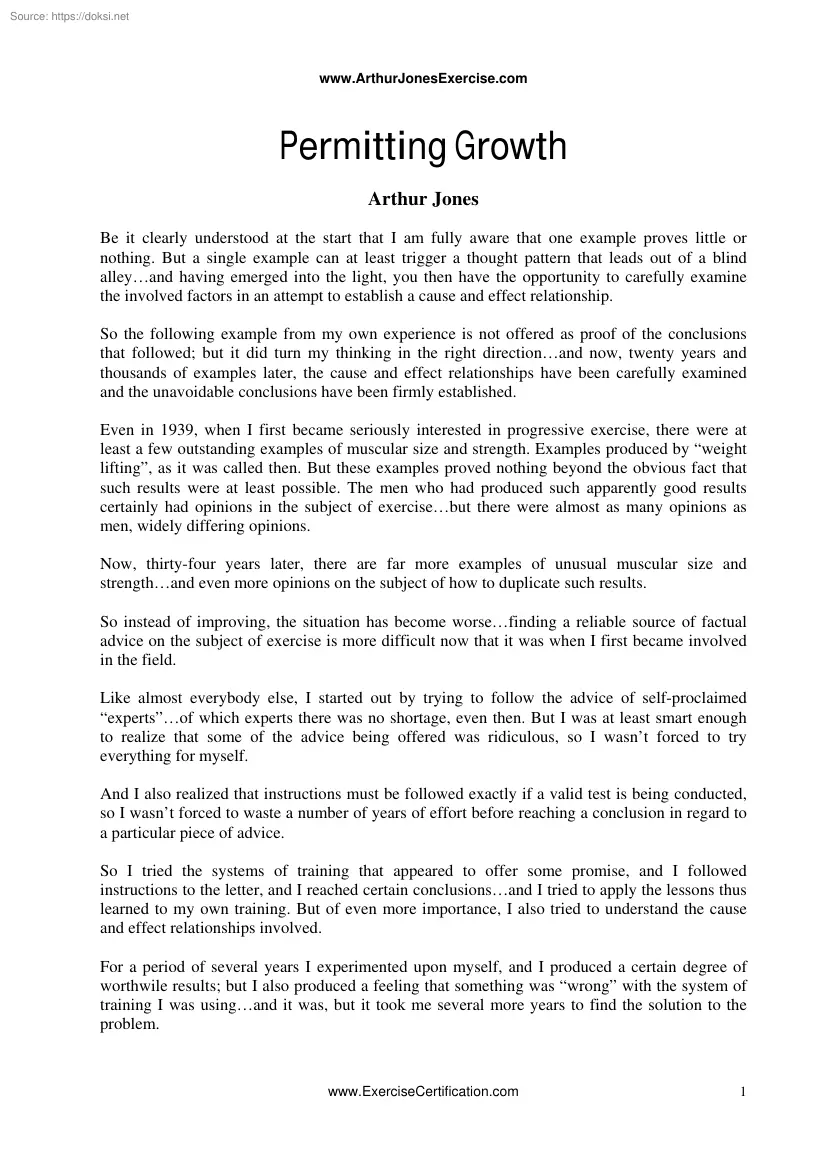
www.ArthurJonesExercisecom Permitting Growth Arthur Jones Be it clearly understood at the start that I am fully aware that one example proves little or nothing. But a single example can at least trigger a thought pattern that leads out of a blind alleyand having emerged into the light, you then have the opportunity to carefully examine the involved factors in an attempt to establish a cause and effect relationship. So the following example from my own experience is not offered as proof of the conclusions that followed; but it did turn my thinking in the right directionand now, twenty years and thousands of examples later, the cause and effect relationships have been carefully examined and the unavoidable conclusions have been firmly established. Even in 1939, when I first became seriously interested in progressive exercise, there were at least a few outstanding examples of muscular size and strength. Examples produced by “weight lifting”, as it was called then. But these examples
proved nothing beyond the obvious fact that such results were at least possible. The men who had produced such apparently good results certainly had opinions in the subject of exercisebut there were almost as many opinions as men, widely differing opinions. Now, thirty-four years later, there are far more examples of unusual muscular size and strengthand even more opinions on the subject of how to duplicate such results. So instead of improving, the situation has become worsefinding a reliable source of factual advice on the subject of exercise is more difficult now that it was when I first became involved in the field. Like almost everybody else, I started out by trying to follow the advice of self-proclaimed “experts”of which experts there was no shortage, even then. But I was at least smart enough to realize that some of the advice being offered was ridiculous, so I wasn’t forced to try everything for myself. And I also realized that instructions must be followed exactly if a
valid test is being conducted, so I wasn’t forced to waste a number of years of effort before reaching a conclusion in regard to a particular piece of advice. So I tried the systems of training that appeared to offer some promise, and I followed instructions to the letter, and I reached certain conclusionsand I tried to apply the lessons thus learned to my own training. But of even more importance, I also tried to understand the cause and effect relationships involved. For a period of several years I experimented upon myself, and I produced a certain degree of worthwile results; but I also produced a feeling that something was “wrong” with the system of training I was usingand it was, but it took me several more years to find the solution to the problem. www.ExerciseCertificationcom 1 www.ArthurJonesExercisecom And in the end, the answer was not the product of a flashing bit of logical insight; instead, it was forced upon me literally be accident. Like almost everybody
else, I had been guilty of overtraining, of training far too much, of equating “more” with “better”. And the evidence had been in plain sight all the time, but was ignored because it wasn’t understood. For years I had been stimulating growth, but I had not been PERMITTING growth. I created the need for growth, but denied the means. Starting at a bodyweight of 132 pounds, I increased my weight by exactly 40 pounds, to a bodyweight of 172 pounds; but regardless of any continued efforts, I reached a firm sticking point at that bodyweight. Over a period of nearly fifteen years my training was conducted in an “on again, off again” fashion. I would train hard for a few months and then would stop training entirely for another few months, or even years. During a long layoff from exercise of any kind, my bodyweight would drop to 160 pounds, and would remain at that level. But as soon as I started training again my weight would increase very rapidlyup to a point, a certain, exact
point, beyond which I could not gain. So my bodyweight varied between 160 pounds and 172 pounds28 pounds of the weight I had added by exercise remaining as a permanent gain; but 12 pounds of it being temporary, remaining only as long as I continued training. During those years I gradually settled upon an exact training routine that was seldom varied. I trained three times weekly, for a period of more than three hours during each workout, using twelve basic barbell exercises and performing four “sets” of each exercise. A total of 48 sets during each workout. The number of repetitions in each set was normally from eight to ten, but I always trained as hard as possible, performing as many repetitions as possible and stopping only when I reached a point of momentary muscular failure. If I was able to perform ten or more repetitions during a particular workout, then I increased the resistance during the next workout, and I constantly pushed in an effort to progressalways trying to
increase either the amount of resistance or the number of repetitions, or both. Even a few weeks of such hard training would rapidly increase my bodyweight to a level of 172 pounds, with muscular measurements and strength levels in proportion; but no amount of continued training would produce the slightest evidence of progress beyond that point. Having been “up and down” several times over a period of fifteen years, I finally reached a point where I could exactly predict my muscular measurements and strength levels at any given bodyweightbut I couldn’t get any heavier, nor stronger. Since I didn’t think I had reached the limits of my potential, I felt that something was wrongand it was, but it took me a long time to find the answer. 2 www.ExerciseCertificationcom www.ArthurJonesExercisecom Eventually, when I did find the answer, it was literally forced upon me by accident. At the age of about thirty, having been “up and down” approximately a dozen times over a period
of years, I was again stuck at a bodyweight of 172 pounds and had produced no sign of progress during several weeks of steady, hard training. I was ready to quit again, convinced that I was wasting my time and efforts, when I decided to try something newinstead of stopping training entirely, I decided to cut my workouts in half, to reduce the amount of training by exactly 50%. Previously, upon reaching this same sticking point I had always stopped training entirely; but this time I simply reduced the amount of training. Otherwise, everything remained the same; the same three weekly workouts, the same exercises, the same arrangement of exercisesexcept the number of sets, instead of the previously practiced four sets of each exercise I performed only two sets of each exercise. And I immediately started growing, rapidly growing. Within a week I added nearly ten pounds of bodyweight, increased the size of my arms exactly half an inch, and greatly increased my strengthquickly reaching a
bodyweight, muscular size, and strength level that I had previously found impossible to attain. After the first week I was forced to stop training for nearly a year, I was flying internationally and a change in my schedule made it impossible to continue training; but the experience of that final week of training had not been overlooked, the implications were simply to obvious to missa 50% reduction in the amount of my training had produced progress that had previously been impossible. During the following year I had neither the time nor the opportunity to train, but I did have a lot of time to think about the implications of that brief experiment. So when I started training again I decided to try an even greater reduction in the amount of traininginstead of performing 4 sets of 12 exercises, I used only 2 sets of 8 exercises, thus reducing the length of my workouts from 48 sets to only 16 sets. The change in the production of results was almost more than I could believe; while training
only a third as much as I had previously, I produced far better resultsgrowth was apparent as a result of every single workout, and I quickly reached my previous sticking point and passed trough it with no slightest pause. The previously practiced longer workouts had obviously been stimulating growthbut they had not been PERMITTING growth, at least not beyond a certain point. Now, approximately twenty years after that first clear lesson was forced upon me by accident, the cause and effect relationships involved in my early training experience are simply undeniable; in the meantime having been confirmed and reconfirmed by thousands of other examples. But it certainly does not follow that this same lesson has been learned by everybody On the contrary, the seemingly natural inclination to equate “more” with “better” still persists; so many thousands of trainees still make the same mistake that I made more than thirty years ago. www.ExerciseCertificationcom 3
www.ArthurJonesExercisecom And in the light of my own experience, I can certainly understand why they make such a mistakeafter all, I continued making the exact same mistake for nearly fifteen years before the truth of the matter finally came trough to me by accident. So it was a hard lesson for me to learnand perhaps I am expecting a bit too much of other people when I expect them to learn the same lesson quickly and easily. Some people do, but some don’tand some apparently never will, remaining firmly if falsely convinced that a literally enormous amount of training is an absolute requirement. When the fact is that such training will literally prevent the production of worthwhile results. But when a genetic freak comes upon the scene with an outstanding degree of muscular size and strength and loudly proclaims himself an “expert”, and points to his own results as undeniable proof that his methods are bestand when he firmly states that he devotes almost every walking hour to
his trainingthen I suppose that it is perfectly natural for many people to pay attention to his words. So perfectly natural it may be, but it is almost always a mistake. I have yet to meet a single example of such a man who had even a basic understanding of the actual cause and effect relationships involved in exercise. Such people are simply statistical standouts, genetic freaksand have produced their obvious results almost in spite of their efforts, rather that as a results of any real knowledge. And it must be understood that “outstanding results” or “obvious results” do not prove the value of a particular methoduntil and unless they are considered in relation to the amount of time and effort that were involved in producing them. Everything has a price, and everything has a valueif the price paid by many trainees is really the required price, then the results are simply not worth it. But in fact, the actual price required for the production of maximum possible results from
exercise is quite lowliterally must be low. Eventually, this will be understood by almost everybodybut in the meantime, millions of people are wasting billions of hours of training time, while doing much more in the way of preventing the results than they are in the direction of producing results. Having thus wasted at least a thousand hours of my own time, I can understand just how this has come aboutbut having finally learned my lesson, I now produce far better results form a tiny percentage of the previous training time. Finally, in an effort to determine just how little training was actually required for the production of large scale, rapid increases in muscular size and strength, we conducted the Colorado Experiment during the month of May, 1973. In the following four chapters, this experiment will be covered in detail. 4 www.ExerciseCertificationcom
proved nothing beyond the obvious fact that such results were at least possible. The men who had produced such apparently good results certainly had opinions in the subject of exercisebut there were almost as many opinions as men, widely differing opinions. Now, thirty-four years later, there are far more examples of unusual muscular size and strengthand even more opinions on the subject of how to duplicate such results. So instead of improving, the situation has become worsefinding a reliable source of factual advice on the subject of exercise is more difficult now that it was when I first became involved in the field. Like almost everybody else, I started out by trying to follow the advice of self-proclaimed “experts”of which experts there was no shortage, even then. But I was at least smart enough to realize that some of the advice being offered was ridiculous, so I wasn’t forced to try everything for myself. And I also realized that instructions must be followed exactly if a
valid test is being conducted, so I wasn’t forced to waste a number of years of effort before reaching a conclusion in regard to a particular piece of advice. So I tried the systems of training that appeared to offer some promise, and I followed instructions to the letter, and I reached certain conclusionsand I tried to apply the lessons thus learned to my own training. But of even more importance, I also tried to understand the cause and effect relationships involved. For a period of several years I experimented upon myself, and I produced a certain degree of worthwile results; but I also produced a feeling that something was “wrong” with the system of training I was usingand it was, but it took me several more years to find the solution to the problem. www.ExerciseCertificationcom 1 www.ArthurJonesExercisecom And in the end, the answer was not the product of a flashing bit of logical insight; instead, it was forced upon me literally be accident. Like almost everybody
else, I had been guilty of overtraining, of training far too much, of equating “more” with “better”. And the evidence had been in plain sight all the time, but was ignored because it wasn’t understood. For years I had been stimulating growth, but I had not been PERMITTING growth. I created the need for growth, but denied the means. Starting at a bodyweight of 132 pounds, I increased my weight by exactly 40 pounds, to a bodyweight of 172 pounds; but regardless of any continued efforts, I reached a firm sticking point at that bodyweight. Over a period of nearly fifteen years my training was conducted in an “on again, off again” fashion. I would train hard for a few months and then would stop training entirely for another few months, or even years. During a long layoff from exercise of any kind, my bodyweight would drop to 160 pounds, and would remain at that level. But as soon as I started training again my weight would increase very rapidlyup to a point, a certain, exact
point, beyond which I could not gain. So my bodyweight varied between 160 pounds and 172 pounds28 pounds of the weight I had added by exercise remaining as a permanent gain; but 12 pounds of it being temporary, remaining only as long as I continued training. During those years I gradually settled upon an exact training routine that was seldom varied. I trained three times weekly, for a period of more than three hours during each workout, using twelve basic barbell exercises and performing four “sets” of each exercise. A total of 48 sets during each workout. The number of repetitions in each set was normally from eight to ten, but I always trained as hard as possible, performing as many repetitions as possible and stopping only when I reached a point of momentary muscular failure. If I was able to perform ten or more repetitions during a particular workout, then I increased the resistance during the next workout, and I constantly pushed in an effort to progressalways trying to
increase either the amount of resistance or the number of repetitions, or both. Even a few weeks of such hard training would rapidly increase my bodyweight to a level of 172 pounds, with muscular measurements and strength levels in proportion; but no amount of continued training would produce the slightest evidence of progress beyond that point. Having been “up and down” several times over a period of fifteen years, I finally reached a point where I could exactly predict my muscular measurements and strength levels at any given bodyweightbut I couldn’t get any heavier, nor stronger. Since I didn’t think I had reached the limits of my potential, I felt that something was wrongand it was, but it took me a long time to find the answer. 2 www.ExerciseCertificationcom www.ArthurJonesExercisecom Eventually, when I did find the answer, it was literally forced upon me by accident. At the age of about thirty, having been “up and down” approximately a dozen times over a period
of years, I was again stuck at a bodyweight of 172 pounds and had produced no sign of progress during several weeks of steady, hard training. I was ready to quit again, convinced that I was wasting my time and efforts, when I decided to try something newinstead of stopping training entirely, I decided to cut my workouts in half, to reduce the amount of training by exactly 50%. Previously, upon reaching this same sticking point I had always stopped training entirely; but this time I simply reduced the amount of training. Otherwise, everything remained the same; the same three weekly workouts, the same exercises, the same arrangement of exercisesexcept the number of sets, instead of the previously practiced four sets of each exercise I performed only two sets of each exercise. And I immediately started growing, rapidly growing. Within a week I added nearly ten pounds of bodyweight, increased the size of my arms exactly half an inch, and greatly increased my strengthquickly reaching a
bodyweight, muscular size, and strength level that I had previously found impossible to attain. After the first week I was forced to stop training for nearly a year, I was flying internationally and a change in my schedule made it impossible to continue training; but the experience of that final week of training had not been overlooked, the implications were simply to obvious to missa 50% reduction in the amount of my training had produced progress that had previously been impossible. During the following year I had neither the time nor the opportunity to train, but I did have a lot of time to think about the implications of that brief experiment. So when I started training again I decided to try an even greater reduction in the amount of traininginstead of performing 4 sets of 12 exercises, I used only 2 sets of 8 exercises, thus reducing the length of my workouts from 48 sets to only 16 sets. The change in the production of results was almost more than I could believe; while training
only a third as much as I had previously, I produced far better resultsgrowth was apparent as a result of every single workout, and I quickly reached my previous sticking point and passed trough it with no slightest pause. The previously practiced longer workouts had obviously been stimulating growthbut they had not been PERMITTING growth, at least not beyond a certain point. Now, approximately twenty years after that first clear lesson was forced upon me by accident, the cause and effect relationships involved in my early training experience are simply undeniable; in the meantime having been confirmed and reconfirmed by thousands of other examples. But it certainly does not follow that this same lesson has been learned by everybody On the contrary, the seemingly natural inclination to equate “more” with “better” still persists; so many thousands of trainees still make the same mistake that I made more than thirty years ago. www.ExerciseCertificationcom 3
www.ArthurJonesExercisecom And in the light of my own experience, I can certainly understand why they make such a mistakeafter all, I continued making the exact same mistake for nearly fifteen years before the truth of the matter finally came trough to me by accident. So it was a hard lesson for me to learnand perhaps I am expecting a bit too much of other people when I expect them to learn the same lesson quickly and easily. Some people do, but some don’tand some apparently never will, remaining firmly if falsely convinced that a literally enormous amount of training is an absolute requirement. When the fact is that such training will literally prevent the production of worthwhile results. But when a genetic freak comes upon the scene with an outstanding degree of muscular size and strength and loudly proclaims himself an “expert”, and points to his own results as undeniable proof that his methods are bestand when he firmly states that he devotes almost every walking hour to
his trainingthen I suppose that it is perfectly natural for many people to pay attention to his words. So perfectly natural it may be, but it is almost always a mistake. I have yet to meet a single example of such a man who had even a basic understanding of the actual cause and effect relationships involved in exercise. Such people are simply statistical standouts, genetic freaksand have produced their obvious results almost in spite of their efforts, rather that as a results of any real knowledge. And it must be understood that “outstanding results” or “obvious results” do not prove the value of a particular methoduntil and unless they are considered in relation to the amount of time and effort that were involved in producing them. Everything has a price, and everything has a valueif the price paid by many trainees is really the required price, then the results are simply not worth it. But in fact, the actual price required for the production of maximum possible results from
exercise is quite lowliterally must be low. Eventually, this will be understood by almost everybodybut in the meantime, millions of people are wasting billions of hours of training time, while doing much more in the way of preventing the results than they are in the direction of producing results. Having thus wasted at least a thousand hours of my own time, I can understand just how this has come aboutbut having finally learned my lesson, I now produce far better results form a tiny percentage of the previous training time. Finally, in an effort to determine just how little training was actually required for the production of large scale, rapid increases in muscular size and strength, we conducted the Colorado Experiment during the month of May, 1973. In the following four chapters, this experiment will be covered in detail. 4 www.ExerciseCertificationcom
 Orosz regényíró, elbeszélőTolsztoj gróf 1828. szeptember 9-én született Jasznaja Poljánában, Tula közelében.Szüleit korán elveszti, neveltetéséről rokonai gondoskodnak. 1844-ben keleti nyelveket tanul a kazányi egyetemen, majd jogi tanulmányokba kezd, de hamarosan azokat is félbehagyja. Szalonoknak és báloknak lesz gyakori vendége. Egyszerre jellemzi Tolsztojt ekkortájt a

