A doksi online olvasásához kérlek jelentkezz be!
A doksi online olvasásához kérlek jelentkezz be!
 2003 · 3 oldal (76 KB)
 magyar
 516
516
 2008. május 04.
 Bejelentkezés szükséges

 Beágyazás
Nincs még értékelés. Legyél Te az első!





Tartalmi kivonat
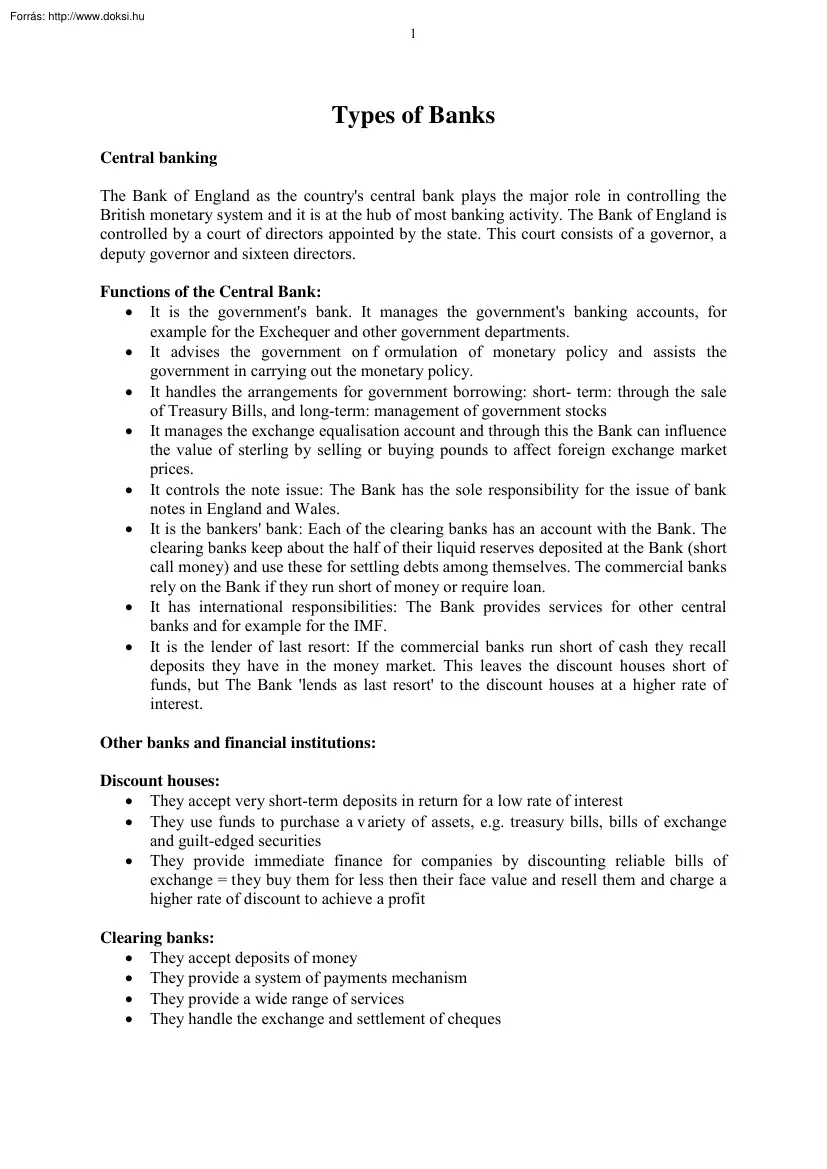
1 Types of Banks Central banking The Bank of England as the country's central bank plays the major role in controlling the British monetary system and it is at the hub of most banking activity. The Bank of England is controlled by a court of directors appointed by the state. This court consists of a governor, a deputy governor and sixteen directors. Functions of the Central Bank: • It is the government's bank. It manages the government's banking accounts, for example for the Exchequer and other government departments. • It advises the government on f ormulation of monetary policy and assists the government in carrying out the monetary policy. • It handles the arrangements for government borrowing: short- term: through the sale of Treasury Bills, and long-term: management of government stocks • It manages the exchange equalisation account and through this the Bank can influence the value of sterling by selling or buying pounds to affect foreign exchange market
prices. • It controls the note issue: The Bank has the sole responsibility for the issue of bank notes in England and Wales. • It is the bankers' bank: Each of the clearing banks has an account with the Bank. The clearing banks keep about the half of their liquid reserves deposited at the Bank (short call money) and use these for settling debts among themselves. The commercial banks rely on the Bank if they run short of money or require loan. • It has international responsibilities: The Bank provides services for other central banks and for example for the IMF. • It is the lender of last resort: If the commercial banks run short of cash they recall deposits they have in the money market. This leaves the discount houses short of funds, but The Bank 'lends as last resort' to the discount houses at a higher rate of interest. Other banks and financial institutions: Discount houses: • They accept very short-term deposits in return for a low rate of interest • They
use funds to purchase a v ariety of assets, e.g treasury bills, bills of exchange and guilt-edged securities • They provide immediate finance for companies by discounting reliable bills of exchange = they buy them for less then their face value and resell them and charge a higher rate of discount to achieve a profit Clearing banks: • They accept deposits of money • They provide a system of payments mechanism • They provide a wide range of services • They handle the exchange and settlement of cheques 2 Trustee Savings Bank (TSB) It is a fully fledged bank that offers a variety of services similar to the other clearing banks: current, deposit, savings and investment account, credit transfer facilities, overdrafts, personal and mortgage loans, combined credit and cheque guarantee card, travel cheques and foreign currency. State banks The National Savings Bank operated through the Post office The National Girobank: financially independent from the Post Office Merchant banks
They are private firms that offer highly specialised services almost exclusively for business customers. Their main activities: • Acceptance house activities: they lend their name to a bill of exchange issued by less well-known traders, so that it becomes more acceptable because of the bank's good reputation. They confirm the buyer’s ability to pay for the product • Issuing house activities: they sponsor first issues of companies' shares , and they are intermediaries between companies seeking capital and those willing to provide it. • Capital market activities: they accept larger deposits, provide finance for hirepurchase, advise on company problems such as capital reorganisations, offer consultancy services etc. Foreign banks There area bout 400 foreign banks in London. They provide services and credit to companies from their own countries operating in Britain, but some of them make substantial sterling loans to British borrowers, too. Banking in the USA In 1913, the
Congress established the Federal Reserve System and required all national banks to belong to this system. State banks were invited to join and many did Now most American banks belong to the FRS, which regulates banking in America. The nation is divided into 12 Federal Reserve Districts. There is one Federal Reserve Bank in each district. They operate under the centralised control of the Federal Reserve Board in Washington. It consists of 7 members appointed by the President and approved by the Senate for a 14-year term. This Board makes most of the major decisions for FRS The Federal Reserve Banks do not business with individuals or business firms. They serve only the Federal Government and the members banks of FRS. The Federal Reserve Banks serve two main purposes: • The Federal Government uses them to handle its own banking needs. The Federal Reserve Banks also handle the sale of bonds issued by the US Administration • The Federal Reserve Banks provide important services to the
member banks. Member banks are required by law to set aside a part of their depositors' money . This is called 3 their reserve and each bank must deposit its reserve in the FRB that serves its Federal Reserve District. Vocabulary Deposit Treasury bill Gilt-edged securities Bill of exchange To discount a bill of exchange Clearing Banks Savings bank betét (bank témakörben), de lehet letét is Kincstárjegy Biztonságos államkötvények Idegenváltó; váltó = feltétel nélküli fizetési felszólítás, amit vki aláírásával kiállít vki másnak; a cí mzettet arra utasítja, hogy meghatározott időben fizessen ki egy adott összeget vagy egy bizonyos személy számára, vagy a dokumentum bemutatójának. váltót leszámítolni, diszkontálni klíring bankok, zsíró bankok = olyan bankok, melyek tagjai a London Bankers Clearing Bank Association-nek, mely lehetővé teszi a csekk- és készpénzforgalom elszámolását Angliában takarékpénztár Overdraft
számlahitel, hiteltúllépés = folyószámlahitel, meghatározott határértékig változó összeggel To buy on the hire-purchase system Acceptance house/ accepting house részletre vásárol váltóbank; olyan pénzintézet, melynek tevékenységei közé tartozik a váltók értékesítése akár elfogadással, akár garanciával. Valójában garantálja az áruk vásárlójának vagy importőrének pénzügyi helyzetét azzal, hogy vállalja a váltókötelezettséget, azaz aláírásával igazolja, megerősíti, hogy a vevő illetve az importőr az árut ki tudja fizetni kibocsátóház; olyan pénzintézet, mely a vállalatok tőzsdei bevezetésében, illetve részvényeik kihelyezésében és a tőkenövekedést célzó további tranzakciók lebonyolításában segédkezik szakosodott kereskedelmi bank Issuing house Merchant bank
prices. • It controls the note issue: The Bank has the sole responsibility for the issue of bank notes in England and Wales. • It is the bankers' bank: Each of the clearing banks has an account with the Bank. The clearing banks keep about the half of their liquid reserves deposited at the Bank (short call money) and use these for settling debts among themselves. The commercial banks rely on the Bank if they run short of money or require loan. • It has international responsibilities: The Bank provides services for other central banks and for example for the IMF. • It is the lender of last resort: If the commercial banks run short of cash they recall deposits they have in the money market. This leaves the discount houses short of funds, but The Bank 'lends as last resort' to the discount houses at a higher rate of interest. Other banks and financial institutions: Discount houses: • They accept very short-term deposits in return for a low rate of interest • They
use funds to purchase a v ariety of assets, e.g treasury bills, bills of exchange and guilt-edged securities • They provide immediate finance for companies by discounting reliable bills of exchange = they buy them for less then their face value and resell them and charge a higher rate of discount to achieve a profit Clearing banks: • They accept deposits of money • They provide a system of payments mechanism • They provide a wide range of services • They handle the exchange and settlement of cheques 2 Trustee Savings Bank (TSB) It is a fully fledged bank that offers a variety of services similar to the other clearing banks: current, deposit, savings and investment account, credit transfer facilities, overdrafts, personal and mortgage loans, combined credit and cheque guarantee card, travel cheques and foreign currency. State banks The National Savings Bank operated through the Post office The National Girobank: financially independent from the Post Office Merchant banks
They are private firms that offer highly specialised services almost exclusively for business customers. Their main activities: • Acceptance house activities: they lend their name to a bill of exchange issued by less well-known traders, so that it becomes more acceptable because of the bank's good reputation. They confirm the buyer’s ability to pay for the product • Issuing house activities: they sponsor first issues of companies' shares , and they are intermediaries between companies seeking capital and those willing to provide it. • Capital market activities: they accept larger deposits, provide finance for hirepurchase, advise on company problems such as capital reorganisations, offer consultancy services etc. Foreign banks There area bout 400 foreign banks in London. They provide services and credit to companies from their own countries operating in Britain, but some of them make substantial sterling loans to British borrowers, too. Banking in the USA In 1913, the
Congress established the Federal Reserve System and required all national banks to belong to this system. State banks were invited to join and many did Now most American banks belong to the FRS, which regulates banking in America. The nation is divided into 12 Federal Reserve Districts. There is one Federal Reserve Bank in each district. They operate under the centralised control of the Federal Reserve Board in Washington. It consists of 7 members appointed by the President and approved by the Senate for a 14-year term. This Board makes most of the major decisions for FRS The Federal Reserve Banks do not business with individuals or business firms. They serve only the Federal Government and the members banks of FRS. The Federal Reserve Banks serve two main purposes: • The Federal Government uses them to handle its own banking needs. The Federal Reserve Banks also handle the sale of bonds issued by the US Administration • The Federal Reserve Banks provide important services to the
member banks. Member banks are required by law to set aside a part of their depositors' money . This is called 3 their reserve and each bank must deposit its reserve in the FRB that serves its Federal Reserve District. Vocabulary Deposit Treasury bill Gilt-edged securities Bill of exchange To discount a bill of exchange Clearing Banks Savings bank betét (bank témakörben), de lehet letét is Kincstárjegy Biztonságos államkötvények Idegenváltó; váltó = feltétel nélküli fizetési felszólítás, amit vki aláírásával kiállít vki másnak; a cí mzettet arra utasítja, hogy meghatározott időben fizessen ki egy adott összeget vagy egy bizonyos személy számára, vagy a dokumentum bemutatójának. váltót leszámítolni, diszkontálni klíring bankok, zsíró bankok = olyan bankok, melyek tagjai a London Bankers Clearing Bank Association-nek, mely lehetővé teszi a csekk- és készpénzforgalom elszámolását Angliában takarékpénztár Overdraft
számlahitel, hiteltúllépés = folyószámlahitel, meghatározott határértékig változó összeggel To buy on the hire-purchase system Acceptance house/ accepting house részletre vásárol váltóbank; olyan pénzintézet, melynek tevékenységei közé tartozik a váltók értékesítése akár elfogadással, akár garanciával. Valójában garantálja az áruk vásárlójának vagy importőrének pénzügyi helyzetét azzal, hogy vállalja a váltókötelezettséget, azaz aláírásával igazolja, megerősíti, hogy a vevő illetve az importőr az árut ki tudja fizetni kibocsátóház; olyan pénzintézet, mely a vállalatok tőzsdei bevezetésében, illetve részvényeik kihelyezésében és a tőkenövekedést célzó további tranzakciók lebonyolításában segédkezik szakosodott kereskedelmi bank Issuing house Merchant bank
 Ahogy közeledik a történelem érettségi, sokan döbbennek rá, hogy nem készültek fel eléggé az esszéírás feladatra. Módszertani útmutatónkban kitérünk a történet térbeli és időbeli elhelyezésére, a források elemzésére és az eseményeket alakító tényezőkre is.

