Comments
 2018 · 6 page(s) (568 KB)
 English
 3
 July 05 · 2018
 Log in

 Embed
No comments yet. You can be the first!

Content extract
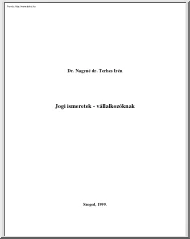
Source: http://www.doksinet IN THE COURT OF APPEALS OF TENNESSEE AT NASHVILLE 02/28/2018 October 3, 2017 Session IN RE ESTATE OF SYLVIA MARLENE TOLBERT ET AL. v STATE OF TENNESSEE Appeal from the Tennessee Claims Commission No. T20140069, T20140070 Robert N. Hibbett, Claims Commissioner No. M2017-00862-COA-R3-CV Claimants asserted monetary claims against the State of Tennessee for personal injuries and property damage resulting from an automobile accident with a state employee. The Tennessee Claims Commission found the State liable and awarded compensatory damages. On appeal, the State argues that the Claims Commission erred in awarding damages for medical expenses based on the claimants’ unadjusted medical bills. Upon review, we conclude that the collateral source rule precludes introduction of evidence of insurance adjustments to claimants’ medical bills. Accordingly, we affirm Tenn. R App P 3 Appeal as of
Right; Judgment of the Tennessee Claims Commission Affirmed W. NEAL MCBRAYER, J, delivered the opinion of the court, in which RICHARD H DINKINS and KENNY ARMSTRONG, JJ., joined Herbert H. Slatery III, Attorney General and Reporter; Andrée S Blumstein, Solicitor General; and Dawn Jordan, Senior Deputy Attorney General, for the appellant, State of Tennessee. Phillip L. Davidson, Brentwood, Tennessee, for the appellees, Sylvia Marlene Tolbert and Alvin Wayne Tindell. Source: http://www.doksinet OPINION I. The relevant facts are undisputed. On June 27, 2013, an employee of the Tennessee Emergency Management Agency, while driving a state-owned vehicle, collided with the vehicle occupied by Alvin Tindell and Sylvia Tolbert, causing personal injuries and property damage. Both Mr Tindell and Ms Tolbert filed claims against the State of Tennessee seeking compensation under the Tennessee Claims Commission Act. See Tenn. Code Ann § 9-8-307(a)(1)(A) (Supp 2017) Before trial, the claimants
filed a motion in limine to exclude any evidence of amounts paid for their medical expenses by collateral sources. In response, the State argued that the amounts deducted from the claimants’ medical bills as insurance adjustments were not precluded by the collateral source rule. Although the Claims Commission allowed the State to introduce evidence of the adjustments, the Commission withheld ruling on whether it would consider such evidence in awarding damages. At trial, the claimants produced their unadjusted medical bills as evidence of the medical expenses they incurred as a result of the accident. Ms Tolbert presented medical bills totaling $11,118.78 while Mr Tindell’s medical bills were $250,04490 The claimants also submitted expert medical testimony that their medical bills were reasonable and necessary. The State, in turn, introduced two exhibits showing that, after insurance adjustments, the claimants’ medical bills were reduced to $6,644.36 and $58,492.92, respectively
The Claims Commission ruled that the State was liable for the accident and awarded damages based on the unadjusted medical bills. The Commission held that the collateral source rule precluded consideration of the adjusted medical bills and the State had failed to rebut the claimants’ evidence that their unadjusted medical bills were reasonable and necessary. This appeal followed II. The sole issue on appeal is the proper measure of damages for medical expenses under the Tennessee Claims Commission Act. This issue presents a question of law, which we review de novo with no presumption of correctness. Beacon4, LLC v I & L Invs., LLC, 514 SW3d 153, 169 (Tenn Ct App 2016), perm app denied, (Tenn Dec 15, 2016). 2 Source: http://www.doksinet A. The State contends, as it did before the Claims Commission, that the collateral source rule does not apply to the amounts deducted as adjustments on the claimants’ medical bills based on their insurance because these amounts were never
paid by any source. In Tennessee, the collateral source rule has long prohibited “reduction of a plaintiff’s recovery [in a personal injury action] by [payments or] benefits from sources unrelated to the tortfeasor.” See Dedmon v Steelman, 535 SW3d 431, 443 (Tenn 2017). And any evidence of payments or benefits from a collateral source is inadmissible at trial. Id at 444 Those portions of a plaintiff’s medical bills that are written-off or forgiven by a source other than the tortfeasor constitute a benefit to the plaintiff which is covered by the collateral source rule. Fye v Kennedy, 991 SW2d 754, 763-64 (Tenn Ct. App 1998) The adjusted amounts at issue here are no different. See Dedmon, 535 SW3d at 467. As our supreme court has recently explained, in personal injury actions in Tennessee, the collateral source rule precludes defendants from “submitting evidence of discounted rates for medical services accepted by medical providers as a result of [the plaintiff’s]
insurance.” Id While defendants may submit other competent proof to rebut the plaintiff’s evidence that the unadjusted medical bills are reasonable, that proof cannot “contravene the collateral source rule.” Id1 B. In the wake of the Dedmon decision, the State argues that the collateral source rule, which arises from common law, has been statutorily abrogated in personal injury actions under the Tennessee Claims Commission Act. See Tenn Code Ann § 9-8307(d); Dedmon, 535 SW3d at 440 “Tennessee is a common law state, and so much of the common law as has not been abrogated or repealed by statute is in full force and effect.” Powell v Hartford Acc & Indem Co, 398 SW2d 727, 730 (Tenn 1966) As noted by our supreme court, Tennessee has partially abrogated the collateral source rule in two limited circumstances: health care liability actions and workers’ compensation cases. Dedmon, 535 SW3d at 445-46 The General Assembly “unquestionably has the constitutional and
legislative authority to change the common law” through its statutory enactments. Heirs of Ellis v Estate of Ellis, 71 S.W3d 705, 712 (Tenn 2002) But the mere existence of a statute is not enough. Cellco P’ship v Shelby Cnty, 172 SW3d 574, 591 n7 (Tenn Ct App 1 To the extent that the State asks this Court to make an exception to the collateral source rule based on West v. Shelby Cnty Health Corp, 459 SW3d 33, 44-45 (Tenn 2014), we decline to do so Our supreme court expressly limited the interpretation of “reasonable charges” in the West decision to cases arising under the Hospital Lien Act. Dedmon, 535 SW3d at 467 3 Source: http://www.doksinet 2005). We construe statutes in derogation of common law strictly Davenport v Chrysler Credit Corp., 818 SW2d 23, 28 (Tenn Ct App 1991) “Statutes do not alter the common law any further than they expressly declare or necessarily require.” Id Without a clear indication in the statute, we will not presume that the General Assembly
intended to change the common law. See Shore v Maple Lane Farms, LLC, 411 SW3d 405, 423 (Tenn. 2013) The State’s abrogation argument relies exclusively on subsection (d) of the Claims Commission Act, which provides, in relevant part: The state will be liable for actual damages only. No award shall be made unless the facts found by the commission would entitle the claimant to a judgment in an action at law if the state had been a private individual. The state will not be liable for punitive damages and the costs of litigation other than court costs. Tenn. Code Ann § 9-8-307(d) According to the State, the General Assembly chose to use the term “actual damages” rather than “compensatory damages” thereby limiting the recovery of a claimant in a personal injury action against the State to actual amounts paid for medical expenses. Although “actual damages” is not defined in the Claims Commission Act, Tennessee courts have generally equated “actual damages” with
“compensatory damages.” See, eg, Whittington v Grand Valley Lakes, Inc, 547 SW2d 241, 243 (Tenn. 1977) (discussing “general rule in this jurisdiction that actual or compensatory damages must be found as a predicate for the recovery of punitive damages”); Emerson v. Garner, 732 S.W2d 613, 614-15 (Tenn Ct App 1987) (referring to “actual or compensatory damages”); Caccamisi v. Thurmond, 282 SW2d 633, 645-46 (Tenn Ct App. 1954) (holding jury verdict, which “allowed a recovery of $5,000 actual or compensatory damages, and $5,000 punitive damages” was excessive); see also Damages, Black’s Law Dictionary (10th ed. 2014) (treating “actual damages” and “compensatory damages” as synonymous terms). And when our courts have been called upon to interpret the term “actual damages” in other statutes, they have construed it to mean “compensatory damages.” See Robinson v Fulliton, 140 SW3d 312, 317 (Tenn Ct. App 2003) (treating the award of actual damages under the
Wiretapping and Electronic Surveillance Act of 1994 as compensatory damages); Gifford v. Premier Mfg Corp., No 18, 1989 WL 85752, at *6 (Tenn. Ct App Aug 1, 1989) (holding that “actual damages and compensatory damages are synonymous, and that the legislature’s use of the term actual damages indicated its intent that a plaintiff under [the Human Rights Act] is entitled to recover all items of damages normally included in the definition of compensatory damages”); Taff v. Media Gen Broad Servs, Inc, No 32, 1986 WL 12240, at *5 (Tenn. Ct App Nov 3, 1986) (construing “actual damages” in Tennessee Human Rights Act as synonymous with “compensatory damages”). 4 Source: http://www.doksinet Given these precedents, we find the State’s contention that the General Assembly intended for “actual damages” to mean “actual amount paid” rather than “compensatory damages” unpersuasive. When a statute contains a term with a well-recognized common law meaning, we will apply
the common law meaning unless a different meaning is apparent from the context or general purpose of the statute. See Lively v Am Zinc Co, 191 S.W 975, 978 (Tenn 1917); see also Taylor v State, No 02A01-91090BC-00182, 1991 WL 268357, at *2-3 (Tenn. Ct App Dec 18, 1991) (stating that when the General Assembly enacted the Claims Commission Act it was well aware of the established meaning of the term “damages” as “the pecuniary consequences which the law imposes for the breach of some duty or the violation of some right.”) (quoting 22 AM JUR 2D, Damages § 1 (1988)).2 Nothing in the Claims Commission Act indicates that the General Assembly intended to deviate from the well-recognized common law meaning of “actual damages.” Thus, the language used in subsection (d) falls far short of the clear expression of legislative intent necessary to abrogate the collateral source rule. Our conclusion is buttressed by a comparison of the language used in subsection (d) to the language the
General Assembly used to abrogate the collateral source rule in health care liability actions. See Tenn Code Ann § 29-26-119 (2012) There, the General Assembly expressly limited recoverable damages to: actual economic losses suffered by the claimant by reason of the personal injury, including, but not limited to, cost of reasonable and necessary medical care, rehabilitation services, and custodial care, loss of services and loss of earned income, but only to the extent that such costs are not paid or payable and such losses are not replaced, or indemnified in whole or in part, by insurance provided by an employer either governmental or private, by social security benefits, service benefit programs, unemployment benefits, or any other source except the assets of the claimant or of the members of the claimant’s immediate family and insurance purchased in whole or in part, privately and individually. Id. If the General Assembly had intended to limit the State’s liability under the
Claims Commission Act to “actual amounts paid,” it could have said so. Without a clear expression of legislative intent, we cannot presume that the General Assembly intended to abrogate the collateral source rule in personal injury actions before the Claims Commission. See Shore, 411 SW3d at 423 We conclude that the collateral source rule precluded consideration of the amounts deducted as adjustments to the claimant’s medical bills based on their insurance. See Dedmon, 535 SW3d at 467 2 The issue in Taylor was whether the monetary cap on “damages” in subsection (e) of the Claims Commission Act prevented the Claims Commission from awarding post-judgment interest. Taylor, 1991 WL 268357, at *1. 5 Source: http://www.doksinet III. For the foregoing reasons, we affirm the decision of the Tennessee Claims Commission. W. NEAL MCBRAYER, JUDGE 6