Comments
 2019 · 1 page(s) (1 MB)
 English
 3
3
 November 18 2019
 Logging in required
 Embed
Embed
No comments yet. You can be the first!
What did others read after this?




Content extract
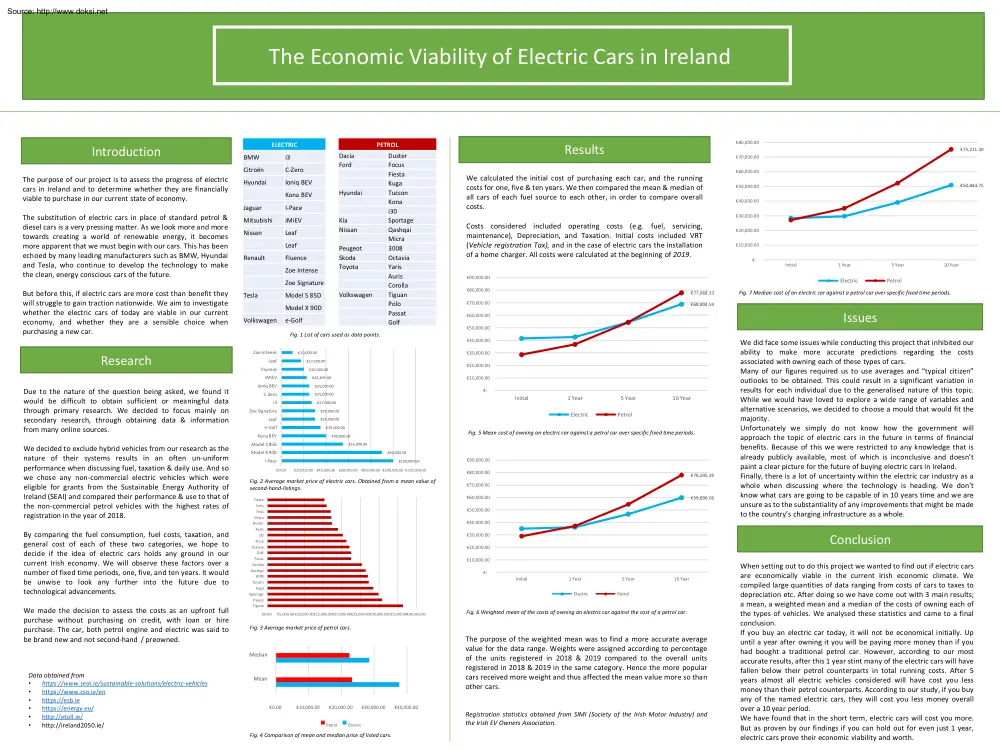
Source: http://www.doksinet The Economic Viability of Electric Cars in Ireland Introduction The purpose of our project is to assess the progress of electric cars in Ireland and to determine whether they are financially viable to purchase in our current state of economy. The substitution of electric cars in place of standard petrol & diesel cars is a very pressing matter. As we look more and more towards creating a world of renewable energy, it becomes more apparent that we must begin with our cars. This has been echoed by many leading manufacturers such as BMW, Hyundai and Tesla, who continue to develop the technology to make the clean, energy conscious cars of the future. ELECTRIC PETROL Dacia Ford BMW i3 Citroën C-Zero Hyundai Ioniq BEV Hyundai Kona BEV Jaguar I-Pace Mitsubishi iMiEV Nissan Leaf Kia Nissan Leaf Renault Peugeot Skoda Toyota Fluence Zoe Intense Zoe Signature But before this, if electric cars are more cost than benefit they will struggle to
gain traction nationwide. We aim to investigate whether the electric cars of today are viable in our current economy, and whether they are a sensible choice when purchasing a new car. Tesla Volkswagen Model S 85D Model X 90D Volkswagen e-Golf Duster Focus Fiesta Kuga Tucson Kona i30 Sportage Qashqai Micra 3008 Octavia Yaris Auris Corolla Tiguan Polo Passat Golf €80,000.00 Results €75,211.30 €70,000.00 €60,000.00 We calculated the initial cost of purchasing each car, and the running costs for one, five & ten years. We then compared the mean & median of all cars of each fuel source to each other, in order to compare overall costs. Due to the nature of the question being asked, we found it would be difficult to obtain sufficient or meaningful data through primary research. We decided to focus mainly on secondary research, through obtaining data & information from many online sources. We decided to exclude hybrid vehicles from our research as the nature of
their systems results in an often un-uniform performance when discussing fuel, taxation & daily use. And so we chose any non-commercial electric vehicles which were eligible for grants from the Sustainable Energy Authority of Ireland (SEAI) and compared their performance & use to that of the non-commercial petrol vehicles with the highest rates of registration in the year of 2018. By comparing the fuel consumption, fuel costs, taxation, and general cost of each of these two categories, we hope to decide if the idea of electric cars holds any ground in our current Irish economy. We will observe these factors over a number of fixed time periods, one, five, and ten years. It would be unwise to look any further into the future due to technological advancements. We made the decision to assess the costs as an upfront full purchase without purchasing on credit, with loan or hire purchase. The car, both petrol engine and electric was said to be brand new and not second-hand / preowned.
€90,000.00 €20,000.00 €10,000.00 €- Initial 1 Year Electric €80,000.00 €77,868.33 €70,000.00 5 Year 10 Year Petrol Fig. 7 Median cost of an electric car against a petrol car over specific fixed time periods €68,804.59 Issues €60,000.00 €50,000.00 Fig. 1 List of cars used as data points Zoe Intense €30,000.00 €10,000.00 Leaf €17,500.00 Fluence €20,000.00 iMiEV €22,495.00 Ioniq BEV €25,000.00 C-Zero €25,000.00 i3 €27,000.00 €20,000.00 €10,000.00 Zoe Signature €30,000.00 Leaf €30,000.00 e-Golf €- Initial 1 Year 5 Year Electric Petrol 10 Year €35,000.00 Kona BEV Fig. 5 Mean cost of owning an electric car against a petrol car over specific fixed time periods €40,000.00 Model S 85D €55,000.00 Model X 90D €90,000.00 I-Pace €100,000.00 €0.00 €20,000.00 €40,00000 €60,00000 €80,00000 €100,00000 €120,00000 Fig. 2 Average market price of electric cars Obtained from a mean
value of second-hand-listings. €90,000.00 €80,000.00 €78,045.29 €70,000.00 €60,000.00 Fiesta Yaris Polo Micra Duster Auris i30 Kona Octavia Golf Focus Corolla Qashqai 3008 Tucson Kuga Sportage Passat Tiguan €59,836.06 €50,000.00 We did face some issues while conducting this project that inhibited our ability to make more accurate predictions regarding the costs associated with owning each of these types of cars. Many of our figures required us to use averages and “typical citizen” outlooks to be obtained. This could result in a significant variation in results for each individual due to the generalised nature of this topic. While we would have loved to explore a wide range of variables and alternative scenarios, we decided to choose a mould that would fit the majority. Unfortunately we simply do not know how the government will approach the topic of electric cars in the future in terms of financial benefits. Because of this we were restricted to any knowledge
that is already publicly available, most of which is inconclusive and doesn’t paint a clear picture for the future of buying electric cars in Ireland. Finally, there is a lot of uncertainty within the electric car industry as a whole when discussing where the technology is heading. We don’t know what cars are going to be capable of in 10 years time and we are unsure as to the substantiality of any improvements that might be made to the country’s charging infrastructure as a whole. €40,000.00 €30,000.00 Conclusion €20,000.00 €10,000.00 €Initial 1 Year Electric €0.00 €5,000.00 €10,00000€15,00000€20,00000€25,00000€30,00000€35,00000€40,00000 5 Year 10 Year Petrol Fig. 6 Weighted mean of the costs of owning an electric car against the cost of a petrol car Fig. 3 Average market price of petrol cars The purpose of the weighted mean was to find a more accurate average value for the data range. Weights were assigned according to percentage of the
units registered in 2018 & 2019 compared to the overall units registered in 2018 & 2019 in the same category. Hence the more popular cars received more weight and thus affected the mean value more so than other cars. Median Data obtained from • https://www.seaiie/sustainable-solutions/electric-vehicles • https://www.csoie/en • https://esb.ie • https://energy.eu/ • http://etoll.ie/ • http://ireland2050.ie/ €40,000.00 €30,000.00 Costs considered included operating costs (e.g fuel, servicing, maintenance), Depreciation, and Taxation. Initial costs included VRT (Vehicle registration Tax), and in the case of electric cars the installation of a home charger. All costs were calculated at the beginning of 2019 €40,000.00 Research €50,843.75 €50,000.00 Mean €0.00 €10,000.00 €20,000.00 Petrol €30,000.00 Electric Fig. 4 Comparison of mean and median price of listed cars €40,000.00 Registration statistics obtained from SIMI (Society of the
Irish Motor Industry) and the Irish EV Owners Association. When setting out to do this project we wanted to find out if electric cars are economically viable in the current Irish economic climate. We compiled large quantities of data ranging from costs of cars to taxes to depreciation etc. After doing so we have come out with 3 main results; a mean, a weighted mean and a median of the costs of owning each of the types of vehicles. We analysed these statistics and came to a final conclusion. If you buy an electric car today, it will not be economical initially. Up until a year after owning it you will be paying more money than if you had bought a traditional petrol car. However, according to our most accurate results, after this 1 year stint many of the electric cars will have fallen below their petrol counterparts in total running costs. After 5 years almost all electric vehicles considered will have cost you less money than their petrol counterparts. According to our study, if you
buy any of the named electric cars, they will cost you less money overall over a 10 year period. We have found that in the short term, electric cars will cost you more. But as proven by our findings if you can hold out for even just 1 year, electric cars prove their economic viability and worth
gain traction nationwide. We aim to investigate whether the electric cars of today are viable in our current economy, and whether they are a sensible choice when purchasing a new car. Tesla Volkswagen Model S 85D Model X 90D Volkswagen e-Golf Duster Focus Fiesta Kuga Tucson Kona i30 Sportage Qashqai Micra 3008 Octavia Yaris Auris Corolla Tiguan Polo Passat Golf €80,000.00 Results €75,211.30 €70,000.00 €60,000.00 We calculated the initial cost of purchasing each car, and the running costs for one, five & ten years. We then compared the mean & median of all cars of each fuel source to each other, in order to compare overall costs. Due to the nature of the question being asked, we found it would be difficult to obtain sufficient or meaningful data through primary research. We decided to focus mainly on secondary research, through obtaining data & information from many online sources. We decided to exclude hybrid vehicles from our research as the nature of
their systems results in an often un-uniform performance when discussing fuel, taxation & daily use. And so we chose any non-commercial electric vehicles which were eligible for grants from the Sustainable Energy Authority of Ireland (SEAI) and compared their performance & use to that of the non-commercial petrol vehicles with the highest rates of registration in the year of 2018. By comparing the fuel consumption, fuel costs, taxation, and general cost of each of these two categories, we hope to decide if the idea of electric cars holds any ground in our current Irish economy. We will observe these factors over a number of fixed time periods, one, five, and ten years. It would be unwise to look any further into the future due to technological advancements. We made the decision to assess the costs as an upfront full purchase without purchasing on credit, with loan or hire purchase. The car, both petrol engine and electric was said to be brand new and not second-hand / preowned.
€90,000.00 €20,000.00 €10,000.00 €- Initial 1 Year Electric €80,000.00 €77,868.33 €70,000.00 5 Year 10 Year Petrol Fig. 7 Median cost of an electric car against a petrol car over specific fixed time periods €68,804.59 Issues €60,000.00 €50,000.00 Fig. 1 List of cars used as data points Zoe Intense €30,000.00 €10,000.00 Leaf €17,500.00 Fluence €20,000.00 iMiEV €22,495.00 Ioniq BEV €25,000.00 C-Zero €25,000.00 i3 €27,000.00 €20,000.00 €10,000.00 Zoe Signature €30,000.00 Leaf €30,000.00 e-Golf €- Initial 1 Year 5 Year Electric Petrol 10 Year €35,000.00 Kona BEV Fig. 5 Mean cost of owning an electric car against a petrol car over specific fixed time periods €40,000.00 Model S 85D €55,000.00 Model X 90D €90,000.00 I-Pace €100,000.00 €0.00 €20,000.00 €40,00000 €60,00000 €80,00000 €100,00000 €120,00000 Fig. 2 Average market price of electric cars Obtained from a mean
value of second-hand-listings. €90,000.00 €80,000.00 €78,045.29 €70,000.00 €60,000.00 Fiesta Yaris Polo Micra Duster Auris i30 Kona Octavia Golf Focus Corolla Qashqai 3008 Tucson Kuga Sportage Passat Tiguan €59,836.06 €50,000.00 We did face some issues while conducting this project that inhibited our ability to make more accurate predictions regarding the costs associated with owning each of these types of cars. Many of our figures required us to use averages and “typical citizen” outlooks to be obtained. This could result in a significant variation in results for each individual due to the generalised nature of this topic. While we would have loved to explore a wide range of variables and alternative scenarios, we decided to choose a mould that would fit the majority. Unfortunately we simply do not know how the government will approach the topic of electric cars in the future in terms of financial benefits. Because of this we were restricted to any knowledge
that is already publicly available, most of which is inconclusive and doesn’t paint a clear picture for the future of buying electric cars in Ireland. Finally, there is a lot of uncertainty within the electric car industry as a whole when discussing where the technology is heading. We don’t know what cars are going to be capable of in 10 years time and we are unsure as to the substantiality of any improvements that might be made to the country’s charging infrastructure as a whole. €40,000.00 €30,000.00 Conclusion €20,000.00 €10,000.00 €Initial 1 Year Electric €0.00 €5,000.00 €10,00000€15,00000€20,00000€25,00000€30,00000€35,00000€40,00000 5 Year 10 Year Petrol Fig. 6 Weighted mean of the costs of owning an electric car against the cost of a petrol car Fig. 3 Average market price of petrol cars The purpose of the weighted mean was to find a more accurate average value for the data range. Weights were assigned according to percentage of the
units registered in 2018 & 2019 compared to the overall units registered in 2018 & 2019 in the same category. Hence the more popular cars received more weight and thus affected the mean value more so than other cars. Median Data obtained from • https://www.seaiie/sustainable-solutions/electric-vehicles • https://www.csoie/en • https://esb.ie • https://energy.eu/ • http://etoll.ie/ • http://ireland2050.ie/ €40,000.00 €30,000.00 Costs considered included operating costs (e.g fuel, servicing, maintenance), Depreciation, and Taxation. Initial costs included VRT (Vehicle registration Tax), and in the case of electric cars the installation of a home charger. All costs were calculated at the beginning of 2019 €40,000.00 Research €50,843.75 €50,000.00 Mean €0.00 €10,000.00 €20,000.00 Petrol €30,000.00 Electric Fig. 4 Comparison of mean and median price of listed cars €40,000.00 Registration statistics obtained from SIMI (Society of the
Irish Motor Industry) and the Irish EV Owners Association. When setting out to do this project we wanted to find out if electric cars are economically viable in the current Irish economic climate. We compiled large quantities of data ranging from costs of cars to taxes to depreciation etc. After doing so we have come out with 3 main results; a mean, a weighted mean and a median of the costs of owning each of the types of vehicles. We analysed these statistics and came to a final conclusion. If you buy an electric car today, it will not be economical initially. Up until a year after owning it you will be paying more money than if you had bought a traditional petrol car. However, according to our most accurate results, after this 1 year stint many of the electric cars will have fallen below their petrol counterparts in total running costs. After 5 years almost all electric vehicles considered will have cost you less money than their petrol counterparts. According to our study, if you
buy any of the named electric cars, they will cost you less money overall over a 10 year period. We have found that in the short term, electric cars will cost you more. But as proven by our findings if you can hold out for even just 1 year, electric cars prove their economic viability and worth
 Just like you draw up a plan when you’re going to war, building a house, or even going on vacation, you need to draw up a plan for your business. This tutorial will help you to clearly see where you are and make it possible to understand where you’re going.

