Comments
 2013 · 19 page(s) (838 KB)
 English
 4
4
 December 03 · 2020
 Log in

 Embed
Embed
No comments yet. You can be the first!
Most popular documents in this category


Content extract
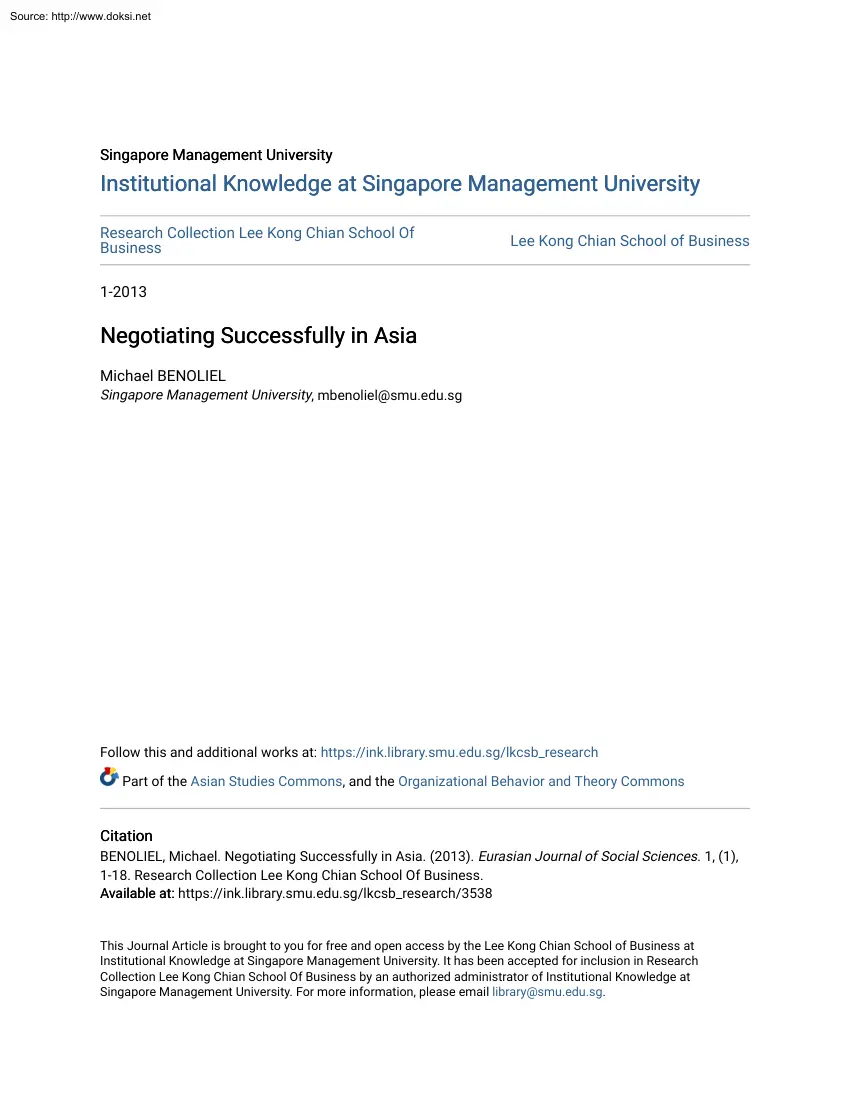
Source: http://www.doksinet Singapore Management University Institutional Knowledge at Singapore Management University Research Collection Lee Kong Chian School Of Business Lee Kong Chian School of Business 1-2013 Negotiating Successfully in Asia Michael BENOLIEL Singapore Management University, mbenoliel@smu.edusg Follow this and additional works at: https://ink.librarysmuedusg/lkcsb research Part of the Asian Studies Commons, and the Organizational Behavior and Theory Commons Citation BENOLIEL, Michael. Negotiating Successfully in Asia (2013) Eurasian Journal of Social Sciences 1, (1), 1-18. Research Collection Lee Kong Chian School Of Business Available at: https://ink.librarysmuedusg/lkcsb research/3538 This Journal Article is brought to you for free and open access by the Lee Kong Chian School of Business at Institutional Knowledge at Singapore Management University. It has been accepted for inclusion in Research Collection Lee Kong Chian School Of Business by an
authorized administrator of Institutional Knowledge at Singapore Management University. For more information, please email library@smuedusg Source: http://www.doksinet Eurasian Journal of Social Sciences, 1(1), 2013, 1-18 EURASIAN JOURNAL OF SOCIAL SCIENCES http://www.econjournalsnet NEGOTIATING SUCCESSFULLY IN ASIA Michael Benoliel Singapore Management University, Singapore. Email: mbenoliel@aolcom and mbenoliel@centerfornegotiation.com Abstract Cross-cultural negotiations are complex, challenging, and difficult to navigate because much of the Asian culture is unstated, implicit, and internalized in subtle behavioral patterns. It is like an iceberg; more is invisible and less is visible. To understand how the Asian negotiation values and practices are different from those in the West, I describe briefly the Asian cultural roots, highlight the major dimensions that differentiate cultures, explore the factors that influence the Asian negotiation processes and outcomes, and provide
a list of practical suggestions for negotiating successful deals with Asian negotiators. Keywords: Negotiation, Culture, Multicultural Negotiation, Asia 1. Introduction Asia’s recent rapid rise to economic prominence marks the beginning of a trend that will increase in the future. The Chinese economy, the second largest in the world, is currently attracting more direct investment than any other nation. Estimates suggest that by 2015 China’s purchasing power will surpass the U.S, and by 2025 China will be the world’s largest economic power. Similarly, India’s economic prominence in the global economy is also increasing Today, India is the third most attractive foreign investment destination globally and is expected to be the world’s third-largest economy by 2035. In 20 years, it is estimated that the combined economies of China, India, and Japan will dominant the global economy. Asia’s growing economic dominance, on one hand, and the continuous search for new business
opportunities, on the other hand, will drive Western businesses to have stronger economic ties to Asia in various forms: joint ventures; wholly foreign-owned enterprises; or direct investments. Cultural values and business practices in Asia are different from those in the West. The challenge for Western businesses is to understand those values and find effective ways for operating successfully in Asia. This paper focuses specifically on negotiation in Asia First, I describe briefly the cultural roots of China, Japan, and India. Second, I highlight the major dimensions that differentiate cultures. Third, I explore how factors like relationships, trust, approach to the rule of law, fairness, “face,” risk aversion, time orientation, and emotions influence negotiation processes and outcomes. Fourth, I provide a list of practical suggestions for negotiating successful deals with Asian negotiators. Source: http://www.doksinet M. Benoliel / Eurasian Journal of Social Sciences, 1(1),
2013, 1-18 2. Cultural Roots Culture refers to the collective programming of the mind through socially transmitted values that shape the way people of the same social group think and act in various situations (Hofstede, 1980), including in negotiation. To understand the Asians’ mind-set and negotiating style, one has to understand the influential cultural roots of Asia, primarily Confucianism, Taoism, Chinese stratagems (Art of War), Hinduism, and experiences with Western colonialism and imperialism. The Asian–Chinese culture is largely rooted in the teachings of Kong Fu Ze, known as Confucius, who lived in China from 551 to 479 B.C The Confucian doctrine is a pragmatic moral and non-religious ethic that advocates virtuous behavior such as, benevolence, righteousness, justice, propriety, trust, and sincerity. These moral ideals are designed to guide one’s daily life through a set of clear rules. The first rule is the stability of society Societal stability is based on five basic
and unequal relationships, known as wu lun. The relationships are between ruler and subject, father and son, older brother and younger brother, husband and wife, and older friend and younger friend. Second, family harmony is the prototype of all other social organizations. Family members are not autonomous to pursue their self-centered desires; they must restrain their impulses for the overall good of the family’s interests. Similarly, individual members in other social systems (groups, organizations and communities) should also submit to the interests of the collective. By extension, a business joint venture, for example, should be run on the basis of the family model. The role of the joint venture, therefore, is to serve the interests of the parent company the same way a child faithfully serves the family. Third, Confucianism advocates virtuous behavior towards others. This consists of having good manners between civilized people who also have a sense of dignity and shame
(“face”). Fourth is mastery. One’s challenge in life consists of self-improvement - the tenacity to acquire skills and education through hard work and perseverance. Individuals as well as collectives ought to use resources wisely, mainly preserving them for the future. Modest spending is virtuous whereas hedonism and conspicuous consumption are taboos. Other important values are respect for tradition and reciprocity of favors and gifts. Confucian humanity, based on the principles of harmony, hierarchy and sincerity, is applied primarily to insiders - family and kinship in group members. It is not a universal morality that must be applied to all in all circumstances because “he who treats his enemy with humanity and virtue only harms himself.Using the rhetoric of virtue to maintain a pretense to othersis acceptable” (von Senger, 1991, p.12) Next to the wide spread influence of Confucianism is the influence of Lao Tzu, the founder of the Taoist philosophy. It advocates
simplicity, contentment, spontaneity, and wu wei (inaction). The two key concepts of Taoism are yin and yang, and wu wei (Fang, 1999) The yin and yang are contrasts that complement each other and together create a harmonious whole. However, because life’s forces are not static, harmony is not permanent. When good changes to bad and fortune to misfortune, disharmony settles. Re-harmonization of the yin and the yang is, therefore, an ongoing process of mutual adjustment. Conflict, from the yin and yang perspective, is a manifestation of imbalance between two opposing forces that can be resolved by mutual readjustment. The Taoist principle of reversion – good changes to bad or fortune turns to misfortune has profoundly shaped the Asian’s holistic mind-set that recognizes the co-existence of contrasts and sees them together as a harmonious whole. Reversion, therefore, encourages caution, resilience, and hopefulness, when fortune, for example, is not separated from misfortune. In
times of prosperity, one must be cautious and observe frugality to buffer against possible misfortune and hardship. And in times of misfortune, one must be resilient and hopeful awaiting fortune. The principle of wu wei, translated into inaction, does not literally mean passivity and doing nothing. It means action less activity, to act without acting It is the art of “mastering circumstances without asserting ones self against them; it is the principle of yielding to an oncoming force in such a way that it is unable to harm you” (Fang, 1999, p.33) It is an approach that accepts given circumstances as they are, not resisting, but instead, finding the best way within the given set of circumstances. It is the water way Water is fluid and flexible 2 Source: http://www.doksinet M. Benoliel / Eurasian Journal of Social Sciences, 1(1), 2013, 1-18 and does not resist. It adapts by finding new ways to continue to flow The principles of yin and yang, and wu-wei, according to Fang
(1999), form the foundation of the Chinese stratagems as described in the writings of the Art of War and the 36 Chinese stratagems. Another deeply embedded cultural root that influences Asian culture and negotiating style is the 2300 years old concept of Ji, or as it is known in the West, the Art of War developed by Sun Tzu, the Chinese military strategist. Ji means to plan, to create strategies or stratagems Stratagems are not just simple acts involving trickery and deceit. Ji is both tactic and strategy, and a method of using “mental wisdom instead of physical force to win a war” (Fang, 1999, p.155) The business arena, from the perspective of Ji (Art of War), is viewed as a competitive battlefield. To win over the unworthy competitor-enemy, one must use the morally justified stratagems, such as secrecy, deception, and espionage. The militant concept of Ji was further emphasized by the Thirty-Six Stratagems written by an anonymous Chinese writer (Fang, 1999, p.164) Some of the 36
stratagems are: Hide a knife in a smile, which means win the opponent’s trust and act after his guard is down; Kill with a borrowed knife, which means make use of others’ resources for your gain; The beautiful woman which means use temptations and espionage to overpower the enemy; and Lure the tiger to leave the mountains, which means draw the opponent out of his natural environment to cut him from his source of power. The Chinese stratagems have been widely disseminated through the popular literature and over time have penetrated deeply into the Asian’s cultural ethos. When Japan was introduced to the Art of War about 1500 years ago, it was studied immediately by generals. To this day, Chinese managers are encouraged to read and use the Chinese stratagems “for the purpose of winning business in competition with foreign business people” (Fang, 1999, p.180) The Asian Chinese character was formed by Confucianism, which advocates humanity and righteousness; by Taoism, which
emphasizes yin and yang, and wu wei (wisdom of inaction); and by the militant principles of the Art of War and the 36 Chinese stratagems that advocate the use of military-like strategies to subdue the enemy and win the war. The long exposure to these different teachings has made the Asian Chinese practical and morally flexible. They use multiple standards and apply them contextually – based on specific situations and circumstances - without having a sense of acting immorally. This ability to act situationally is the key to understanding the complexity of Asian Chinese business negotiations (Fang, 1999). Over time, the Confucian philosophy extended its influence from China to Japan and Korea. The Japanese culture also emphasizes hierarchical relationships, restraining one’s selfinterests, and promoting social and interpersonal harmony It is the responsibility of all members, including leaders, to maintain and promote social harmony. To preserve harmony, for example, Japanese
negotiators refrain from competing amongst themselves. They measure successes by how much an individual is contributing to the collective effort to become successful. The Indian culture is religiously and linguistically diverse (18 official languages and 1600 dialects). It was shaped largely by the more than 5000 year old Hinduism and 3000 year old Buddhism that permeate all aspects of life. Hindus believe that humans are subject to a long series of reincarnations that ultimately, through good deeds (karma), end the cycle of re-births and achieve spiritual salvation. In the sequence of rebirths, one’s lifetime is temporary, and multiple lives are, therefore, an ongoing evolutionary process. Nothing is fixed, and nothing is permanent. Fundamentally, Indians believe that human nature is bad, immoral, and cannot be changed in one’s lifetime. Thus, people should be monitored and controlled through punishments. However, not all individuals are equally bad Individuals born into the
higher and noble caste of the Brahmins – priests, poets, and intellectuals -- are endowed with better personality traits than the inferior individuals born into the lower caste of laborers, the Shudras. Social hierarchy that structures inequality and promotes the stability of the existing order is deeply embedded in Indian history and culture. The fatalistic disposition of being born into a caste and the attitude that the future cannot be changed discourages one from taking initiatives and promoting change. These old historical and cultural forces are now changing in modern 3 Source: http://www.doksinet M. Benoliel / Eurasian Journal of Social Sciences, 1(1), 2013, 1-18 India. And with the exposure to the forces of modernization and to the West, personal mastery, initiative, innovation, and change are encouraged. 3. Recent History: The Dark Side of Foreigners The Asian culture is fundamentally a low-trust culture (Fukuyama, 1995). Secrecy and withholding of information are
common, especially toward foreigners. Historically, foreigners came to China and before the Court of the Emperor as requestors - asking for something (Faure, 1998). But in recent history, foreigners – the colonialists and the imperialists - came to Asia as takers. They used their military superiority to control and exploit Britain, for example, colonized India and attacked China in the first Opium War from 1839 to 1842 to force China to import British Opium. The defeated Chinese were forced to sign The Treaty of Nanjing where they had to commit to fixed tariffs of British goods, cede the island of Hong Kong to Queen Victoria, and pay reparation for the cost of the war to the British government. The British victory paved the way to resuming illegal drug trafficking within China. China, rejecting British pressure to legalize the opium trade in China, had to defend itself again in the Second Opium War, from 1856 to 1860. In 1860 joint British and French forces attacked Beijing, burned
down the Summer Palace and smashed its treasures. China, weakened by two wars, could no longer resist the pressure to legalize the trade of opium. “Beyond any doubt, by 1860 the ancient civilization that was China had been thoroughly defeated and humiliated by the West” (Hsu, 2000, p.219) Ancient civilizations, like the Japanese and the Chinese, have a profound sense of the past. The Chinese, for example, regularly remind foreign negotiators of “the opium wars of the nineteen century” (Cohen, 2002, p.36) The resentful negative sentiments toward foreigners were expressed in the strong words of the former Chinese Premier, Mao: “The imperialists will never lay down their butcher knives, and they will never become Buddha ‘til their doom” (Blackman, 1997, p.25) The legacy of foreigners in Asia is dark. They have been seen as dangerous, exploitive, unethical, and untrustworthy. The new and modern form of joint ventures, for many Chinese, is just another exploitive method
designed by the rich capitalists to get richer. In their view, rich foreigners build factories and operate mines and banks to control the economy. Still, to this day, Indian and Japanese negotiators are conscious “of the racist and imperialist outrages to which their countries were subjected in the colonial era” (Cohen, 2002, p.36) Indians, known to be the most nationalistic people, are extremely sensitive to economic activities by foreigners, especially investments that will affect India’s future welfare. 4. Cultural Dimensions The Asian culture is primarily rooted in the Confucian, Taoist, and Hindu philosophies. The central tenets of these philosophies have been synthesized into a number of cultural dimensions that differentiate between eastern and Western societies. The major cultural differentiators are: Individualism versus collectivism; Power distance; Uncertainty avoidance; Femininity versus masculinity (Hofstede, 1980); Confucian dynamism (Hofstede and Bond, 1988); High
versus low context; and the concept of time -- Monochromic versus Polychromic (Hall, 1973). 4.1 Individualism - Collectivism This dimension refers to the extent to which a society recognizes an individual’s right to pursue his personal goals. Individualistic societies like the United States, Great Britain, Canada, and Australia, are imbued with each citizen’s legal rights. People are concerned, primarily, about their own self-directed goals, needs, and interests. In contrast, collective societies like, China, Japan, Korea, and Singapore emphasize collective goals over individual goals and encourage self-sacrifice for the good of the whole. Self-interested behavior is discouraged and is perceived as selfish. A person’s duty is to conform and contribute to the common good of the group that 4 Source: http://www.doksinet M. Benoliel / Eurasian Journal of Social Sciences, 1(1), 2013, 1-18 he is embedded in – the family, group, organization, and community. Social relationships
tend to be permanent and people are more likely to keep their social relationships and affiliations (alumni, friends from military service) for a long period of their lives (Hui, 1990). Success in a collective culture is defined in terms of an individual’s commitment and effort to help the group achieve its goal. 4.2 Power Distance This refers to the degree to which power is distributed equally across social groups. In high power distance – hierarchical cultures like, China, Japan, and India -- the less powerful members expect and accept that power will be distributed unequally. Positional power and social status are stressed and interpersonal relationships are vertical - based on differences of stature, age, gender, and education. The less powerful members of the social group typically refrain from expressing their opinion and suppress their contrarian views. Rarely, if ever, do they challenge high authority or take personal responsibility to make decisions. In low power distance
– egalitarian-oriented cultures like the United States and the United Kingdom - rank, status, gender, and seniority, although recognized, are less emphasized. Knowledge, competency, and independence are valued. In China, for example, when seniority and competence are incongruent, the Chinese will choose the experience of the elders over competency. 4.3 Uncertainty Avoidance This refers to the extent to which individuals feel comfortable (or uncomfortable) in ambiguous and unstructured situations. Uncertainty represents risk; certainty represents no risk In high uncertainty avoidance societies like Japan and China, individuals prefer to operate in environments that are less risky, more clear and defined. Asians, in general, are risk averse and make decisions after careful evaluation of a large amount of information. Change is carefully measured, slow, and incremental. In contrast, in low uncertainty avoidance cultures like Israel and Canada, individuals are comfortable in fuzzy and
unclear situations. They make quick decisions based on a limited amount of information, embrace change, and accept bold ideas. 4.4 Femininity - Masculinity This refers to the extent to which the characteristics of the social group are more stereotypically feminine or masculine. On the masculinity-femininity continuum, Asian cultures are characterized as feminine. They are concerned with people’s feelings and emphasize harmony and cooperation. Western cultures are seen as masculine and achievement oriented because they emphasize competitiveness and assertiveness. 4.5 Confucian Dynamism (Future Orientation) This dimension is related to the importance of the future and hard work. Long-term goals are achieved through persistence and perseverance, especially in the face of difficulties. The AsianChinese culture is future oriented, emphasizes thrift, the conservation of resources, and investment for the future. In contrast, the time orientation of Western societies is short Immediate
gratification and quick results are sought and encouraged. It is, therefore, not surprising that the personal savings of the Chinese and Japanese are 26 and 22 percent of personal income, respectively, whereas the personal saving of Americans is only nine percent. 4.6 High Context - Low Context This dimension refers to how people communicate. In China, Hong Kong, Japan, Singapore, and Korea, known as high context cultures, communication is indirect, implicit, suggestive, and vague. This form of communication, says Bryan Huang, the President of Bearing Point Greater China confuses “almost all Americans and Europeans when they first visit Japan and China. 5 Source: http://www.doksinet M. Benoliel / Eurasian Journal of Social Sciences, 1(1), 2013, 1-18 Western culture places a high value on being very specific. But in Japan and China, says Bryan Huang, “things are more ambiguous, on purpose” (Fernandez and Underwood, 2006, p.83) An American executive commenting on his business
experience in Japan said: “I make deals all over the world. Everywhere I go, I can pretty much tell where I stand with my clients Everywhere, that is except Japan” (Graham, 1986, p.65) Asians believe that the indirect way is the virtuous way to maintain harmony and “face.” According to a Chinese proverb, only the devil walks in a straight line. Although the Asian form of communication is indirect, it is complete. To uncover the complete information, however, you must look everywhere - in the message, in between the lines, in the facial expression and the body language, and in what is not being said. For Israelis, Americans, and Canadians, who communicate explicitly, this form of communication is mysterious and difficult to interpret. 4.7 Temporal Orientation: Monochronic – Polychronic Asians have a polychronic attitude towards time. Time is fluid, cyclical, recursive and natural like the seasons. As in nature, where the seasons have their natural rhythms, human interactions
also follow a natural flow of time. One, therefore, should naturally blend into the pace of events and allow time to take its course. Time should not restrict the process flow of human interaction Human interaction should not be forced into pre-set, artificial schedules and plans. The Westerner’s temporal orientation is monochronic -- time is linear, inflexible, and sequential. The schedule for Americans “is almost sacred” (Hall, 1973, p157) It is a limited resource that should be managed well and maximized. Fixed schedules, segmentation of time, promptness, performance schedules, and deadlines are emphasized. Edward Hall, a linguistic scholar, suggests that American negotiators prefer a predetermined and sequential agenda where the movement is linear from one issue to the next. They lose their balance when their counterpart negotiator changes the structure of the agenda by rearranging the sequence of the issues (1973). Asian negotiators have greater facility with a “messy”
and less structured agenda. They easily move cyclically between issues and can handle multiple issues in parallel. 5. Culture and Negotiation Research and experience have shown that culture influences negotiators’ mind-sets, behaviors, and styles. In this section, I describe how cultural differentiators (eg, collectivism, high power distance, uncertainty avoidance, Confucian dynamism, and high context) and cultural elements such as, distinction between in group and out-group, relationships, trust, legal framework, fairness, risk behavior, “face,” time perspective, emotions, decisions style, and teamwork influence the negotiation style of Asian negotiators. In-Group and Out-Group. In the Asian strong familial system, there is a distinction between the family and kinship social network - the in-group system - and outsider and strangers in the out-group system. In Japan, for example, there are three differentiating circles. The innermost circle, the Miuchi, comprises of trusted
family and close friends. The Nakama, refers to friends and relatives who are mutually dependent on assistance. The most outer circle is the Tanin It refers to strangers with whom there are no relationships. The behavioral norms in the in-group system are different from those in an out-group system. In the in-group, members are seen as long-term trusted family and friends on whom you can rely and with whom you must collaborate rather than compete. Keeping interpersonal harmony in the in-group is a duty, but with members in the out-group, who are naturally not trusted, self-interested competitive behavior is acceptable. One need not be concerned with maintaining harmony and solidarity, especially with out-group exploitive foreigners. The distinction between the in-group and the out-group has a profound impact on Asians’ moral and social behavior, including negotiation. It affects the nature of relationships, trust, openness, sincerity, and commitment that shape the Asians’
negotiating style. 6 Source: http://www.doksinet M. Benoliel / Eurasian Journal of Social Sciences, 1(1), 2013, 1-18 5.1 Negotiation Style Negotiators may come to the table with two distinctly different motivations: claiming value and creating value (Lax and Sebenius, 1986). Negotiators with a value claiming attitude see the negotiation as a zero-sum game and a conquest. Value claiming negotiators conceal their interests, do not share information, bluff, exaggerate the value of their concessions, and use hard tactics like threats and ultimatums. In contrast, negotiators with a value creation attitude exchange information more openly, disclose their interests, invest in building relationships, nurture trust, and search for mutually beneficial options designed to create a win-win outcome. The true nature of negotiation, however, is mixed-motive, a combination of creating value followed by claiming value – a continuous process of cooperation and competition. Effective negotiators
cooperate in order to create value and then move competitively to claiming value for themselves. The Asian Chinese negotiating style is rooted in the duality of the Confucian teaching of cooperation and the Chinese competitive stratagems (Fang, 1999). It is, as Guy Faure describes, a joint quest of working together, on one hand, and a ruthless mobile warfare, on the other hand (1998: 140). When counterpart negotiators are seen as adversaries and their interests are perceived to be in conflict, the mobile warfare style is used – the application of the military principles of the Art of War and the 36 Chinese stratagems. The primary objective of mobile warfare is to exhaust, destabilize, and weaken the adversary by various means, including concealment, deception, and espionage. A mobile warfare negotiator will not hesitate to disseminate false information and misrepresent the facts in order to mislead. Asian Chinese negotiators often increase their bargaining edge by stimulating open
competition between competing suppliers who are aware of each other. It is also not uncommon to intentionally leak a competitor’s proposal to the other competitors in order to pressure them to improve their proposals. The objective of mobile warfare, however, is not to completely destroy the other side Rather, it is to weaken the adversary. In negotiation it means reducing substantially the bargaining power of the other side. The Chinese who have used the mobile warfare strategy are known as tough, shrewd, and tenacious negotiators. They are skilled in extracting sizeable concessions and give concessions only after a long fight while creating an appearance of mutuality, reciprocity, and generosity. The joint quest, in contrast to the mobile warfare, is a collaborative and ambiguous process of searching patiently for mutual value through fairness. It is a harmonious process of value creation that can be achieved not by presenting bluntly opposing positions or by extracting
concessions, but rather by engaging in delicate “dance,” of adjusting interests without explicitly disclosing the opposing interests. It is an invisible, subtle, and refined process of exchanges which makes Western negotiators often stumble like new dancers dancing in the dark. The duality of the mobile warfare and the joint quest is expressed in the Japanese word of negotiation. One meaning of negotiation is kosho It implies conflict of interests, verbal debate, fight, and the use of strategy in order to secure one’s interests. Another meaning implies engaging constructively in a conference, discussing issues and exchanging concessions in order to create a deal (March, 1990, p.84) Asian negotiators are adept in using cooperative and competitive styles, as both are deeply embedded in the different cultural teachings: the cooperative Confucianism and the confrontational Taoism and the art of war. The joint influence of East and West helped Indians incorporate opposing value
systems. The cultural blend of Western individualism and achievement, on one hand, and eastern collectivism and hierarchical order, on the other hand, shaped a complex Indian negotiating style. Indian negotiators, adopting individualistic characteristics, can be aggressive, competitive, and achievement oriented. At the same time, operating in a culture of distinct social hierarchy, power distance, compliance and expected loyalty, they can be passive and agreeable. They are very sensitive to context and adapt well to changing circumstances 7 Source: http://www.doksinet M. Benoliel / Eurasian Journal of Social Sciences, 1(1), 2013, 1-18 5.2 Negotiating with Outsiders Asians, especially Japanese, in their trusted in-group network, are concerned with harmony and do not like to negotiate. Internal negotiations are “on the basis of give and take, harmony and long-term interest” (March, 1990, p.15) Given a choice, the Japanese would rather not negotiate as the head of a Japanese
research institute in negotiation noted: “We Japanese really don’t like negotiating at all!” (Cohen, 2002, p.77) Informal contacts between the negotiators give them an opportunity to negotiate without negotiating. However, with aggressive and arrogant foreign negotiators, the Japanese negotiate defensively and use the kosho, the fighting negotiating style (March, 1990). Similarly, the Chinese promote the use of mobile warfare when dealing with foreigners. In fact, Chinese managers “are educated to make use of the Art of War and The Thirty-Six Stratagems to deal with foreign business people” (Fang, 1999, p.180) The authors of Sun Tsu’s art of war and enterprise management write: In order not to be tricked in dealings with capitalist enterprises and also for the purpose of winning business in competition with foreign business people and making our products enter into the international markets, we need to study Sun Tzu’s Art of War. Use this magic weapon handed down from our
ancestors to defeat them (Li et al. 1986, p12) The historically lingering suspicion of foreigners is the backdrop of negotiations in Asia. Recent negative business incidents have reinforced the prevailing sense of distrust. For example, promises by Westerners to transfer modern technology to China were purposely delayed until a new generation of technology was developed so that the old one would be transferred. Foreigners, Asians say, are motivated by cheap labor and short-term financial gains. They don’t have a long term-commitment to doing business in Asia Resentful of another foreign exploitation, Asians are determined to prevent the foreigners from “taking advantage of the current situation to make money at China’s expense” (Faure, 2000, p.166) They feel morally justified in taking revenge and exploiting the exploiters, and “plucking the chickens” -the rich and powerful Western corporations. Asian’s defensive mindset against foreign exploitations, naturally lead Asian
negotiators to use the value claiming style – the 36 Chinese stratagems and the Japanese kosho. 5.3 Relationships While the Asian-Chinese and the Japanese can easily use the Art of War, the competitive mobile warfare, and the kosho value claiming negotiating style with untrustworthy counterparts, they can also use the magnanimous and benevolent Confucian joined quest style with trustworthy counterparts. In negotiations between China and lower status countries, like Zambia and Thailand, Chinese negotiators were cooperative and accommodating (Fang, 1999). Relationships: Guanxi and Kankei Consistent with the Confucian teaching of promoting harmonious social relationships, Asians put a premium on relationships and friendship. They invest in building interpersonal connections and in creating a dependable social network of friends and colleagues, known as guanxi. In Japan, the concept of guanxi is known as kankei Asians prefer to do business within their own trusted network – with
individuals and entities that are “known quantities” (Shenkar and Ronen, 1987, p.271) Reputation without familiarity is not enough. In the first meeting between two shipping giants, the Greek Aristotle Onassis and the Chinese Sir YK Pao, Onassis, moving quickly during the customary exchange of pleasantries, proposed to Pao a business joint venture. Pao was appalled by how a stranger could make such an offer (Hutcheon, 1990). Solid relationships, friendship, and guanxi should not be underestimated when one is dealing in Asia. Asians put a premium on personal relationships because they provide assurances that reduce the risk of doing business. The legal system in Asia does not provide the same assurances as the legal system in the West. In China, for example, “the law has been 8 Source: http://www.doksinet M. Benoliel / Eurasian Journal of Social Sciences, 1(1), 2013, 1-18 susceptible to manipulation by the authorities and hence provided relatively little protection or
stability” (Seligman, 1989, p.127) To foster relationships, Asians mastered the art of hospitality, flattery, real friendship, and sometimes false friendship. In the Chinese and Japanese relationship-focused cultures, deals evolve from already established relationships. Deals cannot be made between strangers, unless they are introduced through the guanxi network. Because relationships come first, Asians will take as long as it is necessary to nourish and establish them before moving to the deal. In Asia one has to be a relationship-negotiator Westerners, in contrast, are contract-focused. They unbundle the business from the personal, a separation difficult for the Chinese, for example, to comprehend. For Western negotiators, deals emerge first and foremost from shared interests, and relationships might later evolve during the negotiation process or post negotiation. This is the contract-negotiator style For the Indians, in contrast to the Chinese and the Japanese, socializing and
building relationships are much less important at the outset of the negotiation. They focus more on building relationships during the negotiations and in that sense they are contract-negotiators. While relationships facilitate trust, flexibility, and loyalty, they also create obligations. From a Western perspective, relationships in Asia are a double-edged sword because they are used to make new demands, reopen contracts, renegotiate already settled terms and demand new concessions. Westerners’ refusal to accommodate new demands may well be interpreted as unfriendly and would jeopardize the relationships. 5.4 Trust from the Heart The way members of a social group develop trust and emphasize different trust factors differ across cultures. Asians have a strong inclination to trust insiders -- people related to family and kinship group (Fukuyama, 1995, p.75) and distrust outsiders because they cannot be dealt with in the normal way. In the normal way, interactions among a kinship group
carry low risk If one misbehaves, for example, it can be discussed with a brother and a redress can be sought from parents. Delicate matters can be handled by a go between uncles The “insiders” have a shared past, a future together, and obligations to fulfill, outsiders do not (Wolf, 1968, p.3) Trust in Asia is based on individual trust, cultivated by interpersonal relationships. Asians do business with trustworthy individuals and not with the faceless organizations they represent. Organizational trust is a Western notion which is foreign to Asians There are two types of trust. Trust from the head or cognitive-based trust, and trust from the heart, or affect-based trust (McAllister, 1995; Chua et al. 2009) Westerners tend to trust more from the head. They make a cognitive decision to trust based on the person’s competency, integrity, sincerity, and reliability. Easterners, in contrast, tend to trust more from the heart. A Japanese executive, for example, “is making gut level
judgments about the integrity, reliability, commitment.of his American counterpart” (Graham, 1986, p61) Establishing trust from the heart is a long process developed through trust factors like personal relationship, openness, mutual help, mutual understanding, and the formation of emotional bonds (Tan and Chee, 2005). In Asia, trust from the heart influences a wide range of business decisions, including appointments and promotion of senior executives. In Taiwan, for example, appointments and promotions of general managers and directors to the board in large businesses is based primarily on personal trust. Experience and competence, although important, are not sufficient Personal trust is a necessary condition (Kao, 1996). And in China, “rather than relying on objective performance criteria, personnel decisions are made on the basis of the boss’s personal relations with his subordinates, even if they are not relatives” (Fukuyama, 1995, p.77) Asians, using the family model of
relationships as a prototype, are more likely to mix between emotional, social, and business elements. The implication, for foreign negotiators, is to invest patiently in the natural process of building personal trust from the heart followed by the head. 9 Source: http://www.doksinet M. Benoliel / Eurasian Journal of Social Sciences, 1(1), 2013, 1-18 5.5 Legal Contracts and the Law Westerners are accustomed to a long tradition of a strong legal system and to the rule of law. Contracts and agreements are viewed as solid legal instruments to be strictly enforced, if violated. Among Asian nations, there are significant differences in terms of the level of development of the legal system and the rule of law. While Singapore, for example, has a strong legal system and strict enforcement of laws, China is still far behind. Not only have Chinese private citizens violated intellectual property rights; the Chinese State Statistical Bureau has too. It pirated a data management program of a
U.S computer software company The US firm protested and argued that if the government does not respect intellectual property laws, how could private citizens be expected to follow the law? The State Statistical Bureau saw the point and decided to comply with the law and offered “just $500 for the entire bureau’s national network” (Oliver, 1996, p.12) Asians have a long tradition of doing business without contracts. Raised with Confucian values and a preference for doing business within the trusted guanxi, the in-group network, they rely more on sincerity and “face” than on legal contracts. A verbal commitment is sufficient and binding. Asians often feel insulted when their legalistic negotiating counterparts specify in detail penalties or remedies for not honoring commitments. Legal contracts are merely a tangible expression of something more important - the relationships being created by the parties. Contracts are not treated as fixed instruments, simply because one can not
foresee all circumstances. To reduce risk, Westerners force the future’s eventualities into “what if” by “legalizing” them into a long and detailed legal instrument. Life changing circumstances, in the Asian tradition, cannot be predicted nor “contained.” Contracts, therefore, are inherently deficient and can never be completely fair because they cannot deal fully with the future. Signed contracts are but a representation of current conditions and thus cannot be final. And when circumstances change and the existing contract is no longer perceived as a fair deal, it should be opened and renegotiated in order to deal with the new circumstances and strike a new and fair arrangement between the parties. Asians believe that better than a legal contract is the human touch -- good relationships, friendship, trust, flexibility, “face,” and mutual considerations. These personal, social and psychological “instruments” deal better with the future and its unknowns than legal
contracts. Confucianism emphasizes moral authority and de-emphasizes legal power. Good leaders, for example, rule through their superior moral character and not through the power of the law. The law does not provide solutions to problems; people do when they internalize moral values and have “face” - a sense of shame. This doctrine of self and social regulation can explain why China did not develop a Western-like legal system. In fact, legalism has been seen as coercion and always viewed with distrust. The judicial system and the rule of law in Asia are not as advanced as in the West. In China, for example, the judicial system has just begun to employ professional people, standards, and practices. In the 1980’s it was staffed primarily with military personnel who had no legal training and who were primarily loyal to the Party. The judiciary, says Norman Givant, the Managing Partner of the Freshfields, Buckhaus and Deringer law office in China, “is still problematic and has a
long way to go” (Fernandez and Underwood, 2006, p.218) Senior executives of multi-national companies who are familiar with the Chinese legal system suggest that it should be avoided as a forum of redressing disputes. Gary Dirks of British Petroleum China, for example, would rather negotiate disputes out of court than go to court. Charles Browne, President of Du Pont China prefers to resolve problems directly with counterparts rather than go to court because, he says, “in negotiation you would come out with a result that is still better than a court judgment” (Fernandez and Underwood, 2006, p.218) It should be noted, however, that the Chinese legal system has been making a substantial effort to improve itself in the past few years. Presently, there are many business laws designed to address business issues. But a still sensitive area is the interpretation of these laws, which tend to be very broad and vague. When a US electrical goods manufacturer that 10 Source:
http://www.doksinet M. Benoliel / Eurasian Journal of Social Sciences, 1(1), 2013, 1-18 partnered in a joint venture with a Chinese company wanted to fire a Chinese manager who restrained the company from expanding its existing product line in China, the Chinese local labor bureau refused to approve it (Oliver, 1996, p.12) The evolving legal system and rule of law, the wide variation in the interpretation of laws and regulations, and the relaxed enforcement of the laws in China make it a challenge to do business in some parts of Asia. A US industrial manufacturer learned this lesson in 1988 in China when it partnered with a state-owned Chinese company. Based on a signed contract, the US partner committed to buy each year a fixed number of batteries at a fixed price each year. It was surprised to get a bill 50 percent higher than expected. After refusing to pay the bill the Chinese government confiscated the plant. A year later the American company won its case in the international
courts but was unable to collect the $8.3 million compensation (Oliver, 1996, p.13) Foreigners should realize that the legal power of agreements and contracts varies between the West and the East and within countries in Asia. Westerners should restrain their instincts to rush to court and litigate and adopt multiple ways for managing disputes. Resolving disputes the “local way” of informal influence and mediation behind the scene is most often the most effective way. 5.6 Concept of Fairness In the West, economic fairness is based on equity (proportionality) and equal reciprocity. Parties that invest more resources in a venture are entitled to a greater share of the pie, and when they exchange concessions, they expect that the exchange will be roughly equal, value for value. In Asia fairness is perceived differently. When Thailand wanted to sell rice to China as an economic favor, China agreed. Describing the negotiation with the accommodating Chinese, a Thai negotiator commented:
“in our tradition the less powerful party is not expected to be as generous as the more powerful one” (Blackman, 1997, p.26) Fairness in the Asian tradition is contextual and is based on needs. It is measured by the economic conditions of the company with whom you negotiate, which party has more resources, and which party is in a greater need. Fairness based on needs implies that negotiators representing wealthy foreign corporations are expected to be generous with their local and needy partners. To not act generously is to not be a good friend, as friends always help each other. However, in order to preserve “face” the appearance of symmetry and equality must be maintained. 5.7 Risk Behavior “He who does nothing makes no mistakes,” is one of the central rules of the Chinese bureaucracy. Asians do not behave as autonomous negotiators, especially when it comes to taking risks and assuming personal responsibility. For Asians, not to act is rational because the rewards for
negotiating successfully, as Fang (1999) argues, are minimal, whereas the penalties for making mistakes are great. That makes Asians risk averse To minimize risks they tend to make decisions based on carefully evaluating a large amount of information. A Chinese buyer will spend an enormous amount of time collecting information on product technology and performance, making the purchase process long. This tendency to “play it safe” often hinders the introduction of creative, bold, and risky ideas. When dealing with Asian negotiators, especially Japanese, moving forward patiently and making incremental progress, generally is more productive. While Chinese and Japanese are risk averse, Indians, like Westerners, see risk as something that should be managed wisely rather than avoided. 5.8 Concept of “Face” “Face,” or human dignity, is gained when individuals behave morally, have prestige associated with accomplishments, and most importantly, show genuine concern for the
collective’s interests – family, social network, and the community. “Face” is a formidable social control mechanism – 11 Source: http://www.doksinet M. Benoliel / Eurasian Journal of Social Sciences, 1(1), 2013, 1-18 rewarding people with prestige when they respond positively to social expectations and punishing them with a loss of “face” when they do not. The concept of “face” is common to all societies but most salient in the Asian culture. It is rooted in the Confucian philosophy of social harmony. A social group maintains inter-personal and social harmony when individuals restrain their aggressive instincts and do not confront each other directly, nor mention difficulties. An employee, for example, would refrain from raising concerns with a superior because “Troubling the boss can be considered rude and would likely be seen as admission that the manager was to some degree responsible for the problem” (Fernandez & Underwood, 2006, p.83) Consequently,
problems and difficulties are dealt with only when they can no longer be avoided. Postponed difficulties and avoided conflicts usually become more acute at a later stage. The Western’s style of conflict management tends to be open and direct. It is indeed challenging for foreigners to communicate effectively and manage difficulties and, at the same time, preserve their counterparts’ “face” because “if you let somebody lose ‘face,’ it will be very difficult to rebuild a trusting relationship,” says Jun Tang, the president of Microsoft China (Fernandez and Underwood, 2006, p.84) Much of Asians’ inactions and actions are related to protecting against losing “face” or to gaining “face.” On the inaction side, Asian negotiators, for example, are uncomfortable about expressing direct opinions because they do not want to run the risk of disrespecting or even offending their chief negotiator. On the action side, Asian negotiators are relentless in their conquest for
concessions. They are motivated by the desire to look good and have a better “face” (Schnepp, et al. 1990, p148) The better the deal the more “face” they obtain 5.9 Time Perspective, Pace, and Synchronization When Jeanne Kirkpatrick, then American ambassador to the United Nations, asked the foreign ministers of the six ASEAN countries if there were good prospects for settling the Cambodian conflict, they all said, “Yes.” And when she asked: “Do you think it will be very soon?” they all said, “Oh yes, very soon.” “Well, how soon?” she wanted to know “Oh, about five years’ time,” they said. She was shocked Five years for an American is certainly not soon (Koh, 1996, p.316), but is for Easterners The Asians’ sense of time was perhaps best expressed by the former Chinese Premier, Mao Zedong. When a journalist asked him to comment on the French revolution of 1789, he said that it is too early to comment on it (Faure, 1998, p.145) The short time perspective of
Westerners clearly stands in contrast to the Easterners’ time perspective. When the University of New South Wales (UNSW), an Australian university, opened its Singapore campus in May 2007, many were optimistic. But only a few months later, UNSW announced that the campus would be closed immediately. It pulled out of Singapore because it was able to recruit only 148 applicants, short of the projected 300 for the first semester. This decision reinforced the common perception of foreign entities’ short-term mindset lacking the Confucian virtue of persistence and tenacity that Saburo Matsuo, a Japanese salesman of a major securities company demonstrated. Matsuo, interested in the business of one of Japan’s richest man, stood in front of his house and bowed to him for six months, six mornings a week, but he was ignored by the rich man. One morning, however, Matsuo was caught in a heavy downpour without an umbrella, and the famous rich man invited him to get into his car. There they had
their first conversation about the stock market Matsuo’s patience and persistence impressed the rich man who became a new client (March, 1990, p.18) Asia is a long-term investment that requires patience, persistence, and tenacity. Short or long-term orientations influence the pace – how fast or slow -- negotiations move. For many Western negotiators, the pace of negotiating with Asians is painfully slow Asians believe that a negotiator should be calm, and move slowly. To lose your serenity and to negotiate anxiously under time pressure is to put yourself unwisely at a psychological disadvantage. Even when Asian negotiators have an interest in expediting the negotiation process, they will project an attitude of not being in a hurry. They understand the strategic value of time and are mindful of controlling the pace of the negotiation. They slow it or hasten it according to their interests. 12 Source: http://www.doksinet M. Benoliel / Eurasian Journal of Social Sciences, 1(1),
2013, 1-18 The slow pace of the negotiations in Asia can be attributed to several factors. First is the general belief that a negotiator cannot maximize the benefits in a quick negotiation. Because negotiation, as many believe, is a war of attrition where resilience and patience are tested, one must be patient. Second is the management of impression To conclude the deal quickly may be seen by the negotiator’s superiors as “premature” and as if the negotiator did not try hard enough to maximize gains. Third is the symbolic “game of time” To move forward quickly signals anxiety and weakness. It sends a clear message that you need the deal more Not to appear eager and weak, Asians play the “game of time.” Fourth is risk aversion Asian negotiators refrain from taking personal responsibility and constantly go back and forth to consult with their superiors. The fifth reason that explains the slow pace of negotiating with Asians is the nature of their decision making process.
To maintain harmony, diffuse risks, and save face, Asians, especially Japanese, employ a consensus decision-making process. The pace of the negotiation influences the degree to which negotiators are synchronized. Effective negotiators find a way to mutually adjust their pace and synchronize it – moving together at the same pace. Often, however, Western and Asian negotiators move at different paces and consequently find themselves not synchronized. In the first phase of the preliminaries -- small talks and building relationships -- Westerners are brief. After 10 minutes of chit chat they jump into the task of give and take. For Asians, the long preliminary phase is perhaps the most critical. It is made of social entertainment, ceremonies, and the exchange of gifts (Graham, 1986). In the second phase of the actual negotiation – give and take --, Westerners are also brief. Asians are interested first and foremost in fully understanding the negotiation context and ask many clarifying
questions. When the Americans and Japanese negotiate, for example, after the Americans state their positions, “the Japanese tendency is to listen quite carefully, to ask for additional details, and to say nothing at all committal. This lack of response is likely to frustrate the American side, which wants a counter-proposal put on the table so that give-and-take can begin” (Cohen, 2002, p.85) Westerners ask a few questions and move quickly to persuading and making concessions quite early in the negotiation process. The Japanese make concessions only at the very end of the negotiation. In the final stage – the closing of the deal --, Western negotiators who typically have authority to seal the deal, move quickly and finalize it. Asian negotiators, in contrast, move also very slowly in the deal closing stage. They, in general, have limited authority to seal the deal themselves and thus have to take the proposed deal to their superiors for approval. The negotiating process with
Indians is also slow and long for several reasons. First, they do not work well in teams. Thus, it takes a long time to sort out different perspectives and disagreements. Second, Indian negotiators diligently collect a lot of information and analyze it carefully in order to ensure that they get the best possible deal. They are constantly looking for a better deal. Third, the efficiency of the negotiation process is much less important than the final outcome. Therefore, to get the best possible deal, like the Chinese and Japanese, they use the drawn out war of attrition designed to “exhaust” the counterparts to concede to more demands. 5.10 Emotions All negotiations have some degree of inherent ambiguity. Negotiators, therefore, engage in sense making activities by looking for clues and visible signs that will help them diffuse the uncertainty. One of the ways is to look at their counterpart’s display of emotions The Confucian teaching of xinping qihe – “being perfectly
calm” (Shenkar and Ronen, 1987, p.267) makes this very difficult for Westerners. Confucianism promotes the notion that a cultivated person must exercise self-control and restrain selfish urges to display emotions, especially in public, because it threatens harmony. Asians, suspicious of strong emotional displays, distrust individuals who cannot contain their emotions and display aggressive behavior. Asians, trained to project calm and minimize emotional displays, add another layer of uncertainty to the already ambiguous negotiation situation. Westerners, in contrast, tend to be animated and openly display soft and raw emotions. Western negotiators may want to tone it down and disengage from the urge to make sense of their Asian counterparts’ emotional state 13 Source: http://www.doksinet M. Benoliel / Eurasian Journal of Social Sciences, 1(1), 2013, 1-18 because doing so is challenging. However, it is this challenge that justifies the use of multicultural interpreters who may
be more capable of making sense of the invisible aspects of the behaviors of negotiators from different cultures. 5.11 Decisions Making decisions can range from a top-down style where a single authority makes the decision to a consensus decision making style where all the members of a group make the decision together. The Chinese and the Japanese use the consensus decision making style Although these societies are hierarchical, leaders refrain from dictating a decision in order to preserve the harmonious relationships and give “face” to others. In Japan, for example, the practice of Nemawashi – binding up the roots of the tree prior to its being transplanted – is a decision making process that allows people to express ideas before a formal proposal is drawn (March, 1990, p.27) In this long and slow process, leaders and followers exert caution and consideration ensuring that all reservations and disagreements are ironed out before the final decision is made. The consensus
decision making process allows individuals to diffuse risks and be shielded from taking personal responsibility. The Western’s notion that an authorized person in the negotiation room will make a quick decision is wishful thinking. Quite often influential decision makers are not even at the table. They may appear when there is a good prospect of closing the deal. In India, unlike China and Japan, decisions most often are top-down and made by the higher authority. This is the norm Indian subordinates expect the higher authority to make the decision and will not question it even when they disagree with their superiors. Compliance and loyalty are expected. In this respect, the speed of decisions in India can be faster than in Japan and China, provided, the Indian bureaucracy is neither needed nor involved in making the deal. 5.12 Teamwork Asian Chinese, contrary to Westerners and Indians, are excellent team players. They recognize that success comes from compliance and contribution to
the collective effort. Japanese negotiators, so concerned with loyalty to the collective’s interests, often reassure their colleagues that their private interests will not compromise the team’s interests. Asian negotiators form well integrated and cohesive teams with clear roles and responsibilities. The spokesperson, most often, is not the higher authority decision maker The ability of the teams to stay united and work well together is perhaps the greatest strength they bring to the table in team negotiations. It would be unwise and futile to try to split Asian teams Their loyalty to the team is paramount and supersedes any potential individual gains they might get in the future. While Chinese and Japanese are good team players, Indian negotiators do not work well together. The typical Indian’s self concept is “I am superior and right” and thus the other person is wrong. The team, for an Indian, is to serve him or her and respond to his or her own interests. When an Indian
team is leaderless and the authority is not well defined, Indians resort to extreme individualism and counter conformism, giving freedom to their full selves. Westerners have often underestimated the power of the Chinese and the Japanese team unity and loyalty and tried, however unsuccessfully, to create a split among the team’s members. Not only will such a move rarely, if ever, succeed; it can lead to a deep sense of mistrust. In contrast, the Indians’ difficulties in creating team unity may dispose them to splitting and forming a coalition with counterpart negotiators. 6. The Art of War: Mobile Warfare Asian negotiators had been trained in the Art of War for many centuries. It may be useful also for Western negotiators to read the Art of War and the 36 Chinese stratagems (Fang, 1999, pp.289-304) and identify the stratagems that their counterparts might use The more Western 14 Source: http://www.doksinet M. Benoliel / Eurasian Journal of Social Sciences, 1(1), 2013, 1-18
negotiators are familiar with the Chinese stratagems, the better they can cope with them and hopefully transform the negotiation from a mobile warfare to a joint quest. Here are some of the common Chinese stratagems. Hide a knife behind a smile: Charm and ingratiate yourself to your adversaries. Once you have gained their trust, move secretly and attack them. Kill with a borrowed knife: Asian negotiators use external resources to their advantage. For example, they will use a competitor’s proposals to play the competition against each other. Confidential proposals from one competitor are shown to another in order to extract better terms. Often negotiations are handled simultaneously with several competitors despite promises to the contrary (Seligman, 1989, p.144) Killing the chicken to warn the monkey: Asian negotiators, in general, are not high risk takers. To establish their “high” risk attitude and credibility, they may make a threat on a minor issue in order to establish the
credibility of their future threats on larger issues. Killing the chicken is “a warning shot” (Faure, 1998, p.141) Sweet and sour: Asian negotiators like to create a psychological dissonance by changing approaches from the sweet and friendly to the sour and cold. Sometimes the negotiation team will take assigned roles – some sweet and others sour (Pye, 1982). This is the classic good cop, bad cop. Shaming and guilt: Although “face” in Asia is an important civil value and people go to a great length to refrain from causing others to lose face, some Asian negotiators do not hesitate to use this taboo against strangers. Asian negotiators have a long memory and to instill a feeling of guilt (Seligman, 1989) sometimes go 200 years back – to colonial and imperialist times – to remind their counterparts of misdeeds made by their countries. The shaming may come together with a display of anger and “drama” – like storming out of the negotiating room. Lure the tiger to leave
the mountain: Asians like to control the location of the negotiation so that they can be the hosts and not the guests who come to China asking for favors from the Court of the Emperor. The home court advantage is both psychological and physical. Whereas Asians are in their natural environment, not pressed by artificial deadlines and spared of travel expenses, foreign negotiators are cut off from their headquarters, their families, and under a deadline pressure to conclude a deal. By controlling the ground, Asians can also control the schedule and control the timing (Fang, 1999) – slowing the negotiation process by organizing sightseeing tours or engaging in lengthy consultations while the counterparts are “on hold.” To establish the principle of reciprocity, foreign negotiators may want to schedule some of the negotiations outside Asia, in their own home court. Await leisurely the exhausted enemy: Asian negotiators understand well the value of resources. While they relax and
preserve their own resources, they wage a war of attrition to frustrate and deplete the counterpart psychologically and physically. For example, the Chinese insist that “disputes be arbitrated in Beijing before the Foreign Economic and Trade Arbitration Commission” (Chang, 1987), or that contracts will be according to the Chinese law and written in Chinese only. Create something of nothing: Take trivial issues and blow them up out of proportion. Gain advantage by conjuring illusions (Fang, 1999, p.291) Even when quality or prices are reasonable, blow them up – “the price is very high” or the “quality is very low.” Giving away a brick to earn a piece of jade: This involves capitalizing on the foreign negotiators ignorance and trading something of a low value for something of a high value. 15 Source: http://www.doksinet M. Benoliel / Eurasian Journal of Social Sciences, 1(1), 2013, 1-18 7. Suggestions for Negotiating Successfully in Asia Successful cross-border
deal-making begins with understanding the deep cultural values that drive behavior. Negotiators should be culturally informed and sensitive However, it should be noted that cultural understanding and sensitivity are not enough. Equally important is strategic advantage. Those who go to Asia as takers may not fare well if they do not have much to offer Those who go to Asia as givers and have something to offer – new technologies, new products, or new mutually beneficial opportunities – will fare well. Here are some suggestions that may facilitate successful negotiations in Asia. Present a long-term vision: The Asian time perspective is historical. Asian negotiators appreciate perseverance and long term commitment based on trusted relationships that are built slowly and over time. Assure your counterparts that your “Asia play” is a long term play because Asians distrust quick deals. You should present a vision based on shared interests first, not just benefits. Build strong
relationships and trust: Business in Asia is based on personal relationships and trust from the heart. Use skilled negotiators who know how to form emotional bonds and develop trust from the heart as well as the head. Emphasize first personal relationships and friendship, openness, and understanding and help. Use trusted intermediaries to introduce you and facilitate the process of building relationships and trust. They can play an important informal role behind the scene. Mobile warfare and joint quest: Asian negotiators are contextual and use both cooperative and competitive negotiating styles. Foreign negotiators should not be trapped in the aggressive mobile warfare. To promote the likelihood that the constructive joint quest negotiating style will be used, proceed with the negotiation after you have established good relationships and some degree of trust. Wide repertoire of behaviors: To succeed in Asia, one must have a wide range of skills, attitudes, and behaviors. In a culture
that tests resiliency and competes fiercely for resources, you have to be a warrior. In a culture that promotes harmony, you have to be a peacemaker. In a culture where time is plentiful and urgency is a weakness, you have to be a monk. In a culture that values symbols, rituals, and tradition, you must be civilized In a culture that emphasizes hierarchical social relationships, you have to be respectfully differential. In a culture that emphasizes human sincerity and human touch, you ought not to act too legally. Deemphasize legalism: Relationships and trust between negotiators are much more important than just legal agreements. Do not overemphasize legalism by articulating countless contingencies and “what ifs.” Good relationships are a better mean of taking care of any unforeseen future difficulties. Use cultural boundary spanners: Western negotiators should study the Asian culture and understand it well. However, it is not possible to fully understand all the cultural subtle
nuances. Therefore, Western negotiators would benefit from the expertise and advice of culturally informed experts who are more capable of interpreting the subtleties of a given culture. Practice patience: Because Asians distrust quick deals, expect deliberate delays and sometimes break offs. They are designed to test your resolve Do not restrain yourself by setting an inflexible deadline because time urgency in Asia is interpreted as a weakness. Even when you are under time pressure, do what Asians do: Be calm and project the allure that time is not of the essence. A prolonged negotiation process is normal, and when it seems that there is no 16 Source: http://www.doksinet M. Benoliel / Eurasian Journal of Social Sciences, 1(1), 2013, 1-18 progress, there is, in fact, progress. In the Asian’s thinking, no movement is part of movement When it seems that nothing is happening for a period of time, resist the temptation to push too hard forward. Things will move forward when the
other side is ripe and willing to move Know and commit to your objectives and bottom line: Asian negotiators often play the competitors off each other and use the long war of attrition to erode your objectives, the things you must get from the deal. Your commitment to your objectives and bottom line is critically important, especially in Asia. Focus like a laser beam on what you must get from the deal and do not let deadlines, psychological pressure, and fatigue, erode your core interests. Master the substance and the protocol: Asians prepare meticulously, master well the substantive issues, and engage in continuous due-diligence. The Japanese, for example, “ask thousands of questions” (Graham, 1986 p.62) and often repeat the same questions in order to fully understand the full context of the negotiation. Be prepared to answer a lot of questions In addition, recognize that Asian negotiators take detailed notes of everything and will use them to exploit advantages. Do the same: take
meticulous notes and use the record to your advantage Always clarify the issues and record mutual understandings in great specificity, leaving minimal room for misconstruing the issues. On-going negotiation: Whereas in the west a done deal is a done deal, in Asia deals are never done and are often opened and renegotiated when the circumstances change. Therefore, leave room for giving future concessions. Don’t deplete your bank of concessions Be humble and fair: Asians dislike foreign negotiators who are arrogant and display their superiority in different areas (e.g, science, technology, or management) Be humble about what you know and be humbled by what you don’t know. Try to create mutually beneficial and fair deals. References Blackman, C., 1997 Negotiating China: Case studies and strategies St Leonard, NWS, Australia: Allen & Unwin. Chang, T.K, 1987 The great battle of form China Business Review, 14 (4), pp7-11 Chua, R.YJ, Morris, WM, & Ingram, P, 2009 Guanzi versus
networking: Distinctive configurations of affect – and cognition - base trust in the networks of Chinese versus American managers. Journal of International Business Studies, 40(3), pp490-508 Cohen, R., 2002 Negotiating across cultures Washington, DC: United States Institute of Peace Press, Fang, T., 1999 Chinese business negotiating style New York: Sage Publications Faure, O.G, 1998 Negotiation: The Chinese Concept Negotiation Journal, 14(2), pp137-148 Faure, O.G, 2000 Negotiations to set up joint ventures in China International Negotiation, 5, pp.157-189 Fernandez, J.A, and Underwood, L, 2006 China CEO: Voices of experience Singapore: John Wiley. Fukuyama, F., 1995 Trust: The social virtues and the creation of prosperity New York: Simon & Schuster. Graham, L.J, 1986 Across the negotiating table from the Japanese International Marketing Review, 3(3), pp.58-71 Hall, T.E, 1973 The silent language New York: Anchor Books Hofstede, G., 1980 Culture’s consequences: International
differences in work related values Beverly Hills, CA: Sage. Hofstede, G., and Bond, MH, 1988 Confucius and economic growth: New trends in culture’s consequences. Organizational Dynamics, 16, pp 4-21 th Hsu, C.YI, 2000 The rise of modern China 6 edition New York: Oxford University Press 17 Source: http://www.doksinet M. Benoliel / Eurasian Journal of Social Sciences, 1(1), 2013, 1-18 Hui, C.H, 1990 Work attitude, leadership styles, and managerial behaviors in different cultures In: R. Brislin ed Applied cross-cultural psychology Newbury Park, CA: Sage, pp 186208 Hutcheon, R., 1990 First sea lord: The life and work of Sir YK Pao Hong Kong: Chinese University Press. Kao, C.S, 1996 ‘”Personal trust” in a large business in Taiwan: A traditional foundation for contemporary economic activities. In: H Gary Hamilton, ed Asian Business Networks, New York: Walter de Gruyter, pp. 61-70 Koh, T.BT, 1996 American strengths and weaknesses International Negotiation, 1, pp313317 Lax, A.D,
and Sebenius KJ, 1986 The manager as negotiator New York: Free Press nd Li, S.J, Yang, XJ, and Tan, JR, 1986 Sun Tzu’s art of war and enterprise management 2 edition. Nanning: Guangxi People’s Press (In Chinese) March, R.M, 1990 The Japanese negotiator: Subtleties and strategy beyond Western logic Tokyo: Kodansha International. McAllister, D.J, 1995 Affect and cognition-based trust as foundation for interpersonal cooperation in organizations. Academy of management Review, 20, pp709-734 Oliver, C., 1996 Investing in China: 12 hard lessons World Link, November/December, p 12 Pye, I.W, 1982 Chinese commercial negotiating style Cambridge, MA: Oelgeschlager, Gunn& Hain. Schnepp, O., von Glinow, MA, and Bhambri, A, 1990 United States-China technology transfer. Englewood Cliffs, NJ: Prentice Hall Seligman, S.D 1989 Dealing with the Chinese: A practical guide to business etiquette in the -people’s republic today London: Mercury Shenkar, O. and Ronen, S, 1987 The cultural context of
negotiation: The implications of Chinese interpersonal norms. The Journal of Applied Behavioral Science, 23(2), pp.263-275 Tan, H.H, and Chee, D, 2005 Understanding interpersonal trust in a Confucian-influenced society. International Journal of Cross Cultural Management, 5(2), pp197-212 Von Senger, H., 1991 The book of stratagems New York: Viking/Penguin Wolf, M., 1968 The house of Lim: A study of Chinese farm family Englewood Cliffs, NJ: Prentice Hall. 18
authorized administrator of Institutional Knowledge at Singapore Management University. For more information, please email library@smuedusg Source: http://www.doksinet Eurasian Journal of Social Sciences, 1(1), 2013, 1-18 EURASIAN JOURNAL OF SOCIAL SCIENCES http://www.econjournalsnet NEGOTIATING SUCCESSFULLY IN ASIA Michael Benoliel Singapore Management University, Singapore. Email: mbenoliel@aolcom and mbenoliel@centerfornegotiation.com Abstract Cross-cultural negotiations are complex, challenging, and difficult to navigate because much of the Asian culture is unstated, implicit, and internalized in subtle behavioral patterns. It is like an iceberg; more is invisible and less is visible. To understand how the Asian negotiation values and practices are different from those in the West, I describe briefly the Asian cultural roots, highlight the major dimensions that differentiate cultures, explore the factors that influence the Asian negotiation processes and outcomes, and provide
a list of practical suggestions for negotiating successful deals with Asian negotiators. Keywords: Negotiation, Culture, Multicultural Negotiation, Asia 1. Introduction Asia’s recent rapid rise to economic prominence marks the beginning of a trend that will increase in the future. The Chinese economy, the second largest in the world, is currently attracting more direct investment than any other nation. Estimates suggest that by 2015 China’s purchasing power will surpass the U.S, and by 2025 China will be the world’s largest economic power. Similarly, India’s economic prominence in the global economy is also increasing Today, India is the third most attractive foreign investment destination globally and is expected to be the world’s third-largest economy by 2035. In 20 years, it is estimated that the combined economies of China, India, and Japan will dominant the global economy. Asia’s growing economic dominance, on one hand, and the continuous search for new business
opportunities, on the other hand, will drive Western businesses to have stronger economic ties to Asia in various forms: joint ventures; wholly foreign-owned enterprises; or direct investments. Cultural values and business practices in Asia are different from those in the West. The challenge for Western businesses is to understand those values and find effective ways for operating successfully in Asia. This paper focuses specifically on negotiation in Asia First, I describe briefly the cultural roots of China, Japan, and India. Second, I highlight the major dimensions that differentiate cultures. Third, I explore how factors like relationships, trust, approach to the rule of law, fairness, “face,” risk aversion, time orientation, and emotions influence negotiation processes and outcomes. Fourth, I provide a list of practical suggestions for negotiating successful deals with Asian negotiators. Source: http://www.doksinet M. Benoliel / Eurasian Journal of Social Sciences, 1(1),
2013, 1-18 2. Cultural Roots Culture refers to the collective programming of the mind through socially transmitted values that shape the way people of the same social group think and act in various situations (Hofstede, 1980), including in negotiation. To understand the Asians’ mind-set and negotiating style, one has to understand the influential cultural roots of Asia, primarily Confucianism, Taoism, Chinese stratagems (Art of War), Hinduism, and experiences with Western colonialism and imperialism. The Asian–Chinese culture is largely rooted in the teachings of Kong Fu Ze, known as Confucius, who lived in China from 551 to 479 B.C The Confucian doctrine is a pragmatic moral and non-religious ethic that advocates virtuous behavior such as, benevolence, righteousness, justice, propriety, trust, and sincerity. These moral ideals are designed to guide one’s daily life through a set of clear rules. The first rule is the stability of society Societal stability is based on five basic
and unequal relationships, known as wu lun. The relationships are between ruler and subject, father and son, older brother and younger brother, husband and wife, and older friend and younger friend. Second, family harmony is the prototype of all other social organizations. Family members are not autonomous to pursue their self-centered desires; they must restrain their impulses for the overall good of the family’s interests. Similarly, individual members in other social systems (groups, organizations and communities) should also submit to the interests of the collective. By extension, a business joint venture, for example, should be run on the basis of the family model. The role of the joint venture, therefore, is to serve the interests of the parent company the same way a child faithfully serves the family. Third, Confucianism advocates virtuous behavior towards others. This consists of having good manners between civilized people who also have a sense of dignity and shame
(“face”). Fourth is mastery. One’s challenge in life consists of self-improvement - the tenacity to acquire skills and education through hard work and perseverance. Individuals as well as collectives ought to use resources wisely, mainly preserving them for the future. Modest spending is virtuous whereas hedonism and conspicuous consumption are taboos. Other important values are respect for tradition and reciprocity of favors and gifts. Confucian humanity, based on the principles of harmony, hierarchy and sincerity, is applied primarily to insiders - family and kinship in group members. It is not a universal morality that must be applied to all in all circumstances because “he who treats his enemy with humanity and virtue only harms himself.Using the rhetoric of virtue to maintain a pretense to othersis acceptable” (von Senger, 1991, p.12) Next to the wide spread influence of Confucianism is the influence of Lao Tzu, the founder of the Taoist philosophy. It advocates
simplicity, contentment, spontaneity, and wu wei (inaction). The two key concepts of Taoism are yin and yang, and wu wei (Fang, 1999) The yin and yang are contrasts that complement each other and together create a harmonious whole. However, because life’s forces are not static, harmony is not permanent. When good changes to bad and fortune to misfortune, disharmony settles. Re-harmonization of the yin and the yang is, therefore, an ongoing process of mutual adjustment. Conflict, from the yin and yang perspective, is a manifestation of imbalance between two opposing forces that can be resolved by mutual readjustment. The Taoist principle of reversion – good changes to bad or fortune turns to misfortune has profoundly shaped the Asian’s holistic mind-set that recognizes the co-existence of contrasts and sees them together as a harmonious whole. Reversion, therefore, encourages caution, resilience, and hopefulness, when fortune, for example, is not separated from misfortune. In
times of prosperity, one must be cautious and observe frugality to buffer against possible misfortune and hardship. And in times of misfortune, one must be resilient and hopeful awaiting fortune. The principle of wu wei, translated into inaction, does not literally mean passivity and doing nothing. It means action less activity, to act without acting It is the art of “mastering circumstances without asserting ones self against them; it is the principle of yielding to an oncoming force in such a way that it is unable to harm you” (Fang, 1999, p.33) It is an approach that accepts given circumstances as they are, not resisting, but instead, finding the best way within the given set of circumstances. It is the water way Water is fluid and flexible 2 Source: http://www.doksinet M. Benoliel / Eurasian Journal of Social Sciences, 1(1), 2013, 1-18 and does not resist. It adapts by finding new ways to continue to flow The principles of yin and yang, and wu-wei, according to Fang
(1999), form the foundation of the Chinese stratagems as described in the writings of the Art of War and the 36 Chinese stratagems. Another deeply embedded cultural root that influences Asian culture and negotiating style is the 2300 years old concept of Ji, or as it is known in the West, the Art of War developed by Sun Tzu, the Chinese military strategist. Ji means to plan, to create strategies or stratagems Stratagems are not just simple acts involving trickery and deceit. Ji is both tactic and strategy, and a method of using “mental wisdom instead of physical force to win a war” (Fang, 1999, p.155) The business arena, from the perspective of Ji (Art of War), is viewed as a competitive battlefield. To win over the unworthy competitor-enemy, one must use the morally justified stratagems, such as secrecy, deception, and espionage. The militant concept of Ji was further emphasized by the Thirty-Six Stratagems written by an anonymous Chinese writer (Fang, 1999, p.164) Some of the 36
stratagems are: Hide a knife in a smile, which means win the opponent’s trust and act after his guard is down; Kill with a borrowed knife, which means make use of others’ resources for your gain; The beautiful woman which means use temptations and espionage to overpower the enemy; and Lure the tiger to leave the mountains, which means draw the opponent out of his natural environment to cut him from his source of power. The Chinese stratagems have been widely disseminated through the popular literature and over time have penetrated deeply into the Asian’s cultural ethos. When Japan was introduced to the Art of War about 1500 years ago, it was studied immediately by generals. To this day, Chinese managers are encouraged to read and use the Chinese stratagems “for the purpose of winning business in competition with foreign business people” (Fang, 1999, p.180) The Asian Chinese character was formed by Confucianism, which advocates humanity and righteousness; by Taoism, which
emphasizes yin and yang, and wu wei (wisdom of inaction); and by the militant principles of the Art of War and the 36 Chinese stratagems that advocate the use of military-like strategies to subdue the enemy and win the war. The long exposure to these different teachings has made the Asian Chinese practical and morally flexible. They use multiple standards and apply them contextually – based on specific situations and circumstances - without having a sense of acting immorally. This ability to act situationally is the key to understanding the complexity of Asian Chinese business negotiations (Fang, 1999). Over time, the Confucian philosophy extended its influence from China to Japan and Korea. The Japanese culture also emphasizes hierarchical relationships, restraining one’s selfinterests, and promoting social and interpersonal harmony It is the responsibility of all members, including leaders, to maintain and promote social harmony. To preserve harmony, for example, Japanese
negotiators refrain from competing amongst themselves. They measure successes by how much an individual is contributing to the collective effort to become successful. The Indian culture is religiously and linguistically diverse (18 official languages and 1600 dialects). It was shaped largely by the more than 5000 year old Hinduism and 3000 year old Buddhism that permeate all aspects of life. Hindus believe that humans are subject to a long series of reincarnations that ultimately, through good deeds (karma), end the cycle of re-births and achieve spiritual salvation. In the sequence of rebirths, one’s lifetime is temporary, and multiple lives are, therefore, an ongoing evolutionary process. Nothing is fixed, and nothing is permanent. Fundamentally, Indians believe that human nature is bad, immoral, and cannot be changed in one’s lifetime. Thus, people should be monitored and controlled through punishments. However, not all individuals are equally bad Individuals born into the
higher and noble caste of the Brahmins – priests, poets, and intellectuals -- are endowed with better personality traits than the inferior individuals born into the lower caste of laborers, the Shudras. Social hierarchy that structures inequality and promotes the stability of the existing order is deeply embedded in Indian history and culture. The fatalistic disposition of being born into a caste and the attitude that the future cannot be changed discourages one from taking initiatives and promoting change. These old historical and cultural forces are now changing in modern 3 Source: http://www.doksinet M. Benoliel / Eurasian Journal of Social Sciences, 1(1), 2013, 1-18 India. And with the exposure to the forces of modernization and to the West, personal mastery, initiative, innovation, and change are encouraged. 3. Recent History: The Dark Side of Foreigners The Asian culture is fundamentally a low-trust culture (Fukuyama, 1995). Secrecy and withholding of information are
common, especially toward foreigners. Historically, foreigners came to China and before the Court of the Emperor as requestors - asking for something (Faure, 1998). But in recent history, foreigners – the colonialists and the imperialists - came to Asia as takers. They used their military superiority to control and exploit Britain, for example, colonized India and attacked China in the first Opium War from 1839 to 1842 to force China to import British Opium. The defeated Chinese were forced to sign The Treaty of Nanjing where they had to commit to fixed tariffs of British goods, cede the island of Hong Kong to Queen Victoria, and pay reparation for the cost of the war to the British government. The British victory paved the way to resuming illegal drug trafficking within China. China, rejecting British pressure to legalize the opium trade in China, had to defend itself again in the Second Opium War, from 1856 to 1860. In 1860 joint British and French forces attacked Beijing, burned
down the Summer Palace and smashed its treasures. China, weakened by two wars, could no longer resist the pressure to legalize the trade of opium. “Beyond any doubt, by 1860 the ancient civilization that was China had been thoroughly defeated and humiliated by the West” (Hsu, 2000, p.219) Ancient civilizations, like the Japanese and the Chinese, have a profound sense of the past. The Chinese, for example, regularly remind foreign negotiators of “the opium wars of the nineteen century” (Cohen, 2002, p.36) The resentful negative sentiments toward foreigners were expressed in the strong words of the former Chinese Premier, Mao: “The imperialists will never lay down their butcher knives, and they will never become Buddha ‘til their doom” (Blackman, 1997, p.25) The legacy of foreigners in Asia is dark. They have been seen as dangerous, exploitive, unethical, and untrustworthy. The new and modern form of joint ventures, for many Chinese, is just another exploitive method
designed by the rich capitalists to get richer. In their view, rich foreigners build factories and operate mines and banks to control the economy. Still, to this day, Indian and Japanese negotiators are conscious “of the racist and imperialist outrages to which their countries were subjected in the colonial era” (Cohen, 2002, p.36) Indians, known to be the most nationalistic people, are extremely sensitive to economic activities by foreigners, especially investments that will affect India’s future welfare. 4. Cultural Dimensions The Asian culture is primarily rooted in the Confucian, Taoist, and Hindu philosophies. The central tenets of these philosophies have been synthesized into a number of cultural dimensions that differentiate between eastern and Western societies. The major cultural differentiators are: Individualism versus collectivism; Power distance; Uncertainty avoidance; Femininity versus masculinity (Hofstede, 1980); Confucian dynamism (Hofstede and Bond, 1988); High
versus low context; and the concept of time -- Monochromic versus Polychromic (Hall, 1973). 4.1 Individualism - Collectivism This dimension refers to the extent to which a society recognizes an individual’s right to pursue his personal goals. Individualistic societies like the United States, Great Britain, Canada, and Australia, are imbued with each citizen’s legal rights. People are concerned, primarily, about their own self-directed goals, needs, and interests. In contrast, collective societies like, China, Japan, Korea, and Singapore emphasize collective goals over individual goals and encourage self-sacrifice for the good of the whole. Self-interested behavior is discouraged and is perceived as selfish. A person’s duty is to conform and contribute to the common good of the group that 4 Source: http://www.doksinet M. Benoliel / Eurasian Journal of Social Sciences, 1(1), 2013, 1-18 he is embedded in – the family, group, organization, and community. Social relationships
tend to be permanent and people are more likely to keep their social relationships and affiliations (alumni, friends from military service) for a long period of their lives (Hui, 1990). Success in a collective culture is defined in terms of an individual’s commitment and effort to help the group achieve its goal. 4.2 Power Distance This refers to the degree to which power is distributed equally across social groups. In high power distance – hierarchical cultures like, China, Japan, and India -- the less powerful members expect and accept that power will be distributed unequally. Positional power and social status are stressed and interpersonal relationships are vertical - based on differences of stature, age, gender, and education. The less powerful members of the social group typically refrain from expressing their opinion and suppress their contrarian views. Rarely, if ever, do they challenge high authority or take personal responsibility to make decisions. In low power distance
– egalitarian-oriented cultures like the United States and the United Kingdom - rank, status, gender, and seniority, although recognized, are less emphasized. Knowledge, competency, and independence are valued. In China, for example, when seniority and competence are incongruent, the Chinese will choose the experience of the elders over competency. 4.3 Uncertainty Avoidance This refers to the extent to which individuals feel comfortable (or uncomfortable) in ambiguous and unstructured situations. Uncertainty represents risk; certainty represents no risk In high uncertainty avoidance societies like Japan and China, individuals prefer to operate in environments that are less risky, more clear and defined. Asians, in general, are risk averse and make decisions after careful evaluation of a large amount of information. Change is carefully measured, slow, and incremental. In contrast, in low uncertainty avoidance cultures like Israel and Canada, individuals are comfortable in fuzzy and
unclear situations. They make quick decisions based on a limited amount of information, embrace change, and accept bold ideas. 4.4 Femininity - Masculinity This refers to the extent to which the characteristics of the social group are more stereotypically feminine or masculine. On the masculinity-femininity continuum, Asian cultures are characterized as feminine. They are concerned with people’s feelings and emphasize harmony and cooperation. Western cultures are seen as masculine and achievement oriented because they emphasize competitiveness and assertiveness. 4.5 Confucian Dynamism (Future Orientation) This dimension is related to the importance of the future and hard work. Long-term goals are achieved through persistence and perseverance, especially in the face of difficulties. The AsianChinese culture is future oriented, emphasizes thrift, the conservation of resources, and investment for the future. In contrast, the time orientation of Western societies is short Immediate
gratification and quick results are sought and encouraged. It is, therefore, not surprising that the personal savings of the Chinese and Japanese are 26 and 22 percent of personal income, respectively, whereas the personal saving of Americans is only nine percent. 4.6 High Context - Low Context This dimension refers to how people communicate. In China, Hong Kong, Japan, Singapore, and Korea, known as high context cultures, communication is indirect, implicit, suggestive, and vague. This form of communication, says Bryan Huang, the President of Bearing Point Greater China confuses “almost all Americans and Europeans when they first visit Japan and China. 5 Source: http://www.doksinet M. Benoliel / Eurasian Journal of Social Sciences, 1(1), 2013, 1-18 Western culture places a high value on being very specific. But in Japan and China, says Bryan Huang, “things are more ambiguous, on purpose” (Fernandez and Underwood, 2006, p.83) An American executive commenting on his business
experience in Japan said: “I make deals all over the world. Everywhere I go, I can pretty much tell where I stand with my clients Everywhere, that is except Japan” (Graham, 1986, p.65) Asians believe that the indirect way is the virtuous way to maintain harmony and “face.” According to a Chinese proverb, only the devil walks in a straight line. Although the Asian form of communication is indirect, it is complete. To uncover the complete information, however, you must look everywhere - in the message, in between the lines, in the facial expression and the body language, and in what is not being said. For Israelis, Americans, and Canadians, who communicate explicitly, this form of communication is mysterious and difficult to interpret. 4.7 Temporal Orientation: Monochronic – Polychronic Asians have a polychronic attitude towards time. Time is fluid, cyclical, recursive and natural like the seasons. As in nature, where the seasons have their natural rhythms, human interactions
also follow a natural flow of time. One, therefore, should naturally blend into the pace of events and allow time to take its course. Time should not restrict the process flow of human interaction Human interaction should not be forced into pre-set, artificial schedules and plans. The Westerner’s temporal orientation is monochronic -- time is linear, inflexible, and sequential. The schedule for Americans “is almost sacred” (Hall, 1973, p157) It is a limited resource that should be managed well and maximized. Fixed schedules, segmentation of time, promptness, performance schedules, and deadlines are emphasized. Edward Hall, a linguistic scholar, suggests that American negotiators prefer a predetermined and sequential agenda where the movement is linear from one issue to the next. They lose their balance when their counterpart negotiator changes the structure of the agenda by rearranging the sequence of the issues (1973). Asian negotiators have greater facility with a “messy”
and less structured agenda. They easily move cyclically between issues and can handle multiple issues in parallel. 5. Culture and Negotiation Research and experience have shown that culture influences negotiators’ mind-sets, behaviors, and styles. In this section, I describe how cultural differentiators (eg, collectivism, high power distance, uncertainty avoidance, Confucian dynamism, and high context) and cultural elements such as, distinction between in group and out-group, relationships, trust, legal framework, fairness, risk behavior, “face,” time perspective, emotions, decisions style, and teamwork influence the negotiation style of Asian negotiators. In-Group and Out-Group. In the Asian strong familial system, there is a distinction between the family and kinship social network - the in-group system - and outsider and strangers in the out-group system. In Japan, for example, there are three differentiating circles. The innermost circle, the Miuchi, comprises of trusted
family and close friends. The Nakama, refers to friends and relatives who are mutually dependent on assistance. The most outer circle is the Tanin It refers to strangers with whom there are no relationships. The behavioral norms in the in-group system are different from those in an out-group system. In the in-group, members are seen as long-term trusted family and friends on whom you can rely and with whom you must collaborate rather than compete. Keeping interpersonal harmony in the in-group is a duty, but with members in the out-group, who are naturally not trusted, self-interested competitive behavior is acceptable. One need not be concerned with maintaining harmony and solidarity, especially with out-group exploitive foreigners. The distinction between the in-group and the out-group has a profound impact on Asians’ moral and social behavior, including negotiation. It affects the nature of relationships, trust, openness, sincerity, and commitment that shape the Asians’
negotiating style. 6 Source: http://www.doksinet M. Benoliel / Eurasian Journal of Social Sciences, 1(1), 2013, 1-18 5.1 Negotiation Style Negotiators may come to the table with two distinctly different motivations: claiming value and creating value (Lax and Sebenius, 1986). Negotiators with a value claiming attitude see the negotiation as a zero-sum game and a conquest. Value claiming negotiators conceal their interests, do not share information, bluff, exaggerate the value of their concessions, and use hard tactics like threats and ultimatums. In contrast, negotiators with a value creation attitude exchange information more openly, disclose their interests, invest in building relationships, nurture trust, and search for mutually beneficial options designed to create a win-win outcome. The true nature of negotiation, however, is mixed-motive, a combination of creating value followed by claiming value – a continuous process of cooperation and competition. Effective negotiators
cooperate in order to create value and then move competitively to claiming value for themselves. The Asian Chinese negotiating style is rooted in the duality of the Confucian teaching of cooperation and the Chinese competitive stratagems (Fang, 1999). It is, as Guy Faure describes, a joint quest of working together, on one hand, and a ruthless mobile warfare, on the other hand (1998: 140). When counterpart negotiators are seen as adversaries and their interests are perceived to be in conflict, the mobile warfare style is used – the application of the military principles of the Art of War and the 36 Chinese stratagems. The primary objective of mobile warfare is to exhaust, destabilize, and weaken the adversary by various means, including concealment, deception, and espionage. A mobile warfare negotiator will not hesitate to disseminate false information and misrepresent the facts in order to mislead. Asian Chinese negotiators often increase their bargaining edge by stimulating open
competition between competing suppliers who are aware of each other. It is also not uncommon to intentionally leak a competitor’s proposal to the other competitors in order to pressure them to improve their proposals. The objective of mobile warfare, however, is not to completely destroy the other side Rather, it is to weaken the adversary. In negotiation it means reducing substantially the bargaining power of the other side. The Chinese who have used the mobile warfare strategy are known as tough, shrewd, and tenacious negotiators. They are skilled in extracting sizeable concessions and give concessions only after a long fight while creating an appearance of mutuality, reciprocity, and generosity. The joint quest, in contrast to the mobile warfare, is a collaborative and ambiguous process of searching patiently for mutual value through fairness. It is a harmonious process of value creation that can be achieved not by presenting bluntly opposing positions or by extracting
concessions, but rather by engaging in delicate “dance,” of adjusting interests without explicitly disclosing the opposing interests. It is an invisible, subtle, and refined process of exchanges which makes Western negotiators often stumble like new dancers dancing in the dark. The duality of the mobile warfare and the joint quest is expressed in the Japanese word of negotiation. One meaning of negotiation is kosho It implies conflict of interests, verbal debate, fight, and the use of strategy in order to secure one’s interests. Another meaning implies engaging constructively in a conference, discussing issues and exchanging concessions in order to create a deal (March, 1990, p.84) Asian negotiators are adept in using cooperative and competitive styles, as both are deeply embedded in the different cultural teachings: the cooperative Confucianism and the confrontational Taoism and the art of war. The joint influence of East and West helped Indians incorporate opposing value
systems. The cultural blend of Western individualism and achievement, on one hand, and eastern collectivism and hierarchical order, on the other hand, shaped a complex Indian negotiating style. Indian negotiators, adopting individualistic characteristics, can be aggressive, competitive, and achievement oriented. At the same time, operating in a culture of distinct social hierarchy, power distance, compliance and expected loyalty, they can be passive and agreeable. They are very sensitive to context and adapt well to changing circumstances 7 Source: http://www.doksinet M. Benoliel / Eurasian Journal of Social Sciences, 1(1), 2013, 1-18 5.2 Negotiating with Outsiders Asians, especially Japanese, in their trusted in-group network, are concerned with harmony and do not like to negotiate. Internal negotiations are “on the basis of give and take, harmony and long-term interest” (March, 1990, p.15) Given a choice, the Japanese would rather not negotiate as the head of a Japanese
research institute in negotiation noted: “We Japanese really don’t like negotiating at all!” (Cohen, 2002, p.77) Informal contacts between the negotiators give them an opportunity to negotiate without negotiating. However, with aggressive and arrogant foreign negotiators, the Japanese negotiate defensively and use the kosho, the fighting negotiating style (March, 1990). Similarly, the Chinese promote the use of mobile warfare when dealing with foreigners. In fact, Chinese managers “are educated to make use of the Art of War and The Thirty-Six Stratagems to deal with foreign business people” (Fang, 1999, p.180) The authors of Sun Tsu’s art of war and enterprise management write: In order not to be tricked in dealings with capitalist enterprises and also for the purpose of winning business in competition with foreign business people and making our products enter into the international markets, we need to study Sun Tzu’s Art of War. Use this magic weapon handed down from our
ancestors to defeat them (Li et al. 1986, p12) The historically lingering suspicion of foreigners is the backdrop of negotiations in Asia. Recent negative business incidents have reinforced the prevailing sense of distrust. For example, promises by Westerners to transfer modern technology to China were purposely delayed until a new generation of technology was developed so that the old one would be transferred. Foreigners, Asians say, are motivated by cheap labor and short-term financial gains. They don’t have a long term-commitment to doing business in Asia Resentful of another foreign exploitation, Asians are determined to prevent the foreigners from “taking advantage of the current situation to make money at China’s expense” (Faure, 2000, p.166) They feel morally justified in taking revenge and exploiting the exploiters, and “plucking the chickens” -the rich and powerful Western corporations. Asian’s defensive mindset against foreign exploitations, naturally lead Asian
negotiators to use the value claiming style – the 36 Chinese stratagems and the Japanese kosho. 5.3 Relationships While the Asian-Chinese and the Japanese can easily use the Art of War, the competitive mobile warfare, and the kosho value claiming negotiating style with untrustworthy counterparts, they can also use the magnanimous and benevolent Confucian joined quest style with trustworthy counterparts. In negotiations between China and lower status countries, like Zambia and Thailand, Chinese negotiators were cooperative and accommodating (Fang, 1999). Relationships: Guanxi and Kankei Consistent with the Confucian teaching of promoting harmonious social relationships, Asians put a premium on relationships and friendship. They invest in building interpersonal connections and in creating a dependable social network of friends and colleagues, known as guanxi. In Japan, the concept of guanxi is known as kankei Asians prefer to do business within their own trusted network – with
individuals and entities that are “known quantities” (Shenkar and Ronen, 1987, p.271) Reputation without familiarity is not enough. In the first meeting between two shipping giants, the Greek Aristotle Onassis and the Chinese Sir YK Pao, Onassis, moving quickly during the customary exchange of pleasantries, proposed to Pao a business joint venture. Pao was appalled by how a stranger could make such an offer (Hutcheon, 1990). Solid relationships, friendship, and guanxi should not be underestimated when one is dealing in Asia. Asians put a premium on personal relationships because they provide assurances that reduce the risk of doing business. The legal system in Asia does not provide the same assurances as the legal system in the West. In China, for example, “the law has been 8 Source: http://www.doksinet M. Benoliel / Eurasian Journal of Social Sciences, 1(1), 2013, 1-18 susceptible to manipulation by the authorities and hence provided relatively little protection or
stability” (Seligman, 1989, p.127) To foster relationships, Asians mastered the art of hospitality, flattery, real friendship, and sometimes false friendship. In the Chinese and Japanese relationship-focused cultures, deals evolve from already established relationships. Deals cannot be made between strangers, unless they are introduced through the guanxi network. Because relationships come first, Asians will take as long as it is necessary to nourish and establish them before moving to the deal. In Asia one has to be a relationship-negotiator Westerners, in contrast, are contract-focused. They unbundle the business from the personal, a separation difficult for the Chinese, for example, to comprehend. For Western negotiators, deals emerge first and foremost from shared interests, and relationships might later evolve during the negotiation process or post negotiation. This is the contract-negotiator style For the Indians, in contrast to the Chinese and the Japanese, socializing and
building relationships are much less important at the outset of the negotiation. They focus more on building relationships during the negotiations and in that sense they are contract-negotiators. While relationships facilitate trust, flexibility, and loyalty, they also create obligations. From a Western perspective, relationships in Asia are a double-edged sword because they are used to make new demands, reopen contracts, renegotiate already settled terms and demand new concessions. Westerners’ refusal to accommodate new demands may well be interpreted as unfriendly and would jeopardize the relationships. 5.4 Trust from the Heart The way members of a social group develop trust and emphasize different trust factors differ across cultures. Asians have a strong inclination to trust insiders -- people related to family and kinship group (Fukuyama, 1995, p.75) and distrust outsiders because they cannot be dealt with in the normal way. In the normal way, interactions among a kinship group
carry low risk If one misbehaves, for example, it can be discussed with a brother and a redress can be sought from parents. Delicate matters can be handled by a go between uncles The “insiders” have a shared past, a future together, and obligations to fulfill, outsiders do not (Wolf, 1968, p.3) Trust in Asia is based on individual trust, cultivated by interpersonal relationships. Asians do business with trustworthy individuals and not with the faceless organizations they represent. Organizational trust is a Western notion which is foreign to Asians There are two types of trust. Trust from the head or cognitive-based trust, and trust from the heart, or affect-based trust (McAllister, 1995; Chua et al. 2009) Westerners tend to trust more from the head. They make a cognitive decision to trust based on the person’s competency, integrity, sincerity, and reliability. Easterners, in contrast, tend to trust more from the heart. A Japanese executive, for example, “is making gut level
judgments about the integrity, reliability, commitment.of his American counterpart” (Graham, 1986, p61) Establishing trust from the heart is a long process developed through trust factors like personal relationship, openness, mutual help, mutual understanding, and the formation of emotional bonds (Tan and Chee, 2005). In Asia, trust from the heart influences a wide range of business decisions, including appointments and promotion of senior executives. In Taiwan, for example, appointments and promotions of general managers and directors to the board in large businesses is based primarily on personal trust. Experience and competence, although important, are not sufficient Personal trust is a necessary condition (Kao, 1996). And in China, “rather than relying on objective performance criteria, personnel decisions are made on the basis of the boss’s personal relations with his subordinates, even if they are not relatives” (Fukuyama, 1995, p.77) Asians, using the family model of
relationships as a prototype, are more likely to mix between emotional, social, and business elements. The implication, for foreign negotiators, is to invest patiently in the natural process of building personal trust from the heart followed by the head. 9 Source: http://www.doksinet M. Benoliel / Eurasian Journal of Social Sciences, 1(1), 2013, 1-18 5.5 Legal Contracts and the Law Westerners are accustomed to a long tradition of a strong legal system and to the rule of law. Contracts and agreements are viewed as solid legal instruments to be strictly enforced, if violated. Among Asian nations, there are significant differences in terms of the level of development of the legal system and the rule of law. While Singapore, for example, has a strong legal system and strict enforcement of laws, China is still far behind. Not only have Chinese private citizens violated intellectual property rights; the Chinese State Statistical Bureau has too. It pirated a data management program of a
U.S computer software company The US firm protested and argued that if the government does not respect intellectual property laws, how could private citizens be expected to follow the law? The State Statistical Bureau saw the point and decided to comply with the law and offered “just $500 for the entire bureau’s national network” (Oliver, 1996, p.12) Asians have a long tradition of doing business without contracts. Raised with Confucian values and a preference for doing business within the trusted guanxi, the in-group network, they rely more on sincerity and “face” than on legal contracts. A verbal commitment is sufficient and binding. Asians often feel insulted when their legalistic negotiating counterparts specify in detail penalties or remedies for not honoring commitments. Legal contracts are merely a tangible expression of something more important - the relationships being created by the parties. Contracts are not treated as fixed instruments, simply because one can not
foresee all circumstances. To reduce risk, Westerners force the future’s eventualities into “what if” by “legalizing” them into a long and detailed legal instrument. Life changing circumstances, in the Asian tradition, cannot be predicted nor “contained.” Contracts, therefore, are inherently deficient and can never be completely fair because they cannot deal fully with the future. Signed contracts are but a representation of current conditions and thus cannot be final. And when circumstances change and the existing contract is no longer perceived as a fair deal, it should be opened and renegotiated in order to deal with the new circumstances and strike a new and fair arrangement between the parties. Asians believe that better than a legal contract is the human touch -- good relationships, friendship, trust, flexibility, “face,” and mutual considerations. These personal, social and psychological “instruments” deal better with the future and its unknowns than legal
contracts. Confucianism emphasizes moral authority and de-emphasizes legal power. Good leaders, for example, rule through their superior moral character and not through the power of the law. The law does not provide solutions to problems; people do when they internalize moral values and have “face” - a sense of shame. This doctrine of self and social regulation can explain why China did not develop a Western-like legal system. In fact, legalism has been seen as coercion and always viewed with distrust. The judicial system and the rule of law in Asia are not as advanced as in the West. In China, for example, the judicial system has just begun to employ professional people, standards, and practices. In the 1980’s it was staffed primarily with military personnel who had no legal training and who were primarily loyal to the Party. The judiciary, says Norman Givant, the Managing Partner of the Freshfields, Buckhaus and Deringer law office in China, “is still problematic and has a
long way to go” (Fernandez and Underwood, 2006, p.218) Senior executives of multi-national companies who are familiar with the Chinese legal system suggest that it should be avoided as a forum of redressing disputes. Gary Dirks of British Petroleum China, for example, would rather negotiate disputes out of court than go to court. Charles Browne, President of Du Pont China prefers to resolve problems directly with counterparts rather than go to court because, he says, “in negotiation you would come out with a result that is still better than a court judgment” (Fernandez and Underwood, 2006, p.218) It should be noted, however, that the Chinese legal system has been making a substantial effort to improve itself in the past few years. Presently, there are many business laws designed to address business issues. But a still sensitive area is the interpretation of these laws, which tend to be very broad and vague. When a US electrical goods manufacturer that 10 Source:
http://www.doksinet M. Benoliel / Eurasian Journal of Social Sciences, 1(1), 2013, 1-18 partnered in a joint venture with a Chinese company wanted to fire a Chinese manager who restrained the company from expanding its existing product line in China, the Chinese local labor bureau refused to approve it (Oliver, 1996, p.12) The evolving legal system and rule of law, the wide variation in the interpretation of laws and regulations, and the relaxed enforcement of the laws in China make it a challenge to do business in some parts of Asia. A US industrial manufacturer learned this lesson in 1988 in China when it partnered with a state-owned Chinese company. Based on a signed contract, the US partner committed to buy each year a fixed number of batteries at a fixed price each year. It was surprised to get a bill 50 percent higher than expected. After refusing to pay the bill the Chinese government confiscated the plant. A year later the American company won its case in the international
courts but was unable to collect the $8.3 million compensation (Oliver, 1996, p.13) Foreigners should realize that the legal power of agreements and contracts varies between the West and the East and within countries in Asia. Westerners should restrain their instincts to rush to court and litigate and adopt multiple ways for managing disputes. Resolving disputes the “local way” of informal influence and mediation behind the scene is most often the most effective way. 5.6 Concept of Fairness In the West, economic fairness is based on equity (proportionality) and equal reciprocity. Parties that invest more resources in a venture are entitled to a greater share of the pie, and when they exchange concessions, they expect that the exchange will be roughly equal, value for value. In Asia fairness is perceived differently. When Thailand wanted to sell rice to China as an economic favor, China agreed. Describing the negotiation with the accommodating Chinese, a Thai negotiator commented:
“in our tradition the less powerful party is not expected to be as generous as the more powerful one” (Blackman, 1997, p.26) Fairness in the Asian tradition is contextual and is based on needs. It is measured by the economic conditions of the company with whom you negotiate, which party has more resources, and which party is in a greater need. Fairness based on needs implies that negotiators representing wealthy foreign corporations are expected to be generous with their local and needy partners. To not act generously is to not be a good friend, as friends always help each other. However, in order to preserve “face” the appearance of symmetry and equality must be maintained. 5.7 Risk Behavior “He who does nothing makes no mistakes,” is one of the central rules of the Chinese bureaucracy. Asians do not behave as autonomous negotiators, especially when it comes to taking risks and assuming personal responsibility. For Asians, not to act is rational because the rewards for
negotiating successfully, as Fang (1999) argues, are minimal, whereas the penalties for making mistakes are great. That makes Asians risk averse To minimize risks they tend to make decisions based on carefully evaluating a large amount of information. A Chinese buyer will spend an enormous amount of time collecting information on product technology and performance, making the purchase process long. This tendency to “play it safe” often hinders the introduction of creative, bold, and risky ideas. When dealing with Asian negotiators, especially Japanese, moving forward patiently and making incremental progress, generally is more productive. While Chinese and Japanese are risk averse, Indians, like Westerners, see risk as something that should be managed wisely rather than avoided. 5.8 Concept of “Face” “Face,” or human dignity, is gained when individuals behave morally, have prestige associated with accomplishments, and most importantly, show genuine concern for the
collective’s interests – family, social network, and the community. “Face” is a formidable social control mechanism – 11 Source: http://www.doksinet M. Benoliel / Eurasian Journal of Social Sciences, 1(1), 2013, 1-18 rewarding people with prestige when they respond positively to social expectations and punishing them with a loss of “face” when they do not. The concept of “face” is common to all societies but most salient in the Asian culture. It is rooted in the Confucian philosophy of social harmony. A social group maintains inter-personal and social harmony when individuals restrain their aggressive instincts and do not confront each other directly, nor mention difficulties. An employee, for example, would refrain from raising concerns with a superior because “Troubling the boss can be considered rude and would likely be seen as admission that the manager was to some degree responsible for the problem” (Fernandez & Underwood, 2006, p.83) Consequently,
problems and difficulties are dealt with only when they can no longer be avoided. Postponed difficulties and avoided conflicts usually become more acute at a later stage. The Western’s style of conflict management tends to be open and direct. It is indeed challenging for foreigners to communicate effectively and manage difficulties and, at the same time, preserve their counterparts’ “face” because “if you let somebody lose ‘face,’ it will be very difficult to rebuild a trusting relationship,” says Jun Tang, the president of Microsoft China (Fernandez and Underwood, 2006, p.84) Much of Asians’ inactions and actions are related to protecting against losing “face” or to gaining “face.” On the inaction side, Asian negotiators, for example, are uncomfortable about expressing direct opinions because they do not want to run the risk of disrespecting or even offending their chief negotiator. On the action side, Asian negotiators are relentless in their conquest for
concessions. They are motivated by the desire to look good and have a better “face” (Schnepp, et al. 1990, p148) The better the deal the more “face” they obtain 5.9 Time Perspective, Pace, and Synchronization When Jeanne Kirkpatrick, then American ambassador to the United Nations, asked the foreign ministers of the six ASEAN countries if there were good prospects for settling the Cambodian conflict, they all said, “Yes.” And when she asked: “Do you think it will be very soon?” they all said, “Oh yes, very soon.” “Well, how soon?” she wanted to know “Oh, about five years’ time,” they said. She was shocked Five years for an American is certainly not soon (Koh, 1996, p.316), but is for Easterners The Asians’ sense of time was perhaps best expressed by the former Chinese Premier, Mao Zedong. When a journalist asked him to comment on the French revolution of 1789, he said that it is too early to comment on it (Faure, 1998, p.145) The short time perspective of
Westerners clearly stands in contrast to the Easterners’ time perspective. When the University of New South Wales (UNSW), an Australian university, opened its Singapore campus in May 2007, many were optimistic. But only a few months later, UNSW announced that the campus would be closed immediately. It pulled out of Singapore because it was able to recruit only 148 applicants, short of the projected 300 for the first semester. This decision reinforced the common perception of foreign entities’ short-term mindset lacking the Confucian virtue of persistence and tenacity that Saburo Matsuo, a Japanese salesman of a major securities company demonstrated. Matsuo, interested in the business of one of Japan’s richest man, stood in front of his house and bowed to him for six months, six mornings a week, but he was ignored by the rich man. One morning, however, Matsuo was caught in a heavy downpour without an umbrella, and the famous rich man invited him to get into his car. There they had
their first conversation about the stock market Matsuo’s patience and persistence impressed the rich man who became a new client (March, 1990, p.18) Asia is a long-term investment that requires patience, persistence, and tenacity. Short or long-term orientations influence the pace – how fast or slow -- negotiations move. For many Western negotiators, the pace of negotiating with Asians is painfully slow Asians believe that a negotiator should be calm, and move slowly. To lose your serenity and to negotiate anxiously under time pressure is to put yourself unwisely at a psychological disadvantage. Even when Asian negotiators have an interest in expediting the negotiation process, they will project an attitude of not being in a hurry. They understand the strategic value of time and are mindful of controlling the pace of the negotiation. They slow it or hasten it according to their interests. 12 Source: http://www.doksinet M. Benoliel / Eurasian Journal of Social Sciences, 1(1),
2013, 1-18 The slow pace of the negotiations in Asia can be attributed to several factors. First is the general belief that a negotiator cannot maximize the benefits in a quick negotiation. Because negotiation, as many believe, is a war of attrition where resilience and patience are tested, one must be patient. Second is the management of impression To conclude the deal quickly may be seen by the negotiator’s superiors as “premature” and as if the negotiator did not try hard enough to maximize gains. Third is the symbolic “game of time” To move forward quickly signals anxiety and weakness. It sends a clear message that you need the deal more Not to appear eager and weak, Asians play the “game of time.” Fourth is risk aversion Asian negotiators refrain from taking personal responsibility and constantly go back and forth to consult with their superiors. The fifth reason that explains the slow pace of negotiating with Asians is the nature of their decision making process.
To maintain harmony, diffuse risks, and save face, Asians, especially Japanese, employ a consensus decision-making process. The pace of the negotiation influences the degree to which negotiators are synchronized. Effective negotiators find a way to mutually adjust their pace and synchronize it – moving together at the same pace. Often, however, Western and Asian negotiators move at different paces and consequently find themselves not synchronized. In the first phase of the preliminaries -- small talks and building relationships -- Westerners are brief. After 10 minutes of chit chat they jump into the task of give and take. For Asians, the long preliminary phase is perhaps the most critical. It is made of social entertainment, ceremonies, and the exchange of gifts (Graham, 1986). In the second phase of the actual negotiation – give and take --, Westerners are also brief. Asians are interested first and foremost in fully understanding the negotiation context and ask many clarifying
questions. When the Americans and Japanese negotiate, for example, after the Americans state their positions, “the Japanese tendency is to listen quite carefully, to ask for additional details, and to say nothing at all committal. This lack of response is likely to frustrate the American side, which wants a counter-proposal put on the table so that give-and-take can begin” (Cohen, 2002, p.85) Westerners ask a few questions and move quickly to persuading and making concessions quite early in the negotiation process. The Japanese make concessions only at the very end of the negotiation. In the final stage – the closing of the deal --, Western negotiators who typically have authority to seal the deal, move quickly and finalize it. Asian negotiators, in contrast, move also very slowly in the deal closing stage. They, in general, have limited authority to seal the deal themselves and thus have to take the proposed deal to their superiors for approval. The negotiating process with
Indians is also slow and long for several reasons. First, they do not work well in teams. Thus, it takes a long time to sort out different perspectives and disagreements. Second, Indian negotiators diligently collect a lot of information and analyze it carefully in order to ensure that they get the best possible deal. They are constantly looking for a better deal. Third, the efficiency of the negotiation process is much less important than the final outcome. Therefore, to get the best possible deal, like the Chinese and Japanese, they use the drawn out war of attrition designed to “exhaust” the counterparts to concede to more demands. 5.10 Emotions All negotiations have some degree of inherent ambiguity. Negotiators, therefore, engage in sense making activities by looking for clues and visible signs that will help them diffuse the uncertainty. One of the ways is to look at their counterpart’s display of emotions The Confucian teaching of xinping qihe – “being perfectly
calm” (Shenkar and Ronen, 1987, p.267) makes this very difficult for Westerners. Confucianism promotes the notion that a cultivated person must exercise self-control and restrain selfish urges to display emotions, especially in public, because it threatens harmony. Asians, suspicious of strong emotional displays, distrust individuals who cannot contain their emotions and display aggressive behavior. Asians, trained to project calm and minimize emotional displays, add another layer of uncertainty to the already ambiguous negotiation situation. Westerners, in contrast, tend to be animated and openly display soft and raw emotions. Western negotiators may want to tone it down and disengage from the urge to make sense of their Asian counterparts’ emotional state 13 Source: http://www.doksinet M. Benoliel / Eurasian Journal of Social Sciences, 1(1), 2013, 1-18 because doing so is challenging. However, it is this challenge that justifies the use of multicultural interpreters who may
be more capable of making sense of the invisible aspects of the behaviors of negotiators from different cultures. 5.11 Decisions Making decisions can range from a top-down style where a single authority makes the decision to a consensus decision making style where all the members of a group make the decision together. The Chinese and the Japanese use the consensus decision making style Although these societies are hierarchical, leaders refrain from dictating a decision in order to preserve the harmonious relationships and give “face” to others. In Japan, for example, the practice of Nemawashi – binding up the roots of the tree prior to its being transplanted – is a decision making process that allows people to express ideas before a formal proposal is drawn (March, 1990, p.27) In this long and slow process, leaders and followers exert caution and consideration ensuring that all reservations and disagreements are ironed out before the final decision is made. The consensus
decision making process allows individuals to diffuse risks and be shielded from taking personal responsibility. The Western’s notion that an authorized person in the negotiation room will make a quick decision is wishful thinking. Quite often influential decision makers are not even at the table. They may appear when there is a good prospect of closing the deal. In India, unlike China and Japan, decisions most often are top-down and made by the higher authority. This is the norm Indian subordinates expect the higher authority to make the decision and will not question it even when they disagree with their superiors. Compliance and loyalty are expected. In this respect, the speed of decisions in India can be faster than in Japan and China, provided, the Indian bureaucracy is neither needed nor involved in making the deal. 5.12 Teamwork Asian Chinese, contrary to Westerners and Indians, are excellent team players. They recognize that success comes from compliance and contribution to
the collective effort. Japanese negotiators, so concerned with loyalty to the collective’s interests, often reassure their colleagues that their private interests will not compromise the team’s interests. Asian negotiators form well integrated and cohesive teams with clear roles and responsibilities. The spokesperson, most often, is not the higher authority decision maker The ability of the teams to stay united and work well together is perhaps the greatest strength they bring to the table in team negotiations. It would be unwise and futile to try to split Asian teams Their loyalty to the team is paramount and supersedes any potential individual gains they might get in the future. While Chinese and Japanese are good team players, Indian negotiators do not work well together. The typical Indian’s self concept is “I am superior and right” and thus the other person is wrong. The team, for an Indian, is to serve him or her and respond to his or her own interests. When an Indian
team is leaderless and the authority is not well defined, Indians resort to extreme individualism and counter conformism, giving freedom to their full selves. Westerners have often underestimated the power of the Chinese and the Japanese team unity and loyalty and tried, however unsuccessfully, to create a split among the team’s members. Not only will such a move rarely, if ever, succeed; it can lead to a deep sense of mistrust. In contrast, the Indians’ difficulties in creating team unity may dispose them to splitting and forming a coalition with counterpart negotiators. 6. The Art of War: Mobile Warfare Asian negotiators had been trained in the Art of War for many centuries. It may be useful also for Western negotiators to read the Art of War and the 36 Chinese stratagems (Fang, 1999, pp.289-304) and identify the stratagems that their counterparts might use The more Western 14 Source: http://www.doksinet M. Benoliel / Eurasian Journal of Social Sciences, 1(1), 2013, 1-18
negotiators are familiar with the Chinese stratagems, the better they can cope with them and hopefully transform the negotiation from a mobile warfare to a joint quest. Here are some of the common Chinese stratagems. Hide a knife behind a smile: Charm and ingratiate yourself to your adversaries. Once you have gained their trust, move secretly and attack them. Kill with a borrowed knife: Asian negotiators use external resources to their advantage. For example, they will use a competitor’s proposals to play the competition against each other. Confidential proposals from one competitor are shown to another in order to extract better terms. Often negotiations are handled simultaneously with several competitors despite promises to the contrary (Seligman, 1989, p.144) Killing the chicken to warn the monkey: Asian negotiators, in general, are not high risk takers. To establish their “high” risk attitude and credibility, they may make a threat on a minor issue in order to establish the
credibility of their future threats on larger issues. Killing the chicken is “a warning shot” (Faure, 1998, p.141) Sweet and sour: Asian negotiators like to create a psychological dissonance by changing approaches from the sweet and friendly to the sour and cold. Sometimes the negotiation team will take assigned roles – some sweet and others sour (Pye, 1982). This is the classic good cop, bad cop. Shaming and guilt: Although “face” in Asia is an important civil value and people go to a great length to refrain from causing others to lose face, some Asian negotiators do not hesitate to use this taboo against strangers. Asian negotiators have a long memory and to instill a feeling of guilt (Seligman, 1989) sometimes go 200 years back – to colonial and imperialist times – to remind their counterparts of misdeeds made by their countries. The shaming may come together with a display of anger and “drama” – like storming out of the negotiating room. Lure the tiger to leave
the mountain: Asians like to control the location of the negotiation so that they can be the hosts and not the guests who come to China asking for favors from the Court of the Emperor. The home court advantage is both psychological and physical. Whereas Asians are in their natural environment, not pressed by artificial deadlines and spared of travel expenses, foreign negotiators are cut off from their headquarters, their families, and under a deadline pressure to conclude a deal. By controlling the ground, Asians can also control the schedule and control the timing (Fang, 1999) – slowing the negotiation process by organizing sightseeing tours or engaging in lengthy consultations while the counterparts are “on hold.” To establish the principle of reciprocity, foreign negotiators may want to schedule some of the negotiations outside Asia, in their own home court. Await leisurely the exhausted enemy: Asian negotiators understand well the value of resources. While they relax and
preserve their own resources, they wage a war of attrition to frustrate and deplete the counterpart psychologically and physically. For example, the Chinese insist that “disputes be arbitrated in Beijing before the Foreign Economic and Trade Arbitration Commission” (Chang, 1987), or that contracts will be according to the Chinese law and written in Chinese only. Create something of nothing: Take trivial issues and blow them up out of proportion. Gain advantage by conjuring illusions (Fang, 1999, p.291) Even when quality or prices are reasonable, blow them up – “the price is very high” or the “quality is very low.” Giving away a brick to earn a piece of jade: This involves capitalizing on the foreign negotiators ignorance and trading something of a low value for something of a high value. 15 Source: http://www.doksinet M. Benoliel / Eurasian Journal of Social Sciences, 1(1), 2013, 1-18 7. Suggestions for Negotiating Successfully in Asia Successful cross-border
deal-making begins with understanding the deep cultural values that drive behavior. Negotiators should be culturally informed and sensitive However, it should be noted that cultural understanding and sensitivity are not enough. Equally important is strategic advantage. Those who go to Asia as takers may not fare well if they do not have much to offer Those who go to Asia as givers and have something to offer – new technologies, new products, or new mutually beneficial opportunities – will fare well. Here are some suggestions that may facilitate successful negotiations in Asia. Present a long-term vision: The Asian time perspective is historical. Asian negotiators appreciate perseverance and long term commitment based on trusted relationships that are built slowly and over time. Assure your counterparts that your “Asia play” is a long term play because Asians distrust quick deals. You should present a vision based on shared interests first, not just benefits. Build strong
relationships and trust: Business in Asia is based on personal relationships and trust from the heart. Use skilled negotiators who know how to form emotional bonds and develop trust from the heart as well as the head. Emphasize first personal relationships and friendship, openness, and understanding and help. Use trusted intermediaries to introduce you and facilitate the process of building relationships and trust. They can play an important informal role behind the scene. Mobile warfare and joint quest: Asian negotiators are contextual and use both cooperative and competitive negotiating styles. Foreign negotiators should not be trapped in the aggressive mobile warfare. To promote the likelihood that the constructive joint quest negotiating style will be used, proceed with the negotiation after you have established good relationships and some degree of trust. Wide repertoire of behaviors: To succeed in Asia, one must have a wide range of skills, attitudes, and behaviors. In a culture
that tests resiliency and competes fiercely for resources, you have to be a warrior. In a culture that promotes harmony, you have to be a peacemaker. In a culture where time is plentiful and urgency is a weakness, you have to be a monk. In a culture that values symbols, rituals, and tradition, you must be civilized In a culture that emphasizes hierarchical social relationships, you have to be respectfully differential. In a culture that emphasizes human sincerity and human touch, you ought not to act too legally. Deemphasize legalism: Relationships and trust between negotiators are much more important than just legal agreements. Do not overemphasize legalism by articulating countless contingencies and “what ifs.” Good relationships are a better mean of taking care of any unforeseen future difficulties. Use cultural boundary spanners: Western negotiators should study the Asian culture and understand it well. However, it is not possible to fully understand all the cultural subtle
nuances. Therefore, Western negotiators would benefit from the expertise and advice of culturally informed experts who are more capable of interpreting the subtleties of a given culture. Practice patience: Because Asians distrust quick deals, expect deliberate delays and sometimes break offs. They are designed to test your resolve Do not restrain yourself by setting an inflexible deadline because time urgency in Asia is interpreted as a weakness. Even when you are under time pressure, do what Asians do: Be calm and project the allure that time is not of the essence. A prolonged negotiation process is normal, and when it seems that there is no 16 Source: http://www.doksinet M. Benoliel / Eurasian Journal of Social Sciences, 1(1), 2013, 1-18 progress, there is, in fact, progress. In the Asian’s thinking, no movement is part of movement When it seems that nothing is happening for a period of time, resist the temptation to push too hard forward. Things will move forward when the
other side is ripe and willing to move Know and commit to your objectives and bottom line: Asian negotiators often play the competitors off each other and use the long war of attrition to erode your objectives, the things you must get from the deal. Your commitment to your objectives and bottom line is critically important, especially in Asia. Focus like a laser beam on what you must get from the deal and do not let deadlines, psychological pressure, and fatigue, erode your core interests. Master the substance and the protocol: Asians prepare meticulously, master well the substantive issues, and engage in continuous due-diligence. The Japanese, for example, “ask thousands of questions” (Graham, 1986 p.62) and often repeat the same questions in order to fully understand the full context of the negotiation. Be prepared to answer a lot of questions In addition, recognize that Asian negotiators take detailed notes of everything and will use them to exploit advantages. Do the same: take
meticulous notes and use the record to your advantage Always clarify the issues and record mutual understandings in great specificity, leaving minimal room for misconstruing the issues. On-going negotiation: Whereas in the west a done deal is a done deal, in Asia deals are never done and are often opened and renegotiated when the circumstances change. Therefore, leave room for giving future concessions. Don’t deplete your bank of concessions Be humble and fair: Asians dislike foreign negotiators who are arrogant and display their superiority in different areas (e.g, science, technology, or management) Be humble about what you know and be humbled by what you don’t know. Try to create mutually beneficial and fair deals. References Blackman, C., 1997 Negotiating China: Case studies and strategies St Leonard, NWS, Australia: Allen & Unwin. Chang, T.K, 1987 The great battle of form China Business Review, 14 (4), pp7-11 Chua, R.YJ, Morris, WM, & Ingram, P, 2009 Guanzi versus
networking: Distinctive configurations of affect – and cognition - base trust in the networks of Chinese versus American managers. Journal of International Business Studies, 40(3), pp490-508 Cohen, R., 2002 Negotiating across cultures Washington, DC: United States Institute of Peace Press, Fang, T., 1999 Chinese business negotiating style New York: Sage Publications Faure, O.G, 1998 Negotiation: The Chinese Concept Negotiation Journal, 14(2), pp137-148 Faure, O.G, 2000 Negotiations to set up joint ventures in China International Negotiation, 5, pp.157-189 Fernandez, J.A, and Underwood, L, 2006 China CEO: Voices of experience Singapore: John Wiley. Fukuyama, F., 1995 Trust: The social virtues and the creation of prosperity New York: Simon & Schuster. Graham, L.J, 1986 Across the negotiating table from the Japanese International Marketing Review, 3(3), pp.58-71 Hall, T.E, 1973 The silent language New York: Anchor Books Hofstede, G., 1980 Culture’s consequences: International
differences in work related values Beverly Hills, CA: Sage. Hofstede, G., and Bond, MH, 1988 Confucius and economic growth: New trends in culture’s consequences. Organizational Dynamics, 16, pp 4-21 th Hsu, C.YI, 2000 The rise of modern China 6 edition New York: Oxford University Press 17 Source: http://www.doksinet M. Benoliel / Eurasian Journal of Social Sciences, 1(1), 2013, 1-18 Hui, C.H, 1990 Work attitude, leadership styles, and managerial behaviors in different cultures In: R. Brislin ed Applied cross-cultural psychology Newbury Park, CA: Sage, pp 186208 Hutcheon, R., 1990 First sea lord: The life and work of Sir YK Pao Hong Kong: Chinese University Press. Kao, C.S, 1996 ‘”Personal trust” in a large business in Taiwan: A traditional foundation for contemporary economic activities. In: H Gary Hamilton, ed Asian Business Networks, New York: Walter de Gruyter, pp. 61-70 Koh, T.BT, 1996 American strengths and weaknesses International Negotiation, 1, pp313317 Lax, A.D,
and Sebenius KJ, 1986 The manager as negotiator New York: Free Press nd Li, S.J, Yang, XJ, and Tan, JR, 1986 Sun Tzu’s art of war and enterprise management 2 edition. Nanning: Guangxi People’s Press (In Chinese) March, R.M, 1990 The Japanese negotiator: Subtleties and strategy beyond Western logic Tokyo: Kodansha International. McAllister, D.J, 1995 Affect and cognition-based trust as foundation for interpersonal cooperation in organizations. Academy of management Review, 20, pp709-734 Oliver, C., 1996 Investing in China: 12 hard lessons World Link, November/December, p 12 Pye, I.W, 1982 Chinese commercial negotiating style Cambridge, MA: Oelgeschlager, Gunn& Hain. Schnepp, O., von Glinow, MA, and Bhambri, A, 1990 United States-China technology transfer. Englewood Cliffs, NJ: Prentice Hall Seligman, S.D 1989 Dealing with the Chinese: A practical guide to business etiquette in the -people’s republic today London: Mercury Shenkar, O. and Ronen, S, 1987 The cultural context of
negotiation: The implications of Chinese interpersonal norms. The Journal of Applied Behavioral Science, 23(2), pp.263-275 Tan, H.H, and Chee, D, 2005 Understanding interpersonal trust in a Confucian-influenced society. International Journal of Cross Cultural Management, 5(2), pp197-212 Von Senger, H., 1991 The book of stratagems New York: Viking/Penguin Wolf, M., 1968 The house of Lim: A study of Chinese farm family Englewood Cliffs, NJ: Prentice Hall. 18