Comments
 2024 · 16 page(s) (234 KB)
 English
 1
1
 February 18 · 2026
 Kansai University
 Log in

 Embed
Embed
No comments yet. You can be the first!
What did others read after this?


Content extract
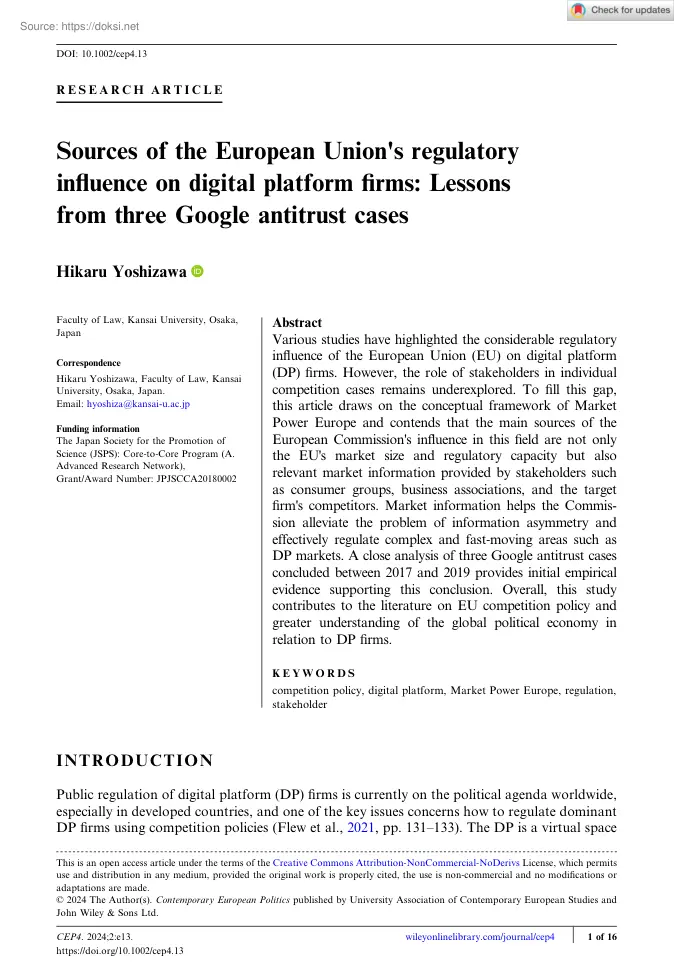
DOI: 10.1002/cep413 RESEARCH ARTICLE Sources of the European Union's regulatory influence on digital platform firms: Lessons from three Google antitrust cases Hikaru Yoshizawa Faculty of Law, Kansai University, Osaka, Japan Correspondence Hikaru Yoshizawa, Faculty of Law, Kansai University, Osaka, Japan. Email: hyoshiza@kansai-u.acjp Funding information The Japan Society for the Promotion of Science (JSPS): Core‐to‐Core Program (A. Advanced Research Network), Grant/Award Number: JPJSCCA20180002 Abstract Various studies have highlighted the considerable regulatory influence of the European Union (EU) on digital platform (DP) firms. However, the role of stakeholders in individual competition cases remains underexplored. To fill this gap, this article draws on the conceptual framework of Market Power Europe and contends that the main sources of the European Commission's influence in this field are not only the EU's market size and regulatory capacity but also
relevant market information provided by stakeholders such as consumer groups, business associations, and the target firm's competitors. Market information helps the Commission alleviate the problem of information asymmetry and effectively regulate complex and fast‐moving areas such as DP markets. A close analysis of three Google antitrust cases concluded between 2017 and 2019 provides initial empirical evidence supporting this conclusion. Overall, this study contributes to the literature on EU competition policy and greater understanding of the global political economy in relation to DP firms. KEYWORDS competition policy, digital platform, Market Power Europe, regulation, stakeholder INTRODUCTION Public regulation of digital platform (DP) firms is currently on the political agenda worldwide, especially in developed countries, and one of the key issues concerns how to regulate dominant DP firms using competition policies (Flew et al., 2021, pp 131–133) The DP is a virtual
space This is an open access article under the terms of the Creative Commons Attribution‐NonCommercial‐NoDerivs License, which permits use and distribution in any medium, provided the original work is properly cited, the use is non‐commercial and no modifications or adaptations are made. 2024 The Author(s). Contemporary European Politics published by University Association of Contemporary European Studies and John Wiley & Sons Ltd. CEP4. 2024;2:e13 https://doi.org/101002/cep413 wileyonlinelibrary.com/journal/cep4 | 1 of 16 2 of 16 | YOSHIZAWA in which various firms and consumers gather and look for trading partners to maximise their utility (Ohashi, 2021, p. 272) DPs such as search engines, online malls, social media, and smartphone application stores were widely considered beneficial for the economy because they virtually connected a large number of end users and business users while providing various innovative services. However, in the mid‐2010s, many
competition authorities worldwide became increasingly aware of certain drawbacks of DP firms and began to regulate them more strictly (Cioffi et al., 2022) This trend was based on the premise that American information technology (IT) giants such as Google, Apple, Meta (formerly Facebook), and Amazon were taking advantage of their dominant market positions as DP providers and making excessive profits at the expense of consumers and other firms. The European Union (EU) has been one of the pioneers in this emerging area of regulation. The EU's competition authority, the European Commission, launched an official investigation into Google's anticompetitive practices in 2010 and imposed heavy fines on the company in 2017, 2018, and 2019, amounting to more than eight billion euros in total. Furthermore, the Commission opened six cases concerning Google, Apple, Meta, and Amazon between 2019 and 2021.1 Against this background, the following research question is posed: What are
the main sources of the EU's regulatory influence on global DP firms in individual competition cases? To address this question, this study undertook a close analysis of the three cases against Google, which concerned typical competition problems in DP business, especially self‐preferencing, resulting in record‐breaking fines. The primary sources used in this research were the European Commission's official publications, such as press releases, communications, and case decisions. While the issue of DP regulation in competition policy has been analysed by experts in various academic disciplines, such as economics (Belleflamme & Peitz, 2021; Ohashi, 2021), law (Vande Walle, 2022), and political science (Cini & Czulno, 2022; Cioffi et al., 2022; Flew et al., 2021; Hoeffler & Mérand, 2023), a study conducted by legal scholar Anu Bradford is particularly relevant to the analysis of the Google cases in the EU. In her book The Brussels Effect, Bradford states
that the EU was able to impose heavy fines and remedies on Google because of its large market, significant regulatory capacity, and the relative stringency of its competition law. At the same time, she pointed out the limit of the EU's capacity to control Google's business conduct beyond its borders (Bradford, 2020, pp. 106–114) This analysis from the Brussels effect perspective is insightful, but does not sufficiently consider the role of stakeholders in these cases. Therefore, to complement Bradford's analysis, I present a further perspective based on the conceptual framework of Market Power Europe (Damro, 2012, 2021), which explicitly considers interest contestation among private actors, as well as the EU's market size and institutional features. My central contention is that the main sources of the EU's influence on DP firms in competition cases relate not only to its market size and regulatory capacity but also to relevant market information
provided by stakeholders such as consumer groups, business associations, and the target firm's competitors. In other words, stakeholder cooperation in law enforcement is significant for the European Commission to alleviate the problem of information asymmetry between the regulator and the regulated, especially in complex and fast‐moving areas such as multidimensional DP markets. A case study of Google cases provides the first test for this argument and shows that the Commission primarily used market information provided by stakeholders to identify specific problems and to substantiate its arguments in the final decisions. Furthermore, I argue that the EU's ability to regulate DP firms is likely to increase even further following enactment of the Digital Markets Act in the EU in 2022, and that the United States has recently begun to take a stricter stance on DP firms, increasing the potential for its law enforcement cooperation with the EU. This study 1 Their case
names and numbers are the following. AmazonMarket Place (AT 40462), AmazonBuy Box (AT40703), AppleApp Store Practices (music streaming) (AT.40437), AppleMobile payments (AT40452), Facebook leveraging (AT40684), and Google Adtech and Data‐related practices (AT.40670) 28330188, 2024, 2, Downloaded from https://onlinelibrary.wileycom/doi/101002/cep413 by Cochrane Japan, Wiley Online Library on [17/07/2024] See the Terms and Conditions (https://onlinelibrarywileycom/terms-and-conditions) on Wiley Online Library for rules of use; OA articles are governed by the applicable Creative Commons License SOURCES OF THE EUROPEAN UNION'S REGULATORY INFLUENCE | 3 of 16 aims to complement works on the legislative process of the Digital Markets Act (Cini & Czulno, 2022; Hoeffler & Mérand, 2023) and the shift to the stricter antitrust regulation of DP firms in the United States (Popiel, 2024) by analysing their implications for the EU's external regulatory influence more
explicitly. The remainder of this article is organised as follows. First, drawing on the literature on competition economics and law, I explain why DP firms often distort market competition and why they are comparatively difficult to regulate. Second, I briefly review the literature on the EU's regulatory influence, especially in relation to the Market Power Europe framework, and explain how it can be applied to the analysis of individual competition cases involving DP firms in the EU. Third, I highlight that the European Commission is experienced in handling IT sector cases and has recently reinforced its DP firm regulations in line with the EU's digital single market strategy. Fourth, I conduct a case study of three Google cases in the area of abuse of dominance and examine the main sources of the EU's regulatory influence. Finally, I draw conclusions, reflect on the implications of this research for the study of EU politics and the global political economy,
and identify avenues for further research. T HE N A T U R E A ND COM P L E X I T Y OF DP M A R K E T S The monopolisation tendency in DP markets, primarily due to structural factors is not accidental. Therefore, it is important to understand why the business practices of DP firms often cause competition policy concerns, especially regarding market dominance. According to the literature on competition economics, this problem is largely attributable to four characteristics of DPs (Crémer et al., 2019, pp 19–29; Ohashi, 2021, pp 276–280; Sugimoto, 2019, pp. 122–128) The first is economies of scale. These refer to the cost advantages enjoyed by firms that produce a large number of products. While economies of scale can be observed in many economic sectors, ‘the digital world pushes this phenomenon to the extreme’ (Crémer et al., 2019, p 20) On the one hand, the construction and maintenance of DPs generally require a substantial amount of initial investment and fixed costs.
However, the marginal cost (i.e, the production cost per unit) of digital products such as operating systems and applications tends to be extremely low because they are generally much easier to reproduce than manufactured goods. Therefore, the more the firm produces, the lower the average cost In this type of market, first movers gain an advantage. The second characteristic is the network effect. This means that the larger the number of network users, the greater the network's utility. For example, an increase in the number of online shopping mall sellers can provide a wider variety of goods and attract more consumers. Therefore, a DP firm operating this type of mall can accumulate more data regarding consumers' search and purchase histories as well as their personal information. This accumulation allows firms to analyse big data, often using artificial intelligence (AI), and display recommended products that match individual consumer preferences. DP firms also commonly
ask consumers to rate and comment on goods and services (Belleflamme & Peitz, 2021, pp. 41–76) Consequently, malls will become even more useful and attract more consumers. This phenomenon is called the attraction loop (Belleflamme & Peitz, 2021, pp. 13–15) The third characteristic is economies of scope. They refer to the cost advantages enjoyed by firms that produce various goods and services. Economies of scope occur when the expansion of a firm's product range generates substantial synergy. This concept helps understand why many DP firms continue to enter new markets in digital and real economies, as they are most likely seeking to reduce costs by applying their data on consumer preferences and versatile 28330188, 2024, 2, Downloaded from https://onlinelibrary.wileycom/doi/101002/cep413 by Cochrane Japan, Wiley Online Library on [17/07/2024] See the Terms and Conditions (https://onlinelibrarywileycom/terms-and-conditions) on Wiley Online Library for rules of
use; OA articles are governed by the applicable Creative Commons License 4 of 16 | YOSHIZAWA technologies such as personalised recommendation systems and conversational AI to related markets. The fourth factor is the significance of data. As suggested above, the analysis of detailed individual‐level data is the key to the success of the digital economy. DP firms have a significant advantage in this regard because they can easily collect data when managing interactions between business users and end users. Because of these four characteristics, DP firms often foster an oligopoly or near‐monopoly. While economies of scope are primarily a matter of business strategy, other characteristics are structural and intrinsic to DP firms. It is extremely difficult to challenge the incumbent DP firms. Initially, DP firms may compete fiercely for consumers in new markets. However, once the number of users of a particular DP firm reaches a certain level (critical mass), the
network effect and the value of the collected data become significant. Therefore, the provider of that platform will gain a strong comparative advantage (Ohashi, 2021, pp. 280–281) Global DPs such as Google, Apple, Meta, and Amazon have exponentially expanded their market share in various areas, including online search engines, digital device software, social media, and online malls. They have gained dominant market positions in numerous countries. It is likely that the key features of DP firms explained above have contributed to this market dominance. Global DP firms have actively acquired hundreds of emerging IT firms in related markets to diversify their businesses and achieve economies of scale (Crémer et al., 2019, pp 110–113) For example, Google acquired Android (2005) and YouTube (2006), and Facebook bought Instagram (2012) and WhatsApp (2014). Apple purchased the music streaming service company Beats (2014), which later became Apple Music (Vande Walle, 2022, pp.
158–159) There is growing recognition that killer acquisitions, meaning the purchase of potential competitors at an early stage, may distort market competition in the long run, even if their market shares are relatively small. It is difficult to regulate DP markets because they are multidimensional and fast‐moving. As DP firms simultaneously manage multiple markets for end and business users, it is difficult to detect the anticompetitive effects of their businesses from a traditional competition policy perspective (Knapstad, 2023). For example, free social media services seem to have no impact on market competition, but the accumulation of user data may provide an enormous advantage to a DP firm in terms of attracting more online advertisers while building its own business strategy in other markets. To further complicate the situation, DP firms tend to enter new markets constantly to achieve economies of scope while fully utilising the collected data. A major challenge for
competition authorities is understanding the overall ‘ecosystem’ of DP firms for effective regulation. Building on this insight, the next section explains how the conceptual framework of Market Power Europe can be applied to the analysis of competition cases involving DP firms. APPLYING THE CONCEPTUAL FRAMEWORK OF MARKET POWER EUROPE T O THE ANAL YSIS O F C OMPET IT IO N CASES INVOLVING DP FIRMS Over the past two decades, there has been growing interest among researchers and practitioners in the EU's significant regulatory influence within and beyond its borders. Various conceptual frameworks such as regulatory power (Endo & Suzuki, 2012), the Brussels effect (Bradford, 2020), and Market Power Europe (Damro, 2012) have been proposed to explain why the EU exerts considerable influence in various policy areas, especially those related to economic and social regulation. While all these conceptual frameworks have their own merits, the Market Power Europe framework is
particularly useful for the present research for two reasons. First, it is more generalisable than the other frameworks because it has been developed 28330188, 2024, 2, Downloaded from https://onlinelibrary.wileycom/doi/101002/cep413 by Cochrane Japan, Wiley Online Library on [17/07/2024] See the Terms and Conditions (https://onlinelibrarywileycom/terms-and-conditions) on Wiley Online Library for rules of use; OA articles are governed by the applicable Creative Commons License SOURCES OF THE EUROPEAN UNION'S REGULATORY INFLUENCE | 5 of 16 not only in terms of the literature on the EU's identity and actions as a power in international relations, but also on the broader study of comparative and international political economy. Second, it explicitly considers aspects of interest contestation within the EU. Therefore, this section briefly reviews the literature on the EU's regulatory influence, with a particular focus on Market Power Europe, and explains how such
perspective can be applied to the analysis of individual competition cases. According to Young (2015, pp. 1236–1239), regulatory influence refers to the intentional or unintentional exercise of power by public authorities to change: (1) the behaviour of firms and other private actors, (2) the rules and policies of other governments, and (3) multilateral rules and standards in various regulatory areas. While all these aspects are significant, this study focuses on the first. Specifically, it analyses the European Commission's intentional and coercive influences on firm behaviour. A precondition for the exercise of intentional and coercive regulatory influence is a political will to take collective action (Suzuki, 2012, pp. 25–27). This political will merits analysis as it is not always obvious in practice, especially in the EU's complex policymaking process. Regarding the main sources of the EU's regulatory influence on firms, one strand of research
emphasises the importance of market size (Drezner, 2007). There is broad consensus that market size is an essential factor because it increases the potential cost of firms’ noncompliance with regulations, which may result in sanctions such as market entry bans. However, market size alone cannot explain the considerable variation in the EU's regulatory influence across time and policy areas. Therefore, Bach and Newman (2007, pp 831–832) introduced the concept of regulatory capacity, which consists of regulatory expertise, the coherence of the regulatory authority in a policy domain, and the extent to which the statutory authority imposes costs for noncompliance. Subsequently, Damro (2012) synthesised these studies and the literature on the EU's identity and actions as a power to propose the conceptual framework of Market Power Europe. This framework helps in terms of understanding that the EU is essentially ‘a powerful actor that actively engages in international
affairs through the externalisation of its economic and social market‐related policies and regulatory measures’ (Damro, 2012, p. 696) The concept also draws attention to three sources of the EU's regulatory influence: (1) material existence, especially market size; (2) institutional features, especially regulatory capacity; and (3) interest contestation, which can generally be understood as societal pressure. More recently, Damro has used EU competition policy to illustrate how Market Power Europe can be applied in practice. Regarding the aspect of interest contestation, he stated that ‘companies (and their domestic and foreign competitors) are centrally involved in individual competition cases’ and ‘these companies, their competitors and other actorsboth European and non‐European onesmay form pro‐ externalisation coalitions that help to support and propel the EU's efforts at externalisation’ (Damro, 2021, pp. 60–61) Building on these studies, I hypothesise
that the main sources of the EU's regulatory influence in competition cases involve not only market size and regulatory capacity but also relevant market information provided by stakeholders, especially in complex and fast‐moving areas such as DP markets. What constitutes relevant market information in competition cases depends on the context; however, the most significant information is usually a detailed record of the business practices of the firms under investigation. Here, the term stakeholders refers to a wide range of actors such as firms, business associations, consumer groups, law firms, and individual experts. In the EU, they can participate directly in competition cases as complainants or interested third parties. They can also express their opinions when the European Commission holds public consultations on certain aspects of competition. This hypothesis is based on the following logic. Firms generally have more information about specific markets than
competition authorities. This problem of information asymmetry between the regulator and the regulated, which is prevalent across various areas of economic 28330188, 2024, 2, Downloaded from https://onlinelibrary.wileycom/doi/101002/cep413 by Cochrane Japan, Wiley Online Library on [17/07/2024] See the Terms and Conditions (https://onlinelibrarywileycom/terms-and-conditions) on Wiley Online Library for rules of use; OA articles are governed by the applicable Creative Commons License 6 of 16 | YOSHIZAWA regulation, incentivizes authorities to cooperate with stakeholders, including market participants. Such an incentive is likely to be particularly strong when authorities deal with complex and fast‐moving areas, such as DP markets. As noted in the previous section, DP markets are complex because they are multidimensional and rely on extensive AI‐based big data analyses. These markets are also fast‐moving because leading DP firms often enter new markets to achieve economies
of scope. The European Commission already has a formal, well‐established system of law enforcement cooperation with firms in cartel control. This system, called the leniency program, was introduced in 1996 to increase the Commission's capacity to detect and prove the existence of secret cartels among competitors in the same market.2 This program offers full immunity from fines or a reduction in fines to firms that anonymously confess their participation in cartels and provide relevant information. Leniency programs, such as those in the EU, are clearly designed as policy tools for competition authorities to alleviate the problem of information asymmetry. Therefore, market information provision by stakeholders can be assumed to increase the effectiveness of the European Commission's law enforcement not only in cartel control but also in other areas such as abuse of dominance. The next section places the EU's DP firm regulations in context, and the subsequent
section offers the first evaluation of the hypothesis based on a case study. EU C OMPET IT IO N POL IC Y AND D P FIR MS The EU is a pioneer in the regulation of DP firms in terms of competition policies. The main areas of EU competition policy involve restrictive practices, abuse of dominance, mergers, and state aid, and the European Commission has imposed heavy fines on DP firms particularly in the area of abuse of dominance. Therefore, this section explains how abuse‐of‐dominance (or ‘antitrust’) regulation of DP firms has become a policy priority. According to the European Commission (2015a, pp. 6, 11–12), the regulation of anticompetitive business practices in the IT sector is important for the EU to maximise its potential for growth. Therefore, the Commission has taken a comparatively strict stance on this issue for more than two decades. As shown in Table 1, between 2000 and 2023, the Commission imposed heavy fines on four American IT firms: Microsoft, Intel,
Qualcomm, and Google. While all these cases are high‐profile, issues directly related to DP markets were systematically addressed for the first time in the Google cases. The regulation of DP firms became a major policy issue in the EU in the mid‐2010s and is now deeply embedded in the EU's internal market policy and digitalisation strategy (Cini & Czulno, 2022, pp. 44–45) This is evident in the European Commission's discourse and law enforcement. Regarding the discourse, one key document is A Digital Single Market Strategy, published in 2015 by the Juncker Commission. The strategy outlined there acknowledges the benefits of DP firms but also points out the potential antitrust concerns they may give rise to (European Commission, 2015b, pp. 5, 11–12) Another significant policy document is Shaping Europe's Digital Future, published by the von der Leyen Commission in 2020. This document clarified that competition policy is an integral part of the EU's
digital transition strategy and is an essential tool for achieving a fair and competitive digital economy (European Commission, 2020, p. 5) Regarding law enforcement, the European Commission intensified its campaign to ensure compliance in relation to large DP firms under the leadership of European Competition Commissioner Margrethe Vestager (2014–2019). During her term in office, the Commission made decisions regarding three Google cases. Subsequently, the 2 The EU's leniency program was revised in 2002 and 2006. 28330188, 2024, 2, Downloaded from https://onlinelibrary.wileycom/doi/101002/cep413 by Cochrane Japan, Wiley Online Library on [17/07/2024] See the Terms and Conditions (https://onlinelibrarywileycom/terms-and-conditions) on Wiley Online Library for rules of use; OA articles are governed by the applicable Creative Commons License | SOURCES OF THE EUROPEAN UNION'S REGULATORY INFLUENCE TABLE 1 7 of 16 The European Commission's fines for abuse of
dominance by IT firms, 2000–2023. Year Case Case number Fine (€ million) 2004 Microsoft AT.37792 497 2009 Intel AT.37990 1060 2017 Google Search (Shopping) AT.39740 2424 2018 Google Android AT.40099 4343 2018 Qualcomm (Exclusivity payments) AT.40220 997 2019 Qualcomm (Predation) AT.39711 242 2019 Google Search (AdSense) AT.40411 1490 Note: Microsoft had three additional fines imposed for noncompliance with European Commission decisions. Source: Collected by the author using the case search engine of DG Competition website: https://competition-cases.eceuropaeu/search, Accessed January 10, 2024. European Commission President Ursula von der Leyen appointed Vestager as Executive Vice‐ President for a Europe Fit for the Digital Age and Competition (2019–2024). On the one hand, this appointment indicated an ever‐closer link between the EU's competition policy, digital single market strategy, and overarching digitalisation strategy. On the
other hand, it confirmed continuity in the Commission's struggle against DP firms' anticompetitive conduct. As noted, the Commission opened six abuse‐of‐dominance cases between 2019 and 2021: two cases against Amazon in July 2019, two cases against Apple in June 2020, one case against Facebook in June 2021, and a fourth case against Google also in June 2021.3 Furthermore, the European Parliament and the Council of the EU adopted the Digital Markets Act in September 2022 for the stricter regulation of large DP firms primarily in the field of competition policy. This legislation proceeded alongside the EU's digital sovereignty discourse and the adoption of other rules, especially the Digital Services Act for a safer and more transparent digital space (Farrand, 2023; Heidebrecht, 2024). In summary, the European Commission has recently intensified the competition regulation of large DP firms by building on its established regulatory tools and experience in handling
cases in related fields. This policy orientation is based on certain norms (protection of consumers) and interests (promotion of competition for economic growth) and is likely to continue because it is consistent with the principal priorities of the European Commission, especially ‘a Europe fit for the digital age’. THREE G OOGLE CASES IN T HE AREA OF ABUSE OF DOMINANCE The cases against Google concerned markets for comparison online shopping, mobile device software, and online advertisement intermediation. The European Commission launched an official investigation in 2010, intensified it in 2015, and made final decisions between 2017 and 2019. This section explains how events unfolded and why the Commission was able to exert a significant regulatory influence on Google. Regarding methodology, the case study method is used here because the number of competition cases involving DP firms is still very small in the EU as well as other jurisdictions. 3 See footnote 1.
28330188, 2024, 2, Downloaded from https://onlinelibrary.wileycom/doi/101002/cep413 by Cochrane Japan, Wiley Online Library on [17/07/2024] See the Terms and Conditions (https://onlinelibrarywileycom/terms-and-conditions) on Wiley Online Library for rules of use; OA articles are governed by the applicable Creative Commons License 8 of 16 | YOSHIZAWA Another reason is that this method allows a close examination of stakeholders' contributions, primarily based on a qualitative analysis of the content of European Commission decisions, a type of legal text. The three Google cases were selected for the case study for two reasons First, while the Microsoft case in the 2000s also involved a DP firm, key DP‐related issues such as self‐preferencing were directly addressed by the Commission for the first time in the Google cases. As noted, the other abuse‐of‐dominance cases involving DP firms are still ongoing as of January 2024. Second, the Google cases involved
record‐breaking fines and substantial remedies and can be considered a landmark in the EU's regulation of DP firms. Regarding material, I drew on the European Commission's press releases and annual reports on competition policy to explain how the cases unfolded. Furthermore, I examined the European Commission's decisions on these cases, which are more than 740 pages long in total and provide the detailed assessment of procedural and substantial issues. Specifically, I analysed the content of four key sections of each decision: procedures, market definition, dominance, and abuse of dominance. The ‘procedures’ section provides a list of complainants and third parties in each case, whereas the other sections analyse relevant markets and Google's conduct in depth. I conducted this analysis to ascertain the importance of stakeholders' market information provision in competition cases involving DP firms. S U M M A R Y O F T H E EU R O P E A N C O M M I S
S I O N ' S INVESTIGATIONS AND DECISIONS The European Commission initiated an investigation into Google's alleged antitrust practices in November 2010 and informed it of its preliminary conclusion in March 2013 (European Commission, 2010, 2013b). To address the concerns of the European Commission, Google proposed remedies in April 2013. Negotiations between them continued, and Google proposed revised remedies in February 2014. First, European Competition Commissioner Joaquín Almunia welcomed the proposal and stated that the Commission would make a commitment decision to swiftly restore market competition (European Commission, 2014, p. 1) However, the Commission changed its approach and continued the investigation to finally make a prohibition decision, most likely because the Commission was pressurised by European and non‐European firms, as well as by politicians and ministers across EU member states (Damro & Guay, 2016, pp. 67–68)4 In November 2014, Vestager was
appointed as the new European Competition Commissioner, succeeding Almunia, and the Commission began to take an even tougher stance on DP firms. The Commission sent three objections to Google in April 2015, April 2016, and July 2016 (European Commission, 2015b, 2016). Ultimately, the European Commission made three prohibition decisions, arguing that Google had violated Article 102 of the Treaty on the Functioning of the EU (TFEU). In all cases, the fines were calculated based on the worldwide turnover of Google and its parent company, Alphabet.5 In the first case, Google was fined 2.42 billion euros in June 2017 for the abuse of its dominant position in the search engine market.6 According to the decision, Google was dominant in general internet search markets throughout the European Economic Area (EEA), 4 The Commission adopts two main types of decisions regarding abuse of dominance (European Commission, 2013a). The first is the prohibition decision, which prohibits certain
business conduct and may also impose remedies and/or fines on violators of the law. The second type is a commitment decision. When a firm under investigation offers remedies for anticompetitive practices, the Commission may adopt this decision to make the commitments legally binding and close the case without establishing infringement. Commitment decisions are often adopted because they are useful for restoring market competition relatively quickly, while saving administrative resources. However, when the infringements are serious, the Commission is likely to make prohibition decisions 5 As codified in Article 23(2) of Regulation 1/2003, the European Commission has the power to impose fines on firms that infringe Article 102 of the TFEU. For each firm, the fine may be up to 10% of its total turnover in the preceding business year 6 Case AT.39740, Google Search (Shopping), Commission decision of 27 June 2017, C(2017)4444 final 28330188, 2024, 2, Downloaded from
https://onlinelibrary.wileycom/doi/101002/cep413 by Cochrane Japan, Wiley Online Library on [17/07/2024] See the Terms and Conditions (https://onlinelibrarywileycom/terms-and-conditions) on Wiley Online Library for rules of use; OA articles are governed by the applicable Creative Commons License SOURCES OF THE EUROPEAN UNION'S REGULATORY INFLUENCE | 9 of 16 including all EU member states, and held extremely high market shares in all EEA countries, exceeding 90% in most. Google abused this market dominance by providing a substantial advantage to its own ‘comparison shopping website’, Google Shopping. Such websites provide specialised web search services that allow users to search for certain categories of information, such as the prices of similar products. The Commission argued that Google Shopping occupied the first few pages of the search results. Simultaneously, items suggested by rival comparison shopping services were made less visible, often on page 4 or later.
Based on these observations, the European Commission required Google to terminate its anticompetitive business conduct and provide equal treatment to its own and rival services within 90 days (European Commission, 2017). In the second case, Google was fined 4.34 billion euros in July 2018 According to the European Commission's decision in this case,7 Google held a dominant position in the Android smart mobile operating system and its application stores, as well as in the general internet search market. As of 2018, approximately 80% of smart mobile devices in Europe and worldwide used the Android system. The company abused its dominant position in the following ways (European Commission, 2018). First, it required manufacturers to pre‐install its general search and browser applications, Google Search and Chrome, as a condition for licensing its application store, the Play Store. Second, it made payments to manufacturers and mobile network operators that exclusively preinstalled
Google Search on their devices. Third, it prevented manufacturers wishing to preinstall Google applications from selling digital devices running on other versions of the Android operating system. Based on these findings, the European Commission required Google to cease these practices within 90 days. In the third case, Google was fined 1.49 billion euros in March 20198 This case involved the market for online search advertisement intermediation. Online search advertisements are targeted advertisements that correspond to specific search results on websites and are customised for individual user preferences. Online search advertisement intermediation refers to business in which DP firms profit by virtually connecting advertisers, website owners, and end users. Websites such as newspapers, blogs, and travel sites often have an embedded search function. When users use this function and type keywords, search results and associated advertisements are displayed. Google provides an
intermediary system of this type, AdSense for Search. According to the European Commission, Google began including exclusive clauses in its contracts with website owners in 2006. These clauses prevented owners from displaying advertisements from Google competitors on their search‐result pages. Later, Google gradually began to replace exclusive clauses with premium placement clauses, which required website owners to prioritise Google's advertisements in their search results. Based on these observations, the European Commission concluded that Google had abused its dominant position by preventing its rivals from competing for online search advertising intermediation (European Commission, 2019). Google brought these cases to the General Court of the EU and requested annulment of European Commission decisions; however, this attempt has thus far been largely unsuccessful. The court upheld most aspects of the first decision in its judgement in November 2021.9 Similarly, the court
largely upheld the second decision in its judgement in September 2022, while reducing the fine from 4.34 billion euros to 4125 billion euros10 Google appealed to the Court of Justice against these judgements. As of January 2024, the third case is still under consideration. Case AT.40099, Google Android, Commission decision of 18 July 2018, C (2018) 4761 final Case AT.40411, Google Search (AdSense), Commission decision of 20 March 2019, C (2019) 2173 final Case T‐612‐17, Google and Alphabet v Commission (Google Shopping), ECLI:EU:T:2021:763. 10 Case T‐604/18, Google and Alphabet v Commission (Google Android), ECLI:EU:T:2022:541. 7 8 9 28330188, 2024, 2, Downloaded from https://onlinelibrary.wileycom/doi/101002/cep413 by Cochrane Japan, Wiley Online Library on [17/07/2024] See the Terms and Conditions (https://onlinelibrarywileycom/terms-and-conditions) on Wiley Online Library for rules of use; OA articles are governed by the applicable Creative Commons License 10 of 16 |
YOSHIZAWA M A I N S O U R C E S O F T H E E U ' S RE G U L A T O R Y IN F L U E N C E ON DP FIRMS In these cases, the precondition for intentional regulatory influence, that is, the EU's political will to take collective action, appears to have been met for three reasons. First, according to the literature on comparative competition law, the EU is generally more interventionist than many other jurisdictions, such as the US, which has been reluctant to take antitrust action against large DP firms until recently (Bradford, 2020, pp. 101–103) Second, as noted, the strict stance on Google is in line with the current von der Leyen Commission's digital policy, which emphasises the regulation of DP firms and emerging digital technologies. Third, the dominant DP firms in the EU market, such as Google, Amazon, Apple, and Meta are all American. If they had been European, it could have been more difficult for the EU to take decisive action against them. Notably, the
European Commission imposed severe penalties on Google, although these might have caused political friction between the EU and the United States. In fact, after the Commission adopted the decision on the third Google case in March 2019, US President Donald Trump commented that Vestager ‘hates the United States perhaps worse than any person I have ever met’ and ‘Europe treats us worse than China’ (Dallison, 2019). However, despite political pressure from the highest level, the Commission remained united and reinforced its struggle against infringements by American DP firms in the following years. The conceptual framework of Market Power Europe helps understand why the European Commission could exert considerable regulatory influence on Google, one of the largest and most profitable DP firms worldwide. As noted, Market Power Europe stresses the significance of material existence, institutional features, and interest contestations. Regarding material existence, there is
little doubt that the EU's large market is one of the main sources of regulatory influence on Google. The EU's gross domestic product (GDP) at purchaser's prices was approximately 167 trillion dollars in 2022, which is comparable to that of China, the second largest global economy.11 Despite the United Kingdom's withdrawal from the EU in 2020, many IT firms, including DP firms, remain attracted to the EU's large market of nearly 450 million citizens, many of whom have strong purchasing power. Furthermore, as noted previously, Google enjoys a dominant position in several European digital markets. In 2016, its share in the general online search market exceeded 90% in 25 EU member states and 80% in the other three, while its share in the online advertisement intermediation market was more than 85% in most member states and more than 95% in the global market for licensed smartphone operating systems, excluding China (European Commission, 2018, p. 2; 2019, p 2)
Given its well‐established dominance in these profitable and growing markets, it is understandable that Google continues its business in the EU even after being fined around eight billion euros in total. Regarding the second aspect, namely, the EU's institutional features, the cases against Google illustrate the European Commission's significant regulatory capacity. Based on the extensive investigations conducted by the Directorate General for Competition (DG COMP), the European Commission published detailed decisions on these cases, totalling more than 740 pages. Furthermore, as noted above, the decisions in the first and second cases were largely upheld by the General Court. These facts indicate that the European Commission, especially the DG COMP, possesses sufficient human resources and expertise to deal with complex cases concerning DP firms. Regarding the third aspect, namely, interest contestations within the EU, stakeholders played a significant role in the
decision‐making process. Four pieces of evidence support this 11 China's GDP in 2022 was approximately 18 trillion dollars, and that of the United States was approximately 25 trillion dollars. See World Bank ‘GDP (current US$)’ https://data.worldbankorg/indicator/NYGDPMKTPCD (accessed 10 January 2024) 28330188, 2024, 2, Downloaded from https://onlinelibrary.wileycom/doi/101002/cep413 by Cochrane Japan, Wiley Online Library on [17/07/2024] See the Terms and Conditions (https://onlinelibrarywileycom/terms-and-conditions) on Wiley Online Library for rules of use; OA articles are governed by the applicable Creative Commons License SOURCES OF THE EUROPEAN UNION'S REGULATORY INFLUENCE | 11 of 16 viewpoint. First, the cases against Google were launched based on private actors' formal complaints rather than on the European Commission's own initiative. The initial complainants were four firms that provided online search services and one business
association: Foundem (United Kingdom), Microsoft's Ciao Unit (Germany), eJustice and its parent company 1plusV (France), and the business association Verband freier Telefonbuchverleger (Germany).12 Second, after the official investigation began in November 2010, these firms were joined by numerous European and American firms as well as other groups. By September 2015, there were 24 complainants and 10 interested third parties.13 These included the European Consumer Organization (BEUC); European firms such as Deutsche Telekom, HolidayCheck, Acheter moins cher, and the above‐mentioned initial complainants; American firms such as Microsoft, Yelp, TripAdvisor, Expedia, and Getty Images; and FairSearch, an international group of businesses and organisations established specifically to lobby against Google's alleged anticompetitive practices.14 According to Yelp's public policy director, Luther Lowe, the American firms ‘helped lead the charge by providing
substantive evidence of Google's harm to consumers’ (Foo & Auchard, 2015). Many other complainants and interested third parties also actively participated in the investigation process by submitting opinions on the European Commission's objections and Google's responses to them. Third, in all three decisions the European Commission extensively referred to market information provided by stakeholders, especially companies. Table 2 provides examples of such references and their purposes These examples show that stakeholders' contributions helped the European Commission disprove some of the key claims of Google and substantiate its arguments. Finally, the European Commission held a public consultation in April 2013 regarding the remedies proposed by Google (European Commission, 2013b, p. 1), although public consultations are not mandatory. This indicates that the European Commission may have found it difficult to cope with the issue alone and actively invited
stakeholders to provide their expertise on this matter. AFTERMATH: NEW L EGISLATION AND A MORE F A V OU R A B L E INT E RNA T IONAL ENVIRO NMENT In assessing the EU's regulatory influence on DP firms comprehensively, two recent changes should be considered. The first is legislation recently introduced in the EU, as noted, while the second concerns the general political momentum in other jurisdictions, including the United States. Regarding the EU's legislation, the Digital Markets Act was proposed in December 2020 and adopted in September 2022 to control DP firms more strictly and effectively. After the European Commission's threshold check, obligations codified in the Act will begin to apply to designated gatekeepers in March 2024. This rather rapid legislation indicates the continuing political will of the EU and its member states to tackle the issue of abuse of dominance by DP firms. While Cini and Czulno (2022) and Hoeffler and Mérand (2023) provide slightly
different explanations for this legislation,15 both studies indicate two points. First, as noted above, the Act is part of the EU's increasingly stringent digital regulation, which is evident in the digital 12 Commission decision of 2017, paras. 39–43 Commission decision of 2017, para. 89 and footnote 37 14 According to its official website, FairSearch.org is ‘a group of businesses and organisations united to promote economic growth, innovation and choice across the Internet ecosystem by fostering and defending competition in online and mobile search’ (https:// fairsearch.org/about/) As of January 2024, its members are Foundem (UK), Naspers (South Africa), Oracle (US), TripAdvisor (US), Seznam (Czech Republic), Ecosia (Germany), and a Brussels‐based business group, the International Association of the Media Licensing Industry. 15 The former emphasises the internal and external context that provided a window of opportunity for policy change, as well as input from various
actors such as experts and corporate lobbyists. The latter regards the Act as the result of a fierce struggle between groups of political actors, consisting of EU institutions, member states, and private acotrs, which promoted competing economic ideas. 13 28330188, 2024, 2, Downloaded from https://onlinelibrary.wileycom/doi/101002/cep413 by Cochrane Japan, Wiley Online Library on [17/07/2024] See the Terms and Conditions (https://onlinelibrarywileycom/terms-and-conditions) on Wiley Online Library for rules of use; OA articles are governed by the applicable Creative Commons License 12 of 16 | YOSHIZAWA T A B L E 2 Key references to market information provided by stakeholders in the European Commission decisions on the Google cases. Sections Key references and their purposes regarding Google Search (Shopping), Google Android, and Google Search (AdSense) cases (hereafter cases 1 to 3) Market definition (relevant product markets) – To disprove Google's claim that
comparison shopping sites directly compete with merchant platforms such as Amazon Marketplace and eBay Marketplace (case 1, paras. 216–246, references to anonymous parties) – To disprove Google's claim that Android app stores directly compete with app stores for other smart mobile operating systems (case 2, paras. 284–305, 14 companies such as Apple, LG Electronics, Microsoft, and Samsung) – To disprove Google's claim that online search advertising directly competes with online non‐search advertising (case 3, paras. 135–150, Axel Springer Group, Labelium, Liberty Global, Microsoft, Yahoo, WFA, and anonymous parties) Dominant position – To prove that the market for general search engine is characterised by high entry barriers because such engine requires significant investments in terms of time and resources (case 1, para. 286, anonymous parties) – To prove that users of Google Android devices would face substantial costs when switching to Apple's iOS
devices (case 2, paras. 522–532, Jolla, Nokia, Portugal Telecom, Sony Mobile Communications, Telefonica, and Yandex) – To prove Google's high shares in the market for online search advertisement intermediation because no data is available from independent third parties (case 3, para. 278, Microsoft and Yahoo) Abuse of a dominant position – To prove that Google's conduct decreased search traffic from its general search results to its rival comparison shopping sites (case 1, paras. 381 and 463–474, anonymous parties) – To prove that competing general search services cannot offset the competitive advantage that Google ensures for itself through tying (case 2, paras. 804–834, AOL, Hutchison 3 G, Microsoft, Nokia, OEM, Yahoo, and Yandex) – To prove that Google abused its dominant position by including exclusive clauses in certain agreements with publishers (case 3, para. 348, anonymous parties) Source: Compiled by the author based on the European
Commission's decisions on these cases. sovereignty discourse and the adoption the Digital Services Act among others (see also Farrand, 2023; Heidebrecht, 2024). Second, the Digital Markets Act clearly granted new powers to the European Commission to regulate large DP firms ex ante. The Act defines gatekeepers as large DP firms that meet certain quantitative thresholds and provides a list of business practices that are illegal per se. If designated gatekeepers engage in these practices, the European Commission can impose behavioural and structural remedies and fines of up to 10% of their annual worldwide turnover. Notably, in case of repeated infringements, fines will be up to 20% Regarding the situation in other jurisdictions, many competition authorities worldwide became increasingly aware of shortcomings in DP business in the late 2010s and began to strengthen their control in relation to abuse of dominance by DP firms. This trend is evident from the publication of
detailed reports on this issue in numerous countries, including those in the EU.16 This ongoing political momentum is arguably increasing the potential for law enforcement 16 A report commissioned by the European Commission was published in 2019 (Crémer et al., 2019) In the same year, the United States, the United Kingdom, Australia, Benelux countries, BRICS countries, France, Germany, Italy, Portugal, Japan, and the United Nations Conference on Trade and Development also public their own reports (Belleflamme & Peitz, 2021, p. 3) 28330188, 2024, 2, Downloaded from https://onlinelibrary.wileycom/doi/101002/cep413 by Cochrane Japan, Wiley Online Library on [17/07/2024] See the Terms and Conditions (https://onlinelibrarywileycom/terms-and-conditions) on Wiley Online Library for rules of use; OA articles are governed by the applicable Creative Commons License SOURCES OF THE EUROPEAN UNION'S REGULATORY INFLUENCE | 13 of 16 cooperation between the European Commission and
its counterparts in certain countries, especially those that have signed bilateral competition agreements with the EU such as the United States, Canada, and Japan.17 It should be noted that two strong advocates for strict DP firm regulation were selected as leaders of US competition authorities in 2021. US President Joe Biden appointed Lina Khan as Chair of the Federal Trade Commission and Jonathan Kanter as Assistant Attorney General of the Justice Department's Antitrust Division. These appointments and the increasing recognition of the importance of competition rules for DP governance among American policymakers (Popiel, 2024) have paved the way for closer cooperation between the EU and the United States. The annual Joint Technology Competition Policy Dialogue was launched in 2021 as a forum for bilateral cooperation and dialogue regarding the technology sector, particularly regarding the issue of dominance in digital markets (European Commission, 2023). Regarding law
enforcement, US authorities have recently launched antitrust cases against American DP firms, including two cases filed by the Department of Justice and some states against Google in 2020 and 2023.18 In this situation, the European Commission is unlikely to face strong opposition from its US counterparts when imposing serious penalties on American DP firms. Overall, the international environment and transatlantic relations are becoming more favourable for the Commission in terms of competition regulation of DP firms. CONCLUSION There has been growing interest among researchers and practitioners in the global political economy concerning DP firm regulation. The competition policy dimension lies at the heart of DP firm regulation because it directly addresses the issue of market dominance, which is a classic example of market failure. There is currently a broad consensus across many jurisdictions that some degree of public intervention is necessary to address this problem, because
the market dominance tendency in DP markets is primarily caused by structural factors. Against this background, this study examined the sources of the EU's direct and coercive regulatory influence on DP firms and undertook an empirical analysis of landmark Google cases. In summary, this study presents the following findings. While the EU's large market and regulatory capacity are significant power resources, more attention should be paid to the role of market information provided by stakeholders in individual competition cases. Such information is essential for effective law enforcement, especially in complex areas such as DP markets where information asymmetry between the regulator and the regulated is prevalent. The findings of the case study support this viewpoint, although more empirical research is required to draw general conclusions. Specifically, in the Google cases, stakeholders' market information provision helped the European Commission to identify
specific problems and to substantiate its arguments while disproving some of the key arguments of Google. Since DP firm regulation is an integral part of the EU's digital single market strategy and general digitalisation strategy, the EU is highly likely to maintain its strict stance on large DP firms. The enactment of the Digital Markets Act and the recent trend towards stricter regulations in the EU's major partners, such as the United States, indicate that the EU's regulatory influence in this field is likely to increase even more. Overall, this study contributes to the study of EU competition policy and the literature on the EU's global regulatory influence by providing insights based on the conceptual framework of Market Power Europe. A broader implication of this research for the study of the global political economy is that the politics of DP firm regulation is complex and cannot be fully explained by simple dichotomies 17 A list of the EU's
bilateral and regional competition‐dedicated agreements and other agreements with competition provisions can be found on the DP COMP website (https://competition-policy.eceuropaeu/international-relations/bilateral-relations en) 18 US and Plaintiff States v. Google LLC [2020], US and Plaintiff States v Google LLC [2023] 28330188, 2024, 2, Downloaded from https://onlinelibrary.wileycom/doi/101002/cep413 by Cochrane Japan, Wiley Online Library on [17/07/2024] See the Terms and Conditions (https://onlinelibrarywileycom/terms-and-conditions) on Wiley Online Library for rules of use; OA articles are governed by the applicable Creative Commons License 14 of 16 | YOSHIZAWA such as ‘the state versus the market’ and ‘the EU versus the United States’. Regarding the state‐ market relationship, there have been confrontations between competition authorities and dominant DP firms in various jurisdictions, but this confrontational aspect is only part of the story. In Google cases,
the European Commission cooperated with stakeholders, including business associations, medium‐sized DP firms, and other private firms. Therefore, this cooperative aspect should not be overlooked. Similarly, the understanding of DP firm regulation as a zero‐sum economic contest between the EU and the United States has limitations. The European Commission's strict competition regulations have had a direct and enormous impact on leading DP firms, which are mostly American, but there is no clear evidence that the Commission discriminates against American IT firms for industrial policy purposes (Bradford, 2020, pp. 242–243; Yoshizawa, 2021, p 92) Apart from consumers, those who have benefited most from the first case against Google were not European firms, but Google's closest rivals based in the United States: Apple and Microsoft benefited in relation to the second case on digital device software, and Microsoft and Yahoo benefited in relation to the third case on
digital advertisement intermediation. Therefore, the European Commission's stringent competition policy vis‐à‐vis DP firms is best understood as part of the EU's digital single market strategy, which prioritises the creation and maintenance of a level‐ playing field rather than the protection of EU‐based firms.19 To better understand the regulatory influence of EU competition policy, further research could investigate the following three topics. First, additional case studies should be conducted, perhaps focusing on recent abuse‐of‐dominance cases in the EU concerning DP firms, as these seem particularly useful for ascertaining the significance of cooperation with stakeholders in law enforcement, although most are still ongoing as of January 2024. Second, research on international law enforcement cooperation could provide insights into the effectiveness of DP firm regulation by competition authorities such as the European Commission. Finally, a comparison
between the EU and other major economies is likely to provide detail of interest. For example, as distinct from the EU, the United States and China have their own leading DP firms, which may contribute to differences between their policies. A systematic comparative study could help deepen insights into the distinctiveness of the EU's DP firm regulation in terms of competition policies. AC KNOWLE DGEME NT S The author would like to thank two anonymous reviewers for their constructive and detailed comments. Earlier versions of this article were presented at the 2022 Annual Convention of the Japanese Association of International Relations in Sendai and the 2023 EU‐Japan Forum at the Université libre de Bruxelles (ULB). Also grateful to the participants of these conferences, especially Yuko Suda, Ken Endo, Momoko Nishimura, Yoshiko Kojo, Kazutoshi Suzuki, Takeshi Tsuchiya, Taro Nishikawa, Koji Fukuda, Toru Harada, Hidetoshi Nakamura, and Frederik Ponjaert for their valuable
feedback. The author acknowledges a research grant provided by the Japan Society for the Promotion of Science (JSPS): Core‐to‐Core Program (A. Advanced Research Networks) under Grant JPJSCCA20180002. CONFLI CT OF I NTE RES T STAT EME NT The author declares no conflict of interest. DATA AVA IL ABI LI TY ST ATE MENT Data sharing is not applicable. 19 For discussion on whether the Digital Markets Act could be implemented by the European Commission for industrial policy purposes, see Hoeffler and Mérand (2023, pp. 18–20) For the distinction between competition‐oriented (stringent) and competitiveness‐oriented (strategic) competition policies, see Yoshizawa (2021, pp. 8–11) 28330188, 2024, 2, Downloaded from https://onlinelibrary.wileycom/doi/101002/cep413 by Cochrane Japan, Wiley Online Library on [17/07/2024] See the Terms and Conditions (https://onlinelibrarywileycom/terms-and-conditions) on Wiley Online Library for rules of use; OA articles are governed by the
applicable Creative Commons License SOURCES OF THE EUROPEAN UNION'S REGULATORY INFLUENCE ORCID Hikaru Yoshizawa | 15 of 16 http://orcid.org/0000-0003-4306-754X PE ER RE VIEW The peer review history for this article is available at https://www.webofsciencecom/api/ gateway/wos/peer-review/10.1002/cep413 RE FER ENCES Bach, D. & Newman, AL (2007) The European regulatory state and global public policy: micro‐institutions, macro‐ influence. Journal of European Public Policy, 14(6), 827–846 Belleflamme, P. & Peitz, M (2021) The economics of platforms: concepts and strategy Cambridge University Press Bradford, A. (2020) The Brussels effect: how the European Union rules the world Oxford University Press Cini, M. & Czulno, P (2022) Digital single market and the EU competition regime: an explanation of policy change Journal of European Integration, 44(1), 41–57. Cioffi, J.W, Kenney, MF & Zysman, J (2022) Platform power and regulatory politics: Polanyi for
the twenty‐first century. New Political Economy, 27(5), 820–836 Crémer, J., Montjoye, Y & Schweitzer, H (2019) Competition policy for the digital era Publications Office of the European Union. Dallison, P. (2019) Trump: Europe treats us worse than China POLITICO Europe Damro, C. (2012) Market power Europe Journal of European Public Policy, 19(5), 682–699 Damro, C. (2021) The European Union as ‘market power Europe’ In: Gstöhl, S & Schunz, S (Eds) The external action of the European Union: concepts, approaches, theories. Red Globe Press, pp 54–68 Damro, C. & Guay, TR (2016) European competition policy and globalization Palgrave Macmillan Drezner, D.W (2007) All politics is global: explaining international regulatory regimes Princeton University Press Endo, K. & Suzuki, K (Eds) (2012) EU no Kiseiryoku (The EU's Regulatory Power) Nihon Keizai Hyouronsha European Commission. (2010) Antitrust: commission probes allegations of antitrust violations by
Google, IP/10/1624 European Commission. (2013a) Competition: antitrust procedures in abuse of dominance: Article 102 TFEU cases https://competition-policy.eceuropaeu/system/files/2021-05/antitrust procedures 102 enpdf European Commission. (2013b) Antitrust: commission seeks feedback on commitments offered by Google to address competition concerns. IP/13/371 European Commission. (2014) Antitrust: commission obtains from Google comparable display of specialized search rivals frequently asked questions. MEMO/14/87 European Commission. (2015a) A digital single market strategy for Europe European Commission. (2015b) Antitrust: commission sends statement of objections to Google on comparison shopping service; opens separate formal investigation on Android. IP/15/4780 European Commission. (2016) Antitrust: commission takes further steps in investigations alleging Google's comparison shopping and advertising‐related practices breach EU rules. IP/16/2532 European Commission. (2017)
Antitrust: commission fines Google €242 billion for abusing dominance as search engine by giving illegal advantage to own comparison shopping service. IP/17/1784 European Commission. (2018) Antitrust: commission fines Google €434 billion for illegal practices regarding Android mobile devices to strengthen dominance of Google's search engine. IP/18/4581 European Commission. (2019) Antitrust: commission fines Google €149 billion for abusive practices in online advertising IP/19/1770. European Commission. (2020) Shaping Europe's digital future European Commission. (2023) Competition: EU‐US hold third joint technology competition policy dialogue IP/23/2019 Farrand, B. (2023) Regulating misleading political advertising on online platforms: an example of regulatory mercantilism in digital policy. Policy Studies, 1–20 In press Available from: https://doiorg/101080/01442872 2023.2258810 Flew, T., Gillett, R, Martin, F & Sunman, L (2021) Return of the regulatory
state: a stakeholder analysis of Australia's Digital Platforms Inquiry and online news policy. The Information Society, 37(2), 128–145 Foo, Y.C & Auchard, E (2015) EU antitrust case against Google based on 19 complaints: sources Reuters Heidebrecht, S. (2024) From market liberalism to public intervention: digital sovereignty and changing European Union digital single market governance. Journal of Common Market Studies, 62(1), 205–223 Hoeffler, C. & Mérand, F (2023) Digital sovereignty, economic ideas, and the struggle over the digital markets act: a political cultural approach. Journal of European Public Policy, 1–26 In press Available from: https://doiorg/10 1080/13501763.20232294144 Knapstad, T. (2023) Digital dominance: assessing market definition and market power for online platforms under article 102 TFEU. European Competition Journal, 1–25 In press Available from: https://doiorg/101080/ 17441056.20232280334 28330188, 2024, 2, Downloaded from
https://onlinelibrary.wileycom/doi/101002/cep413 by Cochrane Japan, Wiley Online Library on [17/07/2024] See the Terms and Conditions (https://onlinelibrarywileycom/terms-and-conditions) on Wiley Online Library for rules of use; OA articles are governed by the applicable Creative Commons License 16 of 16 | YOSHIZAWA Ohashi, H. (2021) Kyousou Seisaku No Keizaigaku: Jinkou Genshou, Dejitaruka, Sangyou Seisaku (Economics of competition policy: population decline, digitalization, and industrial policy). Nikkei Business Publications Popiel, P. (2024) Emerging platform governance: antitrust reform and non‐competitive harms in digital platform markets. Information, Communication & Society, 27(1), 92–108 Sugimoto, K. (2019) Dejitaru Jidai No Kyousou Seisaku (Competition policy in the digital era) Nikkei Business Publications. Suzuki, K. (2012) EU No Kiseiryoku No Teigi To Bunsekishikaku (The definition and analytical perspective of the EU's regulatory power). In: Endo, K
& Suzuki, K (Eds) EU No Kiseiryoku (The EU's regulatory power) Nihon Keizai Hyouronsha, pp. 17–35 Vande Walle S. (2022) Biggu Teku No Taitou: Kyousouhou Wa Kinou Shiteirunoka (The rise of big tech: is competition law doing its job?). In: University of Tokyo, Faculty of Law, Gendai To Hou Committee, (Ed) Mada Hougaku Wo Shiranai Kimi E: Mirai Wo Hiraku 13 Kou (Discover the study of law: 13 lectures that open up a whole new world). Yuhikaku, pp 155–165 Yoshizawa, H. (2021) European Union competition policy versus industrial competitiveness: stringent regulation and its external implications. Routledge Young, A.R (2015) The European Union as a global regulator? Context and comparison Journal of European Public Policy, 22(9), 1233–1252. How to cite this article: Yoshizawa, H. (2024) Sources of the European Union's regulatory influence on digital platform firms: Lessons from three Google antitrust cases. Contemporary European Politics, 2, e13.
https://doiorg/101002/cep413 28330188, 2024, 2, Downloaded from https://onlinelibrary.wileycom/doi/101002/cep413 by Cochrane Japan, Wiley Online Library on [17/07/2024] See the Terms and Conditions (https://onlinelibrarywileycom/terms-and-conditions) on Wiley Online Library for rules of use; OA articles are governed by the applicable Creative Commons License
relevant market information provided by stakeholders such as consumer groups, business associations, and the target firm's competitors. Market information helps the Commission alleviate the problem of information asymmetry and effectively regulate complex and fast‐moving areas such as DP markets. A close analysis of three Google antitrust cases concluded between 2017 and 2019 provides initial empirical evidence supporting this conclusion. Overall, this study contributes to the literature on EU competition policy and greater understanding of the global political economy in relation to DP firms. KEYWORDS competition policy, digital platform, Market Power Europe, regulation, stakeholder INTRODUCTION Public regulation of digital platform (DP) firms is currently on the political agenda worldwide, especially in developed countries, and one of the key issues concerns how to regulate dominant DP firms using competition policies (Flew et al., 2021, pp 131–133) The DP is a virtual
space This is an open access article under the terms of the Creative Commons Attribution‐NonCommercial‐NoDerivs License, which permits use and distribution in any medium, provided the original work is properly cited, the use is non‐commercial and no modifications or adaptations are made. 2024 The Author(s). Contemporary European Politics published by University Association of Contemporary European Studies and John Wiley & Sons Ltd. CEP4. 2024;2:e13 https://doi.org/101002/cep413 wileyonlinelibrary.com/journal/cep4 | 1 of 16 2 of 16 | YOSHIZAWA in which various firms and consumers gather and look for trading partners to maximise their utility (Ohashi, 2021, p. 272) DPs such as search engines, online malls, social media, and smartphone application stores were widely considered beneficial for the economy because they virtually connected a large number of end users and business users while providing various innovative services. However, in the mid‐2010s, many
competition authorities worldwide became increasingly aware of certain drawbacks of DP firms and began to regulate them more strictly (Cioffi et al., 2022) This trend was based on the premise that American information technology (IT) giants such as Google, Apple, Meta (formerly Facebook), and Amazon were taking advantage of their dominant market positions as DP providers and making excessive profits at the expense of consumers and other firms. The European Union (EU) has been one of the pioneers in this emerging area of regulation. The EU's competition authority, the European Commission, launched an official investigation into Google's anticompetitive practices in 2010 and imposed heavy fines on the company in 2017, 2018, and 2019, amounting to more than eight billion euros in total. Furthermore, the Commission opened six cases concerning Google, Apple, Meta, and Amazon between 2019 and 2021.1 Against this background, the following research question is posed: What are
the main sources of the EU's regulatory influence on global DP firms in individual competition cases? To address this question, this study undertook a close analysis of the three cases against Google, which concerned typical competition problems in DP business, especially self‐preferencing, resulting in record‐breaking fines. The primary sources used in this research were the European Commission's official publications, such as press releases, communications, and case decisions. While the issue of DP regulation in competition policy has been analysed by experts in various academic disciplines, such as economics (Belleflamme & Peitz, 2021; Ohashi, 2021), law (Vande Walle, 2022), and political science (Cini & Czulno, 2022; Cioffi et al., 2022; Flew et al., 2021; Hoeffler & Mérand, 2023), a study conducted by legal scholar Anu Bradford is particularly relevant to the analysis of the Google cases in the EU. In her book The Brussels Effect, Bradford states
that the EU was able to impose heavy fines and remedies on Google because of its large market, significant regulatory capacity, and the relative stringency of its competition law. At the same time, she pointed out the limit of the EU's capacity to control Google's business conduct beyond its borders (Bradford, 2020, pp. 106–114) This analysis from the Brussels effect perspective is insightful, but does not sufficiently consider the role of stakeholders in these cases. Therefore, to complement Bradford's analysis, I present a further perspective based on the conceptual framework of Market Power Europe (Damro, 2012, 2021), which explicitly considers interest contestation among private actors, as well as the EU's market size and institutional features. My central contention is that the main sources of the EU's influence on DP firms in competition cases relate not only to its market size and regulatory capacity but also to relevant market information
provided by stakeholders such as consumer groups, business associations, and the target firm's competitors. In other words, stakeholder cooperation in law enforcement is significant for the European Commission to alleviate the problem of information asymmetry between the regulator and the regulated, especially in complex and fast‐moving areas such as multidimensional DP markets. A case study of Google cases provides the first test for this argument and shows that the Commission primarily used market information provided by stakeholders to identify specific problems and to substantiate its arguments in the final decisions. Furthermore, I argue that the EU's ability to regulate DP firms is likely to increase even further following enactment of the Digital Markets Act in the EU in 2022, and that the United States has recently begun to take a stricter stance on DP firms, increasing the potential for its law enforcement cooperation with the EU. This study 1 Their case
names and numbers are the following. AmazonMarket Place (AT 40462), AmazonBuy Box (AT40703), AppleApp Store Practices (music streaming) (AT.40437), AppleMobile payments (AT40452), Facebook leveraging (AT40684), and Google Adtech and Data‐related practices (AT.40670) 28330188, 2024, 2, Downloaded from https://onlinelibrary.wileycom/doi/101002/cep413 by Cochrane Japan, Wiley Online Library on [17/07/2024] See the Terms and Conditions (https://onlinelibrarywileycom/terms-and-conditions) on Wiley Online Library for rules of use; OA articles are governed by the applicable Creative Commons License SOURCES OF THE EUROPEAN UNION'S REGULATORY INFLUENCE | 3 of 16 aims to complement works on the legislative process of the Digital Markets Act (Cini & Czulno, 2022; Hoeffler & Mérand, 2023) and the shift to the stricter antitrust regulation of DP firms in the United States (Popiel, 2024) by analysing their implications for the EU's external regulatory influence more
explicitly. The remainder of this article is organised as follows. First, drawing on the literature on competition economics and law, I explain why DP firms often distort market competition and why they are comparatively difficult to regulate. Second, I briefly review the literature on the EU's regulatory influence, especially in relation to the Market Power Europe framework, and explain how it can be applied to the analysis of individual competition cases involving DP firms in the EU. Third, I highlight that the European Commission is experienced in handling IT sector cases and has recently reinforced its DP firm regulations in line with the EU's digital single market strategy. Fourth, I conduct a case study of three Google cases in the area of abuse of dominance and examine the main sources of the EU's regulatory influence. Finally, I draw conclusions, reflect on the implications of this research for the study of EU politics and the global political economy,
and identify avenues for further research. T HE N A T U R E A ND COM P L E X I T Y OF DP M A R K E T S The monopolisation tendency in DP markets, primarily due to structural factors is not accidental. Therefore, it is important to understand why the business practices of DP firms often cause competition policy concerns, especially regarding market dominance. According to the literature on competition economics, this problem is largely attributable to four characteristics of DPs (Crémer et al., 2019, pp 19–29; Ohashi, 2021, pp 276–280; Sugimoto, 2019, pp. 122–128) The first is economies of scale. These refer to the cost advantages enjoyed by firms that produce a large number of products. While economies of scale can be observed in many economic sectors, ‘the digital world pushes this phenomenon to the extreme’ (Crémer et al., 2019, p 20) On the one hand, the construction and maintenance of DPs generally require a substantial amount of initial investment and fixed costs.
However, the marginal cost (i.e, the production cost per unit) of digital products such as operating systems and applications tends to be extremely low because they are generally much easier to reproduce than manufactured goods. Therefore, the more the firm produces, the lower the average cost In this type of market, first movers gain an advantage. The second characteristic is the network effect. This means that the larger the number of network users, the greater the network's utility. For example, an increase in the number of online shopping mall sellers can provide a wider variety of goods and attract more consumers. Therefore, a DP firm operating this type of mall can accumulate more data regarding consumers' search and purchase histories as well as their personal information. This accumulation allows firms to analyse big data, often using artificial intelligence (AI), and display recommended products that match individual consumer preferences. DP firms also commonly
ask consumers to rate and comment on goods and services (Belleflamme & Peitz, 2021, pp. 41–76) Consequently, malls will become even more useful and attract more consumers. This phenomenon is called the attraction loop (Belleflamme & Peitz, 2021, pp. 13–15) The third characteristic is economies of scope. They refer to the cost advantages enjoyed by firms that produce various goods and services. Economies of scope occur when the expansion of a firm's product range generates substantial synergy. This concept helps understand why many DP firms continue to enter new markets in digital and real economies, as they are most likely seeking to reduce costs by applying their data on consumer preferences and versatile 28330188, 2024, 2, Downloaded from https://onlinelibrary.wileycom/doi/101002/cep413 by Cochrane Japan, Wiley Online Library on [17/07/2024] See the Terms and Conditions (https://onlinelibrarywileycom/terms-and-conditions) on Wiley Online Library for rules of
use; OA articles are governed by the applicable Creative Commons License 4 of 16 | YOSHIZAWA technologies such as personalised recommendation systems and conversational AI to related markets. The fourth factor is the significance of data. As suggested above, the analysis of detailed individual‐level data is the key to the success of the digital economy. DP firms have a significant advantage in this regard because they can easily collect data when managing interactions between business users and end users. Because of these four characteristics, DP firms often foster an oligopoly or near‐monopoly. While economies of scope are primarily a matter of business strategy, other characteristics are structural and intrinsic to DP firms. It is extremely difficult to challenge the incumbent DP firms. Initially, DP firms may compete fiercely for consumers in new markets. However, once the number of users of a particular DP firm reaches a certain level (critical mass), the
network effect and the value of the collected data become significant. Therefore, the provider of that platform will gain a strong comparative advantage (Ohashi, 2021, pp. 280–281) Global DPs such as Google, Apple, Meta, and Amazon have exponentially expanded their market share in various areas, including online search engines, digital device software, social media, and online malls. They have gained dominant market positions in numerous countries. It is likely that the key features of DP firms explained above have contributed to this market dominance. Global DP firms have actively acquired hundreds of emerging IT firms in related markets to diversify their businesses and achieve economies of scale (Crémer et al., 2019, pp 110–113) For example, Google acquired Android (2005) and YouTube (2006), and Facebook bought Instagram (2012) and WhatsApp (2014). Apple purchased the music streaming service company Beats (2014), which later became Apple Music (Vande Walle, 2022, pp.
158–159) There is growing recognition that killer acquisitions, meaning the purchase of potential competitors at an early stage, may distort market competition in the long run, even if their market shares are relatively small. It is difficult to regulate DP markets because they are multidimensional and fast‐moving. As DP firms simultaneously manage multiple markets for end and business users, it is difficult to detect the anticompetitive effects of their businesses from a traditional competition policy perspective (Knapstad, 2023). For example, free social media services seem to have no impact on market competition, but the accumulation of user data may provide an enormous advantage to a DP firm in terms of attracting more online advertisers while building its own business strategy in other markets. To further complicate the situation, DP firms tend to enter new markets constantly to achieve economies of scope while fully utilising the collected data. A major challenge for
competition authorities is understanding the overall ‘ecosystem’ of DP firms for effective regulation. Building on this insight, the next section explains how the conceptual framework of Market Power Europe can be applied to the analysis of competition cases involving DP firms. APPLYING THE CONCEPTUAL FRAMEWORK OF MARKET POWER EUROPE T O THE ANAL YSIS O F C OMPET IT IO N CASES INVOLVING DP FIRMS Over the past two decades, there has been growing interest among researchers and practitioners in the EU's significant regulatory influence within and beyond its borders. Various conceptual frameworks such as regulatory power (Endo & Suzuki, 2012), the Brussels effect (Bradford, 2020), and Market Power Europe (Damro, 2012) have been proposed to explain why the EU exerts considerable influence in various policy areas, especially those related to economic and social regulation. While all these conceptual frameworks have their own merits, the Market Power Europe framework is
particularly useful for the present research for two reasons. First, it is more generalisable than the other frameworks because it has been developed 28330188, 2024, 2, Downloaded from https://onlinelibrary.wileycom/doi/101002/cep413 by Cochrane Japan, Wiley Online Library on [17/07/2024] See the Terms and Conditions (https://onlinelibrarywileycom/terms-and-conditions) on Wiley Online Library for rules of use; OA articles are governed by the applicable Creative Commons License SOURCES OF THE EUROPEAN UNION'S REGULATORY INFLUENCE | 5 of 16 not only in terms of the literature on the EU's identity and actions as a power in international relations, but also on the broader study of comparative and international political economy. Second, it explicitly considers aspects of interest contestation within the EU. Therefore, this section briefly reviews the literature on the EU's regulatory influence, with a particular focus on Market Power Europe, and explains how such
perspective can be applied to the analysis of individual competition cases. According to Young (2015, pp. 1236–1239), regulatory influence refers to the intentional or unintentional exercise of power by public authorities to change: (1) the behaviour of firms and other private actors, (2) the rules and policies of other governments, and (3) multilateral rules and standards in various regulatory areas. While all these aspects are significant, this study focuses on the first. Specifically, it analyses the European Commission's intentional and coercive influences on firm behaviour. A precondition for the exercise of intentional and coercive regulatory influence is a political will to take collective action (Suzuki, 2012, pp. 25–27). This political will merits analysis as it is not always obvious in practice, especially in the EU's complex policymaking process. Regarding the main sources of the EU's regulatory influence on firms, one strand of research
emphasises the importance of market size (Drezner, 2007). There is broad consensus that market size is an essential factor because it increases the potential cost of firms’ noncompliance with regulations, which may result in sanctions such as market entry bans. However, market size alone cannot explain the considerable variation in the EU's regulatory influence across time and policy areas. Therefore, Bach and Newman (2007, pp 831–832) introduced the concept of regulatory capacity, which consists of regulatory expertise, the coherence of the regulatory authority in a policy domain, and the extent to which the statutory authority imposes costs for noncompliance. Subsequently, Damro (2012) synthesised these studies and the literature on the EU's identity and actions as a power to propose the conceptual framework of Market Power Europe. This framework helps in terms of understanding that the EU is essentially ‘a powerful actor that actively engages in international
affairs through the externalisation of its economic and social market‐related policies and regulatory measures’ (Damro, 2012, p. 696) The concept also draws attention to three sources of the EU's regulatory influence: (1) material existence, especially market size; (2) institutional features, especially regulatory capacity; and (3) interest contestation, which can generally be understood as societal pressure. More recently, Damro has used EU competition policy to illustrate how Market Power Europe can be applied in practice. Regarding the aspect of interest contestation, he stated that ‘companies (and their domestic and foreign competitors) are centrally involved in individual competition cases’ and ‘these companies, their competitors and other actorsboth European and non‐European onesmay form pro‐ externalisation coalitions that help to support and propel the EU's efforts at externalisation’ (Damro, 2021, pp. 60–61) Building on these studies, I hypothesise
that the main sources of the EU's regulatory influence in competition cases involve not only market size and regulatory capacity but also relevant market information provided by stakeholders, especially in complex and fast‐moving areas such as DP markets. What constitutes relevant market information in competition cases depends on the context; however, the most significant information is usually a detailed record of the business practices of the firms under investigation. Here, the term stakeholders refers to a wide range of actors such as firms, business associations, consumer groups, law firms, and individual experts. In the EU, they can participate directly in competition cases as complainants or interested third parties. They can also express their opinions when the European Commission holds public consultations on certain aspects of competition. This hypothesis is based on the following logic. Firms generally have more information about specific markets than
competition authorities. This problem of information asymmetry between the regulator and the regulated, which is prevalent across various areas of economic 28330188, 2024, 2, Downloaded from https://onlinelibrary.wileycom/doi/101002/cep413 by Cochrane Japan, Wiley Online Library on [17/07/2024] See the Terms and Conditions (https://onlinelibrarywileycom/terms-and-conditions) on Wiley Online Library for rules of use; OA articles are governed by the applicable Creative Commons License 6 of 16 | YOSHIZAWA regulation, incentivizes authorities to cooperate with stakeholders, including market participants. Such an incentive is likely to be particularly strong when authorities deal with complex and fast‐moving areas, such as DP markets. As noted in the previous section, DP markets are complex because they are multidimensional and rely on extensive AI‐based big data analyses. These markets are also fast‐moving because leading DP firms often enter new markets to achieve economies
of scope. The European Commission already has a formal, well‐established system of law enforcement cooperation with firms in cartel control. This system, called the leniency program, was introduced in 1996 to increase the Commission's capacity to detect and prove the existence of secret cartels among competitors in the same market.2 This program offers full immunity from fines or a reduction in fines to firms that anonymously confess their participation in cartels and provide relevant information. Leniency programs, such as those in the EU, are clearly designed as policy tools for competition authorities to alleviate the problem of information asymmetry. Therefore, market information provision by stakeholders can be assumed to increase the effectiveness of the European Commission's law enforcement not only in cartel control but also in other areas such as abuse of dominance. The next section places the EU's DP firm regulations in context, and the subsequent
section offers the first evaluation of the hypothesis based on a case study. EU C OMPET IT IO N POL IC Y AND D P FIR MS The EU is a pioneer in the regulation of DP firms in terms of competition policies. The main areas of EU competition policy involve restrictive practices, abuse of dominance, mergers, and state aid, and the European Commission has imposed heavy fines on DP firms particularly in the area of abuse of dominance. Therefore, this section explains how abuse‐of‐dominance (or ‘antitrust’) regulation of DP firms has become a policy priority. According to the European Commission (2015a, pp. 6, 11–12), the regulation of anticompetitive business practices in the IT sector is important for the EU to maximise its potential for growth. Therefore, the Commission has taken a comparatively strict stance on this issue for more than two decades. As shown in Table 1, between 2000 and 2023, the Commission imposed heavy fines on four American IT firms: Microsoft, Intel,
Qualcomm, and Google. While all these cases are high‐profile, issues directly related to DP markets were systematically addressed for the first time in the Google cases. The regulation of DP firms became a major policy issue in the EU in the mid‐2010s and is now deeply embedded in the EU's internal market policy and digitalisation strategy (Cini & Czulno, 2022, pp. 44–45) This is evident in the European Commission's discourse and law enforcement. Regarding the discourse, one key document is A Digital Single Market Strategy, published in 2015 by the Juncker Commission. The strategy outlined there acknowledges the benefits of DP firms but also points out the potential antitrust concerns they may give rise to (European Commission, 2015b, pp. 5, 11–12) Another significant policy document is Shaping Europe's Digital Future, published by the von der Leyen Commission in 2020. This document clarified that competition policy is an integral part of the EU's
digital transition strategy and is an essential tool for achieving a fair and competitive digital economy (European Commission, 2020, p. 5) Regarding law enforcement, the European Commission intensified its campaign to ensure compliance in relation to large DP firms under the leadership of European Competition Commissioner Margrethe Vestager (2014–2019). During her term in office, the Commission made decisions regarding three Google cases. Subsequently, the 2 The EU's leniency program was revised in 2002 and 2006. 28330188, 2024, 2, Downloaded from https://onlinelibrary.wileycom/doi/101002/cep413 by Cochrane Japan, Wiley Online Library on [17/07/2024] See the Terms and Conditions (https://onlinelibrarywileycom/terms-and-conditions) on Wiley Online Library for rules of use; OA articles are governed by the applicable Creative Commons License | SOURCES OF THE EUROPEAN UNION'S REGULATORY INFLUENCE TABLE 1 7 of 16 The European Commission's fines for abuse of
dominance by IT firms, 2000–2023. Year Case Case number Fine (€ million) 2004 Microsoft AT.37792 497 2009 Intel AT.37990 1060 2017 Google Search (Shopping) AT.39740 2424 2018 Google Android AT.40099 4343 2018 Qualcomm (Exclusivity payments) AT.40220 997 2019 Qualcomm (Predation) AT.39711 242 2019 Google Search (AdSense) AT.40411 1490 Note: Microsoft had three additional fines imposed for noncompliance with European Commission decisions. Source: Collected by the author using the case search engine of DG Competition website: https://competition-cases.eceuropaeu/search, Accessed January 10, 2024. European Commission President Ursula von der Leyen appointed Vestager as Executive Vice‐ President for a Europe Fit for the Digital Age and Competition (2019–2024). On the one hand, this appointment indicated an ever‐closer link between the EU's competition policy, digital single market strategy, and overarching digitalisation strategy. On the
other hand, it confirmed continuity in the Commission's struggle against DP firms' anticompetitive conduct. As noted, the Commission opened six abuse‐of‐dominance cases between 2019 and 2021: two cases against Amazon in July 2019, two cases against Apple in June 2020, one case against Facebook in June 2021, and a fourth case against Google also in June 2021.3 Furthermore, the European Parliament and the Council of the EU adopted the Digital Markets Act in September 2022 for the stricter regulation of large DP firms primarily in the field of competition policy. This legislation proceeded alongside the EU's digital sovereignty discourse and the adoption of other rules, especially the Digital Services Act for a safer and more transparent digital space (Farrand, 2023; Heidebrecht, 2024). In summary, the European Commission has recently intensified the competition regulation of large DP firms by building on its established regulatory tools and experience in handling
cases in related fields. This policy orientation is based on certain norms (protection of consumers) and interests (promotion of competition for economic growth) and is likely to continue because it is consistent with the principal priorities of the European Commission, especially ‘a Europe fit for the digital age’. THREE G OOGLE CASES IN T HE AREA OF ABUSE OF DOMINANCE The cases against Google concerned markets for comparison online shopping, mobile device software, and online advertisement intermediation. The European Commission launched an official investigation in 2010, intensified it in 2015, and made final decisions between 2017 and 2019. This section explains how events unfolded and why the Commission was able to exert a significant regulatory influence on Google. Regarding methodology, the case study method is used here because the number of competition cases involving DP firms is still very small in the EU as well as other jurisdictions. 3 See footnote 1.
28330188, 2024, 2, Downloaded from https://onlinelibrary.wileycom/doi/101002/cep413 by Cochrane Japan, Wiley Online Library on [17/07/2024] See the Terms and Conditions (https://onlinelibrarywileycom/terms-and-conditions) on Wiley Online Library for rules of use; OA articles are governed by the applicable Creative Commons License 8 of 16 | YOSHIZAWA Another reason is that this method allows a close examination of stakeholders' contributions, primarily based on a qualitative analysis of the content of European Commission decisions, a type of legal text. The three Google cases were selected for the case study for two reasons First, while the Microsoft case in the 2000s also involved a DP firm, key DP‐related issues such as self‐preferencing were directly addressed by the Commission for the first time in the Google cases. As noted, the other abuse‐of‐dominance cases involving DP firms are still ongoing as of January 2024. Second, the Google cases involved
record‐breaking fines and substantial remedies and can be considered a landmark in the EU's regulation of DP firms. Regarding material, I drew on the European Commission's press releases and annual reports on competition policy to explain how the cases unfolded. Furthermore, I examined the European Commission's decisions on these cases, which are more than 740 pages long in total and provide the detailed assessment of procedural and substantial issues. Specifically, I analysed the content of four key sections of each decision: procedures, market definition, dominance, and abuse of dominance. The ‘procedures’ section provides a list of complainants and third parties in each case, whereas the other sections analyse relevant markets and Google's conduct in depth. I conducted this analysis to ascertain the importance of stakeholders' market information provision in competition cases involving DP firms. S U M M A R Y O F T H E EU R O P E A N C O M M I S
S I O N ' S INVESTIGATIONS AND DECISIONS The European Commission initiated an investigation into Google's alleged antitrust practices in November 2010 and informed it of its preliminary conclusion in March 2013 (European Commission, 2010, 2013b). To address the concerns of the European Commission, Google proposed remedies in April 2013. Negotiations between them continued, and Google proposed revised remedies in February 2014. First, European Competition Commissioner Joaquín Almunia welcomed the proposal and stated that the Commission would make a commitment decision to swiftly restore market competition (European Commission, 2014, p. 1) However, the Commission changed its approach and continued the investigation to finally make a prohibition decision, most likely because the Commission was pressurised by European and non‐European firms, as well as by politicians and ministers across EU member states (Damro & Guay, 2016, pp. 67–68)4 In November 2014, Vestager was
appointed as the new European Competition Commissioner, succeeding Almunia, and the Commission began to take an even tougher stance on DP firms. The Commission sent three objections to Google in April 2015, April 2016, and July 2016 (European Commission, 2015b, 2016). Ultimately, the European Commission made three prohibition decisions, arguing that Google had violated Article 102 of the Treaty on the Functioning of the EU (TFEU). In all cases, the fines were calculated based on the worldwide turnover of Google and its parent company, Alphabet.5 In the first case, Google was fined 2.42 billion euros in June 2017 for the abuse of its dominant position in the search engine market.6 According to the decision, Google was dominant in general internet search markets throughout the European Economic Area (EEA), 4 The Commission adopts two main types of decisions regarding abuse of dominance (European Commission, 2013a). The first is the prohibition decision, which prohibits certain
business conduct and may also impose remedies and/or fines on violators of the law. The second type is a commitment decision. When a firm under investigation offers remedies for anticompetitive practices, the Commission may adopt this decision to make the commitments legally binding and close the case without establishing infringement. Commitment decisions are often adopted because they are useful for restoring market competition relatively quickly, while saving administrative resources. However, when the infringements are serious, the Commission is likely to make prohibition decisions 5 As codified in Article 23(2) of Regulation 1/2003, the European Commission has the power to impose fines on firms that infringe Article 102 of the TFEU. For each firm, the fine may be up to 10% of its total turnover in the preceding business year 6 Case AT.39740, Google Search (Shopping), Commission decision of 27 June 2017, C(2017)4444 final 28330188, 2024, 2, Downloaded from
https://onlinelibrary.wileycom/doi/101002/cep413 by Cochrane Japan, Wiley Online Library on [17/07/2024] See the Terms and Conditions (https://onlinelibrarywileycom/terms-and-conditions) on Wiley Online Library for rules of use; OA articles are governed by the applicable Creative Commons License SOURCES OF THE EUROPEAN UNION'S REGULATORY INFLUENCE | 9 of 16 including all EU member states, and held extremely high market shares in all EEA countries, exceeding 90% in most. Google abused this market dominance by providing a substantial advantage to its own ‘comparison shopping website’, Google Shopping. Such websites provide specialised web search services that allow users to search for certain categories of information, such as the prices of similar products. The Commission argued that Google Shopping occupied the first few pages of the search results. Simultaneously, items suggested by rival comparison shopping services were made less visible, often on page 4 or later.
Based on these observations, the European Commission required Google to terminate its anticompetitive business conduct and provide equal treatment to its own and rival services within 90 days (European Commission, 2017). In the second case, Google was fined 4.34 billion euros in July 2018 According to the European Commission's decision in this case,7 Google held a dominant position in the Android smart mobile operating system and its application stores, as well as in the general internet search market. As of 2018, approximately 80% of smart mobile devices in Europe and worldwide used the Android system. The company abused its dominant position in the following ways (European Commission, 2018). First, it required manufacturers to pre‐install its general search and browser applications, Google Search and Chrome, as a condition for licensing its application store, the Play Store. Second, it made payments to manufacturers and mobile network operators that exclusively preinstalled
Google Search on their devices. Third, it prevented manufacturers wishing to preinstall Google applications from selling digital devices running on other versions of the Android operating system. Based on these findings, the European Commission required Google to cease these practices within 90 days. In the third case, Google was fined 1.49 billion euros in March 20198 This case involved the market for online search advertisement intermediation. Online search advertisements are targeted advertisements that correspond to specific search results on websites and are customised for individual user preferences. Online search advertisement intermediation refers to business in which DP firms profit by virtually connecting advertisers, website owners, and end users. Websites such as newspapers, blogs, and travel sites often have an embedded search function. When users use this function and type keywords, search results and associated advertisements are displayed. Google provides an
intermediary system of this type, AdSense for Search. According to the European Commission, Google began including exclusive clauses in its contracts with website owners in 2006. These clauses prevented owners from displaying advertisements from Google competitors on their search‐result pages. Later, Google gradually began to replace exclusive clauses with premium placement clauses, which required website owners to prioritise Google's advertisements in their search results. Based on these observations, the European Commission concluded that Google had abused its dominant position by preventing its rivals from competing for online search advertising intermediation (European Commission, 2019). Google brought these cases to the General Court of the EU and requested annulment of European Commission decisions; however, this attempt has thus far been largely unsuccessful. The court upheld most aspects of the first decision in its judgement in November 2021.9 Similarly, the court
largely upheld the second decision in its judgement in September 2022, while reducing the fine from 4.34 billion euros to 4125 billion euros10 Google appealed to the Court of Justice against these judgements. As of January 2024, the third case is still under consideration. Case AT.40099, Google Android, Commission decision of 18 July 2018, C (2018) 4761 final Case AT.40411, Google Search (AdSense), Commission decision of 20 March 2019, C (2019) 2173 final Case T‐612‐17, Google and Alphabet v Commission (Google Shopping), ECLI:EU:T:2021:763. 10 Case T‐604/18, Google and Alphabet v Commission (Google Android), ECLI:EU:T:2022:541. 7 8 9 28330188, 2024, 2, Downloaded from https://onlinelibrary.wileycom/doi/101002/cep413 by Cochrane Japan, Wiley Online Library on [17/07/2024] See the Terms and Conditions (https://onlinelibrarywileycom/terms-and-conditions) on Wiley Online Library for rules of use; OA articles are governed by the applicable Creative Commons License 10 of 16 |
YOSHIZAWA M A I N S O U R C E S O F T H E E U ' S RE G U L A T O R Y IN F L U E N C E ON DP FIRMS In these cases, the precondition for intentional regulatory influence, that is, the EU's political will to take collective action, appears to have been met for three reasons. First, according to the literature on comparative competition law, the EU is generally more interventionist than many other jurisdictions, such as the US, which has been reluctant to take antitrust action against large DP firms until recently (Bradford, 2020, pp. 101–103) Second, as noted, the strict stance on Google is in line with the current von der Leyen Commission's digital policy, which emphasises the regulation of DP firms and emerging digital technologies. Third, the dominant DP firms in the EU market, such as Google, Amazon, Apple, and Meta are all American. If they had been European, it could have been more difficult for the EU to take decisive action against them. Notably, the
European Commission imposed severe penalties on Google, although these might have caused political friction between the EU and the United States. In fact, after the Commission adopted the decision on the third Google case in March 2019, US President Donald Trump commented that Vestager ‘hates the United States perhaps worse than any person I have ever met’ and ‘Europe treats us worse than China’ (Dallison, 2019). However, despite political pressure from the highest level, the Commission remained united and reinforced its struggle against infringements by American DP firms in the following years. The conceptual framework of Market Power Europe helps understand why the European Commission could exert considerable regulatory influence on Google, one of the largest and most profitable DP firms worldwide. As noted, Market Power Europe stresses the significance of material existence, institutional features, and interest contestations. Regarding material existence, there is
little doubt that the EU's large market is one of the main sources of regulatory influence on Google. The EU's gross domestic product (GDP) at purchaser's prices was approximately 167 trillion dollars in 2022, which is comparable to that of China, the second largest global economy.11 Despite the United Kingdom's withdrawal from the EU in 2020, many IT firms, including DP firms, remain attracted to the EU's large market of nearly 450 million citizens, many of whom have strong purchasing power. Furthermore, as noted previously, Google enjoys a dominant position in several European digital markets. In 2016, its share in the general online search market exceeded 90% in 25 EU member states and 80% in the other three, while its share in the online advertisement intermediation market was more than 85% in most member states and more than 95% in the global market for licensed smartphone operating systems, excluding China (European Commission, 2018, p. 2; 2019, p 2)
Given its well‐established dominance in these profitable and growing markets, it is understandable that Google continues its business in the EU even after being fined around eight billion euros in total. Regarding the second aspect, namely, the EU's institutional features, the cases against Google illustrate the European Commission's significant regulatory capacity. Based on the extensive investigations conducted by the Directorate General for Competition (DG COMP), the European Commission published detailed decisions on these cases, totalling more than 740 pages. Furthermore, as noted above, the decisions in the first and second cases were largely upheld by the General Court. These facts indicate that the European Commission, especially the DG COMP, possesses sufficient human resources and expertise to deal with complex cases concerning DP firms. Regarding the third aspect, namely, interest contestations within the EU, stakeholders played a significant role in the
decision‐making process. Four pieces of evidence support this 11 China's GDP in 2022 was approximately 18 trillion dollars, and that of the United States was approximately 25 trillion dollars. See World Bank ‘GDP (current US$)’ https://data.worldbankorg/indicator/NYGDPMKTPCD (accessed 10 January 2024) 28330188, 2024, 2, Downloaded from https://onlinelibrary.wileycom/doi/101002/cep413 by Cochrane Japan, Wiley Online Library on [17/07/2024] See the Terms and Conditions (https://onlinelibrarywileycom/terms-and-conditions) on Wiley Online Library for rules of use; OA articles are governed by the applicable Creative Commons License SOURCES OF THE EUROPEAN UNION'S REGULATORY INFLUENCE | 11 of 16 viewpoint. First, the cases against Google were launched based on private actors' formal complaints rather than on the European Commission's own initiative. The initial complainants were four firms that provided online search services and one business
association: Foundem (United Kingdom), Microsoft's Ciao Unit (Germany), eJustice and its parent company 1plusV (France), and the business association Verband freier Telefonbuchverleger (Germany).12 Second, after the official investigation began in November 2010, these firms were joined by numerous European and American firms as well as other groups. By September 2015, there were 24 complainants and 10 interested third parties.13 These included the European Consumer Organization (BEUC); European firms such as Deutsche Telekom, HolidayCheck, Acheter moins cher, and the above‐mentioned initial complainants; American firms such as Microsoft, Yelp, TripAdvisor, Expedia, and Getty Images; and FairSearch, an international group of businesses and organisations established specifically to lobby against Google's alleged anticompetitive practices.14 According to Yelp's public policy director, Luther Lowe, the American firms ‘helped lead the charge by providing
substantive evidence of Google's harm to consumers’ (Foo & Auchard, 2015). Many other complainants and interested third parties also actively participated in the investigation process by submitting opinions on the European Commission's objections and Google's responses to them. Third, in all three decisions the European Commission extensively referred to market information provided by stakeholders, especially companies. Table 2 provides examples of such references and their purposes These examples show that stakeholders' contributions helped the European Commission disprove some of the key claims of Google and substantiate its arguments. Finally, the European Commission held a public consultation in April 2013 regarding the remedies proposed by Google (European Commission, 2013b, p. 1), although public consultations are not mandatory. This indicates that the European Commission may have found it difficult to cope with the issue alone and actively invited
stakeholders to provide their expertise on this matter. AFTERMATH: NEW L EGISLATION AND A MORE F A V OU R A B L E INT E RNA T IONAL ENVIRO NMENT In assessing the EU's regulatory influence on DP firms comprehensively, two recent changes should be considered. The first is legislation recently introduced in the EU, as noted, while the second concerns the general political momentum in other jurisdictions, including the United States. Regarding the EU's legislation, the Digital Markets Act was proposed in December 2020 and adopted in September 2022 to control DP firms more strictly and effectively. After the European Commission's threshold check, obligations codified in the Act will begin to apply to designated gatekeepers in March 2024. This rather rapid legislation indicates the continuing political will of the EU and its member states to tackle the issue of abuse of dominance by DP firms. While Cini and Czulno (2022) and Hoeffler and Mérand (2023) provide slightly
different explanations for this legislation,15 both studies indicate two points. First, as noted above, the Act is part of the EU's increasingly stringent digital regulation, which is evident in the digital 12 Commission decision of 2017, paras. 39–43 Commission decision of 2017, para. 89 and footnote 37 14 According to its official website, FairSearch.org is ‘a group of businesses and organisations united to promote economic growth, innovation and choice across the Internet ecosystem by fostering and defending competition in online and mobile search’ (https:// fairsearch.org/about/) As of January 2024, its members are Foundem (UK), Naspers (South Africa), Oracle (US), TripAdvisor (US), Seznam (Czech Republic), Ecosia (Germany), and a Brussels‐based business group, the International Association of the Media Licensing Industry. 15 The former emphasises the internal and external context that provided a window of opportunity for policy change, as well as input from various
actors such as experts and corporate lobbyists. The latter regards the Act as the result of a fierce struggle between groups of political actors, consisting of EU institutions, member states, and private acotrs, which promoted competing economic ideas. 13 28330188, 2024, 2, Downloaded from https://onlinelibrary.wileycom/doi/101002/cep413 by Cochrane Japan, Wiley Online Library on [17/07/2024] See the Terms and Conditions (https://onlinelibrarywileycom/terms-and-conditions) on Wiley Online Library for rules of use; OA articles are governed by the applicable Creative Commons License 12 of 16 | YOSHIZAWA T A B L E 2 Key references to market information provided by stakeholders in the European Commission decisions on the Google cases. Sections Key references and their purposes regarding Google Search (Shopping), Google Android, and Google Search (AdSense) cases (hereafter cases 1 to 3) Market definition (relevant product markets) – To disprove Google's claim that
comparison shopping sites directly compete with merchant platforms such as Amazon Marketplace and eBay Marketplace (case 1, paras. 216–246, references to anonymous parties) – To disprove Google's claim that Android app stores directly compete with app stores for other smart mobile operating systems (case 2, paras. 284–305, 14 companies such as Apple, LG Electronics, Microsoft, and Samsung) – To disprove Google's claim that online search advertising directly competes with online non‐search advertising (case 3, paras. 135–150, Axel Springer Group, Labelium, Liberty Global, Microsoft, Yahoo, WFA, and anonymous parties) Dominant position – To prove that the market for general search engine is characterised by high entry barriers because such engine requires significant investments in terms of time and resources (case 1, para. 286, anonymous parties) – To prove that users of Google Android devices would face substantial costs when switching to Apple's iOS
devices (case 2, paras. 522–532, Jolla, Nokia, Portugal Telecom, Sony Mobile Communications, Telefonica, and Yandex) – To prove Google's high shares in the market for online search advertisement intermediation because no data is available from independent third parties (case 3, para. 278, Microsoft and Yahoo) Abuse of a dominant position – To prove that Google's conduct decreased search traffic from its general search results to its rival comparison shopping sites (case 1, paras. 381 and 463–474, anonymous parties) – To prove that competing general search services cannot offset the competitive advantage that Google ensures for itself through tying (case 2, paras. 804–834, AOL, Hutchison 3 G, Microsoft, Nokia, OEM, Yahoo, and Yandex) – To prove that Google abused its dominant position by including exclusive clauses in certain agreements with publishers (case 3, para. 348, anonymous parties) Source: Compiled by the author based on the European
Commission's decisions on these cases. sovereignty discourse and the adoption the Digital Services Act among others (see also Farrand, 2023; Heidebrecht, 2024). Second, the Digital Markets Act clearly granted new powers to the European Commission to regulate large DP firms ex ante. The Act defines gatekeepers as large DP firms that meet certain quantitative thresholds and provides a list of business practices that are illegal per se. If designated gatekeepers engage in these practices, the European Commission can impose behavioural and structural remedies and fines of up to 10% of their annual worldwide turnover. Notably, in case of repeated infringements, fines will be up to 20% Regarding the situation in other jurisdictions, many competition authorities worldwide became increasingly aware of shortcomings in DP business in the late 2010s and began to strengthen their control in relation to abuse of dominance by DP firms. This trend is evident from the publication of
detailed reports on this issue in numerous countries, including those in the EU.16 This ongoing political momentum is arguably increasing the potential for law enforcement 16 A report commissioned by the European Commission was published in 2019 (Crémer et al., 2019) In the same year, the United States, the United Kingdom, Australia, Benelux countries, BRICS countries, France, Germany, Italy, Portugal, Japan, and the United Nations Conference on Trade and Development also public their own reports (Belleflamme & Peitz, 2021, p. 3) 28330188, 2024, 2, Downloaded from https://onlinelibrary.wileycom/doi/101002/cep413 by Cochrane Japan, Wiley Online Library on [17/07/2024] See the Terms and Conditions (https://onlinelibrarywileycom/terms-and-conditions) on Wiley Online Library for rules of use; OA articles are governed by the applicable Creative Commons License SOURCES OF THE EUROPEAN UNION'S REGULATORY INFLUENCE | 13 of 16 cooperation between the European Commission and
its counterparts in certain countries, especially those that have signed bilateral competition agreements with the EU such as the United States, Canada, and Japan.17 It should be noted that two strong advocates for strict DP firm regulation were selected as leaders of US competition authorities in 2021. US President Joe Biden appointed Lina Khan as Chair of the Federal Trade Commission and Jonathan Kanter as Assistant Attorney General of the Justice Department's Antitrust Division. These appointments and the increasing recognition of the importance of competition rules for DP governance among American policymakers (Popiel, 2024) have paved the way for closer cooperation between the EU and the United States. The annual Joint Technology Competition Policy Dialogue was launched in 2021 as a forum for bilateral cooperation and dialogue regarding the technology sector, particularly regarding the issue of dominance in digital markets (European Commission, 2023). Regarding law
enforcement, US authorities have recently launched antitrust cases against American DP firms, including two cases filed by the Department of Justice and some states against Google in 2020 and 2023.18 In this situation, the European Commission is unlikely to face strong opposition from its US counterparts when imposing serious penalties on American DP firms. Overall, the international environment and transatlantic relations are becoming more favourable for the Commission in terms of competition regulation of DP firms. CONCLUSION There has been growing interest among researchers and practitioners in the global political economy concerning DP firm regulation. The competition policy dimension lies at the heart of DP firm regulation because it directly addresses the issue of market dominance, which is a classic example of market failure. There is currently a broad consensus across many jurisdictions that some degree of public intervention is necessary to address this problem, because
the market dominance tendency in DP markets is primarily caused by structural factors. Against this background, this study examined the sources of the EU's direct and coercive regulatory influence on DP firms and undertook an empirical analysis of landmark Google cases. In summary, this study presents the following findings. While the EU's large market and regulatory capacity are significant power resources, more attention should be paid to the role of market information provided by stakeholders in individual competition cases. Such information is essential for effective law enforcement, especially in complex areas such as DP markets where information asymmetry between the regulator and the regulated is prevalent. The findings of the case study support this viewpoint, although more empirical research is required to draw general conclusions. Specifically, in the Google cases, stakeholders' market information provision helped the European Commission to identify
specific problems and to substantiate its arguments while disproving some of the key arguments of Google. Since DP firm regulation is an integral part of the EU's digital single market strategy and general digitalisation strategy, the EU is highly likely to maintain its strict stance on large DP firms. The enactment of the Digital Markets Act and the recent trend towards stricter regulations in the EU's major partners, such as the United States, indicate that the EU's regulatory influence in this field is likely to increase even more. Overall, this study contributes to the study of EU competition policy and the literature on the EU's global regulatory influence by providing insights based on the conceptual framework of Market Power Europe. A broader implication of this research for the study of the global political economy is that the politics of DP firm regulation is complex and cannot be fully explained by simple dichotomies 17 A list of the EU's
bilateral and regional competition‐dedicated agreements and other agreements with competition provisions can be found on the DP COMP website (https://competition-policy.eceuropaeu/international-relations/bilateral-relations en) 18 US and Plaintiff States v. Google LLC [2020], US and Plaintiff States v Google LLC [2023] 28330188, 2024, 2, Downloaded from https://onlinelibrary.wileycom/doi/101002/cep413 by Cochrane Japan, Wiley Online Library on [17/07/2024] See the Terms and Conditions (https://onlinelibrarywileycom/terms-and-conditions) on Wiley Online Library for rules of use; OA articles are governed by the applicable Creative Commons License 14 of 16 | YOSHIZAWA such as ‘the state versus the market’ and ‘the EU versus the United States’. Regarding the state‐ market relationship, there have been confrontations between competition authorities and dominant DP firms in various jurisdictions, but this confrontational aspect is only part of the story. In Google cases,
the European Commission cooperated with stakeholders, including business associations, medium‐sized DP firms, and other private firms. Therefore, this cooperative aspect should not be overlooked. Similarly, the understanding of DP firm regulation as a zero‐sum economic contest between the EU and the United States has limitations. The European Commission's strict competition regulations have had a direct and enormous impact on leading DP firms, which are mostly American, but there is no clear evidence that the Commission discriminates against American IT firms for industrial policy purposes (Bradford, 2020, pp. 242–243; Yoshizawa, 2021, p 92) Apart from consumers, those who have benefited most from the first case against Google were not European firms, but Google's closest rivals based in the United States: Apple and Microsoft benefited in relation to the second case on digital device software, and Microsoft and Yahoo benefited in relation to the third case on
digital advertisement intermediation. Therefore, the European Commission's stringent competition policy vis‐à‐vis DP firms is best understood as part of the EU's digital single market strategy, which prioritises the creation and maintenance of a level‐ playing field rather than the protection of EU‐based firms.19 To better understand the regulatory influence of EU competition policy, further research could investigate the following three topics. First, additional case studies should be conducted, perhaps focusing on recent abuse‐of‐dominance cases in the EU concerning DP firms, as these seem particularly useful for ascertaining the significance of cooperation with stakeholders in law enforcement, although most are still ongoing as of January 2024. Second, research on international law enforcement cooperation could provide insights into the effectiveness of DP firm regulation by competition authorities such as the European Commission. Finally, a comparison
between the EU and other major economies is likely to provide detail of interest. For example, as distinct from the EU, the United States and China have their own leading DP firms, which may contribute to differences between their policies. A systematic comparative study could help deepen insights into the distinctiveness of the EU's DP firm regulation in terms of competition policies. AC KNOWLE DGEME NT S The author would like to thank two anonymous reviewers for their constructive and detailed comments. Earlier versions of this article were presented at the 2022 Annual Convention of the Japanese Association of International Relations in Sendai and the 2023 EU‐Japan Forum at the Université libre de Bruxelles (ULB). Also grateful to the participants of these conferences, especially Yuko Suda, Ken Endo, Momoko Nishimura, Yoshiko Kojo, Kazutoshi Suzuki, Takeshi Tsuchiya, Taro Nishikawa, Koji Fukuda, Toru Harada, Hidetoshi Nakamura, and Frederik Ponjaert for their valuable
feedback. The author acknowledges a research grant provided by the Japan Society for the Promotion of Science (JSPS): Core‐to‐Core Program (A. Advanced Research Networks) under Grant JPJSCCA20180002. CONFLI CT OF I NTE RES T STAT EME NT The author declares no conflict of interest. DATA AVA IL ABI LI TY ST ATE MENT Data sharing is not applicable. 19 For discussion on whether the Digital Markets Act could be implemented by the European Commission for industrial policy purposes, see Hoeffler and Mérand (2023, pp. 18–20) For the distinction between competition‐oriented (stringent) and competitiveness‐oriented (strategic) competition policies, see Yoshizawa (2021, pp. 8–11) 28330188, 2024, 2, Downloaded from https://onlinelibrary.wileycom/doi/101002/cep413 by Cochrane Japan, Wiley Online Library on [17/07/2024] See the Terms and Conditions (https://onlinelibrarywileycom/terms-and-conditions) on Wiley Online Library for rules of use; OA articles are governed by the
applicable Creative Commons License SOURCES OF THE EUROPEAN UNION'S REGULATORY INFLUENCE ORCID Hikaru Yoshizawa | 15 of 16 http://orcid.org/0000-0003-4306-754X PE ER RE VIEW The peer review history for this article is available at https://www.webofsciencecom/api/ gateway/wos/peer-review/10.1002/cep413 RE FER ENCES Bach, D. & Newman, AL (2007) The European regulatory state and global public policy: micro‐institutions, macro‐ influence. Journal of European Public Policy, 14(6), 827–846 Belleflamme, P. & Peitz, M (2021) The economics of platforms: concepts and strategy Cambridge University Press Bradford, A. (2020) The Brussels effect: how the European Union rules the world Oxford University Press Cini, M. & Czulno, P (2022) Digital single market and the EU competition regime: an explanation of policy change Journal of European Integration, 44(1), 41–57. Cioffi, J.W, Kenney, MF & Zysman, J (2022) Platform power and regulatory politics: Polanyi for
the twenty‐first century. New Political Economy, 27(5), 820–836 Crémer, J., Montjoye, Y & Schweitzer, H (2019) Competition policy for the digital era Publications Office of the European Union. Dallison, P. (2019) Trump: Europe treats us worse than China POLITICO Europe Damro, C. (2012) Market power Europe Journal of European Public Policy, 19(5), 682–699 Damro, C. (2021) The European Union as ‘market power Europe’ In: Gstöhl, S & Schunz, S (Eds) The external action of the European Union: concepts, approaches, theories. Red Globe Press, pp 54–68 Damro, C. & Guay, TR (2016) European competition policy and globalization Palgrave Macmillan Drezner, D.W (2007) All politics is global: explaining international regulatory regimes Princeton University Press Endo, K. & Suzuki, K (Eds) (2012) EU no Kiseiryoku (The EU's Regulatory Power) Nihon Keizai Hyouronsha European Commission. (2010) Antitrust: commission probes allegations of antitrust violations by
Google, IP/10/1624 European Commission. (2013a) Competition: antitrust procedures in abuse of dominance: Article 102 TFEU cases https://competition-policy.eceuropaeu/system/files/2021-05/antitrust procedures 102 enpdf European Commission. (2013b) Antitrust: commission seeks feedback on commitments offered by Google to address competition concerns. IP/13/371 European Commission. (2014) Antitrust: commission obtains from Google comparable display of specialized search rivals frequently asked questions. MEMO/14/87 European Commission. (2015a) A digital single market strategy for Europe European Commission. (2015b) Antitrust: commission sends statement of objections to Google on comparison shopping service; opens separate formal investigation on Android. IP/15/4780 European Commission. (2016) Antitrust: commission takes further steps in investigations alleging Google's comparison shopping and advertising‐related practices breach EU rules. IP/16/2532 European Commission. (2017)
Antitrust: commission fines Google €242 billion for abusing dominance as search engine by giving illegal advantage to own comparison shopping service. IP/17/1784 European Commission. (2018) Antitrust: commission fines Google €434 billion for illegal practices regarding Android mobile devices to strengthen dominance of Google's search engine. IP/18/4581 European Commission. (2019) Antitrust: commission fines Google €149 billion for abusive practices in online advertising IP/19/1770. European Commission. (2020) Shaping Europe's digital future European Commission. (2023) Competition: EU‐US hold third joint technology competition policy dialogue IP/23/2019 Farrand, B. (2023) Regulating misleading political advertising on online platforms: an example of regulatory mercantilism in digital policy. Policy Studies, 1–20 In press Available from: https://doiorg/101080/01442872 2023.2258810 Flew, T., Gillett, R, Martin, F & Sunman, L (2021) Return of the regulatory
state: a stakeholder analysis of Australia's Digital Platforms Inquiry and online news policy. The Information Society, 37(2), 128–145 Foo, Y.C & Auchard, E (2015) EU antitrust case against Google based on 19 complaints: sources Reuters Heidebrecht, S. (2024) From market liberalism to public intervention: digital sovereignty and changing European Union digital single market governance. Journal of Common Market Studies, 62(1), 205–223 Hoeffler, C. & Mérand, F (2023) Digital sovereignty, economic ideas, and the struggle over the digital markets act: a political cultural approach. Journal of European Public Policy, 1–26 In press Available from: https://doiorg/10 1080/13501763.20232294144 Knapstad, T. (2023) Digital dominance: assessing market definition and market power for online platforms under article 102 TFEU. European Competition Journal, 1–25 In press Available from: https://doiorg/101080/ 17441056.20232280334 28330188, 2024, 2, Downloaded from
https://onlinelibrary.wileycom/doi/101002/cep413 by Cochrane Japan, Wiley Online Library on [17/07/2024] See the Terms and Conditions (https://onlinelibrarywileycom/terms-and-conditions) on Wiley Online Library for rules of use; OA articles are governed by the applicable Creative Commons License 16 of 16 | YOSHIZAWA Ohashi, H. (2021) Kyousou Seisaku No Keizaigaku: Jinkou Genshou, Dejitaruka, Sangyou Seisaku (Economics of competition policy: population decline, digitalization, and industrial policy). Nikkei Business Publications Popiel, P. (2024) Emerging platform governance: antitrust reform and non‐competitive harms in digital platform markets. Information, Communication & Society, 27(1), 92–108 Sugimoto, K. (2019) Dejitaru Jidai No Kyousou Seisaku (Competition policy in the digital era) Nikkei Business Publications. Suzuki, K. (2012) EU No Kiseiryoku No Teigi To Bunsekishikaku (The definition and analytical perspective of the EU's regulatory power). In: Endo, K
& Suzuki, K (Eds) EU No Kiseiryoku (The EU's regulatory power) Nihon Keizai Hyouronsha, pp. 17–35 Vande Walle S. (2022) Biggu Teku No Taitou: Kyousouhou Wa Kinou Shiteirunoka (The rise of big tech: is competition law doing its job?). In: University of Tokyo, Faculty of Law, Gendai To Hou Committee, (Ed) Mada Hougaku Wo Shiranai Kimi E: Mirai Wo Hiraku 13 Kou (Discover the study of law: 13 lectures that open up a whole new world). Yuhikaku, pp 155–165 Yoshizawa, H. (2021) European Union competition policy versus industrial competitiveness: stringent regulation and its external implications. Routledge Young, A.R (2015) The European Union as a global regulator? Context and comparison Journal of European Public Policy, 22(9), 1233–1252. How to cite this article: Yoshizawa, H. (2024) Sources of the European Union's regulatory influence on digital platform firms: Lessons from three Google antitrust cases. Contemporary European Politics, 2, e13.
https://doiorg/101002/cep413 28330188, 2024, 2, Downloaded from https://onlinelibrary.wileycom/doi/101002/cep413 by Cochrane Japan, Wiley Online Library on [17/07/2024] See the Terms and Conditions (https://onlinelibrarywileycom/terms-and-conditions) on Wiley Online Library for rules of use; OA articles are governed by the applicable Creative Commons License
 Just like you draw up a plan when you’re going to war, building a house, or even going on vacation, you need to draw up a plan for your business. This tutorial will help you to clearly see where you are and make it possible to understand where you’re going.

