Comments
 2025 · 9 page(s) (132 KB)
 English
 0
0
 April 29 · 2026
 The City University of New York
 Log in

 Embed
Embed
No comments yet. You can be the first!
What did others read after this?



Content extract
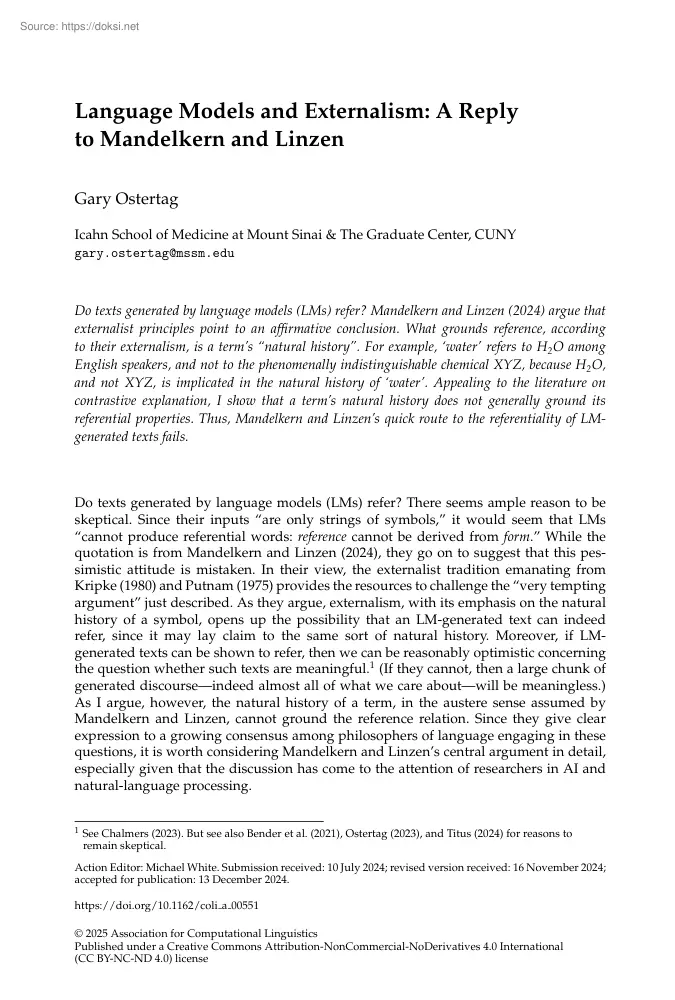
Language Models and Externalism: A Reply to Mandelkern and Linzen Gary Ostertag Icahn School of Medicine at Mount Sinai & The Graduate Center, CUNY gary.ostertag@mssmedu Do texts generated by language models (LMs) refer? Mandelkern and Linzen (2024) argue that externalist principles point to an affirmative conclusion. What grounds reference, according to their externalism, is a term’s “natural history”. For example, ‘water’ refers to H2 O among English speakers, and not to the phenomenally indistinguishable chemical XYZ, because H2 O, and not XYZ, is implicated in the natural history of ‘water’. Appealing to the literature on contrastive explanation, I show that a term’s natural history does not generally ground its referential properties. Thus, Mandelkern and Linzen’s quick route to the referentiality of LMgenerated texts fails Do texts generated by language models (LMs) refer? There seems ample reason to be skeptical. Since their inputs “are only strings of
symbols,” it would seem that LMs “cannot produce referential words: reference cannot be derived from form.” While the quotation is from Mandelkern and Linzen (2024), they go on to suggest that this pessimistic attitude is mistaken. In their view, the externalist tradition emanating from Kripke (1980) and Putnam (1975) provides the resources to challenge the “very tempting argument” just described. As they argue, externalism, with its emphasis on the natural history of a symbol, opens up the possibility that an LM-generated text can indeed refer, since it may lay claim to the same sort of natural history. Moreover, if LMgenerated texts can be shown to refer, then we can be reasonably optimistic concerning the question whether such texts are meaningful.1 (If they cannot, then a large chunk of generated discourseindeed almost all of what we care aboutwill be meaningless.) As I argue, however, the natural history of a term, in the austere sense assumed by Mandelkern and Linzen,
cannot ground the reference relation. Since they give clear expression to a growing consensus among philosophers of language engaging in these questions, it is worth considering Mandelkern and Linzen’s central argument in detail, especially given that the discussion has come to the attention of researchers in AI and natural-language processing. 1 See Chalmers (2023). But see also Bender et al (2021), Ostertag (2023), and Titus (2024) for reasons to remain skeptical. Action Editor: Michael White. Submission received: 10 July 2024; revised version received: 16 November 2024; accepted for publication: 13 December 2024. https://doi.org/101162/coli a 00551 2025 Association for Computational Linguistics Published under a Creative Commons Attribution-NonCommercial-NoDerivatives 4.0 International (CC BY-NC-ND 4.0) license Computational Linguistics Volume 51, Number 2 1. Do Facts About Natural History Ground Reference? Since Kripke (1980), it has seemed to many that some form of
externalism about reference is inevitable. The fact that I refer to Nixon in uttering Nixon resigned in disgrace is due to causal-historical facts involving that name. In particular, reference is mediated by a causal-historical chain linking the utterance to an event in which the bearer, Nixon, was “baptized” with that name. Since a name’s entering my vocabulary “does not require substantive experience, beliefs, or capacities vis-à-vis its referent” (Mandelkern and Linzen 2024, page 1194), the question is raised whether an LM’s tokening of the above sentence refers to Nixon. One line of resistance to a positive answer stems from the claim, cited above, that “reference cannot be derived from form.” But this oversimplifies the dialectic As Mandelkern and Linzen point out, “LMs’ inputs are not bare strings of symbols, but strings of symbols with certain natural histories that connect them to their referents” (page 1191). Once this fact is taken into account, they
argue, we have an effective response to the skeptic about LM reference. But this correction involves an oversimplification of its own: Nothing in Kripke’s understanding of the natural history of a name or kind term allows for such optimism. Indeed, Kripke’s picture would seem to preclude LMs’ participating in the sort of name-using practices required for their outputs to refer.2 Kripke himself, although he occasionally spoke of a “causal or historical connection” between current use and baptismal event, was careful to avoid causal vocabulary when describing how reference is transmitted. As he wrote: When the name is ‘passed from link to link’, the receiver of the name must, I think, intend when he learns it to use it with the same reference as the man from whom he heard it. (Kripke 1980, page 96) Consider the practice of using the name Nixon to refer to the former president. On Kripke’s view, what links the referential acts constituting this practice is the speaker’s
intention, at each point, to preserve the reference of the person from whom they first learned the name. (The precise construal of the intention need not detain us here) This suggests that what grounds the fact that, e.g, my current use of Nixon refers to Nixon is that (a) the person from whom I learned the name used it to refer to Nixon and that (b) I intend my current use to co-refer with that use. Referential intentions, however they are ultimately construed, are thus an ineliminable part of what grounds proper-name (and natural-kind-term) reference. This does not automatically imply a negative answer to our question. One general strategy of response is to show that LMs can, in fact, be said to intend to refer in conformity with communal practice. While Mandelkern and Linzen are cautiously optimistic about the prospects for such an approach, they acknowledge that it is an open question whether LMs can literally be said to possess intentions of the relevant sort. Alternatively, one
might part with Kripke here and deny that an attitude of deference to the community is integral to our referential practices (Cappelen and Deutsch 2024). If either view turns out to be correct, then nothing should stand in the way of our saying that LM-generated tokens refer. 2 For the moment setting aside the thorny question of what it could even mean for an AI tool to engage in “a practice”. See, however, Cappelen and Dever (2021, Chapter 5), who attempt to provide a “de-anthropocentrized” natural history, one applicable to AI tools. 652 Ostertag LMs and Externalism But this is a big if. An alternative path to an affirmative answer is more direct, dispensing with the need to route reference through states like intending or believing. Mandelkern and Linzen provide a succinct statement of the approach: What grounds reference is not beliefs, experiences, and discriminatory capacities of the kind that LMs obviously lack. Rather, what grounds reference is the natural
histories of words: the causal-historical links between a speech community’s use of a word and the word’s referent. (Mandelkern and Linzen 2024, page 1194; note omitted) Let’s call this viewthat the natural history of a name grounds its referencenaı̈ve externalism. On such a view, it should be “strikingly easy for a speaker to use a word referentially” (Mandelkern and Linzen 2024, page 1194). To demonstrate this, they present the example of Luke, who assertively utters Peano proved that arithmetic is incomplete, based entirely on his reading an article whose sole content is that very sentence. As long as his use of Peano is appropriately situated vis-à-vis Peano, Luke can use that name to refereven though the information on which that usage is based is false. Another case they use to show the irrelevance of specific beliefs to reference is Putnam’s well-known Twin Earth example (Putnam 1975). Recall that Twin Earth is just like Earth except for the fact that the
transparent liquid that flows in its rivers and streams and is rapidly seeping from its glaciers and icecaps is not H2 O but something elseXYZ. Since we are supposing that Twin Earth is superficially just like Earth, it follows that Twin Earthians go around using water to refer to the liquid that flows in its rivers and streams, etc., just as we use water to refer to the liquid that flows in our rivers and streams, etc. The difference is that the liquid flowing in their rivers and streams is not what flows in our rivers and streams. Because of this, when they use water their tokens refer to their local liquid (XYZ) whereas when we use that term, our tokens refer to our local liquid (H2 O). What makes it the case that water in Earthian English refers to H2 O, while water in Twin Earthian refers to XYZ? It is not the beliefs of the speakers about the liquids’ respective chemical compositions, since, by assumption, they do not yet know the chemical compositions of their respective
watery stuffs. Rather, it seems to simply be the fact that the stuff in the natural history of the word water on earth was made of H2 O, whereas the stuff in the natural history of the of the word water on twin earth was made of XYZ. (Mandelkern and Linzen 2024, page 1195) For Mandelkern and Linzen, all that is required for water to refer to H2 O (XYZ) among Earthians (Twin Earthians) is for the term to have the appropriate natural history. Similarly, all that is required for Luke’s use of Peano to refer to the mathematician is for it to have the right causal-historical pedigree. 2. Why? Questions and Constitutive Explanation As indicated, while Mandelkern and Linzen do not explicitly endorse naı̈ve externalism, they hold that it provides a promising route to a positive answer to our leading questionwhether LMs’ outputs refer. Even if the inputs to LMs are simply strings of text, they are strings of text with natural histories, and that may suffice for LMs’ words to refer.
653 Computational Linguistics Volume 51, Number 2 By contrast [to Cappelen and Dever], we will argue that the standard externalist accounts are at least prima facie compelling with respect to LMs. (2024, pages 1191, 1193; emphasis added) My claim in what follows is to show that their optimism is misplaced: Naı̈ve externalism gives us no grounds for holding that LMs’ outputs refer. I begin by noting a crucial slip in their argument. To see this, we first need to get clear on the question Mandelkern and Linzen take the externalist to be answering, which, in turn, will require a brief excursion into contrastive explanation. Here is their question, slightly modified to cohere with standard accounts of Why? questions (Mandelkern and Linzen 2024, page 1195).3 Q1. Why does water refer to H2 O among Earthians, while water refers to XYZ among Twin Earthians? The first thing to note is that Q1 is really the conjunction of two questions: Q1a. Why does water refer to H2 O among
Earthians? Q1b. Why does water refer to XYZ among Twin Earthians? I will focus on the naı̈ve externalist’s answer to Q1a, although the same problems will arise with respect to their answer to Q1b. Why? questions are intimately linked to the explanations they seek: We conceive of explanations as answers to such questions. What the contrastivist adds is that Why? questions are always, either implicitly or explicitly, contrastive in nature, taking the form: Why P as opposed to Q? Accordingly, explanations cite a reason or cause both for the fact that P and for the fact that not-Q. Consider, as an example, (1): (1) Why did John get paresis? As indicated, the contrastivist holds that a question of the form Why P? is always incomplete; it is elliptical for a question of the form Why P rather than Q? In the case of (1), the contrasting proposition, or “foil”, will be supplied by context. If we fill in some background, we can see how this works: Paresis can only arise in
individuals with untreated syphilis, occurring, even then, in only one out of ten cases. In addition, in any given instance of untreated syphilis it is indeterminate whether or not the particular case will develop into paresis. Let’s assume that all this is part of the common ground and, in addition, that John has paresis and that José and Maryan do not. Relative to this background, it is plausible to take (1) as asking (2): (2) Why did John, as opposed to José and Maryan, contract paresis? 3 I have also formulated the question so that it concerns the reference of water among Earthians rather than what water refers to in “Earthian English.” Presumably, nothing about the natural history of water is relevant to what it refers to in the abstract entity we here refer to as “Earthian English.” 654 Ostertag LMs and Externalism An additional element in the contrastivist’s account concerns the proper form an answer to such questions must take. It addresses the
question: If Why? questions are invariably contrastive, what must their answers look like? Lipton’s well-known account of explanation provides an answer: To explain why P rather than Q, we must cite a causal difference between P and not-Q, consisting of a cause of P and the absence of a corresponding event in the history of not-Q. (Lipton 2004, page 42) Intuitively, the fact that John was the only one among the three with untreated syphilis explains why John was the only one among the three who developed paresis. And this meshes perfectly with Lipton’s account, giving us a (partial) cause of John’s developing paresis together with the absence of “a corresponding event” in the history leading up to José and Maryan’s current state of non-paresis. Importantly, for our purposes, the explanation shows us the form that an answer to a Why? question should take. If contrastivism is on the right track, then Q1 is elliptical for a contrastive question. Given the context, it can be
seen to be elliptical for either of the following: Q2. Why does water refer to H2 O, and not to XYZ, among Earthians? Q3. Why does water refer to H2 O among Earthians, but not among Twin Earthians? On Lipton’s account, an answer to Q2 must cite a causal difference between the fact that water refers to H2 O among Earthians and the fact that water does not refer to XYZ among Earthians. (A similar requirement holds for Q3, which I will set aside here) With all this in place, we are now ready to ask: Does the externalist succeed in actually grounding reference? For present purposes, this becomes: Does the externalist succeed in responding satisfactorily to Q2? Before proceeding, note that a correct answer to Q2that is, a contrastive explanationprovides a “difference maker”: something that grounds the fact that water refers to H2 O but which is absent from the fact that water does not refer to XYZ. It is not required that the difference maker provides a complete ground of the fact
that water refers to H2 O, only that it provides a necessary condition (partial ground) of the fact. And this is precisely what the externalist is equipped to deliver. To see this, recall (2): (2) Why did John, as opposed to José and Maryan, contract paresis? The answer is: Because John had untreated syphilis, whereas José and Maryan did not. Here, the property of having untreated syphilis is the difference maker: It is what John has (and part of what makes it the case that he developed paresis) and José and Maryan lack. The externalist can provide a parallel response to Q2. Here’s how: Assume that XYZ never occurs in this corner of the universe. (Putnam assumes merely that it is not “plentiful” on Earth.) Since H2 O, but not XYZ, is implicated in the natural history of water (as used by Earthians), we have an explanation as to why water refers to H2 O but does not refer to XYZ, and thus an answer to Q2: Because H2 O is implicated in the natural history of ‘water’
whereas XYZ is not implicated in the natural history of ‘water’. Here, 655 Computational Linguistics Volume 51, Number 2 the property of being implicated in the natural history of water is the difference maker: H2 O has it (and that’s part of what makes it function as the referent of water), XYZ does not.4 But even if this serves to answer Q2, the strategy fails to yield an answer to Q4: Q4. Why does water refer to H2 O, and not to oxygen, among Earthians? To explain why P rather than Q, we must cite a difference maker: a property that H2 O has but oxygen lacks. But, although H2 O is implicated in the causal history of water, and thus partially grounds that reference, oxygen is equally implicated in the causal history of water. We thus fail to meet “the difference condition” (Lipton) Again, it might be thought that citing the fact that H2 O is implicated in the natural history of water would “stop the buck” in both Q2 and Q4; but it can do so only if this fact is
also a difference maker. In Q2 it is: H2 O, but not XYZ, is implicated in the natural history of water. But not in Q4: The parallel “difference maker”that H2 O, but not oxygen, is implicated in the natural history of wateris false. 3. Fine-tuning the Difference Maker For the naı̈ve externalist, facts about the natural history of water ground its reference. While this view is far more austere than anything proposed by the initial architects of externalism, it appears to underwrite the intuitionshared by manythat LMs’ outputs refer. Yet, the foregoing shows that the naı̈ve externalist is incapable of answering Q4a necessary condition, it would seem, on any successful theory of reference. Is there a way of embellishing naı̈ve externalism so that it remains naı̈ve and yet provides an answer to our question? Translated to address our current concerns, the question is: Can the naı̈ve externalist provide something more specific than being implicated in the natural history of
‘water’ in answering Q4? And, in fact, a more fine-grained difference maker can be gleaned from the following claim: “Luke’s use of Peano refers to Peano. thanks to the fact that his use of Peano traces back via causal-historical lines to Peano himself” (page 1195). Applied to the case in question, we get, as a candidate difference maker, being such that ‘water’ traces back via causal-historical lines to it. This gives us the following answer to Q4: A1. Earthians’ use of water traces back via causal-historical lines to H2 O; it does not trace back via causal historical lines to oxygen. But being such that ‘water’ traces back via causal-historical lines to it is easily seen not to be a difference maker: If water traces back via causal-historical lines to H2 O, then it traces back via causal-historical lines to oxygen as well. So A1 fails as an answer to Q4 (Things do not improve if we add details about the event at which the causal chain terminates. 4 Although
I’ll focus on Q2 in what follows, the answer to Q3 is: Because H2 O is implicated in the natural history of Earthian’s use of ‘water’ whereas H2 O is not implicated in the natural history of Twin Earthian’s use of ‘water’. Here, the difference maker is the property of being such that H2 O is implicated in its natural history: Earthian’s use of water has it, Twin Earthian’s use of water does not. 656 Ostertag LMs and Externalism For example, being such that ‘water’ traces back via causal-historical lines to a baptismal event involving it applies equally to H2 O and oxygen.) Perhaps we can invoke deference to the community, or, if not, to a set of experts? Since the Earthians cannot intelligibly be said to defer to themselves, deference to “the community” is a non-starter. A difference maker that invokes the relevant experts, ie, chemists, is more promisingfor example: being such that chemists are disposed to use ‘water’ in its presence. This gives us
the following answer: A2. Earthians defer to chemists in their use of water. Chemists are disposed to use water just when they are in the presence of H2 O; they are not disposed to use water just when they are in the presence of oxygen. This, however, needs to be finessed. If chemists use water when they are in the presence of H2 O, they also use water when they are in the presence of oxygen. Since every event in which they token water is one involving H2 O, every such event also involves oxygen. But chemists arguably have a more fine-grained disposition: to use water only in the presence of pure samples of H2 O, and never in the presence of pure samples of oxygen. Moreover, our deference is based on this more rarefied usage. Here we get: A3. Earthians defer to chemists in their use of water. Chemists use water only when in the presence of pure samples of H2 O; they do not use water only when in the presence of pure samples of oxygen. Note that it would be too strong to say that
chemists are disposed to use water when, and only when, they are in the presence of pure samples of H2 Oin a word, that their use of water covaries with the presence of pure samples of H2 O. What A3 states is that chemists refrain from using water in the absence of pure samples of H2 O. It does not require, implausibly, that they use the term whenever such pure samples are present. In fact, A3 is still too strong. Even chemists will, on occasion, “speak with the vulgar” and use water in the presence of impure samples of H2 Oto request a glass of drinking water, for example. One can rule out such possibilities by invoking the conversational context, as in A4: A4. Earthians defer to chemists in their use of water with respect to chemists’ purely scientific communications. These chemists have the following disposition: in the course of scientific communications, to use water only when in the presence of pure samples of H2 O; they do not have an analogous disposition with respect to
pure samples of oxygen. This easily accommodates a stray use of water in the presence of an impure sample of H2 O. Since the chemist’s request for a glass of drinking water is, technically, not part of a purely scientific exchange, it does not constitute a counterexample to A4. Even if we grant the assumption that context will make it clear which sense of water the speaker intends, there is the question as to whether this context-sensitivity comports with naı̈ve externalism. According to A4, the larger community does not defer to expert usage per se, but to expert usage relative to scientific exchanges. This requires an explanation as to how deference is made to the just right class of uses, and it is 657 Computational Linguistics Volume 51, Number 2 hard to see how our naive externalist, who eschews talk of “beliefs, experiences, and discriminatory capacities,” can accomplish this. These worries are compounded by the observation that, even with respect to strictly
scientific communications, there is significant variation with respect to chemists’ use of water. As Weisberg (2006) notes: Chemists’ ordinary use of natural kind terms are highly context sensitive. Say a chemist needs to use a warm water bath to keep a reaction at a particular temperature. Her request for more warm water from an associate will be taken to mean that she wants a substance that is composed primarily of H2 O molecules with an isotopic abundance somewhere in the normal background range. On the other hand, if she is doing a very isotopically sensitive kinetic study, her request for water would be interpreted in a different way. (Weisberg 2006, page 343) If this is correct, water does not refer to a unique chemical kind, even among chemists.5 But then the idea that the experts use water when, and only when, they are in the presence of pure samples of H2 O is a fictioneven if we restrict the claim to scientific exchanges. The upshot is that the naive externalist
remains incapable of answering Q4 We are now in a position to see the “slip” I referred to in Section 2: Mandelkern and Linzen answer what appears to be a contrastive question, Q1, but which is in reality a conjunction of two incomplete questions. Choosing randomly between the two, we saw that the externalist can provide an adequate (if perhaps unsatisfying) answer to one completion (Q2), but fails entirely to answer another completion that is equally pressing (Q4). The externalist thus provides only a partial ground of P in Q2the fact that water refers to H2 O among Earthians. While citing this partial ground (namely, that Earthians’ use of water traces back via causal-historical lines to H2 O) might strike us as unsatisfying in the case of Q2, it at least makes a move in the answering game. In contrast, a partial ground of P in the context of Q4 is not simply unsatisfying: It fails to be a difference maker and thus fails to answer the question. The upshot is that externalism,
as understood by Mandelkern and Linzen, cannot ground reference.6 4. Conclusion Naı̈ve externalismthe thesis that the natural history of a name or kind term grounds its referential propertiespresents an alluringly simple answer to our leading question, whether LMs can refer. While I have argued that natural history alone cannot ground a 5 See Hendry (2006, pages 869–874), LaPorte (1996, pages 118–121), and LaPorte (2004, pages 103–110) for similar arguments. 6 One might take issue with my appeal to the contrastivist framework and in particular reject the claim that Q1a is, in fact, elliptical for the contrastive question, Q2. If it is not, the fact that the externalist cannot answer Q4 should be of no particular concern. No one should expect that the correct answer to a simple (i.e, non-contrastive) Why? question will provide the difference-making answer to every contrastive expansion of that question. The externalist has thus done their job if they have addressed Q1a as
originally stated. But a look at Mandelkern and Linzen’s answer to Q1a should quickly dispel this idea (“Because Earthians’ use of water traces back via causal-historical lines to H2 O”). While this is technically an answer, it can hardly lay claim to being an explanationcertainly not once it is part of the common ground (which it now is) that Earthians’ use of water traces back via causal-historical lines to an event involving oxygen. NB: I am not here assuming a contrastive analysis of Q1a, but merely appealing to an intuitive judgmentwhich I assume the externalist sharesthat the answer is not explanatory in the relevant context. Thanks to Antonella Mallozzi for pushing me to address this objection 658 Ostertag LMs and Externalism name’s reference, I have been neutral on whether or not an externalism construed either along explicitly Kripkean lines, or an externalism that invokes community but, pace Kripke, eschews deference, can provide an appropriate grounding
for LM reference. We can express these options with the following conditional: if we can make sense of LMs possessing referential intentions, or if deference to usage is not essential to reference, then there is no principled barrier to LMs’ outputs referring. In this case, my concern is not with the conditional, which I accept, but with the antecedent, about which I have doubts. In the case of the conditional that Mandelkern and Linzen are, in effect, asserting (namely, that if naı̈ve externalism is true, then there are no principled obstacles to the claim that LMs’ outputs refer) my concerns are different. Here, my doubts are with the conditional itself As I have argued, I see no obvious route from antecedent to consequent. In any case, as I hope to have shown, the path to the claim that LMs’ outputs refer remains dauntinga far cry from the easy route that the naı̈ve externalist promised. Acknowledgments Thanks to the editor, an anonymous referee, Nathan Bice, Ray Buchanan,
Anandi Hattiagadi, Harvey Lederman, Antonella Mallozzi, Matt Mandelkern, Sai Ying Ng, Francesco Pupa, and Tomasz Zyglewicz for helpful comments on a previous draft. References Bender, Emily M., Timnit Gebru, Angelina McMillan-Major, and Shmargaret Shmitchell. 2021 On the dangers of stochastic parrots: Can language models be too big? In Proceedings of the 2021 ACM Conference on Fairness, Accountability, and Transparency, pages 610–623. https:// doi.org/101145/34421883445922 Cappelen, Herman and Max Deutsch. 2024 Reference without deference. In Ernie Lepore, and Una Stojnić, editors, Oxford Handbook of Contemporary Philosophy of Language. Oxford University Press https://doi.org/101093/oxfordhb /9780192856852.01333 Cappelen, Herman and Josh Dever. 2021 Making AI intelligible: Philosophical Foundations. Oxford University Press https://doi.org/101093/oso /9780192894724.0010001 Chalmers, David. 2023 Could a large language model be conscious? Boston Review. https://wwwbostonreviewnet
/articles/could-a-large-language -model-be-conscious/. Hendry, Robin. 2006 Elements, compounds, and other chemical kinds. Philosophy of Science, 73(5):864–875. https://doi .org/101086/518745 Kripke, Saul A. 1980 Naming and Necessity Harvard University Press. LaPorte, Joseph. 1996 Chemical kind term reference and the discovery of essence. Noûs, 30(1):112–132. https://doiorg /10.2307/2216306 LaPorte, Joseph. 2004 Natural Kinds and Conceptual Change. Cambridge University Press. https://doiorg/101017 /CBO9780511527319 Lipton, Peter. 2004 Inference to the Best Explanation, second edition. Routledge https://doi.org/104324 /9780203470855 Mandelkern, Matthew and Tal Linzen. 2024 Do language models’ words refer? Computational Linguistics, 50(3):1191–1200. https://doi.org/101162/coli a 00522 Ostertag, Gary. 2023 Meaning by courtesy: LLM-generated texts and the illusion of content. The American Journal of Bioethics, 93(10):91–93. https://doiorg/101080 /15265161.20232249851, PubMed:
37812115 Putnam, Hilary. 1975 The meaning of ‘meaning’. Minnesota Studies in the Philosophy of Science, 7:131–193. Titus, Lisa. 2024 Does ChatGPT have semantic understanding? A problem with the statistics-of-occurrence strategy. Cognitive Systems Research, 83(101174). https://doi.org/101016/jcogsys .2023101174 Weisberg, Michael. 2006 Water is not H2 O In Davis Baird, Eric Scerri, and Lee McIntyre, editors, Philosophy of Chemistry: Synthesis of a New Discipline. Springer, pages 337–345. 659
symbols,” it would seem that LMs “cannot produce referential words: reference cannot be derived from form.” While the quotation is from Mandelkern and Linzen (2024), they go on to suggest that this pessimistic attitude is mistaken. In their view, the externalist tradition emanating from Kripke (1980) and Putnam (1975) provides the resources to challenge the “very tempting argument” just described. As they argue, externalism, with its emphasis on the natural history of a symbol, opens up the possibility that an LM-generated text can indeed refer, since it may lay claim to the same sort of natural history. Moreover, if LMgenerated texts can be shown to refer, then we can be reasonably optimistic concerning the question whether such texts are meaningful.1 (If they cannot, then a large chunk of generated discourseindeed almost all of what we care aboutwill be meaningless.) As I argue, however, the natural history of a term, in the austere sense assumed by Mandelkern and Linzen,
cannot ground the reference relation. Since they give clear expression to a growing consensus among philosophers of language engaging in these questions, it is worth considering Mandelkern and Linzen’s central argument in detail, especially given that the discussion has come to the attention of researchers in AI and natural-language processing. 1 See Chalmers (2023). But see also Bender et al (2021), Ostertag (2023), and Titus (2024) for reasons to remain skeptical. Action Editor: Michael White. Submission received: 10 July 2024; revised version received: 16 November 2024; accepted for publication: 13 December 2024. https://doi.org/101162/coli a 00551 2025 Association for Computational Linguistics Published under a Creative Commons Attribution-NonCommercial-NoDerivatives 4.0 International (CC BY-NC-ND 4.0) license Computational Linguistics Volume 51, Number 2 1. Do Facts About Natural History Ground Reference? Since Kripke (1980), it has seemed to many that some form of
externalism about reference is inevitable. The fact that I refer to Nixon in uttering Nixon resigned in disgrace is due to causal-historical facts involving that name. In particular, reference is mediated by a causal-historical chain linking the utterance to an event in which the bearer, Nixon, was “baptized” with that name. Since a name’s entering my vocabulary “does not require substantive experience, beliefs, or capacities vis-à-vis its referent” (Mandelkern and Linzen 2024, page 1194), the question is raised whether an LM’s tokening of the above sentence refers to Nixon. One line of resistance to a positive answer stems from the claim, cited above, that “reference cannot be derived from form.” But this oversimplifies the dialectic As Mandelkern and Linzen point out, “LMs’ inputs are not bare strings of symbols, but strings of symbols with certain natural histories that connect them to their referents” (page 1191). Once this fact is taken into account, they
argue, we have an effective response to the skeptic about LM reference. But this correction involves an oversimplification of its own: Nothing in Kripke’s understanding of the natural history of a name or kind term allows for such optimism. Indeed, Kripke’s picture would seem to preclude LMs’ participating in the sort of name-using practices required for their outputs to refer.2 Kripke himself, although he occasionally spoke of a “causal or historical connection” between current use and baptismal event, was careful to avoid causal vocabulary when describing how reference is transmitted. As he wrote: When the name is ‘passed from link to link’, the receiver of the name must, I think, intend when he learns it to use it with the same reference as the man from whom he heard it. (Kripke 1980, page 96) Consider the practice of using the name Nixon to refer to the former president. On Kripke’s view, what links the referential acts constituting this practice is the speaker’s
intention, at each point, to preserve the reference of the person from whom they first learned the name. (The precise construal of the intention need not detain us here) This suggests that what grounds the fact that, e.g, my current use of Nixon refers to Nixon is that (a) the person from whom I learned the name used it to refer to Nixon and that (b) I intend my current use to co-refer with that use. Referential intentions, however they are ultimately construed, are thus an ineliminable part of what grounds proper-name (and natural-kind-term) reference. This does not automatically imply a negative answer to our question. One general strategy of response is to show that LMs can, in fact, be said to intend to refer in conformity with communal practice. While Mandelkern and Linzen are cautiously optimistic about the prospects for such an approach, they acknowledge that it is an open question whether LMs can literally be said to possess intentions of the relevant sort. Alternatively, one
might part with Kripke here and deny that an attitude of deference to the community is integral to our referential practices (Cappelen and Deutsch 2024). If either view turns out to be correct, then nothing should stand in the way of our saying that LM-generated tokens refer. 2 For the moment setting aside the thorny question of what it could even mean for an AI tool to engage in “a practice”. See, however, Cappelen and Dever (2021, Chapter 5), who attempt to provide a “de-anthropocentrized” natural history, one applicable to AI tools. 652 Ostertag LMs and Externalism But this is a big if. An alternative path to an affirmative answer is more direct, dispensing with the need to route reference through states like intending or believing. Mandelkern and Linzen provide a succinct statement of the approach: What grounds reference is not beliefs, experiences, and discriminatory capacities of the kind that LMs obviously lack. Rather, what grounds reference is the natural
histories of words: the causal-historical links between a speech community’s use of a word and the word’s referent. (Mandelkern and Linzen 2024, page 1194; note omitted) Let’s call this viewthat the natural history of a name grounds its referencenaı̈ve externalism. On such a view, it should be “strikingly easy for a speaker to use a word referentially” (Mandelkern and Linzen 2024, page 1194). To demonstrate this, they present the example of Luke, who assertively utters Peano proved that arithmetic is incomplete, based entirely on his reading an article whose sole content is that very sentence. As long as his use of Peano is appropriately situated vis-à-vis Peano, Luke can use that name to refereven though the information on which that usage is based is false. Another case they use to show the irrelevance of specific beliefs to reference is Putnam’s well-known Twin Earth example (Putnam 1975). Recall that Twin Earth is just like Earth except for the fact that the
transparent liquid that flows in its rivers and streams and is rapidly seeping from its glaciers and icecaps is not H2 O but something elseXYZ. Since we are supposing that Twin Earth is superficially just like Earth, it follows that Twin Earthians go around using water to refer to the liquid that flows in its rivers and streams, etc., just as we use water to refer to the liquid that flows in our rivers and streams, etc. The difference is that the liquid flowing in their rivers and streams is not what flows in our rivers and streams. Because of this, when they use water their tokens refer to their local liquid (XYZ) whereas when we use that term, our tokens refer to our local liquid (H2 O). What makes it the case that water in Earthian English refers to H2 O, while water in Twin Earthian refers to XYZ? It is not the beliefs of the speakers about the liquids’ respective chemical compositions, since, by assumption, they do not yet know the chemical compositions of their respective
watery stuffs. Rather, it seems to simply be the fact that the stuff in the natural history of the word water on earth was made of H2 O, whereas the stuff in the natural history of the of the word water on twin earth was made of XYZ. (Mandelkern and Linzen 2024, page 1195) For Mandelkern and Linzen, all that is required for water to refer to H2 O (XYZ) among Earthians (Twin Earthians) is for the term to have the appropriate natural history. Similarly, all that is required for Luke’s use of Peano to refer to the mathematician is for it to have the right causal-historical pedigree. 2. Why? Questions and Constitutive Explanation As indicated, while Mandelkern and Linzen do not explicitly endorse naı̈ve externalism, they hold that it provides a promising route to a positive answer to our leading questionwhether LMs’ outputs refer. Even if the inputs to LMs are simply strings of text, they are strings of text with natural histories, and that may suffice for LMs’ words to refer.
653 Computational Linguistics Volume 51, Number 2 By contrast [to Cappelen and Dever], we will argue that the standard externalist accounts are at least prima facie compelling with respect to LMs. (2024, pages 1191, 1193; emphasis added) My claim in what follows is to show that their optimism is misplaced: Naı̈ve externalism gives us no grounds for holding that LMs’ outputs refer. I begin by noting a crucial slip in their argument. To see this, we first need to get clear on the question Mandelkern and Linzen take the externalist to be answering, which, in turn, will require a brief excursion into contrastive explanation. Here is their question, slightly modified to cohere with standard accounts of Why? questions (Mandelkern and Linzen 2024, page 1195).3 Q1. Why does water refer to H2 O among Earthians, while water refers to XYZ among Twin Earthians? The first thing to note is that Q1 is really the conjunction of two questions: Q1a. Why does water refer to H2 O among
Earthians? Q1b. Why does water refer to XYZ among Twin Earthians? I will focus on the naı̈ve externalist’s answer to Q1a, although the same problems will arise with respect to their answer to Q1b. Why? questions are intimately linked to the explanations they seek: We conceive of explanations as answers to such questions. What the contrastivist adds is that Why? questions are always, either implicitly or explicitly, contrastive in nature, taking the form: Why P as opposed to Q? Accordingly, explanations cite a reason or cause both for the fact that P and for the fact that not-Q. Consider, as an example, (1): (1) Why did John get paresis? As indicated, the contrastivist holds that a question of the form Why P? is always incomplete; it is elliptical for a question of the form Why P rather than Q? In the case of (1), the contrasting proposition, or “foil”, will be supplied by context. If we fill in some background, we can see how this works: Paresis can only arise in
individuals with untreated syphilis, occurring, even then, in only one out of ten cases. In addition, in any given instance of untreated syphilis it is indeterminate whether or not the particular case will develop into paresis. Let’s assume that all this is part of the common ground and, in addition, that John has paresis and that José and Maryan do not. Relative to this background, it is plausible to take (1) as asking (2): (2) Why did John, as opposed to José and Maryan, contract paresis? 3 I have also formulated the question so that it concerns the reference of water among Earthians rather than what water refers to in “Earthian English.” Presumably, nothing about the natural history of water is relevant to what it refers to in the abstract entity we here refer to as “Earthian English.” 654 Ostertag LMs and Externalism An additional element in the contrastivist’s account concerns the proper form an answer to such questions must take. It addresses the
question: If Why? questions are invariably contrastive, what must their answers look like? Lipton’s well-known account of explanation provides an answer: To explain why P rather than Q, we must cite a causal difference between P and not-Q, consisting of a cause of P and the absence of a corresponding event in the history of not-Q. (Lipton 2004, page 42) Intuitively, the fact that John was the only one among the three with untreated syphilis explains why John was the only one among the three who developed paresis. And this meshes perfectly with Lipton’s account, giving us a (partial) cause of John’s developing paresis together with the absence of “a corresponding event” in the history leading up to José and Maryan’s current state of non-paresis. Importantly, for our purposes, the explanation shows us the form that an answer to a Why? question should take. If contrastivism is on the right track, then Q1 is elliptical for a contrastive question. Given the context, it can be
seen to be elliptical for either of the following: Q2. Why does water refer to H2 O, and not to XYZ, among Earthians? Q3. Why does water refer to H2 O among Earthians, but not among Twin Earthians? On Lipton’s account, an answer to Q2 must cite a causal difference between the fact that water refers to H2 O among Earthians and the fact that water does not refer to XYZ among Earthians. (A similar requirement holds for Q3, which I will set aside here) With all this in place, we are now ready to ask: Does the externalist succeed in actually grounding reference? For present purposes, this becomes: Does the externalist succeed in responding satisfactorily to Q2? Before proceeding, note that a correct answer to Q2that is, a contrastive explanationprovides a “difference maker”: something that grounds the fact that water refers to H2 O but which is absent from the fact that water does not refer to XYZ. It is not required that the difference maker provides a complete ground of the fact
that water refers to H2 O, only that it provides a necessary condition (partial ground) of the fact. And this is precisely what the externalist is equipped to deliver. To see this, recall (2): (2) Why did John, as opposed to José and Maryan, contract paresis? The answer is: Because John had untreated syphilis, whereas José and Maryan did not. Here, the property of having untreated syphilis is the difference maker: It is what John has (and part of what makes it the case that he developed paresis) and José and Maryan lack. The externalist can provide a parallel response to Q2. Here’s how: Assume that XYZ never occurs in this corner of the universe. (Putnam assumes merely that it is not “plentiful” on Earth.) Since H2 O, but not XYZ, is implicated in the natural history of water (as used by Earthians), we have an explanation as to why water refers to H2 O but does not refer to XYZ, and thus an answer to Q2: Because H2 O is implicated in the natural history of ‘water’
whereas XYZ is not implicated in the natural history of ‘water’. Here, 655 Computational Linguistics Volume 51, Number 2 the property of being implicated in the natural history of water is the difference maker: H2 O has it (and that’s part of what makes it function as the referent of water), XYZ does not.4 But even if this serves to answer Q2, the strategy fails to yield an answer to Q4: Q4. Why does water refer to H2 O, and not to oxygen, among Earthians? To explain why P rather than Q, we must cite a difference maker: a property that H2 O has but oxygen lacks. But, although H2 O is implicated in the causal history of water, and thus partially grounds that reference, oxygen is equally implicated in the causal history of water. We thus fail to meet “the difference condition” (Lipton) Again, it might be thought that citing the fact that H2 O is implicated in the natural history of water would “stop the buck” in both Q2 and Q4; but it can do so only if this fact is
also a difference maker. In Q2 it is: H2 O, but not XYZ, is implicated in the natural history of water. But not in Q4: The parallel “difference maker”that H2 O, but not oxygen, is implicated in the natural history of wateris false. 3. Fine-tuning the Difference Maker For the naı̈ve externalist, facts about the natural history of water ground its reference. While this view is far more austere than anything proposed by the initial architects of externalism, it appears to underwrite the intuitionshared by manythat LMs’ outputs refer. Yet, the foregoing shows that the naı̈ve externalist is incapable of answering Q4a necessary condition, it would seem, on any successful theory of reference. Is there a way of embellishing naı̈ve externalism so that it remains naı̈ve and yet provides an answer to our question? Translated to address our current concerns, the question is: Can the naı̈ve externalist provide something more specific than being implicated in the natural history of
‘water’ in answering Q4? And, in fact, a more fine-grained difference maker can be gleaned from the following claim: “Luke’s use of Peano refers to Peano. thanks to the fact that his use of Peano traces back via causal-historical lines to Peano himself” (page 1195). Applied to the case in question, we get, as a candidate difference maker, being such that ‘water’ traces back via causal-historical lines to it. This gives us the following answer to Q4: A1. Earthians’ use of water traces back via causal-historical lines to H2 O; it does not trace back via causal historical lines to oxygen. But being such that ‘water’ traces back via causal-historical lines to it is easily seen not to be a difference maker: If water traces back via causal-historical lines to H2 O, then it traces back via causal-historical lines to oxygen as well. So A1 fails as an answer to Q4 (Things do not improve if we add details about the event at which the causal chain terminates. 4 Although
I’ll focus on Q2 in what follows, the answer to Q3 is: Because H2 O is implicated in the natural history of Earthian’s use of ‘water’ whereas H2 O is not implicated in the natural history of Twin Earthian’s use of ‘water’. Here, the difference maker is the property of being such that H2 O is implicated in its natural history: Earthian’s use of water has it, Twin Earthian’s use of water does not. 656 Ostertag LMs and Externalism For example, being such that ‘water’ traces back via causal-historical lines to a baptismal event involving it applies equally to H2 O and oxygen.) Perhaps we can invoke deference to the community, or, if not, to a set of experts? Since the Earthians cannot intelligibly be said to defer to themselves, deference to “the community” is a non-starter. A difference maker that invokes the relevant experts, ie, chemists, is more promisingfor example: being such that chemists are disposed to use ‘water’ in its presence. This gives us
the following answer: A2. Earthians defer to chemists in their use of water. Chemists are disposed to use water just when they are in the presence of H2 O; they are not disposed to use water just when they are in the presence of oxygen. This, however, needs to be finessed. If chemists use water when they are in the presence of H2 O, they also use water when they are in the presence of oxygen. Since every event in which they token water is one involving H2 O, every such event also involves oxygen. But chemists arguably have a more fine-grained disposition: to use water only in the presence of pure samples of H2 O, and never in the presence of pure samples of oxygen. Moreover, our deference is based on this more rarefied usage. Here we get: A3. Earthians defer to chemists in their use of water. Chemists use water only when in the presence of pure samples of H2 O; they do not use water only when in the presence of pure samples of oxygen. Note that it would be too strong to say that
chemists are disposed to use water when, and only when, they are in the presence of pure samples of H2 Oin a word, that their use of water covaries with the presence of pure samples of H2 O. What A3 states is that chemists refrain from using water in the absence of pure samples of H2 O. It does not require, implausibly, that they use the term whenever such pure samples are present. In fact, A3 is still too strong. Even chemists will, on occasion, “speak with the vulgar” and use water in the presence of impure samples of H2 Oto request a glass of drinking water, for example. One can rule out such possibilities by invoking the conversational context, as in A4: A4. Earthians defer to chemists in their use of water with respect to chemists’ purely scientific communications. These chemists have the following disposition: in the course of scientific communications, to use water only when in the presence of pure samples of H2 O; they do not have an analogous disposition with respect to
pure samples of oxygen. This easily accommodates a stray use of water in the presence of an impure sample of H2 O. Since the chemist’s request for a glass of drinking water is, technically, not part of a purely scientific exchange, it does not constitute a counterexample to A4. Even if we grant the assumption that context will make it clear which sense of water the speaker intends, there is the question as to whether this context-sensitivity comports with naı̈ve externalism. According to A4, the larger community does not defer to expert usage per se, but to expert usage relative to scientific exchanges. This requires an explanation as to how deference is made to the just right class of uses, and it is 657 Computational Linguistics Volume 51, Number 2 hard to see how our naive externalist, who eschews talk of “beliefs, experiences, and discriminatory capacities,” can accomplish this. These worries are compounded by the observation that, even with respect to strictly
scientific communications, there is significant variation with respect to chemists’ use of water. As Weisberg (2006) notes: Chemists’ ordinary use of natural kind terms are highly context sensitive. Say a chemist needs to use a warm water bath to keep a reaction at a particular temperature. Her request for more warm water from an associate will be taken to mean that she wants a substance that is composed primarily of H2 O molecules with an isotopic abundance somewhere in the normal background range. On the other hand, if she is doing a very isotopically sensitive kinetic study, her request for water would be interpreted in a different way. (Weisberg 2006, page 343) If this is correct, water does not refer to a unique chemical kind, even among chemists.5 But then the idea that the experts use water when, and only when, they are in the presence of pure samples of H2 O is a fictioneven if we restrict the claim to scientific exchanges. The upshot is that the naive externalist
remains incapable of answering Q4 We are now in a position to see the “slip” I referred to in Section 2: Mandelkern and Linzen answer what appears to be a contrastive question, Q1, but which is in reality a conjunction of two incomplete questions. Choosing randomly between the two, we saw that the externalist can provide an adequate (if perhaps unsatisfying) answer to one completion (Q2), but fails entirely to answer another completion that is equally pressing (Q4). The externalist thus provides only a partial ground of P in Q2the fact that water refers to H2 O among Earthians. While citing this partial ground (namely, that Earthians’ use of water traces back via causal-historical lines to H2 O) might strike us as unsatisfying in the case of Q2, it at least makes a move in the answering game. In contrast, a partial ground of P in the context of Q4 is not simply unsatisfying: It fails to be a difference maker and thus fails to answer the question. The upshot is that externalism,
as understood by Mandelkern and Linzen, cannot ground reference.6 4. Conclusion Naı̈ve externalismthe thesis that the natural history of a name or kind term grounds its referential propertiespresents an alluringly simple answer to our leading question, whether LMs can refer. While I have argued that natural history alone cannot ground a 5 See Hendry (2006, pages 869–874), LaPorte (1996, pages 118–121), and LaPorte (2004, pages 103–110) for similar arguments. 6 One might take issue with my appeal to the contrastivist framework and in particular reject the claim that Q1a is, in fact, elliptical for the contrastive question, Q2. If it is not, the fact that the externalist cannot answer Q4 should be of no particular concern. No one should expect that the correct answer to a simple (i.e, non-contrastive) Why? question will provide the difference-making answer to every contrastive expansion of that question. The externalist has thus done their job if they have addressed Q1a as
originally stated. But a look at Mandelkern and Linzen’s answer to Q1a should quickly dispel this idea (“Because Earthians’ use of water traces back via causal-historical lines to H2 O”). While this is technically an answer, it can hardly lay claim to being an explanationcertainly not once it is part of the common ground (which it now is) that Earthians’ use of water traces back via causal-historical lines to an event involving oxygen. NB: I am not here assuming a contrastive analysis of Q1a, but merely appealing to an intuitive judgmentwhich I assume the externalist sharesthat the answer is not explanatory in the relevant context. Thanks to Antonella Mallozzi for pushing me to address this objection 658 Ostertag LMs and Externalism name’s reference, I have been neutral on whether or not an externalism construed either along explicitly Kripkean lines, or an externalism that invokes community but, pace Kripke, eschews deference, can provide an appropriate grounding
for LM reference. We can express these options with the following conditional: if we can make sense of LMs possessing referential intentions, or if deference to usage is not essential to reference, then there is no principled barrier to LMs’ outputs referring. In this case, my concern is not with the conditional, which I accept, but with the antecedent, about which I have doubts. In the case of the conditional that Mandelkern and Linzen are, in effect, asserting (namely, that if naı̈ve externalism is true, then there are no principled obstacles to the claim that LMs’ outputs refer) my concerns are different. Here, my doubts are with the conditional itself As I have argued, I see no obvious route from antecedent to consequent. In any case, as I hope to have shown, the path to the claim that LMs’ outputs refer remains dauntinga far cry from the easy route that the naı̈ve externalist promised. Acknowledgments Thanks to the editor, an anonymous referee, Nathan Bice, Ray Buchanan,
Anandi Hattiagadi, Harvey Lederman, Antonella Mallozzi, Matt Mandelkern, Sai Ying Ng, Francesco Pupa, and Tomasz Zyglewicz for helpful comments on a previous draft. References Bender, Emily M., Timnit Gebru, Angelina McMillan-Major, and Shmargaret Shmitchell. 2021 On the dangers of stochastic parrots: Can language models be too big? In Proceedings of the 2021 ACM Conference on Fairness, Accountability, and Transparency, pages 610–623. https:// doi.org/101145/34421883445922 Cappelen, Herman and Max Deutsch. 2024 Reference without deference. In Ernie Lepore, and Una Stojnić, editors, Oxford Handbook of Contemporary Philosophy of Language. Oxford University Press https://doi.org/101093/oxfordhb /9780192856852.01333 Cappelen, Herman and Josh Dever. 2021 Making AI intelligible: Philosophical Foundations. Oxford University Press https://doi.org/101093/oso /9780192894724.0010001 Chalmers, David. 2023 Could a large language model be conscious? Boston Review. https://wwwbostonreviewnet
/articles/could-a-large-language -model-be-conscious/. Hendry, Robin. 2006 Elements, compounds, and other chemical kinds. Philosophy of Science, 73(5):864–875. https://doi .org/101086/518745 Kripke, Saul A. 1980 Naming and Necessity Harvard University Press. LaPorte, Joseph. 1996 Chemical kind term reference and the discovery of essence. Noûs, 30(1):112–132. https://doiorg /10.2307/2216306 LaPorte, Joseph. 2004 Natural Kinds and Conceptual Change. Cambridge University Press. https://doiorg/101017 /CBO9780511527319 Lipton, Peter. 2004 Inference to the Best Explanation, second edition. Routledge https://doi.org/104324 /9780203470855 Mandelkern, Matthew and Tal Linzen. 2024 Do language models’ words refer? Computational Linguistics, 50(3):1191–1200. https://doi.org/101162/coli a 00522 Ostertag, Gary. 2023 Meaning by courtesy: LLM-generated texts and the illusion of content. The American Journal of Bioethics, 93(10):91–93. https://doiorg/101080 /15265161.20232249851, PubMed:
37812115 Putnam, Hilary. 1975 The meaning of ‘meaning’. Minnesota Studies in the Philosophy of Science, 7:131–193. Titus, Lisa. 2024 Does ChatGPT have semantic understanding? A problem with the statistics-of-occurrence strategy. Cognitive Systems Research, 83(101174). https://doi.org/101016/jcogsys .2023101174 Weisberg, Michael. 2006 Water is not H2 O In Davis Baird, Eric Scerri, and Lee McIntyre, editors, Philosophy of Chemistry: Synthesis of a New Discipline. Springer, pages 337–345. 659
 Just like you draw up a plan when you’re going to war, building a house, or even going on vacation, you need to draw up a plan for your business. This tutorial will help you to clearly see where you are and make it possible to understand where you’re going.

