Comments
 2025 · 12 page(s) (1 MB)
 English
 0
0
 April 08 · 2026
 University of Porto
 Log in

 Embed
Embed
No comments yet. You can be the first!
What did others read after this?


Content extract
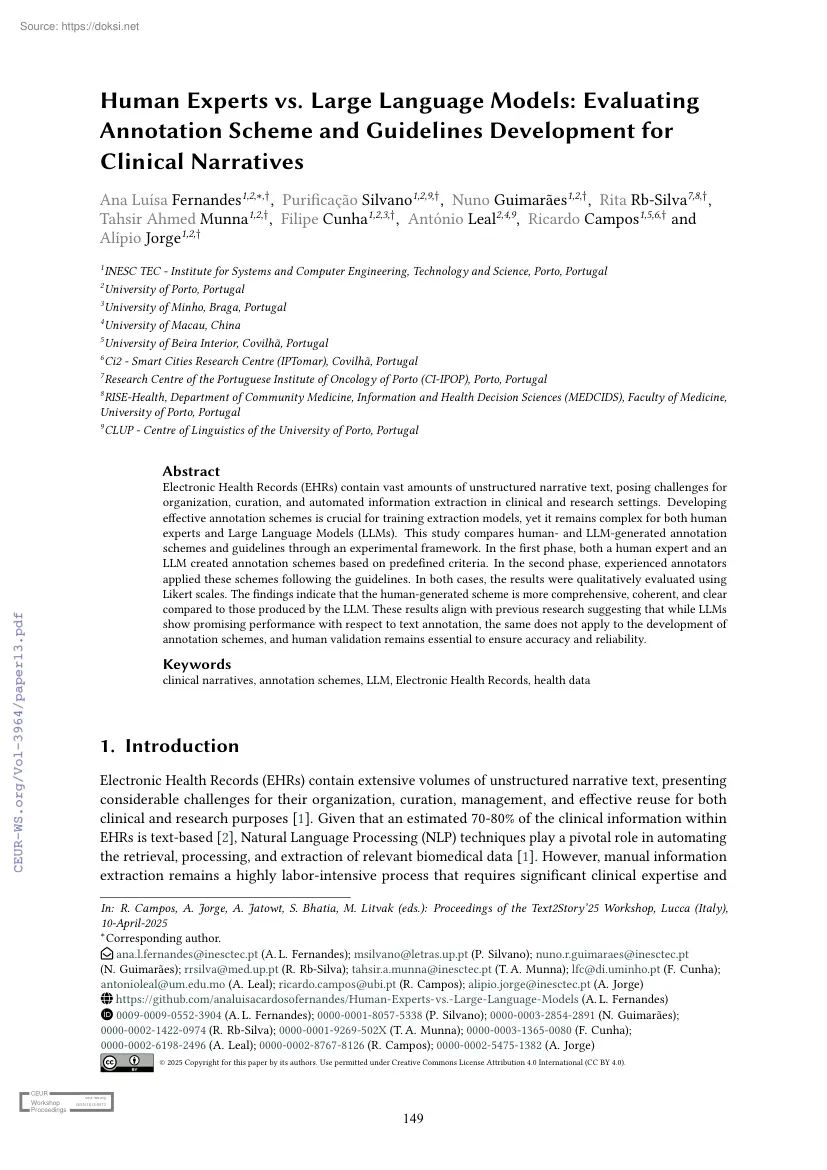
Human Experts vs. Large Language Models: Evaluating Annotation Scheme and Guidelines Development for Clinical Narratives Ana Luísa Fernandes1,2,,† , Puri!cação Silvano1,2,9,† , Nuno Guimarães1,2,† , Rita Rb-Silva7,8,† , Tahsir Ahmed Munna1,2,† , Filipe Cunha1,2,3,† , António Leal2,4,9 , Ricardo Campos1,5,6,† and Alípio Jorge1,2,† 1 INESC TEC - Institute for Systems and Computer Engineering, Technology and Science, Porto, Portugal University of Porto, Portugal 3 University of Minho, Braga, Portugal 4 University of Macau, China 5 University of Beira Interior, Covilhã, Portugal 6 Ci2 - Smart Cities Research Centre (IPTomar), Covilhã, Portugal 7 Research Centre of the Portuguese Institute of Oncology of Porto (CI-IPOP), Porto, Portugal 8 RISE-Health, Department of Community Medicine, Information and Health Decision Sciences (MEDCIDS), Faculty of Medicine, University of Porto, Portugal 9 CLUP - Centre of Linguistics of the University of Porto, Portugal 2 Abstract
Electronic Health Records (EHRs) contain vast amounts of unstructured narrative text, posing challenges for organization, curation, and automated information extraction in clinical and research settings. Developing e"ective annotation schemes is crucial for training extraction models, yet it remains complex for both human experts and Large Language Models (LLMs). This study compares human- and LLM-generated annotation schemes and guidelines through an experimental framework. In the !rst phase, both a human expert and an LLM created annotation schemes based on prede!ned criteria. In the second phase, experienced annotators applied these schemes following the guidelines. In both cases, the results were qualitatively evaluated using Likert scales. The !ndings indicate that the human-generated scheme is more comprehensive, coherent, and clear compared to those produced by the LLM. These results align with previous research suggesting that while LLMs show promising performance with
respect to text annotation, the same does not apply to the development of annotation schemes, and human validation remains essential to ensure accuracy and reliability. Keywords clinical narratives, annotation schemes, LLM, Electronic Health Records, health data 1. Introduction Electronic Health Records (EHRs) contain extensive volumes of unstructured narrative text, presenting considerable challenges for their organization, curation, management, and e"ective reuse for both clinical and research purposes [1]. Given that an estimated 70-80% of the clinical information within EHRs is text-based [2], Natural Language Processing (NLP) techniques play a pivotal role in automating the retrieval, processing, and extraction of relevant biomedical data [1]. However, manual information extraction remains a highly labor-intensive process that requires signi!cant clinical expertise and In: R. Campos, A Jorge, A Jatowt, S Bhatia, M Litvak (eds): Proceedings of the Text2Story’25 Workshop,
Lucca (Italy), 10-April-2025 Corresponding author. ! ana.lfernandes@inesctecpt (A L Fernandes); msilvano@letrasuppt (P Silvano); nunorguimaraes@inesctecpt (N. Guimarães); rrsilva@meduppt (R Rb-Silva); tahsiramunna@inesctecpt (T A Munna); lfc@diuminhopt (F Cunha); antonioleal@um.edumo (A Leal); ricardocampos@ubipt (R Campos); alipiojorge@inesctecpt (A Jorge) ! https://github.com/analuisacardosofernandes/Human-Experts-vs-Large-Language-Models (A L Fernandes) ! 0009-0009-0552-3904 (A. L Fernandes); 0000-0001-8057-5338 (P Silvano); 0000-0003-2854-2891 (N Guimarães); 0000-0002-1422-0974 (R. Rb-Silva); 0000-0001-9269-502X (T A Munna); 0000-0003-1365-0080 (F Cunha); 0000-0002-6198-2496 (A. Leal); 0000-0002-8767-8126 (R Campos); 0000-0002-5475-1382 (A Jorge) 2025 Copyright for this paper by its authors. Use permitted under Creative Commons License Attribution 40 International (CC BY 40) CEUR Workshop Proceedings ceur-ws.org ISSN 1613-0073 149 extensive training to achieve a high
level of Inter-Annotator Agreement (IAA). Moreover, manual extraction is often impractical for studies involving large datasets, such as clinical trials, underscoring the need for more e#cient computational methods [2]. While the implementation of high-performance information extraction algorithms has become increasingly feasible due to advancements in NLP, the creation of high-quality annotated corpora for training and evaluating automatic models continues to pose a signi!cant challenge [3]. To ensure the development of high-quality datasets, it is essential to establish a robust and comprehensive annotation scheme that accurately accounts for the unique characteristics of clinical text and represents them with precision and completeness. Annotation schemes consist of descriptive and analytical labels that, during the process of annotation, are associated with linguistic data, guided by prede!ned guidelines that specify the labels, features, annotation units (e.g, token, phrase,
clause, or document) and instructions on how to proceed To ensure consistency, labels and units must have clear operational de!nitions, facilitating agreement among human annotators. In cases where annotation supports machine learning, schemes may highlight features correlated with annotation labels. Modern annotation work$ows often employ specialized tools that enable span identi!cation, label assignment, and relationship marking, alongside measures of IAA to assess consistency and inform the development of automatic annotation systems [4]. One of the primary challenges in developing annotation schemes for clinical narratives arises from the substantial heterogeneity in content and writing styles across di"erent hospitals [3], as well as across various departments and services within the same institution. Clinical text is typically composed in a free-form, spontaneous manner, exhibiting a wide-ranging diversity of medical domain topics and concepts. Throughout a patient’s
hospital journey, a variety of medical reports are generated, including admission reports and discharge summaries following hospitalization. Furthermore, clinical text in EHRs di"ers signi!cantly from non-clinical text due to the specialized nature of medical language and the frequent use of abbreviations, which signi!cantly increase processing complexity [5]. For instance, the Uni!ed Medical Language System (UMLS) encompasses over two million terms representing approximately 900,000 concepts across more than 60 biomedical terminologies, as well as 12 million relationships among these concepts [6]. Additionally, biomedical terminology is highly intricate, with some terms exhibiting context-dependent meanings [1]. To gain a better understanding of clinical narratives, especially concerning the chronological progression of the patient’s hospital journey, it becomes crucial to analyze the sequence of medical reports generated during their care. This analysis involves considering
the temporal semantics inter-document, which helps to create a structured timeline of hospital events that accurately re$ects the patient’s history. However, this necessity complicates the development of annotation schemes Bearing in mind all these challenges, designing an annotation scheme for clinical reports is a complex endeavor, even for experts in both linguistics and the medical domain. In this study, we aim to investigate the extent to which Large Language Models (LLMs) can address this challenge. LLMs have, since their surge, led to an increasing reliance on automated and generative methods for data annotation [7]. While LLMs can achieve competitive performance in annotation tasks compared to human annotators, existing research [8, 9] has shown that human expertise continues to overcome LLMs, particularly in more complex annotation tasks. However, to the best of our knowledge, no prior studies have speci!cally evaluated the e"ectiveness of LLMs in developing annotation
schemes for representing temporal information in clinical narratives. Accordingly, this study makes the following key contributions: 1. Performance Assessment of LLMs: We evaluate the capability of an LLM in generating an annotation scheme and corresponding guidelines, with a speci!c focus on temporal information in clinical narratives. 2. Comparative Analysis: We conduct a systematic comparison between human-generated and LLM-generated annotation schemes, assessing their e#ciency, consistency, and applicability. 3. Multilingual Expansion: Unlike most prior studies focused on English, our research extends the evaluation of LLM performance to Portuguese, broadening the understanding of their capabilities across languages. 150 The structure of this paper is outlined below. Section 2 presents various annotation schemes for clinical narratives, emphasizing their scarcity and incompleteness. Section 3 outlines the methodology, beginning with the process of developing an annotation
scheme for clinical narratives by a human expert (3.11) and an LLM (312), followed by the creation of an evaluation framework in Section 32 designed to assess both annotation schemes. This section provides a comprehensive description of the metrics and procedures employed for evaluating human annotation using the two schemes, as well as the qualitative assessments of the guidelines utilizing Likert scales. Finally, Section 4 presents and discusses the results. In Section 41, we present the problems encountered in the annotation performed according to each of the schemes, speci!cally the results and analysis of the curation process and the IAA values. Section 42 presents the results of the annotation scheme evaluation conducted by the annotators using Likert scales. 2. Annotation schemes for clinical narratives Annotation schemes for clinical narratives remain scarce, with limited availability of annotated corpora. One of the earliest e"orts, the Clinical E-Science Framework
(CLEF) [10], annotated a corpus following a scheme which included entities, relations, modi!ers, co-references, and temporal information. Patel et al. [11] annotated a large corpus of clinical documents following a scheme with 11 semantic groups mapped to UMLS semantic types [6]. The Temporal Histories of Your Medical Events (THYME) [12] corpus and the i2b2 project [13] integrated event and temporal relation annotations extending ISO TimeML [14] to the annotation of clinical reports. Additionally, the MiPACQ corpus [15] applied syntactic and semantic annotations based on the UMLS semantic hierarchy. Over the years, most clinical NLP research has focused on English, Chinese being the second most common language [3], and signi!cantly fewer e"orts have been dedicated to other languages. In Spanish, the IxaMed-GS corpus applied an SNOMED-CT -based scheme for disease and drug entity annotations [16], while the MERLOT corpus developed a comprehensive semantic annotation framework for
clinical documents in French [17]. For Portuguese, annotation e"orts remain particularly limited. In Brazilian Portuguese, Souza et al [18] created a Named Entity Recognition (NER) system for various clinical narrative types, while Oliveira et al. [19] introduced SemClinBr, the !rst semantically annotated clinical corpus for this language, with a scheme incorporating UMLS semantic types alongside additional tags for negation and abbreviations. Rocha et al [20] extended this research by manually annotating patient reports for automatic information extraction, while the MedAlert Discharge Letters Representation Model (MDLRM) focused on entity annotation in 90 Brazilian Portuguese hospital discharge summaries. In European Portuguese, Lopes et al. [21] describe a clinical text collection with entities manually annotated, and Nunes et al. [22] introduced the MediAlbertina model, a BERT-based encoder pre-trained on Portuguese electronic medical records, which is annotated with entities
and their status (present or absent). Despite these initiatives, most annotation schemes remain limited in scope, primarily focusing on NER. Moreover, the reliance on medical ontologies constrains the annotation of morphosyntactic and semantic features, underscoring the need for more comprehensive and multilingual annotation frameworks in clinical NLP. The inclusion of deeper morphosyntactic and semantic structures, such as relationships between entities and temporal information, is crucial to properly represent relevant clinical information. For instance, the relevant antecedents for understanding the clinical cases are organized in a speci!c temporal order, which may not coincide with the linear order of discourse. In that case, temporal relations are determined, for instance, by expressions that can be of di"erent kinds (nouns, adjectives, adverbs), which have to be identi!ed and labeled during annotation. Another source of temporal ordering is the aspectual nature of the
situations themselves: states are unbounded situations, which tend to establish temporal inclusion with other situations, whereas transitions are telic situations, which trigger temporal precedence. Therefore, aspectual information is paramount to determining temporal organization and should also be included in annotation frameworks for clinical narratives. 151 3. Methodology 3.1 Developing a temporal annotation scheme and guidelines for clinical narratives In this section we describe how two annotation schemes and respective guidelines were designed to capture temporal information in clinical narratives in European Portuguese. The !rst scheme is de!ned by a human expert, while the second is de!ned by an LLM. We will provide a detailed account of both processes, outlining the steps, criteria, and methodologies that guided each approach. 3.11 By Human A specialist in linguistics and pharmaceutical sciences, with expertise in semantic annotation, developed the annotation scheme
through a comparative analysis of various existing frameworks. This analysis encompassed the temporal layer of the Text2Story scheme [23, 24, 25, 26], which is a general annotation scheme based on ISO 24617 - Language Resource Management – Semantic Annotation Framework [14] and is designed for annotating morphosyntactic and semantic information in European Portuguese news texts. Additionally, the study examined the i2b2 [13] and MERLOT [17] frameworks, both of which are speci!cally developed for the annotation of clinical texts. For this comparative analysis, six pseudo-anonymized medical reports from patients diagnosed with Acute Myeloid Leukemia, followed by IPO-Porto (Portugal), were annotated according to the guidelines of the Text2Story, i2b2, and MERLOT annotation schemes. The results revealed that, although Text2Story captured morphosyntactic and semantic information, it lacked labels speci!c to the medical domain. In contrast, the i2b2 and MERLOT frameworks, while including
domain-speci!c labels, were overly broad in scope. Based on these preliminary !ndings, we used 40 medical reports from patients diagnosed with Acute Myeloid Leukemia, followed by IPO-Porto, to identify additional tags needed to enhance the Text2Story annotation scheme in order to capture medical domain-speci!c information. This corpus included admission reports, discharge summaries, and general medical reports. This work was conducted in collaboration with a medical specialist from IPO-Porto, who validated the most relevant clinical elements for annotation. In selecting the semantic classes, the UMLS Metathesaurus ontology was considered, ensuring a systematic approach aligned with international standards. The de!nition of medical labels was further grounded in the work of Leite [27]. The guidelines for the temporal annotation framework and the proposed set of labels can be consulted in detail in the GitHub repository. 3.12 By LLM For the development of an annotation framework and
guidelines by an LLM capable of capturing temporal and clinical information, we utilised Gemini. We chose Gemini 15 Flash due to its performance and because we had access to a paid version. It is comparable to that of GPT-4 models across various tasks1 , and because it belongs to a family of models that currently o"er context windows larger than those provided by OpenAI 2 . This latter characteristic is particularly signi!cant, as it enables the application of the methodology presented in this study to more extensive annotation guidelines. For the development of the prompts provided to the model, we employed an adaptation of ablation studies. We chose this method as ablation studies o"er valuable insights into the contribution of each component of the prompts to the performance of the LLM [28]. Based on this, we began by providing the model with a simpler prompt and gradually enriched its structure. In total, three distinct prompts were developed plus two variants of two of
them, re$ecting an iterative process of re!nement. In what follows, we provide a detailed description of the content of each prompt, along with the evaluation conducted for each. To conduct the prompts’ assessment, we de!ned the parameters and questions presented in Table 1 establishing Likert scales [29]. 1 2 The reader is referred to the leaderboard presented at https://lmarena.ai/?leaderboard Cf. information at https://bloggoogle/technology/ai/google-gemini-next-generation-model-february-2024/#context-window 152 Table 1 Evaluation parameters and corresponding questions. Parameters Questions Markables (tag spans) How clear and consistent are the guidelines for defining markables? Events (grammatical domains) How e!ective are the guidelines for identifying and classifying events at the morphosyntactic and grammatical levels? Events (medical domain) How well-defined and comprehensive are the tags for the medical domain? Temporal Expressions How e!ective are the
guidelines for identifying and classifying temporal expressions? Temporal Relations How accurate are the guidelines for identifying and classifying temporal relations between events? Definitions How clear and detailed are the definitions of each tag? Ambiguities How e!ective is the approach to resolving ambiguities? Coherence and Clarity How coherent and clear are the provided guidelines? Adaptation of Text2Story How e!ective is the adaptation of the Text2Story scheme for medical reports? Examples How relevant and illustrative of the tags are the examples? Table 2 Means and standard deviations of the results obtained from evaluating each Prompt’s output using Likert scales (the Prompt content is a summary). Prompt Content Prompt 1 Development of a temporal annotation scheme capturing morphosyntactic, grammatical, and medical domain-specific information. Same as Prompt 1, + T2S guidelines + instructions to capture morphosyntactic and grammatical information. Same as
Prompt 2A + request to include tags specific to the medical domain. Same as Prompt 2B + inclusion of synthetic reports as examples. Same as Prompt 3A + an emphasis on deriving examples from synthetic reports + providing detailed specifications of markables. Prompt 2A Prompt 2B Prompt 3A Prompt 3B Evaluation x̄ � 2.1 0.74 2.7 1 3 1 2.8 0.84 3.2 0.63 The scores for each parameter ranged from 1 to 5. For example, for the !rst parameter, “Markables”, the question “How clear and consistent are the guidelines for de!ning markables?” o"ered !ve response options: 1 – The guidelines are nonexistent or very vague; 2 – The guidelines are partially clear but frequently ambiguous; 3 – The guidelines are satisfactory but occasionally lack clarity; 4 – The guidelines are clear in most cases, with some areas for improvement; 5 – The guidelines are precise, unambiguous, and consistently applicable. This information regarding the content of each prompt and its
evaluation is presented in Table 2. The !rst prompt (Prompt 1) included instructions for the development of a temporal annotation scheme capturing morphosyntactic, semantic, and medical domain-speci!c information. As the output of Prompt 1, the LLM addressed all elements of the input, generating guidelines that included domain-speci!c medical tags (“diagnosis”, “treatment”, “symptom”, “procedure”, “test”, and “state”), as well as temporal expressions (“date”, “time”, “duration”, and “frequency”) and temporal relations (“before”, “after”, “simultaneously”, “includes”, “is included”, and “during”). The guidelines provided basic examples for some tags. For instance, for the tag “Treatment”, examples included “start of chemotherapy”, “bone marrow transplant”, and “radiotherapy”. However, the guidelines failed to clearly specify the markables, signi!cantly undermining the annotation process. For example, in the
case of “start of chemotherapy”, the example implies that the annotation should use a single tag. Yet, this phrase involves two distinct events: “start” and “chemotherapy”. The lack of a precise de!nition for the markables thus introduces ambiguity into the annotation process. The proposed scheme also 153 exhibited limitations in capturing more detailed morphosyntactic and grammatical information, as events were generically annotated as “events” and supplemented only by the medical domain tags. Prompt 1 received the lowest average evaluation score (2.1), as shown in Table 2 Due to the limitation in including morphosyntactic and semantic tags, and to ensure that the LLM was provided with the same conditions as the human expert, we decided, for the second prompt (Prompt 2A), to supply the guidelines from the original Text2Story annotation scheme. Thus, Prompt 2A was structured similarly to Prompt 1, with the addition of the Text2Story guidelines and the following
phrase appended to the end of the prompt: “For capturing morphosyntactic and grammatical information, refer to the Text2Story guidelines provided in the attached document”. As the output of Prompt 2A, the LLM adopted the same tags for events, temporal expressions, and temporal relations present in the Text2Story guidelines, while introducing a new tag, “domain”, with attributes such as “diagnosis”, “treatment”, “prognosis”, and “etc.” The guidelines included a clari!cation of markables, following the standard established by Text2Story. However, examples were provided only for temporal expressions. At the end of the guidelines, an annotated example sentence was included but exhibited signi!cant limitations. The output of Prompt 2A received an average Likert scale score of 27 Since the tags related to the medical domain were insu#cient and qualitatively inferior to the output of Prompt 1, we decided to reinforce the !nal sentence of the second prompt with the
following request: “Ensure to include tags speci!c to the medical domain” (Prompt 2B). As a result, the output was similar to Prompt 2A but included an expansion of the medical domain tags, such as “diagnosis”, “treatment”, “procedure”, “symptom onset”, “symptom resolution”, “prognosis”, “follow-up”, “lab results”, and “medication administration”. However, signi!cant limitations persisted in the output, including the absence of clear de!nitions for the tags and examples based on only one annotated sentence, which was marked by contradictions and inconsistencies. For instance, in establishing temporal relations, the directionality of the arrow was not speci!ed, resulting in an example where the same events were linked by both “after” and “before”. The average evaluation score for the output of Prompt 2B was 3 Regarding Prompt 3A, with the aim of improving the quality of examples generated by the LLM and, once again, ensuring that the LLM
had conditions comparable to those of a human expert, we opted to provide the model with synthetic reports created by a specialist physician. Thus, Prompt 3A was structured similarly to Prompt 2B, with the addition of a set of synthetic reports and the following instruction at the end: “Use the !ve attached medical reports as examples”. As a result, the output was of lower quality than that generated by Prompt 2B, receiving an average Likert scale score of 2.8 The LLM produced only one example derived from the provided reports, which exhibited limitations and inconsistencies. Additionally, the guidelines presented were unclear in specifying the markables, merely referring to the Text2Story guidelines. In light of these results, we decided to re!ne Prompt 3A further, developing Prompt 3B, with an emphasis on deriving examples from synthetic reports and providing detailed speci!cations of markables. The output generated by Prompt 3B stood out for providing the best guidelines among
the outputs of the prompts tested achieving the highest average score (3.2) Nonetheless, these guidelines still exhibited several weaknesses, such as a lack of clarity in de!ning markables, the absence of well-de!ned tags for the medical domain, limitations in the approach to resolving ambiguities, and issues with the quality of the examples provided. The annotation scheme and guidelines generated as output of Prompt 3B were used as a reference for comparison with the guidelines developed by the human expert, since they obtained the best result. The content of the prompts, as well as the guidelines produced as outputs and their assessement, can be found in the GitHub repository. Figure 1 depicts the sequential steps involved in developing the annotation scheme, outlining the processes followed by both the human expert and the LLM. 3.2 Evaluation framework To evaluate the annotation schemes and guidelines produced by both a human and the LLM, two complementary approaches were employed.
First, the two annotation schemes and their respective 154 Comparison of frameworks (Text2Story, i2b2, Merlot) Analysis of 40 EHRs and selection of medical labels Validation of labels for medical events Annotation scheme and guidlines Prompt development Generation of the annotation schemes and guidelines Assessment of the generated annotation scheme and guidelines Annotation scheme and guidelines Figure 1: Overview of the annotation scheme development process followed by a human expert and by the LLM vs. Curation of the annotated data Data annotation Annotation scheme development Assessment of the annotation, the annotation scheme and guidelines (IAA, qualitative analisys) Assessment of annotation schemes and guidelines (Likert scales) Figure 2: Overview of the two evaluation approaches used to assess the e!icacy of the two annotation schemes. guidelines were applied to the annotation of clinical reports by two annotators. This human annotation was evaluated by a
specialist in linguistics and pharmaceutical sciences during the curation process and by IAA metrics. Second, both the human- and LLM-generated schemes and guidelines were assessed by the two annotators. Figure 2 provides a summary of these two approaches Regarding the !rst approach, the corpus used for annotation consisted of synthetic reports for two patients diagnosed with Acute Myeloid Leukemia, written by a specialist physician from IPO-Porto. For each patient, an admission report, two discharge reports, and a general report were provided. The sets of reports were annotated according to the two annotation schemes (human- and LLMgenerated). The reports for Patient 1 followed the guidelines developed by a human expert, while the reports for Patient 2 were annotated according to the guidelines formulated by the LLM as output from Prompt 3B. Annotation was conducted by two linguistics students with extensive experience in semantic annotation. To minimize biases during the annotation
process, such as the potential in$uence of one scheme on another, the following approach was adopted: Annotator 1 commenced the task using the scheme developed by a human expert, annotating the reports for Patient 1. Simultaneously, Annotator 2 began with the scheme created by the LLM, annotating the reports for Patient 2. Upon completion of this initial phase, it was the other way around, ensuring that each annotator contributed to all combinations of scheme and patient. Curation was conducted by an expert to ensure the accuracy and consistency of the annotations, as 155 well as to verify whether the annotators had correctly interpreted and applied the guidelines to the reports. The annotations and curation were performed using the INCEpTION tool [30] Additionally, to assess the quality and reliability of the guidelines, the IAA was calculated. This percentage allows for the identi!cation of ambiguities or di#culties in the interpretation of the guidelines, with values closer to
100% indicating higher reliability [31]. Another approach used to assess the quality of the annotation schemes and guidelines created by both the human expert and the LLM involved the application of the same Likert scales [29] that were developed to evaluate the prompt outputs, presented in Table 1. In this instance, the evaluation was conducted by the annotators. 4. Results and discussion 4.1 Human annotation As explained in the previous section, to assess the quality and e#cacy of the annotation schemes and guidelines produced by the human expert and by the LLM, we devised an experiment in which both annotation frameworks were used to represent information from clinical reports. Once the annotation was !nished, the curation was carried out by a specialist in linguistics and pharmaceutical sciences, enabling some general observations. Regarding the annotation based on the guidelines developed by a human expert, the curator observed that the identi!cation of events and temporal
expressions was performed unanimously and in accordance with the annotation guidelines. Minor inconsistencies were reported, particularly in the classi!cation of “medical domain” attributes, possibly due to the annotators’ lack of expertise in the medical domain. As for the annotation based on the guidelines developed by the LLM, several inconsistencies were reported. The lack of clarity in the guidelines led one annotator to assign attributes with morphosyntactic and grammatical categories to all events, while the other did not apply these attributes to events labeled under the “medical domain”. For both schemes, the primary source of variance was the annotation of temporal relations, particularly in the selection of the relation type. Additionally, although the rules regarding arrow directionality were clari!ed in the guidelines created by the human expert, the annotators did not always follow them. The scheme developed by the LLM did not specify any rules on this matter,
further contributing to variance among the annotators. The Inter-Annotator Agreement (IAA) results were consistent with the curator’s observations. For event annotation based on the human expert’s scheme, the exact match at span-level was 72%, with agreement on the label in 81% of cases. Regarding the attributes of the specialized event class in the medical domain, agreement reached 85%. In contrast, for the LLM-generated annotation scheme, the exact match percentage at span-level 64%, with agreement on the label in 78% of cases. Annotators agreed on the attributes of the specialized event class in only 61% of cases. These !ndings are indicative that the human expert’s annotation scheme provided clearer guidelines, resulting in more consistent annotations. The lower agreement observed with the LLM-generated scheme suggests reduced reliability, particularly in domain-speci!c event classi!cation, likely due to ambiguous or inconsistently applied de!nitions. 4.2 Likert-scale
performance assessment tool As mentioned in Subsubsection 3.2, the two annotators were asked to evaluate each scheme and their respective annotation guidelines using Likert scales after the annotation process. The average evaluation results and the corresponding standard deviations are presented in Table 3. The scheme developed by the human expert demonstrated superior performance across all evaluated parameters, consistently achieving the highest ratings, particularly in the identi!cation and classi!cation of medical domain events, temporal expressions, and temporal relations. Regarding ambiguity resolution, 156 Table 3 Means and standard deviations of the results obtained from the evaluation of the schemes/guidelines developed by LLM (Prompt 3B) and by Human. Annotator Annotator 1 Annotator 2 Evaluation Human LLM x̄ � x̄ � 4.1 07 18 04 4.5 05 25 08 Annotator 2 characterized the human-generated scheme as "a robust and e"ective approach to resolve all
ambiguities encountered", whereas Annotator 1 acknowledged that "reasonable strategies are o"ered, but a comprehensive approach is lacking”. In terms of the relevance and illustrative capacity of the examples, Annotator 2 considered the guidelines produced by the human expert to “provide welldeveloped examples, with broad coverage and clear application”. Annotator 1, however, noted that the guidelines "provide su#cient examples, but they do not cover the full diversity of scenarios or contain inconsistencies". With respect to the de!nition of markables in the human-generated guidelines, both annotators agreed that "the guidelines are clear in most cases, with some areas for improvement". Similarly, in the evaluation of the coherence and clarity of the guidelines, both annotators stated that "the guidelines are coherent and clear in most cases". Overall, the scheme and guidelines developed by the human expert received an average rating
of 4.1 from Annotator 1 and 45 from Annotator 2 Conversely, the scheme and guidelines produced by the LLM received lower ratings across all evaluated parameters. Regarding the medical domain tags, Annotator 1 noted that "identi!cation is limited, with clear inconsistencies in classi!cation", while Annotator 2 stated that "the tags are absent or poorly de!ned for the medical domain". In terms of ambiguity resolution, Annotator 2 observed that in this LLM-generated scheme "reasonable strategies are o"ered, but a comprehensive approach is lacking", whereas Annotator 1 argued that "no strategies are o"ered to resolve ambiguities". Concerning the quality of the examples, both annotators agreed that the guidelines "include few examples, without addressing complex cases or containing incorrect annotation". Regarding the LLM de!nition of markables, Annotator 2 found that "the guidelines are satisfactory but occasionally lack
clarity", while Annotator 1 remarked that "the guidelines are partially clear but frequently ambiguous". As for the coherence and clarity of the guidelines, Annotator 2 considered that "the guidelines are reasonable but have gaps and inconsistencies", whereas Annotator 1 asserted that "the guidelines are inconsistent and di#cult to understand". As a result, the LLM scheme and guidelines received an average rating of 1.8 from Annotator 1 and 25 from Annotator 2 5. Conclusions and Future Work This work assessed the performance of an LLM in generating a temporal annotation scheme capable of capturing morphosyntactic, semantic, and medical domain information in clinical narratives in European Portuguese, comparing the automatically generated scheme with that produced by a human expert. The study contributes to expanding research on LLM performance to Portuguese, being, to our knowledge, the only one comparing the annotation scheme and guideline
generation capacity of an LLM with that of a human expert. The results show that, although LLMs are capable of creating annotation guidelines, the guidelines produced by a human expert were more comprehensible, coherent, and clear. The lack of speci!city and clarity in the LLM’s guidelines led to inconsistencies in the annotation, particularly in the de!nition of markables and the resolution of ambiguities. A hybrid approach, combining the performance of LLMs with human validation, could mitigate the observed inconsistencies. In future research, we aim to conduct a comprehensive analysis of human annotation results, with a particular emphasis on instances of annotator disagreement. Our objective is to identify the underlying factors contributing to these discrepancies and re!ne the human-designed annotation scheme to reduce 157 ambiguities. Furthermore, we plan to integrate additional automated evaluation metrics to complement manual assessments, focusing on aspects such as
readability, clarity, and structural coherence. To enhance scienti!c reproducibility, we also intend to incorporate a broader range of large language models (LLMs), including open-source alternatives. Additionally, we seek to extend this study to other annotation layers, particularly the referential layer, to systematically capture participants and their relationships. Acknowledgments We would like to thank the anonymous reviewers for their helpful comments on earlier versions of this paper. We express our gratitude to Inês Cantante and Ana Filipa Pacheco for conducting the annotations This research was partially funded by National Funds through the FCT - Fundação para a Ciência e a Tecnologia, I.P (Portuguese Foundation for Science and Technology) within the project StorySense, with reference 2022.09312PTDC (DOI 1054499/202209312PTDC) and by the Centre of Linguistics of the University of Porto, within the project UIDB/00022/2020 (DOI 10.54499/UIDB/00022/2020) References [1] O.
Irrera, S Marchesin, G Silvello, Metatron: Advancing biomedical annotation empowering relation annotation and collaboration, BMC Bioinformatics 25 (2024) 1–41 doi:101186/ s12859-024-05730-9. [2] C. Lindvall, C-Y Deng, E Moseley, N Agaronnik, A El-Jawahri, M K Paasche-Orlow, J R Lakin, A. Volandes, J A Tulsky, Natural language processing to identify advance care planning documentation in a multisite pragmatic clinical trial, Journal of Pain and Symptom Management 63 (2022) e29–e36. doi:101016/jjpainsymman202106025 [3] E. Zhu, Q Sheng, H Yang, Y Liu, T Cai, J Li, A uni!ed framework of medical information annotation and extraction for chinese clinical text, Arti!cial Intelligence in Medicine 142 (2023) 1–12. doi:101016/jartmed2023102573 [4] N. Ide, Introduction: The handbook of linguistic annotation, in: N Ide, J Pustejovsky (Eds), Handbook of Linguistic Annotation, Springer, Dordrecht, 2017, pp. 1–18 [5] G. Moharasan, T-B Ho, Extraction of temporal information from clinical
narratives, Journal of Healthcare Informatics Research 3 (2019) 220–244. doi:101007/s41666-019-00049-0 [6] O. Bodenreider, The uni!ed medical language system (umls): Integrating biomedical terminology, Nucleic Acids Research 32 (2004) D267–D270. doi:101093/nar/gkh061 [7] Z. Tan, D Li, S Wang, A Beigi, B Jiang, A Bhattacharjee, M Karami, J Li, L Cheng, H Liu, Large language models for data annotation and synthesis: A survey, 2024. URL: https://arxivorg/abs/ 2402.13446 arXiv:240213446 [8] A. H Nasution, A Onan, Chatgpt label: Comparing the quality of human-generated and llmgenerated annotations in low-resource language nlp tasks, IEEE Access 12 (2024) 71876–71900 doi:10.1109/ACCESS20243402809 [9] N. Pangakis, S Wolken, N Fasching, Automated annotation with generative ai requires validation, 2023. URL: https://arxivorg/abs/230600176 arXiv:230600176 [10] A. Roberts, R J Gaizauskas, M Hepple, G Demetriou, Y Guo, I Roberts, A Setzer, Building a semantically annotated corpus of clinical
texts, Journal of biomedical informatics 42 5 (2009) 950–66. URL: https://apisemanticscholarorg/CorpusID:17473913 [11] P. Patel, D Davey, V Panchal, P Pathak, Annotation of a large clinical entity corpus, in: E Rilo", D. Chiang, J Hockenmaier, J Tsujii (Eds), Proceedings of the 2018 Conference on Empirical Methods in Natural Language Processing, Association for Computational Linguistics, Brussels, Belgium, 2018, pp. 2033–2042 URL: https://aclanthologyorg/D18-1228/ doi:1018653/v1/D18-1228 [12] W. F Styler IV, S Bethard, S Finan, M Palmer, S Pradhan, P C de Groen, B Erickson, T Miller, C. Lin, G Savova, J Pustejovsky, Temporal annotation in the clinical domain, Transactions of 158 the Association for Computational Linguistics 2 (2014) 143–154. URL: https://aclanthologyorg/ Q14-1012/. doi:101162/tacl a 00172 [13] W. Sun, A Rumshisky, O Uzuner, Annotating temporal information in clinical narratives, Journal of Biomedical Informatics 46 (2013) S5–S12. URL:
https://doiorg/101016/jjbi201307004 doi:10 1016/j.jbi201307004 [14] International Organization for Standardization, Iso 24617:2012 - language resource management – semantic annotation framework, 2012. [15] D. Albright, A Lanfranchi, A Fredriksen, I WilliamFStyler, C Warner, J D Hwang, J D Choi, D. Dligach, R D Nielsen, J H Martin, W H Ward, M Palmer, G K Savova, Towards comprehensive syntactic and semantic annotations of the clinical narrative, Journal of the American Medical Informatics Association : JAMIA 20 (2013) 922 – 930. URL: https://apisemanticscholarorg/CorpusID: 15409975. [16] A. Miranda-Escalada, M López-Arevalo, J Armengol-Estapé, M T Martín-Valverde, F Sanz, L I Furlong, M. Krallinger, A clinical gold standard corpus in spanish: Mining adverse drug reactions, Journal of Biomedical Informatics 56 (2015) 318–332. URL: https://doiorg/101016/jjbi201506016 doi:10.1016/jjbi201506016 [17] L. Campillos, L Deléger, C Grouin, T Hamon, A-L Ligozat, A Névéol, A french
clinical corpus with comprehensive semantic annotations: Development of the medical entity and relation limsi annotated text corpus (merlot), Language Resources and Evaluation 52 (2018) 571–601. URL: https://doi.org/101007/s10579-017-9382-y doi:101007/s10579-017-9382-y [18] J. V A d Souza, Y B Gumiel, L E S e Oliveira, C M C Moro, Named entity recognition for clinical portuguese corpus with conditional random !elds and semantic groups, in: Simpósio Brasileiro de Computação Aplicada à Saúde (SBCAS), 2019, pp. 318–323 URL: https://doiorg/10 5753/sbcas.20196269 doi:105753/sbcas20196269 [19] L. E S e Oliveira, A C Peters, A M P da Silva, C P Gebeluca, Y B Gumiel, L M M Cintho, D R Carvalho, S. Al Hasan, C M C Moro, Semclinbra multi-institutional and multi-specialty semantically annotated corpus for portuguese clinical nlp tasks, Journal of Biomedical Semantics 13 (2022) 13. URL: https://doiorg/101186/s13326-022-00269-1 doi:101186/s13326-022-00269-1 [20] N. C Rocha, A M P Barbosa,
Y O Schnr, J Machado-Rugolo, L G M de Andrade, J E Corrente, L. V de Arruda Silveira, Natural language processing to extract information from portugueselanguage medical records, Data 8 (2023) Article 1 URL: https://doiorg/103390/data8010011 doi:10.3390/data8010011 [21] F. Lopes, C Teixeira, H Gonçalo Oliveira, Contributions to clinical named entity recognition in portuguese, in: D. Demner-Fushman, K B Cohen, S Ananiadou, J Tsujii (Eds), Proceedings of the 18th BioNLP Workshop and Shared Task, Association for Computational Linguistics, 2019, pp. 223–233. URL: https://doiorg/1018653/v1/W19-5024 doi:1018653/v1/W19-5024 [22] M. Nunes, J Boné, J C Ferreira, P Chaves, L B Elvas, Medialbertina: An european portuguese medical language model, Computers in Biology and Medicine 182 (2024) 109233. URL: https: //doi.org/101016/jcompbiomed2024109233 doi:101016/jcompbiomed2024109233 [23] P. Silvano, A Leal, F Silva, I Cantante, F Oliveira, A Jorge, Developing a multilayer semantic annotation
scheme based on ISO standards for the visualization of a newswire corpus, in: H. Bunt (Ed.), Proceedings of the 17th Joint ACL - ISO Workshop on Interoperable Semantic Annotation, Association for Computational Linguistics, Groningen, The Netherlands (online), 2021, pp. 1–13 URL: https://aclanthology.org/2021isa-11/ [24] A. Leal, P Silvano, E Amorim, I Cantante, F Silva, A Jorge, R Campos, The place of iso-space in text2story multilayer annotation scheme, in: H. Bunt (Ed), Proceedings of the 18th Joint ACL - ISO Workshop on Interoperable Semantic Annotation within LREC2022, European Language Resources Association, 2022, pp. 61–70 URL: https://aclanthologyorg/2022isa-18 [25] P. Silvano, E Amorim, A Leal, I Cantante, F d Silva, A Jorge, R Campos, S S Nunes, Annotation and visualisation of reporting events in textual narratives, in: Proceedings of Text2Story 2023: Sixth Workshop on Narrative Extraction From Texts, CEUR Workshop Proceedings, Dublin, Ireland, 2023, pp. 47–59 159
[26] P. Silvano, E Amorim, A Leal, I Cantante, A Jorge, R Campos, N Yu, Untangling a web of temporal relations in news articles, in: Proceedings of Text2Story - Seventh Workshop on Narrative Extraction From Texts Held in Conjunction with the 46th European Conference on Information Retrieval (ECIR 2024), 2024, pp. 77–92 URL: https://repositorio-abertouppt/handle/10216/158767 [27] M. A Leite, Ontology-Based Extraction and Structuring of Narrative Elements from Clinical Texts, Mater´s thesis, Universidade do Porto, 2024. [28] S. Sheikholeslami, M Meister, T Wang, A H Payberah, V Vlassov, J Dowling, Autoablation: Automated parallel ablation studies for deep learning, in: Proceedings of the 1st Workshop on Machine Learning and Systems, 2021, pp. 55–61 URL: https://doiorg/101145/34379843458834 doi:10.1145/34379843458834 [29] R. Likert, A technique for the measurement of attitudes, Archives of Psychology, Nova Iorque, 1932. [30] J.-C Klie, M Bugert, B Boullosa, R Eckart de Castilho, I
Gurevych, The inception platform: Machine-assisted and knowledge-oriented interactive annotation, in: D. Zhao (Ed), Proceedings of the 27th International Conference on Computational Linguistics: System Demonstrations, Association for Computational Linguistics, 2018, pp. 5–9 URL: https://aclanthologyorg/C18-2002 [31] R. Artstein, Inter-annotator agreement, in: N Ide, J Pustejovsky (Eds), Handbook of Linguistic Annotation, Springer Netherlands, 2017, pp. 297–313 URL: https://doiorg/101007/ 978-94-024-0881-2 11. doi:101007/978-94-024-0881-2 11 160
Electronic Health Records (EHRs) contain vast amounts of unstructured narrative text, posing challenges for organization, curation, and automated information extraction in clinical and research settings. Developing e"ective annotation schemes is crucial for training extraction models, yet it remains complex for both human experts and Large Language Models (LLMs). This study compares human- and LLM-generated annotation schemes and guidelines through an experimental framework. In the !rst phase, both a human expert and an LLM created annotation schemes based on prede!ned criteria. In the second phase, experienced annotators applied these schemes following the guidelines. In both cases, the results were qualitatively evaluated using Likert scales. The !ndings indicate that the human-generated scheme is more comprehensive, coherent, and clear compared to those produced by the LLM. These results align with previous research suggesting that while LLMs show promising performance with
respect to text annotation, the same does not apply to the development of annotation schemes, and human validation remains essential to ensure accuracy and reliability. Keywords clinical narratives, annotation schemes, LLM, Electronic Health Records, health data 1. Introduction Electronic Health Records (EHRs) contain extensive volumes of unstructured narrative text, presenting considerable challenges for their organization, curation, management, and e"ective reuse for both clinical and research purposes [1]. Given that an estimated 70-80% of the clinical information within EHRs is text-based [2], Natural Language Processing (NLP) techniques play a pivotal role in automating the retrieval, processing, and extraction of relevant biomedical data [1]. However, manual information extraction remains a highly labor-intensive process that requires signi!cant clinical expertise and In: R. Campos, A Jorge, A Jatowt, S Bhatia, M Litvak (eds): Proceedings of the Text2Story’25 Workshop,
Lucca (Italy), 10-April-2025 Corresponding author. ! ana.lfernandes@inesctecpt (A L Fernandes); msilvano@letrasuppt (P Silvano); nunorguimaraes@inesctecpt (N. Guimarães); rrsilva@meduppt (R Rb-Silva); tahsiramunna@inesctecpt (T A Munna); lfc@diuminhopt (F Cunha); antonioleal@um.edumo (A Leal); ricardocampos@ubipt (R Campos); alipiojorge@inesctecpt (A Jorge) ! https://github.com/analuisacardosofernandes/Human-Experts-vs-Large-Language-Models (A L Fernandes) ! 0009-0009-0552-3904 (A. L Fernandes); 0000-0001-8057-5338 (P Silvano); 0000-0003-2854-2891 (N Guimarães); 0000-0002-1422-0974 (R. Rb-Silva); 0000-0001-9269-502X (T A Munna); 0000-0003-1365-0080 (F Cunha); 0000-0002-6198-2496 (A. Leal); 0000-0002-8767-8126 (R Campos); 0000-0002-5475-1382 (A Jorge) 2025 Copyright for this paper by its authors. Use permitted under Creative Commons License Attribution 40 International (CC BY 40) CEUR Workshop Proceedings ceur-ws.org ISSN 1613-0073 149 extensive training to achieve a high
level of Inter-Annotator Agreement (IAA). Moreover, manual extraction is often impractical for studies involving large datasets, such as clinical trials, underscoring the need for more e#cient computational methods [2]. While the implementation of high-performance information extraction algorithms has become increasingly feasible due to advancements in NLP, the creation of high-quality annotated corpora for training and evaluating automatic models continues to pose a signi!cant challenge [3]. To ensure the development of high-quality datasets, it is essential to establish a robust and comprehensive annotation scheme that accurately accounts for the unique characteristics of clinical text and represents them with precision and completeness. Annotation schemes consist of descriptive and analytical labels that, during the process of annotation, are associated with linguistic data, guided by prede!ned guidelines that specify the labels, features, annotation units (e.g, token, phrase,
clause, or document) and instructions on how to proceed To ensure consistency, labels and units must have clear operational de!nitions, facilitating agreement among human annotators. In cases where annotation supports machine learning, schemes may highlight features correlated with annotation labels. Modern annotation work$ows often employ specialized tools that enable span identi!cation, label assignment, and relationship marking, alongside measures of IAA to assess consistency and inform the development of automatic annotation systems [4]. One of the primary challenges in developing annotation schemes for clinical narratives arises from the substantial heterogeneity in content and writing styles across di"erent hospitals [3], as well as across various departments and services within the same institution. Clinical text is typically composed in a free-form, spontaneous manner, exhibiting a wide-ranging diversity of medical domain topics and concepts. Throughout a patient’s
hospital journey, a variety of medical reports are generated, including admission reports and discharge summaries following hospitalization. Furthermore, clinical text in EHRs di"ers signi!cantly from non-clinical text due to the specialized nature of medical language and the frequent use of abbreviations, which signi!cantly increase processing complexity [5]. For instance, the Uni!ed Medical Language System (UMLS) encompasses over two million terms representing approximately 900,000 concepts across more than 60 biomedical terminologies, as well as 12 million relationships among these concepts [6]. Additionally, biomedical terminology is highly intricate, with some terms exhibiting context-dependent meanings [1]. To gain a better understanding of clinical narratives, especially concerning the chronological progression of the patient’s hospital journey, it becomes crucial to analyze the sequence of medical reports generated during their care. This analysis involves considering
the temporal semantics inter-document, which helps to create a structured timeline of hospital events that accurately re$ects the patient’s history. However, this necessity complicates the development of annotation schemes Bearing in mind all these challenges, designing an annotation scheme for clinical reports is a complex endeavor, even for experts in both linguistics and the medical domain. In this study, we aim to investigate the extent to which Large Language Models (LLMs) can address this challenge. LLMs have, since their surge, led to an increasing reliance on automated and generative methods for data annotation [7]. While LLMs can achieve competitive performance in annotation tasks compared to human annotators, existing research [8, 9] has shown that human expertise continues to overcome LLMs, particularly in more complex annotation tasks. However, to the best of our knowledge, no prior studies have speci!cally evaluated the e"ectiveness of LLMs in developing annotation
schemes for representing temporal information in clinical narratives. Accordingly, this study makes the following key contributions: 1. Performance Assessment of LLMs: We evaluate the capability of an LLM in generating an annotation scheme and corresponding guidelines, with a speci!c focus on temporal information in clinical narratives. 2. Comparative Analysis: We conduct a systematic comparison between human-generated and LLM-generated annotation schemes, assessing their e#ciency, consistency, and applicability. 3. Multilingual Expansion: Unlike most prior studies focused on English, our research extends the evaluation of LLM performance to Portuguese, broadening the understanding of their capabilities across languages. 150 The structure of this paper is outlined below. Section 2 presents various annotation schemes for clinical narratives, emphasizing their scarcity and incompleteness. Section 3 outlines the methodology, beginning with the process of developing an annotation
scheme for clinical narratives by a human expert (3.11) and an LLM (312), followed by the creation of an evaluation framework in Section 32 designed to assess both annotation schemes. This section provides a comprehensive description of the metrics and procedures employed for evaluating human annotation using the two schemes, as well as the qualitative assessments of the guidelines utilizing Likert scales. Finally, Section 4 presents and discusses the results. In Section 41, we present the problems encountered in the annotation performed according to each of the schemes, speci!cally the results and analysis of the curation process and the IAA values. Section 42 presents the results of the annotation scheme evaluation conducted by the annotators using Likert scales. 2. Annotation schemes for clinical narratives Annotation schemes for clinical narratives remain scarce, with limited availability of annotated corpora. One of the earliest e"orts, the Clinical E-Science Framework
(CLEF) [10], annotated a corpus following a scheme which included entities, relations, modi!ers, co-references, and temporal information. Patel et al. [11] annotated a large corpus of clinical documents following a scheme with 11 semantic groups mapped to UMLS semantic types [6]. The Temporal Histories of Your Medical Events (THYME) [12] corpus and the i2b2 project [13] integrated event and temporal relation annotations extending ISO TimeML [14] to the annotation of clinical reports. Additionally, the MiPACQ corpus [15] applied syntactic and semantic annotations based on the UMLS semantic hierarchy. Over the years, most clinical NLP research has focused on English, Chinese being the second most common language [3], and signi!cantly fewer e"orts have been dedicated to other languages. In Spanish, the IxaMed-GS corpus applied an SNOMED-CT -based scheme for disease and drug entity annotations [16], while the MERLOT corpus developed a comprehensive semantic annotation framework for
clinical documents in French [17]. For Portuguese, annotation e"orts remain particularly limited. In Brazilian Portuguese, Souza et al [18] created a Named Entity Recognition (NER) system for various clinical narrative types, while Oliveira et al. [19] introduced SemClinBr, the !rst semantically annotated clinical corpus for this language, with a scheme incorporating UMLS semantic types alongside additional tags for negation and abbreviations. Rocha et al [20] extended this research by manually annotating patient reports for automatic information extraction, while the MedAlert Discharge Letters Representation Model (MDLRM) focused on entity annotation in 90 Brazilian Portuguese hospital discharge summaries. In European Portuguese, Lopes et al. [21] describe a clinical text collection with entities manually annotated, and Nunes et al. [22] introduced the MediAlbertina model, a BERT-based encoder pre-trained on Portuguese electronic medical records, which is annotated with entities
and their status (present or absent). Despite these initiatives, most annotation schemes remain limited in scope, primarily focusing on NER. Moreover, the reliance on medical ontologies constrains the annotation of morphosyntactic and semantic features, underscoring the need for more comprehensive and multilingual annotation frameworks in clinical NLP. The inclusion of deeper morphosyntactic and semantic structures, such as relationships between entities and temporal information, is crucial to properly represent relevant clinical information. For instance, the relevant antecedents for understanding the clinical cases are organized in a speci!c temporal order, which may not coincide with the linear order of discourse. In that case, temporal relations are determined, for instance, by expressions that can be of di"erent kinds (nouns, adjectives, adverbs), which have to be identi!ed and labeled during annotation. Another source of temporal ordering is the aspectual nature of the
situations themselves: states are unbounded situations, which tend to establish temporal inclusion with other situations, whereas transitions are telic situations, which trigger temporal precedence. Therefore, aspectual information is paramount to determining temporal organization and should also be included in annotation frameworks for clinical narratives. 151 3. Methodology 3.1 Developing a temporal annotation scheme and guidelines for clinical narratives In this section we describe how two annotation schemes and respective guidelines were designed to capture temporal information in clinical narratives in European Portuguese. The !rst scheme is de!ned by a human expert, while the second is de!ned by an LLM. We will provide a detailed account of both processes, outlining the steps, criteria, and methodologies that guided each approach. 3.11 By Human A specialist in linguistics and pharmaceutical sciences, with expertise in semantic annotation, developed the annotation scheme
through a comparative analysis of various existing frameworks. This analysis encompassed the temporal layer of the Text2Story scheme [23, 24, 25, 26], which is a general annotation scheme based on ISO 24617 - Language Resource Management – Semantic Annotation Framework [14] and is designed for annotating morphosyntactic and semantic information in European Portuguese news texts. Additionally, the study examined the i2b2 [13] and MERLOT [17] frameworks, both of which are speci!cally developed for the annotation of clinical texts. For this comparative analysis, six pseudo-anonymized medical reports from patients diagnosed with Acute Myeloid Leukemia, followed by IPO-Porto (Portugal), were annotated according to the guidelines of the Text2Story, i2b2, and MERLOT annotation schemes. The results revealed that, although Text2Story captured morphosyntactic and semantic information, it lacked labels speci!c to the medical domain. In contrast, the i2b2 and MERLOT frameworks, while including
domain-speci!c labels, were overly broad in scope. Based on these preliminary !ndings, we used 40 medical reports from patients diagnosed with Acute Myeloid Leukemia, followed by IPO-Porto, to identify additional tags needed to enhance the Text2Story annotation scheme in order to capture medical domain-speci!c information. This corpus included admission reports, discharge summaries, and general medical reports. This work was conducted in collaboration with a medical specialist from IPO-Porto, who validated the most relevant clinical elements for annotation. In selecting the semantic classes, the UMLS Metathesaurus ontology was considered, ensuring a systematic approach aligned with international standards. The de!nition of medical labels was further grounded in the work of Leite [27]. The guidelines for the temporal annotation framework and the proposed set of labels can be consulted in detail in the GitHub repository. 3.12 By LLM For the development of an annotation framework and
guidelines by an LLM capable of capturing temporal and clinical information, we utilised Gemini. We chose Gemini 15 Flash due to its performance and because we had access to a paid version. It is comparable to that of GPT-4 models across various tasks1 , and because it belongs to a family of models that currently o"er context windows larger than those provided by OpenAI 2 . This latter characteristic is particularly signi!cant, as it enables the application of the methodology presented in this study to more extensive annotation guidelines. For the development of the prompts provided to the model, we employed an adaptation of ablation studies. We chose this method as ablation studies o"er valuable insights into the contribution of each component of the prompts to the performance of the LLM [28]. Based on this, we began by providing the model with a simpler prompt and gradually enriched its structure. In total, three distinct prompts were developed plus two variants of two of
them, re$ecting an iterative process of re!nement. In what follows, we provide a detailed description of the content of each prompt, along with the evaluation conducted for each. To conduct the prompts’ assessment, we de!ned the parameters and questions presented in Table 1 establishing Likert scales [29]. 1 2 The reader is referred to the leaderboard presented at https://lmarena.ai/?leaderboard Cf. information at https://bloggoogle/technology/ai/google-gemini-next-generation-model-february-2024/#context-window 152 Table 1 Evaluation parameters and corresponding questions. Parameters Questions Markables (tag spans) How clear and consistent are the guidelines for defining markables? Events (grammatical domains) How e!ective are the guidelines for identifying and classifying events at the morphosyntactic and grammatical levels? Events (medical domain) How well-defined and comprehensive are the tags for the medical domain? Temporal Expressions How e!ective are the
guidelines for identifying and classifying temporal expressions? Temporal Relations How accurate are the guidelines for identifying and classifying temporal relations between events? Definitions How clear and detailed are the definitions of each tag? Ambiguities How e!ective is the approach to resolving ambiguities? Coherence and Clarity How coherent and clear are the provided guidelines? Adaptation of Text2Story How e!ective is the adaptation of the Text2Story scheme for medical reports? Examples How relevant and illustrative of the tags are the examples? Table 2 Means and standard deviations of the results obtained from evaluating each Prompt’s output using Likert scales (the Prompt content is a summary). Prompt Content Prompt 1 Development of a temporal annotation scheme capturing morphosyntactic, grammatical, and medical domain-specific information. Same as Prompt 1, + T2S guidelines + instructions to capture morphosyntactic and grammatical information. Same as
Prompt 2A + request to include tags specific to the medical domain. Same as Prompt 2B + inclusion of synthetic reports as examples. Same as Prompt 3A + an emphasis on deriving examples from synthetic reports + providing detailed specifications of markables. Prompt 2A Prompt 2B Prompt 3A Prompt 3B Evaluation x̄ � 2.1 0.74 2.7 1 3 1 2.8 0.84 3.2 0.63 The scores for each parameter ranged from 1 to 5. For example, for the !rst parameter, “Markables”, the question “How clear and consistent are the guidelines for de!ning markables?” o"ered !ve response options: 1 – The guidelines are nonexistent or very vague; 2 – The guidelines are partially clear but frequently ambiguous; 3 – The guidelines are satisfactory but occasionally lack clarity; 4 – The guidelines are clear in most cases, with some areas for improvement; 5 – The guidelines are precise, unambiguous, and consistently applicable. This information regarding the content of each prompt and its
evaluation is presented in Table 2. The !rst prompt (Prompt 1) included instructions for the development of a temporal annotation scheme capturing morphosyntactic, semantic, and medical domain-speci!c information. As the output of Prompt 1, the LLM addressed all elements of the input, generating guidelines that included domain-speci!c medical tags (“diagnosis”, “treatment”, “symptom”, “procedure”, “test”, and “state”), as well as temporal expressions (“date”, “time”, “duration”, and “frequency”) and temporal relations (“before”, “after”, “simultaneously”, “includes”, “is included”, and “during”). The guidelines provided basic examples for some tags. For instance, for the tag “Treatment”, examples included “start of chemotherapy”, “bone marrow transplant”, and “radiotherapy”. However, the guidelines failed to clearly specify the markables, signi!cantly undermining the annotation process. For example, in the
case of “start of chemotherapy”, the example implies that the annotation should use a single tag. Yet, this phrase involves two distinct events: “start” and “chemotherapy”. The lack of a precise de!nition for the markables thus introduces ambiguity into the annotation process. The proposed scheme also 153 exhibited limitations in capturing more detailed morphosyntactic and grammatical information, as events were generically annotated as “events” and supplemented only by the medical domain tags. Prompt 1 received the lowest average evaluation score (2.1), as shown in Table 2 Due to the limitation in including morphosyntactic and semantic tags, and to ensure that the LLM was provided with the same conditions as the human expert, we decided, for the second prompt (Prompt 2A), to supply the guidelines from the original Text2Story annotation scheme. Thus, Prompt 2A was structured similarly to Prompt 1, with the addition of the Text2Story guidelines and the following
phrase appended to the end of the prompt: “For capturing morphosyntactic and grammatical information, refer to the Text2Story guidelines provided in the attached document”. As the output of Prompt 2A, the LLM adopted the same tags for events, temporal expressions, and temporal relations present in the Text2Story guidelines, while introducing a new tag, “domain”, with attributes such as “diagnosis”, “treatment”, “prognosis”, and “etc.” The guidelines included a clari!cation of markables, following the standard established by Text2Story. However, examples were provided only for temporal expressions. At the end of the guidelines, an annotated example sentence was included but exhibited signi!cant limitations. The output of Prompt 2A received an average Likert scale score of 27 Since the tags related to the medical domain were insu#cient and qualitatively inferior to the output of Prompt 1, we decided to reinforce the !nal sentence of the second prompt with the
following request: “Ensure to include tags speci!c to the medical domain” (Prompt 2B). As a result, the output was similar to Prompt 2A but included an expansion of the medical domain tags, such as “diagnosis”, “treatment”, “procedure”, “symptom onset”, “symptom resolution”, “prognosis”, “follow-up”, “lab results”, and “medication administration”. However, signi!cant limitations persisted in the output, including the absence of clear de!nitions for the tags and examples based on only one annotated sentence, which was marked by contradictions and inconsistencies. For instance, in establishing temporal relations, the directionality of the arrow was not speci!ed, resulting in an example where the same events were linked by both “after” and “before”. The average evaluation score for the output of Prompt 2B was 3 Regarding Prompt 3A, with the aim of improving the quality of examples generated by the LLM and, once again, ensuring that the LLM
had conditions comparable to those of a human expert, we opted to provide the model with synthetic reports created by a specialist physician. Thus, Prompt 3A was structured similarly to Prompt 2B, with the addition of a set of synthetic reports and the following instruction at the end: “Use the !ve attached medical reports as examples”. As a result, the output was of lower quality than that generated by Prompt 2B, receiving an average Likert scale score of 2.8 The LLM produced only one example derived from the provided reports, which exhibited limitations and inconsistencies. Additionally, the guidelines presented were unclear in specifying the markables, merely referring to the Text2Story guidelines. In light of these results, we decided to re!ne Prompt 3A further, developing Prompt 3B, with an emphasis on deriving examples from synthetic reports and providing detailed speci!cations of markables. The output generated by Prompt 3B stood out for providing the best guidelines among
the outputs of the prompts tested achieving the highest average score (3.2) Nonetheless, these guidelines still exhibited several weaknesses, such as a lack of clarity in de!ning markables, the absence of well-de!ned tags for the medical domain, limitations in the approach to resolving ambiguities, and issues with the quality of the examples provided. The annotation scheme and guidelines generated as output of Prompt 3B were used as a reference for comparison with the guidelines developed by the human expert, since they obtained the best result. The content of the prompts, as well as the guidelines produced as outputs and their assessement, can be found in the GitHub repository. Figure 1 depicts the sequential steps involved in developing the annotation scheme, outlining the processes followed by both the human expert and the LLM. 3.2 Evaluation framework To evaluate the annotation schemes and guidelines produced by both a human and the LLM, two complementary approaches were employed.
First, the two annotation schemes and their respective 154 Comparison of frameworks (Text2Story, i2b2, Merlot) Analysis of 40 EHRs and selection of medical labels Validation of labels for medical events Annotation scheme and guidlines Prompt development Generation of the annotation schemes and guidelines Assessment of the generated annotation scheme and guidelines Annotation scheme and guidelines Figure 1: Overview of the annotation scheme development process followed by a human expert and by the LLM vs. Curation of the annotated data Data annotation Annotation scheme development Assessment of the annotation, the annotation scheme and guidelines (IAA, qualitative analisys) Assessment of annotation schemes and guidelines (Likert scales) Figure 2: Overview of the two evaluation approaches used to assess the e!icacy of the two annotation schemes. guidelines were applied to the annotation of clinical reports by two annotators. This human annotation was evaluated by a
specialist in linguistics and pharmaceutical sciences during the curation process and by IAA metrics. Second, both the human- and LLM-generated schemes and guidelines were assessed by the two annotators. Figure 2 provides a summary of these two approaches Regarding the !rst approach, the corpus used for annotation consisted of synthetic reports for two patients diagnosed with Acute Myeloid Leukemia, written by a specialist physician from IPO-Porto. For each patient, an admission report, two discharge reports, and a general report were provided. The sets of reports were annotated according to the two annotation schemes (human- and LLMgenerated). The reports for Patient 1 followed the guidelines developed by a human expert, while the reports for Patient 2 were annotated according to the guidelines formulated by the LLM as output from Prompt 3B. Annotation was conducted by two linguistics students with extensive experience in semantic annotation. To minimize biases during the annotation
process, such as the potential in$uence of one scheme on another, the following approach was adopted: Annotator 1 commenced the task using the scheme developed by a human expert, annotating the reports for Patient 1. Simultaneously, Annotator 2 began with the scheme created by the LLM, annotating the reports for Patient 2. Upon completion of this initial phase, it was the other way around, ensuring that each annotator contributed to all combinations of scheme and patient. Curation was conducted by an expert to ensure the accuracy and consistency of the annotations, as 155 well as to verify whether the annotators had correctly interpreted and applied the guidelines to the reports. The annotations and curation were performed using the INCEpTION tool [30] Additionally, to assess the quality and reliability of the guidelines, the IAA was calculated. This percentage allows for the identi!cation of ambiguities or di#culties in the interpretation of the guidelines, with values closer to
100% indicating higher reliability [31]. Another approach used to assess the quality of the annotation schemes and guidelines created by both the human expert and the LLM involved the application of the same Likert scales [29] that were developed to evaluate the prompt outputs, presented in Table 1. In this instance, the evaluation was conducted by the annotators. 4. Results and discussion 4.1 Human annotation As explained in the previous section, to assess the quality and e#cacy of the annotation schemes and guidelines produced by the human expert and by the LLM, we devised an experiment in which both annotation frameworks were used to represent information from clinical reports. Once the annotation was !nished, the curation was carried out by a specialist in linguistics and pharmaceutical sciences, enabling some general observations. Regarding the annotation based on the guidelines developed by a human expert, the curator observed that the identi!cation of events and temporal
expressions was performed unanimously and in accordance with the annotation guidelines. Minor inconsistencies were reported, particularly in the classi!cation of “medical domain” attributes, possibly due to the annotators’ lack of expertise in the medical domain. As for the annotation based on the guidelines developed by the LLM, several inconsistencies were reported. The lack of clarity in the guidelines led one annotator to assign attributes with morphosyntactic and grammatical categories to all events, while the other did not apply these attributes to events labeled under the “medical domain”. For both schemes, the primary source of variance was the annotation of temporal relations, particularly in the selection of the relation type. Additionally, although the rules regarding arrow directionality were clari!ed in the guidelines created by the human expert, the annotators did not always follow them. The scheme developed by the LLM did not specify any rules on this matter,
further contributing to variance among the annotators. The Inter-Annotator Agreement (IAA) results were consistent with the curator’s observations. For event annotation based on the human expert’s scheme, the exact match at span-level was 72%, with agreement on the label in 81% of cases. Regarding the attributes of the specialized event class in the medical domain, agreement reached 85%. In contrast, for the LLM-generated annotation scheme, the exact match percentage at span-level 64%, with agreement on the label in 78% of cases. Annotators agreed on the attributes of the specialized event class in only 61% of cases. These !ndings are indicative that the human expert’s annotation scheme provided clearer guidelines, resulting in more consistent annotations. The lower agreement observed with the LLM-generated scheme suggests reduced reliability, particularly in domain-speci!c event classi!cation, likely due to ambiguous or inconsistently applied de!nitions. 4.2 Likert-scale
performance assessment tool As mentioned in Subsubsection 3.2, the two annotators were asked to evaluate each scheme and their respective annotation guidelines using Likert scales after the annotation process. The average evaluation results and the corresponding standard deviations are presented in Table 3. The scheme developed by the human expert demonstrated superior performance across all evaluated parameters, consistently achieving the highest ratings, particularly in the identi!cation and classi!cation of medical domain events, temporal expressions, and temporal relations. Regarding ambiguity resolution, 156 Table 3 Means and standard deviations of the results obtained from the evaluation of the schemes/guidelines developed by LLM (Prompt 3B) and by Human. Annotator Annotator 1 Annotator 2 Evaluation Human LLM x̄ � x̄ � 4.1 07 18 04 4.5 05 25 08 Annotator 2 characterized the human-generated scheme as "a robust and e"ective approach to resolve all
ambiguities encountered", whereas Annotator 1 acknowledged that "reasonable strategies are o"ered, but a comprehensive approach is lacking”. In terms of the relevance and illustrative capacity of the examples, Annotator 2 considered the guidelines produced by the human expert to “provide welldeveloped examples, with broad coverage and clear application”. Annotator 1, however, noted that the guidelines "provide su#cient examples, but they do not cover the full diversity of scenarios or contain inconsistencies". With respect to the de!nition of markables in the human-generated guidelines, both annotators agreed that "the guidelines are clear in most cases, with some areas for improvement". Similarly, in the evaluation of the coherence and clarity of the guidelines, both annotators stated that "the guidelines are coherent and clear in most cases". Overall, the scheme and guidelines developed by the human expert received an average rating
of 4.1 from Annotator 1 and 45 from Annotator 2 Conversely, the scheme and guidelines produced by the LLM received lower ratings across all evaluated parameters. Regarding the medical domain tags, Annotator 1 noted that "identi!cation is limited, with clear inconsistencies in classi!cation", while Annotator 2 stated that "the tags are absent or poorly de!ned for the medical domain". In terms of ambiguity resolution, Annotator 2 observed that in this LLM-generated scheme "reasonable strategies are o"ered, but a comprehensive approach is lacking", whereas Annotator 1 argued that "no strategies are o"ered to resolve ambiguities". Concerning the quality of the examples, both annotators agreed that the guidelines "include few examples, without addressing complex cases or containing incorrect annotation". Regarding the LLM de!nition of markables, Annotator 2 found that "the guidelines are satisfactory but occasionally lack
clarity", while Annotator 1 remarked that "the guidelines are partially clear but frequently ambiguous". As for the coherence and clarity of the guidelines, Annotator 2 considered that "the guidelines are reasonable but have gaps and inconsistencies", whereas Annotator 1 asserted that "the guidelines are inconsistent and di#cult to understand". As a result, the LLM scheme and guidelines received an average rating of 1.8 from Annotator 1 and 25 from Annotator 2 5. Conclusions and Future Work This work assessed the performance of an LLM in generating a temporal annotation scheme capable of capturing morphosyntactic, semantic, and medical domain information in clinical narratives in European Portuguese, comparing the automatically generated scheme with that produced by a human expert. The study contributes to expanding research on LLM performance to Portuguese, being, to our knowledge, the only one comparing the annotation scheme and guideline
generation capacity of an LLM with that of a human expert. The results show that, although LLMs are capable of creating annotation guidelines, the guidelines produced by a human expert were more comprehensible, coherent, and clear. The lack of speci!city and clarity in the LLM’s guidelines led to inconsistencies in the annotation, particularly in the de!nition of markables and the resolution of ambiguities. A hybrid approach, combining the performance of LLMs with human validation, could mitigate the observed inconsistencies. In future research, we aim to conduct a comprehensive analysis of human annotation results, with a particular emphasis on instances of annotator disagreement. Our objective is to identify the underlying factors contributing to these discrepancies and re!ne the human-designed annotation scheme to reduce 157 ambiguities. Furthermore, we plan to integrate additional automated evaluation metrics to complement manual assessments, focusing on aspects such as
readability, clarity, and structural coherence. To enhance scienti!c reproducibility, we also intend to incorporate a broader range of large language models (LLMs), including open-source alternatives. Additionally, we seek to extend this study to other annotation layers, particularly the referential layer, to systematically capture participants and their relationships. Acknowledgments We would like to thank the anonymous reviewers for their helpful comments on earlier versions of this paper. We express our gratitude to Inês Cantante and Ana Filipa Pacheco for conducting the annotations This research was partially funded by National Funds through the FCT - Fundação para a Ciência e a Tecnologia, I.P (Portuguese Foundation for Science and Technology) within the project StorySense, with reference 2022.09312PTDC (DOI 1054499/202209312PTDC) and by the Centre of Linguistics of the University of Porto, within the project UIDB/00022/2020 (DOI 10.54499/UIDB/00022/2020) References [1] O.
Irrera, S Marchesin, G Silvello, Metatron: Advancing biomedical annotation empowering relation annotation and collaboration, BMC Bioinformatics 25 (2024) 1–41 doi:101186/ s12859-024-05730-9. [2] C. Lindvall, C-Y Deng, E Moseley, N Agaronnik, A El-Jawahri, M K Paasche-Orlow, J R Lakin, A. Volandes, J A Tulsky, Natural language processing to identify advance care planning documentation in a multisite pragmatic clinical trial, Journal of Pain and Symptom Management 63 (2022) e29–e36. doi:101016/jjpainsymman202106025 [3] E. Zhu, Q Sheng, H Yang, Y Liu, T Cai, J Li, A uni!ed framework of medical information annotation and extraction for chinese clinical text, Arti!cial Intelligence in Medicine 142 (2023) 1–12. doi:101016/jartmed2023102573 [4] N. Ide, Introduction: The handbook of linguistic annotation, in: N Ide, J Pustejovsky (Eds), Handbook of Linguistic Annotation, Springer, Dordrecht, 2017, pp. 1–18 [5] G. Moharasan, T-B Ho, Extraction of temporal information from clinical
narratives, Journal of Healthcare Informatics Research 3 (2019) 220–244. doi:101007/s41666-019-00049-0 [6] O. Bodenreider, The uni!ed medical language system (umls): Integrating biomedical terminology, Nucleic Acids Research 32 (2004) D267–D270. doi:101093/nar/gkh061 [7] Z. Tan, D Li, S Wang, A Beigi, B Jiang, A Bhattacharjee, M Karami, J Li, L Cheng, H Liu, Large language models for data annotation and synthesis: A survey, 2024. URL: https://arxivorg/abs/ 2402.13446 arXiv:240213446 [8] A. H Nasution, A Onan, Chatgpt label: Comparing the quality of human-generated and llmgenerated annotations in low-resource language nlp tasks, IEEE Access 12 (2024) 71876–71900 doi:10.1109/ACCESS20243402809 [9] N. Pangakis, S Wolken, N Fasching, Automated annotation with generative ai requires validation, 2023. URL: https://arxivorg/abs/230600176 arXiv:230600176 [10] A. Roberts, R J Gaizauskas, M Hepple, G Demetriou, Y Guo, I Roberts, A Setzer, Building a semantically annotated corpus of clinical
texts, Journal of biomedical informatics 42 5 (2009) 950–66. URL: https://apisemanticscholarorg/CorpusID:17473913 [11] P. Patel, D Davey, V Panchal, P Pathak, Annotation of a large clinical entity corpus, in: E Rilo", D. Chiang, J Hockenmaier, J Tsujii (Eds), Proceedings of the 2018 Conference on Empirical Methods in Natural Language Processing, Association for Computational Linguistics, Brussels, Belgium, 2018, pp. 2033–2042 URL: https://aclanthologyorg/D18-1228/ doi:1018653/v1/D18-1228 [12] W. F Styler IV, S Bethard, S Finan, M Palmer, S Pradhan, P C de Groen, B Erickson, T Miller, C. Lin, G Savova, J Pustejovsky, Temporal annotation in the clinical domain, Transactions of 158 the Association for Computational Linguistics 2 (2014) 143–154. URL: https://aclanthologyorg/ Q14-1012/. doi:101162/tacl a 00172 [13] W. Sun, A Rumshisky, O Uzuner, Annotating temporal information in clinical narratives, Journal of Biomedical Informatics 46 (2013) S5–S12. URL:
https://doiorg/101016/jjbi201307004 doi:10 1016/j.jbi201307004 [14] International Organization for Standardization, Iso 24617:2012 - language resource management – semantic annotation framework, 2012. [15] D. Albright, A Lanfranchi, A Fredriksen, I WilliamFStyler, C Warner, J D Hwang, J D Choi, D. Dligach, R D Nielsen, J H Martin, W H Ward, M Palmer, G K Savova, Towards comprehensive syntactic and semantic annotations of the clinical narrative, Journal of the American Medical Informatics Association : JAMIA 20 (2013) 922 – 930. URL: https://apisemanticscholarorg/CorpusID: 15409975. [16] A. Miranda-Escalada, M López-Arevalo, J Armengol-Estapé, M T Martín-Valverde, F Sanz, L I Furlong, M. Krallinger, A clinical gold standard corpus in spanish: Mining adverse drug reactions, Journal of Biomedical Informatics 56 (2015) 318–332. URL: https://doiorg/101016/jjbi201506016 doi:10.1016/jjbi201506016 [17] L. Campillos, L Deléger, C Grouin, T Hamon, A-L Ligozat, A Névéol, A french
clinical corpus with comprehensive semantic annotations: Development of the medical entity and relation limsi annotated text corpus (merlot), Language Resources and Evaluation 52 (2018) 571–601. URL: https://doi.org/101007/s10579-017-9382-y doi:101007/s10579-017-9382-y [18] J. V A d Souza, Y B Gumiel, L E S e Oliveira, C M C Moro, Named entity recognition for clinical portuguese corpus with conditional random !elds and semantic groups, in: Simpósio Brasileiro de Computação Aplicada à Saúde (SBCAS), 2019, pp. 318–323 URL: https://doiorg/10 5753/sbcas.20196269 doi:105753/sbcas20196269 [19] L. E S e Oliveira, A C Peters, A M P da Silva, C P Gebeluca, Y B Gumiel, L M M Cintho, D R Carvalho, S. Al Hasan, C M C Moro, Semclinbra multi-institutional and multi-specialty semantically annotated corpus for portuguese clinical nlp tasks, Journal of Biomedical Semantics 13 (2022) 13. URL: https://doiorg/101186/s13326-022-00269-1 doi:101186/s13326-022-00269-1 [20] N. C Rocha, A M P Barbosa,
Y O Schnr, J Machado-Rugolo, L G M de Andrade, J E Corrente, L. V de Arruda Silveira, Natural language processing to extract information from portugueselanguage medical records, Data 8 (2023) Article 1 URL: https://doiorg/103390/data8010011 doi:10.3390/data8010011 [21] F. Lopes, C Teixeira, H Gonçalo Oliveira, Contributions to clinical named entity recognition in portuguese, in: D. Demner-Fushman, K B Cohen, S Ananiadou, J Tsujii (Eds), Proceedings of the 18th BioNLP Workshop and Shared Task, Association for Computational Linguistics, 2019, pp. 223–233. URL: https://doiorg/1018653/v1/W19-5024 doi:1018653/v1/W19-5024 [22] M. Nunes, J Boné, J C Ferreira, P Chaves, L B Elvas, Medialbertina: An european portuguese medical language model, Computers in Biology and Medicine 182 (2024) 109233. URL: https: //doi.org/101016/jcompbiomed2024109233 doi:101016/jcompbiomed2024109233 [23] P. Silvano, A Leal, F Silva, I Cantante, F Oliveira, A Jorge, Developing a multilayer semantic annotation
scheme based on ISO standards for the visualization of a newswire corpus, in: H. Bunt (Ed.), Proceedings of the 17th Joint ACL - ISO Workshop on Interoperable Semantic Annotation, Association for Computational Linguistics, Groningen, The Netherlands (online), 2021, pp. 1–13 URL: https://aclanthology.org/2021isa-11/ [24] A. Leal, P Silvano, E Amorim, I Cantante, F Silva, A Jorge, R Campos, The place of iso-space in text2story multilayer annotation scheme, in: H. Bunt (Ed), Proceedings of the 18th Joint ACL - ISO Workshop on Interoperable Semantic Annotation within LREC2022, European Language Resources Association, 2022, pp. 61–70 URL: https://aclanthologyorg/2022isa-18 [25] P. Silvano, E Amorim, A Leal, I Cantante, F d Silva, A Jorge, R Campos, S S Nunes, Annotation and visualisation of reporting events in textual narratives, in: Proceedings of Text2Story 2023: Sixth Workshop on Narrative Extraction From Texts, CEUR Workshop Proceedings, Dublin, Ireland, 2023, pp. 47–59 159
[26] P. Silvano, E Amorim, A Leal, I Cantante, A Jorge, R Campos, N Yu, Untangling a web of temporal relations in news articles, in: Proceedings of Text2Story - Seventh Workshop on Narrative Extraction From Texts Held in Conjunction with the 46th European Conference on Information Retrieval (ECIR 2024), 2024, pp. 77–92 URL: https://repositorio-abertouppt/handle/10216/158767 [27] M. A Leite, Ontology-Based Extraction and Structuring of Narrative Elements from Clinical Texts, Mater´s thesis, Universidade do Porto, 2024. [28] S. Sheikholeslami, M Meister, T Wang, A H Payberah, V Vlassov, J Dowling, Autoablation: Automated parallel ablation studies for deep learning, in: Proceedings of the 1st Workshop on Machine Learning and Systems, 2021, pp. 55–61 URL: https://doiorg/101145/34379843458834 doi:10.1145/34379843458834 [29] R. Likert, A technique for the measurement of attitudes, Archives of Psychology, Nova Iorque, 1932. [30] J.-C Klie, M Bugert, B Boullosa, R Eckart de Castilho, I
Gurevych, The inception platform: Machine-assisted and knowledge-oriented interactive annotation, in: D. Zhao (Ed), Proceedings of the 27th International Conference on Computational Linguistics: System Demonstrations, Association for Computational Linguistics, 2018, pp. 5–9 URL: https://aclanthologyorg/C18-2002 [31] R. Artstein, Inter-annotator agreement, in: N Ide, J Pustejovsky (Eds), Handbook of Linguistic Annotation, Springer Netherlands, 2017, pp. 297–313 URL: https://doiorg/101007/ 978-94-024-0881-2 11. doi:101007/978-94-024-0881-2 11 160