Comments
 2024 · 17 page(s) (338 KB)
 English
 1
1
 June 10 · 2026
 Log in

 Embed
Embed
No comments yet. You can be the first!


Content extract
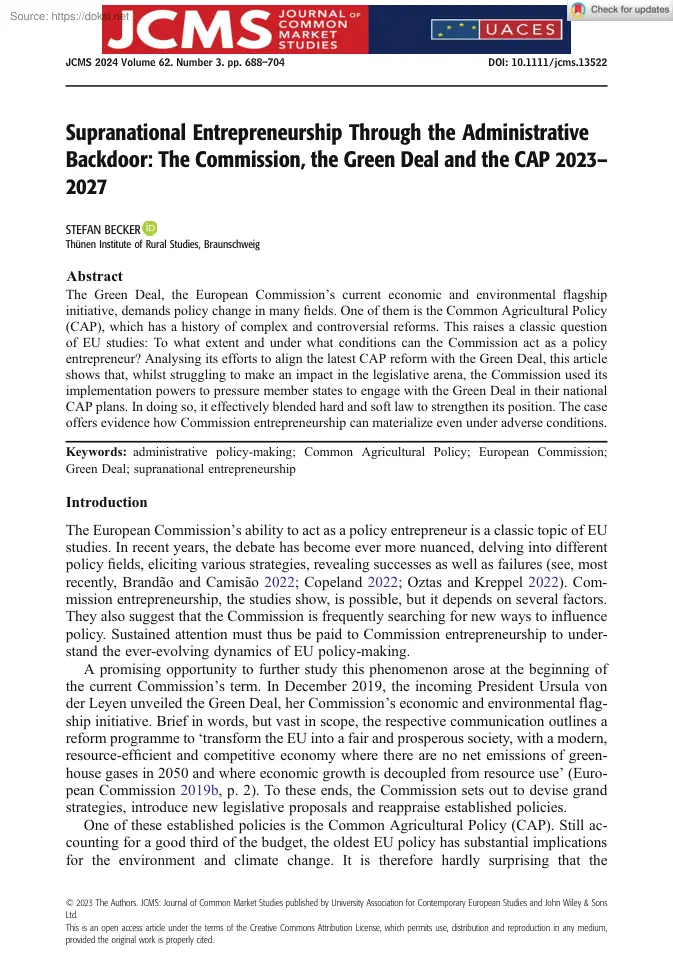
JCMS 2024 Volume 62. Number 3 pp 688–704 DOI: 10.1111/jcms13522 Supranational Entrepreneurship Through the Administrative Backdoor: The Commission, the Green Deal and the CAP 2023– 2027 STEFAN BECKER Thünen Institute of Rural Studies, Braunschweig Abstract The Green Deal, the European Commission’s current economic and environmental flagship initiative, demands policy change in many fields. One of them is the Common Agricultural Policy (CAP), which has a history of complex and controversial reforms. This raises a classic question of EU studies: To what extent and under what conditions can the Commission act as a policy entrepreneur? Analysing its efforts to align the latest CAP reform with the Green Deal, this article shows that, whilst struggling to make an impact in the legislative arena, the Commission used its implementation powers to pressure member states to engage with the Green Deal in their national CAP plans. In doing so, it effectively blended hard and soft law
to strengthen its position The case offers evidence how Commission entrepreneurship can materialize even under adverse conditions. Keywords: administrative policy-making; Common Agricultural Policy; European Commission; Green Deal; supranational entrepreneurship Introduction The European Commission’s ability to act as a policy entrepreneur is a classic topic of EU studies. In recent years, the debate has become ever more nuanced, delving into different policy fields, eliciting various strategies, revealing successes as well as failures (see, most recently, Brandão and Camisão 2022; Copeland 2022; Oztas and Kreppel 2022). Commission entrepreneurship, the studies show, is possible, but it depends on several factors They also suggest that the Commission is frequently searching for new ways to influence policy. Sustained attention must thus be paid to Commission entrepreneurship to understand the ever-evolving dynamics of EU policy-making A promising opportunity to further study
this phenomenon arose at the beginning of the current Commission’s term. In December 2019, the incoming President Ursula von der Leyen unveiled the Green Deal, her Commission’s economic and environmental flagship initiative. Brief in words, but vast in scope, the respective communication outlines a reform programme to ‘transform the EU into a fair and prosperous society, with a modern, resource-efficient and competitive economy where there are no net emissions of greenhouse gases in 2050 and where economic growth is decoupled from resource use’ (European Commission 2019b, p. 2) To these ends, the Commission sets out to devise grand strategies, introduce new legislative proposals and reappraise established policies. One of these established policies is the Common Agricultural Policy (CAP). Still accounting for a good third of the budget, the oldest EU policy has substantial implications for the environment and climate change. It is therefore hardly surprising that the 2023
The Authors. JCMS: Journal of Common Market Studies published by University Association for Contemporary European Studies and John Wiley & Sons Ltd. This is an open access article under the terms of the Creative Commons Attribution License, which permits use, distribution and reproduction in any medium, provided the original work is properly cited. Supranational Entrepreneurship Through the Administrative Backdoor: The Commission, the Green Deal and the CAP 2023–2027 689 Commission listed ‘Greening the [CAP]’ as one of its key actions in the Green Deal roadmap (European Commission 2019a). The CAP also represented an immediate window of opportunity to deliver on the Green Deal, as the decision-making process for the next funding period was still ongoing. The relevant legislation was far from being decided, and the member states were just beginning to prepare their strategic plans, the new mandatory documents showing how both CAP funds – the European Agricultural
Guarantee Fund and European Agricultural Fund for Rural Development, commonly referred to as the first and second pillars of the CAP – were to be used at national level. The Green Deal communication had been received fairly well by the European Parliament (EP) and the member state governments. The EP (2020b) signalled strong support, whilst the European Council (2019) ‘took note’ and asked the Council ‘to take work forward’. Yet conflicts were likely to materialize in the implementation of the Green Deal roadmap. This was especially true for the CAP, which has a history of complex and controversial reforms (see, eg, Daugbjerg and Swinbank 2016; Swinnen 2008, 2015) Moreover, the relevant legislation had been proposed by the previous Commission, leaving the new leadership with limited agenda-setting power. This article seizes the opportunity and analyses to what extent and under what conditions the Commission can act as a policy entrepreneur, using the latest CAP reform as a
case study. It first lays out the conceptual framework and introduces CAP reform as a potential case of Commission entrepreneurship. The empirical analysis then scrutinizes the negotiations on the core legislation of the new CAP, the strategic plan regulation (SPR), and the procedures for developing and approving the national plans, focusing in each decision-making arena on the issues related to the Green Deal.1 It shows how the Commission, whilst struggling to make an impact in the legislative arena, used its implementation powers to pressure member states to engage with the Green Deal in their national CAP plans. The final section discusses these findings, highlighting how Commission entrepreneurship materialized under adverse conditions, and explores further research avenues I. Conceptual Framework: The Commission as a Supranational Entrepreneur Policy entrepreneurship, following Kingdon (2003), means the investment of political resources to push for a desired policy outcome. The
concept was originally concerned with individuals advocating policies inside and outside of government, but it has been applied to political organizations and institutions as well. Whilst most actors involved in policy-making have desired policy outcomes, not every attempt to exercise political influence is entrepreneurship. The latter is a proactive and sustained effort, starting from a concrete policy proposal or at least a general idea, to promote policy change Such entrepreneurship may also involve an attempt to push the boundaries of decision-making procedures (see Mintrom and Norman 2009). As for the Commission, the literature has elicited several conditions of successful entrepreneurship that relate to the organization itself and its political and institutional environment. Regarding the former, the Commission must first be willing to exercise significant 1 Apart from the SPR [(EU) 2021/2115], the CAP reform package includes the horizontal regulation on financing,
management and monitoring [(EU) 2021/2116] and the Common Market Organisation regulation [(EU) 2021/2117] as well as numerous implementing and delegated acts. All of them are important, but the crucial files to link the CAP to the Green Deal were the SPR and the implementing regulation on the content of the national plans (2021/2289). 2023 The Authors. JCMS: Journal of Common Market Studies published by University Association for Contemporary European Studies and John Wiley & Sons Ltd. 14685965, 2024, 3, Downloaded from https://onlinelibrary.wileycom/doi/101111/jcms13522 by Johann Heinrich von Thuenen, Wiley Online Library on [21/04/2024] See the Terms and Conditions (https://onlinelibrarywileycom/terms-and-conditions) on Wiley Online Library for rules of use; OA articles are governed by the applicable Creative Commons License 690 Stefan Becker influence over a policy dossier – which has long been taken for granted, but must not necessarily be the case. The Commission
may simply have other priorities or might exercise restraint for ideological reasons (see, e.g, Hodson 2013) Second, the Commission must be unified, meaning that different commissioners (and their directorate-generals) do not pursue contradictory agendas. Whilst the Commission had long been a fragmented institution, the process of presidentialization since the 1990s has made it more hierarchical (Kassim et al. 2016); however, internal conflict is still commonplace Third, the Commission must have adequate political resources at its disposal Most frequently mentioned are its legal mandate, especially its exclusive agenda-setting role in most legislative areas (see, e.g, Blom-Hansen and Senninger 2021), but also its competencies in secondary rule-making (Nugent and Rhinard 2019, p 214); its legitimacy, not least based on the treaty provision that the Commission ‘shall promote the general interest of the Union and take appropriate initiatives to that end’ (article 17 TEU); and its
technical expertise, which can result in an informational advantage vis-à-vis other actors in the policy process (see, e.g, Chou and Riddervold 2015). In the political and institutional environment, four conditions in particular are linked to successful Commission entrepreneurship. First, there must be a reasonable window of opportunity – or policy windows, as Kingdon (1984) put it – which entrepreneurs can use to promote their ideas. Especially in older policy fields with a considerable acquis communautaire and established conflict lines, this may not often be the case. Another factor in this regard is the ‘heterotemporality’ of EU policy-making, with ‘key policies running on different cycles’ (Goetz 2017, p. 52), which can limit the number and quality of policy windows. Second, low salience of an issue tends to grant the Commission more power to influence policies, as the other institutions turn their attention towards more politicized dossiers (see, recently, Tortola
and Tarlea 2021, p. 1966) Third, Commission entrepreneurship benefits from finding allies for its initiatives Policy congruence with other EU institutions has been identified to have become increasingly important for the success of Commission initiatives (Oztas and Kreppel 2022) At the same time, the Commission has effectively promoted and used civil society organizations and experts to further its own ends (Princen 2011, pp. 935–936) Fourth, successful entrepreneurship is more likely when the Commission can link issues and decision-making arenas, using strong competencies in one policy area to expand its powers in others (Schmidt 2000). Only the Commission’s willingness to exercise influence and a reasonable window of opportunity are necessary conditions for successful entrepreneurship. Beyond that, different pathways are possible, and the Commission might adapt its strategies As Cram (1994, p. 214) has shown, the Commission is a ‘purposeful opportunist’, that is, ‘an
organisation which has a notion of its overall objectives and aims but is quite flexible as to the means of achieving them’. Any inquiry into Commission entrepreneurship is thus well advised to be guided by the concept and conditions of entrepreneurship outlined above, whilst considering the dynamic nature of EU policy-making. II. Case Selection: CAP Reform (and the Environment) The relevance of studying the latest CAP reform goes beyond the fact that the Commission identified the policy field as one priority in its Green Deal roadmap. Previous reform 2023 The Authors. JCMS: Journal of Common Market Studies published by University Association for Contemporary European Studies and John Wiley & Sons Ltd. 14685965, 2024, 3, Downloaded from https://onlinelibrary.wileycom/doi/101111/jcms13522 by Johann Heinrich von Thuenen, Wiley Online Library on [21/04/2024] See the Terms and Conditions (https://onlinelibrarywileycom/terms-and-conditions) on Wiley Online Library for rules of
use; OA articles are governed by the applicable Creative Commons License Supranational Entrepreneurship Through the Administrative Backdoor: The Commission, the Green Deal and the CAP 2023–2027 691 rounds had proved notoriously complex and controversial. Given the salience of the CAP, with a lot of money to be distributed, it is generally a difficult terrain for Commission entrepreneurship. Respective efforts are not futile. The Commission has always had a strong position in the implementation of the CAP, given the policy’s supranational character and the central role of comitology (see, e.g, Roederer-Rynning 2020) It was also able to influence the design of the policy. Knudsen (2009) has, for instance, shown how individual commissioners were important actors in the initial design of the CAP, and Garzon’s (2006) analysis of the 1992, 1999 and 2003 reforms has revealed that the Commission was able to act as a policy entrepreneur and that it was most influential when it
could link its agenda-setting powers to its role as a trade negotiator. However, there were no decision-making processes the Commission could link the most recent reform to. And environmental policy integration was still a strongly contested issue in the CAP (Alons 2017; Feindt 2010). The general objectives as enshrined in the treaties have not changed since its establishment in 1958; according to Article 39 TFEU, they still aim at increasing agricultural productivity, ensuring a fair standard of living for the agricultural community, stabilizing the markets, assuring the availability of supplies and ensuring reasonable consumer prices. There had been change beneath the treaty level (see, e.g, Grant 2010, Burrell 2009), and one trajectory was the integration of environmental goals. The MacSharry reforms of 1992 introduced agri-environment measures, that is, support for farming practices considered to be beneficial for – or less harmful to – the environment, as a regular CAP
instrument. They were subsequently expanded and are now called agri-environment-climate measures (AECM). Another step came with the Agenda 2000 reforms, which established the system of cross-compliance that linked direct payments to a number of conditions, many of them relating to the environment.2 Voluntary for member states at first, the Luxembourg Agreement (2003) made cross-compliance mandatory. The 2013 CAP reform then introduced ‘Greening’, which made access to 30% of the direct payment envelope conditional on complying with certain farming practices considered to benefit the environment In addition, there had been minor changes, such as the more prominent proclamation of environmental goals, ring-fencing requirements for environmental measures in the second pillar and the introduction of modulation which allowed member states to transfer funds from the first to the second pillar, thus possibly benefitting environmental measures. The debate about the CAP’s environmental
performance was far from being resolved, however. Environmental groups and scientists had been sceptical with the reforms’ scope and speed from the beginning, and they have become ever more vocal (see, e.g, Pe’er et al. 2020) A common criticism was that the discourse may have changed but that the CAP is still geared towards farm income support (see Alons 2017, pp. 1614–1616, on the use of environmental goals for the legitimation of old practices). And the critical camp was growing. The European Court of Auditors (2017), for instance, severely questioned the ecological impact of Greening. Farm groups and many governments, meanwhile, tended to prefer incremental change. Here, ideas of agricultural exceptionalism that 2 Around the same time, the Treaty of Amsterdam (1999) introduced the obligation to integrate ‘environmental protection requirements [] into the definition and implementation of the Union’s policies and activities’ (now Article 11 TFEU). 2023 The Authors.
JCMS: Journal of Common Market Studies published by University Association for Contemporary European Studies and John Wiley & Sons Ltd. 14685965, 2024, 3, Downloaded from https://onlinelibrary.wileycom/doi/101111/jcms13522 by Johann Heinrich von Thuenen, Wiley Online Library on [21/04/2024] See the Terms and Conditions (https://onlinelibrarywileycom/terms-and-conditions) on Wiley Online Library for rules of use; OA articles are governed by the applicable Creative Commons License 692 Stefan Becker primarily call for supporting the economic interests of agricultural producers (Daugbjerg and Feindt 2017) were still common. The EP, equipped with co-decision powers in agricultural matters since the Treaty of Lisbon (2009), tended to fall in this camp as well An analysis of the 2013 reform shows how the EP had its hand in watering down environmental ambitions (Gravey and Buzogány 2021). The Commission had occupied a middle position, mostly trying to reconcile environmental
concerns with other CAP goals – and thereby seeking to safeguard the general legitimacy of the policy (see, e.g, Alons 2017, p. 1614) With the Green Deal, the Commission position now appeared to be different. There was no indication, however, that the positions of the other actors had changed as well. Aligning the reform with the Green Deal can thus be considered a ‘critical case’ for the study of Commission entrepreneurship – if it materializes in this difficult setting, it is likely to be possible in many other cases, too (see Flyvbjerg 2006, pp. 229–230) III. Empirical Analysis: The CAP 2023–2027 Reform Process and the Green Deal The analysis traces the latest CAP reform process as it relates to the Commission’s Green Deal ambitions. Point of departure is the SPR proposal introduced by the Juncker Commission It then shows how the Green Deal represented a new Commission position on CAP reform. The analysis goes on to dissect the negotiations on the SPR in the
legislative arena and the decisions on the content and approval of national CAP plans in the administrative arena. This process-tracing (Beach and Pedersen 2019) seeks to uncover the factors that determined the success of Commission entrepreneurship Methodologically, it is based on analysis of legislation and other official documents, such as country-specific recommendations and observation letters issued by the Commission during the preparation and approval of the national plans. Where necessary, it also refers to secondary sources, such as media articles, to account for the course of the negotiation and approval process. Point of Departure: The SPR Proposal A year before the legislative proposal, the Commission prepared the field with a communication on the future of food and farming (European Commission 2017). The document stressed that the CAP was now operating in a ‘new context’ in which, inter alia, farmers were the ‘first stewards of the natural environment’ (p. 3)
and called for the new funding period to ‘reflect higher ambition and focus more on results as regards resource efficiency, environmental care and climate action’ (p. 18) This plea was, however, not the only, or even the central, one; it was accompanied by calls for ‘fostering a smart and resilient agricultural sector’ and ‘strengthening the socio-economic fabric of rural areas’ (p. 3) There was thus still a broad catalogue of goals for the CAP, and the Commission refrained from bringing them in any kind of order. When these goals found their way into the legislative proposal, now being dubbed ‘general objectives’, it became clearer what the Commission thought the CAP should primarily accomplish. Out of nine specific CAP objectives, four addressed the agricultural sector (income, competitiveness, position in the value chain and generational renewal), three dealt with environmental concerns (climate, natural resources and biodiversity), one objective lumped together
socio-economic issues of rural areas and another one 2023 The Authors. JCMS: Journal of Common Market Studies published by University Association for Contemporary European Studies and John Wiley & Sons Ltd. 14685965, 2024, 3, Downloaded from https://onlinelibrary.wileycom/doi/101111/jcms13522 by Johann Heinrich von Thuenen, Wiley Online Library on [21/04/2024] See the Terms and Conditions (https://onlinelibrarywileycom/terms-and-conditions) on Wiley Online Library for rules of use; OA articles are governed by the applicable Creative Commons License Supranational Entrepreneurship Through the Administrative Backdoor: The Commission, the Green Deal and the CAP 2023–2027 693 pertained to almost all general objectives (adapting agriculture to ‘societal demands’, such as regarding animal welfare).3 The environmental objectives thus almost reached parity with the agricultural objectives. Furthermore, the proposed SPR stated that member states ‘shall aim to make [] a
greater overall contribution to the achievement of the specific environmental- and climate-related objectives’ (Article 92) than in the previous funding period. The Commission (2019) emphasized three instruments to further ‘green’ the CAP. First, the Commission proposal introduced eco-schemes, environmental measures in the first pillar that would be mandatory for member states but voluntary for farmers. Apart from being yearly area-based payments for observing ‘agricultural practices beneficial for the climate and the environment’ that would need to be different from AECM in the second pillar, the eco-schemes were, however, not further defined. The Commission also refrained from proposing any sort of minimum budgetary allocation for eco-schemes. Second, a new system of obligations for area- or animal-based payments, known as conditionality, was to allow for more effective basic environmental protection. This system would include and slightly upgrade elements of the
previous Greening and cross compliance standards. Above a certain standard, however, conditionality was to be defined at member state level. Third, ring-fencing for environmental measures in the second pillar was to remain at the level of 30% but was to exclude payments for farmers in areas facing natural or other area-specific constraints (ANC). This measure had been found to have limited environmental effect (Alliance Environnement 2020), and its inclusion in the ring-fencing for environmental payments had been considered green-washing (see, e.g, BirdLife International 2021). The Commission proposal could thus be seen as a moderate step towards more environmental ambition in the CAP; however, central elements remained vague (ecoschemes) or would have had to be further defined at national level (conditionality). A New Commission Position: The Green Deal and the CAP The Green Deal communication, published only 2 weeks after the new Commission formally took office, singled out the
CAP as one important field of action. It stated that ‘the Commission will work with the Member States and stakeholders to ensure that from the outset the national strategic plans for agriculture fully reflect the ambition of the Green Deal and the Farm to Fork Strategy’ and that ‘the Commission will ensure that these strategic plans are assessed against robust climate and environmental criteria’ (European Commission 2019b, p. 12) At that point, however, neither the mentioned Farm to Fork Strategy nor the equally relevant Biodiversity Strategy had been published. It thus remained somewhat elusive what the Commission had in mind In May 2020, the Commission simultaneously unveiled the Farm to Fork Strategy and the Biodiversity Strategy (European Commission 2020b, 2020c). These strategies contain a number of agricultural and environmental goals, most qualitative, some quantitative. Amongst the latter, the Commission calls for reducing the use of chemical pesticides and high-risk
pesticides by 50%, respectively, reducing the sales of antimicrobials for farmed animals and aquaculture also by 50%, reducing by at least 50% nutrient losses 3 In addition, there is a cross-cutting objective of ‘fostering and sharing of knowledge, innovation and digitalization in agriculture and rural areas, and encouraging their uptake’. 2023 The Authors. JCMS: Journal of Common Market Studies published by University Association for Contemporary European Studies and John Wiley & Sons Ltd. 14685965, 2024, 3, Downloaded from https://onlinelibrary.wileycom/doi/101111/jcms13522 by Johann Heinrich von Thuenen, Wiley Online Library on [21/04/2024] See the Terms and Conditions (https://onlinelibrarywileycom/terms-and-conditions) on Wiley Online Library for rules of use; OA articles are governed by the applicable Creative Commons License 694 Stefan Becker and achieving 25% agricultural area under organic farming – all by the year 2030. Both strategies emphasized the CAP
as a central policy to accomplish these goals. A Commission staff working document, published at the same time (European Commission 2020a), provided additional guidance on the links between its environmental strategies and the CAP. It concluded that the SPR proposal offered a solid foundation to align the CAP with the Green Deal, but that much depended on the following decisions at EU and national level. The document also outlined the new Commission’s vision for the direction the CAP reform should take. The Commission first emphasized the need to retain key aspects of the original proposals, namely, that member states should show more ambition regarding environmental and climate-related objectives compared to the previous funding period; that the proposed framework for conditionality should be maintained and not replaced by voluntary arrangements; and that ring-fencing for environmental and climate measures in the second pillar should be kept at 30% (without counting ANC payments).
Second, the Commission acknowledged that ring-fencing and further specifications on the possible types of eco-schemes in the first pillar would be beneficial; however, it again refrained from proposing a mandatory budget or a catalogue of possible schemes. Third and finally, the Commission shared its ideas on how it could ‘assist’ decision-making processes at member state level. It envisaged making the approval process for the national plans more transparent, initiating a structured dialogue with member states well before the submission of their plans and issuing country-specific recommendations. In doing so, the Green Deal would be paid special attention. Particularly, the Commission planned to ask member states ‘to set explicit national values at the level of impact indicators for the key [Green Deal targets], to show how they plan to contribute to the new EU ambition, thus indicating a clear direction of the efforts to be made at national level’ (European Commission
2020a, p. 21) With the Farm to Fork Strategy, the Biodiversity Strategy and its staff work document, the new Commission thus presented a clearer position on what the next CAP should look like in environmental terms, especially regarding the integration of the Green Deal. The national CAP plans were to reflect the headline targets as proposed by the Farm to Fork Strategy and the Biodiversity Strategy, offer more ambitious policy instruments (compared to the previous funding period) and were to be developed under close supervision of the Commission. The Commission could have felt encouraged by signals from the co-legislators regarding the agricultural aspects of the Green Deal. The agricultural ministers had shared the Commission’s notion that the CAP was crucial for the Green Deal – and had, correspondingly, called for an adequate budget (Council of the European Union 2020a), whilst the EP had stated that the CAP ‘should be fully in line with the EU’s increased climate and
biodiversity ambition’ and had further invited the Commission to analyse the legislative proposal in this regard (EP 2020b, points 55 and 58). The integration of the Green Deal would, however, face some resistance in the legislative negotiations that were now beginning to gather momentum. The Legislative Arena: Negotiations on the SPR Before deciding on what the new CAP funding period should entail, the first major decision to be taken was when it should begin. Against the background of slow progress on 2023 The Authors. JCMS: Journal of Common Market Studies published by University Association for Contemporary European Studies and John Wiley & Sons Ltd. 14685965, 2024, 3, Downloaded from https://onlinelibrary.wileycom/doi/101111/jcms13522 by Johann Heinrich von Thuenen, Wiley Online Library on [21/04/2024] See the Terms and Conditions (https://onlinelibrarywileycom/terms-and-conditions) on Wiley Online Library for rules of use; OA articles are governed by the applicable
Creative Commons License Supranational Entrepreneurship Through the Administrative Backdoor: The Commission, the Green Deal and the CAP 2023–2027 695 both the multi-annual financial framework and the SPR, it was commonly agreed that the original schedule, according to which member states would hand in their strategic plans by 1 January 2020 with the new rules applying a year later, would need to be extended. There was no agreement, however, on exactly how far the new funding period should be pushed into the future. The proposal for a transitional regulation (European Commission 2019c) was designed for 1 year, whilst the Council cautiously and the EP forcefully called for a 2-year extension (Council of the European Union 2020c; EP 2020c). This disagreement was not only based on technical considerations The transitional regulation basically extended the old rules The Commission, unsurprisingly, would have liked to see new money spent according to new rules – which, from the
Commission standpoint, would be in line with the Green Deal – as early as possible (Fortuna 2020b). The member states and the Parliament prevailed, however, extending the old rules for 2 years and thereby reducing the new funding period to 5 years starting in 2023. With this decision taken, the Council and the EP began to make progress on the new CAP legislation. In the fall of 2020, they respectively agreed on their negotiation positions (Council of the European Union 2020b; EP 2020a) Regarding the key elements of the original proposal and its informal update after the Green Deal, the co-legislators took the following stands. First, the EP demanded that at least 30% of the first pillar budget should be reserved for eco-schemes (which, it added, could also include measures for animal welfare), whereas as the Council wanted to see the minimum set at 20%. In addition, the national governments called for a 2-year transition period, during which unused funds from eco-schemes could be
used for other measures, and the option to take environmental payments into account if they exceeded 30% of the second pillar budget. Second, both institutions sought to weaken the Commission proposal regarding conditionality, with the Council being more assertive than the EP (see Meredith and Kollenda 2021, pp. 5–10, for an overview) The same is true for the third key element, ring-fencing for environmental measures in the second pillar. Whilst the Council wanted to maintain the 30% proposed by the Commission, the EP even called for 35%; however, both institutions wanted the ANC payments to be included in this spending category, effectively reducing the environmental ambition of the ring-fencing exercise. The co-legislators also responded to the Commission’s general aim of urging member states to demonstrate more environmental ambition. The EP called for measuring this ambition in budgetary terms, something that the Commission (2020a) had warned would not be sufficient by itself,
but also made reference to the Green Deal in its recitals, inter alia ‘stress[ing] that CAP strategic plans must fully reflect the ambition of the European Green Deal, and call[ing] on the Commission to be firm on this point in its assessment of the strategic plans’ (EP 2020a). By contrast, the Council sought to pre-empt any respective Commission discretion when it came to scrutinizing the national plans. It called for amending the stipulations on the assessment procedure to make clear that it ‘shall exclusively be based on acts which are legally binding on Member States’ (Council of the European Union 2021b) – which the Green Deal and the associated Farm to Fork Strategy and Biodiversity Strategy were not. To varying degrees, the Council and the EP were thus not following the Commission’s vision on how the CAP reform should reflect the Green Deal. Frans Timmermans, the Commission’s Vice President for the Green Deal, immediately went on record to heavily 2023 The
Authors. JCMS: Journal of Common Market Studies published by University Association for Contemporary European Studies and John Wiley & Sons Ltd. 14685965, 2024, 3, Downloaded from https://onlinelibrary.wileycom/doi/101111/jcms13522 by Johann Heinrich von Thuenen, Wiley Online Library on [21/04/2024] See the Terms and Conditions (https://onlinelibrarywileycom/terms-and-conditions) on Wiley Online Library for rules of use; OA articles are governed by the applicable Creative Commons License 696 Stefan Becker criticize the co-legislators. He even hinted at the possibility of withdrawing the CAP proposal, if the emerging compromise was not in line with EU’s new environmental flagship initiative (Fortuna 2020a). This option was quickly taken off the table by President von der Leyen. She promised, however, that the Commission would strive to be – somewhat paradoxically – both an ‘honest broker’ and a ‘driver for greater sustainability’ in the negotiations (European
Commission 2020f). After von der Leyen’s intervention, Timmermans met with staunch critics of the proposals, for example, from the #WithdrawTheCAP campaign (Ackerman et al. 2021), but mainly reiterated his superior’s position And whilst he did take part in the legislative trilogue, there was also the Commissioner formally responsible for the dossier, Janusz Wojciechowski, who was perceived by environmental groups as someone ‘who talks a bigger game on greening EU agriculture than he delivers’ (Wax and Wanat 2021). The outcome of the legislative negotiations shows that the Commission was hardly successful in its ‘drive for greater sustainability’. In the final SPR [(EU) 2021/2115], the minimum to be reserved for eco-schemes in the first pillar was set at 25%, with both a 2-year learning period that allowed for the transfer of unused funds and the option of a rebate (of up to 50%) if environmental payments exceeded a certain threshold (30%, excluding ANC payments) in the
second pillar. Furthermore, 35% of the second pillar would have to be spent on environmental measures, but the calculation includes half of the ANC payments. Conditionality was slightly weakened compared to the original proposal through exemptions and reductions in scope (see Guyomard et al. 2020, pp 93–95) Finally, regarding the approval procedure for the strategic plans, the Council position that the assessment should only consider legally binding acts prevailed. With the old funding period being extended for 2 years and key decisions on the SPR taken against its preferences, the legislative arena thus proved difficult for the new Commission and its wish to adapt the CAP reform to the Green Deal. But there was another window of opportunity. The Administrative Arena: Deciding on the Content and Approval of National CAP Plans At the same time the SPR was being negotiated, the Commission was already concerned with implementation. Regarding the Green Deal, three areas were
particularly important: the interaction with the member states in developing their national plans, the implementing regulation for the specific content of these plans and the plan approval procedure. Despite their many differences regarding the next CAP funding period, none of the actors questioned that the member states will have to prepare strategic plans. Their efforts were already well under way when the negotiations on the SPR gained momentum. There was also no overt opposition to the Commission already engaging with the member states during this phase – which is plausible, because national governments liaise permanently with the EU executive, and this specific structured dialogue could help to facilitate the formal procedure later on. The Commission’s so-called ‘assistance’ during this phase was, however, not a purely technical, but also a political exercise. Its strategy to use the structured dialogue to push for the Green Deal becomes evident in the country-specific
recommendations it delivered at the end of 2020. One the one hand, the recommendations were not part of the (draft) SPR, but solely a Commission initiative. On the other hand, the Commission put the 2023 The Authors. JCMS: Journal of Common Market Studies published by University Association for Contemporary European Studies and John Wiley & Sons Ltd. 14685965, 2024, 3, Downloaded from https://onlinelibrary.wileycom/doi/101111/jcms13522 by Johann Heinrich von Thuenen, Wiley Online Library on [21/04/2024] See the Terms and Conditions (https://onlinelibrarywileycom/terms-and-conditions) on Wiley Online Library for rules of use; OA articles are governed by the applicable Creative Commons License Supranational Entrepreneurship Through the Administrative Backdoor: The Commission, the Green Deal and the CAP 2023–2027 697 Green Deal front and centre (European Commission 2020e). Out of a total of 402 country-specific recommendations,4 roughly 41% pertained to the general CAP
objective to ‘bolster environmental care and climate action and to contribute to the environmentaland climate-related objectives of the Union’, whilst 26% were dedicated to the objective to ‘strengthen the socio-economic fabric of rural areas and address societal demands’ and 21% addressed the objective to ‘foster a smart, resilient and diversified agricultural sector ensuring food security’ (the remaining 12% concerned the cross-cutting objective). With some recommendations not falling neatly into one category, and considering their general vagueness (see, e.g, Metta and Moore 2021), these numbers should not be overstated; but they illustrate the Commission’s focus and ambitions. The Commission also reiterated that the recommendations – and their follow-up by the member states – would be considered in the strategic plan approval procedure. What exactly the Commission would be approving, that is, the content of the strategic plans, remained uncertain at the time. The
respective implementing act was not only held up by the ongoing SPR negotiations. There were also marked differences between the Commission and the member states how the Green Deal should feature in the plans. As outlined above, the Council amended the SPR proposal to keep the Green Deal – as soft law – out of the approval procedure. The Commission had to shelve an early draft of the relevant implementing regulation after heavy criticism from the member states and parts of the EP on how the Green Deal targets were to be integrated into the strategic plans; according to some MEPs, bringing the Green Deal targets into secondary legislation would be ‘politically and legally problematic. These numerical targets are essential elements which should have been decided in the framework of the basic regulation, through the co-decision procedure and not through a delegated act’ (Agence Europe (2021a, 2021b). The Commission was thus left with ‘inviting [member states] to actually include
concrete national targets in their strategic plans’, as one Commission official put it (Dahm 2021). The adopted implementing regulation (2021/2289) states that the plans ‘shall also include an explanation of the national contribution to achieving the Union’s targets for 2030 set out in the Farm to Fork Strategy and the EU Biodiversity Strategy’. The Commission did, however, continue to push for the integration of the Green Deal in the national plans. For this purpose, it used its discretion in the approval procedure, deliberately expanding its scope of assessment The Commission’s approach drew criticism from the Council and civil society organizations alike. In its agricultural meeting in October 2021, the Council ‘called on the Commission to adopt a transparent approach to evaluating the plans, for example by providing clear assessment criteria and ensuring that as many guidance documents as possible are made public’ (Council of the European Union 2021a, p. 6)
Environmental groups, meanwhile, called for more transparency regarding the strategic plans and the Commission’s first appraisal of them (the so-called observation letters); both should be made public as soon as possible (see Foote 2021) Most member states published their draft plans, and the Commission made available the observation letters (after member states had the opportunity to respond); however, the Commission never published its strategy and methods in assessing the plans. The transparency it 4 The recommendations are available at https://ec.europaeu/info/food-farming-fisheries/key-policies/common-agriculturalpolicy/cap-strategic-plans en (13 March 2023) 2023 The Authors. JCMS: Journal of Common Market Studies published by University Association for Contemporary European Studies and John Wiley & Sons Ltd. 14685965, 2024, 3, Downloaded from https://onlinelibrary.wileycom/doi/101111/jcms13522 by Johann Heinrich von Thuenen, Wiley Online Library on [21/04/2024] See
the Terms and Conditions (https://onlinelibrarywileycom/terms-and-conditions) on Wiley Online Library for rules of use; OA articles are governed by the applicable Creative Commons License 698 Stefan Becker promised (European Commission 2020a) was thus asymmetrical: high in its messages to the member states and low regarding its own approval approach. The observation letters show that environmental issues and the Green Deal in particular were a primary concern for the Commission.5 Each observation letter starts with key issues. Amongst those that explicitly refer to the general objectives, roughly half (49%) relate to the environmental cluster. In addition, the Commission considered the Green Deal a key issue by itself and commented on each strategic plan’s ‘information with regard to the contribution to and consistency with the Green Deal targets’. This took different forms, depending on the information provided A few member states have indicated national values, whilst
most have provided qualitative information on how they contribute to the Green Deal targets, with ‘the quality and detail of these explanations vary[ing] significantly’, as the Commission (2022, p. 15) put it In all cases, however, it did provide a brief assessment of the proclaimed contribution to the Green Deal targets, prompting the member states to respond. From the country-specific recommendations, to the content of the strategic plans, to the approval procedure, the Commission has thus used its implementation powers to put pressure on the member states to acknowledge the Green Deal in their national plans. IV. Discussion and Outlook The empirical analysis reveals new insights into the Commission’s abilities to act as a policy entrepreneur. Based primarily on the scrutiny of official documents, these insights have limits. They only refer to what the institutions have put into writing; internal processes of preference formation (Hartlapp et al 2014) and informal
negotiation dynamics (Brandsma 2015) go largely unnoticed. However, the documents under scrutiny do offer substantial evidence of successes and failures in the Commission’s quest to align the most recent CAP reform with the Green Deal. And given that the CAP, especially in its environmental dimensions, represents a critical case for the study of supranational entrepreneurship, the results matter beyond this particular policy The case again emphasizes the many limits to successful entrepreneurship. The political and institutional environment was predominantly marked by adversity Due to the EU’s asynchronous political cycles, the new Commission was stuck with the CAP proposal of its predecessor – that was not known to be overly ambitious in environmental terms (Steinebach and Knill 2016). An incoming Commission can scrap proposals and cite ‘discontinuity’, as the von der Leyen Commission had also done (European Commission 2020d); but when a policy is closely tied to the budget
and there are many (potential) beneficiaries, an alternative would have to materialize immediately. Furthermore, CAP reform proved complex and controversial yet again, evidenced by the protracted negotiations and the need to prolong the old funding period by 2 years. For the Commission, such a salient dossier is difficult to handle, with the Council and the EP being attentive to even the smallest details. There were also no parallel decision-making processes the Commission could link the CAP reform to. It had no reliable ally in the negotiations either: The EP was not as assertive as the Commission might 5 The 28 observation letters on the draft strategic plans – Belgium has two, one for Wallonia and one for Flanders – are available at https://agriculture.eceuropaeu/cap-my-country/cap-strategic-plans/obervation-letters en (13 March 2023) 2023 The Authors. JCMS: Journal of Common Market Studies published by University Association for Contemporary European Studies and John Wiley
& Sons Ltd. 14685965, 2024, 3, Downloaded from https://onlinelibrary.wileycom/doi/101111/jcms13522 by Johann Heinrich von Thuenen, Wiley Online Library on [21/04/2024] See the Terms and Conditions (https://onlinelibrarywileycom/terms-and-conditions) on Wiley Online Library for rules of use; OA articles are governed by the applicable Creative Commons License Supranational Entrepreneurship Through the Administrative Backdoor: The Commission, the Green Deal and the CAP 2023–2027 699 have hoped, and whilst environmental groups and scientists mobilized against the reform proposals, they hardly influenced the legislative debate. Finally, there were limiting factors on the Commission side as well It was not as unified as it could have been, as the President’s fast reassurance that the CAP proposal would not be withdrawn (regardless of the legal feasibility) indicates, which undermined the position of the vice president responsible for the Green Deal. Yet the case also shows
that, even under adverse conditions, the Commission can act as a policy entrepreneur. Its country-specific recommendations, an initiative independently conceived by the Commission, sought to frame the drafting process of the national plans in light of the Green Deal and provided a reference point for the following approval procedure. Then, and more importantly, the Commission used its discretion in this procedure to pressure member states to engage with the Green Deal – an approach with little to no basis in the SPR legislation. In doing so, it effectively blended its hard law power to approve the national strategic plans with its soft law initiative that is the Green Deal, thus pushing the boundaries of the procedure in classic entrepreneurial fashion (Mintrom and Norman 2009). The analysis thus shows how the Commission can use the administrative backdoor to influence policy, even if it failed at the legislative front door. Studies have shown that the Commission finds it
increasingly hard to make an impact in the legislative arena but enjoys considerable influence in the ever-growing administrative arena (see, e.g, Nugent and Rhinard 2016). Future studies should, therefore, acknowledge both arenas for a more comprehensive account of Commission entrepreneurship (see also Becker et al. 2016) In this case, successes in the administrative arena cannot compensate for losses in the legislative arena; but its effects are noticeable, and in other cases, the relation may well be different. Another pointer for future studies is the Commission’s creativity when being a ‘purposeful opportunist’ (Cram 1994) – in this case, in interpreting rules and procedures. Its strategy to bring the Green Deal into the plan approval procedure resembles its efforts to strengthen its role in the European Semester by linking the sanction-based excessive deficit procedure with the non-binding country-specific recommendations (see, e.g, Crespy and Menz 2015, p. 763) In
either case, member states cannot be sanctioned – or denied approval of their plans – if they do not follow the Commission’s recommendations, but with the distinctions between hard and soft requirements being blurred, they come under additional pressure to justify their choices. More generally, the Commission might have to become more creative (see, e.g, Copeland 2022 on the Juncker Commission’s efforts to revive the ‘Social Europe’ idea) to be a successful entrepreneur in an ever more complicated and contested EU. Detecting, analysing and assessing such creative pathways to entrepreneurship remain important tasks for scholars of EU integration. Finally, the Commission’s strategies to influence policy-making, and especially its handling of soft law, also raise normative questions. In the case at hand, some may applaud the Commission for trying to pressure member states into engaging with the Green Deal, especially if they see it as promoting the delivery of ‘public
goods’; others might find that the Commission transcends its mandate in the approval procedure. Then again, what options does an incoming Commission have when political cycles do not align and a fresh legislative proposal is unfeasible? The latest CAP reform thus shows that 2023 The Authors. JCMS: Journal of Common Market Studies published by University Association for Contemporary European Studies and John Wiley & Sons Ltd. 14685965, 2024, 3, Downloaded from https://onlinelibrary.wileycom/doi/101111/jcms13522 by Johann Heinrich von Thuenen, Wiley Online Library on [21/04/2024] See the Terms and Conditions (https://onlinelibrarywileycom/terms-and-conditions) on Wiley Online Library for rules of use; OA articles are governed by the applicable Creative Commons License 700 Stefan Becker EU policy-making continues to produce novel processes and phenomena, even in established policy fields, that raise classic questions of influence and legitimacy. ACKNOWLEDGEMENTS The
author wishes to thank the three anonymous reviewers for their thorough comments and helpful suggestions. Open Access funding enabled and organized by Projekt DEAL. Correspondence: Stefan Becker, Thünen Institute of Rural Studies, Braunschweig. email: stefan.becker@thuenende References Ackerman, S., Herzog, M, Ruas, V and Comparelli, M (2021) Withdraw the CAP Movement Takes on Timmermans, Trilogues and Parliament Plenary. https://wwwarc2020eu/withdrawthe-cap-movement-takes-on-timmermans-trilogues-and-parliament-plenary/ Agence Europe. (2021a) European Commission Submits Parts of CAP Secondary Legislation to Member States: 9 November 2021. Agence Europe. (2021b) MEPs Denounce Time Pressure to Rush Through ‘Secondary’ CAP Legislation: 11 November 2021 Alliance Environnement (2020) Evaluation of the Impact of the CAP on Habitats, Landscapes, Biodiversity: Final Report (Publications Office of the European Union). Alons, G. (2017) ‘Environmental Policy Integration in the EU’s
Common Agricultural Policy: Greening or Greenwashing?’ Journal of European Public Policy, Vol. 24, No 11, pp. 1604–1622 https://doiorg/101080/1350176320171334085 Beach, D. and Pedersen, RB (2019) Process-Tracing Methods: Foundations and Guidelines (Second edition) (University of Michigan Press). Becker, S., Bauer, MW, Connolly, S and Kassim, H (2016) ‘The Commission: Boxed In and Constrained, but Still an Engine of Integration’. West European Politics, pp 1–21 https:// doi.org/101080/0140238220161181870 BirdLife International. (2021) Business as Usual and Mass Funding of Nature Destruction under New Common Agricultural Policy. https://wwwbirdlifeorg/news/2021/06/25/press-releasebad-cap-deal-kill-nature 25june2021/ Blom-Hansen, J. and Senninger, R (2021) ‘The Commission in EU Policy Preparation’ JCMS: Journal of Common Market Studies, Vol. 59, No 3, pp 625–642 https://doiorg/101111/ jcms.13123 Brandão, A.P and Camisão, I (2022) ‘Playing the Market Card: The
Commission’s Strategy to Shape EU Cybersecurity Policy’. JCMS: Journal of Common Market Studies, Vol 60, No 5, pp. 1335–1355 https://doiorg/101111/jcms13158 Brandsma, G.J (2015) ‘Co-Decision after Lisbon: The Politics of Informal Trilogues in European Union Lawmaking’. European Union Politics, Vol 16, No 2, pp 300–319 https://doiorg/10 1177/1465116515584497 Burrell, A. (2009) ‘The CAP: Looking Back, Looking Ahead’ Journal of European Integration, Vol. 31, No 3, pp 271–289 https://doiorg/101080/07036330902782113 Chou, M.-H and Riddervold, M (2015) ‘The Unexpected Negotiator at the Table: How the European Commission’s Expertise Informs Intergovernmental EU Policies’ Politics and Governance, Vol. 3, No 1, pp 61–72 https://doiorg/1017645/pagv3i1117 2023 The Authors. JCMS: Journal of Common Market Studies published by University Association for Contemporary European Studies and John Wiley & Sons Ltd. 14685965, 2024, 3, Downloaded from
https://onlinelibrary.wileycom/doi/101111/jcms13522 by Johann Heinrich von Thuenen, Wiley Online Library on [21/04/2024] See the Terms and Conditions (https://onlinelibrarywileycom/terms-and-conditions) on Wiley Online Library for rules of use; OA articles are governed by the applicable Creative Commons License Supranational Entrepreneurship Through the Administrative Backdoor: The Commission, the Green Deal and the CAP 2023–2027 701 Copeland, P. (2022) ‘The Juncker Commission as a Politicising Bricoleur and the Renewed Momentum in Social Europe’ JCMS: Journal of Common Market Studies, Vol 60, No 6, pp. 1629–1644 https://doiorg/101111/jcms13336 Council of the European Union. (2020a) Outcome of the 3745th Council Meeting Agriculture and Fisheries Brussels, 27 January 2020: 5544/20. Council of the European Union. (2020b) Proposal for a Regulation of the European Parliament and of the Council Establishing Rules on Support for Strategic Plans to be Drawn up by Member States
under the Common Agricultural Policy (CAP Strategic Plans) and Financed by the European Agricultural Guarantee Fund (EAGF) and by the European Agricultural Fund for Rural Development (EAFRD) and repealing Regulation (EU) No 1305/2013 of the European Parliament and of the Council and Regulation (EU) No 1307/2013 of the European Parliament and of the Council - General Approach: 2018/0216(COD) Brussels, 21 October 2020. Council of the European Union. (2020c) Proposal for a Regulation of the European Parliament and of the Council Laying Down Certain Transitional Provisions for the Support by the European Agricultural Fund for Rural Development (EAFRD) and by the European Agricultural Guarantee Fund (EAGF) in the Year 2021 and Amending Regulations (EU) No 228/2013, (EU) No 229/2013 and (EU) No 1308/2013 as regards Resources and Their Distribution in Respect of the Year 2021 and Amending Regulations (EU) No 1305/2013, (EU) No 1306/2013 and (EU) No 1307/2013 as regards Their Resources and
Application in the Year 2021 - Partial Mandate for Negotiations with the European Parliament: 2019/0254(COD). Council of the European Union. (2021a) Outcome of the Council Meeting, 3817th Council Meeting Agriculture and Fisheries Luxembourg, 11 and 12 October 2021: 12734/21 Council of the European Union. (2021b) Proposal for a Regulation of the European Parliament and of the Council Establishing Rules on Support for Strategic Plans to be Drawn Up by Member States under the Common Agricultural Policy (CAP Strategic Plans) and Financed by the European Agricultural Guarantee Fund (EAGF) and by the European Agricultural Fund for Rural Development (EAFRD) and Repealing Regulation (EU) No 1305/2013 of the European Parliament and of the Council and Regulation (EU) No 1307/2013 of the European Parliament and of the Council - Four-Column Document. Cram, L. (1994) ‘The European commission as a multi-organization: Social policy and IT policy in the EU’. Journal of European Public Policy, Vol
1, No 2, pp 195–217 https://doiorg/10 1080/13501769408406955 Crespy, A. and Menz, G (2015) ‘Commission Entrepreneurship and the Debasing of Social Europe Before and After the Eurocrisis’. Journal of Common Market Studies, Vol 53, No 4, pp. 753–768 https://doiorg/101111/jcms12241 Dahm, J. (2021) Hard or Soft Law: What’s the Status of EU Sustainable Agriculture Goals? https://www.euractivcom/section/agriculture-food/news/hard-or-soft-law-whats-the-status-ofeu-sustainable-agriculture-goals/ Daugbjerg, C. and Feindt, PH (2017) ‘Post-Exceptionalism in Public Policy: Transforming Food and Agricultural Policy’. Journal of European Public Policy, Vol 24, No 11, pp 1565–1584 https://doi.org/101080/1350176320171334081 Daugbjerg, C. and Swinbank, A (2016) ‘Three Decades of Policy Layering and Politically Sustainable Reform in the European Union’s Agricultural Policy’ Governance, Vol 29, No 2, pp. 265–280 https://doiorg/101111/gove12171 European Commission. (2017)
Communication from the Commission to the European Parliament, the Council, the European Economic and Social Committee and the Committee of the Regions Commission. The Future of Food and Farming: COM(2017) 713 final European Commission. (2019) The Post-2020 Common Agricultural Policy: Environmental Benefits and Simplification https://eceuropaeu/info/sites/default/files/food-farming-fisheries/ key policies/documents/cap-post-2020-environ-benefits-simplification en.pdf 2023 The Authors. JCMS: Journal of Common Market Studies published by University Association for Contemporary European Studies and John Wiley & Sons Ltd. 14685965, 2024, 3, Downloaded from https://onlinelibrary.wileycom/doi/101111/jcms13522 by Johann Heinrich von Thuenen, Wiley Online Library on [21/04/2024] See the Terms and Conditions (https://onlinelibrarywileycom/terms-and-conditions) on Wiley Online Library for rules of use; OA articles are governed by the applicable Creative Commons License 702
Stefan Becker European Commission. (2019a) Annex to the Communication from the Commission to the European Parliament, the Council, the European Economic and Social Committee and the Committee of the Regions Commission. The European Green Deal: COM(2019) 640 final European Commission. (2019b) Communication from the Commission to the European Parliament, the Council, the European Economic and Social Committee and the Committee of the Regions Commission. The European Green Deal: COM(2019) 640 final European Commission. (2019c) Proposal for a Regulation of the European Parliament and of the Council Laying Down Certain Transitional Provisions for the Support by the European Agricultural Fund for Rural Development (EAFRD) and by the European Agricultural Guarantee Fund (EAGF) in the year 2021 and Amending Regulations (EU) No 228/2013, (EU) No 229/2013 and (EU) No 1308/2013 as regards Resources and Their Distribution in Respect of the Year 2021 and Amending Regulations (EU) No 1305/2013,
(EU) No 1306/2013 and (EU) No 1307/2013 as regards their resources and application in the year 2021: COM/2019/ 581 final. European Commission. (2020a) Commission Staff Working Document Analysis of links between CAP reform and Green Deal: SWD(2020) 93 final. European Commission. (2020b) Communication from the Commission to the European Parliament, the Council, the European Economic and Social Committee and the Committee of the Regions Commission. A Farm to Fork Strategy for a Fair, Healthy and Environmentally-Friendly Food System: COM(2020) 381 final. European Commission. (2020c) Communication from the Commission to the European Parliament, the Council, the European Economic and Social Committee and the Committee of the Regions Commission. EU Biodiversity Strategy for 2030 Bringing Nature Back into Our Lives: COM(2020) 380 final. European Commission. (2020d) Communication from the Commission to the European Parliament, the Council, the European Economic and Social Committee and the
Committee of the Regions: Commission Work Programme 2015. A Union that Strives for More COM(2014) 910 final. European Commission. (2020e) Communication from the Commission to the European Parliament, the Council, the European Economic and Social Committee and the Committee of the Regions. Recommendations to the Member States as regards Their Strategic Plan for the Common Agricultural Policy: COM(2020) 846 Final European Commission. (2020f) Letter from the President, 17112020 European Commission. (2022) CAP Strategic Plans and Commission observations: Summary Overview for 19 Member States. https://eceuropaeu/info/sites/default/files/food-farming-fisheries/key policies/documents/overview-cap-plans-ol-220331pdf European Council. (2019) European Council Meeting (12 December 2019) – Conclusions EUCO 29/19. European Court of Auditors. (2017) Greening: A More Complex Income Support Scheme, Not Yet Environmentally Effective: Special Report No 21. European Parliament. (2020a) Common
Agricultural Policy - Support for Strategic Plans to be Drawn up by Member States and Financed by the EAGF and by the EAFRD *I Amendments Adopted by the European Parliament on 23 October 2020 on the Proposal for a Regulation of the European Parliament and of the Council Establishing Rules on Support for Strategic Plans to be Drawn up by Member States under the Common Agricultural Policy (CAP Strategic Plans) and Financed by the European Agricultural Guarantee Fund (EAGF) and by the European Agricultural Fund for Rural Development (EAFRD) and Repealing Regulation (EU) No 1305/2013 of the European Parliament and of the Council and Regulation (EU) No 1307/2013 of the European Parliament and of the Council (COM(2018)0392 – C80248/2018–2018/0216(COD)): P9 TA-PROV(2020)0287. 2023 The Authors. JCMS: Journal of Common Market Studies published by University Association for Contemporary European Studies and John Wiley & Sons Ltd. 14685965, 2024, 3, Downloaded from
https://onlinelibrary.wileycom/doi/101111/jcms13522 by Johann Heinrich von Thuenen, Wiley Online Library on [21/04/2024] See the Terms and Conditions (https://onlinelibrarywileycom/terms-and-conditions) on Wiley Online Library for rules of use; OA articles are governed by the applicable Creative Commons License Supranational Entrepreneurship Through the Administrative Backdoor: The Commission, the Green Deal and the CAP 2023–2027 703 European Parliament. (2020b) P9 TA(2020)0005 The European Green Deal European Parliament resolution of 15 January 2020 on the European Green Deal (2019/2956(RSP)). European Parliament. (2020c) REPORT on the Proposal for a Regulation of the European Parliament and of the Council Laying Down Certain Transitional Provisions for the Support by the European Agricultural Fund for Rural Development (EAFRD) and by the European Agricultural Guarantee Fund (EAGF) in the Year 2021 and Amending Regulations (EU) No 228/ 2013, (EU) No 229/2013 and (EU) No
1308/2013 as regards Resources and Their Distribution in Respect of the Year 2021 and Amending Regulations (EU) No 1305/2013, (EU) No 1306/ 2013 and (EU) No 1307/2013 as regards Their Resources and Application in the Year 2021 (COM(2019)0581 – C9-0162/2019 – 2019/0254(COD)). Feindt, P.H (2010) ‘Policy-Learning and Environmental Policy Integration in the Common Agrictultural Policy, 1973–2003’. Public Administration, Vol 88, No 2, pp 296–314 https://doi.org/101111/j1467-9299201001833x Flyvbjerg, B. (2006) ‘Five Misunderstandings about Case-Study Research’ Qualitative Inquiry, Vol. 12, No 2, pp 219–245 https://doiorg/101177/1077800405284363 Foote, N. (2021) Commission Dismisses Calls for More Transparency in Drafting CAP Plans https://www.euractivcom/section/agriculture-food/news/commission-dismisses-calls-formore-transparency-in-drafting-cap-plans/ Fortuna, G. (2020a) Commission Does Not Rule Out CAP Withdrawal at a Later Stage https://
www.euractivcom/section/agriculture-food/news/commission-does-not-rule-out-cap-withdrawal-at-a-later-stage/ Fortuna, G. (2020b) Commission Irks Council, Parliament by Opposing Two-Year Bridging CAP gap: 23 Jun 2020. https://wwweuractivcom/section/agriculture-food/news/commission-irkscouncil-parliament-by-opposing-two-year-bridging-cap-gap/ Garzon, I. (2006) Reforming the Common Agricultural Policy: History of a Paradigm Change (Palgrave Studies in European Union Politics) (Basingstoke: Palgrave Macmillan). Goetz, K.H (2017) ‘Political Leadership in the European Union: A Time-Centred View’ European Political Science, Vol 16, No 1, pp 48–59 https://doiorg/101057/eps2015115 Grant, W. (2010) ‘Policy Instruments in the Common Agricultural Policy’ West European Politics, Vol 33, No 1, pp 22–38 https://doiorg/101080/01402380903354049 Gravey, V. and Buzogány, A (2021) ‘For Farmers or the Environment? The European Parliament in the 2013 CAP Reform’. Politics and Governance, Vol
9, No 3, pp 16–28 https://doiorg/ 10.17645/pagv9i34033 Guyomard, H., Bureau, J-C, Chatellier, V et al (2020) Research for AGRI Committee – The Green Deal and the CAP: Policy Implications to Adapt Farming Practices and to Preserve the EU’s Natural Resources (Brussels: European Parliament, Policy Department for Structural and Cohesion Policies). Hartlapp, M., Metz, J and Rauh, C (2014) Which Policy for Europe? Power and Conflict Inside the European Commission (Oxford, UK: Oxford University Press). Hodson, D. (2013) ‘The Little Engine that Wouldn’t: Supranational Entrepreneurship and the Barroso Commission’. Journal of European Integration, Vol 35, No 3, pp 301–314 https://doi.org/101080/070363372013774779 Kassim, H., Connolly, S, Dehousse, R, Rozenberg, O and Bendjaballah, S (2016) ‘Managing the House: The Presidency, Agenda Control and Policy Activism in the European Commission’. Journal of European Public Policy, Vol. 1–22 https://doiorg/101080/135017632016 1154590
Kingdon, J.W (1984) Agendas, Alternatives and Public Policies (Boston: Little, Brown) Kingdon, J.W (2003) Agendas, Alternatives, and Public Policies (2nd edition) (New York: Longman). 2023 The Authors. JCMS: Journal of Common Market Studies published by University Association for Contemporary European Studies and John Wiley & Sons Ltd. 14685965, 2024, 3, Downloaded from https://onlinelibrary.wileycom/doi/101111/jcms13522 by Johann Heinrich von Thuenen, Wiley Online Library on [21/04/2024] See the Terms and Conditions (https://onlinelibrarywileycom/terms-and-conditions) on Wiley Online Library for rules of use; OA articles are governed by the applicable Creative Commons License 704 Stefan Becker Knudsen, A.-CL (2009) Farmers on Welfare: The Making of Europe’s Common Agricultural Policy (Ithaca, NY: Cornell University Press). Meredith, S. and Kollenda, E (2021) CAP Trialogue Negotiations Briefing (Brussels: Briefing Note by the Institute for European Environmental Policy).
Metta, M. and Moore, O (2021) Commission’s Recommendations to the CAP Strategic Plans: Glitters or Gold? https://eu.boellorg/en/2021/02/22/european-commission-s-recommendations-cap-strategic-plans-glitters-or-gold Mintrom, M. and Norman, P (2009) ‘Policy Entrepreneurship and Policy Change’ Policy Studies Journal, Vol. 37, No 4, pp 649–667 https://doiorg/101111/j1541-0072200900329x Nugent, N. and Rhinard, M (2016) ‘Is the European Commission Really in Decline?’ JCMS: Journal of Common Market Studies, Vol. 54, No 5, pp 1199–1215 https://doiorg/101111/ jcms.12358 Nugent, N. and Rhinard, M (2019) ‘The ‘Political’ Roles of the European Commission’ Journal of European Integration, Vol. 41, No 2, pp 203–220 https://doiorg/101080/070363372019 1572135 Oztas, B. and Kreppel, A (2022) ‘Power or Luck? The Limitations of the European Commission’s Agenda Setting Power and Autonomous Policy Influence’. JCMS: Journal of Common Market Studies, Vol. 60, No 2, pp 408–426
https://doiorg/101111/jcms13242 Pe’er, G., Bonn, A, Bruelheide, H et al (2020) ‘Action Needed for the EU Common Agricultural Policy to Address Sustainability Challenges’. People and Nature, Vol 2, No 2, pp 305–316 https://doi.org/101002/pan310080 Princen, S. (2011) ‘Agenda-Setting Strategies in EU Policy Processes’ Journal of European Public Policy, Vol 18, No 7, pp 927–943 https://doiorg/101080/135017632011599960 Roederer-Rynning, C. (2020) ‘The Common Agricultural Policy: A Case of Embedded Liberalism’ In Wiltshire, K (ed) Oxford Research Encyclopedia of Politics (Oxford, UK: Oxford University Press). Schmidt, S.K (2000) ‘Only an Agenda Setter? The European Commission’s Power over the Council of Ministers’ European Union Politics, Vol 1, No 1, pp 37–61 Steinebach, Y. and Knill, C (2016) ‘Still an Entrepreneur? The Changing Role of the European Commission in EU environmental Policy-Making’. Journal of European Public Policy, pp. 1–18
https://doiorg/101080/1350176320161149207 Swinnen, J.FM (ed) (2008) The Perfect Storm: The Political Economy of the Fischler Reforms of the Common Agricultural Policy (Brussels: Centre for European Policy Studies). Swinnen, J.FM (ed) (2015) The Political Economy of the 2014–2020 Common Agricultural Policy: An Imperfect Storm (Lanham, UK: Rowman and Littlefield; Centre for European Policy Studies). Tortola, P.D and Tarlea, S (2021) ‘The Power of Expertise: Gauging Technocracy in EMU Reform Negotiations’ Journal of European Public Policy, Vol 28, No 12, pp 1950–1972 https://doi.org/101080/1350176320201815824 Wax, E. and Wanat, Z (2021) EU’s Odd Man Out Tries to Take Agriculture Back to its Roots https://www.politicoeu/article/janusz-wojciechowski-farm-eu-agriculture-commissioner/ 2023 The Authors. JCMS: Journal of Common Market Studies published by University Association for Contemporary European Studies and John Wiley & Sons Ltd. 14685965, 2024, 3, Downloaded from
https://onlinelibrary.wileycom/doi/101111/jcms13522 by Johann Heinrich von Thuenen, Wiley Online Library on [21/04/2024] See the Terms and Conditions (https://onlinelibrarywileycom/terms-and-conditions) on Wiley Online Library for rules of use; OA articles are governed by the applicable Creative Commons License
to strengthen its position The case offers evidence how Commission entrepreneurship can materialize even under adverse conditions. Keywords: administrative policy-making; Common Agricultural Policy; European Commission; Green Deal; supranational entrepreneurship Introduction The European Commission’s ability to act as a policy entrepreneur is a classic topic of EU studies. In recent years, the debate has become ever more nuanced, delving into different policy fields, eliciting various strategies, revealing successes as well as failures (see, most recently, Brandão and Camisão 2022; Copeland 2022; Oztas and Kreppel 2022). Commission entrepreneurship, the studies show, is possible, but it depends on several factors They also suggest that the Commission is frequently searching for new ways to influence policy. Sustained attention must thus be paid to Commission entrepreneurship to understand the ever-evolving dynamics of EU policy-making A promising opportunity to further study
this phenomenon arose at the beginning of the current Commission’s term. In December 2019, the incoming President Ursula von der Leyen unveiled the Green Deal, her Commission’s economic and environmental flagship initiative. Brief in words, but vast in scope, the respective communication outlines a reform programme to ‘transform the EU into a fair and prosperous society, with a modern, resource-efficient and competitive economy where there are no net emissions of greenhouse gases in 2050 and where economic growth is decoupled from resource use’ (European Commission 2019b, p. 2) To these ends, the Commission sets out to devise grand strategies, introduce new legislative proposals and reappraise established policies. One of these established policies is the Common Agricultural Policy (CAP). Still accounting for a good third of the budget, the oldest EU policy has substantial implications for the environment and climate change. It is therefore hardly surprising that the 2023
The Authors. JCMS: Journal of Common Market Studies published by University Association for Contemporary European Studies and John Wiley & Sons Ltd. This is an open access article under the terms of the Creative Commons Attribution License, which permits use, distribution and reproduction in any medium, provided the original work is properly cited. Supranational Entrepreneurship Through the Administrative Backdoor: The Commission, the Green Deal and the CAP 2023–2027 689 Commission listed ‘Greening the [CAP]’ as one of its key actions in the Green Deal roadmap (European Commission 2019a). The CAP also represented an immediate window of opportunity to deliver on the Green Deal, as the decision-making process for the next funding period was still ongoing. The relevant legislation was far from being decided, and the member states were just beginning to prepare their strategic plans, the new mandatory documents showing how both CAP funds – the European Agricultural
Guarantee Fund and European Agricultural Fund for Rural Development, commonly referred to as the first and second pillars of the CAP – were to be used at national level. The Green Deal communication had been received fairly well by the European Parliament (EP) and the member state governments. The EP (2020b) signalled strong support, whilst the European Council (2019) ‘took note’ and asked the Council ‘to take work forward’. Yet conflicts were likely to materialize in the implementation of the Green Deal roadmap. This was especially true for the CAP, which has a history of complex and controversial reforms (see, eg, Daugbjerg and Swinbank 2016; Swinnen 2008, 2015) Moreover, the relevant legislation had been proposed by the previous Commission, leaving the new leadership with limited agenda-setting power. This article seizes the opportunity and analyses to what extent and under what conditions the Commission can act as a policy entrepreneur, using the latest CAP reform as a
case study. It first lays out the conceptual framework and introduces CAP reform as a potential case of Commission entrepreneurship. The empirical analysis then scrutinizes the negotiations on the core legislation of the new CAP, the strategic plan regulation (SPR), and the procedures for developing and approving the national plans, focusing in each decision-making arena on the issues related to the Green Deal.1 It shows how the Commission, whilst struggling to make an impact in the legislative arena, used its implementation powers to pressure member states to engage with the Green Deal in their national CAP plans. The final section discusses these findings, highlighting how Commission entrepreneurship materialized under adverse conditions, and explores further research avenues I. Conceptual Framework: The Commission as a Supranational Entrepreneur Policy entrepreneurship, following Kingdon (2003), means the investment of political resources to push for a desired policy outcome. The
concept was originally concerned with individuals advocating policies inside and outside of government, but it has been applied to political organizations and institutions as well. Whilst most actors involved in policy-making have desired policy outcomes, not every attempt to exercise political influence is entrepreneurship. The latter is a proactive and sustained effort, starting from a concrete policy proposal or at least a general idea, to promote policy change Such entrepreneurship may also involve an attempt to push the boundaries of decision-making procedures (see Mintrom and Norman 2009). As for the Commission, the literature has elicited several conditions of successful entrepreneurship that relate to the organization itself and its political and institutional environment. Regarding the former, the Commission must first be willing to exercise significant 1 Apart from the SPR [(EU) 2021/2115], the CAP reform package includes the horizontal regulation on financing,
management and monitoring [(EU) 2021/2116] and the Common Market Organisation regulation [(EU) 2021/2117] as well as numerous implementing and delegated acts. All of them are important, but the crucial files to link the CAP to the Green Deal were the SPR and the implementing regulation on the content of the national plans (2021/2289). 2023 The Authors. JCMS: Journal of Common Market Studies published by University Association for Contemporary European Studies and John Wiley & Sons Ltd. 14685965, 2024, 3, Downloaded from https://onlinelibrary.wileycom/doi/101111/jcms13522 by Johann Heinrich von Thuenen, Wiley Online Library on [21/04/2024] See the Terms and Conditions (https://onlinelibrarywileycom/terms-and-conditions) on Wiley Online Library for rules of use; OA articles are governed by the applicable Creative Commons License 690 Stefan Becker influence over a policy dossier – which has long been taken for granted, but must not necessarily be the case. The Commission
may simply have other priorities or might exercise restraint for ideological reasons (see, e.g, Hodson 2013) Second, the Commission must be unified, meaning that different commissioners (and their directorate-generals) do not pursue contradictory agendas. Whilst the Commission had long been a fragmented institution, the process of presidentialization since the 1990s has made it more hierarchical (Kassim et al. 2016); however, internal conflict is still commonplace Third, the Commission must have adequate political resources at its disposal Most frequently mentioned are its legal mandate, especially its exclusive agenda-setting role in most legislative areas (see, e.g, Blom-Hansen and Senninger 2021), but also its competencies in secondary rule-making (Nugent and Rhinard 2019, p 214); its legitimacy, not least based on the treaty provision that the Commission ‘shall promote the general interest of the Union and take appropriate initiatives to that end’ (article 17 TEU); and its
technical expertise, which can result in an informational advantage vis-à-vis other actors in the policy process (see, e.g, Chou and Riddervold 2015). In the political and institutional environment, four conditions in particular are linked to successful Commission entrepreneurship. First, there must be a reasonable window of opportunity – or policy windows, as Kingdon (1984) put it – which entrepreneurs can use to promote their ideas. Especially in older policy fields with a considerable acquis communautaire and established conflict lines, this may not often be the case. Another factor in this regard is the ‘heterotemporality’ of EU policy-making, with ‘key policies running on different cycles’ (Goetz 2017, p. 52), which can limit the number and quality of policy windows. Second, low salience of an issue tends to grant the Commission more power to influence policies, as the other institutions turn their attention towards more politicized dossiers (see, recently, Tortola
and Tarlea 2021, p. 1966) Third, Commission entrepreneurship benefits from finding allies for its initiatives Policy congruence with other EU institutions has been identified to have become increasingly important for the success of Commission initiatives (Oztas and Kreppel 2022) At the same time, the Commission has effectively promoted and used civil society organizations and experts to further its own ends (Princen 2011, pp. 935–936) Fourth, successful entrepreneurship is more likely when the Commission can link issues and decision-making arenas, using strong competencies in one policy area to expand its powers in others (Schmidt 2000). Only the Commission’s willingness to exercise influence and a reasonable window of opportunity are necessary conditions for successful entrepreneurship. Beyond that, different pathways are possible, and the Commission might adapt its strategies As Cram (1994, p. 214) has shown, the Commission is a ‘purposeful opportunist’, that is, ‘an
organisation which has a notion of its overall objectives and aims but is quite flexible as to the means of achieving them’. Any inquiry into Commission entrepreneurship is thus well advised to be guided by the concept and conditions of entrepreneurship outlined above, whilst considering the dynamic nature of EU policy-making. II. Case Selection: CAP Reform (and the Environment) The relevance of studying the latest CAP reform goes beyond the fact that the Commission identified the policy field as one priority in its Green Deal roadmap. Previous reform 2023 The Authors. JCMS: Journal of Common Market Studies published by University Association for Contemporary European Studies and John Wiley & Sons Ltd. 14685965, 2024, 3, Downloaded from https://onlinelibrary.wileycom/doi/101111/jcms13522 by Johann Heinrich von Thuenen, Wiley Online Library on [21/04/2024] See the Terms and Conditions (https://onlinelibrarywileycom/terms-and-conditions) on Wiley Online Library for rules of
use; OA articles are governed by the applicable Creative Commons License Supranational Entrepreneurship Through the Administrative Backdoor: The Commission, the Green Deal and the CAP 2023–2027 691 rounds had proved notoriously complex and controversial. Given the salience of the CAP, with a lot of money to be distributed, it is generally a difficult terrain for Commission entrepreneurship. Respective efforts are not futile. The Commission has always had a strong position in the implementation of the CAP, given the policy’s supranational character and the central role of comitology (see, e.g, Roederer-Rynning 2020) It was also able to influence the design of the policy. Knudsen (2009) has, for instance, shown how individual commissioners were important actors in the initial design of the CAP, and Garzon’s (2006) analysis of the 1992, 1999 and 2003 reforms has revealed that the Commission was able to act as a policy entrepreneur and that it was most influential when it
could link its agenda-setting powers to its role as a trade negotiator. However, there were no decision-making processes the Commission could link the most recent reform to. And environmental policy integration was still a strongly contested issue in the CAP (Alons 2017; Feindt 2010). The general objectives as enshrined in the treaties have not changed since its establishment in 1958; according to Article 39 TFEU, they still aim at increasing agricultural productivity, ensuring a fair standard of living for the agricultural community, stabilizing the markets, assuring the availability of supplies and ensuring reasonable consumer prices. There had been change beneath the treaty level (see, e.g, Grant 2010, Burrell 2009), and one trajectory was the integration of environmental goals. The MacSharry reforms of 1992 introduced agri-environment measures, that is, support for farming practices considered to be beneficial for – or less harmful to – the environment, as a regular CAP
instrument. They were subsequently expanded and are now called agri-environment-climate measures (AECM). Another step came with the Agenda 2000 reforms, which established the system of cross-compliance that linked direct payments to a number of conditions, many of them relating to the environment.2 Voluntary for member states at first, the Luxembourg Agreement (2003) made cross-compliance mandatory. The 2013 CAP reform then introduced ‘Greening’, which made access to 30% of the direct payment envelope conditional on complying with certain farming practices considered to benefit the environment In addition, there had been minor changes, such as the more prominent proclamation of environmental goals, ring-fencing requirements for environmental measures in the second pillar and the introduction of modulation which allowed member states to transfer funds from the first to the second pillar, thus possibly benefitting environmental measures. The debate about the CAP’s environmental
performance was far from being resolved, however. Environmental groups and scientists had been sceptical with the reforms’ scope and speed from the beginning, and they have become ever more vocal (see, e.g, Pe’er et al. 2020) A common criticism was that the discourse may have changed but that the CAP is still geared towards farm income support (see Alons 2017, pp. 1614–1616, on the use of environmental goals for the legitimation of old practices). And the critical camp was growing. The European Court of Auditors (2017), for instance, severely questioned the ecological impact of Greening. Farm groups and many governments, meanwhile, tended to prefer incremental change. Here, ideas of agricultural exceptionalism that 2 Around the same time, the Treaty of Amsterdam (1999) introduced the obligation to integrate ‘environmental protection requirements [] into the definition and implementation of the Union’s policies and activities’ (now Article 11 TFEU). 2023 The Authors.
JCMS: Journal of Common Market Studies published by University Association for Contemporary European Studies and John Wiley & Sons Ltd. 14685965, 2024, 3, Downloaded from https://onlinelibrary.wileycom/doi/101111/jcms13522 by Johann Heinrich von Thuenen, Wiley Online Library on [21/04/2024] See the Terms and Conditions (https://onlinelibrarywileycom/terms-and-conditions) on Wiley Online Library for rules of use; OA articles are governed by the applicable Creative Commons License 692 Stefan Becker primarily call for supporting the economic interests of agricultural producers (Daugbjerg and Feindt 2017) were still common. The EP, equipped with co-decision powers in agricultural matters since the Treaty of Lisbon (2009), tended to fall in this camp as well An analysis of the 2013 reform shows how the EP had its hand in watering down environmental ambitions (Gravey and Buzogány 2021). The Commission had occupied a middle position, mostly trying to reconcile environmental
concerns with other CAP goals – and thereby seeking to safeguard the general legitimacy of the policy (see, e.g, Alons 2017, p. 1614) With the Green Deal, the Commission position now appeared to be different. There was no indication, however, that the positions of the other actors had changed as well. Aligning the reform with the Green Deal can thus be considered a ‘critical case’ for the study of Commission entrepreneurship – if it materializes in this difficult setting, it is likely to be possible in many other cases, too (see Flyvbjerg 2006, pp. 229–230) III. Empirical Analysis: The CAP 2023–2027 Reform Process and the Green Deal The analysis traces the latest CAP reform process as it relates to the Commission’s Green Deal ambitions. Point of departure is the SPR proposal introduced by the Juncker Commission It then shows how the Green Deal represented a new Commission position on CAP reform. The analysis goes on to dissect the negotiations on the SPR in the
legislative arena and the decisions on the content and approval of national CAP plans in the administrative arena. This process-tracing (Beach and Pedersen 2019) seeks to uncover the factors that determined the success of Commission entrepreneurship Methodologically, it is based on analysis of legislation and other official documents, such as country-specific recommendations and observation letters issued by the Commission during the preparation and approval of the national plans. Where necessary, it also refers to secondary sources, such as media articles, to account for the course of the negotiation and approval process. Point of Departure: The SPR Proposal A year before the legislative proposal, the Commission prepared the field with a communication on the future of food and farming (European Commission 2017). The document stressed that the CAP was now operating in a ‘new context’ in which, inter alia, farmers were the ‘first stewards of the natural environment’ (p. 3)
and called for the new funding period to ‘reflect higher ambition and focus more on results as regards resource efficiency, environmental care and climate action’ (p. 18) This plea was, however, not the only, or even the central, one; it was accompanied by calls for ‘fostering a smart and resilient agricultural sector’ and ‘strengthening the socio-economic fabric of rural areas’ (p. 3) There was thus still a broad catalogue of goals for the CAP, and the Commission refrained from bringing them in any kind of order. When these goals found their way into the legislative proposal, now being dubbed ‘general objectives’, it became clearer what the Commission thought the CAP should primarily accomplish. Out of nine specific CAP objectives, four addressed the agricultural sector (income, competitiveness, position in the value chain and generational renewal), three dealt with environmental concerns (climate, natural resources and biodiversity), one objective lumped together
socio-economic issues of rural areas and another one 2023 The Authors. JCMS: Journal of Common Market Studies published by University Association for Contemporary European Studies and John Wiley & Sons Ltd. 14685965, 2024, 3, Downloaded from https://onlinelibrary.wileycom/doi/101111/jcms13522 by Johann Heinrich von Thuenen, Wiley Online Library on [21/04/2024] See the Terms and Conditions (https://onlinelibrarywileycom/terms-and-conditions) on Wiley Online Library for rules of use; OA articles are governed by the applicable Creative Commons License Supranational Entrepreneurship Through the Administrative Backdoor: The Commission, the Green Deal and the CAP 2023–2027 693 pertained to almost all general objectives (adapting agriculture to ‘societal demands’, such as regarding animal welfare).3 The environmental objectives thus almost reached parity with the agricultural objectives. Furthermore, the proposed SPR stated that member states ‘shall aim to make [] a
greater overall contribution to the achievement of the specific environmental- and climate-related objectives’ (Article 92) than in the previous funding period. The Commission (2019) emphasized three instruments to further ‘green’ the CAP. First, the Commission proposal introduced eco-schemes, environmental measures in the first pillar that would be mandatory for member states but voluntary for farmers. Apart from being yearly area-based payments for observing ‘agricultural practices beneficial for the climate and the environment’ that would need to be different from AECM in the second pillar, the eco-schemes were, however, not further defined. The Commission also refrained from proposing any sort of minimum budgetary allocation for eco-schemes. Second, a new system of obligations for area- or animal-based payments, known as conditionality, was to allow for more effective basic environmental protection. This system would include and slightly upgrade elements of the
previous Greening and cross compliance standards. Above a certain standard, however, conditionality was to be defined at member state level. Third, ring-fencing for environmental measures in the second pillar was to remain at the level of 30% but was to exclude payments for farmers in areas facing natural or other area-specific constraints (ANC). This measure had been found to have limited environmental effect (Alliance Environnement 2020), and its inclusion in the ring-fencing for environmental payments had been considered green-washing (see, e.g, BirdLife International 2021). The Commission proposal could thus be seen as a moderate step towards more environmental ambition in the CAP; however, central elements remained vague (ecoschemes) or would have had to be further defined at national level (conditionality). A New Commission Position: The Green Deal and the CAP The Green Deal communication, published only 2 weeks after the new Commission formally took office, singled out the
CAP as one important field of action. It stated that ‘the Commission will work with the Member States and stakeholders to ensure that from the outset the national strategic plans for agriculture fully reflect the ambition of the Green Deal and the Farm to Fork Strategy’ and that ‘the Commission will ensure that these strategic plans are assessed against robust climate and environmental criteria’ (European Commission 2019b, p. 12) At that point, however, neither the mentioned Farm to Fork Strategy nor the equally relevant Biodiversity Strategy had been published. It thus remained somewhat elusive what the Commission had in mind In May 2020, the Commission simultaneously unveiled the Farm to Fork Strategy and the Biodiversity Strategy (European Commission 2020b, 2020c). These strategies contain a number of agricultural and environmental goals, most qualitative, some quantitative. Amongst the latter, the Commission calls for reducing the use of chemical pesticides and high-risk
pesticides by 50%, respectively, reducing the sales of antimicrobials for farmed animals and aquaculture also by 50%, reducing by at least 50% nutrient losses 3 In addition, there is a cross-cutting objective of ‘fostering and sharing of knowledge, innovation and digitalization in agriculture and rural areas, and encouraging their uptake’. 2023 The Authors. JCMS: Journal of Common Market Studies published by University Association for Contemporary European Studies and John Wiley & Sons Ltd. 14685965, 2024, 3, Downloaded from https://onlinelibrary.wileycom/doi/101111/jcms13522 by Johann Heinrich von Thuenen, Wiley Online Library on [21/04/2024] See the Terms and Conditions (https://onlinelibrarywileycom/terms-and-conditions) on Wiley Online Library for rules of use; OA articles are governed by the applicable Creative Commons License 694 Stefan Becker and achieving 25% agricultural area under organic farming – all by the year 2030. Both strategies emphasized the CAP
as a central policy to accomplish these goals. A Commission staff working document, published at the same time (European Commission 2020a), provided additional guidance on the links between its environmental strategies and the CAP. It concluded that the SPR proposal offered a solid foundation to align the CAP with the Green Deal, but that much depended on the following decisions at EU and national level. The document also outlined the new Commission’s vision for the direction the CAP reform should take. The Commission first emphasized the need to retain key aspects of the original proposals, namely, that member states should show more ambition regarding environmental and climate-related objectives compared to the previous funding period; that the proposed framework for conditionality should be maintained and not replaced by voluntary arrangements; and that ring-fencing for environmental and climate measures in the second pillar should be kept at 30% (without counting ANC payments).
Second, the Commission acknowledged that ring-fencing and further specifications on the possible types of eco-schemes in the first pillar would be beneficial; however, it again refrained from proposing a mandatory budget or a catalogue of possible schemes. Third and finally, the Commission shared its ideas on how it could ‘assist’ decision-making processes at member state level. It envisaged making the approval process for the national plans more transparent, initiating a structured dialogue with member states well before the submission of their plans and issuing country-specific recommendations. In doing so, the Green Deal would be paid special attention. Particularly, the Commission planned to ask member states ‘to set explicit national values at the level of impact indicators for the key [Green Deal targets], to show how they plan to contribute to the new EU ambition, thus indicating a clear direction of the efforts to be made at national level’ (European Commission
2020a, p. 21) With the Farm to Fork Strategy, the Biodiversity Strategy and its staff work document, the new Commission thus presented a clearer position on what the next CAP should look like in environmental terms, especially regarding the integration of the Green Deal. The national CAP plans were to reflect the headline targets as proposed by the Farm to Fork Strategy and the Biodiversity Strategy, offer more ambitious policy instruments (compared to the previous funding period) and were to be developed under close supervision of the Commission. The Commission could have felt encouraged by signals from the co-legislators regarding the agricultural aspects of the Green Deal. The agricultural ministers had shared the Commission’s notion that the CAP was crucial for the Green Deal – and had, correspondingly, called for an adequate budget (Council of the European Union 2020a), whilst the EP had stated that the CAP ‘should be fully in line with the EU’s increased climate and
biodiversity ambition’ and had further invited the Commission to analyse the legislative proposal in this regard (EP 2020b, points 55 and 58). The integration of the Green Deal would, however, face some resistance in the legislative negotiations that were now beginning to gather momentum. The Legislative Arena: Negotiations on the SPR Before deciding on what the new CAP funding period should entail, the first major decision to be taken was when it should begin. Against the background of slow progress on 2023 The Authors. JCMS: Journal of Common Market Studies published by University Association for Contemporary European Studies and John Wiley & Sons Ltd. 14685965, 2024, 3, Downloaded from https://onlinelibrary.wileycom/doi/101111/jcms13522 by Johann Heinrich von Thuenen, Wiley Online Library on [21/04/2024] See the Terms and Conditions (https://onlinelibrarywileycom/terms-and-conditions) on Wiley Online Library for rules of use; OA articles are governed by the applicable
Creative Commons License Supranational Entrepreneurship Through the Administrative Backdoor: The Commission, the Green Deal and the CAP 2023–2027 695 both the multi-annual financial framework and the SPR, it was commonly agreed that the original schedule, according to which member states would hand in their strategic plans by 1 January 2020 with the new rules applying a year later, would need to be extended. There was no agreement, however, on exactly how far the new funding period should be pushed into the future. The proposal for a transitional regulation (European Commission 2019c) was designed for 1 year, whilst the Council cautiously and the EP forcefully called for a 2-year extension (Council of the European Union 2020c; EP 2020c). This disagreement was not only based on technical considerations The transitional regulation basically extended the old rules The Commission, unsurprisingly, would have liked to see new money spent according to new rules – which, from the
Commission standpoint, would be in line with the Green Deal – as early as possible (Fortuna 2020b). The member states and the Parliament prevailed, however, extending the old rules for 2 years and thereby reducing the new funding period to 5 years starting in 2023. With this decision taken, the Council and the EP began to make progress on the new CAP legislation. In the fall of 2020, they respectively agreed on their negotiation positions (Council of the European Union 2020b; EP 2020a) Regarding the key elements of the original proposal and its informal update after the Green Deal, the co-legislators took the following stands. First, the EP demanded that at least 30% of the first pillar budget should be reserved for eco-schemes (which, it added, could also include measures for animal welfare), whereas as the Council wanted to see the minimum set at 20%. In addition, the national governments called for a 2-year transition period, during which unused funds from eco-schemes could be
used for other measures, and the option to take environmental payments into account if they exceeded 30% of the second pillar budget. Second, both institutions sought to weaken the Commission proposal regarding conditionality, with the Council being more assertive than the EP (see Meredith and Kollenda 2021, pp. 5–10, for an overview) The same is true for the third key element, ring-fencing for environmental measures in the second pillar. Whilst the Council wanted to maintain the 30% proposed by the Commission, the EP even called for 35%; however, both institutions wanted the ANC payments to be included in this spending category, effectively reducing the environmental ambition of the ring-fencing exercise. The co-legislators also responded to the Commission’s general aim of urging member states to demonstrate more environmental ambition. The EP called for measuring this ambition in budgetary terms, something that the Commission (2020a) had warned would not be sufficient by itself,
but also made reference to the Green Deal in its recitals, inter alia ‘stress[ing] that CAP strategic plans must fully reflect the ambition of the European Green Deal, and call[ing] on the Commission to be firm on this point in its assessment of the strategic plans’ (EP 2020a). By contrast, the Council sought to pre-empt any respective Commission discretion when it came to scrutinizing the national plans. It called for amending the stipulations on the assessment procedure to make clear that it ‘shall exclusively be based on acts which are legally binding on Member States’ (Council of the European Union 2021b) – which the Green Deal and the associated Farm to Fork Strategy and Biodiversity Strategy were not. To varying degrees, the Council and the EP were thus not following the Commission’s vision on how the CAP reform should reflect the Green Deal. Frans Timmermans, the Commission’s Vice President for the Green Deal, immediately went on record to heavily 2023 The
Authors. JCMS: Journal of Common Market Studies published by University Association for Contemporary European Studies and John Wiley & Sons Ltd. 14685965, 2024, 3, Downloaded from https://onlinelibrary.wileycom/doi/101111/jcms13522 by Johann Heinrich von Thuenen, Wiley Online Library on [21/04/2024] See the Terms and Conditions (https://onlinelibrarywileycom/terms-and-conditions) on Wiley Online Library for rules of use; OA articles are governed by the applicable Creative Commons License 696 Stefan Becker criticize the co-legislators. He even hinted at the possibility of withdrawing the CAP proposal, if the emerging compromise was not in line with EU’s new environmental flagship initiative (Fortuna 2020a). This option was quickly taken off the table by President von der Leyen. She promised, however, that the Commission would strive to be – somewhat paradoxically – both an ‘honest broker’ and a ‘driver for greater sustainability’ in the negotiations (European
Commission 2020f). After von der Leyen’s intervention, Timmermans met with staunch critics of the proposals, for example, from the #WithdrawTheCAP campaign (Ackerman et al. 2021), but mainly reiterated his superior’s position And whilst he did take part in the legislative trilogue, there was also the Commissioner formally responsible for the dossier, Janusz Wojciechowski, who was perceived by environmental groups as someone ‘who talks a bigger game on greening EU agriculture than he delivers’ (Wax and Wanat 2021). The outcome of the legislative negotiations shows that the Commission was hardly successful in its ‘drive for greater sustainability’. In the final SPR [(EU) 2021/2115], the minimum to be reserved for eco-schemes in the first pillar was set at 25%, with both a 2-year learning period that allowed for the transfer of unused funds and the option of a rebate (of up to 50%) if environmental payments exceeded a certain threshold (30%, excluding ANC payments) in the
second pillar. Furthermore, 35% of the second pillar would have to be spent on environmental measures, but the calculation includes half of the ANC payments. Conditionality was slightly weakened compared to the original proposal through exemptions and reductions in scope (see Guyomard et al. 2020, pp 93–95) Finally, regarding the approval procedure for the strategic plans, the Council position that the assessment should only consider legally binding acts prevailed. With the old funding period being extended for 2 years and key decisions on the SPR taken against its preferences, the legislative arena thus proved difficult for the new Commission and its wish to adapt the CAP reform to the Green Deal. But there was another window of opportunity. The Administrative Arena: Deciding on the Content and Approval of National CAP Plans At the same time the SPR was being negotiated, the Commission was already concerned with implementation. Regarding the Green Deal, three areas were
particularly important: the interaction with the member states in developing their national plans, the implementing regulation for the specific content of these plans and the plan approval procedure. Despite their many differences regarding the next CAP funding period, none of the actors questioned that the member states will have to prepare strategic plans. Their efforts were already well under way when the negotiations on the SPR gained momentum. There was also no overt opposition to the Commission already engaging with the member states during this phase – which is plausible, because national governments liaise permanently with the EU executive, and this specific structured dialogue could help to facilitate the formal procedure later on. The Commission’s so-called ‘assistance’ during this phase was, however, not a purely technical, but also a political exercise. Its strategy to use the structured dialogue to push for the Green Deal becomes evident in the country-specific
recommendations it delivered at the end of 2020. One the one hand, the recommendations were not part of the (draft) SPR, but solely a Commission initiative. On the other hand, the Commission put the 2023 The Authors. JCMS: Journal of Common Market Studies published by University Association for Contemporary European Studies and John Wiley & Sons Ltd. 14685965, 2024, 3, Downloaded from https://onlinelibrary.wileycom/doi/101111/jcms13522 by Johann Heinrich von Thuenen, Wiley Online Library on [21/04/2024] See the Terms and Conditions (https://onlinelibrarywileycom/terms-and-conditions) on Wiley Online Library for rules of use; OA articles are governed by the applicable Creative Commons License Supranational Entrepreneurship Through the Administrative Backdoor: The Commission, the Green Deal and the CAP 2023–2027 697 Green Deal front and centre (European Commission 2020e). Out of a total of 402 country-specific recommendations,4 roughly 41% pertained to the general CAP
objective to ‘bolster environmental care and climate action and to contribute to the environmentaland climate-related objectives of the Union’, whilst 26% were dedicated to the objective to ‘strengthen the socio-economic fabric of rural areas and address societal demands’ and 21% addressed the objective to ‘foster a smart, resilient and diversified agricultural sector ensuring food security’ (the remaining 12% concerned the cross-cutting objective). With some recommendations not falling neatly into one category, and considering their general vagueness (see, e.g, Metta and Moore 2021), these numbers should not be overstated; but they illustrate the Commission’s focus and ambitions. The Commission also reiterated that the recommendations – and their follow-up by the member states – would be considered in the strategic plan approval procedure. What exactly the Commission would be approving, that is, the content of the strategic plans, remained uncertain at the time. The
respective implementing act was not only held up by the ongoing SPR negotiations. There were also marked differences between the Commission and the member states how the Green Deal should feature in the plans. As outlined above, the Council amended the SPR proposal to keep the Green Deal – as soft law – out of the approval procedure. The Commission had to shelve an early draft of the relevant implementing regulation after heavy criticism from the member states and parts of the EP on how the Green Deal targets were to be integrated into the strategic plans; according to some MEPs, bringing the Green Deal targets into secondary legislation would be ‘politically and legally problematic. These numerical targets are essential elements which should have been decided in the framework of the basic regulation, through the co-decision procedure and not through a delegated act’ (Agence Europe (2021a, 2021b). The Commission was thus left with ‘inviting [member states] to actually include
concrete national targets in their strategic plans’, as one Commission official put it (Dahm 2021). The adopted implementing regulation (2021/2289) states that the plans ‘shall also include an explanation of the national contribution to achieving the Union’s targets for 2030 set out in the Farm to Fork Strategy and the EU Biodiversity Strategy’. The Commission did, however, continue to push for the integration of the Green Deal in the national plans. For this purpose, it used its discretion in the approval procedure, deliberately expanding its scope of assessment The Commission’s approach drew criticism from the Council and civil society organizations alike. In its agricultural meeting in October 2021, the Council ‘called on the Commission to adopt a transparent approach to evaluating the plans, for example by providing clear assessment criteria and ensuring that as many guidance documents as possible are made public’ (Council of the European Union 2021a, p. 6)
Environmental groups, meanwhile, called for more transparency regarding the strategic plans and the Commission’s first appraisal of them (the so-called observation letters); both should be made public as soon as possible (see Foote 2021) Most member states published their draft plans, and the Commission made available the observation letters (after member states had the opportunity to respond); however, the Commission never published its strategy and methods in assessing the plans. The transparency it 4 The recommendations are available at https://ec.europaeu/info/food-farming-fisheries/key-policies/common-agriculturalpolicy/cap-strategic-plans en (13 March 2023) 2023 The Authors. JCMS: Journal of Common Market Studies published by University Association for Contemporary European Studies and John Wiley & Sons Ltd. 14685965, 2024, 3, Downloaded from https://onlinelibrary.wileycom/doi/101111/jcms13522 by Johann Heinrich von Thuenen, Wiley Online Library on [21/04/2024] See
the Terms and Conditions (https://onlinelibrarywileycom/terms-and-conditions) on Wiley Online Library for rules of use; OA articles are governed by the applicable Creative Commons License 698 Stefan Becker promised (European Commission 2020a) was thus asymmetrical: high in its messages to the member states and low regarding its own approval approach. The observation letters show that environmental issues and the Green Deal in particular were a primary concern for the Commission.5 Each observation letter starts with key issues. Amongst those that explicitly refer to the general objectives, roughly half (49%) relate to the environmental cluster. In addition, the Commission considered the Green Deal a key issue by itself and commented on each strategic plan’s ‘information with regard to the contribution to and consistency with the Green Deal targets’. This took different forms, depending on the information provided A few member states have indicated national values, whilst
most have provided qualitative information on how they contribute to the Green Deal targets, with ‘the quality and detail of these explanations vary[ing] significantly’, as the Commission (2022, p. 15) put it In all cases, however, it did provide a brief assessment of the proclaimed contribution to the Green Deal targets, prompting the member states to respond. From the country-specific recommendations, to the content of the strategic plans, to the approval procedure, the Commission has thus used its implementation powers to put pressure on the member states to acknowledge the Green Deal in their national plans. IV. Discussion and Outlook The empirical analysis reveals new insights into the Commission’s abilities to act as a policy entrepreneur. Based primarily on the scrutiny of official documents, these insights have limits. They only refer to what the institutions have put into writing; internal processes of preference formation (Hartlapp et al 2014) and informal
negotiation dynamics (Brandsma 2015) go largely unnoticed. However, the documents under scrutiny do offer substantial evidence of successes and failures in the Commission’s quest to align the most recent CAP reform with the Green Deal. And given that the CAP, especially in its environmental dimensions, represents a critical case for the study of supranational entrepreneurship, the results matter beyond this particular policy The case again emphasizes the many limits to successful entrepreneurship. The political and institutional environment was predominantly marked by adversity Due to the EU’s asynchronous political cycles, the new Commission was stuck with the CAP proposal of its predecessor – that was not known to be overly ambitious in environmental terms (Steinebach and Knill 2016). An incoming Commission can scrap proposals and cite ‘discontinuity’, as the von der Leyen Commission had also done (European Commission 2020d); but when a policy is closely tied to the budget
and there are many (potential) beneficiaries, an alternative would have to materialize immediately. Furthermore, CAP reform proved complex and controversial yet again, evidenced by the protracted negotiations and the need to prolong the old funding period by 2 years. For the Commission, such a salient dossier is difficult to handle, with the Council and the EP being attentive to even the smallest details. There were also no parallel decision-making processes the Commission could link the CAP reform to. It had no reliable ally in the negotiations either: The EP was not as assertive as the Commission might 5 The 28 observation letters on the draft strategic plans – Belgium has two, one for Wallonia and one for Flanders – are available at https://agriculture.eceuropaeu/cap-my-country/cap-strategic-plans/obervation-letters en (13 March 2023) 2023 The Authors. JCMS: Journal of Common Market Studies published by University Association for Contemporary European Studies and John Wiley
& Sons Ltd. 14685965, 2024, 3, Downloaded from https://onlinelibrary.wileycom/doi/101111/jcms13522 by Johann Heinrich von Thuenen, Wiley Online Library on [21/04/2024] See the Terms and Conditions (https://onlinelibrarywileycom/terms-and-conditions) on Wiley Online Library for rules of use; OA articles are governed by the applicable Creative Commons License Supranational Entrepreneurship Through the Administrative Backdoor: The Commission, the Green Deal and the CAP 2023–2027 699 have hoped, and whilst environmental groups and scientists mobilized against the reform proposals, they hardly influenced the legislative debate. Finally, there were limiting factors on the Commission side as well It was not as unified as it could have been, as the President’s fast reassurance that the CAP proposal would not be withdrawn (regardless of the legal feasibility) indicates, which undermined the position of the vice president responsible for the Green Deal. Yet the case also shows
that, even under adverse conditions, the Commission can act as a policy entrepreneur. Its country-specific recommendations, an initiative independently conceived by the Commission, sought to frame the drafting process of the national plans in light of the Green Deal and provided a reference point for the following approval procedure. Then, and more importantly, the Commission used its discretion in this procedure to pressure member states to engage with the Green Deal – an approach with little to no basis in the SPR legislation. In doing so, it effectively blended its hard law power to approve the national strategic plans with its soft law initiative that is the Green Deal, thus pushing the boundaries of the procedure in classic entrepreneurial fashion (Mintrom and Norman 2009). The analysis thus shows how the Commission can use the administrative backdoor to influence policy, even if it failed at the legislative front door. Studies have shown that the Commission finds it
increasingly hard to make an impact in the legislative arena but enjoys considerable influence in the ever-growing administrative arena (see, e.g, Nugent and Rhinard 2016). Future studies should, therefore, acknowledge both arenas for a more comprehensive account of Commission entrepreneurship (see also Becker et al. 2016) In this case, successes in the administrative arena cannot compensate for losses in the legislative arena; but its effects are noticeable, and in other cases, the relation may well be different. Another pointer for future studies is the Commission’s creativity when being a ‘purposeful opportunist’ (Cram 1994) – in this case, in interpreting rules and procedures. Its strategy to bring the Green Deal into the plan approval procedure resembles its efforts to strengthen its role in the European Semester by linking the sanction-based excessive deficit procedure with the non-binding country-specific recommendations (see, e.g, Crespy and Menz 2015, p. 763) In
either case, member states cannot be sanctioned – or denied approval of their plans – if they do not follow the Commission’s recommendations, but with the distinctions between hard and soft requirements being blurred, they come under additional pressure to justify their choices. More generally, the Commission might have to become more creative (see, e.g, Copeland 2022 on the Juncker Commission’s efforts to revive the ‘Social Europe’ idea) to be a successful entrepreneur in an ever more complicated and contested EU. Detecting, analysing and assessing such creative pathways to entrepreneurship remain important tasks for scholars of EU integration. Finally, the Commission’s strategies to influence policy-making, and especially its handling of soft law, also raise normative questions. In the case at hand, some may applaud the Commission for trying to pressure member states into engaging with the Green Deal, especially if they see it as promoting the delivery of ‘public
goods’; others might find that the Commission transcends its mandate in the approval procedure. Then again, what options does an incoming Commission have when political cycles do not align and a fresh legislative proposal is unfeasible? The latest CAP reform thus shows that 2023 The Authors. JCMS: Journal of Common Market Studies published by University Association for Contemporary European Studies and John Wiley & Sons Ltd. 14685965, 2024, 3, Downloaded from https://onlinelibrary.wileycom/doi/101111/jcms13522 by Johann Heinrich von Thuenen, Wiley Online Library on [21/04/2024] See the Terms and Conditions (https://onlinelibrarywileycom/terms-and-conditions) on Wiley Online Library for rules of use; OA articles are governed by the applicable Creative Commons License 700 Stefan Becker EU policy-making continues to produce novel processes and phenomena, even in established policy fields, that raise classic questions of influence and legitimacy. ACKNOWLEDGEMENTS The
author wishes to thank the three anonymous reviewers for their thorough comments and helpful suggestions. Open Access funding enabled and organized by Projekt DEAL. Correspondence: Stefan Becker, Thünen Institute of Rural Studies, Braunschweig. email: stefan.becker@thuenende References Ackerman, S., Herzog, M, Ruas, V and Comparelli, M (2021) Withdraw the CAP Movement Takes on Timmermans, Trilogues and Parliament Plenary. https://wwwarc2020eu/withdrawthe-cap-movement-takes-on-timmermans-trilogues-and-parliament-plenary/ Agence Europe. (2021a) European Commission Submits Parts of CAP Secondary Legislation to Member States: 9 November 2021. Agence Europe. (2021b) MEPs Denounce Time Pressure to Rush Through ‘Secondary’ CAP Legislation: 11 November 2021 Alliance Environnement (2020) Evaluation of the Impact of the CAP on Habitats, Landscapes, Biodiversity: Final Report (Publications Office of the European Union). Alons, G. (2017) ‘Environmental Policy Integration in the EU’s
Common Agricultural Policy: Greening or Greenwashing?’ Journal of European Public Policy, Vol. 24, No 11, pp. 1604–1622 https://doiorg/101080/1350176320171334085 Beach, D. and Pedersen, RB (2019) Process-Tracing Methods: Foundations and Guidelines (Second edition) (University of Michigan Press). Becker, S., Bauer, MW, Connolly, S and Kassim, H (2016) ‘The Commission: Boxed In and Constrained, but Still an Engine of Integration’. West European Politics, pp 1–21 https:// doi.org/101080/0140238220161181870 BirdLife International. (2021) Business as Usual and Mass Funding of Nature Destruction under New Common Agricultural Policy. https://wwwbirdlifeorg/news/2021/06/25/press-releasebad-cap-deal-kill-nature 25june2021/ Blom-Hansen, J. and Senninger, R (2021) ‘The Commission in EU Policy Preparation’ JCMS: Journal of Common Market Studies, Vol. 59, No 3, pp 625–642 https://doiorg/101111/ jcms.13123 Brandão, A.P and Camisão, I (2022) ‘Playing the Market Card: The
Commission’s Strategy to Shape EU Cybersecurity Policy’. JCMS: Journal of Common Market Studies, Vol 60, No 5, pp. 1335–1355 https://doiorg/101111/jcms13158 Brandsma, G.J (2015) ‘Co-Decision after Lisbon: The Politics of Informal Trilogues in European Union Lawmaking’. European Union Politics, Vol 16, No 2, pp 300–319 https://doiorg/10 1177/1465116515584497 Burrell, A. (2009) ‘The CAP: Looking Back, Looking Ahead’ Journal of European Integration, Vol. 31, No 3, pp 271–289 https://doiorg/101080/07036330902782113 Chou, M.-H and Riddervold, M (2015) ‘The Unexpected Negotiator at the Table: How the European Commission’s Expertise Informs Intergovernmental EU Policies’ Politics and Governance, Vol. 3, No 1, pp 61–72 https://doiorg/1017645/pagv3i1117 2023 The Authors. JCMS: Journal of Common Market Studies published by University Association for Contemporary European Studies and John Wiley & Sons Ltd. 14685965, 2024, 3, Downloaded from
https://onlinelibrary.wileycom/doi/101111/jcms13522 by Johann Heinrich von Thuenen, Wiley Online Library on [21/04/2024] See the Terms and Conditions (https://onlinelibrarywileycom/terms-and-conditions) on Wiley Online Library for rules of use; OA articles are governed by the applicable Creative Commons License Supranational Entrepreneurship Through the Administrative Backdoor: The Commission, the Green Deal and the CAP 2023–2027 701 Copeland, P. (2022) ‘The Juncker Commission as a Politicising Bricoleur and the Renewed Momentum in Social Europe’ JCMS: Journal of Common Market Studies, Vol 60, No 6, pp. 1629–1644 https://doiorg/101111/jcms13336 Council of the European Union. (2020a) Outcome of the 3745th Council Meeting Agriculture and Fisheries Brussels, 27 January 2020: 5544/20. Council of the European Union. (2020b) Proposal for a Regulation of the European Parliament and of the Council Establishing Rules on Support for Strategic Plans to be Drawn up by Member States
under the Common Agricultural Policy (CAP Strategic Plans) and Financed by the European Agricultural Guarantee Fund (EAGF) and by the European Agricultural Fund for Rural Development (EAFRD) and repealing Regulation (EU) No 1305/2013 of the European Parliament and of the Council and Regulation (EU) No 1307/2013 of the European Parliament and of the Council - General Approach: 2018/0216(COD) Brussels, 21 October 2020. Council of the European Union. (2020c) Proposal for a Regulation of the European Parliament and of the Council Laying Down Certain Transitional Provisions for the Support by the European Agricultural Fund for Rural Development (EAFRD) and by the European Agricultural Guarantee Fund (EAGF) in the Year 2021 and Amending Regulations (EU) No 228/2013, (EU) No 229/2013 and (EU) No 1308/2013 as regards Resources and Their Distribution in Respect of the Year 2021 and Amending Regulations (EU) No 1305/2013, (EU) No 1306/2013 and (EU) No 1307/2013 as regards Their Resources and
Application in the Year 2021 - Partial Mandate for Negotiations with the European Parliament: 2019/0254(COD). Council of the European Union. (2021a) Outcome of the Council Meeting, 3817th Council Meeting Agriculture and Fisheries Luxembourg, 11 and 12 October 2021: 12734/21 Council of the European Union. (2021b) Proposal for a Regulation of the European Parliament and of the Council Establishing Rules on Support for Strategic Plans to be Drawn Up by Member States under the Common Agricultural Policy (CAP Strategic Plans) and Financed by the European Agricultural Guarantee Fund (EAGF) and by the European Agricultural Fund for Rural Development (EAFRD) and Repealing Regulation (EU) No 1305/2013 of the European Parliament and of the Council and Regulation (EU) No 1307/2013 of the European Parliament and of the Council - Four-Column Document. Cram, L. (1994) ‘The European commission as a multi-organization: Social policy and IT policy in the EU’. Journal of European Public Policy, Vol
1, No 2, pp 195–217 https://doiorg/10 1080/13501769408406955 Crespy, A. and Menz, G (2015) ‘Commission Entrepreneurship and the Debasing of Social Europe Before and After the Eurocrisis’. Journal of Common Market Studies, Vol 53, No 4, pp. 753–768 https://doiorg/101111/jcms12241 Dahm, J. (2021) Hard or Soft Law: What’s the Status of EU Sustainable Agriculture Goals? https://www.euractivcom/section/agriculture-food/news/hard-or-soft-law-whats-the-status-ofeu-sustainable-agriculture-goals/ Daugbjerg, C. and Feindt, PH (2017) ‘Post-Exceptionalism in Public Policy: Transforming Food and Agricultural Policy’. Journal of European Public Policy, Vol 24, No 11, pp 1565–1584 https://doi.org/101080/1350176320171334081 Daugbjerg, C. and Swinbank, A (2016) ‘Three Decades of Policy Layering and Politically Sustainable Reform in the European Union’s Agricultural Policy’ Governance, Vol 29, No 2, pp. 265–280 https://doiorg/101111/gove12171 European Commission. (2017)
Communication from the Commission to the European Parliament, the Council, the European Economic and Social Committee and the Committee of the Regions Commission. The Future of Food and Farming: COM(2017) 713 final European Commission. (2019) The Post-2020 Common Agricultural Policy: Environmental Benefits and Simplification https://eceuropaeu/info/sites/default/files/food-farming-fisheries/ key policies/documents/cap-post-2020-environ-benefits-simplification en.pdf 2023 The Authors. JCMS: Journal of Common Market Studies published by University Association for Contemporary European Studies and John Wiley & Sons Ltd. 14685965, 2024, 3, Downloaded from https://onlinelibrary.wileycom/doi/101111/jcms13522 by Johann Heinrich von Thuenen, Wiley Online Library on [21/04/2024] See the Terms and Conditions (https://onlinelibrarywileycom/terms-and-conditions) on Wiley Online Library for rules of use; OA articles are governed by the applicable Creative Commons License 702
Stefan Becker European Commission. (2019a) Annex to the Communication from the Commission to the European Parliament, the Council, the European Economic and Social Committee and the Committee of the Regions Commission. The European Green Deal: COM(2019) 640 final European Commission. (2019b) Communication from the Commission to the European Parliament, the Council, the European Economic and Social Committee and the Committee of the Regions Commission. The European Green Deal: COM(2019) 640 final European Commission. (2019c) Proposal for a Regulation of the European Parliament and of the Council Laying Down Certain Transitional Provisions for the Support by the European Agricultural Fund for Rural Development (EAFRD) and by the European Agricultural Guarantee Fund (EAGF) in the year 2021 and Amending Regulations (EU) No 228/2013, (EU) No 229/2013 and (EU) No 1308/2013 as regards Resources and Their Distribution in Respect of the Year 2021 and Amending Regulations (EU) No 1305/2013,
(EU) No 1306/2013 and (EU) No 1307/2013 as regards their resources and application in the year 2021: COM/2019/ 581 final. European Commission. (2020a) Commission Staff Working Document Analysis of links between CAP reform and Green Deal: SWD(2020) 93 final. European Commission. (2020b) Communication from the Commission to the European Parliament, the Council, the European Economic and Social Committee and the Committee of the Regions Commission. A Farm to Fork Strategy for a Fair, Healthy and Environmentally-Friendly Food System: COM(2020) 381 final. European Commission. (2020c) Communication from the Commission to the European Parliament, the Council, the European Economic and Social Committee and the Committee of the Regions Commission. EU Biodiversity Strategy for 2030 Bringing Nature Back into Our Lives: COM(2020) 380 final. European Commission. (2020d) Communication from the Commission to the European Parliament, the Council, the European Economic and Social Committee and the
Committee of the Regions: Commission Work Programme 2015. A Union that Strives for More COM(2014) 910 final. European Commission. (2020e) Communication from the Commission to the European Parliament, the Council, the European Economic and Social Committee and the Committee of the Regions. Recommendations to the Member States as regards Their Strategic Plan for the Common Agricultural Policy: COM(2020) 846 Final European Commission. (2020f) Letter from the President, 17112020 European Commission. (2022) CAP Strategic Plans and Commission observations: Summary Overview for 19 Member States. https://eceuropaeu/info/sites/default/files/food-farming-fisheries/key policies/documents/overview-cap-plans-ol-220331pdf European Council. (2019) European Council Meeting (12 December 2019) – Conclusions EUCO 29/19. European Court of Auditors. (2017) Greening: A More Complex Income Support Scheme, Not Yet Environmentally Effective: Special Report No 21. European Parliament. (2020a) Common
Agricultural Policy - Support for Strategic Plans to be Drawn up by Member States and Financed by the EAGF and by the EAFRD *I Amendments Adopted by the European Parliament on 23 October 2020 on the Proposal for a Regulation of the European Parliament and of the Council Establishing Rules on Support for Strategic Plans to be Drawn up by Member States under the Common Agricultural Policy (CAP Strategic Plans) and Financed by the European Agricultural Guarantee Fund (EAGF) and by the European Agricultural Fund for Rural Development (EAFRD) and Repealing Regulation (EU) No 1305/2013 of the European Parliament and of the Council and Regulation (EU) No 1307/2013 of the European Parliament and of the Council (COM(2018)0392 – C80248/2018–2018/0216(COD)): P9 TA-PROV(2020)0287. 2023 The Authors. JCMS: Journal of Common Market Studies published by University Association for Contemporary European Studies and John Wiley & Sons Ltd. 14685965, 2024, 3, Downloaded from
https://onlinelibrary.wileycom/doi/101111/jcms13522 by Johann Heinrich von Thuenen, Wiley Online Library on [21/04/2024] See the Terms and Conditions (https://onlinelibrarywileycom/terms-and-conditions) on Wiley Online Library for rules of use; OA articles are governed by the applicable Creative Commons License Supranational Entrepreneurship Through the Administrative Backdoor: The Commission, the Green Deal and the CAP 2023–2027 703 European Parliament. (2020b) P9 TA(2020)0005 The European Green Deal European Parliament resolution of 15 January 2020 on the European Green Deal (2019/2956(RSP)). European Parliament. (2020c) REPORT on the Proposal for a Regulation of the European Parliament and of the Council Laying Down Certain Transitional Provisions for the Support by the European Agricultural Fund for Rural Development (EAFRD) and by the European Agricultural Guarantee Fund (EAGF) in the Year 2021 and Amending Regulations (EU) No 228/ 2013, (EU) No 229/2013 and (EU) No
1308/2013 as regards Resources and Their Distribution in Respect of the Year 2021 and Amending Regulations (EU) No 1305/2013, (EU) No 1306/ 2013 and (EU) No 1307/2013 as regards Their Resources and Application in the Year 2021 (COM(2019)0581 – C9-0162/2019 – 2019/0254(COD)). Feindt, P.H (2010) ‘Policy-Learning and Environmental Policy Integration in the Common Agrictultural Policy, 1973–2003’. Public Administration, Vol 88, No 2, pp 296–314 https://doi.org/101111/j1467-9299201001833x Flyvbjerg, B. (2006) ‘Five Misunderstandings about Case-Study Research’ Qualitative Inquiry, Vol. 12, No 2, pp 219–245 https://doiorg/101177/1077800405284363 Foote, N. (2021) Commission Dismisses Calls for More Transparency in Drafting CAP Plans https://www.euractivcom/section/agriculture-food/news/commission-dismisses-calls-formore-transparency-in-drafting-cap-plans/ Fortuna, G. (2020a) Commission Does Not Rule Out CAP Withdrawal at a Later Stage https://
www.euractivcom/section/agriculture-food/news/commission-does-not-rule-out-cap-withdrawal-at-a-later-stage/ Fortuna, G. (2020b) Commission Irks Council, Parliament by Opposing Two-Year Bridging CAP gap: 23 Jun 2020. https://wwweuractivcom/section/agriculture-food/news/commission-irkscouncil-parliament-by-opposing-two-year-bridging-cap-gap/ Garzon, I. (2006) Reforming the Common Agricultural Policy: History of a Paradigm Change (Palgrave Studies in European Union Politics) (Basingstoke: Palgrave Macmillan). Goetz, K.H (2017) ‘Political Leadership in the European Union: A Time-Centred View’ European Political Science, Vol 16, No 1, pp 48–59 https://doiorg/101057/eps2015115 Grant, W. (2010) ‘Policy Instruments in the Common Agricultural Policy’ West European Politics, Vol 33, No 1, pp 22–38 https://doiorg/101080/01402380903354049 Gravey, V. and Buzogány, A (2021) ‘For Farmers or the Environment? The European Parliament in the 2013 CAP Reform’. Politics and Governance, Vol
9, No 3, pp 16–28 https://doiorg/ 10.17645/pagv9i34033 Guyomard, H., Bureau, J-C, Chatellier, V et al (2020) Research for AGRI Committee – The Green Deal and the CAP: Policy Implications to Adapt Farming Practices and to Preserve the EU’s Natural Resources (Brussels: European Parliament, Policy Department for Structural and Cohesion Policies). Hartlapp, M., Metz, J and Rauh, C (2014) Which Policy for Europe? Power and Conflict Inside the European Commission (Oxford, UK: Oxford University Press). Hodson, D. (2013) ‘The Little Engine that Wouldn’t: Supranational Entrepreneurship and the Barroso Commission’. Journal of European Integration, Vol 35, No 3, pp 301–314 https://doi.org/101080/070363372013774779 Kassim, H., Connolly, S, Dehousse, R, Rozenberg, O and Bendjaballah, S (2016) ‘Managing the House: The Presidency, Agenda Control and Policy Activism in the European Commission’. Journal of European Public Policy, Vol. 1–22 https://doiorg/101080/135017632016 1154590
Kingdon, J.W (1984) Agendas, Alternatives and Public Policies (Boston: Little, Brown) Kingdon, J.W (2003) Agendas, Alternatives, and Public Policies (2nd edition) (New York: Longman). 2023 The Authors. JCMS: Journal of Common Market Studies published by University Association for Contemporary European Studies and John Wiley & Sons Ltd. 14685965, 2024, 3, Downloaded from https://onlinelibrary.wileycom/doi/101111/jcms13522 by Johann Heinrich von Thuenen, Wiley Online Library on [21/04/2024] See the Terms and Conditions (https://onlinelibrarywileycom/terms-and-conditions) on Wiley Online Library for rules of use; OA articles are governed by the applicable Creative Commons License 704 Stefan Becker Knudsen, A.-CL (2009) Farmers on Welfare: The Making of Europe’s Common Agricultural Policy (Ithaca, NY: Cornell University Press). Meredith, S. and Kollenda, E (2021) CAP Trialogue Negotiations Briefing (Brussels: Briefing Note by the Institute for European Environmental Policy).
Metta, M. and Moore, O (2021) Commission’s Recommendations to the CAP Strategic Plans: Glitters or Gold? https://eu.boellorg/en/2021/02/22/european-commission-s-recommendations-cap-strategic-plans-glitters-or-gold Mintrom, M. and Norman, P (2009) ‘Policy Entrepreneurship and Policy Change’ Policy Studies Journal, Vol. 37, No 4, pp 649–667 https://doiorg/101111/j1541-0072200900329x Nugent, N. and Rhinard, M (2016) ‘Is the European Commission Really in Decline?’ JCMS: Journal of Common Market Studies, Vol. 54, No 5, pp 1199–1215 https://doiorg/101111/ jcms.12358 Nugent, N. and Rhinard, M (2019) ‘The ‘Political’ Roles of the European Commission’ Journal of European Integration, Vol. 41, No 2, pp 203–220 https://doiorg/101080/070363372019 1572135 Oztas, B. and Kreppel, A (2022) ‘Power or Luck? The Limitations of the European Commission’s Agenda Setting Power and Autonomous Policy Influence’. JCMS: Journal of Common Market Studies, Vol. 60, No 2, pp 408–426
https://doiorg/101111/jcms13242 Pe’er, G., Bonn, A, Bruelheide, H et al (2020) ‘Action Needed for the EU Common Agricultural Policy to Address Sustainability Challenges’. People and Nature, Vol 2, No 2, pp 305–316 https://doi.org/101002/pan310080 Princen, S. (2011) ‘Agenda-Setting Strategies in EU Policy Processes’ Journal of European Public Policy, Vol 18, No 7, pp 927–943 https://doiorg/101080/135017632011599960 Roederer-Rynning, C. (2020) ‘The Common Agricultural Policy: A Case of Embedded Liberalism’ In Wiltshire, K (ed) Oxford Research Encyclopedia of Politics (Oxford, UK: Oxford University Press). Schmidt, S.K (2000) ‘Only an Agenda Setter? The European Commission’s Power over the Council of Ministers’ European Union Politics, Vol 1, No 1, pp 37–61 Steinebach, Y. and Knill, C (2016) ‘Still an Entrepreneur? The Changing Role of the European Commission in EU environmental Policy-Making’. Journal of European Public Policy, pp. 1–18
https://doiorg/101080/1350176320161149207 Swinnen, J.FM (ed) (2008) The Perfect Storm: The Political Economy of the Fischler Reforms of the Common Agricultural Policy (Brussels: Centre for European Policy Studies). Swinnen, J.FM (ed) (2015) The Political Economy of the 2014–2020 Common Agricultural Policy: An Imperfect Storm (Lanham, UK: Rowman and Littlefield; Centre for European Policy Studies). Tortola, P.D and Tarlea, S (2021) ‘The Power of Expertise: Gauging Technocracy in EMU Reform Negotiations’ Journal of European Public Policy, Vol 28, No 12, pp 1950–1972 https://doi.org/101080/1350176320201815824 Wax, E. and Wanat, Z (2021) EU’s Odd Man Out Tries to Take Agriculture Back to its Roots https://www.politicoeu/article/janusz-wojciechowski-farm-eu-agriculture-commissioner/ 2023 The Authors. JCMS: Journal of Common Market Studies published by University Association for Contemporary European Studies and John Wiley & Sons Ltd. 14685965, 2024, 3, Downloaded from
https://onlinelibrary.wileycom/doi/101111/jcms13522 by Johann Heinrich von Thuenen, Wiley Online Library on [21/04/2024] See the Terms and Conditions (https://onlinelibrarywileycom/terms-and-conditions) on Wiley Online Library for rules of use; OA articles are governed by the applicable Creative Commons License