Comments
 2007 · 5 page(s) (68 KB)
 English
 0
0
 July 09 · 2026
 Log in

 Embed
Embed
No comments yet. You can be the first!
What did others read after this?



Content extract
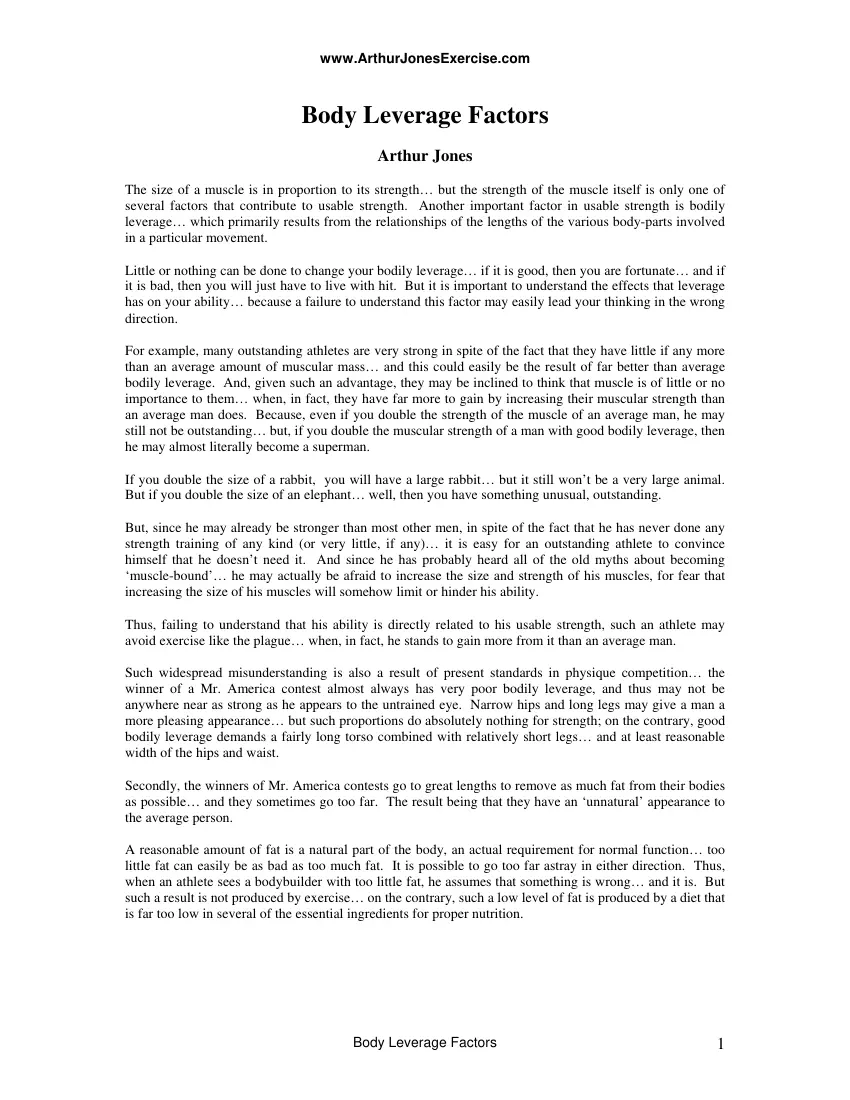
www.ArthurJonesExercisecom Body Leverage Factors Arthur Jones The size of a muscle is in proportion to its strength but the strength of the muscle itself is only one of several factors that contribute to usable strength. Another important factor in usable strength is bodily leverage which primarily results from the relationships of the lengths of the various body-parts involved in a particular movement. Little or nothing can be done to change your bodily leverage if it is good, then you are fortunate and if it is bad, then you will just have to live with hit. But it is important to understand the effects that leverage has on your ability because a failure to understand this factor may easily lead your thinking in the wrong direction. For example, many outstanding athletes are very strong in spite of the fact that they have little if any more than an average amount of muscular mass and this could easily be the result of far better than average bodily leverage. And, given such an
advantage, they may be inclined to think that muscle is of little or no importance to them when, in fact, they have far more to gain by increasing their muscular strength than an average man does. Because, even if you double the strength of the muscle of an average man, he may still not be outstanding but, if you double the muscular strength of a man with good bodily leverage, then he may almost literally become a superman. If you double the size of a rabbit, you will have a large rabbit but it still won’t be a very large animal. But if you double the size of an elephant well, then you have something unusual, outstanding. But, since he may already be stronger than most other men, in spite of the fact that he has never done any strength training of any kind (or very little, if any) it is easy for an outstanding athlete to convince himself that he doesn’t need it. And since he has probably heard all of the old myths about becoming ‘muscle-bound’ he may actually be afraid to
increase the size and strength of his muscles, for fear that increasing the size of his muscles will somehow limit or hinder his ability. Thus, failing to understand that his ability is directly related to his usable strength, such an athlete may avoid exercise like the plague when, in fact, he stands to gain more from it than an average man. Such widespread misunderstanding is also a result of present standards in physique competition the winner of a Mr. America contest almost always has very poor bodily leverage, and thus may not be anywhere near as strong as he appears to the untrained eye. Narrow hips and long legs may give a man a more pleasing appearance but such proportions do absolutely nothing for strength; on the contrary, good bodily leverage demands a fairly long torso combined with relatively short legs and at least reasonable width of the hips and waist. Secondly, the winners of Mr. America contests go to great lengths to remove as much fat from their bodies as possible
and they sometimes go too far. The result being that they have an ‘unnatural’ appearance to the average person. A reasonable amount of fat is a natural part of the body, an actual requirement for normal function too little fat can easily be as bad as too much fat. It is possible to go too far astray in either direction Thus, when an athlete sees a bodybuilder with too little fat, he assumes that something is wrong and it is. But such a result is not produced by exercise on the contrary, such a low level of fat is produced by a diet that is far too low in several of the essential ingredients for proper nutrition. Body Leverage Factors 1 www.ArthurJonesExercisecom And, thirdly, bodybuilders attempt to develop all of the muscles of their bodies as they should; but since most people, even most outstanding athletes, do little or nothing for several of their major muscular structures, they are not accustomed to looking at men who have an overall muscular development so again, it
somehow looks ‘wrong’ to them, and adds t their fear of exercise. Finally, most bodybuilders are photographed only in positions of tense muscular contraction and even attempt to keep several of their larger muscles contracted when appearing in public; with the result that they appear stiff, or distorted, or both. When, in fact, a relaxed bodybuilder (if you can find one, and they are rare) looks much like anybody else, only larger. Most competitive weightlifters do not look like bodybuilders although they may be much stronger than an average bodybuilder of the same weight; but weightlifters don’t get the publicity that bodybuilders do, and the few weightlifters that do get much publicity are the super heavyweights who usually look a great deal like a blimp with legs, because they are carrying at least a hundred pounds of surplus fat in addition to a large mass of muscular tissue. In the lighter classes, weightlifters purposely avoid developing some of their muscles devoting their
efforts to the development of their muscles that contribute directly to a very few lifts. They neglect the other muscles because developing them would increase their weight, thus forcing them to compete against heavier men while doing nothing to contribute to their specialized lifts. So an active athlete would probably be more inclined to relate to a weightlifter than he would to a bodybuilder because, to his eyes, the weightlifter looks more ‘normal’ and because, in his mind, the weightlifter has at least built ‘usable’ strength. But, in fact, the active athlete should devote attention to every muscular structure in his body even to those muscles that do not contribute directly to his particular sport; because, if any muscular structure in the body is relatively weak, then the danger of injury is increased and this is of particular importance in contact sports such as football and basketball. A gymnast obviously should not build the size and strength of his legs to a maximum
possible degree because doing so would increase his bodyweight and would thus impose a greater strain upon the muscles of his torso and arms that are directly involved in gymnastics and because the strength of the legs add little or nothing to most gymnastic movements. And, taking an opposite example, a sprinter obviously should not attempt to build the muscles of his torso and arms to their greatest possible degree of strength and strength because doing so would contribute nothing to his sports specialty and because the added bodyweight would actually be a burden to his sprinting activities. But both types of athletes, gymnasts and sprinters, should do at least some exercise for all of their major muscular structures attempting to develop a maximum level of strength in the muscles that directly contribute to their particular sport while building as much strength as possible into the other muscular structures WITHOUT INCREASING THEIR WEIGHT. Which, in practice, means that the
non-essential muscles should be exposed to high-repetition, stretching type exercises that will not build great muscular mass or strength but that will increase flexibility and muscle-tone and help to prevent injury. While the other muscles that do contribute to their sport should be exercised much harder not exercised MORE, probably exercised LESS, but exercised HARDER, using fewer repetitions and far more resistance. And it is extremely important that the antagonist muscles of the prime movers be exercised just as hard as the prime movers themselves which, in practice, means that the muscles on both sides of a joint should be worked equally hard. Because, if not, then you are literally INCREASING the chances of injury, rather than reducing it. 2 Body Leverage Factors www.ArthurJonesExercisecom If the triceps muscles of the arms, which straighten the arms, are worked hard during bench-pressing and/or dipping exercises while little or nothing is done for the biceps muscles, which
bend the arms then the chance of injury is increased by such a poorly outlined program of exercise. A situation may be encountered where the triceps contract with such force that the antagonistic muscles, the biceps, are literally torn loose from their attachments. In sports, this probably occurs most frequently when hamstring muscles are torn and this is frequently a result of exercise programs that devote too little attention to the muscles of the back of the thighs while heavily working the front of the thighs. By all means, you should work the muscles of the frontal thighs but equal attention must be given to the back of the thighs and, for real strength in running or jumping, the most important but usually most neglected muscles are the large muscular structures of the hips and lower back. If you are a good athlete without ever having practiced strength-training, then you will be an even better athlete as a result of an intelligently applied program of proper exercise and your
chances of injury will be greatly reduced. Some injuries that might otherwise have occurred may be avoided entirely if you are stronger and more flexible and some injuries that are not avoided may be reduced in severity. As mentioned previously, usable strength is a result of several factors and the strength of the muscles is only one of those factors; but it is important to remember that your muscular strength is one of the few factors that you can change to any great degree and in the case of many outstanding athletes, STRENGTH IS THE ONLY FACTOR THAT CAN BE IMPROVED. If a particular individual is outstanding in his sport, this is usually due in part to the fact that his neurological ability is superior, and also due to the fact that his cardiovascular condition is good, and almost certainly due to the fact that his bodily leverage is better than average, and always due to the fact that his skill in that particular sport is superior and if such an individual has become outstanding
without strength-training, simply as a result of the practice of his chosen sport, then his muscular strength is the only factor that can be improved to a meaningful degree. So I repeat strength-training is far more important to an outstanding athlete than it is to an average athlete. But it should also be understood that your interest should be directed to the development of ‘raw strength’ and ‘overall strength’ and little or no attention should be paid to attempts to increase the athlete’s strength in any particular exercise. A good performance in many lifts is a combination of several factors in a bench-press, for example, skill is almost if perhaps not quite as important as muscular strength; but such skill is of absolutely no value to a football player while the strength is of great importance. Another example is a lift like the clean and jerk. A good performance in the clean and jerk is far more dependent upon skill in that particular lift than it is upon strength a
very strong but unskilled man will make a poor showing at this lift, and a much smaller, far weaker but skilled man can easily outperform him. Thus giving the false impression that the weaker man is actually stronger. AND such skill leads to great confusion; causing many people to consider muscles to be of little or no value. BUT WORSE the practice of lifts such as the clean and jerk will do very little for the development of actual strength, while greatly increasing the danger of a training injury. The skills developed by practicing the clean and jerk, or any fast lift, are of no value to anybody except a competitive weightlifter and the practice of such lifts is dangerous to anybody. Far better results can be produced by the practice of slow lifts, with little or no danger of injury. Body Leverage Factors 3 www.ArthurJonesExercisecom Strength-training should increase the strength and flexibility of an athlete, and it should do so without exposing him to additional dangers
should, in fact, reduce the chances of injury. And it will if the training is properly conducted. So the exercises that are to be used should be chosen with great care, and all of the fast lifts should be avoided like the plague the fast lifts have nothing to offer the average athlete except the danger of injury. Yet we hear meaningless terms like ‘sudden strength’ or ‘explosive strength’ whatever such terms mean, and I have personally never been able to find out what they mean, if anything. And we are told by self-proclaimed ‘experts’ that the fast lifts are a requirement for athletes such as football players. While, in fact, the ability to perform the sudden movements that are required in some sports must be developed by the practice of that sport and the practice of other sudden movements will do little or nothing to help. If you increase the size of the major muscles in a sprinter’s legs he will be heavier but he will also be stronger; and faster, because his power to
weight ratio will be better each pound of muscle will be forced to move less bodyweight. Thus he will not be faster ‘in spite of his increased bodyweight’ but, rather, he will be faster BECAUSE OF HIS GREATER WEIGHT. Far too much attention is given to an exact bodyweight when all that really matters in performance. If a man can perform better at a heavier bodyweight, then he should be heavier and if he performs best at a lighter weight, then he should be lighter. Judge your athletes on their ability to perform at their chosen sport and do whatever is necessary to improve their performance, and let the bodyweight be what it may. Build as much strength as possible into the muscles that contribute directly to the particular sport remove as much non-essential fat as you can without hurting an athlete’s strength and develop at least a reasonable level of strength and flexibility into the non-essential muscles. and let the resulting bodyweight be your criteria for judging what the
athlete’s weight should be. BUT do not make the mistake of attempting to compare one man’s performance to the performance of another man; not, at least, during strength-training programs. Treat each man as an individual, and compare him only to himself when he is stronger than he was, then he is stronger, even though he may still not be as strong as another individual. If a man has very short forearms, then he may be able to demonstrate great strength in the curl but he should be able to, since he has an advantage in bodily leverage. If his forearms are short, he may lift the weight less than two feet during a curl while a man with very long forearms may lift the weight nearly three feet. And if a man has fairly short legs and a relatively long torso, then he should be able to squat with far more weight than another man of equal height who has long legs and a short torso and, obviously, a man with short arms does not have to move the weight a very great distance during a
bench-press. The ‘distance of movement’ is just as important for judging strength as the actual amount of weight that is lifted and even when the distance of movement is the same in both cases, one man may still be able to lift far more weight if he has an advantage of bodily leverage. So setting a ‘standard of performance’ for all of your athletes is worse than meaningless some men will find it easy to reach a particular level of performance in a certain lift, and other men will find it impossible. Instead, train all of your men as individuals increase each man’s strength as much as possible; but don’t worry about it if it happens that some of your men can demonstrate far more strength than others that will always be the case if your entire team is training properly. 4 Body Leverage Factors www.ArthurJonesExercisecom AND if all of your men can perform equally, then that is simply proof that your training program is wrong; because, some of your men should be able to
lift far more weight than others and if they can’t, then you should be aware that your stronger men have not been pushed hard enough to reach their potential levels of strength. The bodily proportions that are best for one particular sport may be the worst possible proportions for another sport but regardless of proportions, increasing the strength of an athlete will always increase his performances. And remember you cannot change bodily proportions, but you can increase strength And increases in strength are produced best by using the same type of training regardless of bodily proportions, regardless of good or bad leverage factors, and regardless of the sport for which an athlete is training. The same basic principles apply in all cases heavy resistance should be employed in exercises of approximately ten repetitions and full-range movements should be performed with a steady, smooth, and fairly slow speed-of-movement. Jerking should be avoided, and careful attention should be given
to both the positive and the negative parts of the movement. Final results will not be the same in all cases, literally can NOT be the same but proper strength-training can and will improve any athlete, in any sport. Body Leverage Factors 5
advantage, they may be inclined to think that muscle is of little or no importance to them when, in fact, they have far more to gain by increasing their muscular strength than an average man does. Because, even if you double the strength of the muscle of an average man, he may still not be outstanding but, if you double the muscular strength of a man with good bodily leverage, then he may almost literally become a superman. If you double the size of a rabbit, you will have a large rabbit but it still won’t be a very large animal. But if you double the size of an elephant well, then you have something unusual, outstanding. But, since he may already be stronger than most other men, in spite of the fact that he has never done any strength training of any kind (or very little, if any) it is easy for an outstanding athlete to convince himself that he doesn’t need it. And since he has probably heard all of the old myths about becoming ‘muscle-bound’ he may actually be afraid to
increase the size and strength of his muscles, for fear that increasing the size of his muscles will somehow limit or hinder his ability. Thus, failing to understand that his ability is directly related to his usable strength, such an athlete may avoid exercise like the plague when, in fact, he stands to gain more from it than an average man. Such widespread misunderstanding is also a result of present standards in physique competition the winner of a Mr. America contest almost always has very poor bodily leverage, and thus may not be anywhere near as strong as he appears to the untrained eye. Narrow hips and long legs may give a man a more pleasing appearance but such proportions do absolutely nothing for strength; on the contrary, good bodily leverage demands a fairly long torso combined with relatively short legs and at least reasonable width of the hips and waist. Secondly, the winners of Mr. America contests go to great lengths to remove as much fat from their bodies as possible
and they sometimes go too far. The result being that they have an ‘unnatural’ appearance to the average person. A reasonable amount of fat is a natural part of the body, an actual requirement for normal function too little fat can easily be as bad as too much fat. It is possible to go too far astray in either direction Thus, when an athlete sees a bodybuilder with too little fat, he assumes that something is wrong and it is. But such a result is not produced by exercise on the contrary, such a low level of fat is produced by a diet that is far too low in several of the essential ingredients for proper nutrition. Body Leverage Factors 1 www.ArthurJonesExercisecom And, thirdly, bodybuilders attempt to develop all of the muscles of their bodies as they should; but since most people, even most outstanding athletes, do little or nothing for several of their major muscular structures, they are not accustomed to looking at men who have an overall muscular development so again, it
somehow looks ‘wrong’ to them, and adds t their fear of exercise. Finally, most bodybuilders are photographed only in positions of tense muscular contraction and even attempt to keep several of their larger muscles contracted when appearing in public; with the result that they appear stiff, or distorted, or both. When, in fact, a relaxed bodybuilder (if you can find one, and they are rare) looks much like anybody else, only larger. Most competitive weightlifters do not look like bodybuilders although they may be much stronger than an average bodybuilder of the same weight; but weightlifters don’t get the publicity that bodybuilders do, and the few weightlifters that do get much publicity are the super heavyweights who usually look a great deal like a blimp with legs, because they are carrying at least a hundred pounds of surplus fat in addition to a large mass of muscular tissue. In the lighter classes, weightlifters purposely avoid developing some of their muscles devoting their
efforts to the development of their muscles that contribute directly to a very few lifts. They neglect the other muscles because developing them would increase their weight, thus forcing them to compete against heavier men while doing nothing to contribute to their specialized lifts. So an active athlete would probably be more inclined to relate to a weightlifter than he would to a bodybuilder because, to his eyes, the weightlifter looks more ‘normal’ and because, in his mind, the weightlifter has at least built ‘usable’ strength. But, in fact, the active athlete should devote attention to every muscular structure in his body even to those muscles that do not contribute directly to his particular sport; because, if any muscular structure in the body is relatively weak, then the danger of injury is increased and this is of particular importance in contact sports such as football and basketball. A gymnast obviously should not build the size and strength of his legs to a maximum
possible degree because doing so would increase his bodyweight and would thus impose a greater strain upon the muscles of his torso and arms that are directly involved in gymnastics and because the strength of the legs add little or nothing to most gymnastic movements. And, taking an opposite example, a sprinter obviously should not attempt to build the muscles of his torso and arms to their greatest possible degree of strength and strength because doing so would contribute nothing to his sports specialty and because the added bodyweight would actually be a burden to his sprinting activities. But both types of athletes, gymnasts and sprinters, should do at least some exercise for all of their major muscular structures attempting to develop a maximum level of strength in the muscles that directly contribute to their particular sport while building as much strength as possible into the other muscular structures WITHOUT INCREASING THEIR WEIGHT. Which, in practice, means that the
non-essential muscles should be exposed to high-repetition, stretching type exercises that will not build great muscular mass or strength but that will increase flexibility and muscle-tone and help to prevent injury. While the other muscles that do contribute to their sport should be exercised much harder not exercised MORE, probably exercised LESS, but exercised HARDER, using fewer repetitions and far more resistance. And it is extremely important that the antagonist muscles of the prime movers be exercised just as hard as the prime movers themselves which, in practice, means that the muscles on both sides of a joint should be worked equally hard. Because, if not, then you are literally INCREASING the chances of injury, rather than reducing it. 2 Body Leverage Factors www.ArthurJonesExercisecom If the triceps muscles of the arms, which straighten the arms, are worked hard during bench-pressing and/or dipping exercises while little or nothing is done for the biceps muscles, which
bend the arms then the chance of injury is increased by such a poorly outlined program of exercise. A situation may be encountered where the triceps contract with such force that the antagonistic muscles, the biceps, are literally torn loose from their attachments. In sports, this probably occurs most frequently when hamstring muscles are torn and this is frequently a result of exercise programs that devote too little attention to the muscles of the back of the thighs while heavily working the front of the thighs. By all means, you should work the muscles of the frontal thighs but equal attention must be given to the back of the thighs and, for real strength in running or jumping, the most important but usually most neglected muscles are the large muscular structures of the hips and lower back. If you are a good athlete without ever having practiced strength-training, then you will be an even better athlete as a result of an intelligently applied program of proper exercise and your
chances of injury will be greatly reduced. Some injuries that might otherwise have occurred may be avoided entirely if you are stronger and more flexible and some injuries that are not avoided may be reduced in severity. As mentioned previously, usable strength is a result of several factors and the strength of the muscles is only one of those factors; but it is important to remember that your muscular strength is one of the few factors that you can change to any great degree and in the case of many outstanding athletes, STRENGTH IS THE ONLY FACTOR THAT CAN BE IMPROVED. If a particular individual is outstanding in his sport, this is usually due in part to the fact that his neurological ability is superior, and also due to the fact that his cardiovascular condition is good, and almost certainly due to the fact that his bodily leverage is better than average, and always due to the fact that his skill in that particular sport is superior and if such an individual has become outstanding
without strength-training, simply as a result of the practice of his chosen sport, then his muscular strength is the only factor that can be improved to a meaningful degree. So I repeat strength-training is far more important to an outstanding athlete than it is to an average athlete. But it should also be understood that your interest should be directed to the development of ‘raw strength’ and ‘overall strength’ and little or no attention should be paid to attempts to increase the athlete’s strength in any particular exercise. A good performance in many lifts is a combination of several factors in a bench-press, for example, skill is almost if perhaps not quite as important as muscular strength; but such skill is of absolutely no value to a football player while the strength is of great importance. Another example is a lift like the clean and jerk. A good performance in the clean and jerk is far more dependent upon skill in that particular lift than it is upon strength a
very strong but unskilled man will make a poor showing at this lift, and a much smaller, far weaker but skilled man can easily outperform him. Thus giving the false impression that the weaker man is actually stronger. AND such skill leads to great confusion; causing many people to consider muscles to be of little or no value. BUT WORSE the practice of lifts such as the clean and jerk will do very little for the development of actual strength, while greatly increasing the danger of a training injury. The skills developed by practicing the clean and jerk, or any fast lift, are of no value to anybody except a competitive weightlifter and the practice of such lifts is dangerous to anybody. Far better results can be produced by the practice of slow lifts, with little or no danger of injury. Body Leverage Factors 3 www.ArthurJonesExercisecom Strength-training should increase the strength and flexibility of an athlete, and it should do so without exposing him to additional dangers
should, in fact, reduce the chances of injury. And it will if the training is properly conducted. So the exercises that are to be used should be chosen with great care, and all of the fast lifts should be avoided like the plague the fast lifts have nothing to offer the average athlete except the danger of injury. Yet we hear meaningless terms like ‘sudden strength’ or ‘explosive strength’ whatever such terms mean, and I have personally never been able to find out what they mean, if anything. And we are told by self-proclaimed ‘experts’ that the fast lifts are a requirement for athletes such as football players. While, in fact, the ability to perform the sudden movements that are required in some sports must be developed by the practice of that sport and the practice of other sudden movements will do little or nothing to help. If you increase the size of the major muscles in a sprinter’s legs he will be heavier but he will also be stronger; and faster, because his power to
weight ratio will be better each pound of muscle will be forced to move less bodyweight. Thus he will not be faster ‘in spite of his increased bodyweight’ but, rather, he will be faster BECAUSE OF HIS GREATER WEIGHT. Far too much attention is given to an exact bodyweight when all that really matters in performance. If a man can perform better at a heavier bodyweight, then he should be heavier and if he performs best at a lighter weight, then he should be lighter. Judge your athletes on their ability to perform at their chosen sport and do whatever is necessary to improve their performance, and let the bodyweight be what it may. Build as much strength as possible into the muscles that contribute directly to the particular sport remove as much non-essential fat as you can without hurting an athlete’s strength and develop at least a reasonable level of strength and flexibility into the non-essential muscles. and let the resulting bodyweight be your criteria for judging what the
athlete’s weight should be. BUT do not make the mistake of attempting to compare one man’s performance to the performance of another man; not, at least, during strength-training programs. Treat each man as an individual, and compare him only to himself when he is stronger than he was, then he is stronger, even though he may still not be as strong as another individual. If a man has very short forearms, then he may be able to demonstrate great strength in the curl but he should be able to, since he has an advantage in bodily leverage. If his forearms are short, he may lift the weight less than two feet during a curl while a man with very long forearms may lift the weight nearly three feet. And if a man has fairly short legs and a relatively long torso, then he should be able to squat with far more weight than another man of equal height who has long legs and a short torso and, obviously, a man with short arms does not have to move the weight a very great distance during a
bench-press. The ‘distance of movement’ is just as important for judging strength as the actual amount of weight that is lifted and even when the distance of movement is the same in both cases, one man may still be able to lift far more weight if he has an advantage of bodily leverage. So setting a ‘standard of performance’ for all of your athletes is worse than meaningless some men will find it easy to reach a particular level of performance in a certain lift, and other men will find it impossible. Instead, train all of your men as individuals increase each man’s strength as much as possible; but don’t worry about it if it happens that some of your men can demonstrate far more strength than others that will always be the case if your entire team is training properly. 4 Body Leverage Factors www.ArthurJonesExercisecom AND if all of your men can perform equally, then that is simply proof that your training program is wrong; because, some of your men should be able to
lift far more weight than others and if they can’t, then you should be aware that your stronger men have not been pushed hard enough to reach their potential levels of strength. The bodily proportions that are best for one particular sport may be the worst possible proportions for another sport but regardless of proportions, increasing the strength of an athlete will always increase his performances. And remember you cannot change bodily proportions, but you can increase strength And increases in strength are produced best by using the same type of training regardless of bodily proportions, regardless of good or bad leverage factors, and regardless of the sport for which an athlete is training. The same basic principles apply in all cases heavy resistance should be employed in exercises of approximately ten repetitions and full-range movements should be performed with a steady, smooth, and fairly slow speed-of-movement. Jerking should be avoided, and careful attention should be given
to both the positive and the negative parts of the movement. Final results will not be the same in all cases, literally can NOT be the same but proper strength-training can and will improve any athlete, in any sport. Body Leverage Factors 5