Comments
 2026 · 9 page(s) (345 KB)
 English
 0
 November 25 · 2026
 Log in

 Embed
No comments yet. You can be the first!
What did others read after this?



Content extract
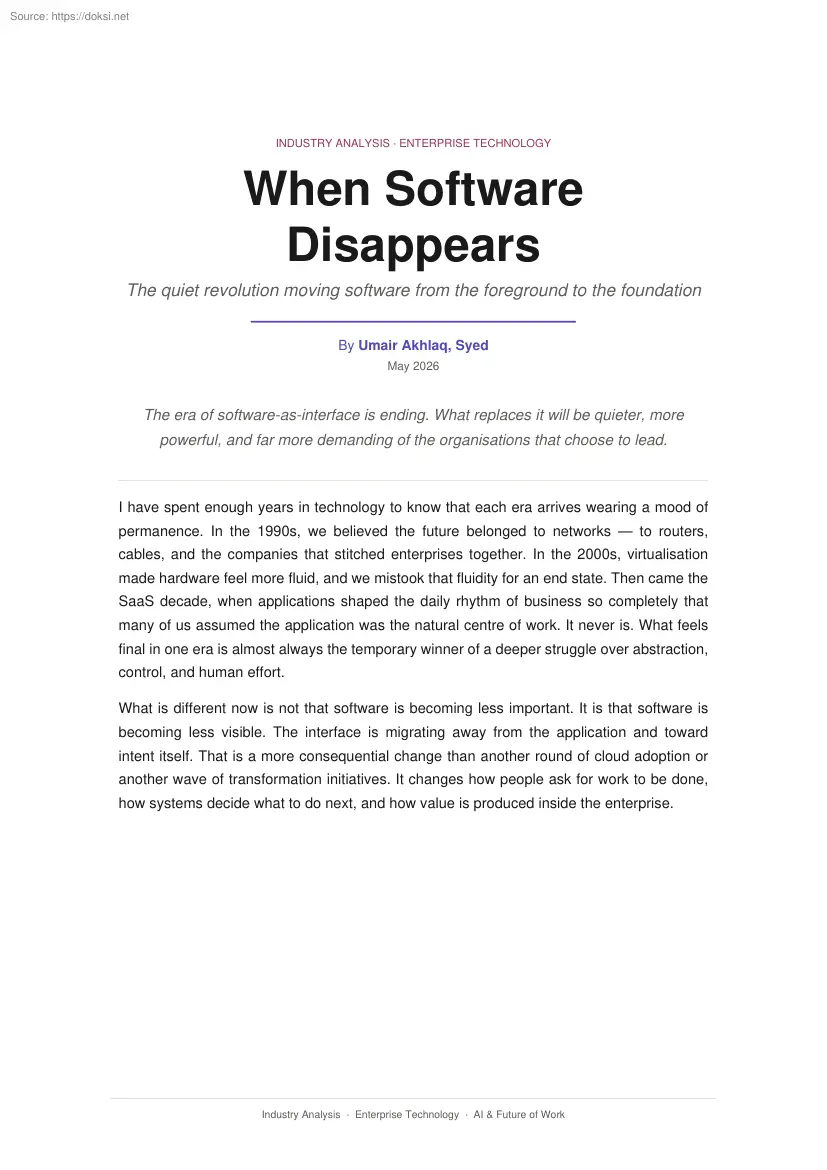
INDUSTRY ANALYSIS · ENTERPRISE TECHNOLOGY When Software Disappears The quiet revolution moving software from the foreground to the foundation By Umair Akhlaq, Syed May 2026 The era of software-as-interface is ending. What replaces it will be quieter, more powerful, and far more demanding of the organisations that choose to lead. I have spent enough years in technology to know that each era arrives wearing a mood of permanence. In the 1990s, we believed the future belonged to networks to routers, cables, and the companies that stitched enterprises together. In the 2000s, virtualisation made hardware feel more fluid, and we mistook that fluidity for an end state. Then came the SaaS decade, when applications shaped the daily rhythm of business so completely that many of us assumed the application was the natural centre of work. It never is What feels final in one era is almost always the temporary winner of a deeper struggle over abstraction, control, and human effort. What is
different now is not that software is becoming less important. It is that software is becoming less visible. The interface is migrating away from the application and toward intent itself. That is a more consequential change than another round of cloud adoption or another wave of transformation initiatives. It changes how people ask for work to be done, how systems decide what to do next, and how value is produced inside the enterprise. Industry Analysis · Enterprise Technology · AI & Future of Work When Software Disappears · Umair Akhlaq, Syed Page 2 Relative enterprise adoption intensity across the four major technology eras. Each era felt permanent at its peak THE FOUR ERAS AT A GLANCE Era Period Control point Interface Infrastructure 1990–2003 Hardware & network Physical console Virtualisation 2000–2010 Hypervisor / OS Management console SaaS Platform 2010–2022 Application layer Screen / UI AI Orchestration 2023 – AI intent layer
Natural language Each era redrew the enterprise control point from hardware to hypervisor to application layer to, now, the AI orchestration layer. THE INFRASTRUCTURE YEARS Building the connective tissue of modern enterprise The first great phase I watched closely was the infrastructure and networking age of the 1990s and early 2000s. The enterprise was, above all, a physical problem Businesses were constructing the connective tissue of modern computing local networks, wide-area links, secure access, servers, storage, and the devices that made all of it usable. Cisco, IBM, HP, and their peers were not merely suppliers; they were architects of a new operating environment. As the internet moved from technical curiosity to commercial necessity, investment followed the need to connect people, systems, and geographies at scale. In those years, the network was the product of strategy. Every new application assumed more bandwidth, more reliability, and more centralised control. Analysts
at Gartner and IDC were tracking the build-out of enterprise IT as organisations bought the infrastructure required to participate in the internet economy. This was an era of visibility You could see Industry Analysis · Enterprise Technology · AI & Future of Work When Software Disappears · Umair Akhlaq, Syed Page 3 the stack, touch the servers, count the ports, and measure the cost of every expansion. That visibility shaped the psychology of the age. Technology leaders talked in terms of capacity, uptime, throughput, and resilience because those were the terms that mattered. The business depended on the network, but the network itself still felt like the story. VIRTUALISATION & ABSTRACTION When software learned to abstract hardware The next era began when software learned to abstract hardware. Virtualisation was not simply a technical improvement; it was a change in the logic of enterprise computing. VMware helped normalise running multiple workloads on the same
physical machine, and in doing so, it changed how organisations thought about utilisation, recovery, and deployment. The old relationship between one server and one workload weakened Compute became pooled. Infrastructure became more flexible Hardware did not disappear, but it ceased to define the operating model. That shift matters because abstraction changes power. Once the underlying machine can be decoupled from the workload, the control point moves upward. Operating systems, hypervisors, and management layers begin to matter more than the bare metal underneath them. Enterprises started to understand that the real value lay not in the machine itself, but in the ability to use machines dynamically. This was the first clear signal that technology was becoming less about ownership and more about orchestration. The more software could abstract, the less the enterprise needed to think in terms of fixed assets. That lesson would become central in the decade that followed. SOFTWARE IN THE
DRIVING SEAT The SaaS decade and the application-centric enterprise From roughly 2010 to 2022, software moved from abstraction layer to operating environment. SaaS changed not just how companies bought technology, but how they organised work. Salesforce helped normalise the idea that core enterprise capability could live continuously in the cloud rather than inside a locally installed system. ServiceNow turned workflow into a platform. ERP, IT service management, compliance, governance, and customer operations increasingly became software-defined spaces. The subscription model reinforced this shift by making usage continuous, iterative, and deeply embedded in business process. This was the era in which companies became dependent on software ecosystems in a way that was both powerful and quietly constraining. Cloud adoption accelerated Applications Industry Analysis · Enterprise Technology · AI & Future of Work When Software Disappears · Umair Akhlaq, Syed Page 4 became
the place where work happened, not just the place where records were stored. The software did not merely support the business; it shaped the business. It determined what was easy, what was hard, what was auditable, and what was possible without costly customisation. That brought enormous gains. Processes became more consistent Rollouts became faster Data became more accessible. But it also created a subtle dependency Once a company has reorganised itself around dozens or hundreds of tightly integrated applications, the application layer starts to define the organisation's behaviour. People adapt to the software as much as the software adapts to people. “The application became the primary translator of human intent into organisational action. That was the hidden logic of the SaaS era” THE INFLECTION POINT AI changes the interface and the operating model Generative AI has begun to dismantle that pattern. The shift is not simply that software has become smarter. It is that
the human no longer needs to speak in the syntax of each application. Instead of opening a system, navigating screens, and translating a goal into a sequence of clicks, people can now express intent in natural language and let AI determine how to assemble the result. Microsoft's framing of Copilot as a new kind of interface captured that change precisely. So did the broader response from OpenAI, Google DeepMind, and others that have treated language models not as standalone products but as orchestration layers. McKinsey's research on generative AI has reinforced the point that the deepest value lies not in content generation alone, but in the automation of coordination work that previously required repeated human effort. But this is where rhetoric regularly outruns reality. The current generation of AI systems is useful, impressive, and still fragile. Agentic workflows can hallucinate steps, misread context, or take actions that are plausible but wrong. In mission-critical
environments healthcare, utilities, financial services, regulated operations that fragility is not a footnote. It is the central issue. An AI layer that can suggest actions is not the same as an AI layer that can safely execute them. The closer a system gets to real operational authority, the more the costs of error multiply. The biggest mistake any organisation can make is treating AI as a replacement for governance. It is the opposite AI increases the premium on governance because it Industry Analysis · Enterprise Technology · AI & Future of Work When Software Disappears · Umair Akhlaq, Syed introduces speed without necessarily Page 5 introducing certainty. It can compress decision-making, but it also expands the surface area of risk. THE NEW OPERATING MODEL How the fundamental model has shifted The old model was simple: user, then application, then output. The user learned the application's structure, the application constrained the possible actions,
and the output emerged from fixed workflows. That made sense when software was expensive to build, difficult to change, and designed for a relatively stable set of processes. The new model is different: human intent, then AI, then orchestrated software, then output. In this model, AI becomes the interaction layer. Software becomes the execution layer The application still matters, but less as the place where work is done directly and more as the place where work is carried out reliably in the background. That is a profound transition, but it should not be romanticised. AI does not remove complexity; it moves complexity to a different place. Instead of making people learn every application, enterprises must now design systems that can be safely interpreted, composed, and governed by machine intelligence. That means identity, authorisation, policy, observability, data quality, and exception handling become even more important than they were before. Far from reducing architectural debt,
AI raises the cost of bad architecture. A brittle system becomes more dangerous when an intelligent layer sits on top of it. This is why the most important technology leaders in the next decade will be architects, not just product builders. The winners will be companies that understand how to make software legible to AI without making it less secure or less accountable. Industry Analysis · Enterprise Technology · AI & Future of Work When Software Disappears · Umair Akhlaq, Syed Page 6 The fundamental model shift: from User Application Output to Human Intent AI Orchestrated Software Output. OLD MODEL VS NEW MODEL Dimension Old model (SaaS era) New model (AI era) Entry point Open application Express intent Interface Screen & UI AI orchestration layer Software role Primary interface Execution infrastructure Value driver Workflow ownership Orchestration quality Risk surface User error, UI complexity AI hallucination, governance gaps Software does
not disappear it recedes into trusted execution infrastructure, with AI occupying the interaction layer between human intent and system action. STRATEGIC IMPLICATIONS What changes for vendors, builders, and the enterprise For SaaS vendors, the next era will be less forgiving than the last. Applications that simply expose rigid screens or store records will be easier to bypass than platforms that can participate in orchestration, expose clean APIs, and maintain trusted execution. The value will migrate upward from workflow ownership toward orchestration value. That does not mean the application disappears. It means the application must now earn its place behind Industry Analysis · Enterprise Technology · AI & Future of Work When Software Disappears · Umair Akhlaq, Syed Page 7 the interface. The strongest vendors will be those that combine domain depth with machine readability trusted data, clear permissions, and predictable behaviour. The weakest will be those that
mistake AI branding for product evolution. Enterprise customers are not looking for novelty They are looking for systems they can trust to act on their behalf without losing control. There is also a harder truth here. Some software businesses built their economics around making the user do the work of navigation. As AI absorbs more of that burden, those businesses will face pressure to justify themselves in new ways. If the application is merely a place to click, it becomes vulnerable. If it is a repository of institutional logic and reliable execution, it remains essential. For developers and architects, the centre of gravity is moving from screen design to service design. The systems that matter most will be modular, observable, and composable Clean APIs, explicit contracts, and deterministic behaviour will matter more, not less, because AI depends on them. A language model can only orchestrate what it can understand More effort will go into defining machine-readable business logic,
handling exceptions, and designing for trust. System integrators have a significant opening here, but only if they move beyond classic implementation work. The opportunity is no longer just connecting systems after the fact It is designing the operating model that lets intent travel across systems with enough control to be useful and enough flexibility to be worth the effort. Enterprise IT organisations will not become less important. They will become more central, but the nature of their work will change fundamentally. Standardising applications was once the main task. Now the task is standardising the conditions under which AI can use those applications safely access controls, data governance, logging, policy enforcement, and exception management. This is where many current AI projects will struggle. Pilot programmes are easy Production at scale is hard. The distance between a useful demo and a governed enterprise capability is enormous. That gap is not just technical It is
organisational It requires new operating assumptions about accountability, escalation, and risk tolerance. Industry Analysis · Enterprise Technology · AI & Future of Work When Software Disappears · Umair Akhlaq, Syed Page 8 What will rise, evolve, and decline across the four major stakeholder groups in the AI orchestration era. THE NEXT THREE TO FIVE YEARS A grounded forward look Over the next three to five years, the most realistic outcome is not a wholesale replacement of software interfaces, but a gradual redistribution of how work gets initiated and executed. Employees will increasingly begin with a question, a request, or a goal rather than a specific application. AI will route more work across systems, and many routine tasks will become less visible to the user not because they vanish, but because the interface has moved. That does not mean every process becomes conversational. Forms and screens will remain important in complex or regulated work, but they will
lose their monopoly on the interface. The best systems will feel less like software people operate and more like software that understands what they need. The other major change will be architectural. Enterprises will invest more heavily in the infrastructure that makes intent-driven systems safe: policy engines, identity controls, data lineage, monitoring, and audit trails. The companies that ignore this will discover that AI is not a shortcut around complexity. It is a multiplier of whatever complexity already exists The real divide in the next phase will not be between AI adopters and non-adopters. It will be between organisations that treat AI as a layer of conversation and organisations that redesign their software estates to support intelligent orchestration. That distinction will determine which enterprises thrive and which discover, too late, that they built a fast car on a crumbling road. Industry Analysis · Enterprise Technology · AI & Future of Work When Software
Disappears · Umair Akhlaq, Syed Page 9 Projected trajectory 2022–2028: AI orchestration adoption crosses screen-centric interface primacy near 2027. CLOSING REFLECTION I have learned, across several decades, that technology rarely removes the need for structure. More often, it raises the value of structure by changing where the complexity lives. That is precisely what is happening now Software is not dying It is receding into the background which is, if we are honest, where the best infrastructure has always belonged. The application era made people work like software users. The next era will ask software to work more like a disciplined extension of human intent. That is a quieter revolution than many of the loud claims around AI suggest, but it is also a more durable one. The great systems of the future will not be the ones people stare at. They will be the ones that disappear just enough to let judgment, purpose, and action come forward without losing an ounce of
accountability in the process. Umair Akhlaq, Syed is a technology strategist and transformation leader with over 25 years of experience across infrastructure, enterprise software, cloud platforms, and AI-driven systems. May 2026 · Industry Analysis Industry Analysis · Enterprise Technology · AI & Future of Work