A doksi online olvasásához kérlek jelentkezz be!
A doksi online olvasásához kérlek jelentkezz be!
 2013 · 3 oldal (39 KB)
 magyar
 50
50
 2013. március 05.
 Bejelentkezés szükséges

 Beágyazás
Nincs még értékelés. Legyél Te az első!



Tartalmi kivonat
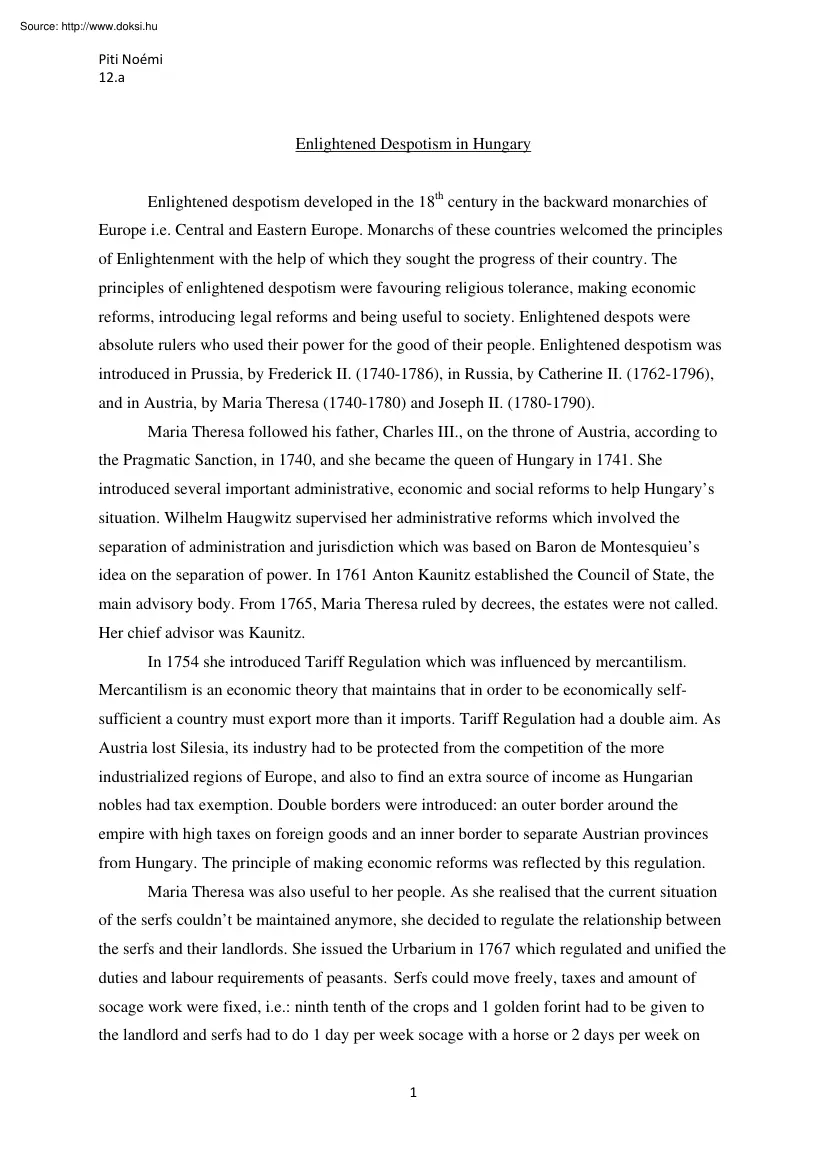
Piti Noémi 12.a Enlightened Despotism in Hungary Enlightened despotism developed in the 18th century in the backward monarchies of Europe i.e Central and Eastern Europe Monarchs of these countries welcomed the principles of Enlightenment with the help of which they sought the progress of their country. The principles of enlightened despotism were favouring religious tolerance, making economic reforms, introducing legal reforms and being useful to society. Enlightened despots were absolute rulers who used their power for the good of their people. Enlightened despotism was introduced in Prussia, by Frederick II. (1740-1786), in Russia, by Catherine II (1762-1796), and in Austria, by Maria Theresa (1740-1780) and Joseph II. (1780-1790) Maria Theresa followed his father, Charles III., on the throne of Austria, according to the Pragmatic Sanction, in 1740, and she became the queen of Hungary in 1741. She introduced several important administrative, economic and social reforms to help
Hungary’s situation. Wilhelm Haugwitz supervised her administrative reforms which involved the separation of administration and jurisdiction which was based on Baron de Montesquieu’s idea on the separation of power. In 1761 Anton Kaunitz established the Council of State, the main advisory body. From 1765, Maria Theresa ruled by decrees, the estates were not called Her chief advisor was Kaunitz. In 1754 she introduced Tariff Regulation which was influenced by mercantilism. Mercantilism is an economic theory that maintains that in order to be economically selfsufficient a country must export more than it imports. Tariff Regulation had a double aim As Austria lost Silesia, its industry had to be protected from the competition of the more industrialized regions of Europe, and also to find an extra source of income as Hungarian nobles had tax exemption. Double borders were introduced: an outer border around the empire with high taxes on foreign goods and an inner border to separate
Austrian provinces from Hungary. The principle of making economic reforms was reflected by this regulation Maria Theresa was also useful to her people. As she realised that the current situation of the serfs couldn’t be maintained anymore, she decided to regulate the relationship between the serfs and their landlords. She issued the Urbarium in 1767 which regulated and unified the duties and labour requirements of peasants. Serfs could move freely, taxes and amount of socage work were fixed, i.e: ninth tenth of the crops and 1 golden forint had to be given to the landlord and serfs had to do 1 day per week socage with a horse or 2 days per week on 1 Piti Noémi 12.a foot. They also paid a tithe to the Church, war tax to the state and local tax to finance the administration of the county. Finally, they had to do military service However, serfs regained some former rights e.g to hunt or collect wood and food in the forest of the landlord With the Ratio Educationis, issued in 1777,
she regulated education. Schools came under state control and compulsory education was introduced between the ages of 6 and 12. Village schools were built and the language of education became Hungarian. Her son, Joseph II. followed her on the throne of Hungary in 1780 However, he refused to be crowned king of Hungary, he governed by decree and he didn’t convene the Hungarian Diet. He was enlightened because he considered himself as the first servant of the state, he wanted a united, modern, strong state and he wanted to rule for the people. He was despotic as he didn’t convene the diet, he ruled by decrees and he didn’t vow on the Holy Crown of Hungary. He introduced administrative reforms as his dream was the unity of the empire which obviously meant the abolition of Hungarian autonomy. He divided Hungary into ten administrative units, officials were appointed by the monarch. He ordered a national census and land survey, which meant the preparation for the taxation of nobles.
Joseph II. decided to take radical steps against the over-powerful Roman Catholic Church. He was a devout Catholic, so his anti-Catholic policy was inspired by enlightened ideas; he was convinced that faith should not limit the rights of the citizens. In 1781 he issued the Decree on Toleration in which he granted freedom of religion, except for Jews. He imposed censorship over the publication of all printed material that was not subject to Church authority. He also dissolved all religious orders not involved in teaching or caring for the sick What’s more, he restricted the Pope’s right to interfere in his Church policy and internal politics. The resistance of Hungarian nobility was mostly provoked by the Language Decree of 1784. This decree made the German the official language of the whole empire This gave rise to a strong national movement which turned to traditional Hungarian folklore and customs. Enlightenment in Hungarian literature was also started because of this as a
resistance. In 1784 peasants uprising started in Transylvania, as a result of which in 1785 Joseph II issued his decree on serfdom, which secured the freedom of movement of serfs. Perpetual serfdom, i.e inherited serfdom, was abolished The authority of manorial courts was also curtailed. 2 Piti Noémi 12.a Neither of the monarchs was liked by the Hungarians. During Maria Theresa’s reign, the estates were hostile against every kind of changes. This can be said about Joseph II’s monarchy. Hungarians were against his philosophy, the so-called Josephinism, according to which he wanted to create a united and strong empire from the vastly different, multilingual regions. He was really unpopular as he issued about 6000 decrees in 10 years, because he wanted to reform everything. By the end of his reign, Hungarian nobility openly organised a conspiracy against him. This and several other international difficulties led him to the ‘notable stroke of a pen’ which meant that on his
deathbed he withdrew all his reforms except from the decree on toleration and the decree on serfs. 3
Hungary’s situation. Wilhelm Haugwitz supervised her administrative reforms which involved the separation of administration and jurisdiction which was based on Baron de Montesquieu’s idea on the separation of power. In 1761 Anton Kaunitz established the Council of State, the main advisory body. From 1765, Maria Theresa ruled by decrees, the estates were not called Her chief advisor was Kaunitz. In 1754 she introduced Tariff Regulation which was influenced by mercantilism. Mercantilism is an economic theory that maintains that in order to be economically selfsufficient a country must export more than it imports. Tariff Regulation had a double aim As Austria lost Silesia, its industry had to be protected from the competition of the more industrialized regions of Europe, and also to find an extra source of income as Hungarian nobles had tax exemption. Double borders were introduced: an outer border around the empire with high taxes on foreign goods and an inner border to separate
Austrian provinces from Hungary. The principle of making economic reforms was reflected by this regulation Maria Theresa was also useful to her people. As she realised that the current situation of the serfs couldn’t be maintained anymore, she decided to regulate the relationship between the serfs and their landlords. She issued the Urbarium in 1767 which regulated and unified the duties and labour requirements of peasants. Serfs could move freely, taxes and amount of socage work were fixed, i.e: ninth tenth of the crops and 1 golden forint had to be given to the landlord and serfs had to do 1 day per week socage with a horse or 2 days per week on 1 Piti Noémi 12.a foot. They also paid a tithe to the Church, war tax to the state and local tax to finance the administration of the county. Finally, they had to do military service However, serfs regained some former rights e.g to hunt or collect wood and food in the forest of the landlord With the Ratio Educationis, issued in 1777,
she regulated education. Schools came under state control and compulsory education was introduced between the ages of 6 and 12. Village schools were built and the language of education became Hungarian. Her son, Joseph II. followed her on the throne of Hungary in 1780 However, he refused to be crowned king of Hungary, he governed by decree and he didn’t convene the Hungarian Diet. He was enlightened because he considered himself as the first servant of the state, he wanted a united, modern, strong state and he wanted to rule for the people. He was despotic as he didn’t convene the diet, he ruled by decrees and he didn’t vow on the Holy Crown of Hungary. He introduced administrative reforms as his dream was the unity of the empire which obviously meant the abolition of Hungarian autonomy. He divided Hungary into ten administrative units, officials were appointed by the monarch. He ordered a national census and land survey, which meant the preparation for the taxation of nobles.
Joseph II. decided to take radical steps against the over-powerful Roman Catholic Church. He was a devout Catholic, so his anti-Catholic policy was inspired by enlightened ideas; he was convinced that faith should not limit the rights of the citizens. In 1781 he issued the Decree on Toleration in which he granted freedom of religion, except for Jews. He imposed censorship over the publication of all printed material that was not subject to Church authority. He also dissolved all religious orders not involved in teaching or caring for the sick What’s more, he restricted the Pope’s right to interfere in his Church policy and internal politics. The resistance of Hungarian nobility was mostly provoked by the Language Decree of 1784. This decree made the German the official language of the whole empire This gave rise to a strong national movement which turned to traditional Hungarian folklore and customs. Enlightenment in Hungarian literature was also started because of this as a
resistance. In 1784 peasants uprising started in Transylvania, as a result of which in 1785 Joseph II issued his decree on serfdom, which secured the freedom of movement of serfs. Perpetual serfdom, i.e inherited serfdom, was abolished The authority of manorial courts was also curtailed. 2 Piti Noémi 12.a Neither of the monarchs was liked by the Hungarians. During Maria Theresa’s reign, the estates were hostile against every kind of changes. This can be said about Joseph II’s monarchy. Hungarians were against his philosophy, the so-called Josephinism, according to which he wanted to create a united and strong empire from the vastly different, multilingual regions. He was really unpopular as he issued about 6000 decrees in 10 years, because he wanted to reform everything. By the end of his reign, Hungarian nobility openly organised a conspiracy against him. This and several other international difficulties led him to the ‘notable stroke of a pen’ which meant that on his
deathbed he withdrew all his reforms except from the decree on toleration and the decree on serfs. 3