A doksi online olvasásához kérlek jelentkezz be!
A doksi online olvasásához kérlek jelentkezz be!
 2002 · 4 oldal (36 KB)
 magyar
 635
635
 2006. szeptember 17.
 Bejelentkezés szükséges

 Beágyazás
Nincs még értékelés. Legyél Te az első!



Tartalmi kivonat
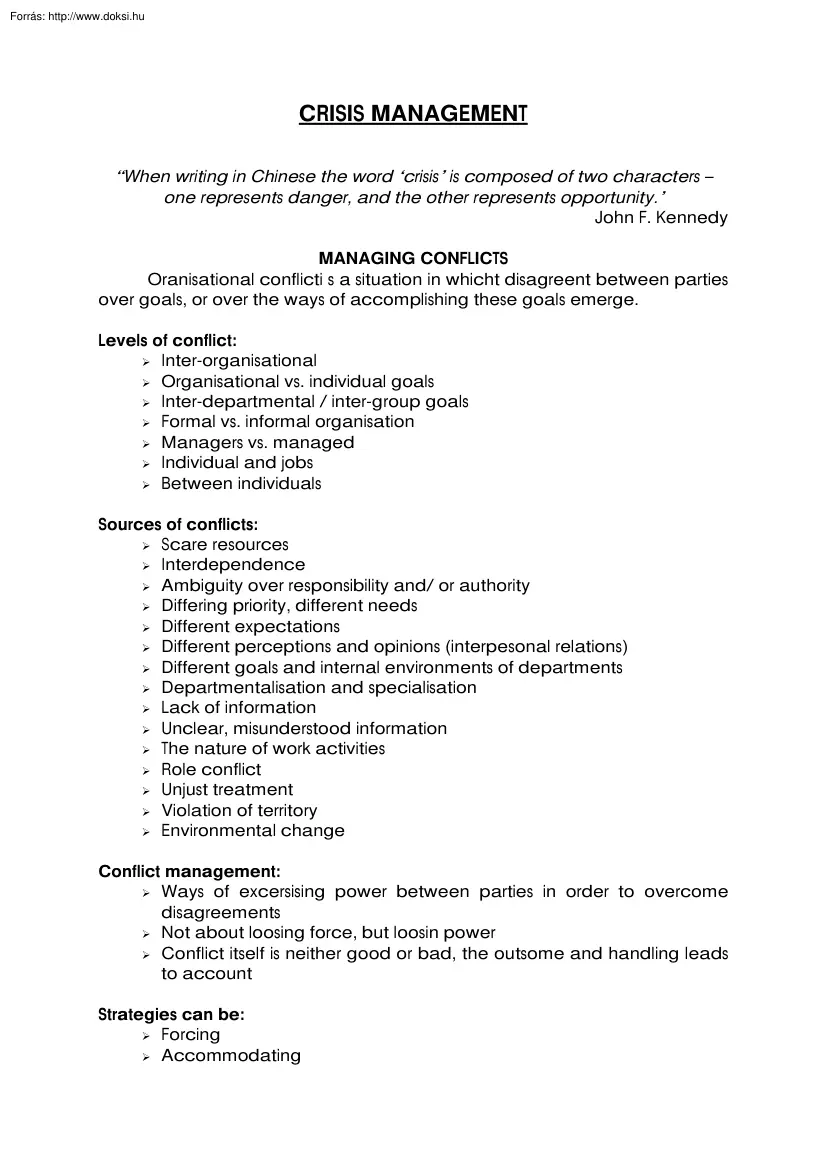
CRISIS MANAGEMENT “When writing in Chinese the word ‘crisis’ is composed of two characters – one represents danger, and the other represents opportunity.’ John F. Kennedy MANAGING CONFLICTS Oranisational conflicti s a situation in whicht disagreent between parties over goals, or over the ways of accomplishing these goals emerge. Levels of conflict: Inter-organisational Organisational vs. individual goals Inter-departmental / inter-group goals Formal vs. informal organisation Managers vs. managed Individual and jobs Between individuals Sources of conflicts: Scare resources Interdependence Ambiguity over responsibility and/ or authority Differing priority, different needs Different expectations Different perceptions and opinions (interpesonal relations) Different goals and internal environments of departments Departmentalisation and specialisation Lack of information Unclear, misunderstood information The
nature of work activities Role conflict Unjust treatment Violation of territory Environmental change Conflict management: Ways of excersising power between parties in order to overcome disagreements Not about loosing force, but loosin power Conflict itself is neither good or bad, the outsome and handling leads to account Strategies can be: Forcing Accommodating Negotiating Avoiding Strategies for manging conflicts: Clarification of goals and objectives Resource distribution Personnel policies and procedures 1. job analysis 2. recruitment and selection 3. job evaluation 4. systems of reward and punishment 5. appeals 6. discliplinary procedures 7. arbitration and mediation 8. recognition of trade unions and their officials Non-monetary awards Developmenet of interpersonal/ group process skills Group activities Leadership management 1. showing an attitude of respect and trust 2. ancouraging personal self development
3. creating a work nvironment in which staff can work cooperatively together Organisational processes/ reducing conflict situations by such features as: 1. the nature of the authority structure 2. work organisation 3. patterns of communication and sharing of information 4. democrating functioning of the organisation 5. unnecesarry adherence to bureocratic procedures and official rules and regulations Outcomes: Win-loose Loose-loose Positive outcomes of conflicts: Better ideas produced People fprced to search new approaches Problems come to surface Clarifications of views Negative outcomes of conflicts: Somebody defeated Growing distanc ebetween people Mistrust and sispicion developed Change to face revenge Fighting for individual interesets Team spirit missed Possible crisis situations in a hotel: Fires and accidents Management failure (negligence, misconduct,
law-breaking) Malevolence (terrorists, criminal acts, rumors) Health, safety danger (environmental exposure, food poisoning) Litigation (highly publicised or inherently newsworthy) Confrontation (activist campaigns) Natural disasters or Government or private threats to independence and the business Dealing with the media in a crisis situation: During a crisis, the media will be interested in specific questions: What is the root or the croux of the story? Who is to blame or responsible? Who is going to fix (or pay for it)? Way of handling crisis situations: Prepare for truoble. Identify portential problems. Appoint and train a responsive tem. Prepare and test crisis management plan. Set up news centers for workers, media equipped with phones, computers and ither tols. Tell receptionis to direct calls to news center. DO’s: Practice your answers, but do not memorise them Use questions as an opportunity to make key
points Ask for clarification if you do not inderstand the question Avoid using hotel industry jargon and acronyms Refuse statements that are not true Issue at least two updates daily and hav etrained personel to respond. Provide comlete information to media as soon as possiible DONT’S: Loose your control Repeat negative question Put down or blame anyone Say ‘I think’ or ‘I believe’ Offer more information than requested Do not speculate in public Do not refuse to aswer a question Do not release any information that violated anybody’s right ot privacy Do not play favousites with media representatives
nature of work activities Role conflict Unjust treatment Violation of territory Environmental change Conflict management: Ways of excersising power between parties in order to overcome disagreements Not about loosing force, but loosin power Conflict itself is neither good or bad, the outsome and handling leads to account Strategies can be: Forcing Accommodating Negotiating Avoiding Strategies for manging conflicts: Clarification of goals and objectives Resource distribution Personnel policies and procedures 1. job analysis 2. recruitment and selection 3. job evaluation 4. systems of reward and punishment 5. appeals 6. discliplinary procedures 7. arbitration and mediation 8. recognition of trade unions and their officials Non-monetary awards Developmenet of interpersonal/ group process skills Group activities Leadership management 1. showing an attitude of respect and trust 2. ancouraging personal self development
3. creating a work nvironment in which staff can work cooperatively together Organisational processes/ reducing conflict situations by such features as: 1. the nature of the authority structure 2. work organisation 3. patterns of communication and sharing of information 4. democrating functioning of the organisation 5. unnecesarry adherence to bureocratic procedures and official rules and regulations Outcomes: Win-loose Loose-loose Positive outcomes of conflicts: Better ideas produced People fprced to search new approaches Problems come to surface Clarifications of views Negative outcomes of conflicts: Somebody defeated Growing distanc ebetween people Mistrust and sispicion developed Change to face revenge Fighting for individual interesets Team spirit missed Possible crisis situations in a hotel: Fires and accidents Management failure (negligence, misconduct,
law-breaking) Malevolence (terrorists, criminal acts, rumors) Health, safety danger (environmental exposure, food poisoning) Litigation (highly publicised or inherently newsworthy) Confrontation (activist campaigns) Natural disasters or Government or private threats to independence and the business Dealing with the media in a crisis situation: During a crisis, the media will be interested in specific questions: What is the root or the croux of the story? Who is to blame or responsible? Who is going to fix (or pay for it)? Way of handling crisis situations: Prepare for truoble. Identify portential problems. Appoint and train a responsive tem. Prepare and test crisis management plan. Set up news centers for workers, media equipped with phones, computers and ither tols. Tell receptionis to direct calls to news center. DO’s: Practice your answers, but do not memorise them Use questions as an opportunity to make key
points Ask for clarification if you do not inderstand the question Avoid using hotel industry jargon and acronyms Refuse statements that are not true Issue at least two updates daily and hav etrained personel to respond. Provide comlete information to media as soon as possiible DONT’S: Loose your control Repeat negative question Put down or blame anyone Say ‘I think’ or ‘I believe’ Offer more information than requested Do not speculate in public Do not refuse to aswer a question Do not release any information that violated anybody’s right ot privacy Do not play favousites with media representatives