Comments
 2007 · 17 page(s) (90 KB)
 English
 11
11
 February 17 · 2013
 Log in

 Embed
Embed
No comments yet. You can be the first!
Most popular documents in this category

Content extract
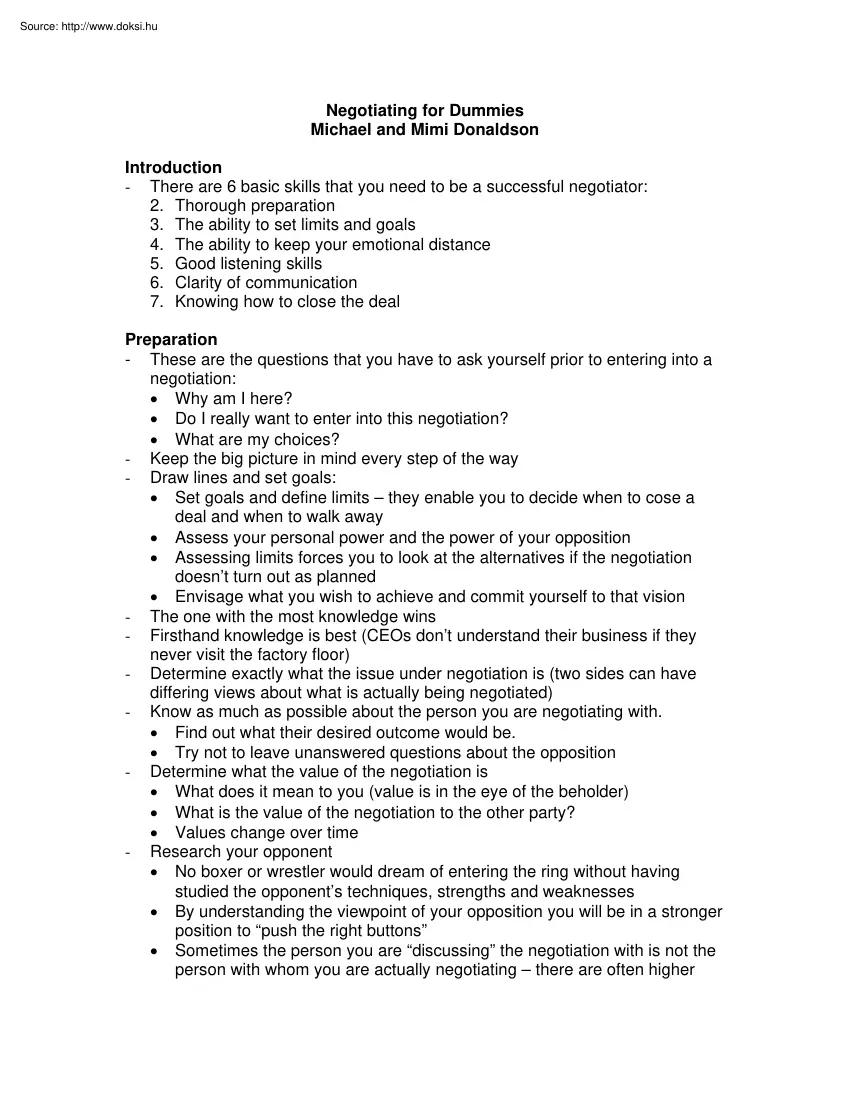
Negotiating for Dummies Michael and Mimi Donaldson Introduction - There are 6 basic skills that you need to be a successful negotiator: 2. Thorough preparation 3. The ability to set limits and goals 4. The ability to keep your emotional distance 5. Good listening skills 6. Clarity of communication 7. Knowing how to close the deal Preparation - These are the questions that you have to ask yourself prior to entering into a negotiation: • Why am I here? • Do I really want to enter into this negotiation? • What are my choices? - Keep the big picture in mind every step of the way - Draw lines and set goals: • Set goals and define limits – they enable you to decide when to cose a deal and when to walk away • Assess your personal power and the power of your opposition • Assessing limits forces you to look at the alternatives if the negotiation doesn’t turn out as planned • Envisage what you wish to achieve and commit yourself to that vision - The one with the most knowledge
wins - Firsthand knowledge is best (CEOs don’t understand their business if they never visit the factory floor) - Determine exactly what the issue under negotiation is (two sides can have differing views about what is actually being negotiated) - Know as much as possible about the person you are negotiating with. • Find out what their desired outcome would be. • Try not to leave unanswered questions about the opposition - Determine what the value of the negotiation is • What does it mean to you (value is in the eye of the beholder) • What is the value of the negotiation to the other party? • Values change over time - Research your opponent • No boxer or wrestler would dream of entering the ring without having studied the opponent’s techniques, strengths and weaknesses • By understanding the viewpoint of your opposition you will be in a stronger position to “push the right buttons” • Sometimes the person you are “discussing” the negotiation with is not the
person with whom you are actually negotiating – there are often higher - - - - powers that send messengers to negotiate for them. The real decision maker may actually be somewhere else. • On the other hand, don’t try to bypass the assigned person, by doing that you may violate the corporate culture and the tactic could often backfire on you • Never loose your cool in a negotiation. If the person you are negotiating with has a positive attitude about the outcome of the negotiation, they will “sell” the outcome to the “higher-ups” to gain approval. A negative attitude on their part could destroy the entire negotiation. Search for the hidden agenda • Without stooping to paranoia, be mindful of the fact that there are often ulterior motives • The hidden agenda is not often discovered until some time into the negotiation process, when more information is revealed • There might also be a “secondary reason” eg: primary reason is to sell your car to upgrade,
but you also aim to get as much money for it as possible International negotiations • Learn a little about the culture of the opposing party • Learn a little about the foreign government as they sometimes have to be part of business deals even within the private sector • Life is different in every country in the world and you have to understand and respect that before you can contemplate success in an international negotiation Never commence negotiations until you are ready • If someone tries to open negotiations when you are not ready, tell them that you need more time to prepare – but listen first as you might learn some valuable information that you could not have otherwise discovered (are they in a rush? Do they have to meet a deadline?) • One way to determine if you are asking for important information is the intensity of the refusal! • It is easy to stall in a negotiation by saying that you have to discuss the idea with a superior, other directors, managers etc
prior to making a decision. Even if this is not true, it is always a handy way to stall for time Control your environment • The environment for the negotiation can be as important as any other aspect of the negotiation • Home ground advantage is definitely better as your control level will be at its highest • But the best place for a negotiation is a place where you can listen • Seating tips: o Sit next to the person with whom you will need to consult with quickly and privately o Sit opposite the person with whom you have the most conflict o Consider who should be closest to the door and who should be closest to the phone (the person next to the door can control - - - - physical access to the room and the person next to the phone controls its use – positions of power) o Windows and the angle of the sun are important factors • Sometimes negotiating over lunch can be the worst environment: not only is it likely to be noisy, but you feel inhibited because there are
other people around, you are constantly interrupted by waiters and there are far too many distractions • The negotiating space should be near the restrooms and near some break areas Who is invited to the meeting is important • Don’t invite even one more person than is necessary – ie: what can they add to the negotiation? • Compensate for not inviting a particular person to the meeting with a detailed memo of what occurred during the meeting Create a written agenda (even if it is only for personal use) • Scrawl out all the things you want to talk about and everything that you want to find out that you don’t already know • Decide which points you want to raise specifically • When you know what you want to talk about, determine the order Leave enough time for the negotiation • Leaving more time for the negotiation is always better than not leaving enough • Several factors create the need for more time to complete international negotiations than domestic ones: o Both
parties proceed more cautiously as they assess the culture that the other comes from o Language differences may cause delays, even with a skilled translator – even with different accents o Fatigue is common if a host pushes a special event each evening Prepare yourself for the negotiation: • Be well rested • Dress for success (this may mean to mirror your environment – who will take you seriously if you come dressed casually when everyone else is wearing a suit – and who will take you seriously if you are wearing a suit where everyone else in casually attired • Always enter the negotiating room perky and assertive – establish confidence and control from the opening moment • Improving your attitude prior to negotiations is of tantamount importance • Never forget pleasantries Setting limits and sticking to them • Setting limits early in a negotiation (or better, before the negotiation) can save much time and effort during the actual course of the negotiation •
When you predetermine your limits, they help to guide the negotiations through rough waters • Set limits and know when to walk away. Knowing that you are prepared to walk away gives you the strength and confidence to be firm You gotta know when to hold em, Know when to fold em, Know when to walk away Know when to run The above epitomises the attitude you have to take when negotiating and setting limits • Know that you have other choices: there is always another deal around the corner • You don’t have to close every negotiation with a purchase or sale • The biggest prison is the one you build around your mind if you limit your choices • BATNA: Best Aternative To a Negotiated Agreement • Life is always about exercising options • Try to construct a similar list of alternatives for the other party, you will gain a clearer understanding of their limitations and alternatives to your offers - Determine your “Resistance Point” • Your resistance point is close to your
limit but leaves enough room to close the deal without crossing your limits • You need to understand your resistance point so that you don’t let the other party knock the negotiations out of the sky – act before that happens - Never paint yourself into a corner • If you state your limits immediately, you violate a fundamental tenant of sound negotiations • Always leave yourself an in and an out • Set limits, don’t shout limits - Re-examine your limits: don’t be afraid to take a second look at the limits • Don’t slowly change your limits during a negotiation without mindful consideration – if you are aware of the change and are changing on purpose, then it can be a positive step • Slipping and sliding causes confusion in your mind and in the minds of those with whom you are negotiating Set specific goals and stick to them • Include all the team members in the goal-setting exercise so that they can all feel that they are all aiming for the same target • If
you don’t include all members of the team in goal setting exercises then you run the risk of miscommunication and misunderstandings • Aim high • Weight goals in terms of importance • Create long range and short range goals - The opening offer in a negotiation should just be slightly higher than your actual goal, but not ridiculously high so as to be off-putting to the other party Maintaining emotional distance - Maintaining emotional distance from whatever is being discussed is what differentiates the master negotiator from the rest - Press the “pause” button to buy time. This is an excellent tactic when there is a high stress situation ie: don’t just do something, sit there! - Pausing the negotiations allows you to: • regroup your thoughts • step away physically and psychologically • review the entire process • avoid getting boxed into a corner • explore options - You can harness the power of the pause by: • Telling the other party that you need to sleep on
it • Excusing yourself to the restroom • Lean back in your chair, close your eyes and say “wait a minute, I have to take that in” • Say “I’ll have to run this by my partner (manager, boss, accountant, advisor)” etc - Use the “pause” technique at critical moments in the negotiation (like making concessions or to decide to close a deal) and use it when you are pressured or under stress - Pausing before making a concession gives that concession weight and it might work in your favour as the other party might feel that that was the significant point in your view and they have thus made a victory. In effect, it might have been an insignificant concession, but the pause made it seem more important - Making quick concessions might make the other party feel that they could have achieved a better result had they tried (eg: a lower price). By taking your time to concede a point, you make them feel like they made a good deal - Don’t allow yourself to be pressured into making
a decision. Using the pause will allow you to distance yourself from the situation and make better decisions (say something like, “I’m going to consider everything you said and get back to you tomorrow”) - - - You can loose your cool if the other party pushes your “hot buttons” – stimuli that trigger a response of resistance and causes you to be tempted to get out of control A prime factor in negotiations is honest communication. If you are angry about something that the other party has done, then tell them (but use “I” statements like “I am not happy about this point” not “You are making unreasonable demands”) Don’t be afraid to express enthusiasm in a negotiation – you cannot be exploited if you properly prepare and if you have set limits Don’t gloat in a negotiation Consider failure a learning experience – in a protracted negotiation you must be prepared to face frustration Stay in control during meetings: • Be strong and firm with dominators
of a meeting. State the need for other opinions, ask the group for views and reactions, find a natural pause and intervene • Restrain ramblers. Confirm your understanding of the point so they won’t go on forever, restate the urgency of the objectives and list the time constraints, direct a question to other participants • Curtail competing conversers. Pause and look directly at the conversers, ask the conversers to share their ideas with the group • Address the arguers. Paraphrase the argument so that you express your understanding of their points, restate the agreed-upon agenda so that you can move the conversation to a more desired outcome Hot buttons - Some causes of stress • Determine if you are worried about a certain point? What are you really worried about? • Anger can be brought to the fore by many external events. • Resentment is caused by people who cause you frustration - Dealing with stress • Stop: Push the “pause” button on the negotiations • Look:
recognise that you are experiencing a “hot button” or “stress trigger”. Ask yourself if reacting emotionally is going to get you a good result • Listen: Pay attention to what your “inner voice” is telling you. Take one of 3 options: o Adapt: listen to what the other person is saying and evaluate if your expectations are unrealistic. You might have to adapt them to fit into the situation at hand o Alter: Change the situation all together. Find alternative routes to your goal o Avoid: Avoid the negotiations if you can tell that they are not going to get you anywhere (this is obviously the least favoured option) • Use empathy to reduce stress or tension in the negotiation eg: “I understand where you are coming from” Listening - Listening is an essential negotiating technique. The following methods ensure that you have heard correctly what the other party has said: • Restate the other party’s statement ie: repeat it word for word • Paraphrase the other
party’s statement ie: put it in your own words - Six barriers to being a good listener i. Defence mechanism: • Don’t want to get the bad news • Don’t want to acknowledge “advance warning signals” ii. Weak Self Confidence: • Talk too much out of nervousness • A mind in motion blocks listening (ie: mind racing, searching for an answer) iii. The energy Drag: • Too tired or too lazy to listen • If the speaker needs to slow down in order for you to fully participate, say so iv. Habit: • A developed habit of thinking ahead while the other person is talking • Talk too much – talk inside your head more than outside your head and you will be a better participant in a conversation v. Preconception: • Just because a person acted in one way before, doesn’t mean that they will act in the same way again • Closely related to the “assumption” – prevents you from having an open mind and listening effectively vi. Not expecting value in others: • You don’t
listen to a person because you don’t expect them to say anything worthwhile • It is often true that “buried within chatter is value” • Questioning someone who might seem boring or unintelligent could produce a nugget of information - Successful people listen better than their counterparts Becoming a better listener - Tips for becoming a good listener: • If you have something else on your mind then write it down so that you can give the other person your undivided attention • Don’t accept phone calls or unnecessary interruptions while you are talking with someone • Uncross your arms and legs • Sit straight in the chair • Face the speaker full on • Lean forward • Make as much eye contact as you can • Sit on the edge of your seat (by pretending to be alert, you can actually feel more alert) • Make notes: even if you never refer to them again, the act of writing them down reinforces the point that the other person is making • Ask good questions and you
will get good answers • Ask them to clarify a statement if it doesn’t make sense to you – especially if it is jargon - Part of becoming a good listener is being able to ask good questions: • Plan questions in advance (not the exact wording, but the content of the question) • Ask with purpose, not just for the sake of asking a question • Tailor questions to the listener – use examples that they can relate to • Follow general questions with more specific ones • Keep questions short and clear – cover only one subject per question • Make transitions between their answers and your questions (use something in the first answer to frame the next question) - A sharp negotiator may ask a series of questions to compel you to a certain conclusion - Avoid leading questions - Ask open ended questions eg: what do you like the best about this product? - Ask again – if you have already asked the question but not received an appropriate answer, then rephrase the question. You
might have to bide your time and ask the question later - Don’t waste your asks – the other party will often offer answers to questions before you have even asked them - If you are listening, asking the right questions but still not getting the answers you need the following may be the case: • The person simply doesn’t want to answer that question – make a note and find out the information elsewhere • The person is not good at answering questions – ask again in a different way - • The person is a liar – Never negotiate with a liar as you will never win Be alert to the other person’s listening to find out if they are actually listening to what you are saying – if they are not, it is probably best to take a break (or if a distraction is causing the other person not to listen, then deal with the distraction Your inner voice - Your “inner voice” can warn you of impending danger in a negotiation. • Can I trust the information? • What is this person’s
reputation for honesty and accuracy? • Is the deal a questionable one? – If your inner voice tells you that you don’t want to make the deal, then stop it at once • Heed strong messages that a course of action is wise or unwise - Body language can tell a lot about what a person is thinking - Many body language expressions are the same throughout the world – especially facial expressions. Body Language - Body Language Tips: • Make sure that your body language is consistent with the words coming out of your mouth • Read the non-verbal signs of the person with whom you are negotiating – are they sending conflicting words and actions? o Are their eyes wandering o Are they attending to unrelated tasks o Does the person seem confused o Is the person expressing that there is a hidden agenda o The nervous laugh is a giveaway that the person is nervous about the negotiation • If you can see that there are conflicting words and body language, and the person denies that a
discrepancy exists, this is called a blind spot – something that you know about others that they don’t know about themselves • For most part of the conversation the other person will most likely stay in the same position. Shifts from that position indicate that it is time to analyse their body language eg: o The other party feels that you are talking about a sensitive issue o The other party is loosing interest o The other party needs a break or a stretch o The other party is turning off to your arguments • The more powerful a person is, the more “personal space” is awarded to him • Enter the negotiating arena with a positive attitude and positive body language – smiles, handshake, eye contact etc – be confident, self assured • If a person is accepting your ideas they may display the following body language: o Cocking the head o Squinting the eyes slightly o Taking off or toying with eyeglasses o Pinching the bridge of their nose o Leaning forward, uncrossing
legs and sitting at the edge of the chair o Increasing eye contact o Putting hands to chest o Touching the forehead or the chin • Gestures of resistance to your ideas: o Fidgeting nervously o Reducing eye contact o Placing hands behind their back o Placing hand over their mouth o Locking ankles o Gripping their arm or waste o Crossing arms in front of chest o Squinting eyes dramatically o Making fist-like gestures o Twisting the feet or the entire body so they point to the door o Looking out the window, holding head with one hand or incessant doodling indicates boredom • When closing a deal the following may occur to make both parties feel good about the deal: o Softening of tone of voice o Leaning in to the other party’s personal space o Physical contact (hand shake, slap on back etc) • Body language can be misleading eg: o Sitting erect may indicate a stiff bargaining position or the person may be physically injured o Gestures can be employed for effect (closing your eyes to
think, scratching your chin looks like you are considering their point, but you might just be stalling for time; anger can be used for dramatic effect, but not necessarily meant hat the personis genuinely angry) o Consider the context of the body language o Prepare for the bluff – they might be faking interest or disinterest to work in their favour o Most body language is accidental and is not part of a “sinister plot” Control through clarity - The ability to communicate clearly is one of the six basic skills of negotiation - Being clear means that when you speak, write or otherwise communicate, your listener understands your intended message. - You must ask yourself this question: What do I want my listener to do, think or feel as a result of the communication - PREP: My POINT is (exercise is energising) My REASON is (it gets your heart rate up) My EXAMPE is (after at least 20 minutes of increase heart rate you are more energised when you come out of the gym than when you
went in) My POINT is (exercise is energising) - Tips for being clear: • Just because it is phrased nicely, it doesn’t mean that it is understood • Set the climate - be in a place conducive to concentration • Give the big picture: describe the overall objectives – how does your part and the other party’s tasks fit into the grand scheme of things • Describe the steps – write them out to avoid confusion • Cite resources available – point out where to find references • Invite questions • Get the person to summarise the task so that you are sure that they know what is expected of them • Agree on a follow up time - Cut the mumbo-jumbo • If you have something complicated to describe or explain, find ways to make it simpler (eg: charts and graphs instead of tables of numbers) - Keep commitments • This is the bedrock of trust – your trustworthiness is dependant on whether you keep to your word • These are the words that you say and the deeds that follow -
Barriers to clarity: • Fear of rejection: people blur the lines to avoid total comprehension by the other party and thus avoid rejection • Fear of hurting someone else: people may not say what they really think so as not to hurt someone else’s feelings – you have to deliver the news with dignity and respect for the person – but tell them the truth • Fatigue: Unable to focus • Laziness: you may not have prepared enough and are dreading being clear on some facts that are unsubstantiated • Interruptions: Change the environment if there are too many distractions - - - - Saying NO without hurting other’s feelings: • Acknowledge that the other party has a priority and that it is important then • Advise the other party of your priorities and then • Accept the request with conditions or alter it so that it suits both parties The costs of not being clear are that the deal will disappear before your eyes – for instance, by floating an outrageous first offer, the
whole negotiations can falter because the other party might think that you are serious and this deters them from doing business with you The signs of unclear communication are: • Reciprocal Obfuscation: the other party begins to become unclear, too – so nobody really knows what the other is talking about • Leaving lots of room to manoeuvre: rather than commit, the other party will leave lots of room to manoeuvre Sometimes language barriers can inhibit communication. To overcome this: • Drop your voice • Speak more slowly • Use simpler words • Use your hands • Be patient Verbal Stop Signs - Phrases you should never use during a negotiation: • Trust me: if a person says this, ask for details and a commitment – you want an agreement so clear that you don’t need to trust the other person • I’m going to be honest with you: this is tantamount to saying that I have not been honest so far, but I’ll start now • Take it or leave it: even if the other party takes
the offer, it leaves them with a bad taste in their mouths • You’ll never work in this town again: this is a bully’s tactic and it is often an idle threat • Slurs: Steer clear of racial slurs or politically incorrect statements - If the other party is unclear, steer them to clarity: • Don’t let them go off on a tangent • Stop others from interrupting the flow of the work • Postpone the meeting if the other person is not prepared • Schedule meetings at appropriate times so that you and the other person are going to be preoccupied (eg: start the meeting at the beginning of the day) Negotiating over the telephone - Negotiating over the telephone is never as good as face-to-face negotiations. You loose the gestures, facial expressions and the interaction between the members of the other party - Getting on with assistance and support staff is essential to being granted access to people higher up on the ladder – they are the gatekeepers - Negotiating over the
telephone “belittles” the process a bit because it seems like you haven’t made the effort to have a face-to-face negotiation. Overcome this by stating how important the meeting is. Talk slowly and deliberately - Give lots of auditory feedback so that your counterpart is able to determine your viewpoint and there will be clear communication - Try to end a telephone conversation on a personal note - When on the phone, use these terms and phrases: • “How are you today? Is it a good time to talk?” • “Do you have half an hour to talk, or should we schedule another phone appointment?” • I hear a change of tone. Is everything alright today?” - Speakerphone: • Having your hands free to write is an advantage • Let the other person know who is in the room • More than one person in the office can participate in the conversation • The speakerphones are not usually perfectly clear and can create an in-tunnel effect • Speakerphone sound tends to cut out briefly but
often - Mute button: • Never assume that the mute button is flawless – don’t use it to discuss top-secret information while in the midst of a telephone negotiation • Use the mute button for things like giving directions to a member of your team - Mobile phones: • Negotiating over a mobile phone is difficult as there are often many distractions • Often you are in public – which is not the place to hold a negotiation and still make the other party feel like you attach any sort of importance to the topic at hand Closing the Deal - If you are going to close the deal, make sure that the deal is positive for both parties - If you are about to walk away from a negotiation then make sure that you have exhausted all other options for a mutually beneficial agreement - A good deal is workable in the real world – it also has contingencies built into it in case something goes wrong in the middle - Aim for win-win situations – ask yourself the following questions: • Does the
agreement further your long-range goals? Does it fit into your vision statement? • Foes the agreement fall comfortably within the goals and the limits you set for this particular negotiation? • Can you perform your side to the fullest? • Do you intend to meet your commitments? • Based on all of the other information, can the other side perform the agreement to your expectations? • Based on what you know, does the other side intend to carry out the terms of the agreement? - Myths of win-win negotiating: • Don’t care too much about the other party – don’t compromise your limits and your needs • Your job is to get what you want, not to “mother” the other side Getting past the glitches - Glitches will happen and they are unavoidable. The secret to successfully negotiating around the glitch is to focus on your ultimate goal and don’t get sidetracked • Using the pause technique allows you time to think of a way to steer around potholes. - Dealing with difficult
people • The bully: they make “take it or leave it” offers and other forms of intimidation. Someone who bullies you through a negotiation may continue to do so after an agreement has been reached. To counteract a bully, tell them in front of the others at the negotiating table that the person in question is being a bully – bullies don’t like to be branded as bullies so they may change their behaviour. • The screamer: there are a few types of screamers: o One who is truly angry or upset o Habitual screamers o Bully The worst response is to scream back. The best response is to say something along the lines of “I hear from your voice that you are upset” or “Tell me more about that” – these are meant to be - calming phrases which tell the counterpart that you want to understand their position. • The Star: How can you negotiate with someone you really admire? Talk to the real human being, ignoring the fact that this person is a “superstar” or a
“celebrity”. Have your purpose in mind at all times • The biased buyer: If your counterpart has biased, racist or predetermined views about you, then the best thing to do is to tackle the issue head on – calmly and with dignity using statements like, “Are you open to granting this contract to a non-American company?” Or ask “Exactly what is your criteria for making a decision about the terms of this deal?” • You could be the problem! Are you stuck on one issue? Is your position absolutely set in stone? Have you got a Plan B? Here are a number of common glitches: • One party constantly changing positions • Good Cop/Bad Cop: 2 partners working together to undo you • The invisible partner: “I have to discuss this with my boss” (who is unavailable, indecisive, slow to make a decision) • The double message: Actions and words are inconsistent • “Let’s split the difference and be done”” – you may end up with an unsatisfactory result • Bad
environment • Too much paper • Hidden agendas • Poorly designed tools and resources • If the other party walks away: o Attempt to pull them back o Use the time to your advantage o If the negotiations are worth salvaging, try to do so – don’t stand on pride o Keep emotions at a distance • If the other party comes crawling back: o Acknowledge any first step • If a competitor in a negotiation walks away: o Move quickly o The party on the other side is a bit vulnerable and you can achieve a good result • If you walk away: o State clearly under what circumstances the negotiations can resume o Never terminate a negotiation when you are angry o Take 6 steps: Summarise the position of the other side Summarise your own position Explain that nobody is to blame, square pegs don’t fit into round holes Never blame the other person Send a thank-you note Telegraph your next move “perhaps we can get together next time I am in town for another
discussion” Closing the Deal - A deal closes when the parties agree on enough terms that they can move forward with the performance of the deal • The agreement needs to have 4 parts: o What you are getting o What you are paying o How long will the contract last o Who are the parties in the contract • Making a counteroffer: This implies that the initial offer is rejected and the other party may not allow you to revert to the initial offer if the counteroffer is not accepted • “A verbal contract is not worth the paper its written on” - Recognising when to close: • Close early and close often: if there is no need to hang around and continue the negotiations, then close the deal • Appropriate moments for closing can be: o When an acceptable solution is on the table o When the other side wants to close o When a deadline is approaching o When all of the negotiation goals are met o When you have better alternatives • Weak closers tend to get stuck on a position; strong
closers find a solution • Strong closers are those who can complete tasks on time; weak closers are procrastinators • The only way to close a deal is to ASK – ask your counterpart if the terms are acceptable to close the deal. • If the other party does not want to close the negotiations, ask the following questions: o Is the stated objection really what is bothering the other party o What will the other party do if this deal doesn’t close o Can you meet or beat the alternative - When the deal is done: • Review the process • Do everything in your power to ensure that the deal is carried out as agreed (if the other party is happy, no problem) Ways to Become a Master Negotiator • Commit to the process • Take care of yourself • Study negotiating techniques of at least 2 people • Adopt a hero • Involve your support group • Keep the 6 basic skills handy • Debrief yourself after negotiations • Know more than anybody else in the business • Be a mentor -
Personality Traits of Top Negotiators: • Empathy • Respect • Personal Integrity • Fairness • Patience • Responsibility • Flexibility • Sense of Humour • Self-Discipline • Stamina - 10 Common Negotiating Mistakes: • Starting a negotiation before you are ready • Negotiating with the wrong person • Locking on a position • Feeling powerless during negotiation sessions • Worrying about losing control of the negotiation • Wandering away from your set goals and limits • Worrying too much about the other guy • Thinking of “just the right thing to say” – the next day • Blaming yourself for another’s mistake • Not focusing on closing the negotiation
wins - Firsthand knowledge is best (CEOs don’t understand their business if they never visit the factory floor) - Determine exactly what the issue under negotiation is (two sides can have differing views about what is actually being negotiated) - Know as much as possible about the person you are negotiating with. • Find out what their desired outcome would be. • Try not to leave unanswered questions about the opposition - Determine what the value of the negotiation is • What does it mean to you (value is in the eye of the beholder) • What is the value of the negotiation to the other party? • Values change over time - Research your opponent • No boxer or wrestler would dream of entering the ring without having studied the opponent’s techniques, strengths and weaknesses • By understanding the viewpoint of your opposition you will be in a stronger position to “push the right buttons” • Sometimes the person you are “discussing” the negotiation with is not the
person with whom you are actually negotiating – there are often higher - - - - powers that send messengers to negotiate for them. The real decision maker may actually be somewhere else. • On the other hand, don’t try to bypass the assigned person, by doing that you may violate the corporate culture and the tactic could often backfire on you • Never loose your cool in a negotiation. If the person you are negotiating with has a positive attitude about the outcome of the negotiation, they will “sell” the outcome to the “higher-ups” to gain approval. A negative attitude on their part could destroy the entire negotiation. Search for the hidden agenda • Without stooping to paranoia, be mindful of the fact that there are often ulterior motives • The hidden agenda is not often discovered until some time into the negotiation process, when more information is revealed • There might also be a “secondary reason” eg: primary reason is to sell your car to upgrade,
but you also aim to get as much money for it as possible International negotiations • Learn a little about the culture of the opposing party • Learn a little about the foreign government as they sometimes have to be part of business deals even within the private sector • Life is different in every country in the world and you have to understand and respect that before you can contemplate success in an international negotiation Never commence negotiations until you are ready • If someone tries to open negotiations when you are not ready, tell them that you need more time to prepare – but listen first as you might learn some valuable information that you could not have otherwise discovered (are they in a rush? Do they have to meet a deadline?) • One way to determine if you are asking for important information is the intensity of the refusal! • It is easy to stall in a negotiation by saying that you have to discuss the idea with a superior, other directors, managers etc
prior to making a decision. Even if this is not true, it is always a handy way to stall for time Control your environment • The environment for the negotiation can be as important as any other aspect of the negotiation • Home ground advantage is definitely better as your control level will be at its highest • But the best place for a negotiation is a place where you can listen • Seating tips: o Sit next to the person with whom you will need to consult with quickly and privately o Sit opposite the person with whom you have the most conflict o Consider who should be closest to the door and who should be closest to the phone (the person next to the door can control - - - - physical access to the room and the person next to the phone controls its use – positions of power) o Windows and the angle of the sun are important factors • Sometimes negotiating over lunch can be the worst environment: not only is it likely to be noisy, but you feel inhibited because there are
other people around, you are constantly interrupted by waiters and there are far too many distractions • The negotiating space should be near the restrooms and near some break areas Who is invited to the meeting is important • Don’t invite even one more person than is necessary – ie: what can they add to the negotiation? • Compensate for not inviting a particular person to the meeting with a detailed memo of what occurred during the meeting Create a written agenda (even if it is only for personal use) • Scrawl out all the things you want to talk about and everything that you want to find out that you don’t already know • Decide which points you want to raise specifically • When you know what you want to talk about, determine the order Leave enough time for the negotiation • Leaving more time for the negotiation is always better than not leaving enough • Several factors create the need for more time to complete international negotiations than domestic ones: o Both
parties proceed more cautiously as they assess the culture that the other comes from o Language differences may cause delays, even with a skilled translator – even with different accents o Fatigue is common if a host pushes a special event each evening Prepare yourself for the negotiation: • Be well rested • Dress for success (this may mean to mirror your environment – who will take you seriously if you come dressed casually when everyone else is wearing a suit – and who will take you seriously if you are wearing a suit where everyone else in casually attired • Always enter the negotiating room perky and assertive – establish confidence and control from the opening moment • Improving your attitude prior to negotiations is of tantamount importance • Never forget pleasantries Setting limits and sticking to them • Setting limits early in a negotiation (or better, before the negotiation) can save much time and effort during the actual course of the negotiation •
When you predetermine your limits, they help to guide the negotiations through rough waters • Set limits and know when to walk away. Knowing that you are prepared to walk away gives you the strength and confidence to be firm You gotta know when to hold em, Know when to fold em, Know when to walk away Know when to run The above epitomises the attitude you have to take when negotiating and setting limits • Know that you have other choices: there is always another deal around the corner • You don’t have to close every negotiation with a purchase or sale • The biggest prison is the one you build around your mind if you limit your choices • BATNA: Best Aternative To a Negotiated Agreement • Life is always about exercising options • Try to construct a similar list of alternatives for the other party, you will gain a clearer understanding of their limitations and alternatives to your offers - Determine your “Resistance Point” • Your resistance point is close to your
limit but leaves enough room to close the deal without crossing your limits • You need to understand your resistance point so that you don’t let the other party knock the negotiations out of the sky – act before that happens - Never paint yourself into a corner • If you state your limits immediately, you violate a fundamental tenant of sound negotiations • Always leave yourself an in and an out • Set limits, don’t shout limits - Re-examine your limits: don’t be afraid to take a second look at the limits • Don’t slowly change your limits during a negotiation without mindful consideration – if you are aware of the change and are changing on purpose, then it can be a positive step • Slipping and sliding causes confusion in your mind and in the minds of those with whom you are negotiating Set specific goals and stick to them • Include all the team members in the goal-setting exercise so that they can all feel that they are all aiming for the same target • If
you don’t include all members of the team in goal setting exercises then you run the risk of miscommunication and misunderstandings • Aim high • Weight goals in terms of importance • Create long range and short range goals - The opening offer in a negotiation should just be slightly higher than your actual goal, but not ridiculously high so as to be off-putting to the other party Maintaining emotional distance - Maintaining emotional distance from whatever is being discussed is what differentiates the master negotiator from the rest - Press the “pause” button to buy time. This is an excellent tactic when there is a high stress situation ie: don’t just do something, sit there! - Pausing the negotiations allows you to: • regroup your thoughts • step away physically and psychologically • review the entire process • avoid getting boxed into a corner • explore options - You can harness the power of the pause by: • Telling the other party that you need to sleep on
it • Excusing yourself to the restroom • Lean back in your chair, close your eyes and say “wait a minute, I have to take that in” • Say “I’ll have to run this by my partner (manager, boss, accountant, advisor)” etc - Use the “pause” technique at critical moments in the negotiation (like making concessions or to decide to close a deal) and use it when you are pressured or under stress - Pausing before making a concession gives that concession weight and it might work in your favour as the other party might feel that that was the significant point in your view and they have thus made a victory. In effect, it might have been an insignificant concession, but the pause made it seem more important - Making quick concessions might make the other party feel that they could have achieved a better result had they tried (eg: a lower price). By taking your time to concede a point, you make them feel like they made a good deal - Don’t allow yourself to be pressured into making
a decision. Using the pause will allow you to distance yourself from the situation and make better decisions (say something like, “I’m going to consider everything you said and get back to you tomorrow”) - - - You can loose your cool if the other party pushes your “hot buttons” – stimuli that trigger a response of resistance and causes you to be tempted to get out of control A prime factor in negotiations is honest communication. If you are angry about something that the other party has done, then tell them (but use “I” statements like “I am not happy about this point” not “You are making unreasonable demands”) Don’t be afraid to express enthusiasm in a negotiation – you cannot be exploited if you properly prepare and if you have set limits Don’t gloat in a negotiation Consider failure a learning experience – in a protracted negotiation you must be prepared to face frustration Stay in control during meetings: • Be strong and firm with dominators
of a meeting. State the need for other opinions, ask the group for views and reactions, find a natural pause and intervene • Restrain ramblers. Confirm your understanding of the point so they won’t go on forever, restate the urgency of the objectives and list the time constraints, direct a question to other participants • Curtail competing conversers. Pause and look directly at the conversers, ask the conversers to share their ideas with the group • Address the arguers. Paraphrase the argument so that you express your understanding of their points, restate the agreed-upon agenda so that you can move the conversation to a more desired outcome Hot buttons - Some causes of stress • Determine if you are worried about a certain point? What are you really worried about? • Anger can be brought to the fore by many external events. • Resentment is caused by people who cause you frustration - Dealing with stress • Stop: Push the “pause” button on the negotiations • Look:
recognise that you are experiencing a “hot button” or “stress trigger”. Ask yourself if reacting emotionally is going to get you a good result • Listen: Pay attention to what your “inner voice” is telling you. Take one of 3 options: o Adapt: listen to what the other person is saying and evaluate if your expectations are unrealistic. You might have to adapt them to fit into the situation at hand o Alter: Change the situation all together. Find alternative routes to your goal o Avoid: Avoid the negotiations if you can tell that they are not going to get you anywhere (this is obviously the least favoured option) • Use empathy to reduce stress or tension in the negotiation eg: “I understand where you are coming from” Listening - Listening is an essential negotiating technique. The following methods ensure that you have heard correctly what the other party has said: • Restate the other party’s statement ie: repeat it word for word • Paraphrase the other
party’s statement ie: put it in your own words - Six barriers to being a good listener i. Defence mechanism: • Don’t want to get the bad news • Don’t want to acknowledge “advance warning signals” ii. Weak Self Confidence: • Talk too much out of nervousness • A mind in motion blocks listening (ie: mind racing, searching for an answer) iii. The energy Drag: • Too tired or too lazy to listen • If the speaker needs to slow down in order for you to fully participate, say so iv. Habit: • A developed habit of thinking ahead while the other person is talking • Talk too much – talk inside your head more than outside your head and you will be a better participant in a conversation v. Preconception: • Just because a person acted in one way before, doesn’t mean that they will act in the same way again • Closely related to the “assumption” – prevents you from having an open mind and listening effectively vi. Not expecting value in others: • You don’t
listen to a person because you don’t expect them to say anything worthwhile • It is often true that “buried within chatter is value” • Questioning someone who might seem boring or unintelligent could produce a nugget of information - Successful people listen better than their counterparts Becoming a better listener - Tips for becoming a good listener: • If you have something else on your mind then write it down so that you can give the other person your undivided attention • Don’t accept phone calls or unnecessary interruptions while you are talking with someone • Uncross your arms and legs • Sit straight in the chair • Face the speaker full on • Lean forward • Make as much eye contact as you can • Sit on the edge of your seat (by pretending to be alert, you can actually feel more alert) • Make notes: even if you never refer to them again, the act of writing them down reinforces the point that the other person is making • Ask good questions and you
will get good answers • Ask them to clarify a statement if it doesn’t make sense to you – especially if it is jargon - Part of becoming a good listener is being able to ask good questions: • Plan questions in advance (not the exact wording, but the content of the question) • Ask with purpose, not just for the sake of asking a question • Tailor questions to the listener – use examples that they can relate to • Follow general questions with more specific ones • Keep questions short and clear – cover only one subject per question • Make transitions between their answers and your questions (use something in the first answer to frame the next question) - A sharp negotiator may ask a series of questions to compel you to a certain conclusion - Avoid leading questions - Ask open ended questions eg: what do you like the best about this product? - Ask again – if you have already asked the question but not received an appropriate answer, then rephrase the question. You
might have to bide your time and ask the question later - Don’t waste your asks – the other party will often offer answers to questions before you have even asked them - If you are listening, asking the right questions but still not getting the answers you need the following may be the case: • The person simply doesn’t want to answer that question – make a note and find out the information elsewhere • The person is not good at answering questions – ask again in a different way - • The person is a liar – Never negotiate with a liar as you will never win Be alert to the other person’s listening to find out if they are actually listening to what you are saying – if they are not, it is probably best to take a break (or if a distraction is causing the other person not to listen, then deal with the distraction Your inner voice - Your “inner voice” can warn you of impending danger in a negotiation. • Can I trust the information? • What is this person’s
reputation for honesty and accuracy? • Is the deal a questionable one? – If your inner voice tells you that you don’t want to make the deal, then stop it at once • Heed strong messages that a course of action is wise or unwise - Body language can tell a lot about what a person is thinking - Many body language expressions are the same throughout the world – especially facial expressions. Body Language - Body Language Tips: • Make sure that your body language is consistent with the words coming out of your mouth • Read the non-verbal signs of the person with whom you are negotiating – are they sending conflicting words and actions? o Are their eyes wandering o Are they attending to unrelated tasks o Does the person seem confused o Is the person expressing that there is a hidden agenda o The nervous laugh is a giveaway that the person is nervous about the negotiation • If you can see that there are conflicting words and body language, and the person denies that a
discrepancy exists, this is called a blind spot – something that you know about others that they don’t know about themselves • For most part of the conversation the other person will most likely stay in the same position. Shifts from that position indicate that it is time to analyse their body language eg: o The other party feels that you are talking about a sensitive issue o The other party is loosing interest o The other party needs a break or a stretch o The other party is turning off to your arguments • The more powerful a person is, the more “personal space” is awarded to him • Enter the negotiating arena with a positive attitude and positive body language – smiles, handshake, eye contact etc – be confident, self assured • If a person is accepting your ideas they may display the following body language: o Cocking the head o Squinting the eyes slightly o Taking off or toying with eyeglasses o Pinching the bridge of their nose o Leaning forward, uncrossing
legs and sitting at the edge of the chair o Increasing eye contact o Putting hands to chest o Touching the forehead or the chin • Gestures of resistance to your ideas: o Fidgeting nervously o Reducing eye contact o Placing hands behind their back o Placing hand over their mouth o Locking ankles o Gripping their arm or waste o Crossing arms in front of chest o Squinting eyes dramatically o Making fist-like gestures o Twisting the feet or the entire body so they point to the door o Looking out the window, holding head with one hand or incessant doodling indicates boredom • When closing a deal the following may occur to make both parties feel good about the deal: o Softening of tone of voice o Leaning in to the other party’s personal space o Physical contact (hand shake, slap on back etc) • Body language can be misleading eg: o Sitting erect may indicate a stiff bargaining position or the person may be physically injured o Gestures can be employed for effect (closing your eyes to
think, scratching your chin looks like you are considering their point, but you might just be stalling for time; anger can be used for dramatic effect, but not necessarily meant hat the personis genuinely angry) o Consider the context of the body language o Prepare for the bluff – they might be faking interest or disinterest to work in their favour o Most body language is accidental and is not part of a “sinister plot” Control through clarity - The ability to communicate clearly is one of the six basic skills of negotiation - Being clear means that when you speak, write or otherwise communicate, your listener understands your intended message. - You must ask yourself this question: What do I want my listener to do, think or feel as a result of the communication - PREP: My POINT is (exercise is energising) My REASON is (it gets your heart rate up) My EXAMPE is (after at least 20 minutes of increase heart rate you are more energised when you come out of the gym than when you
went in) My POINT is (exercise is energising) - Tips for being clear: • Just because it is phrased nicely, it doesn’t mean that it is understood • Set the climate - be in a place conducive to concentration • Give the big picture: describe the overall objectives – how does your part and the other party’s tasks fit into the grand scheme of things • Describe the steps – write them out to avoid confusion • Cite resources available – point out where to find references • Invite questions • Get the person to summarise the task so that you are sure that they know what is expected of them • Agree on a follow up time - Cut the mumbo-jumbo • If you have something complicated to describe or explain, find ways to make it simpler (eg: charts and graphs instead of tables of numbers) - Keep commitments • This is the bedrock of trust – your trustworthiness is dependant on whether you keep to your word • These are the words that you say and the deeds that follow -
Barriers to clarity: • Fear of rejection: people blur the lines to avoid total comprehension by the other party and thus avoid rejection • Fear of hurting someone else: people may not say what they really think so as not to hurt someone else’s feelings – you have to deliver the news with dignity and respect for the person – but tell them the truth • Fatigue: Unable to focus • Laziness: you may not have prepared enough and are dreading being clear on some facts that are unsubstantiated • Interruptions: Change the environment if there are too many distractions - - - - Saying NO without hurting other’s feelings: • Acknowledge that the other party has a priority and that it is important then • Advise the other party of your priorities and then • Accept the request with conditions or alter it so that it suits both parties The costs of not being clear are that the deal will disappear before your eyes – for instance, by floating an outrageous first offer, the
whole negotiations can falter because the other party might think that you are serious and this deters them from doing business with you The signs of unclear communication are: • Reciprocal Obfuscation: the other party begins to become unclear, too – so nobody really knows what the other is talking about • Leaving lots of room to manoeuvre: rather than commit, the other party will leave lots of room to manoeuvre Sometimes language barriers can inhibit communication. To overcome this: • Drop your voice • Speak more slowly • Use simpler words • Use your hands • Be patient Verbal Stop Signs - Phrases you should never use during a negotiation: • Trust me: if a person says this, ask for details and a commitment – you want an agreement so clear that you don’t need to trust the other person • I’m going to be honest with you: this is tantamount to saying that I have not been honest so far, but I’ll start now • Take it or leave it: even if the other party takes
the offer, it leaves them with a bad taste in their mouths • You’ll never work in this town again: this is a bully’s tactic and it is often an idle threat • Slurs: Steer clear of racial slurs or politically incorrect statements - If the other party is unclear, steer them to clarity: • Don’t let them go off on a tangent • Stop others from interrupting the flow of the work • Postpone the meeting if the other person is not prepared • Schedule meetings at appropriate times so that you and the other person are going to be preoccupied (eg: start the meeting at the beginning of the day) Negotiating over the telephone - Negotiating over the telephone is never as good as face-to-face negotiations. You loose the gestures, facial expressions and the interaction between the members of the other party - Getting on with assistance and support staff is essential to being granted access to people higher up on the ladder – they are the gatekeepers - Negotiating over the
telephone “belittles” the process a bit because it seems like you haven’t made the effort to have a face-to-face negotiation. Overcome this by stating how important the meeting is. Talk slowly and deliberately - Give lots of auditory feedback so that your counterpart is able to determine your viewpoint and there will be clear communication - Try to end a telephone conversation on a personal note - When on the phone, use these terms and phrases: • “How are you today? Is it a good time to talk?” • “Do you have half an hour to talk, or should we schedule another phone appointment?” • I hear a change of tone. Is everything alright today?” - Speakerphone: • Having your hands free to write is an advantage • Let the other person know who is in the room • More than one person in the office can participate in the conversation • The speakerphones are not usually perfectly clear and can create an in-tunnel effect • Speakerphone sound tends to cut out briefly but
often - Mute button: • Never assume that the mute button is flawless – don’t use it to discuss top-secret information while in the midst of a telephone negotiation • Use the mute button for things like giving directions to a member of your team - Mobile phones: • Negotiating over a mobile phone is difficult as there are often many distractions • Often you are in public – which is not the place to hold a negotiation and still make the other party feel like you attach any sort of importance to the topic at hand Closing the Deal - If you are going to close the deal, make sure that the deal is positive for both parties - If you are about to walk away from a negotiation then make sure that you have exhausted all other options for a mutually beneficial agreement - A good deal is workable in the real world – it also has contingencies built into it in case something goes wrong in the middle - Aim for win-win situations – ask yourself the following questions: • Does the
agreement further your long-range goals? Does it fit into your vision statement? • Foes the agreement fall comfortably within the goals and the limits you set for this particular negotiation? • Can you perform your side to the fullest? • Do you intend to meet your commitments? • Based on all of the other information, can the other side perform the agreement to your expectations? • Based on what you know, does the other side intend to carry out the terms of the agreement? - Myths of win-win negotiating: • Don’t care too much about the other party – don’t compromise your limits and your needs • Your job is to get what you want, not to “mother” the other side Getting past the glitches - Glitches will happen and they are unavoidable. The secret to successfully negotiating around the glitch is to focus on your ultimate goal and don’t get sidetracked • Using the pause technique allows you time to think of a way to steer around potholes. - Dealing with difficult
people • The bully: they make “take it or leave it” offers and other forms of intimidation. Someone who bullies you through a negotiation may continue to do so after an agreement has been reached. To counteract a bully, tell them in front of the others at the negotiating table that the person in question is being a bully – bullies don’t like to be branded as bullies so they may change their behaviour. • The screamer: there are a few types of screamers: o One who is truly angry or upset o Habitual screamers o Bully The worst response is to scream back. The best response is to say something along the lines of “I hear from your voice that you are upset” or “Tell me more about that” – these are meant to be - calming phrases which tell the counterpart that you want to understand their position. • The Star: How can you negotiate with someone you really admire? Talk to the real human being, ignoring the fact that this person is a “superstar” or a
“celebrity”. Have your purpose in mind at all times • The biased buyer: If your counterpart has biased, racist or predetermined views about you, then the best thing to do is to tackle the issue head on – calmly and with dignity using statements like, “Are you open to granting this contract to a non-American company?” Or ask “Exactly what is your criteria for making a decision about the terms of this deal?” • You could be the problem! Are you stuck on one issue? Is your position absolutely set in stone? Have you got a Plan B? Here are a number of common glitches: • One party constantly changing positions • Good Cop/Bad Cop: 2 partners working together to undo you • The invisible partner: “I have to discuss this with my boss” (who is unavailable, indecisive, slow to make a decision) • The double message: Actions and words are inconsistent • “Let’s split the difference and be done”” – you may end up with an unsatisfactory result • Bad
environment • Too much paper • Hidden agendas • Poorly designed tools and resources • If the other party walks away: o Attempt to pull them back o Use the time to your advantage o If the negotiations are worth salvaging, try to do so – don’t stand on pride o Keep emotions at a distance • If the other party comes crawling back: o Acknowledge any first step • If a competitor in a negotiation walks away: o Move quickly o The party on the other side is a bit vulnerable and you can achieve a good result • If you walk away: o State clearly under what circumstances the negotiations can resume o Never terminate a negotiation when you are angry o Take 6 steps: Summarise the position of the other side Summarise your own position Explain that nobody is to blame, square pegs don’t fit into round holes Never blame the other person Send a thank-you note Telegraph your next move “perhaps we can get together next time I am in town for another
discussion” Closing the Deal - A deal closes when the parties agree on enough terms that they can move forward with the performance of the deal • The agreement needs to have 4 parts: o What you are getting o What you are paying o How long will the contract last o Who are the parties in the contract • Making a counteroffer: This implies that the initial offer is rejected and the other party may not allow you to revert to the initial offer if the counteroffer is not accepted • “A verbal contract is not worth the paper its written on” - Recognising when to close: • Close early and close often: if there is no need to hang around and continue the negotiations, then close the deal • Appropriate moments for closing can be: o When an acceptable solution is on the table o When the other side wants to close o When a deadline is approaching o When all of the negotiation goals are met o When you have better alternatives • Weak closers tend to get stuck on a position; strong
closers find a solution • Strong closers are those who can complete tasks on time; weak closers are procrastinators • The only way to close a deal is to ASK – ask your counterpart if the terms are acceptable to close the deal. • If the other party does not want to close the negotiations, ask the following questions: o Is the stated objection really what is bothering the other party o What will the other party do if this deal doesn’t close o Can you meet or beat the alternative - When the deal is done: • Review the process • Do everything in your power to ensure that the deal is carried out as agreed (if the other party is happy, no problem) Ways to Become a Master Negotiator • Commit to the process • Take care of yourself • Study negotiating techniques of at least 2 people • Adopt a hero • Involve your support group • Keep the 6 basic skills handy • Debrief yourself after negotiations • Know more than anybody else in the business • Be a mentor -
Personality Traits of Top Negotiators: • Empathy • Respect • Personal Integrity • Fairness • Patience • Responsibility • Flexibility • Sense of Humour • Self-Discipline • Stamina - 10 Common Negotiating Mistakes: • Starting a negotiation before you are ready • Negotiating with the wrong person • Locking on a position • Feeling powerless during negotiation sessions • Worrying about losing control of the negotiation • Wandering away from your set goals and limits • Worrying too much about the other guy • Thinking of “just the right thing to say” – the next day • Blaming yourself for another’s mistake • Not focusing on closing the negotiation