Comments
 2007 · 12 page(s) (519 KB)
 English
 3
3
 January 28 · 2021
 Log in

 Embed
Embed
No comments yet. You can be the first!
What did others read after this?



Content extract
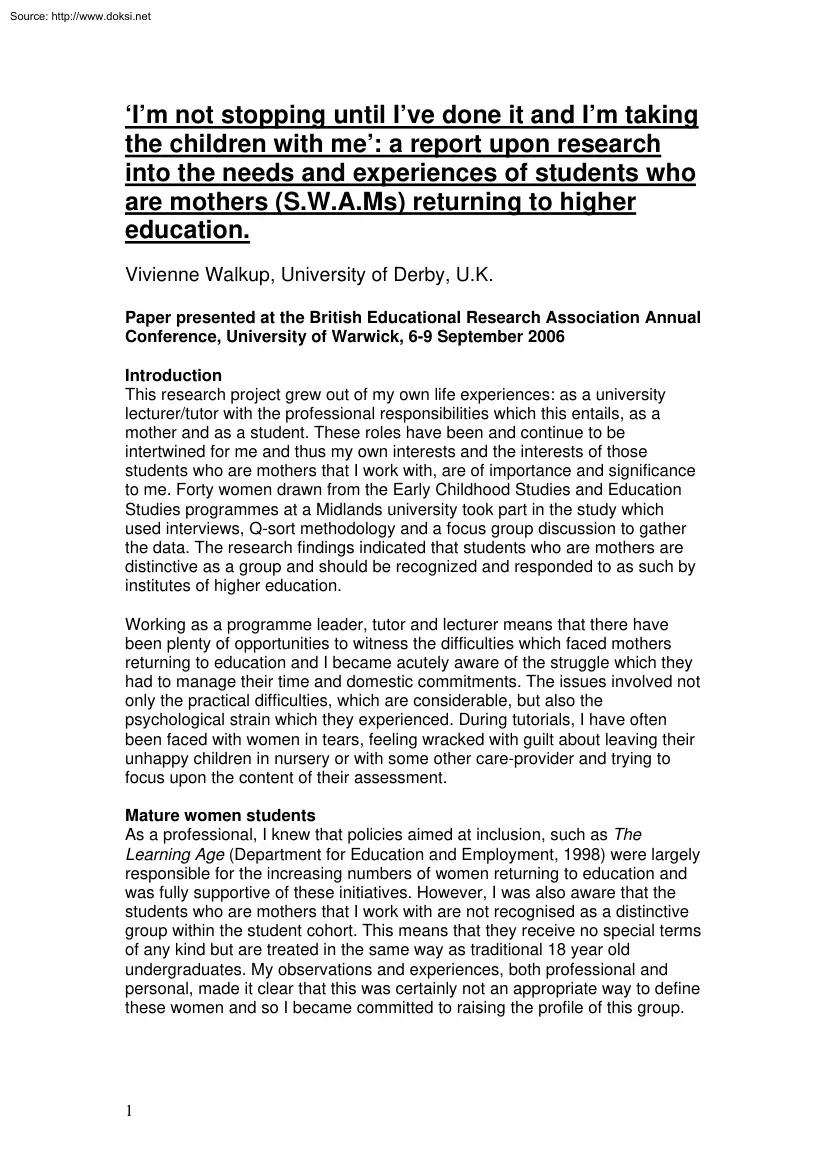
Source: http://www.doksinet ‘I’m not stopping until I’ve done it and I’m taking the children with me’: a report upon research into the needs and experiences of students who are mothers (S.WAMs) returning to higher education. Vivienne Walkup, University of Derby, U.K Paper presented at the British Educational Research Association Annual Conference, University of Warwick, 6-9 September 2006 Introduction This research project grew out of my own life experiences: as a university lecturer/tutor with the professional responsibilities which this entails, as a mother and as a student. These roles have been and continue to be intertwined for me and thus my own interests and the interests of those students who are mothers that I work with, are of importance and significance to me. Forty women drawn from the Early Childhood Studies and Education Studies programmes at a Midlands university took part in the study which used interviews, Q-sort methodology and a focus group discussion to
gather the data. The research findings indicated that students who are mothers are distinctive as a group and should be recognized and responded to as such by institutes of higher education. Working as a programme leader, tutor and lecturer means that there have been plenty of opportunities to witness the difficulties which faced mothers returning to education and I became acutely aware of the struggle which they had to manage their time and domestic commitments. The issues involved not only the practical difficulties, which are considerable, but also the psychological strain which they experienced. During tutorials, I have often been faced with women in tears, feeling wracked with guilt about leaving their unhappy children in nursery or with some other care-provider and trying to focus upon the content of their assessment. Mature women students As a professional, I knew that policies aimed at inclusion, such as The Learning Age (Department for Education and Employment, 1998) were
largely responsible for the increasing numbers of women returning to education and was fully supportive of these initiatives. However, I was also aware that the students who are mothers that I work with are not recognised as a distinctive group within the student cohort. This means that they receive no special terms of any kind but are treated in the same way as traditional 18 year old undergraduates. My observations and experiences, both professional and personal, made it clear that this was certainly not an appropriate way to define these women and so I became committed to raising the profile of this group. 1 Source: http://www.doksinet Women returning to higher education currently constitute 63.5% of first year undergraduates (Higher Education Statistics Agency 2002/3) over the age of twenty-one and therefore represent a significant proportion of higher education students. A significant, although currently unquantifiable number (because they are not recognised as a distinctive
group) of these women have children and the primary responsibility for their children’s welfare as well as for domestic management (Green Lister, 2003). It follows that their positioning as students is an additional rather than central role for them, bringing challenges and demands which are particular to this group (Edwards, 1993). They are, for example, likely to be limited in terms of their availability because of the demands of the family and household (Fryer, 1997) which will probably result in added pressure both in terms of managing their study and the home. As Edwards put it they have to balance the demands of these two different ‘greedy institutions’ (Edwards, 1993, p.62) Further, they are subject to the general pressures of being a non-traditional student which include financial responsibilities (Bowl, 2001) and lack of confidence in their academic ability as compared with traditional entry students (Murphy and Roopchand, 2003). Moreover, mothers in general are subject
to ideological expectations about the nature of mothering as ‘selfless’ (Ireland, 1993; Sharpe, 1994; Hays, 1996) and these are likely to be in conflict with institutional demands, such as attendance requirements and assignment deadlines for those mothers who are students. Consequently, those mothers who are responding to initiatives to encourage women to return to education and who are representative of enlightened views about the role of mothers because they have aspirations to study and develop themselves which differ from traditional norms (Parr, 2001) are nevertheless subject to additional stresses and pressures which are not acknowledged by institutes of higher education. Thus, it is argued, the predicament of SWAMs is essentially different both from students who have entered higher education in the traditional way (i.e at eighteen, having taken higher qualifications such as A levels) and other mature students without children who have returned to education as a result of
changes in their life patterns or ambitions, whether these are women or men. It is important, then, that they are understood as ‘whole’ human beings with lives and responsibilities already in place rather than simply constructed as ‘students’ who are fixed upon their academic experiences. Reporting of Findings The methodology of the study was in three phases: • Phase 1: Interviews • Phase 2: Q-sort • Phase 3: Focus group. The aim was to provide a platform which would allow the voices of this group to be heard and formerly recognized. Data gathered from interviews with six Year 1 SWAMs was used to construct a Q-sort (consisting of forty statements). Participants (twenty Year 1 and ten Year 3 SWAMs) ranked these in terms of ‘most like me’ to ‘least like me’ using a pre-constructed response sheet. The statements were coded by the researcher to represent emergent themes and facilitate analysis. 2 Source: http://www.doksinet ‘Good mother’ (GM): relating to
ideologies of selfless or ‘good’ mothering; ‘Primary caregivers and domestic managers’ (PCDM): issues related to women’s major responsibility for child care and the home; ‘Time poverty’ (TP): shortage of available time to carry out their many tasks; ‘Self statements’ (SS): concerned with the personal development and experiences of the SWAMs, outside of their children and homes; Ambiguous’ (A) was used for those statements which are not clearly based in the other categories. The most significant results are presented below: (Fig. 1) Table to show Year 1 and Year 3 “most like me” statements Year 1 Year 3 Statement Number Percentage 1.Time I think 11 55% is the big factor Statement 1. Time I think is the big factor Number Percentage 5 50% 14. I picked my modules to fit in with child- care 8 40% 2. So it’s a bit difficult. We manage to get through it. 4 40% 34. It is hard work, managing everything. 6 30% 40% 17. I think it’s helpful (having
children of my own) because you can see some of the 5 25% 6. I see that 4 I’m doing it for my child’s benefit as well as mine. 30. I find it 4 very stimulating – I have to manage my time, work to the clock. 3 40% Source: http://www.doksinet things you’ve been told about. You know you can say to yourself, ‘I remember that stage’ or whatever. 38. You do get tired that’s the main problem – like at the end of the day, you’re just worn out. 5 25% 5. I see it all as being positive. 3 30% Over 75 % of the Year 1 ‘like me’ responses are bound up with mothering concerns (as defined by ‘good mother’, ‘primary caregiver and domestic manager’ and ‘time poverty’ categories) compared with 13% related to selfdevelopment and actualisation with the remainder taken up in ‘ambiguous’ statements. Consequently, it emerges that this group of mothers in higher education is preoccupied with the needs of their children and homes and strongly influenced by
ideological expectations about the role of mother. They clearly struggle to reconcile the competing physical and psychological demands placed upon them within the available time but seem to accept these as being inevitable. Similar findings appear in the third year Q-sort, in terms of ‘time poverty’ and concerns about management and being a ‘good mother’. However, there are differences related to the inclusion of ‘self statements’ as most representative of their views. This suggests that the SWAMs have become more concerned with their own interests and development over the course of their three years in higher education. These findings must be treated with caution, however, in the light of the cross-sectional sample used because these differences could be related to individual differences in the students themselves. A focus group (consisting of a further six Year 3 SWAMs) was held to discuss these findings. A summary of the main points to emerge form this are listed below:
4 • tiredness and the difficulties of ‘fitting everything in’; • frustration with the limits of time available in terms of affecting their achievements; Source: http://www.doksinet • guilt about spending less time with their children; • the importance of peer support; • ways in which they have changed over the three years at university including a sense of achievement and emergent identity; • the dissatisfactions and difficulties of university life specific to students who are also mothers and • motivation for returning to education and continuing to study. Discussion of findings The findings from the two Q-sorts suggest that there are some key areas which are central to the experiences of these SWAM throughout their time at university. These include focus upon issues such as lack of time to carry out their multifarious functions as students, mothers, sometimes wives or partners and domestic responsibilities which means a prevailing sense of ‘time
poverty’ as well as concerns around being a ‘good’ mother. However, there are signs of some changes between first and third years students related to their selection of more ‘self’ focussed issues which may indicate that they have changed in the light of or as part of the process of Higher Education. These findings are interesting as they suggest that personal change is involved for this group of SWAMs, which results in a shift in their social construction of themselves, as they progress their studies. This seems to be achieved against overwhelming odds as they struggle and juggle with the competing demands. However, the necessity for participants to respond within the fixed categories imposed by Q-sort, even though these were gathered from the ‘mothers’ own voices’ (Arendell, 2000, p.1202) meant that statements were sometimes ranked into categories which did not truly represent the views of the women. Comments made by participants to the researcher, as the sorts were
carried out, confirmed this and led to the decision to include a focus group discussion. to provide a platform for further discussions and reflections. It emerged that the SWAMs in the focus group also felt the tensions identified by McNab & Kavner (2001) as they struggled with tiredness and the competing demands and expectations of home, children and study/work. (NB: Pseudonyms are used throughout.) Diane (a mother of three school-age children) comments: tired is the main thing for me. You go home after a full day here and you take on the role of mum and housekeeper and then you’ve got to start again and I find that very hard to get motivated again. A lot of the time I just don’t do it because I’m too tired. (Lines 5-9) And Cheryl (a mother of two school-age children) adds: 5 Source: http://www.doksinet I could do so much better but I haven’t got enough time to do it that much better. (Line 19) It can be seen from these (and many other similar comments) that there is a
feeling of frustration at the impossibility of fitting everything in and resentment about the effects this has upon their achievements voiced here as the women reflect upon their lives which emerges here. There was also evidence of feelings of guilt (Hays, 1996), clearly related to dominant discourses of idealized motherhood (Woodward, 1997). Frances (lone parent with two young children) presents this emotional account: I have to leave my daughter as well and my son and they’re cryingand saying, ‘Don’t leave me’ and being dragged off me. I’ll carry that round with me for a long time. (Lines 206-211 and other group members voiced similar feelings. Clearly, their experiences as students in higher education need to be understood in terms of these feelings which are central to their lives and a source of ongoing stress. The focus group also raised the issue of the importance of peer support, commenting that this had been of considerable value. Frances comments: I think the major
thing is the support you get from other students with children. I mean there’s times I’ve come here [the university] and I’ve been upset. I’ve thought I can’t manage this but I’ve sat down and talked to Ellie and she’s smiled and said, ‘Of course you can do it’ and she’s got seven. So the support that I’ve had from everybody else has been a major thing. You value what people give. All you have to is sit in a room and chat about it and you feel better; I know I do. You know a ten minute conversation really helps (Lines 524-530) Comments such as these suggest that peer support is particularly necessary for mature students with children perhaps because their experiences are particularly stressful and alienating. However, although mothers learnt to support each other and managed as best they could, there was a feeling that they were doing this against the odds and that their achievements had been constrained by their domestic commitments. Moreover, the university had
at times made their experiences more problematic by imposing blanket regulations (such as limited parking and incompatible times of lectures). The presentation of the top five ‘most like me’ third year statements stimulated a reflective discussion about the way that they had changed over the three years at university. Frances observes that she feels she has now ‘become part of the institution’ (line 265) whereas it was such a ‘big thing’ (line 264) in the first year when she returned to education after over thirty years. Cheryl comments that, I feel like my brain’s going to burst’ (line 290) and Barbara adds that she 6 Source: http://www.doksinet has become ‘much more critical’ line 293 and has become ‘intrigued’ about learning (Line 294). Frances recognizes her own changed reactions and increased self-esteem: I used to feel a bit intimidated by people such as teachers, at Open Evenings and things like that but I don’t feel like that anymore. (Lines
309310) As well as changes in self-esteem, there are changes in the ways they feel as mothers. Frances commented: I feel less guilty now but I don’t know whether it’s because the children are older or I’ve just got used to it. (Lines 440-441) Barbara agrees with this idea of growing used to the changes and the effects this has upon feelings of guilt towards the children with Diane adding: It’s like childbirth. Come 24th May [when they finish] and it’s over, you’ll forget all about it. (Line 334) There are interesting insights here into their experiences. Diane’s comment (which raised a laugh) however, brings the discussion of their experiences as students back to the theme or discourse of motherhood reinforcing connections between the two processes of self -development and mothering. It also suggests that whilst this has been a sometimes difficult and painful experience, but also productive and creative one which is essentially personal and rewarding. The group moves on
at this point to discuss some of the negatives or dissatisfactions they have experienced as SWAMs. This is again a new strand to the discussion and one which has emerged solely from this Focus Group meeting. Cheryl complains that: There are things about the situation. You know most of it has been positive but in the three years I have got really angry about some things. I mean to do with the University’s attitude – like about parking and access to the library, access to the language centre which is only open in the day and if I can’t get in I can’t use it and get access to the books I need. Things like that from an older person’s perspective that the University doesn’t seem to give a toss about. (Lines 336-342) and Frances expresses the pressure placed upon her by recent student parking restrictions: I remember when the letter came about it (about the parking permit) I was more nervous than when my results came. I thought this is ridiculous; I’d rather have a permit for
parking than a degree at the minute. (Lines 349356) 7 Source: http://www.doksinet Cheryl reports: It’s attitudes that we get lumped by the university as ‘the students’ but I feel personally, as a mother, as a woman, as a mature person, I don’t fall into the ‘young students’ category. I don’t feel that I belong anywhere here because of that (Lines 390-392) There is recognition of this theme of feeling excluded as a mature student by the rest of the group. It is taken up and explored by some of the others The difficulties and frustrations of working with younger students emerges as Frances comments: You think, look I’ve busted a gut to get this work done for us to work as a group and that’s the time I think, why am I bothering then? I’m carrying you now and I’ve got two children at home; I don’t want to carry anyone else. (Lines 421-425) She adds: My (young student) friends call me ‘Mum’ now. They go, ‘Oh look, Mum’s not happy. Look at her face’
(Lines 429-430) Here then the focus group are recognizing and articulating the ways in which they have felt excluded and disadvantaged as SWAMs while studying at university. There was a considerable amount of anger evident in the way in which some of the points were expressed, indicative of the depth of their feelings and frustrations. The fifth ranked ‘least like me’ statement ‘I planned for a few years to come back into education when the kids went to school’ stimulated discussion about their motivation for returning to higher education. (Fig.2) Table to show Year 1 and Year 3 “least like me” statements Year 1 Year 3 Number Percentage Number Percentage Statement Statement 18. I always wanted to teach when I was younger but I didn’t stay on to the sixth form or anything but I’ve come back to it now. 9 45% 4. I feel very 4 guilty at the moment 40% 9. It all links in with the holidays. 7 35% 18. I always 4 wanted to teach when I was 40% 8 Source:
http://www.doksinet younger but I didn’t stay on to the sixth form or anything but I’ve come back to it now. 19. They like 7 going to the After-school club and the child minder’s they think it’s great. I think I’d feel guilty if they didn’t. 35% 8. So it all links 3 in. This was why I decided to do something to do with children. 30% 32. I need to get 7 an identity – not just someone’s mother and that’s exciting. 35% 9. It all links in 3 with the holidays. 30% 27. My choice 6 of doing child care came only after I was a mother. 30% 11. I planned for 3 a few years to come back into education when the kids went to school. 30% 28. I think if I 6 went full time it would be too much on my children. 30% 30% 11. I planned 5 for a few years to come back into education when the kids went to school. 25% 19. They like 3 going to the After-school club and the child minder’s they think it’s great. I think I’d feel guilty if they didn’t. 21. I think from a 3
21. I think from 5 a younger age I’ve always been told that 25% 9 younger age I’ve always been told that I’m not very good academically. 30% Source: http://www.doksinet I’m not very good academically. Diane comments: I was fed up with dead-end jobs and I thought I’m going to get some education. (Line 491) Frances returns here to elaborate upon the life events which were part of her decision to return to education: Well I was given the choice; it was my marriage or university. I chose university. If you look at me as a person I’m completely different I think look at me, look at him. He hasn’t changed but I have (Lines 498-500) Cheryl adds: I used to think of myself as not being a very strong person but now I look back and think, my God I had a lot of balls to do that. (Lines 511512) And Frances continues: I said that the other day. I think I’m hard now but I’ll stick up for myself, I’ll fight because I know what I can do whereas before I’d been walked over
for years and put up with it but now I won’t be defeated by anybody ever again. I think with the PGCE (post graduate certificate of education) I’m going into that with confidence. I’ve been in this direction for four years now and I’m not stopping until I’ve done it and I’m taking the children with me. (Lines 513-519) Frances’s comments here are strongly indicative of the kind of determination and positive energy which she now feels as a result of her successful engagement with higher education. She recognizes her own power here, as a woman, a student and a mother. Whilst still seeing the children as important she is now putting herself first and seeing her life as significant in its own right. So here are accounts of the differing motivations, some of them at high emotional costs which are part of life for these women returners to higher education. They provide insights which are critical parts of the stories which unfold as they interact and share with each other
Although the recording stopped soon after this point there were many informal comments from the group. They had enjoyed taking part in the discussion and several of them thanked the researcher for allowing them to take part, 10 Source: http://www.doksinet indicating that they had welcomed this novel opportunity to publicly air their views. Conclusion The study indicates that students who are mothers are indeed a distinctive group within higher education who have additional needs in terms of institutional support. This needs to be acknowledged both at local and national levels if ‘inclusion’ is going to be a reality rather than a fictive construct. Whilst acknowledging that this is a small-scale study, located within one Midlands university, the results produced by this sample may well be indicative of wider trends in the experiences of students who are mothers in higher education. References Arendell T (2000) Conceiving and Investigating Motherhood. Journal of Marriage and the
Family, Vol.62, pp1192-1207 Arksey H, Marchant I and Simmill C (Eds) (1994) Juggling for a Degree, pp.17-22, Lancaster: Innovation in Higher Education, Lancaster University Bowl M (2001) Experiencing the Barriers: non-traditional students entering higher education. Research Papers in Education, Vol16, No2, pp 141-160 Department for Education and Employment (DfEE) (1998) The Learning Age: a renaissance for new Britain. London: Stationery Office Edwards R (1993a) Mature Women Students. Separating or Connecting Family and Education. London: Taylor and Francis Fryer R (Chairperson) (1997) Learning for the Twenty-First Century. First report of the National Advisory Group for Continuing Education and Lifelong Learning (NAGCELL) (Viewed 10/08/04 at http://www.lifelonglearningcouk/nagcell/indexhtm) Green Lister P (2003) ‘It’s Like You Can’t be a Whole Person, a Mother who Studies’. Lifelong learning: Mature women students with caring commitments in social work education. Social Work
Education, Vol 22, No2, pp125-138 Hays S (1996) The Cultural Contradictions of Motherhood. London: Yale University Press Higher Education Statistics Agency (HESA) (2002/3) On-line Information Service, Student Tables 2003/4. Cheltenham: Higher Education Statistical Agency. (Viewed 20/05/04 at http://www.hesaacuk/holisdocs/pubinfo/studhtm) Hays S (1996) The Cultural Contradictions of Motherhood. London: Yale University Press 11 Source: http://www.doksinet Ireland M (1993) Reconceiving Women: Separating motherhood from female identity. New York: Guilford Press King E (1998) Entering Higher Education: Older students’ constructions of self as learners. In Radford J, 1998, Gender and Choice in Education and Occupation. London: Routledge McNab S & Kavner E (2001) When it All Goes Wrong-challenge to mother blame. Journal of Family Therapy, Vol 23, pp189-207 Murphy H & Roopchand N (2003) Intrinsic Motivation and Self-esteem in Traditional and Mature Students at a Post-1992
University in the North-east of England. Educational Studies, Vol 29, No2/3 pp243-259 Parr J (2001) Education: What’s in it for Mature Women? In Anderson, P. & Williams, J. (Eds), 2001, Identity and Difference in Higher Education ‘Outsiders Within’, pp.55-66 Aldershot: Ashgate Pascall G & Cox R (1993) Women Returning to Higher Education. Buckingham: Society for Research into Higher Education/Open University Press. Radford J (1998) Gender and Choice in Education and Occupation. London: Routledge Sharpe S (1994) ‘Just Like a Girl’: How girls learn to be women – from the seventies to the nineties. London: Penguin Simmill C (1994) On Being a Mature Student with Children. In Arksey H, Marchant I and Simmill C (Eds), 1994, Juggling for a Degree, pp.17-22, Lancaster: Innovation in Higher Education, Lancaster University. Woodward K (Ed) (1997) Identity and Difference. London: Sage 12
gather the data. The research findings indicated that students who are mothers are distinctive as a group and should be recognized and responded to as such by institutes of higher education. Working as a programme leader, tutor and lecturer means that there have been plenty of opportunities to witness the difficulties which faced mothers returning to education and I became acutely aware of the struggle which they had to manage their time and domestic commitments. The issues involved not only the practical difficulties, which are considerable, but also the psychological strain which they experienced. During tutorials, I have often been faced with women in tears, feeling wracked with guilt about leaving their unhappy children in nursery or with some other care-provider and trying to focus upon the content of their assessment. Mature women students As a professional, I knew that policies aimed at inclusion, such as The Learning Age (Department for Education and Employment, 1998) were
largely responsible for the increasing numbers of women returning to education and was fully supportive of these initiatives. However, I was also aware that the students who are mothers that I work with are not recognised as a distinctive group within the student cohort. This means that they receive no special terms of any kind but are treated in the same way as traditional 18 year old undergraduates. My observations and experiences, both professional and personal, made it clear that this was certainly not an appropriate way to define these women and so I became committed to raising the profile of this group. 1 Source: http://www.doksinet Women returning to higher education currently constitute 63.5% of first year undergraduates (Higher Education Statistics Agency 2002/3) over the age of twenty-one and therefore represent a significant proportion of higher education students. A significant, although currently unquantifiable number (because they are not recognised as a distinctive
group) of these women have children and the primary responsibility for their children’s welfare as well as for domestic management (Green Lister, 2003). It follows that their positioning as students is an additional rather than central role for them, bringing challenges and demands which are particular to this group (Edwards, 1993). They are, for example, likely to be limited in terms of their availability because of the demands of the family and household (Fryer, 1997) which will probably result in added pressure both in terms of managing their study and the home. As Edwards put it they have to balance the demands of these two different ‘greedy institutions’ (Edwards, 1993, p.62) Further, they are subject to the general pressures of being a non-traditional student which include financial responsibilities (Bowl, 2001) and lack of confidence in their academic ability as compared with traditional entry students (Murphy and Roopchand, 2003). Moreover, mothers in general are subject
to ideological expectations about the nature of mothering as ‘selfless’ (Ireland, 1993; Sharpe, 1994; Hays, 1996) and these are likely to be in conflict with institutional demands, such as attendance requirements and assignment deadlines for those mothers who are students. Consequently, those mothers who are responding to initiatives to encourage women to return to education and who are representative of enlightened views about the role of mothers because they have aspirations to study and develop themselves which differ from traditional norms (Parr, 2001) are nevertheless subject to additional stresses and pressures which are not acknowledged by institutes of higher education. Thus, it is argued, the predicament of SWAMs is essentially different both from students who have entered higher education in the traditional way (i.e at eighteen, having taken higher qualifications such as A levels) and other mature students without children who have returned to education as a result of
changes in their life patterns or ambitions, whether these are women or men. It is important, then, that they are understood as ‘whole’ human beings with lives and responsibilities already in place rather than simply constructed as ‘students’ who are fixed upon their academic experiences. Reporting of Findings The methodology of the study was in three phases: • Phase 1: Interviews • Phase 2: Q-sort • Phase 3: Focus group. The aim was to provide a platform which would allow the voices of this group to be heard and formerly recognized. Data gathered from interviews with six Year 1 SWAMs was used to construct a Q-sort (consisting of forty statements). Participants (twenty Year 1 and ten Year 3 SWAMs) ranked these in terms of ‘most like me’ to ‘least like me’ using a pre-constructed response sheet. The statements were coded by the researcher to represent emergent themes and facilitate analysis. 2 Source: http://www.doksinet ‘Good mother’ (GM): relating to
ideologies of selfless or ‘good’ mothering; ‘Primary caregivers and domestic managers’ (PCDM): issues related to women’s major responsibility for child care and the home; ‘Time poverty’ (TP): shortage of available time to carry out their many tasks; ‘Self statements’ (SS): concerned with the personal development and experiences of the SWAMs, outside of their children and homes; Ambiguous’ (A) was used for those statements which are not clearly based in the other categories. The most significant results are presented below: (Fig. 1) Table to show Year 1 and Year 3 “most like me” statements Year 1 Year 3 Statement Number Percentage 1.Time I think 11 55% is the big factor Statement 1. Time I think is the big factor Number Percentage 5 50% 14. I picked my modules to fit in with child- care 8 40% 2. So it’s a bit difficult. We manage to get through it. 4 40% 34. It is hard work, managing everything. 6 30% 40% 17. I think it’s helpful (having
children of my own) because you can see some of the 5 25% 6. I see that 4 I’m doing it for my child’s benefit as well as mine. 30. I find it 4 very stimulating – I have to manage my time, work to the clock. 3 40% Source: http://www.doksinet things you’ve been told about. You know you can say to yourself, ‘I remember that stage’ or whatever. 38. You do get tired that’s the main problem – like at the end of the day, you’re just worn out. 5 25% 5. I see it all as being positive. 3 30% Over 75 % of the Year 1 ‘like me’ responses are bound up with mothering concerns (as defined by ‘good mother’, ‘primary caregiver and domestic manager’ and ‘time poverty’ categories) compared with 13% related to selfdevelopment and actualisation with the remainder taken up in ‘ambiguous’ statements. Consequently, it emerges that this group of mothers in higher education is preoccupied with the needs of their children and homes and strongly influenced by
ideological expectations about the role of mother. They clearly struggle to reconcile the competing physical and psychological demands placed upon them within the available time but seem to accept these as being inevitable. Similar findings appear in the third year Q-sort, in terms of ‘time poverty’ and concerns about management and being a ‘good mother’. However, there are differences related to the inclusion of ‘self statements’ as most representative of their views. This suggests that the SWAMs have become more concerned with their own interests and development over the course of their three years in higher education. These findings must be treated with caution, however, in the light of the cross-sectional sample used because these differences could be related to individual differences in the students themselves. A focus group (consisting of a further six Year 3 SWAMs) was held to discuss these findings. A summary of the main points to emerge form this are listed below:
4 • tiredness and the difficulties of ‘fitting everything in’; • frustration with the limits of time available in terms of affecting their achievements; Source: http://www.doksinet • guilt about spending less time with their children; • the importance of peer support; • ways in which they have changed over the three years at university including a sense of achievement and emergent identity; • the dissatisfactions and difficulties of university life specific to students who are also mothers and • motivation for returning to education and continuing to study. Discussion of findings The findings from the two Q-sorts suggest that there are some key areas which are central to the experiences of these SWAM throughout their time at university. These include focus upon issues such as lack of time to carry out their multifarious functions as students, mothers, sometimes wives or partners and domestic responsibilities which means a prevailing sense of ‘time
poverty’ as well as concerns around being a ‘good’ mother. However, there are signs of some changes between first and third years students related to their selection of more ‘self’ focussed issues which may indicate that they have changed in the light of or as part of the process of Higher Education. These findings are interesting as they suggest that personal change is involved for this group of SWAMs, which results in a shift in their social construction of themselves, as they progress their studies. This seems to be achieved against overwhelming odds as they struggle and juggle with the competing demands. However, the necessity for participants to respond within the fixed categories imposed by Q-sort, even though these were gathered from the ‘mothers’ own voices’ (Arendell, 2000, p.1202) meant that statements were sometimes ranked into categories which did not truly represent the views of the women. Comments made by participants to the researcher, as the sorts were
carried out, confirmed this and led to the decision to include a focus group discussion. to provide a platform for further discussions and reflections. It emerged that the SWAMs in the focus group also felt the tensions identified by McNab & Kavner (2001) as they struggled with tiredness and the competing demands and expectations of home, children and study/work. (NB: Pseudonyms are used throughout.) Diane (a mother of three school-age children) comments: tired is the main thing for me. You go home after a full day here and you take on the role of mum and housekeeper and then you’ve got to start again and I find that very hard to get motivated again. A lot of the time I just don’t do it because I’m too tired. (Lines 5-9) And Cheryl (a mother of two school-age children) adds: 5 Source: http://www.doksinet I could do so much better but I haven’t got enough time to do it that much better. (Line 19) It can be seen from these (and many other similar comments) that there is a
feeling of frustration at the impossibility of fitting everything in and resentment about the effects this has upon their achievements voiced here as the women reflect upon their lives which emerges here. There was also evidence of feelings of guilt (Hays, 1996), clearly related to dominant discourses of idealized motherhood (Woodward, 1997). Frances (lone parent with two young children) presents this emotional account: I have to leave my daughter as well and my son and they’re cryingand saying, ‘Don’t leave me’ and being dragged off me. I’ll carry that round with me for a long time. (Lines 206-211 and other group members voiced similar feelings. Clearly, their experiences as students in higher education need to be understood in terms of these feelings which are central to their lives and a source of ongoing stress. The focus group also raised the issue of the importance of peer support, commenting that this had been of considerable value. Frances comments: I think the major
thing is the support you get from other students with children. I mean there’s times I’ve come here [the university] and I’ve been upset. I’ve thought I can’t manage this but I’ve sat down and talked to Ellie and she’s smiled and said, ‘Of course you can do it’ and she’s got seven. So the support that I’ve had from everybody else has been a major thing. You value what people give. All you have to is sit in a room and chat about it and you feel better; I know I do. You know a ten minute conversation really helps (Lines 524-530) Comments such as these suggest that peer support is particularly necessary for mature students with children perhaps because their experiences are particularly stressful and alienating. However, although mothers learnt to support each other and managed as best they could, there was a feeling that they were doing this against the odds and that their achievements had been constrained by their domestic commitments. Moreover, the university had
at times made their experiences more problematic by imposing blanket regulations (such as limited parking and incompatible times of lectures). The presentation of the top five ‘most like me’ third year statements stimulated a reflective discussion about the way that they had changed over the three years at university. Frances observes that she feels she has now ‘become part of the institution’ (line 265) whereas it was such a ‘big thing’ (line 264) in the first year when she returned to education after over thirty years. Cheryl comments that, I feel like my brain’s going to burst’ (line 290) and Barbara adds that she 6 Source: http://www.doksinet has become ‘much more critical’ line 293 and has become ‘intrigued’ about learning (Line 294). Frances recognizes her own changed reactions and increased self-esteem: I used to feel a bit intimidated by people such as teachers, at Open Evenings and things like that but I don’t feel like that anymore. (Lines
309310) As well as changes in self-esteem, there are changes in the ways they feel as mothers. Frances commented: I feel less guilty now but I don’t know whether it’s because the children are older or I’ve just got used to it. (Lines 440-441) Barbara agrees with this idea of growing used to the changes and the effects this has upon feelings of guilt towards the children with Diane adding: It’s like childbirth. Come 24th May [when they finish] and it’s over, you’ll forget all about it. (Line 334) There are interesting insights here into their experiences. Diane’s comment (which raised a laugh) however, brings the discussion of their experiences as students back to the theme or discourse of motherhood reinforcing connections between the two processes of self -development and mothering. It also suggests that whilst this has been a sometimes difficult and painful experience, but also productive and creative one which is essentially personal and rewarding. The group moves on
at this point to discuss some of the negatives or dissatisfactions they have experienced as SWAMs. This is again a new strand to the discussion and one which has emerged solely from this Focus Group meeting. Cheryl complains that: There are things about the situation. You know most of it has been positive but in the three years I have got really angry about some things. I mean to do with the University’s attitude – like about parking and access to the library, access to the language centre which is only open in the day and if I can’t get in I can’t use it and get access to the books I need. Things like that from an older person’s perspective that the University doesn’t seem to give a toss about. (Lines 336-342) and Frances expresses the pressure placed upon her by recent student parking restrictions: I remember when the letter came about it (about the parking permit) I was more nervous than when my results came. I thought this is ridiculous; I’d rather have a permit for
parking than a degree at the minute. (Lines 349356) 7 Source: http://www.doksinet Cheryl reports: It’s attitudes that we get lumped by the university as ‘the students’ but I feel personally, as a mother, as a woman, as a mature person, I don’t fall into the ‘young students’ category. I don’t feel that I belong anywhere here because of that (Lines 390-392) There is recognition of this theme of feeling excluded as a mature student by the rest of the group. It is taken up and explored by some of the others The difficulties and frustrations of working with younger students emerges as Frances comments: You think, look I’ve busted a gut to get this work done for us to work as a group and that’s the time I think, why am I bothering then? I’m carrying you now and I’ve got two children at home; I don’t want to carry anyone else. (Lines 421-425) She adds: My (young student) friends call me ‘Mum’ now. They go, ‘Oh look, Mum’s not happy. Look at her face’
(Lines 429-430) Here then the focus group are recognizing and articulating the ways in which they have felt excluded and disadvantaged as SWAMs while studying at university. There was a considerable amount of anger evident in the way in which some of the points were expressed, indicative of the depth of their feelings and frustrations. The fifth ranked ‘least like me’ statement ‘I planned for a few years to come back into education when the kids went to school’ stimulated discussion about their motivation for returning to higher education. (Fig.2) Table to show Year 1 and Year 3 “least like me” statements Year 1 Year 3 Number Percentage Number Percentage Statement Statement 18. I always wanted to teach when I was younger but I didn’t stay on to the sixth form or anything but I’ve come back to it now. 9 45% 4. I feel very 4 guilty at the moment 40% 9. It all links in with the holidays. 7 35% 18. I always 4 wanted to teach when I was 40% 8 Source:
http://www.doksinet younger but I didn’t stay on to the sixth form or anything but I’ve come back to it now. 19. They like 7 going to the After-school club and the child minder’s they think it’s great. I think I’d feel guilty if they didn’t. 35% 8. So it all links 3 in. This was why I decided to do something to do with children. 30% 32. I need to get 7 an identity – not just someone’s mother and that’s exciting. 35% 9. It all links in 3 with the holidays. 30% 27. My choice 6 of doing child care came only after I was a mother. 30% 11. I planned for 3 a few years to come back into education when the kids went to school. 30% 28. I think if I 6 went full time it would be too much on my children. 30% 30% 11. I planned 5 for a few years to come back into education when the kids went to school. 25% 19. They like 3 going to the After-school club and the child minder’s they think it’s great. I think I’d feel guilty if they didn’t. 21. I think from a 3
21. I think from 5 a younger age I’ve always been told that 25% 9 younger age I’ve always been told that I’m not very good academically. 30% Source: http://www.doksinet I’m not very good academically. Diane comments: I was fed up with dead-end jobs and I thought I’m going to get some education. (Line 491) Frances returns here to elaborate upon the life events which were part of her decision to return to education: Well I was given the choice; it was my marriage or university. I chose university. If you look at me as a person I’m completely different I think look at me, look at him. He hasn’t changed but I have (Lines 498-500) Cheryl adds: I used to think of myself as not being a very strong person but now I look back and think, my God I had a lot of balls to do that. (Lines 511512) And Frances continues: I said that the other day. I think I’m hard now but I’ll stick up for myself, I’ll fight because I know what I can do whereas before I’d been walked over
for years and put up with it but now I won’t be defeated by anybody ever again. I think with the PGCE (post graduate certificate of education) I’m going into that with confidence. I’ve been in this direction for four years now and I’m not stopping until I’ve done it and I’m taking the children with me. (Lines 513-519) Frances’s comments here are strongly indicative of the kind of determination and positive energy which she now feels as a result of her successful engagement with higher education. She recognizes her own power here, as a woman, a student and a mother. Whilst still seeing the children as important she is now putting herself first and seeing her life as significant in its own right. So here are accounts of the differing motivations, some of them at high emotional costs which are part of life for these women returners to higher education. They provide insights which are critical parts of the stories which unfold as they interact and share with each other
Although the recording stopped soon after this point there were many informal comments from the group. They had enjoyed taking part in the discussion and several of them thanked the researcher for allowing them to take part, 10 Source: http://www.doksinet indicating that they had welcomed this novel opportunity to publicly air their views. Conclusion The study indicates that students who are mothers are indeed a distinctive group within higher education who have additional needs in terms of institutional support. This needs to be acknowledged both at local and national levels if ‘inclusion’ is going to be a reality rather than a fictive construct. Whilst acknowledging that this is a small-scale study, located within one Midlands university, the results produced by this sample may well be indicative of wider trends in the experiences of students who are mothers in higher education. References Arendell T (2000) Conceiving and Investigating Motherhood. Journal of Marriage and the
Family, Vol.62, pp1192-1207 Arksey H, Marchant I and Simmill C (Eds) (1994) Juggling for a Degree, pp.17-22, Lancaster: Innovation in Higher Education, Lancaster University Bowl M (2001) Experiencing the Barriers: non-traditional students entering higher education. Research Papers in Education, Vol16, No2, pp 141-160 Department for Education and Employment (DfEE) (1998) The Learning Age: a renaissance for new Britain. London: Stationery Office Edwards R (1993a) Mature Women Students. Separating or Connecting Family and Education. London: Taylor and Francis Fryer R (Chairperson) (1997) Learning for the Twenty-First Century. First report of the National Advisory Group for Continuing Education and Lifelong Learning (NAGCELL) (Viewed 10/08/04 at http://www.lifelonglearningcouk/nagcell/indexhtm) Green Lister P (2003) ‘It’s Like You Can’t be a Whole Person, a Mother who Studies’. Lifelong learning: Mature women students with caring commitments in social work education. Social Work
Education, Vol 22, No2, pp125-138 Hays S (1996) The Cultural Contradictions of Motherhood. London: Yale University Press Higher Education Statistics Agency (HESA) (2002/3) On-line Information Service, Student Tables 2003/4. Cheltenham: Higher Education Statistical Agency. (Viewed 20/05/04 at http://www.hesaacuk/holisdocs/pubinfo/studhtm) Hays S (1996) The Cultural Contradictions of Motherhood. London: Yale University Press 11 Source: http://www.doksinet Ireland M (1993) Reconceiving Women: Separating motherhood from female identity. New York: Guilford Press King E (1998) Entering Higher Education: Older students’ constructions of self as learners. In Radford J, 1998, Gender and Choice in Education and Occupation. London: Routledge McNab S & Kavner E (2001) When it All Goes Wrong-challenge to mother blame. Journal of Family Therapy, Vol 23, pp189-207 Murphy H & Roopchand N (2003) Intrinsic Motivation and Self-esteem in Traditional and Mature Students at a Post-1992
University in the North-east of England. Educational Studies, Vol 29, No2/3 pp243-259 Parr J (2001) Education: What’s in it for Mature Women? In Anderson, P. & Williams, J. (Eds), 2001, Identity and Difference in Higher Education ‘Outsiders Within’, pp.55-66 Aldershot: Ashgate Pascall G & Cox R (1993) Women Returning to Higher Education. Buckingham: Society for Research into Higher Education/Open University Press. Radford J (1998) Gender and Choice in Education and Occupation. London: Routledge Sharpe S (1994) ‘Just Like a Girl’: How girls learn to be women – from the seventies to the nineties. London: Penguin Simmill C (1994) On Being a Mature Student with Children. In Arksey H, Marchant I and Simmill C (Eds), 1994, Juggling for a Degree, pp.17-22, Lancaster: Innovation in Higher Education, Lancaster University. Woodward K (Ed) (1997) Identity and Difference. London: Sage 12