Comments
 2005 · 5 page(s) (479 KB)
 English
 4
4
 November 30 · 2020
 Log in

 Embed
Embed
No comments yet. You can be the first!
What did others read after this?



Content extract
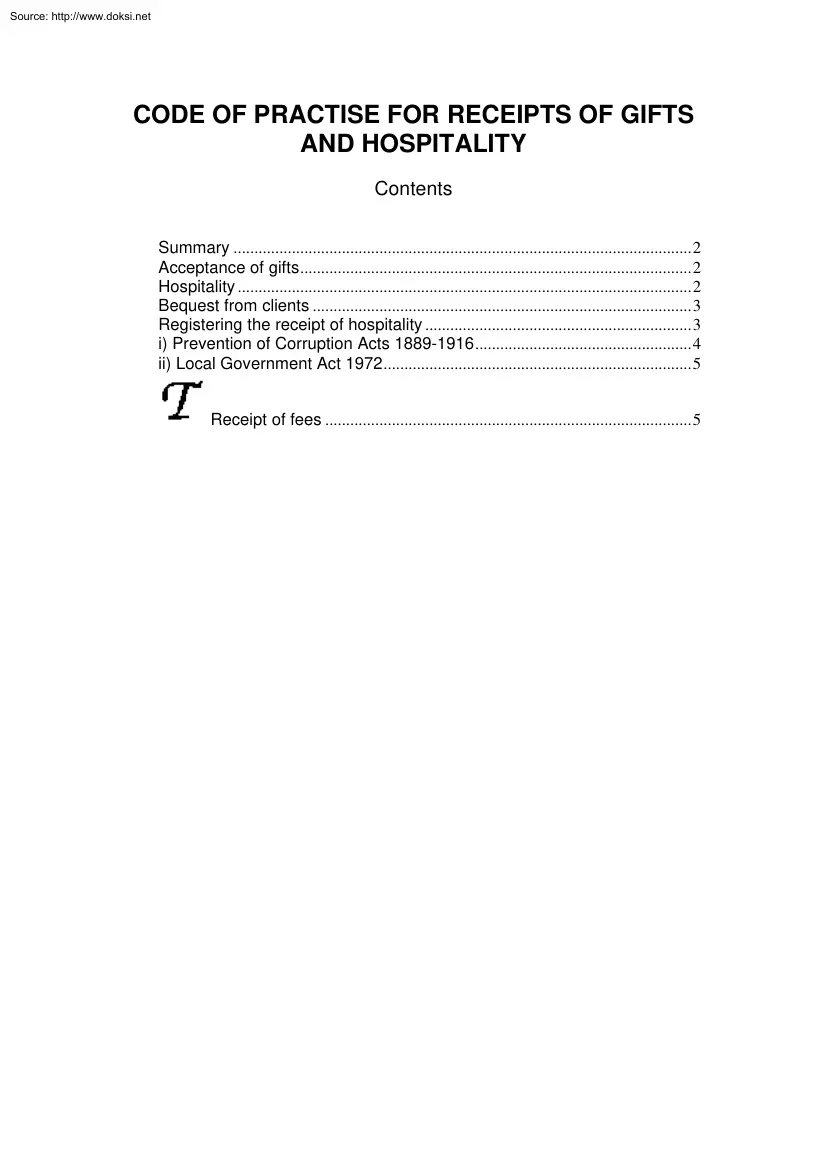
Source: http://www.doksinet CODE OF PRACTISE FOR RECEIPTS OF GIFTS AND HOSPITALITY Contents Summary . 2 Acceptance of gifts . 2 Hospitality . 2 Bequest from clients . 3 Registering the receipt of hospitality . 3 i) Prevention of Corruption Acts 1889-1916 . 4 ii) Local Government Act 1972 . 5 Receipt of fees . 5 Source: http://www.doksinet Summary The code was introduced on 1 December 1991 and applies to all employees. It is designed to prevent any improper behaviour or suspicion of improper behaviour arising and to ensure that employees are not left open to allegations of corruption. The code is part of the Employee Code of Conduct and all new employees should receive details of the code with their particulars of employment. (see section 8-E). Breaches of the code may result in disciplinary action and in serious cases could result in dismissal. Acceptance of gifts Minor gifts of token value such as promotional material, for example calendars and diaries, may be accepted. No cash
gifts or gift vouchers can be accepted. Other gifts such as a bottle or case of wine, food hampers, discretional goods and special discounts not available to other employees must not be accepted. If such a gift is delivered, it must be returned immediately to the sender giving reasons the chief officer should be advised of the gift and its return where clients persist the chief officer must notify Internal Audit for advice on further appropriate action. Employees providing personal services for example social services care staff, may encounter difficulties in refusing gifts from clients, particularly where there is a sentimental attachment and where a personal service has been carried out over a period of time. In this case, the chief officer must be notified in writing of any items received and acceptance must be approved by the chief officer. No gifts can be accepted from contractors who are submitting a tender during a tendering period (see section 8-E). Hospitality Offers of
hospitality should be treated with caution whenever any suggestion of improper influence could arise. Particular care is required when hospitality is offered by private sector companies, consultants and individuals seeking business or a decision from the Council. During a tendering period under no Source: http://www.doksinet circumstances can hospitality be accepted from or provided for contractors who are submitting a tender. Similarly employees should not use Council funds to offer hospitality to contractors, consultants or individuals unless essential to service eg serminers, conferences and then only with the prior agreement of an Executive Director or Assistant Director (Resources) on each occasion. Hospitality which has been accepted must not be extravagant, nor should it be taken from the same client on a frequent basis; for example, a lunch at £40 per person would be considered unacceptable. A register for receipt of hospitality is maintained by the directorate HR section
and, if in doubt about whether the hospitality offered can be accepted, advice should be sought from them. Bequest from clients Some employees may be left money or gifts in clients' wills in appreciation of their services. Members of the public should be discouraged from leaving such bequests. If an employee is aware of such a bequest, they should inform their chief officer in writing before acceptance, supplying the appropriate details including the client's name, the service that has been provided, the reason for and type of bequest. If concerned about the nature of the bequest, the chief officer may wish to discuss it with the employee concerned, before acceptance. Where an employee has been left money the chief officer may suggest that the bequest be left to charity in order to prevent any suspicion of improper behaviour arising. Where an employee becomes aware of the bequest only after the death of the client, then the employee must inform the chief officer, in writing,
before acceptance. Registering the receipt of hospitality The usual civilities of seasonal drink (for example at Christmas) should not be recorded in the register. However, more substantial forms of hospitality (for example a working lunch) provided either by, or for, private sector companies or consultants should be recorded. The register should be maintained by the directorate HR section, giving the following information: name of company or individual, Source: http://www.doksinet company's or individual's relationship with the Council, type of hospitality, where the hospitality took place, date hospitality given/received. Examples of unacceptable forms of hospitality are: invitations to major sporting events paid for by the client, eg Ascot/Wimbledon/FA Cup Final, Extravagant and/or frequent lunches, Theatre, concert and opera tickets. Hospitality necessarily provided within the structure of a training course, demonstration or seminar should not be recorded. Likewise,
hospitality (such as a modest working lunch) given in the course of normal business by one Council employee to a colleague should not be recorded. If in doubt about whether an offer of hospitality can be accepted, consult your chief officer as appropriate. The register for receipt of hospitality must always be open for inspection by officers, Members and Internal Audit. Any attempt at bribery must be reported immediately to the appropriate chief officer, who should advise Internal Audit. An outline of the legislation applicable to the acceptance of gifts and hospitality by Council employees is given overleaf. i) Prevention of Corruption Acts 1889-1916 Under the Prevention of Corruption Acts 1889-1916 it is an offence for any employee to solicit or accept any gift, loan, fee, reward or advantage for allowing themselves to be influenced in any way in their official capacity. Where an employee has been proved to have received any money, gift or other consideration from a person holding
or seeking to hold a contract with the Council, corruption may be presumed unless the contrary is proved. Therefore, if an employee is accused of this offence, the burden of proof rests with them personally to show that they did not favour or disfavour any person or organisation concerned with the contract. Any breach of these Acts may lead to disciplinary action under the Council's Disciplinary Code and to prosecution. On conviction an offender is liable to pay a fine, face imprisonment or both, and forfeit their superannuation benefits. Source: http://www.doksinet ii) Local Government Act 1972 It is a criminal offence under Sub-section 2 of Section 117 for Council employees to accept any fee or reward other than their remuneration. An offender is liable on conviction to pay a fine. It should be noted that under Annex 1 (Code of Practice for Contractors and Suppliers) to Standing Order 83 specific reference is made to this legislation. Personnel Committee, 21 November 1991.
Receipt of fees Any fees received by teachers, either as a witness or in any official capacity shall be paid to the Council unless permission is given by the Council for these to be retained
gifts or gift vouchers can be accepted. Other gifts such as a bottle or case of wine, food hampers, discretional goods and special discounts not available to other employees must not be accepted. If such a gift is delivered, it must be returned immediately to the sender giving reasons the chief officer should be advised of the gift and its return where clients persist the chief officer must notify Internal Audit for advice on further appropriate action. Employees providing personal services for example social services care staff, may encounter difficulties in refusing gifts from clients, particularly where there is a sentimental attachment and where a personal service has been carried out over a period of time. In this case, the chief officer must be notified in writing of any items received and acceptance must be approved by the chief officer. No gifts can be accepted from contractors who are submitting a tender during a tendering period (see section 8-E). Hospitality Offers of
hospitality should be treated with caution whenever any suggestion of improper influence could arise. Particular care is required when hospitality is offered by private sector companies, consultants and individuals seeking business or a decision from the Council. During a tendering period under no Source: http://www.doksinet circumstances can hospitality be accepted from or provided for contractors who are submitting a tender. Similarly employees should not use Council funds to offer hospitality to contractors, consultants or individuals unless essential to service eg serminers, conferences and then only with the prior agreement of an Executive Director or Assistant Director (Resources) on each occasion. Hospitality which has been accepted must not be extravagant, nor should it be taken from the same client on a frequent basis; for example, a lunch at £40 per person would be considered unacceptable. A register for receipt of hospitality is maintained by the directorate HR section
and, if in doubt about whether the hospitality offered can be accepted, advice should be sought from them. Bequest from clients Some employees may be left money or gifts in clients' wills in appreciation of their services. Members of the public should be discouraged from leaving such bequests. If an employee is aware of such a bequest, they should inform their chief officer in writing before acceptance, supplying the appropriate details including the client's name, the service that has been provided, the reason for and type of bequest. If concerned about the nature of the bequest, the chief officer may wish to discuss it with the employee concerned, before acceptance. Where an employee has been left money the chief officer may suggest that the bequest be left to charity in order to prevent any suspicion of improper behaviour arising. Where an employee becomes aware of the bequest only after the death of the client, then the employee must inform the chief officer, in writing,
before acceptance. Registering the receipt of hospitality The usual civilities of seasonal drink (for example at Christmas) should not be recorded in the register. However, more substantial forms of hospitality (for example a working lunch) provided either by, or for, private sector companies or consultants should be recorded. The register should be maintained by the directorate HR section, giving the following information: name of company or individual, Source: http://www.doksinet company's or individual's relationship with the Council, type of hospitality, where the hospitality took place, date hospitality given/received. Examples of unacceptable forms of hospitality are: invitations to major sporting events paid for by the client, eg Ascot/Wimbledon/FA Cup Final, Extravagant and/or frequent lunches, Theatre, concert and opera tickets. Hospitality necessarily provided within the structure of a training course, demonstration or seminar should not be recorded. Likewise,
hospitality (such as a modest working lunch) given in the course of normal business by one Council employee to a colleague should not be recorded. If in doubt about whether an offer of hospitality can be accepted, consult your chief officer as appropriate. The register for receipt of hospitality must always be open for inspection by officers, Members and Internal Audit. Any attempt at bribery must be reported immediately to the appropriate chief officer, who should advise Internal Audit. An outline of the legislation applicable to the acceptance of gifts and hospitality by Council employees is given overleaf. i) Prevention of Corruption Acts 1889-1916 Under the Prevention of Corruption Acts 1889-1916 it is an offence for any employee to solicit or accept any gift, loan, fee, reward or advantage for allowing themselves to be influenced in any way in their official capacity. Where an employee has been proved to have received any money, gift or other consideration from a person holding
or seeking to hold a contract with the Council, corruption may be presumed unless the contrary is proved. Therefore, if an employee is accused of this offence, the burden of proof rests with them personally to show that they did not favour or disfavour any person or organisation concerned with the contract. Any breach of these Acts may lead to disciplinary action under the Council's Disciplinary Code and to prosecution. On conviction an offender is liable to pay a fine, face imprisonment or both, and forfeit their superannuation benefits. Source: http://www.doksinet ii) Local Government Act 1972 It is a criminal offence under Sub-section 2 of Section 117 for Council employees to accept any fee or reward other than their remuneration. An offender is liable on conviction to pay a fine. It should be noted that under Annex 1 (Code of Practice for Contractors and Suppliers) to Standing Order 83 specific reference is made to this legislation. Personnel Committee, 21 November 1991.
Receipt of fees Any fees received by teachers, either as a witness or in any official capacity shall be paid to the Council unless permission is given by the Council for these to be retained
 Just like you draw up a plan when you’re going to war, building a house, or even going on vacation, you need to draw up a plan for your business. This tutorial will help you to clearly see where you are and make it possible to understand where you’re going.

