Comments
 2016 · 7 page(s) (453 KB)
 English
 0
0
 May 15 · 2026
 Kirikkale University
 Log in

 Embed
Embed
No comments yet. You can be the first!
What did others read after this?


Content extract
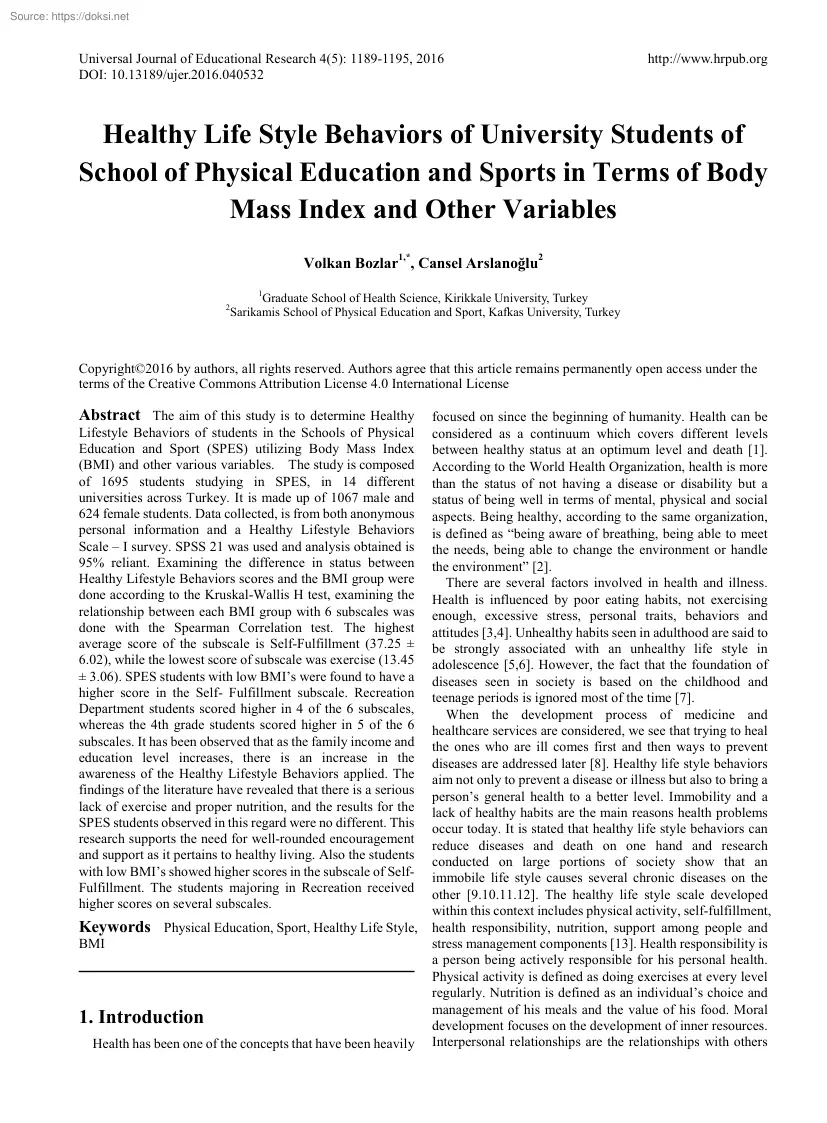
Universal Journal of Educational Research 4(5): 1189-1195, 2016 DOI: 10.13189/ujer2016040532 http://www.hrpuborg Healthy Life Style Behaviors of University Students of School of Physical Education and Sports in Terms of Body Mass Index and Other Variables Volkan Bozlar1,*, Cansel Arslanoğlu2 1 Graduate School of Health Science, Kirikkale University, Turkey Sarikamis School of Physical Education and Sport, Kafkas University, Turkey 2 Copyright2016 by authors, all rights reserved. Authors agree that this article remains permanently open access under the terms of the Creative Commons Attribution License 4.0 International License Abstract The aim of this study is to determine Healthy Lifestyle Behaviors of students in the Schools of Physical Education and Sport (SPES) utilizing Body Mass Index (BMI) and other various variables. The study is composed of 1695 students studying in SPES, in 14 different universities across Turkey. It is made up of 1067 male and 624 female students. Data
collected, is from both anonymous personal information and a Healthy Lifestyle Behaviors Scale – I survey. SPSS 21 was used and analysis obtained is 95% reliant. Examining the difference in status between Healthy Lifestyle Behaviors scores and the BMI group were done according to the Kruskal-Wallis H test, examining the relationship between each BMI group with 6 subscales was done with the Spearman Correlation test. The highest average score of the subscale is Self-Fulfillment (37.25 ± 6.02), while the lowest score of subscale was exercise (1345 ± 3.06) SPES students with low BMI’s were found to have a higher score in the Self- Fulfillment subscale. Recreation Department students scored higher in 4 of the 6 subscales, whereas the 4th grade students scored higher in 5 of the 6 subscales. It has been observed that as the family income and education level increases, there is an increase in the awareness of the Healthy Lifestyle Behaviors applied. The findings of the literature have
revealed that there is a serious lack of exercise and proper nutrition, and the results for the SPES students observed in this regard were no different. This research supports the need for well-rounded encouragement and support as it pertains to healthy living. Also the students with low BMI’s showed higher scores in the subscale of SelfFulfillment. The students majoring in Recreation received higher scores on several subscales. Keywords Physical Education, Sport, Healthy Life Style, BMI 1. Introduction Health has been one of the concepts that have been heavily focused on since the beginning of humanity. Health can be considered as a continuum which covers different levels between healthy status at an optimum level and death [1]. According to the World Health Organization, health is more than the status of not having a disease or disability but a status of being well in terms of mental, physical and social aspects. Being healthy, according to the same organization, is defined as
“being aware of breathing, being able to meet the needs, being able to change the environment or handle the environment” [2]. There are several factors involved in health and illness. Health is influenced by poor eating habits, not exercising enough, excessive stress, personal traits, behaviors and attitudes [3,4]. Unhealthy habits seen in adulthood are said to be strongly associated with an unhealthy life style in adolescence [5,6]. However, the fact that the foundation of diseases seen in society is based on the childhood and teenage periods is ignored most of the time [7]. When the development process of medicine and healthcare services are considered, we see that trying to heal the ones who are ill comes first and then ways to prevent diseases are addressed later [8]. Healthy life style behaviors aim not only to prevent a disease or illness but also to bring a person’s general health to a better level. Immobility and a lack of healthy habits are the main reasons health
problems occur today. It is stated that healthy life style behaviors can reduce diseases and death on one hand and research conducted on large portions of society show that an immobile life style causes several chronic diseases on the other [9.101112] The healthy life style scale developed within this context includes physical activity, self-fulfillment, health responsibility, nutrition, support among people and stress management components [13]. Health responsibility is a person being actively responsible for his personal health. Physical activity is defined as doing exercises at every level regularly. Nutrition is defined as an individual’s choice and management of his meals and the value of his food. Moral development focuses on the development of inner resources. Interpersonal relationships are the relationships with others 1190 Healthy Life Style Behaviors of University Students of School of Physical Education and Sports in Terms of Body Mass Index and Other Variables and
require use of communication. Stress management is to determine and activate an individual’s physiological and psychological resources to reduce and control intensity [14]. Considering the fact that the foundation of many diseases and illnesses is based on childhood and teenage period and how important this issue is, this research is anticipated to raise awareness in students of School of Physical Education and Sports (SPES), improving and contributing to the development of current behaviors related to health. When research on healthy lifestyle behaviors in Turkey is examined, it is seen that very few studies are conducted generally in university students (with the exception of nursing students). This research aims to examine healthy life style behaviors of SPES students in terms of Body-Mass Index (BMI) and other health variables. packet program and statistical analysis was carried out with a 95% reliability range. Personal information related to frequency and percentage values
related to data gathered from the personal information form are presented within the scope of the study. Normality test was conducted to determine the conformity to normal distribution and the analysis showed that the scores were not in conformity with normal distribution. Therefore, kruskal wallish and Man Whitney U tests were used. The level of significance was determined according to p<0.05 When calculating the BMI, weight (kg)/height (m) formula was used. According to BMI values, people under 18,5 were grouped as underweight, ones that are between 18,5 and 24,99 are normal weight, between 25,00 and 29,99 are overweight and over 30,0 are as obese. 2. Material and Method 3. Findings This study is a descriptive study using valid survey. The sample of this study consists of SPES students (n=1870) from 14 different universities in Turkey chosen randomly. Contributions from universities to this study are listed in a descending order; Adnan Menderes University (11,2), Kafkas
University (10,8), Ordu University (10,3), Erciyes University (9,9), Dumlupinar University (9,4), Karadeniz Technical University (8,0), Yuzuncu Yil University (7,1), Gazi University (7,0), Cukurova University (5,3), Karabuk University (4,7), Batman University (4,7), Mehmet Akif Ersoy University (4,0), Adiyaman University (3,8), Marmara University (3,8). 1695 surveys out of 1870 that are sent out to be answered are considered acceptable and organized in order to be used in the analysis. 1067 of the surveys taken into analysis were answered by male students while 624 were answered by female students. Some survey takers did not answer some of the questions in the personal information section but completed the scale. Data Gathering Tools Personal Information Form: 15 questions were asked in the personal information form related to determination of students’ socio-demographical characteristics and BMI. Healthy Life Style Behaviors Scale: Walker et al.[14], developed the healthy lifestyle
behaviors scale to test the Improving Health Model introduced by Pender in 1987 [15]. This scale measures behaviors that improve an individual’s health related to healthy lifestyle. The validity and reliability of this scale was conducted by Esin M. N in Turkey [16] and this scale was used in many studies. There are a total of 48 items and 6 sub-scales in the scale. These sub question groups are related to self-fulfillment, health responsibility, exercise, nutrition, interpersonal support and stress management. Data Analysis Data gathered by surveys were entered into the SPSS 21.0 Table 1. Socio-Demographical Information N Age BMI % 16-17 7 0,4 18-20 512 30,3 21-22 651 38,5 23-24 355 21,0 9,9 25 and older 167 Underweight 134 7,9 Normal 1372 80,9 Overweight 176 10,4 Obese 13 0,8 Gender Female 624 36,9 1067 63,1 Department Male Physical Education and Sports Teacher Sports Management 585 34,6 596 35,2 Coaching Education 367 21,7 Recreation
144 8,5 Yes 834 49,2 No 860 50,8 Are you a professional athlete? Table 2. Normality Test of Dimensions of Healthy Life Style Behavior Scale Kolmogorov-Smirnova Statistic df Sig. Shapiro-Wilk Statistic df Sig. Exercise ,087 1695 ,000 ,982 1695 ,000 Nutrition ,067 1695 ,000 ,989 1695 ,000 ,046 1695 ,000 ,993 1695 ,000 ,066 1695 ,000 ,960 1695 ,000 Self-Fulfillment ,040 1695 ,000 ,994 1695 ,000 Stress Management ,070 1695 ,000 ,966 1695 ,000 Health Responsibility Interpersonal Support Shapiro-Wilk Test that is done for the scales of exercise, nutrition, health responsibility, interpersonal support, Universal Journal of Educational Research 4(5): 1189-1195, 2016 self-fulfillment, stress management score average, showed that the data do not show a normal distribution. Therefore, non-parametric techniques were used in intergroup comparisons. N Minimum Maximum Average Table 5. Comparison of Scale Scores in Terms of Age Variable
Exercise Table 3. Dimensions of Healthy Life Style Behavior Scale 1191 ss Age n Mean Rank 16-17 7 1196,86 18-20 512 881,82 21-22 651 812,04 23-24 355 839,97 25 ≥ 167 871,73 Exercise 1695 5,00 33,00 13,45 3,06 16-17 7 720,29 Nutrition 1695 6,00 24,00 15,51 3,40 18-20 512 808,60 1695 10,00 38,00 23,57 5,56 21-22 651 828,16 1695 8,00 54,00 20,25 3,82 23-24 355 890,07 946,87 1695 15,00 52,00 37,25 6,02 Health Responsibility Interpersonal Support Self-Fulfillment Stress Management 1695 8,00 56,00 18,70 3,67 The survey takers’ average score of exercise is 13,45±3,06; average score of nutrition is 15,51±3,40; average score of health responsibility is 23,57±5,56; average score of interpersonal support is 20,25±3,82; average score of self-fulfillment 37,25±6,02 and average score of stress management is 18,70±3,67. Nutrition Health Responsibility Interpersonal Support Table 4. Comparison of Groups with Different
Body-Mass Index BMI Exercise Nutrition Health Responsibility Interpersonal Support Self-Fufilment Stress Management p< 0,05 7 751,71 18-20 512 795,57 21-22 651 842,77 23-24 355 897,09 25 ≥ 167 913,63 16-17 7 862,93 18-20 512 847,70 21-22 651 819,08 23-24 355 854,16 25 ≥ 167 932,72 16-17 7 998,21 18-20 512 842,66 21-22 651 824,15 23-24 355 843,56 25 ≥ 167 945,27 Mean Rank Underweight 134 811,70 Normal 1372 848,37 Overweight 176 870,08 Obese 13 884,31 16-17 7 724,93 Underweight 134 848,12 18-20 512 823,11 Normal 1372 836,77 21-22 651 825,75 23-24 355 882,81 25 ≥ 167 927,04 176 937,33 Obese 13 822,77 Underweight 134 929,07 Normal 1372 836,42 Overweight 176 863,86 Obese 13 1019,46 Underweight 134 880,54 Normal 1372 839,59 Overweight 176 887,00 Obese 13 872,58 Underweight 134 941,87 Normal 1372 831,10 Overweight 176 911,35 Obese 13 806,81 Underweight 134
906,98 Normal 1372 835,25 Overweight 176 894,15 Obese 13 960,81 P 167 N Overweight X2 25 ≥ 16-17 Self-Fulfillment 1,179 6,671 ,758 ,083 Stress Management X2 P 10,121 ,038 14,446 ,006 12,862 ,012 7,400 ,116 8,929 ,063 9,350 ,053 p<0,05 6,242 ,100 2,163 ,539 According to Kruskal Wallis test performed for different age groups, statistically significant difference was found in the exercise, nutrition and health responsibility scale (p<0,05). Table 6. Comparison of Scale Scores in Terms of Gender Variable Gender Exercise 9,630 5,171 ,022 ,160 Nutrition n Mean Rank female 624 779,34 male 1067 884,98 female 624 806,93 male 1067 868,85 Health Responsibility female 624 859,71 male 1067 837,98 Interpersonal Support female 624 794,12 male 1067 876,34 Self-Fulfillment Stress Management female 624 849,47 male 1067 843,97 female 624 825,10 male 1067 858,22 U P 291311,000 ,000 308526,500 ,012 324350,500
,377 300528,500 ,001 330738,500 ,823 319860,000 ,177 1192 Healthy Life Style Behaviors of University Students of School of Physical Education and Sports in Terms of Body Mass Index and Other Variables According to the comparison in terms of gender with Mann Whitney test, statistically significant difference was found in exercise, nutrition and interpersonal support scale (p<0,05). Table 7. Comparison of Scale Scores in Terms of Department Variable Department Physical Education and Sports Teaching Sports Management Exercise Coaching Education Recreation Physical Education and Sports Teaching Sports Management Nutrition Coaching Education Recreation Physical Education and Sports Teaching Health Sports Management Responsibility Coaching Education Recreation Physical Education and Sports Teaching Interpersonal Sports Management Support Coaching Education Recreation Physical Education and Sports Teaching Self-Fulfillment Sports Management Coaching Education Recreation Physical
Education and Sports Teaching Stress Sports Management Management Coaching Education Recreation n Mean Rank 585 837,31 596 367 144 826,32 4,729 ,193 893,93 846,49 585 831,35 596 367 144 836,21 8,236 ,041 844,08 956,79 585 880,81 596 367 144 815,74 8,990 ,029 817,09 909,40 585 824,92 596 367 144 848,51 9,717 ,021 831,95 962,92 585 819,62 596 367 144 857,72 6,661 ,084 837,49 932,24 585 852,74 596 367 144 831,71 9,760 ,021 816,39 959,12 X2 P Statistically significant difference was found in sub-scales of nutrition, health responsibility, interpersonal support and stress management (p<0,05). Table 8. Comparison of Groups of Professional and Amateur Athletes Are you a professional athlete? Yes Exercise No Yes Nutrition No Yes Health Responsibility No Yes Interpersonal Support No Yes Self-Fulfillment No Yes Stres Management No p<0,05 n 834 860 834 860 834 860 834 860 834 860 834 860 Mean Rank 978,34 720,62 894,11 802,30 894,36 802,05 870,90 824,80 894,92
801,52 881,06 814,96 U P 249500,00 ,000 319751,00 ,000 319537,00 ,000 339101,00 ,052 319074,00 ,000 330635,00 ,005 According to the Mann Whitney U test performed in groups of professional and amateur athletes, significant difference was found in between the groups in terms of exercise, nutrition, health responsibility, self-fulfillment and stress management sub-dimensions (p<0,05). The scores of people who are professionals, are higher than the other group in all sub-dimensions. There is no statistically significant difference in the interpersonal support scale (p>0.05) 4. Discussion This section presents the comparison and comments of our findings contributing to the related literature findings. In terms of average Healthy Life Style Behavior Scale subscale scores When the situation is evaluated, it is seen that the highest score average among the answers provided by students is self-fulfillment (37,25±6,02). This is followed by health responsibility (23,57±5,56),
interpersonal support (20,25±3,82), stress management (18,70±3,67), nutrition (15,51±3,40) and exercise (13,45±3,06) consecutively (Table 3). Similarly to our study, in most studies it is seen that self-fulfillment sub-scale takes the first place and exercise takes the last [17,18,19,20,21,22]. In a study performed in Malatya, the healthy lifestyle behavior scale score averages of physical education teachers are found higher than the results of studies performed in different countries and regions using healthy lifestyle behavior scale [23]. Nevertheless, when studies in this field are considered generally, the fact that the lowest scores are in nutrition and physical activity sub-scales and having the same result in our study was unexpected from SPES students. In a study conducted in medical students by Nacar et al. in 2014, a similar paradox was identified [24] Although it was assumed that first year medical students do not have much information on healthy living, they scored
higher in several sub-scales while senior year medical students who are to be doctors soon scored lower. In a study conducted among university students in Mexico, the order was as follows: self-fulfillment, interpersonal relationships, nutrition, stress management, health responsibility and physical activity [25]. In a study conducted in nursing students in the United States of America, the highest scores were in interpersonal relations and self-fulfillment sub-dimensions while the lowest score was in health responsibility [26]. The reason that self-fulfillment sub-scale gets the first place is thought to be influenced by societal and personal beliefs while the reason for the exercise sub-scale taking the last place is thought to be a lack of full understanding of sports culture in society, the costs of gyms, living conditions in the society in general and lack of time as a result of this, not having alternative sport fields at the desired level. Universal Journal of Educational
Research 4(5): 1189-1195, 2016 When the results are considered in terms of BMI No statistically significant difference was found in terms of exercise, nutrition, health responsibility, interpersonal support and stress management scales while those with underweight BMIs have the highest mean rank in self-fulfillment scale (Table 4). When we compared our findings with the literature, we found that underweight and normal BMI groups have generally healthier profiles. A study by Firinci showed that according to BMI, “underweight” students are more emotional in “interpersonal relationships” compared to other students [27]. Additionally, there are studies where no significant difference was determined with different BMI groups and healthy lifestyle behavior total and sub-scale score averages [28]. Also, a study conducted with American adults showed that stressful life, changes related to work and death of a family member or a friend increases BMIs of women especially [29]. These data
show the importance of having BMI measures in the “normal” rating and the link to positive health behaviors. In our comprehensive study and with broad participation across several schools and departments, the interesting point was to find a statistically significant difference only in self-fulfillment scale out of six sub-scales as it pertains to BMI. In terms of Different Age Groups Interpersonal support, self-fulfillment, stress management were not statistically significantly different while average mean rank of exercise scale of students at the age of 16 and 17 and the sub-scales of nutrition and health responsibility of students that are 25 and older have the highest average mean rank (Table 5). Literature search showed parallelism with our findings. For instance, a study showed that the scores of sub-scales of health responsibility and nutrition are higher in older ages [30] while another study performed with university students from different majors showed that scores of
nutrition and health responsibility sub-scales are higher among older students compared to young students [31]. In another study performed with Firat University Health College this difference was prominent in health responsibility and interpersonal support scores in older ages [32]. A study done in Nursing College in Istanbul, the average scores of students in 22-25 age groups in self-fulfillment, health responsibility and interpersonal support were found to be higher compared to 17-21 age group [33]. Aside from these, there is a study showing that especially health responsibility increases as the age increases [19]. In a study conducted in Mexico, it was found that students in the age group 17-24 have higher score average in physical activity, stress management and interpersonal support sub-scales parallel to our findings compared to students at the age of 25 and older [25]. In another study done in America, it was found that student at an older age have higher scores in scale total
score and health responsibility sub-scale [26]. Different from our 1193 findings, there is a study where there is no statistically significant difference in healthy lifestyle behavior scale total [30]. When we evaluate the results, it is seen that individuals who are younger put more importance on physical activity and exercise while individuals who are 25 and older are more responsible with health and their nutrition. In similar studies, it is understood that health responsibility awareness become predominant as the age increases, similar to our findings, and some differences can show changes according to the country, region or areas where the research takes place. In terms of Gender Variable Statistically no significant difference was found in between female and male student groups in terms of health responsibility, self-fulfillment and stress management sub-scales while mean rank scores of males in nutrition and interpersonal support sub-scales are higher than female scores (Table
6). Our results show parallelism with some research results. In a study conducted in high school students in Adana, the scores of males in nutrition and exercise sub-scales were found higher than females [34]. In a study conducted with nursing college students, males received higher scores in exercise sub-scale [33]. In studies performed with university students in Hong Kong and Mexico and studies performed in America with 11-15 year old teens, it was found that males place more importance on exercise than females [25,35,36]. In a study performed with academic personnel in university, the average scores of male academicians in exercise sub-scale were found higher than female academicians [37]. Different than our findings, in a study conducted with 208 physical education teachers, female teachers were found to have higher score average than male teachers in nutrition while no significant difference was found between groups in terms of exercise and interpersonal support sub-scales [23].
Studies performed in African Americans [38] and students in Uludag University Health College [39] showed that female students have higher scores in nutrition and interpersonal support sub-scales and statistically significant difference in between the groups. In a university in Japan, female students showed better results than males in interpersonal support and nutrition sub-scales while males were more prominently represented than females in exercise sub-scale [40]. In terms of Department Variable When the subject of study is evaluated, students in recreation departments have higher mean rank average in terms of nutrition, health responsibility, interpersonal support and stress management compared to students in other departments (Table 7). There is research in literature that compares different departments. For instance, in a study done in students from nursing, medical school, computer engineering and statistics departments, a relationship was found between departments and only
health responsibility sub-scale. In another study 1194 Healthy Life Style Behaviors of University Students of School of Physical Education and Sports in Terms of Body Mass Index and Other Variables performed in students of medicine, dentistry, nursing and midwifery, score average of medical students in all sub-scales except physical activity, and in scale total was found significantly lower compared to other departments. Also, another study performed in first year and senior year students from different medical schools in Turkey showed that first year students score significantly higher in several sub-scales while senior year students have lower scores [24]. Another study showed that students in life sciences have higher score average in health responsibility sub-scale compared to students in social sciences while students in healthcare have higher score averages compared to students in social sciences and vocational schools [31]. When our findings are considered, mean rank
scores of recreation students in four sub-scales (Nutrition, Health Responsibility, Interpersonal Support and Stress Management) are found to be higher than other departments. This finding is important in terms of being a reference for further studies and the impact of school programs on student health. negative correlation between BMI and Self-Fulfillment. Students in recreation were found to get higher scores in 4 sub-scales out of 6 while fourth year students have higher scores in 5 sub-scales out of 6. We can say that, when the grade level of students increase, they show more healthy life style behaviours. In terms of Groups of Professional and Amateur Athletes [2] World Health Organization (WHO) Health Promotion (1986).: A Discussion Document on The Concept and Principles Public Health Rev., 14, 245-254 When professional athletes are compared with amateur athletes, their mean rank scores are found to be higher in terms of exercise, nutrition, health responsibility,
self-fulfillment and stress management sub-scales (Table 8). Additionally, in a study conducted by Bercin (2010), students who are engaged in social activities were found to have higher scores in total score in healthy lifestyle behavior and in all sub-scales except nutrition compared to students who are not engaged in social activities [41]. Another study showed higher scores for students who engage in sports activities than who do not, in terms of all sub-scales except nutrition, and in total score averages in healthy lifestyle behavior. In a study done in middle school students in Isparta [42], students who engage in sports activities regularly are better than students who do not, in terms of personal traits such as being outgoing and open. Also, these students were found to be prominently represented in terms of academic success. It is clear that individuals who engage in sports activities regularly and who are professional athletes get higher scores in almost all healthy lifestyle
behavior sub-scales or they have more positive attitudes and habits related to health. Results of some studies have shown this athlete population does not make healthy eating part of their healthy lifestyle [43]. 5. Conclusions This study examined healthy life style behaviors of students of SPES evaluating BMI and other health variables, it was found that the highest score average was achieved in Self-Fulfillment sub-scale (37,25±6,02) while the lowest score average was in exercise (13,45±3,06). SPES students whose BMIs are underweight were found to have higher scores in Self-Fulfillment sub-scale. So there is a Acknowledgements It has been accepted as a master thesis in Kafkas University Institute of Natural and Applied Science. REFERENCESS [1] Phalank, C., 1991, Determinant of Health Promotive Behavior; a Preview of Current Research, Nursing Clinic North America, 26(4), 815-832. [3] Ebersole, P., Hess, P, Theris A Touhy , Kathleen F Jett 1990, Toward Healthy Aging, Human Needs
and Nursing Response, ISBN-13: 978-0323073165, Third ed., The CV Mosby Company. [4] Lewis S. M, Collier IC, 1987, Medical Surgical Nursing Assesment and Management of Clinical Problems Sec. ed Mc Graw-Hill Book Company, USA. [5] Krueger, P.M and Chang, VW, 2008, Being Poor and Coping with Stress: Health Behaviors and the Risk of Death, American Journal of Public Health, 98(5), 889–896. [6] Lowry, R. Galuska DA, Fulton JE, Wechsler H, Kann L, Collins JL. 2000, Physical Activity, Food Choice and Weight Management Goals and Practices Among U.S College Students. American Journal of Preventive Medicine, 18(1),18-27. [7] Rodriguez, VG. Libersa C Maria IM Laurent B Catalina I Luis AMA. Jean D Frédéric G 2007, Healthy Lifestyle by Nutrition in Adolesce (HELENA). A New EU Funded Project .Therapie, 62(3), 259-270 [8] Hardrick, G. and Lindsey, E, 1996, Health Promotion Nursing Practice: The Demise of Nursing Process, Journal of Adv. Nursing, 23, 106-112 [9] Edelman, C., Mandle, CL, 1986,
Health Promotion Throughout the Lifespan, The C.VMosby Company, St Luis, Toronto, Princeton. [10] Pender, N.J, 1987, Health Promotion in Nursing Practice (Second ed.), Norwalk CT, California [11] Redland, A.R and Stuifbergen, AK, 1993, Stategies For Maintenance of Health Promoting Behaviours The Nursing Clinics of North America, 28(2), 427-442. [12] Costanzo, C. Walker SN, Yates BC, McCabe B, Berg K 2006, Physical Activity Counselling for Older Women West Journal Nursing Res., 28(7), 786-801 Universal Journal of Educational Research 4(5): 1189-1195, 2016 [13] Maurer, F. and Smith, C, 2000, Community Health Nursing Theory and Practice, WB Saunders Company, 404-424. [14] Walker, S.N Volkan K, Sechrist KR, Pender NJ1988, Health Promoting Life Styles of Older Adults: Comparisons with Young and Middle–Aged Adults, Correlates and Patterns, Advances in Nursing Science, 11(1), 76-90. [15] Esin, M. N, 1999, Sağlıklı Yaşam Biçimi Davranışları Ölçeğinin Türkçe’ye
Uyarlanması, Hemşirelik Bülteni, 12 (45),87-95. [16] Esin, N., 1997, Endüstriyel Alanda Çalışan İşçilerin Sağlık Davranışlarının Saptanması ve Geliştirilmesi, Doktora Tezi, İstanbul Üniversitesi, Sağlık Bilimleri Enstitüsü, İstanbul. [17] Bozkuş T, Türkmen M, Kul M, Özkan A, Öz Ü, Cengiz C. 2013. Determination and Relationships of Physical Activity Level And Healthy Lifestyle Behaviors In Physical Education Students, International Journal of Science Culture and Sport, 1(3), 49-65. [18] Sivrikaya, A. H Sivrikaya SK Altun ÖŞ 2013, Examinatıon of healthy lifestyle attitudes of physical education and sports teaching department students. Balıkesir Health Science Journal. 2(3): 133-138 [19] Ünalan, D. Şenol V Öztürk A Erkorkmaz Ü 2007, A Research on The Relation between the Healthy Life Style Behaviors and Self-Care Levels of the Students in Health and Social Programs of Vocational Collages. İÜ Tıp Fakültesi Dergisi, 14(2), 101-109. [20] Can, G.
Ozdilli K, Erol O, Unsar S, Tulek Z, Savaser S, Ozcan S, Durna Z.2008, Comparison of The Health‐ Promoting Lifestyles of Nursing and Non-Nursing Students in İstanbul, Turkey, Nursing & Health Sciences, 10(4), 273-280. [21] Altun, İ., 2008, Effect of A Health Promotion Course on Health Promoting Behaviours of University Students, Eastern Mediterranean Health Journal, 14(4), 880-887. [22] Al-Qahtani, M.F, 2015, Health-Promoting Lifestyle Behaviors among Nurses in Private Hospitals in Al-Khobar, Saudi Arabia, Journal of the Egyptian Public Health Association,90(1), 29-34. [23] Kafkas, M. E Kafkas AŞ, Acet M 2012, Analysıs Of Physical Education Teachers’ Level Of Healthy Life Style Behaviours, Dumlupinar University Journal of Social Science, 2,47-55. [24] Nacar, M. Baykan Z, Cetinkaya F, Arslantas D, Ozer A, Coskun O, Bati H, Karaoglu N, Elmali F, Yilmaze G. 2014, Health Promoting Lifestyle Behaviour in Medical Students: a Multicentre Study from Turkey, Asian Pacific Journal of
Cancer Prevention, 15, s20,s8969-s8974. 1195 [28] Cheung, PCH., Ip PL, Lam ST, Bibby H, 2007, A Study on Body Weight Perception and Weight Control Behaviors Among Adolescents in Hong Kong Hong Kong Medicine Journal, 13(1), s16-s21. [29] Udo, T. Grilo CM, McKee SA 2014, Gender Differences in The İmpact of Stressful Life Events on Changes in Body Mass İndex, Preventive Medicine, 69, 49-53. [30] Walker, S. N Sechrist KR, Pender NJ 1987, The Health Promoting Lifestyle Profile Development and Psychometric Characteristics, Nursing Research, 36(2), 76-80. [31] Yıldırım, N., 2005, The effect of the health-life style behaviors of some socio-demographic characteristics of the university students, Master Thesis. Sivas Cumhuriyet University, Institute of Health Sciences. [32] Cihangiroğlu, Z. Deveci, SE, 2011, Healthy Life Style Behaviours and Related Influencing Factors of the Students of Elazig High School of Health Sciences of Firat University, Fırat Tıp Dergisi, 16, s02, 78-83. [33]
Kocaakman, M. Aksoy G Güler HH 2010, Healthy life style behavior of the students at the nursing college in Istanbul, Süleyman Demirel Üniversitesi Tıp Fakültesi Dergisi, 17(2), 19-24. [34] Karadamar, M. Yiğit R Sungur MA 2014, Evaluation of Healthy Lifestyle Behaviours in Adolescents, Journal of Anatolia Nursing and Health Sciences, 17(3), 131-139. [35] Lee, R.LT and Alice JTL, 2005, Health‐ Promoting Behaviors and Psychosocial Well-being of University Students in Hong Kong, Public Health Nursing, 22(3), 209-220. [36] Sanchez, A. Norman GJ, Sallis JF, Calfas KJ, Cella J, Patrick K. 2007, Patterns and Correlates of Physical Activity and Nutrition Behaviors in Adolescents, American Journal of Preventive Medicine, 32(2), 124-130. [37] Tiryaki, K., 2013, The examination of healthy lifestyle behaviors on academic staff of university Master Thesis, Gaziantep University, Graduate School of Health Sciences. [38] Johnson, R. L, 2005, Gender Differences in Health-Promoting Lifestyles of
African Americans, Public Health Nursing, 22(2), 130-137. [39] Özyazıcıoğlu, N. Kılıç M Erdem N Yavuz C Afacan S 2011, Determinants of nursing students' healthy life style, İnternational Journal of Human Sciences, 8(2), 277-332. [40] Wei, C. N Harada K, Ueda K, Fukumoto K, Minamoto K, Ueda A. 2012, Assessment of Health-Promoting Lifestyle Profile in Japanese University Students, Environmental Health and Preventive Medicine,17(3), 222-227. [25] Díez USM. Fortis P, 2009, A Socio-demographic predictors of health behaviors in Mexican college students, Health Promotion International Oxford Journal, 25(1), 85-93. [41] Berçin, T., 2010, Description of health promoting lifestyle behaviors of high school students and factors affecting those behaviors. Master Thesis, Hacettepe University, Ankara [26] Stark, M. A Manning-Walsh J, Vliem S 2005, Caring for Self While Learning to Care for Others: A Challenge for Nursing Students, The Journal of Nursing Education, 44(6), 266-270.
[42] Saygılı, G. Atay E Eraslan M Hekim M 2015, Investıgatıon Of The Relatıonshıp Between Personalıty Features And Academıc Achıevement Of Students Doıng And Don’t Sport Regularly. Kastamonu Eğitim Dergisi, 23(1), 161-170 [27] Fırıncı, T., 2012, Ergenlik Çağındaki Gençlerde Sağlıklı Yaşam Biçimi Araştırması, Hacettepe Üniversitesi Sosyolojik Araştırmalar E-Dergisi, 1-14. [43] Yalçınkaya, M. Özer FG Karamanoğlu AY 2007, Evaluation of Healthy Lifestyle Behaviors in Health Care Workers, TAF Preventive Medicine Bulletin 6(6), 409-420
collected, is from both anonymous personal information and a Healthy Lifestyle Behaviors Scale – I survey. SPSS 21 was used and analysis obtained is 95% reliant. Examining the difference in status between Healthy Lifestyle Behaviors scores and the BMI group were done according to the Kruskal-Wallis H test, examining the relationship between each BMI group with 6 subscales was done with the Spearman Correlation test. The highest average score of the subscale is Self-Fulfillment (37.25 ± 6.02), while the lowest score of subscale was exercise (1345 ± 3.06) SPES students with low BMI’s were found to have a higher score in the Self- Fulfillment subscale. Recreation Department students scored higher in 4 of the 6 subscales, whereas the 4th grade students scored higher in 5 of the 6 subscales. It has been observed that as the family income and education level increases, there is an increase in the awareness of the Healthy Lifestyle Behaviors applied. The findings of the literature have
revealed that there is a serious lack of exercise and proper nutrition, and the results for the SPES students observed in this regard were no different. This research supports the need for well-rounded encouragement and support as it pertains to healthy living. Also the students with low BMI’s showed higher scores in the subscale of SelfFulfillment. The students majoring in Recreation received higher scores on several subscales. Keywords Physical Education, Sport, Healthy Life Style, BMI 1. Introduction Health has been one of the concepts that have been heavily focused on since the beginning of humanity. Health can be considered as a continuum which covers different levels between healthy status at an optimum level and death [1]. According to the World Health Organization, health is more than the status of not having a disease or disability but a status of being well in terms of mental, physical and social aspects. Being healthy, according to the same organization, is defined as
“being aware of breathing, being able to meet the needs, being able to change the environment or handle the environment” [2]. There are several factors involved in health and illness. Health is influenced by poor eating habits, not exercising enough, excessive stress, personal traits, behaviors and attitudes [3,4]. Unhealthy habits seen in adulthood are said to be strongly associated with an unhealthy life style in adolescence [5,6]. However, the fact that the foundation of diseases seen in society is based on the childhood and teenage periods is ignored most of the time [7]. When the development process of medicine and healthcare services are considered, we see that trying to heal the ones who are ill comes first and then ways to prevent diseases are addressed later [8]. Healthy life style behaviors aim not only to prevent a disease or illness but also to bring a person’s general health to a better level. Immobility and a lack of healthy habits are the main reasons health
problems occur today. It is stated that healthy life style behaviors can reduce diseases and death on one hand and research conducted on large portions of society show that an immobile life style causes several chronic diseases on the other [9.101112] The healthy life style scale developed within this context includes physical activity, self-fulfillment, health responsibility, nutrition, support among people and stress management components [13]. Health responsibility is a person being actively responsible for his personal health. Physical activity is defined as doing exercises at every level regularly. Nutrition is defined as an individual’s choice and management of his meals and the value of his food. Moral development focuses on the development of inner resources. Interpersonal relationships are the relationships with others 1190 Healthy Life Style Behaviors of University Students of School of Physical Education and Sports in Terms of Body Mass Index and Other Variables and
require use of communication. Stress management is to determine and activate an individual’s physiological and psychological resources to reduce and control intensity [14]. Considering the fact that the foundation of many diseases and illnesses is based on childhood and teenage period and how important this issue is, this research is anticipated to raise awareness in students of School of Physical Education and Sports (SPES), improving and contributing to the development of current behaviors related to health. When research on healthy lifestyle behaviors in Turkey is examined, it is seen that very few studies are conducted generally in university students (with the exception of nursing students). This research aims to examine healthy life style behaviors of SPES students in terms of Body-Mass Index (BMI) and other health variables. packet program and statistical analysis was carried out with a 95% reliability range. Personal information related to frequency and percentage values
related to data gathered from the personal information form are presented within the scope of the study. Normality test was conducted to determine the conformity to normal distribution and the analysis showed that the scores were not in conformity with normal distribution. Therefore, kruskal wallish and Man Whitney U tests were used. The level of significance was determined according to p<0.05 When calculating the BMI, weight (kg)/height (m) formula was used. According to BMI values, people under 18,5 were grouped as underweight, ones that are between 18,5 and 24,99 are normal weight, between 25,00 and 29,99 are overweight and over 30,0 are as obese. 2. Material and Method 3. Findings This study is a descriptive study using valid survey. The sample of this study consists of SPES students (n=1870) from 14 different universities in Turkey chosen randomly. Contributions from universities to this study are listed in a descending order; Adnan Menderes University (11,2), Kafkas
University (10,8), Ordu University (10,3), Erciyes University (9,9), Dumlupinar University (9,4), Karadeniz Technical University (8,0), Yuzuncu Yil University (7,1), Gazi University (7,0), Cukurova University (5,3), Karabuk University (4,7), Batman University (4,7), Mehmet Akif Ersoy University (4,0), Adiyaman University (3,8), Marmara University (3,8). 1695 surveys out of 1870 that are sent out to be answered are considered acceptable and organized in order to be used in the analysis. 1067 of the surveys taken into analysis were answered by male students while 624 were answered by female students. Some survey takers did not answer some of the questions in the personal information section but completed the scale. Data Gathering Tools Personal Information Form: 15 questions were asked in the personal information form related to determination of students’ socio-demographical characteristics and BMI. Healthy Life Style Behaviors Scale: Walker et al.[14], developed the healthy lifestyle
behaviors scale to test the Improving Health Model introduced by Pender in 1987 [15]. This scale measures behaviors that improve an individual’s health related to healthy lifestyle. The validity and reliability of this scale was conducted by Esin M. N in Turkey [16] and this scale was used in many studies. There are a total of 48 items and 6 sub-scales in the scale. These sub question groups are related to self-fulfillment, health responsibility, exercise, nutrition, interpersonal support and stress management. Data Analysis Data gathered by surveys were entered into the SPSS 21.0 Table 1. Socio-Demographical Information N Age BMI % 16-17 7 0,4 18-20 512 30,3 21-22 651 38,5 23-24 355 21,0 9,9 25 and older 167 Underweight 134 7,9 Normal 1372 80,9 Overweight 176 10,4 Obese 13 0,8 Gender Female 624 36,9 1067 63,1 Department Male Physical Education and Sports Teacher Sports Management 585 34,6 596 35,2 Coaching Education 367 21,7 Recreation
144 8,5 Yes 834 49,2 No 860 50,8 Are you a professional athlete? Table 2. Normality Test of Dimensions of Healthy Life Style Behavior Scale Kolmogorov-Smirnova Statistic df Sig. Shapiro-Wilk Statistic df Sig. Exercise ,087 1695 ,000 ,982 1695 ,000 Nutrition ,067 1695 ,000 ,989 1695 ,000 ,046 1695 ,000 ,993 1695 ,000 ,066 1695 ,000 ,960 1695 ,000 Self-Fulfillment ,040 1695 ,000 ,994 1695 ,000 Stress Management ,070 1695 ,000 ,966 1695 ,000 Health Responsibility Interpersonal Support Shapiro-Wilk Test that is done for the scales of exercise, nutrition, health responsibility, interpersonal support, Universal Journal of Educational Research 4(5): 1189-1195, 2016 self-fulfillment, stress management score average, showed that the data do not show a normal distribution. Therefore, non-parametric techniques were used in intergroup comparisons. N Minimum Maximum Average Table 5. Comparison of Scale Scores in Terms of Age Variable
Exercise Table 3. Dimensions of Healthy Life Style Behavior Scale 1191 ss Age n Mean Rank 16-17 7 1196,86 18-20 512 881,82 21-22 651 812,04 23-24 355 839,97 25 ≥ 167 871,73 Exercise 1695 5,00 33,00 13,45 3,06 16-17 7 720,29 Nutrition 1695 6,00 24,00 15,51 3,40 18-20 512 808,60 1695 10,00 38,00 23,57 5,56 21-22 651 828,16 1695 8,00 54,00 20,25 3,82 23-24 355 890,07 946,87 1695 15,00 52,00 37,25 6,02 Health Responsibility Interpersonal Support Self-Fulfillment Stress Management 1695 8,00 56,00 18,70 3,67 The survey takers’ average score of exercise is 13,45±3,06; average score of nutrition is 15,51±3,40; average score of health responsibility is 23,57±5,56; average score of interpersonal support is 20,25±3,82; average score of self-fulfillment 37,25±6,02 and average score of stress management is 18,70±3,67. Nutrition Health Responsibility Interpersonal Support Table 4. Comparison of Groups with Different
Body-Mass Index BMI Exercise Nutrition Health Responsibility Interpersonal Support Self-Fufilment Stress Management p< 0,05 7 751,71 18-20 512 795,57 21-22 651 842,77 23-24 355 897,09 25 ≥ 167 913,63 16-17 7 862,93 18-20 512 847,70 21-22 651 819,08 23-24 355 854,16 25 ≥ 167 932,72 16-17 7 998,21 18-20 512 842,66 21-22 651 824,15 23-24 355 843,56 25 ≥ 167 945,27 Mean Rank Underweight 134 811,70 Normal 1372 848,37 Overweight 176 870,08 Obese 13 884,31 16-17 7 724,93 Underweight 134 848,12 18-20 512 823,11 Normal 1372 836,77 21-22 651 825,75 23-24 355 882,81 25 ≥ 167 927,04 176 937,33 Obese 13 822,77 Underweight 134 929,07 Normal 1372 836,42 Overweight 176 863,86 Obese 13 1019,46 Underweight 134 880,54 Normal 1372 839,59 Overweight 176 887,00 Obese 13 872,58 Underweight 134 941,87 Normal 1372 831,10 Overweight 176 911,35 Obese 13 806,81 Underweight 134
906,98 Normal 1372 835,25 Overweight 176 894,15 Obese 13 960,81 P 167 N Overweight X2 25 ≥ 16-17 Self-Fulfillment 1,179 6,671 ,758 ,083 Stress Management X2 P 10,121 ,038 14,446 ,006 12,862 ,012 7,400 ,116 8,929 ,063 9,350 ,053 p<0,05 6,242 ,100 2,163 ,539 According to Kruskal Wallis test performed for different age groups, statistically significant difference was found in the exercise, nutrition and health responsibility scale (p<0,05). Table 6. Comparison of Scale Scores in Terms of Gender Variable Gender Exercise 9,630 5,171 ,022 ,160 Nutrition n Mean Rank female 624 779,34 male 1067 884,98 female 624 806,93 male 1067 868,85 Health Responsibility female 624 859,71 male 1067 837,98 Interpersonal Support female 624 794,12 male 1067 876,34 Self-Fulfillment Stress Management female 624 849,47 male 1067 843,97 female 624 825,10 male 1067 858,22 U P 291311,000 ,000 308526,500 ,012 324350,500
,377 300528,500 ,001 330738,500 ,823 319860,000 ,177 1192 Healthy Life Style Behaviors of University Students of School of Physical Education and Sports in Terms of Body Mass Index and Other Variables According to the comparison in terms of gender with Mann Whitney test, statistically significant difference was found in exercise, nutrition and interpersonal support scale (p<0,05). Table 7. Comparison of Scale Scores in Terms of Department Variable Department Physical Education and Sports Teaching Sports Management Exercise Coaching Education Recreation Physical Education and Sports Teaching Sports Management Nutrition Coaching Education Recreation Physical Education and Sports Teaching Health Sports Management Responsibility Coaching Education Recreation Physical Education and Sports Teaching Interpersonal Sports Management Support Coaching Education Recreation Physical Education and Sports Teaching Self-Fulfillment Sports Management Coaching Education Recreation Physical
Education and Sports Teaching Stress Sports Management Management Coaching Education Recreation n Mean Rank 585 837,31 596 367 144 826,32 4,729 ,193 893,93 846,49 585 831,35 596 367 144 836,21 8,236 ,041 844,08 956,79 585 880,81 596 367 144 815,74 8,990 ,029 817,09 909,40 585 824,92 596 367 144 848,51 9,717 ,021 831,95 962,92 585 819,62 596 367 144 857,72 6,661 ,084 837,49 932,24 585 852,74 596 367 144 831,71 9,760 ,021 816,39 959,12 X2 P Statistically significant difference was found in sub-scales of nutrition, health responsibility, interpersonal support and stress management (p<0,05). Table 8. Comparison of Groups of Professional and Amateur Athletes Are you a professional athlete? Yes Exercise No Yes Nutrition No Yes Health Responsibility No Yes Interpersonal Support No Yes Self-Fulfillment No Yes Stres Management No p<0,05 n 834 860 834 860 834 860 834 860 834 860 834 860 Mean Rank 978,34 720,62 894,11 802,30 894,36 802,05 870,90 824,80 894,92
801,52 881,06 814,96 U P 249500,00 ,000 319751,00 ,000 319537,00 ,000 339101,00 ,052 319074,00 ,000 330635,00 ,005 According to the Mann Whitney U test performed in groups of professional and amateur athletes, significant difference was found in between the groups in terms of exercise, nutrition, health responsibility, self-fulfillment and stress management sub-dimensions (p<0,05). The scores of people who are professionals, are higher than the other group in all sub-dimensions. There is no statistically significant difference in the interpersonal support scale (p>0.05) 4. Discussion This section presents the comparison and comments of our findings contributing to the related literature findings. In terms of average Healthy Life Style Behavior Scale subscale scores When the situation is evaluated, it is seen that the highest score average among the answers provided by students is self-fulfillment (37,25±6,02). This is followed by health responsibility (23,57±5,56),
interpersonal support (20,25±3,82), stress management (18,70±3,67), nutrition (15,51±3,40) and exercise (13,45±3,06) consecutively (Table 3). Similarly to our study, in most studies it is seen that self-fulfillment sub-scale takes the first place and exercise takes the last [17,18,19,20,21,22]. In a study performed in Malatya, the healthy lifestyle behavior scale score averages of physical education teachers are found higher than the results of studies performed in different countries and regions using healthy lifestyle behavior scale [23]. Nevertheless, when studies in this field are considered generally, the fact that the lowest scores are in nutrition and physical activity sub-scales and having the same result in our study was unexpected from SPES students. In a study conducted in medical students by Nacar et al. in 2014, a similar paradox was identified [24] Although it was assumed that first year medical students do not have much information on healthy living, they scored
higher in several sub-scales while senior year medical students who are to be doctors soon scored lower. In a study conducted among university students in Mexico, the order was as follows: self-fulfillment, interpersonal relationships, nutrition, stress management, health responsibility and physical activity [25]. In a study conducted in nursing students in the United States of America, the highest scores were in interpersonal relations and self-fulfillment sub-dimensions while the lowest score was in health responsibility [26]. The reason that self-fulfillment sub-scale gets the first place is thought to be influenced by societal and personal beliefs while the reason for the exercise sub-scale taking the last place is thought to be a lack of full understanding of sports culture in society, the costs of gyms, living conditions in the society in general and lack of time as a result of this, not having alternative sport fields at the desired level. Universal Journal of Educational
Research 4(5): 1189-1195, 2016 When the results are considered in terms of BMI No statistically significant difference was found in terms of exercise, nutrition, health responsibility, interpersonal support and stress management scales while those with underweight BMIs have the highest mean rank in self-fulfillment scale (Table 4). When we compared our findings with the literature, we found that underweight and normal BMI groups have generally healthier profiles. A study by Firinci showed that according to BMI, “underweight” students are more emotional in “interpersonal relationships” compared to other students [27]. Additionally, there are studies where no significant difference was determined with different BMI groups and healthy lifestyle behavior total and sub-scale score averages [28]. Also, a study conducted with American adults showed that stressful life, changes related to work and death of a family member or a friend increases BMIs of women especially [29]. These data
show the importance of having BMI measures in the “normal” rating and the link to positive health behaviors. In our comprehensive study and with broad participation across several schools and departments, the interesting point was to find a statistically significant difference only in self-fulfillment scale out of six sub-scales as it pertains to BMI. In terms of Different Age Groups Interpersonal support, self-fulfillment, stress management were not statistically significantly different while average mean rank of exercise scale of students at the age of 16 and 17 and the sub-scales of nutrition and health responsibility of students that are 25 and older have the highest average mean rank (Table 5). Literature search showed parallelism with our findings. For instance, a study showed that the scores of sub-scales of health responsibility and nutrition are higher in older ages [30] while another study performed with university students from different majors showed that scores of
nutrition and health responsibility sub-scales are higher among older students compared to young students [31]. In another study performed with Firat University Health College this difference was prominent in health responsibility and interpersonal support scores in older ages [32]. A study done in Nursing College in Istanbul, the average scores of students in 22-25 age groups in self-fulfillment, health responsibility and interpersonal support were found to be higher compared to 17-21 age group [33]. Aside from these, there is a study showing that especially health responsibility increases as the age increases [19]. In a study conducted in Mexico, it was found that students in the age group 17-24 have higher score average in physical activity, stress management and interpersonal support sub-scales parallel to our findings compared to students at the age of 25 and older [25]. In another study done in America, it was found that student at an older age have higher scores in scale total
score and health responsibility sub-scale [26]. Different from our 1193 findings, there is a study where there is no statistically significant difference in healthy lifestyle behavior scale total [30]. When we evaluate the results, it is seen that individuals who are younger put more importance on physical activity and exercise while individuals who are 25 and older are more responsible with health and their nutrition. In similar studies, it is understood that health responsibility awareness become predominant as the age increases, similar to our findings, and some differences can show changes according to the country, region or areas where the research takes place. In terms of Gender Variable Statistically no significant difference was found in between female and male student groups in terms of health responsibility, self-fulfillment and stress management sub-scales while mean rank scores of males in nutrition and interpersonal support sub-scales are higher than female scores (Table
6). Our results show parallelism with some research results. In a study conducted in high school students in Adana, the scores of males in nutrition and exercise sub-scales were found higher than females [34]. In a study conducted with nursing college students, males received higher scores in exercise sub-scale [33]. In studies performed with university students in Hong Kong and Mexico and studies performed in America with 11-15 year old teens, it was found that males place more importance on exercise than females [25,35,36]. In a study performed with academic personnel in university, the average scores of male academicians in exercise sub-scale were found higher than female academicians [37]. Different than our findings, in a study conducted with 208 physical education teachers, female teachers were found to have higher score average than male teachers in nutrition while no significant difference was found between groups in terms of exercise and interpersonal support sub-scales [23].
Studies performed in African Americans [38] and students in Uludag University Health College [39] showed that female students have higher scores in nutrition and interpersonal support sub-scales and statistically significant difference in between the groups. In a university in Japan, female students showed better results than males in interpersonal support and nutrition sub-scales while males were more prominently represented than females in exercise sub-scale [40]. In terms of Department Variable When the subject of study is evaluated, students in recreation departments have higher mean rank average in terms of nutrition, health responsibility, interpersonal support and stress management compared to students in other departments (Table 7). There is research in literature that compares different departments. For instance, in a study done in students from nursing, medical school, computer engineering and statistics departments, a relationship was found between departments and only
health responsibility sub-scale. In another study 1194 Healthy Life Style Behaviors of University Students of School of Physical Education and Sports in Terms of Body Mass Index and Other Variables performed in students of medicine, dentistry, nursing and midwifery, score average of medical students in all sub-scales except physical activity, and in scale total was found significantly lower compared to other departments. Also, another study performed in first year and senior year students from different medical schools in Turkey showed that first year students score significantly higher in several sub-scales while senior year students have lower scores [24]. Another study showed that students in life sciences have higher score average in health responsibility sub-scale compared to students in social sciences while students in healthcare have higher score averages compared to students in social sciences and vocational schools [31]. When our findings are considered, mean rank
scores of recreation students in four sub-scales (Nutrition, Health Responsibility, Interpersonal Support and Stress Management) are found to be higher than other departments. This finding is important in terms of being a reference for further studies and the impact of school programs on student health. negative correlation between BMI and Self-Fulfillment. Students in recreation were found to get higher scores in 4 sub-scales out of 6 while fourth year students have higher scores in 5 sub-scales out of 6. We can say that, when the grade level of students increase, they show more healthy life style behaviours. In terms of Groups of Professional and Amateur Athletes [2] World Health Organization (WHO) Health Promotion (1986).: A Discussion Document on The Concept and Principles Public Health Rev., 14, 245-254 When professional athletes are compared with amateur athletes, their mean rank scores are found to be higher in terms of exercise, nutrition, health responsibility,
self-fulfillment and stress management sub-scales (Table 8). Additionally, in a study conducted by Bercin (2010), students who are engaged in social activities were found to have higher scores in total score in healthy lifestyle behavior and in all sub-scales except nutrition compared to students who are not engaged in social activities [41]. Another study showed higher scores for students who engage in sports activities than who do not, in terms of all sub-scales except nutrition, and in total score averages in healthy lifestyle behavior. In a study done in middle school students in Isparta [42], students who engage in sports activities regularly are better than students who do not, in terms of personal traits such as being outgoing and open. Also, these students were found to be prominently represented in terms of academic success. It is clear that individuals who engage in sports activities regularly and who are professional athletes get higher scores in almost all healthy lifestyle
behavior sub-scales or they have more positive attitudes and habits related to health. Results of some studies have shown this athlete population does not make healthy eating part of their healthy lifestyle [43]. 5. Conclusions This study examined healthy life style behaviors of students of SPES evaluating BMI and other health variables, it was found that the highest score average was achieved in Self-Fulfillment sub-scale (37,25±6,02) while the lowest score average was in exercise (13,45±3,06). SPES students whose BMIs are underweight were found to have higher scores in Self-Fulfillment sub-scale. So there is a Acknowledgements It has been accepted as a master thesis in Kafkas University Institute of Natural and Applied Science. REFERENCESS [1] Phalank, C., 1991, Determinant of Health Promotive Behavior; a Preview of Current Research, Nursing Clinic North America, 26(4), 815-832. [3] Ebersole, P., Hess, P, Theris A Touhy , Kathleen F Jett 1990, Toward Healthy Aging, Human Needs
and Nursing Response, ISBN-13: 978-0323073165, Third ed., The CV Mosby Company. [4] Lewis S. M, Collier IC, 1987, Medical Surgical Nursing Assesment and Management of Clinical Problems Sec. ed Mc Graw-Hill Book Company, USA. [5] Krueger, P.M and Chang, VW, 2008, Being Poor and Coping with Stress: Health Behaviors and the Risk of Death, American Journal of Public Health, 98(5), 889–896. [6] Lowry, R. Galuska DA, Fulton JE, Wechsler H, Kann L, Collins JL. 2000, Physical Activity, Food Choice and Weight Management Goals and Practices Among U.S College Students. American Journal of Preventive Medicine, 18(1),18-27. [7] Rodriguez, VG. Libersa C Maria IM Laurent B Catalina I Luis AMA. Jean D Frédéric G 2007, Healthy Lifestyle by Nutrition in Adolesce (HELENA). A New EU Funded Project .Therapie, 62(3), 259-270 [8] Hardrick, G. and Lindsey, E, 1996, Health Promotion Nursing Practice: The Demise of Nursing Process, Journal of Adv. Nursing, 23, 106-112 [9] Edelman, C., Mandle, CL, 1986,
Health Promotion Throughout the Lifespan, The C.VMosby Company, St Luis, Toronto, Princeton. [10] Pender, N.J, 1987, Health Promotion in Nursing Practice (Second ed.), Norwalk CT, California [11] Redland, A.R and Stuifbergen, AK, 1993, Stategies For Maintenance of Health Promoting Behaviours The Nursing Clinics of North America, 28(2), 427-442. [12] Costanzo, C. Walker SN, Yates BC, McCabe B, Berg K 2006, Physical Activity Counselling for Older Women West Journal Nursing Res., 28(7), 786-801 Universal Journal of Educational Research 4(5): 1189-1195, 2016 [13] Maurer, F. and Smith, C, 2000, Community Health Nursing Theory and Practice, WB Saunders Company, 404-424. [14] Walker, S.N Volkan K, Sechrist KR, Pender NJ1988, Health Promoting Life Styles of Older Adults: Comparisons with Young and Middle–Aged Adults, Correlates and Patterns, Advances in Nursing Science, 11(1), 76-90. [15] Esin, M. N, 1999, Sağlıklı Yaşam Biçimi Davranışları Ölçeğinin Türkçe’ye
Uyarlanması, Hemşirelik Bülteni, 12 (45),87-95. [16] Esin, N., 1997, Endüstriyel Alanda Çalışan İşçilerin Sağlık Davranışlarının Saptanması ve Geliştirilmesi, Doktora Tezi, İstanbul Üniversitesi, Sağlık Bilimleri Enstitüsü, İstanbul. [17] Bozkuş T, Türkmen M, Kul M, Özkan A, Öz Ü, Cengiz C. 2013. Determination and Relationships of Physical Activity Level And Healthy Lifestyle Behaviors In Physical Education Students, International Journal of Science Culture and Sport, 1(3), 49-65. [18] Sivrikaya, A. H Sivrikaya SK Altun ÖŞ 2013, Examinatıon of healthy lifestyle attitudes of physical education and sports teaching department students. Balıkesir Health Science Journal. 2(3): 133-138 [19] Ünalan, D. Şenol V Öztürk A Erkorkmaz Ü 2007, A Research on The Relation between the Healthy Life Style Behaviors and Self-Care Levels of the Students in Health and Social Programs of Vocational Collages. İÜ Tıp Fakültesi Dergisi, 14(2), 101-109. [20] Can, G.
Ozdilli K, Erol O, Unsar S, Tulek Z, Savaser S, Ozcan S, Durna Z.2008, Comparison of The Health‐ Promoting Lifestyles of Nursing and Non-Nursing Students in İstanbul, Turkey, Nursing & Health Sciences, 10(4), 273-280. [21] Altun, İ., 2008, Effect of A Health Promotion Course on Health Promoting Behaviours of University Students, Eastern Mediterranean Health Journal, 14(4), 880-887. [22] Al-Qahtani, M.F, 2015, Health-Promoting Lifestyle Behaviors among Nurses in Private Hospitals in Al-Khobar, Saudi Arabia, Journal of the Egyptian Public Health Association,90(1), 29-34. [23] Kafkas, M. E Kafkas AŞ, Acet M 2012, Analysıs Of Physical Education Teachers’ Level Of Healthy Life Style Behaviours, Dumlupinar University Journal of Social Science, 2,47-55. [24] Nacar, M. Baykan Z, Cetinkaya F, Arslantas D, Ozer A, Coskun O, Bati H, Karaoglu N, Elmali F, Yilmaze G. 2014, Health Promoting Lifestyle Behaviour in Medical Students: a Multicentre Study from Turkey, Asian Pacific Journal of
Cancer Prevention, 15, s20,s8969-s8974. 1195 [28] Cheung, PCH., Ip PL, Lam ST, Bibby H, 2007, A Study on Body Weight Perception and Weight Control Behaviors Among Adolescents in Hong Kong Hong Kong Medicine Journal, 13(1), s16-s21. [29] Udo, T. Grilo CM, McKee SA 2014, Gender Differences in The İmpact of Stressful Life Events on Changes in Body Mass İndex, Preventive Medicine, 69, 49-53. [30] Walker, S. N Sechrist KR, Pender NJ 1987, The Health Promoting Lifestyle Profile Development and Psychometric Characteristics, Nursing Research, 36(2), 76-80. [31] Yıldırım, N., 2005, The effect of the health-life style behaviors of some socio-demographic characteristics of the university students, Master Thesis. Sivas Cumhuriyet University, Institute of Health Sciences. [32] Cihangiroğlu, Z. Deveci, SE, 2011, Healthy Life Style Behaviours and Related Influencing Factors of the Students of Elazig High School of Health Sciences of Firat University, Fırat Tıp Dergisi, 16, s02, 78-83. [33]
Kocaakman, M. Aksoy G Güler HH 2010, Healthy life style behavior of the students at the nursing college in Istanbul, Süleyman Demirel Üniversitesi Tıp Fakültesi Dergisi, 17(2), 19-24. [34] Karadamar, M. Yiğit R Sungur MA 2014, Evaluation of Healthy Lifestyle Behaviours in Adolescents, Journal of Anatolia Nursing and Health Sciences, 17(3), 131-139. [35] Lee, R.LT and Alice JTL, 2005, Health‐ Promoting Behaviors and Psychosocial Well-being of University Students in Hong Kong, Public Health Nursing, 22(3), 209-220. [36] Sanchez, A. Norman GJ, Sallis JF, Calfas KJ, Cella J, Patrick K. 2007, Patterns and Correlates of Physical Activity and Nutrition Behaviors in Adolescents, American Journal of Preventive Medicine, 32(2), 124-130. [37] Tiryaki, K., 2013, The examination of healthy lifestyle behaviors on academic staff of university Master Thesis, Gaziantep University, Graduate School of Health Sciences. [38] Johnson, R. L, 2005, Gender Differences in Health-Promoting Lifestyles of
African Americans, Public Health Nursing, 22(2), 130-137. [39] Özyazıcıoğlu, N. Kılıç M Erdem N Yavuz C Afacan S 2011, Determinants of nursing students' healthy life style, İnternational Journal of Human Sciences, 8(2), 277-332. [40] Wei, C. N Harada K, Ueda K, Fukumoto K, Minamoto K, Ueda A. 2012, Assessment of Health-Promoting Lifestyle Profile in Japanese University Students, Environmental Health and Preventive Medicine,17(3), 222-227. [25] Díez USM. Fortis P, 2009, A Socio-demographic predictors of health behaviors in Mexican college students, Health Promotion International Oxford Journal, 25(1), 85-93. [41] Berçin, T., 2010, Description of health promoting lifestyle behaviors of high school students and factors affecting those behaviors. Master Thesis, Hacettepe University, Ankara [26] Stark, M. A Manning-Walsh J, Vliem S 2005, Caring for Self While Learning to Care for Others: A Challenge for Nursing Students, The Journal of Nursing Education, 44(6), 266-270.
[42] Saygılı, G. Atay E Eraslan M Hekim M 2015, Investıgatıon Of The Relatıonshıp Between Personalıty Features And Academıc Achıevement Of Students Doıng And Don’t Sport Regularly. Kastamonu Eğitim Dergisi, 23(1), 161-170 [27] Fırıncı, T., 2012, Ergenlik Çağındaki Gençlerde Sağlıklı Yaşam Biçimi Araştırması, Hacettepe Üniversitesi Sosyolojik Araştırmalar E-Dergisi, 1-14. [43] Yalçınkaya, M. Özer FG Karamanoğlu AY 2007, Evaluation of Healthy Lifestyle Behaviors in Health Care Workers, TAF Preventive Medicine Bulletin 6(6), 409-420