Comments
 2019 · 236 page(s) (7 MB)
 English
 0
0
 May 20 · 2026
 Queensland University of Technology
 Log in

 Embed
Embed
No comments yet. You can be the first!
What did others read after this?



Content extract
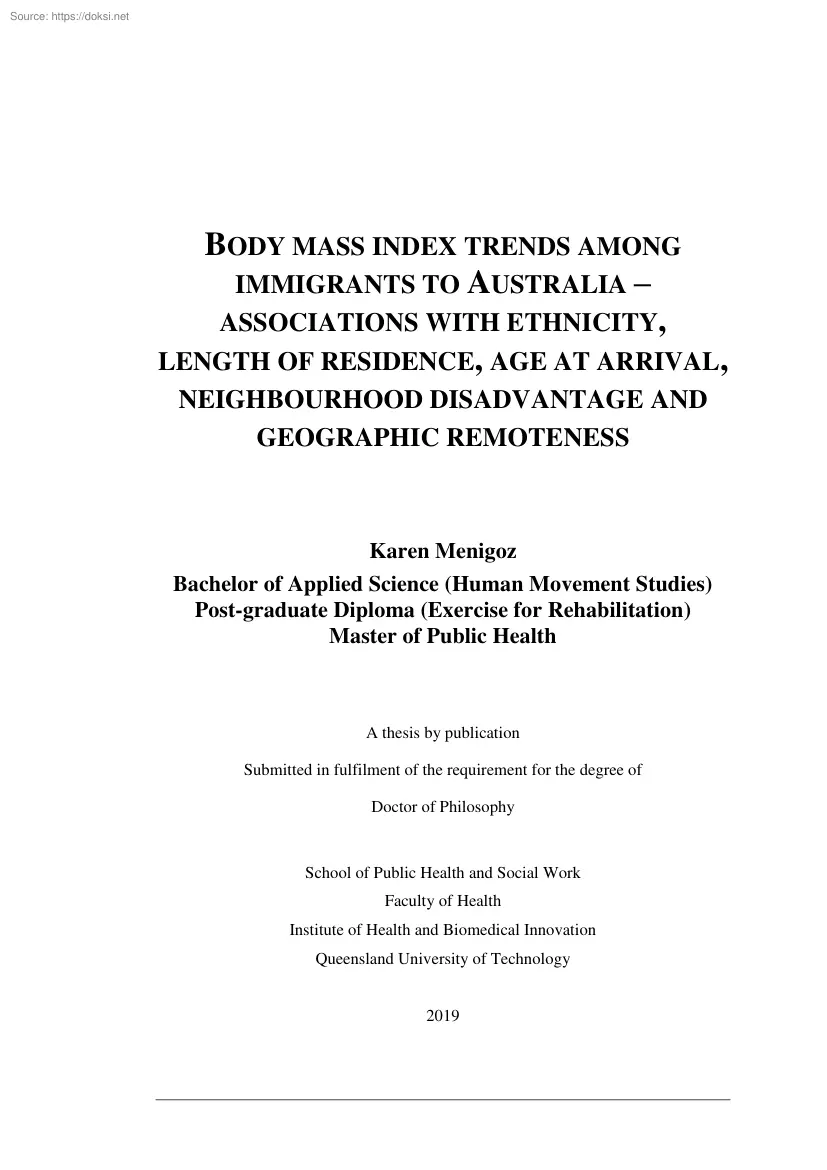
BODY MASS INDEX TRENDS AMONG IMMIGRANTS TO AUSTRALIA – ASSOCIATIONS WITH ETHNICITY, LENGTH OF RESIDENCE, AGE AT ARRIVAL, NEIGHBOURHOOD DISADVANTAGE AND GEOGRAPHIC REMOTENESS Karen Menigoz Bachelor of Applied Science (Human Movement Studies) Post-graduate Diploma (Exercise for Rehabilitation) Master of Public Health A thesis by publication Submitted in fulfilment of the requirement for the degree of Doctor of Philosophy School of Public Health and Social Work Faculty of Health Institute of Health and Biomedical Innovation Queensland University of Technology 2019 Keywords Obesity, overweight, BMI, body mass index, weight, ethnicity, immigrant, ethnic, minority, length of residence, age at arrival, acculturation, socioeconomic, neighbourhood, environment, geographic, geography, disadvantage, inequality, inequity, disparity, urban, regional, rural, remote, social, epidemiology, Australia Body mass index trends among immigrants to Australia – associations with ethnicity, length
of residence, age at arrival, neighbourhood disadvantage and geographic remoteness i Items for consideration prior to reading this thesis The Queensland University of Technology Thesis by Published Papers Guidelines notes that a thesis by published papers may comprise papers that are published, accepted for publication, submitted for publication or under review. The Guidelines specify that the thesis must include at least three papers, with at least one paper published, in press, or accepted for publication by the time of thesis lodgement for examination, and the published paper(s) must make an original contribution to research. This thesis includes three papers, all of which have been published in international, peer-reviewed journals. I am the first author on all three papers Elements of the thesis draw not only on evidence from the published literature, and my findings, but also from my experience of over 20 years in public policy. This particularly pertains to the policy
implications section of the Discussion and the Policy Brief at Appendix C, where I have drawn broader inferences from my findings to guide public health policy and practice in the Australian context. ii Body mass index trends among immigrants to Australia – associations with ethnicity, length of residence, age at arrival, neighbourhood disadvantage and geographic remoteness Abstract Background Obesity is a risk factor for premature morbidity and mortality and is associated with increased risk of chronic disease. The global movement of people worldwide is increasing, and in Australia, over one quarter of the population were born overseas. Few studies, however, have examined obesity among immigrants to Australia, and no published studies have examined longitudinal bodyweight trends in immigrant cohorts using contemporary data. Length of residence, age at arrival and the concept of acculturation have received research attention as explanatory mechanisms for individual-level
adaptation to a new host country and as predictors of immigrant obesity. There is also evidence that factors operating at the area or neighbourhood level contribute to immigrant obesity trends. Studies using US data dominate these fields of research, leaving an evidence gap for the design of effective and equitable obesity prevention policy in Australia. Based on an adapted social-ecological model, this thesis has three primary aims: to examine (1) cross-sectional and longitudinal associations between ethnicity and body mass index (BMI) in Australia, (2) how trends in immigrant BMI vary by length of residence and age at arrival, and (3) how neighbourhood socioeconomic disadvantage and geographic remoteness may contribute to immigrant BMI trends. Methods The Household Income and Labour Dynamics in Australia (HILDA) survey was the data source for three published studies. Study 1 used a sample of 13,047 respondents from Wave 11 (2011) of the HILDA survey to examine associations between
ethnicity (country of birth) and two dependent variables: mean BMI and odds of overweight and obesity. The second part of the study used an immigrant-only sample (n = 2,997) to examine associations between two independent variables: length of residence and age at arrival, with mean BMI and odds of overweight and obesity. Study 2 used nine waves of data from Wave 6 (2006) to Wave 14 (2014) and a sample of 20,934 respondents (101,717 person-year observations) to compare Body mass index trends among immigrants to Australia – associations with ethnicity, length of residence, age at arrival, neighbourhood disadvantage and geographic remoteness iii prospective trends in BMI of immigrant ethnic groups with native-born Australians. The second part of the study used an immigrant-only sample (n = 4,583 and 22,301 person-year observations) to test associations between length of residence and prospective trends in BMI. Study 3 used an immigrant-only sample (n = 4,293 and 19,404 person-year
observations) and nine waves of data from Wave 6 (2006) to Wave 14 (2014) to investigate longitudinal relationships between two area-level factors: neighbourhood socioeconomic disadvantage and geographic remoteness, with immigrant BMI. All studies used multi-level regression modelling techniques to test relationships between independent and dependent variables. Control variables differed by analysis, and included age, ethnicity, education, occupation, household income, neighbourhood socioeconomic disadvantage, and geographic remoteness. In all studies, analyses were stratified by gender, Results Ethnic differences in BMI: After controlling for age, socioeconomic factors and geographic remoteness, men from North Africa/Middle East and Oceania regions had significantly higher mean BMI compared with native-born Australians. Men from North West Europe, North East Asia and Southern and Central Asia, along with the majority of female ethnic groups had significantly lower mean BMI compared
with native-born Australians. Trends over a nine-year period showed that mean BMI increased for all ethnic and Australian-born groups at a similar rate, with the exception of North-West European men, for whom mean BMI increased at a slower rate compared with native-born Australians. By the final wave (2014), mean BMI exceeded 25 kg/m2 for all ethnic groups. Length of residence, age at arrival: After full-adjustment, cross-sectional results showed that male and female immigrants living in Australia for longer periods (≥ 15 years) had significantly higher mean BMI and odds of overweight and obesity respectively, compared with recently arrived immigrants. Over a nine-year period, immigrants in the early-mid settlement period (10-19 years) had significantly faster mean BMI increases compared with immigrants living in Australia for longer (≥ 30 years). Younger age at arrival (arrival as a child or adolescent for males and iv Body mass index trends among immigrants to Australia –
associations with ethnicity, length of residence, age at arrival, neighbourhood disadvantage and geographic remoteness arrival as a child for females) was associated with significantly higher adult mean BMI compared with immigrants who arrived as adults. Neighbourhood disadvantage: After controlling for age, ethnicity, individual/household socioeconomic factors and geographic remoteness, male immigrants living in the most disadvantaged neighbourhoods had significantly higher mean BMI compared with those living in the least disadvantaged neighbourhoods. Over time, mean BMI increased in all groups with the exception of male immigrants in the least disadvantaged neighbourhoods, where mean BMI remained essentially unchanged, effectively widening neighbourhood inequalities. For female immigrants, inequalities by neighbourhood disadvantage persisted over time, as mean BMI was significantly higher in the most compared with the least disadvantaged neighbourhoods and mean BMI
increased for all groups at a similar rate over the nine-year period. Geographic remoteness: Male and female immigrants residing in outer regional Australia (compared with major cities) had the highest mean BMI. Differences were attenuated, however, following adjustment for ethnicity, individual/household socioeconomic position and neighbourhood disadvantage. Over the nine-year period, all groups increased in mean BMI at a similar rate irrespective of the level of geographic remoteness. Conclusions The findings of this thesis demonstrate that all immigrants to Australia are at risk of overweight and obesity over time. Obesity prevention approaches tailored to the needs of ethnic groups most vulnerable to obesity are a priority, as are interventions that commence in the early-mid settlement period, and those directed at families arriving with children and adolescents. Multi-level policy approaches that consider the places where immigrants reside, are critical to support individual
behaviour change and address inequalities in immigrant BMI arising from neighbourhood disadvantage. Policies should also be inclusive of immigrants residing outside Australia’s major cities. Further research with immigrant and ethnic minority groups will assist in understanding the drivers of ethnic inequalities in obesity in Australia. Body mass index trends among immigrants to Australia – associations with ethnicity, length of residence, age at arrival, neighbourhood disadvantage and geographic remoteness v Table of Contents Keywords . i Items for consideration prior to reading this thesis . ii Abstract . iii Table of Contents . vi List of Figures . ix List of Tables . x List of publications and conference presentations. xii List of abbreviations . xiii Statement of original authorship . xiv Acknowledgements . xv Chapter 1: Introduction . 2 1.1 Context . 2 1.2 Purpose, Significance, Scope and Definitions . 4 1.3 Thesis Outline . 8 Chapter 2: Literature review . 11
2.1 Setting the scene – ethnic inequalities in health and the Australian context . 11 2.2 Setting the scene – obesity as a public health priority . 19 2.3 Ethnic inequalities in obesity . 23 2.4 Acculturation/exposure . 33 2.5 Contextual effects – neighbourhood disadvantage and geographic remoteness . 36 2.6 Summary . 39 Chapter 3: Overview of methods . 41 PART 1: The HILDA Survey . 42 3.1 Acknowledgement of data provider . 42 3.2 Rationale for selecting The HILDA Survey . 42 3.3 Background . 42 3.4 HILDA sampling procedure. 43 3.5 Data collection in the HILDA survey . 45 3.6 Quality of the HILDA data - representativeness . 46 PART 2: Secondary Analysis of the HILDA Survey . 49 3.7 Ethics approval. 49 3.8 Design of the secondary analysis . 49 3.9 Measures . 51 3.10 Data analysis 60 vi Body mass index trends among immigrants to Australia – associations with ethnicity, length of residence, age at arrival, neighbourhood disadvantage and
geographic remoteness PART 3: Preliminary Analyses of the HILDA Survey .65 3.11 Gender stratification 65 3.12 Multilevel modelling 65 3.13 Bias arising from differences in HILDA original sample vs top-up sample 67 3.14 Bias arising from non-random exclusion from the analytic sample 70 3.15 Consideration of English language variables71 3.16 Summary 73 Chapter 4: Ethnic differences in overweight and obesity and the influence of acculturation on immigrant bodyweight: evidence from a national sample of Australian adults . 75 4.1 Abstract.76 4.2 Background .77 4.3 Methods .78 4.4 Results .81 4.5 Discussion .90 4.6 Conclusions .92 Chapter 5: Ethnicity, length of residence and prospective trends in body mass index in a national sample of Australian adults (2006-2014). 93 5.1 Abstract.94 5.2 Introduction .95 5.3 Methods .97 5.4 Results .100 5.5 Discussion .109 5.6 Conclusions .110 Chapter 6: Neighbourhood disadvantage, geographic remoteness and body mass index
among immigrants to Australia: a national cohort study 2006-2014113 6.1 Abstract.114 6.2 Introduction .115 6.3 Materials and methods .116 6.4 Results .121 6.5 Discussion .129 6.6 Conclusions .132 Chapter 7: Discussion . 133 7.1 Summary of key findings.133 7.2 Strengths and limitations .144 7.3 Implications for research and policy.147 7.4 Conclusions .154 References . 156 Body mass index trends among immigrants to Australia – associations with ethnicity, length of residence, age at arrival, neighbourhood disadvantage and geographic remoteness vii Appendix A – Literature review summary tables . 192 Appendix B – Countries of birth and regions . 213 Appendix C – Policy brief . 216 viii Body mass index trends among immigrants to Australia – associations with ethnicity, length of residence, age at arrival, neighbourhood disadvantage and geographic remoteness List of Figures Figure 2.1 Cultural and contextual influences on obesity risk in ethnic
minority populations (48). 13 Figure 2.2 Global disability-adjusted life years (DALY’s) and deaths associated with a high body mass index (2015), showing the proportion of the total number of DALY’s or deaths contributed by each disorder (86). 20 Figure 2.3 Distribution of body mass index, people aged 18 and over, 1995 and 2011-12 (93). 22 Figure 3.1 Wave 1 HILDA survey sampling design: dark shaded areas from which census collection district areas were sampled (194). 43 Figure 3.2 Australian Bureau of Statistics 2011 Australian Statistical Geography Standard: Remoteness Structure (213). 56 Figure 5.1 Adjusted mean BMI trajectories over time by ethnic group in Australia (2006-2014), men and women. 105 Figure 5.2 Adjusted mean BMI trajectories over time by length of residence in Australia (2006 - 2014), men and women. 108 Figure 6.1 Immigrant BMI trends over time by quintile of neighbourhood disadvantage (2006-2014) (A) Men, (B) Women; neighbourhoods in Quintile 1 are the most
disadvantaged. 125 Figure 6.2 Immigrant BMI trends over time by geographic remoteness (20062014) (A) Men, (B) Women 128 Figure 7.1 Immigrant BMI trends over time from the results of Chapter 5, showing the World Health Organization cut-off for overweight of 25 kg/m2 (solid thick line). 136 Body mass index trends among immigrants to Australia – associations with ethnicity, length of residence, age at arrival, neighbourhood disadvantage and geographic remoteness ix List of Tables Table 2.1 Estimated resident population (ERP) of foreign born people in Australia in 2016: ten highest ERP, median age, and sex ratio, by country of birth (68) . 16 Table 3.1 HILDA survey responding households and responding adults Wave 1 (2001) to Wave 14 (2014) (201) . 46 Table 3.2 Creation of analytic sample for Study 1 62 Table 3.3 Creation of analytic sample for Study 2 63 Table 3.4 Creation of analytic sample for Study 3 64 Table 3.5 Socio-demographic and bodyweight characteristics of men and
women in top-up sample (n = 4,041) and the original sample (n = 16,894) . 68 Table 3.6 Comparison of original sample and top-up sample results from random intercept models, men and women, BMI by ethnicity, 20062014 . 69 Table 3.7 Odds of non-inclusion in the analytic sample (total number = 122,103 observations), when excluded based on (A) missing data and (B) no self-completed questionnaire . 71 Table 3.8 English as a first language and bodyweight characteristics of men and women: foreign-born sample (n = 2,997) . 74 Table 3.9 English as a first language by BMI and odds of overweight/obesity, men and women: foreign-born sample (n = 2,997) . 74 Table 4.1 Socio-demographic and bodyweight characteristics of men and women: ethnicity and bodyweight sample (n = 13,047) . 82 Table 4.2 Country of birth by BMI and odds of overweight/obesity, men and women . 84 Table 4.3 Socio-demographic and bodyweight characteristics of men and women: acculturation and bodyweight sample (n = 2,997) . 86 Table
4.4 Length of residence in Australia by BMI and odds of overweight/obesity, men and women. 88 Table 4.5 Age at arrival in Australia by BMI and odds of overweight/obesity, men and women . 89 Table 5.1 Socio-demographic and bodyweight characteristics of men and women in Australia in 2006 and 2014 . 101 Table 5.2 BMI by time and ethnicity in Australia, 2006-2014: random intercept models and time interaction model (ethnicity*time), men and women . 103 Table 5.3 BMI by time and length of residence in Australia, 2006-2014: random intercept models and time interaction model (length of residence*time), men and women (overseas born only) . 107 x Body mass index trends among immigrants to Australia – associations with ethnicity, length of residence, age at arrival, neighbourhood disadvantage and geographic remoteness Table 6.1 Neighbourhood disadvantage, geographic remoteness, sociodemographic characteristics and mean body mass index of men and women in the analytic sample, 2006 and
2014 . 122 Table 6.2 Neighbourhood disadvantage and mean BMI for immigrant men and women, 2006-2014 . 124 Table 6.3 Geographic remoteness and mean BMI for immigrant men and women, 2006-2014 . 127 Table A1 Longitudinal trends: ethnicity and body composition measures. 192 Table A2 Cross-sectional studies: ethnicity and body composition measures . 195 Table A3 Studies of length of residence, age at arrival and body composition measures . 203 Table A4 Studies of neighbourhood socioeconomic disadvantage and body composition measures in ethnic minority cohorts . 208 Table A5 Studies of geographic remoteness and body composition measures in the general population (no known studies stratify by ethnic group). 211 Table B1 Number of respondents (Study 1) and number of person-year observations (Studies 2 and 3) in the analytic samples, by region based on the Australian Bureau of Statistics’ Standard Australian Classification of Countries1 . 213 Body mass index trends among immigrants to
Australia – associations with ethnicity, length of residence, age at arrival, neighbourhood disadvantage and geographic remoteness xi List of publications and conference presentations Publications during candidature Menigoz K, Nathan A, Turrell G. Ethnic differences in overweight and obesity and the influence of acculturation on immigrant bodyweight: evidence from a national sample of Australian adults. BMC Public Health 2016;16(1):932 Menigoz K, Nathan A, Heesch KC, Turrell G. Ethnicity, length of residence, and prospective trends in body mass index in a national sample of Australian adults (2006–2014). Ann Epidemiol 2018;28(3):160-8 Menigoz K, Nathan A, Heesch KC, Turrell G. Neighbourhood disadvantage, geographic remoteness and body mass index among immigrants to Australia: a national cohort study 2006-2014. PLoS One 2018;13(1):e0191729 Oral presentations at national and international conferences 2015 Menigoz K, Turrell G. Overweight and obesity in Australia – are we
missing ¼ of the picture? Population Health Congress 2015, Hobart, Australia. 2017 Menigoz K, Nathan A, Heesch KC, Turrell G. Longitudinal trends in bodyweight amongst immigrants to Australia. 15th World Congress on Public Health 2017, Melbourne, Australia. xii Body mass index trends among immigrants to Australia – associations with ethnicity, length of residence, age at arrival, neighbourhood disadvantage and geographic remoteness List of abbreviations ABS Australian Bureau of Statistics BMI Body mass index CCD Census Collection District CI Confidence interval COAG Council of Australian Governments CrI Credible interval HILDA Household, Income and Labour Dynamics in Australia MCMC Markov Chain Monte Carlo NHS National Health Survey OECD Organization for Economic Co-operation and Development OR Odds ratio SES Socioeconomic status UK United Kingdom US United States of America WHO World Health Organization Body mass index trends among immigrants to
Australia – associations with ethnicity, length of residence, age at arrival, neighbourhood disadvantage and geographic remoteness xiii Statement of original authorship QUT Verified Signature xiv Body mass index trends among immigrants to Australia – associations with ethnicity, length of residence, age at arrival, neighbourhood disadvantage and geographic remoteness Acknowledgements I am very grateful to have had the strength, knowledge and support of my Principal Supervisor, Professor Gavin Turrell, to mentor and guide me on my PhD journey from start to finish. Gavin seemed to have an uncanny ability to know when my motivation and self-belief were wavering and I would receive a ‘how’s it going’ email or a ‘let me know when you’d like to meet’ suggestion and then follow up to get me back on track. I have learnt a great deal from Gavin’s considerable expertise in the fields of public health, health inequalities, neighbourhood effects, multilevel modelling
(etc.) Gavin taught me about the science and art of research I would like to acknowledge and thank my Associate Supervisor, Dr Kristiann Heesch, for being an important part of my supervisory team. Kristi was supportive, knowledgeable and responsive. She was also my grammar queen! Kristi provided invaluable guidance through the process of conducting my studies, as well as writing and editing to prepare my publications and thesis. I greatly appreciated Kristi’s kindness as well as her expertise, efficiency and reliability. I would like to acknowledge and thank my Associate Supervisor for much of the journey, Dr Andrea Nathan, who was a knowledgeable and supportive guide. I particularly valued Andrea’s contribution as I was conducting my studies and throughout the preparation of my studies for publication. Andrea helped me clarify what I wanted to achieve and what I wanted to say. I appreciated her calm and gentle manner. I would not have been able to complete this PhD without the
unfailing support of my husband, who gave me the time, space and support to do this amongst the busy-ness of our family life. Comme dit Pierre Reverdy, “Il n’y a pas d’amour, il n’y a que des preuves d’amour.” I would also like to thank my children for their unconditional love and for giving me so many moments of light relief, encouragement and the grounding to remember that there was more to life than the PhD. I would like to thank my family and in particular, my Mum, Dad and sisters who were unwavering in their belief in me that I could do this. They also gave me the precious gift of time when I needed it, to be able to concentrate, focus, and write. Body mass index trends among immigrants to Australia – associations with ethnicity, length of residence, age at arrival, neighbourhood disadvantage and geographic remoteness xv Thank you to QUT for the resources and support to be able to work efficiently with access to the right technology, equipment and information.
The infrastructure, resources and supports available for higher degree research students are excellent. Thank you to IHBI for the research funds that enabled me to attend conferences and travel during the course of my candidature. I would also like to thank all those who participated and continue to participate in the Living in Australia study (the Household, Income and Labour Dynamics in Australia (HILDA) survey). Without you, my thesis would not have been able to take the path that it did. I also acknowledge the providers of my data source: The HILDA Project team and the funding for HILDA provided by the Australian Government Department of Social Services and management of the HILDA survey by the Melbourne Institute of Applied Economic and Social Research. Finally, thank you to friends, my work managers and work colleagues, fellow PhD students and everyone who, knowingly or unknowingly, gave me advice, support and encouragement along the way. So in response to everyone’s question,
have you finished your PhD yet? My answer is yes! xvi Body mass index trends among immigrants to Australia – associations with ethnicity, length of residence, age at arrival, neighbourhood disadvantage and geographic remoteness Chapter 1: Introduction 1.1 CONTEXT Obesity is a major global health risk affecting both developing and developed countries (1). Obesity is a risk factor for chronic disease, with a well-documented increase in risk of cardiovascular disease, diabetes, cancer, chronic kidney disease and musculo-skeletal conditions, such as osteoarthritis, as body mass index (BMI) values increase beyond 23kg/m2 (1). Australia has the fifth highest rate of adult obesity of Organization for Economic Co-operation and Development (OECD) countries, after the United States (US), Mexico, New Zealand and Hungary (2). In Australia in 2014-15, 70.8% of men and 563% of women aged 18 years and over were overweight or obese (3). To respond to the obesity epidemic, global targets have
been established to halt the dramatic rise in obesity (4), and Australia, as a member state of the World Health Organization (WHO) has committed to addressing obesity in line with the Global Action Plan (5). From an equity perspective, policy makers and researchers are bestowed with the responsibility of ensuring that obesity prevention efforts are inclusive of vulnerable and hard-to-reach groups and that health policies are not inadvertently widening health inequalities. An equally significant shift is occurring in the global movement of people. Over the past 15 years, global immigration has increased substantially, and in 2015, over 240 million people were living outside of their country of origin (6). Ethnic inequalities in health and more particularly, ethnic inequalities in overweight and obesity, are now well established. Stark and persistent ethnic inequalities in obesity have been demonstrated in several developed countries (7-10). The epidemiology of overweight and obesity in
‘at risk’ sub-populations such as ethnic minority groups is clearly important in order to predict future burden of disease, shape effective health policy, and for practitioners, understand the likely trajectory of bodyweight gain amongst immigrants post-arrival. There is little published literature, however, on the nature of these relationships in the Asia-Pacific region, and there are no published studies defining ethnic differences in bodyweight in a national sample of Australian adults. Although much attention has focused on obesity trends and obesity prevention in Australia, there has been comparatively little focus on obesity 2 Chapter 1: Introduction prevention in immigrants and ethnically diverse groups. This is surprising as an estimated 6.6 million people or 28% of the Australian population were born overseas (11). The magnitude and nature of ethnic inequalities in obesity in Australia is unknown. It is also not clear whether ethnic inequalities in obesity are
explained by socioeconomic inequalities. The role of length of residence, age at arrival and the associated theory of acculturation has attracted research attention in recent years. Acculturation is defined as a change in cultural patterns arising from exposure to the host country’s lifestyle, environment and culture (12,13). Cross-sectional studies, predominantly from the US, have shown a clear association of increased BMI with longer length of residence (14) and younger age at arrival (15). Overseas studies have also demonstrated that BMI may increase more rapidly in immigrants in the early settlement period postarrival (16-18). Longitudinal studies with US data dominate this field of research, and little is known about whether relationships between ethnicity, length of residence/age at arrival and trends in bodyweight hold true in other contexts, including Australia. Neighbourhoods have emerged as an important area of study in ethnic inequalities in health (19). This is because
choice of place of residence is patterned by ethnic as well as socioeconomic factors (20), and neighbourhoods capture structural and social context independent of individual level factors (21). Neighbourhoods also matter to health (20,22), and factors linked to obesity, such as healthy eating and physical activity, and social supports are clearly shaped by the environments in which people live (23). In the Australian context, geographic remoteness (living outside of Australia’s major cities in regional and remote areas) has also been associated with increased obesity risk (24,25). Despite the public health evidence for the need to focus on both ‘people’ and ‘places’ in order for interventions to have maximum effect (26,27), policy and programs targeting ethnically diverse groups may be criticized as being overly individual-focused at the expense of a more holistic view (28,29). This situation is not helped by the paucity of evidence available to guide policy development. It
is therefore important to move beyond only individual factors and consider contextual factors in obesity research and policy development for ethnically diverse groups in Australia. Chapter 1: Introduction 3 1.2 PURPOSE, SIGNIFICANCE, SCOPE AND DEFINITIONS This thesis is concerned with understanding inequality. Not all ethnic groups experience worse health, but some do. Why is that? The policy implications of identifying a genetic/biological or behavioural basis for the differences we see are, for example, very different from those where ethnic inequality is identified as a consequence of the limited opportunities following on from ethnic or racial disadvantage. (30, p 20) In my thesis I wanted to know which ethnic groups were vulnerable to obesity in Australia, and why. I wanted to discover what ecological factors, beyond individual behavioural choices, were driving any inequalities so that policy makers could design more effective and equitable interventions. In exploring
these themes, my thesis makes both theoretical and practical contributions to the fields of obesity prevention and ethnic inequalities in health. 1.21 Aims and objectives of the thesis The research comprising this thesis aims to elucidate (i) trends in overweight and obesity in immigrants to Australia, (ii) the roles of length of residence and age at arrival as factors influencing immigrant bodyweight, and (iii) the relationship between ‘place’ (where people live) and bodyweight among immigrants. Considering these aims, the three objectives of the thesis are to: 1. investigate ethnic differences in BMI and overweight/obesity, comparing immigrants with native-born Australians, and among immigrants, investigate the relationship between length of residence and age at arrival with BMI and overweight/obesity. 2. investigate prospective trends in BMI of immigrant ethnic groups compared with native-born Australians and whether BMI trends among immigrants vary by length of residence in
Australia. 3. among immigrants, investigate relationships between prospective trends in BMI and two contextual factors: neighbourhood socioeconomic disadvantage, and geographic remoteness. 4 Chapter 1: Introduction 1.22 Theoretical and practical contributions The programme of research covered in this thesis draws on an adaptation of the well-established social-ecological model that contends that an individual’s health is influenced by multiple levels of influence at the intrapersonal, interpersonal, organisational, community and public policy levels (31). This thesis explores how cultural-contextual factors when added to a social-ecological model (28), can assist in understanding intersecting dimensions of disadvantage and influence how these contribute to immigrant obesity trends in Australia. Given that the majority of studies have tested the theoretical pathways using US data, this thesis offers an opportunity to test and extend lines of enquiry in obesity research
in a different context (Australia). For the first time, this thesis provides important national-level evidence on the existence, extent, and nature of ethnic inequalities in obesity among immigrants to Australia. It also provides important evidence on length of residence and age at arrival as contributors to immigrant obesity trends. To assist in understanding the broader ecological influences on obesity, the thesis seeks to understand the existence and persistence of ethnic inequalities related to neighbourhood socioeconomic disadvantage and geographic remoteness. While the studies forming this thesis are largely descriptive in nature, this type of evidence is a necessary foundation to improve appropriate targeting of obesity prevention policy to ethnic groups vulnerable to obesity and/or immigrant cohorts during sensitive exposure periods post-arrival. The thesis also provides a platform for future research to examine the area-level drivers of obesity among immigrants more closely,
in order to understand the (potentially different) drivers underlying contextual effects on bodyweight among immigrant ethnic groups. 1.23 Scope This thesis is delimited in a number of ways. The study scope focuses on obesity and its relationships with ethnicity, length of residence, age at arrival and environmental factors among first generation immigrants to Australia. The thesis does not specifically test relationships with obesity among second and subsequent generations of immigrants, although there is some discussion on this topic in the Literature Review. Chapter 1: Introduction The thesis does not focus on the unique health needs and 5 circumstances of refugees and asylum seekers. The study does not focus on ethnic differences as they pertain to Australia’s Indigenous peoples. The term, Australian immigrants, refers to people born overseas and now residing in Australia. It does not include holidaymakers or temporary visitors. The thesis does not delve into factors that
may influence bodyweight arising from an immigrant’s ‘sending’ context (experiences and environments that may have affected an individual’s health in their home country, prior to immigration). This study also does not focus on the settlement priorities of immigrants immediately post-arrival such as housing and access to health, education and social services, nor does it directly examine experiences of racism and discrimination or mental health issues, although I acknowledge the important effect that these can have on an individual’s experiences post-migration. I also acknowledge the remarkable strengths of individuals from culturally and linguistically diverse backgrounds and ethnic communities, and their contribution to a vibrant and diverse Australia. The scope of this thesis does not extend to studying these strengths or factors that promote resilience to weight gain. There are an extraordinary number of influences on an individual’s risk of overweight and obesity. This
thesis does not investigate behavioural intermediaries of obesity, including physical activity, sedentary behaviour and dietary factors. It also does not explore all of the environmental determinants of obesity, such as elements of the built environment and the social environment. The thesis acknowledges, but does not address, genetic differences in body composition, individual psychology, social supports and specific cultural factors, such as religious affiliation. Finally, the thesis focuses on adult immigrants, as this is the most glaring gap in the current literature. 1.24 Definitions and terminology Ethnicity, as defined by Bhopal, “is a multifaceted quality that refers to the group to which people belong, and/or are perceived to belong, as a result of certain shared characteristics, including geographical and ancestral origins, but with particular emphasis on cultural traditions and languages” (32, p. 18) Occasionally, researchers also refer to the combined term
‘race/ethnicity’. Bhopal defines race as, “the group you belong to or are perceived to belong to in light of a limited range of physical factors” (32, p. 14) Given the potential damaging and discriminatory nature of the term race (32,33), ethnicity is the inclusive term used in this thesis with 6 Chapter 1: Introduction occasional use of the term race/ethnicity when reported as such in others’ research. UK and US research also uses the term ‘Black’ or ‘non-Hispanic Black’ to refer to ethnic groups of people usually of African or Caribbean descent. This is not a derogatory term but rather, reflects use of the terms in US and UK population survey questions about an individual’s self-identified ethnic group (34,35) . The term ‘ethnic minorities’ is also commonly used by researchers to refer to visible minority ethnic groups in contrast to the general population or dominant cultural group in their country of residence. The term, ethnic minorities, may be used
in this thesis when reporting on the findings of other studies. The term, ‘immigrants’, refers to first generation immigrants (people who were born in one country and then moved to a new host country) and is differentiated from second and subsequent generations who are referred to as native-born ethnic groups (e.g, US-born Hispanic). I discuss the importance of this distinction in relation to obesity trends further in Section 2.32 of the Literature Review In this thesis, I use the term health inequality to refer to the unequal distribution of health and disease. The definition contrasts with a related term, health inequity, that I use in the Discussion Chapter to discuss whether the distribution of health is unfair or unjust (36). Given the dominance of US-based research in this field, a similar term, health disparities, is also used and refers to “a particular type of health difference that is closely linked with social or economic disadvantage” (37, p. 46). This term is
common in the US as reducing or eliminating health disparities has been a policy goal for over two decades (38). It should also be noted that definitions and terminology vary somewhat in policy documents. Public Health England, for example, defines ethnic inequalities in health as health differences that are unfair and avoidable (39). Chapter 4 of this thesis also refers to ‘health differences’ at the suggestion of a Reviewer in the first publication. BMI is calculated as weight in kilograms divided by height in metres squared. Overweight and obesity are typically defined in population health studies according to WHO BMI cut-off points: adult overweight is a BMI of 25-30 kg/m2 and obesity is a BMI of greater than 30 kg/m2 (40). There is debate on the use of different BMI cut-off points for different ethnic groups. In particular, lower BMI cut-off points have been proposed for people of Asian ethnicity (41) to better align increases in BMI with observed increases in chronic disease
incidence and to account for higher Chapter 1: Introduction 7 levels of body fat at lower BMI values in this cohort (42,43). The WHO recommends, however, the use of a standard cut-off (44), although this may underestimate the actual prevalence of clinically significant overweight and obesity among some Asian ethnic groups. In addition to BMI and WHO cut-offs to define overweight and obesity, the literature uses a range of other measures to report on clinically significant adiposity (body fatness) and discuss population obesity trends. These measures include body weight, waist circumference, waist to hip ratio, waist to height ratio and skinfold measures. In the Methods Chapter, I explain my reasons for using BMI as the main outcome measure in this thesis, and discuss how I operationalised BMI in my studies. 1.3 THESIS OUTLINE This is a thesis by publication. In the chapter that follows, I discuss the theoretical framework for the thesis and critically appraise the international
and Australian literature on the relationships between ethnicity and obesity. I also examine the evidence for the role of length of residence and age at arrival in immigrant obesity trends and discuss the related concept of acculturation. I then provide an analysis of the relationships between neighbourhood socioeconomic disadvantage and geographic remoteness and immigrant obesity trends. Chapter 3 provides a comprehensive description of the methods used in the thesis and complements the methods outlined in each of the published studies. The Methods Chapter is divided into three parts. The first part addresses the data source, the Household, Income and Labour Dynamics in Australia (HILDA) survey. I describe the sampling procedures, data collection techniques and quality control measures as they pertain to my research questions. The second part of the chapter clearly delineates my work by describing my secondary analyses with the HILDA survey data. I detail the design, methods, measures
and analyses I used across the three studies. The third part of the Methods Chapter explains the preliminary analyses I undertook to understand potential sources of bias in the data and facilitate interpretation of the results. I also detail the methods and results of exploratory analyses undertaken to test whether an English language variable could be included in my thesis to test associations with immigrant BMI trends. 8 Chapter 1: Introduction Chapters 4, 5 and 6 are my published studies. Study 1, published in BMC Public Health, is a national cross-sectional study on ethnic differences in overweight and obesity in Australia and the influence of acculturation on immigrant bodyweight. Chapter 5 is Study 2, published in Annals of Epidemiology. This national cohort study examined prospective trends in mean BMI by ethnicity and length of residence. Chapter 6 presents Study 3, published in PLoS One. It is a national cohort study examining neighbourhood disadvantage, geographic
remoteness and prospective trends in mean BMI in Australian immigrants. Chapter 7 presents a meta-discussion of all findings. The chapter summarises the key findings from my programme of research. I also discuss the strengths and limitations, drawing out common themes from my studies and present implications of the thesis findings for future research and policy development. A policy brief is included as an appendix to the thesis. Chapter 7 finishes with concluding remarks and commentary on achievement of the aims and objectives of the thesis. Chapter 1: Introduction 9 Chapter 2: Literature review The first section of the literature review sets the scene for the study of ethnic inequalities in health and presents an adapted social-ecological framework that I use in the thesis to investigate my study aims and interpret my findings (Section 2.1) I then introduce the global and national trends that demonstrate why obesity is a public health priority (Section 2.2) The remainder
of the literature review narrows its focus to the literature pertaining directly to the thesis aims and objectives. I provide a comprehensive analysis of the evidence for ethnic inequalities in obesity, highlighting important gaps in knowledge (Section 2.3) I then turn the reader’s attention to why ethnic inequalities in obesity may exist. I examine available evidence on length of residence in the host country and age at arrival (Section 2.4), followed by an exploration of two area-level factors as contributors to immigrant bodyweight trends, neighbourhood socioeconomic disadvantage and geographic remoteness (Section 2.5) To support the literature review, Appendix A provides a series of tables of key studies for each of the factors outlined above. I conclude the chapter with a brief summary. 2.1 SETTING THE SCENE – ETHNIC INEQUALITIES IN HEALTH AND THE AUSTRALIAN CONTEXT The study of ethnic inequalities in health arises from the fundamentals of epidemiology, which endeavours to
examine not only the overall health of a population, but also the distribution of health in a population (45). The burden of non-communicable disease is unequally distributed and the World Health Organization (WHO) has called for countries to take an equity-based approach and act on the social determinants of health, both for the entire population and vulnerable groups (4). This thesis draws from the field of social epidemiology (45) to examine not only the distribution of obesity among immigrants to Australia, but also begin to explore the social structures and relationships that influence these patterns and trends over time. Chapter 2: Literature review 11 2.11 Ethical approaches to studying vulnerable populations Given that ethnic minority groups are vulnerable to stigmatisation and discrimination, it is important for research to be grounded in the appropriate ethical principles (46). This thesis aligns with the Leeds Consensus Principles for research on ethnicity and health
(46) and in particular, Mir et al. notes that, “research should be for the purpose of well-being and betterment of populations being studied and equity should be the guiding ethical principle” (46, p. 508) Principle 4 discusses the importance of recognising diversity within ethnic groups, including paying due regard to how ethnicity may intersect with other dimensions of difference impacting on health inequalities, such as age, gender, religion, education, socioeconomic position, geography or periodicity of migration (46). I selected the theoretical framework, research questions and methods of my thesis with the Principles in mind. 2.12 Theoretical framework: social-ecological determinants of obesity For over three decades, ecological models have been used to illustrate and explain the intertwining nature of multiple levels of influence (intrapersonal, interpersonal, organisational, community and public policy) on health behaviours and the reciprocal and cyclical nature of the
interaction where behaviours are shaped by, and serve to shape, the environment in which we live (31). In 1999, Swinburn, Egger and Raza applied the ecological model to obesity and introduced the term, ‘obesogenic environment’, where ‘obesogenicity’ was defined as, “the sum of influences that the surrounds, opportunities, or conditions of life have on promoting obesity in individuals or populations” (47, p.564) More recently, an international collaboration of experts published an adapted social-ecological framework, adding an important dimension of cultural and contextual influences to advance our understanding of energy balance and weight status in ethnic minority groups (28). The cultural-contextual influences are extensive (see Figure 2.1) The central rings of the diagram demonstrate that ethnic minority groups experience dimensions of influence arising from not only the person as an individual, but also their families, their ethnic minority community and the broader
context of living among the general population and culture of the host country. The cultural-contextual framework also illustrates on the left of the diagram that historical experiences and adaptations, types of minority status (e.g, established migrants, new migrants), structural influences, and sociocultural influences all have 12 Chapter 2: Literature review the potential to influence weight status in immigrants in a way that is different to the general population. On the right of the diagram, a range of intervention targets are listed demonstrating the multi-level nature of suitable interventions operating on communities, families and individuals. Figure 2.1 Cultural and contextual influences on obesity risk in ethnic minority populations (48)1 The adapted social-ecological model was therefore an ideal vehicle to apply a public health lens to my programme of research. The shaded arrows in Figure 21 align with the three research objectives. That is, (1)
understanding how immigrants’ ethnicity in the presence/absence of socioeconomic disadvantage influences BMI; (2) how immigrant adaptation to a new host country influences BMI and how this relates 1 Reprinted from Preventive Medicine, 55(5), Kumanyika SK, Taylor WC, Grier SA, Lassiter V, Lancaster KJ, Morssink CB, Renzaho, AMN, Community energy balance: a framework for contextualizing cultural influences on high risk of obesity in ethnic minority populations, Pages 371381, Copyright (2012), with permission from Elsevier. Chapter 2: Literature review 13 to acculturation; and (3) structural influences, to understand how BMI trends vary depending on the areas or neighbourhoods where immigrants reside. Using an adapted social-ecological model is also important as it represents a shift away from a narrow focus on individual behaviour change as a driver of obesity, toward consideration of the environmental underpinnings of health and disease risk (49). This is particularly relevant
in obesity prevention policy as individual-level approaches risk victim blaming and stigmatisation (31), and approaches focused on educating individuals to make healthy choices are unlikely to be sufficient to address obesity trends (50,51). Increasingly, it is recognised that individual and environmental influences are not an either/or approach (52). Rather, ecological models can function as a ‘meta-model’ that do not dismiss other health behaviour theories but provide a framework to integrate multiple theories operating at individual, social and organisation levels (53), and facilitate the design of multilevel policy interventions (47,50). Drawing on the adapted social-ecological model from Kumanyika et al., multi-level obesity prevention policy for ethnic minority communities should, ideally, simultaneously address policy settings within the host country (e.g regulatory intervention), and intervene at the ethnic minority community (e.g, built environment and social support),
family (eg, home food availability, health care advice) and individual (e.g, weight control behaviours) levels (28). Population-level obesity interventions require greater engagement across government, sectors and with industry (54), which make them more challenging, although more worthwhile in the pursuit of sustainable population health outcomes. Before concluding this section, it is useful to address an alternative line of research inquiry that suggests that genetic/biological factors are fundamental drivers of ethnic inequalities in obesity. Following this argument, it would be possible to predict immigrant obesity risk from a simple extrapolation of country of origin data to apply to immigrants from those countries now living abroad. There are numerous reasons, however, why this is not plausible or helpful. From a theoretical perspective, as the above discussion highlighted, immigrant ethnic groups experience a range of cultural-contextual influences arising from their exposures
and adaptations in a new host country that an individual living in their own ancestral country would not experience. Immigrants are also likely to be different to those who do not immigrate in their individual-level characteristics due to (i) self-selection, in that those who are 14 Chapter 2: Literature review healthy, educated and have the financial means to migrate, are more likely to do so (55) and (ii) positive selection bias arising from the strict health entry requirements in the migration process (56). Empirical evidence also supports the contention that context is important. For example, a series of seminal studies of cardiovascular disease among Japanese men living in Japan, Hawaii and California demonstrated that mean BMI was lower for those living in Japan compared with those living in Hawaii and California for each five-year age group (57). It can therefore be argued that immigrant obesity trends are unlikely to solely be due to biological susceptibility to obesity
(any more than gender differences in obesity are simply a product of biological differences between male and females (58)) and that broader contextual factors must be considered. 2.13 Australia’s ethnic diversity Australia’s unique historical and contemporary immigration trends mean that research findings from overseas are not easily generalisable to Australian immigrants and ethnic groups. To provide context to the thesis, this section provides a brief overview of Australia’s ethnic diversity. Australia is a richly diverse, multicultural nation (59) that began with Australia’s Indigenous peoples - Aboriginal and Torres Strait Islander peoples, inhabiting the continent for over 60,000 years (60). From White settlement in 1788 through to World War II, Australia’s immigrant population was largely comprised of those born in Britain and British colonies (61). Following the war, a perceived need to expand the population for defence and economic reasons was the driving force of
immigration policy. This resulted in a large influx of immigrants from European countries: Eastern European refugees, then Western Europeans and Southern Europeans including significant numbers from the Netherlands, Germany, Italy, Greece and Yugoslavia (61). With the abolition of the policy preference for ‘White’ immigrants (the White Australia Policy), post-1970s immigration was no longer based on country of origin, but rather favoured immigration based primarily on criteria of skill and humanitarian needs (62). Since the 1980’s and 1990’s immigration policy increasingly selected migrants based on skills, language, and minimum health requirements (63). With this policy change came increasing language diversity and over time, Australia has received increasing numbers of immigrants from India, China, Turkey, Lebanon, and South East Asia (61). In 2010, Chapter 2: Literature review 15 two thirds of Australia’s six million immigrants arrived from non-English speaking
countries (62). Present day immigration policy continues to favour skilled migrants. In 201617, of the 180,000 permanent migrants who entered Australia, approximately 124,000 places were in the skilled migration stream (64). This contrasts to the early 1990’s when skilled migrants formed only 20% of permanent migrants (65). The Australian Government also delivered approximately 14,000 places for Humanitarian programme entrants in 2016-17 plus additional visas to resettle those displaced by conflicts in Syria and Iraq (64). Australia’s migration program does not include New Zealand citizens due to arrangements in place that allow for the free movement of people between Australia and New Zealand, although access to voting, social security and other arrangements varies (66). In 2012-13, approximately 52,000 New Zealand citizens migrated to Australia as permanent and long-term arrivals (66). The immigrant population in Australia in 2016 was an estimated 6.6 million people or 28% of the
Australian population (11). Table 21 shows the 10 countries of birth with the highest estimated Australian resident population, and also demonstrates the significant variation in median age of ethnic groups, ranging from 34 years (India) to 70 years (Italy). Australia’s multicultural population composition is likely to continue to increase into the future. Australia’s population is growing by 1.6% per year, and in the 12 months to 30 June 2017, net overseas migration contributed 63% to total population growth (67). Table 2.1 Estimated resident population (ERP) of foreign born people in Australia in 2016: ten highest ERP, median age, and sex ratio, by country of birth (68) 1,198,000 Median age (years) 55 New Zealand 607,200 41 105 China 526,000 35 80 India 468,800 34 119 Philippines 246,400 40 63 Vietnam 236,700 45 83 Italy 194,900 70 107 South Africa 181,400 42 100 Malaysia Germany 166,200 124,300 39 64 89 92 Country of birth ERP United Kingdom
Sex ratio1 104 1 Number of males per 100 females 16 Chapter 2: Literature review 2.14 Ethnic inequalities in health in Australia In broad terms, immigrants to Australia generally experience better health, lower overall mortality and less hospitalisations than native-born Australians (59,6971). Commonly referred to as the ‘healthy immigrant effect’, this phenomena has been observed in other developed countries, including the US, Canada and the UK (39,55). Although empirical evidence is weak, theorists have postulated a number of reasons for the healthy immigrant effect. These include: strict immigrant health entry requirements (72); protective dietary, lifestyle and sociocultural factors (72); and self-selection where only those who are healthy, educated and have the financial means to migrate, do so (55). The literature also discusses a possible cause being the intuitively-appealing, ‘salmon-bias’ (73), whereby immigrants tend to return to their country of origin when
in declining health or nearing end of life, although the evidence to support this hypothesis is not strong (74,75). Studies have also shown ethnic inequalities in some health outcomes in Australia. A review published in 2010 of the health status of immigrants in Australia, including studies from the period 1980 to 2008, found that the majority of immigrants had better health compared with native-born Australians (72). The key exception was for Type 2 diabetes, where the review found that immigrants from Southern European and South Asian countries were at higher risk compared with the Australian-born population (72). One of the important limitations of the review was that the included studies predominantly focused on established ethnic groups, and little data were available on more recent immigrants from other regions, notably the Middle East and Africa (72). The clearest evidence, however, for ethnic inequalities in physical health in Australia is for diabetes and cardiovascular
disease. Population monitoring data from 2011-12, demonstrated higher proportions of long-term health conditions, including diabetes mellitus and cardiovascular disease, among immigrants from Southern and Eastern Europe, and North Africa and the Middle East, relative to other ethnic groups and native-born Australians (76). Further, studies have shown that Asian/South East Asian immigrants are more likely to report diabetes than native-born Australians (43,77), and Southern European and Southern Asian immigrants to Australia have higher mortality from diabetes (59). Immigrants from Oceania also have higher hospitalisation rates, including for diabetes and heart failure, and higher mortality from diabetes, and immigrants from the Middle East and Chapter 2: Literature review 17 North Africa have higher hospitalisation rates, including for diabetes and coronary heart disease, compared with native-born Australians (70). While I have summarised the research from a patchwork of
available data, reports and studies, the balance of the evidence suggests that some ethnic groups experience inequalities in health conditions linked to obesity. English language proficiency is an important consideration in ethnic inequalities in health. This is particularly true in Australia, as changes in immigration policy have resulted in considerable language diversity. Whereas in 1947, Australia had 2% of the population, or approximately 150,000 people, from non-English speaking countries (61), in 2010, approximately 4 million of Australia’s population were from non-English speaking countries (62). Research has shown links between being a migrant from a non-English speaking country and lower health literacy (78), and links between English language proficiency and socioeconomic outcomes, such as employment opportunities (79). Some researchers have argued that a lack of English language skills may contribute to acculturative stress and adversely impact on health (77). Research
using panel data with Australian immigrants from Englishspeaking (UK, US, Canada, New Zealand, Ireland and South Africa) and nonEnglish speaking countries (all other countries) found that those from non-English speaking countries were disadvantaged in terms of mental health, physical health and self-assessed health outcomes compared with native-born Australians (77). There are no known population studies testing the relationships between English language proficiency and bodyweight outcomes in Australian adults. Population ageing is another macro trend affecting health and the health system in Australia. Between 1976 and 2016, the proportion of the Australian population aged 65 years and over tripled and in 2016, one in three older people were born overseas (80) (11). Post-war, young immigrants of the 1950’s and 60’s are now reaching ages of increased morbidity and mortality from chronic disease (65). These immigrants have had long periods of residence in Australia (81), and their
health and social needs are influenced by ethnic factors including migration circumstances and language competency, as well as inter-linked factors such as their financial status in old age and geographical location (82). Further research is needed so that policy can be tailored to address the needs of older immigrants and to address the nuanced nature of ethnic inequalities in health in Australia. 18 Chapter 2: Literature review 2.2 SETTING THE SCENE – OBESITY AS A PUBLIC HEALTH PRIORITY This section provides a brief overview of the global and Australian obesity trends and presents the evidence of why obesity is a public health priority. 2.21 Trends in global obesity A pooled analysis of over 19 million people from population-based studies from 200 countries demonstrates a global shift in bodyweight (83). Between 1975 and 2014, mean BMI increased globally from 21.7 kg/m2 to 242 kg/m2 in men and from 22.1 kg/m2 to 244 kg/m2 in women (83) Over the same period, population
prevalence of obesity increased by 7.6% in men and 85% in women (83), and in 2015, 12% of adults globally were obese (84). Although there is some evidence that the rate of increase in overweight and obesity has slowed in some developed countries (1), worldwide, obesity is not decreasing (1,85) and its negative health impacts will be felt long into the future. Global burden of disease studies show that increases in BMI outside the ‘healthy’ range of 20 to 25 kg/m 2 pose substantially increased risks of mortality and morbidity (see Figure 2.2) (84) In 2015, high BMI accounted for 4 million or 7% of deaths from all causes globally (84). Over two thirds of high BMI-related deaths were due to cardiovascular disease, followed by diabetes, chronic kidney disease and cancers (84). In 2015, high BMI also accounted for 5% of adult disability-adjusted life years globally, with cardiovascular disease again being the major contributor, followed by chronic kidney disease, cancers, diabetes
mellitus, and musculo-skeletal disorders (84). Chapter 2: Literature review 19 Musculo-skeletal disorders Cardiovascular diseases Cancer Chronic kidney disease Diabetes mellitus Cardiovascular diseases Cancer Chronic kidney disease Diabetes mellitus Figure 2.2 Global disability-adjusted life years (DALY’s) and deaths associated with a high body mass index (2015), showing the proportion of the total number of DALY’s or deaths contributed by each disorder (86).2 2 Reproduced with permission from The New England Journal of Medicine, Copyright Massachusetts Medical Society. 20 Chapter 2: Literature review As a consequence of the epidemic nature of obesity, in 2013, as part of the World Health Organization Global Action Plan for the Prevention and Control of Non-Communicable Diseases 2013-2020 (87), the 66th World Health Assembly endorsed a target ‘to halt the rise in diabetes and obesity’ by 2025 (4). Monitoring was to occur in both adolescents and adults, with
2010 set as the baseline year. The previous World Health Assembly in 2012 had set a similar target for ‘no increase in childhood overweight’. The health and economic consequences of not achieving these targets will be profound; however, based on current trends, there is little optimism that the targets will be met (1,83,88). It is no surprise, therefore, that obesity has been referred to by Ng et al. as a “global health challenge” (1, p 766) and international collaborations have made loud and persistent calls for further research and global action (1,83). 2.22 Obesity in Australia Australia has not escaped the global obesity epidemic. Between 1995 and 2011-12, the population BMI curve flattened and shifted to the right (see Figure 2.3), representing fewer people with normal BMI and a proportional shift of people into the obese range (89). This is significant as even a slight shift in population BMI has a large impact on future disease burden. For example, the Australian
Institute of Health and Welfare estimated that if the population rise in overweight and obesity had been halted at 2011 levels, then 6% of future disease burden in 2020 could have been avoided (90). The latest Australian health survey of approximately 19,000 people showed that in 2014-15, over two thirds of men and over half of women were overweight or obese (3). In 2014-15, the mean BMI of Australian men and women had risen to 27.8 kg/m2 (standard error (SE) 03) and 272 kg/m2 (SE 04) respectively (91) It is also important to note that the prevalence of overweight and obesity in Australia is not evenly distributed. Australia’s Indigenous peoples, women (and to a lesser extent, men) living in areas of high socioeconomic disadvantage, and adults living in regional Australia compared with major cities are disproportionately affected (3,92). Immigrants to Australia have often been omitted or dismissed as having a lower risk of overweight and obesity compared with the general population
(90). As this thesis will explore, these omissions and generalisations are not necessarily valid and Chapter 2: Literature review 21 neglect to consider immigrant heterogeneity in a range of characteristics, such as Per cent ethnicity, length of residence, age at arrival, and place of residence. Figure 2.3 Distribution of body mass index, people aged 18 and over, 1995 and 2011-12 (93).3 The economic cost of overweight and obesity in Australia is substantial. In 2011-12, the total estimated cost was $8.6 billion (94) Of these costs, $38 billion were direct costs arising from health services, hospital care, pharmaceuticals, weight loss and public health interventions, and $4.8 billion were indirect costs arising from absenteeism, presenteeism (lost productivity associated with employees coming to work but not functioning fully due to illness or medical condition), government subsidies and foregone tax (94). These estimates are relatively consistent across a number of economic
costs of obesity reports (95-97). In addition, costs to individual health and well-being (burden of disease attributable to obesity) have been estimated at over $47 billion in 2011-12, plus an additional $11.8 billion in potential forgone earnings due to obesity (94). 3 Source: Based on Australian Institute of Health and Welfare; ABS material. 22 Chapter 2: Literature review Given the health and economic consequences of obesity, in 2008, the Council of Australian Governments (COAG) established benchmarks to increase the proportion of Australian adults who were achieving a healthy bodyweight by five percentage points by 2018 (98). The baseline year was 2009, and in 2016, a COAG report showed that no Australian State or Territory was on track to meet the trajectory required to achieve the target (99). Currently, there are no known nationallevel targets for obesity, although some States and Territories have set their own targets, focusing on reductions in childhood obesity (New
South Wales) (100), increasing the proportion of Queenslanders who are of a healthy weight (101) and zero growth in the proportion of the population classified as overweight or obese (Australian Capital Territory) (102). Even in the absence of targets, obesity prevention remains important as evidenced by national-level investment in areas such as dietary and physical activity guidelines, voluntary initiatives with industry (e.g, front-of-pack labelling, public education resources and social marketing campaigns (103). Government also invests in population health monitoring through the Australian Bureau of Statistics (91) and the Australian Institute of Health and Welfare (104) and invests in obesity-related research funded by the National Health and Medical Research Council (105). The pressing nature of the risk of obesity to the health of Australians, the healthcare system, and the economy, would suggest that more can be done. It is critical, as part of the broad approach to reducing
obesity, that we understand the distribution and drivers of obesity across all population groups and investment is oriented toward reducing or preventing weight gain in those disproportionally affected. 2.3 ETHNIC INEQUALITIES IN OBESITY In this section, I review the literature on ethnic inequalities in obesity. I introduce the section with a brief synthesis of the literature pertaining to using BMI as a measure of obesity among different ethnic groups. I have structured the remainder of the section to consider evidence on ethnic inequalities in obesity from population prevalence studies, followed by findings from cross-sectional studies, and findings from longitudinal studies. Within each sub-section, I first examine the international literature, followed by the Australian literature to highlight important gaps in knowledge. The section concludes with an overview of potential explanatory Chapter 2: Literature review 23 factors for ethnic inequalities in obesity, and in
particular, the degree of overlap between ethnic inequalities and socioeconomic inequalities. 2.31 Measuring obesity among different ethnic groups Internationally, BMI is the common measure used to track global overweight and obesity trends and make comparisons of between-country prevalence and incidence data (1). The sensitivity of BMI as a measure of adiposity in different ethnic groups and as a predictor for chronic disease risk is debated in the literature and some researchers have pointed out the need for a range of adiposity measures to be used. For example, a 2012 systematic review of studies from 18 countries with people of different nationalities showed that waist circumference improved discrimination by 3% and waist-to-height ratio by 4-5% over BMI for distinguishing conditions such as hypertension, type 2 diabetes, dyslipidaemia, metabolic syndrome and cardiovascular disease (106). In a similar way, a systematic review of ethnic differences in obesity in the UK (8) suggested
that South Asian adults accumulate more abdominal adiposity than Caucasians and recommended using multiple metrics such as BMI, skin-folds and waist/hip measures in order to take into account the anthropometric differences between ethnic groups. While this represents the ideal scenario, it is also noted that using multiple metrics is resource-intensive, may negatively impact recruitment and retention, and may be impractical for large-scale population surveillance studies. It is important that all obesity-related research, including that focused on immigrant ethnic groups, be clear on the reasons for selecting the adiposity measures (aligned to the study purpose), and be aware of the limitations of the measures when drawing conclusions. 2.32 Ethnicity and obesity – prevalence studies Population prevalence data are a useful starting point to understand population demographics and risk of obesity by ethnic sub-group. Prevalence studies and reviews have shown within-country ethnic
inequalities in overweight and obesity in a range of contexts including the US (7,9,107,108), the UK (8) and Canada (10,109). In 2009-2010, a study using nationally representative US data showed stark ethnic inequalities in obesity, particularly in women, for whom age-adjusted obesity prevalence ranged from 32% for White, to 41% for Hispanic and to 58% for Black women, with less variation by ethnic group for men (36% White, 37% Hispanic and 39% Black) (9). In the UK, a review of studies from 1980 to 2010 showed consensus 24 Chapter 2: Literature review that Black adults had higher risk of obesity relative to their Caucasian counterparts (8). The review also discussed the findings from a number of smaller UK studies that suggested obesity risk may be higher among Pakistani women, Indian men, and by religion, people identifying as Muslim (relative to Hindu), although the review notes that further population studies are required (8). In Canada, data from 2009-2012 showed the
prevalence of overweight/obesity exceeded 50% for Black men and women, which was higher relative to other ethnic groups (10). Across the prevalence studies, Asian, Chinese and in some contexts, South Asian ethnic groups, generally had lower obesity prevalence relative to either Caucasians (8), or other ethnic groups (10,108). In Australia, there is a dearth of population-based obesity prevalence data by ethnic group. Population monitoring data from the 2014-15 National Health Survey (NHS) provides a guide. Results from the NHS showed higher proportions of overweight and obesity in immigrants born in Southern and Eastern Europe (74%), Oceania (73%), UK (68%), North Africa and the Middle East (67%) and SubSaharan Africa (67%) regions relative to native-born Australians (65%) (110). People born in other regions had lower proportions of overweight and obesity, particularly immigrants from South-East Asia (45%) and North-East Asia (34%) (110). These population monitoring data by ethnicity
require careful interpretation, as results were not reported by gender, some estimates had high margins of error and BMI was imputed when height and/or weight data were not available (over 25% of the sample) (111). Empirical research is needed to understand the relationships between ethnicity and obesity and to assess whether differences are attributable to other influences, such as age, gender and socioeconomic factors. 2.33 Ethnicity and obesity – cross-sectional findings Relationships between race/ethnicity and obesity have been tested using crosssectional methods in two main ways. Descriptive studies have typically focused on differences in body composition measures for immigrant ethnic groups compared with a White reference population, and/or generational differences comparing first generation immigrants with second and subsequent generations. The findings from both methodologies are reviewed below. International studies have shown cross-sectional associations between body
composition measures and ethnicity in a variety of contexts (112-123). The findings Chapter 2: Literature review 25 show a higher risk of overweight and/or obesity among some immigrant ethnic groups compared with a White or native-born reference group. These include Pakistani, Black Caribbean and Black African immigrants to the UK (112); Portuguese immigrants in Luxembourg (113); Turkish, Kosovan and Serbian immigrants in Switzerland (116); American immigrants in Italy (124); Surinamese, Turkish and Moroccan immigrants in the Netherlands (123); Pakistani immigrants in Norway (120); and Polish, Chilean and Turkish immigrants in Sweden (121). In the US, where the existence of ethnic inequalities, predominantly between Blacks, Hispanics and Whites are now established and research on ethnic inequalities in obesity is relatively mature, the need for cross-sectional descriptive studies has diminished, and studies are now oriented more toward causal mechanisms (114,119,125). In the
Australian context, there have been three known population studies on cross-sectional relationships between ethnicity and overweight/obesity in Australia in the last 10 years. All used state-level data Two studies used New South Wales data from over 200,000 adults aged > 45 years (43,126), and one study used Victorian data from approximately 15,000 adults aged > 18 years (127). The findings were that immigrants born in some South European countries had higher BMI relative to native-born Australians following full adjustment for demographic and socioeconomic factors (126,127) and that the majority of overseas-born ethnic groups, particularly groups of immigrants born in Asian countries, had lower BMI relative to native-born Australians (43,126,127). Further studies with adults of all age groups, using national (rather than state-based) data, and with analyses stratified by gender, will help confirm the stability of associations between ethnicity and body composition
measures and assist with understanding which ethnic groups may be vulnerable to obesity in Australia. Cross-sectional generational studies from the US, the UK, Netherlands and Australia confirm and extend the above findings by showing that the favourable bodyweight profile of first generation immigrants does not apply to the same extent to second, third or subsequent generations of some ethnic groups (112,118,123,127,128). A US study with 4,649 Latino and Asian participants found that, after controlling for age, country of birth/ancestry and education, second and third generation Latinos and Asian Americans had higher BMI compared with their 26 Chapter 2: Literature review first generation counterparts (118). A UK study with a multi-ethnic sample (n = 27,901) showed that second generation Indian and Chinese were more likely to be obese than the first generation (no significant generational differences for other ethnic groups: Pakistani, Bangladeshi, Black African, Black
Caribbean and Irish immigrants) (112). The Australian studies on generational differences showed that the BMI advantage of first generation immigrants from some European and Asian countries had largely dissipated by the second generation (126,127). Relationships between ethnicity and obesity would therefore appear to be a multi-generational concept. Although this thesis limited its scope to first generation immigrants, the generational relationships are of interest because they provide insights into the healthy migrant effect. Further, some researchers have interpreted cross-sectional generational differences as showing patterns of convergence between immigrants and native-born residents (129), suggesting that immigrants are gaining weight at a faster pace (130). Longitudinal studies are needed to test relationships over time 2.34 Ethnicity and obesity – longitudinal findings In the past 10 years, five longitudinal studies (17,51,131-133), all from the US, have examined associations
between ethnicity and changes in adult BMI, weight or waist circumference. The findings confirmed that not only are there substantial ethnic disparities in body composition in the US, but also that there is heterogeneity in the rate of body composition change by ethnic group. For example, one study, with a sample of 1,487 women, showed widening disparities between Black and White women’s BMI due to faster BMI increases among Black women (133). Another study, with a sample of 9,115 respondents, showed that from adolescence to early adulthood, Latino and African Americans gained weight faster than their White counterparts (132). Across the five longitudinal studies, there was considerable variation in study design and methods, including different age groups, ethnic groups, generational groups, geographical locations, reference populations, methods of analysis, periods of data collection, and follow-up. These methodological differences make it difficult to generalise and be definitive
in drawing conclusions. Broadly, the findings suggest that ethnic inequalities will persist or widen over time as some ethnic groups may gain weight at a faster pace than the rest of the native-born population. Chapter 2: Literature review 27 Although not longitudinal in design, three further studies from the US examined patterns of weight change using repeated cross-sectional designs (108,130,134). The findings from these studies generally mirrored those from the longitudinal studies, that is, that immigrant ethnic groups are gaining weight, but not as quickly as native-born ethnic groups or the White reference population. For example, one study used a nationally representative sample of over 150,000 people, to show that over the period 1992-2008, obesity prevalence for US-born adults increased by 15 percentage points, from 14% to 29%, while obesity prevalence for immigrants increased by 11 percentage points, from 10% to 21% (108). Studies using pooled cross-sectional data also
confirm the likely heterogeneity in the pace of weight gain among immigrants and ethnic groups. For example, in a large, multiethnic dataset (n = 989,273), over the period from 1989 to 2011, US-born Hispanics (Puerto Ricans, Mexicans and Cubans) had the fastest annual increases in BMI of all ethnic groups (Blacks, Whites and Asians) (134). Longitudinal studies of immigrant status and obesity are limited in Australia. Only a study from 2003 examined weight change among different ethnic groups (135). That study recruited a sample of 29,799 Melbourne residents, including Anglo-Celtic, Italian/Maltese and Greek ethnic groups. Over two time points (baseline and 5-year follow up) there was little variation in weight change between the three ethnic groups (135). This finding may be unsurprising given that Southern European immigrants primarily migrated in the 1940s and given their length of residence in Australia, likely had a strong acculturation pattern to the Australian lifestyle and
environment. The study analysed data from the 1990’s, which are now over 20 years old. More longitudinal studies that reflect Australia’s contemporary ethnic diversity and national population obesity trends are needed. While this thesis is concerned with BMI trends among adults, research also demonstrates the importance of life course considerations. Studies with children have highlighted that racial/ethnic disparities begin to appear from early childhood and are generally established by kindergarten age (136). Australian research with ethnically diverse groups of school-aged children (137-141) have demonstrated greater risk of overweight/obesity particularly among children from North Africa and Middle Eastern (137,139-141) and Pacific Islander (137,140) backgrounds. The multi- 28 Chapter 2: Literature review generational impact of adult obesity trends on children is important for the health of subsequent generations of immigrant families. In relation to generational
differences, longitudinal studies have been consistent in confirming cross-sectional results; that is, that immigrants (first generation) are less likely to be overweight than second and subsequent generations (17,18,134). However, the findings in longitudinal generational studies have been less consistent in terms of the rate of change over time. Some studies have shown no differences in the rate of change; others have shown faster increases in immigrants; and others have shown faster increases in native-born ethnic groups. To illustrate, a study of 2,288 older Hispanic and Chinese adults residing in the US showed that the US-born Hispanic and Chinese adults had higher BMI at baseline than their foreignborn counterparts, but there was no significant difference in the rate of change over time (17). Results from the same study showed that within a sub-group of Mexican Hispanics, the foreign-born had greater annual increases in waist circumference compared with US-born (17). A larger
study of 989,273 adults showed that US-born White, Black and Mexican ethnic groups had higher average BMIs and faster BMI increases over time than their first generation counterparts (134). However, US-born Chinese and Filipino ethnic groups had higher average BMI but no difference in the rate of increase compared with their first generation counterparts (134). In summary, findings from US generational longitudinal studies do not consistently support the notion of uniform convergence of immigrant bodyweight to native-born levels over time, because some US-born ethnic groups appear to have faster increases in bodyweight measures, demonstrating widening nativity disparities in BMI. Testing whether the same patterns occur in other contexts (outside of the US) would be of benefit. Age, period, cohort effects Longitudinal studies have the advantage of examining how age, period and cohort effects contribute to observed associations between ethnicity and obesity, that cannot be accounted for
with cross-sectional designs (142). Age effects refer to a greater risk of obesity with increasing age (excluding very old age when bodyweight generally declines) (107). Period effects refer to secular trends of rising obesity that affect all cohort and age groups in that calendar period, for example due to national and/or global forces, such as changes to the food environment or climate change Chapter 2: Literature review 29 (107). Cohort effects refer to the potential for systematic differences between different birth cohorts based on being born and living through different periods in history (107,142). Further, consistent with the adapted social-ecological model of my thesis, immigrants may experience immigration cohort effects (109) based on the immigration policy environment at their time of migration (e.g, post-war immigrant cohorts compared with recent skills-focused cohorts). Some researchers have argued that separating age, period and cohort effects results in
theoretical and methodological issues due to assumptions and problems with collinearity, with considerable (and lively) debate in the published literature (143-146). Although it is not necessary to delve into the details of the debate, one of the key points on which there is agreement is that there are clearly historical and social processes affecting the nature and progression of the obesity epidemic. Further, based on research findings and observations of population BMI change in developed countries such as the US and Australia, it is unlikely that birth cohorts are the principal driver of the obesity epidemic. Rather, age effects and a marked period effect are driving a ‘rising tide’ of obesity; that is, an increasing obesity prevalence for all (including ethnic minority groups) (107,134,146,147). In addition, age, period and cohort affects may impact differently on immigrant groups. For example, one study suggested that immigrants (first generation) may have a socio-cultural
advantage that is protective against an accelerated movement toward obesity (130), and another suggested that African Americans may be more susceptible to the period effect due potentially to greater exposure to obesogenic environments (107). Again, longitudinal studies would assist in understanding how age, period and cohort effects may affect immigrant obesity trends in Australia. 2.35 Reasons for ethnic inequalities in obesity It is clear from this review of the literature that ethnic inequalities in obesity exist in a range of contexts, although Australian evidence is incomplete. The next question that naturally follows is, what might explain ethnic inequalities in obesity? The most common explanations investigated in the literature include: (i) the overlap of ethnic inequalities with socioeconomic inequalities; (ii) neighbourhood and community environments, including social networks and support, and experiences of racism and discrimination; and (iii) acculturation and related
behavioural and cultural 30 Chapter 2: Literature review risk/protective factors. I review the literature on the first of these factors in this section and the remaining two factors in subsequent sections. Since a seminal review by Sobal and Stunkard in 1989 (148), there has been overwhelming evidence of the link between socioeconomic status and obesity, particularly for women (149). Racial/ethnic disparities in socioeconomic status are similarly well established. Some researchers have inevitably linked the two and contended that individual socioeconomic factors are primarily responsible for racial differences in health (150). Since the 1990’s, studies have been more intent on exploring the nature of the relationship between socioeconomic position, ethnicity and measures of obesity. The majority of studies have tested socioeconomic status (SES) as a confounder in the relationship between ethnicity and obesity by using step-wise statistical modelling techniques to control for
SES. This methodology is now wellaccepted and studies have successfully demonstrated that ethnic differences persist after controlling for individual (and/or neighbourhood) SES, although it is apparent that the association between ethnicity and obesity may be more or less attenuated, depending on the ethnic group and context (114,134,151,152). The three Australian cross-sectional studies discussed previously also presented their findings following adjustment for SES as a confounder and have drawn similar conclusions on the independent effect of ethnicity on bodyweight measures (43,126,127). While the methodology is sound, some theorists have criticised the interpretation and contended that ethnicity cannot be isolated to ‘independently’ influence health (29). Rather, immigrants and ethnic minorities experience disadvantage arising from a range of intersecting influences that simultaneously impact on health (29). The relative importance of socioeconomic influences on weight status
in the face of disadvantage generated by ethnic/racial influences is a question that has not been fully addressed by the literature. Under the adapted social-ecological model of this thesis, it is plausible and indeed likely, that socioeconomic disadvantage may magnify ethnic inequalities arising from cultural-contextual factors. For example, historical and life course experiences of disadvantage from the country of origin, or experiences of racism and discrimination due to being part of a ‘visible’ minority (e.g, based on skin colour or religious practices) may magnify other forms of disadvantage. Some researchers have discussed the accumulation of multiple Chapter 2: Literature review 31 stressors (arising from multiple forms of disadvantage) as a contributor to the ‘allostatic load’ that has been linked with adverse health outcomes in immigrant and ethnic minority groups (153). It is therefore possible to assert that measures of individual and household socioeconomic
status are relevant but insufficient to explain the multi-faceted disadvantage that impacts immigrant health (154). 2.36 Summary In summary, prevalence studies have demonstrated stark ethnic inequalities in obesity in multiple contexts internationally. Cross-sectional studies have confirmed that ethnicity is associated with obesity among immigrant cohorts and that a healthy migrant effect may apply for some, but not all, immigrant ethnic groups. Studies of generational differences in obesity suggest that second and subsequent generations of immigrants may not experience the same level of ‘protection’ from obesity as firstgeneration immigrants. Obesity is likely to continue to be a significant public health issue for ethnic minority communities over time and for generations to come. Drawing conclusions from longitudinal studies of ethnicity and obesity is problematic due to methodological differences across studies. Further, given that studies have been based on US data, it is not
known if relationships will hold true in other contexts outside of the US. Overall, longitudinal studies, particularly those that have examined age, period and cohort effects, suggest that immigrants are likely to be caught in the ‘rising tide’ of obesity and ethnic inequalities in obesity are likely to persist, and for some groups, widen, over time. Obesity is ethnically- and socioeconomically-patterned, and there is evidence to suggest that these two elements of disadvantage are not mutually exclusive. The current review of the literature suggests that both elements influence obesity among ethnic groups and that there is heterogeneity in how they intersect depending on the context and ethnic group. It also evident from this review that Australian studies contribute minimally to the present literature on ethnic inequalities in obesity. Cross-sectional studies from Australia have methodological limitations, and there are no contemporary longitudinal studies. There is a clear
research and evidence gap as to the nature of contemporary population obesity trends for immigrants to Australia. 32 Chapter 2: Literature review In the next sections, I discuss acculturation and the role of length of residence and age at arrival in the host country, as well as neighbourhood and area level contexts that provide further insight into obesity trends and explanatory mechanisms for associations between ethnicity and obesity. 2.4 ACCULTURATION/EXPOSURE Narrowly defined, acculturation refers to a change in cultural patterns arising from exposure to the host country’s lifestyle, environment and culture (12,13). Anthropologists and archaeologists first used acculturation to describe the changes in culture and language that arose from contact between two groups (155). The concept was then adapted by psychologists, who shifted the focus to the individual level to reflect an individual’s adaptation to a new host country (156). Subsequently, the fields of medicine and
public health adopted the acculturation term, although this shift attracted criticism as the definition was not adapted to align with the ecological models common in public health (155). Theorists argue that the individual-level nature of the definition is doing a disservice to immigrant health research (29). The definition of acculturation has implications for measurement, and some studies have used specific acculturation scales to detect individual-level change in cultural patterns that impacts obesity risk. A 2013 systematic review of studies that used standardized scale measures of acculturation to test associations with obesity in high income countries, found eight cross-sectional and one longitudinal study that met their inclusion criteria: all were based on US data (56). The acculturation scales varied somewhat but typically included assessments of immigrants’ language use, use of media in the host country, values, lifestyle, attitudes and ethnic social relations and networks
(56). The review found an overall positive correlation between acculturation and overweight and obesity (56); however, this finding was not conclusive and needs cautious interpretation. The review noted that in some studies, relationships between acculturation and obesity were confounded by socioeconomic status, length of residence and immigrant generational status. Further, studies showed mixed results depending on gender and ethnic group. The review attributed associations between acculturation and obesity to behaviours, such as the transition of immigrants’ diets to higher consumption of fatty and processed foods, although the logic behind selecting this explanatory mechanism was not clear (56). An updated systematic review from 2017 included studies that used both scale measures, Chapter 2: Literature review 33 as well as proxy measures of acculturation (such as length of residence) (157). The findings showed consistency with those from the earlier review of a positive
association between acculturation and obesity. In a similar way, the findings from the latter review were also interpreted with a health-psychology lens, and the policy implications and directions for future research were primarily focused on individual health behaviour change (157). There is an opportunity therefore, to extend previous research on acculturation by drawing on the adapted social-ecological model of my thesis. Rather than an individual-adaptation focused outcome, proxy measures of acculturation such as length of residence and age at arrival could be interpreted more broadly as representing the sum total of individual’s experiences and exposures in the host country that may influence obesity risk. I review the literature pertaining to length of residence and age at arrival below. 2.41 Length of residence Studies of the cross-sectional relationship between length of residence and body composition outcomes among immigrants have produced consistent results in the US. A
systematic review showed that in 14 of 15 studies, there was a significant positive association between length of residence in the US and BMI (14). Findings from Europe have been less consistent. For example, a study of 7,155 people residing in Madrid showed that immigrant length of residence was not associated with obesity (117). In contrast, a study of 31,685 people living in Portugal showed the odds of obesity was 1.3 times higher when immigrant length of residence exceeded 15 years compared with a length of residence less than 4 years (115). A large pooled crosssectional analysis with 524,789 immigrants in the US, provides some insight into variation in the relationship between length of residence and obesity (158). Their study showed the relationship differed depending on education level (no University degree vs University degree), ethnicity (Hispanics and Blacks more than Asians and Whites) and age at arrival (arrival at a younger age vs older age). These findings suggest that
testing relationships between length of residence and body composition measures in different host countries with different immigrant ethnic groups and societal contexts is important. There have been few longitudinal studies examining length of residence and body composition measures. In those that have, the findings suggest that immigrants 34 Chapter 2: Literature review in the early settlement period may gain weight faster, compared with those living in the host country for longer periods (16,18,159). For example, one US study with 1,561 respondents showed that more recently arrived Hispanic (< 15 years) and Chinese immigrants (< 15 years and 15 to 30 years) experienced greater annual increases in waist circumference compared with those living in the US for longer (> 30 years) (16). In a very different context, a study of 1,066 Vietnamese female immigrants to Korea similarly showed that recently arrived immigrants (< 6 years) had a greater annual change in BMI
compared with immigrants with longer length of residence (> 8 years) (159). In Australia, two cross-sectional studies have examined the association between length of residence and overweight/obesity (43,160). Both used data with adults aged 45 years and older. In a sample of 263,356 adults, one study demonstrated significantly higher prevalence of overweight/obesity with longer length of residence (> 30 years compared with the reference group of 0-10 years) (43). The other study with 3,220 Chinese immigrants showed no statistically significant differences with the overall sample, but with the gender-stratified sample, females with 10-19 years of residence were significantly less likely to be overweight/obese compared with the 0-10 years reference group (160). These studies may have limited generalisability given the data were from one Australian state, the older age group of the sample, the focus on selected immigrant ethnic groups, and a low estimated response rate for the study
(17.9%) (43) Longitudinal studies of length of residence with other health outcomes (physical health, mental health and self-assessed health) have demonstrated that there is not a universal relationship of length of residence across all immigrant groups, nor with all health outcomes (77). More studies, particularly longitudinal studies, are needed to examine the relationship between length of residence and body composition among immigrants in the Australian context. 2.42 Age at arrival Age at arrival may be significant in adult immigrant obesity risk, as arrival in the host country during childhood could influence English language proficiency and future wage earning potential (79) as well as the extent of dietary change postmigration (15). Age at arrival may also reflect different adaptive capabilities of children versus adults (69) and different levels of acculturation to behaviours such as Chapter 2: Literature review 35 physical activity, diet and smoking (15). US studies have
shown that arrival at an age of less than 20 years old (compared with arrival at later ages) places immigrants at higher risk of overweight/obesity (15,161). The two known studies of age at arrival and body composition measures using longitudinal data have shown inconsistent results. One study with a US cohort of 7,073 male Asian immigrants (Chinese, Japanese, Korean, Filipino and Vietnamese) showed higher odds of overweight among immigrants arriving ≤ 40 years compared with immigrants arriving after 40 years; however, older age at arrival was associated with larger 5-year increases in BMI (18). One study with a Korean cohort of 1066 Vietnamese female immigrants found that, following adjustment for all covariates, neither BMI nor annual change in BMI were associated with age at arrival (159). This finding may be unsurprising given the younger age of the sample (mean 24 years, SD 4.3) (159) Two Australian studies have examined age at arrival and overweight/obesity among immigrants
(43,160). Both were cross-sectional studies using data from a population of New South Wales residents aged 45 years and older. One study examined associations for ethnic groups from Europe, North East Asia, South East Asia and ‘other’, and found that arrival at a younger age (0-10 years of age compared with > 30 years of age) was associated with significantly higher overweight/obesity for both North East Asian and South East Asian groups (43). The other study, with Chinese immigrants, found that migration as a child/adolescent (<18 years old) was associated with higher prevalence of overweight/obesity compared with those arriving as adults, in both men and women (160). Further research with larger population samples would benefit our understanding of the associations between age at arrival and adult obesity. This type of research would also provide insights to identify potentially important life-stages for intervention among immigrant groups. 2.5 CONTEXTUAL EFFECTS –
NEIGHBOURHOOD DISADVANTAGE AND GEOGRAPHIC REMOTENESS Over the last two decades, there has been increasing interest in the link between neighbourhood or area effects with health outcomes (22,162,163). There have also been advances in multilevel modelling techniques to enable these contextual-level factors to be examined simultaneously alongside individual factors 36 Chapter 2: Literature review (164). Studies and reviews have confirmed the need to consider the role of contextual effects on health outcomes, including obesity (20,165). A range of contextual factors has been associated with obesity and body mass index (BMI) in ethnic minority groups. These include attributes of the built environment (16,114,166-168) and social environment (114,131,168,169), ethnic density (109,126,169-172), racial or residential segregation (133,173,174), neighbourhood socioeconomic disadvantage (21,133,169,175-177) and geographic remoteness (urban vs rural) (178). The majority of these studies have
been from the US, and wider research examining the role of contextual factors on immigrant obesity trends in other developed countries is needed to advance the field and guide policy development (112,170). Given the nascent nature of the field in the Australian context, I selected two census-derived measures of ‘place’ disadvantage: neighbourhood disadvantage and geographic remoteness to examine contextual effects in this thesis. 2.51 Neighbourhood disadvantage and obesity among immigrants Studies with the general population have shown that people living in disadvantaged neighbourhoods experience higher levels of overweight and obesity, and some, but not all, may experience faster weight gain (92,179-182). Crosssectional studies with immigrant and ethnic minority groups are less clear, as associations between neighbourhood disadvantage and body composition measures appear to vary depending on gender and ethnic group (169,183). For example, in a study with 102,906 participants,
neighbourhood disadvantage was associated with obesity in African Americans, Latinos and Whites, but not for Japanese-Americans; and the magnitude of the associations was strongest for White women, followed by White men, African American women, Latino men, African American men and Latino women (183). Other US studies have examined the role of neighbourhood disadvantage in explaining ethnic disparities in obesity and have similarly suggested that the explanatory power varies by ethnic group and relationships are generally stronger for women than men (21,151). For example, a study with 14,152 respondents found that neighbourhood disadvantage accounted for 9% (Black) and 29% (Mexican-American) of ethnic differences in BMI among women, with smaller effects for men (21). Chapter 2: Literature review 37 Longitudinal studies have advanced the field by testing whether the rate of BMI increase among ethnic groups varies by the level of neighbourhood disadvantage. Findings again appear to
be mixed, depending on the cohort One large study (n = 48,359) with African-American women, showed that women living in poorer neighbourhoods had faster weight gain compared with those living in more affluent neighbourhoods (184). Another study with 13,167 older (45 – 64 years) respondents showed that while neighbourhood disadvantage was associated with BMI at baseline among White and Black women (but not men), it was not associated with differences in BMI increase over time (176). Further, using neighbourhood SES as a control variable, a study with 1,487 women found that neighbourhood disadvantage was able to partially explain Black-White disparities in BMI and BMI trajectories(133). Longitudinal studies have also shown that duration of residence in disadvantaged neighbourhoods and life course considerations may be important. For example, a US study that took weight measurements on a sample of 939 multi-ethnic (51% Black, 24% White and 14% Hispanic) non-movers between 2000 and 2009
showed that greater neighbourhood deprivation was associated with greater weight gain among those who lived in the same neighbourhood for over 11 years (185). Two longitudinal studies with multi-ethnic cohorts (White, African American and Hispanic), one with 5,759 people (175), and another with 9,115 people (132), showed that exposure to neighbourhood-level deprivation during adolescence was associated with detrimental bodyweight outcomes in early adulthood, although the relationships varied by gender and ethnicity (132,175). As is clear from this overview of the literature, the majority of studies examining neighbourhood disadvantage and obesity among immigrants and ethnic minority groups have used US data and shown varying relationships. Applying the findings to the Australian context is not straightforward, given the differing immigration histories, demographics, geographic settlement patterns and policy contexts between the two countries. Studies with Australian data are needed,
starting with descriptive research to examine the association between neighbourhood disadvantage and immigrant bodyweight and to understand how any patterns of inequality develop over time. 38 Chapter 2: Literature review 2.52 Geographic remoteness Australian research and population monitoring data have demonstrated differences in overweight and obesity by geographic remoteness in the general Australian population (186), although the extent to which differences can be explained by individual-level socio-demographic variables and contextual effects requires further research (187). Cross-sectional studies have shown higher obesity prevalence in the general Australian population living in rural versus urban areas (24,187). In the only Australian longitudinal study, with 1,775 participants over a 25year follow up period, cumulative exposure to rural environments and exposure during critical periods of young adulthood were associated with higher BMI (25). Despite calls for population
sub-group research to inform equitable health policy (131,188), no studies have examined the association between obesity and geographic remoteness with immigrant cohorts. In research using other health outcomes, one study with a sample of 780 participants considered the well-being of Italian immigrants living in rural Australia compared with urban areas and found immigrants in rural areas had poorer general well-being compared with their urban counterparts (189). The urban/rural differences were attributed to the maintenance of health-protective cultural traditions post-arrival, which some have suggested is easier in more densely populated metropolitan areas (72). 2.6 SUMMARY This review of the literature has demonstrated that there is insufficient substantive evidence describing national obesity trends in immigrants to Australia. We have only a preliminary understanding of how length of residence and age at arrival in Australia affects immigrant bodyweight, and most of this
understanding is extrapolated from studies in US contexts. A paucity of area-level research with immigrant cohorts leaves policy makers without guidance to design inclusive multilevel interventions that move beyond individual-level approaches. This thesis builds on current Australian and international findings and applies an adapted socialecological model to address the identified gaps in understanding the extent and nature of ethnic inequalities in obesity in Australia. Chapter 2: Literature review 39 Chapter 3: Overview of methods Chapter 3 details the research design and methods used to address the research questions. Part 1 provides the background to the data source used for this thesis: the Household, Income and Labour Dynamics in Australia (HILDA) survey. I describe the conceptual basis of the HILDA survey (Section 3.3), the HILDA sampling procedures (Section 3.4) and the HILDA data collection techniques (Section 35) I then describe the quality control checks performed
by the HILDA researchers in relation to the representativeness of the sample (Section 3.6), including survey and item non-response and panel attrition. Part 2 of the chapter delineates my work in conducting a secondary analysis of the HILDA survey. I provide an overview of the ethics approval (Section 37), design of my three studies (Section 3.8), and details of each of the measures, as well as how I operationalised each of the independent, dependent and control variables (Section 3.9) In Section 310, I introduce the statistical methods and analytic samples for each of the studies, noting that detailed descriptions are included in the published papers (Chapters 4 to 6). Part 3 acts as a prelude to the publications, by detailing my preliminary analyses to establish the need for gender stratification (Section 3.11) and multilevel modelling techniques (Section 3.12) In Section 313 and 314, I provide the methods and results of my own HILDA data quality control checks that facilitated
interpretation of the results from my studies. I then provide a summary of my preliminary analyses investigating whether English language proficiency could be included in my published studies (Section 3.15) I conclude the chapter with a summary (Section 3.16) Chapter 3: Overview of methods 41 PART 1: THE HILDA SURVEY 3.1 ACKNOWLEDGEMENT OF DATA PROVIDER This thesis uses unit record data from the Household, Income and Labour Dynamics in Australia (HILDA) Survey. The HILDA Project was initiated and is funded by the Australian Government Department of Social Services (DSS) and is managed by the Melbourne Institute of Applied Economic and Social Research (Melbourne Institute). The findings and views reported in this thesis, however, are those of the author and should not be attributed to either DSS or the Melbourne Institute. 3.2 RATIONALE FOR SELECTING THE HILDA SURVEY I selected the HILDA survey as the data source for all three studies because it was a nationally
representative, longitudinal dataset with data collected annually since 2001. The dataset contained variables relevant to the research questions These include data on ethnicity (country of birth) and migration (year of arrival in Australia), as well as an array of socioeconomic variables at the individual (occupation, education), household (household income) and area levels (socioeconomic indices for areas, geographic remoteness classification). In 2006, the survey also began collecting height and weight data, which meant that longitudinal bodyweight data reflecting contemporary bodyweight trends were available for analysis. No other Australian population surveys were able to match or exceed these numerous characteristics, and so I chose HILDA as the most suitable dataset to answer the research questions. 3.3 BACKGROUND The HILDA survey is a household-based, national panel survey that began in 2001 and each year follows the lives of over 17,000 Australians (190). When first
commissioned by the Australian Government, the overarching purpose of the HILDA survey was to provide a longitudinal data source to support evidence-based policy and research into family and household dynamics, labour market dynamics and income and welfare dynamics (191). Early on, the Government recognised the advantages of broadening the scope to include questions on health and well-being so that the survey data could be used across the social sciences (191). 42 Chapter 3: Overview of methods 3.4 HILDA SAMPLING PROCEDURE In 2001, Wave 1 of the survey began with a national probability sample of 7,682 households and 19,914 individuals (192). The HILDA survey reference population was all members of private dwellings in Australia excluding remote and sparsely populated areas (193). The initial sample was created using a three-stage clustered design (193), as described below. In the first stage, 488 census collection district’s (CCDs) were sampled from across Australia (each
area contained approximately 200 to 250 households). Figure 3.1 shows the areas from which the CCDs were selected, noting that the area-based sampling frame excluded CCDs that were very remote or sparsely populated (193). CCDs were sampled based on the probability proportional to their size as defined by the number of occupied and unoccupied dwellings in the 1996 Census. HILDA researchers used sorting and serpentine order techniques to ensure that the sample of CCDs selected gave good coverage of all States, as well as metropolitan and nonmetropolitan areas (193). Figure 3.1 Wave 1 HILDA survey sampling design: dark shaded areas from which census collection district areas were sampled (194). Chapter 3: Overview of methods 43 In the second stage of sampling, a team of interviewers visited each selected CCD to create a full list of dwellings (including houses, semi-detached houses, flats, granny flats, residential warehouses, other dwellings). In CCDs that covered very large land
areas, satellite maps were used in lieu of a site visit. Based on projections of response rates and occupancy rates, approximately 22 to 34 dwellings per CCD were randomly selected from the full list (193). In the third stage of sampling, from each dwelling, up to three households were selected to form the sample. For the purposes of HILDA, a household was defined as a group of people who usually reside and eat together (195), noting that more than one household can live in a dwelling (e.g, flats) In the majority of cases, the dwelling contained three or fewer households, and in these circumstances, all households were sampled. For the small minority of dwellings with four or more households, a random sample of three households was selected. The HILDA study expands over time to include new members of households (192). Further, in Wave 11 (2011), a top-up sample of 2,153 households (5,477 individuals) was added to the HILDA survey (195,196). Following consideration of a range of options
for the top-up sample (197), it was decided that a general top-up sample would be added to HILDA via the same three-staged cluster methodology as the first wave (198). The 2,153 new households served to replenish the sample and improve its representativeness, particularly in terms of immigrants to Australia (both countries of birth and years of arrival) (195), as well as in comparison to benchmarking against the Australian Bureau of Statistics Labour Force Survey (195). The HILDA study uses a detailed set of survey following rules to determine the panel composition. The rules set out who will become part of the permanent survey panel even if they move to a different household, and who will remain a temporary survey member where they are only surveyed for as long as they remain part of the permanent survey member’s household (192). To assist with retention of new immigrants in the survey, from Wave 9 (2009), the survey following rules changed so that new household members who
immigrated to Australia after 2001 became permanent sample members (192). Similarly, the rule also applied for the top-up sample households, so that new household members immigrating to Australia after 2011 also become permanent sample members (192). Representativeness of the HILDA sample is discussed in Section 3.62 44 Chapter 3: Overview of methods 3.5 DATA COLLECTION IN THE HILDA SURVEY In Wave 1 (2001), the HILDA survey comprised four questionnaires (192). The household form collected information about the dwelling and basic details of household members (193). The household form was the ‘master document’ that interviewers used to decide who to interview, and how to treat household joiners and leavers and to record reasons for not interviewing (192). The household questionnaire collected household information. Any adult member of the household could be interviewed for the household questionnaire, although there was a preference stated to interview the person who knew
most about the household finances or with a group of people from the household (including the person who knew most about the finances) (193). The person questionnaire collected detailed socio-demographic and background information; and the self-completion questionnaire collected attitudinal data, as well as weight and height data (193). In subsequent waves, data were collected from continuing survey members (the continuing person questionnaire) and new survey members (the new person questionnaire), as well as from the top-up sample added in Wave 11 (2011) (the topup household form and the top-up new person questionnaire) (192). All questionnaires are available from the HILDA website: https://melbourneinstitute.unimelbeduau/hilda/for-data-users Trained interviewers administer the HILDA person questionnaire annually to all members of the household aged 15 years and over, with substantial efforts made to interview every eligible member of the household (193). All
questionnaires are interviewer-administered, apart from the self-completion questionnaire, which is left with the individual to complete in private and is collected by the interviewer at a later date, or if it cannot be collected, instructions are provided to return the questionnaire by mail. Interviews to complete the household questionnaire take approximately 10 minutes and the person questionnaire approximately 35 minutes (193). The selfcompletion questionnaire requires an average of 30 minutes to complete (192) Fieldwork generally begins in August of each year and over 95 per cent of interviews are finished by December (192). Interviewers conduct most interviews within the one-month anniversary of the previous year’s interview (192). Chapter 3: Overview of methods 45 3.6 QUALITY OF THE HILDA DATA - REPRESENTATIVENESS HILDA administrators and researchers performed a range of quality control checks and regularly reported on the representativeness of the survey in the HILDA
data manual (192) and in published technical papers (195,199,200). 3.61 Household response rates The HILDA survey household response rate at Wave 1 (2001) was 66%, which compared favourably with other surveys of similar size and design (192). That is, of the 11,693 households originally selected in 2001 for inclusion in the sample, 7,682 households agreed to participate. The household response rate for the top-up sample (added in Wave 11 (2011)) was 69% (192). The improved response rate was attributed to greater experience of field workers and a longer fieldwork period for Wave 11 (28 weeks compared with 21 weeks in Wave 1) (195). For other waves, the household response rate ranged from 87 per cent in Wave 2 (2002) to 68.6 per cent in Wave 14 (2014). Table 31 provides an overview of the numbers of responding households and responding adults (persons interviewed) from Waves 1 to 14. Table 3.1 HILDA survey responding households and responding adults Wave 1 (2001) to Wave 14 (2014) (201)
Wave Year Households Persons interviewed Wave 1 2001 7,682 13,969 Wave 2 2002 7,245 13,041 Wave 3 2003 7,096 12,728 Wave 4 2004 6,987 12,408 Wave 5 2005 7,125 12,759 Wave 6 2006 7,139 12,905 Wave 7 2007 7,063 12,789 Wave 8 2008 7,066 12,785 Wave 9 2009 7,234 13,301 Wave 10 2010 7,317 13,526 Wave 11 (original sample) 2011 7,390 13,603 Wave 12 (original sample) 2012 7,420 13,536 Wave 13 (original sample) 2013 7,463 13,609 Wave 14 (original sample) 2014 7,441 13,446 Wave 11 (top-up sample) 2011 2,153 4,009 Wave 12 (top-up sample) 2012 2,117 3,939 Wave 13 (top-up sample) 2013 2,092 3,892 Wave 14 (top-up sample) 2014 2,097 3,879 46 Chapter 3: Overview of methods 3.62 Representativeness of the HILDA sample Compared to the benchmark of the ABS Monthly Population Survey, the HILDA survey sample at Wave 1 (2001) reported an under-representation of people living in Sydney, men, unmarried persons, people aged 20 to
24 or ≥ 65 years, and household family members who were dependent students or non-dependent children (199). Individuals born in a non-English speaking country were also underrepresented That is, compared with the population benchmark estimate of 175 per cent, immigrants from a non-English speaking background comprised 14.7 per cent of the HILDA sample (199). Geographical differences in survey response were also common as people living in major cities were generally less available and more difficult to contact (202). The HILDA survey over time cannot mimic the Australian population in several important ways. Permanent immigrants and long-term visitors arriving in Australia since 2001 (when the survey first started), and Australians returning from overseas since 2001 are not able to be represented in the sample, unless they join an existing HILDA household (197). The combined total of these two groups was estimated to form six per cent of the Australian population in 2011 and was one
of the drivers for adding the top-up sample in Wave 11 (2011) (197). 3.63 The HILDA self-completion questionnaire response rate Response rates for the self-completion questionnaire were calculated separately from the interview-administered questionnaires. The self-completion questionnaire is important because it contains questions and records responses for height and weight data. Response rates for the self-completion questionnaire were calculated as the percentage of people who provided an individual interview and returned a completed self-completion questionnaire, of those who were contacted and were eligible to participate. Response rates varied from wave to wave, although since Wave 10 (2010), they have stabilised at approximately 89% (200). Non-return of the selfcompletion questionnaire was reported to be more likely among those who were: born in countries where English was not the main language; did not speak English well; were Indigenous Australians; were unmarried; rented their
home; had a moderate or severe long-term health condition or disability; and those with low education levels (200). Chapter 3: Overview of methods 47 3.64 Item non-response rates in the HILDA survey Item non-response rates to the interviewer-administered questionnaires were low, with the majority of items having no missing cases and those that were missing cases were generally less than 2 per cent (199). Item non-response was higher for the self-completed questionnaire (averaging 2.4 per cent per item) (199); however, this higher non-response did not impact the question items which underpinned the variables used in this thesis. Details of non-response to height and weight questions follow in Section 3.74 3.65 Attrition from the HILDA survey panel Noting that the sample expands over time, retention from Wave 1 respondents was good; of the original respondents from Wave 1 in 2001, 66.5% of those still in scope (alive and in Australia) maintained their participation at Wave 14
(2014) (192). The number of people interviewed in all 14 waves (from 13,969 people interviewed in Wave 1) was 6,574 (192). Attrition bias becomes a problem when attrition is nonrandom or there are systematic differences between those who leave the panel and those who remain. HILDA researchers reported on non-random attrition from the survey panel and showed that re-interview rates were lowest among people who were aged between 15 and 24 years, born in a non-English speaking country, Indigenous Australian, single, unemployed, or working in low-skilled occupations (192). 48 Chapter 3: Overview of methods PART 2: SECONDARY ANALYSIS OF THE HILDA SURVEY 3.7 ETHICS APPROVAL The Australian Government’s Department of Social Services (DSS) granted permission for use of the HILDA data releases for the purposes of this PhD research through an organisational licensing arrangement with Queensland University of Technology. The HILDA survey had ethics approval from The Faculty of Business
and Economics Human Ethics Advisory Committee, University of Melbourne, Reference number 1135382.4 Under a Deed of Confidentiality, DSS approved the use of the HILDA In Confidence Release dataset, which was necessary in order to obtain the level of geographic detail required to examine neighbourhood effects. Noting that the In Confidence Release contains potentially identifiable personal data, a negligible/low risk ethics approval was also required. The research for this PhD thesis was reviewed and confirmed as meeting the requirements of the National Statement on Ethical Conduct in Human Research and received ethics approval from the Human Research Ethics Committee at the Queensland University of Technology (Reference number 1500000836). 3.8 DESIGN OF THE SECONDARY ANALYSIS I published three studies based on secondary analyses of the HILDA survey. The first study was cross-sectional in design, followed by two longitudinal studies. As discussed further below, the progression of the
three studies followed the logic of firstly establishing the cross-sectional associations and longitudinal trends in ethnic differences in BMI in Australia, as well as examining the cross-sectional (age at arrival and length of residence) and longitudinal (length of residence) associations of acculturation variables with BMI. The third study built on this foundation by analysing what area-level or neighbourhood-level factors may contribute to ethnic differences in BMI. As this thesis was interested in exploring inequality, I selected two contextual factors that have been associated with inequality in overweight and obesity in Australia: neighbourhood socioeconomic disadvantage and geographic remoteness. The third study tested the longitudinal relationships between each of these variables with immigrant BMI. Chapter 3: Overview of methods 49 3.81 Overview of Study 1 Study 1 examines ethnic differences in BMI and overweight/obesity in Australia, and among immigrants, investigates
the relationship between length of residence and age at arrival with BMI and overweight/obesity. The sample was taken from Wave 11 (2011) HILDA data and the analysis comprised two stages. The first stage used an analytic sample of 13,047 adults (6,216 men and 6,831 women) to perform cross-sectional analyses comparing the mean BMI and odds of overweight/obesity of immigrant ethnic groups with native-born Australians. The second stage used an analytic sample of 2,997 foreign-born adults (1,457 men and 1,540 women) to examine cross-sectional relationships between two independent variables: length of residence and age at arrival, with the dependent variables: mean BMI and odds of overweight/obesity. When examining each relationship, the analyses were stratified by sex, and adjusted for age, individual-level socioeconomic position, neighbourhood socioeconomic disadvantage and geographic remoteness. 3.82 Overview of Study 2 Study 2 investigates prospective trends in mean BMI of immigrant
ethnic groups compared with native-born Australians and whether BMI trends among immigrants varied by length of residence in Australia. Study 2 was similar to Study 1, except that instead of cross-sectional analyses, Study 2 was longitudinal in design and used nine waves of HILDA data from Wave 6 (2006) to Wave 14 (2014). The two-stage study design involved an analytic sample of 20,934 people (52% women) and 101,717 person-year observations (53% women) to compare prospective trends in mean BMI of immigrant ethnic groups with native-born Australians. The second stage used an analytic sample of 4,583 foreign-born adults (52% women) and 22,301 person-year observations (52% women) to examine the influence of length of residence on prospective trends in mean BMI. As in Study 1, when examining each relationship, the analyses were stratified by sex, and adjusted for age, individuallevel socioeconomic position, neighbourhood socioeconomic disadvantage and geographic remoteness. 3.83 Overview
of Study 3 Study 3 focuses on immigrants and investigates relationships between two contextual factors, neighbourhood socioeconomic disadvantage, and geographic 50 Chapter 3: Overview of methods remoteness, with prospective trends in BMI. The analytic sample contained 4,293 foreign-born individuals (52% women) and 19,404 person-year observations (53% women). Analyses were stratified by sex, and adjusted as per Study 1 and Study 2 3.9 MEASURES 3.91 Independent variables used in the three studies Ethnicity: Country of birth is a commonly used proxy measure of ethnicity in Australia, primarily due to its presence in a large number of population-level datasets and the lack of routine collection of other measures, such as self-identified ethnicity (203,204). In the HILDA survey, country of birth data were collected at interview in response to the question: “In which country were you born?” Data were then recorded at the country level and included in the dataset as the four-digit
country code from the Standard Australian Classification of Countries (SACC) (205). The SACC groups countries based on geographic proximity and similarities in economic, social and political characteristics. In operationalising the ethnicity variable, an important consideration was whether to investigate obesity differences by ethnicity defined at a country level or at a regional level. For the purposes of this thesis, I decided to aggregate the country of birth variable into regions as defined by the SACC for a number of reasons. Firstly, the SACC regions are commonly used by the Australian Bureau of Statistics in reporting on population health indicators, including overweight and obesity (110). Inspection of the dataset also revealed that it contained over 100 different countries of birth, and so aggregating country of birth to regions facilitated data analysis and interpretation. Aggregating to regions also meant that the maximum number of cases could be retained, as otherwise, some
countries of birth would have been dropped due to insufficient sample size. Further, while the selection of ethnic minority groups for population monitoring purposes is clearer in countries such as the US and the UK, the considerable ethnic diversity in Australia makes a country-level choice (that is, which countries should be selected) problematic. As this thesis represented pioneering research on ethnic differences in BMI in Australia, aggregated region reporting was deemed the most appropriate to understand associations of interest and guide future research to interrogate more detailed, country-level trends. Chapter 3: Overview of methods 51 To create an ethnicity regions variable, I manually coded each of the SACC country codes to its matched SACC region. The variable had 10 categories, being: Australia, Oceania, North-West Europe, Southern and Eastern Europe, North Africa and the Middle East, South-east Asia, North-east Asia, Southern and Central Asia, Americas and
Sub-Saharan Africa. Details on which countries are included in each of the regions for each of the studies are shown in Appendix B. The 10 ethnicity region categories represented a potentially heterogeneous group of immigrants from a region of the globe where the countries share similar economic, social and political characteristics. This method of classification was expected to produce ethnic categories of immigrants who shared similar pre-immigration contexts and had potentially similar ecological exposures to environments at the macro or country/region level that would influence bodyweight. It also means that there would be some similarity in migration cohort effects as Australia’s migration history shows large influxes of migrants from particular regions at particular periods (see Section 2.13) The regional classifications also meant some shared body types and genetic predispositions (e.g, Asian regions, Oceania regions) Some categories such as ‘Americas’ and ‘Sub-Saharan
Africa’ were included for completeness of all SACC regions; however, the results required careful interpretation due to the large conglomeration of immigrants represented by these very broad regional categories. Length of residence: A length of residence variable was not contained within the HILDA dataset. From the HILDA person questionnaires, interviewers asked the question: “In what year did you first come to Australia to live for 6 months or more (even if you have spent time abroad since)?” From these data, I created the length of residence variable by subtracting the year the person first came to Australia to live, from the survey year and then categorising the variable into 5-year and 10-year categories for Study 1 and Study 2 respectively. The reason for modelling length of residence categorically was to be consistent with previous approaches – in a systematic review on immigrant duration of residence in the US and bodyweight, all but one of the studies modelled length of
residence as a categorical variable (14). Two subsequent longitudinal studies on this topic since the review (16,17) also used categorical modelling. An important consideration in operationalising the length of residence variable was the choice of categories. Study 1 used the categories: < 5 years, 5-9 years, 10-14 52 Chapter 3: Overview of methods years and ≥ 15 years, following the approach of most cross-sectional studies (14). In Study 2, the length of residence categories were: < 10 years, 10-19 years, 20-29 years and ≥ 30 years, to be consistent with another longitudinal chronic disease study that used HILDA data (206) and with longitudinal US studies modelling length of residence and BMI, that have used larger (15 year) categories (16,17). To confirm the most appropriate categorisation with my dataset, I conducted exploratory analyses, testing the longitudinal modelling with BMI when I used 5-year, 10-year and 15-year categories. The exploratory analyses confirmed
that the 10-year categories would produce the most reliable estimates without undue loss of sensitivity. The reasons for using categories of length of residence was to represent immigrants in the early-, mid- and longer-term settlement periods, noting that these periods represent different levels of exposure/adaptation/acculturation into the Australian environment and could therefore reasonably expect to influence BMI. Study 1 assumed that after approximately 15 years, the level of adaptation would remain essentially unchanged with increasing length of residence and so the maximum category was ≥ 15 years. In subsequent studies, I decided to explore this relationship further by creating categories up to ≥ 30 years. An explanatory note in relation to the reference group: Study 1 used < 5 years as the reference and for consistency Study 2 initially used the < 10 years group as the reference group. However, during the preparation of Study 2, my co-authors and I decided to switch
the reference group to the theoretically most acculturated group (30+ years). The reason for the switch was primarily to facilitate longitudinal interpretation and enable a more compelling discussion of faster weight gain among recently arrived immigrant cohorts, rather than slower weight gain among immigrants with longer length of residence. Age at arrival: Age at arrival was included as a second independent variable, alongside length of residence in Study 1. In a similar way to length of residence, I derived age at arrival from the question “In what year did you first come to Australia to live?” I then calculated age at arrival by subtracting the year of birth from the year the person first came to Australia to live. I operationalised the variable by creating four categories: 0-11 years, 12- 17 years, 18-24 years and ≥ 25 years. I aligned these categories to facilitate Chapter 3: Overview of methods 53 interpretation as arrival as a young child, arrival as an adolescent,
arrival as a young adult and arrival as an adult. The categories are meaningful in the developmental sense to take into account the rapid adaptive capacities of young children (69), and literature showing sensitive periods to environmental factors in adolescence (132) and young adulthood impacting on BMI (25). Age at arrival was not included in analyses beyond Study 1, as the primary focus of the thesis was on adult immigrants and the length of residence data provided the clearest opportunity to build on the field of previous research and contribute to the debate on acculturation. Further analysis of age at arrival was also limited because the migration event was not included in the HILDA dataset. That is, HILDA collects data on people over 15 years of age and so for immigrants who arrived as children, we are only able to analyse their adult BMI trajectories (not their BMI trajectory post-arrival as children). The discussion section of Study 1 noted that further examination of age at
arrival and sensitive periods of exposure, such as adolescence, using data on children and young people would be of interest for future research. Neighbourhood socioeconomic disadvantage: The HILDA dataset contained a number of variables reflecting different aspects of neighbourhood socioeconomic conditions. In this thesis, I selected the SEIFA (Socio-Economic Indexes for Area) Index of Relative Socio-Economic Disadvantage (IRSD) (207). The IRSD represented the construct of interest: “people’s access to material and social resources, and their ability to participate in society” (207, p. 6) and the collective socioeconomic disadvantage of people living in an area. The IRSD was a ranking produced by the ABS from 5-yearly population Australian Census data and was based on an arbitrary numeric scale where low scores indicate high relative disadvantage (207). The SEIFA IRSD scores were assigned by the ABS to an area that contained an average population of approximately 400 people
(208) and included variables across six dimensions: income, education, employment, occupation, housing and ‘other’. Study 3 (Chapter 6) contains a more detailed discussion of the composite variables. It is noted that an aspect of immigrant status (do not speak English well) was included in the IRSD. However, given that it was one of 16 variables included in the principal components analysis to form the IRSD, 54 Chapter 3: Overview of methods there was a low risk that the presumed neighbourhood socioeconomic effect would be due to an ethnicity effect. To operationalise the neighbourhood socioeconomic disadvantage variable, I selected the SEIFA IRSD decile ranking from the HILDA dataset and transformed it into a quintile ranking (207). Quintile 1 represented the most disadvantaged areas where collective access to material and social resources is hypothesised to be lowest and Quintile 5, at the opposite end of the spectrum, representing areas with collectively the highest level
of resources categorised as the least disadvantaged areas. The IRSD quintile was treated as time-invariant, that is, as a single point estimate of disadvantage, as recommended by the ABS (207). Study 1 used the SEIFA 2001 IRSD score as a control variable and in Studies 2 and 3, I used the updated SEIFA 2011 variable. Geographic remoteness: The HILDA dataset included an area remoteness variable that was calculated by the ABS, based on the Accessibility/Remoteness Index of Australia (ARIA+) (209). ARIA+ is a continuous index from 0 (high accessibility) to 15 (high remoteness), and as a purely geographical measure, does not take into account socioeconomic status, ‘rurality’ or the population size of localities (209). Categories of remoteness were based on relative access (by road) to services and follow the hierarchy of major city, inner regional, outer regional, remote and very remote. Figure 32 shows the Australian remoteness area boundaries and further maps at a State and Territory
level are also available (210). I used the geographic remoteness variable from the HILDA dataset with categories representing areas with more or less proximity to major centres and accompanying services and resources. There was only one minor coding variation where I combined the ‘remote’ and ‘very remote’ categories due to small case numbers. I investigated geographic remoteness as an independent variable in Study 3, and in a similar way to neighbourhood disadvantage, I also used it as a control variable in other analyses. The first two studies used the ABS Australian Standard Geographical Classification (ASGC) 2001 Remoteness Structure (211) and the third study used the updated Australian Statistical Geography Standard (ASGS) Remoteness Structure 2011 (212). Both the 2001 and 2011 remoteness structures were compiled by the ABS based on the same principles, and apart from a change in geographical building Chapter 3: Overview of methods 55 blocks from Census Collection
Districts to newly defined ABS regions called Statistical Area Level 1, there has been no substantial change in the methodology to define remoteness (212). Figure 3.2 Australian Bureau of Statistics 2011 Australian Statistical Geography Standard: Remoteness Structure (213).4 3.92 Dependent variable used in the three studies: body mass index (BMI) I selected BMI as the primary dependent variable for my thesis for several reasons. As a measure of healthy bodyweight, BMI is an internationally established measure used to track and compare population overweight and obesity trends (1). BMI was the most suitable measure to test associations between variables, to assist with comparability with other studies, and BMI as a continuous variable removed the contentious (and potentially distracting) issue of applying ethnic-specific BMI cutoff points to define overweight and obesity. Further, from a pragmatic perspective, the HILDA dataset contained BMI data in every wave beginning in 2006, which
4 Source: ABS Derivative material. 56 Chapter 3: Overview of methods enabled my studies to examine trends over time. The HILDA dataset contained a body mass index variable calculated from self-reported height and weight (see Section 7.22 for discussion of the limitations associated with self-reported height and weight data). To improve response rates to these questions and not adversely affect overall survey participation, the HILDA survey collected height and weight data via the self-completion questionnaire. The question on height was phrased as follows: “How tall are you (without shoes)? You only need to provide an answer in either centimetres (cms) or in feet/inches. (Note: There are 12 inches in a foot)” The question on weight was phrased as, “What is your current weight? You only need to provide an answer in either kilograms (kgs) or in stones/pounds. (Note: There are 14 pounds in a stone).” HILDA height, weight and BMI data were cleaned prior to release (214).
This included applying fixed rules when respondents reported height or weight using both imperial and metric units (214) and inspecting minimum and maximum height, weight and BMI values to detect implausible values. Extremely unlikely values were based on the cut-off points for men: height < 130cm or > 229cm, weight < 35kg or > 300kg, and for women: height < 110cm or > 210cm, weight < 25kg or > 300kg. While there were instances in the general population of height and weight exceeding the above limits, HILDA researchers took the conservative approach of coding these as implausible due to the greater likelihood that these values were due to reporting errors. Only a small number of cases were coded as implausible; for example, in Wave 6 (2006), 51 respondents had values coded as implausible for height and 32 coded to implausible for weight (214). HILDA researchers have also reported on the quality of HILDA height and weight data and found that the data were
comparable to, if not better than, other benchmarks (214). Specifically, in terms of missing data, Wave 6 (2006) BMI scores were not recorded for 14.1% of the sample; however, this was primarily due to nonreturn of the self-completion questionnaire and not due to refusal to provide height and weight measurements (214). Excluding non-return of the survey, non-response to height and weight questions in HILDA was comparatively lower than for the Australian National Health Survey (4% for men and 7% for women in HILDA, compared with 7% for men and 12% for women) (214). Further, in terms of the distribution of BMI, HILDA researchers have shown that HILDA BMI data Chapter 3: Overview of methods 57 compared reasonably well with the BMI data based on measured height and weight in the Australian National Health Survey, although the HILDA dataset contained a higher proportion of obese persons (214). This finding was attributed to the lower levels of missing data (it could be argued that
response refusal would be highest among those at the upper end of the BMI distribution) (214). BMI was operationalised as a continuous measure in all three studies to test associations between variables, and had the advantage of eliminating the need to consider different BMI cut-off points for different ethnic groups. In my first study, I also operationalised BMI as a categorical variable (in accordance with WHO cut-offs for overweight and obesity (40)), as a way to discuss overweight and obesity trends and engage policy makers in the results; however, this was not continued in subsequent longitudinal studies as it added unnecessary complexity in reporting associations for minimal gain. As part of the data preparation for each study, I undertook a number of preliminary analyses to validate the BMI data. These included checking: the wave on wave BMI distribution to ensure a normal distribution, the minimum and maximum BMI values to identify any outliers which had not been
detected through the HILDA data cleaning process, whether any individuals had experienced large (> 15 kg/m2) wave on wave BMI increases or decreases, and whether any individuals had BMI values that were so different across waves that they were likely to have arisen from a different person completing the survey. A further discussion on the results of these data quality checks and their implications for the analytic samples are provided in the methods sections of Chapters 4 to 6. 3.93 Control variables used in the three studies Age: The prevalence of overweight and obesity increases with age and population prevalence data are typically reported as age-standardised (1). It was therefore important that I control for age in all analyses. 58 Chapter 3: Overview of methods The HILDA survey collected the respondent’s date of birth, and I used the derived age variable from the dataset and coded it as a categorical variable for use in my analyses. For the longitudinal
studies, I calculated age as the age at baseline and coded the variable to be mean-centred, so that the BMI coefficient in the base model (alternatively called the intercept model) reflected the mean BMI value of a person of the mean age in the sample. Note that the alternative if age is not mean-centred, is that the mean BMI value will represent a person at age 0, which is an implausible value. The preliminary analyses for Studies 2 and 3 revealed a significant (p<0001) curvilinear association between BMI and age, and so both age and age squared terms were included in the longitudinal models. Individual- and household-level socioeconomic position: Consistent with the social-ecological model underpinning my thesis, it was appropriate that the socioeconomic environment operating at the individual (education and occupation), household (household income) and area (socioeconomic disadvantage) levels be included in my analyses. These differing dimensions of socioeconomic position may
differ in their linkages to disadvantage in immigrants compared with the ‘majority’ culture (215). Inclusion of all four measures was considered important From a statistical analysis perspective, it was also necessary to include all levels. According to Dutton, Turrell and Oldenburg, “To fully understand the role of the socioeconomic environment with respect to health, individual-, household-, and area-level indicators of socioeconomic position should be jointly considered in analyses, as omitting any of these will result in incomplete model bias” (215, p. 44) Education: The education variable chosen was the derived variable ‘highest education level achieved’ from data collected in series of interview questions on the person questionnaires, progressing from school attendance: “At what age did you leave school?”, to “Have you ever enrolled in a course of study to obtain a trade certificate, diploma, degree or other educational qualification?”. I operationalised the
education variable by re-coding the HILDA derived variable from 10 categories to four categories (Bachelor plus, Diploma, Certificate - trade/business, and School year 12 and below) consistent with other Australian studies on socioeconomic position (216). Occupation: Questions about occupation in the HILDA person questionnaires started with asking about the employment status of the respondent and then progressed to Chapter 3: Overview of methods 59 questions regarding the type and nature of the work undertaken: “What kind of work do you do in this job? That is, what is your occupation called and what are the main tasks and duties you undertake in this job? Please describe fully.” From these questions, HILDA derived occupation variables based on the skill-based classification system, the Australian and New Zealand Standard Classification of Occupations (ANSZCO 2006) (217). I operationalised the occupation variable by using the ‘Occupation 1-digit ANZSCO 2006’ HILDA
variable and re-coding it from eight to four categories, in a similar way to others (216). The four categories were: managers and professionals, white collar (community and personal service, clerical and administrative, sales workers), blue collar (technicians and trades, machinery operators and drivers, labourers) and unemployed/not in labour force. Income: The income data collected in the HILDA person questionnaires was comprehensive (192). For the purposes of my secondary analyses, I used annual household disposable income, to reflect resources available to the household, even if one survey member was unemployed/not in the labour force. HILDA administrators derived annual household disposable income by totalling the financial year disposable regular income for each individual belonging to the household (individuals were matched by the household identifier variable). The individual disposable regular income was itself derived from a series of survey questions on respondent’s
self-reported total regular income from all sources minus estimated income tax. I operationalised annual household disposable income by coding the HILDA continuous variable in to a five-category measure: < $25,999, $26,000 $51,999, $52,000 - $72,799, $72,800 – 129,999, > $130,000, consistent with other studies (216). 3.10 DATA ANALYSIS For all three studies I used the statistical programs STATA 12, STATA/SE 13 (218) and MLwiN (219) to undertake the analyses. In brief, my statistical analyses involved using step-wise linear regression modelling techniques to examine crosssectional and longitudinal associations between BMI and the independent variables. I also used logistic regression modelling techniques in Study 1 to examine relationships with odds of overweight/obesity. The first study used the Wave 11 (2011) HILDA data as it contained recent data on the largest, most ethnically diverse sample (as tested by my preliminary analyses), noting that Wave 11 contained the 60
Chapter 3: Overview of methods HILDA top-up sample. The two subsequent studies were longitudinal, and I created datasets for each study using nine waves of data from Wave 6 (2006) to Wave 14 (2014). This period was selected because height and weight data were first collected in 2006, and 2014 was the latest wave of data available at the time I commenced the analyses. Tables 32 – 34 show how I created the analytic samples for each of the three studies. The methods sections of Chapters 4, 5 and 6 provide a detailed description of the statistical analyses undertaken for each study. Chapter 3: Overview of methods 61 Table 3.2 Creation of analytic sample for Study 1 Removed Sample of responding persons from wave 11 (k file) Life event ineligible Pregnant in last year 904 Age ineligible Aged less than 18 years 847 BMI data ineligible No Self completed questionnaire (SCQ) 2130 Implausible value (HILDA coded) 80 Refused/not stated 582 COB data ineligible Refused/not
stated 4 Missing SES data Missing Quintile data 3 Missing Income data 2 Missing Occupation data 9 Missing Education data 4 Minus total ineligible participants Full analytic sample (for ethnicity analyses) Minus Australian born Australian born Foreign-born sample (for length of residence, age at arrival analyses) 62 Chapter 3: Overview of methods Remaining Males Females 17612 8357 9255 4565 -4565 13047 -10050 6216 6831 10050 2997 1457 1540 Table 3.3 Creation of analytic sample for Study 2 Obs. Removed Obs. Remaining Males Females 270942 132100 138842 No. respondents Number of person-year observations from responding persons - unbalanced panel waves 1-14 Removed wave 1-5 (no BMI data) Waves 1-5 90575 38510 -6672 Life event ineligible Pregnant in last year 6458 -162 Age ineligible Aged less than 18 years 51806 -8880 sub-total BMI data ineligible 122103 No Self completed questionnaire (SCQ) 581 Refused/not stated 4599 78 COB data
ineligible Refused/not stated COB 29 Missing SES data Missing Quintile data 17 Missing Occupation data 50 Missing Education data 43 Missing Income data 22796 -1836 -3 -20 0 Different person completed survey (n=3) 20 Minus total ineligible observations 169225 Person-Year observations in analytic sample (for ethnicity analyses) No. Individuals in analytic sample -3 -169225 101717 20934 Overseas born only Australian born Refused, not stated, don't know for year first came to Australia to live Minus total ineligible observations 53607 10002 10932 20934 -16346 19 -5 -79416 22301 4583 63 48110 79397 79416 Person-Year observations in overseas sample (for length of residence analyses) No. Individuals in analytic sample Chapter 3: Overview of methods 64268 14969 Implausible value (HILDA coded) Large change in BMI (>15BMI points) between waves Length of time in Australia missing 57835 10633 2189 11668 2394 4583 Table 3.4 Creation of analytic
sample for Study 3 Obs. Removed Number of person-year observations from responding persons - unbalanced panel waves 1-14 Removed wave 1-5 (no BMI data) Waves 1-5 (n=6672) Obs. Remaining Males Females 270942 132100 138842 90575 No. Respondents 38510 -6672 Life event ineligible Pregnant in last year (n=162) 6458 -162 Age ineligible Aged less than 18 years 51806 -8880 Australian born (immigrant only sample) Australian born 94885 -17715 Length of time in Australia missing Refused, not stated, don't know for year first came to Australia to live 46 -10 COB data ineligible Refused/not stated COB 22 sub-total BMI data ineligible Missing SES data Missing remoteness No Self completed questionnaire (SCQ) 3754 Implausible value (HILDA coded) 136 Refused/not stated 915 Large change in BMI (>15BMI points) between waves 24 Missing Quintile data 0 Missing Occupation data 10 Missing Education data 6 Missing Income data 0 Missing remoteness data 0
Different person completed survey Movers 12896 14254 Household moved address since previous wave -4 Person-Year observations in analytic sample No. Individuals in analytic sample 0 2901 251538 -291 -251538 19404 4293 Chapter 3: Overview of methods 5068 -480 0 Minus total ineligible observations 64 -3 27150 9192 10212 2043 2250 4293 PART 3: PRELIMINARY ANALYSES OF THE HILDA SURVEY In this final section of the Methods Chapter, I describe my preliminary analyses and data preparation that, for reasons of relevance and brevity, could not be included in the published studies. In particular, I detail the analyses performed to test gender interactions and to prepare the data prior to multilevel modelling, as well as the methods and results of my analyses of potential sources of bias that facilitated interpretation of results in the published studies. I also describe the methods and results of preliminary analyses I conducted to assess the suitability of including
English language proficiency as an independent variable in my studies. 3.11 GENDER STRATIFICATION I decided to stratify all analyses by gender, based on theory, the findings of previous studies and the results of my tests for gender interaction. Theorists have emphasised the importance of considering systems of social hierarchy such as gender, class and ethnicity and how these may work simultaneously to impact on immigrant health outcomes (29). Studies and reviews from Australia and overseas have shown gender to be a significant factor in ethnic differences in body weight (8,56,174,220). I tested for a gender interaction effect by regressing the interaction term, ethnicity*gender, on BMI. Significant interaction effects were present in both cross-sectional and longitudinal datasets (p<0.001), which confirmed my decision to stratify analyses by gender. 3.12 MULTILEVEL MODELLING 3.121 Confirming the need to use multilevel modelling techniques Multilevel models allow for the
simultaneous consideration of individual (compositional) effects and area or neighbourhood (contextual) effects (164,215), which was consistent with the social-ecological model underpinning my thesis. Multilevel modelling techniques enabled me to examine the independent contributions of area-level measures (neighbourhood socioeconomic disadvantage, geographic remoteness) on BMI. From a methodological perspective, the multilevel models allowed for the partitioning of the variation in BMI across the hierarchical clustering inherent in the HILDA dataset. In the preliminary analyses for Study 1, I Chapter 3: Overview of methods 65 ran a variance components model (a null model) and tested variation in BMI at the area level (CCD), household level (household ID), and individual level (individual ID). The results showed a statistically significant (p<0001) variation in average BMI among areas (accounted for 3% of variation), among households (accounted for 23% of variation) and among
individuals (accounted for 74% of variation). It was therefore appropriate to account for this variation by using multilevel modelling regression techniques. 3.122 Preparing the dataset for longitudinal multilevel modelling In the longitudinal studies, the hierarchical structure of the dataset had four levels: observations over time, nested within individuals, who were nested within households, which were nested within CCDs. All levels of the hierarchy needed cross-wave identifiers for the multilevel regression modelling. From preliminary analyses with my longitudinal dataset, I confirmed the presence of cross-wave identifiers at the individual and area levels; however, there was no consistent crosswave identifier at the household level in the HILDA dataset. That is, each wave had a randomised household identifier, so it was possible to match individuals to a household within a wave, but not across waves. To resolve this issue, I considered approaches from other studies (202,221,222)
(some of which chose to ignore the household level), consulted with HILDA researchers, and together with my supervisory team, designed a solution to create a cross-wave household identifier. This involved a number of steps. Firstly, I defined a household group as all people in the household in Wave 1 or Wave 11 (for the top-up sample) along with any subsequent people who joined the household over time. I then undertook a coding process to create a cross-wave household identifier variable that matched all respondents to a Wave 1 (initial survey sample) or Wave 11 (top-up sample) household identifier. At the completion of this process, approximately 1 per cent of the nine-wave longitudinal sample (1,158 person-year observations), were not matched to an original household. This situation arose if, for example, in a particular wave, the original household member did not complete a survey, but a new member of their household completed the survey - there was no way to match the new
individual back to a Wave 1 or Wave 11 household. I manually coded the one per cent of cases with a new cross-wave household identifier. Given the small proportion involved, this coding was not expected to affect the accuracy of the regression 66 Chapter 3: Overview of methods standard errors (based on accounting for household clustering). At the completion of this process, I had a new cross-wave household identifier variable in the datasets and the dataset was suitable for longitudinal multilevel analysis as described in Chapters 5 and 6. 3.13 BIAS ARISING FROM DIFFERENCES IN HILDA ORIGINAL SAMPLE VS TOP-UP SAMPLE Given that the HILDA dataset contained an original sample and a top-up sample (added in Wave 11), it was important to understand if there were differences in the characteristics of the top-up sample compared with the original sample members and if or how these may have influenced the regression results. To test whether the BMI regression results were robust across the
different samples (top-up sample vs continuing survey members from the original sample), I performed a sensitivity analysis with the longitudinal dataset (Waves 6 to 14). The sensitivity analysis involved firstly, directly comparing descriptive characteristics of the top-up sample only (n = 4,041 and 11,501 person-year observations) and the original sample (n = 16,894 and 90,216 person-year observations). From the results shown in Table 3.5, it was clear that the top-up sample contained a higher proportion of immigrants and a higher proportion of immigrants with a much shorter length of time in Australia. Other descriptive characteristics were similar for the top-up and original samples. In the second step of the sensitivity analysis, I conducted regression analyses modelling BMI and ethnicity in (i) the original sample and (ii) the top-up sample and directly compared the results as shown in Table 3.6 The results showed that the regression coefficients were, in the main, in the same
direction for the two samples, and while there were differences, these were not of sufficient magnitude to change the analytical approach. This was particularly the case given the obvious advantage of using all available data from 2006 to 2014 and that the inclusion of the top-up sample in Wave 11 (2011) improved the representativeness of the data (195). Chapter 3: Overview of methods 67 Table 3.5 Socio-demographic and bodyweight characteristics of men and women in top-up sample (n = 4,041) and the original sample (n = 16,894) Men Original sample (n = 8074) Mean BMI = 27.2 (SD = 4.9) Men Top-up (n = 1928) Mean BMI = 27.0 (SD = 4.8) Women Original sample (n = 8820) Mean BMI = 26.7 (SD = 6.2) Women Top-up (n = 2113) Mean BMI = 26.4 (SD = 6.2) % Mean BMI (SD) % Mean BMI (SD) % Mean BMI (SD) % Mean BMI (SD) Australian-born 79.1 27.0 (47) 68.0 27.2 (49) 79.1 26.7 (60) 71.4 26.9 (64) Oceania (excluding Australia) 2.9 28.1 (50) 4.9 28.7 (50) 2.4 27.1 (61) 3.6
26.3 (56) North-West Europe 9.4 27.0 (44) 10.7 26.5 (35) 8.3 26.4 (56) 8.6 26.7 (62) Southern & Eastern Europe 2.3 27.9 (39) 3.1 27.7 (44) 2.4 27.0 (50) 2.9 27.4 (65) North Africa & the Middle East 0.7 29.6 (84) 1.3 27.2 (61) 0.6 28.2 (70) 0.9 25.3 (52) South-East Asia 1.6 25.6 (42) 2.2 25.1 (52) 2.6 24.0 (50) 3.1 23.6 (41) North-East Asia 0.8 24.3 (42) 2.3 25.6 (59) 1.4 21.8 (29) 2.8 21.4 (31) Southern & Central Asia 1.1 25.5 (37) 4.2 24.7 (34) 1.0 25.5 (43) 3.5 24.3 (44) Americas 1.0 27.9 (47) 1.6 26.4 (37) 1.2 24.8 (42) 1.9 23.7 (38) Sub-Saharan Africa 1.0 26.4 (39) 1.7 25.9 (34) 0.9 24.9 (54) 1.4 24.3 (47) 18 – 24 years 13.1 24.7 (46) 13.1 25.0 (47) 12.7 24.1 (51) 11.3 23.6 (54) 25-34 years 14.7 26.4 (46) 15.4 26.3 (47) 14.0 25.6 (59) 16.5 24.6 (59) 35-44 years 17.0 27.6 (48) 17.3 27.2 (49) 17.8 26.9 (64) 18.2 26.1 (61) 45-54 years 20.2 27.8 (49) 18.9 27.7 (45)
20.1 27.1 (61) 17.4 27.5 (66) 55-64 years 16.4 28.0 (45) 15.3 28.4 (48) 16.3 27.8 (60) 17.1 28.1 (64) 65-74 years 11.3 27.5 (43) 12.2 27.5 (47) 11.0 27.3 (55) 12.2 28.1 (57) ≥ 75 years 7.2 26.0 (40) 7.7 25.9 (38) 8.2 25.9 (48) 7.2 25.8 (52) Bachelor + 22.4 26.6 (40) 26.8 26.2 (40) 25.1 25.5 (54) 30.9 25.1 (54) Diploma 9.5 27.2 (45) 9.6 27.0 (43) 9.5 26.5 (61) 10.6 26.2 (57) Certificate (trade/business) 28.3 27.5 (47) 29.9 27.7 (47) 15.6 27.0 (60) 16.7 27.6 (68) School - Year 12 and below 39.8 26.9 (52) 33.7 27.0 (54) 49.7 26.8 (61) 41.8 26.9 (66) Managers and professionals 27.6 27.0 (42) 28.2 26.9 (41) 23.2 25.9 (55) 23.5 25.6 (54) White Collar 13.6 27.1 (49) 12.1 26.9 (47) 30.4 26.3 (59) 29.2 26.0 (62) Blue Collar 29.9 27.1 (48) 28.6 27.2 (49) 7.1 26.5 (59) 6.3 26.4 (60) Unemployed/Not in Labour Force 28.8 26.9 (50) 31.1 26.9 (52) 39.3 27.0 (62) 40.9 27.1 (67) ≥ $130,000k per
annum 16.7 27.0 (43) 19.4 27.0 (47) 14.8 25.4 (53) 18.3 25.2 (51) $72,800 - $129,999 35.4 27.2 (47) 37.7 27.0 (45) 32.7 26.4 (59) 34.6 26.3 (63) $52,000 - $72,799 17.2 27.0 (47) 16.2 27.0 (46) 16.6 26.9 (63) 17.0 26.4 (64) $26,000 - $51,599 21.0 27.0 (50) 19.3 26.9 (54) 22.4 26.9 (62) 20.0 27.5 (64) $0 - $25,999 9.6 26.6 (51) 7.4 26.9 (50) 13.4 26.6 (58) 10.0 26.6 (69) Country of birth Age Education Employment Income 68 Chapter 3: Overview of methods Neighbourhood disadvantage Quintile 5 (least disadvantage) 21.7 26.4 (42) 21.8 26.3 (37) 21.1 25.3 (51) 21.7 24.7 (49) Quintile 4 22.5 26.8 (44) 21.2 26.7 (45) 22.0 26.1 (57) 21.7 26.7 (59) Quintile 3 19.8 27.2 (47) 18.3 27.5 (48) 20.2 26.7 (60) 18.7 26.5 (64) Quintile 2 19.1 27.5 (52) 18.3 27.2 (51) 19.6 27.1 (62) 18.2 26.7 (65) Quintile 1 (most disadvantage) 16.9 27.4 (52) 20.4 27.4 (56) 17.0 27.6 (65) 19.6 27.5 (72) Major City 62.1 26.8
(46) 66.0 26.6 (47) 62.3 26.2 (58) 67.3 25.6 (58) Inner Regional Australia 24.9 27.2 (48) 20.8 27.5 (46) 25.4 26.8 (58) 20.9 27.6 (66) Outer Regional Australia 11.3 27.5 (51) 11.7 27.7 (51) 10.7 27.3 (66) 10.4 28.6 (72) Remote & Very Remote Australia 1.7 27.8 (46) 1.5 30.3 (49) 1.6 27.3 (64) 1.4 28.0 (63) Geographic remoteness Mean Length of time in Australia (overseas born only) 32.4 (160) 26.0 (186) 31.5 (164) 24.1 (188) Table 3.6 Comparison of original sample and top-up sample results from random intercept models, men and women, BMI by ethnicity, 2006-2014 Original Samplea Top-up Samplea Coeff 95% CI Coeff 95% CI Intercept (Standard Error) 27.2 (0.120) 26.5 (0.318) Time (0=2006) 0.081 (0.07,009) 0.116 (0.06,017) Men Australian-born Reference Reference Oceania (excluding Australia) 0.65 (0.20,109) 0.84 (0.04,164) North-West Europe -0.53 (-0.82,-023) -0.89 (-1.51,-026) Southern & Eastern Europe 0.19
(-0.36,075) -0.11 (-1.20,098) North Africa & the Middle East 1.02 (0.09,195) 0.13 (-1.32,159) South-East Asia -1.70 (-2.35,-106) -1.43 (-2.66,-020) North-East Asia -2.56 (-3.43,-169) -1.03 (-2.18,012) Southern & Central Asia -1.30 (-2.04,-056) -2.16 (-3.07,-125) Americas 0.21 (-0.51,093) -0.43 (-1.65,080) Sub-Saharan Africa -0.42 (-1.15,032) -0.54 (-1.81,074) Intercept (Standard Error) 25.7 (0.142) 24.6 (0.370) Time (0=2006) 0.115 (0.10,013) 0.094 (0.04,015) Women Australian-born Reference Oceania (excluding Australia) Reference 0.15 (-0.45,075) -0.02 (-1.16,112) North-West Europe -0.79 (-1.16,-042) -0.68 (-1.51,014) Southern & Eastern Europe -0.35 (-1.02,032) 0.48 (-0.85,181) North Africa & the Middle East 0.61 (-0.67,189) -0.89 (-3.14,136) South-East Asia -2.74 (-3.35,-213) -2.90 (-4.13,-167) North-East Asia -4.46 (-5.32,-361) -3.90 (-5.14,-267) Southern & Central Asia -0.50 (-1.49,049)
-1.90 (-3.05,-075) Americas -2.07 (-2.91,-124) -2.12 (-3.64,-059) Sub-Saharan Africa -1.05 (-1.98,-012) -1.97 (-3.77,-016) a Fully adjusted model - Country of birth adjusted for survey year, baseline age and age squared, geographic remoteness, education, occupation, household income, neighbourhood disadvantage. Bold, p<005 Coeff, Coefficient; CI, Confidence Interval. Chapter 3: Overview of methods 69 3.14 BIAS ARISING FROM NON-RANDOM EXCLUSION FROM THE ANALYTIC SAMPLE In creating the analytic samples, I also checked for bias arising from applying my exclusion criteria to the dataset, in particular, where I excluded respondents because of missing data. I used logistic regression to compare the ethnicity and age characteristics of those excluded from the analytic sample with those retained. To undertake the bias check, I performed the following steps. From the longitudinal dataset, I removed those who were out of scope of the study (aged less than 18 years or
pregnant in the last year) and then created two groups with the remaining sample. Those excluded from the sample based on missing or implausible data for the dependent, independent or control variables (BMI, ethnicity, income, occupation, education, neighbourhood socioeconomic disadvantage and geographic remoteness) were coded to form one group and compared with the group who were retained. Predictors for non-inclusion in the analytic sample were younger age groups (18-24 and 25-34 years) and those born in Southern & Eastern Europe, North Africa & Middle East, South East Asia and Southern & Central Asia (see Table 3.7(A)) This analysis revealed that exclusion was mostly due to non-return of the self-completed questionnaire, resulting in BMI data being unavailable for analysis. Examination of the predictors for non-return of the self-completed questionnaire (see Table 3.7 (B)) confirmed the findings from the HILDA researchers, that birth in a non-English speaking region was
an important predictor. This was especially the case for respondents from Southern and Eastern Europe, and North Africa/Middle East regions. These respondents were over three times more likely to be excluded due to non-return of the self-completed questionnaire. These findings confirm that the analytic sample had an under-representation of immigrants born in countries where English was not the main language. The underrepresentation was likely to be due to the survey methods and sampling design, rather than a refusal to report height and weight data, and it was therefore not possible to determine the impact of the under-representation on the BMI results. 70 Chapter 3: Overview of methods Table 3.7 Odds of non-inclusion in the analytic sample (total number = 122,103 observations), when excluded based on (A) missing data and (B) no self-completed questionnaire (A) Missing data OR 95% CrI Age 18 – 24 years 1.61 25-34 years 1.46 35-44 years a (B) No SCQ OR 95% CrI
(1.48,175) 1.63 (1.48,180) (1.34,159) Reference 1.63 (148,179) Reference 45-54 years 0.72 (0.66,079) 0.68 (0.61,075) 55-64 years 0.54 (0.49,060) 0.48 (0.42,054) 65-74 years 0.58 1.23 (0.52,065) 0.42 0.93 (0.36,049) ≥ 75 years Ethnicity Australian-born (1.09,139) Reference (0.79,110) Reference Oceania (excl Aust) 1.20 (0.97,150) 1.14 (0.91,142) North-West Europe 0.78 (0.68,088) 0.78 (0.66,091) Southern & Eastern Europe 2.62 (2.13,322) 3.34 (2.64,422) North Africa & the Middle East 2.98 (2.06,432) 3.61 (2.41,540) South East Asia 1.60 1.24 (1.26,204) 1.86 (1.41,245) (0.92,168) 1.67 (1.21,232) (1.18,192) (0.85,142) 1.69 1.23 (1.27,226) Americas 1.50 1.10 Sub-Saharan Africa 0.99 (0.74,132) 0.98 (0.71,137) North-East Asia Southern & Central Asia (0.89,169) SQC, Self-completed questionnaire; OR, Odds Ratio; CrI, Credible Interval. Bold, p < 005 a Credible intervals (rather than confidence intervals) are reported
as the results were obtained from a Markov Chain Monte Carlo (MCMC) simulation analysis with multilevel logistic regression. Further details on this technique are in the methods section of Chapter 4. 3.15 CONSIDERATION OF ENGLISH LANGUAGE VARIABLES As noted in the previous Chapter, English language ability may be an important influence on immigrant obesity risk. Three potentially relevant language variables were included in the HILDA survey: English language ability, language other than English spoken at home, and English as a first language. I undertook preliminary analyses with each of these variables to assess their suitability for inclusion in my thesis, as described below. 3.151 English language ability The HILDA survey question on English language ability is, “Would you say you speak English (options) Very well, well, not well, not at all”. There is also a category for ‘not asked’. In analysing response data for this variable, approximately Chapter 3: Overview of
methods 71 90% of respondents at each wave were recorded as ‘not asked’. The variable therefore was more likely to be meaningful for survey administrators so that the interviewer could assess whether the respondent would be able to participate successfully in the interview. Although others have used this variable in analyses with HILDA data to test whether English language proficiency acts as a mediator in the relationship between duration of residence and health outcomes (77), the low response rates from my preliminary analyses meant that English language ability was unsuitable as an independent variable to respond to the research questions of my thesis. I comment on how future studies could explore the mediating role of English language ability in the Discussion Chapter. 3.152 Language other than English spoken at home The HILDA survey includes the question: “Do you speak a language other than English in this home?” The dichotomous response options (apart from
non-response categories), was yes/no. Exploratory analyses revealed that approximately 90% of respondents answered no, they did not speak a language other than English in the home. In contrast, Australian census data from a comparable period (2011) showed that 77% of people only spoke English at home (223). Given the insufficient variability in the responses and the difficulty in generalising my findings to the Australian population, I decided not to pursue this variable further. 3.153 English as a first language The HILDA interview included the question, “Is English the first language you learned to speak as a child?” Exploratory analyses using this variable showed nearly an even split between the yes and no responses (Table 3.8) Using the same linear and logistic regression modelling techniques as Study 1, I examined associations between English as a first language and BMI/odds of overweight and obesity. The results (Table 3.9) showed that, for men, following full adjustment for
covariates, respondents for whom English was not their first language had significantly lower BMI (β = -0.70, 95%, confidence interval -138,-003) and odds of overweight and obesity (odds ratio = 0.73, 95% credible interval 056, 093), compared with those for whom English was their first language. For women, following full adjustment for covariates, I found no significant differences for BMI or odds of overweight and obesity between the two groups. I could draw few meaningful conclusions from these results and it became apparent that the ‘English as a first language’ analyses could 72 Chapter 3: Overview of methods not usefully contribute to answering my research questions in relation to disadvantage or inequality. I therefore decided to focus on the other independent variables: ethnicity, length of residence, and age at arrival, that I could more clearly interpret in the context of ethnic inequalities in obesity. In Chapter 7, I discuss the constraints of the dataset,
potential solutions, and directions for future research when investigating language as a determinant of obesity among immigrant and ethnic groups. 3.16 SUMMARY Chapter 3 provided an overview of the methods of the thesis, noting that important details on the methods of each of the studies are also included in Chapters 4 to 6. In Part 1 of this chapter, I clearly summarised the relevant elements of the data source, the HILDA survey, and the work of the HILDA team in sampling, data collection and in reporting on the quality of the data. In Part 2 of this chapter, I provided an overview of the design of the secondary analysis and how I operationalised each of the independent, outcome and control variables. I also gave an overview of the statistical modelling techniques used in the three studies. In Part 3 of this chapter, I detailed both the methods and results of my preliminary analyses to prepare the dataset and facilitate statistical interpretation of the results. I also gave an
overview of the exploratory analyses undertaken to assess how English language proficiency affects immigrant BMI and noted important limitations in the dataset that precluded full analyses. The following chapters, Chapters 4 to 6, contain my three published papers that form the foundations of my original contribution to knowledge on BMI trends among immigrants to Australia. Chapter 3: Overview of methods 73 Table 3.8 English as a first language and bodyweight characteristics of men and women: foreign-born sample (n = 2,997) Men (Foreign-born only) (n = 1 457, 48.6%) Mean BMI % Overweight % (SD) /Obese Women (Foreign-born only) (n = 1 540, 51.4%) Mean BMI % Overweight/ % (SD) Obese Yes 57.1 27.4 (50) 68.7 49.7 26.2 (60) 51.0 No 42.9 26.5 (53) 59.8 50.3 25.5 (59) 44.6 Is English the first language you learned to speak as a child? Table 3.9 English as a first language by BMI and odds of overweight/obesity, men and women: foreign-born sample (n = 2,997) BMI Men Yes
No Odds Overweight/Obesity Model 2b Model 3c OR 95% CrI OR 95% CrI Model 1a Coeff 95% CI Model 2b Coeff 95% CI Model 3c Coeff 95% CI Model 4d Coeff 95% CI Model 1a OR 95% CrI Model 4d OR 95% CrI Reference Reference Reference Reference Reference Reference Reference Reference -0.64 (-119,-010) -0.53 (-107, 001) -0.66 (-121,-011) -0.70 (-138,-003) 0.69 (056, 083) 0.72 (059, 088) 0.62 (043, 083) 0.73 (056, 093) Women Reference Reference Reference Reference Reference Reference Reference Reference Yes No -0.32 (-092, 028) -0.52 (-111, 008) 0.13 (-061, 086) -0.60 (-121,-000) 0.78 (065, 094) 088 (073, 107) 084 (069, 101) 107 (084, 137) Abbreviations: BMI, Body Mass Index; Coeff, coefficient; CI, confidence interval; CrI, credible interval; FB, foreign-born; OR, odds ratio. aBase model, no adjustment bAdjusted for age c Adjusted for age, area remoteness, education, occupation, household income, neighbourhood disadvantage. dAdjusted for age, area remoteness, education,
occupation, household income, neighbourhood disadvantage, country of birth. Bold p<005 74 Chapter 3: Overview of methods Chapter 4: Ethnic differences in overweight and obesity and the influence of acculturation on immigrant bodyweight: evidence from a national sample of Australian adults Citation: Menigoz K, Nathan A, Turrell G. Ethnic differences in overweight and obesity and the influence of acculturation on immigrant bodyweight: evidence from a national sample of Australian adults. BMC Public Health 2016;16(1):932 Official URL: http://dx.doiorg/101186/s12889-016-3608-6 QUT Verified Signature QUT Verified Signature Chapter 4: Ethnic differences in overweight and obesity and the influence of acculturation on immigrant bodyweight: evidence from a national sample of Australian adults 75 4.1 ABSTRACT Background: Despite growing international migration and documented ethnic differences in overweight and obesity in developed countries, no research has described the
epidemiology of immigrant overweight and obesity at a national level in Australia, a country where immigrants comprise 28.1% of the population The aim of this study was to examine ethnic differences in body mass index (BMI) and overweight/obesity in Australia and the influence of acculturation on bodyweight among Australian immigrants. Methods: Data from the national Household Income and Labour Dynamics in Australia (HILDA) survey were used to examine mean BMI and odds of overweight/obesity comparing immigrants (n = 2,997) with Australian-born (n = 13,047). Among immigrants, acculturation differences were examined by length of residence in Australia and age at arrival. Data were modelled in a staged approach using multilevel linear and logistic regression, controlling for demographic and socioeconomic variables. Results: Relative to Australian-born, men from North Africa/Middle East and Oceania regions had significantly higher BMIs, and men from North West Europe, North East Asia and
Southern and Central Asia had significantly lower BMIs. Among women, the majority of foreign-born groups had significantly lower BMIs compared with Australian-born. Male and female immigrants living in Australia for 15 years or more had significantly higher BMIs and increased odds of being overweight/obese respectively, compared with immigrants living in Australia for less than 5 years. Male immigrants arriving as adolescents were twice more likely to be overweight/obese and had significantly higher BMIs than immigrants who arrived as adults. Male and female immigrants who arrived as children (≤ 11 years) had significantly higher odds of adult overweight/obesity and BMIs. Conclusions: This study provides evidence of ethnic differences in overweight and obesity in Australia with male immigrants from North Africa/Middle East and Oceania regions being particularly vulnerable. In addition, this study suggests that greater acculturation may negatively impact immigrant bodyweight and
recently arrived immigrants as well as those who arrive as children or adolescents may benefit from obesity prevention intervention. Public health policy targeted at and tailored to 76 Chapter 4: Ethnic differences in overweight and obesity and the influence of acculturation on immigrant bodyweight: evidence from a national sample of Australian adults these immigrant cohorts will assist in the multi-pronged approach required to address the obesity epidemic. Keywords: Obesity, BMI, Bodyweight, Ethnicity, Immigrant, Minority, Acculturation, Prevention, Inequality, Australia 4.2 BACKGROUND Obesity is a significant global health challenge impacting both developing and developed countries (1). Worldwide, international migration has increased 41% from 2000 to 2015, with over 244 million people now living in a country other than where they were born (6). The prevalence of overweight and obesity is ethnically (7,8,109,120) as well as socioeconomically patterned (149,220,224,225)
and understanding the nature of these relationships is important in designing effective obesity prevention policy. Ethnicity and bodyweight research is dominated by studies from the United States and Europe which demonstrate stark, multi-generational inequalities in overweight and obesity among some ethnic minority groups (7,9,112,113,120,134,226). Few studies however have focused on the Asia Pacific region and no published studies have defined ethnic differences in bodyweight in a national sample of Australian adults. Australia has high rates of overweight and obesity (70.3% of men and 562% of women) (76) and a particularly high immigrant population with 28.1% of the population born overseas (227) (in contrast for example, to the United States which has 12.5% born overseas (228)) It is somewhat surprising therefore, that epidemiological studies of ethnic difference in bodyweight in Australia have focused largely on children (137,139-141) and the three known studies that
focused on adults (43,126,127) have a number of substantive and methodological limitations. In particular, previous Australian studies have been based on single State surveys, were not inclusive of all ethnic groups, two studies did not address expected gender differences (126,127) and two studies were limited to older adults (43,126). Alongside ethnic differences in bodyweight, a related body of research has examined the influence of acculturation on immigrant bodyweight. Acculturation is defined as a change in cultural patterns arising from exposure to the host country’s lifestyle, environment and culture (12,13). Studies primarily from the United States Chapter 4: Ethnic differences in overweight and obesity and the influence of acculturation on immigrant bodyweight: evidence from a national sample of Australian adults 77 and United Kingdom have consistently shown that upon arrival, immigrants have lower BMI, overweight and obesity relative to their host-country born
counterparts (109,119,134,229-231) however longer residence has been shown to be associated with higher BMI (14,56,119,230) – often attributed to acculturation (14,56). Acculturation can be assessed with scale measures (typically measuring language, use of media in the host country, values, lifestyle, attitudes and ethnic social relations and networks), as well as via temporal measures such as length of residence in the host country and age at arrival (56,232). While scale measures more sensitively measure social structural and cultural changes, temporal measures are more readily available and commonly used in population immigrant health research (56,232). Length of residence is thought to influence immigrant overweight and obesity through behavioural change such as adoption of unhealthy dietary habits (233); contextual effects, such as ethnic social network (109) and neighbourhood effects (16); and a range of individual differences - in household income, English proficiency,
acculturative stress, experiences of discrimination (234) and education, gender and racial/ethnic group (119). Age at arrival may influence adult obesity risk due to the different adaptive capabilities of children vs adults (69), English language proficiency (79), wage earning potential (79), and the level of acculturation to behaviours such as physical activity, diet and smoking (15). While this topic has received some attention in the Australian context (43,127,233), there are no known studies to date, which have examined at a national level, whether acculturation and obesity relationships hold true in Australia’s unique immigration history and immigration policy environment. The aim of this present study therefore, is to present for the first time, nationallevel findings on the gender-specific ethnic differences in BMI and overweight/obesity in Australian adults and the influence of acculturation on bodyweight among immigrants to Australia. 4.3 METHODS 4.31 Study
design and sample This paper uses Wave 11 (2011) data from the Household Income and Labour Dynamics in Australia (HILDA) survey. HILDA is a national, household-based longitudinal survey about life in Australia that includes a range of ethnicity and 78 Chapter 4: Ethnic differences in overweight and obesity and the influence of acculturation on immigrant bodyweight: evidence from a national sample of Australian adults migration related variables and information on economic, social and demographic characteristics. The HILDA methodology is described in detail elsewhere (193) Briefly, the scope and coverage of the survey are Australian households (and usual residents) in private dwellings, excluding very remote and sparsely populated areas (193). The panel in Wave 1 of the survey consisted of 7,682 responding households and 19,914 individuals. The sample was topped up in Wave 11 with an additional 2,153 responding households. The selection method for the top-up sample was similar to
the original sample methodology (198). The survey research team have examined the issue of cross-sectional representativeness and found that combining the main sample with the top-up sample served to improve the quality of the crosssectional estimates (compared to just using the main sample), particularly for estimates of country of birth and year of arrival (195). The survey researchers also found that the combined sample resulted in estimates which more closely reflected data benchmarked from the Australian Bureau of Statistics Labour Force Survey (195). The majority of Wave 11 interviews were conducted during the period August to November, 2011. Data were collected using personal interviews with each member of the household aged ≥ 15 years, followed by a self-completion questionnaire which included questions on lifestyle and health habits. In 2011, 10,440 households were included in the study with 64.9% of these being fully responding households: this resulted in a sample of
17,612 responding individuals. 4.32 Measures Anthropometric measurements. Two common indicators of population weight, mean BMI and prevalence of overweight/obesity were used in this study. Weight and height were self-reported and BMI was calculated as weight in kilograms divided by the square of height in metres and outliers removed (214). The dichotomous variable for overweight/obesity (or not) was derived as per WHO cut-offs (BMI ≥ 25 kg/m2) (40). Overweight/obesity as a combined category is clinically relevant due to the established health consequences of exceeding a body mass index of 25 kg/m2 (see Ng et al. (1) for an overview) It is also a policy-relevant categorisation reflecting international obesity reduction targets and indicators (40). Ethnicity. The ethnicity variable used in this study was Country of birth (sometimes referred to as Nativity), categorised into regions using the Standard Chapter 4: Ethnic differences in overweight and obesity and the influence of
acculturation on immigrant bodyweight: evidence from a national sample of Australian adults 79 Australian Classification of Countries (based on geographic proximity and similarities in economic, social and political characteristics) (205). Acculturation. There were two acculturation variables Length of residence in Australia was calculated by subtracting the year the person first came to Australia to live from the year of the survey; and Age at arrival, calculated by subtracting the year of birth from the year the person first came to Australia to live. Consistent with previous research (14,15), both variables were transformed into categorical variables for the analysis (see Table 1 for definitions). Controls. Six demographic and socioeconomic variables were included in the models as controls to address potential sources of confounding as identified in the literature (109,119,149,224). Variables were categorised as shown in Table 1 and included age (date of birth), highest
educational qualification, occupation and annual household income, with data collected through interviewer-administered questionnaires (193). Neighbourhood disadvantage was derived by the data provider from a ranking based on the Australian Bureau of Statistics’ methods of compiling a range of indicators of socioeconomic disadvantage into a single SEIFA (SocioEconomic Indexes for Areas) index (207). For this study, the SEIFA 2011 Decile of Index of Relative Socio-Economic Disadvantage (IRSD) was used to calculate quintiles of neighbourhood disadvantage. Geographic remoteness was derived by the data-provider and based on the Australian Standard Geographical Classification (ASGC) (211). Remoteness was included as a control variable as it is an element of disadvantage that has been linked to obesity in Australia (187,189). 4.33 Analysis The analysis comprised two stages: the first examined the relationship between ethnicity (country of birth) and bodyweight; and the second stage
examined acculturation (length of stay and age at arrival) and bodyweight. Ethnicity and bodyweight. Those who were aged < 18 years or were pregnant in the last year were removed from the sample (n = 1,751) as out of scope for this study. Those who had no self-completed questionnaire, had missing or implausible BMI data or missing data for the predictor variables (n = 2,814) were also excluded from the analysis: of these, predictors for non-inclusion were younger age (18-24 and 25-34 years) (p < 0.001) and those born in Oceania (p = 0041), Southern & Eastern 80 Chapter 4: Ethnic differences in overweight and obesity and the influence of acculturation on immigrant bodyweight: evidence from a national sample of Australian adults Europe (p < 0.001), North Africa & Middle East (p < 0001) and South East Asia (p = 0.001) The final analytic sample included 13,047 adults (6,216 men and 6,831 women). We examined the relationship between ethnicity and bodyweight using a
staged modelling approach and stratifying by gender. The staged approach included a base model (model 1) with only country of birth and subsequently adjusted for age (model 2) and adjusted for socioeconomic variables and geographic remoteness (model 3). The reference group was Australian-born Multilevel linear and logistic regression techniques were selected due to the multilevel structure of the data and to account for clustering at the individual, household, neighbourhood and area levels. Regression analyses were used to examine associations between the outcome variables (BMI, overweight/obesity) and the predictor variables. We tested for an interaction between ethnicity and sex on BMI. The parameters for the multilevel logistic models were estimated using Markov Chain Monte Carlo (MCMC) simulation (235). Results are presented as odds ratios (OR) and their 95% credible intervals (CrI). All models were run with sufficient iterations to meet the minimum estimation requirements. The
statistical analyses were performed using STATA 12 and MLwiN (236). Acculturation and bodyweight. For the second stage of the analysis, we took the analytic sample from the first stage and excluded those born in Australia, resulting in a sample of 2,997 foreign-born adults (1,457 men and 1,540 women). The modelling approach was the same as previous, with the addition of a further model (model 4) adjusting for country of birth. The hypothesised least acculturated group was used as the reference category: length of residence < 5 years, and age at arrival ≥ 25 years. Linear and logistic regression analyses were used to model BMI and odds overweight/obesity as per previous. 4.4 RESULTS 4.41 Ethnicity and bodyweight Table 4.1 describes the summary characteristics of the analytic sample (n = 13,047). The majority of the sample were Australian-born (765% and 774% for men and women), which is broadly reflective of their proportion in the Australian population. The majority were middle
aged (35-64 years) and lived in either major cities or inner regional centres. Nearly half of the women (482%) had low Chapter 4: Ethnic differences in overweight and obesity and the influence of acculturation on immigrant bodyweight: evidence from a national sample of Australian adults 81 educational attainment. The highest proportions of overweight and obesity were seen in men and women born in Southern and Eastern Europe (74.7% and 645% respectively). Male and female immigrants from North Africa/Middle East had the highest mean BMIs of 28.8 kg/m2 (SD 85) and 280 kg/m2 (SD 62) respectively Table 4.1 Socio-demographic and bodyweight characteristics of men and women: ethnicity and bodyweight sample (n = 13,047) Men (n = 6,216, 47.6%) 27.1 (50) Mean BMI(SD) 65.2%Owt/Obese Women (n = 6,831, 52.4%) 26.6 (63) Mean BMI(SD) 52.8%Owt/Obese % Mean BMI (SD) %O’wt/ Obese % Mean BMI (SD) %O’wt/ Obese Australian-born 76.5 27.1 (49) 65.3 77.4 26.8 (64) 54.2 Oceania (excl
Aust) 3.3 28.3 (55) 71.6 2.6 27.0 (57) 58.5 North-West Europe 9.5 26.9 (44) 67.3 8.4 26.6 (59) 53.1 Southern & Eastern Europe 2.6 27.7 (43) 74.7 2.5 27.5 (57) 64.5 North Africa & the Middle East 1.0 28.8 (85) 68.8 0.7 28.0 (62) 62.2 South-East Asia 1.7 26.3 (56) 53.3 2.7 24.7 (62) 35.3 North-East Asia 1.1 25.2 (57) 39.4 1.8 21.5 (30) 11.6 Southern & Central Asia 1.9 25.7 (61) 51.7 1.6 25.0 (64) 42.6 Americas 1.1 28.2 (55) 71.4 1.4 25.3 (63) 43.3 Sub-Saharan Africa 1.2 26.0 (35) 58.9 1.0 24.5 (51) 35.7 18 – 24 years 13.2 24.8 (47) 40.3 12.4 23.7 (52) 26.7 25-34 years 14.4 26.4 (45) 58.8 13.8 25.4 (63) 41.8 35-44 years 16.8 27.6 (51) 68.3 17.7 27.2 (66) 55.1 45-54 years 20.3 27.8 (49) 73.3 19.7 27.2 (65) 56.1 55-64 years 16.6 28.3 (52) 74.2 17.3 28.0 (63) 63.5 65-74 years 11.4 27.5 (48 72.3 11.0 27.8 (60) 64.4 ≥ 75 years 7.2 26.2 (44) 61.3 8.1 26.1 (55) 54.7
Major City 63.4 26.9 (49) 63.3 63.8 26.3 (62) 50.0 Inner Regional Australia 24.1 27.3 (50) 67.4 24.7 27.1 (62) 57.3 Outer Regional Australia 10.9 27.6 (53) 69.4 9.9 27.6 (70) 58.6 1.6 28.5 (46) 78.6 1.6 27.5 (64) 57.8 26.7 (46) 63.5 26.1 25.6 (56) 45.4 Diploma 23.5 9.4 27.3 (45) 68.0 9.5 26.4 (64) 51.2 Certificate (trade/business) 28.6 27.7 (49) 71.2 16.2 27.3 (65) 57.7 School - Year 12 and below 38.4 26.9 (53) 61.0 48.2 27.0 (65) 55.4 Managers and professionals 27.7 27.1 (43) 68.3 23 26.0 (56) 47.1 White Collar 13.6 27.0 (52) 60.7 30.8 26.3 (63) 50.2 Country of birth Age Remoteness Remote and Very Remote Australia Highest attained education level Bachelor + Occupation 82 Chapter 4: Ethnic differences in overweight and obesity and the influence of acculturation on immigrant bodyweight: evidence from a national sample of Australian adults Blue Collar 29.8 27.2 (49) 65.1 6.9 26.8 (68) 52.1 Unemp/Not in
Labour Force 28.8 27.0 (54) 64.4 39.3 27.2 (66) 58.2 ≥ $130,000k per annum 19.4 27.0 (46) 64.4 17.2 25.5 (56) 44.5 $72,800 - $129,999 35.6 27.2 (48) 67.5 32.9 26.4 (59) 50.9 $52,000 - $72,799 17.1 8.2 26.8 (49) 63.2 16.0 27.2 (66) 55.8 $41,600 - $51,999 27.2 (51) 65.4 8.0 27.3 (71) 53.4 $26,000 - $41,599 11.9 27.0 (56) 63.4 13.4 27.3 (65) 58.7 $0 - $25,999 7.8 27.0 (56) 63.4 12.5 27.0 (67) 58.1 Quintile 5 (least disadv.) 22.0 26.4 (40) 61.4 21.2 25.4 (56) 44.3 Quintile 4 22.1 26.8 (47) 63.8 22.2 26.3 (58) 51.4 Quintile 3 19.5 27.5 (53) 68.2 20.1 26.7 (63) 54.2 Quintile 2 18.9 27.5 (52) 68.3 19.3 27.0 (64) 54.9 Quintile 1 (most disadv.) 17.5 27.4 (57) 64.9 17.2 28.0 (72) 60.8 Household Income Neighbourhood Disadvantage Abbreviations: BMI, Body Mass Index; Owt, Overweight. Countries of birth of respondents comprising >5% of region sample: Oceania: New Zealand, Fiji, Papua New Guinea; North-West
Europe: UK, Netherlands, Germany; Southern & Eastern Europe: Italy, Poland, Croatia, Fed Rep of Yugoslavia, Romania, Former Yugoslave Rep. of Macedonia; North Africa & Middle East: Lebanon, Egypt, Turkey, Iraq, Iran; South-East Asia: Philippines, Vietnam, Malaysia, Indonesia; North-East Asia: China, Hong Kong, Japan, Taiwan; Southern & Central Asia: India, Sri Lanka, Nepal, Bangladesh, Pakistan; Americas: US, Canada, Chile, Colombia; Sub-Saharan Africa: South Africa, Mauritius, Zimbabwe Significant interaction effects for gender and ethnicity on BMI (p < 0.001), and on percent overweight/obese (p = 0.004) were found, therefore analyses were stratified by gender. Among men, after adjustment for age, geographic remoteness, education, occupation, household income and neighbourhood disadvantage, BMI was significantly higher for immigrants from North Africa/Middle East (β = 1.42, 95% confidence interval (CI) = 0.19, 264) and Oceania (β = 084, CI = 016, 152), compared with
Australian-born (Table 4.2) Men from North West Europe (β= -047, CI = -0.89, -005), North East Asia (β = -148, CI = -263, -034) and Southern and Central Asia (β = -1.24, CI = -217, -032) had significantly lower BMIs relative to Australian-born. In the fully adjusted models, the odds of being overweight/obese were significantly less among Asian ethnic groups. Among women, six of the nine ethnic immigrant groups had significantly lower BMIs compared with the Australian-born reference group. The results for odds overweight/obesity showed similar patterns. Immigrants from North East Asia had the largest (lower) BMI difference compared with Australian-born (β = -4.93, CI = 606, -379) Chapter 4: Ethnic differences in overweight and obesity and the influence of acculturation on immigrant bodyweight: evidence from a national sample of Australian adults 83 Table 4.2 Country of birth by BMI and odds of overweight/obesity, men and women BMI a Coeff Men Model 1 95% CI Reference Odds
Overweight/Obesity b c a Model 2 Coeff 95% CI Model 3 Coeff 95% CI Model 1 OR 95% CrI Model 2b OR 95% CrI Reference Reference Reference Reference OR Model 3c 95% CrI Reference Australian-born Oceania (excl Australia) 1.31 (0.62, 201) 0.89 (0.21, 158) 0.84 (0.16, 152) 1.35 (1.00, 187) 1.14 (0.83, 159) 1.12 (0.81, 157) North-West Europe -0.10 (-0.53, 032) -0.52 (-0.94, -010) -0.47 (-0.89, -005) 1.10 (0.92, 133) 0.87 (0.72, 088) 0.88 (0.73, 108) Southern & Eastern Europe 0.67 (-0.10, 145) 0.23 (-0.53, 100) 0.24 (-0.52, 101) 1.59 (1.11, 231) 1.29 (0.89, 191) 1.33 (0.91, 197) N.Africa & the Middle East 1.69 (0.43, 294) 1.25 (0.03, 247) 1.42 (0.19, 264) 1.20 (0.70, 211) 0.99 (0.56, 181) 1.12 (0.63, 208) South-East Asia -0.73 (-1.70, 023) -1.03 (-1.97, -009) -0.90 (-1.84, 005) 0.61 (0.41, 090) 0.53 (0.35, 079) 0.57 (0.37, 086) North-East Asia -1.77 (-2.94, -059) -1.75 (-2.89, -060) -1.48 (-2.63, -034)
0.35 (0.21, 057) 0.33 (0.20, 055) 0.36 (0.21, 061) Southern & Central Asia -1.25 (-2.19, -032) -1.44 (-2.36, -052) -1.24 (-2.17, -032) 0.58 (0.39, 084) 0.53 (0.36, 078) 0.59 (0.39, 088) Americas 1.18 (0.02, 235) 0.69 (-0.45, 183) 0.97 (-0.16, 211) 1.37 (0.81, 237) 1.11 (0.65, 197) 1.23 (0.72, 216) Sub-Saharan Africa -0.94 (-2.09, 021) -0.95 (-2.07, 018) -0.77 (-1.89, 035) 0.78 (0.48, 128) 0.78 (0.47, 130) 0.81 (0.49, 137) Women Reference Reference Reference Reference Reference Australian-born Oceania (excl. Australia) 0.27 (-0.67, 122) -0.19 (-1.11, 073) -0.22 (-1.13, 070) 1.22 (0.90, 168) 1.05 North-West Europe -0.25 (-0.79, 028) -0.91 (-1.44, -038) -0.80 (-1.33, -028) 0.95 (0.79, 113) 0.72 Southern & Eastern Europe 0.69 (-0.26, 164) -0.07 (-1.00, 086) -0.12 (-1.05, 080) 1.59 (1.15, 221) Reference (0.77, 145) 1.05 (0.76, 145) (0.60, 087) 0.75 (0.62, 090) 1.21 (0.87, 170) 1.20 (0.87, 169)
N.Africa & the Middle East 1.47 (-0.37, 331) 0.89 (-0.91, 269) 0.73 (-1.06, 252) 1.52 (0.81, 292) 1.36 (0.72, 260) 1.31 (0.69, 255) South-East Asia -1.96 (-2.89, -104) -2.35 (-3.27, -145) -2.34 (-3.25, -143) 0.45 (0.33, 160) 0.41 (0.29, 056) 0.41 (0.30, 057) North-East Asia -4.92 (-6.08, -376) -4.99 (-6.13, -385) -4.93 (-6.06, -379) 0.11 (0.06, 019) 0.11 (0.06, 018) 0.11 (0.06, 019) Southern & Central Asia -1.36 (-2.57, -015) -1.54 (-2.73, -036) -1.60 (-2.77, -042) 0.67 (0.44, 101) 0.63 (0.41, 096) 0.64 (0.42, 097) Americas -1.27 (-2.52, -002) -1.81 (-3.03, -059) -1.67 (-2.88, -045) 0.73 (0.48, 112) 0.62 (0.41, 095) 0.66 (0.43, 100) Sub-Saharan Africa -2.34 (-3.82, -086) -2.54 (-3.99, -109) -2.37 (-3.81, -093) 0.45 (0.27, 075) 0.42 (0.24, 071) 0.44 (0.26, 074) Abbreviations: BMI, Body Mass Index; CI, confidence interval; OR, odds ratio; CrI, credible interval. aBase model, no adjustment bAdjusted for
age cAdjusted for age, area remoteness, education, occupation, household income, neighbourhood disadvantage. Bold p<005 84 Chapter 4: Ethnic differences in overweight and obesity and the influence of acculturation on immigrant bodyweight: evidence from a national sample of Australian adults 4.42 Acculturation and bodyweight Table 4.3 describes the summary characteristics of the foreign-born sample (n = 2,997), which includes small proportions in the youngest age category (18-24 years) and the majority living in major cities. Over 40% of women were in the lowest category for individual measures of socioeconomic position (education and occupation). Over 75% of the foreign-born sample had lived in Australia for > 15 years and the majority arrived as adults (≥ 25 years). Those who had resided in Australia for 15 or more years, had the highest BMIs in both males and females (27.3 (5.1) and 264 (58) respectively) Men who arrived during adolescence had a relatively high BMI of
28.0 (62) and both men and women who arrived as children (0-11 years), also had high BMIs compared with the other categories. The percentage overweight/obese descriptive results for the acculturation variables showed the same patterns as for mean BMI. Length of residence in Australia: After adjustment for age, geographic remoteness, education, occupation, household income, neighbourhood disadvantage and nativity, male immigrants who had lived in Australia for ≥ 15 years had significantly higher BMIs (β = 1.27, CI = 010, 244) compared with their counterparts residing in Australia less than five years (Table 4.4) Among female immigrants, as length of residence increased, so too did odds of overweight/obesity, however the relationship reached significance only for those living in Australia for ≥ 15 years (odds ratio = 1.59, 95% CrI = 104, 246) Odds ratios were not significant for men and BMI results were not significant for women. Age at arrival: After full adjustment, male
immigrants who arrived as a young child or an adolescent had significantly higher BMIs (β = 1.27, CI = 059, 195 and β = 2.01, CI = 103, 306 respectively) and odds overweight/obesity (OR = 165, CrI = 1.26, 216 and OR = 209, CrI = 138, 318 respectively) compared with immigrants who arrived as adults (Table 4.5) Among women, immigrants who arrived as a young child also had significantly higher BMIs (β = 1.67, CI = 092, 242) and odds overweight/obesity (OR = 1.45, CrI = 112, 186) compared with those who arrived as adults. Chapter 4: Ethnic differences in overweight and obesity and the influence of acculturation on immigrant bodyweight: evidence from a national sample of Australian adults 85 Table 4.3 Socio-demographic and bodyweight characteristics of men and women: acculturation and bodyweight sample (n = 2,997) Men (Foreign-born only) (n = 1,457, 48.6%) 27.1(52) mean BMI(SD) 64.9%Owt/Obese Women (Foreign-born only) (n = 1,540, 51.4%) 25.9 (60) mean BMI(SD) 47.8%Owt/Obese %
Mean BMI (SD) %Owt/ Obese % Mean BMI (SD) %Owt/ Obese < 5 years 6.7 25.3 (41) 49.0 5-9 years 9.1 23.2 (42) 25.7 6.2 25.8 (46) 10-14 years 7.8 26.7 (62) 57.1 5.8 24.9 (90) 31.5 56.6 9.2 24.7 (52) ≥ 15 years 41.1 79.3 27.3 (51) 67.6 76.0 26.4 (58) 52.4 ≥ 25 years (arrived as adult) 44.9 26.7 (51) 62.6 45.1 25.5 (58) 46.2 18-24 years (arrived as young adult) 18.8 26.7 (46) 62.6 19.7 25.2 (51) 44.2 12-17 years (arrived as an adolescent) 8.0 28.0 (62) 70.1 9.0 26.2 (55) 50.0 0-11 years (arrived as young child) 28.3 27.5 (53) 68.5 26.2 27.0 (68) 52.5 18 – 24 years 5.4 24.9 (42) 40.5 4.7 22.4 (41) 23.3 25-34 years 11.9 25.9 (46) 50.0 12.3 23.9 (57) 28.6 16.9 25.6 (59) 43.8 Length of residence in Australia Age at Arrival Age 35-44 years 15.0 27.2 (42) 65.3 45-54 years 22.5 27.3 (50) 68.9 21.8 25.7 (58) 46.7 55-64 years 20.6 28.0 (55) 73.7 21.9 27.0 (67) 54.3 13.8 27.2 (54) 60.6 65-74
years 15.5 27.5 (56) 69.0 ≥ 75 years 9.0 26.2 (46) 61.1 8.6 26.7 (49) 62.1 Major City 76.9 27.0 (51) 64.5 77.9 25.8 (60) 46.7 Inner Regional Australia 15.8 27.3 (57) 64.1 13.9 26.1 (52) 51.4 5.9 27.2 (49) 68.6 6.8 27.0 (67) 52.4 1.3 27.9 (40) 78.9 1.4 24.9 (51) 48.6 32.3 26.7 (53) 61.1 33.6 24.6 (51) 38.8 10.7 25.1 (62) 41.2 Remoteness Outer Regional Australia Remote and Very Remote Australia Highest attained education level Bachelor + Diploma 11.0 26.7 (48) 60.6 Certificate (trade/business) 24.9 27.3 (44) 70.8 13.4 26.7 (64) 53.4 School - Year 12 and below 31.8 27.4 (56) 65.5 42.3 26.9 (62) 54.8 29.2 26.8 (47) 65.0 22.5 25.0 (49) 40.9 23.6 25.4 (61) 41.8 Occupation Managers and professionals White Collar 12.8 26.9 (55) 61.5 Blue Collar 25.0 27.3 (48) 65.1 7.3 26.0 (65) 42.9 32.9 27.2 (57) 65.8 46.6 26.5 (62) 54.9 ≥ $130,000k per annum 18.3 26.8 (44) 61.3 15.7 24.7 (54) 38.4 $72,800 -
$129,999 35.4 27.4 (52) 68.6 33.1 25.6 (55) 46.9 $52,000 - $72,799 16.3 26.2 (45) 58.6 15.9 25.8 (63) 43.3 7.5 25.9 (54) 44.8 Unemp/Not in Labour Force Household Income $41,600 - $51,999 7.6 27.1 (57) 63.1 $26,000 - $41,599 14.1 27.6 (61) 68.0 14.3 26.8 (67) 55.4 27.0 (54) 65.3 13.4 27.0 (64) 59.9 $0 - $25,999 86 8.3 Chapter 4: Ethnic differences in overweight and obesity and the influence of acculturation on immigrant bodyweight: evidence from a national sample of Australian adults Neighbourhood Disadvantage Quintile 5 (least disadvantage) 24.8 26.5 (37) 62.7 23.6 24.3 (47) 36.1 Quintile 4 20.4 26.7 (48) 63.8 21.3 25.8 (54) 48.2 18.1 26.1 (65) 48.2 Quintile 3 16.7 28.0 (63) 68.7 Quintile 2 20.0 27.5 (57) 70.8 19.5 25.9 (59) 48.2 Quintile 1 (most disadvantage) 18.0 26.8 (54) 58.9 17.5 27.8 (70) 62.2 Abbreviations:BMI, Body Mass Index; Owt, Overweight; SD, Standard Deviation Chapter 4: Ethnic differences in
overweight and obesity and the influence of acculturation on immigrant bodyweight: evidence from a national sample of Australian adults 87 Table 4.4 Length of residence in Australia by BMI and odds of overweight/obesity, men and women. BMI a b Odds Overweight/Obesity c d a Model 1 Coeff 95% CI Model 2 Coeff 95% CI Model 3 Coeff 95% CI Model 4 Coeff 95% CI Model 1 OR 95% CrI Model 2b OR 95% CrI Model 3c OR 95% CrI Model 4d OR 95% CrI Reference Reference Reference Reference Reference Reference Reference Reference Men (FB only) < 5 years 5-9 years 0.63 (-0.84, 210) 0.63 (-0.82, 208) 0.71 (-0.73, 216) 0.61 (-0.82, 205) 1.43 (0.87, 237) 1.41 (0.84, 234) 1.56 (0.90, 273) 1.56 (0.91, 270) 10-14 years 1.47 (0.05, 288) 1.18 (-0.25, 261) 1.31 (-0.11, 274) 0.95 (-0.47, 237) 1.37 (0.85, 222) 1.06 (0.65, 173) 1.15 (0.67, 20) 1.03 (0.61, 178) ≥ 15 years 2.05 (0.96, 314) 1.45 (0.28, 261) 1.54 (0.37, 271) 1.27 (0.10, 244) 2.20
(1.53, 316) 1.43 (0.95, 216) 1.54 (0.98, 244) 1.33 (0.86, 208) Women (FB only) Reference Reference Reference Reference Reference Reference Reference Reference < 5 years 5-9 years 1.53 (-0.01, 307) 0.97 (-0.57, 252) 0.86 (-0.67, 240) 1.13 (-0.38, 264) 1.28 (0.75, 215) 1.09 (0.64, 183) 1.06 (0.61, 182) 1.17 (0.66, 206) 10-14 years 1.24 (-0.14, 264) 0.56 (-0.85, 197) 0.34 (-1.06, 173) 0.19 (-1.17, 156) 1.97 (1.24, 311) 1.54 (0.96, 242) 1.47 (0.91, 237) 1.43 (0.87, 042) ≥ 15 years 2.86 (1.81, 391) 1.32 (0.13, 250) 1.13 (-0.06, 231) 0.77 (-0.40, 193) 3.17 (2.19, 460) 1.79 (1.21, 261) 1.75 (1.17, 263) 1.59 (1.04, 246) Abbreviations: BMI, Body Mass Index; Coeff, coefficient; CI, confidence interval; CrI, credible interval; FB, foreign-born; OR, odds ratio. aBase model, no adjustment bAdjusted for age cAdjusted for age, area remoteness, education, occupation, household income, neighbourhood disadvantage. dAdjusted for age,
area remoteness, education, occupation, household income, neighbourhood disadvantage, country of birth Bold p<0.05 88 Chapter 4: Ethnic differences in overweight and obesity and the influence of acculturation on immigrant bodyweight: evidence from a national sample of Australian adults Table 4.5 Age at arrival in Australia by BMI and odds of overweight/obesity, men and women BMI a b Odds Overweight/Obesity c d a Model 1 Coeff 95% CI Model 2 Coeff 95% CI Model 3 Coeff 95% CI Model 4 Coeff 95% CI Model 1 OR 95% CrI Model 2b OR 95% CrI Model 3c OR 95% CrI Model 4d OR 95% CrI Reference Reference Reference Reference Reference Reference Reference Reference Men (FB only) ≥ 25 years (arr. as adult) 18-24 years (arr. as young adult) -0.08 (-0.81, 064) 0.23 (-0.49, 095) 0.07 (-0.66, 079) -0.08 (-0.80, 064) 1.01 (0.78, 130) 1.23 (0.90, 171) 1.11 (0.84, 147) 1.07 (0.81, 142) 12-17 years (arr. as adolescent) 1.20 (0.20, 221) 1.86 (0.85, 288)
1.92 (0.91, 294) 2.01 (1.03, 306) 1.42 (0.98, 208) 2.31 (1.43, 388) 2.09 (1.38, 318) 2.09 (1.38, 318) 0-11 years (arr. as young child) 0.63 (0.01, 126) 1.23 (0.58, 189) 1.19 (0.53, 186) 1.27 (0.59, 195) 1.28 (1.02, 162) 1.92 (1.42, 266) 1.78 (1.37, 233) 1.65 (1.26, 216) Women (FB only) ≥ 25 years (arr. as adult) 18-24 years (arr.as young adult) -0.38 (-1.17, 040) 0.36 (-0.42, 114) 0.42 (-0.36, 120) 0.17 (-0.61, 094) 0.90 (0.71, 115) 1.15 (0.90, 148) 1.18 (0.91, 153) 1.05 (0.81, 137) 12-17 years (arr. as adolescent) 0.29 (-0.78, 135) 0.57 (-0.47, 161) 0.53 (-0.50, 156) 0.30 (-0.73, 132) 1.08 (0.78, 150) 1.22 (0.88, 172) 1.22 (0.86, 172) 1.08 (0.76, 152) 0-11 years (arr. as young child) 1.25 (0.53, 196) 2.17 (1.45, 290) 2.16 (1.44, 289) 1.67 (0.92, 242) 1.24 (0.99, 155) 1.73 (1.38, 219) 1.77 (1.39, 227) 1.45 (1.12, 186) Reference Reference Reference Reference Reference Reference Reference Reference
Abbreviations:Arr, arrived; BMI, Body Mass Index; Coeff, coefficient; CI, confidence interval; CrI, credible interval; FB, foreign-born; OR, odds ratio. aBase model, no adjustment bAdjusted for age cAdjusted for age, area remoteness, education, occupation, household income, neighbourhood disadvantage. dAdjusted for age, area remoteness, education, occupation, household income, neighbourhood disadvantage, country of birth Bold p<0.05 Chapter 4: Ethnic differences in overweight and obesity and the influence of acculturation on immigrant bodyweight: evidence from a national sample of Australian adults 89 4.5 DISCUSSION This study revealed gender-specific ethnic differences in bodyweight in a national sample of Australian adults. Adjustment for socioeconomic factors had minimal and variable impact on regression coefficients and odds ratios, suggesting that these constructs do not explain ethnic differences in bodyweight in Australia. Two ethnic groups had significantly higher
BMI compared with Australian-born male immigrants born in North Africa/Middle East, and Oceania. This contrasts to results from single-State Australian studies, which identified immigrants born in Southern European countries as having significantly higher BMIs compared with Australian-born after full adjustment (126,127). Published results from these earlier studies were not stratified by gender and comparisons are difficult due to methodological constraints (as described in the introduction). There is a paucity of international studies focused on immigrants from Oceania and North Africa/Middle Eastern regions. International prevalence data has shown in excess of 50% obesity rates in countries of these regions (1), however it cannot be assumed that nationals living in their own countries have the same characteristics as those who immigrate, underscoring the importance of further research on ethnic differences in bodyweight among existing and emerging immigrant cohorts. Findings from
this study of lower BMI among male and female Asian immigrants compared with Australian-born are generally consistent with state-based research (126,127). It remains important however, to include Asian immigrants in obesity monitoring and prevention efforts, as using Asian BMI cut-offs for overweight/obesity has revealed higher levels of health risks,(43) and generational studies from multiple countries have shown a rapid upward assimilation of Asian immigrants’ BMI to the host country’s BMI over the course of one generation (112,118,127). The acculturation results demonstrated that Australian immigrants are no exception to international evidence of immigrants having lower BMI on arrival and increasing BMI with longer durations of residence. A number of contributing factors have been postulated to explain these phenomena. These include, strict immigrant health entry requirements (72); protective biological, behavioural and sociocultural factors (72,237); and immigrant
self-selection, that is, only those who are healthy, educated and have the financial means to migrate, do so (55). Most studies from 90 Chapter 4: Ethnic differences in overweight and obesity and the influence of acculturation on immigrant bodyweight: evidence from a national sample of Australian adults developed countries found that women are particularly susceptible to increasing BMI with longer duration of residence (119,129,229,238), although others have found the opposite (119). The modelling in this study showed that the relationship between duration of residence and BMI was significant only for men living in Australia for ≥ 15 years and that among women, socioeconomic factors and nativity explained the increased BMI with increased length of residence. The odds of overweight/obesity remained significantly higher after full adjustment among female immigrants residing in Australia ≥ 15 years, which suggests that conclusions on gender acculturation differences may vary
depending on the measures used to assess adiposity. Age at arrival results from this study supported the length of residence results which in turn is consistent with findings that arrival < 20 years of age (compared with arrival at later ages), placed immigrants at higher risk of overweight/obesity (15). This study is unique in showing that men who arrived as adolescents are at particularly high risk in terms of their adult BMI and likelihood of overweight/obesity, suggesting an important area for policy attention. 4.51 Strengths, limitations and areas for further research This study had a number of limitations. Country of birth is the most commonly used indicator of ethnicity in Australian datasets and other, more sensitive measures such as self-identified ethnicity (204) are not routinely gathered. Country of birth may be only one of several factors which influence a person’s ethnicity (239) and in this study, aggregating countries into regions may mask important heterogeneity
both within countries and within regions. The self-completed questionnaire was only available in English and analysis of reasons for exclusion, revealed that birth in nonEnglish speaking regions may be an important predictor of questionnaire non-return and may have introduced selection bias into the sample. Self-reported BMI is known to be subject to error (240) and further research is needed to confirm the presence and direction of weight-reporting biases among adults in different ethnic groups (119,241). In this study, as we were comparing ethnic differences in overweight and obesity relative to Australian-born, the WHO standard overweight and obesity cutoff points were used. This may underestimate overweight and obesity amongst some Asian ethnic groups (242). Chapter 4: Ethnic differences in overweight and obesity and the influence of acculturation on immigrant bodyweight: evidence from a national sample of Australian adults 91 Acknowledging the constraints of this paper, the
complexity of ethnicity as a construct and the under-representation of ethnic minority groups in health research, we echo the calls of other researchers (72,204) for increased population-level research on migrant health trends and the inclusion of a greater range of ethnicity variables and appropriate data collection techniques to enable this to occur. Findings from this study, along with research from other developed countries, suggest that the complex and intertwining nature of ethnicity, acculturation, gender and socioeconomic status requires further context specific research. In particular longitudinal studies will build on our findings and reveal trends which take into account cohort effects and secular and age-related increases in obesity (17). 4.6 CONCLUSIONS This paper was the first study of its kind to examine ethnic differences in BMI and overweight/obesity and the influence of acculturation on the bodyweight of immigrants in a national sample of Australian adults. Our
findings emphasise the importance of targeted and tailored obesity prevention intervention aimed at ethnic groups at high risk of overweight and obesity. In the Australian context, this includes male immigrants from North Africa/Middle East and Oceania regions. Our findings also highlight the need for public health policy directed at immigrants in the early years post-arrival and to those who arrive as young children or adolescents, in order to combat acculturation-related weight gain. The study adds to the international literature by demonstrating the pervasiveness of ethnic differences in immigrant bodyweight and the consistency and speed of immigrant acculturation to a country’s unhealthy weight profile in the face of obesogenic environments present in developed countries. 92 Chapter 4: Ethnic differences in overweight and obesity and the influence of acculturation on immigrant bodyweight: evidence from a national sample of Australian adults Chapter 5: Ethnicity, length of
residence and prospective trends in body mass index in a national sample of Australian adults (2006-2014) Citation: Menigoz K, Nathan A, Heesch KC, Turrell G. Ethnicity, length of residence, and prospective trends in body mass index in a national sample of Australian adults (2006–2014). Ann Epidemiol 2018;28(3):160-8 Official URL: https://doi.org/101016/jannepidem201801006 QUT Verified Signature QUT Verified Signature Chapter 5: Ethnicity, length of residence and prospective trends in body mass index in a national sample of Australian adults (2006-2014) 93 5.1 ABSTRACT Purpose: Increasing global migration, high obesity in developed countries, and ethnic health inequalities, are compelling reasons to monitor immigrant obesity trends. Longitudinal studies of ethnicity, length of residence, and adiposity, in contexts outside of the United States are lacking. Methods: Nine waves (2006 to 2014) of the Household Income and Labour Dynamics in Australia survey were analysed (n =
20,934; 52% women; 101,717 person-year observations) using random effects modelling to assess average annual change in body mass index (BMI) by ethnic group. A second analysis used an immigrant-only cohort (n = 4,583; 52% women; 22,301 person-year observations) to examine BMI change by length of residence. Results: Over 9 years, mean BMI increased significantly in all ethnic and Australian-born groups and by the final wave, mean BMI exceeded 25 kg/m2 for all groups. Trajectories of change did not vary between groups, with the exception of slower BMI increases for North-West European men compared with Australian-born. Immigrants residing in Australia for 10-19 years had significantly faster annual increases in BMI compared with long-term immigrants (≥ 30 years). Conclusions: Immigrants to Australia, regardless of ethnicity, are at risk of obesity over time. Obesity prevention policy should prioritise immigrants in the early-mid settlement period. Keywords: Obesity, Body mass index,
Ethnicity, Length of residence, Immigrant, Acculturation, Prevention, Australia 94 Chapter 5: Ethnicity, length of residence and prospective trends in body mass index in a national sample of Australian adults (2006-2014) 5.2 INTRODUCTION Large and persistent inequalities in overweight and obesity prevalence have been observed for some ethnic minority groups in developed countries (7-9,243). The past 15 years has also seen rapid rises in international migration, with 240 million people now living outside their country of origin (6). Together, ethnic health inequalities and rising population proportions of immigrants underscore the importance of understanding immigrant bodyweight trends for predicting future burden of disease and shaping effective health policy. Ethnic inequalities in adult obesity have been documented extensively in the US (7,9,51); however, in other countries, there has been patchy coverage, often relying on cross-sectional data (8,112,115,120,121,243). The
reasons for ethnic differences in obesity risk are likely to be context- and ethnic group-specific, given that they are influenced by the dynamic interplay of biological/genetic, behavioural, cultural, contextual and systemic factors (28). Cross-sectional methods offer only limited insight into these processes and must be interpreted with caution as associations between obesity and ethnicity may be conflated with age, calendar period and birth cohort effects (51,130,134,142). Longitudinal studies of immigrant bodyweight trends in contexts outside of the US are therefore needed. Acculturation has often been used to explain obesity progression in immigrants, with acculturation typically defined as the process of individual adaptation to the host country’s lifestyle, environment and culture (13). Crosssectional studies have shown that proxy measures for acculturation, including generational status (second and subsequent immigrant generations) (112,118,127), younger age at migration
(15,243), and longer residence in the host country (14,115,129,243), are associated with higher BMI, overweight or obesity. Acculturation, however, has been criticised as an overly-simplistic concept when based on individual cultural change (13,29,155,232), and theorists have asserted the need to consider social determinants of health (232,244) and the interplay with other power dimensions such as gender and class (29,232). Length of residence has the benefit of being an easy to collect, comparable measure, and can respond to the criticisms of acculturation by being interpreted more broadly, as reflecting the sum total of an immigrant’s experiences and exposures in their host society that impact health. Given the dynamic nature of social processes, longitudinal research on length Chapter 5: Ethnicity, length of residence and prospective trends in body mass index in a national sample of Australian adults (2006-2014) 95 of residence and obesity is beneficial to not only identify
vulnerable periods postmigration, but also understand contemporary obesity trends and predict future burden of disease in increasingly diverse societies. In the past 10 years, five longitudinal studies from the US examined BMI, weight or waist circumference change amongst immigrants (16-18,51,131) and three examined the role of length of residence (16-18). Four other US studies compared patterns of weight change using a repeated cross-sectional design (108,130,134,230). Generalising findings from these methodologically different studies is problematic and evidence for differences in the rate of bodyweight change comparing immigrant ethnic groups to native-born is inconclusive. There has been greater consistency in the findings of studies which examined the effect of length of residence on bodyweight change. That is, while groups with longer length of residence are heavier at baseline, more recently arrived immigrants appear to have faster increases in waist circumference and BMI
compared with those who have lived in the host country for longer periods (although increases can be context- and ethnic-group specific) (1618,134). It remains unknown whether relationships between ethnicity, length of residence and BMI are observed outside the US. Australia has a large, growing immigrant population (11,245) and immigrants to Australia are likely to be different from immigrants to the US in several ways. Australia is ethnically diverse with 28.1% of the population born overseas (11) (versus 125% in the US (228)), and positive net migration represents 55% of the country’s population growth (245). Australia’s ethnic composition also differs from the dominant Hispanic, nonHispanic Black, non-Hispanic White and Asian groups typical in US research, and Australia’s ethnic groups have a different socioeconomic profile due to the large intake of skilled migrants. Over the past decade, Australian population studies exploring the bodyweight profile of immigrant ethnic
groups have been crosssectional; longitudinal studies are needed (243). The aims of this study are to investigate BMI trends of immigrant ethnic groups compared with native-born Australians; and using an immigrant-only cohort, examine whether BMI trends differ by length of residence in Australia. 96 Chapter 5: Ethnicity, length of residence and prospective trends in body mass index in a national sample of Australian adults (2006-2014) 5.3 METHODS The Household Income and Labour Dynamics in Australia (HILDA) survey is a national household panel survey which began in 2001. The reference population is all Australian residents who live in private households excluding remote areas. Study methods are published elsewhere (193). In brief, the panel began with a national probability sample of 7,682 households and 19,914 individuals. Data are collected annually from interviews with each household member aged ≥ 15 years, followed by a self-completed questionnaire. The sample has
expanded over time to include new members of original households. Attrition analyses showed that those more likely to be lost to follow up were aged 15-24 years, born in a non-English speaking country, unemployed or in low-skilled occupations, single, and Indigenous (192). In Wave 11 (2011), the sample was replenished using a similar recruitment methodology as the first wave (198), resulting in an additional 2,153 households and 5,477 individuals. Inclusion of the top-up sample has improved the representativeness of the data, particularly for country of birth and length of residence in Australia (195), and improved comparability of estimates when benchmarked to the Australian Bureau of Statistics’ (ABS) Labour Force Survey (195). This study used the nine waves of data (Waves 6-14), in which BMI was available. Women (at any wave) who were pregnant in the previous year and respondents aged < 18 years were excluded. 5.31 Variables BMI (kg/m2) was calculated from height and weight
data reported through the self-completed questionnaire. BMI was treated as a continuous variable so that interpreting the results was not influenced by different ethnic cut-off points for overweight and obesity. Ethnicity was defined from responses to the interview question, “In which country were you born?” Responses were categorised into regions using the ABS Standard Australian Classification of Countries, which is based on geographic proximity and economic, social and political similarities (205). Length of residence was calculated by subtracting the year the person first came to live in Australia from the survey year and then grouped into 10-year categories, consistent with other research (18,71). Sensitivity analyses confirmed that 10-year categories produced Chapter 5: Ethnicity, length of residence and prospective trends in body mass index in a national sample of Australian adults (2006-2014) 97 the strongest results in detecting differences while ensuring appropriate
statistical power and reasonable estimates of uncertainty. As immigrant ethnic groups vary in socioeconomic characteristics (246) and socioeconomic status also predicts BMI (220), the following variables were included as confounders in the modelling: education, occupation, household income, neighbourhood disadvantage and area remoteness, as well as age in 2006 (meancentred). The highest education level achieved was derived from interview questions that progressed from asking about school attendance, to questions on the highest educational qualification achieved. Occupation was derived from interview responses to the question: “What kind of work do you do in this job? That is, what is your occupation called and what are the main tasks and duties you undertake in this job? Please describe fully.” Responses were coded using the ABS’ 4-digit Australian and New Zealand Standard Classification of Occupations (ANZSCO 2006). Annual household disposable income was assessed from
self-reported total regular household income from all sources minus estimated income tax. Neighbourhood disadvantage was based on the household’s residential address and categorized into quintiles of disadvantage based on the area’s Index of Relative Socioeconomic Disadvantage score, which is a ranking produced by the ABS from combining socioeconomic indicators into a single index (207). Area remoteness was defined using the Australian Standard Geographical Classification (211). 5.32 Statistical Analysis Analyses were conducted in two stages using STATA/SE Release 13 (College Station, TX: StataCorp LP) and MLwiN (219): the first examined associations between ethnicity and prospective trends in BMI and the second examined length of residence in Australia and prospective trends in BMI. The gender interaction with ethnicity was significant (p<0.001), so analyses were stratified by gender 5.33 Ethnicity and prospective trends in BMI Data from 22,796 people (52% women) were available
for analysis. The analysis included respondents who left or joined the panel over the study period (an unbalanced panel). Respondents with missing or implausible BMI at any time point (n = 1,836), or were missing data on ethnicity or socioeconomic status (n = 23), or cases where it was likely that a different person completed the survey between waves 98 Chapter 5: Ethnicity, length of residence and prospective trends in body mass index in a national sample of Australian adults (2006-2014) (n = 3) were excluded, resulting in an analytic sample of 20,934 people (52% women) and 101,717 person-year observations (53% women). Logistic regression was used to examine the characteristics of those included and excluded from analysis. Descriptive statistics were calculated for all variables at the first and final time points. For Waves 6, 11 and 14, within-wave linear regressions were conducted to explore cross-wave consistency of relationships between ethnicity and BMI, after adjusting for
confounders. Multilevel longitudinal random effects models were used to examine associations between ethnicity and mean BMI over nine waves. Multilevel techniques accounted for the hierarchical structure of the data. Modelling followed a staged approach: model 1, the null model, included ethnicity, wave and BMI; model 2 adjusted for baseline age and age squared (as there was a curvilinear relationship between age and BMI); model 3 added adjustment for all socioeconomic variables; and model 4 included an ethnicity by wave interaction term, to assess whether the rate of change in BMI varied by ethnic group. Between-person heterogeneity in change was reported for each model, as was the -2loglikelihood, to compare model fit. 5.34 Length of residence in Australia and prospective trends in BMI An immigrant-only sample was created for the second stage analysis by excluding those born in Australia (n = 16,346) and those missing data for length of residence in Australia (n = 5). This resulted
in a sample of 4,583 respondents (52% women) and 22,301 person-year observations (52% women). An immigrant-only sample was used, consistent with approaches taken in other studies (16,18), in order to extend findings from Australian cross-sectional research (243), allow comparison with other longitudinal studies (16,18), and identify policy-relevant time points for obesity prevention intervention in the post-arrival period. Similar modelling techniques were used as per the previous stage, except that model 1 included length of residence and wave, model 2 added all socio-demographic variables, model 3 added adjustment for country of birth and model 4 added a length of residence by wave interaction term to assess whether the rate of BMI change varied by length of residence group. Chapter 5: Ethnicity, length of residence and prospective trends in body mass index in a national sample of Australian adults (2006-2014) 99 5.4 RESULTS Survey participants responded on average for 4.9
survey waves with 29% participating in all waves for which they were eligible. Those more likely to be excluded from analysis were aged 18-24, 25-34 and > 75 years, and those born in Southern and Eastern Europe, North Africa and the Middle East, South East Asia, and Southern and Central Asia. Table 51 shows characteristics of the sample at baseline (2006) and in the final year of the study (2014). Of the sample, 77-79% were born in Australia and 49-52% of immigrants had lived in Australia for over 30 years. 5.41 Ethnicity and prospective trends in BMI Men Over the 9-year survey period, Australian-born men had a mean BMI of 26.4 kg/m2 (SD 0.05) and an average annual increase of 0076 kg/m2 (95% CI 006, 008) Table 5.2 shows that following full adjustment (model 3), male immigrants from Oceania had a significantly higher mean BMI (β=0.66; 95%CI 027, 105) compared with Australian-born men. Other male ethnic groups had a significantly lower mean BMI compared with Australian-born men,
most notably North-East Asian men (β=2.13; 95%CI -282,-143) The time-ethnicity interaction (model 4) was not statistically significant, with the exception of slower mean BMI increases for NorthWest European men (β=-0.04; 95%CI -008, -001) The time-ethnicity interaction slopes were essentially parallel and all male groups exceeded a mean BMI of 25 kg/m2 by the final wave (Figure 5.1) Women Australian-born women had a mean BMI of 25.7 (SD 006) kg/m2 over the survey period and an average annual increase of 0.102 kg/m2 (95% CI 009, 011) Most ethnic groups had a significantly lower mean BMI compared with Australianborn women (Table 5.2), with the largest difference being for North-East Asian women (β=-4.44; 95%CI -512,-373) The time-ethnicity interaction was not significantly different for any ethnic group compared to Australian-born. Mean BMI increased for all ethnic groups at approximately the same rate (Figure 5.1) 100 Chapter 5: Ethnicity, length of residence and prospective trends
in body mass index in a national sample of Australian adults (2006-2014) Table 5.1 Socio-demographic and bodyweight characteristics of men and women in Australia in 2006 and 2014 Men (2006) (n = 4708) Mean BMI % (SD) 26.8 (46) Men (2014) (n = 6329) Mean % BMI (SD) 27.2 (49) Women (2006) (n = 5243) Mean BMI % (SD) 26.1 (57) Women (2014) (n = 7044) Mean BMI % (SD) 26.7 (62) Australian-born 78.1 26.8 (46) 77.4 27.2 (50) 78.5 26.3 (58) 77.6 27.0 (64) Oceania (excl Aust) 2.9 27.9 (49) 3.5 28.9 (56) 2.3 26.5 (59) 2.6 27.0 (61) North-West Europe 10.2 26.7 (42) 9.0 27.2 (44) 9.2 26.1 (53) 8.0 26.6 (59) Southern & Eastern Europe 2.8 27.5 (40) 2.1 28.0 (42) 2.7 26.6 (50) 2.2 27.1 (57) North Africa/Middle East 0.7 28.7 (80) 0.8 29.0 (75) 0.5 28.1 (77) 0.7 27.1 (62) South-East Asia 1.5 25.3 (40) 1.9 25.6 (43) 2.5 23.7 (52) 3.0 24.0 (48) North-East Asia 0.8 23.6 (31) 1.1 24.4 (39) 1.2 21.5 (29) 1.7 21.7 (28) Southern &
Central Asia 1.1 25.3 (35) 1.9 25.2 (34) 1.0 25.0 (40) 1.6 24.9 (42) Americas 0.9 27.5 (52) 1.0 28.1 (43) 1.1 24.3 (41) 1.5 24.8 (43) Sub-Saharan Africa 1.0 25.7 (36) 1.2 26.7 (38) 1.0 25.5 (64) 1.1 24.7 (50) 18 – 24 years 12.5 24.3 (41) 13.4 25.0 (51) 12.0 23.7 (49) 12.6 24.1 (51) 25-34 years 14.4 26.3 (43) 16.0 26.5 (49) 14.1 25.3 (57) 15.5 25.6 (61) 35-44 years 19.7 27.4 (48) 15.4 27.6 (48) 20.5 26.3 (59) 16.1 27.0 (67) 45-54 years 20.5 27.6 (46) 18.6 28.1 (51) 20.0 26.9 (60) 18.5 27.5 (65) 55-64 years 15.4 27.7 (43) 16.8 28.1 (47) 14.9 27.4 (55) 17.0 27.9 (65) 65-74 years 10.3 27.1 (42) 12.2 28.0 (46) 10.3 26.7 (52) 12.2 27.9 (58) ≥ 75 years Remoteness 7.2 25.7 (42) 7.7 26.4 (43) 8.2 25.7 (53) 8.1 26.0 (50) Major City 61.0 26.6 (45) 63.4 26.9 (48) 62.1 25.9 (57) 63.6 26.2 (60) Inner Regional Australia 25.0 26.9 (45) 24.0 27.6 (50) 25.3 26.2 (54) 24.6 27.4 (63) Outer
Regional Australia 12.1 27.0 (47) 11.1 28.0 (53) 10.9 26.9 (64) 10.4 28.0 (71) 1.9 27.3 (46) 1.5 28.8 (50) 1.7 27.2 (59) 1.4 27.1 (64) 21.2 9.4 26.3 (38) 24.6 26.5 (40) 28.3 25.5 (55) 26.8 (46) 9.7 27.4 (45) 23.5 9.3 25.1 (52) Diploma 26.1 (57) 10.3 26.9 (63) Certificate (trade/business) 28.1 27.1 (44) 29.3 27.7 (49) 13.3 26.3 (57) 17.7 27.3 (63) School - Year 12 and below 41.3 26.8 (49) 36.3 27.2 (56) 53.9 26.5 (59) 43.7 27.2 (65) Managers and professionals 27.6 26.8 (42) 27.5 27.0 (41) 23.2 25.5 (52) 23.7 25.9 (58) White Collar 13.7 26.9 (45) 13.0 27.2 (50) 29.9 25.9 (57) 29.4 26.3 (58) Blue Collar 31.0 26.8 (47) 28.6 27.5 (50) 7.6 26.0 (58) 6.8 26.7 (61) Unemp/Not in Labour Force 27.7 26.7 (48) 31.0 27.2 (55) 39.3 26.7 (59) 40.0 27.4 (67) ≥ $130,000k per annum 7.6 26.5 (39) 23.6 27.0 (45) 6.7 24.5 (50) 21.7 25.8 (55) $72,800 - $129,999 29.5 26.9 (43) 36.3 27.4 (49) 26.6 25.8 (54)
33.7 26.6 (61) $52,000 - $72,799 22.0 26.4 27.0 (46) 15.0 27.3 (49) 15.5 27.2 (69) 26.6 (47) 18.1 27.3 (55) 20.4 27.6 26.2 (58) $26,000 - $51,599 26.6 (61) 19.7 27.5 (64) $0 - $25,999 14.5 26.6 (51) 7.0 26.6 (52) 18.7 26.3 (56) 9.4 26.8 (64) Overall Country of birth Age Remote/Very Remote Australia Highest attained education level Bachelor + Occupation Household Income Chapter 5: Ethnicity, length of residence and prospective trends in body mass index in a national sample of Australian adults (2006-2014) 101 Neighbourhood Disadvantage Quintile 5 (least disadvantage) 22.0 26.2 (41) 21.2 26.5 (43) 21.8 25.0 (49) 20.6 25.4 (54) Quintile 4 21.6 26.7 (42) 22.5 26.9 (45) 21.3 25.8 (54) 22.1 26.4 (61) Quintile 3 19.8 26.9 (46) 19.5 27.5 (49) 20.2 26.3 (59) 20.0 26.9 (62) Quintile 2 19.1 26.9 (50) 19.4 27.7 (55) 19.3 26.6 (59) 19.9 27.2 (63) Quintile 1 (most disadvantage) 17.4 27.3 (50) 17.4 27.6 (55) 17.3 27.2 (63)
17.5 27.9 (69) Length of Residence (overseas born) n = 1027 n = 1426 n = 1126 n = 1578 <10 years 9.6 25.5 (41) 12.3 26.0 (47) 10.2 23.3 (48) 14.6 23.6 (48) 10-19 years 21.4 25.5 (38) 16.1 26.5 (42) 23.6 24.2 (53) 16.4 24.9 (48) 20-29 years 17.1 26.9 (44) 20.3 26.6 (45) 17.6 25.6 (53) 20.2 24.8 (49) 30+ years 51.8 27.4 (46) 51.4 27.9 (50) 48.6 26.7 (53) 48.8 26.9 (59) Abbreviations: BMI, Body Mass Index Three countries of birth with highest proportion of respondents per region (2006): Oceania: New Zealand, Fiji, Papua New Guinea; North-West Europe: United Kingdom, Netherlands, Germany; Southern & Eastern Europe: Italy, Poland, Fed Rep of Yugoslavia; North Africa & Middle East: Egypt, Lebanon, Turkey; SouthEast Asia: Philippines, Vietnam, Malaysia; North-East Asia: China, Hong Kong, Japan; Southern & Central Asia: India, Sri Lanka, Nepal, Bangladesh, Pakistan; Americas: USA, Canada, Chile; Sub-Saharan Africa: South Africa,
Mauritius, Zimbabwe. 102 Chapter 5: Ethnicity, length of residence and prospective trends in body mass index in a national sample of Australian adults (2006-2014) Table 5.2 BMI by time and ethnicity in Australia, 2006-2014: random intercept models and time interaction model (ethnicity*time), men and women Men (n = 10 002) Fixed effects Intercept (se) Time (0=2006) Country of birth Australian-born Oceania (excl Aust) North-West Europe Southern & Eastern Europe North Africa & the Middle East South-East Asia North-East Asia Southern & Central Asia Americas Sub-Saharan Africa Interaction Australian-born * time Oceania (excl Aust) * time North-West Europe * time Southern & Eastern Europe * time North Africa/ Middle East * time South-East Asia * time North-East Asia * time Southern & Central Asia * time Americas * time Sub-Saharan Africa * time Random effects Time (between-person heterogeneity) -2Log Likelihood p-value Women (n = 10 932) Fixed effects Intercept
Time (0=2006) Country of birth Australian-born Oceania (excl Aust) North-West Europe Southern & Eastern Europe North Africa & the Middle East South-East Asia North-East Asia Southern & Central Asia Americas Sub-Saharan Africa Interaction Australian-born * time Oceania (excl Aust) * time North-West Europe * time Southern & Eastern Europe * time Model 1a Coeff 95% CI Model 2b Coeff 95% CI Model 3c Coeff 95% CI Model 4d Coeff 95% CI 26.4 0.076 27.8 0.085 27.1 0.082 27.1 0.088 (0.05) (0.06, 008) Reference (0.81,161) 1.21 0.10 (-0.17,038) (0.20,123) 0.71 (0.43,208) 1.26 -1.26 (-186,-067) -2.22 (-296,-154) -1.47 (-206,-089) 0.46 (-0.18,111) -0.26 (-093,040) (0.062) (0.07,010) Reference (0.28,106) 0.67 -0.66 (-093,-039) 0.07 (-0.43,057) 0.60 (-0.19,139) -1.79 (-236,-121) -2.37 (-307,-168) -1.95 (-252,-139) -0.15 (-075,050) -0.62 (-126,002) (0.111) (0.07,009) Reference (0.27,105) 0.66 -0.60 (-087,-033) 0.13 (-0.36,063) 0.74 (-0.05,152) -1.68 (-225,-111) -2.13
(-282,-143) -1.79 (-236,-122) 0.03 (-0.59,065) -0.50 (-114,004) (0.111) (0.08, 01) Reference (0.20,115) 0.67 -0.45 (-075,-014) 0.24 (-0.32,080) 0.72 (-0.21,166) -1.55 (-222,-089) -1.97 (-286, -108) -1.71 (-244,-098) 0.07 (-0.74,088) -0.57 (-137,022) Reference 0.00 (-0.07,006) -0.04 (-008,-001) -0.03 (-010,004) 0.00 (-0.12,012) -0.03 (-011,005) -0.03 (-015,008) -0.02 (-011,008) -0.01 (-012,010) 0.02 (-0.09,013) 0.097 (0004) 224489 0.096 (0004) 223187 0.096 (0004) 223046 0.096 (0004) 223040 e p<0.001 p<0.001 p<0.001 p=0.710 25.7 0.102 27.1 0.112 (0.060) (0.09,011) Reference (0.26,136) 0.81 0.02 (-0.32,036) 0.52 (-0.09,113) 1.13 (-0.02,229) -2.40 (-296,-183) -4.56 (-529,-384) -1.23 (-200,-046) -1.93 (-269,-117) -1.31 (-217,-046) (0.075) (0.10,012) Reference 0.15 (-0.39,069) -0.89 (-123,-055) -0.29 (-089,031) 0.25 (-0.87,138) -2.87 (-342,-232) -4.82 (-552,-411) -1.55 (-231,-080) -2.43 (-317,-169) -1.51 (-235,-068) 25.5 0.112 (0.132) (0.10,012) Reference 0.06
(-0.47,059) -0.79 (-113,-045) -0.19 (-079,040) 0.22 (-0.90,133) -2.81 (-336,-226) -4.44 (-514,-373) -1.39 (-213,-064) -2.13 (-286,-140) -1.28 (-210,-045) 25.5 0.119 (0.133) (0.10,013) Reference 0.06 (-0.57,068) -0.68 (-105,-030) -0.04 (-069,062) 0.43 (-0.86,171) -2.62 (-324,-199) -4.42 (-526,-358) -1.10 (-200,-019) -2.10 (-297,-124) -1.20 (-218,-022) Reference 0.00 (-0.08,008) -0.03 (-007,001) -0.05 (-012,003) Chapter 5: Ethnicity, length of residence and prospective trends in body mass index in a national sample of Australian adults (2006-2014) 103 North Africa/ Middle East * time South-East Asia * time North-East Asia * time Southern & Central Asia * time Americas * time Sub-Saharan Africa * time Random effects Time (between-person heterogeneity) -2Log Likelihood p-value -0.05 -0.05 -0.01 -0.07 -0.01 -0.02 0.152 (0005) 269510 e p<0.001 0.152 (0005) 268534 p<0.001 0.152 (0005) 268201 p<0.001 (-0.21,010) (-0.12,002) (-0.11,010) (-0.18,005) (-0.12,010)
(-0.15,011) 0.152 (0005) 268195 p=0.750 a Model 1: Base model, country of birth adjusted for survey year. bModel 2: Model 1 plus adjustment for baseline age and age squared Model 3: Model 2 plus adjustment for area remoteness, education, occupation, household income, neighbourhood disadvantage. dModel 4: Model 3 plus addition of interaction term. eCalculated relative to null model Bold p<005 c 104 Chapter 5: Ethnicity, length of residence and prospective trends in body mass index in a national sample of Australian adults (2006-2014) Men 28.5 28 27.5 27 26.5 Australian born Oceania (excl Aust) 26 North-West Europe Mean BMI (kg/m 2 ) 25.5 Southern & Eastern Europe 25 North Africa & The Middle East 24.5 South-East Asia 24 North-East Asia Southern & Central Asia 23.5 Americas 23 Sub-Saharan Africa 22.5 22 21.5 21 2006 2007 2008 2009 2010 2011 2012 2013 2014 Year 28.5 Women 28 27.5 27 26.5 Australian born Mean BMI (kg/m 2 ) 26
Oceania (excl Aust) 25.5 North-West Europe Southern & Eastern Europe 25 North Africa & The Middle East 24.5 South-East Asia 24 North-East Asia 23.5 Southern & Central Asia 23 Americas Sub-Saharan Africa 22.5 22 21.5 21 2006 2007 2008 2009 2010 2011 2012 2013 2014 Year Figure 5.1 Adjusted mean BMI trajectories over time by ethnic group in Australia (2006-2014), men and women. Chapter 5: Ethnicity, length of residence and prospective trends in body mass index in a national sample of Australian adults (2006-2014) 105 5.42 Length of residence and prospective trends in BMI (immigrant-only sample) Men Table 5.3 shows that after full adjustment (model 3), recently arrived immigrants (< 10 years and 10-19 years) had a significantly lower mean BMI compared to immigrants who had lived in Australia the longest (≥ 30 years). Model 4 shows that male immigrants who had lived in Australia for 10-19 years had significantly greater annual increases in mean
BMI compared to immigrants who had lived in Australia for ≥ 30 years (β=0.08; 95%CI 003, 014) The size of the length of residence difference in mean BMI was greatest at baseline and successively narrowed over time to be smallest at the final wave (Figure 5.2) Women Female immigrants who had lived in Australia for <10 years, 10-19 years or 20-29 years had a significantly lower mean BMI compared to those who had lived in Australia ≥ 30 years, and these differences persisted following full adjustment (Table 3). Similar to the results for men, female immigrants who had lived in Australia for 10-19 years had significantly greater annual increases in mean BMI compared to those who had lived in Australia for ≥ 30 years (β=0.07; 95%CI 001, 0.13) The fastest increases in BMI were for the 10-19 years group and length of residence differences narrowed over time, although in a less marked manner than for men (Figure 5.2) 106 Chapter 5: Ethnicity, length of residence and prospective
trends in body mass index in a national sample of Australian adults (2006-2014) Table 5.3 BMI by time and length of residence in Australia, 2006-2014: random intercept models and time interaction model (length of residence*time), men and women (overseas born only) Men (n = 2 189) Fixed effects Intercept (se) Time (0=2006) Length of Residence <10 years 10-19 years 20-29 years 30+ years Interaction <10 years*time 10-19 years*time 20-29 years*time 30+ years*time Model 1a Coeff 95% CI Model 2b Coeff 95% CI Model 3c Coeff 95% CI Model 4d Coeff 95% CI 27.0 0.042 26.6 0.054 26.4 0.054 26.5 0.027 (0.115) (0.02,006) -1.20 (-152,-088) -0.83 (-109,-057) -0.42 (-063,-020) Reference (0.215) (0.03,008) (-0.99,-028) -0.64 (-0.70,-013) -0.42 -0.20 (-0.42, 003) Reference (0.234) (0.03,008) -0.62 (-084,-039) -0.43 (-072,-015) -0.21 (-044, 001) Reference (0.235) (-0.00,005) -0.82 (-131,-033) -0.74 (-109,-038) -0.43 (-074,-012) Reference 0.07 (-0.01,015) (0.03,014) 0.08 0.05
(-0.00,010) Reference Random effects Time (between-person heterogeneity) -2Log Likelihood p-value Women (n = 2 394) Fixed effects Intercept Time (0=2006) Length of Residence <10 years 10-19 years 20-29 years 30+ years Interaction <10 years*time 10-19 years*time 20-29 years*time 30+ years*time 0.078 (0006) 48302 e p<0.001 0.079 (0.006) 48133 p<0.001 0.078 (0006) 48015 p<0.001 0.077 (0006) 48005 p=0.021 26.0 0.055 24.4 0.07 24.8 0.078 24.9 0.054 (0.136) (0.03,008) -2.05 (-240,-169) -1.31 (-160,-103) -0.87 (-110,-064) Reference (0.256) (0.05,010) (-1.41,-063) -1.02 (-0.92,-032) -0.62 (-0.68,-020) -0.44 Reference (0.275) (0.05,010) -0.74 (-113,-035) -0.41 (-071,-010) -0.32 (-056,-007) Reference (0.277) (0.02,009) -0.85 (-134,-036) -0.66 (-103,-029) -0.51 (-084,-018) Reference 0.04 (-0.04,012) (0.01,013) 0.07 0.04 (-0.01,010) Reference Random effects Time (between-person heterogeneity) -2Log Likelihood p-value 0.108 (0008) 55463 e p<0.001 0.107 (0.008)
55229 p<0.001 0.107 (0008) 55071 p<0.001 0.105 (0007) 55065 p=0.098 a Model 1: Base model, length of residence adjusted for survey year. bModel 2: Model 1 plus adjustment for baseline age and age squared, area remoteness, education, occupation, household income, neighbourhood disadvantage. cModel 3: Model 2 plus adjustment for country of birth. dModel 4: Model 3 plus addition of interaction term eCalculated relative to null model. Bold p<005 Chapter 5: Ethnicity, length of residence and prospective trends in body mass index in a national sample of Australian adults (2006-2014) 107 28.5 Men 28 27.5 27 26.5 Mean BMI (kg/m 2 ) 26 30+ years 25.5 20-29 years 25 10-19 years 24.5 <10 years 24 23.5 23 22.5 22 21.5 21 2006 2007 2008 2009 2010 2011 2012 2013 2014 Year 28.5 28 Women 27.5 27 26.5 Mean BMI (kg/m 2 ) 26 25.5 25 30+ years 24.5 20-29 years 24 10-19 years 23.5 <10 years 23 22.5 22 21.5 21 2006 2007 2008 2009 2010 2011
2012 2013 2014 Year Figure 2: Adjusted mean BMI trajectories over time by length of residence in Australia (20062014), men and women Figure 5.2 Adjusted mean BMI trajectories over time by length of residence in Australia (2006 - 2014), men and women. 108 Chapter 5: Ethnicity, length of residence and prospective trends in body mass index in a national sample of Australian adults (2006-2014) 5.5 DISCUSSION The first aim of this study was to investigate BMI trends of immigrant ethnic groups compared with native-born Australians. While the results showed significant baseline differences in mean BMI between immigrant ethnic groups and Australianborn respondents, mean BMI increased at a similar rate for all groups. Only NorthWest European men had a slower mean BMI increase, which may reflect the larger and established nature of this ethnic cohort, who typically immigrated post-World War II. Cross-sectional studies have suggested that immigrant bodyweight converges to native-born
levels over one generation (112,118,127), implying that immigrants are increasing in bodyweight at a faster rate than native-born (17): we found no evidence to support this. Our finding contrasts somewhat with US trends (17,130), which show patterns of convergence in BMI among immigrants and native-born varying depending on the ethnic group. These differing findings may be due to heterogeneity in a range of factors including ethnic group differences, socioeconomic profiles, contextual effects and/or cohort and period effects. Further prospective studies using contemporary data from a range of developed countries are needed to monitor trends, examine mediating pathways and be used to develop interventions to support healthy bodyweight among ethnic groups most vulnerable to overweight, obesity and weight gain. The second study aim was to examine whether BMI trends among immigrants differed by length of residence in Australia. The general consensus from crosssectional research is that
greater length of residence is associated with higher BMI (14,115,243). Findings from this study are in agreement with this cross-sectional association, but extend this further by showing that the rate of BMI increase varies by length of residence group. For men and women, the early-mid settlement period, and in particular the second decade of residence, saw an accelerated rate of increase in mean BMI relative to immigrants with ≥ 30 years of residence. These findings are consistent with two longitudinal studies from the US, which showed that more recently arrived Hispanic and Chinese immigrants (<15 years length of residence) experienced greater annual increases in waist circumference compared with their counterparts living in the US for > 30 years (16); and that more recently arrived Asian immigrant men (<10 years and <25 years) experienced larger increases in BMI compared with their counterparts living in the US for > 25 years (18). This present Chapter 5:
Ethnicity, length of residence and prospective trends in body mass index in a national sample of Australian adults (2006-2014) 109 study did not examine the causes of the accelerated increase in BMI in the 10-19 year period. It could be hypothesised, however, that the trends may be due to a combination of factors. For example, from an acculturation perspective, the trend may be due to the lag between adopting unhealthy behaviours (such as poor diet, alcohol consumption (112)) of the host country and weight gain. Alternatively, from a social determinants perspective, the trend could be due to the accumulation of stressors/exposures (e.g, in response to racism (247), exposure to obesogenic neighbourhood environments (248), or interactions with other elements of disadvantage such as gender and socioeconomic position (153)) and these could take time to develop and influence weight gain. Future longitudinal research on mediating pathways should test these hypotheses. This study has
several strengths. The data collection period (2006-2014) reflects contemporary obesity secular trends relevant for policy and practice. This study included immigrants from all regions worldwide to Australia, providing a holistic study of ethnic differences in a context outside of the US. There are also a number of limitations. Self-reported BMI is known to be subject to measurement error, the magnitude of which may vary by ethnic group (241). The HILDA selfcompleted survey was available only in English, which may have introduced selection bias into the sample. Country of birth was used as a proxy for ethnicity Although this is common in Australian population health monitoring and research, it does not account for people who identify with an ethnic group different to their birth country. Ethnic groups were aggregated into regions to achieve sufficient statistical power, which may have masked important heterogeneity. This study did not attempt to examine BMI trends in second generation
immigrants, or BMI trends combining nativity and length of residence, as others have done with US data (17,51,130,131). This is an important avenue for future research and will assist in understanding patterns of weight gain and convergence/divergence between foreign-born ethnic groups and their native-born counterparts. 5.6 CONCLUSIONS This study provides evidence for a continued focus on immigrants and ethnic minorities as a priority population group in obesity policy and research. Although immigrants may have a more favourable bodyweight profile than native-born Australians, they are nonetheless prone to similar rates of bodyweight gain and are 110 Chapter 5: Ethnicity, length of residence and prospective trends in body mass index in a national sample of Australian adults (2006-2014) particularly vulnerable to BMI increases in the period 10-20 years post-arrival. Tailoring obesity prevention policy to be inclusive of immigrants and targeting interventions toward the early-mid
settlement period will assist in national and global endeavours to halt the rise in obesity. Chapter 5: Ethnicity, length of residence and prospective trends in body mass index in a national sample of Australian adults (2006-2014) 111 Chapter 6: Neighbourhood disadvantage, geographic remoteness and body mass index among immigrants to Australia: a national cohort study 2006-2014 Citation: Menigoz K, Nathan A, Heesch KC, Turrell G. Neighbourhood disadvantage, geographic remoteness and body mass index among immigrants to Australia: A national cohort study 2006-2014. PLoS One 2018;13(1):e0191729 Official URL: https://doi.org/101371/journalpone0191729 QUT Verified Signature QUT Verified Signature Chapter 6: Neighbourhood disadvantage, geographic remoteness and body mass index among immigrants to Australia: a national cohort study 2006-2014 113 6.1 ABSTRACT Purpose: Obesity is socioeconomically, geographically and ethnically patterned. Understanding these elements of
disadvantage is vital in understanding population obesity trends and the development of effective and equitable interventions. This study examined the relationship between neighbourhood socioeconomic disadvantage and geographic remoteness with prospective trends in mean body mass index (BMI) among immigrants to Australia. Method: Longitudinal data (2006–2014) from a national panel survey of Australian adults was divided into an immigrant-only sample (n = 4,293, 52.6% women and 19,404 person-year observations). The data were analysed using multi-level random effects linear regression modelling that controlled for individual socioeconomic and demographic factors. Results: Male immigrants living in the most disadvantaged neighbourhoods had significantly higher mean BMI compared with those living in the least disadvantaged. Over time, mean BMI increased for all groups except for men living in the least disadvantaged neighbourhoods, for whom mean BMI remained almost static (0.1
kg/m2 increase from 2006 to 2014), effectively widening neighbourhood inequalities. Among women, mean BMI was also significantly higher in the most compared with the least, disadvantaged neighbourhoods (β = 2.08 kg/m 2; 95%CI: 1.48, 268) Neighbourhood inequalities were maintained over time as mean BMI increased for all groups at a similar rate. Male and female immigrants residing in outer regional areas had significantly higher mean BMI compared with those living in major cities; however, differences were attenuated and no longer significant following adjustment for ethnicity, individual socioeconomic position and neighbourhood disadvantage. Over time, mean BMI increased in all male and female groups with no differences based on geographic remoteness. Conclusion: Obesity prevention policy targeted at immigrant cohorts needs to include area-level interventions that address inequalities in BMI arising from neighbourhood disadvantage, and be inclusive of immigrants living outside
Australia’s major cities. Keywords: Obesity, Body mass index, Ethnicity, Immigrant, Socioeconomic, Disadvantage, Geographic, Urban, Rural, Regional, Neighbourhood, Australia 114 Chapter 6: Neighbourhood disadvantage, geographic remoteness and body mass index among immigrants to Australia: a national cohort study 2006-2014 6.2 INTRODUCTION Worldwide, adult overweight and obesity rose by 27.5% between 1980 and 2013, with an estimated 2.1 billion people overweight or obese in 2013 (1) In parallel, global movements of people increased by 41% from 2000 to 2015, with 244 million people living outside their country of birth in 2015 (6). Reviews and longitudinal studies have demonstrated persistent inequalities in the prevalence of overweight and obesity for ethnic groups in the United States (US) (7,9,131), Canada (10) and the United Kingdom (8). It is therefore critical to develop an understanding of the drivers of obesity across all population groups to underpin efforts to halt the
obesity epidemic. Previous explorations of the reasons for ethnic inequalities in obesity have taken an individual-level approach: they have focused on individual risk factors, adaptation or acculturation processes, individual socioeconomic position, and cultural factors (43,51,112,127,249). Alongside these compositional effects, researchers and theorists have asserted the need to consider broader contextual or area-level effects (16,19,20,29,131). Contextual factors associated with obesity and body mass index (BMI) in ethnic minority groups include attributes of the built environment (16,114,166-168) and of the social environment (114,131,168), ethnic density (109,126,170-172), racial or residential segregation (133,173,174), neighbourhood socioeconomic disadvantage (21,133,175-177) and geographic remoteness (urban vs rural) (178). The majority of these studies have been from the US, and wider research examining the role of contextual factors on immigrant obesity trends in other
developed countries is needed to advance the field and guide policy development (112,170). Neighbourhood socioeconomic disadvantage and geographic remoteness are particularly relevant to the study of overweight and obesity in Australia. In Australian studies with the general population, cross-sectional associations between neighbourhood socioeconomic disadvantage and higher BMI have been demonstrated among men and women living in more deprived areas compared with those living in less deprived areas (92,250). The two known longitudinal studies (180,222) confirm and extend these findings demonstrating that neighbourhood inequalities in BMI are maintained over time (BMI increasing at a similar rate across all groups) (180) and that neighbourhood inequalities are maintained through age Chapter 6: Neighbourhood disadvantage, geographic remoteness and body mass index among immigrants to Australia: a national cohort study 2006-2014 115 groups in men and widen with age in women
(222). Geographic remoteness is also important, because immigrants living in rural Australia may have poorer general well-being compared with immigrants living in urban areas (189). Further, higher obesity prevalence has been documented in the general Australian population living in rural versus urban areas (24,187) and accumulated exposure to rural areas has been shown to result in higher obesity later in life (25). Despite calls for population sub-group research to understand the role of neighbourhood context in vulnerable groups (131) and inform equitable health policy (188), no known studies have examined the double disadvantage which may arise for immigrants living in socioeconomically deprived neighbourhoods or geographically remote areas in Australia. This is a significant evidence gap for policy makers given that in 2016, 28.2% of the Australian population were born overseas (11); we have demonstrated ethnic differences in overweight and obesity comparing overseas-born with
native-born Australians (243); choice of neighbourhood of residence is ethnically patterned (173); and Australian immigration policy is promoting settlement in regional areas (251). Further, obesity is a public health priority in Australia, as in 2014-15, 70.8% of men and 563% of women aged 18 years and over were overweight or obese (3), placing Australia in 5th place for adult obesity prevalence in Organization for Economic Cooperation and Development (OECD) countries (behind the US, Mexico, New Zealand and Hungary) (2). The current study contributes to addressing the identified gaps in the literature by using contemporary cohort data to examine BMI trends by neighbourhood disadvantage and geographic remoteness among immigrant men and women in Australia. 6.3 MATERIALS AND METHODS 6.31 Ethics statement Permission was sought and granted to use the Household Income and Labour Dynamics in Australia (HILDA) In Confidence Release dataset for the purposes of this research, through an
organisational licensing agreement between Queensland University of Technology and the Australian Government’s Department of Social Services, and through signing a Deed of Confidentiality. The HILDA survey has ethics approval from The Faculty of Business and Economics Human Ethics Advisory Committee (University of Melbourne) (reference number 1135382.4) 116 Chapter 6: Neighbourhood disadvantage, geographic remoteness and body mass index among immigrants to Australia: a national cohort study 2006-2014 Access to the HILDA In Confidence Release dataset was necessary in order to obtain the level of geographic detail required to examine neighbourhood effects. The level of geographic detail in the HILDA In Confidence Release had the potential to allow participants to be identified. As such, a negligible/low risk ethics approval was required. The research was reviewed and confirmed as meeting the requirements of the National Statement on Ethical Conduct in Human Research and has
received ethics approval from the Human Research Ethics Committee at the Queensland University of Technology (reference number 1500000836). 6.32 Study design and sample This study was conducted using data from the HILDA survey, a national panel survey that began in 2001. The survey is administered annually by trained interviewers to all household members aged 15 years and over, who then selfcomplete a questionnaire. The HILDA reference population is all members of private dwellings in Australia. Details about study methods are published elsewhere (191) Briefly, a multi-staged sampling methodology was used to select households who would form the survey panel. From a sample of 488 Census Collection Districts (CCDs) across Australia (each CCD consists of approximately 200 to 250 households), a sample of 22 to 34 dwellings was selected and within each dwelling, up to three households were chosen. In the first wave this resulted in a probability sample of 7,682 households (19,914
individuals) and over time, the sample expands to include new members of survey households. In 2011, the sample was replenished, adding a further 2,153 households (5,477 individuals) using a similar recruitment methodology as the first wave (198). Inclusion of the 2011 top-up sample has been shown to improve the representativeness of the data, particularly in relation to immigrants’ country of birth and length of residence in Australia (195). The combined original and top-up samples have also improved the comparability of estimates against the Australian Bureau of Statistics Labour Force Survey (195). Attrition analyses showed that study drop-out has been more likely for those who identify as Indigenous Australians, are single, unemployed or in low skilled occupations, were born in a non-English speaking country, or are young (aged 15-24 years) (192). The current analysis used nine waves of data, beginning in 2006 (Wave 6) when height and weight data were first collected, through
to 2014 (Wave 14). Chapter 6: Neighbourhood disadvantage, geographic remoteness and body mass index among immigrants to Australia: a national cohort study 2006-2014 117 Observations from individuals aged less than 18 years (n = 8,880) and women (at any wave) who were pregnant in the previous year (n = 162) were excluded. As immigrants were the population group of interest for this study, people born in Australia were also excluded (n = 17,715), as were people who moved during the study period (n = 291), to allow for a consistent environmental exposure to neighbourhood disadvantage and geographic remoteness over time. 6.33 Variables BMI was calculated from height and weight (weight in kilograms divided by height in metres squared) reported by participants in the self-completed questionnaire. BMI was modelled as a continuous variable in all analyses so that interpretation of the data was not influenced by debate about different ethnic BMI cut-off points for overweight and obesity
(44). Neighbourhood disadvantage was operationalised as the SEIFA (SocioEconomic Indexes for Area) 2011 Index of Relative Socio-Economic Disadvantage (IRSD) decile score (207). IRSD scores are assigned by the Australian Bureau of Statistics to an area that contains an average population of approximately 400 persons (the geographical unit called Statistical Area Level 1)(208). The IRSD is derived from 16 variables, including, the proportion of people who have low household income, are unemployed, have low status occupations, have no or low education levels, live in overcrowded or lower quality housing, are separated/divorced, have a disability or a long-term health condition, or do not speak English well; the proportion of families containing children living with jobless parents and one parent families with dependent offspring; and the proportion of residences with no internet connection and no cars (207). For the analyses, the IRSD deciles were collapsed into quintiles of
neighbourhood disadvantage with Quintile 1 denoting the most disadvantaged neighbourhoods, and Quintile 5 the least disadvantaged. Geographic remoteness was assessed using the Australian Bureau of Statistics’ 2011 Australian Statistical Geography Standard (ASGS) Remoteness Structure (212). The Remoteness Structure is also assigned at Statistical Area Level 1 and is a commonly used measure to divide Australia into areas that share common remoteness characteristics based on the road distance to services. As a measure of geographic remoteness and accessibility specific to the Australian context, it does not 118 Chapter 6: Neighbourhood disadvantage, geographic remoteness and body mass index among immigrants to Australia: a national cohort study 2006-2014 necessarily reflect an area’s rurality, socioeconomic characteristics nor population size (209). For this study, four categories were used: major city, inner regional, outer regional and a combined category of remote and very
remote (due to small sample sizes in each category). Individual socioeconomic and demographic variables, collected from the survey questionnaires, were also used in the analysis. Baseline age was calculated as age in 2006 (mean-centred) and an age-squared variable, which was included due to our observation of a curvilinear association between age and BMI. Ethnicity was included in the analysis given that neighbourhood settlement patterns vary by ethnic group (173) and ethnicity is associated with BMI (243). Ethnicity was assessed with the question, “In which country were you born?”, and responses were aggregated according to the Standard Australian Classification of Countries (a standard classification used by the Australian Bureau of Statistics that is based on similarities between countries in political, economic and social characteristics and also their geographic proximity) (205). Individual-level socioeconomic indicators (household income, education and occupation) were
included in the analyses in order to simultaneously model both individual-level socioeconomic factors and their arealevel analogues (252). Annual household disposable income was reported as total regular household income from all sources minus income tax. The highest attained education level was assessed from a series of interview questions. Occupation was coded according to the 4-digit Australian and New Zealand Standard Classification of Occupations (ANZSCO 2006) (217), based on responses to questions about participants’ occupation title and the tasks/duties undertaken in their job. 6.34 Statistical analyses The analytic sample was formed by excluding individuals who had implausible or incomplete BMI data (n = 480) or who were missing data on socioeconomic characteristics (n = 4). For those missing BMI data, over 75% were excluded for non-return of the self-completed questionnaire, and non-return of the questionnaire has been shown to be more likely among those born overseas in
countries where English is not the main language and those with low education levels (200). The final analytic sample contained 4,293 individuals (52.4% women) and 19,404 person-year observations (52.6% women) An unbalanced panel, allowing respondents to leave and re-join the survey over the study period, was used in all analyses. Consistent Chapter 6: Neighbourhood disadvantage, geographic remoteness and body mass index among immigrants to Australia: a national cohort study 2006-2014 119 with previous studies of obesity and area-level disadvantage in Australia (180,222,250), men and women were analysed separately in recognition of the gendered determinants of BMI. All analyses were conducted using STATA/SE Release 13 (College Station, TX: StataCorp LP) and MLwiN v2.27 (219) Summary statistics (mean and standard deviation) on all variables at the first and final waves were computed. Longitudinal random effects modelling was used to assess prospective trends in mean BMI by
neighbourhood disadvantage and geographic remoteness. Given that the survey sampling unit was the household, multilevel models were used to account for the hierarchical nature of the data structure with observations (waves) nested within individuals, who were nested within households, which were nested within CCDs. A four-step modelling process was used to assess the impact of controlling for various factors on the coefficient estimates. Step 1 (model 1): BMI (the dependent variable) was regressed on neighbourhood disadvantage (the independent variable), with adjustment for age, age squared and survey year. Step 2 (model 2): the regression analysis from step 1 was repeated with the addition of the ethnicity variable to the model. Step 3 (model 3): the regression analysis from step 2 was repeated with the addition of geographic remoteness, education, occupation and household income. Model 3 coefficient estimates were used to assess the association between neighbourhood disadvantage and
BMI after full adjustment. Step 4 (model 4): the regression analysis from step 3 was repeated with the addition of an interaction term of neighbourhood disadvantage by survey year, to assess whether the rate of change in BMI varied by neighbourhood disadvantage. In all models, Quintile 5 (the least disadvantaged neighbourhood) was the reference category, as this allowed for easier interpretation of the results as positive coefficients and a discussion of inequalities comparing the most disadvantaged neighbourhoods to the least disadvantaged. A similar, four-step modelling process was undertaken with geographic remoteness as the independent variable. The only difference to the previous modelling was that in Step 3 (model 3), neighbourhood disadvantage was added as one of the control variables (in lieu of geographic remoteness). In all models, the reference category was major cities, as this allowed comparison with the theoretically least disadvantaged group. 120 Chapter 6:
Neighbourhood disadvantage, geographic remoteness and body mass index among immigrants to Australia: a national cohort study 2006-2014 6.4 RESULTS The characteristics of the analytic sample in 2006 and 2014 (the first and final time points) are shown in Table 6.1 The mean BMI of men and women in 2014 was 27.2 kg/m2 (SD 48) and 258 kg/m2 (SD 56) respectively Consistent with Australia’s immigrant profile, the predominant ethnicity of respondents was NorthWest European and Southern and Eastern European, followed by Oceania for men and South-East Asian for women. For men, there was a slightly higher proportion of the sample in the least disadvantaged neighbourhood (Quintile 5), and in 2014, men in Quintile 3 had the highest BMI (28.0 kg/m2 (SD 54)) Women in the sample were evenly distributed across quintiles of neighbourhood disadvantage and women in the most disadvantaged neighbourhood (Quintile 1) had the highest BMI in 2014 (27.2 kg/m2 (SD 6.0)) Approximately 80% of
respondents lived in major cities, and BMI was highest in outer regional Australia for both men and women, exceeding 28 kg/m2 for both genders in 2014. Chapter 6: Neighbourhood disadvantage, geographic remoteness and body mass index among immigrants to Australia: a national cohort study 2006-2014 121 Table 6.1 Neighbourhood disadvantage, geographic remoteness, socio-demographic characteristics and mean body mass index of men and women in the analytic sample, 2006 and 2014 % Overall Men (2006) Men (2014) Women (2006) Women (2014) (n = 891) (n = 972) (n = 1205) (n = 1368) Mean BMI (SD) % 26.7 (44) Country of birtha Oceania (excluding Australia) Mean BMI (SD) % 27.2 (48) Mean BMI (SD) % 25.7 (54) Mean BMI (SD) 25.8 (56) 11.5 27.9 (49) 15.2 29.1 (57) 9.9 26.6 (60) 11.3 27.3 (63) North-West Europe 48.0 26.7 (41) 40.8 27.1 (43) 42.3 26.1 (51) 36.3 26.5 (58) Southern & Eastern Europe 13.4 27.2 (40) 10.3 28.3 (43) 13.5 26.9 (51) 9.9 27.2
(62) North Africa & Middle East 3.1 29.3 (83) 3.8 29.3 (77) 2.7 28.6 (78) 3.5 27.2 (62) South-East Asia 6.9 25.3 (36) 8.7 25.4 (44) 12.1 24.0 (53) 13.9 24.1 (49) North-East Asia 3.6 23.6 (32) 4.7 24.7 (43) 5.9 21.6 (30) 7.0 21.9 (28) Southern & Central Asia 5.3 25.4 (34) 8.1 24.9 (34) 4.9 25.0 (41) 6.8 24.9 (41) Americas 3.7 28.0 (57) 3.4 28.3 (43) 4.5 24.5 (42) 6.6 25.0 (45) Sub-Saharan Africa 4.6 25.4 (35) 5.1 26.5 (41) 4.2 26.1 (65) 4.6 24.6 (49) Neighbourhood disadvantage Quintile 5 (least disadvantage) 25.6 26.3 (41) 24.6 26.6 (38) 21.8 24.2 (43) 23.1 24.2 (45) Quintile 4 19.4 26.1 (36) 21.7 26.9 (44) 20.6 25.2 (51) 20.9 25.5 (50) Quintile 3 18.0 27.2 (47) 16.4 28.0 (54) 18.9 26.0 (51) 17.5 25.7 (59) Quintile 2 18.7 27.3 (55) 17.8 27.6 (57) 18.6 26.2 (59) 17.4 26.4 (60) Quintile 1 (most disadvantage) 18.3 27.0 (42) 19.6 27.3 (50) 20.1 27.2 (60) 21.1 27.2 (60) Major city
78.4 26.6 (44) 79.6 27.1 (48) 78.4 25.7 (55) 80.8 25.5 (54) Inner regional 14.2 26.9 (47) 13.5 27.3 (43) 14.5 25.1 (44) 12.1 26.2 (58) Outer regional 6.5 27.1 (41) 6.0 28.5 (57) 6.2 27.3 (61) 6.3 28.1 (69) Remote and very remote 0.8 26.6 (28) 0.9 26.8 (40) 0.9 24.3 (26) 1.1 25.1 (66) 18–24 years 4.5 23.5 (38) 3.3 24.7 (52) 4.6 23.0 (58) 3.7 23.5 (55) 25-34 years 9.6 26.5 (43) 10.5 26.6 (49) 9.1 23.3 (40) 10.5 23.4 (47) 35-44 years 17.4 26.6 (53) 13.8 27.0 (47) 20.4 24.8 (58) 15.1 25.0 (54) 45-54 years 22.2 26.5 (39) 20.8 27.5 (54) 24.4 26.0 (55) 21.7 26.0 (58) 55-64 years 21.7 27.6 (45) 20.5 27.5 (45) 19.7 27.1 (51) 20.8 26.4 (55) 65-74 years 15.8 27.2 (39) 19.8 27.7 (46) 13.4 26.3 (48) 17.0 27.3 (57) ≥ 75 years 8.8 26.1 (43) 11.4 27.0 (44) 8.5 26.7 (46) 11.3 25.8 (48) Bachelor or greater 27.5 25.9 (36) 33.4 26.4 (39) 26.9 24.7 (53) 36.0 24.4 (47) Diploma 11.5 26.5 (44)
11.3 26.8 (49) 9.7 24.9 (50) 11.7 25.7 (56) Certificate (trade/business) 26.7 26.9 (43) 25.3 27.7 (48) 13.1 25.6 (51) 14.5 26.3 (52) School - Year 12 and below 34.3 27.3 (50) 30.0 27.8 (56) 50.4 26.4 (55) 37.9 26.8 (62) Manager or professional 29.1 26.5 (39) 28.1 26.7 (42) 23.1 24.9 (49) 23.3 24.8 (48) White collar 11.3 26.5 (47) 11.3 27.1 (46) 24.2 25.4 (58) 22.2 25.4 (49) Blue collar 25.4 27.1 (48) 22.9 27.9 (51) 6.9 25.4 (54) 6.7 25.2 (54) Remoteness Age Highest attained education level Occupation 122 Chapter 6: Neighbourhood disadvantage, geographic remoteness and body mass index among immigrants to Australia: a national cohort study 2006-2014 Unemp./not in labour force 34.2 26.7 (45) 37.8 27.2 (51) 45.8 26.3 (53) 47.9 26.5 (61) ≥ $130,000 7.2 25.8 (36) 24.7 27.0 (47) 6.4 23.9 (48) 22.7 24.5 (47) $72,800 - $129,999 27.4 26.9 (43) 34.4 27.3 (51) 25.9 25.7 (58) 30.3 25.6 (52) $52,000 - $72,799
22.6 27.1 (50) 13.5 26.9 (43) 19.8 25.2 (48) 14.5 26.0 (59) $26,000 - $51,599 27.2 26.4 (43) 20.3 27.6 (47) 27.4 25.7 (55) 21.8 26.6 (61) Household income (per annum) $0 - $25,999 15.7 26.8 (44) 7.1 26.9 (53) 20.6 26.7 (53) 10.7 26.7 (62) a Abbreviations: BMI, Body Mass Index; disadv, disadvantage; unemp, unemployed. For each region, the countries of birth with highest proportion of respondents in 2006 were: Oceania: New Zealand, Fiji, Papua New Guinea; North-West Europe: United Kingdom, Netherlands, Germany; Southern & Eastern Europe: Italy, Poland, Fed Rep of Yugoslavia; North Africa & Middle East: Egypt, Lebanon, Turkey; South-East Asia: Philippines, Vietnam, Malaysia; North-East Asia: China, Hong Kong, Japan; Southern & Central Asia: India, Sri Lanka, Bangladesh; Americas: USA, Canada, Chile; Sub-Saharan Africa: South Africa, Mauritius, Zimbabwe. 6.41 Neighbourhood disadvantage and mean BMI Men Table 6.2 shows the results of the step-wise regression
modelling After adjustment for age (model 1), mean BMI was significantly higher in men living in more disadvantaged neighbourhoods (in Quintiles 1, 2 and 3) compared with men living in the least disadvantaged neighbourhood (Quintile 5). These associations remained largely unchanged following adjustment for ethnicity (model 2), and individual socioeconomic position and geographic remoteness (model 3). In models 2 and 3, mean BMI also was significantly higher in Quintile 4 neighbourhoods than in Quintile 5 neighbourhoods (β = 0.55, 95%CI 007, 103) Figure 6.1A demonstrates the mean BMI trends over time by quintile of neighbourhood disadvantage. It illustrates the more rapid increase in mean BMI observed for men in Quintile 4 neighbourhoods compared with men in Quintile 5 neighbourhoods (β = 0.09, 95%CI 003, 016) The figure also shows a widening of BMI neighbourhood inequalities, arising from increasing mean BMI for all groups with the exception of male immigrants living in Quintile 5
(the least disadvantaged) neighbourhoods, for whom mean BMI remained almost static over time (0.1 kg/m2 increase from 2006 to 2014). Chapter 6: Neighbourhood disadvantage, geographic remoteness and body mass index among immigrants to Australia: a national cohort study 2006-2014 123 Table 6.2 Neighbourhood disadvantage and mean BMI for immigrant men and women, 2006-2014 Model 1a Model 2b Model 3c Model 4d Coeff 95% CI Coeff 95% CI Coeff 95% CI Coeff 95% CI 26.4 (0.189) 26.2 (0.215) 26.2 (0.242) 26.4 (0.253) 0.057 (0.04,008) 0.058 (0.04,008) 0.059 (0.04,008) 0.012 (-0.03,006) Men (n = 2,043 9,192 observations) Fixed effects Intercept (se) Time (0=2006) Neighbourhood disadvantage Quintile 5 (least disadvantage) Reference Reference Quintile 4 Reference Reference 0.48 (-0.01,097) 0.55 (0.07,103) 0.55 (0.07,103) 0.18 (-0.36,073) Quintile 3 1.08 (0.57,159) 1.10 (0.59,160) 1.10 (0.59,162) 0.94 (0.36,153) Quintile 2 0.98 (0.45,149) 0.94
(0.43,145) 0.94 (0.41,147) 0.70 (0.11,130) Quintile 1 (most disadvantage) 0.65 (0.13,117) 0.63 (0.12,114) 0.62 (0.08,116) 0.42 (-0.18,102) Interaction Quintile 5*time Reference Quintile 4*time 0.09 (0.03,016) Quintile 3*time 0.04 (-0.02,011) Quintile 2*time 0.06 (-0.01,013) Quintile 1*time 0.05 (-0.02,012) Women (n = 2,250 10,212 observations) Fixed effects Intercept Time (0=2006) 24.2 (0.227) 24.7 (0.258) 24.4 (0.284) 24.5 (0.297) 0.076 (0.05,010) 0.077 (0.05,010) 0.079 (0.05,010) 0.062 (0.01,011) Neighbourhood disadvantage Quintile 5 (least disadvantage) Reference Reference Reference Reference Quintile 4 0.94 (0.35,153) 0.89 (0.32,146) 0.92 (0.35,179) 0.72 (0.08,136) Quintile 3 1.29 (0.69,189) 1.17 (0.59,175) 1.16 (0.57,175) 1.15 (0.49,181) Quintile 2 1.93 (1.31,255) 1.71 (1.11,231) 1.67 (1.05,229) 1.59 (0.89,227) Quintile 1 (most disadvantage) 2.31 (1.71,291) 2.14 (1.55,272) 2.08 (1.48,268) 2.01
(1.34,269) Interaction Quintile 5*time Reference Quintile 4*time 0.05 (-0.02,012) Quintile 3*time 0.00 (-0.07,008) Quintile 2*time 0.02 (-0.05,010) Quintile 1*time 0.01 (-0.06,009) Abbreviations: Coeff, coefficient. aModel 1: Neighbourhood disadvantage adjusted for baseline age, age squared and survey year bModel 2: Model 1 plus adjustment for ethnicity. cModel 3: Model 2 plus adjustment for geographic remoteness, education, occupation, household income. dModel 4: Model 3 plus interaction (neighbourhood disadvantage*year). Bold p<005 124 Chapter 6: Neighbourhood disadvantage, geographic remoteness and body mass index among immigrants to Australia: a national cohort study 2006-2014 Figure 6.1 Immigrant BMI trends over time by quintile of neighbourhood disadvantage (2006-2014) (A) Men, (B) Women; neighbourhoods in Quintile 1 are the most disadvantaged. Women Table 6.2 demonstrates that among women, mean BMI increased significantly with increasing level of
neighbourhood disadvantage. Adjustment for ethnicity (model 2) attenuated the differences somewhat, as did adjustment for individual socioeconomic position and geographic remoteness (model 3) for Quintiles 1, 2 and 3, although relationships remained significant. Figure 61B shows that over the period 2006-2014, mean BMI increased at a similar rate for all groups, effectively Chapter 6: Neighbourhood disadvantage, geographic remoteness and body mass index among immigrants to Australia: a national cohort study 2006-2014 125 maintaining neighbourhood socioeconomic inequalities over time. Although there is some suggestion of a slightly faster mean BMI increase in women living in Quintile 4 neighbourhoods compared with women living in other neighbourhoods, this faster increase was not significant (β = 0.05, 95%CI -002, 012) 6.42 Geographic remoteness and mean BMI Men Table 6.3 shows the association between mean BMI and geographic remoteness. In model 1, men living in outer regional
Australia had significantly higher mean BMI compared with those living in major cities (β = 0.79, 95%CI 008, 1.50) This difference was attenuated, however, and became non-significant following adjustment for ethnicity (model 2) and further attenuated following adjustment for individual socioeconomic position and neighbourhood disadvantage (model 3). As shown in Figure 62A, BMI increased at a similar rate over the period 2006 to 2014 for men living in all locations irrespective of the level of geographic remoteness. Women In model 1, mean BMI was significantly higher in women living in outer regional Australia compared with those living in major cities (β = 1.01, 95%CI 021, 1.80) This difference was attenuated and non-significant following adjustment for ethnicity (model 2) and further attenuated after adjustment for individual socioeconomic position and neighbourhood disadvantage (model 3). In model 3, mean BMI was significantly lower in women living in inner regional Australia
compared with those living in major cities (β = -0.70, 95%CI -134, -006) Figure 6.2B illustrates that over the period 2006 to 2014, mean BMI increased at a similar rate for all groups with no differences based on geographic remoteness. 126 Chapter 6: Neighbourhood disadvantage, geographic remoteness and body mass index among immigrants to Australia: a national cohort study 2006-2014 Table 6.3 Geographic remoteness and mean BMI for immigrant men and women, 2006-2014 Model 1a Coeff Model 2b Model 3c Model 4d 95% CI Coeff 95% CI Coeff 95% CI Coeff 95% CI 27.0 (0.127) 26.8 (0.177) 26.2 (0.242) 26.2 (0.243) 0.057 (0.03,008) 0.058 (0.04,008) 0.059 (0.04,008) 0.061 (0.03,009) Men (n = 2 043, 9 192 observations) Fixed effects Intercept (se) Time (0=2006) Remoteness Major city Reference Reference Reference Reference Inner regional Australia -0.25 (-0.77,027) -0.37 (-0.89,015) -0.61 (-1.15,-008) -0.52 (-1.10,006) Outer regional Australia 0.79
(0.08,150) 0.60 (-0.10,130) 0.31 (-0.40,102) 0.20 (-0.59,098) Remote and very remote -0.25 (-2.02,152) -0.65 (-2.38,109) -0.74 (-2.46,099) -0.62 (-2.60,137) Interaction Major city*time Reference Inner regional Australia*time -0.03 (-0.09,004) Outer regional Australia*time 0.03 (-0.07,013) Remote & very remote*time -0.03 (-0.27,021) Women (n = 2 250, 10 212 observations) Fixed effects Intercept Time (0=2006) 25.3 (0.150) 25.7 (0.208) 24.4 (0.284) 24.2 (0.306) 0.077 (0.05,010) 0.079 (0.06,010) 0.079 (0.06,010) 0.071 (0.04,010) Remoteness Major city Reference Reference Reference Reference Inner regional Australia -0.10 (-0.75,056) -0.26 (-0.90,038) -0.70 (-1.34,-006) -0.80 (-1.70,-012) Outer regional Australia 1.01 (0.21,180) 0.71 (-0.07,148) 0.17 (-0.61,094) 0.17 (-0.69,103) Remote and very remote -0.08 (-2.03,188) -0.20 (-2.08,169) -0.32 (-2.16,152) -0.14 (-2.18,189) Interaction Major city*time Reference
Inner regional Australia*time 0.02 (-0.05,009) Outer regional Australia*time -0.01 (-0.11,010) Remote & very remote*time -0.03 (-0.27,021) Abbreviations: Coeff, coefficient. aModel 1: Geographic remoteness adjusted for baseline age, age squared and survey year bModel 2: Model 1 plus adjustment for ethnicity. cModel 3: Model 2 plus adjustment for neighbourhood disadvantage, education, occupation, household income. dModel 4: Model 3 plus interaction (geographic remoteness*year). Bold p<005 Chapter 6: Neighbourhood disadvantage, geographic remoteness and body mass index among immigrants to Australia: a national cohort study 2006-2014 127 Figure 6.2 Immigrant BMI trends over time by geographic remoteness (2006-2014) (A) Men, (B) Women. 128 Chapter 6: Neighbourhood disadvantage, geographic remoteness and body mass index among immigrants to Australia: a national cohort study 2006-2014 6.5 DISCUSSION This study reports new findings on BMI trends among an immigrant
cohort of Australian adults and their relationship with two elements of ‘place’ disadvantage: neighbourhood socioeconomic disadvantage and geographic remoteness. 6.51 Neighbourhood socioeconomic disadvantage Over the period 2006 to 2014, the level of neighbourhood socioeconomic disadvantage was associated with mean BMI in both immigrant men and women, with a particularly strong relationship for women. The associations were robust to controlling for individual socioeconomic position and ethnicity, suggesting that neighbourhood socioeconomic disadvantage exerts an independent contextual effect on immigrant BMI. These findings build on research that found similar associations with the general Australian population (92,180,222,250). To date, the literature has not considered BMI trajectories by level of neighbourhood disadvantage in an Australian immigrant cohort. Findings from this study are unique in demonstrating widening neighbourhood inequalities in BMI among men, arising from an
increase in mean BMI for all groups over time, with the exception of immigrant men living in the least disadvantaged neighbourhoods. Among women, mean BMI increased at a similar rate for immigrant women across all neighbourhoods, and therefore, BMI inequalities between women living in the most versus the least disadvantaged neighbourhoods were maintained over time. These patterns of persistent or widening inequalities suggest that current obesity prevention interventions are not successful (or not yet successful) in reaching immigrants living in disadvantaged neighbourhoods in Australia. Comparable longitudinal research with the general Australian population is limited to two known studies. One study of a mid-older aged cohort living in Brisbane (the third largest city in Australia) found that, in both men and women, living in more disadvantaged neighbourhoods was associated with higher BMI and neighbourhood inequalities were maintained over time with all groups increasing in BMI at
a similar rate (180). The other study took a life course approach examining neighbourhood inequalities in BMI across different age groups in adulthood and found that neighbourhood inequalities were evident from 15-24 years and were maintained across age groups for men and widened for women (222). Together these findings underscore the importance of further research with both the general population and immigrant Chapter 6: Neighbourhood disadvantage, geographic remoteness and body mass index among immigrants to Australia: a national cohort study 2006-2014 129 cohorts to understand the (potentially different) underlying causes of neighbourhood inequalities in BMI (180,222). Longitudinal studies of BMI and neighbourhood disadvantage among ethnic minorities in the US (16,132,133,175,176) are not directly comparable due to the differing immigrant cohorts, immigration histories, geographic settlement patterns and policy contexts between the two countries. Studies from other contexts can,
however, suggest promising directions for future research on mediating factors that have been shown to be significant (and protective) in the relationship between neighbourhood disadvantage and trends in BMI in ethnic minority groups. These include aspects of the built environment, such as neighbourhood walkability (16); elements of the socio-cultural environment, such as own-group neighbourhood ethnic density and social networks (133); and life course considerations, such as addressing exposure to neighbourhood disadvantage during critical life-course periods (132,175). 6.52 Geographic remoteness This is the first known study of the relationship between geographic remoteness and BMI trends among immigrants to Australia. Over the study period, male and female immigrants residing in outer regional areas had significantly higher mean BMI compared with their counterparts in major cities. These differences were largely attenuated and no longer statistically significant following adjustment
for ethnicity, individual socioeconomic position and neighbourhood disadvantage, suggesting no independent effect of living in outer regional areas on mean BMI. The implications of these findings are that policy interventions need to target high BMI among immigrants living in outer regional areas. However, it is not the ‘remoteness’ per se which should be the focus (for example improving access to services), but rather, obesity prevention interventions should consider the role of ethnic factors, individual socioeconomic factors and neighbourhood disadvantage and seek to intervene on these fronts. Trajectories of change showed all groups increasing in BMI at a similar rate. Comparing findings of this study with trends in the general Australian population is problematic given that most other studies have been cross-sectional (24,187). The only known cohort study used a life course approach and national data, and found higher BMI with higher accumulated exposure to rural residence, as
well as identifying a potential sensitive period of exposure to rurality at ages 26-30 years 130 Chapter 6: Neighbourhood disadvantage, geographic remoteness and body mass index among immigrants to Australia: a national cohort study 2006-2014 being associated with obesity later in adulthood (25). There are no comparable international studies with immigrants or ethnic minority cohorts, although obesity differences in rural vs urban areas in the general population have been identified as important in the US (178) and Finland (253). Further research to build on the findings of this study is needed. In particular, future prospective studies could focus on the role of sociocultural environmental factors in explaining BMI differences by geographic remoteness. Although not yet tested empirically in Australia, it could be hypothesised that ethnic density or living among people of a similar ethnic group may strengthen social ties and provide some protection against racism (including
inter-personal and structural racism (254)), which has been linked to obesity (255) . Further, maintenance of health-protective cultural traditions post-arrival may be easier in more densely populated metropolitan areas (72), where there are greater social supports and infrastructure (e.g, access to ethnic food stores, places of worship). Mixed methods or qualitative approaches with ethnic communities in cities and regional locations would be of benefit to explore these facilitators further. 6.53 Strengths and limitations This study has a number of strengths that advance the field of environmental influences on immigrant bodyweight. These include the longitudinal design to Study 2 contextual factors and trends in BMI. Further, the analysis used a nation-wide sample of immigrants and recent survey data (2006-2014) that reflects contemporary, policy-relevant BMI trends. There are also limitations to consider in interpreting the findings. The HILDA data has an under-representation of
immigrants born in countries where English is not the main language (14.7 per cent of the original sample compared with population benchmark of 17.5 per cent) (199) This group was also more likely to be lost to follow up and were more likely to be excluded from the analytic sample (primarily due to non-return of the self-completed questionnaire, rather than refusal to provide height and/or weight data). The direction of bias on regression estimates is unclear, depending on their association with BMI. For example, immigrants from North Africa/Middle East countries have been shown to have higher mean BMI and immigrants from South East Asian countries have been shown to have lower BMI (243). Future studies with non-English speaking ethnic groups (using linguistically Chapter 6: Neighbourhood disadvantage, geographic remoteness and body mass index among immigrants to Australia: a national cohort study 2006-2014 131 inclusive methods such as translated surveys, culturally-trained
interviewers and bilingual interviewers(256)), would assist in assessing the extent to which the findings presented in our study can be generalised to this cohort. Self-reported BMI is subject to reporting errors and the magnitude of these errors may vary by ethnic group (241). Also, the spatial scale used here to define neighbourhoods may not be the spatial area relevant for individuals in terms of contextual associations with BMI or BMI change (20), although recent Australian studies have used similar measures of the neighbourhood environment to predict engagement in health behaviours, like physical activity, that are protective against overweight and obesity (216). Immigrant length of residence has been shown to be associated with BMI trends (16); however, sub-analyses by length of residence in Australia was outside the scope of this study (and would be limited by sample size constraints). Finally, this study relied on census-derived measures of neighbourhood disadvantage and
geographic remoteness to characterise immigrant neighbourhoods. While this is useful in describing overall patterns of area-level inequalities, more specific measures related to different dimensions of the built environment and socio-cultural environment would be of benefit in future research. 6.6 CONCLUSIONS This study is the first to demonstrate the existence and persistence of inequalities in BMI for immigrants living in disadvantaged neighbourhoods and in outer regional areas of Australia. The findings highlight the importance of multilevel obesity policy approaches that consider the environments where immigrants live, as well as the importance of designing interventions to be inclusive of immigrants living outside of capital cities. Further prospective research on area-level mediators is needed. 132 Chapter 6: Neighbourhood disadvantage, geographic remoteness and body mass index among immigrants to Australia: a national cohort study 2006-2014 Chapter 7: Discussion The
final chapter of the thesis summarises and critically analyses the key findings from the three studies (Chapters 4 to 6) and positions the findings relative to the literature and the theoretical framework of the thesis (Section 7.1) Subsequent sections discuss the strengths and limitations of the research (Section 7.2), followed by the implications of the thesis for future research and policy (Section 7.3) Section 7.4 concludes the thesis As outlined in the Introduction and Literature Review, significant global trends are colliding: increasing global migration, high obesity in developed countries and ethnic inequalities in health. These are compelling reasons to monitor immigrant obesity trends; however, in the Australian context, where over one quarter of the population are born overseas, there is little evidence available to guide policy makers given that most studies are based on US data. I used an adapted social-ecological model to underpin this thesis. In doing so, I was able to
consider cultural-contextual influences as an additional dimension of the immigrant experience that may impact obesity risk in ethnic minority populations, and shift the focus from individual behavioural causes to a broader appreciation of contextual factors. This thesis had three aims. The aims were to examine: (1) cross-sectional and longitudinal associations between ethnicity and obesity in Australia; (2) how patterns of immigrant obesity vary by length of residence and age at arrival; and (3) the role of environmental factors (neighbourhood socioeconomic disadvantage and geographic remoteness) as contributors to these trends. Overall, the purpose of the thesis was to advance our understanding of immigrant ethnic groups or cohorts at risk of overweight and obesity over time, expose key intervention time points to prevent post-migration weight gain, and begin the path toward understanding arealevel drivers of immigrant overweight and obesity trends in Australia. 7.1 SUMMARY OF KEY
FINDINGS In this section, I summarise and interpret the significance of the key findings for each of the independent variables examined in my thesis: ethnicity, length of residence, age at arrival, neighbourhood disadvantage and geographic remoteness. Chapter 7: Discussion 133 7.11 Ethnicity Chapters 4 and 5 used cross-sectional and longitudinal data from the HILDA survey to explore gender-specific differences and trends in BMI of immigrant ethnic groups compared with native-born Australians. The key findings from the crosssectional study were that, after controlling for demographic and socioeconomic factors (age, individual socioeconomic position, neighbourhood disadvantage and geographic remoteness), men from Oceania and North Africa/Middle East regions had significantly higher mean BMI compared with their Australian-born counterparts. Men from North West Europe, North East Asia and Southern and Central Asia, along with the majority of female ethnic groups, had significantly
lower BMIs. Other groups (men from Southern & Eastern Europe, America and SubSaharan Africa, and women from Oceania, Southern & Eastern Europe and North Africa/Middle East) were not significantly different in mean BMI compared with native-born Australians. While the cross-sectional findings assisted in understanding gender-specific ethnic differences, the longitudinal findings provided evidence of trends over time. Findings from Chapter 5 showed that over the period 2006 to 2014, after controlling for demographic and socioeconomic factors, mean BMI increased for all ethnic and Australian-born groups at a similar rate, meaning that the ethnic differences in BMI observed at baseline were maintained over time. The only exception was for NorthWest European men, who had a slower mean BMI increase, which, as explained in Chapter 5, likely reflected the more established nature of this ethnic cohort, who typically immigrated post-World War II (257). The findings from this thesis showed
some consistency with Australian crosssectional studies that used state-based data (43,126,127) and found lower BMI among East and South Asian immigrants (43,127) and Chinese immigrants (126), although state-based studies found significantly higher BMI in South European immigrants (126,127), which was not replicated in my studies. Direct comparisons are difficult, as two of the earlier studies used data from a sample of older adults (43,126); two studies did not stratify by gender (126,127); and two studies examined selected ethnic groups at regional and country-level, but did not include North African or Pacific Islander regions or countries (43,126). There are no comparable longitudinal studies with Australian data. 134 Chapter 7: Discussion The interpretation and implications of the longitudinal findings are mixed. In a positive sense, ethnic inequalities in BMI did not widen over the time period studied, and Study 2 did not identify a particular ethnic group at risk of faster
increases in BMI. On the other hand, the absolute values of mean BMI were concerning On this latter point, one of the challenges in interpreting my results was that the reference group, native-born Australians, did not reflect a healthy BMI benchmark. That is, in the final wave of data (Wave 14, 2014), mean BMI of Australian-born men was 27.2 kg/m2 (SD 5.0) and Australian-born women was 270 kg/m2 (SD 64) So, while differences relative to the Australian-born population appear to be a concern for only two ethnic groups of men, the absolute values demonstrated that by the final wave, most ethnic groups had a mean BMI in the overweight range, i.e, exceeding 25 kg/m2 (see Figure 7.1) Further, if I apply an Asian-specific BMI cut-off for overweight at 23 kg/m2, as others have done (43), the mean BMI for Asian groups also becomes close to or within the overweight range. In terms of the theoretical framework of my thesis, my findings lend support to the idea that broader ecological forces in
the host country may be exerting a more powerful influence on immigrant bodyweight than forces or influences related specifically to immigrant ethnic groups. Overall, the health implications of the relative findings are that immigrant men from North Africa/Middle East and Oceania regions are particularly vulnerable to overweight and obesity in Australia. The absolute findings show that women from North Africa/Middle East, Oceania and native-born Australians have the highest mean BMI (27 kg/m2 in 2014). The Literature Review noted that immigrants from regions including North Africa and the Middle East and Oceania, are at higher risk (relative to native-born Australians) of long-term health conditions linked to obesity, such as diabetes and cardiovascular disease (43,59,70,72,76,77). Earlier research on childhood overweight/obesity patterns in Australia also indicates that children from North African and Middle Eastern (137,139-141), and Pacific Islander (137,140) backgrounds are at
higher risk of obesity relative to their English-speaking or nativeborn counterparts. Together, these findings suggest that immigrants and subsequent generations from these ethnic groups are likely to be particularly vulnerable to the adverse health consequences arising from overweight and obesity. Chapter 7: Discussion 135 Men 28.5 28 27.5 27 26.5 Australian born Oceania (excl Aust) 26 North-West Europe Mean BMI (kg/m 2 ) 25.5 Southern & Eastern Europe 25 North Africa & The Middle East 24.5 South-East Asia 24 North-East Asia Southern & Central Asia 23.5 Americas 23 Sub-Saharan Africa 22.5 22 21.5 21 2006 2007 2008 2009 2010 2011 2012 2013 2014 Year 28.5 Women 28 27.5 27 26.5 Australian born Mean BMI (kg/m 2 ) 26 Oceania (excl Aust) 25.5 North-West Europe Southern & Eastern Europe 25 North Africa & The Middle East 24.5 South-East Asia 24 North-East Asia 23.5 Southern & Central Asia 23 Americas Sub-Saharan
Africa 22.5 22 21.5 21 2006 2007 2008 2009 2010 2011 2012 2013 2014 Year Figure 7.1 Immigrant BMI trends over time from the results of Chapter 5, showing the World Health Organization cut-off for overweight of 25 kg/m2 (solid thick line). So far, I have centred my discussion on the adapted social-ecological model of my thesis, which highlights the importance of cultural and contextual influences on immigrant bodyweight. Let us consider for a moment an alternative perspective raised in the Literature Review Chapter, that ethnic inequalities in obesity are a product of a racial or genetic predisposition to obesity and apply this to immigrants from North African, Middle Eastern and Pacific Islander backgrounds. In support of the racial or genetic argument, there is evidence from global obesity studies, that North African/Middle Eastern and Pacific Islander countries have some of the highest levels of obesity in the world (1). However, this biological susceptibility is 136
Chapter 7: Discussion quickly refuted as the sole cause by other studies showing that the prevalence of obesity for immigrant ethnic groups differs from those who do not migrate (57,258260). For example, Pacific Islander immigrants to the US, New Zealand and Australia have reportedly higher obesity prevalence than residents in their island home countries (259), and North African immigrants (Moroccan and Tunisian) living in Europe have higher overweight and obesity relative to their home-country resident counterparts (260). The higher prevalence of overweight and obesity in immigrants may arise because of selection (i.e heavier people migrate) or because of exposures and experiences in the host-country that lead to higher risk of obesity. There is evidence for the latter point where the accumulation of post-migration stressors can contribute to worse health outcomes (153,183). For example, immigrants from North Africa/Middle Eastern regions have reported high levels of experiences
of interpersonal racism (261), and immigrants from the Middle East and people of Muslim faith are more likely to be perceived as an ‘out-group’ and experience discrimination relative to immigrants from Britain and Europe (262), and racism and perceived discrimination has been linked with obesity (255,263,264). Given different socialecological environments and cultural-contextual influences in host countries, one cannot assume that an immigrant’s bodyweight will necessarily follow the same trajectory as their counterparts living in their native country. Rather, it is likely, as demonstrated in the adapted social-ecological model, that a combination of biological, cultural and contextual factors influence the trajectory of bodyweight gain for immigrants. Some may also argue that ethnic inequalities in obesity are essentially socioeconomic inequalities. That is, people from ethnic minority backgrounds have lower socioeconomic position and lower socioeconomic position is associated
with metrics of poor health (8). From a theoretical perspective, it is plausible that there is overlap between socioeconomic and ethnic inequalities; however, it is also evident that in contrast with native-born individuals experiencing socioeconomic disadvantage, immigrants with low socioeconomic position may experience additional dimensions of disadvantage associated with their ethnicity and/or immigrant status (28,29,58). Studies that have examined the overlap between socioeconomic inequalities and ethnic inequalities, also suggest that ethnic Chapter 7: Discussion 137 inequalities are distinct from, but remain linked with, socioeconomic factors (7,133,153). In my studies, I used statistical modelling to assist in understanding the extent of ethnic differences independent of individual-, household- and area-level socioeconomic factors. The results showed that controlling for socioeconomic factors decreased the strength of associations between ethnicity and BMI for some, but
not all, ethnic groups; suggesting that part, but not all, of the ‘ethnic effect’ was attributable to socioeconomic factors. While this method of controlling for socioeconomic position serves a statistical purpose, isolating an ethnic effect is unlikely to reflect lived experiences that involve the interaction of multiple dimensions of disadvantage simultaneously (29,154). Cultural-contextual influences are therefore an important social determinant of health for ethnic minority groups. To ignore these influences and focus only on socioeconomic differences risks losing an important avenue to gain insight into obesity aetiology in countries with high immigrant populations. 7.12 Length of residence, age at arrival Chapters 4 and 5 used immigrant-only samples to explore cross-sectional and longitudinal associations between length of residence and BMI. Chapter 4 examined cross-sectional associations between age at arrival and BMI. In this section, I summarise the principal findings from
these studies and discuss the implications in terms of the concept of acculturation. For length of residence, the key findings from Chapter 4 were that male and female immigrants living in Australia for 15 years or more had significantly higher BMIs and increased odds of being overweight/obese, compared with immigrants living in Australia for less than 5 years. These results are consistent with the findings of the one Australian study on this topic (43) and consistent with findings from most studies and reviews with different immigrant cohorts, although the categories of length of residence varied somewhat (14,15,115,161,229). Some studies have shown no relationship (117), or have shown similar results in women but no relationship between length or residence and BMI in men (160,234), or have shown variation by education, ethnicity or age at arrival (128,158). The general stability, however, of cross-sectional associations between length of residence and BMI across multiple contexts is
strong and may reflect similarities in the erosion of a healthy migrant effect and/or similarity in the upward pressure on bodyweight arising from exposure 138 Chapter 7: Discussion to post-migration psychosocial stressors and/or obesogenic environments. Given that these hypotheses of erosion and increasing exposures have a clear temporal component, the findings of longitudinal studies are important. In an advance in the field of research, my longitudinal findings from Chapter 5 demonstrated for the first time in the Australian context significantly faster mean BMI increases among Australian immigrants in the early-mid settlement period (1019 years) compared with immigrants living in Australia for longer (≥ 30 years). These findings showed consistency with the small number of other longitudinal studies of length of residence and waist circumference (16) or BMI (18,159) from the US and Korea. The US studies found faster increases in body composition measures in the early-mid
settlement period in Asian and Hispanic immigrants compared with their counterparts living in the US for longer periods. The ‘early-mid settlement period’ was defined loosely as ranging from < 10 years post-arrival to < 25 years post-arrival, depending on the study (16,18). The Korean study of female immigrants from Vietnam showed similar relationships; although the length of residence period was shorter (< 6 years post-arrival had faster annual changes in BMI compared with reference category of > 8 years) (159). Heightened vulnerability to body weight change in the early-mid settlement period may be due to a range of factors, that need to be tested further to confirm. The range of factors include, the convergence and accumulation of multiple stressors arising from the migration process and in response to racism and discrimination (234,247), exposure to obesogenic neighbourhood environments (248), or interactions with other elements of disadvantage, such as gender and
socioeconomic position (153,234). Further, the interaction of these factors with the changing nature of the migrant experience (e.g, experiences of more recent immigrant cohorts may be very different from earlier cohorts) could be an area explored in future research. The health implications of the results deserve some attention. Taking the results from Chapter 5, the unadjusted effect size5 for an immigrant in the early arrival period (< 10 years of residence) was -1.2 BMI points for men and -205 for women relative to the reference group (≥ 30 years of residence). For a man or 5 The adjusted effect sizes (following adjustment for age, age squared, education, occupation, household income, neighbourhood disadvantage, area remoteness and country of birth) was 1.9kg for each man and 2.0kg for each woman Chapter 7: Discussion 139 woman of average height in Australia (176.1cm and 1622cm respectively (91) ) and a BMI of 25, the effect size equates to a bodyweight difference
between the shortest and longest periods post-arrival of 3.7kg (48% difference) for each immigrant man and 5.3kg (8% difference) for each immigrant woman Avoiding post-migration bodyweight gains for all immigrants (6.6 million people) has the potential to shift the Australian population mean BMI, and deliver substantial health benefits for immigrants and the health system in Australia. For age at arrival, the key findings were that younger age at arrival (arrival as a child (<11 years) or adolescent (12-17 years) for males and arrival as a child for females) was associated with significantly higher adult BMI. Findings of previous studies are consistent in showing higher odds of adult obesity among immigrants arriving at a younger age. These studies include Australian studies of older Asian immigrants (43,160), a Korean study of Vietnamese immigrant women (159), and in US studies with mixed ethnicity (15), Asian (18), and Mexican (161) immigrant cohorts. Results of some US studies
suggest that a combination of age at arrival and length of residence are important (15,158,161). In particular, one paper identified that immigrants who arrived at a young age (< 20 years) and had resided in the US for 15 years or more had 11 times the likelihood of overweight/obesity compared with those who arrived at a similar age, but had lived in the US for less than one year (15). In contrast, for those who arrived at greater than 50 years of age, their risk of overweight/obesity did not vary by length of residence (15). These results need careful interpretation because analysing the interaction of length of residence and age at arrival is vexed statistically (265). That is, the three time-related exposures of age of the individual, age at arrival, and length of residence are inter-dependent, and if you know any two of the exposures, you can calculate the third (265). The results of the US study discussed above were obtained from analyses that did not control for age (due to
multi-collinearity), and it is likely that at least some of the magnitude of the association is due to confounding with age-related increases in BMI. Indeed, a recent US study attempted a similar analysis as the study above, but controlled for age (with no commentary on collinearity) and found only small differences in the length of residence trends for groups arriving at different ages (161). Further, a larger, more sophisticated US study with data pooled from 524,789 participants, 140 Chapter 7: Discussion showed that the relationship between length of residence and obesity was more pronounced for immigrants arriving at a younger age (< 22 years) than those arriving at an older age (≥ 22 years). Although the difference was again, of a smaller magnitude than the 11-fold higher odds reported in the first study mentioned above. (158). Authors of an earlier US-based review of acculturation similarly suggested the relationship between duration of residence and acculturation is
likely to depend on age at arrival, and suggested using the measure of proportion of life spent in the host country instead of total number of years of residence (232). However, this approach also requires caution because of the potential for confounding with age and immigrant cohort effects. For example, an immigrant with one third of their life spent in their host country could be an immigrant of 20 years old who arrived at age 13, or an immigrant who is 60 years old and arrived at age 40. The policy relevance of the measure, proportion of life spent in the host country, is also yet to be tested. My conclusion is that both longer length of residence and younger age at arrival are likely to contribute to increased adult obesity risk among immigrants. Any interaction between these two factors, while of interest theoretically and methodologically in further research, does not alter policy recommendations highlighting the importance of obesity prevention approaches targeted at immigrants
arriving as children and adolescents, as well as immigrants in the early-mid settlement period. In Chapter 5, I argued that acculturation is an inadequate conceptual framework to explain immigrant obesity risk over time and with increasing length of residence. This was because acculturation tends to be interpreted with a narrow individual or behavioural focus, and the more probable scenario is that an immigrant’s obesity risk arises from a complex array of factors that characterise an immigrant’s experience and exposures in the host country. This interpretation sits more comfortably with the theoretical model of my thesis. That is, associations between increasing length of residence or younger age at arrival and bodyweight trends arise from the interplay of individual, interpersonal, organisational, community and policy elements operating at multiple levels over time. In Section 7.32, I discuss the policy implications arising from this framework Chapter 7: Discussion 141 7.13
Contextual effects – neighbourhood socioeconomic disadvantage Chapter 6 examined the relationships between neighbourhood socioeconomic disadvantage and geographic remoteness with prospective trends in mean BMI among immigrants to Australia. In relation to neighbourhood socioeconomic disadvantage, the findings from Chapter 6 demonstrated that after controlling for demographic and individual/household socioeconomic factors, neighbourhood disadvantage was associated with mean BMI among immigrants to Australia. Findings differed by gender. Among men, the strongest association and trend was a protective effect for immigrants living in the least disadvantaged neighbourhoods, where BMI was lower at baseline and remained essentially unchanged over time. For other groups, BMI was significantly higher at baseline and increased over time, creating widening neighbourhood inequalities in BMI for immigrant men. For female immigrants, there was a strong linear relationship between
neighbourhood disadvantage and BMI, and immigrants residing in the most disadvantaged neighbourhoods had significantly higher BMI compared with those residing in the least disadvantaged neighbourhoods. For women, inequalities by neighbourhood disadvantage persisted over time, as all groups increased in mean BMI over nine years at a similar rate. When my findings are placed in the context of broader research on neighbourhood disadvantage and obesity, it becomes evident that neighbourhood socioeconomic inequalities in obesity are not necessarily an ethnic-specific issue in Australia. In particular for women, similar trends of increasing BMI with increasing neighbourhood disadvantage, have been observed in the general population (92,180,222,250). Studies with US data have also shown a higher risk of obesity with higher neighbourhood disadvantage for women from a range of ethnic backgrounds, including Blacks and Hispanics, as well as Whites (132,176,177,183). What are the likely causes of
these relationships? Based on the theoretical model of my thesis, it is plausible that some of the causal pathways linking neighbourhood disadvantage with BMI among immigrant groups will be the same as the causal pathways in the general population and some will differ. One promising direction for further research would be to investigate possible health protective neighbourhood factors that support immigrants to maintain a healthy bodyweight post-arrival. For example, investigating factors such as social support, social capital, and buffering against racism arising 142 Chapter 7: Discussion from living in areas with high ethnic density and diversity (109,126,170,173), may assist in identifying ways to capitalise on ethnic community strengths to promote healthy bodyweight. 7.14 Contextual effects – geographic remoteness Although geographic remoteness was not explicitly featured in the theoretical model selected for my thesis (28), as discussed in Chapter 1, geographic remoteness
is a relevant area-level predictor of obesity in Australia (24,25,187). My study findings demonstrated that male and female immigrants residing in outer regional Australia (compared with major cities) had the highest mean BMI and that all immigrant groups, irrespective of geographic remoteness, increased in mean BMI at a similar rate. Of interest, geographic differences in BMI between groups attenuated following adjustment for ethnicity, individual socioeconomic position and neighbourhood disadvantage. As noted in the discussion of Study 3, these findings suggest that, while immigrants residing in outer regional areas have higher mean BMI, it is not the remoteness per se (e.g, access to services) that is the likely cause Rather, it is likely that an immigrant’s socioeconomic position, neighbourhood disadvantage and a range of cultural-contextual factors (as noted in the theoretical model) contribute to observed geographic inequalities in immigrant BMI (266). Studies with the general
population in Australia have shown similar patterns of higher risk of obesity with increased geographical remoteness. Researchers have suggested that individual and area-level socioeconomic factors are likely not to be the sole cause of geographic inequalities and have gone so far as to suggest that geographic location could be considered its own social determinant of health (24). Further research into geographical inequalities would be useful as other factors postulated to contribute to higher risk of obesity among rural dwelling women, including lower social support and lower use of self-management strategies such as health professional engagement (267), may also be problematic for immigrants. In addition to the barriers to healthy weight experienced by the general population, immigrants living outside of capital cities may experience additional layers of disadvantage and difference arising from their ethnic background. For example, it is plausible that racism may be an important
contributor to health disparities, particularly for more ‘visible’ ethnic minority groups (262) residing in outer regional areas. In both meta-analyses (247) and longitudinal studies (263,268), Chapter 7: Discussion 143 racism was significantly associated with poorer mental and physical health. Although findings from most studies are based on US data, it is likely that similar mechanisms could affect visible ethnic minorities in Australia. Indeed, Australian research has shown that immigrants from Asia, Sub-Saharan Africa and Muslim backgrounds are more exposed to racism than other immigrant groups and they experience negative outcomes as both targets and witnesses of racist behaviour (261). Further research, particularly of a qualitative or mixed-methods nature, would contribute to understanding the experiences of immigrants living outside of Australia’s major cities and potentially modifiable risk and protective factors suitable for policy intervention. The need for
further research is particularly salient in light of Australian government policies encouraging regional immigrant settlement to address skill shortages, relieve population pressures in cities and revitalise rural economies (262). 7.2 STRENGTHS AND LIMITATIONS In Chapters 4, 5 and 6, I discussed the key methodological strengths and limitations of my studies. For completeness, I provide a brief overview and discuss in this section the broader strengths and limitations of my thesis as a whole. 7.21 Strengths My thesis used a combination of cross-sectional and longitudinal methods to fill an important gap in the literature on BMI trends among immigrants to Australia. To respond effectively to my research questions, I chose to perform secondary data analyses with a large, national sample of Australian adults from a reputable data source, the HILDA survey. The studies were methodologically robust due to the strengths of the HILDA sampling techniques, the quality of the HILDA panel data,
and the depth of supporting materials in the HILDA survey documentation. These elements allowed me to undertake detailed analyses of potential sources of bias and closely examine data quality issues to assist in the correct interpretation of my results. I selected HILDA data from 2006 to 2014 for my analyses Using contemporary data was important given strong obesity period effects, so that I could draw conclusions based on current BMI trends and make policy-relevant recommendations. A further important strength of the thesis was that I applied an adapted socialecological theoretical model to consider how cultural-contextual factors contribute to 144 Chapter 7: Discussion the aetiology of obesity among immigrants to Australia. This novel theoretical approach allowed me to explore different elements of the immigrant experience that lead to inequalities in immigrant BMI. That is, I examined the relationships between not only ethnicity and BMI, but also between length of residence,
age at arrival, and two area-level factors - neighbourhood socioeconomic disadvantage and geographic remoteness and BMI. In addition, I used acculturation theory as a starting paradigm, but it did not limit my thinking in interpreting my length of residence and age at arrival findings. In this way, I was able to contribute to the debate on acculturation and the broader explanatory mechanisms behind obesity risk among immigrant cohorts. For the first time in the Australian context, I applied longitudinal study designs to investigate BMI trends and patterns of area-level inequality among immigrants and compared with native-born Australians. Using these methods, I was able to demonstrate that the healthy migrant effect offers little protection for immigrants against overweight and obesity over time; and the possible compounding disadvantage experienced by immigrants living in areas of high socioeconomic disadvantage and in outer regional areas of Australia. 7.22 Limitations There were
clear sources of bias in the HILDA survey data. The most important for this thesis was the under-representation of immigrants born in countries where English was not the main language. This group was less likely to participate in the original panel, was more likely to drop out and was less likely to return the selfcompleted questionnaire. Compared with the population benchmark estimate of 175 per cent, immigrants from a non-English speaking background comprised 14.7 per cent of the HILDA sample (199). This difference may have potentially been caused by communication difficulties to complete the survey and greater suspicion and reluctance to participate in a government-backed survey among people from nonEnglish speaking countries (199). The problem of under-representation from people of non-English speaking backgrounds in health research is not unique to HILDA, and other longitudinal studies have addressed this challenge in a number of ways. For example, the Understanding Society (UK
Household Longitudinal Study) recruited two immigrant and ethnic minority ‘boost samples’, adding at least 1,000 adults from each of five Chapter 7: Discussion 145 ‘non-White’ ethnic minority communities in 2009 and around 4,500 additional responding adults in 2015 (269). The HILDA survey added a top-up sample in 2011, which improved the representativeness of the survey, including changes in the Australian population arising from immigration (195); however, the top-up sample was focused on a general sample, which included, but did not specifically target, immigrant cohorts (197). Aside from over-sampling, other potential solutions to increase participation by people from countries where English is not the main language include using translated surveys, recruiting bilingual interviewers, and using culturally-trained interviewers or locals to overcome issues of mistrust (256). These solutions are time-consuming and add to the complexity and cost of survey administration,
which likely explains in part why these solutions are not routinely used in Australian datasets, including HILDA. A second limitation was that I used country of birth as the measure of ethnicity. Country of birth is a common variable in Australian population datasets and the lack of routine collection of other more sensitive measures, such as self-identified ethnicity, is a challenge in the study of ethnic health inequalities (203,204). The Leeds Consensus Statement on Ethnicity and Health, stresses the multi-dimensional nature of ethnicity and recommends that, “ethnic categories and labels should be meaningful in relation to the particular experiences and outcomes being explored” (46, p. 508) It is recognised that country of birth is only one of several factors that may influence a person’s ethnic identity (203,239), and it does not reflect heterogeneity arising from, for example, religious affiliation and language group. Country of birth also does not necessarily reflect
country of residence during early childhood, the country where the person has lived the longest, nor the country from which the person immigrated. While these limitations are acknowledged, for the purposes of my population-level research, country of birth provided a practical measure of ethnicity and when aggregated into a standard set of regions, could be compared with other studies and Australian population surveillance data. Theorists have suggested that as long as caution is exercised in interpreting the findings and there is transparency in the underlying assumptions, limitations arising from the use of proxy measures of ethnicity should not preclude research activity aimed at improving health outcomes for people from minority ethnic groups (46). 146 Chapter 7: Discussion A third limitation was that the immigrant-only samples used in Studies 1, 2 and 3 combined immigrants into one group, stratified by gender, and then examined associations with the independent variables age
at arrival, length of residence, neighbourhood socioeconomic disadvantage and geographic remoteness. By grouping immigrants together, insight into important heterogeneity in the immigrant cohort may have been lost. For example, the length of residence analyses with immigrant samples controlled for ethnicity; however, if I had stratified by ethnicity, I may have shown important differences in the relationship between length of residence and BMI for different immigrant ethnic groups. Other Australian studies have shown heterogeneity in the relationship between length of residence and other health outcomes, such as self-rated health by place of birth (born in an Englishspeaking vs. non-English speaking country); however, these relationships remain untested with body composition measures as the health outcome (77). Finally, there are a number of limitations associated with the use of BMI as an outcome measure of body composition. I chose to use BMI because it is used internationally to
track global overweight and obesity trends and make comparisons of between-country prevalence and incidence data (1). In the dataset for my studies, BMI was derived from self-reported height and weight. While self-reported height and weight have been shown to correlate well with measured data (see Gorber et al. (240) for a review), they are subject to error with a tendency for individuals to overestimate their height and underestimate their weight (240,270). Further, underestimation increases as objectively-measured BMI increases (240,270) The direction and magnitude of height and weight self-reporting bias for different ethnic groups is not clearly established. The practical effect of these limitations means that the absolute prevalence of overweight and obesity (based on BMI and overweight/obesity cut-offs) is likely to be under-estimated, particularly for some Asian ethnic groups, where standard BMI cut-offs are used (270). 7.3 IMPLICATIONS FOR RESEARCH AND POLICY 7.31
Recommendations for future research Good public health practice involves strong population surveillance to understand the extent of the obesity problem within countries (1). In Australia, there is a marked absence of data and research to meet policy development needs and Chapter 7: Discussion 147 effectively support the health of immigrants and ethnic minority groups (73,203,271,272). Limited evidence is not unique to Australia, as international expert consensus is that current health research is not serving the interests of ethnic minority communities (46). Future research should aim to be representative of the Australian immigrant population, and in particular, address the under-representation of immigrants born in countries where English is not the main language. The influence of language is a potentially important factor in post-migration health and obesity risk. With more representative data, English-language proficiency and factors such as lower health literacy (78), access
to employment opportunities (79), and level of sociocultural integration (273), could be explored with body composition measures as the health outcome. There is also evidence that second and subsequent generations of immigrants to Australia experience different health outcomes (126) and understanding the nature of BMI trends among multi-generational ethnic communities in Australia remains an important area for further research. Given Australia’s ethnic diversity, future work toward a strategic obesity research agenda should follow the example of the US and mandate the inclusion of disadvantaged groups in health research. In the US, it is mandatory that clinical research include racial/ethnic minority groups, and policy guidelines have been developed to ensure this occurs in a manner that is appropriate to the question under study (274). Cost is not an acceptable reason for exclusion and compliance with the policy is actively monitored (274). The US example is noteworthy because it
demonstrates how diversity and inclusion in research can be sustainable when driven from policy interest and backed by funders, universities and other stakeholders. There is currently no such driving force in Australian health research. My thesis examined immigrant bodyweight trends from the perspective of the receiving country (Australia). Theorists have also asserted the need to consider the pre-migration experiences and exposures of immigrants arising from their sending countries, and some have proposed using a ‘cross-national’ framework (244). Influential pre-migration exposures could include the population health distribution, the social determinants of health (including gender, socioeconomic position, ethnicity) and exposure to environmental hazards and infectious agents (244). While a cross-national research framework is conceptually appealing, it is difficult to put 148 Chapter 7: Discussion into practice given constraints on data availability. The framework is
valuable, however, in acknowledging heterogeneity in immigrants’ experiences, and that ‘unmeasured factors’ prior to arrival in Australia are likely to influence postmigration health. Examining the interaction of pre- and post-migration experiences is an important area for future research to understand how both sending and receiving country contexts may influence immigrant bodyweight. This thesis used cohort analyses to understand immigrant BMI trends and their relationships with ethnicity, length of residence, age at arrival and area-level factors relevant to the Australian context. Future research could use alternative longitudinal methods such as undertaking a complete case analysis to assess BMI change within individuals over, for example, a 10-year period. This type of analysis would ideally have a baseline within the first year post-arrival to provide a clearer insight into the potentially curvilinear relationship between BMI and length of residence in the earlymid
settlement period. Examining within-individual change in BMI post-migration would also mean that the predictors of these changes could be assessed more fully. Relevant predictors could test the cultural-contextual factors featured in the adapted social-ecological model, and include factors operating at individual, family, ethnic minority community and area levels (built and social environments), as well as interactions of ethnic groups with the broader host society (28). The final recommendation is for future research to incorporate methods based on community participatory approaches (28,46). As noted in the adapted socialecological model, engaging with ethnic minority communities around their own community-level health priorities acknowledges community strengths and has the potential to leverage important social capital (28,275). These approaches also assist in promoting empowerment, building community capacity and driving more responsive and effective public health policy (275). 7.32
Implications for policy and practice This section discusses the policy implications of my research and weaves together elements of the theoretical model of my thesis, my study findings, my knowledge of the public health policy environment in Australia, and my professional skills as a Government policy practitioner. Chapters 4, 5 and 6 included policy implications arising from each of the studies. A stand-alone Policy Brief suitable for distribution to policy makers is at Appendix C. Given the interest of this thesis in Chapter 7: Discussion 149 understanding inequality, below I discuss two key policy-relevant questions arising from my research: (i) which immigrant groups are vulnerable to obesity in Australia and (ii) do immigrant cohorts merit a different policy response to the general Australian population? I conclude this section with a summary of 10 points for policy makers’ consideration. Which immigrant groups are likely to be vulnerable to obesity in Australia? Earlier in
the Discussion Chapter, I provided an overview of my findings on ethnic inequalities in obesity. In particular, I discussed the transient nature of the healthy immigrant effect whereby most immigrant ethnic groups have a lower BMI than native-born Australians; however, all immigrants are gaining weight at a similar pace as native-born Australians and are therefore at risk of overweight and obesity over time. I also discussed inequality: higher BMIs were observed among men from North Africa/Middle East and Oceania regions relative to native-born Australians and women from these same regions had the highest BMI of all immigrant groups, although not significantly different from native-born Australians. My studies also showed some immigrant cohorts to be more susceptible than others to overweight and obesity, including immigrants in the early-mid settlement period, immigrants arriving as children and adolescents and immigrants living in poor neighbourhoods and outside Australia’s capital
cities. Where does this discussion leave policy makers interested in addressing health inequity and should immigrants be considered a vulnerable population group in obesity prevention policy and research? Based on my findings, I suggest that policy makers and researchers consider some immigrant ethnic groups and some immigrant cohorts as vulnerable groups in obesity prevention in Australia. From an equity perspective, obesity prevention policy should include a focus on healthy weight for Pacific Islander and North African/Middle Eastern ethnic groups, given the likely multiple intersecting elements of disadvantage and the potential for adverse generational impacts on the bodyweight profile of children and young people. In addition, the ethnic inequalities observed for immigrants living in disadvantaged neighbourhoods and in outer regional areas may be considered inequities due to the potential for area-level disadvantage to be compounded by ethnic disadvantage to adversely affect the
health and bodyweight profile of immigrants living in these areas. While not necessarily a health inequity, I also suggest that immigrants arriving 150 Chapter 7: Discussion as children and adolescents and immigrants in the early-mid settlement period be considered vulnerable groups for targeted obesity prevention. Further, it is clear from population overweight and obesity trends, that any efforts to target intervention to vulnerable groups must occur in tandem with broad-reaching policies that address rising population obesity for all Australians. Do immigrant cohorts merit a different policy response than the general Australian population? Research suggests that tailored and targeted interventions are required to effectively reach population groups who tend to not access universal programs and services, and who can have differing health needs to the general population (139,276,277). For immigrants, factors influencing access to and uptake of programs and services include the
cultural appropriateness of programs and services, the cultural competency of service providers, and an individual’s English language skills and literacy levels (275,278,279). Policy approaches need to consider both appropriate cultural targeting (i.e, specifically designed programs targeted at particular ethnic groups or cohorts) and cultural tailoring (i.e adapting community engagement, development and implementation to be culturally appropriate and acceptable) (279). Examples of successful immigrant obesity prevention programs in the US have centred on strong cultural elements (280). The cultural elements can include community engagement and participatory approaches to intervention design, and ongoing engagement through bilingual health workers, and/or delivery of programs in community-accepted settings and within community-accepted structures (275,280). In Australia, obesity prevention interventions tailored to the needs of Maori and Pacific Islander families have shown good
community acceptance and engagement, attributable to the cultural tailoring of the program (e.g, a holistic concept of health and elements of dance and song), school-based delivery involving multicultural health workers, and engagement of families and the broader community (281). These strengths-based approaches acknowledge ethnic communities’ considerable social assets, such as community capacity and clearly identified community leaders, and are considered best-practice in equitable policy development with ethnic minority groups (277,280). It seems apparent that the question is not about whether groups ‘merit’ a different response, but rather, that tailored and Chapter 7: Discussion 151 targeted interventions represent an opportunity to reach a large segment of the population. Alongside universal approaches, targeted and tailored strategies aimed at vulnerable immigrant groups and cohorts have the potential to augment the effectiveness of population strategies to address
obesity. Summary - ten points for policy consideration The findings of my thesis suggest that it is possible to amplify efforts to address population obesity in Australia. In developing obesity prevention strategies, I suggest that policy practitioners consider the following ten points: 1. Be inclusive - consider that 28% of the Australian population are immigrants and use this population segmentation in designing obesity prevention policy. 2. Get in early – start obesity prevention efforts aimed at immigrants in the early-mid settlement period post-arrival. 3. Pay attention to immigrant families – focus obesity prevention on immigrant families arriving with children and adolescents. 4. Culturally tailor interventions – to enhance uptake of prevention initiatives 5. Target interventions for maximum effect – target interventions to support healthy body weight among immigrants from Oceania and North African/Middle Eastern countries. 6. Consider places as well as people –
area-level interventions are necessary to reduce obesity risk among immigrants living in disadvantaged neighbourhoods and to reduce inequalities between immigrants living in rich and poor neighbourhoods. 7. Remember our regional areas – immigration policies are encouraging regional settlement and these areas are known to be more obesogenic for the general population, as well as for immigrants. 8. Involve communities – community-led or co-designed initiatives will be of benefit in designing accessible and acceptable interventions to ensure maximum uptake and community ownership. 9. Advocate for national and global action - given strong global and national forces and evidence of period effects where all population segments are 152 Chapter 7: Discussion gaining weight, policy interventions at the broadest scale (including legislative approaches) are necessary to interrupt these larger forces and halt the rise in global obesity. 10. Commission further research – further
research will improve our understanding of the causal pathways driving trends in obesity among immigrants to Australia and highlight further opportunities for policy intervention. Chapter 7: Discussion 153 7.4 CONCLUSIONS This thesis used an adapted social-ecological model to examine heterogeneity in immigrant BMI arising from a range of characteristics, including ethnicity, length of residence, age at arrival, neighbourhood disadvantage and geographic remoteness. Specifically, the three studies in this thesis investigated: 1. ethnic differences in BMI and overweight/obesity, comparing immigrants with native-born Australians, and among immigrants, the relationship between length of residence and age at arrival with BMI and overweight/obesity; 2. prospective trends in BMI of immigrant ethnic groups compared with native-born Australians and whether BMI trends among immigrants varied by length of residence in Australia; and 3. prospective trends in immigrant BMI by
neighbourhood socioeconomic disadvantage and geographic remoteness. Findings from this thesis demonstrated ethnic inequalities in BMI for some immigrant ethnic groups compared with native-born Australians, independent of socioeconomic factors. These include higher mean BMI among men immigrating to Australia from North Africa/Middle East and Oceania regions. Trends over time suggest that all immigrant ethnic groups, as well as native-born Australians, are caught in the rising tide of population obesity, and there was no evidence for widening ethnic inequalities in obesity. Of concern, however, is that over time, the absolute mean BMI values for all immigrant ethnic groups was shown in this thesis to approach or exceed the threshold for overweight. Length of residence clearly plays an important role in immigrant bodyweight trends. Immigrants living in Australia for ≥ 15 years had significantly higher BMIs compared with more recently arrived immigrants. Immigrants in the early-mid
settlement period (10 – 19 years post-arrival) had faster increases in mean BMI compared with immigrants living in Australia for longer, highlighting a potential window of opportunity for obesity prevention post-arrival. Age at arrival was also associated with mean BMI among immigrants to Australia. Male immigrants arriving as adolescents were twice as likely to be overweight/obese as immigrants who arrived as adults. Arrival as a child (< 11 years) 154 Chapter 7: Discussion was also associated with higher odds of overweight and obesity in both males and females. The last finding demonstrated the importance of obesity prevention efforts aimed at immigrant families arriving with children and adolescents. The finding of faster increases in BMI in the early mid-settlement period challenged the adequacy of the concept of acculturation. In this thesis, I argued that while acculturation theory could be used as an explanation for why individuals adopt unhealthy behaviours in the
host country and gain weight, it was not the only plausible conceptualisation. Alternative explanations included the accumulation of stressors post-arrival, the intersecting influence of multiple dimensions of disadvantage (e.g, gender, socioeconomic position, racism and discrimination), and exposures to toxic obesogenic environments. These theoretical relationships require further testing in the Australian context. Acknowledging the adapted social-ecological model underpinning this thesis, my research demonstrated the importance of considering area-level inequalities as contributors to immigrant BMI trends in Australia. My findings showed that inequalities arising from neighbourhood disadvantage existed and persisted over time in similar patterns as those observed in the general population. Immigrants in outer regional areas appeared to be vulnerable to overweight and obesity, although differences were no longer significant following adjustment for demographic and socioeconomic
factors, which suggests that interventions that account for these factors may be more fruitful than those addressing ‘remoteness’ per se. Further research, particularly using qualitative or community participatory approaches, would be of benefit in understanding the causes of area-level inequalities in immigrant obesity. For policy makers, this thesis has demonstrated the importance of inclusive and equitable policy approaches where targeted and culturally tailored interventions sit alongside universal (whole of population) interventions to help fight the rising tide of obesity affecting all Australians. Chapter 7: Discussion 155 References 1. Ng M, Fleming T, Robinson M, Thomson B, Graetz N, Margono C, et al. Global, regional, and national prevalence of overweight and obesity in children and adults during 1980-2013: a systematic analysis for the Global Burden of Disease Study 2013. Lancet 2014;384:766-81 2. OECD. Obesity Update 2017 [Internet] Paris: Organisation for
Economic Co-operation and Development 2017 [cited 2017 Sept 2]. Available from: www.oecdorg/health/obesity-updatehtm 3. Australian Bureau of Statistics. National Health Survey: first results, 2014-15 [Internet]. Canberra: Australian Bureau of Statistics; 2015 [cited 2017 Jul 1] Available from: http://www.absgovau/ausstats/abs@nsf/Lookup/by%20Subject/4364055001~201 4-15~Main%20Features~Overweight%20and%20obesity~22. 4. World Health Organization. Follow-up to the Political Declaration of the High-level Meeting of the General Assembly on the Prevention and Control of Noncommunicable Diseases [Internet]. Geneva: World Health Organization; 2013 [cited 2017 Jun 13]. Available from: http://apps.whoint/gb/ebwha/pdf files/WHA66/A66 R10-enpdf 5. Australian Government Department of Health. National strategic framework for chronic conditions [Internet]. Canberra: Australian Government Department of Health; 2017 [cited 2018 Apr 5]. Available from:
http://www.healthgovau/internet/main/publishingnsf/Content/nsfcc 6. United Nations Department of Economic and Social Affairs Population Division. Trends in international migration [Internet] Geneva: United Nations; 2015 [cited 2015 Apr 3]. Available from: http://www.unorg/en/development/desa/population/migration/publications/populatio nfacts/docs/MigrationPopFacts20154.pdf 156 References 7. Wang Y, Beydoun MA. The obesity epidemic in the United States - gender, age, socioeconomic, racial/ethnic, and geographic characteristics: a systematic review and meta-regression analysis. Epidemiol Rev 2007;29(1):6-28 8. El-Sayed A, Scarborough P, Galea S. Ethnic inequalities in obesity among children and adults in the UK: a systematic review of the literature. Obes Rev 2011;12(5):e516-e534. 9. Flegal KM, Carroll MD, Kit BK, Ogden CL. Prevalence of obesity and trends in the distribution of body mass index among US adults, 1999-2010. JAMA 2012;307(5):491-497. 10. Chiu M, Maclagan LC,
Tu JV, Shah BR. Temporal trends in cardiovascular disease risk factors among White, South Asian, Chinese and Black groups in Ontario, Canada, 2001 to 2012: a population-based study. BMJ Open 2015;5(8):e007232 11. Australian Bureau of Statistics. Migration, Australia 2014-15 [Internet] Canberra: Australian Bureau of Statistics; 2016 [cited 2016 Oct 2]. Available from: http://www.absgovau/AUSSTATS/abs@nsf/mf/34120 12. Redfield R, Linton R, Herskovits MJ. Memorandum for the study of acculturation. American Anthropologist 1936;38(1):149-152 13. Schwartz SJ, Unger JB, Zamboanga BL, Szapocznik J. Rethinking the concept of acculturation: implications for theory and research. Am Psychol 2010;65(4):237-251. 14. Oza‐Frank R, Cunningham SA. The weight of US residence among immigrants: a systematic review. Obes Rev 2010;11(4):271-280 15. Roshania R, Narayan K, Oza‐Frank R. Age at arrival and risk of obesity among US immigrants. Obesity 2008;16(12):2669-2675 16. Albrecht SS, Osypuk
TL, Kandula NR, Gallo LC, Lê-Scherban F, Shrager S, et al. Change in waist circumference with longer time in the United States among References 157 Hispanic and Chinese immigrants: the modifying role of the neighborhood built environment. Ann Epidemiol 2015;25(10):767-772 17. Albrecht SS, Diez Roux AV, Kandula NR, Osypuk TL, Ni H, Shrager S. Immigrant assimilation and BMI and waist size: a longitudinal examination among Hispanic and Chinese participants in the Multi-ethnic Study of Atherosclerosis. Obesity. 2013;21(8):1695-1703 18. Erber Oakkar E, Stevens J, Bradshaw PT, Cai J, Perreira KM, Popkin BM, et al. Longitudinal study of acculturation and BMI change among Asian American men Prev Med. 2015;73:15-21 19. Osypuk TL, Acevedo-Garcia D. Beyond individual neighborhoods: a geography of opportunity perspective for understanding racial/ethnic health disparities. Health Place 2010;16(6):1113-1123 20. Diez-Roux AV, Mair C. Neighborhoods and health Ann N Y Acad Sci
2010;1186(1):125-145. 21. Do DP, Dubowitz T, Bird CE, Lurie N, Escarce JJ, Finch BK. Neighborhood context and ethnicity differences in body mass index: a multilevel analysis using the NHANES III survey (1988–1994). Econ Hum Biol 2007;5(2):179-203 22. Macintyre S, Ellaway A, Cummins S. Place effects on health: how can we conceptualise, operationalise and measure them? Soc Sci Med. 2002;55(1):125-139 23. Rutter HR, Bes-Rastrollo M, de Henauw S, Lahti-Koski M, Lehtinen-Jacks S, Mullerova D, et al. Balancing upstream and downstream measures to tackle the obesity epidemic: a position statement from the European Association for the Study of Obesity. Obesity Facts 2017;10(1):61-63 24. Patterson KA, Cleland V, Venn A, Blizzard L, Gall S. A cross-sectional study of geographic differences in health risk factors among young Australian adults: the role of socioeconomic position. BMC Public Health 2014;14(1):1278 158 References 25. Patterson KA, Gall SL, Venn AJ, Otahal P, Blizzard
L, Dwyer T, et al. Accumulated exposure to rural areas of residence over the life course is associated with overweight and obesity in adulthood: a 25-year prospective cohort study. Ann Epidemiol. 2017;27(3):169-175 26. Macintyre S, MacIver S, Sooman A. Area, class and health: should we be focusing on places or people? J Soc Policy. 1993;22(02):213-234 27. Giles-Corti B. People or places: what should be the target? J Sci Med Sport 2006;9(5):357-366. 28. Kumanyika SK, Taylor WC, Grier SA, Lassiter V, Lancaster KJ, Morssink CB, et al. Community energy balance: a framework for contextualizing cultural influences on high risk of obesity in ethnic minority populations. Prev Med 2012;55(5):371-381. 29. Viruell-Fuentes EA, Miranda PY, Abdulrahim S. More than culture: structural racism, intersectionality theory, and immigrant health. Soc Sci Med 2012;75(12):2099-2106. 30. Karlsen S, Nazroo JY. Defining and measuring ethnicity and 'race': theoretical and conceptual issues
for health and social care research. In: Nazroo JY, editor. Health and social research in multiethnic societies New York; London: Routledge; 2006. 31. McLeroy KR, Bibeau D, Steckler A, Glanz K. An ecological perspective on health promotion programs. Health Educ Q 1988;15(4):351-77 32. Bhopal RS. Introduction: the concepts of ethnicity and race in health In: Bhopal RS, editor. Ethnicity, race, and health in multicultural societies: foundations for better epidemiology, public health, and health care. New York: Oxford University Press Incorporated; 2007. 33. UNESCO. Declaration on Race and Racial Prejudice [Internet] Paris: United Nations Educational, Scientific and Cultural Organization; 1978 [cited 2015 May References 159 19]. Available from: http://portalunescoorg/en/evphpURL ID=13161&URL DO=DO TOPIC&URL SECTION=201html 34. Office for National Statistics. Ethnic group, national identity and religion Measuring equality: a guide for the collection and classification
of ethnic group, national identify and religion data in the UK [Internet]. London: Office for National Statistics; 2018 [cited 2018 Apr 30]. Available from: https://www.onsgovuk/methodology/classificationsandstandards/measuringequality/ ethnicgroupnationalidentityandreligion. 35. United States Census Bureau. About Race [Internet] Washington: United States Census Bureau; 2018 [cited 2018 Apr 30]. Available from: https://www.censusgov/topics/population/race/abouthtml 36. Bhopal RS. Research agenda for tackling inequalities related to migration and ethnicity in Europe. J Public Health (Oxf) 2012;34(2):167-173 37. United States Department of Health and Human Services. The Secretary’s Advisory Committee on National Health Promotion and Disease Prevention Objectives for 2020. Phase I report: recommendations for the framework and format of healthy people 2020. Section IV Advisory Committee findings and recommendations [Internet]. 2008 [cited 2017 Nov 4] Available from:
https://www.healthypeoplegov/sites/default/files/PhaseI 0pdf 38. Office of Disease Prevention and Health Promotion. Healthy People 2020 - Disparities [Internet]. Washington: Office of Disease Prevention and Health Promotion; 2017 [cited 2017 Dec 10]. Available from: https://www.healthypeoplegov/2020/about/foundation-health-measures/Disparities 39. Public Health England. Local action on health inequalities: understanding and reducing ethnic inequalities in health [Internet]. Public Health England; 2018 [cited 2018 Sept 16]. Available from: https://assets.publishingservicegovuk/government/uploads/system/uploads/attachm ent data/file/730917/local action on health inequalities.pdf 160 References 40. World Health Organisation. Global database on body mass index [Internet] Geneva: World Health Organization; 2013 [cited 2015 Jul 19]. Available from: http://apps.whoint/bmi/indexjsp?introPage=intro 3html 41. Stella SY, Kwon SC, Wyatt L, Islam N, Trinh-Shevrin C. Weighing in on the
hidden Asian American obesity epidemic. Preventive Medicine 2015 42. Cheong KC, Yusoff AF, Ghazali SM, Lim KH, Selvarajah S, Haniff J, et al. Optimal BMI cut-off values for predicting diabetes, hypertension and hypercholesterolaemia in a multi-ethnic population. Public Health Nutr 2013;16(3):453-459. 43. Guo S, Lucas RM, Joshy G, Banks E. Cardiovascular disease risk factor profiles of 263,356 older Australians according to region of birth and acculturation, with a focus on migrants born in Asia. PLoS One 2015;10(2):e0115627 44. WHO Expert Consultation. Appropriate body mass index for Asian populations and its implications for policy and intervention strategies. Lancet 2004;363(9403):157-63. 45. Berkman LF, Kawachi I. A historical framework for social epidemiology: social determinants of population health. In: Berkman LF, Kawachi I, Glymour MM, editors. Social Epidemiology 2nd ed New York: Oxford University Press; 2014 46. Mir G, Salway S, Kai J, Karlsen S, Bhopal RS, Ellison
GT, et al. Principles for research on ethnicity and health: the Leeds consensus statement. Eur J Public Health. 2013;23(3):504-510 47. Swinburn B, Egger G, Raza F. Dissecting obesogenic environments: the development and application of a framework for identifying and prioritizing environmental interventions for obesity. Prev Med 1999;29(6):563-570 48. Kumanyika SK, Taylor WC, Grier SA, Lassiter V, Lancaster KJ, Morssink CB, et al. Community energy balance: a framework for contextualizing cultural influences on high risk of obesity in ethnic minority populations. Prev Med References 161 2012;55(5):371-381. Figure 1 A “community energy balance” framework for identifying cultural and contextual influences predisposing to high risk of obesity in ethnic minority populations; p. 375 49. Stokols D. Translating social ecological theory into guidelines for community health promotion. Am J Health Promot 1996;10(4):282-298 50. Swinburn BA. Commentary: closing the disparity gaps
in obesity Int J Epidemiol. 2009;38(2):509-511 51. Clarke P, O’Malley PM, Johnston LD, Schulenberg JE. Social disparities in BMI trajectories across adulthood by gender, race/ethnicity and lifetime socioeconomic position: 1986–2004. Int J Epidemiol 2009;38(2):499-509 52. Roberto CA, Swinburn B, Hawkes C, Huang TTK, Costa SA, Ashe M, et al. Patchy progress on obesity prevention: emerging examples, entrenched barriers, and new thinking. The Lancet 2015;385(9985):2400-2409 53. Sallis JF, Owen N. Ecological models of health behavior In: Glanz K, Rimer B, Viswanath K, editors. Health behavior: theory, research, and practice San Francisco: Jossey-Bass; 2015. p 43-64 54. Baker P, Gill T, Friel S, Carey G, Kay A. Generating political priority for regulatory interventions targeting obesity prevention: an Australian case study. Soc Sci Med. 2017;177:141-149 55. Kennedy S, McDonald JT, Biddle N. The healthy immigrant effect and immigrant selection: evidence from four countries.
Ottawa: Social and Economic Dimensions of an Ageing Population (SEDAP) Research Program, 2006. 56. Delavari M, Sønderlund AL, Swinburn B, Mellor D, Renzaho AMN. Acculturation and obesity among migrant populations in high income countries: a systematic review. BMC Public Health 2013;13(1):458 162 References 57. Curb JD, Marcus EB. Body fat and obesity in Japanese Americans Am J Clin Nutr. 1991;53(6):1552S-1555S 58. Bauer GR. Incorporating intersectionality theory into population health research methodology: challenges and the potential to advance health equity. Soc Sci Med. 2014;110:10-7 59. Anikeeva O, Bi P, Hiller JE, Ryan P, Roder D, Han G-S. Trends in migrant mortality rates in Australia 1981-2007: a focus on the National Health Priority Areas other than cancer. Ethn Health 2015;20(1):29-48 60. Australian Institute of Aboriginal and Torres Strait Islander Studies. The Little Red Yellow Black Book - Who are we? [Internet]. Canberra: Australian Institute of Aboriginal
and Torres Strait Islander Studies; 2009 [cited 2018 Apr 5]. Available from: http://lryb.aiatsisgovau/our-pasthtml 61. Krupinski J. Changing patterns of migration to Australia and their influence on the health of migrants. Soc Sci Med 1984;18(11):927-937 62. Cully M, Pejoski L. Australia unbound? Migration, openness and population futures [Internet]. Canberra: Australian Government Department of Immigration and Border Protection; 2012 [cited 2016 Apr 22]. Available from: http://www.bordergovau/ReportsandPublications/Documents/research/migrationpopulation-futurespdf 63. Parliament of Australia. Australia's Migration Program [Internet] Canberra: Parliament of Australia; 2010 [cited 2018 Sept 5]. Available from: https://www.aphgovau/About Parliament/Parliamentary Departments/Parliamentar y Library/pubs/BN/1011/AustMigration# ftn11. 64. Australian Government Department of Immigration and Border Protection. Department of Immigration and Border Protection Annual Report 2016-17
[Internet]. Canberra: Australian Government Department of Immigration and Border Protection; 2017 [cited 2017 Nov 16]. Available from: References 163 https://www.bordergovau/about/reports-publications/reports/annual/annual-report2016-17 65. Australian Government Department of Immigration and Border Protection. Migration programme statistics [Internet]. Canberra: Australian Government Department of Immigration and Border Protection; 2015 [cited 2015 Apr 11]. Available from: http://www.immigovau/media/statistics/statistical-info/visagrants/indexhtm 66. Australian Government Department of Home Affairs. Fact sheet - New Zealanders in Australia [Internet]. Canberra: Australian Government Department of Home Affairs; 2014 [cited 2018 May 10]. Available from: https://www.homeaffairsgovau/about/corporate/information/fact-sheets/17nz 67. Australian Bureau of Statistics. Australian Demographic Statistics, June 2017 [Internet]. Canberra: Australian Bureau of Statistics; 2017 [cited
2017 Dec 16] Available from: http://www.absgovau/ausstats/abs@nsf/mf/31010 68. Australian Bureau of Statistics. Migration, Australia 2014-15 [Internet] Canberra: Australian Bureau of Statistics; 2016. [Table] Estimated Resident Population, Australia - Top 10 countries of birth - 30 June 2016 [cited 2016 Oct 2]. Available from: http://www.absgovau/AUSSTATS/abs@nsf/mf/34120 69. Gray L, Harding S, Reid A. Evidence of divergence with duration of residence in circulatory disease mortality in migrants to Australia. Eur J Public Health. 2007;17(6):550-554 70. Jardine A, Endo T, Watson M, Bright M, MacLeod S-L. Death and hospitalisation rates by country of birth in Queensland #6: Discussion and summary of report series. Brisbane: Queensland Health, 2011 71. Jatrana S, Pasupuleti SSR, Richardson K. Nativity, duration of residence and chronic health conditions in Australia: do trends converge towards the native-born population? Soc Sci Med. 2014;119:53-63 164 References 72.
Anikeeva O, Bi P, Hiller JE, Ryan P, Roder D, Han G-S. The health status of migrants in Australia: a review. Asia Pac J Public Health 2010;22(2):159-93 73. Renzaho AMN, Renzaho C, Polonsky M. Left out, left off, left over: why migrants from non-English speaking backgrounds are not adequately recognised in health promotion policy and programs. Health Promot J Austr 2012;23(2):84-5 74. Abraido-Lanza AF, Dohrenwend BP, Ng-Mak DS, Turner JB. The Latino mortality paradox: a test of the" salmon bias" and healthy migrant hypotheses. Am J Public Health. 1999;89(10):1543-1548 75. Turra CM, Elo IT. The impact of salmon bias on the hispanic mortality advantage: new evidence from social security data. Population Research and Policy Review. 2008;27(5):515-530 76. Australian Bureau of Statistics. Australian Health Survey: first results, 2011- 12 [Internet]. Canberra: Australian Bureau of Statistics; 2012 [cited 2015 Aug 19] Available from:
http://www.absgovau/AUSSTATS/abs@nsf/DetailsPage/4364055001201112?OpenDocument 77. Jatrana S, Richardson K, Pasupuleti SSR. Investigating the dynamics of migration and health in Australia: a longitudinal study. Eur J Popul 2017:1-47 78. Australian Bureau of Statistics. Health literacy, Australia, 2006 [Internet] Canberra: Australian Bureau of Statistics; 2008 [cited 2015 May 24]. Available from: http://www.absgovau/AUSSTATS/abs@nsf/mf/42330 79. Guven C, Islam A. Age at migration, language proficiency and socio- economic outcomes: evidence from Australia [Internet]. Melbourne: Department of Economics, Monash University; 2013 [cited 2017 Mar 26]. Available from: http://www.melbourneinstitutecom/downloads/hilda/Bibliography/Working+Discuss ion+Research Papers/2013/Guven etal migration language proficiency.pdf References 165 80. Australian Institute of Health and Welfare. Older Australia at a glance [Internet]. Canberra: Australian Institute of Health and Welfare; 2017 [cited
2018 May 11]. Available from: https://wwwaihwgovau/reports/older-people/olderaustralia-at-a-glance/contents/summary 81. Blignault I, Haghshenas A. Identification of Australians from culturally and linguistically diverse backgrounds in national health data collections. Aust Health Rev. 2005;29(4):455-468 82. Visala Rao D, Warburton J, Bartlett H. Health and social needs of older Australians from culturally and linguistically diverse backgrounds: issues and implications. Australas J Ageing 2006;25(4):174-179 83. NCD Risk Factor Collaboration. Trends in adult body-mass index in 200 countries from 1975 to 2014: a pooled analysis of 1698 population-based measurement studies with 19·2 million participants. Lancet 2016;387(10026):13771396 84. GBD Obesity Collaborators. Health effects of overweight and obesity in 195 countries over 25 years. N Engl J Med 2017;377(1):13-27 85. Finucane MM, Stevens GA, Cowan MJ, Danaei G, Lin JK, Paciorek CJ, et al. National, regional, and global
trends in body-mass index since 1980: systematic analysis of health examination surveys and epidemiological studies with 960 country-years and 9.1 million participants The Lancet 2011;377(9765):557-567 86. GBD Obesity Collaborators. Health effects of overweight and obesity in 195 countries over 25 years. N Engl J Med 2017;377(1):13-27 Figure 3 Global Disability-Adjusted Life-Years and Deaths Associated with a High Body-Mass Index (1990–2015); p. 20 87. World Health Organization. Global action plan for the prevention and control of noncommunicable diseases 2013-2020 [Internet]. Geneva: World Health Organization; 2013 [cited 2017 Oct 13]. Available from: http://www.whoint/nmh/publications/en/ 166 References 88. Lobstein T, Jackson‐Leach R. Planning for the worst: estimates of obesity and comorbidities in school‐age children in 2025. Pediatr Obes 2016;11(5):321-325 89. Australian Institute of Health and Welfare. Australia's health 2018: overweight and obesity
[Internet]. Canberra: Australian Institute of Health and Welfare; 2018 [cited 2018 Aug 4]. Available from: https://www.aihwgovau/getmedia/4b395076-f554-4818-9150-64ffe2fc3039/aihwaus-221-chapter-4-10pdfaspx 90. Australian Institute of Health and Welfare. A picture of overweight and obesity in Australia 2017 [Internet]. Canberra: Australian Institute of Health and Welfare; 2017 [cited 2017 Dec 15]. Available from: https://www.aihwgovau/getmedia/172fba28-785e-4a08-ab37-2da3bbae40b8/aihwphe-216pdfaspx?inline=true 91. Australian Bureau of Statistics. National Health Survey: first results, 2014- 15. Data cube Table 8: Body mass index, waist circumference, height and weight Australia [Internet] Canberra: Australian Bureau of Statistics; 2015 [cited 2017 Sept 20]. Available from: http://www.absgovau/AUSSTATS/abs@nsf/DetailsPage/4364055001201415?OpenDocument 92. Feng X, Wilson A. Do neighbourhood socioeconomic circumstances not matter for weight status among Australian men? Multilevel
evidence from a household survey of 14 691 adults. BMJ Open 2015;5:e007052 93. Australian Institute of Health and Welfare. A picture of overweight and obesity in Australia 2017 [Internet]. Canberra: AIHW; 2017 Figure 42 Distribution of body mass index in adults, 1995 and 2014-15; p. 19 [cited 2017 Dec 15] Available from: https://www.aihwgovau/getmedia/172fba28-785e-4a08-ab372da3bbae40b8/aihw-phe-216pdfaspx?inline=true References 167 94. PwC Australia. Weighing the cost of obesity: a case for action [Internet] PwC Australia; 2015 [cited 2017 Nov 12]. Available from: https://www.pwccomau/pdf/weighing-the-cost-of-obesity-finalpdf 95. Colagiuri S, Lee CM, Colagiuri R, Magliano D, Shaw JE, Zimmet PZ, et al. The cost of overweight and obesity in Australia. Med J Aust 2010;192(5):260-264 96. Access Economics. The growing cost of obesity in 2008: three years on [Internet]. Canberra: Diabetes Australia; 2008 [cited 2017 Nov 14] Available from:
https://static.diabetesaustraliacomau/s/fileassets/diabetes-australia/7b855650-e1294499-a371-c7932f8cc38dpdf 97. Medibank Health Solutions. Obesity in Australia: financial impacts and cost benefits of intervention [Internet]. Medibank Private; 2010 [cited 2016 Jul 30] Available from: https://www.medibankcomau/Client/Documents/Pdfs/Obesity Report 2010pdf 98. Australian Government Department of Health. Australian Health Ministers' Conference Communique [Internet]. Australia: Australian Government Department of Health; 2008 [cited 2015 Mar 1]. Available from: http://www.healthgovau/internet/main/publishingnsf/Content/mr-yr08-deptdept180408htm 99. Australian Government Department of the Prime Minister and Cabinet. Council of Australian Governments Report on Performance [Internet]. Canberra: Australian Government Department of the Prime Minister and Cabinet; 2016 [cited 2017 Dec 15]. Available from: https://www.coaggovau/sites/default/files/files/report coag 2016docx 100. NSW
Government. Tackling childhood obesity [Internet] Sydney: NSW Government; 2017 [cited 2018 Apr 5]. Available from: https://www.nswgovau/improving-nsw/premiers-priorities/tackling-childhoodobesity/ 168 References 101. Queensland Health. Overweight and obesity prevention strategy 2017 to 2020 [Internet]. Brisbane: Queensland Health; 2018 [cited 2018 Apr 30] Available from: https://www.healthqldgovau/system-governance/strategic-direction/plans/healthwellbeing 102. ACT Government. Healthy Living [Internet] Canberra: ACT Government; 2017 [cited 2018 Apr 5]. Available from: https://wwwactgovau/healthyliving 103. Australian Government Department of Health. Australian Government food, nutrition, physical activity and obesity prevention initiatives [Internet]. Canberra: Australian Government Department of Health; 2017 [cited 2018 Apr 5]. Available from: http://www.healthgovau/internet/main/publishingnsf/Content/world-healthorganization-regional-committee-meeting-68 104. Australian
Institute of Health and Welfare. Impact of overweight and obesity as a risk factor for chronic conditions: Australian Burden of Disease Study. Australian Burden of DIsease Study series no.11 Cat no BOD 12 Canberra: Australian Institute of Health and Welfare; 2017. 105. Australian Government National Health and Medical Research Council. Obesity and overweight [Internet]. Canberra: Australian Government National Health and Medical Research Council; 2015 [cited 2018 Apr 5]. Available from: https://www.nhmrcgovau/health-topics/obesity-and-overweight 106. Ashwell M, Gunn P, Gibson S. Waist‐to‐height ratio is a better screening tool than waist circumference and BMI for adult cardiometabolic risk factors: systematic review and meta‐analysis. Obes Rev 2012;13(3):275-286 107. An R, Xiang X. Age–period–cohort analyses of obesity prevalence in US adults. Public Health 2016;141:163-169 108. Singh G, Siahpush M, Hiatt R, Timsina L. Dramatic increases in obesity and overweight
prevalence and body mass index among ethnic-immigrant and social class groups in the United States, 1976–2008. J Community Health 2011;36(1):94110 References 169 109. McDonald JT, Kennedy S. Is migration to Canada associated with unhealthy weight gain? Overweight and obesity among Canada's immigrants. Soc Sci Med 2005;61(12):2469-2481. 110. Australian Bureau of Statistics. National Health Survey: first results, 2014- 15. Data cube Table 6: Health risk factors by population characteristics - Australia [Internet]. Canberra: Australian Bureau of Statistics; 2015 [cited 2017 Sept 20] Available from: http://www.absgovau/AUSSTATS/abs@nsf/DetailsPage/4364055001201415?OpenDocument 111. Australian Bureau of Statistics. National Health Survey: first results, 2014- 15. Appendix 2: Physical measurements in the 2014-15 National Health Survey [Internet]. Canberra: Australian Bureau of Statistics; 2015 [cited 2017 Sept 20] Available from:
http://www.absgovau/AUSSTATS/abs@nsf/Latestproducts/4364055001Appendi x22014-15?opendocument&tabname=Notes&prodno=4364.055001&issue=201415&num=&view= 112. Smith NR, Kelly YJ, Nazroo JY. The effects of acculturation on obesity rates in ethnic minorities in England: evidence from the Health Survey for England. Eur J Public Health. 2012;22(4):508-513 113. Alkerwi Aa, Sauvageot N, Pagny S, Beissel J, Delagardelle C, Lair M-L. Acculturation, immigration status and cardiovascular risk factors among Portuguese immigrants to Luxembourg: findings from ORISCAV-LUX study. BMC Public Health. 2012;12(1):1-10 114. Mujahid MS, Moore LV, Petito LC, Kershaw KN, Watson K, Roux AVD. Neighborhoods and racial/ethnic differences in ideal cardiovascular health (the Multi-Ethnic Study of Atherosclerosis). Health Place 2017;44:61-69 170 References 115. da Costa LP, Dias SF, Martins M. Association between length of residence and overweight among adult immigrants in Portugal: a
nationwide cross-sectional study. BMC Public Health 2017;17(1):316 116. Volken T, Rüesch P. Risk of overweight and obesity among migrants in Switzerland. Health (N Y) 2012;4(08):514 117. Gutiérrez-Fisac JL, Marín-Guerrero A, Regidor E, Guallar-Castillón P, Banegas JR, Rodríguez-Artalejo F. Length of residence and obesity among immigrants in Spain. Public Health Nutr 2010;13(10):1593-1598 118. Bates LM, Acevedo-Garcia D, Alegria M, Krieger N. Immigration and generational trends in body mass index and obesity in the United States: results of the National Latino and Asian American Survey, 2002-2003. Am J Public Health 2008;98(1):70-7. 119. Sanchez-Vaznaugh EV, Kawachi I, Subramanian S, Sánchez BN, Acevedo- Garcia D. Differential effect of birthplace and length of residence on body mass index (BMI) by education, gender and race/ethnicity. Soc Sci Med 2008;67(8):13001310 120. Kumar BN, Meyer HE, Wandel M, Dalen I, Holmboe-Ottesen G. Ethnic differences in obesity among
immigrants from developing countries, in Oslo, Norway. Int J Obes 2006;30(4):684-690 121. Wändell PE, Ponzer S, Johansson S-e, Sundquist K. Country of birth and body mass index: a national study of 2,000 immigrants in Sweden. Eur J Epidemiol 2004;19(11):1005-1010. 122. Rodriguez-Alvarez E, Lanborena N, Borrell LN. Obesity inequalities according to place of birth: the role of education. International Journal of Environmental Research and Public Health [Internet]. 2018; 15(8):[p1620] Available from: http://europepmc.org/abstract/MED/30065204 References 171 123. Dijkshoorn H, Nicolaou M, Ujcic-Voortman JK, Schouten GM, Bouwman- Notenboom AJ, Berns MP, et al. Overweight and obesity in young Turkish, Moroccan and Surinamese migrants of the second generation in the Netherlands. Public Health Nutr. 2014;17(9):2037-2044 124. Petrelli A, Di Napoli A, Rossi A, Spizzichino D, Costanzo G, Perez M. Overweight and obesity among adult immigrant populations resident in Italy. Epidemiol
Prev. 2017;41(3-4):26-32 125. Wang L, Southerland J, Wang K, Bailey BA, Alamian A, Stevens MA, et al. Ethnic differences in risk factors for obesity among adults in California, the United States. J Obes 2017 126. Astell-Burt T, Feng X, Croteau K, Kolt GS. Influence of neighbourhood ethnic density, diet and physical activity on ethnic differences in weight status: a study of 214,807 adults in Australia. Soc Sci Med 2013;93:70-77 127. Hauck K, Hollingsworth B, Morgan L. BMI differences in 1st and 2nd generation immigrants of Asian and European origin to Australia. Health Place 2011;17(1):78-85. 128. Rosas LG, Sanchez-Vaznaugh EV, Sánchez BN. Nativity, US length of residence, and BMI among diverse Asian American ethnic groups. Journal of Immigrant and Minority Health. 2015;17:1496-1503 129. Antecol H, Bedard K. Unhealthy assimilation: why do immigrants converge to American health status levels? Demography. 2006;43(2):337-360 130. Park J, Myers D, Kao D, Min S. Immigrant
obesity and unhealthy assimilation: alternative estimates of convergence or divergence, 1995–2005. Soc Sci Med. 2009;69(11):1625-1633 131. Ullmann SH, Goldman N, Pebley AR. Contextual factors and weight change over time: a comparison between US Hispanics and other population sub-groups. Soc Sci Med. 2013;90:40-8 172 References 132. Burdette AM, Needham BL. Neighborhood environment and body mass index trajectories from adolescence to adulthood. J Adolesc Health 2012;50(1):3037 133. Ruel E, Reither EN, Robert SA, Lantz PM. Neighborhood effects on BMI trends: examining BMI trajectories for Black and White women. Health Place 2010;16(2):191-198. 134. Krueger PM, Coleman‐Minahan K, Rooks RN. Race/ethnicity, nativity and trends in BMI among US adults. Obesity 2014;22(7):1739-1746 135. Ball K, Crawford D, Ireland P, Hodge A. Patterns and demographic predictors of 5-year weight change in a multi-ethnic cohort of men and women in Australia. Public Health Nutr
2003;6(3):269-281 136. Isong IA, Richmond T, Avendaño M, Kawachi I. Racial/ethnic disparities: a longitudinal study of growth trajectories among US kindergarten children. Journal of Racial and Ethnic Health Disparities. 2018;5(4):875-884 137. Achat HM, Stubbs JM. Socio-economic and ethnic differences in the prevalence of overweight and obesity among school children. J Paediatr Child Health. 2012;50:e77–e84 138. Griffith M, Mellor D, Green J, Renzaho AMN. Migration‐related influences on obesity among sub‐Saharan African migrant adolescents in Melbourne, Australia. Nutrition and Dietetics. 2014;71(4):252-257 139. Hardy LL, King L, Hector D, Baur LA. Socio-cultural differences in Australian primary school children's weight and weight-related behaviours. J Paediatr Child Health. 2013;49(8):641-648 140. O'Dea JA. Gender, ethnicity, culture and social class influences on childhood obesity among Australian schoolchildren: implications for treatment, prevention and
community education. Health Soc Care Community 2008;16(3):282-290 References 173 141. Waters E, Ashbolt R, Gibbs L, Booth M, Magarey A, Gold L, et al. Double disadvantage: the influence of ethnicity over socioeconomic position on childhood overweight and obesity: findings from an inner urban population of primary school children. Int J Pediatr Obes 2008;3(4):196-204 142. Reither EN, Hauser RM, Yang Y. Do birth cohorts matter? Age-period- cohort analyses of the obesity epidemic in the United States. Soc Sci Med 2009;69(10):1439-1448. 143. Bell A, Jones K. Don't birth cohorts matter? A commentary and simulation exercise on Reither, Hauser, and Yang's (2009) age–period–cohort study of obesity. Soc Sci Med. 2014;101:176-180 144. Reither EN, Masters RK, Yang YC, Powers DA, Zheng H, Land KC. Should age-period-cohort studies return to the methodologies of the 1970s? Soc Sci Med. 2015;128:356-365. 145. Bell A, Jones K. Should age-period-cohort analysts accept
innovation without scrutiny? A response to Reither, Masters, Yang, Powers, Zheng and Land. Soc Sci Med. 2015;128:331-333 146. Reither EN, Land KC, Jeon SY, Powers DA, Masters RK, Zheng H, et al. Clarifying hierarchical age–period–cohort models: a rejoinder to Bell and Jones. Soc Sci Med. 2015;145:125-128 147. Allman-Farinelli MA, Chey T, Bauman AE, Gill T, James WPT. Age, period and birth cohort effects on prevalence of overweight and obesity in Australian adults from 1990 to 2000. Eur J Clin Nutr 2007;62(7):898 148. Sobal J, Stunkard AJ. Socioeconomic status and obesity: a review of the literature. Psychol Bull 1989;105(2):260-75 149. McLaren L. Socioeconomic status and obesity Epidemiol Rev 2007;29(1):29-48. 174 References 150. Williams DR, Yu Y, Jackson JS, Anderson NB. Racial differences in physical and mental health: Socio-economic status, stress and discrimination. J Health Psychol. 1997;2(3):335-351 151. Robert SA, Reither EN. A multilevel analysis of race,
community disadvantage, and body mass index among adults in the US. Soc Sci Med 2004;59(12):2421-2434. 152. Sundquist J, Johansson S-E. The influence of socioeconomic status, ethnicity and lifestyle on body mass index in a longitudinal study. Int J Epidemiol 1998;27(1):57-63. 153. Turner RJ, Brown TN, Hale WB. Race, socioeconomic position, and physical health. J Health Soc Behav 2017;58(1):23-36 154. Williams DR, Mohammed SA, Leavell J, Collins C. Race, socioeconomic status, and health: complexities, ongoing challenges, and research opportunities. Ann N Y Acad Sci. 2010;1186(1):69-101 155. Fox M, Thayer Z, Wadhwa PD. Assessment of acculturation in minority health research. Soc Sci Med 2017;176(Supplement C):123-132 156. Berry JW. Immigration, acculturation, and adaptation Appl Psychol 1997;46(1):5-34. 157. Alidu L, Grunfeld E. A systematic review of acculturation, obesity and health behaviours among migrants to high-income countries. Psychol Health 2017;33(6):724-745. 158.
Kaushal N. Adversities of acculturation? Prevalence of obesity among immigrants. Health Econ 2009;18(3):291-303 159. Lee DE, Lee J-E, Park SY, Chung HW. Acculturation and body mass index among marriage-based immigrant Vietnamese women in Korea. Obstet Gynecol Sci 2018;61(1):118-126. References 175 160. Jin K, Gullick J, Neubeck L, Koo F, Ding D. Acculturation is associated with higher prevalence of cardiovascular disease risk-factors among Chinese immigrants in Australia: evidence from a large population-based cohort. Eur J Prev Cardiol 2017;24(18):2000-2008. 161. Chrisman M, Chow W-H, Daniel CR, Wu X, Zhao H. Associations between language acculturation, age of immigration, and obesity in the Mexican American Mano A Mano cohort. Obes Res Clin Pract 2017;11(5):544-557 162. Pickett KE, Pearl M. Multilevel analyses of neighbourhood socioeconomic context and health outcomes: a critical review. J Epidemiol Community Health 2001;55(2):111-122. 163. Stafford M, Bartley M,
Mitchell R, Marmot M. Characteristics of individuals and characteristics of areas: investigating their influence on health in the Whitehall II study. Health Place 2001;7(2):117-129 164. Diez-Roux AV. Multilevel analysis in public health research Annu Rev Public Health. 2000;21:171-92 165. Black JL, Macinko J. Neighborhoods and obesity Nutr Rev 2008;66(1):2- 20. 166. Wen M, Kowaleski-Jones L. The built environment and risk of obesity in the United States: racial-ethnic disparities. Health Place 2012;18(6):1314-1322 167. Lovasi GS, Hutson MA, Guerra M, Neckerman KM. Built environments and obesity in disadvantaged populations. Epidemiol Rev 2009;31(1):7-20 168. Mujahid MS, Roux AVD, Shen M, Gowda D, Sánchez B, Shea S, et al. Relation between neighborhood environments and obesity in the Multi-Ethnic Study of Atherosclerosis. Am J Epidemiol 2008;167(11):1349-1357 176 References 169. Wong MS, Chan KS, Jones-Smith JC, Colantuoni E, Thorpe RJ, Bleich SN. The neighborhood
environment and obesity: understanding variation by race/ethnicity. Prev Med 2018;111:371-377 170. Bécares L, Shaw R, Nazroo J, Stafford M, Albor C, Atkin K, et al. Ethnic density effects on physical morbidity, mortality, and health behaviors: a systematic review of the literature. Am J Public Health 2012;102(12):e33-e66 171. Moloney KL, South SJ. Ethnic density and obesity: evidence from fixed- effects models. Health Place 2015;31:199-207 172. Kirby JB, Liang L, Chen H-J, Wang Y. Race, place, and obesity: the complex relationships among community racial/ethnic composition, individual race/ethnicity, and obesity in the United States. Am J Public Health 2012;102(8):1572-1578 173. Johnston R, Poulsen M, Forrest J. The geography of ethnic residential segregation: a comparative study of five countries. Annals of the Association of American Geographers. 2007;97(4):713-738 174. Kershaw KN, Albrecht SS, Carnethon MR. Racial and ethnic residential segregation, the neighborhood
socioeconomic environment, and obesity among Blacks and Mexican Americans. Am J Epidemiol 2013;177(4):299-309 175. Nicholson LM, Browning CR. Racial and ethnic disparities in obesity during the transition to adulthood: the contingent and non-linear impact of neighborhood disadvantage. J Youth Adolesc 2012;41(1):53-66 176. Mujahid MS, Roux AV, Borrell LN, Nieto FJ. Cross‐sectional and longitudinal associations of BMI with socioeconomic characteristics. Obesity 2005;13(8):1412-1421. 177. Do DP, Zheng C. A marginal structural modeling strategy investigating short and long-term exposure to neighborhood poverty on BMI among US Black and White adults. Health Place 2017;46:201-209 References 177 178. Befort CA, Nazir N, Perri MG. Prevalence of obesity among adults from rural and urban areas of the United States: findings from NHANES (2005-2008). J Rural Health. 2012;28(4):392-397 179. Berry TR, Spence JC, Blanchard C, Cutumisu N, Edwards J, Nykiforuk C. Changes in BMI over 6
years: the role of demographic and neighborhood characteristics. Int J Obes 2010;34(8):1275-1283 180. Rachele JN, Kavanagh A, Brown WJ, Healy AM, Schmid CJ, Turrell G. Neighborhood socioeconomic disadvantage and body mass index among residentially stable mid-older aged adults: findings from the HABITAT multilevel longitudinal study. Prev Med 2017;105:271-274 181. Lippert AM, Evans CR, Razak F, Subramanian SV. Associations of continuity and change in early neighborhood poverty with adult cardiometabolic biomarkers in the United States: results from the National Longitudinal Study of Adolescent to Adult Health, 1995–2008. Am J Epidemiol 2017;185(9):765-776 182. Stafford M, Brunner EJ, Head J, Ross NA. Deprivation and the development of obesity a multilevel, longitudinal study in England. Am J Prev Med 2010;39(2):130. 183. Conroy SM, Shariff-Marco S, Yang J, Hertz A, Cockburn M, Shvetsov YB, et al. Characterizing the neighborhood obesogenic environment in the Multiethnic Cohort:
a multi-level infrastructure for cancer health disparities research. Cancer Causes Control. 2018;29(1):167-183 184. Coogan PF, Cozier YC, Krishnan S, Wise LA, Adams‐Campbell LL, Rosenberg L, et al. Neighborhood socioeconomic status in relation to 10‐year weight gain in the Black Women's Health Study. Obesity 2010;18(10):2064-2065 185. Powell-Wiley TM, Ayers C, Agyemang P, Leonard T, Berrigan D, Barbash RB, et al. Neighborhood-level socioeconomic deprivation predicts weight gain in a multi-ethnic population: longitudinal data from the Dallas Heart Study. Prev Med 2014;66:22-27. 178 References 186. Australian Bureau of Statistics. Australian Health Survey: updated results 2011-2012 [Internet]. Canberra: Australian Bureau of Statistics; 2013 [cited 2014 Sept 6]. Available from: http://www.absgovau/AUSSTATS/abs@nsf/DetailsPage/436405500320112012?OpenDocument 187. Cleland V, Hume C, Crawford D, Timperio A, Hesketh K, Baur LA, et al. Urban-rural comparison of weight
status among women and children living in socioeconomically disadvantaged neighbourhoods. Med J Aust 2010;192(3):137 188. Renzaho A, Polonsky M, Mellor D, Cyril S. Addressing migration-related social and health inequalities in Australia: call for research funding priorities to recognise the needs of migrant populations. Aust Health Rev 2016;40(1):3-10 189. Lau R, Morse CA. Health and wellbeing of older people in Anglo‐Australian and Italian‐Australian communities: a rural–urban comparison. Aust J Rural Health 2008;16(1):5-11. 190. Melbourne Institute of Applied Economic and Social Research. HILDA Survey [Internet]. Melbourne: Melbourne Institute of Applied Economic and Social Research, The University of Melbourne; 2018 [cited 2017 Nov 13]. Available from: https://melbourneinstitute.unimelbeduau/hilda 191. Watson N, Wooden MP. The HILDA survey: a case study in the design and development of a successful household panel survey. Longit Life Course Stud 2012;3(3):369-381. 192.
Summerfield M, Freidin S, Hahn M, Li N, Macalalad N, Mundy L, et al. HILDA user manual – release 14 [Internet]. Melbourne: Melbourne Institute of Applied Economic and Social Research; 2015 [cited 2016 Jan 15]. Available from: https://melbourneinstitute.unimelbeduau/hilda/for-data-users/user-manuals 193. Watson N, Wooden M. The Household, Income and Labour Dynamics in Australia (HILDA) survey: wave 1 survey methodology [Internet]. Melbourne: Melbourne Institute of Applied Economic and Social Research, The University of References 179 Melbourne; 2002 [cited 2015 Apr 26]. Available from: http://www.melbourneinstitutecom/hilda/biblio/HILDA technical papershtml 194. Watson N, Wooden M. The Household, Income and Labour Dynamics in Australia (HILDA) survey: wave 1 survey methodology [Internet]. Melbourne: Melbourne Institute of Applied Economic and Social Research, The University of Melbourne; 2002. Figure 1 Areas from which CDs were selected; p 6 [cited 2015 Apr 26]. Available
from: http://www.melbourneinstitutecom/hilda/biblio/HILDA technical papershtml 195. Watson N. Longitudinal and cross-sectional weighting methodology for the HILDA survey [Internet]. Melbourne: Melbourne Institute of Applied Economic and Social Research, The University of Melbourne; 2012 [cited 2016 Jul 22]. Available from: http://www.melbourneinstitutecom/hilda/biblio/HILDA technical papershtml 196. Australian Government Department of Social Services. The Household, Income and Labour Dynamics in Australia (HILDA) survey [Internet]. Canberra: Australian Government Department of Social Services; 2017 [cited 2017 Mar 6]. Available from: https://www.dssgovau/our-responsibilities/families-andchildren/programmes-services/the-household-income-and-labour-dynamics-inaustralia-hilda-survey 197. Watson N. Options for a top-up sample to the HILDA survey [Internet] Melbourne: Melbourne Institute of Applied Economic and Social Research, The University of Melbourne; 2006 [cited 2017 Dec 6].
Available from: http://melbourneinstitute.unimelbeduau/assets/documents/hildabibliography/conference-papers-lectures/2006/Watson-Topuppdf 198. Watson N. Methodology for the HILDA top-up sample [Internet] Melbourne: Melbourne Institute of Applied Economic and Social Research, The University of Melbourne; 2011 [cited 2016 Jul 22]. Available from: http://www.melbourneinstitutecom/hilda/biblio/HILDA technical papershtml 180 References 199. Watson N, Wooden M. Assessing the quality of the HILDA survey wave 1 data [Internet]. Melbourne: Melbourne Institute of Applied Economic and Social Research, The University of Melbourne; 2002 [cited 2015 Aug 24]. Available from: http://www.melbourneinstitutecom/hilda/biblio/HILDA technical papershtml 200. Watson N, Wooden M. Factors affecting response to the HILDA survey self- completion questionnaire [Internet]. Melbourne: Melbourne Institute of Applied Economic and Social Research, The University of Melbourne; 2015 [cited 2017 Jul 30].
Available from: http://melbourneinstitute.unimelbeduau/assets/documents/hilda-bibliography/hildadiscussion-papers/hdps115pdf 201. Wilkins R. The Household, Income and Labour Dynamics in Australia Survey: selected findings from waves 1 to 14; p. 116 [Internet] Melbourne: Melbourne Institute of Applied Economic and Social Research; 2016. Table 1, HILDA Survey sample sizes; [cited 2018 Feb 20]. Available from: https://melbourneinstitute.unimelbeduau/ data/assets/pdf file/0007/2155507/hilda -statreport-2016.pdf 202. Watson N, Wooden M. Identifying factors affecting longitudinal survey response. In: Lynn P, editor Methodology of longitudinal surveys West Sussex: John Wiley & Sons, Ltd.; 2009 p 157-182 203. Minas H, Kakuma R, San Too L, Vayani H, Orapeleng S, Prasad-Ildes R, et al. Mental health research and evaluation in multicultural Australia: developing a culture of inclusion [Internet]. Brisbane, Australia: Mental Health in Multicultural Australia; 2013 [cited 2013 Nov 6].
Available from: http://www.mentalhealthcommissiongovau/media/80646/2093%20MHiMA%20CA LD%20REPORT 06.pdf 204. Abouzeid M, Bhopal RS, Dunbar JA, Janus ED. The potential for measuring ethnicity and health in a multicultural milieu: the case of type 2 diabetes in Australia. Ethn Health. 2013;19(4):424-439 References 181 205. Australian Bureau of Statistics. Standard Australian Classification of Countries (SACC) [Internet]. Canberra: Australian Bureau of Statistics; 2016 [cited 2015 Apr 21]. Available from: http://wwwabsgovau/ausstats/abs@nsf/mf/12690 206. Pasupuleti SSR, Jatrana S, Richardson K. Effect of nativity and duration of residence on chronic health conditions among Asian immigrants in Australia: a longitudinal investigation. J Biosoc Sci 2015;48(3):322-41 207. Australian Bureau of Statistics. Technical paper Socio-Economic Indexes for Areas (SEIFA) [Internet]. Canberra: Australian Bureau of Statistics; 2011 [cited 2016 Jun 17]. Available from:
http://www.ausstatsabsgovau/ausstats/subscribernsf/0/22CEDA8038AF7A0DCA2 57B3B00116E34/$File/2033.055001%20seifa%202011%20technical%20paperpdf 208. Australian Bureau of Statistics. Australian Statistical Geography Standard (ASGS) [Internet]. Canberra: Australian Bureau of Statistics; 2011 [cited 2017 Aug 6]. Available from: http://www.absgovau/websitedbs/D3310114nsf/home/Australian+Statistical+Geog raphy+Standard+(ASGS). 209. The University of Adelaide Hugo Centre for Migration and Population Research. ARIA (Accessibility/Remoteness Index of Australia) [Internet] Adelaide: The University of Adelaide Hugo Centre for Migration and Population Research; 2015 [cited 2017 Aug 16]. Available from: http://wwwadelaideeduau/hugocentre/spatial data/aria/ 210. Australian Bureau of Statistics. Australian Statistical Geography Standard (ASGS): Volume 5 - Remoteness Structure Maps [Internet]. Canberra: Australian Bureau of Statistics,; 2011 [cited 2017 Aug 6]. Available from:
http://www.ausstatsabsgovau/ausstats/subscribernsf/0/EB3374C05104D74ACA25 7D1E00128192/$File/1270055005 2011 remoteness structure maps.pdf 211. Australian Bureau of Statistics. Australian Standard Geographical Classification (ASGC) [Internet]. Canberra: Australian Bureau of Statistics; 2001 182 References [cited 2015 Apr 21]. Available from: http://www.absgovau/AUSSTATS/abs@nsf/DetailsPage/121602001?OpenDocum ent. 212. Australian Bureau of Statistics. Australian Statistical Geography Standard (ASGS): volume 5 - remoteness structure [Internet]. Canberra: Australian Bureau of Statistics; 2011 [cited 2017 Aug 6]. Available from: http://www.absgovau/AUSSTATS/abs@nsf/DetailsPage/1270055005July%2020 11?OpenDocument. 213. Australian Bureau of Statistics. Australian Statistical Geography Standard (ASGS): Volume 5 - Remoteness Structure Maps [Internet]. Canberra: Australian Bureau of Statistics,; 2011. [Figure] 2011 Australian Statistical Geography Standard: Remoteness Structure; p.
2 [cited 2017 Aug 6] Available from: http://www.ausstatsabsgovau/ausstats/subscribernsf/0/EB3374C05104D74ACA25 7D1E00128192/$File/1270055005 2011 remoteness structure maps.pdf 214. Wooden M, Watson N, Agius P, Friedin S. Assessing the quality of the height and weight data in the HILDA survey. 2008 [Internet] Melbourne: Melbourne Institute of Applied Economic and Social Research, The University of Melbourne; 2008 [cited 2015 Aug 24]. Available from: http://www.melbourneinstitutecom/hilda/biblio/HILDA technical papershtml 215. Dutton T, Turrell G, Oldenburg BF. Measuring socioeconomic position in population health monitoring and health research. Brisbane: Queensland University of Technology, 2005. 216. Turrell G, Hewitt B, Haynes M, Nathan A, Giles-Corti B. Change in walking for transport: a longitudinal study of the influence of neighbourhood disadvantage and individual-level socioeconomic position in mid-aged adults. Int J Behav Nutr Phys Ac. 2014;11(1):151 217. Australian
Bureau of Statistics. ANZSCO - Australian and New Zealand Standard Classification of Occupations, First Edition [Internet]. Canberra: Australian References 183 Bureau of Statistics; 2006 [cited 2015 Apr 21]. Available from: http://www.absgovau/AUSSTATS/abs@nsf/Lookup/12200Main+Features12006? OpenDocument. 218. StataCorp. Stata Statistical Software: Release 13 College Station, TX: StataCorp LP; 2013. 219. Rasbash J, Charlton C, Browne WJ, Healy M, Cameron B. MLwiN Version 2.27 University of Bristol: Centre for Multilevel Modelling; 2013 220. Ball K, Crawford D. Socioeconomic status and weight change in adults: a review. Soc Sci Med 2005;60(9):1987-2010 221. Watson N, Wooden M. Re‐engaging with survey non‐respondents: evidence from three household panels. Journal of the Royal Statistical Society: Series A (Statistics in Society). 2014;177(2):499-522 222. Feng X, Wilson A. Getting bigger, quicker? Gendered socioeconomic trajectories in body mass index across the adult
lifecourse: a longitudinal study of 21,403 Australians. PLoS One 2015;10(10):e0141499 223. Australian Bureau of Statistics. Media Release - 2011 Census shows Asian languages on the rise in Australian households [Internet]. Canberra: Australian Bureau of Statistics; 2012 [cited 2016 Jun 17]. Available from: http://www.absgovau/websitedbs/censushomensf/home/CO-60 224. El-Sayed A, Scarborough P, Galea S. Unevenly distributed: a systematic review of the health literature about socioeconomic inequalities in adult obesity in the United Kingdom. BMC Public Health 2012;12(1):18 225. Gearon E, Backholer K, Stevenson C, Magliano DJ, Keating C, Ball K, et al. Trends in body mass index according to educational attainment for urban Australian adults between 1980 and 2007. Int J Obes 2015;39(6):1019-1026 184 References 226. Zilanawala A, Davis-Kean P, Nazroo JY, Sacker A, Simonton S, Kelly YJ. Race/ethnic disparities in early childhood BMI, obesity and overweight in the United Kingdom
and United States. Int J Obes 2014;39(3):520-529 227. Australian Bureau of Statistics. Australia's population by country of birth [Internet]. Canberra: Australian Bureau of Statistics; 2012 [cited 2015 Aug 19] Available from: http://www.absgovau/ausstats/abs@nsf/Products/84074889D69E738CCA257A5A 00120A69?opendocument. 228. United States Census Bureau. Statistical abstract of the United States: 2012 [Internet]. Washington: United States Census Bureau,; 2011 [cited 2015 Sept 5] Available from: http://www.censusgov/library/publications/2011/compendia/statab/131edhtml 229. Barcenas CH, Wilkinson AV, Strom SS, Cao Y, Saunders KC, Mahabir S, et al. Birthplace, years of residence in the United States, and obesity among Mexican‐ American adults. Obesity 2007;15(4):1043-1052 230. Albrecht SS, Diez Roux AV, Aiello AE, Schulz AJ, Abraido-Lanza AF. Secular trends in the association between nativity/length of US residence with body mass index and waist circumference among
Mexican-Americans, 1988–2008. Int J Public Health. 2013;58(4):573-581 231. Bennett GG, Wolin KY, Askew S, Fletcher R, Emmons KM. Immigration and obesity among lower income blacks. Obesity 2007;15(6):1391-1394 232. Salant T, Lauderdale DS. Measuring culture: a critical review of acculturation and health in Asian immigrant populations. Soc Sci Med 2003;57(1):71-90 233. Wan-Ping L, Lingard J, Bermingham M. Change in diet and body mass index in Taiwanese women with length of residence in Australia. Asia Pac J Clin Nutr 2007;16(1):56-65. References 185 234. Ro A, Bostean G. Duration of US stay and body mass index among Latino and Asian immigrants: a test of theoretical pathways. Soc Sci Med 2015;144:39-47 235. Browne WJ. MCMC estimation in MLwiN version 213 United Kingdom: Centre for Multilevel Modelling, University of Bristol; 2009. 236. Leckie G, Charlton C. Runmlwin-a program to run the MLwiN multilevel modelling software from within Stata. Journal of Statistical
Software 2013;52(11):140 237. Krueger P, Reither E. Mind the gap: race/ethnic and socioeconomic disparities in obesity. Curr Diab Rep 2015;15(11):1-9 238. Kaplan MS, Huguet N, Newsom JT, McFarland BH. The association between length of residence and obesity among Hispanic immigrants. Am J Prev Med 2004;27(4):323-326. 239. Ford CL, Harawa NT. A new conceptualization of ethnicity for social epidemiologic and health equity research. Soc Sci Med 2010;71(2):251-258 240. Gorber SC, Tremblay MS, Moher D, Gorber B. A comparison of direct vs self‐report measures for assessing height, weight and body mass index: a systematic review. Obes Rev 2007;8(4):307-326 241. Richmond TK, Thurston I, Sonneville K, Milliren CE, Walls CE, Austin SB. Racial/ethnic differences in accuracy of body mass index reporting in a diverse cohort of young adults. Int J Obes 2015;39(3):546-548 242. Stella SY, Kwon SC, Wyatt L, Islam N, Trinh-Shevrin C. Weighing in on the hidden Asian American obesity
epidemic. Prev Med 2015;73:6-9 243. Menigoz K, Nathan A, Turrell G. Ethnic differences in overweight and obesity and the influence of acculturation on immigrant bodyweight: evidence from a national sample of Australian adults. BMC Public Health 2016;16:932 186 References 244. Acevedo-Garcia D, Sanchez-Vaznaugh EV, Viruell-Fuentes EA, Almeida J. Integrating social epidemiology into immigrant health research: a cross-national framework. Soc Sci Med 2012;75:2060-2068 245. Australian Bureau of Statistics. Australian Demographic Statistics [Internet] Canberra: Australian Bureau of Statistics; 2016 [cited 2016 Oct 2]. Available from: http://www.absgovau/ausstats/abs@nsf/mf/31010 246. Kennedy S, Kidd MP, McDonald JT, Biddle N. The healthy immigrant effect: patterns and evidence from four countries. International Migration and Integration 2015;16(2):317-332. 247. Paradies Y, Ben J, Denson N, Elias A, Priest N, Pieterse A, et al. Racism as a determinant of health: a systematic
review and meta-analysis. PLoS One 2015;10(9):e0138511. 248. Sheehan CM, Cantu PA, Powers DA, Margerison-Zilko CE, Cubbin C. Long- term neighborhood poverty trajectories and obesity in a sample of California mothers. Health Place 2017;46:49-57 249. Feng X, Astell-Burt T, Kolt GS. Is an index of co-occurring unhealthy lifestyles suitable for understanding migrant health? Prev Med. 2014;69:172-175 250. King T, Kavanagh AM, Jolley D, Turrell G, Crawford D. Weight and place: a multilevel cross-sectional survey of area-level social disadvantage and overweight/obesity in Australia. Int J Obes 2005;30(2):281-287 251. Hugo G. Immigrant settlement in regional Australia: patterns and processes In: Dufty-Jones R, Connell J, editors. Rural change in Australia: population, economy, environment. Surrey: Ashgate Publishing Limited; 2014 p 57-82 252. Turrell G, Haynes M, Wilson L-AM, Giles-Corti B. Can the built environment reduce health inequalities? A study of neighbourhood socioeconomic
disadvantage and walking for transport. Health Place 2013;19:89-98 References 187 253. Jokela M, Kivimäki M, Elovainio M, Viikari J, Raitakari OT, Keltikangas- Järvinen L. Urban/rural differences in body weight: evidence for social selection and causation hypotheses in Finland. Soc Sci Med 2009;68(5):867-875 254. Gee GC, Ford CL. Structural racism and health inequities Du Bois Review 2011;8(01):115-132. 255. Cozier YC, Yu J, Coogan PF, Bethea TN, Rosenberg L, Palmer JR. Racism, segregation, and risk of obesity in the Black Women's Health Study. Am J Epidemiol. 2014;179(7):875-883 256. Bonevski B, Randell M, Paul C, Chapman K, Twyman L, Bryant J, et al. Reaching the hard-to-reach: a systematic review of strategies for improving health and medical research with socially disadvantaged groups. BMC Med Res Methodol 2014;14(1):42. 257. Menigoz K, Nathan A, Heesch KC, Turrell G. Ethnicity, length of residence, and prospective trends in body mass index in a national
sample of Australian adults (2006-2014). Ann Epidemiol 2018;28(3):160-8 258. Agyemang C, Meeks K, Beune E, Owusu-Dabo E, Mockenhaupt FP, Addo J, et al. Obesity and type 2 diabetes in sub-Saharan Africans - Is the burden in today's Africa similar to African migrants in Europe? The RODAM study. BMC Med 2016;14(1). 259. Hawley NL, McGarvey ST. Obesity and diabetes in Pacific Islanders: the current burden and the need for urgent action. Curr Diab Rep 2015;15(5):29 260. Toselli S, Gualdi-Russo E, Boulos DN, Anwar WA, Lakhoua C, Jaouadi I, et al. Prevalence of overweight and obesity in adults from North Africa The European Journal of Public Health. 2014;24(suppl 1):31-39 261. Dunn K, Paradies Y, Atie R, Priest N. The morbid effects associated with racism experienced by immigrants: findings from Australia. In: Renzaho A, editor 188 References Globalisation, Migration and Health: Challenges and Opportunities. London: Imperial College Press; 2016. p 509-531 262. Forrest J,
Dunn K. Cultural diversity, racialisation and the experience of racism in rural Australia: the South Australian case. J Rural Stud 2013;30:1-9 263. Hunte HE. Association between perceived interpersonal everyday discrimination and waist circumference over a 9-year period in the Midlife Development in the United States cohort study. Am J Epidemiol 2011;173(11):1232-1239. 264. Schmengler H, Ikram UZ, Snijder MB, Kunst AE, Agyemang C. Association of perceived ethnic discrimination with general and abdominal obesity in ethnic minority groups: The HELIUS study. J Epidemiol Community Health 2016;71(5):453-460. 265. Kinra S. Commentary: can conventional migration studies really identify critical age-period effects? Int J Epidemiol. 2004;33(6):1226-1227 266. Menigoz K, Nathan A, Heesch KC, Turrell G. Neighbourhood disadvantage, geographic remoteness and body mass index among immigrants to Australia: a national cohort study 2006-2014. PLoS One 2018;13(1):e0191729 267. Harrison CL,
Teede HJ, Kozica S, Zoungas S, Lombard CB. Individual, social and environmental factors and their association with weight in rural‐dwelling women. Aust N Z J Public Health 2017;41(2):158-164 268. Cunningham TJ, Berkman LF, Kawachi I, Jacobs DR, Seeman TE, Kiefe CI, et al. Changes in waist circumference and body mass index in the US CARDIA cohort: fixed-effects associations with self-reported experiences of racial/ethnic discrimination. J Biosoc Sci 2013;45(2):267-278 269. Institute for Social and Economic Research. Ethnicity and immigration in Understanding Society [Internet]. University of Essex; [cited 2017 Dec 6] Available from: https://www.understandingsocietyacuk/about/ethnicity/background References 189 270. Ng SP, Korda R, Clements M, Latz I, Bauman A, Bambrick H, et al. Validity of self-reported height and weight and derived body mass index in middle-aged and elderly individuals in Australia. Aust N Z J Public Health 2011;35(6):557-563 271. Australian Institute
of Health and Welfare. Australia's health 2018 [Internet] Canberra: Australian Institute of Health and Welfare; 2018 [cited 2018 Aug 4]. Available from: https://www.aihwgovau/getmedia/7c42913d-295f-4bc9-9c244e44eff4a04a/aihw-aus-221pdfaspx?inline=true 272. Garrett PW, Dickson HG, Whelan AK, Whyte L. Representations and coverage of non-English-speaking immigrants and multicultural issues in three major Australian health care publications. Aust New Zealand Health Policy 2010;7(1):1 273. Perez DF, Ritvo PG, Brown PE, Holowaty E, Ardern C. Perceived walkability, social support, age, native language, and vehicle access as correlates of physical activity: a cross-sectional study of low-socioeconomic status, ethnic, minority women. J Phys Act Health 2011;8(8):1098 274. National Institutes of Health. NIH policy and guideliness on the inclusion of women and minorities as subjects in clinical research [Internet]. Maryland: National Institutes of Health; 2001 [cited 2017 Dec 6].
Available from: https://grants.nihgov/grants/funding/women min/guidelines amended 10 2001htm . 275. Renzaho AMN, Mellor D, Boulton K, Swinburn B. Effectiveness of prevention programmes for obesity and chronic diseases among immigrants to developed countries: a systematic review. Public Health Nutr 2009 Mar;13(3):438450 276. Gill T, King L, Bauman AE, Vita P, Caterson I, Colagiuri S, et al. A “state of the knowledge” assessment of comprehensive interventions that address the drivers of obesity: a rapid assessment. Sydney: The Boden Institute of Obesity, Nutrition, Exercise and Eating Disorders, The University of Sydney, 2010. 190 References 277. Goris J, Komaric N, Guandalini A, Francis D, Hawes E. Effectiveness of multicultural health workers in chronic disease prevention and self-management in culturally and linguistically diverse populations: A systematic literature review. Australian Journal of Primary Health. 2013;19(1):14-37 278. Chand M. Health equity in
Australia with a focus on culturally diverse populations: a summary article [Internet]. Brisbane: World Wellness Group; 2012 [cited 2013 Jun 25]. Available from: wwwworldwellnessgrouporgau 279. Kumanyika SK, Whitt‐Glover MC, Haire‐Joshu D. What works for obesity prevention and treatment in black Americans? Research directions. Obes Rev 2014;15(S4):204-212. 280. Tovar A, Renzaho AMN, Guerrero AD, Mena N, Ayala GX. A systematic review of obesity prevention intervention studies among immigrant populations in the US. Current Obesity Reports 2014;3(2):206-222 281. Mihrshahi S, Vaughan L, Fa’avale N, De Silva Weliange S, Manu-Sione I, Schubert L. Evaluation of the Good Start Program: a healthy eating and physical activity intervention for Maori and Pacific Islander children living in Queensland, Australia. BMC Public Health 2017;17(1):77 References 191 Appendix A – Literature review summary tables Table A1 Longitudinal trends: ethnicity and body composition measures
Author, year, journal Sample, data source Outcome variable Krueger et al 2014 US n = 989,273 Whites, Blacks, Hispanic (Mexicans, Puerto Ricans, Cubans), Asian (Chinese, Filipino, Asian Indians National Health Interview Survey Cross-sectional pooled data (1989-2011) US n= 2288 Hispanic and Chinese, aged 45-84 years Annual increase in BMI Obesity Albrecht et al 2013 Obesity Relevant predictor variables Ethnicity Nativity 192 US n = 975 Hispanic, White, Black, Analysis Main findings for ethnicity Family income Education Employment Linear regression with pooled crosssectional data Change in waist circumf. Change in BMI Ethnicity Nativity Multi-ethnic study of atherosclerosis Baseline 2000 – 2002 and 3 follow ups by 2007 Ullmann et al 2013 Control variables Annual weight change Ethnicity Age Sex Site Education Family Income Time since baseline Lifestyle (PA, Smoking, Drinking, Diet) Repeated measures analysis Ethnicity stratified Hispanic sub-group
analysis Weight at wave 1 Age at wave 1 Education Multilevel random intercept regression models Appendix A – Literature review summary tables Lower BMI in immigrants compared with U.S born in most race/ethnic groups BMI increases for all ethnic groups over time US-born Hispanics had the fastest BMI increases of all US-born ethnic groups (White, Black and Asian) Foreign born Hispanic and Chinese had lower mean BMI and WC than US born Hispanic and Chinese. No sig differences in BMI or WC change over time. Heterogeneity within Hispanic subgroups: foreign-born Mexican Hispanics had greater annual increase in WC compared with US born Mexican Hispanics. Among women, US-born Hispanics gain weight faster than foreign-born Hispanics. Soc Sci Med Burdette and Needham 2012 J Adolescent Health Singh et al 2011 J Comm Health Asian/Pacific Islander Los Angeles Family and Neighbourhood Survey Baseline 2000-2001 and follow-up 2006-2008 US n = 9115 adolescents, aged
24-32yrs at final wave White, Black, Latino, Other The National Longitudinal Study of Adolescent Health Waves: 1996, 2001, 2008 US n = 323,627 in 1992/95 n = 154,649 in 2003/08 11 immigrant groups BMI in young adulthood Race/ethnicity Change in overweight, obesity prevalence Race/ethnicity Change in BMI trajectories over 16 years Race National Health Interview Survey 1992-2008. Ruel et al 2010 Health & Place US n=1487 women Black, White Americans’ Changing Lives (ACL) survey 4 waves – 1986, 1989, 1994, 2002 Appendix A – Literature review summary tables Marital status Average height Neighbourhood disadvantage Neighbourhood collective efficacy Gender Age Education for the respondent’s most highly educated parent Family structure Household income Receipt of public assistance Age Gender Marital status Region of residence Education Family income/poverty status Occupation Physical activity Age Children, Family income, assets Smoking status, physical activity, acute
stress financial strain, social support 193 Latent growth curve modelling Among men, Black men gain weight faster compared with foreign-born Hispanics Latino and African Americans gained weight at a faster rate than Whites. With controls for neighbourhood context, disparities were no longer significant. Multivariate logistic regression (Overweight, obesity), Ordinary Least Squares (Mean BMI), with pooled cross-sectional data Obesity prevalence for US-born adults increased from 13.9 to 287%, while prevalence for immigrants increased from 9.5 to 207% Growth curve modelling Random effects models Racial disparities between black and white women’s BMI persisted at each time point, and widened over time (faster increases for black compared with white women). Neighbourhood disadvantage slightly attenuated racial disparities in BMI and BMI trajectories Park et al 2009 Soc Sci & Med Clarke 2009 Int J Epi US n= 191,211 in 1995 and 81,977 in 2005
Hispanic native born, foreign born Adults aged up to 64 in 2005 National Health Interview Surveys 1995, 2005 US n=10,956, 18-45 years White, Black, Hispanic, other Monitoring the Future Study 1986-2004 (Baseline, nine follow-ups) Ball 2003 Public Health Nut Australia n=29,799, aged 35-79 years. Anglo/Celtic, Italian/Maltese, Greek Melbourne Collaborative Cohort Study (baseline 1990-1994 and 5 year follow-up) 194 Rate of obesity increase Trajectories of BMI Year of data collection – to examine period shifts in BMI across all ages Weight change Categorical variable for major weight gain Nativity Race/ethnicity Neighbourhood disadvantage, % Black in census tract Age Length of residence Age at baseline Repeated crosssectional data Immigrant and native-born cohorts passing through same age range in 1995 and 2005 Growth curve models (mixed models) Ethnicity: Anglo-Celtic (born in Australia, England, Scotland, NZ, Ireland and Wales), Italian/ Maltese, and
Greek Smoking status Age Gender Education Appendix A – Literature review summary tables Linear and logistic regression models Native-born and foreign-born Hispanics are both growing more obese over time Rate of increase in obesity is slower for foreign-born persons than native-born in the same age cohort. Higher BMI and more rapid BMI increase for racial/ethnic minority groups compared with whites Strong period effect, i.e, weight gain was more rapid for more recent cohorts. Risk of major weight gain did not vary greatly by ethnicity. Table A2 Cross-sectional studies: ethnicity and body composition measures Author, year, journal Sample, data source Outcome variable RodriguezAlvarez et al 2018 Spain n=27,720, aged 18-64 years (European, African, Latin American, Asian) Obesity Int J Env Res & Pub Health Relevant predictor variables Nativity (Immigrant, native) Spanish National Health Survey 2011-2012, European Health Survey in Spain 2014. Mujahid et al 2017
Health & Place Da Costa et al 2017 BMC Public Health US n=5263, aged 45-84 years (White, Black, Hispanic) Overweight/ obese Race/ethnicity Multi-Ethnic Study of Atherosclerosis Data from 2000 to 2002 Portugal n=31685 (n=1447 immigrants from Europe, Africa, America, Asia) Overweight Nativity (Immigrant, native) Control variables Analysis Main findings for ethnicity Survey year Age Self-rated health Employment, living arrangement Social class Education Physical activity, smoking, alcohol, fruit and veg consumption Age Sex Education Family income Physical environment indicators – PA and healthy food. Social environment (aesthetics, safety, social cohesion) Logistic regression Age Sex Marital status SES – education, employment Smoking Logistic regression National Health Survey Appendix A – Literature review summary tables 195 Logistic regression Higher probability of obesity in immigrant women relative to nativeborn Lower probability of
obesity in immigrant men relative to native born Racial/ethnic disparities (27.2% obese White, 44.8% obese Black, 391% obese Hispanic) Blacks and Hispanics had significantly higher odds of overweight/obesity compared with Whites Following full adjustment, no difference in overweight between natives and immigrants Data from 2005-06 Petrelli et al 2017 Epidemiol Prev Wang et al 2017 Journal of Obesity Italy n=15,195 immigrants, aged 18-64 yrs (European, African, Asian, American) Italian National Institute of Statistics survey – Social conditions and integration of foreign citizens in Italy Data from 2011-12 US n = 42,935 (Whites, Latinos, African Americans, Asians, other) Overweight and obesity Obesity Region of birth Region of birth California Health Interview Survey Data from 2011-12 Guo, et al. 2015 Plos One Australia n=263,356 aged 45 years and older. (Australia, Europe, NE Asia, SE Asia and Other) 45 and Up Study Data from 2006-2008 196 Overweight/ obesity Region
of birth (did not include North African, Middle Eastern or Pacific Islander countries) Gender Age Employment Length of residence Employment Family status Education Dietary and smoking habits Multivariate logistic regression Gender Age Employment Physical activity, smoking, drinking Arthritis, diabetes medicine intake Psychological distress Age Marital status Education Remoteness Household income Health insurance (yes/no) Logistic regression Appendix A – Literature review summary tables Modified poisson regression models Higher odds of overweight and obesity for immigrants from America compared with European immigrants Lower odds of overweight and obesity for immigrants from Sub-Saharan Africa and Central-Western Asia Disparities in obesity (Whites 22%, Latinos 34%, African Americans 36%, Asians 10%) Latino, African American and ‘other’ ethnic groups more likely to be obese compared with Whites Asians less likely to be obese Male
immigrants from NE Asia, SE Asia and Europe had lower BMI compared with native-born Female immigrants from NE Asia and Europe had significantly lower BMI compared with native-born With Asian cut-off (BMI >=23kg/m2), men from SE Asia had a higher prevalence of overweight/ obesity; women from SE Asia were similar to Australian-born; NE Asian participants still less likely to be overweight, but smaller magnitude of difference Rosas et al 2015 J Immigrant Minority Health Carlsson et al 2014 Prev Med Dijkshoorn et al 2014 Public Health Nutr US n = 11,795 (Philippines, Japan, China, Korean, South Asia, Vietnam) California Health Interview Study (Data from 2001, 2003, 2005) Sweden Two cohorts: n = 4232 and n = 26,777 60-year old individuals (Swedish, Finland, Eastern Europe, Other Europe/US, Middle Eastern, other) Malmo Diet and Cancer Study (Data collected over period 1991 to 1999) Netherlands n = 4787, aged 16-34 yrs (Dutch, Surinamese, Turkish, Moroccan) BMI Ethnicity
Generation (1st vs 2nd) Age Gender Marital status Education Household income Smoking, alcohol, physical activity Linear regression Higher BMI among all US-born ethnic groups compared with immigrants, except South Asians (not significantly different) BMI (and a range of other body composition measures) Ethnicity Education Smoking, physical activity Linear regression Female immigrants from Finland, Middle East and ‘other’ had higher BMI than Swedish-born Male immigrants from Eastern Europe, Southern Europe/Western Europe/North America and Middle East had higher BMI than Swedishborn Sample only included 60 year olds – limited population generalisability Overweight obesity Ethnicity Generation (1st vs 2nd) 2008 General Health Questionnaire Age Sex Marital status Education Employment Financial situation Logistic regression Astell-Burt et Australia Appendix A – Literature review summary tables BMI Ethnicity Age Two-level random 197
Relative to Dutch-born: second generation Surinamese (men and women), Turkish (men) and Moroccan (women) had higher odds of overweight Second generation Surinamese, Turkish and Moroccan women had higher odds of obesity (not men) Relative to 1st generation counterparts: second generation Surinamese and Moroccan men had higher overweight Second generation Turkish women had higher obesity Immigrants: Higher BMI in Italians, al. 2013 Soc Sc & Med n = 214,807, aged ≥45 yrs Aust., English, Scottish, Welsh, Irish, Danish, French, Swiss, German, Dutch, Spanish, Italian, Greek, Polish, Maltese, Lebanese, Croatian, Indian, Chinese. Nativity (did not include North African or Pacific Islander countries) 45 and Up Study Data from 2006 – 2009 Smith et al 2012 Eur J of Public Health UK n=27901 (White, India, Pakistan, Bangladesh, Black Caribbean, Black African, Chinese, Irish) Obesity Ethnicity Generation (1st vs 2nd) Gender Household income Education, Couple status Language
at home Length of residence Physical activity, diet Neighbourhood affluence Remoteness intercept models fitted separately for each ethnic and country of birth group Age Sex Social class Income Education Diet, exercise, smoking, drinking Logistic regression 1st gen vs whites 2nd gen vs whites 1st gen vs 2nd gen for each ethnic group Healthy Survey for England Data from 1999 and 2004 ethnic boosts Alkerwi et al 2012 BMC Public Health 198 Luxembourg n=843 (Luxembourg, Portugal) ORISCAV-LUX survey Overweight/ obesity Ethnicity Generation (1st vs 2nd) Age Sex Education Income Physical activity Appendix A – Literature review summary tables Logistic regression Greeks compared with native-born Australians Lower BMI among immigrants born in China, India, Spain, Netherlands, Germany, Switzerland, France, United Kingdom, Ireland compared with native-born Australians 2nd generation: Higher BM in Australian-born Welsh, Irish, German and Italian
compared with native-born Australians Lower BMI in Dutch, Chinese compared with native-born Australians Immigrants: compared with Whites, Pakistani, Black Caribbean and Black African groups were more likely to be obese; Indian, Bangladeshi and Chinese groups were less likely to be obese than Whites 2nd generation: Chinese group was less likely and the Black Caribbean group more likely to be obese than White Risk of obesity converged between generations to the risk observed in the White reference group, except for Black Caribbean group Indian and Chinese were more likely to be obese in second generation than the first, with no significant differences in other groups Higher overweight/obesity among Portuguese compared with Luxembourgers, although differences became insignificant following adjustment for diet Data from 2007-08 Volken et al 2012 Scientific Research (Open Access) Health Hauck et al 2011 Health and Place Switzerland n = 14,637 aged 17-64 (Swiss, Portugal, Turkey,
Serbia, Kosovo, Germany, Italy) Swiss Migrant Health Survey 2010 Swiss Health Survey 2007 Australia n=15,783 (Aust (natives), East Europe, South Europe, North-West Europe, East Asia, South Asia, the Middle East and Pacific Diet Obesity Ethnicity Age Gender Education Employment Housing Length of residence Rural/urban Logistic regression BMI quantiles ranging from underweight to morbidly obese Generational status (1st and 2nd generation immigrants) Age, age squared Education Employment Income Marital status Fruit & veg consumption Home ownership Exercise Quantile regression estimation (data from 2003-2005) Victorian Population Health Survey UjcicVoortman et al 2011 Netherlands n = 1285 (Dutch, Turkish, Moroccan) Obes Facts 2004 General Health Questionnaire Appendix A – Literature review summary tables Obesity BMI Waist to hip ratio Ethnicity Age Education Financial situation Household income Employment of the respondent and the
household’s main 199 Logistic regression Linear regression Overweight/obesity significantly higher among Portuguese first generation compared to second generation, although small sample size (n = 22) for 2nd generation Compared with Swiss, Turkish, Kosovan and Serbs had higher odds of obesity; no difference between Swiss nationals and those from Portugal, Italy, and Germany Immigrants: South European immigrants have higher BMI than native-born Australians. East Asian, South Asian and NW European immigrant groups are significantly lighter than native-born not presented as part of the paper, however the results refer to gender specific associations (significantly higher only for men, not women) 2nd generation: no differences between native-born Australians and 2nd generation immigrants, suggestive of convergence to native-born Turkish and Moroccan immigrant women had higher obesity compared with Dutch women Turkish (men and women) and Moroccan immigrants (women) had higher
BMI compared with Dutch wage earner Oza-Frank et al 2010 Am J Public Health US n = 34,456 immigrants (Mexico, Central America, Caribbean; South America; Europe; Russia; Africa; Middle East; Indian subcontinent; central Asia; SE Asia) Overweight/ obesity Region of birth Age Gender Poverty income ratio Smoking, alcohol, physical activity Length of residence Logistic regression GutierrezFisac et al 2009 Public Health Nutrition Bates et al 2008 Am J Pub Health National Health Interview Survey Data pooled from 1997 to 2005 Spain n = 7155 Western countries (USA, Canada, Western Europe), Eastern Europe, Latin America (South and Central America) and Other (Africa and Asia) Spanish National Health Survey Data from 2004-05 US n = 4649 (Latinos -Puerto Rican, Cuban, Mexican, other; Asians - Chinese, Filipino, Vietnamese, other) Obesity Nativity (immigrant vs native) Self-reported health Occupation Education Marital status Smoking, alcohol consumption Diet, Physical
activity Logistic regression No difference in obesity between immigrants and Spanish BMI Obesity Generational status (1st, 2nd, 3rd generations) Age Ancestry Gender Education Linear regression Logistic regression Second and third generation Latinos and Asian Americans had higher BMI compared with their first generation counterparts National Latino and Asian 200 Men and women from Mexico, Central America or Caribbean were more likely to be overweight/obese compared with European immigrants Men from South America and women from Africa were also more likely to be overweight/obese compared with European immigrants Immigrants from all Asian regions were less likely to be overweight/obese than European immigrants Appendix A – Literature review summary tables SanchezVaznaugh et al (2008) American Survey Data from 2002-2003 US n = 37,350 aged 25-64 yrs (Whites, Asian/APIs, Hispanics, Blacks) BMI Birthplace Nativity (immigrant vs native) Soc Sc & Med
California Health Interview Survey Data from 2001 Kumar et al 2006 Int J Obesity McDonald 2005 Soc Sci & Med Wandell et al 2004 Norway n=3019 (Turkey, Iran, Pakistan, Sri Lanka, Vietnam) Oslo Immigrant Health Study Data from 2002 Canada n = 126,796 (White, Black, Chinese, South Asian, SE Asian, Korean, Japanese, Hispanic, Arab/West Asian, Filipino, other) National Population Health Survey (1996), Canadian Community Health Survey (2000-2001) Sweden n = 4932 (Swedes, Poland, Turkey, Appendix A – Literature review summary tables BMI Obesity prevalence Ethnicity Overweight Obese Ethnicity BMI Country of birth Age Gender Marital status Race/ethnicity Education Income Fruit & Veg consumption Smoking and alcohol use Age Education Length of residence Smoking Number of children Physical activity Linear regression Linear regression (reference group = Vietnamese) Age Education Marital status Children Home ownership Type of dwelling Income Year of arrival, years
since migration, arrival period Probit regression with pooled crosssectional data Age Educational status Physical activity Linear regression 201 Compared with Whites, Black and Hispanic immigrants had significantly higher BMI Within ethnic groups, foreign-born adults had lower BMI than US-born adults All groups had higher BMI compared with Vietnamese Prevalence of obesity among Pakistani women was 39.8% (discussion compared to population estimates of 11.6% for Norwegian women) Immigrants from most ethnic backgrounds less likely to be overweight and obese than Whites (other groups were not significantly different from Whites) Migration period effect i.e males arriving before 1996 had higher probability of overweight compared with recent immigrants Higher BMI among Polish and Chilean men compared with Swedes BMI significantly higher among Eur J Epi Chile, Iran) Smoking Bespoke survey of immigrants and Swedish Survey of Living Conditions Data
from 1996 202 Appendix A – Literature review summary tables Chilean and Turkish women compared with Swedes. Table A3 Studies of length of residence, age at arrival and body composition measures Author, year, journal Sample, data source Outcome variable Yoshida et al 2018 US n = 2946 (Mexican-American) Obesity Central Obesity Ethn Health NHANES 1999-2008 Lee et al 2018 Obstet Gynecol Sci Jin et al 2017 Eur J Prev Cardiology Chrisman et al 2017 Korea - longitudinal n=1066 (Vietnamese women) Korean Genome and Epidemiology Study (cohort of inter-married women) Data from 2006-2011 (baseline) and 2012-2014 (follow up) Australia n=3220, 45 years and older (Chinese immigrants) Annual change in BMI Appendix A – Literature review summary tables Length of residence (< 6 yrs, 6 to 8 yrs, > 8 yrs) Age at arrival (<20 yrs, 20 to 24 yrs, 25 to 29 yrs, ≥ 30 yrs) Overweight / obesity 45 and up study Data from 2006-2009 US n = 18,298 (Mexican Americans) Relevant
predictor variables Acculturation score (based on nativity, language spoken at home, length of residence) Length of residence (<10, 1019, 20-29, ≥ 30) Age at arrival (<18, ≥18 yrs) Obesity Length of residence (<5 yrs, 5 to 9 yrs, 10 to 15 Control variables Analysis Main findings length of residence, age at arrival Age Education Marital status Poverty-income ratio Smoking, alcohol, physical activity, diet Insurance coverage Age Lifestyle habits (good adaptation, dietary factors, language preference) Family income Education Multivariate logistic regression Age Sex Education Marital status Remoteness Private health insurance Poisson regression with robust error variance Age Education Marital status Logistic regression Multivariate linear regression 203 Higher acculturation associated with higher odds of obesity and central obesity Moderating role of social support for men but not women LoR < 6 years had significantly faster
annual change in BMI compared with reference group (> 8 years) BMI and annual change in BMI were not associated with age at arrival No association with LoR in combined sample, however when stratified, females with LoR 10-19 years were less likely to be overweight/obese compared with <10yrs. No differences for males Younger age at migration more likely to be overweight/obese LoR: Higher odds of obesity with longer residence compared with < 5yrs Obes Res Clin Pract yrs, >15 yrs) Mano a Mano, (Mexican American Cohort study) Data from 2001 Age at migration (<20 yrs, 20 to 29yrs, 30+ yrs) Smoking, alcohol, sitting time, physical activity Acculturation Da Costa et al 2017 BMC Public Health Albrecht et al 2015 Portugal n=31685 (Europe, Africa, America, Asia) National Health Survey Data from 2005-2006 US – longitudinal n = 1561, aged 45-84 yrs (Hispanic, Chinese) Overweight Length of residence (<1 to 4 yrs, 5 to 9 yrs; 10 to 14 yrs, ≥ 15 yrs) Age
Sex Marital status SES – education, employment Smoking Logistic regression Change in waist circumf. Length of residence (<15, 1530, >30, miss) Age Sex Ethnicity (self-id.) Nativity Education Income Time since baseline Linear mixed models, ethnicity stratified Baseline age Household income Education Generalised estimating equations Linear mixed models Annals of Epi Oakkar et al 2015 Prev Med Guo, et al. (2015) 204 Multi-ethnic study of atherosclerosis. Baseline 2000 – 2002 and four f/up over 9 years to 2012 US – longitudinal n= 7,073 men aged 44-71 (Chinese, Japanese, Korean, Filipino, Vietnamese) California Men’s Health Study. Baseline 2002-2003 Repeated BMI measures 2005-2012 Australia n=263,356 45 years and older (Asian) Overweight 5 year BMI changes Length of US residence <10, 11– 25, and >25 years), Age at migration (≤ 40, >40yrs) Overweight/ obesity Duration of residence (0 to10 yrs, 11 to 20 yrs, Age
Sex Marital status Appendix A – Literature review summary tables Modified poisson regression models. reference group. Age at arrival: Immigrants arriving as a child/adolescent had higher obesity risk compared with arrival as an adult (2029 yrs and 30+ years) Stratification by gender showed similar patterns Odds of overweight for a long-term immigrant (≥ 15 years) was higher than for recently arrived immigrants (< 4 years). Hispanic immigrants living in the US for <15 years had greater annual increases in WC (ref group: > 30 years) Chinese immigrants with <15 years and 15-30 years in the US experienced greater annual increases in WC (ref group: > 30 years LoR: among Asians, a shorter LoR was associated with lower odds of overweight compared with ≥25 years Age at arrival: older age at arrival associated with lower odds overweight. Trends: shorter length of residence and older age at migration were associated with larger 5-year increases in BMI. Heterogeneity
within Asian population for trends over time but not overweight Prevalence of overweight/obesity was significantly higher with longer LoR and younger age at migration (<10 Plos One 45 and Up Study Data from 2006-2008 Ro et al (2015) US n = 2782 Latino and Asian BMI 21 to 30 yrs, >30 yrs) Age at migration (0 to 10 yrs, 11 to 20 yrs, 21 to 30 yrs > 30 yrs) Length of residence Soc Sc & Med Education Remoteness Household income Health insurance (yes/no) years) Age, age squared Employment Marital status Education Multivariate analyses (mediator path models to examine National Latino and Asian American Survey Data from 2003 Rosas et al 2015 J Immigrant Minority Health GutierrezFisac et al 2012 Public Health Nutrition US n = 11,795 (Philippines, Japan, China, Korean, South Asia, Vietnam) California Health Interview Study (Data from 2001, 2003, 2005) Spain (Madrid) n = 7155 Western countries (USA, Canada, Western Europe), Eastern Europe, Latin America
(South and Central America) and Other (Africa and Asia). BMI Length of residence (< 15 yrs, ≥ 15 yrs) Age Gender Marital status Education Household income Smoking, alcohol, physical activity Linear regression Obesity Length of residence (< 2 yrs, 2 to 4 yrs, 5 to 9 yrs and ≥ 10 yrs) Self-reported health Occupation Education Marital status Smoking, alcohol consumption, diet, physical activity Logistic regression Health Survey Data from 2004-05 Appendix A – Literature review summary tables 205 No significant relationship between LoR and BMI for men, only women Of the mediators tested, household income and acculturative stress were significant for Latina women For Asian women, English proficiency and discrimination were significant moderators. Higher BMI with longer US residence for Koreans and Filipinos and not significant among other groups No significant effect for length of residence. Kaushal 2009 Health Economics US n = 524,789 (White, Black,
Hispanic, Asian) Obesity Duration of stay (<1 year, 1 to 5 yrs, 5 to 10 yrs, 10 to < 15 yrs and ≥ 15 yrs) National Health Interview Surveys (Data from 19902004) SanchezVaznaugh et al (2008) Soc Sc & Med Roshania et al 2008 Obesity US n = 37,350 adults, aged 2564 years (White, Asian/Pacific Is, Hispanic, Black) California Health Interview Survey Data from 2001 US n = 6,421 (Asia, Latin American and Caribbean, Sub Saharan Africa, European and Central Asia, Middle East and North Africa New Immigrant Survey Data from 2003 206 BMI Overweight/ obesity Birthplace Length of residence (<5 yrs, 5 to 9 yrs, 10 to 14 yrs, ≥ 15 yrs, USborn) Length of residence (<1 yr, 1 to <5 yrs, 5 to <10 yrs, 10 to <15 yrs, ≥ 15 yrs) Age Age at arrival (< 22 yrs, 22 to 29 yrs, ≥ 30 yrs) Period of arrival (control for these variables using threeway cohort analysis) Education Ethnicity Sex Marital status Logistic regression with pooled crosssectional synthetic
cohorts based on period of arrival Stratified by age at arrival, education, ethnicity Age Gender Marital status Race/ethnicity Education Income Fruit & Veg consumption Smoking and alcohol Sex Education Marital status Region of origin Linear regression Age at arrival (≤ 20 yrs, 21 to 30 yrs, 31 to 40 yrs, 41 to 50 yrs, > 50 yrs) Appendix A – Literature review summary tables Multiple regression Age at arrival: Greater increases in obesity with increasing length of residence for those who arrived at a younger age (< 22 yrs) Education: Increased obesity with increased LoR, but only for those without a higher degree (no effect for those with a higher degree) Ethnicity: Greater increases during first ten years of residence for Hispanic and Black immigrants, while White and Asian immigrants obesity were almost unchanged Reference category was US-born and all LoR groups had significantly lower BMI. Difficult to draw conclusions with
USborn reference group Longer LoR associated with higher crude mean BMI and significance differed by education level, gender and race/ethnicity. LoR: Compared with <1 yr LoR, higher LoR associated with higher overweight/obesity in men (from ≥ 5 yrs), women (from ≥10 yrs) Age at arrival: younger age at arrival (≤ 20 yrs) had higher overweight/obesity than arrival at older ages among male and female immigrants. Interaction: Immigrants ≤ 20 yrs at arrival who had resided in the US ≥ 15 yrs were 11 times more likely to be overweight/obese than immigrants ≤ 20 yrs at arrival who had resided in the US Barcenas et al 2007 US n = 7503 (Mexican descent) BMI Obesity Antecol et al 2006 Demography Mano a Mano, (Mexican American Cohort study) Data from 2001 US n = 490,716 (Hispanics, Whites, Blacks) BMI Soc Sci & Med Canada n = 126,796 (White, Black, Chinese, South Asian, SE Asian, Korean, Japanese, Hispanic, Arab/West Asian, Filipino, other) National Population
Health Survey (1996), Canadian Community Health Survey (2000-2001) Appendix A – Literature review summary tables Age Marital status Education Smoking and alcohol Physical activity Acculturation Linear regression Length of residence (0 to 4 yrs, 5 to 9 yrs, 10 to 14 yrs, 15+ yrs) Age Education Employment Marital status Urban residence Region residence Immigrant arrival cohort Linear regression Age Education Marital status Children Home ownership Type of dwelling Income Year of arrival, years since migration, arrival period Probit regression with pooled crosssectional data Generation (1st vs 2nd) National Health Interview Survey Data from 1989 to 1996 McDonald 2005 Length of residence (< 5 yrs, 5 to 9 yrs, 10 to 14 yrs, ≥ 15 yrs) Overweight Obese Years since migration (LoR) (1 to 4 yrs, 5 to 9 yrs, 10 to 19 yrs, 20+ yrs) 207 ≤ 1 yr. Did not control for age No difference in overweight/obesity by LoR for immigrants who arrived at
>50 years For women, compared with immigrants with LoR < 5yrs, those with LoR ≥ 10 yrs had higher BMI For men, compared with immigrants with LoR < 5yrs, those with LoR ≥ 15 yrs had higher BMI Longer LoR associated with higher BMI. Less convergence between immigrant and native born for men than women Hispanics: LoR < 5yrs had lower BMI than native-born and LoR ≥ 15 yrs had higher BMI Blacks: all Black immigrants had lower BMI than native-born regardless of LoR. Among immigrants, higher BMI with longer US residence Convergence of overweight and obesity between immigrants and native born after 20-30 years of residence Chinese immigrants show little weight change within increasing LoR Table A4 Studies of neighbourhood socioeconomic disadvantage and body composition measures in ethnic minority cohorts Author, year, journal Sample, data source Outcome variable Conroy et al 2018 US n = 102,906, aged 45-75yrs (African American, Japanese American, Latino, White)
Obesity Cancer Causes Control Wong et al 2018 Prev Med Multiethnic cohort study (Californian participants) Data from 1993 to 1996 US n = 62,396 (White, Hispanic, African American, Asian) BMI Obesity California Health Interview Survey Data from 2011-2013 linked to US Census’s American Community Survey Data from 2009-2013 Do and Zheng 2017 Health & Place 208 US n = 8,195 (White, Black) Panel study of income dynamics. Data from 1999 – 2013 Overweight Obesity Relevant predictor variables Neighbourhood SES Control variables Analysis Population density Commuting Food outlets Amenities Walkability Traffic density Physical activity, diet Multinomial logistic regression Neighbourhood SES (census-tract median household income, educational attainment, and % Asian, % Hispanic, % Black, each assessed separately) Age Gender Education Current smoker Urban/rural residence Years at current address Acculturation (English proficiency variable combining nativity, generational status
and time in US). Self-rated health Wealth Family Income Marital status Employment status Health behaviours – smoking, PA Multi-level linear and logistic regression models, stratified by ethnicity Exposure to N’hood poverty – both short-term and long-term exposure (5 year average exposure) Appendix A – Literature review summary tables Main findings for neighbourhood socioeconomic disadvantage (n’hood SES) N’hood SES associated with obesity in African Americans, Latinos and Whites No clear associations with obesity for Japanese American men or women Note data from 1993-96 Marginal Structural Modelling with longitudinal data measure of 5 year average exposure to high poverty n’hoods. For Hispanics and Whites (not Asians and not African-Americans), lower n’hood SES (% of census tract with high school degree) associated with higher odds obesity No associations with obesity for other measures of neighbourhood SES (median household income,
%Asian, %Hispanic, % Black) Short and long-term n’hood poverty positively associated with overweight (not obesity) for Black and White women No association for either Black or White men. Powell-Wiley et al 2014 Prev Med Nicholson and Browning 2012 J Youth Adolescence Burdette et al 2012 J Adolescent Health US n = 989 (51% Black, 34% White, 14% Hispanic) Dallas Heart Study Data from 2000-2009 (median 7-year follow-up) US n = 5,759 adolescents (White, African American, Hispanic) The National Longitudinal Study of Adolescent Health Wave I 1994-95 (adolescents 11-15 years) Wave III 2001-2 (young adult 17-21 years) US n=9115 (White, African American, Hispanic) Weight change Young adult obesity (at wave III) BMI in young adulthood Neighbourhood deprivation N’hood disadvantage N’hood disadvantage The National Longitudinal Study of Adolescent Health Three waves of data collection (1996, 2001, 2008) Ruel et al 2010 US n = 1487, women only (Black, White) Appendix A –
Literature review summary tables Change in BMI trajectories Baseline n’hood disadvantage Age Sex Race/ethnicity Smoking Education Income Multi-level modelling Race/ethnicity Wave 1 obesity Age Immigrant (y/n) Pubertal development Family history of obesity Parental education Family structure Hierarchical logit models Characteristics at Wave 1: Gender Race/ethnicity Age Education for the respondent’s most highly educated parent Family structure Household income Receipt of public assistance Age Race No. children, Latent growth curve modelling 209 Growth curve modelling Random effects Living in most deprived n’hood > 11 years resulted in higher weight gain compared with least deprived No significant relationship with weight gain for living in n’hood < 11 years. Not stratified by ethnicity Females: adolescent n’hood disadvantage partially explains racial/ ethnic disparities in adult obesity. N’hood disadvantage
increases the odds of becoming obese in a curvilinear form, and relationship varies between Whites and Hispanics. Males: n’hood disadvantage does not increase the risk of obesity, regardless of race/ethnicity Negative effect of n’hood disadvantage is higher among Whites compared with African Americans and Latinos Latino and African Americans gained weight at a faster rate than Whites. The addition of controls for n’hood context reduced disparities to nonsignificance (faster weight gain partially attributable to living in disadvantaged environments). N’hood disadvantage associated with higher BMI N’hood disadvantage slightly Health & Place Coogan et al 2010 Americans’ Changing Lives Survey 4 waves – 1986, ’89, ’94 and 2002. US n = 48,359, women only (Black) Obesity Black Women’s Health Study Data from 1995-2005 Do et al. 2007 Economics and Human Biology US n = 14,152 (White, Black, MexicanAmerican, Other) over 16 years 10-year weight change Incident
obesity Neighbourhood SES BMI N’hood disadvantage NHANES III (1988-1994) Family income Assets Smoking status, PA, Acute stress Financial strain, social support Age Calendar time Smoking, alcohol, physical activity, diet Education Family income Household size Marital status Height Age Marital status Employment status Educational attainment Family poverty income ratio models Mixed linear regression attenuates racial (Black-White) disparities in BMI and BMI trajectories (i.e faster weight gain partially attributable to disadvantaged environments). Linear multilevel model Mujahid et al. 2005 Obesity Research 210 US n = 13,167, aged 45-64 yrs (White and Black) Atherosclerosis Risk in Communities Study 1987-89, follow up 199092, 1993-95, 1996-99. BMI Change in BMI N’hood disadvantage Age Education Income Current smoking Self-reported health History of cancer Appendix A – Literature review summary tables Linear mixed models In cohort of
Black women, n’hood SES associated with baseline BMI Living in disadvantaged n’hood associated with faster weight gain and increased incidence of obesity N’hood characteristics are significantly associated with body mass and partially explain ethnic disparities in BMI. Men: adjusting for n’hood context resulted in a modest to moderate reduction of the observed ethnic disparity in BMI. Women: n’hood disadvantage accounted for 9% (Blacks) and 29% (Mexican-Americans) of ethnic differences in BMI At baseline, n’hood disadvantage associated with higher BMI in Black and White women but not men. No longitudinal associations between BMI increases and n’hood disadvantage (all increased at same rate). Table A5 Studies of geographic remoteness and body composition measures in the general population (no known studies stratify by ethnic group). Author, year, journal Sample, data source Outcome variable Patterson et al 2017 Australia n =1775, aged 7-15 yrs in 1985. Mid-adult
BMI Weight status Annals of Epi Harrison et al 2017 Aust NZ J Pub Health Childhood Determinants of Adult Health Study Follow-up in 2004-2006 (26-36 years) and 20092011 (31-41 years) Australia n = 649 women, aged 1850 yrs from 42 rural towns. BMI Overweight/ obesity HeLP-her Rural cluster randomised controlled trial Data from 2012/13 Patterson et al 2014 Australia n = 2567, aged 26-36 years BMC Pub Health Childhood Determinants of Adult Health Study Data collection 2004-2006 Befort et al 2012 US n = 7,325 urban and 1,490 rural adults Appendix A – Literature review summary tables Overweight/ obesity Obesity Relevant predictor variables Area of residence – urban vs rural Control variables Analysis Main findings Age Sex Education Marital status Number of children N’hood SES Accumulation and sensitive period models Study did not compare urban vs rural, but looked at contributing factors to obesity in rural women Age Country of birth Income Occupation
Education Marital status Linear regression, Logistic regression Metropolitan vs non-metropolitan area Age Education Occupation Employment Area disadvantage Marital status Parity for women Medical condition (yes/no) Age Race/ethnicity Gender Logistic regression Rural vs urban 211 Multiple logistic regression Greater accumulated exposure to rural areas associated with higher BMI and obesity Living in rural areas at ages 26-30 yrs was also associated with a higher BMI and obesity in mid-adulthood. Obese women reported increased weight gain, energy intake, sitting time and prevalence of pre-existing health conditions. Inverse relationship between increased weight and scores for selfmanagement, social support and health environment perception Differences in obesity only for women (higher obesity living in non-metro area), not men Individual SEP and area-level disadvantage did not fully explain differences in women Prevalence of obesity remained
significantly higher among rural compared to urban adults J Rural Health Men and women combined NHANES (2005-2008). Cleland et al 2010 MJA Australia n = 3879, women aged 1845 yrs living in 40 rural and 40 urban socioeconomically disadvantaged areas of Victoria Overweight Obesity Rural vs urban area Age Number of children, Country of birth, Education Employment Marital status READI study Data from 2007-2008 212 Marital status Education Income Dietary intake Physical activity Appendix A – Literature review summary tables Logistic regression Race/ethnicity was a significant correlate of obesity among both rural and urban adults. In rural areas, non-Hispanic Black had higher obesity compared to nonHispanic Whites Higher obesity in rural women compared with urban women, largely explained by individual-level sociodemographic factors. Appendix B – Countries of birth and regions Table B1 Number of respondents (Study 1) and number of person-year
observations (Studies 2 and 3) in the analytic samples, by region based on the Australian Bureau of Statistics’ Standard Australian Classification of Countries1 Study 1 (n = 13,047) Study 2 (n = 22,796; 101,717 person year obs) Study 3 (n = 4,293; 19,404 person year obs) Region Countries Number Countries Number person year observations Countries Australia Australia 10,042 Australia 79,416 N/A (immigrant only sample) Oceania New Zealand Fiji PNG Tonga Cook Is Samoa New Caledonia Solomon Is Kiribati Marshall Is 307 34 24 7 2 2 1 1 1 1 New Zealand Fiji PNG Tonga Samoa Cook Is Solomon Is Kiribati Marshall Is New Caledonia Vanuatu 2267 297 183 40 19 9 12 6 6 2 1 New Zealand Fiji PNG Tonga Samoa Solomon Is Kiribati Marshall Is Cook Is New Caledonia 1851 234 156 37 16 10 5 5 5 2 North-West Europe UK Netherlands Germany Ireland France Switzerland Austria Denmark Sweden Finland Belgium Norway 875 93 91 37 16 12 9 8 8 6 5 4 UK Germany Netherlands Ireland France Austria
Switzerland Denmark Sweden Finland Belgium Norway Iceland 6845 705 697 323 127 81 72 63 50 35 29 22 4 UK Netherlands Germany Ireland France Austria Switzerland Denmark Sweden Finland Belgium Norway Iceland 6051 645 632 288 106 73 60 60 42 33 24 20 3 Southern and Eastern Europe Italy Poland Croatia Yugoslavia Romania Macedonia Russian Fed Greece Malta Hungary Czech Republic Ukraine Spain Portugal Cyprus Serbia 74 35 28 28 23 19 17 15 13 12 11 10 9 7 7 6 Italy Poland Yugoslavia Croatia Romania Malta Russian Fed Hungary Macedonia Greece Czech Republic Ukraine Spain Portugal Cyprus Latvia 547 276 233 210 138 128 126 120 120 102 101 68 62 46 46 39 Italy Poland Yugoslavia Croatia Romania Russian Fed Malta Macedonia Hungary Greece Czech Republic Ukraine Spain Portugal Cyprus Latvia 517 251 210 193 127 122 119 105 105 94 94 58 48 42 41 38 Appendix B – Countries of birth and regions Number person year observations 213 Latvia Bulgaria Bosnia & Herzegovina Slovenia Estonia
Lithuania Belarus 6 4 3 Bulgaria Bosnia & Herzegovina Serbia Estonia Slovenia Belarus Lithuania 37 28 North Africa and the Middle East Lebanon Egypt Turkey Iraq Iran Israel Morocco Sudan Saudi Arabia Libya Bahrain Oman Qatar Syria UAE 25 24 20 11 10 4 2 2 2 1 1 1 1 1 1 South-east Asia Philippines Vietnam Malaysia Indonesia Thailand Singapore Cambodia East Timor Laos Burma (Myanmar) 108 51 43 33 15 15 10 7 5 4 2 2 2 1 34 23 24 20 12 11 10 Bulgaria Bosnia & Herzegovina Serbia Estonia Slovenia Belarus Lithuania Egypt Lebanon Turkey Iran Iraq Israel Sudan Libya Syria Oman Bahrain Morocco Qatar UAE Saudi Arabia Kuwait 181 171 116 91 72 30 26 13 10 6 5 4 4 4 3 3 Lebanon Egypt Turkey Iraq Iran Israel Sudan Libya Syria Oman UAE Bahrain Qatar Saudi Arabia Morocco Kuwait 169 167 107 73 55 28 21 12 9 7 5 3 3 3 2 2 Philippines Vietnam Malaysia Indonesia Singapore Thailand Cambodia East Timor Burma (Myanmar) Laos Brunei 841 514 343 209 110 95 65 34 27 Philippines Vietnam
Malaysia Indonesia Singapore Thailand Cambodia East Timor Laos Burma (Myanmar) Brunei 732 460 301 182 99 81 60 31 26 19 26 2 21 14 12 10 8 2 North-east Asia China Hong Kong Japan Taiwan Republic of South Korea 108 38 24 13 9 China Hong Kong Japan Taiwan Republic of South Korea 632 335 167 122 27 China Hong Kong Japan Taiwan Republic of South Korea 532 299 139 106 21 Southern and Central Asia India Sri Lanka Nepal Bangladesh Pakistan Afghanistan Azerbaijan Uzbekistan 117 56 19 17 14 2 2 1 India Sri Lanka Bangladesh Nepal Pakistan Afghanistan Azerbaijan Armenia Kazakhstan Tajikstan Uzbekistan 694 376 115 94 68 20 18 2 2 2 1 India Sri Lanka Bangladesh Nepal Pakistan Afghanistan Azerbaijan Armenia Tajikstan Uzbekistan 603 337 93 68 56 16 15 2 1 1 214 Appendix B – Countries of birth and regions Americas Sub-Saharan Africa US Canada Chile Colombia Argentina Uruguay Peru Brazil Venezuela South America Mexico Jamaica Trinidad & Tobago Bermuda Falkland Is Costa
Rica Bahamas 61 32 17 15 9 8 6 4 3 2 2 2 2 South Africa Mauritius Zimbabwe Zambia Tanzania Ethiopia Kenya Congo Ghana Botswana Eritrea Mozambique Seychelles Somalia Uganda 86 18 13 7 5 3 3 1 1 1 1 1 1 1 1 1 1 1 1 US Canada Chile Colombia Argentina Uruguay Peru Brazil Venezuela Jamaica Trinidad & Tobago Ecuador South America Costa Rica Mexico Falkland Is El Salvador Bermuda Bahamas Nicaragua 414 233 140 114 55 52 52 24 20 16 16 South Africa Mauritius Zimbabwe Zambia Tanzania Kenya Ethiopia Eritrea Mozambique Congo Somalia Botswana Seychelles Madagascar Uganda Equatorial Guinea Ghana Southern & East Africa Liberia Nigeria 607 150 99 53 29 27 18 9 8 7 6 4 4 4 3 2 10 10 9 6 5 4 4 3 1 1 1 1 1 US Canada Chile Colombia Uruguay Argentina Peru Brazil Trinidad & Tobago Venezuela Jamaica Ecuador Costa Rica South America Falkland Is Mexico El Salvador Nicaragua 339 198 115 78 47 44 42 19 15 South Africa Mauritius Zimbabwe Zambia Tanzania Kenya Ethiopia Eritrea Mozambique
Somalia Botswana Congo Seychelles Madagascar Uganda Equatorial Guinea Ghana Southern & East Africa Nigeria 474 132 86 43 27 20 13 8 7 6 4 3 3 3 3 2 14 14 9 9 6 5 4 3 1 1 1 1 1 Australian Bureau of Statistics. Standard Australian Classification of Countries (SACC) [Internet] Canberra: Australian Bureau of Statistics; 2016 [cited 2015 Apr 21]. Available from: http://wwwabsgovau/ausstats/abs@nsf/mf/12690 Appendix B – Countries of birth and regions 215 Appendix C – Policy brief I have written the policy brief in a style and format suitable for policy professionals, and have therefore separated it from the main body of the thesis. The policy brief does not contain extensive referencing as would be expected with an academic audience; rather, I direct the policy professional to my published papers that contain references consistent with academic publishing standards. Following finalisation of the thesis examination process, I will distribute the policy brief to Government,
non-Government organisations and other interested stakeholders. 216 Appendix C – Policy brief Policy brief - Obesity prevention policy for immigrants to Australia What is the issue? Obesity is a major global health risk. Obesity is a risk factor for chronic disease including heart disease, diabetes, cancer, chronic kidney disease and osteoarthritis. In Australia, in 2017, 2 in 3 adults and 1 in 4 children were overweight or obese. Some groups experience higher risk of overweight and obesity, including people living in lower socioeconomic areas and regional and remote areas. Disadvantage can also arise from an individual’s ethnic background, where a combination of social, economic, and cultural factors can result in higher risk of obesity. Governments recognise the individual, social and economic costs of overweight and obesity and some have established goals to achieve population improvements in healthy body weight. Immigrants number over 6 million people in Australia or 28%
of the population. Addressing overweight and obesity among this large population segment may be part of the innovative solutions needed to shift population bodyweight back into the healthy weight range. What policy action is needed? There is no doubt that population strategies are required. Alongside universal approaches, policy makers have an opportunity to target investment to match the risk profile of immigrants to Australia. Based on the latest evidence, the top five priorities for targeted policy action are to: 1. Focus on vulnerable immigrant groups - culturally target and tailor interventions to support healthy bodyweight in immigrants from North Africa/Middle East and Oceania regions 2. Get in early – target prevention efforts to immigrants in the early-mid settlement period 3. Pay attention to immigrant families – support families arriving with children and adolescents 4. Consider place-based approaches – target interventions at the area-level to address the causes of
obesity arising from neighbourhood disadvantage and geographic remoteness 5. Tap into community strengths – use community participatory approaches for further research and to develop and design culturally acceptable obesity prevention strategies. What is the evidence for this policy action? A small shift in body weight when multiplied across the population can make a large difference to future disease burden and health care costs1. Recently published longitudinal studies2 with national data provide new evidence for how factors such as ethnicity, length of residence, age at arrival, neighbourhood disadvantage and geographic remoteness contribute to immigrant obesity trends. Here I present a snapshot of the key findings. 1 Australian Institute of Health and Welfare. A picture of overweight and obesity in Australia 2017 [Internet] Canberra: Australian Institute of Health and Welfare; 2017 [cited 2017 Dec 15]. Available from: https://wwwaihwgovau 2 See ‘Further reading’ for full
references Appendix C – Policy brief 217 Immigrants from North Africa/Middle East and Oceania regions are at the highest risk of obesity. A study of 20,934 Australians examined body mass index (BMI)* trajectories of nine immigrant ethnic groups. Men from North Africa/Middle East and Oceania regions had significantly higher BMI compared with native-born Australians†, and women from the same regions had the highest BMI (27 kg/m2 in 2014) of all ethnic groups, although were not significantly different from native-born Australians. Given that obesity disparities are similar in children, obesity prevention policy and research in Australia should prioritise North Africa/Middle East and Oceania ethnic groups. Immigrant ethnic groups are gaining weight at a similar pace to native-born Australians. The implications are that all immigrant groups are caught in the rising tide of population bodyweight and are at risk of obesity-related chronic disease over time. Immigrants in the
early-mid settlement period are gaining weight faster than those who have been in Australia for longer. A study of 4,583 immigrants to Australia showed that over a nine-year period, immigrants residing in Australia for 10-19 years had significantly faster increases in mean BMI compared with long-term immigrants (> 30 years). These findings suggest a window of opportunity for obesity prevention strategies targeted at immigrants in the early-mid settlement period. Immigrants arriving as children and adolescents may be at particular risk of obesity. A cross-sectional study with 2,997 immigrants showed that younger age at arrival is associated with adult obesity. Policy approaches should explore initiatives targeted at immigrant families. Where immigrants live, matters. A study with 4,293 immigrants showed that those living in ‘poor areas’ (high socioeconomic disadvantage) had significantly higher BMI compared with ‘rich’ areas. Over a nine-year period, these neighbourhood
inequalities either persisted or widened. Immigrants residing in outer regional areas also had significantly higher BMI compared with those living in major cities; however, differences faded after adjusting for demographic and socioeconomic factors. Policy initiatives should include neighbourhood interventions aimed at creating supportive environments for healthy bodyweight, as well as be inclusive of immigrants living outside Australia’s capital cities. Universal vs. tailored and targeted responses Not all immigrant ethnic groups are at higher risk of obesity and not all need a targeted approach to obesity prevention. Research suggests that culturally tailored and targeted interventions more effectively reach groups who do not tend to access universal programs and services, and who likely have different health needs to the general population. Based on evidence of inequities in overweight and obesity, targeted responses would be most appropriate for ethnic groups who experience
lower socioeconomic position, live in poor neighbourhoods or regional and remote areas, lack social networks, experience racism and discrimination, have poor English-language proficiency, or experience barriers to accessing services. For these groups, targeted and tailored responses are preferred as it is unlikely that a universal policy response (aimed at the general population) will achieve the reach needed to support a healthy bodyweight. * Body Mass Index (BMI) is a measure used internationally to track population obesity trends. BMI = weight in kilograms divided by the square of height in metres. The World Health Organization defines a BMI of ≥ 25 kg/m2 as overweight and ≥ 30 kg/m2 as obese † Analyses controlled for age, income, education, occupation, neighbourhood disadvantage and geographic remoteness. 218 Appendix C – Policy brief What are the next steps? Involve communities. Community-led or co-designed initiatives can assist in understanding the modifiable
risk and protective factors contributing to obesity risk, and designing culturally acceptable interventions. The cultural element can come from community engagement at the design phase, ongoing engagement through bilingual health workers, and/or delivery of programs in community-accepted settings and within community-accepted structures. A strengths-based approach to program design recognises and taps into ethnic communities’ considerable social assets. What else can be done? Further research would be of benefit in understanding the area-level drivers of immigrant obesity in poor neighbourhoods and regional and remote areas to understand how these may differ from the general population. In addition, investment in innovative approaches coupled with evaluation will build the evidence for what works in tailored and targeted policy responses. Finally, given strong global and national forces, broad-scale obesity prevention initiatives are necessary to reduce obesity and its detrimental
impact on the health, social and economic wellbeing of all Australians. Further reading: Menigoz, K., Nathan, A, & Turrell, G (2016) Ethnic differences in overweight and obesity and the influence of acculturation on immigrant bodyweight: evidence from a national sample of Australian adults. BMC Public Health, 16(1), 932 Menigoz, K., Nathan, A, Heesch, K C, & Turrell, G (2018) Ethnicity, length of residence, and prospective trends in body mass index in a national sample of Australian adults (2006–2014). Annals of Epidemiology, 28(3), 160-168. Menigoz, K., Nathan, A, Heesch, K C, & Turrell, G (2018) Neighbourhood disadvantage, geographic remoteness and body mass index among immigrants to Australia: A national cohort study 20062014. PloS one, 13(1), e0191729 Contact: karen.menigoz@hdrquteduau Appendix C – Policy brief 219
of residence, age at arrival, neighbourhood disadvantage and geographic remoteness i Items for consideration prior to reading this thesis The Queensland University of Technology Thesis by Published Papers Guidelines notes that a thesis by published papers may comprise papers that are published, accepted for publication, submitted for publication or under review. The Guidelines specify that the thesis must include at least three papers, with at least one paper published, in press, or accepted for publication by the time of thesis lodgement for examination, and the published paper(s) must make an original contribution to research. This thesis includes three papers, all of which have been published in international, peer-reviewed journals. I am the first author on all three papers Elements of the thesis draw not only on evidence from the published literature, and my findings, but also from my experience of over 20 years in public policy. This particularly pertains to the policy
implications section of the Discussion and the Policy Brief at Appendix C, where I have drawn broader inferences from my findings to guide public health policy and practice in the Australian context. ii Body mass index trends among immigrants to Australia – associations with ethnicity, length of residence, age at arrival, neighbourhood disadvantage and geographic remoteness Abstract Background Obesity is a risk factor for premature morbidity and mortality and is associated with increased risk of chronic disease. The global movement of people worldwide is increasing, and in Australia, over one quarter of the population were born overseas. Few studies, however, have examined obesity among immigrants to Australia, and no published studies have examined longitudinal bodyweight trends in immigrant cohorts using contemporary data. Length of residence, age at arrival and the concept of acculturation have received research attention as explanatory mechanisms for individual-level
adaptation to a new host country and as predictors of immigrant obesity. There is also evidence that factors operating at the area or neighbourhood level contribute to immigrant obesity trends. Studies using US data dominate these fields of research, leaving an evidence gap for the design of effective and equitable obesity prevention policy in Australia. Based on an adapted social-ecological model, this thesis has three primary aims: to examine (1) cross-sectional and longitudinal associations between ethnicity and body mass index (BMI) in Australia, (2) how trends in immigrant BMI vary by length of residence and age at arrival, and (3) how neighbourhood socioeconomic disadvantage and geographic remoteness may contribute to immigrant BMI trends. Methods The Household Income and Labour Dynamics in Australia (HILDA) survey was the data source for three published studies. Study 1 used a sample of 13,047 respondents from Wave 11 (2011) of the HILDA survey to examine associations between
ethnicity (country of birth) and two dependent variables: mean BMI and odds of overweight and obesity. The second part of the study used an immigrant-only sample (n = 2,997) to examine associations between two independent variables: length of residence and age at arrival, with mean BMI and odds of overweight and obesity. Study 2 used nine waves of data from Wave 6 (2006) to Wave 14 (2014) and a sample of 20,934 respondents (101,717 person-year observations) to compare Body mass index trends among immigrants to Australia – associations with ethnicity, length of residence, age at arrival, neighbourhood disadvantage and geographic remoteness iii prospective trends in BMI of immigrant ethnic groups with native-born Australians. The second part of the study used an immigrant-only sample (n = 4,583 and 22,301 person-year observations) to test associations between length of residence and prospective trends in BMI. Study 3 used an immigrant-only sample (n = 4,293 and 19,404 person-year
observations) and nine waves of data from Wave 6 (2006) to Wave 14 (2014) to investigate longitudinal relationships between two area-level factors: neighbourhood socioeconomic disadvantage and geographic remoteness, with immigrant BMI. All studies used multi-level regression modelling techniques to test relationships between independent and dependent variables. Control variables differed by analysis, and included age, ethnicity, education, occupation, household income, neighbourhood socioeconomic disadvantage, and geographic remoteness. In all studies, analyses were stratified by gender, Results Ethnic differences in BMI: After controlling for age, socioeconomic factors and geographic remoteness, men from North Africa/Middle East and Oceania regions had significantly higher mean BMI compared with native-born Australians. Men from North West Europe, North East Asia and Southern and Central Asia, along with the majority of female ethnic groups had significantly lower mean BMI compared
with native-born Australians. Trends over a nine-year period showed that mean BMI increased for all ethnic and Australian-born groups at a similar rate, with the exception of North-West European men, for whom mean BMI increased at a slower rate compared with native-born Australians. By the final wave (2014), mean BMI exceeded 25 kg/m2 for all ethnic groups. Length of residence, age at arrival: After full-adjustment, cross-sectional results showed that male and female immigrants living in Australia for longer periods (≥ 15 years) had significantly higher mean BMI and odds of overweight and obesity respectively, compared with recently arrived immigrants. Over a nine-year period, immigrants in the early-mid settlement period (10-19 years) had significantly faster mean BMI increases compared with immigrants living in Australia for longer (≥ 30 years). Younger age at arrival (arrival as a child or adolescent for males and iv Body mass index trends among immigrants to Australia –
associations with ethnicity, length of residence, age at arrival, neighbourhood disadvantage and geographic remoteness arrival as a child for females) was associated with significantly higher adult mean BMI compared with immigrants who arrived as adults. Neighbourhood disadvantage: After controlling for age, ethnicity, individual/household socioeconomic factors and geographic remoteness, male immigrants living in the most disadvantaged neighbourhoods had significantly higher mean BMI compared with those living in the least disadvantaged neighbourhoods. Over time, mean BMI increased in all groups with the exception of male immigrants in the least disadvantaged neighbourhoods, where mean BMI remained essentially unchanged, effectively widening neighbourhood inequalities. For female immigrants, inequalities by neighbourhood disadvantage persisted over time, as mean BMI was significantly higher in the most compared with the least disadvantaged neighbourhoods and mean BMI
increased for all groups at a similar rate over the nine-year period. Geographic remoteness: Male and female immigrants residing in outer regional Australia (compared with major cities) had the highest mean BMI. Differences were attenuated, however, following adjustment for ethnicity, individual/household socioeconomic position and neighbourhood disadvantage. Over the nine-year period, all groups increased in mean BMI at a similar rate irrespective of the level of geographic remoteness. Conclusions The findings of this thesis demonstrate that all immigrants to Australia are at risk of overweight and obesity over time. Obesity prevention approaches tailored to the needs of ethnic groups most vulnerable to obesity are a priority, as are interventions that commence in the early-mid settlement period, and those directed at families arriving with children and adolescents. Multi-level policy approaches that consider the places where immigrants reside, are critical to support individual
behaviour change and address inequalities in immigrant BMI arising from neighbourhood disadvantage. Policies should also be inclusive of immigrants residing outside Australia’s major cities. Further research with immigrant and ethnic minority groups will assist in understanding the drivers of ethnic inequalities in obesity in Australia. Body mass index trends among immigrants to Australia – associations with ethnicity, length of residence, age at arrival, neighbourhood disadvantage and geographic remoteness v Table of Contents Keywords . i Items for consideration prior to reading this thesis . ii Abstract . iii Table of Contents . vi List of Figures . ix List of Tables . x List of publications and conference presentations. xii List of abbreviations . xiii Statement of original authorship . xiv Acknowledgements . xv Chapter 1: Introduction . 2 1.1 Context . 2 1.2 Purpose, Significance, Scope and Definitions . 4 1.3 Thesis Outline . 8 Chapter 2: Literature review . 11
2.1 Setting the scene – ethnic inequalities in health and the Australian context . 11 2.2 Setting the scene – obesity as a public health priority . 19 2.3 Ethnic inequalities in obesity . 23 2.4 Acculturation/exposure . 33 2.5 Contextual effects – neighbourhood disadvantage and geographic remoteness . 36 2.6 Summary . 39 Chapter 3: Overview of methods . 41 PART 1: The HILDA Survey . 42 3.1 Acknowledgement of data provider . 42 3.2 Rationale for selecting The HILDA Survey . 42 3.3 Background . 42 3.4 HILDA sampling procedure. 43 3.5 Data collection in the HILDA survey . 45 3.6 Quality of the HILDA data - representativeness . 46 PART 2: Secondary Analysis of the HILDA Survey . 49 3.7 Ethics approval. 49 3.8 Design of the secondary analysis . 49 3.9 Measures . 51 3.10 Data analysis 60 vi Body mass index trends among immigrants to Australia – associations with ethnicity, length of residence, age at arrival, neighbourhood disadvantage and
geographic remoteness PART 3: Preliminary Analyses of the HILDA Survey .65 3.11 Gender stratification 65 3.12 Multilevel modelling 65 3.13 Bias arising from differences in HILDA original sample vs top-up sample 67 3.14 Bias arising from non-random exclusion from the analytic sample 70 3.15 Consideration of English language variables71 3.16 Summary 73 Chapter 4: Ethnic differences in overweight and obesity and the influence of acculturation on immigrant bodyweight: evidence from a national sample of Australian adults . 75 4.1 Abstract.76 4.2 Background .77 4.3 Methods .78 4.4 Results .81 4.5 Discussion .90 4.6 Conclusions .92 Chapter 5: Ethnicity, length of residence and prospective trends in body mass index in a national sample of Australian adults (2006-2014). 93 5.1 Abstract.94 5.2 Introduction .95 5.3 Methods .97 5.4 Results .100 5.5 Discussion .109 5.6 Conclusions .110 Chapter 6: Neighbourhood disadvantage, geographic remoteness and body mass index
among immigrants to Australia: a national cohort study 2006-2014113 6.1 Abstract.114 6.2 Introduction .115 6.3 Materials and methods .116 6.4 Results .121 6.5 Discussion .129 6.6 Conclusions .132 Chapter 7: Discussion . 133 7.1 Summary of key findings.133 7.2 Strengths and limitations .144 7.3 Implications for research and policy.147 7.4 Conclusions .154 References . 156 Body mass index trends among immigrants to Australia – associations with ethnicity, length of residence, age at arrival, neighbourhood disadvantage and geographic remoteness vii Appendix A – Literature review summary tables . 192 Appendix B – Countries of birth and regions . 213 Appendix C – Policy brief . 216 viii Body mass index trends among immigrants to Australia – associations with ethnicity, length of residence, age at arrival, neighbourhood disadvantage and geographic remoteness List of Figures Figure 2.1 Cultural and contextual influences on obesity risk in ethnic
minority populations (48). 13 Figure 2.2 Global disability-adjusted life years (DALY’s) and deaths associated with a high body mass index (2015), showing the proportion of the total number of DALY’s or deaths contributed by each disorder (86). 20 Figure 2.3 Distribution of body mass index, people aged 18 and over, 1995 and 2011-12 (93). 22 Figure 3.1 Wave 1 HILDA survey sampling design: dark shaded areas from which census collection district areas were sampled (194). 43 Figure 3.2 Australian Bureau of Statistics 2011 Australian Statistical Geography Standard: Remoteness Structure (213). 56 Figure 5.1 Adjusted mean BMI trajectories over time by ethnic group in Australia (2006-2014), men and women. 105 Figure 5.2 Adjusted mean BMI trajectories over time by length of residence in Australia (2006 - 2014), men and women. 108 Figure 6.1 Immigrant BMI trends over time by quintile of neighbourhood disadvantage (2006-2014) (A) Men, (B) Women; neighbourhoods in Quintile 1 are the most
disadvantaged. 125 Figure 6.2 Immigrant BMI trends over time by geographic remoteness (20062014) (A) Men, (B) Women 128 Figure 7.1 Immigrant BMI trends over time from the results of Chapter 5, showing the World Health Organization cut-off for overweight of 25 kg/m2 (solid thick line). 136 Body mass index trends among immigrants to Australia – associations with ethnicity, length of residence, age at arrival, neighbourhood disadvantage and geographic remoteness ix List of Tables Table 2.1 Estimated resident population (ERP) of foreign born people in Australia in 2016: ten highest ERP, median age, and sex ratio, by country of birth (68) . 16 Table 3.1 HILDA survey responding households and responding adults Wave 1 (2001) to Wave 14 (2014) (201) . 46 Table 3.2 Creation of analytic sample for Study 1 62 Table 3.3 Creation of analytic sample for Study 2 63 Table 3.4 Creation of analytic sample for Study 3 64 Table 3.5 Socio-demographic and bodyweight characteristics of men and
women in top-up sample (n = 4,041) and the original sample (n = 16,894) . 68 Table 3.6 Comparison of original sample and top-up sample results from random intercept models, men and women, BMI by ethnicity, 20062014 . 69 Table 3.7 Odds of non-inclusion in the analytic sample (total number = 122,103 observations), when excluded based on (A) missing data and (B) no self-completed questionnaire . 71 Table 3.8 English as a first language and bodyweight characteristics of men and women: foreign-born sample (n = 2,997) . 74 Table 3.9 English as a first language by BMI and odds of overweight/obesity, men and women: foreign-born sample (n = 2,997) . 74 Table 4.1 Socio-demographic and bodyweight characteristics of men and women: ethnicity and bodyweight sample (n = 13,047) . 82 Table 4.2 Country of birth by BMI and odds of overweight/obesity, men and women . 84 Table 4.3 Socio-demographic and bodyweight characteristics of men and women: acculturation and bodyweight sample (n = 2,997) . 86 Table
4.4 Length of residence in Australia by BMI and odds of overweight/obesity, men and women. 88 Table 4.5 Age at arrival in Australia by BMI and odds of overweight/obesity, men and women . 89 Table 5.1 Socio-demographic and bodyweight characteristics of men and women in Australia in 2006 and 2014 . 101 Table 5.2 BMI by time and ethnicity in Australia, 2006-2014: random intercept models and time interaction model (ethnicity*time), men and women . 103 Table 5.3 BMI by time and length of residence in Australia, 2006-2014: random intercept models and time interaction model (length of residence*time), men and women (overseas born only) . 107 x Body mass index trends among immigrants to Australia – associations with ethnicity, length of residence, age at arrival, neighbourhood disadvantage and geographic remoteness Table 6.1 Neighbourhood disadvantage, geographic remoteness, sociodemographic characteristics and mean body mass index of men and women in the analytic sample, 2006 and
2014 . 122 Table 6.2 Neighbourhood disadvantage and mean BMI for immigrant men and women, 2006-2014 . 124 Table 6.3 Geographic remoteness and mean BMI for immigrant men and women, 2006-2014 . 127 Table A1 Longitudinal trends: ethnicity and body composition measures. 192 Table A2 Cross-sectional studies: ethnicity and body composition measures . 195 Table A3 Studies of length of residence, age at arrival and body composition measures . 203 Table A4 Studies of neighbourhood socioeconomic disadvantage and body composition measures in ethnic minority cohorts . 208 Table A5 Studies of geographic remoteness and body composition measures in the general population (no known studies stratify by ethnic group). 211 Table B1 Number of respondents (Study 1) and number of person-year observations (Studies 2 and 3) in the analytic samples, by region based on the Australian Bureau of Statistics’ Standard Australian Classification of Countries1 . 213 Body mass index trends among immigrants to
Australia – associations with ethnicity, length of residence, age at arrival, neighbourhood disadvantage and geographic remoteness xi List of publications and conference presentations Publications during candidature Menigoz K, Nathan A, Turrell G. Ethnic differences in overweight and obesity and the influence of acculturation on immigrant bodyweight: evidence from a national sample of Australian adults. BMC Public Health 2016;16(1):932 Menigoz K, Nathan A, Heesch KC, Turrell G. Ethnicity, length of residence, and prospective trends in body mass index in a national sample of Australian adults (2006–2014). Ann Epidemiol 2018;28(3):160-8 Menigoz K, Nathan A, Heesch KC, Turrell G. Neighbourhood disadvantage, geographic remoteness and body mass index among immigrants to Australia: a national cohort study 2006-2014. PLoS One 2018;13(1):e0191729 Oral presentations at national and international conferences 2015 Menigoz K, Turrell G. Overweight and obesity in Australia – are we
missing ¼ of the picture? Population Health Congress 2015, Hobart, Australia. 2017 Menigoz K, Nathan A, Heesch KC, Turrell G. Longitudinal trends in bodyweight amongst immigrants to Australia. 15th World Congress on Public Health 2017, Melbourne, Australia. xii Body mass index trends among immigrants to Australia – associations with ethnicity, length of residence, age at arrival, neighbourhood disadvantage and geographic remoteness List of abbreviations ABS Australian Bureau of Statistics BMI Body mass index CCD Census Collection District CI Confidence interval COAG Council of Australian Governments CrI Credible interval HILDA Household, Income and Labour Dynamics in Australia MCMC Markov Chain Monte Carlo NHS National Health Survey OECD Organization for Economic Co-operation and Development OR Odds ratio SES Socioeconomic status UK United Kingdom US United States of America WHO World Health Organization Body mass index trends among immigrants to
Australia – associations with ethnicity, length of residence, age at arrival, neighbourhood disadvantage and geographic remoteness xiii Statement of original authorship QUT Verified Signature xiv Body mass index trends among immigrants to Australia – associations with ethnicity, length of residence, age at arrival, neighbourhood disadvantage and geographic remoteness Acknowledgements I am very grateful to have had the strength, knowledge and support of my Principal Supervisor, Professor Gavin Turrell, to mentor and guide me on my PhD journey from start to finish. Gavin seemed to have an uncanny ability to know when my motivation and self-belief were wavering and I would receive a ‘how’s it going’ email or a ‘let me know when you’d like to meet’ suggestion and then follow up to get me back on track. I have learnt a great deal from Gavin’s considerable expertise in the fields of public health, health inequalities, neighbourhood effects, multilevel modelling
(etc.) Gavin taught me about the science and art of research I would like to acknowledge and thank my Associate Supervisor, Dr Kristiann Heesch, for being an important part of my supervisory team. Kristi was supportive, knowledgeable and responsive. She was also my grammar queen! Kristi provided invaluable guidance through the process of conducting my studies, as well as writing and editing to prepare my publications and thesis. I greatly appreciated Kristi’s kindness as well as her expertise, efficiency and reliability. I would like to acknowledge and thank my Associate Supervisor for much of the journey, Dr Andrea Nathan, who was a knowledgeable and supportive guide. I particularly valued Andrea’s contribution as I was conducting my studies and throughout the preparation of my studies for publication. Andrea helped me clarify what I wanted to achieve and what I wanted to say. I appreciated her calm and gentle manner. I would not have been able to complete this PhD without the
unfailing support of my husband, who gave me the time, space and support to do this amongst the busy-ness of our family life. Comme dit Pierre Reverdy, “Il n’y a pas d’amour, il n’y a que des preuves d’amour.” I would also like to thank my children for their unconditional love and for giving me so many moments of light relief, encouragement and the grounding to remember that there was more to life than the PhD. I would like to thank my family and in particular, my Mum, Dad and sisters who were unwavering in their belief in me that I could do this. They also gave me the precious gift of time when I needed it, to be able to concentrate, focus, and write. Body mass index trends among immigrants to Australia – associations with ethnicity, length of residence, age at arrival, neighbourhood disadvantage and geographic remoteness xv Thank you to QUT for the resources and support to be able to work efficiently with access to the right technology, equipment and information.
The infrastructure, resources and supports available for higher degree research students are excellent. Thank you to IHBI for the research funds that enabled me to attend conferences and travel during the course of my candidature. I would also like to thank all those who participated and continue to participate in the Living in Australia study (the Household, Income and Labour Dynamics in Australia (HILDA) survey). Without you, my thesis would not have been able to take the path that it did. I also acknowledge the providers of my data source: The HILDA Project team and the funding for HILDA provided by the Australian Government Department of Social Services and management of the HILDA survey by the Melbourne Institute of Applied Economic and Social Research. Finally, thank you to friends, my work managers and work colleagues, fellow PhD students and everyone who, knowingly or unknowingly, gave me advice, support and encouragement along the way. So in response to everyone’s question,
have you finished your PhD yet? My answer is yes! xvi Body mass index trends among immigrants to Australia – associations with ethnicity, length of residence, age at arrival, neighbourhood disadvantage and geographic remoteness Chapter 1: Introduction 1.1 CONTEXT Obesity is a major global health risk affecting both developing and developed countries (1). Obesity is a risk factor for chronic disease, with a well-documented increase in risk of cardiovascular disease, diabetes, cancer, chronic kidney disease and musculo-skeletal conditions, such as osteoarthritis, as body mass index (BMI) values increase beyond 23kg/m2 (1). Australia has the fifth highest rate of adult obesity of Organization for Economic Co-operation and Development (OECD) countries, after the United States (US), Mexico, New Zealand and Hungary (2). In Australia in 2014-15, 70.8% of men and 563% of women aged 18 years and over were overweight or obese (3). To respond to the obesity epidemic, global targets have
been established to halt the dramatic rise in obesity (4), and Australia, as a member state of the World Health Organization (WHO) has committed to addressing obesity in line with the Global Action Plan (5). From an equity perspective, policy makers and researchers are bestowed with the responsibility of ensuring that obesity prevention efforts are inclusive of vulnerable and hard-to-reach groups and that health policies are not inadvertently widening health inequalities. An equally significant shift is occurring in the global movement of people. Over the past 15 years, global immigration has increased substantially, and in 2015, over 240 million people were living outside of their country of origin (6). Ethnic inequalities in health and more particularly, ethnic inequalities in overweight and obesity, are now well established. Stark and persistent ethnic inequalities in obesity have been demonstrated in several developed countries (7-10). The epidemiology of overweight and obesity in
‘at risk’ sub-populations such as ethnic minority groups is clearly important in order to predict future burden of disease, shape effective health policy, and for practitioners, understand the likely trajectory of bodyweight gain amongst immigrants post-arrival. There is little published literature, however, on the nature of these relationships in the Asia-Pacific region, and there are no published studies defining ethnic differences in bodyweight in a national sample of Australian adults. Although much attention has focused on obesity trends and obesity prevention in Australia, there has been comparatively little focus on obesity 2 Chapter 1: Introduction prevention in immigrants and ethnically diverse groups. This is surprising as an estimated 6.6 million people or 28% of the Australian population were born overseas (11). The magnitude and nature of ethnic inequalities in obesity in Australia is unknown. It is also not clear whether ethnic inequalities in obesity are
explained by socioeconomic inequalities. The role of length of residence, age at arrival and the associated theory of acculturation has attracted research attention in recent years. Acculturation is defined as a change in cultural patterns arising from exposure to the host country’s lifestyle, environment and culture (12,13). Cross-sectional studies, predominantly from the US, have shown a clear association of increased BMI with longer length of residence (14) and younger age at arrival (15). Overseas studies have also demonstrated that BMI may increase more rapidly in immigrants in the early settlement period postarrival (16-18). Longitudinal studies with US data dominate this field of research, and little is known about whether relationships between ethnicity, length of residence/age at arrival and trends in bodyweight hold true in other contexts, including Australia. Neighbourhoods have emerged as an important area of study in ethnic inequalities in health (19). This is because
choice of place of residence is patterned by ethnic as well as socioeconomic factors (20), and neighbourhoods capture structural and social context independent of individual level factors (21). Neighbourhoods also matter to health (20,22), and factors linked to obesity, such as healthy eating and physical activity, and social supports are clearly shaped by the environments in which people live (23). In the Australian context, geographic remoteness (living outside of Australia’s major cities in regional and remote areas) has also been associated with increased obesity risk (24,25). Despite the public health evidence for the need to focus on both ‘people’ and ‘places’ in order for interventions to have maximum effect (26,27), policy and programs targeting ethnically diverse groups may be criticized as being overly individual-focused at the expense of a more holistic view (28,29). This situation is not helped by the paucity of evidence available to guide policy development. It
is therefore important to move beyond only individual factors and consider contextual factors in obesity research and policy development for ethnically diverse groups in Australia. Chapter 1: Introduction 3 1.2 PURPOSE, SIGNIFICANCE, SCOPE AND DEFINITIONS This thesis is concerned with understanding inequality. Not all ethnic groups experience worse health, but some do. Why is that? The policy implications of identifying a genetic/biological or behavioural basis for the differences we see are, for example, very different from those where ethnic inequality is identified as a consequence of the limited opportunities following on from ethnic or racial disadvantage. (30, p 20) In my thesis I wanted to know which ethnic groups were vulnerable to obesity in Australia, and why. I wanted to discover what ecological factors, beyond individual behavioural choices, were driving any inequalities so that policy makers could design more effective and equitable interventions. In exploring
these themes, my thesis makes both theoretical and practical contributions to the fields of obesity prevention and ethnic inequalities in health. 1.21 Aims and objectives of the thesis The research comprising this thesis aims to elucidate (i) trends in overweight and obesity in immigrants to Australia, (ii) the roles of length of residence and age at arrival as factors influencing immigrant bodyweight, and (iii) the relationship between ‘place’ (where people live) and bodyweight among immigrants. Considering these aims, the three objectives of the thesis are to: 1. investigate ethnic differences in BMI and overweight/obesity, comparing immigrants with native-born Australians, and among immigrants, investigate the relationship between length of residence and age at arrival with BMI and overweight/obesity. 2. investigate prospective trends in BMI of immigrant ethnic groups compared with native-born Australians and whether BMI trends among immigrants vary by length of residence in
Australia. 3. among immigrants, investigate relationships between prospective trends in BMI and two contextual factors: neighbourhood socioeconomic disadvantage, and geographic remoteness. 4 Chapter 1: Introduction 1.22 Theoretical and practical contributions The programme of research covered in this thesis draws on an adaptation of the well-established social-ecological model that contends that an individual’s health is influenced by multiple levels of influence at the intrapersonal, interpersonal, organisational, community and public policy levels (31). This thesis explores how cultural-contextual factors when added to a social-ecological model (28), can assist in understanding intersecting dimensions of disadvantage and influence how these contribute to immigrant obesity trends in Australia. Given that the majority of studies have tested the theoretical pathways using US data, this thesis offers an opportunity to test and extend lines of enquiry in obesity research
in a different context (Australia). For the first time, this thesis provides important national-level evidence on the existence, extent, and nature of ethnic inequalities in obesity among immigrants to Australia. It also provides important evidence on length of residence and age at arrival as contributors to immigrant obesity trends. To assist in understanding the broader ecological influences on obesity, the thesis seeks to understand the existence and persistence of ethnic inequalities related to neighbourhood socioeconomic disadvantage and geographic remoteness. While the studies forming this thesis are largely descriptive in nature, this type of evidence is a necessary foundation to improve appropriate targeting of obesity prevention policy to ethnic groups vulnerable to obesity and/or immigrant cohorts during sensitive exposure periods post-arrival. The thesis also provides a platform for future research to examine the area-level drivers of obesity among immigrants more closely,
in order to understand the (potentially different) drivers underlying contextual effects on bodyweight among immigrant ethnic groups. 1.23 Scope This thesis is delimited in a number of ways. The study scope focuses on obesity and its relationships with ethnicity, length of residence, age at arrival and environmental factors among first generation immigrants to Australia. The thesis does not specifically test relationships with obesity among second and subsequent generations of immigrants, although there is some discussion on this topic in the Literature Review. Chapter 1: Introduction The thesis does not focus on the unique health needs and 5 circumstances of refugees and asylum seekers. The study does not focus on ethnic differences as they pertain to Australia’s Indigenous peoples. The term, Australian immigrants, refers to people born overseas and now residing in Australia. It does not include holidaymakers or temporary visitors. The thesis does not delve into factors that
may influence bodyweight arising from an immigrant’s ‘sending’ context (experiences and environments that may have affected an individual’s health in their home country, prior to immigration). This study also does not focus on the settlement priorities of immigrants immediately post-arrival such as housing and access to health, education and social services, nor does it directly examine experiences of racism and discrimination or mental health issues, although I acknowledge the important effect that these can have on an individual’s experiences post-migration. I also acknowledge the remarkable strengths of individuals from culturally and linguistically diverse backgrounds and ethnic communities, and their contribution to a vibrant and diverse Australia. The scope of this thesis does not extend to studying these strengths or factors that promote resilience to weight gain. There are an extraordinary number of influences on an individual’s risk of overweight and obesity. This
thesis does not investigate behavioural intermediaries of obesity, including physical activity, sedentary behaviour and dietary factors. It also does not explore all of the environmental determinants of obesity, such as elements of the built environment and the social environment. The thesis acknowledges, but does not address, genetic differences in body composition, individual psychology, social supports and specific cultural factors, such as religious affiliation. Finally, the thesis focuses on adult immigrants, as this is the most glaring gap in the current literature. 1.24 Definitions and terminology Ethnicity, as defined by Bhopal, “is a multifaceted quality that refers to the group to which people belong, and/or are perceived to belong, as a result of certain shared characteristics, including geographical and ancestral origins, but with particular emphasis on cultural traditions and languages” (32, p. 18) Occasionally, researchers also refer to the combined term
‘race/ethnicity’. Bhopal defines race as, “the group you belong to or are perceived to belong to in light of a limited range of physical factors” (32, p. 14) Given the potential damaging and discriminatory nature of the term race (32,33), ethnicity is the inclusive term used in this thesis with 6 Chapter 1: Introduction occasional use of the term race/ethnicity when reported as such in others’ research. UK and US research also uses the term ‘Black’ or ‘non-Hispanic Black’ to refer to ethnic groups of people usually of African or Caribbean descent. This is not a derogatory term but rather, reflects use of the terms in US and UK population survey questions about an individual’s self-identified ethnic group (34,35) . The term ‘ethnic minorities’ is also commonly used by researchers to refer to visible minority ethnic groups in contrast to the general population or dominant cultural group in their country of residence. The term, ethnic minorities, may be used
in this thesis when reporting on the findings of other studies. The term, ‘immigrants’, refers to first generation immigrants (people who were born in one country and then moved to a new host country) and is differentiated from second and subsequent generations who are referred to as native-born ethnic groups (e.g, US-born Hispanic). I discuss the importance of this distinction in relation to obesity trends further in Section 2.32 of the Literature Review In this thesis, I use the term health inequality to refer to the unequal distribution of health and disease. The definition contrasts with a related term, health inequity, that I use in the Discussion Chapter to discuss whether the distribution of health is unfair or unjust (36). Given the dominance of US-based research in this field, a similar term, health disparities, is also used and refers to “a particular type of health difference that is closely linked with social or economic disadvantage” (37, p. 46). This term is
common in the US as reducing or eliminating health disparities has been a policy goal for over two decades (38). It should also be noted that definitions and terminology vary somewhat in policy documents. Public Health England, for example, defines ethnic inequalities in health as health differences that are unfair and avoidable (39). Chapter 4 of this thesis also refers to ‘health differences’ at the suggestion of a Reviewer in the first publication. BMI is calculated as weight in kilograms divided by height in metres squared. Overweight and obesity are typically defined in population health studies according to WHO BMI cut-off points: adult overweight is a BMI of 25-30 kg/m2 and obesity is a BMI of greater than 30 kg/m2 (40). There is debate on the use of different BMI cut-off points for different ethnic groups. In particular, lower BMI cut-off points have been proposed for people of Asian ethnicity (41) to better align increases in BMI with observed increases in chronic disease
incidence and to account for higher Chapter 1: Introduction 7 levels of body fat at lower BMI values in this cohort (42,43). The WHO recommends, however, the use of a standard cut-off (44), although this may underestimate the actual prevalence of clinically significant overweight and obesity among some Asian ethnic groups. In addition to BMI and WHO cut-offs to define overweight and obesity, the literature uses a range of other measures to report on clinically significant adiposity (body fatness) and discuss population obesity trends. These measures include body weight, waist circumference, waist to hip ratio, waist to height ratio and skinfold measures. In the Methods Chapter, I explain my reasons for using BMI as the main outcome measure in this thesis, and discuss how I operationalised BMI in my studies. 1.3 THESIS OUTLINE This is a thesis by publication. In the chapter that follows, I discuss the theoretical framework for the thesis and critically appraise the international
and Australian literature on the relationships between ethnicity and obesity. I also examine the evidence for the role of length of residence and age at arrival in immigrant obesity trends and discuss the related concept of acculturation. I then provide an analysis of the relationships between neighbourhood socioeconomic disadvantage and geographic remoteness and immigrant obesity trends. Chapter 3 provides a comprehensive description of the methods used in the thesis and complements the methods outlined in each of the published studies. The Methods Chapter is divided into three parts. The first part addresses the data source, the Household, Income and Labour Dynamics in Australia (HILDA) survey. I describe the sampling procedures, data collection techniques and quality control measures as they pertain to my research questions. The second part of the chapter clearly delineates my work by describing my secondary analyses with the HILDA survey data. I detail the design, methods, measures
and analyses I used across the three studies. The third part of the Methods Chapter explains the preliminary analyses I undertook to understand potential sources of bias in the data and facilitate interpretation of the results. I also detail the methods and results of exploratory analyses undertaken to test whether an English language variable could be included in my thesis to test associations with immigrant BMI trends. 8 Chapter 1: Introduction Chapters 4, 5 and 6 are my published studies. Study 1, published in BMC Public Health, is a national cross-sectional study on ethnic differences in overweight and obesity in Australia and the influence of acculturation on immigrant bodyweight. Chapter 5 is Study 2, published in Annals of Epidemiology. This national cohort study examined prospective trends in mean BMI by ethnicity and length of residence. Chapter 6 presents Study 3, published in PLoS One. It is a national cohort study examining neighbourhood disadvantage, geographic
remoteness and prospective trends in mean BMI in Australian immigrants. Chapter 7 presents a meta-discussion of all findings. The chapter summarises the key findings from my programme of research. I also discuss the strengths and limitations, drawing out common themes from my studies and present implications of the thesis findings for future research and policy development. A policy brief is included as an appendix to the thesis. Chapter 7 finishes with concluding remarks and commentary on achievement of the aims and objectives of the thesis. Chapter 1: Introduction 9 Chapter 2: Literature review The first section of the literature review sets the scene for the study of ethnic inequalities in health and presents an adapted social-ecological framework that I use in the thesis to investigate my study aims and interpret my findings (Section 2.1) I then introduce the global and national trends that demonstrate why obesity is a public health priority (Section 2.2) The remainder
of the literature review narrows its focus to the literature pertaining directly to the thesis aims and objectives. I provide a comprehensive analysis of the evidence for ethnic inequalities in obesity, highlighting important gaps in knowledge (Section 2.3) I then turn the reader’s attention to why ethnic inequalities in obesity may exist. I examine available evidence on length of residence in the host country and age at arrival (Section 2.4), followed by an exploration of two area-level factors as contributors to immigrant bodyweight trends, neighbourhood socioeconomic disadvantage and geographic remoteness (Section 2.5) To support the literature review, Appendix A provides a series of tables of key studies for each of the factors outlined above. I conclude the chapter with a brief summary. 2.1 SETTING THE SCENE – ETHNIC INEQUALITIES IN HEALTH AND THE AUSTRALIAN CONTEXT The study of ethnic inequalities in health arises from the fundamentals of epidemiology, which endeavours to
examine not only the overall health of a population, but also the distribution of health in a population (45). The burden of non-communicable disease is unequally distributed and the World Health Organization (WHO) has called for countries to take an equity-based approach and act on the social determinants of health, both for the entire population and vulnerable groups (4). This thesis draws from the field of social epidemiology (45) to examine not only the distribution of obesity among immigrants to Australia, but also begin to explore the social structures and relationships that influence these patterns and trends over time. Chapter 2: Literature review 11 2.11 Ethical approaches to studying vulnerable populations Given that ethnic minority groups are vulnerable to stigmatisation and discrimination, it is important for research to be grounded in the appropriate ethical principles (46). This thesis aligns with the Leeds Consensus Principles for research on ethnicity and health
(46) and in particular, Mir et al. notes that, “research should be for the purpose of well-being and betterment of populations being studied and equity should be the guiding ethical principle” (46, p. 508) Principle 4 discusses the importance of recognising diversity within ethnic groups, including paying due regard to how ethnicity may intersect with other dimensions of difference impacting on health inequalities, such as age, gender, religion, education, socioeconomic position, geography or periodicity of migration (46). I selected the theoretical framework, research questions and methods of my thesis with the Principles in mind. 2.12 Theoretical framework: social-ecological determinants of obesity For over three decades, ecological models have been used to illustrate and explain the intertwining nature of multiple levels of influence (intrapersonal, interpersonal, organisational, community and public policy) on health behaviours and the reciprocal and cyclical nature of the
interaction where behaviours are shaped by, and serve to shape, the environment in which we live (31). In 1999, Swinburn, Egger and Raza applied the ecological model to obesity and introduced the term, ‘obesogenic environment’, where ‘obesogenicity’ was defined as, “the sum of influences that the surrounds, opportunities, or conditions of life have on promoting obesity in individuals or populations” (47, p.564) More recently, an international collaboration of experts published an adapted social-ecological framework, adding an important dimension of cultural and contextual influences to advance our understanding of energy balance and weight status in ethnic minority groups (28). The cultural-contextual influences are extensive (see Figure 2.1) The central rings of the diagram demonstrate that ethnic minority groups experience dimensions of influence arising from not only the person as an individual, but also their families, their ethnic minority community and the broader
context of living among the general population and culture of the host country. The cultural-contextual framework also illustrates on the left of the diagram that historical experiences and adaptations, types of minority status (e.g, established migrants, new migrants), structural influences, and sociocultural influences all have 12 Chapter 2: Literature review the potential to influence weight status in immigrants in a way that is different to the general population. On the right of the diagram, a range of intervention targets are listed demonstrating the multi-level nature of suitable interventions operating on communities, families and individuals. Figure 2.1 Cultural and contextual influences on obesity risk in ethnic minority populations (48)1 The adapted social-ecological model was therefore an ideal vehicle to apply a public health lens to my programme of research. The shaded arrows in Figure 21 align with the three research objectives. That is, (1)
understanding how immigrants’ ethnicity in the presence/absence of socioeconomic disadvantage influences BMI; (2) how immigrant adaptation to a new host country influences BMI and how this relates 1 Reprinted from Preventive Medicine, 55(5), Kumanyika SK, Taylor WC, Grier SA, Lassiter V, Lancaster KJ, Morssink CB, Renzaho, AMN, Community energy balance: a framework for contextualizing cultural influences on high risk of obesity in ethnic minority populations, Pages 371381, Copyright (2012), with permission from Elsevier. Chapter 2: Literature review 13 to acculturation; and (3) structural influences, to understand how BMI trends vary depending on the areas or neighbourhoods where immigrants reside. Using an adapted social-ecological model is also important as it represents a shift away from a narrow focus on individual behaviour change as a driver of obesity, toward consideration of the environmental underpinnings of health and disease risk (49). This is particularly relevant
in obesity prevention policy as individual-level approaches risk victim blaming and stigmatisation (31), and approaches focused on educating individuals to make healthy choices are unlikely to be sufficient to address obesity trends (50,51). Increasingly, it is recognised that individual and environmental influences are not an either/or approach (52). Rather, ecological models can function as a ‘meta-model’ that do not dismiss other health behaviour theories but provide a framework to integrate multiple theories operating at individual, social and organisation levels (53), and facilitate the design of multilevel policy interventions (47,50). Drawing on the adapted social-ecological model from Kumanyika et al., multi-level obesity prevention policy for ethnic minority communities should, ideally, simultaneously address policy settings within the host country (e.g regulatory intervention), and intervene at the ethnic minority community (e.g, built environment and social support),
family (eg, home food availability, health care advice) and individual (e.g, weight control behaviours) levels (28). Population-level obesity interventions require greater engagement across government, sectors and with industry (54), which make them more challenging, although more worthwhile in the pursuit of sustainable population health outcomes. Before concluding this section, it is useful to address an alternative line of research inquiry that suggests that genetic/biological factors are fundamental drivers of ethnic inequalities in obesity. Following this argument, it would be possible to predict immigrant obesity risk from a simple extrapolation of country of origin data to apply to immigrants from those countries now living abroad. There are numerous reasons, however, why this is not plausible or helpful. From a theoretical perspective, as the above discussion highlighted, immigrant ethnic groups experience a range of cultural-contextual influences arising from their exposures
and adaptations in a new host country that an individual living in their own ancestral country would not experience. Immigrants are also likely to be different to those who do not immigrate in their individual-level characteristics due to (i) self-selection, in that those who are 14 Chapter 2: Literature review healthy, educated and have the financial means to migrate, are more likely to do so (55) and (ii) positive selection bias arising from the strict health entry requirements in the migration process (56). Empirical evidence also supports the contention that context is important. For example, a series of seminal studies of cardiovascular disease among Japanese men living in Japan, Hawaii and California demonstrated that mean BMI was lower for those living in Japan compared with those living in Hawaii and California for each five-year age group (57). It can therefore be argued that immigrant obesity trends are unlikely to solely be due to biological susceptibility to obesity
(any more than gender differences in obesity are simply a product of biological differences between male and females (58)) and that broader contextual factors must be considered. 2.13 Australia’s ethnic diversity Australia’s unique historical and contemporary immigration trends mean that research findings from overseas are not easily generalisable to Australian immigrants and ethnic groups. To provide context to the thesis, this section provides a brief overview of Australia’s ethnic diversity. Australia is a richly diverse, multicultural nation (59) that began with Australia’s Indigenous peoples - Aboriginal and Torres Strait Islander peoples, inhabiting the continent for over 60,000 years (60). From White settlement in 1788 through to World War II, Australia’s immigrant population was largely comprised of those born in Britain and British colonies (61). Following the war, a perceived need to expand the population for defence and economic reasons was the driving force of
immigration policy. This resulted in a large influx of immigrants from European countries: Eastern European refugees, then Western Europeans and Southern Europeans including significant numbers from the Netherlands, Germany, Italy, Greece and Yugoslavia (61). With the abolition of the policy preference for ‘White’ immigrants (the White Australia Policy), post-1970s immigration was no longer based on country of origin, but rather favoured immigration based primarily on criteria of skill and humanitarian needs (62). Since the 1980’s and 1990’s immigration policy increasingly selected migrants based on skills, language, and minimum health requirements (63). With this policy change came increasing language diversity and over time, Australia has received increasing numbers of immigrants from India, China, Turkey, Lebanon, and South East Asia (61). In 2010, Chapter 2: Literature review 15 two thirds of Australia’s six million immigrants arrived from non-English speaking
countries (62). Present day immigration policy continues to favour skilled migrants. In 201617, of the 180,000 permanent migrants who entered Australia, approximately 124,000 places were in the skilled migration stream (64). This contrasts to the early 1990’s when skilled migrants formed only 20% of permanent migrants (65). The Australian Government also delivered approximately 14,000 places for Humanitarian programme entrants in 2016-17 plus additional visas to resettle those displaced by conflicts in Syria and Iraq (64). Australia’s migration program does not include New Zealand citizens due to arrangements in place that allow for the free movement of people between Australia and New Zealand, although access to voting, social security and other arrangements varies (66). In 2012-13, approximately 52,000 New Zealand citizens migrated to Australia as permanent and long-term arrivals (66). The immigrant population in Australia in 2016 was an estimated 6.6 million people or 28% of the
Australian population (11). Table 21 shows the 10 countries of birth with the highest estimated Australian resident population, and also demonstrates the significant variation in median age of ethnic groups, ranging from 34 years (India) to 70 years (Italy). Australia’s multicultural population composition is likely to continue to increase into the future. Australia’s population is growing by 1.6% per year, and in the 12 months to 30 June 2017, net overseas migration contributed 63% to total population growth (67). Table 2.1 Estimated resident population (ERP) of foreign born people in Australia in 2016: ten highest ERP, median age, and sex ratio, by country of birth (68) 1,198,000 Median age (years) 55 New Zealand 607,200 41 105 China 526,000 35 80 India 468,800 34 119 Philippines 246,400 40 63 Vietnam 236,700 45 83 Italy 194,900 70 107 South Africa 181,400 42 100 Malaysia Germany 166,200 124,300 39 64 89 92 Country of birth ERP United Kingdom
Sex ratio1 104 1 Number of males per 100 females 16 Chapter 2: Literature review 2.14 Ethnic inequalities in health in Australia In broad terms, immigrants to Australia generally experience better health, lower overall mortality and less hospitalisations than native-born Australians (59,6971). Commonly referred to as the ‘healthy immigrant effect’, this phenomena has been observed in other developed countries, including the US, Canada and the UK (39,55). Although empirical evidence is weak, theorists have postulated a number of reasons for the healthy immigrant effect. These include: strict immigrant health entry requirements (72); protective dietary, lifestyle and sociocultural factors (72); and self-selection where only those who are healthy, educated and have the financial means to migrate, do so (55). The literature also discusses a possible cause being the intuitively-appealing, ‘salmon-bias’ (73), whereby immigrants tend to return to their country of origin when
in declining health or nearing end of life, although the evidence to support this hypothesis is not strong (74,75). Studies have also shown ethnic inequalities in some health outcomes in Australia. A review published in 2010 of the health status of immigrants in Australia, including studies from the period 1980 to 2008, found that the majority of immigrants had better health compared with native-born Australians (72). The key exception was for Type 2 diabetes, where the review found that immigrants from Southern European and South Asian countries were at higher risk compared with the Australian-born population (72). One of the important limitations of the review was that the included studies predominantly focused on established ethnic groups, and little data were available on more recent immigrants from other regions, notably the Middle East and Africa (72). The clearest evidence, however, for ethnic inequalities in physical health in Australia is for diabetes and cardiovascular
disease. Population monitoring data from 2011-12, demonstrated higher proportions of long-term health conditions, including diabetes mellitus and cardiovascular disease, among immigrants from Southern and Eastern Europe, and North Africa and the Middle East, relative to other ethnic groups and native-born Australians (76). Further, studies have shown that Asian/South East Asian immigrants are more likely to report diabetes than native-born Australians (43,77), and Southern European and Southern Asian immigrants to Australia have higher mortality from diabetes (59). Immigrants from Oceania also have higher hospitalisation rates, including for diabetes and heart failure, and higher mortality from diabetes, and immigrants from the Middle East and Chapter 2: Literature review 17 North Africa have higher hospitalisation rates, including for diabetes and coronary heart disease, compared with native-born Australians (70). While I have summarised the research from a patchwork of
available data, reports and studies, the balance of the evidence suggests that some ethnic groups experience inequalities in health conditions linked to obesity. English language proficiency is an important consideration in ethnic inequalities in health. This is particularly true in Australia, as changes in immigration policy have resulted in considerable language diversity. Whereas in 1947, Australia had 2% of the population, or approximately 150,000 people, from non-English speaking countries (61), in 2010, approximately 4 million of Australia’s population were from non-English speaking countries (62). Research has shown links between being a migrant from a non-English speaking country and lower health literacy (78), and links between English language proficiency and socioeconomic outcomes, such as employment opportunities (79). Some researchers have argued that a lack of English language skills may contribute to acculturative stress and adversely impact on health (77). Research
using panel data with Australian immigrants from Englishspeaking (UK, US, Canada, New Zealand, Ireland and South Africa) and nonEnglish speaking countries (all other countries) found that those from non-English speaking countries were disadvantaged in terms of mental health, physical health and self-assessed health outcomes compared with native-born Australians (77). There are no known population studies testing the relationships between English language proficiency and bodyweight outcomes in Australian adults. Population ageing is another macro trend affecting health and the health system in Australia. Between 1976 and 2016, the proportion of the Australian population aged 65 years and over tripled and in 2016, one in three older people were born overseas (80) (11). Post-war, young immigrants of the 1950’s and 60’s are now reaching ages of increased morbidity and mortality from chronic disease (65). These immigrants have had long periods of residence in Australia (81), and their
health and social needs are influenced by ethnic factors including migration circumstances and language competency, as well as inter-linked factors such as their financial status in old age and geographical location (82). Further research is needed so that policy can be tailored to address the needs of older immigrants and to address the nuanced nature of ethnic inequalities in health in Australia. 18 Chapter 2: Literature review 2.2 SETTING THE SCENE – OBESITY AS A PUBLIC HEALTH PRIORITY This section provides a brief overview of the global and Australian obesity trends and presents the evidence of why obesity is a public health priority. 2.21 Trends in global obesity A pooled analysis of over 19 million people from population-based studies from 200 countries demonstrates a global shift in bodyweight (83). Between 1975 and 2014, mean BMI increased globally from 21.7 kg/m2 to 242 kg/m2 in men and from 22.1 kg/m2 to 244 kg/m2 in women (83) Over the same period, population
prevalence of obesity increased by 7.6% in men and 85% in women (83), and in 2015, 12% of adults globally were obese (84). Although there is some evidence that the rate of increase in overweight and obesity has slowed in some developed countries (1), worldwide, obesity is not decreasing (1,85) and its negative health impacts will be felt long into the future. Global burden of disease studies show that increases in BMI outside the ‘healthy’ range of 20 to 25 kg/m 2 pose substantially increased risks of mortality and morbidity (see Figure 2.2) (84) In 2015, high BMI accounted for 4 million or 7% of deaths from all causes globally (84). Over two thirds of high BMI-related deaths were due to cardiovascular disease, followed by diabetes, chronic kidney disease and cancers (84). In 2015, high BMI also accounted for 5% of adult disability-adjusted life years globally, with cardiovascular disease again being the major contributor, followed by chronic kidney disease, cancers, diabetes
mellitus, and musculo-skeletal disorders (84). Chapter 2: Literature review 19 Musculo-skeletal disorders Cardiovascular diseases Cancer Chronic kidney disease Diabetes mellitus Cardiovascular diseases Cancer Chronic kidney disease Diabetes mellitus Figure 2.2 Global disability-adjusted life years (DALY’s) and deaths associated with a high body mass index (2015), showing the proportion of the total number of DALY’s or deaths contributed by each disorder (86).2 2 Reproduced with permission from The New England Journal of Medicine, Copyright Massachusetts Medical Society. 20 Chapter 2: Literature review As a consequence of the epidemic nature of obesity, in 2013, as part of the World Health Organization Global Action Plan for the Prevention and Control of Non-Communicable Diseases 2013-2020 (87), the 66th World Health Assembly endorsed a target ‘to halt the rise in diabetes and obesity’ by 2025 (4). Monitoring was to occur in both adolescents and adults, with
2010 set as the baseline year. The previous World Health Assembly in 2012 had set a similar target for ‘no increase in childhood overweight’. The health and economic consequences of not achieving these targets will be profound; however, based on current trends, there is little optimism that the targets will be met (1,83,88). It is no surprise, therefore, that obesity has been referred to by Ng et al. as a “global health challenge” (1, p 766) and international collaborations have made loud and persistent calls for further research and global action (1,83). 2.22 Obesity in Australia Australia has not escaped the global obesity epidemic. Between 1995 and 2011-12, the population BMI curve flattened and shifted to the right (see Figure 2.3), representing fewer people with normal BMI and a proportional shift of people into the obese range (89). This is significant as even a slight shift in population BMI has a large impact on future disease burden. For example, the Australian
Institute of Health and Welfare estimated that if the population rise in overweight and obesity had been halted at 2011 levels, then 6% of future disease burden in 2020 could have been avoided (90). The latest Australian health survey of approximately 19,000 people showed that in 2014-15, over two thirds of men and over half of women were overweight or obese (3). In 2014-15, the mean BMI of Australian men and women had risen to 27.8 kg/m2 (standard error (SE) 03) and 272 kg/m2 (SE 04) respectively (91) It is also important to note that the prevalence of overweight and obesity in Australia is not evenly distributed. Australia’s Indigenous peoples, women (and to a lesser extent, men) living in areas of high socioeconomic disadvantage, and adults living in regional Australia compared with major cities are disproportionately affected (3,92). Immigrants to Australia have often been omitted or dismissed as having a lower risk of overweight and obesity compared with the general population
(90). As this thesis will explore, these omissions and generalisations are not necessarily valid and Chapter 2: Literature review 21 neglect to consider immigrant heterogeneity in a range of characteristics, such as Per cent ethnicity, length of residence, age at arrival, and place of residence. Figure 2.3 Distribution of body mass index, people aged 18 and over, 1995 and 2011-12 (93).3 The economic cost of overweight and obesity in Australia is substantial. In 2011-12, the total estimated cost was $8.6 billion (94) Of these costs, $38 billion were direct costs arising from health services, hospital care, pharmaceuticals, weight loss and public health interventions, and $4.8 billion were indirect costs arising from absenteeism, presenteeism (lost productivity associated with employees coming to work but not functioning fully due to illness or medical condition), government subsidies and foregone tax (94). These estimates are relatively consistent across a number of economic
costs of obesity reports (95-97). In addition, costs to individual health and well-being (burden of disease attributable to obesity) have been estimated at over $47 billion in 2011-12, plus an additional $11.8 billion in potential forgone earnings due to obesity (94). 3 Source: Based on Australian Institute of Health and Welfare; ABS material. 22 Chapter 2: Literature review Given the health and economic consequences of obesity, in 2008, the Council of Australian Governments (COAG) established benchmarks to increase the proportion of Australian adults who were achieving a healthy bodyweight by five percentage points by 2018 (98). The baseline year was 2009, and in 2016, a COAG report showed that no Australian State or Territory was on track to meet the trajectory required to achieve the target (99). Currently, there are no known nationallevel targets for obesity, although some States and Territories have set their own targets, focusing on reductions in childhood obesity (New
South Wales) (100), increasing the proportion of Queenslanders who are of a healthy weight (101) and zero growth in the proportion of the population classified as overweight or obese (Australian Capital Territory) (102). Even in the absence of targets, obesity prevention remains important as evidenced by national-level investment in areas such as dietary and physical activity guidelines, voluntary initiatives with industry (e.g, front-of-pack labelling, public education resources and social marketing campaigns (103). Government also invests in population health monitoring through the Australian Bureau of Statistics (91) and the Australian Institute of Health and Welfare (104) and invests in obesity-related research funded by the National Health and Medical Research Council (105). The pressing nature of the risk of obesity to the health of Australians, the healthcare system, and the economy, would suggest that more can be done. It is critical, as part of the broad approach to reducing
obesity, that we understand the distribution and drivers of obesity across all population groups and investment is oriented toward reducing or preventing weight gain in those disproportionally affected. 2.3 ETHNIC INEQUALITIES IN OBESITY In this section, I review the literature on ethnic inequalities in obesity. I introduce the section with a brief synthesis of the literature pertaining to using BMI as a measure of obesity among different ethnic groups. I have structured the remainder of the section to consider evidence on ethnic inequalities in obesity from population prevalence studies, followed by findings from cross-sectional studies, and findings from longitudinal studies. Within each sub-section, I first examine the international literature, followed by the Australian literature to highlight important gaps in knowledge. The section concludes with an overview of potential explanatory Chapter 2: Literature review 23 factors for ethnic inequalities in obesity, and in
particular, the degree of overlap between ethnic inequalities and socioeconomic inequalities. 2.31 Measuring obesity among different ethnic groups Internationally, BMI is the common measure used to track global overweight and obesity trends and make comparisons of between-country prevalence and incidence data (1). The sensitivity of BMI as a measure of adiposity in different ethnic groups and as a predictor for chronic disease risk is debated in the literature and some researchers have pointed out the need for a range of adiposity measures to be used. For example, a 2012 systematic review of studies from 18 countries with people of different nationalities showed that waist circumference improved discrimination by 3% and waist-to-height ratio by 4-5% over BMI for distinguishing conditions such as hypertension, type 2 diabetes, dyslipidaemia, metabolic syndrome and cardiovascular disease (106). In a similar way, a systematic review of ethnic differences in obesity in the UK (8) suggested
that South Asian adults accumulate more abdominal adiposity than Caucasians and recommended using multiple metrics such as BMI, skin-folds and waist/hip measures in order to take into account the anthropometric differences between ethnic groups. While this represents the ideal scenario, it is also noted that using multiple metrics is resource-intensive, may negatively impact recruitment and retention, and may be impractical for large-scale population surveillance studies. It is important that all obesity-related research, including that focused on immigrant ethnic groups, be clear on the reasons for selecting the adiposity measures (aligned to the study purpose), and be aware of the limitations of the measures when drawing conclusions. 2.32 Ethnicity and obesity – prevalence studies Population prevalence data are a useful starting point to understand population demographics and risk of obesity by ethnic sub-group. Prevalence studies and reviews have shown within-country ethnic
inequalities in overweight and obesity in a range of contexts including the US (7,9,107,108), the UK (8) and Canada (10,109). In 2009-2010, a study using nationally representative US data showed stark ethnic inequalities in obesity, particularly in women, for whom age-adjusted obesity prevalence ranged from 32% for White, to 41% for Hispanic and to 58% for Black women, with less variation by ethnic group for men (36% White, 37% Hispanic and 39% Black) (9). In the UK, a review of studies from 1980 to 2010 showed consensus 24 Chapter 2: Literature review that Black adults had higher risk of obesity relative to their Caucasian counterparts (8). The review also discussed the findings from a number of smaller UK studies that suggested obesity risk may be higher among Pakistani women, Indian men, and by religion, people identifying as Muslim (relative to Hindu), although the review notes that further population studies are required (8). In Canada, data from 2009-2012 showed the
prevalence of overweight/obesity exceeded 50% for Black men and women, which was higher relative to other ethnic groups (10). Across the prevalence studies, Asian, Chinese and in some contexts, South Asian ethnic groups, generally had lower obesity prevalence relative to either Caucasians (8), or other ethnic groups (10,108). In Australia, there is a dearth of population-based obesity prevalence data by ethnic group. Population monitoring data from the 2014-15 National Health Survey (NHS) provides a guide. Results from the NHS showed higher proportions of overweight and obesity in immigrants born in Southern and Eastern Europe (74%), Oceania (73%), UK (68%), North Africa and the Middle East (67%) and SubSaharan Africa (67%) regions relative to native-born Australians (65%) (110). People born in other regions had lower proportions of overweight and obesity, particularly immigrants from South-East Asia (45%) and North-East Asia (34%) (110). These population monitoring data by ethnicity
require careful interpretation, as results were not reported by gender, some estimates had high margins of error and BMI was imputed when height and/or weight data were not available (over 25% of the sample) (111). Empirical research is needed to understand the relationships between ethnicity and obesity and to assess whether differences are attributable to other influences, such as age, gender and socioeconomic factors. 2.33 Ethnicity and obesity – cross-sectional findings Relationships between race/ethnicity and obesity have been tested using crosssectional methods in two main ways. Descriptive studies have typically focused on differences in body composition measures for immigrant ethnic groups compared with a White reference population, and/or generational differences comparing first generation immigrants with second and subsequent generations. The findings from both methodologies are reviewed below. International studies have shown cross-sectional associations between body
composition measures and ethnicity in a variety of contexts (112-123). The findings Chapter 2: Literature review 25 show a higher risk of overweight and/or obesity among some immigrant ethnic groups compared with a White or native-born reference group. These include Pakistani, Black Caribbean and Black African immigrants to the UK (112); Portuguese immigrants in Luxembourg (113); Turkish, Kosovan and Serbian immigrants in Switzerland (116); American immigrants in Italy (124); Surinamese, Turkish and Moroccan immigrants in the Netherlands (123); Pakistani immigrants in Norway (120); and Polish, Chilean and Turkish immigrants in Sweden (121). In the US, where the existence of ethnic inequalities, predominantly between Blacks, Hispanics and Whites are now established and research on ethnic inequalities in obesity is relatively mature, the need for cross-sectional descriptive studies has diminished, and studies are now oriented more toward causal mechanisms (114,119,125). In the
Australian context, there have been three known population studies on cross-sectional relationships between ethnicity and overweight/obesity in Australia in the last 10 years. All used state-level data Two studies used New South Wales data from over 200,000 adults aged > 45 years (43,126), and one study used Victorian data from approximately 15,000 adults aged > 18 years (127). The findings were that immigrants born in some South European countries had higher BMI relative to native-born Australians following full adjustment for demographic and socioeconomic factors (126,127) and that the majority of overseas-born ethnic groups, particularly groups of immigrants born in Asian countries, had lower BMI relative to native-born Australians (43,126,127). Further studies with adults of all age groups, using national (rather than state-based) data, and with analyses stratified by gender, will help confirm the stability of associations between ethnicity and body composition
measures and assist with understanding which ethnic groups may be vulnerable to obesity in Australia. Cross-sectional generational studies from the US, the UK, Netherlands and Australia confirm and extend the above findings by showing that the favourable bodyweight profile of first generation immigrants does not apply to the same extent to second, third or subsequent generations of some ethnic groups (112,118,123,127,128). A US study with 4,649 Latino and Asian participants found that, after controlling for age, country of birth/ancestry and education, second and third generation Latinos and Asian Americans had higher BMI compared with their 26 Chapter 2: Literature review first generation counterparts (118). A UK study with a multi-ethnic sample (n = 27,901) showed that second generation Indian and Chinese were more likely to be obese than the first generation (no significant generational differences for other ethnic groups: Pakistani, Bangladeshi, Black African, Black
Caribbean and Irish immigrants) (112). The Australian studies on generational differences showed that the BMI advantage of first generation immigrants from some European and Asian countries had largely dissipated by the second generation (126,127). Relationships between ethnicity and obesity would therefore appear to be a multi-generational concept. Although this thesis limited its scope to first generation immigrants, the generational relationships are of interest because they provide insights into the healthy migrant effect. Further, some researchers have interpreted cross-sectional generational differences as showing patterns of convergence between immigrants and native-born residents (129), suggesting that immigrants are gaining weight at a faster pace (130). Longitudinal studies are needed to test relationships over time 2.34 Ethnicity and obesity – longitudinal findings In the past 10 years, five longitudinal studies (17,51,131-133), all from the US, have examined associations
between ethnicity and changes in adult BMI, weight or waist circumference. The findings confirmed that not only are there substantial ethnic disparities in body composition in the US, but also that there is heterogeneity in the rate of body composition change by ethnic group. For example, one study, with a sample of 1,487 women, showed widening disparities between Black and White women’s BMI due to faster BMI increases among Black women (133). Another study, with a sample of 9,115 respondents, showed that from adolescence to early adulthood, Latino and African Americans gained weight faster than their White counterparts (132). Across the five longitudinal studies, there was considerable variation in study design and methods, including different age groups, ethnic groups, generational groups, geographical locations, reference populations, methods of analysis, periods of data collection, and follow-up. These methodological differences make it difficult to generalise and be definitive
in drawing conclusions. Broadly, the findings suggest that ethnic inequalities will persist or widen over time as some ethnic groups may gain weight at a faster pace than the rest of the native-born population. Chapter 2: Literature review 27 Although not longitudinal in design, three further studies from the US examined patterns of weight change using repeated cross-sectional designs (108,130,134). The findings from these studies generally mirrored those from the longitudinal studies, that is, that immigrant ethnic groups are gaining weight, but not as quickly as native-born ethnic groups or the White reference population. For example, one study used a nationally representative sample of over 150,000 people, to show that over the period 1992-2008, obesity prevalence for US-born adults increased by 15 percentage points, from 14% to 29%, while obesity prevalence for immigrants increased by 11 percentage points, from 10% to 21% (108). Studies using pooled cross-sectional data also
confirm the likely heterogeneity in the pace of weight gain among immigrants and ethnic groups. For example, in a large, multiethnic dataset (n = 989,273), over the period from 1989 to 2011, US-born Hispanics (Puerto Ricans, Mexicans and Cubans) had the fastest annual increases in BMI of all ethnic groups (Blacks, Whites and Asians) (134). Longitudinal studies of immigrant status and obesity are limited in Australia. Only a study from 2003 examined weight change among different ethnic groups (135). That study recruited a sample of 29,799 Melbourne residents, including Anglo-Celtic, Italian/Maltese and Greek ethnic groups. Over two time points (baseline and 5-year follow up) there was little variation in weight change between the three ethnic groups (135). This finding may be unsurprising given that Southern European immigrants primarily migrated in the 1940s and given their length of residence in Australia, likely had a strong acculturation pattern to the Australian lifestyle and
environment. The study analysed data from the 1990’s, which are now over 20 years old. More longitudinal studies that reflect Australia’s contemporary ethnic diversity and national population obesity trends are needed. While this thesis is concerned with BMI trends among adults, research also demonstrates the importance of life course considerations. Studies with children have highlighted that racial/ethnic disparities begin to appear from early childhood and are generally established by kindergarten age (136). Australian research with ethnically diverse groups of school-aged children (137-141) have demonstrated greater risk of overweight/obesity particularly among children from North Africa and Middle Eastern (137,139-141) and Pacific Islander (137,140) backgrounds. The multi- 28 Chapter 2: Literature review generational impact of adult obesity trends on children is important for the health of subsequent generations of immigrant families. In relation to generational
differences, longitudinal studies have been consistent in confirming cross-sectional results; that is, that immigrants (first generation) are less likely to be overweight than second and subsequent generations (17,18,134). However, the findings in longitudinal generational studies have been less consistent in terms of the rate of change over time. Some studies have shown no differences in the rate of change; others have shown faster increases in immigrants; and others have shown faster increases in native-born ethnic groups. To illustrate, a study of 2,288 older Hispanic and Chinese adults residing in the US showed that the US-born Hispanic and Chinese adults had higher BMI at baseline than their foreignborn counterparts, but there was no significant difference in the rate of change over time (17). Results from the same study showed that within a sub-group of Mexican Hispanics, the foreign-born had greater annual increases in waist circumference compared with US-born (17). A larger
study of 989,273 adults showed that US-born White, Black and Mexican ethnic groups had higher average BMIs and faster BMI increases over time than their first generation counterparts (134). However, US-born Chinese and Filipino ethnic groups had higher average BMI but no difference in the rate of increase compared with their first generation counterparts (134). In summary, findings from US generational longitudinal studies do not consistently support the notion of uniform convergence of immigrant bodyweight to native-born levels over time, because some US-born ethnic groups appear to have faster increases in bodyweight measures, demonstrating widening nativity disparities in BMI. Testing whether the same patterns occur in other contexts (outside of the US) would be of benefit. Age, period, cohort effects Longitudinal studies have the advantage of examining how age, period and cohort effects contribute to observed associations between ethnicity and obesity, that cannot be accounted for
with cross-sectional designs (142). Age effects refer to a greater risk of obesity with increasing age (excluding very old age when bodyweight generally declines) (107). Period effects refer to secular trends of rising obesity that affect all cohort and age groups in that calendar period, for example due to national and/or global forces, such as changes to the food environment or climate change Chapter 2: Literature review 29 (107). Cohort effects refer to the potential for systematic differences between different birth cohorts based on being born and living through different periods in history (107,142). Further, consistent with the adapted social-ecological model of my thesis, immigrants may experience immigration cohort effects (109) based on the immigration policy environment at their time of migration (e.g, post-war immigrant cohorts compared with recent skills-focused cohorts). Some researchers have argued that separating age, period and cohort effects results in
theoretical and methodological issues due to assumptions and problems with collinearity, with considerable (and lively) debate in the published literature (143-146). Although it is not necessary to delve into the details of the debate, one of the key points on which there is agreement is that there are clearly historical and social processes affecting the nature and progression of the obesity epidemic. Further, based on research findings and observations of population BMI change in developed countries such as the US and Australia, it is unlikely that birth cohorts are the principal driver of the obesity epidemic. Rather, age effects and a marked period effect are driving a ‘rising tide’ of obesity; that is, an increasing obesity prevalence for all (including ethnic minority groups) (107,134,146,147). In addition, age, period and cohort affects may impact differently on immigrant groups. For example, one study suggested that immigrants (first generation) may have a socio-cultural
advantage that is protective against an accelerated movement toward obesity (130), and another suggested that African Americans may be more susceptible to the period effect due potentially to greater exposure to obesogenic environments (107). Again, longitudinal studies would assist in understanding how age, period and cohort effects may affect immigrant obesity trends in Australia. 2.35 Reasons for ethnic inequalities in obesity It is clear from this review of the literature that ethnic inequalities in obesity exist in a range of contexts, although Australian evidence is incomplete. The next question that naturally follows is, what might explain ethnic inequalities in obesity? The most common explanations investigated in the literature include: (i) the overlap of ethnic inequalities with socioeconomic inequalities; (ii) neighbourhood and community environments, including social networks and support, and experiences of racism and discrimination; and (iii) acculturation and related
behavioural and cultural 30 Chapter 2: Literature review risk/protective factors. I review the literature on the first of these factors in this section and the remaining two factors in subsequent sections. Since a seminal review by Sobal and Stunkard in 1989 (148), there has been overwhelming evidence of the link between socioeconomic status and obesity, particularly for women (149). Racial/ethnic disparities in socioeconomic status are similarly well established. Some researchers have inevitably linked the two and contended that individual socioeconomic factors are primarily responsible for racial differences in health (150). Since the 1990’s, studies have been more intent on exploring the nature of the relationship between socioeconomic position, ethnicity and measures of obesity. The majority of studies have tested socioeconomic status (SES) as a confounder in the relationship between ethnicity and obesity by using step-wise statistical modelling techniques to control for
SES. This methodology is now wellaccepted and studies have successfully demonstrated that ethnic differences persist after controlling for individual (and/or neighbourhood) SES, although it is apparent that the association between ethnicity and obesity may be more or less attenuated, depending on the ethnic group and context (114,134,151,152). The three Australian cross-sectional studies discussed previously also presented their findings following adjustment for SES as a confounder and have drawn similar conclusions on the independent effect of ethnicity on bodyweight measures (43,126,127). While the methodology is sound, some theorists have criticised the interpretation and contended that ethnicity cannot be isolated to ‘independently’ influence health (29). Rather, immigrants and ethnic minorities experience disadvantage arising from a range of intersecting influences that simultaneously impact on health (29). The relative importance of socioeconomic influences on weight status
in the face of disadvantage generated by ethnic/racial influences is a question that has not been fully addressed by the literature. Under the adapted social-ecological model of this thesis, it is plausible and indeed likely, that socioeconomic disadvantage may magnify ethnic inequalities arising from cultural-contextual factors. For example, historical and life course experiences of disadvantage from the country of origin, or experiences of racism and discrimination due to being part of a ‘visible’ minority (e.g, based on skin colour or religious practices) may magnify other forms of disadvantage. Some researchers have discussed the accumulation of multiple Chapter 2: Literature review 31 stressors (arising from multiple forms of disadvantage) as a contributor to the ‘allostatic load’ that has been linked with adverse health outcomes in immigrant and ethnic minority groups (153). It is therefore possible to assert that measures of individual and household socioeconomic
status are relevant but insufficient to explain the multi-faceted disadvantage that impacts immigrant health (154). 2.36 Summary In summary, prevalence studies have demonstrated stark ethnic inequalities in obesity in multiple contexts internationally. Cross-sectional studies have confirmed that ethnicity is associated with obesity among immigrant cohorts and that a healthy migrant effect may apply for some, but not all, immigrant ethnic groups. Studies of generational differences in obesity suggest that second and subsequent generations of immigrants may not experience the same level of ‘protection’ from obesity as firstgeneration immigrants. Obesity is likely to continue to be a significant public health issue for ethnic minority communities over time and for generations to come. Drawing conclusions from longitudinal studies of ethnicity and obesity is problematic due to methodological differences across studies. Further, given that studies have been based on US data, it is not
known if relationships will hold true in other contexts outside of the US. Overall, longitudinal studies, particularly those that have examined age, period and cohort effects, suggest that immigrants are likely to be caught in the ‘rising tide’ of obesity and ethnic inequalities in obesity are likely to persist, and for some groups, widen, over time. Obesity is ethnically- and socioeconomically-patterned, and there is evidence to suggest that these two elements of disadvantage are not mutually exclusive. The current review of the literature suggests that both elements influence obesity among ethnic groups and that there is heterogeneity in how they intersect depending on the context and ethnic group. It also evident from this review that Australian studies contribute minimally to the present literature on ethnic inequalities in obesity. Cross-sectional studies from Australia have methodological limitations, and there are no contemporary longitudinal studies. There is a clear
research and evidence gap as to the nature of contemporary population obesity trends for immigrants to Australia. 32 Chapter 2: Literature review In the next sections, I discuss acculturation and the role of length of residence and age at arrival in the host country, as well as neighbourhood and area level contexts that provide further insight into obesity trends and explanatory mechanisms for associations between ethnicity and obesity. 2.4 ACCULTURATION/EXPOSURE Narrowly defined, acculturation refers to a change in cultural patterns arising from exposure to the host country’s lifestyle, environment and culture (12,13). Anthropologists and archaeologists first used acculturation to describe the changes in culture and language that arose from contact between two groups (155). The concept was then adapted by psychologists, who shifted the focus to the individual level to reflect an individual’s adaptation to a new host country (156). Subsequently, the fields of medicine and
public health adopted the acculturation term, although this shift attracted criticism as the definition was not adapted to align with the ecological models common in public health (155). Theorists argue that the individual-level nature of the definition is doing a disservice to immigrant health research (29). The definition of acculturation has implications for measurement, and some studies have used specific acculturation scales to detect individual-level change in cultural patterns that impacts obesity risk. A 2013 systematic review of studies that used standardized scale measures of acculturation to test associations with obesity in high income countries, found eight cross-sectional and one longitudinal study that met their inclusion criteria: all were based on US data (56). The acculturation scales varied somewhat but typically included assessments of immigrants’ language use, use of media in the host country, values, lifestyle, attitudes and ethnic social relations and networks
(56). The review found an overall positive correlation between acculturation and overweight and obesity (56); however, this finding was not conclusive and needs cautious interpretation. The review noted that in some studies, relationships between acculturation and obesity were confounded by socioeconomic status, length of residence and immigrant generational status. Further, studies showed mixed results depending on gender and ethnic group. The review attributed associations between acculturation and obesity to behaviours, such as the transition of immigrants’ diets to higher consumption of fatty and processed foods, although the logic behind selecting this explanatory mechanism was not clear (56). An updated systematic review from 2017 included studies that used both scale measures, Chapter 2: Literature review 33 as well as proxy measures of acculturation (such as length of residence) (157). The findings showed consistency with those from the earlier review of a positive
association between acculturation and obesity. In a similar way, the findings from the latter review were also interpreted with a health-psychology lens, and the policy implications and directions for future research were primarily focused on individual health behaviour change (157). There is an opportunity therefore, to extend previous research on acculturation by drawing on the adapted social-ecological model of my thesis. Rather than an individual-adaptation focused outcome, proxy measures of acculturation such as length of residence and age at arrival could be interpreted more broadly as representing the sum total of individual’s experiences and exposures in the host country that may influence obesity risk. I review the literature pertaining to length of residence and age at arrival below. 2.41 Length of residence Studies of the cross-sectional relationship between length of residence and body composition outcomes among immigrants have produced consistent results in the US. A
systematic review showed that in 14 of 15 studies, there was a significant positive association between length of residence in the US and BMI (14). Findings from Europe have been less consistent. For example, a study of 7,155 people residing in Madrid showed that immigrant length of residence was not associated with obesity (117). In contrast, a study of 31,685 people living in Portugal showed the odds of obesity was 1.3 times higher when immigrant length of residence exceeded 15 years compared with a length of residence less than 4 years (115). A large pooled crosssectional analysis with 524,789 immigrants in the US, provides some insight into variation in the relationship between length of residence and obesity (158). Their study showed the relationship differed depending on education level (no University degree vs University degree), ethnicity (Hispanics and Blacks more than Asians and Whites) and age at arrival (arrival at a younger age vs older age). These findings suggest that
testing relationships between length of residence and body composition measures in different host countries with different immigrant ethnic groups and societal contexts is important. There have been few longitudinal studies examining length of residence and body composition measures. In those that have, the findings suggest that immigrants 34 Chapter 2: Literature review in the early settlement period may gain weight faster, compared with those living in the host country for longer periods (16,18,159). For example, one US study with 1,561 respondents showed that more recently arrived Hispanic (< 15 years) and Chinese immigrants (< 15 years and 15 to 30 years) experienced greater annual increases in waist circumference compared with those living in the US for longer (> 30 years) (16). In a very different context, a study of 1,066 Vietnamese female immigrants to Korea similarly showed that recently arrived immigrants (< 6 years) had a greater annual change in BMI
compared with immigrants with longer length of residence (> 8 years) (159). In Australia, two cross-sectional studies have examined the association between length of residence and overweight/obesity (43,160). Both used data with adults aged 45 years and older. In a sample of 263,356 adults, one study demonstrated significantly higher prevalence of overweight/obesity with longer length of residence (> 30 years compared with the reference group of 0-10 years) (43). The other study with 3,220 Chinese immigrants showed no statistically significant differences with the overall sample, but with the gender-stratified sample, females with 10-19 years of residence were significantly less likely to be overweight/obese compared with the 0-10 years reference group (160). These studies may have limited generalisability given the data were from one Australian state, the older age group of the sample, the focus on selected immigrant ethnic groups, and a low estimated response rate for the study
(17.9%) (43) Longitudinal studies of length of residence with other health outcomes (physical health, mental health and self-assessed health) have demonstrated that there is not a universal relationship of length of residence across all immigrant groups, nor with all health outcomes (77). More studies, particularly longitudinal studies, are needed to examine the relationship between length of residence and body composition among immigrants in the Australian context. 2.42 Age at arrival Age at arrival may be significant in adult immigrant obesity risk, as arrival in the host country during childhood could influence English language proficiency and future wage earning potential (79) as well as the extent of dietary change postmigration (15). Age at arrival may also reflect different adaptive capabilities of children versus adults (69) and different levels of acculturation to behaviours such as Chapter 2: Literature review 35 physical activity, diet and smoking (15). US studies have
shown that arrival at an age of less than 20 years old (compared with arrival at later ages) places immigrants at higher risk of overweight/obesity (15,161). The two known studies of age at arrival and body composition measures using longitudinal data have shown inconsistent results. One study with a US cohort of 7,073 male Asian immigrants (Chinese, Japanese, Korean, Filipino and Vietnamese) showed higher odds of overweight among immigrants arriving ≤ 40 years compared with immigrants arriving after 40 years; however, older age at arrival was associated with larger 5-year increases in BMI (18). One study with a Korean cohort of 1066 Vietnamese female immigrants found that, following adjustment for all covariates, neither BMI nor annual change in BMI were associated with age at arrival (159). This finding may be unsurprising given the younger age of the sample (mean 24 years, SD 4.3) (159) Two Australian studies have examined age at arrival and overweight/obesity among immigrants
(43,160). Both were cross-sectional studies using data from a population of New South Wales residents aged 45 years and older. One study examined associations for ethnic groups from Europe, North East Asia, South East Asia and ‘other’, and found that arrival at a younger age (0-10 years of age compared with > 30 years of age) was associated with significantly higher overweight/obesity for both North East Asian and South East Asian groups (43). The other study, with Chinese immigrants, found that migration as a child/adolescent (<18 years old) was associated with higher prevalence of overweight/obesity compared with those arriving as adults, in both men and women (160). Further research with larger population samples would benefit our understanding of the associations between age at arrival and adult obesity. This type of research would also provide insights to identify potentially important life-stages for intervention among immigrant groups. 2.5 CONTEXTUAL EFFECTS –
NEIGHBOURHOOD DISADVANTAGE AND GEOGRAPHIC REMOTENESS Over the last two decades, there has been increasing interest in the link between neighbourhood or area effects with health outcomes (22,162,163). There have also been advances in multilevel modelling techniques to enable these contextual-level factors to be examined simultaneously alongside individual factors 36 Chapter 2: Literature review (164). Studies and reviews have confirmed the need to consider the role of contextual effects on health outcomes, including obesity (20,165). A range of contextual factors has been associated with obesity and body mass index (BMI) in ethnic minority groups. These include attributes of the built environment (16,114,166-168) and social environment (114,131,168,169), ethnic density (109,126,169-172), racial or residential segregation (133,173,174), neighbourhood socioeconomic disadvantage (21,133,169,175-177) and geographic remoteness (urban vs rural) (178). The majority of these studies have
been from the US, and wider research examining the role of contextual factors on immigrant obesity trends in other developed countries is needed to advance the field and guide policy development (112,170). Given the nascent nature of the field in the Australian context, I selected two census-derived measures of ‘place’ disadvantage: neighbourhood disadvantage and geographic remoteness to examine contextual effects in this thesis. 2.51 Neighbourhood disadvantage and obesity among immigrants Studies with the general population have shown that people living in disadvantaged neighbourhoods experience higher levels of overweight and obesity, and some, but not all, may experience faster weight gain (92,179-182). Crosssectional studies with immigrant and ethnic minority groups are less clear, as associations between neighbourhood disadvantage and body composition measures appear to vary depending on gender and ethnic group (169,183). For example, in a study with 102,906 participants,
neighbourhood disadvantage was associated with obesity in African Americans, Latinos and Whites, but not for Japanese-Americans; and the magnitude of the associations was strongest for White women, followed by White men, African American women, Latino men, African American men and Latino women (183). Other US studies have examined the role of neighbourhood disadvantage in explaining ethnic disparities in obesity and have similarly suggested that the explanatory power varies by ethnic group and relationships are generally stronger for women than men (21,151). For example, a study with 14,152 respondents found that neighbourhood disadvantage accounted for 9% (Black) and 29% (Mexican-American) of ethnic differences in BMI among women, with smaller effects for men (21). Chapter 2: Literature review 37 Longitudinal studies have advanced the field by testing whether the rate of BMI increase among ethnic groups varies by the level of neighbourhood disadvantage. Findings again appear to
be mixed, depending on the cohort One large study (n = 48,359) with African-American women, showed that women living in poorer neighbourhoods had faster weight gain compared with those living in more affluent neighbourhoods (184). Another study with 13,167 older (45 – 64 years) respondents showed that while neighbourhood disadvantage was associated with BMI at baseline among White and Black women (but not men), it was not associated with differences in BMI increase over time (176). Further, using neighbourhood SES as a control variable, a study with 1,487 women found that neighbourhood disadvantage was able to partially explain Black-White disparities in BMI and BMI trajectories(133). Longitudinal studies have also shown that duration of residence in disadvantaged neighbourhoods and life course considerations may be important. For example, a US study that took weight measurements on a sample of 939 multi-ethnic (51% Black, 24% White and 14% Hispanic) non-movers between 2000 and 2009
showed that greater neighbourhood deprivation was associated with greater weight gain among those who lived in the same neighbourhood for over 11 years (185). Two longitudinal studies with multi-ethnic cohorts (White, African American and Hispanic), one with 5,759 people (175), and another with 9,115 people (132), showed that exposure to neighbourhood-level deprivation during adolescence was associated with detrimental bodyweight outcomes in early adulthood, although the relationships varied by gender and ethnicity (132,175). As is clear from this overview of the literature, the majority of studies examining neighbourhood disadvantage and obesity among immigrants and ethnic minority groups have used US data and shown varying relationships. Applying the findings to the Australian context is not straightforward, given the differing immigration histories, demographics, geographic settlement patterns and policy contexts between the two countries. Studies with Australian data are needed,
starting with descriptive research to examine the association between neighbourhood disadvantage and immigrant bodyweight and to understand how any patterns of inequality develop over time. 38 Chapter 2: Literature review 2.52 Geographic remoteness Australian research and population monitoring data have demonstrated differences in overweight and obesity by geographic remoteness in the general Australian population (186), although the extent to which differences can be explained by individual-level socio-demographic variables and contextual effects requires further research (187). Cross-sectional studies have shown higher obesity prevalence in the general Australian population living in rural versus urban areas (24,187). In the only Australian longitudinal study, with 1,775 participants over a 25year follow up period, cumulative exposure to rural environments and exposure during critical periods of young adulthood were associated with higher BMI (25). Despite calls for population
sub-group research to inform equitable health policy (131,188), no studies have examined the association between obesity and geographic remoteness with immigrant cohorts. In research using other health outcomes, one study with a sample of 780 participants considered the well-being of Italian immigrants living in rural Australia compared with urban areas and found immigrants in rural areas had poorer general well-being compared with their urban counterparts (189). The urban/rural differences were attributed to the maintenance of health-protective cultural traditions post-arrival, which some have suggested is easier in more densely populated metropolitan areas (72). 2.6 SUMMARY This review of the literature has demonstrated that there is insufficient substantive evidence describing national obesity trends in immigrants to Australia. We have only a preliminary understanding of how length of residence and age at arrival in Australia affects immigrant bodyweight, and most of this
understanding is extrapolated from studies in US contexts. A paucity of area-level research with immigrant cohorts leaves policy makers without guidance to design inclusive multilevel interventions that move beyond individual-level approaches. This thesis builds on current Australian and international findings and applies an adapted socialecological model to address the identified gaps in understanding the extent and nature of ethnic inequalities in obesity in Australia. Chapter 2: Literature review 39 Chapter 3: Overview of methods Chapter 3 details the research design and methods used to address the research questions. Part 1 provides the background to the data source used for this thesis: the Household, Income and Labour Dynamics in Australia (HILDA) survey. I describe the conceptual basis of the HILDA survey (Section 3.3), the HILDA sampling procedures (Section 3.4) and the HILDA data collection techniques (Section 35) I then describe the quality control checks performed
by the HILDA researchers in relation to the representativeness of the sample (Section 3.6), including survey and item non-response and panel attrition. Part 2 of the chapter delineates my work in conducting a secondary analysis of the HILDA survey. I provide an overview of the ethics approval (Section 37), design of my three studies (Section 3.8), and details of each of the measures, as well as how I operationalised each of the independent, dependent and control variables (Section 3.9) In Section 310, I introduce the statistical methods and analytic samples for each of the studies, noting that detailed descriptions are included in the published papers (Chapters 4 to 6). Part 3 acts as a prelude to the publications, by detailing my preliminary analyses to establish the need for gender stratification (Section 3.11) and multilevel modelling techniques (Section 3.12) In Section 313 and 314, I provide the methods and results of my own HILDA data quality control checks that facilitated
interpretation of the results from my studies. I then provide a summary of my preliminary analyses investigating whether English language proficiency could be included in my published studies (Section 3.15) I conclude the chapter with a summary (Section 3.16) Chapter 3: Overview of methods 41 PART 1: THE HILDA SURVEY 3.1 ACKNOWLEDGEMENT OF DATA PROVIDER This thesis uses unit record data from the Household, Income and Labour Dynamics in Australia (HILDA) Survey. The HILDA Project was initiated and is funded by the Australian Government Department of Social Services (DSS) and is managed by the Melbourne Institute of Applied Economic and Social Research (Melbourne Institute). The findings and views reported in this thesis, however, are those of the author and should not be attributed to either DSS or the Melbourne Institute. 3.2 RATIONALE FOR SELECTING THE HILDA SURVEY I selected the HILDA survey as the data source for all three studies because it was a nationally
representative, longitudinal dataset with data collected annually since 2001. The dataset contained variables relevant to the research questions These include data on ethnicity (country of birth) and migration (year of arrival in Australia), as well as an array of socioeconomic variables at the individual (occupation, education), household (household income) and area levels (socioeconomic indices for areas, geographic remoteness classification). In 2006, the survey also began collecting height and weight data, which meant that longitudinal bodyweight data reflecting contemporary bodyweight trends were available for analysis. No other Australian population surveys were able to match or exceed these numerous characteristics, and so I chose HILDA as the most suitable dataset to answer the research questions. 3.3 BACKGROUND The HILDA survey is a household-based, national panel survey that began in 2001 and each year follows the lives of over 17,000 Australians (190). When first
commissioned by the Australian Government, the overarching purpose of the HILDA survey was to provide a longitudinal data source to support evidence-based policy and research into family and household dynamics, labour market dynamics and income and welfare dynamics (191). Early on, the Government recognised the advantages of broadening the scope to include questions on health and well-being so that the survey data could be used across the social sciences (191). 42 Chapter 3: Overview of methods 3.4 HILDA SAMPLING PROCEDURE In 2001, Wave 1 of the survey began with a national probability sample of 7,682 households and 19,914 individuals (192). The HILDA survey reference population was all members of private dwellings in Australia excluding remote and sparsely populated areas (193). The initial sample was created using a three-stage clustered design (193), as described below. In the first stage, 488 census collection district’s (CCDs) were sampled from across Australia (each
area contained approximately 200 to 250 households). Figure 3.1 shows the areas from which the CCDs were selected, noting that the area-based sampling frame excluded CCDs that were very remote or sparsely populated (193). CCDs were sampled based on the probability proportional to their size as defined by the number of occupied and unoccupied dwellings in the 1996 Census. HILDA researchers used sorting and serpentine order techniques to ensure that the sample of CCDs selected gave good coverage of all States, as well as metropolitan and nonmetropolitan areas (193). Figure 3.1 Wave 1 HILDA survey sampling design: dark shaded areas from which census collection district areas were sampled (194). Chapter 3: Overview of methods 43 In the second stage of sampling, a team of interviewers visited each selected CCD to create a full list of dwellings (including houses, semi-detached houses, flats, granny flats, residential warehouses, other dwellings). In CCDs that covered very large land
areas, satellite maps were used in lieu of a site visit. Based on projections of response rates and occupancy rates, approximately 22 to 34 dwellings per CCD were randomly selected from the full list (193). In the third stage of sampling, from each dwelling, up to three households were selected to form the sample. For the purposes of HILDA, a household was defined as a group of people who usually reside and eat together (195), noting that more than one household can live in a dwelling (e.g, flats) In the majority of cases, the dwelling contained three or fewer households, and in these circumstances, all households were sampled. For the small minority of dwellings with four or more households, a random sample of three households was selected. The HILDA study expands over time to include new members of households (192). Further, in Wave 11 (2011), a top-up sample of 2,153 households (5,477 individuals) was added to the HILDA survey (195,196). Following consideration of a range of options
for the top-up sample (197), it was decided that a general top-up sample would be added to HILDA via the same three-staged cluster methodology as the first wave (198). The 2,153 new households served to replenish the sample and improve its representativeness, particularly in terms of immigrants to Australia (both countries of birth and years of arrival) (195), as well as in comparison to benchmarking against the Australian Bureau of Statistics Labour Force Survey (195). The HILDA study uses a detailed set of survey following rules to determine the panel composition. The rules set out who will become part of the permanent survey panel even if they move to a different household, and who will remain a temporary survey member where they are only surveyed for as long as they remain part of the permanent survey member’s household (192). To assist with retention of new immigrants in the survey, from Wave 9 (2009), the survey following rules changed so that new household members who
immigrated to Australia after 2001 became permanent sample members (192). Similarly, the rule also applied for the top-up sample households, so that new household members immigrating to Australia after 2011 also become permanent sample members (192). Representativeness of the HILDA sample is discussed in Section 3.62 44 Chapter 3: Overview of methods 3.5 DATA COLLECTION IN THE HILDA SURVEY In Wave 1 (2001), the HILDA survey comprised four questionnaires (192). The household form collected information about the dwelling and basic details of household members (193). The household form was the ‘master document’ that interviewers used to decide who to interview, and how to treat household joiners and leavers and to record reasons for not interviewing (192). The household questionnaire collected household information. Any adult member of the household could be interviewed for the household questionnaire, although there was a preference stated to interview the person who knew
most about the household finances or with a group of people from the household (including the person who knew most about the finances) (193). The person questionnaire collected detailed socio-demographic and background information; and the self-completion questionnaire collected attitudinal data, as well as weight and height data (193). In subsequent waves, data were collected from continuing survey members (the continuing person questionnaire) and new survey members (the new person questionnaire), as well as from the top-up sample added in Wave 11 (2011) (the topup household form and the top-up new person questionnaire) (192). All questionnaires are available from the HILDA website: https://melbourneinstitute.unimelbeduau/hilda/for-data-users Trained interviewers administer the HILDA person questionnaire annually to all members of the household aged 15 years and over, with substantial efforts made to interview every eligible member of the household (193). All
questionnaires are interviewer-administered, apart from the self-completion questionnaire, which is left with the individual to complete in private and is collected by the interviewer at a later date, or if it cannot be collected, instructions are provided to return the questionnaire by mail. Interviews to complete the household questionnaire take approximately 10 minutes and the person questionnaire approximately 35 minutes (193). The selfcompletion questionnaire requires an average of 30 minutes to complete (192) Fieldwork generally begins in August of each year and over 95 per cent of interviews are finished by December (192). Interviewers conduct most interviews within the one-month anniversary of the previous year’s interview (192). Chapter 3: Overview of methods 45 3.6 QUALITY OF THE HILDA DATA - REPRESENTATIVENESS HILDA administrators and researchers performed a range of quality control checks and regularly reported on the representativeness of the survey in the HILDA
data manual (192) and in published technical papers (195,199,200). 3.61 Household response rates The HILDA survey household response rate at Wave 1 (2001) was 66%, which compared favourably with other surveys of similar size and design (192). That is, of the 11,693 households originally selected in 2001 for inclusion in the sample, 7,682 households agreed to participate. The household response rate for the top-up sample (added in Wave 11 (2011)) was 69% (192). The improved response rate was attributed to greater experience of field workers and a longer fieldwork period for Wave 11 (28 weeks compared with 21 weeks in Wave 1) (195). For other waves, the household response rate ranged from 87 per cent in Wave 2 (2002) to 68.6 per cent in Wave 14 (2014). Table 31 provides an overview of the numbers of responding households and responding adults (persons interviewed) from Waves 1 to 14. Table 3.1 HILDA survey responding households and responding adults Wave 1 (2001) to Wave 14 (2014) (201)
Wave Year Households Persons interviewed Wave 1 2001 7,682 13,969 Wave 2 2002 7,245 13,041 Wave 3 2003 7,096 12,728 Wave 4 2004 6,987 12,408 Wave 5 2005 7,125 12,759 Wave 6 2006 7,139 12,905 Wave 7 2007 7,063 12,789 Wave 8 2008 7,066 12,785 Wave 9 2009 7,234 13,301 Wave 10 2010 7,317 13,526 Wave 11 (original sample) 2011 7,390 13,603 Wave 12 (original sample) 2012 7,420 13,536 Wave 13 (original sample) 2013 7,463 13,609 Wave 14 (original sample) 2014 7,441 13,446 Wave 11 (top-up sample) 2011 2,153 4,009 Wave 12 (top-up sample) 2012 2,117 3,939 Wave 13 (top-up sample) 2013 2,092 3,892 Wave 14 (top-up sample) 2014 2,097 3,879 46 Chapter 3: Overview of methods 3.62 Representativeness of the HILDA sample Compared to the benchmark of the ABS Monthly Population Survey, the HILDA survey sample at Wave 1 (2001) reported an under-representation of people living in Sydney, men, unmarried persons, people aged 20 to
24 or ≥ 65 years, and household family members who were dependent students or non-dependent children (199). Individuals born in a non-English speaking country were also underrepresented That is, compared with the population benchmark estimate of 175 per cent, immigrants from a non-English speaking background comprised 14.7 per cent of the HILDA sample (199). Geographical differences in survey response were also common as people living in major cities were generally less available and more difficult to contact (202). The HILDA survey over time cannot mimic the Australian population in several important ways. Permanent immigrants and long-term visitors arriving in Australia since 2001 (when the survey first started), and Australians returning from overseas since 2001 are not able to be represented in the sample, unless they join an existing HILDA household (197). The combined total of these two groups was estimated to form six per cent of the Australian population in 2011 and was one
of the drivers for adding the top-up sample in Wave 11 (2011) (197). 3.63 The HILDA self-completion questionnaire response rate Response rates for the self-completion questionnaire were calculated separately from the interview-administered questionnaires. The self-completion questionnaire is important because it contains questions and records responses for height and weight data. Response rates for the self-completion questionnaire were calculated as the percentage of people who provided an individual interview and returned a completed self-completion questionnaire, of those who were contacted and were eligible to participate. Response rates varied from wave to wave, although since Wave 10 (2010), they have stabilised at approximately 89% (200). Non-return of the selfcompletion questionnaire was reported to be more likely among those who were: born in countries where English was not the main language; did not speak English well; were Indigenous Australians; were unmarried; rented their
home; had a moderate or severe long-term health condition or disability; and those with low education levels (200). Chapter 3: Overview of methods 47 3.64 Item non-response rates in the HILDA survey Item non-response rates to the interviewer-administered questionnaires were low, with the majority of items having no missing cases and those that were missing cases were generally less than 2 per cent (199). Item non-response was higher for the self-completed questionnaire (averaging 2.4 per cent per item) (199); however, this higher non-response did not impact the question items which underpinned the variables used in this thesis. Details of non-response to height and weight questions follow in Section 3.74 3.65 Attrition from the HILDA survey panel Noting that the sample expands over time, retention from Wave 1 respondents was good; of the original respondents from Wave 1 in 2001, 66.5% of those still in scope (alive and in Australia) maintained their participation at Wave 14
(2014) (192). The number of people interviewed in all 14 waves (from 13,969 people interviewed in Wave 1) was 6,574 (192). Attrition bias becomes a problem when attrition is nonrandom or there are systematic differences between those who leave the panel and those who remain. HILDA researchers reported on non-random attrition from the survey panel and showed that re-interview rates were lowest among people who were aged between 15 and 24 years, born in a non-English speaking country, Indigenous Australian, single, unemployed, or working in low-skilled occupations (192). 48 Chapter 3: Overview of methods PART 2: SECONDARY ANALYSIS OF THE HILDA SURVEY 3.7 ETHICS APPROVAL The Australian Government’s Department of Social Services (DSS) granted permission for use of the HILDA data releases for the purposes of this PhD research through an organisational licensing arrangement with Queensland University of Technology. The HILDA survey had ethics approval from The Faculty of Business
and Economics Human Ethics Advisory Committee, University of Melbourne, Reference number 1135382.4 Under a Deed of Confidentiality, DSS approved the use of the HILDA In Confidence Release dataset, which was necessary in order to obtain the level of geographic detail required to examine neighbourhood effects. Noting that the In Confidence Release contains potentially identifiable personal data, a negligible/low risk ethics approval was also required. The research for this PhD thesis was reviewed and confirmed as meeting the requirements of the National Statement on Ethical Conduct in Human Research and received ethics approval from the Human Research Ethics Committee at the Queensland University of Technology (Reference number 1500000836). 3.8 DESIGN OF THE SECONDARY ANALYSIS I published three studies based on secondary analyses of the HILDA survey. The first study was cross-sectional in design, followed by two longitudinal studies. As discussed further below, the progression of the
three studies followed the logic of firstly establishing the cross-sectional associations and longitudinal trends in ethnic differences in BMI in Australia, as well as examining the cross-sectional (age at arrival and length of residence) and longitudinal (length of residence) associations of acculturation variables with BMI. The third study built on this foundation by analysing what area-level or neighbourhood-level factors may contribute to ethnic differences in BMI. As this thesis was interested in exploring inequality, I selected two contextual factors that have been associated with inequality in overweight and obesity in Australia: neighbourhood socioeconomic disadvantage and geographic remoteness. The third study tested the longitudinal relationships between each of these variables with immigrant BMI. Chapter 3: Overview of methods 49 3.81 Overview of Study 1 Study 1 examines ethnic differences in BMI and overweight/obesity in Australia, and among immigrants, investigates
the relationship between length of residence and age at arrival with BMI and overweight/obesity. The sample was taken from Wave 11 (2011) HILDA data and the analysis comprised two stages. The first stage used an analytic sample of 13,047 adults (6,216 men and 6,831 women) to perform cross-sectional analyses comparing the mean BMI and odds of overweight/obesity of immigrant ethnic groups with native-born Australians. The second stage used an analytic sample of 2,997 foreign-born adults (1,457 men and 1,540 women) to examine cross-sectional relationships between two independent variables: length of residence and age at arrival, with the dependent variables: mean BMI and odds of overweight/obesity. When examining each relationship, the analyses were stratified by sex, and adjusted for age, individual-level socioeconomic position, neighbourhood socioeconomic disadvantage and geographic remoteness. 3.82 Overview of Study 2 Study 2 investigates prospective trends in mean BMI of immigrant
ethnic groups compared with native-born Australians and whether BMI trends among immigrants varied by length of residence in Australia. Study 2 was similar to Study 1, except that instead of cross-sectional analyses, Study 2 was longitudinal in design and used nine waves of HILDA data from Wave 6 (2006) to Wave 14 (2014). The two-stage study design involved an analytic sample of 20,934 people (52% women) and 101,717 person-year observations (53% women) to compare prospective trends in mean BMI of immigrant ethnic groups with native-born Australians. The second stage used an analytic sample of 4,583 foreign-born adults (52% women) and 22,301 person-year observations (52% women) to examine the influence of length of residence on prospective trends in mean BMI. As in Study 1, when examining each relationship, the analyses were stratified by sex, and adjusted for age, individuallevel socioeconomic position, neighbourhood socioeconomic disadvantage and geographic remoteness. 3.83 Overview
of Study 3 Study 3 focuses on immigrants and investigates relationships between two contextual factors, neighbourhood socioeconomic disadvantage, and geographic 50 Chapter 3: Overview of methods remoteness, with prospective trends in BMI. The analytic sample contained 4,293 foreign-born individuals (52% women) and 19,404 person-year observations (53% women). Analyses were stratified by sex, and adjusted as per Study 1 and Study 2 3.9 MEASURES 3.91 Independent variables used in the three studies Ethnicity: Country of birth is a commonly used proxy measure of ethnicity in Australia, primarily due to its presence in a large number of population-level datasets and the lack of routine collection of other measures, such as self-identified ethnicity (203,204). In the HILDA survey, country of birth data were collected at interview in response to the question: “In which country were you born?” Data were then recorded at the country level and included in the dataset as the four-digit
country code from the Standard Australian Classification of Countries (SACC) (205). The SACC groups countries based on geographic proximity and similarities in economic, social and political characteristics. In operationalising the ethnicity variable, an important consideration was whether to investigate obesity differences by ethnicity defined at a country level or at a regional level. For the purposes of this thesis, I decided to aggregate the country of birth variable into regions as defined by the SACC for a number of reasons. Firstly, the SACC regions are commonly used by the Australian Bureau of Statistics in reporting on population health indicators, including overweight and obesity (110). Inspection of the dataset also revealed that it contained over 100 different countries of birth, and so aggregating country of birth to regions facilitated data analysis and interpretation. Aggregating to regions also meant that the maximum number of cases could be retained, as otherwise, some
countries of birth would have been dropped due to insufficient sample size. Further, while the selection of ethnic minority groups for population monitoring purposes is clearer in countries such as the US and the UK, the considerable ethnic diversity in Australia makes a country-level choice (that is, which countries should be selected) problematic. As this thesis represented pioneering research on ethnic differences in BMI in Australia, aggregated region reporting was deemed the most appropriate to understand associations of interest and guide future research to interrogate more detailed, country-level trends. Chapter 3: Overview of methods 51 To create an ethnicity regions variable, I manually coded each of the SACC country codes to its matched SACC region. The variable had 10 categories, being: Australia, Oceania, North-West Europe, Southern and Eastern Europe, North Africa and the Middle East, South-east Asia, North-east Asia, Southern and Central Asia, Americas and
Sub-Saharan Africa. Details on which countries are included in each of the regions for each of the studies are shown in Appendix B. The 10 ethnicity region categories represented a potentially heterogeneous group of immigrants from a region of the globe where the countries share similar economic, social and political characteristics. This method of classification was expected to produce ethnic categories of immigrants who shared similar pre-immigration contexts and had potentially similar ecological exposures to environments at the macro or country/region level that would influence bodyweight. It also means that there would be some similarity in migration cohort effects as Australia’s migration history shows large influxes of migrants from particular regions at particular periods (see Section 2.13) The regional classifications also meant some shared body types and genetic predispositions (e.g, Asian regions, Oceania regions) Some categories such as ‘Americas’ and ‘Sub-Saharan
Africa’ were included for completeness of all SACC regions; however, the results required careful interpretation due to the large conglomeration of immigrants represented by these very broad regional categories. Length of residence: A length of residence variable was not contained within the HILDA dataset. From the HILDA person questionnaires, interviewers asked the question: “In what year did you first come to Australia to live for 6 months or more (even if you have spent time abroad since)?” From these data, I created the length of residence variable by subtracting the year the person first came to Australia to live, from the survey year and then categorising the variable into 5-year and 10-year categories for Study 1 and Study 2 respectively. The reason for modelling length of residence categorically was to be consistent with previous approaches – in a systematic review on immigrant duration of residence in the US and bodyweight, all but one of the studies modelled length of
residence as a categorical variable (14). Two subsequent longitudinal studies on this topic since the review (16,17) also used categorical modelling. An important consideration in operationalising the length of residence variable was the choice of categories. Study 1 used the categories: < 5 years, 5-9 years, 10-14 52 Chapter 3: Overview of methods years and ≥ 15 years, following the approach of most cross-sectional studies (14). In Study 2, the length of residence categories were: < 10 years, 10-19 years, 20-29 years and ≥ 30 years, to be consistent with another longitudinal chronic disease study that used HILDA data (206) and with longitudinal US studies modelling length of residence and BMI, that have used larger (15 year) categories (16,17). To confirm the most appropriate categorisation with my dataset, I conducted exploratory analyses, testing the longitudinal modelling with BMI when I used 5-year, 10-year and 15-year categories. The exploratory analyses confirmed
that the 10-year categories would produce the most reliable estimates without undue loss of sensitivity. The reasons for using categories of length of residence was to represent immigrants in the early-, mid- and longer-term settlement periods, noting that these periods represent different levels of exposure/adaptation/acculturation into the Australian environment and could therefore reasonably expect to influence BMI. Study 1 assumed that after approximately 15 years, the level of adaptation would remain essentially unchanged with increasing length of residence and so the maximum category was ≥ 15 years. In subsequent studies, I decided to explore this relationship further by creating categories up to ≥ 30 years. An explanatory note in relation to the reference group: Study 1 used < 5 years as the reference and for consistency Study 2 initially used the < 10 years group as the reference group. However, during the preparation of Study 2, my co-authors and I decided to switch
the reference group to the theoretically most acculturated group (30+ years). The reason for the switch was primarily to facilitate longitudinal interpretation and enable a more compelling discussion of faster weight gain among recently arrived immigrant cohorts, rather than slower weight gain among immigrants with longer length of residence. Age at arrival: Age at arrival was included as a second independent variable, alongside length of residence in Study 1. In a similar way to length of residence, I derived age at arrival from the question “In what year did you first come to Australia to live?” I then calculated age at arrival by subtracting the year of birth from the year the person first came to Australia to live. I operationalised the variable by creating four categories: 0-11 years, 12- 17 years, 18-24 years and ≥ 25 years. I aligned these categories to facilitate Chapter 3: Overview of methods 53 interpretation as arrival as a young child, arrival as an adolescent,
arrival as a young adult and arrival as an adult. The categories are meaningful in the developmental sense to take into account the rapid adaptive capacities of young children (69), and literature showing sensitive periods to environmental factors in adolescence (132) and young adulthood impacting on BMI (25). Age at arrival was not included in analyses beyond Study 1, as the primary focus of the thesis was on adult immigrants and the length of residence data provided the clearest opportunity to build on the field of previous research and contribute to the debate on acculturation. Further analysis of age at arrival was also limited because the migration event was not included in the HILDA dataset. That is, HILDA collects data on people over 15 years of age and so for immigrants who arrived as children, we are only able to analyse their adult BMI trajectories (not their BMI trajectory post-arrival as children). The discussion section of Study 1 noted that further examination of age at
arrival and sensitive periods of exposure, such as adolescence, using data on children and young people would be of interest for future research. Neighbourhood socioeconomic disadvantage: The HILDA dataset contained a number of variables reflecting different aspects of neighbourhood socioeconomic conditions. In this thesis, I selected the SEIFA (Socio-Economic Indexes for Area) Index of Relative Socio-Economic Disadvantage (IRSD) (207). The IRSD represented the construct of interest: “people’s access to material and social resources, and their ability to participate in society” (207, p. 6) and the collective socioeconomic disadvantage of people living in an area. The IRSD was a ranking produced by the ABS from 5-yearly population Australian Census data and was based on an arbitrary numeric scale where low scores indicate high relative disadvantage (207). The SEIFA IRSD scores were assigned by the ABS to an area that contained an average population of approximately 400 people
(208) and included variables across six dimensions: income, education, employment, occupation, housing and ‘other’. Study 3 (Chapter 6) contains a more detailed discussion of the composite variables. It is noted that an aspect of immigrant status (do not speak English well) was included in the IRSD. However, given that it was one of 16 variables included in the principal components analysis to form the IRSD, 54 Chapter 3: Overview of methods there was a low risk that the presumed neighbourhood socioeconomic effect would be due to an ethnicity effect. To operationalise the neighbourhood socioeconomic disadvantage variable, I selected the SEIFA IRSD decile ranking from the HILDA dataset and transformed it into a quintile ranking (207). Quintile 1 represented the most disadvantaged areas where collective access to material and social resources is hypothesised to be lowest and Quintile 5, at the opposite end of the spectrum, representing areas with collectively the highest level
of resources categorised as the least disadvantaged areas. The IRSD quintile was treated as time-invariant, that is, as a single point estimate of disadvantage, as recommended by the ABS (207). Study 1 used the SEIFA 2001 IRSD score as a control variable and in Studies 2 and 3, I used the updated SEIFA 2011 variable. Geographic remoteness: The HILDA dataset included an area remoteness variable that was calculated by the ABS, based on the Accessibility/Remoteness Index of Australia (ARIA+) (209). ARIA+ is a continuous index from 0 (high accessibility) to 15 (high remoteness), and as a purely geographical measure, does not take into account socioeconomic status, ‘rurality’ or the population size of localities (209). Categories of remoteness were based on relative access (by road) to services and follow the hierarchy of major city, inner regional, outer regional, remote and very remote. Figure 32 shows the Australian remoteness area boundaries and further maps at a State and Territory
level are also available (210). I used the geographic remoteness variable from the HILDA dataset with categories representing areas with more or less proximity to major centres and accompanying services and resources. There was only one minor coding variation where I combined the ‘remote’ and ‘very remote’ categories due to small case numbers. I investigated geographic remoteness as an independent variable in Study 3, and in a similar way to neighbourhood disadvantage, I also used it as a control variable in other analyses. The first two studies used the ABS Australian Standard Geographical Classification (ASGC) 2001 Remoteness Structure (211) and the third study used the updated Australian Statistical Geography Standard (ASGS) Remoteness Structure 2011 (212). Both the 2001 and 2011 remoteness structures were compiled by the ABS based on the same principles, and apart from a change in geographical building Chapter 3: Overview of methods 55 blocks from Census Collection
Districts to newly defined ABS regions called Statistical Area Level 1, there has been no substantial change in the methodology to define remoteness (212). Figure 3.2 Australian Bureau of Statistics 2011 Australian Statistical Geography Standard: Remoteness Structure (213).4 3.92 Dependent variable used in the three studies: body mass index (BMI) I selected BMI as the primary dependent variable for my thesis for several reasons. As a measure of healthy bodyweight, BMI is an internationally established measure used to track and compare population overweight and obesity trends (1). BMI was the most suitable measure to test associations between variables, to assist with comparability with other studies, and BMI as a continuous variable removed the contentious (and potentially distracting) issue of applying ethnic-specific BMI cutoff points to define overweight and obesity. Further, from a pragmatic perspective, the HILDA dataset contained BMI data in every wave beginning in 2006, which
4 Source: ABS Derivative material. 56 Chapter 3: Overview of methods enabled my studies to examine trends over time. The HILDA dataset contained a body mass index variable calculated from self-reported height and weight (see Section 7.22 for discussion of the limitations associated with self-reported height and weight data). To improve response rates to these questions and not adversely affect overall survey participation, the HILDA survey collected height and weight data via the self-completion questionnaire. The question on height was phrased as follows: “How tall are you (without shoes)? You only need to provide an answer in either centimetres (cms) or in feet/inches. (Note: There are 12 inches in a foot)” The question on weight was phrased as, “What is your current weight? You only need to provide an answer in either kilograms (kgs) or in stones/pounds. (Note: There are 14 pounds in a stone).” HILDA height, weight and BMI data were cleaned prior to release (214).
This included applying fixed rules when respondents reported height or weight using both imperial and metric units (214) and inspecting minimum and maximum height, weight and BMI values to detect implausible values. Extremely unlikely values were based on the cut-off points for men: height < 130cm or > 229cm, weight < 35kg or > 300kg, and for women: height < 110cm or > 210cm, weight < 25kg or > 300kg. While there were instances in the general population of height and weight exceeding the above limits, HILDA researchers took the conservative approach of coding these as implausible due to the greater likelihood that these values were due to reporting errors. Only a small number of cases were coded as implausible; for example, in Wave 6 (2006), 51 respondents had values coded as implausible for height and 32 coded to implausible for weight (214). HILDA researchers have also reported on the quality of HILDA height and weight data and found that the data were
comparable to, if not better than, other benchmarks (214). Specifically, in terms of missing data, Wave 6 (2006) BMI scores were not recorded for 14.1% of the sample; however, this was primarily due to nonreturn of the self-completion questionnaire and not due to refusal to provide height and weight measurements (214). Excluding non-return of the survey, non-response to height and weight questions in HILDA was comparatively lower than for the Australian National Health Survey (4% for men and 7% for women in HILDA, compared with 7% for men and 12% for women) (214). Further, in terms of the distribution of BMI, HILDA researchers have shown that HILDA BMI data Chapter 3: Overview of methods 57 compared reasonably well with the BMI data based on measured height and weight in the Australian National Health Survey, although the HILDA dataset contained a higher proportion of obese persons (214). This finding was attributed to the lower levels of missing data (it could be argued that
response refusal would be highest among those at the upper end of the BMI distribution) (214). BMI was operationalised as a continuous measure in all three studies to test associations between variables, and had the advantage of eliminating the need to consider different BMI cut-off points for different ethnic groups. In my first study, I also operationalised BMI as a categorical variable (in accordance with WHO cut-offs for overweight and obesity (40)), as a way to discuss overweight and obesity trends and engage policy makers in the results; however, this was not continued in subsequent longitudinal studies as it added unnecessary complexity in reporting associations for minimal gain. As part of the data preparation for each study, I undertook a number of preliminary analyses to validate the BMI data. These included checking: the wave on wave BMI distribution to ensure a normal distribution, the minimum and maximum BMI values to identify any outliers which had not been
detected through the HILDA data cleaning process, whether any individuals had experienced large (> 15 kg/m2) wave on wave BMI increases or decreases, and whether any individuals had BMI values that were so different across waves that they were likely to have arisen from a different person completing the survey. A further discussion on the results of these data quality checks and their implications for the analytic samples are provided in the methods sections of Chapters 4 to 6. 3.93 Control variables used in the three studies Age: The prevalence of overweight and obesity increases with age and population prevalence data are typically reported as age-standardised (1). It was therefore important that I control for age in all analyses. 58 Chapter 3: Overview of methods The HILDA survey collected the respondent’s date of birth, and I used the derived age variable from the dataset and coded it as a categorical variable for use in my analyses. For the longitudinal
studies, I calculated age as the age at baseline and coded the variable to be mean-centred, so that the BMI coefficient in the base model (alternatively called the intercept model) reflected the mean BMI value of a person of the mean age in the sample. Note that the alternative if age is not mean-centred, is that the mean BMI value will represent a person at age 0, which is an implausible value. The preliminary analyses for Studies 2 and 3 revealed a significant (p<0001) curvilinear association between BMI and age, and so both age and age squared terms were included in the longitudinal models. Individual- and household-level socioeconomic position: Consistent with the social-ecological model underpinning my thesis, it was appropriate that the socioeconomic environment operating at the individual (education and occupation), household (household income) and area (socioeconomic disadvantage) levels be included in my analyses. These differing dimensions of socioeconomic position may
differ in their linkages to disadvantage in immigrants compared with the ‘majority’ culture (215). Inclusion of all four measures was considered important From a statistical analysis perspective, it was also necessary to include all levels. According to Dutton, Turrell and Oldenburg, “To fully understand the role of the socioeconomic environment with respect to health, individual-, household-, and area-level indicators of socioeconomic position should be jointly considered in analyses, as omitting any of these will result in incomplete model bias” (215, p. 44) Education: The education variable chosen was the derived variable ‘highest education level achieved’ from data collected in series of interview questions on the person questionnaires, progressing from school attendance: “At what age did you leave school?”, to “Have you ever enrolled in a course of study to obtain a trade certificate, diploma, degree or other educational qualification?”. I operationalised the
education variable by re-coding the HILDA derived variable from 10 categories to four categories (Bachelor plus, Diploma, Certificate - trade/business, and School year 12 and below) consistent with other Australian studies on socioeconomic position (216). Occupation: Questions about occupation in the HILDA person questionnaires started with asking about the employment status of the respondent and then progressed to Chapter 3: Overview of methods 59 questions regarding the type and nature of the work undertaken: “What kind of work do you do in this job? That is, what is your occupation called and what are the main tasks and duties you undertake in this job? Please describe fully.” From these questions, HILDA derived occupation variables based on the skill-based classification system, the Australian and New Zealand Standard Classification of Occupations (ANSZCO 2006) (217). I operationalised the occupation variable by using the ‘Occupation 1-digit ANZSCO 2006’ HILDA
variable and re-coding it from eight to four categories, in a similar way to others (216). The four categories were: managers and professionals, white collar (community and personal service, clerical and administrative, sales workers), blue collar (technicians and trades, machinery operators and drivers, labourers) and unemployed/not in labour force. Income: The income data collected in the HILDA person questionnaires was comprehensive (192). For the purposes of my secondary analyses, I used annual household disposable income, to reflect resources available to the household, even if one survey member was unemployed/not in the labour force. HILDA administrators derived annual household disposable income by totalling the financial year disposable regular income for each individual belonging to the household (individuals were matched by the household identifier variable). The individual disposable regular income was itself derived from a series of survey questions on respondent’s
self-reported total regular income from all sources minus estimated income tax. I operationalised annual household disposable income by coding the HILDA continuous variable in to a five-category measure: < $25,999, $26,000 $51,999, $52,000 - $72,799, $72,800 – 129,999, > $130,000, consistent with other studies (216). 3.10 DATA ANALYSIS For all three studies I used the statistical programs STATA 12, STATA/SE 13 (218) and MLwiN (219) to undertake the analyses. In brief, my statistical analyses involved using step-wise linear regression modelling techniques to examine crosssectional and longitudinal associations between BMI and the independent variables. I also used logistic regression modelling techniques in Study 1 to examine relationships with odds of overweight/obesity. The first study used the Wave 11 (2011) HILDA data as it contained recent data on the largest, most ethnically diverse sample (as tested by my preliminary analyses), noting that Wave 11 contained the 60
Chapter 3: Overview of methods HILDA top-up sample. The two subsequent studies were longitudinal, and I created datasets for each study using nine waves of data from Wave 6 (2006) to Wave 14 (2014). This period was selected because height and weight data were first collected in 2006, and 2014 was the latest wave of data available at the time I commenced the analyses. Tables 32 – 34 show how I created the analytic samples for each of the three studies. The methods sections of Chapters 4, 5 and 6 provide a detailed description of the statistical analyses undertaken for each study. Chapter 3: Overview of methods 61 Table 3.2 Creation of analytic sample for Study 1 Removed Sample of responding persons from wave 11 (k file) Life event ineligible Pregnant in last year 904 Age ineligible Aged less than 18 years 847 BMI data ineligible No Self completed questionnaire (SCQ) 2130 Implausible value (HILDA coded) 80 Refused/not stated 582 COB data ineligible Refused/not
stated 4 Missing SES data Missing Quintile data 3 Missing Income data 2 Missing Occupation data 9 Missing Education data 4 Minus total ineligible participants Full analytic sample (for ethnicity analyses) Minus Australian born Australian born Foreign-born sample (for length of residence, age at arrival analyses) 62 Chapter 3: Overview of methods Remaining Males Females 17612 8357 9255 4565 -4565 13047 -10050 6216 6831 10050 2997 1457 1540 Table 3.3 Creation of analytic sample for Study 2 Obs. Removed Obs. Remaining Males Females 270942 132100 138842 No. respondents Number of person-year observations from responding persons - unbalanced panel waves 1-14 Removed wave 1-5 (no BMI data) Waves 1-5 90575 38510 -6672 Life event ineligible Pregnant in last year 6458 -162 Age ineligible Aged less than 18 years 51806 -8880 sub-total BMI data ineligible 122103 No Self completed questionnaire (SCQ) 581 Refused/not stated 4599 78 COB data
ineligible Refused/not stated COB 29 Missing SES data Missing Quintile data 17 Missing Occupation data 50 Missing Education data 43 Missing Income data 22796 -1836 -3 -20 0 Different person completed survey (n=3) 20 Minus total ineligible observations 169225 Person-Year observations in analytic sample (for ethnicity analyses) No. Individuals in analytic sample -3 -169225 101717 20934 Overseas born only Australian born Refused, not stated, don't know for year first came to Australia to live Minus total ineligible observations 53607 10002 10932 20934 -16346 19 -5 -79416 22301 4583 63 48110 79397 79416 Person-Year observations in overseas sample (for length of residence analyses) No. Individuals in analytic sample Chapter 3: Overview of methods 64268 14969 Implausible value (HILDA coded) Large change in BMI (>15BMI points) between waves Length of time in Australia missing 57835 10633 2189 11668 2394 4583 Table 3.4 Creation of analytic
sample for Study 3 Obs. Removed Number of person-year observations from responding persons - unbalanced panel waves 1-14 Removed wave 1-5 (no BMI data) Waves 1-5 (n=6672) Obs. Remaining Males Females 270942 132100 138842 90575 No. Respondents 38510 -6672 Life event ineligible Pregnant in last year (n=162) 6458 -162 Age ineligible Aged less than 18 years 51806 -8880 Australian born (immigrant only sample) Australian born 94885 -17715 Length of time in Australia missing Refused, not stated, don't know for year first came to Australia to live 46 -10 COB data ineligible Refused/not stated COB 22 sub-total BMI data ineligible Missing SES data Missing remoteness No Self completed questionnaire (SCQ) 3754 Implausible value (HILDA coded) 136 Refused/not stated 915 Large change in BMI (>15BMI points) between waves 24 Missing Quintile data 0 Missing Occupation data 10 Missing Education data 6 Missing Income data 0 Missing remoteness data 0
Different person completed survey Movers 12896 14254 Household moved address since previous wave -4 Person-Year observations in analytic sample No. Individuals in analytic sample 0 2901 251538 -291 -251538 19404 4293 Chapter 3: Overview of methods 5068 -480 0 Minus total ineligible observations 64 -3 27150 9192 10212 2043 2250 4293 PART 3: PRELIMINARY ANALYSES OF THE HILDA SURVEY In this final section of the Methods Chapter, I describe my preliminary analyses and data preparation that, for reasons of relevance and brevity, could not be included in the published studies. In particular, I detail the analyses performed to test gender interactions and to prepare the data prior to multilevel modelling, as well as the methods and results of my analyses of potential sources of bias that facilitated interpretation of results in the published studies. I also describe the methods and results of preliminary analyses I conducted to assess the suitability of including
English language proficiency as an independent variable in my studies. 3.11 GENDER STRATIFICATION I decided to stratify all analyses by gender, based on theory, the findings of previous studies and the results of my tests for gender interaction. Theorists have emphasised the importance of considering systems of social hierarchy such as gender, class and ethnicity and how these may work simultaneously to impact on immigrant health outcomes (29). Studies and reviews from Australia and overseas have shown gender to be a significant factor in ethnic differences in body weight (8,56,174,220). I tested for a gender interaction effect by regressing the interaction term, ethnicity*gender, on BMI. Significant interaction effects were present in both cross-sectional and longitudinal datasets (p<0.001), which confirmed my decision to stratify analyses by gender. 3.12 MULTILEVEL MODELLING 3.121 Confirming the need to use multilevel modelling techniques Multilevel models allow for the
simultaneous consideration of individual (compositional) effects and area or neighbourhood (contextual) effects (164,215), which was consistent with the social-ecological model underpinning my thesis. Multilevel modelling techniques enabled me to examine the independent contributions of area-level measures (neighbourhood socioeconomic disadvantage, geographic remoteness) on BMI. From a methodological perspective, the multilevel models allowed for the partitioning of the variation in BMI across the hierarchical clustering inherent in the HILDA dataset. In the preliminary analyses for Study 1, I Chapter 3: Overview of methods 65 ran a variance components model (a null model) and tested variation in BMI at the area level (CCD), household level (household ID), and individual level (individual ID). The results showed a statistically significant (p<0001) variation in average BMI among areas (accounted for 3% of variation), among households (accounted for 23% of variation) and among
individuals (accounted for 74% of variation). It was therefore appropriate to account for this variation by using multilevel modelling regression techniques. 3.122 Preparing the dataset for longitudinal multilevel modelling In the longitudinal studies, the hierarchical structure of the dataset had four levels: observations over time, nested within individuals, who were nested within households, which were nested within CCDs. All levels of the hierarchy needed cross-wave identifiers for the multilevel regression modelling. From preliminary analyses with my longitudinal dataset, I confirmed the presence of cross-wave identifiers at the individual and area levels; however, there was no consistent crosswave identifier at the household level in the HILDA dataset. That is, each wave had a randomised household identifier, so it was possible to match individuals to a household within a wave, but not across waves. To resolve this issue, I considered approaches from other studies (202,221,222)
(some of which chose to ignore the household level), consulted with HILDA researchers, and together with my supervisory team, designed a solution to create a cross-wave household identifier. This involved a number of steps. Firstly, I defined a household group as all people in the household in Wave 1 or Wave 11 (for the top-up sample) along with any subsequent people who joined the household over time. I then undertook a coding process to create a cross-wave household identifier variable that matched all respondents to a Wave 1 (initial survey sample) or Wave 11 (top-up sample) household identifier. At the completion of this process, approximately 1 per cent of the nine-wave longitudinal sample (1,158 person-year observations), were not matched to an original household. This situation arose if, for example, in a particular wave, the original household member did not complete a survey, but a new member of their household completed the survey - there was no way to match the new
individual back to a Wave 1 or Wave 11 household. I manually coded the one per cent of cases with a new cross-wave household identifier. Given the small proportion involved, this coding was not expected to affect the accuracy of the regression 66 Chapter 3: Overview of methods standard errors (based on accounting for household clustering). At the completion of this process, I had a new cross-wave household identifier variable in the datasets and the dataset was suitable for longitudinal multilevel analysis as described in Chapters 5 and 6. 3.13 BIAS ARISING FROM DIFFERENCES IN HILDA ORIGINAL SAMPLE VS TOP-UP SAMPLE Given that the HILDA dataset contained an original sample and a top-up sample (added in Wave 11), it was important to understand if there were differences in the characteristics of the top-up sample compared with the original sample members and if or how these may have influenced the regression results. To test whether the BMI regression results were robust across the
different samples (top-up sample vs continuing survey members from the original sample), I performed a sensitivity analysis with the longitudinal dataset (Waves 6 to 14). The sensitivity analysis involved firstly, directly comparing descriptive characteristics of the top-up sample only (n = 4,041 and 11,501 person-year observations) and the original sample (n = 16,894 and 90,216 person-year observations). From the results shown in Table 3.5, it was clear that the top-up sample contained a higher proportion of immigrants and a higher proportion of immigrants with a much shorter length of time in Australia. Other descriptive characteristics were similar for the top-up and original samples. In the second step of the sensitivity analysis, I conducted regression analyses modelling BMI and ethnicity in (i) the original sample and (ii) the top-up sample and directly compared the results as shown in Table 3.6 The results showed that the regression coefficients were, in the main, in the same
direction for the two samples, and while there were differences, these were not of sufficient magnitude to change the analytical approach. This was particularly the case given the obvious advantage of using all available data from 2006 to 2014 and that the inclusion of the top-up sample in Wave 11 (2011) improved the representativeness of the data (195). Chapter 3: Overview of methods 67 Table 3.5 Socio-demographic and bodyweight characteristics of men and women in top-up sample (n = 4,041) and the original sample (n = 16,894) Men Original sample (n = 8074) Mean BMI = 27.2 (SD = 4.9) Men Top-up (n = 1928) Mean BMI = 27.0 (SD = 4.8) Women Original sample (n = 8820) Mean BMI = 26.7 (SD = 6.2) Women Top-up (n = 2113) Mean BMI = 26.4 (SD = 6.2) % Mean BMI (SD) % Mean BMI (SD) % Mean BMI (SD) % Mean BMI (SD) Australian-born 79.1 27.0 (47) 68.0 27.2 (49) 79.1 26.7 (60) 71.4 26.9 (64) Oceania (excluding Australia) 2.9 28.1 (50) 4.9 28.7 (50) 2.4 27.1 (61) 3.6
26.3 (56) North-West Europe 9.4 27.0 (44) 10.7 26.5 (35) 8.3 26.4 (56) 8.6 26.7 (62) Southern & Eastern Europe 2.3 27.9 (39) 3.1 27.7 (44) 2.4 27.0 (50) 2.9 27.4 (65) North Africa & the Middle East 0.7 29.6 (84) 1.3 27.2 (61) 0.6 28.2 (70) 0.9 25.3 (52) South-East Asia 1.6 25.6 (42) 2.2 25.1 (52) 2.6 24.0 (50) 3.1 23.6 (41) North-East Asia 0.8 24.3 (42) 2.3 25.6 (59) 1.4 21.8 (29) 2.8 21.4 (31) Southern & Central Asia 1.1 25.5 (37) 4.2 24.7 (34) 1.0 25.5 (43) 3.5 24.3 (44) Americas 1.0 27.9 (47) 1.6 26.4 (37) 1.2 24.8 (42) 1.9 23.7 (38) Sub-Saharan Africa 1.0 26.4 (39) 1.7 25.9 (34) 0.9 24.9 (54) 1.4 24.3 (47) 18 – 24 years 13.1 24.7 (46) 13.1 25.0 (47) 12.7 24.1 (51) 11.3 23.6 (54) 25-34 years 14.7 26.4 (46) 15.4 26.3 (47) 14.0 25.6 (59) 16.5 24.6 (59) 35-44 years 17.0 27.6 (48) 17.3 27.2 (49) 17.8 26.9 (64) 18.2 26.1 (61) 45-54 years 20.2 27.8 (49) 18.9 27.7 (45)
20.1 27.1 (61) 17.4 27.5 (66) 55-64 years 16.4 28.0 (45) 15.3 28.4 (48) 16.3 27.8 (60) 17.1 28.1 (64) 65-74 years 11.3 27.5 (43) 12.2 27.5 (47) 11.0 27.3 (55) 12.2 28.1 (57) ≥ 75 years 7.2 26.0 (40) 7.7 25.9 (38) 8.2 25.9 (48) 7.2 25.8 (52) Bachelor + 22.4 26.6 (40) 26.8 26.2 (40) 25.1 25.5 (54) 30.9 25.1 (54) Diploma 9.5 27.2 (45) 9.6 27.0 (43) 9.5 26.5 (61) 10.6 26.2 (57) Certificate (trade/business) 28.3 27.5 (47) 29.9 27.7 (47) 15.6 27.0 (60) 16.7 27.6 (68) School - Year 12 and below 39.8 26.9 (52) 33.7 27.0 (54) 49.7 26.8 (61) 41.8 26.9 (66) Managers and professionals 27.6 27.0 (42) 28.2 26.9 (41) 23.2 25.9 (55) 23.5 25.6 (54) White Collar 13.6 27.1 (49) 12.1 26.9 (47) 30.4 26.3 (59) 29.2 26.0 (62) Blue Collar 29.9 27.1 (48) 28.6 27.2 (49) 7.1 26.5 (59) 6.3 26.4 (60) Unemployed/Not in Labour Force 28.8 26.9 (50) 31.1 26.9 (52) 39.3 27.0 (62) 40.9 27.1 (67) ≥ $130,000k per
annum 16.7 27.0 (43) 19.4 27.0 (47) 14.8 25.4 (53) 18.3 25.2 (51) $72,800 - $129,999 35.4 27.2 (47) 37.7 27.0 (45) 32.7 26.4 (59) 34.6 26.3 (63) $52,000 - $72,799 17.2 27.0 (47) 16.2 27.0 (46) 16.6 26.9 (63) 17.0 26.4 (64) $26,000 - $51,599 21.0 27.0 (50) 19.3 26.9 (54) 22.4 26.9 (62) 20.0 27.5 (64) $0 - $25,999 9.6 26.6 (51) 7.4 26.9 (50) 13.4 26.6 (58) 10.0 26.6 (69) Country of birth Age Education Employment Income 68 Chapter 3: Overview of methods Neighbourhood disadvantage Quintile 5 (least disadvantage) 21.7 26.4 (42) 21.8 26.3 (37) 21.1 25.3 (51) 21.7 24.7 (49) Quintile 4 22.5 26.8 (44) 21.2 26.7 (45) 22.0 26.1 (57) 21.7 26.7 (59) Quintile 3 19.8 27.2 (47) 18.3 27.5 (48) 20.2 26.7 (60) 18.7 26.5 (64) Quintile 2 19.1 27.5 (52) 18.3 27.2 (51) 19.6 27.1 (62) 18.2 26.7 (65) Quintile 1 (most disadvantage) 16.9 27.4 (52) 20.4 27.4 (56) 17.0 27.6 (65) 19.6 27.5 (72) Major City 62.1 26.8
(46) 66.0 26.6 (47) 62.3 26.2 (58) 67.3 25.6 (58) Inner Regional Australia 24.9 27.2 (48) 20.8 27.5 (46) 25.4 26.8 (58) 20.9 27.6 (66) Outer Regional Australia 11.3 27.5 (51) 11.7 27.7 (51) 10.7 27.3 (66) 10.4 28.6 (72) Remote & Very Remote Australia 1.7 27.8 (46) 1.5 30.3 (49) 1.6 27.3 (64) 1.4 28.0 (63) Geographic remoteness Mean Length of time in Australia (overseas born only) 32.4 (160) 26.0 (186) 31.5 (164) 24.1 (188) Table 3.6 Comparison of original sample and top-up sample results from random intercept models, men and women, BMI by ethnicity, 2006-2014 Original Samplea Top-up Samplea Coeff 95% CI Coeff 95% CI Intercept (Standard Error) 27.2 (0.120) 26.5 (0.318) Time (0=2006) 0.081 (0.07,009) 0.116 (0.06,017) Men Australian-born Reference Reference Oceania (excluding Australia) 0.65 (0.20,109) 0.84 (0.04,164) North-West Europe -0.53 (-0.82,-023) -0.89 (-1.51,-026) Southern & Eastern Europe 0.19
(-0.36,075) -0.11 (-1.20,098) North Africa & the Middle East 1.02 (0.09,195) 0.13 (-1.32,159) South-East Asia -1.70 (-2.35,-106) -1.43 (-2.66,-020) North-East Asia -2.56 (-3.43,-169) -1.03 (-2.18,012) Southern & Central Asia -1.30 (-2.04,-056) -2.16 (-3.07,-125) Americas 0.21 (-0.51,093) -0.43 (-1.65,080) Sub-Saharan Africa -0.42 (-1.15,032) -0.54 (-1.81,074) Intercept (Standard Error) 25.7 (0.142) 24.6 (0.370) Time (0=2006) 0.115 (0.10,013) 0.094 (0.04,015) Women Australian-born Reference Oceania (excluding Australia) Reference 0.15 (-0.45,075) -0.02 (-1.16,112) North-West Europe -0.79 (-1.16,-042) -0.68 (-1.51,014) Southern & Eastern Europe -0.35 (-1.02,032) 0.48 (-0.85,181) North Africa & the Middle East 0.61 (-0.67,189) -0.89 (-3.14,136) South-East Asia -2.74 (-3.35,-213) -2.90 (-4.13,-167) North-East Asia -4.46 (-5.32,-361) -3.90 (-5.14,-267) Southern & Central Asia -0.50 (-1.49,049)
-1.90 (-3.05,-075) Americas -2.07 (-2.91,-124) -2.12 (-3.64,-059) Sub-Saharan Africa -1.05 (-1.98,-012) -1.97 (-3.77,-016) a Fully adjusted model - Country of birth adjusted for survey year, baseline age and age squared, geographic remoteness, education, occupation, household income, neighbourhood disadvantage. Bold, p<005 Coeff, Coefficient; CI, Confidence Interval. Chapter 3: Overview of methods 69 3.14 BIAS ARISING FROM NON-RANDOM EXCLUSION FROM THE ANALYTIC SAMPLE In creating the analytic samples, I also checked for bias arising from applying my exclusion criteria to the dataset, in particular, where I excluded respondents because of missing data. I used logistic regression to compare the ethnicity and age characteristics of those excluded from the analytic sample with those retained. To undertake the bias check, I performed the following steps. From the longitudinal dataset, I removed those who were out of scope of the study (aged less than 18 years or
pregnant in the last year) and then created two groups with the remaining sample. Those excluded from the sample based on missing or implausible data for the dependent, independent or control variables (BMI, ethnicity, income, occupation, education, neighbourhood socioeconomic disadvantage and geographic remoteness) were coded to form one group and compared with the group who were retained. Predictors for non-inclusion in the analytic sample were younger age groups (18-24 and 25-34 years) and those born in Southern & Eastern Europe, North Africa & Middle East, South East Asia and Southern & Central Asia (see Table 3.7(A)) This analysis revealed that exclusion was mostly due to non-return of the self-completed questionnaire, resulting in BMI data being unavailable for analysis. Examination of the predictors for non-return of the self-completed questionnaire (see Table 3.7 (B)) confirmed the findings from the HILDA researchers, that birth in a non-English speaking region was
an important predictor. This was especially the case for respondents from Southern and Eastern Europe, and North Africa/Middle East regions. These respondents were over three times more likely to be excluded due to non-return of the self-completed questionnaire. These findings confirm that the analytic sample had an under-representation of immigrants born in countries where English was not the main language. The underrepresentation was likely to be due to the survey methods and sampling design, rather than a refusal to report height and weight data, and it was therefore not possible to determine the impact of the under-representation on the BMI results. 70 Chapter 3: Overview of methods Table 3.7 Odds of non-inclusion in the analytic sample (total number = 122,103 observations), when excluded based on (A) missing data and (B) no self-completed questionnaire (A) Missing data OR 95% CrI Age 18 – 24 years 1.61 25-34 years 1.46 35-44 years a (B) No SCQ OR 95% CrI
(1.48,175) 1.63 (1.48,180) (1.34,159) Reference 1.63 (148,179) Reference 45-54 years 0.72 (0.66,079) 0.68 (0.61,075) 55-64 years 0.54 (0.49,060) 0.48 (0.42,054) 65-74 years 0.58 1.23 (0.52,065) 0.42 0.93 (0.36,049) ≥ 75 years Ethnicity Australian-born (1.09,139) Reference (0.79,110) Reference Oceania (excl Aust) 1.20 (0.97,150) 1.14 (0.91,142) North-West Europe 0.78 (0.68,088) 0.78 (0.66,091) Southern & Eastern Europe 2.62 (2.13,322) 3.34 (2.64,422) North Africa & the Middle East 2.98 (2.06,432) 3.61 (2.41,540) South East Asia 1.60 1.24 (1.26,204) 1.86 (1.41,245) (0.92,168) 1.67 (1.21,232) (1.18,192) (0.85,142) 1.69 1.23 (1.27,226) Americas 1.50 1.10 Sub-Saharan Africa 0.99 (0.74,132) 0.98 (0.71,137) North-East Asia Southern & Central Asia (0.89,169) SQC, Self-completed questionnaire; OR, Odds Ratio; CrI, Credible Interval. Bold, p < 005 a Credible intervals (rather than confidence intervals) are reported
as the results were obtained from a Markov Chain Monte Carlo (MCMC) simulation analysis with multilevel logistic regression. Further details on this technique are in the methods section of Chapter 4. 3.15 CONSIDERATION OF ENGLISH LANGUAGE VARIABLES As noted in the previous Chapter, English language ability may be an important influence on immigrant obesity risk. Three potentially relevant language variables were included in the HILDA survey: English language ability, language other than English spoken at home, and English as a first language. I undertook preliminary analyses with each of these variables to assess their suitability for inclusion in my thesis, as described below. 3.151 English language ability The HILDA survey question on English language ability is, “Would you say you speak English (options) Very well, well, not well, not at all”. There is also a category for ‘not asked’. In analysing response data for this variable, approximately Chapter 3: Overview of
methods 71 90% of respondents at each wave were recorded as ‘not asked’. The variable therefore was more likely to be meaningful for survey administrators so that the interviewer could assess whether the respondent would be able to participate successfully in the interview. Although others have used this variable in analyses with HILDA data to test whether English language proficiency acts as a mediator in the relationship between duration of residence and health outcomes (77), the low response rates from my preliminary analyses meant that English language ability was unsuitable as an independent variable to respond to the research questions of my thesis. I comment on how future studies could explore the mediating role of English language ability in the Discussion Chapter. 3.152 Language other than English spoken at home The HILDA survey includes the question: “Do you speak a language other than English in this home?” The dichotomous response options (apart from
non-response categories), was yes/no. Exploratory analyses revealed that approximately 90% of respondents answered no, they did not speak a language other than English in the home. In contrast, Australian census data from a comparable period (2011) showed that 77% of people only spoke English at home (223). Given the insufficient variability in the responses and the difficulty in generalising my findings to the Australian population, I decided not to pursue this variable further. 3.153 English as a first language The HILDA interview included the question, “Is English the first language you learned to speak as a child?” Exploratory analyses using this variable showed nearly an even split between the yes and no responses (Table 3.8) Using the same linear and logistic regression modelling techniques as Study 1, I examined associations between English as a first language and BMI/odds of overweight and obesity. The results (Table 3.9) showed that, for men, following full adjustment for
covariates, respondents for whom English was not their first language had significantly lower BMI (β = -0.70, 95%, confidence interval -138,-003) and odds of overweight and obesity (odds ratio = 0.73, 95% credible interval 056, 093), compared with those for whom English was their first language. For women, following full adjustment for covariates, I found no significant differences for BMI or odds of overweight and obesity between the two groups. I could draw few meaningful conclusions from these results and it became apparent that the ‘English as a first language’ analyses could 72 Chapter 3: Overview of methods not usefully contribute to answering my research questions in relation to disadvantage or inequality. I therefore decided to focus on the other independent variables: ethnicity, length of residence, and age at arrival, that I could more clearly interpret in the context of ethnic inequalities in obesity. In Chapter 7, I discuss the constraints of the dataset,
potential solutions, and directions for future research when investigating language as a determinant of obesity among immigrant and ethnic groups. 3.16 SUMMARY Chapter 3 provided an overview of the methods of the thesis, noting that important details on the methods of each of the studies are also included in Chapters 4 to 6. In Part 1 of this chapter, I clearly summarised the relevant elements of the data source, the HILDA survey, and the work of the HILDA team in sampling, data collection and in reporting on the quality of the data. In Part 2 of this chapter, I provided an overview of the design of the secondary analysis and how I operationalised each of the independent, outcome and control variables. I also gave an overview of the statistical modelling techniques used in the three studies. In Part 3 of this chapter, I detailed both the methods and results of my preliminary analyses to prepare the dataset and facilitate statistical interpretation of the results. I also gave an
overview of the exploratory analyses undertaken to assess how English language proficiency affects immigrant BMI and noted important limitations in the dataset that precluded full analyses. The following chapters, Chapters 4 to 6, contain my three published papers that form the foundations of my original contribution to knowledge on BMI trends among immigrants to Australia. Chapter 3: Overview of methods 73 Table 3.8 English as a first language and bodyweight characteristics of men and women: foreign-born sample (n = 2,997) Men (Foreign-born only) (n = 1 457, 48.6%) Mean BMI % Overweight % (SD) /Obese Women (Foreign-born only) (n = 1 540, 51.4%) Mean BMI % Overweight/ % (SD) Obese Yes 57.1 27.4 (50) 68.7 49.7 26.2 (60) 51.0 No 42.9 26.5 (53) 59.8 50.3 25.5 (59) 44.6 Is English the first language you learned to speak as a child? Table 3.9 English as a first language by BMI and odds of overweight/obesity, men and women: foreign-born sample (n = 2,997) BMI Men Yes
No Odds Overweight/Obesity Model 2b Model 3c OR 95% CrI OR 95% CrI Model 1a Coeff 95% CI Model 2b Coeff 95% CI Model 3c Coeff 95% CI Model 4d Coeff 95% CI Model 1a OR 95% CrI Model 4d OR 95% CrI Reference Reference Reference Reference Reference Reference Reference Reference -0.64 (-119,-010) -0.53 (-107, 001) -0.66 (-121,-011) -0.70 (-138,-003) 0.69 (056, 083) 0.72 (059, 088) 0.62 (043, 083) 0.73 (056, 093) Women Reference Reference Reference Reference Reference Reference Reference Reference Yes No -0.32 (-092, 028) -0.52 (-111, 008) 0.13 (-061, 086) -0.60 (-121,-000) 0.78 (065, 094) 088 (073, 107) 084 (069, 101) 107 (084, 137) Abbreviations: BMI, Body Mass Index; Coeff, coefficient; CI, confidence interval; CrI, credible interval; FB, foreign-born; OR, odds ratio. aBase model, no adjustment bAdjusted for age c Adjusted for age, area remoteness, education, occupation, household income, neighbourhood disadvantage. dAdjusted for age, area remoteness, education,
occupation, household income, neighbourhood disadvantage, country of birth. Bold p<005 74 Chapter 3: Overview of methods Chapter 4: Ethnic differences in overweight and obesity and the influence of acculturation on immigrant bodyweight: evidence from a national sample of Australian adults Citation: Menigoz K, Nathan A, Turrell G. Ethnic differences in overweight and obesity and the influence of acculturation on immigrant bodyweight: evidence from a national sample of Australian adults. BMC Public Health 2016;16(1):932 Official URL: http://dx.doiorg/101186/s12889-016-3608-6 QUT Verified Signature QUT Verified Signature Chapter 4: Ethnic differences in overweight and obesity and the influence of acculturation on immigrant bodyweight: evidence from a national sample of Australian adults 75 4.1 ABSTRACT Background: Despite growing international migration and documented ethnic differences in overweight and obesity in developed countries, no research has described the
epidemiology of immigrant overweight and obesity at a national level in Australia, a country where immigrants comprise 28.1% of the population The aim of this study was to examine ethnic differences in body mass index (BMI) and overweight/obesity in Australia and the influence of acculturation on bodyweight among Australian immigrants. Methods: Data from the national Household Income and Labour Dynamics in Australia (HILDA) survey were used to examine mean BMI and odds of overweight/obesity comparing immigrants (n = 2,997) with Australian-born (n = 13,047). Among immigrants, acculturation differences were examined by length of residence in Australia and age at arrival. Data were modelled in a staged approach using multilevel linear and logistic regression, controlling for demographic and socioeconomic variables. Results: Relative to Australian-born, men from North Africa/Middle East and Oceania regions had significantly higher BMIs, and men from North West Europe, North East Asia and
Southern and Central Asia had significantly lower BMIs. Among women, the majority of foreign-born groups had significantly lower BMIs compared with Australian-born. Male and female immigrants living in Australia for 15 years or more had significantly higher BMIs and increased odds of being overweight/obese respectively, compared with immigrants living in Australia for less than 5 years. Male immigrants arriving as adolescents were twice more likely to be overweight/obese and had significantly higher BMIs than immigrants who arrived as adults. Male and female immigrants who arrived as children (≤ 11 years) had significantly higher odds of adult overweight/obesity and BMIs. Conclusions: This study provides evidence of ethnic differences in overweight and obesity in Australia with male immigrants from North Africa/Middle East and Oceania regions being particularly vulnerable. In addition, this study suggests that greater acculturation may negatively impact immigrant bodyweight and
recently arrived immigrants as well as those who arrive as children or adolescents may benefit from obesity prevention intervention. Public health policy targeted at and tailored to 76 Chapter 4: Ethnic differences in overweight and obesity and the influence of acculturation on immigrant bodyweight: evidence from a national sample of Australian adults these immigrant cohorts will assist in the multi-pronged approach required to address the obesity epidemic. Keywords: Obesity, BMI, Bodyweight, Ethnicity, Immigrant, Minority, Acculturation, Prevention, Inequality, Australia 4.2 BACKGROUND Obesity is a significant global health challenge impacting both developing and developed countries (1). Worldwide, international migration has increased 41% from 2000 to 2015, with over 244 million people now living in a country other than where they were born (6). The prevalence of overweight and obesity is ethnically (7,8,109,120) as well as socioeconomically patterned (149,220,224,225)
and understanding the nature of these relationships is important in designing effective obesity prevention policy. Ethnicity and bodyweight research is dominated by studies from the United States and Europe which demonstrate stark, multi-generational inequalities in overweight and obesity among some ethnic minority groups (7,9,112,113,120,134,226). Few studies however have focused on the Asia Pacific region and no published studies have defined ethnic differences in bodyweight in a national sample of Australian adults. Australia has high rates of overweight and obesity (70.3% of men and 562% of women) (76) and a particularly high immigrant population with 28.1% of the population born overseas (227) (in contrast for example, to the United States which has 12.5% born overseas (228)) It is somewhat surprising therefore, that epidemiological studies of ethnic difference in bodyweight in Australia have focused largely on children (137,139-141) and the three known studies that
focused on adults (43,126,127) have a number of substantive and methodological limitations. In particular, previous Australian studies have been based on single State surveys, were not inclusive of all ethnic groups, two studies did not address expected gender differences (126,127) and two studies were limited to older adults (43,126). Alongside ethnic differences in bodyweight, a related body of research has examined the influence of acculturation on immigrant bodyweight. Acculturation is defined as a change in cultural patterns arising from exposure to the host country’s lifestyle, environment and culture (12,13). Studies primarily from the United States Chapter 4: Ethnic differences in overweight and obesity and the influence of acculturation on immigrant bodyweight: evidence from a national sample of Australian adults 77 and United Kingdom have consistently shown that upon arrival, immigrants have lower BMI, overweight and obesity relative to their host-country born
counterparts (109,119,134,229-231) however longer residence has been shown to be associated with higher BMI (14,56,119,230) – often attributed to acculturation (14,56). Acculturation can be assessed with scale measures (typically measuring language, use of media in the host country, values, lifestyle, attitudes and ethnic social relations and networks), as well as via temporal measures such as length of residence in the host country and age at arrival (56,232). While scale measures more sensitively measure social structural and cultural changes, temporal measures are more readily available and commonly used in population immigrant health research (56,232). Length of residence is thought to influence immigrant overweight and obesity through behavioural change such as adoption of unhealthy dietary habits (233); contextual effects, such as ethnic social network (109) and neighbourhood effects (16); and a range of individual differences - in household income, English proficiency,
acculturative stress, experiences of discrimination (234) and education, gender and racial/ethnic group (119). Age at arrival may influence adult obesity risk due to the different adaptive capabilities of children vs adults (69), English language proficiency (79), wage earning potential (79), and the level of acculturation to behaviours such as physical activity, diet and smoking (15). While this topic has received some attention in the Australian context (43,127,233), there are no known studies to date, which have examined at a national level, whether acculturation and obesity relationships hold true in Australia’s unique immigration history and immigration policy environment. The aim of this present study therefore, is to present for the first time, nationallevel findings on the gender-specific ethnic differences in BMI and overweight/obesity in Australian adults and the influence of acculturation on bodyweight among immigrants to Australia. 4.3 METHODS 4.31 Study
design and sample This paper uses Wave 11 (2011) data from the Household Income and Labour Dynamics in Australia (HILDA) survey. HILDA is a national, household-based longitudinal survey about life in Australia that includes a range of ethnicity and 78 Chapter 4: Ethnic differences in overweight and obesity and the influence of acculturation on immigrant bodyweight: evidence from a national sample of Australian adults migration related variables and information on economic, social and demographic characteristics. The HILDA methodology is described in detail elsewhere (193) Briefly, the scope and coverage of the survey are Australian households (and usual residents) in private dwellings, excluding very remote and sparsely populated areas (193). The panel in Wave 1 of the survey consisted of 7,682 responding households and 19,914 individuals. The sample was topped up in Wave 11 with an additional 2,153 responding households. The selection method for the top-up sample was similar to
the original sample methodology (198). The survey research team have examined the issue of cross-sectional representativeness and found that combining the main sample with the top-up sample served to improve the quality of the crosssectional estimates (compared to just using the main sample), particularly for estimates of country of birth and year of arrival (195). The survey researchers also found that the combined sample resulted in estimates which more closely reflected data benchmarked from the Australian Bureau of Statistics Labour Force Survey (195). The majority of Wave 11 interviews were conducted during the period August to November, 2011. Data were collected using personal interviews with each member of the household aged ≥ 15 years, followed by a self-completion questionnaire which included questions on lifestyle and health habits. In 2011, 10,440 households were included in the study with 64.9% of these being fully responding households: this resulted in a sample of
17,612 responding individuals. 4.32 Measures Anthropometric measurements. Two common indicators of population weight, mean BMI and prevalence of overweight/obesity were used in this study. Weight and height were self-reported and BMI was calculated as weight in kilograms divided by the square of height in metres and outliers removed (214). The dichotomous variable for overweight/obesity (or not) was derived as per WHO cut-offs (BMI ≥ 25 kg/m2) (40). Overweight/obesity as a combined category is clinically relevant due to the established health consequences of exceeding a body mass index of 25 kg/m2 (see Ng et al. (1) for an overview) It is also a policy-relevant categorisation reflecting international obesity reduction targets and indicators (40). Ethnicity. The ethnicity variable used in this study was Country of birth (sometimes referred to as Nativity), categorised into regions using the Standard Chapter 4: Ethnic differences in overweight and obesity and the influence of
acculturation on immigrant bodyweight: evidence from a national sample of Australian adults 79 Australian Classification of Countries (based on geographic proximity and similarities in economic, social and political characteristics) (205). Acculturation. There were two acculturation variables Length of residence in Australia was calculated by subtracting the year the person first came to Australia to live from the year of the survey; and Age at arrival, calculated by subtracting the year of birth from the year the person first came to Australia to live. Consistent with previous research (14,15), both variables were transformed into categorical variables for the analysis (see Table 1 for definitions). Controls. Six demographic and socioeconomic variables were included in the models as controls to address potential sources of confounding as identified in the literature (109,119,149,224). Variables were categorised as shown in Table 1 and included age (date of birth), highest
educational qualification, occupation and annual household income, with data collected through interviewer-administered questionnaires (193). Neighbourhood disadvantage was derived by the data provider from a ranking based on the Australian Bureau of Statistics’ methods of compiling a range of indicators of socioeconomic disadvantage into a single SEIFA (SocioEconomic Indexes for Areas) index (207). For this study, the SEIFA 2011 Decile of Index of Relative Socio-Economic Disadvantage (IRSD) was used to calculate quintiles of neighbourhood disadvantage. Geographic remoteness was derived by the data-provider and based on the Australian Standard Geographical Classification (ASGC) (211). Remoteness was included as a control variable as it is an element of disadvantage that has been linked to obesity in Australia (187,189). 4.33 Analysis The analysis comprised two stages: the first examined the relationship between ethnicity (country of birth) and bodyweight; and the second stage
examined acculturation (length of stay and age at arrival) and bodyweight. Ethnicity and bodyweight. Those who were aged < 18 years or were pregnant in the last year were removed from the sample (n = 1,751) as out of scope for this study. Those who had no self-completed questionnaire, had missing or implausible BMI data or missing data for the predictor variables (n = 2,814) were also excluded from the analysis: of these, predictors for non-inclusion were younger age (18-24 and 25-34 years) (p < 0.001) and those born in Oceania (p = 0041), Southern & Eastern 80 Chapter 4: Ethnic differences in overweight and obesity and the influence of acculturation on immigrant bodyweight: evidence from a national sample of Australian adults Europe (p < 0.001), North Africa & Middle East (p < 0001) and South East Asia (p = 0.001) The final analytic sample included 13,047 adults (6,216 men and 6,831 women). We examined the relationship between ethnicity and bodyweight using a
staged modelling approach and stratifying by gender. The staged approach included a base model (model 1) with only country of birth and subsequently adjusted for age (model 2) and adjusted for socioeconomic variables and geographic remoteness (model 3). The reference group was Australian-born Multilevel linear and logistic regression techniques were selected due to the multilevel structure of the data and to account for clustering at the individual, household, neighbourhood and area levels. Regression analyses were used to examine associations between the outcome variables (BMI, overweight/obesity) and the predictor variables. We tested for an interaction between ethnicity and sex on BMI. The parameters for the multilevel logistic models were estimated using Markov Chain Monte Carlo (MCMC) simulation (235). Results are presented as odds ratios (OR) and their 95% credible intervals (CrI). All models were run with sufficient iterations to meet the minimum estimation requirements. The
statistical analyses were performed using STATA 12 and MLwiN (236). Acculturation and bodyweight. For the second stage of the analysis, we took the analytic sample from the first stage and excluded those born in Australia, resulting in a sample of 2,997 foreign-born adults (1,457 men and 1,540 women). The modelling approach was the same as previous, with the addition of a further model (model 4) adjusting for country of birth. The hypothesised least acculturated group was used as the reference category: length of residence < 5 years, and age at arrival ≥ 25 years. Linear and logistic regression analyses were used to model BMI and odds overweight/obesity as per previous. 4.4 RESULTS 4.41 Ethnicity and bodyweight Table 4.1 describes the summary characteristics of the analytic sample (n = 13,047). The majority of the sample were Australian-born (765% and 774% for men and women), which is broadly reflective of their proportion in the Australian population. The majority were middle
aged (35-64 years) and lived in either major cities or inner regional centres. Nearly half of the women (482%) had low Chapter 4: Ethnic differences in overweight and obesity and the influence of acculturation on immigrant bodyweight: evidence from a national sample of Australian adults 81 educational attainment. The highest proportions of overweight and obesity were seen in men and women born in Southern and Eastern Europe (74.7% and 645% respectively). Male and female immigrants from North Africa/Middle East had the highest mean BMIs of 28.8 kg/m2 (SD 85) and 280 kg/m2 (SD 62) respectively Table 4.1 Socio-demographic and bodyweight characteristics of men and women: ethnicity and bodyweight sample (n = 13,047) Men (n = 6,216, 47.6%) 27.1 (50) Mean BMI(SD) 65.2%Owt/Obese Women (n = 6,831, 52.4%) 26.6 (63) Mean BMI(SD) 52.8%Owt/Obese % Mean BMI (SD) %O’wt/ Obese % Mean BMI (SD) %O’wt/ Obese Australian-born 76.5 27.1 (49) 65.3 77.4 26.8 (64) 54.2 Oceania (excl
Aust) 3.3 28.3 (55) 71.6 2.6 27.0 (57) 58.5 North-West Europe 9.5 26.9 (44) 67.3 8.4 26.6 (59) 53.1 Southern & Eastern Europe 2.6 27.7 (43) 74.7 2.5 27.5 (57) 64.5 North Africa & the Middle East 1.0 28.8 (85) 68.8 0.7 28.0 (62) 62.2 South-East Asia 1.7 26.3 (56) 53.3 2.7 24.7 (62) 35.3 North-East Asia 1.1 25.2 (57) 39.4 1.8 21.5 (30) 11.6 Southern & Central Asia 1.9 25.7 (61) 51.7 1.6 25.0 (64) 42.6 Americas 1.1 28.2 (55) 71.4 1.4 25.3 (63) 43.3 Sub-Saharan Africa 1.2 26.0 (35) 58.9 1.0 24.5 (51) 35.7 18 – 24 years 13.2 24.8 (47) 40.3 12.4 23.7 (52) 26.7 25-34 years 14.4 26.4 (45) 58.8 13.8 25.4 (63) 41.8 35-44 years 16.8 27.6 (51) 68.3 17.7 27.2 (66) 55.1 45-54 years 20.3 27.8 (49) 73.3 19.7 27.2 (65) 56.1 55-64 years 16.6 28.3 (52) 74.2 17.3 28.0 (63) 63.5 65-74 years 11.4 27.5 (48 72.3 11.0 27.8 (60) 64.4 ≥ 75 years 7.2 26.2 (44) 61.3 8.1 26.1 (55) 54.7
Major City 63.4 26.9 (49) 63.3 63.8 26.3 (62) 50.0 Inner Regional Australia 24.1 27.3 (50) 67.4 24.7 27.1 (62) 57.3 Outer Regional Australia 10.9 27.6 (53) 69.4 9.9 27.6 (70) 58.6 1.6 28.5 (46) 78.6 1.6 27.5 (64) 57.8 26.7 (46) 63.5 26.1 25.6 (56) 45.4 Diploma 23.5 9.4 27.3 (45) 68.0 9.5 26.4 (64) 51.2 Certificate (trade/business) 28.6 27.7 (49) 71.2 16.2 27.3 (65) 57.7 School - Year 12 and below 38.4 26.9 (53) 61.0 48.2 27.0 (65) 55.4 Managers and professionals 27.7 27.1 (43) 68.3 23 26.0 (56) 47.1 White Collar 13.6 27.0 (52) 60.7 30.8 26.3 (63) 50.2 Country of birth Age Remoteness Remote and Very Remote Australia Highest attained education level Bachelor + Occupation 82 Chapter 4: Ethnic differences in overweight and obesity and the influence of acculturation on immigrant bodyweight: evidence from a national sample of Australian adults Blue Collar 29.8 27.2 (49) 65.1 6.9 26.8 (68) 52.1 Unemp/Not in
Labour Force 28.8 27.0 (54) 64.4 39.3 27.2 (66) 58.2 ≥ $130,000k per annum 19.4 27.0 (46) 64.4 17.2 25.5 (56) 44.5 $72,800 - $129,999 35.6 27.2 (48) 67.5 32.9 26.4 (59) 50.9 $52,000 - $72,799 17.1 8.2 26.8 (49) 63.2 16.0 27.2 (66) 55.8 $41,600 - $51,999 27.2 (51) 65.4 8.0 27.3 (71) 53.4 $26,000 - $41,599 11.9 27.0 (56) 63.4 13.4 27.3 (65) 58.7 $0 - $25,999 7.8 27.0 (56) 63.4 12.5 27.0 (67) 58.1 Quintile 5 (least disadv.) 22.0 26.4 (40) 61.4 21.2 25.4 (56) 44.3 Quintile 4 22.1 26.8 (47) 63.8 22.2 26.3 (58) 51.4 Quintile 3 19.5 27.5 (53) 68.2 20.1 26.7 (63) 54.2 Quintile 2 18.9 27.5 (52) 68.3 19.3 27.0 (64) 54.9 Quintile 1 (most disadv.) 17.5 27.4 (57) 64.9 17.2 28.0 (72) 60.8 Household Income Neighbourhood Disadvantage Abbreviations: BMI, Body Mass Index; Owt, Overweight. Countries of birth of respondents comprising >5% of region sample: Oceania: New Zealand, Fiji, Papua New Guinea; North-West
Europe: UK, Netherlands, Germany; Southern & Eastern Europe: Italy, Poland, Croatia, Fed Rep of Yugoslavia, Romania, Former Yugoslave Rep. of Macedonia; North Africa & Middle East: Lebanon, Egypt, Turkey, Iraq, Iran; South-East Asia: Philippines, Vietnam, Malaysia, Indonesia; North-East Asia: China, Hong Kong, Japan, Taiwan; Southern & Central Asia: India, Sri Lanka, Nepal, Bangladesh, Pakistan; Americas: US, Canada, Chile, Colombia; Sub-Saharan Africa: South Africa, Mauritius, Zimbabwe Significant interaction effects for gender and ethnicity on BMI (p < 0.001), and on percent overweight/obese (p = 0.004) were found, therefore analyses were stratified by gender. Among men, after adjustment for age, geographic remoteness, education, occupation, household income and neighbourhood disadvantage, BMI was significantly higher for immigrants from North Africa/Middle East (β = 1.42, 95% confidence interval (CI) = 0.19, 264) and Oceania (β = 084, CI = 016, 152), compared with
Australian-born (Table 4.2) Men from North West Europe (β= -047, CI = -0.89, -005), North East Asia (β = -148, CI = -263, -034) and Southern and Central Asia (β = -1.24, CI = -217, -032) had significantly lower BMIs relative to Australian-born. In the fully adjusted models, the odds of being overweight/obese were significantly less among Asian ethnic groups. Among women, six of the nine ethnic immigrant groups had significantly lower BMIs compared with the Australian-born reference group. The results for odds overweight/obesity showed similar patterns. Immigrants from North East Asia had the largest (lower) BMI difference compared with Australian-born (β = -4.93, CI = 606, -379) Chapter 4: Ethnic differences in overweight and obesity and the influence of acculturation on immigrant bodyweight: evidence from a national sample of Australian adults 83 Table 4.2 Country of birth by BMI and odds of overweight/obesity, men and women BMI a Coeff Men Model 1 95% CI Reference Odds
Overweight/Obesity b c a Model 2 Coeff 95% CI Model 3 Coeff 95% CI Model 1 OR 95% CrI Model 2b OR 95% CrI Reference Reference Reference Reference OR Model 3c 95% CrI Reference Australian-born Oceania (excl Australia) 1.31 (0.62, 201) 0.89 (0.21, 158) 0.84 (0.16, 152) 1.35 (1.00, 187) 1.14 (0.83, 159) 1.12 (0.81, 157) North-West Europe -0.10 (-0.53, 032) -0.52 (-0.94, -010) -0.47 (-0.89, -005) 1.10 (0.92, 133) 0.87 (0.72, 088) 0.88 (0.73, 108) Southern & Eastern Europe 0.67 (-0.10, 145) 0.23 (-0.53, 100) 0.24 (-0.52, 101) 1.59 (1.11, 231) 1.29 (0.89, 191) 1.33 (0.91, 197) N.Africa & the Middle East 1.69 (0.43, 294) 1.25 (0.03, 247) 1.42 (0.19, 264) 1.20 (0.70, 211) 0.99 (0.56, 181) 1.12 (0.63, 208) South-East Asia -0.73 (-1.70, 023) -1.03 (-1.97, -009) -0.90 (-1.84, 005) 0.61 (0.41, 090) 0.53 (0.35, 079) 0.57 (0.37, 086) North-East Asia -1.77 (-2.94, -059) -1.75 (-2.89, -060) -1.48 (-2.63, -034)
0.35 (0.21, 057) 0.33 (0.20, 055) 0.36 (0.21, 061) Southern & Central Asia -1.25 (-2.19, -032) -1.44 (-2.36, -052) -1.24 (-2.17, -032) 0.58 (0.39, 084) 0.53 (0.36, 078) 0.59 (0.39, 088) Americas 1.18 (0.02, 235) 0.69 (-0.45, 183) 0.97 (-0.16, 211) 1.37 (0.81, 237) 1.11 (0.65, 197) 1.23 (0.72, 216) Sub-Saharan Africa -0.94 (-2.09, 021) -0.95 (-2.07, 018) -0.77 (-1.89, 035) 0.78 (0.48, 128) 0.78 (0.47, 130) 0.81 (0.49, 137) Women Reference Reference Reference Reference Reference Australian-born Oceania (excl. Australia) 0.27 (-0.67, 122) -0.19 (-1.11, 073) -0.22 (-1.13, 070) 1.22 (0.90, 168) 1.05 North-West Europe -0.25 (-0.79, 028) -0.91 (-1.44, -038) -0.80 (-1.33, -028) 0.95 (0.79, 113) 0.72 Southern & Eastern Europe 0.69 (-0.26, 164) -0.07 (-1.00, 086) -0.12 (-1.05, 080) 1.59 (1.15, 221) Reference (0.77, 145) 1.05 (0.76, 145) (0.60, 087) 0.75 (0.62, 090) 1.21 (0.87, 170) 1.20 (0.87, 169)
N.Africa & the Middle East 1.47 (-0.37, 331) 0.89 (-0.91, 269) 0.73 (-1.06, 252) 1.52 (0.81, 292) 1.36 (0.72, 260) 1.31 (0.69, 255) South-East Asia -1.96 (-2.89, -104) -2.35 (-3.27, -145) -2.34 (-3.25, -143) 0.45 (0.33, 160) 0.41 (0.29, 056) 0.41 (0.30, 057) North-East Asia -4.92 (-6.08, -376) -4.99 (-6.13, -385) -4.93 (-6.06, -379) 0.11 (0.06, 019) 0.11 (0.06, 018) 0.11 (0.06, 019) Southern & Central Asia -1.36 (-2.57, -015) -1.54 (-2.73, -036) -1.60 (-2.77, -042) 0.67 (0.44, 101) 0.63 (0.41, 096) 0.64 (0.42, 097) Americas -1.27 (-2.52, -002) -1.81 (-3.03, -059) -1.67 (-2.88, -045) 0.73 (0.48, 112) 0.62 (0.41, 095) 0.66 (0.43, 100) Sub-Saharan Africa -2.34 (-3.82, -086) -2.54 (-3.99, -109) -2.37 (-3.81, -093) 0.45 (0.27, 075) 0.42 (0.24, 071) 0.44 (0.26, 074) Abbreviations: BMI, Body Mass Index; CI, confidence interval; OR, odds ratio; CrI, credible interval. aBase model, no adjustment bAdjusted for
age cAdjusted for age, area remoteness, education, occupation, household income, neighbourhood disadvantage. Bold p<005 84 Chapter 4: Ethnic differences in overweight and obesity and the influence of acculturation on immigrant bodyweight: evidence from a national sample of Australian adults 4.42 Acculturation and bodyweight Table 4.3 describes the summary characteristics of the foreign-born sample (n = 2,997), which includes small proportions in the youngest age category (18-24 years) and the majority living in major cities. Over 40% of women were in the lowest category for individual measures of socioeconomic position (education and occupation). Over 75% of the foreign-born sample had lived in Australia for > 15 years and the majority arrived as adults (≥ 25 years). Those who had resided in Australia for 15 or more years, had the highest BMIs in both males and females (27.3 (5.1) and 264 (58) respectively) Men who arrived during adolescence had a relatively high BMI of
28.0 (62) and both men and women who arrived as children (0-11 years), also had high BMIs compared with the other categories. The percentage overweight/obese descriptive results for the acculturation variables showed the same patterns as for mean BMI. Length of residence in Australia: After adjustment for age, geographic remoteness, education, occupation, household income, neighbourhood disadvantage and nativity, male immigrants who had lived in Australia for ≥ 15 years had significantly higher BMIs (β = 1.27, CI = 010, 244) compared with their counterparts residing in Australia less than five years (Table 4.4) Among female immigrants, as length of residence increased, so too did odds of overweight/obesity, however the relationship reached significance only for those living in Australia for ≥ 15 years (odds ratio = 1.59, 95% CrI = 104, 246) Odds ratios were not significant for men and BMI results were not significant for women. Age at arrival: After full adjustment, male
immigrants who arrived as a young child or an adolescent had significantly higher BMIs (β = 1.27, CI = 059, 195 and β = 2.01, CI = 103, 306 respectively) and odds overweight/obesity (OR = 165, CrI = 1.26, 216 and OR = 209, CrI = 138, 318 respectively) compared with immigrants who arrived as adults (Table 4.5) Among women, immigrants who arrived as a young child also had significantly higher BMIs (β = 1.67, CI = 092, 242) and odds overweight/obesity (OR = 1.45, CrI = 112, 186) compared with those who arrived as adults. Chapter 4: Ethnic differences in overweight and obesity and the influence of acculturation on immigrant bodyweight: evidence from a national sample of Australian adults 85 Table 4.3 Socio-demographic and bodyweight characteristics of men and women: acculturation and bodyweight sample (n = 2,997) Men (Foreign-born only) (n = 1,457, 48.6%) 27.1(52) mean BMI(SD) 64.9%Owt/Obese Women (Foreign-born only) (n = 1,540, 51.4%) 25.9 (60) mean BMI(SD) 47.8%Owt/Obese %
Mean BMI (SD) %Owt/ Obese % Mean BMI (SD) %Owt/ Obese < 5 years 6.7 25.3 (41) 49.0 5-9 years 9.1 23.2 (42) 25.7 6.2 25.8 (46) 10-14 years 7.8 26.7 (62) 57.1 5.8 24.9 (90) 31.5 56.6 9.2 24.7 (52) ≥ 15 years 41.1 79.3 27.3 (51) 67.6 76.0 26.4 (58) 52.4 ≥ 25 years (arrived as adult) 44.9 26.7 (51) 62.6 45.1 25.5 (58) 46.2 18-24 years (arrived as young adult) 18.8 26.7 (46) 62.6 19.7 25.2 (51) 44.2 12-17 years (arrived as an adolescent) 8.0 28.0 (62) 70.1 9.0 26.2 (55) 50.0 0-11 years (arrived as young child) 28.3 27.5 (53) 68.5 26.2 27.0 (68) 52.5 18 – 24 years 5.4 24.9 (42) 40.5 4.7 22.4 (41) 23.3 25-34 years 11.9 25.9 (46) 50.0 12.3 23.9 (57) 28.6 16.9 25.6 (59) 43.8 Length of residence in Australia Age at Arrival Age 35-44 years 15.0 27.2 (42) 65.3 45-54 years 22.5 27.3 (50) 68.9 21.8 25.7 (58) 46.7 55-64 years 20.6 28.0 (55) 73.7 21.9 27.0 (67) 54.3 13.8 27.2 (54) 60.6 65-74
years 15.5 27.5 (56) 69.0 ≥ 75 years 9.0 26.2 (46) 61.1 8.6 26.7 (49) 62.1 Major City 76.9 27.0 (51) 64.5 77.9 25.8 (60) 46.7 Inner Regional Australia 15.8 27.3 (57) 64.1 13.9 26.1 (52) 51.4 5.9 27.2 (49) 68.6 6.8 27.0 (67) 52.4 1.3 27.9 (40) 78.9 1.4 24.9 (51) 48.6 32.3 26.7 (53) 61.1 33.6 24.6 (51) 38.8 10.7 25.1 (62) 41.2 Remoteness Outer Regional Australia Remote and Very Remote Australia Highest attained education level Bachelor + Diploma 11.0 26.7 (48) 60.6 Certificate (trade/business) 24.9 27.3 (44) 70.8 13.4 26.7 (64) 53.4 School - Year 12 and below 31.8 27.4 (56) 65.5 42.3 26.9 (62) 54.8 29.2 26.8 (47) 65.0 22.5 25.0 (49) 40.9 23.6 25.4 (61) 41.8 Occupation Managers and professionals White Collar 12.8 26.9 (55) 61.5 Blue Collar 25.0 27.3 (48) 65.1 7.3 26.0 (65) 42.9 32.9 27.2 (57) 65.8 46.6 26.5 (62) 54.9 ≥ $130,000k per annum 18.3 26.8 (44) 61.3 15.7 24.7 (54) 38.4 $72,800 -
$129,999 35.4 27.4 (52) 68.6 33.1 25.6 (55) 46.9 $52,000 - $72,799 16.3 26.2 (45) 58.6 15.9 25.8 (63) 43.3 7.5 25.9 (54) 44.8 Unemp/Not in Labour Force Household Income $41,600 - $51,999 7.6 27.1 (57) 63.1 $26,000 - $41,599 14.1 27.6 (61) 68.0 14.3 26.8 (67) 55.4 27.0 (54) 65.3 13.4 27.0 (64) 59.9 $0 - $25,999 86 8.3 Chapter 4: Ethnic differences in overweight and obesity and the influence of acculturation on immigrant bodyweight: evidence from a national sample of Australian adults Neighbourhood Disadvantage Quintile 5 (least disadvantage) 24.8 26.5 (37) 62.7 23.6 24.3 (47) 36.1 Quintile 4 20.4 26.7 (48) 63.8 21.3 25.8 (54) 48.2 18.1 26.1 (65) 48.2 Quintile 3 16.7 28.0 (63) 68.7 Quintile 2 20.0 27.5 (57) 70.8 19.5 25.9 (59) 48.2 Quintile 1 (most disadvantage) 18.0 26.8 (54) 58.9 17.5 27.8 (70) 62.2 Abbreviations:BMI, Body Mass Index; Owt, Overweight; SD, Standard Deviation Chapter 4: Ethnic differences in
overweight and obesity and the influence of acculturation on immigrant bodyweight: evidence from a national sample of Australian adults 87 Table 4.4 Length of residence in Australia by BMI and odds of overweight/obesity, men and women. BMI a b Odds Overweight/Obesity c d a Model 1 Coeff 95% CI Model 2 Coeff 95% CI Model 3 Coeff 95% CI Model 4 Coeff 95% CI Model 1 OR 95% CrI Model 2b OR 95% CrI Model 3c OR 95% CrI Model 4d OR 95% CrI Reference Reference Reference Reference Reference Reference Reference Reference Men (FB only) < 5 years 5-9 years 0.63 (-0.84, 210) 0.63 (-0.82, 208) 0.71 (-0.73, 216) 0.61 (-0.82, 205) 1.43 (0.87, 237) 1.41 (0.84, 234) 1.56 (0.90, 273) 1.56 (0.91, 270) 10-14 years 1.47 (0.05, 288) 1.18 (-0.25, 261) 1.31 (-0.11, 274) 0.95 (-0.47, 237) 1.37 (0.85, 222) 1.06 (0.65, 173) 1.15 (0.67, 20) 1.03 (0.61, 178) ≥ 15 years 2.05 (0.96, 314) 1.45 (0.28, 261) 1.54 (0.37, 271) 1.27 (0.10, 244) 2.20
(1.53, 316) 1.43 (0.95, 216) 1.54 (0.98, 244) 1.33 (0.86, 208) Women (FB only) Reference Reference Reference Reference Reference Reference Reference Reference < 5 years 5-9 years 1.53 (-0.01, 307) 0.97 (-0.57, 252) 0.86 (-0.67, 240) 1.13 (-0.38, 264) 1.28 (0.75, 215) 1.09 (0.64, 183) 1.06 (0.61, 182) 1.17 (0.66, 206) 10-14 years 1.24 (-0.14, 264) 0.56 (-0.85, 197) 0.34 (-1.06, 173) 0.19 (-1.17, 156) 1.97 (1.24, 311) 1.54 (0.96, 242) 1.47 (0.91, 237) 1.43 (0.87, 042) ≥ 15 years 2.86 (1.81, 391) 1.32 (0.13, 250) 1.13 (-0.06, 231) 0.77 (-0.40, 193) 3.17 (2.19, 460) 1.79 (1.21, 261) 1.75 (1.17, 263) 1.59 (1.04, 246) Abbreviations: BMI, Body Mass Index; Coeff, coefficient; CI, confidence interval; CrI, credible interval; FB, foreign-born; OR, odds ratio. aBase model, no adjustment bAdjusted for age cAdjusted for age, area remoteness, education, occupation, household income, neighbourhood disadvantage. dAdjusted for age,
area remoteness, education, occupation, household income, neighbourhood disadvantage, country of birth Bold p<0.05 88 Chapter 4: Ethnic differences in overweight and obesity and the influence of acculturation on immigrant bodyweight: evidence from a national sample of Australian adults Table 4.5 Age at arrival in Australia by BMI and odds of overweight/obesity, men and women BMI a b Odds Overweight/Obesity c d a Model 1 Coeff 95% CI Model 2 Coeff 95% CI Model 3 Coeff 95% CI Model 4 Coeff 95% CI Model 1 OR 95% CrI Model 2b OR 95% CrI Model 3c OR 95% CrI Model 4d OR 95% CrI Reference Reference Reference Reference Reference Reference Reference Reference Men (FB only) ≥ 25 years (arr. as adult) 18-24 years (arr. as young adult) -0.08 (-0.81, 064) 0.23 (-0.49, 095) 0.07 (-0.66, 079) -0.08 (-0.80, 064) 1.01 (0.78, 130) 1.23 (0.90, 171) 1.11 (0.84, 147) 1.07 (0.81, 142) 12-17 years (arr. as adolescent) 1.20 (0.20, 221) 1.86 (0.85, 288)
1.92 (0.91, 294) 2.01 (1.03, 306) 1.42 (0.98, 208) 2.31 (1.43, 388) 2.09 (1.38, 318) 2.09 (1.38, 318) 0-11 years (arr. as young child) 0.63 (0.01, 126) 1.23 (0.58, 189) 1.19 (0.53, 186) 1.27 (0.59, 195) 1.28 (1.02, 162) 1.92 (1.42, 266) 1.78 (1.37, 233) 1.65 (1.26, 216) Women (FB only) ≥ 25 years (arr. as adult) 18-24 years (arr.as young adult) -0.38 (-1.17, 040) 0.36 (-0.42, 114) 0.42 (-0.36, 120) 0.17 (-0.61, 094) 0.90 (0.71, 115) 1.15 (0.90, 148) 1.18 (0.91, 153) 1.05 (0.81, 137) 12-17 years (arr. as adolescent) 0.29 (-0.78, 135) 0.57 (-0.47, 161) 0.53 (-0.50, 156) 0.30 (-0.73, 132) 1.08 (0.78, 150) 1.22 (0.88, 172) 1.22 (0.86, 172) 1.08 (0.76, 152) 0-11 years (arr. as young child) 1.25 (0.53, 196) 2.17 (1.45, 290) 2.16 (1.44, 289) 1.67 (0.92, 242) 1.24 (0.99, 155) 1.73 (1.38, 219) 1.77 (1.39, 227) 1.45 (1.12, 186) Reference Reference Reference Reference Reference Reference Reference Reference
Abbreviations:Arr, arrived; BMI, Body Mass Index; Coeff, coefficient; CI, confidence interval; CrI, credible interval; FB, foreign-born; OR, odds ratio. aBase model, no adjustment bAdjusted for age cAdjusted for age, area remoteness, education, occupation, household income, neighbourhood disadvantage. dAdjusted for age, area remoteness, education, occupation, household income, neighbourhood disadvantage, country of birth Bold p<0.05 Chapter 4: Ethnic differences in overweight and obesity and the influence of acculturation on immigrant bodyweight: evidence from a national sample of Australian adults 89 4.5 DISCUSSION This study revealed gender-specific ethnic differences in bodyweight in a national sample of Australian adults. Adjustment for socioeconomic factors had minimal and variable impact on regression coefficients and odds ratios, suggesting that these constructs do not explain ethnic differences in bodyweight in Australia. Two ethnic groups had significantly higher
BMI compared with Australian-born male immigrants born in North Africa/Middle East, and Oceania. This contrasts to results from single-State Australian studies, which identified immigrants born in Southern European countries as having significantly higher BMIs compared with Australian-born after full adjustment (126,127). Published results from these earlier studies were not stratified by gender and comparisons are difficult due to methodological constraints (as described in the introduction). There is a paucity of international studies focused on immigrants from Oceania and North Africa/Middle Eastern regions. International prevalence data has shown in excess of 50% obesity rates in countries of these regions (1), however it cannot be assumed that nationals living in their own countries have the same characteristics as those who immigrate, underscoring the importance of further research on ethnic differences in bodyweight among existing and emerging immigrant cohorts. Findings from
this study of lower BMI among male and female Asian immigrants compared with Australian-born are generally consistent with state-based research (126,127). It remains important however, to include Asian immigrants in obesity monitoring and prevention efforts, as using Asian BMI cut-offs for overweight/obesity has revealed higher levels of health risks,(43) and generational studies from multiple countries have shown a rapid upward assimilation of Asian immigrants’ BMI to the host country’s BMI over the course of one generation (112,118,127). The acculturation results demonstrated that Australian immigrants are no exception to international evidence of immigrants having lower BMI on arrival and increasing BMI with longer durations of residence. A number of contributing factors have been postulated to explain these phenomena. These include, strict immigrant health entry requirements (72); protective biological, behavioural and sociocultural factors (72,237); and immigrant
self-selection, that is, only those who are healthy, educated and have the financial means to migrate, do so (55). Most studies from 90 Chapter 4: Ethnic differences in overweight and obesity and the influence of acculturation on immigrant bodyweight: evidence from a national sample of Australian adults developed countries found that women are particularly susceptible to increasing BMI with longer duration of residence (119,129,229,238), although others have found the opposite (119). The modelling in this study showed that the relationship between duration of residence and BMI was significant only for men living in Australia for ≥ 15 years and that among women, socioeconomic factors and nativity explained the increased BMI with increased length of residence. The odds of overweight/obesity remained significantly higher after full adjustment among female immigrants residing in Australia ≥ 15 years, which suggests that conclusions on gender acculturation differences may vary
depending on the measures used to assess adiposity. Age at arrival results from this study supported the length of residence results which in turn is consistent with findings that arrival < 20 years of age (compared with arrival at later ages), placed immigrants at higher risk of overweight/obesity (15). This study is unique in showing that men who arrived as adolescents are at particularly high risk in terms of their adult BMI and likelihood of overweight/obesity, suggesting an important area for policy attention. 4.51 Strengths, limitations and areas for further research This study had a number of limitations. Country of birth is the most commonly used indicator of ethnicity in Australian datasets and other, more sensitive measures such as self-identified ethnicity (204) are not routinely gathered. Country of birth may be only one of several factors which influence a person’s ethnicity (239) and in this study, aggregating countries into regions may mask important heterogeneity
both within countries and within regions. The self-completed questionnaire was only available in English and analysis of reasons for exclusion, revealed that birth in nonEnglish speaking regions may be an important predictor of questionnaire non-return and may have introduced selection bias into the sample. Self-reported BMI is known to be subject to error (240) and further research is needed to confirm the presence and direction of weight-reporting biases among adults in different ethnic groups (119,241). In this study, as we were comparing ethnic differences in overweight and obesity relative to Australian-born, the WHO standard overweight and obesity cutoff points were used. This may underestimate overweight and obesity amongst some Asian ethnic groups (242). Chapter 4: Ethnic differences in overweight and obesity and the influence of acculturation on immigrant bodyweight: evidence from a national sample of Australian adults 91 Acknowledging the constraints of this paper, the
complexity of ethnicity as a construct and the under-representation of ethnic minority groups in health research, we echo the calls of other researchers (72,204) for increased population-level research on migrant health trends and the inclusion of a greater range of ethnicity variables and appropriate data collection techniques to enable this to occur. Findings from this study, along with research from other developed countries, suggest that the complex and intertwining nature of ethnicity, acculturation, gender and socioeconomic status requires further context specific research. In particular longitudinal studies will build on our findings and reveal trends which take into account cohort effects and secular and age-related increases in obesity (17). 4.6 CONCLUSIONS This paper was the first study of its kind to examine ethnic differences in BMI and overweight/obesity and the influence of acculturation on the bodyweight of immigrants in a national sample of Australian adults. Our
findings emphasise the importance of targeted and tailored obesity prevention intervention aimed at ethnic groups at high risk of overweight and obesity. In the Australian context, this includes male immigrants from North Africa/Middle East and Oceania regions. Our findings also highlight the need for public health policy directed at immigrants in the early years post-arrival and to those who arrive as young children or adolescents, in order to combat acculturation-related weight gain. The study adds to the international literature by demonstrating the pervasiveness of ethnic differences in immigrant bodyweight and the consistency and speed of immigrant acculturation to a country’s unhealthy weight profile in the face of obesogenic environments present in developed countries. 92 Chapter 4: Ethnic differences in overweight and obesity and the influence of acculturation on immigrant bodyweight: evidence from a national sample of Australian adults Chapter 5: Ethnicity, length of
residence and prospective trends in body mass index in a national sample of Australian adults (2006-2014) Citation: Menigoz K, Nathan A, Heesch KC, Turrell G. Ethnicity, length of residence, and prospective trends in body mass index in a national sample of Australian adults (2006–2014). Ann Epidemiol 2018;28(3):160-8 Official URL: https://doi.org/101016/jannepidem201801006 QUT Verified Signature QUT Verified Signature Chapter 5: Ethnicity, length of residence and prospective trends in body mass index in a national sample of Australian adults (2006-2014) 93 5.1 ABSTRACT Purpose: Increasing global migration, high obesity in developed countries, and ethnic health inequalities, are compelling reasons to monitor immigrant obesity trends. Longitudinal studies of ethnicity, length of residence, and adiposity, in contexts outside of the United States are lacking. Methods: Nine waves (2006 to 2014) of the Household Income and Labour Dynamics in Australia survey were analysed (n =
20,934; 52% women; 101,717 person-year observations) using random effects modelling to assess average annual change in body mass index (BMI) by ethnic group. A second analysis used an immigrant-only cohort (n = 4,583; 52% women; 22,301 person-year observations) to examine BMI change by length of residence. Results: Over 9 years, mean BMI increased significantly in all ethnic and Australian-born groups and by the final wave, mean BMI exceeded 25 kg/m2 for all groups. Trajectories of change did not vary between groups, with the exception of slower BMI increases for North-West European men compared with Australian-born. Immigrants residing in Australia for 10-19 years had significantly faster annual increases in BMI compared with long-term immigrants (≥ 30 years). Conclusions: Immigrants to Australia, regardless of ethnicity, are at risk of obesity over time. Obesity prevention policy should prioritise immigrants in the early-mid settlement period. Keywords: Obesity, Body mass index,
Ethnicity, Length of residence, Immigrant, Acculturation, Prevention, Australia 94 Chapter 5: Ethnicity, length of residence and prospective trends in body mass index in a national sample of Australian adults (2006-2014) 5.2 INTRODUCTION Large and persistent inequalities in overweight and obesity prevalence have been observed for some ethnic minority groups in developed countries (7-9,243). The past 15 years has also seen rapid rises in international migration, with 240 million people now living outside their country of origin (6). Together, ethnic health inequalities and rising population proportions of immigrants underscore the importance of understanding immigrant bodyweight trends for predicting future burden of disease and shaping effective health policy. Ethnic inequalities in adult obesity have been documented extensively in the US (7,9,51); however, in other countries, there has been patchy coverage, often relying on cross-sectional data (8,112,115,120,121,243). The
reasons for ethnic differences in obesity risk are likely to be context- and ethnic group-specific, given that they are influenced by the dynamic interplay of biological/genetic, behavioural, cultural, contextual and systemic factors (28). Cross-sectional methods offer only limited insight into these processes and must be interpreted with caution as associations between obesity and ethnicity may be conflated with age, calendar period and birth cohort effects (51,130,134,142). Longitudinal studies of immigrant bodyweight trends in contexts outside of the US are therefore needed. Acculturation has often been used to explain obesity progression in immigrants, with acculturation typically defined as the process of individual adaptation to the host country’s lifestyle, environment and culture (13). Crosssectional studies have shown that proxy measures for acculturation, including generational status (second and subsequent immigrant generations) (112,118,127), younger age at migration
(15,243), and longer residence in the host country (14,115,129,243), are associated with higher BMI, overweight or obesity. Acculturation, however, has been criticised as an overly-simplistic concept when based on individual cultural change (13,29,155,232), and theorists have asserted the need to consider social determinants of health (232,244) and the interplay with other power dimensions such as gender and class (29,232). Length of residence has the benefit of being an easy to collect, comparable measure, and can respond to the criticisms of acculturation by being interpreted more broadly, as reflecting the sum total of an immigrant’s experiences and exposures in their host society that impact health. Given the dynamic nature of social processes, longitudinal research on length Chapter 5: Ethnicity, length of residence and prospective trends in body mass index in a national sample of Australian adults (2006-2014) 95 of residence and obesity is beneficial to not only identify
vulnerable periods postmigration, but also understand contemporary obesity trends and predict future burden of disease in increasingly diverse societies. In the past 10 years, five longitudinal studies from the US examined BMI, weight or waist circumference change amongst immigrants (16-18,51,131) and three examined the role of length of residence (16-18). Four other US studies compared patterns of weight change using a repeated cross-sectional design (108,130,134,230). Generalising findings from these methodologically different studies is problematic and evidence for differences in the rate of bodyweight change comparing immigrant ethnic groups to native-born is inconclusive. There has been greater consistency in the findings of studies which examined the effect of length of residence on bodyweight change. That is, while groups with longer length of residence are heavier at baseline, more recently arrived immigrants appear to have faster increases in waist circumference and BMI
compared with those who have lived in the host country for longer periods (although increases can be context- and ethnic-group specific) (1618,134). It remains unknown whether relationships between ethnicity, length of residence and BMI are observed outside the US. Australia has a large, growing immigrant population (11,245) and immigrants to Australia are likely to be different from immigrants to the US in several ways. Australia is ethnically diverse with 28.1% of the population born overseas (11) (versus 125% in the US (228)), and positive net migration represents 55% of the country’s population growth (245). Australia’s ethnic composition also differs from the dominant Hispanic, nonHispanic Black, non-Hispanic White and Asian groups typical in US research, and Australia’s ethnic groups have a different socioeconomic profile due to the large intake of skilled migrants. Over the past decade, Australian population studies exploring the bodyweight profile of immigrant ethnic
groups have been crosssectional; longitudinal studies are needed (243). The aims of this study are to investigate BMI trends of immigrant ethnic groups compared with native-born Australians; and using an immigrant-only cohort, examine whether BMI trends differ by length of residence in Australia. 96 Chapter 5: Ethnicity, length of residence and prospective trends in body mass index in a national sample of Australian adults (2006-2014) 5.3 METHODS The Household Income and Labour Dynamics in Australia (HILDA) survey is a national household panel survey which began in 2001. The reference population is all Australian residents who live in private households excluding remote areas. Study methods are published elsewhere (193). In brief, the panel began with a national probability sample of 7,682 households and 19,914 individuals. Data are collected annually from interviews with each household member aged ≥ 15 years, followed by a self-completed questionnaire. The sample has
expanded over time to include new members of original households. Attrition analyses showed that those more likely to be lost to follow up were aged 15-24 years, born in a non-English speaking country, unemployed or in low-skilled occupations, single, and Indigenous (192). In Wave 11 (2011), the sample was replenished using a similar recruitment methodology as the first wave (198), resulting in an additional 2,153 households and 5,477 individuals. Inclusion of the top-up sample has improved the representativeness of the data, particularly for country of birth and length of residence in Australia (195), and improved comparability of estimates when benchmarked to the Australian Bureau of Statistics’ (ABS) Labour Force Survey (195). This study used the nine waves of data (Waves 6-14), in which BMI was available. Women (at any wave) who were pregnant in the previous year and respondents aged < 18 years were excluded. 5.31 Variables BMI (kg/m2) was calculated from height and weight
data reported through the self-completed questionnaire. BMI was treated as a continuous variable so that interpreting the results was not influenced by different ethnic cut-off points for overweight and obesity. Ethnicity was defined from responses to the interview question, “In which country were you born?” Responses were categorised into regions using the ABS Standard Australian Classification of Countries, which is based on geographic proximity and economic, social and political similarities (205). Length of residence was calculated by subtracting the year the person first came to live in Australia from the survey year and then grouped into 10-year categories, consistent with other research (18,71). Sensitivity analyses confirmed that 10-year categories produced Chapter 5: Ethnicity, length of residence and prospective trends in body mass index in a national sample of Australian adults (2006-2014) 97 the strongest results in detecting differences while ensuring appropriate
statistical power and reasonable estimates of uncertainty. As immigrant ethnic groups vary in socioeconomic characteristics (246) and socioeconomic status also predicts BMI (220), the following variables were included as confounders in the modelling: education, occupation, household income, neighbourhood disadvantage and area remoteness, as well as age in 2006 (meancentred). The highest education level achieved was derived from interview questions that progressed from asking about school attendance, to questions on the highest educational qualification achieved. Occupation was derived from interview responses to the question: “What kind of work do you do in this job? That is, what is your occupation called and what are the main tasks and duties you undertake in this job? Please describe fully.” Responses were coded using the ABS’ 4-digit Australian and New Zealand Standard Classification of Occupations (ANZSCO 2006). Annual household disposable income was assessed from
self-reported total regular household income from all sources minus estimated income tax. Neighbourhood disadvantage was based on the household’s residential address and categorized into quintiles of disadvantage based on the area’s Index of Relative Socioeconomic Disadvantage score, which is a ranking produced by the ABS from combining socioeconomic indicators into a single index (207). Area remoteness was defined using the Australian Standard Geographical Classification (211). 5.32 Statistical Analysis Analyses were conducted in two stages using STATA/SE Release 13 (College Station, TX: StataCorp LP) and MLwiN (219): the first examined associations between ethnicity and prospective trends in BMI and the second examined length of residence in Australia and prospective trends in BMI. The gender interaction with ethnicity was significant (p<0.001), so analyses were stratified by gender 5.33 Ethnicity and prospective trends in BMI Data from 22,796 people (52% women) were available
for analysis. The analysis included respondents who left or joined the panel over the study period (an unbalanced panel). Respondents with missing or implausible BMI at any time point (n = 1,836), or were missing data on ethnicity or socioeconomic status (n = 23), or cases where it was likely that a different person completed the survey between waves 98 Chapter 5: Ethnicity, length of residence and prospective trends in body mass index in a national sample of Australian adults (2006-2014) (n = 3) were excluded, resulting in an analytic sample of 20,934 people (52% women) and 101,717 person-year observations (53% women). Logistic regression was used to examine the characteristics of those included and excluded from analysis. Descriptive statistics were calculated for all variables at the first and final time points. For Waves 6, 11 and 14, within-wave linear regressions were conducted to explore cross-wave consistency of relationships between ethnicity and BMI, after adjusting for
confounders. Multilevel longitudinal random effects models were used to examine associations between ethnicity and mean BMI over nine waves. Multilevel techniques accounted for the hierarchical structure of the data. Modelling followed a staged approach: model 1, the null model, included ethnicity, wave and BMI; model 2 adjusted for baseline age and age squared (as there was a curvilinear relationship between age and BMI); model 3 added adjustment for all socioeconomic variables; and model 4 included an ethnicity by wave interaction term, to assess whether the rate of change in BMI varied by ethnic group. Between-person heterogeneity in change was reported for each model, as was the -2loglikelihood, to compare model fit. 5.34 Length of residence in Australia and prospective trends in BMI An immigrant-only sample was created for the second stage analysis by excluding those born in Australia (n = 16,346) and those missing data for length of residence in Australia (n = 5). This resulted
in a sample of 4,583 respondents (52% women) and 22,301 person-year observations (52% women). An immigrant-only sample was used, consistent with approaches taken in other studies (16,18), in order to extend findings from Australian cross-sectional research (243), allow comparison with other longitudinal studies (16,18), and identify policy-relevant time points for obesity prevention intervention in the post-arrival period. Similar modelling techniques were used as per the previous stage, except that model 1 included length of residence and wave, model 2 added all socio-demographic variables, model 3 added adjustment for country of birth and model 4 added a length of residence by wave interaction term to assess whether the rate of BMI change varied by length of residence group. Chapter 5: Ethnicity, length of residence and prospective trends in body mass index in a national sample of Australian adults (2006-2014) 99 5.4 RESULTS Survey participants responded on average for 4.9
survey waves with 29% participating in all waves for which they were eligible. Those more likely to be excluded from analysis were aged 18-24, 25-34 and > 75 years, and those born in Southern and Eastern Europe, North Africa and the Middle East, South East Asia, and Southern and Central Asia. Table 51 shows characteristics of the sample at baseline (2006) and in the final year of the study (2014). Of the sample, 77-79% were born in Australia and 49-52% of immigrants had lived in Australia for over 30 years. 5.41 Ethnicity and prospective trends in BMI Men Over the 9-year survey period, Australian-born men had a mean BMI of 26.4 kg/m2 (SD 0.05) and an average annual increase of 0076 kg/m2 (95% CI 006, 008) Table 5.2 shows that following full adjustment (model 3), male immigrants from Oceania had a significantly higher mean BMI (β=0.66; 95%CI 027, 105) compared with Australian-born men. Other male ethnic groups had a significantly lower mean BMI compared with Australian-born men,
most notably North-East Asian men (β=2.13; 95%CI -282,-143) The time-ethnicity interaction (model 4) was not statistically significant, with the exception of slower mean BMI increases for NorthWest European men (β=-0.04; 95%CI -008, -001) The time-ethnicity interaction slopes were essentially parallel and all male groups exceeded a mean BMI of 25 kg/m2 by the final wave (Figure 5.1) Women Australian-born women had a mean BMI of 25.7 (SD 006) kg/m2 over the survey period and an average annual increase of 0.102 kg/m2 (95% CI 009, 011) Most ethnic groups had a significantly lower mean BMI compared with Australianborn women (Table 5.2), with the largest difference being for North-East Asian women (β=-4.44; 95%CI -512,-373) The time-ethnicity interaction was not significantly different for any ethnic group compared to Australian-born. Mean BMI increased for all ethnic groups at approximately the same rate (Figure 5.1) 100 Chapter 5: Ethnicity, length of residence and prospective trends
in body mass index in a national sample of Australian adults (2006-2014) Table 5.1 Socio-demographic and bodyweight characteristics of men and women in Australia in 2006 and 2014 Men (2006) (n = 4708) Mean BMI % (SD) 26.8 (46) Men (2014) (n = 6329) Mean % BMI (SD) 27.2 (49) Women (2006) (n = 5243) Mean BMI % (SD) 26.1 (57) Women (2014) (n = 7044) Mean BMI % (SD) 26.7 (62) Australian-born 78.1 26.8 (46) 77.4 27.2 (50) 78.5 26.3 (58) 77.6 27.0 (64) Oceania (excl Aust) 2.9 27.9 (49) 3.5 28.9 (56) 2.3 26.5 (59) 2.6 27.0 (61) North-West Europe 10.2 26.7 (42) 9.0 27.2 (44) 9.2 26.1 (53) 8.0 26.6 (59) Southern & Eastern Europe 2.8 27.5 (40) 2.1 28.0 (42) 2.7 26.6 (50) 2.2 27.1 (57) North Africa/Middle East 0.7 28.7 (80) 0.8 29.0 (75) 0.5 28.1 (77) 0.7 27.1 (62) South-East Asia 1.5 25.3 (40) 1.9 25.6 (43) 2.5 23.7 (52) 3.0 24.0 (48) North-East Asia 0.8 23.6 (31) 1.1 24.4 (39) 1.2 21.5 (29) 1.7 21.7 (28) Southern &
Central Asia 1.1 25.3 (35) 1.9 25.2 (34) 1.0 25.0 (40) 1.6 24.9 (42) Americas 0.9 27.5 (52) 1.0 28.1 (43) 1.1 24.3 (41) 1.5 24.8 (43) Sub-Saharan Africa 1.0 25.7 (36) 1.2 26.7 (38) 1.0 25.5 (64) 1.1 24.7 (50) 18 – 24 years 12.5 24.3 (41) 13.4 25.0 (51) 12.0 23.7 (49) 12.6 24.1 (51) 25-34 years 14.4 26.3 (43) 16.0 26.5 (49) 14.1 25.3 (57) 15.5 25.6 (61) 35-44 years 19.7 27.4 (48) 15.4 27.6 (48) 20.5 26.3 (59) 16.1 27.0 (67) 45-54 years 20.5 27.6 (46) 18.6 28.1 (51) 20.0 26.9 (60) 18.5 27.5 (65) 55-64 years 15.4 27.7 (43) 16.8 28.1 (47) 14.9 27.4 (55) 17.0 27.9 (65) 65-74 years 10.3 27.1 (42) 12.2 28.0 (46) 10.3 26.7 (52) 12.2 27.9 (58) ≥ 75 years Remoteness 7.2 25.7 (42) 7.7 26.4 (43) 8.2 25.7 (53) 8.1 26.0 (50) Major City 61.0 26.6 (45) 63.4 26.9 (48) 62.1 25.9 (57) 63.6 26.2 (60) Inner Regional Australia 25.0 26.9 (45) 24.0 27.6 (50) 25.3 26.2 (54) 24.6 27.4 (63) Outer
Regional Australia 12.1 27.0 (47) 11.1 28.0 (53) 10.9 26.9 (64) 10.4 28.0 (71) 1.9 27.3 (46) 1.5 28.8 (50) 1.7 27.2 (59) 1.4 27.1 (64) 21.2 9.4 26.3 (38) 24.6 26.5 (40) 28.3 25.5 (55) 26.8 (46) 9.7 27.4 (45) 23.5 9.3 25.1 (52) Diploma 26.1 (57) 10.3 26.9 (63) Certificate (trade/business) 28.1 27.1 (44) 29.3 27.7 (49) 13.3 26.3 (57) 17.7 27.3 (63) School - Year 12 and below 41.3 26.8 (49) 36.3 27.2 (56) 53.9 26.5 (59) 43.7 27.2 (65) Managers and professionals 27.6 26.8 (42) 27.5 27.0 (41) 23.2 25.5 (52) 23.7 25.9 (58) White Collar 13.7 26.9 (45) 13.0 27.2 (50) 29.9 25.9 (57) 29.4 26.3 (58) Blue Collar 31.0 26.8 (47) 28.6 27.5 (50) 7.6 26.0 (58) 6.8 26.7 (61) Unemp/Not in Labour Force 27.7 26.7 (48) 31.0 27.2 (55) 39.3 26.7 (59) 40.0 27.4 (67) ≥ $130,000k per annum 7.6 26.5 (39) 23.6 27.0 (45) 6.7 24.5 (50) 21.7 25.8 (55) $72,800 - $129,999 29.5 26.9 (43) 36.3 27.4 (49) 26.6 25.8 (54)
33.7 26.6 (61) $52,000 - $72,799 22.0 26.4 27.0 (46) 15.0 27.3 (49) 15.5 27.2 (69) 26.6 (47) 18.1 27.3 (55) 20.4 27.6 26.2 (58) $26,000 - $51,599 26.6 (61) 19.7 27.5 (64) $0 - $25,999 14.5 26.6 (51) 7.0 26.6 (52) 18.7 26.3 (56) 9.4 26.8 (64) Overall Country of birth Age Remote/Very Remote Australia Highest attained education level Bachelor + Occupation Household Income Chapter 5: Ethnicity, length of residence and prospective trends in body mass index in a national sample of Australian adults (2006-2014) 101 Neighbourhood Disadvantage Quintile 5 (least disadvantage) 22.0 26.2 (41) 21.2 26.5 (43) 21.8 25.0 (49) 20.6 25.4 (54) Quintile 4 21.6 26.7 (42) 22.5 26.9 (45) 21.3 25.8 (54) 22.1 26.4 (61) Quintile 3 19.8 26.9 (46) 19.5 27.5 (49) 20.2 26.3 (59) 20.0 26.9 (62) Quintile 2 19.1 26.9 (50) 19.4 27.7 (55) 19.3 26.6 (59) 19.9 27.2 (63) Quintile 1 (most disadvantage) 17.4 27.3 (50) 17.4 27.6 (55) 17.3 27.2 (63)
17.5 27.9 (69) Length of Residence (overseas born) n = 1027 n = 1426 n = 1126 n = 1578 <10 years 9.6 25.5 (41) 12.3 26.0 (47) 10.2 23.3 (48) 14.6 23.6 (48) 10-19 years 21.4 25.5 (38) 16.1 26.5 (42) 23.6 24.2 (53) 16.4 24.9 (48) 20-29 years 17.1 26.9 (44) 20.3 26.6 (45) 17.6 25.6 (53) 20.2 24.8 (49) 30+ years 51.8 27.4 (46) 51.4 27.9 (50) 48.6 26.7 (53) 48.8 26.9 (59) Abbreviations: BMI, Body Mass Index Three countries of birth with highest proportion of respondents per region (2006): Oceania: New Zealand, Fiji, Papua New Guinea; North-West Europe: United Kingdom, Netherlands, Germany; Southern & Eastern Europe: Italy, Poland, Fed Rep of Yugoslavia; North Africa & Middle East: Egypt, Lebanon, Turkey; SouthEast Asia: Philippines, Vietnam, Malaysia; North-East Asia: China, Hong Kong, Japan; Southern & Central Asia: India, Sri Lanka, Nepal, Bangladesh, Pakistan; Americas: USA, Canada, Chile; Sub-Saharan Africa: South Africa,
Mauritius, Zimbabwe. 102 Chapter 5: Ethnicity, length of residence and prospective trends in body mass index in a national sample of Australian adults (2006-2014) Table 5.2 BMI by time and ethnicity in Australia, 2006-2014: random intercept models and time interaction model (ethnicity*time), men and women Men (n = 10 002) Fixed effects Intercept (se) Time (0=2006) Country of birth Australian-born Oceania (excl Aust) North-West Europe Southern & Eastern Europe North Africa & the Middle East South-East Asia North-East Asia Southern & Central Asia Americas Sub-Saharan Africa Interaction Australian-born * time Oceania (excl Aust) * time North-West Europe * time Southern & Eastern Europe * time North Africa/ Middle East * time South-East Asia * time North-East Asia * time Southern & Central Asia * time Americas * time Sub-Saharan Africa * time Random effects Time (between-person heterogeneity) -2Log Likelihood p-value Women (n = 10 932) Fixed effects Intercept
Time (0=2006) Country of birth Australian-born Oceania (excl Aust) North-West Europe Southern & Eastern Europe North Africa & the Middle East South-East Asia North-East Asia Southern & Central Asia Americas Sub-Saharan Africa Interaction Australian-born * time Oceania (excl Aust) * time North-West Europe * time Southern & Eastern Europe * time Model 1a Coeff 95% CI Model 2b Coeff 95% CI Model 3c Coeff 95% CI Model 4d Coeff 95% CI 26.4 0.076 27.8 0.085 27.1 0.082 27.1 0.088 (0.05) (0.06, 008) Reference (0.81,161) 1.21 0.10 (-0.17,038) (0.20,123) 0.71 (0.43,208) 1.26 -1.26 (-186,-067) -2.22 (-296,-154) -1.47 (-206,-089) 0.46 (-0.18,111) -0.26 (-093,040) (0.062) (0.07,010) Reference (0.28,106) 0.67 -0.66 (-093,-039) 0.07 (-0.43,057) 0.60 (-0.19,139) -1.79 (-236,-121) -2.37 (-307,-168) -1.95 (-252,-139) -0.15 (-075,050) -0.62 (-126,002) (0.111) (0.07,009) Reference (0.27,105) 0.66 -0.60 (-087,-033) 0.13 (-0.36,063) 0.74 (-0.05,152) -1.68 (-225,-111) -2.13
(-282,-143) -1.79 (-236,-122) 0.03 (-0.59,065) -0.50 (-114,004) (0.111) (0.08, 01) Reference (0.20,115) 0.67 -0.45 (-075,-014) 0.24 (-0.32,080) 0.72 (-0.21,166) -1.55 (-222,-089) -1.97 (-286, -108) -1.71 (-244,-098) 0.07 (-0.74,088) -0.57 (-137,022) Reference 0.00 (-0.07,006) -0.04 (-008,-001) -0.03 (-010,004) 0.00 (-0.12,012) -0.03 (-011,005) -0.03 (-015,008) -0.02 (-011,008) -0.01 (-012,010) 0.02 (-0.09,013) 0.097 (0004) 224489 0.096 (0004) 223187 0.096 (0004) 223046 0.096 (0004) 223040 e p<0.001 p<0.001 p<0.001 p=0.710 25.7 0.102 27.1 0.112 (0.060) (0.09,011) Reference (0.26,136) 0.81 0.02 (-0.32,036) 0.52 (-0.09,113) 1.13 (-0.02,229) -2.40 (-296,-183) -4.56 (-529,-384) -1.23 (-200,-046) -1.93 (-269,-117) -1.31 (-217,-046) (0.075) (0.10,012) Reference 0.15 (-0.39,069) -0.89 (-123,-055) -0.29 (-089,031) 0.25 (-0.87,138) -2.87 (-342,-232) -4.82 (-552,-411) -1.55 (-231,-080) -2.43 (-317,-169) -1.51 (-235,-068) 25.5 0.112 (0.132) (0.10,012) Reference 0.06
(-0.47,059) -0.79 (-113,-045) -0.19 (-079,040) 0.22 (-0.90,133) -2.81 (-336,-226) -4.44 (-514,-373) -1.39 (-213,-064) -2.13 (-286,-140) -1.28 (-210,-045) 25.5 0.119 (0.133) (0.10,013) Reference 0.06 (-0.57,068) -0.68 (-105,-030) -0.04 (-069,062) 0.43 (-0.86,171) -2.62 (-324,-199) -4.42 (-526,-358) -1.10 (-200,-019) -2.10 (-297,-124) -1.20 (-218,-022) Reference 0.00 (-0.08,008) -0.03 (-007,001) -0.05 (-012,003) Chapter 5: Ethnicity, length of residence and prospective trends in body mass index in a national sample of Australian adults (2006-2014) 103 North Africa/ Middle East * time South-East Asia * time North-East Asia * time Southern & Central Asia * time Americas * time Sub-Saharan Africa * time Random effects Time (between-person heterogeneity) -2Log Likelihood p-value -0.05 -0.05 -0.01 -0.07 -0.01 -0.02 0.152 (0005) 269510 e p<0.001 0.152 (0005) 268534 p<0.001 0.152 (0005) 268201 p<0.001 (-0.21,010) (-0.12,002) (-0.11,010) (-0.18,005) (-0.12,010)
(-0.15,011) 0.152 (0005) 268195 p=0.750 a Model 1: Base model, country of birth adjusted for survey year. bModel 2: Model 1 plus adjustment for baseline age and age squared Model 3: Model 2 plus adjustment for area remoteness, education, occupation, household income, neighbourhood disadvantage. dModel 4: Model 3 plus addition of interaction term. eCalculated relative to null model Bold p<005 c 104 Chapter 5: Ethnicity, length of residence and prospective trends in body mass index in a national sample of Australian adults (2006-2014) Men 28.5 28 27.5 27 26.5 Australian born Oceania (excl Aust) 26 North-West Europe Mean BMI (kg/m 2 ) 25.5 Southern & Eastern Europe 25 North Africa & The Middle East 24.5 South-East Asia 24 North-East Asia Southern & Central Asia 23.5 Americas 23 Sub-Saharan Africa 22.5 22 21.5 21 2006 2007 2008 2009 2010 2011 2012 2013 2014 Year 28.5 Women 28 27.5 27 26.5 Australian born Mean BMI (kg/m 2 ) 26
Oceania (excl Aust) 25.5 North-West Europe Southern & Eastern Europe 25 North Africa & The Middle East 24.5 South-East Asia 24 North-East Asia 23.5 Southern & Central Asia 23 Americas Sub-Saharan Africa 22.5 22 21.5 21 2006 2007 2008 2009 2010 2011 2012 2013 2014 Year Figure 5.1 Adjusted mean BMI trajectories over time by ethnic group in Australia (2006-2014), men and women. Chapter 5: Ethnicity, length of residence and prospective trends in body mass index in a national sample of Australian adults (2006-2014) 105 5.42 Length of residence and prospective trends in BMI (immigrant-only sample) Men Table 5.3 shows that after full adjustment (model 3), recently arrived immigrants (< 10 years and 10-19 years) had a significantly lower mean BMI compared to immigrants who had lived in Australia the longest (≥ 30 years). Model 4 shows that male immigrants who had lived in Australia for 10-19 years had significantly greater annual increases in mean
BMI compared to immigrants who had lived in Australia for ≥ 30 years (β=0.08; 95%CI 003, 014) The size of the length of residence difference in mean BMI was greatest at baseline and successively narrowed over time to be smallest at the final wave (Figure 5.2) Women Female immigrants who had lived in Australia for <10 years, 10-19 years or 20-29 years had a significantly lower mean BMI compared to those who had lived in Australia ≥ 30 years, and these differences persisted following full adjustment (Table 3). Similar to the results for men, female immigrants who had lived in Australia for 10-19 years had significantly greater annual increases in mean BMI compared to those who had lived in Australia for ≥ 30 years (β=0.07; 95%CI 001, 0.13) The fastest increases in BMI were for the 10-19 years group and length of residence differences narrowed over time, although in a less marked manner than for men (Figure 5.2) 106 Chapter 5: Ethnicity, length of residence and prospective
trends in body mass index in a national sample of Australian adults (2006-2014) Table 5.3 BMI by time and length of residence in Australia, 2006-2014: random intercept models and time interaction model (length of residence*time), men and women (overseas born only) Men (n = 2 189) Fixed effects Intercept (se) Time (0=2006) Length of Residence <10 years 10-19 years 20-29 years 30+ years Interaction <10 years*time 10-19 years*time 20-29 years*time 30+ years*time Model 1a Coeff 95% CI Model 2b Coeff 95% CI Model 3c Coeff 95% CI Model 4d Coeff 95% CI 27.0 0.042 26.6 0.054 26.4 0.054 26.5 0.027 (0.115) (0.02,006) -1.20 (-152,-088) -0.83 (-109,-057) -0.42 (-063,-020) Reference (0.215) (0.03,008) (-0.99,-028) -0.64 (-0.70,-013) -0.42 -0.20 (-0.42, 003) Reference (0.234) (0.03,008) -0.62 (-084,-039) -0.43 (-072,-015) -0.21 (-044, 001) Reference (0.235) (-0.00,005) -0.82 (-131,-033) -0.74 (-109,-038) -0.43 (-074,-012) Reference 0.07 (-0.01,015) (0.03,014) 0.08 0.05
(-0.00,010) Reference Random effects Time (between-person heterogeneity) -2Log Likelihood p-value Women (n = 2 394) Fixed effects Intercept Time (0=2006) Length of Residence <10 years 10-19 years 20-29 years 30+ years Interaction <10 years*time 10-19 years*time 20-29 years*time 30+ years*time 0.078 (0006) 48302 e p<0.001 0.079 (0.006) 48133 p<0.001 0.078 (0006) 48015 p<0.001 0.077 (0006) 48005 p=0.021 26.0 0.055 24.4 0.07 24.8 0.078 24.9 0.054 (0.136) (0.03,008) -2.05 (-240,-169) -1.31 (-160,-103) -0.87 (-110,-064) Reference (0.256) (0.05,010) (-1.41,-063) -1.02 (-0.92,-032) -0.62 (-0.68,-020) -0.44 Reference (0.275) (0.05,010) -0.74 (-113,-035) -0.41 (-071,-010) -0.32 (-056,-007) Reference (0.277) (0.02,009) -0.85 (-134,-036) -0.66 (-103,-029) -0.51 (-084,-018) Reference 0.04 (-0.04,012) (0.01,013) 0.07 0.04 (-0.01,010) Reference Random effects Time (between-person heterogeneity) -2Log Likelihood p-value 0.108 (0008) 55463 e p<0.001 0.107 (0.008)
55229 p<0.001 0.107 (0008) 55071 p<0.001 0.105 (0007) 55065 p=0.098 a Model 1: Base model, length of residence adjusted for survey year. bModel 2: Model 1 plus adjustment for baseline age and age squared, area remoteness, education, occupation, household income, neighbourhood disadvantage. cModel 3: Model 2 plus adjustment for country of birth. dModel 4: Model 3 plus addition of interaction term eCalculated relative to null model. Bold p<005 Chapter 5: Ethnicity, length of residence and prospective trends in body mass index in a national sample of Australian adults (2006-2014) 107 28.5 Men 28 27.5 27 26.5 Mean BMI (kg/m 2 ) 26 30+ years 25.5 20-29 years 25 10-19 years 24.5 <10 years 24 23.5 23 22.5 22 21.5 21 2006 2007 2008 2009 2010 2011 2012 2013 2014 Year 28.5 28 Women 27.5 27 26.5 Mean BMI (kg/m 2 ) 26 25.5 25 30+ years 24.5 20-29 years 24 10-19 years 23.5 <10 years 23 22.5 22 21.5 21 2006 2007 2008 2009 2010 2011
2012 2013 2014 Year Figure 2: Adjusted mean BMI trajectories over time by length of residence in Australia (20062014), men and women Figure 5.2 Adjusted mean BMI trajectories over time by length of residence in Australia (2006 - 2014), men and women. 108 Chapter 5: Ethnicity, length of residence and prospective trends in body mass index in a national sample of Australian adults (2006-2014) 5.5 DISCUSSION The first aim of this study was to investigate BMI trends of immigrant ethnic groups compared with native-born Australians. While the results showed significant baseline differences in mean BMI between immigrant ethnic groups and Australianborn respondents, mean BMI increased at a similar rate for all groups. Only NorthWest European men had a slower mean BMI increase, which may reflect the larger and established nature of this ethnic cohort, who typically immigrated post-World War II. Cross-sectional studies have suggested that immigrant bodyweight converges to native-born
levels over one generation (112,118,127), implying that immigrants are increasing in bodyweight at a faster rate than native-born (17): we found no evidence to support this. Our finding contrasts somewhat with US trends (17,130), which show patterns of convergence in BMI among immigrants and native-born varying depending on the ethnic group. These differing findings may be due to heterogeneity in a range of factors including ethnic group differences, socioeconomic profiles, contextual effects and/or cohort and period effects. Further prospective studies using contemporary data from a range of developed countries are needed to monitor trends, examine mediating pathways and be used to develop interventions to support healthy bodyweight among ethnic groups most vulnerable to overweight, obesity and weight gain. The second study aim was to examine whether BMI trends among immigrants differed by length of residence in Australia. The general consensus from crosssectional research is that
greater length of residence is associated with higher BMI (14,115,243). Findings from this study are in agreement with this cross-sectional association, but extend this further by showing that the rate of BMI increase varies by length of residence group. For men and women, the early-mid settlement period, and in particular the second decade of residence, saw an accelerated rate of increase in mean BMI relative to immigrants with ≥ 30 years of residence. These findings are consistent with two longitudinal studies from the US, which showed that more recently arrived Hispanic and Chinese immigrants (<15 years length of residence) experienced greater annual increases in waist circumference compared with their counterparts living in the US for > 30 years (16); and that more recently arrived Asian immigrant men (<10 years and <25 years) experienced larger increases in BMI compared with their counterparts living in the US for > 25 years (18). This present Chapter 5:
Ethnicity, length of residence and prospective trends in body mass index in a national sample of Australian adults (2006-2014) 109 study did not examine the causes of the accelerated increase in BMI in the 10-19 year period. It could be hypothesised, however, that the trends may be due to a combination of factors. For example, from an acculturation perspective, the trend may be due to the lag between adopting unhealthy behaviours (such as poor diet, alcohol consumption (112)) of the host country and weight gain. Alternatively, from a social determinants perspective, the trend could be due to the accumulation of stressors/exposures (e.g, in response to racism (247), exposure to obesogenic neighbourhood environments (248), or interactions with other elements of disadvantage such as gender and socioeconomic position (153)) and these could take time to develop and influence weight gain. Future longitudinal research on mediating pathways should test these hypotheses. This study has
several strengths. The data collection period (2006-2014) reflects contemporary obesity secular trends relevant for policy and practice. This study included immigrants from all regions worldwide to Australia, providing a holistic study of ethnic differences in a context outside of the US. There are also a number of limitations. Self-reported BMI is known to be subject to measurement error, the magnitude of which may vary by ethnic group (241). The HILDA selfcompleted survey was available only in English, which may have introduced selection bias into the sample. Country of birth was used as a proxy for ethnicity Although this is common in Australian population health monitoring and research, it does not account for people who identify with an ethnic group different to their birth country. Ethnic groups were aggregated into regions to achieve sufficient statistical power, which may have masked important heterogeneity. This study did not attempt to examine BMI trends in second generation
immigrants, or BMI trends combining nativity and length of residence, as others have done with US data (17,51,130,131). This is an important avenue for future research and will assist in understanding patterns of weight gain and convergence/divergence between foreign-born ethnic groups and their native-born counterparts. 5.6 CONCLUSIONS This study provides evidence for a continued focus on immigrants and ethnic minorities as a priority population group in obesity policy and research. Although immigrants may have a more favourable bodyweight profile than native-born Australians, they are nonetheless prone to similar rates of bodyweight gain and are 110 Chapter 5: Ethnicity, length of residence and prospective trends in body mass index in a national sample of Australian adults (2006-2014) particularly vulnerable to BMI increases in the period 10-20 years post-arrival. Tailoring obesity prevention policy to be inclusive of immigrants and targeting interventions toward the early-mid
settlement period will assist in national and global endeavours to halt the rise in obesity. Chapter 5: Ethnicity, length of residence and prospective trends in body mass index in a national sample of Australian adults (2006-2014) 111 Chapter 6: Neighbourhood disadvantage, geographic remoteness and body mass index among immigrants to Australia: a national cohort study 2006-2014 Citation: Menigoz K, Nathan A, Heesch KC, Turrell G. Neighbourhood disadvantage, geographic remoteness and body mass index among immigrants to Australia: A national cohort study 2006-2014. PLoS One 2018;13(1):e0191729 Official URL: https://doi.org/101371/journalpone0191729 QUT Verified Signature QUT Verified Signature Chapter 6: Neighbourhood disadvantage, geographic remoteness and body mass index among immigrants to Australia: a national cohort study 2006-2014 113 6.1 ABSTRACT Purpose: Obesity is socioeconomically, geographically and ethnically patterned. Understanding these elements of
disadvantage is vital in understanding population obesity trends and the development of effective and equitable interventions. This study examined the relationship between neighbourhood socioeconomic disadvantage and geographic remoteness with prospective trends in mean body mass index (BMI) among immigrants to Australia. Method: Longitudinal data (2006–2014) from a national panel survey of Australian adults was divided into an immigrant-only sample (n = 4,293, 52.6% women and 19,404 person-year observations). The data were analysed using multi-level random effects linear regression modelling that controlled for individual socioeconomic and demographic factors. Results: Male immigrants living in the most disadvantaged neighbourhoods had significantly higher mean BMI compared with those living in the least disadvantaged. Over time, mean BMI increased for all groups except for men living in the least disadvantaged neighbourhoods, for whom mean BMI remained almost static (0.1
kg/m2 increase from 2006 to 2014), effectively widening neighbourhood inequalities. Among women, mean BMI was also significantly higher in the most compared with the least, disadvantaged neighbourhoods (β = 2.08 kg/m 2; 95%CI: 1.48, 268) Neighbourhood inequalities were maintained over time as mean BMI increased for all groups at a similar rate. Male and female immigrants residing in outer regional areas had significantly higher mean BMI compared with those living in major cities; however, differences were attenuated and no longer significant following adjustment for ethnicity, individual socioeconomic position and neighbourhood disadvantage. Over time, mean BMI increased in all male and female groups with no differences based on geographic remoteness. Conclusion: Obesity prevention policy targeted at immigrant cohorts needs to include area-level interventions that address inequalities in BMI arising from neighbourhood disadvantage, and be inclusive of immigrants living outside
Australia’s major cities. Keywords: Obesity, Body mass index, Ethnicity, Immigrant, Socioeconomic, Disadvantage, Geographic, Urban, Rural, Regional, Neighbourhood, Australia 114 Chapter 6: Neighbourhood disadvantage, geographic remoteness and body mass index among immigrants to Australia: a national cohort study 2006-2014 6.2 INTRODUCTION Worldwide, adult overweight and obesity rose by 27.5% between 1980 and 2013, with an estimated 2.1 billion people overweight or obese in 2013 (1) In parallel, global movements of people increased by 41% from 2000 to 2015, with 244 million people living outside their country of birth in 2015 (6). Reviews and longitudinal studies have demonstrated persistent inequalities in the prevalence of overweight and obesity for ethnic groups in the United States (US) (7,9,131), Canada (10) and the United Kingdom (8). It is therefore critical to develop an understanding of the drivers of obesity across all population groups to underpin efforts to halt the
obesity epidemic. Previous explorations of the reasons for ethnic inequalities in obesity have taken an individual-level approach: they have focused on individual risk factors, adaptation or acculturation processes, individual socioeconomic position, and cultural factors (43,51,112,127,249). Alongside these compositional effects, researchers and theorists have asserted the need to consider broader contextual or area-level effects (16,19,20,29,131). Contextual factors associated with obesity and body mass index (BMI) in ethnic minority groups include attributes of the built environment (16,114,166-168) and of the social environment (114,131,168), ethnic density (109,126,170-172), racial or residential segregation (133,173,174), neighbourhood socioeconomic disadvantage (21,133,175-177) and geographic remoteness (urban vs rural) (178). The majority of these studies have been from the US, and wider research examining the role of contextual factors on immigrant obesity trends in other
developed countries is needed to advance the field and guide policy development (112,170). Neighbourhood socioeconomic disadvantage and geographic remoteness are particularly relevant to the study of overweight and obesity in Australia. In Australian studies with the general population, cross-sectional associations between neighbourhood socioeconomic disadvantage and higher BMI have been demonstrated among men and women living in more deprived areas compared with those living in less deprived areas (92,250). The two known longitudinal studies (180,222) confirm and extend these findings demonstrating that neighbourhood inequalities in BMI are maintained over time (BMI increasing at a similar rate across all groups) (180) and that neighbourhood inequalities are maintained through age Chapter 6: Neighbourhood disadvantage, geographic remoteness and body mass index among immigrants to Australia: a national cohort study 2006-2014 115 groups in men and widen with age in women
(222). Geographic remoteness is also important, because immigrants living in rural Australia may have poorer general well-being compared with immigrants living in urban areas (189). Further, higher obesity prevalence has been documented in the general Australian population living in rural versus urban areas (24,187) and accumulated exposure to rural areas has been shown to result in higher obesity later in life (25). Despite calls for population sub-group research to understand the role of neighbourhood context in vulnerable groups (131) and inform equitable health policy (188), no known studies have examined the double disadvantage which may arise for immigrants living in socioeconomically deprived neighbourhoods or geographically remote areas in Australia. This is a significant evidence gap for policy makers given that in 2016, 28.2% of the Australian population were born overseas (11); we have demonstrated ethnic differences in overweight and obesity comparing overseas-born with
native-born Australians (243); choice of neighbourhood of residence is ethnically patterned (173); and Australian immigration policy is promoting settlement in regional areas (251). Further, obesity is a public health priority in Australia, as in 2014-15, 70.8% of men and 563% of women aged 18 years and over were overweight or obese (3), placing Australia in 5th place for adult obesity prevalence in Organization for Economic Cooperation and Development (OECD) countries (behind the US, Mexico, New Zealand and Hungary) (2). The current study contributes to addressing the identified gaps in the literature by using contemporary cohort data to examine BMI trends by neighbourhood disadvantage and geographic remoteness among immigrant men and women in Australia. 6.3 MATERIALS AND METHODS 6.31 Ethics statement Permission was sought and granted to use the Household Income and Labour Dynamics in Australia (HILDA) In Confidence Release dataset for the purposes of this research, through an
organisational licensing agreement between Queensland University of Technology and the Australian Government’s Department of Social Services, and through signing a Deed of Confidentiality. The HILDA survey has ethics approval from The Faculty of Business and Economics Human Ethics Advisory Committee (University of Melbourne) (reference number 1135382.4) 116 Chapter 6: Neighbourhood disadvantage, geographic remoteness and body mass index among immigrants to Australia: a national cohort study 2006-2014 Access to the HILDA In Confidence Release dataset was necessary in order to obtain the level of geographic detail required to examine neighbourhood effects. The level of geographic detail in the HILDA In Confidence Release had the potential to allow participants to be identified. As such, a negligible/low risk ethics approval was required. The research was reviewed and confirmed as meeting the requirements of the National Statement on Ethical Conduct in Human Research and has
received ethics approval from the Human Research Ethics Committee at the Queensland University of Technology (reference number 1500000836). 6.32 Study design and sample This study was conducted using data from the HILDA survey, a national panel survey that began in 2001. The survey is administered annually by trained interviewers to all household members aged 15 years and over, who then selfcomplete a questionnaire. The HILDA reference population is all members of private dwellings in Australia. Details about study methods are published elsewhere (191) Briefly, a multi-staged sampling methodology was used to select households who would form the survey panel. From a sample of 488 Census Collection Districts (CCDs) across Australia (each CCD consists of approximately 200 to 250 households), a sample of 22 to 34 dwellings was selected and within each dwelling, up to three households were chosen. In the first wave this resulted in a probability sample of 7,682 households (19,914
individuals) and over time, the sample expands to include new members of survey households. In 2011, the sample was replenished, adding a further 2,153 households (5,477 individuals) using a similar recruitment methodology as the first wave (198). Inclusion of the 2011 top-up sample has been shown to improve the representativeness of the data, particularly in relation to immigrants’ country of birth and length of residence in Australia (195). The combined original and top-up samples have also improved the comparability of estimates against the Australian Bureau of Statistics Labour Force Survey (195). Attrition analyses showed that study drop-out has been more likely for those who identify as Indigenous Australians, are single, unemployed or in low skilled occupations, were born in a non-English speaking country, or are young (aged 15-24 years) (192). The current analysis used nine waves of data, beginning in 2006 (Wave 6) when height and weight data were first collected, through
to 2014 (Wave 14). Chapter 6: Neighbourhood disadvantage, geographic remoteness and body mass index among immigrants to Australia: a national cohort study 2006-2014 117 Observations from individuals aged less than 18 years (n = 8,880) and women (at any wave) who were pregnant in the previous year (n = 162) were excluded. As immigrants were the population group of interest for this study, people born in Australia were also excluded (n = 17,715), as were people who moved during the study period (n = 291), to allow for a consistent environmental exposure to neighbourhood disadvantage and geographic remoteness over time. 6.33 Variables BMI was calculated from height and weight (weight in kilograms divided by height in metres squared) reported by participants in the self-completed questionnaire. BMI was modelled as a continuous variable in all analyses so that interpretation of the data was not influenced by debate about different ethnic BMI cut-off points for overweight and obesity
(44). Neighbourhood disadvantage was operationalised as the SEIFA (SocioEconomic Indexes for Area) 2011 Index of Relative Socio-Economic Disadvantage (IRSD) decile score (207). IRSD scores are assigned by the Australian Bureau of Statistics to an area that contains an average population of approximately 400 persons (the geographical unit called Statistical Area Level 1)(208). The IRSD is derived from 16 variables, including, the proportion of people who have low household income, are unemployed, have low status occupations, have no or low education levels, live in overcrowded or lower quality housing, are separated/divorced, have a disability or a long-term health condition, or do not speak English well; the proportion of families containing children living with jobless parents and one parent families with dependent offspring; and the proportion of residences with no internet connection and no cars (207). For the analyses, the IRSD deciles were collapsed into quintiles of
neighbourhood disadvantage with Quintile 1 denoting the most disadvantaged neighbourhoods, and Quintile 5 the least disadvantaged. Geographic remoteness was assessed using the Australian Bureau of Statistics’ 2011 Australian Statistical Geography Standard (ASGS) Remoteness Structure (212). The Remoteness Structure is also assigned at Statistical Area Level 1 and is a commonly used measure to divide Australia into areas that share common remoteness characteristics based on the road distance to services. As a measure of geographic remoteness and accessibility specific to the Australian context, it does not 118 Chapter 6: Neighbourhood disadvantage, geographic remoteness and body mass index among immigrants to Australia: a national cohort study 2006-2014 necessarily reflect an area’s rurality, socioeconomic characteristics nor population size (209). For this study, four categories were used: major city, inner regional, outer regional and a combined category of remote and very
remote (due to small sample sizes in each category). Individual socioeconomic and demographic variables, collected from the survey questionnaires, were also used in the analysis. Baseline age was calculated as age in 2006 (mean-centred) and an age-squared variable, which was included due to our observation of a curvilinear association between age and BMI. Ethnicity was included in the analysis given that neighbourhood settlement patterns vary by ethnic group (173) and ethnicity is associated with BMI (243). Ethnicity was assessed with the question, “In which country were you born?”, and responses were aggregated according to the Standard Australian Classification of Countries (a standard classification used by the Australian Bureau of Statistics that is based on similarities between countries in political, economic and social characteristics and also their geographic proximity) (205). Individual-level socioeconomic indicators (household income, education and occupation) were
included in the analyses in order to simultaneously model both individual-level socioeconomic factors and their arealevel analogues (252). Annual household disposable income was reported as total regular household income from all sources minus income tax. The highest attained education level was assessed from a series of interview questions. Occupation was coded according to the 4-digit Australian and New Zealand Standard Classification of Occupations (ANZSCO 2006) (217), based on responses to questions about participants’ occupation title and the tasks/duties undertaken in their job. 6.34 Statistical analyses The analytic sample was formed by excluding individuals who had implausible or incomplete BMI data (n = 480) or who were missing data on socioeconomic characteristics (n = 4). For those missing BMI data, over 75% were excluded for non-return of the self-completed questionnaire, and non-return of the questionnaire has been shown to be more likely among those born overseas in
countries where English is not the main language and those with low education levels (200). The final analytic sample contained 4,293 individuals (52.4% women) and 19,404 person-year observations (52.6% women) An unbalanced panel, allowing respondents to leave and re-join the survey over the study period, was used in all analyses. Consistent Chapter 6: Neighbourhood disadvantage, geographic remoteness and body mass index among immigrants to Australia: a national cohort study 2006-2014 119 with previous studies of obesity and area-level disadvantage in Australia (180,222,250), men and women were analysed separately in recognition of the gendered determinants of BMI. All analyses were conducted using STATA/SE Release 13 (College Station, TX: StataCorp LP) and MLwiN v2.27 (219) Summary statistics (mean and standard deviation) on all variables at the first and final waves were computed. Longitudinal random effects modelling was used to assess prospective trends in mean BMI by
neighbourhood disadvantage and geographic remoteness. Given that the survey sampling unit was the household, multilevel models were used to account for the hierarchical nature of the data structure with observations (waves) nested within individuals, who were nested within households, which were nested within CCDs. A four-step modelling process was used to assess the impact of controlling for various factors on the coefficient estimates. Step 1 (model 1): BMI (the dependent variable) was regressed on neighbourhood disadvantage (the independent variable), with adjustment for age, age squared and survey year. Step 2 (model 2): the regression analysis from step 1 was repeated with the addition of the ethnicity variable to the model. Step 3 (model 3): the regression analysis from step 2 was repeated with the addition of geographic remoteness, education, occupation and household income. Model 3 coefficient estimates were used to assess the association between neighbourhood disadvantage and
BMI after full adjustment. Step 4 (model 4): the regression analysis from step 3 was repeated with the addition of an interaction term of neighbourhood disadvantage by survey year, to assess whether the rate of change in BMI varied by neighbourhood disadvantage. In all models, Quintile 5 (the least disadvantaged neighbourhood) was the reference category, as this allowed for easier interpretation of the results as positive coefficients and a discussion of inequalities comparing the most disadvantaged neighbourhoods to the least disadvantaged. A similar, four-step modelling process was undertaken with geographic remoteness as the independent variable. The only difference to the previous modelling was that in Step 3 (model 3), neighbourhood disadvantage was added as one of the control variables (in lieu of geographic remoteness). In all models, the reference category was major cities, as this allowed comparison with the theoretically least disadvantaged group. 120 Chapter 6:
Neighbourhood disadvantage, geographic remoteness and body mass index among immigrants to Australia: a national cohort study 2006-2014 6.4 RESULTS The characteristics of the analytic sample in 2006 and 2014 (the first and final time points) are shown in Table 6.1 The mean BMI of men and women in 2014 was 27.2 kg/m2 (SD 48) and 258 kg/m2 (SD 56) respectively Consistent with Australia’s immigrant profile, the predominant ethnicity of respondents was NorthWest European and Southern and Eastern European, followed by Oceania for men and South-East Asian for women. For men, there was a slightly higher proportion of the sample in the least disadvantaged neighbourhood (Quintile 5), and in 2014, men in Quintile 3 had the highest BMI (28.0 kg/m2 (SD 54)) Women in the sample were evenly distributed across quintiles of neighbourhood disadvantage and women in the most disadvantaged neighbourhood (Quintile 1) had the highest BMI in 2014 (27.2 kg/m2 (SD 6.0)) Approximately 80% of
respondents lived in major cities, and BMI was highest in outer regional Australia for both men and women, exceeding 28 kg/m2 for both genders in 2014. Chapter 6: Neighbourhood disadvantage, geographic remoteness and body mass index among immigrants to Australia: a national cohort study 2006-2014 121 Table 6.1 Neighbourhood disadvantage, geographic remoteness, socio-demographic characteristics and mean body mass index of men and women in the analytic sample, 2006 and 2014 % Overall Men (2006) Men (2014) Women (2006) Women (2014) (n = 891) (n = 972) (n = 1205) (n = 1368) Mean BMI (SD) % 26.7 (44) Country of birtha Oceania (excluding Australia) Mean BMI (SD) % 27.2 (48) Mean BMI (SD) % 25.7 (54) Mean BMI (SD) 25.8 (56) 11.5 27.9 (49) 15.2 29.1 (57) 9.9 26.6 (60) 11.3 27.3 (63) North-West Europe 48.0 26.7 (41) 40.8 27.1 (43) 42.3 26.1 (51) 36.3 26.5 (58) Southern & Eastern Europe 13.4 27.2 (40) 10.3 28.3 (43) 13.5 26.9 (51) 9.9 27.2
(62) North Africa & Middle East 3.1 29.3 (83) 3.8 29.3 (77) 2.7 28.6 (78) 3.5 27.2 (62) South-East Asia 6.9 25.3 (36) 8.7 25.4 (44) 12.1 24.0 (53) 13.9 24.1 (49) North-East Asia 3.6 23.6 (32) 4.7 24.7 (43) 5.9 21.6 (30) 7.0 21.9 (28) Southern & Central Asia 5.3 25.4 (34) 8.1 24.9 (34) 4.9 25.0 (41) 6.8 24.9 (41) Americas 3.7 28.0 (57) 3.4 28.3 (43) 4.5 24.5 (42) 6.6 25.0 (45) Sub-Saharan Africa 4.6 25.4 (35) 5.1 26.5 (41) 4.2 26.1 (65) 4.6 24.6 (49) Neighbourhood disadvantage Quintile 5 (least disadvantage) 25.6 26.3 (41) 24.6 26.6 (38) 21.8 24.2 (43) 23.1 24.2 (45) Quintile 4 19.4 26.1 (36) 21.7 26.9 (44) 20.6 25.2 (51) 20.9 25.5 (50) Quintile 3 18.0 27.2 (47) 16.4 28.0 (54) 18.9 26.0 (51) 17.5 25.7 (59) Quintile 2 18.7 27.3 (55) 17.8 27.6 (57) 18.6 26.2 (59) 17.4 26.4 (60) Quintile 1 (most disadvantage) 18.3 27.0 (42) 19.6 27.3 (50) 20.1 27.2 (60) 21.1 27.2 (60) Major city
78.4 26.6 (44) 79.6 27.1 (48) 78.4 25.7 (55) 80.8 25.5 (54) Inner regional 14.2 26.9 (47) 13.5 27.3 (43) 14.5 25.1 (44) 12.1 26.2 (58) Outer regional 6.5 27.1 (41) 6.0 28.5 (57) 6.2 27.3 (61) 6.3 28.1 (69) Remote and very remote 0.8 26.6 (28) 0.9 26.8 (40) 0.9 24.3 (26) 1.1 25.1 (66) 18–24 years 4.5 23.5 (38) 3.3 24.7 (52) 4.6 23.0 (58) 3.7 23.5 (55) 25-34 years 9.6 26.5 (43) 10.5 26.6 (49) 9.1 23.3 (40) 10.5 23.4 (47) 35-44 years 17.4 26.6 (53) 13.8 27.0 (47) 20.4 24.8 (58) 15.1 25.0 (54) 45-54 years 22.2 26.5 (39) 20.8 27.5 (54) 24.4 26.0 (55) 21.7 26.0 (58) 55-64 years 21.7 27.6 (45) 20.5 27.5 (45) 19.7 27.1 (51) 20.8 26.4 (55) 65-74 years 15.8 27.2 (39) 19.8 27.7 (46) 13.4 26.3 (48) 17.0 27.3 (57) ≥ 75 years 8.8 26.1 (43) 11.4 27.0 (44) 8.5 26.7 (46) 11.3 25.8 (48) Bachelor or greater 27.5 25.9 (36) 33.4 26.4 (39) 26.9 24.7 (53) 36.0 24.4 (47) Diploma 11.5 26.5 (44)
11.3 26.8 (49) 9.7 24.9 (50) 11.7 25.7 (56) Certificate (trade/business) 26.7 26.9 (43) 25.3 27.7 (48) 13.1 25.6 (51) 14.5 26.3 (52) School - Year 12 and below 34.3 27.3 (50) 30.0 27.8 (56) 50.4 26.4 (55) 37.9 26.8 (62) Manager or professional 29.1 26.5 (39) 28.1 26.7 (42) 23.1 24.9 (49) 23.3 24.8 (48) White collar 11.3 26.5 (47) 11.3 27.1 (46) 24.2 25.4 (58) 22.2 25.4 (49) Blue collar 25.4 27.1 (48) 22.9 27.9 (51) 6.9 25.4 (54) 6.7 25.2 (54) Remoteness Age Highest attained education level Occupation 122 Chapter 6: Neighbourhood disadvantage, geographic remoteness and body mass index among immigrants to Australia: a national cohort study 2006-2014 Unemp./not in labour force 34.2 26.7 (45) 37.8 27.2 (51) 45.8 26.3 (53) 47.9 26.5 (61) ≥ $130,000 7.2 25.8 (36) 24.7 27.0 (47) 6.4 23.9 (48) 22.7 24.5 (47) $72,800 - $129,999 27.4 26.9 (43) 34.4 27.3 (51) 25.9 25.7 (58) 30.3 25.6 (52) $52,000 - $72,799
22.6 27.1 (50) 13.5 26.9 (43) 19.8 25.2 (48) 14.5 26.0 (59) $26,000 - $51,599 27.2 26.4 (43) 20.3 27.6 (47) 27.4 25.7 (55) 21.8 26.6 (61) Household income (per annum) $0 - $25,999 15.7 26.8 (44) 7.1 26.9 (53) 20.6 26.7 (53) 10.7 26.7 (62) a Abbreviations: BMI, Body Mass Index; disadv, disadvantage; unemp, unemployed. For each region, the countries of birth with highest proportion of respondents in 2006 were: Oceania: New Zealand, Fiji, Papua New Guinea; North-West Europe: United Kingdom, Netherlands, Germany; Southern & Eastern Europe: Italy, Poland, Fed Rep of Yugoslavia; North Africa & Middle East: Egypt, Lebanon, Turkey; South-East Asia: Philippines, Vietnam, Malaysia; North-East Asia: China, Hong Kong, Japan; Southern & Central Asia: India, Sri Lanka, Bangladesh; Americas: USA, Canada, Chile; Sub-Saharan Africa: South Africa, Mauritius, Zimbabwe. 6.41 Neighbourhood disadvantage and mean BMI Men Table 6.2 shows the results of the step-wise regression
modelling After adjustment for age (model 1), mean BMI was significantly higher in men living in more disadvantaged neighbourhoods (in Quintiles 1, 2 and 3) compared with men living in the least disadvantaged neighbourhood (Quintile 5). These associations remained largely unchanged following adjustment for ethnicity (model 2), and individual socioeconomic position and geographic remoteness (model 3). In models 2 and 3, mean BMI also was significantly higher in Quintile 4 neighbourhoods than in Quintile 5 neighbourhoods (β = 0.55, 95%CI 007, 103) Figure 6.1A demonstrates the mean BMI trends over time by quintile of neighbourhood disadvantage. It illustrates the more rapid increase in mean BMI observed for men in Quintile 4 neighbourhoods compared with men in Quintile 5 neighbourhoods (β = 0.09, 95%CI 003, 016) The figure also shows a widening of BMI neighbourhood inequalities, arising from increasing mean BMI for all groups with the exception of male immigrants living in Quintile 5
(the least disadvantaged) neighbourhoods, for whom mean BMI remained almost static over time (0.1 kg/m2 increase from 2006 to 2014). Chapter 6: Neighbourhood disadvantage, geographic remoteness and body mass index among immigrants to Australia: a national cohort study 2006-2014 123 Table 6.2 Neighbourhood disadvantage and mean BMI for immigrant men and women, 2006-2014 Model 1a Model 2b Model 3c Model 4d Coeff 95% CI Coeff 95% CI Coeff 95% CI Coeff 95% CI 26.4 (0.189) 26.2 (0.215) 26.2 (0.242) 26.4 (0.253) 0.057 (0.04,008) 0.058 (0.04,008) 0.059 (0.04,008) 0.012 (-0.03,006) Men (n = 2,043 9,192 observations) Fixed effects Intercept (se) Time (0=2006) Neighbourhood disadvantage Quintile 5 (least disadvantage) Reference Reference Quintile 4 Reference Reference 0.48 (-0.01,097) 0.55 (0.07,103) 0.55 (0.07,103) 0.18 (-0.36,073) Quintile 3 1.08 (0.57,159) 1.10 (0.59,160) 1.10 (0.59,162) 0.94 (0.36,153) Quintile 2 0.98 (0.45,149) 0.94
(0.43,145) 0.94 (0.41,147) 0.70 (0.11,130) Quintile 1 (most disadvantage) 0.65 (0.13,117) 0.63 (0.12,114) 0.62 (0.08,116) 0.42 (-0.18,102) Interaction Quintile 5*time Reference Quintile 4*time 0.09 (0.03,016) Quintile 3*time 0.04 (-0.02,011) Quintile 2*time 0.06 (-0.01,013) Quintile 1*time 0.05 (-0.02,012) Women (n = 2,250 10,212 observations) Fixed effects Intercept Time (0=2006) 24.2 (0.227) 24.7 (0.258) 24.4 (0.284) 24.5 (0.297) 0.076 (0.05,010) 0.077 (0.05,010) 0.079 (0.05,010) 0.062 (0.01,011) Neighbourhood disadvantage Quintile 5 (least disadvantage) Reference Reference Reference Reference Quintile 4 0.94 (0.35,153) 0.89 (0.32,146) 0.92 (0.35,179) 0.72 (0.08,136) Quintile 3 1.29 (0.69,189) 1.17 (0.59,175) 1.16 (0.57,175) 1.15 (0.49,181) Quintile 2 1.93 (1.31,255) 1.71 (1.11,231) 1.67 (1.05,229) 1.59 (0.89,227) Quintile 1 (most disadvantage) 2.31 (1.71,291) 2.14 (1.55,272) 2.08 (1.48,268) 2.01
(1.34,269) Interaction Quintile 5*time Reference Quintile 4*time 0.05 (-0.02,012) Quintile 3*time 0.00 (-0.07,008) Quintile 2*time 0.02 (-0.05,010) Quintile 1*time 0.01 (-0.06,009) Abbreviations: Coeff, coefficient. aModel 1: Neighbourhood disadvantage adjusted for baseline age, age squared and survey year bModel 2: Model 1 plus adjustment for ethnicity. cModel 3: Model 2 plus adjustment for geographic remoteness, education, occupation, household income. dModel 4: Model 3 plus interaction (neighbourhood disadvantage*year). Bold p<005 124 Chapter 6: Neighbourhood disadvantage, geographic remoteness and body mass index among immigrants to Australia: a national cohort study 2006-2014 Figure 6.1 Immigrant BMI trends over time by quintile of neighbourhood disadvantage (2006-2014) (A) Men, (B) Women; neighbourhoods in Quintile 1 are the most disadvantaged. Women Table 6.2 demonstrates that among women, mean BMI increased significantly with increasing level of
neighbourhood disadvantage. Adjustment for ethnicity (model 2) attenuated the differences somewhat, as did adjustment for individual socioeconomic position and geographic remoteness (model 3) for Quintiles 1, 2 and 3, although relationships remained significant. Figure 61B shows that over the period 2006-2014, mean BMI increased at a similar rate for all groups, effectively Chapter 6: Neighbourhood disadvantage, geographic remoteness and body mass index among immigrants to Australia: a national cohort study 2006-2014 125 maintaining neighbourhood socioeconomic inequalities over time. Although there is some suggestion of a slightly faster mean BMI increase in women living in Quintile 4 neighbourhoods compared with women living in other neighbourhoods, this faster increase was not significant (β = 0.05, 95%CI -002, 012) 6.42 Geographic remoteness and mean BMI Men Table 6.3 shows the association between mean BMI and geographic remoteness. In model 1, men living in outer regional
Australia had significantly higher mean BMI compared with those living in major cities (β = 0.79, 95%CI 008, 1.50) This difference was attenuated, however, and became non-significant following adjustment for ethnicity (model 2) and further attenuated following adjustment for individual socioeconomic position and neighbourhood disadvantage (model 3). As shown in Figure 62A, BMI increased at a similar rate over the period 2006 to 2014 for men living in all locations irrespective of the level of geographic remoteness. Women In model 1, mean BMI was significantly higher in women living in outer regional Australia compared with those living in major cities (β = 1.01, 95%CI 021, 1.80) This difference was attenuated and non-significant following adjustment for ethnicity (model 2) and further attenuated after adjustment for individual socioeconomic position and neighbourhood disadvantage (model 3). In model 3, mean BMI was significantly lower in women living in inner regional Australia
compared with those living in major cities (β = -0.70, 95%CI -134, -006) Figure 6.2B illustrates that over the period 2006 to 2014, mean BMI increased at a similar rate for all groups with no differences based on geographic remoteness. 126 Chapter 6: Neighbourhood disadvantage, geographic remoteness and body mass index among immigrants to Australia: a national cohort study 2006-2014 Table 6.3 Geographic remoteness and mean BMI for immigrant men and women, 2006-2014 Model 1a Coeff Model 2b Model 3c Model 4d 95% CI Coeff 95% CI Coeff 95% CI Coeff 95% CI 27.0 (0.127) 26.8 (0.177) 26.2 (0.242) 26.2 (0.243) 0.057 (0.03,008) 0.058 (0.04,008) 0.059 (0.04,008) 0.061 (0.03,009) Men (n = 2 043, 9 192 observations) Fixed effects Intercept (se) Time (0=2006) Remoteness Major city Reference Reference Reference Reference Inner regional Australia -0.25 (-0.77,027) -0.37 (-0.89,015) -0.61 (-1.15,-008) -0.52 (-1.10,006) Outer regional Australia 0.79
(0.08,150) 0.60 (-0.10,130) 0.31 (-0.40,102) 0.20 (-0.59,098) Remote and very remote -0.25 (-2.02,152) -0.65 (-2.38,109) -0.74 (-2.46,099) -0.62 (-2.60,137) Interaction Major city*time Reference Inner regional Australia*time -0.03 (-0.09,004) Outer regional Australia*time 0.03 (-0.07,013) Remote & very remote*time -0.03 (-0.27,021) Women (n = 2 250, 10 212 observations) Fixed effects Intercept Time (0=2006) 25.3 (0.150) 25.7 (0.208) 24.4 (0.284) 24.2 (0.306) 0.077 (0.05,010) 0.079 (0.06,010) 0.079 (0.06,010) 0.071 (0.04,010) Remoteness Major city Reference Reference Reference Reference Inner regional Australia -0.10 (-0.75,056) -0.26 (-0.90,038) -0.70 (-1.34,-006) -0.80 (-1.70,-012) Outer regional Australia 1.01 (0.21,180) 0.71 (-0.07,148) 0.17 (-0.61,094) 0.17 (-0.69,103) Remote and very remote -0.08 (-2.03,188) -0.20 (-2.08,169) -0.32 (-2.16,152) -0.14 (-2.18,189) Interaction Major city*time Reference
Inner regional Australia*time 0.02 (-0.05,009) Outer regional Australia*time -0.01 (-0.11,010) Remote & very remote*time -0.03 (-0.27,021) Abbreviations: Coeff, coefficient. aModel 1: Geographic remoteness adjusted for baseline age, age squared and survey year bModel 2: Model 1 plus adjustment for ethnicity. cModel 3: Model 2 plus adjustment for neighbourhood disadvantage, education, occupation, household income. dModel 4: Model 3 plus interaction (geographic remoteness*year). Bold p<005 Chapter 6: Neighbourhood disadvantage, geographic remoteness and body mass index among immigrants to Australia: a national cohort study 2006-2014 127 Figure 6.2 Immigrant BMI trends over time by geographic remoteness (2006-2014) (A) Men, (B) Women. 128 Chapter 6: Neighbourhood disadvantage, geographic remoteness and body mass index among immigrants to Australia: a national cohort study 2006-2014 6.5 DISCUSSION This study reports new findings on BMI trends among an immigrant
cohort of Australian adults and their relationship with two elements of ‘place’ disadvantage: neighbourhood socioeconomic disadvantage and geographic remoteness. 6.51 Neighbourhood socioeconomic disadvantage Over the period 2006 to 2014, the level of neighbourhood socioeconomic disadvantage was associated with mean BMI in both immigrant men and women, with a particularly strong relationship for women. The associations were robust to controlling for individual socioeconomic position and ethnicity, suggesting that neighbourhood socioeconomic disadvantage exerts an independent contextual effect on immigrant BMI. These findings build on research that found similar associations with the general Australian population (92,180,222,250). To date, the literature has not considered BMI trajectories by level of neighbourhood disadvantage in an Australian immigrant cohort. Findings from this study are unique in demonstrating widening neighbourhood inequalities in BMI among men, arising from an
increase in mean BMI for all groups over time, with the exception of immigrant men living in the least disadvantaged neighbourhoods. Among women, mean BMI increased at a similar rate for immigrant women across all neighbourhoods, and therefore, BMI inequalities between women living in the most versus the least disadvantaged neighbourhoods were maintained over time. These patterns of persistent or widening inequalities suggest that current obesity prevention interventions are not successful (or not yet successful) in reaching immigrants living in disadvantaged neighbourhoods in Australia. Comparable longitudinal research with the general Australian population is limited to two known studies. One study of a mid-older aged cohort living in Brisbane (the third largest city in Australia) found that, in both men and women, living in more disadvantaged neighbourhoods was associated with higher BMI and neighbourhood inequalities were maintained over time with all groups increasing in BMI at
a similar rate (180). The other study took a life course approach examining neighbourhood inequalities in BMI across different age groups in adulthood and found that neighbourhood inequalities were evident from 15-24 years and were maintained across age groups for men and widened for women (222). Together these findings underscore the importance of further research with both the general population and immigrant Chapter 6: Neighbourhood disadvantage, geographic remoteness and body mass index among immigrants to Australia: a national cohort study 2006-2014 129 cohorts to understand the (potentially different) underlying causes of neighbourhood inequalities in BMI (180,222). Longitudinal studies of BMI and neighbourhood disadvantage among ethnic minorities in the US (16,132,133,175,176) are not directly comparable due to the differing immigrant cohorts, immigration histories, geographic settlement patterns and policy contexts between the two countries. Studies from other contexts can,
however, suggest promising directions for future research on mediating factors that have been shown to be significant (and protective) in the relationship between neighbourhood disadvantage and trends in BMI in ethnic minority groups. These include aspects of the built environment, such as neighbourhood walkability (16); elements of the socio-cultural environment, such as own-group neighbourhood ethnic density and social networks (133); and life course considerations, such as addressing exposure to neighbourhood disadvantage during critical life-course periods (132,175). 6.52 Geographic remoteness This is the first known study of the relationship between geographic remoteness and BMI trends among immigrants to Australia. Over the study period, male and female immigrants residing in outer regional areas had significantly higher mean BMI compared with their counterparts in major cities. These differences were largely attenuated and no longer statistically significant following adjustment
for ethnicity, individual socioeconomic position and neighbourhood disadvantage, suggesting no independent effect of living in outer regional areas on mean BMI. The implications of these findings are that policy interventions need to target high BMI among immigrants living in outer regional areas. However, it is not the ‘remoteness’ per se which should be the focus (for example improving access to services), but rather, obesity prevention interventions should consider the role of ethnic factors, individual socioeconomic factors and neighbourhood disadvantage and seek to intervene on these fronts. Trajectories of change showed all groups increasing in BMI at a similar rate. Comparing findings of this study with trends in the general Australian population is problematic given that most other studies have been cross-sectional (24,187). The only known cohort study used a life course approach and national data, and found higher BMI with higher accumulated exposure to rural residence, as
well as identifying a potential sensitive period of exposure to rurality at ages 26-30 years 130 Chapter 6: Neighbourhood disadvantage, geographic remoteness and body mass index among immigrants to Australia: a national cohort study 2006-2014 being associated with obesity later in adulthood (25). There are no comparable international studies with immigrants or ethnic minority cohorts, although obesity differences in rural vs urban areas in the general population have been identified as important in the US (178) and Finland (253). Further research to build on the findings of this study is needed. In particular, future prospective studies could focus on the role of sociocultural environmental factors in explaining BMI differences by geographic remoteness. Although not yet tested empirically in Australia, it could be hypothesised that ethnic density or living among people of a similar ethnic group may strengthen social ties and provide some protection against racism (including
inter-personal and structural racism (254)), which has been linked to obesity (255) . Further, maintenance of health-protective cultural traditions post-arrival may be easier in more densely populated metropolitan areas (72), where there are greater social supports and infrastructure (e.g, access to ethnic food stores, places of worship). Mixed methods or qualitative approaches with ethnic communities in cities and regional locations would be of benefit to explore these facilitators further. 6.53 Strengths and limitations This study has a number of strengths that advance the field of environmental influences on immigrant bodyweight. These include the longitudinal design to Study 2 contextual factors and trends in BMI. Further, the analysis used a nation-wide sample of immigrants and recent survey data (2006-2014) that reflects contemporary, policy-relevant BMI trends. There are also limitations to consider in interpreting the findings. The HILDA data has an under-representation of
immigrants born in countries where English is not the main language (14.7 per cent of the original sample compared with population benchmark of 17.5 per cent) (199) This group was also more likely to be lost to follow up and were more likely to be excluded from the analytic sample (primarily due to non-return of the self-completed questionnaire, rather than refusal to provide height and/or weight data). The direction of bias on regression estimates is unclear, depending on their association with BMI. For example, immigrants from North Africa/Middle East countries have been shown to have higher mean BMI and immigrants from South East Asian countries have been shown to have lower BMI (243). Future studies with non-English speaking ethnic groups (using linguistically Chapter 6: Neighbourhood disadvantage, geographic remoteness and body mass index among immigrants to Australia: a national cohort study 2006-2014 131 inclusive methods such as translated surveys, culturally-trained
interviewers and bilingual interviewers(256)), would assist in assessing the extent to which the findings presented in our study can be generalised to this cohort. Self-reported BMI is subject to reporting errors and the magnitude of these errors may vary by ethnic group (241). Also, the spatial scale used here to define neighbourhoods may not be the spatial area relevant for individuals in terms of contextual associations with BMI or BMI change (20), although recent Australian studies have used similar measures of the neighbourhood environment to predict engagement in health behaviours, like physical activity, that are protective against overweight and obesity (216). Immigrant length of residence has been shown to be associated with BMI trends (16); however, sub-analyses by length of residence in Australia was outside the scope of this study (and would be limited by sample size constraints). Finally, this study relied on census-derived measures of neighbourhood disadvantage and
geographic remoteness to characterise immigrant neighbourhoods. While this is useful in describing overall patterns of area-level inequalities, more specific measures related to different dimensions of the built environment and socio-cultural environment would be of benefit in future research. 6.6 CONCLUSIONS This study is the first to demonstrate the existence and persistence of inequalities in BMI for immigrants living in disadvantaged neighbourhoods and in outer regional areas of Australia. The findings highlight the importance of multilevel obesity policy approaches that consider the environments where immigrants live, as well as the importance of designing interventions to be inclusive of immigrants living outside of capital cities. Further prospective research on area-level mediators is needed. 132 Chapter 6: Neighbourhood disadvantage, geographic remoteness and body mass index among immigrants to Australia: a national cohort study 2006-2014 Chapter 7: Discussion The
final chapter of the thesis summarises and critically analyses the key findings from the three studies (Chapters 4 to 6) and positions the findings relative to the literature and the theoretical framework of the thesis (Section 7.1) Subsequent sections discuss the strengths and limitations of the research (Section 7.2), followed by the implications of the thesis for future research and policy (Section 7.3) Section 7.4 concludes the thesis As outlined in the Introduction and Literature Review, significant global trends are colliding: increasing global migration, high obesity in developed countries and ethnic inequalities in health. These are compelling reasons to monitor immigrant obesity trends; however, in the Australian context, where over one quarter of the population are born overseas, there is little evidence available to guide policy makers given that most studies are based on US data. I used an adapted social-ecological model to underpin this thesis. In doing so, I was able to
consider cultural-contextual influences as an additional dimension of the immigrant experience that may impact obesity risk in ethnic minority populations, and shift the focus from individual behavioural causes to a broader appreciation of contextual factors. This thesis had three aims. The aims were to examine: (1) cross-sectional and longitudinal associations between ethnicity and obesity in Australia; (2) how patterns of immigrant obesity vary by length of residence and age at arrival; and (3) the role of environmental factors (neighbourhood socioeconomic disadvantage and geographic remoteness) as contributors to these trends. Overall, the purpose of the thesis was to advance our understanding of immigrant ethnic groups or cohorts at risk of overweight and obesity over time, expose key intervention time points to prevent post-migration weight gain, and begin the path toward understanding arealevel drivers of immigrant overweight and obesity trends in Australia. 7.1 SUMMARY OF KEY
FINDINGS In this section, I summarise and interpret the significance of the key findings for each of the independent variables examined in my thesis: ethnicity, length of residence, age at arrival, neighbourhood disadvantage and geographic remoteness. Chapter 7: Discussion 133 7.11 Ethnicity Chapters 4 and 5 used cross-sectional and longitudinal data from the HILDA survey to explore gender-specific differences and trends in BMI of immigrant ethnic groups compared with native-born Australians. The key findings from the crosssectional study were that, after controlling for demographic and socioeconomic factors (age, individual socioeconomic position, neighbourhood disadvantage and geographic remoteness), men from Oceania and North Africa/Middle East regions had significantly higher mean BMI compared with their Australian-born counterparts. Men from North West Europe, North East Asia and Southern and Central Asia, along with the majority of female ethnic groups, had significantly
lower BMIs. Other groups (men from Southern & Eastern Europe, America and SubSaharan Africa, and women from Oceania, Southern & Eastern Europe and North Africa/Middle East) were not significantly different in mean BMI compared with native-born Australians. While the cross-sectional findings assisted in understanding gender-specific ethnic differences, the longitudinal findings provided evidence of trends over time. Findings from Chapter 5 showed that over the period 2006 to 2014, after controlling for demographic and socioeconomic factors, mean BMI increased for all ethnic and Australian-born groups at a similar rate, meaning that the ethnic differences in BMI observed at baseline were maintained over time. The only exception was for NorthWest European men, who had a slower mean BMI increase, which, as explained in Chapter 5, likely reflected the more established nature of this ethnic cohort, who typically immigrated post-World War II (257). The findings from this thesis showed
some consistency with Australian crosssectional studies that used state-based data (43,126,127) and found lower BMI among East and South Asian immigrants (43,127) and Chinese immigrants (126), although state-based studies found significantly higher BMI in South European immigrants (126,127), which was not replicated in my studies. Direct comparisons are difficult, as two of the earlier studies used data from a sample of older adults (43,126); two studies did not stratify by gender (126,127); and two studies examined selected ethnic groups at regional and country-level, but did not include North African or Pacific Islander regions or countries (43,126). There are no comparable longitudinal studies with Australian data. 134 Chapter 7: Discussion The interpretation and implications of the longitudinal findings are mixed. In a positive sense, ethnic inequalities in BMI did not widen over the time period studied, and Study 2 did not identify a particular ethnic group at risk of faster
increases in BMI. On the other hand, the absolute values of mean BMI were concerning On this latter point, one of the challenges in interpreting my results was that the reference group, native-born Australians, did not reflect a healthy BMI benchmark. That is, in the final wave of data (Wave 14, 2014), mean BMI of Australian-born men was 27.2 kg/m2 (SD 5.0) and Australian-born women was 270 kg/m2 (SD 64) So, while differences relative to the Australian-born population appear to be a concern for only two ethnic groups of men, the absolute values demonstrated that by the final wave, most ethnic groups had a mean BMI in the overweight range, i.e, exceeding 25 kg/m2 (see Figure 7.1) Further, if I apply an Asian-specific BMI cut-off for overweight at 23 kg/m2, as others have done (43), the mean BMI for Asian groups also becomes close to or within the overweight range. In terms of the theoretical framework of my thesis, my findings lend support to the idea that broader ecological forces in
the host country may be exerting a more powerful influence on immigrant bodyweight than forces or influences related specifically to immigrant ethnic groups. Overall, the health implications of the relative findings are that immigrant men from North Africa/Middle East and Oceania regions are particularly vulnerable to overweight and obesity in Australia. The absolute findings show that women from North Africa/Middle East, Oceania and native-born Australians have the highest mean BMI (27 kg/m2 in 2014). The Literature Review noted that immigrants from regions including North Africa and the Middle East and Oceania, are at higher risk (relative to native-born Australians) of long-term health conditions linked to obesity, such as diabetes and cardiovascular disease (43,59,70,72,76,77). Earlier research on childhood overweight/obesity patterns in Australia also indicates that children from North African and Middle Eastern (137,139-141), and Pacific Islander (137,140) backgrounds are at
higher risk of obesity relative to their English-speaking or nativeborn counterparts. Together, these findings suggest that immigrants and subsequent generations from these ethnic groups are likely to be particularly vulnerable to the adverse health consequences arising from overweight and obesity. Chapter 7: Discussion 135 Men 28.5 28 27.5 27 26.5 Australian born Oceania (excl Aust) 26 North-West Europe Mean BMI (kg/m 2 ) 25.5 Southern & Eastern Europe 25 North Africa & The Middle East 24.5 South-East Asia 24 North-East Asia Southern & Central Asia 23.5 Americas 23 Sub-Saharan Africa 22.5 22 21.5 21 2006 2007 2008 2009 2010 2011 2012 2013 2014 Year 28.5 Women 28 27.5 27 26.5 Australian born Mean BMI (kg/m 2 ) 26 Oceania (excl Aust) 25.5 North-West Europe Southern & Eastern Europe 25 North Africa & The Middle East 24.5 South-East Asia 24 North-East Asia 23.5 Southern & Central Asia 23 Americas Sub-Saharan
Africa 22.5 22 21.5 21 2006 2007 2008 2009 2010 2011 2012 2013 2014 Year Figure 7.1 Immigrant BMI trends over time from the results of Chapter 5, showing the World Health Organization cut-off for overweight of 25 kg/m2 (solid thick line). So far, I have centred my discussion on the adapted social-ecological model of my thesis, which highlights the importance of cultural and contextual influences on immigrant bodyweight. Let us consider for a moment an alternative perspective raised in the Literature Review Chapter, that ethnic inequalities in obesity are a product of a racial or genetic predisposition to obesity and apply this to immigrants from North African, Middle Eastern and Pacific Islander backgrounds. In support of the racial or genetic argument, there is evidence from global obesity studies, that North African/Middle Eastern and Pacific Islander countries have some of the highest levels of obesity in the world (1). However, this biological susceptibility is 136
Chapter 7: Discussion quickly refuted as the sole cause by other studies showing that the prevalence of obesity for immigrant ethnic groups differs from those who do not migrate (57,258260). For example, Pacific Islander immigrants to the US, New Zealand and Australia have reportedly higher obesity prevalence than residents in their island home countries (259), and North African immigrants (Moroccan and Tunisian) living in Europe have higher overweight and obesity relative to their home-country resident counterparts (260). The higher prevalence of overweight and obesity in immigrants may arise because of selection (i.e heavier people migrate) or because of exposures and experiences in the host-country that lead to higher risk of obesity. There is evidence for the latter point where the accumulation of post-migration stressors can contribute to worse health outcomes (153,183). For example, immigrants from North Africa/Middle Eastern regions have reported high levels of experiences
of interpersonal racism (261), and immigrants from the Middle East and people of Muslim faith are more likely to be perceived as an ‘out-group’ and experience discrimination relative to immigrants from Britain and Europe (262), and racism and perceived discrimination has been linked with obesity (255,263,264). Given different socialecological environments and cultural-contextual influences in host countries, one cannot assume that an immigrant’s bodyweight will necessarily follow the same trajectory as their counterparts living in their native country. Rather, it is likely, as demonstrated in the adapted social-ecological model, that a combination of biological, cultural and contextual factors influence the trajectory of bodyweight gain for immigrants. Some may also argue that ethnic inequalities in obesity are essentially socioeconomic inequalities. That is, people from ethnic minority backgrounds have lower socioeconomic position and lower socioeconomic position is associated
with metrics of poor health (8). From a theoretical perspective, it is plausible that there is overlap between socioeconomic and ethnic inequalities; however, it is also evident that in contrast with native-born individuals experiencing socioeconomic disadvantage, immigrants with low socioeconomic position may experience additional dimensions of disadvantage associated with their ethnicity and/or immigrant status (28,29,58). Studies that have examined the overlap between socioeconomic inequalities and ethnic inequalities, also suggest that ethnic Chapter 7: Discussion 137 inequalities are distinct from, but remain linked with, socioeconomic factors (7,133,153). In my studies, I used statistical modelling to assist in understanding the extent of ethnic differences independent of individual-, household- and area-level socioeconomic factors. The results showed that controlling for socioeconomic factors decreased the strength of associations between ethnicity and BMI for some, but
not all, ethnic groups; suggesting that part, but not all, of the ‘ethnic effect’ was attributable to socioeconomic factors. While this method of controlling for socioeconomic position serves a statistical purpose, isolating an ethnic effect is unlikely to reflect lived experiences that involve the interaction of multiple dimensions of disadvantage simultaneously (29,154). Cultural-contextual influences are therefore an important social determinant of health for ethnic minority groups. To ignore these influences and focus only on socioeconomic differences risks losing an important avenue to gain insight into obesity aetiology in countries with high immigrant populations. 7.12 Length of residence, age at arrival Chapters 4 and 5 used immigrant-only samples to explore cross-sectional and longitudinal associations between length of residence and BMI. Chapter 4 examined cross-sectional associations between age at arrival and BMI. In this section, I summarise the principal findings from
these studies and discuss the implications in terms of the concept of acculturation. For length of residence, the key findings from Chapter 4 were that male and female immigrants living in Australia for 15 years or more had significantly higher BMIs and increased odds of being overweight/obese, compared with immigrants living in Australia for less than 5 years. These results are consistent with the findings of the one Australian study on this topic (43) and consistent with findings from most studies and reviews with different immigrant cohorts, although the categories of length of residence varied somewhat (14,15,115,161,229). Some studies have shown no relationship (117), or have shown similar results in women but no relationship between length or residence and BMI in men (160,234), or have shown variation by education, ethnicity or age at arrival (128,158). The general stability, however, of cross-sectional associations between length of residence and BMI across multiple contexts is
strong and may reflect similarities in the erosion of a healthy migrant effect and/or similarity in the upward pressure on bodyweight arising from exposure 138 Chapter 7: Discussion to post-migration psychosocial stressors and/or obesogenic environments. Given that these hypotheses of erosion and increasing exposures have a clear temporal component, the findings of longitudinal studies are important. In an advance in the field of research, my longitudinal findings from Chapter 5 demonstrated for the first time in the Australian context significantly faster mean BMI increases among Australian immigrants in the early-mid settlement period (1019 years) compared with immigrants living in Australia for longer (≥ 30 years). These findings showed consistency with the small number of other longitudinal studies of length of residence and waist circumference (16) or BMI (18,159) from the US and Korea. The US studies found faster increases in body composition measures in the early-mid
settlement period in Asian and Hispanic immigrants compared with their counterparts living in the US for longer periods. The ‘early-mid settlement period’ was defined loosely as ranging from < 10 years post-arrival to < 25 years post-arrival, depending on the study (16,18). The Korean study of female immigrants from Vietnam showed similar relationships; although the length of residence period was shorter (< 6 years post-arrival had faster annual changes in BMI compared with reference category of > 8 years) (159). Heightened vulnerability to body weight change in the early-mid settlement period may be due to a range of factors, that need to be tested further to confirm. The range of factors include, the convergence and accumulation of multiple stressors arising from the migration process and in response to racism and discrimination (234,247), exposure to obesogenic neighbourhood environments (248), or interactions with other elements of disadvantage, such as gender and
socioeconomic position (153,234). Further, the interaction of these factors with the changing nature of the migrant experience (e.g, experiences of more recent immigrant cohorts may be very different from earlier cohorts) could be an area explored in future research. The health implications of the results deserve some attention. Taking the results from Chapter 5, the unadjusted effect size5 for an immigrant in the early arrival period (< 10 years of residence) was -1.2 BMI points for men and -205 for women relative to the reference group (≥ 30 years of residence). For a man or 5 The adjusted effect sizes (following adjustment for age, age squared, education, occupation, household income, neighbourhood disadvantage, area remoteness and country of birth) was 1.9kg for each man and 2.0kg for each woman Chapter 7: Discussion 139 woman of average height in Australia (176.1cm and 1622cm respectively (91) ) and a BMI of 25, the effect size equates to a bodyweight difference
between the shortest and longest periods post-arrival of 3.7kg (48% difference) for each immigrant man and 5.3kg (8% difference) for each immigrant woman Avoiding post-migration bodyweight gains for all immigrants (6.6 million people) has the potential to shift the Australian population mean BMI, and deliver substantial health benefits for immigrants and the health system in Australia. For age at arrival, the key findings were that younger age at arrival (arrival as a child (<11 years) or adolescent (12-17 years) for males and arrival as a child for females) was associated with significantly higher adult BMI. Findings of previous studies are consistent in showing higher odds of adult obesity among immigrants arriving at a younger age. These studies include Australian studies of older Asian immigrants (43,160), a Korean study of Vietnamese immigrant women (159), and in US studies with mixed ethnicity (15), Asian (18), and Mexican (161) immigrant cohorts. Results of some US studies
suggest that a combination of age at arrival and length of residence are important (15,158,161). In particular, one paper identified that immigrants who arrived at a young age (< 20 years) and had resided in the US for 15 years or more had 11 times the likelihood of overweight/obesity compared with those who arrived at a similar age, but had lived in the US for less than one year (15). In contrast, for those who arrived at greater than 50 years of age, their risk of overweight/obesity did not vary by length of residence (15). These results need careful interpretation because analysing the interaction of length of residence and age at arrival is vexed statistically (265). That is, the three time-related exposures of age of the individual, age at arrival, and length of residence are inter-dependent, and if you know any two of the exposures, you can calculate the third (265). The results of the US study discussed above were obtained from analyses that did not control for age (due to
multi-collinearity), and it is likely that at least some of the magnitude of the association is due to confounding with age-related increases in BMI. Indeed, a recent US study attempted a similar analysis as the study above, but controlled for age (with no commentary on collinearity) and found only small differences in the length of residence trends for groups arriving at different ages (161). Further, a larger, more sophisticated US study with data pooled from 524,789 participants, 140 Chapter 7: Discussion showed that the relationship between length of residence and obesity was more pronounced for immigrants arriving at a younger age (< 22 years) than those arriving at an older age (≥ 22 years). Although the difference was again, of a smaller magnitude than the 11-fold higher odds reported in the first study mentioned above. (158). Authors of an earlier US-based review of acculturation similarly suggested the relationship between duration of residence and acculturation is
likely to depend on age at arrival, and suggested using the measure of proportion of life spent in the host country instead of total number of years of residence (232). However, this approach also requires caution because of the potential for confounding with age and immigrant cohort effects. For example, an immigrant with one third of their life spent in their host country could be an immigrant of 20 years old who arrived at age 13, or an immigrant who is 60 years old and arrived at age 40. The policy relevance of the measure, proportion of life spent in the host country, is also yet to be tested. My conclusion is that both longer length of residence and younger age at arrival are likely to contribute to increased adult obesity risk among immigrants. Any interaction between these two factors, while of interest theoretically and methodologically in further research, does not alter policy recommendations highlighting the importance of obesity prevention approaches targeted at immigrants
arriving as children and adolescents, as well as immigrants in the early-mid settlement period. In Chapter 5, I argued that acculturation is an inadequate conceptual framework to explain immigrant obesity risk over time and with increasing length of residence. This was because acculturation tends to be interpreted with a narrow individual or behavioural focus, and the more probable scenario is that an immigrant’s obesity risk arises from a complex array of factors that characterise an immigrant’s experience and exposures in the host country. This interpretation sits more comfortably with the theoretical model of my thesis. That is, associations between increasing length of residence or younger age at arrival and bodyweight trends arise from the interplay of individual, interpersonal, organisational, community and policy elements operating at multiple levels over time. In Section 7.32, I discuss the policy implications arising from this framework Chapter 7: Discussion 141 7.13
Contextual effects – neighbourhood socioeconomic disadvantage Chapter 6 examined the relationships between neighbourhood socioeconomic disadvantage and geographic remoteness with prospective trends in mean BMI among immigrants to Australia. In relation to neighbourhood socioeconomic disadvantage, the findings from Chapter 6 demonstrated that after controlling for demographic and individual/household socioeconomic factors, neighbourhood disadvantage was associated with mean BMI among immigrants to Australia. Findings differed by gender. Among men, the strongest association and trend was a protective effect for immigrants living in the least disadvantaged neighbourhoods, where BMI was lower at baseline and remained essentially unchanged over time. For other groups, BMI was significantly higher at baseline and increased over time, creating widening neighbourhood inequalities in BMI for immigrant men. For female immigrants, there was a strong linear relationship between
neighbourhood disadvantage and BMI, and immigrants residing in the most disadvantaged neighbourhoods had significantly higher BMI compared with those residing in the least disadvantaged neighbourhoods. For women, inequalities by neighbourhood disadvantage persisted over time, as all groups increased in mean BMI over nine years at a similar rate. When my findings are placed in the context of broader research on neighbourhood disadvantage and obesity, it becomes evident that neighbourhood socioeconomic inequalities in obesity are not necessarily an ethnic-specific issue in Australia. In particular for women, similar trends of increasing BMI with increasing neighbourhood disadvantage, have been observed in the general population (92,180,222,250). Studies with US data have also shown a higher risk of obesity with higher neighbourhood disadvantage for women from a range of ethnic backgrounds, including Blacks and Hispanics, as well as Whites (132,176,177,183). What are the likely causes of
these relationships? Based on the theoretical model of my thesis, it is plausible that some of the causal pathways linking neighbourhood disadvantage with BMI among immigrant groups will be the same as the causal pathways in the general population and some will differ. One promising direction for further research would be to investigate possible health protective neighbourhood factors that support immigrants to maintain a healthy bodyweight post-arrival. For example, investigating factors such as social support, social capital, and buffering against racism arising 142 Chapter 7: Discussion from living in areas with high ethnic density and diversity (109,126,170,173), may assist in identifying ways to capitalise on ethnic community strengths to promote healthy bodyweight. 7.14 Contextual effects – geographic remoteness Although geographic remoteness was not explicitly featured in the theoretical model selected for my thesis (28), as discussed in Chapter 1, geographic remoteness
is a relevant area-level predictor of obesity in Australia (24,25,187). My study findings demonstrated that male and female immigrants residing in outer regional Australia (compared with major cities) had the highest mean BMI and that all immigrant groups, irrespective of geographic remoteness, increased in mean BMI at a similar rate. Of interest, geographic differences in BMI between groups attenuated following adjustment for ethnicity, individual socioeconomic position and neighbourhood disadvantage. As noted in the discussion of Study 3, these findings suggest that, while immigrants residing in outer regional areas have higher mean BMI, it is not the remoteness per se (e.g, access to services) that is the likely cause Rather, it is likely that an immigrant’s socioeconomic position, neighbourhood disadvantage and a range of cultural-contextual factors (as noted in the theoretical model) contribute to observed geographic inequalities in immigrant BMI (266). Studies with the general
population in Australia have shown similar patterns of higher risk of obesity with increased geographical remoteness. Researchers have suggested that individual and area-level socioeconomic factors are likely not to be the sole cause of geographic inequalities and have gone so far as to suggest that geographic location could be considered its own social determinant of health (24). Further research into geographical inequalities would be useful as other factors postulated to contribute to higher risk of obesity among rural dwelling women, including lower social support and lower use of self-management strategies such as health professional engagement (267), may also be problematic for immigrants. In addition to the barriers to healthy weight experienced by the general population, immigrants living outside of capital cities may experience additional layers of disadvantage and difference arising from their ethnic background. For example, it is plausible that racism may be an important
contributor to health disparities, particularly for more ‘visible’ ethnic minority groups (262) residing in outer regional areas. In both meta-analyses (247) and longitudinal studies (263,268), Chapter 7: Discussion 143 racism was significantly associated with poorer mental and physical health. Although findings from most studies are based on US data, it is likely that similar mechanisms could affect visible ethnic minorities in Australia. Indeed, Australian research has shown that immigrants from Asia, Sub-Saharan Africa and Muslim backgrounds are more exposed to racism than other immigrant groups and they experience negative outcomes as both targets and witnesses of racist behaviour (261). Further research, particularly of a qualitative or mixed-methods nature, would contribute to understanding the experiences of immigrants living outside of Australia’s major cities and potentially modifiable risk and protective factors suitable for policy intervention. The need for
further research is particularly salient in light of Australian government policies encouraging regional immigrant settlement to address skill shortages, relieve population pressures in cities and revitalise rural economies (262). 7.2 STRENGTHS AND LIMITATIONS In Chapters 4, 5 and 6, I discussed the key methodological strengths and limitations of my studies. For completeness, I provide a brief overview and discuss in this section the broader strengths and limitations of my thesis as a whole. 7.21 Strengths My thesis used a combination of cross-sectional and longitudinal methods to fill an important gap in the literature on BMI trends among immigrants to Australia. To respond effectively to my research questions, I chose to perform secondary data analyses with a large, national sample of Australian adults from a reputable data source, the HILDA survey. The studies were methodologically robust due to the strengths of the HILDA sampling techniques, the quality of the HILDA panel data,
and the depth of supporting materials in the HILDA survey documentation. These elements allowed me to undertake detailed analyses of potential sources of bias and closely examine data quality issues to assist in the correct interpretation of my results. I selected HILDA data from 2006 to 2014 for my analyses Using contemporary data was important given strong obesity period effects, so that I could draw conclusions based on current BMI trends and make policy-relevant recommendations. A further important strength of the thesis was that I applied an adapted socialecological theoretical model to consider how cultural-contextual factors contribute to 144 Chapter 7: Discussion the aetiology of obesity among immigrants to Australia. This novel theoretical approach allowed me to explore different elements of the immigrant experience that lead to inequalities in immigrant BMI. That is, I examined the relationships between not only ethnicity and BMI, but also between length of residence,
age at arrival, and two area-level factors - neighbourhood socioeconomic disadvantage and geographic remoteness and BMI. In addition, I used acculturation theory as a starting paradigm, but it did not limit my thinking in interpreting my length of residence and age at arrival findings. In this way, I was able to contribute to the debate on acculturation and the broader explanatory mechanisms behind obesity risk among immigrant cohorts. For the first time in the Australian context, I applied longitudinal study designs to investigate BMI trends and patterns of area-level inequality among immigrants and compared with native-born Australians. Using these methods, I was able to demonstrate that the healthy migrant effect offers little protection for immigrants against overweight and obesity over time; and the possible compounding disadvantage experienced by immigrants living in areas of high socioeconomic disadvantage and in outer regional areas of Australia. 7.22 Limitations There were
clear sources of bias in the HILDA survey data. The most important for this thesis was the under-representation of immigrants born in countries where English was not the main language. This group was less likely to participate in the original panel, was more likely to drop out and was less likely to return the selfcompleted questionnaire. Compared with the population benchmark estimate of 175 per cent, immigrants from a non-English speaking background comprised 14.7 per cent of the HILDA sample (199). This difference may have potentially been caused by communication difficulties to complete the survey and greater suspicion and reluctance to participate in a government-backed survey among people from nonEnglish speaking countries (199). The problem of under-representation from people of non-English speaking backgrounds in health research is not unique to HILDA, and other longitudinal studies have addressed this challenge in a number of ways. For example, the Understanding Society (UK
Household Longitudinal Study) recruited two immigrant and ethnic minority ‘boost samples’, adding at least 1,000 adults from each of five Chapter 7: Discussion 145 ‘non-White’ ethnic minority communities in 2009 and around 4,500 additional responding adults in 2015 (269). The HILDA survey added a top-up sample in 2011, which improved the representativeness of the survey, including changes in the Australian population arising from immigration (195); however, the top-up sample was focused on a general sample, which included, but did not specifically target, immigrant cohorts (197). Aside from over-sampling, other potential solutions to increase participation by people from countries where English is not the main language include using translated surveys, recruiting bilingual interviewers, and using culturally-trained interviewers or locals to overcome issues of mistrust (256). These solutions are time-consuming and add to the complexity and cost of survey administration,
which likely explains in part why these solutions are not routinely used in Australian datasets, including HILDA. A second limitation was that I used country of birth as the measure of ethnicity. Country of birth is a common variable in Australian population datasets and the lack of routine collection of other more sensitive measures, such as self-identified ethnicity, is a challenge in the study of ethnic health inequalities (203,204). The Leeds Consensus Statement on Ethnicity and Health, stresses the multi-dimensional nature of ethnicity and recommends that, “ethnic categories and labels should be meaningful in relation to the particular experiences and outcomes being explored” (46, p. 508) It is recognised that country of birth is only one of several factors that may influence a person’s ethnic identity (203,239), and it does not reflect heterogeneity arising from, for example, religious affiliation and language group. Country of birth also does not necessarily reflect
country of residence during early childhood, the country where the person has lived the longest, nor the country from which the person immigrated. While these limitations are acknowledged, for the purposes of my population-level research, country of birth provided a practical measure of ethnicity and when aggregated into a standard set of regions, could be compared with other studies and Australian population surveillance data. Theorists have suggested that as long as caution is exercised in interpreting the findings and there is transparency in the underlying assumptions, limitations arising from the use of proxy measures of ethnicity should not preclude research activity aimed at improving health outcomes for people from minority ethnic groups (46). 146 Chapter 7: Discussion A third limitation was that the immigrant-only samples used in Studies 1, 2 and 3 combined immigrants into one group, stratified by gender, and then examined associations with the independent variables age
at arrival, length of residence, neighbourhood socioeconomic disadvantage and geographic remoteness. By grouping immigrants together, insight into important heterogeneity in the immigrant cohort may have been lost. For example, the length of residence analyses with immigrant samples controlled for ethnicity; however, if I had stratified by ethnicity, I may have shown important differences in the relationship between length of residence and BMI for different immigrant ethnic groups. Other Australian studies have shown heterogeneity in the relationship between length of residence and other health outcomes, such as self-rated health by place of birth (born in an Englishspeaking vs. non-English speaking country); however, these relationships remain untested with body composition measures as the health outcome (77). Finally, there are a number of limitations associated with the use of BMI as an outcome measure of body composition. I chose to use BMI because it is used internationally to
track global overweight and obesity trends and make comparisons of between-country prevalence and incidence data (1). In the dataset for my studies, BMI was derived from self-reported height and weight. While self-reported height and weight have been shown to correlate well with measured data (see Gorber et al. (240) for a review), they are subject to error with a tendency for individuals to overestimate their height and underestimate their weight (240,270). Further, underestimation increases as objectively-measured BMI increases (240,270) The direction and magnitude of height and weight self-reporting bias for different ethnic groups is not clearly established. The practical effect of these limitations means that the absolute prevalence of overweight and obesity (based on BMI and overweight/obesity cut-offs) is likely to be under-estimated, particularly for some Asian ethnic groups, where standard BMI cut-offs are used (270). 7.3 IMPLICATIONS FOR RESEARCH AND POLICY 7.31
Recommendations for future research Good public health practice involves strong population surveillance to understand the extent of the obesity problem within countries (1). In Australia, there is a marked absence of data and research to meet policy development needs and Chapter 7: Discussion 147 effectively support the health of immigrants and ethnic minority groups (73,203,271,272). Limited evidence is not unique to Australia, as international expert consensus is that current health research is not serving the interests of ethnic minority communities (46). Future research should aim to be representative of the Australian immigrant population, and in particular, address the under-representation of immigrants born in countries where English is not the main language. The influence of language is a potentially important factor in post-migration health and obesity risk. With more representative data, English-language proficiency and factors such as lower health literacy (78), access
to employment opportunities (79), and level of sociocultural integration (273), could be explored with body composition measures as the health outcome. There is also evidence that second and subsequent generations of immigrants to Australia experience different health outcomes (126) and understanding the nature of BMI trends among multi-generational ethnic communities in Australia remains an important area for further research. Given Australia’s ethnic diversity, future work toward a strategic obesity research agenda should follow the example of the US and mandate the inclusion of disadvantaged groups in health research. In the US, it is mandatory that clinical research include racial/ethnic minority groups, and policy guidelines have been developed to ensure this occurs in a manner that is appropriate to the question under study (274). Cost is not an acceptable reason for exclusion and compliance with the policy is actively monitored (274). The US example is noteworthy because it
demonstrates how diversity and inclusion in research can be sustainable when driven from policy interest and backed by funders, universities and other stakeholders. There is currently no such driving force in Australian health research. My thesis examined immigrant bodyweight trends from the perspective of the receiving country (Australia). Theorists have also asserted the need to consider the pre-migration experiences and exposures of immigrants arising from their sending countries, and some have proposed using a ‘cross-national’ framework (244). Influential pre-migration exposures could include the population health distribution, the social determinants of health (including gender, socioeconomic position, ethnicity) and exposure to environmental hazards and infectious agents (244). While a cross-national research framework is conceptually appealing, it is difficult to put 148 Chapter 7: Discussion into practice given constraints on data availability. The framework is
valuable, however, in acknowledging heterogeneity in immigrants’ experiences, and that ‘unmeasured factors’ prior to arrival in Australia are likely to influence postmigration health. Examining the interaction of pre- and post-migration experiences is an important area for future research to understand how both sending and receiving country contexts may influence immigrant bodyweight. This thesis used cohort analyses to understand immigrant BMI trends and their relationships with ethnicity, length of residence, age at arrival and area-level factors relevant to the Australian context. Future research could use alternative longitudinal methods such as undertaking a complete case analysis to assess BMI change within individuals over, for example, a 10-year period. This type of analysis would ideally have a baseline within the first year post-arrival to provide a clearer insight into the potentially curvilinear relationship between BMI and length of residence in the earlymid
settlement period. Examining within-individual change in BMI post-migration would also mean that the predictors of these changes could be assessed more fully. Relevant predictors could test the cultural-contextual factors featured in the adapted social-ecological model, and include factors operating at individual, family, ethnic minority community and area levels (built and social environments), as well as interactions of ethnic groups with the broader host society (28). The final recommendation is for future research to incorporate methods based on community participatory approaches (28,46). As noted in the adapted socialecological model, engaging with ethnic minority communities around their own community-level health priorities acknowledges community strengths and has the potential to leverage important social capital (28,275). These approaches also assist in promoting empowerment, building community capacity and driving more responsive and effective public health policy (275). 7.32
Implications for policy and practice This section discusses the policy implications of my research and weaves together elements of the theoretical model of my thesis, my study findings, my knowledge of the public health policy environment in Australia, and my professional skills as a Government policy practitioner. Chapters 4, 5 and 6 included policy implications arising from each of the studies. A stand-alone Policy Brief suitable for distribution to policy makers is at Appendix C. Given the interest of this thesis in Chapter 7: Discussion 149 understanding inequality, below I discuss two key policy-relevant questions arising from my research: (i) which immigrant groups are vulnerable to obesity in Australia and (ii) do immigrant cohorts merit a different policy response to the general Australian population? I conclude this section with a summary of 10 points for policy makers’ consideration. Which immigrant groups are likely to be vulnerable to obesity in Australia? Earlier in
the Discussion Chapter, I provided an overview of my findings on ethnic inequalities in obesity. In particular, I discussed the transient nature of the healthy immigrant effect whereby most immigrant ethnic groups have a lower BMI than native-born Australians; however, all immigrants are gaining weight at a similar pace as native-born Australians and are therefore at risk of overweight and obesity over time. I also discussed inequality: higher BMIs were observed among men from North Africa/Middle East and Oceania regions relative to native-born Australians and women from these same regions had the highest BMI of all immigrant groups, although not significantly different from native-born Australians. My studies also showed some immigrant cohorts to be more susceptible than others to overweight and obesity, including immigrants in the early-mid settlement period, immigrants arriving as children and adolescents and immigrants living in poor neighbourhoods and outside Australia’s capital
cities. Where does this discussion leave policy makers interested in addressing health inequity and should immigrants be considered a vulnerable population group in obesity prevention policy and research? Based on my findings, I suggest that policy makers and researchers consider some immigrant ethnic groups and some immigrant cohorts as vulnerable groups in obesity prevention in Australia. From an equity perspective, obesity prevention policy should include a focus on healthy weight for Pacific Islander and North African/Middle Eastern ethnic groups, given the likely multiple intersecting elements of disadvantage and the potential for adverse generational impacts on the bodyweight profile of children and young people. In addition, the ethnic inequalities observed for immigrants living in disadvantaged neighbourhoods and in outer regional areas may be considered inequities due to the potential for area-level disadvantage to be compounded by ethnic disadvantage to adversely affect the
health and bodyweight profile of immigrants living in these areas. While not necessarily a health inequity, I also suggest that immigrants arriving 150 Chapter 7: Discussion as children and adolescents and immigrants in the early-mid settlement period be considered vulnerable groups for targeted obesity prevention. Further, it is clear from population overweight and obesity trends, that any efforts to target intervention to vulnerable groups must occur in tandem with broad-reaching policies that address rising population obesity for all Australians. Do immigrant cohorts merit a different policy response than the general Australian population? Research suggests that tailored and targeted interventions are required to effectively reach population groups who tend to not access universal programs and services, and who can have differing health needs to the general population (139,276,277). For immigrants, factors influencing access to and uptake of programs and services include the
cultural appropriateness of programs and services, the cultural competency of service providers, and an individual’s English language skills and literacy levels (275,278,279). Policy approaches need to consider both appropriate cultural targeting (i.e, specifically designed programs targeted at particular ethnic groups or cohorts) and cultural tailoring (i.e adapting community engagement, development and implementation to be culturally appropriate and acceptable) (279). Examples of successful immigrant obesity prevention programs in the US have centred on strong cultural elements (280). The cultural elements can include community engagement and participatory approaches to intervention design, and ongoing engagement through bilingual health workers, and/or delivery of programs in community-accepted settings and within community-accepted structures (275,280). In Australia, obesity prevention interventions tailored to the needs of Maori and Pacific Islander families have shown good
community acceptance and engagement, attributable to the cultural tailoring of the program (e.g, a holistic concept of health and elements of dance and song), school-based delivery involving multicultural health workers, and engagement of families and the broader community (281). These strengths-based approaches acknowledge ethnic communities’ considerable social assets, such as community capacity and clearly identified community leaders, and are considered best-practice in equitable policy development with ethnic minority groups (277,280). It seems apparent that the question is not about whether groups ‘merit’ a different response, but rather, that tailored and Chapter 7: Discussion 151 targeted interventions represent an opportunity to reach a large segment of the population. Alongside universal approaches, targeted and tailored strategies aimed at vulnerable immigrant groups and cohorts have the potential to augment the effectiveness of population strategies to address
obesity. Summary - ten points for policy consideration The findings of my thesis suggest that it is possible to amplify efforts to address population obesity in Australia. In developing obesity prevention strategies, I suggest that policy practitioners consider the following ten points: 1. Be inclusive - consider that 28% of the Australian population are immigrants and use this population segmentation in designing obesity prevention policy. 2. Get in early – start obesity prevention efforts aimed at immigrants in the early-mid settlement period post-arrival. 3. Pay attention to immigrant families – focus obesity prevention on immigrant families arriving with children and adolescents. 4. Culturally tailor interventions – to enhance uptake of prevention initiatives 5. Target interventions for maximum effect – target interventions to support healthy body weight among immigrants from Oceania and North African/Middle Eastern countries. 6. Consider places as well as people –
area-level interventions are necessary to reduce obesity risk among immigrants living in disadvantaged neighbourhoods and to reduce inequalities between immigrants living in rich and poor neighbourhoods. 7. Remember our regional areas – immigration policies are encouraging regional settlement and these areas are known to be more obesogenic for the general population, as well as for immigrants. 8. Involve communities – community-led or co-designed initiatives will be of benefit in designing accessible and acceptable interventions to ensure maximum uptake and community ownership. 9. Advocate for national and global action - given strong global and national forces and evidence of period effects where all population segments are 152 Chapter 7: Discussion gaining weight, policy interventions at the broadest scale (including legislative approaches) are necessary to interrupt these larger forces and halt the rise in global obesity. 10. Commission further research – further
research will improve our understanding of the causal pathways driving trends in obesity among immigrants to Australia and highlight further opportunities for policy intervention. Chapter 7: Discussion 153 7.4 CONCLUSIONS This thesis used an adapted social-ecological model to examine heterogeneity in immigrant BMI arising from a range of characteristics, including ethnicity, length of residence, age at arrival, neighbourhood disadvantage and geographic remoteness. Specifically, the three studies in this thesis investigated: 1. ethnic differences in BMI and overweight/obesity, comparing immigrants with native-born Australians, and among immigrants, the relationship between length of residence and age at arrival with BMI and overweight/obesity; 2. prospective trends in BMI of immigrant ethnic groups compared with native-born Australians and whether BMI trends among immigrants varied by length of residence in Australia; and 3. prospective trends in immigrant BMI by
neighbourhood socioeconomic disadvantage and geographic remoteness. Findings from this thesis demonstrated ethnic inequalities in BMI for some immigrant ethnic groups compared with native-born Australians, independent of socioeconomic factors. These include higher mean BMI among men immigrating to Australia from North Africa/Middle East and Oceania regions. Trends over time suggest that all immigrant ethnic groups, as well as native-born Australians, are caught in the rising tide of population obesity, and there was no evidence for widening ethnic inequalities in obesity. Of concern, however, is that over time, the absolute mean BMI values for all immigrant ethnic groups was shown in this thesis to approach or exceed the threshold for overweight. Length of residence clearly plays an important role in immigrant bodyweight trends. Immigrants living in Australia for ≥ 15 years had significantly higher BMIs compared with more recently arrived immigrants. Immigrants in the early-mid
settlement period (10 – 19 years post-arrival) had faster increases in mean BMI compared with immigrants living in Australia for longer, highlighting a potential window of opportunity for obesity prevention post-arrival. Age at arrival was also associated with mean BMI among immigrants to Australia. Male immigrants arriving as adolescents were twice as likely to be overweight/obese as immigrants who arrived as adults. Arrival as a child (< 11 years) 154 Chapter 7: Discussion was also associated with higher odds of overweight and obesity in both males and females. The last finding demonstrated the importance of obesity prevention efforts aimed at immigrant families arriving with children and adolescents. The finding of faster increases in BMI in the early mid-settlement period challenged the adequacy of the concept of acculturation. In this thesis, I argued that while acculturation theory could be used as an explanation for why individuals adopt unhealthy behaviours in the
host country and gain weight, it was not the only plausible conceptualisation. Alternative explanations included the accumulation of stressors post-arrival, the intersecting influence of multiple dimensions of disadvantage (e.g, gender, socioeconomic position, racism and discrimination), and exposures to toxic obesogenic environments. These theoretical relationships require further testing in the Australian context. Acknowledging the adapted social-ecological model underpinning this thesis, my research demonstrated the importance of considering area-level inequalities as contributors to immigrant BMI trends in Australia. My findings showed that inequalities arising from neighbourhood disadvantage existed and persisted over time in similar patterns as those observed in the general population. Immigrants in outer regional areas appeared to be vulnerable to overweight and obesity, although differences were no longer significant following adjustment for demographic and socioeconomic
factors, which suggests that interventions that account for these factors may be more fruitful than those addressing ‘remoteness’ per se. Further research, particularly using qualitative or community participatory approaches, would be of benefit in understanding the causes of area-level inequalities in immigrant obesity. For policy makers, this thesis has demonstrated the importance of inclusive and equitable policy approaches where targeted and culturally tailored interventions sit alongside universal (whole of population) interventions to help fight the rising tide of obesity affecting all Australians. Chapter 7: Discussion 155 References 1. Ng M, Fleming T, Robinson M, Thomson B, Graetz N, Margono C, et al. Global, regional, and national prevalence of overweight and obesity in children and adults during 1980-2013: a systematic analysis for the Global Burden of Disease Study 2013. Lancet 2014;384:766-81 2. OECD. Obesity Update 2017 [Internet] Paris: Organisation for
Economic Co-operation and Development 2017 [cited 2017 Sept 2]. Available from: www.oecdorg/health/obesity-updatehtm 3. Australian Bureau of Statistics. National Health Survey: first results, 2014-15 [Internet]. Canberra: Australian Bureau of Statistics; 2015 [cited 2017 Jul 1] Available from: http://www.absgovau/ausstats/abs@nsf/Lookup/by%20Subject/4364055001~201 4-15~Main%20Features~Overweight%20and%20obesity~22. 4. World Health Organization. Follow-up to the Political Declaration of the High-level Meeting of the General Assembly on the Prevention and Control of Noncommunicable Diseases [Internet]. Geneva: World Health Organization; 2013 [cited 2017 Jun 13]. Available from: http://apps.whoint/gb/ebwha/pdf files/WHA66/A66 R10-enpdf 5. Australian Government Department of Health. National strategic framework for chronic conditions [Internet]. Canberra: Australian Government Department of Health; 2017 [cited 2018 Apr 5]. Available from:
http://www.healthgovau/internet/main/publishingnsf/Content/nsfcc 6. United Nations Department of Economic and Social Affairs Population Division. Trends in international migration [Internet] Geneva: United Nations; 2015 [cited 2015 Apr 3]. Available from: http://www.unorg/en/development/desa/population/migration/publications/populatio nfacts/docs/MigrationPopFacts20154.pdf 156 References 7. Wang Y, Beydoun MA. The obesity epidemic in the United States - gender, age, socioeconomic, racial/ethnic, and geographic characteristics: a systematic review and meta-regression analysis. Epidemiol Rev 2007;29(1):6-28 8. El-Sayed A, Scarborough P, Galea S. Ethnic inequalities in obesity among children and adults in the UK: a systematic review of the literature. Obes Rev 2011;12(5):e516-e534. 9. Flegal KM, Carroll MD, Kit BK, Ogden CL. Prevalence of obesity and trends in the distribution of body mass index among US adults, 1999-2010. JAMA 2012;307(5):491-497. 10. Chiu M, Maclagan LC,
Tu JV, Shah BR. Temporal trends in cardiovascular disease risk factors among White, South Asian, Chinese and Black groups in Ontario, Canada, 2001 to 2012: a population-based study. BMJ Open 2015;5(8):e007232 11. Australian Bureau of Statistics. Migration, Australia 2014-15 [Internet] Canberra: Australian Bureau of Statistics; 2016 [cited 2016 Oct 2]. Available from: http://www.absgovau/AUSSTATS/abs@nsf/mf/34120 12. Redfield R, Linton R, Herskovits MJ. Memorandum for the study of acculturation. American Anthropologist 1936;38(1):149-152 13. Schwartz SJ, Unger JB, Zamboanga BL, Szapocznik J. Rethinking the concept of acculturation: implications for theory and research. Am Psychol 2010;65(4):237-251. 14. Oza‐Frank R, Cunningham SA. The weight of US residence among immigrants: a systematic review. Obes Rev 2010;11(4):271-280 15. Roshania R, Narayan K, Oza‐Frank R. Age at arrival and risk of obesity among US immigrants. Obesity 2008;16(12):2669-2675 16. Albrecht SS, Osypuk
TL, Kandula NR, Gallo LC, Lê-Scherban F, Shrager S, et al. Change in waist circumference with longer time in the United States among References 157 Hispanic and Chinese immigrants: the modifying role of the neighborhood built environment. Ann Epidemiol 2015;25(10):767-772 17. Albrecht SS, Diez Roux AV, Kandula NR, Osypuk TL, Ni H, Shrager S. Immigrant assimilation and BMI and waist size: a longitudinal examination among Hispanic and Chinese participants in the Multi-ethnic Study of Atherosclerosis. Obesity. 2013;21(8):1695-1703 18. Erber Oakkar E, Stevens J, Bradshaw PT, Cai J, Perreira KM, Popkin BM, et al. Longitudinal study of acculturation and BMI change among Asian American men Prev Med. 2015;73:15-21 19. Osypuk TL, Acevedo-Garcia D. Beyond individual neighborhoods: a geography of opportunity perspective for understanding racial/ethnic health disparities. Health Place 2010;16(6):1113-1123 20. Diez-Roux AV, Mair C. Neighborhoods and health Ann N Y Acad Sci
2010;1186(1):125-145. 21. Do DP, Dubowitz T, Bird CE, Lurie N, Escarce JJ, Finch BK. Neighborhood context and ethnicity differences in body mass index: a multilevel analysis using the NHANES III survey (1988–1994). Econ Hum Biol 2007;5(2):179-203 22. Macintyre S, Ellaway A, Cummins S. Place effects on health: how can we conceptualise, operationalise and measure them? Soc Sci Med. 2002;55(1):125-139 23. Rutter HR, Bes-Rastrollo M, de Henauw S, Lahti-Koski M, Lehtinen-Jacks S, Mullerova D, et al. Balancing upstream and downstream measures to tackle the obesity epidemic: a position statement from the European Association for the Study of Obesity. Obesity Facts 2017;10(1):61-63 24. Patterson KA, Cleland V, Venn A, Blizzard L, Gall S. A cross-sectional study of geographic differences in health risk factors among young Australian adults: the role of socioeconomic position. BMC Public Health 2014;14(1):1278 158 References 25. Patterson KA, Gall SL, Venn AJ, Otahal P, Blizzard
L, Dwyer T, et al. Accumulated exposure to rural areas of residence over the life course is associated with overweight and obesity in adulthood: a 25-year prospective cohort study. Ann Epidemiol. 2017;27(3):169-175 26. Macintyre S, MacIver S, Sooman A. Area, class and health: should we be focusing on places or people? J Soc Policy. 1993;22(02):213-234 27. Giles-Corti B. People or places: what should be the target? J Sci Med Sport 2006;9(5):357-366. 28. Kumanyika SK, Taylor WC, Grier SA, Lassiter V, Lancaster KJ, Morssink CB, et al. Community energy balance: a framework for contextualizing cultural influences on high risk of obesity in ethnic minority populations. Prev Med 2012;55(5):371-381. 29. Viruell-Fuentes EA, Miranda PY, Abdulrahim S. More than culture: structural racism, intersectionality theory, and immigrant health. Soc Sci Med 2012;75(12):2099-2106. 30. Karlsen S, Nazroo JY. Defining and measuring ethnicity and 'race': theoretical and conceptual issues
for health and social care research. In: Nazroo JY, editor. Health and social research in multiethnic societies New York; London: Routledge; 2006. 31. McLeroy KR, Bibeau D, Steckler A, Glanz K. An ecological perspective on health promotion programs. Health Educ Q 1988;15(4):351-77 32. Bhopal RS. Introduction: the concepts of ethnicity and race in health In: Bhopal RS, editor. Ethnicity, race, and health in multicultural societies: foundations for better epidemiology, public health, and health care. New York: Oxford University Press Incorporated; 2007. 33. UNESCO. Declaration on Race and Racial Prejudice [Internet] Paris: United Nations Educational, Scientific and Cultural Organization; 1978 [cited 2015 May References 159 19]. Available from: http://portalunescoorg/en/evphpURL ID=13161&URL DO=DO TOPIC&URL SECTION=201html 34. Office for National Statistics. Ethnic group, national identity and religion Measuring equality: a guide for the collection and classification
of ethnic group, national identify and religion data in the UK [Internet]. London: Office for National Statistics; 2018 [cited 2018 Apr 30]. Available from: https://www.onsgovuk/methodology/classificationsandstandards/measuringequality/ ethnicgroupnationalidentityandreligion. 35. United States Census Bureau. About Race [Internet] Washington: United States Census Bureau; 2018 [cited 2018 Apr 30]. Available from: https://www.censusgov/topics/population/race/abouthtml 36. Bhopal RS. Research agenda for tackling inequalities related to migration and ethnicity in Europe. J Public Health (Oxf) 2012;34(2):167-173 37. United States Department of Health and Human Services. The Secretary’s Advisory Committee on National Health Promotion and Disease Prevention Objectives for 2020. Phase I report: recommendations for the framework and format of healthy people 2020. Section IV Advisory Committee findings and recommendations [Internet]. 2008 [cited 2017 Nov 4] Available from:
https://www.healthypeoplegov/sites/default/files/PhaseI 0pdf 38. Office of Disease Prevention and Health Promotion. Healthy People 2020 - Disparities [Internet]. Washington: Office of Disease Prevention and Health Promotion; 2017 [cited 2017 Dec 10]. Available from: https://www.healthypeoplegov/2020/about/foundation-health-measures/Disparities 39. Public Health England. Local action on health inequalities: understanding and reducing ethnic inequalities in health [Internet]. Public Health England; 2018 [cited 2018 Sept 16]. Available from: https://assets.publishingservicegovuk/government/uploads/system/uploads/attachm ent data/file/730917/local action on health inequalities.pdf 160 References 40. World Health Organisation. Global database on body mass index [Internet] Geneva: World Health Organization; 2013 [cited 2015 Jul 19]. Available from: http://apps.whoint/bmi/indexjsp?introPage=intro 3html 41. Stella SY, Kwon SC, Wyatt L, Islam N, Trinh-Shevrin C. Weighing in on the
hidden Asian American obesity epidemic. Preventive Medicine 2015 42. Cheong KC, Yusoff AF, Ghazali SM, Lim KH, Selvarajah S, Haniff J, et al. Optimal BMI cut-off values for predicting diabetes, hypertension and hypercholesterolaemia in a multi-ethnic population. Public Health Nutr 2013;16(3):453-459. 43. Guo S, Lucas RM, Joshy G, Banks E. Cardiovascular disease risk factor profiles of 263,356 older Australians according to region of birth and acculturation, with a focus on migrants born in Asia. PLoS One 2015;10(2):e0115627 44. WHO Expert Consultation. Appropriate body mass index for Asian populations and its implications for policy and intervention strategies. Lancet 2004;363(9403):157-63. 45. Berkman LF, Kawachi I. A historical framework for social epidemiology: social determinants of population health. In: Berkman LF, Kawachi I, Glymour MM, editors. Social Epidemiology 2nd ed New York: Oxford University Press; 2014 46. Mir G, Salway S, Kai J, Karlsen S, Bhopal RS, Ellison
GT, et al. Principles for research on ethnicity and health: the Leeds consensus statement. Eur J Public Health. 2013;23(3):504-510 47. Swinburn B, Egger G, Raza F. Dissecting obesogenic environments: the development and application of a framework for identifying and prioritizing environmental interventions for obesity. Prev Med 1999;29(6):563-570 48. Kumanyika SK, Taylor WC, Grier SA, Lassiter V, Lancaster KJ, Morssink CB, et al. Community energy balance: a framework for contextualizing cultural influences on high risk of obesity in ethnic minority populations. Prev Med References 161 2012;55(5):371-381. Figure 1 A “community energy balance” framework for identifying cultural and contextual influences predisposing to high risk of obesity in ethnic minority populations; p. 375 49. Stokols D. Translating social ecological theory into guidelines for community health promotion. Am J Health Promot 1996;10(4):282-298 50. Swinburn BA. Commentary: closing the disparity gaps
in obesity Int J Epidemiol. 2009;38(2):509-511 51. Clarke P, O’Malley PM, Johnston LD, Schulenberg JE. Social disparities in BMI trajectories across adulthood by gender, race/ethnicity and lifetime socioeconomic position: 1986–2004. Int J Epidemiol 2009;38(2):499-509 52. Roberto CA, Swinburn B, Hawkes C, Huang TTK, Costa SA, Ashe M, et al. Patchy progress on obesity prevention: emerging examples, entrenched barriers, and new thinking. The Lancet 2015;385(9985):2400-2409 53. Sallis JF, Owen N. Ecological models of health behavior In: Glanz K, Rimer B, Viswanath K, editors. Health behavior: theory, research, and practice San Francisco: Jossey-Bass; 2015. p 43-64 54. Baker P, Gill T, Friel S, Carey G, Kay A. Generating political priority for regulatory interventions targeting obesity prevention: an Australian case study. Soc Sci Med. 2017;177:141-149 55. Kennedy S, McDonald JT, Biddle N. The healthy immigrant effect and immigrant selection: evidence from four countries.
Ottawa: Social and Economic Dimensions of an Ageing Population (SEDAP) Research Program, 2006. 56. Delavari M, Sønderlund AL, Swinburn B, Mellor D, Renzaho AMN. Acculturation and obesity among migrant populations in high income countries: a systematic review. BMC Public Health 2013;13(1):458 162 References 57. Curb JD, Marcus EB. Body fat and obesity in Japanese Americans Am J Clin Nutr. 1991;53(6):1552S-1555S 58. Bauer GR. Incorporating intersectionality theory into population health research methodology: challenges and the potential to advance health equity. Soc Sci Med. 2014;110:10-7 59. Anikeeva O, Bi P, Hiller JE, Ryan P, Roder D, Han G-S. Trends in migrant mortality rates in Australia 1981-2007: a focus on the National Health Priority Areas other than cancer. Ethn Health 2015;20(1):29-48 60. Australian Institute of Aboriginal and Torres Strait Islander Studies. The Little Red Yellow Black Book - Who are we? [Internet]. Canberra: Australian Institute of Aboriginal
and Torres Strait Islander Studies; 2009 [cited 2018 Apr 5]. Available from: http://lryb.aiatsisgovau/our-pasthtml 61. Krupinski J. Changing patterns of migration to Australia and their influence on the health of migrants. Soc Sci Med 1984;18(11):927-937 62. Cully M, Pejoski L. Australia unbound? Migration, openness and population futures [Internet]. Canberra: Australian Government Department of Immigration and Border Protection; 2012 [cited 2016 Apr 22]. Available from: http://www.bordergovau/ReportsandPublications/Documents/research/migrationpopulation-futurespdf 63. Parliament of Australia. Australia's Migration Program [Internet] Canberra: Parliament of Australia; 2010 [cited 2018 Sept 5]. Available from: https://www.aphgovau/About Parliament/Parliamentary Departments/Parliamentar y Library/pubs/BN/1011/AustMigration# ftn11. 64. Australian Government Department of Immigration and Border Protection. Department of Immigration and Border Protection Annual Report 2016-17
[Internet]. Canberra: Australian Government Department of Immigration and Border Protection; 2017 [cited 2017 Nov 16]. Available from: References 163 https://www.bordergovau/about/reports-publications/reports/annual/annual-report2016-17 65. Australian Government Department of Immigration and Border Protection. Migration programme statistics [Internet]. Canberra: Australian Government Department of Immigration and Border Protection; 2015 [cited 2015 Apr 11]. Available from: http://www.immigovau/media/statistics/statistical-info/visagrants/indexhtm 66. Australian Government Department of Home Affairs. Fact sheet - New Zealanders in Australia [Internet]. Canberra: Australian Government Department of Home Affairs; 2014 [cited 2018 May 10]. Available from: https://www.homeaffairsgovau/about/corporate/information/fact-sheets/17nz 67. Australian Bureau of Statistics. Australian Demographic Statistics, June 2017 [Internet]. Canberra: Australian Bureau of Statistics; 2017 [cited
2017 Dec 16] Available from: http://www.absgovau/ausstats/abs@nsf/mf/31010 68. Australian Bureau of Statistics. Migration, Australia 2014-15 [Internet] Canberra: Australian Bureau of Statistics; 2016. [Table] Estimated Resident Population, Australia - Top 10 countries of birth - 30 June 2016 [cited 2016 Oct 2]. Available from: http://www.absgovau/AUSSTATS/abs@nsf/mf/34120 69. Gray L, Harding S, Reid A. Evidence of divergence with duration of residence in circulatory disease mortality in migrants to Australia. Eur J Public Health. 2007;17(6):550-554 70. Jardine A, Endo T, Watson M, Bright M, MacLeod S-L. Death and hospitalisation rates by country of birth in Queensland #6: Discussion and summary of report series. Brisbane: Queensland Health, 2011 71. Jatrana S, Pasupuleti SSR, Richardson K. Nativity, duration of residence and chronic health conditions in Australia: do trends converge towards the native-born population? Soc Sci Med. 2014;119:53-63 164 References 72.
Anikeeva O, Bi P, Hiller JE, Ryan P, Roder D, Han G-S. The health status of migrants in Australia: a review. Asia Pac J Public Health 2010;22(2):159-93 73. Renzaho AMN, Renzaho C, Polonsky M. Left out, left off, left over: why migrants from non-English speaking backgrounds are not adequately recognised in health promotion policy and programs. Health Promot J Austr 2012;23(2):84-5 74. Abraido-Lanza AF, Dohrenwend BP, Ng-Mak DS, Turner JB. The Latino mortality paradox: a test of the" salmon bias" and healthy migrant hypotheses. Am J Public Health. 1999;89(10):1543-1548 75. Turra CM, Elo IT. The impact of salmon bias on the hispanic mortality advantage: new evidence from social security data. Population Research and Policy Review. 2008;27(5):515-530 76. Australian Bureau of Statistics. Australian Health Survey: first results, 2011- 12 [Internet]. Canberra: Australian Bureau of Statistics; 2012 [cited 2015 Aug 19] Available from:
http://www.absgovau/AUSSTATS/abs@nsf/DetailsPage/4364055001201112?OpenDocument 77. Jatrana S, Richardson K, Pasupuleti SSR. Investigating the dynamics of migration and health in Australia: a longitudinal study. Eur J Popul 2017:1-47 78. Australian Bureau of Statistics. Health literacy, Australia, 2006 [Internet] Canberra: Australian Bureau of Statistics; 2008 [cited 2015 May 24]. Available from: http://www.absgovau/AUSSTATS/abs@nsf/mf/42330 79. Guven C, Islam A. Age at migration, language proficiency and socio- economic outcomes: evidence from Australia [Internet]. Melbourne: Department of Economics, Monash University; 2013 [cited 2017 Mar 26]. Available from: http://www.melbourneinstitutecom/downloads/hilda/Bibliography/Working+Discuss ion+Research Papers/2013/Guven etal migration language proficiency.pdf References 165 80. Australian Institute of Health and Welfare. Older Australia at a glance [Internet]. Canberra: Australian Institute of Health and Welfare; 2017 [cited
2018 May 11]. Available from: https://wwwaihwgovau/reports/older-people/olderaustralia-at-a-glance/contents/summary 81. Blignault I, Haghshenas A. Identification of Australians from culturally and linguistically diverse backgrounds in national health data collections. Aust Health Rev. 2005;29(4):455-468 82. Visala Rao D, Warburton J, Bartlett H. Health and social needs of older Australians from culturally and linguistically diverse backgrounds: issues and implications. Australas J Ageing 2006;25(4):174-179 83. NCD Risk Factor Collaboration. Trends in adult body-mass index in 200 countries from 1975 to 2014: a pooled analysis of 1698 population-based measurement studies with 19·2 million participants. Lancet 2016;387(10026):13771396 84. GBD Obesity Collaborators. Health effects of overweight and obesity in 195 countries over 25 years. N Engl J Med 2017;377(1):13-27 85. Finucane MM, Stevens GA, Cowan MJ, Danaei G, Lin JK, Paciorek CJ, et al. National, regional, and global
trends in body-mass index since 1980: systematic analysis of health examination surveys and epidemiological studies with 960 country-years and 9.1 million participants The Lancet 2011;377(9765):557-567 86. GBD Obesity Collaborators. Health effects of overweight and obesity in 195 countries over 25 years. N Engl J Med 2017;377(1):13-27 Figure 3 Global Disability-Adjusted Life-Years and Deaths Associated with a High Body-Mass Index (1990–2015); p. 20 87. World Health Organization. Global action plan for the prevention and control of noncommunicable diseases 2013-2020 [Internet]. Geneva: World Health Organization; 2013 [cited 2017 Oct 13]. Available from: http://www.whoint/nmh/publications/en/ 166 References 88. Lobstein T, Jackson‐Leach R. Planning for the worst: estimates of obesity and comorbidities in school‐age children in 2025. Pediatr Obes 2016;11(5):321-325 89. Australian Institute of Health and Welfare. Australia's health 2018: overweight and obesity
[Internet]. Canberra: Australian Institute of Health and Welfare; 2018 [cited 2018 Aug 4]. Available from: https://www.aihwgovau/getmedia/4b395076-f554-4818-9150-64ffe2fc3039/aihwaus-221-chapter-4-10pdfaspx 90. Australian Institute of Health and Welfare. A picture of overweight and obesity in Australia 2017 [Internet]. Canberra: Australian Institute of Health and Welfare; 2017 [cited 2017 Dec 15]. Available from: https://www.aihwgovau/getmedia/172fba28-785e-4a08-ab37-2da3bbae40b8/aihwphe-216pdfaspx?inline=true 91. Australian Bureau of Statistics. National Health Survey: first results, 2014- 15. Data cube Table 8: Body mass index, waist circumference, height and weight Australia [Internet] Canberra: Australian Bureau of Statistics; 2015 [cited 2017 Sept 20]. Available from: http://www.absgovau/AUSSTATS/abs@nsf/DetailsPage/4364055001201415?OpenDocument 92. Feng X, Wilson A. Do neighbourhood socioeconomic circumstances not matter for weight status among Australian men? Multilevel
evidence from a household survey of 14 691 adults. BMJ Open 2015;5:e007052 93. Australian Institute of Health and Welfare. A picture of overweight and obesity in Australia 2017 [Internet]. Canberra: AIHW; 2017 Figure 42 Distribution of body mass index in adults, 1995 and 2014-15; p. 19 [cited 2017 Dec 15] Available from: https://www.aihwgovau/getmedia/172fba28-785e-4a08-ab372da3bbae40b8/aihw-phe-216pdfaspx?inline=true References 167 94. PwC Australia. Weighing the cost of obesity: a case for action [Internet] PwC Australia; 2015 [cited 2017 Nov 12]. Available from: https://www.pwccomau/pdf/weighing-the-cost-of-obesity-finalpdf 95. Colagiuri S, Lee CM, Colagiuri R, Magliano D, Shaw JE, Zimmet PZ, et al. The cost of overweight and obesity in Australia. Med J Aust 2010;192(5):260-264 96. Access Economics. The growing cost of obesity in 2008: three years on [Internet]. Canberra: Diabetes Australia; 2008 [cited 2017 Nov 14] Available from:
https://static.diabetesaustraliacomau/s/fileassets/diabetes-australia/7b855650-e1294499-a371-c7932f8cc38dpdf 97. Medibank Health Solutions. Obesity in Australia: financial impacts and cost benefits of intervention [Internet]. Medibank Private; 2010 [cited 2016 Jul 30] Available from: https://www.medibankcomau/Client/Documents/Pdfs/Obesity Report 2010pdf 98. Australian Government Department of Health. Australian Health Ministers' Conference Communique [Internet]. Australia: Australian Government Department of Health; 2008 [cited 2015 Mar 1]. Available from: http://www.healthgovau/internet/main/publishingnsf/Content/mr-yr08-deptdept180408htm 99. Australian Government Department of the Prime Minister and Cabinet. Council of Australian Governments Report on Performance [Internet]. Canberra: Australian Government Department of the Prime Minister and Cabinet; 2016 [cited 2017 Dec 15]. Available from: https://www.coaggovau/sites/default/files/files/report coag 2016docx 100. NSW
Government. Tackling childhood obesity [Internet] Sydney: NSW Government; 2017 [cited 2018 Apr 5]. Available from: https://www.nswgovau/improving-nsw/premiers-priorities/tackling-childhoodobesity/ 168 References 101. Queensland Health. Overweight and obesity prevention strategy 2017 to 2020 [Internet]. Brisbane: Queensland Health; 2018 [cited 2018 Apr 30] Available from: https://www.healthqldgovau/system-governance/strategic-direction/plans/healthwellbeing 102. ACT Government. Healthy Living [Internet] Canberra: ACT Government; 2017 [cited 2018 Apr 5]. Available from: https://wwwactgovau/healthyliving 103. Australian Government Department of Health. Australian Government food, nutrition, physical activity and obesity prevention initiatives [Internet]. Canberra: Australian Government Department of Health; 2017 [cited 2018 Apr 5]. Available from: http://www.healthgovau/internet/main/publishingnsf/Content/world-healthorganization-regional-committee-meeting-68 104. Australian
Institute of Health and Welfare. Impact of overweight and obesity as a risk factor for chronic conditions: Australian Burden of Disease Study. Australian Burden of DIsease Study series no.11 Cat no BOD 12 Canberra: Australian Institute of Health and Welfare; 2017. 105. Australian Government National Health and Medical Research Council. Obesity and overweight [Internet]. Canberra: Australian Government National Health and Medical Research Council; 2015 [cited 2018 Apr 5]. Available from: https://www.nhmrcgovau/health-topics/obesity-and-overweight 106. Ashwell M, Gunn P, Gibson S. Waist‐to‐height ratio is a better screening tool than waist circumference and BMI for adult cardiometabolic risk factors: systematic review and meta‐analysis. Obes Rev 2012;13(3):275-286 107. An R, Xiang X. Age–period–cohort analyses of obesity prevalence in US adults. Public Health 2016;141:163-169 108. Singh G, Siahpush M, Hiatt R, Timsina L. Dramatic increases in obesity and overweight
prevalence and body mass index among ethnic-immigrant and social class groups in the United States, 1976–2008. J Community Health 2011;36(1):94110 References 169 109. McDonald JT, Kennedy S. Is migration to Canada associated with unhealthy weight gain? Overweight and obesity among Canada's immigrants. Soc Sci Med 2005;61(12):2469-2481. 110. Australian Bureau of Statistics. National Health Survey: first results, 2014- 15. Data cube Table 6: Health risk factors by population characteristics - Australia [Internet]. Canberra: Australian Bureau of Statistics; 2015 [cited 2017 Sept 20] Available from: http://www.absgovau/AUSSTATS/abs@nsf/DetailsPage/4364055001201415?OpenDocument 111. Australian Bureau of Statistics. National Health Survey: first results, 2014- 15. Appendix 2: Physical measurements in the 2014-15 National Health Survey [Internet]. Canberra: Australian Bureau of Statistics; 2015 [cited 2017 Sept 20] Available from:
http://www.absgovau/AUSSTATS/abs@nsf/Latestproducts/4364055001Appendi x22014-15?opendocument&tabname=Notes&prodno=4364.055001&issue=201415&num=&view= 112. Smith NR, Kelly YJ, Nazroo JY. The effects of acculturation on obesity rates in ethnic minorities in England: evidence from the Health Survey for England. Eur J Public Health. 2012;22(4):508-513 113. Alkerwi Aa, Sauvageot N, Pagny S, Beissel J, Delagardelle C, Lair M-L. Acculturation, immigration status and cardiovascular risk factors among Portuguese immigrants to Luxembourg: findings from ORISCAV-LUX study. BMC Public Health. 2012;12(1):1-10 114. Mujahid MS, Moore LV, Petito LC, Kershaw KN, Watson K, Roux AVD. Neighborhoods and racial/ethnic differences in ideal cardiovascular health (the Multi-Ethnic Study of Atherosclerosis). Health Place 2017;44:61-69 170 References 115. da Costa LP, Dias SF, Martins M. Association between length of residence and overweight among adult immigrants in Portugal: a
nationwide cross-sectional study. BMC Public Health 2017;17(1):316 116. Volken T, Rüesch P. Risk of overweight and obesity among migrants in Switzerland. Health (N Y) 2012;4(08):514 117. Gutiérrez-Fisac JL, Marín-Guerrero A, Regidor E, Guallar-Castillón P, Banegas JR, Rodríguez-Artalejo F. Length of residence and obesity among immigrants in Spain. Public Health Nutr 2010;13(10):1593-1598 118. Bates LM, Acevedo-Garcia D, Alegria M, Krieger N. Immigration and generational trends in body mass index and obesity in the United States: results of the National Latino and Asian American Survey, 2002-2003. Am J Public Health 2008;98(1):70-7. 119. Sanchez-Vaznaugh EV, Kawachi I, Subramanian S, Sánchez BN, Acevedo- Garcia D. Differential effect of birthplace and length of residence on body mass index (BMI) by education, gender and race/ethnicity. Soc Sci Med 2008;67(8):13001310 120. Kumar BN, Meyer HE, Wandel M, Dalen I, Holmboe-Ottesen G. Ethnic differences in obesity among
immigrants from developing countries, in Oslo, Norway. Int J Obes 2006;30(4):684-690 121. Wändell PE, Ponzer S, Johansson S-e, Sundquist K. Country of birth and body mass index: a national study of 2,000 immigrants in Sweden. Eur J Epidemiol 2004;19(11):1005-1010. 122. Rodriguez-Alvarez E, Lanborena N, Borrell LN. Obesity inequalities according to place of birth: the role of education. International Journal of Environmental Research and Public Health [Internet]. 2018; 15(8):[p1620] Available from: http://europepmc.org/abstract/MED/30065204 References 171 123. Dijkshoorn H, Nicolaou M, Ujcic-Voortman JK, Schouten GM, Bouwman- Notenboom AJ, Berns MP, et al. Overweight and obesity in young Turkish, Moroccan and Surinamese migrants of the second generation in the Netherlands. Public Health Nutr. 2014;17(9):2037-2044 124. Petrelli A, Di Napoli A, Rossi A, Spizzichino D, Costanzo G, Perez M. Overweight and obesity among adult immigrant populations resident in Italy. Epidemiol
Prev. 2017;41(3-4):26-32 125. Wang L, Southerland J, Wang K, Bailey BA, Alamian A, Stevens MA, et al. Ethnic differences in risk factors for obesity among adults in California, the United States. J Obes 2017 126. Astell-Burt T, Feng X, Croteau K, Kolt GS. Influence of neighbourhood ethnic density, diet and physical activity on ethnic differences in weight status: a study of 214,807 adults in Australia. Soc Sci Med 2013;93:70-77 127. Hauck K, Hollingsworth B, Morgan L. BMI differences in 1st and 2nd generation immigrants of Asian and European origin to Australia. Health Place 2011;17(1):78-85. 128. Rosas LG, Sanchez-Vaznaugh EV, Sánchez BN. Nativity, US length of residence, and BMI among diverse Asian American ethnic groups. Journal of Immigrant and Minority Health. 2015;17:1496-1503 129. Antecol H, Bedard K. Unhealthy assimilation: why do immigrants converge to American health status levels? Demography. 2006;43(2):337-360 130. Park J, Myers D, Kao D, Min S. Immigrant
obesity and unhealthy assimilation: alternative estimates of convergence or divergence, 1995–2005. Soc Sci Med. 2009;69(11):1625-1633 131. Ullmann SH, Goldman N, Pebley AR. Contextual factors and weight change over time: a comparison between US Hispanics and other population sub-groups. Soc Sci Med. 2013;90:40-8 172 References 132. Burdette AM, Needham BL. Neighborhood environment and body mass index trajectories from adolescence to adulthood. J Adolesc Health 2012;50(1):3037 133. Ruel E, Reither EN, Robert SA, Lantz PM. Neighborhood effects on BMI trends: examining BMI trajectories for Black and White women. Health Place 2010;16(2):191-198. 134. Krueger PM, Coleman‐Minahan K, Rooks RN. Race/ethnicity, nativity and trends in BMI among US adults. Obesity 2014;22(7):1739-1746 135. Ball K, Crawford D, Ireland P, Hodge A. Patterns and demographic predictors of 5-year weight change in a multi-ethnic cohort of men and women in Australia. Public Health Nutr
2003;6(3):269-281 136. Isong IA, Richmond T, Avendaño M, Kawachi I. Racial/ethnic disparities: a longitudinal study of growth trajectories among US kindergarten children. Journal of Racial and Ethnic Health Disparities. 2018;5(4):875-884 137. Achat HM, Stubbs JM. Socio-economic and ethnic differences in the prevalence of overweight and obesity among school children. J Paediatr Child Health. 2012;50:e77–e84 138. Griffith M, Mellor D, Green J, Renzaho AMN. Migration‐related influences on obesity among sub‐Saharan African migrant adolescents in Melbourne, Australia. Nutrition and Dietetics. 2014;71(4):252-257 139. Hardy LL, King L, Hector D, Baur LA. Socio-cultural differences in Australian primary school children's weight and weight-related behaviours. J Paediatr Child Health. 2013;49(8):641-648 140. O'Dea JA. Gender, ethnicity, culture and social class influences on childhood obesity among Australian schoolchildren: implications for treatment, prevention and
community education. Health Soc Care Community 2008;16(3):282-290 References 173 141. Waters E, Ashbolt R, Gibbs L, Booth M, Magarey A, Gold L, et al. Double disadvantage: the influence of ethnicity over socioeconomic position on childhood overweight and obesity: findings from an inner urban population of primary school children. Int J Pediatr Obes 2008;3(4):196-204 142. Reither EN, Hauser RM, Yang Y. Do birth cohorts matter? Age-period- cohort analyses of the obesity epidemic in the United States. Soc Sci Med 2009;69(10):1439-1448. 143. Bell A, Jones K. Don't birth cohorts matter? A commentary and simulation exercise on Reither, Hauser, and Yang's (2009) age–period–cohort study of obesity. Soc Sci Med. 2014;101:176-180 144. Reither EN, Masters RK, Yang YC, Powers DA, Zheng H, Land KC. Should age-period-cohort studies return to the methodologies of the 1970s? Soc Sci Med. 2015;128:356-365. 145. Bell A, Jones K. Should age-period-cohort analysts accept
innovation without scrutiny? A response to Reither, Masters, Yang, Powers, Zheng and Land. Soc Sci Med. 2015;128:331-333 146. Reither EN, Land KC, Jeon SY, Powers DA, Masters RK, Zheng H, et al. Clarifying hierarchical age–period–cohort models: a rejoinder to Bell and Jones. Soc Sci Med. 2015;145:125-128 147. Allman-Farinelli MA, Chey T, Bauman AE, Gill T, James WPT. Age, period and birth cohort effects on prevalence of overweight and obesity in Australian adults from 1990 to 2000. Eur J Clin Nutr 2007;62(7):898 148. Sobal J, Stunkard AJ. Socioeconomic status and obesity: a review of the literature. Psychol Bull 1989;105(2):260-75 149. McLaren L. Socioeconomic status and obesity Epidemiol Rev 2007;29(1):29-48. 174 References 150. Williams DR, Yu Y, Jackson JS, Anderson NB. Racial differences in physical and mental health: Socio-economic status, stress and discrimination. J Health Psychol. 1997;2(3):335-351 151. Robert SA, Reither EN. A multilevel analysis of race,
community disadvantage, and body mass index among adults in the US. Soc Sci Med 2004;59(12):2421-2434. 152. Sundquist J, Johansson S-E. The influence of socioeconomic status, ethnicity and lifestyle on body mass index in a longitudinal study. Int J Epidemiol 1998;27(1):57-63. 153. Turner RJ, Brown TN, Hale WB. Race, socioeconomic position, and physical health. J Health Soc Behav 2017;58(1):23-36 154. Williams DR, Mohammed SA, Leavell J, Collins C. Race, socioeconomic status, and health: complexities, ongoing challenges, and research opportunities. Ann N Y Acad Sci. 2010;1186(1):69-101 155. Fox M, Thayer Z, Wadhwa PD. Assessment of acculturation in minority health research. Soc Sci Med 2017;176(Supplement C):123-132 156. Berry JW. Immigration, acculturation, and adaptation Appl Psychol 1997;46(1):5-34. 157. Alidu L, Grunfeld E. A systematic review of acculturation, obesity and health behaviours among migrants to high-income countries. Psychol Health 2017;33(6):724-745. 158.
Kaushal N. Adversities of acculturation? Prevalence of obesity among immigrants. Health Econ 2009;18(3):291-303 159. Lee DE, Lee J-E, Park SY, Chung HW. Acculturation and body mass index among marriage-based immigrant Vietnamese women in Korea. Obstet Gynecol Sci 2018;61(1):118-126. References 175 160. Jin K, Gullick J, Neubeck L, Koo F, Ding D. Acculturation is associated with higher prevalence of cardiovascular disease risk-factors among Chinese immigrants in Australia: evidence from a large population-based cohort. Eur J Prev Cardiol 2017;24(18):2000-2008. 161. Chrisman M, Chow W-H, Daniel CR, Wu X, Zhao H. Associations between language acculturation, age of immigration, and obesity in the Mexican American Mano A Mano cohort. Obes Res Clin Pract 2017;11(5):544-557 162. Pickett KE, Pearl M. Multilevel analyses of neighbourhood socioeconomic context and health outcomes: a critical review. J Epidemiol Community Health 2001;55(2):111-122. 163. Stafford M, Bartley M,
Mitchell R, Marmot M. Characteristics of individuals and characteristics of areas: investigating their influence on health in the Whitehall II study. Health Place 2001;7(2):117-129 164. Diez-Roux AV. Multilevel analysis in public health research Annu Rev Public Health. 2000;21:171-92 165. Black JL, Macinko J. Neighborhoods and obesity Nutr Rev 2008;66(1):2- 20. 166. Wen M, Kowaleski-Jones L. The built environment and risk of obesity in the United States: racial-ethnic disparities. Health Place 2012;18(6):1314-1322 167. Lovasi GS, Hutson MA, Guerra M, Neckerman KM. Built environments and obesity in disadvantaged populations. Epidemiol Rev 2009;31(1):7-20 168. Mujahid MS, Roux AVD, Shen M, Gowda D, Sánchez B, Shea S, et al. Relation between neighborhood environments and obesity in the Multi-Ethnic Study of Atherosclerosis. Am J Epidemiol 2008;167(11):1349-1357 176 References 169. Wong MS, Chan KS, Jones-Smith JC, Colantuoni E, Thorpe RJ, Bleich SN. The neighborhood
environment and obesity: understanding variation by race/ethnicity. Prev Med 2018;111:371-377 170. Bécares L, Shaw R, Nazroo J, Stafford M, Albor C, Atkin K, et al. Ethnic density effects on physical morbidity, mortality, and health behaviors: a systematic review of the literature. Am J Public Health 2012;102(12):e33-e66 171. Moloney KL, South SJ. Ethnic density and obesity: evidence from fixed- effects models. Health Place 2015;31:199-207 172. Kirby JB, Liang L, Chen H-J, Wang Y. Race, place, and obesity: the complex relationships among community racial/ethnic composition, individual race/ethnicity, and obesity in the United States. Am J Public Health 2012;102(8):1572-1578 173. Johnston R, Poulsen M, Forrest J. The geography of ethnic residential segregation: a comparative study of five countries. Annals of the Association of American Geographers. 2007;97(4):713-738 174. Kershaw KN, Albrecht SS, Carnethon MR. Racial and ethnic residential segregation, the neighborhood
socioeconomic environment, and obesity among Blacks and Mexican Americans. Am J Epidemiol 2013;177(4):299-309 175. Nicholson LM, Browning CR. Racial and ethnic disparities in obesity during the transition to adulthood: the contingent and non-linear impact of neighborhood disadvantage. J Youth Adolesc 2012;41(1):53-66 176. Mujahid MS, Roux AV, Borrell LN, Nieto FJ. Cross‐sectional and longitudinal associations of BMI with socioeconomic characteristics. Obesity 2005;13(8):1412-1421. 177. Do DP, Zheng C. A marginal structural modeling strategy investigating short and long-term exposure to neighborhood poverty on BMI among US Black and White adults. Health Place 2017;46:201-209 References 177 178. Befort CA, Nazir N, Perri MG. Prevalence of obesity among adults from rural and urban areas of the United States: findings from NHANES (2005-2008). J Rural Health. 2012;28(4):392-397 179. Berry TR, Spence JC, Blanchard C, Cutumisu N, Edwards J, Nykiforuk C. Changes in BMI over 6
years: the role of demographic and neighborhood characteristics. Int J Obes 2010;34(8):1275-1283 180. Rachele JN, Kavanagh A, Brown WJ, Healy AM, Schmid CJ, Turrell G. Neighborhood socioeconomic disadvantage and body mass index among residentially stable mid-older aged adults: findings from the HABITAT multilevel longitudinal study. Prev Med 2017;105:271-274 181. Lippert AM, Evans CR, Razak F, Subramanian SV. Associations of continuity and change in early neighborhood poverty with adult cardiometabolic biomarkers in the United States: results from the National Longitudinal Study of Adolescent to Adult Health, 1995–2008. Am J Epidemiol 2017;185(9):765-776 182. Stafford M, Brunner EJ, Head J, Ross NA. Deprivation and the development of obesity a multilevel, longitudinal study in England. Am J Prev Med 2010;39(2):130. 183. Conroy SM, Shariff-Marco S, Yang J, Hertz A, Cockburn M, Shvetsov YB, et al. Characterizing the neighborhood obesogenic environment in the Multiethnic Cohort:
a multi-level infrastructure for cancer health disparities research. Cancer Causes Control. 2018;29(1):167-183 184. Coogan PF, Cozier YC, Krishnan S, Wise LA, Adams‐Campbell LL, Rosenberg L, et al. Neighborhood socioeconomic status in relation to 10‐year weight gain in the Black Women's Health Study. Obesity 2010;18(10):2064-2065 185. Powell-Wiley TM, Ayers C, Agyemang P, Leonard T, Berrigan D, Barbash RB, et al. Neighborhood-level socioeconomic deprivation predicts weight gain in a multi-ethnic population: longitudinal data from the Dallas Heart Study. Prev Med 2014;66:22-27. 178 References 186. Australian Bureau of Statistics. Australian Health Survey: updated results 2011-2012 [Internet]. Canberra: Australian Bureau of Statistics; 2013 [cited 2014 Sept 6]. Available from: http://www.absgovau/AUSSTATS/abs@nsf/DetailsPage/436405500320112012?OpenDocument 187. Cleland V, Hume C, Crawford D, Timperio A, Hesketh K, Baur LA, et al. Urban-rural comparison of weight
status among women and children living in socioeconomically disadvantaged neighbourhoods. Med J Aust 2010;192(3):137 188. Renzaho A, Polonsky M, Mellor D, Cyril S. Addressing migration-related social and health inequalities in Australia: call for research funding priorities to recognise the needs of migrant populations. Aust Health Rev 2016;40(1):3-10 189. Lau R, Morse CA. Health and wellbeing of older people in Anglo‐Australian and Italian‐Australian communities: a rural–urban comparison. Aust J Rural Health 2008;16(1):5-11. 190. Melbourne Institute of Applied Economic and Social Research. HILDA Survey [Internet]. Melbourne: Melbourne Institute of Applied Economic and Social Research, The University of Melbourne; 2018 [cited 2017 Nov 13]. Available from: https://melbourneinstitute.unimelbeduau/hilda 191. Watson N, Wooden MP. The HILDA survey: a case study in the design and development of a successful household panel survey. Longit Life Course Stud 2012;3(3):369-381. 192.
Summerfield M, Freidin S, Hahn M, Li N, Macalalad N, Mundy L, et al. HILDA user manual – release 14 [Internet]. Melbourne: Melbourne Institute of Applied Economic and Social Research; 2015 [cited 2016 Jan 15]. Available from: https://melbourneinstitute.unimelbeduau/hilda/for-data-users/user-manuals 193. Watson N, Wooden M. The Household, Income and Labour Dynamics in Australia (HILDA) survey: wave 1 survey methodology [Internet]. Melbourne: Melbourne Institute of Applied Economic and Social Research, The University of References 179 Melbourne; 2002 [cited 2015 Apr 26]. Available from: http://www.melbourneinstitutecom/hilda/biblio/HILDA technical papershtml 194. Watson N, Wooden M. The Household, Income and Labour Dynamics in Australia (HILDA) survey: wave 1 survey methodology [Internet]. Melbourne: Melbourne Institute of Applied Economic and Social Research, The University of Melbourne; 2002. Figure 1 Areas from which CDs were selected; p 6 [cited 2015 Apr 26]. Available
from: http://www.melbourneinstitutecom/hilda/biblio/HILDA technical papershtml 195. Watson N. Longitudinal and cross-sectional weighting methodology for the HILDA survey [Internet]. Melbourne: Melbourne Institute of Applied Economic and Social Research, The University of Melbourne; 2012 [cited 2016 Jul 22]. Available from: http://www.melbourneinstitutecom/hilda/biblio/HILDA technical papershtml 196. Australian Government Department of Social Services. The Household, Income and Labour Dynamics in Australia (HILDA) survey [Internet]. Canberra: Australian Government Department of Social Services; 2017 [cited 2017 Mar 6]. Available from: https://www.dssgovau/our-responsibilities/families-andchildren/programmes-services/the-household-income-and-labour-dynamics-inaustralia-hilda-survey 197. Watson N. Options for a top-up sample to the HILDA survey [Internet] Melbourne: Melbourne Institute of Applied Economic and Social Research, The University of Melbourne; 2006 [cited 2017 Dec 6].
Available from: http://melbourneinstitute.unimelbeduau/assets/documents/hildabibliography/conference-papers-lectures/2006/Watson-Topuppdf 198. Watson N. Methodology for the HILDA top-up sample [Internet] Melbourne: Melbourne Institute of Applied Economic and Social Research, The University of Melbourne; 2011 [cited 2016 Jul 22]. Available from: http://www.melbourneinstitutecom/hilda/biblio/HILDA technical papershtml 180 References 199. Watson N, Wooden M. Assessing the quality of the HILDA survey wave 1 data [Internet]. Melbourne: Melbourne Institute of Applied Economic and Social Research, The University of Melbourne; 2002 [cited 2015 Aug 24]. Available from: http://www.melbourneinstitutecom/hilda/biblio/HILDA technical papershtml 200. Watson N, Wooden M. Factors affecting response to the HILDA survey self- completion questionnaire [Internet]. Melbourne: Melbourne Institute of Applied Economic and Social Research, The University of Melbourne; 2015 [cited 2017 Jul 30].
Available from: http://melbourneinstitute.unimelbeduau/assets/documents/hilda-bibliography/hildadiscussion-papers/hdps115pdf 201. Wilkins R. The Household, Income and Labour Dynamics in Australia Survey: selected findings from waves 1 to 14; p. 116 [Internet] Melbourne: Melbourne Institute of Applied Economic and Social Research; 2016. Table 1, HILDA Survey sample sizes; [cited 2018 Feb 20]. Available from: https://melbourneinstitute.unimelbeduau/ data/assets/pdf file/0007/2155507/hilda -statreport-2016.pdf 202. Watson N, Wooden M. Identifying factors affecting longitudinal survey response. In: Lynn P, editor Methodology of longitudinal surveys West Sussex: John Wiley & Sons, Ltd.; 2009 p 157-182 203. Minas H, Kakuma R, San Too L, Vayani H, Orapeleng S, Prasad-Ildes R, et al. Mental health research and evaluation in multicultural Australia: developing a culture of inclusion [Internet]. Brisbane, Australia: Mental Health in Multicultural Australia; 2013 [cited 2013 Nov 6].
Available from: http://www.mentalhealthcommissiongovau/media/80646/2093%20MHiMA%20CA LD%20REPORT 06.pdf 204. Abouzeid M, Bhopal RS, Dunbar JA, Janus ED. The potential for measuring ethnicity and health in a multicultural milieu: the case of type 2 diabetes in Australia. Ethn Health. 2013;19(4):424-439 References 181 205. Australian Bureau of Statistics. Standard Australian Classification of Countries (SACC) [Internet]. Canberra: Australian Bureau of Statistics; 2016 [cited 2015 Apr 21]. Available from: http://wwwabsgovau/ausstats/abs@nsf/mf/12690 206. Pasupuleti SSR, Jatrana S, Richardson K. Effect of nativity and duration of residence on chronic health conditions among Asian immigrants in Australia: a longitudinal investigation. J Biosoc Sci 2015;48(3):322-41 207. Australian Bureau of Statistics. Technical paper Socio-Economic Indexes for Areas (SEIFA) [Internet]. Canberra: Australian Bureau of Statistics; 2011 [cited 2016 Jun 17]. Available from:
http://www.ausstatsabsgovau/ausstats/subscribernsf/0/22CEDA8038AF7A0DCA2 57B3B00116E34/$File/2033.055001%20seifa%202011%20technical%20paperpdf 208. Australian Bureau of Statistics. Australian Statistical Geography Standard (ASGS) [Internet]. Canberra: Australian Bureau of Statistics; 2011 [cited 2017 Aug 6]. Available from: http://www.absgovau/websitedbs/D3310114nsf/home/Australian+Statistical+Geog raphy+Standard+(ASGS). 209. The University of Adelaide Hugo Centre for Migration and Population Research. ARIA (Accessibility/Remoteness Index of Australia) [Internet] Adelaide: The University of Adelaide Hugo Centre for Migration and Population Research; 2015 [cited 2017 Aug 16]. Available from: http://wwwadelaideeduau/hugocentre/spatial data/aria/ 210. Australian Bureau of Statistics. Australian Statistical Geography Standard (ASGS): Volume 5 - Remoteness Structure Maps [Internet]. Canberra: Australian Bureau of Statistics,; 2011 [cited 2017 Aug 6]. Available from:
http://www.ausstatsabsgovau/ausstats/subscribernsf/0/EB3374C05104D74ACA25 7D1E00128192/$File/1270055005 2011 remoteness structure maps.pdf 211. Australian Bureau of Statistics. Australian Standard Geographical Classification (ASGC) [Internet]. Canberra: Australian Bureau of Statistics; 2001 182 References [cited 2015 Apr 21]. Available from: http://www.absgovau/AUSSTATS/abs@nsf/DetailsPage/121602001?OpenDocum ent. 212. Australian Bureau of Statistics. Australian Statistical Geography Standard (ASGS): volume 5 - remoteness structure [Internet]. Canberra: Australian Bureau of Statistics; 2011 [cited 2017 Aug 6]. Available from: http://www.absgovau/AUSSTATS/abs@nsf/DetailsPage/1270055005July%2020 11?OpenDocument. 213. Australian Bureau of Statistics. Australian Statistical Geography Standard (ASGS): Volume 5 - Remoteness Structure Maps [Internet]. Canberra: Australian Bureau of Statistics,; 2011. [Figure] 2011 Australian Statistical Geography Standard: Remoteness Structure; p.
2 [cited 2017 Aug 6] Available from: http://www.ausstatsabsgovau/ausstats/subscribernsf/0/EB3374C05104D74ACA25 7D1E00128192/$File/1270055005 2011 remoteness structure maps.pdf 214. Wooden M, Watson N, Agius P, Friedin S. Assessing the quality of the height and weight data in the HILDA survey. 2008 [Internet] Melbourne: Melbourne Institute of Applied Economic and Social Research, The University of Melbourne; 2008 [cited 2015 Aug 24]. Available from: http://www.melbourneinstitutecom/hilda/biblio/HILDA technical papershtml 215. Dutton T, Turrell G, Oldenburg BF. Measuring socioeconomic position in population health monitoring and health research. Brisbane: Queensland University of Technology, 2005. 216. Turrell G, Hewitt B, Haynes M, Nathan A, Giles-Corti B. Change in walking for transport: a longitudinal study of the influence of neighbourhood disadvantage and individual-level socioeconomic position in mid-aged adults. Int J Behav Nutr Phys Ac. 2014;11(1):151 217. Australian
Bureau of Statistics. ANZSCO - Australian and New Zealand Standard Classification of Occupations, First Edition [Internet]. Canberra: Australian References 183 Bureau of Statistics; 2006 [cited 2015 Apr 21]. Available from: http://www.absgovau/AUSSTATS/abs@nsf/Lookup/12200Main+Features12006? OpenDocument. 218. StataCorp. Stata Statistical Software: Release 13 College Station, TX: StataCorp LP; 2013. 219. Rasbash J, Charlton C, Browne WJ, Healy M, Cameron B. MLwiN Version 2.27 University of Bristol: Centre for Multilevel Modelling; 2013 220. Ball K, Crawford D. Socioeconomic status and weight change in adults: a review. Soc Sci Med 2005;60(9):1987-2010 221. Watson N, Wooden M. Re‐engaging with survey non‐respondents: evidence from three household panels. Journal of the Royal Statistical Society: Series A (Statistics in Society). 2014;177(2):499-522 222. Feng X, Wilson A. Getting bigger, quicker? Gendered socioeconomic trajectories in body mass index across the adult
lifecourse: a longitudinal study of 21,403 Australians. PLoS One 2015;10(10):e0141499 223. Australian Bureau of Statistics. Media Release - 2011 Census shows Asian languages on the rise in Australian households [Internet]. Canberra: Australian Bureau of Statistics; 2012 [cited 2016 Jun 17]. Available from: http://www.absgovau/websitedbs/censushomensf/home/CO-60 224. El-Sayed A, Scarborough P, Galea S. Unevenly distributed: a systematic review of the health literature about socioeconomic inequalities in adult obesity in the United Kingdom. BMC Public Health 2012;12(1):18 225. Gearon E, Backholer K, Stevenson C, Magliano DJ, Keating C, Ball K, et al. Trends in body mass index according to educational attainment for urban Australian adults between 1980 and 2007. Int J Obes 2015;39(6):1019-1026 184 References 226. Zilanawala A, Davis-Kean P, Nazroo JY, Sacker A, Simonton S, Kelly YJ. Race/ethnic disparities in early childhood BMI, obesity and overweight in the United Kingdom
and United States. Int J Obes 2014;39(3):520-529 227. Australian Bureau of Statistics. Australia's population by country of birth [Internet]. Canberra: Australian Bureau of Statistics; 2012 [cited 2015 Aug 19] Available from: http://www.absgovau/ausstats/abs@nsf/Products/84074889D69E738CCA257A5A 00120A69?opendocument. 228. United States Census Bureau. Statistical abstract of the United States: 2012 [Internet]. Washington: United States Census Bureau,; 2011 [cited 2015 Sept 5] Available from: http://www.censusgov/library/publications/2011/compendia/statab/131edhtml 229. Barcenas CH, Wilkinson AV, Strom SS, Cao Y, Saunders KC, Mahabir S, et al. Birthplace, years of residence in the United States, and obesity among Mexican‐ American adults. Obesity 2007;15(4):1043-1052 230. Albrecht SS, Diez Roux AV, Aiello AE, Schulz AJ, Abraido-Lanza AF. Secular trends in the association between nativity/length of US residence with body mass index and waist circumference among
Mexican-Americans, 1988–2008. Int J Public Health. 2013;58(4):573-581 231. Bennett GG, Wolin KY, Askew S, Fletcher R, Emmons KM. Immigration and obesity among lower income blacks. Obesity 2007;15(6):1391-1394 232. Salant T, Lauderdale DS. Measuring culture: a critical review of acculturation and health in Asian immigrant populations. Soc Sci Med 2003;57(1):71-90 233. Wan-Ping L, Lingard J, Bermingham M. Change in diet and body mass index in Taiwanese women with length of residence in Australia. Asia Pac J Clin Nutr 2007;16(1):56-65. References 185 234. Ro A, Bostean G. Duration of US stay and body mass index among Latino and Asian immigrants: a test of theoretical pathways. Soc Sci Med 2015;144:39-47 235. Browne WJ. MCMC estimation in MLwiN version 213 United Kingdom: Centre for Multilevel Modelling, University of Bristol; 2009. 236. Leckie G, Charlton C. Runmlwin-a program to run the MLwiN multilevel modelling software from within Stata. Journal of Statistical
Software 2013;52(11):140 237. Krueger P, Reither E. Mind the gap: race/ethnic and socioeconomic disparities in obesity. Curr Diab Rep 2015;15(11):1-9 238. Kaplan MS, Huguet N, Newsom JT, McFarland BH. The association between length of residence and obesity among Hispanic immigrants. Am J Prev Med 2004;27(4):323-326. 239. Ford CL, Harawa NT. A new conceptualization of ethnicity for social epidemiologic and health equity research. Soc Sci Med 2010;71(2):251-258 240. Gorber SC, Tremblay MS, Moher D, Gorber B. A comparison of direct vs self‐report measures for assessing height, weight and body mass index: a systematic review. Obes Rev 2007;8(4):307-326 241. Richmond TK, Thurston I, Sonneville K, Milliren CE, Walls CE, Austin SB. Racial/ethnic differences in accuracy of body mass index reporting in a diverse cohort of young adults. Int J Obes 2015;39(3):546-548 242. Stella SY, Kwon SC, Wyatt L, Islam N, Trinh-Shevrin C. Weighing in on the hidden Asian American obesity
epidemic. Prev Med 2015;73:6-9 243. Menigoz K, Nathan A, Turrell G. Ethnic differences in overweight and obesity and the influence of acculturation on immigrant bodyweight: evidence from a national sample of Australian adults. BMC Public Health 2016;16:932 186 References 244. Acevedo-Garcia D, Sanchez-Vaznaugh EV, Viruell-Fuentes EA, Almeida J. Integrating social epidemiology into immigrant health research: a cross-national framework. Soc Sci Med 2012;75:2060-2068 245. Australian Bureau of Statistics. Australian Demographic Statistics [Internet] Canberra: Australian Bureau of Statistics; 2016 [cited 2016 Oct 2]. Available from: http://www.absgovau/ausstats/abs@nsf/mf/31010 246. Kennedy S, Kidd MP, McDonald JT, Biddle N. The healthy immigrant effect: patterns and evidence from four countries. International Migration and Integration 2015;16(2):317-332. 247. Paradies Y, Ben J, Denson N, Elias A, Priest N, Pieterse A, et al. Racism as a determinant of health: a systematic
review and meta-analysis. PLoS One 2015;10(9):e0138511. 248. Sheehan CM, Cantu PA, Powers DA, Margerison-Zilko CE, Cubbin C. Long- term neighborhood poverty trajectories and obesity in a sample of California mothers. Health Place 2017;46:49-57 249. Feng X, Astell-Burt T, Kolt GS. Is an index of co-occurring unhealthy lifestyles suitable for understanding migrant health? Prev Med. 2014;69:172-175 250. King T, Kavanagh AM, Jolley D, Turrell G, Crawford D. Weight and place: a multilevel cross-sectional survey of area-level social disadvantage and overweight/obesity in Australia. Int J Obes 2005;30(2):281-287 251. Hugo G. Immigrant settlement in regional Australia: patterns and processes In: Dufty-Jones R, Connell J, editors. Rural change in Australia: population, economy, environment. Surrey: Ashgate Publishing Limited; 2014 p 57-82 252. Turrell G, Haynes M, Wilson L-AM, Giles-Corti B. Can the built environment reduce health inequalities? A study of neighbourhood socioeconomic
disadvantage and walking for transport. Health Place 2013;19:89-98 References 187 253. Jokela M, Kivimäki M, Elovainio M, Viikari J, Raitakari OT, Keltikangas- Järvinen L. Urban/rural differences in body weight: evidence for social selection and causation hypotheses in Finland. Soc Sci Med 2009;68(5):867-875 254. Gee GC, Ford CL. Structural racism and health inequities Du Bois Review 2011;8(01):115-132. 255. Cozier YC, Yu J, Coogan PF, Bethea TN, Rosenberg L, Palmer JR. Racism, segregation, and risk of obesity in the Black Women's Health Study. Am J Epidemiol. 2014;179(7):875-883 256. Bonevski B, Randell M, Paul C, Chapman K, Twyman L, Bryant J, et al. Reaching the hard-to-reach: a systematic review of strategies for improving health and medical research with socially disadvantaged groups. BMC Med Res Methodol 2014;14(1):42. 257. Menigoz K, Nathan A, Heesch KC, Turrell G. Ethnicity, length of residence, and prospective trends in body mass index in a national
sample of Australian adults (2006-2014). Ann Epidemiol 2018;28(3):160-8 258. Agyemang C, Meeks K, Beune E, Owusu-Dabo E, Mockenhaupt FP, Addo J, et al. Obesity and type 2 diabetes in sub-Saharan Africans - Is the burden in today's Africa similar to African migrants in Europe? The RODAM study. BMC Med 2016;14(1). 259. Hawley NL, McGarvey ST. Obesity and diabetes in Pacific Islanders: the current burden and the need for urgent action. Curr Diab Rep 2015;15(5):29 260. Toselli S, Gualdi-Russo E, Boulos DN, Anwar WA, Lakhoua C, Jaouadi I, et al. Prevalence of overweight and obesity in adults from North Africa The European Journal of Public Health. 2014;24(suppl 1):31-39 261. Dunn K, Paradies Y, Atie R, Priest N. The morbid effects associated with racism experienced by immigrants: findings from Australia. In: Renzaho A, editor 188 References Globalisation, Migration and Health: Challenges and Opportunities. London: Imperial College Press; 2016. p 509-531 262. Forrest J,
Dunn K. Cultural diversity, racialisation and the experience of racism in rural Australia: the South Australian case. J Rural Stud 2013;30:1-9 263. Hunte HE. Association between perceived interpersonal everyday discrimination and waist circumference over a 9-year period in the Midlife Development in the United States cohort study. Am J Epidemiol 2011;173(11):1232-1239. 264. Schmengler H, Ikram UZ, Snijder MB, Kunst AE, Agyemang C. Association of perceived ethnic discrimination with general and abdominal obesity in ethnic minority groups: The HELIUS study. J Epidemiol Community Health 2016;71(5):453-460. 265. Kinra S. Commentary: can conventional migration studies really identify critical age-period effects? Int J Epidemiol. 2004;33(6):1226-1227 266. Menigoz K, Nathan A, Heesch KC, Turrell G. Neighbourhood disadvantage, geographic remoteness and body mass index among immigrants to Australia: a national cohort study 2006-2014. PLoS One 2018;13(1):e0191729 267. Harrison CL,
Teede HJ, Kozica S, Zoungas S, Lombard CB. Individual, social and environmental factors and their association with weight in rural‐dwelling women. Aust N Z J Public Health 2017;41(2):158-164 268. Cunningham TJ, Berkman LF, Kawachi I, Jacobs DR, Seeman TE, Kiefe CI, et al. Changes in waist circumference and body mass index in the US CARDIA cohort: fixed-effects associations with self-reported experiences of racial/ethnic discrimination. J Biosoc Sci 2013;45(2):267-278 269. Institute for Social and Economic Research. Ethnicity and immigration in Understanding Society [Internet]. University of Essex; [cited 2017 Dec 6] Available from: https://www.understandingsocietyacuk/about/ethnicity/background References 189 270. Ng SP, Korda R, Clements M, Latz I, Bauman A, Bambrick H, et al. Validity of self-reported height and weight and derived body mass index in middle-aged and elderly individuals in Australia. Aust N Z J Public Health 2011;35(6):557-563 271. Australian Institute
of Health and Welfare. Australia's health 2018 [Internet] Canberra: Australian Institute of Health and Welfare; 2018 [cited 2018 Aug 4]. Available from: https://www.aihwgovau/getmedia/7c42913d-295f-4bc9-9c244e44eff4a04a/aihw-aus-221pdfaspx?inline=true 272. Garrett PW, Dickson HG, Whelan AK, Whyte L. Representations and coverage of non-English-speaking immigrants and multicultural issues in three major Australian health care publications. Aust New Zealand Health Policy 2010;7(1):1 273. Perez DF, Ritvo PG, Brown PE, Holowaty E, Ardern C. Perceived walkability, social support, age, native language, and vehicle access as correlates of physical activity: a cross-sectional study of low-socioeconomic status, ethnic, minority women. J Phys Act Health 2011;8(8):1098 274. National Institutes of Health. NIH policy and guideliness on the inclusion of women and minorities as subjects in clinical research [Internet]. Maryland: National Institutes of Health; 2001 [cited 2017 Dec 6].
Available from: https://grants.nihgov/grants/funding/women min/guidelines amended 10 2001htm . 275. Renzaho AMN, Mellor D, Boulton K, Swinburn B. Effectiveness of prevention programmes for obesity and chronic diseases among immigrants to developed countries: a systematic review. Public Health Nutr 2009 Mar;13(3):438450 276. Gill T, King L, Bauman AE, Vita P, Caterson I, Colagiuri S, et al. A “state of the knowledge” assessment of comprehensive interventions that address the drivers of obesity: a rapid assessment. Sydney: The Boden Institute of Obesity, Nutrition, Exercise and Eating Disorders, The University of Sydney, 2010. 190 References 277. Goris J, Komaric N, Guandalini A, Francis D, Hawes E. Effectiveness of multicultural health workers in chronic disease prevention and self-management in culturally and linguistically diverse populations: A systematic literature review. Australian Journal of Primary Health. 2013;19(1):14-37 278. Chand M. Health equity in
Australia with a focus on culturally diverse populations: a summary article [Internet]. Brisbane: World Wellness Group; 2012 [cited 2013 Jun 25]. Available from: wwwworldwellnessgrouporgau 279. Kumanyika SK, Whitt‐Glover MC, Haire‐Joshu D. What works for obesity prevention and treatment in black Americans? Research directions. Obes Rev 2014;15(S4):204-212. 280. Tovar A, Renzaho AMN, Guerrero AD, Mena N, Ayala GX. A systematic review of obesity prevention intervention studies among immigrant populations in the US. Current Obesity Reports 2014;3(2):206-222 281. Mihrshahi S, Vaughan L, Fa’avale N, De Silva Weliange S, Manu-Sione I, Schubert L. Evaluation of the Good Start Program: a healthy eating and physical activity intervention for Maori and Pacific Islander children living in Queensland, Australia. BMC Public Health 2017;17(1):77 References 191 Appendix A – Literature review summary tables Table A1 Longitudinal trends: ethnicity and body composition measures
Author, year, journal Sample, data source Outcome variable Krueger et al 2014 US n = 989,273 Whites, Blacks, Hispanic (Mexicans, Puerto Ricans, Cubans), Asian (Chinese, Filipino, Asian Indians National Health Interview Survey Cross-sectional pooled data (1989-2011) US n= 2288 Hispanic and Chinese, aged 45-84 years Annual increase in BMI Obesity Albrecht et al 2013 Obesity Relevant predictor variables Ethnicity Nativity 192 US n = 975 Hispanic, White, Black, Analysis Main findings for ethnicity Family income Education Employment Linear regression with pooled crosssectional data Change in waist circumf. Change in BMI Ethnicity Nativity Multi-ethnic study of atherosclerosis Baseline 2000 – 2002 and 3 follow ups by 2007 Ullmann et al 2013 Control variables Annual weight change Ethnicity Age Sex Site Education Family Income Time since baseline Lifestyle (PA, Smoking, Drinking, Diet) Repeated measures analysis Ethnicity stratified Hispanic sub-group
analysis Weight at wave 1 Age at wave 1 Education Multilevel random intercept regression models Appendix A – Literature review summary tables Lower BMI in immigrants compared with U.S born in most race/ethnic groups BMI increases for all ethnic groups over time US-born Hispanics had the fastest BMI increases of all US-born ethnic groups (White, Black and Asian) Foreign born Hispanic and Chinese had lower mean BMI and WC than US born Hispanic and Chinese. No sig differences in BMI or WC change over time. Heterogeneity within Hispanic subgroups: foreign-born Mexican Hispanics had greater annual increase in WC compared with US born Mexican Hispanics. Among women, US-born Hispanics gain weight faster than foreign-born Hispanics. Soc Sci Med Burdette and Needham 2012 J Adolescent Health Singh et al 2011 J Comm Health Asian/Pacific Islander Los Angeles Family and Neighbourhood Survey Baseline 2000-2001 and follow-up 2006-2008 US n = 9115 adolescents, aged
24-32yrs at final wave White, Black, Latino, Other The National Longitudinal Study of Adolescent Health Waves: 1996, 2001, 2008 US n = 323,627 in 1992/95 n = 154,649 in 2003/08 11 immigrant groups BMI in young adulthood Race/ethnicity Change in overweight, obesity prevalence Race/ethnicity Change in BMI trajectories over 16 years Race National Health Interview Survey 1992-2008. Ruel et al 2010 Health & Place US n=1487 women Black, White Americans’ Changing Lives (ACL) survey 4 waves – 1986, 1989, 1994, 2002 Appendix A – Literature review summary tables Marital status Average height Neighbourhood disadvantage Neighbourhood collective efficacy Gender Age Education for the respondent’s most highly educated parent Family structure Household income Receipt of public assistance Age Gender Marital status Region of residence Education Family income/poverty status Occupation Physical activity Age Children, Family income, assets Smoking status, physical activity, acute
stress financial strain, social support 193 Latent growth curve modelling Among men, Black men gain weight faster compared with foreign-born Hispanics Latino and African Americans gained weight at a faster rate than Whites. With controls for neighbourhood context, disparities were no longer significant. Multivariate logistic regression (Overweight, obesity), Ordinary Least Squares (Mean BMI), with pooled cross-sectional data Obesity prevalence for US-born adults increased from 13.9 to 287%, while prevalence for immigrants increased from 9.5 to 207% Growth curve modelling Random effects models Racial disparities between black and white women’s BMI persisted at each time point, and widened over time (faster increases for black compared with white women). Neighbourhood disadvantage slightly attenuated racial disparities in BMI and BMI trajectories Park et al 2009 Soc Sci & Med Clarke 2009 Int J Epi US n= 191,211 in 1995 and 81,977 in 2005
Hispanic native born, foreign born Adults aged up to 64 in 2005 National Health Interview Surveys 1995, 2005 US n=10,956, 18-45 years White, Black, Hispanic, other Monitoring the Future Study 1986-2004 (Baseline, nine follow-ups) Ball 2003 Public Health Nut Australia n=29,799, aged 35-79 years. Anglo/Celtic, Italian/Maltese, Greek Melbourne Collaborative Cohort Study (baseline 1990-1994 and 5 year follow-up) 194 Rate of obesity increase Trajectories of BMI Year of data collection – to examine period shifts in BMI across all ages Weight change Categorical variable for major weight gain Nativity Race/ethnicity Neighbourhood disadvantage, % Black in census tract Age Length of residence Age at baseline Repeated crosssectional data Immigrant and native-born cohorts passing through same age range in 1995 and 2005 Growth curve models (mixed models) Ethnicity: Anglo-Celtic (born in Australia, England, Scotland, NZ, Ireland and Wales), Italian/ Maltese, and
Greek Smoking status Age Gender Education Appendix A – Literature review summary tables Linear and logistic regression models Native-born and foreign-born Hispanics are both growing more obese over time Rate of increase in obesity is slower for foreign-born persons than native-born in the same age cohort. Higher BMI and more rapid BMI increase for racial/ethnic minority groups compared with whites Strong period effect, i.e, weight gain was more rapid for more recent cohorts. Risk of major weight gain did not vary greatly by ethnicity. Table A2 Cross-sectional studies: ethnicity and body composition measures Author, year, journal Sample, data source Outcome variable RodriguezAlvarez et al 2018 Spain n=27,720, aged 18-64 years (European, African, Latin American, Asian) Obesity Int J Env Res & Pub Health Relevant predictor variables Nativity (Immigrant, native) Spanish National Health Survey 2011-2012, European Health Survey in Spain 2014. Mujahid et al 2017
Health & Place Da Costa et al 2017 BMC Public Health US n=5263, aged 45-84 years (White, Black, Hispanic) Overweight/ obese Race/ethnicity Multi-Ethnic Study of Atherosclerosis Data from 2000 to 2002 Portugal n=31685 (n=1447 immigrants from Europe, Africa, America, Asia) Overweight Nativity (Immigrant, native) Control variables Analysis Main findings for ethnicity Survey year Age Self-rated health Employment, living arrangement Social class Education Physical activity, smoking, alcohol, fruit and veg consumption Age Sex Education Family income Physical environment indicators – PA and healthy food. Social environment (aesthetics, safety, social cohesion) Logistic regression Age Sex Marital status SES – education, employment Smoking Logistic regression National Health Survey Appendix A – Literature review summary tables 195 Logistic regression Higher probability of obesity in immigrant women relative to nativeborn Lower probability of
obesity in immigrant men relative to native born Racial/ethnic disparities (27.2% obese White, 44.8% obese Black, 391% obese Hispanic) Blacks and Hispanics had significantly higher odds of overweight/obesity compared with Whites Following full adjustment, no difference in overweight between natives and immigrants Data from 2005-06 Petrelli et al 2017 Epidemiol Prev Wang et al 2017 Journal of Obesity Italy n=15,195 immigrants, aged 18-64 yrs (European, African, Asian, American) Italian National Institute of Statistics survey – Social conditions and integration of foreign citizens in Italy Data from 2011-12 US n = 42,935 (Whites, Latinos, African Americans, Asians, other) Overweight and obesity Obesity Region of birth Region of birth California Health Interview Survey Data from 2011-12 Guo, et al. 2015 Plos One Australia n=263,356 aged 45 years and older. (Australia, Europe, NE Asia, SE Asia and Other) 45 and Up Study Data from 2006-2008 196 Overweight/ obesity Region
of birth (did not include North African, Middle Eastern or Pacific Islander countries) Gender Age Employment Length of residence Employment Family status Education Dietary and smoking habits Multivariate logistic regression Gender Age Employment Physical activity, smoking, drinking Arthritis, diabetes medicine intake Psychological distress Age Marital status Education Remoteness Household income Health insurance (yes/no) Logistic regression Appendix A – Literature review summary tables Modified poisson regression models Higher odds of overweight and obesity for immigrants from America compared with European immigrants Lower odds of overweight and obesity for immigrants from Sub-Saharan Africa and Central-Western Asia Disparities in obesity (Whites 22%, Latinos 34%, African Americans 36%, Asians 10%) Latino, African American and ‘other’ ethnic groups more likely to be obese compared with Whites Asians less likely to be obese Male
immigrants from NE Asia, SE Asia and Europe had lower BMI compared with native-born Female immigrants from NE Asia and Europe had significantly lower BMI compared with native-born With Asian cut-off (BMI >=23kg/m2), men from SE Asia had a higher prevalence of overweight/ obesity; women from SE Asia were similar to Australian-born; NE Asian participants still less likely to be overweight, but smaller magnitude of difference Rosas et al 2015 J Immigrant Minority Health Carlsson et al 2014 Prev Med Dijkshoorn et al 2014 Public Health Nutr US n = 11,795 (Philippines, Japan, China, Korean, South Asia, Vietnam) California Health Interview Study (Data from 2001, 2003, 2005) Sweden Two cohorts: n = 4232 and n = 26,777 60-year old individuals (Swedish, Finland, Eastern Europe, Other Europe/US, Middle Eastern, other) Malmo Diet and Cancer Study (Data collected over period 1991 to 1999) Netherlands n = 4787, aged 16-34 yrs (Dutch, Surinamese, Turkish, Moroccan) BMI Ethnicity
Generation (1st vs 2nd) Age Gender Marital status Education Household income Smoking, alcohol, physical activity Linear regression Higher BMI among all US-born ethnic groups compared with immigrants, except South Asians (not significantly different) BMI (and a range of other body composition measures) Ethnicity Education Smoking, physical activity Linear regression Female immigrants from Finland, Middle East and ‘other’ had higher BMI than Swedish-born Male immigrants from Eastern Europe, Southern Europe/Western Europe/North America and Middle East had higher BMI than Swedishborn Sample only included 60 year olds – limited population generalisability Overweight obesity Ethnicity Generation (1st vs 2nd) 2008 General Health Questionnaire Age Sex Marital status Education Employment Financial situation Logistic regression Astell-Burt et Australia Appendix A – Literature review summary tables BMI Ethnicity Age Two-level random 197
Relative to Dutch-born: second generation Surinamese (men and women), Turkish (men) and Moroccan (women) had higher odds of overweight Second generation Surinamese, Turkish and Moroccan women had higher odds of obesity (not men) Relative to 1st generation counterparts: second generation Surinamese and Moroccan men had higher overweight Second generation Turkish women had higher obesity Immigrants: Higher BMI in Italians, al. 2013 Soc Sc & Med n = 214,807, aged ≥45 yrs Aust., English, Scottish, Welsh, Irish, Danish, French, Swiss, German, Dutch, Spanish, Italian, Greek, Polish, Maltese, Lebanese, Croatian, Indian, Chinese. Nativity (did not include North African or Pacific Islander countries) 45 and Up Study Data from 2006 – 2009 Smith et al 2012 Eur J of Public Health UK n=27901 (White, India, Pakistan, Bangladesh, Black Caribbean, Black African, Chinese, Irish) Obesity Ethnicity Generation (1st vs 2nd) Gender Household income Education, Couple status Language
at home Length of residence Physical activity, diet Neighbourhood affluence Remoteness intercept models fitted separately for each ethnic and country of birth group Age Sex Social class Income Education Diet, exercise, smoking, drinking Logistic regression 1st gen vs whites 2nd gen vs whites 1st gen vs 2nd gen for each ethnic group Healthy Survey for England Data from 1999 and 2004 ethnic boosts Alkerwi et al 2012 BMC Public Health 198 Luxembourg n=843 (Luxembourg, Portugal) ORISCAV-LUX survey Overweight/ obesity Ethnicity Generation (1st vs 2nd) Age Sex Education Income Physical activity Appendix A – Literature review summary tables Logistic regression Greeks compared with native-born Australians Lower BMI among immigrants born in China, India, Spain, Netherlands, Germany, Switzerland, France, United Kingdom, Ireland compared with native-born Australians 2nd generation: Higher BM in Australian-born Welsh, Irish, German and Italian
compared with native-born Australians Lower BMI in Dutch, Chinese compared with native-born Australians Immigrants: compared with Whites, Pakistani, Black Caribbean and Black African groups were more likely to be obese; Indian, Bangladeshi and Chinese groups were less likely to be obese than Whites 2nd generation: Chinese group was less likely and the Black Caribbean group more likely to be obese than White Risk of obesity converged between generations to the risk observed in the White reference group, except for Black Caribbean group Indian and Chinese were more likely to be obese in second generation than the first, with no significant differences in other groups Higher overweight/obesity among Portuguese compared with Luxembourgers, although differences became insignificant following adjustment for diet Data from 2007-08 Volken et al 2012 Scientific Research (Open Access) Health Hauck et al 2011 Health and Place Switzerland n = 14,637 aged 17-64 (Swiss, Portugal, Turkey,
Serbia, Kosovo, Germany, Italy) Swiss Migrant Health Survey 2010 Swiss Health Survey 2007 Australia n=15,783 (Aust (natives), East Europe, South Europe, North-West Europe, East Asia, South Asia, the Middle East and Pacific Diet Obesity Ethnicity Age Gender Education Employment Housing Length of residence Rural/urban Logistic regression BMI quantiles ranging from underweight to morbidly obese Generational status (1st and 2nd generation immigrants) Age, age squared Education Employment Income Marital status Fruit & veg consumption Home ownership Exercise Quantile regression estimation (data from 2003-2005) Victorian Population Health Survey UjcicVoortman et al 2011 Netherlands n = 1285 (Dutch, Turkish, Moroccan) Obes Facts 2004 General Health Questionnaire Appendix A – Literature review summary tables Obesity BMI Waist to hip ratio Ethnicity Age Education Financial situation Household income Employment of the respondent and the
household’s main 199 Logistic regression Linear regression Overweight/obesity significantly higher among Portuguese first generation compared to second generation, although small sample size (n = 22) for 2nd generation Compared with Swiss, Turkish, Kosovan and Serbs had higher odds of obesity; no difference between Swiss nationals and those from Portugal, Italy, and Germany Immigrants: South European immigrants have higher BMI than native-born Australians. East Asian, South Asian and NW European immigrant groups are significantly lighter than native-born not presented as part of the paper, however the results refer to gender specific associations (significantly higher only for men, not women) 2nd generation: no differences between native-born Australians and 2nd generation immigrants, suggestive of convergence to native-born Turkish and Moroccan immigrant women had higher obesity compared with Dutch women Turkish (men and women) and Moroccan immigrants (women) had higher
BMI compared with Dutch wage earner Oza-Frank et al 2010 Am J Public Health US n = 34,456 immigrants (Mexico, Central America, Caribbean; South America; Europe; Russia; Africa; Middle East; Indian subcontinent; central Asia; SE Asia) Overweight/ obesity Region of birth Age Gender Poverty income ratio Smoking, alcohol, physical activity Length of residence Logistic regression GutierrezFisac et al 2009 Public Health Nutrition Bates et al 2008 Am J Pub Health National Health Interview Survey Data pooled from 1997 to 2005 Spain n = 7155 Western countries (USA, Canada, Western Europe), Eastern Europe, Latin America (South and Central America) and Other (Africa and Asia) Spanish National Health Survey Data from 2004-05 US n = 4649 (Latinos -Puerto Rican, Cuban, Mexican, other; Asians - Chinese, Filipino, Vietnamese, other) Obesity Nativity (immigrant vs native) Self-reported health Occupation Education Marital status Smoking, alcohol consumption Diet, Physical
activity Logistic regression No difference in obesity between immigrants and Spanish BMI Obesity Generational status (1st, 2nd, 3rd generations) Age Ancestry Gender Education Linear regression Logistic regression Second and third generation Latinos and Asian Americans had higher BMI compared with their first generation counterparts National Latino and Asian 200 Men and women from Mexico, Central America or Caribbean were more likely to be overweight/obese compared with European immigrants Men from South America and women from Africa were also more likely to be overweight/obese compared with European immigrants Immigrants from all Asian regions were less likely to be overweight/obese than European immigrants Appendix A – Literature review summary tables SanchezVaznaugh et al (2008) American Survey Data from 2002-2003 US n = 37,350 aged 25-64 yrs (Whites, Asian/APIs, Hispanics, Blacks) BMI Birthplace Nativity (immigrant vs native) Soc Sc & Med
California Health Interview Survey Data from 2001 Kumar et al 2006 Int J Obesity McDonald 2005 Soc Sci & Med Wandell et al 2004 Norway n=3019 (Turkey, Iran, Pakistan, Sri Lanka, Vietnam) Oslo Immigrant Health Study Data from 2002 Canada n = 126,796 (White, Black, Chinese, South Asian, SE Asian, Korean, Japanese, Hispanic, Arab/West Asian, Filipino, other) National Population Health Survey (1996), Canadian Community Health Survey (2000-2001) Sweden n = 4932 (Swedes, Poland, Turkey, Appendix A – Literature review summary tables BMI Obesity prevalence Ethnicity Overweight Obese Ethnicity BMI Country of birth Age Gender Marital status Race/ethnicity Education Income Fruit & Veg consumption Smoking and alcohol use Age Education Length of residence Smoking Number of children Physical activity Linear regression Linear regression (reference group = Vietnamese) Age Education Marital status Children Home ownership Type of dwelling Income Year of arrival, years
since migration, arrival period Probit regression with pooled crosssectional data Age Educational status Physical activity Linear regression 201 Compared with Whites, Black and Hispanic immigrants had significantly higher BMI Within ethnic groups, foreign-born adults had lower BMI than US-born adults All groups had higher BMI compared with Vietnamese Prevalence of obesity among Pakistani women was 39.8% (discussion compared to population estimates of 11.6% for Norwegian women) Immigrants from most ethnic backgrounds less likely to be overweight and obese than Whites (other groups were not significantly different from Whites) Migration period effect i.e males arriving before 1996 had higher probability of overweight compared with recent immigrants Higher BMI among Polish and Chilean men compared with Swedes BMI significantly higher among Eur J Epi Chile, Iran) Smoking Bespoke survey of immigrants and Swedish Survey of Living Conditions Data
from 1996 202 Appendix A – Literature review summary tables Chilean and Turkish women compared with Swedes. Table A3 Studies of length of residence, age at arrival and body composition measures Author, year, journal Sample, data source Outcome variable Yoshida et al 2018 US n = 2946 (Mexican-American) Obesity Central Obesity Ethn Health NHANES 1999-2008 Lee et al 2018 Obstet Gynecol Sci Jin et al 2017 Eur J Prev Cardiology Chrisman et al 2017 Korea - longitudinal n=1066 (Vietnamese women) Korean Genome and Epidemiology Study (cohort of inter-married women) Data from 2006-2011 (baseline) and 2012-2014 (follow up) Australia n=3220, 45 years and older (Chinese immigrants) Annual change in BMI Appendix A – Literature review summary tables Length of residence (< 6 yrs, 6 to 8 yrs, > 8 yrs) Age at arrival (<20 yrs, 20 to 24 yrs, 25 to 29 yrs, ≥ 30 yrs) Overweight / obesity 45 and up study Data from 2006-2009 US n = 18,298 (Mexican Americans) Relevant
predictor variables Acculturation score (based on nativity, language spoken at home, length of residence) Length of residence (<10, 1019, 20-29, ≥ 30) Age at arrival (<18, ≥18 yrs) Obesity Length of residence (<5 yrs, 5 to 9 yrs, 10 to 15 Control variables Analysis Main findings length of residence, age at arrival Age Education Marital status Poverty-income ratio Smoking, alcohol, physical activity, diet Insurance coverage Age Lifestyle habits (good adaptation, dietary factors, language preference) Family income Education Multivariate logistic regression Age Sex Education Marital status Remoteness Private health insurance Poisson regression with robust error variance Age Education Marital status Logistic regression Multivariate linear regression 203 Higher acculturation associated with higher odds of obesity and central obesity Moderating role of social support for men but not women LoR < 6 years had significantly faster
annual change in BMI compared with reference group (> 8 years) BMI and annual change in BMI were not associated with age at arrival No association with LoR in combined sample, however when stratified, females with LoR 10-19 years were less likely to be overweight/obese compared with <10yrs. No differences for males Younger age at migration more likely to be overweight/obese LoR: Higher odds of obesity with longer residence compared with < 5yrs Obes Res Clin Pract yrs, >15 yrs) Mano a Mano, (Mexican American Cohort study) Data from 2001 Age at migration (<20 yrs, 20 to 29yrs, 30+ yrs) Smoking, alcohol, sitting time, physical activity Acculturation Da Costa et al 2017 BMC Public Health Albrecht et al 2015 Portugal n=31685 (Europe, Africa, America, Asia) National Health Survey Data from 2005-2006 US – longitudinal n = 1561, aged 45-84 yrs (Hispanic, Chinese) Overweight Length of residence (<1 to 4 yrs, 5 to 9 yrs; 10 to 14 yrs, ≥ 15 yrs) Age
Sex Marital status SES – education, employment Smoking Logistic regression Change in waist circumf. Length of residence (<15, 1530, >30, miss) Age Sex Ethnicity (self-id.) Nativity Education Income Time since baseline Linear mixed models, ethnicity stratified Baseline age Household income Education Generalised estimating equations Linear mixed models Annals of Epi Oakkar et al 2015 Prev Med Guo, et al. (2015) 204 Multi-ethnic study of atherosclerosis. Baseline 2000 – 2002 and four f/up over 9 years to 2012 US – longitudinal n= 7,073 men aged 44-71 (Chinese, Japanese, Korean, Filipino, Vietnamese) California Men’s Health Study. Baseline 2002-2003 Repeated BMI measures 2005-2012 Australia n=263,356 45 years and older (Asian) Overweight 5 year BMI changes Length of US residence <10, 11– 25, and >25 years), Age at migration (≤ 40, >40yrs) Overweight/ obesity Duration of residence (0 to10 yrs, 11 to 20 yrs, Age
Sex Marital status Appendix A – Literature review summary tables Modified poisson regression models. reference group. Age at arrival: Immigrants arriving as a child/adolescent had higher obesity risk compared with arrival as an adult (2029 yrs and 30+ years) Stratification by gender showed similar patterns Odds of overweight for a long-term immigrant (≥ 15 years) was higher than for recently arrived immigrants (< 4 years). Hispanic immigrants living in the US for <15 years had greater annual increases in WC (ref group: > 30 years) Chinese immigrants with <15 years and 15-30 years in the US experienced greater annual increases in WC (ref group: > 30 years LoR: among Asians, a shorter LoR was associated with lower odds of overweight compared with ≥25 years Age at arrival: older age at arrival associated with lower odds overweight. Trends: shorter length of residence and older age at migration were associated with larger 5-year increases in BMI. Heterogeneity
within Asian population for trends over time but not overweight Prevalence of overweight/obesity was significantly higher with longer LoR and younger age at migration (<10 Plos One 45 and Up Study Data from 2006-2008 Ro et al (2015) US n = 2782 Latino and Asian BMI 21 to 30 yrs, >30 yrs) Age at migration (0 to 10 yrs, 11 to 20 yrs, 21 to 30 yrs > 30 yrs) Length of residence Soc Sc & Med Education Remoteness Household income Health insurance (yes/no) years) Age, age squared Employment Marital status Education Multivariate analyses (mediator path models to examine National Latino and Asian American Survey Data from 2003 Rosas et al 2015 J Immigrant Minority Health GutierrezFisac et al 2012 Public Health Nutrition US n = 11,795 (Philippines, Japan, China, Korean, South Asia, Vietnam) California Health Interview Study (Data from 2001, 2003, 2005) Spain (Madrid) n = 7155 Western countries (USA, Canada, Western Europe), Eastern Europe, Latin America
(South and Central America) and Other (Africa and Asia). BMI Length of residence (< 15 yrs, ≥ 15 yrs) Age Gender Marital status Education Household income Smoking, alcohol, physical activity Linear regression Obesity Length of residence (< 2 yrs, 2 to 4 yrs, 5 to 9 yrs and ≥ 10 yrs) Self-reported health Occupation Education Marital status Smoking, alcohol consumption, diet, physical activity Logistic regression Health Survey Data from 2004-05 Appendix A – Literature review summary tables 205 No significant relationship between LoR and BMI for men, only women Of the mediators tested, household income and acculturative stress were significant for Latina women For Asian women, English proficiency and discrimination were significant moderators. Higher BMI with longer US residence for Koreans and Filipinos and not significant among other groups No significant effect for length of residence. Kaushal 2009 Health Economics US n = 524,789 (White, Black,
Hispanic, Asian) Obesity Duration of stay (<1 year, 1 to 5 yrs, 5 to 10 yrs, 10 to < 15 yrs and ≥ 15 yrs) National Health Interview Surveys (Data from 19902004) SanchezVaznaugh et al (2008) Soc Sc & Med Roshania et al 2008 Obesity US n = 37,350 adults, aged 2564 years (White, Asian/Pacific Is, Hispanic, Black) California Health Interview Survey Data from 2001 US n = 6,421 (Asia, Latin American and Caribbean, Sub Saharan Africa, European and Central Asia, Middle East and North Africa New Immigrant Survey Data from 2003 206 BMI Overweight/ obesity Birthplace Length of residence (<5 yrs, 5 to 9 yrs, 10 to 14 yrs, ≥ 15 yrs, USborn) Length of residence (<1 yr, 1 to <5 yrs, 5 to <10 yrs, 10 to <15 yrs, ≥ 15 yrs) Age Age at arrival (< 22 yrs, 22 to 29 yrs, ≥ 30 yrs) Period of arrival (control for these variables using threeway cohort analysis) Education Ethnicity Sex Marital status Logistic regression with pooled crosssectional synthetic
cohorts based on period of arrival Stratified by age at arrival, education, ethnicity Age Gender Marital status Race/ethnicity Education Income Fruit & Veg consumption Smoking and alcohol Sex Education Marital status Region of origin Linear regression Age at arrival (≤ 20 yrs, 21 to 30 yrs, 31 to 40 yrs, 41 to 50 yrs, > 50 yrs) Appendix A – Literature review summary tables Multiple regression Age at arrival: Greater increases in obesity with increasing length of residence for those who arrived at a younger age (< 22 yrs) Education: Increased obesity with increased LoR, but only for those without a higher degree (no effect for those with a higher degree) Ethnicity: Greater increases during first ten years of residence for Hispanic and Black immigrants, while White and Asian immigrants obesity were almost unchanged Reference category was US-born and all LoR groups had significantly lower BMI. Difficult to draw conclusions with
USborn reference group Longer LoR associated with higher crude mean BMI and significance differed by education level, gender and race/ethnicity. LoR: Compared with <1 yr LoR, higher LoR associated with higher overweight/obesity in men (from ≥ 5 yrs), women (from ≥10 yrs) Age at arrival: younger age at arrival (≤ 20 yrs) had higher overweight/obesity than arrival at older ages among male and female immigrants. Interaction: Immigrants ≤ 20 yrs at arrival who had resided in the US ≥ 15 yrs were 11 times more likely to be overweight/obese than immigrants ≤ 20 yrs at arrival who had resided in the US Barcenas et al 2007 US n = 7503 (Mexican descent) BMI Obesity Antecol et al 2006 Demography Mano a Mano, (Mexican American Cohort study) Data from 2001 US n = 490,716 (Hispanics, Whites, Blacks) BMI Soc Sci & Med Canada n = 126,796 (White, Black, Chinese, South Asian, SE Asian, Korean, Japanese, Hispanic, Arab/West Asian, Filipino, other) National Population
Health Survey (1996), Canadian Community Health Survey (2000-2001) Appendix A – Literature review summary tables Age Marital status Education Smoking and alcohol Physical activity Acculturation Linear regression Length of residence (0 to 4 yrs, 5 to 9 yrs, 10 to 14 yrs, 15+ yrs) Age Education Employment Marital status Urban residence Region residence Immigrant arrival cohort Linear regression Age Education Marital status Children Home ownership Type of dwelling Income Year of arrival, years since migration, arrival period Probit regression with pooled crosssectional data Generation (1st vs 2nd) National Health Interview Survey Data from 1989 to 1996 McDonald 2005 Length of residence (< 5 yrs, 5 to 9 yrs, 10 to 14 yrs, ≥ 15 yrs) Overweight Obese Years since migration (LoR) (1 to 4 yrs, 5 to 9 yrs, 10 to 19 yrs, 20+ yrs) 207 ≤ 1 yr. Did not control for age No difference in overweight/obesity by LoR for immigrants who arrived at
>50 years For women, compared with immigrants with LoR < 5yrs, those with LoR ≥ 10 yrs had higher BMI For men, compared with immigrants with LoR < 5yrs, those with LoR ≥ 15 yrs had higher BMI Longer LoR associated with higher BMI. Less convergence between immigrant and native born for men than women Hispanics: LoR < 5yrs had lower BMI than native-born and LoR ≥ 15 yrs had higher BMI Blacks: all Black immigrants had lower BMI than native-born regardless of LoR. Among immigrants, higher BMI with longer US residence Convergence of overweight and obesity between immigrants and native born after 20-30 years of residence Chinese immigrants show little weight change within increasing LoR Table A4 Studies of neighbourhood socioeconomic disadvantage and body composition measures in ethnic minority cohorts Author, year, journal Sample, data source Outcome variable Conroy et al 2018 US n = 102,906, aged 45-75yrs (African American, Japanese American, Latino, White)
Obesity Cancer Causes Control Wong et al 2018 Prev Med Multiethnic cohort study (Californian participants) Data from 1993 to 1996 US n = 62,396 (White, Hispanic, African American, Asian) BMI Obesity California Health Interview Survey Data from 2011-2013 linked to US Census’s American Community Survey Data from 2009-2013 Do and Zheng 2017 Health & Place 208 US n = 8,195 (White, Black) Panel study of income dynamics. Data from 1999 – 2013 Overweight Obesity Relevant predictor variables Neighbourhood SES Control variables Analysis Population density Commuting Food outlets Amenities Walkability Traffic density Physical activity, diet Multinomial logistic regression Neighbourhood SES (census-tract median household income, educational attainment, and % Asian, % Hispanic, % Black, each assessed separately) Age Gender Education Current smoker Urban/rural residence Years at current address Acculturation (English proficiency variable combining nativity, generational status
and time in US). Self-rated health Wealth Family Income Marital status Employment status Health behaviours – smoking, PA Multi-level linear and logistic regression models, stratified by ethnicity Exposure to N’hood poverty – both short-term and long-term exposure (5 year average exposure) Appendix A – Literature review summary tables Main findings for neighbourhood socioeconomic disadvantage (n’hood SES) N’hood SES associated with obesity in African Americans, Latinos and Whites No clear associations with obesity for Japanese American men or women Note data from 1993-96 Marginal Structural Modelling with longitudinal data measure of 5 year average exposure to high poverty n’hoods. For Hispanics and Whites (not Asians and not African-Americans), lower n’hood SES (% of census tract with high school degree) associated with higher odds obesity No associations with obesity for other measures of neighbourhood SES (median household income,
%Asian, %Hispanic, % Black) Short and long-term n’hood poverty positively associated with overweight (not obesity) for Black and White women No association for either Black or White men. Powell-Wiley et al 2014 Prev Med Nicholson and Browning 2012 J Youth Adolescence Burdette et al 2012 J Adolescent Health US n = 989 (51% Black, 34% White, 14% Hispanic) Dallas Heart Study Data from 2000-2009 (median 7-year follow-up) US n = 5,759 adolescents (White, African American, Hispanic) The National Longitudinal Study of Adolescent Health Wave I 1994-95 (adolescents 11-15 years) Wave III 2001-2 (young adult 17-21 years) US n=9115 (White, African American, Hispanic) Weight change Young adult obesity (at wave III) BMI in young adulthood Neighbourhood deprivation N’hood disadvantage N’hood disadvantage The National Longitudinal Study of Adolescent Health Three waves of data collection (1996, 2001, 2008) Ruel et al 2010 US n = 1487, women only (Black, White) Appendix A –
Literature review summary tables Change in BMI trajectories Baseline n’hood disadvantage Age Sex Race/ethnicity Smoking Education Income Multi-level modelling Race/ethnicity Wave 1 obesity Age Immigrant (y/n) Pubertal development Family history of obesity Parental education Family structure Hierarchical logit models Characteristics at Wave 1: Gender Race/ethnicity Age Education for the respondent’s most highly educated parent Family structure Household income Receipt of public assistance Age Race No. children, Latent growth curve modelling 209 Growth curve modelling Random effects Living in most deprived n’hood > 11 years resulted in higher weight gain compared with least deprived No significant relationship with weight gain for living in n’hood < 11 years. Not stratified by ethnicity Females: adolescent n’hood disadvantage partially explains racial/ ethnic disparities in adult obesity. N’hood disadvantage
increases the odds of becoming obese in a curvilinear form, and relationship varies between Whites and Hispanics. Males: n’hood disadvantage does not increase the risk of obesity, regardless of race/ethnicity Negative effect of n’hood disadvantage is higher among Whites compared with African Americans and Latinos Latino and African Americans gained weight at a faster rate than Whites. The addition of controls for n’hood context reduced disparities to nonsignificance (faster weight gain partially attributable to living in disadvantaged environments). N’hood disadvantage associated with higher BMI N’hood disadvantage slightly Health & Place Coogan et al 2010 Americans’ Changing Lives Survey 4 waves – 1986, ’89, ’94 and 2002. US n = 48,359, women only (Black) Obesity Black Women’s Health Study Data from 1995-2005 Do et al. 2007 Economics and Human Biology US n = 14,152 (White, Black, MexicanAmerican, Other) over 16 years 10-year weight change Incident
obesity Neighbourhood SES BMI N’hood disadvantage NHANES III (1988-1994) Family income Assets Smoking status, PA, Acute stress Financial strain, social support Age Calendar time Smoking, alcohol, physical activity, diet Education Family income Household size Marital status Height Age Marital status Employment status Educational attainment Family poverty income ratio models Mixed linear regression attenuates racial (Black-White) disparities in BMI and BMI trajectories (i.e faster weight gain partially attributable to disadvantaged environments). Linear multilevel model Mujahid et al. 2005 Obesity Research 210 US n = 13,167, aged 45-64 yrs (White and Black) Atherosclerosis Risk in Communities Study 1987-89, follow up 199092, 1993-95, 1996-99. BMI Change in BMI N’hood disadvantage Age Education Income Current smoking Self-reported health History of cancer Appendix A – Literature review summary tables Linear mixed models In cohort of
Black women, n’hood SES associated with baseline BMI Living in disadvantaged n’hood associated with faster weight gain and increased incidence of obesity N’hood characteristics are significantly associated with body mass and partially explain ethnic disparities in BMI. Men: adjusting for n’hood context resulted in a modest to moderate reduction of the observed ethnic disparity in BMI. Women: n’hood disadvantage accounted for 9% (Blacks) and 29% (Mexican-Americans) of ethnic differences in BMI At baseline, n’hood disadvantage associated with higher BMI in Black and White women but not men. No longitudinal associations between BMI increases and n’hood disadvantage (all increased at same rate). Table A5 Studies of geographic remoteness and body composition measures in the general population (no known studies stratify by ethnic group). Author, year, journal Sample, data source Outcome variable Patterson et al 2017 Australia n =1775, aged 7-15 yrs in 1985. Mid-adult
BMI Weight status Annals of Epi Harrison et al 2017 Aust NZ J Pub Health Childhood Determinants of Adult Health Study Follow-up in 2004-2006 (26-36 years) and 20092011 (31-41 years) Australia n = 649 women, aged 1850 yrs from 42 rural towns. BMI Overweight/ obesity HeLP-her Rural cluster randomised controlled trial Data from 2012/13 Patterson et al 2014 Australia n = 2567, aged 26-36 years BMC Pub Health Childhood Determinants of Adult Health Study Data collection 2004-2006 Befort et al 2012 US n = 7,325 urban and 1,490 rural adults Appendix A – Literature review summary tables Overweight/ obesity Obesity Relevant predictor variables Area of residence – urban vs rural Control variables Analysis Main findings Age Sex Education Marital status Number of children N’hood SES Accumulation and sensitive period models Study did not compare urban vs rural, but looked at contributing factors to obesity in rural women Age Country of birth Income Occupation
Education Marital status Linear regression, Logistic regression Metropolitan vs non-metropolitan area Age Education Occupation Employment Area disadvantage Marital status Parity for women Medical condition (yes/no) Age Race/ethnicity Gender Logistic regression Rural vs urban 211 Multiple logistic regression Greater accumulated exposure to rural areas associated with higher BMI and obesity Living in rural areas at ages 26-30 yrs was also associated with a higher BMI and obesity in mid-adulthood. Obese women reported increased weight gain, energy intake, sitting time and prevalence of pre-existing health conditions. Inverse relationship between increased weight and scores for selfmanagement, social support and health environment perception Differences in obesity only for women (higher obesity living in non-metro area), not men Individual SEP and area-level disadvantage did not fully explain differences in women Prevalence of obesity remained
significantly higher among rural compared to urban adults J Rural Health Men and women combined NHANES (2005-2008). Cleland et al 2010 MJA Australia n = 3879, women aged 1845 yrs living in 40 rural and 40 urban socioeconomically disadvantaged areas of Victoria Overweight Obesity Rural vs urban area Age Number of children, Country of birth, Education Employment Marital status READI study Data from 2007-2008 212 Marital status Education Income Dietary intake Physical activity Appendix A – Literature review summary tables Logistic regression Race/ethnicity was a significant correlate of obesity among both rural and urban adults. In rural areas, non-Hispanic Black had higher obesity compared to nonHispanic Whites Higher obesity in rural women compared with urban women, largely explained by individual-level sociodemographic factors. Appendix B – Countries of birth and regions Table B1 Number of respondents (Study 1) and number of person-year
observations (Studies 2 and 3) in the analytic samples, by region based on the Australian Bureau of Statistics’ Standard Australian Classification of Countries1 Study 1 (n = 13,047) Study 2 (n = 22,796; 101,717 person year obs) Study 3 (n = 4,293; 19,404 person year obs) Region Countries Number Countries Number person year observations Countries Australia Australia 10,042 Australia 79,416 N/A (immigrant only sample) Oceania New Zealand Fiji PNG Tonga Cook Is Samoa New Caledonia Solomon Is Kiribati Marshall Is 307 34 24 7 2 2 1 1 1 1 New Zealand Fiji PNG Tonga Samoa Cook Is Solomon Is Kiribati Marshall Is New Caledonia Vanuatu 2267 297 183 40 19 9 12 6 6 2 1 New Zealand Fiji PNG Tonga Samoa Solomon Is Kiribati Marshall Is Cook Is New Caledonia 1851 234 156 37 16 10 5 5 5 2 North-West Europe UK Netherlands Germany Ireland France Switzerland Austria Denmark Sweden Finland Belgium Norway 875 93 91 37 16 12 9 8 8 6 5 4 UK Germany Netherlands Ireland France Austria
Switzerland Denmark Sweden Finland Belgium Norway Iceland 6845 705 697 323 127 81 72 63 50 35 29 22 4 UK Netherlands Germany Ireland France Austria Switzerland Denmark Sweden Finland Belgium Norway Iceland 6051 645 632 288 106 73 60 60 42 33 24 20 3 Southern and Eastern Europe Italy Poland Croatia Yugoslavia Romania Macedonia Russian Fed Greece Malta Hungary Czech Republic Ukraine Spain Portugal Cyprus Serbia 74 35 28 28 23 19 17 15 13 12 11 10 9 7 7 6 Italy Poland Yugoslavia Croatia Romania Malta Russian Fed Hungary Macedonia Greece Czech Republic Ukraine Spain Portugal Cyprus Latvia 547 276 233 210 138 128 126 120 120 102 101 68 62 46 46 39 Italy Poland Yugoslavia Croatia Romania Russian Fed Malta Macedonia Hungary Greece Czech Republic Ukraine Spain Portugal Cyprus Latvia 517 251 210 193 127 122 119 105 105 94 94 58 48 42 41 38 Appendix B – Countries of birth and regions Number person year observations 213 Latvia Bulgaria Bosnia & Herzegovina Slovenia Estonia
Lithuania Belarus 6 4 3 Bulgaria Bosnia & Herzegovina Serbia Estonia Slovenia Belarus Lithuania 37 28 North Africa and the Middle East Lebanon Egypt Turkey Iraq Iran Israel Morocco Sudan Saudi Arabia Libya Bahrain Oman Qatar Syria UAE 25 24 20 11 10 4 2 2 2 1 1 1 1 1 1 South-east Asia Philippines Vietnam Malaysia Indonesia Thailand Singapore Cambodia East Timor Laos Burma (Myanmar) 108 51 43 33 15 15 10 7 5 4 2 2 2 1 34 23 24 20 12 11 10 Bulgaria Bosnia & Herzegovina Serbia Estonia Slovenia Belarus Lithuania Egypt Lebanon Turkey Iran Iraq Israel Sudan Libya Syria Oman Bahrain Morocco Qatar UAE Saudi Arabia Kuwait 181 171 116 91 72 30 26 13 10 6 5 4 4 4 3 3 Lebanon Egypt Turkey Iraq Iran Israel Sudan Libya Syria Oman UAE Bahrain Qatar Saudi Arabia Morocco Kuwait 169 167 107 73 55 28 21 12 9 7 5 3 3 3 2 2 Philippines Vietnam Malaysia Indonesia Singapore Thailand Cambodia East Timor Burma (Myanmar) Laos Brunei 841 514 343 209 110 95 65 34 27 Philippines Vietnam
Malaysia Indonesia Singapore Thailand Cambodia East Timor Laos Burma (Myanmar) Brunei 732 460 301 182 99 81 60 31 26 19 26 2 21 14 12 10 8 2 North-east Asia China Hong Kong Japan Taiwan Republic of South Korea 108 38 24 13 9 China Hong Kong Japan Taiwan Republic of South Korea 632 335 167 122 27 China Hong Kong Japan Taiwan Republic of South Korea 532 299 139 106 21 Southern and Central Asia India Sri Lanka Nepal Bangladesh Pakistan Afghanistan Azerbaijan Uzbekistan 117 56 19 17 14 2 2 1 India Sri Lanka Bangladesh Nepal Pakistan Afghanistan Azerbaijan Armenia Kazakhstan Tajikstan Uzbekistan 694 376 115 94 68 20 18 2 2 2 1 India Sri Lanka Bangladesh Nepal Pakistan Afghanistan Azerbaijan Armenia Tajikstan Uzbekistan 603 337 93 68 56 16 15 2 1 1 214 Appendix B – Countries of birth and regions Americas Sub-Saharan Africa US Canada Chile Colombia Argentina Uruguay Peru Brazil Venezuela South America Mexico Jamaica Trinidad & Tobago Bermuda Falkland Is Costa
Rica Bahamas 61 32 17 15 9 8 6 4 3 2 2 2 2 South Africa Mauritius Zimbabwe Zambia Tanzania Ethiopia Kenya Congo Ghana Botswana Eritrea Mozambique Seychelles Somalia Uganda 86 18 13 7 5 3 3 1 1 1 1 1 1 1 1 1 1 1 1 US Canada Chile Colombia Argentina Uruguay Peru Brazil Venezuela Jamaica Trinidad & Tobago Ecuador South America Costa Rica Mexico Falkland Is El Salvador Bermuda Bahamas Nicaragua 414 233 140 114 55 52 52 24 20 16 16 South Africa Mauritius Zimbabwe Zambia Tanzania Kenya Ethiopia Eritrea Mozambique Congo Somalia Botswana Seychelles Madagascar Uganda Equatorial Guinea Ghana Southern & East Africa Liberia Nigeria 607 150 99 53 29 27 18 9 8 7 6 4 4 4 3 2 10 10 9 6 5 4 4 3 1 1 1 1 1 US Canada Chile Colombia Uruguay Argentina Peru Brazil Trinidad & Tobago Venezuela Jamaica Ecuador Costa Rica South America Falkland Is Mexico El Salvador Nicaragua 339 198 115 78 47 44 42 19 15 South Africa Mauritius Zimbabwe Zambia Tanzania Kenya Ethiopia Eritrea Mozambique
Somalia Botswana Congo Seychelles Madagascar Uganda Equatorial Guinea Ghana Southern & East Africa Nigeria 474 132 86 43 27 20 13 8 7 6 4 3 3 3 3 2 14 14 9 9 6 5 4 3 1 1 1 1 1 Australian Bureau of Statistics. Standard Australian Classification of Countries (SACC) [Internet] Canberra: Australian Bureau of Statistics; 2016 [cited 2015 Apr 21]. Available from: http://wwwabsgovau/ausstats/abs@nsf/mf/12690 Appendix B – Countries of birth and regions 215 Appendix C – Policy brief I have written the policy brief in a style and format suitable for policy professionals, and have therefore separated it from the main body of the thesis. The policy brief does not contain extensive referencing as would be expected with an academic audience; rather, I direct the policy professional to my published papers that contain references consistent with academic publishing standards. Following finalisation of the thesis examination process, I will distribute the policy brief to Government,
non-Government organisations and other interested stakeholders. 216 Appendix C – Policy brief Policy brief - Obesity prevention policy for immigrants to Australia What is the issue? Obesity is a major global health risk. Obesity is a risk factor for chronic disease including heart disease, diabetes, cancer, chronic kidney disease and osteoarthritis. In Australia, in 2017, 2 in 3 adults and 1 in 4 children were overweight or obese. Some groups experience higher risk of overweight and obesity, including people living in lower socioeconomic areas and regional and remote areas. Disadvantage can also arise from an individual’s ethnic background, where a combination of social, economic, and cultural factors can result in higher risk of obesity. Governments recognise the individual, social and economic costs of overweight and obesity and some have established goals to achieve population improvements in healthy body weight. Immigrants number over 6 million people in Australia or 28%
of the population. Addressing overweight and obesity among this large population segment may be part of the innovative solutions needed to shift population bodyweight back into the healthy weight range. What policy action is needed? There is no doubt that population strategies are required. Alongside universal approaches, policy makers have an opportunity to target investment to match the risk profile of immigrants to Australia. Based on the latest evidence, the top five priorities for targeted policy action are to: 1. Focus on vulnerable immigrant groups - culturally target and tailor interventions to support healthy bodyweight in immigrants from North Africa/Middle East and Oceania regions 2. Get in early – target prevention efforts to immigrants in the early-mid settlement period 3. Pay attention to immigrant families – support families arriving with children and adolescents 4. Consider place-based approaches – target interventions at the area-level to address the causes of
obesity arising from neighbourhood disadvantage and geographic remoteness 5. Tap into community strengths – use community participatory approaches for further research and to develop and design culturally acceptable obesity prevention strategies. What is the evidence for this policy action? A small shift in body weight when multiplied across the population can make a large difference to future disease burden and health care costs1. Recently published longitudinal studies2 with national data provide new evidence for how factors such as ethnicity, length of residence, age at arrival, neighbourhood disadvantage and geographic remoteness contribute to immigrant obesity trends. Here I present a snapshot of the key findings. 1 Australian Institute of Health and Welfare. A picture of overweight and obesity in Australia 2017 [Internet] Canberra: Australian Institute of Health and Welfare; 2017 [cited 2017 Dec 15]. Available from: https://wwwaihwgovau 2 See ‘Further reading’ for full
references Appendix C – Policy brief 217 Immigrants from North Africa/Middle East and Oceania regions are at the highest risk of obesity. A study of 20,934 Australians examined body mass index (BMI)* trajectories of nine immigrant ethnic groups. Men from North Africa/Middle East and Oceania regions had significantly higher BMI compared with native-born Australians†, and women from the same regions had the highest BMI (27 kg/m2 in 2014) of all ethnic groups, although were not significantly different from native-born Australians. Given that obesity disparities are similar in children, obesity prevention policy and research in Australia should prioritise North Africa/Middle East and Oceania ethnic groups. Immigrant ethnic groups are gaining weight at a similar pace to native-born Australians. The implications are that all immigrant groups are caught in the rising tide of population bodyweight and are at risk of obesity-related chronic disease over time. Immigrants in the
early-mid settlement period are gaining weight faster than those who have been in Australia for longer. A study of 4,583 immigrants to Australia showed that over a nine-year period, immigrants residing in Australia for 10-19 years had significantly faster increases in mean BMI compared with long-term immigrants (> 30 years). These findings suggest a window of opportunity for obesity prevention strategies targeted at immigrants in the early-mid settlement period. Immigrants arriving as children and adolescents may be at particular risk of obesity. A cross-sectional study with 2,997 immigrants showed that younger age at arrival is associated with adult obesity. Policy approaches should explore initiatives targeted at immigrant families. Where immigrants live, matters. A study with 4,293 immigrants showed that those living in ‘poor areas’ (high socioeconomic disadvantage) had significantly higher BMI compared with ‘rich’ areas. Over a nine-year period, these neighbourhood
inequalities either persisted or widened. Immigrants residing in outer regional areas also had significantly higher BMI compared with those living in major cities; however, differences faded after adjusting for demographic and socioeconomic factors. Policy initiatives should include neighbourhood interventions aimed at creating supportive environments for healthy bodyweight, as well as be inclusive of immigrants living outside Australia’s capital cities. Universal vs. tailored and targeted responses Not all immigrant ethnic groups are at higher risk of obesity and not all need a targeted approach to obesity prevention. Research suggests that culturally tailored and targeted interventions more effectively reach groups who do not tend to access universal programs and services, and who likely have different health needs to the general population. Based on evidence of inequities in overweight and obesity, targeted responses would be most appropriate for ethnic groups who experience
lower socioeconomic position, live in poor neighbourhoods or regional and remote areas, lack social networks, experience racism and discrimination, have poor English-language proficiency, or experience barriers to accessing services. For these groups, targeted and tailored responses are preferred as it is unlikely that a universal policy response (aimed at the general population) will achieve the reach needed to support a healthy bodyweight. * Body Mass Index (BMI) is a measure used internationally to track population obesity trends. BMI = weight in kilograms divided by the square of height in metres. The World Health Organization defines a BMI of ≥ 25 kg/m2 as overweight and ≥ 30 kg/m2 as obese † Analyses controlled for age, income, education, occupation, neighbourhood disadvantage and geographic remoteness. 218 Appendix C – Policy brief What are the next steps? Involve communities. Community-led or co-designed initiatives can assist in understanding the modifiable
risk and protective factors contributing to obesity risk, and designing culturally acceptable interventions. The cultural element can come from community engagement at the design phase, ongoing engagement through bilingual health workers, and/or delivery of programs in community-accepted settings and within community-accepted structures. A strengths-based approach to program design recognises and taps into ethnic communities’ considerable social assets. What else can be done? Further research would be of benefit in understanding the area-level drivers of immigrant obesity in poor neighbourhoods and regional and remote areas to understand how these may differ from the general population. In addition, investment in innovative approaches coupled with evaluation will build the evidence for what works in tailored and targeted policy responses. Finally, given strong global and national forces, broad-scale obesity prevention initiatives are necessary to reduce obesity and its detrimental
impact on the health, social and economic wellbeing of all Australians. Further reading: Menigoz, K., Nathan, A, & Turrell, G (2016) Ethnic differences in overweight and obesity and the influence of acculturation on immigrant bodyweight: evidence from a national sample of Australian adults. BMC Public Health, 16(1), 932 Menigoz, K., Nathan, A, Heesch, K C, & Turrell, G (2018) Ethnicity, length of residence, and prospective trends in body mass index in a national sample of Australian adults (2006–2014). Annals of Epidemiology, 28(3), 160-168. Menigoz, K., Nathan, A, Heesch, K C, & Turrell, G (2018) Neighbourhood disadvantage, geographic remoteness and body mass index among immigrants to Australia: A national cohort study 20062014. PloS one, 13(1), e0191729 Contact: karen.menigoz@hdrquteduau Appendix C – Policy brief 219
 Just like you draw up a plan when you’re going to war, building a house, or even going on vacation, you need to draw up a plan for your business. This tutorial will help you to clearly see where you are and make it possible to understand where you’re going.

