A doksi online olvasásához kérlek jelentkezz be!
A doksi online olvasásához kérlek jelentkezz be!
 2009 · 19 oldal (142 KB)
 magyar
 81
81
 2012. augusztus 19.
 Jelentkezz be

 Beágyazás
Nincs még értékelés. Legyél Te az első!
Mit olvastak a többiek, ha ezzel végeztek?




Tartalmi kivonat
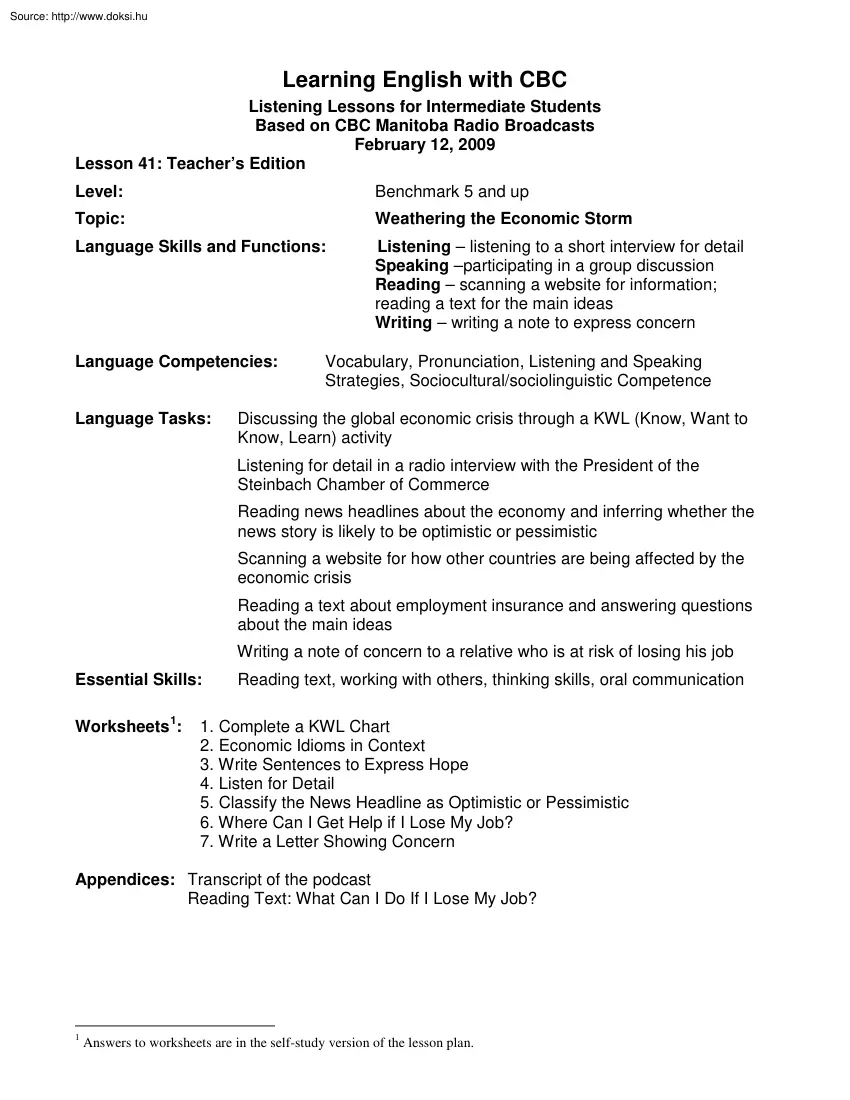
Learning English with CBC Listening Lessons for Intermediate Students Based on CBC Manitoba Radio Broadcasts February 12, 2009 Lesson 41: Teacher’s Edition Level: Benchmark 5 and up Topic: Weathering the Economic Storm Language Skills and Functions: Listening – listening to a short interview for detail Speaking –participating in a group discussion Reading – scanning a website for information; reading a text for the main ideas Writing – writing a note to express concern Language Competencies: Language Tasks: Vocabulary, Pronunciation, Listening and Speaking Strategies, Sociocultural/sociolinguistic Competence Discussing the global economic crisis through a KWL (Know, Want to Know, Learn) activity Listening for detail in a radio interview with the President of the Steinbach Chamber of Commerce Reading news headlines about the economy and inferring whether the news story is likely to be optimistic or pessimistic Scanning a website for how other countries are being
affected by the economic crisis Reading a text about employment insurance and answering questions about the main ideas Writing a note of concern to a relative who is at risk of losing his job Essential Skills: Worksheets 1: Reading text, working with others, thinking skills, oral communication 1. Complete a KWL Chart 2. Economic Idioms in Context 3. Write Sentences to Express Hope 4. Listen for Detail 5. Classify the News Headline as Optimistic or Pessimistic 6. Where Can I Get Help if I Lose My Job? 7. Write a Letter Showing Concern Appendices: Transcript of the podcast Reading Text: What Can I Do If I Lose My Job? 1 Answers to worksheets are in the self-study version of the lesson plan. Manitoba Memo It would be pretty hard to miss the fact that Canada, the United States and much of the world is in the midst of an economic crisis. The collapse of the US mortgage and housing market set the crisis in motion in the fall of 2008. It has moved like a tornado around the globe,
leaving a path of job losses, foreclosures, bankruptcies and hardship in its wake. Depressing economic news is reported daily. Consider these recent headlines: “Grim job stats across Canada” “U.S job losses pile on” “Africa, once thought immune, succumbs to global crisis” What does it all mean for Manitoba? Economists say the province isn’t bullet-proof, but they expect it to do relatively well. While there will be job losses, economists don’t expect Manitoba will see massive lay-offs like those taking place in Ontario, the United States and parts of Europe. Manitoba’s diversified economy doesn’t rely heavily on any one sector This means that even if some sectors are lagging behind, other sectors continue to do well or even expand their business operations. It’s this diversification that will help protect Manitoba from the more severe effects of the economic downturn. Can Manitoba weather the current economic storm? In the words of a local manufacturer, “This
economy’s a bit like driving in the fog. When you drive in the fog, you slow down, but you keep going.” Pre-listening activities 1. K-W-L (Know, Want to Know, Learned) on the global economic crisis Have students work in small groups to complete Worksheet 1. Ask the groups to write down what they already know about the effects of the global economic crisis in column one. Then ask the groups to brainstorm questions for column two – what do they want to know about this crisis and how it could affect their lives? Tell students that at the end of the lesson (or in upcoming class if more research is required), the class will work together to complete column three on what they have learned. 2. Understanding Economic Idioms in Context Tell students that news and conversation about the state of the economy is full of idioms. You see them in news headlines and news stories Hand out Worksheet 2 and review it with students. Ask students to remain in their groups and brainstorm what each
idiom means based on the context of the sentences provided. Weathering the Economic Storm Learning English with CBC Page 2 of 19 3. Vocabulary Elicit or present key vocabulary that students need to understand prior to listening to the podcast (see suggested vocabulary and explanations which follow). You can write the words on the board and elicit possible meanings from the class or break students into groups and give each group a few words to review. Groups can then present the vocabulary to the rest of the class. You can also ask students to mark the syllables and stress for each word, identify word families and practise pronouncing the words. You may want to ask students to think of sentences that use the new vocabulary. If your students keep a vocabulary journal, they can copy the vocabulary into their journal. Vocabulary plunged A quick and significant fall or drop in something. For example, car sales have plunged or dropped significantly since the economic downturn began.
Steinbach The City of Steinbach is a hub of economic activity in southeastern Manitoba. It is also known as Manitoba’s automobile city. hard data Statistics and numbers which support a conclusion. If a report provides hard data, facts or statistics, it is assumed to be accurate. dealer Dealers are the owners of the businesses that sell cars and other vehicles to consumers. These businesses are known as dealerships. forecast To look ahead and try to predict something. For example, business owners and economists are often asked to forecast or predict whether the economy will improve or worsen. (Unfortunately, with the latest crisis, it has become almost as difficult to forecast economic trends as it is to forecast weather trends!) diverse Varied and very different from each other. A diverse economy has many different sectors. It does not rely on one major sector. pharmaceutical manufacturer A company that makes legal drugs which are sold over the counter in drugstores or
prescribed by doctors. an indicator If something is an indicator of something, it is a sign or a signal of what is likely to happen. For example, plunging car sales in North America are an indicator or sign that the economy is in trouble. Weathering the Economic Storm Learning English with CBC Page 3 of 19 4. Predict what the podcast is about In this story, Terry McLeod interviews Paul Neustaedter, an automobile dealer who is also the president of the Steinbach Chamber of Commerce. According to Paul, vehicle sales in Steinbach are higher than they were a year ago. This is opposite to what’s happening in other communities. Ask students to speculate on why Steinbach seems to be “bucking the trend.” Here are some sentence starters to write on the board. Maybevehicle sales are up because there are a lot of good deals. Possibly it’s because the farming community around Steinbach had a good harvest. It could be because no one in Steinbach has lost his or her job. I wonder if
it’s because I have no idea why vehicle sales have increased. While-listening activities 1. Introduce the podcast Tell students that in this podcast, they will hear several speakers. They will hear: Marcy Markusa – host Terry McLeod – interviewer Paul Neustaedter – owner of an automobile dealership and president of the Steinbach Chamber of Commerce Play the podcast for the first time. 2. Listen for detail Hand out Worksheet 3. Review it with students and have them work in pairs to complete it. Take up the answers as a class. After-listening activities 1. Review pre-listening predictions Ask students if they were able to speculate correctly as to why vehicle sales were up in Steinbach. Weathering the Economic Storm Learning English with CBC Page 4 of 19 2. Expressing hope about ourselves and others Tell students that when we talk about the economy and jobs, we often use expressions where we express hope about others or ourselves. Hand out Worksheet 3 and review the
structures for expressing hope with students. Ask students to work with a partner to practice using these structures. Take up the answers as a class Expressing hope about ourselves Example I hope to keep my job. I hope (that) I keep my job. I hope (that) I will keep my job. Structure hope + infinitive. hope + noun clause (present tense) hope + noun clause (future tense) Expressing hope which is not about ourselves Example I hope (that) the stock market stabilizes. I hope (that) the stock market will stabilize. Structure hope + noun clause (present tense) hope + noun clause (future tense) Language Tip: The word “that” which introduces the noun clause does not have meaning. We often omit the word “that”, especially in spoken English Extension activities 1. Read headlines about the economy for inference Hand out Worksheet 5 and review it with students. Ask students to work with a partner to answer the questions. Discuss the answers as a class. 2. Scan a website for information
(optional, internet access required) Ask students to work individually or with a partner (preferably from the same country). Have students search for information on the internet about how the global economic situation is affecting their home country. They can do their research in English, or in their first language. Write the following questions on the board Do you think the economic crisis in your home country is more serious or less serious than in Canada? Why is that? Can you find one example of how your home country is being affected by the economic crisis? Ask students to share their findings with the class. Weathering the Economic Storm Learning English with CBC Page 5 of 19 3. Read a text about employment insurance (EI) for information and answer questions about the main ideas Tell students that even in good economic times, people may lose their job through no fault of their own. In Canada, if workers are paying employment insurance while they’re working, they may be
eligible to collect benefits if they lose their job. Hand out Appendix 2 and Worksheet 6 and review the instructions. Have students work with a partner or in small groups to read the information and answer the questions. 4. Write a note of concern to a relative who is at risk of losing his job Tell students that we are often in situations where we have to express hope, fear, concern or worry. In this scenario, students will write a letter to a relative in another province who may soon lose their job. Hand out and review Worksheet 7 Students can work in pairs for this activity but all students should write their own letter. Ask students to read their letters aloud. 5. Finish the K-W-L chart Return to the K-W-L chart and ask the class to complete the final column. Ask students which of the questions they wrote in column two about how the economic situation has been answered. If some remain unanswered, you may want to have students do internet research on these questions in a subsequent
class. Weathering the Economic Storm Learning English with CBC Page 6 of 19 Want to know more To learn more about the city of Steinbach, go to: http://www.steinbachca/ If you’d like more information on the Steinbach employers Mr. Neustaedter talks about in the interview, here are their websites: http://www.wsfabcom/ http://www.loewencom/ http://www.biovailcom/english/steinbach/ Students might enjoy trying CBC’s interactive map to track monthly unemployment figures in Canada (by province and major cities): http://www.cbcca/news/interactives/cp-unemployment/ The website for the CBC news program The National summarizes some of the services available for Canadians who are out of work or looking for work: http://www.cbcca/national/blog/special feature/hard times hard choices/help wanted online resources 1.html The Community Unemployed Help Centre website is: http://www.cuhcmbca/ Information on employment insurance, training and career development can be found on Service
Canada’s website: http://www.servicecanadagcca/eng/subjects/employment/indexshtml The Manitoba government’s website on jobs and careers can be found at: http://www.govmbca/employment/jobs careershtml (Note: CBC does not endorse and is not responsible for the content of external websites) Weathering the Economic Storm Learning English with CBC Page 7 of 19 Worksheet 1: Complete a KWL Chart One way to approach learning is to first think about what you already know. That helps create context for listening and reading activities. Discuss as a group what you know about the effects of the current global economic crisis. Summarize what you know in column one in point form. Are there things you would like to know about the crisis and how it could affect the lives of your families and friends? Write the things your group wants to know more about in column two. At the end of the class, or in a future class, you can complete the third column. 1: We know 2: We want to know 3: We
learned We know that. We want to know more about. We learned that Weathering the Economic Storm Learning English with CBC Page 8 of 19 Worksheet 2: Economic Idioms in Context News and conversation about the economy is full of idioms. You see them in news headlines and news stories. You will listen to and read several of them in this lesson Working with your group, read the following sentences. In each sentence, the idiom is in bold Based on the context, can you guess what the idiom means? Jot down your ideas and be ready to discuss them with the rest of the class. 1 (a) Manitoba’s economy is doing relatively well, but it’s not bullet-proof. Things that are happening around the globe will have an impact on the province. 1 (b) I think my job is virtually bullet-proof. My employer is still hiring and there’s an ongoing demand for the products we produce. We think bullet-proof means: 2 (a) Some communities in Manitoba are doing very well, despite the economic downturn. It
looks like they will be able to buck the trend. 2 (b) House prices in Winnipeg have begun to fall in the same way they have fallen in other markets. It doesn’t look as though the city will be able to buck the trend of falling house prices. We think buck the trend means: 3 (a) There are tons of bargains out there. Consumers are sharpening their pencils when they shop. They’re trying to get the very best deal they can 3 (b) If you’re thinking of buying a big ticket item like an appliance or a car, sharpen your pencil and make an offer. When manufacturers are hurting, they offer amazing deals You just have to be ready to take advantage of them. We think sharpen your pencil means: 4 (a) Manitoba’s diverse economy means the province is in a good position to weather the economic storm. Manitoba is unlikely to be hit as hard as other provinces 4 (b) Alberta is very dependent on oil and gas revenue, while Ontario is very dependent on the auto sector. With oil and gas prices
dropping and auto industry sales plunging, both provinces are very worried about how well they will be able to weather the economic storm. We think weather the economic storm means: Weathering the Economic Storm Learning English with CBC Page 9 of 19 Worksheet 3: Listen for Detail Sometimes when we listen, we hear the main ideas but we miss an important detail. These details may be short words that are unstressed, a prefix, an adjective and words such as “not” or “no”. When we miss these details, we may misunderstand what is being said. Read the statements below with your partner. When you listen this time, decide which of the options (in bold) gives the correct information about what happens in the story. Notice how the meaning of the sentence would be very different if the other option was chosen! The first one is completed for you as an example. 1. Steinbach’s economy {is experiencing / is not experiencing} the effects of the economic downturn. 2. Chrysler sales in
Steinbach { increased / decreased } in January 2009 in comparison to January 2008. 3. Paul Neustaedter { is / isn’t } certain why Dodge Chrysler sales in Steinbach have been better than the Canadian average. 4. Steinbach customers { expect / don’t expect } great deals 5. The lay-offs some Winnipeg companies are experiencing are { happening / not happening } in Steinbach. 6. Steinbach’s economy is { very / not very } diversified 7. The health of Steinbach’s economy is a { good / poor } indicator of whether Manitoba will be able to weather the economic storm. Weathering the Economic Storm Learning English with CBC Page 10 of 19 Worksheet 4: Expressing Hope When we talk about the economy and jobs, we often use expressions where we express hope about others or ourselves. Review the following chart and examples Then rewrite the sentences below using the correct structure. As you can see in the example, more than one structure will work in your answer. . Expressing hope about
ourselves Example I hope to keep my job. I hope (that) I keep my job. I hope (that) I will keep my job. Structure hope + infinitive. hope + noun clause (present tense) hope + noun clause (future tense) Expressing hope which is not about ourselves Example Structure I hope (that) the stock market stabilizes. hope + noun clause (present tense) I hope (that) the stock market will hope + noun clause (future tense) stabilize. 1. The Canadian economy should improve by 2010 I hope that the Canadian economy improves by 2010. I hope that the Canadian economy will improve by 2010. 2. I think I will have a job next year I hope 3. Once the economy improves, businesses will start investing again I hope 4. I think I qualify for employment insurance I hope 5. President Obama says saving and creating jobs is his government’s top priority I hope Weathering the Economic Storm Learning English with CBC Page 11 of 19 Worksheet 5: Classify the News Headlines as Optimistic or Pessimistic
Writing a good news headline is an art! Headlines often break the rules of formal English. They are short and written to get our attention. They often contain key words only They use idioms. They don’t always use capitalization in the way we might expect They are rarely sentences. You’ll hear people say, “I didn’t read the story, but I saw the headline.” People sometimes infer what a news story is about from the headline. Can you practice inferring the tone of the story from the headlines that follow? For each headline, decide whether you think the information in the story that follows is likely to be optimistic or pessimistic in tone. The first one is completed for you as an example. You can use your English Language Learner’s dictionary to help you with vocabulary. Classifications optimistic pessimistic O Based on the headline, we think the story will contain mostly positive economic news. Based on the headline, we think the story will contain mostly negative economic
news. P 1. Canada’s recession spreads to the storefront P 2. India Bucks Auto Trend as Rate Cuts Spur Suzuki Sales 3. Unemployment and inflation dim the glow of 30-year-old new dawn in Iran 4. Canada’s job losses set record 5. Asian markets up, buoyed by stimulus hopes 6. World stocks fall on grim company earnings 7. Recession-resistant jobs: Finding a new groove 8. Relax: The U.S consumer isn’t dead and buried 9. United States, Europe and Japan already in recession, head of IMF says 10. Fresh ideas help Loblaws turn fortunes around 11. Africa, once thought immune, succumbs to global crisis Weathering the Economic Storm Learning English with CBC Page 12 of 19 Worksheet 6: Where Can I Get Help if I Lose My Job? If you lose your job, it’s important to know where you can go for information about employment insurance benefits and to find out about other employment related services. Read Appendix 2 with your group and see if you can answer the questions
below. You can answer in point form 1. Where can you go to get information about employment insurance? 2. Who is eligible to receive employment insurance benefits? 3. What other assistance can Service Canada provide to someone who has lost his or her job? 4. What is the role of the Community Unemployed Help Centre? Weathering the Economic Storm Learning English with CBC Page 13 of 19
Worksheet 7: Write a Letter of Concern Scenario Your brother lives in southern Ontario. He works for an auto parts manufacturer Due to the plunge in automobile sales in North America, it is very likely he will be laid-off in the near future. He has a family to support and you are worried about his situation You decide to write to him and let him know how you are feeling. Here are some of the expressions you can use in your letter. The examples use each expression in context. Expression to be concerned about to be anxious about to be stressed out about to be worried about to be afraid that Weathering the Economic Storm Example Sentence People working in the auto industry are concerned about their jobs. I’m feeling anxious about the state of the economy. I don’t know what’s going to happen. Many retired people are stressed out about their pensions and RRSP’s. Their plans have really declined in value and they’re not sure if they have enough retirement savings. Are you
worried about finding a new job in these tough economic times? He’s afraid that his company is going to close its doors. Learning English with CBC Page 14 of 19 Write your letter using expressions that show concern. You may need more than one word to fill the blank. In some cases, more than one expression could be correct Choose the expression you would use if you were really writing to your brother! Date Dear : I have been watching the news about the plunging car sales across North America. I am very concerned about you and your family I’m you might lose your job. How are you feeling? Are you about the future? If you do lose your job, I hope that you and your family won’t be too and that you will be able to find a new job. I know you will be eligible for employment insurance, so that makes me feel a little less . But I am still that you may not
have enough money put away to be able to pay the bills. Here in Manitoba, the economy isn’t too bad. So far, I’m not my job. I think I will be able to keep my job and weather the economic downturn. I just wanted to let you know that we are thinking of you. We are all about you and your family. If you need our help at any time, please let us know. Yours sincerely, Weathering the Economic Storm Learning English with CBC Page 15 of 19 Appendix 1: Transcript February 12, 2009 Speaker Podcast Line Marcy Hi I'm Marcy Markusa and you're listening to Learning English with CBC. Well you can’t listen to a news report without hearing more bad news about Canada’s economy, especially the automobile sector. But some communities seem to be bucking the trend. In fact, that’s exactly what’s happening in Steinbach, 5 Manitoba, considered our automobile city. In this interview, Terry McLeod talks to Paul
Neustaedter, the owner of Steinbach Dodge Chrysler and the president of the local Chamber of Commerce. Find out what Neustaedter thinks is contributing to Steinbach’s ongoing economic success. Terry Morning Mr. Neustaedter Mr. Good morning. 10 Neustaedter Terry Now ah Chrysler announced recently that its sales year over year last January versus this one plunged 55 percent. How can things be better this year in Steinbach? 15 Mr. Wow, it’s it’s amazing, um I’m not sure why it’s ah so much Neustaedter better, that would be my answer to that. It’s we’re just being blessed so we’re thankful for ah, actually, an incredible sales increase in the month of January. Terry Now this is ah based on on hard data, not just on enthusiasm 20 for selling ah ah you know, Chryslers and Dodges? Mr. No, it’s based on hard data. Ya, the actual number was a Neustaedter hundred percent and ah that’s in hard data. Terry But are customers coming in though with really sharp
pencils, saying, look Paul, I need a really good deal on this? Give me great financing? Weathering the Economic Storm Learning English with CBC Page 16 of 19 25 Mr. (laughs) They are saying ah I hafta have a fantastic deal or I’m Neustaedter not gonna be doing this. Terry I mean are their pencils sharper than they were last year? Mr. Their pencils are sharper, they’re being very careful and they’re Neustaedter saying I’ve gotta have a fantastic deal so I think that some of 30 the consumers out there are looking at it and saying that, they’re recognizing that we’ve got the lowest prices in the automobile industry and that’s for all dealers. Ahm, we’ve got the lowest prices in the last ten years. It’s just, the deals are 35 fantastic because the manufacturers, y’know we all know, they’re under they’re under pressure to perform and to keep the factories busy. Terry Well ah, what’s what’s your forecast as to how long this this can (2:58)
last? As you know we we were just talking about challenges at 40 Pizza Hut for example or ah lay-offs at The Bay. Is it your sense that this this is gonna come to roost in Steinbach eventually? Mr. Ah no, I look at the community that we’re in and the people that Neustaedter we have here. I look at the ah local jobshopca and the amount of employment that’s available and I look at the employers that I 45 speak to, they’re still lookin’ for people to work here. Um we’ve got a very diverse economy here, from, everything from a farming sector, to a large pharmaceutical manufacturer, Biovail, to Loewen, which is a great ah North American producer of windows, to W.S Machine They just finished hiring 70 to 80 employees and expanding by 50,000 square feet. Terry Well ah that’s all great news and y’know they say, in terms of economies around Manitoba and around the world, Manitoba’s is probably the strongest to weather this, so you’re an indicator. Weathering the
Economic Storm Learning English with CBC Page 17 of 19 50 Appendix 2: What Can I Do if I Lose My Job? What are the first steps for an unemployed person to take in finding employment? When a person loses their job, their first step should be to get as much information as possible about options from various sources, including the Government of Canada. The Government of Canada is responsible for the Employment Insurance (EI) Program. You can find information on the federal government’s Service Canada's website. 2 Or you can call their telephone line at 1 800 206-7218. You can also visit a Service Canada Centre in a community near you. Information and assistance is available free of charge Am I eligible for employment insurance? Service Canada agents can review your particular situation and determine your eligibility to receive employment insurance (EI). Benefits are paid to those who, through no fault of their own, find themselves out of a job. If you are fired from your job
or quit, it is unlikely you will be eligible. There are different rules and regulations for EI benefits. It is important to discuss your specific situation with a Service Canada agent. Generally speaking, to qualify for regular benefits you: • • Must be ready, willing and capable of working each day of your claim Have worked a specific number of hours (depending on the region in which you live and other factors) in the last 52 weeks or up to your last EI claim. What other services and training programs are available? Service Canada can refer you to a variety of programs and services offered by all levels of government. They can help you find information related to your occupation, other career options, training, education or retirement. They can help you find information on labour markets, career searches, and resume building. They offer programs to help you upgrade your skills, train for a new occupation, get on-the-job experience, find a job or become self-employed. There are
also training initiatives for Older Workers to ensure that they can continue to use their hard earned skills and experience. 2 The Service Canada website address is http://www.servicecanadagcca/eng/subjects/employment/indexshtml Weathering the Economic Storm Learning English with CBC Page 18 of 19 What if I have a problem with my EI claim? The Community Unemployed Help Centre (CUHC) is a non-profit organization primarily dedicated to providing information, advice and representation to unemployed workers in Manitoba experiencing employment insurance problems. The Community Unemployed Help Centre advocates for people having problems with E.I They also provide E.I information to the public and help with counseling and referrals You can find out more about their work on their website 3. Or you can call them at 9426556 in Winnipeg or toll free at 1-866-942-6556 All services are provided free of charge. 3 The Community Unemployed Help Centre website address is
http://www.cuhcmbca/indexhtml Weathering the Economic Storm Learning English with CBC Page 19 of 19
affected by the economic crisis Reading a text about employment insurance and answering questions about the main ideas Writing a note of concern to a relative who is at risk of losing his job Essential Skills: Worksheets 1: Reading text, working with others, thinking skills, oral communication 1. Complete a KWL Chart 2. Economic Idioms in Context 3. Write Sentences to Express Hope 4. Listen for Detail 5. Classify the News Headline as Optimistic or Pessimistic 6. Where Can I Get Help if I Lose My Job? 7. Write a Letter Showing Concern Appendices: Transcript of the podcast Reading Text: What Can I Do If I Lose My Job? 1 Answers to worksheets are in the self-study version of the lesson plan. Manitoba Memo It would be pretty hard to miss the fact that Canada, the United States and much of the world is in the midst of an economic crisis. The collapse of the US mortgage and housing market set the crisis in motion in the fall of 2008. It has moved like a tornado around the globe,
leaving a path of job losses, foreclosures, bankruptcies and hardship in its wake. Depressing economic news is reported daily. Consider these recent headlines: “Grim job stats across Canada” “U.S job losses pile on” “Africa, once thought immune, succumbs to global crisis” What does it all mean for Manitoba? Economists say the province isn’t bullet-proof, but they expect it to do relatively well. While there will be job losses, economists don’t expect Manitoba will see massive lay-offs like those taking place in Ontario, the United States and parts of Europe. Manitoba’s diversified economy doesn’t rely heavily on any one sector This means that even if some sectors are lagging behind, other sectors continue to do well or even expand their business operations. It’s this diversification that will help protect Manitoba from the more severe effects of the economic downturn. Can Manitoba weather the current economic storm? In the words of a local manufacturer, “This
economy’s a bit like driving in the fog. When you drive in the fog, you slow down, but you keep going.” Pre-listening activities 1. K-W-L (Know, Want to Know, Learned) on the global economic crisis Have students work in small groups to complete Worksheet 1. Ask the groups to write down what they already know about the effects of the global economic crisis in column one. Then ask the groups to brainstorm questions for column two – what do they want to know about this crisis and how it could affect their lives? Tell students that at the end of the lesson (or in upcoming class if more research is required), the class will work together to complete column three on what they have learned. 2. Understanding Economic Idioms in Context Tell students that news and conversation about the state of the economy is full of idioms. You see them in news headlines and news stories Hand out Worksheet 2 and review it with students. Ask students to remain in their groups and brainstorm what each
idiom means based on the context of the sentences provided. Weathering the Economic Storm Learning English with CBC Page 2 of 19 3. Vocabulary Elicit or present key vocabulary that students need to understand prior to listening to the podcast (see suggested vocabulary and explanations which follow). You can write the words on the board and elicit possible meanings from the class or break students into groups and give each group a few words to review. Groups can then present the vocabulary to the rest of the class. You can also ask students to mark the syllables and stress for each word, identify word families and practise pronouncing the words. You may want to ask students to think of sentences that use the new vocabulary. If your students keep a vocabulary journal, they can copy the vocabulary into their journal. Vocabulary plunged A quick and significant fall or drop in something. For example, car sales have plunged or dropped significantly since the economic downturn began.
Steinbach The City of Steinbach is a hub of economic activity in southeastern Manitoba. It is also known as Manitoba’s automobile city. hard data Statistics and numbers which support a conclusion. If a report provides hard data, facts or statistics, it is assumed to be accurate. dealer Dealers are the owners of the businesses that sell cars and other vehicles to consumers. These businesses are known as dealerships. forecast To look ahead and try to predict something. For example, business owners and economists are often asked to forecast or predict whether the economy will improve or worsen. (Unfortunately, with the latest crisis, it has become almost as difficult to forecast economic trends as it is to forecast weather trends!) diverse Varied and very different from each other. A diverse economy has many different sectors. It does not rely on one major sector. pharmaceutical manufacturer A company that makes legal drugs which are sold over the counter in drugstores or
prescribed by doctors. an indicator If something is an indicator of something, it is a sign or a signal of what is likely to happen. For example, plunging car sales in North America are an indicator or sign that the economy is in trouble. Weathering the Economic Storm Learning English with CBC Page 3 of 19 4. Predict what the podcast is about In this story, Terry McLeod interviews Paul Neustaedter, an automobile dealer who is also the president of the Steinbach Chamber of Commerce. According to Paul, vehicle sales in Steinbach are higher than they were a year ago. This is opposite to what’s happening in other communities. Ask students to speculate on why Steinbach seems to be “bucking the trend.” Here are some sentence starters to write on the board. Maybevehicle sales are up because there are a lot of good deals. Possibly it’s because the farming community around Steinbach had a good harvest. It could be because no one in Steinbach has lost his or her job. I wonder if
it’s because I have no idea why vehicle sales have increased. While-listening activities 1. Introduce the podcast Tell students that in this podcast, they will hear several speakers. They will hear: Marcy Markusa – host Terry McLeod – interviewer Paul Neustaedter – owner of an automobile dealership and president of the Steinbach Chamber of Commerce Play the podcast for the first time. 2. Listen for detail Hand out Worksheet 3. Review it with students and have them work in pairs to complete it. Take up the answers as a class. After-listening activities 1. Review pre-listening predictions Ask students if they were able to speculate correctly as to why vehicle sales were up in Steinbach. Weathering the Economic Storm Learning English with CBC Page 4 of 19 2. Expressing hope about ourselves and others Tell students that when we talk about the economy and jobs, we often use expressions where we express hope about others or ourselves. Hand out Worksheet 3 and review the
structures for expressing hope with students. Ask students to work with a partner to practice using these structures. Take up the answers as a class Expressing hope about ourselves Example I hope to keep my job. I hope (that) I keep my job. I hope (that) I will keep my job. Structure hope + infinitive. hope + noun clause (present tense) hope + noun clause (future tense) Expressing hope which is not about ourselves Example I hope (that) the stock market stabilizes. I hope (that) the stock market will stabilize. Structure hope + noun clause (present tense) hope + noun clause (future tense) Language Tip: The word “that” which introduces the noun clause does not have meaning. We often omit the word “that”, especially in spoken English Extension activities 1. Read headlines about the economy for inference Hand out Worksheet 5 and review it with students. Ask students to work with a partner to answer the questions. Discuss the answers as a class. 2. Scan a website for information
(optional, internet access required) Ask students to work individually or with a partner (preferably from the same country). Have students search for information on the internet about how the global economic situation is affecting their home country. They can do their research in English, or in their first language. Write the following questions on the board Do you think the economic crisis in your home country is more serious or less serious than in Canada? Why is that? Can you find one example of how your home country is being affected by the economic crisis? Ask students to share their findings with the class. Weathering the Economic Storm Learning English with CBC Page 5 of 19 3. Read a text about employment insurance (EI) for information and answer questions about the main ideas Tell students that even in good economic times, people may lose their job through no fault of their own. In Canada, if workers are paying employment insurance while they’re working, they may be
eligible to collect benefits if they lose their job. Hand out Appendix 2 and Worksheet 6 and review the instructions. Have students work with a partner or in small groups to read the information and answer the questions. 4. Write a note of concern to a relative who is at risk of losing his job Tell students that we are often in situations where we have to express hope, fear, concern or worry. In this scenario, students will write a letter to a relative in another province who may soon lose their job. Hand out and review Worksheet 7 Students can work in pairs for this activity but all students should write their own letter. Ask students to read their letters aloud. 5. Finish the K-W-L chart Return to the K-W-L chart and ask the class to complete the final column. Ask students which of the questions they wrote in column two about how the economic situation has been answered. If some remain unanswered, you may want to have students do internet research on these questions in a subsequent
class. Weathering the Economic Storm Learning English with CBC Page 6 of 19 Want to know more To learn more about the city of Steinbach, go to: http://www.steinbachca/ If you’d like more information on the Steinbach employers Mr. Neustaedter talks about in the interview, here are their websites: http://www.wsfabcom/ http://www.loewencom/ http://www.biovailcom/english/steinbach/ Students might enjoy trying CBC’s interactive map to track monthly unemployment figures in Canada (by province and major cities): http://www.cbcca/news/interactives/cp-unemployment/ The website for the CBC news program The National summarizes some of the services available for Canadians who are out of work or looking for work: http://www.cbcca/national/blog/special feature/hard times hard choices/help wanted online resources 1.html The Community Unemployed Help Centre website is: http://www.cuhcmbca/ Information on employment insurance, training and career development can be found on Service
Canada’s website: http://www.servicecanadagcca/eng/subjects/employment/indexshtml The Manitoba government’s website on jobs and careers can be found at: http://www.govmbca/employment/jobs careershtml (Note: CBC does not endorse and is not responsible for the content of external websites) Weathering the Economic Storm Learning English with CBC Page 7 of 19 Worksheet 1: Complete a KWL Chart One way to approach learning is to first think about what you already know. That helps create context for listening and reading activities. Discuss as a group what you know about the effects of the current global economic crisis. Summarize what you know in column one in point form. Are there things you would like to know about the crisis and how it could affect the lives of your families and friends? Write the things your group wants to know more about in column two. At the end of the class, or in a future class, you can complete the third column. 1: We know 2: We want to know 3: We
learned We know that. We want to know more about. We learned that Weathering the Economic Storm Learning English with CBC Page 8 of 19 Worksheet 2: Economic Idioms in Context News and conversation about the economy is full of idioms. You see them in news headlines and news stories. You will listen to and read several of them in this lesson Working with your group, read the following sentences. In each sentence, the idiom is in bold Based on the context, can you guess what the idiom means? Jot down your ideas and be ready to discuss them with the rest of the class. 1 (a) Manitoba’s economy is doing relatively well, but it’s not bullet-proof. Things that are happening around the globe will have an impact on the province. 1 (b) I think my job is virtually bullet-proof. My employer is still hiring and there’s an ongoing demand for the products we produce. We think bullet-proof means: 2 (a) Some communities in Manitoba are doing very well, despite the economic downturn. It
looks like they will be able to buck the trend. 2 (b) House prices in Winnipeg have begun to fall in the same way they have fallen in other markets. It doesn’t look as though the city will be able to buck the trend of falling house prices. We think buck the trend means: 3 (a) There are tons of bargains out there. Consumers are sharpening their pencils when they shop. They’re trying to get the very best deal they can 3 (b) If you’re thinking of buying a big ticket item like an appliance or a car, sharpen your pencil and make an offer. When manufacturers are hurting, they offer amazing deals You just have to be ready to take advantage of them. We think sharpen your pencil means: 4 (a) Manitoba’s diverse economy means the province is in a good position to weather the economic storm. Manitoba is unlikely to be hit as hard as other provinces 4 (b) Alberta is very dependent on oil and gas revenue, while Ontario is very dependent on the auto sector. With oil and gas prices
dropping and auto industry sales plunging, both provinces are very worried about how well they will be able to weather the economic storm. We think weather the economic storm means: Weathering the Economic Storm Learning English with CBC Page 9 of 19 Worksheet 3: Listen for Detail Sometimes when we listen, we hear the main ideas but we miss an important detail. These details may be short words that are unstressed, a prefix, an adjective and words such as “not” or “no”. When we miss these details, we may misunderstand what is being said. Read the statements below with your partner. When you listen this time, decide which of the options (in bold) gives the correct information about what happens in the story. Notice how the meaning of the sentence would be very different if the other option was chosen! The first one is completed for you as an example. 1. Steinbach’s economy {is experiencing / is not experiencing} the effects of the economic downturn. 2. Chrysler sales in
Steinbach { increased / decreased } in January 2009 in comparison to January 2008. 3. Paul Neustaedter { is / isn’t } certain why Dodge Chrysler sales in Steinbach have been better than the Canadian average. 4. Steinbach customers { expect / don’t expect } great deals 5. The lay-offs some Winnipeg companies are experiencing are { happening / not happening } in Steinbach. 6. Steinbach’s economy is { very / not very } diversified 7. The health of Steinbach’s economy is a { good / poor } indicator of whether Manitoba will be able to weather the economic storm. Weathering the Economic Storm Learning English with CBC Page 10 of 19 Worksheet 4: Expressing Hope When we talk about the economy and jobs, we often use expressions where we express hope about others or ourselves. Review the following chart and examples Then rewrite the sentences below using the correct structure. As you can see in the example, more than one structure will work in your answer. . Expressing hope about
ourselves Example I hope to keep my job. I hope (that) I keep my job. I hope (that) I will keep my job. Structure hope + infinitive. hope + noun clause (present tense) hope + noun clause (future tense) Expressing hope which is not about ourselves Example Structure I hope (that) the stock market stabilizes. hope + noun clause (present tense) I hope (that) the stock market will hope + noun clause (future tense) stabilize. 1. The Canadian economy should improve by 2010 I hope that the Canadian economy improves by 2010. I hope that the Canadian economy will improve by 2010. 2. I think I will have a job next year I hope 3. Once the economy improves, businesses will start investing again I hope 4. I think I qualify for employment insurance I hope 5. President Obama says saving and creating jobs is his government’s top priority I hope Weathering the Economic Storm Learning English with CBC Page 11 of 19 Worksheet 5: Classify the News Headlines as Optimistic or Pessimistic
Writing a good news headline is an art! Headlines often break the rules of formal English. They are short and written to get our attention. They often contain key words only They use idioms. They don’t always use capitalization in the way we might expect They are rarely sentences. You’ll hear people say, “I didn’t read the story, but I saw the headline.” People sometimes infer what a news story is about from the headline. Can you practice inferring the tone of the story from the headlines that follow? For each headline, decide whether you think the information in the story that follows is likely to be optimistic or pessimistic in tone. The first one is completed for you as an example. You can use your English Language Learner’s dictionary to help you with vocabulary. Classifications optimistic pessimistic O Based on the headline, we think the story will contain mostly positive economic news. Based on the headline, we think the story will contain mostly negative economic
news. P 1. Canada’s recession spreads to the storefront P 2. India Bucks Auto Trend as Rate Cuts Spur Suzuki Sales 3. Unemployment and inflation dim the glow of 30-year-old new dawn in Iran 4. Canada’s job losses set record 5. Asian markets up, buoyed by stimulus hopes 6. World stocks fall on grim company earnings 7. Recession-resistant jobs: Finding a new groove 8. Relax: The U.S consumer isn’t dead and buried 9. United States, Europe and Japan already in recession, head of IMF says 10. Fresh ideas help Loblaws turn fortunes around 11. Africa, once thought immune, succumbs to global crisis Weathering the Economic Storm Learning English with CBC Page 12 of 19 Worksheet 6: Where Can I Get Help if I Lose My Job? If you lose your job, it’s important to know where you can go for information about employment insurance benefits and to find out about other employment related services. Read Appendix 2 with your group and see if you can answer the questions
below. You can answer in point form 1. Where can you go to get information about employment insurance? 2. Who is eligible to receive employment insurance benefits? 3. What other assistance can Service Canada provide to someone who has lost his or her job? 4. What is the role of the Community Unemployed Help Centre? Weathering the Economic Storm Learning English with CBC Page 13 of 19
Worksheet 7: Write a Letter of Concern Scenario Your brother lives in southern Ontario. He works for an auto parts manufacturer Due to the plunge in automobile sales in North America, it is very likely he will be laid-off in the near future. He has a family to support and you are worried about his situation You decide to write to him and let him know how you are feeling. Here are some of the expressions you can use in your letter. The examples use each expression in context. Expression to be concerned about to be anxious about to be stressed out about to be worried about to be afraid that Weathering the Economic Storm Example Sentence People working in the auto industry are concerned about their jobs. I’m feeling anxious about the state of the economy. I don’t know what’s going to happen. Many retired people are stressed out about their pensions and RRSP’s. Their plans have really declined in value and they’re not sure if they have enough retirement savings. Are you
worried about finding a new job in these tough economic times? He’s afraid that his company is going to close its doors. Learning English with CBC Page 14 of 19 Write your letter using expressions that show concern. You may need more than one word to fill the blank. In some cases, more than one expression could be correct Choose the expression you would use if you were really writing to your brother! Date Dear : I have been watching the news about the plunging car sales across North America. I am very concerned about you and your family I’m you might lose your job. How are you feeling? Are you about the future? If you do lose your job, I hope that you and your family won’t be too and that you will be able to find a new job. I know you will be eligible for employment insurance, so that makes me feel a little less . But I am still that you may not
have enough money put away to be able to pay the bills. Here in Manitoba, the economy isn’t too bad. So far, I’m not my job. I think I will be able to keep my job and weather the economic downturn. I just wanted to let you know that we are thinking of you. We are all about you and your family. If you need our help at any time, please let us know. Yours sincerely, Weathering the Economic Storm Learning English with CBC Page 15 of 19 Appendix 1: Transcript February 12, 2009 Speaker Podcast Line Marcy Hi I'm Marcy Markusa and you're listening to Learning English with CBC. Well you can’t listen to a news report without hearing more bad news about Canada’s economy, especially the automobile sector. But some communities seem to be bucking the trend. In fact, that’s exactly what’s happening in Steinbach, 5 Manitoba, considered our automobile city. In this interview, Terry McLeod talks to Paul
Neustaedter, the owner of Steinbach Dodge Chrysler and the president of the local Chamber of Commerce. Find out what Neustaedter thinks is contributing to Steinbach’s ongoing economic success. Terry Morning Mr. Neustaedter Mr. Good morning. 10 Neustaedter Terry Now ah Chrysler announced recently that its sales year over year last January versus this one plunged 55 percent. How can things be better this year in Steinbach? 15 Mr. Wow, it’s it’s amazing, um I’m not sure why it’s ah so much Neustaedter better, that would be my answer to that. It’s we’re just being blessed so we’re thankful for ah, actually, an incredible sales increase in the month of January. Terry Now this is ah based on on hard data, not just on enthusiasm 20 for selling ah ah you know, Chryslers and Dodges? Mr. No, it’s based on hard data. Ya, the actual number was a Neustaedter hundred percent and ah that’s in hard data. Terry But are customers coming in though with really sharp
pencils, saying, look Paul, I need a really good deal on this? Give me great financing? Weathering the Economic Storm Learning English with CBC Page 16 of 19 25 Mr. (laughs) They are saying ah I hafta have a fantastic deal or I’m Neustaedter not gonna be doing this. Terry I mean are their pencils sharper than they were last year? Mr. Their pencils are sharper, they’re being very careful and they’re Neustaedter saying I’ve gotta have a fantastic deal so I think that some of 30 the consumers out there are looking at it and saying that, they’re recognizing that we’ve got the lowest prices in the automobile industry and that’s for all dealers. Ahm, we’ve got the lowest prices in the last ten years. It’s just, the deals are 35 fantastic because the manufacturers, y’know we all know, they’re under they’re under pressure to perform and to keep the factories busy. Terry Well ah, what’s what’s your forecast as to how long this this can (2:58)
last? As you know we we were just talking about challenges at 40 Pizza Hut for example or ah lay-offs at The Bay. Is it your sense that this this is gonna come to roost in Steinbach eventually? Mr. Ah no, I look at the community that we’re in and the people that Neustaedter we have here. I look at the ah local jobshopca and the amount of employment that’s available and I look at the employers that I 45 speak to, they’re still lookin’ for people to work here. Um we’ve got a very diverse economy here, from, everything from a farming sector, to a large pharmaceutical manufacturer, Biovail, to Loewen, which is a great ah North American producer of windows, to W.S Machine They just finished hiring 70 to 80 employees and expanding by 50,000 square feet. Terry Well ah that’s all great news and y’know they say, in terms of economies around Manitoba and around the world, Manitoba’s is probably the strongest to weather this, so you’re an indicator. Weathering the
Economic Storm Learning English with CBC Page 17 of 19 50 Appendix 2: What Can I Do if I Lose My Job? What are the first steps for an unemployed person to take in finding employment? When a person loses their job, their first step should be to get as much information as possible about options from various sources, including the Government of Canada. The Government of Canada is responsible for the Employment Insurance (EI) Program. You can find information on the federal government’s Service Canada's website. 2 Or you can call their telephone line at 1 800 206-7218. You can also visit a Service Canada Centre in a community near you. Information and assistance is available free of charge Am I eligible for employment insurance? Service Canada agents can review your particular situation and determine your eligibility to receive employment insurance (EI). Benefits are paid to those who, through no fault of their own, find themselves out of a job. If you are fired from your job
or quit, it is unlikely you will be eligible. There are different rules and regulations for EI benefits. It is important to discuss your specific situation with a Service Canada agent. Generally speaking, to qualify for regular benefits you: • • Must be ready, willing and capable of working each day of your claim Have worked a specific number of hours (depending on the region in which you live and other factors) in the last 52 weeks or up to your last EI claim. What other services and training programs are available? Service Canada can refer you to a variety of programs and services offered by all levels of government. They can help you find information related to your occupation, other career options, training, education or retirement. They can help you find information on labour markets, career searches, and resume building. They offer programs to help you upgrade your skills, train for a new occupation, get on-the-job experience, find a job or become self-employed. There are
also training initiatives for Older Workers to ensure that they can continue to use their hard earned skills and experience. 2 The Service Canada website address is http://www.servicecanadagcca/eng/subjects/employment/indexshtml Weathering the Economic Storm Learning English with CBC Page 18 of 19 What if I have a problem with my EI claim? The Community Unemployed Help Centre (CUHC) is a non-profit organization primarily dedicated to providing information, advice and representation to unemployed workers in Manitoba experiencing employment insurance problems. The Community Unemployed Help Centre advocates for people having problems with E.I They also provide E.I information to the public and help with counseling and referrals You can find out more about their work on their website 3. Or you can call them at 9426556 in Winnipeg or toll free at 1-866-942-6556 All services are provided free of charge. 3 The Community Unemployed Help Centre website address is
http://www.cuhcmbca/indexhtml Weathering the Economic Storm Learning English with CBC Page 19 of 19
 Kassán született, 1900. április 11-én. Apja Grosschmid Sándor ügyvéd, a kisebbségi magyarság sorsáról írt könyvet az első világháború után. Öccse, Radványi Géza, a későbbi neves filmrendező a Valahol Európában alkotója.Gimnáziumi tanulmányait Kassán és Eperjesen végezte, majd a fővárosba ment, és Török Gyula mellett dolgozott a Budapesti Naplónál. 1919-ben

