A doksi online olvasásához kérlek jelentkezz be!
A doksi online olvasásához kérlek jelentkezz be!
 2007 · 3 oldal (44 KB)
 angol
angol
 0
0
 2026. július 15.
 Jelentkezz be

 Beágyazás
Nincs még értékelés. Legyél Te az első!
Mit olvastak a többiek, ha ezzel végeztek?




Tartalmi kivonat
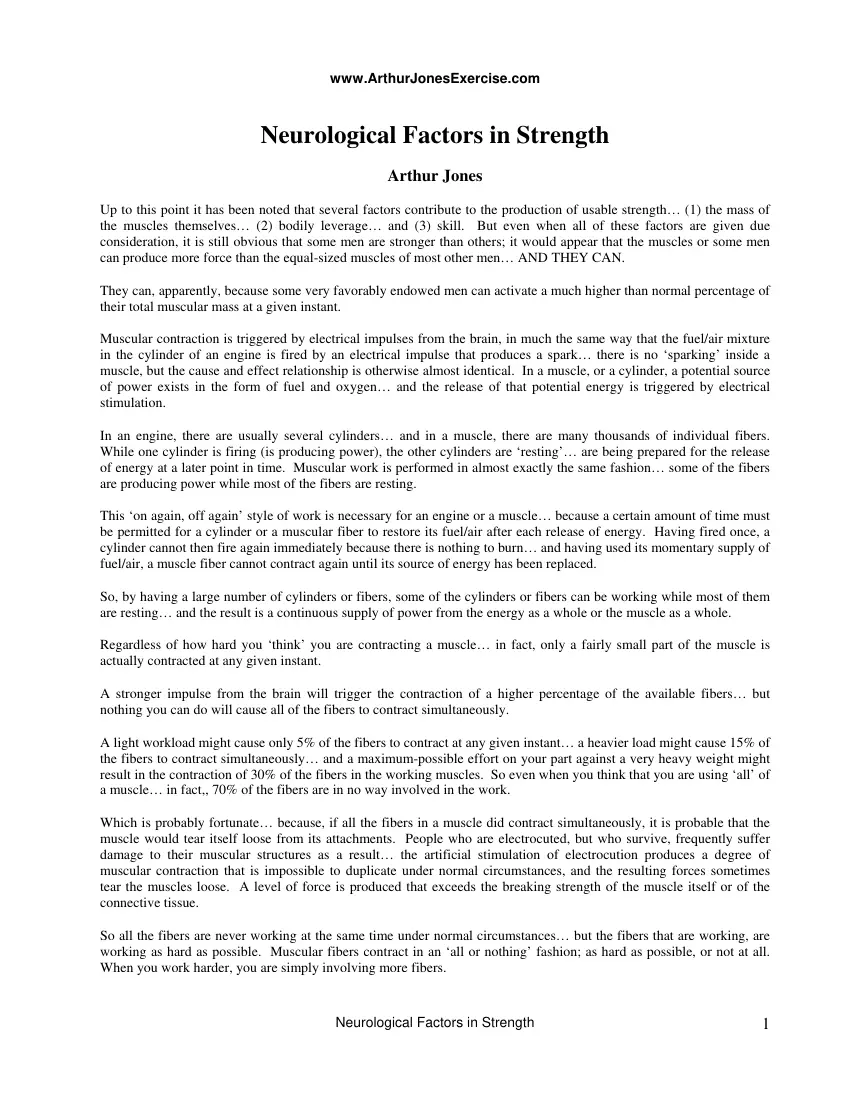
www.ArthurJonesExercisecom Neurological Factors in Strength Arthur Jones Up to this point it has been noted that several factors contribute to the production of usable strength (1) the mass of the muscles themselves (2) bodily leverage and (3) skill. But even when all of these factors are given due consideration, it is still obvious that some men are stronger than others; it would appear that the muscles or some men can produce more force than the equal-sized muscles of most other men AND THEY CAN. They can, apparently, because some very favorably endowed men can activate a much higher than normal percentage of their total muscular mass at a given instant. Muscular contraction is triggered by electrical impulses from the brain, in much the same way that the fuel/air mixture in the cylinder of an engine is fired by an electrical impulse that produces a spark there is no ‘sparking’ inside a muscle, but the cause and effect relationship is otherwise almost identical. In a muscle, or
a cylinder, a potential source of power exists in the form of fuel and oxygen and the release of that potential energy is triggered by electrical stimulation. In an engine, there are usually several cylinders and in a muscle, there are many thousands of individual fibers. While one cylinder is firing (is producing power), the other cylinders are ‘resting’ are being prepared for the release of energy at a later point in time. Muscular work is performed in almost exactly the same fashion some of the fibers are producing power while most of the fibers are resting. This ‘on again, off again’ style of work is necessary for an engine or a muscle because a certain amount of time must be permitted for a cylinder or a muscular fiber to restore its fuel/air after each release of energy. Having fired once, a cylinder cannot then fire again immediately because there is nothing to burn and having used its momentary supply of fuel/air, a muscle fiber cannot contract again until its source of
energy has been replaced. So, by having a large number of cylinders or fibers, some of the cylinders or fibers can be working while most of them are resting and the result is a continuous supply of power from the energy as a whole or the muscle as a whole. Regardless of how hard you ‘think’ you are contracting a muscle in fact, only a fairly small part of the muscle is actually contracted at any given instant. A stronger impulse from the brain will trigger the contraction of a higher percentage of the available fibers but nothing you can do will cause all of the fibers to contract simultaneously. A light workload might cause only 5% of the fibers to contract at any given instant a heavier load might cause 15% of the fibers to contract simultaneously and a maximum-possible effort on your part against a very heavy weight might result in the contraction of 30% of the fibers in the working muscles. So even when you think that you are using ‘all’ of a muscle in fact,, 70% of the
fibers are in no way involved in the work. Which is probably fortunate because, if all the fibers in a muscle did contract simultaneously, it is probable that the muscle would tear itself loose from its attachments. People who are electrocuted, but who survive, frequently suffer damage to their muscular structures as a result the artificial stimulation of electrocution produces a degree of muscular contraction that is impossible to duplicate under normal circumstances, and the resulting forces sometimes tear the muscles loose. A level of force is produced that exceeds the breaking strength of the muscle itself or of the connective tissue. So all the fibers are never working at the same time under normal circumstances but the fibers that are working, are working as hard as possible. Muscular fibers contract in an ‘all or nothing’ fashion; as hard as possible, or not at all When you work harder, you are simply involving more fibers. Neurological Factors in Strength 1
www.ArthurJonesExercisecom Muscles are equipped with ‘sensing devices’ that remain constantly aware of two factors (1) the momentary length of the muscle and (2) the force that is being applied against the muscle. If a muscle is suddenly pulled out of its normal, relaxed, position a so-called ‘strength reflex’ is activated. The strength of this reflex action depends upon three factors (1) the amount of stretching that is involved; that is to say, the distance that the muscle is stretched (2) the level of force that is imposed upon the muscle and (3) the speed-ofmovement of the muscular contraction that follows. If a muscle is rather quickly stretched by a heavy load, and if the amount of stretching pulls the muscle well beyond its normal length, and if the muscle then contracts rather slowly the resulting contraction will involve a much higher number of fibers than normal, and more force will be produced. Such ‘pre-stretching’ stretching of the muscle itself immediately
before contraction is thus an important factor in strength, and an equally important factor in exercise performed for the purpose of increasing strength. Stretching, for flexibility, is also important but stretching can be produced without heavy resistance. Pre-stretching is another factor entirely a very important part of exercise; but one that is not widely understood and one that is usually overlooked. In practical applications, we all make use of pre-stretching and the resulting stretch reflex in any number of ways, usually without even being aware that we are doing so, and seldom with any awareness of why we do so pulling back before delivering a blow, the back-swing in baseball or in golf, these and hundreds of other movements involve prestretching and the stretch reflex. YET in exercise, pre-stretching is usually not involved; but it should be, and a rather large part of the potential value of exercise is being missed if it isn’t involved. If an exercise movement is started
from a position that is not pre-stretched, then the resulting muscular contraction is not as intense as it could have been a lower number of fibers are involved. OR if the movement is performed too rapidly, with or without pre-stretching, then a lower number of fibers are involved. Obviously, then, an exercise movement should start from a pre-stretched position and the movement should be performed slowly and slowly, using as much resistance as possible for about 7 to 12 repetitions. But in practice, most trainees usually do one of two things both of which are wrong. They do not pre-stretch at all, starting their movements from a more or less relaxed position OR, they pre-stretch, but then relax and actually start the movement from a relaxed position. In either case the value of pre-stretching is missed If the intensity of exercise is low enough that is to say, if the percentage of muscular fibers that are involved at any given instant is low then such work can be continued almost
forever. Because the fibers that are resting so far outnumber the ones that are working at any given moment that fresh, rested fibers are always available to take over and continue the work when the working fibers become momentarily exhausted. Exercises performed at such a low intensity will do little or nothing to increase strength. The body provides additional strength by increasing the size of the muscle fibers but it does so only when additional strength is needed; and it judges this need on the basis of momentary use if the work that you require your muscles to perform is within their ability, then additional strength is not required, and none will be provided. 2 Neurological Factors in Strength www.ArthurJonesExercisecom But if you ask your muscles to perform work that is momentarily impossible, or at least VERY DIFFICULT then the body senses that it is not able to perform in proportion to the demands being made upon it, and it increases its strength in the only way it can.
By increasing the size of the muscle fibers Exercise will not give you the ability to involve a higher percentage of your muscle fibers in a maximum-possible contraction but it can make your muscle fibers larger, and the result will be the same; since larger fibers can produce more force. Some few men, by a fortunate accident of birth, have the ability to involve a higher than average percentage of their muscle fibers in an all-out effort and the result of such neurological superiority makes these men far stronger than average. AND, USUALLY having been far stronger than average throughout his life without much muscular size, it is almost impossible to convince such a man that larger muscles would help him in any way. In fact, many such men are firmly (and falsely) convinced that exercise would somehow hurt them. Outstanding athletes are usually neurologically superior men and they can perform well above average without much muscular mass; but they could perform even better with greater
muscle mass. AND just as some few men are neurologically superior, a few others are NEUROLOGICALLY INFERIOR; they cannot involve many of their muscle fibers at any given instant and will be weak even if given greater than average muscular mass. So again, neurological superiority (or inferiority) is a factor that we can do nothing about, cannot change but we can increase the strength of our muscles by increasing their size, and doing so will make us stronger, faster, and more capable in any athletic event. And we can also pay careful attention to the style of performance of our exercises in order to involve as high a percentage of the muscle fibers as possible. Such a proper style of exercise is certainly not easy and in some movements it isn’t very comfortable, either; so a natural inclination to ignore pre-stretching must be guarded against, even when a trainee is aware of its value. Neurological Factors in Strength 3
a cylinder, a potential source of power exists in the form of fuel and oxygen and the release of that potential energy is triggered by electrical stimulation. In an engine, there are usually several cylinders and in a muscle, there are many thousands of individual fibers. While one cylinder is firing (is producing power), the other cylinders are ‘resting’ are being prepared for the release of energy at a later point in time. Muscular work is performed in almost exactly the same fashion some of the fibers are producing power while most of the fibers are resting. This ‘on again, off again’ style of work is necessary for an engine or a muscle because a certain amount of time must be permitted for a cylinder or a muscular fiber to restore its fuel/air after each release of energy. Having fired once, a cylinder cannot then fire again immediately because there is nothing to burn and having used its momentary supply of fuel/air, a muscle fiber cannot contract again until its source of
energy has been replaced. So, by having a large number of cylinders or fibers, some of the cylinders or fibers can be working while most of them are resting and the result is a continuous supply of power from the energy as a whole or the muscle as a whole. Regardless of how hard you ‘think’ you are contracting a muscle in fact, only a fairly small part of the muscle is actually contracted at any given instant. A stronger impulse from the brain will trigger the contraction of a higher percentage of the available fibers but nothing you can do will cause all of the fibers to contract simultaneously. A light workload might cause only 5% of the fibers to contract at any given instant a heavier load might cause 15% of the fibers to contract simultaneously and a maximum-possible effort on your part against a very heavy weight might result in the contraction of 30% of the fibers in the working muscles. So even when you think that you are using ‘all’ of a muscle in fact,, 70% of the
fibers are in no way involved in the work. Which is probably fortunate because, if all the fibers in a muscle did contract simultaneously, it is probable that the muscle would tear itself loose from its attachments. People who are electrocuted, but who survive, frequently suffer damage to their muscular structures as a result the artificial stimulation of electrocution produces a degree of muscular contraction that is impossible to duplicate under normal circumstances, and the resulting forces sometimes tear the muscles loose. A level of force is produced that exceeds the breaking strength of the muscle itself or of the connective tissue. So all the fibers are never working at the same time under normal circumstances but the fibers that are working, are working as hard as possible. Muscular fibers contract in an ‘all or nothing’ fashion; as hard as possible, or not at all When you work harder, you are simply involving more fibers. Neurological Factors in Strength 1
www.ArthurJonesExercisecom Muscles are equipped with ‘sensing devices’ that remain constantly aware of two factors (1) the momentary length of the muscle and (2) the force that is being applied against the muscle. If a muscle is suddenly pulled out of its normal, relaxed, position a so-called ‘strength reflex’ is activated. The strength of this reflex action depends upon three factors (1) the amount of stretching that is involved; that is to say, the distance that the muscle is stretched (2) the level of force that is imposed upon the muscle and (3) the speed-ofmovement of the muscular contraction that follows. If a muscle is rather quickly stretched by a heavy load, and if the amount of stretching pulls the muscle well beyond its normal length, and if the muscle then contracts rather slowly the resulting contraction will involve a much higher number of fibers than normal, and more force will be produced. Such ‘pre-stretching’ stretching of the muscle itself immediately
before contraction is thus an important factor in strength, and an equally important factor in exercise performed for the purpose of increasing strength. Stretching, for flexibility, is also important but stretching can be produced without heavy resistance. Pre-stretching is another factor entirely a very important part of exercise; but one that is not widely understood and one that is usually overlooked. In practical applications, we all make use of pre-stretching and the resulting stretch reflex in any number of ways, usually without even being aware that we are doing so, and seldom with any awareness of why we do so pulling back before delivering a blow, the back-swing in baseball or in golf, these and hundreds of other movements involve prestretching and the stretch reflex. YET in exercise, pre-stretching is usually not involved; but it should be, and a rather large part of the potential value of exercise is being missed if it isn’t involved. If an exercise movement is started
from a position that is not pre-stretched, then the resulting muscular contraction is not as intense as it could have been a lower number of fibers are involved. OR if the movement is performed too rapidly, with or without pre-stretching, then a lower number of fibers are involved. Obviously, then, an exercise movement should start from a pre-stretched position and the movement should be performed slowly and slowly, using as much resistance as possible for about 7 to 12 repetitions. But in practice, most trainees usually do one of two things both of which are wrong. They do not pre-stretch at all, starting their movements from a more or less relaxed position OR, they pre-stretch, but then relax and actually start the movement from a relaxed position. In either case the value of pre-stretching is missed If the intensity of exercise is low enough that is to say, if the percentage of muscular fibers that are involved at any given instant is low then such work can be continued almost
forever. Because the fibers that are resting so far outnumber the ones that are working at any given moment that fresh, rested fibers are always available to take over and continue the work when the working fibers become momentarily exhausted. Exercises performed at such a low intensity will do little or nothing to increase strength. The body provides additional strength by increasing the size of the muscle fibers but it does so only when additional strength is needed; and it judges this need on the basis of momentary use if the work that you require your muscles to perform is within their ability, then additional strength is not required, and none will be provided. 2 Neurological Factors in Strength www.ArthurJonesExercisecom But if you ask your muscles to perform work that is momentarily impossible, or at least VERY DIFFICULT then the body senses that it is not able to perform in proportion to the demands being made upon it, and it increases its strength in the only way it can.
By increasing the size of the muscle fibers Exercise will not give you the ability to involve a higher percentage of your muscle fibers in a maximum-possible contraction but it can make your muscle fibers larger, and the result will be the same; since larger fibers can produce more force. Some few men, by a fortunate accident of birth, have the ability to involve a higher than average percentage of their muscle fibers in an all-out effort and the result of such neurological superiority makes these men far stronger than average. AND, USUALLY having been far stronger than average throughout his life without much muscular size, it is almost impossible to convince such a man that larger muscles would help him in any way. In fact, many such men are firmly (and falsely) convinced that exercise would somehow hurt them. Outstanding athletes are usually neurologically superior men and they can perform well above average without much muscular mass; but they could perform even better with greater
muscle mass. AND just as some few men are neurologically superior, a few others are NEUROLOGICALLY INFERIOR; they cannot involve many of their muscle fibers at any given instant and will be weak even if given greater than average muscular mass. So again, neurological superiority (or inferiority) is a factor that we can do nothing about, cannot change but we can increase the strength of our muscles by increasing their size, and doing so will make us stronger, faster, and more capable in any athletic event. And we can also pay careful attention to the style of performance of our exercises in order to involve as high a percentage of the muscle fibers as possible. Such a proper style of exercise is certainly not easy and in some movements it isn’t very comfortable, either; so a natural inclination to ignore pre-stretching must be guarded against, even when a trainee is aware of its value. Neurological Factors in Strength 3
 Megmutatjuk, hogyan lehet hatékonyan tanulni az iskolában, illetve otthon. Áttekintjük, hogy milyen a jó jegyzet tartalmi, terjedelmi és formai szempontok szerint egyaránt. Végül pedig tippeket adunk a vizsga előtti tanulással kapcsolatban, hogy ne feltétlenül kelljen beleőszülni a felkészülésbe.
