A doksi online olvasásához kérlek jelentkezz be!
A doksi online olvasásához kérlek jelentkezz be!
 2008 · 2 oldal (16 KB)
 magyar
 186
186
 2008. szeptember 10.
 Bejelentkezés szükséges

 Beágyazás
Nincs még értékelés. Legyél Te az első!





Tartalmi kivonat
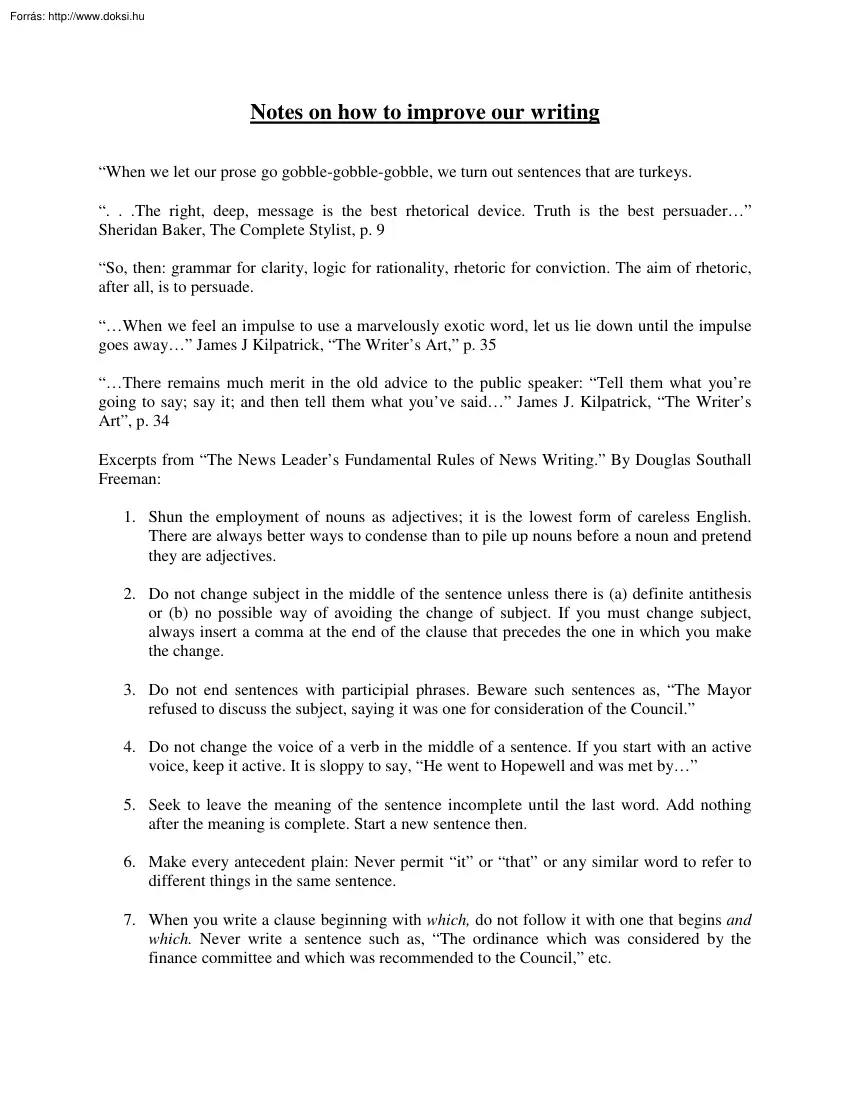
Notes on how to improve our writing “When we let our prose go gobble-gobble-gobble, we turn out sentences that are turkeys. “. The right, deep, message is the best rhetorical device Truth is the best persuader” Sheridan Baker, The Complete Stylist, p. 9 “So, then: grammar for clarity, logic for rationality, rhetoric for conviction. The aim of rhetoric, after all, is to persuade. “When we feel an impulse to use a marvelously exotic word, let us lie down until the impulse goes away” James J Kilpatrick, “The Writer’s Art,” p. 35 “There remains much merit in the old advice to the public speaker: “Tell them what you’re going to say; say it; and then tell them what you’ve said” James J. Kilpatrick, “The Writer’s Art”, p. 34 Excerpts from “The News Leader’s Fundamental Rules of News Writing.” By Douglas Southall Freeman: 1. Shun the employment of nouns as adjectives; it is the lowest form of careless English There are always better ways to condense
than to pile up nouns before a noun and pretend they are adjectives. 2. Do not change subject in the middle of the sentence unless there is (a) definite antithesis or (b) no possible way of avoiding the change of subject. If you must change subject, always insert a comma at the end of the clause that precedes the one in which you make the change. 3. Do not end sentences with participial phrases Beware such sentences as, “The Mayor refused to discuss the subject, saying it was one for consideration of the Council.” 4. Do not change the voice of a verb in the middle of a sentence If you start with an active voice, keep it active. It is sloppy to say, “He went to Hopewell and was met by” 5. Seek to leave the meaning of the sentence incomplete until the last word Add nothing after the meaning is complete. Start a new sentence then 6. Make every antecedent plain: Never permit “it” or “that” or any similar word to refer to different things in the same sentence. 7. When you
write a clause beginning with which, do not follow it with one that begins and which. Never write a sentence such as, “The ordinance which was considered by the finance committee and which was recommended to the Council,” etc. 8. In sentences where several nouns, phrases or clauses depend on the same verb, put the longer phrase or clause last. For instance, do not say, “He addressed the General Assembly, the members of the Corporation Commission, and the Governor.” 9. In conditional sentences, seek to put the conditional clause before the principal clause An if clause at the beginning of a sentence is better placed than at the end, unless the whole point of the sentence lies in the if. 10. Try to end every story with a strong, and, if possible, a short sentence
than to pile up nouns before a noun and pretend they are adjectives. 2. Do not change subject in the middle of the sentence unless there is (a) definite antithesis or (b) no possible way of avoiding the change of subject. If you must change subject, always insert a comma at the end of the clause that precedes the one in which you make the change. 3. Do not end sentences with participial phrases Beware such sentences as, “The Mayor refused to discuss the subject, saying it was one for consideration of the Council.” 4. Do not change the voice of a verb in the middle of a sentence If you start with an active voice, keep it active. It is sloppy to say, “He went to Hopewell and was met by” 5. Seek to leave the meaning of the sentence incomplete until the last word Add nothing after the meaning is complete. Start a new sentence then 6. Make every antecedent plain: Never permit “it” or “that” or any similar word to refer to different things in the same sentence. 7. When you
write a clause beginning with which, do not follow it with one that begins and which. Never write a sentence such as, “The ordinance which was considered by the finance committee and which was recommended to the Council,” etc. 8. In sentences where several nouns, phrases or clauses depend on the same verb, put the longer phrase or clause last. For instance, do not say, “He addressed the General Assembly, the members of the Corporation Commission, and the Governor.” 9. In conditional sentences, seek to put the conditional clause before the principal clause An if clause at the beginning of a sentence is better placed than at the end, unless the whole point of the sentence lies in the if. 10. Try to end every story with a strong, and, if possible, a short sentence
 Ahogy közeledik a történelem érettségi, sokan döbbennek rá, hogy nem készültek fel eléggé az esszéírás feladatra. Módszertani útmutatónkban kitérünk a történet térbeli és időbeli elhelyezésére, a források elemzésére és az eseményeket alakító tényezőkre is.

